In The News – July 25, 1906

Heavy winter rains in the Western District and the South-East of South Australia left Casterton awash in 1906.  As reported in The Border Watch on July 25, 1906, the Glenelg River reached record levels and evacuations took place.  There were also large stock losses.

I am still working out which “Mr. Jelly” carried people to safety.  My ggg grandfather was George Jelly of Casterton, but he passed away in 1896.  He had two sons still living at the time of the floods, William and John and they were both living in Casterton in 1906.

CASTERTON PARTLY SUBMERGED. (1906, July 25). Border Watch (Mount Gambier, SA : 1861 – 1954), p. 2. Retrieved July 25, 2012, from http://nla.gov.au/nla.news-article77582924

In The News – 8 February – 13 February 1901

I have an interest in the weather, not just for today or the coming weekend but also historically.  Participating in Melbourne University’s Climate History newspaper tagging project involving tagging Trove newspaper articles about weather events, it became evident the weather behaves in a cyclical nature.  If it has happened before it will happen again, droughts, floods, and storms.

Taking my interests a step further,  investigating how weather events affected my ancestors can add greatly to their story. That is why the Victorian bushfires of 1901 are of interest as the Byaduk district, where many of my ancestors lived, was heavily affected.  The weather was similar to two days in my lifetime,  Ash Wednesday on 16 February 1983 and  Black Saturday on 7 February 2009. On each day, fires blazed across Victoria.  

The first reports of fire came through on 8 February 1901.  The following article from The Argus describes the weather of 7 February 1901.  The descriptive language takes the reader to that day.  The heat was oppressive, the wind was strong and dust storms crossed the state, causing unnatural darkness.
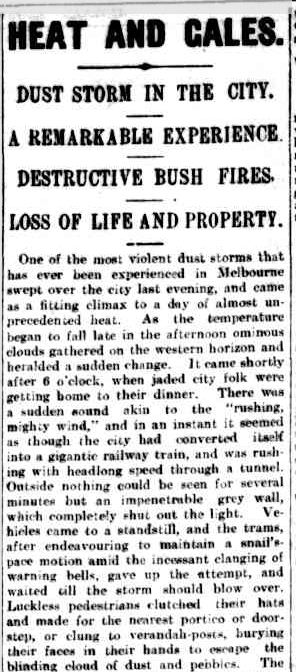
HEAT AND GALES. (1901, February 8). The Argus (Melbourne, Vic. : 1848 – 1956), p. 5. Retrieved January 29, 2012, from http://nla.gov.au/nla.news-article10533956

Fires had sprung up throughout the Western District.  Early reports from Branxholme were tragic with one death, stock killed and houses lost.  I have family links to three families who lost their homes, the Millers, Storers and Addinsalls.  George Miller, a racehorse trainer, lost his house and stables and no doubt his horses.

HEAT AND GALES. (1901, February 8). The Argus (Melbourne, Vic. : 1848 – 1956), p. 5. Retrieved January 29, 2012, from http://nla.gov.au/nla.news-article10533956

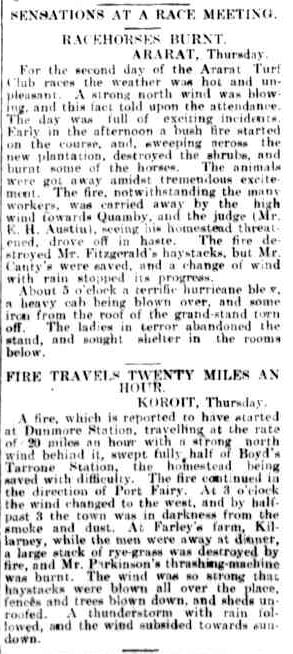
The two-day race meeting at Ararat was held in stifling conditions. A fire started at the course on the second day, with horses receiving burns.  Later the wind picked up and ripped iron off the grandstand roof, sending the ladies within running for shelter.

HEAT AND GALES. (1901, February 8). The Argus (Melbourne, Vic. : 1848 – 1956), p. 5. Retrieved January 29, 2012, from http://nla.gov.au/nla.news-article10533956

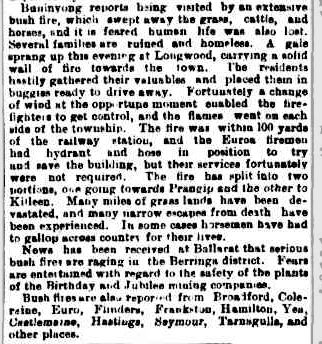
Fires started across Victoria including Warrnambool, Alexandra, Wangaratta, Buninyong, Yea, and Castlemaine.

DESTRUCTIVE BUSH FIRES IN VICTORIA. (1901, February 8). The Sydney Morning Herald (NSW : 1842 – 1954), p. 6. Retrieved January 30, 2012, from http://nla.gov.au/nla.news-article14337694

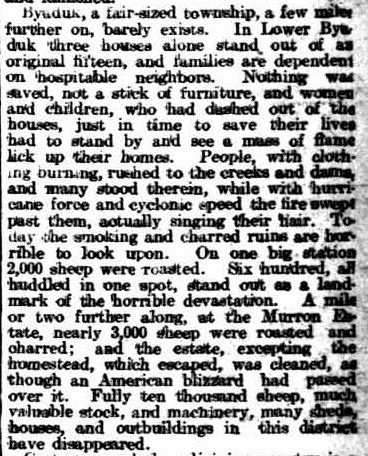
The articles below report on homes lost in the Byaduk district with Byaduk North worst hit.  My relatives were closer to Byaduk township further south and while they were lucky not to lose their homes it must have been terrifying all the same.  

The fire travelled at a great pace, coming within a mile of my ggg grandfather James Harman’s property Mount Pleasant, on the Hamilton-Port Fairy Road, reaching the properties of the Christie brothers just to the north. As well as James and his wife Susan Reed, my great-grandmother Sarah Elizabeth Harman, and her father Reuben James Harman were living at Byaduk but lived further south again in the Byaduk township.  Numerous other family members lived in the area from the Byaduk Caves through to the Byaduk township.  

TERRIBLE BUSH FIRES. (1901, February 9). The Advertiser (Adelaide, SA : 1889 – 1931), p. 7. Retrieved February 7, 2012, from http://nla.gov.au/nla.news-article4818069

DESTRUCTIVE BUSH FIRES. (1901, February 9). Bathurst Free Press and Mining Journal (NSW : 1851 – 1904), p. 2. Retrieved February 7, 2012, from http://nla.gov.au/nla.news-article64452557

The Hamilton Spectator reported twelve homes destroyed leaving just three standing in Byaduk North.  Most were close to the course of the Lyne Creek running to the west of the township. The Free Presbyterian Church was lost and the Byaduk North Hotel was under threat.  In the days after the fire, the hotel served as a refuge for the homeless.

BYADUK NORTH HOTEL c1906. Image courtesy of the Museums Victoria Collections http://collections.museumvictoria.com.au/items/766487

BYADUK NORTH HOTEL c1906. Image courtesy of the Museums Victoria Collections http://collections.museumvictoria.com.au/items/766487

The homestead of Richard Thomas Carty at Brisbane Hill, a large property to the north of Byaduk North, was destroyed.  While running for the creek, after escaping the homestead, Mrs Carty’s dress caught fire but it was fortunately quelled.  The Cartys rebuilt and the replacement homestead Dunroe still stands today.

"ALONG MACARTHUR ROAD." Hamilton Spectator (Vic. : 1870 - 1918) 9 February 1901 .

“ALONG MACARTHUR ROAD.” Hamilton Spectator (Vic. : 1870 – 1918) 9 February 1901 <http://nla.gov.au/nla.news-article226087594&gt;.

"THE VICTORIAN BUSH FIRES." Australian Town and Country Journal (Sydney, NSW : 1870 - 1907) 23 February 1901: .

“THE VICTORIAN BUSH FIRES.” Australian Town and Country Journal (Sydney, NSW : 1870 – 1907) 23 February 1901: <http://nla.gov.au/nla.news-article71463761&gt;.

The fire burnt through the Monivae Estate with a large loss to fences and livestock and burnt within a mile of Hamilton.  On the other side of town, closer to the Coleraine railway line, the Hamilton Racecourse fell just short of the fire’s path.

"MANY FAMILIES HOMELESS." Leader (Melbourne, Vic. : 1862 - 1918) 9 Feb 1901: 18. .

“MANY FAMILIES HOMELESS.” Leader (Melbourne, Vic. : 1862 – 1918) 9 Feb 1901: 18. <http://nla.gov.au/nla.news-article198084151&gt;.

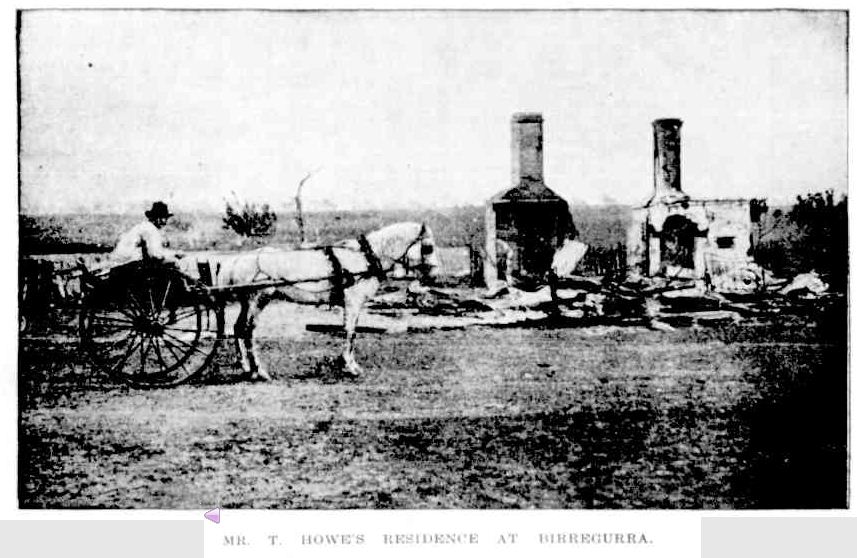
Other areas throughout the Western District felt the brunt of fire on 7 February 1901.  This photograph from Birregurra shows the devastation in that town.

THE VICTORIAN BUSH FIRES. (1901, February 23). Australian Town and Country Journal (NSW : 1870 – 1907), p. 38. Retrieved February 7, 2012, from http://nla.gov.au/nla.news-article71463761

Portland was also under threat with fire circling the town.  The fire did not stop until it met the sea.

VICTORIAN BUSH FIRES. (1901, February 11). The Advertiser (Adelaide, SA : 1889 – 1931), p. 5. Retrieved February 7, 2012, from http://nla.gov.au/nla.news-article4818536

Buninyong near Ballarat was one of the worst areas hit.

BUSH FIRES IN VICTORIA. (1901, February 9). The West Australian (Perth, WA : 1879 – 1954), p. 3. Retrieved February 7, 2012, from http://nla.gov.au/nla.news-article23853766

THE VICTORIAN BUSH FIRES. (1901, February 23). Australian Town and Country Journal (NSW : 1870 – 1907), p. 38. Retrieved February 7, 2012, from http://nla.gov.au/nla.news-article71463761

Macarthur had losses as did Princetown on the south coast.  At Timboon, bullock teams from the local sawmill were lost.

FIRES IN VICTORIA. (1901, February 12). South Australian Register (Adelaide, SA : 1839 - 1900), p. 6. Retrieved February 7, 2012, from http://nla.gov.au/nla.news-article54558042

FIRES IN VICTORIA. (1901, February 12). South Australian Register (Adelaide, SA : 1839 – 1900), p. 6. Retrieved February 7, 2012, from http://nla.gov.au/nla.news-article54558042

By 11 January, aid for the homeless was on the agenda and at Branxholme a public meeting was held to discuss such matters.  Authorities discovered the fire near Branxholme, which was probably the same fire to hit Byaduk, was accidentally started by a travelling tinsmith fixing a trough at Ardachy Estate.

THE BUSH FIRES. (1901, February 11). The Argus (Melbourne, Vic. : 1848 – 1956), p. 5. Retrieved February 7, 2012, from http://nla.gov.au/nla.news-article10534297

A meeting was called at Byaduk for 18 February 1901, and James Harman donated £2 2/ to the fund for the homeless.

"BUSH FIRE BELIEF FUNDS." Hamilton Spectator (Vic. : 1870 - 1918) 21 February 1901: .

“BUSH FIRE BELIEF FUNDS.” Hamilton Spectator (Vic. : 1870 – 1918) 21 February 1901: <http://nla.gov.au/nla.news-article226090204&gt;.

The fire was so strong and relentless, old residents were drawing comparisons to Black Thursday almost fifty years earlier to the day on 6 February 1851.

TELEGRAPHIC. (1901, February 12). Kalgoorlie Western Argus (WA : 1896 – 1916), p. 32. Retrieved February 7, 2012, from http://nla.gov.au/nla.news-article32205605


Histories of South-West Towns

I often look at the ABC Local radio websites, but usually only a page a link has led me to.  Recently I found myself on the ABC South West Victoria website and decided to look around.  I discovered a series of radio interviews by Jeremy Lee entitled A-Z of the South West.  Recorded in 2010, the aim was to highlight the history of towns in the region.  The good news is that there are 45 towns featured, not just 26.  The towns include Macarthur, Caramut, Port Campbell, Branxholme, and Casterton.

They are great interviews with local residents and historians, some have lived in their town all their life.  Topics covered include town beginnings, past businesses, local attractions, prominent residents, and the future outlook. I enjoyed Jim Kent talking about Casterton and his own contribution to the local population, 11 children, 40 grandchildren, and 16 great-grandchildren.  There are photos of each town too.

An understanding of local history is important when researching a family. It can explain why a family chose to settle in a town.  For example, Peter Watt talks of how Cavendish was a town of workers.  Many residents, both male, and female worked for the large stations close to the town such as Mokanger and Kenilworth.  Aside from a sawmill,  a couple of shops, and a pub, there was no other employment opportunities except for the stations.  Two of my families, the Haddens and Mortimers, went to Cavendish primarily to work at Mokanger station and they remained there most of their working lives.

The various ABC websites are a great resource.  I have since looked closer at some of the other ABC local radio websites and found that you can search by topic.  Clicking on the  “Community & Society” tab brings up a list of sub-topics, including “History”.  ABC Western Victoria currently has 86 history-related stories available.  I have also subscribed to an RSS feed of stories tagged “history” so I don’t miss any.  Or take 15 months to stumble across.

To listen to the interviews follow the link:

http://www.abc.net.au/local/stories/2011/06/03/3234418.htm?site=southwestvic

Witness for the Prosecution

Searching old newspapers has uncovered three family members who were either mentioned or were witnesses at three separate murder trials.  They were my ggg grandmother, a cousin and to my surprise, my grandfather.

The earliest of these was known at the time as the “Casterton Murders“. My ggg grandmother Margaret Ann Turner, (Mrs Diwell)  was mentioned at an inquest in February 1860, which ended with Casterton man, George Waines, being placed on trial for the murder of Robert and Mary Hunt, also of Casterton.

The Hunts had not been seen for several months, with many believing they had left the colony.  George Waines claimed he had brought furniture off them, but rumours spread around the town that George may have been responsible for their disappearance.  The local police investigated and were unable to find the Hunts in the other colonies or New Zealand.

Margaret was mentioned in evidence by Dugald Campbell –

THE CASTERTON MURDER. (1860, February 3). Portland Guardian and Normanby General Advertiser (Vic. : 1842 – 1876), p. 2 Edition: EVENINGS.. Retrieved August 11, 2011, from http://nla.gov.au/nla.news-article64513414

This was a gruesome murder, but it captured the attention of people around Australia.  I found sixty articles from four states.  Many are detailed, including forensic evidence, a letter to the editor from the autopsy surgeon and George’s confession.  He was eventually hung at Melbourne Gaol.

The second murder trial had it all.  A small country town, married Methodist preacher, a young, single,  grazier’s daughter, and arsenic.  A search at Trove for “Omeo 1928” brings up hundreds of articles and I found a Western District connection.

Ronald Griggs moved to Omeo to take up the role of Methodist minister, moving into the residence with wife Ethel.  Originally from Tasmania,  Ronald and Ethel were welcomed into the community by the elders of the church including John Condon and his wife Frances.

OMEO MURDER CASE. (1928, March 8). The Register (Adelaide, SA : 1901 – 1929), p. 9. Retrieved August 11, 2011, from http://nla.gov.au/nla.news-article57042062

GRIGGS NOT GUILTY. (1928, April 21). The Canberra Times (ACT : 1926 – 1954), p. 1. Retrieved August 11, 2011, from http://nla.gov.au/nla.news-article1228707

After meeting John and Frances’ daughter Lottie,  Ronald (left) was a regular visitor to the Condon property.  Ethel was pushed to the outer and after giving birth to their first child, she returned to Tasmania spend time with her parents.

Ronald and Lottie’s “meetings’ became more frequent, but Ethel, (right) inconveniently for Ronald, returned to Omeo.  Only days later, she fell ill and died after several days of severe pain.  Thanks to a suspicious local policeman, the case was taken further and Ethel’s body was exhumed for an autopsy.  Arsenic was present in her body.  Ronald was charged with murder.

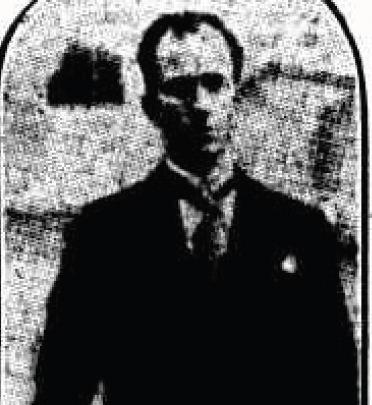
Henry Harman was the son of Walter Harman and grandson of Joseph Harman.  He was a well known Ensay grazier and Omeo Methodist church elder.  Henry was called to give evidence against Ronald Griggs, a man he described as a friend.

OMEO WOMAN’S DEATH. (1928, February 29). The Argus (Melbourne, Vic. : 1848 – 1956), p. 24. Retrieved August 11, 2011, from http://nla.gov.au/nla.news-article3914287

I  found a photo of Henry, along with some of the other key witnesses, in the Barrier Miner, a NSW paper which continues to reward me with articles about my Western Victorian family.  It is becoming a reliable but most unlikely source.

WITNESSES AT THE OMEO INQUIRY INTO THE DEATH OF MRS. ETHEL CONSTANCE GRIGGS (1928, March 2). Barrier Miner (Broken Hill, NSW : 1888 – 1954), p. 4. http://nla.gov.au/nla.news-article46008416″%5D

After two trials, the jury retired to decide its verdict.  According to the Canberra Times, thousands waited on the street outside the court to hear the decision.  Ronald Griggs was acquitted, however, his infamy dogged him.  He changed his name and continued to preach, but as his photo was seen around the country, he was found out.  He struggled to find work and the newspapers followed him for months after.

The Western District connection? Henry was born in Byaduk in 1880 as was his sister Susannah Nash Harman.  Susannah married  William Condon, a cousin of Lottie’s father John.  The Condons first settled in the Portland area, before some of the family moved to Omeo.  Lottie’s mother Frances Ethel Huggins was born at Macarthur in 1883 and she and some of her siblings moved to the Omeo area around 1888.  Around the same time, Henry’s father Walter Harman took his family from the Macarthur district to the High Country.

For more reading about the case, there is a book by Reg Egan,  Lottie: A love affair with a man of God and the cruel death that shocked Australia with Henry Harman a key character.  Murder case aside, it offers an insight into life in a small Victorian town in the 1920s.  I have also a public list of newspaper articles at Trove on the case under the heading “Griggs murder

Finally, the “Body under the staircase” trial of fishmonger Thomas Garrity, charged with the murder of widow Rose Harvey on April 28, 1931.  Rose had met up with Garrity for a few drinks at a local hotel and they returned by tram to the residence adjoining Garrity’s shop in Port Melbourne.  Police later found Rose’s body stuffed in a cupboard under the stairs of the residence.

Percy Riddiford was a 27-year-old, single man from Ballarat,  boarding at his brother’s home in Port Melbourne.  He worked on the trams, based at the Camberwell depot and happened to be working the day Thomas Garrity and Rose Harvey travelled his route.  As a result, he was required to appear as a witness to assist in determining the movements of Garrity on that day.

BODY UNDER STAIRCASE. (1931, May 20). The Argus (Melbourne, Vic. : 1848 – 1956), p. 9. Retrieved August 10, 2011, from http://nla.gov.au/nla.news-article4400320

Garrity claimed that unknown men had visited his home on that night, proceeded to get him drunk then robbed his till.  He claimed they must have killed Rose.  The judge considered Garrity could not have put her body under the stairs without help and reduced his charge to manslaughter.  He received eighteen months jail with hard labour.  Garrity pleaded his innocence after sentencing.

This was an event in my grandfather’s life he kept to himself.  The first my father and uncles had heard of it was when I told them of the articles I had found.  He was one to keep things to himself,  so it was good to find out something of his early life.

Elizabeth Ann Jelly

Richard & Elizabeth Diwell and family

This is Richard and Elizabeth Diwell and their family in the spring of 1900 in Hamilton.  The eldest child, Margaret was nineteen and the youngest, Martha was two. Elizabeth, at forty-four, was in the last months of pregnancy and was radiant.  Martha’s hand rests comfortably on her mother’s growing stomach.  Edith clutches the arm of father Richard, a successful bricklayer and keen gardener, a member of the Hamilton Horticulture Society.  Chrysanthemums were one of his specialities.  Within months, this serene family scene was shattered.

Richard Diwell and Elizabeth Jelly married in June 1877 at Casterton.  Richard, born at Portland in 1854 was the son of William and Margaret Diwell and was their first child born on Australian soil after their arrival in 1853 aboard the Duke of Richmond.  William too was a bricklayer.  Elizabeth was the daughter of  George and Jane Jelly and like William was her parents’ first born in Australia.  They had arrived in 1855 on the Athletae and moved to Casterton where Elizabeth was born in 1856.

Sadness came early in Richard and Elizabeth’s marriage with their first born child, Ada Jane, dying within her first year of life.  Six more children, Margaret, William, Jane, Ralph, Edith and Ernest were born in Casterton over the next eleven years until 1891.  It was in that year that Elizabeth, her mother and sister-in-law, Annabella McIntyre, signed the Victorian Women’s Suffrage Petition along with one hundred other Casterton women.  It was their contribution to the cause championing for equal voting rights for women.

Later in 1891, the Diwells moved to Hamilton.  The following year tragedy would occur again with the passing of five-year-old Ralph.  In 1893, Ethel was born and another pregnancy in 1895 saw the birth of Rebecca but she sadly died in 1896 aged ten months.  George was born in 1896, Martha in 1898.

Which brings us back to 1900.  Despite the losses of the past, life was continuing on for the Diwells.  In March, William was voting in favour of the cancellation of that month’s Hamilton Horticulture Society flower show due to drought and Elizabeth was pregnant for the 12th time at the age of forty-four.

Midway through October Elizabeth fell ill in and was nursed for the next three weeks until she gave birth to a daughter on 2 November.  The baby was weak and died two days later.  Elizabeth was also gravely ill and underwent an operation after the birth of the baby.  She battled to stay but succumbed to peritonitis ten days later, on 12 November.

Elizabeth’s obituary from the Hamilton Spectator on 13 November 1900 read:

“… Another death which has evoked the deepest sympathy of all who knew her took place yesterday when Mrs Diwell, the wife of Mr Richard Diwell, bricklayer of this town, died after a short illness.  The deceased was the second daughter of Mr George Jelly of Casterton where she was born, and she came to Hamilton with her husband in 1891. 

She was taken ill three weeks ago and on the 2nd instance she was confined, the child living only two days.  On Sunday evening she had to undergo an operation as the only hope of saving her life but at 3 o’clock yesterday morning she died of exhaustion, the diagnosis being peritonitis. 

She leaves a husband and eight children – three boys and five girls – the eldest of who, a daughter is only nineteen years of age – to mourn their irreparable loss. Mrs Diwell who was only 44 years of age was highly respected by all who knew her and the deepest sympathy is felt with the stricken family in their bereavement.  The funeral will take place a 3 o’clock this afternoon”

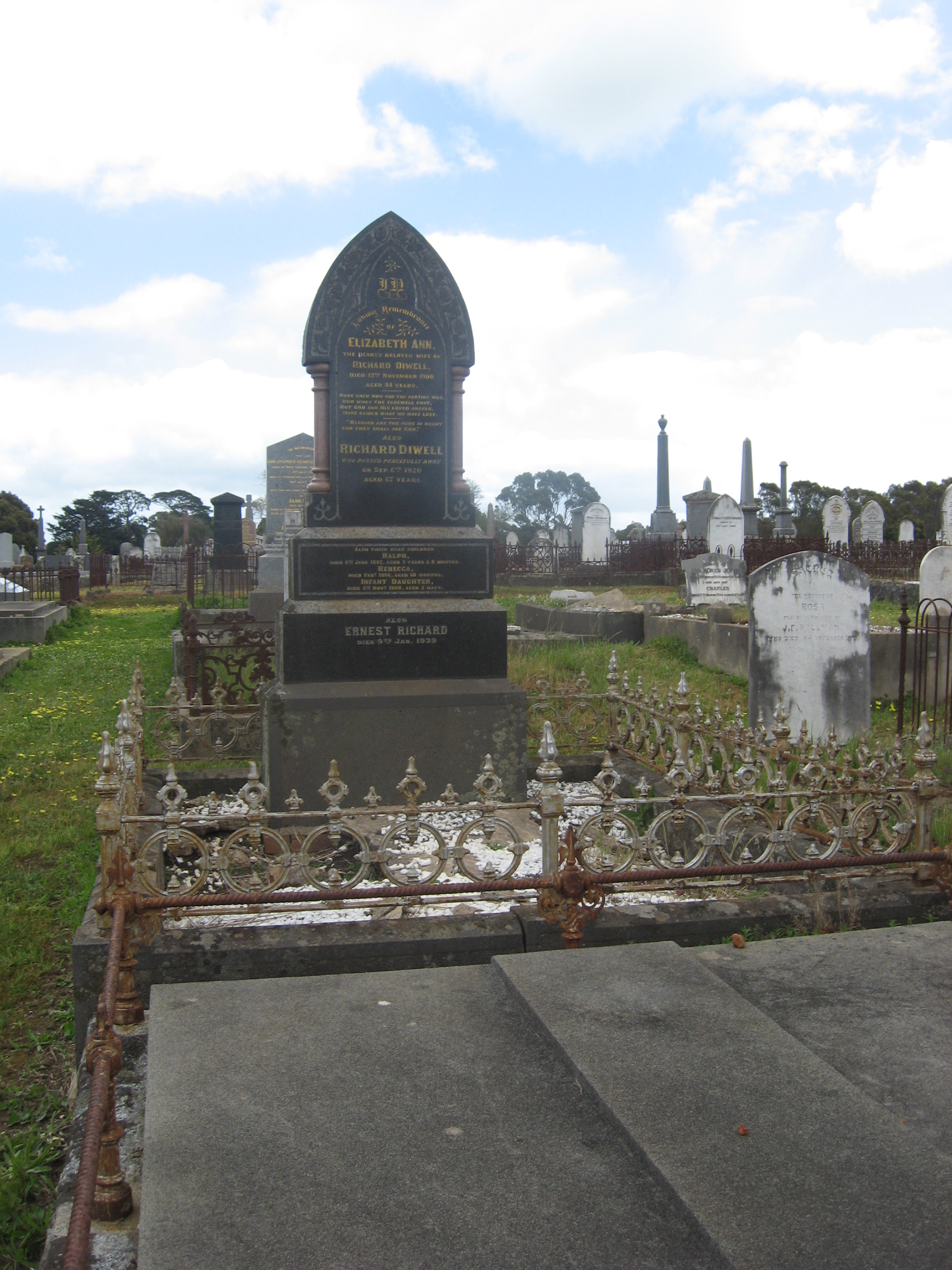
The headstone in the Hamilton Old Cemetery is a tribute to Elizabeth and demonstrates the devotion Richard and her children had for her.  Her headstone read:

“None knew how sad parting was, nor what the farewell cost, but God and his loved angels have gained what we have lost”


Despite having several young children, Richard never remarried.  The older girls Margaret and Jane would have taken on mothering duties of their younger siblings.  Margaret married in 1905, but Jane did not marry until 1915 at thirty by which time youngest Martha was seventeen.  Richard passed away in 1920 and was reunited with Elizabeth.

Life was not altogether easy for the Diwell children, although they always managed a happy disposition.  Margaret had seven children, however, three died, two as newborns.  Edith, my great-grandmother, suffered through an unhappy marriage and spent much time as a single mother.  Jane married twice, both husbands dying, the second after being hit by a taxi.  She never had children.

Grandma (Edith) and Auntie Mat (Martha)

Ethel had four known children, one dying at birth.  Martha or Mat as she was known was forty-one when she married and she also had no children.  The boys, William, Ernest and George all married and became bricklayers like their father and grandfather before them, but Ernest passed away at just forty-eight.

I was not lucky enough to know any members of this family but my mother fondly remembers and often talks of Grandma (Edith), Auntie Janey, Auntie Mat (Martha) and Uncles Bill and George.  The photo above of Grandma and Auntie Mat depicts them just as Mum remembers, always laughing and smiling.

As I look at the Diwell family photo I see Elizabeth as a devoted wife and mother but also a strong woman whose marriage was a partnership of two equals.  I can see the woman who was confident enough to sign the Suffrage petition and I see a happy, kind person, traits she passed to her children.

Next time I visit Richard and Elizabeth’s grave in Hamilton, I will be sure to take some Chrysanthemums.


©Merron Riddiford 2011


In the News – May 9, 1910

Recently the National Library of Australia released digital copies of The Portland Guardian onto their Trove website.  This is very exciting for those researching family links in the Western District and along with the Camperdown Chronicle, Trove users have an opportunity to find out more about their families.

I thought it right that today’s In the News should feature articles that appeared in The Portland Guardian on May 9, 1910.

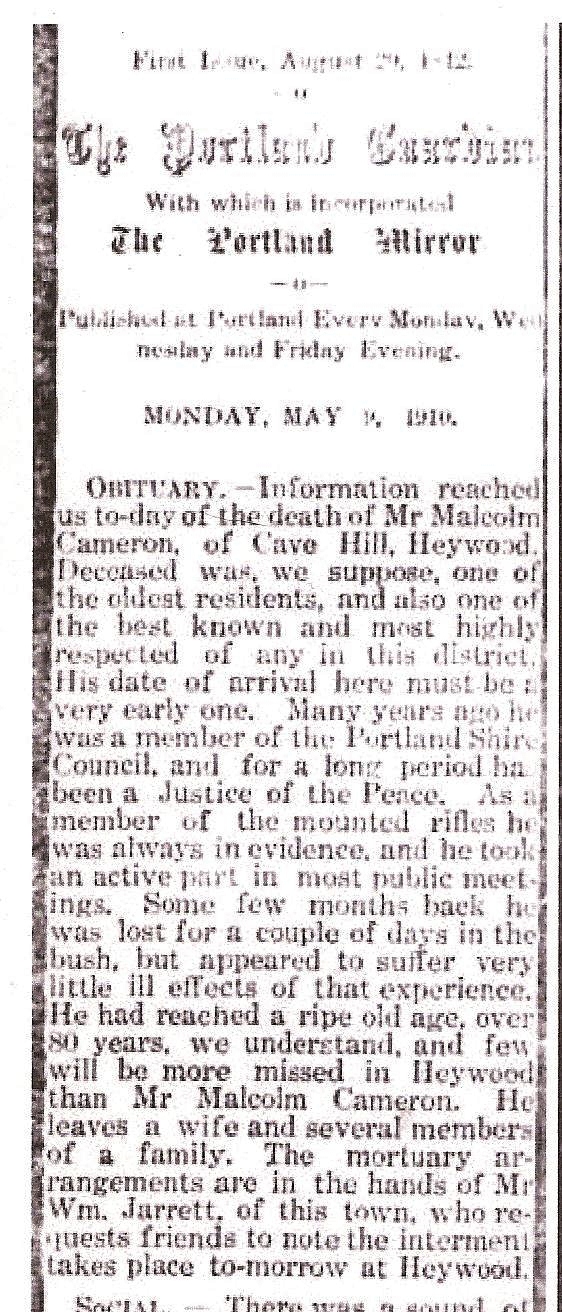
On page 2, the lead story is an Obituary for a long-time Heywood resident Malcolm Cameron.  I have some interest in Malcolm Cameron as he is the father in law of my first cousin four times removed, Emily Harman.

Obituary of Malcolm Cameron First Issue, August 20, 1842. The Portland Guardian. (1910, May 9). Portland Guardian (Vic. : 1876-1953), p. 2 Edition: EVENING. Retrieved May 9, 2011, from http://nla.gov.au/nla.news-article63977026

Malcolm was born in Perthshire, Scotland in around 1823.  There is a record for a Malcolm Douglas arriving on the “Glen Roy” in 1854.  Malcolm married fellow Scot Elizabeth Douglas in Victoria in 1860 and they had their first child, Fanny in 1861 at Heywood.  They had a further nine children over the subsequent 21 years.

From the obituary, it can be seen that Malcolm Cameron was active in the community as a JP and Councillor.  It mentions Malcolm was lost in the bush a few months earlier.  An article about this appeared in The Portland Guardian and other papers including The Argus on December 8, 1909

Malcolm’s son Malcolm Douglas Cameron was born in 1864 at “Cave Hill” near Heywood and married Emily Harman in 1900.  They had two sons, Oliver and Alan.

DEATH OF THE KING

An article on page 2 gives a hint on some major international news of the time.  The Portland Post office would be closed the afternoon of May 9 out of recognition of a day of mourning which had been announced throughout the Commonwealth on the passing of King Edward VII on May 7, 1910.

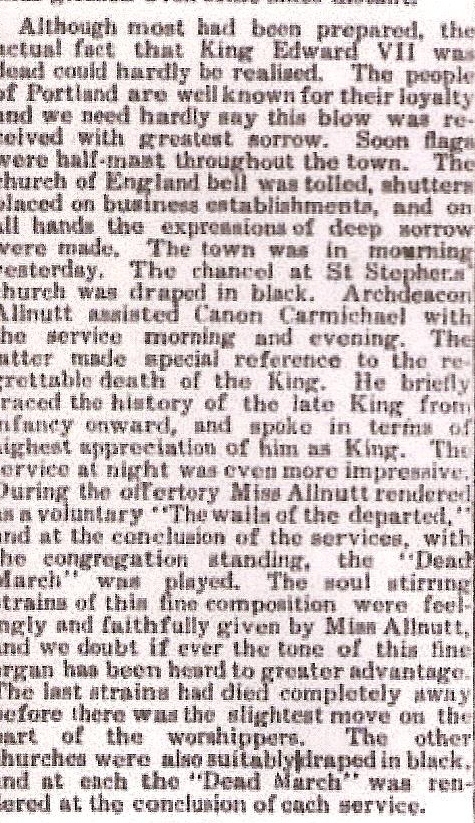
Death of King Death of the King. (1910, May 9). Portland Guardian (Vic. : 1876-1953), p. 3 Edition: EVENING. Retrieved May 9, 2011, from http://nla.gov.au/nla.news-article63977030

On page 3, the headlines proclaim, “Death of the King” with details of the king’s death and further on, the reaction of the Portland residents.

The people of Portland were sent into deep mourning according to this article with flags at half-mast and church bells tolling. Miss Allnutt, the organist who is mentioned in the article was a daughter of the minister of St Stephens Church at the time. Arch Deacon Allnutt was Minister for over 30 years.

THE UPS AND DOWNS OF SKATING

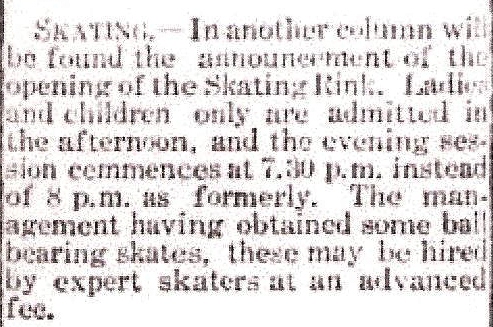
Skating appears to be a popular pastime of the late 19th Century and early 20th Century.  Two articles about skating appear on page 2, one announcing the opening of the Portland Skating rink and the second demonstrating the dangers of the sport.

The advertisement on the same page reveals skating was being held at the Free Library Hall and entry was sixpence.  Unless of course one was an expert and wished to try the more advanced ball-bearing skates!

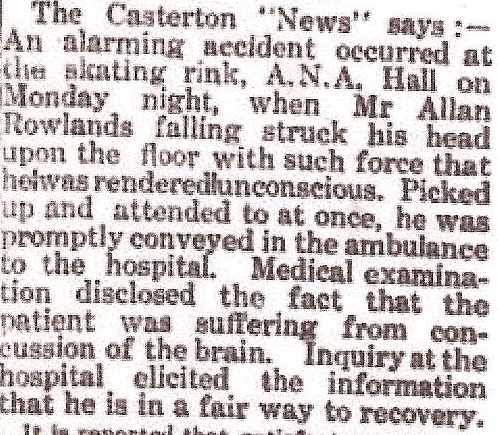
The second article relates to a skating accident at Casterton which resulted in a nasty concussion for Mr Allan Rowlands.  If one considers the size of the average country hall, the thought of skaters hurtling around is rather hair-raising.  No wonder women and children were only allowed to skate in the afternoon when hopefully it would have been a more refined pastime.

Skating Accident at Casterton First Issue, August 20, 1842. The Portland Guardian. (1910, May 9). Portland Guardian (Vic. : 1876-1953), p. 2 Edition: EVENING. Retrieved May 9, 2011, from http://nla.gov.au/nla.news-article63977026


Arthur Leonard Holmes 1889-1918 – Lest We Forget

Most of my family members made it home from World War 1.  While they were far from unaffected,  they could return to their loved ones.  Not so for Arthur Holmes.  Newly married he sacrificed his life for his country following both his older brother and cousin into war.

Arthur Leonard Holmes was born in 1889 in Sandford, Victoria.  His parents were George Holmes, the local miller and Julia Harman, a Byaduk girl.  They married in 1882 in Byaduk and had seven children, with Arthur being the fifth born.  Julia died suddenly in 1896 of a cerebral haemorrhage while George was away gold prospecting on the other side of the state at Tallangatta.   The children ranged in age from fourteen to one.  George remarried in 1900 to Betsy Swain and they had a daughter, Bessie, in 1903.

Arthur, better known as Lennie, enlisted at Melbourne on 4 July 1916 aged twenty-seven.  He was working in Casterton as a coachbuilder. His brother Frederick had enlisted ten months earlier and his cousin Edgar Holmes, a year before.  At the time of enlistment, Arthur noted he was single and gave his next of kin details as his father.  At some point afterwards, this information was edited with “single” being changed to “married” and the contact details changed from father George to his new wife Alice Edith Osborne.  Marriage records show they married in 1916. Alice was from Millicent, South Australia and was twenty-four years old.  After their marriage, Arthur headed overseas and Alice moved to live in Windsor in Melbourne.

Arthur joined his unit on 2 August 1916, initially in Geelong and then he would have gone to Broadmeadows with the 29th Battalion.  Meanwhile, in France, events unfolded that would not have filtered home at the time of Arthur’s enlistment.  His cousin Edgar was listed as missing at Fromelles on 28 July 1916.  A court of enquiry twelve months later found that Edgar was killed in action, with the date given as 16 July 1916 during the Battle of Fromelles.  Also, on 28 July 1916, Arthur’s brother Frederick James Holmes was shot in the shoulder in France.  He was later to return home due to his injuries.  As he donned his uniform for the first time, Arthur would have been oblivious that the horror of war had touched his own family.  By the time he sailed for Plymouth on 26 October 1916, the news would have reached him and one could imagine he left Australian shores with a heavy heart.

On the voyage to England, Arthur was promoted from Private to Acting Sergeant without extra pay, as he was bandmaster for the trip. The Holmes boys were musical.  Arthur’s older brother Goldie was an Australian Cornet Champion in the 1920s and led many large bands around Australia.  Arthur may have had the same abilities and aspirations.

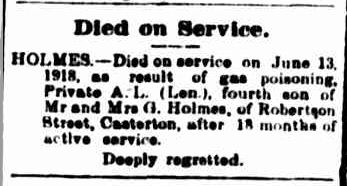
On arrival in England, Arthur left the 29th and joined the newly formed 62nd Battalion.  The 29th moved on to France while Arthur stayed in England until the 62nd Battalion was disbanded in September 1917.  Arthur returned to the 29th Battalion in France, arriving on 15 October 1917 almost a year since he left home.  The 29th Battalion were experiencing a relatively quiet period, following their involvement at Ypres, and as the allies prepared for the eventual Battle of Hamel.  This meant no less of a danger for the soldiers.  On 12 June 1918, Arthur Holmes was overcome by mustard gas, the feared silent killer.  It was never an instant death.  In Arthur’s case, he passed away the next day, 13 June 1918 at the 12th Casualty Clearing Station at Hazebrouck.  He was initially buried at the Longpré Cemetery before being exhumed, with forty-one other fallen soldiers and re-interred at the Crouy British Cemetery, his final resting place.

CORNET PLAYER KILLED. (1918, June 26). The Ballarat Courier (Vic. : 1914 – 1918), p. 4. Retrieved April 3, 2012, from http://nla.gov.au/nla.news-article75192499

Family Notices. (1918, June 24). The Casterton News and the Merino and Sandford Record (Vic. : 1914 – 1918), p. 2 Edition: Bi-Weekly. Retrieved April 3, 2012, from http://nla.gov.au/nla.news-article74221268

On 21 August 1918, a memorial service was held at the Scots Church, Casterton to remember three of Casterton’s men, William Zimmer, Leyton Loggins and Arthur Holmes.  Reverend Mears said of Arthur

The Casterton News and the Merino and Sandford Record (Vic. : 1914 - 1918) 25 July 1918: 3 (Bi-Weekly.). .

The Casterton News and the Merino and Sandford Record (Vic. : 1914 – 1918) 25 July 1918: 3 (Bi-Weekly.). <http://nla.gov.au/nla.news-page7193843&gt;.

What of Arthurs new bride, Alice?  She spent some time in Melbourne after his death, before moving to Daylesford.  She lived at Belvedere House, lodging rooms in Vincent Street, with her widowed mother, Annie Osborne.  In January 1919, Alice received a parcel containing Arthur’s possessions.  Along with personal items such as photos, letters, and a diary, there were small hints about Arthur’s time overseas, a French dictionary, a knife and fork in a case, a razor and mirror.  Did she open the parcel?  Did she read Arthur’s diary?  We will never know, but this is all she had left of her time with Arthur along with her memories.  They did not have time to have a home together or raise a family.

In 1923, Alice’s mother passed away, and she stayed on in Daylesford before her own death in 1930 at only thirty-eight.  She is buried at the Daylesford cemetery.

In Arthur’s hometown of Casterton, he is remembered on the Town Hall Honour Roll and the Casterton War Memorial

Reading of Arthur’s fate reminded me of a poem I studied at school by the great World War 1 poet Wilfred Owen, Dulce Et Decorum Est.  The haunting words give some insight into the experiences of the thousands of Australians who served their country in World War 1 and the discovery that the Great War was not the big adventure so many expected.

Dulce Et Decorum Est

Bent double, like old beggars under sacks,
Knock-kneed, coughing like hags, we cursed through sludge,
Till on the haunting flares we turned our backs
And towards our distant rest began to trudge.
Men marched asleep. Many had lost their boots
But limped on, blood-shod. All went lame; all blind;
Drunk with fatigue; deaf even to the hoots
Of disappointed shells that dropped behind.

GAS! Gas! Quick, boys!– An ecstasy of fumbling,
Fitting the clumsy helmets just in time;
But someone still was yelling out and stumbling
And floundering like a man in fire or lime.–
Dim, through the misty panes and thick green light
As under a green sea, I saw him drowning.

In all my dreams, before my helpless sight,
He plunges at me, guttering, choking, drowning.

If in some smothering dreams you too could pace
Behind the wagon that we flung him in,
And watch the white eyes writhing in his face,
His hanging face, like a devil’s sick of sin;
If you could hear, at every jolt, the blood
Come gargling from the froth-corrupted lungs,
Obscene as cancer, bitter as the cud
Of vile, incurable sores on innocent tongues,–
My friend, you would not tell with such high zest
To children ardent for some desperate glory,
The old Lie: Dulce et decorum est
Pro patria mori.

*It is sweet and right to die for your country

Wilfred Owen – 1918