The first installment of The Vagabond’s Picturesque Victoria in Western Victoria introduced Portland of 1884 and reflected on the history of the area. The second installment sees the Vagabond, still in Portland and, on a tour of the town. He admires the Portland Botanic Gardens, soaks up the atmosphere of the Portland North cemetery, and visits the inmates of the Portland Benevolent Asylum.
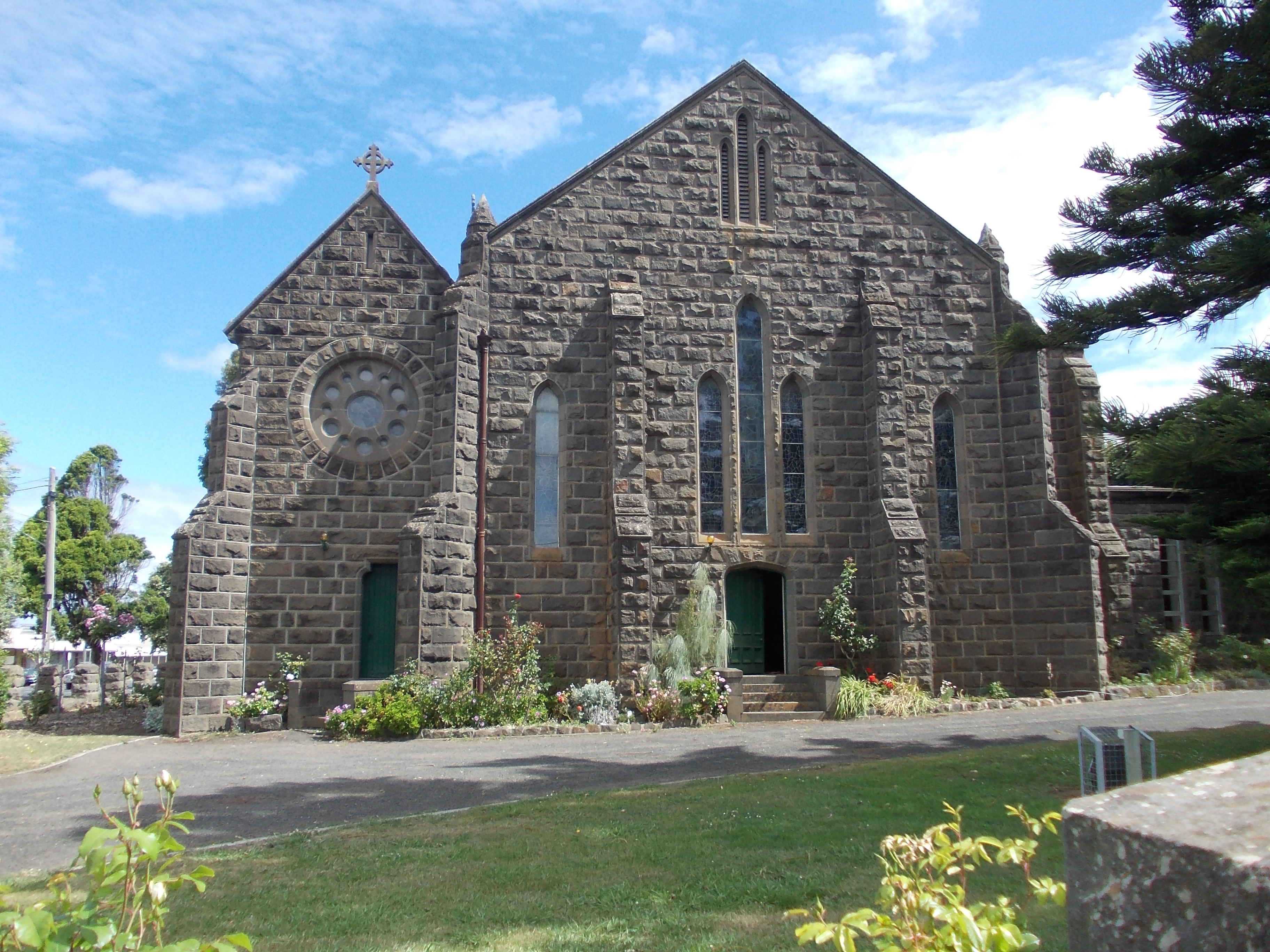
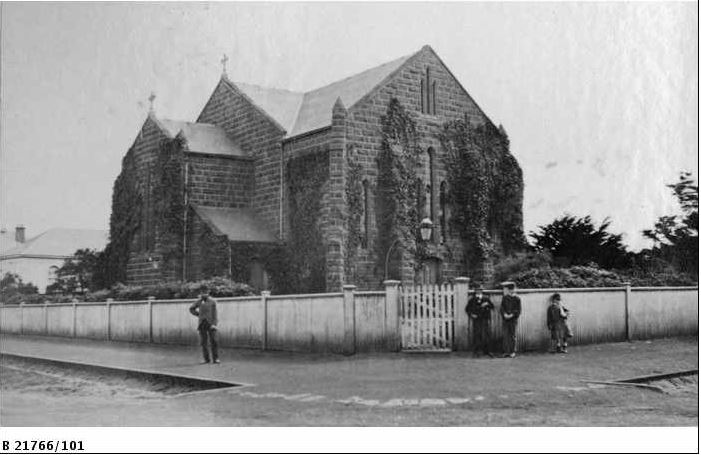
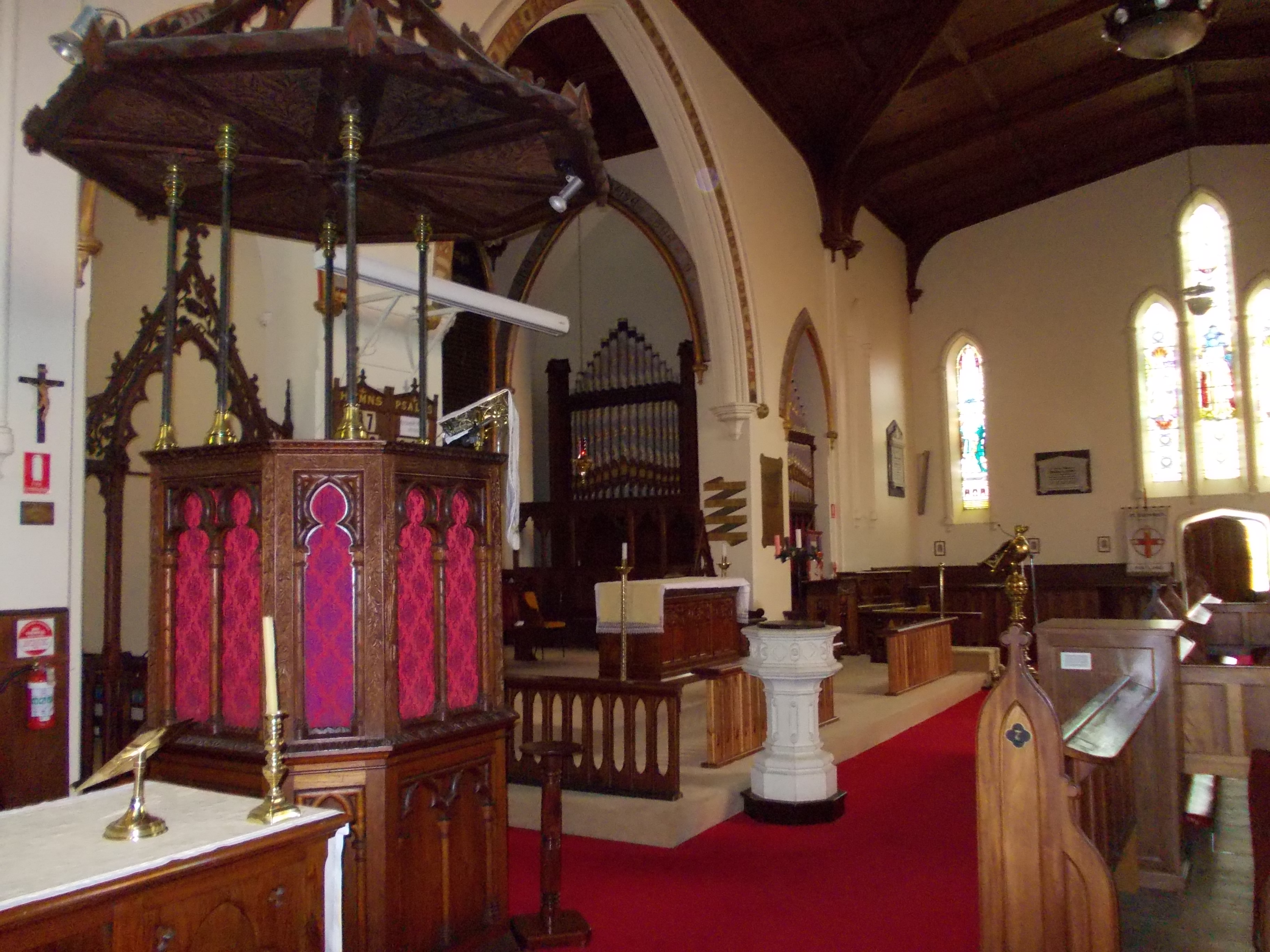
The first stop was St. Stephens Church, undergoing an extension at the time. The Vagabond noted the church’s opulence, much of it built from Henty money and a memorial stained glass window giving thanks for their generosity had been installed.
ST STEPHENS CHURCH
The Vagabond mentioned the left-hand end of the church was boarded up for extensions and the ivy that gave the church an aged appearance. The image below would have been how the church looked in 1884 before the extension began and the church today (above)
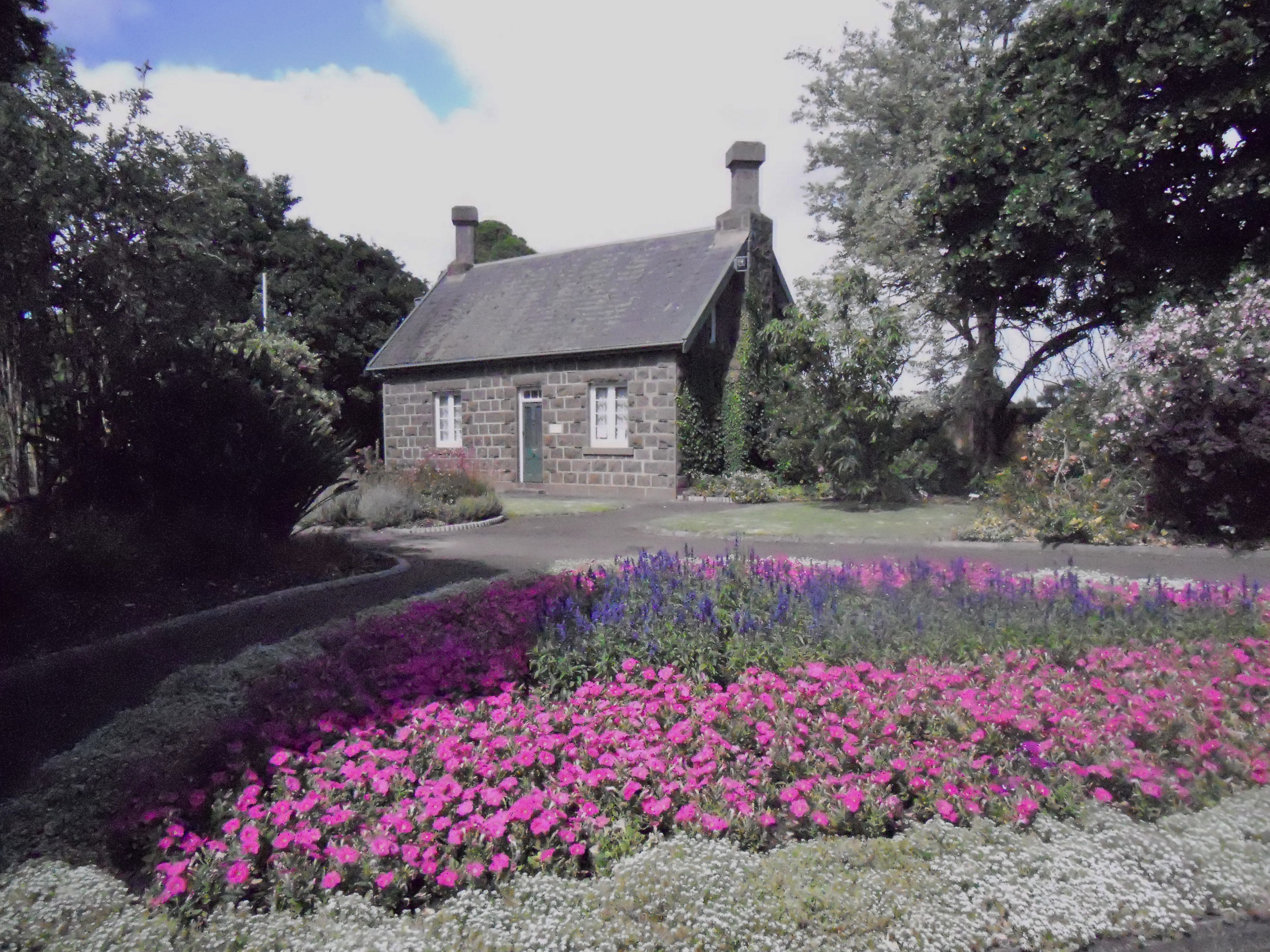
Next, the Botanic gardens, the “pride of Portland”.
PORTLAND BOTANICAL GARDENS
Local residents enjoyed strawberries growing at the back of the gardens but anyone trying to scale the garden’s fence faced ferocious dogs chained at intervals around the perimeter.
PORTLAND BOTANIC GARDENS
The time he spent imbedded at the Melbourne Benevolent Asylum, must have deepened The Vagabonds’ compassion for the unfortunates residing in such institutions. His visit to the Portland Benevolent society gives a most interesting insight into the life of the residents.
Nineteen men and one woman, residents at the time of the Vagabond’s visit, were eating supper of bread and butter and tea. Many were early arrivals to the colony and most had worked for the Henty family …” poor old fellows, they are remnants of a much-despised class, not by any means all bad, good mates to each other, who bore the heat and burden of the early days of colonial life”
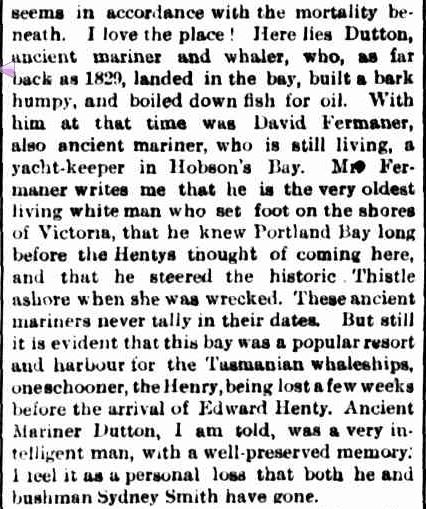
The Old Portland Cemetery had the same effect on the Vagabond as it did on me, even though we visited almost 130 years apart…”I love the place” he declared.
OLD PORTLAND CEMETERY
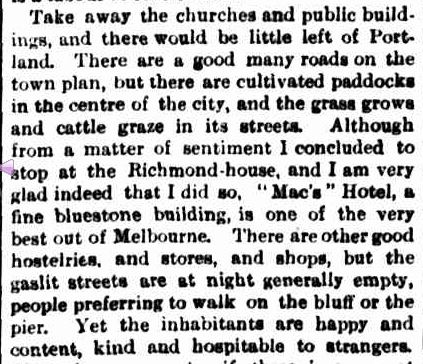
In 1884, if one was to remove the churches and public buildings from Portland, there would be little left, according to the Vagabond. There were ploughed paddocks in the city centre and cows grazing in the streets.
The Vagabond considered Mac’s Hotel (below) one of the finest bluestone buildings outside of Melbourne.
MAC’S HOTEL, PORTLAND
Fishing was the main trade in Portland when he visited, but The Vagabond could foresee a day when Portland would resemble Scarborough, England. He noted the relaxed feel of the town where ladies could visit and not feel they had to change up to four times a day, they even could wear their “oldest gowns”.
PICTURESQUE VICTORIA. (1884, November 18). The Argus (Melbourne, Vic. : 1848 – 1957), p. 6. Retrieved September 16, 2013, from http://nla.gov.au/nla.news-article6061545
The photo below is of Portland’s beach around the 1940s. While villas weren’t lining the cliff tops as the Vagabond predicted, I think he would have been happy that his prophecy had eventuated in part.
If you’ve read my recent Bloggers’ Geneameme response, you would know I often work on blog posts in my head while completing mundane tasks such as cooking dinner. It must have been the child friendly Macaroni Cheese last night that allowed me to switch my mind off the job at hand and consider in-depth, a couple of the benefits of blogging for me.
For 10 years, I used The Master Genealogist (TMG) software. The Narrative report was my favourite because I like to see my family history in story form as it gives me a better perspective of dates and events. A perfect example of how that format works for me is the post I wrote on September 15 for the Riddiford Centenary. I have looked at the various dates for my great grandparents and their children time and time again. But when I put them down in narrative form for the post, there staring me in the face was the fact that my oldest great-uncle was born only 5 months after his parents married. Further on in the post I mention the birth of the last child in the family when my great-grandmother was 43. I then wrote there was an age span of 26 years from oldest to youngest child. Hang on a minute…43 take away 26 is…OMG Caroline was only 17!
With the TMG Narrative report, I could alter the wording of the built-in text plus add extra narrative. It was fun, for a while, but it was never right for me. I switched over to Family Tree Maker about five years ago. While I missed TMG, the user interface with Ancestry. com.au ,my main reason for change because I’m lazy, was a big plus for me when it came to transferring vital records. But I haven’t been able to present my data in the same way I did with the TMG Narrative report.
Also, I’ve always wanted to see the “big picture” of my ancestors’ lives, where they lived, what they did, the history of their towns and the events happening around them at the time of their lives. That resulted in 100s of web page bookmarks about villages in England, histories of occupations and the like. But what could I do with them? I tried to write a history of the Harman family a couple of times trying different formats but it didn’t feel right. I felt it was a lot of work for little gain, in that it would sit on my hard drive and go nowhere. I lacked motivation.
That’s where blogging comes in. With this method I can write my family history in parts, swapping between branches to keep it interesting. I can include the “big picture” and someone else gets to read what I write regularly, other than me. Also, and this was the main theme behind my mind wanderings, it has stretched me. It has forced me to dig deeper and think laterally, forced me to tidy up vital records on my software that I hadn’t followed up and be more aware of my genealogy time management. Now, after just over two years and 245 posts, I have collected stories about all branches of my family and posts relevant to the times and places they lived. This would have been unachievable for me if I didn’t act and take up geneablogging.
Physical training at P. T. & R. School (ca 1942) Image Courtesy of the State Library of Victoria,Argus newspaper collection of war photographs. World War II. Image No. H98.105/4467 http://handle.slv.vic.gov.au/10381/197430
As my mind wandered further, I thought of something that has stretched me, or at least my genealogy muscles, more than blogging and that is the Diploma of Historical Research I’m currently undertaking. It includes writing a 20,000 word family history. My stretching regime has had some changes and I am finding muscles I had forgotten about or didn’t know I had:
I am now forced to record my sources more accurately (I can’t link through to a website to prove my sources as I do here).
Now I have to get the more difficult to access records (for me anyway) that won’t tell me anything new, but will support my evidence. My aforementioned laziness has not been the issue here but rather the barriers of work, child rearing and distance. Now there are no excuses, I have to stretch myself beyond those barriers.
Organization is now key and for me, that is a real stretch.
I have realised that even after researching the Harmans (the subjects of my thesis) as long I have, there is still so much more to find, so many gaps to fill.
There is a strict deadline. While I have loose deadlines for my blog posts, I can move them a little. I can’t do that with the Diploma and I keep having visions of my Uni days, pumping out assignments with only days to spare before the due date, simply because I had left it to the last minute. A lot more work on that muscle is required.
One of the benefits of this extreme stretching will be that I will have written that Harman family history I have not been motivated enough to write before. The extra exertion will be worth it for that reason alone.
So, if you want to start stretching your genealogy muscles start a blog. Geneablogging was exactly what I was looking for but if you really want to stretch those muscles, complete a course or maybe write a book. Whatever your choice, get stretching, it feels good.
Recently, I wrote a Trove Tuesday post about newspapers used as wallpaper in a North Portland building. This week I have a similar story, but the newspapers in this case were found in a more unusual place. The Argus of April 10, 1911 reported on the discovery of newspapers under the Birregurra State school. While finding newspapers under floors my not be unusual, the containers they were in was unusual. The papers were shredded and stuffed into bottles. They were obviously not shredded too small as contractors were able to identify the titles of the newspapers and an article about Adam Lindsay Gordon. Coincidentally, the find was almost 44 years to the day from when the papers were published.
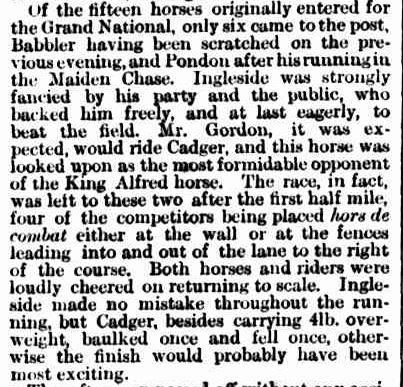
While none of the titles found are available at Trove for the said dates, I was able to find an article about the Autumn Grand National at Ballarat as reported in the Geelong Advertiser of April 13, 1867. The corresponding article was in The Argus of April 13, 1867.
In the feature race, Adam Lindsay Gordon rode Cadger owned by Walter Craig, then proprietor of the well-known Craigs Hotel in Ballarat. Gordon set the pace and with the remaining four horses dropping off, Cadger and Ingleside were left to fight it out. The rough and tumble of colonial racing and the fearlessness of Gordon was on display in the final stages of the race. Cadger baulked at a jump, but Gordon faced him up at again and was able to clear it on the second attempt. The chase was on but Cadger fell further down the track. Not to be perturbed, Gordon remounted and continued the race. Unfortunately, Ingleside had too much of a lead and Gordon and Cadger were beaten by around 12 lengths.
In 1846, the Bristol Mercury reported that Aaron Riddiford of North Nibley, Gloucestershire had died aged 92. He had lived his entire life on the farm where he was born and only ever travelled a few miles from his home.
That same decade a young cousin of Aaron, my ggg grandfather Charles Riddiford, said goodbye to Gloucestershire and moved to Buckinghamshire. He married Elizabeth Richardson Cooke and started a family, but he was looking for more. By 1851, he had taken the family to Clerkenwell, London and worked as a tailor. Shortly after he was off to Bedfordshire as a Police Constable. After his discharge for poaching, he packed up the family and moved back to Buckinghamshire, joining the Haddenham constabulary.
A son of Charles, Thomas Cooke Riddiford inherited the wandering gene. In 1872 he took his family to Ontario, Canada looking for the promised land. He didn’t find it and three years later the family returned to Buckinghamshire. They spent some time in London and then back to Bucks. His wife Emma Piddington died in 1883 and by 1891, Thomas had left his children aged 13 to two at the time of Emma’s death, and moved to Lancashire. He remarried twice and remained in Lancashire until his death.
Thomas William Cooke Riddiford, my great-grandfather, a son of Thomas snr. and Emma Piddington was born at the Crown Inn, Cuddington, Buckinghamshire in 1875 and was eight when his mother died. Like his father and grandfather he was looking for something more. That desire took him to Canada, back to England and finally Australia aboard the “SS Commonwealth“, with his wife Caroline and four sons, including my grandfather Percy, 100 years ago today, on September 15, 1913.
Thomas jnr. followed in his father’s footsteps and took up butchering. In 1891 he was living at the Plough Inn, Haddenham, Buckinghamshire and working as a butcher’s assistant. He then made his way to London. At Lambeth, London on February 7, 1896, he married 17 year-old Caroline “Queenie” Celia Ann Kirkin, daughter of railway worker Frederick John Kirkin and Amy Maria Webb, at St Barnabas Church.
It may have been a short courtship prior to the marriage in February, as the birth of first child William, was registered in July 1896 at Lambeth. His baptism was at St. Barnabas on August 2, 1896 .
Over the next 17 years, the Riddiford family lived at all points of the compass around London. Thomas may have followed work or was looking for the perfect place to raise his growing family. The following Google Map shows the four different residences of the Riddifords during that 17 year period, from Lambeth to Notting Hill, to Leytonstone and finally Edmonton, the last known residence before their departure to Australia.
The family suffered a loss in 1903 with the death of two-year old Horace. The year 1906, was the only time the family were apart when Tom took a trip to Halifax, Nova Scotia, Canada, presumably with the thought of moving there. He didn’t find what he was looking for and returned to London.
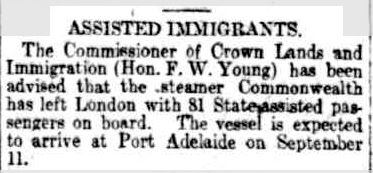
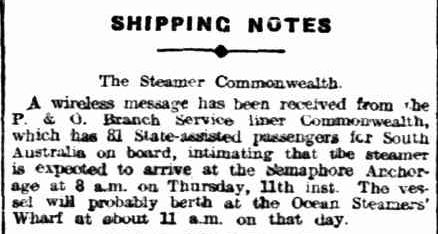
In 1913, the Riddifords took their chances and joined other assisted immigrants aboard the “SS Commonwealth” and sailed for Australia via South Africa, dropping passengers at Adelaide.
GENERAL NEWS. (1913, September 12). The Advertiser (Adelaide, SA : 1889 – 1931), p. 18. Retrieved September 14, 2013, from http://nla.gov.au/nla.news-article5801205
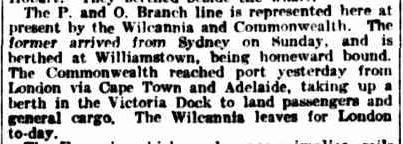
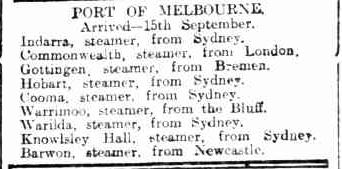
They docked at Victoria Harbour, Melbourne on September 15. The family then consisted of five boys – William Thomas Frederick (17), Cyril Victor (15), Ernest Arthur (14), Percy Ronald (10) and Reginald Leonard (3)
SHIPPING INTELLIGENCE. (1913, September 16). The Argus (Melbourne, Vic. : 1848 – 1957), p. 14. Retrieved September 14, 2013, from http://nla.gov.au/nla.news-article7233086
SHIPPING INTELLIGENCE. (1913, September 16). Bendigo Advertiser (Vic. : 1855 – 1918), p. 6. Retrieved September 14, 2013, from http://nla.gov.au/nla.news-article91019708
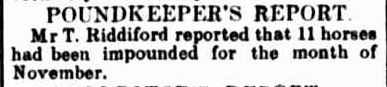
By early 1914, the Riddiford’s had settled at Smeaton, a small town north of Ballarat. Thomas took up work as a farm labourer and was later the pound keeper.
After London, life must have been very different, especially for Caroline who had spent 34 years living in London, most of that time in Lambeth, with smog, pea-soupers, crowding, slums and noise. Imagine how quiet it must have seemed for her…ah the serenity.
After six boys, the family welcomed the first girl, Lillian Ivy, to the family in 1914. Maybe it was the fresh air. If Thomas was looking for wide open spaces, he had arrived. However the serenity was soon shattered with the onset of WW1. If they were feeling settled, that would change.
Fundraising on the home front started and the first newspaper reference I have about Grandpa, Percy Riddiford, refers to a Belgian Fund Concert at Smeaton. He, along with other children sang and conducted games as part of their performance.
Soon after, the first of Thomas and Caroline’s sons would enlist. While Thomas had unwittingly removed his family from the direct threat of war, over the next four years, three of his sons would enlist taking them into its midst. Their decisions to enlist must have been different to other local lads, who may have been second or third generation Australian. Bill, Cyril, and Ern, had already had their adventures and travel, surely their greatest thoughts would have been of England.
Bill enlisted on September 2, 1915, and arrived in France in March 1916 with the 12th Battalion, but after just five months he was hit by an ambulance, suffering a fracture to his femur. While in the 7th General Hospital his condition was listed as “dangerously ill”. His injury resulted in a lifelong disability.
As soon as he was 18, Cyril enlisted, on April 4, 1916, joining the 8th Battalion in France in September that year. Ern, a butcher, also enlisted as soon as he was 18, on February 5, 1918 with the 59th Battalion. He arrived in France on February 1, 1919.
Despite Bill’s injury, the boys returned home safely, their service remembered in the Creswick Shire Avenue of Honour, also known as the Kingston Avenue of Honour.
In 1922, at 43 years of age, Caroline gave birth to Stanley Gordon at Smeaton. The family was now complete with an age span of 26 years from the oldest to youngest child.
Around 1927, the Riddifords moved into Ballarat, taking up residence at 619 Humffray Street South. Thomas returned to the butchering trade, operating a business in Peel Street South. The older boys were getting married and starting families. The three boys that served were living in Melbourne. Ern and Cyril married Jessica Prideaux and Amelia Romeril, respectively, from Port Melbourne. They had two children each. Bill married Creswick girl, Florence Bowley but they lived in Port Melbourne near to Ern and Cyril. Bill and Florence moved to Creswick in their later years where they remained until their passing. They had no children.
The Riddiford family of Ballarat
The photos (above) and (below) have an interesting story that can be read in the R is for…Riddiford post. The photo below has “Clunes” written on the back, but the date of the photo would be the 1930s by which time the Riddifords were in Ballarat. The shop may have been in Peel Street South Ballarat and if so, it no longer exists.
Aside from some time in Geelong, Reg also remained in Ballarat and followed his father’s trade as a butcher. He married Mavis Goldby in 1932 and they had two daughters.
Stan enlisted in WW2 and on his return built a house next to his parents in Humffray Street, He married Amy McBain and worked as a carpet layer. They had two children.
HOMES OF TOM & QUEENIE (left) AND STAN & AMY (right), Humffray Street South, Ballarat.
Lil married Ernest Horgan and had one son. She remained in Ballarat.
Dad remembers family get-togethers in the 1950s with singalongs with songs such “Knees up Mother Brown”. That song was recorded in the 1930s but thought to be an old Cockney song and was, for a time, sung at matches by West Ham supporters. There were also visitors from England to Humffray Street, including Caroline’s parents and cousins of Tom.
The move to Humffray Street in 1927, in the suburb of Mt. Pleasant, was Thomas and Caroline’s last move remaining there until their deaths in 1957 and 1962. Thomas must have found the promised land, his Shangri- La. Maybe if his father had travelled to Australia in 1876 instead of Canada, Thomas jnr. may have reached his destination earlier and Thomas snr. would too have found what seems to have alluded him.
HEADSTONE OF THOMAS AND CAROLINE RIDDIFORD, BALLARAT NEW CEMETERY
My grandfather Percy, went on to work as a tram conductor in Melbourne and Ballarat. He married Mavis McLeish in Melbourne in 1932 and they had four sons. Mavis passed away in 1943 and in 1944 Percy married my grandmother, Mavis Combridge. They returned to Ballarat and they had three more sons.
Dad recalls during the 1950s when they were living in Forest Street, Wendouree, Grandpa would clear out the dining room and call square dances with up to 10 couples involved. At one time the younger boys attended Redan Primary School and Grandpa was on the committee and worked there as a cleaner. He also worked on the gate at the Ballarat trots and one of my last memories of him was there…as we called by the trotting track one night, on our way home to Hamilton, to say goodbye to Grandpa. He died in 1974 when I was six.
MEMORIAL STONE OF PERCY & MAVIS RIDDIFORD, BALLARAT CREMATORIUM
Tom, Queenie, Bill, Cyril, Ern, Percy, Reg, Lil, and Stan…this one’s for you.
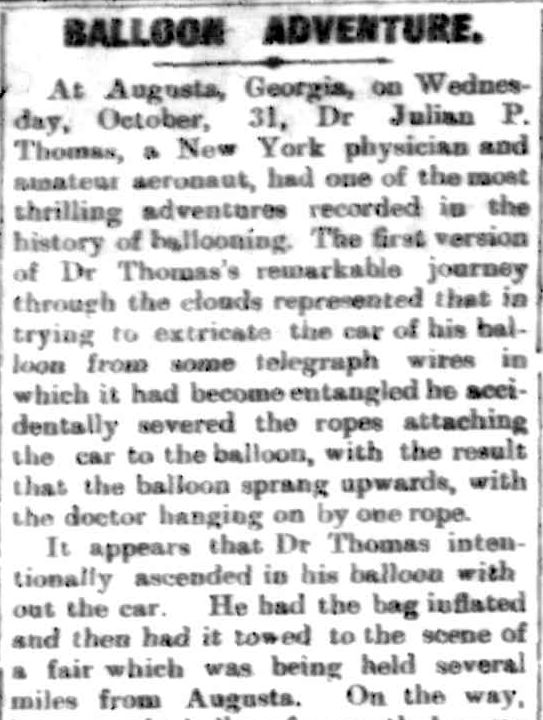
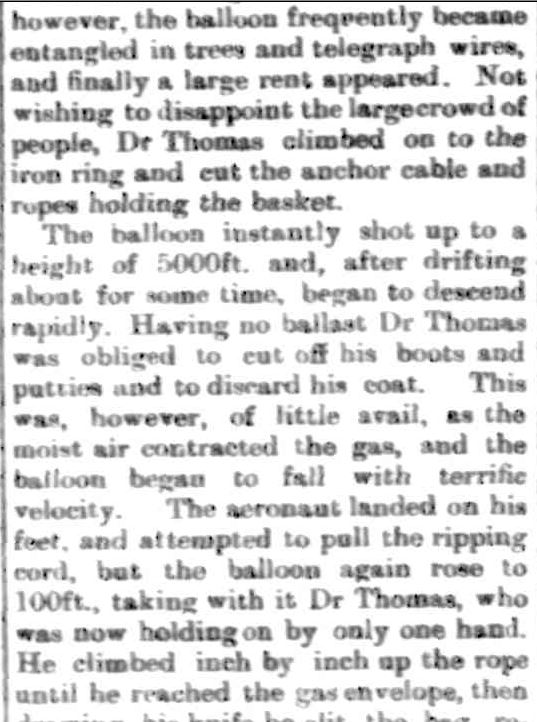
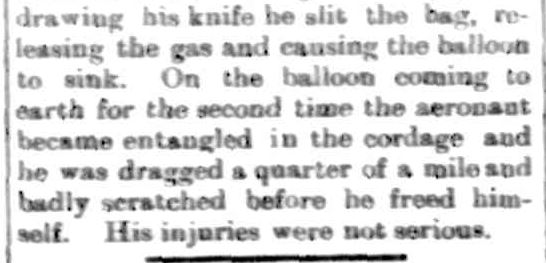
Trove Tuesday goes abroad this week. The date, October 31, 1906. The place, Augusta, Georgia, U.S.A. The man, Dr. Julian P. Thomas an “amateur aeronaut” from New York with a passion for endurance balloon flights. Julian’s endurance was put to the test on that day in October 31, when his balloon went up and down and up and down again.
Dr Thomas was an interesting character as was his wife who often joined him on his flights. A Google search of the “Julian Thomas aeronaut” found various newspaper articles from the likes of the New York Times about some of their escapades. Interestingly, a serious car accident in 1907 involving Julian Thomas, almost resulted in his leg being amputated.
Have you checked the Links page lately? There are loads more links.
You will find links for historical, family history and genealogical societies from across Western Victoria. There are Cemetery links and of course all the Western District newspapers that are now online at Trove. That list is growing rapidly. I have also labelled recently added links with “New”.
I have recently added Facebook pages to the links page because there are several societies that have started pages that are proving very popular. Check out the Mortlake & District Historical Society or the Port Fairy Historical Society pages for some great photos and biographies. It would be good to see more of the societies taking their lead of taking history to the people.
It’s not only the “Links page” where you will find links at Western District Families. Throughout my posts you will notice underlined text. Click on the link and you will find more information about the subject. It may be another post about the subject, sites such as the Australian Biographical Dictionary and Victorian Heritage Database or maybe an article at Trove.
When writing Passing of the Pioneer posts, I do a Google search on most subjects or the property they resided at, just to see if there is more information about them. So, if you find one of your ancestors listed in Passing of the Pioneers, you may find something else that I have dug up about them, maybe even something you didn’t know…
Checking my site stats for “link clicks”, I found the most clicked newspaper article to date has been that an Obituary page from The Horsham Times of January 22, 1904. The article was an obituary bonanza with obituaries for William Gardiner, Mrs Jean Miller, Joseph Jelbart and Mrs Rachel Hedditch and they each appeared in the January 2012 Passing of the Pioneers. Close behind was an article from the Cairns Post of February 1, 1935 about the clipper, Marco Polo.
If you know any great Western District sites or Facebook pages, let me know and I will be happy to add them to the list. Also let me know if you notice any of my links are broken.
The articles were snippets of larger stories, supposedly cut and pasted by the “Colonel”, who ever the “Colonel” was. They are similar in tone to the “They Say” articles featured recently on Trove Tuesday, with a mix of serious and amusing snippets.
This offering from September 12, 1896, includes ostriches and Chow dogs, Daniel Defoe and Charles Dickens Jnr. Public officials were put to task, such as Judge Windeyer and his questionable penison and the Dandenong Shire Councillors, believed to have consumed one hundred rate-payer funded bottles of whiskey over the course of the year. There are statistics aplenty and court news.
SCISSORS and PASTE. (1896, September 12). Windsor and Richmond Gazette (NSW : 1888 – 1954), p. 13. Retrieved September 2, 2013, from http://nla.gov.au/nla.news-article72549720
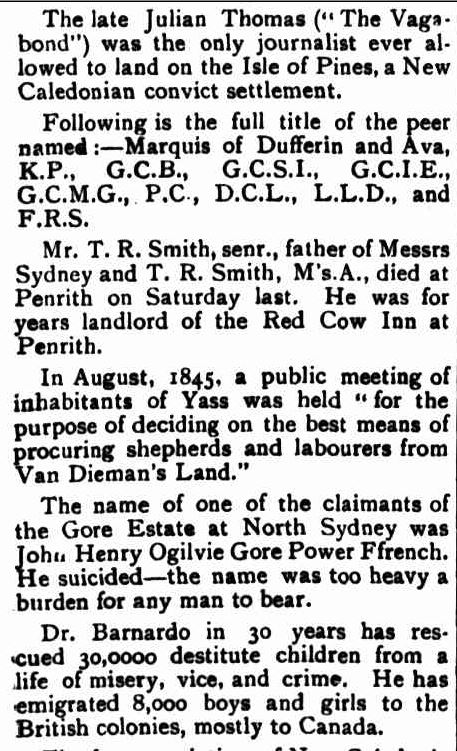
This snippet was from February 4, 1899 and I think you will appreciate it…
SCISSORS and PASTE. (1899, February 4). Windsor and Richmond Gazette (NSW : 1888 – 1954), p. 13. Retrieved September 2, 2013, from http://nla.gov.au/nla.news-article66440144
You can count on Trove to find an image. With just a little searching, I was able to come up with this postcard held at the State Library of Victoria to compliment “Scissors and Paste”.
THE CENSOR AT WORK AS HE IS SEEN BY THE PRESS (c.1914) Image Courtesy of the State Library of Victoria. Image No. H97.248/154 http://handle.slv.vic.gov.au/10381/142970
A small but interesting band of pioneers join the August Passing of the Pioneers.
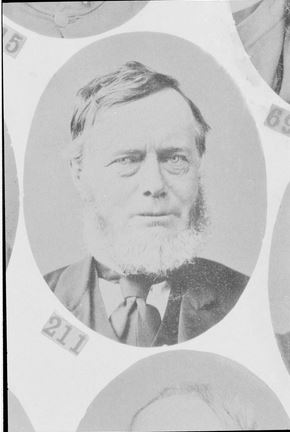
Stephen Rowan ROBERTSON: – Died 19 August 1900 at Portland. Stephen Rowan Robertson was a she, not he, a sister of John G. Robertson, owner of Wando Vale station. Stephen arrived in Victoria in 1842 around the age of thirty-four and in 1846 she married William Corney (below) who took up the lease of Wando Vale. After some time back in England, William and Stephen made their home at South Portland. One of the stained glass windows at St Stephen’s Church, Portland was dedicated to William Corney (below) by his son Robert.
WILLIAM CORNEY (1872). Photographer Thomas Foster Chuck. Image courtesy of the State Library of Victoria. Image no. H5056/211 http://handle.slv.vic.gov.au/10381/17942
Peter MacKINNON: Died 5 August 1902 at Hamilton. Peter MacKinnon was born in Stirlingshire, Scotland around 1825 and arrived in Victoria around 1852. His first job in the colony was at Coleraine as a bookkeeper and then later at Hamilton as a bookkeeper for the timber yard of Mr. Collins in Gray Street. He then worked for many years at the Hamilton Spectator as a machinist. In his later years, he returned to bookkeeping with the Collins timber yard.
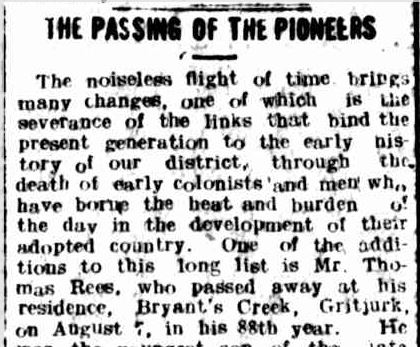
Thomas REES: Died 7 August 1918 at Hamilton. This is one of the first obituaries I have posted from the Hamilton Spectator and it has one of the best openings to an obituary (only a genealogist could/would say that). The reference to the early colonist encapsulates the spirit of the monthly Passing of the Pioneer posts.
Basil McConochie LYON: Died 7 August 1916 at Coleraine. Basil Lyon was born in Glasgow, Scotland around 1850. When he arrived in Victoria he went to the Konongwootong Creek Estate the property of his maternal uncle. John McConochie. He later took up land with his brother at Balmoral. Basil was a member of the Kowree Shire Council for several years and was also a Justice of the Peace. He was a founding member of the Coleraine branch of the Australian People’s Party.
Arthur BALLMENT: Died 26 August 1916 at Perth, Western Australia. Arthur Ballment was from Plymouth, England where his father Hugh was a well-known shipbuilder and merchant. Arthur left England in 1865 aboard the Roxburgh Castle to Melbourne aged twenty-one. He gave New Zealand a try before returning to Victoria and Ararat where he ran a tannery business. He had a strong interest in politics, at a local level while in Ararat, and upon retirement to Western Australia, thirteen years before his death, he followed both Australian and British politics. Arthur was described as a “typical Englishman”. One of Arthur’s sisters married British political cartoonist, Sir Francis Carruthers Gould while his daughter Marion was a Western Australian-based artist of some note.
William ROBERTSON: Died 6 August 1918 at East Melbourne. William Robertson, a son of Duncan Robertson and Ann Fraser, was born in New South Wales in 1839 and went to the Western District with his family aged four. Duncan took up Straun. He later moved to Gringegalgonawhere William remained, unmarried, for the rest of his life. William was keen on horse racing and over a forty-year period, his horses won the Casterton Cup on two occasions, the Warrnambool Cup, and the Great Western Steeple. His trainer was James Agnew, also a Passing Pioneer this month (below).
Bridget HASSETT: Died 14 August 1919 at Dundindin, Western Australia.
Bridget Hassett and her husband Patrick Mullan raised a family of thirteen children, five of whom were still living at the time of her death, as was Patrick then aged ninety.
Letitia BEST: Died 7 August 1941 at Melbourne. Born around 1848 in County Caven, Ireland, Letitia Best arrived at Portland in 1856 aboard General Hewitt with her parents William and Letitia Best, and six siblings (NB: the date of arrival in Letita’s obituary is 1853). The family settled at Heywood where Letitia later married Donald Rankin. Donald and Letitia spent some years at Harrow before moving to Western Australia for 30 years. When Donald passed away, Letitia returned to Victoria.
James AGNEW: Died 10 August 1942 at Hamilton. James Agnew was born at Cowie’s Creek near Geelong around 1857 and as a boy moved with his parents to the Wimmera. In his teen years, James moved to the NSW Riverina working at Yanco Station where his career with horses began. A meeting with the trainer of Carbine, Walter Hickenbotham spurred him on to become a racehorse trainer.
James eventually settled in Hamilton as a trainer and took on horses for owners such as George Robertson (above) and John Kirby. The racing career of Kirby’s horse The Parisian was all but over when he arrived with Agnew with the horse failing over short distances. James saw the staying potential in the horse and trained him accordingly. As a result, he won the Warrnambool and Hamilton Cups. Kirby then too saw The Parisian’s potential to win a Melbourne Cup and moved the horse to a Melbourne trainer, thus robbing James Agnew of a chance to win a Melbourne Cup, as The Parisian saluted in 1911. If it wasn’t for James Agnew, James Kirby is unlikely to have held the Melbourne Cup in 1911.
Charles BRADSHAW: Died 13 August 1944 at Portland. Charles Bradshaw lived his entire eighty-nine years at Portland, the son of William Bradshaw, operator of a wool washing business. Charles worked in several industries including bone-crushing, tomato growing, and like his father, wool washing. He married local girl Eileen Robins and they raised two sons and two daughters.
I really should have been writing the August Passing of the Pioneers post when I clicked on my RSS feed for the Geniaus blog. Jill Ball’s latest post, “The Blogger’s Geneameme” sounded like a bit of fun and it was a chance to have a break from the obits. To see the full set of questions, go to Jill’s blog – Geniaus
1. What are the titles and URLs of your genealogy blog/s?
2. Do you have a wonderful “Cousin Bait” blog story? A link to a previous blog post might answer this question.
Last year I started writing a post about the people I had come in contact with, related and otherwise,thanks to Western District Families. The post was getter longer and longer and needed fine tuning, so I put it away for a while, well, quite awhile. Finding cousins was never my intention but the number of connections I have made is amazing. I will mention a couple here, but I will get on with my “Finding Cousins” post to celebrate my new found cousins.
The research room at my local library is a place I frequent at times, but it wasn’t until I wrote about my Mortimer family that I found out the research librarian, Edie, is my fourth cousin 1 x removed. We also have a link through the Hadden family through marriage. To think I have been there researching the Mortimers and another Mortimer descendant was only metres away!
Fellow blogger Kerryn Taylor from AncestorChasing is related through the marriage of her gg grandfather George Adams and my ggg aunt Sarah Harman (both second marriages). This is a special link beyond our blogging connection.
Finally I must mention my 1st cousin 1 x removed, Warren Gamble who I have only connected with since I been blogging. Warren is an enthusiastic researcher of the Gamble family tree and connected families and is a great supporter of mine, often leaving comments of encouragement. Thanks Warren. We will catch up in person soon.
3. Why did you start blogging? Is there someone who inspired you to start blogging?
Over the years I had gathered stories and facts about my various families and I was looking for a way to share or organise everything. Blogging was the answer.
4. How did you decide on your blog/s title/s?
I was going to call my blog My Western District Families but I changed it to Western District Families because it gave me room to move with the content.
5. Do you ever blog from mobile devices? What are they?
No
6.How do you let others know when you have published a new post?
There are now 92 followers of the Western District Families blog and they either receive an email with each new post or if they are WordPress subscribers, they view each new post on the WordPress Reader.
7.How long have you been blogging?
Just over two years.
8.What widgets or elements do you consider essential on a genealogy blog?
I think a search box is important, especially with so many family names. I also use a category list, tags and an archive list, just so it easy to find posts. I use all these features myself to get around the blog. The RSS feed and the subscribe widgets are important to get posts out there.
I did have a Trove search box. The graphic didn’t install properly but the search function worked. It had been on the side bar for months when I just had to fiddle. I removed it with the aim of re-installing it, hopefully with the graphic. Bad move. Now the box doesn’t work at all. I have a person to contact at Trove to discuss it, but time hasn’t permitted .
9.What is the purpose of your blog/s? Who is your intended audience?
The essential purpose of Western District Families is to share the stories of my Western District Families with snippets of social history, with the intended audience those with the same family interests.
I enjoy when visitors to the blog are those that would not normally visit a history blog. I have found there is an interest in history out there, but for some the topic needs to be something they can relate to and “hometown history” does provoke interest. I have posted links to Hamilton history blog posts to my Facebook group, “I’ve Lived in Hamilton, Victoria” and they’ve been met with interest.
People do like to recall how things were and rekindle memories of their childhood or youth. You only have to look at a new Facebook page Have You Seen Old Ballaarat Town? In just over four weeks it has attracted over 5000 “likes”. It was surprising to see that some of my friends that prefer the offerings of popular culture had “liked” the page before me. A similar page Stawell’s Views by Old Time Photos is pushing 1000 “likes” after a couple of months. Keeping the content light, fresh and identifiable are some of the keys to taking history to the masses.
One of my biggest blogging thrills to date was hearing from Samantha. After visiting Shelly Beach near Portland and reading my post The Sultan of Shelly Beach, Samantha’s primary school age daughter wrote about Shelly Beach, the Sultan and the camels for an “interesting facts about Australia” school project. As a child I read a lot of Australian history and it was stories like those of Sultan Aziz and my many Trove Tuesday animal posts that attracted me. I got hooked and if just one child gets hooked on history because of Western District Families, I’ll be delighted .
10. Which of your posts are you particularly proud of?
Finding time to read other blogs has been difficult of late, but the WordPress Reader is convenient to keep track of WordPress blogs I follow. I also have RSS feeds at the top of my browser for the blog posts I don’t like to miss including Geniaus and the Gould Genealogy & History News. Those blogs often lead to me to other blogs of interest.
12. What platform do you use for publishing your blog/s?
WordPress.com
13. What new features would you like to see in your blogging software?
It’s not really something I’ve considered.
14. Which of your posts has been the most popular with readers?
15, Are you a sole blogger or do you contribute to a shared blog?
Sole blogger
16. How do you compose your blog posts?
I plan a little more than I used to, so I start off the month by coming up with a working title for each post I plan to write during the month ahead. That’s become easier with Trove Tuesday each week and a monthly Passing of the Pioneer post always scheduled for late in the month (very late this month). Then I only have to come up with another three or four other post ideas. Most times I have drafts carried over from earlier months.
My draft list has ideas that go back 18 months but when I’m short of ideas I can return to them. As soon as an idea comes to me I start a draft with at least a title, just so I remember. Sometimes an unexpected post may come up (such as this one) and I need to reschedule, but I look at on the bright side, I will still have something to write about in following months.
Some posts can take a few weeks, depending on the amount of research involved. The posts I have listed under Question 10. are an example of those. I work on posts concurrently but each post maybe at different points of preparation. I usually begin with the photos or newspaper clippings I have gathered and then put the words around them. The Fashion and Christmas posts have been most time consuming in this respect due to the number of images. Often I find myself composing posts in my head when I’m away from a computer (…very sad) such as cooking dinner, at work, trying to sleep… some ofs my better opening and closing paragraphs have come that way.
17. Do you have any blogs that are not genealogy related? If you wish please share their titles and URLs.
No
18. Have you listed your blog/s at Geneabloggers?
Yes, one of the first things I did.
19. Which resources have helped you with your blogging?
To help with the Western District Families content, obviously Trove and the Victorian Heritage Database have been very important. To improve the blog overall, I keep up with articles I find through Twitter and Facebook about both geneablogging and blogging in general. One of the sources I use for links is the Blog Chicks Facebook page.
20. What advice would you give to a new Geneablogger?
Just go for it. Don’t take it too seriously and most importantly, have fun. I do!
On Tuesday August 21, 2012, Amy Lehmann wrote a post on her blog, Branches, Leaves & Pollen called Trove Tuesday – Love, Life and Death in Newspapers. The aim of her post was to show what treasures are found on the Trove site that “add a bit of extra colour” to our family history research. Amy then invited other bloggers to join her the following Tuesday to share their Trove treasures. The next Tuesday, August 28, nine other bloggers, including myself, joined Amy and Trove Tuesday was away.
Not all the treasures I have shared over the past 52 weeks have been about my family. Most have been quirky snippets I’ve stumbled across while researching my family or hunting up pioneer obituaries. You would have to agree animal articles seem to catch my eye most often. There have been articles about a feisty dog, a lost kaf (sic), hopping kangaroos and jumping sheep, a slippery snake and a incredibly long snake, a hare hunt and a cat on the hunt. There was also some “beautiful hair” that could have comfortably housed any of the above critters.
I am looking forward to another 52 weeks of Trove Tuesdays and with all the new papers at Trove there will be many more weird and wonderful treasures to share. Thank you to Amy for coming up with the idea of Trove Tuesday, we have all enjoyed participating. Check out Amy’s blog for all the Trove Tuesday posts of the past year.




 The Vagabond considered Mac’s Hotel (below) one of the finest bluestone buildings outside of Melbourne.












 s
s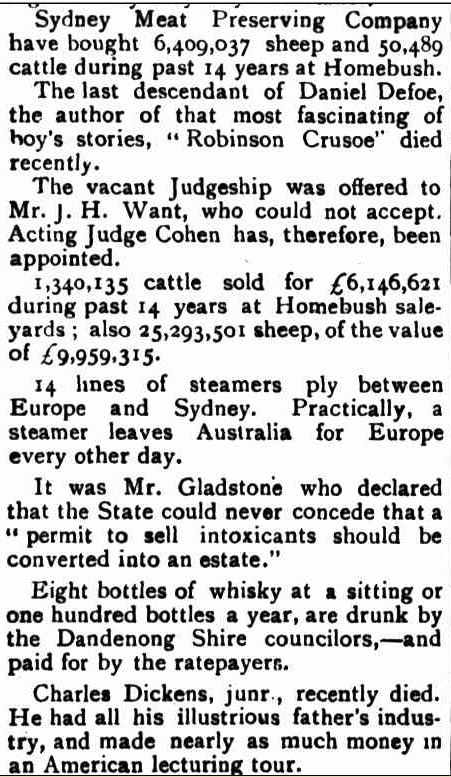





 Western District Families
You must be logged in to post a comment.