There are fourteen new pioneers this month, including two old colonists Cecil Cooke and Jane Fountain. There is Thomas Rutledge born in Port Fairy in 1846 and a son of one of that town’s prominent early residents. Don’t forget if you see underlined text, you can click on it for further information about the subject.
Cecil Pybus COOKE – Died 30 September 1895 at Condah. In 1836 when Major Thomas Mitchell returned to Sydney after his third expedition taking in Victoria’s Western District he described as Australia Felix, word spread far and wide. In England, Cecil Pybus Cooke heard of the “good country” in the new-found part of the colony and set off to see for himself. Cecil was a son of a Madras Civil Servant William Cooke and was born in India in 1813.
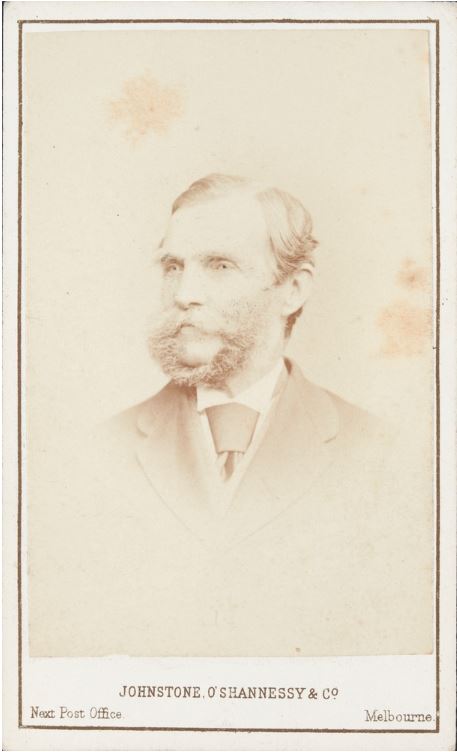
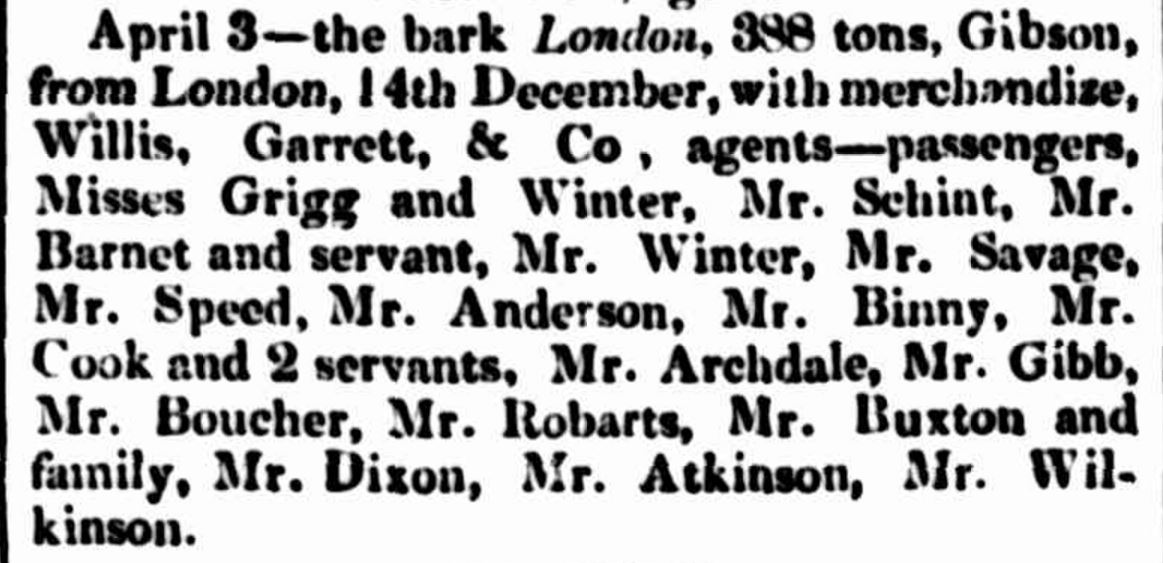
During the voyage, Cecil met George Winter, on his way to join his brother Samuel Pratt Winter who had already made his way to the Western District. Travelling with George was his sister Arbella who caught Cecil’s eye. Just a month after they disembarked at Launceston, Cecil and Arbella were married at St John’s Church, Launceston.
Soon after, the newlyweds boarded a schooner for Victoria arriving at Portland Bay on 10 July 1839. Cecil even travelled with his own accommodation, bringing a hut from England and he set it up in Portland. Soon after, he took up a run on the Smokey River, or Crawford River as it more commonly known. In 1842, a daughter Emily was born and she died the following year. Cecil and Arabella went on to have five sons. Cecil was finding pioneering life tough and things were not going to plan so he went further north to Harrow in 1845 and set up the Pine HillsEstate. More bad luck came when a fire went through the property in 1846. By 1849, Cecil had sold Pine Hills to David Edgar. He then bought Lake Condah Station. In 1864, Cecil sold Lake Condah but the purchaser was unable to make the repayments so he retained it.
One of Cecil and Arbella’s sons Samuel Winter Cooke inherited Murndal, west of Hamiltonfrom his uncle Samuel Pratt Winter in 1878. He employed his brother, Cecil Trevor Cooke as manager from 1883. Samuel later became a Member of the Legislative Council for the Western Province. Cecil and Arbella spent a lot of time at Murndal. The photos below are a collection of photos of or relating to Cecil Cooke held by the State Library of Victoria with most taken at Murndal.
This slideshow requires JavaScript.
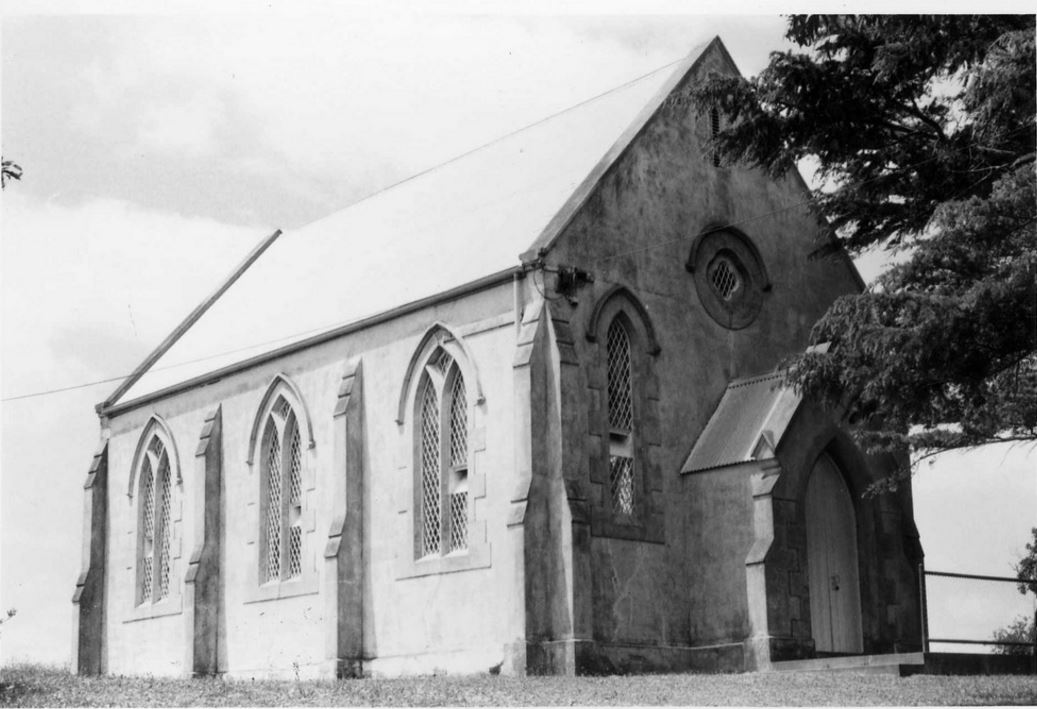
Cecil Cooke was a Justice of the Peace and held court at the Branxholme Magistrates Court. He was Church of England and contributed to the building of St Thomas’ Anglican church at Condah. Arbella died on 1 May 1892 and Cecil had a church built at Spring Creek (below) near Condah in memory of his wife with the foundation stone laid on 24 March 1894.
ST. PHILLIPS CHURCH OF ENGLAND, SPRING CREEK 1983. Image courtesy of the J.T. Collins Collection, La Trobe Picture Collection, State Library of Victoria. http://handle.slv.vic.gov.au/10381/233693
Just two years after his wife, Cecil was buried at Murndal Private Cemetery with Arbella. On 13 March 1900, a memorial window was unveiled for Cecil Cooke at the Condah Church of England.
Jane FOUNTAIN: Died 10 September 1901 at Hamilton. Jane Fountain was born in Cowick, Yorkshire, England on 5 December 1823. When she was eighteen, Jane married James Blastock and soon after the newlyweds left England for Australia, arriving in Melbourne in July 1841. In 1843, they travelled by bullock wagon via Hamilton to Heywood. Jane and James remained there for a short time before returning to Hamilton, then known as the Grange and in 1844, they purchased the Grange Inn. The only other businesses then were a shoemaker and blacksmiths. The photo below shows the Grange settlement when Blastocks ran the Grange Inn and shows land nearby owned by James Blastock.
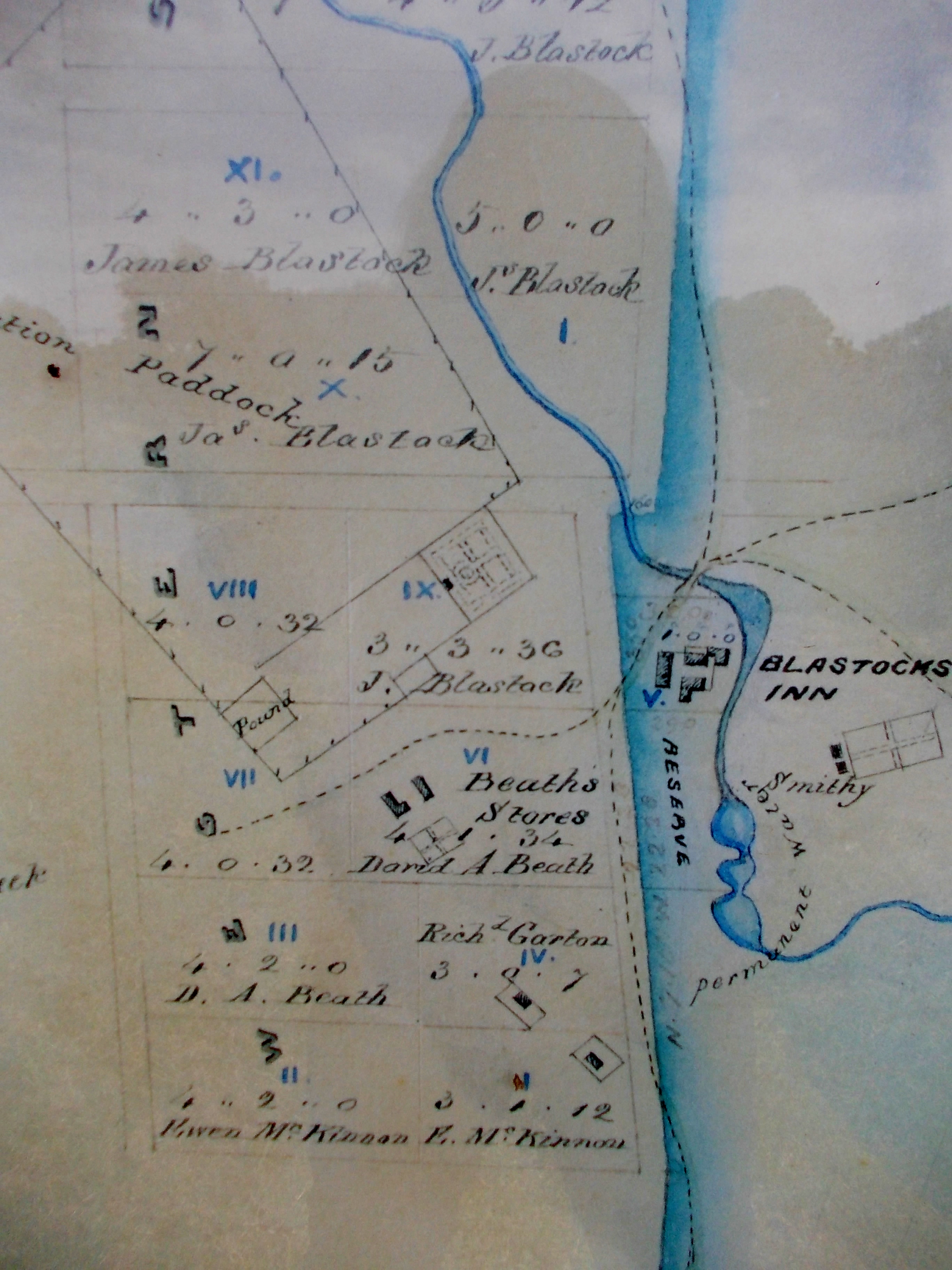
EARLY MAP OF THE GRANGE (HAMILTON) FROM INTERPRETIVE BOARD AT HAMILTON WETLANDS
One of the guests at the Grange Inn during the Blastock’s time there was Charles Latrobe prior to his appointment as Lieutenant Governor. They sold the Grange Inn and purchased the Mooralla Station, north of Hamilton with James’ brother-in-law Mr. Malcolm. Leaving Mr. Malcolm to run Mooralla, Jane and James returned to England for a visit. On their return, they sold Mooralla and built the Victoria Hotel in Gray Street, Hamilton.
In 1857, James Blastock died aged forty-six and in 1859, Jane married James Wiggins. They spent some time living in Geelong then returned to Hamilton and settled at Sandal on Digby Road overlooking the former site of the Grange Inn. Jane was a member of the Wesleyan Church and was involved with the Sunday School. She had an excellent memory of the early days of Hamilton and was often called on for her recollections. In 1893, journalist The Vagabond called on Jane and she was able to show him the route Major Mitchell took when he crossed the Grange Burn in September 1836. On 24 August 1899, the Hamilton Spectator published an article “The Infancy of Hamilton” featuring Jane’s memories. At the time of her death, Jane was Hamilton’s oldest resident.
George SMITH: Died 8 September 1916 at Byaduk. George Smith was born in Devonshire, England about 1843. He arrived in Victoria in 1852 at Portland before moving on to Warrnambool. George moved north to Muddy Creek where he attended the local Primitive Methodist Church. After a few years, he moved to Byaduk, working as a carrier. George left a widow, five sons, and two daughters at the time of his death.
Hannah GREGORY: Died 9 September 1916 at Penshurst. Hannah Gregory was born at Preece, Shropshire, England around 1825 and arrived in Sydney around 1864. Hannah then went to New Zealand where she met her husband James Chesswas and they returned to Australia, settling at Penshurst around 1873. They lived in Bell Street and James worked as a tanner and currier. James died in 1896 and Hannah continued on at Penshurst until her death at age ninety-one.
Hanorah RYAN: Died 30 September 1917 at Kirkstall. Hanorah Ryan was born in Ireland around 1845 and arrived in Australia at the age of twenty, marrying William Pye in 1865. The couple settled at Kirkstall and went on to have five sons and six daughters. Hanorah was buried at Tower Hill Cemetery.
Elizabeth BYRNES: Died 30 September 1917 at Terang. Elizabeth Byrnes was born at Scarva, County Down, Ireland around 1835. She married Thomas Kearns in Ireland and they arrived in 1856 aboard the Anna Maria with their two-year-old daughter to Port Fairy. They settled at Woodford and had four sons and six more daughters. Around 1911, Elizabeth moved to Terang to lived with her eldest daughter until her death.
Thomas Forster RUTLEDGE: Died 6 September 1918 at Toorak. Thomas Rutledge was born at Port Fairy in 1846, a son of well-known resident William Rutledge and Eliza Kirk. His first home was most likely Emoh below, dating back to 1849 and sold by William Rutledge in 1863.
EMOH, COX STREET, PORT FAIRY
In 1876, Thomas married Edith Ritchie. Eventually, Thomas and his brother took over their father’s Farnham run. The 5000 acre property covered the area from the Merri River near Dennington Killarney, further west. The two sons split it, with Thomas taking up Werronggurt and his brother the remaining Farnham run. Thomas bred Lincoln sheep and was known as one of the best judges of Lincolns in the state. He also imported and bred Shorthorn cattle and imported many Clydesdale mares from Scotland. A popular and charitable man, Thomas was one of the first directors of the Farnham butter factory and on the board of the Rosebrook butter factory. He also served on the Warrnambool Shire.
Thomas gradually sold off his holdings and he and Edith moved to Bell Park at Geelong. At one stage, Thomas and Edith spent time living in New Zealand then returned to Geelong. They eventually moved to Woodford in Toorak. At the time of his death, Thomas left his widow Edith and five daughters and one son, Geoffrey, at the time a 2nd Lieutenant with the Australian Flying Corps. Another son, Noel was killed at Ploegsteert, Belgium on 3 June 1917 while serving with the 3rd Division Artillery.
Marie GWYTHER: Died 8 September 1919 at Hamilton. Marie Gwyther was born in Pembroke, South Wales on 2 March 1824. She arrived in Melbourne around 1855 with her three brothers, George, William, and Henry. They stayed in Melbourne a week before moving on to Portland then arriving in Hamilton on 2 August 1855. At the time, the rent on a hut was one pound and a bag of flour ten pounds. Marie was a Presbyterian and attended the ceremony of the laying of the foundation stone by William Skene of Hamilton’s first Presbyterian church (below) on 21 October 1857.
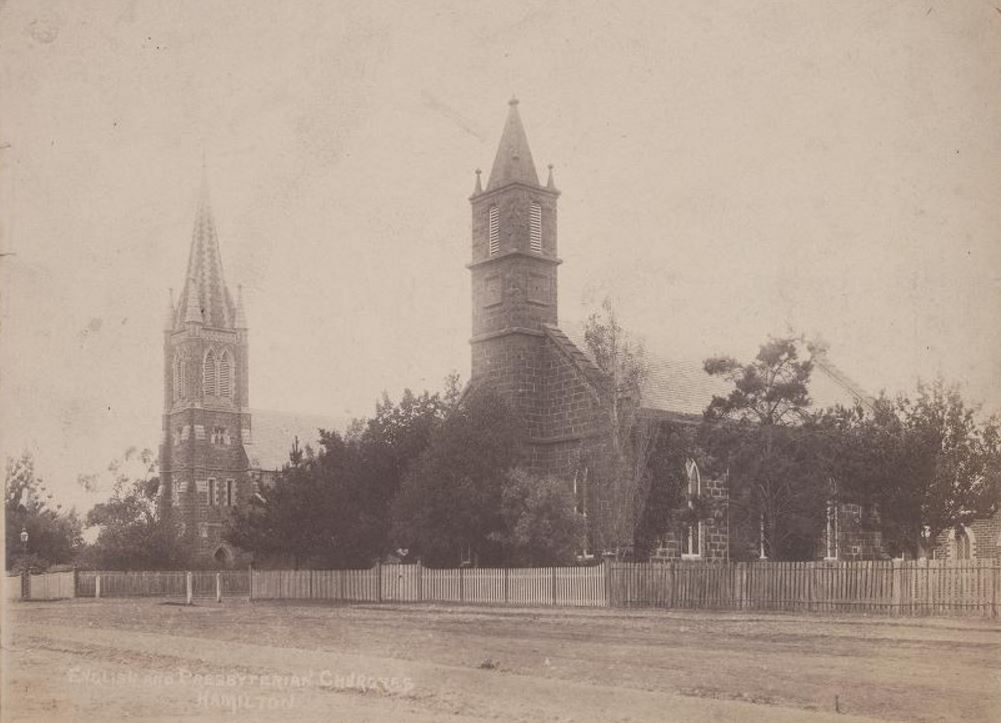
HAMILTON’S FIRST PRESBYTERIAN CHURCH TO THE RIGHT WITH THE HAMILTON ANGLICAN CHRIST CHURCH ON THE LEFT. c1890. Image courtesy of the State Library of Victoria. http://handle.slv.vic.gov.au/10381/69513
During the 1870s, Marie spent time at Harrow working as a cook at the Hermitage Hotel. Marie never married and was “loved by all with who she came in contact.” She lived in Goldsmith Street and as a keen gardener always had a lovely garden.
Isabella McDONALD: Died September 1942 at Geelong. Isabella was born at Mortlake around 1864. Her father Alexander is thought to have built Mack’s Hotel at Mortlake before purchasing the Camperdown Hotel. In 1888, Isabella married John Charles Haugh and they remained in Camperdown. John worked as a baker and they had a family of six sons and two daughters. John Haugh died only four months after Isabella on 19 January 1943.
John PITMAN: Died 4 September 1943 at Portland. John Pitman was born at Macarthur around 1865. While still a teenager, John took up land at Patyah north of Edenhope. In 1897, he married Ellen Montgomery of Neuarapurr. John was interested in athletics and in his early years was a boxer, athlete, cricketer. In his later years, John took up bowls. He retired to Portland in 1921.
Arthur PERRETT: Died September 1948 at Colac. Arthur Perrett was born in January 1884 at Camperdown and married Gertrude Swayn at the Pomberneit Presbyterian Church in 1911. They settled at Derrinellum where Arthur ran a boarding house and grocery store. They returned to Camperdown and Arthur worked for Kleine’s Bakery as a delivery driver. He then obtained work at the Werribee Research Farm before managing a branch of the farm at Boisdale in Gippsland. Arthur and Gertrude returned to the Western District in 1921 when Arthur took up a dairy farm at Pirron Yallock, west of Colac. In 1929, Arthur bought a block in the Reads Estate at Dreeite further north. At both Pirron Yallock and Dreeite, Arthur was on the local state school committee.
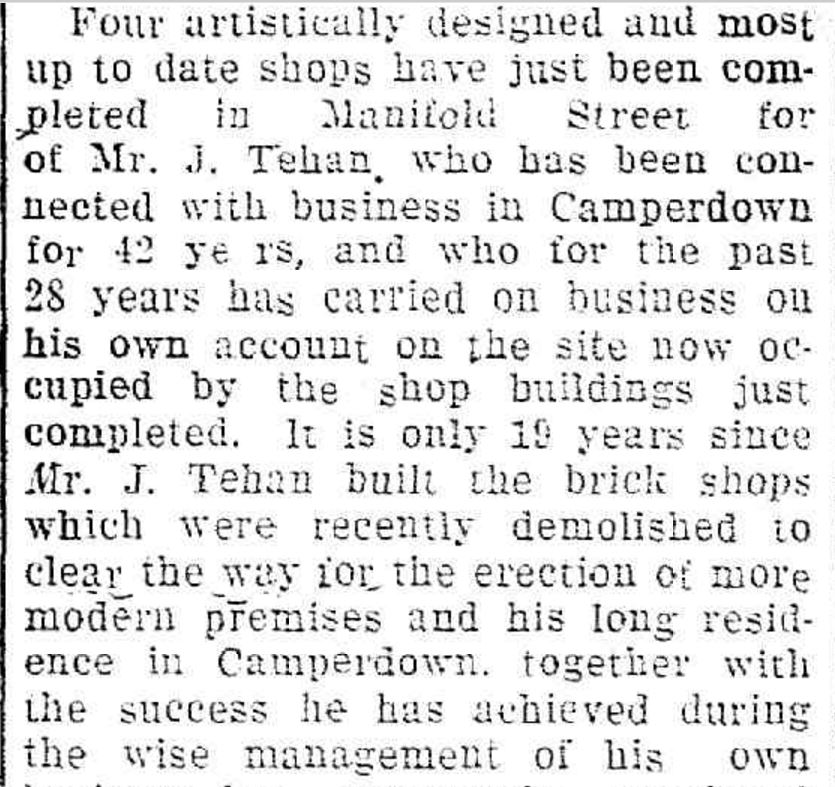
John TEHAN: Died 10 September 1953 at Camperdown. John Tehan was born at Heathcote in 1872 and arrived in the Western District as a young man and worked at Youngers at Warrnambool. He then worked for Morrisons General Store in Manifold Street Camperdown for sixteen years. In 1900, John married Jessie Peter. They had two sons and two daughters. In 1907, John opened his own shop in Manifold street. In 1913, he called for tenders to build a large new brick store on the site. In 1934, John demolished the shops had four new shops built in their place.
Thomas Stewart LORD: Died 12 September 1954 at Warrnambool. Thomas Lord was born at Port Campbell around 1882 and was the first boy of European descent born there. His parents William and Jessie Lord had settled there in 1876. Thomas attended the Port Campbell State School but did spend two years at school in Bairnsdale in East Gippsland. He returned to Port Campbell and worked in the local store from the age of fifteen. Thomas was the first secretary of the Port Campbell Football Club and a member of the school committee. He was also a director of the Cobden and District Pioneer Butter Factory (below)
As the Passing of the Pioneer post comes together each month, I often find the pioneers have something in common. Sometimes it’s their occupations or their birthplace. This month, five of the twelve pioneers went to the goldfields after arriving in Victoria. It is one of the most common similarities I come across, and not surprising as gold was the big drawcard to Victoria in the 1850s. To read the newspaper obituary for each pioneer, just click on their name. You can also click on other underlined text in the post to find more information.
William Henry GUBBINS: Died 9 August 1905 at Penshurst. William Gubbins was born at Tavistock, Devonshire, England around 1827 and arrived in Victoria in the mid-1850s. After his arrival, he went to the diggings at Creswick then later Clunes. Around that time, William married Mary Ann Down and they had five children. The family then spent time around the Terang district before purchasing Burn Brae Estate at Penshurst in 1888.
“BURN BRAE” HOMESTEAD, PENSHURST IN 1978. Image courtesy of the J.T. Collins Collection, La Trobe Picture Collection, State Library of Victoria. http://handle.slv.vic.gov.au/10381/233170
Mary Ann died in 1900 and William stayed on at Burn Brae until his death. William was buried at the Terang Cemetery.
John MILLMAN: Died 2 August 1914 at Hamilton. John Millman was born in Leamington, Warwickshire, England in 1832. He and his brother left England together, arriving in Melbourne in 1852. John worked as a carpenter in Melbourne but his brother went “up country”. By the time of the Eureka uprising in Ballarat in 1854, John was in Ballarat trying his luck as a miner. Around 1855, John purchased a three month Miner’s Right for £2 and he later passed the document on to his family. By 1861, John had arrived in Hamilton where his brother was residing. It was in Hamilton John married Sarah Jane Knapp in 1878. A member of the Hamilton Rifle Club, John was also a keen horticulturist, competing at the various shows around the district. Sarah died in 1910.
Mary LORD: Died 23 August 1914 at Karabeal. Mary Lord was born in Wexford County, Ireland around 1833 and travelled to Portland with her parents around 1850. They settled in that town and in 1860, Mary married Joseph Brewis. At the time, Joseph was the manager at Mokanger Station near Cavendish and he returned there with Mary. After working at Mokanger for seventeen years, Joseph Brewis purchased land at nearby Karabeal they called Canridge and remained there for the rest of their lives. Mary and Joseph had seven sons and one daughter. They were buried at the Cavendish Old Cemetery (below).
THE HEADSTONE OF MARY AND JOSEPH BREWIS OBSCURED BY THE HEADSTONE OF MARY’S PARENTS WILLIAM AND MARY LORD AT CAVENDISH OLD CEMETERY
Edward HALL: Died 8 August 1915 at Malvern. Edward Hall was born in England around 1830. He left Liverpool, England for Australia on the Satellite, arriving at Melbourne on 2 August 1851. He then sailed on the Red Rover to Port Fairy. Edward worked as a tutor for the children of Messrs. Mills and Glare but in 1852 after the discovery of gold, he left for the Ballarat diggings with some other local men. It was short lived with Edward returning to Port Fairy the following year. He next went to Brighton as a lay reader with the Church of England. While there he had an encounter with bushrangers in the area where the suburb of Moorabbin is now located. After that experience, Edward returned to Port Fairy, opening a school at Rosebrook and then teaching at Port Fairy. He again returned to Brighton and then Nunawading where he remained until his death.
Mary Josephine ROACHE: Died 24 August 1915 at Hamilton. Mary Roache was born in Ireland around 1860 and arrived in Australia in the mid-1870s. Mary went to Hamilton and resided at the Town Hall Hotel in Gray Street when it was known as Mackey’s and the licensee was Michael Roache, possibly Mary’s brother.
THE TOWN HALL HOTEL, HAMILTON c1888. (“VIEW OF HAMILTON VICTORIA.” Hamilton Spectator (Vic. : 1870 – 1918) 17 April 1888: 2 (SUPPLEMENT TO THE HAMILTON SPECTATOR).
Mary married widowed travelling dentist John Mawson in Melbourne in 1887 and they had one daughter Veronica in 1892. After spending time in Melbourne, they moved back to Hamilton around 1901 and in 1902 John built a practice in Gray Street. John Mawson died two years after Mary in 1917.
James SPRING: Died 24 August 1916 at Bochara. James Spring was born in County Meath, Ireland in 1830. When eighteen, James sailed to Sydney, NSW aboard the Royal Saxon. He then made his way south to Mount Gambier, South Australia. In February 1855, James arrived in Hamilton and settled north of the town at Bochara on the Grange Creek. During February 1891, bad bushfires swept through the Bochara district impacting on James’ farm. While his house was saved, he lost a lot of feed and farm machinery.
Thomas WHEATLEY: Died 11 August 1917 at Terang. Thomas Wheatley was born in Middlesex, England in 1827. He joined the Royal Navy and during the 1840s spent time sailing around the South Seas. He joined the crew of the Aberfoyle and in 1854 landed a Geelong. Thomas was able to take leave of his employment and went to the Ballarat goldfields but arrived in December around the time of the Eureka uprising. With unrest in Ballarat, Thomas continued on north to Creswick. With no luck on the diggings, Thomas eventually made his way to the Terang district and married in 1856 to Ellen McLaughlin, born in Kilkenny, Ireland. He bought a bullock team and set up the first carrying business in Terang. Thomas was a member of the Salvation Army. Ellen died around 1914 and eight of their children were still living at the time of Thomas’ death three years later.
Mary Ann Coughlan: Died August 1917 at Caramut. Mary Ann Coughlan arrived in Australia with her family in 1849. She later met John Bendall the manager of John Moffat’s Hopkins Hills and The Gums. They married in 1864 and lived at The Gums. After that property was sold, the Bendalls ran a General Store and Post Office at Caramut and raised two sons and two daughters. Mary Ann was widowed for more than thirty years with John dying in 1887 aged forty-seven but she remained in Caramut.
Janet CALDOW: Died August 1918 at Caulfield. Janet Caldow was born around 1832 in Ayrshire, Scotland. While still in Scotland she married Joseph Blain and they travelled to Australia aboard the Lord Nelson, arriving in Melbourne in 1855. They went straight to the Ballarat diggings but soon took up a farm at Coghills Creek near Ballarat. Around 1865, they moved to Garvoc, running a dairy farm and raising three sons and four daughters. Joseph died around 1896. Janet’s immediate family also immigrated from Scotland and lived long lives in Australia. At the time of her death, the ages of her remaining five brothers and one sister totalled 425 years.
Adam Gordon LAIDLAW: Died 1 August 1918 at Melbourne. Adam Laidlaw was born at Harrow in 1858 to Walter Laidlaw and Mary Gordon. Adam grew up on his father’s property Mundarra near Edenhope and later attended Hamilton and Western District College and obtained his matriculation.
Adam Laidlaw was associated with several properties including Ardachy near Branxholme where he lived for ten years. He also owned Wootong Vale near Coleraine but in his later years leased the property out. Never married, Adam was a philanthropist donating much money to charity including the Hamilton Hospital. During the war years, he donated regularly to the War Loans Fund. He was also a member of the Coleraine and Hamilton Racing Clubs. Prior to the war, Adam went on a world trip but returned in 1915 and took up residence at the Melbourne Club in Collins Street. In July 1918, Adam visited the Western District and returned to the Melbourne Club by the start of August. On 1 August, Adam was playing billiards when he fell ill. He was rushed to hospital but later died. Adam Laidlaw was buried at the Brighton Cemetery
Robert Ernest McARTHUR: Died 29 August 1929 at Camperdown. Robert McArthur was born in 1867 at Camperdown, a son of Margaret McLean and well-known pastoralist Peter McArthur of Meeningoort, Camperdown. Robert attended Geelong College and was captain of the cricket and football teams and later went to Ormond College at Melbourne University, studying law. He returned to Camperdown and helped his father manage Meeenigoort before purchasing Koort Koort Nong (below) where he resided.
Robert was an amateur jockey, excelling at cross-country events and enjoyed polo. In 1897 and 1898, he rode three winners at the Warrnambool Amateur Races. He also won the Melbourne Hunt Club Cup. Robert was a member of the Camperdown Turf Club and honourary starter at the Terang Racing Club and a founding member of the Western District Racing Association. He was also a councillor on the Hampden Shire from 1898 to 1907. Another obituary for Robert is on the link here.
George GEMMELL: Died August 1945 at Camperdown. Born around 1867 at Mortlake, George Gemmel moved to Cobden around 1880 working as a stonemason. Works he was involved with included the foundations of Grand Central Hotel at Cobden, the Shire Offices and Poligolet (below) near Derrinallum.
George married Elizabeth Porter in 1890 and the family were members of the Camperdown Presbyterian Church. At the time of his death, George had four sons, one daughter, sixteen grandchildren and two great-grandchildren.
The following advertisement for the 1916 Hamilton Pastoral & Agriculture (P & A) Show reminded me it was the first Hamilton P & A show my ggg grandfather James Harman was not around for. In turn, it reminded me that today is the 100th anniversary of James Harman’s death.
James Harman’s roles with the P & A included exhibitor, judge, and committee member. Over the years, he exhibited Lincoln sheep, farm produce, and border collie dogs and judged produce and farm machinery.
Toward the end of the 1870s, when his oldest boys could take on duties on his farm, James had more “leisure” time, so he threw himself into a few local farm-related activities, and the P & A was one of those. Respected by farmers and graziers alike, James could mix with all men, including Hamilton Spectator owner George Rippon, grazier and politician John Thomson, and businessmen Peter Learmonth and Robert Stapylton Bree, each prominent names in the annals of Hamilton and district.
“PASTORAL AND AGRICULTURAL SOCIETY.” Hamilton Spectator, 17 May 1883, p 4
In 2011, I wrote The Leader of the Pack on the assumption that if all my ancestors came together at one place and time, it would be James Harman who would step to the front and lead the group. Five years on and knowing so much more about James, I have no doubt. I first formed my opinion based on his place in the Harman family as eldest son, and also his place in the community as a Wesleyan Methodist Church Local Preacher. Now, with more issues of the Hamilton Spectator at Trove giving me 250+ tagged articles for James, I know his leadership went beyond the confines of family and the Byaduk community.
Along with James’ P & A involvement, he was on several occasions President of the Hamilton Farmers Union in the 1880s and the founding president of the Byaduk Farmers Club. He was also on the Byaduk State School committee, represented the Byaduk community at Dundas Shire meetings, and as a leader in the church, attended Wesleyan Methodist Synods representing the Hamilton circuit, always considering the interests of the local church goers.
JAMES HARMAN AGED AROUND THIRTY-SEVEN (1867). Photo taken from the Byaduk Pioneer photo boards in the Byaduk Hall, compiled by Vern McCallum (website http://www.mccallum-collection.org/)
Throughout, James remained humble and, during his Farmers’ Union presidency, considered himself worthy of leading the organisation. But James also said if he joined a committee, he gave it everything he had, and he was true to his word. James’ election to chairman of a meeting in 1881 to discuss a possible extension of the railway from Hamilton to Byaduk was just one occasion when James expressed those sentiments publicly.
Such activities meant James was rarely home, but always waiting patiently until all hours of the night was his wife, Susan. Susan shared his life from 1852 in Cambridgeshire, through their voyage to Australia as newlyweds, and trusted James when he suggested moving north from Port Fairy to select their own piece of Australia at Byaduk. It was Susan’s death only four months before his own that saw James’ health slip, taking away the vigour that served him so well for eighty-five years. As Reverend Guard, the then Byaduk Wesleyan Methodist preacher, said in the obituary he wrote for James, “Earth had not such an interest for him…”
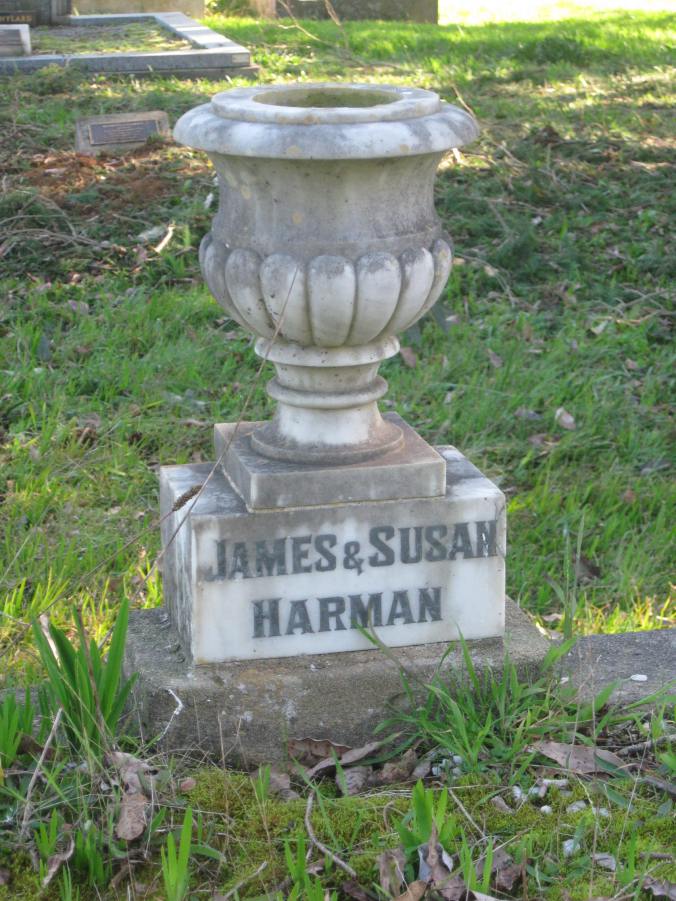
TOGETHER AGAIN. THE GRAVE OF JAMES & SUSAN HARMAN AT THE BYADUK CEMETERY.
It was a chance discovery while searching the fifteen or so years of the Hamilton Spectator available at Trove. There in the search results was an article from 1910. That wasn’t expected when only the WW1 years and the decade 1870-9 were available. Curious, I tried a search of “Harman” and the result was dozens of articles from the 1880s to 1910. Trove had surprised me adding a further three decades of Specs and I couldn’t have been happier. Since that day a couple of months ago, I have searched, tagged and found out an incredible amount of new detail about my Hamilton district families. Also, surnames, street names and locations bring such a sense of familiarity when reading my hometown newspaper, even issues from 100 hundred years before I was a resident.
One of the first items of interest I found was an obituary for my gggg grandfather Joseph Harman from 1893. His son James converted to Methodism around 1851 while still in England. Joseph, entrenched in the Church of England, didn’t share his son’s enthusiasm for Methodism. However, when the Harmans moved to Byaduk in 1863, the first church built was Wesleyan Methodist and James Harman, by then a Local Preacher, was one of the forces behind the church. Joseph had little choice but go along to Methodist services, but as soon as a Presbyterian Church was built at Byaduk eighteen years later, he made that church his Sunday morning destination. There were no family loyalties when it came to Joseph’s faith. It would seem that although the new church wasn’t Church of England, it was more to his liking than the teachings of John Wesley. Granted the Presbyterian Church was less than a mile down the road from his home but the Methodist church was only that distance again further on.
Also found was a rare obituary for a female family member. Although it doesn’t tell me much about my ggg grandmother Sarah Hughes‘ life, the 400 mourners at her funeral tells me something of the sort of person she was.
There are also some great articles about Sarah’s husband James Bishop but I’ll save those for a post just about him because he was a character.
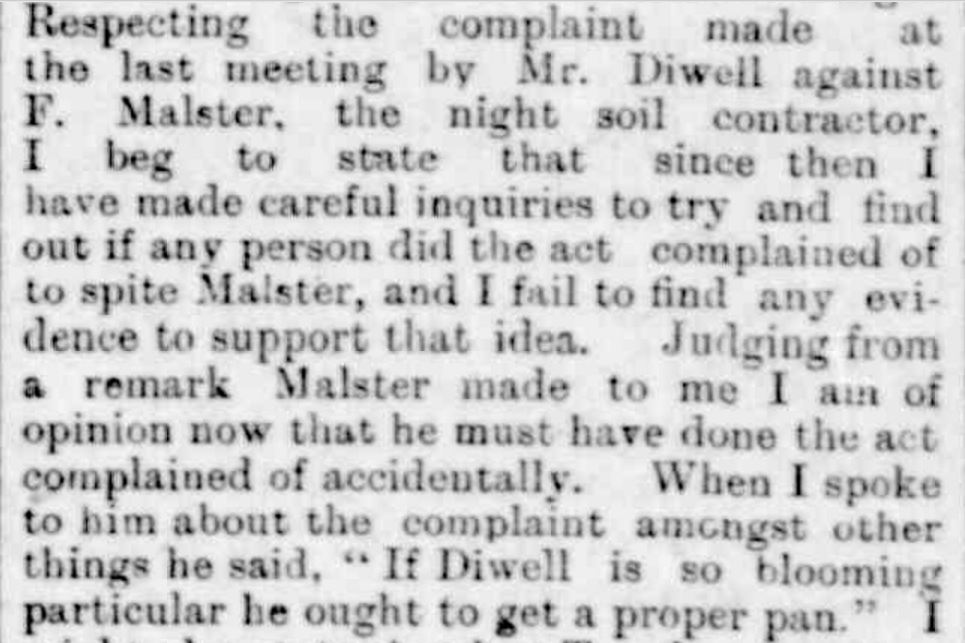
Something I enjoy reading in old newspapers is the seemingly mundane day-to-day goings on in a town. Of course, it’s even better when a story includes a family member. Like the time in 1899 when my gg grandfather Richard Diwell of Hamilton complained about the night soil man.
“HAMILTON BOROUGH COUNCIL.” Hamilton Spectator (Vic. : 1870 – 1918) 14 October 1899: 2 (SUPPLEMENT TO THE HAMILTON SPECTATOR). .
The night soil man Frederick Malster was given the right of reply after the investigation into Richard’s complaint.
“HAMILTON BOROUGH COUNCIL.” Hamilton Spectator (Vic. : 1870 – 1918) 28 October 1899: 2 (SUPPLEMENT TO THE HAMILTON SPECTATOR). .
One of the best finds so far were a number of sketches included in a Hamilton Spectator supplement in 1888. The Spec had the sketches of businesses and scenes of Hamilton made by a Ballarat company. Sketches such as these give us a chance to see how things have changed…
CORNER OF GRAY & THOMPSON STREETS IN 1888. Hamilton Spectator (Vic. : 1870 – 1918) 17 April 1888: 2 (SUPPLEMENT TO THE HAMILTON SPECTATOR).
THE PRESENT VIEW OF THE CORNER OF GRAY & THOMPSON STREETS.
And how other things have barely changed at all…
HAMILTON SPECTATOR IN 1888. “VIEW OF HAMILTON VICTORIA.” Hamilton Spectator (Vic. : 1870 – 1918) 17 April 1888: 1 (SUPPLEMENT TO THE HAMILTON SPECTATOR).
This month, Passing of the Pioneers enters its sixth year and the great pioneering stories keep coming. While not intentional, the theme for the month is construction with several of the pioneers having worked as carpenters and masons. Two of those were born a year apart at Taunton, Somerset, England and both started family businesses still in operation today. As you read through, you can click on the names of the pioneer to read their newspaper obituary or other underlined words for further information.
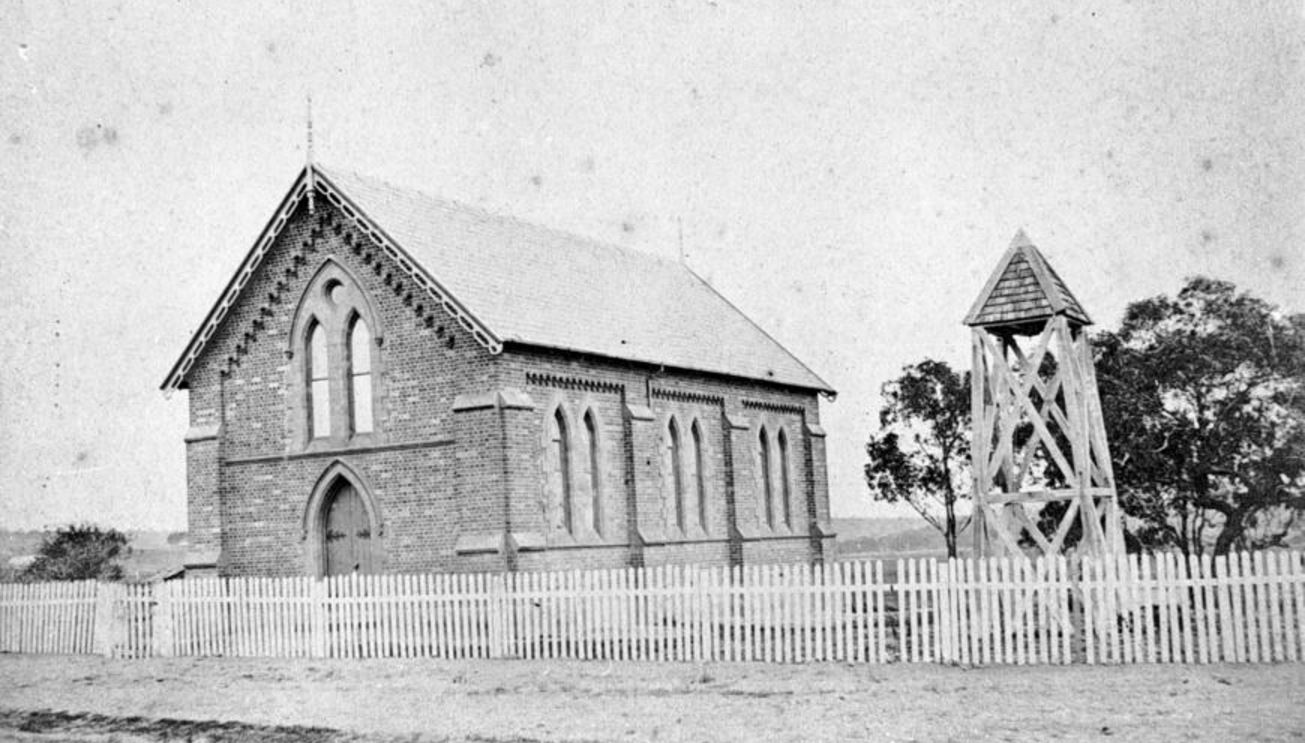
George NORTHCOTT: Died 23 July 1894 at Merino. Born in Devon around 1825, George Northcott, his wife, and his children arrived in Portland around 1854. They spent time in Portland before George, a joiner by trade, was engaged by T.H.Clarke to construct some buildings in Merino. He built the Farmers Arms Hotel at Merino around 1855. In 1868, George Northcott and my ggg grandfather William Diwell built the Merino Presbyterian Church (below).
MERINO UNITING CHURCH (former St Andrews Presbyterian ChruchJ.T. Collins Collection, La Trobe Picture Collection, State Library of Victoria. http://handle.slv.vic.gov.au/10381/232204
In 1865, Northcott and Diwell built the first Casterton Presbyterian Church (below)
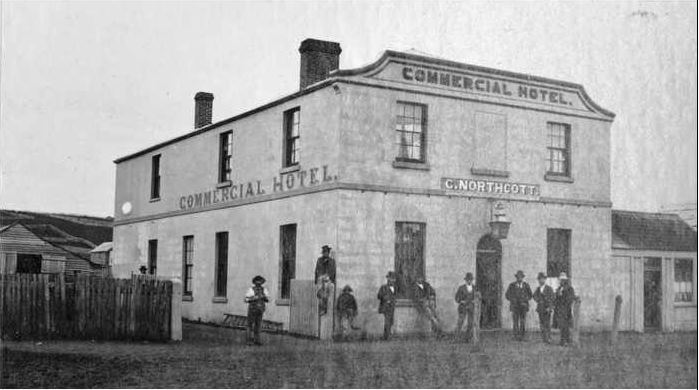
George built the Commercial Hotel at Merino around 1869, the town’s third hotel. He leased the hotel out but after the second tenant of the hotel died suddenly in 1877, George took over the running of the hotel and attached Cobb & Co station and became quite wealthy as a result.
A few years before his death, George’s wife died and he gave up the running of the Commercial, passing control to his eldest son Henry. George did not get over the death of his wife and by the beginning of 1894, his health began to fail before he died on 23 July.
James MALLETT: Died 3 July 1901 at Merino. Born around 1834, at the age of eleven James Mallett arrived in Portland from Tasmania. He went straight on to the Henty’s Muntham Station near Merino where he remained for several years before returning to Portland to start a bootmaking apprenticeship. He married and by 1864 had returned to Merino and remained there until his death. He left three sons and four daughters, with a fourth son having died several years before.
Stephen NORMAN: Died July 1901 at Hamilton. Stephen Norman was born around 1794. On arrival in Australia, he found himself working for the Henty brothers and was one of their first employees after their arrival to Portland Bay in 1834. Stephen was, according to his obituary, the first man to plough land for the Hentys at Portland. Reaching the age of 107 without a sick day in his life and still with all his faculties, Stephen suddenly fell ill at his home in Casterton and admitted to the Hamilton Hospital where he died a few weeks later.
George MAHONEY: Died 13 July 1902 at Dunkeld. Arriving in Victorian in 1841 aboard the Duchess of Northumberland, George Mahoney began his time in Victoria as manager of Glenmore Estate near Bacchus Marsh. He was there several years before moving to Geelong for a short time before settling at Dunkeld. A farmer, George led a quiet life away from public affairs although he did keep up an interest in politics and current affairs. George was eighty-two at the time of his death and left a widow and nine children.
Richard William COLLINS: Died 13 July 1902 at Hamilton. Richard Collins was born in Brixton, London around 1840 and arrived in Victoria in 1857. He settled at Hamilton, working as a carpenter. He later worked at Mr Allen’s timber yard until setting up his own yard, the “Victoria Timber Yard” in 1879. After selling the timber yard, Richard and his wife returned to England for a visit and on their return purchased a farm at Mountajup. After only a few years, Richard returned to nearby Hamilton setting up a timber yard on the corner of French and Cox Streets and he operated it until he died in 1902. A member of the Church of England, Richard left a widow but their marriage was childless. The Hamilton Brass Band played the “Death March” at Richard’s funeral at the Hamilton Cemetery.
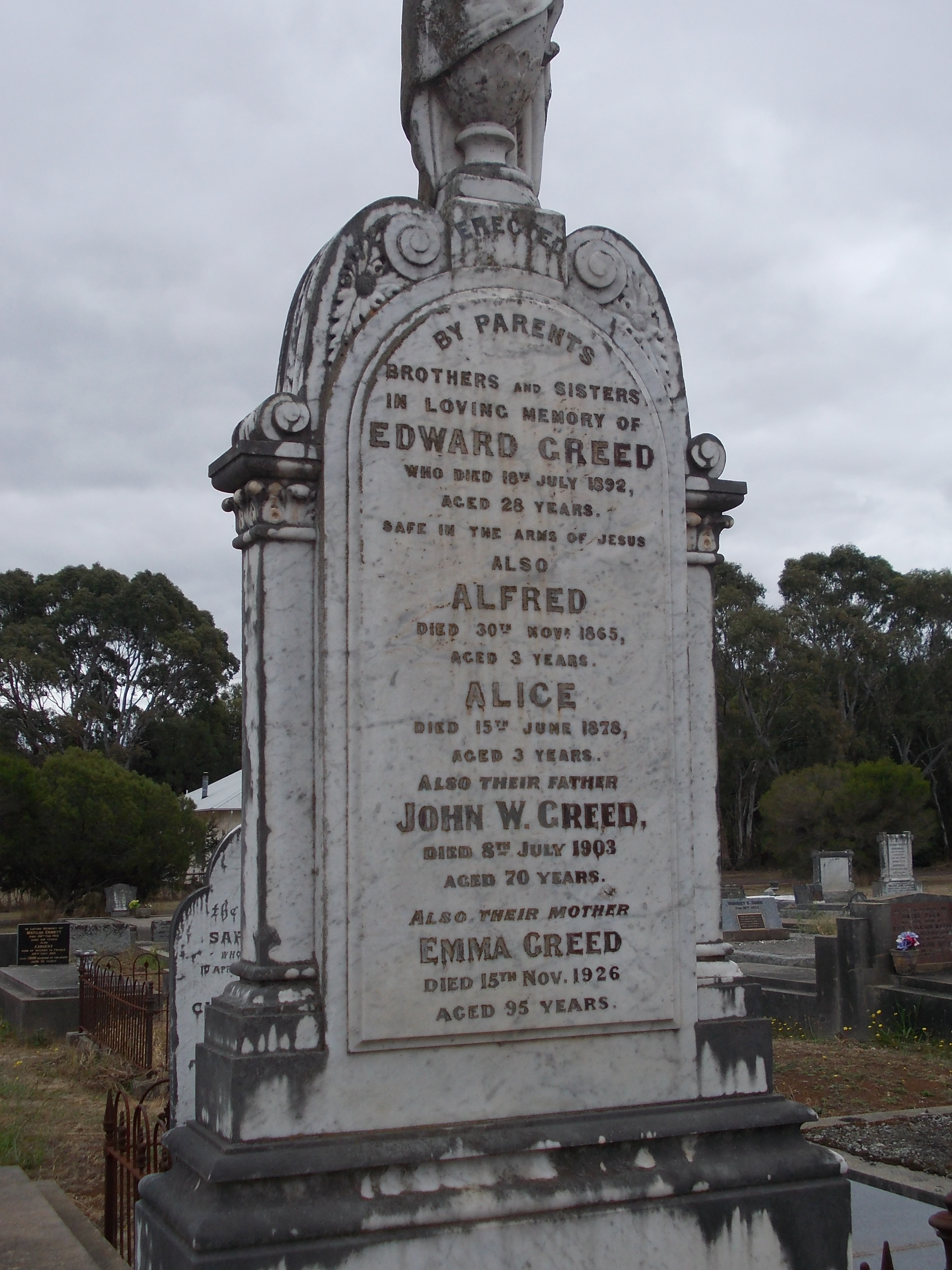
John Weaver GREED: Died 8 July 1903 at Hamilton. Born in Taunton, Somerset, England in 1834, John Greed married Emma Grinter in 1856. They continued to live in Taunton with John working as a mason and two daughters were born. In 1857, John’s parents Charles and Sarah Greed, and his younger siblings left England for Victoria aboard the Balnaguith. In 1862, John and Emma and their daughters left England aboard the Lighting for Victoria, and on arrival in June 1862, the family headed straight for Hamilton to join John’s parents who had settled there, with Charles Greed running a glazier’s business from Lonsdale Street. Hamilton was still in its infancy and John was the first to build on the town’s northern hill, land “dotted” with the mia mias of local aboriginals.
John began a carpentry and contracting business and an early job was to build the fence for the then-new shire offices as reported in the Hamilton Spectator and Grand District Advertiser on 20 May 1864. Earlier in the month, the same paper published a business directory and by that time there were two undertakers in the town, George Brownless, and John Lobban. From searches of the Spectator from that year, it also seems it was the year when John took up a contract with the Hamilton Hospital and Benevolent Asylum to conduct funerals for them. But it was not until April 1871 that I found the following advertisement for John as both a carpenter and undertaker.
Interestingly, from around 1880, John Greed’s advertisements included the words “Established in 1861”, however, both the 1861 England Census and the Victorian Shipping Records prove John was still in England.
The undertaking business tied in well with John’s brother Abraham’s coachbuilding business and one of John’s sons Walter eventually worked for Abraham, a Mayor of Hamilton. John was a Methodist but converted to the Baptist Church, located close to his home in Collins Street. He was also a member of the Forester’s Lodge and the Oddfellows. With the latter, he was twice a member of the board of directors. He was also made a Life Governor of the Hamilton Hospital. Around 1887, John suffered a paralytic seizure reducing his activities and in time leaving him an invalid. That saw John’s youngest son Frank take over as manager of the business around 1892 when he was twenty.
On 23 June 1903, John Greed was in his room at home with his wife Emma. She left the room, leaving John standing in front of a fireplace containing a colonial oven. John fell backwards into the fireplace falling beside the oven but landing on hot iron bars in the fireplace. He called out to Emma who rushed in to find him in the precarious position. She managed to get him out and into his bed. The doctor was called and he treated burns to John’s back, legs, and hands but the shock of the fall saw him fall into a coma like state. Two weeks after his fall, John Weaver Greed died. On 12 September 1903, the Hamilton Spectator announced Frank was taking over the business. F. Greed & Sons was born and still operates under that name today with the Greed family still at the helm.
HEADSTONE OF JOHN WEAVER GREED AND FAMILY, HAMILTON OLD CEMETERY
Euphemia McDONALD: Died 13 July 1907 at Condah. Euphemia McDonald was born around 1832 at Mull, Argyllshire, Scotland. She arrived in Victoria in 1852, disembarking at Portland. It’s unclear when Euphemia married Alexander Urquhart, but they did have a son Thomas born in 1858. In the late 1880s, Alexander took on the management of Samuel Winter Cooke’s property Condah Hills. In 1901, disastrous bushfires swept through a large area south of Hamilton, including Condah. Euphemia received severe burns to her hands and feet and was only saved by her son John’s actions of lowering her into a well. She never fully regained her health and Euphemia died at the age of seventy-five.
Samuel VANCE: Died July 1908 at Bridgewater. Samuel Vance arrived at Portland in 1855 from Northern Ireland aboard the Cairngorm. Before his departure, he had served in the British Army. Samuel worked as a farmer and a contractor for the Portland Shire Council. During the 1880s, he built the Sea View Hotel at Bridgewater and ran it until the time of his death.
Sarah CAMERON: Died 8 July 1908 at Geelong. Sarah Cameron was born in Scotland in 1819 and married Archibald MacDonald and they had three daughters. Archibald’s fate is not mentioned but Sarah went on to marry Donald Cameron of Southland, New Zealand who himself had five daughters and two sons. From NSW they travelled overland to the Colony of Victoria, settling first at Campbellfield near Melbourne before moving on to Morgiana near Hamilton, then called the Grange. Donald’s uncle had taken up the run only a few years earlier and Donald took over the running of the property. The Camerons of Morgiana were well known in the Hamilton district Sarah’s is an interesting obituary as it lists early settlers in the Hamilton district.
Anne BELL: Died 4 July 1909 at Hamilton. Anne Bell was born in Ireland and travelled with her parents John Bell and Elizabeth Morrow to Victoria in 1841, arriving at Portland. With them were Anne’s seven siblings. The family travelled from Portland to Mt Eckersley near Heywood where they settled. In 1848, Anne married Henry Barr and with the discovery of gold, the couple left for the diggings remaining two years with little success. After their return to Heywood, Henry bought the Heywood Hotel, and together Ann and Henry ran a successful business. On 19 February 1865, the stables adjoining the Barr’s hotel caught fire. As a result of his exertion, Henry fell ill and never recovered, dying in July 1866. Anne and her family moved to Lake Condah where they remained for the next fourteen years. After the sudden death of her son, Anne returned to Heywood but eventually sold her interests there and went to live with her children, first John at Lyons between Heywood and Dartmoor and then George at Strathkellar near Hamilton. Anne fell ill in June 1909 and was admitted to the Hamilton Hospital where she died on 4 July.
John PERRY: Died 8 July 1913 at Coleraine. Born in Bristol, England in 1818, John Perry looked set for a career as an artist but decided to choose an outdoor pursuit working in agriculture. He married Elizabeth Holbrook at Bath, England on 3 December 1839, and thirteen years later, the Perrys with four sons left England for Australia. Sailing on the Priam, the Perrys arrived at Portland in 1852. John’s stock experience in England held him in good stead for employment and his services were desperately sought after by Edward Henty at Muntham Station. However, staying loyal to a commitment he made to Mr A. Munro, John went to work for Munro, managing several stations including Dundas and Bassett. By 1859, John had entered into a partnership and purchased land near Ararat. However, the death of one of his sons at the property saw him sell and return to Branxholme and later Merino Downs working for Francis Henty.
Over the next twenty years, John managed various large properties throughout the district. He eventually retired to Digby and in 1886, Elizabeth died. John continued painting as a hobby throughout his life.
William DUNN: Died 12 July 1914 at Box Hill. Born in Taunton, Somerset, England around 1833, William Dunn arrived in Victoria in 1855 aboard the Ravenscraig. He spent time in Geelong before riding on horseback to Hamilton, where he remained for the next forty-four years. William was a builder and in 1866 entered into a partnership with another builder, William Holden, and together they set about “building” Hamilton.
Holden and Dunn built some of Hamilton’s grandest buildings, and most still stand today. They included the Bank of Australasia, the Bank of Victoria, the Colonial Bank, and the residences of doctors, including Hewlett House and Roxburgh House. They alsobuilt the first brick house in Gray Street owned by Mr S. Radley, the Hamilton Goal, and many shops in the CBD of Hamilton, including a strip of shops running from the corner of Gray and Thompson streets. Looking at the histories of some of the buildings Holden and Dunn constructed, it seems William Dunn has become the forgotten man of the partnership, with Holden given credit alone. However, newspaper articles from the time and William Holden’s obituary confirm their partnership.
In his personal life, William married twice and left a widow and four children at the time of his death.
You can see more about Holden and Dunn and their work in the slideshow below.
This slideshow requires JavaScript.
Richard Thomas CARTY: Died 24 July 1917 at Hamilton. Richard Carty was born in Wexford, London in 1842 and at age seventeen arrived in Australia. With little to his name, he tried various jobs before going to the New Zealand gold diggings. After mixed fortunes on the diggings, Richard returned to Australia and took up cattle droving. He became manager of the Bredelbane Estate near Castlemaine and with that experience, leased Mt Clay Estate near Heywood during the 1860s. Success from that venture enabled him to lease Bark Hill Estate in 1873. In was also in that year, Richard married Lucy Hawkins. In the early 1880s, Wando Vale was subdivided for Closer Settlement, and Richard and Lucy moved there, remaining for three years. On 1 January 1885, Richard took possession of Brisbane Hill at Byaduk. Richard and Lucy remained at Brisbane Hill until around 1916 when they moved into Hamilton, residing at Montacue in Kennedy Street until Richard’s death.
GRAVE OF RICHARD CARTY AND FAMILY, HAMILTON OLD CEMETERY
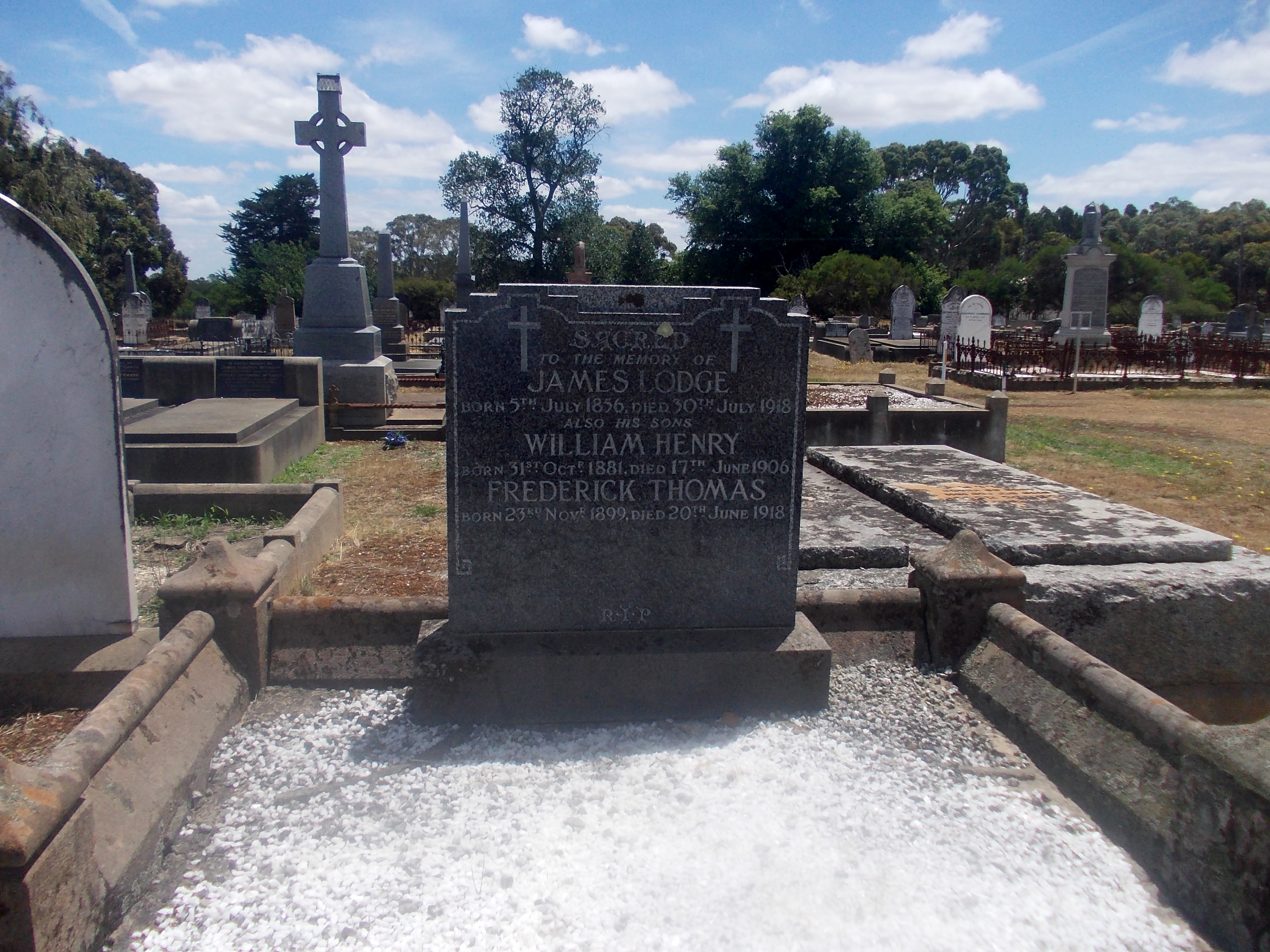
James LODGE: Died 31 July 1918 at Casterton. A son of James Clapham Lodge and Hannah Hudson, James Lodge was born in Richmond, Victoria around 1859. He became an apprentice stonemason and stone cutter and following his apprenticeship, moved to Stawell to work in a stonemason partnership, Lodge and Timmins. In 1884, James married Ellen Murphy and they went on to have six sons and two daughters. Around 1892, James moved to Hamilton, taking up residence in Clarke Street and one of his first jobs was as clerk of works on extensions of Hamilton’s Catholic church St Mary’s. Later he would add a spire to the church.
Churches were James’ specialty, building extensions to Catholic churches in Penshurst, Casterton, and Koroit. He also built the Tabor Lutheran Church and Tarrington School building. James’ sons followed him into the business, however, in 1906, eldest son Harry fell ill and died of inflammation of the kidneys on 17 June.
The years of WW1 were difficult for James. With five sons, James saw his oldest four boys Gus, Frank, James, and Richard enlist. During those years, James won a street channelling contract with the Borough of Hamilton and in June 1918, James and his youngest son Frederick were building the Catholic presbytery at Casterton. Frederick was eighteen and keen to join his brothers overseas. However, Frederick caught a cold while working on the presbytery and it developed into double pneumonia and he died on 20 June 1918, While James was worried about his four sons overseas, it was the son under his own watchful eye who would die. Despite his grief, James continued working on the presbytery but around July 21, he too fell ill with a cold. Within days, James was diagnosed with pneumonia and pleurisy and he died during the afternoon of Wednesday 31 July, and was buried at the Hamilton Old Cemetery.
HEADSTONE OF JAMES LODGE AND SONS WILLIAM AND FREDERICK, HAMILTON OLD CEMETERY
Just weeks after James’ death, on 24 August 1918, trees for Hamilton’s Clarke Street Memorial Avenue were planted, with the first tree planted in front of the Lodge home in memory of James followed by another four for each of his enlisted sons. The Lodge boys all arrived home safely from war, having served with distinction. Gus was awarded a Distinguished Service Order for conspicuous bravery at Pozieres. Frank was awarded a Military Medal for his efforts at Pozieres and later a Military Cross for his service at Mont St. Quentin in 1918. Settling into civilian life, the boys returned to stone masonry operating as Lodge Bros. and in 1928 were awarded the contract to build Melbourne’s Shrine of Remembrance, employing returned servicemen as labourers. The business still operates today.
A welcome addition to Trove has been the Weekly Times, Victoria’s favourite newspaper for country readers and still in publication. The editions at Trove cover the years 1869 to 1954 and with a rural focus, I anticipated its arrival. Familiar with the newspaper, I was sure the Western District would be well represented and I wasn’t disappointed. The photos alone are fantastic. I’ve found some great Hamilton photos and have shared those to the Facebook group I’ve Lived in Hamilton, Victoria. Some from the 1950s have included faces familiar to many in the group.
There are also family photos and for Trove Tuesday I thought I’d share this lovely photo of Macarthur Pioneers Frederick Button Huggins and Frances Mary Trowell. Both born in Kent, England in the mid-1830s, they married prior to their arrival at Portland in 1856, settling at Macarthur two years later. Frances died in 1920 at Macarthur aged eighty-five and Frederick died in 1927 at Macarthur aged ninety-three.
During the 1880s, there was a mass exodus of families from the Mount Eccles district near Macarthur. They included the eldest children of Frederick and Frances Huggins, James, Agnes, and Frances Susan. With them was Henry Condon, husband of Agnes Huggins and my relatives Walter and Lydia Harman and their children. Tired of the volcanic stones from nearby Mount Eccles covering their selections making the land unfit for cultivation, they were in search of a fertile place with good rainfall, unlike the often drought prone southwest of the state. That place was Omeo in Victoria’s High Country and they settled there from the mid-1880s. Henry’s uncle John Condon had lived there since at least 1880 and when his first wife Mary Jane died in 1886, he married Frances Susan Huggins in 1888.
One of the fifty great-grandchildren of pioneers Frederick and Frances Huggins was the subject of a past Western District Families post. Witness for the Prosecution from 2011, includes the story of the suspicious death of the wife of the Omeo Methodist Rev. Ronald Griggs. Lottie Condon, a great-granddaughter of Macarthur’s Frederick and Frances Huggins was unwittingly involved. Lottie’s grandparents James Huggins and Elizabeth Skipworth, both from Macarthur, married in 1881 prior to their move to Omeo. Their daughter Frances Ethel was born in Macarthur and was only a small child when they moved. At the age of twenty-one, Frances Ethel Huggins married John Henry Condon, a son of John Condon and his first wife Mary Jane. In 1907, Lottie Elizabeth Condon was born at Omeo to John Henry Condon and Frances Ethel Huggins and twenty-one years later became mixed up in the murder trial of Rev. Ronald Griggs.
The Harman connection with the families continued with the marriage of Walter and Lydia’s daughter Susannah Harman to William Condon in 1898. Also, Susannah’s brother Henry was a good friend of Lottie Condon’s parents strengthened by their connection with the Methodist Church at Omeo and in 1928, he too became involved in the murder trial of Rev. Griggs.
To search the Weekly Times, you can follow this link – Weekly Times. If you would like to read more about Frederick and Frances Huggins’ great-granddaughter Lottie Condon and the murder trial of Ronald Griggs, follow this link – Witness for the Prosecution.
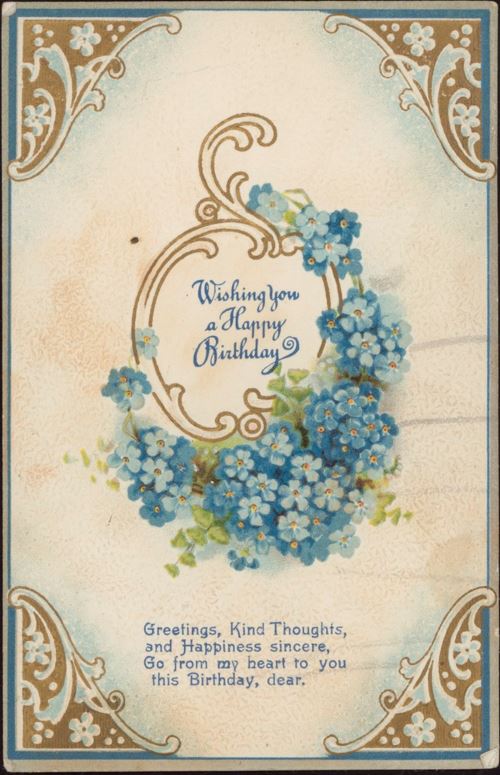
Five years ago today I published my first Western District Families post:
It was interesting to revisit 2011 and reflect on where Western District Families (WDF) is today. The post also shows how far Trove has come in that time with The Argus and The Camperdown Chronicle my only online newspaper sources for Western District material. Soon after the Portland Guardian and Horsham Times arrived. Thankfully the number of Victorian newspapers available at Trove has grown, particularly those of Western District origins. Trove’s growth as helped Western District Families continue and thrive.
Since WDF’s last birthday, I’ve only published twenty-five posts but have been far from idle. In June last year, I launched the Pioneer Obituary Index and it’s been an amazing success with the names of over 600 Western District pioneers now listed. Passing of the Pioneers is having a break but will return in the second half of the year on a monthly basis, so apologies to those who look forward to those posts.
Sharing stories of disaster in Western District’s past was something I wrote of in my first post. Last month came the story of the Big Flood of 1946. It is now the most viewed post at WDF, knocking the long-time leader, Portland Old Cemetery Part 1 from top spot. Another post, written in 2013 has hit its straps in the past year. In The News – January 15 – 19, 1944 tells the story of another Western District disaster, the 1944 bushfires. It is now in WDF’s top five most popular posts.
Introducing WDF to Facebook in October 2012 has been a big step forward in taking the stories of pioneering families and local history to a broader audience. It was thrilling when the Western District Families Facebook page passed 2000 followers recently. Ignoring Facebook’s constant invitations to promote my page in exchange for cash, it came about because there is a huge interest in where we came from and what our towns were like in the past.
Another big event for WDF was the launch of Hamilton’s WW1 in April last year. I have since added Hamilton WW1 War Memorials, the stories of seventy-five Hamilton soldiers and last week, Hamilton’s WW1 Nurses received their own page. Another five soldier profiles are almost ready to go but unfortunately my goal of reaching one hundred stories by Anzac Day will not come to fruition. Currently, I’m concentrating on stories of the men from the Hamilton War Memorial and Anzac Avenue, those who never returned.
Last year I took Hamilton’s WW1 to Facebook and although the subject attracts a niche audience, with some help from the WDF followers and members of the I’ve Lived in Hamilton group, Hamilton’s WW1 has reached 234 followers. It’s so good the stories of Hamilton’s soldiers are getting out there. Many of the men had long been forgotten.
Exciting news came in September last year when the State Library of Victoria contacted me to include Western District Families in the National Library of Australia’s Pandora Archive. How could I say no to that? It means WDF posts now show in search results at Trove and if Western District Families ever ceases to exist, it will always be available at Pandora.
Thank you to everyone who follows Western District Families. I’m proud my blog has gone beyond a read for relatives and family historians and is reaching people who may never have visited a history blog before. A recent email from a Western Victorian bookshop asking if WDF is a book following a customer inquiry has shown me how far WDF has come in five years.
Dressed in a gown of steel grey cloth, trimmed with glacé silk and a “borrowed” tulle veil, Lily Buckland married George Sparrow on 9 April 1916 at Mount Eccles. The wedding was at the home of Lily’s sister and George’s brother, Alice and Charles Sparrow.
Lillian Letitia Buckland was born at Briagolong in 1888, the eldest daughter of William Buckland and Hannah Oakley. The family lived at Toora in Gippsland. George Henry Sparrow was born at Macarthur in 1891, a son of local residents, Abijah Sparrow and Emma Peters. The first instance of a union between the two families was the marriage of Alice Buckland and Charles Sparrow in 1913. How one family from Gippsland and another from the Western District came together is unknown.
George and Lily settled at Lake Gorrie near Macarthur and started their family. Letitia Mavis Sparrow was their first child, born at Hamilton in 1917. Then Charles Robert was born in 1918. In 1920, tragedy struck the family when young Charles, just two years old, fell on a piece of wire in the backyard. The wire went up his nostril and pierced his brain and although taken to Hamilton Hospital, Charles never regained consciousness. In the same year, Lillian saw another sister, Olive, marry a Macarthur lad, returned serviceman William Louden Harman. Seven more children were born to Lily and George over the next ten years, six boys and one girl
A year after the beginning of World War 2, two of George and Lily’s boys enlisted. Allan joined up on 29 June 1940 and served with the 2/23 Australian Infantry Battalion while Roy enlisted on 14 October 1940, serving with the 63rd Australian Infantry Battalion. Allan was discharged on 15 November 1945, however, Roy a Corporal continued on after the end of the war.
On Friday evening 15 March 1946, rain began to fall on the roof of the Sparrow’s home, the likes they had never heard before. At home with George and Lily were three of their children, Mavis, Bruce and Ronald. The rain continued through the night and into Saturday night. On the morning of Sunday 17 March 1946, the Sparrow family woke to the sound of water lapping at their beds. Outside, water was rising rapidly around the property and evacuated. Leaving their domestic animals and poultry to find high ground themselves, Lily and the children climbed into their jinker with George leading the horse, guiding it along the already flooded roads.
It was increasingly difficult for George to distinguish the dangers ahead in the floodwaters, and not far from the house, a wheel of the jinker fell into a concealed hole and upturned, tipping the passengers into the water. George tried desperately to save his family but the water was deep and fast flowing. In his attempt to get help, he became exhausted, collapsed and died.
A search party was soon looking for Lily and her children. Mavis, Bruce and Ronald’s bodies were found in a hole close to the jinker, the water in the hole was over two metres deep. Lily’s body was found caught in a fence over three kilometres away, such was the force of the water. Mavis was twenty-five, Bruce twenty-two, and Ronald, fifteen. Five family members lost in a terrible tragedy. Rumours were flying that were was no need for them to leave, but servicemen who went to the house during the search supported their actions after seeing the high watermark on the walls. Sadly for the Sparrow family, when one of their surviving sons arrived at the farm the following day, he found the chooks and the household dogs and cats had survived the flood.
On the afternoon of Thursday 21 March 1946, the sun broke through the clouds as hundreds made their way to Macarthur’s Church of England for the funeral of the Sparrow family. Among the many floral tributes was a sheaf of flowers sent by the Governor of Victoria and his wife Sir Winston and Lady Dugan, including a personal message for the remaining members of the family. Just days before they had passed through the Macarthur district, including the Sparrow property, to witness the devastation.
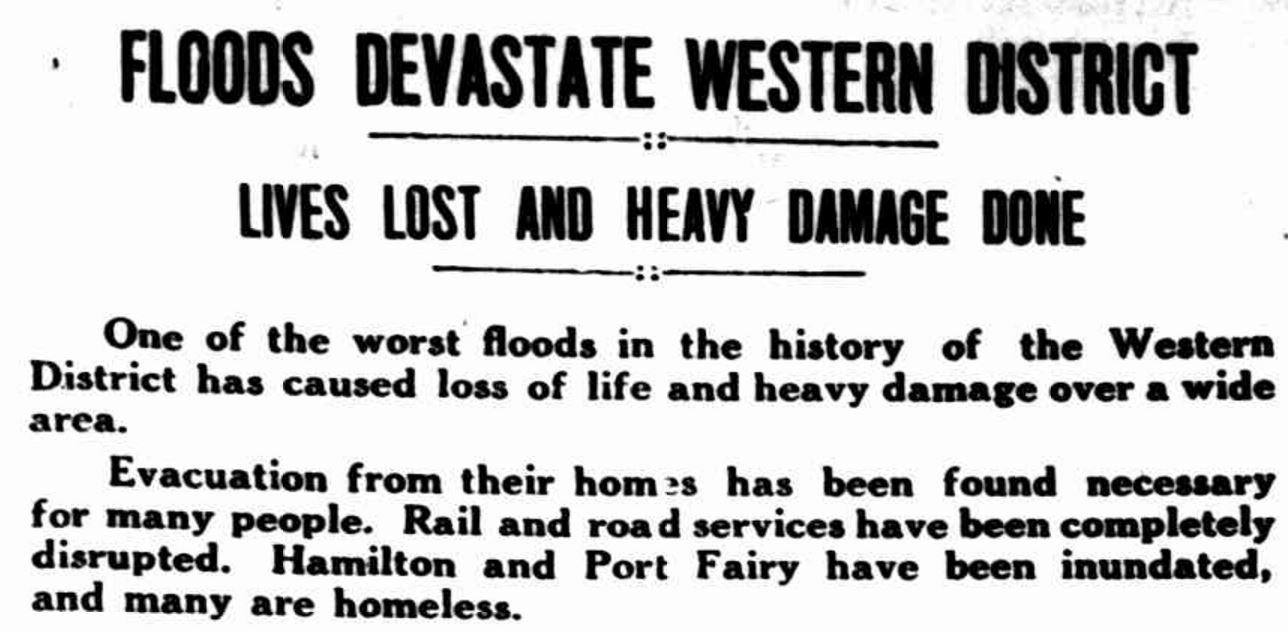
The Sparrow family were victims of one of Western Victoria’s worst natural disasters. More used to the ravages of fire, residents were to witness rising rivers and creeks over the weekend of 16 and 17 March that soon turned their part of Victoria into an inland sea.
Early in March 1946, parts of Queensland and New South Wales were under floodwaters due to a tropical cyclone. On March 10, cold, wet and windy weather hit Victoria. At 9:00 am on Monday 11 March, the previous forty-eight hours had produced 52 mm of rain in Port Fairy, one of the highest rainfall totals in the Western District for the period while 36 mm fell at Hamilton. A cyclonic depression moved across South Australia in the following days before reaching the Western District on Friday 15 March where it stopped.
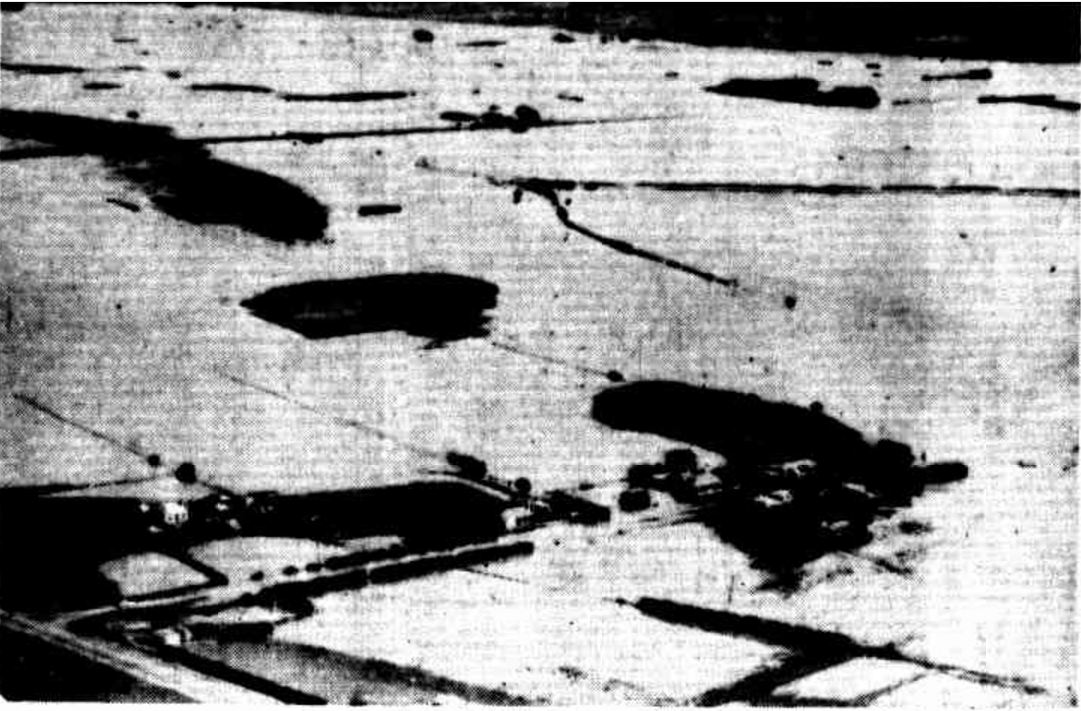
The forecast for Victoria published in The Argus of Friday 15 March was for some rain developing from the west and then showers. At 9:00 pm on Friday night, the forecast was “cold and unsettled with some showers. Some heavy rain, with hail, on and south of the ranges”. That heavy rain was of tropical proportions falling from Friday night and through the weekend. By Monday 18 March, The Argus reported the floods covered the Western District from Natimuk in the southern Wimmera to the sea, and to the east to Mortlake. Police headquarters at Russell Street Melbourne said that a stretch of water up to four metres lay from Hamilton to the coast. The map below shows the extent of the rainfall.
“FAMILY TAKEN OFF ROOF” The Sydney Morning Herald,19 March 1946.
There were evacuations from many towns including Hamilton, Portland, Port Fairy, Warrnambool and Casterton. Rescuers took to boats trying to save families, many clinging to the roofs of their houses. Thousands of head of stock were lost, bridges and roads washed away, telephone lines were down and railway lines damaged. There were mass cancellations of trains and buses. Towns were cut off with little means of communication.
On Tuesday 19 March 1946, The Argus published the rainfall totals from 9:00 am on Saturday 17 March until 3:00 pm on Monday 18 March.
While many communities were flooded, the following were those most severely affected by the big flood of 1946.
MACARTHUR
Parts of the countryside around Macarthur were under three metres of water stranding families on their roofs hoping for rescue. Around nine kilometres south of Macarthur, on the Port Fairy Road, a bridge washed away. Stock losses in the district were estimated at 5000 sheep and 500 head of cattle. There was concern among authorities about the possible outbreak of disease, with livestock hanging on fences in the floodwaters. Posing a threat to rescuers were hundreds of snakes swimming in the water.
BYADUK/WALLACEDALE/CONDAH/BRANXHOLME
In the Wallacedale/Condah area, ten houses were evacuated and dairy herds were lost. Some parts were under three metres of water. Mr & Mrs Edgar Lacey and Miss Grace Tullett took refuge on the roof of the Lacey home. To shelter from the heavy rain and strong winds, they were able to remove a sheet of tin and climb into the ceiling. With them on the roof, also seeking refuge, were several snakes. A RAAF Catalina Flying boat was flown in to rescue the trio. On arrival, the pilot could not find them so he returned to Williamstown, NSW. Next, a flat-bottomed boat tried but failed to retrieve them. An amphibious car from the Army or Army “duck” was the next plan. Finally, after twenty-five hours, they were rescued but it was several days until the water subsided around their house.
Miles of fencing and roads washed away and there were heavy losses to livestock including horses and pigs. A beekeeper’s hives bobbed in the water with the stranded bees atop of the boxes. Rescuers saw thousands of snakes while delirious rabbits, marooned on high ground, were caught and their skins sold.
Branxholme had 394 mm of rain from the Friday until the Monday edition of The Argus went to print and the town was cut off by road, rail and telephone. At Byaduk, Mr Tyres rescued seven people from a raft. More were evacuated but were able to return home on Tuesday including Mr and Mrs McCready. Mr J. Scott and Miss Suttie had their homes flooded. David Kinghorn was rescued from a haystack.
HAMILTON
Hamilton saw the heaviest rainfall since records were first kept. Up until 3:00 pm on Monday 18 March 219mm had fallen in fifty-fours, the town’s largest recorded total over the same period. The highest previous monthly rainfall total was 311 mm set in December 1930. The Grange Burn, usually quietly meandering through parts of the town, quickly rose and became a raging river. Around twenty homes near the railway station were evacuated on Saturday 16 March.
Fuel depots near the creek were underwater and hundreds of oil drums from the Shell and the Commonwealth Oil Refinery depots washed down the Grange Burn, accumulating against bridges and fences. Two other fuel depots were badly damaged. One underground petrol tank pushed its way to the surface. Iron from the fuel depots wrapped around trees and plaster from a nearby factory was spread up to almost 100 metres. In those days, the Hamilton swimming pool was on the Grange Burn, at the Braeside Weir, close to the fuel depots.
GRANGE BURN AT FORMER SWIMMING POOL
Sheds beside the swimming pool were swept away and the diving tower was on a lean. At the Ballarat Road and Portland Road bridges, the Grange Burn was between 180 metres to 400 metres wide. The photo below shows the Grange near the Ballarat Road bridge as it is today
GRANGE BURN LOOKING TOWARD THE BALLARAT ROAD BRIDGE.
A view of the Grange Burn near the Portland Road bridge is below.
Many bridges and roads around the town were impassable and the drains in Lonsdale Street overflowed. The Hamilton Town Hall became “home” to around seventy evacuees and Mayor Rasmussen called on residents to take those evacuated into their homes. Water went through twenty-five to thirty homes, reaching a depth of almost a metre in some. Mr Brimacombe of Martin Street lost all but one of his 250 chooks.
By Monday 18 March, travellers marooned in Hamilton were taken to Portland. Road connections between Warrnambool and Mt Gambier reopened and by Tuesday morning, Ansetts ran a bus from Horsham to Hamilton. An Army “duck” arrived, using the town as its base.
The photos below, used with permission from Jacinta Hanelt, depict the 1983 floods in Hamilton. They show the same areas flooded in 1946 and although not as deep as those floods, they give an idea as to the extent of the 1946 floods. Despite the damage to the fuel depots in 1946, they remained located close to the Grange Burn.
This slideshow requires JavaScript.
WARRNAMBOOL
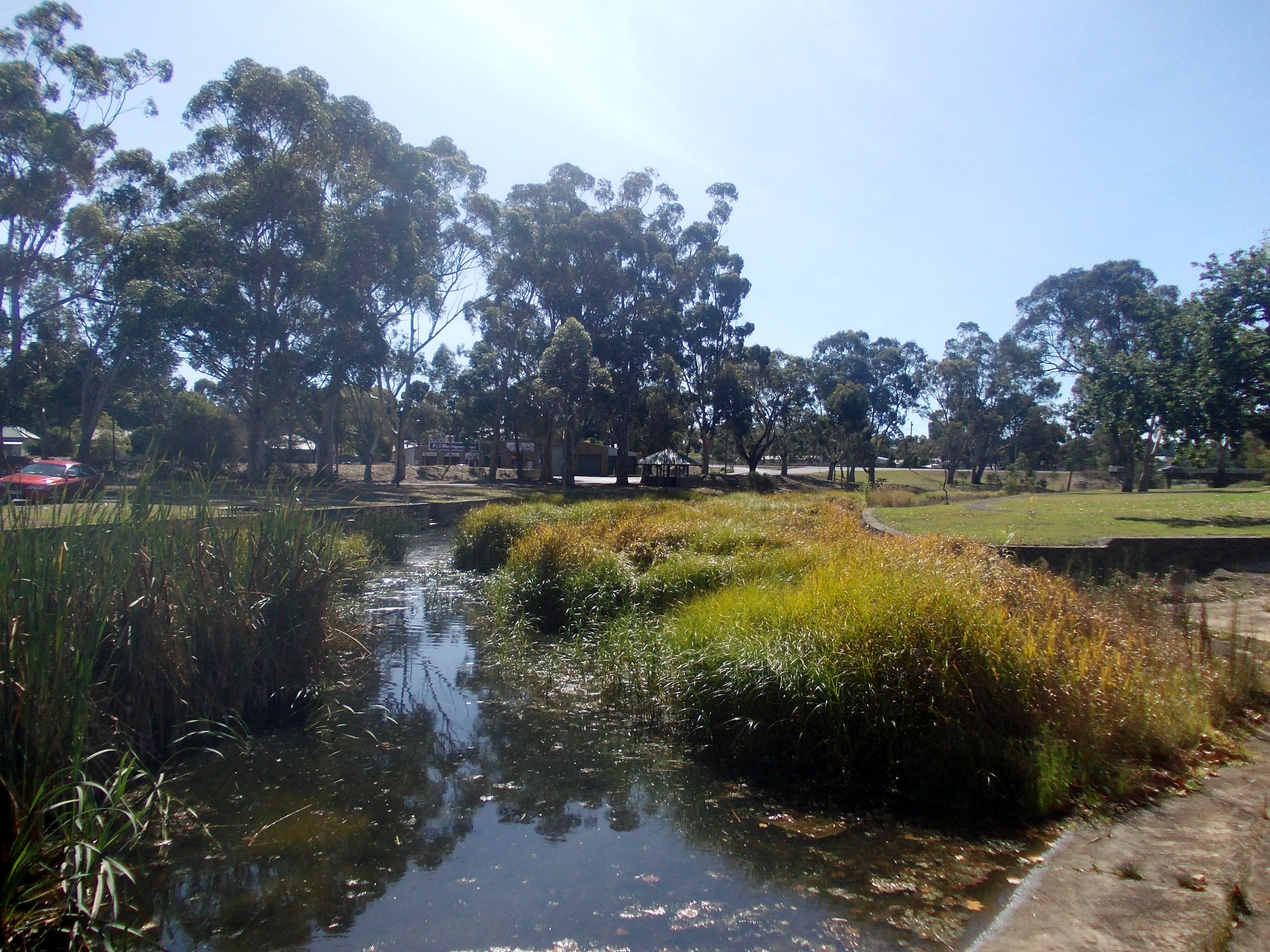
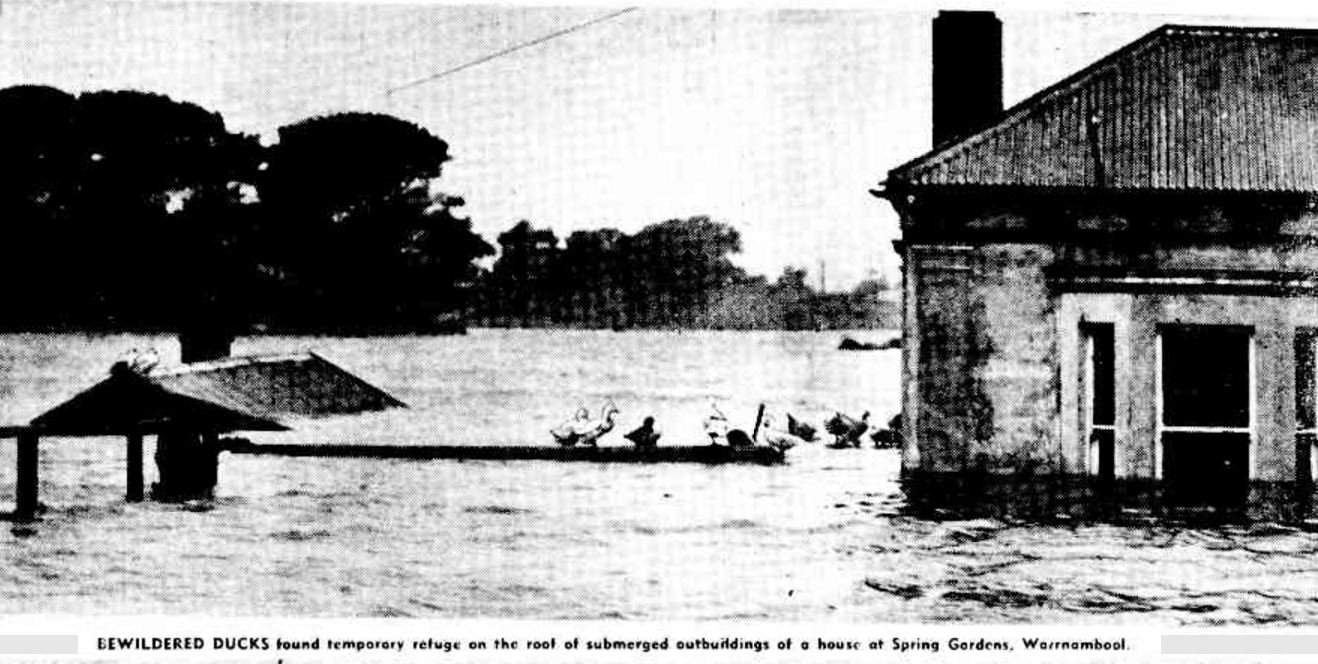
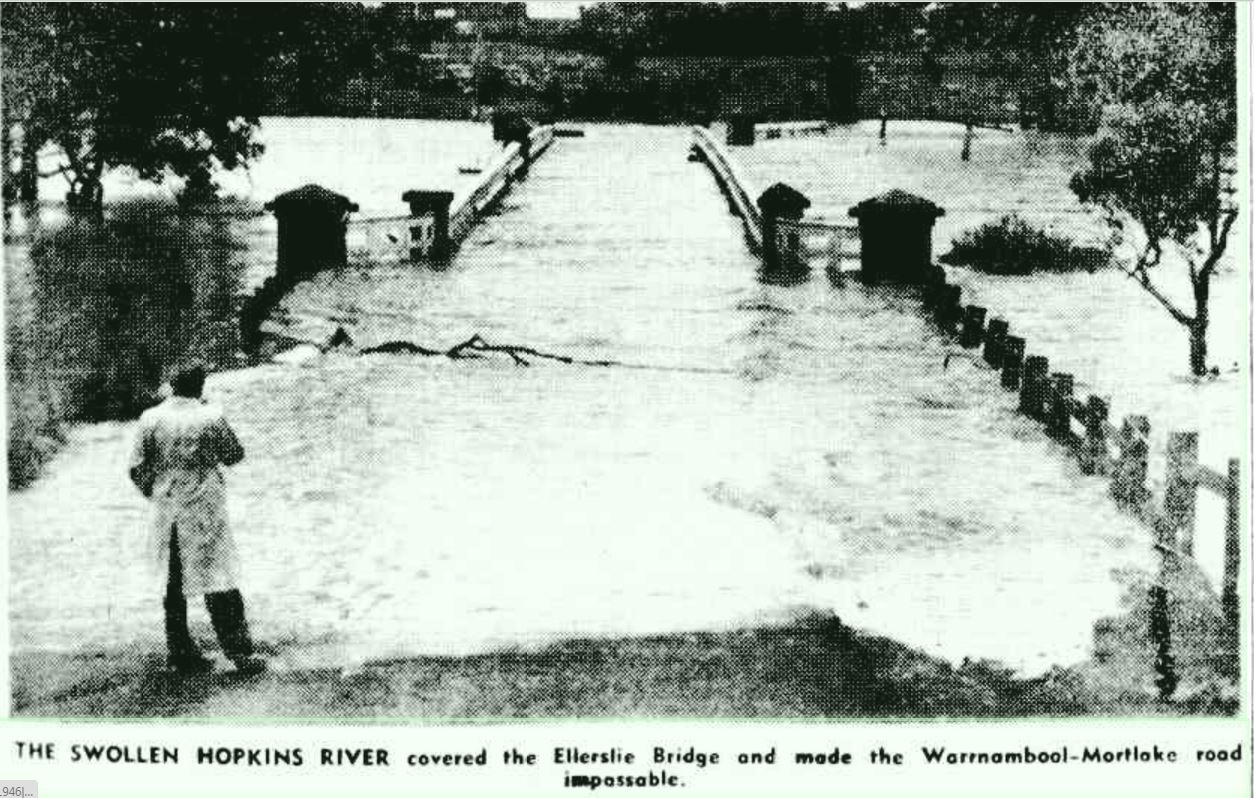
In forty-eight hours at Warrnambool, 228 mm of rain fell accompanied by gale-force winds. There was flooding along the Russell’s Creek, Merri Creek and Hopkins River.
HOPKINS RIVER, WARRNAMBOOL
The 3YB radio transmitter was surrounded by three metres of water and sandbags and pumps were called for. At least seven bridges in the shire were damaged. Nearby Dennington was underwater but in South Warrnambool, only four homes required evacuation. Old residents said they hadn’t seen anything like it.
“Flood Pictures From Inundated Western District” The Argus, 19 March 1946:
During Monday 18 March, the Hopkins River was rising at a rate of thirty centimetres an hour and later that night, the river burst its banks leaving the highway up to 1.2m underwater. Meanwhile, Allansford residents were preparing to leave their homes.
And the road to Port Fairy was also cut, with the following photo showing the situation about five kilometres west of Warrnambool on the Princes Highway.
“DISASTROUS FLOODS IN VICTORIA.” Townsville Daily Bulletin (Qld. : 1907 – 1954) 21 March 1946:.
The Coppick children were delighted to find their dog Paddy.
At Woodford, the local school teacher and his family were stranded in the Woodford Police Station and the post office was underwater (below). A herd of thirty dairy cows drowned.
At Killarney, stranded cows on patches of high ground, helplessly slipped into the floodwaters as exhaustion overcame them. There were huge losses to potato and onion crops and Killarney resembled a lake.
“WESTERN DISTRICTS OF VICTORIA FLOODED.” Daily Advertiser (Wagga Wagga, NSW : 1911 – 1954) 21 March 1946: 1.
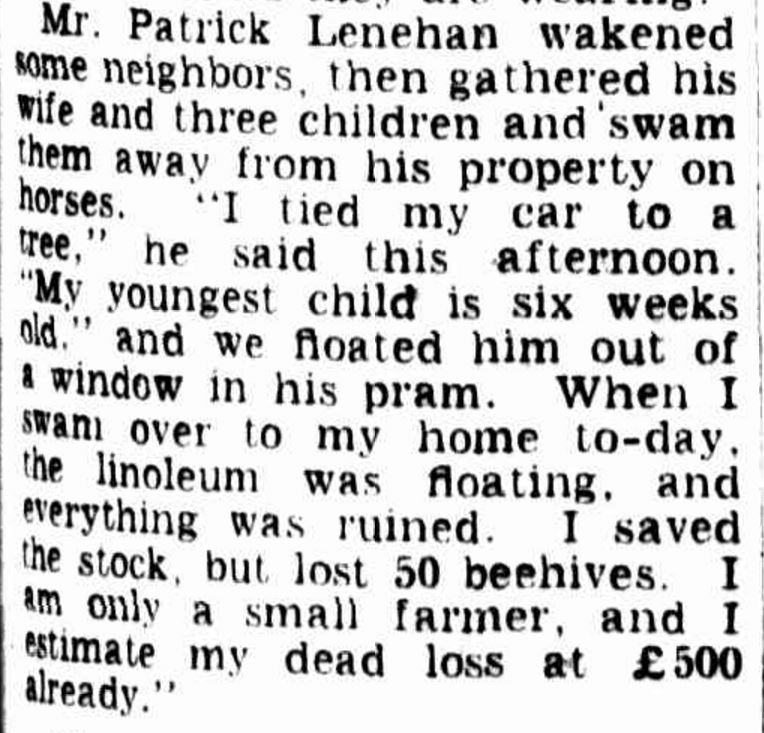
The six-week-old baby of Mr and Mrs Patrick Lenehan was floated out a window of their house, the baby’s pram a substitute boat.
Stories began to emerge of the heroics in the district. Widow, Mrs Madden and her eight children were saved by Jim Gleeson in his tractor. Another farmer saved an elderly woman from her cottage and Mr J. Ryan was taken to Warrnambool Hospital after being lifted through the window of his flooded home.
Mrs Madden, rescued with her eight children by Jim Gleeson, returned to her home to begin the cleanup. She is pictured below with her daughter Dorothy cleaning silt from their carpets.
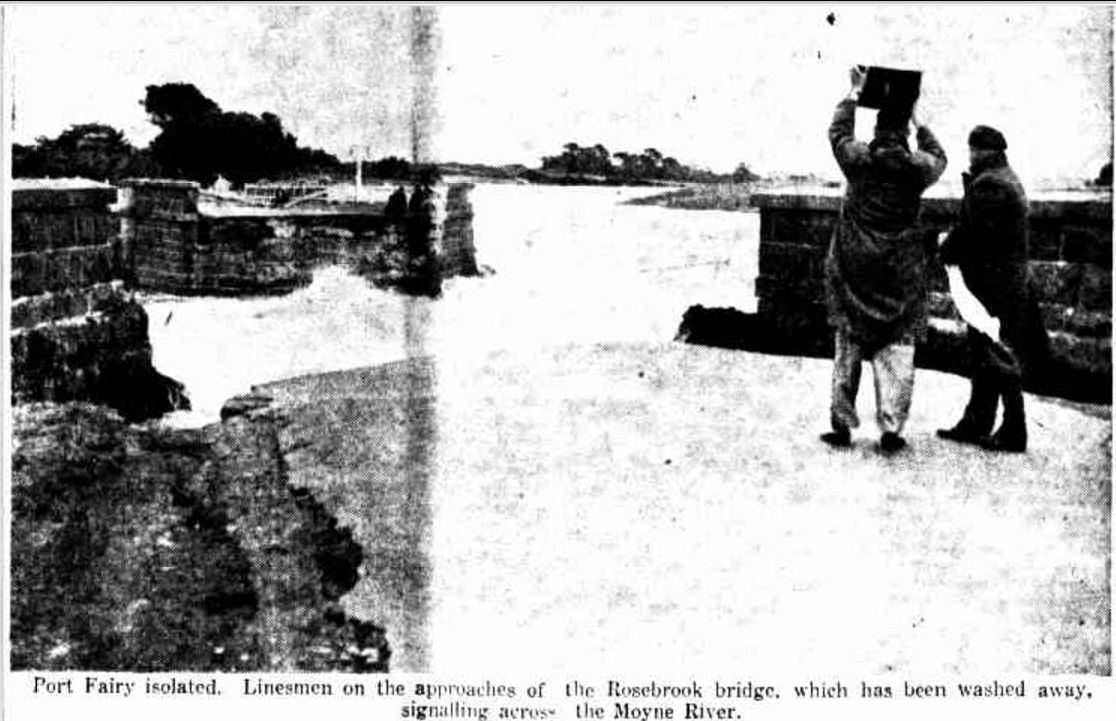
The Moyne River rose rapidly at Port Fairy leading to the evacuation of homes in the eastern part of the town.
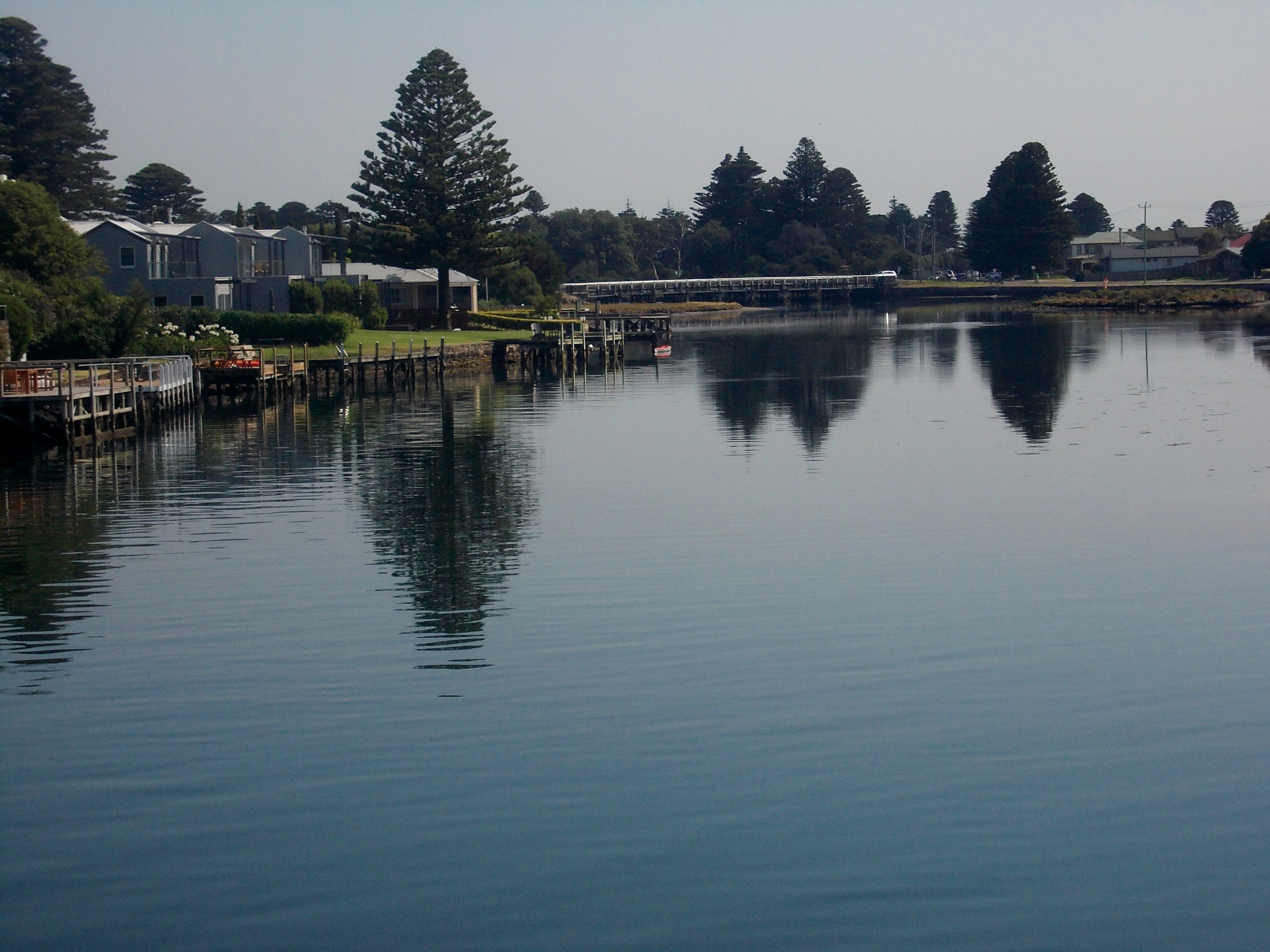
MOYNE RIVER, PORT FAIRY LOOKING EAST.
Residents in Regent, William and Bank Streets were also evacuated with the water reaching almost a metre in Bank Street and running through houses. To the west of the town, water was up to 1.5 metres deep. Thousands of tonnes of potatoes and onions were lost, and in Port Fairy North, Steel’s bridge gave way. Every hour, reports were arriving of stranded families. Power in the town was interrupted for sixteen hours.
“Flood Waters Receding Around Port Fairy” The Argus, 20 March 1946:
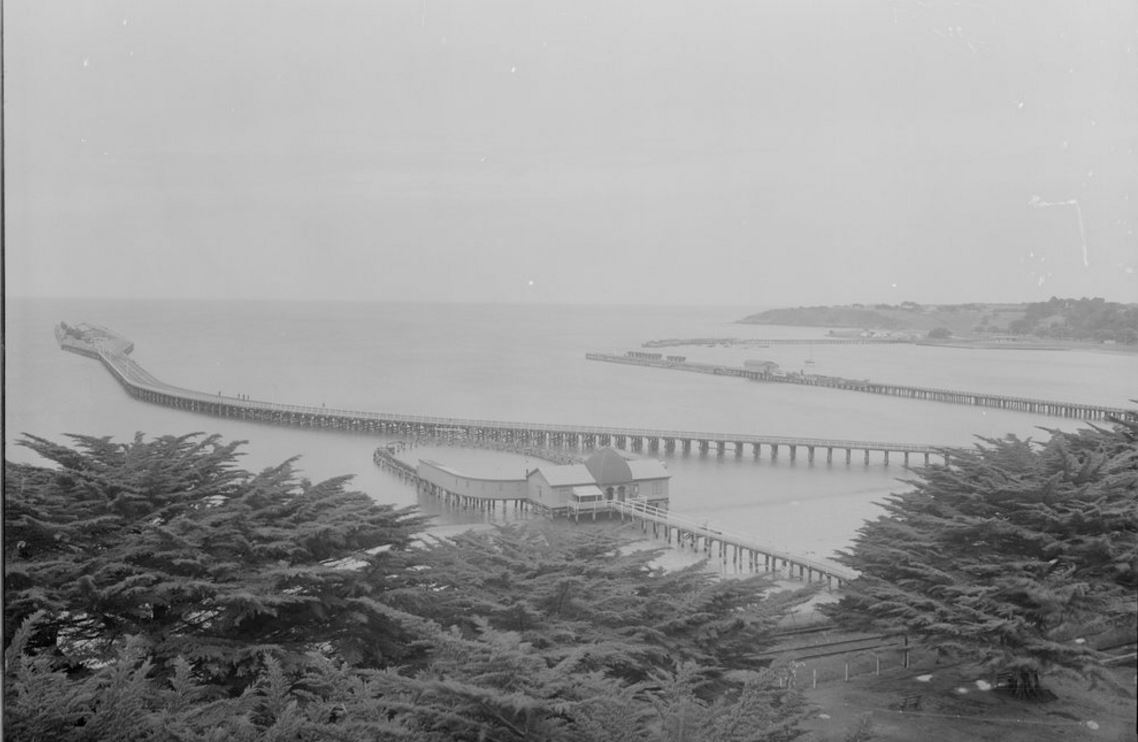
The concrete wharf where fishing boats were moored broke up, threatening to wash boats out to sea. In the end, five boats were lost. Large slabs of concrete from the wharf were swept away and smashed.
PORT FAIRY WHARF ON THE MOYNE RIVER LOOKING TOWARD THE MOUTH OF THE RIVER.
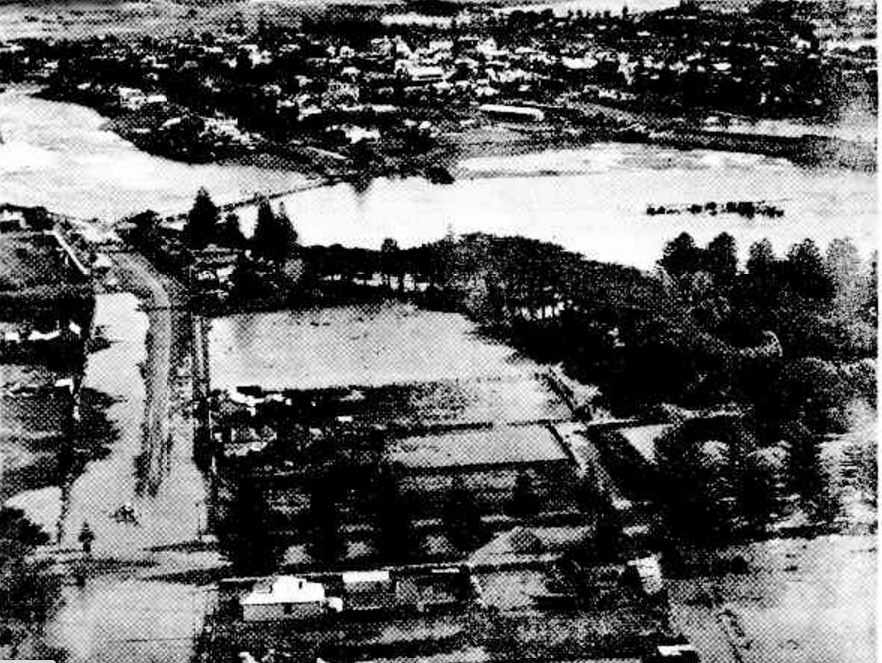
Although it’s not clear, the following photo gives some indication of the torrents of water rushing through Port Fairy.
FLOOD WATERS FROM THE MOYNE RIVER, PORT FAIRY. “FLOOD WAVES LASH HOUSES” Sunday Times (Perth, WA : 1902 – 1954) 24 March 1946: 15 (Sport Section).
By Monday 18 March, the threat had subsided slightly but more water was expected to come down the Moyne River and high tide was a concern. As a result, the fire brigade put all men in the town on standby. The main bridge over the Moyne was still standing but had taken a “pounding”. The river reached its peak on Sunday and fisherman stood in waist-deep water desperately trying to secure their boats, and their livelihoods, with some almost drowning.
LOOKING EAST TOWARD THE PORT FAIRY WHARF, MOYNE RIVER.
By Tuesday, houses on the outskirts of Port Fairy East were still half-submerged. Other families were forced to leave their homes, as weakened walls threatened to collapse while the road to Portland was expected to stay closed for some time. In the north-east of the town, built-up floodwaters tore through sand dunes. In doing so, the water escaped to the sea preventing more damage to the town.
The Town Clerk of Port Fairy spoke with John Cain Sr, then Premier of Victoria “Send us some tobacco; there is a famine in smokes here” Bacon, eggs, potatoes and other food supplies were also in short supply. Two Army “ducks” arrived on Tuesday 19 March with butter, eggs, bacon, tinned meat, yeast and tobacco. Another “duck” was soon dispatched. After rescuing stranded families (below) the “ducks” distributed food to isolated families and fodder for stock. They also collected stranded stock, taking them to safety.
There was almost one metre of water in two of Port Fairy’s hotels, including the Caledonian Inn (below). The publican of the inn waded into his backyard to rescue his poultry, then placed them in the inn’s attic. The nearby picture theatre was also flooded.
CALEDONIAN INN, PORT FAIRY
Jack and Teddy Talbot (below) had a lucky escape as a bridge collapsed just as they were approaching.
Residents in William Street (below) dried clothes and furniture after the water in their street reached a depth of over a metre. By Wednesday 20 March, wet mattresses and pillows hung over fences, furniture was in front yards and clotheslines hung between houses. Dairy farmers unable to get their milk out left cans of milk at each corner and all townspeople were allowed a jug each while the local hotels had a good supply of cream. The damage bill in Port Fairy totalled thousands of pounds.
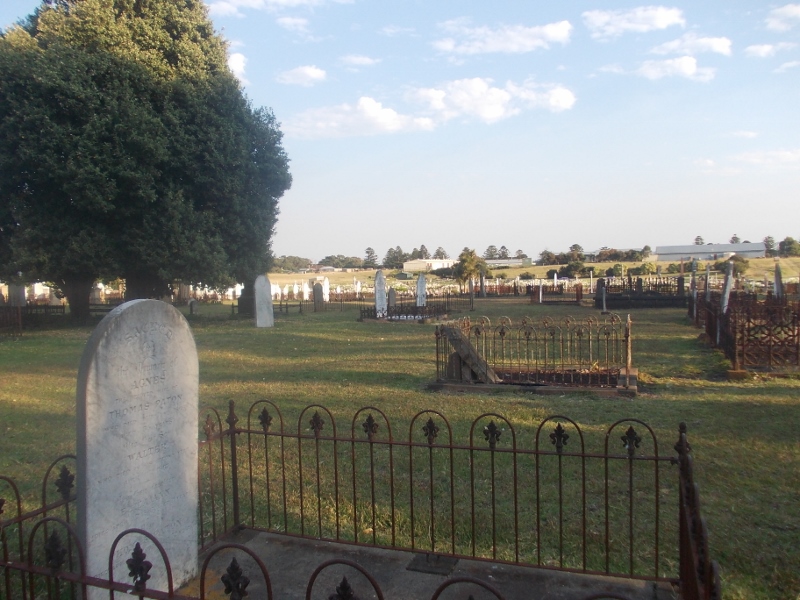
The Port Fairy Cemetery was underwater and even by the end of March, the water was still one metre deep. Eventually, pumps were used to drain it.
PORT FAIRY CEMETERY
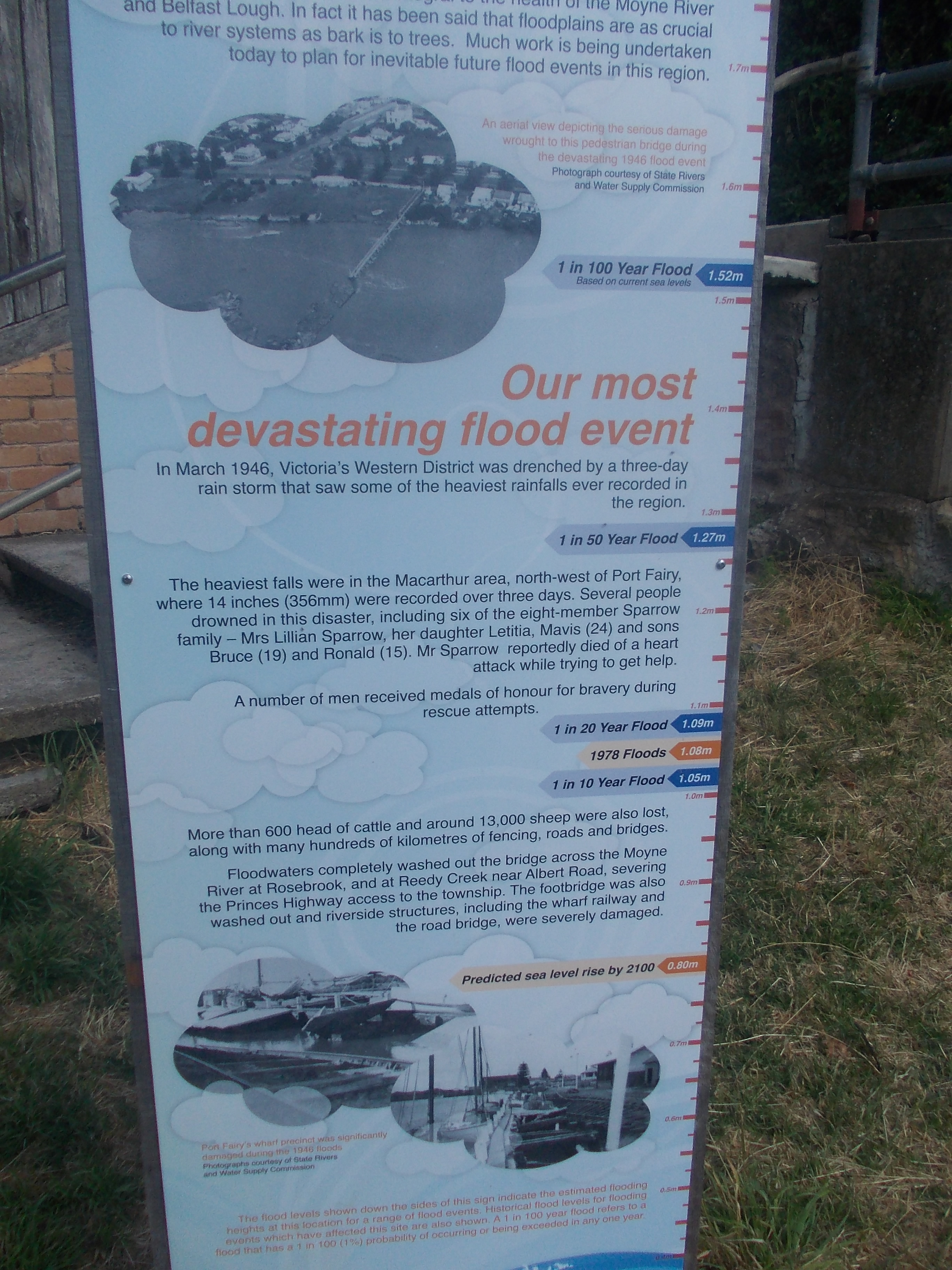
Today, there is a reminder of the 1946 flood at the Port Fairy Wharf.
HEYWOOD/PORTLAND
Between Friday night 15 March and Saturday morning 16 March, Portland received 144 mm of rain and low-lying land in the town was flooded. There was a call to divert the water into the sea to save the electricity and gas supplies, but all electricity and gas were cut. The sewage works were deluged and the local fire brigade was busy pumping water. The Portland Showgrounds were under 1.5 metres of water. The town was cut off from Saturday including telegraph and radio communications.
By the morning of Sunday 17 March, the rainfall totalled 203 mm. Fawthrop Swamp was inundated and parts of Bridgewater Road were covered in water. Much of the state’s tomatoes were grown in the district with crop losses eventually leading to a shortage. Local halls and hotels accommodated evacuees. A “howling southerly breeze” with huge waves hit the breakwater (below).
At Heywood, until 3:00 pm on 18 March the previous fifty-four hours had produced 335 mm rain leaving many people homeless. Travellers were also stranded as the Portland/Hamilton road was cut including at the Fitzroy River bridge. The local hotel was crowded with evacuees and emergency accommodation was set up in the Heywood Hall.
DARTMOOR
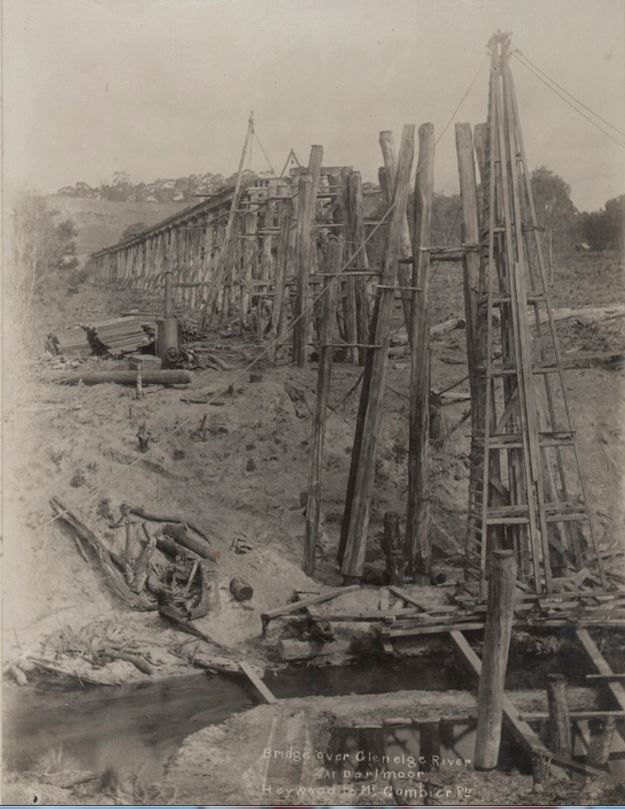
The Glenelg River rose dramatically at Dartmoor as water flowed into the river from tributaries upstream. Five hundred yards of a twenty metre high railway bridge (below) was submerged as was the highway after the river’s level rose fifteen metres. Snakes sought refuge on top of the bridge and iron washed into the pylons, acting as a safe haven for insects, spiders and lizards.
Old residents agreed it was the worst flood in memory. The Glenelg River was over 1.5 kilometres wide and only the tops of telegraph poles were visible. While rowing in the floodwaters, Mr Malseed gathered ten rabbits, twenty-four pumpkins and a number of tomatoes stuck in trees. Seventy drums that had spilt into the river at Casterton were expected to reach Dartmoor.
NELSON
Although Nelson only received 30 mm of rain over the weekend, the Glenelg River was rising rapidly as it neared the sea. A boat shed floated down the Glenelg River with two boats still attached. All sheds on the river bank were submerged as was the kiosk. The monument to Major Mitchell on the Isle of Bags was almost submerged.
ISLE OF BAGS, GLENELG RIVER, NELSON
Rubbish began to collect at the mouth of the river until the water’s force washed the sandbar out to sea. Meanwhile, residents worked hard to save their bridge (below)
TODAY AT NELSON A HIGH CONCRETE BRIDGE SPANS THE GLENELG RIVER
COLERAINE
Coleraine’s rainfall to Saturday 16 March at 6:00 pm was 122 mm. A flood warning was issued at 2:00 am Sunday morning in the lower part of the town. Bryan Creek rose rapidly flooding shops and houses. Stranded Mrs J. Torney and her baby were rescued from the golf course clubhouse. Over a metre of water sat in the yard of the Post Office (below) by noon Sunday and reached the eaves of some houses.
By Monday 18 March, 186 mm of rain had fallen on the town and residents were cleaning silt from their homes. One house, under 1.8m of water in the days before, was left with 50cm of silt. Damage to bridges had blocked the road from Coleraine to Merino and the suspension bridge washed away. There were also large stock losses and miles of fencing demolished.
CASTERTON/SANDFORD
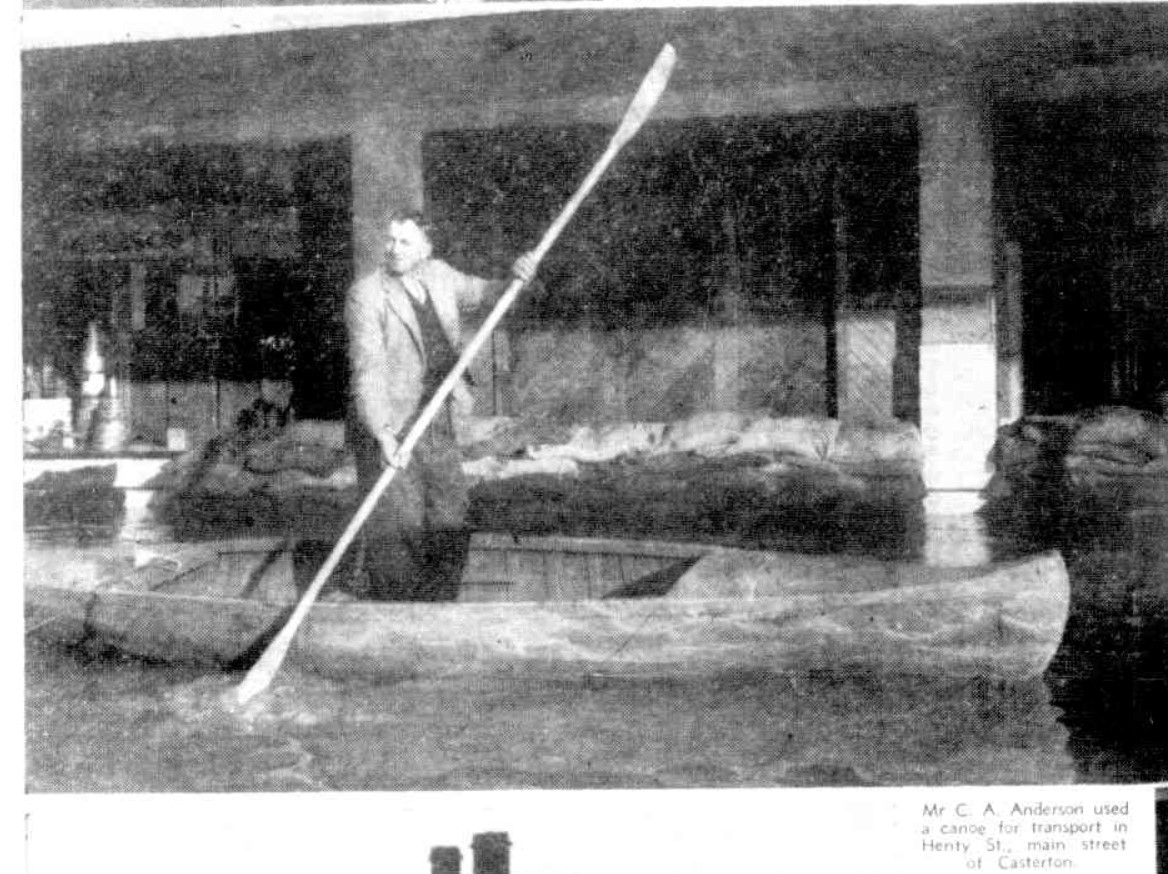
At Casterton, the Glenelg River swelled quickly reaching a height of 6.45m on the river gauge. Seventy drums from the local tip rolled into the river and travelled downstream. By Monday, there were still fears for the safety of three men. Six streets in the town were flooded and Mr Frank Daley and his eighty-three-year-old mother were rescued by police in a boat.
Thirty metres of pipe serving the town’s water supply was washed away while the Major Mitchell monument, south of the town was almost submerged. At nearby Sandford, the McCormack family were stranded. On Monday 18 March, police and an Army “duck” tried to reach them. They were later reported safe.
Just as the water in rivers and creeks was beginning to ease, the following weekend the rain started to fall again. The totals for the period are below, with towns further east of the original floods affected.
On Monday 25 March, Port Fairy was once again isolated and evacuations were considered. Macarthur was expecting floods worse than experienced a week earlier and the Eumerella River burst its banks after reaching a depth of over three metres. Families were evacuated at Bessibelle. The towns of Koroit, Hawkesdale and Branxholme were all at risk of flood. At Allansford. the Hopkins River reached the height of the week before but continued to rise before dropping 1.2 metres on Wednesday 27 March.
At Casterton, the police were warning residents the Glenelg and Wannon Rivers could burst their banks. Homes at Byaduk evacuated a week earlier were again vacated. At Wallacedale and Condah floodwaters still remained from the week before. An Army “duck” was called to Tyrendarra to save a family isolated by the Fitzroy River and Darlot’s Creek. Portland was also cut off via the Princes Highway due to water over the road.
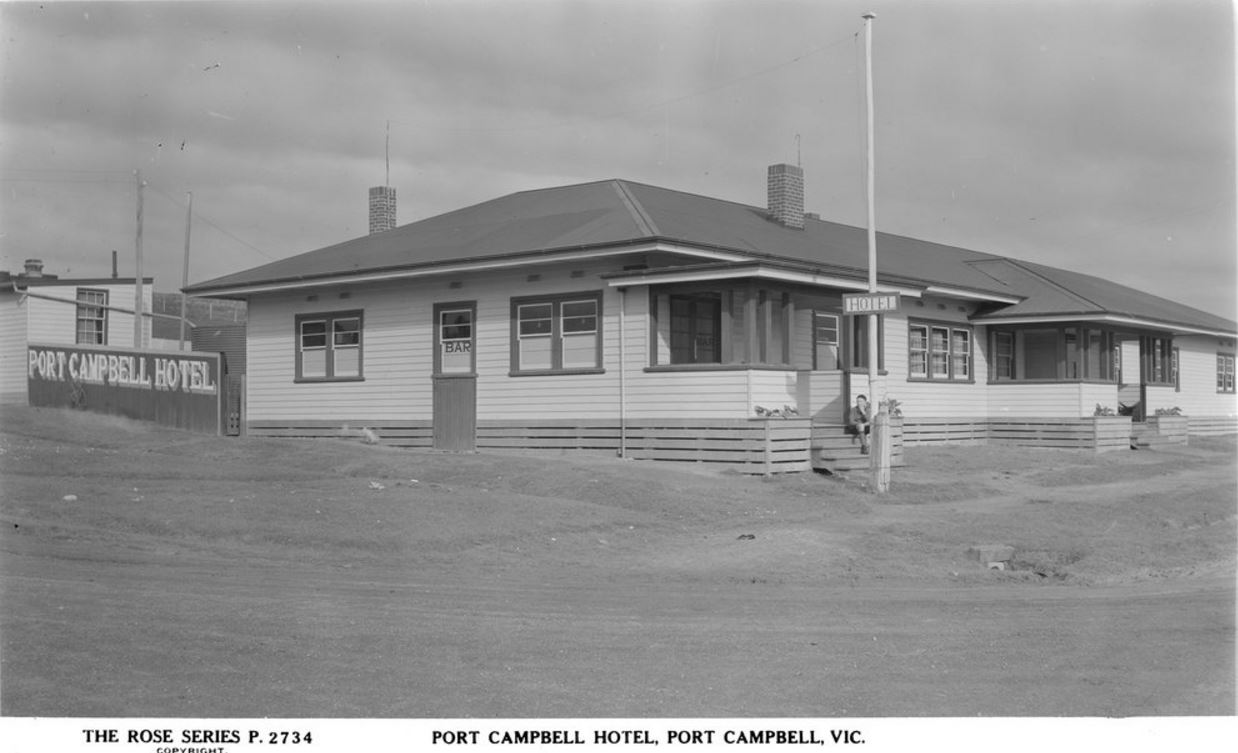
Flooding was reported at Beech Forest and residents living along the Gellibrand River prepared themselves to evacuate. By 29 March, over half a metre of water lay on the Ocean Road at Lower Gellibrand. Meanwhile, at Cobden, 63 mm fell on Saturday 24 March flooding paddocks and stranding cattle. At nearby Cowley’s Creek, stud sheep were rescued from the creek. At Camperdown, a total of 104 mm was recorded over the weekend. Port Campbell, reported the heaviest falls in its history and the township was isolated with over a metre of water over the road. Stranded campers were billeted at the Port Campbell Hotel (below).
By 27 March, the sun was shining in Warrnambool for the first time in two weeks, but the damage bill and impending recovery left a gloomy forecast for the Western District. Before the floodwaters subsided on 20 March 1946, The Age reported the total damage bill could exceed £2,000,000. On 30 March 1946, the Border Watch reported 150 houses were destroyed and 150 sheds damaged. There were losses to ryegrass seed and potato, tomato, onion and apple crops. One hundred bridges were destroyed. The damage bill for bridges and roads alone, published in The Age of 5 April 1946, was estimated at £76,500. Of that, £25, 300 was in the Warrnambool Shire. By the end of March, the Army “ducks”, vital during the disaster, returned to Melbourne.
On 1 July 1946, twenty-seven men from the flood-affected areas received silver and bronze medals from the Royal Humane Society for their rescue work. They included fishermen and policemen. The men presented with silver medals were:
As I write, it is seventeen hours and twenty-one minutes since Trove went offline to prepare for the launch of Trove 7 on Thursday 25 February. And yes, I’m already missing it. Not a day goes by when I don’t turn to Trove to find a photo, a parish map, information on events in Australian history or book details. But I’m reassured knowing in two days this wonderful free resource we are so lucky to have will be back new and improved.
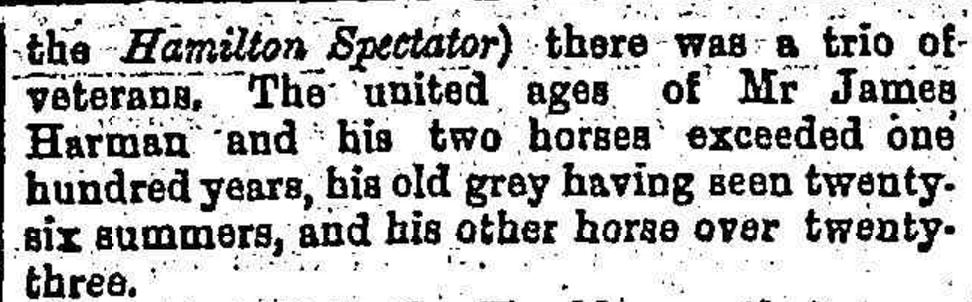
Of course, the online newspapers are my favourite Trove feature especially little gems such as the following article my “Electronic Friend” from Trove sent on Friday. The article from The Ballarat Star of 18 July 1881 is about my ggg grandfather James Harman. At age fifty-one in 1881. James and his old horses, pulling a Lennon plough, were a great team, often winning local ploughing matches. James lived another thirty-five summers but I’m guessing not too many more summers passed after the article before James laid the horses to rest on his Byaduk property Mt Pleasant.
**Postscript – Since writing this post I’ve become aware of funding cuts to the National Library of Australia, the home of Trove. It would be terrible if it meant Trove’s digitisation program was restricted or worse, the introduction of a paywall. You can read more about the funding cuts here.
I’ve set a target, possibly an over ambitious one, of 100 profiles by Anzac Day but I’ll give it a go. There are some good stories about Hamilton nurses that I would like to share before 25 April 2016 too. But first something I’ve noticed…well it’s one of many things I’ve observed during the course of my research, but let’s start with memorials…well, one of the things I’ve noticed about memorials…
If you visit the Hamilton War Memorial and look at the names, you could be excused for thinking those men listed lived in Hamilton for a significant part of their lives or, at the very least, were born there. But that’s not the case, they were from all over with a few men having only a fleeting connection with Hamilton.
Some of the men had fathers who moved often with work. Clifford Williams, who was unlikely to have even visited Hamilton, was a son of a teacher while William Thompson was the son of a railway worker who often moved his family. Both are on the Hamilton War Memorial (below). Others went to Hamilton as adults for work and were only there a short time before enlisting, such as Edwin Smith who arrived in Hamilton around 1913 to work at the Union Bank. Reginald Briant was born in Hampshire, England and spent a few years in Melbourne before working for the Hamilton Electric Supply Company before his enlistment.
When searching for a family member on memorials and honour boards, clues from Electoral Rolls, Trove newspapers and the solider’s Attestation papers can help you find them. Even if your soldier’s family just “passed through” a particular town, it’s worth following up. Soldiers were often memorialised in several towns. As well as the Hamilton War Memorial, Clifford Williams and Percy Osborne had trees planted along Bacchus Marsh’s Avenue Honour. And don’t overlook workplaces and churches. Percy Osborne has a memorial window at Hamilton’s Christ Church Cathedral (below) and is on the Union Bank Honour Roll in Melbourne.
MEMORIAL WINDOW FOR PERCY BEAUMONT OSBORNE, HAMILTON CHRIST CHURCH CATHEDRAL.
If you are wondering if Hamilton commemorated your WW1 soldier’s service, all Hamilton’s outdoor WW1 War Memorials including names are at Hamilton’s WW1. Eventually, I will add Hamilton’s honour boards. The Victorian War Heritage Inventory is a useful resource for locating memorials across Victoria. You can search by the name or a place.
A quick reminder…to delve into the daily events of Hamilton 100 years ago, “like” the Hamilton WW1 Facebook page. Along with new profiles, six days a week I post an article from the Hamilton Spectator from 100 years before. It’s been interesting to read how Hamilton, just like other towns, continued on while so many were away fighting and how the subject of war managed to creep into most aspects of daily life.
The names of the sixty-six soldiers profiled at Hamilton’s WW1 are below. I’ve included their place of birth and other towns they had connections to. Most never returned to Australia. For some of those who did, life was never the same. Lest We Forget.
You must be logged in to post a comment.