Passing of the Pioneers

It’s an interesting mix of pioneers for July with several family links.  It begins with Margaret Laidlaw who’s father and brother-in-law also have their obituaries listed.  Then there’s William Thomson and his son Robert Thomson, and James Brake, a brother-in-law of William’s brother John Thomson. Also there are several connections to previous Passing Pioneers and I’ve linked them up where possible.  You can also see the growing number of family connections among the pioneers on the alphabetical lists at the Pioneer Obituary Index.  A reminder that all underlined text will take you to further information about the subject.

LAIDLAW, James – Died 1 July 1892 at Amphitheatre.  James Laidlaw was born around 1823 in Scotland, a son of Adam Laidlaw and Margaret Stoddart.  He arrived in Victoria in 1852 and married Mary Ann Coates in 1855.  After their marriage, James and Mary Ann resided at Lake Learmonth near Ballarat.  James was a Justice of the Peace and during the 1860s, Chairman of the Ballarat Shire. Around 1872, James purchased Lake Wallace South Estate near Edenhope.  His brother Walter was at nearby Newlands and he and James became well-known in the district. James was the local Justice of the Peace and a Kowree Shire councillor.

In 1883, James purchased Amphiteatre Station, near Avoca with three of his sons while another two sons remained at Lake Wallace to manage affairs.  James was soon involved with public affairs in the district and was elected to the Lexton Shire Council.  James and Mary Ann had two daughters, Helen who married Hamilton stock and station agent John Fenton and another Margaret who married grazier, Thomas Philip. Both daughters lived in the Hamilton district. Margaret’s obituary is further down the page.  James Laidlaw was buried at the Lexton Cemetery.  Mary Ann died in 1896.

THOMSON, William – Died 17 July 1892 at Hamilton.  Born in Fifeshire, Scotland in 1836, William was a son of merchant Robert Thomson and arrived at Hobsons Bay aboard the Yarra at the age of sixteen.  With him was his father, brothers and uncle William Dick Thomson. While his father went to the Bendigo diggings, William and his brother Alex worked with merchants in Melbourne until their father’s return twelve months later.  Robert Thomson opened his own business in Collins Street, Melbourne then later at Collingwood.  Not long after, an accident claimed his life. William and Alec then went to Geelong working as merchants there.  In 1864, the opportunity arose to buy the Levy & Sander Iron Store in Gray Street, Hamilton.

“Advertising” Hamilton Spectator and Grange District Advertiser (South Melbourne, Vic. : 1860 – 1870) 8 January 1864: 1. Web. 9 Jul 2017 <http://nla.gov.au/nla.news-article194724116&gt;.

The store was known as W & W Thomson with William and his Uncle William senior partners. In 1872, William married Ella Guthridge and in the same year, his uncle retired and William’s younger brother John Thomson became a partner in the firm.  In 1875, the Thomsons had grand plans for a new two-storey stone building. Tender applications opened (below) and work began. Within in two years, the Thomson built another store next door, resulting in a “handsome and commodious edifice”.  In time, the store expanded to other towns including Horsham.

“Items of News.” Hamilton Spectator (Vic. : 1870 – 1918) 25 December 1875: 2. Web. 9 Jul 2017 <http://nla.gov.au/nla.news-article226071140&gt;.

During his time in Hamilton, William lived at Malvern House in Gray Street.  Along with being a senior partner in W & W Thomson, William was a Hamilton Borough Councillor first serving in 1868 and going on to serve as Mayor on six occasions.  He was Sunday School Superintendent at St Andrew’s Presbyterian Church for over twenty years and on the Hamilton Hospital committee, serving as President.  At the time of his death, William was President of the Hamilton Mechanics Institute.  William was a force behind the Hamilton railway and was a member of the Railway Extension League.  He was a member of the Hamilton Bowling Club and served as President. William was a keen lodge attendee, as a Freemason and Oddfellows, climbing to the highest ranks

JOHN THOMSON & CO., GRAY STREET, HAMILTON, 1930. Image courtesy of the Museums Victoria Collections https://collections.museumvictoria.com.au/items/769322
Accessed 27 June 2017

William Thomson died on a Sunday afternoon and that evening, his brother John approved a partial post-mortem for “humanitarian purposes” and suspicions confirmed. William Thomson’s death was due to liver cancer at the age of fifty-six.  He left a widow, two sons and three daughters.  The funeral was one of the largest seen in the town with the funeral procession almost one kilometre in length.
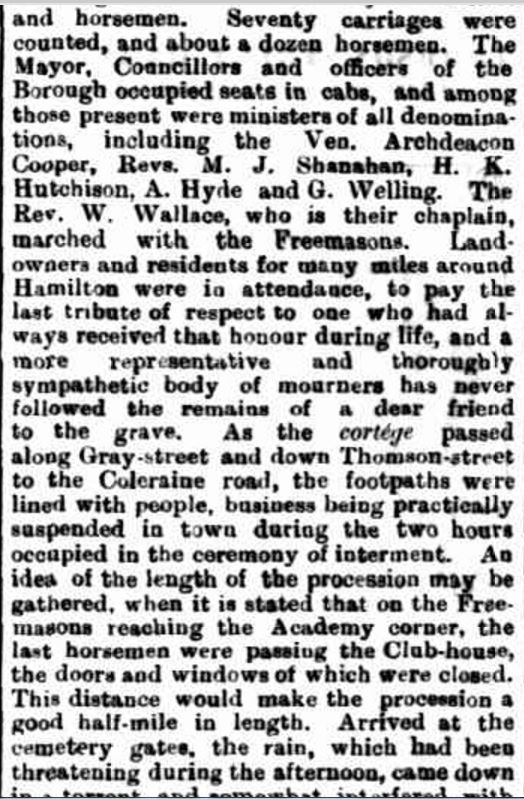
“FUNERAL OF THE LATE MR. WILLIAM THOMSON.” Hamilton Spectator (Vic. : 1870 – 1918) 21 July 1892: 3. <http://nla.gov.au/nla.news-article226161727&gt;.

After William’s death, his younger brother John took over the running of the Thomson store, operating as  John Thomson & Co.  John died suddenly in 1894 and James Brake (see obituary below), brother of John Thomson’s wife Martha, took over the store’s management.  Thomsons as it was locally known, operated in Gray Street until the early 1980s.  The building remains today as a shopping centre and the façade was recently restored.  The photo below was taken prior to the restoration.

FORMER JOHN THOMSON & CO BUILDING, GRAY STREET, HAMILTON, 2015

and after.
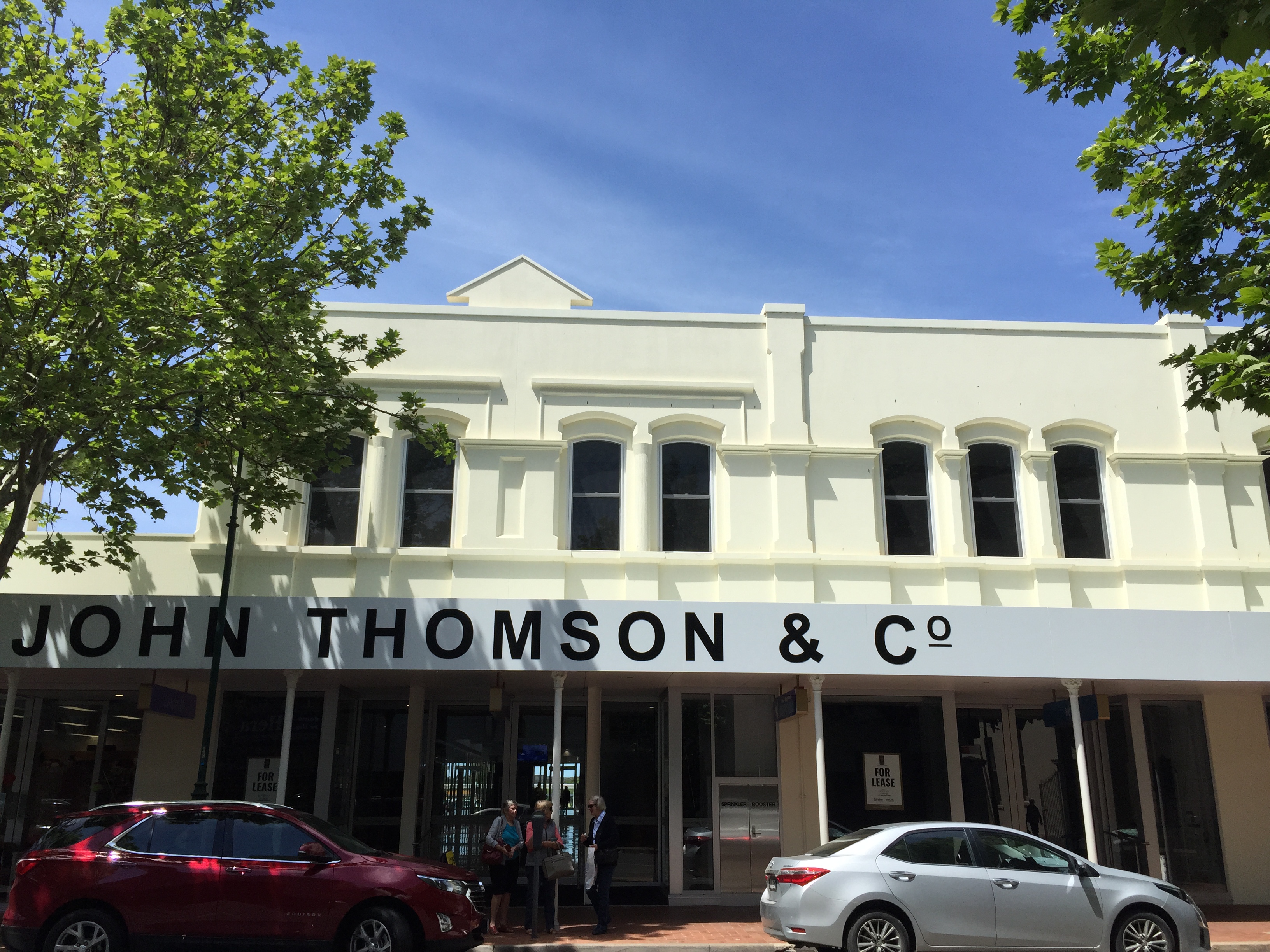
FORMER JOHN THOMSON & CO BUILDING, GRAY STREET, HAMILTON, NOW THE HAMILTON HUB. 2018

MacLEOD, Alexander Magnus – Died 19 July 1910 at West Melbourne.  Alexander MacLeod was born near Elaine, Victoria in 1846, a son of John Norman MacLeod and Agnes Paterson.  He went to school in Portland and Scotch College and then worked in a Portland bank. Later, Alexander became the Deputy Chief Inspector of Stock in South Australia. 

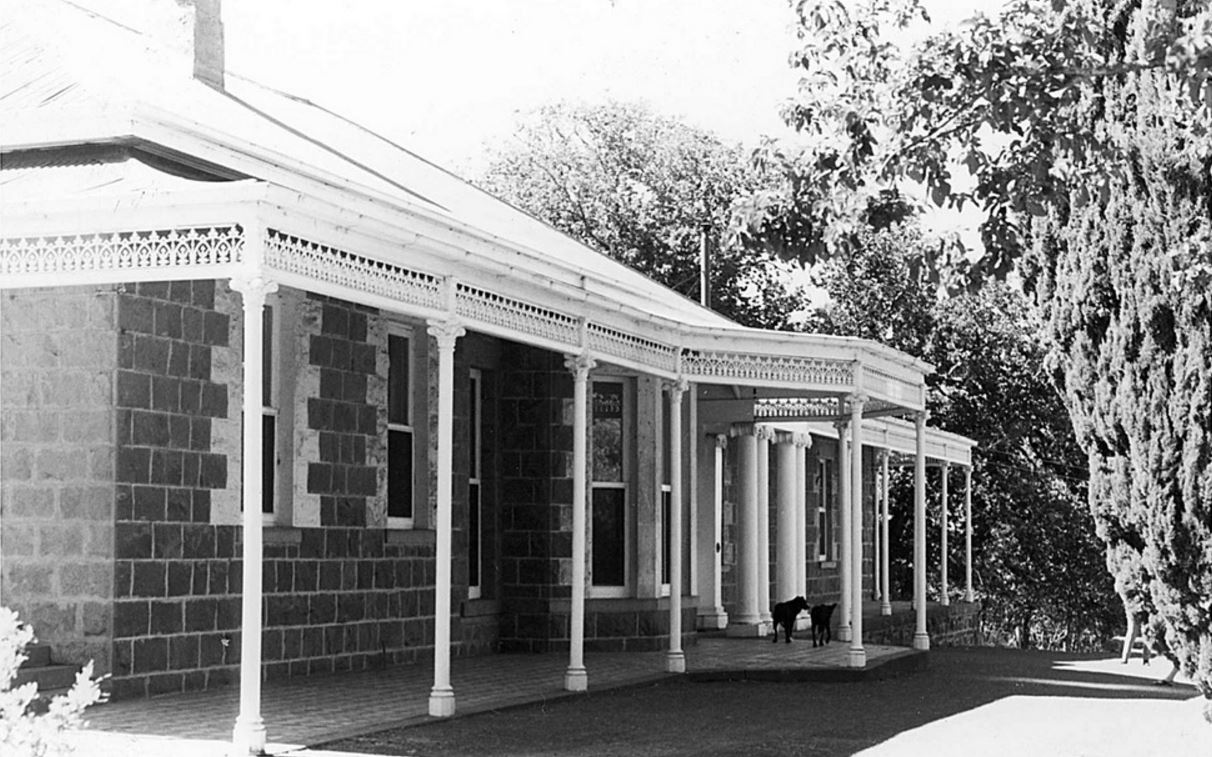
In 1890, at the age of forty-four, Alexander MacLeod married Caroline Henty.  There was gossip about the marriage because of the age difference which was by no means vast and because Caroline had only the year before inherited property after the death of her father Francis Henty. That included part of the Merino Downs property Caroline and Alexander would go on to name Talisker after the MacLeod ancestral home on the Isle of Skye. Alexander and Caroline built a grand homestead in 1901 (below).  Prior to settling at Talisker, the MacLeods had two daughters, Caroline Agnes and Alexandra Frances.

“TALISKER”, MERINO, 1977. Image courtesy of the J.T. Collins Collection, La Trobe Picture Collection, State Library of Victoria. http://handle.slv.vic.gov.au/10381/232509

During his time in the district, Alexander was associated with the construction of the Merino Butter Factory, a cooperative close to Talisker.  In 1910, Alexander and Caroline were visiting Melbourne and in residence at the Menzies Hotel.  It was there on 19 July 1910, Alexander died suddenly from a heart attack.  He was buried in Melbourne and Caroline returned to Talisker where she died four years later.

BRAKE, James Hugh – Died 29 July 1915 at Mont Albert.  James Brake was born at Cavendish around 1854.  Educated in Hamilton, James first worked for David Laidlaw, a storekeeper in Gray Street, Hamilton. James moved across the road to the W & W Thomson Store and was later promoted to manager of the Horsham branch of the store around 1880.  His move to Thomsons was most likely due to the family connection coming in 1877 when James’ sister Martha married John Thomson, a senior partner of W & W Thomson and younger brother of William Thomson (see obituary above).  

In 1881, James married Barbara McDougall, and they had five children.  While in Horsham, James was one of the first members of the local progress association and was a contributor to the Horsham Hospital. He served on the Horsham Borough Council and held the Horsham seat in State Parliament.  James was a supporter of temperance and attended the Horsham Presbyterian Church.

After the death of William Thomson in 1892, James’ brother-in-law  John Thomson became the sole partner.  However, John died suddenly in 1894 and James returned to Hamilton to manage the store in that town.  In time, his sons also worked in the store. In 1914, the Brakes moved to Elouera in Stanhope Street, Mont Albert.  James managed the Hamilton store from afar but died soon after at his home aged sixty-one.  His body was returned to Hamilton and buried at the Old Hamilton Cemetery.  In November of that year, James and Barbara’s younger son William Brake enlisted with the 4th Field Artillery Brigade and middle son James enlisted with the Australian Flying Corps in 1916.  Both sons returned, however, William died at the family home in Mont Albert in 1922 aged just twenty-nine.  He was buried at Hamilton (below).

BRAKE FAMILY PLOT, OLD HAMILTON CEMETERY.

PHILIP, John – Died July 1916 at Hamilton.  John Philip was born at Victoria Lagoon Station north of Cavendish in 1855, the third son of Captain John Philip and Margaret Robertson. John attended the Hamilton Academy and Geelong College.  When he left school, John went to his father’s property Miga Lake Station, north of Harrow, before managing Ascot Heath Station near Dartmoor in 1879. The following year, John married Katherin Swan of  Koonongwootong station near Coleraine.  He later purchased Englefield near Balmoral (below) and the Lower Crawford Estate near Condah in 1902. In 1904, he purchased the Mooralla Estate.

ENGLEFIELD. Image courtesy of the J.T. Collins collection, La Trobe Picture Collection, State Library of Victoria. http://handle.slv.vic.gov.au/10381/214202

John served on the Portland Shire Council and later the Wannon Shire.  He was also president of the Balmoral Mechanics Institute and the Toolondo-Cavendish Railway League.  He was buried at the Old Hamilton Cemetery (below).
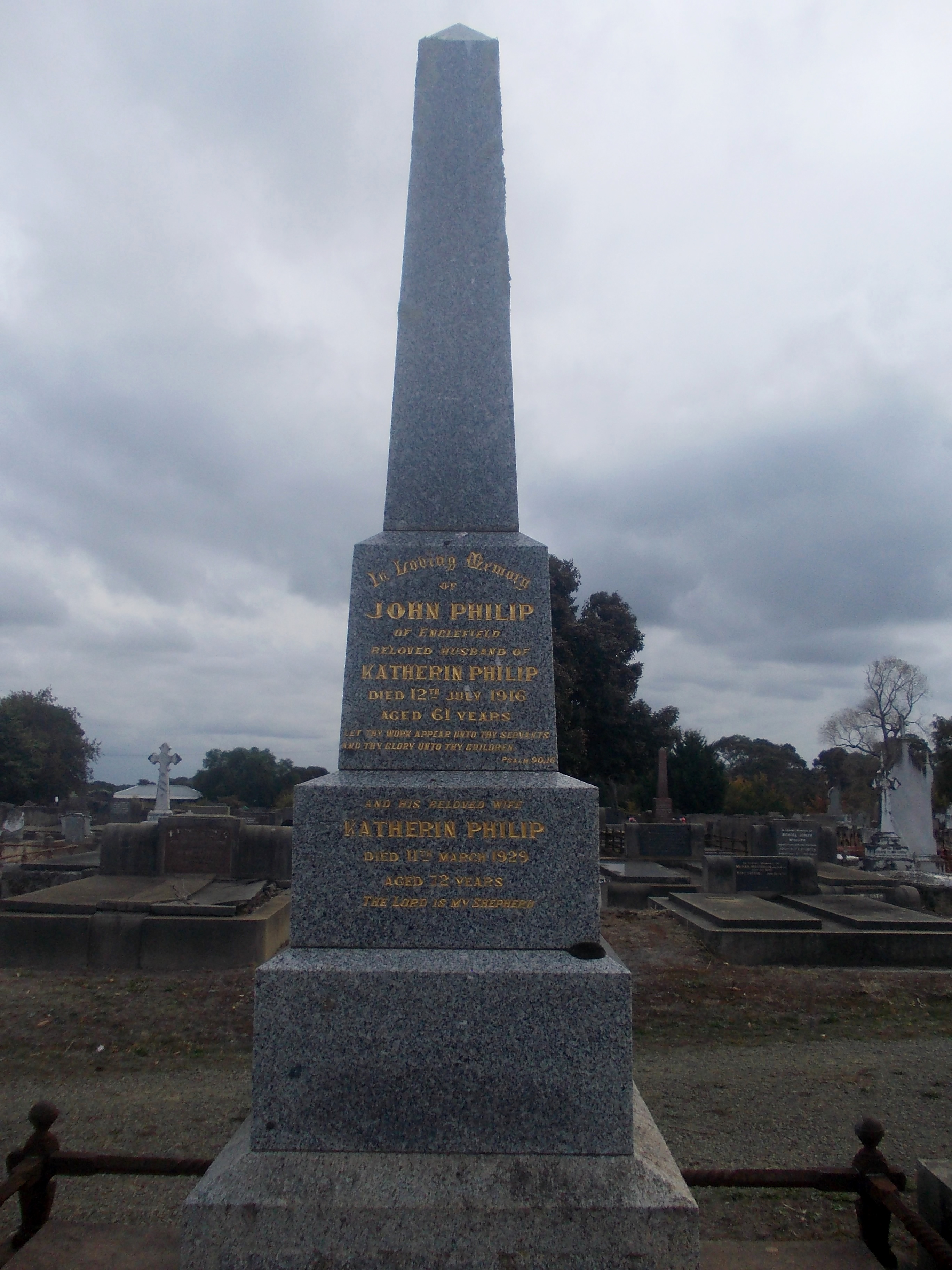
GRAVE OF JOHN AND KATHERIN PHILIP, OLD HAMILTON CEMETERY

WALTER, Emma – Died July 1916 at Hamilton.  Emma Walter was born in Devonshire, England in 1828 where she married Thomas Bromell.  In 1852, Emma and Thomas arrived in Victoria and after a short stay in Geelong went to the Ballarat and Avoca diggings before returning to Geelong by the end of the year,  purchasing a farm in the Barabool Hills.  In 1860, the Bromells took up Hensleigh Park north of Hamilton.  Thomas died in 1887 and around 1904, Emma moved into town, living at Edgecumb in Milton Street Hamilton.  In her earlier years at Hensleigh Park, Emma often attended the Hamilton Hunt Club meets.  She also enjoyed attending the local football.  Emma and Thomas had nine daughters and one son.  At the time of her death, Emma had twenty-two grandchildren and ten great-grandchildren.  She was buried at the Old Hamilton Cemetery (below).

GRAVE OF EMMA BROMELL (NEE WALTER), OLD HAMILTON CEMETERY

JONES, Edwin John – Died 21 July 1928 at Dartmoor.  Edwin Jones was born at Portland around 1856.  His parents settled at Drik Drik where Edwin remained until around 1908 when he purchased land at Mumbannar.  Edwin married Sarah Emerson around 1898 and they had three sons and one daughter. He was member of the Drik Drik P & A Society and Methodist Church (below)

DRIK DRIK METHODIST CHURCH. Image courtesy of the J.T. Collins Collection, La Trobe Picture Collection, State Library of Victoria. http://handle.slv.vic.gov.au/10381/230495

LEARMONTH, Edgar Thomson – Died 8 July 1933 at Mount Gambier.  Edgar Learmonth was the son of James Allan Learmonth and Annie Thomson and was born in Mexico around 1889 while his parents were living there.  The Learmonths returned to Australia in 1892 when Edgar was four and resided at Correa, near Dunkeld for the next ten years before moving to the home of Edgar’s grandfather Peter LearmonthPrestonholme near Hamilton. Edgar went to Hamilton College and later Wesley College.  He spent some years in Western Australia after his schooling then returned to manage his uncle James Thomson’s property Inverary near Branxholme While two of his brothers were serving during WW1, Edgar returned to Prestonholme and helped his father run that property.  It was during those years, Edgar an all round sportsman, won three Hamilton Golf Club championships.  After the war, Edgar and his two returned serviceman brothers purchased land together.

In 1923, Edgar married Nellie Coy of Woorndoo and the following year he and his brother Russell purchased Barnoolut near Mount Gambier where Edgar and Nellie took up residence and went on to have a daughter Janet.  On the afternoon of 9 July 1933, Edgar attended a football match at Mount Gambier and later attended Jenz’s Hotel. He was found unconscious in the outhouse at the hotel with a bullet wound to his head. He died five hours later in a private Mount Gambier hospital.  On 10 July 1933, the Mount Gambier coroner found Edgar Learmonth, at the age of forty-five, died from suicide due to an unsound mind.  During the inquiry, letters by Edgar revealed he was a worried man, however, his brother Russell said that while there were some financial worries, “they were not such to trouble a healthy man”.  Edgar was buried at the Old Hamilton Cemetery (below).
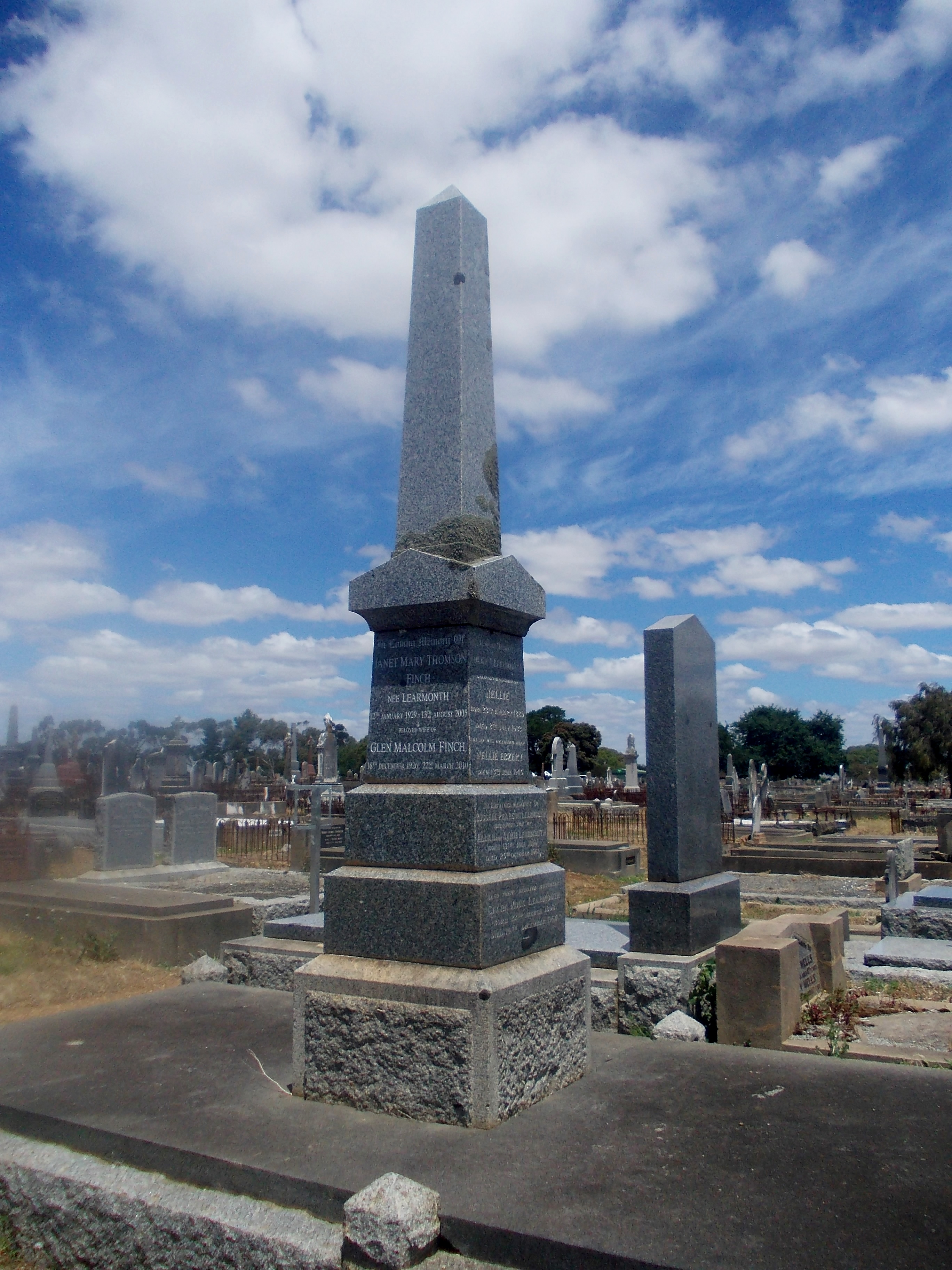
GRAVE OF EDGAR LAIDLAW AND FAMILY, OLD HAMILTON CEMETERY

LAIDLAW, Margaret – Died July 1935 at Hamilton.  Margaret was born at Lake Learmonth near Ballarat in 1858, a daughter of James Laidlaw (see obituary above) and Marian Coates. On 21 August 1883, Margaret married Thomas Philip at Wanliss House, Ballarat.  Thomas was a brother of John Philip (see obituary above).  The groomsmen were Margaret’s brother Henry Laidlaw and John Fenton, Margaret’s brother-in-law.  The Hamilton Spectator of 25 August 1883, headlined the report with, “A Fashionable Wedding”.  Margaret and Thomas eventually went to live at Koornong near Branxholme and in 1910, Thomas was involved in accident with a horse and suffered back injuries.  Since he was fifteen years older than Margaret, it was time to retire to town and the Philips took up residence at Kenmure in Ballarat Road.

KENMURE, HAMILTON 2015

In August 1933, Margaret and Thomas celebrated their Golden wedding anniversary with sixty family and friends.  Margaret died two years later at the age of seventy-six.

THOMSON, Robert Erskine – Died 18 July 1948 at Benalla.  Robert Thompson was born in Hamilton around 1875, a son of store owner William Thomson (see obituary above) and Ella Guthridge.  Around 1904, Robert married Sophie Dowie of Carisbrook.  After his marriage, Robert moved to Benalla and following his father’s footsteps, took over the Beehive Store in Bridge Street.  Robert was a member of the Benalla Lawn Tennis Club and Benalla Golf Club.  He was also a member of the Holy Trinity Church choir.

MANN, Samuel Furneaux – Died 17 July 1954 at Sandringham. Samuel Mann was born at Ballarat in 1866.  His father Samuel Furneaux Sr was a Ballarat solicitor and they lived in Lydiard Street.  Samuel Jr attended Geelong Grammar School.  He was a good sportsman and was part of Geelong Grammar’s rowing eight crew for the local  Head of the River twice.  Samuel also played football and cricket and golf.  He also played polo with the Caramut Polo Club later known as the Hexham Polo Club.   In 1897, Samuel purchased Minjah Station from the Ware family in partnership with Rutherford Albert Affleck.  He married Isabella Cecilia Affleck on 8 December 1897 at Scots’ Church in Collins Street, Melbourne.  Samuel and Cecilia went to have two sons and two daughters.  In 1903, Samuel purchased Lawrenny at Caramut (below).  A further obituary for Samuel Mann is available on the link to Obituaries Australia http://oa.anu.edu.au/obituary/mann-samuel-furneaux-barney-670

‘LAWRENNY”, CARAMUT 1986. Image courtesy of the J.T. Collins Collection, La Trobe Picture Collection, State Library of Victoria. http://handle.slv.vic.gov.au/10381/216637

Passing of the Pioneers

A further ten pioneers join the Pioneer Obituary Index this month.  They include a woman who was a pioneer in the transport industry from Cobden through to Port Campbell and a man who travelled the same routes carting goods.  There is also a Coleraine storekeeper, a Colac politician and a man still training racehorses into his eighties.  Remember to click on the underlined text to read further information on a subject.

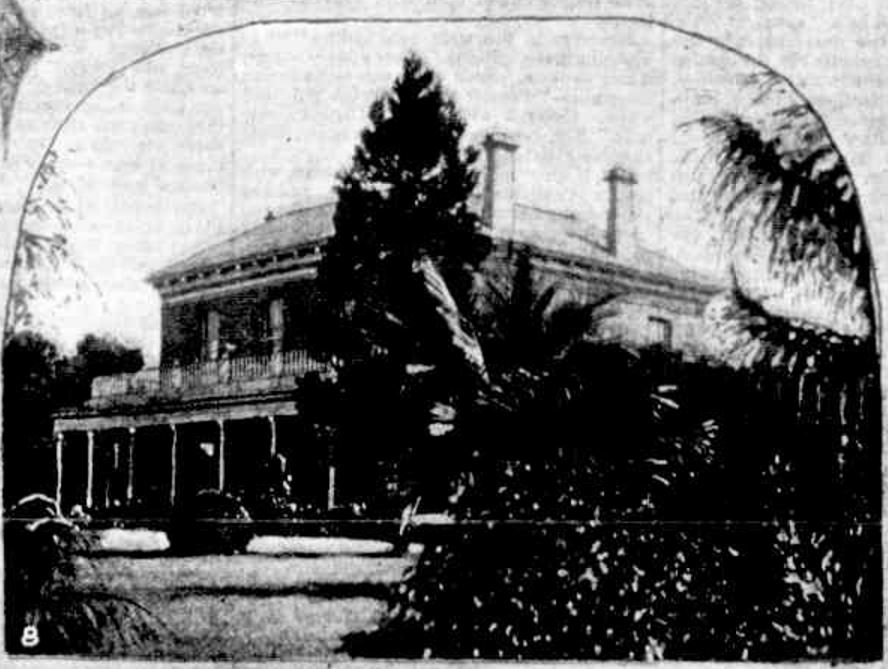
ROBERTSON, William – Died 24 June 1892 at Colac.  William Robertson was the second son of William Robertson of Colac Estate. He was born in 1839 at Hobart and by 1842, the Robertsons arrived in Victoria.  William returned to Hobart for his high school education before studying law at Oxford University. In 1861, he was a member of the winning crew of the annual Oxford vs Cambridge boat race and throughout his life, kept the trophy from the event, a cut-down oar. William returned to Victoria in 1863, marrying Martha Mary Murphy. He worked as a barrister in Melbourne until 1871 when he was successful in winning the seat of Polworth and South Grenville which he held until the next election in 1873 when he didn’t seek reelection.  William’s father died the following year and Colac Estate was divided in four for each of William Robertson Sr’s sons.  William Jr became the owner of The Hill (below).

“THE GOVERNORS DRIVING TOUR.” The Australasian (Melbourne, Vic. : 1864 – 1946) 24 March 1894: 30. Web. 15 Jun 2017 <http://nla.gov.au/nla.news-article138115318&gt;.

William returned to politics in 1881, holding the seat of Polworth and South Grenville for the next five years, then in Victoria’s Legislative Council in the seat of South-West Province until 1888.   The Robertsons were known Australia wide as breeders of fine Shorthorn cattle and their stock sold for large sums.  Williams’ funeral on 28 June 1892  was one of the biggest seen in the district.  Various noted men from Colac attended as well as those from the world of politics.  Numerous wreaths were sent including one from the Governor. The Colac Brass Band led the cortege to the cemetery and shops closed.  Martha died at Armadale in 1909.

PART OF “THE HILL” HOMESTEAD, COLAC IN 1970. Image courtesy of the J.T. Collins Collection, La Trobe Picture Collection, State Library of Victoria. http://handle.slv.vic.gov.au/10381/216917

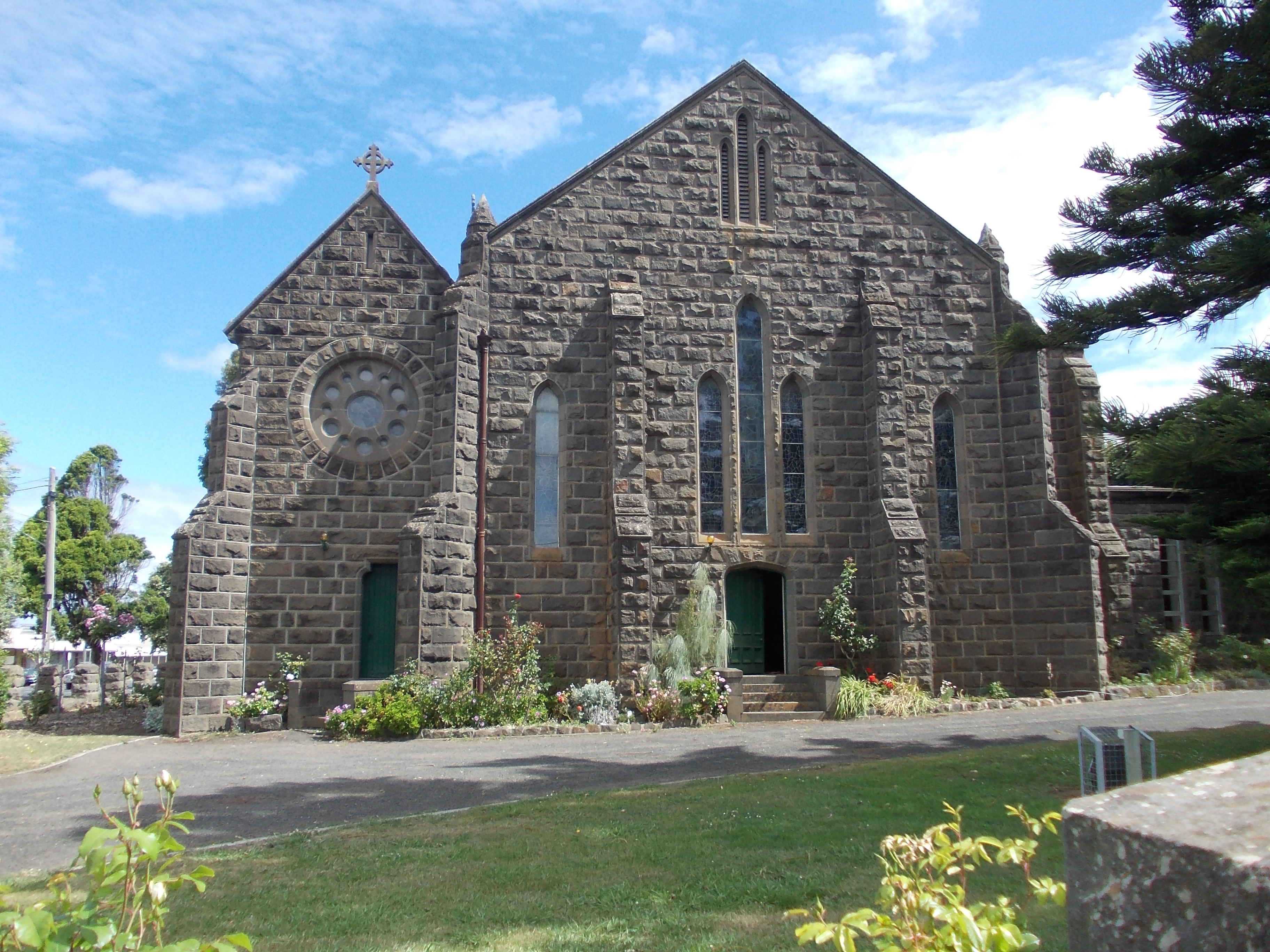
WIGGINS, Charles Augustus – Died 23 June 1901 at Hamilton.  Charles Wiggins was born in Tasmania in 1836 and arrived in Portland with his parents when a boy, attending school at Portland.  In his early twenties, Charles went to Hamilton to live with his brother James Wiggins. Charles was appointed the secretary of the Hamilton Common and was a sheriff’s officer and bailiff until 1883.  In the same year, he married Emma Lawn. Charles joined the Grange Lodge of Freemasons and was a member of the Australian Natives Association.  He was also secretary of the Hamilton Hospital and the Hamilton Pastoral & Agriculture Society.  Charles and Emma lived in Clarke Street, Hamilton and attended the Christ Church Cathedral (below). He was the secretary for the church for more than twenty years and a year before his death he was appointed churchwarden. 

168

CHRIST CHURCH, HAMILTON

Charles’ death came suddenly, and he was preparing to be the returning officer at the North Hamilton State School ballot box for the upcoming election on 25 June and had received all the relevant paperwork in preparation.

SMITH, Sidney – Died June 1916 at Warrnambool.  Sidney Smith was born in Cambridgeshire, England in 1848. Arriving in Victoria as a child, he attended Geelong Grammar School.  Sidney started his working life at fifteen at the offices of R.Busche, Solicitors of Timor Street, Warrnambool.  He then worked as an accountant for a mercantile and shipping firm at Port Fairy, Messrs Bateman & Co.  Later he went into partnership with Messrs Bateman with the firm becoming Bateman, Smith & Co.  Operations moved to Warrnambool and Sidney’s brother Spencer went into partnership with him.  They operated the company until 1898. Sidney then worked as an insurance agent until his retirement due to ill health.  Outside of business, Sidney was a vestryman at the Warrnambool Christ Church. (below)

CHRIST CHURCH WARRNAMBOOL c1907., Photographer Joseph Jordan. Image courtesy of the State Library of Victoria http://handle.slv.vic.gov.au/10381/54344

CLARKE, Edward Henry – Died 21 June 1918 at Digby.  Edward Clarke was born in Tipperary, Ireland in 1847 and arrived at Portland with his parents on the Helen to Portland in 1852.  The family first went to the Mount Gambier district before settling around Digby.  In 1873, Edward settled on his own property Lovely Banks at Digby.  Edward enjoyed football and cricket and was always a spectator at local games.  During the war, he donated to the various patriotic and relief appeals.  Edward’s wife Elizabeth Taylor died in 1909. Eight of Edward and Elizabeth’s ten children were still living at the time of Edward’s death. His youngest son John Clarke was serving overseas and returned to Australia in 1919.

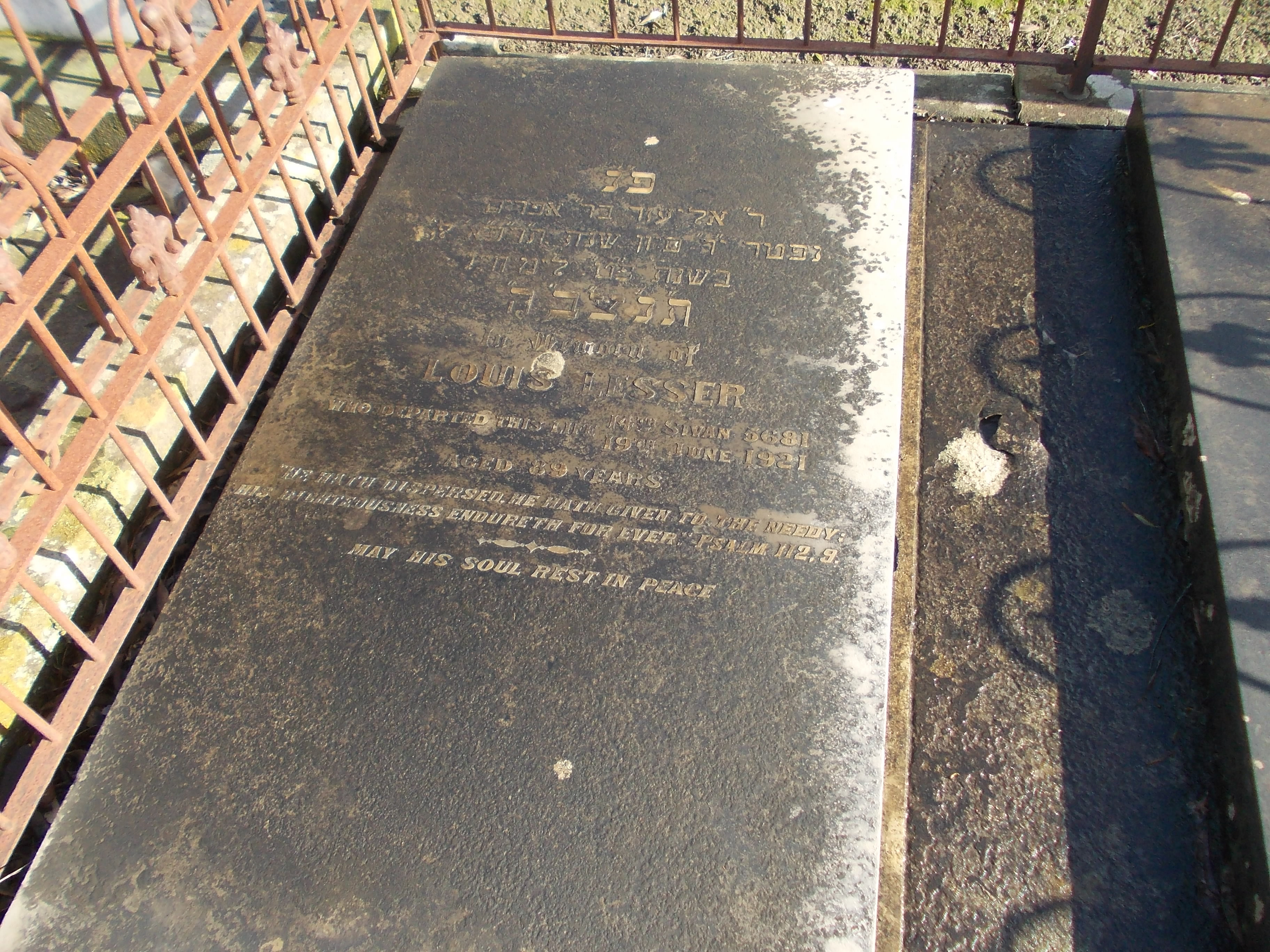
LESSER, Louis – Died 19 June 1921 at Coleraine.  Louis Lesser was born around 1832 in Swarzędz, Poland, then under Prussian rule. When Louis Lesser arrived in Australia about the 1850s, his first job at Sandridge (Port Melbourne) moving sand from the nearby sand dunes.  He then went to the diggings at Bendigo and Pleasant Creek (Stawell).  Louis’ brother Abraham arrived in Australia and the two moved to Coleraine, opening a store in Whyte Street. The partnership in the store was mutually dissolved in May 1865 when Louis left for London and in 1867, Louis married his sister-in-law’s sister Londoner Evelyn May and they left for Australia.  They arrived in Melbourne and made their way to Coleraine to join Abraham and his wife Elizabeth, Evelyn’s sister.  The partnership in the Coleraine store appears to have resumed with Louis operating the store with other family members after Abraham’s death in 1886.

A.LESSER & CO, COLERAINE. Image courtesy of the Museums Victoria Collections https://collections.museumvictoria.com.au/items/769410

Louis was a member of the Coleraine Racing Club for sixty years, retiring in 1918 as an honourary life member.  Louis is pictured below, second from right, with fellow stewards of the racing club in 1914.

RACE MEETING AT COLERAINE (1914, May 23). Weekly Times (Melbourne, Vic. : 1869 – 1954), p. 30.   http://nla.gov.au/nla.news-article121130046

He also served on the Wannon Shire Council and was a Justice of the Peace.  He was also a generous man, donating to many causes and was one of Hamilton Hospital’s leading donors.  In his will,  Louis’ requested a fund be established after his death called the “Louis Lesser Charity Endowment Fund” with an annual sum going to various organisations annually.

“Obituaries.” Observer (Adelaide, SA : 1905 – 1931) 9 July 1921: 34. Web. 28 Jun 2017 <http://nla.gov.au/nla.news-article165649115&gt;.

The Ballarat Synagogue was one of the recipients of the fund, receiving  £1000 pounds annually.  On 11 June 1922, a memorial was unveiled at the Ballarat Synagogue (below) by Louis’ nephew.


BALLARAT SYNAGOGUE. Image courtesy of the J.T. Collins collection, La Trobe Picture Collection, State Library of Victoria. http://handle.slv.vic.gov.au/10381/214178

Louis was buried at the Coleraine Cemetery.

GRAVE OF LOUIS LESSER, COLERAINE CEMETERY

HARVEY, Martin – Died June 1929 at Cudgee.  Martin Harvey was born at Penzance, Cornwall in 1836.  Around 1851, the Harvey family arrived at Geelong where Martin held his first jobs. Soon he was working a bullock team, taking food to outlying settlements, then returning to the Geelong port with a load of wool.  He spent time around the Minyip district moving from property to property working as a shearer.  He also took a bullock team on three trips from Ballarat to Dimboola.  He married Elizabeth Swan in 1867 and they spent time farming around Ballarat before moving to Cudgee near Warrnambool.  Martin finally settled down and lived there until his death at ninety-three. Martin and Elizabeth had seven sons and four daughters.

ROBERTSON, Marslie May – Died 15 June 1930 at Hamilton.  Marslie Robertson was born in Inverness-shire, Scotland in 1844 and was eight when she arrived in Melbourne with her parents. The Robertson family stayed in Melbourne only a few days before journeying to Portland, then on to Straun Station near Coleraine where May’s uncles had already settled.  In 1868, she married William Sudgen Price Lewis, the stepson of Richard Lewis, a former owner of Rifle Downs at Digby. William leased Hilgay near Coleraine until around 1871.  They then moved to Hamilton.  Marslie was an excellent horsewoman and showed horses including Gold Dust for Samuel Winter Cooke in September 1890 at the Hamilton Show in the Ladies’ Hack Class.

Marslie and William had eight children and some time after 1890, the Lewis’ took a young boy Arthur into their care, raising him as their son. They resided at Pine Lodge in Mill Road, Hamilton. In 1914, Arthur Lewis was one of the first Hamilton enlistments for WW1.  He died as a result of his wounds at sea on his way from Gallipoli to a hospital in Alexandria, Egypt on 13 August 1915. The shock of Arthur’s death was a great loss to William and he died In October 1915 at Hamilton.  Marslie was involved with the Hamilton Red Cross during the war and the Women’s Christian Temperance Union.  Each Sunday, she gave out flowers at the Hamilton Hospital.

COOKE, Eliza Jane – Died 29 June 1932 at Cobden.  Eliza Cooke arrived in Australia when she was eight and the family made their way to Ballarat. In 1866, she married Charles Morehouse They arrived in Cobden in 1880 and Charles died in 1881 aged forty.  A son was born in August of the same year.  Eliza ran a store in Cobden and from around 1882 was operating coach services departing from the store.  She pioneered coach services between Cobden, Princetown and Peterborough.

“Classified Advertising” Camperdown Chronicle (Vic. : 1877 – 1954) 20 August 1889: 1. Web. 29 Jun 2017 <http://nla.gov.au/nla.news-article22474287&gt;.

For forty-seven years, Eliza held the mail contract between Cobden and Camperdown. Eliza’s business grew and her sons eventually joined her.

“Advertising” Heytesbury Reformer and Cobden and Camperdown Advertiser (Vic. : 1914 – 1918) 26 February 1915: 3. Web. 29 Jun 2017 <http://nla.gov.au/nla.news-article152613189&gt;.

On 5 August 1931, Eliza celebrated her ninetieth birthday at her home Kooringa, Curdie Street Cobden.  At the time she was President of the Cobden Ladies’ Benevolent Society and still chairing meetings.

JEFFERS, Jonas – Died June 1933 at Cobden.  Jonas Jeffers was born at Connewarre around 1848.  Around the age of twelve, Jonas walked to Cobrico north-west of Cobden.  When he was older he bought land in the district and married Selina Westerland of Terang in 1869.  Jonas worked as a carter throughout the district, passing through the Heytesbury Forest when there was only the roughest of tracks.  He carted wool from Glenample near Princetown to Geelong and timber for the first bridge over the Sherbrooke River, east of Port Campbell.  He also carted wood for the first hotel in Cobden in the 1860s and items from the wreck of the Loch Ard to Colac in 1878.  At the time of Jonas’ death, Selina was still living along with ten of their children.

Jeffers

JONAS JEFFERS, LEFT, AT THE BACK TO COBDEN CELEBRATIONS IN LATE FEBRUARY 1933 JUST MONTHS BEFORE HIS DEATH. Happy Reunions at the back to Cobden Celebrations of Which back to School” and Sports Meetings Were Outstanding Features (1933, March 11). WeeklyTimes , p. 32 (FIRST EDITION). http://nla.gov.au/nla.news-article223807373

HANLON, James – Died 26 June 1940 at Casterton.  James Hanlon was born in Dublin, Ireland around 1854 and his family set sail for Australia soon after his birth. He lived in various towns including Narrawong and Hamilton and operated a hotel at Heywood. By the time he was twenty-one, it was thought he must have held the record for the number of successful racehorses he owned or leased. James was always interested in horses and twice travelled to India with horses exported to that country.  The first horses he raced were Paddy the Larrikan and My Lord. In 1878, James married Morgey Gooding Smith and they had four sons and two daughters.

In 1931, at the age of seventy-seven, Jim walked eighteen miles between Casterton and Coleraine scaling hills like a “mountain goat”.  He was in training for a veteran race over a mile at Mount Gambier on September 1931 in which James ran third riding Dutch Dull, beaten by a rider sixteen years his junior.  His training feats made the Weekly Times on 3 June 1939. A race meeting about three years earlier was referred to.  The jockey didn’t arrive for the ride, so James, then around eighty-four, put on the silks and rode the horse himself.  In the year before his death, James prepared a horse called Furnival.

“CASTERTON VETERAN’S TRAINING TRIUMPH AT EIGHTY-FIVE” Weekly Times (Melbourne, Vic. : 1869 – 1954) 3 June 1939: 58 (FIRST EDITION). Web. 29 Jun 2017 <http://nla.gov.au/nla.news-article224436779&gt;.

Aside from racing, James was a Mason for over fifty years including past Master of the Portland Lodge No. 6. James’ obituary in the Naracoorte Herald of 2 July 1940,  named fifty horses he was connected with during his life.


Hamilton Old Cemetery – Beyond the Headstones

Enter the gates of the Hamilton Old Cemetery and rising up before you are hundreds of diverse and fascinating headstones and monuments.  Some always catch my eye when I visit whether it’s for their design, the effects of time or the inscription.  Taking six headstones I find interesting, I’ve looked further into the history of each and those who lie beneath.

This slideshow requires JavaScript.

GEORGE AND JANE BOWLER

GRAVE OF GEORGE AND JANE BOWLER

A broken column, a life cut short.  In 1856, Jane Scott married London-born George Bowler presumably at Portland where their first child Thomas Joseph Bowler was born the following year.  In 1858, a second son, George Richard Bowler was born at Hamilton.  In 1860, the Bowlers suffered the loss of baby George and welcomed a daughter Mary Jane. The following, year on 16 July 1861, George Bowler Sr. also died at the age of twenty-seven and was buried in the Anglican section of the cemetery.  Jane was left with two small children aged four and one.  In 1864, she lodged a request for the Hamilton Borough Council to relieve her from paying her rates due to poverty.

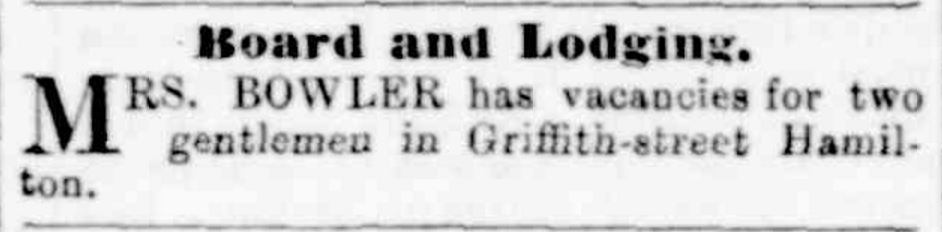
In later years, Jane’s daughter Mary Jane married Robert McFarlane in 1887 and son Thomas Bowler took up the trade of blacksmith in Hamilton.  He for a time was in partnership with David Arnott in the Hamilton Carriage Factory, blacksmith, wheelwrights and coachbuilders.  Jane lived in Griffin Street and took in boarders to make ends meet.

“Advertising” Hamilton Spectator (Vic. : 1870 – 1918) 25 January 1894: 3. Web. 19 May 2017 <http://nla.gov.au/nla.news-article225784055&gt;.

Jane died on December 1896 at Hamilton. She was buried with George.  George’s parents Joseph and Mary Bowler occupy the adjacent plots.

“Family Notices” The Age (Melbourne, Vic. : 1854 – 1954) 23 December 1899: 3. Web. 25 May 2017 <http://nla.gov.au/nla.news-article188661034&gt;.

ISAAC FOSTER

HEADSTONE OF ISAAC FOSTER

 On 9 March 1901, Isaac Foster had his Station Street property up for auction as he was leaving town.

“Advertising” Hamilton Spectator (Vic. : 1870 – 1918) 9 March 1901: 2. Web. 19 May 2017 <http://nla.gov.au/nla.news-article226091868&gt;.

But Isaac didn’t leave town. By 23 March, he was dead at the age of sixty-eight and still in Hamilton.

Isaac Foster arrived at Williamstown in 1870 before heading to Portland where he started a building and contracting business.  A new hospital was planned in Hamilton and Isaac was appointed   Clerk of Works on the project and moved to Hamilton.

HAMILTON HOSPITAL. Image courtesy of the State Library of Victoria http://handle.slv.vic.gov.au/10381/399127

He also worked on the Hamilton Anglican and Presbyterian Sunday Schools and William Melville’s residence at Weerangourt. Two years before his death, Isaac began suffering from consumption which would claim his life. Isaac also owned property at Branxholme which was auctioned in the week after his death.

“Advertising” Hamilton Spectator (Vic. : 1870 – 1918) 26 March 1901: 2. Web. 19 May 2017 <http://nla.gov.au/nla.news-article226090807&gt;.

NAOMI HICKMER

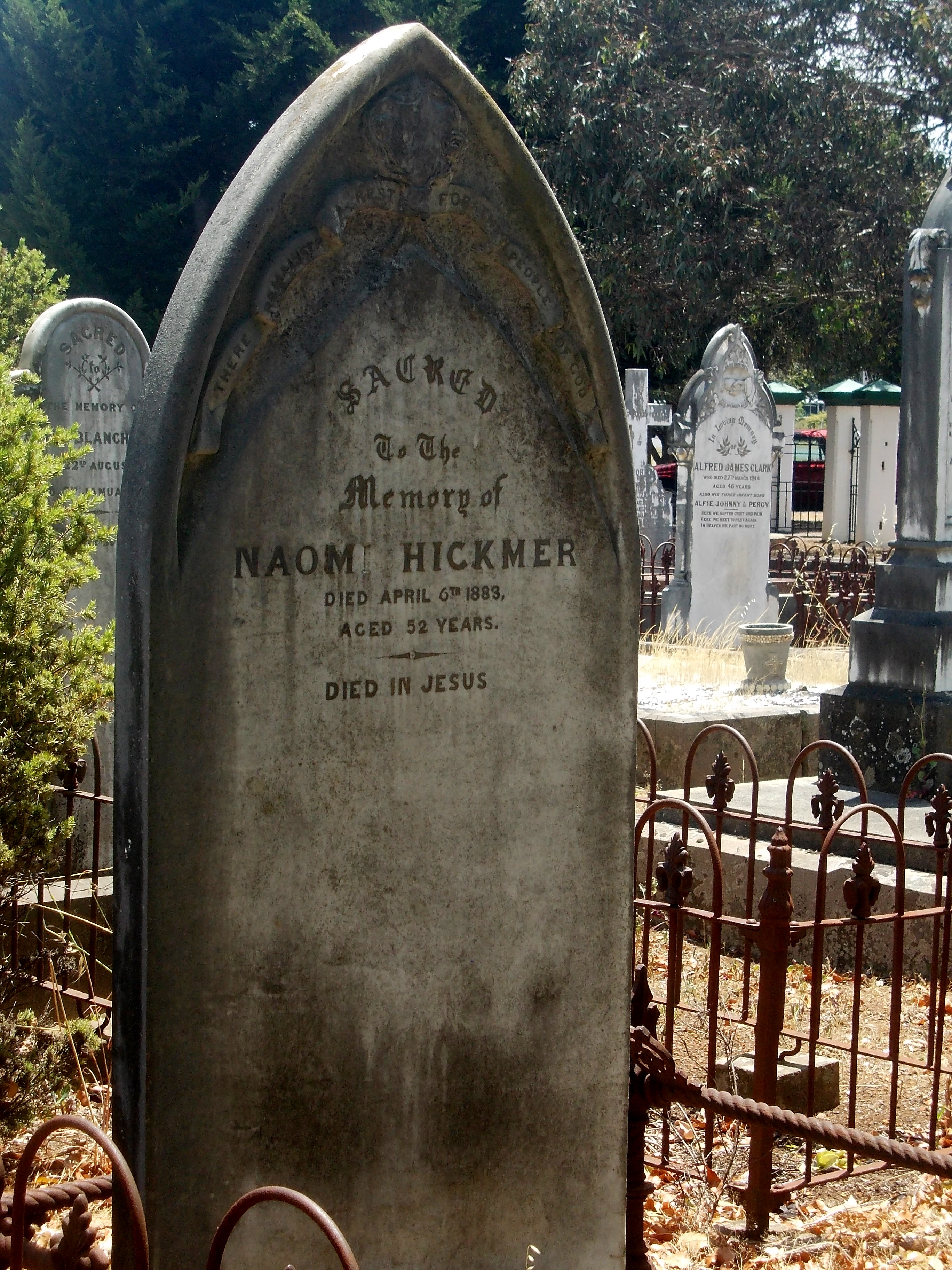
HEADSTONE OF NAOMI HICKMER

Inscribed with the words “There remaineth a rest for the people of God” from the Book of Hebrews, is the headstone at the final resting place of Naomi Hickmer.  Naomi, a spinster lived in Stephens Street, Hamilton and died on 6 April 1883 aged fifty-two.

Naomi’s brother Henry also lived in Hamilton and fortunately, he was a storyteller occasionally sharing his recollections with Mount Gambier’s Border Watch. Henry’s obituary included his life story from his own pen and from that I was able to find out more about Naomi and her family. The Hickmers were from Brighton, Sussex, England. Naomi was born around 1831. The family arrived at Adelaide, South Australia in 1851 when Naomi was twenty. Most of the members of the family then moved to the Lake Leake Station, east of Millicent, South Australia.

“OBITUARY.” Border Watch (Mount Gambier, SA : 1861 – 1954) 26 April 1918: 1. Web. 19 May 2017 <http://nla.gov.au/nla.news-article77655550&gt;.

Henry Jr arrived in Hamilton around 1874, living at various rural properties around the district before settling in Milton Street in 1892.  It is possible his parents and Naomi were in the district from around 1856.  The 1856 Australian Electoral Roll lists a Henry Hickmer, a farmer of South Hamilton.  Henry Hickmer Sr. died at Milton Street, Hamilton on 8 September 1881 aged eighty-three and Ann Hickmer died on 17 September 1884 also at Milton Street. They are buried beside Naomi.

HICKMER FAMILY GRAVE

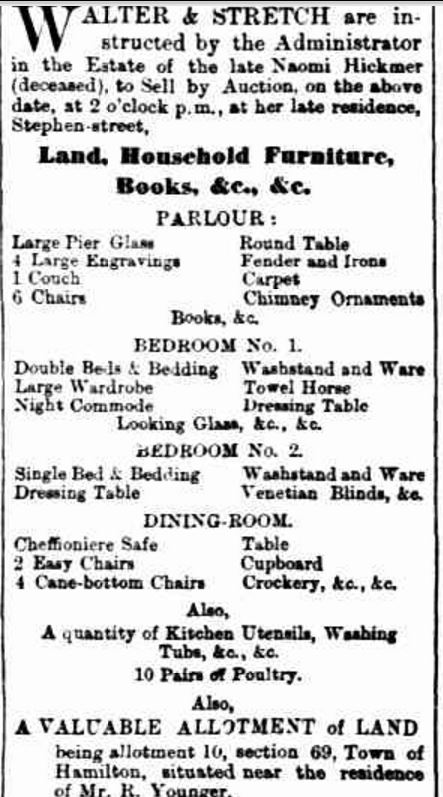
Naomi’s estate consisted of property to the value of £20 being her home in Stephens Street and £543 of personal property.  During the month after her death, Naomi’s assets were auctioned off.

“Advertising” Hamilton Spectator (Vic. : 1870 – 1918) 15 May 1883: 2. Web. 18 May 2017 <http://nla.gov.au/nla.news-article225492898&gt;.

Naomi’s probate file held by the Public Record Office made interesting reading and the outstanding accounts she had when she died, give some clue about her life at the time.  She owed £4 15′ shillings to the grocer Henry Horwitz, £2 6′ to drapers W. & W. Thomson, and £2 7′ for buggy hire from Richard Elijah.  Her other debts show she had a period of illness with amounts due to two surgeons Thomas Scott and George Annaud.  There was also a fee owing to Mrs Young for nursing services and an account of £1 from Carl Klug the chemist.  Naomi also paid Elizabeth Kennett servant’s wages and there was a charge of 13″ 6′ to Mott and Rippon publishers being the Hamilton Spectator.  It’s likely the bill was for Naomi’s funeral notice below.

Family Notices (1883, April 7). Hamilton Spectator (Vic. : 1870 – 1918), p. 2. Retrieved March 18, 2020, from http://nla.gov.au/nla.news-article225496093

ANTONIO & ROSINA RIZZO

HEADSTONE OF ANTONIO & ROSINA RIZZO

The Rizzo headstone not only displays Hamilton jeweller Antonio Rizzo’s devotion to his wife Rose but also a love of cameos, his specialty.

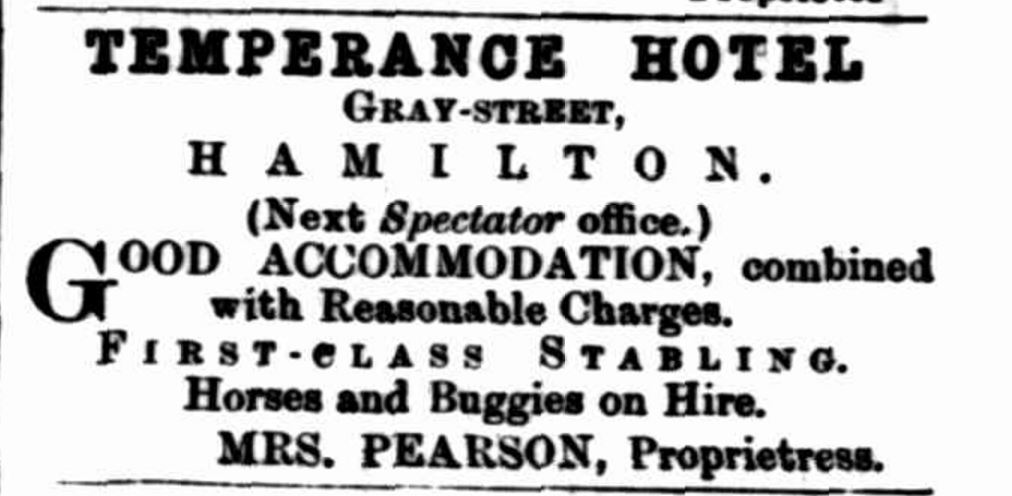
Rose Genevieve McCrystal was born around 1855, the daughter of Patrick McCrystal and Bridget Crinnion of Portland.  The McCrystals married in 1845 at Launceston.  In 1878, Rose married William Pearson.  Their first child a son was born at Branxholme around the time William purchased Hamilton’s Temperance Hotel and Confectionery Establishment.  Two more children, a son and daughter were born in Hamilton in 1883 and 1884.

“Advertising” Hamilton Spectator (Vic. : 1870 – 1918) 16 March 1880: 3. Web. 19 May 2017 <http://nla.gov.au/nla.news-article226055844&gt;.

Four years later, a buggy accident near Branxholme claimed William’s life.

“FATAL BUGGY ACCIDENT.” The Age (Melbourne, Vic. : 1854 – 1954) 30 September 1884: 5. Web. 18 May 2017 <http://nla.gov.au/nla.news-article191469587&gt;.

Rose kept the Temperance Hotel operating after William’s death.

“Advertising” Hamilton Spectator (Vic. : 1870 – 1918) 27 January 1885: 1 (SUPPLEMENT TO THE HAMILTON SPECTATOR). Web. 19 May 2017 <http://nla.gov.au/nla.news-article225659244&gt;.

In 1886, Rose put the Temperance Hotel up for lease and she and the children moved to Portland. Rose ran a boarding house in Percy Street.

“The Portland Guardian, (ESTABLISHED 1842.) With which is incorporated The Portland Mirror.” Portland Guardian (Vic. : 1876 – 1953) 14 November 1887: 2 (EVENING). Web. 19 May 2017 <http://nla.gov.au/nla.news-article65411182&gt;.

Meanwhile, Italian Antonio Rizzo had arrived in Australia sometime in 1884. He was born around 1845 and came from Naples. In 1887, he travelled to the Adelaide International Exhibition for which he received first prizes.

“EXHIBITIONS.” South Australian Register (Adelaide, SA : 1839 – 1900) 17 October 1887: 1 (Supplement to the South Australian Register.). Web. 20 May 2017 <http://nla.gov.au/nla.news-article46830011&gt;.

Antonio moved on to Melbourne for the 1889 Melbourne International Exhibition exhibiting his specialty of shell cameos.

“Italy.” The Week (Brisbane, Qld. : 1876 – 1934) 2 February 1889: 30. Web. 25 May 2017 <http://nla.gov.au/nla.news-article186193649&gt;.

It was in 1889, Antonio first ventured to Portland when he entered the Industrial and Art Loan Exhibition there in March 1889 and won first prize in his section for his artistic and cameo jewellery. Some of Antonio’s chosen materials were coral and lava from Mount Vesuvius.

“Portland Industrial and Art Loan Exhibition.” Portland Guardian (Vic. : 1876 – 1953) 8 March 1889: 3 (EVENING). Web. 19 May 2017 <http://nla.gov.au/nla.news-article63592279&gt;.

Having previously worked for Gaunt and Drummond Jewellers in Melbourne, later in 1889, Antonio opened his own jewellery shop at 37 Sturt Street, Ballarat.  In that year, the Ballarat Star, described Antonio as “our Italian sculptor” after he created a marble statue for an All Nations Fancy Fair in October 1889.

“Advertising” The Ballarat Star (Vic. : 1865 – 1924) 25 December 1889: 3. Web. 19 May 2017 .

Although he was in Ballarat, Antonio’s thoughts were in Portland and in 1891, he married the widow Rose Pearson at St Patrick’s Cathedral, Ballarat.

“Family Notices” Leader (Melbourne, Vic. : 1862 – 1918) 2 May 1891: 44. Web. 25 May 2017 <http://nla.gov.au/nla.news-article198045151&gt;.

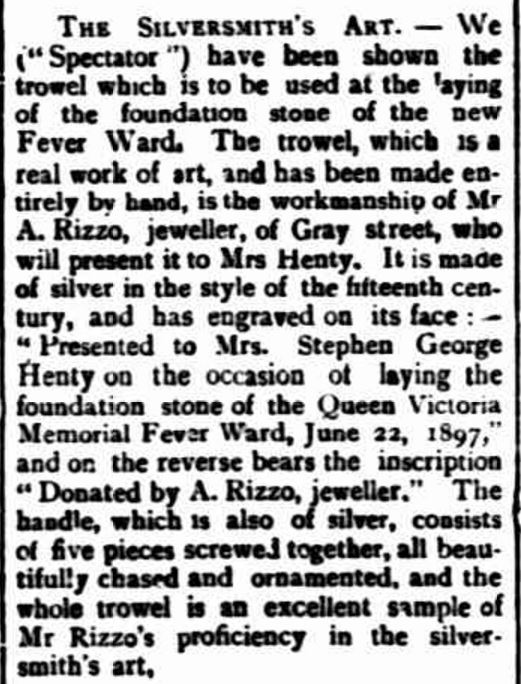
A daughter, Italia Florence was born the following year in Melbourne.  Next, Antonio applied for a wine license in Portland in December 1893 but failed in his application as he was not born in the colony or naturalised.  Instead. he started a jewellery store in Percy Street, Portland in March 1894.  In the same year, Antonio and Rose’s eldest son Hubert was born at Brunswick.  On 30 September 1895,a fire swept through the Percy Street shop and residence.  Rugerio Patrick was born in the same year at Portland. Not perturbed by the fire, Antonio opened a jewellery store in Gray Street, Hamilton in December 1895.  Antonio’s talents were soon noticed in Hamilton and in 1897 he was commissioned to produce an engraved silver-handled trowel for Jane Henty to lay the foundation stone of the Hamilton Hospital Fever Ward.

“Established August 1842. The Portland Guardian, With which is incorporated The Portland Mirror.” Portland Guardian (Vic. : 1876 – 1953) 28 June 1897: 2 (EVENING). Web. 18 May 2017 <http://nla.gov.au/nla.news-article63661275&gt;.

In 1904, Antonio became one of the many unwitting victims of fraudster Louis Horwitz. Horwitz was Antonio’s landlord and legal advisor.  He swindled Antonio into signing documents with regard to his overdraft with the Union Bank.  Before he knew it, Antonio was taken to court by the bank and other creditors all demanding money. It was enough to ruin Antonio.  He had debts of around £1600 and only £830 of assets, leaving a shortfall of £700 forcing him into insolvency in September 1904.  He could no longer trade and a clearance sale was held in early 1905.

“Advertising” Hamilton Spectator (Vic. : 1870 – 1918) 19 January 1905: 3. Web. 25 May 2017 <http://nla.gov.au/nla.news-article225883597&gt;.

In  August 1905, Antonio made a successful application to have his insolvency dissolved and was able to reopen his business.

“Advertising” Hamilton Spectator (Vic. : 1870 – 1918) 29 December 1908: 3. Web. 18 May 2017 <http://nla.gov.au/nla.news-article225891265&gt;.

Antonio was a generous donor of trophies for various events around Hamilton.  One trophy known as the Rizzo Trophy, was for the Hamilton Gun Club becoming highly sort after prize among shooters. While in Hamilton, Antonio and Rose resided at Roma in Milton Street. When WW1 broke, their son Hubert enlisted in 1915 and safely returned to Australia in 1919.

Rose died on 8 November 1920 at a Kyneston Private Hospital in Caulfield aged sixty-five.  Her body was returned to Hamilton and buried in the Roman Catholic section of the cemetery. In time, an exquisite and unique headstone was added to Rose’s grave.  The feature, a cameo made in Italy in the image of Rose. Antonio died on 27 October 1924 at his daughter Italia’s home in Kew at the age of seventy-nine. He was reunited with Rose and today their grave is part of the cemetery’s Notable Graves Walk.  While the entry recognises Antonio, Rose shouldn’t be forgotten. She earned a living and raised her two children alone for seven years, later losing everything in the Portland fire and was there for Antonio through his enforced insolvency.

SIGN ON THE RIZZO GRAVE

Rugerio Rizzo followed his father into the trade and continued operating Rizzo Jewellers for several decades after Antonio’s death.

TIMOTHY TWOMEY & THE TWOMEY FAMILY PLOT

HEADSTONE OF TIMOTHY TWOMEY

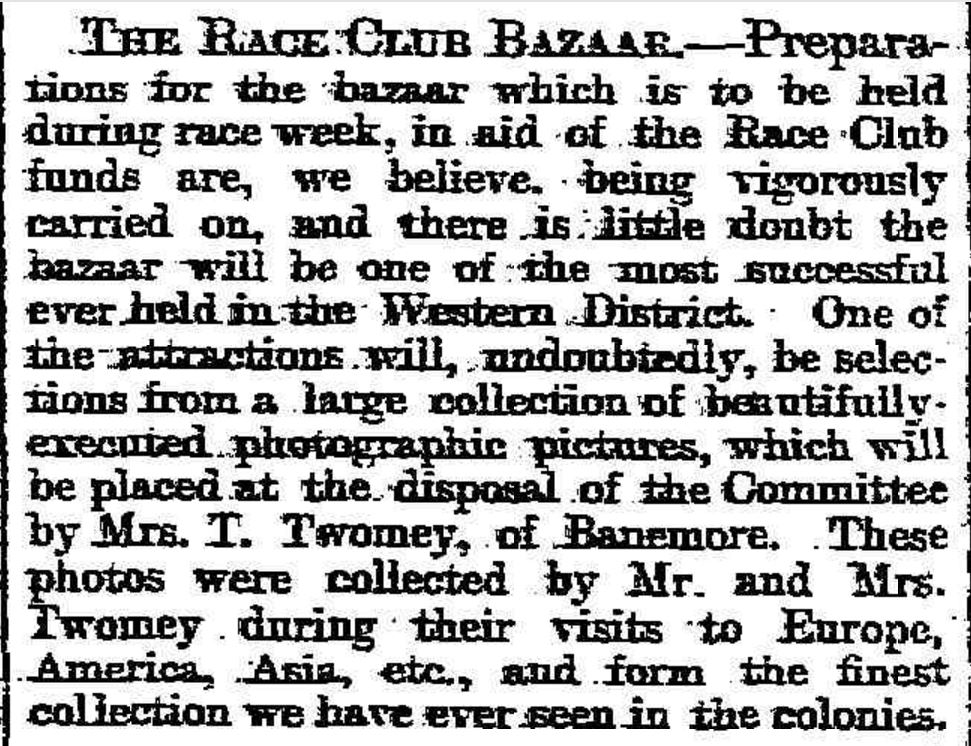
The beautiful Celtic cross in the Roman Catholic section of the cemetery belongs to a man they called the Squire of Banemore, Timothy Twomey.  Timothy was a member of the Twomey family of Penshurst.  He was born in Ireland around 1829, the son of John Twomey and Margaret O’Conner. When the family arrived in Victoria, John Twomey acquired a large amount of land near Penshurst.  He later divided the property into three for his son Timothy’s property was Banemore from 1866  In 1867, Timothy married Annie Hayes. The Twomeys enjoyed overseas travel and by 1887, Timothy and Annie had visited Asia, Europe, and America.

“Items of News.” Hamilton Spectator (Vic. : 1870 – 1918) 13 January 1887: 2. Web. 3 Jun 2017 <http://nla.gov.au/nla.news-article226154135&gt;.

In early 1894, Timothy and Annie were off to England again.  The trip did not go to plan with Timothy dying suddenly in London on 10 July 1894 aged sixty-five.

“Items of News.” Hamilton Spectator (Vic. : 1870 – 1918) 12 July 1894: 2. Web. 19 May 2017 <http://nla.gov.au/nla.news-article225779799&gt;.

Timothy’s body was returned to Hamilton but on the way, there was a stopover at St Patrick’s Cathedral, Melbourne for a memorial service on 7 September 1894.  The cortege left for Spencer Street Station in time for the 6.50pm train to Hamilton. The following day, Timothy’s funeral was held at St Mary’s Catholic Church, Hamilton before burial.

“Family Notices” Hamilton Spectator (Vic. : 1870 – 1918) 8 September 1894: 3. Web. 19 May 2017 .

In 1896, Annie commissioned Messrs. P. Finn & Co, stonemasons of Mitchell Street, Bendigo to make an appropriate headstone. What they created was considered one of the finest headstones in the colonies.  It was a huge undertaking with the granite quarried at Cape Woolamai on Victoria’s east coast, then shipped to Melbourne for transport to Bendigo.  The four metre high Celtic cross was available for viewing at Finn’s yard prior to its transportation to Hamilton.

“Items of News.” Hamilton Spectator (Vic. : 1870 – 1918) 6 October 1896: 3. Web. 19 May 2017 <http://nla.gov.au/nla.news-article225554924&gt;.

Timothy’s Celtic cross is just one of a number of graves in the Twomey family plot and is by no means the tallest. There were eighteen Twomey burials at the cemetery, including Timothy’s parents and brothers Edward and Daniel.  The two brothers were at one time on the Hamilton Cemetery Trust.

TWOMEY FAMILY PLOT, ROMAN CATHOLIC SECTION

THOMAS & MARGARET WALKER

HEADSTONE OF THOMAS AND MARGARET WALKER

A scroll such as that on the column of the Walker monument can symbolise a life unfolding for an uncertain time. It’s doubtful Margaret Walker ever expected her life to unfold across 104 years. Thomas Walker arrived at Portland around 1840 and married Margaret Brown in 1843.  They lived in Portland until 1866 when they moved to Hamilton.   Thomas acquired various properties around the Hamilton township and for a time worked as a land agent.  He died on 15 April 1909 aged eighty-six, leaving his widow Margaret, then aged seventy-four, one son and two daughters.

Margaret, born on 11 August 1835 at Launceston, went on to live for a further thirty years. On 10 August 1939, Margaret celebrated her 104th birthday at her home in Shakespeare Street, Hamilton. At the time, it was thought she was the oldest woman in Victoria living through the reign of six monarchs.

MARGARET WALKER The Age (Melbourne, Vic. : 1854 – 1954) 11 August 1939: 14. Web. 19 May 2017 http://nla.gov.au/nla.news-article204924449

Margaret long life ended two months after her birthday on 19 October 1939.  Her obituary in the Hamilton Spectator of 23 October 1939 said Margaret was, “…a lover of all things beautiful, and in quiet contentment, surrounded by her own people and home where she could indulge her liking, which amounted to almost a passion, for her garden she enjoyed to the full of her heart’s desire.”

Also buried with Thomas and Margaret is their daughter Maria, who Margaret outlived by seven years.  Maria Watson died at Hamilton aged seventy-six.

HEADSTONE OF MARIA WATSON (nee WALKER)

This is the second in a series of posts about the Old Hamilton Cemetery.  You can read the first on the link –  Hamilton Old Cemetery – Finding Family

© 2017 Merron Riddiford

Trove Tuesday – A Highway of Treasures

Recently at the Western District Families Facebook page, the page followers and I completed a virtual tour of the Hamilton Highway “stopping” at historic sites along the way. After 185 kilometres and eight weeks, the virtual tour rolled into Hamilton.  I could not have done it without Trove.  Using Trove as my search engine, I was able to locate relevant out of copyright photos held by the State Library of Victoria and the Museums Victoria Collection.  Also newspaper articles from Trove’s digitised newspapers along the way.

The Hamilton Highway was once the main route to the south-west of Victoria from Geelong and Melbourne and some of the earliest buildings, such as the Elephant Hotel at Darlington, date back to the 1840s.  There was such diversity in the history along the highway.  From Cressy, where local schoolmaster Gabriel Knight documented the growth of the township in the 1910s through to the German settlements between Penshurst and Hamilton dating back to the 1850s.  In between, we visited the beautiful homesteads, learnt about 19th century murders and visited former RAAF bases.  There were volcanoes, bank robberies and many faces from the past.

It was at Hexham that I almost stalled and could have quiet easily got sidetracked.  It had everything I enjoy, homesteads, historic gardens, horses and 1920s/30s glamour.  The Hexham Polo Club began in 1884 and polo really took off in the 1890s.  Families such as the Hoods, Manifolds and Urquharts were there in the beginning and some of their descendants are still members.  The polo drew visitors from Melbourne and the districts around Hexham and was a highlight of the social calendar as were the associated parties and dances.  The following photos are from a tournament in 1936.

"POLO CARNIVAL AT HEXHAM (V.)" The Australasian (Melbourne, Vic. : 1864 - 1946) 29 February 1936: 27 (METROPOLITAN EDITION). Web. 27 Feb 2017 .

“POLO CARNIVAL AT HEXHAM (V.)” The Australasian (Melbourne, Vic. : 1864 – 1946) 29 February 1936: 27 (METROPOLITAN EDITION). Web. 27 Feb 2017 <http://nla.gov.au/nla.news-article141769891&gt;.


"POLO CARNIVAL AT HEXHAM (V.)" The Australasian (Melbourne, Vic. : 1864 - 1946) 29 February 1936: 27 (METROPOLITAN EDITION). Web. 27 Feb 2017 .

“POLO CARNIVAL AT HEXHAM (V.)” The Australasian (Melbourne, Vic. : 1864 – 1946) 29 February 1936: 27 (METROPOLITAN EDITION). Web. 27 Feb 2017 <http://nla.gov.au/nla.news-article141769891&gt;.

It wasn’t easy to drag myself away from the polo but I had to keep motoring along but I then came across Boortkoi.  The State Library of Victoria holds photos of Boortkoi as part of the J.T Collins Collection.  This is one of just many collections the State Library hold and I am constantly grateful to John Collins and his photography for the National Trust he left to the library.  

 J.T. Collins Collection, La Trobe Picture Collection, State Library of Victoria. http://handle.slv.vic.gov.au/10381/231806

BOORTKOI, HEXHAM J.T. Collins Collection, La Trobe Picture Collection, State Library of Victoria. http://handle.slv.vic.gov.au/10381/231806

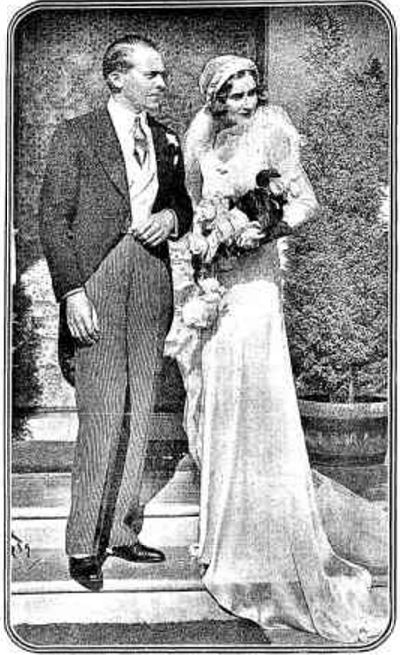
Boortkoi was owned by the Manifold family and when I did some newspaper searching at Trove, I found this beautiful wedding photo.  On 7 March 1933, Andrew Manifold, son of Edward Manifold of Boortkoi married Jess Robertson of Melton South at Frankston.

"Table Talk of The Week" Table Talk (Melbourne, Vic. : 1885 - 1939) 16 March 1933: 4. Web. 27 Feb 2017 .

“Table Talk of The Week” Table Talk (Melbourne, Vic. : 1885 – 1939) 16 March 1933: 4. Web. 27 Feb 2017 .

Jess Manifold was beautiful and stylish and I wanted to find out more about her and the life she and Andrew had at Boortkoi. Searching for Jess took me to Table Talk one of my favourite publications digitised at Trove.  I found Jess played tennis in a Camperdown tournament in 1935, a popular social event for the Melbourne socialites.  Table Talk reported on 3 January 1935, Jess had two tennis outfits a pink chukka skirt and a white linen skirt.  Also, at a wedding in January 1937, Jess looked stylish in a cinnamon brown chiffon cocktail dress with a straw toque (brimless) hat adorned with the latest trend, opalescent flowers.  And, at a cocktail party at the Menzies Hotel in 1937, she wore dusty pink with a blue hat, scarf and sash.  I also found Jess was at least twice voted one of Melbourne’s best best-dressed, the only country woman named.

""Grannies" among best-dressed" The Argus (Melbourne, Vic. : 1848 - 1957) 12 January 1950: 3. Web. 28 Feb 2017 .

“”Grannies” among best-dressed” The Argus (Melbourne, Vic. : 1848 – 1957) 12 January 1950: 3. Web. 28 Feb 2017 <http://nla.gov.au/nla.news-article22804008&gt;.

In early 1935, the couple moved into the rebuilt homestead at Boortkoi.  During my Trove searches, I discovered Andrew and Jess had commissioned Edna Walling to design a new garden. The following image is Edna’s plan for the garden.

http://handle.slv.vic.gov.au/10381/236209

Edna Walling Collection, State Library of Victoria. http://handle.slv.vic.gov.au/10381/236209

I love Edna Walling.  I’ve read her books, tried to emulate her style in my garden (and failed) and looked through her photos held by the State Library of Victoria, another of the wonderful collections they hold.  With Edna Walling now part of the Boortkoi story, I again started losing my way looking through Edna’s photos again, one of which is among my favourite photos I’ve found at the State Library of Victoria (below).

 Edna Walling Collection, State Library of Victoria. http://handle.slv.vic.gov.au/10381/280983

Edna Walling Collection, State Library of Victoria. http://handle.slv.vic.gov.au/10381/280983

The touring has now turned to the Henty Highway from Cherrypool to Portland and has just “arrived” at Branxholme.  There is so much history along the twenty-five kilometre stretch from Hamilton to Branxholme, it’s taken ten days to make the trip.  So why not join us.  You’ll find the Western District Families’ Facebook page here.

You can find the State Library of Victoria’s collection of photos on the link here and the Museums Victoria Collections on the link here.  Always check the copyright status of the photos and if there are any particular citing instructions.  The SLV has special instructions on their collections such as the J.T.Collins collection and the Museums Victoria also has guidelines for using their photos under the Creative Commons licence.  While I could look for my photos directly on those sites, I find using Trove is much easier for searching, filtering and working with the results and I can easily tag for future reference and keep my newspaper and photo discoveries together.

Passing of the Pioneers

Looking back through previous Passing of the Pioneers posts, I noticed the months of April and May have missed out a couple of times over the last five years.  To remedy that, this is joint post and look at the obituaries of seven pioneers from each of those months.  As usual, there are some wonderful stories and characters from towns across the Western District. Hexham features prominently with two of the best known past residents of the district included.   Be sure to click on the underlined text as you’ll find links to further information about the subjects.  

APRIL

CAMERON, Donald – Died April 1870 at Campbellfield.  Donald Cameron was born in Scotland around 1812 and travelled to Sydney about 1835.  He first selected at Mount Sturgeon Plains. He later took over Morgiana earning him the name “Morgiana Cameron” around the Hamilton district where he was known for wearing full Highland regalia to town.  Donald also held Bochara Station.  He was fifty-eight at the time of his death.  The Hamilton Spectator reported on the death of “Morgiana Cameron”, presenting him not very flattering terms.

“Items of News.” Hamilton Spectator (Vic. : 1870 – 1918) 6 April 1870: 2. Web. 23 May 2017 <http://nla.gov.au/nla.news-article196307141&gt;.

In response, Donald’s brother John wrote to the Hamilton Spectator, setting the record straight and reminding the paper that one should not speak ill of the dead.

“THE LATE MR. DONALD CAMERON.” Hamilton Spectator (Vic. : 1870 – 1918) 13 April 1870: 3. Web. 23 May 2017 <http://nla.gov.au/nla.news-article196302866&gt;.

CHAPMAN, James – Died 15 April 1886 at Colac.  James Chapman was born in Scotland and attended the Bathgate Academy before working for the Linen Bank Company.  He arrived in Victoria around 1873 and started work with the Colonial Bank.  He was the manager at Sandhurst, then Portland for nine years before moving to the Colac branch.  Well known in Masonic circles, James was the Worshipful Master of the Warrion Lodge. His funeral included a Masonic burial service.  The Colac Herald published a further description of James’ life on 16 April 1886.

HORNE, John – 6 April 1914 at Terang.  John Horne was born in Scotland around 1825.  He arrived in Victoria in 1852 and tried his luck at the diggings before moving to the Warrnambool district.  He then went on to Terang in 1857 where few buildings existed and families lived in tents. John married Catherine McLean at Warrnambool in 1859 and they settled in High Street, Terang with John working as a bootmaker.  Two days before his death, John celebrated his fifty-seventh year in the town and was the longest continuous resident. He was a leading member of the Terang Presbyterian Church (below) and was a member of the Sons of Temperance, the secretary of the Terang Cemetery Trust and was on the State School Board of Advice.  He was also a trustee of the Mechanics Institute and the Public Park.  Catherine died in 1910 and John left a family of seven children.

THOMPSON MEMORIAL CHURCH, TERANG 1966. Image courtesy of the J.T. Collins Collection, La Trobe Picture Collection, State Library of Victoria. http://handle.slv.vic.gov.au/10381/234278

PETRAS, Johanna – Died 11 April 1916 at Hamilton.  Johanna Petras was born in Prussia in 1816 and arrived in Australia at Geelong in 1855 with her husband Friedrich Herrmann.  They took up land near Muddy Creek in 1869 where they settled.  Johanna and Friedrich kept an orchard and vegetable garden, large enough to sell produce to the people of Hamilton each week. The couple attended St Luke’s Lutheran Church (below) in South Hamilton.  Friedrich died in 1893 after a kick from a horse at the age of seventy-two.  They had four children with two still living at the time of Johanna’s death.

FORMER ST. LUKE’S LUTHERAN CHURCH, HAMILTON. Image courtesy of the J.T. Collins Collection, La Trobe Picture Collection, State Library of Victoria. http://handle.slv.vic.gov.au/10381/229921

LITTLE, Thomas – Died 5 April 1917 at Camperdown.  Thomas Little was born around 1862 living at Terang all his life.  In 1886, he married Caroline Patterson.  Thomas was a founder of the Terang Butter Factory Company and a member of the Oddfellows Lodge.  At the time of his death, Thomas was looking after his son’s property Wiridgil near Camperdown.  He died suddenly after milking the cows on the morning of 5 April.  Thomas left his widow Caroline, two sons and one daughter and was buried at the Terang Cemetery.

HOULIHAN, Ellen – Died 26 April 1917 at Mortlake.  Ellen Houlihan was born in County Kerry, Ireland around 1837 and arrived in Victoria about 1857.  She spent some time at Warrnambool before moving to Mortlake.  In 1860, Ellen married James Campion and James ran a bootmaking business in Mortlake.  James died in 1895 and their son Michael took over the business. Ellen was a member of the Mortlake Roman Catholic Church congregation. She left two sons at the time of her death.

CATHOLIC CHURCH, MORTLAKE, Image courtesy of the State Libary of Victoria. http://handle.slv.vic.gov.au/10381/64602

HOOD, Robert Alexander David – Died 10 April 1934 at Hexham.  Robert Hood was born at Merrang at Hexham in 1863 and attend Geelong Grammar School.  Better known as Alex, after his schooling he went to Burenda Station in Queensland to learn about station life before returning to Merrang to take over operations from his father.  Upon his father’s death,  Alex inherited Merrang.

MERRANG, HEXHAM. Image courtesy of the J.T. Collins Collection, La Trobe Picture Collection, State Library of Victoria. http://handle.slv.vic.gov.au/10381/231920

Alex was a champion polo player and a member of the “Caramut Four” polo team.  He was also captain of the Victorian team, touring the colonies and New Zealand. Below is a photo of the Victorian team in 1899 including other members of the Caramut team.  Further down, you’ll find another photo of Alex  Hood with James Chester Manifold and another Hexham passing pioneer.

“INTERCOLONIAL POLO MATCH.” Melbourne Punch (Vic. : 1855 – 1900) 18 May 1899: 21. Web. 26 May 2017 <http://nla.gov.au/nla.news-article180224372&gt;.

In 1909, Alex married Georgina Anderson and they raised their family at Merrang.  Alex was a renowned breeder of Lincoln sheep and racehorse owner.  He sat on the committee of the Warrnambool Racing Club for around forty years and won the 1918 Warrnambool Cup with Mneon.   He was also a Mortlake Shire councillor for over forty years. .  There are many photos of Alex Hood in the newspapers at Trove, easily found by searching R.A.D.Hood and filtering the illustrated articles.  Most are from the races, like the photo from 1909 below showing Alex in the centre.

“WATCHING THE PARADE OK STEEPLECHASERS.” The Australasian (Melbourne, Vic. : 1864 – 1946) 8 May 1909: 30. Web. 27 May 2017 <http://nla.gov.au/nla.news-article139692972&gt;.

More information and photos about the Hexham Polo Club are on the link here.  Further reading about the Hoods at Merrang is available on this link to The Australasian

MAY

MALSEED, John – Died May 1915 at Myamyn. John Malseed was born in Donegal, Ireland in 1824 and arrived at Portland in 1849 where he started in the carpentry trade. He married Elizabeth Wallace and a daughter was born in 1851.  With the discovery of gold at Ballarat, John left his family in Portland and walked to the diggings where he had some luck.  In 1866, John moved his family to Sunnyside at Myamyn and worked as a contractor for the Portland Council.  The Malseed family attended the Myamyn Methodist Church where John was superintendent of the Sunday School.  Elizabeth died in 1891.  The couple had ten children but only five were living at the time of John’s death at the age of ninety-two

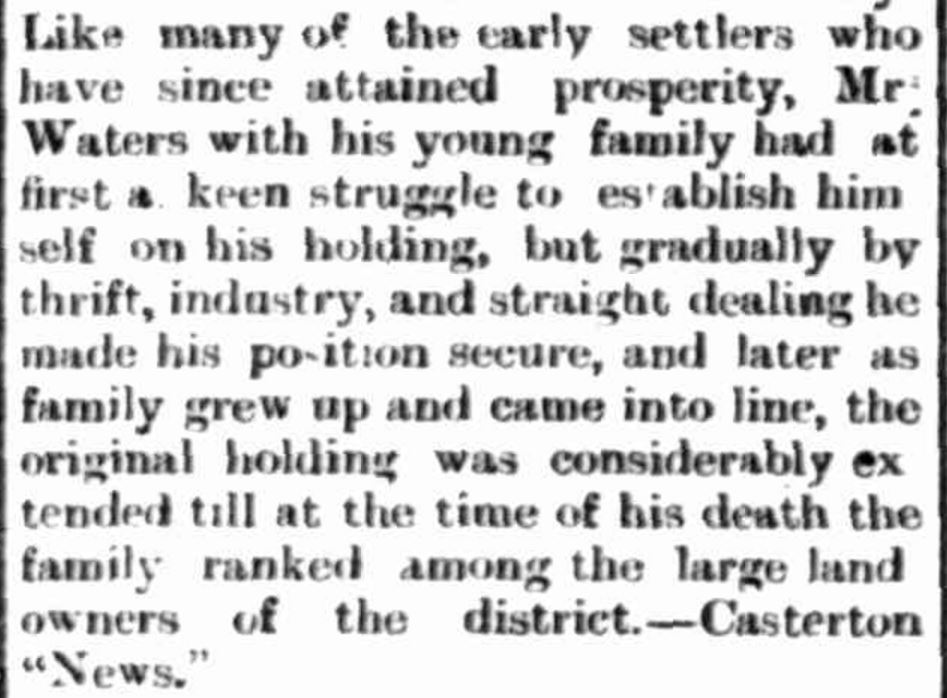
WATERS, John – Died 4 May 1917 at Nareen.  John Waters was born in Ireland’s north at Lurgan in 1830.  Newly married, James and his wife Ellen Maxwell arrived at Portland aboard General Hewitt in 1856 and John secured work at Newlands near Apsley.  They went on to Lake Wallace North before settling at Rock View near Nareen where they settled and John raised Merino sheep.  At the time they were among the first settlers in the district.  John and Ellen went on to raise five sons and three daughters.  Ellen died in April 1913 and John in 1917 aged eighty-six.  District newspapers,  such as the Portland Observer and Normanby Advertiser below, published parts of John’s Casterton News obituary.

“PORTLAND RED CROSS.” Portland Observer and Normanby Advertiser (Vic. : 1914 – 1918) 10 May 1917: 2 (MORNING). Web. 27 May 2017 .

The Casterton News of 7 May 1917 added John had “little sympathy for the coddling legislation of later days, being a whole-souled believer in the fine old doctrine of ‘Paddle your own canoe.'”

McBAIN, Anne – Died 12 May 1917 at Casterton.  Born in Scotland around 1831, Anne McBain married Archibald McKinnon and they left for Australia arriving at Port Adelaide on the Man-O’-War in 1854.  Travelling to Victoria, they settled at Dergholm where they spent the next thirty years raising four sons and four daughters.  In her later years, Annie moved to Casterton. and regularly attended Scots Church.  At the time of her death, Anne left eighteen grandchildren and two great-grandchildren.  One-third of her grandchildren were serving overseas when she died, with six grandsons enlisted.  Because of her family’s involvement in the war, on 20 May 1917, Annie was to attend Scots Church to unveil the second list on the church honour roll but she died the week before. Her death came on the anniversary of the death of her husband Archibald in 1898.


SCOTS PRESBYTERIAN CHURCH, CASTERTON. Image courtesy of the State Library of Victoria http://handle.slv.vic.gov.au/10381/63512

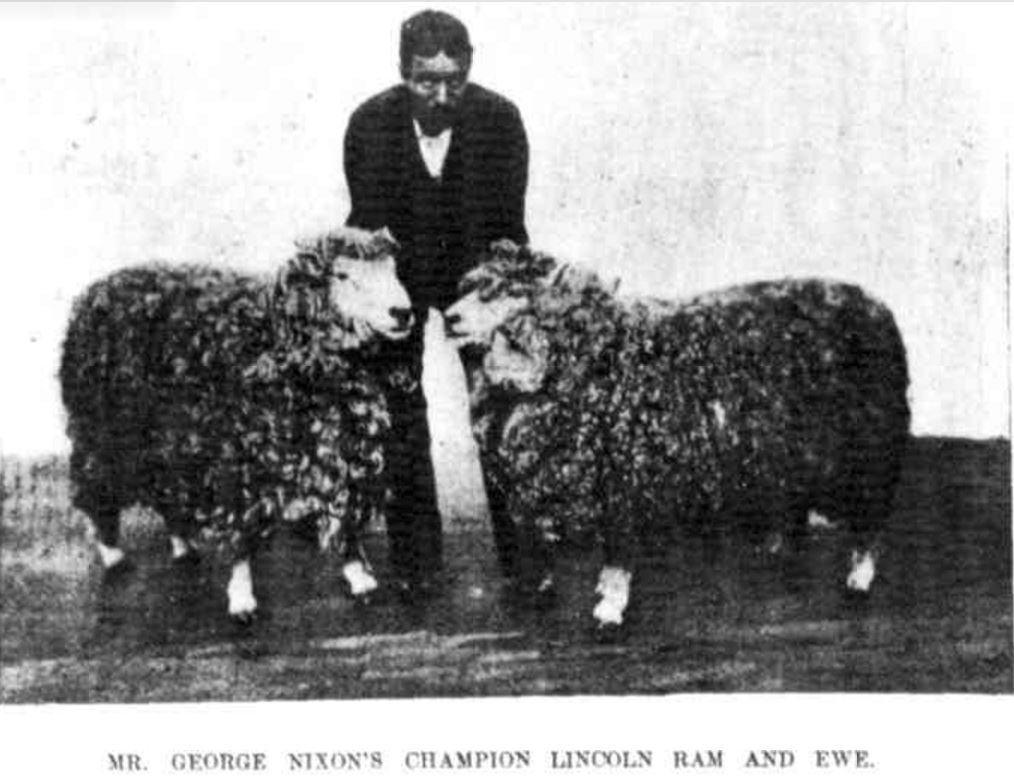
NIXON, George – Died 16 May 1917 at Terang.  Born around 1833 in Northumberland, England, George Nixon arrived at Port Fairy aboard the Tiptree on 9 January 1857.  He married Emily Parry in the same year and they moved to Caramut. After twenty years they moved to Lovely Banks near Garvoc where they remained for thirty years.  George bred and exhibited Lincoln sheep and his relatively small but successful stud caught The Australasian newspaper’s attention with an article on 5 August 1899.  His sheep, and presumably George, were photographed in 1898 at the Sheep-Breeders Show.

“THE SHEEP-BREEDERS’ SHOW.” The Australasian (Melbourne, Vic. : 1864 – 1946) 13 August 1898: 32. Web. 28 May 2017 <http://nla.gov.au/nla.news-article138603271&gt;.

Around 1907, George and Emily moved to McKinnon Street, Terang where Emily died in 1913.

URQUHART, Roderick Robert – Died 18 May 1917 at Hexham.  Roderick Urquhart was born around 1849, a son of Roderick William Urquhart and Lydia Fraser.  Roderick’s father arrived in Sydney in 1837 before travelling to Victoria in 1842. When Roderick Jr was born, the Urquharts were settled at Yangery Park at  Illowa near Warrnambool.  Around the time Roderick was seven, the Urquharts returned to Scotland for the children’s education.  Went they returned to Yangery Park in 1862, Roderick’s father purchased Ardachy near Branxholme for Roderick and his brother Angus.  They ran it for a few years before selling and Roderick left for Queensland in the Birdsville district.  

By 1882, Roderick was back in Victoria and forming a partnership with Walter Armstrong of Hexham Park.  Another partnership Roderick entered into was his marriage to Walter’s sister Mary Helen Armstrong (below) in 1883.  Roderick and Mary, better known as Helen, had two sons and three daughters.

MARY HELEN ARMSTRONG c1882 Stewart & Co. photographer. Image courtesy of the State Library of Victoria http://handle.slv.vic.gov.au/10381/235424

During the mid-1900s, Hexham Park was divided up and Roderick and Walter’s partnership dissolved.  Roderick took up part of the former Hexham Park property and named it Boonerah.  Sons Keith and Roderick Jr were members of the Caramut Polo Club (later known as the Hexham Polo Club) and Roderick enjoyed supporting them.  He also enjoyed the races and in 1914, three of Hexham’s most notable gentleman were photographed together at the Colac races.  They are from left Roderick Urquhart, James Chester Manifold of Bortkoi, Hexham and Alex Hood (see April obituaries above)

“COLAC TURF CLUB: CUP MEETING, FEBRUARY 24.” The Australasian (Melbourne, Vic. : 1864 – 1946) 28 February 1914: 68. Web. 29 May 2017 <http://nla.gov.au/nla.news-article143317765&gt;.

When WW1, broke both Roderick and Helen’s sons enlisted.  Roderick Jr, better known as Roddie, was killed on 7 August 1916 in Palestine aged thirty.  Roderick and Helen learnt the news soon after and it may have contributed to Roderick’s sudden death eight months later at the age of sixty-eight.  Keith returned to Australia on 11 July 1917, two months after his father’s death.  You can read Roderick Urquhart’s Obituary Australia entry on the link here.

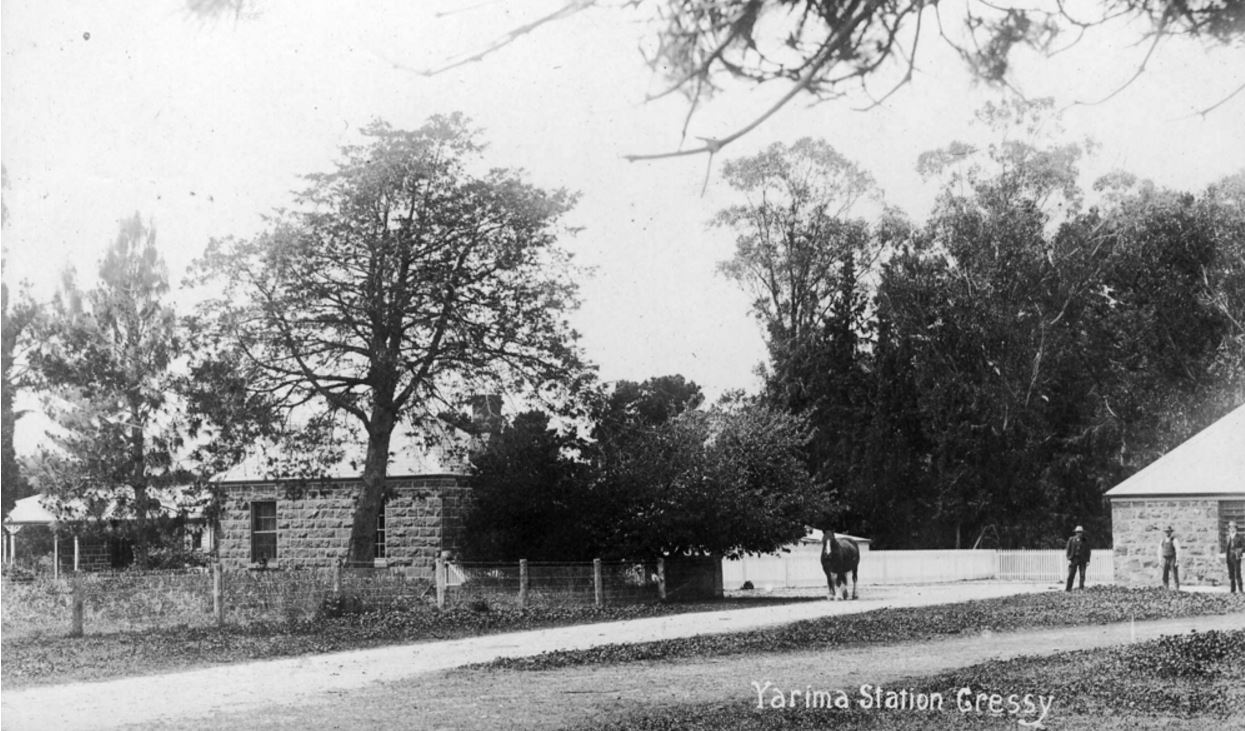
NELSON, Thomas – 8 May 1918 at Colac.  Thomas Nelson was born in Scotland on Christmas Eve, 1844.  He became a sailor and sailed to “practically every seaport in the world”.  He arrived in Australia around 1865, settling at Cressy.  Thomas married Eliza Ann Perkins in 1869.  In those times, Cressy consisted of only three buildings being two stone houses and the Frenchman’s Inn. Thomas built many stone walls in the district including at Yarima where his brother John was the manager for many years and where Thomas worked for four years.

YARIMA STATION, CRESSY c1912 Image courtesy of the State Library of Victoria http://handle.slv.vic.gov.au/10381/369501

Thomas selected around twenty acres at Mia Mia near Poorneet growing barley which he carted to Ballarat.  With the lands opening up in the Wimmera, the Nelsons moved to Donald but drought saw them eventually return to Cressy.  Thomas then started working on the roads for the Cressy Shire Council.  At the time of his death, Thomas left his widow Eliza, five sons, four daughters and thirty-three grandchildren.  He was buried at the Cressy Cemetery.

STEVENSON, Joseph Tyson – Died May 1938 at Hamilton.  Joseph Stevenson was born at Portland around 1873, a son of Joseph Stevenson and Mary Hale. Joseph’s first worked at the Portland Guardian learning the newspaper printing trade.   He then took a job with the Echo in Ballarat.  Joseph married Laura Pfundt in 1899 and they moved to Hamilton where Joseph worked as a compositor at the Hamilton Spectator. Retirement in 1936 was a chance for  Joseph to try farming, something he had longed to do.  He purchased land near Mount Gambier but took ill and never got the opportunity to pursue his dream.  In his day, Joseph took part in competitive cycling races.  He left his widow Laura, three daughters and six sons.

Hamilton Cemetery Trust News

Some great things are happening at the two cemeteries overseen by the Hamilton Cemetery Trust. There was the Notable Graves Walk at the General Cemetery (Old) including signage with a short biography on those graves, new denominational signage, upgrades to pathways and a new website. The trust’s latest news is all burials from both the General and the Lawn cemeteries are now available online.

There have been 15,000 burials at the two cemeteries so many graves to walk around aimlessly when looking for a family member. Until now I’ve used Ian Marr’s wonderful Cemeteries of SW Victoria USB so I know who I’m looking for but where they are is another question.  I’ve done many laps looking for the graves of relatives, fortunately, I also like to take photos of other headstones along the way.  A friend returning to Hamilton spent thirty minutes with six other family members searching for her grandfather’s grave.  

Those days are over.  Now I’ve checked the new “Deceased Search” and map facility, I’ve found I’ve walked straight past several of the graves I’ve been looking for.  Next time I visit I’ll be able to plot my course in advance and finally find the graves I’ve been looking for.  If I get lost while there, I can check the site on my phone to get back on track.  Access like that is great for those passing through Hamilton and spot the cemetery on the highway.  If you like to frequent cemeteries, you’ll know about those impromptu visits. 

Given Hamilton’s size, it’s a credit to the Hamilton Cemetery Trust for continuing to make their cemeteries visitor friendly. They are certainly leading the way among the peers in the Western District.  And why shouldn’t they want to share this wonderful piece of history when burials include the father of a saint, one of Victoria’s first European Settlers, a daughter-in-law of one of the greatest writers the world as seen, and at the Lawn Cemetery, a Victoria Cross recipient.  You’ll find the Deceased Search via the Hamilton Cemetery Trust Home Page on the link here and more about some of the notable graves.  I have a new post on the way about some of the graves I’m drawn to each time I visit the General Cemetery (or old cemetery as it’s commonly known). 

A Box of Chocolates

Each year when writing a post to mark the “birth” of Western District Families, I describe the occasion differently whether it be blogiversary, anniversary or birthday.  After finding the traditional gift for a sixth anniversary is candy, I settled on an anniversary this year.  So, Happy 6th Anniversary Western District Families.

The idea of candy took my mind straight to my cousin “Sweet” Daisy Diwell, an employee at MacRobertson’s Chocolates in Fitzroy and to a Trove Tuesday subject the “Sweet-toothed Fox” a nocturnal visitor to the MacRobertson factory who feasted on the delights within.  Next, I thought of chocolate boxes, particularly the beautiful MacRobertson’s Chocolate boxes.

MacROBERTSON’S CHOCOLATE BOX c1933. Image courtesy of the State Library of Victoria http://handle.slv.vic.gov.au/10381/34008

MacRobertson chocolate boxes are not all that comes to mind. I often think of Forrest Gump and his chocolate box while I’m researching, particularly the men of Hamilton’s WW1.  Starting with the name of a man I know nothing about, I then delve into his life never knowing what I might find.  So many times I’ve been surprised at what’s under the lid when I lift it.  Researching family history generally is much the same.  If you’re lucky, when you do lift the lid you’ll find something like this…

MacROBERTSON CHOCOLATES. Image courtesy of the State Library of Victoria http://handle.slv.vic.gov.au/10381/32815

When I began reflecting on Western District Families’ year, I felt I hadn’t achieved a lot. Looking at the “Home” page and the low numbers of posts, it would seem not much has happened. Then I thought about why that was the case and only then realised how much I had achieved.  As well as being very busy on the home front, Hamilton’s WW1 has been time-consuming with most stories taking several hours of research and writing.  At the same time last year, I had seventy-five biographies and it’s taken a year to add another forty-three but it’s been worth every moment.

‘HAMILTON BOYS’ c 30 April 1915. Photo Courtesy of the Australian War Memorial. Image no. DAOD1060 https://www.awm.gov.au/collection/DAOD1060/

As well as the lists of Hamilton enlistments and posts about Hamilton’s WW1 memorials, Hamilton’s WW1 now has 118 biographies of enlisted men. Each includes a family history, photos and links to relevant online records. Those 118 men make up most of the names of the Hamilton War Memorial and Hamilton’s Anzac Avenue combined, so by this Anzac Day, I hope to have available a full biography of each man.  And not forgetting the nurses, I am also close to finishing the first biography of a WW1 Nurse who trained at Hamilton.

Passing of the Pioneers and the associated Pioneer Obituary Index achieved a milestone in the past year, with 700 pioneer obituaries now indexed.  As I’ve been looking for an opportunity to highlight some of the female pioneers, Women’s History Month was perfect to look back at ten of the women who were Passing of the Pioneers subjects over the past five years in  “Wonderful Women of the Western District” Part 1 and Part 2

CAVENDISH OLD CEMETERY

The Facebook pages, Western District Families and Hamilton’s WW1 continue to grow.  I’ve been delighted to see the interest in the WDF page as it nears 3300 “likes” up from 2000 at this time last year.  During the year, I’ve led the page followers on three virtual historic tours of Western District highways which have been great fun. The wonderful memories shared by those following brought another dimension to the posts. Last month the page’s theme was Women’s History Month and this month, we are remembering the enlisted men and women of the Western District. Then it will be time for another virtual historic tour, this time along the Henty Highway.

A personal achievement was successfully completing a Diploma of Family Historical Studies with the Society of Australian Genealogists, a goal for some time. The task was to complete a 20,000-word family history using a range of sources.  Of course, I chose the Harman family because I knew the most about them.  It was a valuable exercise for my family history research. When I started Western District Families, I soon learnt writing a narrative about family members leads to new discoveries but writing a family history such as I did took it to another level. Now I have a broader knowledge of the family and more understanding of their motivations and emotions but there is still more to learn. It’s something I’d like to try with some of my other families…if I ever get the time.

So that’s the year all wrapped up in a bow.  When you lift the lid on your next box of chocolates I hope you are pleasantly surprised at what you find inside.

MacROBERTSON CHOCOLATE BOX c1933. Image courtesy of the State Library of Victoria http://handle.slv.vic.gov.au/10381/34008


Passing of the Pioneers

It’s Women’s History Month so I thought I would have an all female Passing of the Pioneers. Men have dominated past Passing of the Pioneers posts so I didn’t think it was going to be easy. However, I managed to find thirteen obituaries of some amazing women including sisters.  There was a common theme with several losing their husbands at an early age, leaving them to raise children alone. There is also extra information for most of the women so click on any underlined text to read more about the subject.

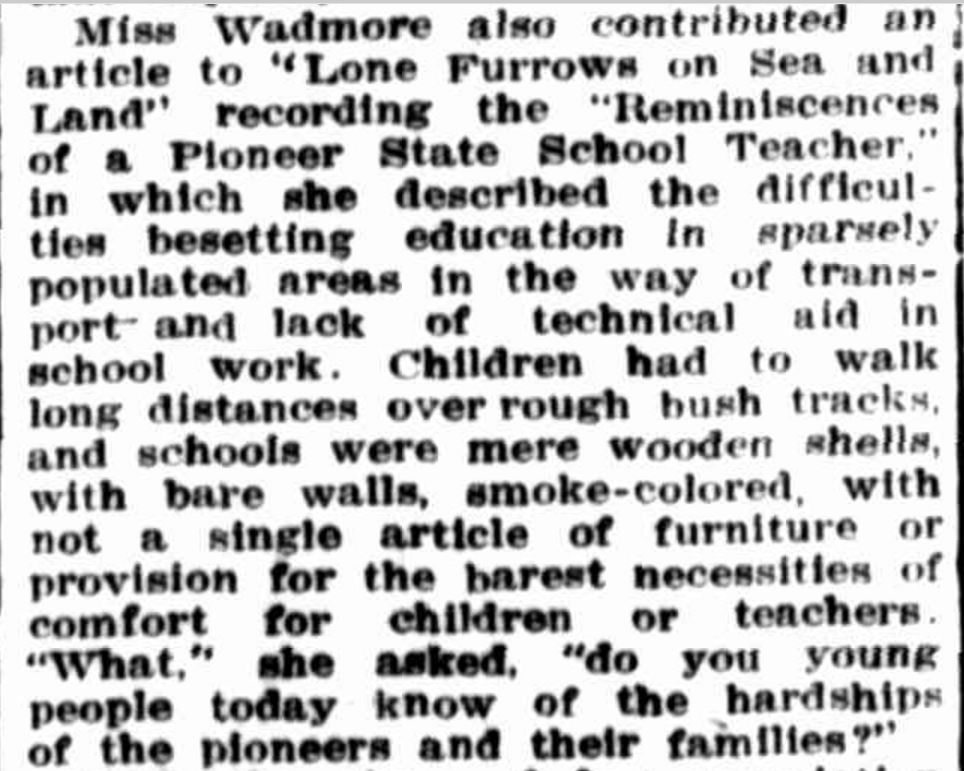
Mary DRISCOLL – Died 3 March 1908 at Portland. Mary Driscoll was born in Kent around 1828 and later married James Wadmore.  The couple came to Australia on the ship Constant on her maiden voyage for shipping agents Messrs S.G.Henty & Co with James acting as doctor’s assistant on the voyage. They arrived at Portland Bay on 24 February 1855 and one of the crew carried Mary ashore. They were in Portland a short time when James got work with Charlton Hedditch at Cape Bridgewater where they took up land themselves. The couple’s first daughter Ann was born during their first year in Victoria and a son was later born.

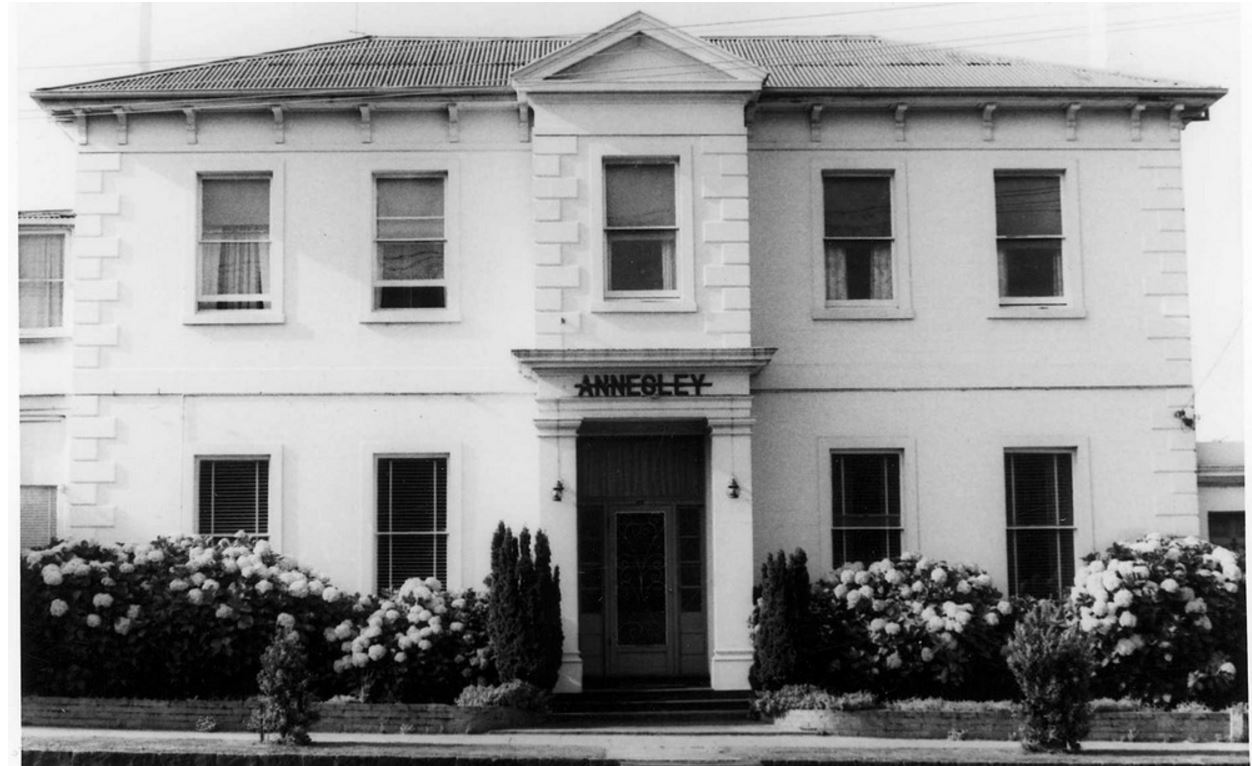
A month after their second daughter Sarah was born in 1859, James drowned after he was washed off rocks on the west coast of Cape Bridgewater. That did not deter Mary who worked hard to raise her children regardless of the hardships. She was a city girl but adapted quickly to her new life in the isolation of Cape Bridgewater. As well as caring for her own family, she rode a “spirited bay mare” across the district helping those who were sick. When her daughter Sarah was fifteen, she was offered teacher training, pleasing Mary a great deal. Mary remained at Cape Bridgewater until around 1905 when her daughters Ann and Sarah bought Annesley in Julia Street, Portland, operating a private guest house. That is where Mary died in 1908.

ANNESLEY, PORTLAND. Image courtesy of the J.T. Collins Collection, La Trobe Picture Collection, State Library of Victoria. http://handle.slv.vic.gov.au/10381/233404

Eliza McANALLY – Died March 1909 at Myamyn. Eliza McAnally was born in Ireland around 1836.  She married her husband James Cowan in 1855 and the couple immediately left Ireland for Australia, arriving at Portland.  They made their way to Crawford Station near Condah where James had work.  They remained there for nine years, then selected their own land near Condah. The farm on Lake Condah Road was known as Pleasant Banks.  In April 1876, Eliza and James’ only son died after an outbreak of scarlet fever in the district.  He was nine.

Around 1886, the Cowans built a new homestead. Only months later, a fire in January 1887 burnt their garden fence and to within two feet of the new house.  The Cowans were away from home at the time, but James returned just as the doormat caught fire.  The Cowans remained at Pleasant Banks until about 1903 when they moved to Myamyn to live with their daughters Sarah and Isabella, who had both married into the Malseed family.  James died in 1905 at the home of their daughter, Sarah Malseed.  Eliza remained living at Myamyn but fell sick in early 1909 and died six weeks later.

Lucy RICHARDSON – Died 9 March 1911 at Hamilton.  Lucy Richardson was born around 1831 at Ulverstone, England, and arrived in Melbourne in 1857.  In 1861, Lucy married Law Gooderidge, and they left for Hamilton where Law was opening Clough & Co., a wool brokers business in Gray Street. Three children were born at Hamilton, but in late 1866,  Law died suddenly aged thirty-three. At the time, Lucy was pregnant and gave birth to a daughter, Elizabeth Law Gooderidge in 1867.  By the 1880s, Lucy was living in French Street, Hamilton and on 9 May 1889, Lucy’s youngest daughter Elizabeth, known as Lawla, married Harold Learmonth, a son of prominent Hamilton businessman Peter Learmonth.  Lucy died suddenly at The Gables (below) in French Street, Hamilton, the home of Harold and Lawla.  Lucy left one son and three daughters. 

THE GABLES, HAMILTON

Lucy was buried at the Old Hamilton Cemetery.

Gooderidge (2)

GRAVE OF LAW AND LUCY GOODERIDGE, HAMILTON (OLD) CEMETERY

Catherine MATHEWS – Died 9 March 1912 at Cavendish.  Catherine was born in County Louth, Ireland around 1843. She arrived at Geelong in 1861 before travelling to Hamilton. In April 1866, Father Farrelly married Catherine and Edward Hynes in the then wooden Roman Catholic chapel. Catherine and Edward settled at Flower Hill near Cavendish, where they remained for twenty-eight years.  In 1895, they moved to Wattle Grove at Glenisla.  As a devout Roman Catholic, Catherine went to church every Sunday, even as her health failed her.

Mary MALONE – Died 3 March 1914 at Dunkeld.  Mary Malone was a daughter of Henry and Rose Malone, and her obituary states she was eighty years of age, born in Ashby Street, Geelong. Melbourne wasn’t settled in 1834, let alone Geelong, so the story had become a little mixed up over the years. When I checked the Victorian Assisted Passenger Lists, I found a Henry and Rose Malone and three children, Joseph aged ten, Mary aged eight and Ann aged one.  They arrived at Geelong in 1841 aboard the Frankfield.

In 1851, Mary married Thomas Lynch and their first child was born in 1852 at Batesford.  They moved to Mount Burchett Estate west of Glenthompson by the 1860s. In January 1890, Thomas died and shortly after, in March 1890, a fire lit in scrub near Mount Burchett went through the property.  At the time, there was only Mary and another woman there. Mary lost sheds, outbuildings and a haystack.  She sold Mount Burchett in November 1890 and moved to Dunkeld to live with one of her sons.  At the time of her death, Mary had six sons, two daughters, six great-grandsons and fifteen great-granddaughters. She was buried at Glenthompson with Thomas.

GRAVE OF MARY & THOMAS LYNCH, GLENTHOMPSON CEMETERY

Mary BEATON – Died 2 March 1915 at Hamilton.  Mary Beaton was born on the Isle of Skye, Scotland, around 1847.  She arrived in Portland aboard the Edward Johnson with her parents in 1854, then transferred to another ship to travel on to nearby Port Fairy. In 1867, when Mary was twenty, she married Thomas Clohesy at the Hamilton Presbyterian Church and they settled in the town. On 24 April 1910, Thomas died suddenly at the age of sixty.  Mary went to live with her daughter Mary-Ann and her husband Robert May in Gray Street.  On 2 March 1915, Mary had a visitor, a shipmate from the Edward Johnson. The pair had just set off for a walk from Mary’s daughter’s home when Mary suffered an apoplexy fit and never regained consciousness, dying six hours later. The cause was put down to the excitement of the occasion.  Mary was sixty-eight and was buried in the Old Hamilton Cemetery (below). She left two daughters and four sons.

GRAVE OF THOMAS AND MARY CLOHESY, OLD HAMILTON CEMETERY

Evelyn MAY – Died 5 March 1916 at Coleraine. Evelyn May and her sister Bessie both died at Coleraine in March 1916.  Evelyn’s death was barely acknowledged in the papers and it was Bessie’s obituary that alerted me to Evelyn’s death three weeks before.  As she did not have an obituary, I’ve had to do some digging to find out more about Evelyn.

Evelyn May was born in Middlesex, England around 1837, the middle daughter of Leon May and Abigail Lyons.  The 1841 England Census lists Leon, Abigail and three girls, Elizabeth (Bessie), Avelina (Evelyn) and Isabella.  Leon was a dentist and they lived at Harrison Street, Bloomsbury, London in what was known as the Harrison Estate.  Leon was from “foreign parts” and Abigail was born in Scotland.  Leon was not present at the time of the 1851 England Census, but the rest of the family were still in Bloomsbury but had moved to Russell Street.  Evelyn’s mother, by then known as Adelaide, listed her occupation as a dental surgeon.

Evelyn’s elder sister Bessie left for Australia around 1861 and married, taking up residence at Coleraine. In 1865, Bessie’s brother-in-law Louis Lesser travelled from Coleraine to England and in 1867, he and Evelyn married and left for Australia.  They arrived in Melbourne and made their way to Coleraine to join Louis’ brother Abraham and Evelyn’s sister Elizabeth.  Louis and Abraham had been partners in a store in Whyte Street,  Coleraine, but mutually dissolved it in May 1865 when Louis left for London.  But they seem to have resumed the partnership with Louis operating the store with other family members after Abraham’s death in 1886.  Evelyn died in 1916 and Louis died on 19 June 1921.  They were buried in the Jewish section of the Coleraine Cemetery.  It appears they had no children.

THE GRAVES OF EVELYN AND LOUIS LESSER, COLERAINE CEMETERY

The photo of A.Lesser & Co Pty. Ltd. (below) was taken in 1922, after Louis’ death.

A.LESSER & CO., WHYTE STREET, COLERAINE. Image courtesy of the Museums Victoria Collections https://collections.museumvictoria.com.au/items/769410

Hanora FLEMING – Died 22 March 1916 at Hamilton.  Hanora was born in Ireland around 1850.  On arrival in Victoria, the Fleming family settled at Woodend.  In 1870, Hanora, also known as Norah, married Thomas Joseph Fitzsimmons, a railway worker.  Their first child Eliza was born in 1871 at Woodend and over the next decade, more children were born as the family moved around with Thomas’ work.  By the 1880s, the family was living in Ballarat. In 1892, Hanora had the last of her children at the age of forty-two.

On 19 January 1900, one of Thomas’ workmates and close friends, Edward Lake, had part of his foot amputated while shunting trains at Elaine.  The accident had a deep effect on Thomas and he went into shock.  As a result, he died on 1 February 1900 at Ballarat.  At the time of Thomas’ death, the Fitzsimmons were living in Peel Street North, just near the railway bridge.  Hanora still had four children under the age of eighteen in her care.  Her eldest son Edmund lived in Hamilton and a daughter was also there with her husband Robert Drummond, the licensee of the Victoria Hotel in Gray Street, Hamilton. Hanora moved to Hamilton after 1905, reuniting the family. 

Hanora initially lived in Coleraine Road, Hamilton, but later she moved to French Street.  She suffered a loss in 1913 when a married daughter Margaret Whitely died in October in Melbourne aged thirty-four.  On 18 March 1916, Hanora attended the Hospital Carnival at Hamilton’s Melville Oval but later in the day developed appendicitis. After an operation, she initially improved but she sank and died, leaving three sons and three daughters. 

Family Notices (1916, March 23). Hamilton Spectator (Vic. : 1870 – 1918), p. 4. Retrieved February 23, 2021, from http://nla.gov.au/nla.news-article133695338

Hanora was buried at the Hamilton (Old) Cemetery, below.

HEADSTONE OF HANORA FITZSIMMONS, HAMILTON (OLD) CEMETERY

Elizabeth MAY – Died 22 March 1916 at Coleraine.  Elizabeth May, better known as Bessie, was born around 1835 in Manchester, England.  As a young child, her dentist father moved the family to Bloomsbury, London.  Around 1860, Bessie travelled to Victoria and in 1861, married Abraham Lesser at the Mikveh Israel Melbourne Synagogue.

“Family Notices” The Argus (Melbourne, Vic. : 1848 – 1957) 13 April 1861: http://nla.gov.au/nla.news-article5699307

Abraham operated a store in Coleraine with his brother Louis, so Bessie moved to Coleraine taking up residence in a house she would live in until her death.  In 1867, Bessie’s sister arrived in Coleraine from London after her marriage to Abraham’s brother Louis.  A search of children born to Bessie and Abraham Lesser at Victoria Births Deaths and Marriage was interesting with the results showing several children.  Bessie lost her first two unnamed babies and by 1870, had lost five children. In November 1886, Abraham died suddenly after taking ill at a concert.  He was sixty.  They had four children still living.

On 5 March 1916, Bessie’s younger sister Evelyn died and only three weeks later, Bessie died. At the time of her death, she had just one son and one daughter from her large family of ten. Bessie was remembered fondly in both the local papers and the Jewish Herald for her good sense of humour and charitable ways.  Bessie was musical and was believed to have taken the first piano to Coleraine, regularly playing at concerts. She was also the secretary of the Ladies’ Benevolent Society.  She bequeathed a large amount of money to various institutions and causes, including £10 to the Hamilton Hospital.  Bessie was buried in the Jewish section of the Coleraine Cemetery.

GRAVE OF ELIZABETH LESSER, COLERAINE CEMETERY.

Eliza WHITTAKER – Died 13 March 1918 at Macarthur.  Eliza Whittaker was born in Ireland but moved with her family to Somerset, England, after the death of her father.  She married Samuel Trigger, and they had three children.  On 9 April 1853, the family arrived at Portland aboard the Eliza.  They went to Mount Taurus, west of Winslow, and Samuel worked as a sawyer.  They later settled near Macarthur, acquiring land at Warrabkook and Mount Eccles.  Four grandsons enlisted for WW1 and in 1916 one, Samuel Trigger was killed at Mouquet Farm, France. His body was never recovered. In 1917, Samuel and Eliza Trigger were photographed for The Weekly Times of 14 April 1917, when they were both aged ninety-five.

“A VENERABLE COUPLE.” Weekly Times (Vic. : 1914 – 1918) 14 Apr 1917: http://nla.gov.au/nla.news-article121151983

Eliza died on 13 March 1918 and Samuel died only three weeks later.  They left four sons, two daughters, thirty-one grandchildren and thirty-eight great children.

Johanna Helena HERGER – Died 17 March 1918 at Yulecart.  Johanna Herger was born around 1833 in Breslau, Silesia, now known as Wroclaw, Poland.  Around 1859, she married Ernest Reich, and they had two daughters, Ernestine and Emelie.  In 1874, the Reichs arrived in Victoria and moved to the Yulecart district where Ernest farmed. Johanna and Ernest’s daughters never married and remained living with their parents.  By 1900, Johanna was an invalid and early that year, fire burnt through 140 acres of the Reich’s property. Ernest, most likely into his seventies, and his daughters, fought the fire alone on 28 January 1900.  It ran up to the homestead, a scary experience for housebound Johanna.  They managed to save the homestead but lost two haystacks. Ernestine and Emelie cared for their parents in their old age, operating a dairy farm to support the family.  Johanna died on 17 March 1918, and Ernest died six months later, on September 1918.

Sarah Jane COLE – Died March 1947 at Geelong.  Sarah Jane Cole was born in Lethbridge in 1861.  She was the youngest daughter of teacher Robert Nelson Cole.  She spent her early years at Boot’s Creek near Daylesford where her father was teaching.  Sarah’s brother Robert followed his father into teaching and before long, Sarah too had taken up the profession. When she was nineteen, Sarah was appointed headteacher at the Carpendeit School, east of Cobden.  She lived with her brother Robert who was living and teaching at the South Purrumbete school.  Sarah rode seven miles to school each morning and seven miles home at night.  She was a “fearless horsewoman” but if for some reason she couldn’t take her horse, she was happy to walk the distance and she was never late. But it wasn’t the safest thing for a young lady to do as she found out.

“Tribute to Life of The Late Mrs.Port” Camperdown Chronicle (Vic. : 1877 – 1954) 27 March 1947: 5 (Afternoons.). http://nla.gov.au/nla.news-article65240862

Eventually, Sarah was able to board at Carpendeit and in time, a teacher’s residence was built.  In 1884, Sarah married John Port of Port Campbell.  Their first child, a son, John George Port was born the following year. Sarah had a further seven children.  Sarah also wrote poetry and sent them to the newspapers. Personal experience may have inspired one of those “On the Death of a Baby” published on 12 January 1889.

“ON THE DEATH OF A BABY.” The Caulfield and Elsternwick Leader (North Brighton, Vic. : 1888 – 1902) 12 January 1889 http://nla.gov.au/nla.news-article66889460 

In those times, it was still possible for a married woman to continue teaching, and Sarah did so until around 1898 when the regulations changed.  In 1902, she wrote a letter to the Editor of the Colac Herald defending a local married woman still teaching. Sarah was active in the Carpendeit community as a member of the Band of Hope and the Carpendeit Methodist Church.

In 1900, the Ports sold their farm and moved to Nalangil, west of Colac. During her time there, the Education Department asked Sarah to fill in for a few months at the Nalangil School.  Around 1926, John’s health was failing, so he and Sarah moved to Ryrie Street, Geelong, where he eventually died in August 1927. Around 1932, Sarah went to live with her daughter in Kilgour Street, Geelong. At the age of seventy-three in 1934, Sarah published a book “Victoria’s Centenary and Other Loyal Poems”.  There were fourteen poems, and the book sold for a shilling. Sarah died at her daughter’s home in March 1947, aged eighty-six.

Ellen Lavinia WINCHCOMB – Died 5 March 1954 at Cobden.  Ellen Winchcomb was born in Cobden about 1883, a daughter of James Winchcomb and Fanny Laundry. Known as Nell, she was an organist at the St Andrew’s Presbyterian Church at Cobden and did all the floral arrangements for the church and was a Sunday School Teacher.

ST ANDREW’S PRESBYTERIAN CHURCH. Image courtesy of the Museums Victoria Collections https://collections.museumvictoria.com.au/items/772413

Ellen was a keen gardener and kept a cottage-style garden. In 1914, Ellen’s mother Fanny visited a sister living on Penshurst Road, Hamilton.  She fell sick there and died at Hamilton on 4 December 1914, aged fifty-eight. Ellen’s father, James Winchcomb died in 1925. On 5 March 1954, Ellen died at her home in Cobden after a long illness.

Wonderful Western District Women Part 2

It’s Women’s History Month and this is my second instalment of Wonderful Western District Women.  As in Part 1, I share the stories of five women I’ve been taken with while writing Passing of the Pioneers over the past five years.  In this post, all five women were in business in some capacity. One was also a teacher.  All are very similar in the level of perseverance and determination they displayed, but each led very different lives.  For example, two never married with one shunning the company of others and the other drawing people to her. As noted in one of their obituaries, they are “those splendid women, whose unselfish, unwearying zeal helped to make the Victoria of today”.  Click on the underlined text for more information about a subject.

DONNELLY, Jane (c1834-1914)  Also known as Jane Walsh and Jane Jenkins.

Jane Donnelly was born in Ireland around 1834 and arrived in Victoria in the early 1860s.  She married William Walsh in 1865 and together they operated the Forester’s Hotel at Myamyn.  Jane and William had three children before William died in 1877 aged forty-nine. It was the same year a fourth child was born. Jane continued to run the hotel although she did try to sell it. In 1881, the hotel was badly damaged by fire leading to Jane’s insolvency in 1881 with debts of £145.

“Advertising” Portland Guardian (Vic. : 1876 – 1953) 24 April 1880: 3 (MORNINGS.). 

“Items of News” Hamilton Spectator (Vic. : 1870 – 1918) 19 May 1881

In 1883, Jane married William Gordon Jenkins and they went to Portland to run the Victoria Hotel.  The building was dilapidated and they were soon closed down.  That appears to have been the end of Jane’s days in the hotel trade.  In their later years, Jane and William moved to Hawkesdale to live with Jane’s daughter.  Jane died at Hawkesdale in 1916 aged eighty.  William died the following year.

STEWART, Christina (1825-1921) Also known as Christina McPherson.

Christina Stewart was born at Kingussie, Scotland around 1825 and travelled with her husband, Duncan McPherson, to Australia in November 1851 on board the Hooghly.  While Duncan went off to the goldfields, Christina waited in Melbourne until they journeyed to Portland and then on to Strathdownie. In March 1857, Duncan purchased the Woodford Inn located just north of Dartmoor on the Glenelg River and a son Alexander was born in the same year. The inn was a busy place as it was at a crossing point on the river with a punt moored at the inn for that purpose. Christina had eight children and during her child-bearing years, rarely saw another white woman. She made friends with the local Aboriginal women, teaching them to make damper. If she had guests staying at the inn, the Aboriginals caught crayfish in the river for her.  The McPhersons eventually moved to Hamilton, residing in Coleraine Road.  Christina died there in 1921 aged ninety-six.

RYAN, Mary  (c1834-1914) 

When I wrote about Mary Ryan for Passing of the Pioneers, there was little known about her other than she ran a servants’ registry office in Hamilton and she died ten months after a fire burnt down her home. I also gathered from her short obituary, she was very independent. Mary never married and living a seemingly solitary life, save for the interactions through her business. When Mary died there was no-one to give the names of her parents, so her death record shows her parents as “unknown”.  Since her Passing of the Pioneers appearance, more Hamilton Spectators have become available at Trove and I’ve been able to find out a little more about Mary.

The earliest newspaper reference I could find of Mary Ryan in Hamilton was in 1864 when she advertised her dressmaking services in the Hamilton Spectator and Grange District Advertiser.  Her advertisement said she was “late of South Yarra” and she was operating from Thompson Street. Other women in Hamilton including a Mrs Owens were combining dressmaking with servant registry businesses so it was a natural progression for Mary to do the same.  She began advertising both services in 1867 from a shop in Gray Street on land owned by local watchmaker Adolphe Destree.

“Advertising” Hamilton Spectator and Grange District Advertiser (South Melbourne, Vic. : 1860 – 1870) 29 June 1867 <http://nla.gov.au/nla.news-article194474076

In September 1870, fire swept through several shops in Gray Street, destroying Mary’s shop.  The report in the Hamilton Spectator said the occupants were able to get their valuables out. 

Mary Ryan

Advertising (1870, September 21). Hamilton Spectator (Vic. : 1870 – 1918), p. 3.  http://nla.gov.au/nla.news-article196305853

Mary took up temporary premises in Gray Street but appears to have rebuilt her burnt out shop. On 8 March 1877 the land where her shop stood was sold, the Hamilton Spectator published the results of the sale.

“Items of News.” Hamilton Spectator (Vic. : 1870 – 1918) 8 March 1877: http://nla.gov.au/nla.news-article226045698 .

Mary responded in the next edition.

“VALUE OF HAMILTON LAND.” Hamilton Spectator (Vic. : 1870 – 1918) 10 March 1877: <http://nla.gov.au/nla.news-article226042386&gt;.

Mary expanded into millinery and drapery.  Only days after Mary placed this advertisement, she sold her shop on  13 July 1878, by auction but I wasn’t able to find a report of the sale in the paper.

“Advertising” Hamilton Spectator (Vic. : 1870 – 1918) 2 July 1878:  <http://nla.gov.au/nla.news-article226069431&gt;.

Two years later, an incident highlighted the potential dangers for a woman living alone.

“HAMILTON POLICE COURT.” Hamilton Spectator (Vic. : 1870 – 1918) 5 August 1880: <http://nla.gov.au/nla.news-article225488525&gt;.

That wasn’t the only incident.  In October 1888, some local “larrikins” were in court charged with “rocking” Mary’s roof in Gray Street.  They also verbally abused her, calling her by name, well aware of who she was.  In her evidence, Mary stated her residence was opposite the Hamilton Mechanics Institute.  In 1894, Mary moved her business to Cox Street opposite the Railway Hotel, and, by 1902, she had moved to Brown Street near the Hamilton Railway Station.  On 2 November 1910, Mary suffered another blow when fire swept through her shop and residence.  Built of pine, the shop burnt quickly and only a small box of valuables was saved.  Fortunately, Mary was away from home at the time but fully insured.

Mary remained stubbornly independent in old age despite becoming very frail.  She stayed in her home, but besides the hospital, it seems she really had nowhere else to go.  In February 1914, a fire broke out in her home, accidentally started when Mary dropped a lit match on some papers on the floor.

“FIRE IN BROWN STREET.” Hamilton Spectator (Vic. : 1870 – 1918) 20 February 1914: <http://nla.gov.au/nla.news-article119823533&gt;.

While she wasn’t injured in the fire, it may have taken a toll as she passed away eight months later.  Her age was given as eighty.

“Hamilton Spectator” Hamilton Spectator (Vic. : 1870 – 1918) 15 December 1914: <http://nla.gov.au/nla.news-article119874336&gt;.

Mary was buried in the Anglican section of the Hamilton (Old) Cemetery.  It is an unmarked grave and is the plot to the left of Charlotte Blackney in the photo below.

LOCATION OF THE GRAVE OF MARY RYAN AT THE HAMILTON (OLD) CEMETERY

SLOAN, Susan  (c1844-1918)

Susan Sloan was born in Glasgow, Scotland and after arriving in Portland in 1855, she went to Ararat where she married Thomas Sloan the following year.  Thomas ran a soda water manufacturing factory. In 1867, Susan returned to Portland with Thomas and they built the White Horse Brewery and a bakery in Gawler Street. Trade was tough and they moved inland in 1873 to Hamilton where they saw greater opportunities. Thomas purchased the North Hamilton Brewery from his brothers James and Robert.  In 1882, Thomas had a timber building constructed in Cox Street for a cordial factory.

Grace Sloan, a daughter of Susan and Thomas suffered consumption since 1893, and on doctor’s advice, she left Hamilton for a drier climate with friends in N.S.W. She departed on her journey but only reached Melbourne before her conditioned worsened and she telegraphed Susan to go to Melbourne. Grace improved so Susan returned home. A week or so later, Susan heard Grace had died in a Melbourne Hospital on 20 July 1895 aged twenty-one.  A memorial service was held at Hamilton’s Christ Church, where Grace had sung with the choir. The following year Susan had a close call herself.

“Items of News.” Hamilton Spectator (Vic. : 1870 – 1918) 12 March 1896: 2. Web. 10 Mar 2017 <http://nla.gov.au/nla.news-article225868558&gt;.

In 1903, the Hamilton Spectator reported Susan had sold the North Hamilton Brewery to Mr J.B.Webb.  He didn’t do much with it and in 1904, the Sloans revitalised it with new equipment. They did the same at the cordial factory where they could produce up to sixty dozen bottles per hour.  Susan advertised prior to Christmas 1908, citing her fifty-two years in the business.

“CHRISTMAS DRINKS.” Hamilton Spectator (Vic. : 1870 – 1918) 17 December 1908: 4. Web. 10 Mar 2017 <http://nla.gov.au/nla.news-article225895607&gt;.

Thomas died in May 1910 and Susan continued to run the business until her death, after which time family members continued operations. The Sloan’s cottage Whinhill in Pope Street, Hamilton still stands today.

“WHINHILL” – THE FORMER COTTAGE OF THE SLOAN FAMILY, POPE STREET, HAMILTON.

WADMORE, Sarah Jane (1859-1941)

Sarah Wadmore was the youngest daughter of Cape Bridgewater pioneers James Wadmore and Mary Driscoll. She was born in 1859 and only a month after her birth, James Wadmore drowned after he was washed off rocks while fishing on the west coast of  Cape Bridgewater.

By the age of fifteen, Sarah was helping her brothers on their mother’s farm. Mr and Mrs Joseph Voysey from the local state school saw something special in her and offered to train Sarah as a teacher.  In 1880, Sarah became head teacher at the new Kentbruck school.  Prior to that she was living at Bacchus Marsh and teaching at the school of Mr and Mrs Voysey.  From Kentbruck, Sarah was headteacher at the Tahara State School for twelve years, her last teaching appointment.  In 1905, Sarah and her sister Anne moved to Annesley in Julia Street, Portland to operate a private boarding house.

“ANNESLEY’, JULIA STREET, PORTLAND. Image courtesy of the J.T. Collins Collection, La Trobe Picture Collection, State Library of Victoria. http://handle.slv.vic.gov.au/10381/233404

One of their first “guests” at Annesley was Rosalie Brewer, the only child of the previous owner, Dr Brewer. Rosalie was confined to bed at Annesley for over twenty years until her death on 2 March 1926 at the age of fifty-seven.  Sarah, then sixty-seven, along with her sister, gave Rosalie the love and care a mother would, nursing her through those years.  Sarah’s mother Mary also moved into Annesley from her home at Cape Bridgewater and she died there in 1908.

Inspired by the pioneering life of her mother and others at Cape Bridgewater, Sarah had a great interest in the history of Portland and its pioneers.  It was always her ambition to publish the history of Portland’s women and in 1934, with the approaching centenary of the arrival of the Henty Bros, Sarah and two other local’s, Mrs Marion Hedditch and Mr E. Davis of the Portland Observer produced a booklet entitled Portland Pioneer Women’s Book of Remembrance for the event.  As Secretary of the Portland Pioneer Women’s Association, she was also the main force behind the Pioneer Women’s statue near the Shire Offices at Portland.  Also in 1934,  Sarah contributed to a supplement for the Portland Guardian for the centenary of the arrival of the Hentys at Portland Bay called Lone furrows on sea and land, or, Historical Portland.  For the publication, Sarah wrote of the Reminiscences of a Pioneer State School Teacher

“OBITUARY” Portland Guardian (Vic. : 1876 – 1953) 6 January 1941: 1 (EVENING). Web. 15 Mar 2017 <http://nla.gov.au/nla.news-article64398666&gt;.

Sarah had a busy life. Many fundraisers, Pioneer Women’s Association meetings and even art exhibitions were held at Annesley.  At one stage, she travelled to England visiting Sussex the birthplace of the Henty brothers. She was interested in the Scout movement and donated a flag to the Portland Scouts. Sarah was also active in the St Stephens Anglican Church community and the church was conveniently located across the road from her home.

ST. STEPHEN’S ANGLICAN CHURCH, PORTLAND

A wonderful life closed on New Year’s Day 1941 when Sarah died at Annesley at the age of aged eighty-one. Sarah’s obituary closed with, “It may be truly said of Miss Wadmore that she shares largely in the honour of those splendid women, whose unselfish, unwearying zeal helped to make the Victoria of today”.

You can read more Wonderful Western District Women on the following links –

Part 1  

Part 3

Part 4

Part 5

Wonderful Western District Women Part 1

On International Women’s Day, this is for the women of the Western District.  The women who arrived in a new country, often as newlyweds with no other family, those who walked behind a plough planting seed, those who didn’t see their husbands from dawn to dusk or weeks at a time, and the women who gave birth in a tent or shack sometimes without another woman present. 

It’s for the benevolent women, the pillars of the church, the businesswomen, the matriarchs, and often, a pillar of strength for their husbands. It’s for those women who lost their husbands young, left to raise children and survive in a man’s world. Life went by unheralded for many of those women. 

Image courtesy of the State Library of Victoria http://handle.slv.vic.gov.au/10381/54600

As it’s also Women’s History Month, this is the first post during March remembering some of the great pioneering women of the Western District. Firstly, I will focus on those I’ve discovered through monthly Passing of the Pioneers posts. For most, I’ve had to draw on their husband’s life story to get some idea of their own.  For others, we are lucky as something of their lives remains, maybe a letter or a diary, and we glean some idea of who they were. Even in their obituaries, women were mostly known by their husband’s name, for example, Mrs John Little or Mrs James Berry. At least those who were given an obituary have something of them left behind; for others, their lives passed silently and without celebration.

Hopefully, the women I have selected to celebrate this month represent women whose stories have been lost.  Also, because most women lived behind the names of their husbands, I’ve chosen to remember the women by their maiden names.  Click on the underlined text through the post to read more information about each subject.

NICOL, Janet (c1822-1903) Also known as Janet Laurie and Janet Black

http://nla.gov.au/nla.news-article77974940

Border Watch, 6 May 1933  http://nla.gov.au/nla.news-article77974940

Janet was born in Lanarkshire, Scotland in 1822, the daughter of Professor Andrew Nicol, a linguist, university lecturer, and head of a boys’ college. Janet, one of eight daughters, attended boarding school and, like her father, could speak several languages. In 1841, she married the Reverend Alexander Laurie, and shortly after, they sailed to Port Phillip aboard the appropriately named William Nicol, arriving in February 1842.  

Alexander was appointed minister of the Portland Bay Presbyterian Church, so they sailed for Portland Bay.  On arrival at Portland, Janet was carried ashore, and on the same day, she gave birth to her first child, Alexander John Laurie.  The Lauries couldn’t stay at any hotels because of quarantine restrictions, so they camped under a shelter near the flour mill in the bitter cold.  They soon settled in the town, and a son, Andrew, was born the following year.

The year 1848 was tumultuous for Janet.  Alexander was accused of spending time in the company of a young lady, even travelling away with her.  The church frowned on his behaviour, and Alex was removed from his role, not because of the shame he brought to his wife and children, but the shame he brought to the church.  A report of his falling out appeared in the Geelong Advertiser of July 11, 1848.  In 1850, Alexander started making the news in a different way when he took over the Portland Herald in Gawler Street.  The Portland Guardian remarked, “Mr Laurie would have seemed to have abandoned the use of his church for the Herald and exchanged religion for politics”.

In 1854, Alexander died aged thirty-six, leaving Janet with four young children. She took over the running of the Portland Herald and, after a short break, resumed publication every Friday with a promise the paper would be “renewed in strength and efficiency” and before long the subscribers to the paper grew.

“Advertising” Portland Guardian and Normanby General Advertiser 9 November 1854, p 3  http://nla.gov.au/nla.news-article71571179

Janet also set up an employment registry in 1856, operating it until 1861 from her home in Percy Street.

“Advertising” Portland Guardian and Normanby General Advertiser (Vic. : 1842 – 1843; 1854 – 1876) 3 November 1858: 3 (EVENINGS.). http://nla.gov.au/nla.news-article64509486

Janet finished up the Portland Herald in 1860, and she and the children went to Mount Gambier, where she assisted two of her sons in setting up the Border Watch, a paper still published today. The paper was established in the name of second born son Andrew, then seventeen, and the first edition published on April 26, 1861. The name for the paper came from Janet, who remembered the Border Watch newspaper on the border of Scotland and England. Given the close proximity of Mount Gambier to the South Australian/Victorian border, it was a perfect choice.

Also in 1861, Janet married widower Joshua Black of Cork Hill, Bridgewater. Joshua was a father to seven children, and Janet must have been busy helping with the paper and performing the duties of matrimony. Janet and Joshua had three children together, the first in 1862 when Janet was forty. By 1865, there were fifteen children aged from twenty-two to newborn. Joshua Black died in 1876 at age seventy-six.  Janet continued on at Bridgewater and was involved in the community.  

BRIDGEWATER BAY

She died in 1903 aged eighty-one and was buried at the North Portland Cemetery in the same grave as Alexander Laurie. The Portland Guardian of 29 July 1903 reported, “the funeral procession was one of the largest, if not the largest seen in Portland.” Returning to Alexander in death was possibly something Janet would not have wanted. Her thirteen years with Alexander were not happy times.  Aside from his adultery, it seems Janet also endured family violence.  She was known throughout her life as having a hearing impairment, put down to the cold on her first night in Portland.  Ann Grant and others in a paper, “Portland – The truth, the whole truth and nothing but the truth”, tells of police records showing Janet had charged Alexander with assault and her deafness was in fact caused by a blow from him.

COLE, Elizabeth (c1845-1942).  Also known as Elizabeth Dalziel.

Elizabeth Cole was seven when she sailed into Hobson’s Bay in December 1852 with her family aboard the Bombay, the same ship my ggg grandparents James Mortimer and Rosanna Buckland arrived on.  Once in Port Phillip Bay, the ship was placed in quarantine because of a typhus fever outbreak on board.  During the 111-day voyage, at least twenty-four of the 706 passengers died from various causes, including typhus.  After they disembarked, the family went to the diggings at Ballarat.

“OLD COBDEN RESIDENT” The Argus (Melbourne, Vic. : 1848 – 1957) 12 March 1938: <http://nla.gov.au/nla.news-article11174181&gt;.

The family then went to Port Fairy, where Elizabeth recalled the first bullock team of Walter Manifold. She was soon driving bullocks herself and, despite being only a teenager, gained a reputation as one of the finest bullock drivers around.  From Port Fairy, her father purchased land at Yambuk.

Elizabeth was only seventeen when she married twenty-eight-year-old Alexander Dalziel on 31 July 1862 at Lethbridge, where Alexander ran a boot store servicing the large canvas town set up for the men working on the Moorabool viaduct.  They then went to Bannockburn before moving to Carpendeit near Cobden in 1885. In 1891, Elizabeth signed the Women’s Suffrage Petition.  

After Alexander died in 1928 aged ninety-four, Elizabeth lived with her granddaughter at Cobden. At the time of her death at age ninety-six, Elizabeth had six sons, three daughters, forty-five grandchildren, sixty-five great-grandchildren, and one great-great-grandchild. 

THE DALZIEL FAMILY WITH ELIZABETH AND HER HUSBAND ALEXANDER SURROUNDED BY THEIR SIX SONS IN FRONT OF THEIR CARPENDEIT HOME c1885 Image courtesy of the Museums Victoria Collections https://collections.museumvictoria.com.au/items/765729

HAZELDINE, Eliza (1857-1941)  Also known as Eliza Lea.

Eliza Hazeldine was born at Portland in 1857 and started her working life as a teacher.  Her first school was Portland North, followed by Koroit, Corindhap, Coleraine, Queenscliff, and Casterton. Her teaching career ended in 1890 when she married Job Lea. The couple’s first son was born the following year, the same year Eliza signed the Women’s Suffrage Petition.  

A second son was born on 22 March 1892. A month later, on 22 April 1892, Job died of typhoid fever aged thirty, leaving Eliza with two children under two.  She returned to her family in Portland before opening a drapery store at Condah Swamp.  Eliza applied to run the first Post Office in the district, and in 1899, her application was approved, and the Post Office opened under the name of Wallacedale.

"Wallacedale." Portland Guardian (Vic. : 1876 - 1953) 15 February 1899: 3 (EVENING). Web. 6 Mar 2017 .

“Wallacedale.” Portland Guardian, 15 February 1899, p 3  http://nla.gov.au/nla.news-article63675448

Eliza played piano and organ and taught her boys, with Charles showing great talent in acquiring three theory certificates from Trinity College, London.  The boys helped Eliza in the post office when they were old enough.  She was also a generous community member, donating to various causes. In 1902, she started fundraising for a piano for the Wallacedale Hall, donating  £1.  Although she was a devout Methodist, when the Wallacedale Presbyterian Church was built in 1913, Eliza donated the linoleum.

War broke in 1914, and on 22 January 1915, her son Charles enlisted, leaving for Egypt a month later. Charles served with the 2nd Field Artillery Brigade and found himself at Gallipoli, where he was killed on 26 July 1915, six months after he left Australia.  The loss of Charles brought great sorrow for Eliza, and she placed an “In Memoriam” notice for Charles and her late husband, Job, each year until her death.

"Family Notices" Portland Guardian (Vic. : 1876 - 1953) 24 July 1933: 2 (EVENING.). Web. 5 Mar 2017 .

“Family Notices” Portland Guardian (Vic. : 1876 – 1953) 24 July 1933: 2 (EVENING.). Web. 5 Mar 2017 <http://nla.gov.au/nla.news-article64282976&gt;.

During the war, Eliza was a great contributor to the Red Cross. In 1919, Eliza returned to Portland, where she died in 1941. Charitable to the end, Eliza left £100 to the Portland Hospital.

KITTSON, Rebecca (c1827-1929) Also known as Rebecca Lightbody.

"No title" The Australasian (Melbourne, Vic. : 1864 - 1946) 23 July 1932: 4 (METROPOLITAN EDITION). Web. 7 Mar 2017 .

The Australasian  23 July 1932, p. 4 http://nla.gov.au/nla.news-article141361822

Rebecca was born at Fermanagh County, Ireland, and arrived in Melbourne with her parents, James Kittson and Katherine Trotter in 1841 aboard the Westminster.  Rebecca remained in Melbourne while her father went ahead to Cape Bridgewater to settle, joining her family in 1842.

On 22 January 1852, Rebecca, described as the “fair Lady of the Lake,” married Wesleyan minister Reverend William Lightbody at Geelong.  Rebecca and William rode on horseback from Bridgewater to Geelong, the location of the nearest minister, married, and rode home again.

William was the itinerant minister for Port Fairy, Warrnambool, and Portland, and they spent time at each of the parsonages, raising a family of four sons and two daughters. In March 1879, William visited a property he owned at Drik Drik and fell ill there.  He made it as far as Mount Richmond, where a doctor was called. He was then transported home and appeared to be on the mend. Having business to do in Portland, he asked his son to drive him into town, but William died on the way.

On Rebecca’s 100th birthday, Reverend Toi of the Portland Methodist Church presented her with 100 shillings, one for every year of her life.  On her 101st birthday, a celebration was held, and Rebecca proved she still had her wits about her.

“A GRAND OLD LADY.” Portland Guardian, 9 February 1928, p 3  http://nla.gov.au/nla.news-article64264653

A colonist of eighty-eight years, in 1929, Rebecca was a month from her 102nd birthday when she died at Portland.

READ, Rachel Forward (1815-1904).  Also known as Rachel Hedditch.


Rachel Forward Read was born in Dorsetshire, England, and married Richard Charlton Hedditch in 1837.  The following year, they planned to travel to Australia, but the ship, The Eden was stuck in the then frozen Thames River, and the voyage was delayed. They eventually arrived in Adelaide in 1838.

In 1841, they were to leave for Tasmania, but having heard favourable reports about Portland Bay, they made their way there, but not before their son Charlton was born.  Rebecca and Richard were appointed to run the Portland Church of England school, where Rachel taught the infant classes.  They then took up a pastoral lease at Bridgewater in 1845, and Rachel opened the first post office there in 1864, operating it for thirty-five years. The Hedditch property was known as Lal Lal Homestead. 

The Book of Remembrance of the Pioneer Women of the Portland Bay District includes a letter Rachel wrote home to her mother on Christmas Day 1848.  She was thirty-three, and life was very difficult.  It shows the depth of her faith and how she appreciated the isolation of Bridgewater for raising the children away from the bad influences in the town.

“…last Sunday after dinner I was considering whether it would be wrong to devote part of the Sabbath in writing to you, and coming to the conclusion that under present circumstances it not,  I rose to take a sheet of paper from my portfolio, when I felt quiet unwell, and continued worse, until about ten o’clock, when I gave birth to a little girl – stillborn – an event which I had long dreaded, for my hands were always full.  I also expected to suffer from the heat, for it is usually very hot here…but it has been cooler this summer…How apt we are to murmur and despair, forgetting our Heavenly  Father does all things for our good.  Although I felt amiss – a kind of loss of the infant – yet I cannot help feeling very thankful that it please God to order it as it was.

“But although we are not doing better in this country we have better health; and I think the children are better for being away from the others’ and children out her are generally brought up badly. Times are very bad indeed.  Almost the whole dependence of this district is on wool growing and tallow, and on account of the disturbed state of Europe the wool at home has fallen in value more than half.  Tallow is very, also, and it has caused such a depression of business here that it is almost impossible to dispose of anything.”

Our fences were all burnt, but we have a garden fenced and a half-acre paddock.  We have also a comfortable three-roomed cottage and a kitchen and dairy, besides fowl house and yard,…We have both fat cattle and milking cows for sale, but nobody is inclined to purchase.  Butchers will not give more than eight shillings a hundred weight for fat beef and a fine cow with calf at side will not fetch more than £3.  There were good milking cows with calves sold by action last week at about 30 shillings per head.  Butter is now down to 1 shilling per pound.  If things do not get better I do not know what shall become of us all.  Our prospects are not worse than that of many others.  Indeed, I think we live at less expense than most families here.

The troubles did not end. In 1854, her daughter Emily died at the age of seven, and in 1863, her son Charlton died aged twenty-three. Richard died in 1894, and Rachel lived on for a further ten years. She was buried at the Cape Bridgewater Cemetery.


You’ll find more Wonderful Western District Women on the link – Part 2