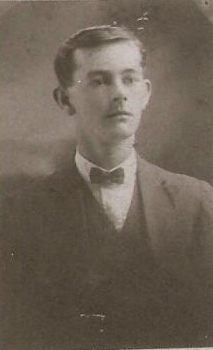
M is for…Methodist

This really should have been a post for the “W” week of the Gould Genealogy Alphabet challenge, but I have another “W” word in mind for that week (guess which word that will be).  To be precise,  “W is for…Wesleyan Methodist” would have been more apt as it is the branch of Methodism that the Harman family followed, but due to an overload of “W”‘s, I’ll turn it upside down and make it “M is for…Methodist”.

What did I know about Methodism before I discovered the Harman’s faith?  Nothing except for a link to temperance.  Therefore, over the years I have tried to find out more about the religion as I think it is definitive in finding out more of what the Harmans were really like, especially James and his brother Walter who were Local Preachers with the church.

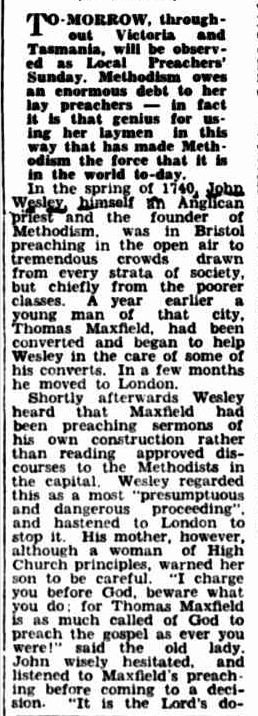
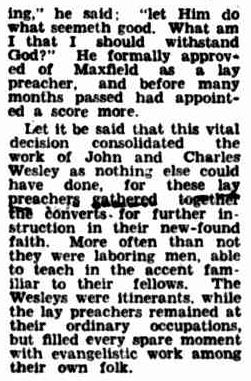
It was the role of a local preacher I discovered was one of the characteristics of Methodism.  This from the Advocate of Burnie on 16 August 1952 gives something of the background:

The Methodist Local Preacher. (1952, August 16). Advocate (Burnie, Tas. : 1890 – 1954), p. 12. Retrieved August 6, 2012, from http://nla.gov.au/nla.news-article69442373

I have also found that James did preach at Hamilton Methodist Church on occasions, found in the history  Uniting we now stand: a history of the Hamilton Methodist Church by Joan A. Smith (1999).  The Hamilton church was originally at 41 McIntyre Street before moving to Lonsdale Street in 1913.  In May this year, a gathering was held recognising 150 years of Methodism in Hamilton.

The Byaduk Methodist Church built 1864, was the first church in the town and a weatherboard Sunday School was added in 1889.  Located on the Hamilton/Port Fairy Road which runs through the town the Byaduk church, along with the Hamilton church,  are now Uniting Churches.  This came about after three churches, the Methodist, Presbyterian and Congregational came together in 1977.

FORMER BYADUK METHODIST CHURCH

Prior to the Byaduk church’s construction services were held in the home of John B. Smith, an early leader of the Wesleyan Methodist Church in Victoria.   In 1866, Smith went to Portland and travelled a circuit which took him throughout the south-west.  His recollections were published in the Portland Guardian of 25 June 1928.  If you have Kittson, Lightbody or Hedditch links, this is worth reading in full.

Early Methodsim. (1928, June 25). Portland Guardian (Vic. : 1876 – 1953), p. 3 Edition: EVENING. Retrieved August 6, 2012, from http://nla.gov.au/nla.news-article64266132

Smith was also a co-author of the book The Early Story of the Wesleyan Methodist Church in Victoria available online.  Of course, there is a lot in the book about John Smith himself who “.. had a clear grasp of the plan of salvation, and a touching and pathetic way of speaking of the “wrath to come”.”(p.269).

Also of Smith:

“The well-worn family Bible used morning, noon, and night for family worship, told of his love for the Psalms and the words of the Lord Jesus and few could use them (even the deep vast words of the fourth gospel), or the plaintive phrases of the Psalms, or the less familiar lines of shaded beauty found in our Hymn Book, with greater feeling and effect” (p269)

The influence of this holy man of God and of other kindred spirits make Byaduk a bright spot in the Hamilton Circuit, while the personal worth and , social standing of Mr. Peter Learmonth as a Christian and a citizen, and the active sympathy and generous help of the Wiggins’ and Learmonths’ on the one hand, and the ungrudging labours of devoted Local Preachers on the other, have served to sustain the cause and comfort the Minister’s heart”(p270)

Peter Fraser in Early Byaduk Settlers, describes an early Methodist service at Byaduk:

“They conducted the services differently from now.  In singing hymns. the preacher read a verse and the congregation sang the verse, then he read another and the congregation sang it and so on to the end of the hymn.  In prayers, most of the congregation knelt; and when the preacher was praying, some in the congregation would sing out AMEN, BE IT SO HALLELUIAH and other words, while others in the congregation would grunt and groan all the time, but it must have been a nuisance to the preacher as the Methodist Ministers stopped it many years ago.” (p. 14)

Peter also names some of the local preachers of which there was an abundance.  They included Mr John Henry Oliver senior, father-in-law of Jonathon and Reuben Harman, and his son John Henry junior.  Also Daniel Love, John Holmes and Samuel Clarke, just to name a few.  George Holmes senior, father in law of Julia Harman, was superintendent of the Sunday School for over forty years.

James and Walter seemed the most devout of the Harman family, with both spreading the word as local preachers. Also, Walter and his wife Lydia established the Sunday School at Ensay and Walter travelled many miles preaching.  Walter’s son Henry was an elder of the Omeo Methodist Church and I have previously told the story of the Omeo Methodist Minister Ronald Griggs.  The church closed ranks around Griggs and continued to support him at the time of his murder trial in 1928.

The post In Search of the Extraordinary Monster looks at the Port Fairy Methodist church.  Port Fairy was the home of the Harman family before they moved to Byaduk

Reuben James Harman, son of James and my gg grandfather,  was buried in the Methodist section of the Ballarat New Cemetery, with the faith continuing on to the next generation.

GRAVE OF REUBEN JAMES HARMAN & EMMA LORDEN – BALLARAT NEW CEMETERY

I know there is so much more to find about the Harman family link to the Wesleyan Methodist Church.  My ggg grandfather was a great servant of the church and saw some changes during its development in Byaduk and Hamilton.   He was still alive when the Hamilton Methodist Church moved to Lonsdale Street, but a major change occurred a year after his death.  In 1917, the Methodist Church of Australia at its Melbourne conference ruled that local preachers were to become known as lay preachers.

METHODIST CONFERENCE. (1917, May 26). Examiner (Launceston, Tas. : 1900 – 1954), p. 6 Edition: DAILY. Retrieved August 7, 2012, from http://nla.gov.au/nla.news-article50927004

A post on the website Gospel Australia has a great post “Poor Old Tom Brown”.  I have included the link but now the site is only working intermittently.   It describes a man who was a Local Preacher in New South Wales and he is very much how I imagine James Harman to have been.

If you have Western District family members who were Methodists, I highly recommend you read The Early Story of the Wesleyan Methodist Church in Victoria.  Various towns throughout the Western District were represented along with many names.  Other areas of Victoria are also covered.

 There is one question about the Harmans and their Methodist faith that I may never have answered.  Why did Joseph Harman, father of James and Walter, change his religion from Methodist to Presbyterian by the time of his death in 1893?  Mentioned in his obituary in Hamilton Spectator it has had me wondering ever since I first read it.


Genealogy in the Papers

Just for fun, I thought I would search the term “genealogy” at Trove. There were 7, 897 matches, so I narrowed the search down to papers that serviced the Western District.  What I found was a mix of humorous pieces, hints, and more.

One of the earliest references I found was from the Camperdown Chronicle of June 20, 1899.  I wonder where Mr. Meek’s genealogical charts got to?

NEWS Of THE DISTRICT. (1899, June 20). Camperdown Chronicle (Vic. : 1877 – 1954), p. 3. Retrieved July 31, 2012, from http://nla.gov.au/nla.news-article35716123

This piece did the rounds of the papers in 1908:

A FAMILY TREE. (1908, December 19). Border Watch (Mount Gambier, SA : 1861 – 1954), p. 6. Retrieved July 31, 2012, from http://nla.gov.au/nla.news-article77450557

From the Border Watch of October 7, 1911, some tips on tracing your family tree:

HOW TO TRACE YOUR ANCESTRY. (1911, October 7). Border Watch (Mount Gambier, SA : 1861 – 1954), p. 5. Retrieved July 31, 2012, from http://nla.gov.au/nla.news-article77477729

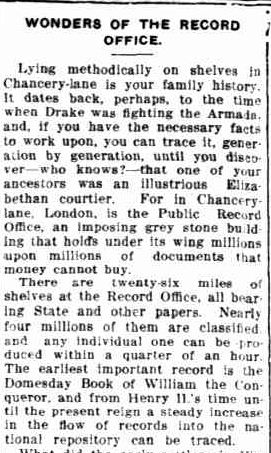
This is an excerpt of an interesting article from the Horsham Times of December 29, 1914 about  London’s Public Record Office:

WONDERS OF THE RECORD OFFICE. (1914, December 29). The Horsham Times (Vic. : 1882 – 1954), p. 10. Retrieved July 31, 2012, from http://nla.gov.au/nla.news-article72968404

Were these genealogical pedigrees really a bargain or just a scam?

Bargains in Ancestors. (1928, March 15). Border Watch (Mount Gambier, SA : 1861 – 1954), p. 6. Retrieved July 31, 2012, from http://nla.gov.au/nla.news-article77703474

The article from the Border Watch of March 15, 1928 does go on with a disclaimer from Mr Anjou , described as a reclusive “pedigree king”.

If the earlier advice on tracing a family tree was not successful, one could always employ the services of G.P.Townend.

Classified Advertising. (1920, January 28). The Argus (Melbourne, Vic. : 1848 – 1956), p. 1. Retrieved July 31, 2012, from http://nla.gov.au/nla.news-article1674996

The next article appeared on what could be best described as the “funnies” page of The Portland Guardian of February 24, 1927.  I wonder if G.P, Townend charged in the same way?

PROBABLY NECESSARY. (1927, February 24). Portland Guardian (Vic. : 1876 – 1953), p. 5 Edition: EVENING. Retrieved July 31, 2012, from http://nla.gov.au/nla.news-article64256338

If you are related to the Wells family of Portland and Mt Gambia (sic), you best be quick and contact Bruce Cartwright of Honolulu!

NEWS OF PIONEERS SOUGHT. (1931, September 7). Portland Guardian (Vic. : 1876 – 1953), p. 1 Edition: EVENING. Retrieved July 31, 2012, from http://nla.gov.au/nla.news-article64296112

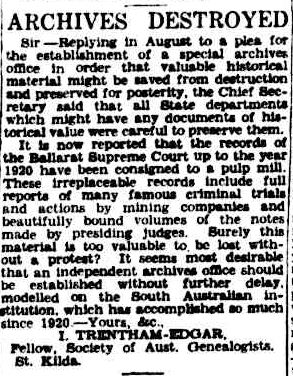
If you have ever gone searching for Ballarat Supreme Court records prior to 1920, stop looking, they were pulped.

ARCHIVES DESTROYED. (1940, September 6). The Argus (Melbourne, Vic. : 1848 – 1956), p. 2. Retrieved July 31, 2012, from http://nla.gov.au/nla.news-article11313187

I’m glad this stereotype of a genealogist, from 1928, has changed.  It has, hasn’t it??


BY VAN. (1928, June 7). Portland Guardian (Vic. : 1876 – 1953), p. 5 Edition: EVENING. Retrieved July 31, 2012, from http://nla.gov.au/nla.news-article64265966

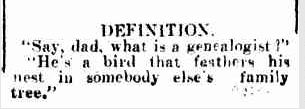
That is just a small selection of what could be found about genealogy in the early papers of the Western District.  Try it for yourself and see what you find from the localities you research.  I also searched “genealogist” and had 863 matches, so I will leave you with one of the results from that search from the Western Argus of Kalgoorlie:

DEFINITION. (1937, April 20). Western Argus (Kalgoorlie, WA : 1916 – 1938), p. 29. Retrieved July 31, 2012, from http://nla.gov.au/nla.news-article34930453


Lots to Like About Local History

Despite all the L’s, this is not a post for this week’s Gould Genealogy’s Family History Through the Alphabet challenge but rather an acknowledgment of one of the posts for that challenge.

Sharn White’s post “L for Local History”  is one that I wanted to share as she reinforces the value of an understanding of local history when researching your family’s history.

Sharn says:

“Knowledge of local history can place our forebears into a geographical, economic, religious and social context. Local history plays a valuable role in family history research”.

“It is this type of broader understanding which provides us with a much closer perspective of our ancestors’ lives and which puts the meat on the bare bones of our family history research. Local history makes family history more than just a family tree.”

Recently I nominated Sharn for an Illuminating Blogger Award and this post is further justification of that and, as I mentioned at the time, Sharn’s posts are well researched and this is no exception.


In The News – July 29, 1929

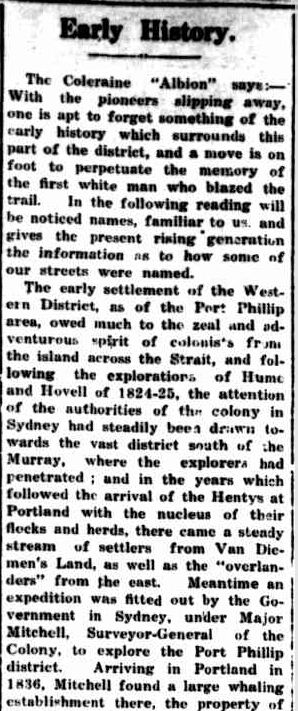
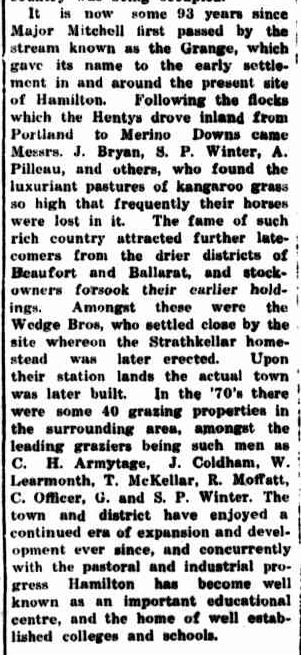
Although many of the Western District newspapers are not digitised at Trove, it is possible to find articles from the likes of The Hamilton Spectator in the The Portland Guardian,  for example.  On this day 83 years ago,  an excerpt from the Albion newspaper of Coleraine appeared in The Portland Guardian of July 29, 1929.

Prompted by the deaths of many of the early pioneers, the article reflected on the history of the Western District  from the time Major Thomas Mitchell made his way across the land he called Australia Felix 93 years earlier.


Early History. (1929, July 29). Portland Guardian (Vic. : 1876 – 1953), p. 3 Edition: EVENING. Retrieved July 23, 2012, from http://nla.gov.au/nla.news-article64270110

There is a clue in the article for those of you who having trouble finding your Western District family member’s arrival in Victoria.  The writer mentions many people from Van Diemen’s Land making their way to Victoria once news got back the Hentys had pushed up from Portland into the Merino district.  It could then be possible that family members travelled to Victoria via Tasmania where they had resided as convicts or otherwise.

Jenny Fawcett, on her great South-West Victoria genealogy and history site,  has indexed the names of those who travelled to Victoria as part of a Geelong and Portland Bay Immigration Society scheme in 1845 and 1846.  The idea behind that and similar schemes was to bring labour into the colony with those behind the society being squatters and merchants.  Jenny provides a great description of the scheme on her site.

Browsing through the names,there are many I instantly recognise as Western District family names.  Also, a lot of the pioneer obituaries I have read tell of the deceased having come to Victoria via Van Diemen’s Land.

So, if you are beginning to think your ancestors were good swimmers, follow-up the possibility they came to the Western District from Tasmania.  You just never know.

Passing of the Pioneers

As Passing of the Pioneers enters a second year, the fascinating stories keep coming.  Who could not be taken in by James Parker’s story? Gold, Captain Moonlight and more than a stroke of good luck make it an interesting read.  Or Octavius Palmer? While still a teenager, he travelled to California and took on the risky job of gold escort, while Mrs Isabella Gilholme’s business sense saw her acquire a portfolio of shops and houses.

Hannah BIRCHALL: Died July 1889 at Bridgewater.  I have mentioned Hannah Birchall before. In the News -May 26  was about the passing of Mrs Hugh Kittson who was Margaret Jennings, daughter of Hannah. Hannah’s husband, Margaret’s father, was Cook Abraham Jennings. Hannah and Abraham arrived in the district during the 1840s.

Amelia PITTS: Died 11 July 1897 at Myamyn. Mrs Dudden was known by many around Myamyn due to husband Stephen Dudden’s work as a storekeeper in the town. She arrived in Victoria during the 1850s. From a search at Trove, I found that only three months earlier on April 19, 1897, the Dudden’s residence, behind their shop, was destroyed by fire

James PARKER: Died 6 July 1899 at Heywood.  At the time of James Parker’s death, The Portland Guardian correspondent promised an account of Parker’s life, in the next issue. Finally, on 9 August 1899, he came good with his promise and it was worth it.  I cannot possibly summarise the life of James Parker, so you must read the obituary for yourself here.  It is a fascinating read, particularly Parker’s encounter with Captain Moonlight.  I will, however, include a piece from the obituary which describes pioneer life.  As you read, keep in mind the obituary is from 1899.
The Late Mr James Parker. (1899, August 9). Portland Guardian (Vic. : 1876 – 1953), p. 3 Edition: EVENING. Retrieved July 22, 2012, from http://nla.gov.au/nla.news-article63676913

William DISHER: Died 11 July 1902 at Stawell. William Disher arrived in South Australia during the 1830s. He married Agnes Horsburgh in 1842 and during the 1870s they moved to Kewell West, north of Murtoa. William and Agnes had twelve children and by the time of his death, the couple had seventy-two grandchildren and twelve great-grandchildren.  Incidentally, William’s mother had 220 direct descendants at the time of her death at ninety-two, including 120 great-grandchildren. William’s sister was Lady Eliza Milne, the wife of Sir William Milne a South Australian politician.

John M. SHEEHY: Died July 1903 at Casterton. How I need a man like John Sheehy in my life.

OBITUARY. (1903, July 28). The Horsham Times (Vic. : 1882 – 1954), p. 3. Retrieved July 22, 2012, from http://nla.gov.au/nla.news-article72840810

John MacEACHERN: Died 4 July 1908 at Nelson. While John MacEachern had only been in the Nelson district from the 1870s, he had been in Australia since 1839 having arrived in Sydney from Scotland with his parents. He made his way to Victoria, first working at Strathdownie as a stockman, where he proved himself an excellent horseman.

Edwin BOASE: Died July 1911 at Murtoa. Edwin Boase was a newspaper pioneer in the Wimmera. He arrived with his parents in Adelaide as a baby during the 1850s before they headed to Castlemaine. He learnt the printing trade in Ballarat before moving to Horsham in 1872 where he printed the first edition of The Horsham Times. He later founded The Dunmunkle Standard and published the paper for thirty-three years until the time of his death.  He married Isabella Cameron in 1878, a daughter of a former Horsham Mayor.

Octavius Frederick William PALMER: Died 18 July18 1914 at Terang. What a life Octavius Palmer led. He was born in London in 1833 and went to Tasmania with his parents and nine siblings in 1838. His father was Captain Frederick Palmer of the East India Company.  After schooling at the Church of England Grammar School in Launceston, Octavius left for the goldfields of California where he spent three years driving the gold escort team of horses. He returned to the Castlemaine diggings and after some pastoral pursuits with his brothers, he settled in the Western District around Warrnambool.

Octavius was a member of the  Warrnambool Polo Club and the Warrnambool Racing Club. He imported many head of Romney Marsh sheep in the 1870s.  An article from The Age of September 1972, reports on the Palmer family breeding Romney Marsh sheep for 100 years with references to Octavius. How proud he would have been that his family continued to breed the sheep he preferred for the conditions of the southwest of Victoria.

I  couldn’t resist this insight into Octavius in later life. From The Mail (Adelaide), the article describes an “old buster”.

When The Heart Is Young. (1941, September 20). The Mail (Adelaide, SA : 1912 – 1954), p. 4. Retrieved July 25, 2012, from http://nla.gov.au/nla.news-article54893294

Forty seems far too young to be thought of as an “old buster”!

Thomas BAILEY: Died 23 July 1914 at Ballarat. Like the JohnGreed above, Thomas Bailey was from Taunton, Somerset.  He was born there in 1840 but at a young age, he left for the New Zealand goldfields. He then went to Ballarat where he had various mining interests. He married Sarah Craig, the daughter of Walter Craig owner at the time of Ballarat’s Craigs Hotel.

Family Notices. (1869, January 29). The Argus (Melbourne, Vic. : 1848 – 1956), p. 4. Retrieved July 23, 2012, from http://nla.gov.au/nla.news-article5815936

Thomas was a member of the Ballarat Anglers Club, Ballarat Hunt Club and had a keen interest in football.  His death was felt in many parts of Ballarat including the Old Colonists Hall, where, out of respect, a meeting was cancelled.

Richard BRYANT: Died 12 July 1919 at Hamilton. Richard Bryant was born in Cornwall in 1829 and married Elizabeth Millstead in 1850.  The couple travelled to Adelaide aboard the Epaminodas in 1853.  From there they went to Portland and Richard walked on to Ballarat in 1854 in search of gold.  After the death of Elizabeth, Richard and two young daughters settled on land at Mooralla.  He then married Irish-born Margaret Nowlan.  Margaret passed away in 1907.

I have a family link to Richard Bryant via a daughter from his first marriage.  Richard was the grandfather of Elizabeth Bryant McWhirter,  wife of James Stevenson of Cavendish.  James was the subject of the post “Hobbies Passions and Devotions.

Sophia Caroline GORTE: Died 10 July 1920 at Halls Gap.

Obituary. (1920, July 16). The Horsham Times (Vic. : 1882 – 1954), p. 5. Retrieved July 23, 2012, from http://nla.gov.au/nla.news-article73176649

I turned to Ida Stanton’s Bridging The Gap for more information about Sophia Gorte. Sophia’s husband Carl Wehl had a tannery in Stawell but owned land in Halls Gap. The house that Sophia built (as referred to in her obituary) was Glenbower 2 near Borough Huts, just outside Halls Gap. The house was so named as it was next to Glenbower owned by members of the D’Alton family, including twins Sophia and Henrietta.

That home went into ruin, however, at the time of Ida writing her book, poplars and remnants of the garden still existed.   Ida tells how the D’Altons brought the poplars with them to Australia from Napoleon Bonaparte’s grave on the island of St Helena. This is not as unusual as it sounds.  A Google search found many others who also grew both poplars and willows grown from cuttings taken from the island’s trees.  An article from The Mercury tells of a Tasmanian family who did the same.

The bushfires of 1939 saw  Glenbower 2 destroyed. There are photos of both homes in Bridging the Gap, and Sophia Wehl is on the veranda in the Glenbower 2 photo.

Sophia Wehl’s daughter was a noted artist specialising in wildflowers. Her art teacher was neighbour Henrietta D’Alton who was famous for her wildflower art and had even exhibited overseas.

Margaret Ann DIWELL:  Died July 1932 at Hamilton. Margaret was my ggg aunt and daughter of William Diwell and Margaret Turner.  She was born at Portland in 1857 and married John McClintock in 1883. They lived at Grassdale and had eleven children including John, James Richard, and Albert Edward featured in my Anzac Day post The McClintock Brothers.

OBITUARY. (1932, July 21). Portland Guardian (Vic. : 1876 – 1953), p. 2 Edition: EVENING. Retrieved July 23, 2012, from http://nla.gov.au/nla.news-article64298800

In the post, Passing of the Pioneers – A Year On, I mentioned the dangers of wrong information in obituaries. Margaret’s obituary offers an example of this. It mentions her parents arrived in Portland in 1850. They, in fact, arrived on the Duke of Richmond in 1852.  Margaret’s mother is also mentioned because of her involvement in the murder trial of George Waines.  I wrote about that trial in Witness For the Prosecution.

John Thomas EDGARDied 10 July 1941 at Melbourne. John Thomas Edgar was born at Portland in 1848, the son of David and Sarah Edgar. The Edgars settled at Pine Hills estate near Harrow. David Edgar subsidised a private school at the estate for the use of his children and the children of other settlers and John attended that school before going on to Hamilton College and later Scotch College in Melbourne.

With his schooling completed, John returned to Pine Hills to learn the finer points of running Merino sheep. This saw him go to on to become an expert breeder and judge of the popular Western Victorian breed.  He took over management of his father’s property Kandook Estate at Harrow and later the ownership. In 1871, John married Margaret Swan and they raised a family of twelve children. He was the brother of Walter Birmingham Edgar and a cousin to Jean Edgar, both Passing Pioneers.

Michael MURPHY:  Died 12 July 1943 at Melbourne. I have driven past Tobacco Road, Pomonal many times en route to Halls Gap and finally, I know how it got its name. Michael Murphy was a former resident of Pomonal at the foot of the Grampians.  He was one of the tobacco-growing pioneers in the area. I didn’t know tobacco was grown there, but it seems obvious now that Tobacco Road was named for such a reason.

Michael was also a supporter of local football and cricket and was a founding member of the Stawell Druids Lodge.  He was seventy-four at the time of his death, following complications of injuries received in a tram accident in Melbourne.

Isabella REID: – Died July 1953 at Heywood.  Isabella Reid was the daughter of William Reid and Johanna Steven and wife of Charles Gilholme. Isabella ran a guest house but after Charles’ death, she expanded her business interests into property.

DEATH OR HEYWOOD OCTOGENARIAN. (1953, July 27). Portland Guardian (Vic. : 1876 – 1953), p. 2 Edition: MIDDAY. Retrieved July 24, 2012, from http://nla.gov.au/nla.news-article64435398

In The News – July 25, 1906

Heavy winter rains in the Western District and the South-East of South Australia left Casterton awash in 1906.  As reported in The Border Watch on July 25, 1906, the Glenelg River reached record levels and evacuations took place.  There were also large stock losses.

I am still working out which “Mr. Jelly” carried people to safety.  My ggg grandfather was George Jelly of Casterton, but he passed away in 1896.  He had two sons still living at the time of the floods, William and John and they were both living in Casterton in 1906.

CASTERTON PARTLY SUBMERGED. (1906, July 25). Border Watch (Mount Gambier, SA : 1861 – 1954), p. 2. Retrieved July 25, 2012, from http://nla.gov.au/nla.news-article77582924

Passing of the Pioneers – A Year On

PASSING OF THE PIONEERS. (1927, November 14). Portland Guardian (Vic. : 1876 – 1953), p. 3 Edition: EVENING. Retrieved July 21, 2012, from http://nla.gov.au/nla.news-article64259147

On July 22, 2011, I posted the first Passing of the Pioneers, and 12 months on I am preparing to post the 13th edition.

There are now over 180 links to Western Victorian pioneer obituaries at Western District Families and the 13th edition will see the total go over 200.

Reading all those obituaries has been a privilege and has taken me on a wonderful journey, not only through the history of the Western District but to places such as game parks in Africa and the silver mines of South America.  The lives I have glimpsed into range from that of the gentry to general hands, but all have shared in making Western Victoria the place it is today.

Some of the pioneers were born during the early days of Victoria,  while others dared their lives aboard immigrant ships in the hope of a better life.  Many travelled from the ports to the Western District by bullock wagon on rough tracks, while enduring unfamiliar conditions.  They built houses on land that would one day see towns such as Penshurst, Hamilton, and Balmoral grow around them.

The women from the pioneering era deserve recognition.   Some were alone among men, left to bear and raise children and turn their canvas tents or slab huts into homes.  Many endured loneliness, but as towns grew some became involved with community activities such as the church.   Despite their hardships, many of these women’s obituaries noted that even in old age they would reminisce about those times.

Obituaries came after the pioneer “crossed the Great Divide”, penned by someone who too had heard the stories but may not have had all the facts.  That is my warning to you while you read obituaries and in the July 2012 Passing of the Pioneers, I will show this with an obituary from my family.

Having said that,  it is the snippets of information within them that make obituaries a worthwhile family history resource.  Names of children and their married names, places of residence, occupations, and immigration details are just some of those snippets which you can then test against the relevant records.

Many of the obituaries I have read have moved me, inspired me, and led me to further research.   I have listed just some of those, not so much for the achievements of the subject but the stories they tell.  Click on the pioneer’s name to go to their original newspaper obituary or the date to go to the Passing of the Pioneers post where the obituary appeared:

Frederick William BILSTON (August 2011)

Mrs Agnes CHEQUER (November 2011)

Thomas Denton CLARKE (October 2011)

Elizabeth COLE (March 2012)

James DAWSON (April 2012)

Alfred Irvine HOGAN (February 2012)

KITTSON family – James (May 2012), James Trotter (December 2011),  Rebecca (January 2012),  Susannah (June 2012) and Mrs Margaret Kittson (May 2012)

MALSEED family – Fanny Ann (February 2012),  Robert J. (May 2012) ,  Mrs E.A. MALSEED (August 2011) and Mary HEDDITCH  (Mrs James MALSEED) (July 2011)

Finlay McPherson PATON (September 2011)

Joseph Bell PEARSON (July 2011)

Mystery Photos

Isn’t  it frustrating when you find old family photos but don’t who the subjects are?  Not long ago Mum found some photos of Nana’s we didn’t know she had. We don’t know who the people are and we have no one to ask.

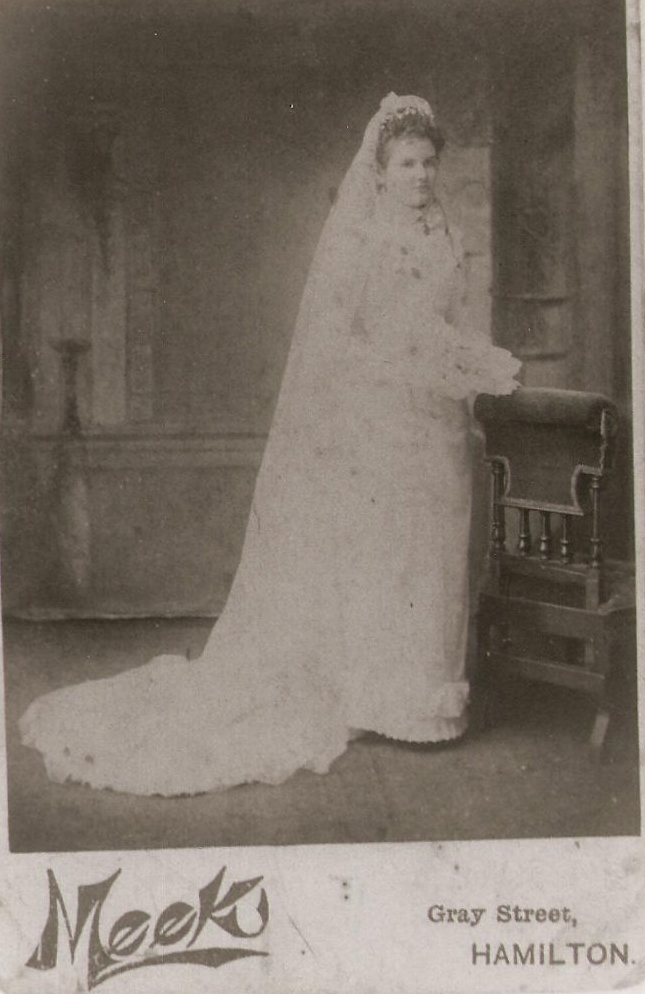
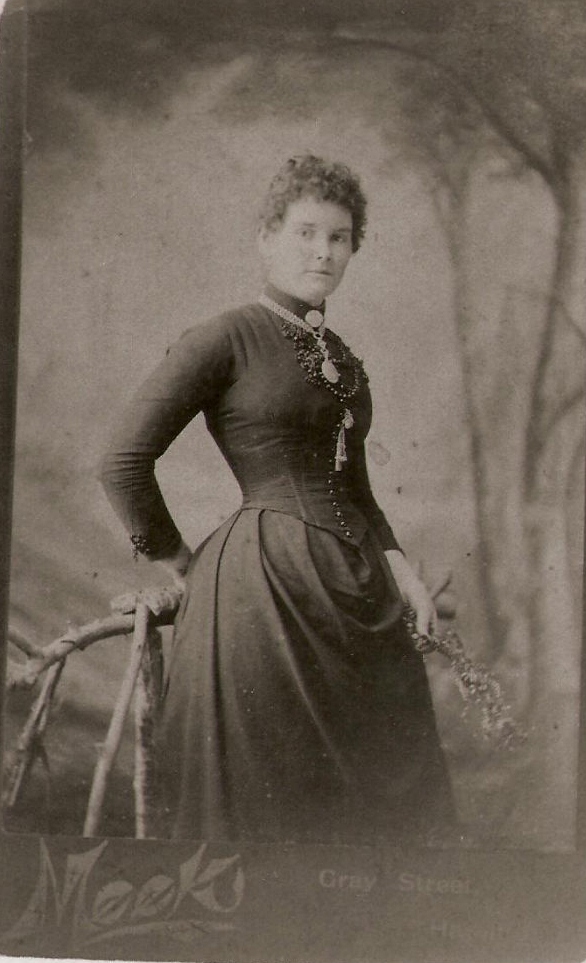
I was recently contacted by Catherine Simmins, who has family links to the Western District.  She is facing the same dilemma with some photos passed on to her family some time ago.  Some were identifiable but others remain a mystery.

Catherine asked me if I could post the photos in the hope someone may recognise the subjects.  Alternatively,  if anyone is better at dating photos than myself, help in that area would also be appreciated.

THE PHOTOS

PHOTO 1

Also from Meek’s

PHOTO 2


PHOTO 3

The following three photos go together.

PHOTO 4


PHOTO 5


PHOTO 6

THE CLUES

The Family

Catherine’s family from the Western District included the family names THOMAS, McPHERSON, JONES and McDONALD.

Alfred Charles THOMAS (Catherines great-grandfather) was the son of  William THOMAS and Hannah JONES.  He was born in 1869 at Hamilton.  Alfred married Sarah Ann McPHERSON, the daughter of Angus McPHERSON and Christina McDONALD.

Alfred and Sarah had a large family of 11  children.

Alfred’s obituary lists the names of their children, their married names and locations.

Obituary. (1937, August 5). Portland Guardian (Vic. : 1876 – 1953), p. 3 Edition: EVENING.. Retrieved July 17, 2012, from http://nla.gov.au/nla.news-article64276614

Sarah’s obituary:

OBITUARY. (1940, February 26). Portland Guardian (Vic. : 1876 – 1953), p. 3 Edition: EVENING. Retrieved July 17, 2012, from http://nla.gov.au/nla.news-article64395373

Of course, there is a good chance that the photos are not of this branch of the THOMAS family but have some link.   Catherine has offered a suggestion as to who the family in Photos 3, 4 and 5 could be.

Sarah Ann McPHERSON’s sister, Margaret Jessie McPHERSON married Donald McBEAN in 1891.  They had five known children:

Jessie Christina Jane born 1891 at Hamilton married Arch. NAISMITH

Alexander Angus born 1895 at Hamilton

Mary Monivae born 1900 at Hamilton

Margaret Murial born 1903 at Hamilton married Alfred BONE

Dorothy Jean born 1913 at Portland

This is the Family Notice for Donald McBean:

Family Notices. (1930, March 6). Portland Guardian (Vic. : 1876 – 1953), p. 2 Edition: EVENING. Retrieved July 17, 2012, from http://nla.gov.au/nla.news-article64291722

I think Catherine’s hunch could prove correct given the number of children, their sex and the age differences in the children.  If that is baby Dorothy McBean, the  family photo could be from around 1914.

**My interest piqued when I saw the name Mary Monivae.  Monivae, my former secondary school in Hamilton, named after the Monivae homestead, the school’s first site during the 1950s, was formally owned by Acheson Ffrench and James Thomson.  I wonder if Donald McBean worked at the property or they simply liked the name. I’ll save that one for later!

The Photographer

James Meek, tobacconist and photographer of Gray Street Hamilton took Photos 1 and 2.  The earliest reference I can find of Meek in Hamilton was 1884 when he played a role in the investigations of a well-known murder case of the time “The Pierrepoint Murders”.  Pierrepoint is just out of Hamilton and Meek took a photograph of the murder victim to help with the identification process.  Interestingly a member of my Bishop family found his way into one of the witness statements.

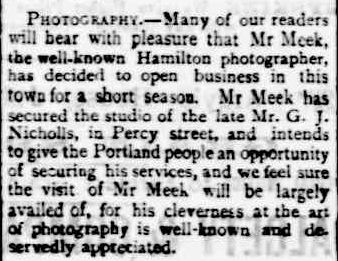
Meek also spent some time in Portland in the mid 1890s

Established August 1842. (1896, February 28). Portland Guardian (Vic. : 1876 – 1953), p. 2 Edition: EVENING. Retrieved July 17, 2012, from http://nla.gov.au/nla.news-article63634459

James Meek appears to have had a studio at Clunes during the early 1900s,  but I have also found references of him in Hamilton up until 1920.  There are a number of  photographs taken by James Meek at Trove

If you think you can help Catherine name the subjects in these wonderful photos, please leave a comment.  It would be much appreciated.

The Hungry Eagle

I had to share this story with you.

John Kirkwood was the father in law of Sarah Ann Reed, the niece of Susan Reed, wife of James Harman.  While checking his rabbit traps, John found a large eagle caught in a trap.  He took the bird to the Hamilton home of Robert Stapylton Bree on North Boundary road.  Bree chained the raptor in the garden to keep other birds away but he got more than he bargained for with the bird’s voracious appetite.

The Portland Guardian, (50th Year of Publication.) With which is incorporated The Portland Mirror. (1892, May 18). Portland Guardian (Vic. : 1876 – 1953), p. 2 Edition: EVENING. Retrieved June 14, 2012, from http://nla.gov.au/nla.news-article65439001

I wonder what happened to the eagle?

Dozens of articles about eagles and hawks caught in rabbit traps abound found at Trove.  Some eagles still flew with the traps attached and one poor bird was reported with a trap attached  for months.

—————————————————

On sad note, 10 years on, in 1902, John Kirkwood succumbed to influenza.  His obituary appeared in The Horsham Times of October 28, 1902.  John had died in the Hamilton Hospital on Wednesday October 22.  On October 31, 1902, the obituary of John’s daughter, 20-year-old Mary Agnes Kirkwood.  She had passed away on  October 26.

OBITUARY. (1902, October 31). The Horsham Times (Vic. : 1882 – 1954), p. 3. Retrieved July 15, 2012, from http://nla.gov.au/nla.news-article72851290


KIRKWOOD GRAVE – OLD HAMILTON CEMETERY

A search of Trove found that in 1902 there were reports of an influenza epidemic.  The Horsham Times reported many cases in the Wimmera area.  Such was the outbreak,  it had an effect on The Horsham Times.

More Illuminating Blogger Award Excitement

How lucky am I?  Two nominations for an Illuminating Blogger Award.

Earlier this week  Kerryn from AncestorChasing nominated me and yesterday Jennifer from Tracking Down The Family contacted me to tell me she too had nominated me.  It is great to get recognition from my fellow geneabloggers.

Jennifer wrote in her post:

I think Merron  at Western District Families and I started blogging at about the same. I find her blog which focuses on the Western  District of Victoria very interesting, especially the obituaries she regularly posts. I have no connection to her area, but Merron makes me wish that I did when I see all the information about the area and it’s families that is shared on her blog.

I appreciate Jennifer’s comment a lot as it affirms to me that my blog, which focuses on a relative small geographical area, can appeal to those who have no family link to the Western District.

My blog provides snippets of Western District history dispersed among the stories of my family.  The aim behind this was to help those who found they had  family from the Western District learn something of such a historic part of Victoria.  Having some knowledge of local history is so important when putting together your family’s history. It is flattering to know that those with no link to the Western District can find my blog interesting.

But I really must not take all the credit.  Thank you to all the pioneers of Western Victoria who left such wonderful stories and of, course  Trove , a favourite website of so many.  Being able to illustrate my posts with newspaper “clippings” from Trove is so important in making Western District Families work.
Jennifer mentions that we started blogging around the same time which gives us something in common.  However, I have always felt I have another connection to Jennifer. Of the geneabloggers I follow, Jennifer lives the closest to me with both places having very similar histories.

Thank you again to both Jennifer and Kerryn and if you missed my six nominations for an Illuminating Blogger Award, you can find them here