Passing of the Pioneers

Seventeen more obituaries of Western District pioneers join the collection this month, and what a group they are.  I must say I had to pass a lot over, but it will ensure Passing with the Pioneers will be going to at least January 2014!  New papers at Trove has guaranteed that. Obituaries came from the Portland Guardian, Horsham Times and Ballarat Courier.

There are a couple of special ones, those of  James HENTY and Rebecca KITTSON and I highly recommend that you read the obituary in full.  I actually found Rebecca’s obituary rather moving and after driving through the Bridgewater area recently, I have great respect for her family and others that settled there.  To read the full obituary, just click on the pioneer’s name and the obituary will open in a new tab.  Some are a little hard to read, but magnifying the page helps.

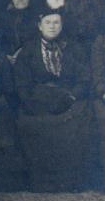
I have also included a “young” pioneer who has a family link to me.  Thank you to Rachael Boatwright for allowing me to include a photo of her family member.

James HENTY: – Died 12 January 1882 at Richmond.  I thought trashy magazines today told all, but the obituary of the Honourable James HENTY M.L.C. shared every detail of the last twenty-four hours or so his life.  How can I possibly give a summary of the life of James HENTY, one of the pioneering HENTY clan?  Instead, read the obituary.  I think James’ life may have ended prematurely, if that is possible at eighty-two, due to a collision with a Newfoundland dog the week before.
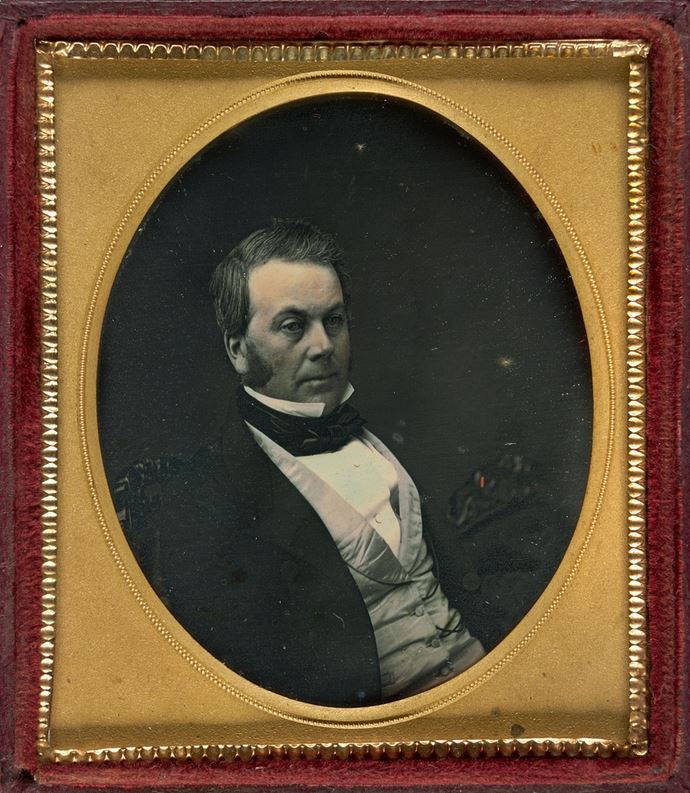
JAMES HENTY c1855. Image Courtesy of the State Library of Victoria. Image no. H83.158/2 http://handle.slv.vic.gov.au/10381/290239

JAMES HENTY c1855. Image Courtesy of the State Library of Victoria. Image no. H83.158/2 http://handle.slv.vic.gov.au/10381/290239

Hugh MCDONALD: Died 30 January 1899 at Portland. This is a timely obituary coming so soon after my Portland trip.  While there, I learnt something of the wreck of the steamer Admella in 1859 and the Portland lifeboat crew that went to her aid. Hugh McDONALD was one of the brave men on board the life boat during that daring rescue.

William GARDINER: Died 17 January 1904 at Warracknabeal.  William GARDINER, another pioneer with an interesting life.  He arrived in Victoria in 1849 aboard the barque Saxon and spent time in Melbourne, Geelong and the goldfields, before heading to New Zealand.  On his return to Australia, he lived in Port Fairy and Hamilton, working as a journalist, before moving to the Wimmera as a correspondent for the Belfast Gazette.  He like it so much, he decided to select land at Warracknabeal.  He also worked as a correspondent for the Horsham Times and built houses!

Jean McCLINTOCK:  Died 19 January 1904 at Melbourne. While only forty at the time of her death and not an “old pioneer”, I have included Jean as she was the sister-in-law of  Alfred Winslow HARMAN.  Jean married William MILLER and they resided at Rupanyup.  After some illness, Jean travelled to Melbourne for an operation, but she died as a result.

Jean McClintock & William Eaton Miller. Photo courtesy of Rachael Boatwright & family.

Joseph JELBART: Died 17 January 1904 at Carapook. Joseph worked as the mail contractor between Carapook and Casterton up until his death. Prior to that, he had worked as a blacksmith and a wheelwright at Chetwynd, Merino and Natimuk. Interesting coincidence, just as Joseph did, his father and brother both died on a Sunday morning in the same house.

Rachel Forward READ: Died 15 January 1904 at Lower Cape Bridgewater.  Rachel Forward READ and her husband Richard Charlton HEDDITCH arrived in Adelaide in 1838 and settled at Cape Bridgewater from 1845 after a stint teaching at the Portland Church of England school.  They resided at the Lal Lal Homestead.  The  Victorian Heritage Database listing for Lal Lal includes a letter home by Rachel after their arrival at Cape Bridgewater.  Rachel was buried at the Cape Bridgewater cemetery rather than the Hedditch family cemetery at Lal Lal.

Donald McRAE: Died 12 January 1914 at Tooan.  Donald McRAE was born in Inverness, Scotland in 1842 and travelled with his parents to Portland. In 1865, he moved to Muntham near Hamilton to farm with brother. The pair eventually selected 320 acres of land each at Natimuk.  Donald was a member of the Horsham Caledonian Society.

Samuel WALKER: Died 24 January 1914 at  Ballarat. Samuel WALKER was born in Cheshire, England around 1828 and travelled to Australia in 1852.  After his arrival on the goldfields of Ballarat, he set up a soda water factory which proved profitable for him.  He then became a partner in Evans and Walkers and worked as an accountant.  He was also the registrar of Births, Deaths and Marriages at Ballarat from 1872.

Selina MILLER: Died January 1917 at Wickliffe. Selina MILLER had resided at Wickliffe for almost sixty years.  She was twice married.  Her first husband was Mr HAIG and her second, George HARRIOTT. Selina was buried at the Wickliffe Cemetery (below).

Elizabeth HUBBARD: Died 3 January 1919 at Horsham.  Elizabeth HUBBARD was born in Norwich, England around 1831 and travelled to Australia with her husband, Mathias HARDINGHAM in the mid-1850s.  From Geelong, they travelled to the Horsham area and were two of the first pioneers in that district.  Mathias ran the Horsham Hotel for some time.

Christina FOX: Died 8 January 1921 at Vectis.  Christine FOX was born in Yorkshire, England around 1835.  As a teenager, she travelled to South Australia with her parents.  She married Robert SANDERS who had also travelled with his parents on the same immigrant ship.

John W. DAVIS: Died 24 January 1928 at Horsham.  John or “Jack” as he was known, arrived in Australia as a three old, living in Williamstown and then Stawell.  He played with the Temperance Union Band in Stawell and then moved to Horsham in 1877 to play with one of two brass bands in the town.  Known throughout the northwest for his ability as a euphonium player, Jack was also a bandmaster at Natimuk and Noradjuha.

Rebecca KITTSON: Died 4 January 1929 at Portland. What a grand old pioneer Rebecca KITTSON was.  A colonist of eighty-eight years, she was a month from her 102nd birthday.  Arriving in Melbourne from Ireland aged eleven, she spent the next year in Melbourne, before joining her family at Cape Bridgewater where her father James Kittson had settled.  She married Reverend William LIGHTBODY, a Wesleyan minister in 1852.  This obituary is a must read.  Mrs LIGHTBODY, as she was known for most of her life, was the last surviving member of her family and the obituary gives a glimpse at how the KITTSON’S came to be in Australia.
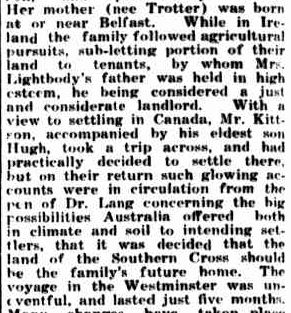
Obituary. (1929, January 7). Portland Guardian (Vic. : 1876 – 1953), p. 2 Edition: EVENING. Retrieved January 17, 2012, from http://nla.gov.au/nla.news-article64268096

Adrian ANDERSON: Died 16 January 1932 at Horsham. This is a first for Passing of the Pioneers.  Adrian ANDERSON was an immigrant from the United States. Wisconsin to be precise. He arrived aged four, with his parents and resided in Western Australia until he was ten.  The family moved to Victoria, where he remained.  He ran a shop in Jeparit before his death in the Horsham Base Hospital.

Agnes Sarah COOK: Died 18 January 1942 at Casterton. This obituary begins “Born in a small house on the banks of the  Glenelg River at Casterton seventy-nine years ago…”.  Agnes was a lady that like the past and the future, knowledgeable about the history of Casterton, she also liked to predict the future.  Agnes married  Robert SYLVESTER and they had four children.

Helen GULL: Died 18 January 1942 at Casterton. Helen was born on the ship Helen during her parents’ voyage to Australia in 1852.  The GULL family became respected pioneers throughout the Western District.  Helen married Frederick PERRY in 1876 and they resided at well known Western District properties, Rifle Downs at Digby and Runnymeade at Sandford.  Frederick later ran the Digby Hotel.

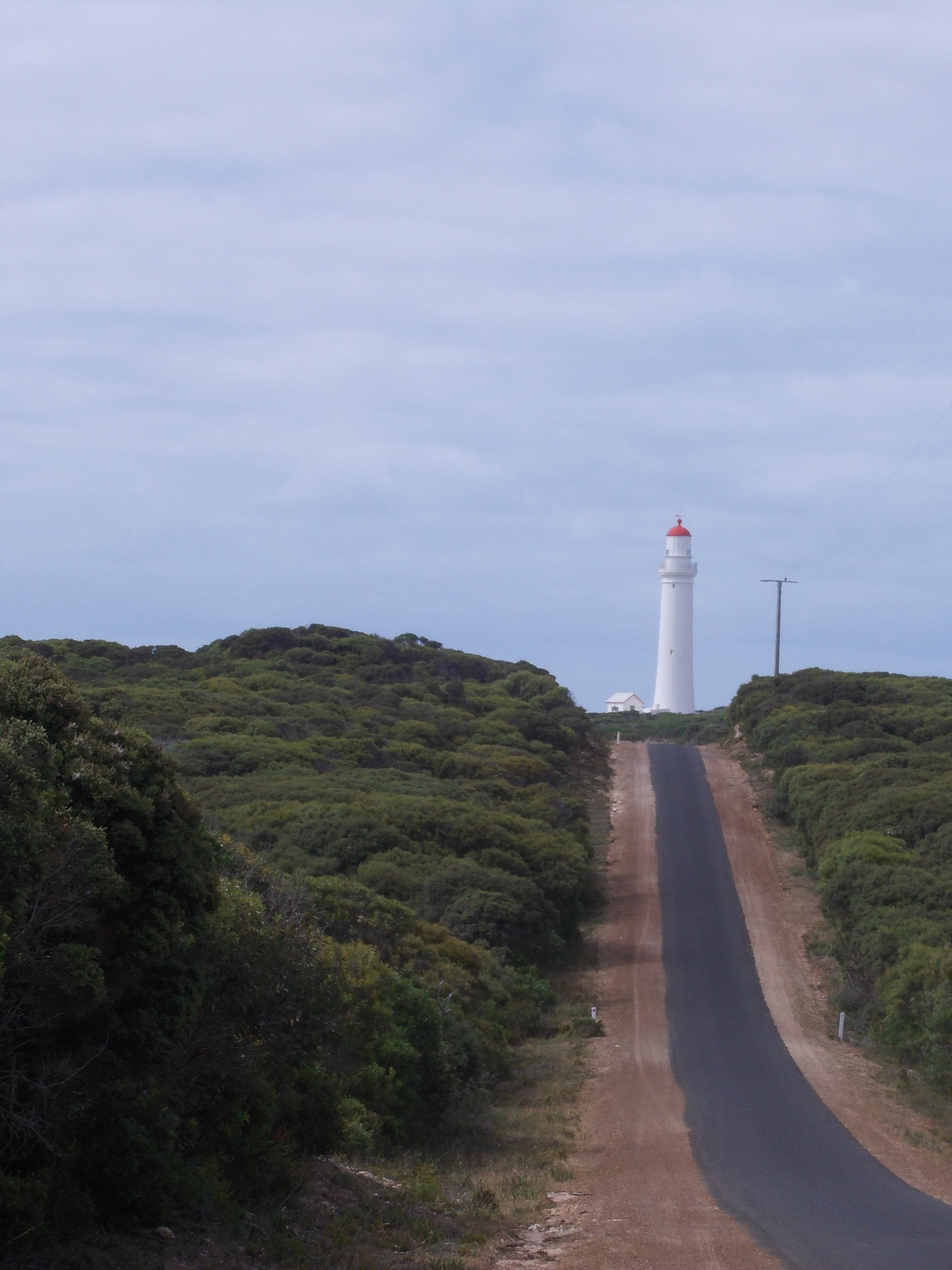
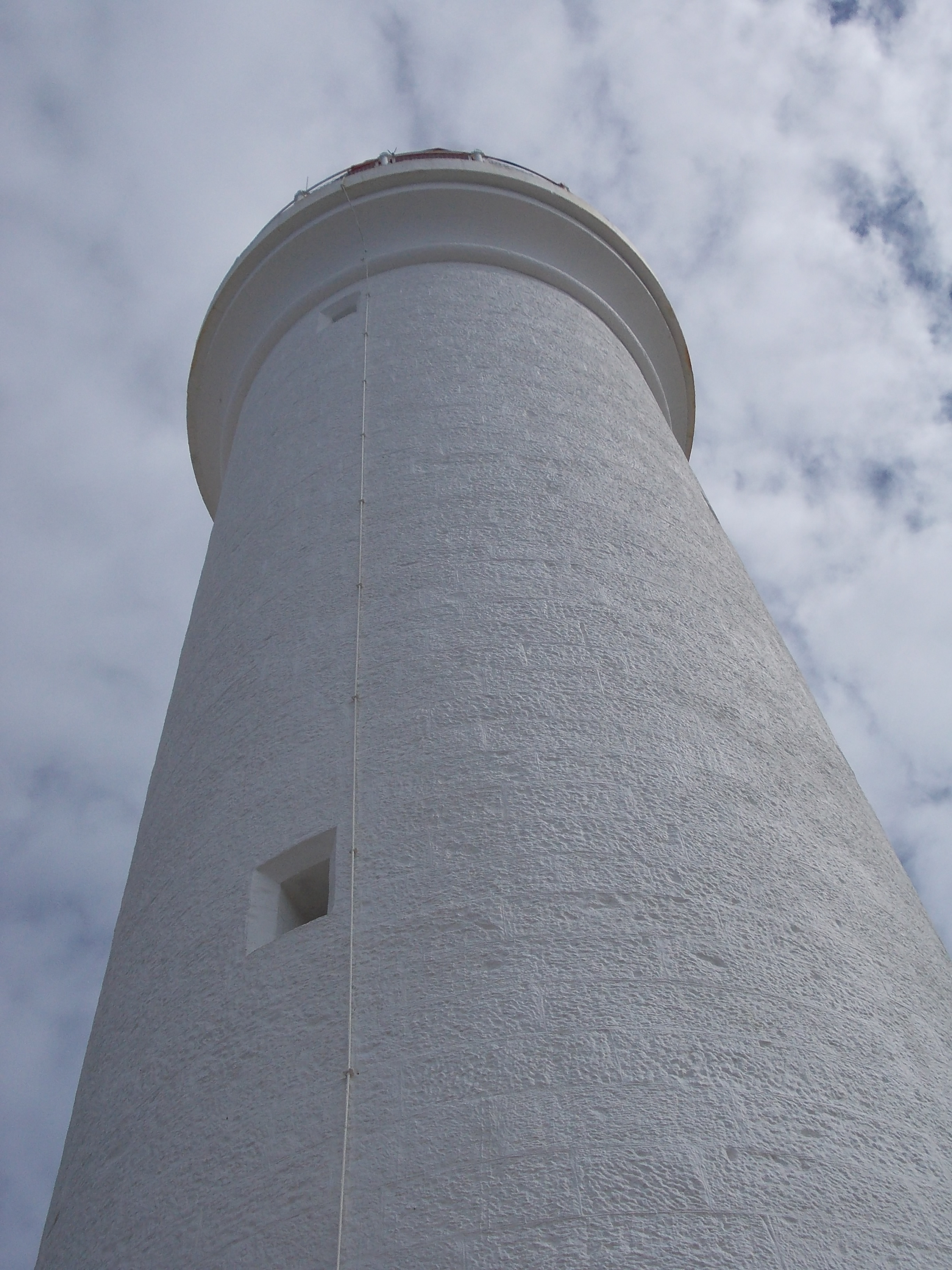
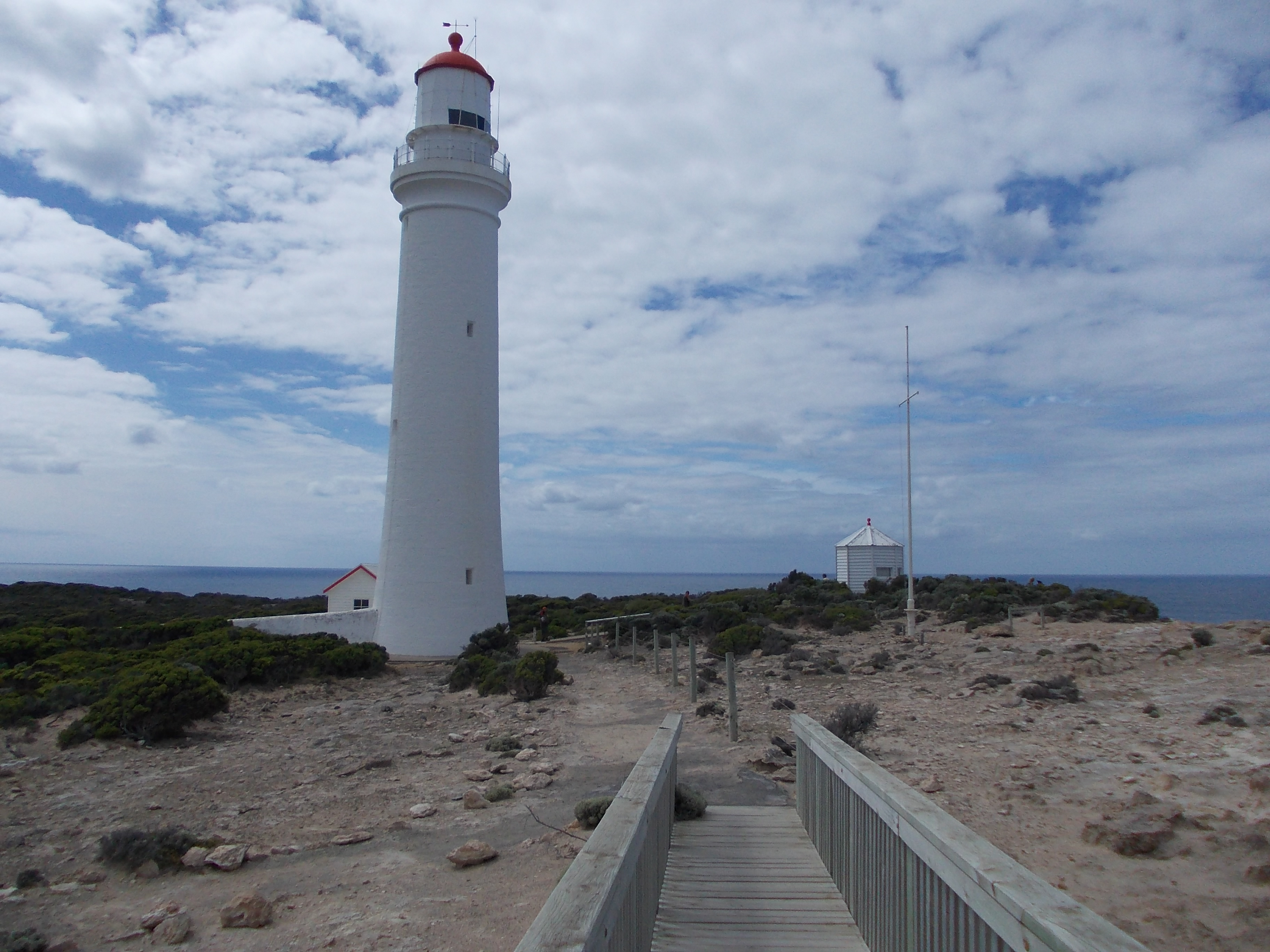
Cape Nelson Lighthouse

The Cape Nelson Lighthouse was fully operational in 1884 but calls for its construction came long before. One of the earliest references I have found to mention a lighthouse at Cape Nelson was in The Argus of 7 January 1864.

(1864, January 7). The Argus (Melbourne, Vic. : 1848 – 1956), p. 5. http://nla.gov.au/nla.news-page209236

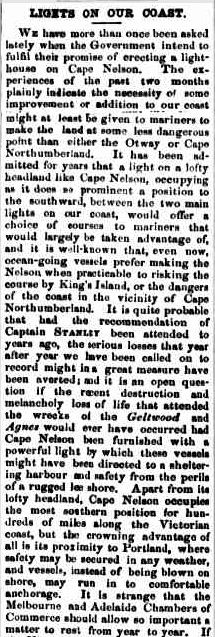
On 8 August 1876, the Portland Guardian expressed frustration at the Government not following through on a promise to build the lighthouse.

LIGHTS ON OUR COAST. (1876, August 8). Portland Guardian (Vic. : 1876 – 1953), p. 2  http://nla.gov.au/nla.news-article6333597

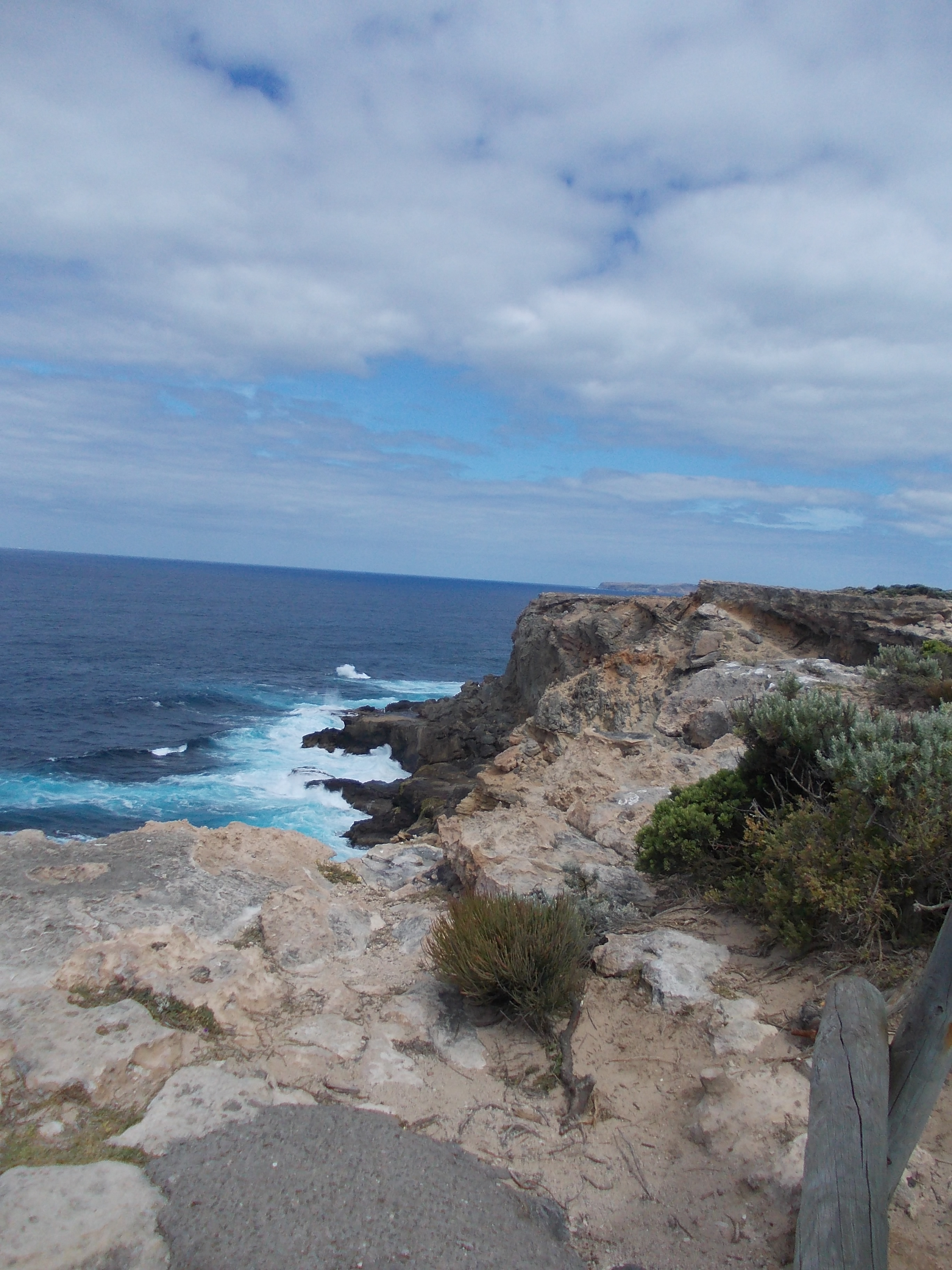
Coastline below the lighthouse

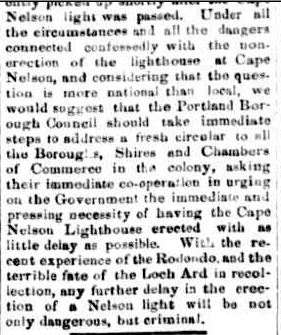
In 1879, the Portland Guardian considered the continual delaying of the lighthouse construction as criminal.
The Guardian. (1879, May 1). Portland Guardian (Vic. : 1876 – 1953), p. 2  http://nla.gov.au/nla.news-article63342225

Finally, in 1882, tenders were called for. The Portland Guardian made the announcement on 30 March 1882 and the article in full explained the plans for the proposed lighthouse.

THE CAPE NELSON LIGHTHOUSE. (1882, March 30). Portland Guardian (Vic. : 1876 – 1953), p. 2 Edition: MORNING.. Retrieved January 12, 2012, from http://nla.gov.au/nla.news-article63404134

Work began later in 1882, but strong winds and the lack of skilled workers impeded progress. The Portland Guardian offered some great articles outlining the progress of construction. An article from 28 December 1882 describes the construction of the wall and the assistant lighthouse keeper’s house. Another on 24 July 1883, describes the job of sourcing the stone for the job and talks of a lift that would aid the construction of the tower.

On Monday 7 July 1884, the Cape Nelson Lighthouse was lit for the first time. The joint honour was given to the then Mayor of Portland, Mr P.W. Shevill and former mayor, Mr W.T. Pile, who had played a big part in the project getting off the ground. A dinner was held that evening at Mac’s Hotel in Portland to celebrate.

THE LIGHTING UP OF THE NEW PHAROS ON CAPE NELSON. (1884, July 8). The Argus (Melbourne, Vic. : 1848 – 1956), p. 6. http://nla.gov.au/nla.news-article6052865

An article from the Portland Guardian of 8 July 1884 thanked the contractors Messrs. Horne and Slingo and looked at the history of the lighthouse from the time it was first determined a lighthouse was required, to the first lighting of the lamp on 7 July 1884.

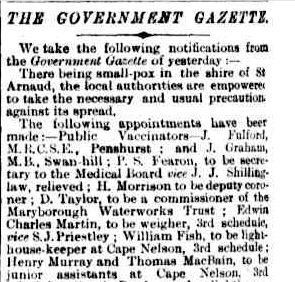
The first Lighthouse keeper at Cape Nelson was William Fish. His assistant was Henry Murray and the junior assistant was Thomas MacBain.

THE GOVERNMENT GAZETTE. (1884, September 6). The Argus (Melbourne, Vic. : 1848 – 1956), p. 12. Retrieved January 13, 2012, from http://nla.gov.au/nla.news-article6056910

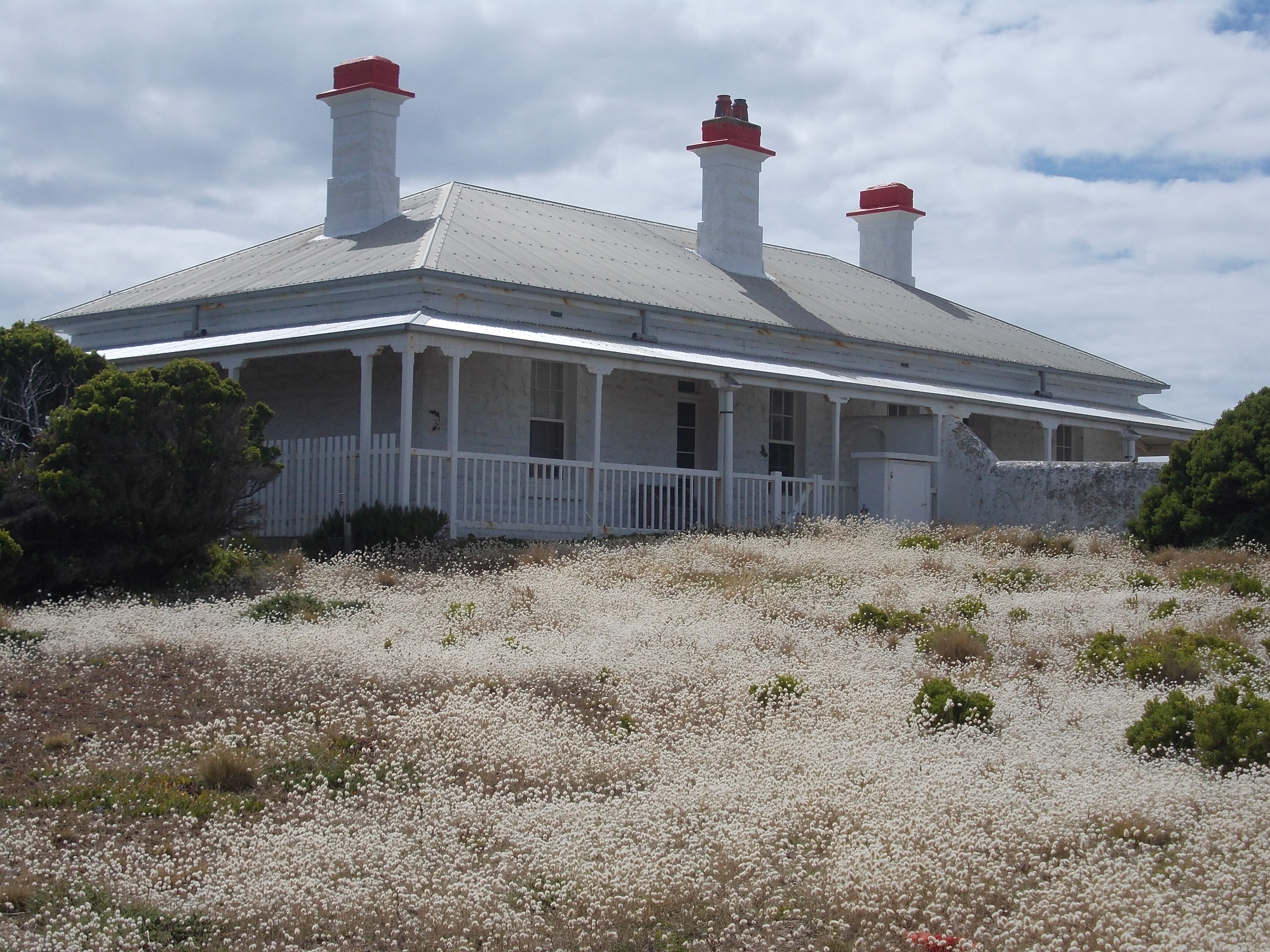
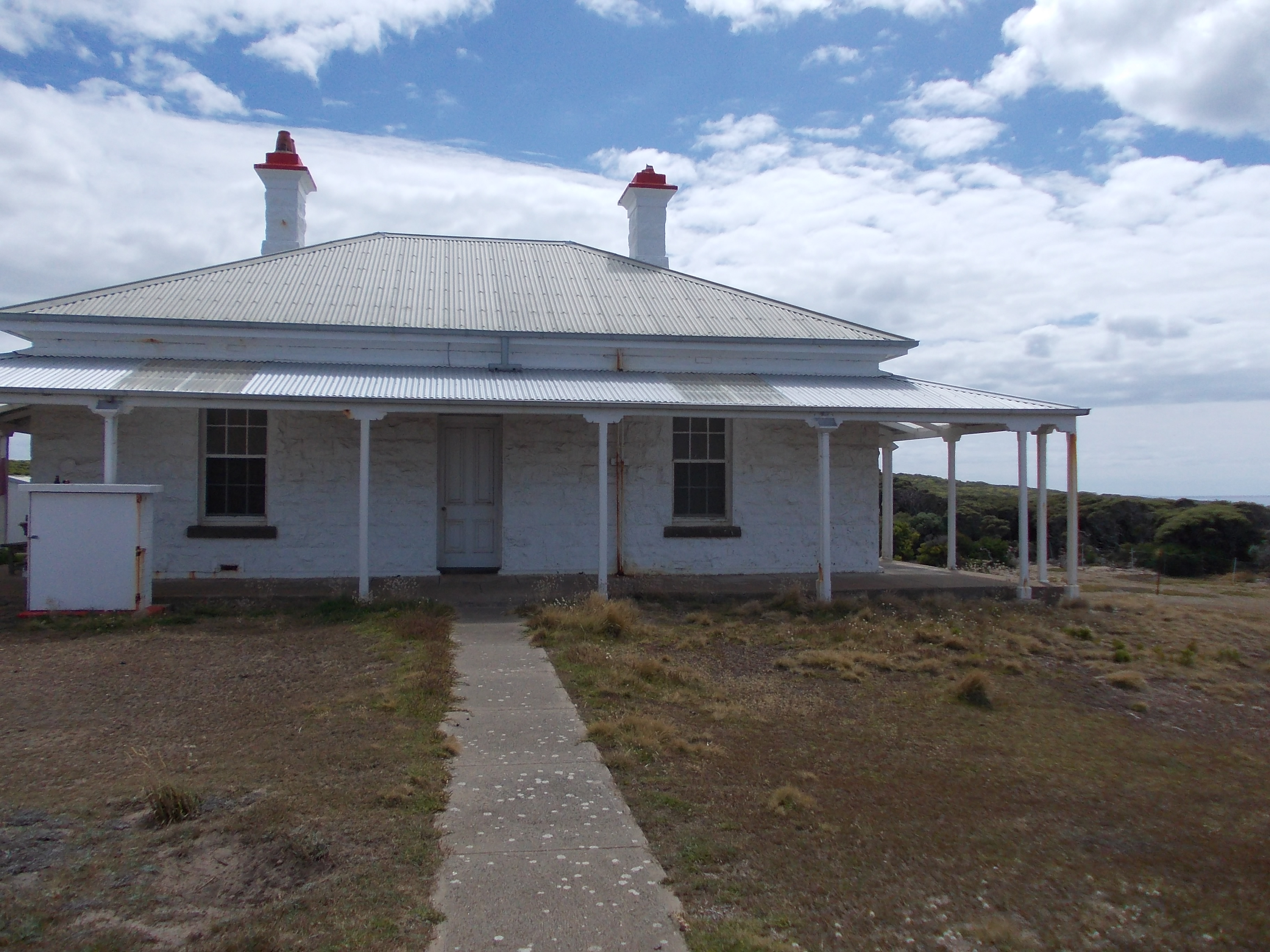
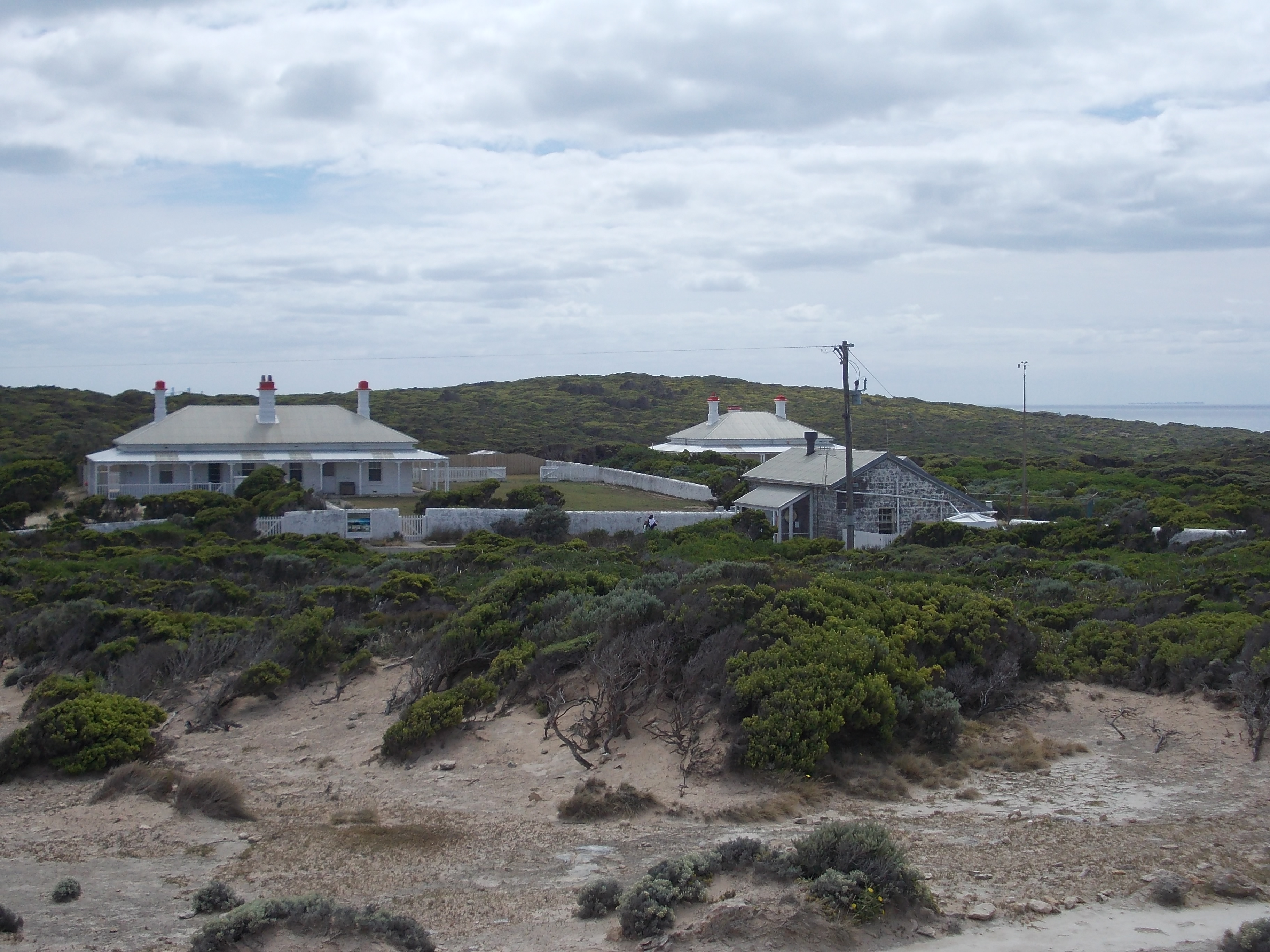
Lighthouse Keeper’s residence – Cape Nelson

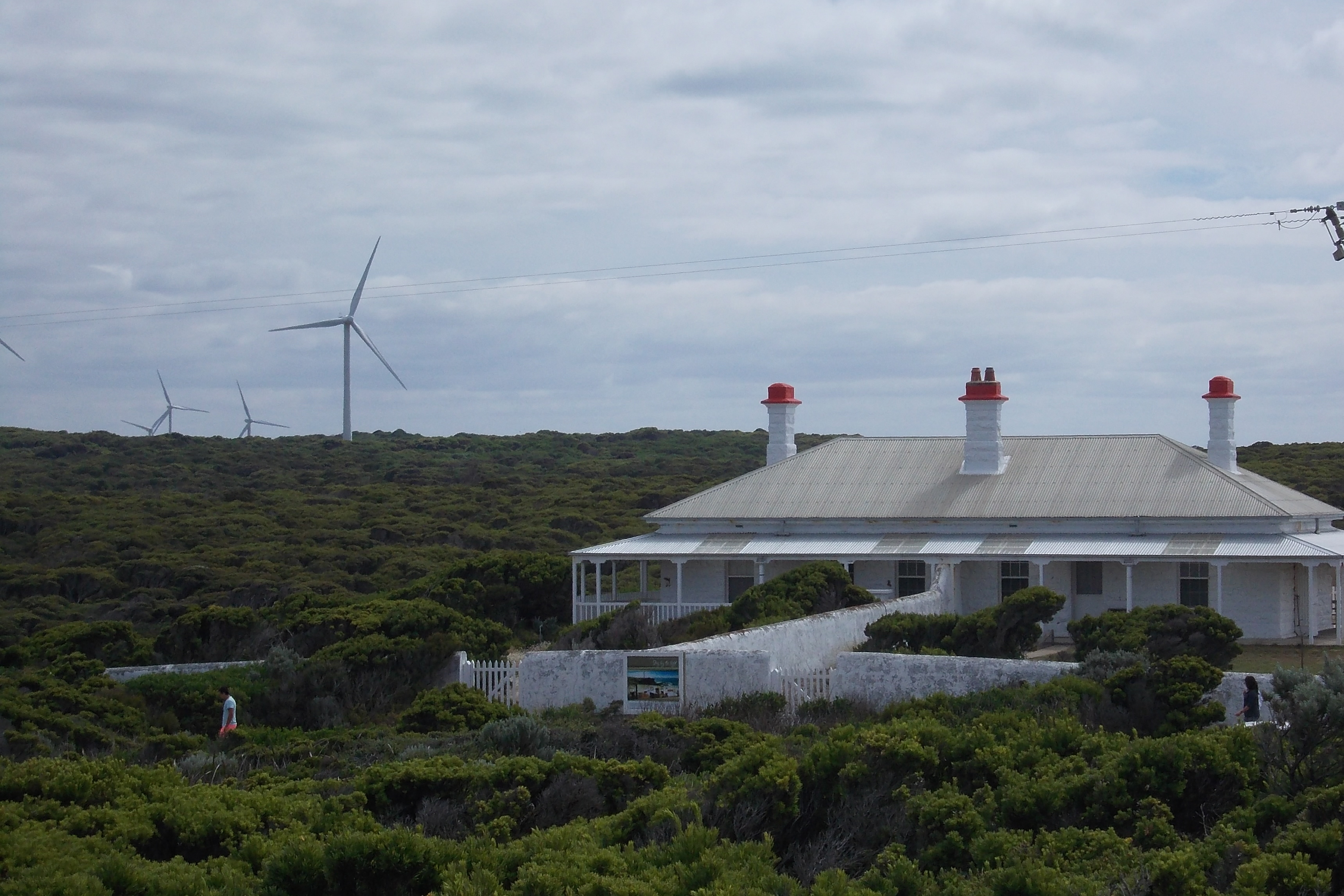
Assistant Lighthouse keeper’s Residence

Today, on the road to Cape Nelson and while at the lighthouse, it is difficult to miss the wind turbines. They look almost graceful on the landscape, but I am not too sure what William Fish would have made of them.

The Old and the New

FURTHER READING

There were other articles from the Portland Guardian about the Cape Nelson Lighthouse also worth reading:

Portland Guardian – 7 October 1882 – A WALK FROM PORTLAND TO THE CAPE NELSON LIGHTHOUSE SITE –  This article written by the “Traveller” describes a walk from Portland to Cape Nelson to inspect the site of the proposed lighthouse, a round trip of about 24 kilometres.

Portland Guardian – 19 August 1920 – BEACON OF THE NIGHT – “Openlight” describes a visit to the Lighthouse, including a climb to the top. There are also references to former lighthouse keepers at Cape Nelson, including William Fish.

Portland Guardian – 3 October 1927 – CAPE NELSON LIGHTHOUSE – This article tells of the role of parliamentarian Peter Lalor, of Eureka Stockade fame, in the eventual approval of a lighthouse at Cape Nelson.

Portland Guardian – 26 March 1931 – CAPE NELSON AND ITS LIGHTHOUSE – The correspondent “W.H.M” tells of a visit to the Cape Nelson Lighthouse. I found this article interesting, as it reports on the children of the lighthouse. He talks of Frank Piper, a boy of around nine, with sight in only one eye, and who was educated by correspondence. A reference was made to an article in The Argus, earlier in 1931, by a Mr Tate.  I managed to track down the article and found it was written by Frank Tate and appeared in The Argus on 28 February 1931, under the title – OUTBACK PUPILS – A MODERN DEVELOPMENT IN EDUCATION. This too was an interesting article discussing early distance education from the time it was introduced in Victoria in 1914 and after in other states. He states over 13000 students were receiving their school via correspondence in 1931, with many having not seen the inside of a classroom. Both articles touch on the loneliness of children living in remote places. Frank Piper did not see another child until he was six years old and became very emotional when he did, according to his mother.

Portland Guardian – 15 June 1939 – CAPE NELSON LIGHTHOUSE – This article recounts the laying of the lighthouse foundation stone at Cape Nelson in 1883 and a time capsule buried within.

Portland Guardian – 12 July 1951 – NATURE NOTES – B.E. Carthew reports on a scrapbook kept by Frank Row, which documents the life of former Portland mayor William Pile, one of the inaugural lamp lighters at the Cape Nelson Lighthouse. A clipping from the scrapbook was from the opening of the lighthouse in 1884 and it gives further insight into the day. There is also a list of lighthouse keepers from 1917 through to 1951.

©Merron Riddiford 2012

In the News – 13 January 1905

Western District pioneers were exposed to most of the elements Australia offers including flood, drought and fire.  Each had its own devastating effect on their lives and livelihood, particularly those on the land.

By summer 1905, my Harman family of Byaduk had already experienced bushfire.  Fires in 1888, 1896, 1901, and 1902 had seen the loss of stock, grazing land, and life.  Bushfires today are just as devastating, but the pioneers of the 19th century and early 20th century did not have the weather forecasting, firefighting equipment, and communications now available.  When a fire came close to their homes at Byaduk on 11 January 1905, one can only imagine how they managed.

The fire broke away in the stony ground near the Byaduk Caves and travelled southerly at a rapid pace.

NEAR BYADUK CAVES.

NEAR BYADUK CAVES.

The first Harman hit was George Harman, son of James Harman.  His property Quetta was on the north-eastern corner of the Hamilton-Port Fairy Road and what is now Harman’s Road. The fire crossed the main road onto his father’s property, Mt Pleasant, and Frank Kinghorn’s The Island next door. Alfred Harper lost all the timber for a new house, while others lost haystacks. Forty men were fighting the fire, but wind changes made it almost impossible for them.  The Portland Guardian reported on the fire on 13 January 1905.

HEAVY LOSSES AT BYADUK. (1905, January 13). Portland Guardian (Vic. : 1876 – 1953), p. 2 Edition: EVENING. Retrieved January 11, 2012, from http://nla.gov.au/nla.news-article63691042

Home from Portland

It was great to get reacquainted with Portland.  Apart from a quick overnight trip about 15 years ago, I had not visited since the 1970s and 80s with most of my time then spent around the harbour and foreshore.  The town really has not changed, but now, compared to when I was a pre-teen on Sunday afternoon outings, I have a greater appreciation of Portland’s history.

It did turn out that some of those Sunday afternoon outings were to witness events that are now ingrained in the history of Portland.  At one time, around 1979, we drove from Hamilton to Portland just to see a live sheep export ship!  Sounds boring, and it probably was for an 11-year-old, but a storm was brewing.  The following months, into 1980 saw protests, black banned transport companies, and disgruntled meat process workers from the local Borthwicks abattoir.  The issue was the talk of the Western District and beyond, at a time when the Western District “rode on the sheep’s back”.

Another visit was to see the ongoing construction of the Alcoa plant, now a familiar fixture on Portland’s landscape.  Construction began in 1981 and smelting began in 1986.  The arrival of Alcoa was a milestone in Portland’s history, offering employment and growth.

Over a series of posts, I will share some of what we saw on our recent visit, including the early architecture of Portland, the Cape Nelson Lighthouse, Bridgewater, and the Old Portland cemetery.

It will be a busy month.  As well as school holidays and extra “real” work for me, there will be a January Passing of the Pioneers and I will be joining my fellow geneabloggers for the Australia Day 2012 blog: Wealth for Toil.   I also will be posting my family’s stories, which is really why I’m here.  I just get a bit sidetracked.  I will share the stories of Sarah and Walter Harman, two more of the children of Joseph and Sarah Harman.   I am already looking forward to February when school returns, so I can have a rest!

Just to give you a taste of what is to come, this a photo I took of the Cape Nelson Lighthouse Keeper’s cottage.

Cape Nelson Lighthouse Keeper’s Cottage

I Hear There is Good Fishing at Portland

We are off to Portland for a couple of days.  As Victoria’s first permanent settlement, it is dripping with history.  What a good idea my suggestion of great fishing was when we were deciding where to go.  I can do some history stuff (I’m hoping to get a lot of photos) and they can fish.  There are also several activities of a historical nature we can all take part in.  My small research assistant will be learning about Victoria’s history and he won’t even know it!

On offer is the Historic Buildings Walk with 48 buildings marked on a convenient map.   The Old Portland cemetery will be a must with the oldest recognisable grave dating back to 1848.  There is a self-guided tour brochure highlighting some of the more significant graves.  We will visit the Portland Maritime Discovery Centre and I am sure my small research assistant will enjoy it.  There is the ribcage of a sperm whale which is large enough to sit inside.

I am particularly looking forward to seeing the Immigration Wall.  This is a great initiative.  Descendants of immigrants who first set foot in Australia at Portland are able to buy a plaque for the wall.  One day I hope that James and Susan Harman and William and Margaret Diwell will have their own plaque.

We also plan to visit nearby Cape Bridgewater settled by a hardy band of pioneers.  From my Passing of the Pioneers posts, I have learnt much about those that settled the area and would like to see something of the land that lay before them.  A number of pioneers from the Cape Bridgewater area are already listed on the Passing of the Pioneers list.  Graves of pioneers with names such as Kittson, White, Hedditch and Malseed can all be found at the Cape Bridgewater cemetery. There are also many natural attractions nearby such as a petrified forest and Shelly Beach.

Back in Portland we can Walk in the Footsteps of Mary McKillop, visit the second oldest Botanic gardens in Victoria, and take a ride in a cable tram along the bay.  If I can squeeze it, I would like to visit History House, home of the Portland Family History group.  Not only are there research facilities available, but there is also a social history museum on site.

I hope the fishing is good, because with so much to do we may have to go back again.

A Life Cut Short

In September 1929, the Advocate from Burnie, Tasmania, reported on the Harman family and their longevity.

Family’s Longevity. (1929, September 10). Advocate (Burnie, Tas. : 1890 – 1954), p. 5. Retrieved December 19, 2011, from http://nla.gov.au/nla.news-article67674788

Jonathan died the next year, George made it to 96, Walter 90, Alfred 81 and Sarah (Mrs Adams), 86.   Add brother James who died in 1916 at the age of 86 and the average age of six of the seven children of Joseph and Sarah Harman that came to Australia was 88.

Reuben Harman did not achieve the longevity of his siblings. He died in 1883 aged 44 but if he had of lived on, he would have been the third pea in a pod, with brothers James and Jonathan.

Reuben was born in Melbourn, Cambridgeshire in 1839 and by the age of 12, he was already working as an agriculture labourer as the 1851 UK Census shows.  He was the youngest of the trio of brothers who sailed to Sydney aboard the Kate in 1854, aged 15.

The earliest record I have found of Reuben in Australia, was in 1864 when he married Elizabeth Oliver.  Elizabeth was the sister of Mary Oliver who had married Jonathan Harman two years earlier.  They resided in Byaduk where Reuben farmed with his brothers.  He acquired land and his home property was Berry Bank at Byaduk.  Reuben and Elizabeth raised six children:

Bertha:  Birth: 1866 at Byaduk;  Marriage:  1892 to Felix Alexander James FULLBROOK ;  Death: 1932 at Nambowla, Tasmania

Absalom:  Birth: 1868 at Byaduk’;  Marriage:  1904 to Hazel Maud FILMER;  Death 1954 at Bannockburn, Victoria.

Gershom:  Birth: 1869 at Byaduk;  Marriage: 1905 to  Elizabeth HILLIARD;  Death: 1940 at Hamilton.

Jessie:  Birth: 1871 at Byaduk;  Marriage:  1898 to Walter GREED;  Death: 1949 at Hamilton.

Beatrice:  Birth:  1878 at Byaduk;  Death:  1929 at Hamilton.

Sarah Mulbery:  Birth: 1880 at Byaduk; Death:  1931 at Hamilton.

I have found two references to Reuben at Trove, both from the 12 months before his death.

The first article about Reuben was for a transfer of a lease from himself to brother Jonathan,  found in the Portland Guardian of May 23, 1882.

The Guardian. (1882, May 23). Portland Guardian (Vic. : 1876 – 1953), p. 2 Edition: MORNING.. Retrieved January 2, 2012, from http://nla.gov.au/nla.news-article71582275

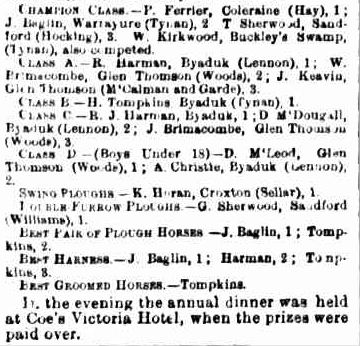
The second, in The Argus of August 19, 1882, reports on the Hamilton ploughing match at Strathkellar, east of Hamilton.  Reuben won Class A, a division down from Champion Class, in heavy conditions.  His plough of choice was the Lennon, also favoured by brother James. He rounded out the day with a second place in the Best Harness class.

HAMILTON PLOUGHING MATCH. (1882, August 19). The Argus (Melbourne, Vic. : 1848 – 1956), p. 11. Retrieved January 2, 2012, from http://nla.gov.au/nla.news-article11550437

On April 28, 1883, Reuben Harman passed away aged just 44 from hydatids.  Reuben was buried at the Byaduk Cemetery.

Headstone of Reuben, Elizabeth, Beatrice and Sarah Harman, Byaduk Cemetery

James Harman was the executor of Reuben’s Will and was very exacting in his application for probate.  Reuben’s estate was to the value of  £1226, quite a tidy sum in 1883.  His assets included 128 acres of land, divided into two parts, one with a two-roomed slab hut with an iron roof and slab partitions.  There was also a further 26 acres of land, 3 horses, 17 head of cattle, 150 sheep, a buggy and an almost new plough.  There is a record of an interest he had in selected land of 70 acres.

After Reuben’s death,  Elizabeth was left to care for the children, then aged 17 down to three.  The first to marry was Bertha in 1892 when she was 26.  Gershom and Jessie also married, however, the two youngest daughters, remained unmarried.  Elizabeth, Beatrice and Sarah eventually moved into Hamilton, with the two girls working as knitting manufacturers.

In 1907, Elizabeth returned to Byaduk to represent her family in a photo at the Byaduk and District Pioneers day.  She appears in the group photo from the day.

Elizabeth died in 1919 at Hamilton.  Beatrice and Sarah only lived for another 10 and 12 years respectively, both dying at 52.

This is the last story of the four Harman boys who travelled independently to Australia.  The last three Harman siblings, Sarah, Walter and Alfred, travelled with their parents, Joseph and Sarah to Australia.  Sarah was 11, Walter 10 and Alfred only three.  The stories of those three Harmans are very different from their four older brothers.

New Year’s Day in the Western District

Less than a week on from Boxing Day, a popular day on the calendar for sports and racing, the Western District pioneers were back at it on New Year’s Day.  Most towns had a sports carnival or race meeting or both and the townsfolk flocked to them.

The Turf Inn, just north of Ballarat, had a busy day on New Year’s Day 1858 with sports and pony races held in the vicinity.

THE TURF INN. (1858, January 2). The Star (Ballarat, Vic. : 1855 – 1864), p. 3. Retrieved December 29, 2011, from http://nla.gov.au/nla.news-article66045904

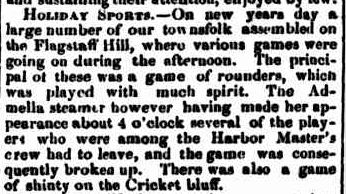
At Warrnambool, New Year’s Day 1859 was celebrated with games on Flagstaff Hill, including rounders.  A game of shinty, a Scottish game like hockey, was also enjoyed.

DOMESTIC INTELLIGENCE. (1859, January 3). Portland Guardian and Normanby General Advertiser (Vic. : 1842 – 1876), p. 2 Edition: EVENINGS.. Retrieved December 29, 2011, from http://nla.gov.au/nla.news-article64509933

The Caledonian games were a popular New Years Day outing for the people of Ballarat in 1861.  I can relate to the poor shop assistants watching the passing parade of happy people enjoying the public holiday.  I have worked more public holidays than I care to remember, in fact I am working today.  I must say while it is annoying at times, I don’t find myself  thinking as the 1860s employees did “wishing all manner of ills to the exacting master whose behests precluded them from mixing in the throng of light hearts and merry faces that swept past the doors…”

NEW YEAR’S DAY. (1861, January 2). The Star (Ballarat, Vic. : 1855 – 1864), p. 2. Retrieved December 30, 2011, from http://nla.gov.au/nla.news-article66336603

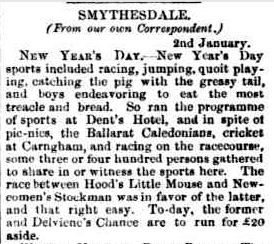
Smythesdale, just out of Ballarat, managed to attract three to four hundred people to their sports day in 1862, despite many other activities threatening to draw people away.  Some of the more interesting sports were catching the pig with the greasy tail and treacle and bread eating competitions.

SMYTHESDALE. (1862, January 3). The Star (Ballarat, Vic. : 1855 – 1864), p. 2. Retrieved December 30, 2011, from http://nla.gov.au/nla.news-article66330531

At Digby in 1863, the local school children held their annual festival and indulged in many cakes and other sweet treats.

DIGBY. (1863, January 6). Portland Guardian and Normanby General Advertiser (Vic. : 1842 – 1876), p. 3 Edition: EVENING. Retrieved December 30, 2011, from http://nla.gov.au/nla.news-article64627825

I could not imagine a government today, state or federal, holding an election between Christmas and New Year.  On December 30, 1865, a general election was held in Victoria, but the timing was not tactical, but due to the dissolution of the fourth government of Victoria on December 11.  New Year’s Day 1866 was spent enjoying the local cricket match and waiting for election results.

NEW YEAR’S DAY. (1866, January 4). Portland Guardian and Normanby General Advertiser (Vic. : 1842 – 1876), p. 2 Edition: EVENING. Retrieved December 30, 2011, from http://nla.gov.au/nla.news-article64635496

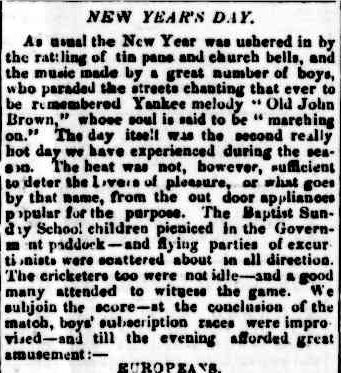
The church bells rang out over Portland at midnight on New Year’s eve 1866, with local boys out on the streets singing “Old John Brown”.  The first day of the new year was hot and outdoor activities were again popular.

NEW YEAR’S DAY. (1867, January 3). Portland Guardian and Normanby General Advertiser (Vic. : 1842 – 1876), p. 2 Edition: EVENING. Retrieved December 30, 2011, from http://nla.gov.au/nla.news-article6463696

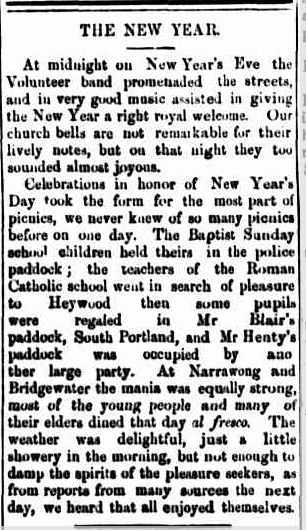
In 1869, New Year’s Day saw al fresco dining at Bridgewater and Narrawong.  The correspondent reported he had not seen so many picnics on one day, including one held for the Baptist Sunday school children and a large gathering at Mr Henty’s paddock.

THE NEW YEAR. (1869, January 4). Portland Guardian and Normanby General Advertiser (Vic. : 1842 – 1876), p. 2 Edition: EVENINGS. Retrieved December 30, 2011, from http://nla.gov.au/nla.news-article64691465

The Australian Sketcher with Pen and Pencil ran a picture of Portarlington on New Years Day, 1879.

(1879, January 18). The Australasian Sketcher with Pen and Pencil (Melbourne, Vic. : 1873 – 1889), p. 172. Retrieved December 30, 2011, from http://nla.gov.au/nla.news-page5739740

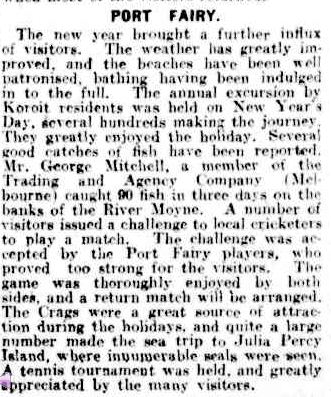
Finally an article from Port Fairy, a popular holiday place then and now for people of the Western District and a place I have celebrated New Year’s Eve on several occasions.  In 1927, visitors to the town had swelled, including a party of several hundred Koroit residents on their annual excursion.  Beaches, fishing, cricket, and boat trips to Julia Percy Island kept the holidaymakers entertained.

HOLIDAY RESORTS. (1927, January 8). The Argus (Melbourne, Vic. : 1848 – 1956), p. 23. Retrieved December 30, 2011, from http://nla.gov.au/nla.news-article3831051

Happy New Year!