The Sultan of Shelly Beach

This was going to be a post about our visit to Shelly Beach in January, a trip to rekindle childhood memories of visits there.  Along with photos and an article which described the beauty of the beach,  I had it covered. However, as is usually the case, I could not settle at that.  I had to search Trove for more information on Shelly Beach and what I found has given the post a twist as I introduce you to a wonderful character who had a link to Shelly Beach in the 1930s.

Firstly, here is part of the article “Beautiful Shelly Beach” that was going to feature.

Beautiful Shelly Beach. (1939, March 30). Portland Guardian (Vic. : 1876 – 1953), p. 3 Edition: EVENING.. Retrieved March 26, 2012, from http://nla.gov.au/nla.news-article64392283

When I returned to Trove, I was keen to find a photo of Shelly Beach.   What I found was beyond my expectations.

No title. (1933, June 24). The Argus (Melbourne, Vic. : 1848 – 1956), p. 5. Retrieved March 26, 2012, from http://nla.gov.au/nla.news-article4744401

The caption reads:  “These camels are employed in removing grit from Shelly Beach, near Portland.  Each carries two bags each weighing 2cwt. each and makes 15 trips daily over the sandhills.   The owner is over 70 years old and has four wives”.

Well, I couldn’t leave it there.  Back to the Portland Guardian, I went to search “camels Shelly Beach”.  From that, I discovered a lot more about the mysterious man with the camels.  Jumping ahead two years from the original picture I found the following “Letter to the Editor” from the man himself:

Camels at Portland. (1935, January 24). Portland Guardian (Vic. : 1876 – 1953), p. 1 Edition: EVENING.. Retrieved March 26, 2012, from http://nla.gov.au/nla.news-article64287962

From one letter, so much is learnt.   Sultan Aziz, it seems, was giving rides to tourists on the North beach at Portland during the summer and carting shell grit at Shelly Beach during the winter.  He was working for Mr Vivian Jennings, a local carrier.  Why were the camels being used to cart the shell grit?  The next article explains:

CARTING SHELL GRIT. (1933, May 16). The Horsham Times (Vic. : 1882 – 1954), p. 5. Retrieved March 26, 2012, from http://nla.gov.au/nla.news-article72660392

Sultan Aziz appears to have been in Portland from at least 1933, but he did travel around the south-west and into South Australia.  In 1934, he and his camels were the star attraction of the Mt. Gambier Tourist Promotion Association parade on 21 February 1934.  Sultan Aziz arrived the day before after travelling along the coast from Portland.

T.P.A. CARNIVAL. (1934, February 20). Border Watch (Mount Gambier, SA : 1861 – 1954), p. 1. Retrieved March 26, 2012, from http://nla.gov.au/nla.news-article77960150

From this, we now know that the Sultan had a son, Abdul.

Mt. Gambier embraced Aziz, if the front page of the Border Watch on 22 February 1934, was any indication.  My favourite photo was that of the mayor, dressed in cameleers robes, riding one of  Sultan Aziz’s camels.

MAYOR LEADS CARNIVAL PROCESSION ASTRIDE CAMEL. (1934, February 22). Border Watch (Mount Gambier, SA : 1861 – 1954), p. 1. Retrieved March 26, 2012, from http://nla.gov.au/nla.news-article77960232

There were five photos on the front page that day, all of which included the camels! Sultan Aziz spent at least a month in South Australia selling camel rides at the Mt. Gambier Showgrounds.   It was not a profitable exercise as discussed at a meeting of the Mt. Gambier A & H Society in March 1934.

MOUNT GAMBIER A. & H. SOCIETY. (1934, March 3). Border Watch (Mount Gambier, SA : 1861 – 1954), p. 3. Retrieved March 26, 2012, from http://nla.gov.au/nla.news-article77960562

On his way back to Portland, Aziz called in at Allendale East, south of  Mt. Gambier.  The camels were once again a source of excitement.

REPORTS FROM RURAL CENTRES. (1934, March 20). The Advertiser (Adelaide, SA : 1931 – 1954), p. 19. Retrieved March 26, 2012, from http://nla.gov.au/nla.news-article47544800

In October 1934, the Sultan applied to the Portland Council to have his camels on the South Beach over the summer, however, the council decided he should stay on the North Beach.

Borough Council. (1934, October 4). Portland Guardian (Vic. : 1876 – 1953), p. 3 Edition: EVENING.. Retrieved March 27, 2012, from http://nla.gov.au/nla.news-article64286951

The following photo was taken during summer 1935 at Portland.  The former Portland Baths are in the background.  Enjoying the novelty of a camel ride are Eileen Hickmer, Gladys Read and Jean Ainsworth.
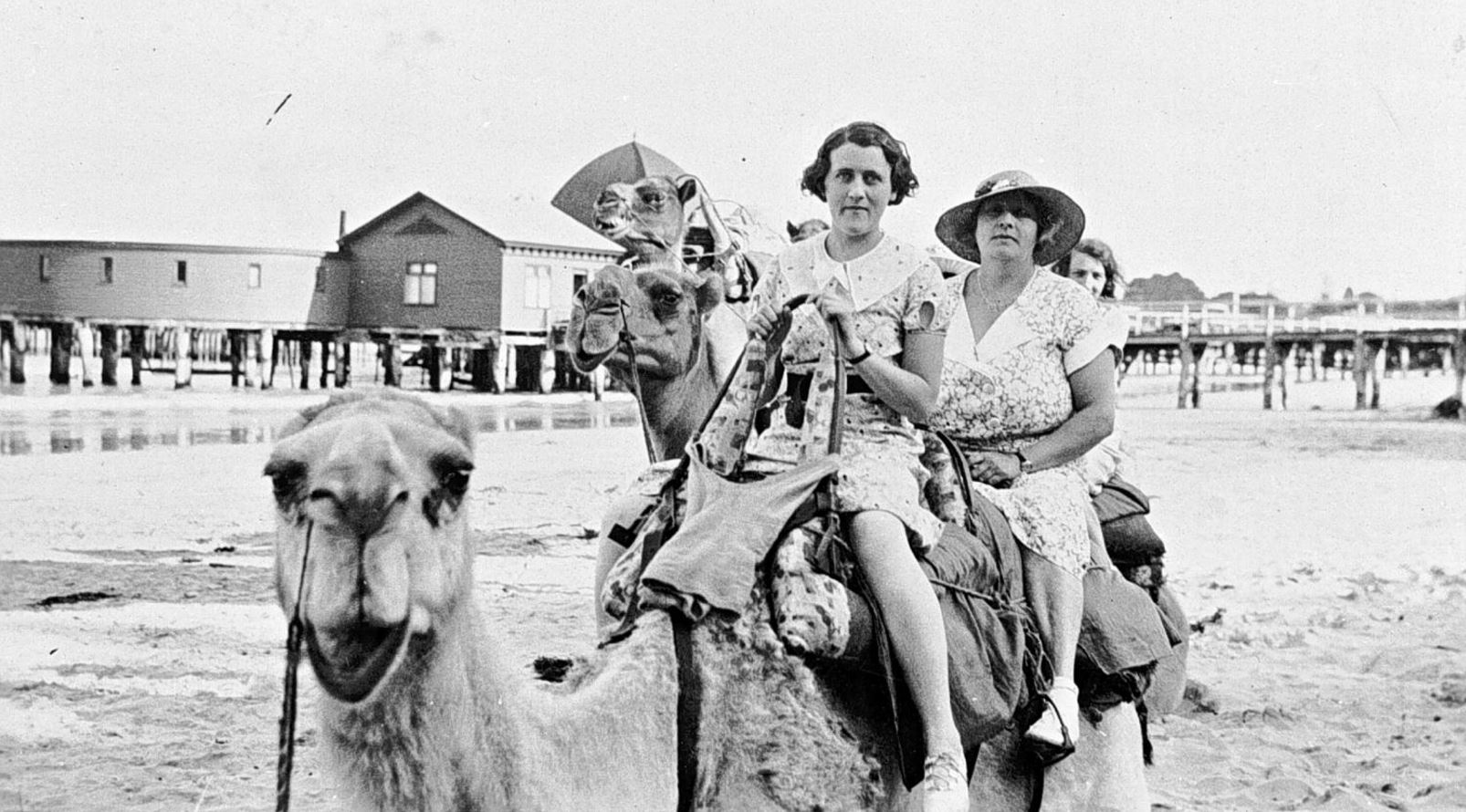
SULTAN AZIZ’S CAMELS ON PORTLAND BEACH IN 1935. Image courtesy of the Museums Victoria Collections https://collections.museumvictoria.com.au/items/773643

This takes us to the time of the “Letter to the Editor” of January 1935.  The Sultan only stayed in Portland another six months, leaving just as another southern winter hit.  He returned home to Broken Hill.  It may well have been a combination of cold weather and the discontent over his camels he spoke of in his letter.  His trip to Portland made news in Broken Hill’s Barrier Miner.

Long Trek On Camels. (1935, October 5). Barrier Miner (Broken Hill, NSW : 1888 – 1954), p. 7 Edition: SPORTS EDITION. Retrieved March 27, 2012, from http://nla.gov.au/nla.news-article46707350

An interesting part of this story is Sultan Aziz’s age.  The photo I found from 1933, gives his age as over 70.  Eight years later in 1941, he was claiming he was 112 which would have made him 104 when the photo on Shelly Beach was taken! I don’t know about that.

“God Is Good” Says Sultan Aziz. (1941, May 16). Barrier Miner (Broken Hill, NSW : 1888 – 1954), p. 1 Edition: HOME EDITION. Retrieved March 27, 2012, from http://nla.gov.au/nla.news-article48407504

A year later he was back in the news, claiming he, at 113 was the oldest person in the Commonwealth.
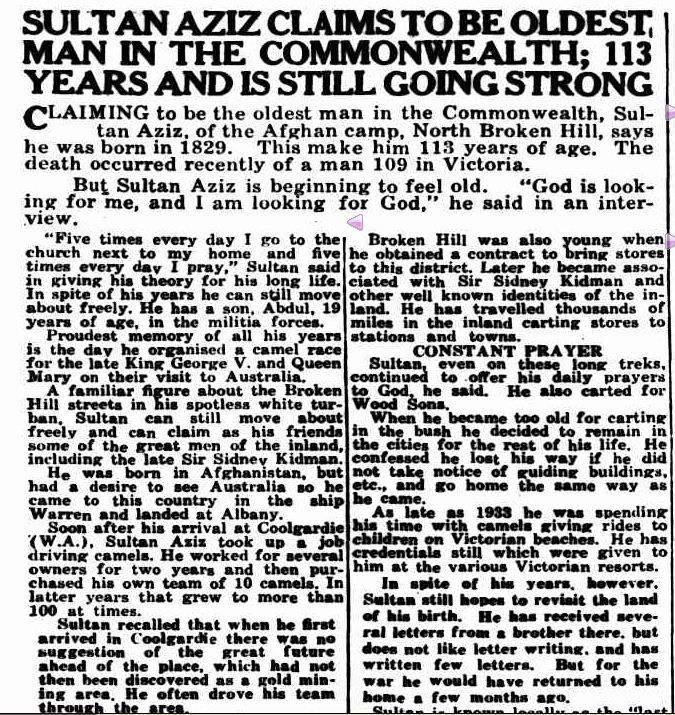
SULTAN AZIZ CLAIMS TO BE OLDEST MAN IN THE COMMONWEALTH; 113 YEARS AND IS STILL GOING STRONG. (1942, August 13). Barrier Miner (Broken Hill, NSW : 1888 – 1954), p. 3. Retrieved March 27, 2012, from http://nla.gov.au/nla.news-article48401748

Sadly, age did catch up with Sultan Aziz.  He passed away in 1950.  His age was given as 105.

AFGHAN DIES AT 105. (1950, August 16). Barrier Miner (Broken Hill, NSW : 1888 – 1954), p. 12. Retrieved March 27, 2012, from http://nla.gov.au/nla.news-article49578554

Summarising Sultan Aziz’s life in Australia through the newspaper articles,  I found he was born in Afghanistan and arrived in Albany, Western Australia via India,  around 1885.  His memories from that time included organising a camel race for His Royal Highness, The Duke of York and Cornwall who would, in 1910, become King George V.

An article from the Northern Times, Carnarvon, Western Australia on March 23, 1912, saw Aziz still in W.A. However, he was selling his camels and then sailing for South Australia to take camels back overland to Carnarvon.  I don’t think he made it all the way back as he ends up in Broken Hill with a carting contract around that time. Many other cameleers from Afghanistan were camped at Broken Hill.  He carted goods into central Australia with his camels, working for Sir Sidney Kidman.  At one time he claims to have owned up to 200 camels.  In the 65 years he was in Australia, he must have racked up some miles on his camels.  The trip from Broken Hill to Portland alone was over 900 kilometres.

He had a least one son, Abdul Aziz, who accompanied his father on his trip to Victoria.  Abdul attended school while in Portland and went on to serve in WW2.

In his later years, Sultan Aziz was the caretaker of the mosque in Broken Hill and tended his fowls.

Of course, this is mostly information provided by Sultan Aziz himself and is still to be supported by other sources.

I also did a search for marriages for Sultan Aziz, because I had to know if he did have up to four wives.  However, I did not find a harem, rather a marriage in 1923 to Bigham Kahn at Broken Hill.  This could be Abdul Aziz’s mother.  It is possible that Sultan Aziz had wives he left in Afganistan, which was not unusual for the cameleers.

It really is a great story of another colourful character to find his way into the Western District of Victoria.  I wonder if any of my relatives saw their first camel or paid a penny for a ride on the North Portland Beach.

Further Reading:

If you would like to learn more about the cameleers who helped explorers and pastoralists venture into inland Australia, the website Australia’s Muslim Cameleers is worth a visit.  There is so much information about the Muslim cameleers, including biographies. Yes, Sultan Aziz’s biography is among them.  One interesting fact is that at least 2000 cameleers arrived in Australia during the fifty years from 1870 to 1920 and 20,000 camels!  Most Australians would know Central Australia today has a lot of camels but would have no idea how and why they are there.

There is also a book by Phillip Jones and Anna Kenny, Australia’s Muslim Cameleers.  It includes a biographical listing of over 1200 cameleers.

The Age, on January 3, 2012, published an article entitled Afghans, cameleers and the massacre of Broken Hill.  It includes photos of cameleers and a mining registration form belonging to Sultan Aziz.  This was from 1939 and according to his own calculations at the time, he would have been around 110!  There is a photo, so see what you think.

I also located the WW2 service record of Abdul Aziz.  This was sad to read.  Abdul, born in 1923, enlisted in the Australian Military Service in 1942, aged 18 and later the A.I.F. in 1944.  He was sent to Bougainville in 1945 and after only four months, he received life-threatening wounds to his leg, thanks to a shell.  He returned to Australia.

Further on in the service record,  I found a letter from 1958 of Thora Aziz’s application to buy a home with help from Legacy.  Her husband Abdul had died in 1951.  He would have been only 28.  Such a short life for the son of a centenarian.

St. Patrick’s Day in Western Victoria

There is plenty of Irish blood flowing through the veins of the people of the Western District, particularly the south-west.  Port Fairy (formally Belfast), Koroit, and Killarney, in particular, saw the settlement of large Irish families.

The earliest Western District St. Patrick’s Day reference I found was from the Portland Guardian and Normanby General Advertiser, from March 4, 1843.  Enthusiastic preparations were underway for a dinner on March 17th.

LOCAL INTELLIGENCE. (1843, March 4). Portland Guardian and Normanby General Advertiser (Vic. : 1842 – 1876), p. 3. Retrieved March 16, 2012, from http://nla.gov.au/nla.news-article71569103

St Patrick’s Day was for a time, a public holiday and races were popular, both the horse and human kind.

HAMILTON. (1858, March 19). Portland Guardian and Normanby General Advertiser (Vic. : 1842 – 1876), p. 2 Edition: EVENINGS.. Retrieved March 16, 2012, from http://nla.gov.au/nla.news-article64570752

In 1869 at Portland, the Rechabite Society fete for the Band of Hope children was a feature of the day.

ST. PATRICK’S DAY. (1869, March 18). Portland Guardian and Normanby General Advertiser (Vic. : 1842 – 1876), p. 2 Edition: EVENINGS. Retrieved March 16, 2012, from http://nla.gov.au/nla.news-article64691997

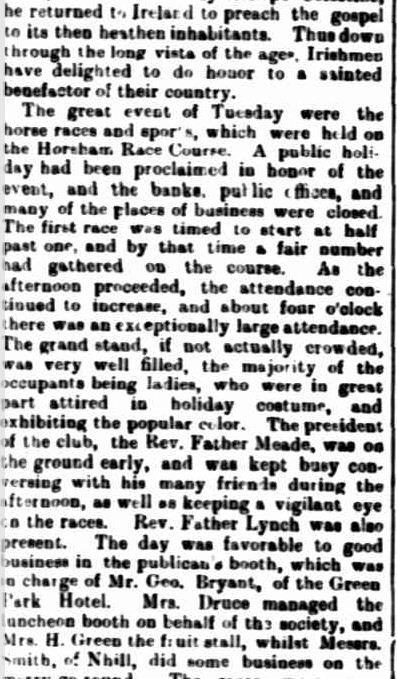
The Horsham Times of March 20, 1903, explains the reason behind the wearing of a green ribbon on St. Patrick’s Day and the story of St Patrick. The people of Horsham went to the races on March 17, 1903.

ST. PATRICK’S DAY. (1903, March 20). The Horsham Times (Vic. : 1882 – 1954), p. 3. Retrieved March 16, 2012, from http://nla.gov.au/nla.news-article72838336

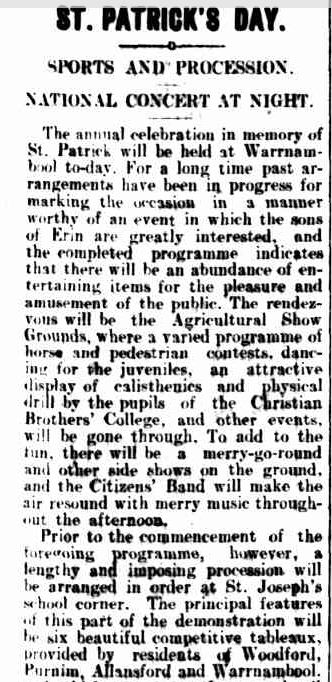
At Warrnambool, in 1914, plans were underway for the annual St. Patrick’s Day celebration, which included a parade in the afternoon and a concert in the evening.

ST. PATRICK’S DAY. (1914, March 14). Warrnambool Standard (Vic. : 1914 – 1918), p. 3 Edition: DAILY.. Retrieved March 16, 2012, from http://nla.gov.au/nla.news-article73467140

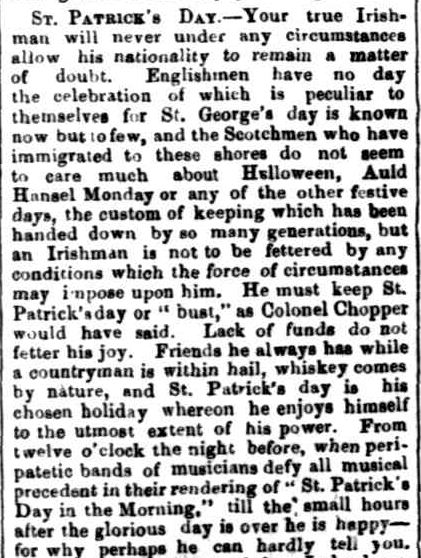
Finally, a reporter for the Star in Ballarat in 1858, observed that while the English barely remembered St. George’s day and the Scots were not interested in Halloween, the Irish would never let St Patrick’s Day be forgotten.  The Irish miners would be pleased St. Patrick’s Day is still celebrated today, minus the public holiday.

Local and General News. (1858, March 18). The Star (Ballarat, Vic. : 1855 – 1864), p. 3. Retrieved March 17, 2012, from http://nla.gov.au/nla.news-article66047115
MLA citation

In The News – 8 February – 13 February 1901

I have an interest in the weather, not just for today or the coming weekend but also historically.  Participating in Melbourne University’s Climate History newspaper tagging project involving tagging Trove newspaper articles about weather events, it became evident the weather behaves in a cyclical nature.  If it has happened before it will happen again, droughts, floods, and storms.

Taking my interests a step further,  investigating how weather events affected my ancestors can add greatly to their story. That is why the Victorian bushfires of 1901 are of interest as the Byaduk district, where many of my ancestors lived, was heavily affected.  The weather was similar to two days in my lifetime,  Ash Wednesday on 16 February 1983 and  Black Saturday on 7 February 2009. On each day, fires blazed across Victoria.  

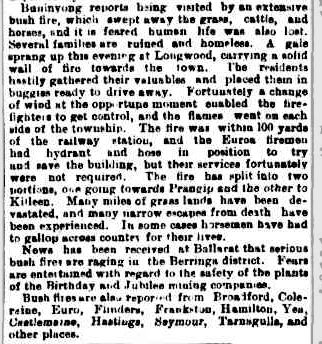
The first reports of fire came through on 8 February 1901.  The following article from The Argus describes the weather of 7 February 1901.  The descriptive language takes the reader to that day.  The heat was oppressive, the wind was strong and dust storms crossed the state, causing unnatural darkness.

HEAT AND GALES. (1901, February 8). The Argus (Melbourne, Vic. : 1848 – 1956), p. 5. Retrieved January 29, 2012, from http://nla.gov.au/nla.news-article10533956

Fires had sprung up throughout the Western District.  Early reports from Branxholme were tragic with one death, stock killed and houses lost.  I have family links to three families who lost their homes, the Millers, Storers and Addinsalls.  George Miller, a racehorse trainer, lost his house and stables and no doubt his horses.

HEAT AND GALES. (1901, February 8). The Argus (Melbourne, Vic. : 1848 – 1956), p. 5. Retrieved January 29, 2012, from http://nla.gov.au/nla.news-article10533956

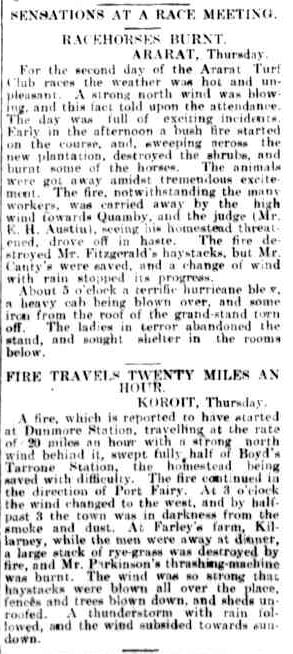
The two-day race meeting at Ararat was held in stifling conditions. A fire started at the course on the second day, with horses receiving burns.  Later the wind picked up and ripped iron off the grandstand roof, sending the ladies within running for shelter.

HEAT AND GALES. (1901, February 8). The Argus (Melbourne, Vic. : 1848 – 1956), p. 5. Retrieved January 29, 2012, from http://nla.gov.au/nla.news-article10533956

Fires started across Victoria including Warrnambool, Alexandra, Wangaratta, Buninyong, Yea, and Castlemaine.

DESTRUCTIVE BUSH FIRES IN VICTORIA. (1901, February 8). The Sydney Morning Herald (NSW : 1842 – 1954), p. 6. Retrieved January 30, 2012, from http://nla.gov.au/nla.news-article14337694

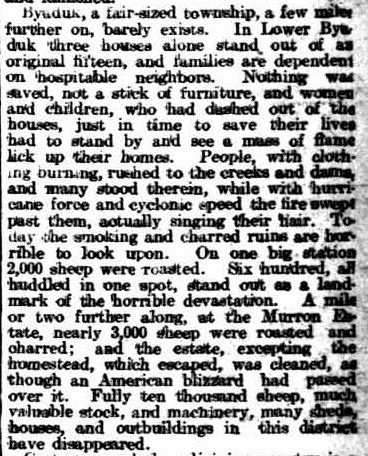
The articles below report on homes lost in the Byaduk district with Byaduk North worst hit.  My relatives were closer to Byaduk township further south and while they were lucky not to lose their homes it must have been terrifying all the same.  

The fire travelled at a great pace, coming within a mile of my ggg grandfather James Harman’s property Mount Pleasant, on the Hamilton-Port Fairy Road, reaching the properties of the Christie brothers just to the north. As well as James and his wife Susan Reed, my great-grandmother Sarah Elizabeth Harman, and her father Reuben James Harman were living at Byaduk but lived further south again in the Byaduk township.  Numerous other family members lived in the area from the Byaduk Caves through to the Byaduk township.  

TERRIBLE BUSH FIRES. (1901, February 9). The Advertiser (Adelaide, SA : 1889 – 1931), p. 7. Retrieved February 7, 2012, from http://nla.gov.au/nla.news-article4818069

DESTRUCTIVE BUSH FIRES. (1901, February 9). Bathurst Free Press and Mining Journal (NSW : 1851 – 1904), p. 2. Retrieved February 7, 2012, from http://nla.gov.au/nla.news-article64452557

The Hamilton Spectator reported twelve homes destroyed leaving just three standing in Byaduk North.  Most were close to the course of the Lyne Creek running to the west of the township. The Free Presbyterian Church was lost and the Byaduk North Hotel was under threat.  In the days after the fire, the hotel served as a refuge for the homeless.

BYADUK NORTH HOTEL c1906. Image courtesy of the Museums Victoria Collections http://collections.museumvictoria.com.au/items/766487

BYADUK NORTH HOTEL c1906. Image courtesy of the Museums Victoria Collections http://collections.museumvictoria.com.au/items/766487

The homestead of Richard Thomas Carty at Brisbane Hill, a large property to the north of Byaduk North, was destroyed.  While running for the creek, after escaping the homestead, Mrs Carty’s dress caught fire but it was fortunately quelled.  The Cartys rebuilt and the replacement homestead Dunroe still stands today.

"ALONG MACARTHUR ROAD." Hamilton Spectator (Vic. : 1870 - 1918) 9 February 1901 .

“ALONG MACARTHUR ROAD.” Hamilton Spectator (Vic. : 1870 – 1918) 9 February 1901 <http://nla.gov.au/nla.news-article226087594&gt;.

"THE VICTORIAN BUSH FIRES." Australian Town and Country Journal (Sydney, NSW : 1870 - 1907) 23 February 1901: .

“THE VICTORIAN BUSH FIRES.” Australian Town and Country Journal (Sydney, NSW : 1870 – 1907) 23 February 1901: <http://nla.gov.au/nla.news-article71463761&gt;.

The fire burnt through the Monivae Estate with a large loss to fences and livestock and burnt within a mile of Hamilton.  On the other side of town, closer to the Coleraine railway line, the Hamilton Racecourse fell just short of the fire’s path.

"MANY FAMILIES HOMELESS." Leader (Melbourne, Vic. : 1862 - 1918) 9 Feb 1901: 18. .

“MANY FAMILIES HOMELESS.” Leader (Melbourne, Vic. : 1862 – 1918) 9 Feb 1901: 18. <http://nla.gov.au/nla.news-article198084151&gt;.

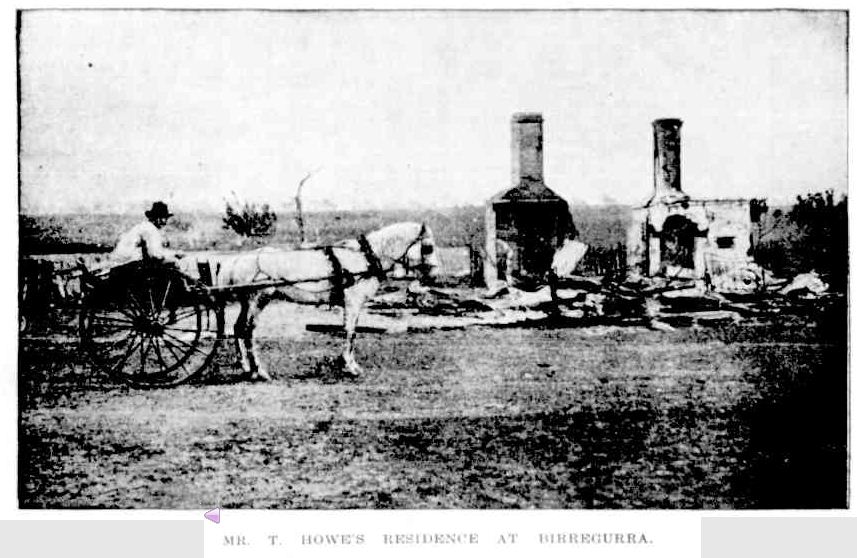
Other areas throughout the Western District felt the brunt of fire on 7 February 1901.  This photograph from Birregurra shows the devastation in that town.

THE VICTORIAN BUSH FIRES. (1901, February 23). Australian Town and Country Journal (NSW : 1870 – 1907), p. 38. Retrieved February 7, 2012, from http://nla.gov.au/nla.news-article71463761

Portland was also under threat with fire circling the town.  The fire did not stop until it met the sea.

VICTORIAN BUSH FIRES. (1901, February 11). The Advertiser (Adelaide, SA : 1889 – 1931), p. 5. Retrieved February 7, 2012, from http://nla.gov.au/nla.news-article4818536

Buninyong near Ballarat was one of the worst areas hit.

BUSH FIRES IN VICTORIA. (1901, February 9). The West Australian (Perth, WA : 1879 – 1954), p. 3. Retrieved February 7, 2012, from http://nla.gov.au/nla.news-article23853766

THE VICTORIAN BUSH FIRES. (1901, February 23). Australian Town and Country Journal (NSW : 1870 – 1907), p. 38. Retrieved February 7, 2012, from http://nla.gov.au/nla.news-article71463761

Macarthur had losses as did Princetown on the south coast.  At Timboon, bullock teams from the local sawmill were lost.

FIRES IN VICTORIA. (1901, February 12). South Australian Register (Adelaide, SA : 1839 - 1900), p. 6. Retrieved February 7, 2012, from http://nla.gov.au/nla.news-article54558042

FIRES IN VICTORIA. (1901, February 12). South Australian Register (Adelaide, SA : 1839 – 1900), p. 6. Retrieved February 7, 2012, from http://nla.gov.au/nla.news-article54558042

By 11 January, aid for the homeless was on the agenda and at Branxholme a public meeting was held to discuss such matters.  Authorities discovered the fire near Branxholme, which was probably the same fire to hit Byaduk, was accidentally started by a travelling tinsmith fixing a trough at Ardachy Estate.

THE BUSH FIRES. (1901, February 11). The Argus (Melbourne, Vic. : 1848 – 1956), p. 5. Retrieved February 7, 2012, from http://nla.gov.au/nla.news-article10534297

A meeting was called at Byaduk for 18 February 1901, and James Harman donated £2 2/ to the fund for the homeless.

"BUSH FIRE BELIEF FUNDS." Hamilton Spectator (Vic. : 1870 - 1918) 21 February 1901: .

“BUSH FIRE BELIEF FUNDS.” Hamilton Spectator (Vic. : 1870 – 1918) 21 February 1901: <http://nla.gov.au/nla.news-article226090204&gt;.

The fire was so strong and relentless, old residents were drawing comparisons to Black Thursday almost fifty years earlier to the day on 6 February 1851.

TELEGRAPHIC. (1901, February 12). Kalgoorlie Western Argus (WA : 1896 – 1916), p. 32. Retrieved February 7, 2012, from http://nla.gov.au/nla.news-article32205605


St Stephen’s Church, Portland

During our recent trip to Portland, while the fish were biting, I managed to sneak away for a walk around the town of Portland.

One building I visited was St Stephen’s Anglican Church on the corner of  Julia and Percy Streets.

St Stephens Church Portland

The foundation stone was laid on March 24, 1855.

St Stephens Church Foundation Stone

The Portland Guardian and Normanby General Advertiser reported on the laying of the foundation stone.

Local Intelligence. (1855, March 26). Portland Guardian and Normanby General Advertiser (Vic. : 1842 – 1876), p. 2 Edition: EVENING. Retrieved February 3, 2012, from http://nla.gov.au/nla.news-article71571938

I wonder if the reporter still had a job after overlooking the lunch that followed the ceremony.

I was impressed that the organisers of the day were able to secure Lieutenant Governor of the Colony, Sir Charles Hotham for the event.  However, after reading some articles about Hotham at Trove, and fitting the Portland visit into his timeline, I realised then he probably was trying to get as far away from Melbourne as possible.  The heat was on.  I would also imagine the Henty brothers’ connection to the church may have also been a factor.  Incidentally, Hotham was dead by the year’s end, having caught a chill, which exacerbated his already failing health.  This extract was published in the Empire (Sydney 1850-1875) on the same day as the report on the foundation stone ceremony and the tone is similar to other reports on Hotham at the time.

VICTORIA,. (1855, March 26). Empire (Sydney, NSW : 1850 – 1875), p. 5. Retrieved February 3, 2012, from http://nla.gov.au/nla.news-article60180148

Despite the church receiving a bell in 1864 from Stephen Henty, it was not until 1907 that the bell was hung.

St. Stephens’ Church Bell. (1907, July 5). Portland Guardian (Vic. : 1876 – 1953), p. 3 Edition: EVENING. Retrieved February 3, 2012, from http://nla.gov.au/nla.news-article63966019

Some histories of the bell may tell a different story of the bell’s origins as local historian Noel F. Learmonth had to admit in his article of October 29, 1951.  After reconfirming the story from 1907 article, he went on to say:

ST. STEPHEN’S BELL. (1951, October 29). Portland Guardian (Vic. : 1876 – 1953), p. 4 Edition: MIDDAY.. Retrieved February 3, 2012, from http://nla.gov.au/nla.news-article64429927

Entrance of St Stephen’s Church, Portland

A SHORT HISTORY OF ST STEPHEN’S CHURCH FROM 1869 TO THE PRESENT DAY. (1943, August 30). Portland Guardian (Vic. : 1876 – 1953), p. 4 Edition: EVENING. Retrieved February 3, 2012, from http://nla.gov.au/nla.news-article64386337

I wish I had read this article before I visited.  I would have like to have seen Stephen Henty’s stained glass window.

Interior of St Stephen’s Church

The organ on the wall of the altar has been in place since 1882.

INTERIOR OF ST STEPHEN’S CHURCH. Image courtesy of the State Library of Victoria http://handle.slv.vic.gov.au/10381/441320

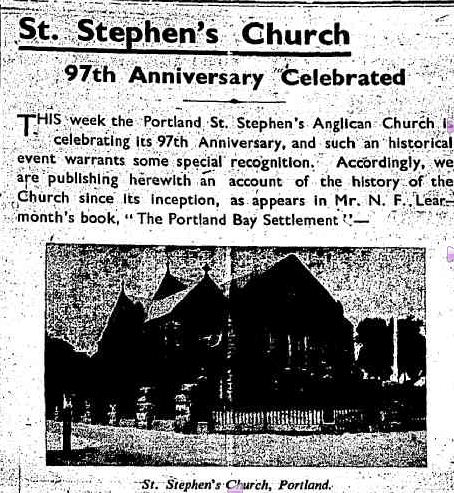
In 1953, the church celebrated its 97th anniversary.  The Portland Guardian of May 14, reported on the event and included an extract from one of Noel Learmonth’s books  “The Portland Bay Settlement”.  A nice touch was when the congregation sang “Happy Birthday” to the church.


St. Stephen’s Church 97th Anniversary celebrated. (1953, May 14). Portland Guardian (Vic. : 1876 – 1953), p. 3 Edition: MIDDAY. Retrieved February 3, 2012, from http://nla.gov.au/nla.news-article64434755

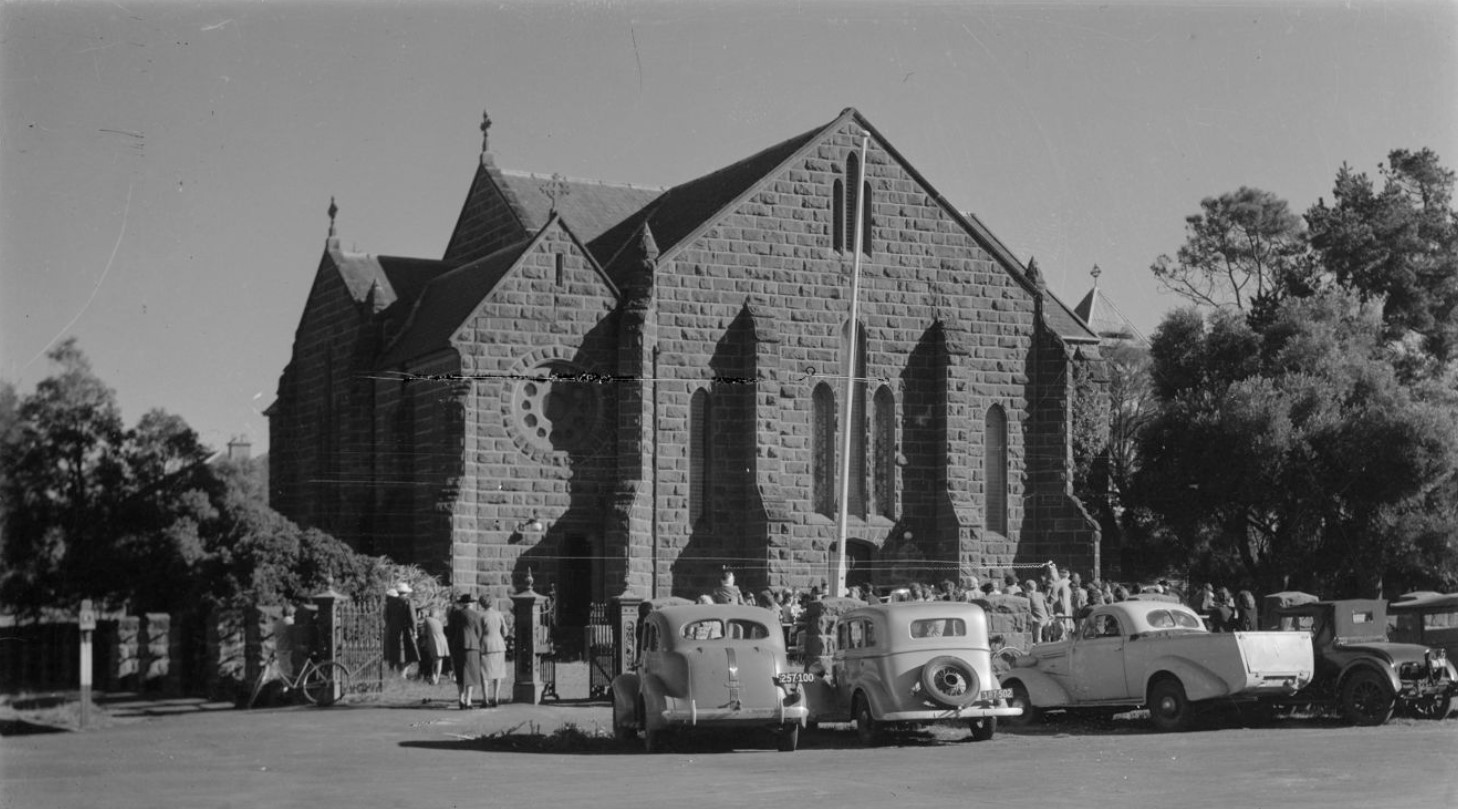
ST STEPHEN’S CHURCH. Image courtesy of the State Library of Victoria http://handle.slv.vic.gov.au/10381/61459

If you are interested in more history of the St Stephen’s Church, an article from the Portland Guardian of August 30, 1943, “A Short History of St Stephen’s Church from 1869 to Present Day” is worth a look.  It also includes a list of the 1943 members of the Ladies Guild.

Passing of the Pioneers

Seventeen more obituaries of Western District pioneers join the collection this month, and what a group they are.  I must say I had to pass a lot over, but it will ensure Passing with the Pioneers will be going to at least January 2014!  New papers at Trove has guaranteed that. Obituaries came from the Portland Guardian, Horsham Times and Ballarat Courier.

There are a couple of special ones, those of  James HENTY and Rebecca KITTSON and I highly recommend that you read the obituary in full.  I actually found Rebecca’s obituary rather moving and after driving through the Bridgewater area recently, I have great respect for her family and others that settled there.  To read the full obituary, just click on the pioneer’s name and the obituary will open in a new tab.  Some are a little hard to read, but magnifying the page helps.

I have also included a “young” pioneer who has a family link to me.  Thank you to Rachael Boatwright for allowing me to include a photo of her family member.

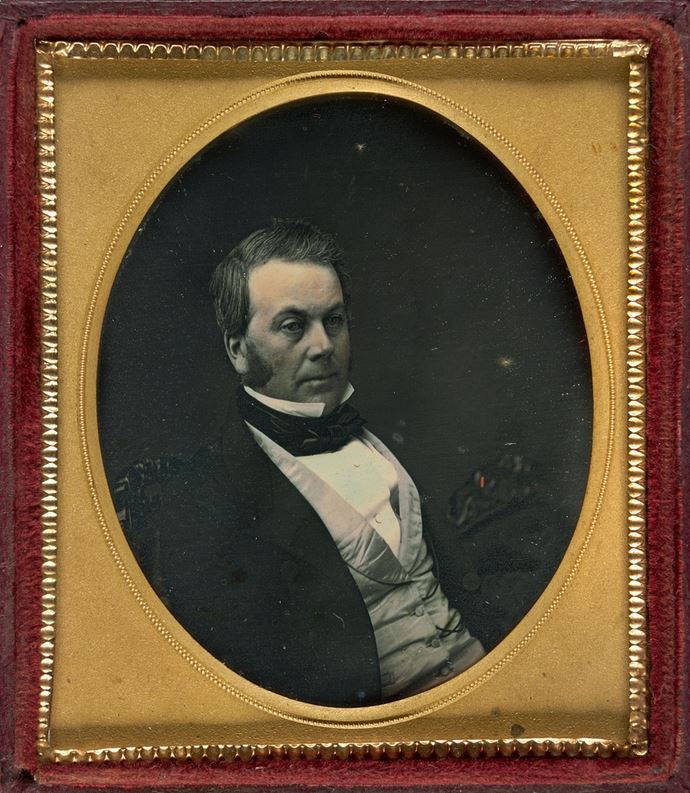
James HENTY: – Died 12 January 1882 at Richmond.  I thought trashy magazines today told all, but the obituary of the Honourable James HENTY M.L.C. shared every detail of the last twenty-four hours or so his life.  How can I possibly give a summary of the life of James HENTY, one of the pioneering HENTY clan?  Instead, read the obituary.  I think James’ life may have ended prematurely, if that is possible at eighty-two, due to a collision with a Newfoundland dog the week before.

JAMES HENTY c1855. Image Courtesy of the State Library of Victoria. Image no. H83.158/2 http://handle.slv.vic.gov.au/10381/290239

JAMES HENTY c1855. Image Courtesy of the State Library of Victoria. Image no. H83.158/2 http://handle.slv.vic.gov.au/10381/290239

Hugh MCDONALD: Died 30 January 1899 at Portland. This is a timely obituary coming so soon after my Portland trip.  While there, I learnt something of the wreck of the steamer Admella in 1859 and the Portland lifeboat crew that went to her aid. Hugh McDONALD was one of the brave men on board the life boat during that daring rescue.

William GARDINER: Died 17 January 1904 at Warracknabeal.  William GARDINER, another pioneer with an interesting life.  He arrived in Victoria in 1849 aboard the barque Saxon and spent time in Melbourne, Geelong and the goldfields, before heading to New Zealand.  On his return to Australia, he lived in Port Fairy and Hamilton, working as a journalist, before moving to the Wimmera as a correspondent for the Belfast Gazette.  He like it so much, he decided to select land at Warracknabeal.  He also worked as a correspondent for the Horsham Times and built houses!

Jean McCLINTOCK:  Died 19 January 1904 at Melbourne. While only forty at the time of her death and not an “old pioneer”, I have included Jean as she was the sister-in-law of  Alfred Winslow HARMAN.  Jean married William MILLER and they resided at Rupanyup.  After some illness, Jean travelled to Melbourne for an operation, but she died as a result.

Jean McClintock & William Eaton Miller. Photo courtesy of Rachael Boatwright & family.

Joseph JELBART: Died 17 January 1904 at Carapook. Joseph worked as the mail contractor between Carapook and Casterton up until his death. Prior to that, he had worked as a blacksmith and a wheelwright at Chetwynd, Merino and Natimuk. Interesting coincidence, just as Joseph did, his father and brother both died on a Sunday morning in the same house.

Rachel Forward READ: Died 15 January 1904 at Lower Cape Bridgewater.  Rachel Forward READ and her husband Richard Charlton HEDDITCH arrived in Adelaide in 1838 and settled at Cape Bridgewater from 1845 after a stint teaching at the Portland Church of England school.  They resided at the Lal Lal Homestead.  The  Victorian Heritage Database listing for Lal Lal includes a letter home by Rachel after their arrival at Cape Bridgewater.  Rachel was buried at the Cape Bridgewater cemetery rather than the Hedditch family cemetery at Lal Lal.

Donald McRAE: Died 12 January 1914 at Tooan.  Donald McRAE was born in Inverness, Scotland in 1842 and travelled with his parents to Portland. In 1865, he moved to Muntham near Hamilton to farm with brother. The pair eventually selected 320 acres of land each at Natimuk.  Donald was a member of the Horsham Caledonian Society.

Samuel WALKER: Died 24 January 1914 at  Ballarat. Samuel WALKER was born in Cheshire, England around 1828 and travelled to Australia in 1852.  After his arrival on the goldfields of Ballarat, he set up a soda water factory which proved profitable for him.  He then became a partner in Evans and Walkers and worked as an accountant.  He was also the registrar of Births, Deaths and Marriages at Ballarat from 1872.

Selina MILLER: Died January 1917 at Wickliffe. Selina MILLER had resided at Wickliffe for almost sixty years.  She was twice married.  Her first husband was Mr HAIG and her second, George HARRIOTT. Selina was buried at the Wickliffe Cemetery (below).

Elizabeth HUBBARD: Died 3 January 1919 at Horsham.  Elizabeth HUBBARD was born in Norwich, England around 1831 and travelled to Australia with her husband, Mathias HARDINGHAM in the mid-1850s.  From Geelong, they travelled to the Horsham area and were two of the first pioneers in that district.  Mathias ran the Horsham Hotel for some time.

Christina FOX: Died 8 January 1921 at Vectis.  Christine FOX was born in Yorkshire, England around 1835.  As a teenager, she travelled to South Australia with her parents.  She married Robert SANDERS who had also travelled with his parents on the same immigrant ship.

John W. DAVIS: Died 24 January 1928 at Horsham.  John or “Jack” as he was known, arrived in Australia as a three old, living in Williamstown and then Stawell.  He played with the Temperance Union Band in Stawell and then moved to Horsham in 1877 to play with one of two brass bands in the town.  Known throughout the northwest for his ability as a euphonium player, Jack was also a bandmaster at Natimuk and Noradjuha.

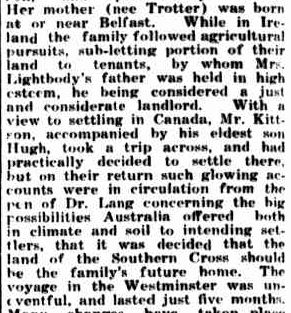
Rebecca KITTSON: Died 4 January 1929 at Portland. What a grand old pioneer Rebecca KITTSON was.  A colonist of eighty-eight years, she was a month from her 102nd birthday.  Arriving in Melbourne from Ireland aged eleven, she spent the next year in Melbourne, before joining her family at Cape Bridgewater where her father James Kittson had settled.  She married Reverend William LIGHTBODY, a Wesleyan minister in 1852.  This obituary is a must read.  Mrs LIGHTBODY, as she was known for most of her life, was the last surviving member of her family and the obituary gives a glimpse at how the KITTSON’S came to be in Australia.

Obituary. (1929, January 7). Portland Guardian (Vic. : 1876 – 1953), p. 2 Edition: EVENING. Retrieved January 17, 2012, from http://nla.gov.au/nla.news-article64268096

Adrian ANDERSON: Died 16 January 1932 at Horsham. This is a first for Passing of the Pioneers.  Adrian ANDERSON was an immigrant from the United States. Wisconsin to be precise. He arrived aged four, with his parents and resided in Western Australia until he was ten.  The family moved to Victoria, where he remained.  He ran a shop in Jeparit before his death in the Horsham Base Hospital.

Agnes Sarah COOK: Died 18 January 1942 at Casterton. This obituary begins “Born in a small house on the banks of the  Glenelg River at Casterton seventy-nine years ago…”.  Agnes was a lady that like the past and the future, knowledgeable about the history of Casterton, she also liked to predict the future.  Agnes married  Robert SYLVESTER and they had four children.

Helen GULL: Died 18 January 1942 at Casterton. Helen was born on the ship Helen during her parents’ voyage to Australia in 1852.  The GULL family became respected pioneers throughout the Western District.  Helen married Frederick PERRY in 1876 and they resided at well known Western District properties, Rifle Downs at Digby and Runnymeade at Sandford.  Frederick later ran the Digby Hotel.

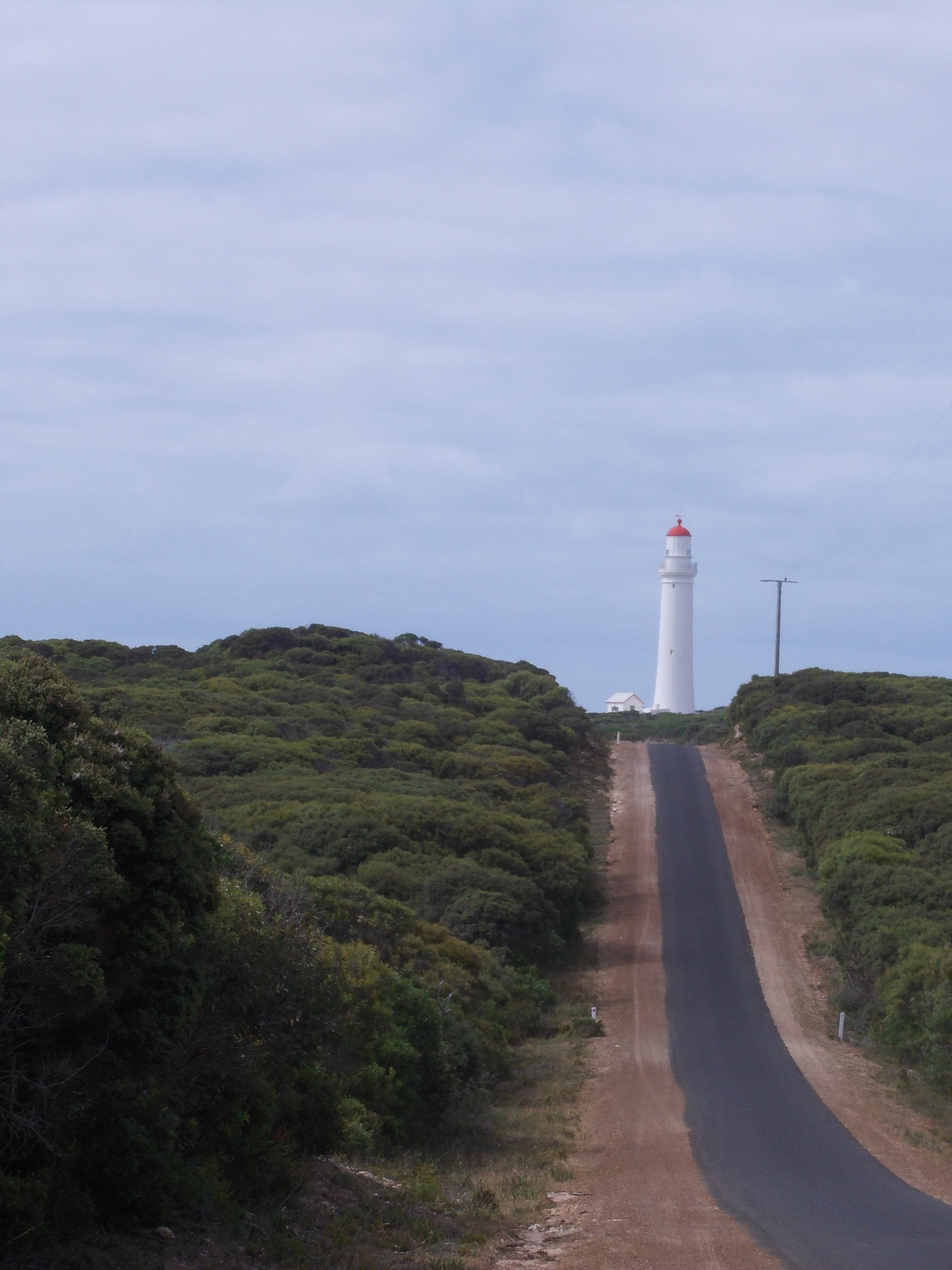
Cape Nelson Lighthouse

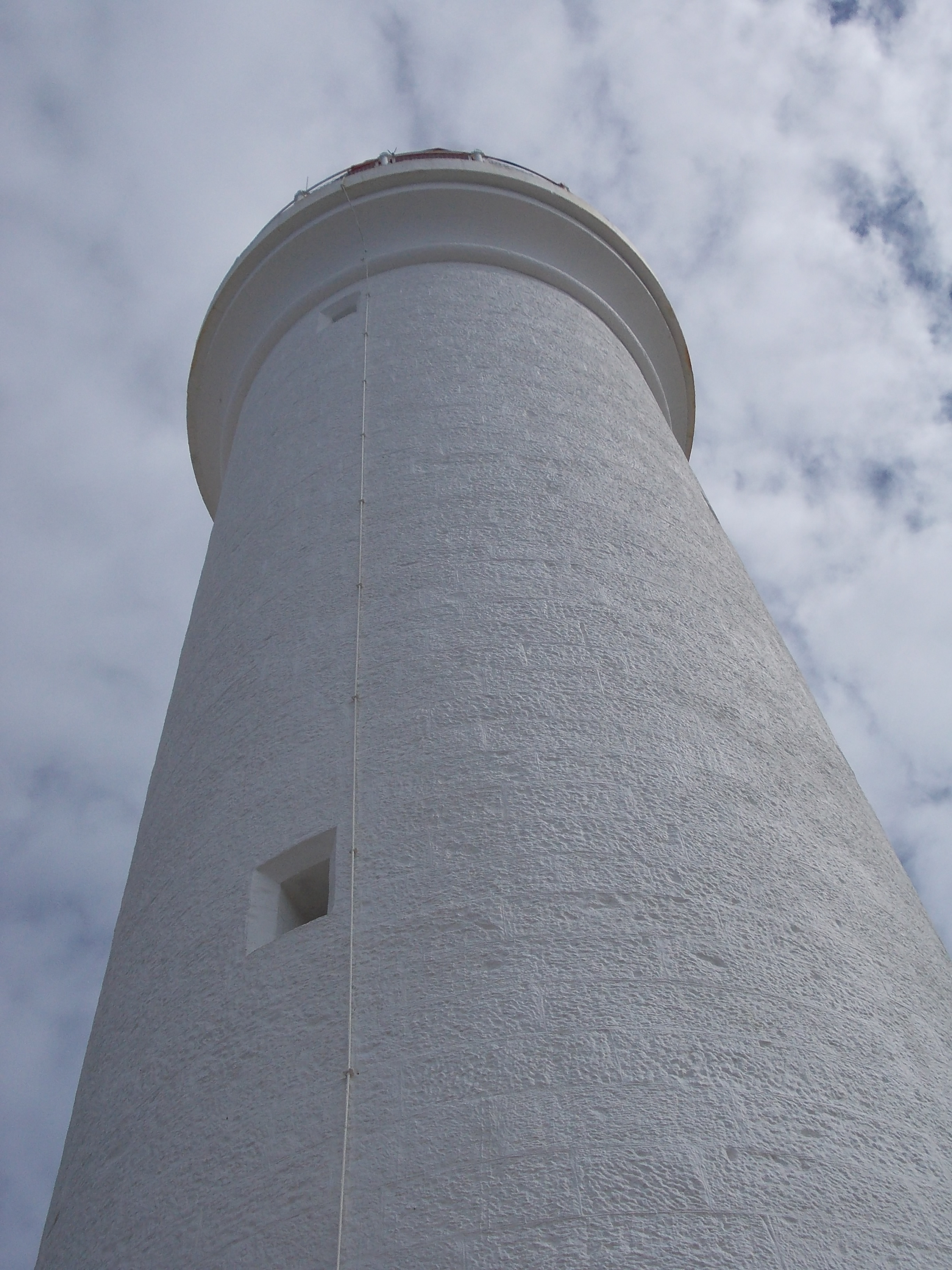
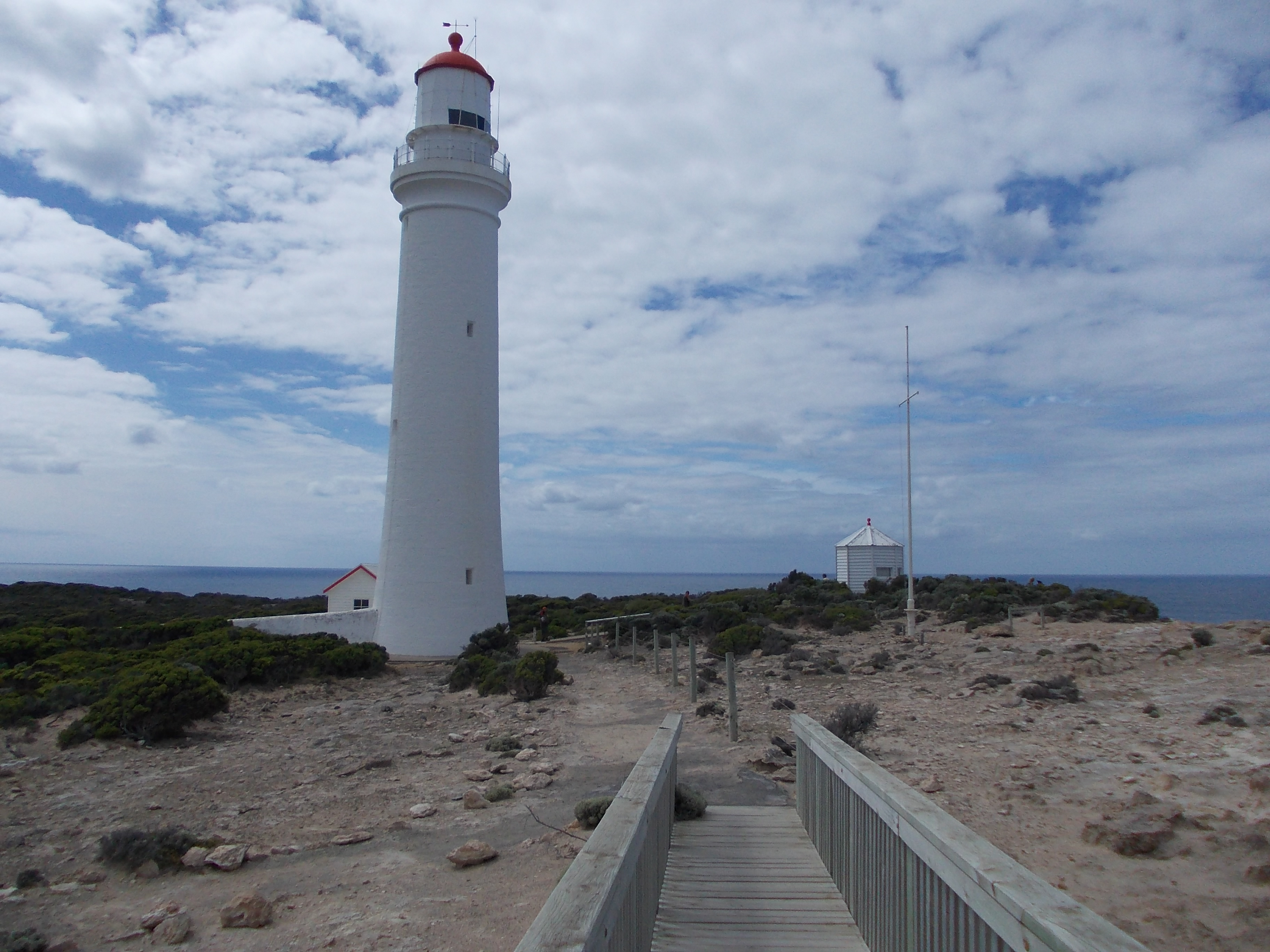
The Cape Nelson Lighthouse was fully operational in 1884 but calls for its construction came long before. One of the earliest references I have found to mention a lighthouse at Cape Nelson was in The Argus of 7 January 1864.

(1864, January 7). The Argus (Melbourne, Vic. : 1848 – 1956), p. 5. http://nla.gov.au/nla.news-page209236

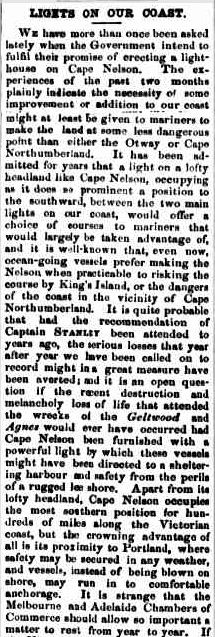
On 8 August 1876, the Portland Guardian expressed frustration at the Government not following through on a promise to build the lighthouse.

LIGHTS ON OUR COAST. (1876, August 8). Portland Guardian (Vic. : 1876 – 1953), p. 2  http://nla.gov.au/nla.news-article6333597

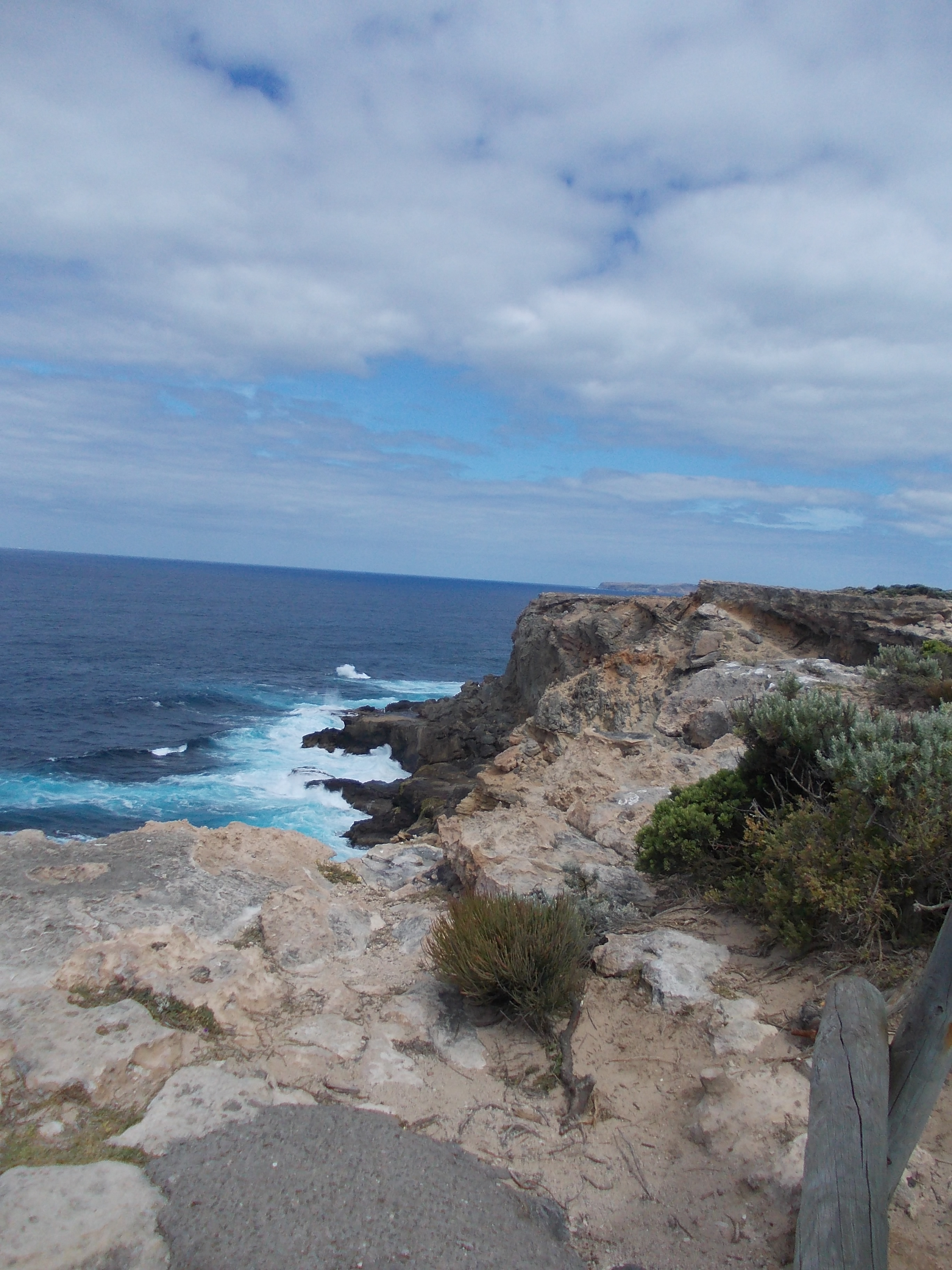
Coastline below the lighthouse

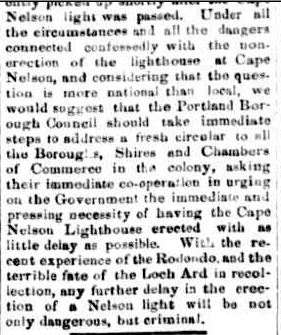
In 1879, the Portland Guardian considered the continual delaying of the lighthouse construction as criminal.

The Guardian. (1879, May 1). Portland Guardian (Vic. : 1876 – 1953), p. 2  http://nla.gov.au/nla.news-article63342225

Finally, in 1882, tenders were called for. The Portland Guardian made the announcement on 30 March 1882 and the article in full explained the plans for the proposed lighthouse.

THE CAPE NELSON LIGHTHOUSE. (1882, March 30). Portland Guardian (Vic. : 1876 – 1953), p. 2 Edition: MORNING.. Retrieved January 12, 2012, from http://nla.gov.au/nla.news-article63404134

Work began later in 1882, but strong winds and the lack of skilled workers impeded progress. The Portland Guardian offered some great articles outlining the progress of construction. An article from 28 December 1882 describes the construction of the wall and the assistant lighthouse keeper’s house. Another on 24 July 1883, describes the job of sourcing the stone for the job and talks of a lift that would aid the construction of the tower.

On Monday 7 July 1884, the Cape Nelson Lighthouse was lit for the first time. The joint honour was given to the then Mayor of Portland, Mr P.W. Shevill and former mayor, Mr W.T. Pile, who had played a big part in the project getting off the ground. A dinner was held that evening at Mac’s Hotel in Portland to celebrate.

THE LIGHTING UP OF THE NEW PHAROS ON CAPE NELSON. (1884, July 8). The Argus (Melbourne, Vic. : 1848 – 1956), p. 6. http://nla.gov.au/nla.news-article6052865

An article from the Portland Guardian of 8 July 1884 thanked the contractors Messrs. Horne and Slingo and looked at the history of the lighthouse from the time it was first determined a lighthouse was required, to the first lighting of the lamp on 7 July 1884.

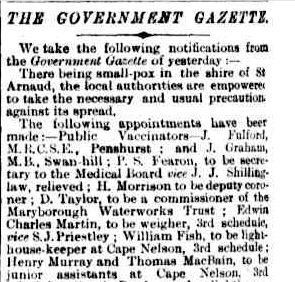
The first Lighthouse keeper at Cape Nelson was William Fish. His assistant was Henry Murray and the junior assistant was Thomas MacBain.

THE GOVERNMENT GAZETTE. (1884, September 6). The Argus (Melbourne, Vic. : 1848 – 1956), p. 12. Retrieved January 13, 2012, from http://nla.gov.au/nla.news-article6056910

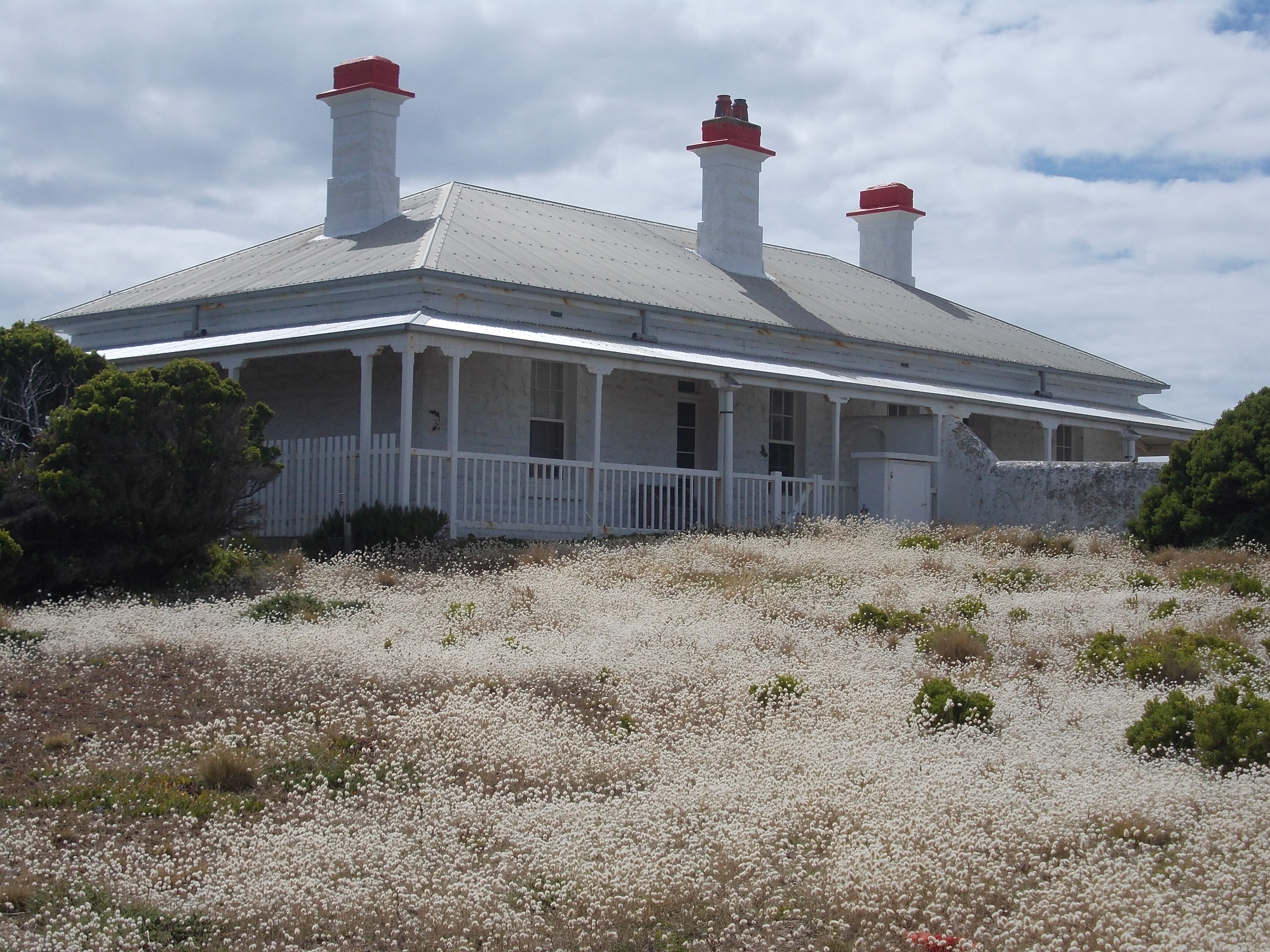
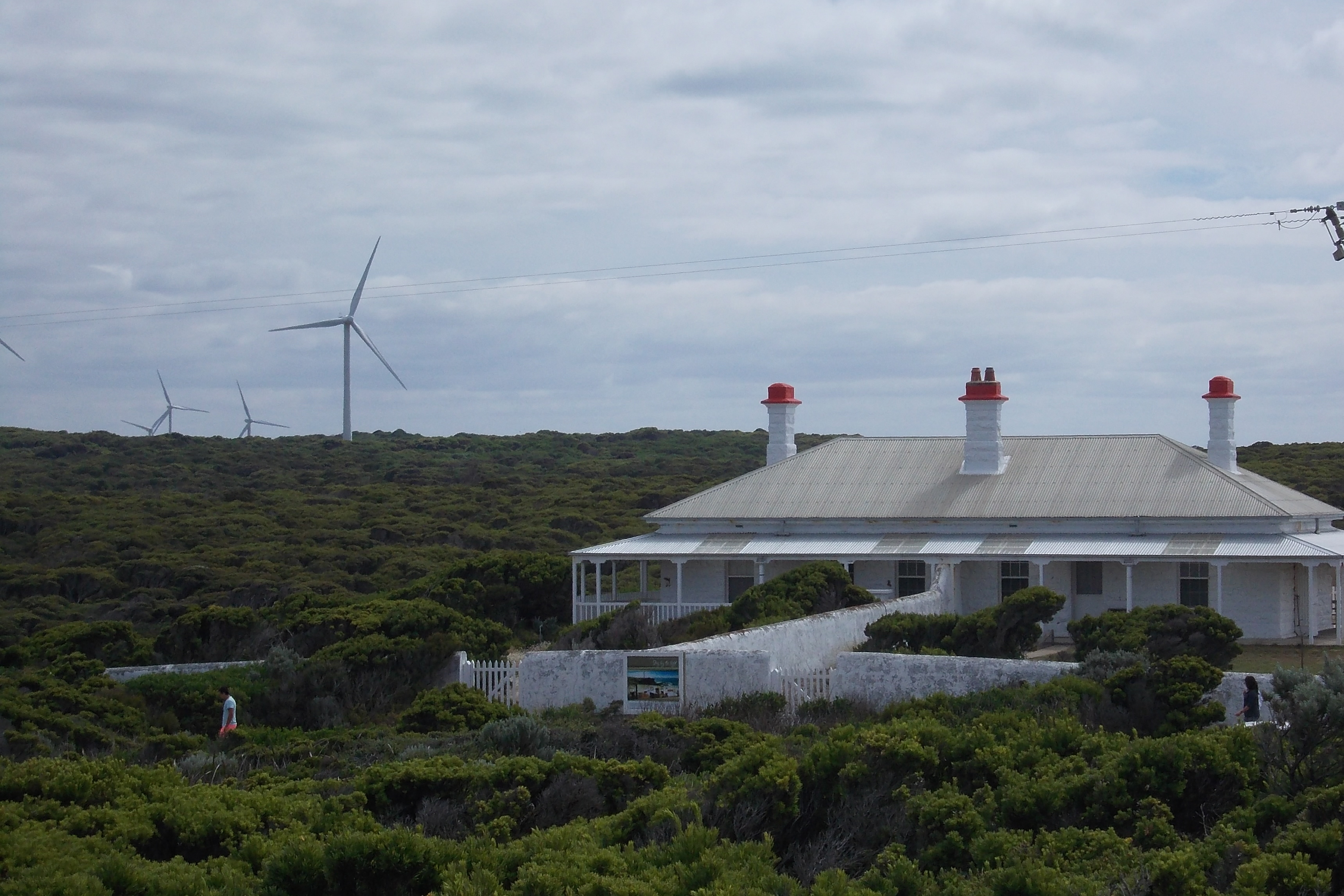
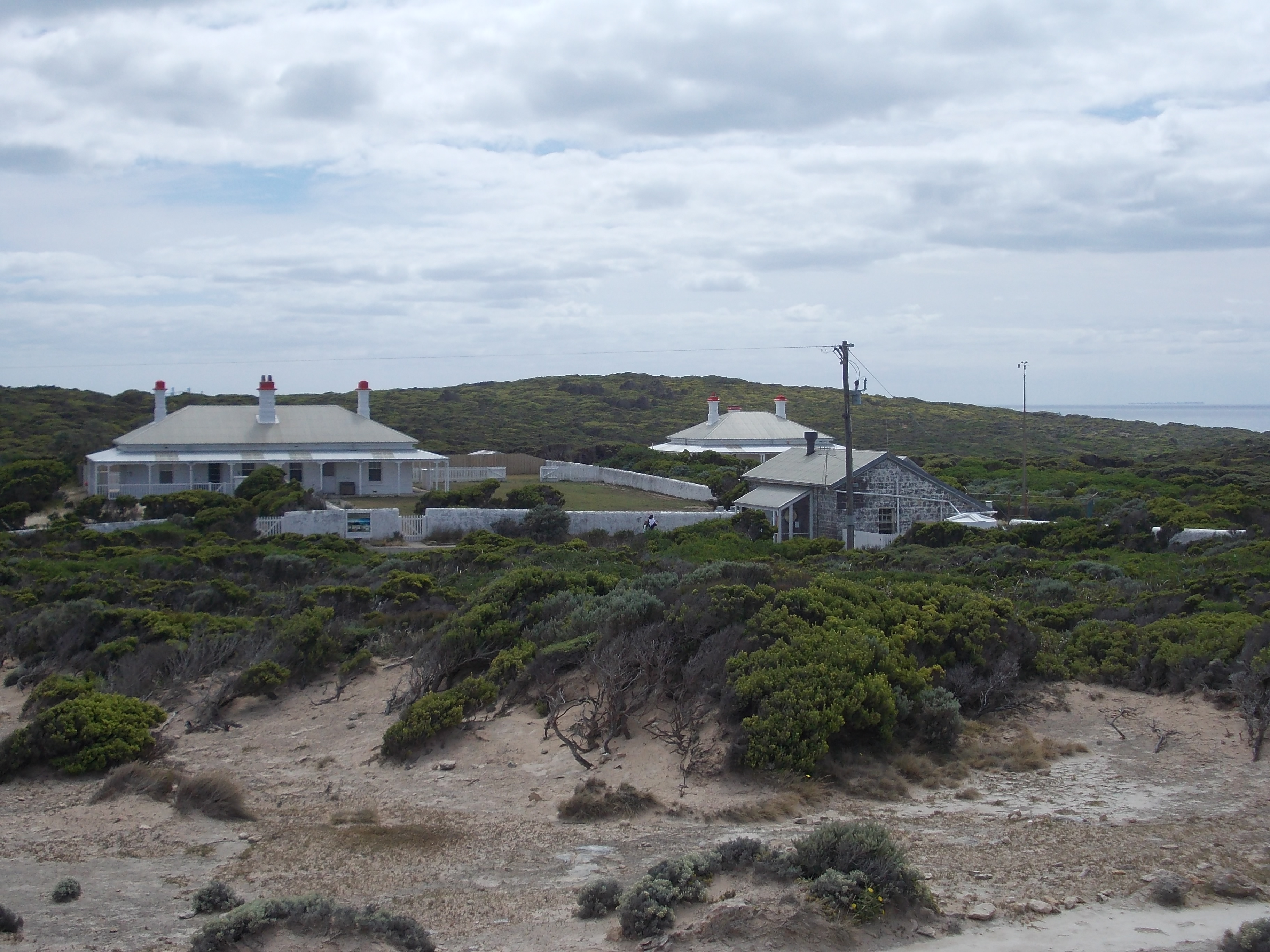
Lighthouse Keeper’s residence – Cape Nelson

Assistant Lighthouse keeper’s Residence

Today, on the road to Cape Nelson and while at the lighthouse, it is difficult to miss the wind turbines. They look almost graceful on the landscape, but I am not too sure what William Fish would have made of them.

The Old and the New

FURTHER READING

There were other articles from the Portland Guardian about the Cape Nelson Lighthouse also worth reading:

Portland Guardian – 7 October 1882 – A WALK FROM PORTLAND TO THE CAPE NELSON LIGHTHOUSE SITE –  This article written by the “Traveller” describes a walk from Portland to Cape Nelson to inspect the site of the proposed lighthouse, a round trip of about 24 kilometres.

Portland Guardian – 19 August 1920 – BEACON OF THE NIGHT – “Openlight” describes a visit to the Lighthouse, including a climb to the top. There are also references to former lighthouse keepers at Cape Nelson, including William Fish.

Portland Guardian – 3 October 1927 – CAPE NELSON LIGHTHOUSE – This article tells of the role of parliamentarian Peter Lalor, of Eureka Stockade fame, in the eventual approval of a lighthouse at Cape Nelson.

Portland Guardian – 26 March 1931 – CAPE NELSON AND ITS LIGHTHOUSE – The correspondent “W.H.M” tells of a visit to the Cape Nelson Lighthouse. I found this article interesting, as it reports on the children of the lighthouse. He talks of Frank Piper, a boy of around nine, with sight in only one eye, and who was educated by correspondence. A reference was made to an article in The Argus, earlier in 1931, by a Mr Tate.  I managed to track down the article and found it was written by Frank Tate and appeared in The Argus on 28 February 1931, under the title – OUTBACK PUPILS – A MODERN DEVELOPMENT IN EDUCATION. This too was an interesting article discussing early distance education from the time it was introduced in Victoria in 1914 and after in other states. He states over 13000 students were receiving their school via correspondence in 1931, with many having not seen the inside of a classroom. Both articles touch on the loneliness of children living in remote places. Frank Piper did not see another child until he was six years old and became very emotional when he did, according to his mother.

Portland Guardian – 15 June 1939 – CAPE NELSON LIGHTHOUSE – This article recounts the laying of the lighthouse foundation stone at Cape Nelson in 1883 and a time capsule buried within.

Portland Guardian – 12 July 1951 – NATURE NOTES – B.E. Carthew reports on a scrapbook kept by Frank Row, which documents the life of former Portland mayor William Pile, one of the inaugural lamp lighters at the Cape Nelson Lighthouse. A clipping from the scrapbook was from the opening of the lighthouse in 1884 and it gives further insight into the day. There is also a list of lighthouse keepers from 1917 through to 1951.

©Merron Riddiford 2012

Home from Portland

It was great to get reacquainted with Portland.  Apart from a quick overnight trip about 15 years ago, I had not visited since the 1970s and 80s with most of my time then spent around the harbour and foreshore.  The town really has not changed, but now, compared to when I was a pre-teen on Sunday afternoon outings, I have a greater appreciation of Portland’s history.

It did turn out that some of those Sunday afternoon outings were to witness events that are now ingrained in the history of Portland.  At one time, around 1979, we drove from Hamilton to Portland just to see a live sheep export ship!  Sounds boring, and it probably was for an 11-year-old, but a storm was brewing.  The following months, into 1980 saw protests, black banned transport companies, and disgruntled meat process workers from the local Borthwicks abattoir.  The issue was the talk of the Western District and beyond, at a time when the Western District “rode on the sheep’s back”.

Another visit was to see the ongoing construction of the Alcoa plant, now a familiar fixture on Portland’s landscape.  Construction began in 1981 and smelting began in 1986.  The arrival of Alcoa was a milestone in Portland’s history, offering employment and growth.

Over a series of posts, I will share some of what we saw on our recent visit, including the early architecture of Portland, the Cape Nelson Lighthouse, Bridgewater, and the Old Portland cemetery.

It will be a busy month.  As well as school holidays and extra “real” work for me, there will be a January Passing of the Pioneers and I will be joining my fellow geneabloggers for the Australia Day 2012 blog: Wealth for Toil.   I also will be posting my family’s stories, which is really why I’m here.  I just get a bit sidetracked.  I will share the stories of Sarah and Walter Harman, two more of the children of Joseph and Sarah Harman.   I am already looking forward to February when school returns, so I can have a rest!

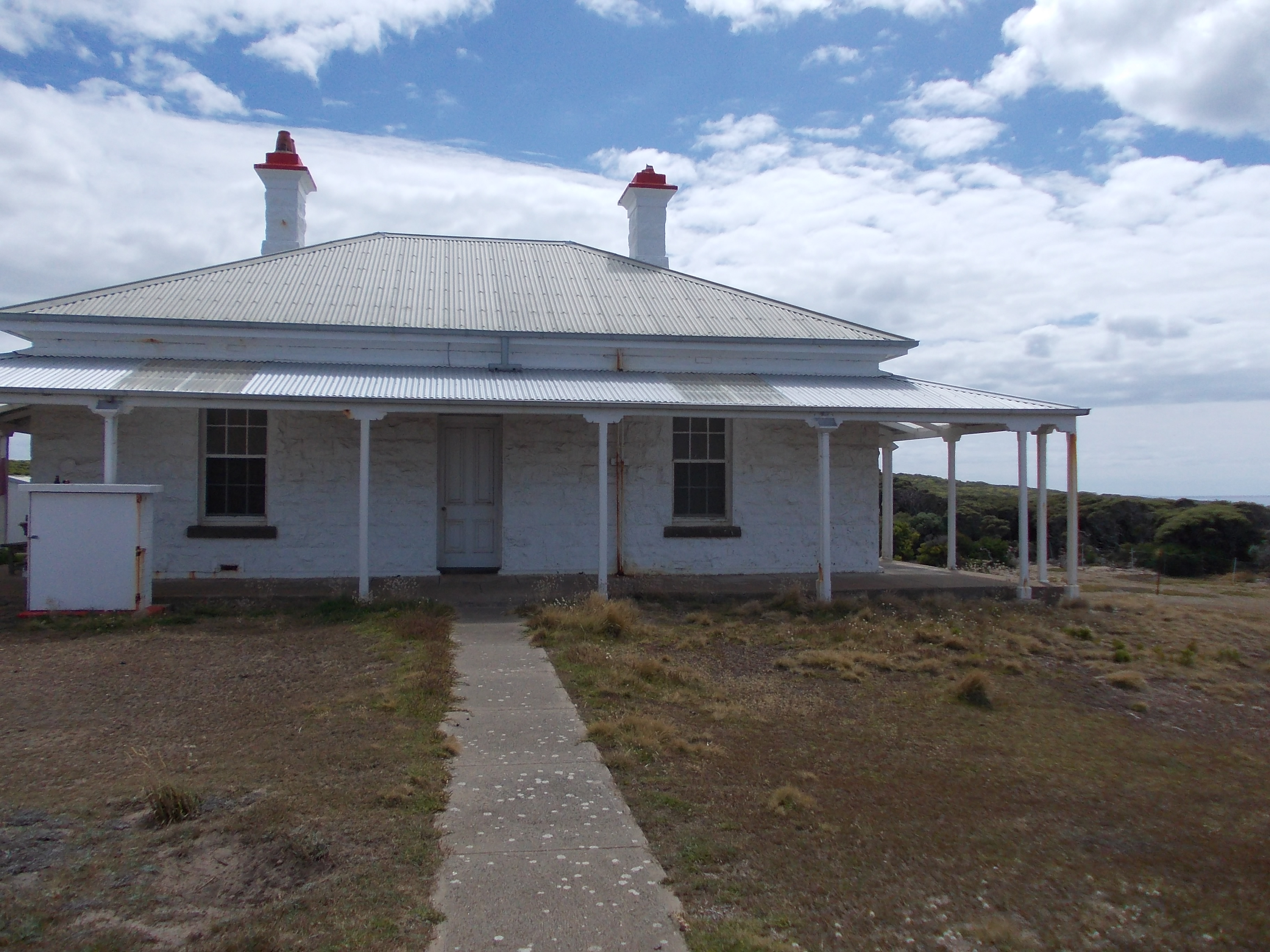
Just to give you a taste of what is to come, this a photo I took of the Cape Nelson Lighthouse Keeper’s cottage.

Cape Nelson Lighthouse Keeper’s Cottage

I Hear There is Good Fishing at Portland

We are off to Portland for a couple of days.  As Victoria’s first permanent settlement, it is dripping with history.  What a good idea my suggestion of great fishing was when we were deciding where to go.  I can do some history stuff (I’m hoping to get a lot of photos) and they can fish.  There are also several activities of a historical nature we can all take part in.  My small research assistant will be learning about Victoria’s history and he won’t even know it!

On offer is the Historic Buildings Walk with 48 buildings marked on a convenient map.   The Old Portland cemetery will be a must with the oldest recognisable grave dating back to 1848.  There is a self-guided tour brochure highlighting some of the more significant graves.  We will visit the Portland Maritime Discovery Centre and I am sure my small research assistant will enjoy it.  There is the ribcage of a sperm whale which is large enough to sit inside.

I am particularly looking forward to seeing the Immigration Wall.  This is a great initiative.  Descendants of immigrants who first set foot in Australia at Portland are able to buy a plaque for the wall.  One day I hope that James and Susan Harman and William and Margaret Diwell will have their own plaque.

We also plan to visit nearby Cape Bridgewater settled by a hardy band of pioneers.  From my Passing of the Pioneers posts, I have learnt much about those that settled the area and would like to see something of the land that lay before them.  A number of pioneers from the Cape Bridgewater area are already listed on the Passing of the Pioneers list.  Graves of pioneers with names such as Kittson, White, Hedditch and Malseed can all be found at the Cape Bridgewater cemetery. There are also many natural attractions nearby such as a petrified forest and Shelly Beach.

Back in Portland we can Walk in the Footsteps of Mary McKillop, visit the second oldest Botanic gardens in Victoria, and take a ride in a cable tram along the bay.  If I can squeeze it, I would like to visit History House, home of the Portland Family History group.  Not only are there research facilities available, but there is also a social history museum on site.

I hope the fishing is good, because with so much to do we may have to go back again.

New Year’s Day in the Western District

Less than a week on from Boxing Day, a popular day on the calendar for sports and racing, the Western District pioneers were back at it on New Year’s Day.  Most towns had a sports carnival or race meeting or both and the townsfolk flocked to them.

The Turf Inn, just north of Ballarat, had a busy day on New Year’s Day 1858 with sports and pony races held in the vicinity.

THE TURF INN. (1858, January 2). The Star (Ballarat, Vic. : 1855 – 1864), p. 3. Retrieved December 29, 2011, from http://nla.gov.au/nla.news-article66045904

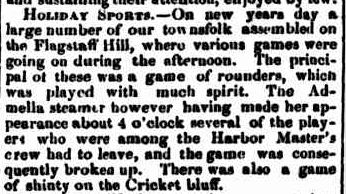
At Warrnambool, New Year’s Day 1859 was celebrated with games on Flagstaff Hill, including rounders.  A game of shinty, a Scottish game like hockey, was also enjoyed.

DOMESTIC INTELLIGENCE. (1859, January 3). Portland Guardian and Normanby General Advertiser (Vic. : 1842 – 1876), p. 2 Edition: EVENINGS.. Retrieved December 29, 2011, from http://nla.gov.au/nla.news-article64509933

The Caledonian games were a popular New Years Day outing for the people of Ballarat in 1861.  I can relate to the poor shop assistants watching the passing parade of happy people enjoying the public holiday.  I have worked more public holidays than I care to remember, in fact I am working today.  I must say while it is annoying at times, I don’t find myself  thinking as the 1860s employees did “wishing all manner of ills to the exacting master whose behests precluded them from mixing in the throng of light hearts and merry faces that swept past the doors…”

NEW YEAR’S DAY. (1861, January 2). The Star (Ballarat, Vic. : 1855 – 1864), p. 2. Retrieved December 30, 2011, from http://nla.gov.au/nla.news-article66336603

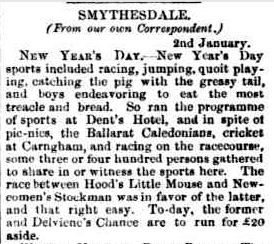
Smythesdale, just out of Ballarat, managed to attract three to four hundred people to their sports day in 1862, despite many other activities threatening to draw people away.  Some of the more interesting sports were catching the pig with the greasy tail and treacle and bread eating competitions.

SMYTHESDALE. (1862, January 3). The Star (Ballarat, Vic. : 1855 – 1864), p. 2. Retrieved December 30, 2011, from http://nla.gov.au/nla.news-article66330531

At Digby in 1863, the local school children held their annual festival and indulged in many cakes and other sweet treats.

DIGBY. (1863, January 6). Portland Guardian and Normanby General Advertiser (Vic. : 1842 – 1876), p. 3 Edition: EVENING. Retrieved December 30, 2011, from http://nla.gov.au/nla.news-article64627825

I could not imagine a government today, state or federal, holding an election between Christmas and New Year.  On December 30, 1865, a general election was held in Victoria, but the timing was not tactical, but due to the dissolution of the fourth government of Victoria on December 11.  New Year’s Day 1866 was spent enjoying the local cricket match and waiting for election results.

NEW YEAR’S DAY. (1866, January 4). Portland Guardian and Normanby General Advertiser (Vic. : 1842 – 1876), p. 2 Edition: EVENING. Retrieved December 30, 2011, from http://nla.gov.au/nla.news-article64635496

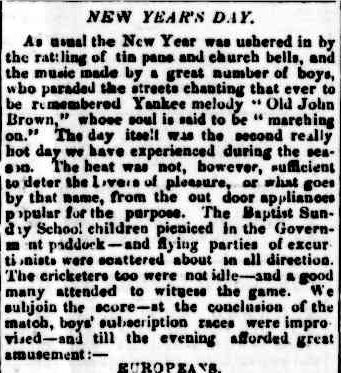
The church bells rang out over Portland at midnight on New Year’s eve 1866, with local boys out on the streets singing “Old John Brown”.  The first day of the new year was hot and outdoor activities were again popular.

NEW YEAR’S DAY. (1867, January 3). Portland Guardian and Normanby General Advertiser (Vic. : 1842 – 1876), p. 2 Edition: EVENING. Retrieved December 30, 2011, from http://nla.gov.au/nla.news-article6463696

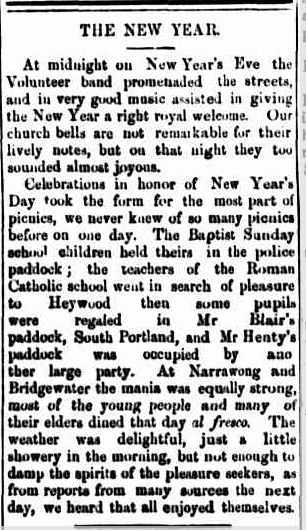
In 1869, New Year’s Day saw al fresco dining at Bridgewater and Narrawong.  The correspondent reported he had not seen so many picnics on one day, including one held for the Baptist Sunday school children and a large gathering at Mr Henty’s paddock.

THE NEW YEAR. (1869, January 4). Portland Guardian and Normanby General Advertiser (Vic. : 1842 – 1876), p. 2 Edition: EVENINGS. Retrieved December 30, 2011, from http://nla.gov.au/nla.news-article64691465

The Australian Sketcher with Pen and Pencil ran a picture of Portarlington on New Years Day, 1879.

(1879, January 18). The Australasian Sketcher with Pen and Pencil (Melbourne, Vic. : 1873 – 1889), p. 172. Retrieved December 30, 2011, from http://nla.gov.au/nla.news-page5739740

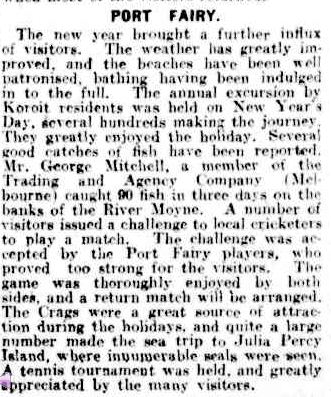
Finally an article from Port Fairy, a popular holiday place then and now for people of the Western District and a place I have celebrated New Year’s Eve on several occasions.  In 1927, visitors to the town had swelled, including a party of several hundred Koroit residents on their annual excursion.  Beaches, fishing, cricket, and boat trips to Julia Percy Island kept the holidaymakers entertained.

HOLIDAY RESORTS. (1927, January 8). The Argus (Melbourne, Vic. : 1848 – 1956), p. 23. Retrieved December 30, 2011, from http://nla.gov.au/nla.news-article3831051

Happy New Year!

A Pioneer Christmas 1890s Style

The 1890s newspaper reports of Christmas were very different to those of the other decades from the 1850s.  Recipes and articles about decorating the home, hint to a greater female readership than other times.  Finally, the arguments about English traditions disappeared as Australians formed their own Christmas traditions.

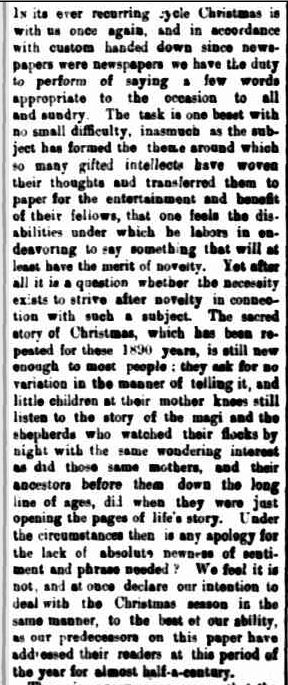
The editor of the  Portland Guardian, welcomed Christmas 1890 as if to say “Here we go again”.

The Portland Guardian,. (1890, December 24). Portland Guardian (Vic. : 1876 – 1953), p. 2 Edition: EVENING. Retrieved December 24, 2011, from http://nla.gov.au/nla.news-article63631009

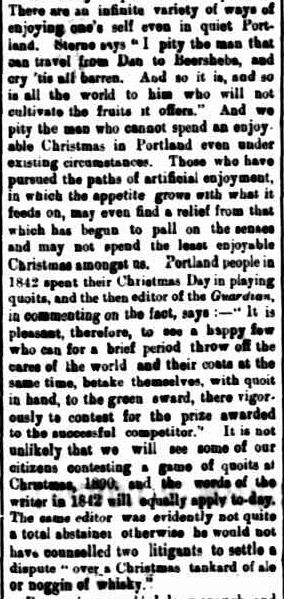
The editor continues with a reference to the 1842 editor of the same newspaper and the Christmas day activity of quoits.

The Portland Guardian,. (1890, December 24). Portland Guardian (Vic. : 1876 – 1953), p. 2 Edition: EVENING. Retrieved December 24, 2011, from http://nla.gov.au/nla.news-article63631009

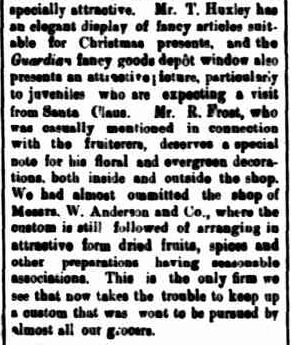
Shop windows were once again dressed up by their owners, but only one grocer maintained the tradition of displaying dried fruits and spices.

The Portland Guardian,. (1890, December 24). Portland Guardian (Vic. : 1876 – 1953), p. 2 Edition: EVENING. Retrieved December 24, 2011, from http://nla.gov.au/nla.news-article63631009

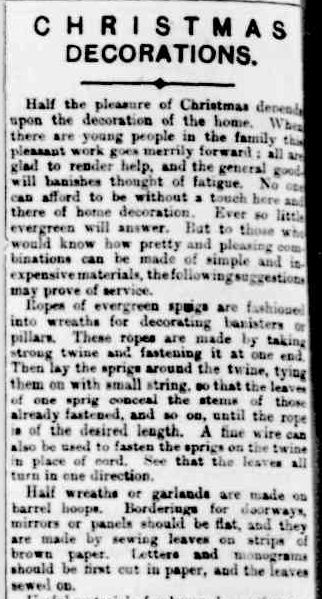
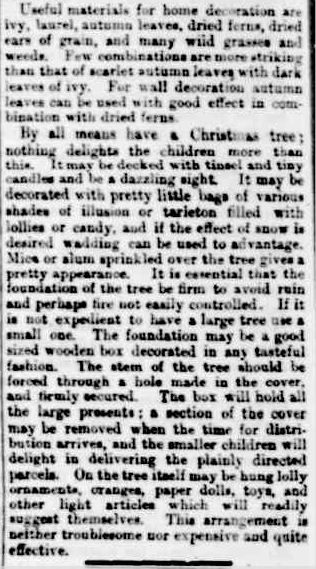
The following is the first article I have seen on Christmas decorations in the home.  It offers tips on Christmas trees and ideas on making decorations.

CHRISTMAS DECORATIONS. (1894, December 28). Portland Guardian (Vic. : 1876 – 1953), p. 12 Edition: EVENING, Supplement: CHRISTMAS SUPPLEMENT. Retrieved December 24, 2011, from http://nla.gov.au/nla.news-article65397988

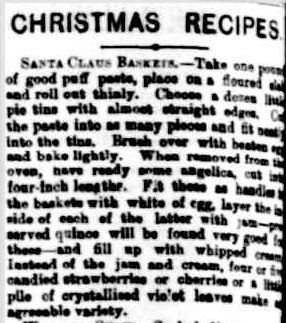
Christmas recipes became popular in the 1890s.  The following for Santa Claus Baskets is from the Portland Guardian of 25 December 1895.  Recipes for Whipped Snow and Plum Pudding were also included.

CHRISTMAS RECIPES. (1895, December 25). Portland Guardian (Vic. : 1876 – 1953), p. 9 Edition: EVENING, Supplement: CHRISTMAS SUPPLEMENT PORTLAND GUARDIAN.. Retrieved December 24, 2011, from http://nla.gov.au/nla.news-article63633406

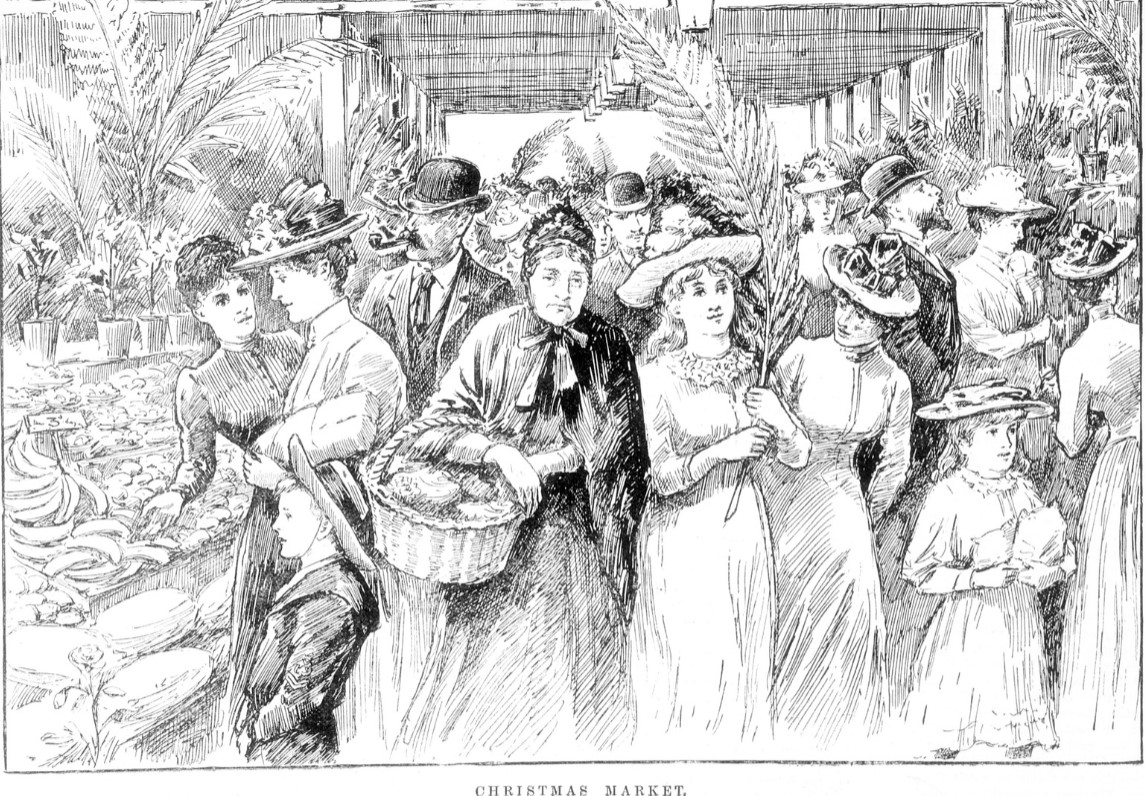
MELBURNE CHRISTMAS EVE MARKET 1892. Image courtesy of the State Library of Victoria http://handle.slv.vic.gov.au/10381/254978

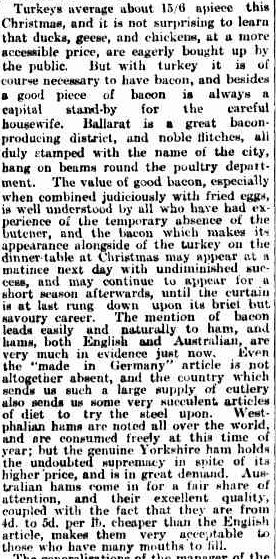
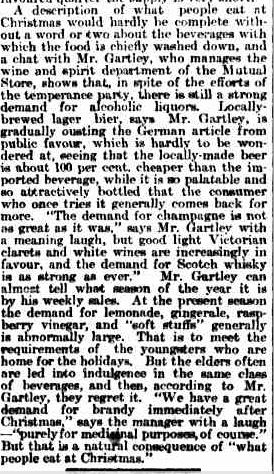
The 1890s saw the traditional beef finally lose favour on the Christmas menu.   This article  What People Eat at Christmas”  from The Argus, gives a real insight into the Christmas fare of the time.  I have not included the entire article, which is worth reading in full.  Times were changing.

WEAT PEOPLE EAT AT CHRISTMAS. (1897, December 25). The Argus (Melbourne, Vic. : 1848 – 1956), p. 8. Retrieved December 24, 2011, from http://nla.gov.au/nla.news-article9784663

Melbourne 1899. CHRISTMAS MARKETING. (1899, December 16). The Australasian (Melbourne, Vic. : 1864 – 1946), p. 29. http://nla.gov.au/nla.news-article138612102

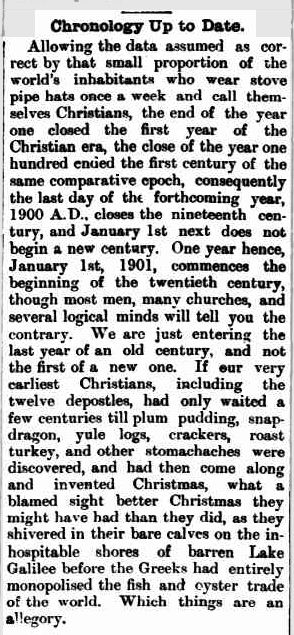
To conclude this 19th-century overview of Christmas in Victoria, I must include the following article for anyone wondering if the 1899 Christmas was the last of the century.  It comes a little further afield than Victoria as it appeared in the West Australian Sunday Times on 31 December  1899.

Chronology Up to Date. (1899, December 31). West Australian Sunday Times (Perth, WA : 1897 – 1902), p. 8. Retrieved December 24, 2011, from http://nla.gov.au/nla.news-article38505997