Passing of the Pioneers

Welcome to November Passing of the Pioneers with a Stawell, Port Fairy and Irish flavour. The pioneers include a licensee, a chemist and an inventive engineer.

If you are new to the monthly Passing of the Pioneers, the obituaries listed here are a summary of the original obituaries, using dates and other information direct from the obituary. I make no attempt to check or correct information contained in the obituary. The original obituaries are found by clicking on the names of the pioneers.

A word of warning, while obituaries often have a wealth of information, that information must be treated with caution.  Naturally, obituaries are written using second-hand information and recall events that occurred many years before the subject’s death, therefore that information can often be incorrect and sometimes even fanciful.   Therefore, the information found in an obituary can only be used as a guide to find primary sources to qualify the claims of an obituary.

Alexander RUSSELL: Died 27 November 1867 at Port Fairy. When Alexander Russell first arrived in Port Fairy in 1847, he took up his chosen profession as a doctor. However, upon his return to the “old country” he gave away medicine and moved into the field of “mercantile speculation” and upon his return to Port Fairy established the Moyne Mill using machinery he brought back from Scotland. Alexander was also the first Mayor of Belfast (Port Fairy) and was elected to the State parliament as member for Villiers and Heytesbury. He relinquished his seat due to ill-health.

Mary D. KEATING: Died 8 November 1914 at Port Fairy. Mary Keating was born in Port Fairy and before her marriage to William Wall, she worked as a teacher at the local Catholic school. William was the Secretary of the Belfast Shire. During her life, Mary was a tireless worker for the Catholic church. William predeceased Mary by fifteen years and they had four children.

Michael QUINLAN: Died November 1914 at Hawkesdale. Michael Quinlan was born in Tipperary, Ireland around 1835, and travelled to Australia when he was around twenty-four. He settled first around Koroit, before taking up land at Hawkesdale. He was a Minhamite Shire Councillor and enjoyed visiting the winter race meeting at Warrnambool.  Michael left one daughter at the time of his passing.

George KAY:  Died 11 November 1915 at Stawell. George Kay lived his forty-nine years in Stawell, in that relatively short time left his mark. He began work at the Stawell foundry and worked in engineering. He took up a partnership in the Kay & Co. Stawell Foundry and remained there until his death. One of his engineering feats was inventing a judging machine for the Stawell Athletics Club, famous for the Stawell Gift. The machine earned him much praise, including from the Governor of Victoria on a trip to Stawell. He was a member of the Stawell Rifle Club and a member of the Pride of Wimmera Lodge.  He left a widow and two daughters.

William WAREHAM: Died 3 November 1916 at Woolongoon. William Wareham’s obituary states he was born at Box Hill in 1844, however, his Victorian Birth registration shows Moonee Ponds in 1845.  At age nineteen, William went to work at Woolongoon Station, near Mortlake. He married and settled in the area.

OBITUARY. (1916, November 8). Mortlake Dispatch (Vic. : 1914 - 1918), p. 3. Retrieved November 29, 2013, from http://nla.gov.au/nla.news-article119795904

OBITUARY. (1916, November 8). Mortlake Dispatch (Vic. : 1914 – 1918), p. 3. Retrieved November 29, 2013, from http://nla.gov.au/nla.news-article119795904

He left a large family including thirty-two grandchildren.

Mary KELLY: Died 19 November 1916 at Stawell. Mary Kelly was born in Tipperary, Ireland around 1836 and travelled to Australia with her parents when she was a girl. She married John Kay and they settled at Great Western. They later moved to Stawell and ran a wine saloon in Main Street before becoming licensees of the Star Hotel (later known as the Stawell Club) in the late 1890s. Family members continued to run the hotel until 1910 when John Alison took over the licence, but Mary continued to own the building.

Margaret ANDERSON: Died 20 November 1916 at Port Fairy. Margaret Anderson was born in Melbourne in 1844 and moved to the Western District with her family at the age of three, taking up residence at Rosebrook. She married John Wright and they settled at nearby Yambuk. Four years prior to her death, Margaret moved into Port Fairy. She was a devout member of St Patrick’s Catholic Church at Port Fairy. Three sons and one daughter were alive at the time of her death, with son George a parish priest in New Zealand.
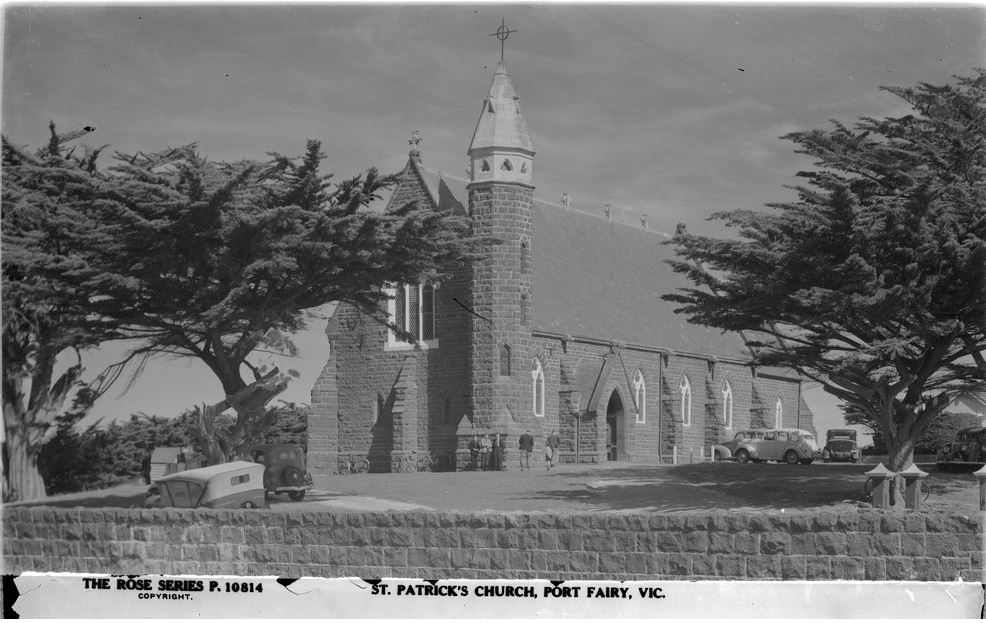
ST. PATRICKS CATHOLIC CHURCH, PORT FAIRY. Image courtesy of the State Library of Victoria, Image no H32492/7521 http://handle.slv.vic.gov.au/10381/61612

ST. PATRICKS CATHOLIC CHURCH, PORT FAIRY. Image courtesy of the State Library of Victoria, Image no H32492/7521 http://handle.slv.vic.gov.au/10381/61612

William DAWSON: Died 30 November 1916 at Stawell. William Dawson was born in Stawell around 1868 and followed his father into the chemist business. After his father’s death, William took over the family chemist shop. William’s passion was sport and he was involved in most of what was on offer in Stawell.  He rode high-wheeled bicycles when they were in vogue and was an official at the Stawell Cycling Club. William was also a cricketer and played with state side, the Victorian Rangers. He was also a founding member of the Stawell Rifle Club and Golf Club and was a keen fisherman. Sport aside, William was a prominent member of the Stawell Brass Band.

Bridget MAHONEY: Died 15 November 1918 at Port Fairy. Bridget Mahoney was born in Ireland in 1823. She arrived in Australia with her husband John Clancy in 1855, travelling from America. Bridget and John settled on a farm at Yambuk.  John passed away around 1895 and Bridget continued to live at Yambuk until seven years prior to her death when she moved to Port Fairy to live with her daughter Lizzie.

William REES: Died 29 November 1918 at Stawell. William Rees was born in South Wales around 1830. He began an apprenticeship as a joiner and for the next five years, he travelled to Canada and the United States, arriving in California in 1853. In 1854, he was lured to the goldfields of Victoria, including Ballarat, Carisbrook and Ararat. He married another native of South Wales in Jane Symons in 1855. William and Jane arrived at Stawell in 1857. William worked as a carpenter for the Oriental and North Cross Mining Company for many years.


Trove Tuesday – High Fire Danger

This week’s Trove Tuesday post began as a story about Magic Lanterns, the early version of the film projector, and the problems they were causing in Portland in 1914.  But a reference in the article to “celluloid collars” changed the post slightly to include another unexpected fire risk to mostly men and boys of the early 20th century.

The first article comes from the Portland Guardian of October 14, 1914.  A cheap toy Magic Lantern, or more precisely the lens of the lantern, was the curse of the mother’s of Portland boys.  The lenses, probably removed for the purpose of mischief by the boys, were burning holes in their pockets.  The whistle-blower on the events, warned that if one were placed in a celluloid collar, disaster would prevail.

First Issue, August 20, 1842. (1914, October 14). Portland Guardian (Vic. : 1876 - 1953), p. 2 Edition: EVENING. Retrieved November 25, 2013, from http://nla.gov.au/nla.news-article63970668

First Issue, August 20, 1842. (1914, October 14). Portland Guardian (Vic. : 1876 – 1953), p. 2 Edition: EVENING. Retrieved November 25, 2013, from http://nla.gov.au/nla.news-article63970668

That got me thinking, why were celluloid collars such a risk.  While I assumed that being made from the same material as film, they would be flammable (thanks to a recent episode of Miss Fisher’s Murder Mysteries for that realisation), but was the danger really that great?  A Trove search found that yes they were a danger, and sometimes in the most innocent ways.  One  headline I found was “Killed by Collar of Fire” , another “Dangers of Celluloid”.  I’ve read many accounts of the risks to ladies wearing full skirts around open fires and even sparks from buggy wheels catching an overhanging skirt, but celluloid collars, it seems, were the male equivalent.

Some Horsham children were lucky that the celluloid collar they were playing with didn’t cause more damage.

A FIRE AVERTED. (1915, June 22). The Horsham Times (Vic. : 1882 - 1954), p. 5. Retrieved November 25, 2013, from http://nla.gov.au/nla.news-article72974894

A FIRE AVERTED. (1915, June 22). The Horsham Times (Vic. : 1882 – 1954), p. 5. Retrieved November 25, 2013, from http://nla.gov.au/nla.news-article72974894

The photo below is of a Magic Lantern, but not a toy that the Portland boys had.  For the purpose of the demonstration, the photo of the Magic Lantern was taken in daylight, but darkness was necessary to view the projected images.

A Magic Lantern (1909).  Image Courtesy of the State Library of Victoria.  Image no.  H2009.29/120 http://handle.slv.vic.gov.au/10381/159294

A Magic Lantern (1909). Image Courtesy of the State Library of Victoria. Image no. H2009.29/120 http://handle.slv.vic.gov.au/10381/159294

It’s A Small World

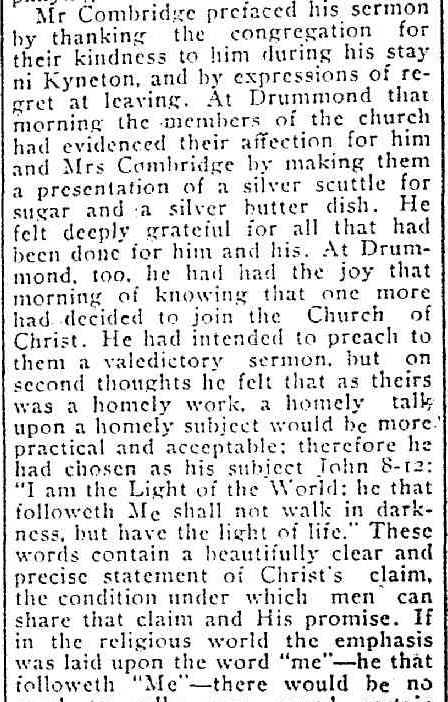
I didn’t think I would ever see the names Harman and Combridge together in a newspaper article.  Harman,  is my maternal great-grandmother’s family name and Combridge, my paternal grandmother’s family name.  One is from the west of the Western District and the other family was predominately from around Geelong, but my paternal grandmother’s own family moved across to South Gippsland.  Also, I thought that not until my parent’s marriage in 1967, would Harman and Combridge descendants have stood together in a church, but in fact 53 years before in Kyneton, Central Victoria they did.

The Harman in question was Nina Harman (who you have met before when she appeared in the Australian Women’s Weekly with her carpet, a royal inspiration).  The Combridge in question was John Robert Combridge (1868-1934), brother of my gg grandfather, Herbert Combridge.

Nina Harman, then 19, was in Kyneton back in 1914 because her father, Walter Graham Harman had moved the family there from Port Fairy in the early 1900s.  John Combridge, a Church of Christ minister, was finishing a stint at the Kyneton Church of Christ, before moving to Horsham, the deepest any Combridge had ventured into Western Victoria. The purpose of the gathering at the Kyneton Church of Christ was to farewell John and his wife, Julia Mill, and wish them luck for their time in Horsham.  Not only was Nina a member of the congregation, she played the piano alongside Julia on the organ.

Nina wasn’t the only Harman in church that Sunday evening.  Mr and Miss Harman sang the hymn “Look up to Christ” accompanied by Nina and Julia.  Mr Harman would have been Nina’s father Walter and the Miss Harman, one of Nina’s sisters, either Elise or Nellie.  John then launched into his final sermon at Kyneton Church of Christ.

While it was a smaller world in 1914, I’m still surprised the families met and I can only wonder how well they knew each other.

com

THE CHURCH OF CHRIST. (1914, June 30). Kyneton Guardian (Vic. : 1914 - 1918), p. 2. Retrieved November 21, 2013, from http://nla.gov.au/nla.news-article129618902

THE CHURCH OF CHRIST. (1914, June 30). Kyneton Guardian (Vic. : 1914 – 1918), p. 2. Retrieved November 21, 2013, from http://nla.gov.au/nla.news-article129618902

Trove Tuesday – Monkey Business

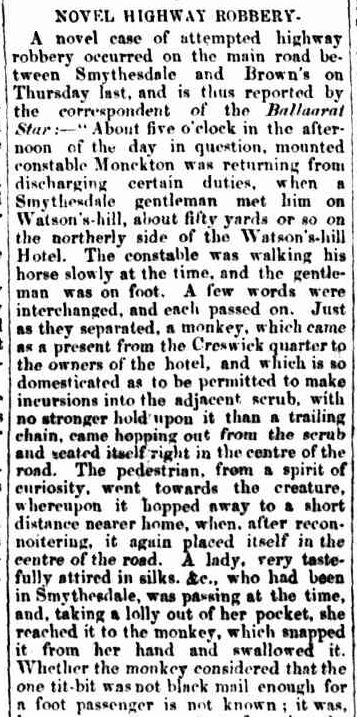
This week for Trove Tuesday we go to  Smythesdale, a small town just west of Ballarat with an article from The Gippsland Times of  October 14, 1865.  And guess what?  It’s another animal story, but I love it because it’s almost 150 years old and it is so descriptive, I can clearly picture the lady “tastefully attired in silks” and Constable Monekton removing himself from the scene at great haste.

monkey1

NOVEL HIGHWAY ROBBERY. (1865, October 14). Gippsland Times (Vic. : 1861 - 1954), p. 1 Edition: Morning., Supplement: SUPPLEMENT TO The Gippsland Times.. Retrieved November 19, 2013, from http://nla.gov.au/nla.news-article65366052

NOVEL HIGHWAY ROBBERY. (1865, October 14). Gippsland Times (Vic. : 1861 – 1954), p. 1 Edition: Morning., Supplement: SUPPLEMENT TO The Gippsland Times.. Retrieved November 19, 2013, from http://nla.gov.au/nla.news-article65366052

As usual, I can count on Trove to help me find the right photo to go with my article.  I am a little concerned about this photo from the State Library of Victoria as the title is “Woman playing with pet monkey” (c1893).  Considering the woman has a stick in her hand and the monkey has its hands on its head, “playing” mightn’t be the right word.  It did however remind me of the scene on the road near Smythesdale.

Image Courtesy of the State Library of Victoria Image No. H83.47/154  http://handle.slv.vic.gov.au/10381/23564

Image Courtesy of the State Library of Victoria Image No. H83.47/154 http://handle.slv.vic.gov.au/10381/23564


Beginning to Look A Lot Like Christmas

While Christmas is the furthest thing from my mind at the moment, judging by the hits my Christmas posts have had in the past week, others are warming up to it.

Image Courtesy of the State Library of Victoria. John Etkins Collection. Image No. H2005.36/75 http://handle.slv.vic.gov.au/10381/73735

Image Courtesy of the State Library of Victoria. John Etkins Collection. Image No. H2005.36/75 http://handle.slv.vic.gov.au/10381/73735

During December 2011 and 2012, I compiled five Pioneer Christmas posts for the decades 1850-1890 and six Western District Christmas posts, 1900-1950. If you would like to know how your ancestors celebrated Christmas, check them out.  From the early decades of the Victorian Colony when the first settlers pined for a white Christmas while they sweltered through summer’s heat through to the 1950s when Christmas Day in Victoria was much as it is today.  In between, there were the struggles of two World Wars and a couple of Depressions.  During those times of austerity, the Christmas spirit still managed to shine through, albeit with some adjustments.

Honestly, I’m all Christmased out after the 11 Christmas posts I have written over two years.  This year, I can rest easy as I now know how my ancestors passed their Christmas Days.

Image Courtesy of State Library of Victoria.  Image No. H42790/19 http://handle.slv.vic.gov.au/10381/41584

Image Courtesy of State Library of Victoria. Image No. H42790/19 http://handle.slv.vic.gov.au/10381/41584

Trove Tuesday – Fido, A Family Favourite

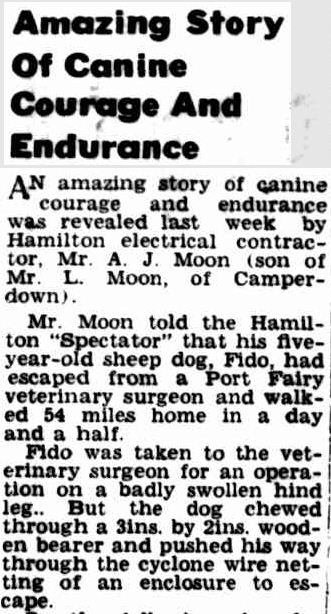
This week, I want to revisit one of my earlier Trove Tuesday posts, “Fido’s Feat”.  To refresh your memory here is Fido’s story again and then, a lovely postscript to his story:

tt3

Amazing Story Of Canine Courage And Endurance. (1954, September 14). Camperdown Chronicle (Vic. : 1877 - 1954), p. 4. Retrieved December 10, 2012, from http://nla.gov.au/nla.news-article24008716

Amazing Story Of Canine Courage And Endurance. (1954, September 14). Camperdown Chronicle (Vic. : 1877 – 1954), p. 4. Retrieved December 10, 2012, from http://nla.gov.au/nla.news-article24008716

I recently told you about a Facebook group I set up called, I’ve Lived in Hamilton, Victoria, that was, and still is, offering me “A Pleasant Distraction”.  I’ve posted a few Hamilton stories from Western District Families, and one of those was Fido’s story.  So, it was a thrill to hear from Alan Moon’s children, Graeme and Diana, members of the group.

Growing up, the story of Fido’s feat was a family favourite, with Graeme commenting that he didn’t think anyone else knew the story their father often told them as children.  He recalled being “amazed” at the brave dog’s journey from Port Fairy to Hamilton.  Diana told me she would ask her father to tell her the story over and over.  Thank you, Graeme and Diana, for sharing your childhood memories and for adding to Fido’s wonderful story.


Trove Tuesday – I Had A Dream

It’s Melbourne Cup time again and I love that it falls on Trove Tuesday.  There are many ways to pick a winner and around Melbourne Cup time, you hear them all.  Some go for numbers, the name, the colours or maybe an omen.  Often after the event, punters will claim they dreamt up the winner, and as the “Sound” from the Hamilton Spectator suggested in 1894, they are often not game to declare their selection prior to the race.  But not so John Cameron.  Back in 1894, farrier John Cameron of Lonsdale Street, Hamilton, claimed his Melbourne Cup selection came from a dream and he was happy to share his vision.

The 1893 Melbourne Cup winner was Tarcoola and it was that horse’s name that came to Cameron in his slumber.  He recalled seeing a newspaper listing previous Melbourne Cup winners including Archer for 1861/62 and Tarcoola 1893/94.  So convinced that he had dreamt the winner, he took a Caulfield Cup/Melbourne Cup Double, Paris into Tarcoola.

The “Sound” recounts the most famous prediction emanating from a dream, the winner of the 1870 Melbourne Cup.  The winner Nimblefoot,  the dreamer his owner Walter Craig, owner of Craig’s Hotel, Ballarat.

mcmc1

Melbourne Cup Dreamers. (1894, October 31). Portland Guardian (Vic. : 1876 - 1953), p. 3 Edition: EVENING. Retrieved November 5, 2013, from http://nla.gov.au/nla.news-article65397112

Melbourne Cup Dreamers. (1894, October 31). Portland Guardian (Vic. : 1876 – 1953), p. 3 Edition: EVENING. Retrieved November 5, 2013, from http://nla.gov.au/nla.news-article65397112

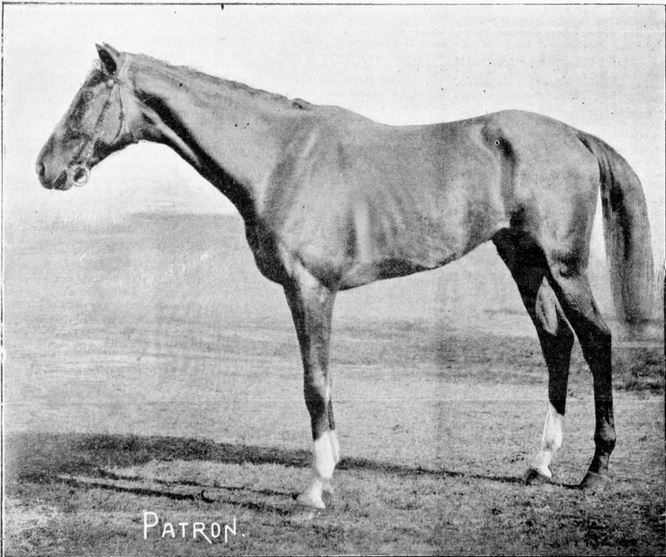
Are you wondering if John Cameron was a winner?  The first leg of his double come in, Paris in the Caulfield Cup.  The Melbourne Cup winner was Patron, with Tarcoola  unplaced.

PATRON, 1894 MELBOURNE CUP WINNER, Image Courtesy of the State Library of Victoria. Image no.  IAN08/11/94/20-21e  http://handle.slv.vic.gov.au/10381/254730

PATRON, 1894 MELBOURNE CUP WINNER, Image Courtesy of the State Library of Victoria. Image no. IAN08/11/94/20-21e
http://handle.slv.vic.gov.au/10381/254730

Skipton – The “Local” Horse

In 1941, a horse with links to the Western District won the Victoria Derby/Melbourne Cup double.  Named after a small town west of Ballarat and with a female owner from Hamilton, Skipton had the two towns on their feet when he crossed the line to win the 1941 Melbourne Cup.

As a birthday gift in 1939, Mrs Myrtle Kitson was given the choice of a yearling from her husband, John. Myrtle selected a colt, sired by Marabou and out of Cupidity.  After some maturing, he was sent to trainer  Jack Fryer. Myrtle wanted to call her colt “Monaco” but had some reservations, so she selected “Skipton”, the name of the little town on the Glenelg Highway where she enjoyed stopping on travels to and from Hamilton. (Skipton is often used as a pit stop for those travelling the Glenelg Hwy, and a place that members of my family would stop for a cup of tea on their drive back to Hamilton)

HOW SKIPTON GOT ITS NAME. (1941, November 12). The Cumberland Argus and Fruitgrowers Advocate (Parramatta, NSW : 1888 - 1950), p. 7. Retrieved November 3, 2013, from http://nla.gov.au/nla.news-article107293645

HOW SKIPTON GOT ITS NAME. (1941, November 12). The Cumberland Argus and Fruitgrowers Advocate, p. 7. , http://nla.gov.au/nla.news-article107293645

Myrtle was superstitious, and on the day of the Derby of 1941, she remained in Hamilton tending the Grand Central Hotel, where she and her husband John were licensees.  John and daughter Morva represented her at the races, and when Skipton crossed the line as the winner of the Derby, they accepted the trophy on Myrtle’s behalf.

OWNER'S DAUGHTER AND WINNING TRAINER. (1941, November 4). The Daily News (Perth, WA : 1882 - 1950), p. 10 Edition: HOME EDITION. Retrieved November 2, 2013, from http://nla.gov.au/nla.news-article78571281

OWNER’S DAUGHTER AND WINNING TRAINER. (1941, November 4). The Daily News (Perth, WA : 1882 – 1950), p. 10 Edition: HOME EDITION. Retrieved November 2, 2013, from http://nla.gov.au/nla.news-article78571281

After the race, reports came through that Skipton had pulled up sore and was an uncertain starter in the Melbourne Cup the following Tuesday.  The night before the Cup, Skipton was declared a starter with William Cooke (Billy) to take the mount.  The late decision, although probably tactics, was the correct one as Skipton took out the race. In doing so, Skipton achieved a feat only twelve horses had done before and no horse has done since, winning the Victoria Derby/Melbourne Cup double in the same year.

Like Derby Day, Myrtle, not wanting to jinx the horse, remained at the Grand Central Hotel on Cup Day.  Morva and John stopped at Skipton for a cup of tea on the way to Melbourne, just as they did three days before…just in case it was an omen.

The whole of Hamilton must have listened to the race, and many crammed into the Grand Central Hotel that day to listen to the Cup on the wireless, and a lot of money was bet on the “local” horse.  That and the chance of a beer on the house were reasons enough to take an interest.  The call, by Ken Howard, is online on the following link – 1941 Melbourne Cup Call

As Skipton crossed the line, Myrtle declared, “Turn it on for the customers”.

skipton

SKIPTON STABLE SECRECY. (1941, November 9). Sunday Times (Perth, WA : 1902 - 1954), p. 8. Retrieved November 2, 2013, from http://nla.gov.au/nla.news-article59154373

SKIPTON STABLE SECRECY. (1941, November 9). Sunday Times, p. 8.  http://nla.gov.au/nla.news-article59154373

SKIPTON'S OWNER MISSED CUP. (1941, November 5). The Argus (Melbourne, Vic. : 1848 - 1957), p. 1. Retrieved November 2, 2013, from http://nla.gov.au/nla.news-article8214714

SKIPTON’S OWNER MISSED CUP. (1941, November 5). The Argus , p. 1. http://nla.gov.au/nla.news-article8214714

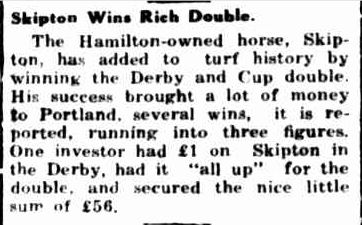
It was not just the money of Hamiltonians riding on Skipton’s back that day.  The Portland Guardian reported there were big wins in Portland on bets placed on the “local” horse.

Shipton Wins Rich Double. (1941, November 6). Portland Guardian (Vic. : 1876 - 1953), p. 2 Edition: EVENING. Retrieved November 2, 2013, from http://nla.gov.au/nla.news-article64402269

Shipton Wins Rich Double. (1941, November 6). Portland Guardian, p. 2 http://nla.gov.au/nla.news-article64402269

The win gave Billy Cook his first Melbourne Cup, in his eighth attempt, aged thirty-one.  He won the Cup again in 1945, aboard Rainbird, a horse bred in the Western District at Cavendish.  By the end of his career, Cook had won almost every major race in Australia and had received legend status.  He was inducted into Racing’s Hall of Fame in 2002.

skipton4

Not Easy Horse To Train. (1941, November 5). The Advertiser (Adelaide, SA : 1931 - 1954), p. 4. Retrieved November 2, 2013, from http://nla.gov.au/nla.news-article45736493

Not Easy Horse To Train. (1941, November 5). The Advertiser  p. 4. http://nla.gov.au/nla.news-article45736493

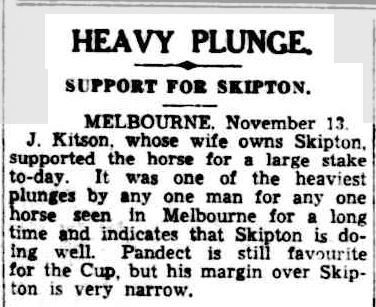
The win was not without controversy.  Punters were angry because, in the lead-up, it was suggested Skipton was unlikely to run.  The price went out and rumours of a £25,000 bet were spreading.  John Kitson denied the rumours, insisting he only bet £8000, still a handsome wager in those days.  A Sydney owner was quick to criticise the secrecy surrounding champion racehorses.

skipton7

skipton8

SKIPTON STABLE SECRECY. (1941, November 9). Sunday Times (Perth, WA : 1902 - 1954), p. 8. Retrieved November 2, 2013, from http://nla.gov.au/nla.news-article59154373

SKIPTON STABLE SECRECY. (1941, November 9). Sunday Times , p. 8.  http://nla.gov.au/nla.news-article59154373

Myrtle was soon reunited with the horse that put her in the history books as the second-winning female owner of the Victoria Derby and the third winning female owner of the Melbourne Cup.

“Melbourne Jockeys Turned Down Ride on Cup Winner” Sporting Globe 12 November 1941, p 1 http://nla.gov.au/nla.news-article181717280 

Back in Hamilton, the town was riding on the back of the Kitson’s success.  A “local” horse had won the cup.  To congratulate the Kitsons, a dinner was held at the Kitsons’ own hotel.

Hamilton Honours Kitson Family. (1941, November 15). Border Watch (Mount Gambier, SA : 1861 - 1954), p. 6. Retrieved November 2, 2013, from http://nla.gov.au/nla.news-article78132418

Hamilton Honours Kitson Family. (1941, November 15). Border Watch (Mount Gambier, SA : 1861 – 1954), p. 6. Retrieved November 2, 2013, from http://nla.gov.au/nla.news-article78132418

The following year, Skipton did not start his preparation well, with a disappointing run in the Mentone Cup.  He followed up with a win in the Stand Handicap, pushing him into Caulfield Cup favouritism. However, he could only manage fifth in the race, with Tranquil Star narrowly winning from Heart’s Desire.  Along with the Caulfield Cup, Tranquil Star won the Caulfield Stakes, WS Cox Plate and the McKinnon Stakes in the same season.

Skipton Doesn't Look Spring Winner. (1942, September 20). Sunday Times (Perth, WA : 1902 - 1954), p. 5. Retrieved November 2, 2013, from http://nla.gov.au/nla.news-article59171794

Skipton Doesn’t Look Spring Winner. (1942, September 20). Sunday Times (Perth, WA : 1902 – 1954), p. 5. Retrieved November 2, 2013, from http://nla.gov.au/nla.news-article59171794

Despite the defeat at Caulfield, come Melbourne Cup time, Skipton was pushing for favouritism after John Kitson placed a rather healthy wager on Skipton, thus giving a hint that the horse was on target.

HEAVY PLUNGE. (1942, November 14). Cairns Post (Qld. : 1909 - 1954), p. 6. Retrieved November 3, 2013, from http://nla.gov.au/nla.news-article42367898

HEAVY PLUNGE. (1942, November 14). Cairns Post (Qld. : 1909 – 1954), p. 6. Retrieved November 3, 2013, from http://nla.gov.au/nla.news-article42367898

The task was ahead of Skipton.  No horse since Archer in 1861/2  had won consecutive cups, and the only horse to have won carrying more than nine stone in the ten years before was the champion, Peter Pan.  Punters were willing to stick with Skipton, especially after his excellent lead-up win in the Hotham Handicap carrying 9st 4lb, and as they say, records are made to be broken.

The records remained intact.  In what has become known as the Austerity Melbourne Cup, due to WW2 belt-tightening, a rank outsider called Colonus got up by seven lengths in heavy conditions. Skipton spent the entire race near the tail of the field.  He was then sent out for a spell before his next tilt at the Cup in 1943.

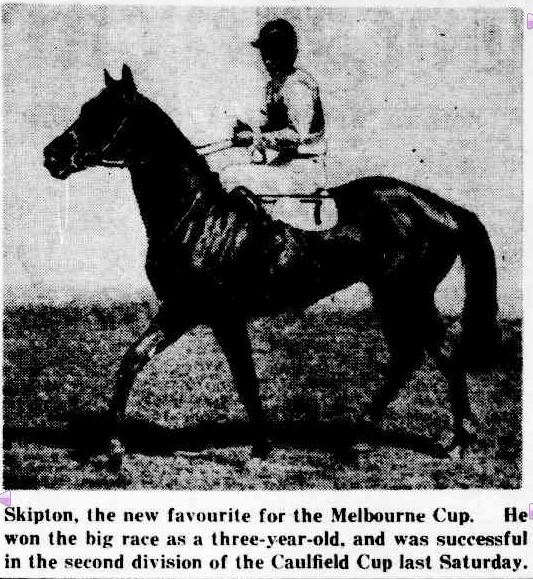
Skipton returned in the Spring of 1943 with the Caulfield Cup, his first goal.  That year, because of an overwhelming number of nominations, there were two divisions of the Caulfield Cup.  The first division was won by a roughie, Saint Warden, while Skipton, showing some of the class of his three old days, won the second division. Naturally, Melbourne Cup favouritism ensued.

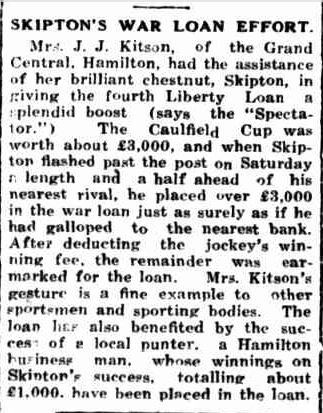
After the win, Myrtle and a generous Hamilton punter donated money to the War Loan effort.

SKIPTON'S WAR LOAN EFFORT. (1943, November 1). Portland Guardian (Vic. : 1876 - 1953), p. 2 Edition: EVENING. Retrieved November 4, 2013, from http://nla.gov.au/nla.news-article64387175

SKIPTON’S WAR LOAN EFFORT. (1943, November 1). Portland Guardian p. 2  http://nla.gov.au/nla.news-article64387175

MELBOURNE CUP FAVOURITE. (1943, October 27). The Mercury (Hobart, Tas. : 1860 - 1954), p. 15. Retrieved November 3, 2013, from http://nla.gov.au/nla.news-article25984915

MELBOURNE CUP FAVOURITE. (1943, October 27). The Mercury, p. 15. http://nla.gov.au/nla.news-article25984915

Once again, Skipton went into the Melbourne Cup with a chance to make history, as the first horse to win two Melbourne Cups and a Caulfield Cup.  Also, only three other horses had won the Caulfield and Melbourne Cups in the same year.  Coming around the back of the track before the horses entered the straight for the last time, it looked as though Skipton could win, sweeping around the field from a long way back as he made his run.  However, as they entered the straight, he was forced wide and with a large weight, he could only manage a credible but well-beaten fifth, behind another favourite in the race, Dark Felt.  Skipton then ran in the Williamstown Cup later in November and ran second to Claudette.

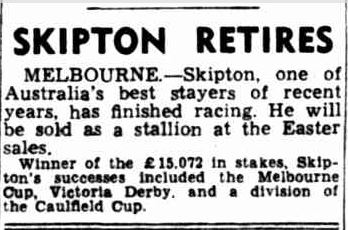
That was the last race for Skipton.  He was brought into the stable in early 1944 for an Autumn preparation, with the Australian Cup in mind.  Unfortunately, in early February, Skipton developed heat in his near-side foreleg and trained at the beach for several days to take advantage of the saltwater.  However, it was soon realised the injury was serious and an announcement was made that he would not run in the Australian Cup and later, the announcement of his retirement.

SKIPTON RETIRES. (1944, February 10). News (Adelaide, SA : 1923 - 1954), p. 6. Retrieved November 3, 2013, from http://nla.gov.au/nla.news-article128393096

SKIPTON RETIRES. (1944, February 10). News (Adelaide, SA : 1923 – 1954), p. 6. Retrieved November 3, 2013, from http://nla.gov.au/nla.news-article128393096

Just over a month later, Myrtle Kitson sold Skipton at the Newmarket Sales.  He fetched 1,500 guineas as a stud prospect, the buyer Kooba Stud near Scone, New South Wales.

At some point, around the mid-1940s, the Kitsons left Hamilton and moved to Glen Iris, where Myrtle passed away on 19 September 1946.  Myrtle left an estate of over £9,000.

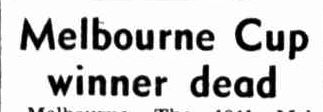
Late in December 1948, news came through that Skipton was dead, aged ten, the result of a tragic stable accident.

Turf Notes. (1948, December 31). The Charleville Times (Brisbane, Qld. : 1896 - 1954), p. 8. Retrieved November 3, 2013, from http://nla.gov.au/nla.news-article76553267

Melbourne Cup winner dead. (1948, December 23). News, p. 16.  http://nla.gov.au/nla.news-article12988791

Melbourne Cup winner dead. (1948, December 23). News (Adelaide, SA : 1923 - 1954), p. 16. Retrieved November 3, 2013, from http://nla.gov.au/nla.news-article12988791

Turf Notes. (1948, December 31). The Charleville Times, p. 8.  http://nla.gov.au/nla.news-article76553267

Underrated Skipton was the last horse to win the Melbourne Cup as a three-year-old and the last horse to win the Derby/Melbourne Cup, a record often forgotten.

Passing of the Pioneers

If you have read my last post, A Pleasant Distraction, you will understand why October Passing of the Pioneers just got in by the skin of its teeth. Thankfully I had the bones of the post done before “Hamilton Fever” took hold. This month there are the obituaries of a bricklayer, a Gaelic preacher, a disgraced crewman from the General Hewitt, and a member of the Henty family.

David HUTTON: Died 9 October 1875 at Mount Rouse. David Hutton was born in Greenock, Scotland around 1809. He was an engineer by trade and left Scotland in 1833 for Hobart to follow his brothers. One brother, William, saw opportunities in the new colony of Victoria, and David later followed, arriving at Portland in around 1844. He took out a lease on land at Mount Rouse and established Cheviot Hills.  David Hutton was a foundation member of the Mt. Rouse Board and served for seven years. A Presbyterian, he was one of those behind the building of a church at Penshurst. He was buried at the Port Fairy Cemetery with other members of his family.  Hutton Street in Penshurst is named after David Hutton. Another obituary, published  in The Mercury of Hobart, has more on David’s story

Ewan McDONALD: Died 13 October 1891 at Warrion. Ewan McDonald was born around 1808 and first went to the Colac district when he settled on land at Dreeite around 1866. Ewan was a Presbyterian and at one time gave services at the Larpent Presbyterian Church in Gaelic.

John H. DUNN: Died 29 October 1914 at Hamilton. John Dunn was born in Geelong around 1860 and arrived in Hamilton, with his parents, two years later. Like his father, John was a bricklayer and together they built some of Hamilton’s larger buildings.  A search for Dunn’s bricklayers found a reference on the Victorian Heritage Database. The home mentioned, in the Church Hill area of Hamilton is well-known to me and was built by William Dunn, when John was still a baby. In later life, John was a member of the Independent Order of Rechabites and the Methodist Church. He married Miss H. Luxton of Macarthur and they had nine children.

James DUNCAN: Died 8 October 1916 at Balmoral. James Duncan was born in Inverness, Scotland in 1837 and he arrived on the Flora McDonald to Portland in 1855. He went to Rocklands, near Balmoral, working as a shepherd. He left the district for Serpentine before returning to Glendinning station as overseer. He later took up the carpentry trade in Balmoral.  He married Emily Rogers in 1876 and they had six children.

Elizabeth LEAHY: Died 15 October 1916 at Cavendish. Elizabeth Leahy was born in Adelaide around 1849. Her family came to Victoria to the goldfields of Bendigo and Ballarat, before returning to South Australia, taking up residence at Mt. Gambier. Elizabeth later moved to Lake Bolac and met her future husband, J.H Wallis. They married at Ararat. The couple farmed in the Wimmera, moved back to Ararat before settling at Mooralla around 1910.

Samuel BROWNLAW: Died 13 October 1917 at Tyrendarra. Samuel Brownlaw and his wife, Mary Ann Speechly, arrived on the Severn to Portland in 1856. They first went to Yambuk, before settling at Tyrendarra where they remained. In 1875, Samuel donated land for the Tyrendarra School. Samuel left three sons and three daughters at the time of his death.

John Stevens ANDREW aka John FORSTER: Died 5 October 1918 at Merino Downs. I have touched upon the obituary of John Andrew/Forster before, in the post The General Hewitt. John’s obituary gave me some clues to the names of the crew members that caused unrest during the voyage and those that deserted. John was one of those crew members, explaining his alias. Unfortunately, his obituary speaks of nothing else but that voyage that hung over his head, even after death,

Christina McGREGOR: Died October 1925 at Hamilton. Christina McGregor was born in Inverness, Scotland around 1835. and arrived in Melbourne around 1847 on The Indian. Aboard the schooner The Wave, Christina travelled to Portland. Her next destination, on horseback, was to Satimer Estate near Casterton, owned by her uncle Alexander Davidson.  Station life must not have been proper for a young lady as Christina returned to Portland to attend the ladies’ school run by the Misses Allison. It was in Portland she met her future husband, Archibald McDonald, from Condah, where they remained for the rest of the lives.

Phillip Henry THEISINGER: Died October 1942 at Portland. Geelong native, Phillip Theisinger, moved to Portland as a small child and remained there for the rest of his life. He worked as a storeman and was a secretary of the Portland Waterside Worker’s Union. Phillip was also a member of the Portland Citizen’s Band for forty-five years and was a member of the Portland Masonic Lodge. He married Sarah Ann Surrey and they had twelve children, but only three still survived at the time of Phillip’s death.

Henry COWLAND:  Died 21 October 1942 at Heywood. Henry Cowland was born in Brixton around 1847. He arrived with his parents to Portland aboard the Severn in 1856. He attended the Butler’s School in Portland until he was twelve and then he obtained work as a contractor at Sandford. He also worked as a fencer and a carrier, carting sleepers for the railway line between Hamilton and Portland.

HENRY COWLAND. OBITUARY. (1942, November 5). Portland Guardian (Vic. : 1876 - 1953), p. 3 Edition: EVENING. Retrieved October 24, 2013, from http://nla.gov.au/nla.news-article64382636

HENRY COWLAND. OBITUARY. (1942, November 5). Portland Guardian (Vic. : 1876 – 1953), p. 3 Edition: EVENING. Retrieved October 24, 2013, from http://nla.gov.au/nla.news-article64382636

Annie DAWKINS: Died 2 October 1942 at Hamilton. Annie Dawkins was born at Glencoe, South Australia around 1866 and travelled to Victoria as a girl with her parents and they settled near Condah. Annie married Henry Dyer Rundell at Condah in 1890. She was a supporter of the Red Cross and did her bit during the two World Wars. She left a family of five children,

Agnes Cecil HENTY: Died 30 October 1945 at Nelson, New Zealand. Agnes Cecil Henty was the 6th daughter of Stephen and Jane Henty and she was born at Portland in 1850. In 1877, she married Edward Stafford Coster in New Zealand and they resided at Canterbury on the South Island. Twenty-five years later Agnes and family moved to Nelson and she remained there until her death aged ninety-five.

Robert Henry HOLLIS:  Died October 1946 at Portland. Robert Hollis was born in Tarragal around 1863. His parents moved to Gorae when Robert’s father began work as a stockman for the Henty’s. After some time working as a butcher, Robert turned to farming and at the time of his death he “had a fine dairy farm and orchard property”.

A Pleasant Distraction

I’ve been a bit distracted from my usual research/blogging regime of late.  Instead, I’ve been indulging in a feast of Hamilton history.  But I haven’t been to the usual repositories, looking at physical records and photographs. I’ve been on Facebook.

In 2008, I set up a Facebook group, “I’ve Lived in Hamilton, Victoria”.  There were a couple of reasons behind it.  I wanted to connect with other Hamilton people and the search features offered by Facebook then didn’t fully satisfy that.  What I was looking for was a central hub, where Hamiltonions could go, find old friends and share memories of growing up in the town.

I was also interested in the power of Social Media to network.  In those days, Facebook pages didn’t exist, only groups, and if a person joined, that action would show on their timeline, much the same as a page today.  My hope was friends would see that post and they too would join the group and so on.  Well it worked, and within a few months we had 1600 members.  It was pretty amazing really.  The unfortunate thing at that time was that it was difficult to get a conversation going among members and then sustain it.

Facebook being Facebook changed at some point, and groups looked like they were on the way out.  Those that weren’t active faced the axe and the Hamilton group, despite large numbers, was one of those.  Eventually all the members were “delisted” and while the group remained, people had to join again.  Problem was, groups became less visible on profiles and most assumed they were still a member or they simply forgot.  Also, if someone joined, it was no longer displayed on their timeline, making it hard to get the word out.

Over the past year, Facebook groups have found their place again and are again visible on members’ profiles and there are “group suggestions” beside the timeline.  A perfect time to get the group happening again.  With just 70 or so stalwart members, I started posting more often.  Then I turned to Trove and I added photos of Hamilton in days of old.  Well, 70 members soon became 130, then 200 and in a couple of weeks we have reached 1100 members.  The photos got the conversation going and the memories flowing.  Once again Trove helped save the day!

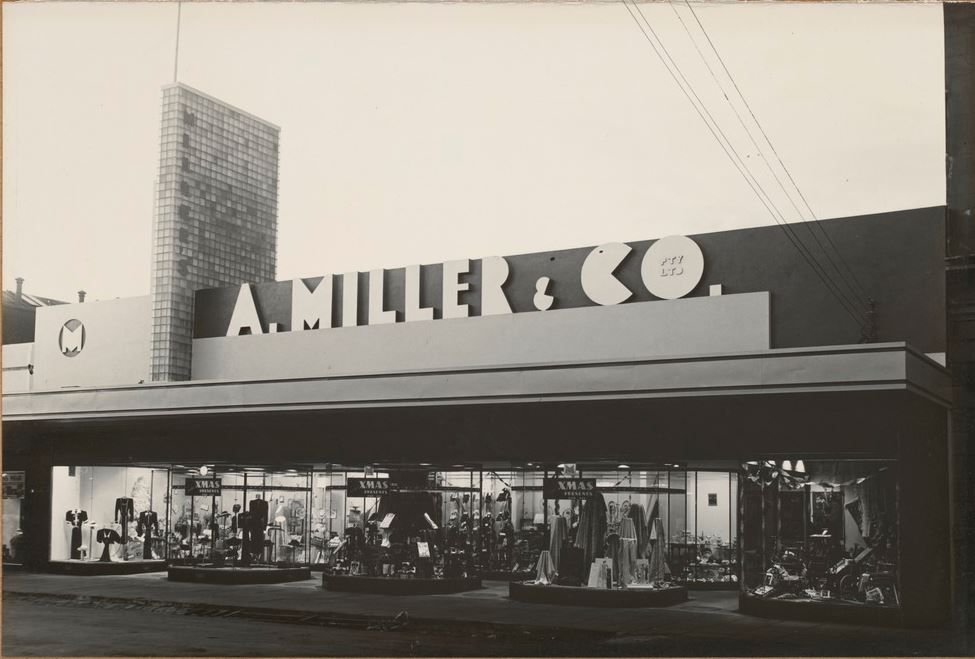
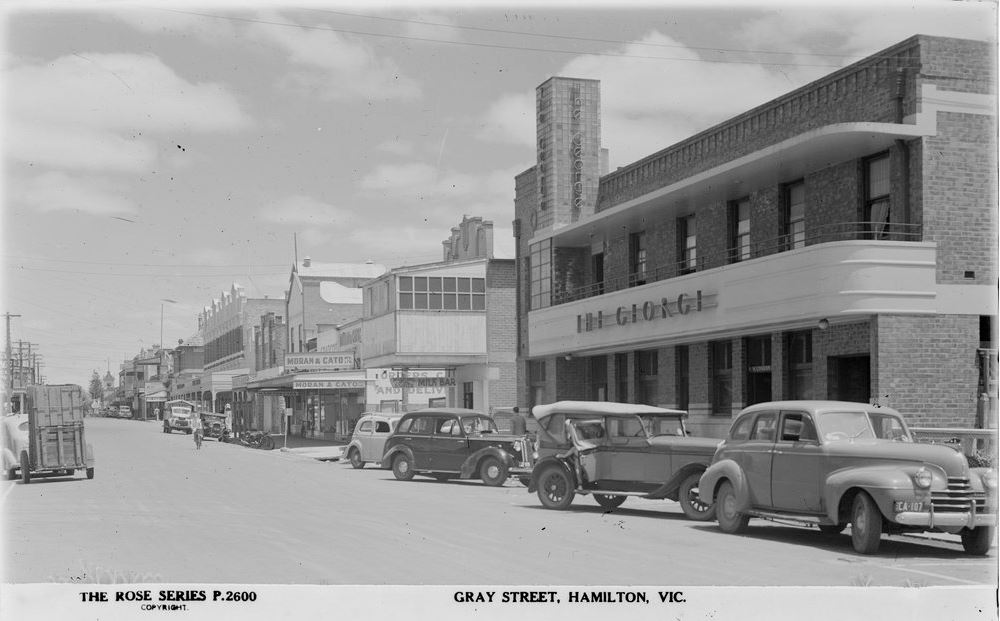
A. MILLER & CO. PTY LTD, GRAY STREET, HAMILTON. Circa 1950s.  Image Courtesy of the State Library of Victoria.  Image No.  H91.142/9 http://handle.slv.vic.gov.au/10381/122523

A. MILLER & CO. PTY LTD, GRAY STREET, HAMILTON. Circa 1950s. Image Courtesy of the State Library of Victoria. Image No. H91.142/9 http://handle.slv.vic.gov.au/10381/122523

As I  started to read the hundreds of  new posts and the many associated comments, I realised that what we were creating was an online social history of post-war WW2 Hamilton.  Just about every topic has been covered.  Festivals, businesses, milk bars, schools, football and cricket, marching girls and town characters.  One post with a surprisingly large number of comments and likes was about the underground toilets that were in Thompson Street.  There are photos of buildings, houses, bands, Blue Light Discos and sporting teams.  There are newspaper clippings of advertisements and Hamilton events.

ham1

THE GEORGE HOTEL. Image courtesy of the State Library of Victoria. Image no.http://handle.slv.vic.gov.au/10381/64135 http://handle.slv.vic.gov.au/10381/60456

All pure gold.  To have a response from such a large amount of people across such a cross-section of ages would otherwise be almost impossible.  Even if a “Back to Hamilton” was held and each person in attendance recorded two memories, I don’t think you would get such an in-depth view of Hamilton life during the past 60 years.  It would probably just end in hundreds of references to the underground toilets.  I suppose they were a novelty.
So after getting the ball rolling, the group has taken on a life of its own and I can sit back and read the fabulous memories and share in the reunions.  There are people who have not seen each other for 50 years and lost extended family members have also been found.   Some members are relaying stories to older relatives not on Facebook, then coming back with questions or comments.   It’s been amazing.

Another interesting observation has been how our memory works.  It was photos of Hamilton that triggered memories that people thought were long gone and many have commented how they had forgotten so much but it was all flooding back.  As one memory is dug up, it almost always seems to trigger another, unlocked from the deep recesses of our minds.

ham

GRAY STREET, HAMILTON. Image courtesy of the State Library of Victoria. Image no. H32492/2033 http://handle.slv.vic.gov.au/10381/64135

The group has also given me the opportunity to post about the Harman family of Byaduk, the subject of my thesis.  I have had a wonderful result, with new found cousins and confirmation that those I had suspected were cousins, (Electoral Rolls are my friend) are really my cousins.  Also, I’ve been researching  the Hamilton Botanic Gardens for a project that I can never get around to.  My focus is on the animals housed in the Garden’s zoo but there is very little information available, but I knew the animals at the gardens held a special place for all that grew up in Hamilton before 1980, especially the Rhesus monkeys.  I asked if anyone knew the year the monkeys left the zoo,  and while we still haven’t come up with a definitive year I think it will come.  I can then hit past editions of the Hamilton Spectator for articles about their removal.

So well done to all Hamiltonions past and present who have, like myself, found a pleasant distraction while collaborating to create a wonderful reminder of our past.  I believe people have a genuine interest in local history as seen by the increase in Facebook pages such as “Lost Warrnambool” and “Have You Seen Old Ballaarat Town”.  The content, in a user-friendly format,  is something people can relate to.

It will be interesting to see how our group will evolve. If I had the time, I would like to organise the stories into categories and topics to bring them together in some sort of order.  Also, there are many calls for a “Back to Hamilton” something that hasn’t been held since 1954 when the Queen visited the town.  If the past and present residents of Hamilton could embrace the idea of “Back to…” in the wonderful spirit they have shown with the “I’ve Lived in Hamilton” group, I am sure it would be a great occasion in the history of our hometown.