The Hungry Eagle

I had to share this story with you.

John Kirkwood was the father in law of Sarah Ann Reed, the niece of Susan Reed, wife of James Harman.  While checking his rabbit traps, John found a large eagle caught in a trap.  He took the bird to the Hamilton home of Robert Stapylton Bree on North Boundary road.  Bree chained the raptor in the garden to keep other birds away but he got more than he bargained for with the bird’s voracious appetite.

The Portland Guardian, (50th Year of Publication.) With which is incorporated The Portland Mirror. (1892, May 18). Portland Guardian (Vic. : 1876 – 1953), p. 2 Edition: EVENING. Retrieved June 14, 2012, from http://nla.gov.au/nla.news-article65439001

I wonder what happened to the eagle?

Dozens of articles about eagles and hawks caught in rabbit traps abound found at Trove.  Some eagles still flew with the traps attached and one poor bird was reported with a trap attached  for months.

—————————————————

On sad note, 10 years on, in 1902, John Kirkwood succumbed to influenza.  His obituary appeared in The Horsham Times of October 28, 1902.  John had died in the Hamilton Hospital on Wednesday October 22.  On October 31, 1902, the obituary of John’s daughter, 20-year-old Mary Agnes Kirkwood.  She had passed away on  October 26.

OBITUARY. (1902, October 31). The Horsham Times (Vic. : 1882 – 1954), p. 3. Retrieved July 15, 2012, from http://nla.gov.au/nla.news-article72851290


KIRKWOOD GRAVE – OLD HAMILTON CEMETERY

A search of Trove found that in 1902 there were reports of an influenza epidemic.  The Horsham Times reported many cases in the Wimmera area.  Such was the outbreak,  it had an effect on The Horsham Times.

More Illuminating Blogger Award Excitement

How lucky am I?  Two nominations for an Illuminating Blogger Award.

Earlier this week  Kerryn from AncestorChasing nominated me and yesterday Jennifer from Tracking Down The Family contacted me to tell me she too had nominated me.  It is great to get recognition from my fellow geneabloggers.

Jennifer wrote in her post:

I think Merron  at Western District Families and I started blogging at about the same. I find her blog which focuses on the Western  District of Victoria very interesting, especially the obituaries she regularly posts. I have no connection to her area, but Merron makes me wish that I did when I see all the information about the area and it’s families that is shared on her blog.

I appreciate Jennifer’s comment a lot as it affirms to me that my blog, which focuses on a relative small geographical area, can appeal to those who have no family link to the Western District.

My blog provides snippets of Western District history dispersed among the stories of my family.  The aim behind this was to help those who found they had  family from the Western District learn something of such a historic part of Victoria.  Having some knowledge of local history is so important when putting together your family’s history. It is flattering to know that those with no link to the Western District can find my blog interesting.

But I really must not take all the credit.  Thank you to all the pioneers of Western Victoria who left such wonderful stories and of, course  Trove , a favourite website of so many.  Being able to illustrate my posts with newspaper “clippings” from Trove is so important in making Western District Families work.

Jennifer mentions that we started blogging around the same time which gives us something in common.  However, I have always felt I have another connection to Jennifer. Of the geneabloggers I follow, Jennifer lives the closest to me with both places having very similar histories.

Thank you again to both Jennifer and Kerryn and if you missed my six nominations for an Illuminating Blogger Award, you can find them here

Misadventures, Deaths, and Near Misses

I have previously posted on the Misadventures, Deaths, and Near Misses of my family members, but as people could hurt themselves in so many ways in the 19th and early 20th century I thought I would share some more.   I have included a couple of people related to me, but most are just everyday people doing everyday things.  If you click on the “victim’s” name it will take you to Trove and the original article.

RABBIT SHOOTING

Beware the perils of rabbit shooting.  Henry Beaton, Reverend T Scanlan & John Kinghorn all knew the dangers, at least in hindsight.

Poor Henry was climbing through a fence with his Winchester when it went off and shot him in the foot.  John Kinghorn, a somewhat accident prone lad, lost the flesh below his thumb after the barrel of his gun exploded in 1890.  On another day not long after, he was riding to Hamilton with the Byaduk Mounted Rifles when another horse kicked him in the leg resulting in a severe leg injury to John.

Reverend Father Scanlan was shooting rabbits with Reverend Father Timmins.  Father Timmins wounded a hare so Father Scanlan pointed his gun through a hedge to take a last shot when the gun exploded, wounding him in the thigh.

A search at Trove found 1624 article headlines containing “Peculiar Accident”  So what characterizes a peculiar accident?  Well  Mrs C.E. Lewis qualified after a cow’s horn ripped her eyelid.

Mr W.B Edgar made the grade while trying to relive his golfing days only to have some protective plovers attack him.

Peculiar Accident. (1937, August 30). Portland Guardian (Vic. : 1876 – 1953), p. 2 Edition: EVENING. Retrieved July 11, 2012, from http://nla.gov.au/nla.news-article64276868

An over exuberant crack of a stock whip resulted in Stephen Moodie’s peculiar accident. Another peculiar accident occurred to an unknown and probably embarrassed customer of Page’s store in Warracknabeal. Lucky in-store video surveillance was not around then or the footage may have made it to a 1920s equivalent of Funniest Home Videos.

A PECULIAR ACCIDENT. (1929, March 19). The Horsham Times (Vic. : 1882 – 1954), p. 8. Retrieved July 11, 2012, from http://nla.gov.au/nla.news-article72606226

Young Alex McIntyre would have thought twice before he messed with a bottle of spirits of salts again.  Deciding the best way to make sure the cork was in the bottle was to stomp down on it with his boot, he caused the bottle to explode.  It was enough to blow the hat from his head.  Luckily he escaped with minor burns and a dose of sense.

While the following peculiar accidents were not headlined as such, I do believe they fall into that category.  Feeding peanuts to a leopard at Melbourne Zoo did it for David Horsfall and Mrs Hill of Casterton found a lost needle in her hand, 35 years later.

Miss Gladys Makin would have been wary of yawning after her peculiar accident in 1908.

PECULIAR ACCIDENT. (1908, March 31). The Horsham Times (Vic. : 1882 – 1954), p. 2. Retrieved July 12, 2012, from http://nla.gov.au/nla.news-article72808154

“Eyes Damaged by Paper” was the headline for Mr H. Foster’s peculiar accident.  From the Minyip “Guardian” newspaper, Mr Foster took paper cuts to a whole new level.  Fingers are the usual victims of the dreaded paper cut, but the gentleman managed to have the paper he was carrying pass over his eyeball.  Several days in a dark room was the remedy.

PAINFUL ACCIDENT. (1916, January 25). Warrnambool Standard (Vic. : 1914 – 1918), p. 3 Edition: DAILY.. Retrieved July 11, 2012, from http://nla.gov.au/nla.news-article73868145

The headline “painful accident” was found 2149 times at Trove, although I think most accidents would fit this description.

Walter Greed of Hamilton was a victim of a painful accident in 1891.  Walter was the son-in-law of Reuben Harman and husband of Jesse Harman.  While working at his uncle’s coach building business Walter’s hand became caught in a studded drum used to prepare stuffing for carriage seats.  Once released, he ran, blood dripping, to Rountree’s Chemists in Gray Street where his hand was bandaged.  The chemist recommended Walter attend the Hamilton Hospital where it was found he had no broken bones.

It goes without saying that Mr Matthews’ accident was painful.  While mustering sheep in the Grampians in 1898  a fall on to dry sticks saw one of them enter three inches into his leg.  Wood was also the cause of Mr J. Sullivan’s painful accident near Warrnambool.  A chip of wood flew up and hit him in the eye, resulting in the eye being removed.

I feel bad smiling while reading the following article.  But when I begin to visualise what John Brisbane was doing it is becomes cartoon-like, particularly if I think of what might have happened and thankfully didn’t.  Apologies to John’s descendants for my mirth.

PAINFUL MOTORING ACCIDENT. (1946, July 25). Portland Guardian (Vic. : 1876 – 1953), p. 2 Edition: EVENING. Retrieved July 12, 2012, from http://nla.gov.au/nla.news-article64408475

SOME UNFORTUNATE RELATIVES

Death by misadventure best describes the unfortunate death of my gg uncle and again spirit of salts proved a very dangerous substance.  In 1939, Ernest Richard Diwell drunk spirits of salts thinking it was whiskey.  This was a fatal mistake.

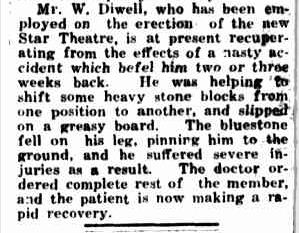
Only two years earlier, Ernest’s, uncle William Diwell had his own misadventure.

Advertising. (1937, June 10). Portland Guardian (Vic. : 1876 – 1953), p. 3 Edition: EVENING.. Retrieved July 12, 2012, from http://nla.gov.au/nla.news-article64276046

I could go on all day with examples.  I have hundreds of them including “unusual accidents”, “extraordinary deaths” and articles with headlines such as “Horse Jumps in Side-Car” and “Cakes Flew When Horse Bolted”, but I will save them for another time.

Illuminating Blogger Award

More excitement.  Kerryn from the blog AncestorChasing has nominated Western District Families for the Illuminating Blogger Award.

She wrote on her blog:

Merron finds and shares some great genealogy resources and information on her Western District Families, one of which I have a slight connection to.   

Lots of local knowledge.

That’s very flattering.  Thank you, Kerryn for your continuing support.

In just over a year, I have obtained so much more from writing Western District Families than I expected at the outset.  It all started with my need to get all my research out of my head.  I had to tell someone and no one around me was terribly interested.  Not only have I met that need, I have made contact with so many people.  Some are related and would never have found me otherwise.  Others have had family on the Duke of Richmond, a ship two lots of my ggg grandparents travelled aboard to Portland.  Then there others like Kerryn who have a link to my family through marriage or otherwise.

One condition of the award nomination is that I need to nominate at least five other blogs.  I have selected six illuminating blogs that I regularly read:

My Genealogy Adventure – Tanya Honey’s blog is one I enjoy very much.  Her posts are well researched and well written.  Not only that, she is supportive of her fellow bloggers.  I have received many comments from Tanya on both my blog and social media.  Like myself, she juggles family, work, study, blogging and researching her family.

Twigs of Yore – I have followed Shelly Crawford’s Twigs of Yore blog for some time now.  Shelly is also balancing raising small children and blogging and she does a great job.  She has also given me a great idea to fill in the school holidays with my son.  Going together to the local cemetery with the Billion Graves app and photographing headstones has been high on my list of things to do this holidays, but given the miserable weather, we may have to wait until spring.

Finding Family – I recently came across this blog from Jess of Perth, Western Australia.  It is great to see someone so young (I sound like a grandma) so interested in history.  Her posts are full of detail and are well written.  Also, there are lots of photos and like me, she loves Trove.

Strong Foundations  – This another blog I have recently discovered and really enjoyed.  Sharon, a fellow Victorian, has the best photos on her blog. She also uses maps and newspapers articles to illustrate her posts which I like.  I particularly enjoyed her post H is for…Horses.

FamilyHistory4u – Sharn White’s FamilyHistory4U is another wonderful blog.  The research and detail that goes into each post is fantastic.  Recently Sharn shared her journey to the U.S. which included a trip to the Ellis Island Immigration Museum for some research.  This was an excellent insight into what to expect and if ever get to New York, I will follow her tips to research members of my Riddiford family who made their way to the U.S.

Our Great Southern Land – Jayne is another Victorian and I love her passion which comes across in her posts.  It’s not only her passion for history but her family, various causes and social issues and of course Dunolly, a central Victorian town to which Jayne dedicates a whole blog to.  But is Our Great Southern Land, which she writes in her own distinct style, that I find most illuminating.  I now even have a recipe for dog cakes (cakes for the dog not of the dog).  I also follow Jayne on Twitter and she provides many insightful links and she is not afraid to stand up for what she believes.

Another condition of the nomination is that I give a random fact about myself.  In 1991, I attended my first, and only, Melbourne Cup to watch London Bridge run in the big race.  Dad was a co-owner and Bart Cummings was the trainer.  London Bridge ran an honourable 9th and despite it raining all day and not being able to see or hear the race because of the crowd, it was still one of the biggest thrills of my life.

If you have been nominated this is what you need to do:

  1. The nominee should visit the award site (http://foodstoriesblog.com/illuminating-blogger-award/) and leave a comment indicating that they have been nominated and by whom. (This step is so important because it’s the only way that we can create a blogroll of award winners).
  2. The Nominee should thank the person that nominated them by posting & including a link to their blog.
  3. The Nominee should include a courtesy link back to the official award site (http://foodstoriesblog.com/illuminating-blogger-award/) in their blog post.
  4. Share one random thing about yourself in your blog post.
  5. Select at least five other bloggers that you enjoy reading their illuminating, informative posts and nominate them for the award. Many people indicate that they wish they could nominate more so please feel free to nominate all your favorites.
  6. Notify your nominees by leaving a comment on their blog, including a link to the award site (http://foodstoriesblog.com/illuminating-blogger-award/).

I is for…Investigation

I didn’t think I would be back so soon with another post for the Gould Genealogy Alphabet Challenge but I was suddenly inspired.

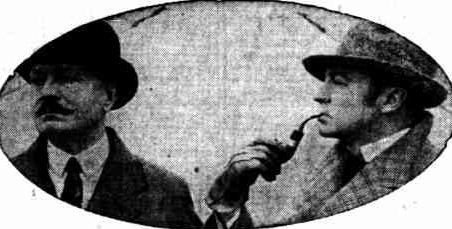
You see, it’s elementary, my dear Watson, I is for investigation.

SHERLOCK HOLMES AND “WATSON”. (1930, May 4). Sunday Times (Perth, WA : 1902 – 1954), p. 8. Retrieved July 5, 2012, from http://nla.gov.au/nla.news-article58381914

Without it where would we, as researchers, be?  It is the very act of investigation that makes us researchers.

We search for clues, follow leads and uncover facts.  The thrill of the chase brings us back for more.

Who hasn’t felt a bit like Sherlock Holmes before?  As one clue leads to another, suddenly a profile of a person or a story that has been hidden reveals itself before our eyes.  Elementary!

Often we find ourselves digging around in the time of Holmes, but of course, the occasional Inspector Clouseau moment occurs. Sometimes the juggling of various resources or social media pages would be better suited to the likes of Inspector Gadget.

However,  it is the discoveries that lead us to do the researcher happy dance that leave us feeling like the divine Miss Phryne Fisher (**Insert Magnum P.I. if you are not of the female persuasion)

Portland’s History House

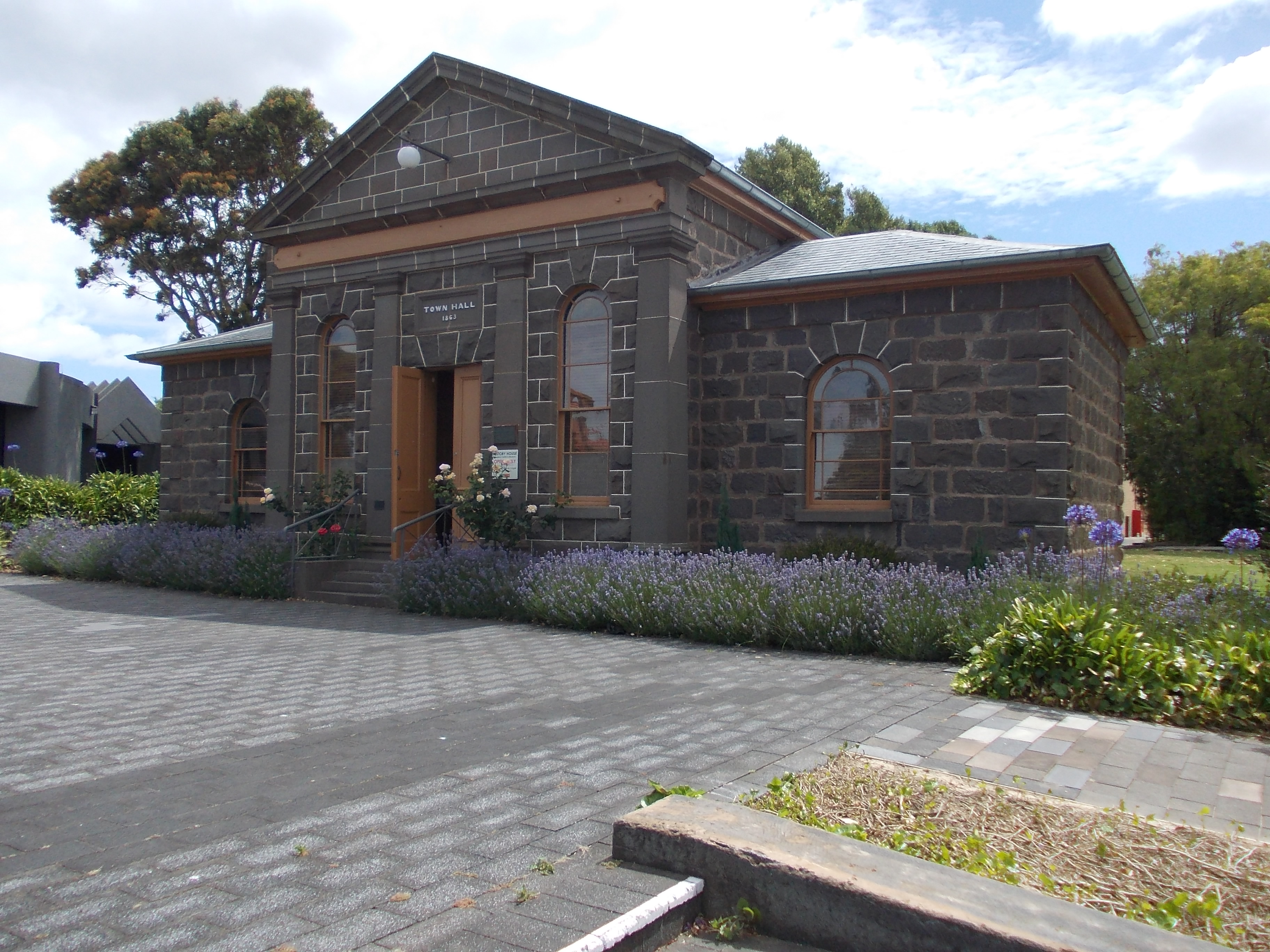
HISTORY HOUSE, PORTLAND

History House in Portland is the place to go to search for your ancestors who lived or arrived in the harbour town.  Located in the former Portland Town Hall, History House offers research facilities and a small museum.

The museum has many reminders of Portland’s early history, in particular, the Henty family.

It is not easy taking a photo of a long plough in a narrow room with a fairly ordinary camera, but I had to give it a go as this in the one and only Henty plough.  While it is famous for it being the first plough used in Victoria, its journey since those early days is interesting.

HENTYS PLOUGH

Maybe this picture does the plough more justice than my own.

THE FIRST PLOUGH USED IN VICTORIA, BY THE HENTY BROTHERS, OF PORTLAND. (1910, September 10). Western Mail (Perth, WA : 1885 – 1954), p. 10. Retrieved July 3, 2012, from http://nla.gov.au/nla.news-article38361343

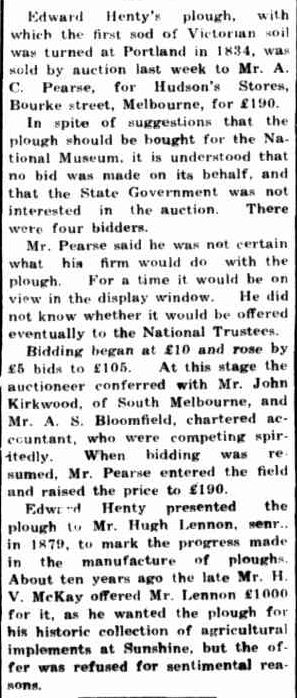
This article from the Portland Guardian of 18 November 1935 described what happened to the plough after it left the Henty’s possession

HENTY’S PLOUGH. (1935, November 18). Portland Guardian (Vic. : 1876 – 1953), p. 3 Edition: EVENING.. Retrieved July 3, 2012, from http://nla.gov.au/nla.news-article64290884

Hugh Lennon, who had the plough on display at his factory in Spotswood, was the manufacturer of the Lennon plough.  This was the plough of choice for ggg grandfather James Harman in local ploughing matches.  It was also the plough of choice for the Kelly gang when making armour.  The plough eventually returned to Portland in 1970.

The is a model of the house occupied by Joseph Henry Porter and his wife, Sarah Herbertson, in Gawler Street, Portland. Joseph constructed the model and Sarah furnished it.  I like the detail, even down to pickets missing off the fence.  Both Joseph and Sarah are part of the Western District Families Pioneer Obituary Index.  Joseph’s obituary mentioned his fine craftmanship.


MODEL OF 42 GAWLER STREET, PORTLAND

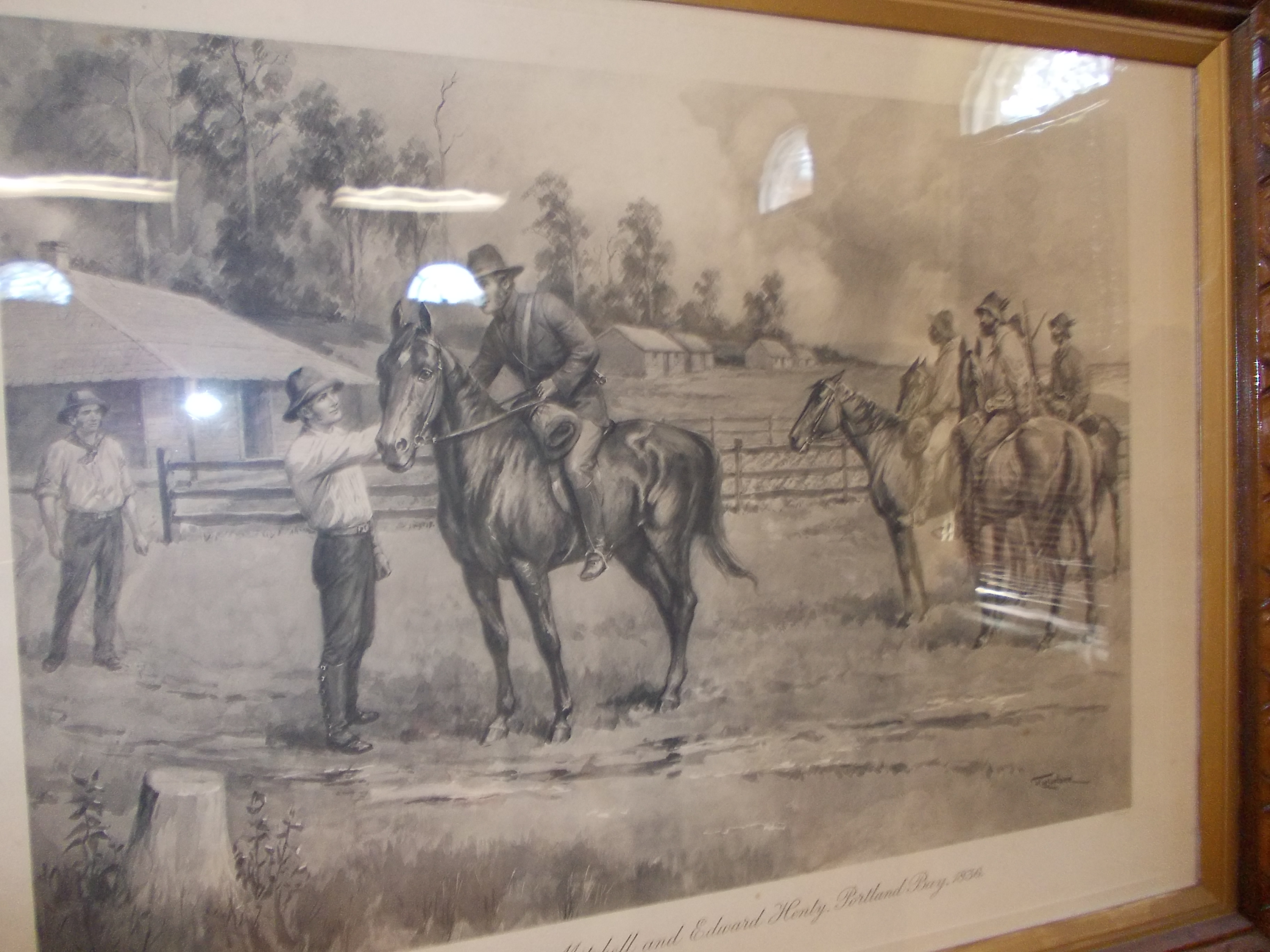
While this isn’t the best photo, I had to share it.  It depicts the meeting of Major Thomas Mitchell and the Henty brothers, a significant time in the history of the Western District.  You can read more about this chance meeting in the post “Major Mitchell Reaches Portland Bay”.

MAJOR MITCHELL AND THE HENTY BROTHERS

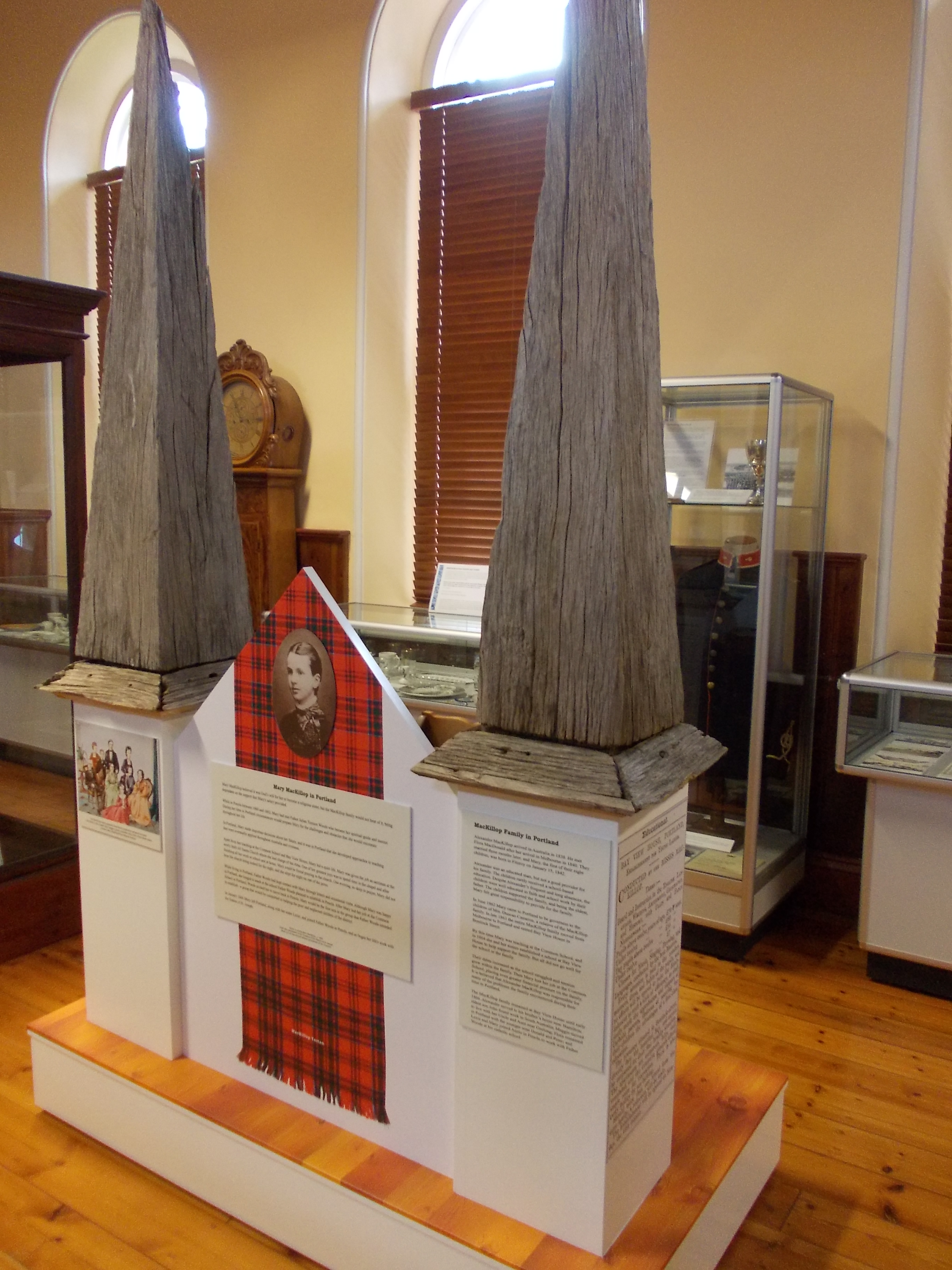
Mary McKillop spent some time in Portland and an exhibit commemorates this, complete with the spires from the original Roman Catholic church in Portland.

MARY MacKILLOP DISPLAY

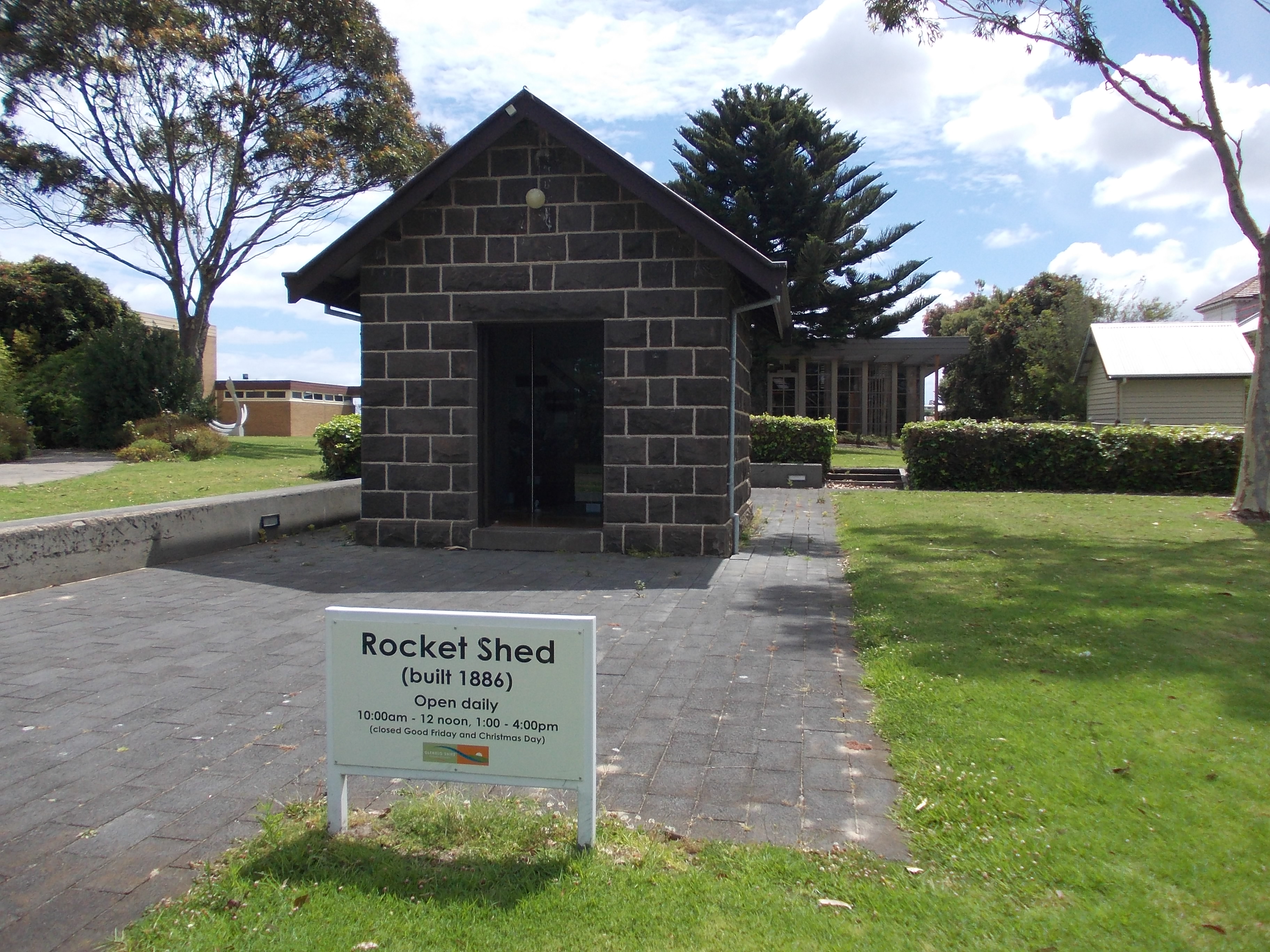
The Portland Rocket Shed is next to History House.  The shed was built in 1886 by George Sedgewick who was the gg grandfather of Ann, a follower of this blog.  Fully restored, the shed has a display inside which includes a rocket launcher used to fire ropes to boats in distress.

ROCKET SHED

For more photos, better than my own, check out ABC South West Victoria’s report on History House’s renovation in 2010 http://www.abc.net.au/local/stories/2010/02/17/2822431.htm.  There was also a report at the time of Mary MacKillop’s canonization http://www.abc.net.au/local/stories/2010/10/12/3035824.htm

H is for…

If ever there was a time to enter the Gould Genealogy Family History Through the  Alphabet challenge, that time would be now.  “H” has arrived.

When my descendants look back at my HISTORY, they will see the letter “H” recurring.

The marriage of Sarah Elizabeth HARMAN and Thomas HADDEN in 1904 brought together two of my “H”‘s.  They settled in HAMILTON and had a daughter, my nana Linda HENRIETTA HADDEN.

Thomas HADDEN & Sarah HARMAN

Sarah HARMAN was not the only one in her family to keep her initials after she married.  Her sister Ellen married a HANKS and she became Ellen HANKS of HARRIET Street HORSHAM.

HADDEN and HARMAN are two of the four main family names that make up the maternal side of my family.

HAMILTON too, features in my HISTORY.  Nana was born there and I was too.

Looking across Melville Oval, HAMILTON

I lived in HAMILTON for 18 years, the town that was formally called the Grange.  If that name had remained, my entry in this challenge may have been “G” for Grange, Gamble and the Grampians.

Nana’s middle name was HENRIETTA  which I used to find quite amusing.   Later I learnt that her name came from her great-aunt HENRIETTA HARMAN, an HONOURABLE lady but one, it would seem, with a lonely HEART.

Linda HENRIETTA HADDEN (left) & her younger sister, Enda

Another “H” which will go down as part of my HISTORY is HALLS GAP in the HEART of the Grampians.  Many HOLIDAYS were spent there and, at times, it has been a place I have called HOME.

HALLS GAP in the HEART of the Grampians

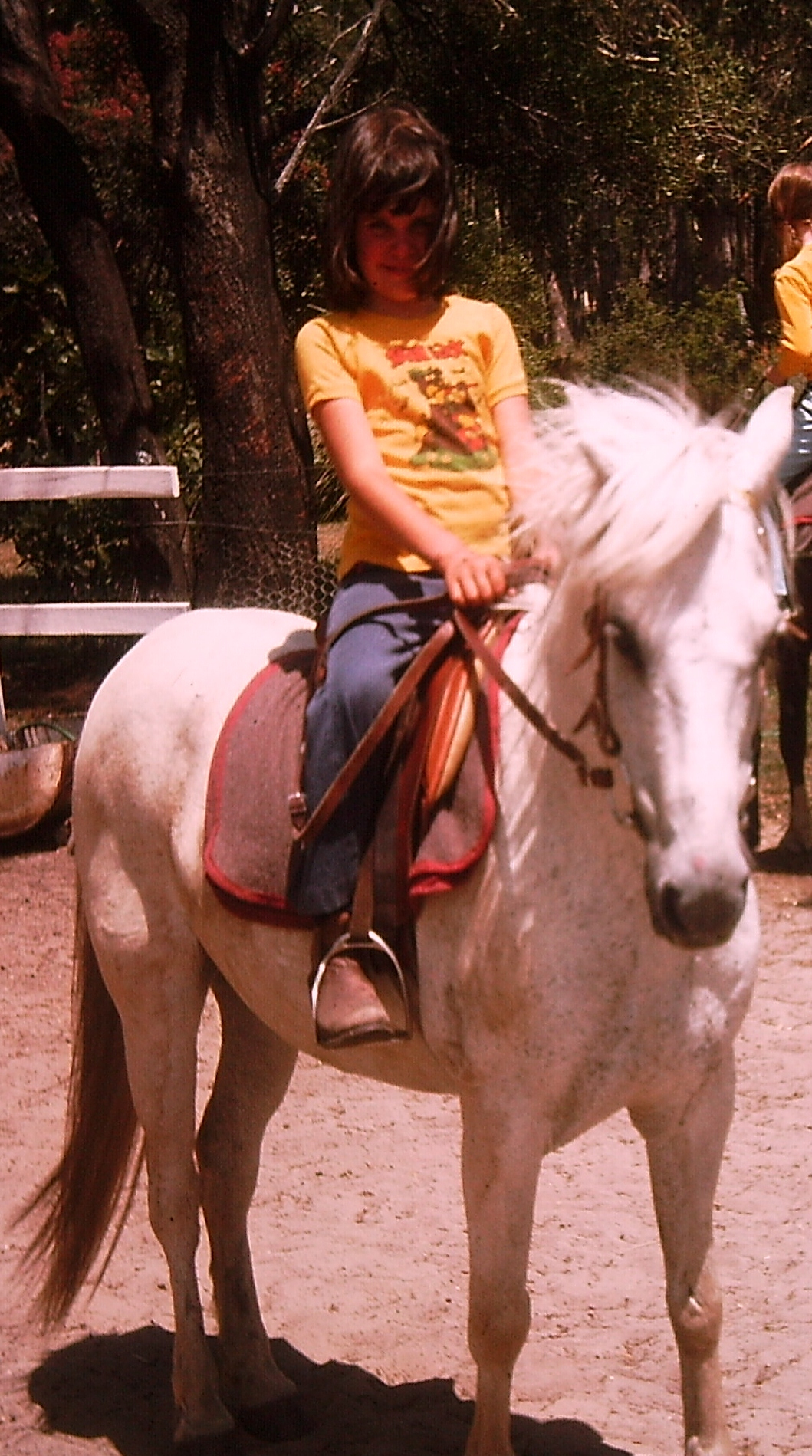
May my HISTORY also show that I liked HORSES.  It was HORSES in HAMILTON, HORSES in HALLS GAP and HORSES on HOLIDAYS in HALLS GAP, HORSES everywhere.

Finally, my HOBBIES include the HISTORY of  HADDEN, HALLS GAP, HAMILTON, HARMAN and, of course, HORSES.

HORSES in HALLS GAP

So, when I get over my obvious preference for the letters “M” and “R”, I can safely say “H” is one of my favourite letters as so much close to my HEART starts with “H”

***Apologies to the HAZELDINE, HICKLETON, HODGINS,  HOLMES, HUNT and HURRELL families to whom I also have links.

Passing of the Pioneers

It never ceases to amaze me how the branches of my family tree reach out through the Western District and entwine with the branches of other family trees. The roots of each tree are different, but the branches come together by way of marriage.  In this month’s Passing of the Pioneers, two of the families represented have links to two of my own families.

This month also sees Mr and Mrs George Excell who sadly passed away within hours of each other. There is also a member of the Kittson family of Bridgewater and a dentist born in the same area. There is Margaret McWilliams, educated in Belgium and John Gorman, an Irish policeman.

William LUXTON: Died 4 June 1903 at North Hamilton. William Luxton was born in Devonshire, England about 1819.  He arrived in South Australia around 1846 before moving to Macarthur, Victoria in the 1850s where he remained until his death.  He had four daughters still alive at the time of his death including Mrs T.R. Oliver (Margaret Luxton) who was the sister-in-law of Elizabeth Oliver (wife of Reuben Harman) and Mary Oliver (wife of Jonathan Harman).

Robert ISBEL:  Died June 1908 at Ararat. Robert Isbel’s father came to Victoria from Adelaide in search of gold, with Robert and his mother joining him at Great Western in 1862. Robert settled at Concongelia.

Francis MATTHEWS: Died 6 June 1915 at Landsborough. Francis Matthews was a native of Ireland and had worked in the Dublin Customs Department before coming to Australia. He eventually settled at Joel Joel and worked hard on the land. He only had two relatives in Australia at the time of his death, an Ernest Matthews of Crowlands and a cousin.

Sarah Elizabeth PORTER: Died 8 June 1915 at Hamilton. Originally from Blackwood, Victoria, Sarah married James Reece from Purdeet, near Penshurst.  She saw Penshurst grow from nothing to a permanent town.  Sarah and James had three sons and four daughters.

Adrina McDONNELL: Died 13 June 1915 at Rhymney.  Adrina McDonnell and her husband Duncan McKenzie arrived in Victoria from Scotland in the early 1850s.  Duncan obtained a job at Allanvale Estate a large sheep station near Great Western.  Adrina died at the home of her daughter, Mrs Foley and was buried at Ararat Cemetery.

Margaret McWILLIAMS: Died 27 June 1915 at Warrnambool.  Margaret McWilliams arrived in Melbourne from Scotland in 1852 to marry Alfred M. Jukes.  After time living in Richmond, they moved to Warrnambool where Alfred took up a post of solicitor, one of the first in the town.  He was also Town Clerk for a time.  Alfred died in 1872. Margaret was a member of the Christ Church Ladies Guild and when World War 1 broke out she was particularly interested in the fate of Belgium and its residents.  As a girl, she was educated in Malines, Belgium a town later destroyed by the Germans.

George EXCELL: Died 11 June 1916 at Stockyard Hill.  George Excell was a successful breeder of dairy cattle, draught horses and sheep. He began his time in Victoria when he landed in Geelong aged around twenty-seven during the 1850s.  He went to Ballarat and was there at the time of Eureka, before residing at Swan Bay near Queenscliffe for forty years.  He later moved to Stockyard Hill, east of Ararat where he remained until his death.

Susan Angelina PRYKE: Died 11 June 1916 at Stockyard Hill.  Susan Pryke was the wife of George Excell, above. They married in 1853 in Victoria and their union was so great that Susan died only hours after George’s passing.

Alexander McBEAN: Died 13 June 1917 at Casterton.  Alexander was a blacksmith, who learnt his trade as a teenager, fresh from the boat.  His first boss was known as “Terrible Billy” Thomson.  He was then apprenticed to Mr W. Handley at Sandford before moving to the Ballarat district.  He later moved to Edenhope and then Casterton where he had a blacksmith’s business behind Cawker’s Mart.  He again moved, this time to Harrow, before once again moving back to Casterton and opening another blacksmith business which he ran until his death.

John Henry Morris BILSTON Died 17 June 1917 at Penola, South Australia. John Bilston was the son of Thomas Bilston, an early settler of Melbourne and brother of Frederick William Bilston, from August Passing of the Pioneers. John was born in Heywood around 1846 and his first job was an apprentice saddler which he did for five years. Finding that rather sedate, he became a gun shearer and a buckjump rider. After some time farming, he took up saddlery again in his later years.  John married Mary Mingoue, the daughter of Simon Minogue of Portland.

William MULLEN:– Died 13 June 1917 at Drik Drik. Born in Ireland, William Mullen arrived in Victoria in 1862 aged eighteen.  He married Emma Holmes of Lower Cape Bridgewater and they celebrated their fiftieth wedding anniversary just prior to William’s death. They had a family of nine children.

Thomas Gibson HENRY: Died 16 June 1920 at Portland. The lure of gold brought Thomas Henry to Australia from Ireland but his life soon went from that of a miner to teacher. He taught at the Heywood school from 1870 to 1876 and the Mumbanner school from 1876 to 1888 after which he retired. He then farmed until he moved to Portland in 1906.  His wife was Miss Tatham of Doncaster, Melbourne and they had five children.

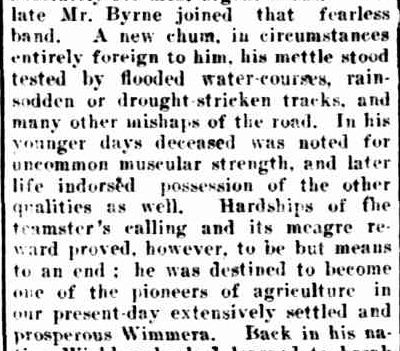
Luke BYRNE: Died 18 June 1920 at Ballarat. This is obituary which tells a great pioneering story. Irishman Luke Byrne began in his time in Australia at Ballarat and his life ended in Ballarat. Luke originally carted goods from Ballarat through to Horsham and the stations beyond.  At the time, the only residents of Horsham were all male except for one woman.

Obituary. (1920, June 22). The Horsham Times (Vic. : 1882 – 1954), p. 5. Retrieved June 28, 2012, from http://nla.gov.au/nla.news-article73193445

Luke was one of the first to select land in the Wimmera in an area which became known as Byrneville.  The early years were very difficult and at times Luke had to leave his selection and take up jobs to supplement his income. By the time he retired, Luke had increased his holding to 3,000 acres of the best wheat growing land which he was able to pass on to his three sons.  Luke and his wife had a total of twelve children.

John GORMAN: Died 18 June 1922 at Geelong. As a policeman of thirty-four years, John Gorman worked in towns throughout Western Victoria. John joined the police force shortly after arriving in Victoria from Ireland in 1863. In his retirement, he lived in Geelong. He left a wife and five children.

Susannah KITTSON: Died 3 June 1926 at Portland. Susannah Kittson came to Victoria from Ireland as a six-year-old in 1841.  She was a member of the pioneering Kittson family of Bridgewater. On arrival at Geelong, her family “trekked” to Colac, then Tahara and then on to Bridgewater.

Susannah married John Harcoan and they settled at Minyip in the Wimmera.  Three months before her death, Susannah returned to live at Portland where she found “peace at last” in the place of her childhood. She left five children.

William OSBOURNE: Died 19 June 1930 at Portland. Born in Portland, William with his brothers, followed his father into the butchering business. Osbournes Butchers were known as giving  “full value and a square deal to all”. William was also a foundation member of the Portland P & A Society and was a vestryman at St Stephens Church.

St Stephens Church Portland

Caroline HUMPHRIES: – Died 8 June 1931 at Casterton. Born at Portland around 1860, Caroline was the daughter of Charles Humphries and Caroline Sampson.  Within a few years of her birth, Caroline’s family moved to Henty, between Merino and Casterton.  She later married James Lane and they settled at Dunrobin, north of Casterton where they raised a large family. I have a link to Caroline Humphries through my Diwell line. Caroline’s niece  Margaret Ley Humphries, married my 1st cousin 3 x removed, William Ralph Francis Coulson a grandson of William Diwell and Margaret Turner.

Peter GAMBETTA: – Died 5 June 1931 at Stawell. Peter Gambetta came to Stawell from his home in Ticino which lies in Italy but is a state of Switzerland. Gold was the lure but after the boom, he started a vineyard “St Bernards” near Stawell.

Joseph Henry PORTER: Died 22 June 1931 at Portland. Born in England around 1840, Joseph Porter arrived in Portland around 1854.  Taking on the trade of cabinet maker, he was known for his fine craftsmanship.  His wife was Sarah Herbertson, a member of a well-known family from Portland West.  They had no children.

A MODEL BY JOSEPH HENRY PORTER.

A MODEL BY JOSEPH HENRY PORTER.

Dr James Thompson TUNNOCK: Died 16 June 1933 at Hamilton. Despite moving away at a young age, Dr Tunnock had strong links to the early pioneers of south-west Victoria. James was the son of Jonathon Carrick More Tunnock and Jane Kennedy and was born at Cape Bridgwater in 1853. Being bright at school and having no interest in farming, James took himself off to Melbourne to study dentistry. Maybe I should not have put the prefix of Dr. in front of James’ name as in 1913, he was fined £5 for using the title Dr. on signage, breaching the Dentists Act 1910.

Advertising. (1908, September 5). Independent (Footscray, Vic. : 1883 – 1922), p. 1. Retrieved June 27, 2012, from http://nla.gov.au/nla.news-article73259572

I don’t think I would fancy visiting a Dental Parlor. It sounds too much like Funeral Parlor!

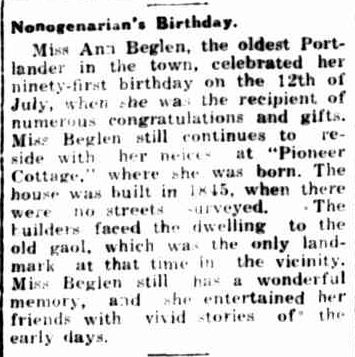
Ann BEGLEN Died 7 June 1940 at Portland. Miss Ann Beglen’s Irish parents John and Margaret, arrived at Williamstown in 1841 before travelling on the Frances Henty to Portland. On arrival, John set up a butcher shop. Ann was born in 1848 and educated at Miss Dunbar’s private school at Portland. In her later years, Ann could still remember playing as a child around the foundations of the then under construction”Burswood” built by Edward Henty. At the time of her death, Ann was living with her nieces at “Pioneer Cottage” the home where she was born.

Nonogenarian’s Birthday. (1938, July 18). Portland Guardian (Vic. : 1876 – 1953), p. 2 Edition: EVENING.. Retrieved June 27, 2012, from http://nla.gov.au/nla.news-article64279644

In The News – June 22, 1877

Today’s “In the News” is from The Portland Guardian of 22 June 22 1877 with the featured article from the Hamilton correspondent, filed on June 16, 1877.

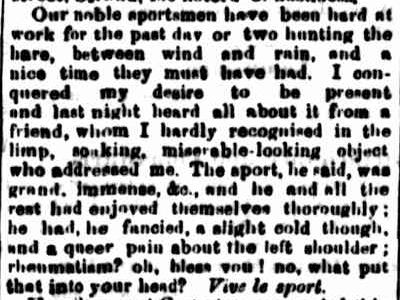
The weather in Hamilton at the time was not dissimilar to the current weather and the streets and footpaths were muddy.  The cheeky correspondent suggested that the residents of Hamilton would not be thinking well of the town engineer after their foot drenching walk to church on Sunday.

HAMILTON. (1877, June 22). Portland Guardian (Vic. : 1876 – 1953), p. 3 Edition: EVENINGS.  http://nla.gov.au/nla.news-article63338700

Hare hunting was a popular sport of the time, with the weather not stopping the keen participants.

Australian Rules football was well underway in the Western District by 1877.

The papers reported disease of all types.  Typhoid fever was prevalent in the navvy’s (railway builders) camp by the Grange Burn in June 1877 and conditions were far from comfortable.   Diphtheria had also been reported, however, the source was unreliable having given a false report of typhus fever in the past.

HAMILTON. (1877, June 22). Portland Guardian (Vic. : 1876 – 1953), p. 3 Edition: EVENINGS. http://nla.gov.au/nla.news-article63338700

Hobbies, Passions and Devotions

The activities of my ancestors outside of their usual occupation is always of interest to me.  Their sports, pastimes, hobbies, and social activities often help define them as people and sometimes those activities are present in later generations.  Also, it can lead to further information from club records and results in newspapers.

In some cases, much spare time was devoted to the church, maybe on the committee such as William Hadden or as a lay preacher like James Harman.  James was also able to find time for his other passion, ploughing competitions, not to mention various committees, such as the local school.
Richard Diwell had an interest in the Hamilton Horticulture Society but also indulged in photography. The photo in the post about Elizabeth Ann Jelly was one of Richard’s using a camera with a timer, a new development in photography at the turn of the century.

My grandfather, Bill Gamble, grandson of Richard Diwell, had many interests, particularly before he married.  He played cornet with the Hamilton Brass band and was a committee member of the Hamilton Rifle Club and a state representative shooter.

He also loved fishing, motorcycles, and like his grandfather before him, photography.  As a result, we now have hundreds of photographs of motorbikes and fishing trips.  He even developed his own photographs.  His passions of photography and motorcycles were passed on to his son Peter.

Many of the Holmes and Diwell families were members of Brass Bands at Casterton and Hamilton.  Alfred Winslow Harman was a rifle shooter and I recently told you about Nina Harman, wiling away the hours completing tapestry carpets.

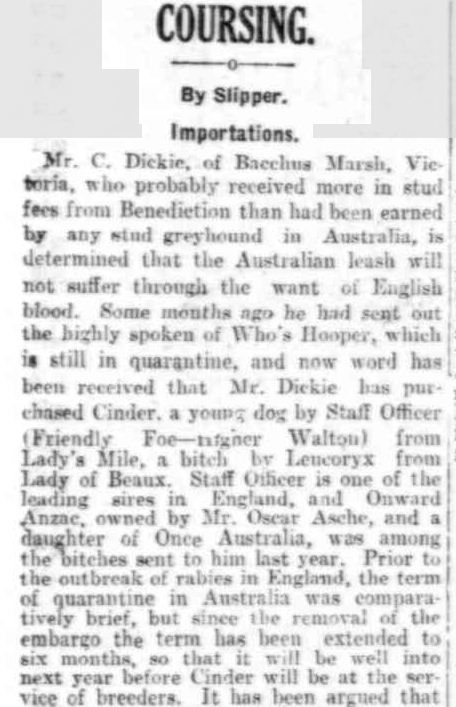
I recently found an activity that previously hadn’t been present in my family, greyhound breeding.

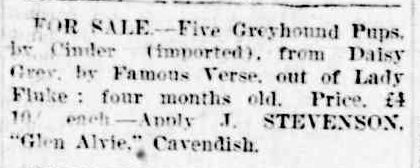
James Stevenson was the grandson of James Mortimer and Rosanna Buckland. He worked as a manager at Hyde Park a squatting run north of Cavendish until it was split up in 1926 for the Soldier Settlement scheme.  After this James moved to “Glen Alvie” at Cavendish where he described himself as a grazier.

In 1927, he advertised five well-bred greyhound pups for sale.  At £4 each, he stood to earn £20 if he successfully sold them.  A seemingly profitable hobby indeed.

Advertising. (1927, February 25). The Horsham Times (Vic. : 1882 – 1954), p. 5. Retrieved June 15, 2012, from http://nla.gov.au/nla.news-article73082854

James would have needed a good return on his pups as the sire’s stud fees would have been pricey given Cinder was imported by the successful breeder, Mr. Dickie of Bacchus Marsh.  The article from the time of Cinder’s arrival in Australia in 1923, reports the dog remained in quarantine for six months.  Because of a rabies outbreak in England, there was an extension to the time spent in quarantine only a short time before his arrival.

In 1927, the time of James’ advertisement, greyhound racing using a “mechanical hare” began for the first time at the Epping course in New South Wales.  It took longer for other states to adopt the “tin hare” where they continued with the traditional field coursing.

SPORTS AND PASTIMES. (1923, September 7). The Register (Adelaide, SA : 1901 – 1929), p. 6. Retrieved June 19, 2012, from http://nla.gov.au/nla.news-article65041056


WHAT DID YOUR ANCESTORS DO IN THEIR SPARE TIME?