Trove Tuesday – Time for a Song

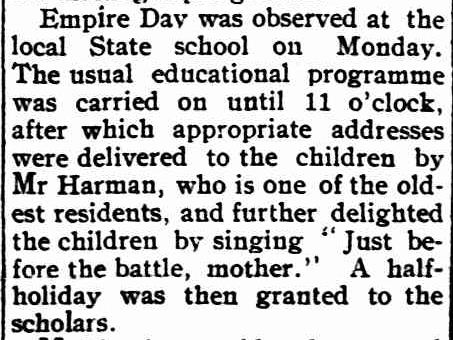
The Port Fairy Gazette has a lot of Byaduk news and I just love this treasure from May 31, 1915.   Australia celebrated Empire Day on May 24 from 1905.  School children participated in patriotic singing and speeches and flags adorned buildings.  The children had a holiday from school in the afternoon.  May 24 was also Cracker Night and in the evening people would gather around bonfires and let off fireworks.

Empire Day 1915 saw ggg grandfather James Harman visit the Byaduk State School and address the children.   He then sang “Just Before the Battle, Mother” and I’m pleased to see he “delighted” the children.  At age 85, he was only a year away from his passing.

BYADUK. (1915, May 31). Port Fairy Gazette (Vic. : 1914 – 1918), p. 2 Edition: EVENING. Retrieved November 14, 2012, from http://nla.gov.au/nla.news-article94725183

“Just Before the Battle, Mother” was an American civil war song but given it was in the midst of WW1, it was apt.  If you have not heard the song before, click on the play button below to hear a rendition courtesy of Soundcloud and P. Murray.

Ellen’s Inquest

Recently I ordered some digitised Inquest records including those of my ggg grandmother Ellen Barry.  You may remember from the post A Tragic Night,  Ellen burnt to death in a house fire,  her drunkenness contributing to her demise.

The various newspaper articles from around the country gave good coverage of the fire including the findings of the coroner’s inquest and her movements on the night of her death.  I hoped that the inquest record would give me more.  The copy of the inquest proved worth it but since then Trove have released The Colac Herald (1875-1918) and an extensive article including transcripts of the witnesses evidence.  Therefore, rather than me describe what the witnesses had to say about Ellen, I can include their statements as found in the Herald

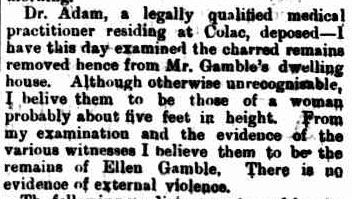
The first witness statement was from Dr Adam who examined Ellen’s badly charred body.  Even though unrecognisable , he was able to show the body was a woman and she was around five feet tall.

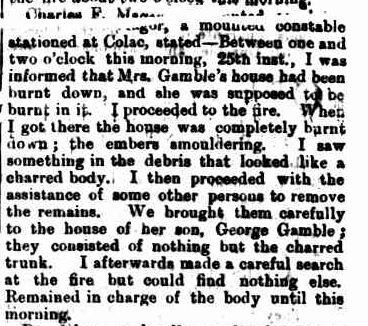
The next  statement was from mounted Constable Charles Magor from the Colac Police station.  By the time he arrived, the house had burnt to the ground.  He found what looked like a body and removed it, “carefully” , I might add, to the home of Ellen’s son George Gamble who lived a few doors away.

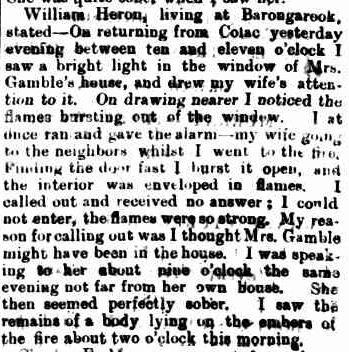
After the official witnesses, members of the public where then called, the first being Barongarook man William Heron.  He and his wife were travelling home from Colac around 11pm on January 24 when he noticed a light in Ellen Gamble’s window.  Interestedly he had seen Ellen at 9pm and to him, she appeared completely sober.

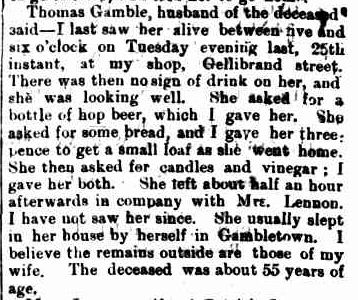
There is still a lot I don’t know about my ggg grandfather, Thomas Gamble save for fleeting mentions in Colac history books, some court records and more recently his obituary.  From the  reports of Ellen’s death that I had initially found  I had questions about their living arrangements, with Thomas supposedly living in another residence in the town.  His inquest statement reveals a little more:


Thomas Gamble had a greengrocer’s shop in Gellibrand Street, Colac.  Ellen had visited him at the shop on January 24th, a visit which seemed more like that of a shopper not a wife.   It is not clear if she paid for the items, however she requested vinegar and the very objects that helped contribute to her death, candles.  She also wanted bread so Thomas gave her 3 pennies to buy a small loaf on the way home.  After a drink of ginger beer she left with Mary Lennon who had also been in the shop.  Thomas noted that Ellen appeared sober then, between 5 and 6pm.  Mary Lennon in her evidence also said she thought Ellen appeared sober.

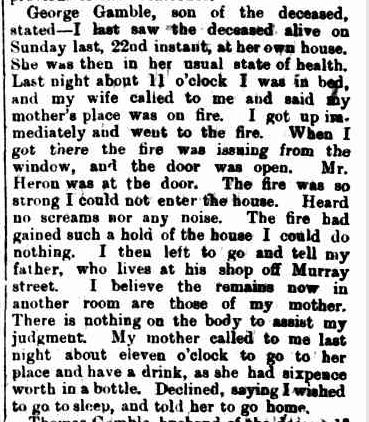
George Gamble then gave his evidence.  Ellen had wanted him to drink rum with her but he declined and Ellen went home.

DEATH BY BURNING. (1882, January 27). The Colac Herald (Vic. : 1875 – 1918), p. 2 Edition: Mornings. Retrieved November 17, 2012, from http://nla.gov.au/nla.news-article91455765

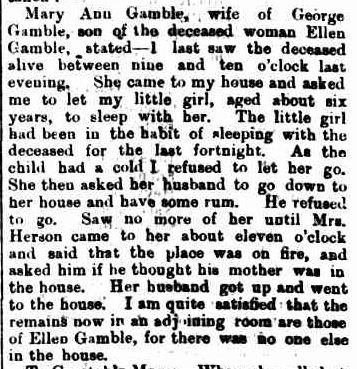
Finally evidence from George’s wife Mary-Ann including reference to Ellen’s grand-daughter Mary Ann as mentioned in A Tragic Night.  She was lucky she was not also burnt death with her grandmother.

DEATH BY BURNING. (1882, January 27). The Colac Herald (Vic. : 1875 – 1918), p. 2 Edition: Mornings. Retrieved November 17, 2012, from http://nla.gov.au/nla.news-article91455765

It’s great to have the Colac Herald online at Trove, but I hope I find some good news stories about my Gamble family soon.  Currently my Electronic Friend is sending me stories of Ellen’s court cases with  the most recent from her 33rd appearance before the Colac Police Court.

Trove Tuesday – UFO Alert!

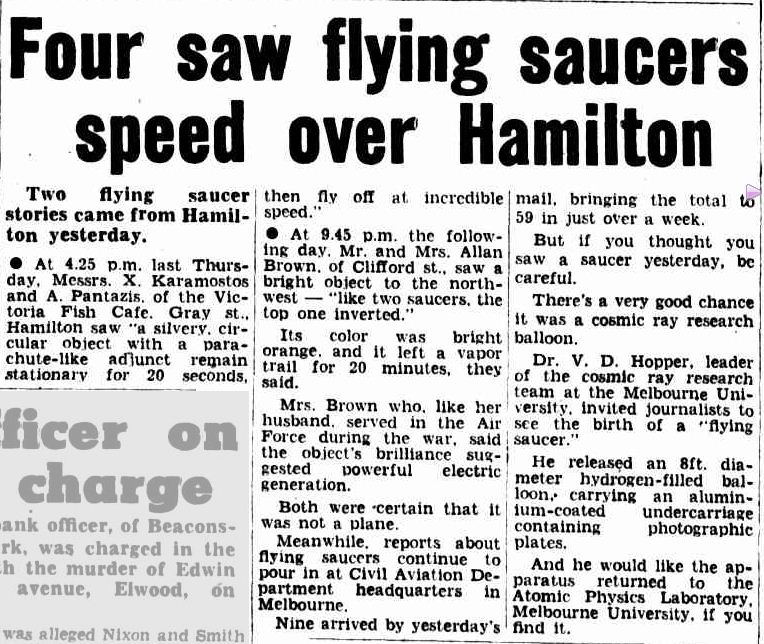
Hamilton experienced the paranormal during January 1954, with two separate “flying saucer” sightings.

Four saw flying saucers speed over Hamilton. (1954, January 13). The Argus (Melbourne, Vic. : 1848 – 1956), p. 5.  http://nla.gov.au/nla.news-article26584624

From a  Trove search of “flying saucers” I found during the 1930s the only flying saucers were those thrown across a room accompanied by a cup, but by the 1940s the flying saucers we know today began to make the news.  Many of the articles I saw were about experimental trials of flying saucers by earthlings.  But by the 1950s, “sightings” of flying saucers, presumably crewed by aliens, were commonplace.

A search of “science fiction” produced similar results.  There was no mention of the term during the 1930s, but by the 1950s it had reached meteoric heights.

The Science Fiction film genre changed during the 1950s.  Science Fiction films of the 1940s were horrors like Frankenstein and Dracula or superheroes such as Batman and Robin.  The Invisible Man and Flash Gordon were also popular.  The 1950s Sci-Fi films took to the universe with life on other planets a major theme.  The film Flying Saucer was released in 1950, War of the Worlds and Invaders from Mars in 1953 and that year even Abbott and Costello went to Mars.

THE MARTIaNS ARE HERE!. (1953, December 22). The Argus (Melbourne, Vic. : 1848 – 1956), p. 1.  http://nla.gov.au/nla.news-article23303135

No wonder Hamilton residents were on high UFO alert. While the film version of War of the Worlds had not yet reached the town, to add to the hype, their holiday reading may have included instalments of the H.G. Wells’ 1898 novel which ran in The Argus from 24 December 1953 until 7 January 1954, the same day as the Hamilton flying saucer sightings.

***If anyone finds Dr Hopper’s cosmic ray research balloon he would appreciate its return to Melbourne University.

Witness for the Prosecution – New Findings

I love it when my ancestors find their voice and through their own words give something of their personalities.  Obviously, their voice is not audible, but through Letters to the Editors, wills or even as witnesses for an inquest, it is then easier to imagine them speaking.

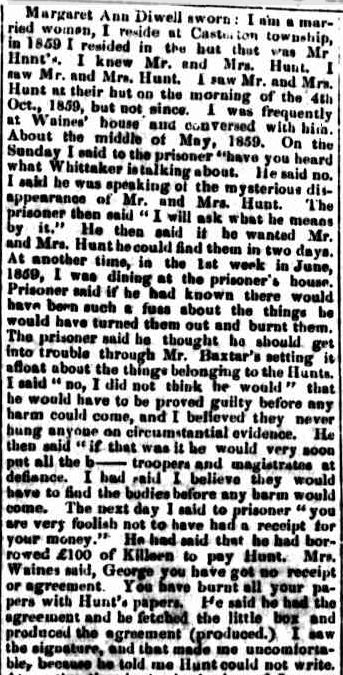
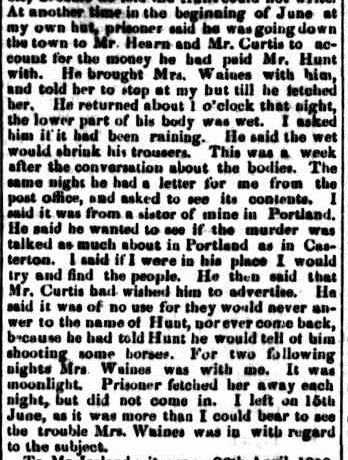
In my post Witness for the Prosecution, I  wrote of ggg grandmother Margaret Ann Turner, married to William Diwell, and her experience as a witness in a murder trial in 1860 at Casterton. Previous newspaper reports had only mentioned her role, but an extensive report of the trial in the Portland Guardian and Normanby General Advertiser of 20 April 1860 brings Margaret to life as she describes her conversations to the defendant, George Waines, prior to his arrest.  Of course, give consideration to the abilities of the person recording the events.

This article tells me a lot about my ggg grandparents.  It reconfirmed they were in Casterton in 1859 and Margaret said they were residing in a hut owned by Mr Hunt.  Also, Margaret must have been good friends with Mrs Waines spending a lot of time at their house, including dining there on occasions.  She makes no mention of William or the six children.

CIRCUIT COURT. (1860, April 20). Portland Guardian and Normanby General Advertiser (Vic. : 1842 – 1876), p. 2 Edition: EVENINGS. Retrieved November 10, 2012, from http://nla.gov.au/nla.news-article65443361

More revelations. George Waines dropped his wife off at Margaret’s hut one night.  Mrs Waines then stayed a further two nights with George returning each night to take Mrs Waines away.  Margaret stated she left on 15 June 1859 because she couldn’t bear to see Mrs Waines put through such torment.  So did Margaret leave her own hut and if so, where did she go?  Once again where were William and the six children?  One would think if William was around during these events, he too would have been called as a witness. William was a bricklayer and worked in surrounding towns so this may explain his apparent absence.

Notice too that Margaret describes the Waines’ abode as a “house”, but the Diwells and Hunts lived in huts.  They were most likely slab huts like the one below.

Sutherland, Alexander, [Slab hut with bark roof ca. 1870-ca. 1880] Image Courtesy of the State Library of Victoria http://digital.slv.vic.gov.au/view/action/nmets.do?DOCCHOICE=353791.xml&dvs=1352638571965~542&locale=en_US&search_terms=&adjacency=&usePid1=true&usePid2=true

The Waines lived in a “house” so it may have been more substantial like the one below, or perhaps larger if George Waines’ aspirations were any indication.

“Family in front of their house on cleared land somewhere in Victoria”
F. J. Stubbs & Co. Photographer [ca. 1858-ca. 1908] Image courtesy of the State Library of Victoria http://handle.slv.vic.gov.au/10381/73293

Another thing that caught my attention was Margaret’s mention of a sister from Portland.  That sent me scurrying to the records as I have never found any of Margaret’s siblings and I would have thought they were back in Surrey.  A quick search of the1841 UK Census records (again) and the Australian Death Index gave me nothing, but I will keep searching.  Or was it just a ruse by Margaret to throw Waines off his interest in her mail.

It is sometimes difficult not to think of ggg grandparents as anything but old.  Reading this latest find has reminded me that Margaret was only thirty-six during the events leading up to the trial which has also reminded me that Margaret lived for only another nine years after the trial.  She was forty-five when she died, only a little older than me.  Margaret never became the old woman I must stop myself imagining her as.

There has also been another development in my family’s association with the Hunt murders.   Another descendant of my ggg grandfather George Jelly contacted me recently.  George’s daughter Elizabeth married Margaret Diwell’s son Richard in 1877.

Judy was kind enough to send me a copy of George’s obituary.  It tells of George’s swimming prowess and how he dived for the bones of the Hunt’s in the Glenelg River.  Unfortunately, I cannot find anything in the various reports about George’s efforts, despite it being mentioned that there was a river search and bones found.

Old Cavendish Cemetery

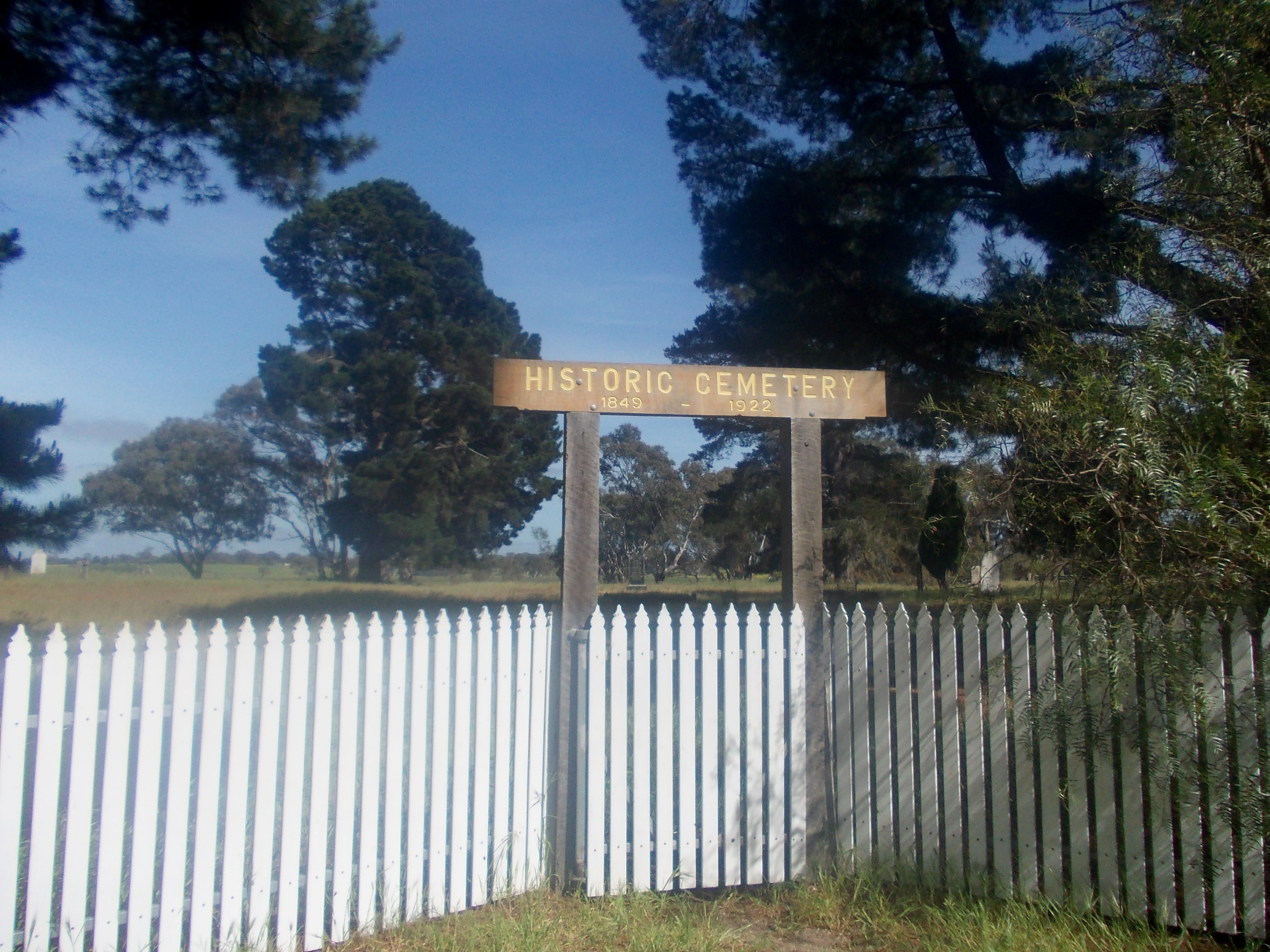
Behind this gate are the graves of two of my ggg grandfathers, two ggg grandmothers and a 2nd cousin once removed.

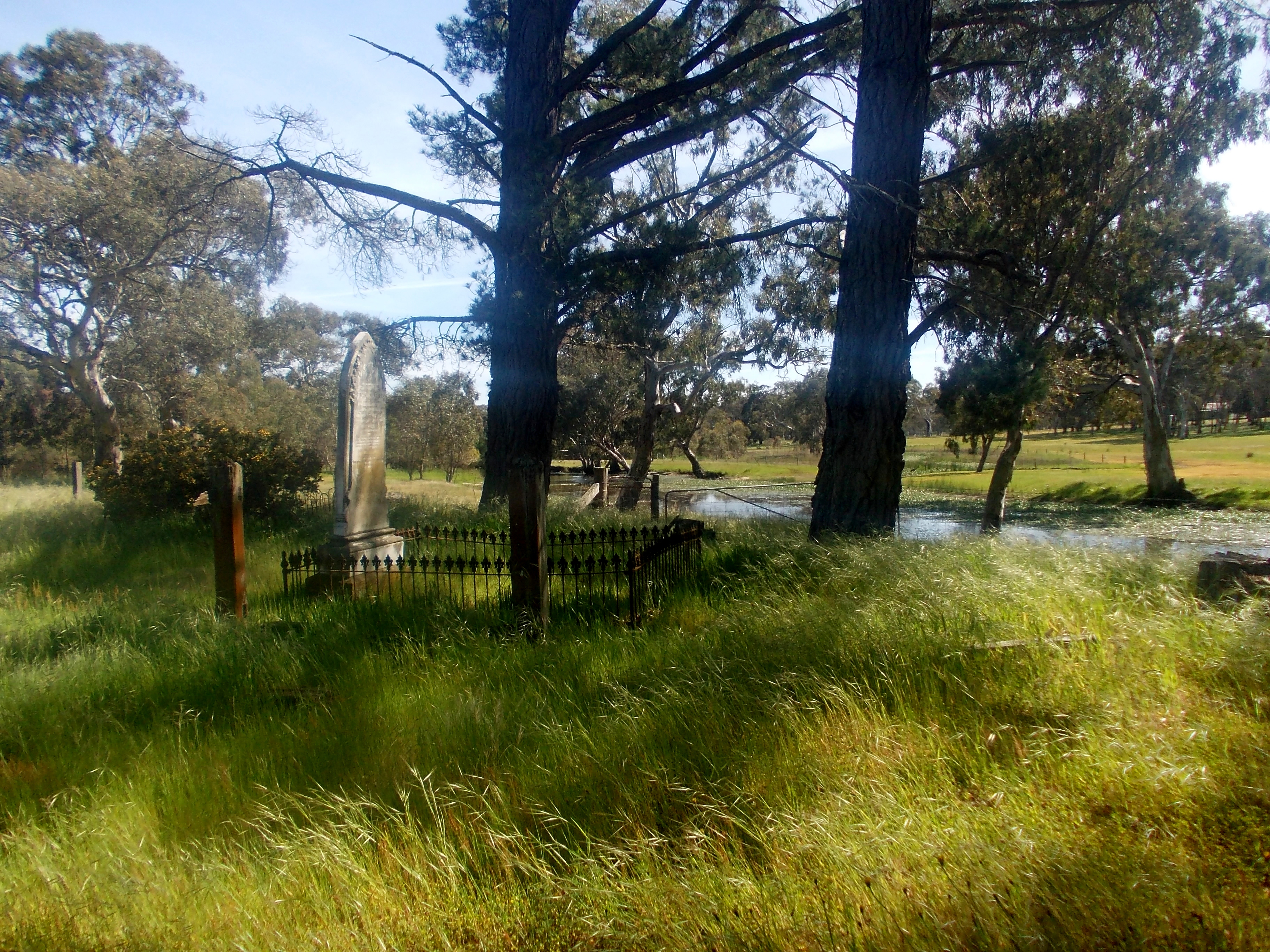
This is the Old Cavendish Cemetery on the banks of the Wannon River. In use from 1849 through to 1922,  it was the site of over 120 burials.  A beautiful resting place for my ancestors but the problem is there are very few headstones remaining.

I visited a few weeks ago on a sunny Sunday morning.  Ticking off the risk factors before entering: sunny, mid-spring, river location, long grass and graves, I decided to move quickly as I didn’t want to run into “Joe Blake”.  I moved at great haste barely stopping to take each photo. Surprisingly none were blurred.

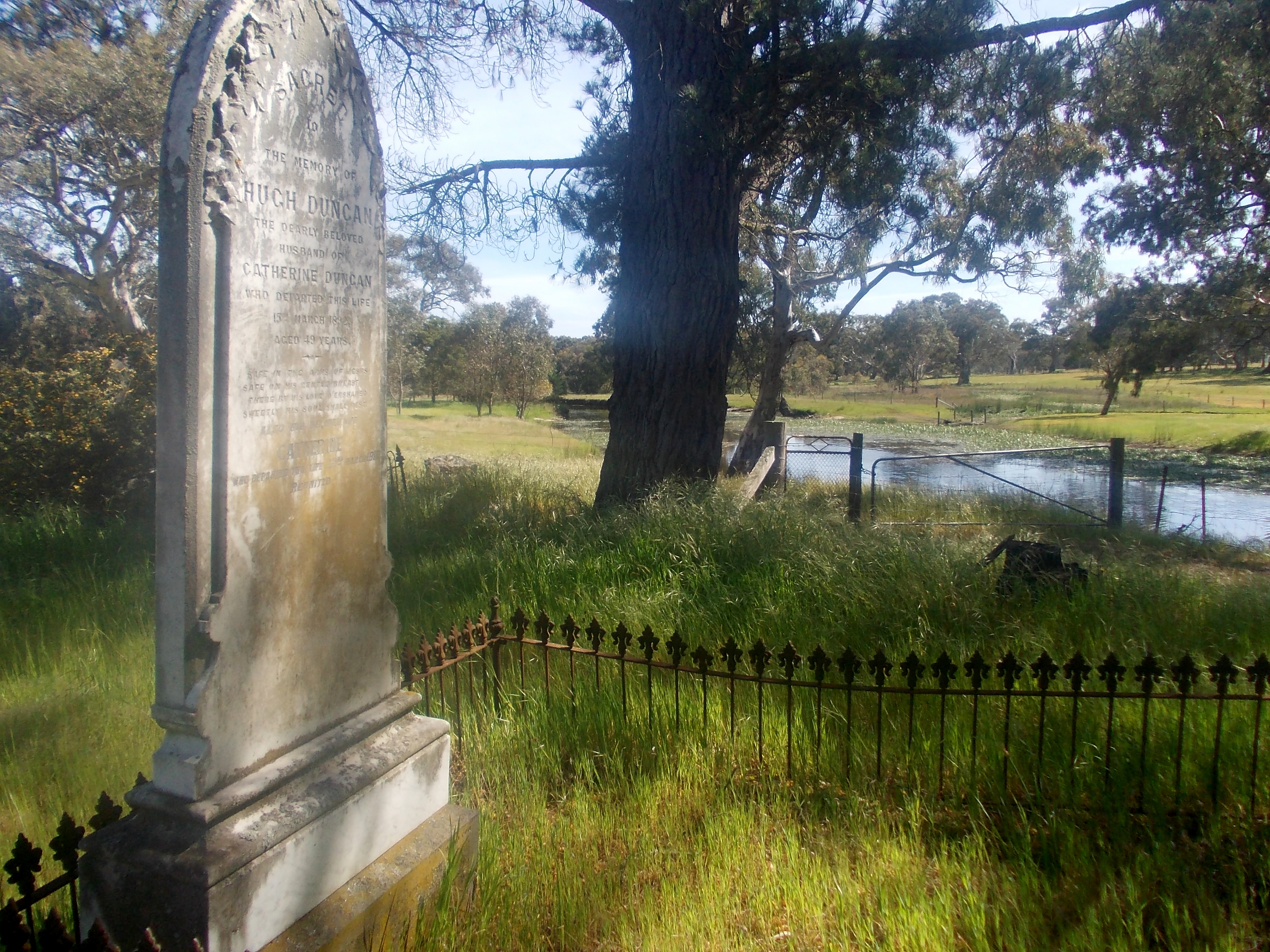
This cemetery is set in beautiful countryside with Hugh Duncan and his wife Catherine having a prime position overlooking the Wannon River.

Headstone of Hugh Duncan (died 1892) and Catherine Duncan (died 1917)

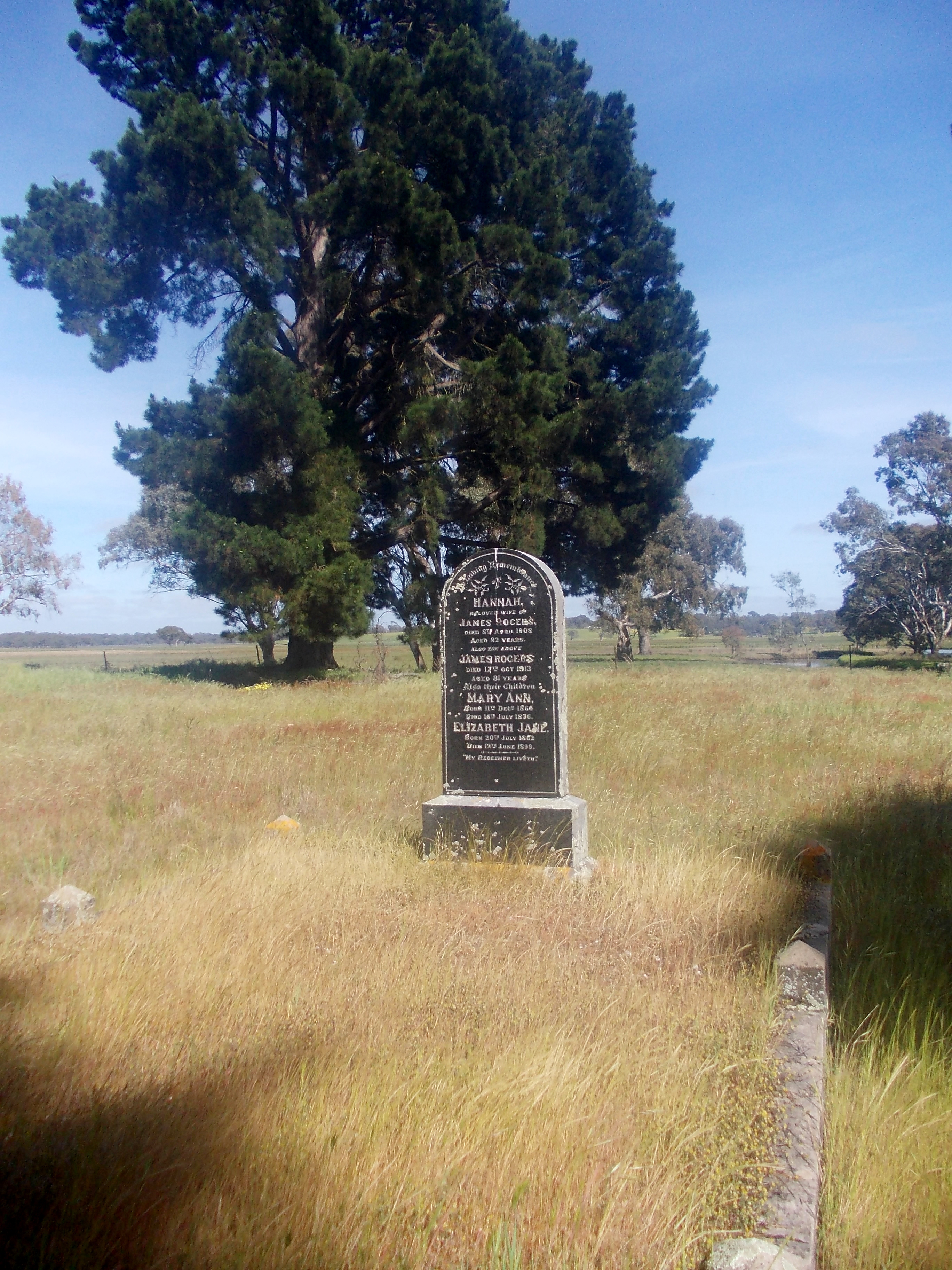
Grave of James Rogers (died 1913) and Hannah Rogers (died 1908) and their daughters Mary Ann (died 1876) & Elizabeth Jane (died 1899)

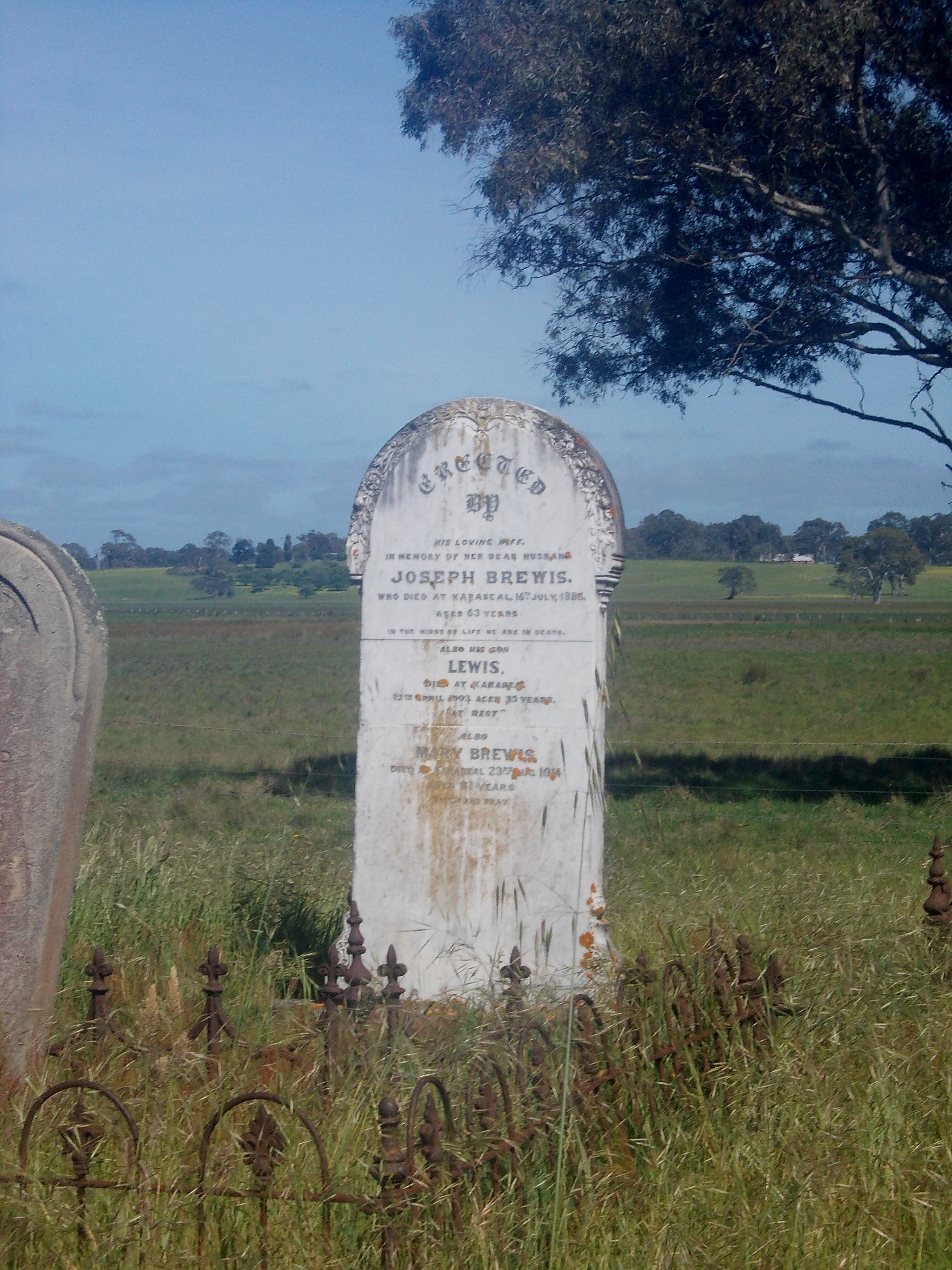
I have a family link to the Brewis family of Karabeal (below).  My first cousin 4 x removed, Alice Reed married Henry Alfred Brewis, son of Joseph and Mary Brewis.  Alice was the niece of Susan Reed, wife of James Harman.

Front: Headstone of Magaret Matheson (died 1871) Back: George Healy Wilson (died 1895) and his mother Elizabeth Wilson (died 1898)

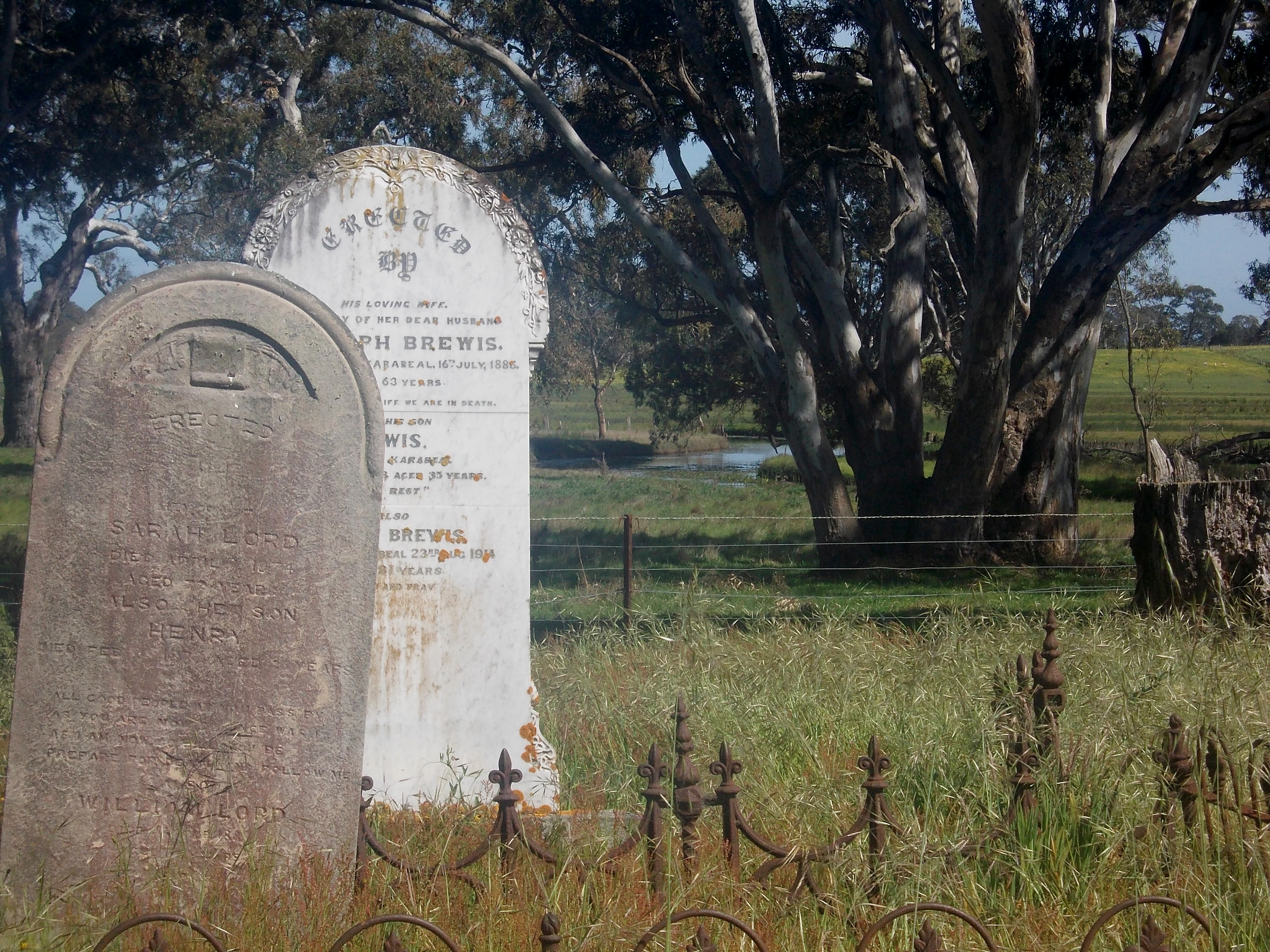
Headstone of William Lord (died 1885) and Sarah Lord (died 1874) and their son Henry (died 1872)

The following headstone is interesting.  It is the grave of Ann Wright who died in 1891.  She is buried with her son Henry Huntly and another Cavendish man Brown Hearn who died in 1904.  A clue came from another Hearn buried in the cemetery, Jessie Hearn.  Her death record of 1880 lists the three-year old’s parents as Brown Hearn and Elizabeth Huntly (or Huntley).  I have found a Victorian Marriage record for an Ann Prior to Henry Huntly in 1842 at Portland, but I can’t find a birth record for a Henry Huntly Jnr and I can’t explain the “Wright” surname.

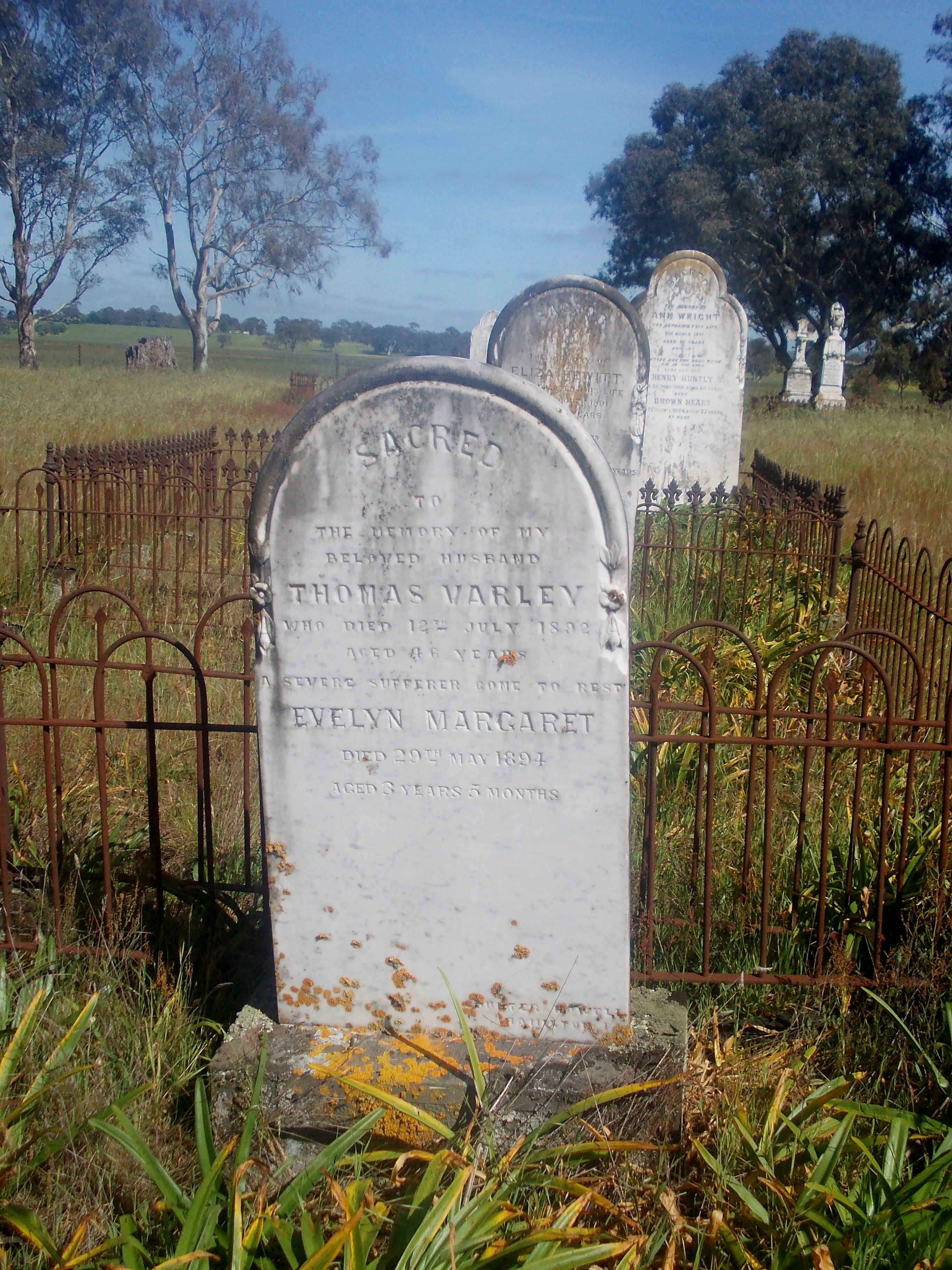
Headstone of Thomas Varley (died 1892) and his daughter Evelyn Margaret (died 1894)

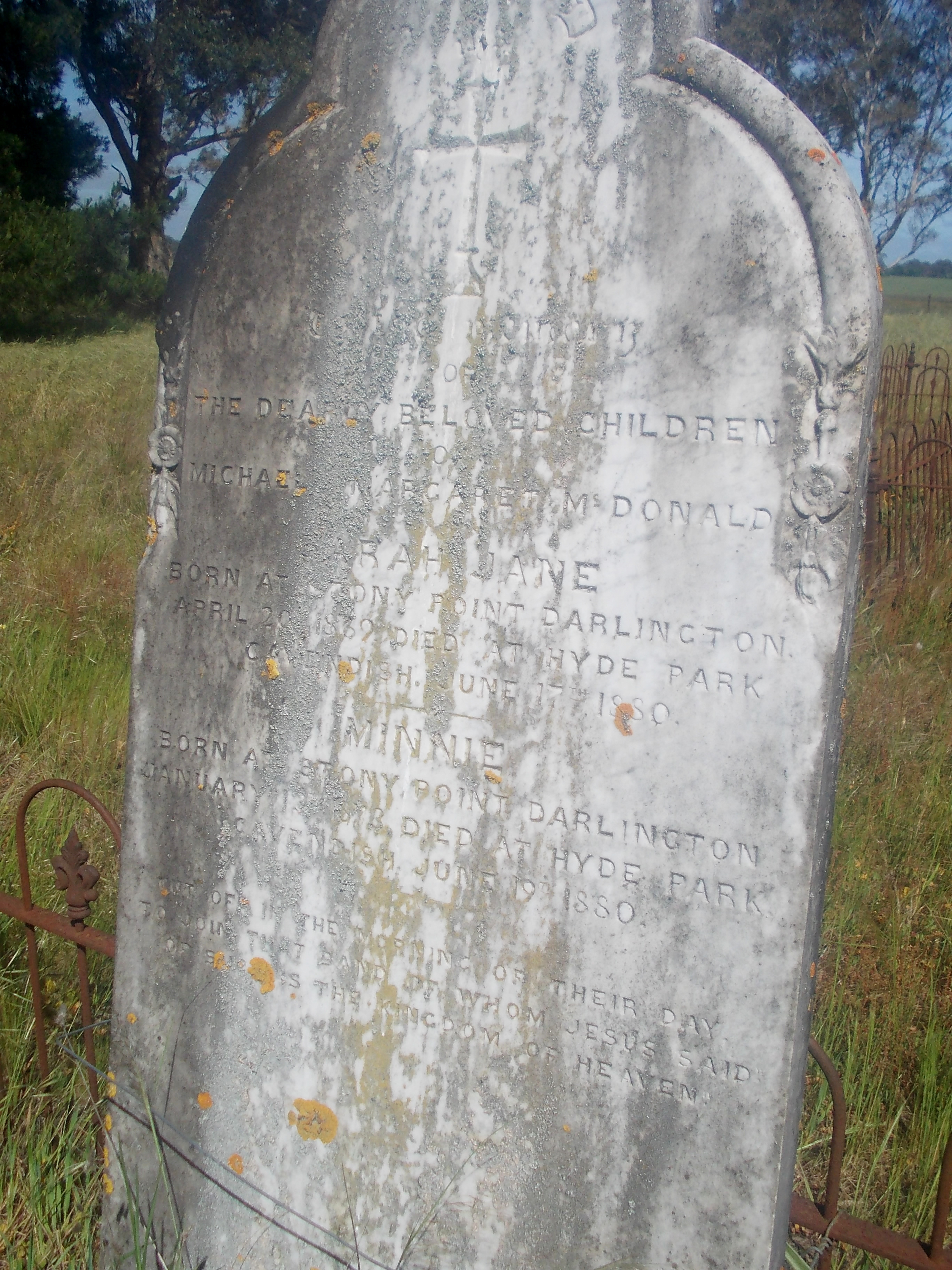
A Diphtheria epidemic hit Cavendish during 1879 and 1880 and many lives were lost including four children of the Cavendish school headmaster.  The headstone of Sarah Jane and Minnie McDonald is a reminder of that time.  Sarah Jane passed away on 17 June 1880 and her sister on 19 June 1880.  They were the daughters of Michael and Margaret McDonald of Hyde Park, Cavendish.

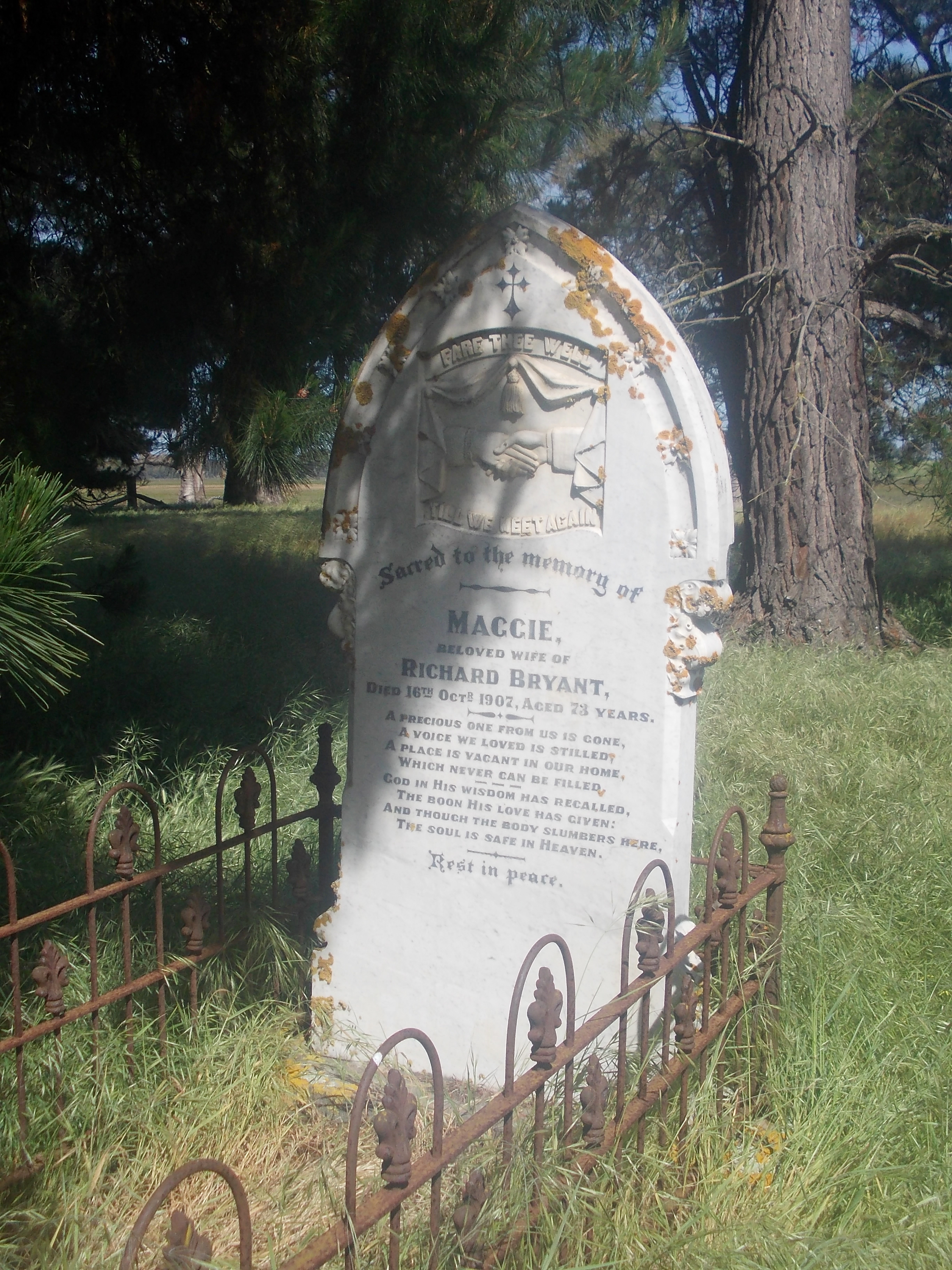
Richard Bryant (below) was a July Passing Pioneer.  Maggie, Richard’s second wife, was born in Ireland and was Margaret Nowlan.  My link to Richard is on his Passing Pioneer entry.

Headstone of Eliza Hewitt (died 1891), Anna Jane Hewitt (died 1899) and William Hewitt (died 1905)

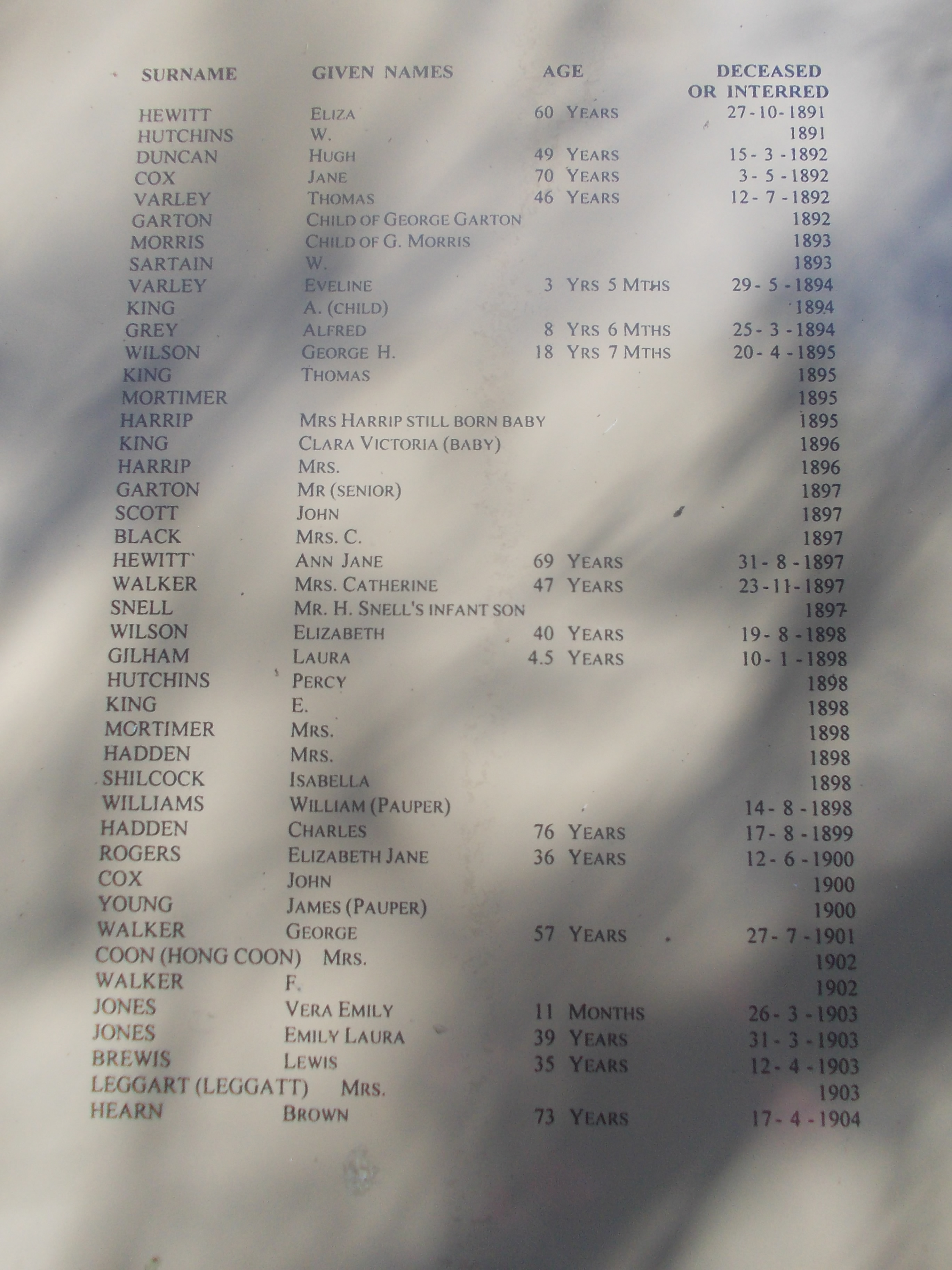
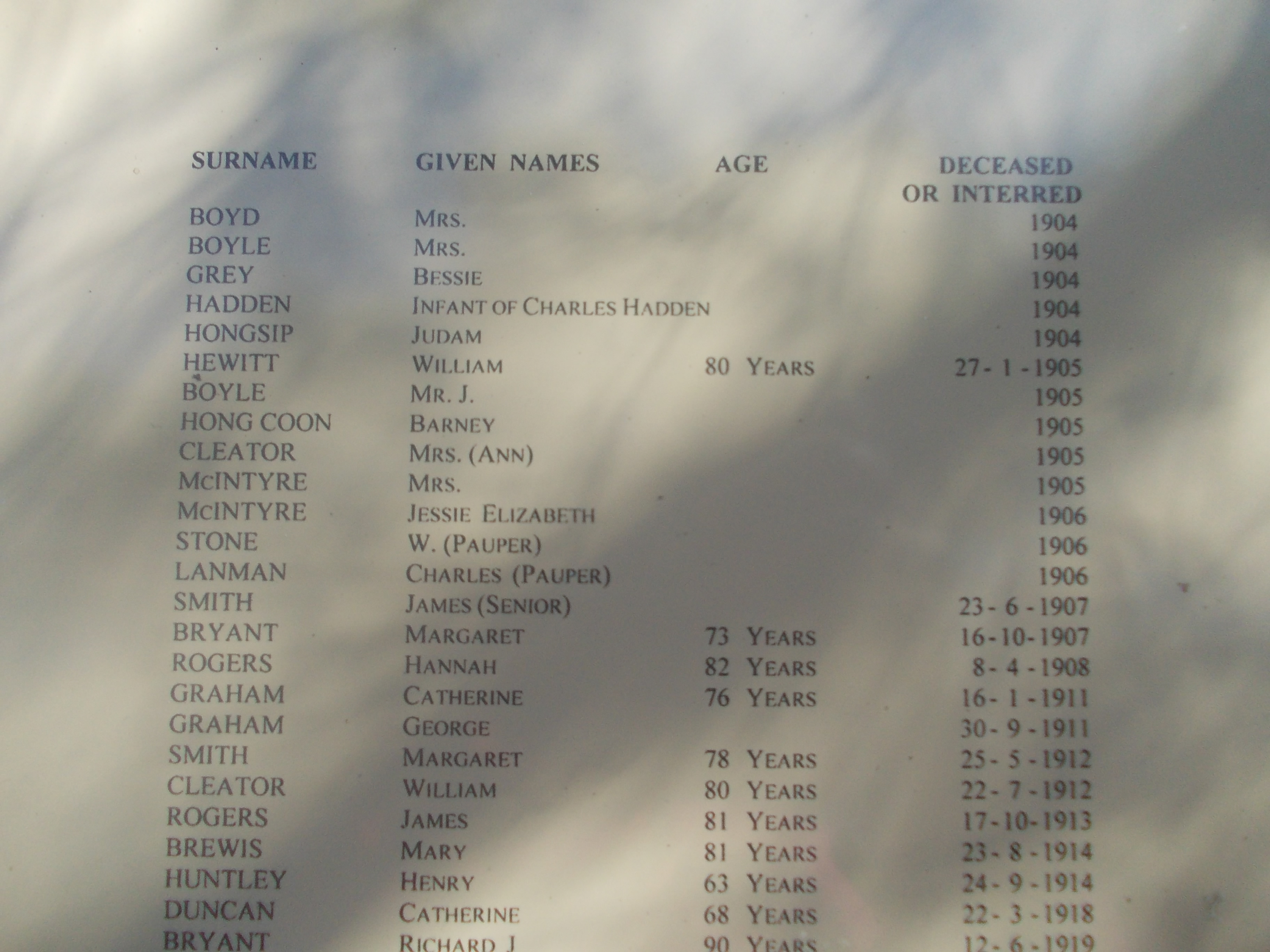
This plaque at the entrance to the cemetery lists all those buried in the cemetery and events from the history of Cavendish during the time the cemetery was in use.

My family members are well represented in the cemetery, but the headstones are gone.  They included my ggg grandparents Charles and Agnes Hadden and their great-grandson, Charles.  Also, my ggg grandfather James Mortimer, died 1895 and his granddaughter Queenie Rose Ann Victoria Mortimer who died as a baby in 1891.

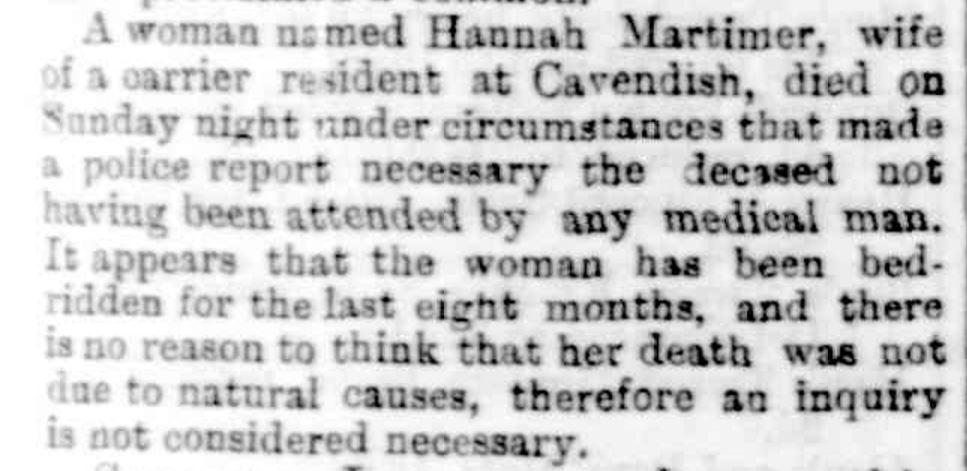
There are three Mortimers that I am not sure of.  Given I cannot find the death of my ggg grandmother Rosanna Buckland*, she has to be one of them.  One unidentified Mortimer died in 1895 which should be James Mortimer.  There is also a Mrs Mortimer, died 1889 and another Mrs Mortimer, died 1898.  I think the latter is Sarah Ann Duggan, wife of Henry Mortimer, James and Rosanna’s youngest son.  Sarah Ann died in Warrnambool in 1898.

GGG Grandmother Rosanna could be the 1889 “Mrs Mortimer”. Or maybe not.  She has been elusive to date *. There is also a Mr W. Mortimer who died in 1889.  I don’t have a W. Mortimer on my tree that died around that time nor can I find a W. Mortimer in the Victorian Death records.

I will return to the Old Cavendish Cemetery in Autumn when the grass will be shorter and “Joe Blake” will be tiring.  Maybe then I can take my time and see what is hidden beneath the grass.

For a full list of those buried at the Old Cavendish Cemetery, check out Ian Marr’s great site Cemeteries of S.W.Victoria

* With some help I did find the death date of Rosanna Mortimer and you can read more about that on the link here.  Since that discovery the Hamilton Spectators from the time are now available at Trove, so I was able to find Rosanna’s obituary and once again another variation on her name.

“Items of News.” Hamilton Spectator (Vic. : 1870 – 1918) 28 August 1888: <http://nla.gov.au/nla.news-article225804201&gt;.

GLOSSARY:

“Joe Blake” ( Australian Rhyming Slang) – snake.

Trove Tuesday Goes to the Races!

Today’s Melbourne Cup marks twenty years since a horse my father was a part-owner of, ran in the Cup.   London Bridge won the Duke of Norfolk Handicap (now known as the Andrew Ramsden Stakes) in 1992, a race over 3200 metres at Flemington just like the Melbourne Cup, and he won it in race record time.  His trainer was the Cups master, Bart Cummings, so London Bridge went into Melbourne Cup day with some hope of a good run.

On Cup Day, the rains came and we knew from the Adelaide Cup in May 1992, that London Bridge was not partial to getting is feet wet.  The winner of the  Adelaide Cup was Subzero and when it rained at Flemington on the first Tuesday in November 1992, London Bridge’s chances decreased and Subzero’s chances increased dramatically.  Subbie won and London Bridge ran a brave ninth.

Both London Bridge and Subzero went on to noble careers after their racing retirements.  London Bridge served as a police horse with the Victorian Police Force and Subzero was a Clerk of Course horse for 15 years and then became an Ambassador for Racing Victoria.  At twenty-four, he still visits schools as part of Racing Victoria’s Community Education Programs and other public appearances.

To mark the 20th anniversary of London Bridge’s Melbourne Cup run, this week’s  Trove Tuesday has a Cup theme with newspaper articles about  Bart Cummings.  Both articles are from the Barrier Miner, a Broken Hill newspaper where, surprisingly enough, I find many treasures.

The first article is from 1947 and a young Bart Cummings, working for his father, had a fall from a flighty colt.

Lucky Escape For Racehorse Comedy Court. (1947, October 16). Barrier Miner (Broken Hill, NSW : 1888 – 1954), p. 8. Retrieved November 6, 2012, from http://nla.gov.au/nla.news-article49572477

When I first read this story, I thought it was a different horse to that in the next article, 1950 Melbourne Cup winner, Comic Court.  However after reading Racing Victoria’s bio of Comic Court I realised that Comedy Court and Comic Court were the same.  Both horse and rider were lucky to win any Melbourne Cups!

The next treasure from the Barrier Miner is a photo of Bart Cummings,  Comic Court and Deidre Gath, the daughter of Albert Gath, a harness racing trainer, who had stables near Flemington.

He made her cry. (1950, November 11). Barrier Miner (Broken Hill, NSW : 1888 – 1954), p. 12. Retrieved November 4, 2012, from http://nla.gov.au/nla.news-article49585975

I like this photo as it brings together two racing dynasties, one thoroughbred racing, the other harness racing. I also love the way Comic Court is looking at Deidre.  Three generations of the Cummings family became trainers, Jim, Bart and Anthony, while the Gath family had five brothers training during the 1950s.  Like the Cummings name in thoroughbred racing, the Gaths are still a force in harness racing today.  In August 2012, Andy Gath trained the winner of the Group 1 Breeders Crown Final with Caribbean Blaster and last Saturday, an Anthony Cummings trained horse, Fiveandahalfstar won the Group 1 Victoria Derby.


A Western District Melbourne Cup

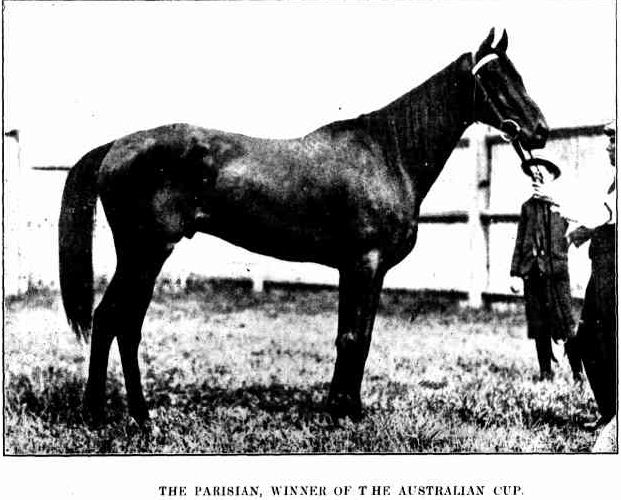
As John Finn Kirby led his 3yo colt from the Mount Gambier show ring in 1908 judged as Best 10 Stone Hack, most would not have considered the same horse would be led in as the winner of the Melbourne Cup three years later, almost to the day. But John Kirby had a dream, and his “10 Stone Hack”, The Parisian, was one of several new horses he had purchased with the potential to complete the task.

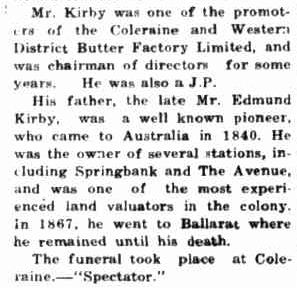
John Finn Kirby was born at his father’s Springbank station, near Casterton, in 1858. His father, Edmund Kirby, was born in Northamptonshire and was one of the early settlers at Casterton, as was John’s Irish-born mother Mary Finn. John and his sister Ellen each received their mother’s surname as their middle name.  As was the way for the sons of the early pastoralists, John was sent away to school, Ballarat College the choice.  He then spent seven years working as a stock and station agent in Ballarat.

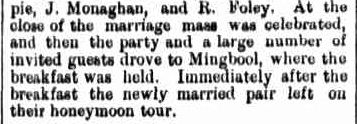
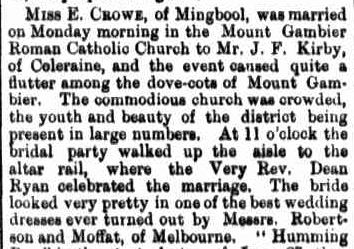
At age twenty-four, John went to work for Smallpage’s Stock and Station agents in Coleraine and after a year, he bought the business. By 1883 he was secretary of the Coleraine Racing Club. In June 1885, John married South Australian girl Elizabeth Crowe, daughter of the late Edmund Crowe and Johanna Crowe, owners of Mingbool Station near Mt Gambier. The wedding was a social highlight in the town, creating much interest.
The Border Watch. (1885, July 1). Border Watch (Mount Gambier, SA : 1861 – 1954), p. 2. Retrieved October 30, 2012, from http://nla.gov.au/nla.news-article77062640

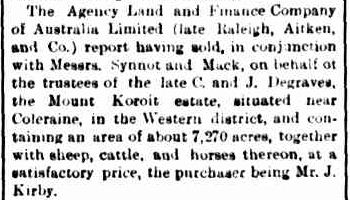
In 1888, John purchased Mt Koroite Estate near the Coleraine racecourse.

COMMERCIAL INTELLIGENCE. (1888, September 21). The Argus (Melbourne, Vic. : 1848 – 1956), p. 9. Retrieved October 30, 2012, from http://nla.gov.au/nla.news-article6902423

In August 1889, Johanna Crowe passed away, resulting in an interesting battle over her will, which ended in the Adelaide Supreme Court. The estate, worth £80,000, was settled with embattled son John receiving £10000 and daughter Elizabeth, Mrs Kirby, receiving half of the balance.  Her children received the other half of the estate.

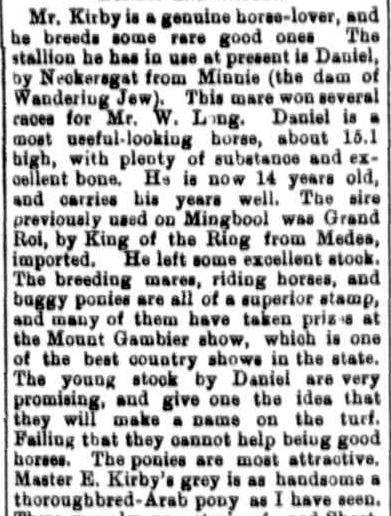
John began to spend time between Mt Koroite and Mingbool.  He’d been breeding and racing horses for a couple of years, but with the use of Mingbool, his interests grew and in 1890 he established the Mingbool Stud, primarily breeding sheep but also horses and cattle. An article from the Border Watch on 18 February 1903, reported Mingbool ran 19,000 sheep, 500 head of cattle and 100 horses.  From the same article,

THE MINGBOOL ESTATE. (1903, February 18). Border Watch (Mount Gambier, SA : 1861 – 1954), p. 4. Retrieved October 30, 2012, from http://nla.gov.au/nla.news-article77157688

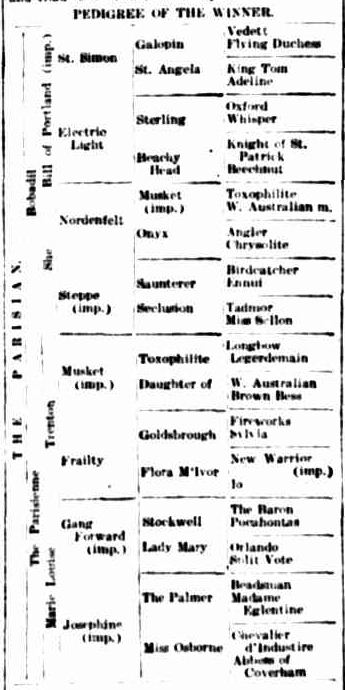
By the middle of 1908, John Kirby had acquired three promising young thoroughbreds, Halloween, Benderay and The Parisian. Benderay was the pick of the trio, brought by Kirby in Dublin, Ireland. He eventually sold the out of form horse in 1912.  Halloween showed a little more promise and picked up a few races for Kirby, but he sold him at auction in 1911. That left The Parisian, bought by Kirby in 1907 at the Melbourne Yearling Sales. His sire was Bobadil, winner of the 1899 Australian Cup and Champion Stakes, and his dam was The Parisienne.

BOBADILL, SIRE OF THE PARISIAN
(1911, March 18). Western Mail (Perth, WA : 1885 – 1954), p. 23. Retrieved November 3, 2012, from http://nla.gov.au/nla.news-article38825171

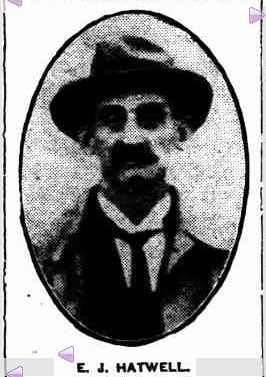
After his victory in the show ring in 1908, The Parisian was in full work by January 1909 with trainer Ernie Hartwell.

On and Off the Racecourse. (1923, June 23). The Mail (Adelaide, SA : 1912 – 1954), p. 4. Retrieved November 1, 2012, from http://nla.gov.au/nla.news-article63442639

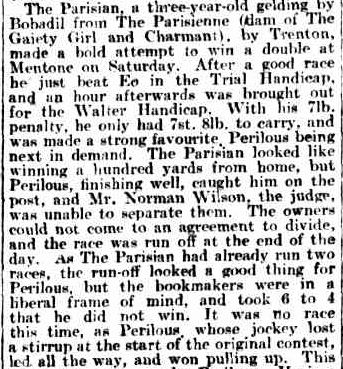
One of his early races, if not his first, was a six furlong Maiden Plate at Sandown Park on 7 April 1909, where he ran fourth, beaten by over ten lengths. The Parisian scored his first victory on 19 April at the Mentone Races, and he backed up an hour later to attempt a double.  An undecided outcome in the second race led to a third race at the end of the meet.

SPORTING INTELLIGENCE. (1909, April 19). The Argus (Melbourne, Vic. : 1848 – 1956), p. 4. Retrieved October 31, 2012, from http://nla.gov.au/nla.news-article10691394

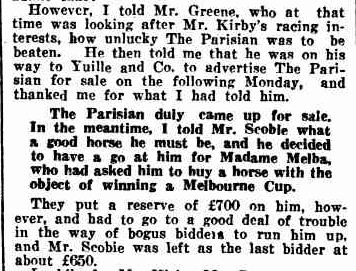
Despite his breeding, the horse was only racing over shorter distances with little success and Kirby sent him to auction.  The great jockey Bobby Lewis, in later years, recalled that time.

£76,000 PLUNGE THAT MISSED. (1933, December 13). The Daily News (Perth, WA : 1882 – 1950), p. 6 Edition: LATE CITY. Retrieved November 1, 2012, from http://nla.gov.au/nla.ne

Passed in, The Parisian was sent to James Agnew, a Hamilton trainer, joining the stable on 1 January 1910.  Agnew soon realised The Parisian was a stayer and increased his distances with success. The Parisian won the 1910 Warrnambool and Hamilton Cups under Agnew. James Agnew’s wins with The Parisian were not enough for him to stay in his stables. The Parisian, along with Halloween, was leased to Charlie Wheeler of Caulfield in June 1910.

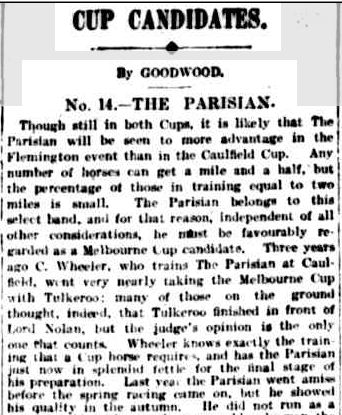
Wheeler took the lead of James Agnew and placed The Parisian over longer journeys and he nominated both The Parisian and Halloween for the 1910 Caulfield Cup and Melbourne Cup not long after their arrival in the Wheeler stable. On October 1, The Argus newspaper’s ongoing summary of the Cup candidates featured The Parisian. With ordinary lead in form, it looked unlikely The Parisian would line up in the Caulfield Cup, with the Melbourne Cup a better option. It was also noted in his last race he struck himself and had a few days off work.

CUP CANDIDATES. (1910, October 1). The Argus (Melbourne, Vic. : 1848 – 1956), p. 17. Retrieved October 31, 2012, from http://nla.gov.au/nla.news-article10465357

The Parisian did not recover fully from his injury of a cracked heel in time for the 1910 Melbourne Cup, and he was scratched.

The Parisian’s first win of any note was the 1911 Australian Cup.  The lead-up to the race was eventful.  Scheduled to run on 7 March, heavy rain leading up to the race saw the meeting postponed and rescheduled for 9 March. However, the rain did not let up, and the race was again rescheduled for Saturday 11 March. Considered a weak field, there were only fourteen runners, and The Parisian was sent out as the second favourite. As the field turned into the Flemington straight, The Parisian drew clear and won by six lengths, easing up.

V.R.C. AUTUMN MEETING. (1911, March 13). The Argus (Melbourne, Vic. : 1848 – 1956), p. 8. Retrieved October 31, 2012, from http://nla.gov.au/nla.news-article10885768

(1911, March 28). Kalgoorlie Western Argus (WA : 1896 – 1916), p. 20. Retrieved November 3, 2012, from http://nla.gov.au/nla.news-article33388818

V.R.C. AUTUMN MEETING. (1911, March 13). The Argus (Melbourne, Vic. : 1848 – 1956), p. 8. Retrieved October 31, 2012, from http://nla.gov.au/nla.news-article10885768

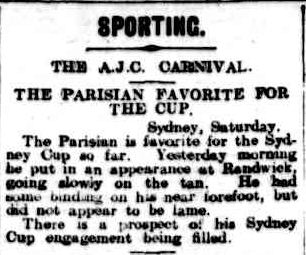
The Parisian then went off to the Sydney Cup, but he was not fully sound and struggled into twelfth.

SPORTING. (1911, April 15). Barrier Miner (Broken Hill, NSW : 1888 – 1954), p. 4. Retrieved November 3, 2012, from http://nla.gov.au/nla.news-article45127765

The next big race set for The Parisian was the 1911 Melbourne Cup.

CUP CANDIDATES. (1911, October 3). The Argus (Melbourne, Vic. : 1848 – 1956), p. 5. Retrieved October 31, 2012, from http://nla.gov.au/nla.news-article11621080

In the week leading up to the race, The Parisian again had heel problems and couldn’t put his hoof to the ground. Again, it looked like he would be scratched.  Charlie Wheeler put the horse in a small paddock full of capeweed next to the stables. The move paid off for Wheeler and on the morning of the race, The Parisian was galloping madly around his paddock trying to avoid capture.

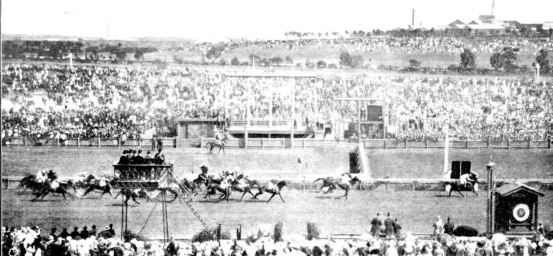
A record crowd of 115,000 people headed to Flemington for the 51st running of the Melbourne Cup.

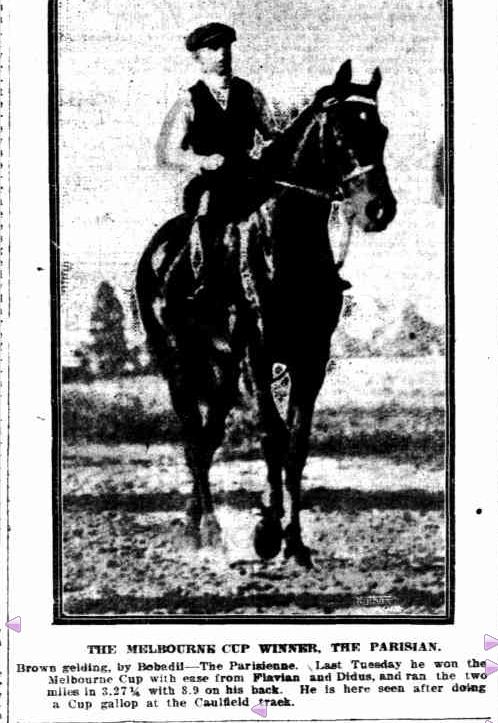
THE 51st MELBOURNE CUP—THE PARISIAN’S EASY WIN FROM FLAVIAN AND DIDUS. (1911, November 18). Western Mail (Perth, WA : 1885 – 1954), p. 23. Retrieved November 1, 2012, from http://nla.gov.au/nla.news-article38837876

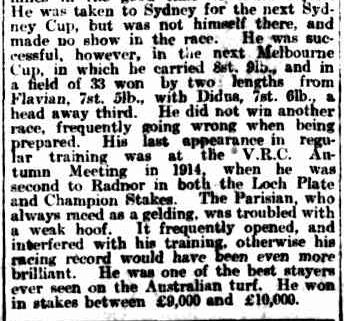
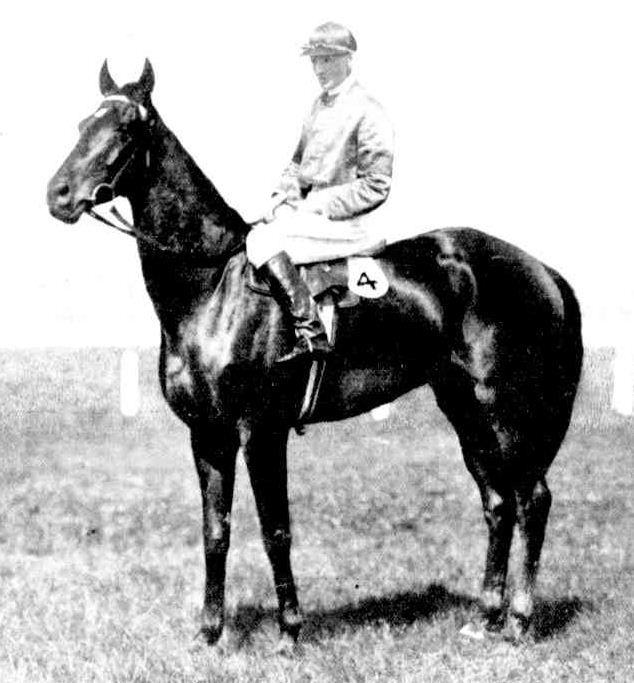
Trafalgar was favourite and The Parisian with Thomas Ronald Cameron aboard was the second favourite in a strong field. The thirty-three horse field jumped and went fast early and as they passed the judge’s box for the first time, the field was well strung out.  The Parisian started making a move coming into the straight for the last time, but Cameron waited, not giving the horse his head until the very last. There was no doubt though, as The Parisian overtook the leaders and won by two lengths, although many thought it was more.  The win was later described as “hollow” and “soft”.
THE 51st MELBOURNE CUP—THE PARISIAN’S EASY WIN FROM FLAVIAN AND DIDUS. (1911, November 18). Western Mail (Perth, WA : 1885 – 1954), p. 23. Retrieved November 1, 2012, from http://nla.gov.au/nla.news-article38837876
THE 51st MELBOURNE CUP—THE PARISIAN’S EASY WIN FROM FLAVIAN AND DIDUS. (1911, November 18). Western Mail (Perth, WA : 1885 – 1954), p. 23. Retrieved November 1, 2012, from http://nla.gov.au/nla.news-article3883787

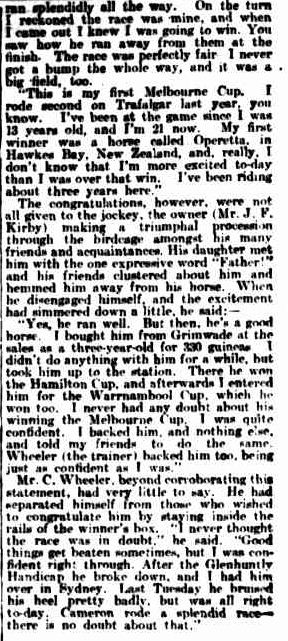
After weighing in, Thomas Cameron was mobbed by stable boys and other jockeys. Meanwhile out in the birdcage, John Finn Kirby’s dream had come true. He was the owner of a Melbourne Cup winner and his delight was clear.
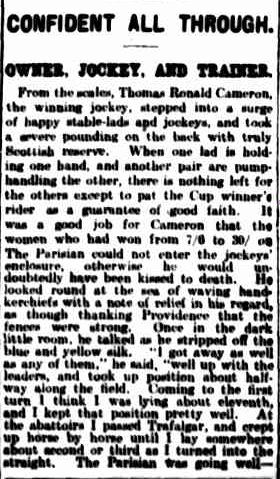
THE RECORD CUP. (1911, November 8). The Argus (Melbourne, Vic. : 1848 – 1956), p. 13. Retrieved November 1, 2012, from http://nla.gov.au/nla.news-article11630312

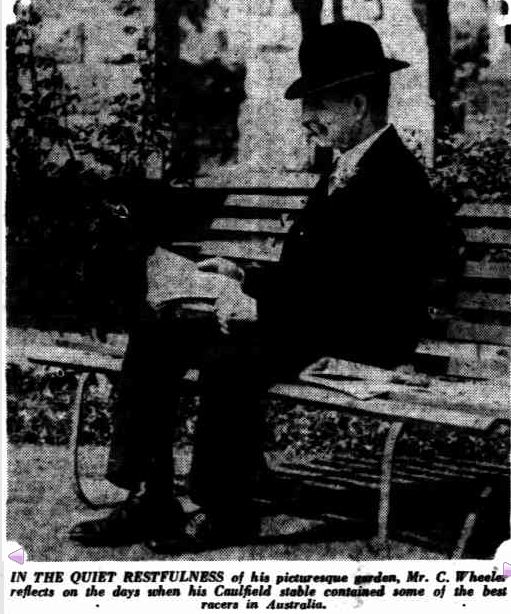
Reflecting twenty years later, Charlie Wheeler revealed the key to training The Parisian for the Cup.

CHARLIE WHEELER’S MEMORIES. (1932, October 29). The Mail (Adelaide, SA : 1912 – 1954), p. 9. Retrieved November 3, 2012, from http://nla.gov.au/nla.news-article59832043

CHARLIE WHEELER’S MEMORIES. (1932, October 29). The Mail (Adelaide, SA : 1912 – 1954), p. 9. Retrieved November 3, 2012, from http://nla.gov.au/nla.news-article59832043

In the days after the Cup, The Parisian was sent to Bacchus Marsh for a spell while John Kirby collected his winnings on “Settling Day” at the Victorian Club. His winnings from the bookmakers were thought to be around  £40,000. The stakes from the Cup were another £7000, although Wheeler, as the lessee, would have received the bulk of that. The Victorian Heritage Database notes around that time, Mt Koroite Homestead received extensive renovations and extensions, presumably from Kirby’s winnings. He had a manager and many staff, including a resident Chinese gardener and a chauffeur, Archie Gunning, who drove Kirby’s car, one of the first cars in the district.

(1911, November 21). Kalgoorlie Western Argus (WA : 1896 – 1916), p. 25. Retrieved November 3, 2012, from http://nla.gov.au/nla.news-article33400021

THE NOBLE ART. (1911, November 12). Sunday Times (Perth, WA : 1902 – 1954), p. 15. Retrieved November 3, 2012, from http://nla.gov.au/nla.news-article57722192

An Autumn 1912 preparation was on the agenda for The Parisian including a chance to repeat his win in the Australian Cup, for which he was the favourite. Unfortunately, his cracked heel again gave him trouble, and he was sent to the paddock, missing all engagements. Brought back for the Spring Carnival, The Parisian ran in the Memsie Handicap first up but needed the run.  He returned in the Rupertswood Handicap where he showed more but was tender after the race. During the following week, The Parisian pulled up lame after track work and Charlie decided to end his Spring campaign.

The Autumn Carnival of 1913 arrived and once again the Australian Cup was set down for The Parisian.  Punters were wary, given the ongoing query about the horse’s soundness. Their caution paid off when The Parisian’s cracked heel again saw him turned out.

It would have seemed unlikely The Parisian would return for the 1913 Spring Carnival, but as a gelding, he did not have a stud career before him and he returned to the track again.  Reports came in early October that he had gone amiss, however, he still ran in the Caulfield Cup on 18 October. There were rumours the horse had problems and would be scratched. However, Charlie Wheeler insisted the horse was fine and ran him. The Parisian ran a creditable fourth but pulled up lame.

Wheeler’s patience was wearing thin, and he advised John Kirby the horse should be turned out for the rest of the spring. Eventually, in early November, Wheeler returned the horse to Kirby, and The Parisian looked set to retire.

Sporting. (1913, October 29). Border Watch, p. 4. http://nla.gov.au/nla.news-article77650783

However, in January 1914 it was reported The Parisian would return to racing in the Western District but not before he raced in the Australian Cup in March.

WORLD OF SPORT. (By “Wakeful.”) THE TURF. (1914, January 17). Barrier Miner, p. 3.  http://nla.gov.au/nla.news-article45268231

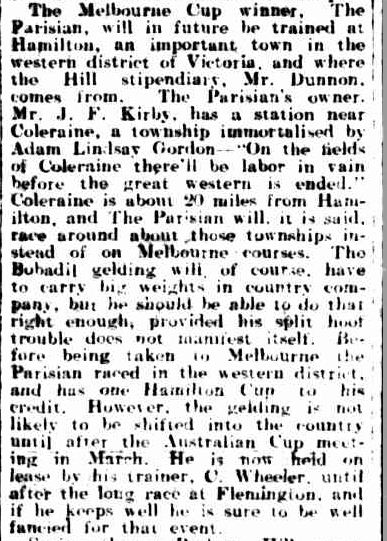
Plans changed again as Charlie Wheeler began an Autumn 1914 preparation with The Parisian. After a few starts, Wheeler finally gave up and once and for all returned The Parisian to Coleraine.

The Turf. (1914, May 7). The Daily News, p. 8 Edition: THIRD EDITION. http://nla.gov.au/nla.news-article79921650

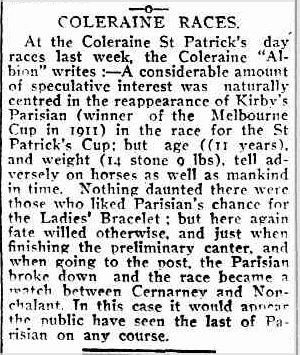
At last, the type of retirement a Melbourne Cup winner deserves looked likely. Nothing of The Parisian racing appeared in the racing pages until just under three years later.  On St Patrick’s Day 1917, The Parisian returned to racing at the Coleraine Racecourse across from Kirby’s Mt Koroite Homestead.  With a hefty weight of 14 stone 9 lbs, the heaviest ever carried at Coleraine, and ridden by, of all people, John Kirby’s chauffeur Archie Gunning, The Parisian broke down again.

COLERAINE RACES. (1917, March 19). Port Fairy Gazette (Vic. : 1914 – 1918), p. 2 Edition: EVENING. Retrieved November 1, 2012, from http://nla.gov.au/nla.news-article88021248

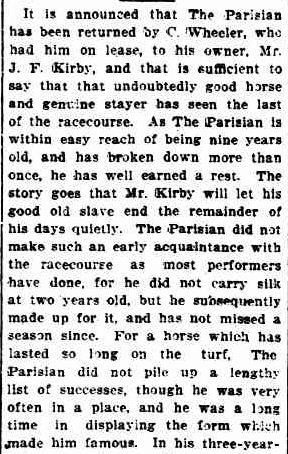
There was little doubt The Parisian had run his last race and around two months later, the sad news came that The Parisian had been euthanised.  Reports stated it was because of a start at a picnic meeting in the Western District. With no reports of the horse racing between March and May, it would have to be assumed his injuries were because of the unreasonable task he was given on St Patrick’s Day at Coleraine when his only purpose in racing was to attract a crowd.
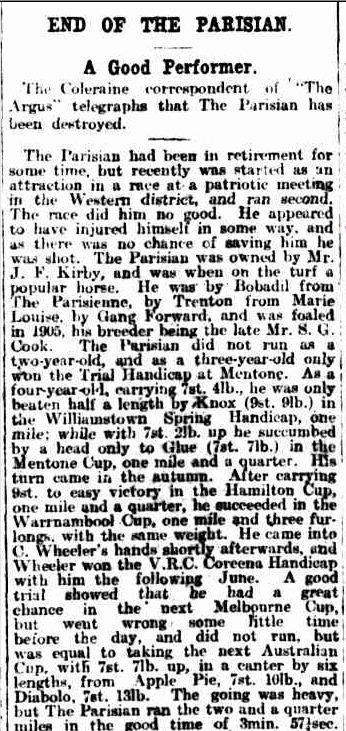
SPORTING. (1917, May 17). The Argus (Melbourne, Vic. : 1848 – 1956), p. 10. Retrieved November 2, 2012, from http://nla.gov.au/nla.news-article1618494

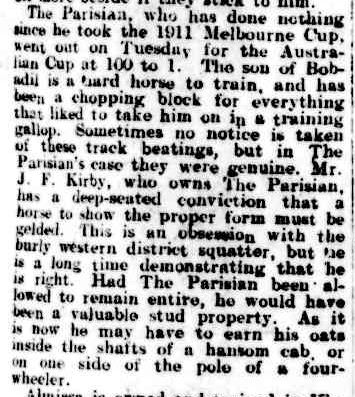
This snippet from Broken Hill’s Barrier Miner four years before The Parisian’s death foresaw what was to come. After two unsuccessful preparations and three years presumably in the paddock, the horse needed to earn more oats.  One would have thought as a Melbourne Cup winner he had earned more than a lifetime’s supply.

WORLD OF SPORT. (1913, March 8). Barrier Miner p. 3.  http://nla.gov.au/nla.news-article45222242

A sad end for a brave horse.

John Finn Kirby passed away in Portland on 7 April 1942, aged eighty-four. His wife Elizabeth had passed away twenty-one years earlier at the Kirby home “Koroite” in Kew, Melbourne.  History shows The Parisian was the best horse Kirby owned, save for Napier a winner of the Great Eastern Steeplechase at Oakbank and the Grand Annual Steeplechase at Warrnambool.
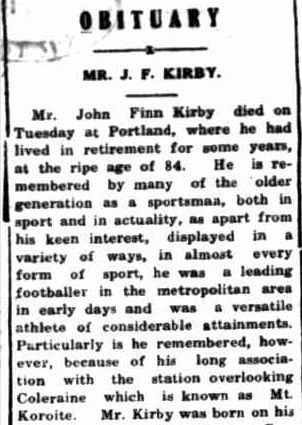
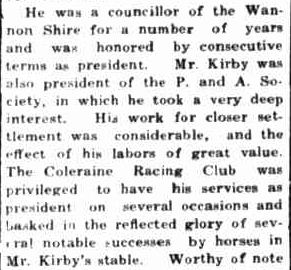
OBITUARY. (1942, April 13). Portland Guardian, p. 4 Edition: EVENING.  http://nla.gov.au/nla.news-article64379650

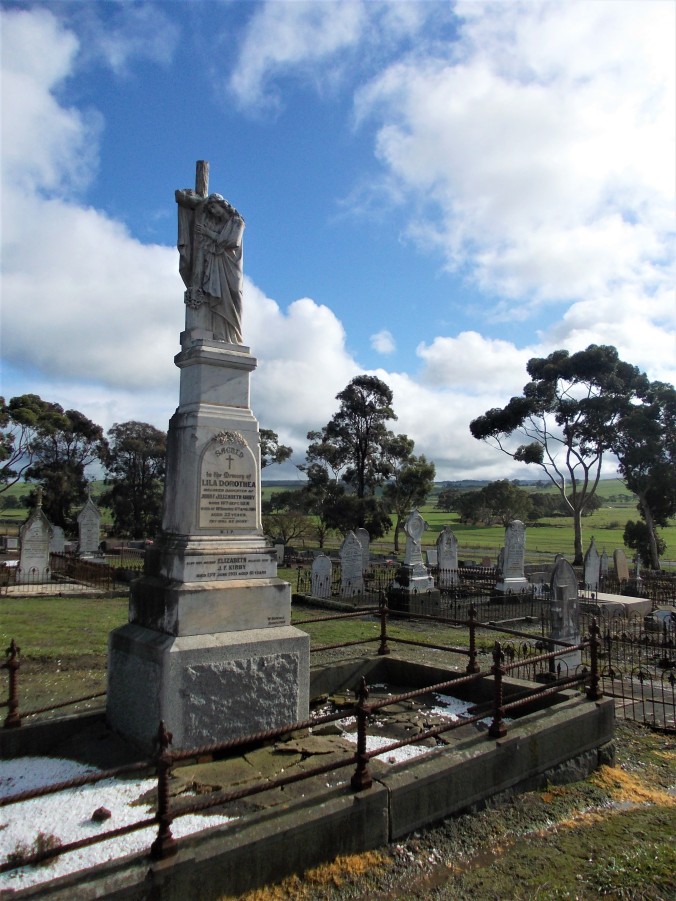
John, Elizabeth and their daughter Lila are buried at the Coleraine Cemetery.
SOURCES:

Trove Australia – List – The Parisian

Victorian Heritage Database
Z is for…Zero, Zilch, Zip

The Gould Genealogy Family History Through the Alphabet Challenge has reached its zenith and I have nothing to offer.  My main purpose of this post is to thank Gould Genealogy  for running the challenge for the past 26 weeks and although I have only contributed four posts, they have all been great fun to write.

Congratulations must also go to those who were able to offer a post for every letter from A-Z with such zest.  A fantastic effort and I have enjoyed reading many of them.  All the posts are at Gould Genealogy & History News under each individual letter.

I possibly could have come up with a few more myself, but with time constraints I thought I would just highlight a couple of letters that meant the most to my family history.  Initially that would be letter “H” and “R” but  two other letters inspired me along the way.  In case you missed, my posts were:

“H” is for …

“I” is for…Investigation

“M” is for…Methodist

“R” is for…Riddiford

For the letter “Z” I did consider Zumsteins, a lovely little place in the Grampians known in the past for its kangaroos.  I enjoyed visiting as a child but it is only a small part of my family history.

I will take this opportunity, however, to mention that Zumsteins celebrates 100 years of settlement this year.  Sadly, because of  bad flooding in the Grampians during the early part of 2011, birthday celebrations are postponed until 2013.  Zumsteins was badly damaged and a culture heritage overlay has, apparently, delayed restoration plans.

The exciting part is the Horsham Historical Society are producing a book to mark the occasion.  They are looking for photos and memories of Zumsteins.  If you would like to share, please contact the Horsham Historical Society

Trove Tuesday – Advertisements

Having been a media student, I do like to look at advertisements and some of the ads in the old newspapers at Trove are absolute treasures.  I came across this group of advertisements recently in the The Mercury, Hobart from May 21, 1917.  The were all found on Page 7, otherwise dominated by racing news.  Only one, a Havelock tobacco advertisement, was directed at the person in the house most likely to read that section of the paper.

Just as they do today, the advertisement play on the insecurities of consumers.  In these examples they include ‘Am I a good mother/housekeeper?”  and “Am I as attractive/fashionable as I can possibly be?”  Buying the featured products would miraculously take away those insecurities.  Or so the advertisers wanted consumers to believe and still do.

Online shopping was not available in 1917, but the same excitement could be experienced when a mail order parcel arrived in the mail box.  Aimed at the country lady (hence the necessity to ride to the mail box), this advertisement makes the reader feel they could be missing out on something if they did not buy from Andrew Mather & Co, with “thousands of satisfied customers.  Are you one?”

THE TURF. (1917, May 21). The Mercury (Hobart, Tas. : 1860 – 1954), p. 7. Retrieved October 29, 2012, from http://nla.gov.au/nla.news-article1074308

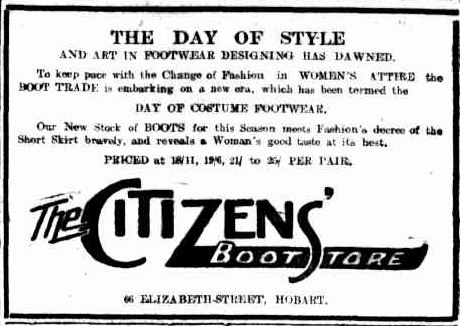
My post on Spring Fashion, explained the change of dress length during WW1.  This advertisement heralded a new era in ladies footwear.  No longer could shoes be hidden under a lady’s skirt.

THE TURF. (1917, May 21). The Mercury (Hobart, Tas. : 1860 – 1954), p. 7. Retrieved October 29, 2012, from http://nla.gov.au/nla.news-article1074308

If it’s good enough for the washerwoman….This Robur advertisement targets both the well-to-do lady of the house and those struggling to make ends meet.  The washerwoman shamed the households that bought “cheap rubbish”” to serve to their staff, and maybe even their guests,  and reassured those on lower incomes that Robur worked out cheaper because it went further and even the finest grades were affordable.

THE TURF. (1917, May 21). The Mercury (Hobart, Tas. : 1860 – 1954), p. 7. Retrieved October 29, 2012, from http://nla.gov.au/nla.news-article1074308

Buying Edmonds Baking Powder was a must for becoming a better home economist.

THE TURF. (1917, May 21). The Mercury (Hobart, Tas. : 1860 – 1954), p. 7. Retrieved October 29, 2012, from http://nla.gov.au/nla.news-article1074308

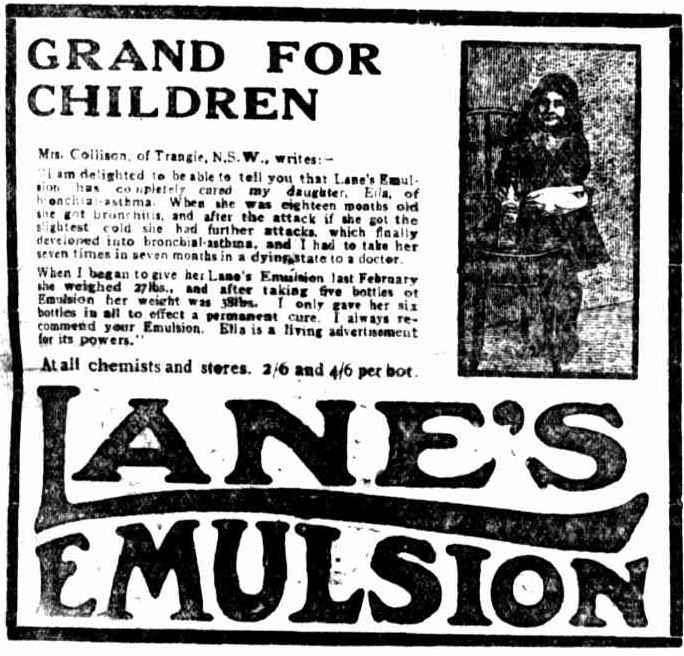
What a great product Lane’s Emulsion must have been.  It cured Mrs Collison’s daughter of asthma!  All it took was six bottles…poor Ella.  Testimonials in advertisements where very common.  In fact, you may find that a relative gave a testimonial.  While researching Sarah Harman’s son, Alfred James Oakley, I found that he had given a testimonial for  Mr Lum the Chinese herbalist from Stawell.  Apparently Mr Lum’s herbal medicines returned Mrs Oakley to full health, something three months under the care of doctors in Melbourne could not do.

THE TURF. (1917, May 21). The Mercury (Hobart, Tas. : 1860 – 1954), p. 7. Retrieved October 29, 2012, from http://nla.gov.au/nla.news-article1074308

An interesting choice of ads to place side by side.  Both  play on a housewife’s doubts about herself, with the ad on the left suggesting experienced housewives know Rex Lorraine Smoked Sausages are “good and fresh”.  Buy them and you too will be a success.  Just “pop the tin in boiling water”, so convenient and  no greasy pan to wash!  Trouble is they don’t sound very appetising.  If  the smoked sausages in jelly caused an outbreak of pimples, Cuticura was the answer.

THE TURF. (1917, May 21). The Mercury (Hobart, Tas. : 1860 – 1954), p. 7. Retrieved October 29, 2012, from http://nla.gov.au/nla.news-article1074308

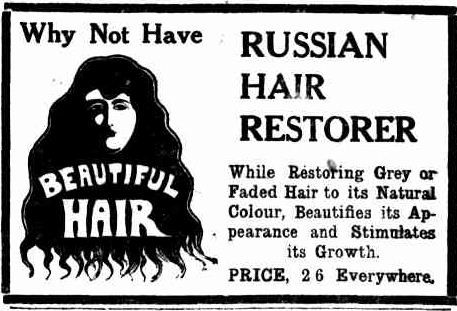
The pimple cream ad. and this one for Russian Hair Restorer, show us that women 100 years ago did care about their appearance.  All that was needed for beautiful hair was a Russian potion.  And what a potion it must have been, supposedly having the power to return grey or faded hair back to a natural colour while stimulating growth.

THE TURF. (1917, May 21). The Mercury (Hobart, Tas. : 1860 – 1954), p. 7. Retrieved October 29, 2012, from http://nla.gov.au/nla.news-article1074308

So next time your browsing the Trove newspapers, check out the advertisements.   Learning about our ancestor’s  food, entertainment, dress and more can go a long way towards understanding their lives.

Passing of the Pioneers

The Ararat Advertiser (1914-1918) is now available at Trove and October Passing of the Pioneers highlights some obituaries from that area.  They show the lure of gold drawing people to Victoria with some of them, such as Mr. and Mrs. George Stock and Elizabeth Williams, being more like “gold rush chasers” moving from town to town as a rush occurred.

If you hoped your ancestor may have been a gold seeker and you haven’t found them at Bendigo or Ballarat, maybe they were at towns like Pleasant Creek (Stawell), Ararat, Landsborough, or Ampitheatre. I thought I had no gold miners until I found that James Bishop was a miner at Mount Ararat when my gg-grandmother, Elizabeth Bishop, was born.

Other pioneers featured include one of my family members, Edward Gamble, Mrs. Hannah Johnstone who would never have starved if she had a gun at hand, and two friends of Adam Lindsay Gordon. I have noticed reading obituaries that Adam Lindsay Gordon had a lot of friends, maybe even more than he thought himself!

James STARRIT: Died 3 October 1889 at Portland. It could be easy for those like James Starrit to be forgotten forever.  I have come across similar obituaries of men and women, unmarried and with few living relatives. James Starrit, his two brothers, two sisters, and elderly father arrived at Portland from Garry Gort, County Donegal, Ireland on August 18, 1852.  James and his two sisters never married and lived together on a farm, earning enough from the farm to allow them to live their simple life.  Prior to farming, James had been a policeman at Portland.

Edward GAMBLE: Died October 1897 at Colac. Edward was my ggg uncle and the son of Thomas Gamble and Ellen Barry. He was only forty-seven at the time of his death from cancer. His obituary alludes to its cause being his work canning rabbits, a job he had for twenty-one years.  There was a preserving factory in Colac and surrounding towns.  Born in Geelong in 1847, Edward married Martha Hodgins in 1873. They had 10 known children. Almost 100 Oddfellows attended Edward’s funeral, dressed in their full regalia as a tribute to their fellow lodge member.

John McKAY:  Died October 1907 at Richmond. At the time of his death at age eighty-four, John McKay was living with his son-in-law. Prior to that, he resided in Portland where he made his name as a blacksmith and wheelwright. He arrived in Victoria in 1853 and Portland in 1854.

Martha HILLS: Died 30 October 1908 at Portland. Martha Hills died at the home of her grandson Charles French, just three months short of her 99th birthday. Martha raised Charles and his siblings after the death of their father Henry and as the obituary puts it so well “…the love and care she gave the three little ones was not relaxed as years advanced, and in return she in her declining years reaped the full reward by equally as loving care and devotion”.  Martha arrived in Victoria around 1858, and spent a few years in Hamilton before moving to Portland with her husband Charles French. She had two children living at the time of her death.

Mary BURNELL: Died October 1910 at Stawell. Mary Burnell was born in Yorkshire on October 23,1836 and at thirteen she travelled to Adelaide, South Australia. She married John Moulden and around 1875, they moved their family to the Wimmera in Victoria. They later moved close to Stawell where she remained until her death.

Mahala CARBIN:  Died 14 October 1915 at Malvern. Born in Cornwall in 1824, Mahala Carbin arrived in South Australia with her parents in 1840. Mahala and her gold-seeking parents moved to Victoria around 1852. She married John Little at St Paul’s Cathedral in Melbourne in 1857 aged thirty-three and they lived in the Ararat district throughout their married lives. Just weeks before her death, Mahala moved to Malvern to live with her daughter.  Mahala lived through the reign of five monarchs and was ninety-one at the time of her death.

Thomas Christopher COATES:  Died 26 October 1915 at Buninyong. Thomas Coates was one of the founding members of the Ballarat Stock Exchange and served as the secretary of the Ballarat Benevolent Society for twenty-six years. He was born in Westmorland, England, and arrived in Australia in 1853. He settled at Creswick in 1854. He died at the home of his son.

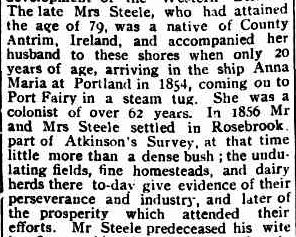
Agnes GORMAN: Died  11 October 1916 at Rosebrook.

Obituary. (1916, October 19). Port Fairy Gazette (Vic. : 1914 – 1918), p. 2 Edition: EVENING. Retrieved October 22, 2012, from http://nla.gov.au/nla.news-article88009495

Elizabeth DAVENPORT: Died 30 October 1916 at Port Fairy. Elizabeth Davenport was born in Parramatta, New South Wales in 1838. When she was eleven, she spent six weeks on a voyage to Port Fairy with her parents. She married William Presnell, a farmer, known for having one of the first threshing machines in the Port Fairy district. Elizabeth and William had thirteen children, six sons, and seven daughters.

William ARMSTRONG:  Died 5 October 1917 at Colac. William was born in Belfast, Ireland the son of a Presbyterian Chaplin. He arrived in Victoria in the 1860s, first spending time with his uncle at West Cloven Hills before setting up his own dairy farm at Darlington. His community interests included the Darlington Presbyterian Church, and the Mechanics Institute and he was the Darlington correspondent for the Camperdown Chronicle. He left a widow and nine children.

Elizabeth PURNELL: Died October 1917 at Ararat. Born in 1823 in Somersetshire, England. Elizabeth Purnell married George Stock around 1852. Not long after they married they sailed for Geelong arriving in October 1852. In 1853, they moved to Ballarat then Stawell when gold was discovered in 1856 at Forty Foot Hill, and then on to Ararat for the “Commissioners Hill” rush.  George was obviously following gold as they then went on to the rushes at Amphitheatre, Barkly, and Landsborough. Finally, in 1867, they settled at Ararat. Elizabeth and George had eleven children, with seven still alive at the time of her death.  Like Mahala Carbin (above), Elizabeth’s obituary mentioned that she had lived through the reign of five monarchs.

Elizabeth BREWIS: Died 10 October 1918 at Ararat.  Elizabeth Williams was an early resident of Ararat. She was born in Essex, England around 1824 and sailed for Sydney in 1852 aboard the Earl of Elgin. While in Sydney she married J. Green. After a year and with the lure of gold, she arrived in Bendigo, Victoria, and followed the rushes until she ended up in Ararat.  She remarried to Robert Williams and they had three daughters.

Mary BARRETT: Died 19 October 1918 at Ararat. Mary Barrett was born in Ireland and arrived in Ararat in the 1860s. Her uncle, Reverend Father Barrett was a pioneer Roman Catholic priest in the Ararat district and Mary resided with him. Mary never married and when her health was failing, she moved to the Brigidine Convent in Ararat where she passed away aged seventy years.

James R. KEAN:  Died 11 October 1926 at Ararat. Born in Portland in 1858, James Kean started working as a printer at age twenty. Two years later, he became a journalist and produced the Portland Mirror. The paper started out small, but within a year the subscribers increased and the paper was already thought of as “an influential and up-to-date journal”  In 1885, James purchased the Portland Guardian a paper established in 1842.  In the same year, he married Jane Robertson, daughter of Angus Robertson of Straun station near Merino. James was a member of the St Stephens Church choir, a member of the Portland racing club, and the Masonic Lodge.

St Stephens Church Portland

John JOHNSTONE: Died October 1930 at Portland. John Johnstone was a very early arrival in Portland, in 1841, as a baby with his parents James and Dorothy Johnstone. James was a blacksmith and wheelwright but he eventually purchased land at Kentbruck and built the Emu Flat Hotel or as known by travellers,” Mrs Johnstone’s”.  After his parents’ deaths, John took over the running of the hotel for a short time before selling it and taking up farming. More commonly known as “Jack”, he was an expert bushman and rider and was a friend of Adam Lindsay Gordon. He married Elizabeth Angus and they had three daughters and two sons.

John Richard MALLINSON:  Died 14 October 1934 at Pomborneit.  Born in Portland, John spent time in Merino and Hamilton as a child and young man. He completed an apprenticeship as a blacksmith and wheelwright and opened a business in Coleraine. After eight years, he moved to Timboon and then Camperdown in 1894 where he again ran a blacksmith’s shop.

Having lived in a number of towns and with his work as a blacksmith he had many friends with horse interests including Cobb and Co drivers of renown and the likes of John Johnstone (above) Adam Lindsay Gordon.

OBITUARY. (1934, October 20). Camperdown Chronicle (Vic. : 1877 – 1954), p. 2. Retrieved October 24, 2012, from http://nla.gov.au/nla.news-article27395509

Frederick WRIGHT:  Died 14 October 1934 at Camperdown. Frederick Wright was born in Cambridgeshire, England around 1842 and arrived at Corio Bay, Victoria aboard the Omega aged fourteen.  He worked as a nurseryman in the Geelong district before learning to drive bullocks.  At eighteen years of age, he took a load of flour to the goldfields at Stawell, the first bullock wagon driven into that area and he only had bush tracks to follow. He moved to Camperdown in 1871 and ran a dairy farm and a chaff mill and later a butcher shop. He was an original member of the Camperdown Turf Club.  He had thirty-five grandchildren and thirty-nine great-grandchildren at the time of his death.

Hannah HANNON:  Died October 1937 at Portland. Hannah was born in Adelaide in the late 1840s and moved to Kentbruck, near Portland aged eighteen.  She married Thomas Charles Johnstone, brother of John Johnstone (above).  Hannah was a woman not afraid to open and close gates and was handy with a gun.  She was known around Portland for sharing ducks or other game she had hunted.  Hannah and Thomas had ten children.

John Alfred RIPPON:  Died 13 October 1938 at Camperdown.

VICTORIA’S OLDEST “BULLOCKY”. (1938, October 20). Camperdown Chronicle (Vic. : 1877 – 1954), p. 1. Retrieved October 24, 2012, from http://nla.gov.au/nla.news-article22995091

John Rippon carted the first load of timber into Purrumbete Estate owned by the Manifold brothers at age eighteen.  He liked it there and stayed for ten years. He then spent another ten years with William Irving Winter-Irving at Tirrengower near Colac.  He then returned to work for William Thomas Chirnside splitting timber.  But John yearned for his bullock driving days and he began his own carrying business.

VICTORIA’S OLDEST “BULLOCKY”. (1938, October 20). Camperdown Chronicle (Vic. : 1877 – 1954), p. 1. Retrieved October 25, 2012, from http://nla.gov.au/nla.news-article22995091

Rachel BLACK: Died 27 October 1941 at Kongorgong. Rachel Black was born in the mid-1850s at Bridgewater. Her father was Joshua Black, a pioneer of that area. When Rachel married James Lightbody, the union brought three Bridgewater pioneering families together as James Lightbody was the son of Rebecca Kittson also from a pioneering family of Bridgewater,

Colin CATHELS: Died 26 October 1952 at Hamilton. Although he died at  Hamilton, Colin Cathels was a Portland identity.  Old age forced him to leave the town he loved and he was not happy in his last days. Born in the 1850s, Colin knew much of  Portland history and enjoyed reminiscing about picnics at the Henty’s home. He was the Portland manager of the Belfast and Koroit Steamship Navigation Company. Colin married a Robertson girl, from a well-known local family.