One of the families in the article are the Guthridges of Carapook and Charam. It was the story of the patriarch of this family, Richard Charles Guthridge, that inspired me to hit the microfiche readers around 20 years ago and begin the search for my family. The Herald-Sun ran an article about Richard and his long-lived family. Nana cut it out as it mentioned the married names of the Guthridge girls with Hadden, Nana’s maiden name, one of them.
Of course, we thought we must be related to this great pioneer in some way. Well we weren’t. My Haddens were from Scotland and the Hadden boys, James and William, that married into the Guthridge family were from Ireland. Maybe the Irish Haddens could have been originally Scots, but as I would have to go back to the early 1800s, I don’t think I’m that desperate to find a distant link.
The article gives the total age of ten members of the Guthridge family as 768 years. It also mentions the Humphries family of Hamilton with an average age of 60.
LONGEVITY IN FAMILIES. (1951, January 4). Portland Guardian (Vic. : 1876 – 1953), p. 3 Edition: MIDDAY.. Retrieved January 28, 2013, from http://nla.gov.au/nla.news-article64427264
There is no doubt that the Guthridge family, with all 10 siblings alive when the youngest was 68 ( Richard lived to 95), was a big effort, but is the Humphries family average remarkable?
When I look at my families, most of them have had siblings that died at a young age and as far we know, all the Humphries were alive in 1951, with the youngest 50.
When I averaged the ages of the Harman children that came to Australia, using their age in the year of brother James Harman’s death, aged 86, I get an average age of 75. Fantastic, but I cheated because Reuben died in 1883 and I didn’t count his age or the siblings that died before the family left England. The Harmans have, however, also had an article published about their longevity.
The Hadden family is a little more accurate. If I average the ages in the year the first sibling passed away, Margaret in 1927, I get an average age of 69. That’s really good. The ages were 80, 77, 74, 66, 63, 55. My gg grandfather William was the 80-year-old and he was still working at Mokanger Station at that time.
Have I sent you scurrying for the calculator? Let me know your best average age.
This post was written for the 2013 Australia Day Blog Challenge organised by genealogist Helen V. Smith. The brief for the challenge was “Tell the story of your first Australian ancestor”.
Easy – Ellen Barry arrived in 1840 on the Orient. But you have heard enough about Ellen and her husband Thomas Gamble, another early arrival (and possible convict). Most of my other ancestors were 1850s Assisted Immigrants. Maybe I could go with a hunch.
My ggg grandparents James Bishop and Sarah Hughes have been difficult to research. I eventually discovered they married in Adelaide in 1852. A few years ago, on the passenger list of the Lysander an 1840 arrival to Adelaide, I found Robert Hughes, his wife and four daughters.
Shipping Report. (1840, September 8). Southern Australian (Adelaide, SA : 1838 – 1844), p. 3. Retrieved January 26, 2013, from http://nla.gov.au/nla.news-article71619943
As Sarah’s father was Robert, I’ve kept the Lysander filed away in my mind (yes, there are probably better places), occasionally having a search around the records hoping for something new.
For this post, I decided to try to find, the arrival date of either Sarah or James, but I had to choose. Firstly, I would need to pay for a digital image of a Death Certificate simply because I was short of clues. This was still cheaper and faster than ordering a hard copy of their South Australian Marriage Certificate.
I’ve posted about James before and I know something of him but nothing of Sarah except she gave birth to eleven children, but I did want to know more. Also, as Sarah passed away before her husband, the informant would most likely have been James and, if he was still of sane mind, information would be more accurate than that on his own certificate. He died ten years later in 1895 and his informant may not have known the detail I was after.
Based on that reasoning, Sarah it would be. So I ordered the certificate and waited, with fingers crossed for the digital image to appear. More often than not when I order a certificate, I end up disappointed. I was, on this occasion, pleasantly surprised. The column I was most interested in was “How long in the Australian colony”. It read, “fourteen years in South Australia”, in Victoria…almost illegible but it looks like thirty-four years. What do you think?
It does not prove that Sarah came on the Lysander but it does qualify her as an early arrival, so let the story begin.
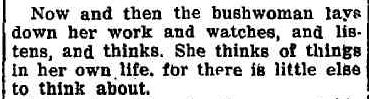
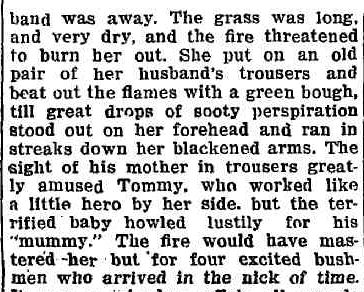
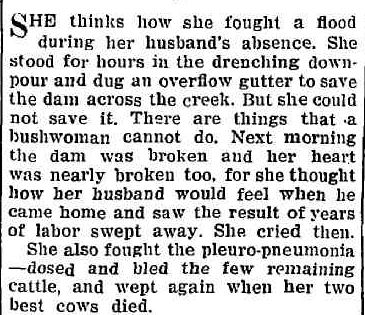
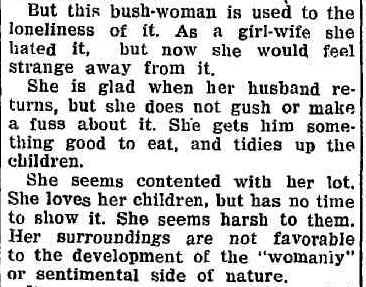
I have told much of the Bishop family story in the post “Jim’s Gone A-droving” but what of Sarah’s story? I know so little about her but with help from Henry Lawson’s “The Drover’s Wife” one can wonder and imagine what life was like for her. While I don’t believe that she felt the isolation experienced by Lawson’s “wife” she must have felt the same loneliness.
Sarah Hughes was born in Brighton, East Sussex, England in 1834 to Robert Hughes and Mary Godfer. Robert was a sailor according to Sarah’s Death Certificate. As a child, Sarah arrived in Adelaide. By 1852, aged eighteen, she had met and married James Bishop from Dorset, nine years her senior. They lived at Thebarton, just north-west of the Adelaide city centre. Eight days short of their nine month anniversary, Sarah and Jim welcomed a daughter, Mary Elizabeth, named after her two grandmothers.
For most of his working life, Jim was a drover. The following article describes a James Bishop, working as a shepherd near Gawler, South Australia in 1853.
This could well be my Jim, off working early in the marriage. I have often wondered why only one child was born during the Adelaide days from 1852-1855/6, considering the speed of conception of the first child and frequency of the later children. Maybe Jim was away working? Could the gaps between the eleven children be a measure of Jim’s absences?
Baby Mary passed away in 1855 and this may have been a catalyst for a move.
Family Notices. (1855, March 26). South Australian Register (Adelaide, SA : 1839 – 1900), p. 2. Retrieved January 24, 2013, from http://nla.gov.au/nla.news-article49308047
Or was it gold? Jim and Sarah next turned up in Ararat where a new lead was found in early 1856.
Would life as a miner’s wife be any different to a shepherd’s wife? The goldfields were harsh for women, in the minority and left alone while their husband’s sought to change their fortunes. There was the cold (and Ararat can get very cold), the mud, the heat and dust. Their home was either a tent or hut. Settled in Ararat, Sarah gave birth to three children in four years, including my gg grandmother Elizabeth, if lucky a midwife at best assisted or another miner’s wife. Disease lurked on the goldfields, a constant worry for a mother with young children.
Seemingly luckless, the Bishops moved to Mount Gambier. Jim would have turned to droving by this time. While they were in Mount Gambier, Harriet was born in 1860 and Ellen in 1862.
By 1865, the family had moved to the Macarthur/Byaduk area and in the same year, after a break of three years, Sarah gave birth to a daughter. She called her Mary after the child she lost 10 years before.
During Jim’s absences, he often took cattle to the Adelaide markets, Sarah would have faced the harshness of the land on her own. By 1870, she had eight children from a newborn to fourteen. That year, Jim selected sixteen acres at Warrabkook, out of Macarthur. At least the older boys could have helped her with daily farm tasks and Elizabeth, thirteen and Harriett, ten, with the babies.
Sarah’s relationship with James is something I wonder about. Nine years younger than him and only a girl when they married. Drovers were stereotypically hard-drinking men adapted to long periods alone. Margaret Kiddle in her book, Men of Yesterday, A Social History of the Western District of Victoria described drovers as “…hardbitten, sunburnt and blasphemous.”(page 411) How did Jim adjust back at home? The peace of life on the road with a mob of cattle would be very different to a home full of children. Did Sarah do as Lawsons’ drover’s wife and not make a fuss?
As Lawson’s “Drover’s Wife” killed a snake that terrorised the family in their home, her eldest son, with some sense of her emptiness, declared “Mother, I won’t go drovin’, blast me if I do”.
For Sarah, this was not the case. Eldest son Charles worked as a drover.
PASTORAL INTELLIGENCE. (1890, January 15). The Argus (Melbourne, Vic. : 1848 – 1956), p. 6. Retrieved January 25, 2013, from http://nla.gov.au/nla.news-article8583931
Third son Robert worked as a drover.
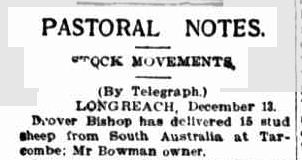
The droving blood ran deep. The 1913 Electoral Roll lists Sarah’s grandson Hubert Nathaniel Gurney Bishop, with the unmistakable name and son of Charles, as living in Longreach, Queensland. I believe this his him.
Sarah died on 15 May 1885 at Byaduk from pulmonary tuberculosis. Buried at only fifty-one at the Macarthur cemetery. The Wesleyan minister presided. On Sarah’s death certificate her profession was not home duties, or wife or even mother. It was a role that was all of those and more…drover’s wife.
After I wrote this post I watched Australian country singer Luke O’Shea ‘s take on The Drover’s Wife. Pass the tissues, please.
SOURCES:
Excerpts of Henry Lawson’s short story “The Drover’s Wife” from Queensland Country Life – EPICS OF THE BUSH. (1936, June 11). Queensland Country Life (Qld. : 1900 – 1954), p. 7. Retrieved January 26, 2013, from http://nla.gov.au/nla.news-article97158517 and Henry Lawson’s Stories of the Bush. (1936, June 18). Queensland Country Life (Qld. : 1900 – 1954), p. 7. Retrieved January 26, 2013, from http://nla.gov.au/nla.news-article97158597
Browsing my Trove tags for this week’s post, the tag “Snake sixteen feet” attracted my attention. The item was this snippet from The Argus of 29 February 1864 (obviously a leap year).
Since I’ve seen two snakes this season after going many years without having seen one, the sixteen-foot snake seemed like an appropriate Trove Tuesday subject. I searched Trove for “snake sixteen feet”. I then narrowed the results down to 1864 but first I noted how many articles came up with the words “snake sixteen feet”. A lot actually, making me think that just like hailstones are always the “size of golf balls”, snakes were once always sixteen feet long.
I did find more about the snake that was making its presence felt at Mount Fyans Station north of Mortlake.
They should have known something when I suggested we go to Nelson for a few days. Like last year when we travelled to Portland, I had found a destination that would covertly satisfy some of my family history needs while still appealing to the other family members.
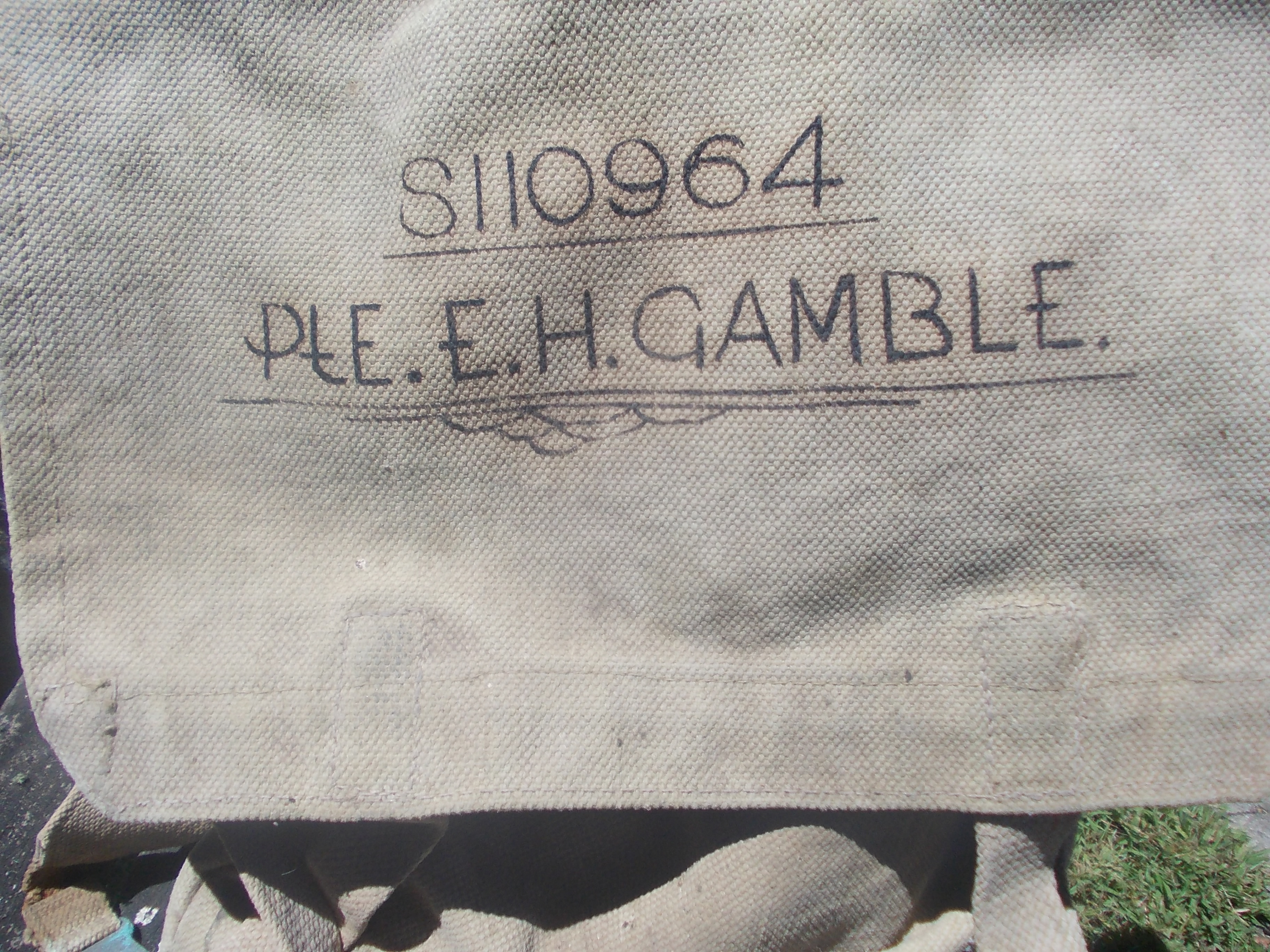
Back in April, I received an email from Daryl Povey from the Glenelg & Wannon Settlers site. Daryl had been at the Digby Hall for ANZAC day and spoke to an old school friend, Doug. Doug had purchased a property near Digby some time ago and had found an army issue backpack hanging on a door in the house. It was in good condition and had the name Pte E. H. Gamble written on it. Daryl knew of my Gamble link and asked me if E.H. was a relative. He most certainly was, he was my great-uncle, Ernest Hiram Gamble
Ernest Hiram Gamble was born in 1915 at Hamilton, the third son of Joseph Henry Gamble and Edith Diwell. My grandfather, William Henry, was the oldest son and was four years older than Ern.
The following photo is L: Ern, Norm, Bill (my grandfather). This is one of my favourite Gamble photos.
There is a lot in the photo. The boy’s shoes – aren’t they great? The boy’s jackets – All different and probably all from different sources, but still Edith ensured her boys looked smart. The garden – I have an interest in Australian gardening history and the photo offers a glimpse into a 1920s backyard. The smiles – it is heartening to see this picture taken in the early 1920s. The boys look so happy and pleased to be together.
In the years earlier, the boys went through a period of separation. Joseph and Edith moved from Hamilton to Moonee Ponds for a short time, living not far from Josephs’ brother Albert. My grandfather and possibly some of the other children spent some time in Ballarat. He even appears on the Macarthur Street State School records. The family returned to Hamilton in the early 1920s and three more children were born. Life was tough at times but Edith, with her happy spirit, kept them smiling.
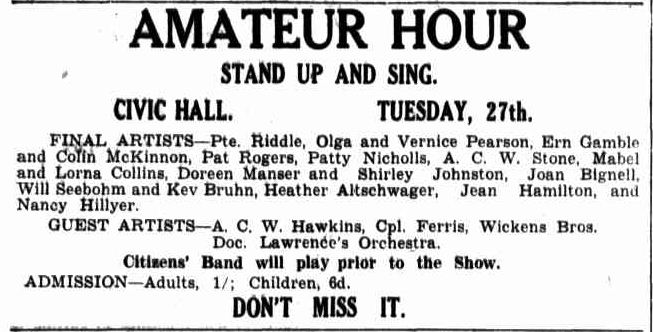
In 1940, Ernest married Jean Lillian Watts and they moved to Mt Gambier. Ern had worked as a grocer in Hamilton with Moran & Cato Pty Ltd a leading Australian grocery chain of the time and he transferred to their Mt. Gambier store. A keen musician, a love passed through the Diwell line, Ern got involved with local dances playing with his friend Colin McKinnon. The duo also performed in Amateur Hours such as the following at Mt Gambier in 1942.
Last Amateur Hour on Tuesday. (1942, October 24). Border Watch (Mount Gambier, SA : 1861 – 1954), p. 3. Retrieved January 15, 2013, from http://nla.gov.au/nla.news-article78118758
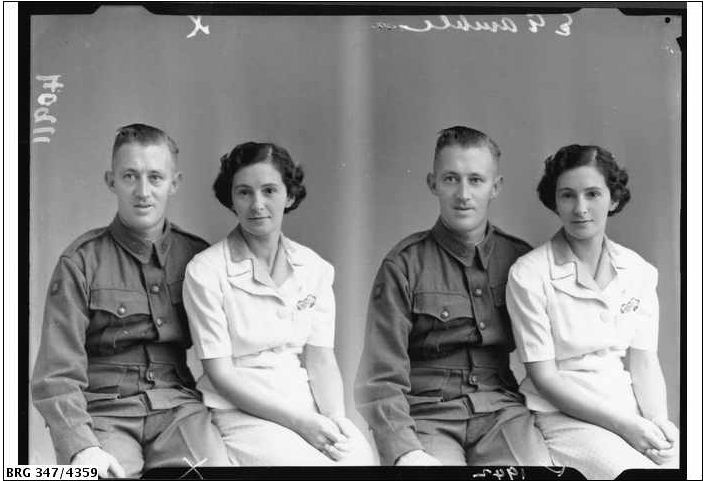
On April 22, 1942, aged 27, Ern enlisted at Mt Gambier for service in WW2. An appointment was made with The Arthur Studio in Mt. Gambier for a photo session for posterity.
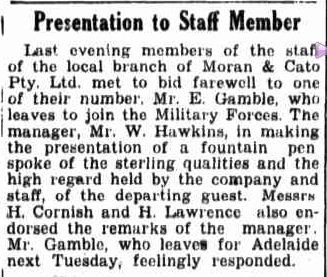
Ern’s work place gave him a send off and he set off to Adelaide for training in early October 1942.
Presentation to Staff Member. (1942, October 3). Border Watch (Mount Gambier, SA : 1861 – 1954), p. 1. Retrieved January 13, 2013, from http://nla.gov.au/nla.news-article78117772A month later, Ern was given leave to spend time with Jean before his posting.
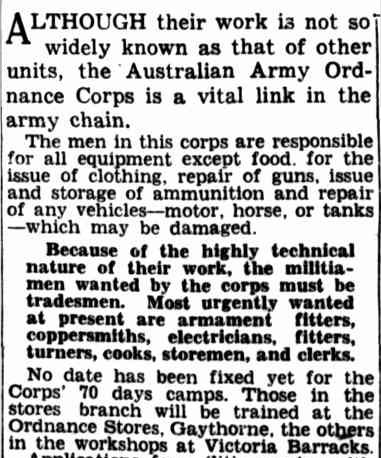
At the time of his discharge, Ern was a corporal with the 1st Australian Base Ordnance Depot that, from what I can work out, was in Brisbane. By the end of the war there was an Ordnance Depot at Bandiana in Victoria and I have found this referred to as the 1st Ordnance Depot. The role of the Ordnance Corps is detailed below:
Men Wanted For Militia.—No. 7. (1940, August 6). The Courier-Mail (Brisbane, Qld. : 1933 – 1954), p. 4. Retrieved January 17, 2013, from http://nla.gov.au/nla.news-article40949865
After the war, Ern and Jean welcomed a son, John Ernest. They were living in Melbourne by that time.
This is another lovely Gamble photo. Here Edith, surrounded by her family, and with a big smile, looks so proud. Ern is back right and my grandfather, back left. This was from a series of photos taken on a day the family managed to all come together from Melbourne, Ballarat and beyond. My mum and Ern’s son John were only toddlers, so I think it may have been around 1948 and Edith was living at 18 Skene Street, Hamilton.
In 1960, Ern passed away at McKinnon, aged only 44. Jean died in 1971 aged 54 and the following year, only child John passed away, aged 26.
So that was it, I had decided. We were off to Nelson with its great fishing and oh, did I mention we would just happen to pass right by Doug’s house on the way?
We met up with Doug and his wonderful farm dogs. What a great bloke Doug is, realising the backpack might hold some special family meaning and for looking after it until the day he may find some one who knew Pte E. H. Gamble.
For over 60 years, Ern’s backpack hung on a door in a farmhouse, waiting for its owner to return. The story of how it came to be there is not yet clear. The house was previously owned by Ronald Mabbitt, a Digby man. He passed away in 2005. Ron did enlist in WW2, and when discharged he was with the 2/32 Australian Infantry Battalion. Maybe their paths crossed during the war or maybe Ron was a musician. Ron must have thought a lot of Ern to keep his backpack so long, hoping one day his friend may return.
Thank you to Daryl Povey for contacting me and passing on Doug’s details. Your help is always appreciated.
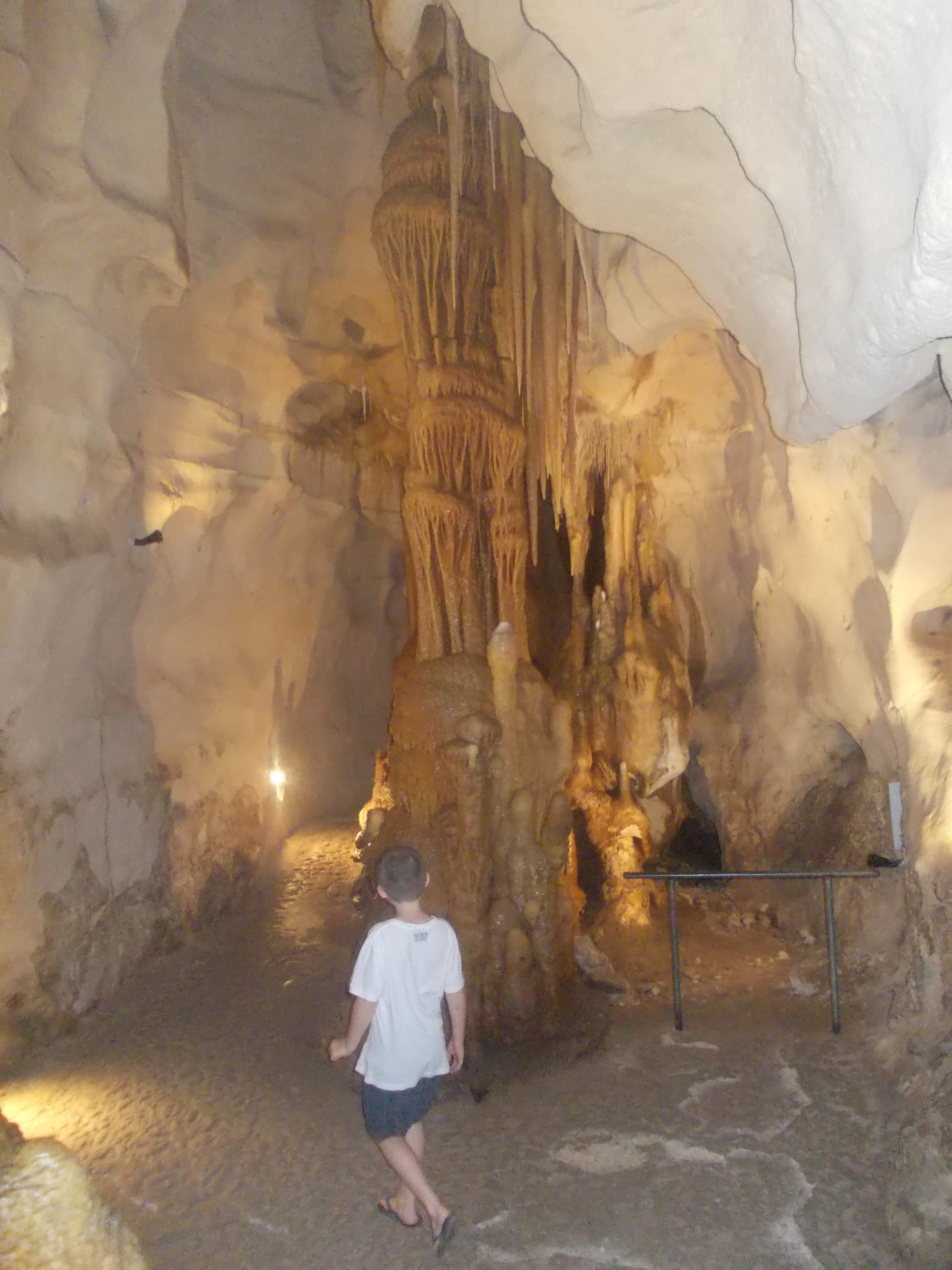
While holidaying at Nelson recently, we went on a guided tour of the nearby Princess Margaret Rose Cave. It is a fascinating collection of stalactites and stalagmites formed over millions of years from water seepage from the Glenelg River.
The story we heard of the discovery of the caves could have been straight from a Boys Own Annual. It was found in 1936 by two young men. One was lowered into a 17 metre dark hole with only a candle, matches and string. When he returned to the top his comment was something like “I think I have found Aladdin’s cave” .
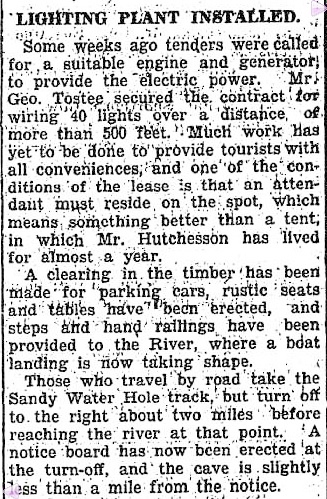
Because it is such a great story, I though I would search Trove for articles from the time of the cave’s opening to the public in 1941. I found two worth sharing from the Border Watch of Mt Gambier and the Horsham Times.
New Cave Opened Near Sandy Water Hole. (1941, January 18). Border Watch (Mount Gambier, SA : 1861 – 1954), p. 3. Retrieved January 15, 2013, from http://nla.gov.au/nla.news-article78138417
The story from the Horsham Times, claims Jack and Keith as Horsham men, but that is not indicated at all in the Border Watch article that states Jack Hutchesson had lived all his life at Caroline, near Nelson. I did check the Electoral Rolls and there were Hutchessons living in Horsham over the years. The Horsham Times does give a good account of the discovery of the caves.
GLENELG RIVER HAS ATTRACTIVE CAVES. (1941, February 14). The Horsham Times (Vic. : 1882 – 1954), p. 1. Retrieved January 14, 2013, from http://nla.gov.au/nla.news-article72689203
What I did learn from the articles was that Jack and Keith were quite a bit older than the impression given on the guided tour. We left with a picture of two lads, maybe 15 or 16, when in fact they had Jack’s sons with them. Otherwise it was a fun and informative tour and highly recommended.
There has been some negative spin about Blogging awards over the past few days, however I felt that it would be remiss of me if I did not acknowledge my third nomination for the Blog of the Year 2012.
“Many of Merron’s quality posts are obviously the result of many hours research on her own and other families of the Western District of Victoria, Australia”
Thank you so much Aillin. To be nominated by you along with some highly respected blogs was a thrill.
Regardless of what others may think are the negatives of blogging awards, I appreciate every nomination I received and greatly admire the blogs I in turn nominated. It is great to be recognised by one’s peers and, hey, it means I’m doing something right.
That’s enough about awards from for now, I’ve got a Trove Tuesday post to write.
Maybe it was excitement from Pauline s Blog of the Year 2012 nomination or maybe it was the incessant cries of MUUUM! that distracted me, but I somehow managed to overlook a Blog of the Year 2012 nomination from Catherine Crout-Habel from the blog Seeking Susan – Meeting Marie-Finding Family. Last night when she drew my attention to my nomination, once again excitement set in. Two nominations for Blog of the Year 2012. Who would have thought?
Catherine wrote in my comments – “I want to thank you for the information you provide and the pleasure I get from your thorough research. Your Trove searches are brilliant. It therefore gives me great pleasure to nominate you for the “Blog of the Year 2012 Award”…”
Why thank you Catherine, I feel humbled by your kind words. But of course I couldn’t have done it alone. Trove, the resource, many of us know and love, plays a large part in my research and it is the information there , that is so easily accessible and searchable, that makes blogging so much easier and fun.
When I considered who would be my next nominees, I thought I would go for two Trovites. My nominations are:
Branches, Leaves and Pollen – Amy Houston – Since the end of August, Amy has sent many of us scrambling to Trove each week to find a special treasure for our Trove Tuesday posts. Thanks to Amy and her Trove Tuesday idea, I have been able to regularly share some of my Trove treasures. Also Amy has a knack of finding some great treasures and her blog is testament to that. Thank you and well done Amy.
Small History – Chloe Okoli – Thanks to Amy, I found Chloe and her blog Small History. Chloe has also been a regular contributor to Trove Tuesday and her well researched posts and her ability to write about history in a refreshing way, make it a pleasure to read. And she has big things planned for Small History in 2013. Well done Chloe.
Apologies to Catherine again for missing your comment and thank you for your nomination of Western District Families.
THE RULES
1 Select the blog(s) you think deserve the ‘Blog of the Year 2012’ Award
2 Write a blog post and tell us about the blog(s) you have chosen – there’s no minimum or maximum number of blogs required – and ‘present’ them with their award.
6 As a winner of the award – please add a link back to the blog that presented you with the award – and then proudly display the award on your blog and sidebar … and start collecting stars…
What a thrill it was to learn of my nomination for Blog of the Year 2012, particularly as the nomination came from a blogger I greatly admire, Pauline Cass. Pauline has been a great supporter of Western District Families, often leaving positive and encouraging comments. In fact, she is second only to my other wonderful commenter Ann in the number of comments she has posted. Pauline is also something of a mentor as she is one of the geneabloggers that shows me how its done.
On her blog, Pauline wrote my nomination was “ for…commitment to documenting the pioneers from the western districts of Victoria, Australia, not just her own families” and I am grateful for that recognition. When I dreamt up this blog it was to be entitled “My Western District Families”, hence the URL, however I thought that was too narrow, considering the many other interesting Western District families with fascinating stories to tell. It has been great to hear from readers, not related to me, who have found a reference to their ancestor on my blog.
Since the latter half of 2012 I have been extremely time poor and I have unfortunately had to curtail my blog reading, but there are several blogs I read when I do get a moment. I have narrowed those down to three blogs that I would like to nominate for Blog of the Year 2012:
FAMILY HISTORY 4 YOU – Sharn White – Sharn’s blog is quality. She is an excellent researcher and her posts are informative and thought-provoking.
GENIAUS – Jill Ball – Like Pauline, Jill has been a great mentor to myself and other Australian geneabloggers. She travelled a lot in 2012 and there were times I missed her daily presence in my life via her blog and social media, but she is back for now and for that I am glad. Whether it be a review, a family story or a geneameme, Jill inspires so many of us.
GOULD GENEALOGY & HISTORY NEWS – Gould Genealogy – When time is short, the Gould Genealogy blog, which I have on a RSS feed, keeps me updated with the latest in the genealogy world. In 2012 there was also the Family History Through the Alphabet challenge which kept me and many others inspired, writing or reading some of the great contributions.
THE RULES
1 Select the blog(s) you think deserve the ‘Blog of the Year 2012’ Award
2 Write a blog post and tell us about the blog(s) you have chosen – there’s no minimum or maximum number of blogs required – and ‘present’ them with their award.
6 As a winner of the award – please add a link back to the blog that presented you with the award – and then proudly display the award on your blog and sidebar … and start collecting stars…
Today I planned to write a post about our trip to Nelson in the far south-west of Victoria, that we have just returned from. We drove down last Wednesday, through towns such as Digby, Dartmoor and Drik Drik, tiny communities which feature in my blog particularity the Passing of the Pioneers posts. As we turned into the Winnap/Nelson Road and entered the Lower Glenelg National Park, the beauty of the area was obvious. I was particularly taken by the number of wild flowers on the side of the roads, pink, white and yellow .
“The most notable feature is the rather impressive entrance. On each side of the gates are honour rolls for both World Wars. The graves are mostly centred in one area, with a small grouping in the far right, front corner.
Drik Drik cemetery is the resting place of many of the pioneers I have written about. They include William Mullen and his wife EmmaHolmes, Robert Arthur Lightbody,Mary Hedditch and her husband James Malseed and the McLeans. Descendants of these families still live in the area.
The temperature quickly reached 43 degrees Celsius Friday leading to an itinerary shuffle. Friday afternoon, while at Nelson we received a CFA text message warning us that fire was 18 kilometres east of Nelson at Kentbruk.
On Saturday, the fire was still out of control and as we hadn’t made our planned trip to Mt. Gambier, rather than head back toward the fire we would go home via nearby Mt Gambier.
Today, four days after it started, as I sit here at home, smoke from the fire is beginning to become visible to the south. The fire is still out of control and threatening the community of Drik Drik and the town of Dartmoor. You may remember Dartmoor and the fantastic Avenue of Honour I posted on back in April. Again we were going to stop on the way home and take some photos. Also the road that led us into the area, the Winnap/Nelson road is now closed
Instead of posting about our holiday, I would like to wish everyone living in the area well and hope that soon life can return to normal. While they are no strangers to bushfire that never makes it easier to deal with. But they are from hardy stock down that way, it’s in the blood. My thoughts are also with the wonderful firefighters working hard in difficult terrain.
In these times, I also think of the wildlife which is abundant and diverse through the Lower Glenelg National Park and the adjacent Cobboboonee National Park. May serenity soon return to their lives and they can graze again among the wildflowers, pink, white and yellow.
Postscript: Since I started this post, a fire is now burning out of control at Chepstowe and Carngham around 20 kilometres from home. There are reports of homes lost including an unconfirmed report that the historic Carngham Station homestead has been destroyed. I will keep you posted.
Further Update on Carngham Station: Tonight it was confirmed that the homestead at Carngham Station was lost in today’s fire. A photo released on Twitter tonight reveals the devastation. .
The newspaper articles I have shared each week for Trove Tuesday are similar to those I choose for the spasmodic “In the News” posts. There are now 21 in total (TT is drawing close with 19 posts), so I thought I would share a few of my favourites for this week’s Trove Tuesday.
September 23, 1870 – Fire swept through Hamilton’s main street, Gray Street.





















 Western District Families
You must be logged in to post a comment.