Port Fairy Cemetery – Part One

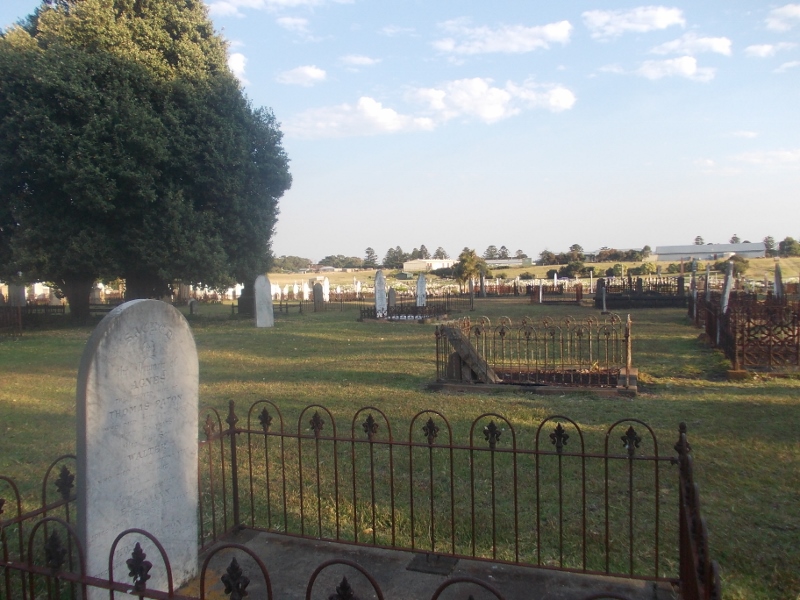
If you find yourself travelling along Victoria’s south-west coast, don’t miss the Port Fairy Cemetery.

232 (800x600)

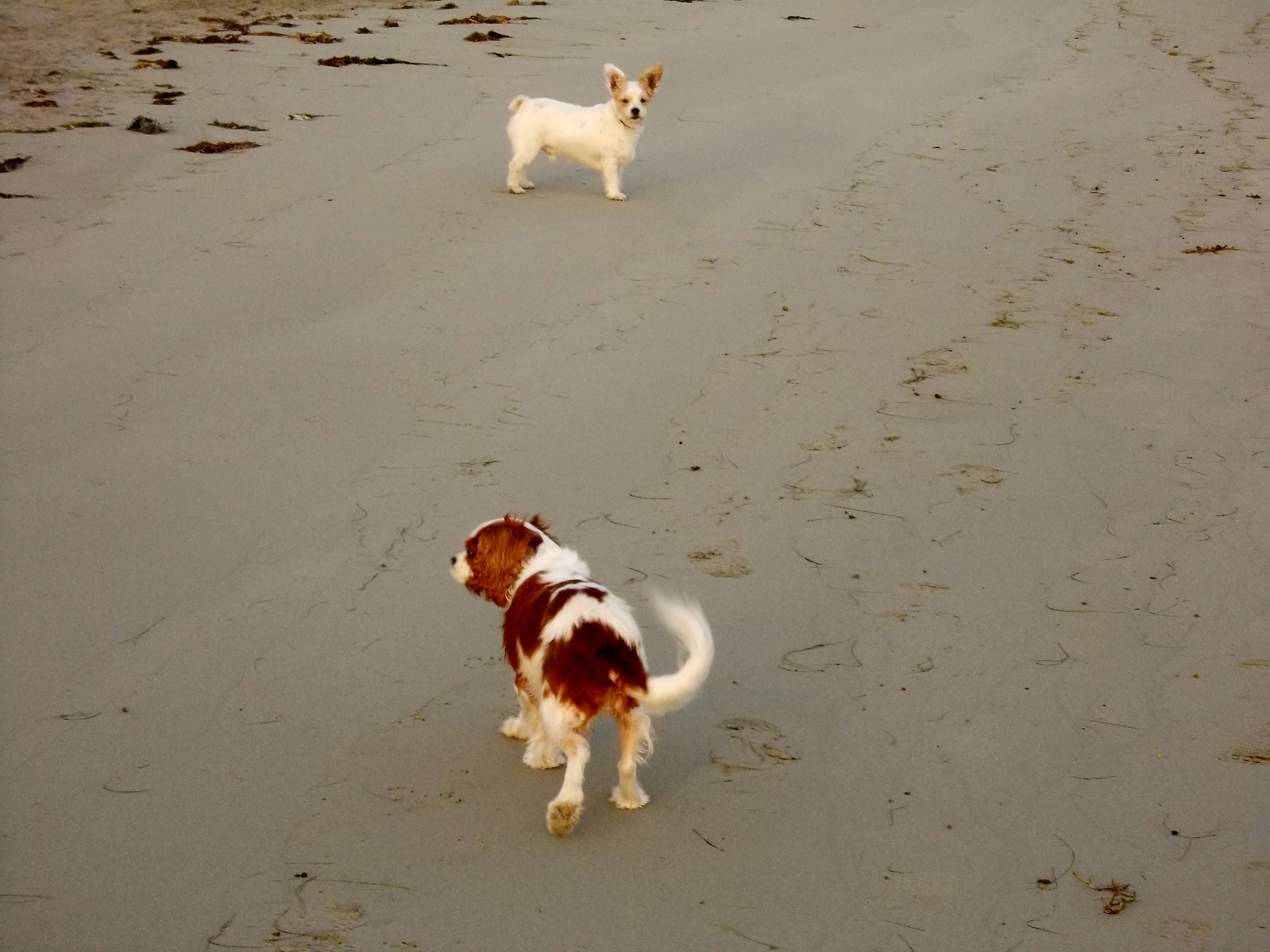
Last summer, I revisited the cemetery with the aim of photographing as many headstones as possible.  During our four days in Port Fairy, the weather was hot and our days were spent at the beach.  My only chance was to head off early to beat the heat.   I took the dogs, and after a stop at the beach for a run, them not me, we arrived at the cemetery around 7.30am.
171

Taking photos and holding two dogs on leads, is not an easy task.  I’m glad they didn’t see the rabbits sitting among the graves but I didn’t count on the burrs.  Soon the dogs were stopping periodically to pick burrs from their paws.  I didn’t get as many photos as I would have liked but I have captured some of the older and more interesting headstones.  I will post the photos in two parts.

On one of my past visits to the Port Fairy Cemetery, I joined a tour run by the Port Fairy Genealogical Society.  It was fantastic and I wished I had our knowledgeable guide Maria Cameron on this visit as I tried to remember the stories behind the graves.
227 (800x600)

MILLS

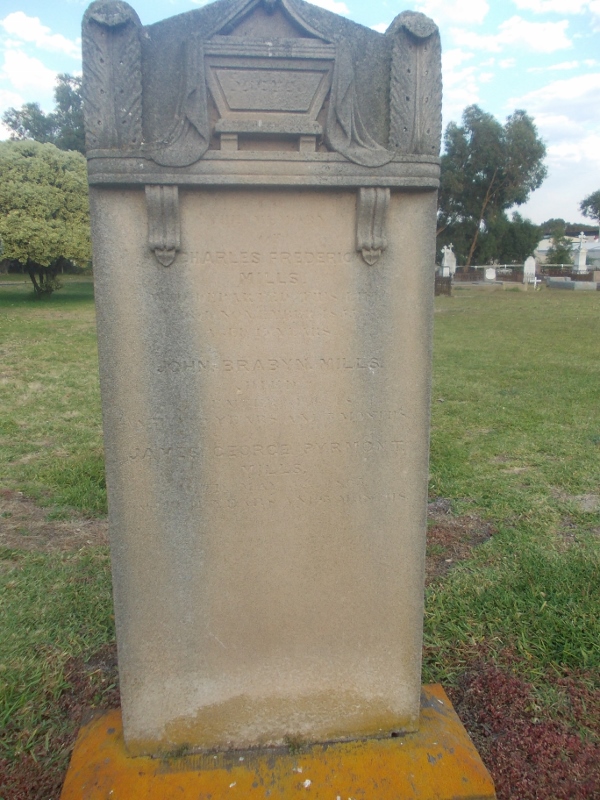
Sealer and whaler, Charles Mills and his older brother John, first saw Port Fairy in 1826, eight years before the Henty brothers arrived at Portland.  However, their whaling camps were not considered permanent in comparison to the Henty settlement, thus the Hentys take the title of first European settlers in Victoria in most discussions on the topic.  Launceston born Charles Mills passed away in 1855 aged 43 and John in 1877 aged 66.   The biography of the brothers is on this link – John and Charles Mills 
183 (600x800)

HEADSTONE OF CHARLES MILLS AND HIS SONS JOHN BRAYBYN MILLS AND JAMES GEORGE PYRMONT MILLS.

“BELFAST.” The Age (Melbourne, Vic. : 1854 – 1954) 21 Nov 1855: 6. .

This was the home of John Mills in Gipps Street, Port Fairy just across the road from the port where he was harbour master.

108

FORMER HOUSE OF JOHN B. MILLS, GIPPS STREET, PORT FAIRY.

106

Port Fairy Harbour

PORT FAIRY HARBOUR

An obituary for John Mills was published on 28 September 1877  in the Portland Guardian:

“BELFAST.” Portland Guardian (Vic. : 1876 – 1953) 28 Sep 1877:.

The Portland Guardian published an interesting article about the Mills Brothers on 21 September 1933.  It included their life stories and that of their father Peter Mills who served as secretary to Governor Bligh  – Early Settlers

180 (800x600)

GRAVE OF CHARLES MILLS (Foreground)

LAIDLAW

William and Agnes Laidlaw were early pioneers of the Port Fairy district, arriving from Scotland with their family around 1841.  William was born on 20 January 1785 and died on 6 April 1870, and Agnes was born on 20 September 1790 and died on 12 February 1867.

186 (600x800)

HEADSTONE OF WILLIAM AND AGNES LAIDLAW

“Family Notices.” Illustrated Australian News for Home Readers (Melbourne, Vic. : 1867 – 1875) 23 Apr 1870.

At least two of their children had great success.  David Laidlaw went on to serve five times as Mayor of Hamilton and was also a leading businessman in that town.   Robert became well-known in the Heidelberg area as a landowner and sheep breeder.  The following is a family photograph taken at Robert’s 90th birthday.  Robert is at the front with the white beard and brother David to his right.

“A Nonagenarian Birthday Party.” Table Talk (Melbourne, Vic. : 1885 – 1939) 23 May 1907: .

ANDREWS

James Andrews (1780-1855) and Elizabeth Andrews (1811-1870) nee O’Brien and their two sons, Michael and Patrick lie in the following grave.

188 (600x800)

HEADSTONE OF JAMES AND ELIZABETH ANDREWS AND THEIR SONS MICHAEL AND PATRICK.

The headstone is difficult to read from the photo, so I have transcribed it:

Sacred to the Memory of 

James Andrews

Formally of Ratoath County Meath

Ireland

Died January 1855 aged 55 years

Elizabeth Andrews

His Beloved Wife

Died 26 August 1870, aged 59

Also their two sons

Michael

Died 3rd May 1854 aged 15 years

Patrick

Died 15 March 1863, Aged 23 years

There was little information around about the Andrews family but I thought I would check shipping records.  An Andrews family arrived at Portland during October 1853 aboard the Oithona.  They were from Meath, Ireland, matching the headstone.  The family consisted of James, aged 56, Elizabeth aged 45, Patrick aged 12, Fanny aged 10, James aged nine and Therese aged 2.  On arrival James Sr. and the family went on to Port Fairy of their own account.  If this is the same Andrews family, James was in Victoria only two years before he died.

GOLDIE

After sorting my photos I’m really disappointed with myself.  The following Goldie family grave is one I remember well from the cemetery tour.  Maria pointed out the top of the grave purposely broken off to signify a life cut short. Firstly, I didn’t get a photo of the top of the grave and secondly I didn’t get a photo of the reverse side of the grave

Instead, I got the following photo showing John and Elizabeth Goldie epitaphs.

189 (600x800)

GOLDIE FAMILY GRAVE

If I had a photo of the reserve side, you would also see three babies. It was their the lives cut short:

Catherine Goldie

Died in Scotland Feb 1859

Aged 21 Months

Margaret

Died Sep 1862 Aged 19 Months

John

Died May 1864 Aged 17 Months

John Goldie and Elizabeth Clarke arrived in Melbourne aboard the Greyhound in 1862.  With them were their children, Elizabeth aged 11, James aged 2 and Margaret aged 1.  John was born in 1862 at Port Fairy and Margaret barely survived the voyage, dying in 1862.

John Goldie Sr. was a pioneer of the agricultural industry, working with the Agricultural Department planting experimental crops.  Photos of one of his experimental sugar beet crops are below.
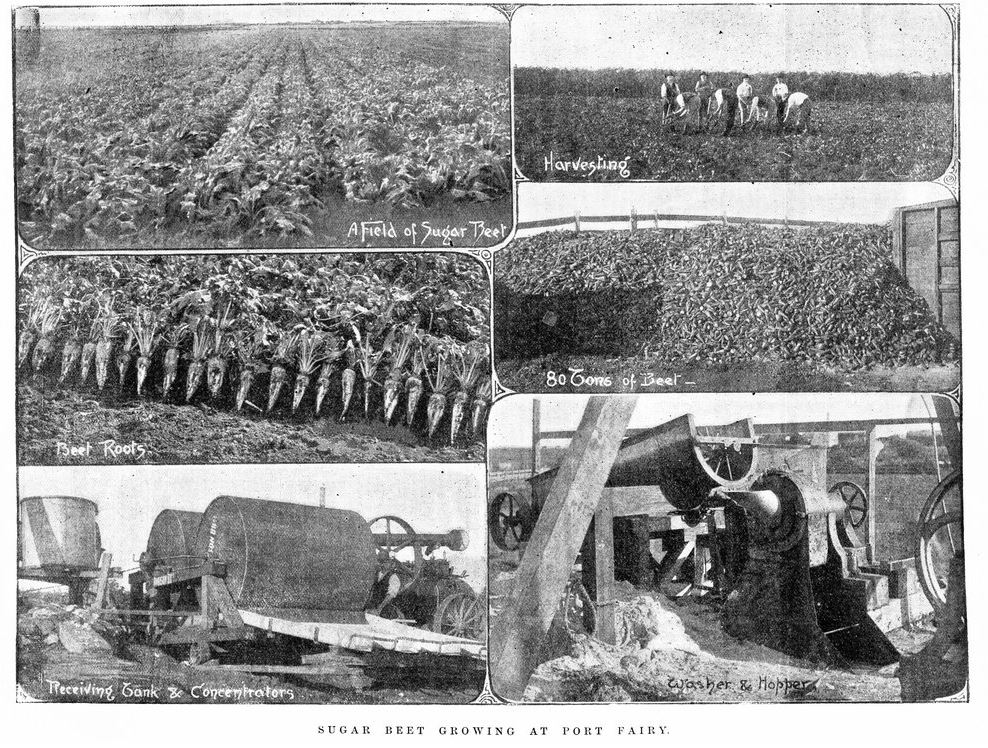
JOHN GOLDIE'S SUGAR BEET CROP TRIALS. Image Courtesy of the State Library of Victoria. Image no. IAN01/10/95/20 http://handle.slv.vic.gov.au/10381/40232

JOHN GOLDIE’S SUGAR BEET CROP TRIALS. Image Courtesy of the State Library of Victoria. Image no. IAN01/10/95/20 http://handle.slv.vic.gov.au/10381/40232

John died in 1901 after a cow knocked him down.  Elizabeth had passed away 29 years earlier aged 45.
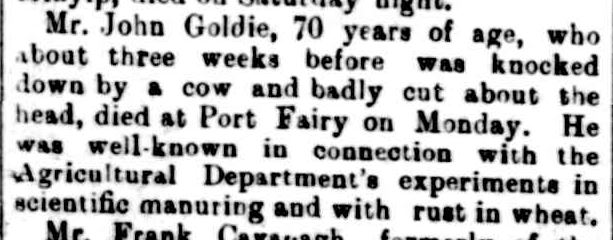
Son of John and Elizabeth, James Goldie. who was two when he arrived at Port Fairy. was a previous Passing Pioneer – James Goldie obituary

KERBY

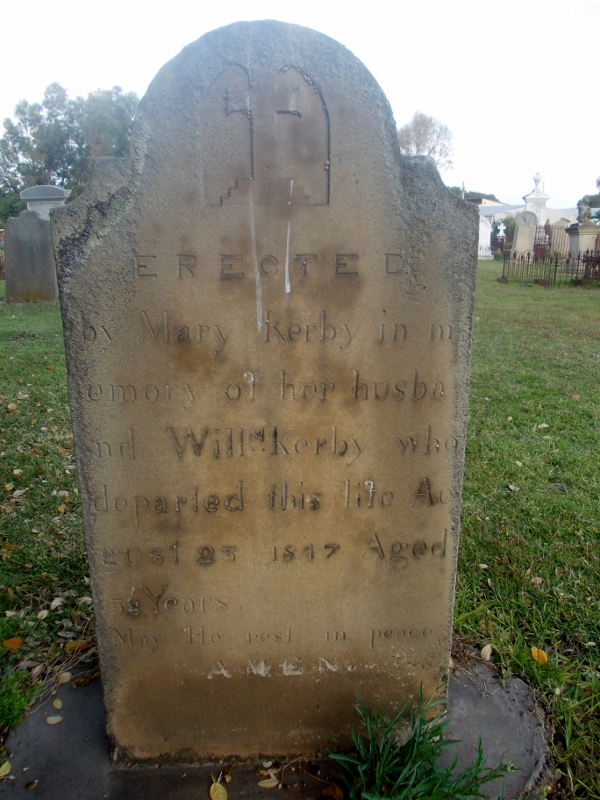
The grave of William Kerby goes back to the early years of the cemetery.  William was buried in 1847 in a grave with headstone and footstone arranged by his wife Mary.

192 (600x800)

GRAVE OF WILLIAM KERBY

190 (600x800)

HEADSTONE OF WILLIAM KERBY

GROSERT

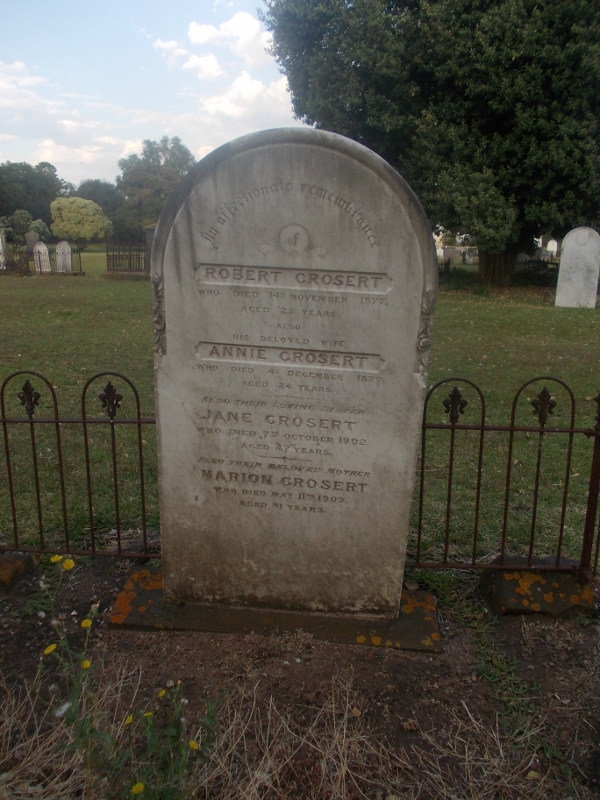
Look a little closer at the next headstone and a sad story begins to emerge.  A check of the marriage record of Robert and Annie Grosert sees the story turn sadder still.  Robert Grosert, the son of a Port Fairy butcher and himself in the trade was born in 1852.  He married Irish immigrant Annie Greer in 1877.  By 14 November of that year Robert was dead and by 4 December, so was Annie.
195 (600x800)

GROSERT FAMILY GRAVE

BEST

George Best was born in Port Fairy in 1853, a son of  George Best and Lucy Weston.  He married Emilie Melina Jenkins in 1877 at Wagga Wagga, NSW and they settled at Port Fairy.  George enjoyed sailing and it was while competing in a regatta on the Moyne River at Port Fairy in March 1891, he was knocked overboard and drowned.

202 (600x800)

BEST FAMILY GRAVE

A diver recovered George’s body from the river floor.  A team of townspeople worked on George for two hours trying to revive him.  An account of the drowning appeared in the Portland Guardian on 13 March 1891 and described the incident and the preparations of the diver which makes interesting reading.

An inquest was held into the accident.

“THE BOATING FATALITY AT PORT FAIRY.” The Argus (Melbourne, Vic. : 1848 – 1957) 10 Mar 1891: 5. Web.<http://nla.gov.au/nla.news-article8482214&gt;.

Coincidentally, George’s father, George Best Sr. a Port Fairy saddler, drowned in almost the same place 30 years before.  His body was never located.

“THE EDUCATION DIFFICULTY SOLVED.” The Age (Melbourne, Vic. : 1854 – 1954) 23 Apr 1861: <http://nla.gov.au/nla.news-article154888852&gt;.

George and Emilie’s daughter, Elsie May Best was buried with her parents.  She died on 10 October 1897 at Port Fairy aged 20 years and 10 months.

“Family Notices.” The Australasian (Melbourne, Vic. : 1864 – 1946) 23 Oct 1897: 55. <http://nla.gov.au/nla.news-article138629574&gt;.

George’s wife  Emilie Melina Jenkins died in a private hospital Somerset House in East Melbourne on 10 April 1924.
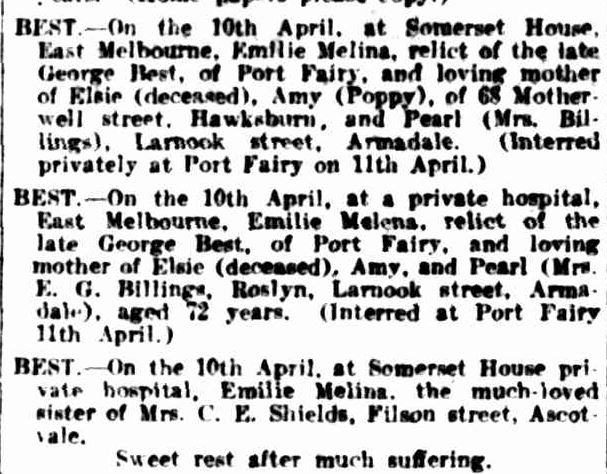
“Family Notices.” The Argus (Melbourne, Vic. : 1848 – 1957) 12 Apr 1924: <http://nla.gov.au/nla.news-article1903476&gt;.

CORBETT

When you walk through a country cemetery and see dozens of unfamiliar names, then later research those names, it’s amazing what you can dig up, so to speak.  Francis Alexander Corbett is one such name. Francis born in 1818, was buried in the Port Fairy cemetery with his wife Ellen Louisa Lane.

205 (600x800)

GRAVE OF FRANCIS ALEXANDER CORBETT AND HIS WIFE ELLEN LOUISA LANE

After searching Trove newspapers, I discovered that Francis arrived in Australia in search of gold and after some time on the diggings went to Melbourne and worked as a reporter for the Argus. Not fond of the work, he moved to the Census Commission conducting the 1854, 1857 and 1861 census as Census Secretary.  He was also a life member of the Royal Society of Victoria.

corbett1

In 1857 he wrote a book Railway Economy in Victoria and in the same year married Ellen Louise Lane born c1829.  During the 1860s, Francis and Ellen moved to Port Fairy and Francis managed the estate of James Atkinson.  They later moved to Kirkstall near Warrnambool.  In 1889, the following article appeared about Francis Corbett in the Australian Town and Country Journal:

“Western Seaports of Victoria.” Australian Town and Country Journal (Sydney, NSW : 1870 – 1907) 5 Jan 1889 <http://nla.gov.au/nla.news-article71113608&gt;.

Francis was visiting Port Fairy when he died suddenly at the Commercial Hotel (now Royal Oak Hotel) on 10 June 1893.

ROYAL OAK HOTEL, PORT FAIRY (FORMALLY THE COMMERCIAL HOTEL)

ROYAL OAK HOTEL, PORT FAIRY (FORMALLY THE COMMERCIAL HOTEL)

“Family Notices.” The Australasian (Melbourne, Vic. : 1864 – 1946) 17 Jun 1893: 42. <http://nla.gov.au/nla.news-article138656519&gt;.

An obituary appeared in the Argus:

“COUNTRY NEWS.” The Argus (Melbourne, Vic. : 1848 – 1957) 12 Jun 1893: <http://nla.gov.au/nla.news-article8563251&gt;.

The information contained in Francis’ will was even more enlightening especially that about his brother John Corbett.

“Wills and Bequests.” Table Talk (Melbourne, Vic. : 1885 – 1939) 28 Jul 1893: <http://nla.gov.au/nla.news-article145711319&gt;.

I tracked down John Corbett or rather,  Admiral Sir John Corbett born 1822 and died 1893, five months after Francis.

“[No heading].” South Australian Chronicle (Adelaide, SA : 1889 – 1895) 16 Dec 1893: 4. <http://nla.gov.au/nla.news-page8442835&gt;.

On 4 December 1904, 11 years after Francis, Ellen passed away at St Kilda.

“Family Notices.” The Argus (Melbourne, Vic. : 1848 – 1957) 5 Dec 1908: <http://nla.gov.au/nla.news-article10188785&gt;.

FINN

Five members of the Finn family lie in the following grave.  The first to pass was John Finn in 1879.  John was the owner of the Belfast Brewery and from 1852, the Belfast Inn in Regent Street, Port Fairy. He was also one of the trustees of the old cemetery which possibly refers to the Sandhills Cemetery although the Port Fairy cemetery website says. at times both cemeteries were referred to as the “old cemetery.”

219 (600x800)

FINN FAMILY GRAVE

The next death in the Finn family was John’s daughter-in-law Ellen, wife of Laurence Finn.  In 1896, Laurence and Ellen’s youngest son, George passed away aged 25.

“Family Notices.” The Australasian (Melbourne, Vic. : 1864 – 1946) 21 Mar 1896: 45. <http://nla.gov.au/nla.news-article139723181&gt;.

Another son, William Henry passed away in 1902.  That left just Laurence who died on 24 May 1914, aged 81 years.  His obituary appeared in the May 2013 Passing of the Pioneers.  Laurence died a wealthy man having inherited land from his father, however his will was contested.  A hearing in 1916 saw many witnesses called to assess the soundness of Laurence’s mind when his will was drawn up.  The article is available on the following link – http://nla.gov.au/nla.news-article88008165 

Just a handful of graves, yet so many interesting characters and stories.

222 (800x600)

For more information about the Port Fairy Cemetery, check out the website –  Port Fairy Public Cemetery.   Also, ABC Local Radio did a great story on the cemetery including an interview with Maria Cameron and you too can listen to Maria talk passionately about the cemetery.  There are also photos accompanying the story which are so much better than mine.  It is available on the following link  – Radio Interview.  The Find A Grave entry for Port Fairy has had some great work done on it with hundreds of headstones photographed.

PORT FAIRY CEMETERY PART 2

The Victorian Heritage Database

On May 5, I attended Day 2 of the Victorian Association of Family History Organisation (VAFHO) conference in Ballarat.  It was a great day with some wonderful speakers and I regret I couldn’t make it the first day.

The first keynote speaker was Lisa Gervasoni, a town planner dedicated to Heritage conservation and a member of the Daylesford & District  Historical Society, among other things.  She gave a great talk about using Google Maps to help with family history research and then showed us the usefulness of the Victorian Heritage Database (VHD).  Timely, as I had considered a post about the VHD as I think it is a valuable resource for those researching families from Victoria.

The Victorian Heritage Database is a collection of Heritage places and precincts in Victoria including Heritage studies completed by local councils around the state.

While writing Passing of the Pioneer posts, if I see a property name in an obituary, I head straight to the VHD.  If the property is on the database, most times I can find more about the obit’s subject.  There is always a history of the building, property, etc offering a wealth of information

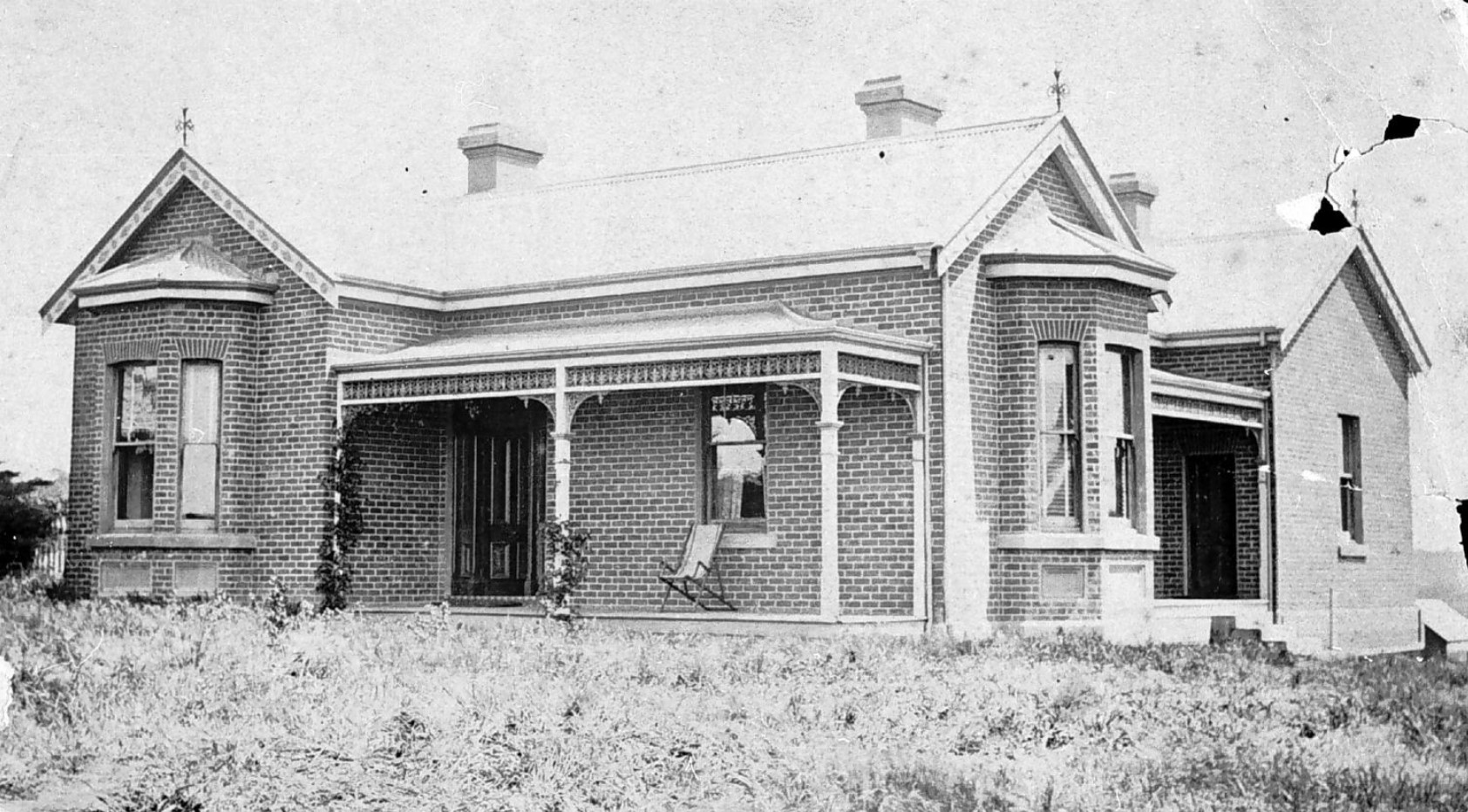
In May Passing of the Pioneers, one obituary belonged to Mary Laidlaw (nee Learmonth).  She and her husband David lived at Eildon” in Hamilton.  A search found information about the house, the architects Ussher and Kemp, and the Napier Club purchasing the building in 1939, the year of Mary’s death.  Not only was I able to expand on the obituary, I learnt something of a house that it is a Hamilton landmark and has intrigued me since childhood.

"EILDON", HAMILTON

“EILDON”, HAMILTON

The VHD was useful when I researched The Parisian, the 1911 Melbourne Cup winner because his owner John Kirby lived at “Mt Koroite Station” opposite Coleraine Racecourse.  On the VHD entry for “Mt Koroite” I found out more about John and even what he did with his winnings from the Melbourne Cup.

The VHD  is useful when researching a cemetery and I have used it for cemetery related posts.  There are photos of headstones and the Byaduk Cemetery entry even has a photo of Jonathon Harman’s headstone.  A short history of the town is given and a history of the cemetery, early burials, and notable “residents” and more.

I have searched property names and town names, but not surnames and Lisa’s talk made me realise I should.  Individuals may be listed as builders of a property or a labourer on a station.  My search of towns had found some references to my family members but I thought for the purpose of this post I would search specific family names.

None of my family were owners of large holdings or houses but the Diwell family were bricklayers and George Jelly was a builder, so maybe there was a chance.

When searching the VHD, use the “Advanced Search” form (below). It will give you more results than the “Simple” search.

There are plenty of options to narrow down a search, but I only used the field “with all of the words“.

An entry on the database will include the location, statement of significance, history and description of the building or otherwise.  There is a Google Maps link with both the aerial view and Street View and most times there is a photo or photos.

Now for my results.  I did find entries I had seen before when searching towns,  but there were some new things.  What all the results show is the different ways your family members can be found at the Victorian Heritage Database.

HADDEN

My search started with the Haddens on my mother’s maternal line.  I had two relevant matches.  The first was about a Bills Horse Trough, in the Lions Park on the Glenelg Highway at Glenthompson installed in the 1920s.

A BILLS HORSE TROUGH (Portland Gardens)

A BILLS HORSE TROUGH (Portland Gardens)

While the horse trough had nothing to do with a Hadden, the entry has a history of the site, previously a blacksmith shop run by Donald Ross.  The other blacksmiths that operated in the town are named including the shop of  Harold James Hadden, my 2nd cousin 1 x removed.

Buggies outside blacksmith's shop. Image courtesy of the State Library of Victoria - Elliot collection. http://handle.slv.vic.gov.au/10381/42869

Buggies outside blacksmith’s shop. Image courtesy of the State Library of Victoria – Elliot collection. http://handle.slv.vic.gov.au/10381/42869

I knew Harold was a blacksmith and that he lived in Glenthompson during that time period, but I didn’t know he ran his own blacksmith shop.

Another entry under “Hadden” was found on a previous search of “Cavendish” and is about gg uncle William Hadden, son of William Hadden and Mary Mortimer.  In 1913, he purchased the Cavendish Cobb & Co Depot and Stables (below) and the adjacent property on the corner of Hamilton Road and Scott Street, Cavendish.  The 1914 Electoral Roll lists William’s occupation as a blacksmith, useful with a Cobb & Co depot.  However, in 1915, the train came to Cavendish taking passengers away from Cobb & Co.

By 1919, William was living at Kiata near Nhill in the Mallee, running the Kiata Hotel.  I am not sure if he had sold the Cobb & Co depot by that time but he never returned to Cavendish and died in Geelong in 1927.

HARMAN

A “Harman” search brought up not a building but a roadside Memorial plantation at Byaduk, sadly in poor condition.  The trees, planted in memory of the Byaduk soldiers that served during WW2, have not been maintained over the years.  My 1st cousin 3 x removed and grandson of James and Susan Harman, Leonard Roy Harman, was killed during the war as was another Byaduk man A.R.McNair.   The Southern Grampians Shire Heritage study on this site reported that much of the significance and integrity of the site had been lost.

The Memorial planting was the only “Harman” reference found until I did a “Byaduk” search.  Then I discovered that a search of “Harman” did not bring up any references to “Harman’s”.  This was after I read the report about the Byaduk General Store ruins.  The general store is thought to have opened around 1863 when another early shop opened,  Joseph Harman’s, bootmaking shop.

DIWELL

I then turned to Mum’s paternal side and searched the Diwells.

Surprisingly the result took me back to Cavendish, a town I never thought they had links to.  However, I found my gg uncle William Diwell, a bricklayer, was the contractor that built the Cavendish Memorial Hall in 1920.


It was no surprise William Diwell was a bricklayer.  The following entries are about his father and grandfathers, all bricklayers or builders.

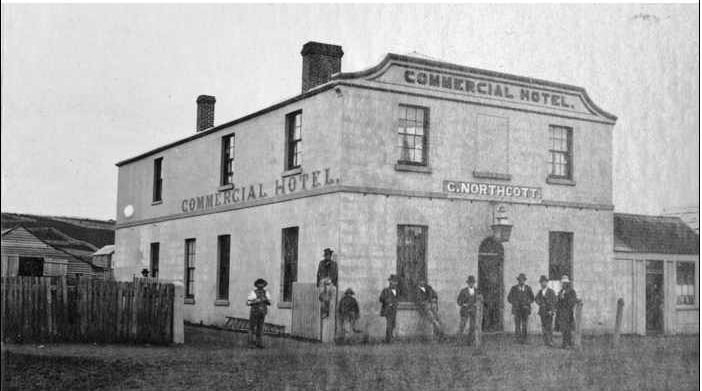
Firstly, St. Andrews Presbyterian Church in Merino.  Builders Northcott and Diwell built the church in 1868.  That would be ggg grandfather William Diwell and I am assuming Northcott is George Northcott of Merino.  George owned Merino’s Commercial Hotel (below) and the Cobb & Co Station.  From the VHD I  discovered they received  £126/15/- for the job and that they had also built the Merino Free Library and the Mechanics Institute.

COMMERCIAL HOTEL, MERINO 1880 Image Courtesy of the State Library of South Australia http://images.slsa.sa.gov.au/mpcimg/22000/B21766_112.htm

COMMERCIAL HOTEL, MERINO 1880 Image Courtesy of the State Library of South Australia http://images.slsa.sa.gov.au/mpcimg/22000/B21766_112.htm

The next Diwell match was for the Sandford Mechanics Hall (below).  I knew from a transcript of the booklet, Back to Sandford Centenary: 1957  on the Glenelg and Wannon Pioneers site, William Diwell senior had a link to the building of the Mechanics Hall but only that he suggested that it be made of brick and not wood.  The VHD shed a little more light on a conversation that took place between William and the committee secretary J.S. Anderson in 1864, but in doing so, it leaves me questioning the entry

From the Back to Sandford booklet,I knew that William ran into Mr Anderson on the Casterton Road.  Anderson told William of the plans to call for a tender for the building of a wooden hall.  William suggested a brick building and that Mr Anderson should take the idea to the committee before advertising.  The committee thought it was a great idea and they called for tenders for a brick hall.

Turning to the VHD, the report continues on from the above story but cites rate book entries from 1863 that Richard Diwell of Casterton was a brickmaker or bricklayer.  Richard was my gg-grandfather and he was nine in 1863. It continued with the story that William suggested Anderson go back to the committee, but added that William had a proposal, maybe an offer of funding.  The committee agreed to the unknown proposal and the tender process began.   The tender was won by James McCormack.

The thing is, the hall was not built until 1885, 19 years after William Diwell met Mr Anderson on the Casterton Road.  William had been dead 14 years.  So he could hardly be credited for a brick hall,  surely.  Also, why is Richard Diwell mentioned?  Did they mean William or was Richard involved later when the hall was built when, as a 30-year-old bricklayer, it was more realistic?

JELLY

I found entries for George Jelly, my ggg grandfather, and father-in-law of Richard Diwell.  George built the Anglican Rectory (below) in Henty Street Casterton in 1887.

CASTERTON ANGLICAN RECTORY c1890. Image courtesy of the Museums Victoria Collections https://collections.museumsvictoria.com.au/items/769228

What particularly interested me came from a spontaneous search I did for the variation “George Jellie”.  It brought up the Coleraine Anglican Church.  The history of the church referred to the original structure built in 1853 by Casterton contractor, George Jellie.  My George Jelly did not arrive in Victoria until 1855 aboard the Athelate with his wife Jane and daughter, Mary.  According to his obituary, they first went to Murndal at Tahara, run by Samuel Pratt Winter, and then on to Casterton.  George and Jane’s firstborn child in Australia was my gg-grandmother, Elizabeth Ann Jelly at Casterton in 1856.

That beggars the questions, was there a George Jellie, contractor of Casterton in 1853, or did the first building at the Coleraine Anglican Church not get constructed until around 1856 by which time George Jelly had arrived in the town?  More research is needed on that one.

George’s obituary credits him for building the Casterton Mechanics Institute also, however that building is not on the VHD.

——————————————————–

While the Victorian Heritage Database is full of useful information, I do wrestle with it on occasions as it takes on a mind of its own.  I use a Firefox browser and I think it doesn’t agree with the database. I have tested Chrome and it seems a lot happier.  Another problem I occasionally have is when clicking on a link to VHD from Google or Western District Families.  I get a message that my session has ended.  If that happens, page back and click again and it will come up.

More on Lisa Gervasoni.  Lisa has over 300,000 photos on Flickr and they are also found with a Trove search.  Lisa’s photos of landmarks and war memorials, often come up in my searches of Western Victorian towns.  When I have wanted to see what something in the Western District looks like, Lisa’s great photos have been there.  Thank you, Lisa.

More on the VAFHO conference.  It was great to finally meet in person, Liz Pidgeon from the Yarra Plenty Regional Library and Infolass blog, who I have known on social media for some time.   I also met Craige from the Mortlake Historical Society.  You should check out the great Facebook page he is running for the society.

Passing of the Pioneers

April Passing of the Pioneers includes members of some of Western Victoria’s well-known pioneering families including Bell, Learmonth, Trigger, Kittson, and Coulson. There is also the great character of Thomas Tattersall of Ararat, a train driving pioneer.

Edwin CUMMINGS:  Died 2 April 1892 at Portland. Edwin Cummings, originally from Tasmania, had only been in Portland around sixteen years but in that time he worked hard to improve his lot. On his arrival in Portland, he ran a successful saw-milling/cabinet-making business. Edwin then moved to farming pursuits. Using modern farming methods, he was able to improve his holding. Edwin also lost several adult children to consumption.

Thomas TATTERSALL: Died 24 April 1894 at Ararat. Lancashire born Thomas Tattersall died from fish poisoning on his birthday. He was a pioneering engine driver and his death was recognised by the  Governor of Victoria who sent a telegram of condolence to the Ararat railway station. Thomas drove the first train from Melbourne to Bendigo and was one of the first drivers to Portland. He had also driven the train for many dignitaries including the Governor and the Premier of Victoria.

Thomas BROWN: Died April 1903 at Hamilton. Thomas Brown went to Hamilton with his parents, after their arrival in Victoria from Scotland in 1852.  Thomas was an elder of the Hamilton Presbyterian Church and a long-time member of the Sons of Temperance and was also involved with other temperance movements. Active in many charities, his obituary noted that the poor of Hamilton had lost a friend in Thomas Brown.

Alfred COWLAND:  Died 27 April 1908 at Casterton. Alfred Cowland was born in Kent, England, and arrived in Victoria around 1858 aged twenty-two  He travelled with his parents, and Alfred and his father began farming at Greenwald.  Alfred married the widow of Fred Spencer, but they did not have any children.

Sophia Styche COLBY: Died 8 April 1915 at Port Fairy. Sophia Colby’s husband Harry Osmond was a partner in Osmond Bros., hotel keepers, and butchers. Sophia was the hostess at the Market Hotel, Port Fairy, and considered a most popular landlady in the Western District and if the races were on, she was there.

Thomas Ferry PEARSON:  Died 24 April 1915 at Port Fairy. Thomas Pearson was born at Newcastle-on-Tyne, England, and arrived in Portland in 1852. He married Jane Strachan there before moving to Port Fairy in 1855.  He went to work on the pilot boats under Captain Mills and then for 13 years was the keeper of the Griffiths Island lighthouse.

GRIFFITHS ISLAND, PORT FAIRY.

GRIFFITHS ISLAND LIGHTHOUSE, PORT FAIRY.

Francis Stubbs COULSON: Died 10 April 1916 at Hamilton. Francis Coulson was the husband of my gg aunt Harriet Martha Diwell. He was the son of Christopher Coulson and Mary Frances Stubbs and was born in Yorkshire, England in 1842.  He married Harriet in 1873 and they had thirteen children. Francis ran a carrying business between Portland and the inland towns. He also farmed at Rosebank Dwyers Creek and hard work saw him turn it into a “nice property”.

Mary Ann ANDREWS: Died 23 April 1918 at Port Fairy. Mary Ann Andrews was born in Somersetshire, England, and arrived in Victoria in 1852. Soon after she married Joseph Digby.  They had a large family of nine sons and daughters.  She was eighty-eight at the time of her death.

Kate CUE: Died 23 April 1917 at Port Fairy. Kate Cue was from the Casterton district. Her brother  Tom Cue, a miner, had the town Cue, Western Australia named after him. Kate married William Sutherland McPherson of Nangeela station, Casterton. They took up residence in Port Fairy and had seven children.

James MAHONEY: Died 27 April 1918 at Port Fairy. James Mahoney of Killarney was a member of one of the oldest families in the district. He was the son of Mrs Quirk and had three brothers and a sister living at the time of his death aged sixty-nine. James had travelled extensively throughout Australia and never married.

James BELL: Died April 1923 at Mt. Eckersley. James Bell was a member of the well-known Bell family of Mt Eckersley near Heywood. James, his parents, and siblings arrived in Victoria in 1841 and they settled at Mt Eckersley. He was the last surviving member of the original family known for their longevity. James was ninety-seven at the time of his death and his father John Bell lived to 101.

Jonathan HARMAN:  Died April 1930 at Heywood. Jonathan Harman, my ggg uncle was also from a family known for longevity. He died at the home of his daughter, Amelia, wife of the nephew of James Bell (above). Jonathan was ninety-two years old and a colonist of seventy-six years. Johnathon was buried with his wife Mary Oliver at the Byaduk Cemetery.

GRAVE OF JONATHON HARMAN, BYADUK CEMETERY

Kate Isabella HILL: Died April 1934 at Wodonga. Kate Hill was the daughter of John and Isabella Hill of West Portland.  She was better known as “Kitty Hill” and she and sister Lizzie were household names in their early days. John Hill was a local school teacher. Kitty married William Smith of Wodonga and was seventy-five years old when she died.

Alexander MOTT:  Died 12 April 1934 at Casterton. Alexander was born in Millicent, South Australia, and went to the Casterton district in the early 1900s. He farmed at Carapook and Bahgallah before settling in the Casterton township. His wife predeceased him and he left seven sons and daughters.

Mary Simpson LEARMONTH: Died 2 April 1939 at Hamilton. Mary Learmonth was from one well-known Hamilton family and married into another when she wed David Fraser Laidlaw in 1899. Mary was the daughter of Peter Learmonth of Prestonholme Hamilton. David’s father was David Laidlaw, a saddler who arrived in Hamilton with no money and become one of the town’s most prominent citizens.

Mary was quite the sportswoman and was seventeen times female champion of the Hamilton Golf Club. This was according to her obituary in the Portland Guardian, however, her obituary in The Argus of April 4, 1939 states she was club champion nineteen times.  She was also a talented tennis and croquet player. Other than sport, Mary was president of the Australian Women’s National League prior to her death and was a member of the Hamilton Horticulture Society.

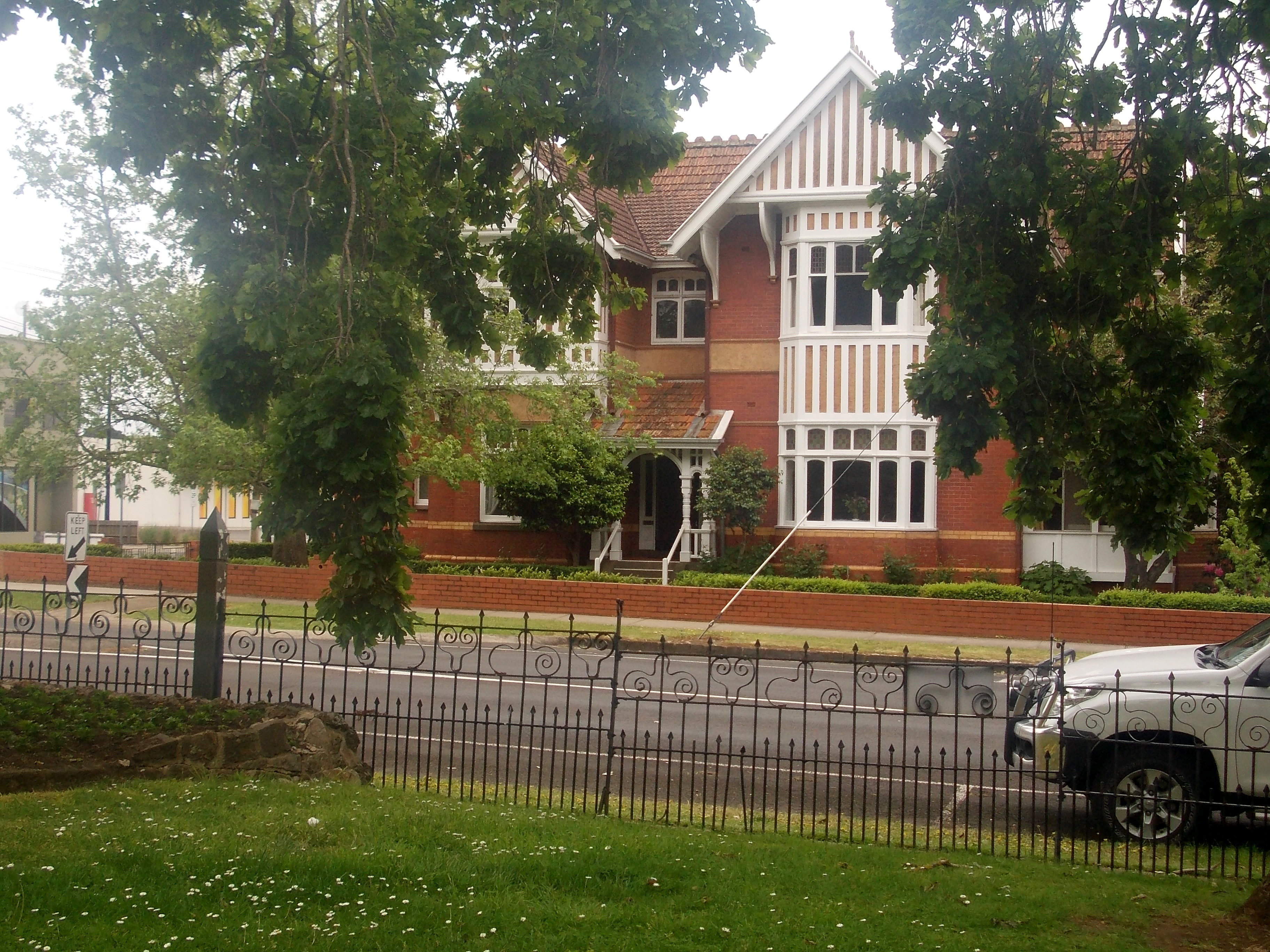
Mary died at her home Eildon on the corner of Thompson and French Street Hamilton. Everyone who has lived in Hamilton will know the Laidlaw’s former home, just on the edge of the CBD and overlooking the Hamilton Botanic Gardens.  The house, designed by Ussher and Kemp, was sold after Mary’s death to the Napier Club, a club formed by the female counterparts of the Hamilton Club.  The club, formed around 1931, still occupies Eildon today.

“Eildon”, Hamilton

Alice Maria WYATT:  Died 23 April 1940 at Hamilton. Alice Wyatt, the daughter of Mr and Mrs Thomas Lewis Wyatt, spent her childhood in Portland before moving to Hamilton around 1878 when she was twenty. She did spend some time in Melbourne working for Sir Edward Miller and his wife Lady Mary Miller. Sir Edward was a politician who made his money in finance and pastoral pursuits.  Alice spent the last twenty-five years of her life in Hamilton.

Irwin BELL: Died April 1940 at Hamilton. Irwin Bell of Dartmoor was a son of James Bell (above). Irwin was born in Portland around 1874 and lived at Mt Eckersley until the Bell family property was sold. He married Ann Letts of Heywood and together they led a life dedicated to the Church of England. They established the first Sunday School at Dartmoor and prepared parishioners for their first communion. Irwin also worked for the Department of Forestry and in later years was a Justice of the Peace. He died at KiaOra Hospital in Hamilton and was buried at Heywood cemetery.

James TRIGGER:  Died 25 April 1945 at Macarthur. James Trigger was the son of Samuel and Eliza Trigger of Warrabkook near Macarthur. Born in 1859, James selected land at Mt Eccles at a young age and he farmed there for the duration of his life.

OBITUARY. (1945, May 24). Portland Guardian (Vic. : 1876 - 1953), p. 3 Edition: EVENING. Retrieved April 27, 2013, from http://nla.gov.au/nla.news-article64404393

OBITUARY. (1945, May 24). Portland Guardian (Vic. : 1876 – 1953), p. 3 Edition: EVENING. Retrieved April 27, 2013, from http://nla.gov.au/nla.news-article64404393

James was interested in horse racing and was the owner of a number of horses. He left a widow and a son and daughter.

Robert Steven KITTSON: Died 8 April 1948 at Lower Cape Bridgewater. Robert Stephen Kittson was the son of James Kittson and Catherine Trotter and the last surviving member of the first family of Kittsons to arrive at Cape Bridgewater. A deeply religious man, he was involved in many church activities. Having had two sons serve in WW1, Robert showed an interest in returned servicemen and with his passing “ex-servicemen have lost a loyal friend”

Mary Ann ALLSOP:  Died 10 April 1953 at Port Campbell. Mary Ann was the daughter of Mr and Mrs Samuel Allsop, pioneers of the Port Campbell district. She married Thomas Wiggens at Purrumbete. After the death of Thomas, Mary Ann moved to Camperdown.  She left one son and three daughters and was buried at the Camperdown cemetery.

Misadventures, Deaths and Near Misses

Transport is important to us in one form or another. If nothing else it sure beats walking.   However, the subjects of this installment of Misadventures, Deaths and Near Misses should have stuck to Shank’s pony.

Click on the links to read each article in full.

HORSES

Described as an “energetic” gentleman, Fred Heathcote, having just displayed his cricketing prowess on the field, gave a display of his riding prowess.  Unfortunately, his mount was  freshly broken and reared, falling onto Fred.  Despite an operation in excess of four hours, Fred was expected to make a full recovery

“Look what I’ve done, I’ve broken both my wrists” were the words uttered by Frank Millard upon seeking help after a horse accident.  Frank’s horse had taken him under a low branch.

In 1896,the horse of William Lucas shied at two dogs and somersaulted.  William received concussion, the horse was shaken.

A witness description of the accident involving John Beglin in 1894, suggested the horse “danced on the man while on the ground”  This sounds like it was rather a spectacular fall in which John sustained possible internal injuries.

HORSE DRAWN VEHICLES

Add a wooden attachment to horse, laden with people,  and accidents are bound to happen.  Take, for example, Patrick Power of Byaduk in 1889. The Port Fairy Cobb & Co coach was not far from Koroit when it broke an axle and tipped.  The coach driver fell on top of Patrick leaving him in need of medical attention

Not so lucky was  Oliver Filmer also of Byaduk. In early January 1900, Oliver and six others were returning from an outing to the Byaduk Caves when the horses bolted down a hill.  The buggy went over an embankment and capsized.  All the occupants were thrown out, including Oliver who sustained head injuries and later died.  Oliver was father-in-law to Absalom Harman, the son of Reuben.

In 1901, Mr H. J. Thompson was standing on the back board of a buggy as it went up a steep hill near Wickliffe.  The buggy wheel fell into a rut, Mr Thompson fell forward and hit the wheel with his leg.  Suffering lacerations and a dislocated knee, he was still able to catch the train home from the Wickliffe station.

Thursday April 20, 1876 was a day of accidents and  Mr & Mrs Webley  and their daughter, all of Byaduk, were caught up in the dramas.  While returning from Hamilton to Branxholme in the darkness, a pin holding the buggy shaft fell out and Mr Webley turned the horse across the road to stop it, but the horse went up an embankment, dropping Miss Webley out the back.  The horse then continued on down a cutting and Mr & Mrs Webley tumbled out.  Mr Webley received cuts, Mrs Webley, a broken arm and Miss Webley was not injured.

Similarly, on the same day, Alfred Bennett had a hair-raising experience when his horse, pulling a dog-cart, bolted.

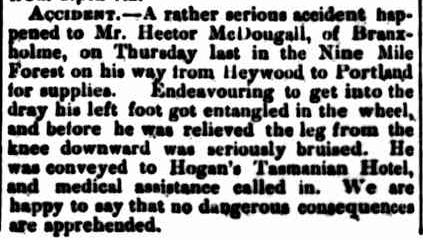
Lucky Hector McDougall had “no dangerous consequences” after his accident when he tangled with a dray’s wheel.

Table Talk. (1864, December 5). Portland Guardian and Normanby General Advertiser (Vic. : 1842 – 1876), p. 2 Edition: EVENING. Retrieved October 16, 2012, from http://nla.gov.au/nla.news-article64632822

Mr Blackney, was left with cake on his face after an incident in Hamilton in 1942.  While his back was turned, his horse bolted, pulling a cart laden with cakes.

CAKES FLEW WHEN HORSE BOLTED. (1942, September 15). The Horsham Times (Vic. : 1882 – 1954), p. 2. Retrieved October 16, 2012, from http://nla.gov.au/nla.news-article72705327

I’m sure a piece of cake helped residents recover from their “mild shock” at finding cakes at their front gates.

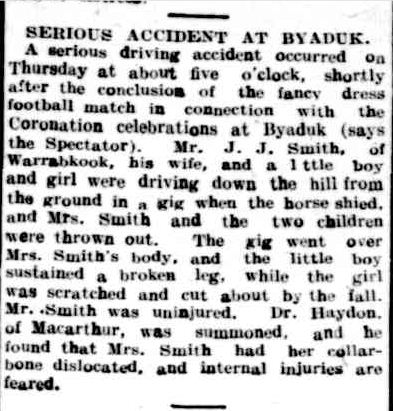
After a fun day at the Byaduk Coronation Celebrations in 1911, which included a fancy dress football match, the Smith Familyof Warrabkook met with disaster while travelling home.

SERIOUS ACCIDENT AT BYADUK. (1911, June 27). The Horsham Times (Vic. : 1882 – 1954), p. 5. Retrieved October 16, 2012, from http://nla.gov.au/nla.news-article73162971

CARS & MOTORCYCLES

If horses and carts weren’t bad enough, throw cars and motorcycles into the mix, and disaster was almost ensured, especially if they all came together at once.  It also appears that with only a lucky few having a motor vehicle in the early days, it was not unusual to pile as many people into the car as possible.

Driving a Damlier home from a day’s shooting at Kirkstall in 1914, George Lock and his four passengers came to grief on the Port Fairy Road on the outskirts of Warrnambool.  It was 7.15pm and the road was dark and narrow.  George, having moved aside for an oncoming car, failed to see the unlit cart of a Chinese market gardener following behind the car.  His car hit the cart sending vegetables across the road.  Debris hit the car’s steering wheel sending the car out of control and into a fence and embankment, throwing the occupants from the car.  George Robinson received the most serious injuries, a ruptured liver.  The Chinese gentleman was lucky to avoid injury and was last seen chasing his horse, also very lucky, down the road.

T.S.A Laidlaw had a scary experience in his new Oldsmobile after leaving Byaduk bound for Macarthur.  The car got into the gravel, crossed the road, went over a prostrate telegraph pole, up an embankment and then overturned.  The car was extensively damaged, Mr Laidlaw wasn’t.

Robert Rymill, a 38-year-old grazier from Penola met a tragic end in a very early motoring accident.  In 1906, he was driving his 15hp Darracq from Melbourne home to Penola when he failed to take a sharp turn at the bottom of a hill, taken while travelling at 12mph.  The car’s wheels slipped and it overturned.  Robert’s passenger, his young gardener was thrown clear, but Robert was pinned underneath the car.  While initially conscious, Robert had passed away by the time help arrived.  This was despite the best attempts of his passenger.

If you are wondering what a Darracq looks like, this clip shows a much more powerful 1905 model travelling a lot faster than 12mph, but you get the idea.

Mr Dotzauer, in 1904, was riding his motorcycle between Terang and Noorat when a horse ran across his path. Mr Doutzauer broke his collar-bone, damage to the motorcycle and horse unknown.

Mrs Living got more than she bargained for when she hitched a ride in Mr E.J.Coopers sidecar one Friday night in 1932.

HORSE JUMPS INTO SIDE-CAR. (1932, April 19). The Horsham Times (Vic. : 1882 – 1954), p. 4. Retrieved October 18, 2012, from http://nla.gov.au/nla.news-article72600659

Len Austin’s accident was caused by a truck tyre, but no, it didn’t run over him.  While working as a road contractor, he noticed a bulge in the truck’s tyre.  The tyre suddenly blew and the expelled air caught him the eye.

Messrs. W Smith and Michael Hickey’s day took a turn for the worse in 1923 while driving a gig with a saddle horse tied to the shafts.  A car with five occupants approached and the saddle horse, obviously not used to the mechanical beasts, shied and found itself on top of the car.  The car rolled, but with plenty of help on hand, it was righted and the driver and his passengers continued on to Horsham.  The horse’s journey ended at the scene.

Passing of the Pioneers

The September “Passing of the Pioneers” in the Portland Guardian saw several prominent Western Victorian residents pass away and two of my own relatives.

Richard LEWIS: Died September 1890 at Digby.  Richard owned some well-known stations in the Western District including Rifle Downs and Hilgay.  An excellent biography of Richard Lewis is on the Ballarat Genealogical Society website. Richard died as a result of Bright’s disease.

Samuel CROSSDied 4 September 1901 at Hamilton. Samuel was seventy-nine at the time of his death and had been in Australia since 1849 after travelling from Sussex, England. He worked in and owned, department stores including the Beehive Store in Hamilton.  In his later years, he was a librarian at the Hamilton Mechanics Institute.

Jacob THEISINGER: Died 13 September 1901 at Portland. Jacob, also a sufferer of Bright’s Disease, had been in the colony since around 1854.  He was a popular person around town and was a member of the Portland German Band.

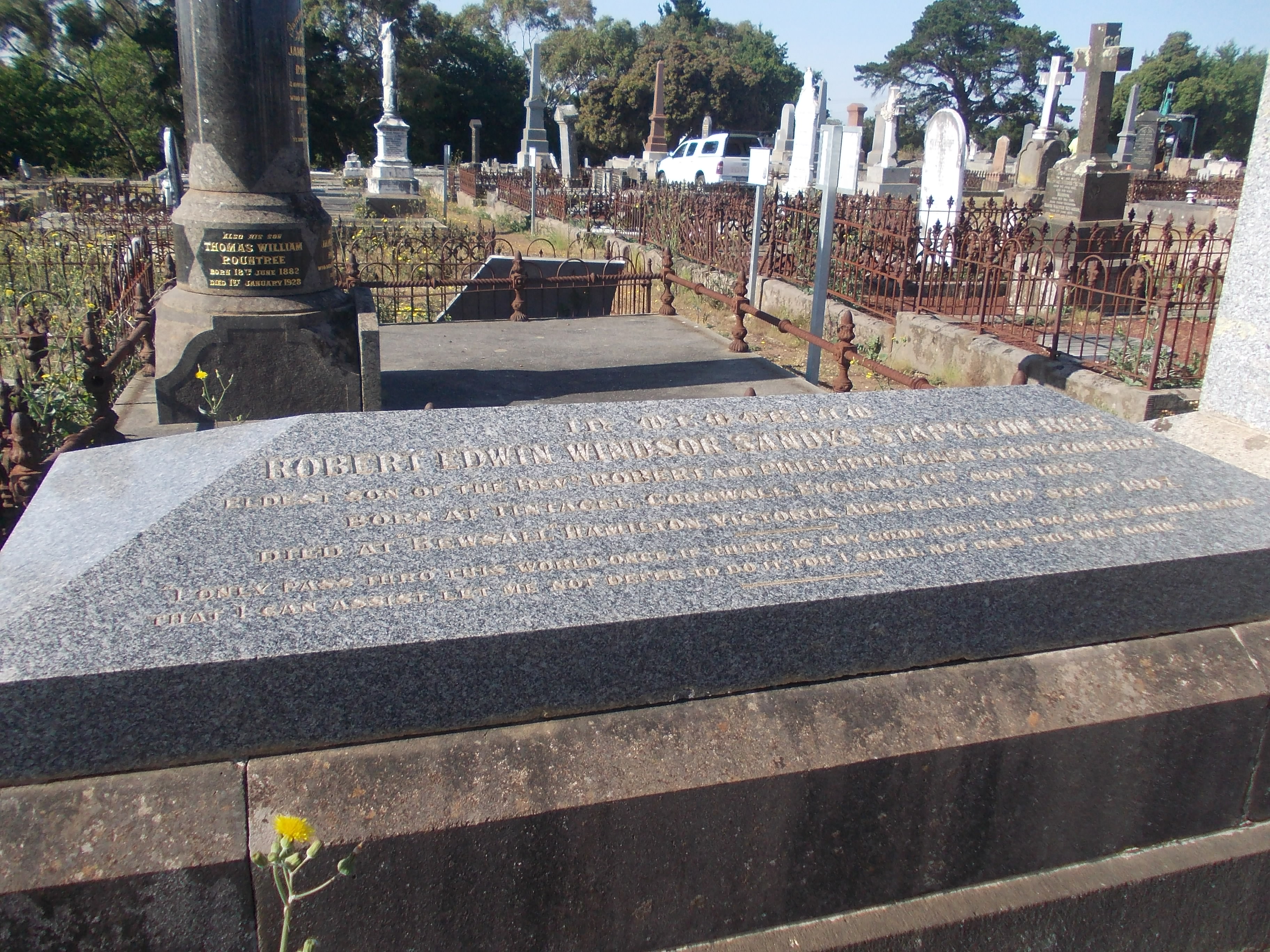
Robert Edwin Windsor Sandys STAPYLTON-BREE: Died 17 September 1907 at Hamilton. Robert Edwin Windsor Sandys Stapylton-Bree was a Hamilton stock and station agent and well know identity not only in Hamilton but also in Portland.  He married the daughter of Stephen HENTY, Annie Maria.  His funeral was well attended with Dean Parkyn presiding over the service.  He and Archdeacon Hayman had motored the 119 mile trip from Ballarat in five hours.

Christina STEWART: Died September 1921 at Hamilton. Christina STEWART was born in Kingussie, Scotland in around 1825 and travelled with her husband, Duncan McPherson, to Australia in 1851 onboard the Hooghlly.  While Duncan went off to the goldfields, Christina waited in Melbourne until they journeyed to Portland.  For a time, she and her husband ran the Dartmoor Hotel.  She was a mother of eight children.

Elizabeth GLADSTONE: Died 18 September 1925 at Millicent, South Australia.  Elizabeth Gladstone grew up near Portland and the Guardian noted she rode eighty miles each day to school.  I am assuming this was a round trip, or it was a short school day.  Elizabeth married George Plunkett in 1862 at Penola, South Australia.

May ROBERTSON: Died September 1925 at Gringalgona.  May Robertson arrived in Sydney with her family in 1847 from Scotland.  They travelled to the Coleraine district by bullock wagon.

Margaret Emily McDONALD:  Died  5 September 1928 at Nokomai, New Zealand.  Margaret McDonald’s parents were early pioneers and she spent time around Portland and Hamilton as a child with one of her early memories being that of Adam Lindsay Gordon and his riding feats.  In 1863, Margaret married Donald Cameron in Melbourne and they moved to New Zealand and raised twelve children.

Margaret BEST: Died 7 September 1933 at Hamilton. Margaret was born in County Caven, Ireland in 1853 to Mr and Mrs William Best.  They arrived at Portland on board the General Hewitt in 1856.  After time in Portland, the Bests moved to Heywood when Margaret was nine. She married James Henry BELL and remained in the Heywood area.

Ada Catherine HAYMAN: Died September 1934 at Portland.  Ada was born in Axminster, Devon, England in about 1858.  She arrived at Portland with her parents and siblings in the 1860s.  This is an interesting family.  Ada’s father was a doctor and practiced in Harrow, Edenhope, and Ararat.  One of her brothers was a doctor, another Archdeacon Hayman presided over R. Stapylton-Bree’s funeral (above).  Another brother W.R. Hayman was one of those who organised the  Aboriginal cricketers’ tour of England in 1868.  The biography of one of the players, Johnny Mullagh, describes the part Hayman played.

Finlay McPherson PATON: Died September 1936 at Tarrayoukyan. Finlay Paton was born at Stirlingshire, Scotland and after landing at Portland, took on the job of ringing the church bell and did so for 15 years. This could have been just one of the reasons for his “magnificent physique”.  Maybe it was because he claimed that he was one of those that carted stones to build Mac’s Hotel in Portland.  Or was it lifting four-bushel bags of wheat from the ground to a wagon, with little trouble.  He really must have been a fine specimen. As were his team of horses used for his carrying business. Bred by Finlay they were the “admiration of the district”

William DIWELL: – Died September 1939 at Jeparit. William was my ggg uncle.  His obituary mentioned his work as a builder and the several buildings in Portland remaining, at the time of his death, as memorials to his work.  It does mention he was a native of Portland, however, he was born at Merino.  It correctly states his wife Frances was a native of Portland.

Thomas Haliburton LAIDLAWDied September 1941 at Hamilton. Over 500 people were reportedly at the funeral of Thomas Laidlaw, a Hamilton stock and station agent.  Thomas was the son of pioneers, Thomas and Grace Laidlaw.   The obituary offers a great description of the early days of Thomas Laidlaw senior in the colony with his four brothers.  Thomas junior, along with building his successful stock and station business was at one time a Shire of Dundas Councillor, President of the Hamilton Racing Club, and chairman of directors of the Hamilton and Western District College, today Hamilton and Alexandra College.  Laidlaw is one of the names that if I hear it, I think of Hamilton.

Henry MORTIMER: Died  6 September 1948 at Portland.  Another ggg uncle of mine, Henry was the son of James Mortimer and Rosanna Buckland.  He was born in Cavendish and was eighty at the time of his death at Portland.  He is best known on this blog as Mr Mortimer of Mr Mortimer’s Daughters.  This was an informative notice as it listed Henry’s children, grandchildren, and great-grandchildren.