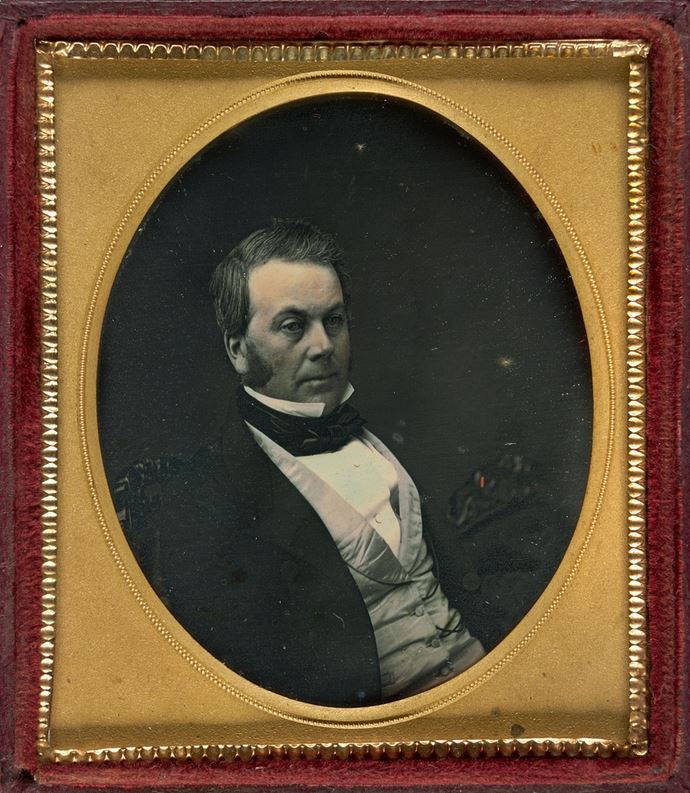
After Many Days

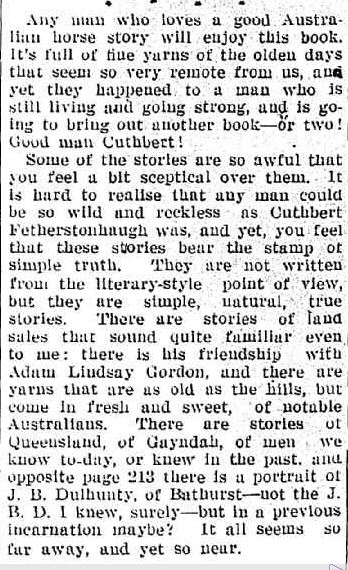
To really get a feel for a time in history, there is nothing better than a diary, letter, memoir or personal account.  Some of my favourite Western District history books are those from pioneer times, such as “The Diaries of Sarah Midgley and Richard Skilbeck” and James Bonwick’s educational tour of Western Victoria in 1857.  There is another on the list that I haven’t shared with you before, “After Many Day’s” being the reminisces of Cuthbert Fetherstonhaugh.  Even better, the book is available online. (See link at end of the post)

Cuthbert Fetherstonhaugh, born in Ireland in 1837, published his memoir in 1918 when he was 81, written, he claims, after much prodding from his wife, Flora, and friends particularly a friend from the later part of his life, writer Walter G. Henderson of Albury.   Many thanks must go to them because their persuading resulted in a 414 page rollicking yarn, packed with places, names and stories from the first half of Cuthbert’s life with illustrations.

“AFTER MANY DAYS:” The Memories of Cuthbert Fetherstonhaugh — A Fascinating Book of Adventures in the Australian Bush. (1918, April 10). Sydney Mail, p. 14. http://nla.gov.au/nla.news-article159027098

This is not just a story of the Western District, but of life in Ireland and Germany during Cuthbert’s childhood.  There is also a wonderful description of his passage on a second-class ticket to Melbourne aboard the “Sussex” in 1853.  Cuthbert spent some time in Melbourne before he went to the Henty’s Muntham station (p.90) in the Western District, and his account brings 1850s Melbourne to life.

He outlines his friendship with Thomas Browne/Rolf Boldrewood author of “Robbery Under Arms “(p 40).  He includes the obituary of his father, Cuthbert Fetherstonhaugh, who spent time as a Police Magistrate at Hamilton (p.52).  During his time there, Cuthbert Snr, resided at  Correagh at Strathkeller, just north of Hamilton.  (Today, Correagh is in excellent condition and was featured in an issue of Home Life magazine, available online). Cuthbert Snr and his wife Susan and daughter Adelaide are buried at the Hamilton (Old) Cemetery (below).

There are stories of horse breaking, bushrangers, colonial racing and more.

Some of the Western District identities he met included members of the Henty family, Samuel Pratt Cooke, Acheson Ffrench and the Learmonths.  But there were also stockmen, horse breakers and crack riders.

He associated with Adam Lindsay Gordon (p.165), a person he admired for his riding skill and poetry, and there are several extracts of ALG’s verse.

Cuthbert devoted several pages to George Waines (p177) and the trial, that saw Waines convicted and sentenced to hang for the murders of Casterton couple Robert and Mary Hunt.

After Muntham, Cuthbert travelled to Queensland via Sydney.  On the way, he dropped in at the Chirnside’s Mt William station at the foot of the Grampians.  It is was there he saw the “western mare” Alice Hawthorne, in the days when she was beginning her Cinderella story, transforming from station hack to champion racehorse.

After lengthy reminisces of his time in Queensland, past Rockhampton, Cuthbert then focused on his life in N.S.W where he spent two years as an Anglican minister.  He died in Wellington, N.S.W. in 1925, aged 88, remembered as a pastoral leader.

What the critics said:

At the time of the book’s release, the Sydney Stock and Station Journal described the book as “pure Australian”

GOSSIP. (1918, April 12). The Sydney Stock and Station Journal (NSW : 1896 - 1924), p. 3. Retrieved October 13, 2013, from http://nla.gov.au/nla.news-article124218838

GOSSIP. (1918, April 12). The Sydney Stock and Station Journal (NSW : 1896 – 1924), p. 3. Retrieved October 13, 2013, from http://nla.gov.au/nla.news-article124218838

When Cuthbert died in 1925,  Walter Henderson wrote of his friend and the book he persuaded Cuthbert to write.

CUTHBERT FETHERSTONHAUGH. (1925, July 15). The Sydney Morning Herald (NSW : 1842 - 1954), p. 12. Retrieved October 13, 2013, from http://nla.gov.au/nla.news-article16210414

CUTHBERT FETHERSTONHAUGH. (1925, July 15). The Sydney Morning Herald (NSW : 1842 – 1954), p. 12. Retrieved October 13, 2013, from http://nla.gov.au/nla.news-article16210414

Read “After Many Days: being the reminiscences of Cuthbert Fetherstonhaugh” online

“Claremont” Portland

It’s been 18 months since our Portland visit and I’m still trying to find a moment to share some photos.  Recently I got around to writing the Portland Botanical Gardens post after it sat in my drafts for months with just photos waiting to be fleshed out.  It’s the fleshing out that is my downfall as you will see soon see.

While in Portland, I stole myself away and took the Portland Historic Buildings walking tour.   Incredibly for a town of its size, there are more than 200 buildings in the Portland CBD that date back to the 1800s.  It was on that self-guided tour that I found “Claremont” at 65 Julia Street, just along from the St Stephen’s Church.

195

I had only intended to share the photos of Claremont and give a small amount of information about the former residents, but as usual, once I got searching at Trove I couldn’t leave it at that.  There was very little information about Claremont elsewhere online, save for an entry on the Victorian Heritage Database only identifying the person who had the house built and an early resident, the information I had from the walking tour guide.  But once again, it was Trove that took the story of Claremont an extra step.  Or two.

Stephen George Henty had Claremont built in 1852 and rented the property to his brother Francis.

Francis and his wife Mary Ann Lawrence only used Claremont as a seaside residence. Their country residence was Merino Downs station and city residence Field Place in Kew, Melbourne.  There is something about the staircase in the foyer of Claremont.  Maybe because I can imagine the likes of Mary-Ann or her daughter Caroline, sweeping done the stairs in their crinolines while in summer residence.

CLAREMONT, c1859. Photographer: Thomas Hannay. Image courtesy of the State Library of Victoria http://handle.slv.vic.gov.au/10381/318575

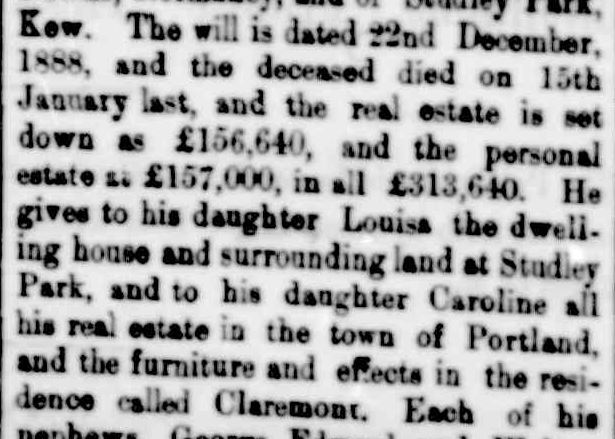
As Claremont was not used as a permanent home there was not much to be found about it in the papers until 1889 when Francis Henty passed away at Field Place. He left all his Portland property daughter Caroline Henty (1849-1914) along with the furniture and effects within Claremont.

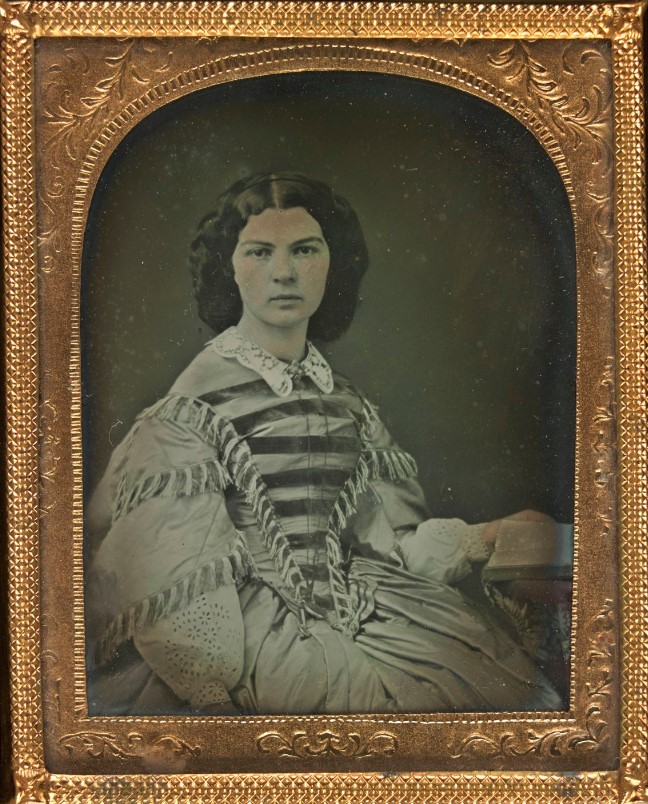
CAROLINE HENTY c1865-1870 Image courtesy of the State Library of Victoria http://handle.slv.vic.gov.au/10381/290266

At some stage, the ownership of Claremont must have passed from Stephen Henty to Francis Henty, in order for Francis to bequeath it. Stephen Henty died in 1872 but I haven’t found any evidence of transfer of ownership.

The Will of the late Mr. Franis Henty. (1889, March 8). Portland Guardian (Vic. : 1876 - 1953), p. 2 Edition: EVENING. Retrieved July 18, 2013, from http://nla.gov.au/nla.news-article63592299

The Will of the late Mr. Franis Henty. (1889, March 8). Portland Guardian (Vic. : 1876 – 1953), p. 2 Edition: EVENING. Retrieved July 18, 2013, from http://nla.gov.au/nla.news-article63592299

Caroline and her three sisters also inherited Merino Downs.

The Late Mr. Francis Henty. (1889, March 16). The Queenslander (Brisbane, Qld. : 1866 - 1939), p. 513. Retrieved August 2, 2013, from http://nla.gov.au/nla.news-article19812393

The Late Mr. Francis Henty. (1889, March 16). The Queenslander (Brisbane, Qld. : 1866 – 1939), p. 513. Retrieved August 2, 2013, from http://nla.gov.au/nla.news-article19812393

In 1900, the sisters registered a Deed of Partition and Merino Downs was split into three separate properties, Merino Downs, Talisker and Wurt Wurt Koort with thesisters having a property each.  Caroline took charge of Talisker estate.

Caroline was quite a catch and a year after her father’s passing she married  Alexander Magnus McLeod (1846-1910), not a bad catch himself.  With Caroline and Alexander living at Talisker estate, Alexander’s spinster sisters Catherine (1845-1919) and Constance (1859-1934) and, at times, his bachelor brother Wallace (1855-1919) took up residence at Claremont.

The McLeods were the children of John Norman Mcleod and Agnes Patterson.  John owned Castlemaddie at Tyrendarra and Maretimo at Portland.  Incidentally, John purchased Castlemaddie and while he was waiting for the sale to go through, he had Maretimo built.  Constance was born at Maretimo in 1859.

"MARETIMO", PORTLAND, VICTORIA. ca.1874-ca.1895. Photographer: O.Dolphin. Image Courtesy of the State Library of Victoria Image no. H31761 http://handle.slv.vic.gov.au/10381/172772

MARETIMO, PORTLAND, VICTORIA. ca.1874-ca.1895. Photographer: O.Dolphin. Image Courtesy of the State Library of Victoria Image no. H31761 http://handle.slv.vic.gov.au/10381/172772

While I can’t find when Alexander McLeod’s siblings went to live at Claremont, at least one Miss McLeod was in residence in 1902, although she was heading off for a summer holiday.

[No heading]. (1902, December 18). The Argus (Melbourne, Vic. : 1848 - 1957), p. 10. Retrieved July 21, 2013, from http://nla.gov.au/nla.news-page332030

[No heading]. (1902, December 18). The Argus (Melbourne, Vic. : 1848 – 1957), p. 10. Retrieved July 21, 2013, from http://nla.gov.au/nla.news-page332030

Another possible guide was the death of the McLeod sister’s mother Agnes Patterson in 1901.  Her obituary stated she had moved into town from Castlemaddie and passed away in Julia Street.

There was also a death of a baby at Claremont in 1904.  I did try to find a link between Phyllis Mary Crawford and the McLeods or the Hentys, but after a quick look without success, I gave up.  The story was getting deep enough.

Family Notices. (1904, April 20). The Argus (Melbourne, Vic. : 1848 - 1957), p. 1. Retrieved August 2, 2013, from http://nla.gov.au/nla.news-article10315347

Family Notices. (1904, April 20). The Argus (Melbourne, Vic. : 1848 – 1957), p. 1. Retrieved August 2, 2013, from http://nla.gov.au/nla.news-article10315347

Claremont” hosted the St. Stephen’s girls’ confirmation class in April 1909 and they gave thanks to Catherine and Constance for making their confirmation veils.

First Issue, August 20, 1842. (1909, April 19). Portland Guardian (Vic. : 1876 - 1953), p. 2 Edition: EVENING. Retrieved July 20, 2013, from http://nla.gov.au/nla.news-article63987683

First Issue, August 20, 1842. (1909, April 19). Portland Guardian (Vic. : 1876 – 1953), p. 2 Edition: EVENING. Retrieved July 20, 2013, from http://nla.gov.au/nla.news-article63987683

Significantly, the Portland branch of the Australian Women’s National League was established during a meeting at Claremont in January 1911.

First Issue, August 20, 1842. (1911, January 11). Portland Guardian (Vic. : 1876 - 1953), p. 2 Edition: EVENING. Retrieved July 20, 2013, from http://nla.gov.au/nla.news-article63979327

First Issue, August 20, 1842. (1911, January 11). Portland Guardian (Vic. : 1876 – 1953), p. 2 Edition: EVENING. Retrieved July 20, 2013, from http://nla.gov.au/nla.news-article63979327

Through the years, the  McLeod sisters occasionally ran advertisements looking for staff.  In 1912, a general servant was required.

Advertising. (1912, December 6). Portland Guardian (Vic. : 1876 - 1953), p. 2 Edition: EVENING. Retrieved July 19, 2013, from http://nla.gov.au/nla.news-article64003591

Advertising. (1912, December 6). Portland Guardian (Vic. : 1876 – 1953), p. 2 Edition: EVENING. Retrieved July 19, 2013, from http://nla.gov.au/nla.news-article64003591

In 1914, Caroline McLeod (Henty) passed away.  Her probate documents listed Claremont and the two acres of land it stood on to the value of £160,000.  Her estate was placed in trust for her two daughters Caroline Agnes Henty McLeod (1892-1943) and Alexandra Frances Henty McLeod (1894-1943) aged 22 and 20 respectively at the time of their mother’s death.  In the meantime, the girls’ aunts and uncle continued to live at Claremont.

In July 1919, Wallace McLeod passed away aged sixty-four at Claremont.

Portland Guardian. (1919, July 28). Portland Guardian (Vic. : 1876 - 1953), p. 2 Edition: EVENING. Retrieved July 18, 2013, from http://nla.gov.au/nla.news-article63959256

Portland Guardian. (1919, July 28). Portland Guardian (Vic. : 1876 – 1953), p. 2 Edition: EVENING. Retrieved July 18, 2013, from http://nla.gov.au/nla.news-article63959256

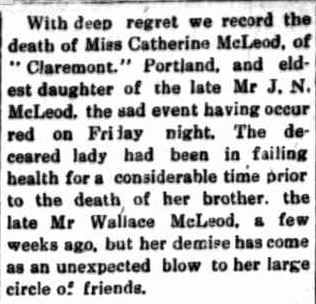
Two months later his older sister, Catherine was dead.

Portland Guardian First Issue August 20, 1842. (1919, September 22). Portland Guardian (Vic. : 1876 - 1953), p. 2 Edition: EVENING. Retrieved July 19, 2013, from http://nla.gov.au/nla.news-article63959741

Portland Guardian First Issue August 20, 1842. (1919, September 22). Portland Guardian (Vic. : 1876 – 1953), p. 2 Edition: EVENING. Retrieved July 19, 2013, from http://nla.gov.au/nla.news-article63959741

The death of her brother and sister in such close succession led Constance to reconsider her future at Claremont.  On 9 June 1920, she held an auction of furniture.

Advertising. (1920, June 3). Portland Guardian (Vic. : 1876 - 1953), p. 2 Edition: EVENING.. Retrieved July 18, 2013, from http://nla.gov.au/nla.news-article64021540

Advertising. (1920, June 3). Portland Guardian (Vic. : 1876 – 1953), p. 2 Edition: EVENING.. Retrieved July 18, 2013, from http://nla.gov.au/nla.news-article64021540

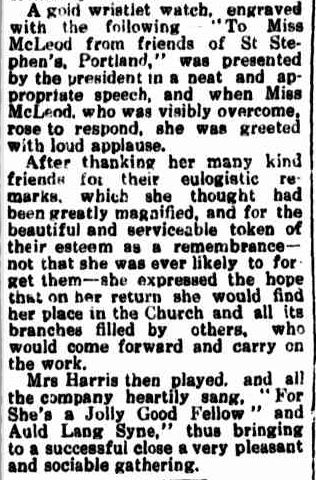
A week later, her friends gave her a send-off in St Stephen’s Parish Hall (below).

ST STEPHEN'S CHURCH HALL, PORTLAND

ST STEPHEN’S CHURCH HALL, PORTLAND

Constance was going on an extended holiday.  She was most likely heading to New Zealand to stay with her sister Jessie, married to Frederick Loisel.  Jessie was present at the send-off and lived in New Zealand by that time.

cl3

Presentation to Miss McLeod. (1920, June 21). Portland Guardian (Vic. : 1876 - 1953), p. 3 Edition: EVENING.. Retrieved July 18, 2013, from http://nla.gov.au/nla.news-article64021677

Presentation to Miss McLeod. (1920, June 21). Portland Guardian (Vic. : 1876 – 1953), p. 3 Edition: EVENING.. Retrieved July 18, 2013, from http://nla.gov.au/nla.news-article64021677

In 1934,  Constance passed away in New Zealand.  She and her sister Jessie had just departed Hamilton, New Zealand bound for Portland for the Portland Centenary Celebrations when Constance fell ill and died.

Obituary. (1934, October 8). Portland Guardian (Vic. : 1876 - 1953), p. 2 Edition: EVENING. Retrieved July 18, 2013, from http://nla.gov.au/nla.news-article64286992

Obituary. (1934, October 8). Portland Guardian (Vic. : 1876 – 1953), p. 2 Edition: EVENING. Retrieved July 18, 2013, from http://nla.gov.au/nla.news-article64286992

After the deaths of Wallace and Catherine and the departure of Constance, Claremont was vacant.  In June 1920, the estate of Caroline Henty advertised Claremont for lease by tender with a term of three years.

Advertising. (1920, June 17). Portland Guardian (Vic. : 1876 - 1953), p. 2 Edition: EVENING.. Retrieved July 19, 2013, from http://nla.gov.au/nla.news-article64021641

Advertising. (1920, June 17). Portland Guardian (Vic. : 1876 – 1953), p. 2 Edition: EVENING.. Retrieved July 19, 2013, from http://nla.gov.au/nla.news-article64021641

Taking up the lease of Claremont in 1920 was Caroline Florence McLean, daughter of Hector McLean and Mary Ann Humphries of Casterton.  Only a year after her arrival another death occurred at Claremont, that of returned WW1 soldier Benjamin Byard. Reading Benjamin’s War  Service Record I found he only made it as far as England when he fell ill with tuberculous.  He spent time in hospital in England before returning to Melbourne and was again confined.  Once released he travelled to his hometown of Casterton to meet up with friends.  It was suggested to him he visit Portland and he ended up at the home of Caroline McLean.

When I initially found this story, I couldn’t understand how Ben just seemed to pitch his tent in Claremont’s front yard. Finding out more about Caroline and her Casterton link went a long way to explaining how Ben chose her front yard.

A Pathetic Ending. (1921, August 22). Portland Guardian (Vic. : 1876 - 1953), p. 3 Edition: EVENING.. Retrieved July 19, 2013, from http://nla.gov.au/nla.news-article64024369

A Pathetic Ending. (1921, August 22). Portland Guardian (Vic. : 1876 – 1953), p. 3 Edition: EVENING.. Retrieved July 19, 2013, from http://nla.gov.au/nla.news-article64024369

It was a happier time at Claremont in June 1922, when Maud McLean of Casterton, Caroline’s sister, married James Anderson of East Malvern, at St Stephens Church.  The wedding breakfast was held at Claremont.

Family Notices. (1922, June 22). Portland Guardian (Vic. : 1876 - 1953), p. 3 Edition: EVENING.. Retrieved July 20, 2013, from http://nla.gov.au/nla.news-article64026127

Family Notices. (1922, June 22). Portland Guardian (Vic. : 1876 – 1953), p. 3 Edition: EVENING.. Retrieved July 20, 2013, from http://nla.gov.au/nla.news-article64026127

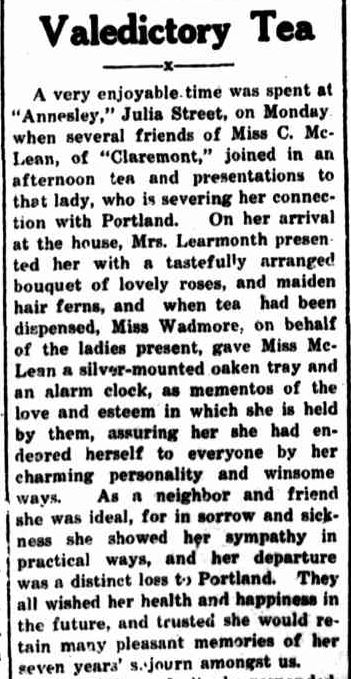
After seven years at Claremont, it was time for Caroline to move on.  Afternoon tea was held as a send-off.  One of the attendees was Sarah Wadmore, author of Portland’s Pioneer Women’s Book of Remembrance.

Valedictory Tea. (1927, May 5). Portland Guardian (Vic. : 1876 - 1953), p. 3 Edition: EVENING. Retrieved July 18, 2013, from http://nla.gov.au/nla.news-article64256993

Valedictory Tea. (1927, May 5). Portland Guardian (Vic. : 1876 – 1953), p. 3 Edition: EVENING. Retrieved July 18, 2013, from http://nla.gov.au/nla.news-article64256993

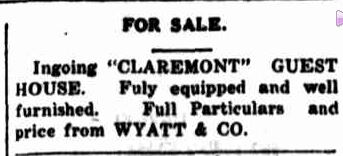
After the departure of Caroline McLean, Claremont was put up for sale as a guest house.

Advertising. (1927, May 5). Portland Guardian (Vic. : 1876 - 1953), p. 3 Edition: EVENING. Retrieved July 18, 2013, from http://nla.gov.au/nla.news-article64257015

Advertising. (1927, May 5). Portland Guardian (Vic. : 1876 – 1953), p. 3 Edition: EVENING. Retrieved July 18, 2013, from http://nla.gov.au/nla.news-article64257015

By November 1927, Claremont as a guest house was accommodating professionals such as Nurse Francis the Chiropodist.

The Portland Guardian. (1927, November 17). Portland Guardian (Vic. : 1876 - 1953), p. 2 Edition: EVENING. Retrieved July 18, 2013, from http://nla.gov.au/nla.news-article64259180

The Portland Guardian. (1927, November 17). Portland Guardian (Vic. : 1876 – 1953), p. 2 Edition: EVENING. Retrieved July 18, 2013, from http://nla.gov.au/nla.news-article64259180

There were vacancies at Claremont in June 1929.

Advertising. (1929, June 6). Portland Guardian (Vic. : 1876 - 1953), p. 2 Edition: EVENING. Retrieved July 18, 2013, from http://nla.gov.au/nla.news-article64269647

Advertising. (1929, June 6). Portland Guardian (Vic. : 1876 – 1953), p. 2 Edition: EVENING. Retrieved July 18, 2013, from http://nla.gov.au/nla.news-article64269647

While I can’t find who owned “Claremont” at this point, I do know that Janet Kosch took over the registration of the boarding house in 1930.  Prior to that, there was a Mrs McIntosh and then Norman McIntyre holding the registration.

Borough Council. (1930, November 20). Portland Guardian (Vic. : 1876 - 1953), p. 3 Edition: EVENING. Retrieved July 18, 2013, from http://nla.gov.au/nla.news-article64293741

Borough Council. (1930, November 20). Portland Guardian (Vic. : 1876 – 1953), p. 3 Edition: EVENING. Retrieved July 18, 2013, from http://nla.gov.au/nla.news-article64293741

In 1934, the two acres of land that made up the “Claremont” property was subdivided.  Again it is not clear who the vendor was, the Henty estate or a new owner from a possible sale back in 1927.

"Claremont" Sud-division. (1934, October 15). Portland Guardian (Vic. : 1876 - 1953), p. 2 Edition: EVENING.. Retrieved July 19, 2013, from http://nla.gov.au/nla.news-article64287062

“Claremont” Sud-division. (1934, October 15). Portland Guardian (Vic. : 1876 – 1953), p. 2 Edition: EVENING.. Retrieved July 19, 2013, from http://nla.gov.au/nla.news-article64287062

Mrs Kosch was still running the Claremont guest house in 1943 when her son visited while on leave from service.

NEWS OF THE FORCES. (1943, October 21). Portland Guardian (Vic. : 1876 - 1953), p. 3 Edition: EVENING. Retrieved July 20, 2013, from http://nla.gov.au/nla.news-article64387036

NEWS OF THE FORCES. (1943, October 21). Portland Guardian (Vic. : 1876 – 1953), p. 3 Edition: EVENING. Retrieved July 20, 2013, from http://nla.gov.au/nla.news-article64387036

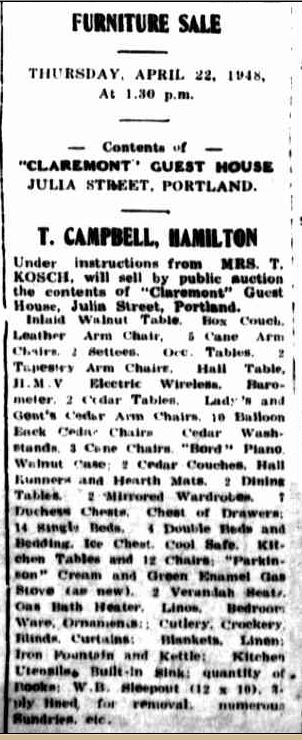
In 1948, after 18 years of running the Claremont guest house, Mrs Kosch retired.  She held a furniture sale on 22 April 1948.  In 1952 she passed away at Heywood.

 Advertising. (1948, April 19). Portland Guardian (Vic. : 1876 - 1953), p. 2 Edition: EVENING. Retrieved July 18, 2013, from http://nla.gov.au/nla.news-article64414613

Advertising. (1948, April 19). Portland Guardian (Vic. : 1876 – 1953), p. 2 Edition: EVENING. Retrieved July 18, 2013, from http://nla.gov.au/nla.news-article64414613

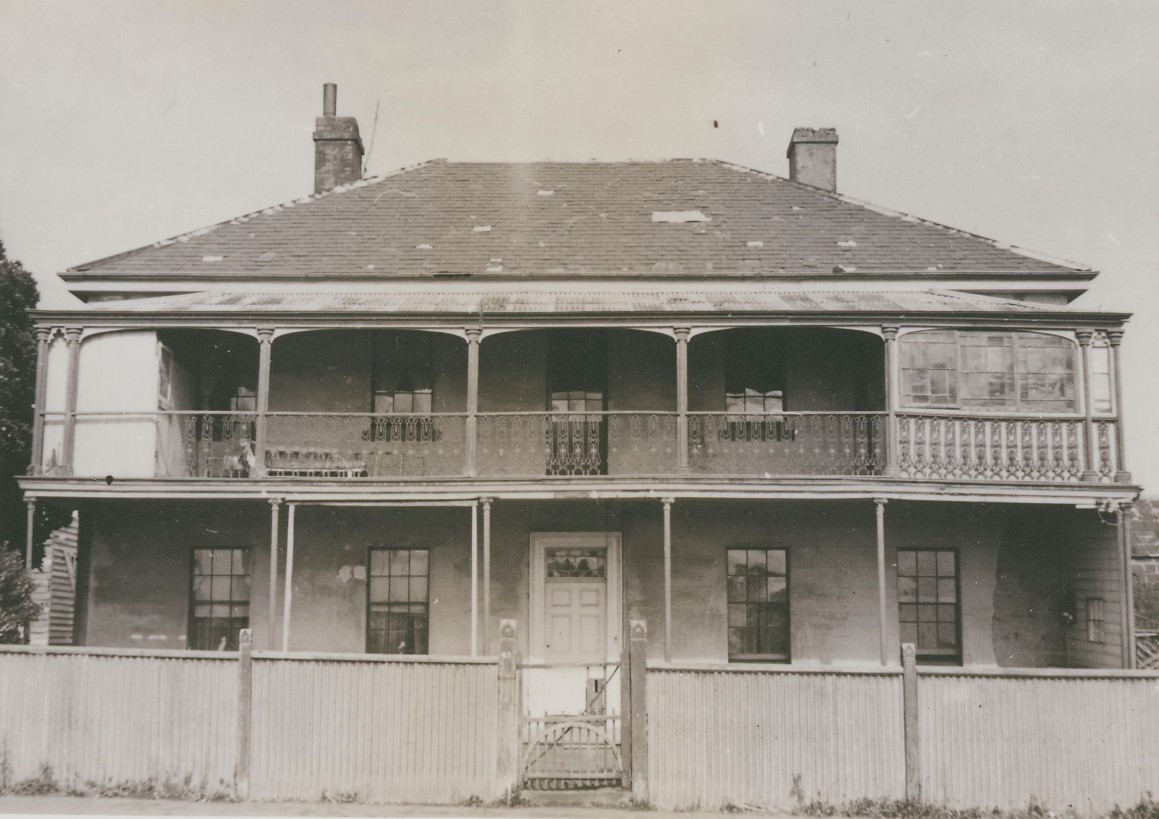
CLAREMONT, c1949. Photographer: Colin Caldwell. Image courtesy of the State Library of Victoria http://handle.slv.vic.gov.au/10381/72863

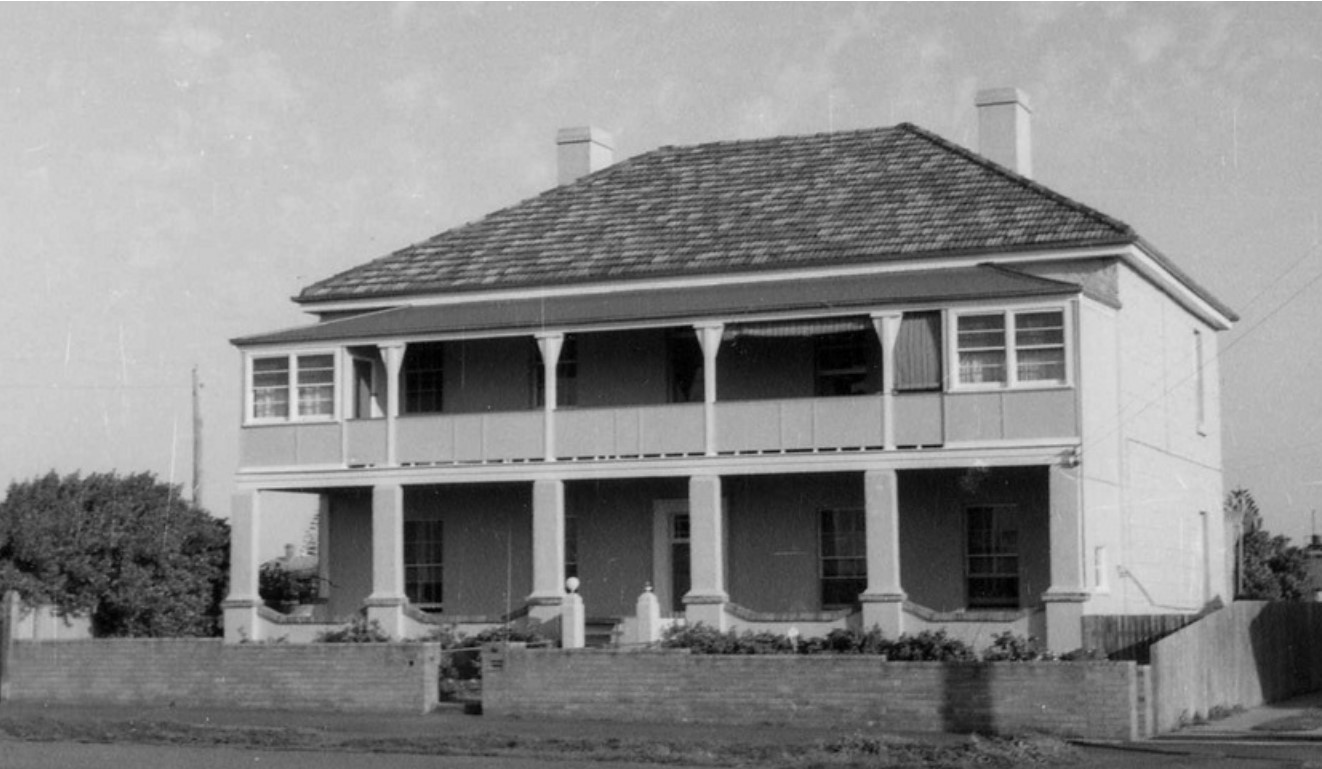
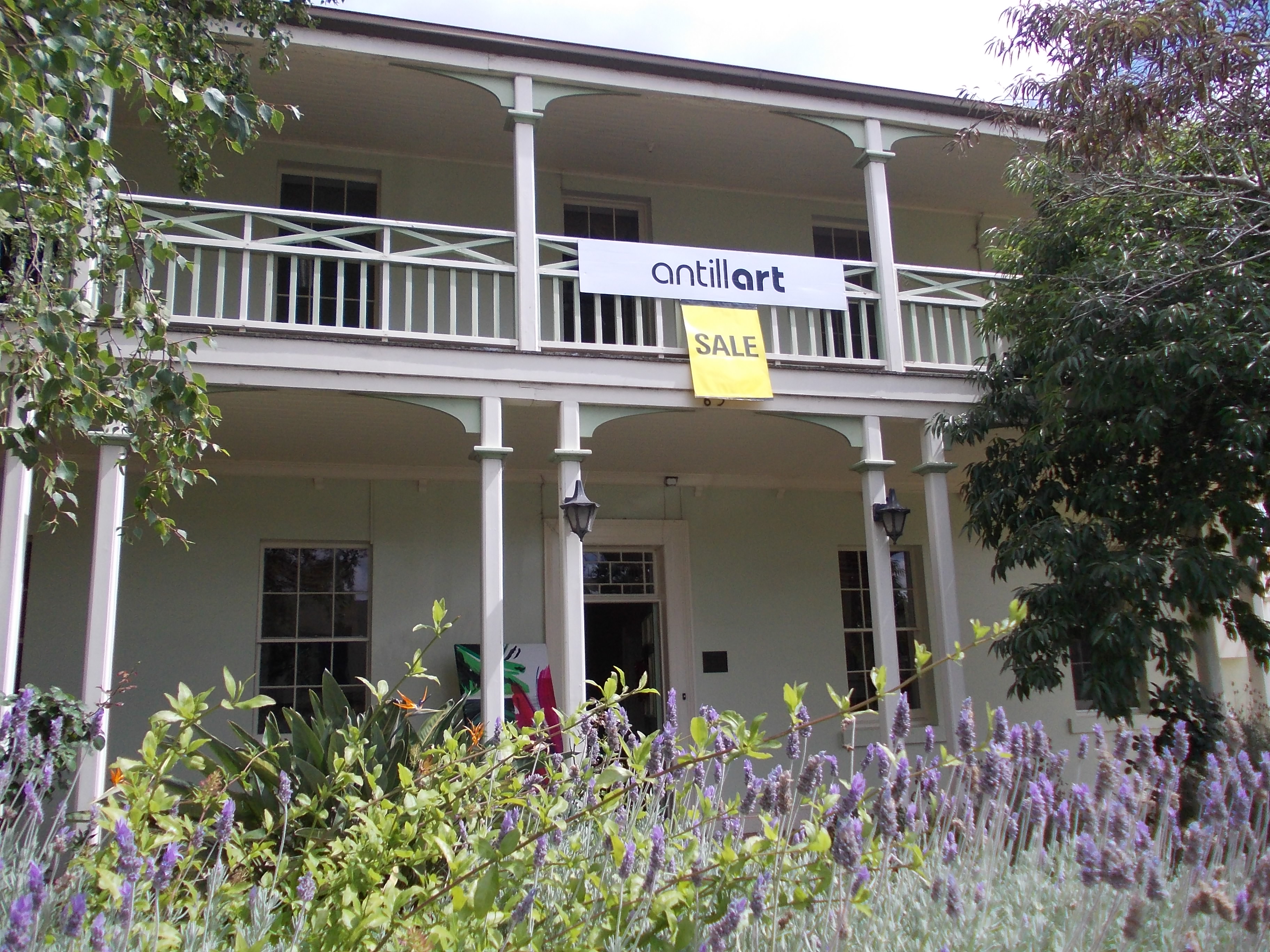
Claremont continued on as a guest house to at least 1954. In more recent years it has been a bed and breakfast and an art gallery, as it was when I visited. It has also been for sale.  The listing is seen on this link:  http://www.homehound.com.au/65+julia+street+portland+vic+3305/   Externally, over the years both the fence and slate roof have been replaced and the verandah modified more than once.
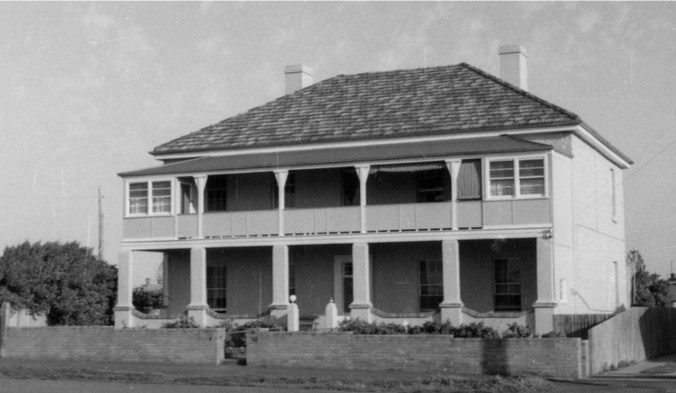
CLAREMONT c1962-1984. Image courtesy of the J.T. Collins Collection, La Trobe Picture Collection, State Library of Victoria.

In at least the first 100 years of existence Claremont was many things but never a family home.  Children weren’t raised under its roof or played in the yard. Memories were never kept of a treasured family home.  It was always a temporary house, even when the Misses McLeod and Miss McLean were in residence.  Now. at the end of my search, I think the reason I kept digging for information is that I wanted to find Claremont as a home, not a just summer residence or a guest house, but I never did.
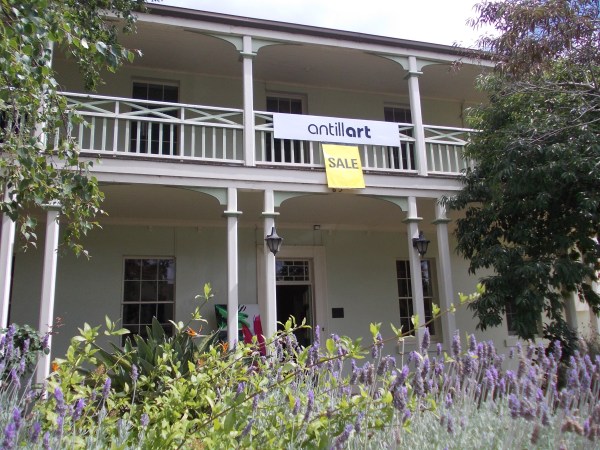
196

Portland Botanical Gardens

The Western District has many historic botanic gardens, most established from the 1850s to the 1870s when it was the thing for a town to do, if nothing else, to keep up with the neighbouring town.  For some, it was for scientific purposes to acclimatise plants and sometimes animals, as with the Hamilton Botanic Gardens.  There is a sense of history walking through each garden, and the tall specimen trees, such as oaks, redwoods, and pines, whisper the tales of times past.

The Portland Botanical Gardens, like the rest of the town, ooze history.  Each botanic garden is unique in some way, and Portland is no different and is unlike other gardens I have visited, including  Hamilton and Geelong.

PORTLAND BOTANICAL GARDENS

PORTLAND BOTANICAL GARDENS

Land for the gardens was first marked out in 1851, but it took a few years of public meetings for the gardens to be established.  In 1853, the Honourary Secretary remarked on the “advantages of a botanical garden, and the study of botanical science”.

PORTLAND. (1853, August 5). Geelong Advertiser and Intelligencer (Vic. : 1851 - 1856), p. 1 Edition: DAILY., Supplement: SUPPLEMENT TO THE GEELONG ADVERTISER AND INTELLIGENCER. Retrieved July 7, 2013, from http://nla.gov.au/nla.news-article86412916

PORTLAND. (1853, August 5). Geelong Advertiser and Intelligencer (Vic. : 1851 – 1856), p. 1 Edition: DAILY., Supplement: SUPPLEMENT TO THE GEELONG ADVERTISER AND INTELLIGENCER. Retrieved July 7, 2013, from http://nla.gov.au/nla.news-article86412916

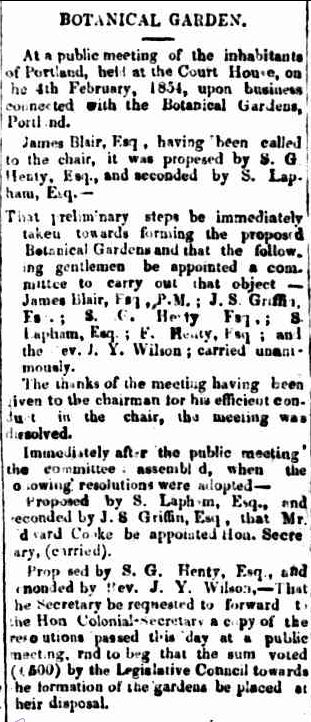
At a public meeting six months later, on February 4, 1854, chaired by James Blair, Stephen Henty proposed that a committee be formed to get the gardens up and running.

 BOTANICAL GARDEN. (1854, February 9). Portland Guardian and Normanby General Advertiser (Vic. : 1842 - 1876), p. 2 Edition: EVENING. Retrieved June 30, 2013, from http://nla.gov.au/nla.news-article71569639

BOTANICAL GARDEN. (1854, February 9). Portland Guardian and Normanby General Advertiser (Vic. : 1842 – 1876), p. 2 Edition: EVENING. Retrieved June 30, 2013, from http://nla.gov.au/nla.news-article71569639

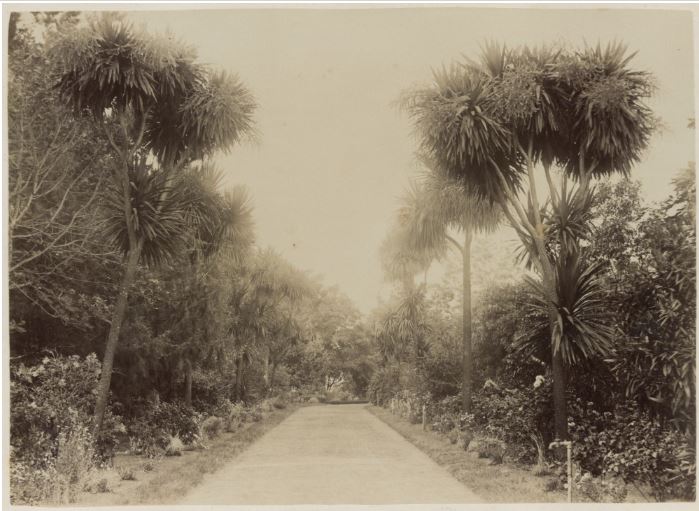
PORTLAND BOTANICAL GARDENS c1891. Image Courtesy of the State Library of Victoria. Image No. H42199/21 http://handle.slv.vic.gov.au/10381/183906

PORTLAND BOTANICAL GARDENS c1891. Image Courtesy of the State Library of Victoria. Image No. H42199/21 http://handle.slv.vic.gov.au/10381/183906

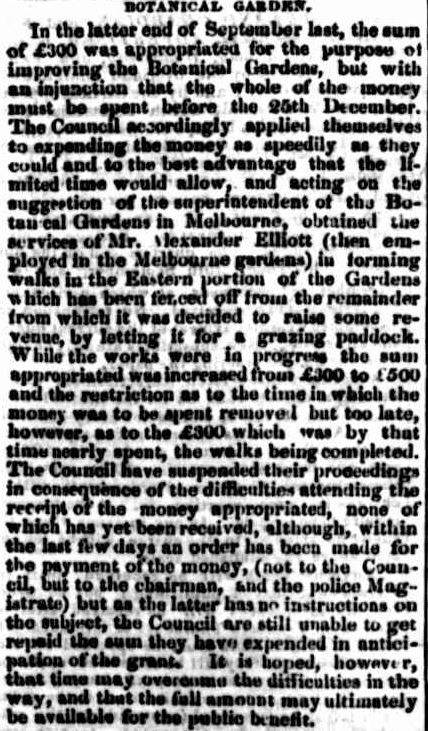
Works began in 1858, assisted by Alexander Elliot from the Royal Botanic Gardens in Melbourne, however, a lack of funds was slowing progress.

MUNICIPAL DISTRICT OF PORTLAND. (1858, March 5). Portland Guardian and Normanby General Advertiser (Vic. : 1842 - 1876), p. 3 Edition: EVENINGS.. Retrieved July 3, 2013, from http://nla.gov.au/nla.news-article64570632

MUNICIPAL DISTRICT OF PORTLAND. (1858, March 5). Portland Guardian and Normanby General Advertiser (Vic. : 1842 – 1876), p. 3 Edition: EVENINGS.. Retrieved July 3, 2013, from http://nla.gov.au/nla.news-article64570632

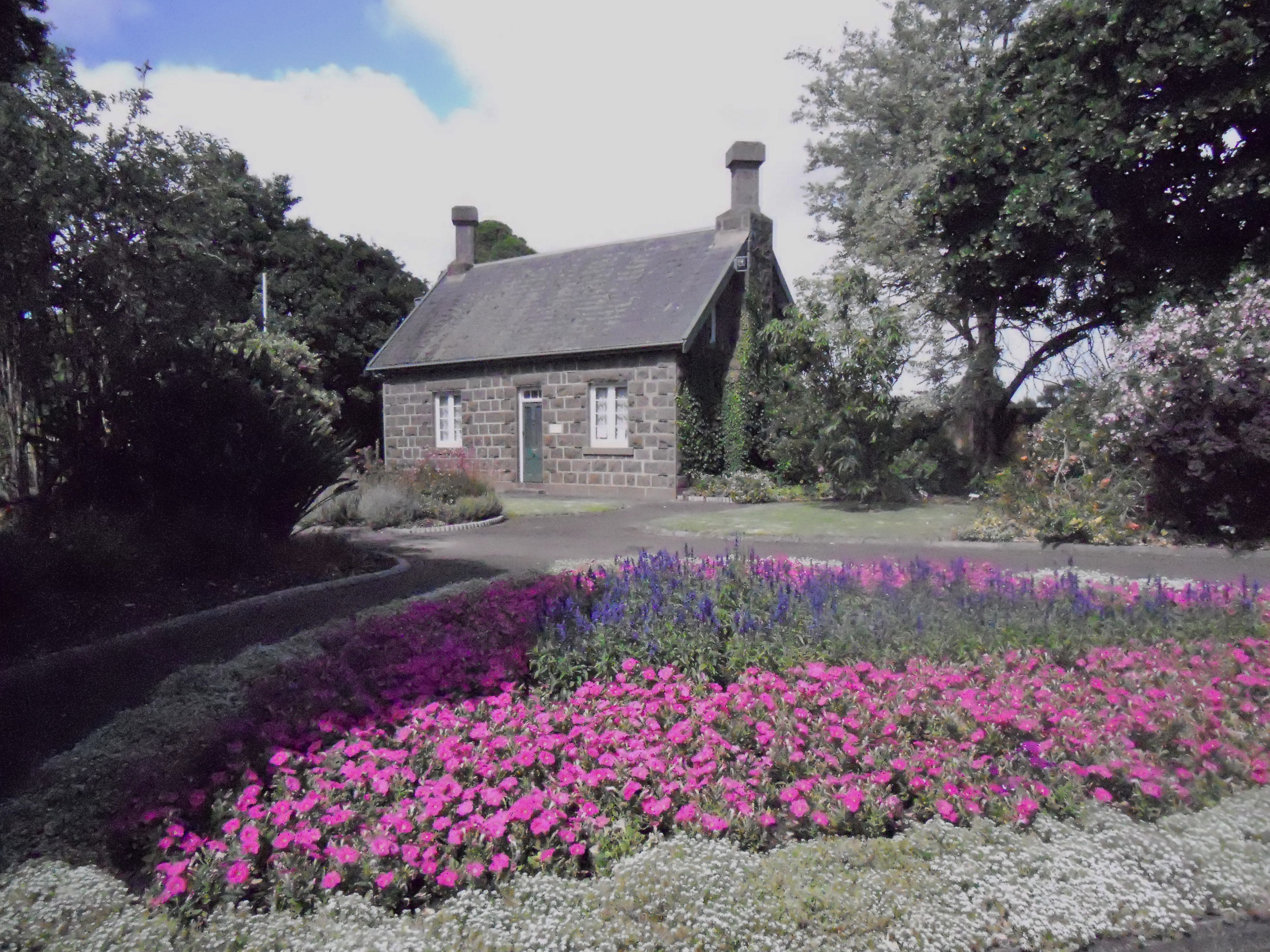
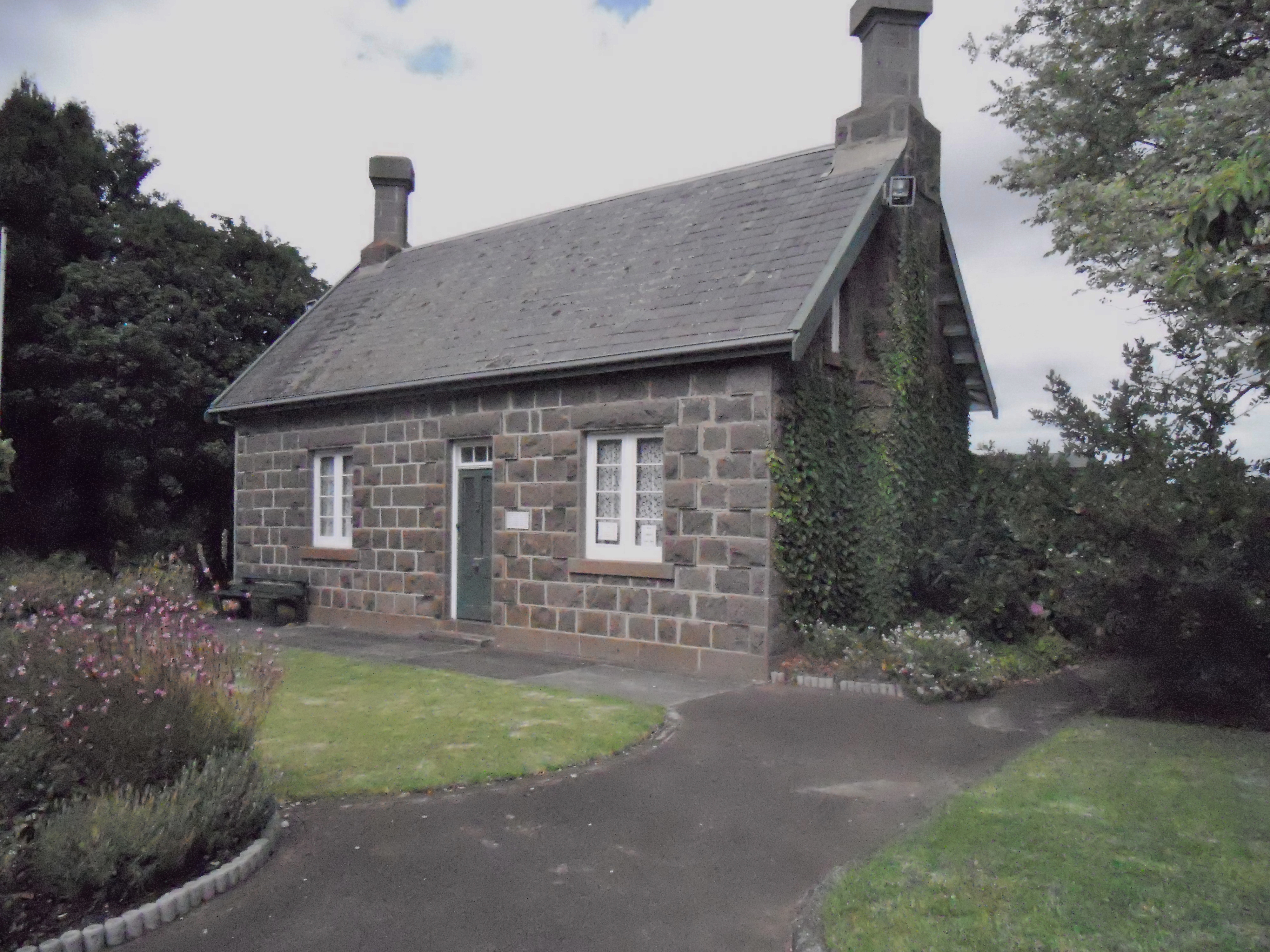
By November, however, the gardens were beginning to take shape and the curator’s cottage was under construction.

CURATOR'S COTTAGE

CURATOR’S COTTAGE

DOMESTIC INTELIGENCE. (1858, November 3). Portland Guardian and Normanby General Advertiser (Vic. : 1842 - 1876), p. 2 Edition: EVENINGS.. Retrieved July 3, 2013, from http://nla.gov.au/nla.news-article64509473

DOMESTIC INTELIGENCE. (1858, November 3). Portland Guardian and Normanby General Advertiser (Vic. : 1842 – 1876), p. 2 Edition: EVENINGS.. Retrieved July 3, 2013, from http://nla.gov.au/nla.news-article64509473

In 1859, a letter to the Portland Guardian questioned the practice of allowing horses to graze in the gardens overnight.  “Delta” wondered why the committee could keep their horses at the gardens while “the great unwashed are warned at the gate, Dogs not Admitted”

ORIGINAL CORRESPONDENCE. (1859, May 2). Portland Guardian and Normanby General Advertiser (Vic. : 1842 - 1876), p. 2 Edition: EVENINGS.. Retrieved July 4, 2013, from http://nla.gov.au/nla.news-article64510907

ORIGINAL CORRESPONDENCE. (1859, May 2). Portland Guardian and Normanby General Advertiser (Vic. : 1842 – 1876), p. 2 Edition: EVENINGS.. Retrieved July 4, 2013, from http://nla.gov.au/nla.news-article64510907

BOTANICAL GARDENS. (1859, May 2). Portland Guardian and Normanby General Advertiser (Vic. : 1842 - 1876), p. 2 Edition: EVENINGS.. Retrieved July 4, 2013, from http://nla.gov.au/nla.news-article64510906

BOTANICAL GARDENS. (1859, May 2). Portland Guardian and Normanby General Advertiser (Vic. : 1842 – 1876), p. 2 Edition: EVENINGS.. Retrieved July 4, 2013, from http://nla.gov.au/nla.news-article64510906

If you visit the Portland Botanical Gardens, look up at the tall trees and think of those who planted them, or as you walk the paths, consider the hands that carved them.  The story behind these features is my favourite story about the gardens.

Table Talk. (1863, April 23). Portland Guardian and Normanby General Advertiser (Vic. : 1842 - 1876), p. 2 Edition: EVENING. Retrieved July 7, 2013, from http://nla.gov.au/nla.news-article64628622

Table Talk. (1863, April 23). Portland Guardian and Normanby General Advertiser (Vic. : 1842 – 1876), p. 2 Edition: EVENING. Retrieved July 7, 2013, from http://nla.gov.au/nla.news-article64628622

At a meeting of the Portland Historical Committee in 1932, the secretary told the story of the Chinese prisoners and their work at the Portland Botanical Gardens.

Historical Committee. (1932, March 17). Portland Guardian (Vic. : 1876 - 1953), p. 3 Edition: EVENING. Retrieved July 7, 2013, from http://nla.gov.au/nla.news-article64297702

Historical Committee. (1932, March 17). Portland Guardian (Vic. : 1876 – 1953), p. 3 Edition: EVENING. Retrieved July 7, 2013, from http://nla.gov.au/nla.news-article64297702

On the wall of the curator’s cottage is a plaque recognising previous curators of the gardens from the kindly William Allitt in 1861 through to Colin Ellingworth, curator from 1982-1987.

373Andrew Callander was curator from 1922 to 1949.  Upon his appointment, Mr Callander set about tidying up the gardens and building a ti-tree greenhouse for seedling propagation.

 THE PORTLAND LIFEBOAT. (1926, January 7). Portland Guardian (Vic. : 1876 - 1953), p. 3 Edition: EVENING.. Retrieved July 4, 2013, from http://nla.gov.au/nla.news-article64252901

THE PORTLAND LIFEBOAT. (1926, January 7). Portland Guardian (Vic. : 1876 – 1953), p. 3 Edition: EVENING.. Retrieved July 4, 2013, from http://nla.gov.au/nla.news-article64252901

PORTLAND BOTANICAL GARDENS. Image Courtesy of the State Library of Victoria. Image no. H32492/1655 http://handle.slv.vic.gov.au/10381/64772

PORTLAND BOTANICAL GARDENS. Image Courtesy of the State Library of Victoria. Image no. H32492/1655 http://handle.slv.vic.gov.au/10381/64772

PORTLAND BOTANICAL GARDENS. Image courtesy of the State Library of Victoria http://handle.slv.vic.gov.au/10381/66929

PORTLAND BOTANICAL GARDENS. Image courtesy of the State Library of Victoria http://handle.slv.vic.gov.au/10381/66929

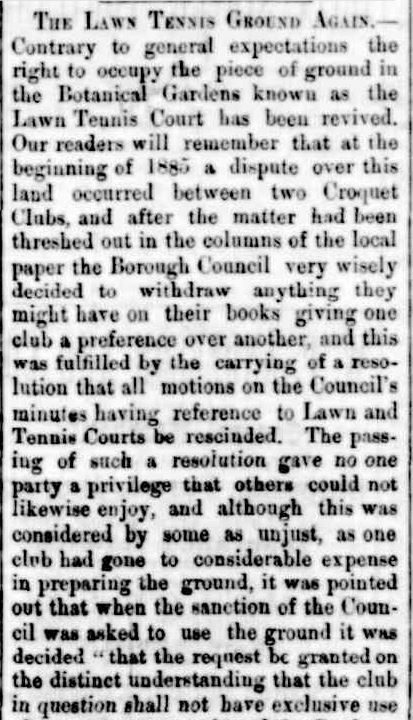
At one time, both croquet and tennis were played at the gardens, and there were often tensions between the two groups and any other group that hoped to share the space.

TABLE TALK. (1876, November 3). Portland Guardian (Vic. : 1876 - 1953), p. 2 Edition: EVENINGS.. Retrieved July 4, 2013, from http://nla.gov.au/nla.news-article63336790

TABLE TALK. (1876, November 3). Portland Guardian (Vic. : 1876 – 1953), p. 2 Edition: EVENINGS.. Retrieved July 4, 2013, from http://nla.gov.au/nla.news-article63336790

THE LAWN TENNIS GROUND AGAIN. (1887, September 2). Portland Guardian (Vic. : 1876 - 1953), p. 2 Edition: EVENING. Retrieved July 4, 2013, from http://nla.gov.au/nla.news-article65410048

THE LAWN TENNIS GROUND AGAIN. (1887, September 2). Portland Guardian (Vic. : 1876 – 1953), p. 2 Edition: EVENING. Retrieved July 4, 2013, from http://nla.gov.au/nla.news-article65410048

375

CROQUET LAWN

Croquet won out and is still played today.  The tennis courts were converted to rose gardens.  The rosary was first proposed in 1930, but it was 1931 before there was further action.

pbg10

Borough Council. (1931, April 13). Portland Guardian (Vic. : 1876 - 1953), p. 3 Edition: EVENING. Retrieved July 5, 2013, from http://nla.gov.au/nla.news-article64294863

Borough Council. (1931, April 13). Portland Guardian (Vic. : 1876 – 1953), p. 3 Edition: EVENING. Retrieved July 5, 2013, from http://nla.gov.au/nla.news-article64294863

378

376

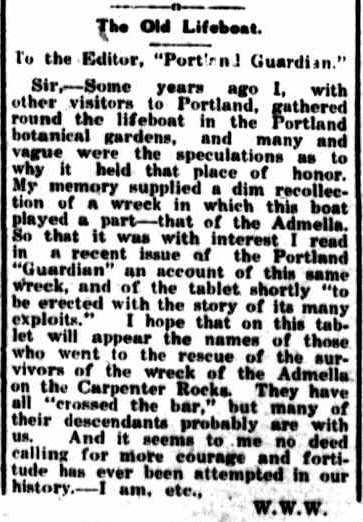
“Wandering Willie’s Wife” visited the Portland Botanical Gardens in 1926 and felt compelled to write a letter to the editor of the Portland Guardian on the subject of a nameless lifeboat on display in the gardens.  Could it have been the lifeboat, captained by James Fawthrop, used to rescue survivors from the wreck of the  S.S. Admella?  Why wasn’t there a name plaque?

pbg8

THE PORTLAND LIFEBOAT. (1926, January 7). Portland Guardian (Vic. : 1876 – 1953), p. 3 Edition: EVENING.. Retrieved July 10, 2013, from http://nla.gov.au/nla.news-article64252901

Three years later, “Wandering Willie’s Wife” wrote to the editor again, prompted by the announcement that a “tablet” with the story of the lifeboat Portland would be placed beside the boat.

OUR LETTER BOX. (1929, May 16). Portland Guardian (Vic. : 1876 - 1953), p. 2 Edition: EVENING. Retrieved July 4, 2013, from http://nla.gov.au/nla.news-article64269425

OUR LETTER BOX. (1929, May 16). Portland Guardian (Vic. : 1876 – 1953), p. 2 Edition: EVENING. Retrieved July 4, 2013, from http://nla.gov.au/nla.news-article64269425

The lifeboat is now removed from the elements and is housed in the Portland Maritime Discovery Centre.

030

LIFEBOAT PORTLAND

ABC Southwest broadcast a story about the Portland Botanic Gardens in March 2009.  The story, including audio and better photos than my own (excluding the wonderful historic photos I found at Trove) can be found by following the link http://www.abc.net.au/local/photos/2009/03/26/2525642.htm

A BILLS HORSE TROUGH (Portland Gardens)
A BILLS HORSE TROUGH (Portland Gardens)

Portland Pioneer Women’s Book of Remembrance

The obituary of Sarah Jane Wadmore in the January Passing of the Pioneers prompted me to find out more about a booklet she co-authored for the Portland Centenary in 1934, the Portland Pioneer Women’s Book of Remembrance.  I had previously read about it in newspaper reports from around the time.

Pioneer Women of Portland. (1934, May 24). Portland Guardian (Vic. : 1876 - 1953), p. 3 Edition: EVENING.. Retrieved January 29, 2013, from http://nla.gov.au/nla.news-article64285807

Pioneer Women of Portland. (1934, May 24). Portland Guardian (Vic. : 1876 – 1953), p. 3 Edition: EVENING.. Retrieved January 29, 2013, from http://nla.gov.au/nla.news-article64285807

A  Google search led me to the State Library of Victoria website and it was pleasing to see it has been digitised and is available online.  I was even more pleased that ggg grandmother Margaret Ann Diwell (nee Turner) was among the pioneering women of Portland as well as some of those I have featured in Passing of the Pioneers.

The booklet begins with a forward from Alice Frances Moss, a pioneer of women’s rights.  She was the first President of the National Council of Women of Australia and Chair of the Victorian Women’s Centenary Council.

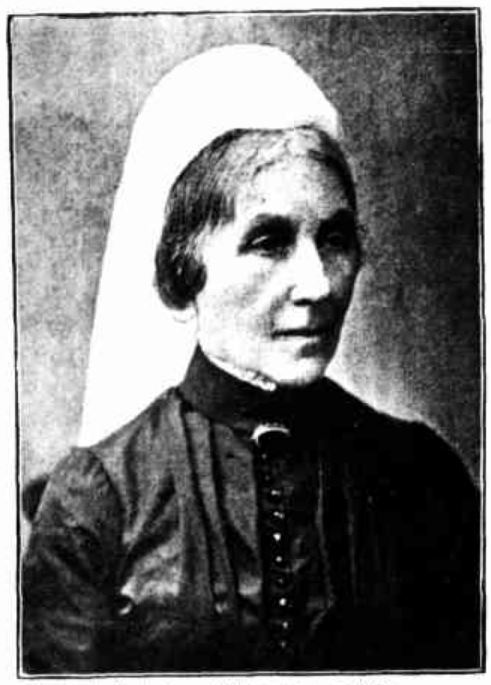
After an offering of appreciation to pioneer women, there is the story of Mrs Stephen George Henty, the first European woman at Portland, to whom the booklet was dedicated.  She is often called Mrs Stephen George Henty, but let us call her Jane (Pace).

“OBITUARY” The Sydney Mail and New South Wales Advertiser, 14 February 1906

There are the recollections of Mrs George Godwin Crouch (Marianne Trangmar) spanning from 1840 to 1917.  Then, a list of “Worthy Pioneers” compiled by Sarah Jane Wadmore.  Included is one of my favourites, Rebecca Kittson (Mrs William Lightbody) and Mrs Fawthrop, Jane Rosevear, wife of Captain James Fawthrop the lifeboat captain.

Following is the story of  Mrs Richard Charlton Hedditch and further on, a letter she wrote on Christmas Day 1848, to her parents in England.  Another woman often referred to by her husband’s name, she was Rachel Forward Read.

After some local poetry comes “Belles and Beauties of the Early Days”.  Those included are Misses Henty, Learmonth, Trangmar and Herbertson.

Finally is a list of Portland’s Pioneering Women with women living in Portland prior to 1864 eligible.  That’s where I found Margaret.  The Diwells lived in Portland for about five years from the time of their arrival on the Duke of Richmond in 1852.

Margaret appears as Mrs William Diwell and her daughter-in-law, Frances Webb,  is also listed as Mrs William Diwell.  Frances just scraped in as she was born in Portland in 1863 to John Webb and Margaret Smith, also listed.  This is a useful list as some entries have notes and maiden names.

The oldest pioneer women, recognised separately, include Marion Nunn Jones, Emma Holmes, and Anne Beglan.

The photographs in the booklet are of Mrs Jane Henty, Mrs Marianne Crouch, Mrs Janet Laurie, Sarah Jane Wadmore and Mrs Rachel Hedditch.

The booklet also comes as an Archive CD book available from the Genealogical Society of Victoria.

Online book – Portland Pioneer Women’s Book of Remembrance 

In The News – July 29, 1929

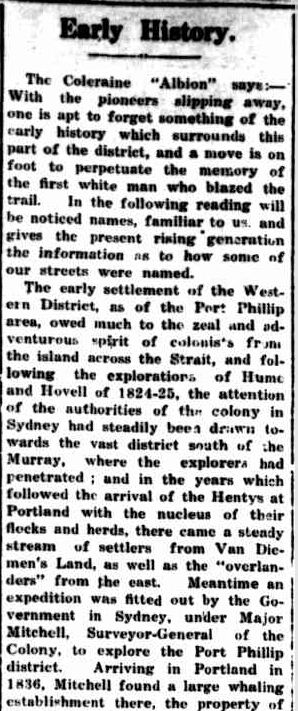
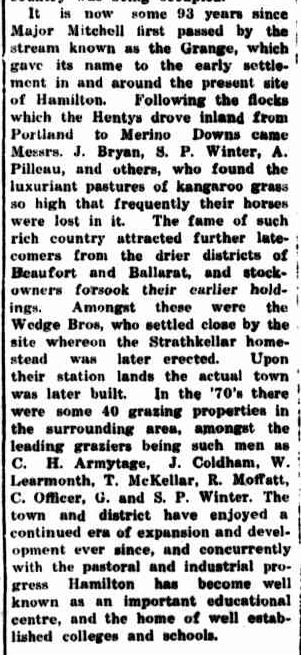
Although many of the Western District newspapers are not digitised at Trove, it is possible to find articles from the likes of The Hamilton Spectator in the The Portland Guardian,  for example.  On this day 83 years ago,  an excerpt from the Albion newspaper of Coleraine appeared in The Portland Guardian of July 29, 1929.

Prompted by the deaths of many of the early pioneers, the article reflected on the history of the Western District  from the time Major Thomas Mitchell made his way across the land he called Australia Felix 93 years earlier.


Early History. (1929, July 29). Portland Guardian (Vic. : 1876 – 1953), p. 3 Edition: EVENING. Retrieved July 23, 2012, from http://nla.gov.au/nla.news-article64270110

There is a clue in the article for those of you who having trouble finding your Western District family member’s arrival in Victoria.  The writer mentions many people from Van Diemen’s Land making their way to Victoria once news got back the Hentys had pushed up from Portland into the Merino district.  It could then be possible that family members travelled to Victoria via Tasmania where they had resided as convicts or otherwise.

Jenny Fawcett, on her great South-West Victoria genealogy and history site,  has indexed the names of those who travelled to Victoria as part of a Geelong and Portland Bay Immigration Society scheme in 1845 and 1846.  The idea behind that and similar schemes was to bring labour into the colony with those behind the society being squatters and merchants.  Jenny provides a great description of the scheme on her site.

Browsing through the names,there are many I instantly recognise as Western District family names.  Also, a lot of the pioneer obituaries I have read tell of the deceased having come to Victoria via Van Diemen’s Land.

So, if you are beginning to think your ancestors were good swimmers, follow-up the possibility they came to the Western District from Tasmania.  You just never know.

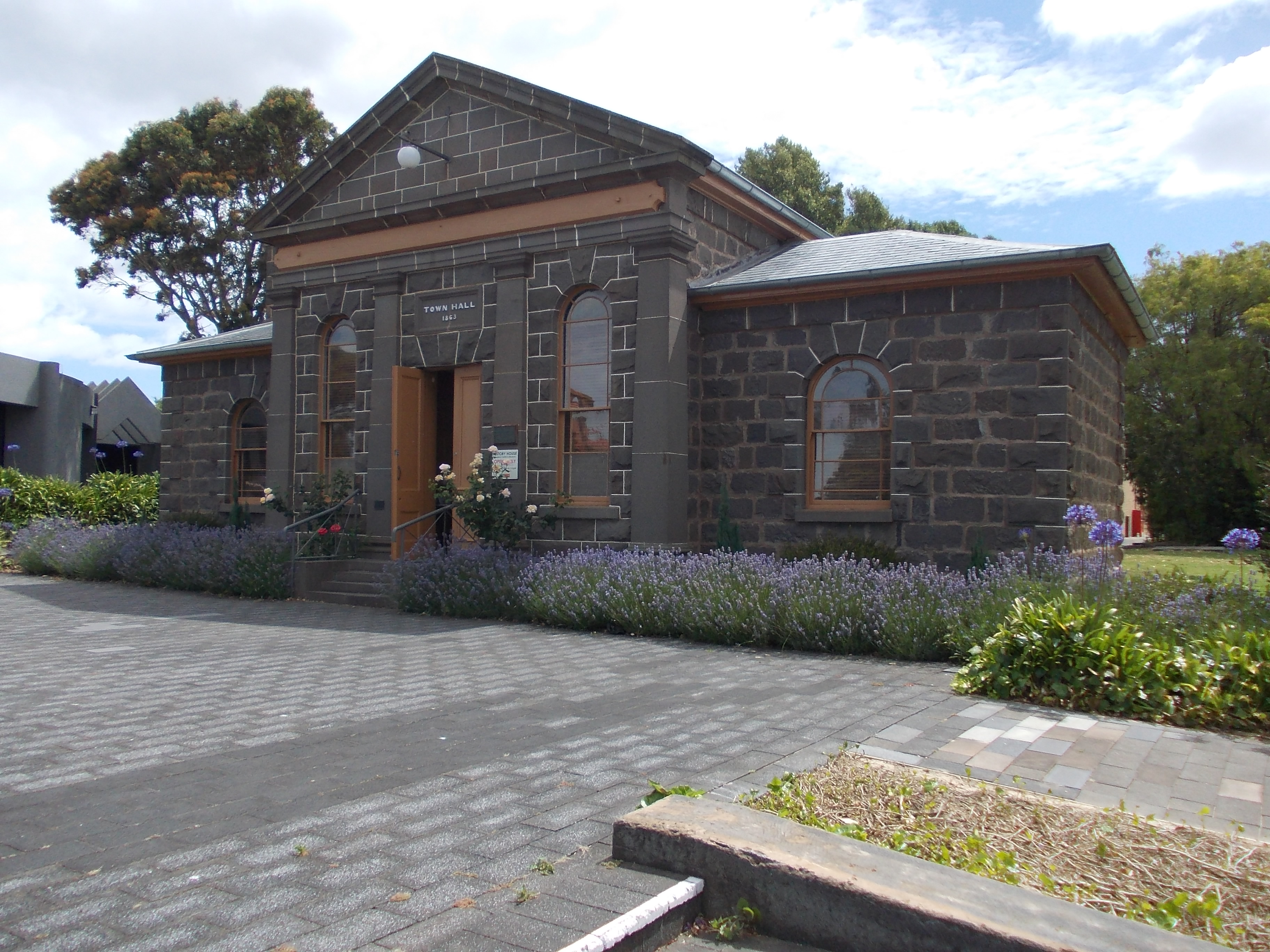
Portland’s History House

HISTORY HOUSE, PORTLAND

History House in Portland is the place to go to search for your ancestors who lived or arrived in the harbour town.  Located in the former Portland Town Hall, History House offers research facilities and a small museum.

The museum has many reminders of Portland’s early history, in particular, the Henty family.

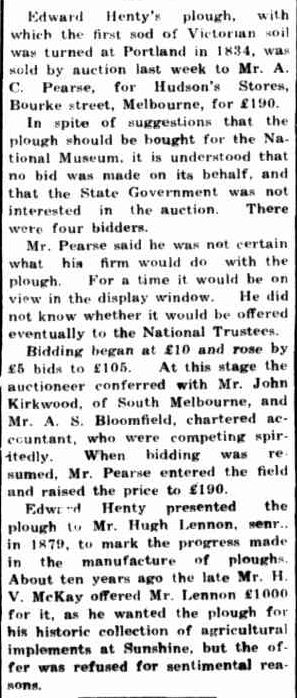
It is not easy taking a photo of a long plough in a narrow room with a fairly ordinary camera, but I had to give it a go as this in the one and only Henty plough.  While it is famous for it being the first plough used in Victoria, its journey since those early days is interesting.

HENTYS PLOUGH

Maybe this picture does the plough more justice than my own.

THE FIRST PLOUGH USED IN VICTORIA, BY THE HENTY BROTHERS, OF PORTLAND. (1910, September 10). Western Mail (Perth, WA : 1885 – 1954), p. 10. Retrieved July 3, 2012, from http://nla.gov.au/nla.news-article38361343

This article from the Portland Guardian of 18 November 1935 described what happened to the plough after it left the Henty’s possession

HENTY’S PLOUGH. (1935, November 18). Portland Guardian (Vic. : 1876 – 1953), p. 3 Edition: EVENING.. Retrieved July 3, 2012, from http://nla.gov.au/nla.news-article64290884

Hugh Lennon, who had the plough on display at his factory in Spotswood, was the manufacturer of the Lennon plough.  This was the plough of choice for ggg grandfather James Harman in local ploughing matches.  It was also the plough of choice for the Kelly gang when making armour.  The plough eventually returned to Portland in 1970.

The is a model of the house occupied by Joseph Henry Porter and his wife, Sarah Herbertson, in Gawler Street, Portland. Joseph constructed the model and Sarah furnished it.  I like the detail, even down to pickets missing off the fence.  Both Joseph and Sarah are part of the Western District Families Pioneer Obituary Index.  Joseph’s obituary mentioned his fine craftmanship.


MODEL OF 42 GAWLER STREET, PORTLAND

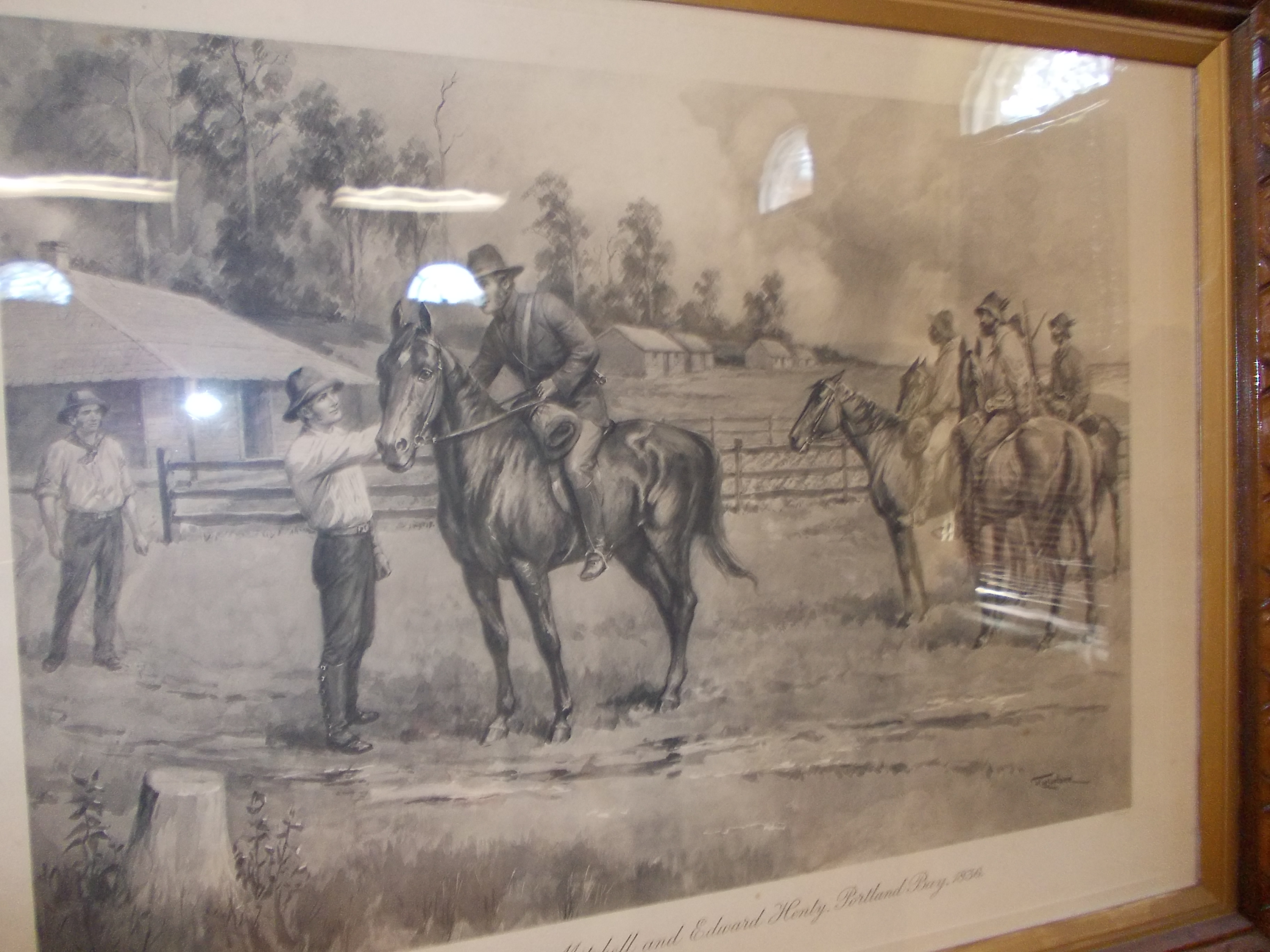
While this isn’t the best photo, I had to share it.  It depicts the meeting of Major Thomas Mitchell and the Henty brothers, a significant time in the history of the Western District.  You can read more about this chance meeting in the post “Major Mitchell Reaches Portland Bay”.

MAJOR MITCHELL AND THE HENTY BROTHERS

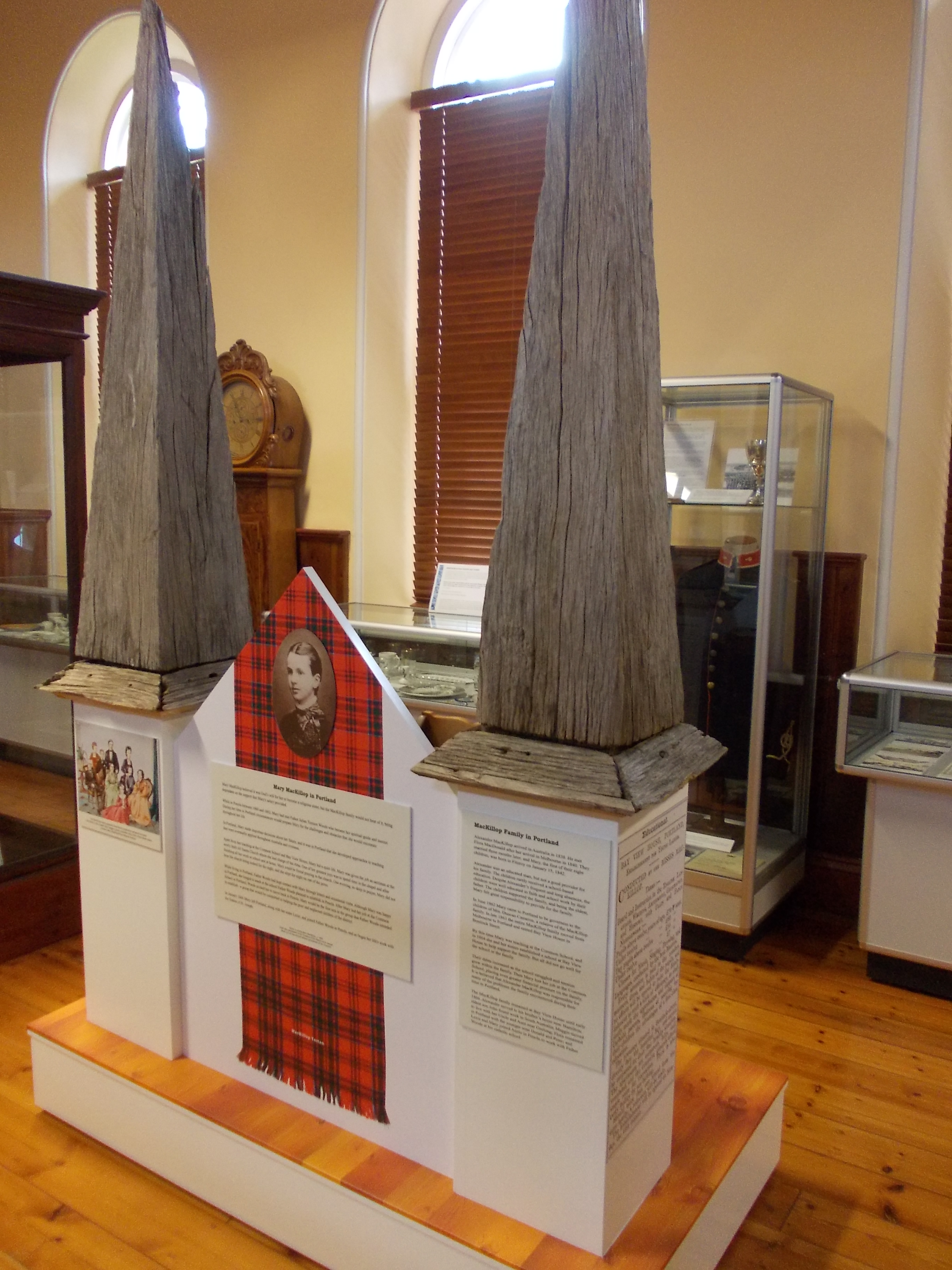
Mary McKillop spent some time in Portland and an exhibit commemorates this, complete with the spires from the original Roman Catholic church in Portland.

MARY MacKILLOP DISPLAY

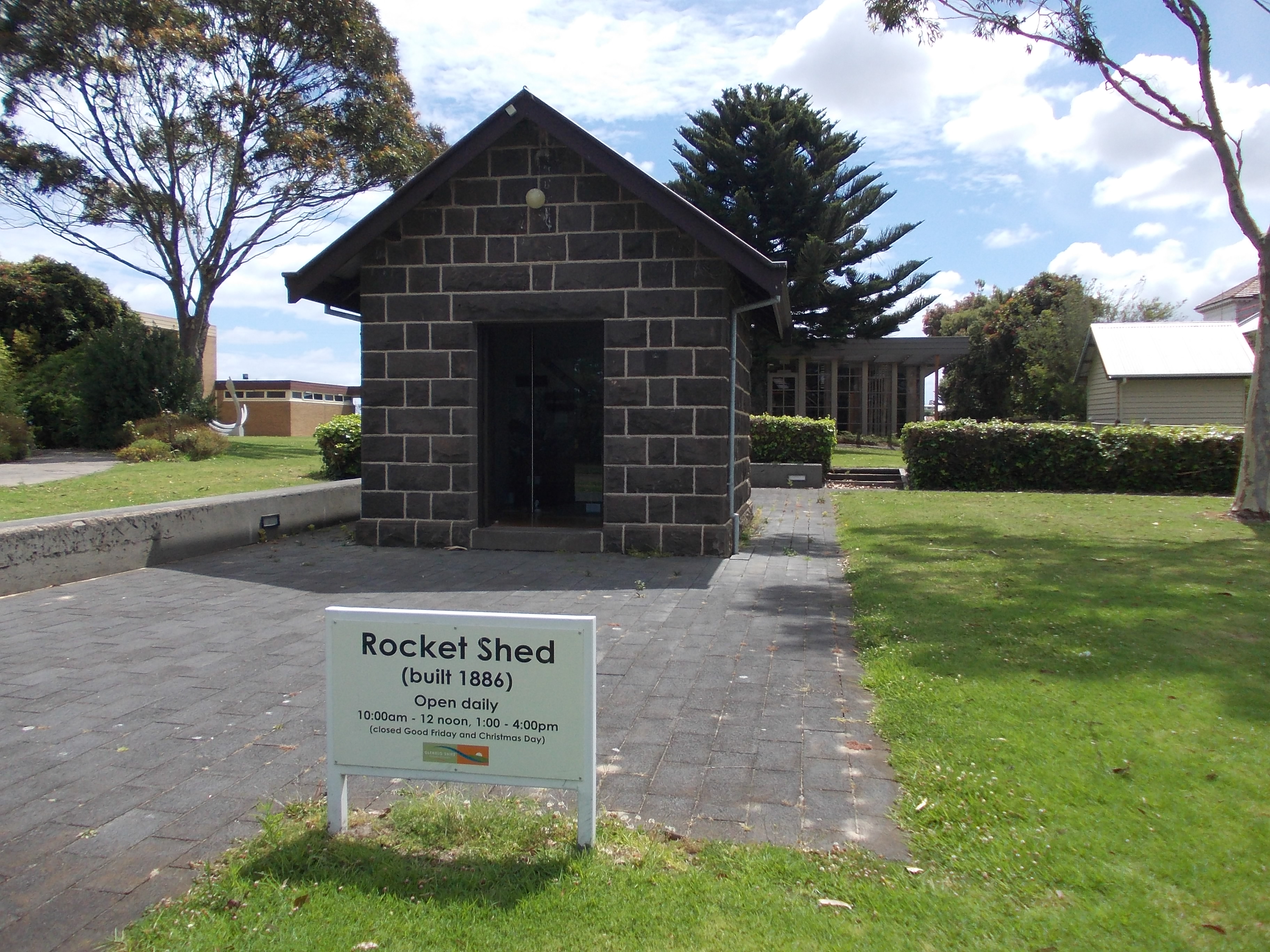
The Portland Rocket Shed is next to History House.  The shed was built in 1886 by George Sedgewick who was the gg grandfather of Ann, a follower of this blog.  Fully restored, the shed has a display inside which includes a rocket launcher used to fire ropes to boats in distress.

ROCKET SHED

For more photos, better than my own, check out ABC South West Victoria’s report on History House’s renovation in 2010 http://www.abc.net.au/local/stories/2010/02/17/2822431.htm.  There was also a report at the time of Mary MacKillop’s canonization http://www.abc.net.au/local/stories/2010/10/12/3035824.htm

Another “What the Dickens?” Moment

To mark the 200th birthday of Charles Dickens, I posted about Alfred Tennyson Dickens who lived in my hometown of Hamilton.  Entitled “What the Dickens?“, the post describes my amazement that a son of Charles Dickens could have lived in Hamilton.  Alfred left the town due to the accidental death of his wife Jessie.

Yesterday I was in Hamilton for several reasons, one of which was to visit the Hamilton Old Cemetery in search of the grave of Jessie Dickens, and as a result, I had another “What the Dickens?” moment.

My visits to Hamilton are infrequent day trips, so I try to cram in as much as possible. Visits to the cemetery are quick, usually to search for a specific grave or graves. Yesterday was no different, except I had absolutely no idea where in the cemetery Jesse was buried.  With Mum, we headed to the oldest and biggest graves.

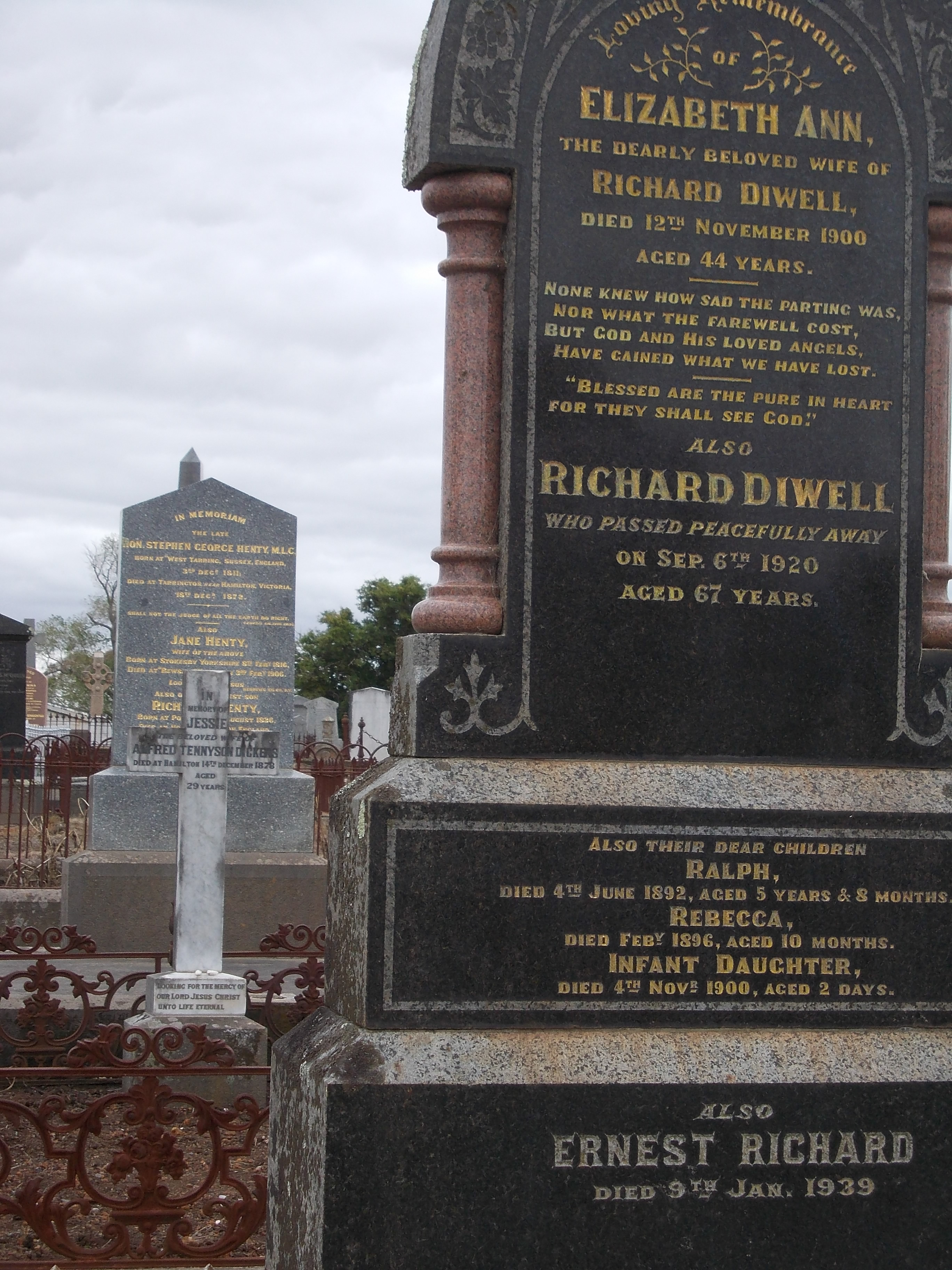
We found the grave quicker than expected.  It turns out the grave of Jessie Dickens is immediately behind my gg grandparents Richard Diwell and Elizabeth Jelly who I have posted about before.  We couldn’t believe we had previously visited the Diwell plot before, unaware the grave of the daughter-in-law of Charles Dickens was right behind. As we were earlier unaware of the Dickens link to Hamilton, we had not made the connection.

What I couldn’t believe was that I had missed the grave immediately behind Jessie’s. It was that of Stephen George Henty, one of the Henty brothers, Victoria’s first settlers.  Stephen, thought to be the most influential of the brothers, was the first to settle inland from Portland, at Muntham, Merino Downs, and Sandford stations.

DIWELL, DICKENS & HENTY GRAVES


Both the Diwell and Dickens headstones were chosen by heartbroken husbands, shattered by their wives’ premature deaths. Jessie was only 29, thrown from a horse-drawn carriage on Portland Road in 1878 and Elizabeth died at 44 due to complications of childbirth in 1900. I have updated the “What the Dickens?” post with a photo of Jessie’s grave.

When I came home, I checked the photos I already had of the Diwell grave, and sure enough, you can see the two other graves in the background.  One of these photos appears on the post “Elizabeth Ann Jelly“.

The thing that struck me was that within a distance of about 6 metres lay the remains of 10 people.  Great Victorian pioneers, Stephen George Henty and wife Jane and their son, Richmond; the wife of the son of one of the greatest novelists of all time and my gg grandparents, Richard and Elizabeth Diwell and four of their children, Ralph, Rebecca, Ernest, and an unnamed baby.  Wow!

Passing of the Pioneers

Once again an interesting band of Western Victorian pioneers were found in newspaper obituaries from February.  There is a tightrope walker, philanthropist, a motor car pioneer and several hardy pioneer women.  It continues to amaze me the lives the pioneers lived.  I mean, who could imagine a tightrope walker living in Portland in the 19th century, in fact at any time!

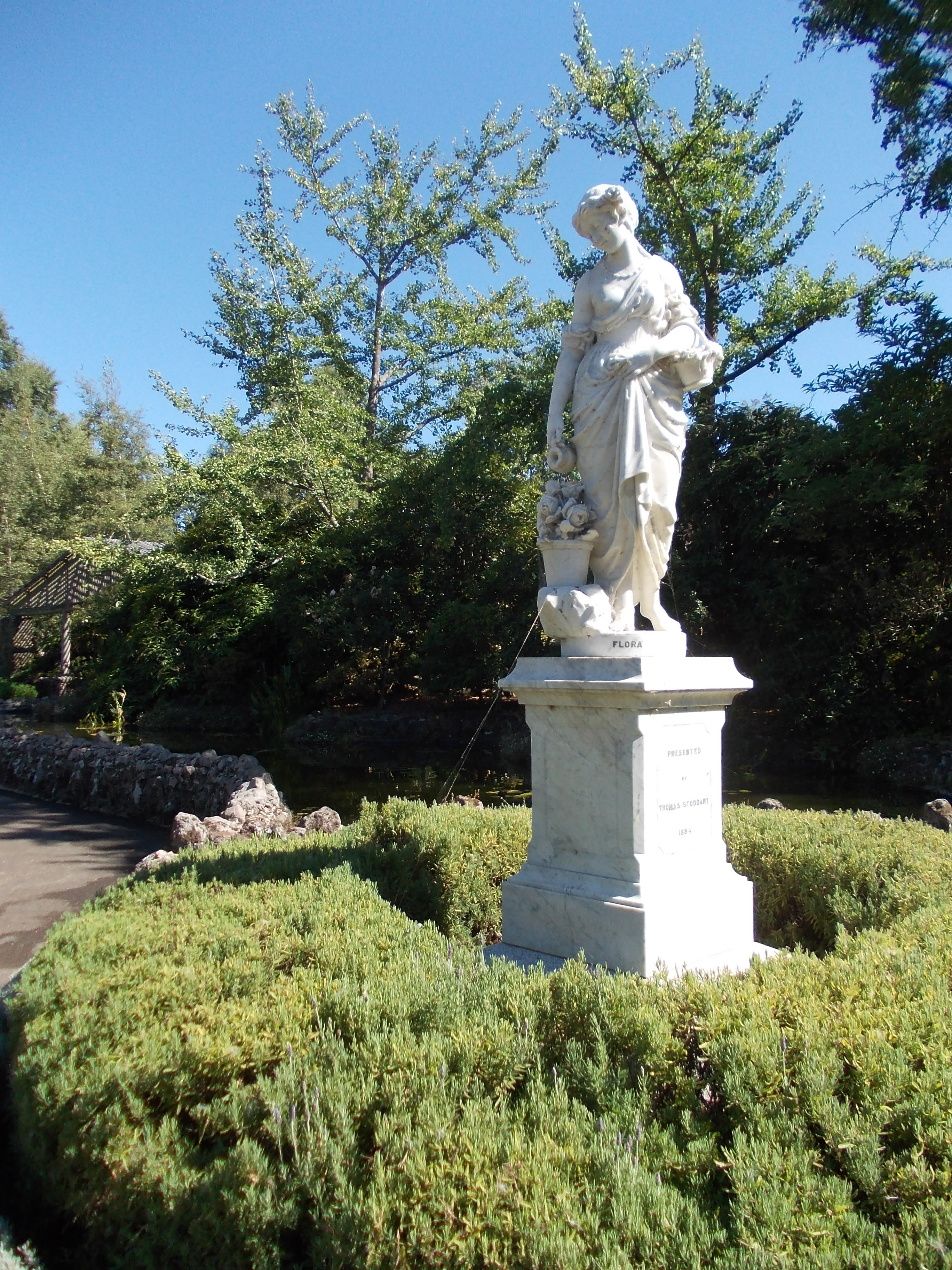
Thomas STODDART: Died 20 February 1905 at Ballarat. When next in Ballarat admiring the many statues in Sturt Street and the Botanical Gardens, thank Thomas Stoddart. He was responsible for getting the ball rolling for leading Ballarat identities to give statues or money towards statues, to the city. From digger to stockbroker, Stoddart donated twelve statues to the city of Ballarat in 1884 after a trip to Europe. This act of philanthropy saw some of Ballarat’s other wealthy citizens bequeath money to fund more statues.  In fact, John Permewan who featured in December Passing of the Pioneers donated the well know “Hebe” which stands in Sturt Street.  As well as the obituary from the Horsham Times, a lengthier obituary appeared in The Argus on February 21.

“FLORA”

“POMONA”

John COFFEY:  Died 9 February 1908 at Melbourne. John Coffey was born in Limerick, Ireland, and came to Australia with his brother in the 1860s. He first went to the Wimmera while carting between Melbourne and the Wimmera. Making a permanent home there, he worked as a farmer and a hotel keeper.  He left a wife, Catherine Almond, five daughters, and three sons.

Thomas HENNESSY: Died 19 February 1908 at Horsham. Thomas Hennessy arrived in Victoria in 1859 aboard the Royal Charter from Limerick, Ireland. He began farming around Koroit, lost a leg, and moved to the Pimpinio district, where he farmed for many years.  An accident before his death contributed to his demise.

James DAVIDSON: Died 12 February 1913 at Narrawong. James Davidson, born at Narrawong, was described as a “good all-round citizen” in his obituary. He was involved in the mounted rifles and athletics.

Matilda GILCHRIST: Died 14 February 1914 at Hawthorn.  Born in Paisley, Scotland, in 1920, she arrived on the Star of the East in 1855.  Her husband, Thomas Lang, was a well-known horticulturist in the late 19th century.  Matilda was the principal of a girls’ school in Ballarat for a time.

Mary Ann DREW: Died 15 February 1915 at Willaura.  Born in Buckinghamshire, England,  Mary Ann Drew came to Victoria in her twenties during the 1850s. She worked at Golf Hill Station at Shelford for George Russell before moving to Sandford, where she married William Lindon. Mary Ann lived at Willaura with her daughter for the last ten years of her life.

Edward Harewood  LASCELLES: Died 12 February 1917 at Geelong. Lascelles is a well-known name in Western Victoria.  Not only does his name form part of the Geelong wool broking firm Denneys Lascelles & Co., but the town of Lascelles in the Mallee was named after him.  Edward Lascelles was born in Tasmania in 1847, married Ethel Denney, and they had six children.  He was a leader in vermin extermination on his property in the Mallee and was the first to introduce share farming in Victoria.

Isabella McDONALD: Died February 1918 at Dandenong. Isabella McDonald arrived in Victoria with her widowed mother in 1863. The following year, she married journalist Mr Dudeney, who had gone to Ballarat to report on the Eureka Stockade riots. Only after a few years of marriage, Mr Dudeney passed away, and she married John Whitehead, a worker at the Ballarat Post Office and later the GPO in Melbourne

Martha MATHEWS: Died 14 February 1918 at Buninyong. Martha Mathews was a colonist of 64 years, arriving in Victoria to join her husband, Richard Phillips, on the goldfields of Ballarat. Martha enjoyed telling stories of the gold rush days.

OBITUARY. (1918, February 18). The Ballarat Courier (Vic. : 1914 – 1918), p. 6 Edition: DAILY.. Retrieved February 26, 2012, from http://nla.gov.au/nla.news-article75176846

Janet SIMPSON: Died 19 February 1920 at  Bondi, New South Wales.  Janet Simpson, her husband Robert Clark, and four children sailed for Australia in 1857. One child, Agnes, died during the journey. At the time of their arrival, the train line to Horsham was under construction, so the family took a coach to Stawell, then a bullock wagon to Horsham.  She was one of the many pioneer women who coped under tough conditions.

Obituary. (1920, February 27). The Horsham Times (Vic. : 1882 – 1954), p. 5. Retrieved February 26, 2012, from http://nla.gov.au/nla.news-article73190179

William HANLON: Died 19 February 1923 at Portland. William Hanlon was the mayor of Portland 11 times.  His interests within the municipality included the President of the Portland Free Library.

William ROBERTSON: Died 2 February 1924 at Portland.  A colonist of seventy-seven years, William Robertson, arrived in Portland as a five-year-old with his parents.  He had travelled to New Guinea and Western Australia as well, once riding in the Great Western Steeplechase at Coleraine.

Charles Francis PATTERSON: Died 17 February 1933 at Portland. Charles was born in Portland in 1857 and spent some time in Western Australia on the railways.  It was there he met his future wife, and after marriage, they returned to Portland to raise ten children.  Charles was a popular figure around the town, and he worked in the fish distribution business.

Alfred Irvine HOGAN: Died 8 February 1934 at Portland. From tightrope walker to saw miller, Alfred Hogan was an interesting chap.  Arriving in Portland as a young man, he gained notoriety as a tightrope walker performing daredevil tricks in the mould of “Blondin” the French tightrope walker.  Age must have caught up with his tightrope walking feats, and he turned to sawmilling, with his obituary crediting him as a pioneer of sawmilling in the Portland district, an industry which became one of the biggest in the area.  Alfred also had a keen interest in Australian Rules football and was one of the people behind the development of Hanlon Park, which is still home to the Portland Football Club today.

Mary Jane SPIKEN:  Died February 1934 at Warrnambool. Mary Jane Spiken’s mother, Anna Harland, arrived in Victoria with members of the Henty family.  Anna married John George Spiken, with Mary Jane born around 1861 at the Henty homestead.  Mary Jane married William Jenkins, and they had seven children.  She had a wealth of knowledge on the early days of Portland.

Fanny Ann MALSEED: Died 13 February 1936 at Myamyn. Fanny Ann was the daughter of James and Eliza Malseed of Mount Richmond.  She married Thomas Edmund Adamson around 1886 and they raised eight children.

Richard YOUNG: Died 16 February 1939 at Horsham. Richard was born at Clunes and moved to Horsham with his parents as a ten-year-old. He married Isabella Anderson, and they raised a large family. Richard was a keen footballer and played for the United Traders football club.  He was a founding member of the Horsham Football Club and was an active member of the local fire brigade.

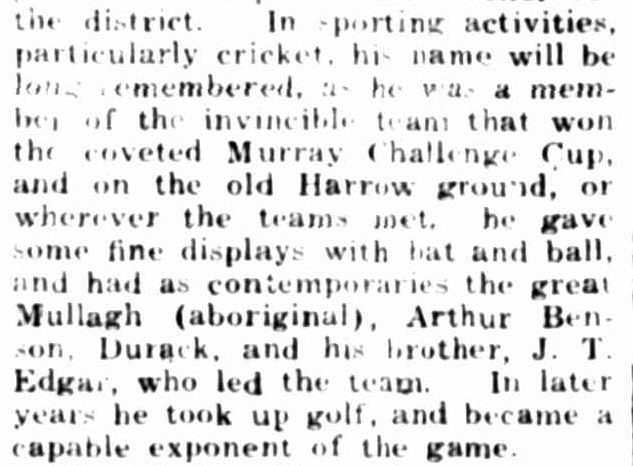
Walter Birmingham EDGAR: Died 22 February 1939 at Portland. Walter Edgar was born at Pine Hills Station at Harrow in 1856.  Educated at Hamilton College, he achieved the double honor of dux of the college and athletic champion.  Despite studying civil engineering at Melbourne University, he returned to Pine Hills to take up agriculture pursuits.  In 1882, he married Jessie Swan of Konongwootong.  In the years before his death, Walter toured England, Scotland, Norway, and Sweden with his daughter.  In his younger days, Walter was something of a cricketer and golfer.  He and his father played some part in the Aboriginal cricket team touring England in 1867.  The team included Johnny Mullagh, with whom Walter often played cricket.

Obituary. (1939, February 27). Portland Guardian (Vic. : 1876 – 1953), p. 3 Edition: EVENING.. Retrieved February 28, 2012, from http://nla.gov.au/nla.news-article64391911

Ann NIVEN: Died 24 February 1942 at Coleraine. Ann Niven came to Australia at five, but without her parents.  They arrived at a later date, but until then, Ann was under the guardianship of Mr and Mrs Christorphen.  They lived where Balmoral now stands, but then it was only bush.  She married William Bird, living at Wombelano, and then for the last thirty-two years of her life, at Coleraine.  Mrs Bird was the mother of eleven children.

Patrick HENRY: Died February 1942 at Terang. Patrick Henry, with his parents, settled in the Woodford area upon their arrival in Australia in 1866.  He began driving bullock wagons as a teenager and worked in that occupation until he was eighty-six.  When he finally retired, it was thought he was the oldest bullock wagon driver in the Western District.

Thomas Turner SHAW:  Died 1 February 1949 at Beaumaris. Thomas Shaw was the son of Thomas and Catherine Shaw. He was born in Victoria in 1864.

THOMAS TURNER SHAW c1866. Image courtesy of the State Library of Victoria. Image no. H2013.172/23 http://handle.slv.vic.gov.au/10381/235471

THOMAS TURNER SHAW c1866. Image courtesy of the State Library of Victoria. Image no. H2013.172/23 http://handle.slv.vic.gov.au/10381/235471

Thomas Shaw was not only a pioneer of fine merino wool production but also of motoring in Victoria.  He drove one of the first steam cars and was also a founding member of the Royal Auto Club (RACV).

St Stephen’s Church, Portland

During our recent trip to Portland, while the fish were biting, I managed to sneak away for a walk around the town of Portland.

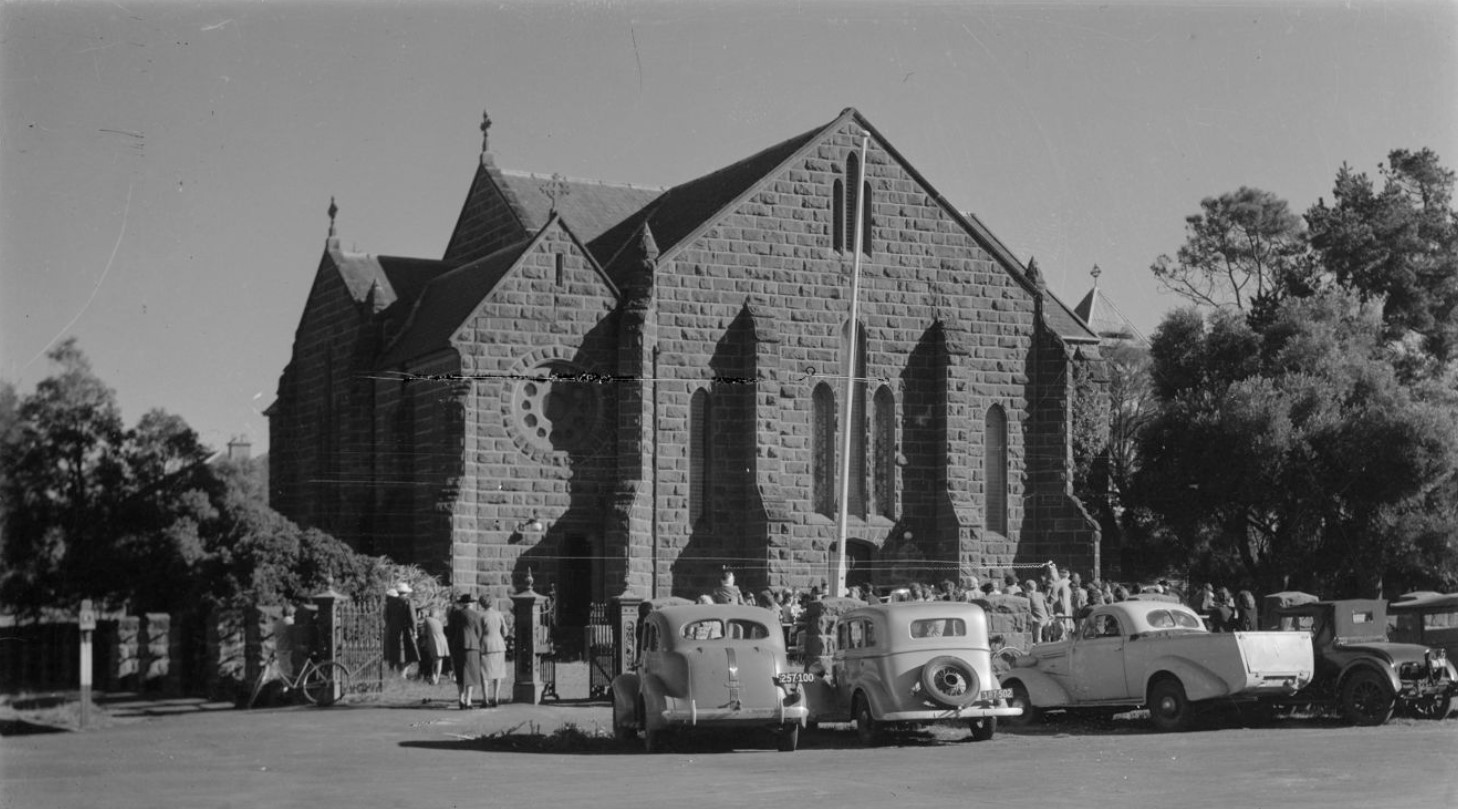
One building I visited was St Stephen’s Anglican Church on the corner of  Julia and Percy Streets.

St Stephens Church Portland

The foundation stone was laid on March 24, 1855.

St Stephens Church Foundation Stone

The Portland Guardian and Normanby General Advertiser reported on the laying of the foundation stone.

Local Intelligence. (1855, March 26). Portland Guardian and Normanby General Advertiser (Vic. : 1842 – 1876), p. 2 Edition: EVENING. Retrieved February 3, 2012, from http://nla.gov.au/nla.news-article71571938

I wonder if the reporter still had a job after overlooking the lunch that followed the ceremony.

I was impressed that the organisers of the day were able to secure Lieutenant Governor of the Colony, Sir Charles Hotham for the event.  However, after reading some articles about Hotham at Trove, and fitting the Portland visit into his timeline, I realised then he probably was trying to get as far away from Melbourne as possible.  The heat was on.  I would also imagine the Henty brothers’ connection to the church may have also been a factor.  Incidentally, Hotham was dead by the year’s end, having caught a chill, which exacerbated his already failing health.  This extract was published in the Empire (Sydney 1850-1875) on the same day as the report on the foundation stone ceremony and the tone is similar to other reports on Hotham at the time.

VICTORIA,. (1855, March 26). Empire (Sydney, NSW : 1850 – 1875), p. 5. Retrieved February 3, 2012, from http://nla.gov.au/nla.news-article60180148

Despite the church receiving a bell in 1864 from Stephen Henty, it was not until 1907 that the bell was hung.

St. Stephens’ Church Bell. (1907, July 5). Portland Guardian (Vic. : 1876 – 1953), p. 3 Edition: EVENING. Retrieved February 3, 2012, from http://nla.gov.au/nla.news-article63966019

Some histories of the bell may tell a different story of the bell’s origins as local historian Noel F. Learmonth had to admit in his article of October 29, 1951.  After reconfirming the story from 1907 article, he went on to say:

ST. STEPHEN’S BELL. (1951, October 29). Portland Guardian (Vic. : 1876 – 1953), p. 4 Edition: MIDDAY.. Retrieved February 3, 2012, from http://nla.gov.au/nla.news-article64429927

Entrance of St Stephen’s Church, Portland

A SHORT HISTORY OF ST STEPHEN’S CHURCH FROM 1869 TO THE PRESENT DAY. (1943, August 30). Portland Guardian (Vic. : 1876 – 1953), p. 4 Edition: EVENING. Retrieved February 3, 2012, from http://nla.gov.au/nla.news-article64386337

I wish I had read this article before I visited.  I would have like to have seen Stephen Henty’s stained glass window.

Interior of St Stephen’s Church

The organ on the wall of the altar has been in place since 1882.

INTERIOR OF ST STEPHEN’S CHURCH. Image courtesy of the State Library of Victoria http://handle.slv.vic.gov.au/10381/441320

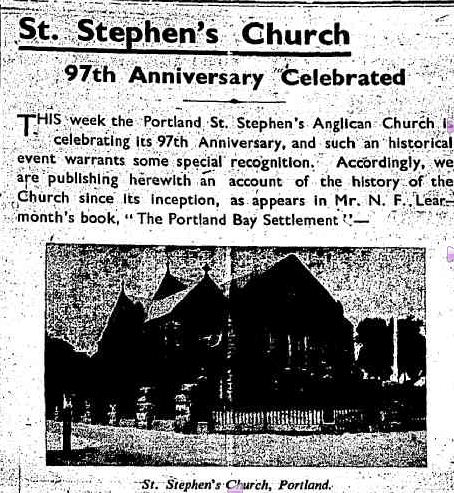
In 1953, the church celebrated its 97th anniversary.  The Portland Guardian of May 14, reported on the event and included an extract from one of Noel Learmonth’s books  “The Portland Bay Settlement”.  A nice touch was when the congregation sang “Happy Birthday” to the church.


St. Stephen’s Church 97th Anniversary celebrated. (1953, May 14). Portland Guardian (Vic. : 1876 – 1953), p. 3 Edition: MIDDAY. Retrieved February 3, 2012, from http://nla.gov.au/nla.news-article64434755

ST STEPHEN’S CHURCH. Image courtesy of the State Library of Victoria http://handle.slv.vic.gov.au/10381/61459

If you are interested in more history of the St Stephen’s Church, an article from the Portland Guardian of August 30, 1943, “A Short History of St Stephen’s Church from 1869 to Present Day” is worth a look.  It also includes a list of the 1943 members of the Ladies Guild.

Passing of the Pioneers

Seventeen more obituaries of Western District pioneers join the collection this month, and what a group they are.  I must say I had to pass a lot over, but it will ensure Passing with the Pioneers will be going to at least January 2014!  New papers at Trove has guaranteed that. Obituaries came from the Portland Guardian, Horsham Times and Ballarat Courier.

There are a couple of special ones, those of  James HENTY and Rebecca KITTSON and I highly recommend that you read the obituary in full.  I actually found Rebecca’s obituary rather moving and after driving through the Bridgewater area recently, I have great respect for her family and others that settled there.  To read the full obituary, just click on the pioneer’s name and the obituary will open in a new tab.  Some are a little hard to read, but magnifying the page helps.

I have also included a “young” pioneer who has a family link to me.  Thank you to Rachael Boatwright for allowing me to include a photo of her family member.

James HENTY: – Died 12 January 1882 at Richmond.  I thought trashy magazines today told all, but the obituary of the Honourable James HENTY M.L.C. shared every detail of the last twenty-four hours or so his life.  How can I possibly give a summary of the life of James HENTY, one of the pioneering HENTY clan?  Instead, read the obituary.  I think James’ life may have ended prematurely, if that is possible at eighty-two, due to a collision with a Newfoundland dog the week before.

JAMES HENTY c1855. Image Courtesy of the State Library of Victoria. Image no. H83.158/2 http://handle.slv.vic.gov.au/10381/290239

JAMES HENTY c1855. Image Courtesy of the State Library of Victoria. Image no. H83.158/2 http://handle.slv.vic.gov.au/10381/290239

Hugh MCDONALD: Died 30 January 1899 at Portland. This is a timely obituary coming so soon after my Portland trip.  While there, I learnt something of the wreck of the steamer Admella in 1859 and the Portland lifeboat crew that went to her aid. Hugh McDONALD was one of the brave men on board the life boat during that daring rescue.

William GARDINER: Died 17 January 1904 at Warracknabeal.  William GARDINER, another pioneer with an interesting life.  He arrived in Victoria in 1849 aboard the barque Saxon and spent time in Melbourne, Geelong and the goldfields, before heading to New Zealand.  On his return to Australia, he lived in Port Fairy and Hamilton, working as a journalist, before moving to the Wimmera as a correspondent for the Belfast Gazette.  He like it so much, he decided to select land at Warracknabeal.  He also worked as a correspondent for the Horsham Times and built houses!

Jean McCLINTOCK:  Died 19 January 1904 at Melbourne. While only forty at the time of her death and not an “old pioneer”, I have included Jean as she was the sister-in-law of  Alfred Winslow HARMAN.  Jean married William MILLER and they resided at Rupanyup.  After some illness, Jean travelled to Melbourne for an operation, but she died as a result.

Jean McClintock & William Eaton Miller. Photo courtesy of Rachael Boatwright & family.

Joseph JELBART: Died 17 January 1904 at Carapook. Joseph worked as the mail contractor between Carapook and Casterton up until his death. Prior to that, he had worked as a blacksmith and a wheelwright at Chetwynd, Merino and Natimuk. Interesting coincidence, just as Joseph did, his father and brother both died on a Sunday morning in the same house.

Rachel Forward READ: Died 15 January 1904 at Lower Cape Bridgewater.  Rachel Forward READ and her husband Richard Charlton HEDDITCH arrived in Adelaide in 1838 and settled at Cape Bridgewater from 1845 after a stint teaching at the Portland Church of England school.  They resided at the Lal Lal Homestead.  The  Victorian Heritage Database listing for Lal Lal includes a letter home by Rachel after their arrival at Cape Bridgewater.  Rachel was buried at the Cape Bridgewater cemetery rather than the Hedditch family cemetery at Lal Lal.

Donald McRAE: Died 12 January 1914 at Tooan.  Donald McRAE was born in Inverness, Scotland in 1842 and travelled with his parents to Portland. In 1865, he moved to Muntham near Hamilton to farm with brother. The pair eventually selected 320 acres of land each at Natimuk.  Donald was a member of the Horsham Caledonian Society.

Samuel WALKER: Died 24 January 1914 at  Ballarat. Samuel WALKER was born in Cheshire, England around 1828 and travelled to Australia in 1852.  After his arrival on the goldfields of Ballarat, he set up a soda water factory which proved profitable for him.  He then became a partner in Evans and Walkers and worked as an accountant.  He was also the registrar of Births, Deaths and Marriages at Ballarat from 1872.

Selina MILLER: Died January 1917 at Wickliffe. Selina MILLER had resided at Wickliffe for almost sixty years.  She was twice married.  Her first husband was Mr HAIG and her second, George HARRIOTT. Selina was buried at the Wickliffe Cemetery (below).

Elizabeth HUBBARD: Died 3 January 1919 at Horsham.  Elizabeth HUBBARD was born in Norwich, England around 1831 and travelled to Australia with her husband, Mathias HARDINGHAM in the mid-1850s.  From Geelong, they travelled to the Horsham area and were two of the first pioneers in that district.  Mathias ran the Horsham Hotel for some time.

Christina FOX: Died 8 January 1921 at Vectis.  Christine FOX was born in Yorkshire, England around 1835.  As a teenager, she travelled to South Australia with her parents.  She married Robert SANDERS who had also travelled with his parents on the same immigrant ship.

John W. DAVIS: Died 24 January 1928 at Horsham.  John or “Jack” as he was known, arrived in Australia as a three old, living in Williamstown and then Stawell.  He played with the Temperance Union Band in Stawell and then moved to Horsham in 1877 to play with one of two brass bands in the town.  Known throughout the northwest for his ability as a euphonium player, Jack was also a bandmaster at Natimuk and Noradjuha.

Rebecca KITTSON: Died 4 January 1929 at Portland. What a grand old pioneer Rebecca KITTSON was.  A colonist of eighty-eight years, she was a month from her 102nd birthday.  Arriving in Melbourne from Ireland aged eleven, she spent the next year in Melbourne, before joining her family at Cape Bridgewater where her father James Kittson had settled.  She married Reverend William LIGHTBODY, a Wesleyan minister in 1852.  This obituary is a must read.  Mrs LIGHTBODY, as she was known for most of her life, was the last surviving member of her family and the obituary gives a glimpse at how the KITTSON’S came to be in Australia.

Obituary. (1929, January 7). Portland Guardian (Vic. : 1876 – 1953), p. 2 Edition: EVENING. Retrieved January 17, 2012, from http://nla.gov.au/nla.news-article64268096

Adrian ANDERSON: Died 16 January 1932 at Horsham. This is a first for Passing of the Pioneers.  Adrian ANDERSON was an immigrant from the United States. Wisconsin to be precise. He arrived aged four, with his parents and resided in Western Australia until he was ten.  The family moved to Victoria, where he remained.  He ran a shop in Jeparit before his death in the Horsham Base Hospital.

Agnes Sarah COOK: Died 18 January 1942 at Casterton. This obituary begins “Born in a small house on the banks of the  Glenelg River at Casterton seventy-nine years ago…”.  Agnes was a lady that like the past and the future, knowledgeable about the history of Casterton, she also liked to predict the future.  Agnes married  Robert SYLVESTER and they had four children.

Helen GULL: Died 18 January 1942 at Casterton. Helen was born on the ship Helen during her parents’ voyage to Australia in 1852.  The GULL family became respected pioneers throughout the Western District.  Helen married Frederick PERRY in 1876 and they resided at well known Western District properties, Rifle Downs at Digby and Runnymeade at Sandford.  Frederick later ran the Digby Hotel.