Everybody Happy?

This is the third draft of this post, and it is definitely the final one. Researching this subject has taken me through several twists and turns. I’ve gone from happy dancing around the room to slumped over the keyboard with frustration to happy dancing around the room again.

In my post “Left Behind,” I alluded to a discovery that linked Mary Ann Harman to Australia. It was the Passenger Lists that led me to my subject, and those same passenger lists have contributed to my despair, leaving me desperately searching for answers.

So far, I have bookmarked almost 100 newspaper articles, watched film archive footage, listened to sound archive footage, read musical scores, and entered a lost world of entertainment, vaudeville. I have gone from the stages of the Bristol Hippodrome to the Melbourne Tivoli, from the BBC to the ABC.

I could not share this story until I knew the truth.

So without further ado, let me introduce you to the star of the show –

!!!!!!!!!RUPERT HAZELL!!!!!!!!!!!!!

!!!!!!!!!RUPERT HAZELL!!!!!!!!!!!!!

Rupert Alexander Hazell was born in West Ham, London in 1887. He was the son of Charles George Hazell and Harriett Sarah Loats, daughter of Mary Ann Harman, and granddaughter of Byaduk pioneers, Joseph and Sarah Harman. Charles Hazell worked on the wharves, and Rupert followed him there to work, first for the Royal Naval Stores and then the Port Authority.

But Rupert’s heart was not in it. He was funny, a born comedian.  Despite passing the examinations to enter the Civil Service and delighting his parents, he wanted to share his humour. With that and his musical talent, he said goodbye to the Civil Service.

In 1913, he formed his first partnership, marrying Florence Adele McKnight at Kingston, Surrey.  Adele worked as a saleswoman for a costumer and it’s possible that she met Rupert there. Years later, it was revealed  Rupert had a great interest in ladies’ stage costumes.

The following year, their son was born and christened with the same name as his father, Rupert Alexander.

Rupert was already treading the boards when he enlisted for WW1 in 1916, listing his occupation as an entertainer. He was an acting sergeant in an English hospital, one that saw ANZAC troops as patients.

It was writing songs for Music Hall star George Robey that saw his career take off.  From there, he impressed Wal Pink and vaudeville director Albert De Courville.

THE PHILOSOPHY OF HUMOR. (1927, February 5). The Advertiser (Adelaide, SA : 1889 – 1931), p. 14. http://nla.gov.au/nla.news-article40762292

Radio came to England in 1920 with Dame Nellie Melba making one of the first broadcasts on Marconi’s test station, 2MT in Essex. Rupert, too, was one of those early broadcasters, being one of the first comedians signed by the Marconi Company. The Marconi Company evolved into the BBC in 1922, with whom Rupert broadcast for at least the next two decades.

In 1922, Rupert travelled to New York for the Broadway show, Pins and Needles, co-written by De Courville and Pink, with lyrics co-written by Rupert. He also appeared in the show for the month of February.

The 1923 Royal Command Performance was Rupert’s next big appearance, before King George V and Queen Mary. After this event, advertising for his shows promoted him as “The Man who Made the King Laugh”.

In 1925, Rupert Hazell hit Australian shores for a tour of the Tivoli circuit. With soprano, Miss Elsie Day (her stage name), they toured Sydney and Melbourne with both critical and popular acclaim.

The visit turned into a four-year stay, with Hazell not returning to London until 1929. During that time, he became a radio star with the ABC with stints in all the Australian capital cities and New Zealand.

Accompanied by Elsie Day, their vaudeville act comprised Rupert’s jokes and Elsie’s songs. Taking on a clown-like appearance, Rupert had wild hair and a funny little hat, while Elsie always dressed in her famous crinoline dresses. Rupert greeted audiences with the familiar opening:

“Hello People. Everybody happy?”

This advertisement for the Tivoli, Melbourne, has Rupert and Elsie on the bill with their show “Harmonylarity”

[No heading]. (1925, November 18). The Argus (Melbourne, Vic. : 1848 – 1956), p. 32.  http://nla.gov.au/nla.news-page443364

Around the Studios. (1929, September 5). Western Mail (Perth, WA : 1885 – 1954), p. 12.  http://nla.gov.au/nla.news-article37675276

By 1928, Rupert Hazell was well known around Australia thanks to radio broadcasts, vaudeville shows, and speaking engagements with groups such as Rotary. According to The Register (S.A), Rupert and Elsie were the first performers to fly between venues.
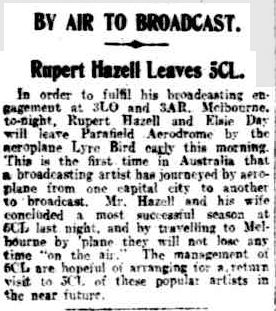
BY AIR TO BROADCAST. (1928, July 31). The Register (Adelaide, SA : 1901 – 1929), p. 14.  http://nla.gov.au/nla.news-article57063715

POPULAR ARTISTS ON THE AIR. (1928, August 1). The Advertiser (Adelaide, SA : 1889 – 1931), p. 14. http://nla.gov.au/nla.news-article29283864

Not only was Rupert a comedian, broadcaster, and composer, but in 1925, while in Australi,a he patented his invention, the Cellocordo, an instrument like the Phonofiddle invented by A.T. Howson.  Rupert also played the Phonofiddle, but also did much to promote his version.
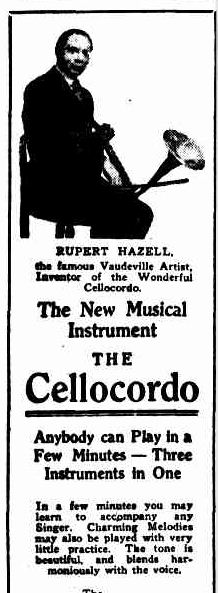
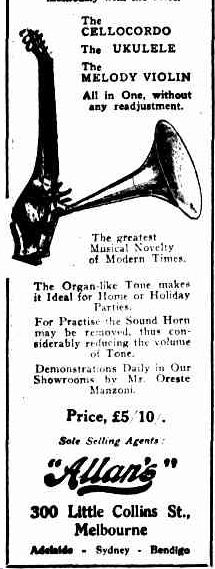
Display Advertising. (1926, March 20). The Argus (Melbourne, Vic. : 1848 – 1956), p. 20.  http://nla.gov.au/nla.news-article3741055


It is around this time in Rupert’s life that questions come up. I had read many articles at Trove about the pair’s 1920s visit and a later visit in 1933-34. Frequently, newspapers reported Elsie as Rupert’s wife. If “Miss Elsie Day” was a stage name, was I to assume that her real name was Florence McKnight?

It was a search at the UK National Archives that uncovered a record of divorce served on Rupert Alexander Hazell by Florence Adele McKnight in 1929. The same year, they both supposedly returned from Australia. But why did Rupert continue to perform with Elsie into the 1930s and beyond if she was Florence?

I had to find out the true identity of “Miss Elsie Day”. I went back to the Passenger Lists and once again studied Rupert’s entries. One would expect that Miss Day would travel using her real name.

There was another “Hazell” listed on three occasions. The first was in 1929 on their return to London.  Accompanying Rupert on the voyage was Eva Hazell, a vocalist. Very interesting. Also interesting was that they each listed a different residence on their return to London, Rupert at 74 Cornhill, London, and “Eva Hazell” at 28 Salmon Road, Kent.

In the later records, 1932 from South Africa and 1934 from Brisbane, Rupert was travelling with Sarah Eva Hazell. Their address was the same, 13 The Fairway, North Wembley. The 1932 record listed Sarah as “wife” and on the 1934 record as “soprano”. On each record, there was a 15-year age difference between Rupert and Eva, while there was only a two-year difference in age between Rupert and Florence.

Eva. That name rang a bell. I had found a marriage record from 1931 listing Rupert Alexander Hazell marrying a woman with the surname Pank. Further investigation revealed her full name was Eva Pank. I had initially assumed this record was for Rupert junior, as I thought Rupert senior was happily married to Florence “Elsie Day” McKnight. I also found the death record for Sarah Eva Hazell from 1988. Things were looking a lot different.

I was now working on the assumption that “Miss Elsie Day” was Sarah Eva Pank. That would mean that when Rupert and “Elsie” were in Australia for the first time, they were not married.

Observer (Adelaide, SA: 1905 – 1931) 5 October 1929, p. 56 http://nla.gov.au/nla.news-article165610189

Then, on their arrival back in England, Florence was waiting with divorce papers. Two years later, in 1931, Rupert finally married his “Miss Elsie Day” and they returned to Australia legally as man and wife. But I could not make such claims without proof.

Back to Trove, and I read through articles from the first visit, comparing them to the second. Was there any way reporting on their relationship was different on each visit? I analysed every interview looking for clues. With no paparazzi following the couple, there were no scandalous rumours, but there were some differences.

On the earlier visit, articles mentioned Rupert Hazell appearing with Miss Elsie Day or his partner, Miss Elsie Day. On one occasion, The Register (Adelaide) reported Elsie was Rupert’s wife, and he referred to her as his “little grandmother”.

BROADCASTING. (1928, July 11). The Register (Adelaide, SA : 1901 – 1929), p. 13.  http://nla.gov.au/nla.news-article57056909

BRIGHT COMEDY VAUDEVILLE. (1928, February 15). The Brisbane Courier (Qld. : 1864 – 1933), p. 25. http://nla.gov.au/nla.news-article21223381

After the formal reporting on the “relationship” during the 1920s visit, the first article after they stepped off the boat at Perth on their return to Australia was totally different:

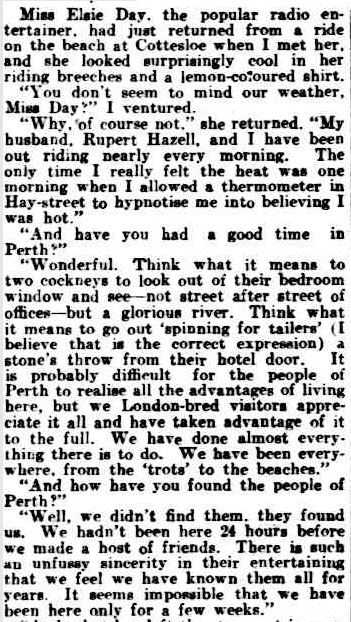
A BROADCASTING STAR. (1933, December 22). The West Australian (Perth, WA:1879-1954), p. 7.  http://nla.gov.au/nla.news-article32777824

I love this article. The couple was certainly living the good life.

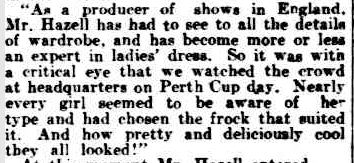
ATTRACTIVE PERTH GIRLS. (1934, January 23). The West Australian (Perth, WA : 1879 – 1954), p. 3. http://nla.gov.au/nla.news-article32795395

Getting copies of divorce papers was a possibility, but a quote of £63 for a digital copy was making it less of an option, although I was getting desperate. I then remembered a comment on a photo on Flickr from the ABC Archive.

The photo is of Rupert and “Elsie” to the right with 3LO Melbourne’s Fred Williams. A comment on the photo from Claire mentioned Elsie Day and Rupert were her gg aunt and uncle. Before I parted with my money for the divorce record, I would contact Claire.  A prompt reply came back, giving me cause to happy dance around the room once again. Claire told me Elsie Day’s real name was Eva Pank or Sarah Eva Pank. She was Claire’s gg aunt on her maternal side.    

I had noticed advertisements from 1924/5 for the Bristol Hippodrome with Rupert performing his show “Harmonylarity” accompanied by Eva Parke. I now believe that was Sarah Eva Pank, and that was when their relationship began.

I can now move on. There is so much more I could tell you about Rupert Hazell’s life. His philosophies of comedy and the audience, topics he spoke of regularly, offer a fascinating insight into early 20th-century entertainment. I also tried to strip back the grease paint to find the “real” Rupert and revealed a complex, intelligent man not afraid to give his opinion, especially about his own talents.

Determination and hard work took him from the ports of London to the stages of the world. He saw comedy move from vaudevillian performances to radio and, in his final years, television, a medium he would have enjoyed being a part of, but I have no evidence of his involvement. Rupert passed away in 1958 at Hampstead, London, aged 71.

When I first discovered Rupert, my only question was if the Harman family in Australia knew of him. I feel they probably did not know their family link, since contact between the Harmans of England and Australia may have ended once Mary Ann passed away in 1873. All the same, it is nice to think Sarah Harman of Flemington, aged in her early 80s, may have tuned her wireless to 3LO and listened to her great-nephew Rupert.

Am I happy? Yes, I am Rupert!

You can watch a performance by Rupert and Elsie from 1935 on this video of footage from the British Pathé. Rupert even plays his Cellocordo.


THANKS

I must thank Alison Rabinovici, who has researched Rupert and his Cellocordo, including for a piece at the Jon Rose Web Project site.  She replied to my enquiry promptly and offered many places to look for further information. She has since followed up with more contacts, and I thank her for all her help.

I big thank you must go to Claire Hardy, the gg niece of Sarah Eva Pank. Without her, I would still be tearing my hair out, spending every waking moment reading, rereading, and analysing.  Thanks to Claire, I can now move on to something else. Some would suggest housework…


SOURCES

1891, 1901, 1911 England Census

British Army WW1 Pension Records (1914-1920)

British Newspaper Archive

British Pathe

England & Wales Death Index (1916-2005)

England & Wales Marriage Index (1916-2005)

Flickr

FreeBDM

Hippodrome Bristol

National Archives of Australia

Papers Past

Trove Australia

The Jon Rose Web Project

The National Archives (UK)

UK Incoming Passenger Lists 1878-1960

Left Behind

I have told you about the original Harmans of Byaduk and their time in Cambridgeshire, their journey to Australia, and their life beyond.  What I haven’t told you about is the family members that were left in England.

Yes, Joseph and Sarah Harman had children that did not make the voyage to Australia, thus never getting the opportunity to live the long and prosperous lives of their siblings.

For most of the children, it was death that robbed them of the life-changing experience.  For Mary Ann, the eldest living daughter, it seems marriage and children sealed her fate.

The children of Joseph and Sarah that did not travel to Australia were:

James:  Born 1827, Cambridgeshire, Died 1827, Cambridgeshire

Mary Ann:  Born 1829, Melbourn, Cambridgeshire; Died 1873, Poplar, London.

Alfred:  Born 1833, Melbourn, Cambridgeshire; Died 1851, Melbourn, Cambridgeshire

Arthur: Born 1842, Melbourn, Cambridgeshire;  Died ?

Ann:  Born 1847, Melbourn, Cambridgeshire;  Died ?

Betsy/Elizabeth:  Born 1849, Melbourn, Cambridgeshire;  Died ?

James was first born of Joseph and Sarah but he died as a baby.  Alfred was the fourth born child and he appears on the 1841 England Census.  His death was registered in January 1851 thus missing the 1851 England Census.

It was that census in 1851 that Arthur, Ann and Betsy appeared, all born after the 1841 England Census.  The question is, what happened to them between 1851 and 1854 when Joseph and Sarah and three children sailed for Sydney?  I have not found death or marriage records for these three children.

Second born child and eldest daughter, Mary Ann was married in 1847.  Her husband was James Loats, who was living with his family in the same street as the Harmans, Drury Lane, Melbourn.  After their marriage, they continued to live in Drury Lane in their own house.

At the time, none of the family would have even heard of Australia let alone considered making it their home.  However, on three occasions from 1852,  Mary-Ann said goodbye to family members beginning their journeys to Australia.   It began with James and his new wife Susan sailing on the Duke of Richmond in 1852.  Then the three boys, George, Jonathan, and Reuben.

In 1854, the last goodbyes came when her parents sailed.  Around this time Mary Ann was living in London.  Maybe she was at the docks.

Mary Ann and James had 10 children that I can match on the various census and vital records.  The first three children were born in Melbourn, with the remaining seven born in London.  James was working as a labourer at a coke oven.  Mary Ann died in 1871 at just 43 leaving four children under 10.  Aside from her brother Reuben, all the siblings that immigrated to Australia lived to around double that age.

Recognition of the Harman family is clear with the names of the Loats children. Julia again proves a popular Harman name, possibly the earliest record of that name in the family.

Betsy/Elizabeth: Born 1849, Melbourn, Cambridgeshire

Julia:  Born 1851, Melbourn, Cambridgeshire; Died 1856

Harriet Sarah:  Born 1852, Melbourn, Cambridgeshire;  Marriage:  Charles George Hazell, 1874 West Ham, London; Died:

Mary Ann Harman:  Born 1854, Camberwell, London

Wilfred:  Born 1857, Camberwell, London; Died 1857 Camberwell, London

Julia Mary Ann:  Born 1858, Rotherhite, Surrey; Died 1900 Holburn, London

Laura: Born 1861, Bromley Middlesex

Grace:  Born 1864, Bromley Middlesex

Joseph Harman:  Born 1867, Poplar, London

Jesse:  Born 1868, Bromley, Middlesex

I had always hoped I might find an Australian link through the Loats line, especially as I know of the name from the Hamilton area.  I have found two links.

Firstly, aboard the Duke of Richmond with Susan and James Harman was Thomas Loats, the brother of James.  Thomas settled in the Western District.  It makes me wonder how close  James and Mary Ann may have come themselves to settle in  Australia.  What stopped them?

Secondly, thanks to the granddaughter of Joseph and Sarah Harman, Harriet Sarah Loats, I have found a link taking a Harman descendant where none have gone before.  However, this post has gone on long enough and I will need to dedicate a whole post to my exciting find.  Stay Tuned!  (That might be a clue).

It’s My 1st Blogiversary!

Happy 1st Blogiversary Western District Families.  I thought we would never make it, but 84 posts and 12 months later, here we are.

What a fun year it has been.  It really was worth procrastinating about whether to blog or not to blog.  Over time I have made some great online friends, met some previously unknown family members, and found out so much more about my Western District family.  Western District Families even got a Google+ page!

I hope some of you have also found out something about your Western District family, where they lived, and the things they did through posts such as In the News and the Pioneer Christmas series.  Maybe you have found an obituary of an ancestor at Passing of the Pioneers.

I have found that the act of writing out my family history has been so useful for my research. It has helped me sort out what information I have but more importantly, what I don’t have.  Also, lining up the lives and events of siblings, in the case of the Harmans for example, has given me a better understanding of the dynamics of the family (can you tell I was a Social Sciences student?).

So what have been the most popular of the past 84 posts?

1.  The Fastest Ship in the World

2. A Tragic Night – January 24, 1882

3. Histories of  South-West Towns

4. Witness for the Prosecution

5. Only Seven More Sleeps…

Which posts have been my favourite to share?  Well it was hard to narrow them down to just five but here they are:

1 Elizabeth Ann Jelly

2. All Quiet By the Wannon

3. Halls Gap’s Cherub

4. From Stone Country to High Country

5. A Tragic Night – January 24, 1882

An Honourable Mention must go to  What the Dickens? and the follow-up post Another ‘What the Dickens” Moment.  They were both interesting and fun to write.

Over the past year, I have had made contact with Gamble and Jelly cousins and members of the Condon, Adams, and Oakley families.

I  also heard from Rosemary of Tulsa, Oklahoma. Her great grandparents were married in the original St Stephens Church in Portland.

Plenty is planned for the next 12 months.  I thought I would run out of things to write about. Instead, I am finding it difficult to keep up with all the subject ideas I have. There will be more Passing of the Pioneers and later in the year, I will look at Christmas in the early part of the 20th century.  Of course, I will have more stories about my family.  I’ve barely touched on some of the stories I had planned when I started the blog as I keep finding more great stories in the meantime.

A big thank you must go to my fellow Australian geneabloggers.  Your support and encouragement have been fantastic and you have all inspired me to keep going.   What I have learnt from each of you has been invaluable.  It was great to meet some of you at the Unlock the Past Victorian Expo at Geelong last year.  Also to the 29 followers of Western District Families, thank you for following and for your great comments.

I must also make a special mention of my maternal grandmother, Linda Gamble (nee Hadden).  Nana did not get to see my blog.  She passed away six days before I published my first post.  It was Nana that got me to this point.  Her love of the past and her family inspired me almost 20 years ago to start researching our family tree simply to find out more about them for her.  What a wonderful family she gave me.

Nana & me

Alfred Winslow Harman – Stepping out of the Shadows

Imagine the family tree of the Harmans of Byaduk, with its long branches sweeping far and wide, lush and prosperous.  That is except for one.  Near the top of the tree sits a small, stunted branch, a mere twig.  It is the branch of Alfred Winslow Harman.

To me, Alfred Harman is like a shadowy figure standing at the rear of the imaginary Harman family photo.   I know little of him and there are no living descendants.

Born in Melbourn, Cambridgeshire in 1852, Alfred was a baby when he sailed to Australia with his parents Joseph and Sarah, sister Sarah and brother Walter.  He was too young to remember life in England, the arduous journey and the early settlement of the family.

Alfred was seven years younger than Walter Harman, his immediate older sibling, and 22 years younger than his oldest brother James.  He probably had more in common with the elder children of his brothers than his brothers themselves.  For example, James Harman’s son Reuben James Harman, my gg-grandfather was only two years younger than his Uncle Alfred.

In his 20s, Alfred headed north to the Wimmera.  It was there that he met Alice Jane Miller, daughter of Scots Joseph Bass Miller and Rose Jane Church of Warracknabeal, formerly of South Australia.  Alfred and Alice married in 1878 and their only son was born in 1879 at Murtoa.

Let’s stop right there…

If I keep going on like this, the post will be over in another paragraph.  All I have to say further is that Alfred went to Western Australia, suffered a loss, returned home and passed away! There must be more to add to this branch to give it some life.

For the purpose of this post, I decided to search for Alfred again at Trove.  With newly digitised papers added regularly, it is worth checking back.  This time I directed my search to the surname “Harman” and the places I knew Alfred lived.  Starting with “Harman Murtoa”, as I gathered leads I moved to “Harman Rupanyup” and then “Harman Hopetoun”.  I searched the decades, the 1870s, 1880s and 1890s.

I then turned my attention to Western Australia, where I knew Alfred had lived.  I tried “Harman Gwalia”, “Harman Perth”, “Harman Malcolm Street”, “Harman The Crescent” between the years 1900-1930.

Thanks to a  number of other leads on Alfred and his wife Alice, the story of Alfred Winslow Harman is looking better.

Let’s pick up the story again in 1878 with Alfred’s marriage to Alice.

Alice Jane Miller was born at Pancharpoo, South Australia in 1859.  The Millers moved to Warracknabeal after 1868.  Alice’s father, Joseph Bass Miller, was an upstanding citizen and the local Justice of the Peace. I have found that while Joseph spelt his name as Miller, some of his children spelt it Millar. In case you are wondering further on in the post.

After Alfred and Alice married in 1878, they soon started their family.  Herbert Winslow Harman was born at Murtoa in 1879.  I am not sure if they were living there or at Rupanyup as newspaper articles found refer to them at both places.  There are only 16 kilometres between the two towns.

The first newspaper reference I have for the Harmans is from 1883 in a Horsham Times report of the Rupanyup and Dunmunkle Society Show. Alice won Best Ironed Gent’s Shirt and Collar.

Subsequent articles show Alfred had something of a talent for rifle shooting.  Alfred entered many competitions and was a member of the Rupanyup Company of Rangers.  In 1886, he and four teammates secured the coveted Sargood Shield, so prized a banquet was held in their honour.

COMPLIMENTARY BANQUET TO THE WINNERS OF THE SARGOOD SHIELD. (1886, December 24). The Horsham Times (Vic. : 1882 – 1954), p. 3. Retrieved March 13, 2012, from http://nla.gov.au/nla.news-article72957471

The team went on to repeat their success in the following two years, as remembered at a dinner at Horsham in 1913.  Samuel Miller, Alice’s brother, also a member of the famous Rupanyup team, was present on the night

The Rifle. (1913, March 7). The Horsham Times (Vic. : 1882 – 1954), p. 5. Retrieved March 13, 2012, from http://nla.gov.au/nla.news-article73134863

.In 1890, the team competed at Mount Gambier, the hometown of the Miller boys.  It was there they suffered one of their few defeats.

RIFLE MATCH. (1890, August 30). Border Watch (Mount Gambier, SA : 1861 – 1954), p. 2. Retrieved March 13, 2012, from http://nla.gov.au/nla.news-article77491178

By 1897, Alfred Harman was shooting with the Hopetoun club, over 100 kilometres north of Rupanyup.  The Hopetoun Rifle club was more than happy with their new acquisition,

RIFLE SHOOTING. (1897, February 9). The Horsham Times (Vic. : 1882 – 1954), p. 2. Retrieved March 13, 2012, from http://nla.gov.au/nla.news-article73118794

Alfred and his family could not have stayed at Hopetoun long, as I found him on the 1903  Electoral Roll at Gwalia, Western Australia. Gwalia was a gold mining town situated over 800 kilometres east of Perth and north of Kalgoorlie.  Gold was first mined there in 1897, so the town was in its beginnings when Alfred was there.

Today, Gwalia is described as a ghost town but has been preserved so the town’s history is not lost.  The Gwalia & Hoover House Historic Precinct website has some great photos of some of the buildings in the town.

How the Harmans came to be in Western Australia, especially in the middle of nowhere at Gwalia, I can only guess.  Two of Alice’s brothers, Joseph and Josiah Miller also turned up in Western Australia, so there may have been some motivation there.

In both 1903 and 1906 on the Gwalia Electoral Roll, Alfred listed his occupation as an agent, however in 1906, he is also on the electoral roll for Midland Junction, Perth (commercial traveller) and Francis Street, Perth (traveller).  Who knows where he and Alice were actually living at the time?  Especially Alice, as she was on the 1903 Electoral Roll at Warracknabeal, the hometown of her parents.  Did Alfred go ahead or did Alice just fail to change her details?

When Alfred and Alice went to the West, their son Herbert, the aged around twenty,also went along. After only a few years, Herbert was working as the manager of the Canada Cycle and Motor Company at Kalgoorlie.  In November 1904, tragedy struck when Herbert (Bert) was stricken with typhoid fever.  He passed away in the Perth Hospital on November 20.  Alfred and Alice had lost their only child.

Family Notices. (1904, November 29). Kalgoorlie Western Argus (WA : 1896 – 1916), p. 16. Retrieved March 14, 2012, from http://nla.gov.au/nla.news-article32744043

I noted Warracknabeal was given as the home of Alfred and Alice. As mentioned, Alice’s address was Warracknabeal in 1903, but did Alfred also live there at some time?.

The death of Bert also hit the Miller side of the family hard.

Family Notices. (1904, November 22). The West Australian (Perth, WA : 1879 – 1954), p. 1. Retrieved March 14, 2012, from http://nla.gov.au/nla.news-article25367642

Joseph Bass Miller Jnr, Alice’s brother was a Health Inspector in Perth. The funeral left his home at The Crescent, Midland Junction.  This is just one of the addresses Alfred is listed at on the 1906 Electoral Roll.

The funeral of Bert was large, with many members of the Miller family in attendance.

NEWS AND NOTES. (1904, November 24). The West Australian (Perth, WA : 1879 – 1954), p. 4. Retrieved March 14, 2012, from http://nla.gov.au/nla.news-article25367801

What interested me in this report was the coffin…” a massive polished jarrah casket, mounted with silver-plated handles and plates”.  Either Alfred’s job as a travelling salesman was doing well or the Miller family chipped in.  Bert himself had done alright for a 25-year-old, with an estate to the value of £212.00.

NEWS AND NOTES. (1905, January 13). The West Australian (Perth, WA : 1879 – 1954), p. 4. Retrieved March 14, 2012, from http://nla.gov.au/nla.news-article25371654

In 1905, Alice’s mother Rose Church passed away at Warracknabeal and her then 81-year-old father moved to Perth.  He passed away in 1908.

Family Notices. (1908, August 22). Western Mail (Perth, WA : 1885 – 1954), p. 31. Retrieved March 15, 2012, from http://nla.gov.au/nla.news-article37577065

If I ever wanted to find out where Alfred was living, Electoral Rolls were not going to help. From 1910 to 1916, Alfred was listed at 71 Malcolm Street, West Perth.  That is the only period where Alfred did not have multiple entries.  In 1910, Alfred was a collector and in 1916, he was a clerk.  In thirteen years, he has been an agent, commercial traveller, traveller, an agent again, collector, and clerk.

After the 1903 Electoral Roll,  Alice did not show up again until 1916, living at 71 Malcolm Street, West Perth with Alfred. However, from my search at Trove of “Harman Malcolm Street”, I know Alice was at 71 Malcolm Street in 1914.  How?  Thanks to this interesting snippet from The Western Australian.

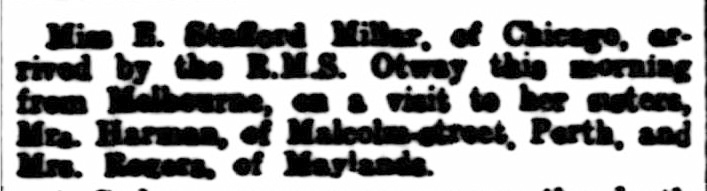
PERSONAL. (1914, October 7). The West Australian (Perth, WA : 1879 – 1954), p. 6. Retrieved March 14, 2012, from http://nla.gov.au/nla.news-article28570146

It is a little difficult to read, but what is that about Miss E. Stafford Millar, of Chicago visiting her sister Mrs Harman, of Malcolm Street, Perth?  I checked back on the Miller family tree and Elinor Stafford Millar was the sister of Alice.  But what about Chicago?  Any excuse to get sidetracked, I turned to Trove again.  A search on Elinor revealed all.  Who needs Google?

PERSONAL. (1914, September 22). The West Australian (Perth, WA : 1879 – 1954), p. 8. Retrieved March 14, 2012, from http://nla.gov.au/nla.news-article28568583

In fact, I found so many articles on Elinor, I have decided she deserves her own post in the future.  She was after all, born at Mount Gambier, almost Western Victoria!  I found she was an amazing woman, well-travelled and known in the U.S. as the “Australian Evangelist”

I had seen a photo of Elinor on the family tree of Rachel Boatwright at Ancestry.com.au (one of Rachel’s photos of Alice’s brother William Miller is on  January Passing of the Pioneers). I was taken in by the difference between her photo and those of her siblings.  Now I know she led a very different life at the Moody Bible Institute in Chicago.   I found another photo of her in The Advertiser, Adelaide from 1937.

South Australian-Born Woman Evangelist. (1937, December 11). The Advertiser (Adelaide, SA : 1931 – 1954), p. 16. Retrieved March 14, 2012, from http://nla.gov.au/nla.news-article36394976

Back to Alfred…his next Electoral Roll appearance was in 1925 at 105 Stirling Street, North Perth.  But wait, he is also listed at Dumbleyung in Western Australia’s wheat belt, a long way from Perth.  At his Perth address, he was a clerk, while at Dumbleyung he was retired.  No mention of Alice at either address.  That was because, in 1924, she was on the electoral at 593 Burke Road, Camberwell, Victoria!

Further investigation found that this was the address of Alice’s brother Alexander.  She is also listed at 27 Aroona Road,  Elsternwick on the  Electoral Roll from the same year.  I don’t know whose house that was!  I sometimes wish the Electoral Rolls were like a census, listed by household and not surname.  It would make it so much easier to find out who was living with who.

Alice appears on the Electoral Roll again in 1931, this time at 15 Torrington Street, Canterbury. But where was Alfred?  He was listed over at 50 Downshire Road, Elsternwick of course!.  Why does that address sound familiar?  It just happened to be the address of Alfred’s niece, Susan Oakley, daughter of Alfred’s sister Sarah Harman.  And that is where it all ended for Alfred, at 50 Downshire Road, Elsternwick on March 22, 1933.  He was buried at the Box Hill Cemetery.

Family Notices. (1933, March 24). The Argus (Melbourne, Vic. : 1848 – 1956), p. 1. Retrieved March 14, 2012, from http://nla.gov.au/nla.news-article4725647

The link to Susan Oakley explains why Susan and her husband Robert Cruikshank are mentioned in the family notice.  There was only 13 years’ difference in age between uncle and niece and Susan was living in the Wimmera, including Rupanyup,  at the same time as Alfred, which may explain their close relationship.  I like to find these links as it gives me some idea of the family dynamic.

So what became of Alice?  According to the Electoral Roll of 1936, she had moved to the house next door at 17 Torrington Street, Canterbury.  She passed away on May 21, 1940, and was buried with Alfred at the Box Hill Cemetery.

Family Notices. (1940, May 23). The Argus (Melbourne, Vic. : 1848 – 1956), p. 4. Retrieved March 14, 2012, from http://nla.gov.au/nla.news-article12463508

Thanks to Trove and the digitised newspapers, I was able to take the information I had from Electoral Rolls and obituaries to discover so much more about Alfred’s life. I also found a lot more about the Millers/Millars and that helped work out who was where and when.

However, questions still stand, such as exactly where did Alfred and Alice live and what was with all the Electoral Roll entries?  I also want to know what Alfred was selling, especially during his time in Gwalia.  I will keep checking the newspapers.

Alfred’s branch is now looking a little healthier.  It will never grow but I think I can see some blossom now.

To Catch A Thief

Well, well, well, what an exciting surprise. While searching the newly released digitised copies of the Mt Gambier paper, the Border Watch, I discovered that in 1877, ggg grandfather James Bishop was nabbed for horse theft and remanded pending trial.

I suppose the find was more exciting than surprising. Why wasn’t I surprised?  Well, Jim was a drover and the article revealed he was also a dealer.  Many horses would have passed through his hands, probably unbranded. Being a drover/stockman I would doubt bookkeeping was a strong suit and after reading many Pound Notices in the newspapers of the time, a lot of horses were wandering the countryside.  Mix-ups could easily happen.

SUMMARY OF NEWS. (1877, October 27). Border Watch (Mount Gambier, SA : 1861 – 1954), p. 3. Retrieved February 28, 2012, from http://nla.gov.au/nla.news-article77048847

I was, however, very excited about this new discovery. Enough to tweet about it!  To find some “dirt” is always exciting.  Why is it we always get the most satisfaction from finding a record of an ancestor’s misfortune?  Criminal records, wills, and obituaries are favourites of mine, but don’t forget inquests and asylum records.  Obviously, some of the excitement is just because we have found something, anything, but it also makes the family member more interesting.  These finds give them character.  An extra dimension.

On the point of character, I would have assumed Jim was nothing but respectable.  A Harman/Bishop marriage (that of my gg grandparents) took place in the same year as the arrest with another in the years following. With the Harmans being self-respecting church people, I am sure neither would have occurred if there were any doubts about Jim.

I had to find the outcome of the matter.  I had thought of going to the Ballarat Archives Centre (PROV) where the Branxholme court registers are held (Series VPRS 4892 Court of Petty Sessions Registers).  This however, would not shed much more light on the trial itself.  Surely there was more than one newspaper report.  Country newspapers reported on even the smallest of stories, and the fact James was remanded made it newsworthy.  Now that I had the date of the court case, I could narrow a Trove search down.  Believe me, this is a great help when searching a name like Bishop where a match to the Bishop of Ballarat is more likely than any members of my Bishop family.

I narrowed down a search of “Bishop Branxholme” to 1877 and bingo, the top two matches were about James.  One, I had already found, but the other from the Portland Guardian reported on Jim’s trial in November 1877 after his first court appearance.  While I had searched the same paper for the Bishops, I had not found this article.  The value of dates!  Oh and some knowledge too.  If I had found the article earlier I may have picked up it was one of my Bishops but I would have been unsure which one.

The barter system was alive and well in the Western District in the 1870s, with James trading a horse and £5 for a buggy.  The question was where did the horse come from and was it one of Mr Officer’s of Harton Hills Station

Upon questioning on this matter, Jim replied he did not know how he came to have the horse. Not a good start.

Evidence then moved to that of Constable Foster, who arrested Jim in a plain clothes operation.  Who would have thought?  Jim didn’t.  When asked by the plain-clothed Constable at Lower Byaduk, prior to his arrest, if he had sold mares at Branxholme lately, Jim said “…no, he had none to sell”  but added that Mr. Madison had sold two colts for him at Branxholme.  As two of the four missing horses were colts, Foster arrested Jim and sent him to the lockup.

While incarcerated, Jim had plenty of time to think over his recent conversations and must have realised he said the wrong thing to Foster and raised it with him.  Jim told Foster he had thought he was “…one of Chalico’s men come to look after some of my horses, and this is why I told you I sold no mares at Branxholme.”

Then it became clear Jim was not a good bookkeeper, with him stating at the time of sale he did not get a receipt from Ted Lee the postman from whom he had bought the horse.  Then Ted was hurt, so Jim went to Belfast (Port Fairy) to get a receipt from Ted, but he was too sick.  Oh dear, things were not looking good.

At last, a savior.  Witness Samuel Taylor took the stand.  He had seen Jim and Ted Lee together with four horses.  Ted told Samuel he had sold the horses to Jim.  The horses were then agisted at Taylor’s property for the next fortnight.  Phew.  Case dismissed, and Jim was off the hook.

BRANXHOLME. (1877, November 5). Portland Guardian (Vic. : 1876 – 1953), p. 2 Edition: EVENINGS.. Retrieved March 2, 2012, from http://nla.gov.au/nla.news-article63339852

So Jim didn’t go to jail, but if it wasn’t for Samuel Taylor’s evidence, he may have. I hope he had Ted Lee lined up as a witness.

Now the excitement has subsided and I can continue to consider Jim Bishop an honest man.  But deep down inside, a small part of me is crying…I could have searched prisoner records!  Sorry, Jim!

From Stone Country to High Country

If I wasn’t the ggg granddaughter of James Harman, I would be just as happy to be the ggg granddaughter of his brother, Walter.  He broke away from Byaduk farm life to pioneer in the High Country of Victoria at Ensay.

There are many things to like about researching Walt.  He and wife Lydia Poynton chose beautiful names for their children. They also liked to be photographed and I have been lucky enough to view some of those wonderful snaps. Also, Walt’s obituary was rich with history and is the kind I wish I could find from James Harman’s death.

Walter was born in December 1845 at Melbourn, Cambridgeshire, England to Joseph and Sarah Harman.  It would be unlikely he remembered a time when older brother James, 15 years his senior, lived in the family home.  While in England he would not have had much to do with any of his older brothers as, by the time he was 8, four of them had left for Australia.

In 1854,  Walter sailed with his parents, Joseph and Sarah, sister Sarah and younger brother Alfred for Sydney aboard the “Queen of England“.  We now know the family went to Western Victoria and were in Byaduk by 1863.

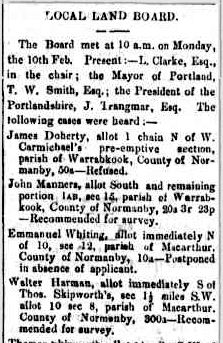
In 1872, aged 27, Walter married Lydia Poynton, daughter of John Poynton and Lydia Walton. Immigrants from Lincolnshire, England, the Poyntons lived in the Macarthur area. The following year Walter applied to the Lands Board for a license on 300 acres near Macarthur.

LOCAL LAND BOARD. (1873, February 24). Portland Guardian and Normanby General Advertiser (Vic. : 1842 - 1876), p. 5 Edition: EVENINGS. Retrieved February 20, 2012, from http://nla.gov.au/nla.news-article65429471

In 1879, he applied for the land next door to the earlier allotment, a further 44 acres.

LOCAL LAND BOARD. (1879, June 7). Portland Guardian (Vic. : 1876 – 1953), p. 2 Edition: MORNINGS.. Retrieved February 20, 2012, from http://nla.gov.au/nla.news-article63398356

Walter and Lydia started their family without haste, with Eunice Walton Harman born the year after their marriage.  Another nine children followed over the next 15 years.

Eunice Walton:  Birth:  1873 at Byaduk; Marriage: 1893 to  Benjamin Miller Lucas;  Death: 1954 at Heathcote Junction, Victoria.

Susannah Nash:  Birth:  1875 at Byaduk; Marriage:  1898 to William Condon;  Death:  1957 at Bairnsdale, Victoria.

Nathan:  Birth: 1878 at  Byaduk; Death:  1892 at Omeo.

Henry: Birth:  1880 at  Byaduk; Marriage:  1922 to  Eva Gertrude Jamison; Death: 1954 at  Bairnsdale, Victoria.

Louisa Mulberry:  Birth:  1881 at Byaduk; Marriage: 1900 to John Phiddian; Death: 1946 at Kyneton, Victoria.

Julia Georgina:  Birth:  1882 at Byaduk;  Marriage:  1915  to  Arthur Frances Lousada;  Death:  1929 at  Malvern, Victoria.

Selina Victoria:   Birth: 1884 at  Byaduk;  Death:  1977 at  Kew, Victoria.

Seth Livingstone:  Birth:  1884 at  Byaduk;  Death: 1892 at Omeo.

Golder Alberta Arlettie:  Birth:  1886 at Byaduk;  Marriage:  1923 to Solomon Kerrison; Death:  1963 at Melbourne.

John Joseph Stanley:  Birth: 1888 at Omeo;  Marriage:  1916 to Daisy Edith Masters;  Death: 1959 at Bairnsdale, Victoria.

This brings us to the wonderful names of the children of Walter and Lydia.  Eunice Walton takes her second name from her maternal grandmother, Lydia Walton.  Susannah Nash was named after her maternal aunt Susannah Poynton.  Susannah married John Nash in 1869 but she died in 1875, aged just 34.  That was the same year Susannah Nash Harman was born. Lydia’s other sister, Mary, also named her daughter Susannah Adeline Skipworth in the same year as her sister’s death.

My favourite name is Julia Georgina.  Julia is such a beautiful name and it may have come from her older cousin Julia Harman, daughter of James.  Selina Victoria is another of my favourite names.  Louisa Mulberry takes her second name from her paternal grandmother, Sarah Mulberry and John Joseph Stanley was named after his grandfathers, Joseph Harman and John Poynton.  I have absolutely no idea where the name Golder Alberta Arlettie may have come from!

The art of child naming carried on to the next generation, with grandchildren of Walter and Lydia having given names such as Stella Camilla Ina May, Edison Winslow, Harold Ornamen Tennyson, Cyril Montrose, Aldith Lorraine, Alban Harcourt, Beryl Maitland, Rodney Raeburn, Wilbur Henry, Athol Elwyn, Winton Harman, Jewel Victoria, Molly Lousada and Gloria Felicity Cambridge.

Just when it seemed Walter was settling into a life in the Western District, around 1888,  Walter Harman packed up the family and made the long trip to Ensay in East Gippsland, Victoria’s High Country.  It is the move which interests me, both the reason for travelling to the other side of the state and how they made the trip of over 600 kilometres, including the route they travelled.  The Ensay district did sound enticing, as this article from 1888 suggests:

In Gippsland. (1888, April 7). Australian Town and Country Journal (NSW : 1870 – 1907), p. 44. Retrieved February 20, 2012, from http://nla.gov.au/nla.news-article71096208

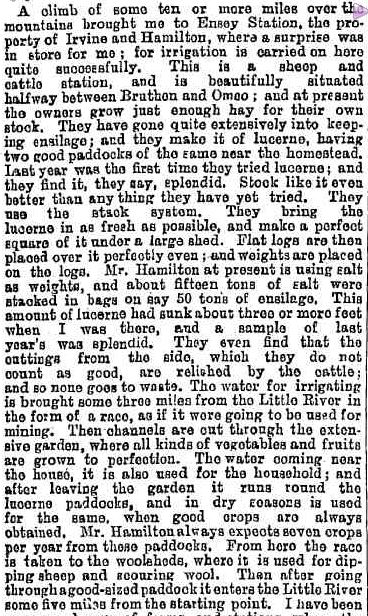
In 1843, Ensay Station comprised 38,400 acres.  An article from the Bairnsdale Advertiser and Tambo and Omeo Chronicle in 1917 cites the total acreage at Ensay Station at that time as 11,000 acres.  Over time, land was sold off to the likes of Walter Harman.

When I started researching the Harmans and I found the first references to Omeo, about 40kms north-west of Ensay, I imagined that Walt and his family went alone.  As my research continued I discovered the Condon family from the marriage record of Susannah Nash Harman and William Condon in 1898.  William was born in Portland in 1870, the son of William Charles Condon and Susan Baker.

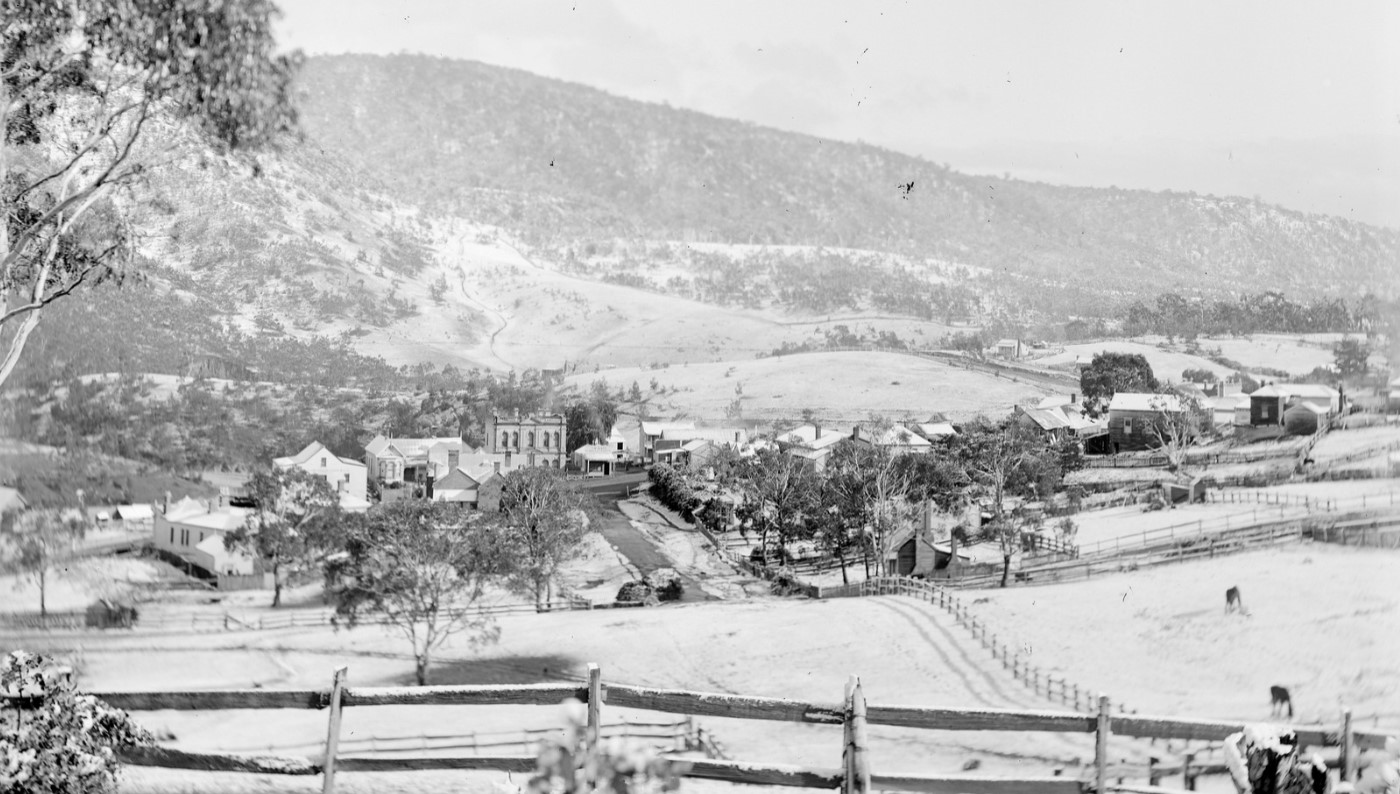
SNOW AT OMEO, c1880-1900. Image courtesy of the State Library of Victoria http://handle.slv.vic.gov.au/10381/22037

Later, thanks to newspaper reports of  Henry HARMAN’s court appearances in the trial of Ronald Griggs, I found John Henry CONDON, father of Lottie Condon.  While John was born in Omeo, he was the cousin of William Condon, Susannah Harman’s husband.  Not only that,  John Condon’s wife, Frances Ethel HUGGINS was born at Mount Eccles, near Macarthur in the Western District.  Frances’ mother was a SKIPWORTH, from Macarthur and her grandmother was a POYNTON, sister of Lydia Poynton, Walter Harman’s wife.  That sister, Mary, was also in the area with her husband, Thomas Skipworth. Phew!

Confusing maybe, but it shows five families living in the Omeo/Ensay area all with links to Byaduk/Macarthur and all connected through marriages over three generations.  Oh yes, Mary Poynton’s daughter Lydia Skipworth took along her new husband Andrew BAULCH from Tower Hill, near Warrnambool.  By 1890, his parent James Baulch and Ann Hulm were living at Bairnsdale.

So, the next question was, who was the trailblazer that made the first big move to the High Country, or was there a convoy of families making the move at the same time?

Using the years the children were born as a guide, the first family to make the move appears to be Henry Condon, older brother of William Condon with his wife Agnes Huggins, aunt of Frances Ethel Huggins.  Married in 1885, their first child was born at Omeo in 1886.  Agnes’ brother James Huggins and wife Elizabeth Skipworth had a child in Macarthur in 1886 with the next child, Thomas Leslie born in 1888 at Omeo.  This is also the same year John Joseph Stanley Harman was born at Omeo.

The obituary of John Tomlin Poynton, nephew of Lydia, talks of his move to the High Country in 1888 with his brother Edward with yet another family tie in, this time to the Skipworths.

PASSED AWAY. (1943, July 19). Gippsland Times (Vic. : 1861 – 1954), p. 1. Retrieved February 14, 2012, from http://nla.gov.au/nla.news-article63255330

The Hamilton Spectator of 8 March 1888, included the following from the Byaduk correspondent, “Several farmers in the neighborhood who have had the good fortune to secure what are said to be superb selections in Gippsland, intend leaving here for that part of the country shortly. “

Walter, with help from Lydia, worked quickly to establish a Sunday school at Ensay and they were a major force behind a State school being opened in the town. 

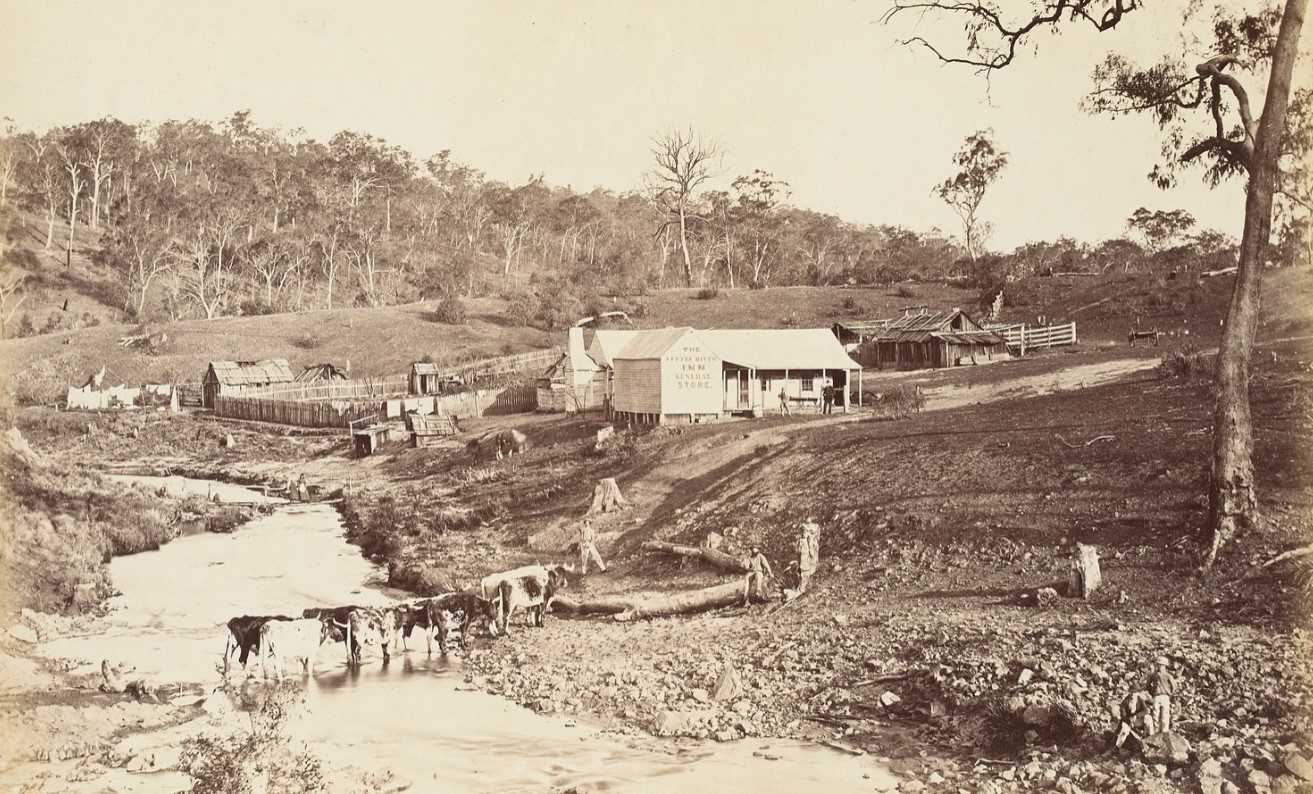
THE OMEO ROAD, ENSAY c1866-1890. Image courtesy of the State Library of Victoria http://handle.slv.vic.gov.au/10381/366573

In 1890, Walter was one of the first trustees of the Ensay Public Cemetery.  The name of the Harman property at Ensay was Systonholme.  This name paid tribute to Lydia’s birthplace, Syston, Lincolnshire, England.

Like his brother James, Walter was a lay preacher for the Methodist Church and would travel by horseback spreading the word of John Wesley.

In 1892, tragedy struck the Harmans in quick succession.  Seth died in July, aged 7 and Nathan passed away in August, aged 13.  The boys were buried at the Omeo cemetery.  Their death certificates are just another two on my long list of “must get” certificates, to see how the boys died so close together, although one would assume it was illness.

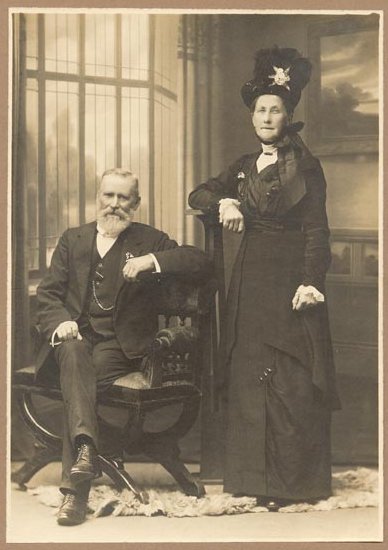
I love this photo of Walt and Lydia.  Despite the stiffness and lack of emotion of early photographs, there is a warmth here and the two seem very comfortable in each other’s company.  They were a team, and this is clear from the photo.  I would like to thank Linda Thatcher for allowing me to use this wonderful photograph.

Walt and Lydia Harman (photo courtesy of Linda Thatcher)

In Walter and Lydia’s later years, they moved into “town”, taking up residence in the Melbourne suburb of Malvern.  In 1923, they were living at 11 Jordan Street with their house named Systonholme, a reminder of Ensay. Daughter Selina was living with them and Julia and her husband Arthur Lousada moved from their home in Toorak to 113 Tooronga Road Malvern, only two streets from her parents.

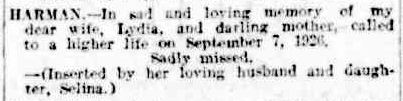
In 1926, Lydia passed away aged 79.  Walter had lost his beloved wife, the woman with whom he had pioneered and raised 10 children.  A  family notice was placed in The Argus at the time of her death:

Family Notices. (1926, September 11). The Argus (Melbourne, Vic. : 1848 – 1956), p. 17. Retrieved February 20, 2012, from http://nla.gov.au/nla.news-article3808510

In 1928, two years after Lydia’s death, Walter and daughter Selina placed an “In Memoriam” notice in The Argus and the pain was still clear.

Family Notices. (1928, September 15). The Argus (Melbourne, Vic. : 1848 – 1956), p. 13. Retrieved February 20, 2012, from http://nla.gov.au/nla.news-article3957034

Faced with life without Lydia, Walter returned to live at Ensay, his other great love.  On 22 October 1936, Walter passed away at  Systonholme, Ensay.

Family Notices. (1936, October 23). The Argus (Melbourne, Vic. : 1848 – 1956), p. 1. Retrieved February 20, 2012, from http://nla.gov.au/nla.news-article11928521

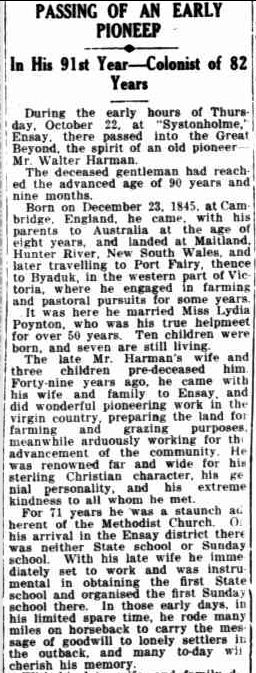
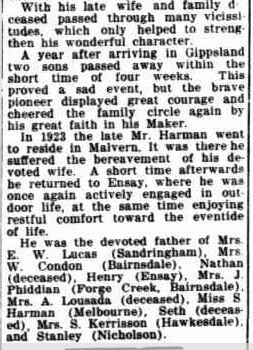
His obituary from the Gippsland Times is a fitting tribute to such a wonderful pioneer who gave so much to his local community while ensuring a comfortable life for his family.

PASSING OF AN EARLY PIONEER. (1936, November 5). Gippsland Times (Vic. : 1861 – 1954), p. 3. Retrieved February 14, 2012, from http://nla.gov.au/nla.news-article62986267

As yet, I have not found an obituary for James Harman but the words written of Walter may give a clue to James himself…”his sterling Christian character, his genial personality, and his extreme kindness to all whom he met”.  There are many similarities between James and Walter, despite their age difference and the fact they lived on opposite sides of Victoria, including their devotion to the Methodist Church and their community involvement.  Both brothers played a role in establishing schools in their respective towns.  The obituary also reconfirmed the Harman’s journey from N.S.W. on arrival in Australia to Port Fairy and then Byaduk.

While Walter Harman is remembered as an Ensay pioneer, he also lived in Byaduk and district for 25 years from the age of 18 to 43, which one could describe as his “formative years”. There was plenty of time for the characteristics, passions and wisdom of his brothers to rub off.

A Memorial Coincidence

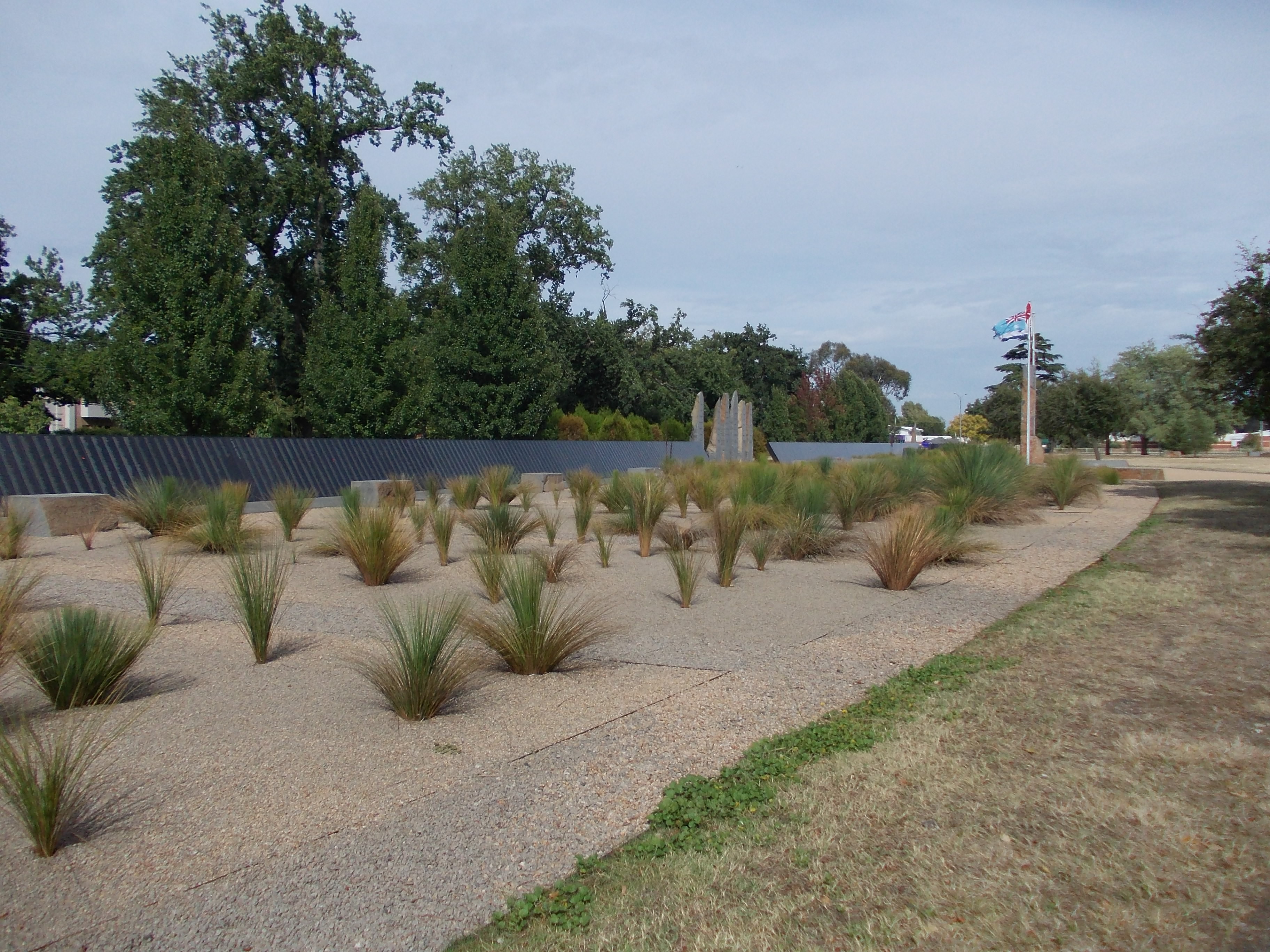
Eight years ago, almost to the day, we decided to visit the newly opened Australian Ex-Prisoners of War Memorial in Ballarat.  My great-uncle Bill Hadden was a POW in Changi and I wanted to find his name.

It was a warm evening, and I was about 8½ months pregnant and apart from another couple browsing through the names, we were the only ones there.  We walked along the row, found Uncle Bill’s name then continued to the end.  As we made the return trip, I noticed the couple had stopped near Uncle Bill’s name.  As I paused nearby for a last tribute, I overheard the couple talking.  They looked puzzled saying they couldn’t see a Bill or a William.  They were pointing right at the list of Haddens on the memorial.  I realised they were talking about Bill Hadden and I immediately understood their predicament.  Uncle Bill’s real name was Thomas Horace Hadden, not William as many people over the years probably thought.

I asked the couple if they were looking for Bill Hadden and they were.  I explained he was the T.H.Hadden on the memorial.

Who were these people?  I certainly didn’t recognise them as cousins.  As it turned out, the lady was a daughter of one of the men incarcerated with Uncle Bill in Changi and Bill had even attended her wedding.  They were en route from Birchip to Melbourne and thought they would drop in at the memorial to look for her father’s name.  Unbelievable.  To think they were there at the same time I was.  Also, if I hadn’t been there at that time, they’d have left wondering why Bill Hadden’s name was not on the memorial.

STOP PRESS!. (1942, February 16). Cairns Post (Qld. : 1909 – 1954), p. 5. Retrieved February 15, 2012, from http://nla.gov.au/nla.news-article42332207

This is a pertinent time to remember that visit eight years ago.  On 15 February 1942,  seventy years ago, Singapore fell to the Japanese and Bill Hadden of the 2/13th Australian General Hospital (2/13 AGH) was taken prisoner. In the days after, he would walk through the gates of Changi prison.

MORE NAMES OF AUSTRALIAN POW’s AT SINGAPORE. (1945, September 14). The Argus (Melbourne, Vic. : 1848 – 1956), p. 2. Retrieved February 15, 2012, from http://nla.gov.au/nla.news-article975785


BILL HADDEN

BILL HADDEN

In Malaya prior to the capture, Uncle Bill wrote a letter home to his great-aunt Henrietta Harman of Byaduk.  Answering the call of the Australian Women’s Weekly, Henrietta sent the letter into the Weekly with it published on 31 January 1942.

LETTERS FROM OUR BOYS. (1942, January 31). The Australian Women’s Weekly (1933 – 1982), p. 2. Retrieved February 15, 2012, from http://nla.gov.au/nla.news-article47812486

This is a wonderful insight into the lead-up to the events of seventy years ago today.  How could Uncle Bill ever imagine the “…greater hardships before it is over” would be over three years in Changi prison.  It has also given me a small glimpse of Henrietta’s life.  Even though I did not know her, I never would have picked her as a reader of the Women’s Weekly.  Maybe it was the incentive of a £1 prize for all letters printed.

May we also remember the brave nurses of the 2/13 AGH, evacuated from Singapore just prior to the fall.  In particular, the nurses on board the ill-fated Vyner Brooke.  The ship was attacked from the air on 14 February 1942.  Survivors found themselves on Radji beach, Banka Island.  They were discovered by Japanese troops who walked twenty-two Australian nurses and one female English civilian into the sea and shot them. One nurse, Sister Vivian Bullwinkel, survived and would herself become a POW.

AUSTRALIAN POW NURSES

Growing up, I was familiar with the name Sister Vivian Bullwinkel.  On Anzac Day, as we watched the march on television, Nana would proudly tell me Uncle Bill knew Vivian Bullwinkel during the war.  It was not until I was older I realised her heroics and the horrific acts she saw.

I also grew up familiar with the name “Changi,” again because Nana would talk of Uncle Bill being in “Changi” during the war.  It probably was not until Uncle Bill, Nana and their two sisters Rose and Alma visited Singapore and the infamous prison in 1981 that I had any inkling of what it really was.

UNCLE BILL & HIS SISTERS IN SINGAPORE

As I have read more, I have learned more about life in Changi for Uncle Bill and thousands of other Australians during that time.  I now know why Nana was so proud of her brother “Billy”.   

I  have a copy of a letter from Uncle Bill to his mother Sarah Hadden (nee Harman) written on 18 August 1945, three days after the war ended.  Bill commented on how fortunate he was to remain at Changi for the duration of his incarceration. He wrote, “I have truly a lot to be thankful for, as many hundreds who went to Thailand and Burma will never return.”


I have only touched on the sinking of the Vyner Brooke and the events on Banka Island.  The Australian War Memorial (AWM) has photos of the nurses from the Vyner Brooke and you can see them here.  It is sad scrolling through the photos of fresh-faced young women who had just enlisted and thinking they never came home.

An article from the Sydney Morning Herald of 18 September 1945 tells the story of Banka Island in Sister Vivian Bullwinkel’s words.

The AWM has articles about the Sinking of the Vyner Brooke and Sister Bullwinkel.

In The News – 8 February – 13 February 1901

I have an interest in the weather, not just for today or the coming weekend but also historically.  Participating in Melbourne University’s Climate History newspaper tagging project involving tagging Trove newspaper articles about weather events, it became evident the weather behaves in a cyclical nature.  If it has happened before it will happen again, droughts, floods, and storms.

Taking my interests a step further,  investigating how weather events affected my ancestors can add greatly to their story. That is why the Victorian bushfires of 1901 are of interest as the Byaduk district, where many of my ancestors lived, was heavily affected.  The weather was similar to two days in my lifetime,  Ash Wednesday on 16 February 1983 and  Black Saturday on 7 February 2009. On each day, fires blazed across Victoria.  

The first reports of fire came through on 8 February 1901.  The following article from The Argus describes the weather of 7 February 1901.  The descriptive language takes the reader to that day.  The heat was oppressive, the wind was strong and dust storms crossed the state, causing unnatural darkness.

HEAT AND GALES. (1901, February 8). The Argus (Melbourne, Vic. : 1848 – 1956), p. 5. Retrieved January 29, 2012, from http://nla.gov.au/nla.news-article10533956

Fires had sprung up throughout the Western District.  Early reports from Branxholme were tragic with one death, stock killed and houses lost.  I have family links to three families who lost their homes, the Millers, Storers and Addinsalls.  George Miller, a racehorse trainer, lost his house and stables and no doubt his horses.

HEAT AND GALES. (1901, February 8). The Argus (Melbourne, Vic. : 1848 – 1956), p. 5. Retrieved January 29, 2012, from http://nla.gov.au/nla.news-article10533956

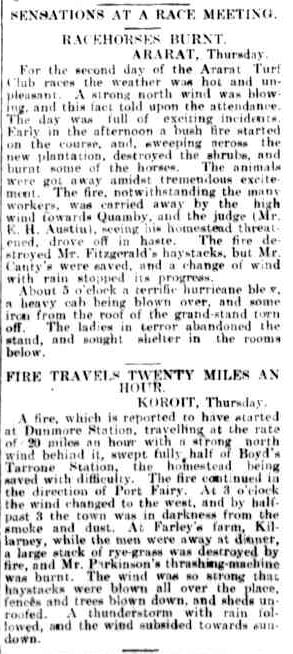
The two-day race meeting at Ararat was held in stifling conditions. A fire started at the course on the second day, with horses receiving burns.  Later the wind picked up and ripped iron off the grandstand roof, sending the ladies within running for shelter.

HEAT AND GALES. (1901, February 8). The Argus (Melbourne, Vic. : 1848 – 1956), p. 5. Retrieved January 29, 2012, from http://nla.gov.au/nla.news-article10533956

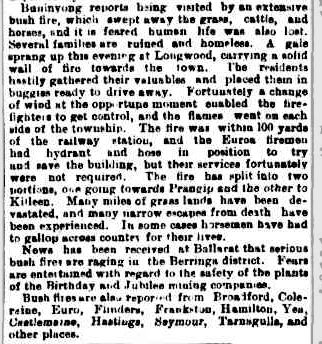
Fires started across Victoria including Warrnambool, Alexandra, Wangaratta, Buninyong, Yea, and Castlemaine.

DESTRUCTIVE BUSH FIRES IN VICTORIA. (1901, February 8). The Sydney Morning Herald (NSW : 1842 – 1954), p. 6. Retrieved January 30, 2012, from http://nla.gov.au/nla.news-article14337694

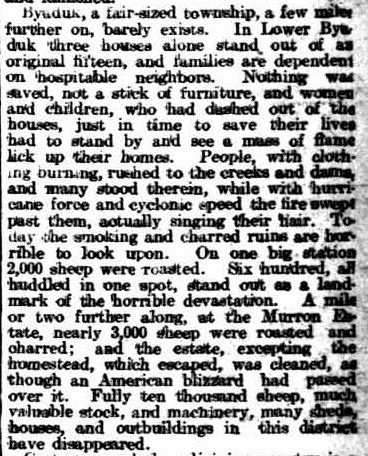
The articles below report on homes lost in the Byaduk district with Byaduk North worst hit.  My relatives were closer to Byaduk township further south and while they were lucky not to lose their homes it must have been terrifying all the same.  

The fire travelled at a great pace, coming within a mile of my ggg grandfather James Harman’s property Mount Pleasant, on the Hamilton-Port Fairy Road, reaching the properties of the Christie brothers just to the north. As well as James and his wife Susan Reed, my great-grandmother Sarah Elizabeth Harman, and her father Reuben James Harman were living at Byaduk but lived further south again in the Byaduk township.  Numerous other family members lived in the area from the Byaduk Caves through to the Byaduk township.  

TERRIBLE BUSH FIRES. (1901, February 9). The Advertiser (Adelaide, SA : 1889 – 1931), p. 7. Retrieved February 7, 2012, from http://nla.gov.au/nla.news-article4818069

DESTRUCTIVE BUSH FIRES. (1901, February 9). Bathurst Free Press and Mining Journal (NSW : 1851 – 1904), p. 2. Retrieved February 7, 2012, from http://nla.gov.au/nla.news-article64452557

The Hamilton Spectator reported twelve homes destroyed leaving just three standing in Byaduk North.  Most were close to the course of the Lyne Creek running to the west of the township. The Free Presbyterian Church was lost and the Byaduk North Hotel was under threat.  In the days after the fire, the hotel served as a refuge for the homeless.

BYADUK NORTH HOTEL c1906. Image courtesy of the Museums Victoria Collections http://collections.museumvictoria.com.au/items/766487

BYADUK NORTH HOTEL c1906. Image courtesy of the Museums Victoria Collections http://collections.museumvictoria.com.au/items/766487

The homestead of Richard Thomas Carty at Brisbane Hill, a large property to the north of Byaduk North, was destroyed.  While running for the creek, after escaping the homestead, Mrs Carty’s dress caught fire but it was fortunately quelled.  The Cartys rebuilt and the replacement homestead Dunroe still stands today.

"ALONG MACARTHUR ROAD." Hamilton Spectator (Vic. : 1870 - 1918) 9 February 1901 .

“ALONG MACARTHUR ROAD.” Hamilton Spectator (Vic. : 1870 – 1918) 9 February 1901 <http://nla.gov.au/nla.news-article226087594&gt;.

"THE VICTORIAN BUSH FIRES." Australian Town and Country Journal (Sydney, NSW : 1870 - 1907) 23 February 1901: .

“THE VICTORIAN BUSH FIRES.” Australian Town and Country Journal (Sydney, NSW : 1870 – 1907) 23 February 1901: <http://nla.gov.au/nla.news-article71463761&gt;.

The fire burnt through the Monivae Estate with a large loss to fences and livestock and burnt within a mile of Hamilton.  On the other side of town, closer to the Coleraine railway line, the Hamilton Racecourse fell just short of the fire’s path.

"MANY FAMILIES HOMELESS." Leader (Melbourne, Vic. : 1862 - 1918) 9 Feb 1901: 18. .

“MANY FAMILIES HOMELESS.” Leader (Melbourne, Vic. : 1862 – 1918) 9 Feb 1901: 18. <http://nla.gov.au/nla.news-article198084151&gt;.

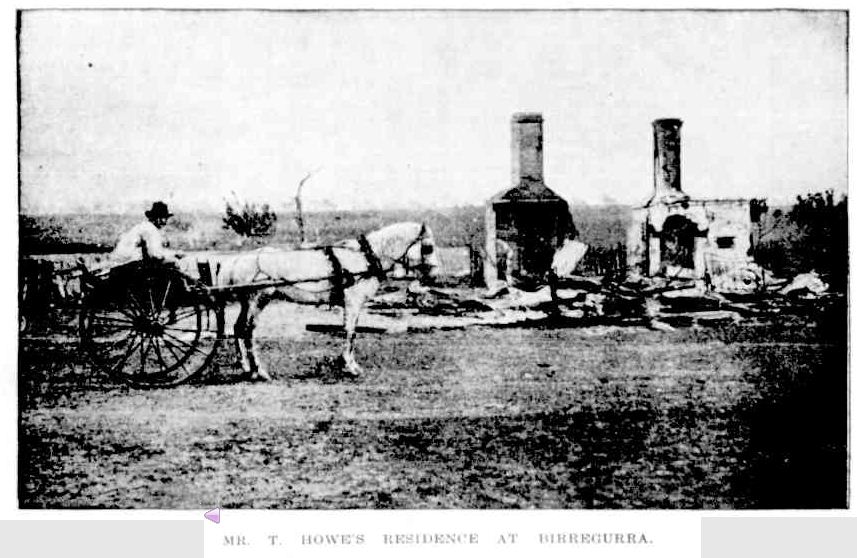
Other areas throughout the Western District felt the brunt of fire on 7 February 1901.  This photograph from Birregurra shows the devastation in that town.

THE VICTORIAN BUSH FIRES. (1901, February 23). Australian Town and Country Journal (NSW : 1870 – 1907), p. 38. Retrieved February 7, 2012, from http://nla.gov.au/nla.news-article71463761

Portland was also under threat with fire circling the town.  The fire did not stop until it met the sea.

VICTORIAN BUSH FIRES. (1901, February 11). The Advertiser (Adelaide, SA : 1889 – 1931), p. 5. Retrieved February 7, 2012, from http://nla.gov.au/nla.news-article4818536

Buninyong near Ballarat was one of the worst areas hit.

BUSH FIRES IN VICTORIA. (1901, February 9). The West Australian (Perth, WA : 1879 – 1954), p. 3. Retrieved February 7, 2012, from http://nla.gov.au/nla.news-article23853766

THE VICTORIAN BUSH FIRES. (1901, February 23). Australian Town and Country Journal (NSW : 1870 – 1907), p. 38. Retrieved February 7, 2012, from http://nla.gov.au/nla.news-article71463761

Macarthur had losses as did Princetown on the south coast.  At Timboon, bullock teams from the local sawmill were lost.

FIRES IN VICTORIA. (1901, February 12). South Australian Register (Adelaide, SA : 1839 - 1900), p. 6. Retrieved February 7, 2012, from http://nla.gov.au/nla.news-article54558042

FIRES IN VICTORIA. (1901, February 12). South Australian Register (Adelaide, SA : 1839 – 1900), p. 6. Retrieved February 7, 2012, from http://nla.gov.au/nla.news-article54558042

By 11 January, aid for the homeless was on the agenda and at Branxholme a public meeting was held to discuss such matters.  Authorities discovered the fire near Branxholme, which was probably the same fire to hit Byaduk, was accidentally started by a travelling tinsmith fixing a trough at Ardachy Estate.

THE BUSH FIRES. (1901, February 11). The Argus (Melbourne, Vic. : 1848 – 1956), p. 5. Retrieved February 7, 2012, from http://nla.gov.au/nla.news-article10534297

A meeting was called at Byaduk for 18 February 1901, and James Harman donated £2 2/ to the fund for the homeless.

"BUSH FIRE BELIEF FUNDS." Hamilton Spectator (Vic. : 1870 - 1918) 21 February 1901: .

“BUSH FIRE BELIEF FUNDS.” Hamilton Spectator (Vic. : 1870 – 1918) 21 February 1901: <http://nla.gov.au/nla.news-article226090204&gt;.

The fire was so strong and relentless, old residents were drawing comparisons to Black Thursday almost fifty years earlier to the day on 6 February 1851.

TELEGRAPHIC. (1901, February 12). Kalgoorlie Western Argus (WA : 1896 – 1916), p. 32. Retrieved February 7, 2012, from http://nla.gov.au/nla.news-article32205605


Sarah Harman – From Country to City

I knew all about the brothers of Sarah Harman before I knew anything of her other than she travelled to Sydney with her parents Joseph and Sarah Harman aboard the “Queen of England” in 1855.  Finally, I decided the time had come to find out more about Sarah.

I quickly discovered she had married George Adams in 1885 and they had one daughter in 1886.  For some time I thought that was Sarah’s story.  It was while searching the Victorian Pioneer Index 1836-1888 using only “Harman” in the “Mother’s name” field, I realised there was more to Sarah than I first thought. I have found this method of searching to be very successful over the years and has unearthed many unknown children and marriages of the females on my tree.

In the index, I found children born at Byaduk to Sarah Harman and a Walter Oakley.  I then found the marriage of Sarah to Walter Oakley in 1864.  Suddenly, Sarah had five children and not one and another spouse.  Sarah’s story had become very different.

Sarah Harman was the only daughter of Joseph and Sarah Harman to come to Australia and she was the eldest of the children to travel with them.  Sarah was born in Melbourn, Cambridgeshire in 1843 and was 12 when she immigrated on the Queen of England.

The Harman family arrived in Byaduk around 1863 and by then Sarah would have been 20.  The following year she married Walter Oakley, son of  Henry Oakley and Susan Bullock.  Walter had family links to Port Fairy and Sarah may well have met him during the time the Harmans spent in the town.

The children of Sarah and Walter were:

SUSAN – Born 1865, Byaduk; Marriage Robert Warwick Cruikshank, Birchip 1892; Death 1949, Wangaratta, Victoria

JOSEPH HARMAN – Born 1867, Byaduk;  Marriage Annie Margaret Simpson, 1891; Death 1957,  Blackburn.

HENRY – Born  1868, Yambuk

ALFRED JAMES – Born 1870; Marriage Kathleen Maud Hodgson, 1910; Death 1951,  Stawell.

To this point it would seem that Sarah was going to live a life similar to her older brothers, living in Byaduk and raising a family.  However, for Sarah, there was a turning point.  Sometime between the birth of Alfred in 1870 and 1884, something happened to Walter Oakley.  What, I am not sure.  I have never found a death record.  He just seemed to disappear.

One of the great things about writing a blog, is you get to meet people with similar research interests.  After my post A Small find at the Vic Expo, I heard from Brad who is an Oakley descendant.  He told me of the family story that Walter had disappeared while on a trip delivering live horses to India.  While this a family story, it is not outside the realm of possibility.

Thousands of horses left Australian shores for India during the mid half of the 19th century and naturally, there were perils.  This is an incredibly interesting part of our history which led to Australia’s own breed of horse, the Waler.  The story of live horse export in Victoria is worthy of its own post at another time.  I like the idea that this is how Walter met is demise, a tragic but romantic end.  Whatever happened, he was gone and Sarah was alone.

Have you found the marriage record of a family member and wondered how on earth did he/she meet that girl/guy?  Sarah’s marriage to George Adams is one such occasion.  How did Sarah from Byaduk, meet George from Melbourne, 12 years her senior, in the 1880s.  Certainly not online dating!

In the last day or so since I started writing this post, I have added Kerryn Taylor to my circles at Google+.  She is a descendant of  George Adams and Catherine Barry and told me George’s father Edward was living in Cambridgeshire when the Harmans were still in Melbourn.  The 1851 England Census lists him living at Bassingbourn, just down the road.  Maybe this link to the old country is the reason why George was in Byaduk and in the life of Sarah Harman.

Who was George Adams?  He was born in Essex, England in 1831 and immigrated to Western Australia around 1852.  He married an Irish girl, Catherine Barry in 1853 in Western Australia.  After the birth of one child, they headed east for Melbourne, where a further six children were born.  Two more children were born in Western Australia in 1868 and 1870.

I pick them up next in 1884.  Catherine passed away in Parkville on May 4.  George is listed as a builder and contractor.

Family Notices. (1884, May 14). Illustrated Australian News (Melbourne, Vic. : 1876 – 1889), p. 78. Retrieved January 19, 2012, from http://nla.gov.au/nla.news-article63184969

The next record of George is the following year, 1885, with his marriage to Sarah Harman.   Not a lot of time elapsed between the death of Catherine and his remarriage, but that was not that unusual.

One child was born from the marriage of George and Sarah.  Sarah was around 42 at the time of the birth.

SARAH SELINA (“Sadie”) – Born 1886 at Kensington;  Marriage Harold Charles STONE, 1915; Death 1977 at Kew.

While it seems that George and Sarah returned to the city, in 1888, George had a listing at Byaduk in that year’s Victorian Post Office Directory, his occupation listed as builder.   He may have kept his work options open. It may also be why George was in the Byaduk area to start with, to build something.

In 1921, George passed away.  He was  91.  The first family notice to appear was from Sarah and “Sadie”.

Family Notices. (1921, January 18). The Argus (Melbourne, Vic. : 1848 – 1956), p. 1. Retrieved January 31, 2012, from http://nla.gov.au/nla.news-article1733023

The following day a notice appeared from the children of George’s first marriage to Catherine Barry.

Family Notices. (1921, January 19). The Argus (Melbourne, Vic. : 1848 – 1956), p. 1. Retrieved January 31, 2012, from http://nla.gov.au/nla.news-article1733152

Then three days later another, more detailed family notice  presumably again from George and Catherine’s children, but unlike the first, it gives the instructions to copy to the Hamilton papers as in the first notice from Sarah and “Sadie”

Family Notices. (1921, January 22). The Argus (Melbourne, Vic. : 1848 – 1956), p. 11. Retrieved January 31, 2012, from http://nla.gov.au/nla.news-article1733627

Are we beginning to see some tension between Sarah and her stepchildren?

George’s Will gives some sign that his children from his first marriage may not have played a big part in his life during his second marriage.  Firstly, Sarah’s son Joseph Harman Oakley and son-in-law, Harold Stone, husband of “Sadie” were executors of the Will.  Sarah was to receive all the household furniture, ornaments and the like as well as all George’s property in his estate.  Upon Sarah’s death, everything was to be sold and distributed as George had nominated.  Aside from his oldest son Edward who was to receive £75, all of his living children from his first marriage were to receive only £20 each.   On the other hand, “Sadie” was to receive the balance of the estate, which sounded as though it would be quiet a considerable sum.

Sarah passed away 10 years later in 1931.  She was 87.  Or was she?  According to her death notice she was in her 90th year.  Her cemetery record lists her as 89.  Her birth record on the England and Wales, Free BMD Birth Index lists her birth in 1843.  The 1851 census has her at seven and as her birth was registered in the last quarter of 1843, this would mean she was turning eight in the year of her census.  The Assisted Immigrants Index lists her age as 12 in 1855, which again fits.  In A Life Cut Short, I posted an article from September 1929 which has Sarah’s age at 85.  Again, if Sarah’s birthday was in the last quarter, this also fits.  I would assume the information for the article came from her brothers.  With 1843 looking like the correct birth year, Sarah should have been 87 at the time of her death, her 88th year, almost 89th but certainly not 90th.  Poor Sarah, what woman would want two years added to her age!

Family Notices. (1931, July 4). The Argus (Melbourne, Vic. : 1848 – 1956), p. 15. Retrieved January 31, 2012, from http://nla.gov.au/nla.news-article4406027

Both Sarah and George are buried at the Fawkner cemetery.

There is something about Sarah’s story that attracted my attention.  Her address at 5 Brixton Street, Flemington. My first thoughts of Flemington are, of course, of the famous racecourse but having driven through the area several times, it also the historic feel of the suburb that comes to mind.  Also, not far away were the Newmarket Saleyards, the City Abbatoir and the Melbourne Showgrounds.  Racing stables were in back lanes and cattle would be herded through the streets en route to the saleyards.  Sarah would only have to step out onto Brixton street for a reminder of country life, horses being led to the track, cattle mooing, drovers’ dogs barking and the smell, well it was bad.

DUST, FLIES, SMELLS, AND NOISES. (1935, August 9). The Argus (Melbourne, Vic. : 1848 – 1956), p. 3. Retrieved February 2, 2012, from http://nla.gov.au/nla.news-article11756155

The Australian Electoral Roll (1903-1980) shows George and Sarah living at 5 Brixton Street in Flemington in 1903.  George died in the house and Sarah lived there after his death.  I like that when Sadie married Harold Stone, they moved into 7 Brixton Street next door and at some stage Sarah, in her later years, moved in with “Sadie”.  In the same year as Sarah’s death, her son Joseph Oakley is listed at 5 Brixton Street in the Australian Electoral Rolls (1903-1980).

Google Street View, points to the painted terrace with the fence as 5 Brixton street.  I’m always a bit wary of where the place the marker lands. If only I could see the street numbers.  I have not been to the house myself but it is on my “to do” list.  Only a couple of months ago I was only about one kilometre away, but with a grumpy driver and child from a day out in the city, I didn’t think they would have appreciated being dragged off course to look at yet another house.  Also the grumpy driver thinks one day we will be arrested  photographing strangers’ houses.  Back to Street View, if you pan around the street, you will see what I mean about the ambiance of the suburb.

Having read George’s Will, it reveals he did own a number of properties, so he may have owned 7 Brixton street, Sadie’s house, also.  In fact he may have owned the entire terrace.  Being a builder, he may have even built the terrace.  As this extract shows, in 1885 land was being offered for sale in Brixton Street.

UNDER THE HAMMER. (1885, February 20). North Melbourne Advertiser (Vic. : 1873 – 1894), p. 3. Retrieved February 1, 2012, from http://nla.gov.au/nla.news-article66154356

The Will states that Sarah was to receive “the rents and income which may arise and be derived from my lands and tenements and from all property in my estate…”.  Also if  “she shall so desire to permit her to reside in any of my messauges or tenements”.  Electoral rolls also listed George has having lived by “Independent means”, so he must have lived off the rent of his properties.  Secretly I used to hope that it meant he was an SP bookie, living so close to the track and all!

So ends Sarah Harman’s story.  A woman who looked set for a life like that of her sister in-laws, a farming wife in a small country town, surrounded by her family including her brothers, nieces and nephews.  A twist of fate would see her live 50 years of her life in the growing city of Melbourne, away from her brothers, but I’m sure never far from their hearts and minds.

If anyone is interested in more information on George Adams, I have found a website with a very good story of him at Adams Generations.

In the News – 13 January 1905

Western District pioneers were exposed to most of the elements Australia offers including flood, drought and fire.  Each had its own devastating effect on their lives and livelihood, particularly those on the land.

By summer 1905, my Harman family of Byaduk had already experienced bushfire.  Fires in 1888, 1896, 1901, and 1902 had seen the loss of stock, grazing land, and life.  Bushfires today are just as devastating, but the pioneers of the 19th century and early 20th century did not have the weather forecasting, firefighting equipment, and communications now available.  When a fire came close to their homes at Byaduk on 11 January 1905, one can only imagine how they managed.

The fire broke away in the stony ground near the Byaduk Caves and travelled southerly at a rapid pace.

NEAR BYADUK CAVES.

NEAR BYADUK CAVES.

The first Harman hit was George Harman, son of James Harman.  His property Quetta was on the north-eastern corner of the Hamilton-Port Fairy Road and what is now Harman’s Road. The fire crossed the main road onto his father’s property, Mt Pleasant, and Frank Kinghorn’s The Island next door. Alfred Harper lost all the timber for a new house, while others lost haystacks. Forty men were fighting the fire, but wind changes made it almost impossible for them.  The Portland Guardian reported on the fire on 13 January 1905.

HEAVY LOSSES AT BYADUK. (1905, January 13). Portland Guardian (Vic. : 1876 – 1953), p. 2 Edition: EVENING. Retrieved January 11, 2012, from http://nla.gov.au/nla.news-article63691042