Another “What the Dickens?” Moment

To mark the 200th birthday of Charles Dickens, I posted about Alfred Tennyson Dickens who lived in my hometown of Hamilton.  Entitled “What the Dickens?“, the post describes my amazement that a son of Charles Dickens could have lived in Hamilton.  Alfred left the town due to the accidental death of his wife Jessie.

Yesterday I was in Hamilton for several reasons, one of which was to visit the Hamilton Old Cemetery in search of the grave of Jessie Dickens, and as a result, I had another “What the Dickens?” moment.

My visits to Hamilton are infrequent day trips, so I try to cram in as much as possible. Visits to the cemetery are quick, usually to search for a specific grave or graves. Yesterday was no different, except I had absolutely no idea where in the cemetery Jesse was buried.  With Mum, we headed to the oldest and biggest graves.

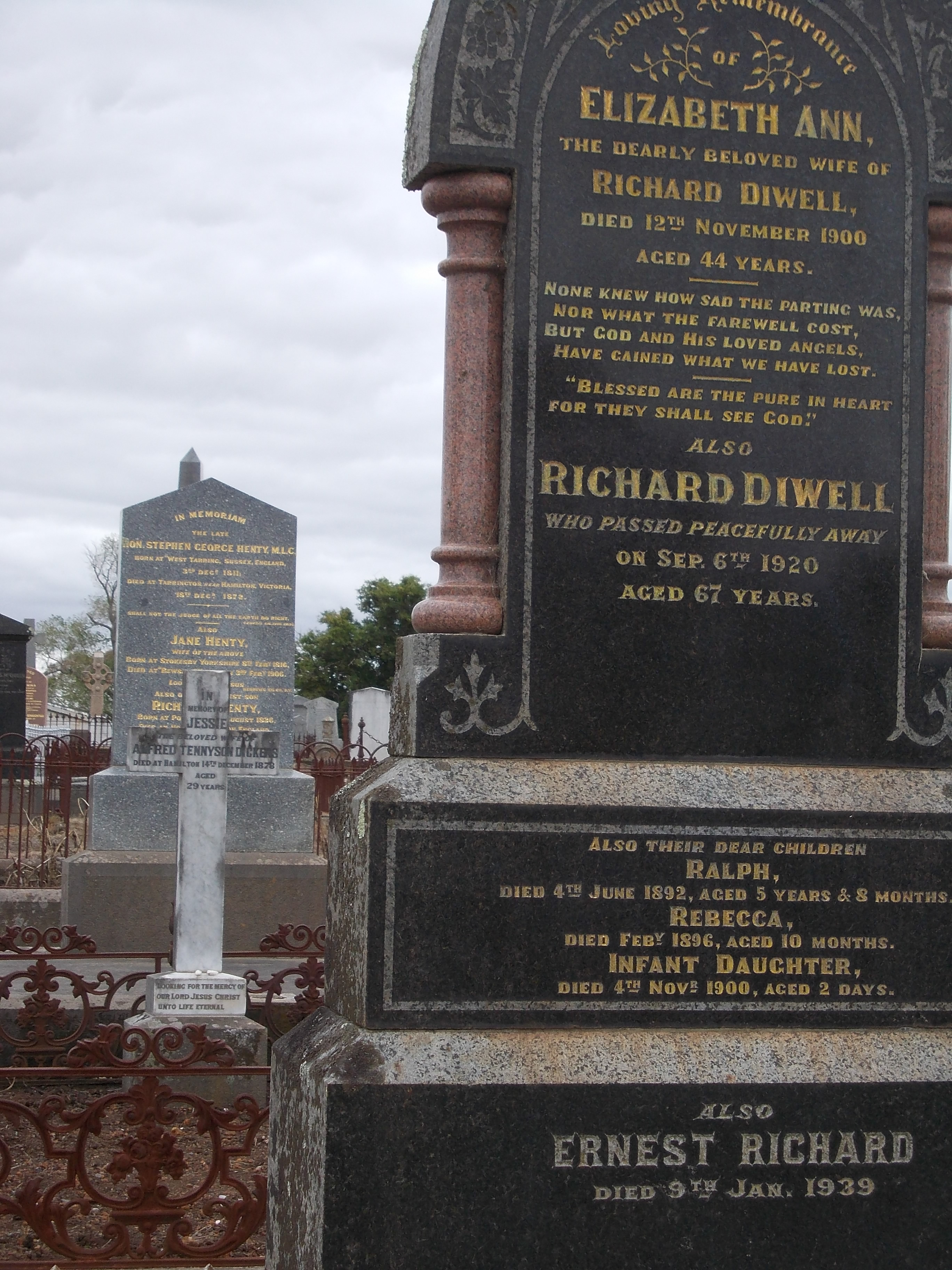
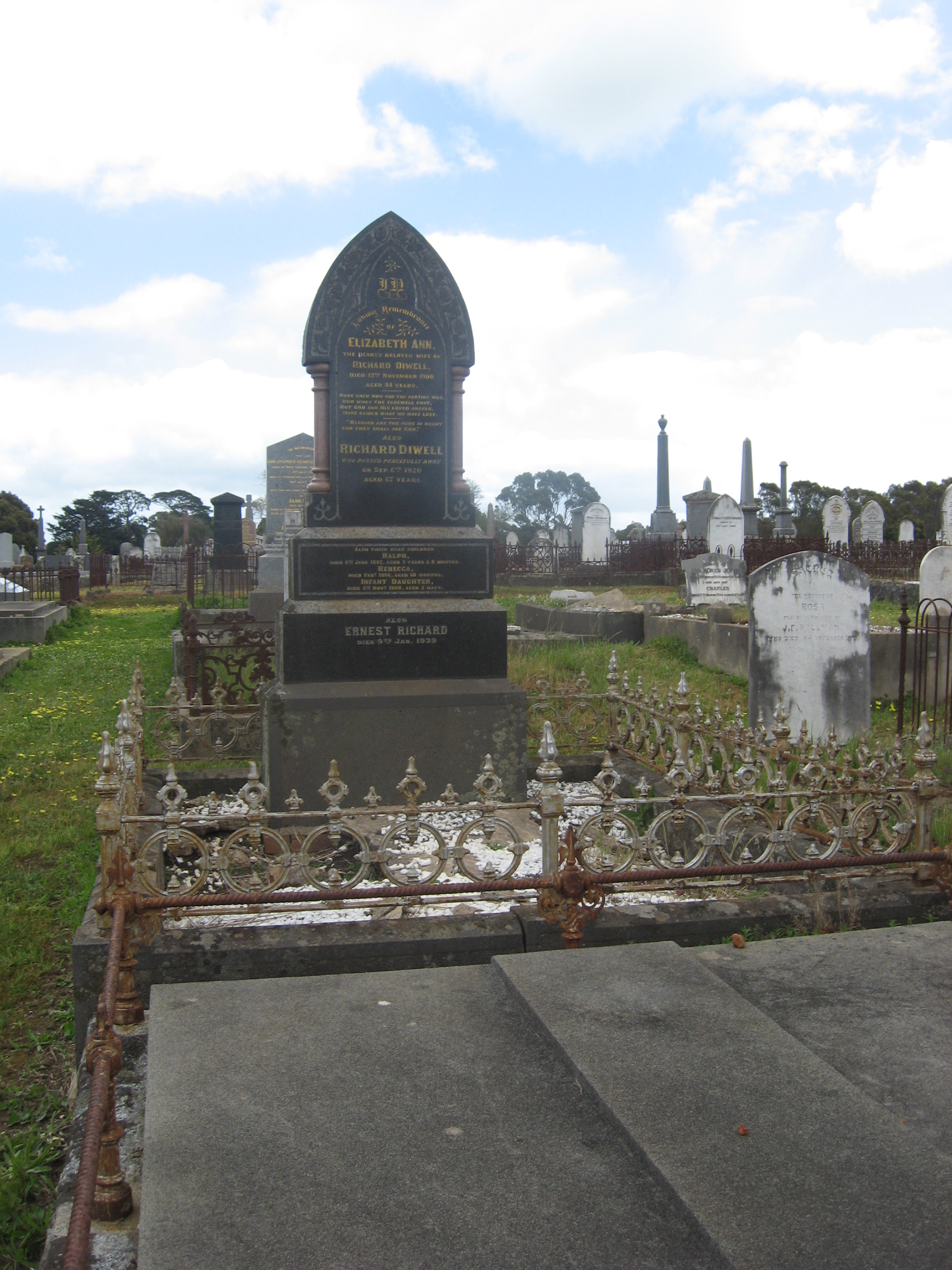
We found the grave quicker than expected.  It turns out the grave of Jessie Dickens is immediately behind my gg grandparents Richard Diwell and Elizabeth Jelly who I have posted about before.  We couldn’t believe we had previously visited the Diwell plot before, unaware the grave of the daughter-in-law of Charles Dickens was right behind. As we were earlier unaware of the Dickens link to Hamilton, we had not made the connection.

What I couldn’t believe was that I had missed the grave immediately behind Jessie’s. It was that of Stephen George Henty, one of the Henty brothers, Victoria’s first settlers.  Stephen, thought to be the most influential of the brothers, was the first to settle inland from Portland, at Muntham, Merino Downs, and Sandford stations.

DIWELL, DICKENS & HENTY GRAVES


Both the Diwell and Dickens headstones were chosen by heartbroken husbands, shattered by their wives’ premature deaths. Jessie was only 29, thrown from a horse-drawn carriage on Portland Road in 1878 and Elizabeth died at 44 due to complications of childbirth in 1900. I have updated the “What the Dickens?” post with a photo of Jessie’s grave.

When I came home, I checked the photos I already had of the Diwell grave, and sure enough, you can see the two other graves in the background.  One of these photos appears on the post “Elizabeth Ann Jelly“.

The thing that struck me was that within a distance of about 6 metres lay the remains of 10 people.  Great Victorian pioneers, Stephen George Henty and wife Jane and their son, Richmond; the wife of the son of one of the greatest novelists of all time and my gg grandparents, Richard and Elizabeth Diwell and four of their children, Ralph, Rebecca, Ernest, and an unnamed baby.  Wow!

Back to Hamilton February 24, 1923

After months of planning, Saturday 24 February 1923 was the first day of the “Back to Hamilton” celebrations, an event which ran until the following Sunday 3 March.

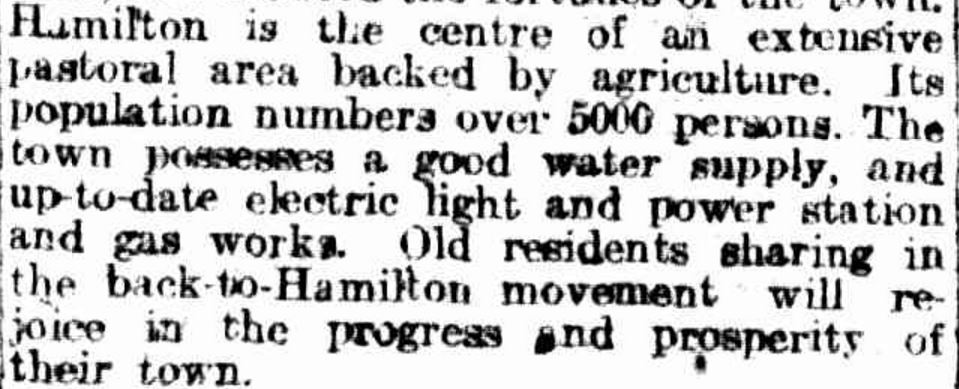
“BACK TO HAMILTON.”. (1923, February 19). Portland Guardian (Vic. : 1876 – 1953), p. 2 Edition: EVENING.. Retrieved February 21, 2012, from http://nla.gov.au/nla.news-article64101957

Activities planned included band recitals, back to school visits, ancient and modern dance socials and terrier coursing.

bh

bh1

bh2

“BACK TO HAMILTON.” The Age (Melbourne, Vic. : 1854 – 1954) 23 Feb 1923: <http://nla.gov.au/nla.news-article203778556&gt;.

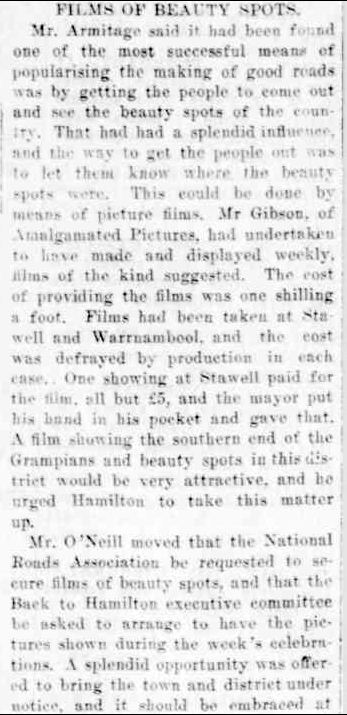
Visits to beauty spots around Hamilton were a feature as were “picture entertainments”.  I wonder if that included films of “Beauty Spots” as proposed in the following article.  Such a film was discussed during a meeting of the National Roads Association who were looking at development of roads through the Grampians to enhance tourism .  The film would be a way to show off the area and reinforce that good roads were necessary throughout the Grampians.  The “Back to Hamilton” celebrations were an opportunity to screen it.

Roads to Grampians. (1923, January 30). The Horsham Times (Vic. : 1882 – 1954), p. 3. Retrieved February 23, 2012, from http://nla.gov.au/nla.news-article72743674

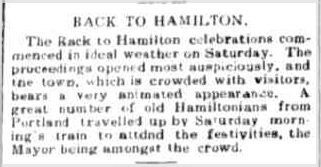
Over the first weekend, Hamilton was full and visitors were enjoying the celebrations in fine weather.

BACK TO HAMILTON. (1923, February 26). Portland Guardian (Vic. : 1876 – 1953), p. 2 Edition: EVENING.. Retrieved February 21, 2012, from http://nla.gov.au/nla.news-article64101997

Many visitors arrived by train and bands welcomed them at the station “Home, Sweet Home”

“BACK TO HAMILTON.”. (1923, February 27). The Argus (Melbourne, Vic. : 1848 – 1956), p. 11. Retrieved February 23, 2012, from http://nla.gov.au/nla.news-article1879114

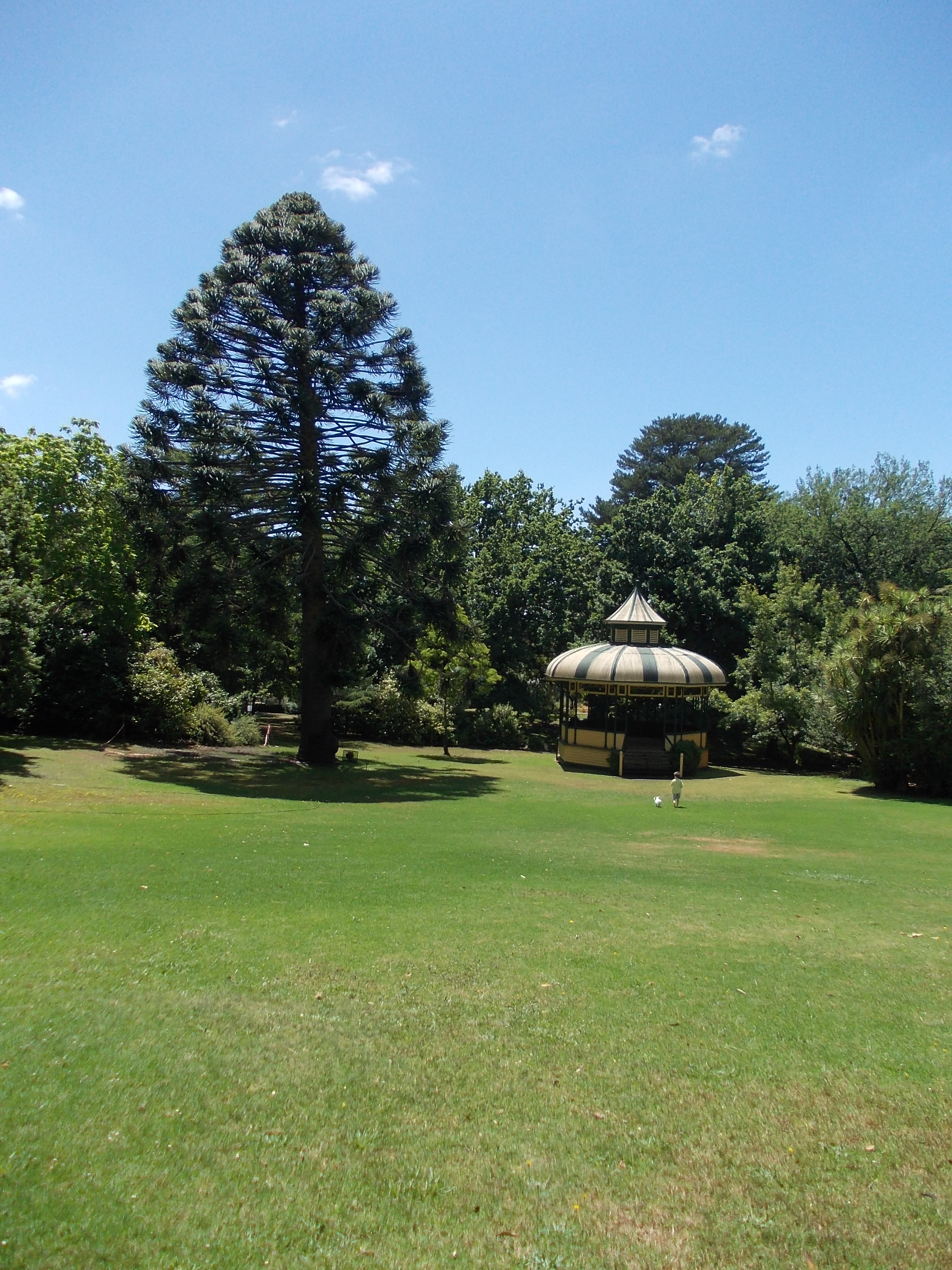
Crowds gathered in the Hamilton Botanic Gardens to listen to band recitals in the bandstand on Sunday February 25.  On the following Tuesday, children gathered in the gardens for sports.

BANDSTAND, HAMILTON BOTANIC GARDENS

Councillor Noske spoke to the gathering declaring “Hamilton was destined to become a great town” and the council’s focus was on closer settlement.  A parade was held on the Tuesday afternoon which included Thomas Cawker of Casterton driving a four-in-hand coach, old pioneers his passengers.

Back to Hamilton. (1923, February 28). The Argus (Melbourne, Vic. : 1848 – 1956), p. 14. Retrieved February 23, 2012, from http://nla.gov.au/nla.news-article1879269

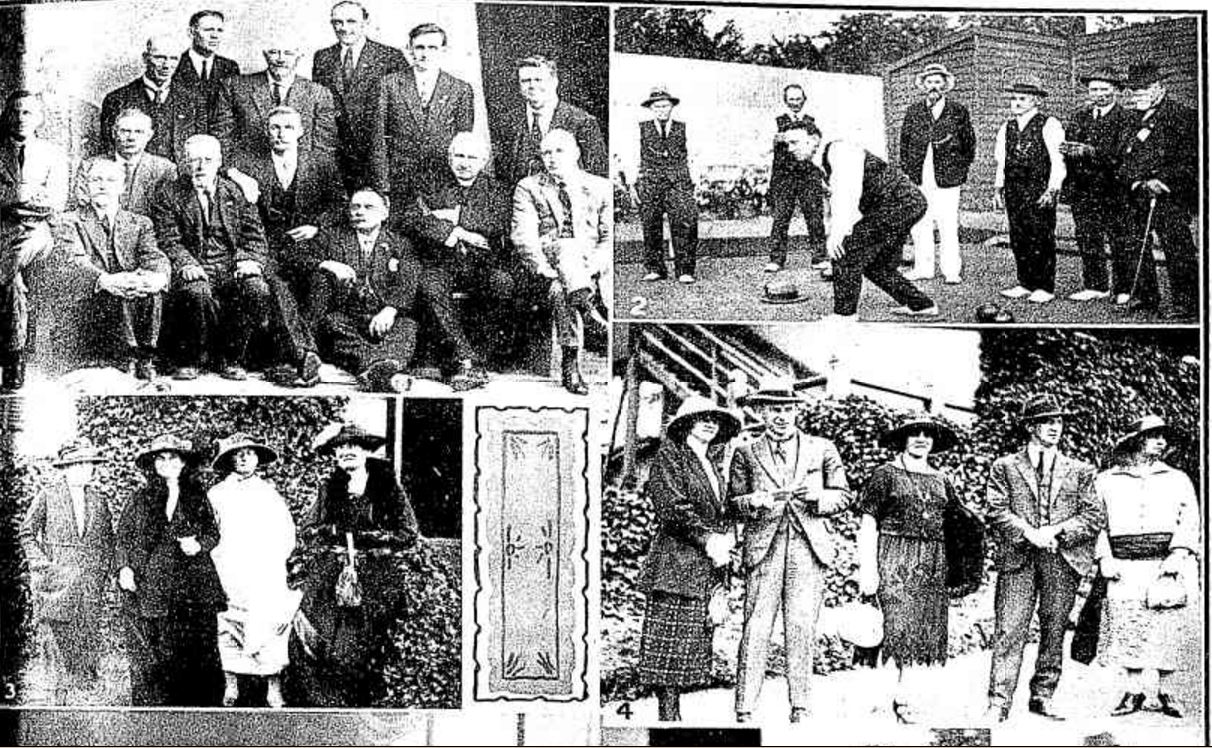
Photos from the event from Table Talk 8 March 1923

bh5

"[No heading]." Table Talk (Melbourne, Vic. : 1885 - 1939) 8 Mar 1923: 9. Web..

bh6

“[No heading].” Table Talk (Melbourne, Vic. : 1885 – 1939) 8 Mar 1923: 9. Web.<http://nla.gov.au/nla.news-page17434629&gt;.

 "[No heading]." Table Talk (Melbourne, Vic. : 1885 - 1939) 8 Mar 1923: 26. .


“[No heading].” Table Talk (Melbourne, Vic. : 1885 – 1939) 8 Mar 1923: 26. <http://nla.gov.au/nla.news-page17434648&gt;.


The “Back to Hamilton” was a roaring success, with a profit of £189/11/9.  A very healthy sum for an event which one would imagine was not for profit.  I wonder where the money ended up?

Miscellaneous. (1923, April 9). Portland Guardian (Vic. : 1876 – 1953), p. 3 Edition: EVENING.. Retrieved February 23, 2012, from http://nla.gov.au/nla.news-article64102283

It was during the following year, 1924, when a committee  formed to organize a “Back to Horsham”, gave some clue how such a big profit came about.  While a similar event in Stawell was mostly subsidized,  Hamilton visitors incurred charges for many events, including a trip to a dry Wannon Falls.

Back to Horsham. (1924, August 5). The Horsham Times (Vic. : 1882 – 1954), p. 3. Retrieved February 23, 2012, from http://nla.gov.au/nla.news-article72749147

What the Dickens?

Today marks 200 years since the birth of writer Charles Dickens.  Growing up in Hamilton in the 1970s and 80s my limited diet of Dickens consisted of a production of “Oliver” circa 1978 by the local theatre group and repeats of an old version of “A Christmas Carol” on one of the two TV channels. Oh, and there was a street in Hamilton called Dickens Street, presumably named after Charles himself.  As there is a Burns, Tennyson, Shakespeare, Byron, and Chaucer Street in Hamilton, it made sense to think Dickens Street was part of the theme the early town leaders had happening.  Or did it?  Those other guys are poets anyway.

Having missed a copy of the first edition of a book by Hamilton researcher John McKay in 2007,  The Streets of Hamilton, Western Victoria,  Australia: A History of the People behind the Names, which had a limited print run, I was lucky enough to have Dad snare a copy of the revised 2nd edition in 2009.  It is a terrific book, and as I am familiar with all the street names, it was interesting to read who the streets were named after, with some surprises.

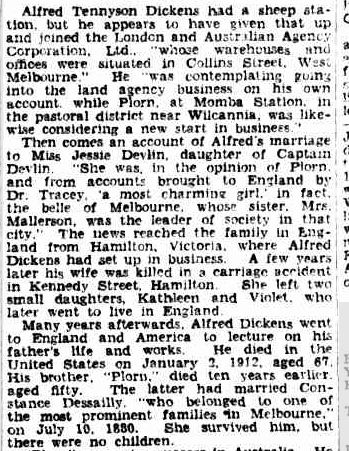
The biggest of those was that Dickens Street, Hamilton was it more likely it was named after the son of Charles Dickens, Alfred D’Orsay Tennyson Dickens.  Why?  Because he lived in Hamilton? What?  The son of one of the world’s most famous novelists could not have lived in Hamilton, my hometown Hamilton, a million miles from the world of Charles Dickens.

Unbelievable but true.  In fact, I find it a little mind-boggling that Alfred Dickens walked the streets of Hamilton 100 years before I did.

Alfred came to be in Australia as his father has sent him off to make his fortune, just as he did with his youngest son Edward Bulwer Lytton Dickens (aka “Plorn”), who lived in New South Wales.

UNLUCKY PLORN DICKENS. (1939, November 4). The Sydney Morning Herald (NSW : 1842 – 1954), p. 13. Retrieved February 6, 2012, from http://nla.gov.au/nla.news-

Alfred’s travels led him to Hamilton where he set up an auctioneering business with Robert Stapylton Bree known as Bree, Dickens & Co.  They were in partnership from 1875-1882.

John McKay mentions a property at 32 Collins Street, Hamilton which Alfred rented before building his own home next door.  The house is very familiar to me and I have been along the street many times, so to think that the son of Dickens lived there is almost unbelievable.

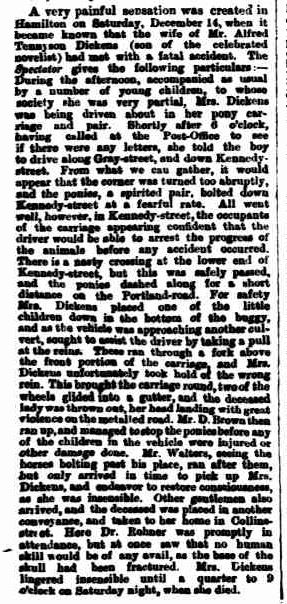
It was an accident that claimed the life of his wife, Jessie Devlin, that saw Alfred Dickens leave Hamilton.

(1878, December 23). The South Australian Advertiser (Adelaide, SA : 1858 – 1889), p. 5. Retrieved February 6, 2012, from http://nla.gov.au/nla.news-page2115990

The horse in the photo below is taking the same path as Jessie’s ponies before bolting down the Kennedy Street hill.

Jessie is buried at the Hamilton (Old) Cemetery

GRAVE OF JESSIE DICKENS

Alfred packed up his two daughters and went to Melbourne.  He was known for his elocution skills and he began giving lectures on his father’s works.  It was on a trip to New York as part of a speaking tour to England and the U.S. that Alfred died.

MR. ALFRED T. DICKENS. (1912, January 4). The Argus (Melbourne, Vic. : 1848 – 1956), p. 7. Retrieved February 6, 2012, from http://nla.gov.au/nla.news-article11643665

First Issue, August 20, 1842. (1912, January 5). Portland Guardian (Vic. : 1876 – 1953), p. 2 Edition: EVENING. Retrieved February 6, 2012, from http://nla.gov.au/nla.news-article63999947

I feel a bit ripped off that it took so long to find out about Hamilton’s brush with Charles Dickens.  But I feel I am not alone.  There would not be many people who either live or have lived in Hamilton that would know the story of Alfred, except for local historians and those who have read John McKay’s book, of course.  Maybe we would know more about him if he had lived out his years in Hamilton, which it appeared he was preparing to do when Jessie met her death.  So on this day, the birthday of Charles Dickens, let us also remember Alfred and his time in the Western District.

In the News – 15 January 1944

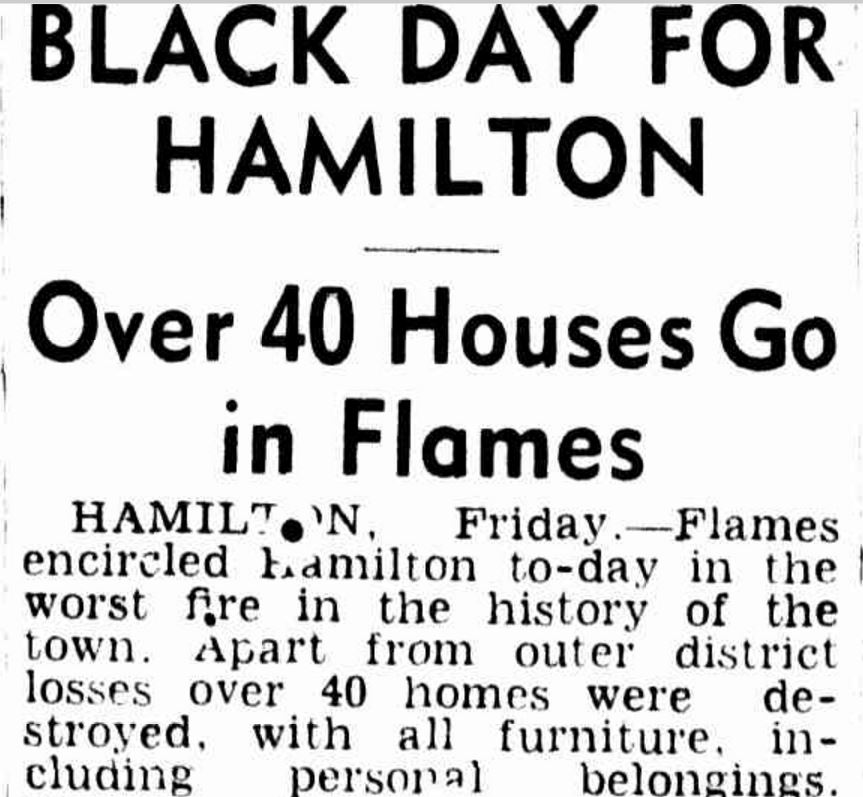
From Saturday 15 January 1944, Victorians were counting the cost of disastrous bushfires that burned out of control a day earlier, Friday 14 January 1944. In Hamilton, the losses were particularly heavy in what were and remain the worst fires in the history of the town, with fifty homes destroyed.

"BLACK DAY FOR HAMILTON" The Age (Melbourne, Vic. : 1854 - 1954) 15 January 1944: .

“BLACK DAY FOR HAMILTON” The Age (Melbourne, Vic. : 1854 – 1954) 15 January 1944: <http://nla.gov.au/nla.news-article206785522&gt;.

There was some warning.  December had recorded below average rainfall, and the temperatures were very high over Christmas and the New Year.  The weekend prior had been hot with temperatures around forty degrees.  Friday 14 January and Saturday 15 January were both declared days of total fire ban across the state except the Mallee.

"BUSH FIRE DANGER" Portland Guardian (Vic. : 1876 - 1953) 13 January 1944: 4 (EVENING). Web. 14 Jan 2017 .

“BUSH FIRE DANGER” Portland Guardian (Vic. : 1876 – 1953) 13 January 1944: 4 (EVENING). <http://nla.gov.au/nla.news-article64387965&gt;.

The Hamilton Hospital admitted more than forty people, and some later died.

HAMILTON AREA LOSS £270,000. (1944, January 19). The Argus (Melbourne, Vic. : 1848 – 1956), p. 4. Retrieved January 18, 2012, from http://nla.gov.au/nla.news-article11821239

CATASTROPHIC FIRE AT HAMILTON. (1944, January 15). The Argus (Melbourne, Vic. : 1848 – 1956), p. 4. Retrieved January 18, 2012, from http://nla.gov.au/nla.news-article11816144

Of the fifty homes destroyed, two belonged to my relatives.  On a trip to Hamilton, I visited Mum’s first cousin and mentioned the 1944 fires to her husband, then his eighties. His family, the Lovell’s, lost their home in the 1944 fires.  He disappeared from the room and returned with a clump of fused pennies, all he had left after the fire, a “memento” he had kept for over 60 years.  I found a similar account in The Age of 20 January 1944,

"Nineteen Patients in Hamilton Hospital" The Age (Melbourne, Vic. : 1854 - 1954) 20 January 1944: .

“Nineteen Patients in Hamilton Hospital” The Age (Melbourne, Vic. : 1854 – 1954) 20 January 1944: <http://nla.gov.au/nla.news-article206793515&gt;.

The Lovell’s house was around three kilometres from the main street, Gray Street.  The Argus reported the closest the fire got to Gray Street was just 500-800 metres from the Post Office.  Having lived in Hamilton, I find this unimaginable, particularly the thought of roofing iron blowing into the main street.

MANY LIVES LOST AND ENORMOUS DAMAGE IN BUSH FIRES. (1944, January 15). The Argus (Melbourne, Vic. : 1848 – 1956), p. 1. Retrieved January 18, 2012, from http://nla.gov.au/nla.news-article11816061

Another of my family members to lose a home was Mrs E.Diwell.  That was Louisa Spender, wife of  Ernest Diwell, a son of my gg grandparents Richard and Elizabeth Diwell.  Ernest passed away in 1939, and Louisa remained at their home, described as “off ” Penshurst Road” on the 1942 Australian Electoral Roll.  They actually lived at the southern end of Rippon Road, which could be described as “off” Penshurst Road.  Penshurst Road is to the east of Hamilton and not far from where I used to live.

Something to consider is that this was wartime, with many men serving overseas. With limited manpower, it was not surprising that women were fighting side by side with men.  I mentioned the fire to Nana, and while she did recall it, she had no other knowledge of it.  She was living in Melbourne then and working at the Munitions factory at Maribyrnong before her marriage in 1945.  Also, her immediate family lived on the northern side of the town, which does not seem to have been in the path of the fire.  When I mentioned women fought the fires, she gave me an “Of course!” type of reply.

Hamilton was not the only town ravaged by the fires of January 1944.  Nearby Dunkeld (below) lost more than forty homes and buildings, and twenty homes were lost at Colac.

THE SCENE AT DUNKELD. "Bush Fire Victims Carry On" Weekly Times (Melbourne, Vic. : 1869 - 1954) 26 January 1944: .

THE SCENE AT DUNKELD. “Bush Fire Victims Carry On” Weekly Times (Melbourne, Vic. : 1869 – 1954) 26 January 1944: <http://nla.gov.au/nla.news-article224839776&gt;.

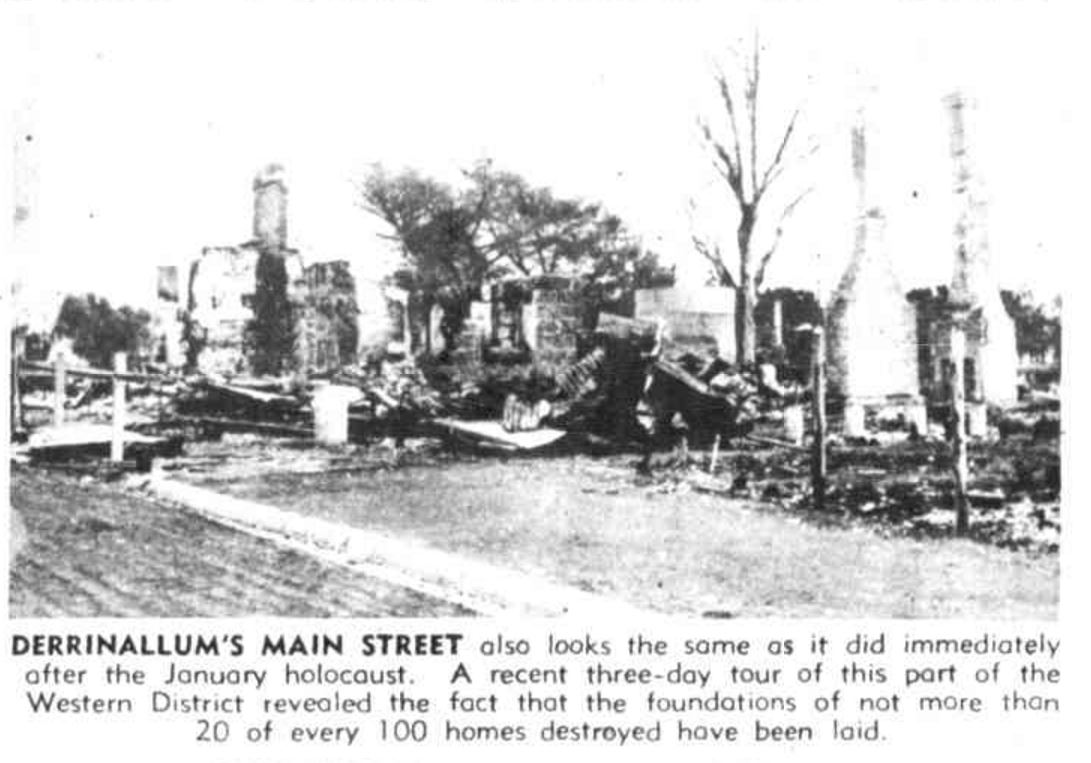
Derrinallum (below) was hit by what The Australasian described as the “January Holocaust”.

"WESTERN DISTRICT FIRE AREAS STILL SCENE OF RUIN" The Australasian (Melbourne, Vic. : 1864 - 1946) 27 May 1944: 6. Web. 14 Jan 2017 .

“WESTERN DISTRICT FIRE AREAS STILL SCENE OF RUIN” The Australasian (Melbourne, Vic. : 1864 – 1946) 27 May 1944: 6. Web. 14 Jan 2017 <http://nla.gov.au/nla.news-article142418919&gt;.

The following article from The Sydney Morning Herald summarised the day of Friday 14 January 1944.

FIRES IN WIDELY-SEPARATED ZONES. (1944, January 15). The Sydney Morning Herald (NSW : 1842 – 1954), p. 9. Retrieved January 18, 2012, from http://nla.gov.au/nla.news-article17878294

Even beachside suburbs of Melbourne had fire running through the ti-tree, forcing hundreds on to the beaches.

FOURTEEN DEATHS IN DISASTROUS BUSH FIRES IN VICTORIA. (1944, January 15). Advocate (Burnie, Tas. : 1890 – 1954), p. 5. Retrieved January 18, 2012, from http://nla.gov.au/nla.news-article68837972

Passing of the Pioneers

This is the fourth “Passing of the Pioneers” and includes a chess champion who lived in Merino and plenty of Irish influence.  They highlight some of the pioneers of Victoria’s Western District by way of their obituaries as published in the Portland Guardian.  If you would like to read the full obituary, just click on the pioneer’s name.

Emma WITHERIDGE: Died  4 October 1888 at Portland. This obituary demonstrates the tone of many at the time.

OBITUARY. (1888, October 5). Portland Guardian (Vic. : 1876 – 1953), p. 2 Edition: EVENING.. Retrieved October 26, 2011, from http://nla.gov.au/nla.news-article63590480

George BEVAN: Died  17 October 1888 at Portland. George owned and died at the London Hotel in Portland.  His family notice shows he was born in Somerset, England and was fifty-nine at the time of death.  George had been in Portland since the early 1860s and was a keen sportsman and former Town Councillor.

Mary ROGERS: Died October 1912 at Greenwald.  Mary Rogers was aged eighty-six at the time of her death and had lived in Victoria for sixty years.  She originally went to Tasmania from Ireland with her parents as a small child.  Mary married Francis Egan who had passed away thirty years earlier.

William Sudgen Price LEWIS: Died 4 October 1915 at Hamilton. William Sudgen Price Lewis was the stepson of Richard Lewis, a former owner of Rifle Downs at Digby.  Born in Tasmania in 1835, William and his brother came to live with Richard Lewis when Richard and their mother married in 1841. In adult life, William leased Hilgay station for a time, bred fine livestock and was a member of several racing clubs. He later retired to Hamilton. He was buried at Hamilton (Old) Cemetery (below).

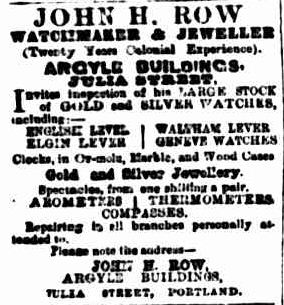
John Hawkins ROW: Died 27 October 1926 at Portland. John Row was a Portland jeweller.

Advertising. (1879, March 27). Portland Guardian (Vic. : 1876 – 1953), p. 2 Edition: MORNINGS.. Retrieved October 27, 2011, from http://nla.gov.au/nla.news-article63341984

At the time of his death, he was the oldest member of the Portland Free Library and the bowling club.  He was also a member of the St Stephen’s Church congregation.

St Stephens Church Portland

John McDONNELL: Died 17 October 1930 at Moree. Mr McDonnell was originally from Ireland and arrived in Australia in 1863 via Liverpool. He was considered one of the oldest people in the district. He married Catherine FAHEY and they selected land at Moree in 1865.

Catherine Bridget SAMPEY: Died October 1933 at Melbourne. Catherine Sampey arrived in Melbourne from Ireland aboard the Red Jacket in 1852. She travelled on to Chetwynd with her brother James Sampey and she later married Patrick WHITE of Casterton.

Elizabeth MONOHAN: Died 12 October 1933 at Casterton. Elizabeth Monohan was 100 when she died. Arriving from Ireland aboard the Frances Henty at age twenty-one, seventy-nine years before, she was still able to converse in Welsh and Gaelic in her later years. In 1859, she married John Glover at Sandford House.

Julia Teresa DOYLE: Died October 1934 at Portland. Born in Tipperary, Ireland but remembered as “a true type of a fine old English lady”, Julia Doyle arrived in Australia as a six-year-old in the mid-1850s. She married Frances SUTTON in 1874 and together they had six daughters and two sons.

Ernest John SEALEY: Died 25 October 1935 at Casterton. In his younger years, Ernest Sealey worked as a bullock driver transporting wool. In later worked on Portland’s deep-water pier, hauling logs from the forests to the pier.

Charles PRATT: Died 26 October 1935 at Birchip.

Obituary. (1935, November 4). Portland Guardian (Vic. : 1876 – 1953), p. 2 Edition: EVENING.. Retrieved October 27, 2011, from http://nla.gov.au/nla.news-article64290777

And so begins the obituary of Charles Pratt.  Charles or Charley as he was widely known, was born at Mumbannar in 1870.  In 1891, he went to Beulah in the Mallee and worked with his step-brother and later selected his own land near Watchupga.  He married Annie LAVERY in 1914 and they had three sons.

Thomas Denton CLARKE: Died 5 October 1937 at Hamilton. Thomas, born around 1847 at Liverpool, was the son of Captain Thomas H. Clarke who was a trader in Portland.  Thomas jnr was a champion chess player and a composer of chess problems.  He won many competitions for both pursuits.  Composing problems up until his death, it was considered probable, according to the obituary, that he was the world’s oldest composer.

James McCLUSKEY: Died October 1942 at Koroit. James McCluskey was born at Portland in 1857, not long after the arrival of his parents on the ship, British Empire. Soon after, the family travelled by bullock wagon to Kirkstall near Warrnambool.  In his early working life, James drove pigs to Port Fairy in order to load them on the steamer Casino to go to market in Melbourne.

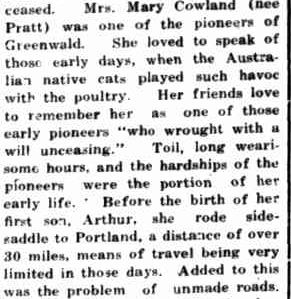
Mary PRATT: Died 7 October 1942 at Greenwald. Mary, the widow of George COWLAND, was eighty-seven at the time of her death.  There were twelve children in their family.  Her obituary recalled her pioneering traits.

OBITUARY. (1942, October 26). Portland Guardian (Vic. : 1876 – 1953), p. 2 Edition: EVENING. Retrieved October 27, 2011, from http://nla.gov.au/nla.news-article64382483

The Day the Queen Visited Hamilton

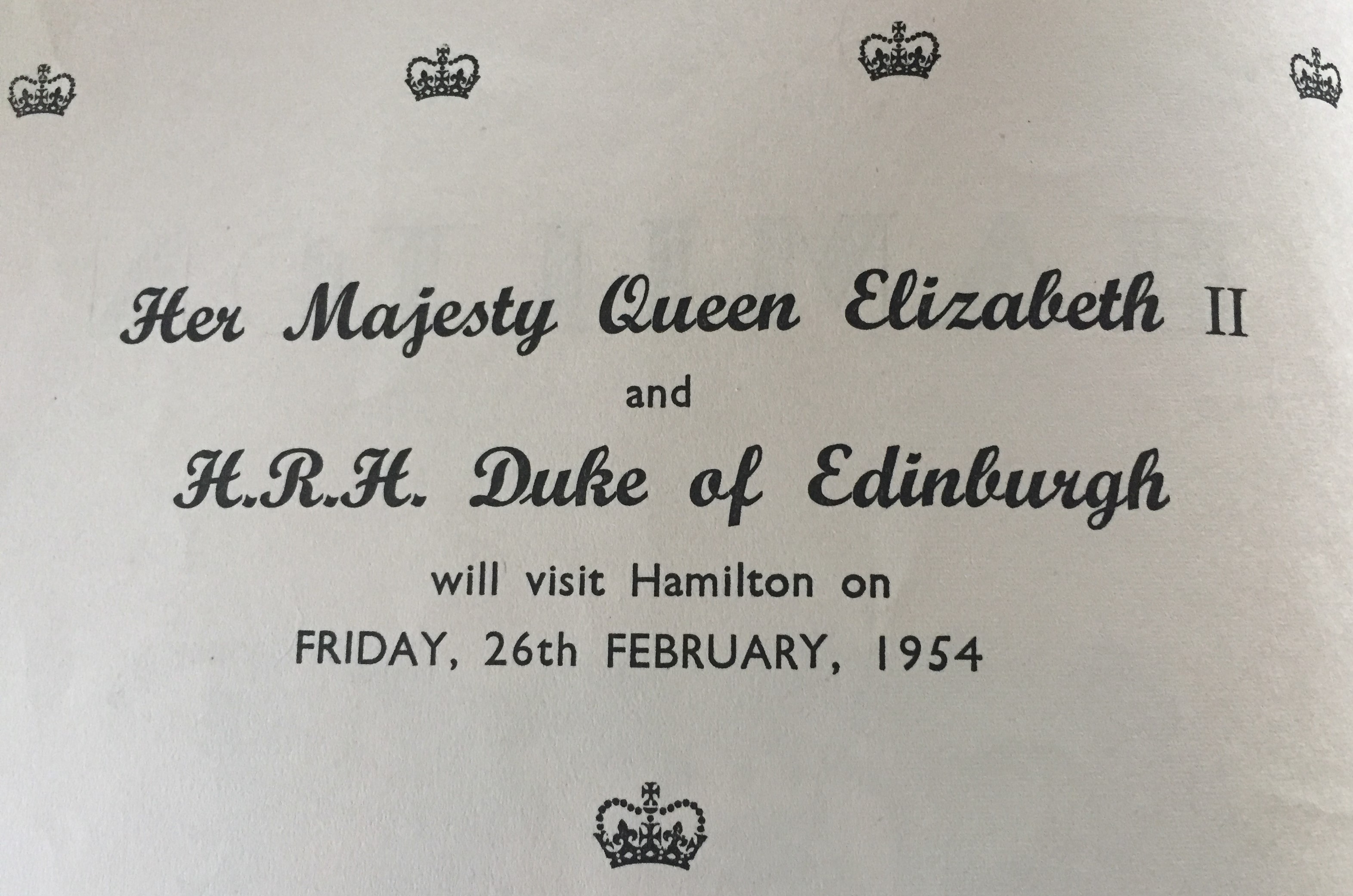
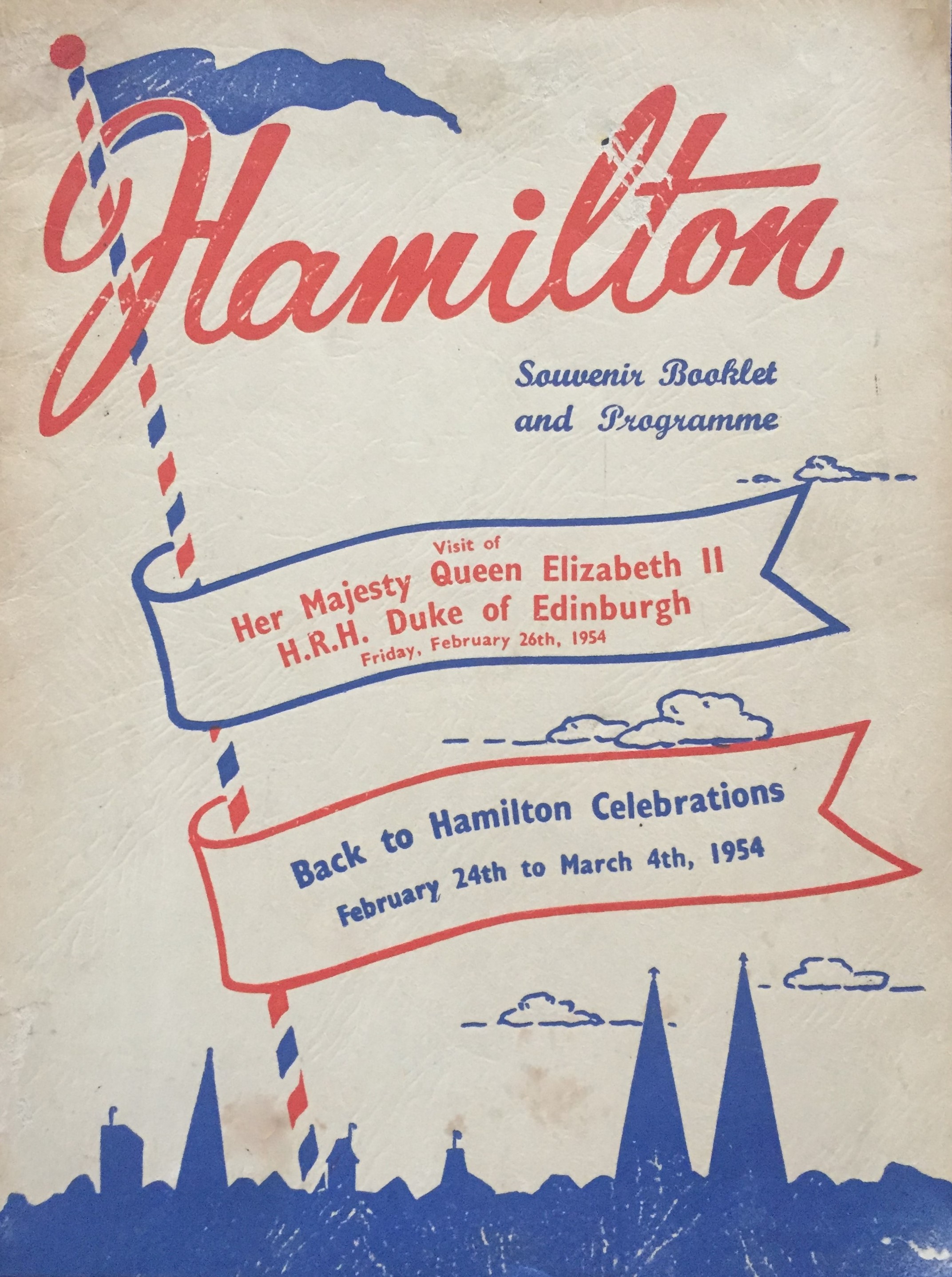
Hamilton Souviner Booklet and Program, 1954

On 26 February 1954, Hamilton was buzzing with excitement for a much-anticipated visit by Queen Elizabeth II and Prince Phillip, Duke of Edinburgh.

Mt Gambier and Hamilton were the only locations in the region chosen for a visit by the new Queen, despite much lobbying by nearby towns. The inter-town rivalry preceding the visit was immense. Headlines in the Portland Guardian at the time included “Number One Priority for Royal Visit Should Have Been Portland’s” and “No Royal Visit an Insult to Portland”

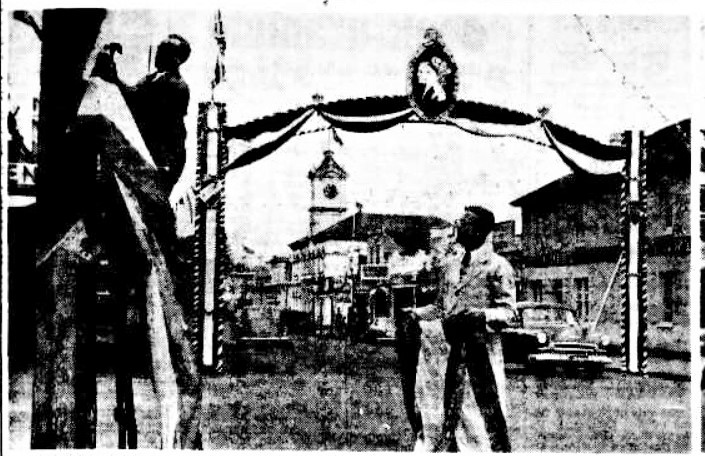
Hamilton wanted to put on a show, and preparations started long before the big day. Residents decorated their homes, some with flags on the roofs for the Queen to see as she flew into the Hamilton Aerodrome.  The council spent £5,000 on decorations, including four large arches around the town, with one on the outskirts made of locally grown hay, oats, and flax, with “Welcome” crafted from wool, for which the district was famous. Several kilometres of bunting, flags, and lights decorated the CBD.

HAMILTON READY TO GREET QUEEN (1954, February 26). The Argus,p. 15. http://nla.gov.au/nla.news-article26593166

More than 100,000 people were expected to converge on the town. Local hotels set up beds in the lounges and on balconies to accommodate the overflow of guests and accommodation houses up to 60 kilometres away reached capacity.

The Royal Visit coincided with “Back to Hamilton” celebrations, and the organising committee published a souvenir booklet.

PHOTO OF AUTHOR’S COPY.

On the big day, The Argus published a map of the best places to glimpse the Queen and Duke.

Where to see the Queen Today FIRST COUNTRY VISIT. (1954, February 26). The Argus p. 7. http://nla.gov.au/nla.news-article26593160

At Melville Oval, around 13,000 school children started assembling from 8.00am.

Along with the school children were several thousand others, many travelling long distances.

HAMILTON’S FAMILY WELCOME. (1954, February 27). The Argus, p. 15. http://nla.gov.au/nla.news-article26593294

With the Queen’s plane scheduled to arrive at the Hamilton Aerodrome, to the north of the city, at 3.35pm, the Dundas Shire President, Cr. Henry Bull, his wife, and around 3000 eager locals gathered to meet Queen Elizabeth and the Duke. Young Rosemary Oates prepared to present Her Majesty with a bouquet.

Back to Hamilton visitors saw Queen and Duke (1954, March 10). Weekly Times p. 78. http://nla.gov.au/nla.news-article224910934

The plane was five minutes late, and a gasp went up from the large crowd when part of the carpet laid on the tarmac almost blew away from the force of the plane’s propellers.

MARGARET OATEN PRESENTS QUEEN ELIZABETH WITH A BOUQUET (1954, February 27). The Argus, p. 7. http://nla.gov.au/nla.news-article26593444

The Royal party then moved by car to Melville Oval, where the schoolchildren were still patiently waiting after eight hours.

Hamilton rocked in Royal salute. (1954, February 27). The Argus p. 7. http://nla.gov.au/nla.news-article26593444

The sight of the decorated city, and an estimated 70,000 adults and children waving, saw the Queen wipe her eyes several times before the motorcade came to a halt at Melville Oval.

Hamilton welcome Queen had tears in her eyes (1954, February 27). The Argus p. 4.  http://nla.gov.au/nla.news-article26593398

After being met by Mayor Cr. Reginald White and Town Clerk Hector Donald and their wives, the royal couple drove around Melville Oval before returning to the airport for a flight to Melbourne.

The Age (Melbourne, Vic. : 1854 – 1954) 27 February 1954, p. 3. http://nla.gov.au/nla.news-article206088677

But not before eight-year-old Jennifer Biggs from Hamilton State School had the honour of presenting the Queen with a bouquet.  Jennifer is pictured below, practising her courtesy before the event while her classmates watch on.

Rag doll aids girl’s curtsy (1954, February 26). The Argus , p. 15.  http://nla.gov.au/nla.news-article26593193

“Hamilton’s Children Cheer the Queen” The Age 27 February 1954: p. 8. http://nla.gov.au/nla.news-article206088514 

Hamilton rocked in Royal salute (1954, February 27). The Argus, p. 7. http://nla.gov.au/nla.news-article26593444

On the return trip to the aerodrome, the Royal party drove past the Hamilton Hospital, where members of the nursing staff excitedly waved to the passing motorcade.

(1954, February 27). The Argus p. 7. http://nla.gov.au/nla.news-article26593444

Back at the aerodrome, around 3,000 people waited to farewell the Royal visitors.  The Argus of 27 February 1954, described how the large crowd “surged forward in a wild rush” jostling “elderly men and women and young children.”

It was a memorable day for Hamilton, one not since matched, and almost 70 years later, it remains in the memories of those who were there to experience it.

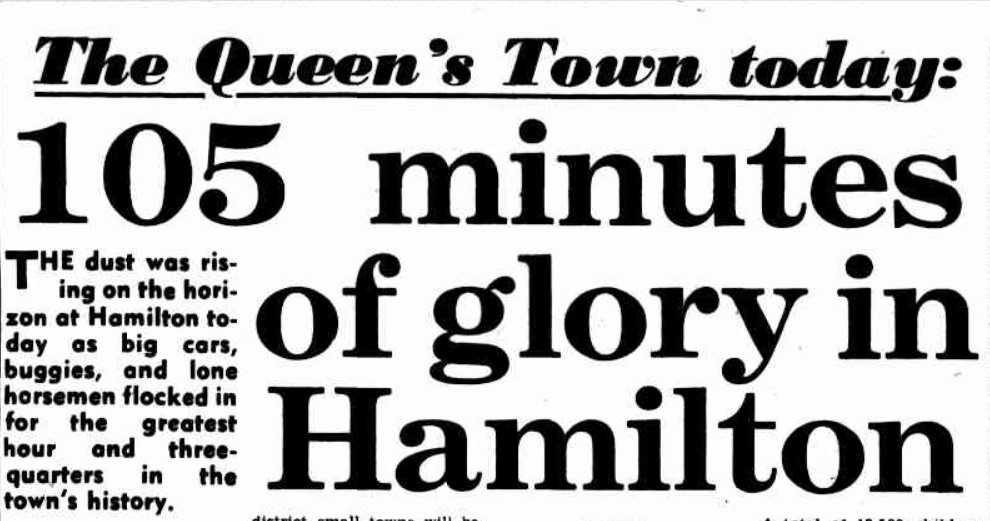
The Queen’s Town today: 105 minutes of glory in Hamilton (1954, February 26). The Argus, p. 2. http://nla.gov.au/nla.news-article26593119

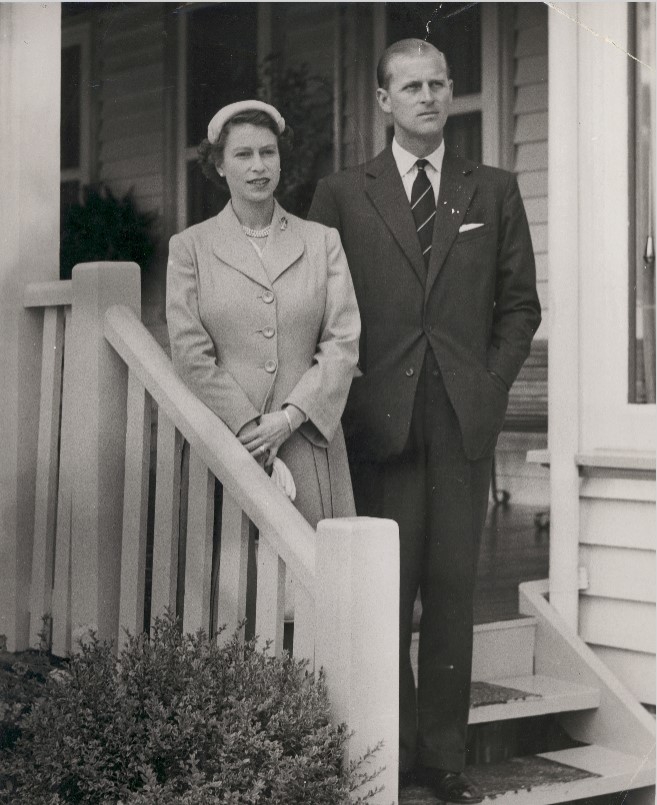
QUEEN ELIZABETH II & PRINCE PHILLIP, DUKE OF EDINBURGH DURING THEIR 1954 TOUR OF VICTORIA. Image courtesy of the State Library of Victoria http://handle.slv.vic.gov.au/10381/245876

Passing of the Pioneers

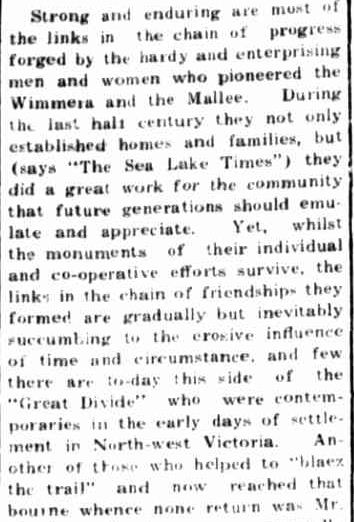
The Portland Guardian was mindful of the contribution made by the early pioneers toward developing the south-west.  They offered regular items titled “Passing of the Pioneers” or “Passing Pioneers” and often mentioned in obituaries that “…one by one are old pioneers are passing”.  As early as 1889, they were lamenting the loss of the links to the early settlers and suggesting that the efforts of those who passed be recognised.

The Portland Guardian,. (1889, January 16). Portland Guardian (Vic. : 1876-1953), p. 2 Edition: EVENING. Retrieved July 18, 2011, from http://nla.gov.au/nla.news-article63591640

Established August 1842. The Portland Guardian,. (1899, July 7). Portland Guardian (Vic. : 1876-1953), p. 2 Edition: EVENING. Retrieved July 19, 2011, from http://nla.gov.au/nla.news-article63676630 MLA citation

In 1921, the paper spoke of the many unwritten histories that had gone before, but now we can see the Portland Guardian lived up to its charter of 1889,  successfully recording the histories of many of the local pioneers.  By doing so, they are now helping us learn more about our families and gain a sense of life in the early days of the Western District.  Of course, The Guardian was not alone.  References to the “passing pioneers” are found in most of the papers on the Trove website.

Obituaries are a secondary source as the information comes from the knowledge of those still living and I have noticed errors in obituaries of my family.  But they can offer leads to records you may never have thought of such as Masonic lodge records and local council records. Whatever you do or don’t get out of an obituary, no-one can deny they are often a good read.

July was a month when many “Passing of the Pioneers” columns appeared.  Cold winters in the southwest saw many of the older residents “cross the Great Divide” as the Guardian would put it.

Some of the more notable passing pioneers in the month of July were:

James PARKER:  Died 6 July1889 at Heywood. James PARKER’S obituary is an interesting read.  Born in Tasmania around 1810, he came to the mainland as a whaler. In 1842, he married Margaret NOLAN at Portland. Later he had some luck at the Creswick goldfields only to have an encounter with bushranger Captain Moonlight.

William TULLOH: Died 19 July 1889 at Portland.  This is a lengthy obituary of a Portland resident of nearly fifty years, whose death saw half-closed shutters on homes around the town.  Born in Scotland in 1812, he left a wife, four sons, and a daughter at the time of his passing.  I have found a site with more detail of William and his wife Eliza Mary KEARTON.

James BARNETT: Died 18 July 1892 at Portland.  James was known as “Old Barney” around Portland and while the Portland Guardian credits him as a pioneer, they make a judgement in saying that he did not make the most of his opportunities as other early settlers had done.  He married in 1851 to Elizabeth AUSTIN. Five children were living at the time of James’ death.

Alexander THOMSON: Died July 1897 at Hamilton. Scottish born Alex THOMSON was prominent around the Hamilton area as a Shire of Dundas Councillor for twenty-one years.  At the time of his death, he was the owner of Pierrepoint Estate near Hamilton and was also an active member of the Pastoral and Agricultural society.

Thomas Webb SMITH:  Died 29 July 1914 at Branxholme.  Thomas served on the Borough of Portland council and was mayor from November 1871-November 1873.  He was also a member of the Goodfellows and Freemasons.

Annie Maria HENTY: Died 2 July 1921 at Hamilton.  Annie was from the most famous southwest pioneering family of them all, the Henty’s. The daughter of Stephen HENTY, Annie married Hamilton stock and station agent Robert STAPYLTON BREE in 1874.  The Bree name is preserved in Hamilton with a much-used road of the same name in the town.  Their home Bewsall (below) once stood near the end of Bree Road in North Boundry Road.

HAMILTON. (1903, May 2). The Australasian (Melbourne, Vic. : 1864 - 1946), p. 27. Retrieved February 18, 2014, from http://nla.gov.au/nla.news-article138684187

HAMILTON. (1903, May 2). The Australasian (Melbourne, Vic. : 1864 – 1946), p. 27. Retrieved February 18, 2014, from http://nla.gov.au/nla.news-article138684187

Stapylton-Bree (2)

Ann Eliza KEEPING: Died 9 July 1921 at Portland.  Annie Eliza KEEPING arrived in Australia aboard the Eliza and married John FINNIGAN in 1857.  She was eighty-two at the time of her death.

Joseph Bell PEARSON:  Died 7 July 1922 at Portland. Yet another interesting character.  According to his obituary, Joseph was born on the voyage from England to Tasmania.  His family moved to the Retreat Estate near Casterton in 1844.  He was a noted horseman, with several good racehorses which he would ride himself.  One of his jumps racing rivals was Adam Lindsay Gordon.

Joseph was buried at the Hamilton (Old) Cemetery with his wife Mary Abbott and mother-in-law Martha Holdish (below).

Abbott

Sarah MARSHALL:  Died 7 July 1923 at Gorae West. Sarah was the wife of the late Richard BEAUGHLEHOLE and she died at seventy-three. Richard selected land at Gorae West and transformed swampland into flourishing orchards.  Sarah and Richard had twelve children.

Mary Thurza HEDDITCH: Died 1 July 1930 at Drik Drik. Mary HEDDITCH was born in Portland in 1844 and moved with her family to Bridgewater in 1846.  Her elder brother drowned when she was a teenager leaving her to take on some of his duties.  As a result, she became an accomplished horsewoman, helping her father with the cattle.  She married James MALSEED and together they had seven children.

Phillipa JOHNS: July 1931 at Portland.  Phillipa JOHNS, the daughter of a doctor, was herself something of a substitute doctor for those living in the Willenbrina area, near Warracknabeal.  Later she and her husband William DELLAR moved to the Portland district.  They had nine children.

In the News – June 24, 1861

The Portland Guardian and Normanby General Advertiser reported on 19 June 1861, a meeting at Hamilton of the Separation Movement.  It was the first meeting of its kind in Hamilton, following on from a successful meeting in Portland.

SEPARATION MEETING AT HAMILTON. (1861, June 24). Portland Guardian and Normanby General Advertiser (Vic. : 1842-1876), p. 2 Edition: EVENINGS.45 http://nla.gov.au/nla.news-article65446763

Many well-known gentlemen of the district were there, men whose names are still evident in Hamilton.  Messers Skene, Learmonth, McKellar, and McPherson were all present.

Despite a campaign that went into 1862, the move to separate was unsuccessful.

An article in The Portland Guardian on 30 March 1953 reflected on what might have been if separathttp://trove.nla.gov.au/ndp/del/title/109ion had occurred.  The proposed new colony was to be called Princeland, with Hamilton as the capital and Portland as the major port.  I would have been born in Hamilton, the capital of the state of Princeland, Australia.  Imagine!

Talk of separation did not subside, as seen in this article from The Guardian in 1921.  A push in the Riverina area to separate in the early 1920s again saw the suggestion for the south-west of Victoria to also separate.

“WAKE UP, HAMILTON.”. (1921, January 31). Portland Guardian (Vic. : 1876-1953), p. 2 Edition: EVENING.. Retrieved June 24, 2011, from http://nla.gov.au/nla.news-article64023185

Elizabeth Ann Jelly

Richard & Elizabeth Diwell and family

This is Richard and Elizabeth Diwell and their family in the spring of 1900 in Hamilton.  The eldest child, Margaret was nineteen and the youngest, Martha was two. Elizabeth, at forty-four, was in the last months of pregnancy and was radiant.  Martha’s hand rests comfortably on her mother’s growing stomach.  Edith clutches the arm of father Richard, a successful bricklayer and keen gardener, a member of the Hamilton Horticulture Society.  Chrysanthemums were one of his specialities.  Within months, this serene family scene was shattered.

Richard Diwell and Elizabeth Jelly married in June 1877 at Casterton.  Richard, born at Portland in 1854 was the son of William and Margaret Diwell and was their first child born on Australian soil after their arrival in 1853 aboard the Duke of Richmond.  William too was a bricklayer.  Elizabeth was the daughter of  George and Jane Jelly and like William was her parents’ first born in Australia.  They had arrived in 1855 on the Athletae and moved to Casterton where Elizabeth was born in 1856.

Sadness came early in Richard and Elizabeth’s marriage with their first born child, Ada Jane, dying within her first year of life.  Six more children, Margaret, William, Jane, Ralph, Edith and Ernest were born in Casterton over the next eleven years until 1891.  It was in that year that Elizabeth, her mother and sister-in-law, Annabella McIntyre, signed the Victorian Women’s Suffrage Petition along with one hundred other Casterton women.  It was their contribution to the cause championing for equal voting rights for women.

Later in 1891, the Diwells moved to Hamilton.  The following year tragedy would occur again with the passing of five-year-old Ralph.  In 1893, Ethel was born and another pregnancy in 1895 saw the birth of Rebecca but she sadly died in 1896 aged ten months.  George was born in 1896, Martha in 1898.

Which brings us back to 1900.  Despite the losses of the past, life was continuing on for the Diwells.  In March, William was voting in favour of the cancellation of that month’s Hamilton Horticulture Society flower show due to drought and Elizabeth was pregnant for the 12th time at the age of forty-four.

Midway through October Elizabeth fell ill in and was nursed for the next three weeks until she gave birth to a daughter on 2 November.  The baby was weak and died two days later.  Elizabeth was also gravely ill and underwent an operation after the birth of the baby.  She battled to stay but succumbed to peritonitis ten days later, on 12 November.

Elizabeth’s obituary from the Hamilton Spectator on 13 November 1900 read:

“… Another death which has evoked the deepest sympathy of all who knew her took place yesterday when Mrs Diwell, the wife of Mr Richard Diwell, bricklayer of this town, died after a short illness.  The deceased was the second daughter of Mr George Jelly of Casterton where she was born, and she came to Hamilton with her husband in 1891. 

She was taken ill three weeks ago and on the 2nd instance she was confined, the child living only two days.  On Sunday evening she had to undergo an operation as the only hope of saving her life but at 3 o’clock yesterday morning she died of exhaustion, the diagnosis being peritonitis. 

She leaves a husband and eight children – three boys and five girls – the eldest of who, a daughter is only nineteen years of age – to mourn their irreparable loss. Mrs Diwell who was only 44 years of age was highly respected by all who knew her and the deepest sympathy is felt with the stricken family in their bereavement.  The funeral will take place a 3 o’clock this afternoon”

The headstone in the Hamilton Old Cemetery is a tribute to Elizabeth and demonstrates the devotion Richard and her children had for her.  Her headstone read:

“None knew how sad parting was, nor what the farewell cost, but God and his loved angels have gained what we have lost”
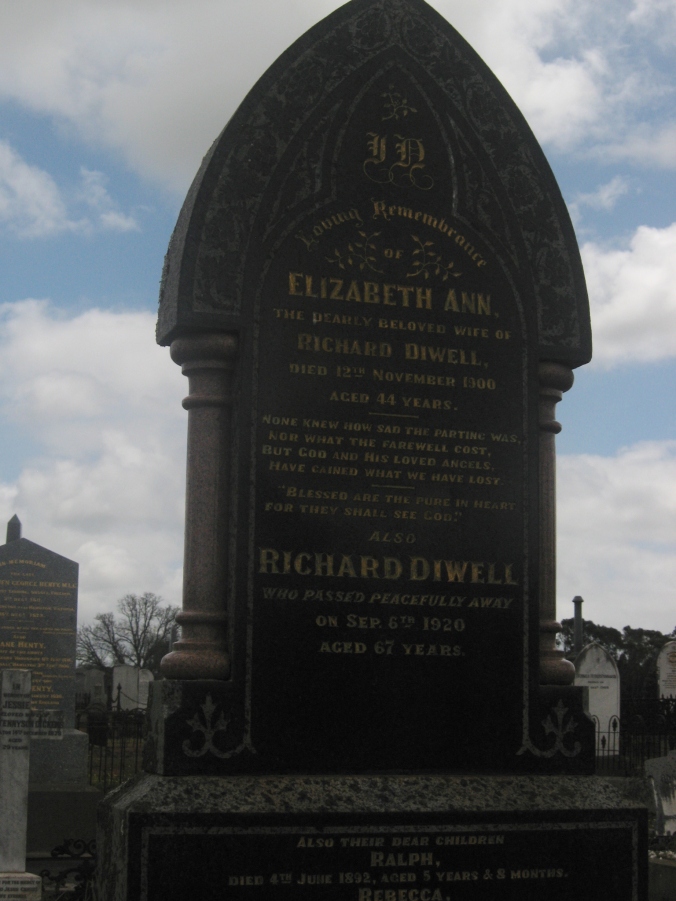
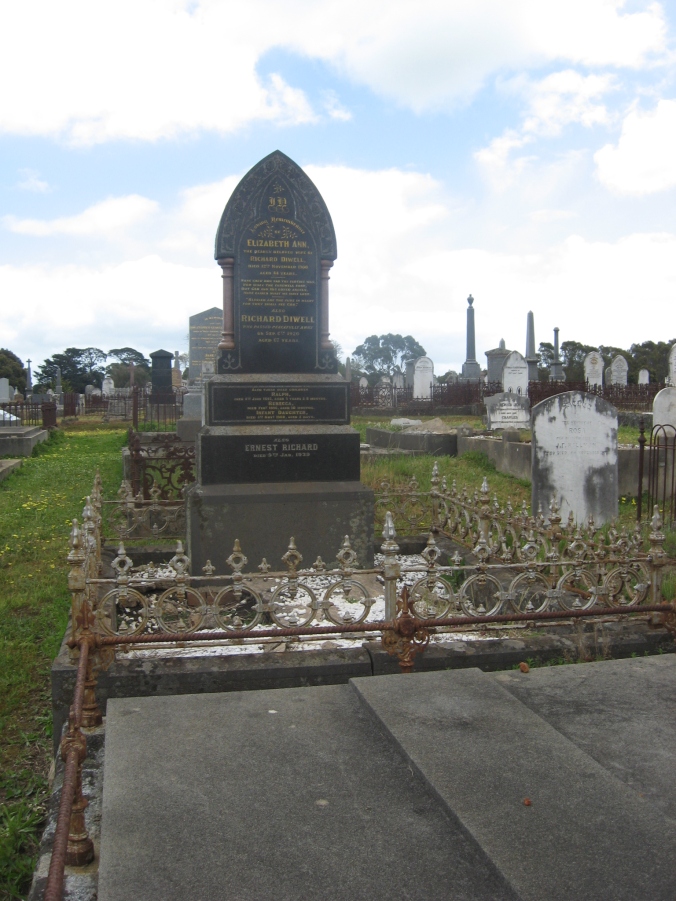


Despite having several young children, Richard never remarried.  The older girls Margaret and Jane would have taken on mothering duties of their younger siblings.  Margaret married in 1905, but Jane did not marry until 1915 at thirty by which time youngest Martha was seventeen.  Richard passed away in 1920 and was reunited with Elizabeth.

Life was not altogether easy for the Diwell children, although they always managed a happy disposition.  Margaret had seven children, however, three died, two as newborns.  Edith, my great-grandmother, suffered through an unhappy marriage and spent much time as a single mother.  Jane married twice, both husbands dying, the second after being hit by a taxi.  She never had children.
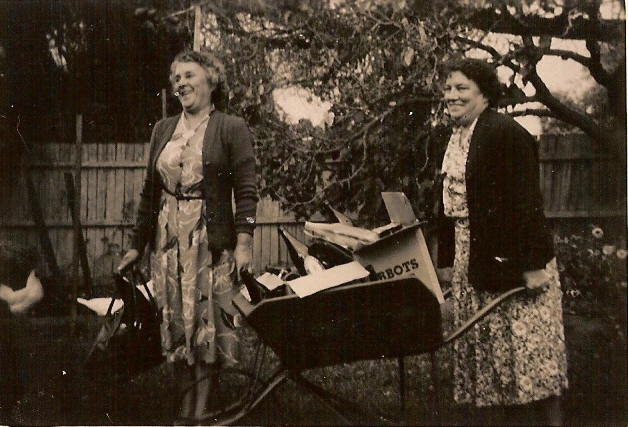
Grandma (Edith) and Auntie Mat (Martha)

Ethel had four known children, one dying at birth.  Martha or Mat as she was known was forty-one when she married and she also had no children.  The boys, William, Ernest and George all married and became bricklayers like their father and grandfather before them, but Ernest passed away at just forty-eight.

I was not lucky enough to know any members of this family but my mother fondly remembers and often talks of Grandma (Edith), Auntie Janey, Auntie Mat (Martha) and Uncles Bill and George.  The photo above of Grandma and Auntie Mat depicts them just as Mum remembers, always laughing and smiling.

As I look at the Diwell family photo I see Elizabeth as a devoted wife and mother but also a strong woman whose marriage was a partnership of two equals.  I can see the woman who was confident enough to sign the Suffrage petition and I see a happy, kind person, traits she passed to her children.

Next time I visit Richard and Elizabeth’s grave in Hamilton, I will be sure to take some Chrysanthemums.


©Merron Riddiford 2011