Passing of the Pioneers

Eight more pioneers join the Pioneer Obituary Index this month in the 68th edition of Passing of the Pioneers.  There are a couple of Hamilton pioneers, one with a great racing story and there are a publican and a publican’s wife.  And what better lead into Women’s History Month (March) than the story of Janet Russell of Golf Hill, Shelford.  You’ll notice loads of links throughout the post, so click on underlined text for more information about a subject.  The links will take you to such things as relevant newspaper articles, the Passing of the Pioneers entries of those connected to this edition’s pioneers, and the Victorian Heritage Database.

UREN, Nicholas John – Died February 1872 at Hamilton.  Nicholas Uren was born in Penzance, Cornwall around 1823.  He joined the British Army serving in India for seven years.  He returned to Penzance and found others in the town were planning to travel to Australia and he decided to join them. Before he left, however, Nicholas married Tryphena Uren in 1854. They left soon after as Assisted Immigrants, arriving at Portland on 16 September 1854 on the ship Nestor.  They were recorded on the passenger list under the name of Wren.

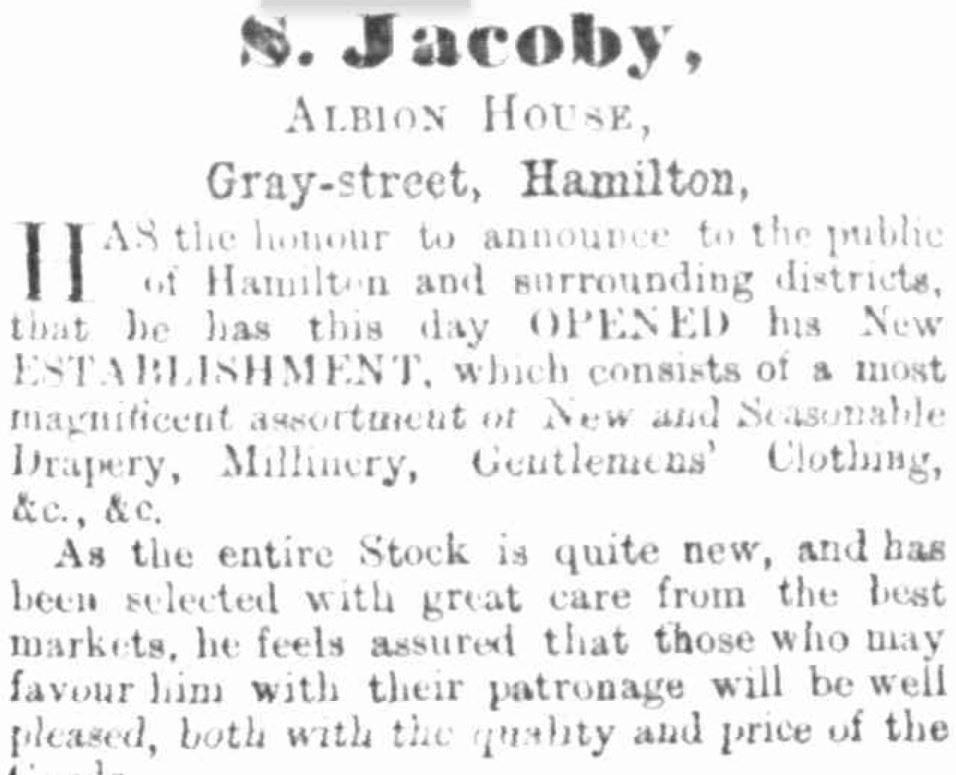
Once in Portland, Nicholas obtained work with the solicitor John Dodd and he and Tryphena resided in Percy Street.  Nicholas stayed with John Dodd until mid-1856 before he and Tryphena went to Hamilton with one of Nicholas’ co-employees Henry Cox. Henry set up a solicitor’s practice in Hamilton and Nicholas joined him as a legal assistant.  In time Angelo Palmer took over the practice.  Nicholas also acted as the Borough solicitor.  In December 1869, he was nominated as a candidate for the Hamilton Borough Council along with Sigismund Jacoby.  Nicholas was successful and he took his place on the council in January 1870.  Nicholas also served was on various committees.

Nicholas was a lover of horses, enjoyed racing, and considered a good judge of horses. In 1865, he nominated a horse for the Melbourne Cup called The Miller.  It was around that time Nicholas acquired a filly foal owned by trainer James Wilson.  James wanted to put it out of its misery by his wife started hand-feeding the poorly foal. Nicholas just happened to call in at the Wilson’s property and James mentioned he wanted the foal gone. Nicholas offered to take it and took her home and raised her. He named her Milksop.  Around 1866, Nicholas took Milksop to the well-known stallion, King Alfred and a filly was born to Milksop and given the name Mermaid.  Her beginnings are outlined below.  James Wiggins lived at Sandal on the hill above the Grange Burn off Digby Road, Hamilton.  It was he who took Mermaid to the Hamilton Show in September 1868.  

SPORTING NOTES, BY “AUGUR.” (1871, May 20). Weekly Times (Melbourne, Vic. : 1869 – 1954), p. 4. Retrieved February 27, 2019, from http://nla.gov.au/nla.news-article219367415

By 1870, Mermaid was sold to Edward Twomey for £30. In 1871, Mermaid won the Sydney Gold Cup as a four-year-old. Interestingly it was James Wilson who trained her to the win, the same man who wanted to take the life of Mermaid’s dam Milksop. The newspapers picked up the story.

ORIGINAL CORRESPONDENCE. (1871, May 27). Hamilton Spectator (Vic. : 1870 – 1918), p. 3. Retrieved February 22, 2019, from http://nla.gov.au/nla.news-article196305363

They were still talking about the story of Milksop and Mermaid in 1935.

A James Wilson Story (1935, December 21). Sporting Globe (Melbourne, Vic. : 1922 – 1954), p. 6 (Edition1). Retrieved February 22, 2019, from http://nla.gov.au/nla.news-article189136383

Nicholas was just forty-nine at the time of his death in 1872.  His wife Tryphena died at Hamilton in 1907.  They had four children, three sons, and one daughter, with two sons predeceasing their parents.  Frank Uren was one of their sons, a chemist and a leading Hamilton citizen.  Nicholas was buried at the Hamilton (Old) Cemetery.

HORWITZ, Henry – Died February 1899 at St Kilda.    

Another of the old landmarks of the colony has been washed away by the stream of time, and Henry Horwitz has gone to join the long list of those who in a humble way helped to build up the destinies of the land in which he made his home

And so began the obituary of Henry Horwitz who was born in Prussia around 1819.  He came from a long line of musicians and lawyers and was himself a fine violinist.  He also had a want to travel and around the age of eighteen, Henry left for England.  From there he then went to Central America “where he was amongst the pioneers who crossed the Isthmus (of Panama), taking the route up Lake Nicaragua”. He then went north to California before travelling to Tasmania where he set up a business in Hobart.  He was there from at least 1843 and went into business with Abraham Woolf.

Advertising (1847, June 18). Colonial Times (Hobart, Tas. : 1828 – 1857), p. 3. Retrieved February 13, 2019, from http://nla.gov.au/nla.news-article8760796

Henry was not yet tired of travelling and went off to England on a stock buying trip.

Advertising (1848, June 20). Colonial Times (Hobart, Tas. : 1828 – 1857), p. 1. Retrieved February 13, 2019, from http://nla.gov.au/nla.news-article8762991

On 11 March 1849, Henry and Abraham’s shop burnt down. Henry was still in England at the time, but Abraham was sleeping on the premises.  Henry and Abraham built another shop and were open for trading again by August 1849.  In August 1850, Henry and Abraham dissolved their partnership and Henry went into business in Hobart with Abraham Marks, an old school friend of Henry’s.

While in London in 1850, Henry married Sarah Pyke, a daughter of Louis Pyke and Charlotte Wolfe.  By the end of 1851, Henry had returned to Hobart. Henry and Abraham opened a store in Elizabeth Street, Melbourne around 1855 and were acting as gold brokers.  In March 1856, Henry and Abraham faced charges of gold smuggling and were fined £100. In the same year, Henry and Sarah’s first child was born in Melbourne. They went on to have a further three children.  During his time in Melbourne, Henry was one of the first presidents of the Melbourne Hebrew Congregation and was involved with the Melbourne Jewish Benevolent Society from the early 1860s.  In 1865, Horwitz and Marks were in financial trouble.

MELBOURNE. (1865, May 23). Geelong Advertiser (Vic. : 1859 – 1929), p. 3. Retrieved February 27, 2019, from http://nla.gov.au/nla.news-article150405376

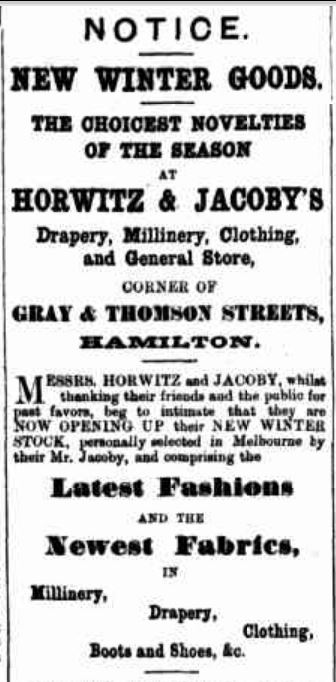
In 1864, Jacob Tallerman an importer of Lonsdale Street, Melbourne built a shop on the corner of Gray and Thompson Streets, Hamilton and opened for business.  At some point, Henry Horwitz went into business with Jacob and in August 1866 it was announced Jacob was leaving the partnership but Henry would keep the Hamilton store.  Henry did not move to Hamilton at that time and Abraham Marks instead went to Hamilton to manage the store.   

Advertising (1866, September 5). Hamilton Spectator and Grange District Advertiser (South Melbourne, Vic. : 1860 – 1870), p. 1. Retrieved February 13, 2019, from http://nla.gov.au/nla.news-article194466922

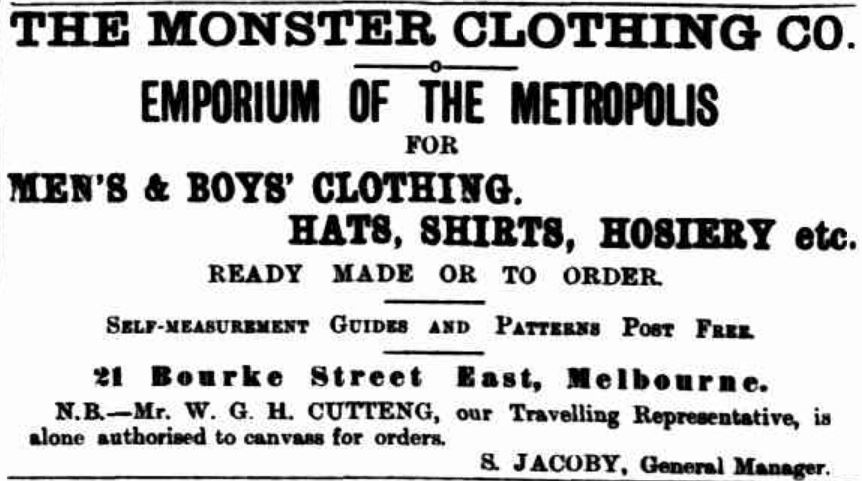
The Horwitz family took up residence in Hamilton around 1869.  It was also around that time Henry went into business with Sigismund Jacoby who in 1869 married Henry’s daughter Hannah. Henry was soon involved in community matters.  In 1870, he was one of the founders of Hamilton and Western District College.  He was at the first meeting of shareholders in September 1870 at the Victoria Hotel.

HAMILTON AND WESTERN DISTRICT COLLEGE. Image courtesy of the State Library of Victoria http://handle.slv.vic.gov.au/10381/241676

During October 1883, Henry retired and sold his Hamilton business to Mr Hillman. The Hamilton Spectator wrote, “The jovial face and cheery conversation of Mr Horwitz will be much missed from the corner”. On 18 January 1884, Henry and Sarah left Hamilton by the midday train to take up residence again in Melbourne. On 27 June 1888, Sarah died at St Kilda.  Henry died at Shandon, Beaconsfield Parade, St Kilda the home of his daughter Hannah Jacoby.  As seen, Henry enjoyed travel and his obituary stated he had sailed around the world three times via Cape Horn.

McCORMACK Thomas Francis – Died 1 February 1914 at Sandford.  Thomas McCormack was born around 1861, a son of James McCormack and Elizabeth O’Meara. He lived at Sandford for most of his life.  On 11 April 1888, he took up the licensee of the Commercial Hotel in Sandford.  In addition, he was on various committees throughout the district including the Sandford Mechanics Institute and the State School committee.  He was a trustee of the Sandford Race Course and Recreation Reserve and vice president and treasurer of the Sandford Boxing Day Sports and was involved with Sandford football, cricket and rifle clubs. 

Thomas married Anne Mitchell in 1888 and their first child Richard Thomas McCormack was born the following year.  The couple went on to have a further four sons and one daughter. Thomas was just fifty-three at the time of his death in 1914.  Anne McCormack continued to run the Commercial Hotel until 1921.  She died at Casterton on 1 October 1933.

MacCALLUM, Mary Isabella – Died February 1915 at Dandenong. Mary MacCallum was born in Scotland about 1835.  During the late 1850s, she married Archibald Campbell who had returned to Scotland after ten years in Australia including time at the Victorian goldfields.  They travelled to Victoria and were at Ellangowan in December 1860 when Mary gave birth to her first child Archibald.

Family Notices (1860, December 14). The Argus (Melbourne, Vic. : 1848 – 1957), p. 4. Retrieved February 23, 2019, from http://nla.gov.au/nla.news-article5694984

Not long after Archibald’s birth, the Campbells left for New Zealand and Archibald ran a shop in Dunedin.  Further children were born at Dunedin.

Family Notices (1864, September 8). The Argus (Melbourne, Vic. : 1848 – 1957), p. 4. Retrieved February 23, 2019, from http://nla.gov.au/nla.news-article5734148

The Campbells were back in Victoria around 1872 and Archibald was granted the license of the Green Hills Hotel at Green Hills (Condah).  A son Allan was born at Condah in 1873.  In December 1877, Alexander was granted a license for the Argyle Arms Hotel in Gray Street, Hamilton which he operated until 1881 when he opened a wines and spirits business in Gray Street. 

In 1891, Archibald died and Mary remained at her home Pennycross in South Hamilton for a time, before moving to Pennycross Dandenong with her daughter. It was there Mary spent the last eight years of her life. In 1913, her brother Allan MacCallum who had previously lived in the Hamilton district went to live at Dandenong with Mary. Allan died in November 1914. Only the month before Mary’s son Archie died in Queensland on 18 October 1914.  Mary’s body was returned to Hamilton and she was buried at the Hamilton (Old) Cemetery.

McNEIL, Duncan – Died February 1916 at Hamilton.  Duncan McNeil was born in Inverness, Scotland around 1842.  He arrived at Portland with his parents Donald and Catherine McNeil and siblings in 1852 aboard John Davis. The family went to the Bochara area near Hamilton. Donald McNeil died in 1856 when Duncan was fourteen. Duncan farmed on the Grange Burn at North Hamilton for most of his adult life.  In 1885 he married Mary Ellen Pevitt at St Mary’s Catholic Church, Hamilton.  At the time of his death, Duncan left his widow Mary, five daughters, and one son.  

QUIGLEY, Joseph Thomas – Died 2 February 1927 at Hamilton.  Joseph Quigley was born in Melbourne around 1846, a son of John Quigley and Winifred Tracey.  Around 1853, the Quigleys moved to Hamilton and Joseph’s father purchased the first township block offered for sale.  Joseph went to school at St Patrick’s College in Melbourne.  After completing school, Joseph spent time at Redruth (Wannon) where his parents were then residing at the Falls View estate.  Joseph was a good athlete, participating in sports days around the district.  He was also interested in racing and was the secretary and treasurer of the Redruth Racing Club. It was said he also rode in steeplechase races with Adam Lindsay Gordon.

Advertising (1865, April 12). Hamilton Spectator and Grange District Advertiser (South Melbourne, Vic. : 1860 – 1870), p. 4. Retrieved February 27, 2019, from http://nla.gov.au/nla.news-article194468224

In 1872, Joseph married Mary Costigan and around 1874, he took up  Maori Park near the Dundas Range north-west of Cavendish. Several children were born at the property. By the early 1890s, Joseph had left Maori Park and by 1902 was living at Burcott in Alexandra Parade, Hamilton.  Mary died there in October 1902.  Joseph continued on at Hamilton and worked as a commission agent.  In his last year, Joseph went to live with his daughter Mary and her husband John Dwyer in Lonsdale Street, Hamilton. In 1926, however, he did the rounds visiting family and friends throughout Victoria for one last time and he died in February 1927 at daughter Mary’s home in Hamilton.       

GRAVE OF JOSEPH QUIGLEY, HAMILTON (OLD) CEMETERY

ADAMSON, Thomas Edmund – Died 25 February 1937 at Hamilton. Thomas Adamson was born in New York around 1852. He arrived at Port Phillip with his parents Thomas and Alice from the United States aboard the Flying Scud in 1854 when he was two.  The family made their way to Portland where Thomas’ father opened a store in the town. When he was older, Thomas farmed at Myamyn on his property called Leylands. He married Mary Malseed a daughter of John Malseed and Elizabeth Wallace in 1879 and they had two children.  Mary died on 9 September 1882 at Condah aged thirty-one. Thomas then married Fanny Ann Malseed in 1885, a daughter of James Malseed and Eliza Ann Malseed and they had eight children.  Fanny died on 13 February 1936 at Myamyn.  In 1938, Thomas fell sick and it was thought it best he go to the Hamilton Hospital where he eventually died on 25 February.  He was buried at the Condah Cemetery.   

RUSSELL, Janet – Died 15 February 1954 at Shelford.  

JANET RUSSELL c1890. Image courtesy of the State Library of Victoria http://handle.slv.vic.gov.au/10381/283407

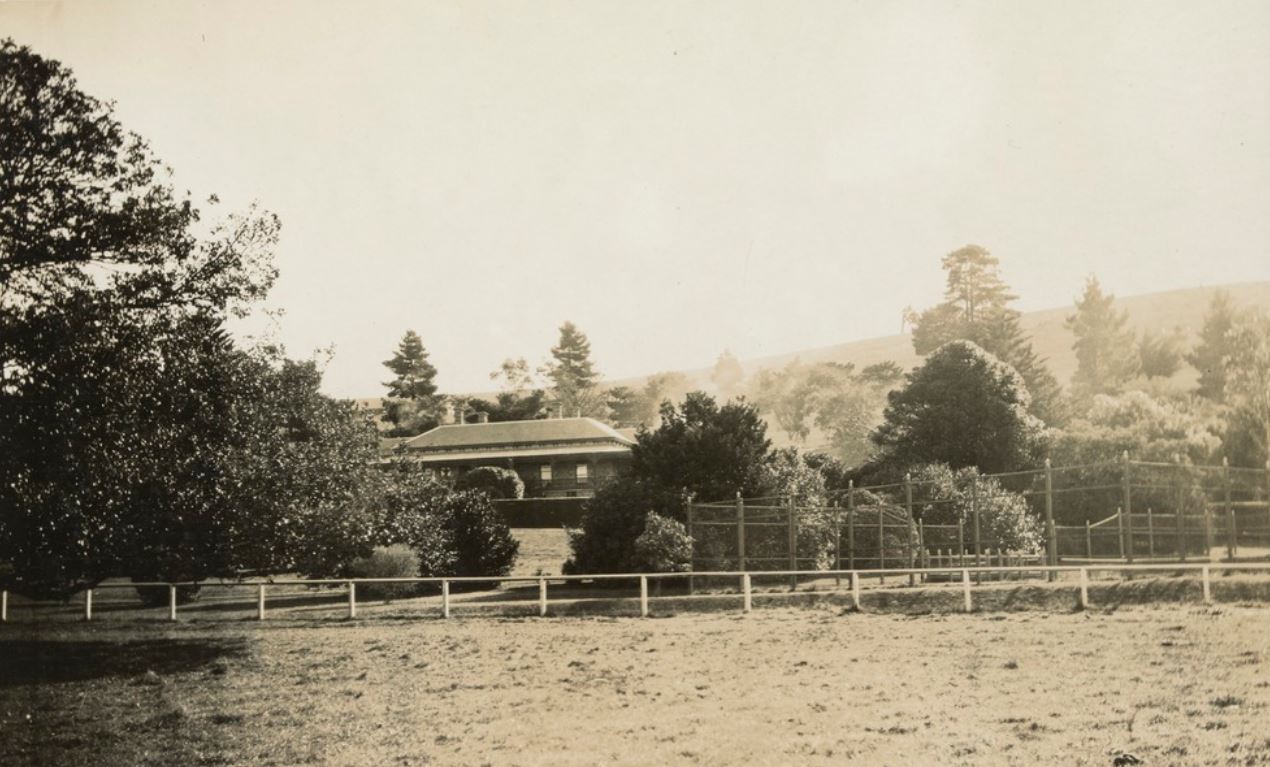
Janet Russell was born in Melbourne on 24 April 1866, a daughter of George Russell and Euphemia Leslie Carstairs.  Janet’s father owned the large pastoral property Golf Hill at Shelford.  She had six sisters and a brother, Phillip.  Her mother died on 3 March 1867 when Janet was a baby.  After her father’s death on 3 November 1888, Phillip inherited Golf Hill.  Phillip never married and on 12 January 1898, he died leaving Golf Hill to Janet.

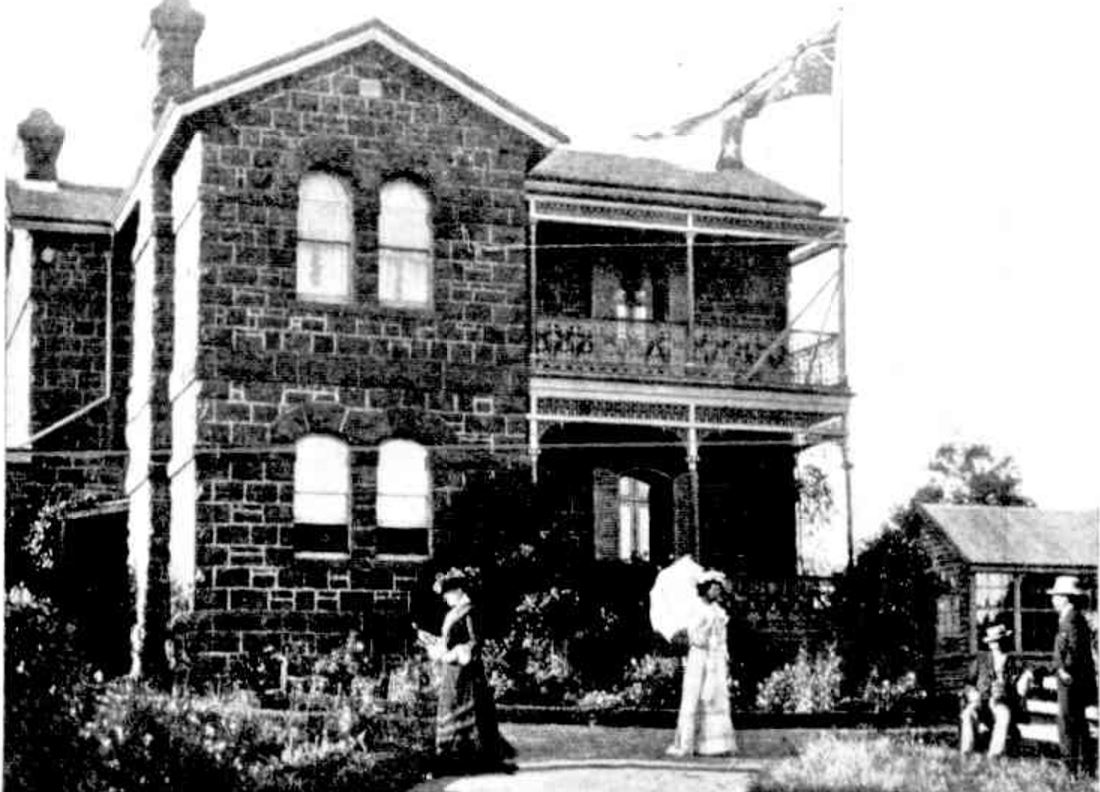
“GOLF HILL”. Image courtesy of the State Library of Victoria http://handle.slv.vic.gov.au/10381/320773

Aged thirty-four, Janet married John Biddlecombe on 7 July 1900 at Scots Church, Collins Street Melbourne. They had no children and John died in 1927. 

Janet was a renowned Hereford breeder and showed her cattle throughout Australia.  Herefords had arrived at Golf Hill in the 1870s but when John Biddlecombe went to Golf Hill, he brought in new stock. By the 1920s, the Herefords of Golf Hill were catching attention Australia wide.  After John’s death, Janet kept improving the herd and took the standard to new heights.

PASTORAL (1930, February 1). The Australasian (Melbourne, Vic. : 1864 – 1946), p. 33 (METROPOLITAN EDITION). Retrieved February 26, 2019, from http://nla.gov.au/nla.news-article14142617

In 1930, Janet’s stud was considered one of the best in the Commonwealth. While she had a stud manager, Jack Tanner, Janet was the overseer of all activities at Golf Hill.  Her cattle were photographed many times over the years at the many shows Janet attended, but a photo of Janet was a little harder to come by.  This photo shows her presenting a ribbon to the Champion Shorthorn bull at the Royal Easter show in 1939.


JANET BIDDLECOMBE AT THE ROYAL EASTER SHOW (1939, April 8). The Australasian (Melbourne, Vic. : 1864 – 1946), p. 12. Retrieved February 26, 2019, from http://nla.gov.au/nla.news-article141815969

In 1953, Janet was eighty-seven and saw that it was time to wind up her stud. She couldn’t be as active in the operations of the stud as she would like.  It was announced in July 1953, she would sell her stock in October.  In September after the Royal Melbourne Show, an article in the Weekly Times of 23 September 1953 reflected on Janet’s efforts at Golf Hill and the reporter expressed sadness that Janet would no longer be at the Royal Shows around the country. 

On 29 October 1953, the dispersal sale was held with more than 1500 people in attendance  By then, Janet was bedridden but was able to listen to a broadcast of the auction.  It must have been a sad day for the woman they called “The Grand Old Lady of Golf Hill“.  The total price of 125,000 guineas for the 130 lots sold broke a record for the British Empire in what was considered a great tribute to Janet. Her Herefords by then were among the best in the world.  The money would have meant little to Janet. 

Less than three months have the dispersal sale, Janet died at Golf Hill.  At the time of her death, her generous philanthropy was acknowledged, something she had preferred to keep private.   

Passing of the Pioneers

Welcome to the 67th edition of Passing of the Pioneers.  This month eight new pioneers from districts including Camperdown, Macarthur and Balmoral join the Pioneer Obituary Index .

MANIFOLD, John – Died 3 January 1877 at Purrumbete.

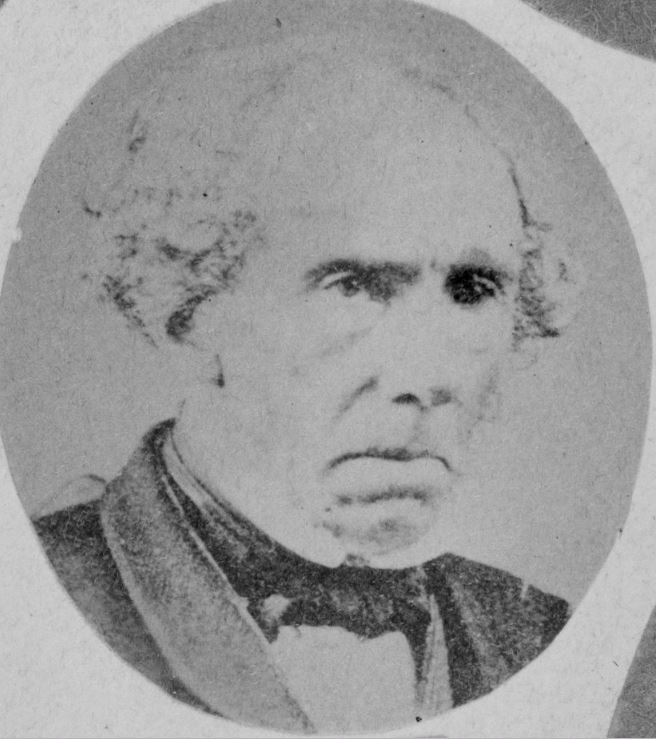
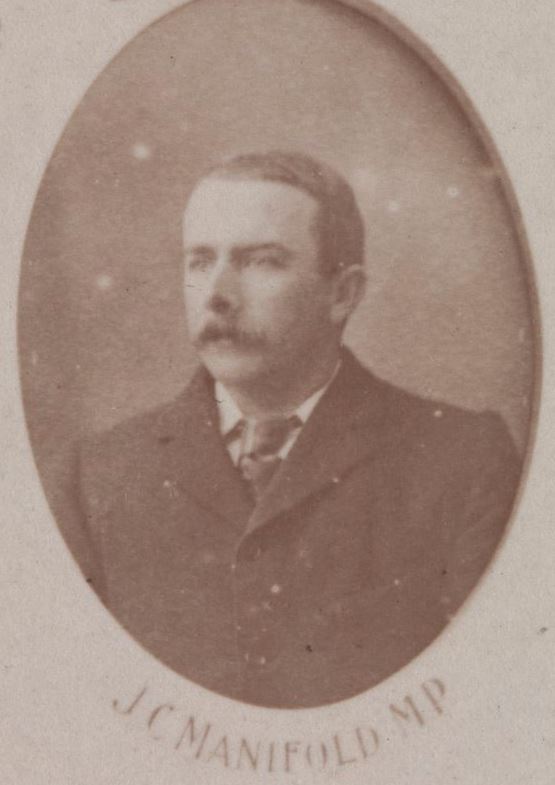
JOHN MANIFOLD. Image courtesy of the State Library of Victoria http://handle.slv.vic.gov.au/10381/18071

John Manifold was born in Cheshire, England in 1811, the fifth son of William Manifold and Mary Barnes.  In 1831, the Manifolds left England for Tasmania to meet up with John’s brother Thomas who had gone ahead three years before.  They settled there but in 1836, Thomas Manifold was keen to see the colony of Victoria of which he was hearing stories.  He travelled to Point Henry near Geelong and took up land on the Moorabool River.  He put his two younger brothers, John and Peter in charge of the property and he returned to Tasmania. 

John and Peter wanted to investigate the land further west and in 1838 found themselves on the shores of Lake Purrumbete and decided that was the place for them.  Thomas joined them but later went to the Grassmere run further west.  John and Peter built up their property Purrumbete and eventually switched from sheep breeding to cattle.

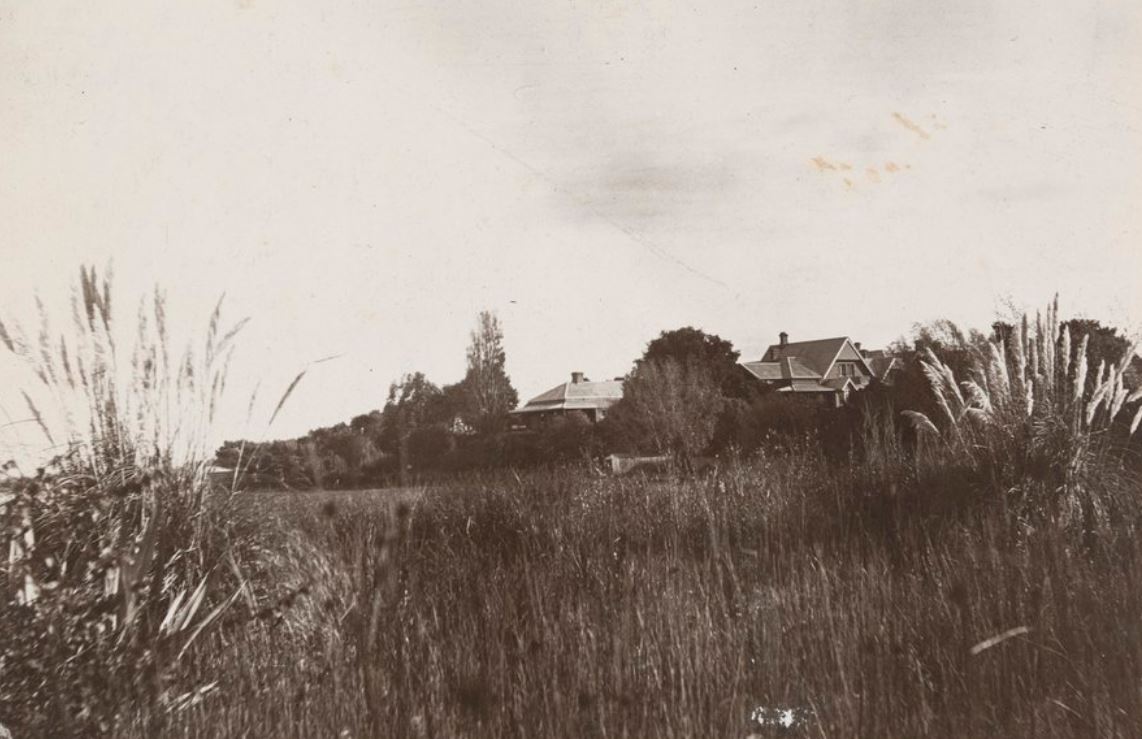
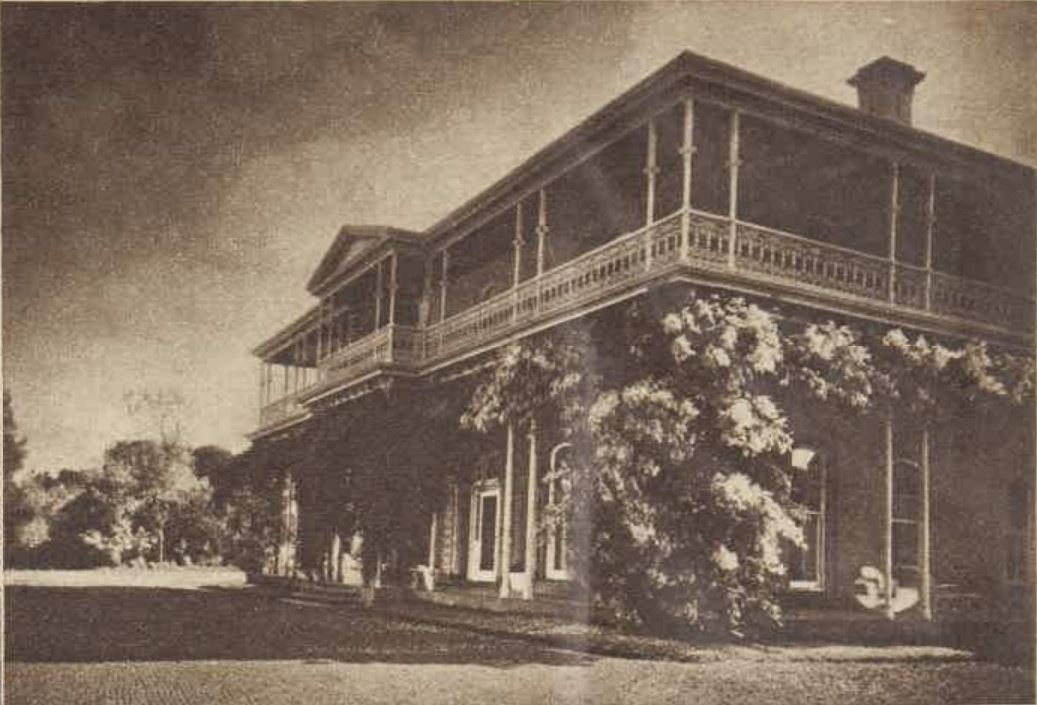
PURRUMBETE c1913 Image courtesy of the State Library of Victoria http://handle.slv.vic.gov.au/10381/75019

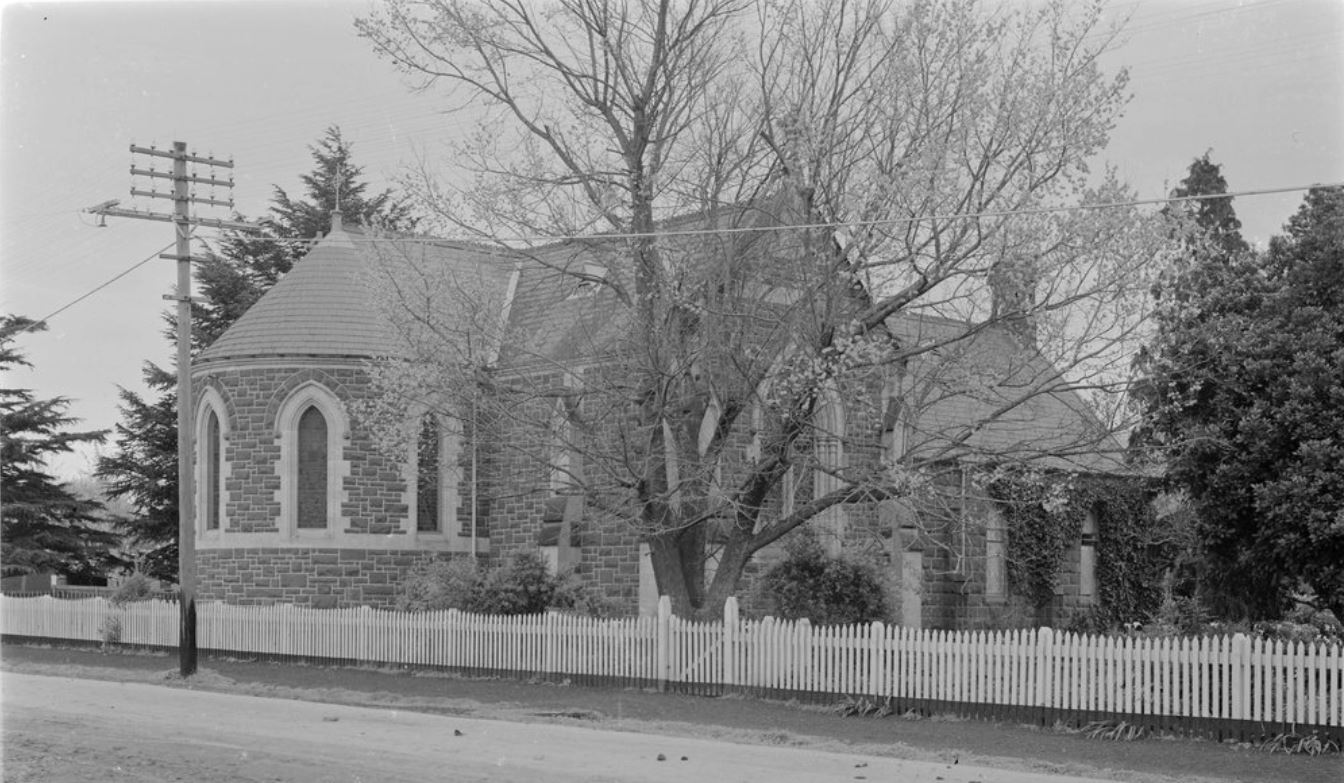
On 4 September 1856, John married Marion Thomson at West Tamar, Tasmania.  They went on to have four sons and five daughters including past Passing Pioneers, Edward, James Chester and William.  John wasn’t interested in public life but he and Peter were generous contributors to the community. One example of their generosity is St Peters Church, Camperdown (below) to which they contributed greatly.

ST PETER’S CHURCH, CAMPERDOWN. Image courtesy of the State Library of Victoria http://handle.slv.vic.gov.au/10381/63204

You can read more about John Manifold and his brothers on the link to the Australian Dictionary of Biography http://adb.anu.edu.au/biography/manifold-john-2839

ARMSTRONG, Alexander – Died 12 January 1890 at Shelford.  Alexander Armstrong was born at Kildonan, Scotland around 1824.  He married Barbara Thomson in 1851 and soon after they set sail for Australia on board Europa with Alexander’s sister Christian and her new husband James Thomson, arriving in 1852.  The following year Barbara died. Alexander first managed Warrambine (also known as Warrambeen) for Major John Bell until Bell’s death in 1876.  He was left £2000 from Bell’s estate.  He then took up a lease on the property and remained there until his death.

WARRAMBINE HOMESTEAD. Image courtesy of the J.T. Collins Collection, La Trobe Picture Collection, State Library of Victoria. http://handle.slv.vic.gov.au/10381/233634

In 1859, Alexander married widow Betsy Thomson (nee Sutherland) and they went on to have a large family.  Alexander’s sister Christian Thomson and her husband James took up residence at Monivae south of Hamilton in 1870. In 1888, Alexander purchased properties close by, Upper Audley and Arrandoovong near Branxholme.  He also had interests in an estate in the Riverina district of NSW.

At the time of his death, Alexander was the oldest councillor on the Leigh Shire Council, representing the East Riding.  He was known as generous and charitable and a leading member of the Leigh Presbyterian Church at Shelford.  At the time of his death, Alexander left his widow Betsy, five sons and four daughters.  He was buried at the Golf Hill Cemetery, Shelford.

Alexander’s estate was worth more than £200,000.  The estate of Alexander Armstrong retained Upper Audley until 1906 and Arrandoovong remained within the Armstrong family until 1923.  Betsy stayed on at Warrambine until the lease expired on 20 December 1892.  She moved to Brighton and died in 1923.

ROBERTSON, George – Died 15 January 1890 at Warrock.  

GEORGE ROBERTSON. Image courtesy of the State Library of Victoria http://handle.slv.vic.gov.au/10381/18268

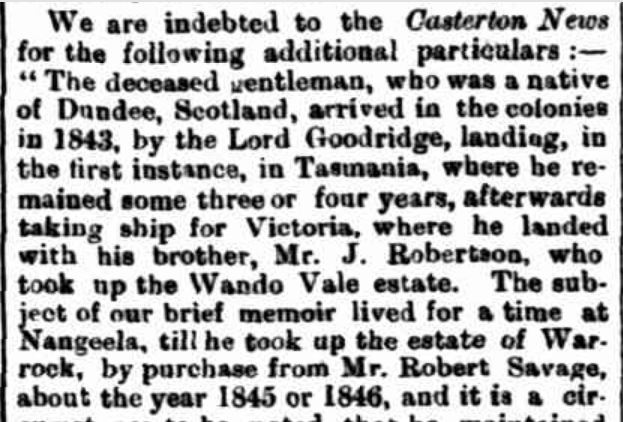
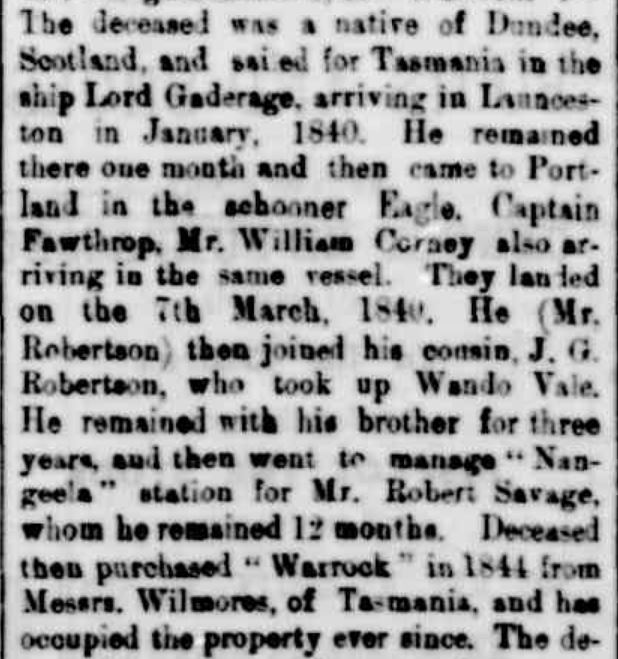
When George Roberston died, an obituary was published in the Hamilton Spectator of 18 January 1890.  Included was George’s recent history from an unknown source and his early history taken from a Casterton Times obituary. On 22 January 1890, the Portland Guardian published an obituary with “particulars supplied” by an unknown source.  Information in the obituaries was quite different. The Hamilton Spectator obituary:

DEATH OF MR. GEORGE ROBERTSON. (1890, January 18). Hamilton Spectator (Vic. : 1870 – 1918), p. 3. Retrieved January 25, 2019, from http://nla.gov.au/nla.news-article225765999

The Portland Guardian obituary:

The Portland Guardian, (1890, January 22). Portland Guardian (Vic. : 1876 – 1953), p. 2 (EVENING). Retrieved January 25, 2019, from http://nla.gov.au/nla.news-article63626300

The Hamilton Spectator/Casterton News stated George arrived in Van Diemen’s Land (Tasmania) in 1843 aboard Lord Goodridge, staying there three or four years before travelling to Victoria with his brother J. Robertson “who took up Wando Vale estate”. Meanwhile, the Portland Guardian stated George had sailed on Lord Gaderage arriving in Van Diemen’s Land in January 1840 where he stayed a month before sailing to Victoria on Eagle captained by Captain Fawthrop of Portland.  A fellow passenger was William Corney and they landed at Portland Bay on 7 March 1840.  It continues…”He then joined his cousin J.G. Robertson who took up Wando Vale estate.  He remained with his brother for three years…”.

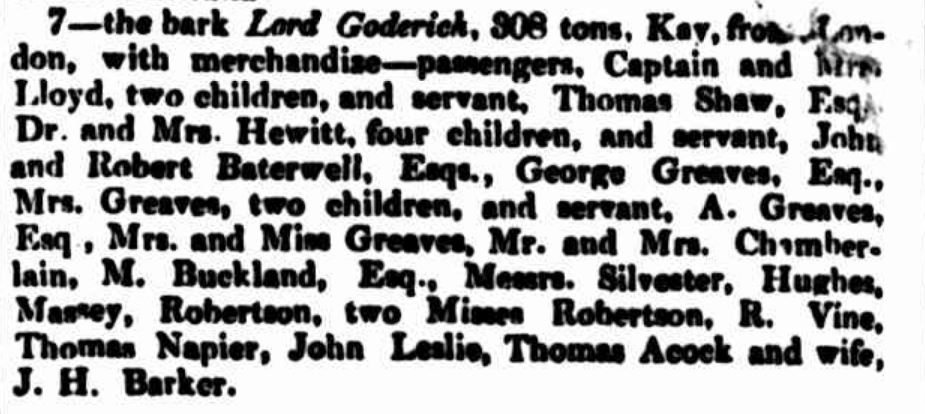
Checking the shipping news in newspapers of the time, I found George’s ship from England was not Lord Goodridge or Lord Gaderage, but rather Lord Goderich, also used to transport convicts.  The Lord Goderich arrived at Launceston on 7 February 1840.  George would have been around thirty-two at the time. On board was a Mr Robertson and two Misses Robertson. Unfortunately, there were no initials to help confirm if it was George.  While George might not have been related to the two Misses Robertson, he did have at least two sisters who came to Australia, Isabella and Ann. However, Isabella didn’t arrive in Australia until 1849 when she arrived with her husband Hugh Patterson and their family aboard  Duchess of Northumberland. George’s cousin John George Robertson (Wando Vale estate) who had already arrived in Van Diemen’s Land by 1840 also had at least two sisters who came to Australia.  Maybe they were the two Misses Robertson.

Shipping Intelligence. (1840, February 14). The Hobart Town Courier and Van Diemen’s Land Gazette (Tas. : 1839 – 1840), p. 4. Retrieved January 23, 2019, from http://nla.gov.au/nla.news-article8748202

The Portland Guardian obituary stated George only stayed in Tasmania about a month before going to Victoria on Eagle.  Sure enough, Eagle did sail to Victoria in the suggested timeframe, leaving Launceston on 28 February 1840.  On board were sheep, bullocks and horses for cousin John Robertson.  Also, the Guardian mentioned William Corney was a passenger on Eagle with George.  William Corney later married George’s cousin and sister of John Robertson, Stephen Rowan Robertson.  The shipping report from Launceston’s The Cornwall Chronicle in February 1840 shows there was a Mr Robertson on board Eagle and he was travelling with Mr Corney.

SHIP NEWS. (1840, February 29). The Cornwall Chronicle (Launceston, Tas. : 1835 – 1880), p. 3. Retrieved January 22, 2019, from http://nla.gov.au/nla.news-article66015719

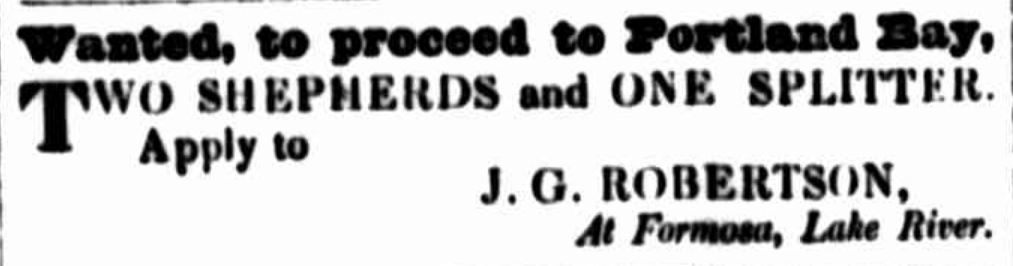
But was it John Robertson not George Robertson on Eagle?  There’s a good chance it was John.  Not only was there stock belonging to John on the ship but it’s likely at least two if not all the shepherds on Eagle were off to Portland Bay to work for John.  Only a month before the Eagle departed John Robertson, then living at Lake River in Van Diemen’s Land, advertised for shepherds and a splitter to go to Portland Bay.

Advertising (1840, January 2). Launceston Advertiser (Tas. : 1829 – 1846), p. 1. Retrieved January 24, 2019, from http://nla.gov.au/nla.news-article84751944

In addition, 1840 is the year generally given as the year John Robertson took up the Wando Vale run.  Checking shipping arrivals and departures via the Names Index on the Libraries Tasmania site, I found John Robertson made more trips from Tasmania to Portland Bay on Eagle in February and March but unfortunately no mention of George.  The newspapers show several voyages to Portland in the first months of 1840 with John’s stock on board. 

In contrast to the Portland Guardian, the Casterton News/Hamilton Spectator obituary stated George travelled to Victoria in 1843 with his brother J.Robertson. The Portland Guardian had a bet each way as to whether George had a brother J.Robertson stating after George arrived in 1840, he went to stay with his cousin J.G.Robertson, staying three years with his brother.  The Casterton News/Hamilton Spectator continued, suggesting after his 1843 arrival he then went to Nangeela, west of Wando Vale estate. Although not mentioned in the obituary, Nangeela was held by Robert Savage in 1843 with Captain Robert Dana.  But the Casterton News/Spectator went on to say George purchased Warrock from Robert Savage in 1845 or 1846.  However, William Wilmore owned Warrock at the time of George’s purchase, supported by the Portland Guardian obituary which said George purchased Warrock in 1844, the generally accepted year.

After all that we are really none the wiser as to when George arrived in Victoria, although the Portland Guardian was probably closer to the mark.  Either way, George was at Warrock on the Glenelg River from around the mid-1840s. 

Moving on to the 1850s, The Argus reported in February 1851, George had lost his home and between 1000 and 2000 sheep in a fire. The following year, he married his cousin Mary Ann Robertson, a sister of John Robertson of Wando Vale. They never had children but instead devoted their lives to Warrock and charitable work.  Over time, George built a large pastoral complex at Warrock. Not just the usual homestead, woolshed and staff quarters but more than fifty mostly timber buildings including a church.  Mary Ann established a beautiful home, known for its tasteful decor.

WARROCK HOMESTEAD c1865. Image courtesy of the Museums Victoria Collections https://collections.museumvictoria.com.au/items/769377

WARROCK HOMESTEAD c1865. Image courtesy of the Museums Victoria Collections https://collections.museumvictoria.com.au/items/769376

WARROCK c1900 Image courtesy of the Museums Victoria Collections https://collections.museumvictoria.com.au/items/769391

WARROCK c1900 Image courtesy of the Museums Victoria Collections https://collections.museumvictoria.com.au/items/769389

George led a quiet life only stepping into public life to sit on the Glenelg Shire Council. As mentioned he was charitable and supported among other things, the Hamilton hospital, local public schools as well as the Casterton and Sandford Mechanics Institutes.  He was the founder of the Casterton Mechanics Institute (below) and was president at the time of his death.  He also donated to churches of all denominations.

CASTERTON MECHANICS INSTITUTE c1880. Image courtesy of the Museums Victoria Collections https://collections.museumvictoria.com.au/items/773754

Another passion for George was his dogs, importing Scotch Collies from the home of his birth.  The Kelpie breed descends from a pair of George’s imported collies.

Mary Ann died in 1886 and George died four years later leaving his large estate to his nephew George Robertson Patterson, a son of his sister Isabella. George was buried at the Old Casterton Cemetery.

You can see more of Warrock on the property’s website on the link www.warrockhomestead.com.au or Facebook page. www.facebook.com/warrockhomestead  Restoration is in progress with wonderful results so far.  George and Mary Ann would be pleased.

FAHEY, Patrick – Died January 1911 at Macarthur.  Patrick Fahey was born in Ireland around 1883. He arrived at Port Fairy about 1854 and settled at nearby Coddrington.  When land became available further north in the 1860s he selected land near Macarthur.  He stayed on his land until the mid-1870s when he built the Farmers Inn within the Macarthur township. Patrick married Catherine O’Connor.  Catherine died in 1881 aged forty-four.  He remarried to Mary O’Donnell in 1890. 

Patrick operated the Farmers Inn for around nineteen years, making additions in 1883.  He sold to Miss Grogan in 1892. Patrick then retired and lived out his days at Macarthur.  At some stage, an accident resulted in the amputation of one of his legs. Patrick was known for his good humour and his charitable ways.  He left his widow, Mary and six sons. The Farmers Inn burnt down on 18 June 1906.

MOLLOY, James – Died January 1913 at Balmoral.  James Molloy was born in Dublin, Ireland around 1853. He arrived at Portland around the age of sixteen.  He went straight to Charles Armytage‘s Fulham estate near Balmoral where he had a job.  After much hard work, James rose through the ranks until he became the manager of the property.  He worked there for forty-four years until his death.

STAFF QUARTERS AT FULHAM ESTATE c1977. Image courtesy of the J.T. Collins collection, La Trobe Picture Collection, State Library of Victoria. http://handle.slv.vic.gov.au/10381/214317

A Hamilton Spectator article from 2 September 1897 describing the Fulham stud stated James was “as enthusiastic a sheep man as one would care to meet”. James was a member of the Balmoral Pastoral and Agriculture Society.  He never married and left two sisters still living in Ireland at the time of his death.  James was buried at the Harrow Cemetery.

SAVIN, William – Died 2 January 1924 at Portland.  William Savin was born at Launton, Oxfordshire around 1843.  In late 1852, William left England with his parents Samuel Savin and Hannah Wise and five siblings aboard Eliza and landed at Portland in 1853.  The family headed to the Upper Crawford estate near Branxholme where there was work available.  Samuel then purchased the first land available for sale at Muddy Creek, just south of Hamilton.  When William was older, he and his brothers selected land at Mount Eccles (Budj Bim) near Macarthur. In 1865, William married Elizabeth Addinsall and they went on to have three daughters. 

Around 1900, William and Elizabeth retired to Portland where William was a member of the bowls and golf clubs.  He also had an interest in political happenings and was a past member of the Hamilton Farmers Union in the 1880s.  Elizabeth died in 1912 at Portland. William remarried to Theresa Lear in 1913.  They were living in Cameron Street, Portland when William died. He left his widow Theresa and three daughters from his first marriage.

HOOD, Eliza Mary – Died 22 January 1926 at Malvern.  Eliza Hood was born in Belfast, Ireland around 1847.  With her parents, she arrived at Hobson’s Bay, Victoria in 1852 aboard Marco Polo.

MARCO POLO BY THOMAS ROBERTSON (1819-1873). Image courtesy of the State Library of Victoria. http://handle.slv.vic.gov.au/10381/132534

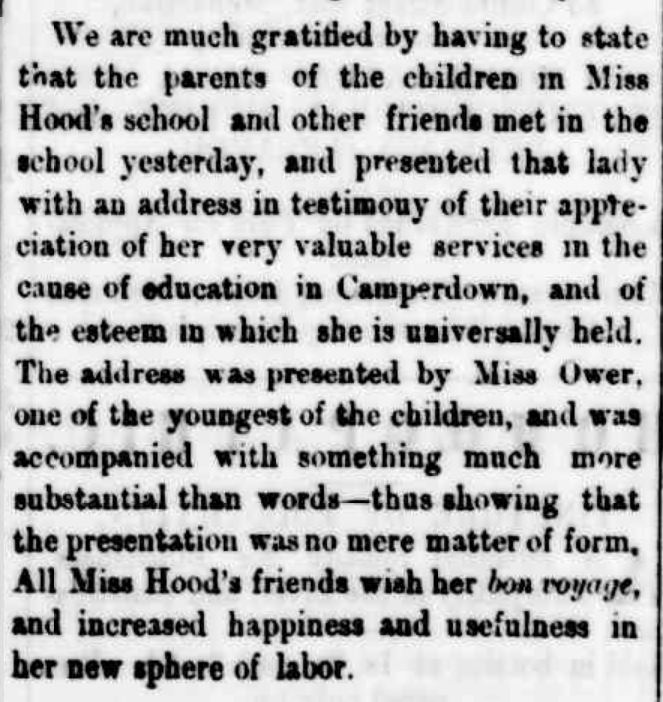
Eliza’s father John Hood was a doctor and he set up a practice in Camperdown.  When Eliza was older she opened the Camperdown Ladies’ College.  In 1878, she was given a farewell as she was off to New Zealand to take up employment at the Invercargill Ladies High School.

The Chronicle. TUESDAY, DECEMBER 24, 1878. (1878, December 24). Camperdown Chronicle (Vic. : 1877 – 1954), p. 2. Retrieved January 14, 2019, from http://nla.gov.au/nla.news-article22473892

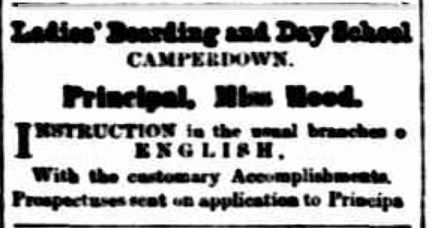
Eliza returned to Camperdown around 1881 and continued to educate the young ladies of Camperdown and district.

Advertising (1884, July 16). Camperdown Chronicle (Vic. : 1877 – 1954), p. 3. Retrieved January 14, 2019, from http://nla.gov.au/nla.news-article23581723

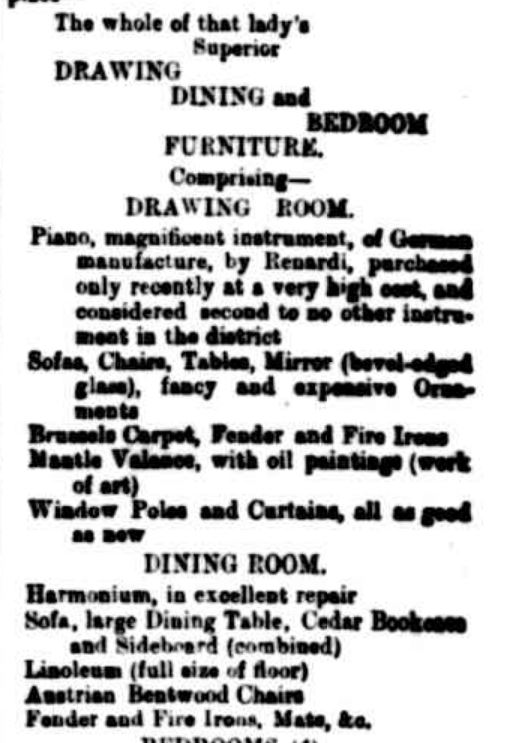
In May 1886, the Camperdown Chronicle announced Eliza was leaving the district and selling her home in Brooke Street along with her furniture including a German-made piano, a harmonium and even the curtain rods.

Classified Advertising (1886, May 5). Camperdown Chronicle (Vic. : 1877 – 1954), p. 3. Retrieved January 14, 2019, from http://nla.gov.au/nla.news-article22098133

In early August 1886, news came to Camperdown of Eliza’s marriage.  At the age of thirty-nine, Eliza married in Melbourne to widower sixty-eight-year-old Peter McArthur of Meningoort near Bookaar just north of Camperdown, on 31 July 1886.  Peter’s first wife Margaret had died in 1883.  Peter had nine children at the time ranging in age from their mid-twenties downwards.  Eliza and Peter had one son George born in 1887.  Peter died on 1 July 1897 aged seventy-nine.

MENINGOORT. Image courtesy of the State Library of Victoria http://handle.slv.vic.gov.au/10381/169949

Eliza died at Malvern and her body returned to Camperdown for burial.

CARMICHAEL, Thomas – Died 5 January 1930 at Casterton.  Thomas Carmichael was born around 1874 at Casterton, one of fifteen children of Thomas Carmichael and Margaret Fletcher of Argyle station, Lake Mundi. Thomas attended the Portland College and then went to work for the Colonial Bank at the Casterton branch (below).

COLONIAL BANK OF CASTERTON c1880 Image courtesy of the State Library of South Australia Image no. B 21766/88 https://collections.slsa.sa.gov.au/resource/B+21766/88

Banking wasn’t for Thomas and he resigned from the bank and returned to Argyle station.  On 15 March 1915, Thomas married St Kilda’s Violet Malcolmson at Middle Park and they took up residence in Henty Street, Casterton. Despite living in town, Thomas kept a keen interest in the family-run Argyle and listed his occupation as a grazier.  He was a leading bowler for the Casterton Cricket Club and a councillor with the Glenelg Shire Council for ten years from 1911. He was Shire President from 1919 to 1920. During his time on council, Thomas was the main protagonist for a proposed Casterton water supply scheme which was eventually introduced.  He was also a supporter of the local returned servicemen after WW1.  Thomas left his widow, Violet and four children.

Trove Tuesday – In Tandem

It’s been a while since I’ve brought you a Trove Tuesday post so it’s time for another.  If you’ve only recently come across Western District Families, you may not know about Trove Tuesday.  It was a blogging prompt started several years ago by an Australian geneablogger for fellow geneabloggers to share their discoveries found at Trove, the National Library of Australia’s wonderful site.  At one stage I had posted eighty-two consecutive Trove Tuesday posts.  Most of the posts are about quirky and amusing articles I’ve found while researching Trove’s digitized newspapers.  This week, it’s another of those quirky stories.

I have read many articles about horses coming to grips with the mechanised age, from shying at steam engines pulling threshing plants to cars sharing Western District roads.  Not all had a happy ending.  Bicycles were around from the 1860s in Australia, but it wasn’t until the arrival of the “safety” bike in the 1890s when cycling took off as an alternate form of transport. Even ladies fashion evolved as a result.

THE CYCLING VEALE GIRLS OF LAKE BOLAC. Image courtesy of the William E. Veale collection of Lake Bolac. State Library of Victoria http://handle.slv.vic.gov.au/10381/89464

Bikes also became popular among shearers moving between sheds in the Western District.

CYCLING SHEARERS AT CASTERTON c1900. Images courtesy of the Museums Victoria Collections https://collections.museumvictoria.com.au/items/767593

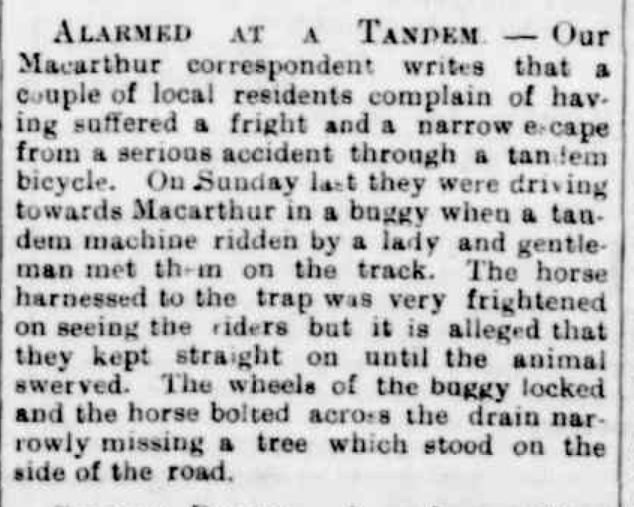
Although the bicycle was a quieter form of mechanisation, they were still mind-boggling for a horse, especially bicycles built for two as discovered near Macarthur in 1896:

Items of News. (1896, May 7). Hamilton Spectator (Vic. : 1870 – 1918), p. 2. http://nla.gov.au/nla.news-article225871697

A TANDEM BIKE AND STANDARD BIKE. Image courtesy of the State Library of Victoria http://handle.slv.vic.gov.au/10381/184376

You can read my earlier Trove Tuesday posts on the link – Trove Tuesday archives

Best of 2018

Another great year for Western District Families is drawing to a close.  Sixty-six new pioneers joined the Pioneer Obituary Index and we celebrated more Wonderful Western District WomenHamilton’s WW1 continued to grow with new biographies and addition of the Borough of Hamilton WW1 Honour Roll to the Hamilton WW1 Memorials.  You can now read the 411 names on the board and read selected stories of those represented.  The most popular post for the year was When the Earth Moved at Warrnambool about two earthquakes in the town in 1903, one of which is still Victoria’s most damaging quakes.
Over on Facebook, the Western District Families Facebook page now has over 6300 “likes”.  We have looked at various themes over the year including hotels, Back to School, Town & Country and more.  I really appreciate all the contributions by those following the page.  Their comments offering extra information about various towns and families are invaluable.  The video below is a look at the most popular photos I posted to the page over the year.


Thank you for visiting Western District Families during 2018. I look forward to sharing more family and local history from the Western District with you in 2019.

Passing of the Pioneers

This edition of Passing of the Pioneers brings you obituaries from the months of November and December.  You can read about the two men who carried out their respective businesses on opposite corners, one of the earliest European settlers with a taste for exploration and several women who devoted their lives to charitable works.  Remember to click on the underlined text for further information on a subject.

NOVEMBER

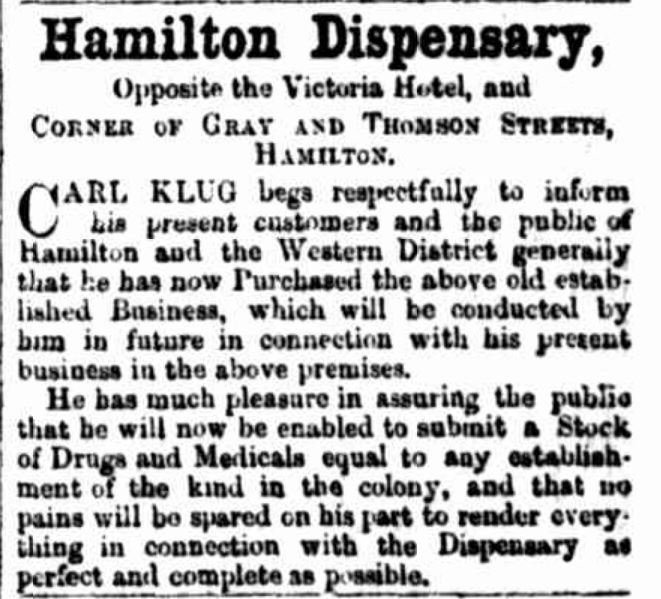
KLUG, Carl – Died 5 November 1897 at Hamilton.  Carl Klug was born in Bromberg, Prussia (now Poland) around 1827.  Following the careers of his father and older brother, Carl went to the University of Berlin to study as a chemist.  As a Prussian citizen, he had to serve time with the Prussian army. It was thought he served with another Hamilton pioneer we met in the last Passing of the Pioneers post, Sigismund Jacoby.

Sometime after his military service, Carl travelled to Victoria.  He arrived in Hamilton around 1864 and opened a shop in Thompson Street.

“Advertising” Hamilton Spectator and Grange District Advertiser (South Melbourne, Vic. : 1860 – 1870) 6 May 1864: 4. Web. 4 Dec 2018 http://nla.gov.au/nla.news-article194723497

He later moved to the corner of Gray and Thompson Streets.

“Advertising” Hamilton Spectator and Grange District Advertiser (South Melbourne, Vic. : 1860 – 1870) 4 November 1865: 3. Web. 4 Dec 2018 <http://nla.gov.au/nla.news-article194467571

“VIEW OF HAMILTON VICTORIA.” Hamilton Spectator (Vic. : 1870 – 1918) 17 April 1888: 2 (SUPPLEMENT TO THE HAMILTON SPECTATOR). http://nla.gov.au/nla.news-article225809074

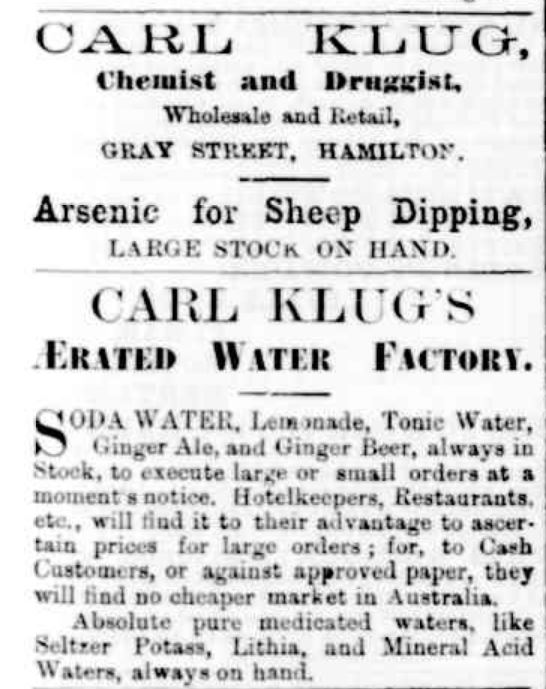
On 25 April 1868, Carl married Eveline Kruger at Warrnambool.  They went on to have five daughters and one son.  In 1877, Carl was a member of the founding committee of the Hamilton Gas Company.  Earlier in that year, Carl opened the Hamilton Ice Works, the first of its kind in the Western District.  It took great financial investment, with Carl having to buy the necessary machine followed by much trial and error to get it working.  He advertised he was making ice twelve hours a day.  Unfortunately, the business didn’t take off and Carl moved into producing aerated water.  In his role as a chemist, he made and patented medicines. Placing his lemonade and ginger beer advertisement under his chemist advertisement for arsenic doesn’t seem like a good idea.

“Advertising” Hamilton Spectator (Vic. : 1870 – 1918) 21 November 1885: 3 (SUPPLEMENT TO THE HAMILTON SPECTATOR). Web. 4 Dec 2018 <http://nla.gov.au/nla.news-article225772985

Carl also treated his own ills which led to his demise.  After having numbness in one of his legs, he simply rubbed cream on it.  It was on until the pain got too great several weeks later did he call in the doctor who found his leg gangrenous and there was no choice but to amputate.  Carl developed pneumonia after the operation and died.  He was buried at South Hamilton Lutheran Cemetery.

GRAVE OF CARL AND EVELINE KLUG AT THE SOUTH HAMILTON LUTHERAN CEMETERY.

JAMES, Henry Cottenham – Died 4 November 1898 at Casterton. Henry James was born in Nottingham, England around 1831.  He arrived in Victoria in the early 1850s and went to the Ballarat diggings. He then went west to Carngham where he opened a store. While there, Henry took up a share in the Britannia Reef at Carngham.  When he sold his share, he made a good profit so he took a trip back to his hometown of Nottingham. He also took the opportunity to tour Europe before returning to England to marry Helen Wayte.  On arrival back in Victoria, Henry and Helen went to Pitfield where two children were born. By 1875, the James family were in Casterton and Henry opened a business selling stationery.

BUSINESS OF HENRY JAMES IN HENTY STREET, CASTERTON c1880. Image courtesy of the State Library of South Australia Image no.B 21766/92 https://collections.slsa.sa.gov.au/resource/B+21766/92

Henry was the secretary of the Casterton Racing Club, the Casterton Pastoral and Agricultural Society, the Mechanics Committee and just about every other committee in the district. He was also the Casterton correspondent for the Hamilton Spectator and The Argus. Henry James fell sick suddenly in 1898.  He’d been planning a trip to the Melbourne Cup the following week. His health gradually declined until he died about a week later.  Henry left his widow Helen, two sons and three daughters.

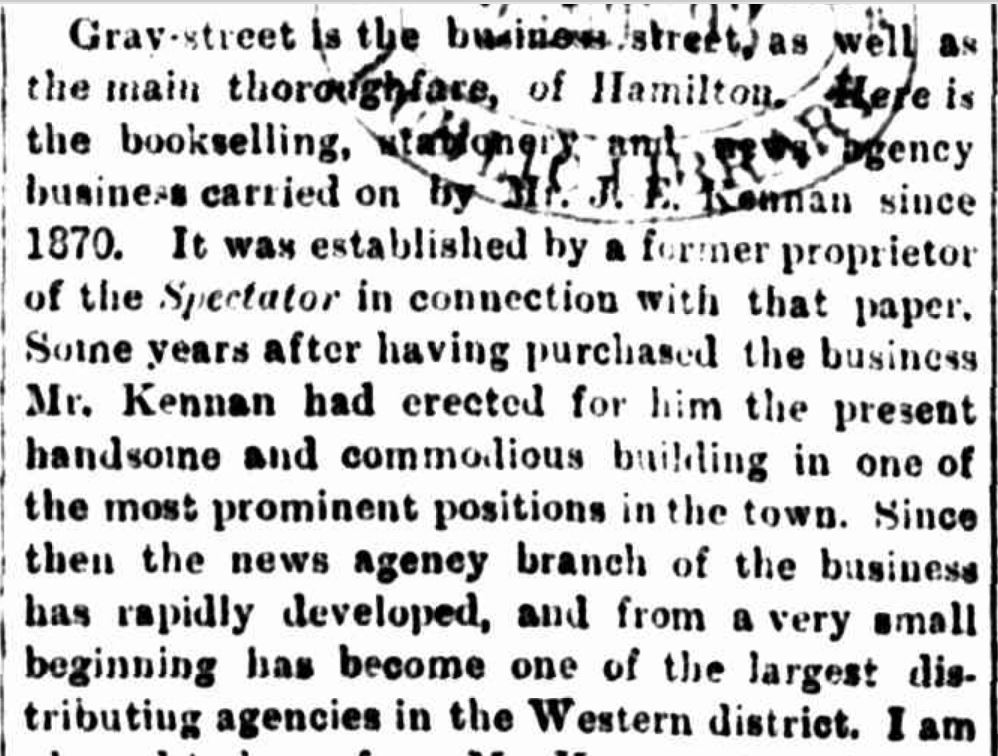
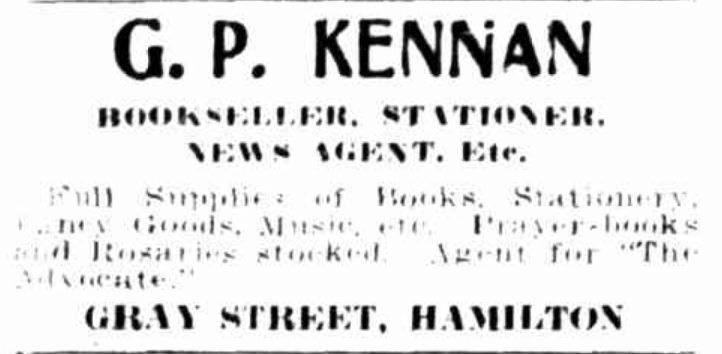
KENNAN, John Edward – Died November 1917 at Hamilton.  John Kennan was born in Dublin in 1841 and arrived in Victoria in December 1855. He headed to Ballarat where he remained for several years and spent time in Melbourne and Bendigo.  By 1865 he was in Kyneton where he married Jane Cameron Campbell on 21 August 1867 and they raised a large family.  Their first child was born in Richmond in 1870, the year John arrived in Hamilton after buying George Robinson’s stationery shop.  At the time George was the owner of the Hamilton Spectator. The family took up residence in French Street.

Advertising (1870, October 8). Hamilton Spectator (Vic. : 1870 – 1918), p. 3. Retrieved December 5, 2018, from http://nla.gov.au/nla.news-article196303053

In time, John built a new store on the corner Gray and Thompson Streets.

HAMILTON (1893, November 25). Leader (Melbourne, Vic. : 1862 – 1918), p. 32. Retrieved December 20, 2018, from http://nla.gov.au/nla.news-article196644733

That was where “The Vagabond” visited him in 1893 and later wrote about John’s successful business in The Leader.

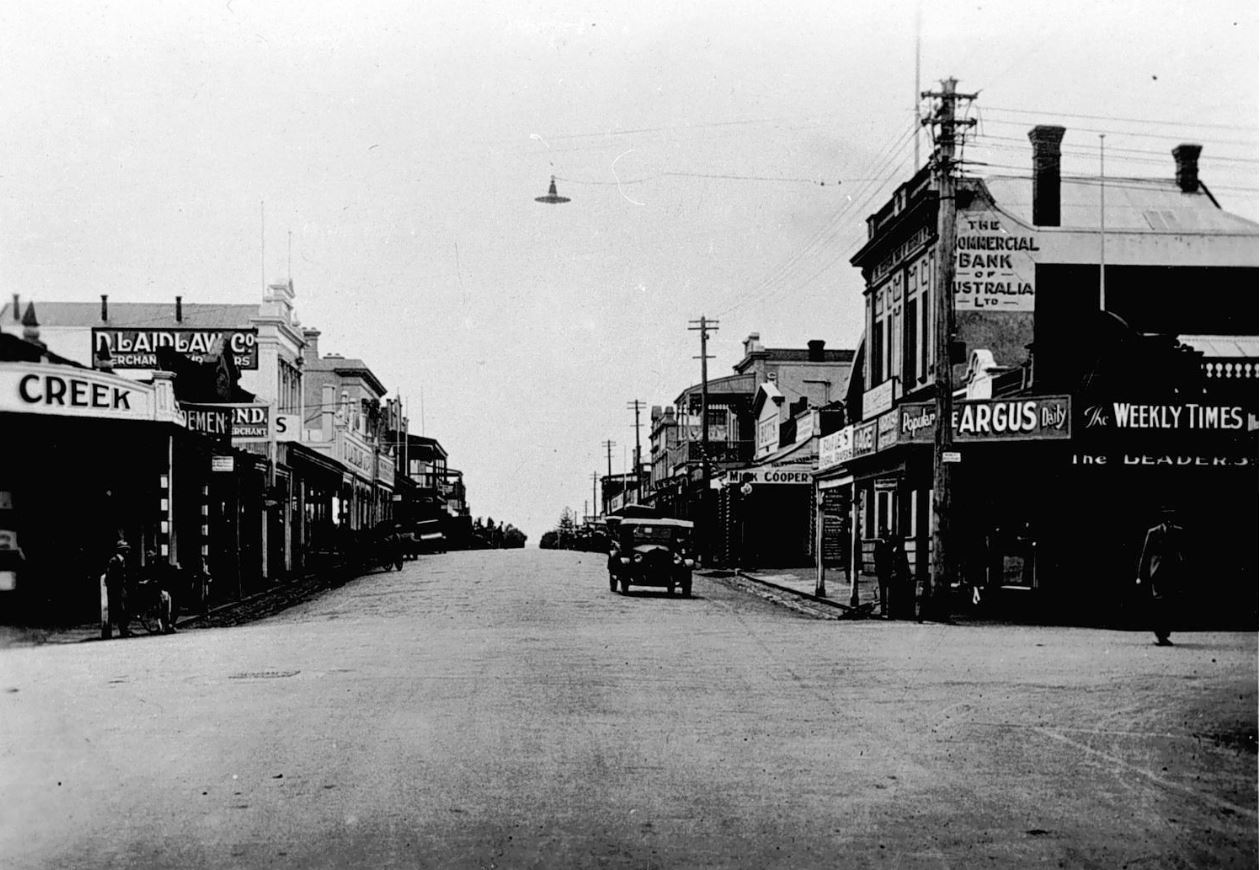
John’s corner became known as Kennan’s corner. You can see the corner on the right in the photo below taken after John’s death but while still a newsagent.  John also owned the shop next door occupied by Robertson’s drapery during his time.

John was a Justice of the Peace from 1887 and served on the Hamilton Council from March 1884 until 1904 and elected Mayor after only five months as a councillor.  John was voted off the council in 1888 but returned in 1898 and remained until 1904. John was also an honourary Magistrate and a founding member of the Hamilton Gas Company in 1877.  At the time of his death, he was the oldest member of the Grange Lodge at Hamilton.   John left his widow Jane, five sons and four daughters.   Gerald, one of John and Jane’s sons continued the business before moving to Melbourne in the mid-1920s.

Advertising (1923, March 1). Advocate (Melbourne, Vic. : 1868 – 1954), p. 12. Retrieved December 21, 2018, from http://nla.gov.au/nla.news-article171246844

READ, William Henry – Died 9 November 1936 at Branxholme.  William Read was born at Davenport, Manchester, England around 1856.  He travelled to Victoria on the Champion of the Seas (below)in 1866 with his parents and younger siblings.

“CHAMPION OF THE SEAS”. Image courtesy of the State Library of Victoria http://handle.slv.vic.gov.au/10381/101122

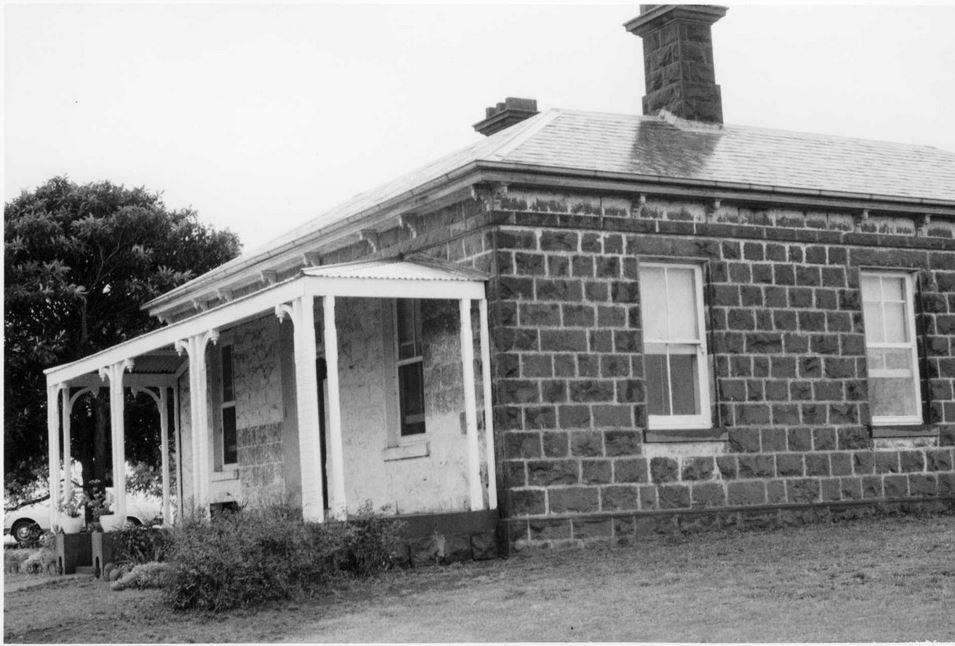
They headed to Sailors Gully near Bendigo and then Learmonth where William gained farming experience from his uncle.  William went on to manage the Tarrone station near Koroit followed by Greenhills station near Hawkesdale.  On 22 September 1880, at Ballarat, William married Clara Edwards of Burrumbeet.  In 1883, on the death of their uncle David Vines, William and his brother purchased Audley near Branxholme from their uncle’s estate.  William later bought out his brother’s share.

“AUDLEY”, BRANXHOLME. Image courtesy of the J.T. Collins Collection, La Trobe Picture Collection, State Library of Victoria http://handle.slv.vic.gov.au/10381/215908

William was a councillor with the Shire of Portland from 1889 to 1906, a member of the Hamilton Hospital committee and a member of the Branxholme Mechanics Institute committee. He was an active member of the Branxholme Church of England congregation and a Justice of the Peace.

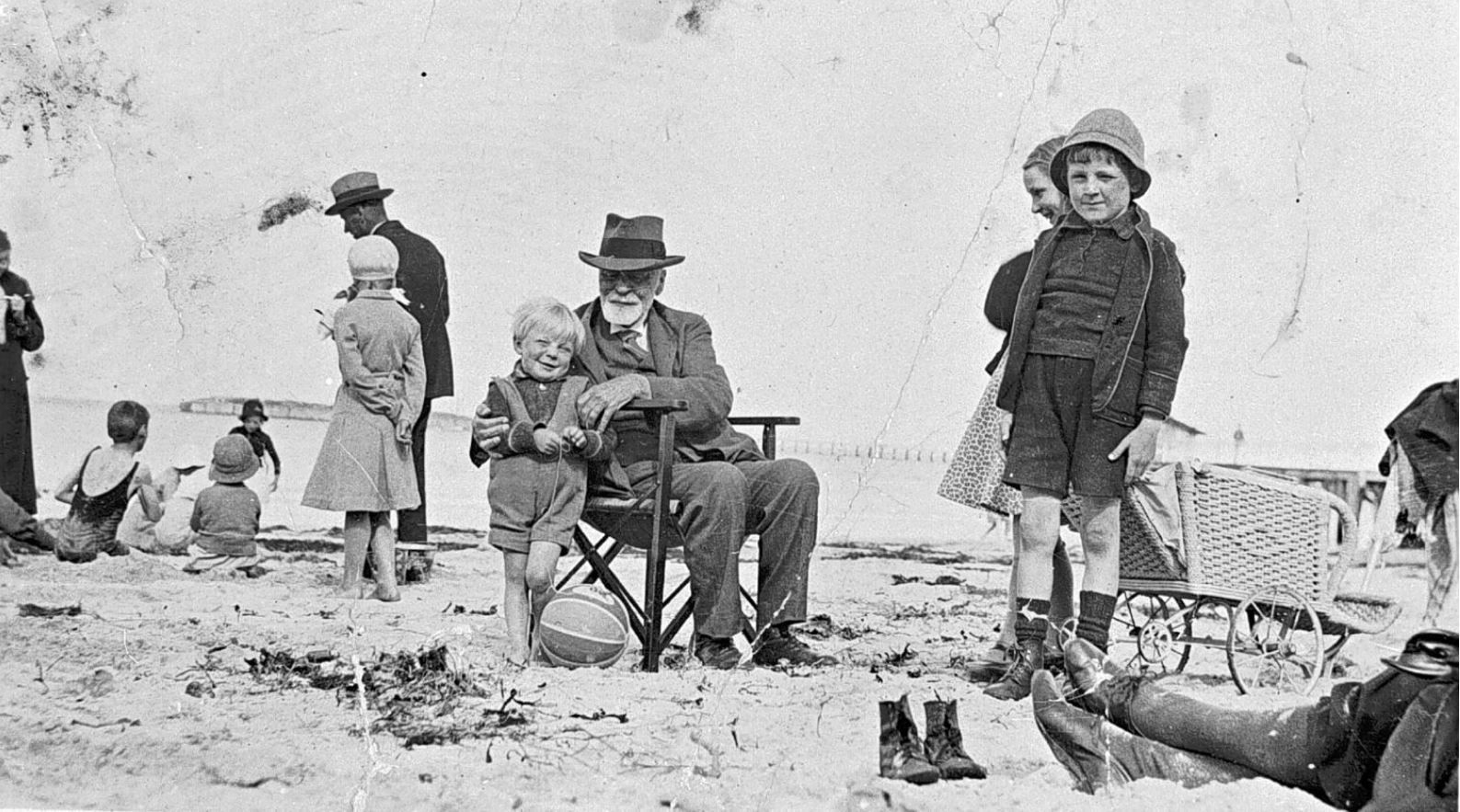
Clara died on 11 June 1927.  William carried on at Audley and spent time with his family as seen in this lovely photo of William and his descendants on the beach at Portland a year before his death.

WILLIAM READ AT PORTLAND WITH FAMILY IN 1935. Image courtesy of the Museums Victoria Collections https://collections.museumvictoria.com.au/items/771581

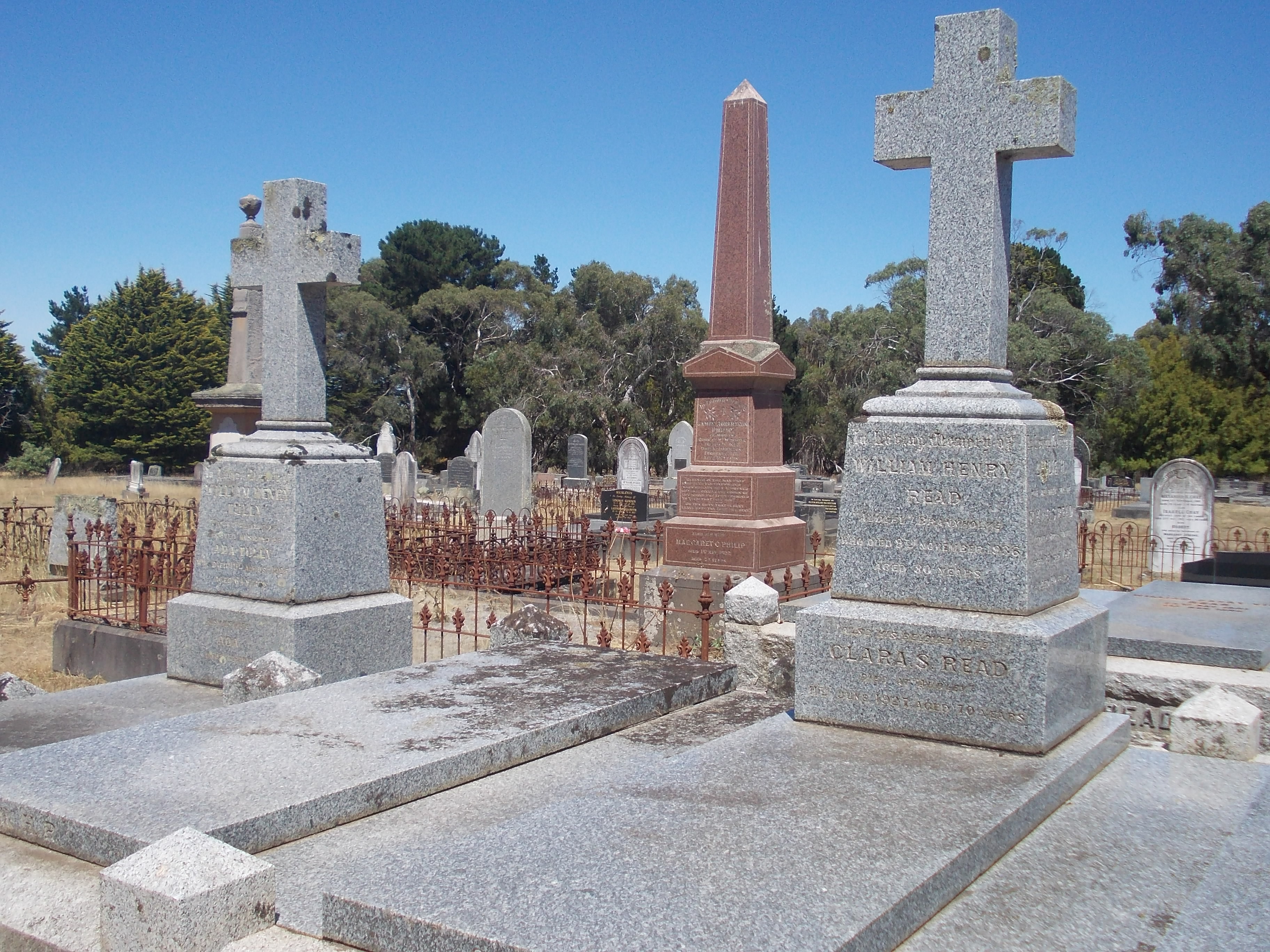
William died at Audley in 1936, survived by four sons and one daughter.

GRAVE OF WILLAM HENRY READ, BRANXHOLME CEMETERY

DECEMBER

READ, William Henry Vines – Died 1 December 1938 at Hotspur.  William Read was born at Ballarat in 1881, a son of William Read (above) and Clara Edwards. The family moved to Audley at Branxholme when William was two.  He later attended school at the Hamilton Academy (below).

HAMILTON ACADEMY. Image courtesy of the State Library of South Australia https://collections.slsa.sa.gov.au/resource/B+21766/58

After his schooling, William went to work for Thomas Laidlaw at Wonwondah, south of Horsham for two years.  William worked for Messrs. A.E. Smith agents of Casterton in their Merino branch.  While in Merino, he was involved with the Mechanics Institute and the tennis and rifle clubs.  He moved to Terang in 1904 where he ran his own stock and station agency for around five years.  In July 1909, William married Isabella Philip of Branxholme at the Branxholme Presbyterian Church and he remained in the Branxholme district.

Like his father, William was a Portland Shire councillor, holding his place for thirteen years including two terms as President.  He was also involved with the Branxholme Progress Association, the Branxholme Racing Club and the Branxholme Hall committee. He was active with the Branxholme Presbyterian Church and a life governor of the Hamilton District Base Hospital.  William died suddenly after collapsing while out with his son at Hotspur.  He left his widow Isabella, two daughters and one son.

HENTY, Stephen George – Died 18 December 1872 at Tarrington.  Writing the life story of Stephen Henty would take more space than I can allow here so I will base his story on his obituary published in the Hamilton Spectator with some help from his wife Jane. Stephen Henty was born in 1811 at West Tarring, Sussex, England the seventh son of Thomas Henty and Frances Hopkins.  He left for Western Australia with his brothers James and John in 1829 going to the Swan River on the Caroline.  With them were forty staff as well as stock including Merino sheep.  They took up land but found it unsuitable so they headed for Launceston.

STEPHEN GEORGE HENTY. Image courtesy of the State Library of Victoria http://handle.slv.vic.gov.au/10381/91532

Stephen made a couple of trips back and forth putting into practice the navigational skills he picked up on his voyage to Australia.  It was in the Swan River area where Stephen, at the age of twenty-two met sixteen-year-old Jane Pace, who had arrived from Yorkshire, England.  Her mother carried a letter of introduction addressed to Stephen should need help on her arrival.  Stephen and Jane married on 14 April 1836 at Fremantle and they soon set off for Portland Bay where the Henty brothers had a whaling station and were establishing themselves as sheep farmers. 

Soon after reaching Portland, the Henty brothers received a surprise visit from Major Thomas Mitchell.  He told them of good land inland, just to the north.  Stephen set off and found the spot which would become Merino Downs.  Jane wrote in her memoir, “My husband, Stephen, never rested until he had gone all through the interior, cut a track through fifteen miles of forest land with two men and a dray, and arrived on the banks of the lovely River Wannon about sundown, grass up to his shoulders. Exclaiming “this is Paradise,” he lay down and slept till sunrise”.

STEPHEN GEORGE HENTY -“MEMORIES” (1934, November 15). Table Talk (Melbourne, Vic. : 1885 – 1939), p. 6. http://nla.gov.au/nla.news-article149584670

Another of Stephen’s expeditions was to what is now Mount Gambier and Jane noted he was the first European to stand on the banks of Blue Lake.  Stephen was also active in business at Portland as a merchant and shipowner.  Jane said, “My husband and his brother Edward were in partnership from boys and continued so for years after, Edward managing the Muntham property and Stephen the mercantile part at Portland Bay.”    


Elected to the Legislative Council of Victoria in 1856, 
Stephen and Jane spent much of their time at Findon in Kew. During his time in Melbourne, Stephen became one of the first members of the Melbourne Club.  He resigned his parliamentary seat in 1870 due to ill-health and he and Jane retired to Tarrington, a property just east of Hamilton where Stephen died two years later.  Stephen Henty is buried at the Hamilton (Old) Cemetery with Jane who lived for a further thirty-four years.

GRAVE OF STEPHEN AND JANE HENTY AT THE HAMILTON (OLD) CEMETERY.

You can read more about Stephen and his brothers in their biography at the Australian Dictionary of Biography on the link http://adb.anu.edu.au/biography/henty-stephen-george-2257

CHAMBERS, Margaret Alice Werge – Died December 1903 at Tahara.  Margaret Chambers was born in Melbourne in 1850.  On 6 January 1883, she married Samuel Winter Cooke of Murndal, Tahara and Alice went to live at Murndal (below)

IN THE MURNDAL GARDEN. c1880. Image courtesy of the State Library of Victoria. http://handle.slv.vic.gov.au/10381/334528

Margaret and Samuel did not have children and Margaret devoted much of her time to various charities in the district.  That was no different in the lead up to Christmas in 1903 a busy time for charitable institutions. While sitting down to lunch with Samuel and her nephew William Gayer they discussed the latest happenings when suddenly Margaret didn’t respond. Realising all was not well Samuel and William got her to bed and a doctor called.  She lapsed in unconsciousness and died soon after aged fifty-three. Margaret was well-respected in the community and evidence of that was demonstrated at her funeral.  Two hundred mourners turned out to Murndal including all the Murndal staff. Eight employees were pallbearers and they placed in her coffin in her grave at the cemetery on the property. 

DENMAN, Ellen – Died 7 December 1917 at Hamilton.  Ellen Denman was born at Blackwood in 1871.  In 1873, her mother Mary died leaving her father Joseph with nine children to care for.  Ellen married Richard Millard in 1888.  They settled in McIntyre Street, Hamilton.  Ellen was a tireless worker for charity particularly the Hamilton branch of the Australian Natives Association (ANA). Described as a Trojan, she never expected payment or rewards for work.  Her obituary read, 

She was of a most friendly disposition, towards all with whom she came in contact, possessing a character for honour which appealed most forcibly, whilst her individuality was most distinctive and marked so strongly that it was recognised her will was unshakable when once she decided on a course of action. Had she been in a more public position there is little doubt that her qualifications would have placed her among the ranks of notable women. But social position deprived her of that opportunity, and she had to work for her home in her task.
In 1915, her son Arthur enlisted and left overseas.  Ellen never got to see him return in  
1919 as she died on 7 December 1917. She had been looking forward to Christmas 
activities with the ANA

GRAVE OF ELLEN AND RICHARD MILLARD, HAMILTON (OLD) CEMETERY.

LOVETT, Eliza Kardinia – Died 30 December 1929 at Pomborneit. Eliza Lovett was born at Geelong around 1879.  She married Alfred Lucas on 12 June 1902. at the Camperdown Presbyterian Church and they went to live at Bonnie Brae at Pomborneit. Eliza was very active in the community as a member of the Camperdown Presbyterian Church Ladies Guild, the Public Hall committee and the women’s section of the Victorian Country Party.  Eliza left her husband Alfred, two daughters and three sons. 

DAVIS, Richard – Died 22 December 1949 at Camperdown.  Richard Davis was born in Camperdown in 1864, however, his father died before his birth. He was one of the first children baptized at St Paul’s Church, Camperdown. As a child, Richard helped with the watering of Camperdown’s Finlay Avenue of Elm trees in Manifold Street planted in 1876.

FINLAY AVENUE, MANIFOLD STREET, CAMPERDOWN. Image courtesy of the State Library of South Australia Image no. B 61788/117 https://collections.slsa.sa.gov.au/resource/B+61788/117

Richard obtained a job with Andrew Walls, a road contractor and later started a similar business with partner Jesse Porter.  He also added stone masonry to his skills.  Richard married Elizabeth Rawbon in 1892 and they had six children.  Richard was a founder of the Camperdown Traders Association and a member of the IOOF Lodge. He and his son Norman raced ponies, winning twenty-seven races with “Lady Howard” and “Joe Jewell”.  Richard left his widow Elizabeth and four children at the time of his death.  Elizabeth died in May the following year.


Armistice Day 1918 in the Western District

Today is the centenary of the signing of the Armistice which brought an end to the fighting of WW1.  News arrived in the Western District between 8.30pm and 9.30pm on Monday 11 November 1918 while for other towns, it was the following morning.  Everyone knew it was coming, the question was when. Hopes were high after the surrender of Austria and Turkey but there was still uncertainty and an unwillingness to celebrate until the official word came through.

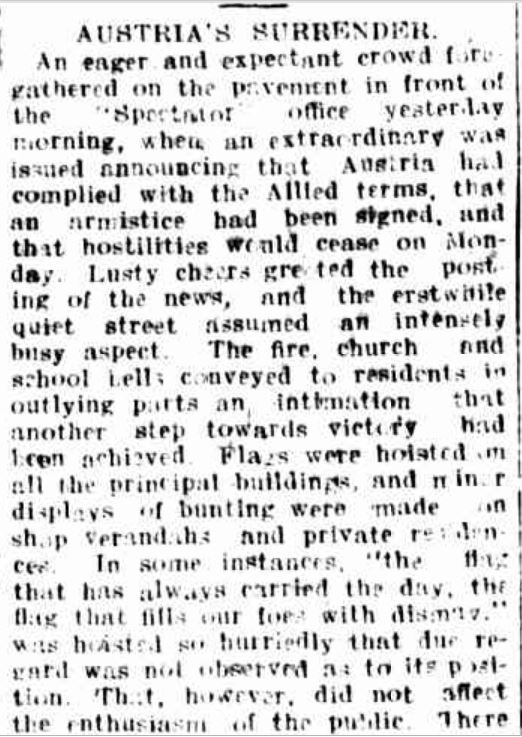
“AUSTRIA’S SURRENDER.” Hamilton Spectator (Vic. : 1870 – 1918) 5 November 1918: 4. Web. 8 Nov 2018 http://nla.gov.au/nla.news-article119508007

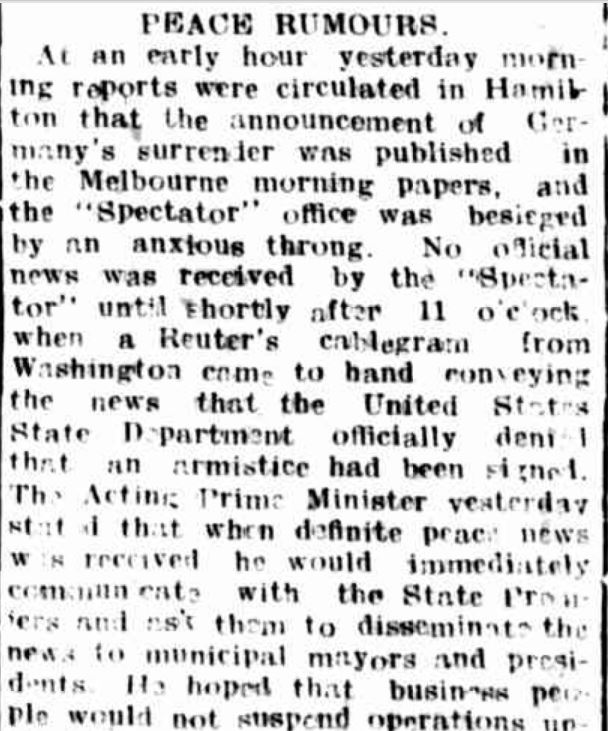
Most towns had put in some preparation organising bands and ensuring bunting was at hand ready to decorate the streets.  Early on 8 November, rumours spread around Hamilton, Coleraine and other Western District towns that the signing had taken place.  But they were just rumours.

“PEACE RUMOURS.” Hamilton Spectator (Vic. : 1870 – 1918) 9 November 1918: 4. Web. 8 Nov 2018 http://nla.gov.au/nla.news-article119508174


“PREMATURE EXCITEMENT” Coleraine Albion and Western Advertiser (Vic. : 1902; 1914 – 1918) 11 November 1918: http://nla.gov.au/nla.news-article119615782

Let’s do a fly around the Western District and see how each town reacted.  In most cases, the reaction was like nothing seen before.

In Ararat, official news came through at 8.30pm on 11 November.  Bells started to ring and the two local brass bands swung into action.

Celebrations continued on into the morning of Tuesday 12 November.

“TO-DAY’S RE[?]OICINGS.” Ararat Chronicle and Willaura and Lake Bolac Districts Recorder (Vic. : 1914 – 1918) 12 November 1918 http://nla.gov.au/nla.news-article154297182

Then into Tuesday evening with an open-air concert at Alexandra Park.

“PEACE CELEBRATIONS.” Ararat Chronicle and Willaura and Lake Bolac Districts Recorder (Vic. : 1914 – 1918) 15 November 1918: 2. Web. 7 Nov 2018 http://nla.gov.au/nla.news-article154298902

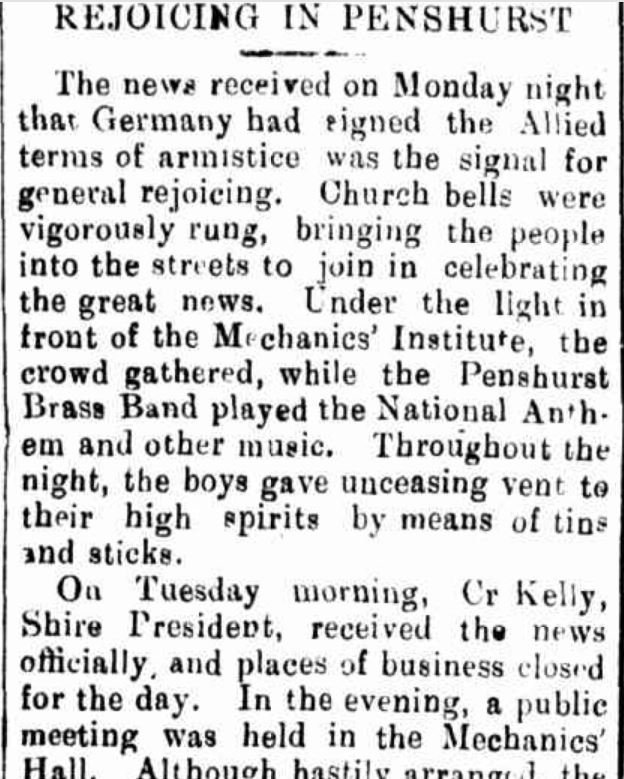
In Penshurst, church bells rang and the Penshurst Brass Band played.

“ARMISTICE SIGNED” Penshurst Free Press (Vic. : 1901 – 1918) 16 November 1918: 3. Web. 7 Nov 2018 http://nla.gov.au/nla.news-article119565333

Just before 9pm, the Hamilton Spectator received a cable and immediately told those waiting in front of the offices in Gray Street. Bells rang, the bands played and people flooded into the streets.  The Hamilton Brass Band was taken by motor car to Tarrington to tell residents there.

“JUBILATION IN HAMILTON” Hamilton Spectator (Vic. : 1870 – 1918) 12 November 1918: 6. Web. 5 Nov 2018 http://nla.gov.au/nla.news-article119508265

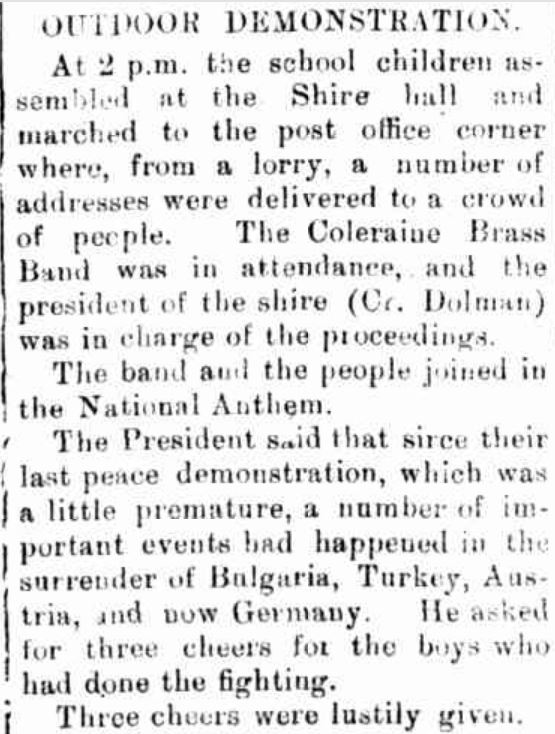
After a false start to celebrations, Coleraine took no time took to get in the spirit.  On 12 November the children marched along the streets of the town.

“OUTDOOR DEMONSTRATION.” Coleraine Albion and Western Advertiser (Vic. : 1902; 1914 – 1918) 14 November 1918: 3. Web. 7 Nov 2018 http://nla.gov.au/nla.news-article119615803

At Casterton, the townsfolk were “delirious with joy”.  There was fireworks, bands and dancing.

“Peace! Glorious Peace!” Casterton Free Press and Glenelg Shire Advertiser (Vic. : 1915 – 1918) 14 November 1918: 3. Web. 7 Nov 2018 http://nla.gov.au/nla.news-article152657300

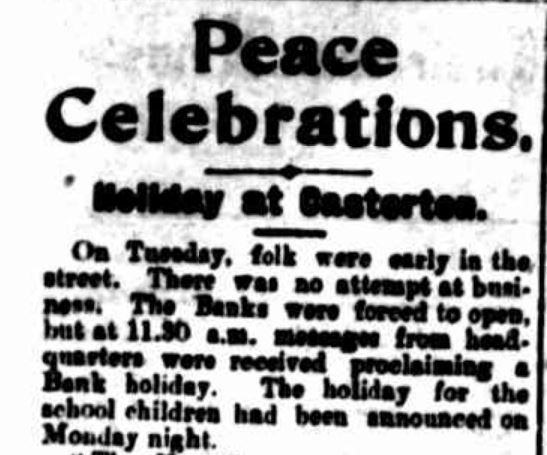
Tuesday 12 November was a holiday in Casterton as it was in most places.

“Peace Celebrations.” The Casterton News and the Merino and Sandford Record (Vic. : 1914 – 1918) 14 November 1918: 3 (Bi-Weekly.). Web. 7 Nov 2018 http://nla.gov.au/nla.news-article74222633

Some towns like Sandford and Merino waited until official word was received the following morning. At Sandford, in a prearranged manoeuvre, the sight of the flag going up the pole of the Post Office signalled the end of the war.

“Sandford Celebrations.” The Casterton News and the Merino and Sandford Record (Vic. : 1914 – 1918) 14 November 1918: 3 (Bi-Weekly.). Web. 7 Nov 2018 http://nla.gov.au/nla.news-article74222628

At Merino, bells rang and guns fired.

“Merino Celebrations.” The Casterton News and the Merino and Sandford Record (Vic. : 1914 – 1918) 14 November 1918: 3 (Bi-Weekly.). Web. 7 Nov 2018 http://nla.gov.au/nla.news-article74222625

Heywood held off with celebrations until official word came after 9am on Tuesday 12 November. Preparations were then quickly underway for a large demonstration at 3pm

“Heywood.” Portland Observer and Normanby Advertiser (Vic. : 1914 – 1918) 14 November 1918: 2. Web. 7 Nov 2018 http://nla.gov.au/nla.news-article88196524

At Portland, the Observer received an urgent wire from Reuters around 9.30pm on 11 November with the news and the celebrations began.  People got out of the beds and rushed into the streets.

“LOCAL CELEBRATIONS.” Portland Observer and Normanby Advertiser (Vic. : 1914 – 1918) 14 November 1918: 3. Web. 7 Nov 2018 http://nla.gov.au/nla.news-article88196546

At Orford, a public picnic was planned for the following Friday.

“CELEBRATIONS AT ORFORD.” Port Fairy Gazette (Vic. : 1914 – 1918) 14 November 1918: 2 (EVENING). http://nla.gov.au/nla.news-article91987686

At Port Fairy, there were a couple of hiccups but that did suppress the euphoria.

“ORDERLY CELEBRATIONS.” Port Fairy Gazette (Vic. : 1914 – 1918) 14 November 1918: 2 (EVENING). Web. 7 Nov 2018 http://nla.gov.au/nla.news-article91987660

The official message arrived about 9pm on 11 November and the news spread around the town like wildfire.

“Advertising” Port Fairy Gazette (Vic. : 1914 – 1918) 14 November 1918: 2 (EVENING). https://trove.nla.gov.au/newspaper/page/8499675

Tuesday was a holiday and just as well because no one would have turned up for work anyway. Port Fairy’s celebrations continued all Tuesday and into Wednesday.

“TUESDAY MORNING.” Port Fairy Gazette (Vic. : 1914 – 1918) 14 November 1918: 2 (EVENING). http://nla.gov.au/nla.news-article91987687

“AFTERNOON DEMONSTRATION” Port Fairy Gazette (Vic. : 1914 – 1918) 14 November 1918: http://nla.gov.au/nla.news-article91987687

At Koroit the shops and school closed Tuesday and Wednesday.  A large bonfire was built and on Tuesday night after a parade, it was lit.

“CELEBRATION AT KOROIT” Warrnambool Standard (Vic. : 1914 – 1918) 14 November 1918: http://nla.gov.au/nla.news-article74039937

In Warrnambool, people waited outside the Standard office for the news on the evening of 11 November.  Fire bells started ringing as soon as the news was read out.

“PEACE AT LAST!” Warrnambool Standard (Vic. : 1914 – 1918) 12 November 1918: 3 (DAILY.). Web. 5 Nov 2018 http://nla.gov.au/nla.news-article74039813

A torchlight parade was organised for Tuesday night with a massed tin-can band.

“STATEMENT BY MR. WATT.” Warrnambool Standard (Vic. : 1914 – 1918) 12 November 1918: 3 (DAILY.). Web. 5 Nov 2018 http://nla.gov.au/nla.news-article74039792

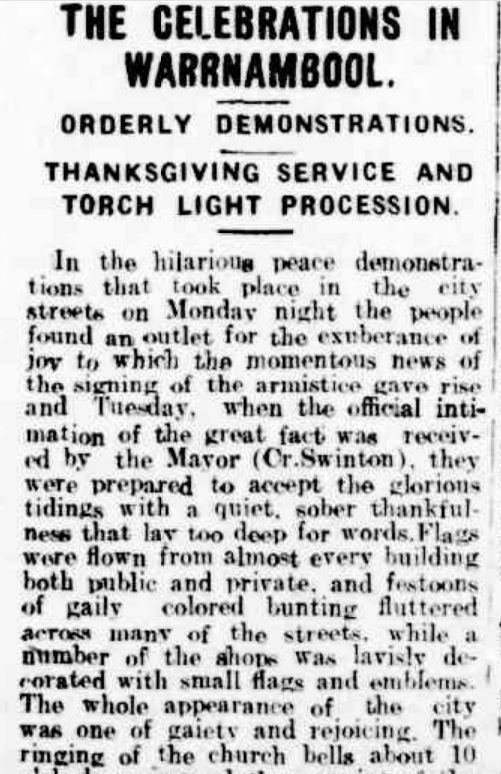
Buildings and streets across Warrnambool were decorated with flags and bunting.

“THE CELEBRATIONS IN WARRNAMBOOL.” Warrnambool Standard (Vic. : 1914 – 1918) 14 November 1918 http://nla.gov.au/nla.news-article74039829

Camperdown residents rushed into Manifold Street.

“General Rejoicing.” Camperdown Chronicle (Vic. : 1877 – 1954) 12 November 1918: 2. Web. 10 Nov 2018 http://nla.gov.au/nla.news-article32180700

Cobden celebrated too.

“PEACE AT LAST.” Cobden Times (Vic. : 1918) 13 November 1918 http://nla.gov.au/nla.news-article119543664

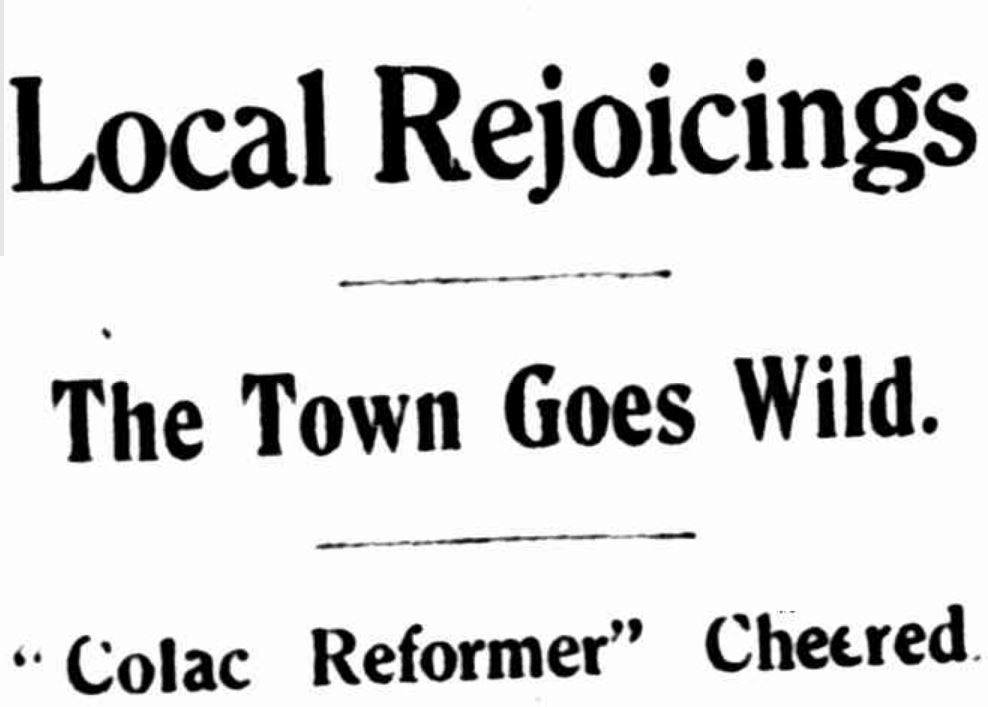
In Colac, they went “wild”.

“Local Rejoicings” Colac Reformer (Vic. : 1914 – 1918) 12 November 1918: 3. Web. 7 Nov 2018 http://nla.gov.au/nla.news-article154137089


“PEACE CELEBRATION.” The Colac Herald (Vic. : 1875 – 1918) 13 November 1918: 3. Web. 5 Nov 2018 http://nla.gov.au/nla.news-article74474856

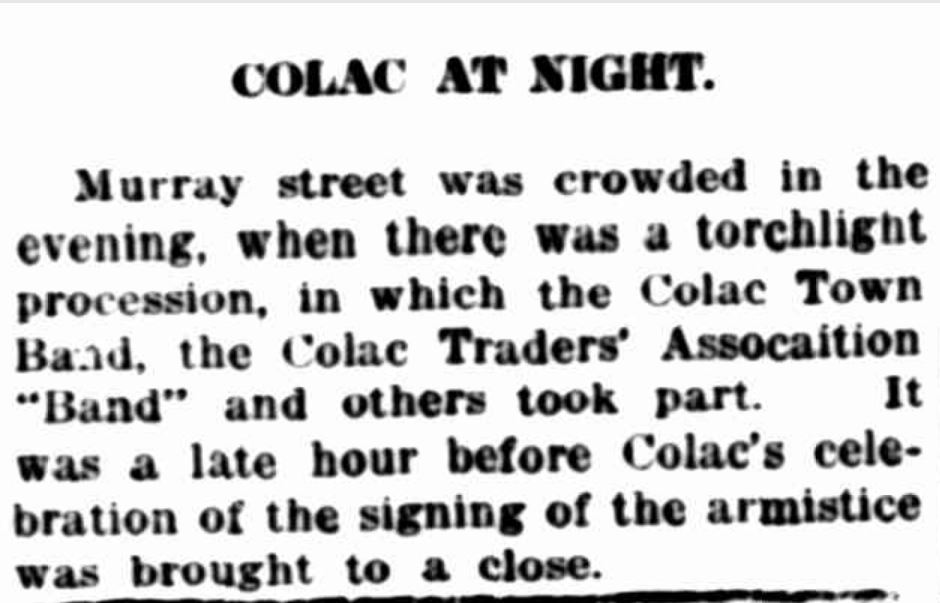
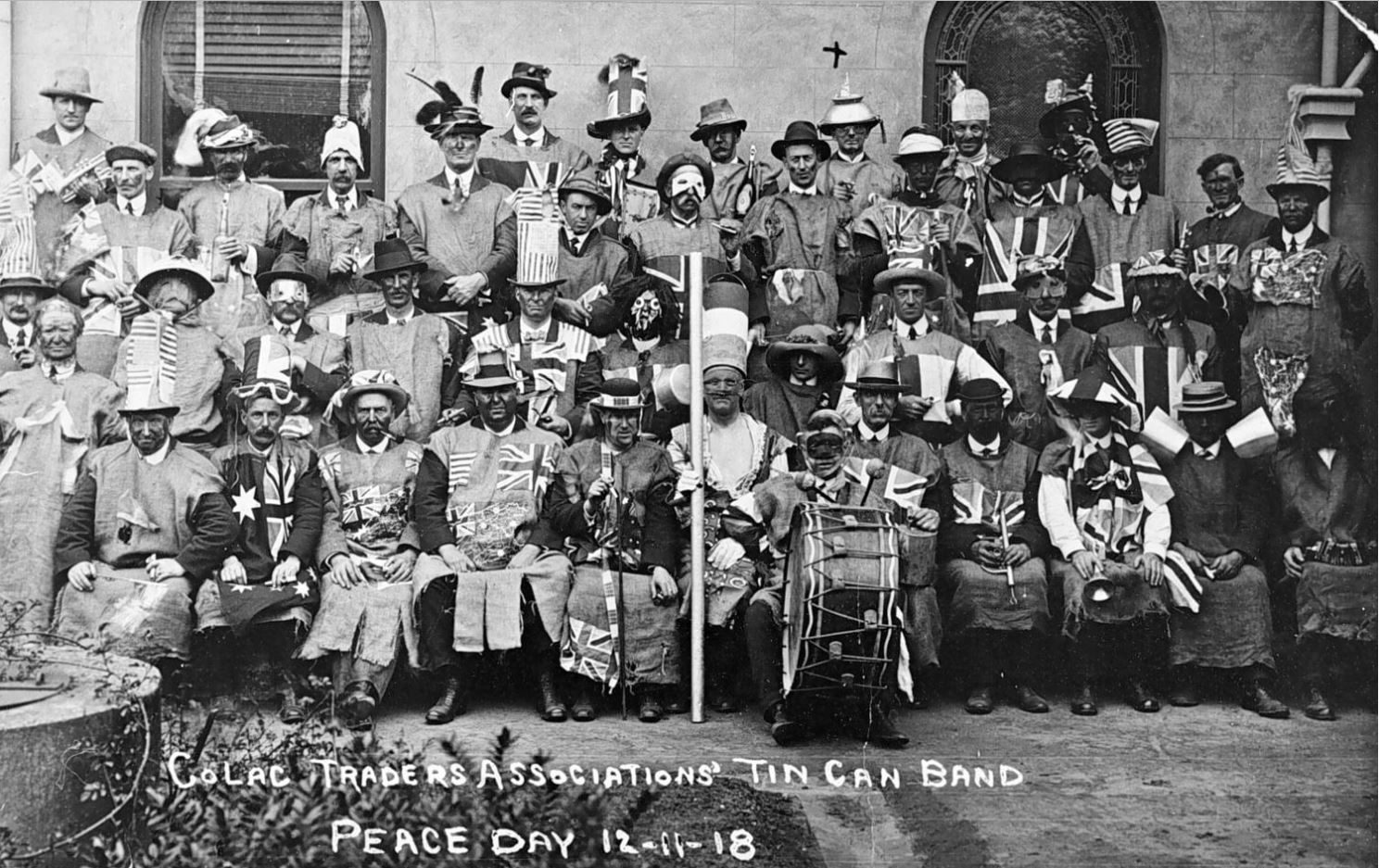
A torchlight parade took place on Tuesday night.

“COLAC AT NIGHT.” The Colac Herald (Vic. : 1875 – 1918) 13 November 1918: 3. Web. 7 Nov 2018 http://nla.gov.au/nla.news-article74474852

A TIN CAN BAND READY FOR COLAC’S TORCHLIGHT PARADE ON 12 NOVEMBER 1918. Image courtesy of the Museums Victoria Collections https://collections.museumvictoria.com.au/items/771371


“CELEBRATIONS IN COLAC” Colac Reformer (Vic. : 1914 – 1918) 14 November 1918: http://nla.gov.au/nla.news-article154135561

.Despite all the celebrations, the underlying feeling was summed up by the Warrnambool Standard.


BIRDS OF PEACE! (1918, November 14). Warrnambool Standard (Vic. : 1914 – 1918), p. 3 (DAILY.). Retrieved November 7, 2018, from http://nla.gov.au/nla.news-article74039924

Hamilton’s WW1…A Reflection

Four years, two months, and twenty-two days after Privates Maurice Tilley, William Niven, William Turner, Ernest Huggins, and Harry Caple left Hamilton by train on the evening of Tuesday 18 August 1914 the first official troops from the district, the guns fell silent.  The people of Hamilton, although somewhat buoyant after the surrender of Turkey and Austria in the days before, were wary about getting too swept up. That was until around 9pm on Monday 11 November when the news of the Armistice reached Hamilton. As those waiting outside the Hamilton Spectator were given the news, jubilation erupted and soon people flooded the streets.  The boys were coming home…but not all.

Just as William Niven, one of the first five men to leave Hamilton, did not return, around one in five of the total number of men with Hamilton ties who enlisted, also never returned to Hamilton.  Of the 693 men I have identified as having Hamilton connections, 169 died before Armistice Day as a direct result of the war.

HAMILTON WAR MEMORIAL c1930-1954. Image courtesy of the State Library of Victoria Image no. H32492/2728 http://handle.slv.vic.gov.au/10381/63654

Since early 2015, I’ve been compiling names and writing stories of the men and women of Hamilton’s WW1. Since late 2015, I’ve been posting snippets of each edition of the Hamilton Spectator from 100 years before on the Hamilton’s WW1 Facebook page.  The aim was to gain an understanding of the effects of the war on a town such as Hamilton, the mood of the people and their response, and of course, the stories of the men and women who enlisted and their families.  

The first man with Hamilton connections killed in action was Joseph Alan Cordner, a Collingwood footballer, former Hamilton College student, and a player in the Hamilton Cricket team.  Joseph, better known as Alan, was the first Victorian Football League player to enlist and among the first VFL players killed.  His death came in the hours after the landing at Gallipoli.  Initially, he was reported as missing and it was almost a year before his death on 25 April 1915 was made official.

JOSEPH ALAN CORDNER. Image Courtesy of the Australian War Memorial. Image no. P03483.009 https://www.awm.gov.au/collection/P03483.009/

The first the Hamilton people heard of a man with a local connection to have fallen was the news of the death of Harold Johnson of Maldon.  Harold was well-known in Hamilton having worked at department store J. Thomson & Co.  He was wounded in the days after the landing and died in hospital in Alexandria on 2 May 1915.  However, it was on 24 May 1915 when the reality of war really hit Hamilton.  The Hamilton Spectator wrote on 24 May 1915, “The youth of the town have had their first piercing illustration of what war means in the last resort when they realise that one of their number will never associate with them.  Private William Henry Waters, a Hamilton State School boy, between nineteen and twenty years of age, has died at the front whilst fighting with the Australian forces at Gallipoli. He is the first Hamilton soldier to fall.”

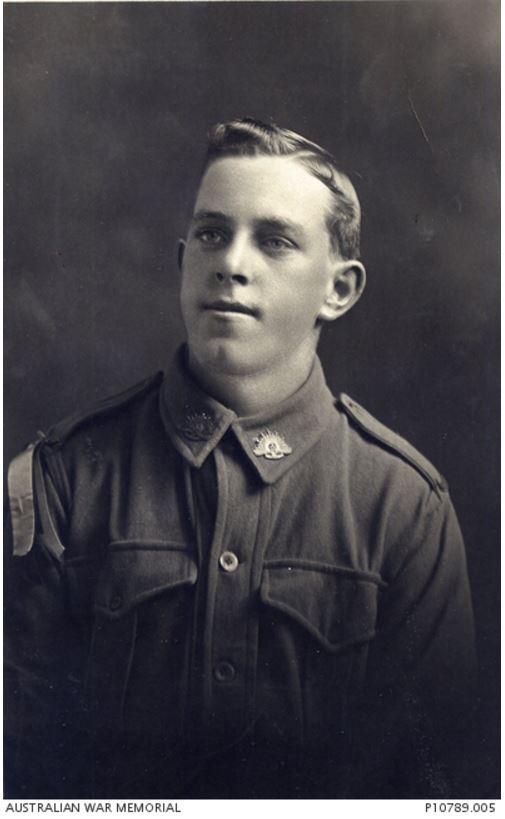
Of those I’ve researched, William Norman was the youngest to enlist at seventeen years and eleven months.  The eldest of eight children, William was eighteen years and five months when he arrived at Gallipoli.  He went on to serve in France and Belgium and was killed on 8 October 1917, near Broodseinde Ridge, Belgium. He was buried where he fell, his body never recovered.  William was twenty.  His five younger brothers all enlisted for WW2.

WILLIAM LESLIE NORMAN. Image courtesy of the Australian War Memorial https://www.awm.gov.au/collection/P10789.004/

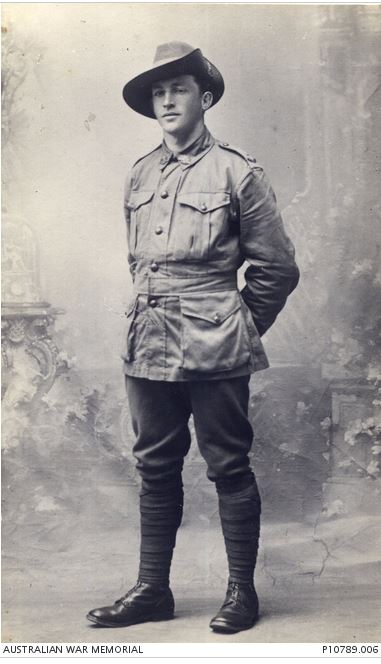
The youngest to die was Robert Taylor, born in Hamilton and a former student of the state school.  He was eighteen years and one month when he enlisted on 24 January 1916.  He was dead just seven months and fifteen days later, killed at Pozieres, France. Like Joseph Cordner and William Norman, Robert’s body was never recovered.

ROBERT TAYLOR. Image courtesy of the Australian War Memorial https://www.awm.gov.au/collection/P10789.005/

The last Hamilton man to die before the Armistice was James Smyth of the 9th Light Horse Regiment.  After James and another man captured a German officer with eighty-five Turkish soldiers on 2 October 1918 near Khan Ayash in Syria, James was nominated for a Distinguished Conduct Medal  (DCM) for conspicuous gallantry, initiative, and devotion to duty.  Fifteen days later he was sick with malaria and died on 25 October 1918.  His DCM was awarded posthumously.

Many families had multiple enlistments which for some brought added grief like that experienced by the Joyce family. Brothers Matthew and Thomas were killed just two months apart, Matthew on 11 April 1917 at Bullecourt, France, and Thomas on 1 June 1917 at Warloy-Baillon, France. 

There were also the two sons of Charlotte Lance.  Her eldest son Alexander Scott (below) was killed on 26 August 1916 at Mouquet Farm, France but Charlotte was not notified he was even missing.  After the death of her younger son George Lance, she wrote to the Defence Department asking after Alexander as she had not heard from him since the year before.  He was dead, came the reply.  Two boys lost a year apart but the news of both came within months. Charlotte didn’t even want George to go, refusing the nineteen-year-old her permission. Determined to enlist, George went to Adelaide, enlisted under a false name, then wrote to his mother and told her what he had done.  She didn’t even get to say goodbye.

ALEXANDER WILLIAM SCOTT. Image courtesy of the Australian War Memorial https://www.awm.gov.au/collection/DA11399/

Then there were the Stevenson brothers  Alexander and Edgar. Only a few years apart in age, they spent a lot of time together before enlistment. They worked together at the family bakery in Coleraine Road, were both members of the Independent Order of Rechabites, and sang together at the local Baptist Church.  They also went to war together both serving with the 39th Battalion.  Alexander known as Lex was there when Edgar was killed on 4 October 1917.  He helped dig the grave and placed a cross upon it.  A week later, Lex was shot near Passchendaele, Belgium, and died on 15 October from his wounds.  William and Euphemia Stevenson received the news of their sons six days apart.

James Lodge of Clarke Street, Hamilton sent four boys to war. Remaining at home was eighteen-year-old Frederick who was keen to join his brothers but instead worked with his father, a stonemason. James and Frederick were building the Catholic presbytery at Casterton when Frederick developed double pneumonia and died on 20 June 1918.  While James’ mind was with his four sons overseas, it was the son under his own watchful eye who died.  Despite his grief, James continued working but he too contracted pneumonia and died on 31 July.  Since it was James’ idea to plant trees along Clarke Street to form an Avenue of Honour for those in the street who enlisted, at the official planting on 24 August 1918, the first tree planted was in James’ honour and positioned in front of the Lodge home. The Lodge boys all returned to Australia, two highly decorated, and they went on to secure the contract of the construction of the Shrine of Remembrance.

James’ death before the war’s end was very common among parents of those serving.  William Sugden Price Lewis passed away within two weeks of hearing of his adopted son Arthur’s fate.  After waiting for eight months for news of his missing son Joseph only to learn he was dead, William Sloan felt he could live no longer.  Grief and anxiety were often compounded by the often-necessary dealings with the Defence Department.  I’ve read dozens of letters to Base Records from desperate parents and siblings.  You can sense the frustration and anguish of Isiah Cordner in his letters seeking information about his missing son Alan.  He wrote to the Defence Department, and the Red Cross and sought out men from Alan’s battalion for help. It was 364 days after Alan’s death when Isiah finally had official confirmation.

The family of John Taylor killed on 29 July 1916 at Pozieres experienced similar pain.  John’s mother Eliza tried to get news of her son, writing letters to the Defence Department and asking relatives to write.  The reply came that he was killed on 28/29 July 1916 but no more details of his death or burial were available.  The first inquiry into John’s death was held on 22 June 1917 finding there was no trace of him.  Letters were still being sent from the family in 1919 requesting more information.  They just wanted to know where he was buried and maybe get a photo of his headstone something available to parents of sons who did get a formal burial.

It was Abraham Tredrea father of Francis Tredrea who summed up the feelings of all parents when he wrote a letter to the Collie fanciers of Victoria by way of the Leader newspaper’s “Kennel Notes” published in September 1917. Abraham had waited thirteen months for news of his missing son. “I received word on Friday last re my son, F. S. Tredrea, saying he was killed in action on the 19th of July, 1916. You will remember he was then reported missing. I miss him very much. He was a very smart boy in the fancy, both in dogs and poultry. He was known by the Collie fanciers of Melbourne, and I am sure his friends in the fancy will be sorry to read the sad news.” Those words…I miss him very much.

FRANCIS STANLEY TREDREA. Image courtesy of the Australian War Memorial https://westerndistrictfamilies.com/wp-content/uploads/2015/04/tredrea.jpg

A number of the men were married with children like Francis. His wife Ada spent the thirteen months Francis was classed as missing, writing letters and advertising in newspapers for information about her husband.  When she finally received the official confirmation, she placed the following notice in The Argus,

“After months of hopeful waiting
The sad cable it came through
Saying he nobly did his duty
As onlloyal Australians do”

Arthur Emmett had the largest family of all the married men. When he enlisted in July 1915, Arthur and his wife Evangeline had four children with twins born after Arthur’s enlistment. Arthur was killed on 26 July 1916 at Pozieres, France but was reported missing.  When Evangeline heard the news, she began a year of letter-writing to the Red Cross asking for help in finding Arthur.  It was not until 4 August 1917 that Arthur’s death was officially confirmed. It was a double blow for the Emmett family with Arthur’s younger brother Alfred Emmett killed only weeks after they heard of Arthur’s fate.

With such a large number of men from the district overseas, there was always an opportunity to catch up with someone from Hamilton. The talk would invariably turn to news from home and the Hamilton Spectator sent by relatives was highly sought after.  Horace Westgarth (below) wrote home after the evacuation at Gallipoli, telling his mother, “…half of Hamilton seem to be with us now.”  By the time Horace left Egypt for France, just having transferred to the 58th Battalion, he had met up with fellow Hamiltonian Terence Finnegan. It was an unlikely friendship, which may not have come about if they were back in Hamilton.  Terence went to the Convent School and Horace went to the state school.  Terence worked as a tailor at J.Thomson & Co., while Horace was a carpenter.  But so far from home that didn’t matter and the common thread of being from Hamilton bound their friendship.  Terence and Horace were on rations fatigue around 9pm on 12 May 1917 as the second Battle of Bullecourt drew to an end. A shell killed Terence and Horace in an area known as Death Valley. They were buried where they fell and the two Hamilton men still lie there together today.

HORACE LEONARD WESTGARTH. Image courtesy of the Australian War Memorial https://www.awm.gov.au/collection/C1298989

Claude Douglas and Albert Sheehan were both twenty and Arthur Lewis aged twenty-four when the trio from Hamilton found themselves together in D Company of the 14th Battalion.  At Gallipoli, they shared a tent behind the frontline.  Thirteen men slept in the tent in the beginning, but by the start of August 1915, there were only three still occupying the tent, the three Hamiltonians.  Three weeks later the tent was empty.  Albert was missing after the attack on Hill 971 on 8 August, Arthur died of wounds on 13 August, and finally on 21 August, Claude was killed.

Ken Toleman of Mortlake and Englishman Reg Briant, were “out of towners”, electricians with the Hamilton Electric Co. when they enlisted.  They left Australia together on 17 June 1915 with the 14th Battalion 6th Reinforcements.  Kenneth and Reg arrived at Gallipoli on 1 August 1915.  It was a bad time to get there with heavy fighting and great loss of life throughout the month.  The day of 22 August was a particularly dark day. The battalion took part in the attack on Hill 60 and Reg was killed. Ken went on to France and then Belgium and was an acting Captain when wounded near La Clytte on 13 October 1916.  He died soon after. Ken had never stopped thinking about Reg.

It was Ken and Reg’s friendship which brought about one of the more heart-warming moments I came across.  In July 1916, Ken was granted leave to England for eight days and took the opportunity to meet with Reg Briant’s sister Dorothy. He also accepted the invitation of Reg’s schoolmaster and paid a visit to the school at Lymington, Hampshire. He was taken on a tour and was the first Australian soldier the children had seen.  He was given three cheers in all the classrooms.  When he next wrote home he described it as a holiday he would never forget. Ken’s grandmother Sarah in Mortlake received a reassuring letter from Dorothy Briant who said Ken was “well and strong”.

That wasn’t the only school visit.  Walter Filmer of Byaduk, a teacher at the Hamilton State School for three years, visited the  Hamilton Academy in Hamilton, Scotland.  The Hamilton State School and the Academy had exchanged flags while Walter was at the state school.  He found the Hamilton State School flag proudly displayed at the Hamilton Academy.  The children were excited to meet a representative from the school on the other side of the world, and Walter passed on his regards from the committee, staff, and pupils of Hamilton State School.

WALTER STEPHEN FILMER. Image courtesy of the Australian War Memorial https://www.awm.gov.au/collection/C73149

The letters to loved ones have been a highlight.  Men and women wrote letters home and in turn, some parents passed the letters on to the local paper for publication.  How thankful I am to those parents who did so. The letters share news of friends or relatives also serving, they describe the conditions and the countryside and give something of the letter writer’s personality.  Some were written during a quiet moment in the trenches while others were written from hospital while reflecting on why they were there.

One of the more entertaining letter writers was plucky William Lovell.  His self-assurance belied his age of nineteen years but it was likely that self-assurance saw him become part of “Jacka’s Mob”, the famous 5th platoon of the 14th Battalion led by Albert Jacka VC.  William lost his life near the Hindenburg Line on 11 April 1917 aged twenty.  His body still lies in the fields of northern France.

WILLIAM LESLIE LOVELL. Image courtesy of the Australian War Memorial https://www.awm.gov.au/collection/DA09468/

Frank Kendall wrote a long letter home to his father describing his time in London.  So long it was published in two parts in the newspaper.  Ivan Morieson, the son of a teacher wrote a lovely letter home to his mother describing his time in Egypt, “There is nothing I should like better than to travel over Egypt at my leisure. A man properly interested could spend a lifetime here, and if ever I get the chance I shall do my best to have a proper look at the place”.  Although he described himself as a man, he was just a boy.  Only eighteen at the time of his letter and twenty when he was shot through the heart while acting as company runner near Polygon Wood, Belgium.

IVAN FRANCIS MORIESON. Image courtesy of the Australian War Memorial https://www.awm.gov.au/collection/C2073040

The nurses from Hamilton have also been part of my research. They were not immune to the horrors of the war working under horrendous conditions and broken bodies.  The mental images would haunt them.  At least two of the Hamilton nurses spent time under psychiatric care within ten years of the end of the war. 

I have posted three stories of the Hamilton nurses so far,  one of those is the story of Hamilton-born Edith Malcolm.  She nursed at Salonika, Greece where living conditions were poor, some even thought worse than France. There was very little fresh food and they lived off soldiers’ rations. For a boost of iron, a weekly ration of bully beef and biscuits was issued.  Winters were freezing and the summers were hot with malaria a constant risk. The nurses covered themselves from head to toe to protect themselves from mosquitos. Edith was diagnosed with anaemia in July 1918 and invalided home.

Once back on Australian soil, Edith (below far right) found her brother Norman had returned home in the months before and her sister Stella and younger brother Eric returned in the months following allowing the Malcolm siblings to come together for the first time in three years for this beautiful photo.

THE MALCOLM FAMILY. Image courtesy of the Australian War Memorial https://www.awm.gov.au/collection/C390054

There have been many inspiring stories of bravery.  Several came from stretcher bearers who often found themselves in exposed positions as they removed the wounded from the battlefields.  They were often members of the battalion band like Arthur Underwood of Mill Road, Hamilton, a member of the 23rd Battalion band. He was awarded a Military Medal after his actions led to at least a dozen wounded men saved from No Man’s Land in broad daylight at Pozieres, France on 29 and 30 July 1916.

ARTHUR BELL PERCY UNDERWOOD. Image courtesy of the Australian War Memorial https://www.awm.gov.au/collection/DA10497/

Then there was Edwin Smith of the 22nd Battalion, not afraid to volunteer for raiding parties.  On 29 June 1916, he volunteered for a raid which saw the man they called “Fatty” crawl on his stomach through No Man’s Land with around sixty other men, before they jumped in the German trenches, taking the enemy by surprise. He didn’t receive a medal for that occasion but was awarded a Military Medal for his service as one of the last remaining men on Gallipoli after the evacuation on 20 December 1915.  The 22nd Battalion was positioned near Johnstone’s Jolly and as the battalion began its evacuation, Edwin and several other men kept up steady gunfire for over two hours so the enemy would believe everything was normal.

On the morning of 26 August 1916, as Edwin Smith passed through the village of Pozieres to relieve a crew on the front line, a shell hit his company. Edwin was killed instantly and buried where he fell. He was later exhumed and his body was placed in the Pozieres British Cemetery.

EDWIN RICHARDSON SMITH. Image courtesy of the Australian War Memorial https://www.awm.gov.au/collection/DA08695/

Frank  Lodge (below)was one of the four enlisted sons of James Lodge. On 29 July 1916, the 2nd Pioneers were in Pozieres and had commenced working on a communications trench known as “Centre Way” running to Pozieres Wood.  Their work was not helped by the enemy as the Germans bombarded the area.  Overnight on 4 August, with their section almost complete, Frank stood in the open above the trench not only giving directions to his men but urging them on.  He was awarded a Military Medal. 

On 31 August 1918, near Peronne Frank went forward to assess sites for bridges to aid with the advance…

…he got over the main canal and examined an old German bridge which had been partially destroyed.  Finding a gap of about fourteen feet, he pushed a spar over the gap and attempted to cross but disturbed a German sentry on the opposite bank who opened fire, and ran toward the village.  As Lieutenant Lodge was fired at by machine guns. from the south side of Halle he returned.  The information gained by this reconnaissance was of great value.  That night he got material carried to the site and proceeded to reconstruct a demolished road bridge and remained in charge of the work until completion the next evening, although immediate vicinity was heavily shelled all day. Later he did further valuable reconnaissance work and rapid bridging (Australian War Memorial, Honours and Awards https://www.awm.gov.au/collection/R1622549/ )

His actions saw him awarded a Military Cross.  His brother Augustine Bernard Lodge was awarded a Distinguished Service Order for his actions at Pozieres in 1916.

“BROTHERS WIN MILITARY HONORS” The Herald (Melbourne, Vic. : 1861 – 1954) 11 November 1916: 6. Web. 19 Jun 2018.

‘HAMILTON BOYS’ c 30 April 1915. Photo Courtesy of the Australian War Memorial. Image no. DAOD1060 https://www.awm.gov.au/collection/DAOD1060/

Passing of the Pioneers

This edition of Passing Pioneers includes two months of obituaries, September and October. The photos I have posted at the Western District Families Facebook page have become a useful tool for finding obituaries.  Recent photos of Western District hotels have helped me find a number of obituaries of publicans past and there are four this edition.  During Family History Month in August,  I posted a photo of the Kent family of Casterton on the Facebook page and below you’ll find the obituary of one of the family members.  There is “feature” obituary for each month, with both subjects making significant contributions to their associated towns.  As usual, if you click on any underlined text, you’ll go to further information about the subject.

SEPTEMBER

BEGG, Thomas – Died 3 September 1895 at Branxholme.  Thomas Begg was born at Cumberland, Scotland around 1819.  He married Mary Reid in 1842 and they had three children.  In February 1855, the family left Liverpool onboard the Nashwauk bond for Adelaide, South Australia.  With them were around 300 other immigrants and 130 Irish Orphan girls. On day eighty-nine of the voyage, they reached Gulf St Vincent near Adelaide.  As the ship headed toward the mouth of the Onkaparinga River south of Adelaide, it hit the shoreline. Fortunately, the passengers were rescued and taken to nearby Noarlunga.  Everything the Beggs owned was lost but at least they survived. They travelled by land to Adelaide, where Thomas bid farewell to his family and left for the Bendigo diggings.

After fifteen months in Victoria with no luck, Thomas returned to Adelaide and took a job at a flour mill.  He was suffering from poor health and after doctor’s advice to move to the country they headed for the south-east of South Australia. The family remained there until around 1865 when Thomas selected land at Condah. He named his property Foutus. Thomas was a councillor for the Portland Shire from 1875 and Shire President from 1877 until his resignation in 1880.  He and Mary remained at Condah until the early 1890s when they moved to Branxholme.  In June 1892, Thomas and Mary celebrated their fiftieth wedding anniversary at the Branxholme Mechanics Institute with 150 guests in attendance.  William died in 1895 after a long illness was buried at the Branxholme Cemetery.  The funeral cortege on 6 September was one of the longest seen in the district and the coffin was almost totally covered with wreaths.  Mary died in 1912 at the age of ninety-two.

BEGG FAMILY GRAVE, BRANXHOLME CEMETERY

MELVILLE, William – Died 7 September 1897 at Byaduk.  William Melville was born in Sutherland, Scotland around 1829.  He arrived in Victoria in 1852 and went into partnership with William Bayles forming Bayles and Melville in Melbourne. In 1858, William married Ann McDonald.  The following year Ann gave birth to a son, William Henry but she died as a result of the birth, aged twenty-four.

“Advertising” The Age (Melbourne, Vic. : 1854 – 1954) 27 August 1859: 4. Web. 5 Sep 2018 <http://nla.gov.au/nla.news-article154826326&gt;.

Meanwhile, business was good for Bayles and Melville and they expanded their interests into grazing land taking up Weerangourt south of Byaduk. On 18 April 1867, William remarried to Annette Margaret Bayles, a daughter of William Bayles and they settled at Weerangourt.  The partnership of Bayles and Melville was eventually dissolved but William continued on at Weerangourt.  In 1893, a new homestead was built.  William was also a Justice of the Peace. At the time of his death, William left his widow Annette and five sons and two daughters.  He was buried at the Hamilton (Old) Cemetery.

GRAVE OF WILLIAM MELVILLE AT HAMILTON (OLD) CEMETERY

JACOBY, Sigismund – Died 15 September 1917 at St Kilda.

“OUR ST. KILDA LEGISLATORS.” The Prahran Telegraph (Vic. : 1889 – 1930) 7 September 1889: 3. Web. 9 Sep 2018.

Sigismund Jacoby was born in Toruá, Prussia (now Poland) in 1837, the eldest of Salomon and Rosalie Jacoby’s seven children. Salomon was a soft goods merchant in Toruá.  Sigismund arrived in Australia around 1860 but left soon after for New Zealand where he worked in the retail trade.  He returned to Australia in January 1866 and by the end of April 1866 had opened a store “Albion House” in Gray Street next to the Bank of Victoria.

“Advertising” Hamilton Spectator and Grange District Advertiser (South Melbourne, Vic. : 1860 – 1870) 28 April 1866: 3. Web. 14 Oct 2018 <http://nla.gov.au/nla.news-article194470438&gt;.

By June 1866, Sigismund was on a committee investigating the viability of Hamilton having a fire brigade.  He was able to offer knowledge gained while in New Zealand.  By mid-March 1867, he was sitting on the Hamilton Borough Council. Also in 1867, Sigismund went into partnership with Isidore Rehfisch. The partnership was dissolved in 1868 and Sigismund once again traded alone.  In 1869, he partnered with Henry Horwitz of Horwitz & Co, a rival draper in the town. Sigismund moved to the corner of Gray and Thompson Streets and “Albion House” was let.

“Advertising” Hamilton Spectator (Vic. : 1870 – 1918) 13 April 1870: 1. Web. 11 Sep 2018 <http://nla.gov.au/nla.news-article196302868&gt;.

On 4 August 1869 at the synagogue in Bourke Street West, Melbourne (below), Sigismund married Hannah Horwitz, a talented pianist and a daughter of Henry Horwitz.  They had four children, three boys and one girl, all born in Hamilton from 1870 to 1876.

THE JEWISH SYNAGOGUE, BOURKE STREET WEST, MELBOURNE. Image courtesy of the State Library of Victoria http://handle.slv.vic.gov.au/10381/236507

On 16 August 1875, Sigismund was elected as Mayor of the Borough of Hamilton.  An inaugural Mayoral dinner was held at the Victoria Hotel on the same day Sigismund was appointed as a Chief Magistrate. He held the Mayoral role until the following August when Councillor Stapylton Bree became Mayor.  Sigismund remained on the council and also sat on the Hamilton Hospital committee and was a founder and director of the Hamilton Gas Company. He believed as a resident, it was his duty to help improve the town.

After the first Hamilton Post Office was demolished in 1876, Sigismund purchased the bluestone to build St Ronans off Pope Street, Hamilton.  The home was of a similar design to the former post office.

ST RONANS, HAMILTON. The Australasian (Melbourne, Vic. : 1864 – 1946) 2 May 1903 http://nla.gov.au/nla.news-article138684187

ST RONANS, HAMILTON

By 1878, Sigismund’s youngest sibling Max had arrived in Hamilton and it was in that year both were naturalised.  The following year, Sigismund travelled to Europe with Hannah as a British subject.  To farewell him, a banquet was held on 3 April 1879, held in the Hamilton Town Hall.  Max took over the running of the store while he was away.

“ITEMS OF NEWS.” Hamilton Spectator (Vic. : 1870 – 1918) 5 August 1880: 2. Web. 15 Oct 2018 <http://nla.gov.au/nla.news-article225488522&gt;.

In June 1881, Sigismund purchased The Wholesale Clothing Company consisting of five stores and factory in the Melbourne CBD, Fitzroy, Emerald Hill, West Melbourne, Prahran, and Carlton, the location of the head office.  The Bourke Street store was part of the Eastern Market (below).

EASTERN MARKET, BOURKE STREET, MELBOURNE. Image courtesy of the State Library of Victoria http://handle.slv.vic.gov.au/10381/41594

In 1884, moved on from the Wholesale Clothing Company when he purchased the Monster Clothing Company at 21 Bourke Street, Melbourne. The Hamilton Spectator shared the news.

“Items of News.” Hamilton Spectator (Vic. : 1870 – 1918) 24 June 1884: 2. Web. 15 Oct 2018 <http://nla.gov.au/nla.news-article226048664&gt;.

“Advertising” Hamilton Spectator (Vic. : 1870 – 1918) 6 March 1886: 6. Web. 17 Oct 2018 <http://nla.gov.au/nla.news-article225773930&gt;.

Although he had left the town, Sigismund still took an interest in Hamilton’s affairs.  In 1883, he joined a deputation from the Dundas Railway League that met with the Minister of Railways.  In 1888, Sigismund left the rag trade and became a hotelier, taking over the Esplanade Hotel at St Kilda which he operated until 1897.

ESPLANADE HOTEL, ST KILDA 1891. Image courtesy of the State Library of Victoria http://handle.slv.vic.gov.au/10381/54610

In 1897, Sigismund purchased the Port Phillip Club Hotel at 232 Flinders Street, Melbourne across the road from the Flinders Street Railway Station and a few doors away from the Young and Jacksons Hotel.  

PORT PHILLIP CLUB HOTEL, FLINDERS STREET, MELBOURNE. Image courtesy of the State Library of Victoria http://handle.slv.vic.gov.au/10381/41779

“Advertising” Hamilton Spectator (Vic. : 1870 – 1918) 16 November 1897: 1. Web. 20 Oct 2018 <http://nla.gov.au/nla.news-article226100390&gt;.

A good description of the hotel when Sigismund purchased it is available on the link to Melbourne Punch of 2 September 1897 http://nla.gov.au/nla.news-article174627105.  Twelve months later, Table Talk published an article on the success of the hotel under Sigismund’s management and the improvements he’d made.  You can read the article on the link http://nla.gov.au/nla.news-article145862760

Sigismund was a member of the St Kilda council from 1888 until 1914, serving as Mayor four times during that period. The Jacoby Reserve in Cowderoy Street, St Kilda West is named after Sigismund.  He was also one of the original members of the Melbourne Board of Works and he sat on the committee of the Alfred Hospital. At the time of his death, Sigismund left his widow. Hannah and three sons. Hannah died in 1935. Sigismund and Hannah are buried together in the St Kilda Cemetery.

Further information about Sigismund and his involvement with the St Kilda Council is on the link – https://heritage.portphillip.vic.gov.au/People_places/People_of_the_past/Councillor_Sigismund_Jacoby_JP

KENT, Michael – Died 21 September 1918 at Casterton.  Michael Joseph Kent was born in Thomastown, Kilkenny, Ireland and arrived in Victoria with his parents and siblings as a child.  The family lived at Portland and that is where Michael reunited with Norah Nell O’Brien, a girl he went to school with back in Kilkenny.  They married and moved to Casterton. Michael did labouring work with the Glenelg Shire, either employed directly by the shire or with shire employed contractors.  The Kents lived at Tara (below) and had seven children.  Two children died as babies.

TARA, CASTERTON, THE HOME OF THE KENT FAMILY c1890. Image courtesy of the Museums Victoria Collections https://collections.museumvictoria.com.au/items/769213

During the winter of 1918, Michael Kent was working as a “day man” for the shire. His work as a labourer meant he was out in the wet weather and as a result, he contracted pneumonia and died ten days later.  He was sixty-three.  Nora died in 1941 aged eighty-eight.

McKELLAR, Rachel – Died 2 September 1926 at Malvern.  Rachel was born at Kilmichael, Scotland around 1836.  She travelled to Australia with her parents John McKellar and Rachel Harkness and siblings when she was fourteen. They settled at Knebsworth near Condah where Rachel’s brothers had already settled. On 3 July 1866, Rachel married Thomas Skene of Warrambeech near Hamilton.  Three years later, Thomas purchased Krongurt in South Australia and they moved there. Thomas died in 1884 and Rachel remained at Krongurt until 1902 when she went to live with her daughter in Melbourne.  She left three sons, five daughters, and nine grandchildren.

CAVE, Elizabeth – Died 26 September 1944 at Cobden.  Elizabeth Cave was born in the Chatsworth district around 1860.  Known as Lizzie, she met Harry Quiney of Mortlake and they married at Harry’s parent’s home at Mortlake on 10 April 1884.  Harry held the licence of Mac’s Hotel in Mortlake and in 1885, Lizzie gave birth to her first child at the hotel.  In 1909, the Quiney’s built a new hotel on the same site (below).

MAC’S HOTEL, MORTLAKE c1930. Image courtesy of the State Library of Victoria http://handle.slv.vic.gov.au/10381/60755

During the war years, Elizabeth was a member of the Mortlake branch of the Red Cross and acted as secretary. Harry Quiney died in 1920 and Elizabeth continued to run Mac’s Hotel until 1927 when she sold.  She then moved to Cobden to run the Grand Central Hotel (below).

GRAND CENTRAL HOTEL, COBDEN c1920 Image courtesy of the Museums Victoria Collections https://collections.museumvictoria.com.au/items/772415

In 1931, Elizabeth left Cobden for a holiday in Tasmania intending to take up another business on her return.  Elizabeth spent some time away from Cobden but was settled back there by the mid-1930s.

October

HAFERKORN, Charles Ehryott– Died 10 October 1884 at Hamilton. Charles Haferkorn arrived in Victoria around 1850.  He spent time in Melbourne before establishing a brewery and aerated water factory in Gray Street, Hamilton in 1858.

“Advertising” Hamilton Spectator and Grange District Advertiser (South Melbourne, Vic. : 1860 – 1870) 12 April 1862: http://nla.gov.au/nla.news-article194859878

In 1860, Charles married Frances “Fanny” Featherby of Croxton East. In 1873, Charles and family went to Balmoral when Charles took up the licence of the Western Hotel but the following year he suffered spinal injuries in a coach accident resulting in paralysis. He continued with the hotel with the help of Fanny.  After six years, the Haferkorns moved on to the Coleraine Hotel.  In 1883, they returned to Hamilton and Charles had the Grange Family Hotel built on the site of his former brewery in Gray Street, Hamilton.  Charles died at the hotel in 1884. 

GRAVE OF CHARLES HAFERKORN AT THE HAMILTON (OLD) CEMETERY

Fanny married Samuel Fogg in 1886 and they continued to run the Grange Family Hotel (below).  The Grange Family Hotel in time became the George Hotel.

GRANGE FAMILY HOTEL, GRAY STREET, HAMILTON. Hamilton Spectator (Vic. : 1870 – 1918) 17 April 1888: 1 (SUPPLEMENT TO THE HAMILTON SPECTATOR). 

MARKS, Mark – Died 12 October 1892 at Colac West.  Mark Marks was born around 1833.  He settled in Colac and in 1857 he married Sarah Ann Owen and they went on to have eleven children over the next twenty-three years.  Mark operated three hotels in Colac, the Perseverance and Oddfellows Hotels during the 1870s and the Union Club Hotel from 1880 until the mid-1880s.

MURRAY STREET, COLAC LOOKING TOWARD THE UNION CLUB HOTEL ON THE CNR OF GELLIBRAND STREET c1913. Image courtesy of the State Library of Victoria http://nla.gov.au/nla.news-article90333175

In 1886, Mark took over the Terang Hotel.  Mark and Sarah returned to Colac in 1891 taking up residence at Laurel Banks estate, Colac West.   Mark was a Colac Shire councillor, a supporter of St Johns Church, Colac and one of the oldest members of the Loyal Colac Lodge.  Mark was fifty-nine at the time of his death. Sarah died in 1907 aged seventy leaving seven sons and two daughters.

BROWN, William Clarke – Died 28 October 1908 at Coleraine.  William Brown was born at Thornbury House, Northampton, England in 1824 and arrived in Victoria in 1844.  He met Margaret Sefton who arrived in 1841 from Ireland, in Melbourne and they married at St James Church Melbourne in 1846.  They went to Heywood and William worked for Mr Bilston’s property before they settled at Dundas Vale, Bil-Bil-Wyt.  William claimed he was the first man to drive a cab in Melbourne and Hamilton. 

William and Margaret celebrated their sixtieth wedding anniversary on 6 February 1906.  Their thirteen children, eighty-one grandchildren and eleven great-grandchildren joined them. James Meek, a photographer from Hamilton took photos at the anniversary celebrations.

“THE FAMILY OF WILLIAM AND MARGARET BROWN .” Weekly Times (Melbourne, Vic. : 1869 – 1954) 7 April 1906: 12. Web. 13 Oct 2018 <http://nla.gov.au/nla.news-article221220108&gt;.

By that time, William was living with his son where he died in 1908.  Margaret died in 1915.

WALSH, Margaret – Died 1 October 1918 at Grassdale.  Margaret Walsh was born in Cork, Ireland in 1817 and arrived in Tasmania in 1841. She met Samuel Evans Young who she married and they left for Portland.  They settled at Tahara and Samuel farmed and during the 1870s, he operated the Tahara store.

“Advertising” Hamilton Spectator (Vic. : 1870 – 1918) 26 February 1878: 3. Web. 15 Oct 2018 <http://nla.gov.au/nla.news-article226069628&gt;.

Margaret and Samuel remained at Tahara until Samuel’s death in July 1907.  The Age reported on Samuel’s death at the age of eighty-four and mentioned his wife was 100 years old.

“HAMILTON.” The Age (Melbourne, Vic. : 1854 – 1954) 22 July 1907: 6. Web. 13 Oct 2018 <http://nla.gov.au/nla.news-article198611068&gt;.

However, Margaret lived for another eleven years but wasn’t 111 when she died, rather 101.  She spent those eleven years living with her son at Grassdale. Margaret lived through the reign of six British sovereigns.

MANIFOLD, James Chester – Died 30 October 1918 at Sea.

JAMES CHESTER MANIFOLD. Image courtesy of the State Library of Victoria

James Manifold was born at Purrumbete estate (below) in 1867, the fourth son of John Manifold and Marion Thomson.  He was educated at Geelong Grammar School.

PURRUMBETE, ON THE BANKS OF LAKE PURRUMBETTE c1913 Image courtesy of the State Library of Victoria http://handle.slv.vic.gov.au/10381/75086

After the death of their father John in 1877, Purrumbete was divided between the four Manifold brothers. Chester’s share was “Talindert“.

TALINDERT, CAMPERDOWN. The Australian Women’s Weekly (1933 – 1982) 6 April 1940: http://nla.gov.au/nla.news-article51271786

In 1890, James was elected to the Hampden Shire Council and would go on to serve as President.  The following year, he married Lillian Eva Curle on 11 March 1891 at St Paul’s Church, Camperdown.  James was involved with football and cricket and his in younger years, was one of the best sportsmen in the state. With his brothers William and Edward, he represented Victoria in polo (below).

“INTERCOLONIAL POLO MATCH.” Melbourne Punch (Vic. : 1855 – 1900) 18 May 1899: 21. Web. 16 Oct 2018 <http://nla.gov.au/nla.news-article180224372&gt;

James was also interested in racing as an owner and breeder. One of his successes, with his brother Edward, was the 1896 Victorian Racing Club Grand National Steeplechase with Dungan (below) considered Australia’s greatest steeplechaser at the time  Dungan was killed less than two weeks later in a race fall at Moonee Valley on 25 July 1896.

“GRAND NATIONAL STEEPLECHASE WINNER.” The Australasian (Melbourne, Vic. : 1864 – 1946) 18 July 1896: 24. Web. 16 Oct 2018 <http://nla.gov.au/nla.news-article139728388&gt;.

With the approach of Federation in 1901, James ran for the seat of Corangamite.  He was successful and was a member of the first Commonwealth parliament in 1901 but resigned in 1903.  He decided to run again for the Federal seat of Corangamite in 1913 and defeated sitting member James Scullin.

During WW1, James gave 3000 acres of land for returned soldiers and donated thousands of pounds for soldiers’ repatriation. His only son, Thomas Chester Manifold served with the Royal Field Artillery with the British Army. James travelled to England in 1917 for government and private business and in 1918 left Sydney for a trip to San Francisco.  It was on that voyage he developed pneumonia and died on 30 October. He was buried at sea.  James left his widow, Lillian and Thomas Chester. and a daughter.

As a result of his death, a by-election was held in the seat of Corangamite and James Scullin returned as the member.  Scullin went on to become Prime Minister of Australia from 1929 until 1932.  At a local level, James and his brothers were great benefactors to Camperdown.  A statue to honour James (below), located in Manifold Street, Camperdown, was unveiled in 1921.

JAMES CHESTER MANIFOLD STATUE, MANIFOLD STREET, CASTERTON. Image courtesy of the State Library of Victoria http://handle.slv.vic.gov.au/10381/365691

MANIFOLD, William Thomas – Died 20 October 1922 at Camperdown.  William Manifold was born in 1861 at Purrumbete estate, the eldest son of John Manifold and Marion Thomson.  On 6 August 1886, William married Alice Mary Cridland at St Mary’s Church, Papanui in Christchurch, New Zealand.  The couple settled at the family station of Gnarpurt, Lismore for a time after their marriage. William and Alice eventually moved back to Purrumbete. (below) The station became known for its dairy herds.

PURRUMBETE HOMESTEAD. Image courtesy of the J.T. Collins Collection, La Trobe Picture Collection, State Library of Victoria. http://handle.slv.vic.gov.au/10381/217424

William was a champion polo player and teamed up with his brothers James and Edward to compete for Victoria.  He was a supporter of the Church of England and Vicar’s warden of St Paul’s Church, Camperdown. He donated money to Geelong and Ballarat Grammar Schools and served as a Hampden Shire councillor.  During WW1, William and Alice’s son Lieutenant William Herbert Manifold was killed on 28 April 1917 in France while with the Royal Field Artillery aged twenty-seven.  Just over three years to the day after William Jr’s death, Alice died at the age of fifty-four.

On 20 October 1922, William MacKinnon of Marida Yallock, visited William at Purrumbete.  They were driving nearby when the car became bogged.  While trying to free the car, William had a heart attack, collapsed and died.  He was sixty and left two sons and two daughters.  William and his brothers contributed much to Camperdown and the clock tower they donated to the town in memory of their brother Thomas Peter Manifold who died in 1895 stands today as a reminder of that contribution.

CAMPERDOWN CLOCK TOWER, MANIFOLD STREET, CAMPERDOWN Image courtesy of the State Library of Victoria http://handle.slv.vic.gov.au/10381/64881

Cemeteries…News & Muse

Time for some news from two of the Western District’s larger cemeteries, Warrnambool and Hamilton and we’ll check in on a useful cemetery website.  Then I take a look at some of the good things about visiting a cemetery.

WARRNAMBOOL CEMETERY

WARRNAMBOOL CEMETERY

Since June, the Warrnambool Cemetery Trust has offered a deceased search on the trust’s website.  A search of my Harman family listed all Harmans buried in the cemetery with their age at death, the date of service and the grave site.  Clicking on the “View More Detail” link brings up those buried in the same place and a Google Satellite Map with the site marked. The results pages are well set out and easy to read and the search is a lot faster than some other cemeteries’ sites.
You can find the Warrnambool Cemetery Deceased Search on the link https://warrnamboolcemetery.com.au/deceased-search

HAMILTON CEMETERY

HAMILTON (OLD) CEMETERY

The Hamilton Cemetery Trust has offered a deceased search of the Hamilton Lawn Cemetery and the General (Old) Cemetery since May 2017.  I have used it a lot, probably too much.  Now the deceased search results give a link to a grave photo.  All photos are for the lawn cemetery are available and a growing number of photos from the old cemetery.  Searching the old cemetery, I found a photo of the grave of my great grandparents Thomas and Sarah Hadden.  Also the grave of my ggg uncle George Harman and his wife Hill May Hill, which was interesting. It was simply a bare patch of ground squeezed between to other graves with no headstone.  Knowing that will save me time in the future.  The trust has more exciting developments on the horizon so I’ll continue to keep you posted.
The Hamilton Cemetery Trust Deceased Search is on the link http://www.hamiltoncemetery.com.au/

CAROL’S HEADSTONE PHOTOGRAPHS

Carol continues her wonderful work photographing graves across Victoria and beyond.  Visit her website and you will find all the graves Carol has photographed, organised by cemetery.  There are also War Memorials with names transcribed, big job but one I’m most grateful for having used Carol’s site many times for my WW1 research.  If you have looked for your family members before, check again because Carol’s Headstones is a work in progress.  Recently Carol did updates for cemeteries such as Yambuk, Branxholme, Condah and Lake Bolac.                                                    You can find Carol’s site on the link http://www.ozgenonline.com/~Carols_Headstones/

Each of these options helps if we live some distance from a particular cemetery or, if we can, enhance our visits.  Instead of wandering aimlessly around the cemetery, especially the larger ones, we can plan and have a better idea where to find the graves we’re interested in.  Having access to grave photos whether from cemetery trusts or websites like Billion Graves is great, but to see a grave in its setting, brings much more.  For example, if I’d never visited Byaduk Cemetery, I wouldn’t know the Harman graves are together in one area I like to call “Harmans’ Corner”.

BYADUK CEMETERY

I wouldn’t know of the beauty and tranquillity of the Cavendish Old Cemetery beside the Wannon River, where my Hadden ancestors lie.

CAVENDISH (OLD) CEMETERY

Nor would I have seen the pockets of beauty which come and go, such as these snowflakes growing in the Thomson family plot I saw last week at Hamilton (Old) Cemetery.

THOMSON FAMILY PLOT, HAMILTON (OLD) CEMETERY

Whether you have a family member in a cemetery or not a cemetery is still worth a visit.  You can marvel at the craftsmanship, the intricate detail and the symbolism of the monuments.

At some cemeteries like Hamilton (Old) Cemetery, there is extra information about those buried there.

GRAVE OF AUGUSTA JESSIE DICKENS, HAMILTON (OLD) CEMETERY

You can also see how a cemetery can blend with the natural landscape.

DUNKELD (OLD) CEMETERY

MOYSTON CEMETERY

And the man-made landscape.

YAMBUK CEMETERY

Cemeteries are a window to the past.

LOOKING THROUGH THE HEADSTONE OF ISSAC FOSTER, HAMILTON (OLD) CEMETERY

Where stories abound.

GRAVE OF DICK THE BUSHRANGER, PORT FAIRY CEMETERY

If you are driving through the Western District and you see a cemetery, stop and take a wander. You never know what you might find.

GRAVE OF ALEXANDER MacKILLOP, HAMILTON (OLD) CEMETERY


Passing of the Pioneers

This edition of Passing of the Pioneers is a joint one with both July and August obituaries.  The pioneers include graziers, a butcher, a commercial traveller and a man with 104 descendants at the time of his death. They came from right across the Western District from Beeac to Carapook and places in between.  As usual, any underlined text is a link to a further information about a subject.

JULY

MANIFOLD, Peter – Died 31 July 1885 at Purrumbete.  Peter Manifold was born around 1817 in Cheshire, England.  With his parents and siblings, Peter travelled to Tasmania around 1831.  In 1836 Peter was around nineteen years old and he and his brother set off for Victoria. They settled at Batesford for a few years before deciding to look at the land further west in 1838  Peter and his brother John arrived at the Stony Rises and climbed Mount Porndon.  Below they saw expansive grass plains and Lake Purrumbete and they knew it was the place for them.

PURRUMBETE HOMESTEAD c1913. Image courtesy of the State Library of Victoria http://handle.slv.vic.gov.au/10381/75019

Peter was a member of the Hampden and Heytesbury Roads Board from 1859 and then the Hampden Shire Council.  From 1877 he a was a member of the cemetery trust.  He never married.  You can read a biography of the Manifold brothers on the link to the Australian Dictionary of Biography-http://adb.anu.edu.au/biography/manifold-peter-2840

PATTERSON, George Robertson – Died 9 July 1912 at Casterton.  George Patterson was born in Glasgow in 1841.  He arrived in Victoria with his parents in 1850.  In 1858, he went to live at Warrock with his uncle George Robertson.

WARROCK HOMESTEAD c1900. Image courtesy of the Museums Victoria Collections https://collections.museumvictoria.com.au/items/769379

Around 1873, George purchased his own land, the property Capaul on the Glenelg River in the Dergholm district.  In 1876, he married Mary Grace Simson of neighbouring Roseneath and a son George was born in 1877 followed by Isobel in 1879, Charles in 1881, and Hugh in 1883. Sadly Mary died in 1885 at St Kilda leaving four children under ten.  In April 1890, George remarried to Ireland born Sara Guilbride in Christchurch, New Zealand. George managed Roseneath and took over much of the management of Warrock in his uncle’s last years. George inherited Warrock after his uncle’s death in 1890.  From 1882-1889, George was a Glenelg Shire councillor.  He also contributed financially to the Presbyterian church, the Casterton Hospital and the Casterton Pastoral & Agriculture Society.  Sara died in 1908 at Casterton and George died four years later leaving an estate of more than £92,000

PALMER, Thomas McLeod – Died 31 July 1915 at Elsternwick.  Thomas Palmer was born in London, England in 1831.  His father was an officer with the East India Company.  In 1838, Thomas with his parents and nine siblings left England for Tasmania. He was educated at Launceston Grammar School then worked in a merchant’s office.  In 1850 he left for the Californian diggings and returned to Australia in 1854 taking up Dederang station south of Albury.  Thomas arrived in the Western District in 1863 after purchasing Grassmere station.  He also purchased Tooram a dairy farm near Allansford.  In 1864, Thomas married Elizabeth Miller.

George’s innovative farming methods saw him put Tooram on the map for its dairy and cheesemaking. George also raised pigs at Tooram and produced bacon.  It was a large concern and required many workers and that was how George come to employ a large group of Afghan men in 1883.  An incident in March 1883 in which one of the Afghans was killed, saw Thomas in court facing manslaughter charges.  He was later acquitted.

Thomas’ wife Elizabeth died in 1888 at the age of forty-seven and poor health forced Thomas to retire around 1890 but he still kept an interest in the industry.  Thomas was also on the Warrnambool Shire Council.  At the time of his death, Thomas had one son and two daughters. 

Two interesting articles about Tooram are on the following links  http://nla.gov.au/nla.news-article142438769  http://nla.gov.au/nla.news-article142438520  You can also read Thomas’ biography at the Australian Dictionary of Biography on the link http://adb.anu.edu.au/biography/palmer-thomas-mcleod-4360

HOPE, Ann – Died 20 July 1916 at Kirkstall.  Ann Hope was born around 1832 in Haddington, Scotland.  She married Barnabas Hamilton and they left for Portland aboard Othani arriving in 1854.  The couple settled at Kirkstall and remained there for the rest of their lives at their property Hopefield.  When they first arrived the land was bush and Ann remembered the “old hands” or former convicts from Tasmania employed in the district.  Barnabas died in 1907 and Ann in 1916.  She left three sons and two daughters and was buried at the Tower Hill Cemetery.

In 1937, a diary written by Barnabas Hamilton was found in a box belonging to his son.  It described his and Ann’s departure from Scotland and his first employment in Victoria.  It also included a description of Sing Sing Prison in New York, visited by Barnabas before he went to Australia.  You can see more about Barnabas’ diary on the link to the Camperdown Chronicle http://nla.gov.au/nla.news-article28320120

CUMMING, Thomas Forest – Died 30 July 1918 at Toorak.

THOMAS CUMMING c1865. image courtesy of the State Library of Victoria http://handle.slv.vic.gov.au/10381/235425

Thomas Cumming was born in Melbourne at a property on the corner of Flinders and Elizabeth Streets on 26 September 1842.  He went to school at Robert Lawson’s Melbourne Academy which later became Scotch College.  His father John Cumming purchased Stony Point station on Mount Emu Creek near Darlington while his older brother John Jr purchased nearby Terrinallum in 1857. When Thomas finished school he went to work for John at Terrinallum learning about all things agricultural.  When John Cumming Sr. died, Thomas inherited Stony Point and began improving the merino stock introducing new bloodlines.

STONY POINT STATION WOOLSHED. Image courtesy of the J.T. Collins Collection, La Trobe Picture Collection, State Library of Victoria http://handle.slv.vic.gov.au/10381/217389

In 1865, Thomas married Selina Dowling and they went on to have five sons and three daughters.

SELINA CUMMING (nee DOWLING) Image courtesy of the State Library of Victoria http://handle.slv.vic.gov.au/10381/235438

In time Thomas also bought a sheep station on the Darling River in NSW.  In the 1870s Thomas purchased Hyde Park station near Cavendish with John Simson, father-in-law of George Patterson (see obituary above).   A leader in the breeding industry, he was the founder of the Australian Sheep Breeders Association in 1877.  He was a longtime secretary with the association and was still on the committee at the time of his death.

In 1881, Thomas sold Stony Point but retained his interest in Hyde Park.  It was also in 1881 Thomas became the member for Western Provence in the Legislative Council, retaining the seat until 1888.  He moved to Melbourne and ran a land valuation and stock agency business in Collins Street Melbourne.  From 1900, he was president of the Old Scotch Collegians and in 1904, President of the Royal Agriculture Society.  He also sat on the Closer Settlement board and Licence Reduction board.  You can read more about Thomas Cumming at the Australian Dictionary of Biography on the link http://adb.anu.edu.au/biography/cumming-thomas-forrest-273

“DEATH OF MR. T. F. CUMMING.” The Australasian (Melbourne, Vic. : 1864 – 1946) 3 August 1918: 36. Web. 12 Aug 2018 <http://nla.gov.au/nla.news-article140209940&gt;.

AUGUST

BEVAN, Thomas – Died 23 August 1915 at Beeac.  Thomas Bevan was born around 1829 in Devonshire, England.  He married Elizabeth Eastlake and they left for Australia, arriving at Geelong around 1851. In 1863, Thomas and Elizabeth settled at Beeac. Thomas was a devout Methodist and was a local preacher for the church for fifty-one years.  He also conducted the Methodist church choir and was the Sunday School superintendent for fourteen years.  Thomas was also a member of the Rechabite Order, a Justice of the Peace for twenty years and trustee of the Beeac Cemetery at the time of his death.  Thomas survived his wife Elizabeth, who died in 1895, by twenty years. At the time of his death, Thomas had four sons, eight daughters, fifty-four grandchildren and thirty-eight great-grandchildren, a total of 104 descendants.

FRASER,  John Alexander – Died 9 August 1917 at Hamilton.  John Fraser was born in Inverness, Scotland around 1834 and arrived in Australia by 1877.  With his wife Mary Dugalda Mackiehan, John lived in Warrnambool and was employed by Messrs Patterson in the town.  He later obtained work with Rolfe & Co, wholesale merchants of Melbourne and his life as a commercial traveller began.  For thirty years, John travelled the roads of the wider Hamilton district as a representative of Rolfe & Co. His home during much of that time was in Hawthorn.  John was a member of the Commercial Travellers Association and gained the respect of all who did business with him.  He was described in his obituary as, “overflowing with Scottish sentiment and a fund of national anecdote, he was a most-interesting raconteur.”  On 9 August 1917, John still working at eighty-three, stopped by his room at the Argyle Arms Hotel in Gray Street, Hamilton before catching a train home.  He suddenly took ill at the hotel, collapsed and died.  He was buried at Hamilton (Old) Cemetery, leaving a widow and three sons.  On 13 November 1917, a memorial stone donated by fellow commercial travellers was unveiled at John’s grave.

SMITH, George – Died 16 August 1917 at Melbourne.  George Smith was born in the Chetwynd district west of Casterton in 1853. His father died when he was three and his mother remarried.  George became a butcher and operated a shop in Henty Street, Casterton (below).

GEORGE SMITH’S BUTCHER SHOP, HENTY STREET, CASTERTON. Image courtesy of the Museums Victoria Collections https://collections.museumvictoria.com.au/items/767590

He married Mary Gill in 1874.  In 1900, George sold his business and in time became the ranger and health inspector for the Glenelg Shire Council.  At the time of his death, George left his widow, Mary and nine children. One of George’s daughters Grace married Jonathan Diwell, my first cousin 3 x removed.

KELLY, James – Died August 1917 at Hamilton.  James Kelly was born in County Armagh, Ireland and married Rose Etta Jackson there.  James and Rose arrived at Portland in 1857 where they stayed for a short time before James decided to try his luck at the Bendigo diggings.  By 1860, the Kellys had settled at Hamilton.  James worked for the Hamilton Borough Council and was a member of the Ancient Order of Foresters.  When James died in 1917, he left his widow Rose, two sons and two daughters.  Rose died on 22 January 1918 and was buried with James at the Hamilton (Old) Cemetery.

MILBURN, William – Died 15 August 1918 at Casterton.  William Milburn was born in Durham, England around 1837.  He arrived in Victoria around the age of twenty-one and went to the Ballarat diggings.  While in Ballarat, he married Mary Coxon in 1863.  The following year William selected land near Carapook, north-east of Casterton.  When the Retreat estate on the Glenelg River was subdivided, William purchased a block and named it Olive Grove.  He lived there for twenty years before moving to Jackson Street, Casterton about 1917.  William was eighty-one at the time of his death and left his widow Mary, four sons and six daughters.  You can read more about William and Mary’s family on the link to Glenelg & Wannon Settlers & Settlement – www.swvic.org/carapook/names/milburn.htm

FREEMAN, Alice Maria – Died 28 August 1951 at Portland.  Alice Freeman was born in Mount Barker, South Australia in 1855.  She married Charles Langley in 1877 in the Mount Barker district.  They moved to the Murtoa district where other members of the Langley family were living.  In the 1890s, the Langleys moved to Halls Gap in the Grampians.  In 1898, Alice’s son Arthur wrote a letter to “Uncle Ben” of the Weekly Times, describing the family’s life in the Grampians.

“OUR LETTER BOX.” Weekly Times (Melbourne, Vic. : 1869 – 1954) 24 September 1898: 8. Web. 12 Aug 2018 <http://nla.gov.au/nla.news-article222632641&gt;.

Later Alice and Charles leased the Morningside Guest House in Halls Gap

morningside

“MORNINGSIDE”, HALLS GAP. Image courtesy of the State Library of Victoria. http://handle.slv.vic.gov.au/10381/59086

They then moved on to the Bellfield Guest House, also in Halls Gap.

“Advertising” The Age (Melbourne, Vic. : 1854 – 1954) 14 December 1907: 17. Web. 9 Aug 2018 <http://nla.gov.au/nla.news-article205002162

Bellfield

“BELLFIELD”, HALLS GAP. Image courtesy of Aussie~mobs, Flickr https://flic.kr/p/2iA5DzZ

The Langleys moved to South Portland around 1909 and Charles took up farming.  Alice attended St Stephen’s Church (below) and later in her life she became a life member of the St Stephen’s Ladies’ Guild.

ST STEPHEN’S CHURCH, PORTLAND

Alice was also a great worker for the war effort, knitting socks during the two world wars.  She lived to the great age of ninety-five and left two sons and two daughters.