The Vagabond Rocks the Cradle

With introductions out of the way in an earlier post, let’s join The Vagabond’s tour through the Western District for his  Picturesque Victoria series.  “The Cradle of Victoria No. 1”  was the first of two articles about his first port of call,  Portland.

Prior to reaching Portland, The Vagabond had travelled through parts of eastern Victoria and along the Murray River to Mildura.  He then headed south, arriving in Portland in November 1884, just in time for the Henty Jubilee on 19 November celebrating 50 years since Edward Henty settled at Portland, then widely considered as the first permanent European settler at Portland.   Overlooked was that whaler and sealer William Dutton who was feeling pretty settled in his hut in the years before 1834, growing potatoes between whaling trips…but that’s another story.

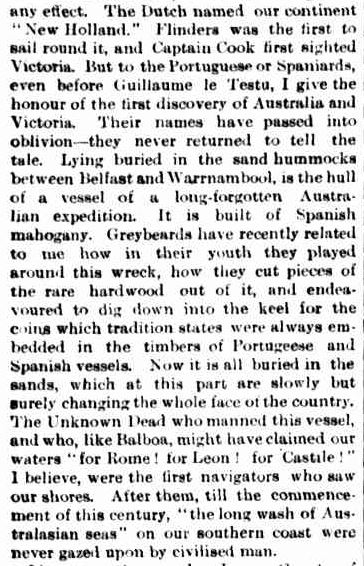
The article begins with an extensive history of Portland, from the first Europeans to sight land, up until the 1830s.  He discusses the Portuguese, with a reference to the Mahogany ship, thought buried under the sands of a beach between Port Fairy and Warrnambool.

portport1

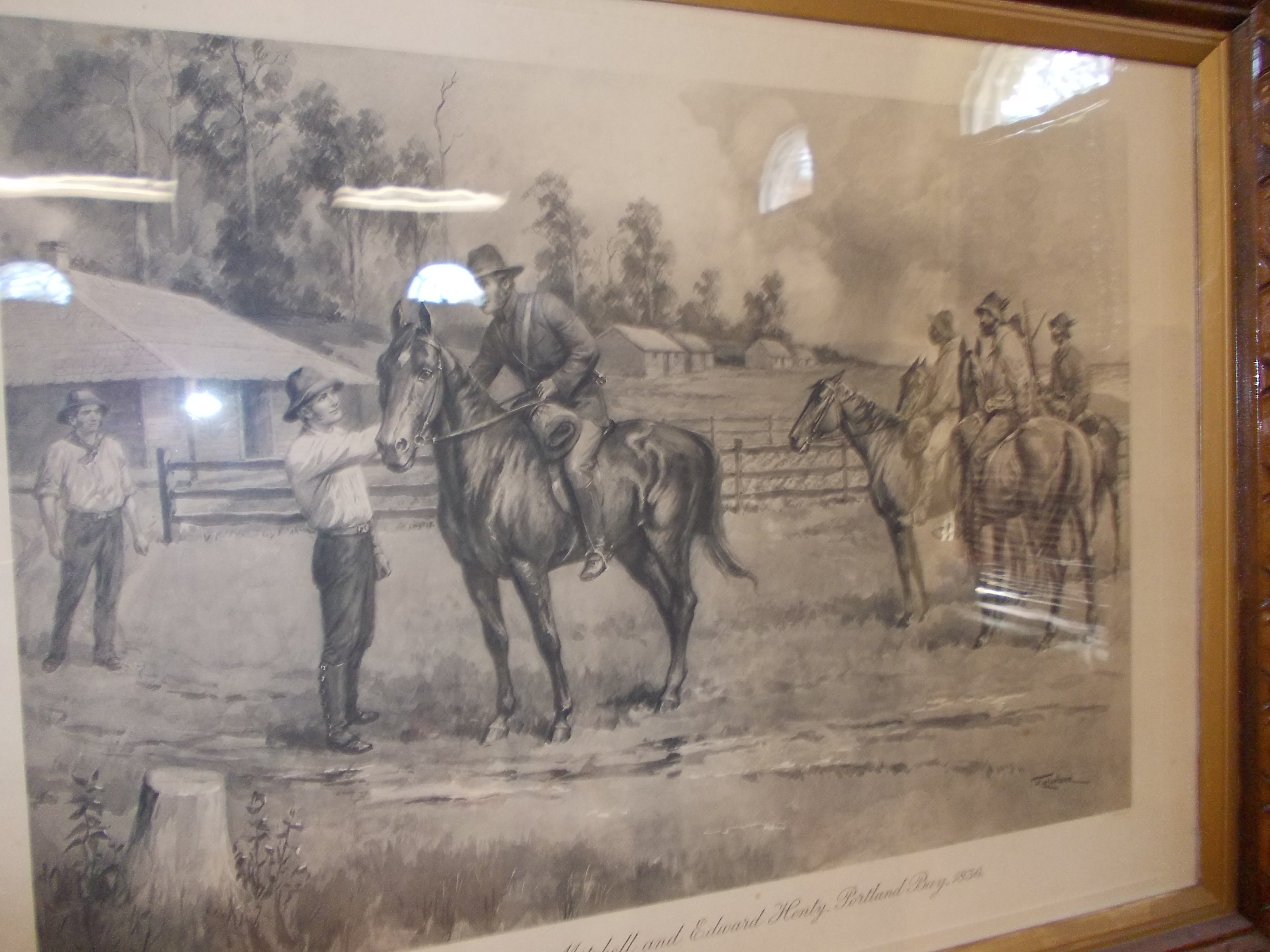
The Vagabond then turned his attention to the early 1830s and the arrival of the Hentys. He tells a story that I never tire of, that of the meeting between Edward Henty and Major Thomas Mitchell.   The Vagabonds descriptive style makes his account my favourite to date.

port2port3

Please excuse my photo of a sketch hanging at Portland’s History House depicting the meeting.

172

The last section of The Vagabond’s article describes Portland in 1884, starting with the transport available from Melbourne to Portland.  We can take something from this for our family history research.  We record our ancestors’ movements between towns or states, but it is easy to overlook how they may have made the trip or the time it took.   While they seem to teleport on paper, there were more practical methods available.

Aside from bullock wagon, dray or foot, one could travel overland from Melbourne on the train, or take the coastal route on a steamer.  The train trip from Melbourne, with stops at  Geelong, Ballarat, Ararat and Hamilton, cost 45s.  The trip was thirteen hours.  The ticket price of the steamer was “ridiculously low” according to The Vagabond, with a cabin priced at 12s 6d for passage only.  Food was extra.  The trip was 24 hours with stops at Warrnambool and Port Fairy.  This was his transport of choice but he does suggest that those with a weaker stomach than his own may suffer “mal de mer”

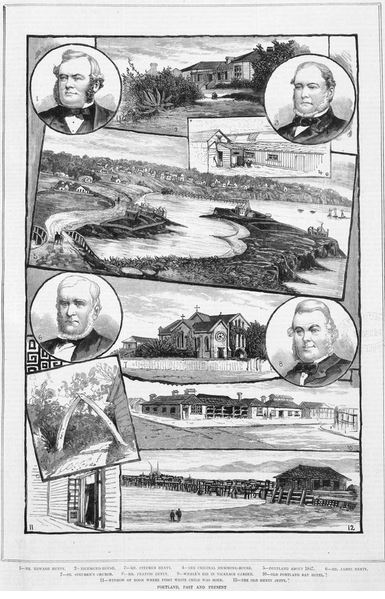
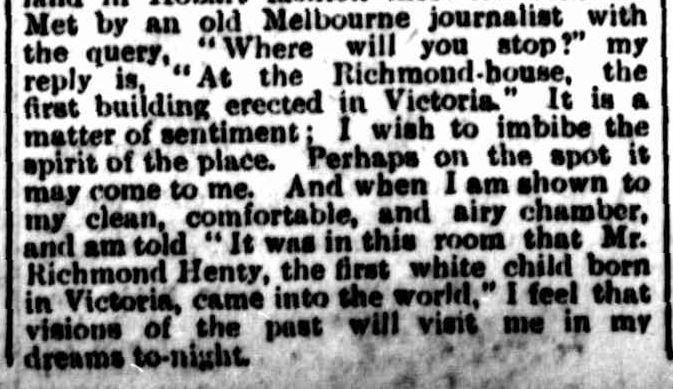
While in Portland, The Vagabond, stayed at Richmond House, the Henty’s first home turned guest house.  The following sketch, from 1884, the same year The Vagabond visited Portland, shows Richmond House at the top centre.

PORTLAND, PAST AND PRESENT Alfred Martin Ebsworth,c. December 17, 1884. Image Courtesy of the State Library of Victoria Image no. A/S17/12/84/197 http://handle.slv.vic.gov.au/10381/91532

PORTLAND, PAST AND PRESENT Alfred Martin Ebsworth,c. December 17, 1884. Image Courtesy of the State Library of Victoria Image no. A/S17/12/84/197 http://handle.slv.vic.gov.au/10381/91532

The Vagabond concludes:

port6

This is another beautifully written article by The Vagabond and if you follow the link, you can read the article in full – “Picturesque Victoria – The Cradle of Victoria No. 1

The Vagabond was good enough to include his sources:

PICTURESQUE VICTORIA. (1884, November 15). The Argus (Melbourne, Vic. : 1848 - 1957), p. 4. Retrieved August 25, 2013, from http://nla.gov.au/nla.news-article6061393

PICTURESQUE VICTORIA. (1884, November 15). The Argus (Melbourne, Vic. : 1848 – 1957), p. 4. Retrieved August 25, 2013, from http://nla.gov.au/nla.news-article6061393

In my next Vagabond post, he will still be rocking around Portland, with a tour of the town he thought had an “atmosphere of bygone days”.  You can read the post on the link – The Vagabond…out and about in Portland

Harman Housekeeping

It’s time to tie up the loose ends with my Harman research before I launch into writing a thesis on the Harmans of Byaduk (1852-1952) for a Diploma in Family Historical Studies.  That’s a daunting thought despite what you may think.  I write often about my family here, especially the Harmans, I have  research gathered over 20 years and I could ramble for 20,000 words about the Harmans if anyone would listen.  Putting the research together into one structured and organised piece is what I find daunting.

So daunted in fact,  I purchased Hazel Edward’s Writing a Non-Boring Family History and revisited a NLA podcast – “How to write history that people want to read” by Professor Ann Curthoys and Professor Ann McGrath.  Not that I’m worried about it being non-boring or uninteresting, I need tips on putting it all together

Structure aside, there are still some unanswered questions about the Harmans that need resolution.  The year the Harmans arrived in Port Fairy from N.S.W. is one question.   Looking for leads,  I contacted the  Port Fairy Historical Society (PFHS) hoping they may have something.  Robyn Bartlett, an archivist at PFHS got back with the news there was a lot of information particularly from a source I had forgotten as a possibility but was not unexpected.  Last week I received a nice thick parcel from the PFHS.  Thank you Robyn,  You provided a wonderful service.

After the dancing died down and I carefully examined the contents of the envelope, I knew If I got nothing else from the information Robyn sent (which I doubt will be true), I have had my Who Do You Think You Are (WDYTYA) moment.  You know that moment  when a celebrity finds a family member that helps defines them, explains their career path or personality traits.  It is different to the other WDYTYA moment when a celeb. visits the former home of an ancestor and feels some affinity.  I have had that moment too.

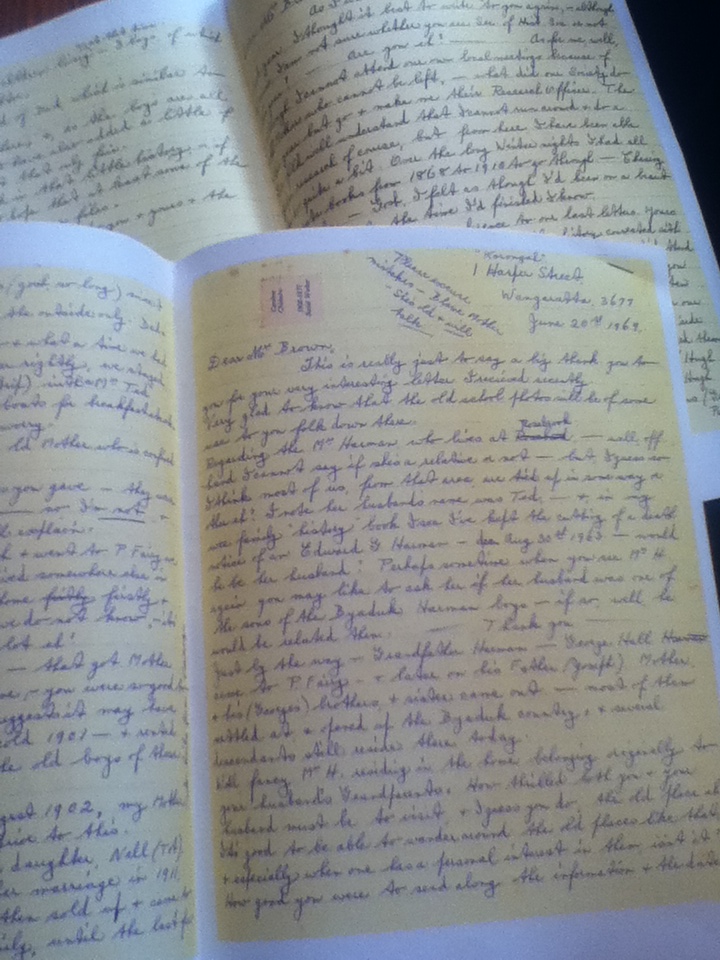
My WDYTYA moment came as I read several letters written by my 2nd cousin 3 x removed, Edna Harman, formerly of Wangaratta.  Distant cousin I know, but as I read the letters I could feel her passion for her family’s history and history in general .  It was like reading me.  Edna wrote six letters over a 20 year period from 1963 to the PFHS.  I knew she was an active member and one time research officer of the Wangaratta Historical Society and had also co-written a book,  Wangaratta: old tales and tours (1983) with Judy Bassett.  Edna’s grandfather George Hall Harman left Port Fairy for Byaduk with the other family members, but later returned to Port Fairy where he remained for the rest of his life.  That is how Edna came to have a Port Fairy connection.

LETTERS FROM EDNA

LETTERS FROM EDNA

Edna’s letters contain snippets of some wonderful family stories and as luck would have it, Edna put those stories. and others she had gathered from cousins, into a text book, complete with photos (yes, she used photo corners!).  There are pages and pages of history of the Harmans of Port Fairy and her family in Wangaratta including her father Herbert Harman, a long serving journalist with the Wangaratta Chronicle.  One of Herbert’s poems was in the package, and I had to smile because the subject  was the S.S.Casino.  The steamer was the subject of a recent Trove Tuesday post.  A story of Edna’s grandfather’s visits to Wangaratta resonated with me,  George Harman would take a bunch of boronia for his granddaughter.  That reminded me of my grandmother Mavis Riddiford telling me about grandpa Percy giving her bunches of boronia.

I am eternally grateful to the late Edna Harman, and I am sorry that I never met her.  I know I would have liked her.

I have also been buying a few certificates that I have need to help answer some questions, well at least try.

Reuben Harman died in 1883 at only 44,  less than half the age of most of his siblings.   I wanted to find the cause of his death,  and check his “length of time in the colony” status, to compare with the other family members.  Turns out Reuben died of hydatids, a condition on the increase in the Western District during the 1880s and was probably caught from his dogs or dirty drinking water.  This article from the Horsham Times of  March 16, 1883, warned of the dangers of hydatidis and its spread.  Reuben died weeks later on April 28.

hyd

The Horsham Times. (1883, March 16). The Horsham Times (Vic. : 1882 - 1954), p. 2. Retrieved August 21, 2013, from http://nla.gov.au/nla.news-article72872771

The Horsham Times. (1883, March 16). The Horsham Times (Vic. : 1882 – 1954), p. 2. Retrieved August 21, 2013, from http://nla.gov.au/nla.news-article72872771

I have also purchased the marriage certificate of Sarah Harman, sister of Reuben.  She married Walter Oakley in  1864 but married again to George Adams in 1885.  When I first wrote about Sarah and Walter I heard from  Brad,  a member of the Oakley family.  As the family story goes,  Walter disappeared while delivering horses to India, part of the active export trade during the later half of the 19th century.  I wanted to know how Walter’s “disappearance” was explained on Sarah’s second marriage certificate.  It said that Walter was “not seen or heard of or from for a period of nine years”.  That would make it around 1876 when he disappeared, leaving Sarah with four children aged six to eleven,

Finally, I  purchased the death certificate  of Charles Frederick Ward, son of Stephen Ward and Isabella Harman and grandson of James Harman.  Isabella died during child-birth and the Harman family raised Charles and from what I can gather, his aunt Henrietta played an integral part.  Charles died in 1928 at Ballarat aged just 42, presumably unmarried and childless.  It always appeared that something tragic had happened to Charles, but I had never found anything in the papers.   Now the story is much clearer.  Charles Ward died in the Ballarat Asylum, later known as the Lakeside Hospital, from “organic disease of the brain” and yes, confirmation he never married or had children.  Of course, this now leads me down the path of inquest and asylum records, but if I am to know the part that Harmans of Byaduk played in the life of Charles, particularly Henrietta, I do need more.

HEADSTONE OF CHARLES WARD AND HIS MOTHER ISABELLA HARMAN

HEADSTONE OF CHARLES WARD AND HIS MOTHER ISABELLA HARMAN

The next steps in my research will be a call to the Macarthur Historical Society,  a visit to the State Library of Victoria for some elusive Byaduk history books, PROV for land records and correspondence with living Harmans.  Just all the things I’ve put off for the past twenty years.

_______________________________________________________________________________________

While I’m here talking about corresponding with living Harmans, it is worth mentioning some of those descendents I’m keen on catching up with.

Descendants of:

Gershom HARMAN (1869-1940) and Elizabeth HILLIARD (1874-1931) of Byaduk

Related Names:

ADDINSALL (Wallacedale)

WHEELER (Branxholme)

Walter GREED (1870-1955) and Jessie HARMAN (1871-1949) of Hamilton

Related Name:

JONES (Mumbannar)

James HANKS (1871-1909) and Ellen May HARMAN (1881-1948) of Horsham

Related Name:

WOODS (Horsham & Kaniva)

Reuben Edward HARMAN (1894-1959) and Elizabeth Evaline HENRY (c1900-1979) of Preston.

Related Names:

KING (Thornbury)

SIMMONS (Mordialloc)


Trove Tuesday – Let it Snow

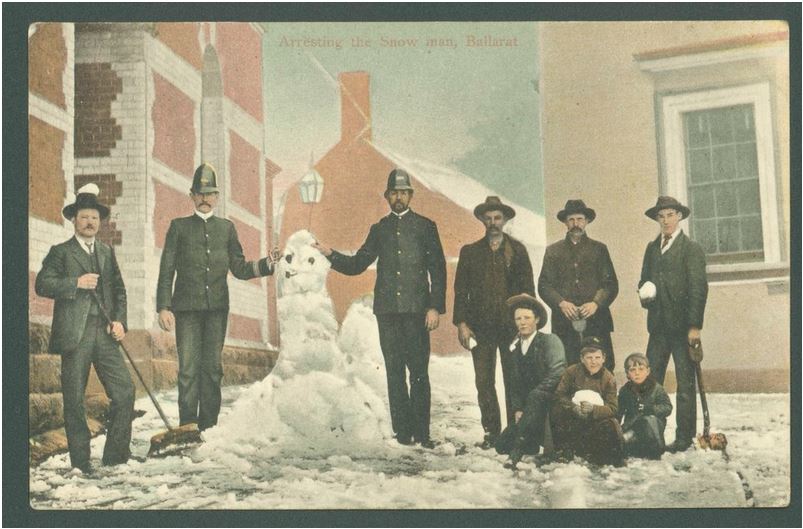
Since Western Victoria is experiencing a cold snap with snowfalls around Ballarat and the Grampians in the past 24 hours, I thought a snow theme for Trove Tuesday appropriate.

This treasure found at Trove is a postcard from Ballarat in 1909.

tt

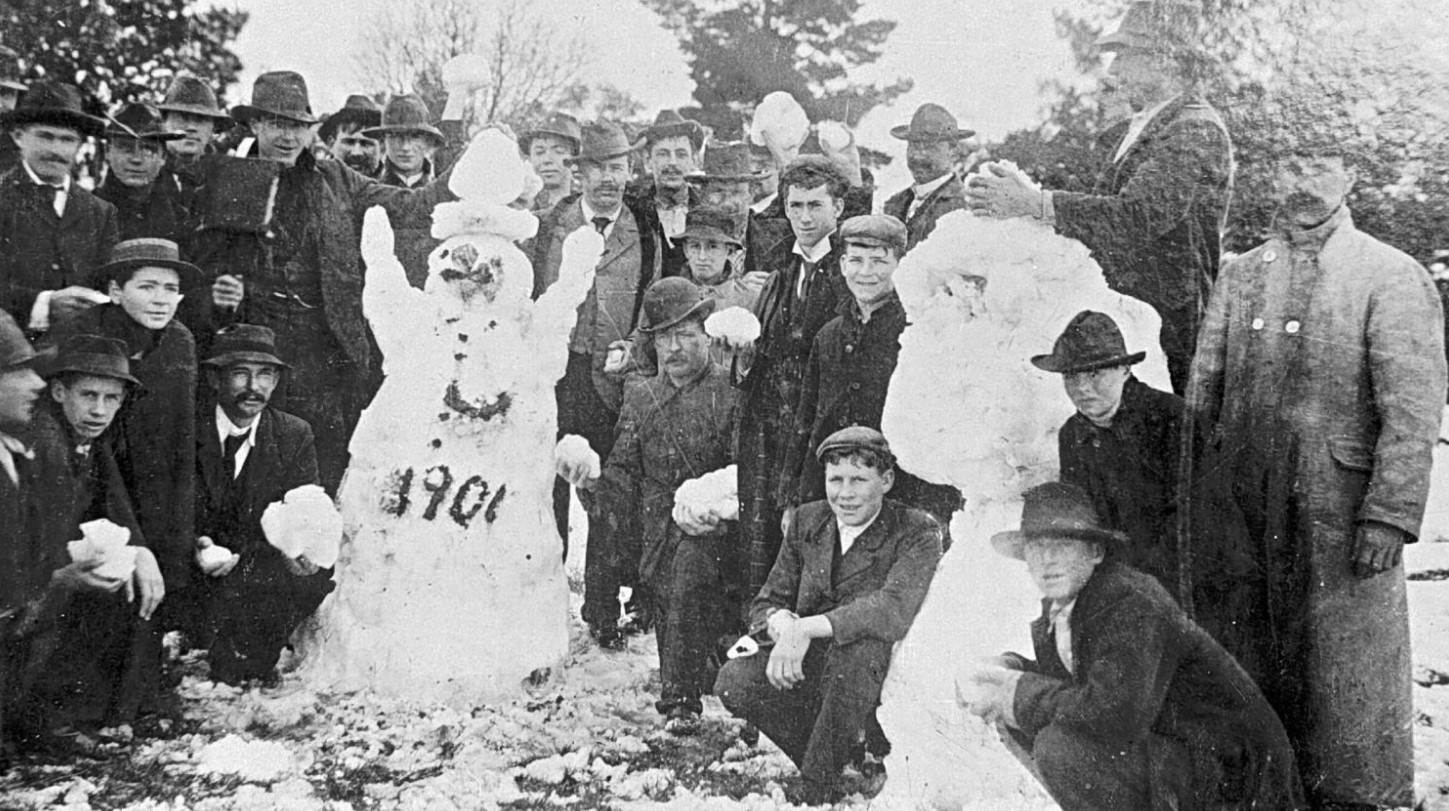
Snowfalls on the hills around Ballarat and surrounding districts are not uncommon, but the snow rarely settles in the town.  Mt William, the highest peak in the Grampians gets a snow cap some winters, but for a short time only.  Further west, it is less likely to snow in Hamilton and from memory, in the eighteen years I lived there, it may have snowed once, but it was closer to sleet than snow.  I have never known it to snow as it did in July 1901, when snow fell for around nine hours in Hamilton.  It would have been a beautiful sight.

HEAVY SNOW IN THE COUNTRY. (1901, July 29). The Argus (Melbourne, Vic. : 1848 - 1957), p. 6. Retrieved August 20, 2013, from http://nla.gov.au/nla.news-article10563557

HEAVY SNOW IN THE COUNTRY. (1901, July 29). The Argus (Melbourne, Vic. : 1848 – 1957), p. 6. Retrieved August 20, 2013, from http://nla.gov.au/nla.news-article10563557

With Trove’s help, I found a photo of a snowman built at Hamilton in 1901, held by Museum Victoria.

HAMILTON 1901. Image courtesy of the Museums Victoria Collections https://collections.museumsvictoria.com.au/items/765795

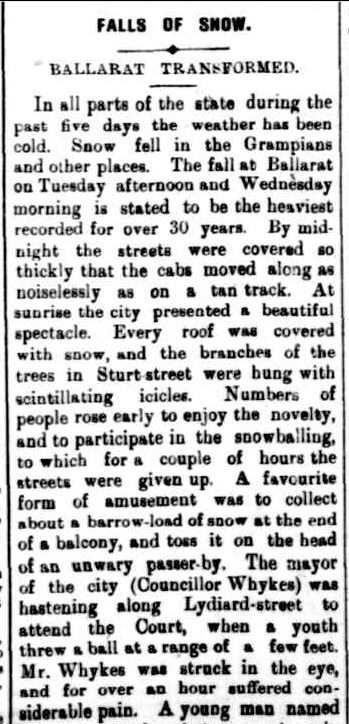
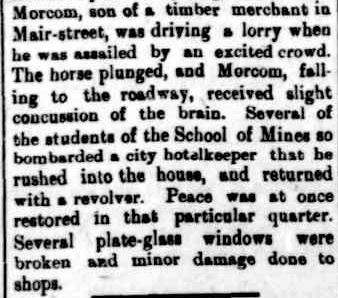
In 1905, heavy snow saw high jinx in the streets of Ballarat that got out of hand resulting in a revolver wielding publican and the Mayor, Councillor Whykes suffering concussion

tt2

FALLS OF SNOW. (1905, September 8). The Horsham Times (Vic. : 1882 - 1954), p. 3. Retrieved August 20, 2013, from http://nla.gov.au/nla.news-article72817822

FALLS OF SNOW. (1905, September 8). The Horsham Times (Vic. : 1882 – 1954), p. 3. Retrieved August 20, 2013, from http://nla.gov.au/nla.news-article72817822

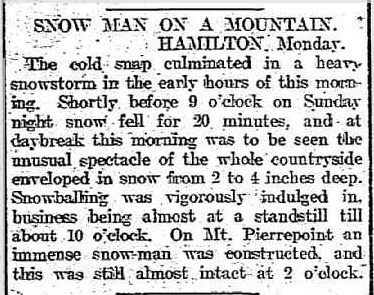
In 1910, Hamilton saw another heavy snowfall.  Such was the novelty, snowballing in the streets took priority over opening the shops.  A large snowman was built on nearby Mt Pierrepoint.

SNOW MAN ON A MOUNTAIN. (1910, October 11). The Border Morning Mail and Riverina Times (Albury, NSW : 1903 - 1920), p. 2. Retrieved August 20, 2013, from http://nla.gov.au/nla.news-article111390335

SNOW MAN ON A MOUNTAIN. (1910, October 11). The Border Morning Mail and Riverina Times (Albury, NSW : 1903 – 1920), p. 2. Retrieved August 20, 2013, from http://nla.gov.au/nla.news-article111390335

Well, this post is my 52nd Trove Tuesday post.  I did it.  I managed to post every Tuesday since Amy Lehmann launched Trove Tuesday on August 28  last year.  Next week, we celebrate Trove Tuesday entering a second year and I will share some of the most popular posts from the past 52 weeks.


Trove Tuesday – The Tiger Again

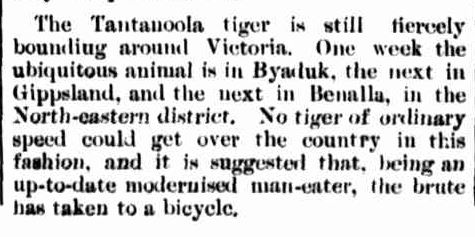
Last month, the Trove Tuesday post, “They Say”  introduced the Tantanoola Tiger that was causing terror for farmers and their sheep in 1915.  I have now found an article from an earlier sighting at Byaduk in 1896.  You may remember the Tantanoola Tiger was first sighted in 1884 after a Bengal tiger supposedly escaped from a circus visiting Tantanoola in the South-East of South Australia and set out on a path of destruction through that district and the Western District of Victoria.

Mr Falkenberg of Byaduk was certain he was a victim of the tiger in 1896.  Just as the story of the Tantanoola tiger had grown in size, so had the tiger itself.  He thought the “tiger was bigger than ever”so big that it was “as big as most horses”.

THE TIGER AGAIN. (1896, February 14). Albury Banner and Wodonga Express (NSW : 1896 - 1939), p. 28. Retrieved August 3, 2013, from http://nla.gov.au/nla.news-article99428658

THE TIGER AGAIN. (1896, February 14). Albury Banner and Wodonga Express (NSW : 1896 – 1939), p. 28. Retrieved August 3, 2013, from http://nla.gov.au/nla.news-article99428658

While the mauling of Mr Falkenberg’s sheep was tragic, I do fear the Byaduk correspondent took the event far too seriously in his report about the “tiger-infested country”.  Thank goodness for the report from the Kalgoorlie Western Argus, almost a month after Mr Falkenberg’s encounter.  That was very much “tongue in cheek” with the last sentence producing a laugh out loud moment for me.

SPORTING. (1896, March 12). Kalgoorlie Western Argus (WA : 1896 - 1916), p. 13. Retrieved August 3, 2013, from http://nla.gov.au/nla.news-article32210351

SPORTING. (1896, March 12). Kalgoorlie Western Argus (WA : 1896 – 1916), p. 13. Retrieved August 3, 2013, from http://nla.gov.au/nla.news-article32210351

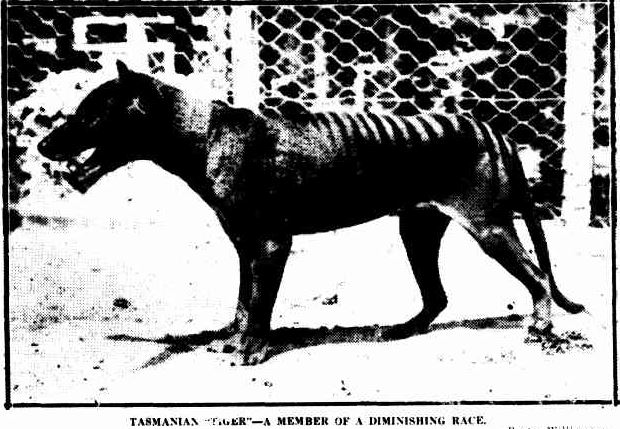
I don’t want to add to the hysteria, but I was wondering if it was something else Mr Falkenberg saw…?

No title. (1923, June 20). The Mercury (Hobart, Tas. : 1860 - 1954), p. 5. Retrieved August 13, 2013, from http://nla.gov.au/nla.news-article23695834

No title. (1923, June 20). The Mercury (Hobart, Tas. : 1860 – 1954), p. 5. Retrieved August 13, 2013, from http://nla.gov.au/nla.news-article23695834

Introducing…The Vagabond

There was James Bonwick with his tour through the Western District in 1857, colonial artists such as Eugene von Guerard and Samuel Gill and there was poet  Adam Lindsay Gordon.  From each of these sources we can learn about Western District life during the 19th century, its natural features, who the people where and how they lived.

Bonwick’s book Western Victoria, Its’ Geography, Geology, and Social Condition: the narrative of an educational tour in 1857 gives a wonderful insight into the small towns of the Western District, the people he met along the way and the flora, fauna and topography of the land.  A town that received a positive report often had residents with church habits that met Bonwick’s approval.

The colonial artists captured the natural landscape,  homesteads of squatters and life on the diggings.  Von Guerard’s “Old Ballarat as it was in the summer of 1853-4”  is recognised as an accurate depiction of the Ballarat diggings.  If you visit the Art Gallery of Ballarat, allow time to be mesmerised by the original and it’s detail.

Adam Lindsay Gordon in lyrical verse described the rugged limestone coast of the south-east of South Australia, the sea, the bush and colonial horse racing.

Then there was The Vagabond, a newspaper journalist who trekked throughout Victoria in 1884 and brought readers of “The Argus“, and beyond, a picture of country Victoria through his eyes in the series “Picturesque Victoria“.

Over the next few months, I hope to share the “Picturesque Victoria” articles that relate to Western Victoria as they give us a glimpse of the social history of the district.  Looking at The Vagabond’s life I thought it right to tell you something about him ahead of those articles as I believe that knowing something of the man enhances the reading experience.

Some you may know of The Vagabond and his tour through Western Victoria, but do you really know the him?

[John Stanley James, alias] Julian Thomas [pen name "The Vagabond"] Stewart & Co., e photographer.

[John Stanley James, alias] Julian Thomas [pen name “The Vagabond”] Stewart & Co.,
e photographer. Image courtesy of the State Library of Victoria http://handle.slv.vic.gov.au/10381/172507

The Vagabond was the pen name of John Stanley James, alias Julian Thomas.  John Stanley James was born in Staffordshire , England in 1844.  In 1872, he left  England for America, changing  his name to Julian Thomas.  After a failed marriage in Virginia he travelled to Sydney in 1875, then began work at Melbourne’s Argus newspaper as a journalist, a profession he had tried to break into in London during the late 1860s.

James immersed himself into his subjects, taking investigative journalism to the extreme.  In 1876, he began a series of articles for The Argus, later compiled and published as the The Vagabond Papers.   By August 1877, there were three series of “The Vagabond Papers” in publication, with 15,000 copies sold in the colony and also republished in Germany.  The premise behind his articles was to take readers into some of Victoria’s institutions and give an often “behind the scenes” insight.

The first article written was “A Night in a Model Lodging-House” on April 15, 1876 and James, then known as Julian Thomas introduced The Vagabond.

A NIGHT IN THE MODEL LODGING-HOUSE. (1876, April 15). The Argus (Melbourne, Vic. : 1848 - 1957), p. 5. Retrieved August 7, 2013, from http://nla.gov.au/nla.news-article7436975

A NIGHT IN THE MODEL LODGING-HOUSE. (1876, April 15). The Argus (Melbourne, Vic. : 1848 – 1957), p. 5. Retrieved August 7, 2013, from http://nla.gov.au/nla.news-article7436975

The article continues with a vivid description of The Vagabond’s first night in a lodging house.  Two weeks later he published “A Day in the Immigrant’s Home”, followed by titles such as “In a Fashionable Church”.

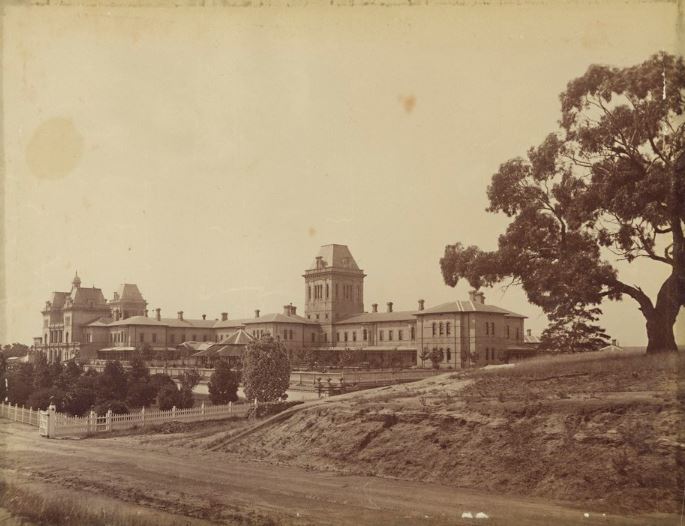
Three Days in the Benevolent Asylum No 1.” showed the lengths James would go to for a story.  He managed to have himself admitted to the Melbourne Benevolent Asylum and spent three days living the life of an inmate.  Three days in the Benevolent Asylum was nothing when James spent a month in Kew Lunatic Asylum writing the series “A month in Kew Asylum and Yarra Bend”, although as a staff member and not an inmate.

Melbourne Benevolent Asylum (1871) photographer :Charles Nettleton (1826-1902). Image courtesy of the State Library of Victoria Victorian Patents Office Copyright Collection Image no. H96.160/2724 http://handle.slv.vic.gov.au/10381/54841

Melbourne Benevolent Asylum (1871) photographer :Charles Nettleton (1826-1902). Image courtesy of the State Library of Victoria Victorian Patents Office Copyright Collection
Image no. H96.160/2724 http://handle.slv.vic.gov.au/10381/54841

KEW LUNATIC ASYLUM (c 1878-1894) Photographer John William Lindt. Image courtesy of the State Library of Victoria. Image no: H2008.59/25 http://handle.slv.vic.gov.au/10381/41805

KEW LUNATIC ASYLUM (c 1878-1894) Photographer John William Lindt. Image courtesy of the State Library of Victoria. Image no: H2008.59/25 http://handle.slv.vic.gov.au/10381/41805

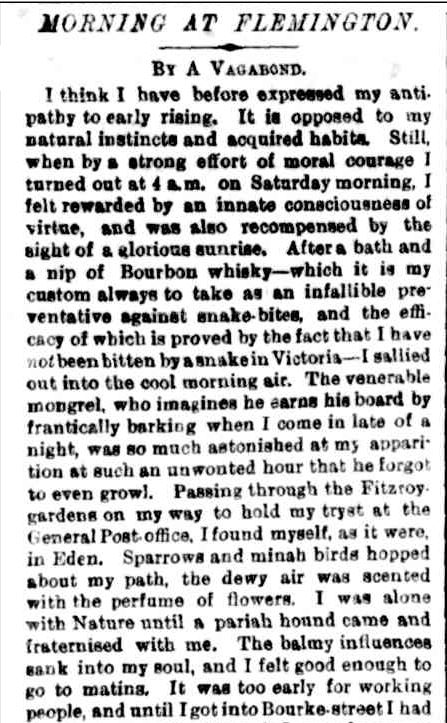
My own favourite is “Morning at Flemington“.  The Vagabond arose early and made his way to the Flemington racetrack to watch trackwork and observe the characters that abounded there.  It was his beautiful  description of the city at an early hour that really had me feeling as though I was there walking through the Fitzroy Gardens.

vaga2

MORNING AT FLEMINGTON. (1876, October 30). The Argus (Melbourne, Vic. : 1848 - 1957), p. 6. Retrieved August 7, 2013, from http://nla.gov.au/nla.news-article5907653

MORNING AT FLEMINGTON. (1876, October 30). The Argus (Melbourne, Vic. : 1848 – 1957), p. 6. Retrieved August 7, 2013, from http://nla.gov.au/nla.news-article5907653

Some of the The Vagabond’s other adventures included “Three Weeks in the Alfred Hospital“, “A Month in Pentridge” and “At a Bazaar”.

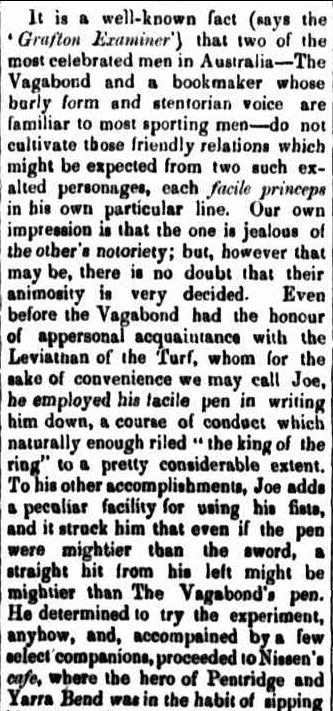
The following article from the Warwick Examiner and Times, August 18, 1877 describes a meeting between a notorious bookmaker and The Vagabond with the adage “The pen is mightier than the sword” put to the test.  An interesting point of this article is the line “...he replied, with that exasperating Yankee drawl of his…”.  Yes,  after two years in America, John  James had picked up an accent, presumably with a hint of the south given his time in Virginia.  I do think it may have been more by design than an accident.

vaga8vaga9

INTERVIEWING THE "VAGABOND.". (1878, September 14). Warwick Examiner and Times (Qld. : 1867 - 1919), p. 3. Retrieved August 9, 2013, from http://nla.gov.au/nla.news-article82121617

INTERVIEWING THE “VAGABOND.”. (1878, September 14). Warwick Examiner and Times (Qld. : 1867 – 1919), p. 3. Retrieved August 9, 2013, from http://nla.gov.au/nla.news-article82121617

In 1877, James went to Sydney to write for the Sydney Morning Herald and then on to New Zealand, New Caledonia, New Guinea and Fiji writing on his experiences.  Some of those were compiled into a book called Cannibals and Convicts.  Say no more.  He then went further afield writing travel articles for The Argus from China, Japan, Canada and the United States.

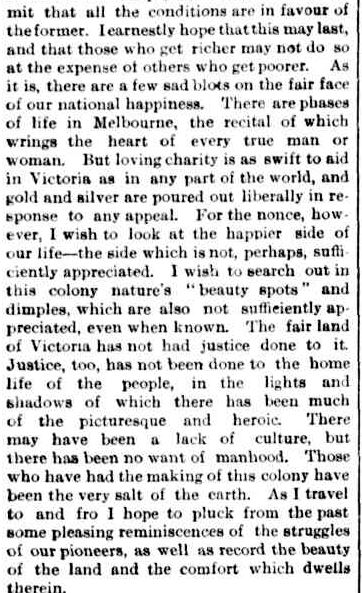
By 1884, The Vagabond was back in Melbourne ready to set off on a tour of Victoria to produce a series of articles entitled “Picturesque Victoria“.  The first article was “Picturesque Victoria No.1 – Kilmore”.  Giving the reasons behind his journey, he bid adieu to his responsibilities, including the Shakespeare Society, and with his Australian Handbook in his pocket, he departed Spencer Street Station passing then through the suburbs, by the docks, the factories and the Melbourne Benevolent Society, bound for Kilmore .

vaga11

PICTURESQUE VICTORIA. (1884, July 19). The Argus (Melbourne, Vic. : 1848 - 1957), p. 4. Retrieved August 9, 2013, from http://nla.gov.au/nla.news-article6053606

PICTURESQUE VICTORIA. (1884, July 19). The Argus (Melbourne, Vic. : 1848 – 1957), p. 4. Retrieved August 9, 2013, from http://nla.gov.au/nla.news-article6053606

As The Vagabond’s tour around Victoria gained momentum, residents of small towns anticipated a possible visit so he could write a glowing report.  Those towns that he did visit turned out to greet his arrival, celebrating with dinners and gatherings, an extra sweetener .

After the tour of Victoria, James went to the Pacific again, visiting Samoa and Tonga.  From 1890-1892 he was the Victorian Royal Commission on Charities.  In 1896, he died in what his biographer John Barnes describes as “squalor” in his Fitzroy flat.

vaga4

DEATH OF A WELL-KNOWN JOURNALIST. (1896, September 5). The Argus (Melbourne, Vic. : 1848 - 1957), p. 4. Retrieved August 9, 2013, from http://nla.gov.au/nla.news-article9183574

DEATH OF A WELL-KNOWN JOURNALIST. (1896, September 5). The Argus (Melbourne, Vic. : 1848 – 1957), p. 4. Retrieved August 9, 2013, from http://nla.gov.au/nla.news-article9183574

The only person that truly knew the Vagabond was John Stanley James himself.   Everyone knew him but no-one really knew him.  Even his own employer, The Argus, possibly fooled by his “Yankee drawl”,  fell into the trap of believing his tales of the past.  This is no more obvious than his obituary.  They reported James was born in Virginia, United States, while The Age, closer to the truth, reported him as a native of Wales.

James was born in Staffordshire and maybe if those at The Argus had access to the marvels of today’s technology, they may have found the Warwickshire birth record of John Stanley James.  Also his 1851 Census record. as a six-year-old  living in Warwickshire with his attorney father Joseph, mother Elizabeth and two siblings.  Or the 1861 England Census when he was living with relatives in Liverpool and working in the family foundry,  Or even the 1871 England Census when John James was back in Warwickshire living with his mother and spinster sisters, himself then 26 with no known occupation.

John Barnes wrote that the true identity of The Vagabond aka Julian Thomas was not known until 1912.  The true identity being his name “John Stanley James” although his birth place is still confused.  He created an enigmatic persona with such skill that he was able to keep up the facade to the grave and beyond.  Long after his death may his literary skill be also celebrated.

Trove Tuesday – Unspoken Memories

Troving never ends. As newspapers come online it’s necessary to check them… just in case.  Often I have filled the gaps in a story or found evidence that supports earlier findings because a “new” paper has arrived on the scene.

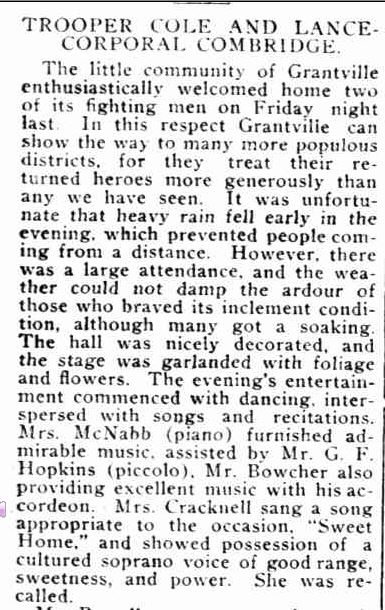
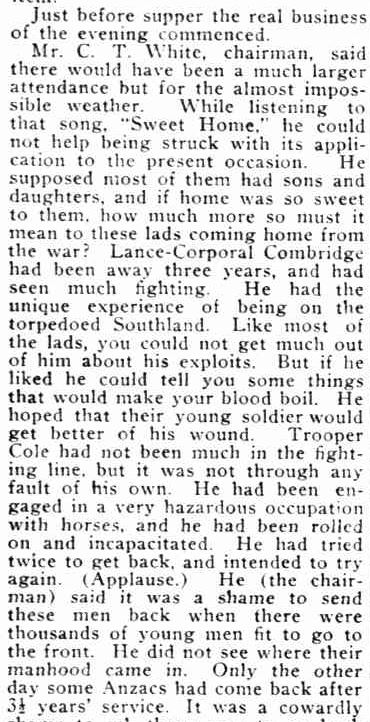
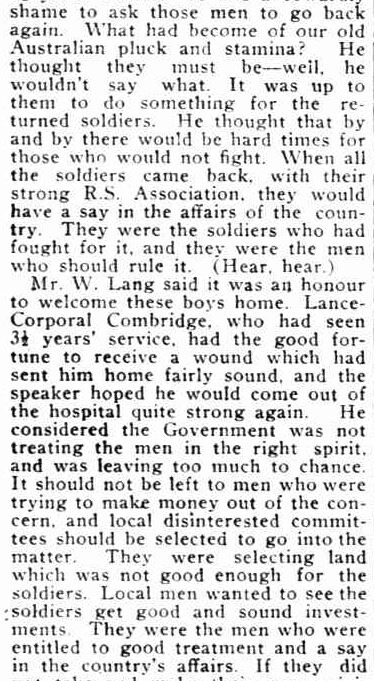
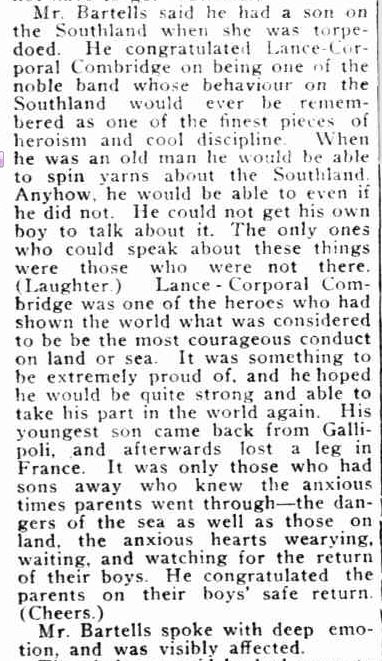
That was the case when the Lang Lang Guardian (1914-1918) came online recently.  For the 2013 Anzac Day Blog Challenge, I wrote about my grandfather Les Combridge so it was pleasing to find the following article from June 21, 1918,  that adds to his story .  It is a report on the return home of two Grantville “fighting men” Trooper Cole and Lance Corporal Combridge.   Aside from what I learnt about Les, this article paints a lovely picture of a small town gathering during that time.  There is the decorated hall, singing and of course supper…ladies a plate please.

So what can I glean from this article.   Firstly, there is confirmation that Les was on the troop ship “Southland“.  Also the chair for the night was his future father-in-law, Culmer White.  There is a reference to the difficulties faced by returned serviceman and lack of Government support, giving us an idea of the tone of public opinion during those times.

The horrors of war were mentioned but not elaborated upon and it is clear that Les preferred not to speak of his experiences . He was not the only one.  Mr Bartells  said his boys would not speak of their time in service.  He quipped that it was only those that hadn’t been away that would talk about the War.

The saddest part of this article is the speech by Mr Bartells.  He told Les that he could “spin yarns” about the bombing of the “Southland” when he was an old man.  Les never became an old man.  He died 19  years after that night in the Grantville hall, aged 40.  He would have take those yarns to the grave.

Despite feeling  sad for Les, my mood lifted when I reached the last paragraph.   The final item on the agenda was supper and one of the helpers was Miss White.  Les married a “Miss White”, Myrtle Rose, daughter of Culmer White.  This could have been any one of Myrtle’s three sisters that were also “Miss White” in 1918, but it is nice to think that it could have been Myrtle.  That may have been the beginnings of their courtship.  They probably went to school together but with Les having been away at war for a couple of years they may have looked at each other differently as they each reached across the supper table for a cucumber sandwich.  Les and Myrtle married  15 months later on September 16, 1919.

tt4 tt5tt6tt8

GRANTVILLE SOLDIERS' WELCOME HOME. (1918, June 21). Lang Lang Guardian (Vic. : 1914 - 1918), p. 3. Retrieved August 6, 2013, from http://nla.gov.au/nla.news-article119515605

GRANTVILLE SOLDIERS’ WELCOME HOME. (1918, June 21). Lang Lang Guardian (Vic. : 1914 – 1918), p. 3. Retrieved August 6, 2013, from http://nla.gov.au/nla.news-article119515605

“Claremont” Portland

It’s been 18 months since our Portland visit and I’m still trying to find a moment to share some photos.  Recently I got around to writing the Portland Botanical Gardens post after it sat in my drafts for months with just photos waiting to be fleshed out.  It’s the fleshing out that is my downfall as you will see soon see.

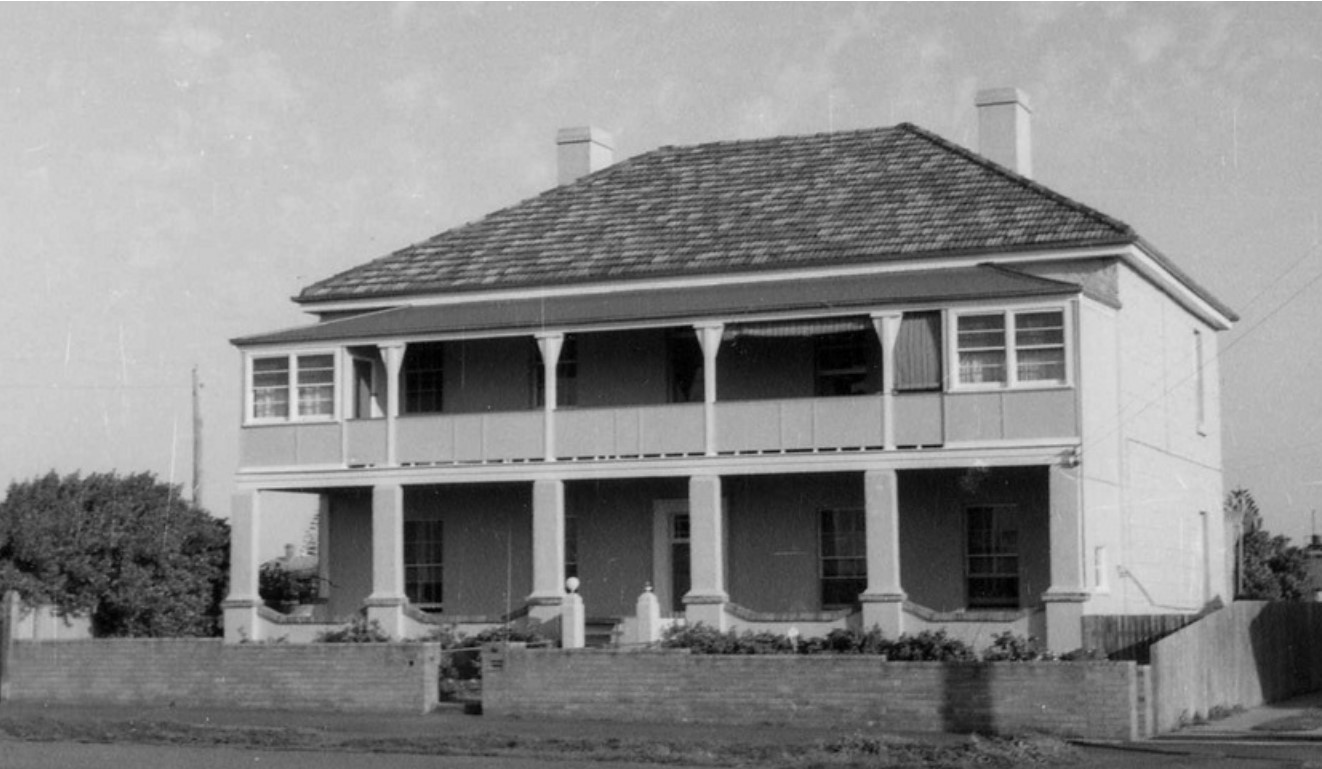
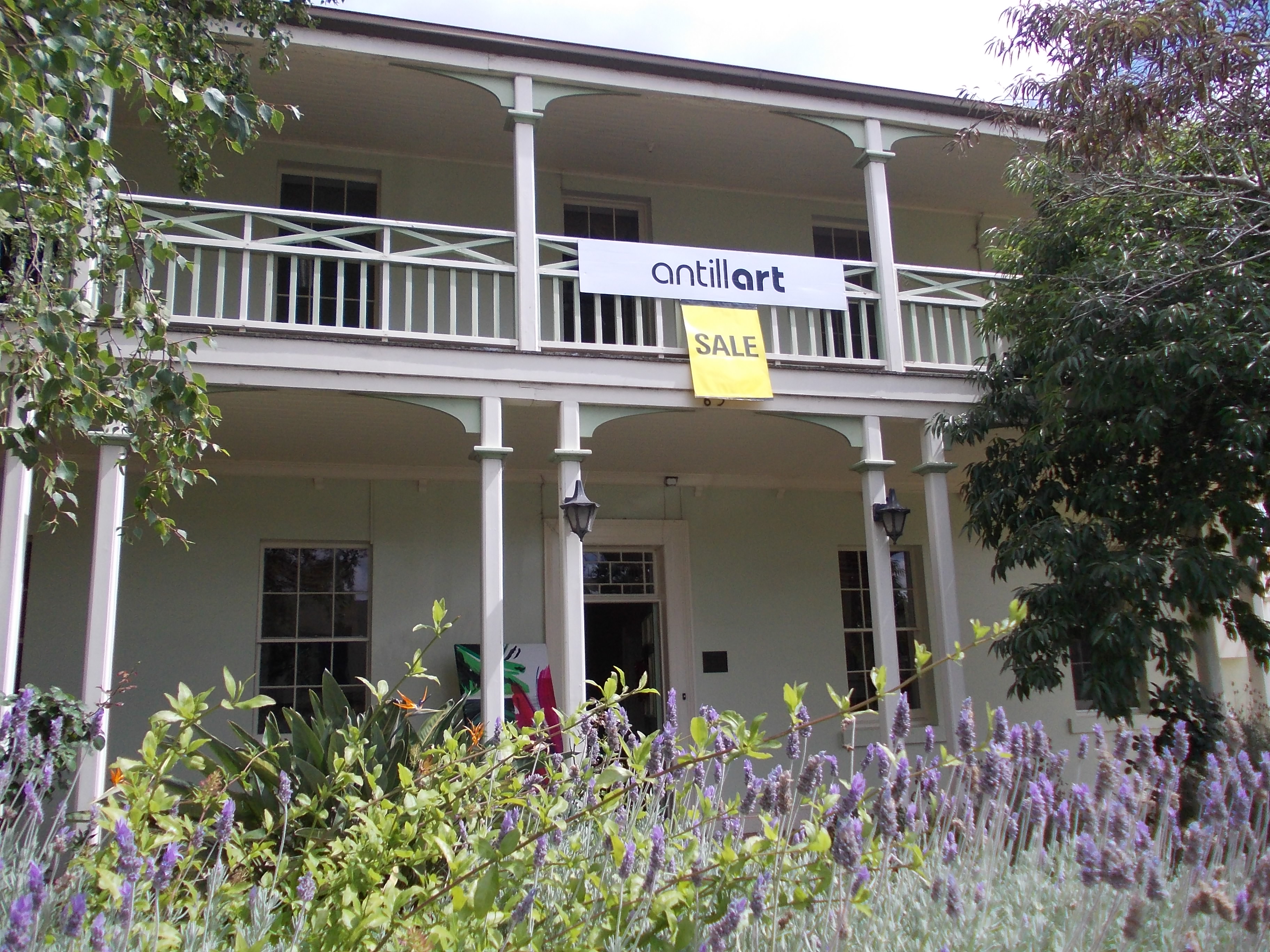
While in Portland, I stole myself away and took the Portland Historic Buildings walking tour.   Incredibly for a town of its size, there are more than 200 buildings in the Portland CBD that date back to the 1800s.  It was on that self-guided tour that I found “Claremont” at 65 Julia Street, just along from the St Stephen’s Church.

195

I had only intended to share the photos of Claremont and give a small amount of information about the former residents, but as usual, once I got searching at Trove I couldn’t leave it at that.  There was very little information about Claremont elsewhere online, save for an entry on the Victorian Heritage Database only identifying the person who had the house built and an early resident, the information I had from the walking tour guide.  But once again, it was Trove that took the story of Claremont an extra step.  Or two.

Stephen George Henty had Claremont built in 1852 and rented the property to his brother Francis.

Francis and his wife Mary Ann Lawrence only used Claremont as a seaside residence. Their country residence was Merino Downs station and city residence Field Place in Kew, Melbourne.  There is something about the staircase in the foyer of Claremont.  Maybe because I can imagine the likes of Mary-Ann or her daughter Caroline, sweeping done the stairs in their crinolines while in summer residence.

CLAREMONT, c1859. Photographer: Thomas Hannay. Image courtesy of the State Library of Victoria http://handle.slv.vic.gov.au/10381/318575

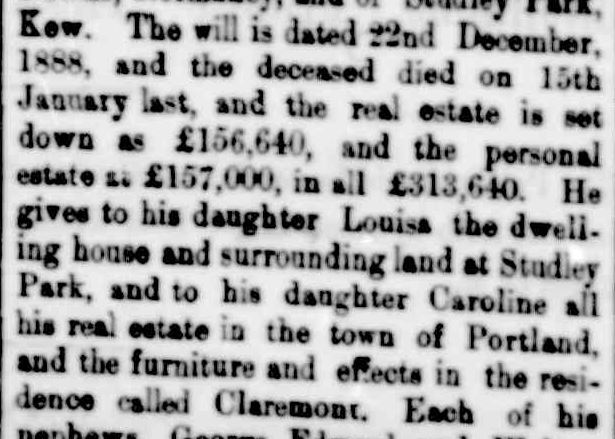
As Claremont was not used as a permanent home there was not much to be found about it in the papers until 1889 when Francis Henty passed away at Field Place. He left all his Portland property daughter Caroline Henty (1849-1914) along with the furniture and effects within Claremont.

CAROLINE HENTY c1865-1870 Image courtesy of the State Library of Victoria http://handle.slv.vic.gov.au/10381/290266

At some stage, the ownership of Claremont must have passed from Stephen Henty to Francis Henty, in order for Francis to bequeath it. Stephen Henty died in 1872 but I haven’t found any evidence of transfer of ownership.

The Will of the late Mr. Franis Henty. (1889, March 8). Portland Guardian (Vic. : 1876 - 1953), p. 2 Edition: EVENING. Retrieved July 18, 2013, from http://nla.gov.au/nla.news-article63592299

The Will of the late Mr. Franis Henty. (1889, March 8). Portland Guardian (Vic. : 1876 – 1953), p. 2 Edition: EVENING. Retrieved July 18, 2013, from http://nla.gov.au/nla.news-article63592299

Caroline and her three sisters also inherited Merino Downs.

The Late Mr. Francis Henty. (1889, March 16). The Queenslander (Brisbane, Qld. : 1866 - 1939), p. 513. Retrieved August 2, 2013, from http://nla.gov.au/nla.news-article19812393

The Late Mr. Francis Henty. (1889, March 16). The Queenslander (Brisbane, Qld. : 1866 – 1939), p. 513. Retrieved August 2, 2013, from http://nla.gov.au/nla.news-article19812393

In 1900, the sisters registered a Deed of Partition and Merino Downs was split into three separate properties, Merino Downs, Talisker and Wurt Wurt Koort with thesisters having a property each.  Caroline took charge of Talisker estate.

Caroline was quite a catch and a year after her father’s passing she married  Alexander Magnus McLeod (1846-1910), not a bad catch himself.  With Caroline and Alexander living at Talisker estate, Alexander’s spinster sisters Catherine (1845-1919) and Constance (1859-1934) and, at times, his bachelor brother Wallace (1855-1919) took up residence at Claremont.

The McLeods were the children of John Norman Mcleod and Agnes Patterson.  John owned Castlemaddie at Tyrendarra and Maretimo at Portland.  Incidentally, John purchased Castlemaddie and while he was waiting for the sale to go through, he had Maretimo built.  Constance was born at Maretimo in 1859.

"MARETIMO", PORTLAND, VICTORIA. ca.1874-ca.1895. Photographer: O.Dolphin. Image Courtesy of the State Library of Victoria Image no. H31761 http://handle.slv.vic.gov.au/10381/172772

MARETIMO, PORTLAND, VICTORIA. ca.1874-ca.1895. Photographer: O.Dolphin. Image Courtesy of the State Library of Victoria Image no. H31761 http://handle.slv.vic.gov.au/10381/172772

While I can’t find when Alexander McLeod’s siblings went to live at Claremont, at least one Miss McLeod was in residence in 1902, although she was heading off for a summer holiday.

[No heading]. (1902, December 18). The Argus (Melbourne, Vic. : 1848 - 1957), p. 10. Retrieved July 21, 2013, from http://nla.gov.au/nla.news-page332030

[No heading]. (1902, December 18). The Argus (Melbourne, Vic. : 1848 – 1957), p. 10. Retrieved July 21, 2013, from http://nla.gov.au/nla.news-page332030

Another possible guide was the death of the McLeod sister’s mother Agnes Patterson in 1901.  Her obituary stated she had moved into town from Castlemaddie and passed away in Julia Street.

There was also a death of a baby at Claremont in 1904.  I did try to find a link between Phyllis Mary Crawford and the McLeods or the Hentys, but after a quick look without success, I gave up.  The story was getting deep enough.

Family Notices. (1904, April 20). The Argus (Melbourne, Vic. : 1848 - 1957), p. 1. Retrieved August 2, 2013, from http://nla.gov.au/nla.news-article10315347

Family Notices. (1904, April 20). The Argus (Melbourne, Vic. : 1848 – 1957), p. 1. Retrieved August 2, 2013, from http://nla.gov.au/nla.news-article10315347

Claremont” hosted the St. Stephen’s girls’ confirmation class in April 1909 and they gave thanks to Catherine and Constance for making their confirmation veils.

First Issue, August 20, 1842. (1909, April 19). Portland Guardian (Vic. : 1876 - 1953), p. 2 Edition: EVENING. Retrieved July 20, 2013, from http://nla.gov.au/nla.news-article63987683

First Issue, August 20, 1842. (1909, April 19). Portland Guardian (Vic. : 1876 – 1953), p. 2 Edition: EVENING. Retrieved July 20, 2013, from http://nla.gov.au/nla.news-article63987683

Significantly, the Portland branch of the Australian Women’s National League was established during a meeting at Claremont in January 1911.

First Issue, August 20, 1842. (1911, January 11). Portland Guardian (Vic. : 1876 - 1953), p. 2 Edition: EVENING. Retrieved July 20, 2013, from http://nla.gov.au/nla.news-article63979327

First Issue, August 20, 1842. (1911, January 11). Portland Guardian (Vic. : 1876 – 1953), p. 2 Edition: EVENING. Retrieved July 20, 2013, from http://nla.gov.au/nla.news-article63979327

Through the years, the  McLeod sisters occasionally ran advertisements looking for staff.  In 1912, a general servant was required.

Advertising. (1912, December 6). Portland Guardian (Vic. : 1876 - 1953), p. 2 Edition: EVENING. Retrieved July 19, 2013, from http://nla.gov.au/nla.news-article64003591

Advertising. (1912, December 6). Portland Guardian (Vic. : 1876 – 1953), p. 2 Edition: EVENING. Retrieved July 19, 2013, from http://nla.gov.au/nla.news-article64003591

In 1914, Caroline McLeod (Henty) passed away.  Her probate documents listed Claremont and the two acres of land it stood on to the value of £160,000.  Her estate was placed in trust for her two daughters Caroline Agnes Henty McLeod (1892-1943) and Alexandra Frances Henty McLeod (1894-1943) aged 22 and 20 respectively at the time of their mother’s death.  In the meantime, the girls’ aunts and uncle continued to live at Claremont.

In July 1919, Wallace McLeod passed away aged sixty-four at Claremont.

Portland Guardian. (1919, July 28). Portland Guardian (Vic. : 1876 - 1953), p. 2 Edition: EVENING. Retrieved July 18, 2013, from http://nla.gov.au/nla.news-article63959256

Portland Guardian. (1919, July 28). Portland Guardian (Vic. : 1876 – 1953), p. 2 Edition: EVENING. Retrieved July 18, 2013, from http://nla.gov.au/nla.news-article63959256

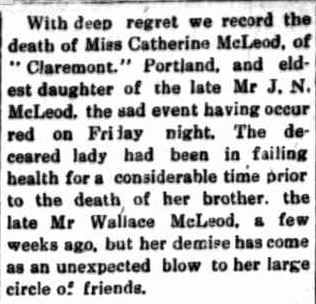
Two months later his older sister, Catherine was dead.

Portland Guardian First Issue August 20, 1842. (1919, September 22). Portland Guardian (Vic. : 1876 - 1953), p. 2 Edition: EVENING. Retrieved July 19, 2013, from http://nla.gov.au/nla.news-article63959741

Portland Guardian First Issue August 20, 1842. (1919, September 22). Portland Guardian (Vic. : 1876 – 1953), p. 2 Edition: EVENING. Retrieved July 19, 2013, from http://nla.gov.au/nla.news-article63959741

The death of her brother and sister in such close succession led Constance to reconsider her future at Claremont.  On 9 June 1920, she held an auction of furniture.

Advertising. (1920, June 3). Portland Guardian (Vic. : 1876 - 1953), p. 2 Edition: EVENING.. Retrieved July 18, 2013, from http://nla.gov.au/nla.news-article64021540

Advertising. (1920, June 3). Portland Guardian (Vic. : 1876 – 1953), p. 2 Edition: EVENING.. Retrieved July 18, 2013, from http://nla.gov.au/nla.news-article64021540

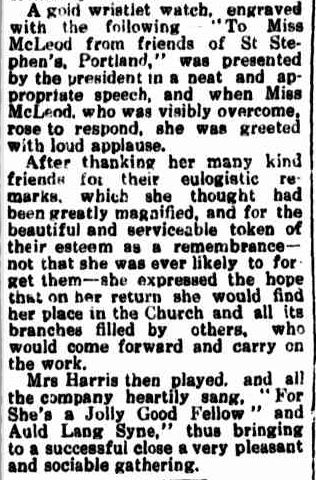
A week later, her friends gave her a send-off in St Stephen’s Parish Hall (below).

ST STEPHEN'S CHURCH HALL, PORTLAND

ST STEPHEN’S CHURCH HALL, PORTLAND

Constance was going on an extended holiday.  She was most likely heading to New Zealand to stay with her sister Jessie, married to Frederick Loisel.  Jessie was present at the send-off and lived in New Zealand by that time.

cl3

Presentation to Miss McLeod. (1920, June 21). Portland Guardian (Vic. : 1876 - 1953), p. 3 Edition: EVENING.. Retrieved July 18, 2013, from http://nla.gov.au/nla.news-article64021677

Presentation to Miss McLeod. (1920, June 21). Portland Guardian (Vic. : 1876 – 1953), p. 3 Edition: EVENING.. Retrieved July 18, 2013, from http://nla.gov.au/nla.news-article64021677

In 1934,  Constance passed away in New Zealand.  She and her sister Jessie had just departed Hamilton, New Zealand bound for Portland for the Portland Centenary Celebrations when Constance fell ill and died.

Obituary. (1934, October 8). Portland Guardian (Vic. : 1876 - 1953), p. 2 Edition: EVENING. Retrieved July 18, 2013, from http://nla.gov.au/nla.news-article64286992

Obituary. (1934, October 8). Portland Guardian (Vic. : 1876 – 1953), p. 2 Edition: EVENING. Retrieved July 18, 2013, from http://nla.gov.au/nla.news-article64286992

After the deaths of Wallace and Catherine and the departure of Constance, Claremont was vacant.  In June 1920, the estate of Caroline Henty advertised Claremont for lease by tender with a term of three years.

Advertising. (1920, June 17). Portland Guardian (Vic. : 1876 - 1953), p. 2 Edition: EVENING.. Retrieved July 19, 2013, from http://nla.gov.au/nla.news-article64021641

Advertising. (1920, June 17). Portland Guardian (Vic. : 1876 – 1953), p. 2 Edition: EVENING.. Retrieved July 19, 2013, from http://nla.gov.au/nla.news-article64021641

Taking up the lease of Claremont in 1920 was Caroline Florence McLean, daughter of Hector McLean and Mary Ann Humphries of Casterton.  Only a year after her arrival another death occurred at Claremont, that of returned WW1 soldier Benjamin Byard. Reading Benjamin’s War  Service Record I found he only made it as far as England when he fell ill with tuberculous.  He spent time in hospital in England before returning to Melbourne and was again confined.  Once released he travelled to his hometown of Casterton to meet up with friends.  It was suggested to him he visit Portland and he ended up at the home of Caroline McLean.

When I initially found this story, I couldn’t understand how Ben just seemed to pitch his tent in Claremont’s front yard. Finding out more about Caroline and her Casterton link went a long way to explaining how Ben chose her front yard.

A Pathetic Ending. (1921, August 22). Portland Guardian (Vic. : 1876 - 1953), p. 3 Edition: EVENING.. Retrieved July 19, 2013, from http://nla.gov.au/nla.news-article64024369

A Pathetic Ending. (1921, August 22). Portland Guardian (Vic. : 1876 – 1953), p. 3 Edition: EVENING.. Retrieved July 19, 2013, from http://nla.gov.au/nla.news-article64024369

It was a happier time at Claremont in June 1922, when Maud McLean of Casterton, Caroline’s sister, married James Anderson of East Malvern, at St Stephens Church.  The wedding breakfast was held at Claremont.

Family Notices. (1922, June 22). Portland Guardian (Vic. : 1876 - 1953), p. 3 Edition: EVENING.. Retrieved July 20, 2013, from http://nla.gov.au/nla.news-article64026127

Family Notices. (1922, June 22). Portland Guardian (Vic. : 1876 – 1953), p. 3 Edition: EVENING.. Retrieved July 20, 2013, from http://nla.gov.au/nla.news-article64026127

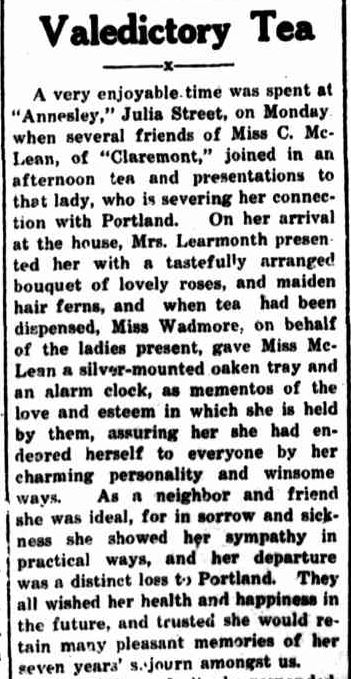
After seven years at Claremont, it was time for Caroline to move on.  Afternoon tea was held as a send-off.  One of the attendees was Sarah Wadmore, author of Portland’s Pioneer Women’s Book of Remembrance.

Valedictory Tea. (1927, May 5). Portland Guardian (Vic. : 1876 - 1953), p. 3 Edition: EVENING. Retrieved July 18, 2013, from http://nla.gov.au/nla.news-article64256993

Valedictory Tea. (1927, May 5). Portland Guardian (Vic. : 1876 – 1953), p. 3 Edition: EVENING. Retrieved July 18, 2013, from http://nla.gov.au/nla.news-article64256993

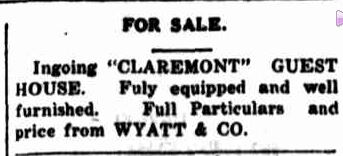
After the departure of Caroline McLean, Claremont was put up for sale as a guest house.

Advertising. (1927, May 5). Portland Guardian (Vic. : 1876 - 1953), p. 3 Edition: EVENING. Retrieved July 18, 2013, from http://nla.gov.au/nla.news-article64257015

Advertising. (1927, May 5). Portland Guardian (Vic. : 1876 – 1953), p. 3 Edition: EVENING. Retrieved July 18, 2013, from http://nla.gov.au/nla.news-article64257015

By November 1927, Claremont as a guest house was accommodating professionals such as Nurse Francis the Chiropodist.

The Portland Guardian. (1927, November 17). Portland Guardian (Vic. : 1876 - 1953), p. 2 Edition: EVENING. Retrieved July 18, 2013, from http://nla.gov.au/nla.news-article64259180

The Portland Guardian. (1927, November 17). Portland Guardian (Vic. : 1876 – 1953), p. 2 Edition: EVENING. Retrieved July 18, 2013, from http://nla.gov.au/nla.news-article64259180

There were vacancies at Claremont in June 1929.

Advertising. (1929, June 6). Portland Guardian (Vic. : 1876 - 1953), p. 2 Edition: EVENING. Retrieved July 18, 2013, from http://nla.gov.au/nla.news-article64269647

Advertising. (1929, June 6). Portland Guardian (Vic. : 1876 – 1953), p. 2 Edition: EVENING. Retrieved July 18, 2013, from http://nla.gov.au/nla.news-article64269647

While I can’t find who owned “Claremont” at this point, I do know that Janet Kosch took over the registration of the boarding house in 1930.  Prior to that, there was a Mrs McIntosh and then Norman McIntyre holding the registration.

Borough Council. (1930, November 20). Portland Guardian (Vic. : 1876 - 1953), p. 3 Edition: EVENING. Retrieved July 18, 2013, from http://nla.gov.au/nla.news-article64293741

Borough Council. (1930, November 20). Portland Guardian (Vic. : 1876 – 1953), p. 3 Edition: EVENING. Retrieved July 18, 2013, from http://nla.gov.au/nla.news-article64293741

In 1934, the two acres of land that made up the “Claremont” property was subdivided.  Again it is not clear who the vendor was, the Henty estate or a new owner from a possible sale back in 1927.

"Claremont" Sud-division. (1934, October 15). Portland Guardian (Vic. : 1876 - 1953), p. 2 Edition: EVENING.. Retrieved July 19, 2013, from http://nla.gov.au/nla.news-article64287062

“Claremont” Sud-division. (1934, October 15). Portland Guardian (Vic. : 1876 – 1953), p. 2 Edition: EVENING.. Retrieved July 19, 2013, from http://nla.gov.au/nla.news-article64287062

Mrs Kosch was still running the Claremont guest house in 1943 when her son visited while on leave from service.

NEWS OF THE FORCES. (1943, October 21). Portland Guardian (Vic. : 1876 - 1953), p. 3 Edition: EVENING. Retrieved July 20, 2013, from http://nla.gov.au/nla.news-article64387036

NEWS OF THE FORCES. (1943, October 21). Portland Guardian (Vic. : 1876 – 1953), p. 3 Edition: EVENING. Retrieved July 20, 2013, from http://nla.gov.au/nla.news-article64387036

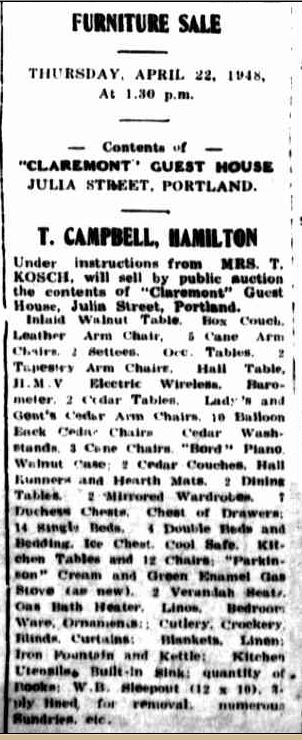
In 1948, after 18 years of running the Claremont guest house, Mrs Kosch retired.  She held a furniture sale on 22 April 1948.  In 1952 she passed away at Heywood.

 Advertising. (1948, April 19). Portland Guardian (Vic. : 1876 - 1953), p. 2 Edition: EVENING. Retrieved July 18, 2013, from http://nla.gov.au/nla.news-article64414613

Advertising. (1948, April 19). Portland Guardian (Vic. : 1876 – 1953), p. 2 Edition: EVENING. Retrieved July 18, 2013, from http://nla.gov.au/nla.news-article64414613

CLAREMONT, c1949. Photographer: Colin Caldwell. Image courtesy of the State Library of Victoria http://handle.slv.vic.gov.au/10381/72863

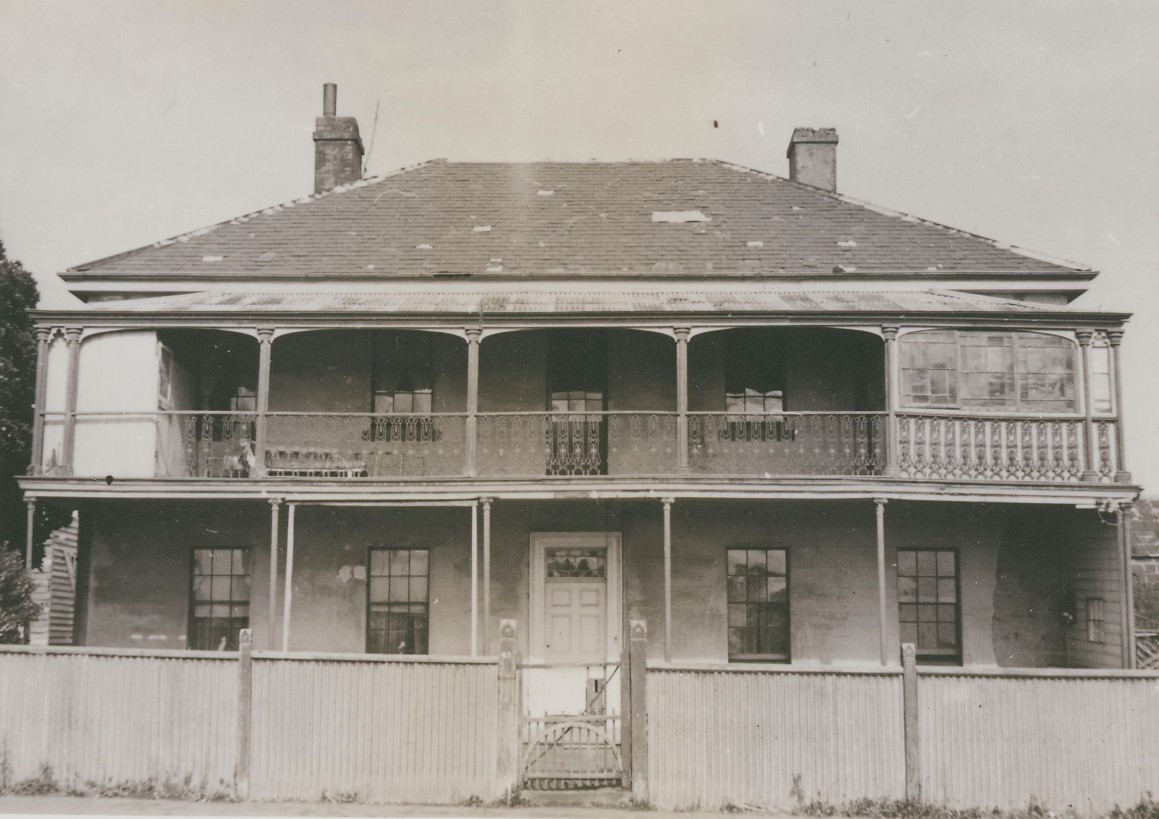
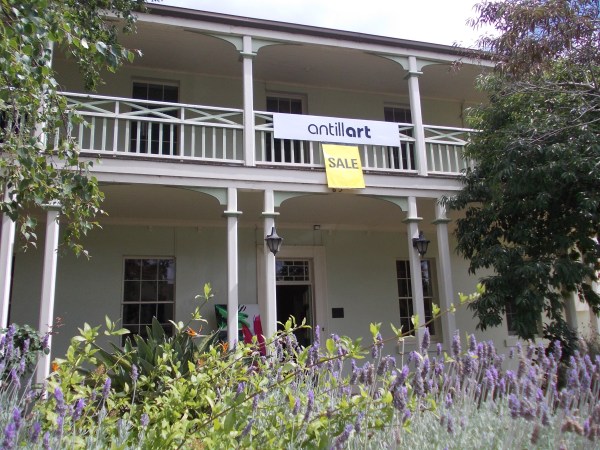
Claremont continued on as a guest house to at least 1954. In more recent years it has been a bed and breakfast and an art gallery, as it was when I visited. It has also been for sale.  The listing is seen on this link:  http://www.homehound.com.au/65+julia+street+portland+vic+3305/   Externally, over the years both the fence and slate roof have been replaced and the verandah modified more than once.
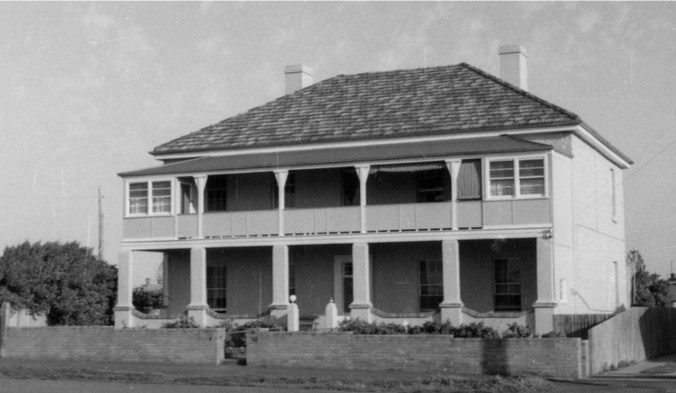
CLAREMONT c1962-1984. Image courtesy of the J.T. Collins Collection, La Trobe Picture Collection, State Library of Victoria.

In at least the first 100 years of existence Claremont was many things but never a family home.  Children weren’t raised under its roof or played in the yard. Memories were never kept of a treasured family home.  It was always a temporary house, even when the Misses McLeod and Miss McLean were in residence.  Now. at the end of my search, I think the reason I kept digging for information is that I wanted to find Claremont as a home, not a just summer residence or a guest house, but I never did.
196

Trove Tuesday – Wages

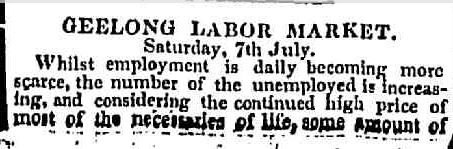
This week’s Trove Tuesday post comes from the Geelong Advertiser and Intelligencer (1851-1856).  The year was 1855 and the colony was in the grips of recession.  Unemployment was high as immigrants arrived daily and luck ran out on the diggings.  The cost of living was also rising.

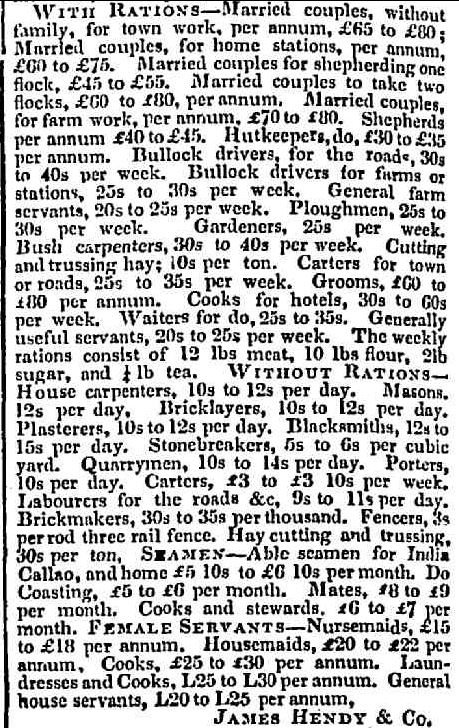
If your ancestor was lucky enough to have work during 1855, the following list of wages gives us some idea of the wages they were receiving.  Tradesmen attracted the highest wages and of course there was gender disparity, with a shepherd able to earn £45 per annum while the highest paid female occupation, a cook, only paid £30 per annum.

tt29tt30

tt31

GEELONG LABOR MARKET. (1855, July 7). Geelong Advertiser and Intelligencer (Vic. : 1851 – 1856), p. 2 Edition: DAILY.. Retrieved July 5, 2013, from http://nla.gov.au/nla.news-article91866096

Passing of the Pioneers

Welcome to July 2013 Passing of the Pioneers, the second birthday of Western District Families monthly feature. Including this month’s obituaries, there are now 372 pioneer obituaries recorded here. You can view all of them on this link – Pioneer Obituaries – or search family names using the search box on the side bar.

I didn’t expect Passing of the Pioneers would continue this long.  In July 2011, I didn’t even think I would be blogging this long.  Also, I have had a few desperate moments when I thought I would run out of obituaries. I started using only the Portland Guardian and the Camperdown Chronicle  and then the Horsham Times, but thankfully papers like the Port Fairy Gazette (1914-1918) and the Ararat Advertiser (1914-1918) came online.  Now with the likes of the Hamilton Spectator(1914-1918) and the Coleraine Albion (1914-1918) coming online I’m reassured that Passing of the Pioneers should see at least a third birthday.
As it is birthday month it is only appropriate that one of the obituaries belongs to one of the great pioneering women of the Western District  who left a legacy that is still around today and has a link to Trove, a source I’m totally dependent on for the obituaries in Passing of the Pioneers.  .

Janet NICOL: Died July 1903 at Bridgewater. After reading two obituaries and an entry in the Portland Pioneer Women’s Book of Remembrance, I have concluded that Janet Nicol was an intelligent woman and one of the most significant pioneers to appear in two years of Passing of the Pioneers.

No title. (1936, May 5). Border Watch (Mount Gambier, SA : 1861 - 1954), p. 7. Retrieved July 29, 2013, from http://nla.gov.au/nla.news-article77987617

No title. (1936, May 5). Border Watch (Mount Gambier, SA : 1861 – 1954), p. 7. Retrieved July 29, 2013, from http://nla.gov.au/nla.news-article77987617

Janet Nicol was born in Lanarkshire, Scotland in 1822, the daughter of Professor Andrew Nicol a linguist, University lecturer, and head of a boys college. Janet, one of eight daughters, attended boarding school and like her father could speak several languages. In 1841, she married the Reverend Alexander Laurie, and shortly after they sailed to Port Phillip aboard the William Nicol, appropriately, arriving in February 1842. After a short time in Melbourne, they sailed for Portland Bay.

On arrival at Portland, Janet was carried ashore on a chair by the crew through the surf. It is unclear whether it was before or after her disembarkation, but on that same day, she gave birth to her first child,  Alexander. The Lauries couldn’t stay at any hotel when they first arrived because of quarantine restrictions and instead camped under a shelter near the flour mill. The draughts left Janet with a severe cold and a lifetime of deafness.

Alexander had been appointed minister for the Portland Bay Presbyterian ministry and went about setting up a church. He then took an interest in newspapers and became involved with the Portland Herald. After his death in 1854, Janet took over the running of the Herald. By that time, she had four children. Interestingly the first child, Alexander was not one of those children. I can find his birth record from 1842, but in 1854 Janet gave birth to another Alexander. Therefore I would assume the first Alexander passed away some time before 1854, however, I can’t find his death record. He may have been a victim of that cold introduction to the world.

That is the glossy story so far taken from the Pioneer Women’s book and the obituaries, however, I found another side of the story that I can support with articles found at Trove. The Pioneers of Port Phillip Inc website includes articles from the group’s newsletters.  One of those entitled “Portland – The truth, the whole truth and anything but the truth” submitted by Jan Hanslow reveals research by Ann Grant about stories passed down over the years and the facts behind them.  The Reverend Laurie and Janet are mentioned.

The first revelation is the cause of Janet’s deafness. It was not the cold draughts on the first night in Portland, rather a blow allegedly inflicted by Alexander for which Janet had him charged for assault, as recorded in Police records. This and various other incidents saw him removed from the church. A report of his falling out with the church appeared in the Geelong Advertiser of July 11, 1848. That is how he really came to be at the Portland Herald, not a voluntary swing from God to journalism.

THE PRESBYTERIAN CHURCH IN PORTLAND. (1850, April 16). Geelong Advertiser (Vic. : 1847 - 1851), p. 3 Edition: MORNING. Retrieved July 29, 2013, from http://nla.gov.au/nla.news-article93135253

THE PRESBYTERIAN CHURCH IN PORTLAND. (1850, April 16). Geelong Advertiser (Vic. : 1847 – 1851), p. 3 Edition: MORNING. Retrieved July 29, 2013, from http://nla.gov.au/nla.news-article93135253

The next revelation from Ann Grant was that Alexander got himself into trouble with the paper and Janet had to take over.  The following article supports that claim.

LOCAL. (1851, July 12). The Cornwall Chronicle (Launceston, Tas. : 1835 - 1880), p. 436. Retrieved July 29, 2013, from http://nla.gov.au/nla.news-article65576481

LOCAL. (1851, July 12). The Cornwall Chronicle (Launceston, Tas. : 1835 – 1880), p. 436. Retrieved July 29, 2013, from http://nla.gov.au/nla.news-article65576481

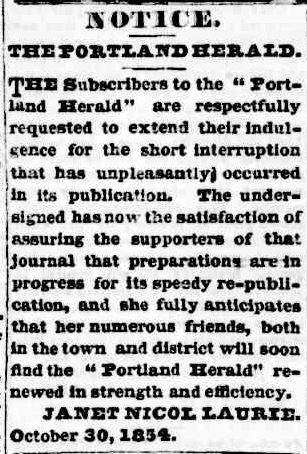
Alexander died in 1854 and after a short break, the Portland Herald resumed publication every Friday with a promise that the paper would be “renewed in strength and efficiency”.

Advertising. (1854, November 9). Portland Guardian and Normanby General Advertiser (Vic. : 1842 - 1876), p. 3 Edition: EVENING.. Retrieved July 29, 2013, from http://nla.gov.au/nla.news-article71571179

Advertising. (1854, November 9). Portland Guardian and Normanby General Advertiser (Vic. : 1842 – 1876), p. 3 Edition: EVENING.. Retrieved July 29, 2013, from http://nla.gov.au/nla.news-article71571179

ESCORT. (1854, December 1). Geelong Advertiser and Intelligencer (Vic. : 1851 - 1856), p. 4 Edition: DAILY. Retrieved July 29, 2013, from http://nla.gov.au/nla.news-article91858365

ESCORT. (1854, December 1). Geelong Advertiser and Intelligencer (Vic. : 1851 – 1856), p. 4 Edition: DAILY. Retrieved July 29, 2013, from http://nla.gov.au/nla.news-article91858365

Janet finished up the Portland Herald in 1860 and she and the children went to Mt, Gambier where she assisted two of her sons in setting up the Border Watch, a paper still published today. The first edition was published on April 26, 1861 and is online at Trove. The eldest son was only seventeen then, so Janet must have been the main force behind the paper’s establishment. The name was definitely her idea as there was a Border Watch newspaper on the border of Scotland and England. Given the close proximity of Mt Gambier to the South Australian/Victorian border, she thought the name appropriate.

(1861, April 26). Border Watch (Mount Gambier, SA : 1861 - 1954), p. 1. Retrieved July 28, 2013, from http://nla.gov.au/nla.news-page7596636

(1861, April 26). Border Watch (Mount Gambier, SA : 1861 – 1954), p. 1. Retrieved July 28, 2013, from http://nla.gov.au/nla.news-page7596636

Also in 1861, Janet married widower Joshua Black of Cork Hill, Bridgewater. Joshua was a father to seven children and Janet must have had a busy time running a paper in Mt. Gambier and the duties of matrimony at Bridgewater. Janet and Joshua had three children together, the first in 1862 when Janet was 40.  By 1865 there were fifteen children from the combined marriages, aged from twenty-two to newborn. One would hope by this time Janet was leaving the running of the newspapers to her sons.

Janet was buried in the North Portland Cemetery in the same grave as Alexander Laurie. The Portland Guardian of 29 July 1903 reported that “the funeral procession was one of the largest, if not the largest seen in Portland”.

The Glenelg Shire have completed a Heritage study of Cork Hill and there is a good history of the Black and Laurie families  http://www.glenelg.vic.gov.au/files/52757_CORK_HILL_HO184.pdf

The State Library of South Australia website includes a history of the Border Watch. http://www.samemory.sa.gov.au/site/page.cfm?c=2585

The entry for Janet in the “Book of Remembrance of the pioneer women of the Portland Bay district”  including a photograph is found here  http://www.slv.vic.gov.au/vicpamphlets/1/4/4/doc/vp1442-007-0000.shtml

Janet’s obituary from the Border Watch, 29 July 1903 http://nla.gov.au/nla.news-article77160512  and from the Portland Guardian http://trove.nla.gov.au/ndp/del/article/63998138

132 (2)

BRIDGEWATER BEACH

Henry DOWN:  Died 4 July 1914 at Port Fairy. Henry Down arrived in Victoria around 1856 aged twenty-one and his first employment was at Yambuk. He was then appointed manager of St Helen’s were he displayed successful farming practices. He purchased his own land at Codrington and continued his success. Henry married twice. His first wife, Susan Dawe was the mother of all of Henry’s six children. She passed away in 1893 and Henry married the widow of Mr William Cain. Henry returned twice to the north of England to visit his two brothers, both coal miners.

James FRY: Died 26 July 1914 at Broadwater. James Fry was born in Gloucestershire, England in 1830. He married Sarah Brown in 1853, in Gloucestershire. They left England in 1857 aboard Chance bound for Port Fairy. He set up a business as a plasterer in the town and was deeply involved in the Oddfellows and the Farmers Rest Lodge. He even built a lodge room at Broadwater for the Farmers Rest masons, at his own expense. James and Sarah had eleven children and Sarah predeceased James in 1907.

Silias SMITH: Died 5 July 1915 at Hamilton. Silias Smith was born in Somerset, England in 1824. He arrived in Hobart in 1855 and then in 1857, sailed for Portland, settling in the Narrawong area. Silias worked in the horticultural field and had great knowledge of both this and general agriculture. In later life, he lived with his married daughter in Heywood and later in Hamilton.

Bridget McCARTHY: Died 16 July 1916 at Crossley. Born in Ireland around 1835, Mrs Bridget O’Brien arrived in Victoria in the mid-1850s. Bridget and her husband Patrick O’Brien lived at Crossley for many years before leasing their land and moving to Port Fairy North. The O’Brien’s had four children but lost three of them at a young age. They had one son John survive them.

Francis McSORLEY: Died 16 July 1916 at Port Fairy. Francis McSorley was born in Ireland around 1826 and arrived in Victoria in the early 1860s aboard the Mindora, along with his wife and two sons. Francis was an expert on the Crimean War and the early history of Victoria. He worked on the railways for many years before retiring to Rosebrook.  He left six sons and one daughter. Another son Patrick, a jockey was killed in a race fall in Adelaide.

Thomas SHANLEY: Died 12 July 1917 at Killarney. Thomas Shanley took up residence at Killarney in 1856. He married Ellen Malone in the same year.  Thomas was the road overseer for the Belfast shire for twenty-two years.

John WILLIAMS: Died 26 July 1917 at Port Fairy. John Williams was born in Hobart in 1834 and arrived in Victoria as a fourteen-year-old in 1848. He worked on stations doing stock work and around the time of the discovery of gold, he was droving stock to Ballarat and Bendigo. He tried his luck while at each of these goldfields with no success and returned to station life and marriage in 1855. He later went to Port Fairy where he remained for forty-nine years. During that time he worked at Guinn’s Brewery and at the harbour. John and his wife raised thirteen children.

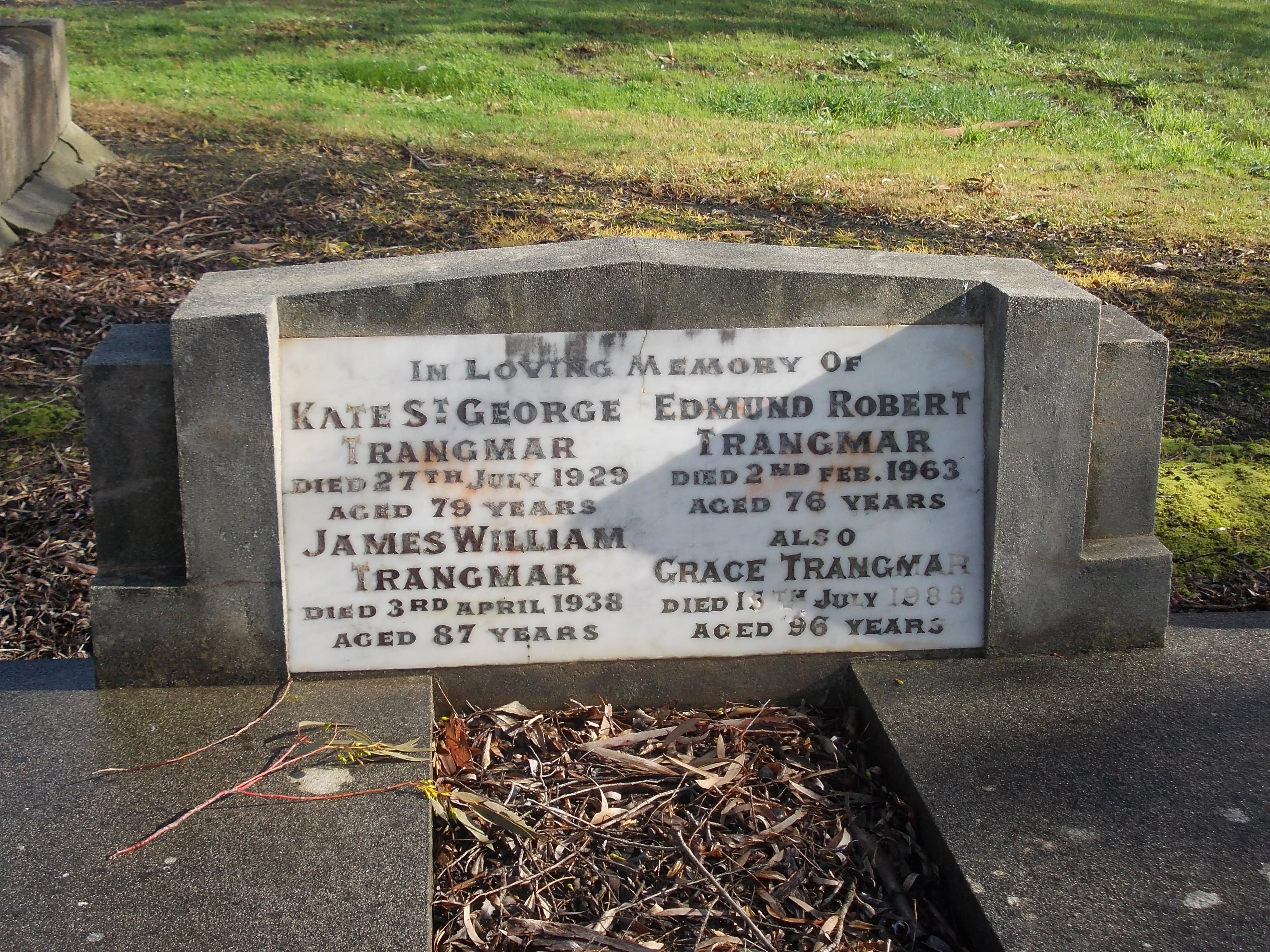
Kate St George McCANN: Died 27 July 1929 at Coleraine. Kate McCann was already well travelled by the time she reached Melbourne in 1866 aboard the Great Britain. She was born on a ship just offshore of San Fransisco in 1849.  Her birth certificate would have stated she was born in Stepney, London as all children born at sea under the British flag were allocated to the Parish of Stepney. Kate grew up playing on her mother’s ranch in the Rocky Mountains, California.  After her mother’s death, she travelled to England with her sister, living with her aunt, Emma Crouch in London. It was with Emma that Kate and her brother and sister sailed on the Great Britain.  They caught the steamer Edina to Portland.

In 1876, Kate married James Trangmar. They moved from Portland to Coleraine and ran a family store. The store was run by members of the Trangmar family until 1969. Kate and James had eight children, six surviving at the time of Kate’s death.

GRAVE OF KATE McCANN AT COLERAINE CEMETERY

Lottie McKEAND: Died 11 July 1942 at Casterton. Lottie was the daughter of Mr and Mrs Andrew McKeand of Penola and she was born there in 1875. She married James Carmichael of Argyle Station at Lake Mundi near Casterton and they moved to their own property Argyle after their marriage. James passed away and Lottie moved to Melbourne with her three sons to enable them to finish their education. She later married James Mitchell of Moredun Hills, Casterton, however, he predeceased her. Lottie was keen on dogs and horses and will still riding only a few years before her death. At the time of her passing, her three sons were serving with the A.I.F, with Thomas missing in Malaya.

It’s Official

Door locked.  Check.  Phone off.  Check.  Coffee. Check.  Chocolate. Check.  It’s time to hit Trove. The Hamilton Spectator has arrived!


[No heading]. (1918, May 16). Hamilton Spectator (Vic. : 1914 - 1918), p. 1. Retrieved July 25, 2013, from http://nla.gov.au/nla.news-page13332555

[No heading]. (1918, May 16). Hamilton Spectator (Vic. : 1914 – 1918), p. 1. Retrieved July 25, 2013, from http://nla.gov.au/nla.news-page13332555

Margaret Kiddle wrote in Men of Yesterday: a social history of the Western District of Victoria 1834-1890 (1961)

“The Hamilton Spectator…was known as ‘the Argus of the west’.  In a district chiefly pastoral it remained conservative in tone but its reporting both of local and larger events was excellent.  Moreover it ran special articles of high literary merit such as Peter Campbell’s ‘Rough Sketches of Colonial Life’ which were published during the sixties.  In the eighties, it gave sound information through weekly agricultural letters”. (p. 457)

Margaret Kiddle’s description of a 19th century Hamilton Spectator could be from today.  The district is still a farming area, there is still excellent reporting on all events, special articles and agriculture news.  The conservatism, from the time of editors such as George Mott or his successor George Rippon, however,  is no longer a part of the paper’s make up.  Rather, the Spectator claims it is neutral.  This stance and the history of the Hamilton Spectator is available to read in an  historic  timeline of the paper on their website.

I grew up with The Spec.  Each Monday, Wednesday and Friday afternoon we would get our Tuesday, Thursday and Saturday editions.  Go figure.  Mum had a shop and a paper boy would drop her copy off.  Small change would sit on the counter awaiting his arrival.  Alternatively, Nana would go to the newsagent in the main street and wait, with others, for the Spec to arrive.  If all that failed, we could always stop at the milk bar on our way home.

To our family and most others in Hamilton, the Spec was, and still is, an important part of daily life.  Each edition meant something different for everyone.   For me, the Thursday edition would have the netball draw for the weekly match at Pedrina Park. The Tuesday paper would have the results of the netball, more times than not a losing result for my team.  Saturday was the big edition with more classifieds, maybe a farming supplement, and weekend “Amusements”.

“Amusements”?   Having grown up in Hamilton during in the 1970s and 1980s, I now delve into my childhood memories and the file “Hamilton Amusements” is practically empty.  The grand picture theatre became an army disposals store in the mid 1970s, there was an occasional roller skating rink, Blue Light discos and drives to Lake Hamilton to delight at water going over the spillway after heavy rain… but no matter how trivial the “amusement”, we could find it in the  Spec.

024

After I left Hamilton in 1986, I kept reading the Spectator.  Mum remained in Hamilton for the following nine years and she saved them for me.  When she left Hamilton there was a dilemma, how would we get the Specs?  Thankfully a generous family member saved us copies.  They would deliver a box full of Specs when they passed through town.  Mum and Nana would read them first and then pass them on to me.   We have another family member living in Hamilton now and she passes them on to my Dad to read, then on to me and then Mum.

I particularly like the regular history features and the Tuesday regular “Where Are They Now”.  I’m often tear out articles, about Western District history or items about family members.  I don’t do this with my current local paper that I don’t buy.  It is run by a large multimedia company and that is the difference.  That is why I prefer to read the Spectator.  It is a run by a small company with only two other papers, the Portland Observer and the Casterton News under its control and it is for that reason the Spec, I believe, is in touch with the community and gives readers what they want, local content and an outlet for opinion and debate.

The Spectator is not the only paper that as come online during the past few days useful to Western District researchers.  There is also the Cobden Times and Heytesbury Advertiser (1914-1918), the Cobden Times (1918), the Clunes Guardian and Gazette (1914-1918) and the Creswick Advertiser (1914-1918).  I have found a wonderful article about my great-uncle Bill Riddiford in the Creswick Advertiser and an article about my great-grandfather in the also recently released Lang Lang Guardian (1914-1918) from Gippsland.  I will share both in future Trove Tuesday posts.

Now it’s time to get back to Trove.  Although there are only four years of Specs online there are 267 matches for Harman, 418 matches for Hadden and 112 for Diwell  just some of the names I am searching.  I will have to stay patient however, many of the articles I want to read are still in  the “coming soon” status so I will have to wait for my Electronic Friend to tell me when they are available but there are exciting times ahead.