Passing of the Pioneers

It’s a bumper January Passing of the Pioneers. So much bigger than I’d planned. But I’ve found some interesting pioneers’ obituaries this month, and it was hard not to want to learn a little more about them. The sixteen pioneers are now included in the Western District Families Pioneer Obituary Index.

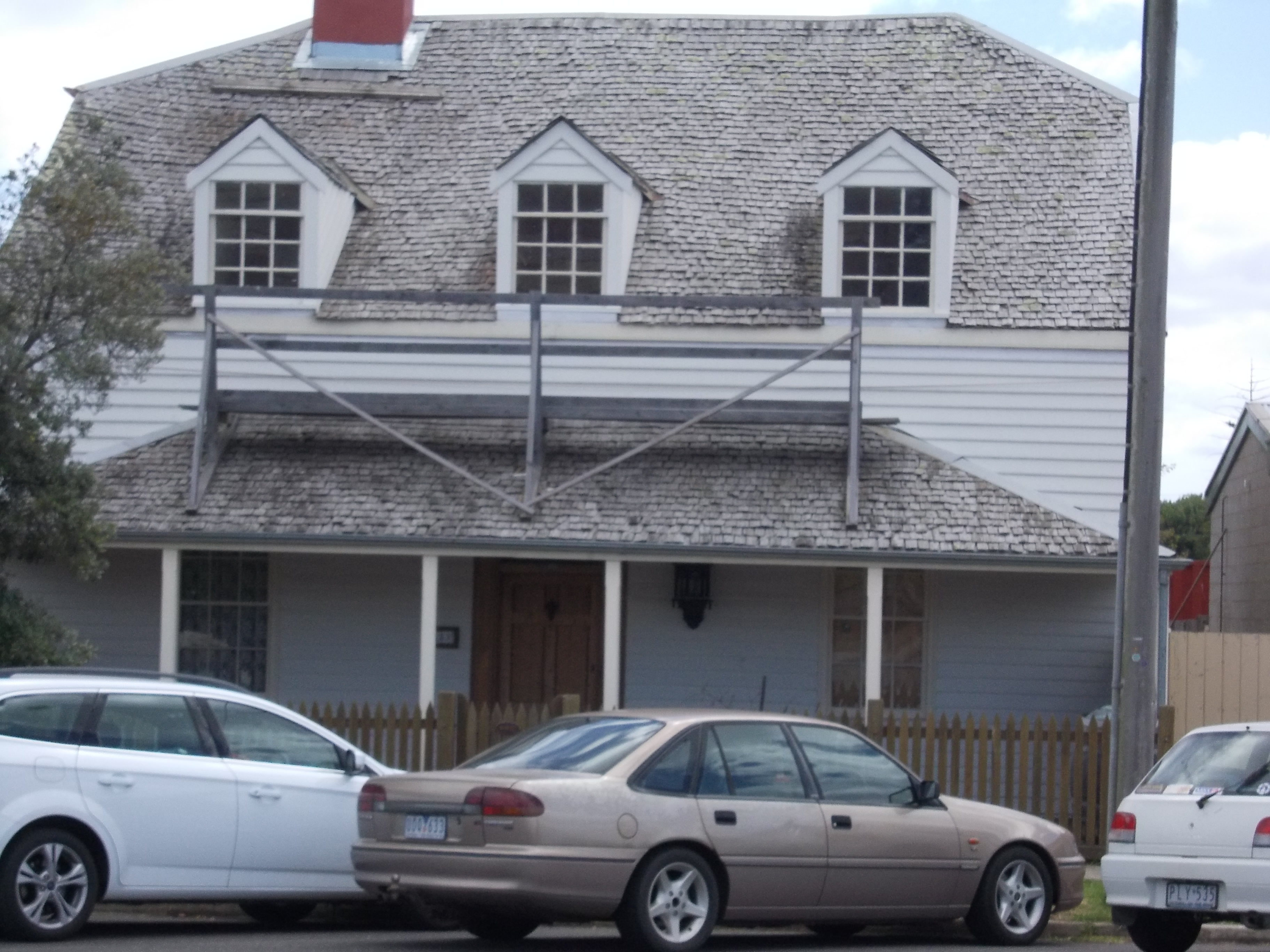
HERBERTSON, Robert – Died 23 January 1879 at Portland.  Robert Herbertson was born in Scotland and travelled to Tasmania in 1830.  He married fellow Scot Isabella Bailey in 1834 in Tasmania, and they arrived in Portland in 1841.  They eventually moved into a house in Julia Street, and Robert worked as a builder and hotel keeper.  Robert built the Steam Packet Inn (below) in 1842, and it is now one of the oldest surviving buildings in the state.
183

STEAM PACKET INN, PORTLAND

The Herbertsons also ran a drapery store.
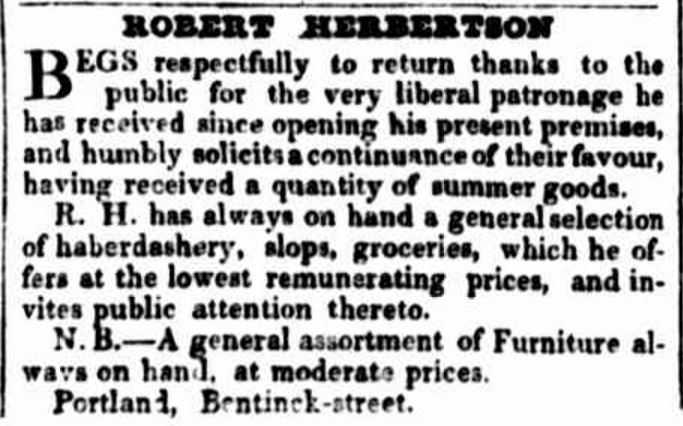
"Advertising." Portland Guardian and Normanby General Advertiser (Vic. : 1842 - 1876) 4 Feb 1843: 2. .

“Advertising.” Portland Guardian and Normanby General Advertiser 4 Feb 1843 http://nla.gov.au/nla.news-article71569036

In 1843, Robert opened the Union Inn, and in 1847, the Britannia Inn and built shops and houses in Julia Street. Robert purchased land on the Bridgewater Road and built Briery (below). From Robert’s obituary in the Portland Guardian, that was in 1867, however, the report on the home found at the Victorian Heritage Database gives the date as around 1850.

BRIERY, PORTLAND 1958. Photographer Colin Caldwell. Image courtesy of the State Library of Victoria http://handle.slv.vic.gov.au/10381/72633

BRIERY, PORTLAND 1958. Photographer Colin Caldwell. Image courtesy of the State Library of Victoria http://handle.slv.vic.gov.au/10381/72633

Briery was definitely built by 1867, as Robert had the house and land up for lease.

"Advertising." Portland Guardian and Normanby General Advertiser (Vic. : 1842 - 1876) 16 Jan 1868: 3 Edition: EVENINGS. . .

“Advertising.” Portland Guardian and Normanby General Advertiser 16 Jan 1868 http://nla.gov.au/nla.news-article64689157

In the days before his death, there was a fire on Bridgewater Road near the farm. Robert’s over-exertion helping to fight the fire most likely led to his death.  Isabella Robertson died in Portland in 1883.

WILSON, John – Died 3 January 1906 at Portland. John Wilson was born around 1826 at Glasgow, Scotland and arrived in Portland around 1853.  He went on to the diggings but returned to the Portland district, dairy-farming at Lower Bridgewater.  John’s property The Lagoons was one of the district’s largest and most successful farms.

TWOMEY, Edward – Died January 1907 in Melbourne.  Edward Twomey was born in Ireland around 1836, the son of John Joseph Twomey and Margaret O’Conner.  John Twomey took up large amounts of land around Penshurst, which he divided into Kolor (below), Banemoreand Langulac and passed it on to his sons.

026

LOOKING DOWN ON KOLOR FROM MT. ROUSE NEAR PENSHURST

Langulac, south of Penshurst, came under the charge of  Edward Twomey. In 1885, Edward announced his engagement to New Zealander Mary Ellen Josephine Cantwell, and they married.  They went on to have five children.

"Family Notices." Table Talk (Melbourne, Vic. : 1885 - 1939) 24 Jul 1885: .

“Family Notices.” Table Talk 24 Jul 1885 http://nla.gov.au/nla.news-article145711723

Edward enjoyed horse racing and was one of the earliest trustees of the Hamilton Race Course.  He bred and raced horses, with his greatest success coming with Mermaid, winner of the 1871 Sydney Cup. Mermaid was a daughter of King Alfred, the great Western District sire imported in 1854 aboard the Severn by Rifle Downs owner Richard Lewis.

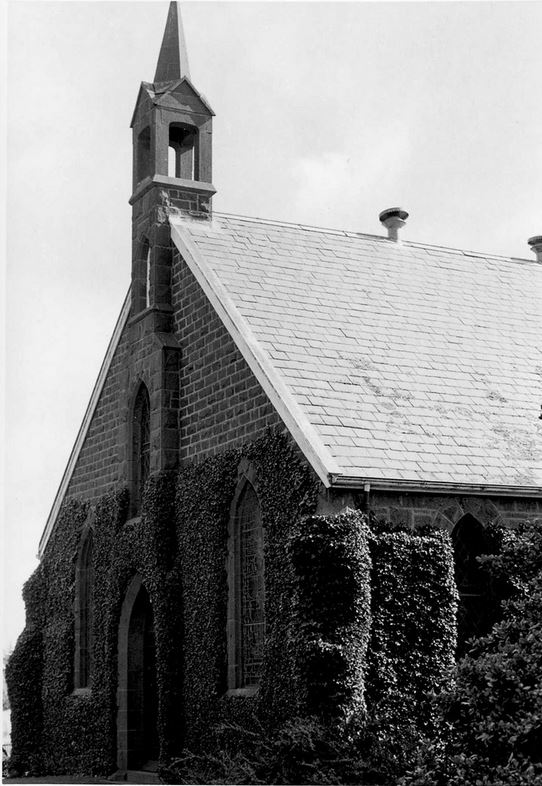
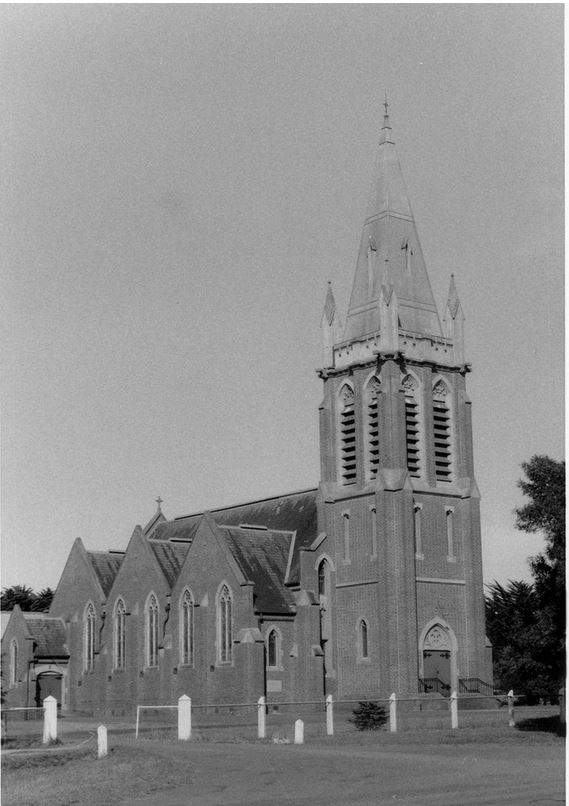
Edward Twomey was a devout Roman Catholic.  He attended the first mass in the Western District according to his obituary; however, most of the congregation was his own family.  He was also a great supporter of the St. Joseph’s Catholic Church at Penshurst.

http://handle.slv.vic.gov.au/10381/233158

ST. JOSEPH’S CATHOLIC CHURCH, PENSHURST. Image courtesy of the J.T. Collins Collection, La Trobe Picture Collection, State Library of Victoria. http://handle.slv.vic.gov.au/10381/233158

In search of an interesting story about Edward Twomey, I found an article published in the Hamilton Spectator and Grange District Advertiser on 10 December 1864.  It was alleged that Edward rode past the Presbyterian minister lying injured by the roadside without offering help. Edward wrote a lengthy “Letter to the Editor”  denying the claims, and Donald Cameron, presumably the Donald Cameron formerly of Morgiana, also wrote the following letter defending Edward.

"ORIGINAL CORRESPONDENCE." Hamilton Spectator and Grange District Advertiser (South Melbourne, Vic. : 1860 - 1870) 17 Dec 1864: 2. Web. 7 Jan 2016 .

“ORIGINAL CORRESPONDENCE.” Hamilton Spectator and Grange District Advertiser 17 Dec 1864 http://nla.gov.au/nla.news-article194723320

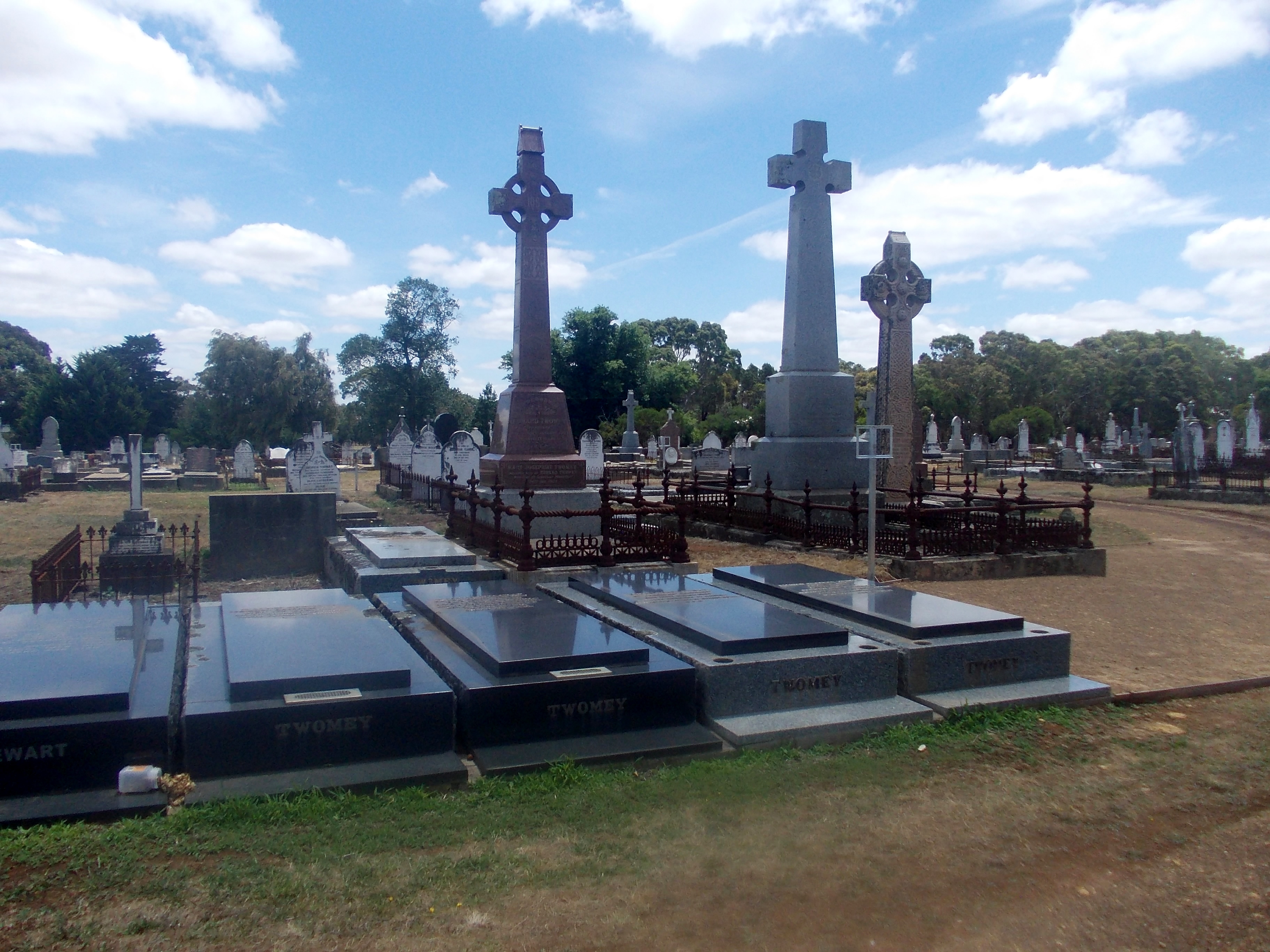
At the age of seventy-one, Edward went to Melbourne for medical treatment.  He died there, and his body was returned to Hamilton for burial at the Hamilton Old Cemetery.  A service was held at Hamilton’s St Mary’s Catholic Church. Mary died in 1926, aged sixty-two, at Penshurst and is also buried at the Hamilton Old Cemetery.
210 (2)

TWOMEY FAMILY PLOT, HAMILTON OLD CEMETERY

EVANS, Edward – Died 6 January 1915 at Ararat.  Edward Evans was the son of Ararat butcher John Pritchard Evans and was born around 1865.  In time, Edward took over his father’s butchery. In 1889, he married Emily Harricks of Ararat.  Edward was a member of the local A.N.A. and a vestryman at Ararat’s Holy Trinity Church of England (below).  He developed Bright’s Disease in 1913, which took his life at age fifty.  Emily, a son and two daughters were left after his death, with Emily dying in 1949, aged eighty-six.

http://handle.slv.vic.gov.au/10381/58321

HOLY TRINITY CHURCH OF ENGLAND, ARARAT. Image courtesy of the State Library of Victoria http://handle.slv.vic.gov.au/10381/58321

SANDRY, Alice – Died 18 January 1916 at Hamilton.  Alice Sandry was born in Cornwall, England, around 1848.  She arrived at Portland with her parents, William and Anne, and three siblings in 1853 aboard the Eliza.  In 1869, Alice married William Arnott, and they lived in Gray Street, Hamilton. Their residence was most likely at the grocery store William ran close to Thomson’s Iron Store. Alice and William went on to have nine children, and for a time, William was a Hamilton Borough Councillor.

On 9 May 1887, Alice and William’s nine-year-old son Frederick died as a result of an accident.  On the day, he was travelling in the wagonette of Frederick Giles, storekeeper of the Giles & Dunn Beehive Store at Hamilton. Mr Giles was a passenger and, as he often did, he allowed Frederick’s older brother Archie to drive. They were going to the Wannon store of Giles & Dunn. During their journey, the pony stumbled, throwing Archie and Mr Giles from the wagonette.  The pony took fright and bolted with Frederick holding on for his life.

Found with a severely broken leg, and with no witnesses, it was thought Frederick had attempted to jump clear, but his leg wedged between a tree and the wagonette.  Taken to the Wannon Inn, amputation was the only option.  Frederick went into shock as a result of the operation and died at his parents’ home. The Portland Guardian published a lengthy account of the accident on 11 May 1887.  The Horsham Times provided a report on the inquest published on 13 May 1887.

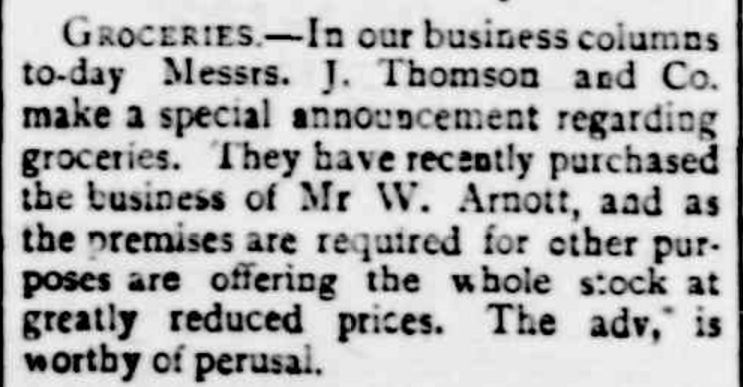
In 1898, William’s grocery store became a part of John Thompson & Co in Gray Street.  The Arnotts then moved to Cox Street, Hamilton.
"Established August 1842. The Portland Guardian,." Portland Guardian (Vic. : 1876 - 1953) 21 Dec 1898: 2 Edition: EVENING. Web. .

“Established August 1842. The Portland Guardian, 21 Dec 1898  http://nla.gov.au/nla.news-article63675021

In 1899, William was declared insolvent owing over £800 and he died the following year.  Alice’s probate file indicates she retained ownership of the Gray Street property and Thomson’s rented it from her.  She also owned her house in Cox Street.

"Family Notices." Hamilton Spectator (Vic. : 1870 - 1873; 1914 - 1918) 19 Jan 1916: 4. .

“Family Notices.” Hamilton Spectator (Vic. : 1870 – 1873; 1914 – 1918) 19 Jan 1916: 4. <http://nla.gov.au/nla.news-article120409938&gt;.

Alice was buried at the Hamilton Old Cemetery with William.  Three of their children were remembered on the headstone: Frederick and two infants, George, who died in 1879 aged six months, and Norman, who died in 1886, two months short of his second birthday.

arnott

O’BRIEN, Patrick – Died 20 January 1916 at Hamilton.  Patrick “Paddy” O’Brien was born in Ireland around 1831. He eventually arrived in Hamilton and became one of the great characters of the town.

"DEATH OF AN OLD HAMILTON RESIDENT." Hamilton Spectator (Vic. : 1870 - 1873; 1914 - 1918) 21 Jan 1916: 4. .

“DEATH OF AN OLD HAMILTON RESIDENT.” Hamilton Spectator 21 Jan 1916 http://nla.gov.au/nla.news-article120410087

Paddy married Mary Harritty* in 1865 and a daughter, Bridget, was born in 1867 at Portland. They then settled at Hamilton, and another daughter, Margaret, was born there in 1871. Paddy worked as a gardener, and the family lived in Cox Street close to the corner of Gray Street.  He was a devout Catholic, attending St. Mary’s Catholic Church (below), and was a member of the local Hibernian Society.

ST MARY'S CATHOLIC CHURCH, HAMILTON. Image courtesy of the State Library of Victoria. http://handle.slv.vic.gov.au/10381/63342

ST MARY’S CATHOLIC CHURCH, HAMILTON. Image courtesy of the State Library of Victoria. http://handle.slv.vic.gov.au/10381/63342

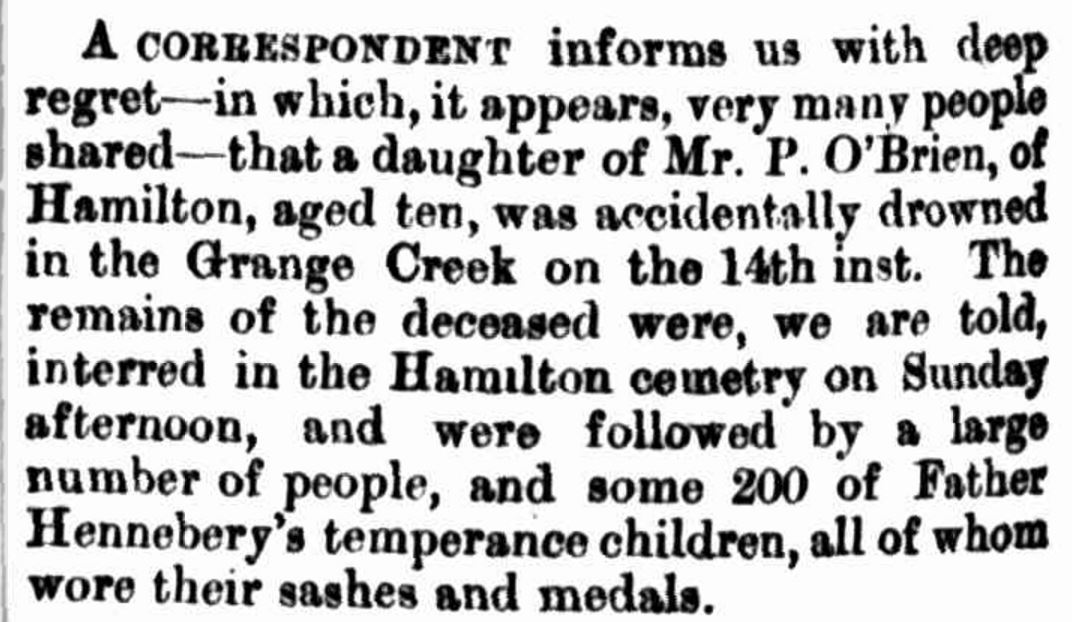
In 1881, tragedy struck the O’Brien family. Ten-year-old Margaret drowned in the local creek, the Grange Burn, on 14 October.  There was a large turnout to follow the funeral cortege to the cemetery.
"A PRACTICAL VIEW OP THE TEMPERANCE MOVEMENT." Advocate (Melbourne, Vic. : 1868 - 1954) 22 Oct 1881: 16. Web. .

“A PRACTICAL VIEW OP THE TEMPERANCE MOVEMENT.” Advocate 22 Oct 1881 http://nla.gov.au/nla.news-article170023451 

Mary died at Hamilton in 1907.  At the time of Paddy’s death in 1916, The Hamilton Spectator wrote, “He may best be described as one of the identities of the town, that being the term generally used where one is well known, and yet perhaps, so so far as his personal history is concerned, not so well known after all.”  How true.

* While searching records for Patrick O’Brien and his wife Mary, I found several variations of Mary’s surname.  The Victorian Marriage Index has Harritty, but I also found Garraty, Haraty, Harty, Harrity, Heroty, and Harety on entries for births and deaths. As Paddy was most likely the informant on those occasions, I suspect his thick Irish brogue resulted in the many variations.

TATLOCK, Thomas Henry – Died January 1918 at Hamilton.  Thomas Tatlock was born in on 13 January 1834 and christened on 23 March 1834 at the British Chaplaincy in Hamburg, Germany.*  His father was Englishman Thomas Marriot Tatlock, and his Scottish mother, Margaret Turner Rolland. Another son, Francis Rolland Tatlock, was born in 1835 and christened in Hamburg the following year.  After their marriage, Thomas Sr and Margaret had moved to Hungary, where Thomas ran a successful pottery works.  Due to unrest in Hungary, the family moved into Austria and then, as the christening records show, on to Germany.

Moving forward around twenty years and Thomas Henry Tatlock arrived in Victoria around 1853 and joined the mounted police force.  He was in Ballarat during the Eureka uprising in 1854 and worked with the Gold Escort. He was later stationed at towns including Casterton, Woodend, and Port Fairy. In 1865, Thomas married Mary Ann Scarsbrick, and a daughter, Ellen, was born at Port Fairy in 1866.  However, Ellen died aged seven months and was buried at the Port Fairy Cemetery. In 1875, while working as a Senior Constable at Casterton, Thomas was appointed Customs Officer with the Customs and Excise department based in Casterton. As Inspector for Licensed Premises and Liquors for the Customs and Excise Department, he based himself at Hamilton around 1880.

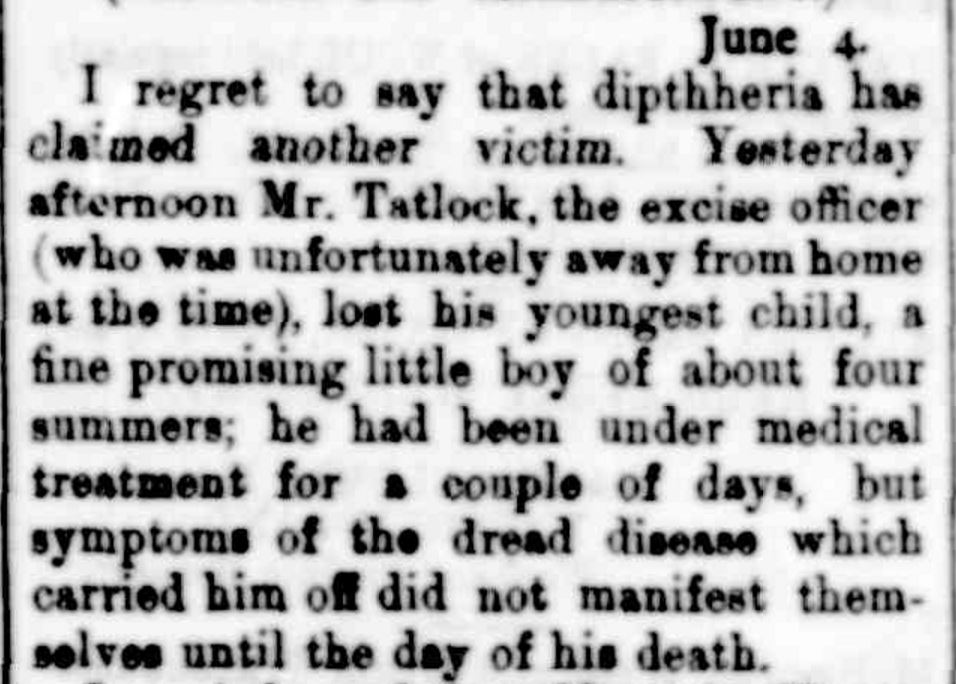
During the 1880s, there were some sad times for the Tatlock family.  Mary Ann died in 1883, aged thirty-eight, from complications due to the birth of twin daughters, Lillie and Daisy. Lillie died in January 1884, aged three months, and Daisy in March, aged five months. On 3 June 1887, Thomas’ son, “of about four summers”, Herbert, died of diphtheria.
 "Hamilton." Portland Guardian (Vic. : 1876 - 1953) 6 Jun 1887: 2 Edition: EVENING. Web. .


“Hamilton.” Portland Guardian 6 Jun 1887 http://nla.gov.au/nla.news-article65408722 

In 1890, Thomas married again to Margery Atchison.  Thomas was a member of the congregation at Christ Church Hamilton and was involved with the Hamilton Pastoral and Agricultural Society.  He was a renowned judge of flowers, poultry, and dogs at district P&A shows and was an importer of Black Orpington poultry.  The Tatlocks lived in Gray Street and later Griffin Street. Thomas’ and Mary Ann’s son Alfred Tatlock, born in Port Fairy in 1868, went on to become one of Hamilton’s leading citizens as a business owner and borough councillor.  Thomas’s second wife, Margery, moved away from Hamilton after Thomas’ death and died in Warrnambool on 7 May 1938.

*”Deutschland Geburten und Taufen, 1558-1898,” database, FamilySearch(https://familysearch.org/ark:/61903/1:1:ND14-PZK : accessed 12 January 2016), Thomas Henry Tatlock, 23 Mar 1834; citing ; FHL microfilm 576,997.

MURRAY, Isabella – Died 27 January 1924 at Warrnambool.  Isabella Murray was born around 1852 at Summer Hill, Allansford, the property of her parents, James Murray and Isabella Gordon. She married Walter Stephen Helpman in 1877, and they lived at Warrnambool.
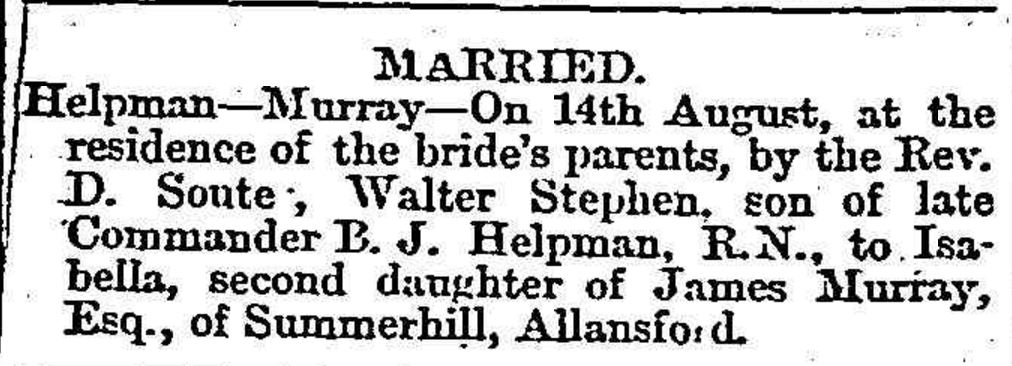
"Family Notices." Geelong Advertiser (Vic. : 1859 - 1926) 16 Aug 1877: 2. .

“Family Notices.” Geelong Advertiser 16 Aug 1877 http://nla.gov.au/nla.news-article150470511 

Walter was a Colonial Bank manager, running branches at Koroit, Port Fairy, and Warrnambool. Isabella kept herself active in the community.  She was a part of the Ladies Benevolent Society for thirty years, including time as President.  Hospital fundraising and the Red Cross, serving as treasurer for five years, were some of Isabella’s other works.  She was also concerned for the welfare of the Aboriginal community at Framlingham and extended her kindness to them.  As the sister of politician John Murray, who became Premier of Victoria, she had a strong interest in politics, helping to campaign at state and federal levels.

HUNT, Caroline – Died January 1925 at Brighton.  Caroline Hunt was born around 1848 and arrived in Australia in 1853 with her parents. Her father was one of the Wimmera’s first settlers, residing at Rosebrook Station.  In 1866, Caroline married William James Carter. William Carter held North Brighton run until 1888 after purchasing Tarrington Estate in 1886.  William died in 1904, and Tarrington Estate was sold in 1909, but the Carters retained ownership of the Tarrington homestead until after Caroline’s death.

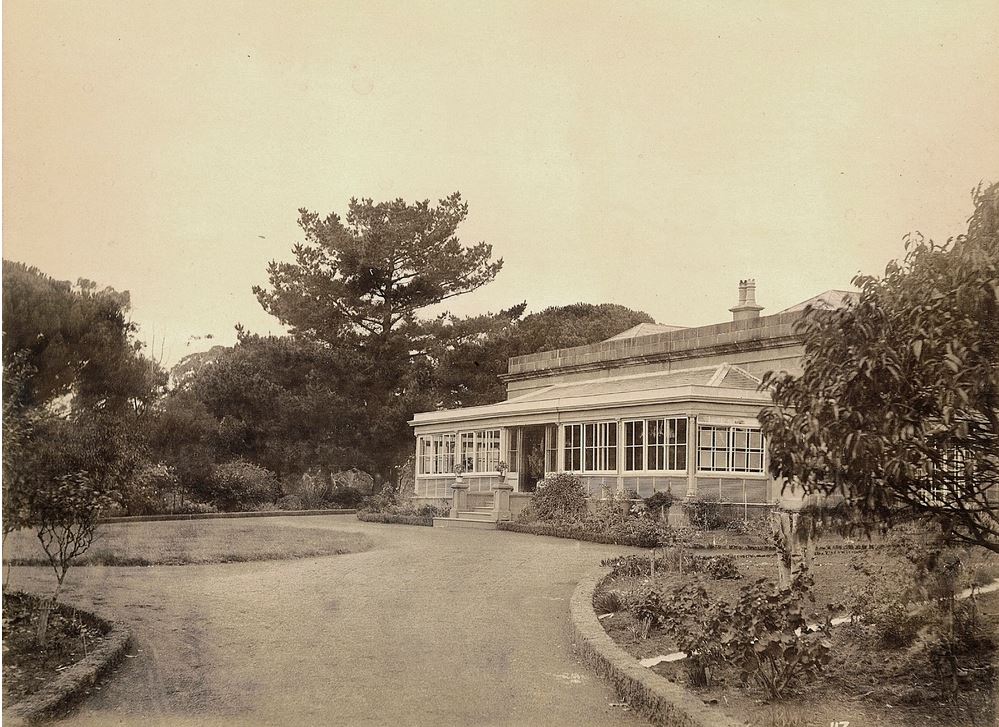
HEDGES, Elizabeth – Died 14 January 1942 at Portland. Elizabeth Hedges was born in Ballarat in 1882.  She became an art teacher and moved to Melbourne.  She married Francis Caine of Bridgewater in 1914, and they lived there until 1921, when Francis purchased land at Kongorong, South Australia, where they established the property Mona Park. While in Kongorong, Elizabeth was the organist at the Kongorong church.  Around the age of fifty, Elizabeth began suffering ill health, and Francis decided to sell Mona Park and buy Cammis near Sandford. The couple enjoyed holidays at Portland.  In 1941, Elizabeth’s health was still failing, and since she always felt better on seaside holidays, Francis bought Burswood at Portland, built by Edward Henty in 1855. Elizabeth only enjoyed the home for seven months before her death. Another obituary for Elizabeth, written by a resident of Kongorong, was published in the Border Watch on 22 January 1942.
http://handle.slv.vic.gov.au/10381/336832

BURSWOOD, PORTLAND. Image courtesy of the State Library of Victoria http://handle.slv.vic.gov.au/10381/336832

FIELDER, Annie Matilda – Died 16 January 1945 at Camperdown.  A daughter of William Fielder and  Matilda Greer, Ann Fielder was born at Cobden in 1877.  In 1903, Annie married William Florence, and they settled at Camperdown.  Annie was a member of the Camperdown branch of the Red Cross and Life Governor of the Royal Victorian Institute for the Blind.   She was also a member of the Camperdown Country Women’s Association and the Camperdown Ladies Auxiliary, among other things.  Annie also attended St. Paul’s Church in Camperdown (below).

stpauls

ST PAUL’S CHURCH, CAMPERDOWN. Image courtesy of the State Library of Victoria. http://handle.slv.vic.gov.au/10381/63204

MONK, Samuel – Died January 1948 at Cobden. Samuel Monk was born at Connewarre in 1861 and arrived at Cobden four years later with his parents, George Monk and Sarah Stenson, early pioneers of that district.  In 1885, Samuel married Patience Silvester.  In his early working days, Samuel made a name for himself working on the roads and was highly sort after by road contractors.  He then turned to farming around 1907 and continued in that pursuit for almost forty years.  Samuel was the oldest surviving member of the original Cobden Football Club and at the time of his death, his son Lesley was the club president. Samuel was a devout Anglican and a member of the Colac Turf Club.

FITZGERALD, John Cunningham – Died 3 January 1950 at Portland.  John Fitzgerald was born at Portland in 1864 to John Bryan Fitzgerald and Mary Birmingham. Mary’s first husband, Walter Birmingham, owned Mullagh near Harrow with David Edgar. Edgar lived at another of their properties Pine Hills, and the Birminghams at Mullagh.  Walter Birmingham died in 1850, and Mary took over Mullagh.  She remarried in 1851 to John Bryan Fitzgerald, and John ran the property.  One of his workers was Johnny Mullagh, who went on to tour England with an Aboriginal team in 1868. Johnny was born at Mullagh around 1841.

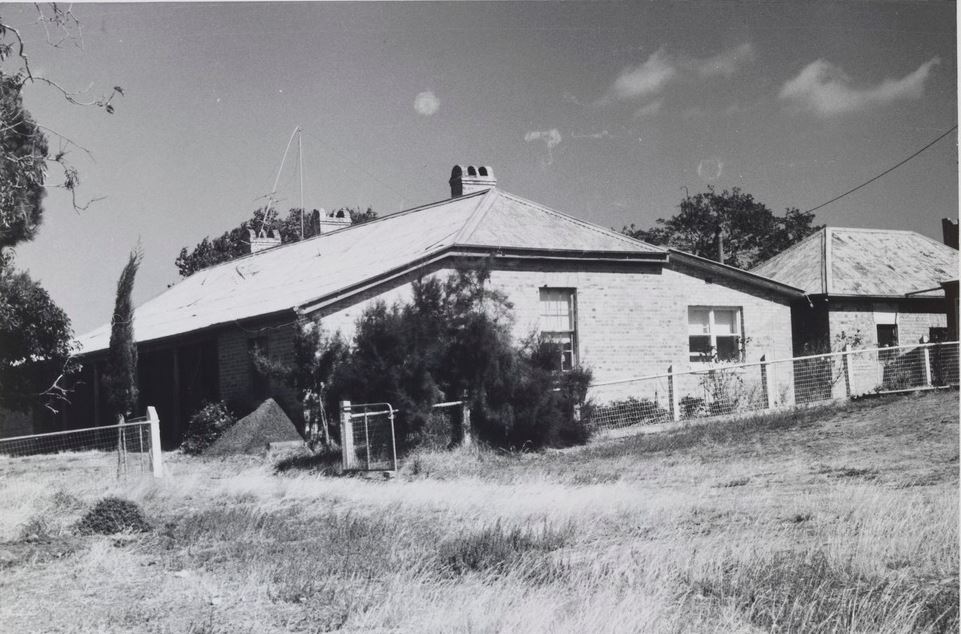
The homestead at Mullagh (below) was built around 1864, the year of John Cunningham Fitzgerald’s birth.
http://handle.slv.vic.gov.au/10381/232035

MULLAGH HOMESTEAD, HARROW. Image courtesy of the J.T. Collins Collection, La Trobe Picture Collection, State Library of Victoria. http://handle.slv.vic.gov.au/10381/232035

In 1893, John C. Fitzgerald married Eliza Anne Silvester.  They lived at Mullagh, with John taking over the running of the property from his father.  They eventually moved to Portland.  John was something of an amateur meteorologist and enjoyed contributing rainfall observations to the Portland Guardian. John and Eliza did not have any children.

COWLEY, Albion – Died 1 January 1951 at Tandarook South. Albion Cowley was born at Cowley’s Creek on 25 April 1878 and attended Cowley’s Creek State School. In 1904, he married Mary Ann Love, and in 1911, they moved to a property at Tandarook. Albion was an elder of the Jancourt Church and taught Sunday School there.  Mary Ann, three sons, and five daughters survived him.

DAVIS, Robert George – Died 21 January 1952 at Camperdown. Robert Davis was born at Scotts Creek around 1880 and lived there until he was twenty-one.  He then moved to Jancourt, buying property from the divided Jancourt Estate.  Robert married Emily Dunstone in 1905. He was a member of the Jancourt Presbyterian Church and was a correspondent for the Tandarook State School.  Robert remained at Jancourt until around 1951, when he retired from farming and purchased a property at Camperdown.

SILVESTER, Serena Owen – Died 26 January 1953 at Camperdown. Serena Silvester was born in 1867 at Camperdown to pioneers William Silvester and Harriet Owen. William Silvester built the second house in Cobden, then known as Lovely Banks.  Serena attended the Cobden State School.  In 1886, Serena married William Wilson.  The year before, her sister Patience married Samuel Monk (above). Serena was a congregation member of the Cobden Presbyterian Church and a member of the Ladies Auxiliary and the Presbyterian Women’s Missionary Union. William Wilson died in 1937.


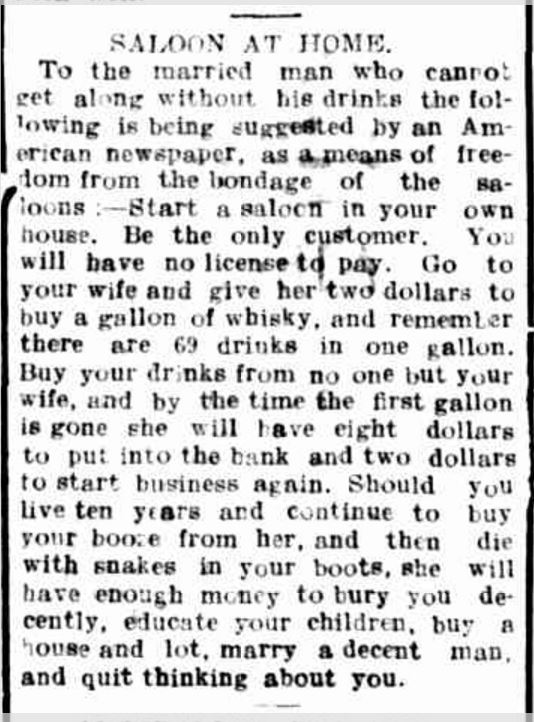
Trove Tuesday – Home Saloon

You’ve heard of home brew but what about a home saloon?  For some Hamilton wives with husbands never home until after 6.00pm, it may have seemed an attractive proposition with a good return.  This humorous article, taken from an American newspaper, was published in the Hamilton Spectator 100 years ago today.  It’s another example of the little treasures you find when you dig at Trove.

"SALOON AT HOME." Hamilton Spectator (Vic. : 1870 - 1873; 1914 - 1918) 12 Jan 1916: .

“SALOON AT HOME.” Hamilton Spectator (Vic. : 1870 – 1873; 1914 – 1918) 12 Jan 1916: <http://nla.gov.au/nla.news-article120409423&gt;.


Christmas Greetings

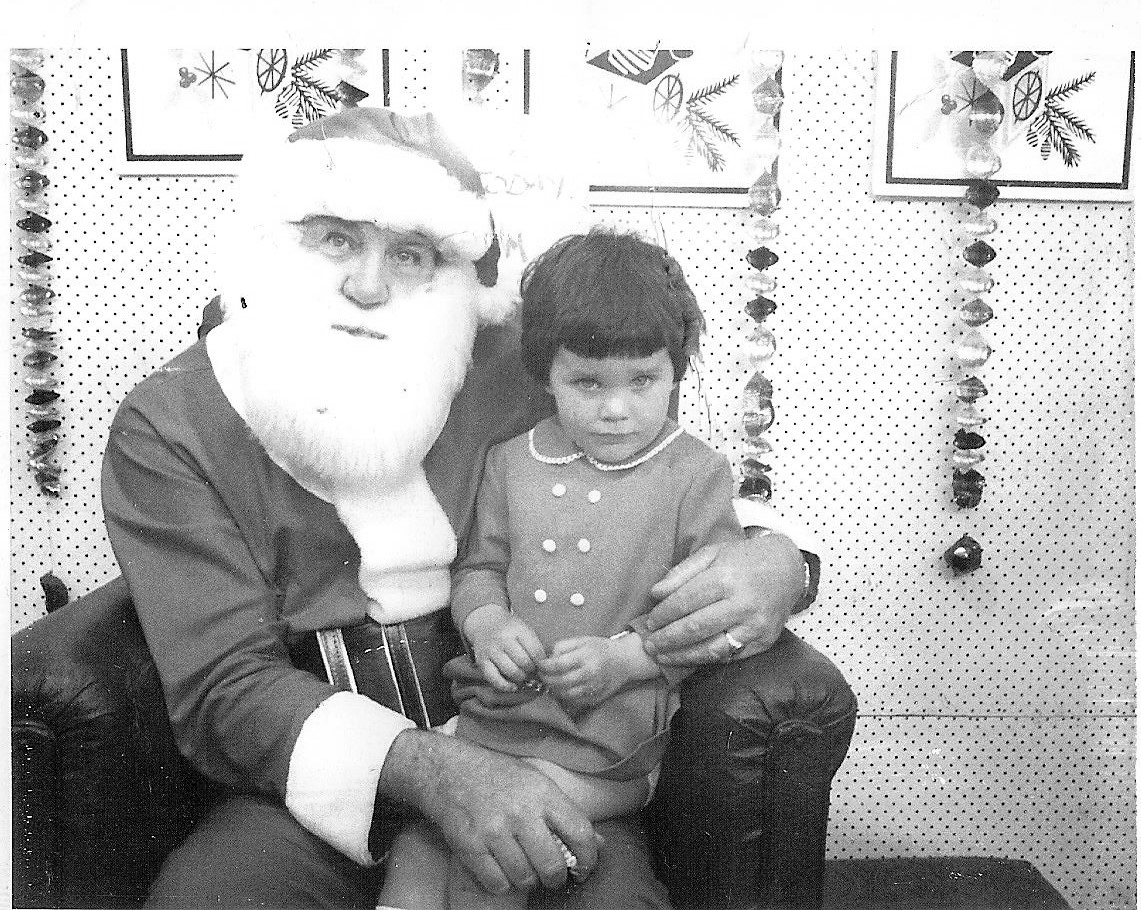
santa1

With the help of my two-year-old self and Santa, may I wish you a Merry Christmas.  Thank you for reading, following, liking and commenting throughout the year.  Your lovely feedback is always encouragement to keep Western District Families rolling along.

Over the past two weeks on the Western District Families Facebook page, I’ve posted my Western District Christmas series.  It was interesting to read the posts again, ranging from the 1850s to the 1950s and chart the changes in a Victorian Christmas over 100 years.  Also interesting were the societal changes and the highs and lows of each decade and how Christmas changed as a result.  When thinking about how your ancestors may have celebrated Christmas, considering such factors will give you a more realistic idea of what their Christmases were like.

Also noticeable was the rise of commercialism and the changes in the media’s focus on women and their portrayal of women. The arrival of the Australian Women’s Weekly is an example, with it projecting an image of the ideal homemaker.  At Christmas the pressure mounted for women to meet that idealised expectation as they stressed over recreating the Weekly’s suggested Christmas dinner menus.

If you would like to read a Western District Christmas 1850-1950, it is in two parts,  A Pioneer Christmas 1850s-1890s here and a Western Victorian Christmas here.  Each link opens with the most recent post first.  For Pioneer Christmas that is the 1890s and for WD Christmas, you will find two general Christmas posts followed by 1950s-1900.  If you scroll to the bottom of each page you will find the earliest posts to start reading.  They are best read from the 1850s to the 1950s to fully appreciate the evolving celebration of Christmas.

MERRY CHRISTMAS AND A HAPPY NEW YEAR

Trove Tuesday – Fancy Photos

For my Hamilton’s WW1 research, I’ve read many Hamilton Spectators from the war years online at Trove.  With all the doom and gloom the war brought to the newspapers of the time, articles like the following make me smile and remind me why I enjoy reading old newspapers.

"FANCY DRESS BALL." Hamilton Spectator (Vic. : 1870 - 1873; 1914 - 1918) 19 Nov 1915: 4. .

“FANCY DRESS BALL.” Hamilton Spectator (Vic. : 1870 – 1873; 1914 – 1918) 19 Nov 1915: 4. <http://nla.gov.au/nla.news-article120405630&gt;.

The title of the Fancy Dress Ball was “The Girls Who Stayed Home” as advertised in the Hamilton Spectator of 22 November 1915.  All proceeds were for the Local Wounded Soldiers Fund.

"Advertising." Hamilton Spectator (Vic. : 1870 - 1873; 1914 - 1918) 22 Nov 1915: .

“Advertising.” Hamilton Spectator (Vic. : 1870 – 1873; 1914 – 1918) 22 Nov 1915: <http://nla.gov.au/nla.news-article120405855&gt;.

The article, from the Hamilton Spectator of 19 November 1915,  jogged my memory and I was sure I had seen photos of the event while searching for illustrated newspaper articles about Hamilton at Trove.  Newspapers such as The Australasian, Table Talk and the more recent addition to Trove, Punch, had fantastic photos and they often included country social events.

Punch reported on the Ladies Fancy Dress Ball held in the Hamilton Town Hall on 22 November 1915 with great photos.  I’m always impressed with the detail put into fancy dress costumes 100 years ago and before. Once limited to images from books and newspapers, the rise of film in the 1910s, however, brought new inspiration.  That was evident at the Hamilton Fancy Dress Ball with Charlie Chaplin in attendance.

"HAMILTON LADIES' FANCY DRESS BALL." Punch (Melbourne, Vic. : 1900 - 1918; 1925) 23 Dec 1915: .

“HAMILTON LADIES’ FANCY DRESS BALL.” Punch (Melbourne, Vic. : 1900 – 1918; 1925) 23 Dec 1915: <http://nla.gov.au/nla.news-article138703780&gt;.

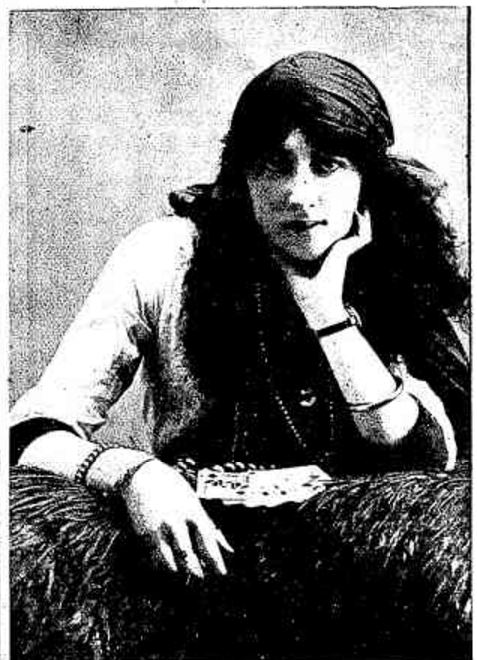
The portrait style photos are the real treasures and as names were provided, if lucky, you may find a family member.  This mysterious gipsy at the Hamilton fancy dress was Miss Eva Wright.

"HAMILTON LADIES' FANCY DRESS BALL." Punch (Melbourne, Vic. : 1900 - 1918; 1925) 23 Dec 1915: .

“HAMILTON LADIES’ FANCY DRESS BALL.” Punch (Melbourne, Vic. : 1900 – 1918; 1925) 23 Dec 1915: <http://nla.gov.au/nla.news-article138703780&gt;.

As predicted, a number of the ladies went dressed as gentlemen.  The following photos show three of those ladies.  Organisers were particularly vigilant on the night to make sure no cheeky men, pretending to be ladies dressed as men, did not pass through the doors.

"HAMILTON LADIES' FANCY DRESS BALL." Punch (Melbourne, Vic. : 1900 - 1918; 1925) 23 Dec 1915: 24. .

“HAMILTON LADIES’ FANCY DRESS BALL.” Punch (Melbourne, Vic. : 1900 – 1918; 1925) 23 Dec 1915: 24. <http://nla.gov.au/nla.news-article138703780&gt;.

The ladies above were from left: Miss Withers – “Tennis Boy”, Miss Eva Strachan “Middy” and Miss L. Meagher “Half-past two in the Morning”.  To read the full article with all the photos click here

Next time you are visiting Trove,  try a newspaper search for your family names and/or towns, but limit your search to the illustrated articles.  You may find a photo of your great-great-grandmother dressed as a pirate.  Now that would be a treasure.


Old Dunkeld Cemetery

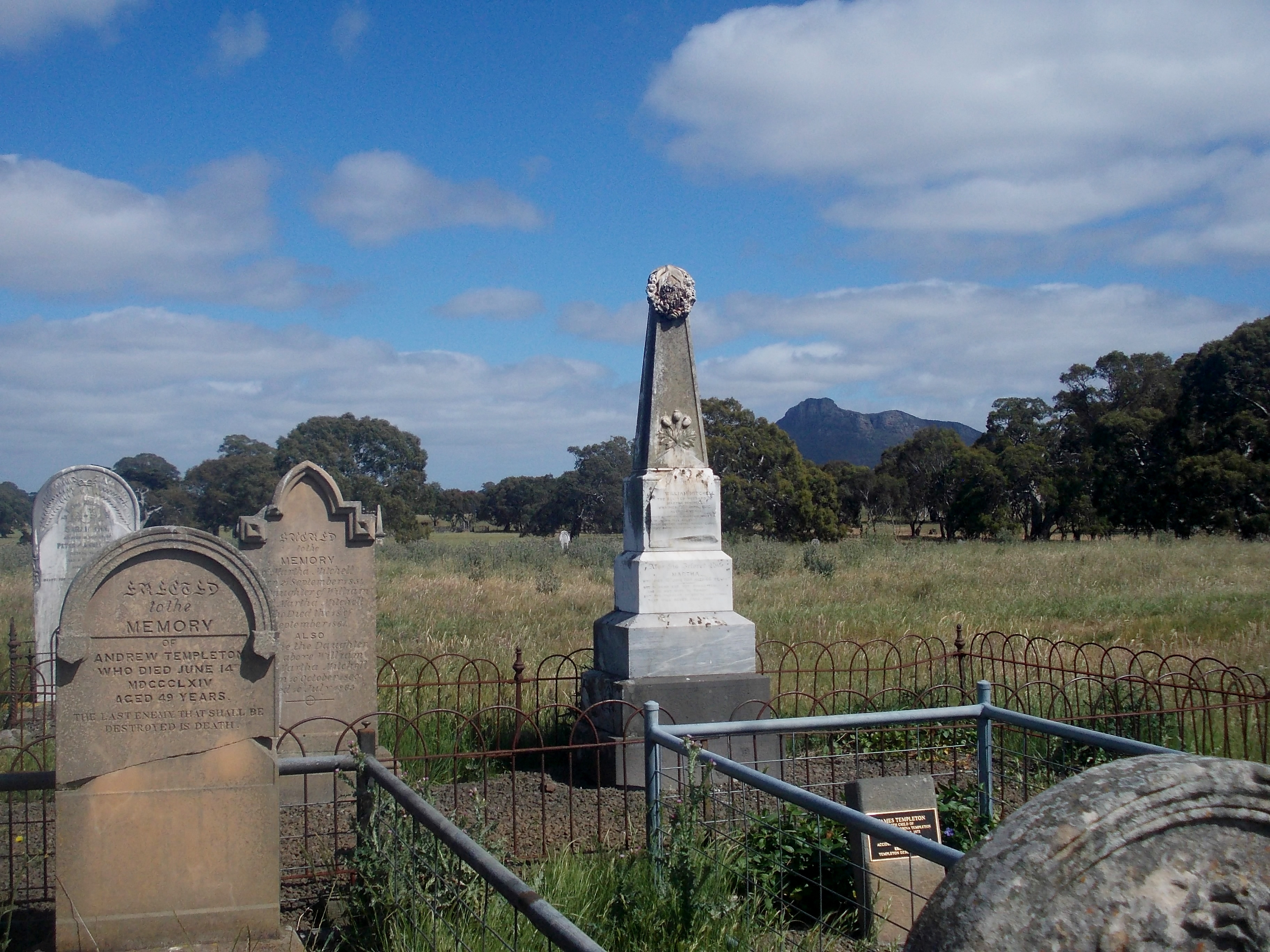
My favourite cemeteries have “old” in their title.  Arriving at the Old Dunkeld Cemetery, you soon see it lives up to its name.  Burials occurred here from 1858 through to 1903.

012

On a large allotment of ten acres, the remaining headstones stand in three main groups, Catholic, Presbyterian and Anglican, at distant points of the cemetery.  Looking at the Google Map at the bottom of this post you can clearly see the headstone groupings.

Just inside the gate, a welcome sign gives you an understanding that there are far more people buried here than the headstones suggest.  Not a good photo, but you can see the full list of burials at Ian Marr’s Cemeteries of SW Victoria site here.

013

Unfortunately, when I visited two weeks ago, I found the cemetery very overgrown.  Being in the middle of a warm spring and considering snakes like a cemetery just as much as I do, I kept to the track leading up to the rear of the cemetery where the Presbyterian section lies.

015

Dunkeld is a picturesque town, at the southern end of the majestic Grampians with endless views to the mountains.  You can’t beat the views at the cemetery either, particularly from the Presbyterian section.

016

020

021

I didn’t try to get to the Anglican section of the cemetery.  There were thistles everywhere.  I suppose if one weed was going to dominate in a cemetery where Scottish settlers rest, in a town with a Scottish name,  in the shadows of a mountain range also with a Scottish name, thistles are apt.

022

023

When snake season has passed, I hope to get back to the Old Dunkeld Cemetery to get some photos of individual headstones.

Old Dunkeld Cemetery – Victorian Heritage Database

Old Dunkeld Cemetery – Cemeteries of South West Victoria

Hamilton’s WW1 on Facebook

The “Hamilton’s WW1” side of Western District Families is growing all the time, although it mightn’t be obvious if you rely on a subscribers email or your RSS feed to notify you of a new post. As Hamilton’s WW1 and the Pioneer Obituary Index are set up a little differently than the main part of the blog, new content on those pages does not trigger an email or listing on your RSS feed, or show in the timeline you are reading this post from.

Until now, finding new soldier profiles meant you had to keep checking back at the site and then go through the lists of names on the “Hamilton’s WW1” tab at the top of this page.  Nobody wants to have to do that. To overcome the problem, somewhat, I have set up a Hamilton’s WW1 Facebook page to post soldier profiles as I write them.

I did consider posting new profiles to my Facebook group I’ve Lived in Hamilton, Victoria but not all members have an interest in military or family history.  Or I could have posted new profiles to my Western District Families page, but as the name suggest it covers the Western District and I didn’t want to have an overload of Hamilton content.


hww

An added extra for those who “like” the page is a daily “100 years ago in the Hamilton Spectator…” post to give us a feel of how life was in Hamilton and district during the war years.  The Hamilton Spectator was published six days a week during WW1, so on the seventh day I will  post other content relevant to Hamilton’s WW1.

After around three weeks, there is already a lot of content and thirty-eight “likes”, not too bad in a short space of time.  However, with Facebook’s mysterious algorithms used to decide how many people actually see each post, thirty-eight “likes” is not enough to ensure the stories of  Hamilton’s WW1 soldiers are not forgotten.

You can find Hamilton’s WW1 Facebook page here, or look for the link in the right-hand sidebar of this page.


In Broad Daylight

A few years ago, I wrote a post about the youngest son of Joseph Harman and Sarah Mulberry of Byaduk and formally of Melbourn, Cambridgeshire. “Alfred Winslow Harman – Stepping out of the Shadows” was so named because research for the post uncovered things about Alfred I hadn’t known.

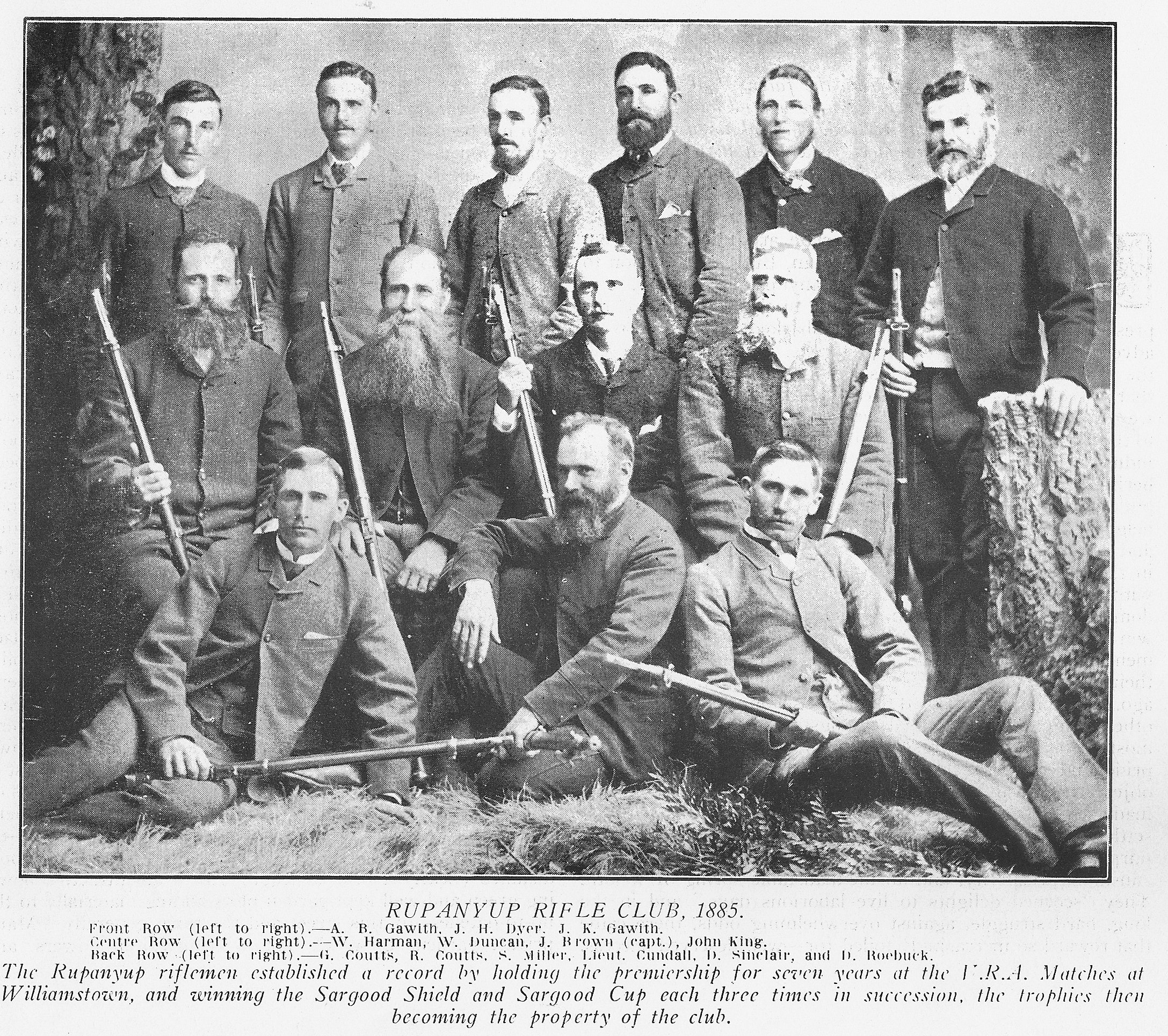
Finding a photo of Alfred was the next aim and I thought I had just one shot at it…a photo of the Rupanyup Rifle Team c1880-90.  Having seen their great Facebook page, I thought I would contact the Rupanyup Historical Society.  I soon heard back from Helen, the society’s Secretary. The society had a meeting the following evening and the President was an expert on the Sargood Shield.   That was great news as the Rupanyup Rifle Club had great success in the Sargood Shield, a highly prized annual competition between Melbourne and country Victorian teams. Alfred was captain of the team in 1886.

Helen came back to me after the meeting and finally I was able to see Alfred Harman, out of the shadows and in broad daylight.  Helen had emailed me a photo of the 1885 Rupanyup Rifle Club. Alfred is the middle row, first on the left in this photo of the 1885.  To give you some idea about where he was in his life,  he was thirty-three years old, married for seven years and father to a six-year-old son.  His brother-in-law Samuel Miller is in the back row, third from the left.  There are some impressive Hairy Mancestors among them.

Image courtesy of the Rupanyup Historical Society.

Image courtesy of the Rupanyup Historical Society.

Thank you so much to the Rupanyup Historical Society.  Please go and check out their wonderful Facebook page on the link – Rupanyup Historical Society Facebook Page.  It was there I found WW1 photos of Alfred Harman’s great-nephews Robert and George Cruikshank, my 2nd cousins, 3 x removed,  who grew up in Rupanyup.  I also found photos of members of the Loats and Starbuck families who had lived in the Muddy Creek area, near Hamilton, and with whom I have family links.


Passing of the Pioneers

Robert Laidlaw becomes the fifth member of the Laidlaw family included in the Pioneer Obituary Index.  Others this month include a man who left Portland at an early age but often returned for a visit and another who lived at beautiful Bridgewater all of his life.  And why not?

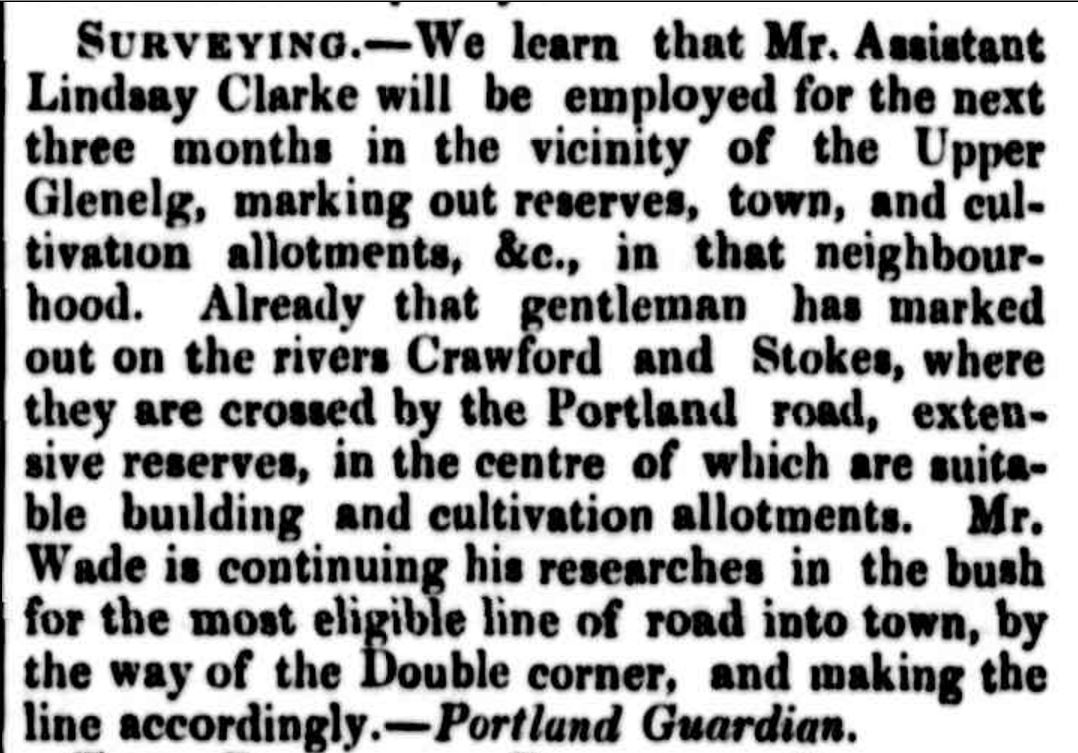
Lindsay CLARKE – Died 16 October 1891 at Portland.  Lindsay Clarke was born in Ireland in 1818 and at the age of sixteen began training as a surveyor.  He arrived in Sydney sometime after 1845 and Portland in 1848.  Lindsay’s role in Portland was as Assistant Government Surveyor.  By 1851, he had done much surveying around Portland and further north.

"PORTLAND BAY." The Cornwall Chronicle (Launceston, Tas. : 1835 - 1880) 15 Jan 1851: 26. .

“PORTLAND BAY.” The Cornwall Chronicle (Launceston, Tas. : 1835 – 1880) 15 Jan 1851: 26. <http://nla.gov.au/nla.news-article65575510&gt;.

Lindsay was promoted to District Surveyor for Portland, Hamilton, and Ararat and spent some time residing in Ararat.  In 1873, Lindsay moved to Hamilton after the closure of the Lands Office there, and he remained there for six years until his retirement in 1879.

Lindsay Clarke was on the committee of the Portland Benevolent Asylum and Hospital and was in the role of President for ten consecutive years.  He was also a member of the Portland Borough Council and declined the Mayoral role when it was offered to him.  Another role was Justice of the Peace acting as Bailiff for the Western area.  He would attend Portland Court (below) every court day to fulfill his role as bailiff.


PORTLAND COURT HOUSE. Image courtesy of the J.T. Collins Collection, La Trobe Picture Collection, State Library of Victoria. http://handle.slv.vic.gov.au/10381/47642

PORTLAND COURT HOUSE. Image courtesy of the J.T. Collins Collection, La Trobe Picture Collection, State Library of Victoria. http://handle.slv.vic.gov.au/10381/47642

Lindsay was also Superintendent of the Sabbath School at the Church of England, a member of the Bowling Club; and Horticulture Society.

Mary MARSDEN – Died 9 October 1909 at Cobden. Mary Marsden was born around 1833 and arrived in Victoria in 1854, living in Ballarat for around thirty years. Around 1887, she and her husband Roger Hirst settled in the Timboon district.  In her last years, Mary and Roger moved to Cobden where Mary died in 1909.

Robert LAIDLAW – Died 28 October 1914 at Beulah.  Born in Scotland in 1831, Robert Laidlaw arrived at Portland in 1851.  He spent time around the diggings before purchasing Lake Roy station near Naracoorte, South Australia.  He sold that property during the 1880s and retired to Geelong.  Two of Robert’s brothers, Thomas and Walter, have been Passing Pioneers in the past.

Richard BARNES – Died October 1915 at Hamilton.  Richard Barnes was born in South Australia around 1852.  He arrived in Penshurst as a child and remained there throughout his life.   Richard was well-known around Penshurst through his community activities.  He was a founding member of the Penshurst P&A Society, a trustee of the racecourse and the recreation reserve. For six years he was  a Councillor with the Mt Rouse Shire (offices below)

PENSHURST SHIRE HALL. Image courtesy of the J.T. Collins Collection, La Trobe Picture Collection, State Library of Victoria. http://handle.slv.vic.gov.au/10381/233458

PENSHURST SHIRE HALL. Image courtesy of the J.T. Collins Collection, La Trobe Picture Collection, State Library of Victoria. http://handle.slv.vic.gov.au/10381/233458

Richard was also known as the “father” of the Penshurst Boxing Day Racing Club and was President of the club for fifteen years.

James Frederick HILL – Died October 1935 at Essendon.  James Hill was born in Portland in 1852 where his father was Principal of one of Portland’s National Schools.  As a young man, James left Portland and obtained a job with the Chief Secretary’s Department.  Despite leaving Portland, he was a regular back to the town of his birth and was well-known by all.

Henry William OSBORNE – Died 20 October 1936 at Malvern.  Henry Osborne was born in 1865 near Amhurst in Central Victoria.  After a couple of newspaper jobs, Henry moved to Warrnambool working as a junior reporter for the Warrnambool Standard in 1886.  He was appointed Shire of Warrnambool secretary in 1898 and held that role for six years before resigning to take up the role of General Manager of the Western District Co-operative and Insurance Ltd.  The company grew under Henry’s management and his job also took him overseas.  In 1920, the Federal Government sent him overseas to negotiate the sale of Australia’s surplus butter.  He was selected to advise the Australian delegation at the Ottawa conference in 1932 and was a member of the Australian Dairy Producers’ Board.   There is an entry for Henry Osborne in the Australian Dictionary of Biography

John James KENNEDY – Died 20 October 1939 at Bridgewater.  The Kennedy family were early settlers at Bridgewater and John Kennedy spent his childhood days roaming the hills surrounding Bridgewater Bay and running on the sandy beach.

132 (2)

BRIDGEWATER BAY

John was born at Bridgewater around 1861 to James Kennedy and Margaret Lennan, and he lived there, following farming pursuits, for his entire seventy-eight years.  In 1939, three family members died at the Kennedy homestead on Blowholes Road overlooking the bay.  Along with John on 20 October, his brother Daniel died on 8 April and an aunt, Frances Ann Kennedy on 21 November.  More information about the Kennedy family and their homestead, now in ruins, is available on the link – Kennedy Family Bridgewater


What’s News?

While organising Western District Families new pages, the blog posts have been neglected.  So I thought I would give you an update on what’s happening at WDF and let you know of some family and local history events coming up in the Western District.

Hamilton WW1 Memorials

The Hamilton’s WW1 pages have had a boost with the addition of the WW1 Memorials of Hamilton.  Currently only outdoor memorials are included but I would like to move on to the various honour rolls around the town.  On each page, you can now view photos of the memorials and the names of those remembered.  If a soldier’s name is underlined on the any of the memorial pages, you can click on the name to read that soldier’s profile. The memorials are:

Anzac Avenue

Anzac Memorial Planting

Australian Light Horse Memorial

Clarke Street Memorial Avenue

Hamilton Sailors and Soldiers Father’s Association Memorial

Hamilton War Memorial

There are now forty-eight Hamilton soldier profiles available.  The most recent additions are Military Medal recipient, Arthur Percy Bell Underwood, along with Edgar Richmond Stevenson who was killed in Belgium on 4 October 1917.  His brother Alexander John Stevenson died of wounds eleven days later and I’m working on his profile.

025 (600x800)

AUSTRALIAN LIGHT HORSE MEMORIAL, HAMILTON


Facebook Happenings 

Western District Families’ Facebook page has now passed 1500 ‘likes’ which is well beyond my expectations.  It’s been great to connect with people who may not have found the blog otherwise.  I have also enjoyed the personal accounts that come when I post photos of Western District historic buildings and homesteads.  The interest in history is also great to see.

That interest is evident with the Facebook group I set up, I’ve Lived in Hamilton, Victoria.  It is going from strength to strength, now with close to 4,500 members.  We have thousands of photos of Hamilton’s past and great stories to go with them.  Even if you haven’t lived in Hamilton, but may have family links there, you are most welcome to join and ask questions.  There are many people willing to help answer questions about Hamilton’s past.

Links

I updated all the links on the Western District Families Links page recently so, fingers crossed, they are all working now.  If you find a link anywhere across the blog that doesn’t work, please feel free to contact me.  There are so many over the 300+ posts, it gets hard to keep track of them.

Pandora

It’s a privilege to have Western District Families now archived at Pandora, Australia’s web archive.  The National Library of Australia started Pandora and since its beginnings, the State libraries have joined in preserving websites with Australian content.  It was from the State Library of Victoria that I heard the news.  It’s reassuring to know that Western District Families will still be available for all to read into the future, even if WordPress disappears.

Mortlake Historical Society – Hatches Matches and Dispatches

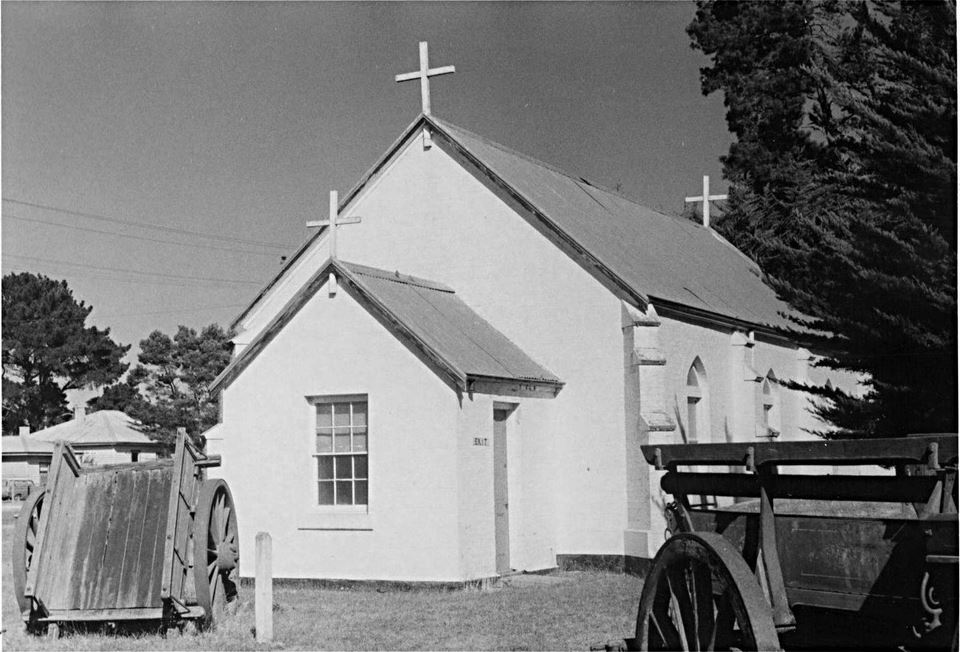
Join the Mortlake Historical Society on Sunday 18 October for a tour of Mortlake’s bluestone churches, such as the St. Andrew’s Presbyterian church (below).  More information is available on the Mortlake Historical Society’s Facebook Events page.  Give the society’s page a “like” while you are there and support one of the most active societies in Western Victoria.


mortlake presbyterian church

ST. ANDREW’S PRESBYTERIAN CHURCH, MORTLAKE, 1968. Image courtesy of the J.T. Collins Collection, La Trobe Picture Collection, State Library of Victoria. http://handle.slv.vic.gov.au/10381/232668

Horse Power

There are two memories I have when I pass the intersection of Hiller Lane and Ballarat Road in Hamilton.  The first is a fall from my bolting pony at the intersection in 1975, metres from the Hamilton Pastoral Museum fence on one corner of the intersection.  That’s were the other memory comes in.

The Hamilton Pastoral Museum was born in the same year as me, 1968, which is seems right because it’s where I first got the idea I liked history.  The museum is under 500 metres from where I grew up, so I used to walk or ride my bike up the road when the museum was open for a rally.

The little church below, was originally the St Luke’s Lutheran Church built in 1861.  One of the early pastors was Pastor C.G. Hiller, hence the name of the lane, and his manse still stands just across the road from the museum.  I remember when I first stepped inside the church, sometime around 1976, and was taken back to the district’s pioneer past with a collection of household objects and the like, all once common place but new to me. Outside the church, steam engines chugged and men in hats admired old tractors and farming equipment.  I loved it.


HAMILTON PASTORAL MUSEUM, 1974. Image courtesy of J.T. Collins Collection, La Trobe Picture Collection, State Library of Victoria. http://handle.slv.vic.gov.au/10381/229985

HAMILTON PASTORAL MUSEUM, 1974. Image courtesy of J.T. Collins Collection, La Trobe Picture Collection, State Library of Victoria. http://handle.slv.vic.gov.au/10381/229985

The Pastoral Museum collection has grown out around the church over the years and is a credit to the volunteers. In 2017, they will host the National Historical Machinery Association annual rally.

The museum holds three rallies each year with the next on Saturday and Sunday 17 and 18 October.  The theme of the weekend is Horse Power.  You can see heavy horses, a tractor pull, machinery demonstrations, a blacksmith and much more.  Further information is available on the Hamilton Pastoral Museum Facebook page.

While you’re there, less than 500 metres on from the museum is the Hamilton South Lutheran cemetery on the Chatsworth Road.  It’s also well worth a visit, especially to see the impressive Noske family vault.

Terang Historic Homes 

As part of History Week 2015, on 25 October from 1:00pm you can take part in an a self-guided walk/drive of Terang’s historic homes including Keayang, below.  More details from the Terang & District Historical Society website.  They also have a Facebook page, so drop by and give it a “like” – Terang & District Historical Society Facebook page.

"KEAYANG", TERANG.  Image courtesy of J.T. Collins Collection, La Trobe Picture Collection, State Library of Victoria. http://handle.slv.vic.gov.au/10381/234524

“KEAYANG”, TERANG. Image courtesy of J.T. Collins Collection, La Trobe Picture Collection, State Library of Victoria. http://handle.slv.vic.gov.au/10381/234524

Mt Rouse Historical Society, Penshurst – Open day 

The Mt. Rouse Historical Society at Penshurst is another active Western District society.  On Saturday 24 October, the society is holding their spring Open Day.  There will be memorabilia from the Penshurst Butter Factory, historic maps, photos and histories.  Also, you can take part in a guided tour of the historic town and have chance to win a society membership. For more information, go to the Mt Rouse Historical Society, Penshurst Facebook page.  Give them a “like” too.

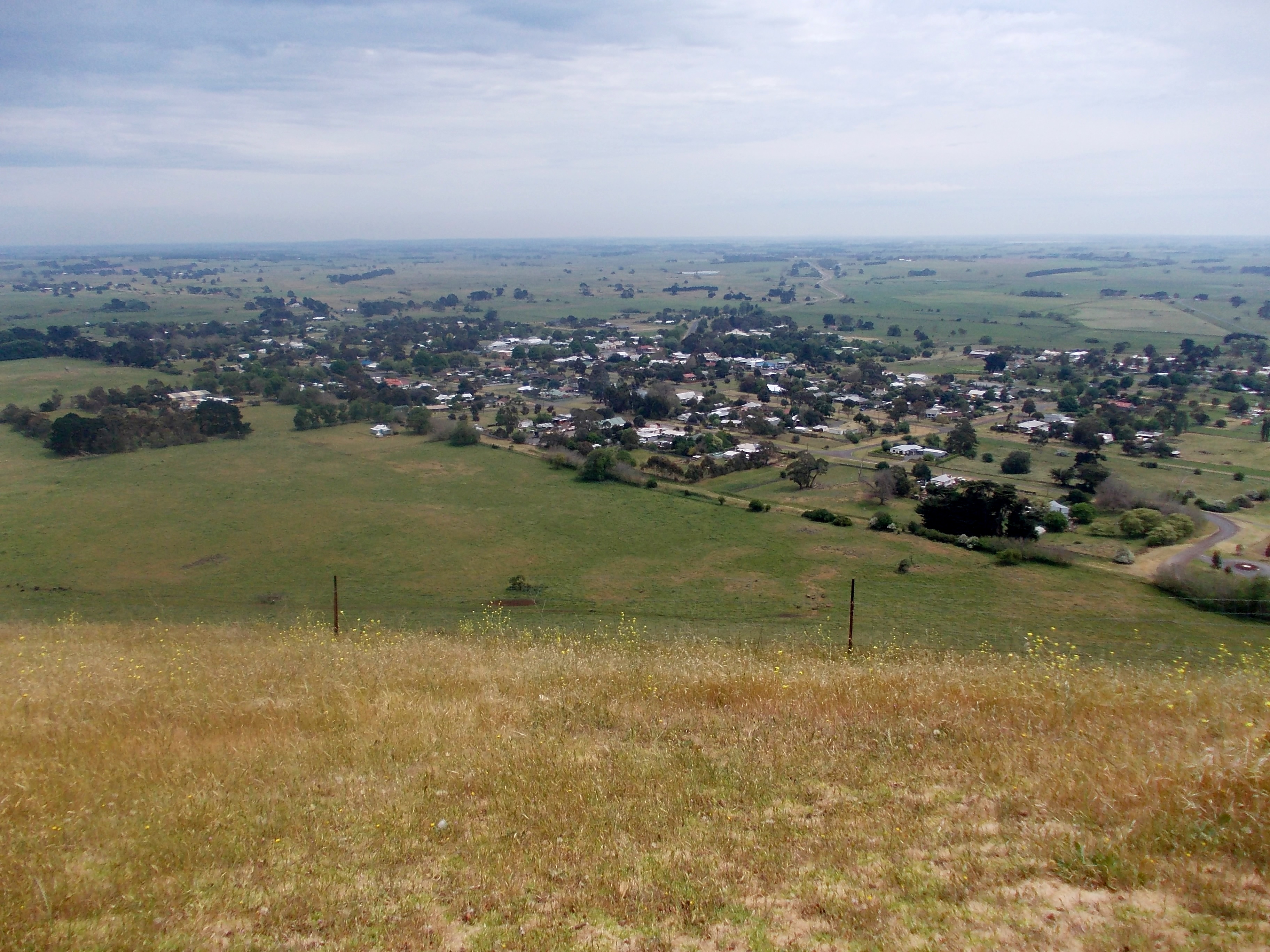
While in Penshurst take a trip to the top of Mt. Rouse and wonder at the beautiful landscape.  In one direction you will see the Grampians, in another Mt. Napier one of the district volcanoes.  And if you want to know more about the volcanoes, Penshurst is also home to the Volcano Discovery Centre, another great place to visit.

LOOKING OVER PENSHURST FROM MT.ROUSE.

LOOKING OVER PENSHURST FROM MT.ROUSE.

Unlock the Past Horsham Seminar

Exciting news for family history researchers of Western Victoria, especially those researching their German heritage.  Unlock the Past are holding a seminar in Horsham on 31 October with a focus on German, English and Australian research.

I’m sure there are many of you with Western District family links who also have some German heritage.  Many German immigrants travelled from South Australia to Western Victoria settling at places such as Tabor and Hochkirch (Tarrington).  Living in Hamilton, German surnames are common place and its sad to consider what the grand-parents and great-parents of Hamilton’s German descendants endured during of WW1.  The WW1 profile of Bernard Herrmann gives evidence of that.  His mother Caroline, born in Australia of German parents, sent three sons to fight for the British Empire, with one, Bernard never to return.  Yet at home in Hochkirch and surrounding settlements,  Caroline and others of German descent were suffering shocking persecution, including a change in the name of Hochkirch to Tarrington in 1918.

ST. MICHAEL'S LUTHERAN CHURCH, TARRINGTON. Image Courtesy of the J.T. Collins Collection, La Trobe Picture Collection, State Library of Victoria http://handle.slv.vic.gov.au/10381/234372

ST. MICHAEL’S LUTHERAN CHURCH, TARRINGTON. Image Courtesy of the J.T. Collins Collection, La Trobe Picture Collection, State Library of Victoria http://handle.slv.vic.gov.au/10381/234372

The Unlock the Past seminar in Horsham is a great chance to hear two experts, Eric and Rosemary Kopittke, speak on the subject of German research. And what a bargain. A $20 fee includes a two-course lunch, morning and afternoon tea.  I’ve been to an Unlock the Past event and had a great time.  They are professionally organised and lots of fun, you might even win a prize. For more information and the full seminar program, go to the Unlock The Past website.


Passing of the Pioneers

A small group of Western District pioneers join Passing of the Pioneers this month.  Among them are immigrants from Scotland, England, and Canada, and, as usual, each has an interesting story. Their names have now been added to the Western District Families Pioneer Obituary Index.

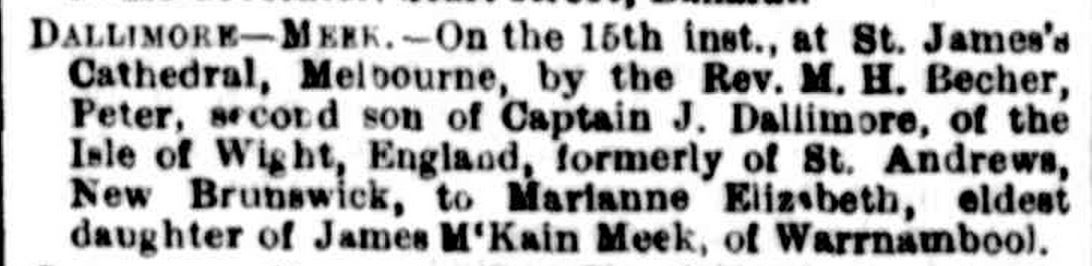
Peter DALLIMORE – Died September 1901 at Warrnambool.  Peter Dallimore was born in New Brunswick, Canada around 1842.  His father Captain Joseph Dallimore was born at the Isle of Wight in 1805.  He went to North America and married Mary Smith of Philadelphia.  They settled at St. Andrews in Charlotte County, New Brunswick, Canada where Peter was born in 1842.  In 1850, Mary Smith died.  Peter arrived in Australia and went to the Warrnambool district in the late 1860s.  He married Marianne Meek on 15 March 1870 at St. James Cathedral in Melbourne.

"Family Notices." The Argus (Melbourne, Vic. : 1848 - 1957) 19 Mar 1870: .

“Family Notices.” The Argus (Melbourne, Vic. : 1848 – 1957) 19 Mar 1870: <http://nla.gov.au/nla.news-article5815488&gt;.

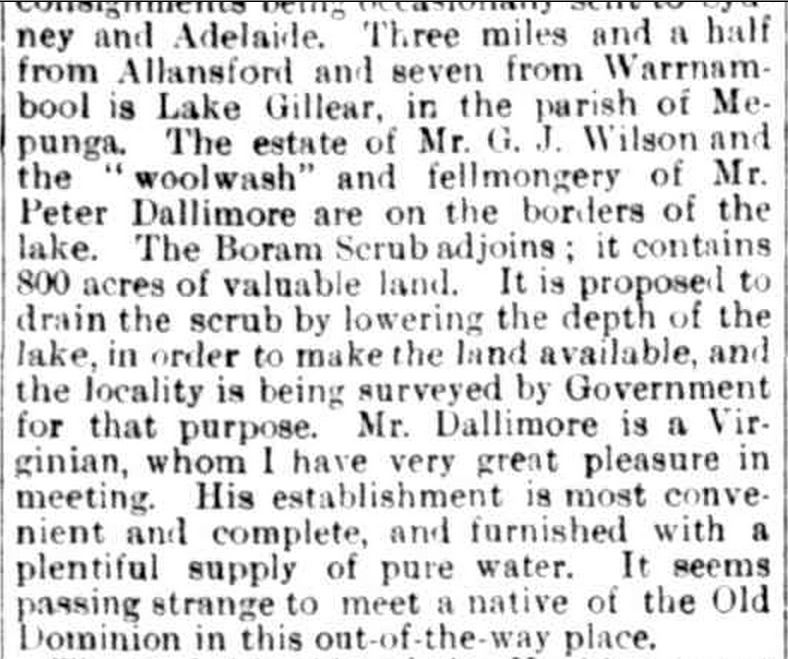
Peter set up a wool-scouring business on the banks of Lake Gillear near Allansford.

 "[No heading]." Hamilton Spectator (Vic. : 1870 - 1873; 1914 - 1918) 21 Dec 1870: 1. .


“[No heading].” Hamilton Spectator (Vic. : 1870 – 1873; 1914 – 1918) 21 Dec 1870: 1. <http://nla.gov.au/nla.news-page22231123&gt;.


In 1876, father  Joseph Dallimore arrived in Victoria aboard the Macduff.  He died at Warrnambool in 1878 and was buried at the Warrnambool Cemetery.

In 1884, when journalist The Vagabond was touring Victoria, he called in on Peter Dallimore.  I  feel that he may have crossed his wires, thinking Peter was a “native of the Old Dominion”…Virginia. Peter was from Charlotte County in New Brunswick in Canada.  There is also a Charlotte County and a Brunswick in Virginia and no doubt Peter had a North American accent further confusing The Vagabond.

"PICTURESQUE VICTORIA." The Australasian (Melbourne, Vic. : 1864 - 1946) 10 Jan 1885: 43. .

“PICTURESQUE VICTORIA.” The Australasian (Melbourne, Vic. : 1864 – 1946) 10 Jan 1885: 43. <http://nla.gov.au/nla.news-article137597580&gt;.

Peter Dallimore was buried in the Warrnambool Cemetery with his father and wife.  I have the Cemeteries of the S.W. USB that includes the Warrnambool Cemetery and a photo of the Dallimore headstone.  It is very informative and includes a memorial to Peter’s mother and all dates and places of birth.

George MARRINER – Died 7 September 1911 at Colac.  George Marriner was born in Fulham, London around 1833 and arrived in Australia around 1857. George was a nurseryman and established the Fulham Nursery in Colac.  He was also a founding member of the Colac I.O.O.F. In 1908, George’s wife Elizabeth was sitting by the fire in their home when her clothing caught alight.  George, in his mid-seventies, returned to the room and tried to douse the flames but to no avail.  Elizabeth died from her burns.  At the time of George’s death, he had three sons and a daughter.

Thomas STAINSBY – Died 26 September 1914 at Warrnambool.  Thomas Stainsby was born in Melbourne in 1848.  He went to Warrnambool and worked as a bootmaker and lived on Raglan Parade.  Thomas took a keen interest in all sports in Warrnambool but cycling and pedestrianism were his preferred sports and he was a handicapper for both.  He was also a sergeant in the Volunteer Militia and was involved with the Church of England men’s society.  Thomas had a shop in Fairy Street, Warrnambool, and rode his bike each day from his home in Raglan Parade.  On the morning of his death, he rode to work as usual but on his return home around lunchtime, he collapsed off the bike and died soon after.  As two of Thomas’ sons were members of the Warrnambool Brass Band, the band did not play at the Saturday afternoon football or the evening pictures on the day of Thomas’ death.

Ellen MAY – Died 27 September 1914 at Ecklin South.  Ellen May was born in Berkshire in 1834.   She arrived in Australia in 1857 aboard the Sir William Fyre and in 1860 she married George Rodgers at Ballarat.  Their first child was born at Smythesdale in 1861.  During the early years of their marriage, George tried gold mining around the Haddon area and operated a grocers at Speciman Hill.  Eventually, they selected land in the Heytesbury forest, near Cobden and named their property Sunny Banks.  Ellen and George had seven children and one of those, Ellen Matilda Rodgers married my 1st cousin 4 x removed, Arthur John Harman, in 1891.  Arthur was a son of Jonathan Harman.

John Hutchinson MURRAY – Died 23 September 1935 at Glenthompson.  John Murray was born at Brighton in 1873 to William Murray and Harriett Hutchinson.  William Murray was the owner of Brie Brie near Glenthompson and had resided there since 1869, breeding fine Merino sheep.  When John was twenty-two, he built a golf course at Brie Brie, after playing the game in Scotland. It was one of the first private golf courses in Victoria.

John Murray was also a keen student of Australian History and had many books on the subject.  He was also interested in the history of Brie Brie with Sir Thomas Mitchell having passed over the same land while exploring Western Victoria in 1836.  In 1909, when that part of Brie Brie was sold off, John removed a tree that one of  Mitchell’s party had marked.  He was concerned bushfires would eventually destroy the tree and history would be lost.  He donated the trunk to the town of Hamilton as a public memorial.  The trunk was positioned in the Hamilton Botanic Gardens with a pair of whale bones.  The display was removed in 1984.  John was buried in the private cemetery at Brie Brie along with his parents and other owners of the property.  More about the Major Mitchell tree trunk is on the following links:      http://nla.gov.au/nla.news-article10702602     http://vhd.heritagecouncil.vic.gov.au/places/1871/download-report

James Patrick DEVLIN – Died 4 September 1942 at Portland.  James Devlin was born at Cape Bridgewater in 1858.  He first worked for John Thomas Edgar at Kadnook near Harrow, then moved to Edgar’s station Thackaringa near Broken Hill.  At Broken Hill, James caught the mining bug and prospected first at Broken Hill and then Kalgoorlie where he spent thirty years.  He was manager of several different mining ventures while in Kalgoorlie.  James was also associated with Sir Sidney Kidman, possibly during their time in Broken Hill, and was good friends with Thomas Browne aka Rolf Boldrewood, author of “Robbery Under Arms”.  In 1891, James married a Portland girl Kate Duffy and they had two children.  In 1908, James returned to Portland residing in a property at North Portland until his death.

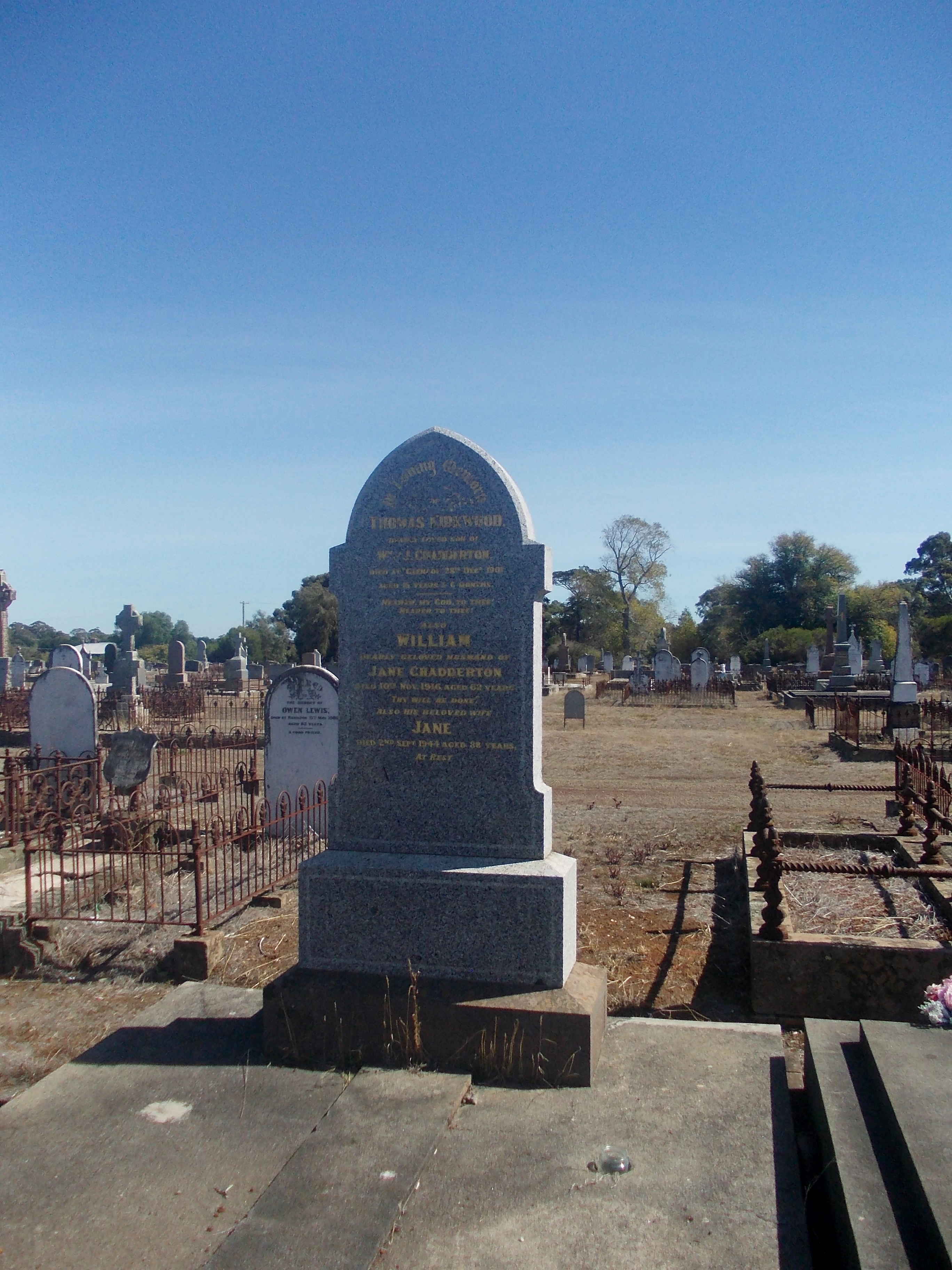
Jane KIRKWOOD – Died 2 September 1944 at Hamilton.  Jane Kirkwood was born at Hamilton in 1856, the daughter of  Scottish immigrants, William Kirkwood and Jane O’May.  The Kirkwoods lived at Buckley Swamp.  In 1885, Jane married William Chadderton and they settled at Glencoe near Bochara.  William was a renowned breeder of Jersey cattle.  After William’s death in 1916, Jane moved into Hamilton to live until her death in 1944.  She was buried at the Hamilton Old Cemetery.

Kirkwood4

GRAVE OF JANE CHADDERTON (nee KIRKWOOD), HAMILTON OLD CEMETERY


Jessie Cairns SPALDING – Died 25 September 1944 at Cobden.  Jessie Spalding was born in Scotland in 1861.  As a baby, she travelled with her parents to Australia, arriving at Geelong.  They then went on to the Ballarat diggings.  From her time at Ballarat, Jessie recalled the visit from the Duke of Edinburgh in 1867 as depicted in the engraving below.

Samuel Calvert, engraver. Image Courtesy of the State Library of Victoria. http://handle.slv.vic.gov.au/10381/235332

Samuel Calvert, engraver. Image Courtesy of the State Library of Victoria. http://handle.slv.vic.gov.au/10381/235332

When Jessie was eighteen, she moved to Camperdown where she met Thomas Fletcher.  They married and raised a family of ten children.  One son was killed fighting during WW1.  At the time of her death, Jessie had thirty-five grandchildren and forty great-grandchildren.