Trove Tuesday – From the Heart

Not only do I have Western District families, but I also have West Gippsland families.  The Combridges, Hunts and Whites resided around Grantville and Wonthaggi.

My great-great-grandfather was Culmer Thomas White, born in Thanet, Kent, England in 1857.  Culmer descended from the Culmer and White families, well-known in Kent for their boat building businesses at Broadstairs.  The two families came together around 1714 when John White married Mary Culmer.  Culmer’s father, great grandfather and gg-grandfather were all named Culmer White.  There are several other Culmer’s including my gg uncle Culmer William White and William Culmer White, Culmer’s 2nd cousin 1 x removed, who also immigrated to Melbourne, and his son Culmer Reuben White.

Almost everything I have found in the newspapers about Culmer Thomas White has been a treasure.  None more so than this heartfelt letter written to Reverend Henry Howard in 1927 which was then passed on by the Reverend to the West Gippsland Gazette.  Culmer was 70 at the time of writing.

Rev. Henry Howard. (1927, July 5). West Gippsland Gazette (Warragul, Vic. : 1898 – 1930) , p. 1 Edition: MORNING.. Retrieved September 30, 2012, from http://nla.gov.au/nla.news-article68643758

It is a touching letter as Culmer gives his thanks to Reverend Howard, shows his pride in his children, and expresses his feelings at that time in his life, happy but at times lonely.

Culmer’s wife, my great great grandmother, was Alice Elizabeth Hunt, daughter of  William Henry Hunt and Margaret Beatty, immigrants from Middlesex, England.  Alice was born at Chilwell, Victoria in 1857.

Culmer died in 1938 at Wonthaggi and Alice in 1940 at Bass.  They are buried together at the Grantville cemetery.

Culmer and Alice’s youngest child, Myrtle Rose White, married Les Combridge in 1919.  They had five children, four daughters, and one son.  One of those daughters was my Grandma, Mavis Combridge, later to marry Percy Riddiford.

Grandma passed away in 2007, but I did get to ask her about her grandparents Culmer and Alice, prior to her death.  She told me the story of how she and her three younger sisters would stay at their grandparent’s house.  Culmer would pick them up in a horse and cart and they would sit in the back as he drove them to his house.  He was a “lovely man” according to Grandma.  As is the way, there is still so much I would like to ask her about them.

I am very lucky as I still have a living link to Culmer and Alice, via my great Auntie Jean.  I have also spoken to her about her grandparents and she reiterated Grandma’s words that Culmer was a “lovely man”.  When I found this letter, I printed it out and sent it to Auntie Jean. She was thrilled.  I have sent her some of the other articles I have found about him and she has enjoyed being taken back in time.  I wish Grandma could have seen this wonderful letter.

Trove Tuesday – A Whale of a Time

I stumbled across this little gem only because it shared a page with an article I believe is about the sister of my ggg grandmother Ellen Barry.  That article from The Argus of June 1, 1849,  mentions Mary Walker, the married name of Mary Barry.  Why do I think it is about my Mary Walker?  Aside from the fact she was living in Melbourne then, the article is under the heading “Police Office” with Mary and another woman described as “two notorious termagants”.  My Mary Walker caused an immigration agent to lose his bounty on her, thanks to her disruptive behavior on the voyage from Ireland to Port Phillip.

As I rolled my eyes at possibly another discovery of a misdemeanor by one of the Barry girls, I noticed this little snippet two columns over.

Domestic Intelligence. (1849, June 1). The Argus (Melbourne, Vic. : 1848 – 1956), p. 1 Supplement: Supplement to the Argus.. Retrieved September 23, 2012, from http://nla.gov.au/nla.news-article4765656

Great news for the whales! At last, their winter home in the seas off the south-west of Victoria was safe to visit again.  Whaling was a huge industry at both Portland and Port Fairy with Portland’s first whaling station established in 1833 and  Port Fairy’s in 1835. By the 1840s, few whales existed and whaling was no longer considered commercially viable and the whaling stations closed.

As the article notes, by the end of the 1840s, whales were appearing again.  Today, their descendants visit the waters of Warrnambool, Port Fairy, and Portland and have become a huge boost to tourism during the colder months.  Warrnambool particularly has benefited from whale watching, however this year the main attractions have made only brief visits, preferring Port Fairy, with daily sightings close to shore of up to 13 whales.   Portland too has had whales and over the past few days, a whale and her calf have been off the breakwater, oblivious to the slaughters over 170 years ago.

Trove Tuesday – The Huntress

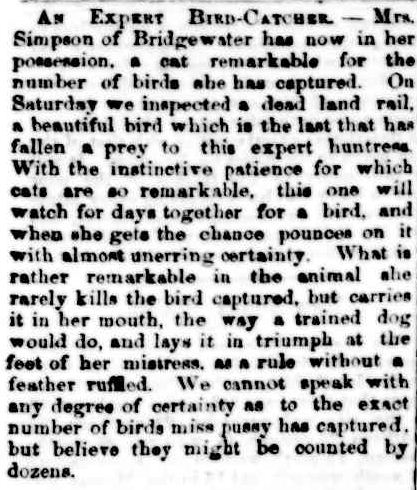
This week’s Trove Tuesday article from the Portland Guardian and Normanby General Advertiser is not an enjoyable read, but it is a reminder of the changes in attitude towards our environment and the creatures that inhabit it. In 1867, a bird hunting cat was a thing to celebrate but remember this was a time when sparrow matches and other bird shooting was popular, so please think no less of Mrs Simpson of Bridgewater.  The poor bird involved was a “land rail bird”, most likely the endangered Lewin’s Rail, a small native water bird found in the south-west of Victoria.

AN EXPERT BIRD-CATCHER. (1867, September 23). Portland Guardian and Normanby General Advertiser (Vic. : 1842 – 1876), p. 6 Edition: EVENINGS.. Retrieved September 9, 2012, from http://nla.gov.au/nla.news-article64638792

Trove Tuesday – Life Expectancy

North-west Victorian residents may have felt slightly uneasy after reading the following article from the Kerang Times and Swan Hill Gazette of July 3, 1883.  With 28 years being the average length of life and one person dying somewhere in the world every second, who could blame them.  We shall refrain from questioning the data collection methods used to calculate the guesstimates, sorry estimates

Average Duration of Human Life. (1883, July 3). Kerang Times and Swan Hill Gazette (Vic. : 1877 – 1889), p. 4. Retrieved September 10, 2012, from http://nla.gov.au/nla.news-article65584044

Trove Tuesday

What a great success Trove Tuesday was.  If you would like to see all the posts from last week, go to Amy Houston’s blog  Branches, Leaves, and Pollen.

For the purpose of Trove Tuesday, I have decided to work through some of the “tags” I have at Trove.   I tag a lot of articles for no other reason than I find them interesting.  As a result, I have a lot of tags.  It is a type of online hoarding.  I can’t get rid of them because you never know when I might need them.

So, along with posting them here, I have created a list at Trove entitled “Miscellaneous“.  Like I need another list, but I do find them useful for certain types of information gathering. Tags are great for others such as collecting obituaries for the monthly Passing of the Pioneers.   Importantly, I am going to put a note on each list entry about the subject of the article so I can easily find them again when I view the list.  That is a tip from my upcoming book “Learning the Hard Way”.

As I have used Trove pretty much from the beginning, I have forgotten a lot of the articles such as the one I have chosen this week.  I had tagged it with “Bochara sleepwalking shearer 1876”.  Understand why I need to do some work on my tags? Bochara is just out of Hamilton.

COUNTRY NEWS. (1876, December 14). The Argus (Melbourne, Vic. : 1848 – 1956), p. 7. Retrieved August 30, 2012, from http://nla.gov.au/nla.news-article5912477

Trove Tuesday

a collection or store of valuable or delightful things

(Oxford Dictionary)

No better words could be used to describe the National Library of Australia’s Trove website.  If you have read a few of my posts, you would know I’m a big Trove fan.    A recent post by Jill Ball at her blog Geniaus, mentioned an initiative by Amy Houston which interested me.  Amy on her blog Branches, Leaves, and Pollen, told how she too is a fan of Trove and invited Australian bloggers to join her on Tuesdays each week to blog about the treasures we have found at Trove.

I have many Trove treasures and a lot of my blog posts are about those.  At first, I thought I would not take part merely because I didn’t think I could choose just one a week.    Where would I start?  That is much like asking me to name my favourite book or film of all time.  I just can’t do it.  But, as Amy suggests the treasure doesn’t always have to be about a family member it could be anything of interest.

I can do that.  How often have you found a newspaper article about a family member, only to find the article, above, below, or beside just as interesting?  I’m into advertisements too and I always read them.  There are some absolute gems, so expect to see some of those on Tuesdays.

Due to time constraints this week, I thought I would begin with a recap of some of my posts that highlight the benefits of Trove to family historians, particularly the digitised newspapers.   Without the newspapers, there is much that I wouldn’t know about my ancestors. Even hours of record searching couldn’t unearth what I have found.

In fact, the papers lead me to the records.  Whether it is records from courts or cemeteries, sporting clubs or churches, Trove has led me there.  Not only is it a time-saver, many of the leads I have found come from places I would never have thought of searching.

These are some of my treasures to date:

Witness for the Prosecution – The story of three of my relatives who were witnesses in murder trials.  I believe two of those stories, that of my ggg grandmother Margaret Diwell and my grandfather Percy Riddiford, would have remained hidden if it wasn’t for Trove.

Alfred Winslow Harman – Stepping out of the Shadows – I knew little about Alfred Harman before I starting an intensive search for him in the Trove digitized newspapers.  Now I know so much more.

Nina’s Royal Inspiration – The story of Nina Harman and her carpet really is delightful.  As Nina is not a close family member, I possibly would not have known this story without finding her direct descendants.  Instead, I found it in a Women’s Weekly at Trove!

To Catch a Thief – Ordinarily,  to find Jim Bishop’s brush with the law, I would have had to search the Branxholme Court Registers held at PROV‘s Ballarat Archives Centre.  Not too hard, but with so many people to research and so many towns on the Victorian court circuit, it may have been a long time before I found it.  Thanks to an article in the Border Watch, that time in Jim’s life is now known to me.

All Quiet By the Wannon – The Mortimer family of Cavendish kept to themselves.  Articles I found at Trove finally gave my ggg James Mortimer a voice.

Mr Mortimer’s Daughters Another Mortimer puzzle solved thanks to Trove.  From Henry Mortimer’s death notice in the Portland Guardian, I was able to establish the married name of one daughter and the second marriage of another daughter.

There is a list of Western Victorian newspapers available at Trove on my Links page.

Don’t forget there are other great treasures that can be found while searching at Trove.  Look beyond the newspaper matches as you never know what might come up in the other categories.  I have found photos of family members and some great early photos of Western Victorian towns while searching.  Trove is also great for tracking down books.

I will try to post something each Tuesday.  Thank you to Amy for the idea and I hope other Australian geneabloggers get involved too.

Show us your treasure and celebrate Trove!