Passing of the Pioneers

The September “Passing of the Pioneers” in the Portland Guardian saw several prominent Western Victorian residents pass away and two of my own relatives.

Richard LEWIS: Died September 1890 at Digby.  Richard owned some well-known stations in the Western District including Rifle Downs and Hilgay.  An excellent biography of Richard Lewis is on the Ballarat Genealogical Society website. Richard died as a result of Bright’s disease.

Samuel CROSSDied 4 September 1901 at Hamilton. Samuel was seventy-nine at the time of his death and had been in Australia since 1849 after travelling from Sussex, England. He worked in and owned, department stores including the Beehive Store in Hamilton.  In his later years, he was a librarian at the Hamilton Mechanics Institute.

Jacob THEISINGER: Died 13 September 1901 at Portland. Jacob, also a sufferer of Bright’s Disease, had been in the colony since around 1854.  He was a popular person around town and was a member of the Portland German Band.

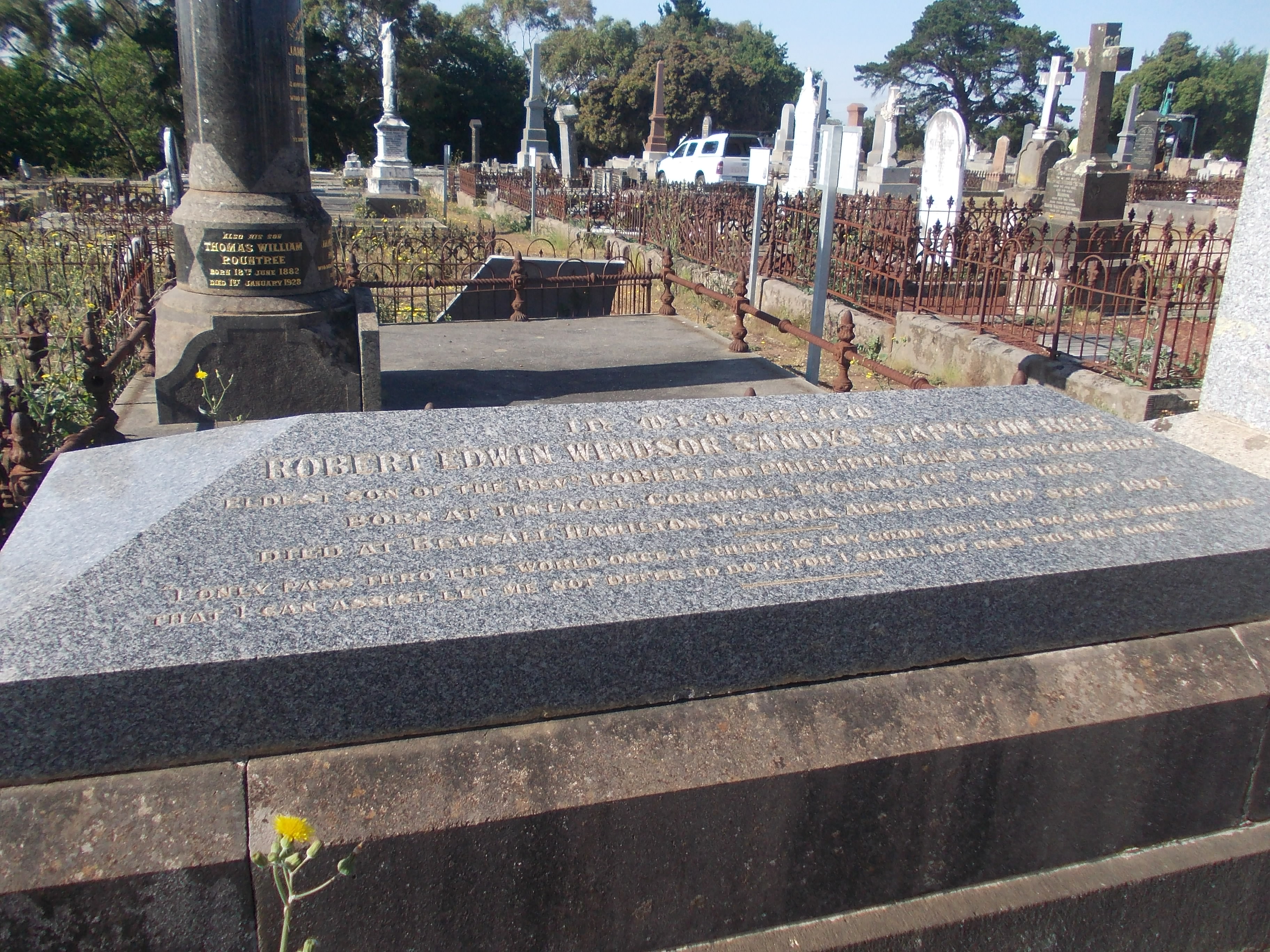
Robert Edwin Windsor Sandys STAPYLTON-BREE: Died 17 September 1907 at Hamilton. Robert Edwin Windsor Sandys Stapylton-Bree was a Hamilton stock and station agent and well know identity not only in Hamilton but also in Portland.  He married the daughter of Stephen HENTY, Annie Maria.  His funeral was well attended with Dean Parkyn presiding over the service.  He and Archdeacon Hayman had motored the 119 mile trip from Ballarat in five hours.
Christina STEWART: Died September 1921 at Hamilton. Christina STEWART was born in Kingussie, Scotland in around 1825 and travelled with her husband, Duncan McPherson, to Australia in 1851 onboard the Hooghlly.  While Duncan went off to the goldfields, Christina waited in Melbourne until they journeyed to Portland.  For a time, she and her husband ran the Dartmoor Hotel.  She was a mother of eight children.

Elizabeth GLADSTONE: Died 18 September 1925 at Millicent, South Australia.  Elizabeth Gladstone grew up near Portland and the Guardian noted she rode eighty miles each day to school.  I am assuming this was a round trip, or it was a short school day.  Elizabeth married George Plunkett in 1862 at Penola, South Australia.

May ROBERTSON: Died September 1925 at Gringalgona.  May Robertson arrived in Sydney with her family in 1847 from Scotland.  They travelled to the Coleraine district by bullock wagon.

Margaret Emily McDONALD:  Died  5 September 1928 at Nokomai, New Zealand.  Margaret McDonald’s parents were early pioneers and she spent time around Portland and Hamilton as a child with one of her early memories being that of Adam Lindsay Gordon and his riding feats.  In 1863, Margaret married Donald Cameron in Melbourne and they moved to New Zealand and raised twelve children.

Margaret BEST: Died 7 September 1933 at Hamilton. Margaret was born in County Caven, Ireland in 1853 to Mr and Mrs William Best.  They arrived at Portland on board the General Hewitt in 1856.  After time in Portland, the Bests moved to Heywood when Margaret was nine. She married James Henry BELL and remained in the Heywood area.

Ada Catherine HAYMAN: Died September 1934 at Portland.  Ada was born in Axminster, Devon, England in about 1858.  She arrived at Portland with her parents and siblings in the 1860s.  This is an interesting family.  Ada’s father was a doctor and practiced in Harrow, Edenhope, and Ararat.  One of her brothers was a doctor, another Archdeacon Hayman presided over R. Stapylton-Bree’s funeral (above).  Another brother W.R. Hayman was one of those who organised the  Aboriginal cricketers’ tour of England in 1868.  The biography of one of the players, Johnny Mullagh, describes the part Hayman played.

Finlay McPherson PATON: Died September 1936 at Tarrayoukyan. Finlay Paton was born at Stirlingshire, Scotland and after landing at Portland, took on the job of ringing the church bell and did so for 15 years. This could have been just one of the reasons for his “magnificent physique”.  Maybe it was because he claimed that he was one of those that carted stones to build Mac’s Hotel in Portland.  Or was it lifting four-bushel bags of wheat from the ground to a wagon, with little trouble.  He really must have been a fine specimen. As were his team of horses used for his carrying business. Bred by Finlay they were the “admiration of the district”

William DIWELL: – Died September 1939 at Jeparit. William was my ggg uncle.  His obituary mentioned his work as a builder and the several buildings in Portland remaining, at the time of his death, as memorials to his work.  It does mention he was a native of Portland, however, he was born at Merino.  It correctly states his wife Frances was a native of Portland.

Thomas Haliburton LAIDLAWDied September 1941 at Hamilton. Over 500 people were reportedly at the funeral of Thomas Laidlaw, a Hamilton stock and station agent.  Thomas was the son of pioneers, Thomas and Grace Laidlaw.   The obituary offers a great description of the early days of Thomas Laidlaw senior in the colony with his four brothers.  Thomas junior, along with building his successful stock and station business was at one time a Shire of Dundas Councillor, President of the Hamilton Racing Club, and chairman of directors of the Hamilton and Western District College, today Hamilton and Alexandra College.  Laidlaw is one of the names that if I hear it, I think of Hamilton.

Henry MORTIMER: Died  6 September 1948 at Portland.  Another ggg uncle of mine, Henry was the son of James Mortimer and Rosanna Buckland.  He was born in Cavendish and was eighty at the time of his death at Portland.  He is best known on this blog as Mr Mortimer of Mr Mortimer’s Daughters.  This was an informative notice as it listed Henry’s children, grandchildren, and great-grandchildren.

All Quiet By The Wannon

I first heard of the Mortimers when I asked Nana her grandparents’ names so I could start a family tree.  Her grandmother was Mary Mortimer from Cavendish, Victoria on the banks of the Wannon River.  Mortimer was not a name I was familiar with while growing up in Hamilton or a name mentioned with regard to relatives, but I soon found Mary’s birth at Mt William, her parents James and Rosanna.  I also managed to find her siblings, but not without some searching as it seems that with each birth registered, the spelling of the Mortimers’ names changed particularly Rosanna’s.

I was trying to form a picture of them, but like the family, Mary married into, the Haddens, they were not ones to get in the newspaper, commit crimes, buy land, or all those other ways that can help tell a story.  Some of my other ancestors, such as the Harmans, seem to get a mention everywhere.  Both the Mortimers and the Haddens were labourers, station hands and the like and they worked hard and more to the point, they kept to themselves, a trait that continued through the generations.

WANNON RIVER

WANNON RIVER

James Mortimer married Rosanna Buckland in 1844 in Cookham, Berkshire.  They immigrated on the “Bombay” which arrived in Port Phillip in December 1852.  They had four children aged one to eight.  In total, 24 passengers died on the voyage, typhoid the most common cause.   The ship was quarantined on arrival.

VICTORIA. (1852, December 24). South Australian Register (Adelaide, SA : 1839 – 1900), p. 4. Retrieved September 25, 2011, from http://nla.gov.au/nla.news-article38459768

Mary was born at Mt William station in 1853, and the remaining children were born at Cavendish.   James worked at Mokanger Station near Cavendish and was a ploughman when Mary married William Hadden.   Mary also worked at Mokanger as a servant and William Hadden worked as a station hand as did his father, CharlesMokanger station was one of many runs owned by the Chirnside brothers, Andrew and Thomas.

The next reference I found of  James Mortimer was his death on November 3, 1895.  An application for probate was made by Cavendish store owner, Robert Young.  James’ occupation at the time of his death was a carrier and his total assets were to the value of £86.

I don’t know if Rosanna was dead or alive at this point.  I have never been able to find a record of her death which has proved a little frustrating.  Even trying all variations of her name, and there were many, I have come up with nothing.

Some variations found so far:

Rosannah BUCKLANDEngland Births & Christenings, 1538-1975

Rosanna BUCKLAND – England/Wales Marriage Record 1844, Cookham, Berkshire, England

Roseanna MORTIMER – 1851 Census, White Waltham, Berkshire, England

Rosannah BUCKLEN – birth record of Harriet, 1862 Cavendish, Victoria.  Family name listed as Mortimore

Rosanna BUCKLIN – birth record of Henry, 1868 Cavendish, Victoria.  Family name listed as Mortimore

Rossana BUCKLIN – marriage certificate of Mary Mortimer and William Hadden 1870 Cavendish, Victoria.

Extract from Marriage Certificate of William Hadden & Mary Mortimer, Victoria 1870

Rosannah BUCKLAND – death record of Annie Mortimer, 1879

At the entrance of the Cavendish Old Cemetery, a plaque lists the names of those buried without a headstone.  Five Mortimer names are listed:

MORTIMER – 1895

MORTIMER, Baby of Mr H Mortimer – 1891

MORTIMER, W –  1889

Mrs MORTIMER  – 1898

Mrs MORTIMER –  1899

“Mortimer 1895” would be James.  Could Rosanna be one of the Mrs Mortimers?  If so, it would have to be “Mrs Mortimer 1899” as “Mrs Mortimer 1898” would most likely be Caroline wife of Stephen Mortimer, Rosanna, and James’ son.  Caroline died in 1898.

Just when I thought this was as exciting as the Mortimers were going to get, I found two newspaper articles.  The Portland Guardian & Normanby General Advertiser reported on July 22, 1862, that John Mahoney had faced the Hamilton Police Court charged with firing a gun at bullock driver, James Mortimer with the intent to do grievous bodily harm.  On October 2, 1862, Mahoney’s trial was heard by His Honour Mr Justice Williams.

The court heard James Mortimer was a bullock driver for the Chirnsides.  Heading to a sawmill near Hamilton, he was passing through a public section of the Mt Sturgeon station when confronted by Mahoney.  Using what the prosecution described as “very colonial epithets”,  Mahoney accused James of removing a part of the fence.  James told him he was a fool, but Mahoney said he would make him fix the fence.  James’ reply was “…it would take a better man than you to do that”.  It was then that Mahoney produced a pistol and shot at James, missing him.  Mahoney was found not guilty.

These two articles have given me a better idea of James’ character and helped confirm his work for the Chirnsides.  Given his location at the time of the incident, and his intended destination,  he could not have come from Cavendish, but probably one of the Chirnsides’ other runs, Mt William Station.  Mary Mortimer’s birth certificate gives her birthplace as Mt William, so this must mean the Mt William station.  Therefore James was there from 1852 to 1862.  Interestingly, the year of the Mahoney incident is the same year in which the Mortimers appear in Cavendish.  Maybe James decided to move across to the Chirnsides’ Mokanger station near Cavendish to avoid further run-ins with John Mahoney.  We will never know.  He would not have told anyone.

In The News – September 16, 1904

An article in The Portland Guardian on September 16, 1904, made me smile.  Today, when politicians of all levels of government are questioned about the frequency of their overseas trips or their questionable expenses, the concerns of the  Guardian seem humble in comparison.  Also,  the tone of the article may have been different if an invitation had been offered to the Editor to take part in what was titled “The Riding Party”.

In an earlier edition of the Guardian, it had been reported that the local Councillors had set off on horseback and buggy that day, with the intent to inspect a road and also Grant Bay, not far south of the town.  The Guardian found out later that the real reason for the outing was to hunt rabbits.

Established August 1842. (1904, September 16). Portland Guardian (Vic. : 1876 – 1953), p. 2 Edition: EVENING. Retrieved September 15, 2011, from http://nla.gov.au/nla.news-article63689870

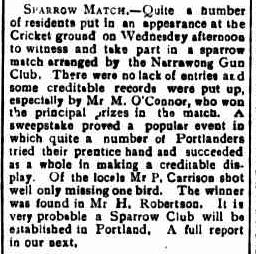
Another article that caught my eye was that of the “Sparrow Match”.  The Narrawong Gun club had organised the match at the cricket ground and there was a large attendance.

Established August 1842. (1904, September 16). Portland Guardian (Vic. : 1876 - 1953), p. 2 Edition: EVENING. Retrieved September 16, 2011, from http://nla.gov.au/nla.news-article63689870

A story on the Penshurst Gun Club by Phillip Doherty for the Mt Rouse & District Historical Society shed some light on this activity.  Sparrow catchers collected the birds for the gun clubs and on the day, they were released and shot for sport.  This was also done with starlings and pigeons.  The introduced birds had become pests and this was seen as killing two birds with one stone, so

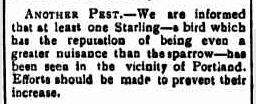
  The sighting of a starling in the Portland area was also mentioned in the Guardian of September 16.  Established August 1842. (1904, September 16). Portland Guardian (Vic. : 1876 - 1953), p. 2 Edition: EVENING. Retrieved September 16, 2011, from http://nla.gov.au/nla.news-article63689870

A Small Find at the Vic Expo

It has taken me a little longer than expected to report back on the Unlock the Past Victorian Expo.  After two days of great talks with plenty of tips, I’ve been busy applying them to my research, with some success.  Along with two fine days ideal for the garden, I’ve had plenty keeping me occupied.

The Vic Expo was great.  I enjoyed each of the eleven talks I attended over the two days and there was plenty to see amongst the exhibitors.  I did several laps of the exhibition hall each day and I was still finding new things late on the second day.  A stand that I did not get to until Day two was that of the Birchip Historical Society.

They had several of their own publications available including birth, death, and marriage notices from the Birchip Advertiser.  I had checked my tree for connections to Birchip and I found that Susan Oakley, granddaughter of Joseph Harman had lived there from the early 1890s to early 1900s.  She married Robert Cruikshank from Birchip in 1892.  As there were several books and I had limited time, I simply chose the top book,  Weddings 1891-1899.  There on page four where the details of the marriage of Susan Oakley to Robert Cruikshank.

It read:

Mr Robert W. Cruikshank to Miss Susan Oakley

The marriage of Mr Robert W. Cruikshank and Miss Susan Oakley was finalized at Bendigo on the 3rd inst., by the Rev. F. Elliott, Presbyterian minister, of Birchip.  The bride looked very pretty in a dress of sea green cashmere and was attended by three bridesmaids, Miss Simpson and Misses Smyth, the former dressed in flowered delaine and the latter (two charming children) dressed in white muslin with pale blue sashes.  Mr Henry Oakley acted as best man on the occasion.  Mr Joseph Oakley, brother of the bride, and Mrs Oakley, had prepared a sumptuous wedding feast at which the usual toasts were honoured and much indulgement enjoyed.  The bride and groom left by the next mornings train amid showers of rice and good wishes from their friends, to enjoy their honeymoon around Hamilton, Port Fairy and the metropolis.  (Weddings 1891-1899, Birchip Historical Society, p4.)

And so began a marriage of over 50 years and 11 children. I would love to see a photo of Susan’s sea-green cashmere dress.  The bridesmaids too would have looked lovely in their flowered delaine dresses.  Looking through the other marriage notices in the book shows that cashmere, delaine (a light wool fabric), and muslin were popular fabrics of the time. Nun’s veil, which was not used for Susan’s dresses, was another fabric mentioned in many of the marriage notices

Joseph Oakley, Susan’s brother was in charge of the wedding breakfast along with Mrs Oakley who I would assume was Joseph’s wife Annie Simpson.  By the time of the wedding, Susan’s mother Sarah Harman was known as Mrs Adams, the name of her second husband George.  Her first husband and Susan’s father, Walter Oakley, had presumably died around 10 years earlier.

While Joseph was acknowledged as the brother of Susan, best man Henry Oakley was not.  Susan had a brother Henry and beyond his birth record of 1869, I have not found another thing.  Could this be brother Henry?  Susan’s grandfather was also Henry Oakley and was alive at the time of the wedding but hardly would have been a 75-year-old best man.

The couple’s honeymoon no doubt included visits to Harman and Oakley cousins in Port Fairy, cousins around Hamilton, and Susan’s mother in the metropolis.  Flemington to be precise.

This was a totally unexpected find which demonstrates the value of publications by historical and family history societies.  I have found so much information because dedicated volunteers have indexed the likes of the Hamilton Spectator BDMs or have recorded historic buildings in a town for example or in this case the indexing of the Birchip Advertiser marriages.

It was fantastic that the Birchip Historical Society made the long trip to Geelong and I am sure many people went away with a greater awareness of the town and its history.  If you are interested in the work of the Birchip Historical Society, the ACMI website has a video of the museum and the wonderful people preserving history in the town.

Only Seven More Sleeps…

There are just seven more sleeps until the Unlock the Past Victorian Expo 2011 begins.  Running over two days, September 2 and 3 in Geelong, the Expo will feature 75 exhibitors and 36 presentations. It will be huge.

Between school drop off/pick up commitments and work on weekends, I don’t get to many family history events.  But when I found out the 2011 Victorian Expo would be in Geelong, less than an hour from home, nothing was going to stop me.  I found a school pick up a replacement and a work replacement and proceeded to book my talks.

Now I have two jammed packed days planned.  This is a great opportunity to hear some of the best genealogy speakers in Australia in one place and I am making the most of the opportunity.  I am particularly looking forward to talks by Carole Riley and Shauna Hicks, who up to now I have communicated within under 140 characters on Twitter.  Once a week, for several weeks, Kerry Farmer led an online meeting for a course I completed with the NIGS, so I am looking forward to seeing her in person.

Anyone who listens to Tony Delroy’s Nightlife on ABC radio will be familiar with Brad Argent from Ancestry.com.au.  I often hear his family history segments with Tony, so Brad’s presentation is on my list.  I naturally couldn’t go past Jenny Higgin’s presentation “National Library: family historians treasure trove”.  Then there is Lauren Bourke from PROV and Susie Zada from the GSV.  It’s just endless.

There really is something for everyone from “Tracing English Ancestors” through to “DNA for Genealogists”,  Asylums to Sewerage records.  I did end up with a couple of clashes and looking at the program now, I regret I won’t make it to Dr Liz Rushen’s talk, “Tracing Irish immigrant women”.  I understand talks are filling fast,  so book now.

As for the exhibitors, it great to see Birchip Historical Society and Museum, Stawell “Biarri” Group for Genealogy and Warrnambool Family History Group all making the trip.  I will be visiting the stands of the Colac & District Family History Group and the Meredith History Interest Group.  There will also be a large choice of exhibitors from around the Geelong and Bellarine areas.

I am really looking forward to checking out the range of books that will be available, although some restraint will be required.  Gould Genealogy and History, Unlock the Past, and Anchor Books are just three of the booksellers.  Not to mention those available through the societies, family history groups, and the Geelong Heritage Centre, which has a great range of books.  I better start clearing space on my bookshelves now.

Just as my small research assistant counts down to Christmas, over the next week I will be counting down the sleeps until the Vic Expo 2011.  An early Christmas for me!  Did I mention the books?

Passing of the Pioneers

The Portland Guardian obituaries from August recognized several residents with very early links to the Portland district. It is well worth reading their obituaries in full.

Robert HEAZLEWOOD:  Died 3 August 1892 at Portland.  Robert was one of Portland’s oldest residents at the time of his death.  He had been in Portland for around 40 years arriving from Tasmania where he had resided since age 16.  Robert ran a farrier business and was considered the best of his trade in the town.

Thomas KEAN:  Died 8 August 1892 at Portland. Thomas arrived in Melbourne in 1843 and went to Portland in 1845 to take charge of the Customs boat.  He did leave for a time when he caught “yellow fever” and joined the hunt for gold.  Unsuccessful, he returned to Portland to resume his position on the Customs boat. and was also a Councillor on a few occasions.

Frederick SAUNDERS:  Died 11 August 1914 at Narrawong.  At eighty-eight years old, Frederick Saunders had been in Australia for eighty-three years.

Francis ROBERTS:  Died 5 August 1920 at Orford. Francis was born in Tasmania and came to Victoria as a nine-year-old.  He spent time at the Firey Creek diggings and selected land at Broadwater where he farmed for the most part of his life.

Eliza Ann MALSEEDDied 13 August 1920 at Myamyn.  Eliza Malseed epitomized the pioneering women of the south-west.  She arrived in Portland from Ireland with her brothers, later marrying a cousin, James Malseed.  She and her husband, along with a small group of pioneering families, forged a life on unsettled land around Cape Bridgewater.  She was remembered as widely read and extremely charitable.  She was eighty-five when she died.

John Read HEDDITCH  Died 12 August 1927 at Cape Bridgewater.  The Portland Guardian reported that John was a descendant of the Hedditch family who arrived in Adelaide in 1837 aboard The Eden.  Also, John was apparently the first white child to be born at the Henty brothers’ Bridgewater run.  He was born in 1847.

William Henry MILLS:  Died August 1931 at Trafalgar.  William’s obituary is an interesting one, not only for its insight into early Australian history, but it demonstrates the need to check the “facts” presented.  William was born in Port Fairy in 1848 and remained there before moving to Gippsland in the late 1870s.  His father was credited as being one of the early discoverers of the south-west of Victoria, arriving in 1825, two years before the Hentys.  The obituary reports that William’s grandfather was the secretary to “Captain Blyth (sic) the then Governor of Victoria”.  Of course, the obituary writer was talking of Captain William Bligh, whose official title was Governor of New South Wales.  Captain Bligh did have a nineteen-year-old secretary by the name of  Peter Mills.

Arthur Harold SUTTON: Died August 1935 at Portland.  This is a most glowing obituary and includes a description of the funeral service.  Arthur was only fifty-three at the time of his death, which shocked Portland.  His parents were Strathdownie pioneers, where Harold was born.  He served in WW1, ran a successful wool export business, and served on the Portland Council.  Over 500 mourners were at his funeral, with over 100 cars (remember this is 1935) following the cortege.  This is an extensive obit which includes details of his children.

Michael James MINOGUE:  Died August 1935.  Michael was the youngest son of Mr and Mrs Simon Minogue, early pioneers of Portland.  A natural horseman, he at one time trained thoroughbreds.

Frederick William BILSTON:  Died August 1935 at Sandford. Frederick was the son of Thomas and Annie Bilston who arrived in Victoria in 1836. Another son, George Yarra Bilston was reportedly the first white child born in Melbourne.  A sister born in 1840, was claimed as the first white child born on the Glenelg River.  Frederick was born in Heywood in 1849 while his parents were running the Heywood hotel.  He trained horses in his early life with the likes of Adam Lindsay Gordon.  He then became a bootmaker and then a carrier.  An expert blade shearer, Frederick would ride to N.S.W to work sheds.  His obituary includes stories of the 1851 bushfires, bushranger Frank Gardiner and high-jumping.

Witness for the Prosecution

Searching old newspapers has uncovered three family members who were either mentioned or were witnesses at three separate murder trials.  They were my ggg grandmother, a cousin and to my surprise, my grandfather.

The earliest of these was known at the time as the “Casterton Murders“. My ggg grandmother Margaret Ann Turner, (Mrs Diwell)  was mentioned at an inquest in February 1860, which ended with Casterton man, George Waines, being placed on trial for the murder of Robert and Mary Hunt, also of Casterton.

The Hunts had not been seen for several months, with many believing they had left the colony.  George Waines claimed he had brought furniture off them, but rumours spread around the town that George may have been responsible for their disappearance.  The local police investigated and were unable to find the Hunts in the other colonies or New Zealand.

Margaret was mentioned in evidence by Dugald Campbell –

THE CASTERTON MURDER. (1860, February 3). Portland Guardian and Normanby General Advertiser (Vic. : 1842 – 1876), p. 2 Edition: EVENINGS.. Retrieved August 11, 2011, from http://nla.gov.au/nla.news-article64513414

This was a gruesome murder, but it captured the attention of people around Australia.  I found sixty articles from four states.  Many are detailed, including forensic evidence, a letter to the editor from the autopsy surgeon and George’s confession.  He was eventually hung at Melbourne Gaol.

The second murder trial had it all.  A small country town, married Methodist preacher, a young, single,  grazier’s daughter, and arsenic.  A search at Trove for “Omeo 1928” brings up hundreds of articles and I found a Western District connection.

Ronald Griggs moved to Omeo to take up the role of Methodist minister, moving into the residence with wife Ethel.  Originally from Tasmania,  Ronald and Ethel were welcomed into the community by the elders of the church including John Condon and his wife Frances.

OMEO MURDER CASE. (1928, March 8). The Register (Adelaide, SA : 1901 – 1929), p. 9. Retrieved August 11, 2011, from http://nla.gov.au/nla.news-article57042062

GRIGGS NOT GUILTY. (1928, April 21). The Canberra Times (ACT : 1926 – 1954), p. 1. Retrieved August 11, 2011, from http://nla.gov.au/nla.news-article1228707

After meeting John and Frances’ daughter Lottie,  Ronald (left) was a regular visitor to the Condon property.  Ethel was pushed to the outer and after giving birth to their first child, she returned to Tasmania spend time with her parents.

Ronald and Lottie’s “meetings’ became more frequent, but Ethel, (right) inconveniently for Ronald, returned to Omeo.  Only days later, she fell ill and died after several days of severe pain.  Thanks to a suspicious local policeman, the case was taken further and Ethel’s body was exhumed for an autopsy.  Arsenic was present in her body.  Ronald was charged with murder.

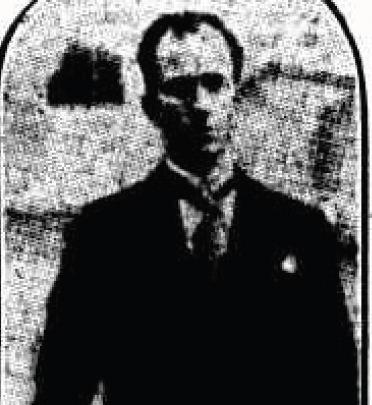
Henry Harman was the son of Walter Harman and grandson of Joseph Harman.  He was a well known Ensay grazier and Omeo Methodist church elder.  Henry was called to give evidence against Ronald Griggs, a man he described as a friend.

OMEO WOMAN’S DEATH. (1928, February 29). The Argus (Melbourne, Vic. : 1848 – 1956), p. 24. Retrieved August 11, 2011, from http://nla.gov.au/nla.news-article3914287

I  found a photo of Henry, along with some of the other key witnesses, in the Barrier Miner, a NSW paper which continues to reward me with articles about my Western Victorian family.  It is becoming a reliable but most unlikely source.

WITNESSES AT THE OMEO INQUIRY INTO THE DEATH OF MRS. ETHEL CONSTANCE GRIGGS (1928, March 2). Barrier Miner (Broken Hill, NSW : 1888 – 1954), p. 4. http://nla.gov.au/nla.news-article46008416″%5D

After two trials, the jury retired to decide its verdict.  According to the Canberra Times, thousands waited on the street outside the court to hear the decision.  Ronald Griggs was acquitted, however, his infamy dogged him.  He changed his name and continued to preach, but as his photo was seen around the country, he was found out.  He struggled to find work and the newspapers followed him for months after.

The Western District connection? Henry was born in Byaduk in 1880 as was his sister Susannah Nash Harman.  Susannah married  William Condon, a cousin of Lottie’s father John.  The Condons first settled in the Portland area, before some of the family moved to Omeo.  Lottie’s mother Frances Ethel Huggins was born at Macarthur in 1883 and she and some of her siblings moved to the Omeo area around 1888.  Around the same time, Henry’s father Walter Harman took his family from the Macarthur district to the High Country.

For more reading about the case, there is a book by Reg Egan,  Lottie: A love affair with a man of God and the cruel death that shocked Australia with Henry Harman a key character.  Murder case aside, it offers an insight into life in a small Victorian town in the 1920s.  I have also a public list of newspaper articles at Trove on the case under the heading “Griggs murder

Finally, the “Body under the staircase” trial of fishmonger Thomas Garrity, charged with the murder of widow Rose Harvey on April 28, 1931.  Rose had met up with Garrity for a few drinks at a local hotel and they returned by tram to the residence adjoining Garrity’s shop in Port Melbourne.  Police later found Rose’s body stuffed in a cupboard under the stairs of the residence.

Percy Riddiford was a 27-year-old, single man from Ballarat,  boarding at his brother’s home in Port Melbourne.  He worked on the trams, based at the Camberwell depot and happened to be working the day Thomas Garrity and Rose Harvey travelled his route.  As a result, he was required to appear as a witness to assist in determining the movements of Garrity on that day.

BODY UNDER STAIRCASE. (1931, May 20). The Argus (Melbourne, Vic. : 1848 – 1956), p. 9. Retrieved August 10, 2011, from http://nla.gov.au/nla.news-article4400320

Garrity claimed that unknown men had visited his home on that night, proceeded to get him drunk then robbed his till.  He claimed they must have killed Rose.  The judge considered Garrity could not have put her body under the stairs without help and reduced his charge to manslaughter.  He received eighteen months jail with hard labour.  Garrity pleaded his innocence after sentencing.

This was an event in my grandfather’s life he kept to himself.  The first my father and uncles had heard of it was when I told them of the articles I had found.  He was one to keep things to himself,  so it was good to find out something of his early life.

In the News – August 8, 1919

The Minister for Home and Territories, Mr Glynn announced there would be an Australian Census in 1921.  The chief statistician Mr Knibbs had left for an international statistical conference in Europe to learn how other countries conducted a Census.  He would be looking at borrowing a Power machine to help with the counting.

Portland Guardian. (1919, August 8). Portland Guardian (Vic. : 1876 – 1953), p. 2 Edition: EVENING. Retrieved August 8, 2011, from http://nla.gov.au/nla.news-article63959361

The census was held on April 3, 1921.  Thanks to the Hollerith electric machine, an American invention, results were expected in two years!    I’m not sure if this is the Power machine Mr Knibbs was investigating, but it seems he did pick up some tips from his trip to Europe.  On April 4, 1921, The Argus published an interesting article about how the information for the census was collected.

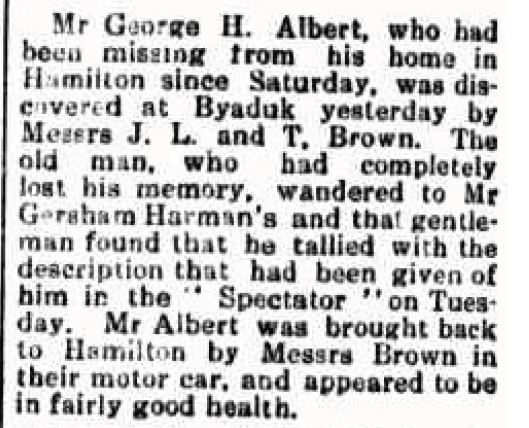
Mr George Albert of Hamilton was found after five days missing.  He was located at Byaduk on the property of Gershom Harman, grandson of Joseph Harman.

Portland Guardian. (1919, August 8). Portland Guardian (Vic. : 1876 – 1953), p. 2 Edition: EVENING. Retrieved August 8, 2011, from http://nla.gov.au/nla.news-article63959361

The Leader of the Pack

When I think of my ancestors, the first name that comes to mind is James Harman.  I don’t know why.  Maybe it’s because if I was to a pick a leader of my ancestors, the boss or the chairperson,  I think It would be James.

In the 15 years or so I have got to know my ggg grandfather, I have imagined him as organised, official and proud.  He was a leader in the church and the farming community speaking up for what he believed.  I can just imagine him standing before my other ancestors, organising and guiding them.  Who would be his deputy?  I would think either of James’ brothers Jonathon or Walt who, in their own activities in the community, were of the same mould.

James was born in Melbourn, Cambridgeshire in 1830, the son of Joseph and Sarah Harman.  He married Susan Reed of Whaddon on August 15, 1852 just two months later on October 20, 1852 they set sail aboard the Duke of Richmond bound for Portland, Victoria, Australia.  They spent time in Port Fairy before settling at Byaduk in the early 1860s.

At Byaduk, James was involved with the church, served on the first committee of the Byaduk State School at the age of 81, and farming activities such as ploughing competitions and the Farmers Union.

James and Susan had 10 children from 1854 to 1875, five boys and five girls.  Even that was orderly.

Reuben James   Birth: 1854 in Port Fairy, Victoria  Marriage: 1877 in Byaduk, Victoria to Elizabeth BISHOP Death: 05 Jan 1937 in Ballarat, Victoria.

Alfred   Birth: 1856 in Portland, Victoria  Marriage: 1883 to Louisa NEWMAN Death: 06 Nov 1922 in Byaduk, Victoria.

Isabella   Birth: 1857 in Port Fairy, Victoria Marriage: 1885 to Stephen WARD Death: 02 Aug 1886 in Port Fairy, Victoria.

George Henry   Birth: 1860 in Port Fairy, Victoria Death: 1861 in Hamilton, Victoria.

Julia   Birth: 1861 in Muddy Creek, Victoria  Marriage: 1882 to George HOLMES Death: 20 Dec 1896 in Casterton, Victoria.

Martha    Birth: 1863 in Byaduk, Victoria Marriage: 08 Nov 1888 in Hamilton, Victoria to Frederick Charles HUGHES Death: 28 Dec 1960 in Hamilton, Victoria.

Henrietta   Birth: 1866 in Byaduk, Victoria. Death: 1952 in Hamilton, Victoria.

Albert    Birth: 1868 in Byaduk, Victoria Marriage: 1907 to Emma CARMICHAEL Death: 26 Nov 1927 in Byaduk, Victoria.

Alice   Birth: 1871 in Byaduk, Victoria Marriage: Dec 1896 in Macarthur, Victoria to William James McLEAN Death: 21 Jun 1927 in Hamilton, Victoria.

George    Birth: 1875 in Byaduk, Victoria Marriage: 1908 to Hilda May HILL Death: 25 Sep 1947 in Hamilton, Victoria.

It was reading James’ Will, written in 1914, that really defined him for me.  In great detail,  he had carefully considered his beneficiaries and ensured that Susan and his spinster daughter Henrietta would be looked after once he was gone.  It also offered information on James’ property and farm related assets.

The first of James’ last wishes was that his watch and chain be passed on to his grandson, Albert Lionel HARMAN, the eldest son of George HARMAN.  Daughter Henrietta was to receive the furniture in the house and all household effects.   She was also the beneficiary of James’ poultry.  He made provision for Henrietta to stay in the house with James’ grandson Charles, only son of  Isabella who died when Charles was a baby.

Farming implements, including a chaff cutter and a set of harrows, were left to son Alfred.  He would also receive two horses and their harness, a number of sheep, and half of the grain and hay on the farm at the time of James’ death.  James had a contingency if there was no grain or hay on the property at the time of his death.  If this was to happen, Alfred would receive £30 instead.  There were conditions for Alfred however. He had to undertake to give his mother Susan 15 shillings a week and give £100 to each of his sisters, Martha and Alice within a year of his father’s death.

Reuben and Albert shared in a large amount of James’ land at Byaduk and Lake Gorrie, near Macarthur.  The description of the property at Byaduk known as the “House Paddock” gives some idea of the out-buildings that existed but also James’ methodical approach to such matters.  It read:

“…commencing at the junction of the Hamilton to Byaduk main road with the Louth road running southerly along the said main road to the entrance gate thence Westerly along the wire fence to the corner of the stackyard and including the woolshed and barn thence Northerly along the wire fence to the Louth road thence along the Louth road easterly to the commencing point.”

The partnership between James and Susan Harman was to come to a rapid close in 1916.  On April 10, Susan passed away aged 86. Just over four months later on August 14,  James himself died also aged 86.  Together they had left England as newlyweds, settled themselves in Victoria before starting their large family.  They had seen births, deaths, and marriages as their family extended, and together they witnessed the growth in the country they had arrived in over 60 years before.

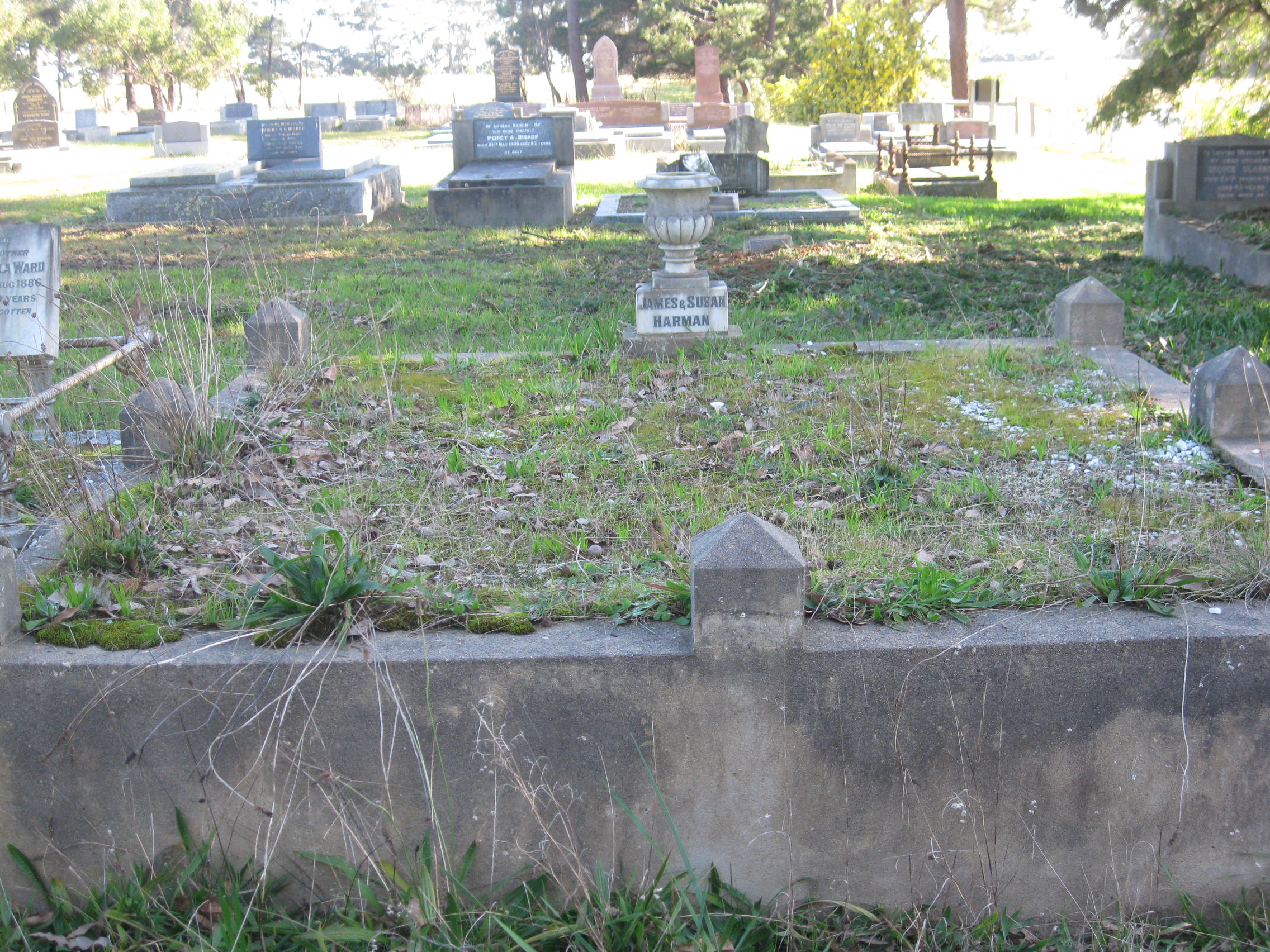
JAMES & SUSAN HARMAN. Photo courtesy of Mike Harman & family.

It seems right they went so close together after 64 years of marriage.  They were buried side by side at the Byaduk cemetery.

© 2011 Merron Riddiford

Passing of the Pioneers

The Portland Guardian was mindful of the contribution made by the early pioneers toward developing the south-west.  They offered regular items titled “Passing of the Pioneers” or “Passing Pioneers” and often mentioned in obituaries that “…one by one are old pioneers are passing”.  As early as 1889, they were lamenting the loss of the links to the early settlers and suggesting that the efforts of those who passed be recognised.

The Portland Guardian,. (1889, January 16). Portland Guardian (Vic. : 1876-1953), p. 2 Edition: EVENING. Retrieved July 18, 2011, from http://nla.gov.au/nla.news-article63591640

Established August 1842. The Portland Guardian,. (1899, July 7). Portland Guardian (Vic. : 1876-1953), p. 2 Edition: EVENING. Retrieved July 19, 2011, from http://nla.gov.au/nla.news-article63676630 MLA citation

In 1921, the paper spoke of the many unwritten histories that had gone before, but now we can see the Portland Guardian lived up to its charter of 1889,  successfully recording the histories of many of the local pioneers.  By doing so, they are now helping us learn more about our families and gain a sense of life in the early days of the Western District.  Of course, The Guardian was not alone.  References to the “passing pioneers” are found in most of the papers on the Trove website.

Obituaries are a secondary source as the information comes from the knowledge of those still living and I have noticed errors in obituaries of my family.  But they can offer leads to records you may never have thought of such as Masonic lodge records and local council records. Whatever you do or don’t get out of an obituary, no-one can deny they are often a good read.

July was a month when many “Passing of the Pioneers” columns appeared.  Cold winters in the southwest saw many of the older residents “cross the Great Divide” as the Guardian would put it.

Some of the more notable passing pioneers in the month of July were:

James PARKER:  Died 6 July1889 at Heywood. James PARKER’S obituary is an interesting read.  Born in Tasmania around 1810, he came to the mainland as a whaler. In 1842, he married Margaret NOLAN at Portland. Later he had some luck at the Creswick goldfields only to have an encounter with bushranger Captain Moonlight.

William TULLOH: Died 19 July 1889 at Portland.  This is a lengthy obituary of a Portland resident of nearly fifty years, whose death saw half-closed shutters on homes around the town.  Born in Scotland in 1812, he left a wife, four sons, and a daughter at the time of his passing.  I have found a site with more detail of William and his wife Eliza Mary KEARTON.

James BARNETT: Died 18 July 1892 at Portland.  James was known as “Old Barney” around Portland and while the Portland Guardian credits him as a pioneer, they make a judgement in saying that he did not make the most of his opportunities as other early settlers had done.  He married in 1851 to Elizabeth AUSTIN. Five children were living at the time of James’ death.

Alexander THOMSON: Died July 1897 at Hamilton. Scottish born Alex THOMSON was prominent around the Hamilton area as a Shire of Dundas Councillor for twenty-one years.  At the time of his death, he was the owner of Pierrepoint Estate near Hamilton and was also an active member of the Pastoral and Agricultural society.

Thomas Webb SMITH:  Died 29 July 1914 at Branxholme.  Thomas served on the Borough of Portland council and was mayor from November 1871-November 1873.  He was also a member of the Goodfellows and Freemasons.

Annie Maria HENTY: Died 2 July 1921 at Hamilton.  Annie was from the most famous southwest pioneering family of them all, the Henty’s. The daughter of Stephen HENTY, Annie married Hamilton stock and station agent Robert STAPYLTON BREE in 1874.  The Bree name is preserved in Hamilton with a much-used road of the same name in the town.  Their home Bewsall (below) once stood near the end of Bree Road in North Boundry Road.

HAMILTON. (1903, May 2). The Australasian (Melbourne, Vic. : 1864 - 1946), p. 27. Retrieved February 18, 2014, from http://nla.gov.au/nla.news-article138684187

HAMILTON. (1903, May 2). The Australasian (Melbourne, Vic. : 1864 – 1946), p. 27. Retrieved February 18, 2014, from http://nla.gov.au/nla.news-article138684187

Stapylton-Bree (2)

Ann Eliza KEEPING: Died 9 July 1921 at Portland.  Annie Eliza KEEPING arrived in Australia aboard the Eliza and married John FINNIGAN in 1857.  She was eighty-two at the time of her death.

Joseph Bell PEARSON:  Died 7 July 1922 at Portland. Yet another interesting character.  According to his obituary, Joseph was born on the voyage from England to Tasmania.  His family moved to the Retreat Estate near Casterton in 1844.  He was a noted horseman, with several good racehorses which he would ride himself.  One of his jumps racing rivals was Adam Lindsay Gordon.

Joseph was buried at the Hamilton (Old) Cemetery with his wife Mary Abbott and mother-in-law Martha Holdish (below).

Abbott

Sarah MARSHALL:  Died 7 July 1923 at Gorae West. Sarah was the wife of the late Richard BEAUGHLEHOLE and she died at seventy-three. Richard selected land at Gorae West and transformed swampland into flourishing orchards.  Sarah and Richard had twelve children.

Mary Thurza HEDDITCH: Died 1 July 1930 at Drik Drik. Mary HEDDITCH was born in Portland in 1844 and moved with her family to Bridgewater in 1846.  Her elder brother drowned when she was a teenager leaving her to take on some of his duties.  As a result, she became an accomplished horsewoman, helping her father with the cattle.  She married James MALSEED and together they had seven children.

Phillipa JOHNS: July 1931 at Portland.  Phillipa JOHNS, the daughter of a doctor, was herself something of a substitute doctor for those living in the Willenbrina area, near Warracknabeal.  Later she and her husband William DELLAR moved to the Portland district.  They had nine children.