A Pioneer Christmas 1890s Style

The 1890s newspaper reports of Christmas were very different to those of the other decades from the 1850s.  Recipes and articles about decorating the home, hint to a greater female readership than other times.  Finally, the arguments about English traditions disappeared as Australians formed their own Christmas traditions.

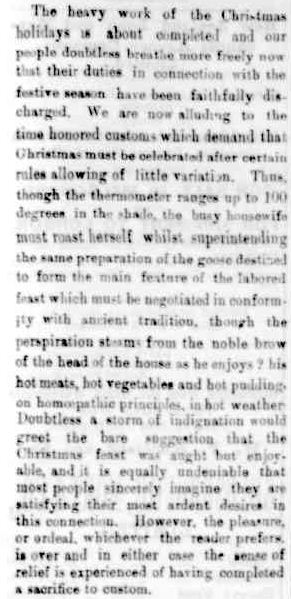
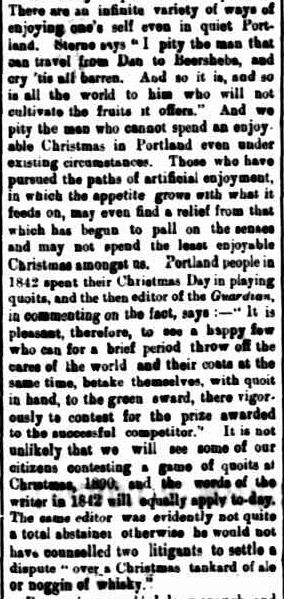
The editor of the  Portland Guardian, welcomed Christmas 1890 as if to say “Here we go again”.

The Portland Guardian,. (1890, December 24). Portland Guardian (Vic. : 1876 – 1953), p. 2 Edition: EVENING. Retrieved December 24, 2011, from http://nla.gov.au/nla.news-article63631009

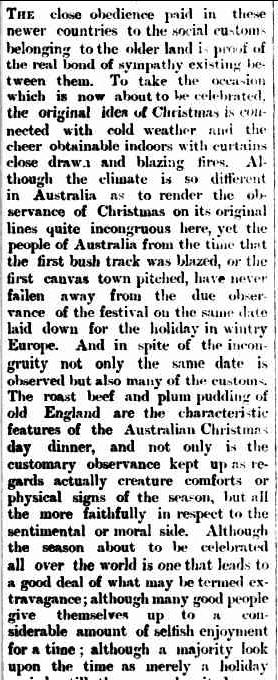
The editor continues with a reference to the 1842 editor of the same newspaper and the Christmas day activity of quoits.

The Portland Guardian,. (1890, December 24). Portland Guardian (Vic. : 1876 – 1953), p. 2 Edition: EVENING. Retrieved December 24, 2011, from http://nla.gov.au/nla.news-article63631009

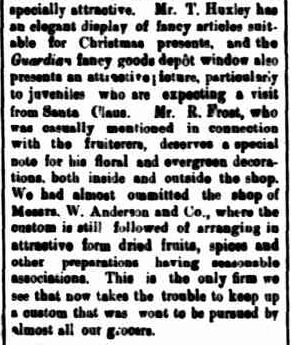
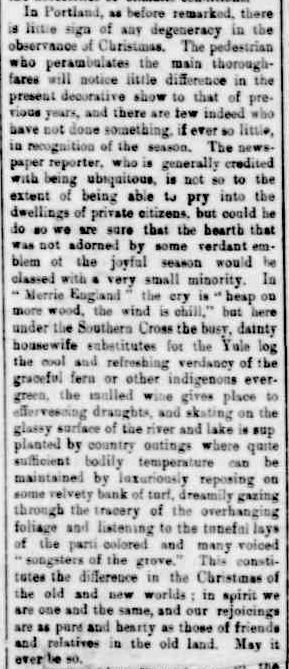
Shop windows were once again dressed up by their owners, but only one grocer maintained the tradition of displaying dried fruits and spices.

The Portland Guardian,. (1890, December 24). Portland Guardian (Vic. : 1876 – 1953), p. 2 Edition: EVENING. Retrieved December 24, 2011, from http://nla.gov.au/nla.news-article63631009

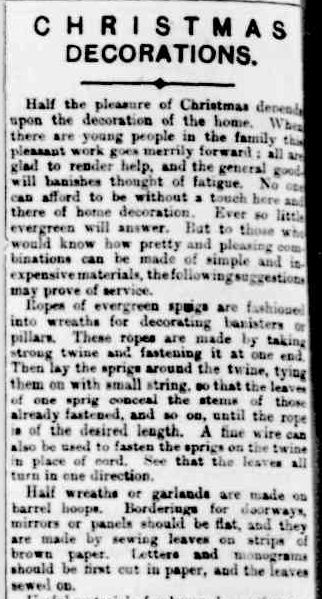
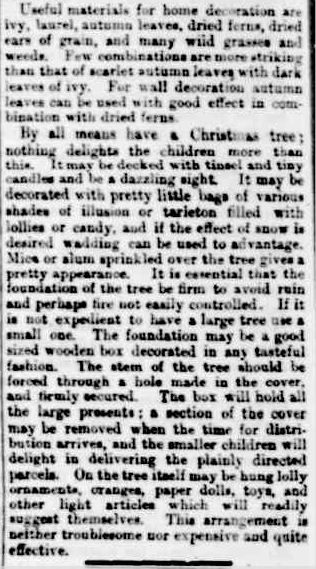
The following is the first article I have seen on Christmas decorations in the home.  It offers tips on Christmas trees and ideas on making decorations.

CHRISTMAS DECORATIONS. (1894, December 28). Portland Guardian (Vic. : 1876 – 1953), p. 12 Edition: EVENING, Supplement: CHRISTMAS SUPPLEMENT. Retrieved December 24, 2011, from http://nla.gov.au/nla.news-article65397988

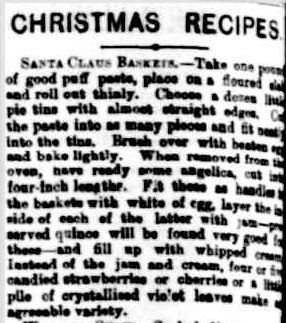
Christmas recipes became popular in the 1890s.  The following for Santa Claus Baskets is from the Portland Guardian of 25 December 1895.  Recipes for Whipped Snow and Plum Pudding were also included.

CHRISTMAS RECIPES. (1895, December 25). Portland Guardian (Vic. : 1876 – 1953), p. 9 Edition: EVENING, Supplement: CHRISTMAS SUPPLEMENT PORTLAND GUARDIAN.. Retrieved December 24, 2011, from http://nla.gov.au/nla.news-article63633406

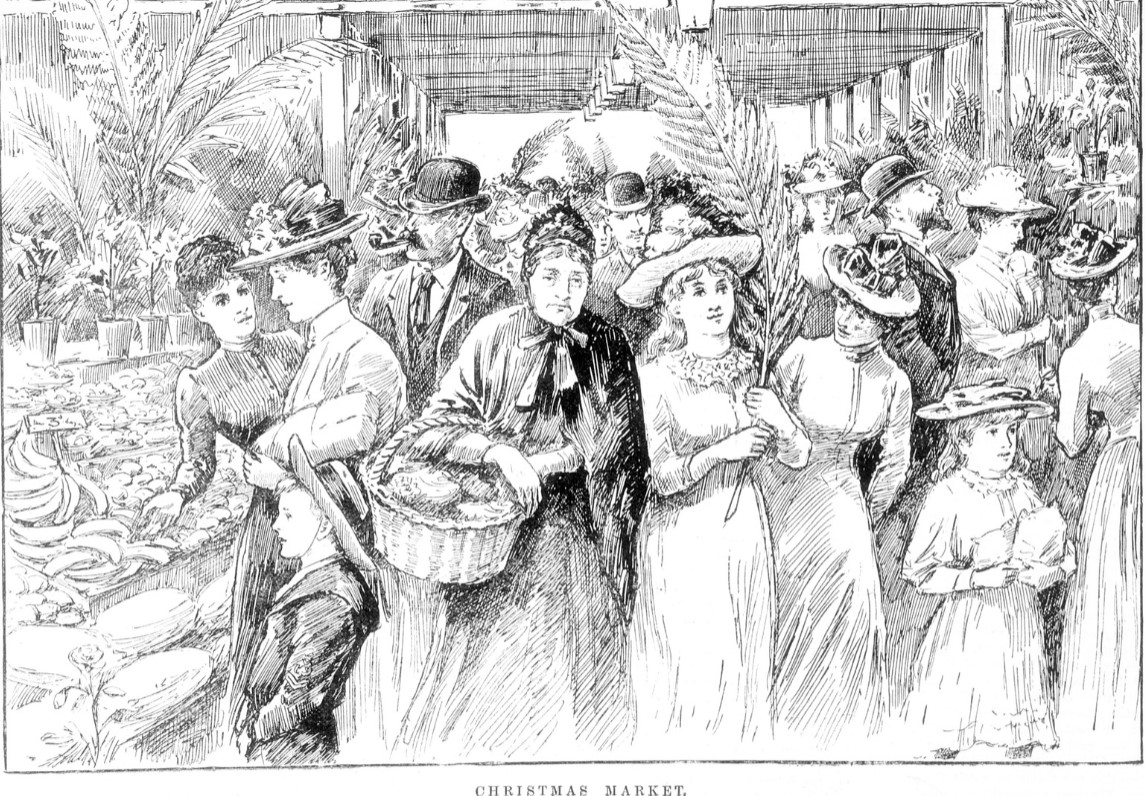
MELBURNE CHRISTMAS EVE MARKET 1892. Image courtesy of the State Library of Victoria http://handle.slv.vic.gov.au/10381/254978

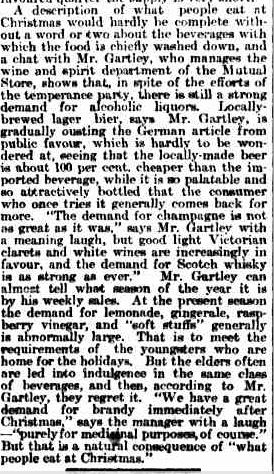
The 1890s saw the traditional beef finally lose favour on the Christmas menu.   This article  What People Eat at Christmas”  from The Argus, gives a real insight into the Christmas fare of the time.  I have not included the entire article, which is worth reading in full.  Times were changing.

WEAT PEOPLE EAT AT CHRISTMAS. (1897, December 25). The Argus (Melbourne, Vic. : 1848 – 1956), p. 8. Retrieved December 24, 2011, from http://nla.gov.au/nla.news-article9784663

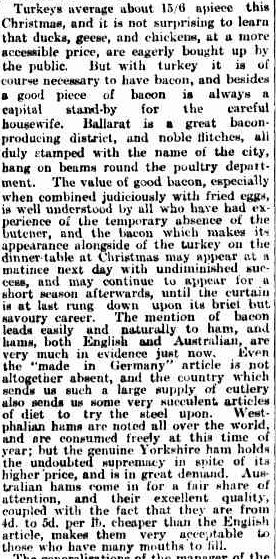
Melbourne 1899. CHRISTMAS MARKETING. (1899, December 16). The Australasian (Melbourne, Vic. : 1864 – 1946), p. 29. http://nla.gov.au/nla.news-article138612102

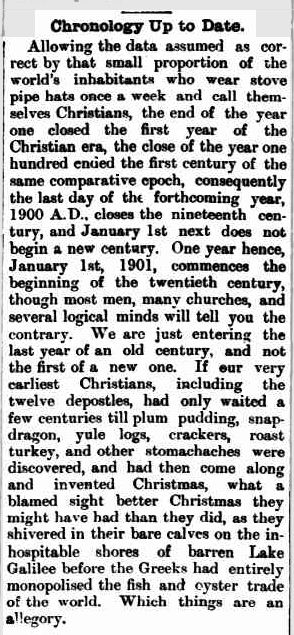
To conclude this 19th-century overview of Christmas in Victoria, I must include the following article for anyone wondering if the 1899 Christmas was the last of the century.  It comes a little further afield than Victoria as it appeared in the West Australian Sunday Times on 31 December  1899.

Chronology Up to Date. (1899, December 31). West Australian Sunday Times (Perth, WA : 1897 – 1902), p. 8. Retrieved December 24, 2011, from http://nla.gov.au/nla.news-article38505997


A Pioneer Christmas 1880s Style

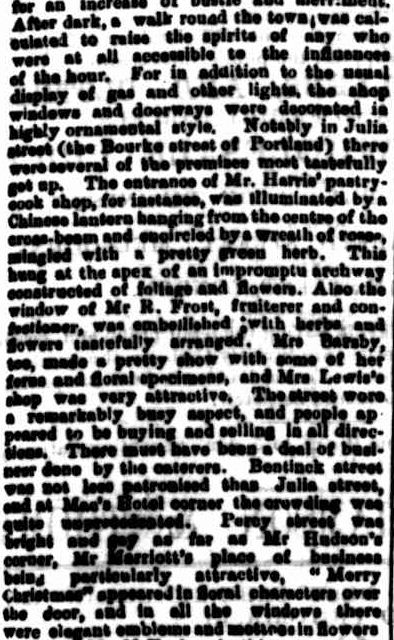
Christmas news in Victoria during the 1880s featured cards, decorations, carols, and for something different, the weather.  The shopkeepers of Portland in 1880, decorated their shops for the season.  Mr. Harris, proprietor of the pastry shop went to great trouble adorning his shop with Chinese lanterns and a wreath of roses.

CHRISTMAS EVE. (1880, December 25). Portland Guardian (Vic. : 1876 – 1953), p. 3 Edition: MORNINGS.. Retrieved December 22, 2011, from http://nla.gov.au/nla.news-article63402944

CHRISTMAS 1883. Image courtesy of the State Library of Victoria http://handle.slv.vic.gov.au/10381/253606

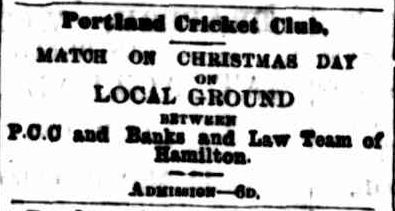
Cricket was a popular activity on Christmas day, a tradition that continues today for many who enjoy a game of backyard cricket after lunch.

1880, December 25). Portland Guardian (Vic. : 1876 – 1953), p. 3 Edition: MORNINGS.. Retrieved December 22, 2011, from http://nla.gov.au/nla.news-page6018426

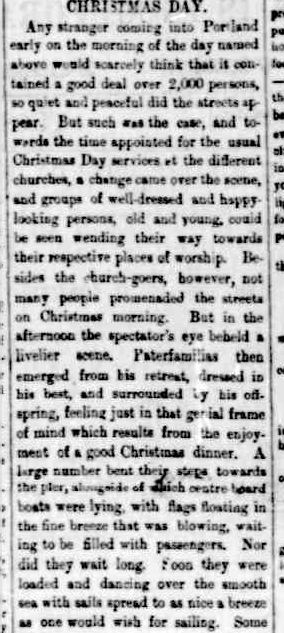
Christmas Day 1885 started quietly before churchgoers began to attend their chosen service.  Those not attending church stayed inside until the afternoon when many took advantage of Portland’s coastal position with some boating on the bay.

THE HOLIDAYS. (1885, December 29). Portland Guardian (Vic. : 1876 – 1953), p. 2 Edition: MORNINGS. Retrieved December 22, 2011, from http://nla.gov.au/nla.news-article63405142

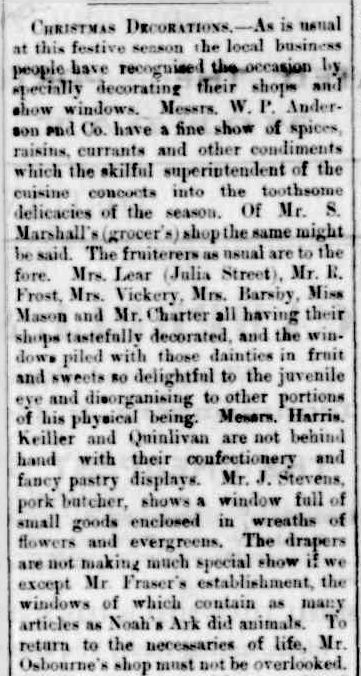
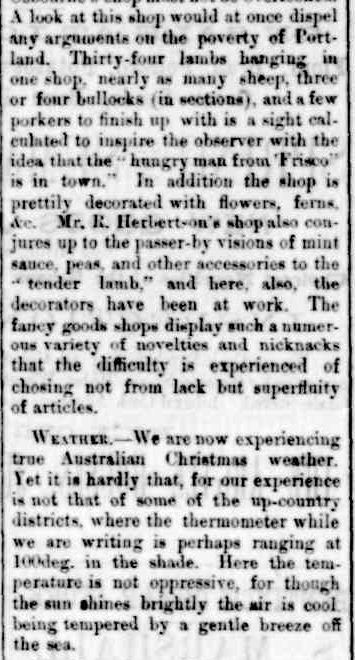
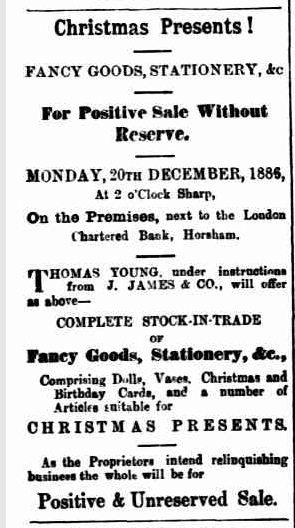
Christmas decorations on shops were still popular mid-1880s and there seems to have been some competition among the Portland shopkeepers.  From spices and currents to fruits and pastries, all had their wares displayed.  Mr. Osborne’s butcher shop window displayed 34 lambs, as many sheep and several bullocks and pigs.  Amid all this, the window was “prettily decorated with flowers, ferns, etc”

CHRISTMAS DECORATIONS. (1886, December 24). Portland Guardian (Vic. : 1876 – 1953), p. 2 Edition: EVENING. Retrieved December 22, 2011, from http://nla.gov.au/nla.news-article63407593

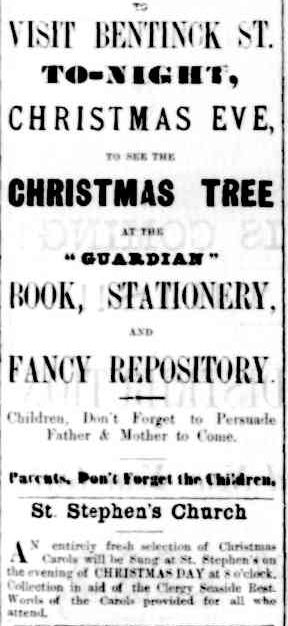
This is a great advertisement inviting the residents of Portland to visit the Christmas tree at the “Guardian” office. “Children, Don’t Forget to Persuade Father & Mother to Come” is followed by “Parents, Don’t Forget the Children”.

Advertising. (1886, December 24). Portland Guardian (Vic. : 1876 – 1953), p. 2 Edition: EVENING. Retrieved December 23, 2011, from http://nla.gov.au/nla.news-article63407578The Portland Guardian

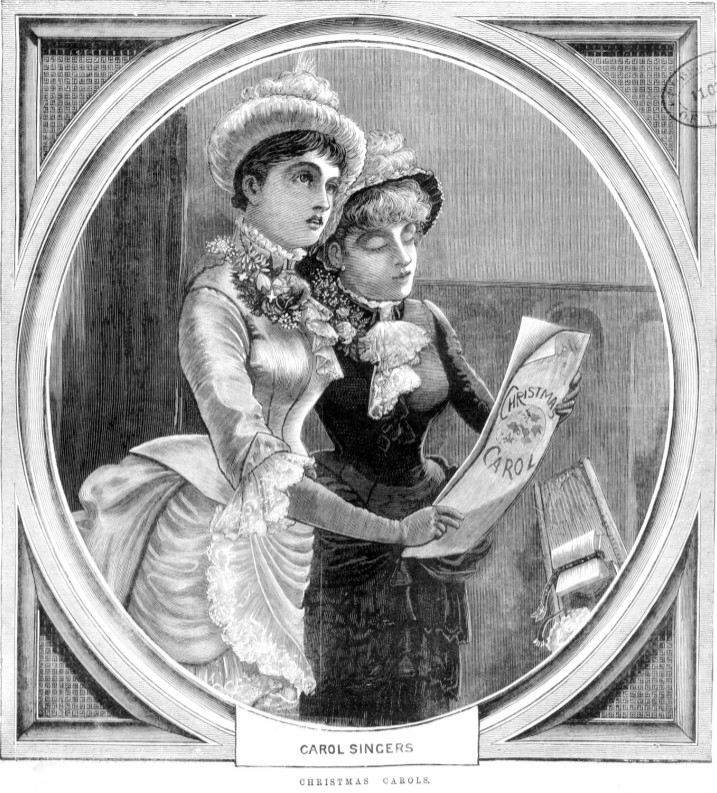
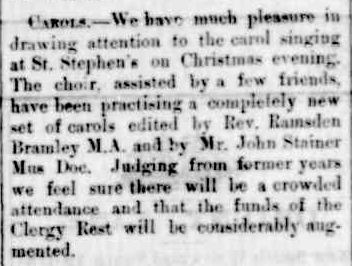
In 1886, St Stephen’s Church was holding the annual carols, but with “a completely new set of carols”.

CHRISTMAS DECORATIONS. (1886, December 24). Portland Guardian (Vic. : 1876 – 1953), p. 2 Edition: EVENING. Retrieved December 22, 2011, from http://nla.gov.au/nla.news-article63407593

The Portland Guardian,. (1889, December 25). Portland Guardian (Vic. : 1876 – 1953), p. 2 Edition: EVENING. Retrieved December 23, 2011, from http://nla.gov.au/nla.news-article63625996

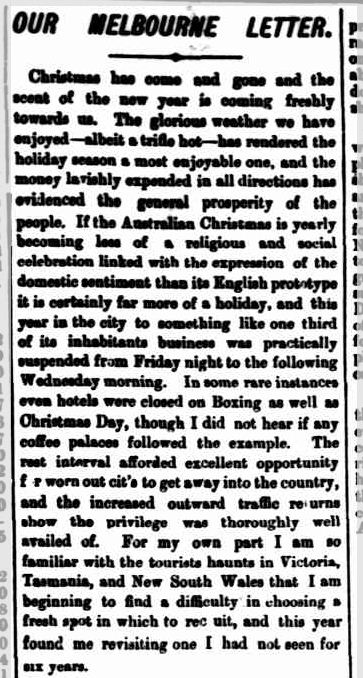
Christmas 1886 in Melbourne saw many businesses closing their doors from Friday to Wednesday to take full advantage of the Christmas holiday.  Even some hotels closed on Boxing Day!  Residents used this extended holiday period to get out of the city and enjoy the countryside.

OUR MELBOURNE LETTER. (1886, December 31). The Horsham Times (Vic. : 1882 – 1954), p. 3. Retrieved December 22, 2011, from http://nla.gov.au/nla.news-article72957501

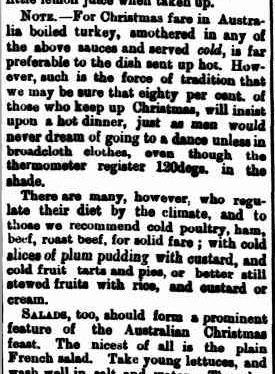
The following extract comes from an article called “Christmas Cheer”.  Along with instructions on how to boil a turkey, there were recipes for accompaniments such as celery sauce, oyster sauce, and German salad.

Christmas Cheer. (1888, December 25). The Horsham Times (Vic. : 1882 – 1954), p. 3 Supplement: CHRISTMAS SUPPLEMENT. Retrieved December 22, 2011, from http://nla.gov.au/nla.news-article72875421

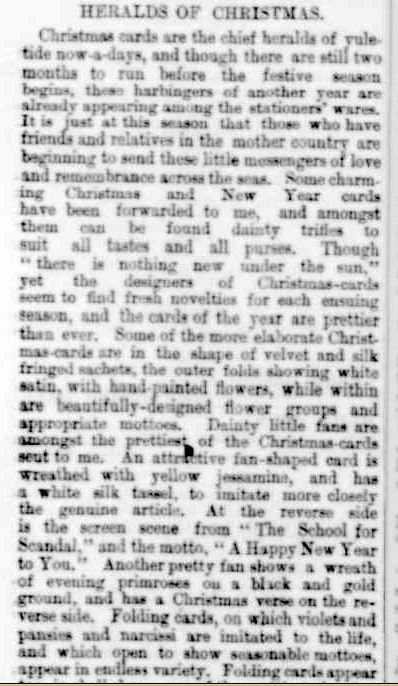
Christmas cards seemed to become more popular during the 1880s, and this article from 25 October 1889 describes some of the trends in cards.  It appeared at the time of year cards were written to send to the “mother country”.

HERALDS OF CHRISTMAS. (1889, October 25). Portland Guardian (Vic. : 1876 – 1953), p. 3 Edition: EVENING, Supplement: SUPPLEMENT TO THE PORTLAND GUARDIAN. Retrieved December 2, 2011, from http://nla.gov.au/nla.news-article63625196

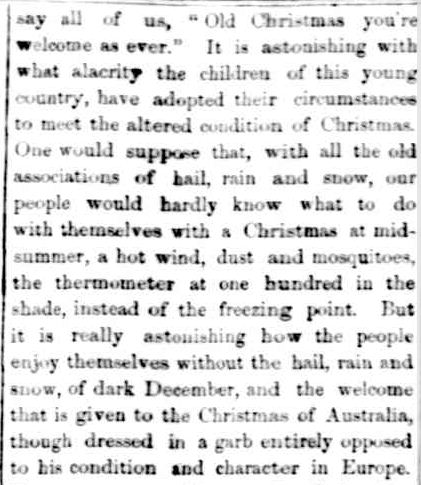
Just when I thought I was not going to see anything of yuletide logs, the following articles from the late 1880s continue the now old arguments of why have a hot lunch during the Australian summer and why are people still persisting with the English traditions?

THE CHRISTMAS HOLIDAYS. (1888, December 28). Portland Guardian (Vic. : 1876 – 1953), p. 3 Edition: EVENING. Retrieved December 23, 2011, from http://nla.gov.au/nla.news-article63591436

The Horsham Times. (1889, December 24). The Horsham Times (Vic. : 1882 – 1954), p. 2. Retrieved December 22, 2011, from http://nla.gov.au/nla.news-article72863411

The Portland Guardian,. (1889, December 25). Portland Guardian (Vic. : 1876 – 1953), p. 2 Edition: EVENING. Retrieved December 23, 2011, from http://nla.gov.au/nla.news-article63625996


A Pioneer Christmas 1870s Style

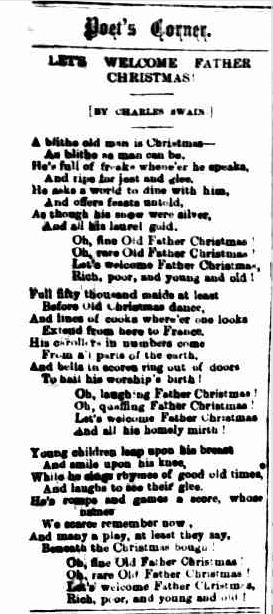
Christmas in Victoria during the 1870s saw the mood change a little from the yearning for an English Christmas to acceptance of the Australian Christmas but the comparisons were still being made.  Father Christmas was getting talked about more in the 1870s than in the previous two decades. He received a mention by way of a poem in the Portland Guardian and Normanby General Advertiser in 1875.

Poet’s Corner. (1875, January 1). Portland Guardian and Normanby General Advertiser (Vic. : 1842 – 1876), p. 4 Edition: EVENING.. Retrieved December 19, 2011, from http://nla.gov.au/nla.news-article64746107

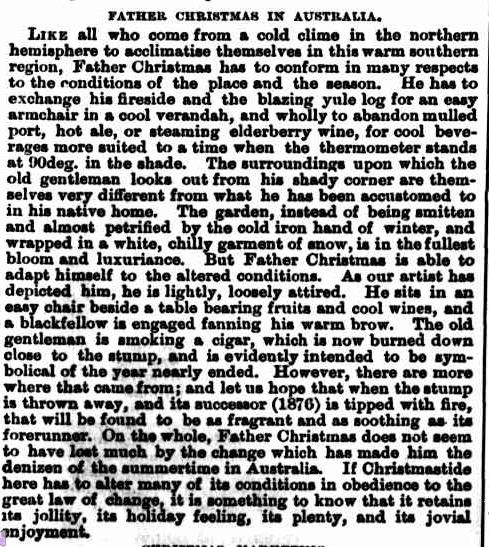
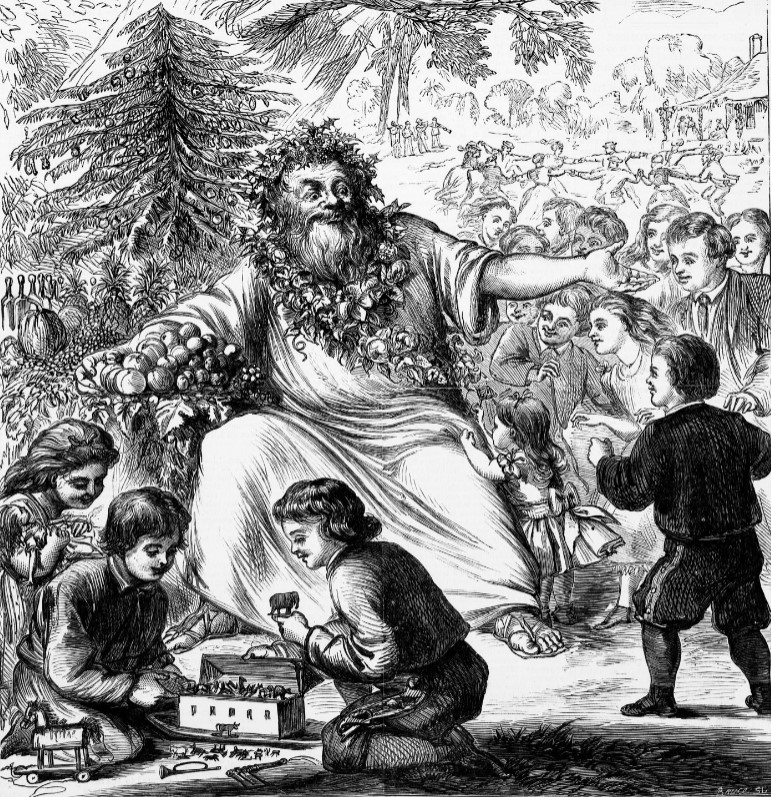
The Australasian Sketcher with Pen and Pencil, a paper I enjoy reading, discussed the adjustments Father Christmas himself had to make to the Australian conditions.

Sketches with Pencil. (1875, December 25). The Australasian Sketcher with Pen and Pencil (Melbourne, Vic. : 1873 – 1889), p. 150. Retrieved December 20, 2011, from http://nla.gov.au/nla.news-article60606552

Christmas 1871 Image courtesy of the State Library of Victoria http://handle.slv.vic.gov.au/10381/252252

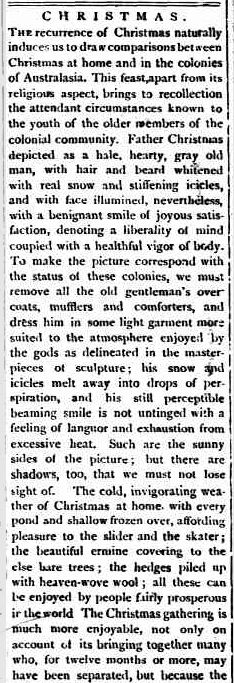
The Kerang Times and Swan Hill Gazette, however, was more sentimental about Father Christmas and the season.

The Kerang Times AND SWAN HILL GAZETTE. (1879, December 25). Kerang Times and Swan Hill Gazette (Vic. : 1877 – 1889), p. 2 Edition: WEEKLY.. Retrieved December 20, 2011, from http://nla.gov.au/nla.news-article66494958

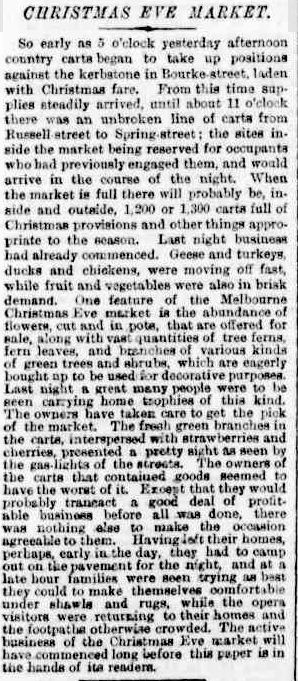
Food was again a focus.  One exciting place to visit was the Christmas Eve market in Melbourne.  That was unless you were one of the many country producers who brought their produce into the city, often having travelled long distances and then enduring uncomfortable conditions upon arrival.  What a sight it would have been to see their 1200 or so carts lined up, some adorned in ferns and other greenery.

CHRISTMAS EVE MARKET. (1874, December 24). The Argus (Melbourne, Vic. : 1848 – 1956), p. 6. Retrieved December 19, 2011, from http://nla.gov.au/nla.news-article11509641

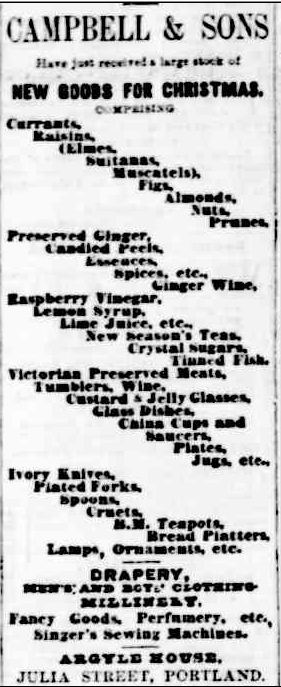
Campbell & Sons of Julia Street Portland advertised an array of new products for Christmas of 1877.  It seems that the Portland pioneers had no difficulty in sourcing the ingredients necessary for a plum pudding or tableware to complement the Christmas lunch.

Advertising. (1877, December 21). Portland Guardian (Vic. : 1876 – 1953), p. 2 Edition: EVENINGS.. Retrieved December 19, 2011, from http://nla.gov.au/nla.news-article63340222

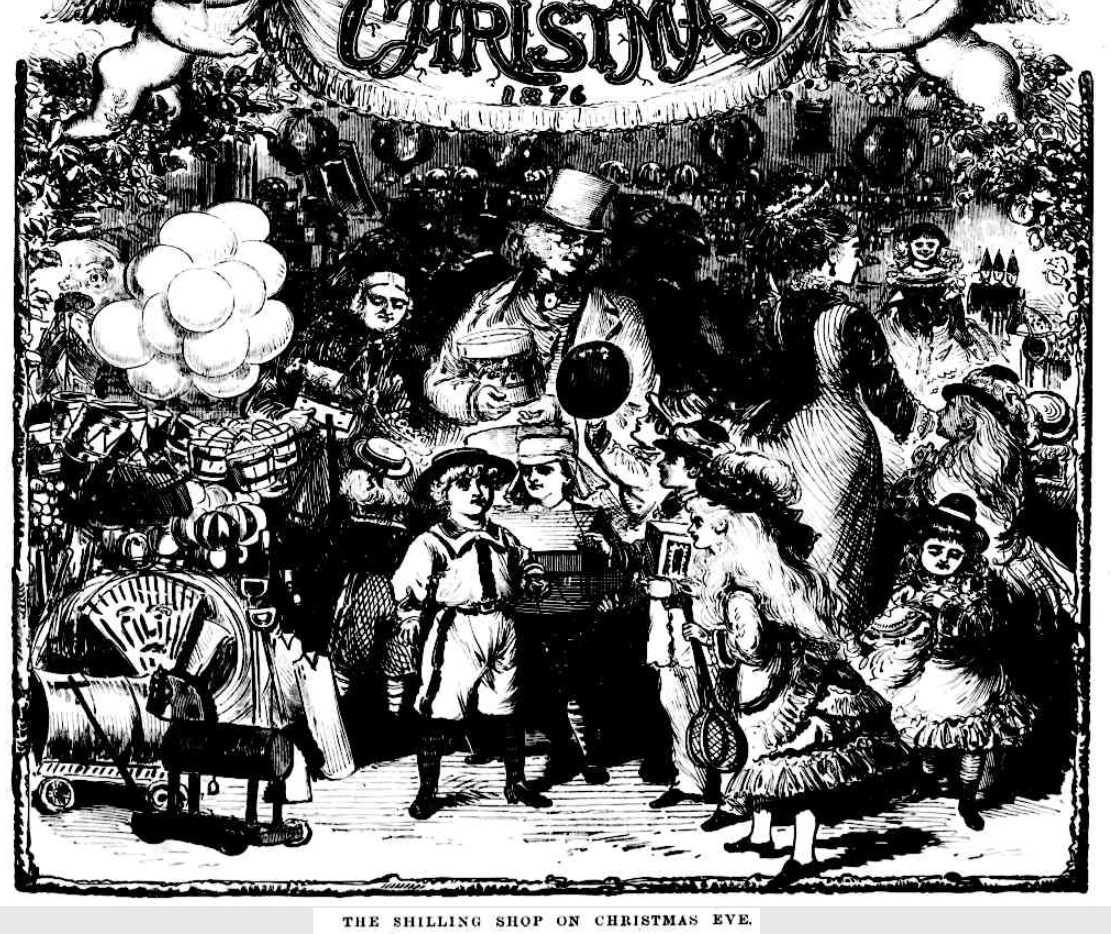
“THE SHILLING SHOP ON CHRISTMAS EVE.” The Australasian Sketcher with Pen and Pencil (Melbourne, Vic. : 1873 – 1889) 23 December 1876: 145

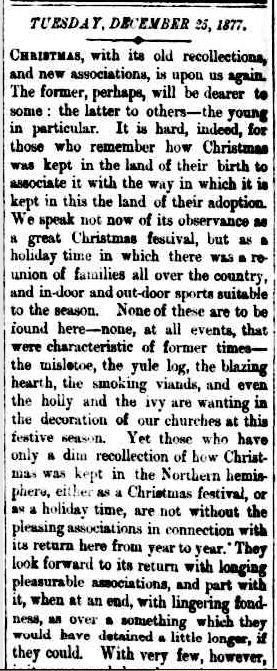
The editor of the Camperdown Chronicle in 1877, suggested the  Australian Christmas celebration was now accepted, with the young knowing nothing else.  Those who could still remember an English Christmas, held the memory dear, however.  I think the editor may have been in that camp.

The Chronicle. (1877, December 25). Camperdown Chronicle (Vic. : 1877 – 1954), p. 2 Edition: BI-WEEKLY. Retrieved December 20, 2011, from http://nla.gov.au/nla.news-article64013025

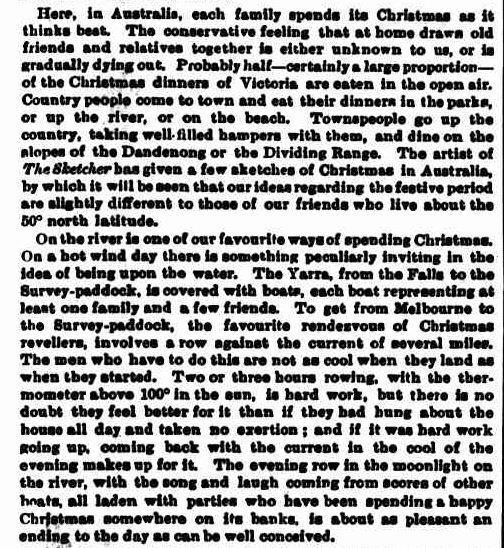
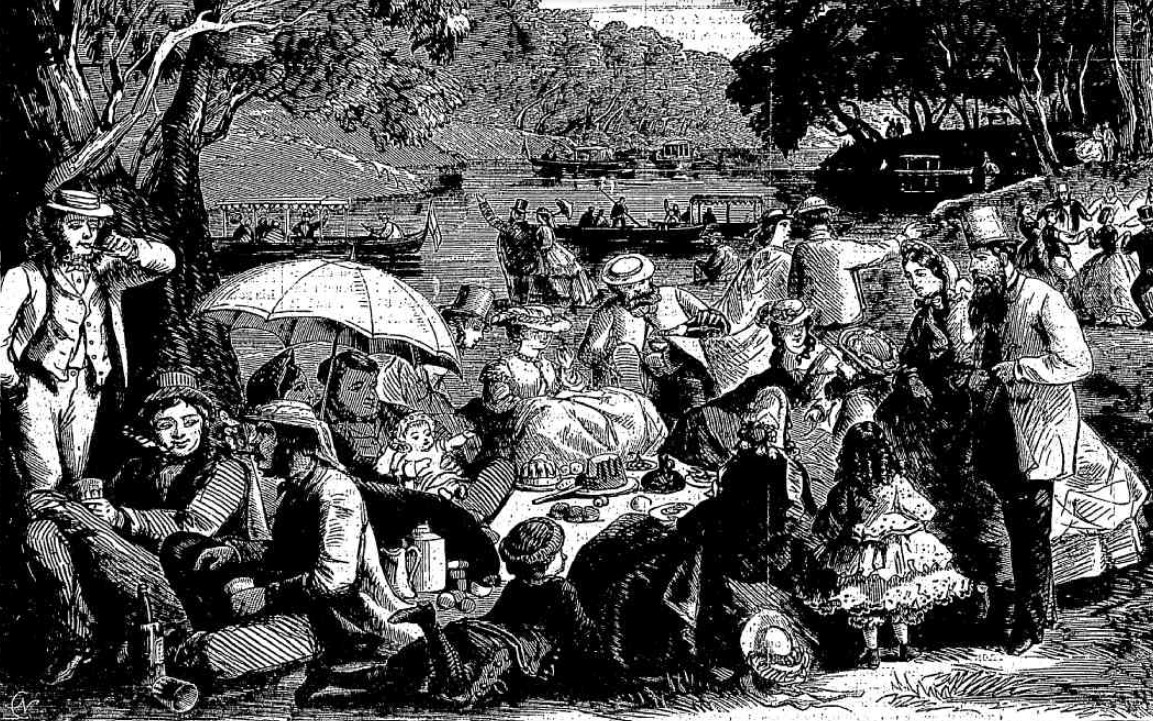
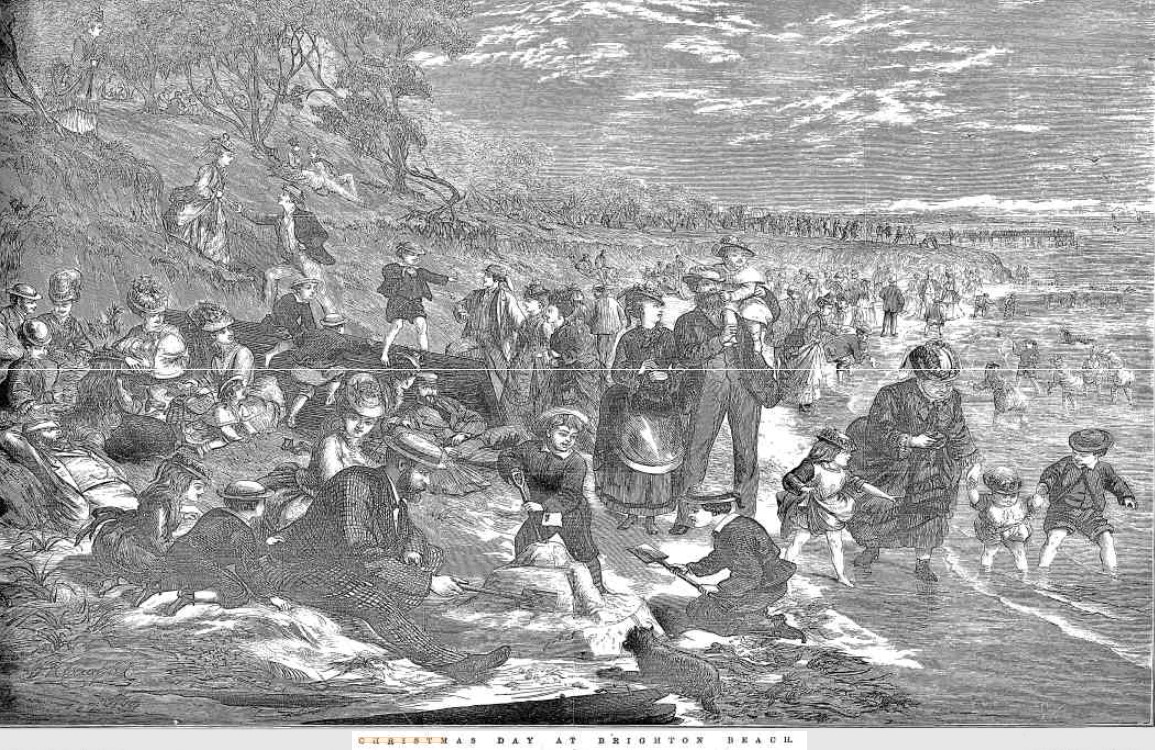
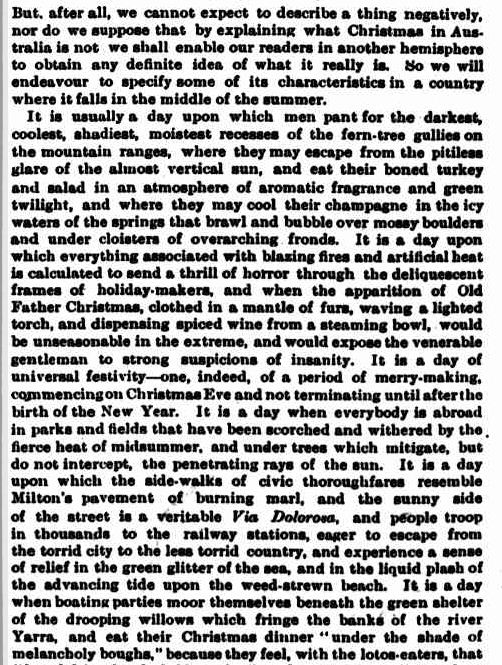
The Australasian Sketcher was an illustrated newspaper, but its descriptive text also paints a picture.  The first article from 1875,  creates such an idyllic image of the day with picnics and boating.   The second article from 1873, with its reference to John Milton’s Paradise Lost, describes the heat in such a way, one can almost envisage the “pavement of burning marl”.

Sketches with Pen. (1875, December 25). The Australasian Sketcher with Pen and Pencil (Melbourne, Vic. : 1873 – 1889), p. 150. Retrieved December 20, 2011, from http://nla.gov.au/nla.news-article60606554

“CHRISTMAS DAY AT BRIGHTON BEACH.” Illustrated Australian News for Home Readers (Melbourne, Vic. : 1867 – 1875) 30 December 1874: 7


Sketches with Pen. (1873, December 27). The Australasian Sketcher with Pen and Pencil (Melbourne, Vic. : 1873 – 1889), p. 166. Retrieved December 20, 2011, from http://nla.gov.au/nla.news-article60607026

A Pioneer Christmas 1860s Style

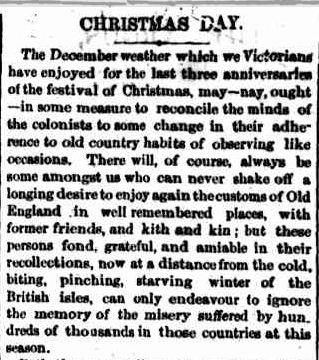
The 1860s arrived and once again the weather was the main point of focus at Christmas.

The Portland Guardian AND NORMANBY GENERAL ADVERTISER. (1864, December 26). Portland Guardian and Normanby General Advertiser (Vic. : 1842 – 1876), p. 2 Edition: EVENING. Retrieved December 13, 2011, from http://nla.gov.au/nla.news-article64632980

“CHRISTMAS IN AUSTRALIA.” The Australian News for Home Readers (Vic. : 1864 – 1867) 19 December 1864: 8

CHRISTMAS DAY. (1862, December 26). The Argus (Melbourne, Vic. : 1848 – 1956), p. 5. Retrieved December 19, 2011, from http://nla.gov.au/nla.news-article6482065

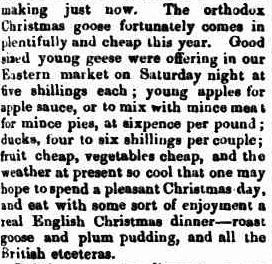
Most papers featured a Christmas supplement.  This extract from the supplement in The Star gives some insight into what was on the menu for Christmas dinner.  Geese, apple’s for sauce, mince pies, and plum pudding was all available at the Eastern market in Melbourne.

MELBOURNE. (1861, December 25). The Star (Ballarat, Vic. : 1855 – 1864), p. 1 Supplement: SUPPLEMENT TO THE STAR. Retrieved December 13, 2011, from http://nla.gov.au/nla.news-article66330382

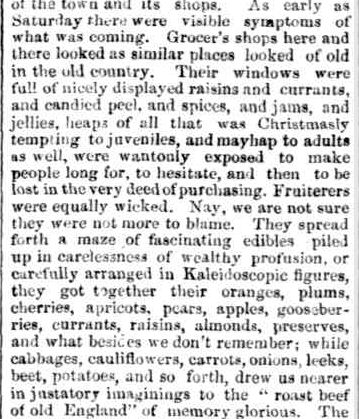
Along Main Road, Ballarat shopkeepers filled their windows with temptations.

CHRISTMAS EVE AND CHRISTMAS MORROW. (1860, December 25). The Star (Ballarat, Vic. : 1855 – 1864), p. 2. Retrieved December 18, 2011, from http://nla.gov.au/nla.news-article66336481

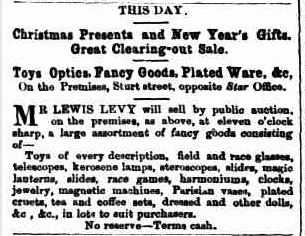
Lewis Levy of Sturt Street Ballarat offered gifts for everyone, from field glasses to Parisian vases.

Advertising. (1864, December 24). The Star (Ballarat, Vic. : 1855 – 1864), p. 3. Retrieved December 19, 2011, from http://nla.gov.au/nla.news-article66350716

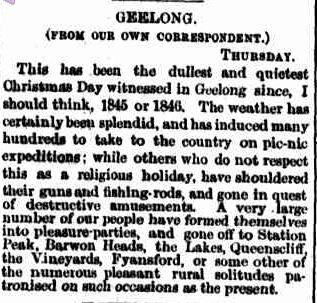
Christmas day 1862 was thought to be the quietest in Geelong for many years.  The weather, though, was perfect for picnics at Barwon Heads or Queenscliff.

CHRISTMAS DAY. (1862, December 26). The Argus (Melbourne, Vic. : 1848 – 1956), p. 5. Retrieved December 19, 2011, from http://nla.gov.au/nla.news-article6482065

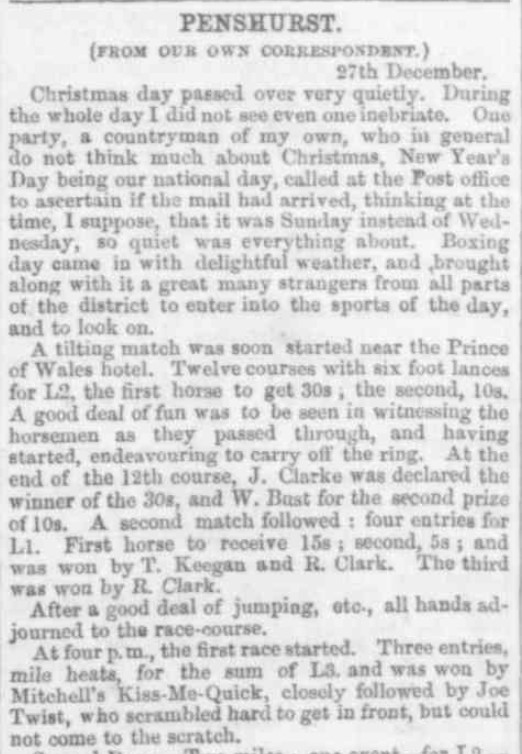
Things weren’t much better in Penshurst that year but Boxing Day was busy and there was, of course, the Penshurst Boxing Day races, still a tradition today.

“District News.” Hamilton Spectator and Grange District Advertiser (Vic. : 1860 – 1870) 4 January 1862: 2

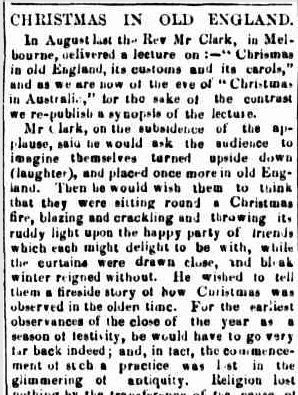
Of course, comparisons with England were never far away.  In 1869, the Portland Guardian and Normanby General Advertiser times ran a synopsis of a lecture by the Reverend Mr Clark “Christmas in old England, its customs and its carols”.

CHRISTMAS IN OLD ENGLAND. (1869, December 13). Portland Guardian and Normanby General Advertiser (Vic. : 1842 – 1876), p. 4 Edition: EVENINGS.. Retrieved December 13, 2011, from http://nla.gov.au/nla.news-article64694207

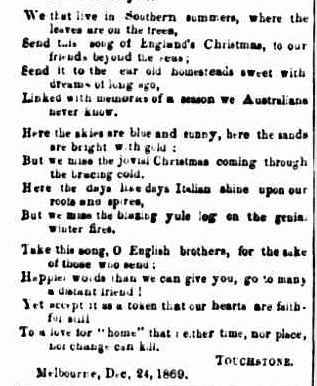
The last word comes from the “Poets Corner” from the Portland Guardian and Normanby General Advertiser about Christmas 1869.  While “Touchstone” spoke of the “Southern summers” he missed the “jovial Christmas coming through the bracing cold”

Poet’s Corner. (1870, January 10). Portland Guardian and Normanby General Advertiser (Vic. : 1842 – 1876), p. 4 Edition: EVENINGS.. Retrieved December 14, 2011, from http://nla.gov.au/nla.news-article64694411

A Pioneer Christmas 1850s Style

Imagine arriving on an immigrant ship to Melbourne or Portland in December.  After enduring the arduous voyage for months, passengers would have set foot in their new country faced with an Australian summer and then reminded Christmas was just around the corner.  My Mortimer family arrived in Melbourne from England on December 14, 1852,  just 11 days before Christmas.  Having known only a cold and maybe white Christmas and possibly losing track of the months, they may have felt a little confused.

Judging by the newspapers of the 1850s, however, it seems that the new arrivals embraced the “new” Christmas of clear skies and sun and a chance to get outside and enjoy the day.

ARRIVAL OF HIS EXCELLENCY SIR H. BARKLY. (1856, December 26). The Argus (Melbourne, Vic. : 1848 – 1956), p. 4. Retrieved December 15, 2011, from http://nla.gov.au/nla.news-article7142206

GEELONG. (1858, December 28). The Argus (Melbourne, Vic. : 1848 – 1956), p. 6. Retrieved December 15, 2011, from http://nla.gov.au/nla.news-article7307009

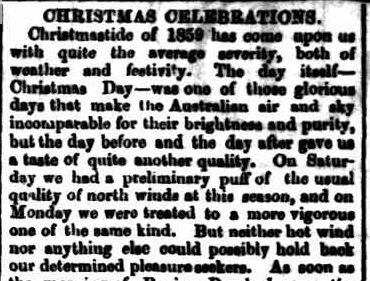
CHRISTMAS CELEBRATIONS. (1859, December 27). The Star (Ballarat, Vic. : 1855 – 1864), p. 1 Supplement: SUPPLEMENT TO THE STAR.. Retrieved December 13, 2011, from http://nla.gov.au/nla.news-article72463975

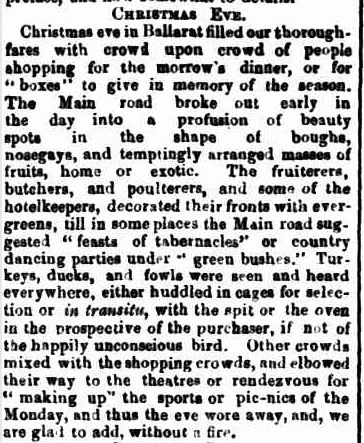
On Christmas Eve, 1859, Main Road Ballarat was abuzz with activity.

CHRISTMAS CELEBRATIONS. (1859, December 27). The Star (Ballarat, Vic. : 1855 – 1864), p. 1 Supplement: SUPPLEMENT TO THE STAR.. Retrieved December 15, 2011, from http://nla.gov.au/nla.news-article72463975

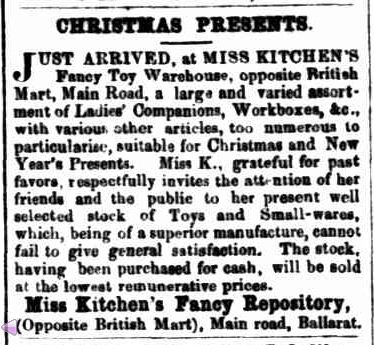
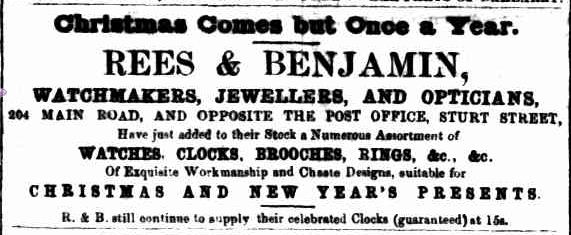
As well as shopping for ducks, geese, and turkey for Christmas lunch, some last-minute Christmas shopping could be done at Miss Kitchen’s Fancy Toy Warehouse or Rees and Benjamin Watchmakers and Jewellers.

Advertising. (1859, December 17). The Star (Ballarat, Vic. : 1855 – 1864), p. 3. Retrieved December 13, 2011, from http://nla.gov.au/nla.news-article72463876

Advertising. (1859, December 20). The Star (Ballarat, Vic. : 1855 – 1864), p. 1. Retrieved December 13, 2011, from http://nla.gov.au/nla.news-article72463910

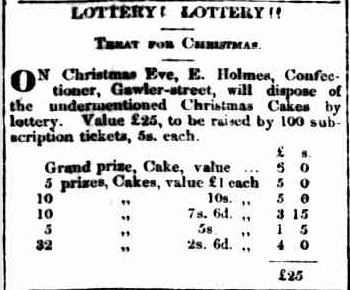
In Portland, shoppers may have spent Christmas Eve with their fingers crossed for the draw of the Christmas cake lottery at Holmes Confectioners in Gawler Street.

Advertising. (1859, December 19). Portland Guardian and Normanby General Advertiser (Vic. : 1842 – 1876), p. 3 Edition: EVENINGS.. Retrieved December 15, 2011, from http://nla.gov.au/nla.news-article64512997

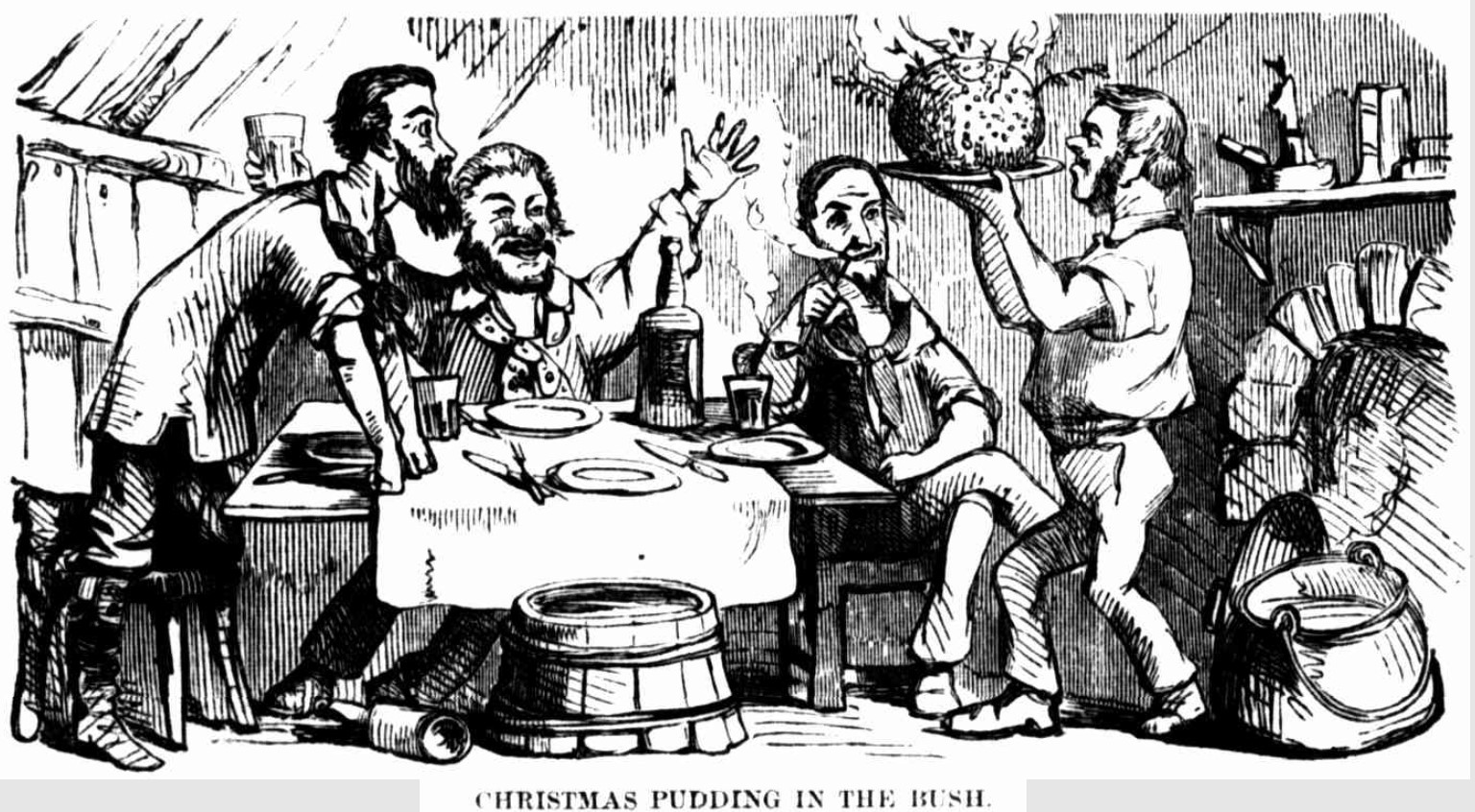
“No Title” Melbourne Punch (Vic. : 1855 – 1900) 2 August 1855: 173.

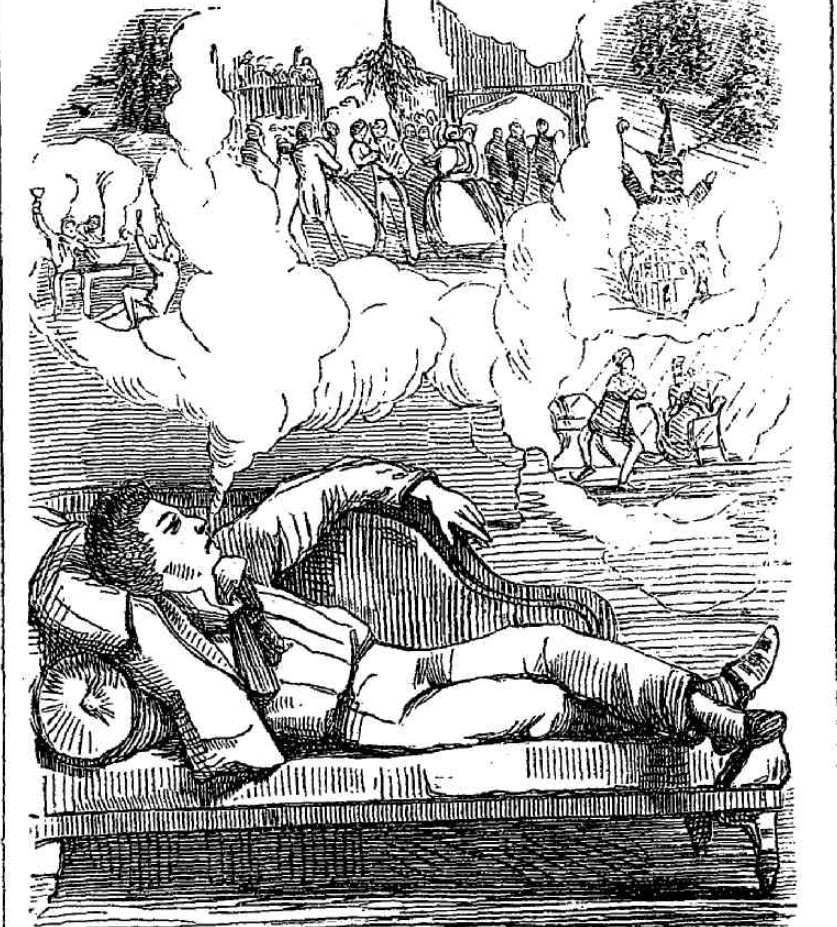
Not everyone was enjoying the new style of Christmas.  This illustration was entitled “A New Chum’s Christmas…The Pleasures of Memory”.

“A NEW CHUM’S CHRISTMAS.” Melbourne Punch (Vic. : 1855 – 1900) 1 January 1857: 3.

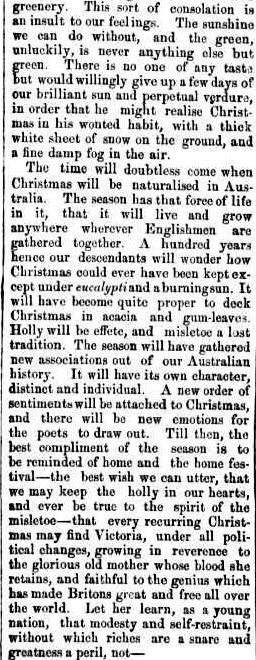
In 1859, the editor of  The Argus lamented that Christmas was not the same in Australia without the snow and mistletoe.  I like his prediction that in one hundred years,  Australians will have forgotten the “old” Christmas and have given Christmas a new feel with eucalyptus and acacia decking the halls.  If only he could see Christmas now as he would see that many of the English traditions of Christmas still exist and we still grapple with the idea of a hot lunch on a hot day,  but we just do it anyway.  The tradition continues.

(1859, December 26). The Argus (Melbourne, Vic. : 1848 – 1956), p. 4. Retrieved December 16, 2011, from http://nla.gov.au/nla.news-page198773

Jonathan Harman

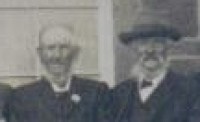
Jonathan Harman and his older brother James were like two peas in a pod.  While Jonathan did not show the devotion to the Wesleyan Methodist Church as his lay preacher brother, they shared a keen interest in farming practices and community involvement.

Jonathan and James Harman

Jonathan was born in Melbourn, Cambridgeshire in 1837.  By the 1851 England Census, he was the eldest child still living at the home of Joseph and Sarah Harman in Drury Lane, Melbourn.  His farming career had begun with his occupation, like so many others, agriculture labourer.

In 1854, Jonathan and his brothers George and Reuben boarded the Queen of England for Sydney.  The first record I find for Jonathan in Victoria is 1862 when he married Mary Oliver, daughter of fellow pioneers, Jonathan Oliver and Ann Richards.

In 1863, the first of the couple’s ten children, Arthur, was born at Yambuk, near Port Fairy.  Peter Fraser in Early Byaduk Settlers, mentions Mary’s father  Jonathan Oliver living there in 1863.   Peter Fraser also tells of James and Jonathan Harman each having a team of bullocks which they used for a carting business along the Port Fairy road, at least as far as Byaduk or even Hamilton.

Also from Early Byaduk Settlers, I have discovered Jonathan was one of the first buggy owners in Byaduk, purchasing a heavy red buggy in 1875.  Up until that time, most people owned spring carts which were not suitable for a trip into Hamilton.  Until the arrival of buggies, the only comfortable way to travel to Hamilton was horseback or dray.  That trip would have taken 4-5 hours according to Fraser.  Today, the trip to Byaduk from Hamilton is only about 15 minutes.

The family of Jonathan and Mary Harman was:

Arthur John – Birth: 1863 at Yambuk;  Marriage:  Ellen Mathilda Rogers 1891;  Death: 1933 at Hamilton.

Amelia – Birth: 1864 at Byaduk;  Marriage: Chris Bell, 1901;  Death: 1956 at Portland.

Edith – Birth: 1865 at Byaduk;  Marriage: Robert Bishop, 1901. Death: 1948 at Port Fairy.

Emily – Birth: 1866 at Byaduk, Marriage:  Malcolm Cameron, 1900; Death: 1948 at Heywood.

John – Birth: 1868 at Byaduk; Death: 1886 at Byaduk.

Mary Ann – Birth: 1869 at Byaduk.

Sarah – Birth: 1870 at Byaduk;  Death: 1877 at Byaduk.

Joseph – Birth: 1871 at Byaduk; Death: 1871 at Byaduk.

Minnie – Birth: 1872 at Byaduk; Marriage: Walt Hurrell, 1901; Death: 1953 at Warrnambool.

Jonathan – Birth: 1876 at Byaduk; Marriage: Hannah Waddup Keyte,1904; Death: 1941 at  Ararat.

Jonathan and Mary lost one child, Joseph as a baby.  Sarah was only six at the time of her death and her son John was 18.  Daughter Mary Ann was born in 1869 but I have never found a record for her death or marriage.

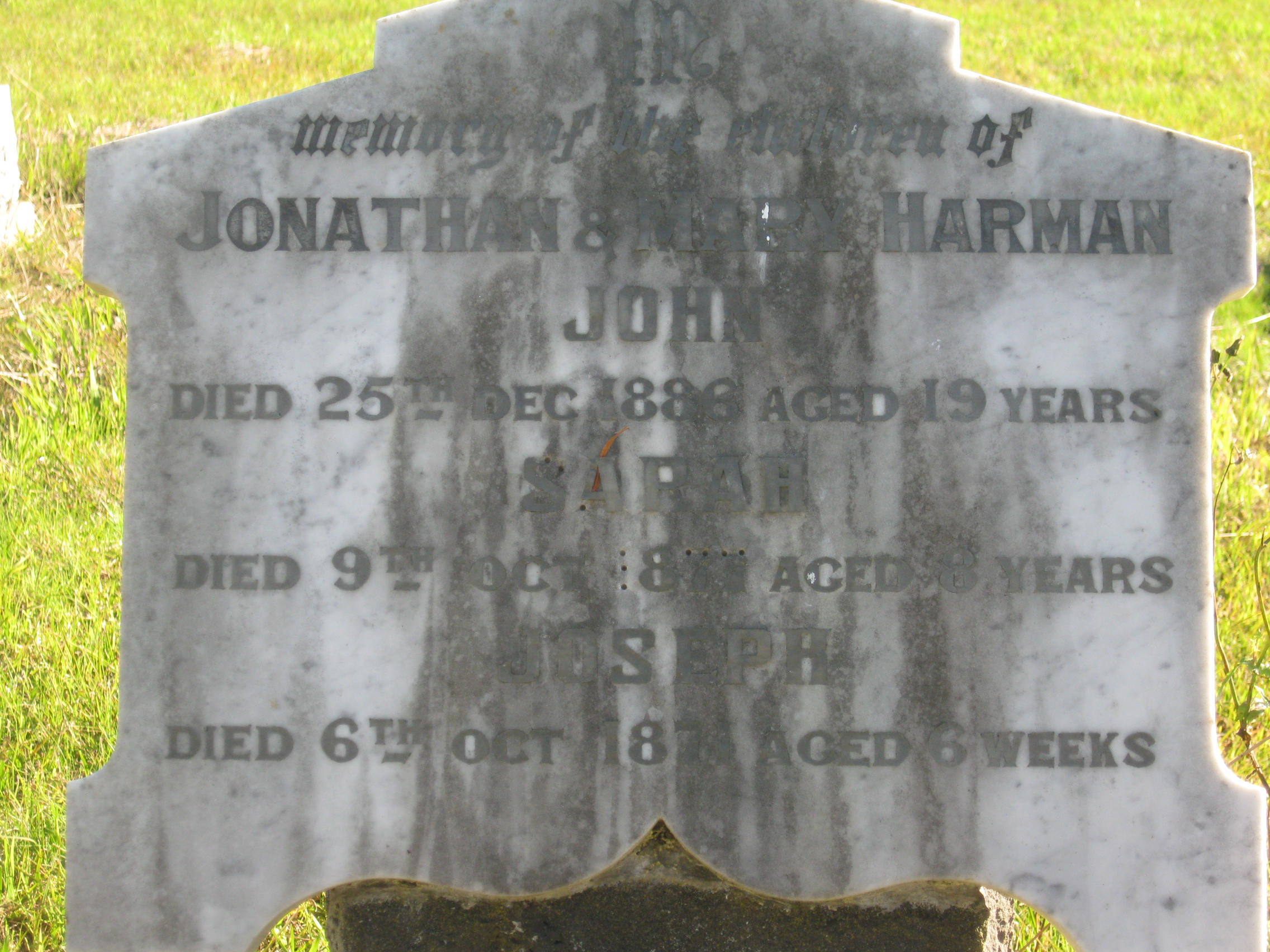
Joseph, Sarah, and John are buried at the Byaduk cemetery and a headstone marks their grave, but where is Mary Ann?

Headstone of John, Sarah and Joseph Harman, children of Jonathan and Mary Harman,, Byaduk Cemetery

Wife Mary died in 1884 at Byaduk at only 41 years of age.  Her youngest child Jonathan was only eight years old at the time.

At the time of Jonathan’s death on 2 April 1930, he was living with his daughter Amelia Bell at Heywood.  He was 94 years old.

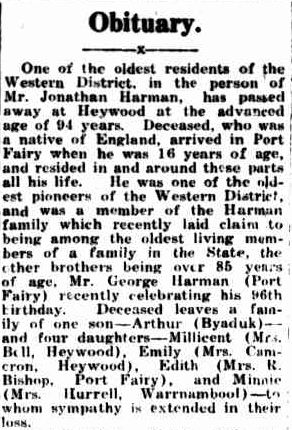
Obituary. (1930, April 7). Portland Guardian (Vic. : 1876 – 1953), p. 3 Edition: EVENING. Retrieved December 7, 2011, from http://nla.gov.au/nla.news-article64291985

Jonathan’s obituary contains some interesting information.

  • Jonathan’s arrival in Australia. It is true that Jonathan would have been around 16 when he arrived in Sydney from England with his brothers.  Parents Joseph and Sarah arrived a short time after and stayed in N.S.W for several years before heading to Victoria toward the end of the 1850s. Did Jonathan leave N.S.W. before them, possibly shortly after his arrival, taking a ship from Sydney to Port Fairy to join brother James?  Or is this all just unreliable second-hand information as is the nature of obituaries?  Even so, it is worth investigating further in my quest to pin down when all the Harmans arrived in Victoria and by what means.
  • Amelia Harman, who married Chris Bell is listed as Millicent. Her birth name was registered as Amelia. Could Millicent have been a nickname that stuck?
  • Youngest son Jonathan is not mentioned in the obituary despite not passing away until 1941.  I have always thought of him as the black sheep of the family.  He married a girl from outside of the district, Hannah Keyte of Natimuk and he spent time in Queensland with Hannah, before disappearing prior to his death in Ararat, Victoria in 1941.  Hannah was still living in Queensland at the time of his death.  Is it possible that not only did he fall out with his wife Hannah, but also his family back in Byaduk?  Or was it simply because the author of the obituary did not have time for him?

Jonathan was buried with Mary next to their three children at the  Byaduk Cemetery.

In the News – December 8, 1909

I’ve heard many stories of pumas living in the Grampians, but a bunyip?  In 1909, a Mr A. J. Campbell of Armadale wrote to The Argus suggesting such a creature was residing in the Black Swamp near Pomonal.

NATURE NOTES AND QUERIES. (1909, November 26). The Argus (Melbourne, Vic. : 1848 – 1956), p. 4. Retrieved December 5, 2011, from http://nla.gov.au/nla.news-article10749956

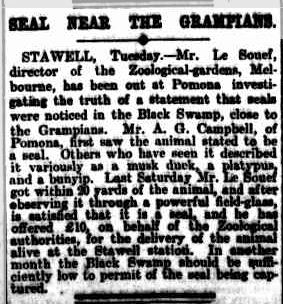
That letter led to a report in The Argus on 8 December 1909 about the strange creature of the  Black Swamp.  An expert had arrived and an attempt made to identify the creature.  Dudley Le Souef, an interesting character from an even more interesting family, and then director of the Melbourne Zoological Gardens, got within 20 yards of it and confirmed that the bunyip was, in fact, a seal.  A seal would not be that surprising in a seaside town but Pomonal is around 150 kilometres from the sea.  Browsing through the newspapers at Trove, I found many references to bunyips, with musk ducks commonly mistaken as were wombats and platypus.  I also found many accounts of “inland seals” around the country, also mistaken for the mythical bunyip.

SEAL NEAR THE GRAMPIANS. (1909, December 8). The Argus (Melbourne, Vic. : 1848 – 1956), p. 12. Retrieved December 5, 2011, from http://nla.gov.au/nla.news-article10752746

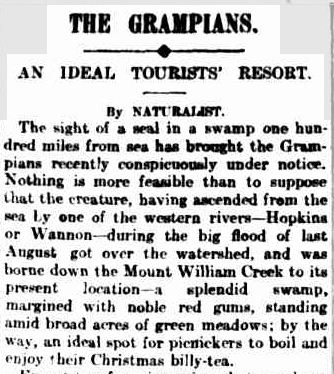
An explanation of how the seal could have come to be so far inland was found in The Argus on 21 December 1909.  The idea of a seal in the Grampians had created some interest and the “Naturalist” who authored the article encouraged people to visit the little-known tourist destination.  He even recommended tourists picnic beside the Black Swamp.  That would be okay if you were not scared of bunyips!

THE GRAMPIANS. (1909, December 21). The Argus (Melbourne, Vic. : 1848 – 1956), p. 5. Retrieved December 7, 2011, from http://nla.gov.au/nla.news-article10755530

Looking at maps of the Grampians, I believe the seal’s path along the Wannon possible, but in the depths of the Grampians, where the Wannon ends, it seems the seal would have had to have travelled overland and along smaller creeks to meet up with the Mount William Creek.

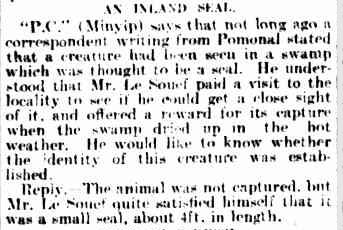
At the time of his sighting, Le Souef offered a £10 reward to anyone who could catch the seal and deliver it alive to the Stawell Railway station.  Hopes were up that by the end of summer, the swamp would have dried enough to assist the seal’s capture, however, a query to the “Nature Notes” in The Argus on 20 May 1910, closed the story.  Until now.

NATURE NOTES AND QUERIES. (1910, May 20). The Argus (Melbourne, Vic. : 1848 – 1956), p. 9. Retrieved December 7, 2011, from http://nla.gov.au/nla.news-article10857617

Halls Gap’s Cherub

There is a special place in Halls Gap I revisited recently.

Behind the Halls Gap caravan park and just beside a track leading to places with whimsical names such as Venus Baths and Wonderland Range, lies a stark reminder of pioneering days in the little town.  Halls Gap has few visible reminders of its pioneering past, but the lonely grave of baby Agnes Folkes has seen much of the town’s history pass before it. Fire, flood, and countless tourists have passed by Agnes.

John and Phoebe Foulkes (later to become Folkes), originally from Worcestershire, arrived in Victoria aboard the Northumbria in 1853.  Ida Stanton, in her book Bridging the Gap, tells of John working as the ship’s carpenter and upon arrival, obtaining work making architraves and balustrades for the new Victorian Parliament House.  They had moved to the Grampians area by the end of the 1850s with son George born in 1858 at Moyston.

By 1870, John Folkes was operating a sawmill in Halls Gap.  The family home, made of logs, was close to the banks of the Stony Creek.   By this time, there were seven children with Phoebe giving birth to Agnes in April of that year at nearby Pleasant Creek.

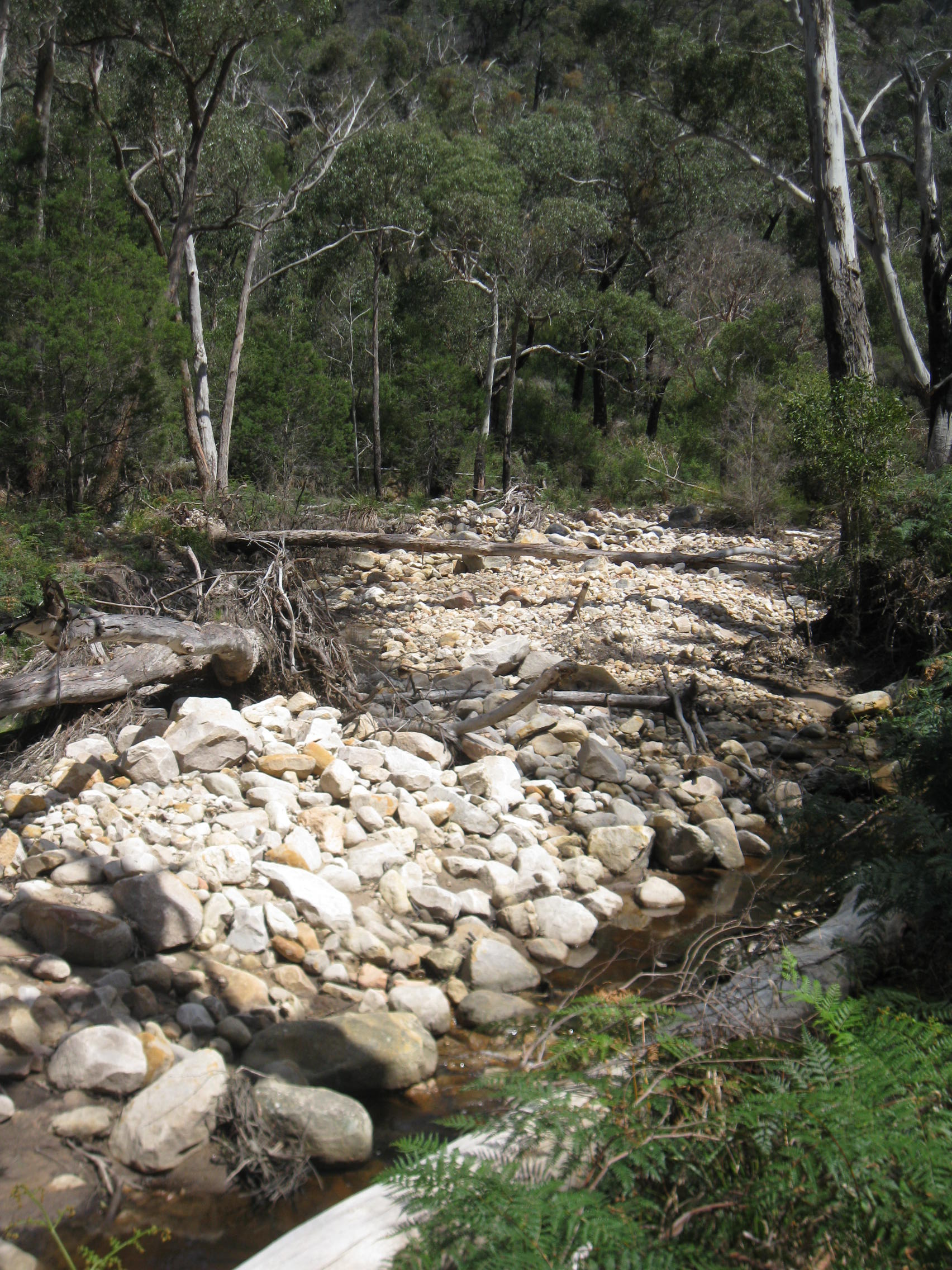
After a dry autumn, the winter of 1870 saw the weather break.   Heavy rain fell across Victoria, flooding lakes, roads and rivers.  At times of heavy rain in the Grampians, water collects in the mountains, working down the many gullies and into small creeks which quickly become rivers.  One of those is the Stony Creek.  With the winter rains of 1870, the creek had risen and was impassable as were others which had to be crossed to leave the town.  The following photo is of Stony Creek close to Agnes’ grave.  Evidence of flash flooding in January this year is still present.

Stoney Creek, Halls Gap

STONY CREEK

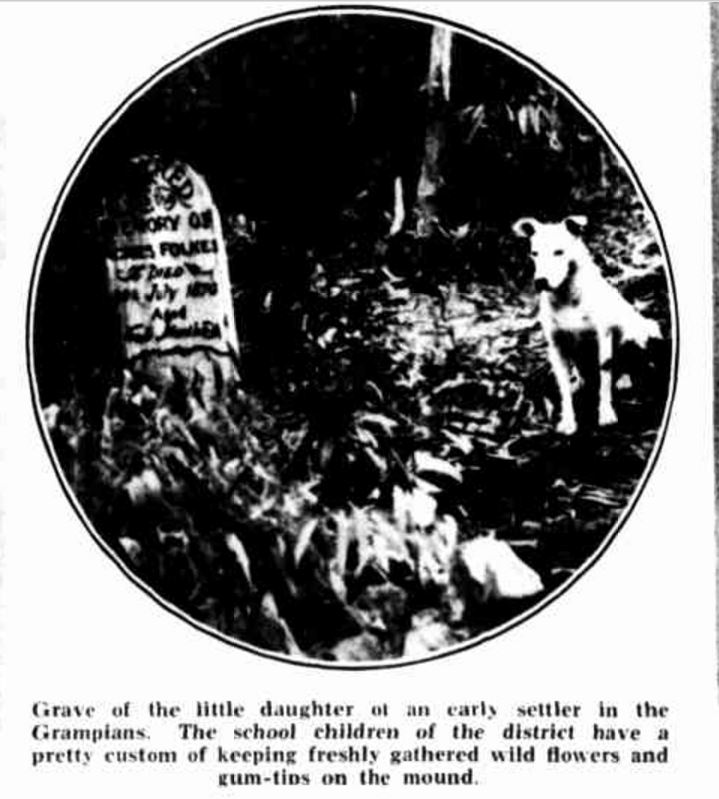
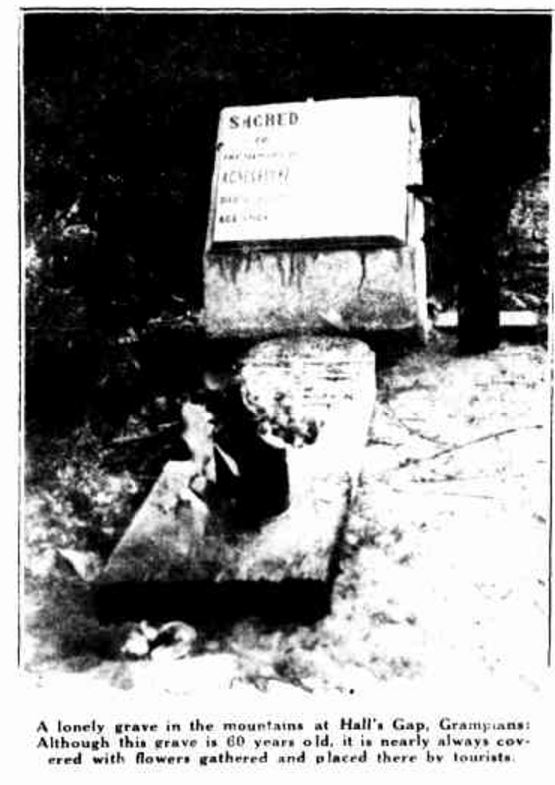
Agnes fell ill with diphtheria that winter, but Phoebe and John could not get through to Stawell and the nearest doctor.  Sadly, on 30 July 1870, Agnes passed away.  She was buried close to the family home in a tiny wooden coffin made by her father.  A headstone was added but it was replaced with something more substantial.  The timing of that was sometime around the 1930s.  The following photo from the Weekly Times in 1932 shows what would be Agnes’ original headstone.

Weekly Times (Melbourne, Vic. : 1869 - 1954) 30 July 1932: http://nla.gov.au/nla.news-page23862849 .

Weekly Times (Melbourne, Vic. : 1869 – 1954) 30 July 1932: http://nla.gov.au/nla.news-page23862849 

However, the following photo appeared in the Weekly Times almost two years earlier on 29 March 1930 and shows the current headstone and what looks like the original headstone lying on top of the grave.

Weekly Times (Melbourne, Vic. : 1869 - 1954) 29 March 1930: .

Weekly Times (Melbourne, Vic. : 1869 – 1954) 29 March 1930: <http://nla.gov.au/nla.news-page23974945&gt;.

The was even a Rose Postcard made of Agnes’ grave and it looks different again.

Image courtesy of the State Library of Victoria http://handle.slv.vic.gov.au/10381/66061

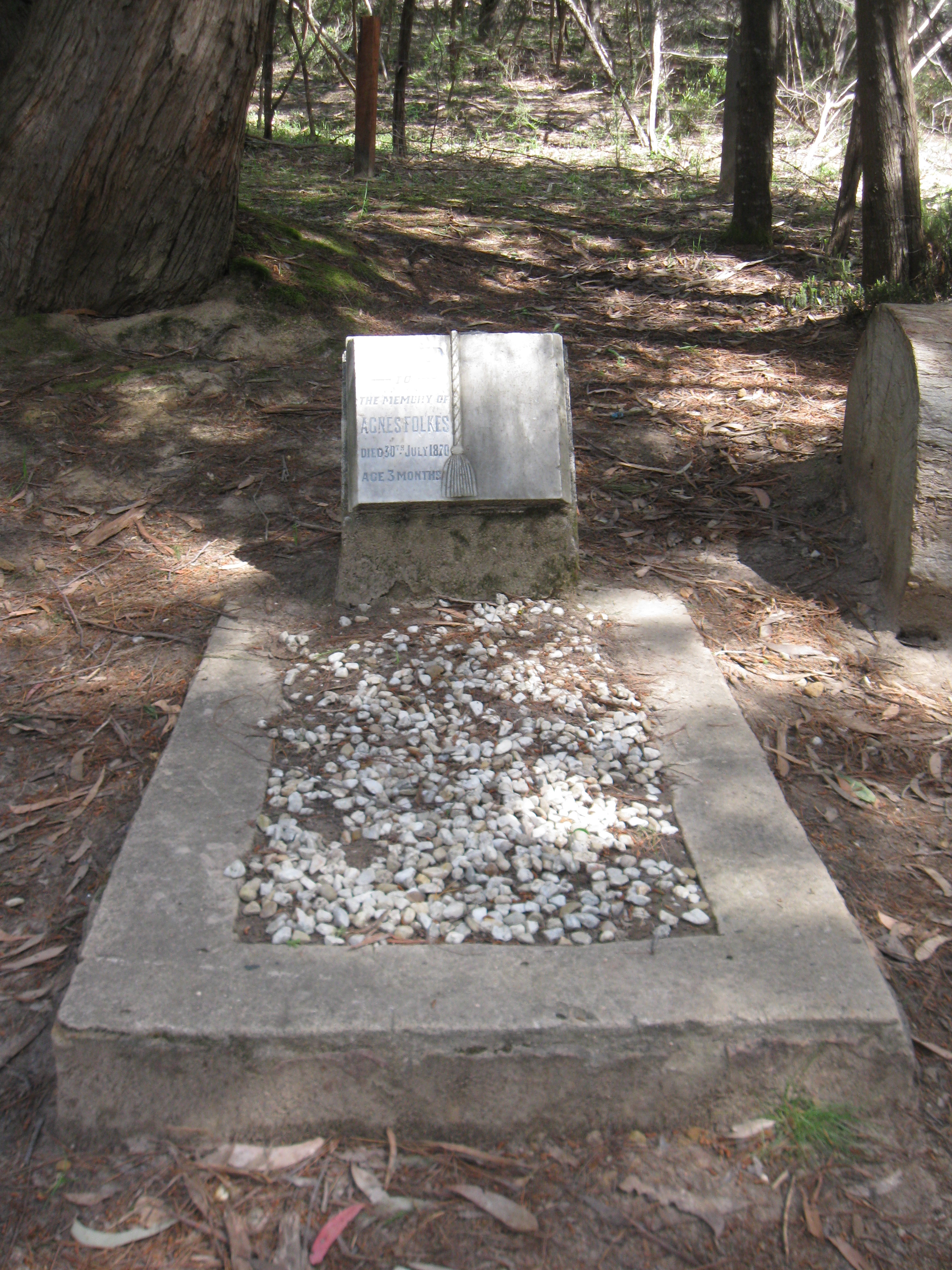
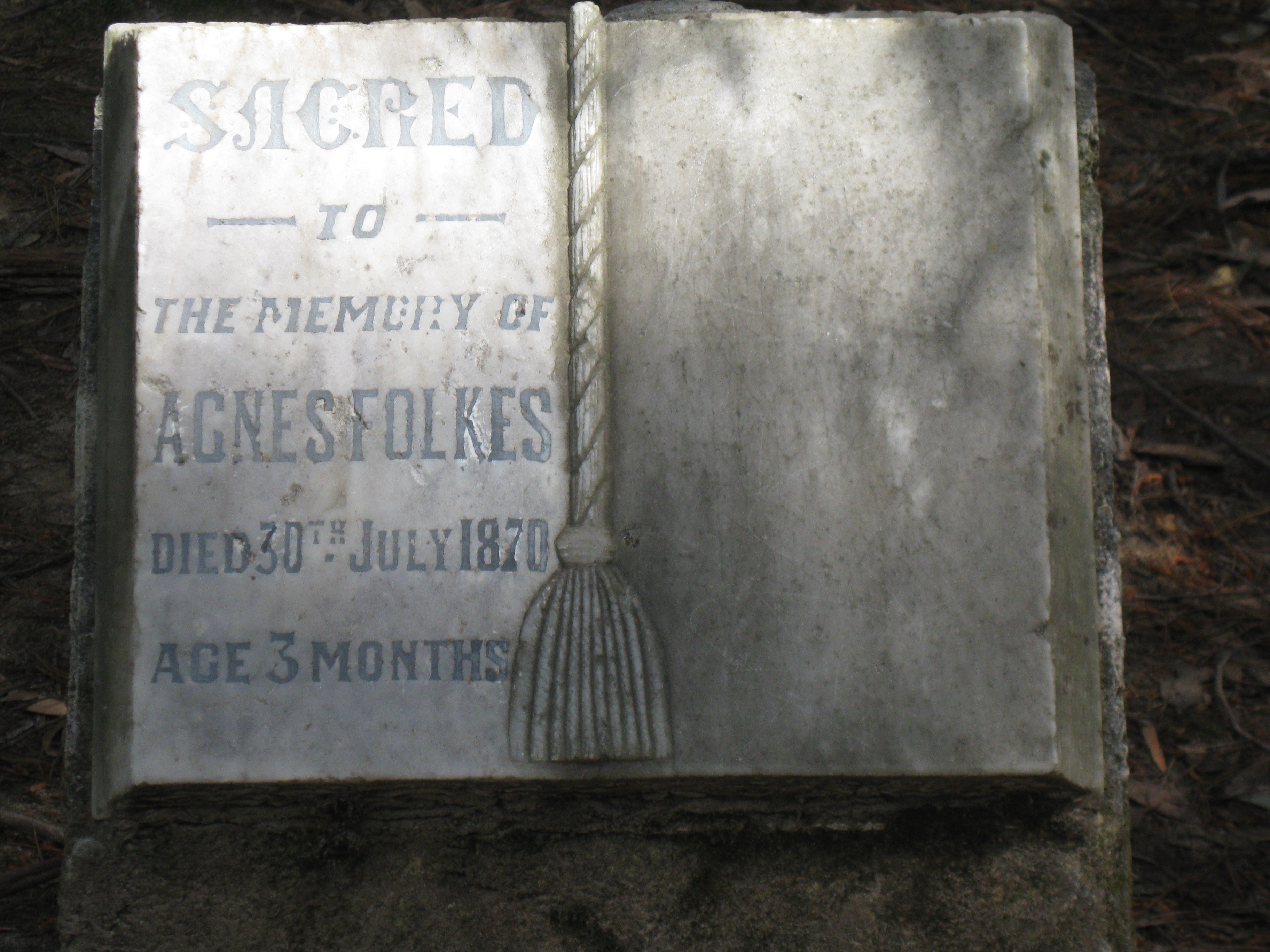
This is how the grave looks today.

IMG_2292

Headstone of Agnes Folkes

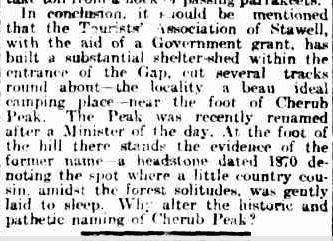
After Agnes’ death, locals began to refer to the mountain peak behind her grave as “Cherub Peak”, however, it was later gazetted as “Mackeys Peak”, after a Government minister.

THE GRAMPIANS. (1909, December 21). The Argus (Melbourne, Vic. : 1848 – 1956), p. 5. Retrieved November 15, 2011, from http://nla.gov.au/nla.news-article10755530

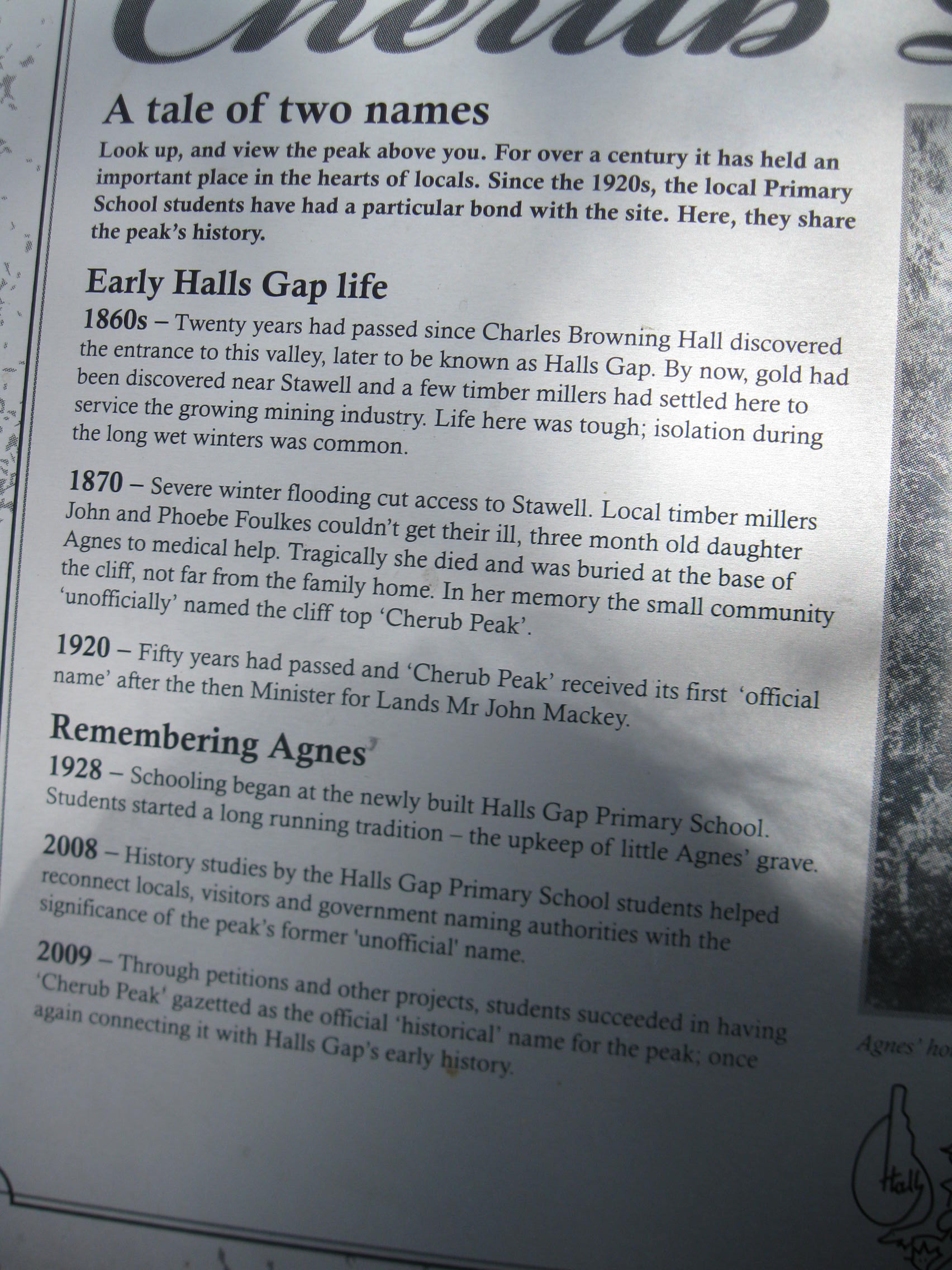
One heartwarming aspect of the story is that not only have the children of  Halls Gap Primary School tended Agnes’ grave for almost one hundred years, they more recently lobbied the Victorian Government for the name to be changed back to “Cherub Peak”.  The name has now been gazetted as a historical name and a new sign  erected to explain the history of the grave.

Cherub Peak

Sign near Agnes’ grave

Agnes’ siblings grew up and married.  A brother and sister went on to marry children of other Halls Gap pioneering families.  Emily Phoebe Folkes married Edward Evans while George Edward Folkes married Emma Launder Delley.  Edward and Emily Evans had a son Edward who married Geraldine D’Alton, from another pioneering family.  The names of Evans, Delley, and D’Alton are still recognizable in the Gap today.  Would Agnes also have married into a well known Halls Gap family and forged her own piece of history?   Despite her short life, her grave and its reminder to visitors of the town’s pioneering times have seen baby Agnes make her mark on the history of Halls Gap.

From The Horsham Times at Trove, I have been able to source this beautiful, almost haunting article originally published in The Ballarat Courier in 1909. The words of “H.B” will come to mind next time I visit Agnes.

In the Grampians. (1909, January 15). The Horsham Times (Vic. : 1882 – 1954), p. 1. Retrieved December 1, 2011, from http://nla.gov.au/nla.news-article72825768

THE VIEW TOWARDS CHERUB PEAK

Passing of the Pioneers

November sees more interesting obituaries from the Portland Guardian.  The Horsham Times is now available at Trove, so I have included obituaries from that paper.

Read about a long time manager of Burswood, the Henty homestead, a man who grew new teeth at 80 and two women who lived in the same houses for over 60 years.

Benjamin EDRICH: Died 18 November 1887 at Portland. The Portland Guardian reported at the time of Benjamin EDRICH’s death that another resident “had been removed by the hand of the “Grim Destroyer”.  Benjamin had been in the hotel business for many years.

George BUSH: Died 18 November 1909 at Portland. George BUSH arrived in Portland in 1853 in his early twenties.  A seaman, George was instrumental in rescuing passengers from the wreck of the “Jane” at Bridgewater some years later.

Peter GOLDSMITH: Died 23 November 1909 at Portland. Peter GOLDSMITH arrived in Portland in 1853 aboard the Cornelius captained by Thomas H. CLARKE. Clarke’s son Thomas Denton CLARKE was mentioned in the October Passing of the Pioneers.  Four months after his arrival Peter GOLDSMITH married Miss BLAY and they had nine children. He was eighty-five at the time of his death.

Michael TOBIN: Died 13 November 1916 at Murtoa. The Horsham Times reported the death of Michael Tobin, a Justice of the Peace and former Councillor with the Dunmunkle Shire.  Michael arrived at Geelong in 1853, with his parents from Kilkenny, Ireland.  He worked with his father who ran a carrying business to the diggings.  Michael later lived in the Warrnambool area where he married Mary CLUNE.  In 1872, Michael was one of the first settlers in the Wimmera.

Obituary. (1916, November 21). The Horsham Times (Vic. : 1882 – 1954), p. 4. Retrieved November 24, 2011, from http://nla.gov.au/nla.news-article72983888

George JARRATT: Died November 1919 at Portland. George JARRATT arrived in 1848 to Portland and married soon after.  He and his wife, a daughter of Thomas KEAN, had twelve children.

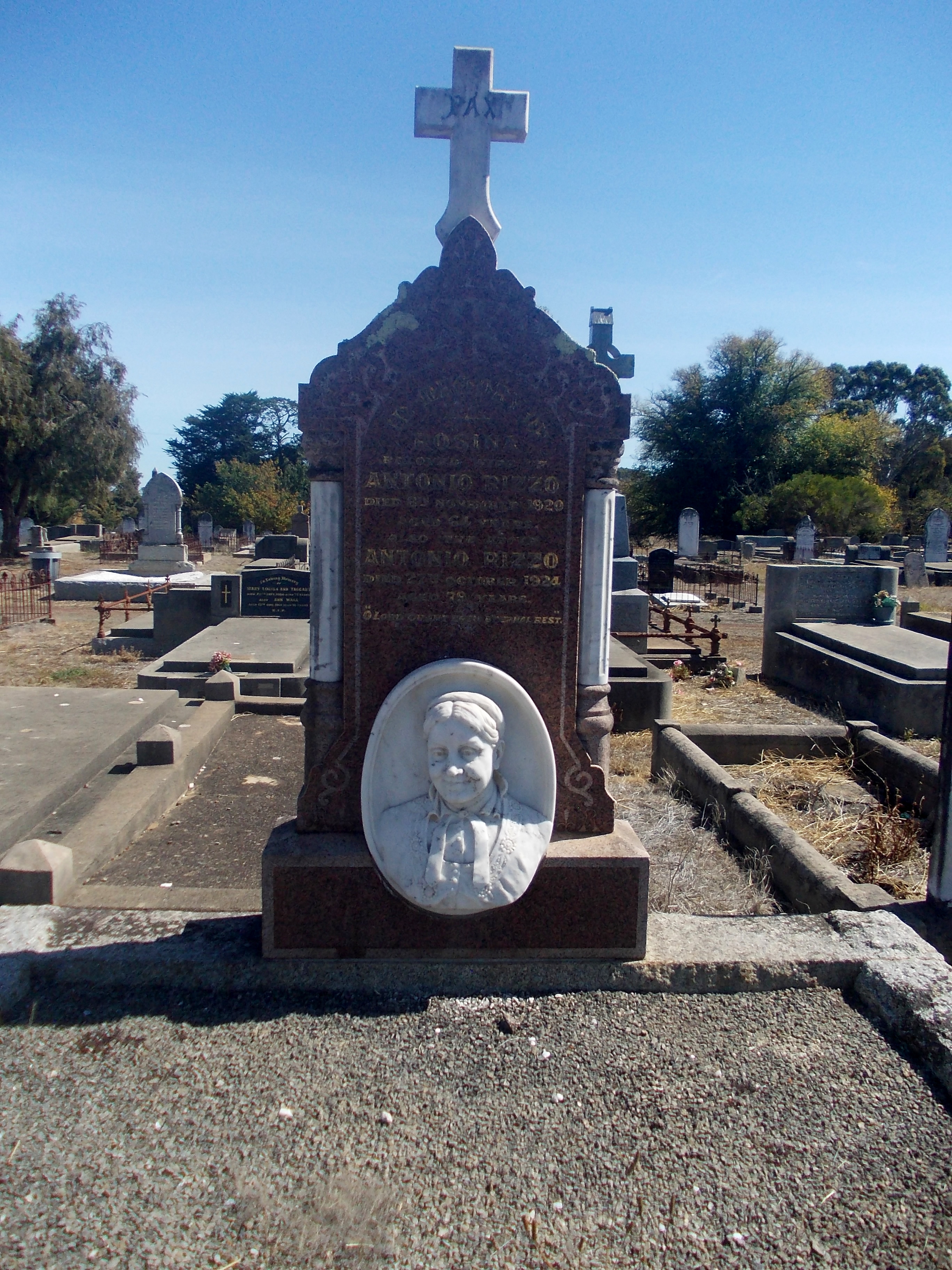
Rose Genevive McCRYSTAL: – Died 8 November 1920 at Caulfield. Rose McCRYSTAL, was the daughter of well-known Portland resident Pat McCrystal. She married W. PEARSON, and moved to Hamilton. After her husband was killed in a buggy accident, she moved back to Portland where she married Antonio RIZZO in 1891. They later returned to Hamilton.

Rizzo

GRAVE OF ROSINA RIZZO (nee McCRYSTAL) AND HER HUSBAND ANTONIO RIZZO, HAMILTON OLD CEMETERY.

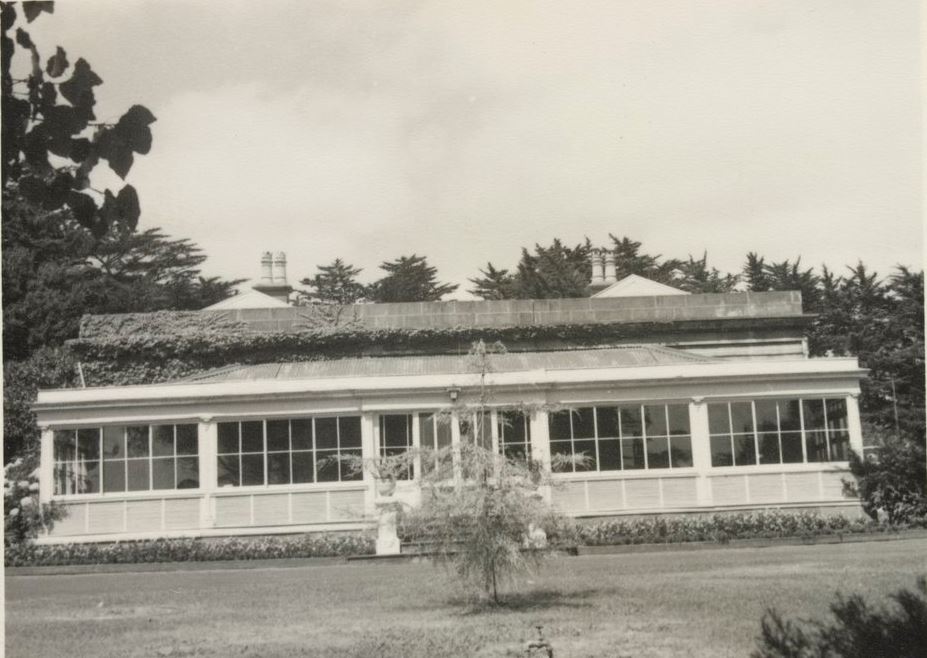
William POLAND: Died 20 November 1922 at Portland. William POLAND arrived in Portland in 1856. He met Edward HENTY and acquired the position of manager of Burswood, the Henty’s original homestead. William held the position for twenty-five years.

“BURSWOOD” PORTLAND. Image courtesy of Colin Caldwell Trust collection, State Library of Victoria. Image no. H84.276/6/44A http://handle.slv.vic.gov.au/10381/72455

Mary Stanton SLEEP: Died 3 November 1923 at Portland. I enlarged this obituary to make sure my eyes weren’t deceiving me.

OBITUARY. (1923, November 8). Portland Guardian (Vic. : 1876 – 1953), p. 2 Edition: EVENING.. Retrieved November 24, 2011, from http://nla.gov.au/nla.news-article64103714

Mary Sleep was ninety-five when she died in 1923, however, the obituary reads she arrived in Portland in 1836 as a married woman!  I think this may have been a typo. A check of the Victorian Marriage Index shows Mary married Francis ROW in 1853.

Isabella MARSHALL: Died 8 November 1927 at Portland. Isabella MARSHALL managed to pass Mary SLEEP (above) for the longest time in one house.  She lived in the same house for sixty-five years. Originally from Scotland, Isabella arrived in Portland aboard the Indian Ocean in 1854 with her husband William ROBB.  She was ninety-six when she died and left seven children, twenty-three grandchildren, twenty-nine great-great-grandchildren and one great-great-great grandchild.  She was buried at the North Portland Cemetery.

Sarah MILLARD: Died 10 November 1927 at Paschendale. Sarah MILLARD was the daughter of William MILLARD of Narrawong. She married William Henry ANNETT in 1870 and they had ten children, eight sons and two daughters.  William, or Henry as he was known, was also known as the “Father of Wallacedale”.  He died only weeks earlier than Sarah on 29 September. Unfortunately, I missed his obituary for the September Passing of the Pioneers, as it appeared in an October issue, but it will definitely appear in September 2012.  Henry’s obituary is one of the best I have read, and what a life he led, especially before he married Sarah.  If you can wait until next year, this is the link:  Obituary of William Henry Annett.  I also spent too much time trying to find a link between Sarah MILLARD and William MILLARD, the winner of the first Stawell Gift.  He may have been Sarah’s brother, but there were a lot of Millards.  Research for another time.

Agnes MUIR: Died 10 November 1942 at Horsham. Agnes MUIR arrived in Brisbane with her new husband Ralph CHEQUER in 1886 aboard the Roma, having married in their home country of Scotland before departing. Over the years, they spent time in Melbourne, Portland and Quantong. At Quantong, the CHEQUERS cleared the land and planted orchards and for thirty years Agnes helped Ralph with the orchard work. One memorable event for the CHEQUERS was in 1911 when they travelled to England for the coronation of King George V.

James COLES: Died 18 November 1944 at Stawell. James COLES was born in the mid-1850s close to the Melbourne GPO.  After time in Avoca, James moved to Stawell as a teenager, later to marry Louisa GILHAM.  He remained in Stawell until his death at ninety-one, aside from a short stint at nearby Fyans Creek.

Thomas THOMPSON: Died 17 November 1945 at Portland. Thomas THOMPSON from Ireland began his time in Australia in Western Australia as a miner. Unsuccessful he headed to Victoria and the Portland district.

OBITUARY. (1945, November 19). Portland Guardian (Vic. : 1876 – 1953), p. 3 Edition: EVENING. Retrieved November 25, 2011, from http://nla.gov.au/nla.news-article64406000

Annie KERR: Died November 1947 at Portland. Annie KERR was the daughter of early Portland residents, her father a doctor. Interesting that he had not practised before his arrival in Portland!  Annie went on to marry John NEWTON.

Joseph Levi Richard BAKER: Died 27 November 1950 at Hamilton. Joseph BAKER was born around 1877 and lived in Collins Street Hamilton. He enjoyed tennis and summer trips to Portland. The obituary reported he was known throughout the Commonwealth for his calligraphy skill. He left a wife Bertha and two daughters.

Carl Frederick Wilhelm PULS: Died 12 November 1953 at Lower Norton. Carl PULS had many claims to fame, but one was his ability to grow new teeth at the age of eighty. Carl was a respected pioneer of the Horsham district and was sadly found dead by his car after a trip to gather wood.

John BERRY: Died 12 November 1953 at Horsham. John BERRY’S death came on the same day as Carl ULS (above).  The BERRY family were pioneers in the Blackheath district, north of Horsham. They later moved to Horsham and John attended the Horsham State School.  John married Ethel KNIPE of Ballarat and worked at Horsham car dealer Wilson Bolton for over forty years. He held one of the first driving licences in Victoria but had driven previous to that, in a time when a licence was not required…scary. I noted that John had a brother James from Hamilton. This may have been the same James BERRY of James Berry & Sons Jewellers, a long-established business in Hamilton when I was growing up there in the 1970s and 80s.
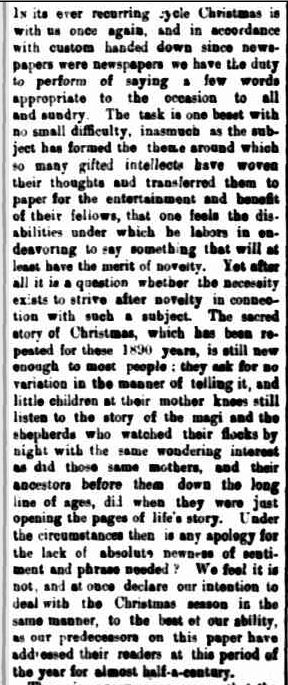
The Horsham Times Goes Digital

(1891, January 6). The Horsham Times (Vic. : 1882 – 1954), p. 1. Retrieved November 23, 2011, from http://nla.gov.au/nla.news-page7084926

It’s great to see issues of  The Horsham Times going online at Trove.  I was very happy when I immediately found articles about family members.  While I did have some family in Horsham, I have found a lot of articles about the Cavendish area which I am hoping will help with the Hadden and Mortimer families.
When fully released, issues available will cover the period 1882-1954.  This will be a great resource for researching the Western District.  There is more to look forward to.  New titles for the 2011-2012 financial year will include:

Ararat Advertiser (1914-1918)   NOW AVAILABLE

Casterton News and the Merino and Sandford Record (1914-1918)  NOW AVAILABLE

Colac Herald (1914-1918) NOW AVAILABLE

Mildura Cultivator (1888-1920) NOW AVAILABLE

Warrnambool Standard (1914-1918) NOW AVAILABLE

If you haven’t visited Trove lately, these are the titles from Western Victoria already available:

The Ballarat Star (1865)

Camperdown Chronicle (1877-1954)

The Kerang Times (1889-1890)

Kerang Times & Swan Hill Gazette (1877-1889)

Portland Guardian (1876-1953)

Portland Guardian and Normanby General Advertiser (1842-1876)

The Star (Ballarat) 1855-1864

Happy reading!