In The News – September 23, 1870

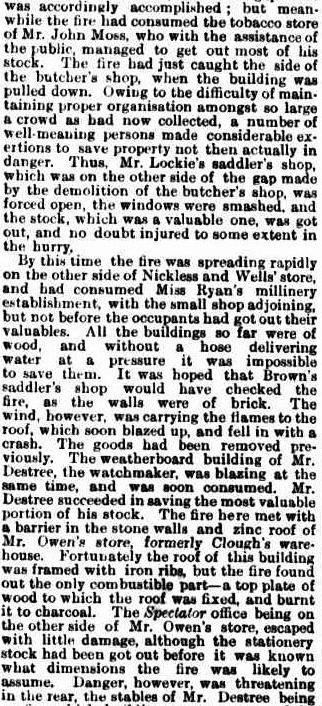
This is one of my favourite articles about Hamilton’s history.  The Argus of 23 September 1870 reported that on the Sunday morning past, September 18, at 3am “the residents of Hamilton were aroused from their beds by the cry of “Fire!” and a large crowd soon collected in Gray Street…” What follows is a story of a desperate battle to save not only the shops surrounding the grocery story of Nickless and Wells but beyond.

The article gives an interesting insight into how a fire of such intensity was managed in the 19th century.  Many buildings were wooden and there was little or no water pressure.  An early decision to pull down the butcher shop of  Messrs. Brown Brothers to create a gap between the fire and the rest of the buildings in the block was to no avail as the fire was quickly spreading from the other side of Nickless and Wells.  Firefighting attempts were also hindered by the large crowd that had gathered.

DISASTROUS FIRE AT HAMILTON. (1870, September 23). The Argus (Melbourne, Vic. : 1848 – 1956), p. 7. Retrieved September 22, 2012, from http://nla.gov.au/nla.news-article5832754

Hamilton’s main street, Gray Street, is no stranger to fire.  Actually, there seems to have been an unusually large number of fires, causing significant damage often to several buildings in the town’s CBD.  I did a quick browse of Trove and found fires such at these in the following years alone:  1874, 1885, 1888, 1900,  1912, 1914, 1920, 1930, 1932, 1938, 1944.

On August 1, 1962, one of Hamilton’s largest fires occurred when Strachan’s Department store, on the corner of Gray and Brown Street burnt out in a spectacular fire, talked about for years after.  During my time in Hamilton, 1970s and 80s, a large car showroom was destroyed on the opposite corner of Gray and Brown Street.  Since then, I can think of two other fires in Gray Street in the block between Brown and Thompson Streets.  The most recent saw the Target store destroyed in October 2004 by a fire the Mayor of the time, Cr. Don Robertson considered large enough have burnt out the CBD.  What differed between the fire of 1870, with the same potential, and the Target fire was that in the case of the latter,  a $1.2 million ladder platform truck was rushed from Ballarat and thermal imaging equipment came from Portland.  Huge advances from the times of horse-drawn fire-carts!

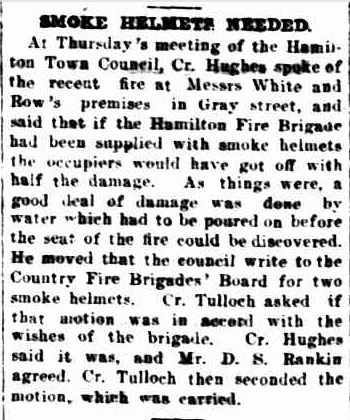
With the tendency for fires in the CBD, it was no surprise that after a fire in Gray Street in 1932,  Councillor Hughes thought smoke helmets could be of some use to the fire brigade.

SMOKE HELMETS NEEDED. (1932, March 4). The Horsham Times (Vic. : 1882 – 1954), p. 2. Retrieved September 23, 2012, from http://nla.gov.au/nla.news-article72599000

Trove Tuesday – The Huntress

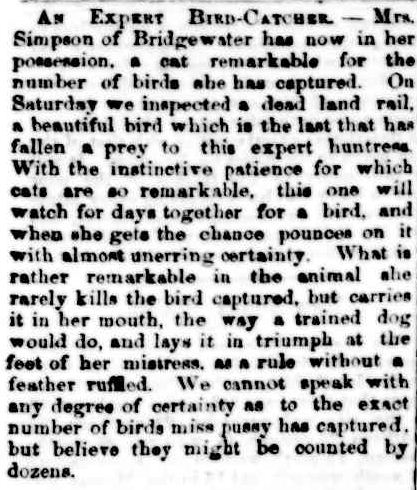
This week’s Trove Tuesday article from the Portland Guardian and Normanby General Advertiser is not an enjoyable read, but it is a reminder of the changes in attitude towards our environment and the creatures that inhabit it. In 1867, a bird hunting cat was a thing to celebrate but remember this was a time when sparrow matches and other bird shooting was popular, so please think no less of Mrs Simpson of Bridgewater.  The poor bird involved was a “land rail bird”, most likely the endangered Lewin’s Rail, a small native water bird found in the south-west of Victoria.

AN EXPERT BIRD-CATCHER. (1867, September 23). Portland Guardian and Normanby General Advertiser (Vic. : 1842 – 1876), p. 6 Edition: EVENINGS.. Retrieved September 9, 2012, from http://nla.gov.au/nla.news-article64638792

160 Years Ago Today…

This morning at 11.00am, I will think of my Hadden family sailing through the Heads into Port Phillip Bay, 160 years ago today.  I have previously posted about their journey on the Marco Polo, a clipper ship that altered the course taken by immigrant ships on their journey to Australia and in doing so, earned the title of Fastest Ship in the World.

Marco Polo Brodie Collection, La Trobe Picture Collection, State Library of Victoria. http://tinyurl.com/9alkahe

Landing at Hobsons Bay, the Haddens made their own way to Melbourne and for the next 14 years, I have no idea where they were.  In that time they “acquired” two daughters, Margaret and Ellen.   John’s birth in 1864 is the first clue to the Haddens being at Mokanger Station near Cavendish where Charles worked.

The children of  Charles Hadden and Agnes Dobson were:

WILLIAM: Born 1847  Haddington, East Lothian, Scotland; Marriage Mary Mortimer 1870, Cavendish; Died 1938,  Hamilton.

JAMES:  Born 1850 Haddington, East Lothian, Scotland; Died 1935, Cavendish.

MARGARET: Born circa 1854; Married James Cameron 1883; Died 1927,  Swan Hill.

ELLEN: Born circa 1861; Died 1948, Cavendish.

JOHN:  Born 1864, Cavendish; Died 1931, Cavendish.

AGNES: Born 1872, Cavendish; Died 1949, Hamilton.


I have searched records from Victoria, South Australia, and New South Wales for the births of Margaret and Ellen with no success.  Yet on their death records, they are the daughters of Charles Hadden and Agnes Dobson.  Also, the Probate Application at the time of the death of Agnes, listed among her children are Margaret Cameron of Swan Hill and Ellen Hadden of Cavendish.   To find where they were born would help me find where they were for those 14 years.  They may well have been at Mokanger Station all that time.

The Hadden children were not really the marrying kind.  Of the six children, only two, my great-great-grandfather William and his sister Margaret, married.  William must have wanted to make up the numbers with he and his wife Mary Mortimer having 10 children.  Margaret and her husband James had five children.  From the 15 grandchildren of Charles and Agnes,  I have found 47 great-grandchildren so far.

At 11.00am I will thank Charles and Agnes Hadden for deciding to leave Scotland to take the journey of a lifetime to come to Australia.  If they hadn’t, where would I be today?

Trove Tuesday – Life Expectancy

North-west Victorian residents may have felt slightly uneasy after reading the following article from the Kerang Times and Swan Hill Gazette of July 3, 1883.  With 28 years being the average length of life and one person dying somewhere in the world every second, who could blame them.  We shall refrain from questioning the data collection methods used to calculate the guesstimates, sorry estimates

Average Duration of Human Life. (1883, July 3). Kerang Times and Swan Hill Gazette (Vic. : 1877 – 1889), p. 4. Retrieved September 10, 2012, from http://nla.gov.au/nla.news-article65584044

R is for…Riddiford

I had considered “R’ week of the Gould Genealogy Alphabet Challenge an opportunity to trot out my Riddiford family as they are, strictly speaking, not a Western District Family.  However, after initially being excited at the prospect of bringing together their rich history,  I soon realised I had too much information to give a summary while still doing justice to the many stories I have found.

Now how am I going to tell you about the family of fabric workers from Gloucestershire, dating back to at least the 1500s, who spread across England, into Wales and then Canada, the United States, and Australia?  I really want to tell you about the criminals, including Dinah Riddiford, the oldest woman to hang in England in the 18th and 19th century and the convicts transported to Van Diemens Land, Sydney and Norfolk Island.

Then there is the story waiting to be told of the Riddifords of New Zealand, original settlers in the country, with Daniel Riddiford arriving in 1840 and making a large contribution to the pastoral history of the country.  Descendants of the Wellington pioneers have gone on to climb Mount Everest with Sir Edmund Hillary, sit in the New Zealand parliament, play cricket for New Zealand  and direct, write and produce for film and television, just to name a few.

NINE GAMBLE DEATH TO SEE ROOF OF THEY. (1952, February 23). Examiner (Launceston, Tas. : 1900 – 1954), p. 14. Retrieved September 6, 2012, from http://nla.gov.au/nla.news-article52848815

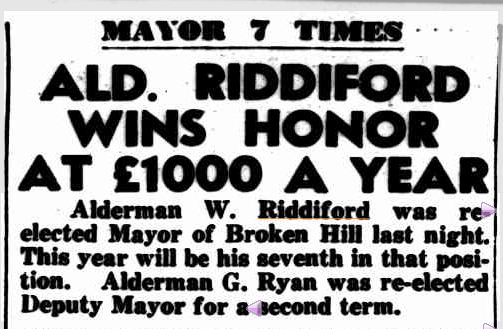
Or there are the Riddifords that immigrated to Australia arriving to South Australia, Queensland, New South Wales, and Victoria.  These included one of the most renowned Australian Riddifords, Walter Riddiford of Broken Hill.  The former miner and mayor of Broken Hill had the Riddiford Arboretum in the town named in his honour.

MAYOR 7 TIMES ALD. RIDDIFORD WINS HONOR AT £1000 A YEAR. (1954, December 17). Barrier Miner (Broken Hill, NSW : 1888 – 1954), p. 4. Retrieved September 5, 2012, from http://nla.gov.au/nla.news-article49976381

I also would like to tell you about my Riddiford line including my ggg grandfather, Charles Riddiford, a tailor and policeman who died in the Saunderton Union Workhouse at Wycombe, Buckinghamshire. And his son Thomas Cooke Riddiford, some time publican and butcher who immigrated with his family to Canada in search of a better life, only to return to Buckinghamshire a few years later.

I will, however, get the chance to tell you the story of my grandfather and great-grandfather, Percy and Tom.

Thomas William Cooke Riddiford, the fourth of eight children, was born in 1875 at the Crown Inn, Aylesbury Road, Cuddington, Buckinghamshire not long after his family had  returned to England from a failed venture to Brant County, Ontario, Canada.

While still a baby, Tom’s parents Thomas Cooke Riddiford and Emma Piddington moved the family to Clerkenwell, London where Lily Beatrice was born in 1877.  Again, the move seems to have been another failed attempt to find a better life for the family, as they had headed back to Cuddington by 1879.  Thomas senior resumed his role as publican of the Crown Inn.  Emma’s father, a victualler, also had links to that pub and others in the district.  In 1883, Emma died aged 34 and Thomas was left with eight children to care for, with three under five.

How does a family manage after such a tragedy?  By the 1891 UK Census, the consequences of Emma’s death had become evident.  On the night of the Census, the two youngest children, Ernest Arthur, 11 and William Leonard, 10, were at the Aylesbury Union Workhouse.  Youngest daughter Florence, 12, was living with her grandmother, Jane Piddington, and Lily, aged 14 was a servant for an Aylesbury hairdresser.  My great-grandfather Tom, then 16 was boarding at the Plough Inn, Haddenham, working as an apprentice butcher.

Where was Thomas senior by this time?  He had moved on.  To Manchester in fact, working as a cab driver and living with his new wife, Sarah Browne, and their four-month-old son, Arthur.   The saddest part of this stage in their lives is that I have never been able to find any trace of Ernest beyond the 1891 Census and his time in the Workhouse.  My grandfather named a son after his younger brother.  A tribute maybe?

Tom junior got on with his life, making a move to London working as a fully qualified butcher.  He married 18-year-old Londoner Caroline “Queenie” Celia Ann Kirkin on February 7, 1896, at St Barnabus Church, Kennington, London.  By the time of the 1901 UK Census, the couple was living at 169 Cromwell Road, Kensington with three sons.  Tom was working for himself as a butcher.

In 1903,  the family suffered a loss with the death of two-year-old Horace. Percy Ronald Riddiford, my grandfather, was born in Leytonstone in 1904 before a break of six years when Reginald was born in 1910 at Edmonton.  That is where the family was living at the time of the 1911 UK Census, 54 Raynham Road, Upper Edmonton.  Oldest son William was 14 and working as a metal polisher, Cyril 13, was attending school and working as an errand boy for a greengrocer.  Father Tom was still a butcher, working for Universal Stores.

The former Riddiford home, possibly their last in England,  is the cream house with red flower baskets.

Something must have nagged at Tom. A feeling like his father before had felt.  How could he make a better life for his family?  In 1906, he had travelled alone to Halifax, Nova Scotia, Canada on what appears to have been a reconnaissance trip, but he returned to London.  In 1912, Tom’s cousin Aubrey Frank Riddiford immigrated to Australia, settling at Heyfield in Gippsland.  This may have been the catalyst for Tom to pack up the family and sail to Australia aboard the “Commonwealth” arriving in Melbourne on September 15, 1913.  Many of the passengers were Assisted Immigrants and I would assume the Riddfords were among them.

SLSA: B 69878

SS Commonwealth 1911 at a pier at Adelaide.
Courtesy of the State Library of South Australia, B69878
http://images.slsa.sa.gov.au/mpcimg/70000/B69878.htm

The Riddifords moved to Smeaton, just north of Ballarat.  Lillian Ivy, the only girl in a family devoid of women, was born in 1914.  War broke out and in 1915 Bill enlisted for his new country, followed by Cyril in 1916 and Ern in 1918.  Bill was hit by an Army ambulance in France and was sent home an invalid in 1917.

ALLENDALE. (1917, July 21). The Ballarat Courier (Vic. : 1914 – 1918), p. 10 Edition: DAILY.. Retrieved September 6, 2012, from http://nla.gov.au/nla.news-article73320328

In 1922, Stanley was born at Smeaton, 26 years younger than his oldest brother Bill.

By the end of the 1920s, the Riddifords moved into Ballarat, residing at 97 Humffray Street South.  Tom and Queenie then moved to 619 Humffray Street where they remained until their deaths.
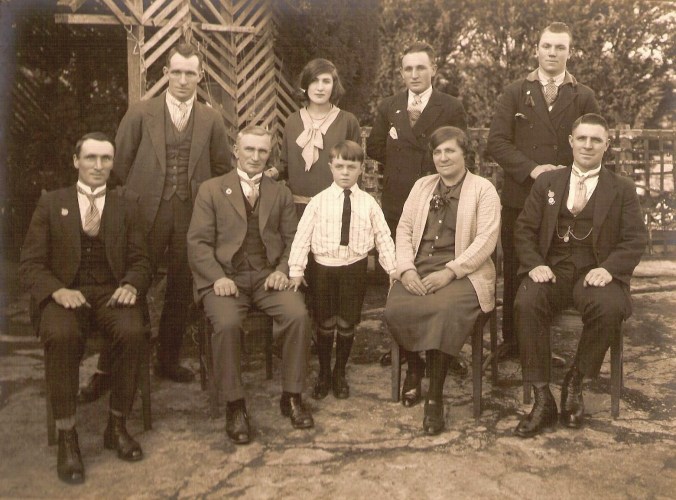
The Riddiford Family of Ballarat circa 1929
Back: Cyril Victor, Lillian Ivy, Percy Ronald, Reginald Leonard
Front: William “Bill” Thomas Frederick, Thomas William Cooke Riddiford, Stanley Gordon, Caroline “Queenie” Celia Ann Kirkin, Ernest Arthur Harold.

This photo is very special because of the circumstances in which I came to have it.  Mum and I visited an antique shop at Newlyn, north of Ballarat. We spotted some old photos with the penciled name “Riddiford” on the cardboard frames.  There were three, including the family photo and a wedding photo of my grandfather and his first wife Mavis McLeish.  The shop owner was able to tell us how he acquired them, but it’s a long story.

Thomas passed away in 1957 aged 81 and Caroline in 1962 aged 83.  They are buried at the Ballarat New Cemetery.

The boys and Lillian married, and all but Bill had children.  But there were few descendants as the seven children produced only 16 grandchildren, seven of them by my grandfather!  Of those, there were five girls and nine boys.  Seven of those boys were my grandfathers!

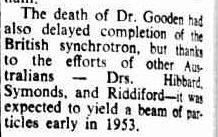
The most successful of Tom and Caroline’s descendants to date has been Ern’s son Leonard Riddiford.  Len gained a scholarship to Melbourne  High School and then studied physics at Melbourne University.  During the late 1940s, he travelled to Birmingham to work on the world’s first synchrotron under Sir Mark Oliphant’s guidance, while completing his PhD at Birmingham University.

ATOM STUDY IN AUSTRALIA. (1952, August 22). The Sydney Morning Herald (NSW : 1842 – 1954), p. 2. Retrieved September 6, 2012, from http://nla.gov.au/nla.news-article18278393

To think the Riddifords were the last branch I researched.  As they arrived in 1913 and with my main interest being 19th-century Australian history, I considered them newbies.  But when I did seriously begin researching the name I couldn’t stop, not returning to research my other families for months.  The research experience was also very different from my other families.  While  I have little information on my Victorian pioneer families prior to their departure from England, I have easily found information on the Riddifords from a variety of sources.

I have also had the pleasure of tracking my grandfather and great-grandfather right through to the 1911 UK census when my other families left soon after the 1851 Census.  It has also given me a greater understanding of English history, geography, and records.

The Riddifords of New Zealand consumed a lot of my time and Papers Past got a workout.  There are over 54,000 “Riddiford” matches at the New Zealand newspaper archive compared to  3449 on the same search at Trove and I have spent months just on this branch trawling through articles and books about the history of New Zealand.

Although I still have some brick walls,  I can safely say that Riddifords everywhere are related.  Like a jigsaw, all the pieces have come together to form a picture of a family who today can trace their links back to those early Gloucestershire cloth makers and, if my theory is correct, back to the Flemish cloth workers who arrived in Gloucestershire from the  1300s-1500s.  That is another facet of the tale I had intended to share.

A book on the Riddiford family history would be the best way to do the stories justice.  I have even considered a One-Name study or at the very least, a blog. I don’t think I can manage any of those options at the moment.  While writing Western District Families has given me an outlet for most of my families, it has also presented a problem. My Riddiford research has fallen into a state of neglect.

RIDDIFORD TRIVIA

It is was not only genealogists who welcomed online records.  Tabloid newspapers soon became fans too. This was evident in 2010 when a journalist wrote on the ancestry of Kylie Minogue.  Numerous newspapers and magazines ran with the story chiefly because Kylie had not one but several criminal ancestors.  Who were they?  Well they were Riddifords!  Yes that’s right Kylie and Dannii Minogue are Riddiford descendants.

Many Riddifords knew this prior to 2010 and I had myself read that the Kylie and Dannii’s mother was a Riddiford.  It was actually her grandmother Millicent Riddiford, one of the Welsh Riddifords.  Millie arrived in Australia in 1955 with her husband Denis Jones and their children.  By my calculations that would make the Minogues my 7th cousins, as we share  6 x great grandparents Thomas Riddiford and Arabella Trottman.  Distant I know, but the 8-year-old research assistant is very proud of his link, even if the kids at school won’t believe him.

An article from the Daily Mail of February 2, 2010, describes the Riddiford/Minogue relationship – Hangings, Sex Assaults and Deportation: Meet Kylie Minogue’s Criminal Ancestors…

I would like to trace the Minogue line to see if Kylie and Dannii descend from the Minogue family, pioneers of Cape Bridgewater in south-west Victoria.  They too may have Western District Families.

Call it a family myth, but another piece of trivia Riddifords like to hang their hat on, is the link between Ronnie Barker and L.E Riddiford Grocers in Thornbury Gloucestershire.  The story goes that while Barker was filming in Thornbury, he was so inspired by the grocers store in High Street that he created the show Open All Hours.  If you look at the L.E.Riddiford website you will understand how this comparison may have come about.

MY FAVOURITE RIDDIFORD

This would be Edward Joshua Riddiford, born in the Hutt Valley, Wellington,  New Zealand in 1842, son of Daniel Riddiford and Harriet Stone.  Educated in Australia at Scotch College, Melbourne, Edward spent time on cattle stations in Queensland.  He often visited Australia and on at least one occasion bought stock from the Learmonths of Ercildoune near Ballarat.
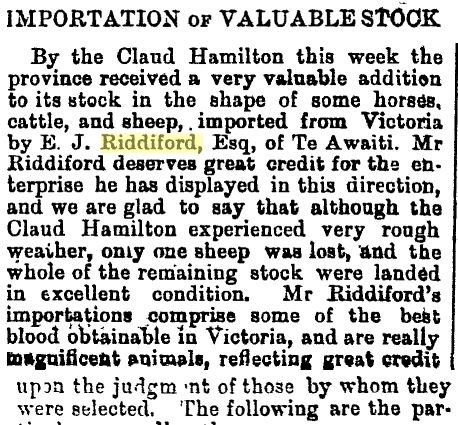
IMPORTATION of VALUABLE STOCK.
Evening Post, Volume X, Issue 134, 25 July 1874, Page 2
Papers Past – http://paperspast.natlib.govt.nz/cgi-bin/paperspast

The reason I particularly like Edward Joshua Riddiford is for the relationships he forged with the Maori people.  This quote from Edward’s biography by Roberta Nicholls for Te Ara – The Encyclopedia of New Zealand sums him up well:

“At Te Awaiti and Orongorongo Edward Riddiford interacted constantly with the local Maori population, as he had done when he was a child. He spoke their language, employed them, shod their horses, and bartered domestic products, foodstuffs and clothing for crops and wild pork. He played cards and drank with the men; he slept with the women. Out of admiration for his forceful leadership, commanding personality, and physical prowess the Maori called him ‘King’. Because of his influence, Riddiford was able to acquire Maori land for leasehold or freehold on favourable terms.” (from the biography of Edward Joshua Riddiford, by Roberta Nicholls, Te Ara – The Encylopedia of New Zealand)

THE RIDDIFORD FAMILY ON FACEBOOK

If you are a Riddiford descendant you are more than welcome to join our Facebook group. Search “The Riddiford Family” at Facebook and you will find us. There are 130 Riddifords from all over the world.  Many have commented on how they thought were the only Riddifords, rarely coming across others with the same surname.  That’s what I used to think growing up in Hamilton in the 70s and 80s.  Mum, Dad, and I were the only three Riddifords anywhere in the world except for Grandpa and Grandma Riddiford and my uncles in Ballarat.  How wrong we were!

Trove Tuesday

What a great success Trove Tuesday was.  If you would like to see all the posts from last week, go to Amy Houston’s blog  Branches, Leaves, and Pollen.

For the purpose of Trove Tuesday, I have decided to work through some of the “tags” I have at Trove.   I tag a lot of articles for no other reason than I find them interesting.  As a result, I have a lot of tags.  It is a type of online hoarding.  I can’t get rid of them because you never know when I might need them.

So, along with posting them here, I have created a list at Trove entitled “Miscellaneous“.  Like I need another list, but I do find them useful for certain types of information gathering. Tags are great for others such as collecting obituaries for the monthly Passing of the Pioneers.   Importantly, I am going to put a note on each list entry about the subject of the article so I can easily find them again when I view the list.  That is a tip from my upcoming book “Learning the Hard Way”.

As I have used Trove pretty much from the beginning, I have forgotten a lot of the articles such as the one I have chosen this week.  I had tagged it with “Bochara sleepwalking shearer 1876”.  Understand why I need to do some work on my tags? Bochara is just out of Hamilton.

COUNTRY NEWS. (1876, December 14). The Argus (Melbourne, Vic. : 1848 – 1956), p. 7. Retrieved August 30, 2012, from http://nla.gov.au/nla.news-article5912477

Spring Fashion

Spring has arrived and a girl’s thoughts turn to a new season’s wardrobe. This was no different in 1940, 1900, and even 1860 with retailers promoting new season’s trends from as early as July.  Ladies in Western Victoria would have required their woollens for a few more months, but a new Spring outfit was necessary for the milder days and social outings.

Mr David Jones was offering a “Grand Show” of spring wear at his shop on Main Road, Ballarat in 1858.

Advertising. (1858, September 15). The Star (Ballarat, Vic. : 1855 – 1864), p. 1. Retrieved August 26, 2012, from http://nla.gov.au/nla.news-article66050200

In 1862, the Old Criterion Store on Main Road Ballarat offered 1000 parasols for sale, perfect for keeping the Australian sun’s harsh rays at bay.

Advertising. (1862, October 13). The Star (Ballarat, Vic. : 1855 – 1864), p. 1. Retrieved August 26, 2012, from http://nla.gov.au/nla.news-article66327869

A sample of spring fashions from 1878.

Spring Fashions. (1878, September 7). Illustrated Sydney News (NSW : 1853 – 1872), p. 7. Retrieved August 26, 2012, from http://nla.gov.au/nla.news-article63335118

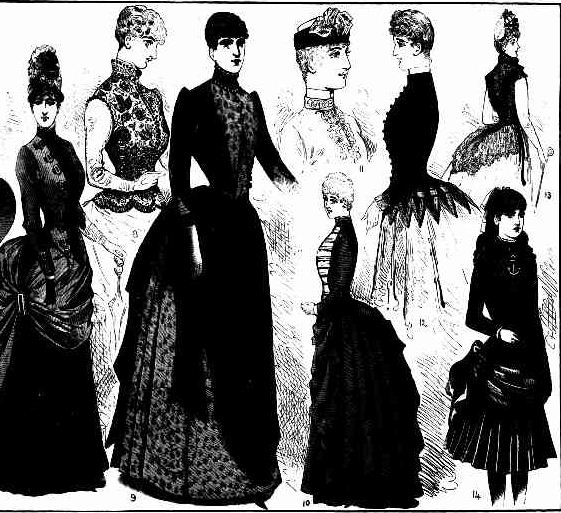
Spring fashions for the elegant lady of 1885.

[No heading]. (1885, August 24). The Australasian Sketcher with Pen and Pencil (Melbourne, Vic. : 1873 – 1889), p. 133. Retrieved August 26, 2012, from http://nla.gov.au/nla.news-page5739497

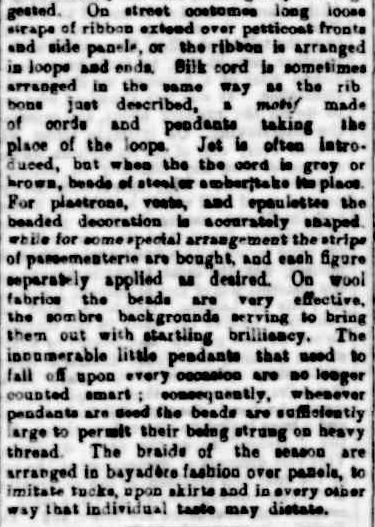
The following article appeared in the Portland Guardian on August 1881 and offered spring fashion tips for the ladies of the Western District.  White, all shades of red and heliotrope were the colours of the season.  Grey was the new black and black was back.  Cashmere and plaid wool fabrics were popular as were ribbons and beading for embellishment.

THE LADIES’ COLUMN. (1888, August 31). Portland Guardian (Vic. : 1876 – 1953), p. 3 Edition: EVENING, Supplement: SUPPLEMENT TO THE PORTLAND GUARDIAN. Retrieved August 26, 2012, from http://nla.gov.au/nla.news-article63589936

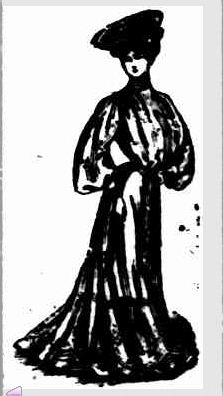
The 20th century arrived but fashion was so last century.

THE LADIES’ COLUMN. (1905, July 25). Camperdown Chronicle (Vic. : 1877 – 1954), p. 6. Retrieved August 31, 2012, from http://nla.gov.au/nla.news-article30351894

Fashion began to evolve during World War 1.  One change was dress length, with hems going up to save material.  An interesting website Fashion Era offers further examples of fashion during this period.

SPRING FASHIONS. (1915, August 4). The Argus (Melbourne, Vic. : 1848 – 1956), p. 12. Retrieved August 31, 2012, from http://nla.gov.au/nla.news-article1544786

T

These dresses from 1918 show traditional styles were still popular.

Spring Fashions. (1916, September 2). The Prahran Telegraph (Vic. : 1889, 1914 – 1918), p. 7. Retrieved August 28, 2012, from http://nla.gov.au/nla.news-article74835347

But things were changing and this dress, also from 1918, is an example of that.

COMING FASHIONS. (1918, July 10). The Argus (Melbourne, Vic. : 1848 – 1956), p. 12. Retrieved August 28, 2012, from http://nla.gov.au/nla.news-article1404142

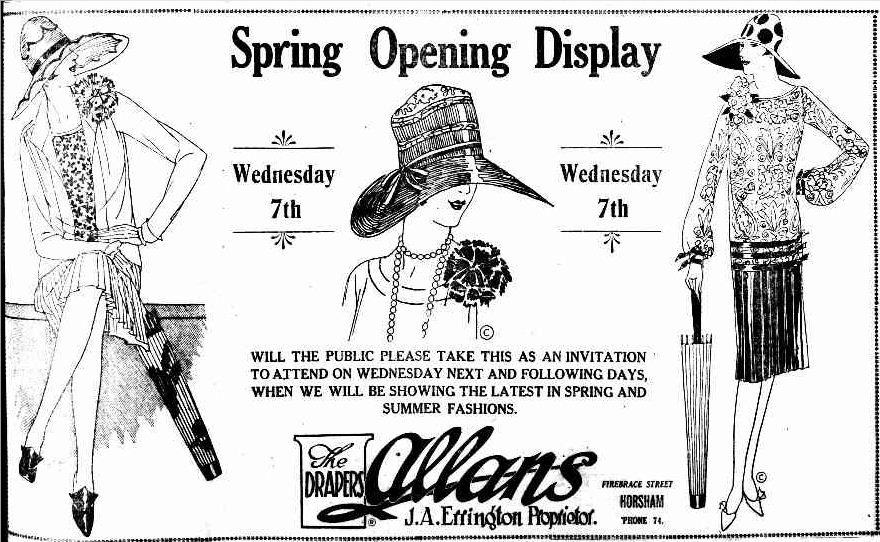
I love this stylish advertisement for Allans The Drapers of Fibrace street Horsham from 1927.

Advertising. (1927, September 2). The Horsham Times (Vic. : 1882 – 1954), p. 5. Retrieved August 29, 2012, from http://nla.gov.au/nla.news-article72996175

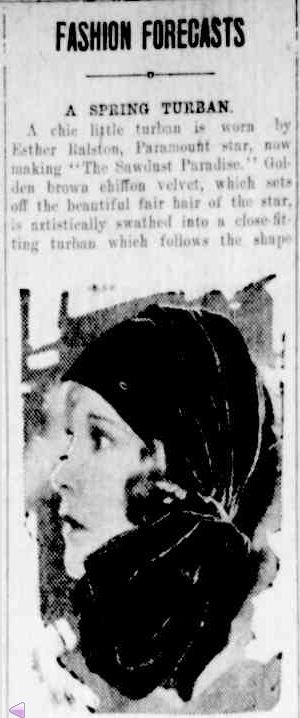
Fancy the Phryne Fisher look?

FASHION FORECASTS. (1928, August 3). The Horsham Times (Vic. : 1882 – 1954), p. 8. Retrieved August 29, 2012, from http://nla.gov.au/nla.news-article72676520

I can’t resist sharing more of the wonderful 1920s fashions, again from the Horsham Times.

Advertising. (1929, October 4). The Horsham Times (Vic. : 1882 – 1954), p. 9. Retrieved August 29, 2012, from http://nla.gov.au/nla.news-article72672337

Another stylish look, this time from 1930.

Woman’s Interests. (1930, July 3). Border Watch (Mount Gambier, SA : 1861 – 1954), p. 6. Retrieved August 29, 2012, from http://nla.gov.au/nla.news-article78010734

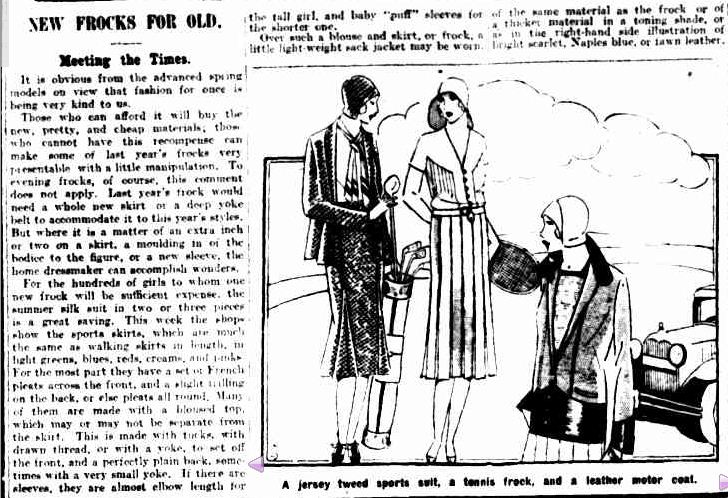
The Great Depression saw a rise in the number of sewing columns in the newspapers.  This article gave advice on how to recycle a frock.  The full article is here

“THE ARGUS” SHOOPING PAGE. (1930, August 8). The Argus (Melbourne, Vic. : 1848 – 1956), p. 12. Retrieved August 26, 2012, from http://nla.gov.au/nla.news-article4104490

Patterns were back for Spring 1935.

Gay Patterns for Spring Frocks. (1935, August 14). The Argus (Melbourne, Vic. : 1848 – 1956), p. 15. Retrieved August 29, 2012, from http://nla.gov.au/nla.news-article11757450

World War 2 saw a dramatic drop in the number of “spring fashion” articles in the papers, more so than the Great War.  The years 1942, 1943 and 1944 had very few and those I found were mostly for sewing patterns.   Families relied on coupons to buy goods, there was rationing of goods including fabrics and the fashion houses of Paris closed.  If a woman wanted to keep up appearances, there was little alternative but to make a frock or remodel one from last season.  The latter half of the 1940s saw a rapid increase in fashion articles as women turned again to the fashion stages of Europe for inspiration and cast aside their drab wartime clothing.

BE CHIC… but coupon canny. (1942, October 17). The Australian Women’s Weekly (1933 – 1982), p. 7. Retrieved August 31, 2012, from http://nla.gov.au/nla.news-article46446873

A few bright notions to cope with a war budget. (1942, January 10). The Australian Women’s Weekly (1933 – 1982), p. 24 Section: Fashion Portfolio. Retrieved August 31, 2012, from http://nla.gov.au/nla.news-article54876753

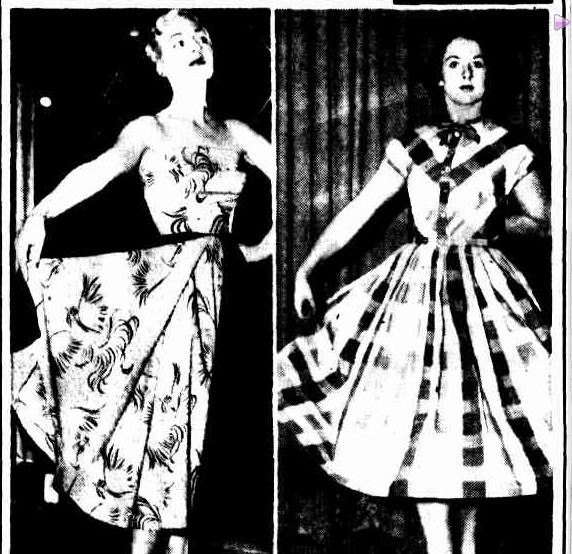
Shock, horror “Hems to go higher” in 1952.  Just wait until the 60s!

Hems to go higher. (1952, May 21). The Argus (Melbourne, Vic. : 1848 – 1956), p. 5. Retrieved August 26, 2012, from http://nla.gov.au/nla.news-article23197518

I could have continued to the 1960s but that would have gone on for some time as I do like the fashion particularly from the latter half of the decade. I could have gone on to the 70s too.  While fashion from that decade was much maligned during the 1980s, anyone who saw Paper Giants: The Birth of Cleo was reminded of the great fashions of the 1970s.  I think the 1980s would have pulled it up though. Agreed?

Looking at fashions of different eras is beneficial to the family historian especially if you are trying to date photos.  It also gives us some idea of what our female ancestors might have endured for either the sake of fashion or managing with what was available.  The long, impractical dresses of the 19th and early 20th century make me think of my ggg grandmothers on farms, getting in and out of buggies and tending fires for washing and cooking.  Consider how your grandmothers or great grandmothers managed during the Depression when money was tight or  World War 2 with coupons and rationing.  No wonder my Nana was good at sewing, darning and knitting. It was a necessity.

***If you are interested in learning how your female ancestors washed their big dresses during the 1850s, the Sovereign Hill Education blog has great posts on washing, drying, and ironing.

False Alarm

Reading the list of newspapers waiting to be released by the NLA’s  Trove,  I noticed the Port Fairy Gazette would not be far away.  Out of interest, I ran a search for “Port Fairy” and bingo many “coming soon” articles came up.  As my Harman and Bishop families lived in Port Fairy at various times, I went straight for a search on “Harman”.  Eleven matches came up with nine  relevant to my Harmans.  I couldn’t believe my eyes when I saw one of the article previews:

Mr James Harman, Byaduk, aged 85, died last week. He landed in Port Fairy in 1853 and…..

It looked like it could be my ggg grandfather’s obituary.  I search for his obituary every time Trove releases a new paper.  To date all I have found is the following snippet from The Argus:

COUNTRY NEWS. (1916, August 22). The Argus (Melbourne, Vic. : 1848 – 1956), p. 8. Retrieved August 29, 2012, from http://nla.gov.au/nla.news-article1630566

Brothers Walt, George, and Jonathan all had lengthy obituaries why not my ggg grandfather.  Even the shadow dweller, brother Alfred had a Family Notice when he died!.  It did seem that my only chance was to search the microfilmed Hamilton Spectators at the Hamilton History Centre.  The hard part about that is getting to Hamilton.

Trove’s release of the Port Fairy Gazette (1914-1918) happened today and yes, the much-anticipated article was available.  I clicked on the link.  This is it, I thought.  What did I find?

Personal. (1916, August 24). Port Fairy Gazette (Vic. : 1914 – 1918), p. 2 Edition: EVENING.. Retrieved August 29, 2012, from http://nla.gov.au/nla.news-article88010281

Twelve more words than the preview.  Only 12 words.  How can I expect any more in The Hamilton Spectator?  How I can ever expect to find any mention of the death of my ggg grandmother Susan Read, wife of James, who died in the same year?

On the bright side, I found a couple of good Bishop related articles and a nice article about my gg uncle Charles James Harman prior to his departure for Egypt during WW1. So far, only 1916 is available but based on the results so far, I think I’m bound to find more when the other years become available.

It was a big day for Trove today with 13Victorian titles released and another Western District paper,  the Portland Observer and Normanby Advertiser (1914-1918) was among them.

Also of interest to me are the Flemington Spectator (1914-1918) and the Wangaratta Chronicle (1914-1918)Sarah Harman and her husband George Adams lived in Flemington and so far I have found plenty of “Adams” matches in the Spectator but none for Sarah or George yet.  Herbert George Harman, nephew of James Harman was a reporter for the Wangaratta Chronicle for over 50 years and I have found matches for both him and his father George, mostly to do with their Masonic activities.

Trove Tuesday

a collection or store of valuable or delightful things

(Oxford Dictionary)

No better words could be used to describe the National Library of Australia’s Trove website.  If you have read a few of my posts, you would know I’m a big Trove fan.    A recent post by Jill Ball at her blog Geniaus, mentioned an initiative by Amy Houston which interested me.  Amy on her blog Branches, Leaves, and Pollen, told how she too is a fan of Trove and invited Australian bloggers to join her on Tuesdays each week to blog about the treasures we have found at Trove.

I have many Trove treasures and a lot of my blog posts are about those.  At first, I thought I would not take part merely because I didn’t think I could choose just one a week.    Where would I start?  That is much like asking me to name my favourite book or film of all time.  I just can’t do it.  But, as Amy suggests the treasure doesn’t always have to be about a family member it could be anything of interest.

I can do that.  How often have you found a newspaper article about a family member, only to find the article, above, below, or beside just as interesting?  I’m into advertisements too and I always read them.  There are some absolute gems, so expect to see some of those on Tuesdays.

Due to time constraints this week, I thought I would begin with a recap of some of my posts that highlight the benefits of Trove to family historians, particularly the digitised newspapers.   Without the newspapers, there is much that I wouldn’t know about my ancestors. Even hours of record searching couldn’t unearth what I have found.

In fact, the papers lead me to the records.  Whether it is records from courts or cemeteries, sporting clubs or churches, Trove has led me there.  Not only is it a time-saver, many of the leads I have found come from places I would never have thought of searching.

These are some of my treasures to date:

Witness for the Prosecution – The story of three of my relatives who were witnesses in murder trials.  I believe two of those stories, that of my ggg grandmother Margaret Diwell and my grandfather Percy Riddiford, would have remained hidden if it wasn’t for Trove.

Alfred Winslow Harman – Stepping out of the Shadows – I knew little about Alfred Harman before I starting an intensive search for him in the Trove digitized newspapers.  Now I know so much more.

Nina’s Royal Inspiration – The story of Nina Harman and her carpet really is delightful.  As Nina is not a close family member, I possibly would not have known this story without finding her direct descendants.  Instead, I found it in a Women’s Weekly at Trove!

To Catch a Thief – Ordinarily,  to find Jim Bishop’s brush with the law, I would have had to search the Branxholme Court Registers held at PROV‘s Ballarat Archives Centre.  Not too hard, but with so many people to research and so many towns on the Victorian court circuit, it may have been a long time before I found it.  Thanks to an article in the Border Watch, that time in Jim’s life is now known to me.

All Quiet By the Wannon – The Mortimer family of Cavendish kept to themselves.  Articles I found at Trove finally gave my ggg James Mortimer a voice.

Mr Mortimer’s Daughters Another Mortimer puzzle solved thanks to Trove.  From Henry Mortimer’s death notice in the Portland Guardian, I was able to establish the married name of one daughter and the second marriage of another daughter.

There is a list of Western Victorian newspapers available at Trove on my Links page.

Don’t forget there are other great treasures that can be found while searching at Trove.  Look beyond the newspaper matches as you never know what might come up in the other categories.  I have found photos of family members and some great early photos of Western Victorian towns while searching.  Trove is also great for tracking down books.

I will try to post something each Tuesday.  Thank you to Amy for the idea and I hope other Australian geneabloggers get involved too.

Show us your treasure and celebrate Trove!

In The News – 28 August 1916

The news of 28 August 1916 was typical of the time.  It was two years into WW1, with the Battle of Fromelles in July and then Pozieres. By the end of August, Australians were fighting at Mouquet Farm, France.  Newspapers were full of war news, departures and casualties and the Portland Guardian of 28 August 1916 was no different.

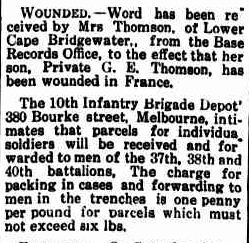
Mrs Thomson of Lower Cape Bridgewater had heard the news her son Private G.E. Thomson was wounded in France.  Families of the 37th, 38th and 40th Battalions were able to send their parcels for the front to 380 Bourke Street, Melbourne.  The parcels were then forwarded to the various Battalions at a cost of one penny per pound.

The Portland Guardian. (1916, August 28). Portland Guardian (Vic. : 1876 – 1953), p. 2 Edition: EVENING. Retrieved August 24, 2012, from http://nla.gov.au/nla.news-article64015692

I would like to think the next article was about my 1st cousins 3 x removed, Frederick James and Arthur Leonard Holmes (aka Lennie) of Casterton.  However, while Arthur was still in Australia, not embarking until 21 October 1916, Fred was in France and wounded by this time.

I searched the WW1 Embarkation Roll and Mapping our Anzacs trying to identify the two Holmes boys, presumably brothers. The venue of the social was not mentioned in the Editorial, so I assumed it was in Portland.  The closest I found was Frederick Noah Holmes of Wallacedale and Leslie Holmes of Homerton via Heywood, however, Leslie embarked on August 1.

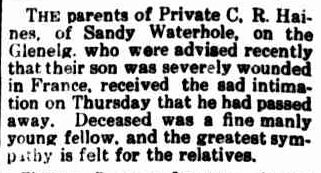
The Haines family from idyllic Sandy Waterhole on the Glenelg River received news of their son’s passing as a result of wounds.

The Mulholland family of Portland also received bad news from France.

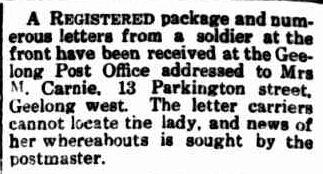
I hope Mrs Carnie got her letters from the front.

Mrs Newman of “Ulymah” Gawler Street Portland, was doing her part for the war effort.  She was the Portland contact for Mr Herbert Daly, an Australian in Paris.  Herbert was collecting socks for those displaced by war, particularly old men.

Newly re-elected Portland Mayor Mr Wyatt received a letter from local boy W.H.J.Baker, serving in France.  Corporal Baker mentions “France is such a beautiful place” and “No wonder Germany wants this beautiful country”.  Read the letter in full here.

On Active Service. (1916, August 28). Portland Guardian (Vic. : 1876 – 1953), p. 3 Edition: EVENING. Retrieved August 25, 2012, from http://nla.gov.au/nla.news-article64015700

Corporal Baker enclosed some of his poetry with the letter.  Read the full poem here.

Australian Sons in Egypt. (1916, August 28). Portland Guardian (Vic. : 1876 – 1953), p. 3 Edition: EVENING. Retrieved August 25, 2012, from http://nla.gov.au/nla.news-article64015713

Back in Portland, which must have felt a million miles away from the war, unsettled weather prevailed.

The Portland Guardian. (1916, August 28). Portland Guardian (Vic. : 1876 – 1953), p. 2 Edition: EVENING. Retrieved August 25, 2012, from http://nla.gov.au/nla.news-article64015692

Wattle Day, on 1 September was fast approaching.  The first Wattle Day was in 1910 and the outbreak of war saw the day celebrated with extra vigour.

The Portland Guardian. (1916, August 28). Portland Guardian (Vic. : 1876 – 1953), p. 2 Edition: EVENING. Retrieved August 25, 2012, from http://nla.gov.au/nla.news-article64015692


Canadian born silent screen star Mary Pickford was appearing in “The Dawn of Tomorrow” at the Portland Pictures.

QUEENS OF THE FILM. (1916, April 29). The Prahran Telegraph (Vic. : 1889, 1914 – 1918), p. 5. Retrieved August 25, 2012, from http://nla.gov.au/nla.news-article74834158

As mentioned,  Cr James Lewis Wyatt was unanimously re-elected Mayor of Portland.  He was Mayor from August 1914 to August 1917.

[No heading]. (1916, August 28). Portland Guardian (Vic. : 1876 – 1953), p. 3 Edition: EVENING. Retrieved August 25, 2012, from http://nla.gov.au/nla.news-page6068639

Victorians, along with the other states, were preparing for their first dose of Daylight Savings. The timing was not exactly how the Act had set out. Clocks went forward on 1 January 1917 and back on 25 March 1917. Daylight Savings did not occur again until WW2 with the years of 1942/3 and 1943/4 each having an extra hour of daylight at the end of the day.

The Portland Guardian. (1916, August 28). Portland Guardian (Vic. : 1876 – 1953), p. 2 Edition: EVENING. Retrieved August 26, 2012, from http://nla.gov.au/nla.news-article64015692

In 1914, the Duke of Portland of England announced that the skeleton of racehorse Carbine would return to Australia for the National Museum.  The following article, two years later, announced the skeleton was ready for shipping to Australia.  Finally, in December 1919, the skeleton was ready to leave England, arriving in February the following year.

I have seen the skeleton of Carbine at the former Racing Museum at Caulfield Racecourse and its current home at the National Sports Museum at the MCG.   While standing beside Carbine’s skeleton is not as moving as visiting Phar Lap at Melbourne Museum, it is still an imposing sight.

A video of Carbine’s skeleton being reconstructed when it moved to the National Sports Museum can be seen at the link  – http://tinyurl.com/8w4w5pv