Trove Tuesday – It was the Snake in the Drawing Room

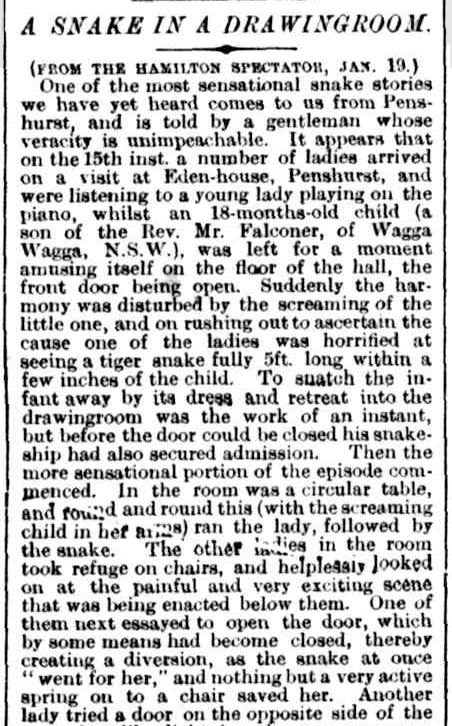
Published in The Argus on 22 January, 1878, this story comes from Penshurst.  It was previously published in the Hamilton Spectator on 19 January 1878.  I agree with the reporter that there are snakes stories and snake stories, but none quite like this snake story.

A SNAKE IN A DRAWINGROOM. (1878, January 22). The Argus (Melbourne, Vic. : 1848 – 1956), p. 10. Retrieved October 17, 2012, from http://nla.gov.au/nla.news-article5918117

Misadventures, Deaths and Near Misses

Transport is important to us in one form or another. If nothing else it sure beats walking.   However, the subjects of this installment of Misadventures, Deaths and Near Misses should have stuck to Shank’s pony.

Click on the links to read each article in full.

HORSES

Described as an “energetic” gentleman, Fred Heathcote, having just displayed his cricketing prowess on the field, gave a display of his riding prowess.  Unfortunately, his mount was  freshly broken and reared, falling onto Fred.  Despite an operation in excess of four hours, Fred was expected to make a full recovery

“Look what I’ve done, I’ve broken both my wrists” were the words uttered by Frank Millard upon seeking help after a horse accident.  Frank’s horse had taken him under a low branch.

In 1896,the horse of William Lucas shied at two dogs and somersaulted.  William received concussion, the horse was shaken.

A witness description of the accident involving John Beglin in 1894, suggested the horse “danced on the man while on the ground”  This sounds like it was rather a spectacular fall in which John sustained possible internal injuries.

HORSE DRAWN VEHICLES

Add a wooden attachment to horse, laden with people,  and accidents are bound to happen.  Take, for example, Patrick Power of Byaduk in 1889. The Port Fairy Cobb & Co coach was not far from Koroit when it broke an axle and tipped.  The coach driver fell on top of Patrick leaving him in need of medical attention

Not so lucky was  Oliver Filmer also of Byaduk. In early January 1900, Oliver and six others were returning from an outing to the Byaduk Caves when the horses bolted down a hill.  The buggy went over an embankment and capsized.  All the occupants were thrown out, including Oliver who sustained head injuries and later died.  Oliver was father-in-law to Absalom Harman, the son of Reuben.

In 1901, Mr H. J. Thompson was standing on the back board of a buggy as it went up a steep hill near Wickliffe.  The buggy wheel fell into a rut, Mr Thompson fell forward and hit the wheel with his leg.  Suffering lacerations and a dislocated knee, he was still able to catch the train home from the Wickliffe station.

Thursday April 20, 1876 was a day of accidents and  Mr & Mrs Webley  and their daughter, all of Byaduk, were caught up in the dramas.  While returning from Hamilton to Branxholme in the darkness, a pin holding the buggy shaft fell out and Mr Webley turned the horse across the road to stop it, but the horse went up an embankment, dropping Miss Webley out the back.  The horse then continued on down a cutting and Mr & Mrs Webley tumbled out.  Mr Webley received cuts, Mrs Webley, a broken arm and Miss Webley was not injured.

Similarly, on the same day, Alfred Bennett had a hair-raising experience when his horse, pulling a dog-cart, bolted.

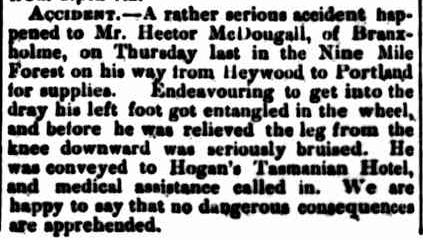
Lucky Hector McDougall had “no dangerous consequences” after his accident when he tangled with a dray’s wheel.

Table Talk. (1864, December 5). Portland Guardian and Normanby General Advertiser (Vic. : 1842 – 1876), p. 2 Edition: EVENING. Retrieved October 16, 2012, from http://nla.gov.au/nla.news-article64632822

Mr Blackney, was left with cake on his face after an incident in Hamilton in 1942.  While his back was turned, his horse bolted, pulling a cart laden with cakes.

CAKES FLEW WHEN HORSE BOLTED. (1942, September 15). The Horsham Times (Vic. : 1882 – 1954), p. 2. Retrieved October 16, 2012, from http://nla.gov.au/nla.news-article72705327

I’m sure a piece of cake helped residents recover from their “mild shock” at finding cakes at their front gates.

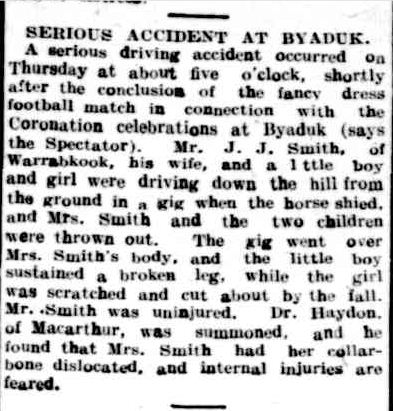
After a fun day at the Byaduk Coronation Celebrations in 1911, which included a fancy dress football match, the Smith Familyof Warrabkook met with disaster while travelling home.

SERIOUS ACCIDENT AT BYADUK. (1911, June 27). The Horsham Times (Vic. : 1882 – 1954), p. 5. Retrieved October 16, 2012, from http://nla.gov.au/nla.news-article73162971

CARS & MOTORCYCLES

If horses and carts weren’t bad enough, throw cars and motorcycles into the mix, and disaster was almost ensured, especially if they all came together at once.  It also appears that with only a lucky few having a motor vehicle in the early days, it was not unusual to pile as many people into the car as possible.

Driving a Damlier home from a day’s shooting at Kirkstall in 1914, George Lock and his four passengers came to grief on the Port Fairy Road on the outskirts of Warrnambool.  It was 7.15pm and the road was dark and narrow.  George, having moved aside for an oncoming car, failed to see the unlit cart of a Chinese market gardener following behind the car.  His car hit the cart sending vegetables across the road.  Debris hit the car’s steering wheel sending the car out of control and into a fence and embankment, throwing the occupants from the car.  George Robinson received the most serious injuries, a ruptured liver.  The Chinese gentleman was lucky to avoid injury and was last seen chasing his horse, also very lucky, down the road.

T.S.A Laidlaw had a scary experience in his new Oldsmobile after leaving Byaduk bound for Macarthur.  The car got into the gravel, crossed the road, went over a prostrate telegraph pole, up an embankment and then overturned.  The car was extensively damaged, Mr Laidlaw wasn’t.

Robert Rymill, a 38-year-old grazier from Penola met a tragic end in a very early motoring accident.  In 1906, he was driving his 15hp Darracq from Melbourne home to Penola when he failed to take a sharp turn at the bottom of a hill, taken while travelling at 12mph.  The car’s wheels slipped and it overturned.  Robert’s passenger, his young gardener was thrown clear, but Robert was pinned underneath the car.  While initially conscious, Robert had passed away by the time help arrived.  This was despite the best attempts of his passenger.

If you are wondering what a Darracq looks like, this clip shows a much more powerful 1905 model travelling a lot faster than 12mph, but you get the idea.

Mr Dotzauer, in 1904, was riding his motorcycle between Terang and Noorat when a horse ran across his path. Mr Doutzauer broke his collar-bone, damage to the motorcycle and horse unknown.

Mrs Living got more than she bargained for when she hitched a ride in Mr E.J.Coopers sidecar one Friday night in 1932.

HORSE JUMPS INTO SIDE-CAR. (1932, April 19). The Horsham Times (Vic. : 1882 – 1954), p. 4. Retrieved October 18, 2012, from http://nla.gov.au/nla.news-article72600659

Len Austin’s accident was caused by a truck tyre, but no, it didn’t run over him.  While working as a road contractor, he noticed a bulge in the truck’s tyre.  The tyre suddenly blew and the expelled air caught him the eye.

Messrs. W Smith and Michael Hickey’s day took a turn for the worse in 1923 while driving a gig with a saddle horse tied to the shafts.  A car with five occupants approached and the saddle horse, obviously not used to the mechanical beasts, shied and found itself on top of the car.  The car rolled, but with plenty of help on hand, it was righted and the driver and his passengers continued on to Horsham.  The horse’s journey ended at the scene.

Trove Tuesday – A Little Chatter About a Magpie

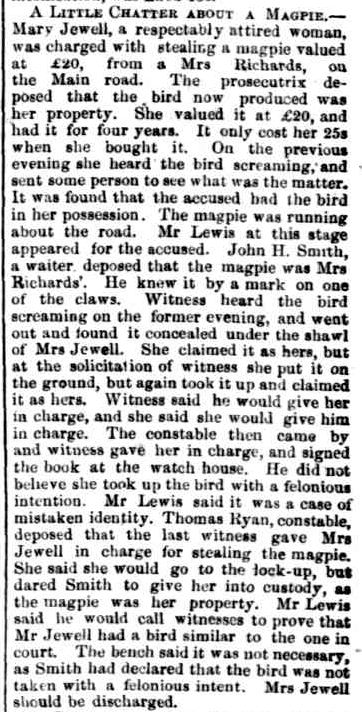
As it is the time of year when the young research assistant is too scared to go into our paddock or walk up the road for fear of swooping magpies, I thought this little treasure from Trove was fitting.  It is from the Ballarat Star of September 21, 1861.

EASTERN POLICE COURT. (1861, September 21). The Star (Ballarat, Vic. : 1855 – 1864), p. 1 Supplement: SUPPLEMENT TO THE STAR. Retrieved October 14, 2012, from http://nla.gov.au/nla.news-article66342198

W is for…What Else Could It Be?

Naturally, I had to rejoin the Gould Genealogy Family History Through the Alphabet Challenge at “W”.  W is for Western District and that means a lot to me not only because this blog “Western District Families”.  I was born and raised in the Western District and all the families of my maternal lines, going back six generations, chose to settle in the wonderful Western District.

One of the highlights of the Western District is the geography.  Entering from the east, the Western Plains lead to the rise of the Grampians and on to the volcanic plains and green rolling hills beyond.  To the south are the forests of the Otways, the south-west coastline and volcanic Tower Hill.  And there are the rivers, meandering through the countryside to the sea.

I will take you on a geographical journey through the Western District, just a glimpse really, beginning with two colonial artists, Nicholas Chevalier and my favourite, Eugene Von Guerard.  These artists and others traipsed around Victoria sketching and painting.  Von Guerard also travelled to Tasmania, New South Wales, South Australia and New Zealand.  Looking at their paintings reminds me of the lives they lived for the sake of their art.

Chevalier’s sketch shows the Serra Range including Mt Sturgeon and Mt Abrupt at the southern end of the Grampians.

View of the Grampians, Western District [art original] N. Chevalier.
State Library of Victoria http://handle.slv.vic.gov.au/10381/100967

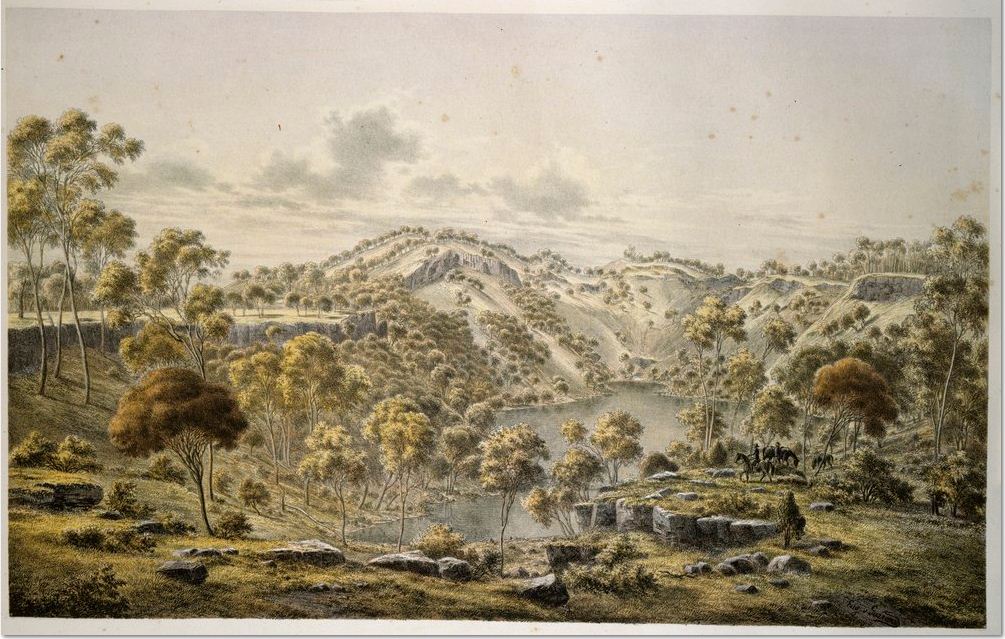
Moving south-west, dormant volcano Mt Eccles near Macarthur has played a part in my family history.  My gg grandfather Reuben James Harman, son of James Harman, owned property at Mt Eccles.  It was also a favourite fishing spot of my grandfather Bill Gamble.

Crater of Mt. Eccles, von Guerard, Eugene,1811-1901,artist.
Image courtesy of the State Library of Victoria http://handle.slv.vic.gov.au/10381/46307

I prefer von Guerard’s depiction of Lake Surprise, the crater lake of Mt Eccles, to my own (below).  I remember as a child asking about the name “Lake Surprise”.  The answer:  When you get to the top of the crater and see the lake, you get a surprise.  Fair enough.

LAKE SURPRISE, MT ECCLES CRATER LAKE

It’s the photo of my grandfather Bill Gamble during the 1930s that is my favourite.

e

A little north of Mt Eccles is the volcanic lava flow, the Harman Valley at Byaduk, named after my Harman family.  In the distance is the source of the lava, Mount Napier.

THE HARMAN VALLEY, BYADUK

South of Mount Eccles is beautiful and historic Port Fairy, the last port of call for the Moyne River, with its origins east of Macarthur, before it reaches the sea.

Port Fairy

MOYNE RIVER, PORT FAIRY


Moving east from Port Fairy is Tower Hill, another dormant volcano.

TOWER HILL

Next is Warrnambool.  The cemetery has a great view toward the Hopkins River close to the end of its 271 kilometre journey through the Western District from near Ararat to the sea at Logans Beach, one of the whale nurseries along the south-west coast,

WARRNAMBOOL CEMETERY

WARRNAMBOOL CEMETERY OVERLOOKING THE HOPKNS RIVER

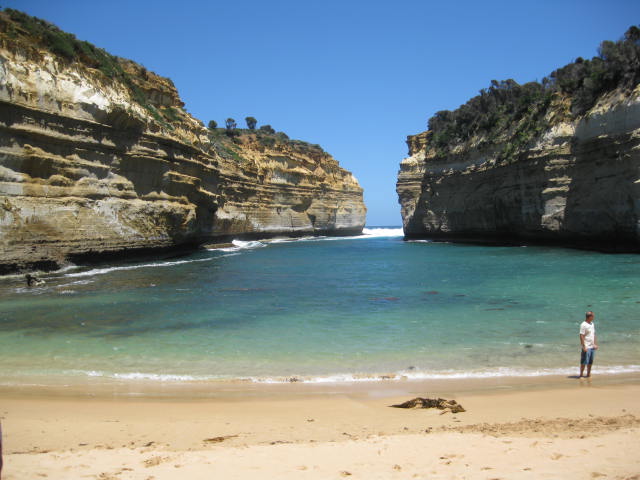
South-east of Warrnambool is the famous Loch Ard Gorge, named for the Loch Ard which wrecked on the treacherous coastline.  The only two survivors, Tom Pearce and Eva Carmichael were washed on to the beach at Loch Ard Gorge.

I find standing on the beach in the Gorge a haunting experience.

LOCH ARD GORGE

East along the coastline is one of the most iconic views, not only of Victoria but Australia.

THE 12 APOSTLES

North-west, and back where we started, are the Grampians.

HALLS GAP, GRAMPIANS

The Grampians are a perfect place to leave the subject of the Western District and move on to another “W” which has been a part of my family since the 1860s, the Wannon River…

W is for…Wannon River

The Wannon River begins its’ flow at the base of Mt Abrupt in the Southern Grampians.  It flows toward Dunkeld, around the base of Mt Sturgeon and leaves the Grampians heading north-west toward Cavendish. Along the way, it passes by Mokanger, the workplace of both the Mortimers and Haddens.  Through Cavendish, it passes close to the cemetery, burial place of members of those two families.

DSCN1056

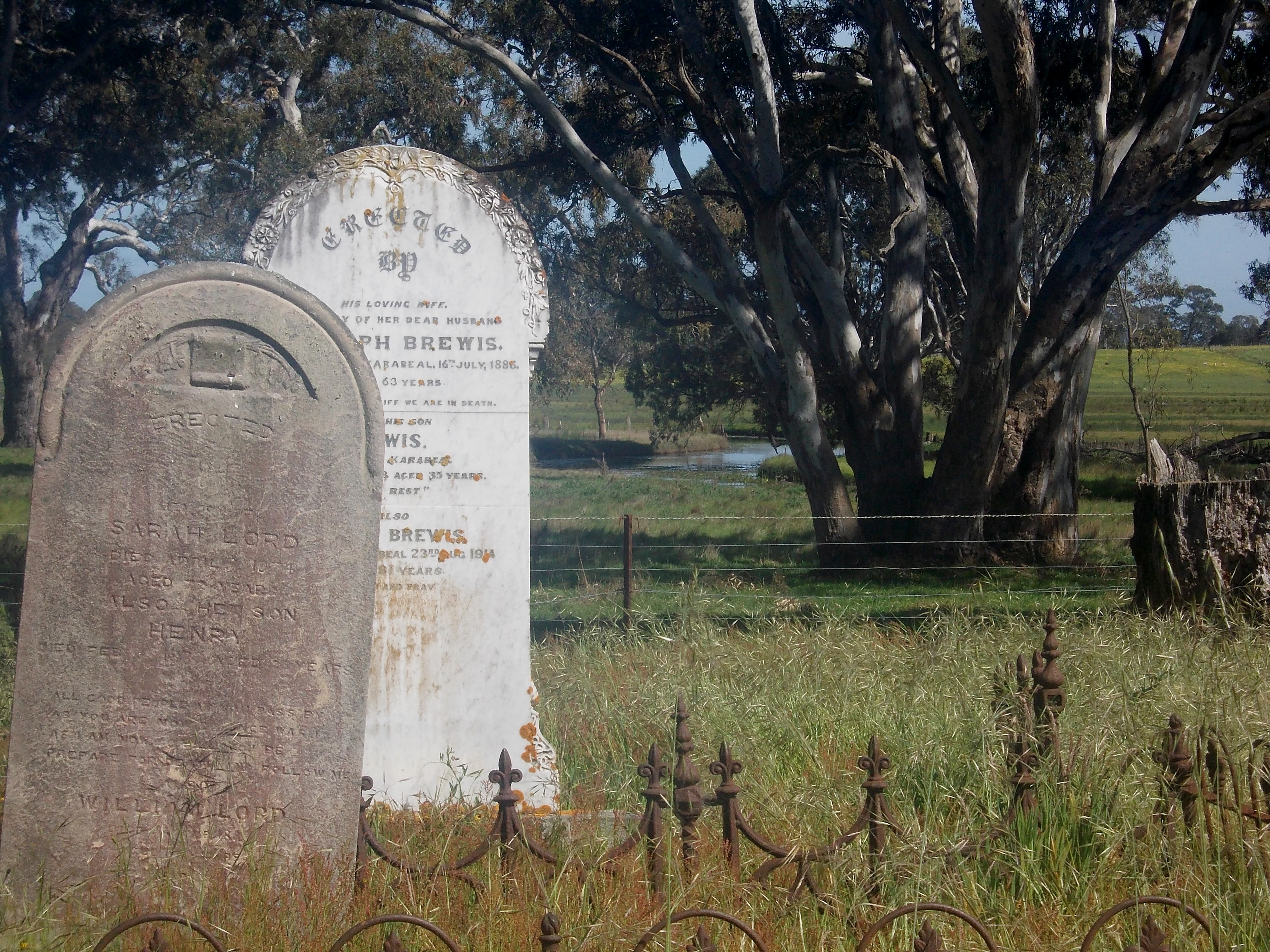
CAVENDISH OLD CEMETERY


From Cavendish, the river begins a southward journey toward two of the Hamilton district’s jewels, the Nigretta and Wannon waterfalls.  As the river progresses west, the Grange Burn joins the Wannon north of Morgiana, having flowed from just east of Hamilton, the city founded on the Grange.  This section of the Wannon river was another favourite fishing spot of my grandfather Bill Gamble.

On the river flows to Tahara and then Sandford. I have family links to Sandford with Julia Harman, daughter of James Harman residing there with her husband George Holmes.  Two children were born at Sandford including WW1 casualty Arthur Leonard Holmes.  My gg uncle William Diwell also spent some time around Sandford.  In 1914, he completed extensions to the St Marys Church.

The Wannon River then joins another great river of the Western District, the Glenelg River, having passed through some of Victoria’s most beautiful countryside.  It is not surprising Joseph Hawdon, travelling overland to Adelaide with Lieutenant Alfred Miller Mundy of the 21st Regiment in 1839, endorsed Major Thomas Mitchell’s description five years earlier. Major Mitchell followed the Glenelg River from its beginnings in the Grampians through to the sea at Nelson. It is little wonder all my direct ancestors stayed in the Western District after settlement.

(1839, September 26). Launceston Advertiser (Tas. : 1829 – 1846), p. 1 Supplement: SUPPLEMENT. Retrieved October 11, 2012, from http://nla.gov.au/nla.news-page8723904

After the merge with the Wannon, the Glenelg flows on to Casterton where I have many family links.  My ggg grandfather George Jelly, the father of Elizabeth Ann Jelly, was one man who could say he had conquered the river.  His obituary read:

“He was a remarkably good swimmer and by his abilities in this direction was instrumental in saving many persons from drowning and rescuing the bodies of many others who had perished in the river” 

He even dived for the bones of Robert and Mary Hunt, murdered by George Wains in 1860.

By the time the Glenelg River reaches the sea, it, the waters of the Wannon and Grange Burn have passed by many of the places my ancestors lived, worked, fished, swam and were laid to rest.

042

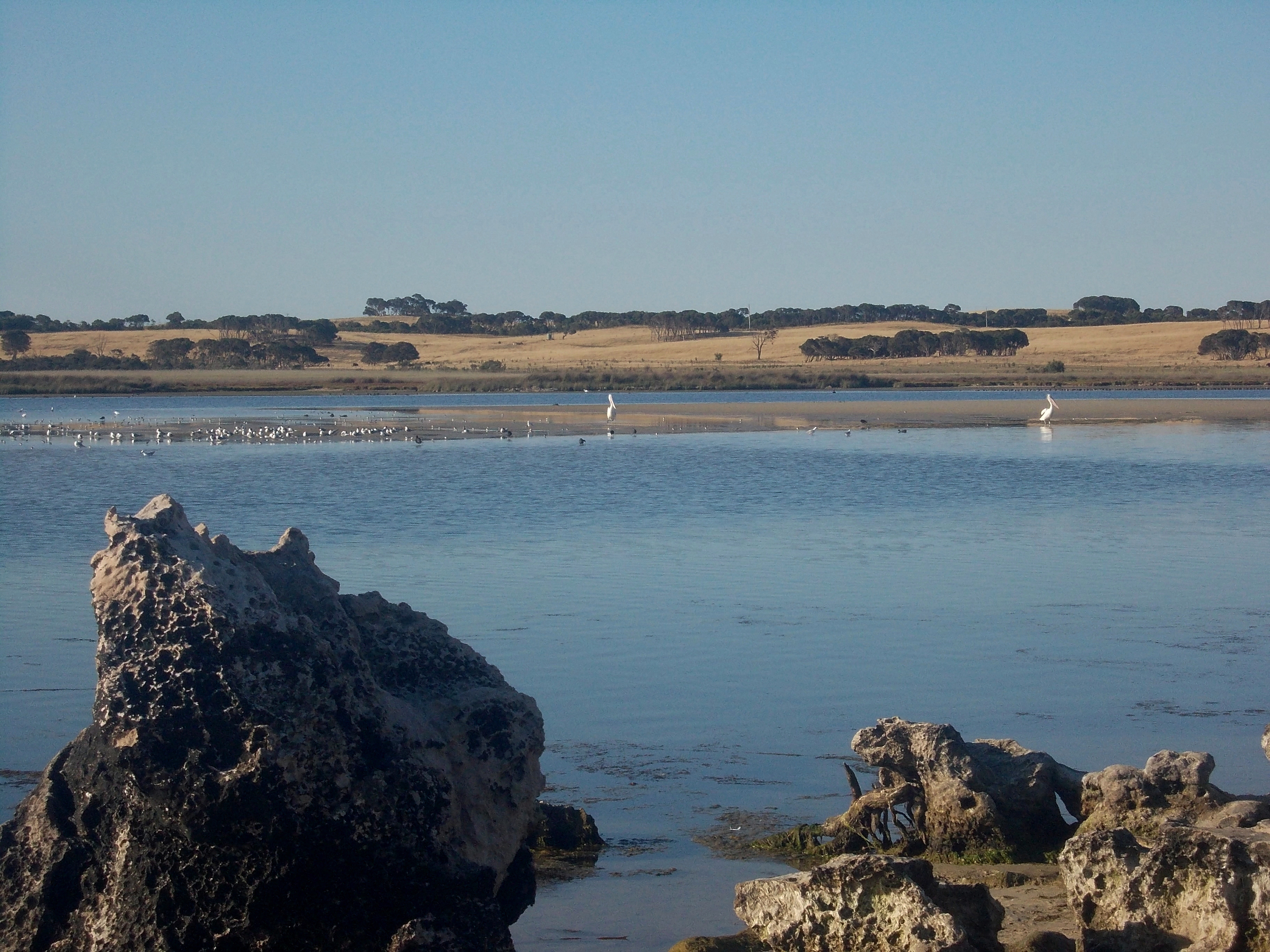
NEAR THE MOUTH OF THE GLENELG RIVER, NELSON

The Wannon River between the Nigretta Falls and the Wannon Falls, about twenty kilometres from Hamilton, would be the section most frequented by myself and my family before me.  My own memories come from family visits, Sunday drives with Nana, school excursions and birthday parties.

The following views near the Wannon Falls are from the State Library of Victoria Collection and were captured around 1878 by  Thomas J. Washbourne, a Geelong photographer.

Wannon River Scene – Washbourne, Thomas J. photographer.Image courtesy of the State Library of Victoria Victorian Patents Office Copyright Collection (VPOCC) http://handle.slv.vic.gov.au/10381/53092

Wannon River Scene Washbourne, Thomas J.,photographer.
Image courtesy of the State Library of Victoria – Victorian Patents Office Copyright Collection (VPOCC) http://handle.slv.vic.gov.au/10381/52931

THE WANNON RIVER AT THE WANNON FALLS

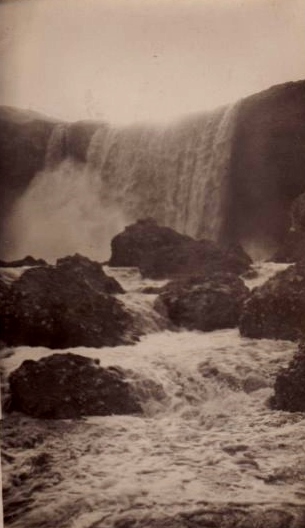
Of the two waterfalls, I prefer the Nigretta, especially after rain.  The Wannon Falls could be described as pretty in the way the water drops off the edge, but the Nigretta Falls are, at times, spectacular.

NIGRETTA FALLS ON THE WANNON RIVER Image courtesy of the State Library of Victoria – collection: Cogger album of photographs http://handle.slv.vic.gov.au/10381/41740

The Vagabond (John Stanley James) described the Nigretta Falls in his series “Picturesque Victoria” for The Argus.  In the 4 April 1885 edition of The Argus, The Vagabond wrote of his visit to the Wannon.  He enjoyed the hospitality at the Wannon Inn and then marvelled at the “miniature Niagara”

PICTURESQUE VICTORIA. (1885, April 4). The Argus (Melbourne, Vic. : 1848 – 1956), p. 4. Retrieved October 11, 2012, from http://nla.gov.au/nla.news-article6073697

This photo taken in August this year by my friend Catherine, after some good rain, sees the Nigretta looking like the miniature Niagara Falls described by The Vagabond.

NIGRETTA FALLS – Image courtesy of Catherine Huisman

My grandfather, Bill Gamble, took the following photo in the 1930s

bg14

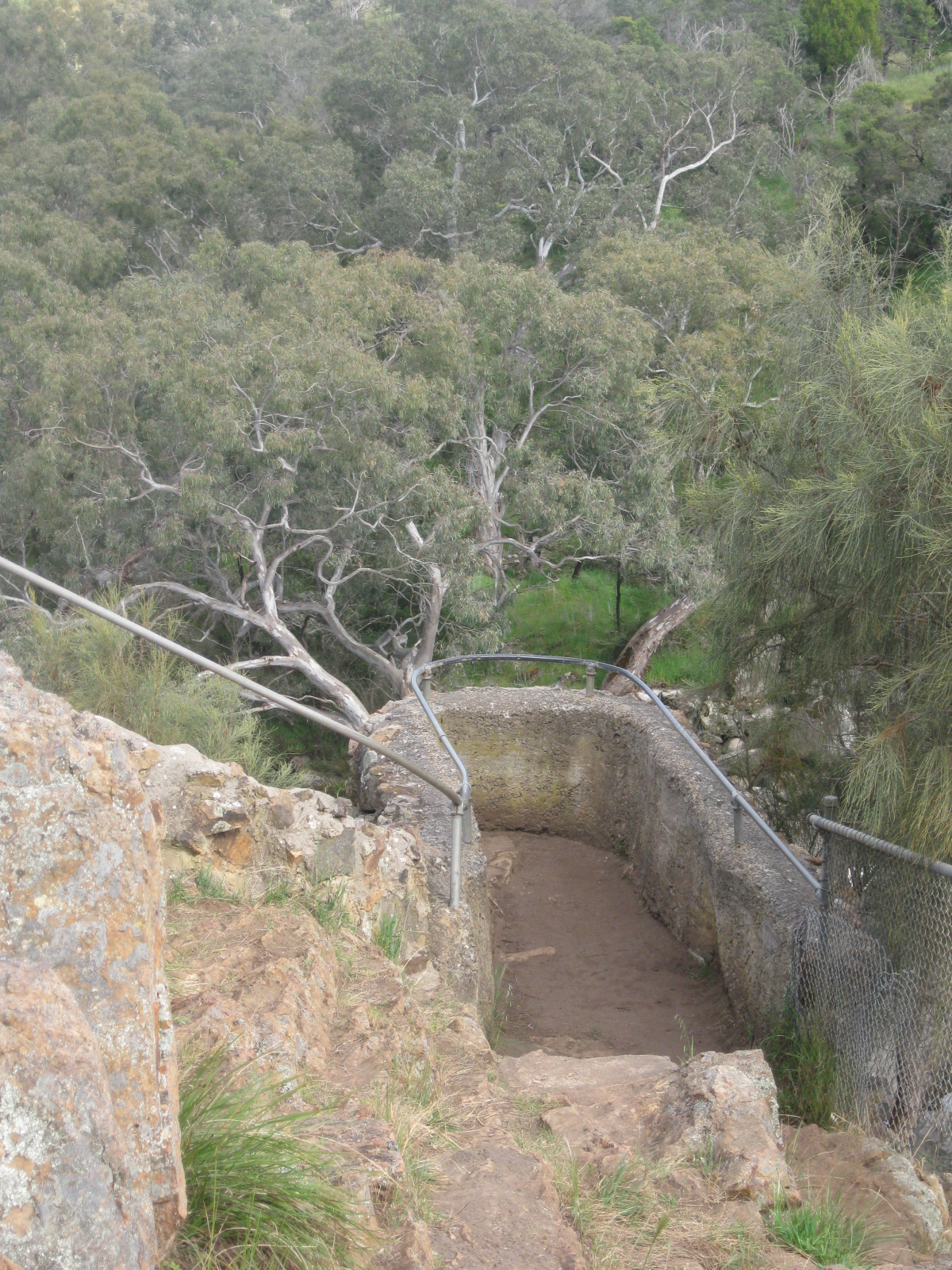
It was pleasing to see that the old viewing platforms still remain at the Nigretta Falls.

NIGRETTA FALLS VIEWING PLATFORM

An impressive wooden staircase now leads down to the falls, but the original steps remain.

The Wannon Falls (below) holds memories of walking beyond the viewing platform, down to the rocks and behind the falls, but only when they were flowing lightly as they are in this photo.  A new viewing platform now prevents such precarious escapades, even undertaken while on school excursions!

WANNON FALLS

I have two framed prints of the Wannon Falls by Louis Buveot, painted in 1872.  One hangs on a wall as a constant reminder of Hamilton, the Wannon River and the waterfalls.  The original work hangs in the Ballarat Fine Art Gallery. To see the original click on the link – Wannon Falls

The topic of the Wannon River gives me an opportunity to share my all-time favourite family photos.  As a little girl when I first saw Nana’s old photo album, these photos captured my imagination.  When Nana came to live with us she kept her photo albums in her wardrobe. I would take them down, sit on her bed and go straight to the photo below.  It was near the beginning of the album which had black, much-turned pages.

From right: Nana, (Linda Hadden), my great-grandmother (Sarah Elizabeth Harman) and my great auntie Alma’s (Nana’s sister) mother-in-law Mrs Issac William Short (Catherine Gissane Tilley). They are standing on the original lower viewing deck.   The photos from a day at the Wannon were originally very small.  It wasn’t until I enlarged them on a computer, that I noticed Nana’s coat hanging on the railing.

I think the reason I like this photo because Nana looked exactly like she did when I knew her, but with long braids and I still can’t believe she was only about fifteen.  Even the small research assistant thought Nana was the lady in the middle when he first saw it.  He only knew her as an older person and does not think of her as having been a child too.

The second photo was taken from the lower viewing deck, looking toward the upper level.  I didn’t like standing here as a child and as you can see the rail was high at the front  and difficult to see over and to the right of  Nana was a gap between the fence and the rocks.  I much preferred the lower deck.

My grandfather Bill, before he married Nana, liked to visit the Wannon Falls too, although he didn’t stick to the viewing platforms.

bg13

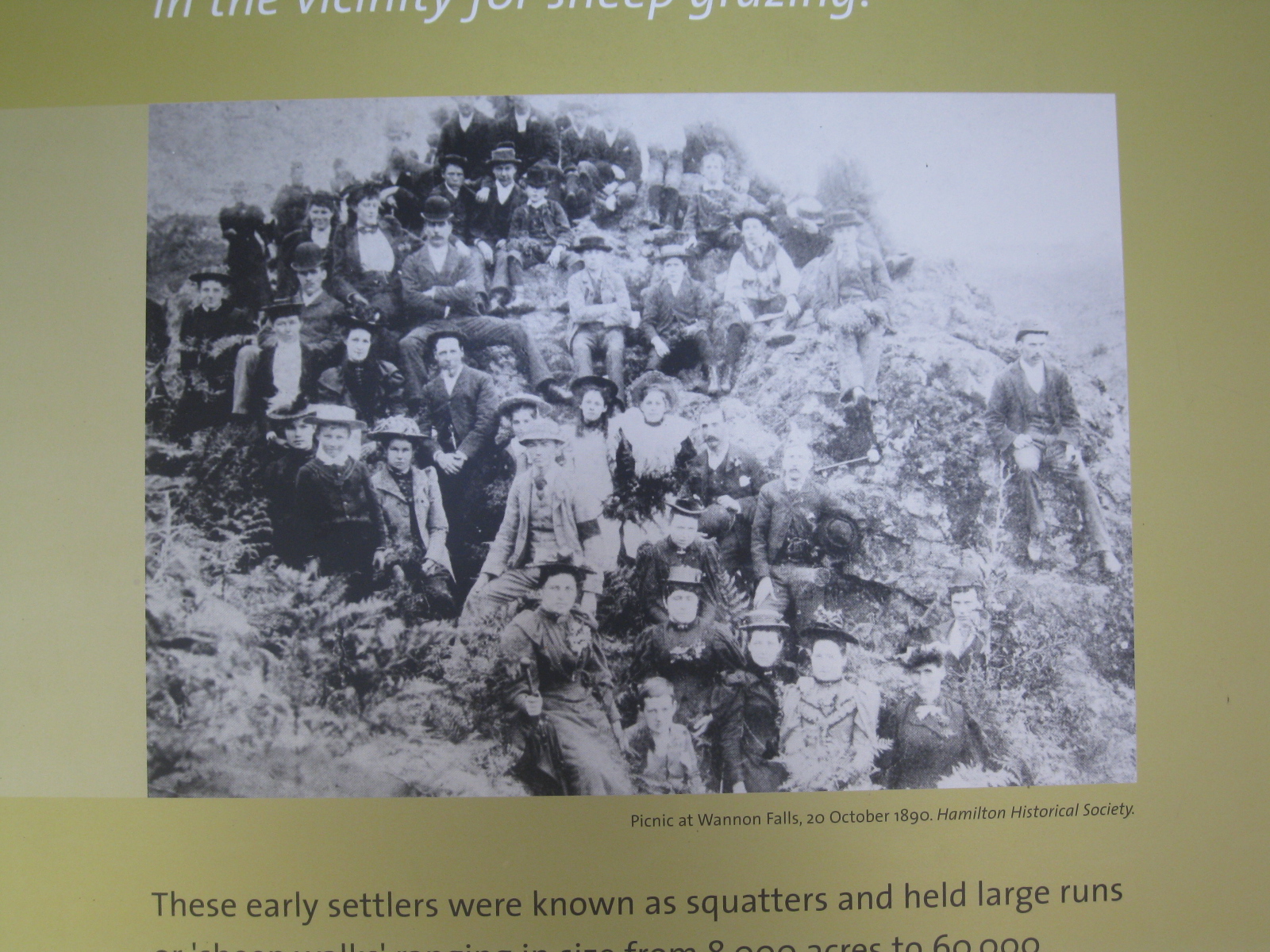
In more recent years, a rotunda was built at the Wannon Falls reserve with information about the waterfall, the local geography and history.

On our visit, the small research assistant said “Look Mum, they even have family history here for you”  He was right. There is a lot of my family history at the Wannon Falls.

©Merron Riddiford 2012

Trove Tuesday – Matter of Relativity

Try to get your head around this article I found at Trove. It appeared in The West Australian and the Adelaide Advertiser in December 1951 and is about my first cousin 4 x removed, Amelia Harman, daughter of Jonathan Harman. Amelia married Christopher (Chris) Bell of Heywood in 1901. They had three children, Millicent Irene (born 1901), Clarence Jonathan (1902), and Christopher George (born 1903) all born at Heywood. Clarence died in 1905. At least one girl is a descendant of Christopher George Bell. At the time of the photo, Christopher was working as a senior constable of police at Casterton. He would have been around 48 then, so I’m guessing Cheryl of Casterton is Christopher’s daughter.

Amelia had an older daughter, Elsie May, who married Herbert Skipworth at Heywood in 1909. Therefore, Helen Skipworth is likely to be a descendant of Elsie and Herbert. That leaves Lynette Wilmot, who also would likely be a descendant of Elsie May and Herbert.


MATTER OF RELATIVITY. (1951, December 14). The West Australian, p. 8  http://nla.gov.au/nla.news-article49005300

Another amazing thing is the three girls are all nine months old! At the time of writing, Cheryl, Helen, and Lynette would be 61. If they or any other Bell family members see this, I would love to confirm the various family relationships. Amelia was around 87 at the time of this photo. She died in 1956, aged 91.

My Electronic Friend

I heard from Electronic Friend yesterday.  I had waited for an email for a few weeks from my friend with no specific gender, although I tend to call him a he.  He brings me news of my family, sometimes good, sometimes bad, sometimes not what I was expecting, but always most welcome.  You may know my Electronic Friend.  If you have ever requested notification of a newly available article from Trove, you will have definitely had an email from him.

My latest contact was about my ggg grandfather Thomas Gamble of Colac.  Trove has been digitizing the Colac Herald (1875-1918) and I’ve been hopeful this may give me more information about Thomas.  A couple of weeks ago, a search of Thomas Gamble found three references to him in the year of his death, 1884.  All were articles “Coming Soon”, so I put in my email request and waited. And waited.

Until now I knew very little about Thomas Gamble:

As I clicked on the link to the requested article, I thought “I hope this is not another False Alarm”.

NOTES AND EVENTS. (1884, May 6). The Colac Herald (Vic. : 1875 – 1918), p. 2. Retrieved October 5, 2012, from http://nla.gov.au/nla.news-article88187507

Very interesting.  My Electronic Friend had outdone himself.

The obituary confirms the Gambletown story.  It gives his age when he died at 76, giving a little more weight to the 1808 birth year I already had.  Finally it confirmed, in the most wonderful way that such a matter could be handled, Thomas liked a drink.

“…but a good part of his life he loved not wisely but too well – the cup.  The old man, however, had no great liking for the tea-cup, and in for something stronger and more cheering?’

Over the past year, I have read well over 200 obituaries to prepare for Passing of the Pioneer posts.  Never have I read of a departed’s drinking habits, so I think Thomas really liked a drink.  So much so, it was a defining part of his character.

It is the new information that I find most interesting.  Thomas was “quite a character”, “full of humor”, in fact, a “chatty, good, humored soul” and “always willing to help his neighbours” .  Until now, in my imagination, Thomas has been an emotionless, non-speaking, old man standing in a brickyard!   While I had a lot of information to get an idea of Ellen’s character,  I had nothing on Thomas so it is pleasing to read of his wonderful attributes.

I have had reason to believe that Thomas did have some money at one time.  Mainly because he appears on the 1856/7 Electoral Roll, compiled for the 1856 elections of the Victorian Legislative Assembly and the Legislative Council.  At the time there were conditions for voting eligibility. For the Legislative Council, one condition was that the voter owned property over the value of £1000, and for the Legislative Assembly, property over the value of £50.  Thomas qualified in one of those categories, listed as a freeholder.  I had several other ggg grandfathers in Victoria at that time and none are on the same Electoral roll. 1857 saw the abolition of property qualifications.

Thomas must have had enough wealth to travel to Sydney to deposit his earnings.  Or was this just something he told the writer over a humorous drunken chat?  During the 1850s, Thomas had a string of appearances in court with men trying to retrieve money from him.  It does say he had his ups and downs.

As a family historian, the last bit of information is very exciting, but at the same time disheartening.  Thomas wrote his memoirs.  On 150 pages of notepaper!  But as written in the obituary, the memoir would probably never have seen the light of day and I doubt it ever did.  Given the snippets I have about Thomas already,  I think it would have been a rollicking read.

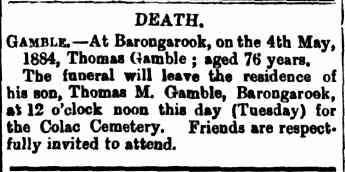
My second article from my Electronic Friend was the Death notice.

Advertising. (1884, May 6). The Colac Herald (Vic. : 1875 – 1918), p. 2. Retrieved October 6, 2012, from http://nla.gov.au/nla.news-article88187484

The last article comes from two months before the death of Thomas and gives some clue to the state of his health leading up to his death and his financial situation at the time.

NOTES AND EVENTS. (1884, March 18). The Colac Herald (Vic. : 1875 – 1918), p. 2. Retrieved October 6, 2012, from http://nla.gov.au/nla.news-article88190014

From the minutes of the Colac Hospital committee meeting, it would seem Thomas needed care but had no money and looked destined for the Benevolent Asylum at Geelong.  From his Death notice, he died at this son’s home seemingly avoiding the Benevolent Asylum.  Whether he was living at Barongarook waiting to go to Geelong or whether he was taken in by Thomas M. Gamble (aka Mark Thomas Gamble), at least he passed away with family around him.

I am waiting for another email from my Electronic Friend.  The article’s headline is “History of Colac Chapter IV. (Continued). The Township Site—First Sale of Town Lands—Notes of Progress”.  The only available line is “…brickyard of any importance was opened out by Mr Thomas Gamble, after whom the suburb on the south…”.

Until then Electronic Friend.

Alice Hawthorn – The Western Mare

On 3 October 1857, a small grey mare known as “Alice” lined up for a match race with her rival Veno, from the colony of New South Wales (NSW), a race that would in time be remembered for its significance in setting the foundations for what has become Australia’s greatest horse race and strengthening the thoroughbred racing and breeding industry in Australia.  It was a time when inter-colonial rivalry was high, but this period of racing’s history shows that the racing fraternities of each colony, while still highly competitive, were able to work together in a harmonious way to develop the industry we have today. This story is not so much about the match race,  rather the life of the grey mare and the mark she left on Australian racing history.

“Alice”, bred at Mt William Station in the Western District and owned by great racing supporters, the Chirnsides, was born sometime around 1849.  Her sire was Delpare, an imported horse and her dam, Polly McQuinn, a part-Arab mare, bloodlines common in the early days of racing in Australia.  “Alice” was branded with the Chirnside’s  “key” brand.  Horses bearing that brand could never be sold.

DEATH OF ALICE HAWTHORNE. (1860, August 18). Bell’s Life in Sydney and Sporting Reviewer (NSW : 1845 – 1860), p. 2. Retrieved August 8, 2012, from http://nla.gov.au/nla.news-article59873244

At age three “Alice” was broken in and she spent time as a stock horse but, unlike her mother, she was not a good riding horse.  The Chinese workers at the station used her to carry rations to workers situated at out stations on the property but she developed a fistula wither, a painful condition, and was turned out.  During that time she became loose on the station roaming the bush for fifteen months. She ran with a wild horse and the result was a foal which died.  Time in the bush had not served her well, but back on pasture, she blossomed.

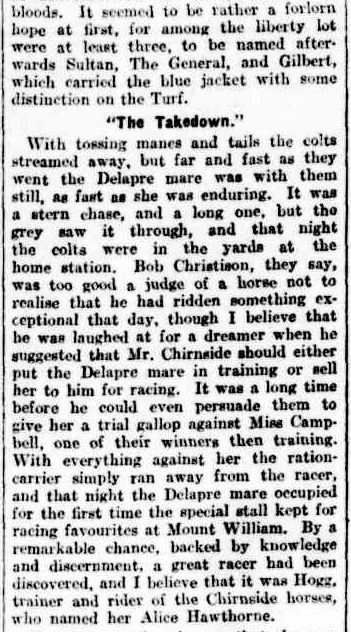
Put to work again, “Alice” was used by Robert Christison, a horse-breaker at Mt William, to act as  “nursemaid” to the young thoroughbreds he was breaking in.  On one occasion, the young horses had missed a muster and Christison chose  “Alice” to bring them back to the main paddock.  What a surprise he received.  This article, “Racing and Romance, Two Western Mares” includes excerpts from the book “After Many Days” by Cuthbert Fetherstonhaugh that recount that day:

RACING AND ROMANCE. (1928, September 15). The Argus (Melbourne, Vic. : 1848 – 1956), p. 2 Supplement: The Argus. Saturday Camera Supplement. Retrieved August 8, 2012, from http://nla.gov.au/nla.news-article3956921

The little mare, who not long before had roamed the bush, impressed and ousted the talented Miss Campbell from her prime stall in the stables.  She was also given her name,  Alice Hawthorn.

Her first race was at Hamilton over a mile and a half.  “Alice” won, kicking off a remarkable career which would span the next four years.  As was racing in those times, “Alice” returned to Hamilton the following day and backed up the win.

HAMILTON. (1856, January 21). Portland Guardian and Normanby General Advertiser (Vic. : 1842 – 1876), p. 3 Edition: EVENING. Retrieved August 8, 2012, from http://nla.gov.au/nla.news-It

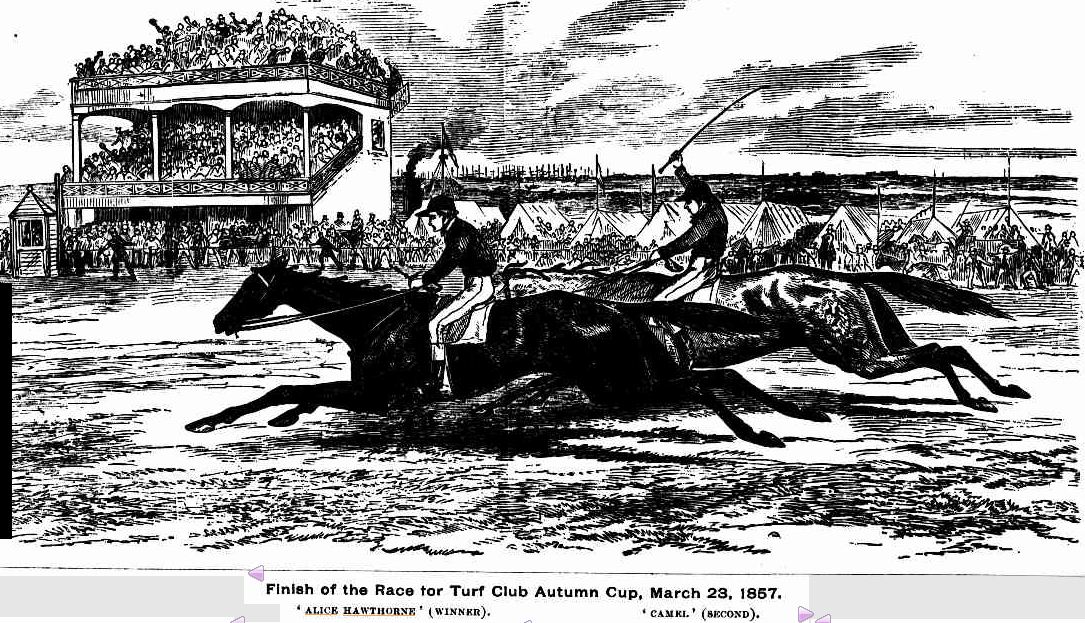
It was not long before Alice Hawthorn was racing at Ballarat, Geelong, and then Flemington.  This sketch shows her storming down the outside to win the Turf Club Autumn Cup of 1857.

Flemington: Past and Present. (1891, October 24). Illustrated Sydney News (NSW : 1853 – 1872), p. 13. Retrieved October 2, 2012, from http://nla.gov.au/nla.news-article63613318

It was this race and others that saw Alice Hawthorn considered one of Victoria’s best horses and in turn, her name was given as a challenger to a horse from NSW in a match race of £1000 aside.  The Victorians wanted to nominate three horses and select the best on the day, however, this was rejected by their NSW. colleagues who nominated just one horse, the chestnut Veno.  Alice Hawthorn, it was.

LOCAL NEWS. (1857, July 1). The Hobart Town Mercury (Tas. : 1857), p. 2. Retrieved August 9, 2012, from http://nla.gov.au/nla.news-article3244328

There was some doubt in the minds of the Victorians that “Alice” was up to the task and her odds went out.  Others considered the home track advantage would help her.  Veno’s arrival in Melbourne created much interest with crowds of people gathering to see the Sydney horse.

VICTORIA. (1857, August 1). Bell’s Life in Sydney and Sporting Reviewer (NSW : 1845 – 1860), p. 2. Retrieved August 9, 2012, from http://nla.gov.au/nla.news-article59867006

Meanwhile, there were security fears for “Alice’ and her trainer Mr Green built a stable at his home to accommodate her safely.

VENO AND ALICE HAWTHORN. (1857, August 29). Bell’s Life in Sydney and Sporting Reviewer (NSW : 1845 – 1860), p. 2. Retrieved August 10, 2012, from http://nla.gov.au/nla.news-article59867185

This thorough description of “Alice”, including her physique, action, and temperament is unlike anything seen today.  The Melbourne correspondent noted her “fine, even temper which nothing can ruffle is the theme of universal admiration”.  Jokes were often made about her arrival at the starting line for races, looking like she had just woken from a sleep. This probably helped her settle in her races and run out the three miles.
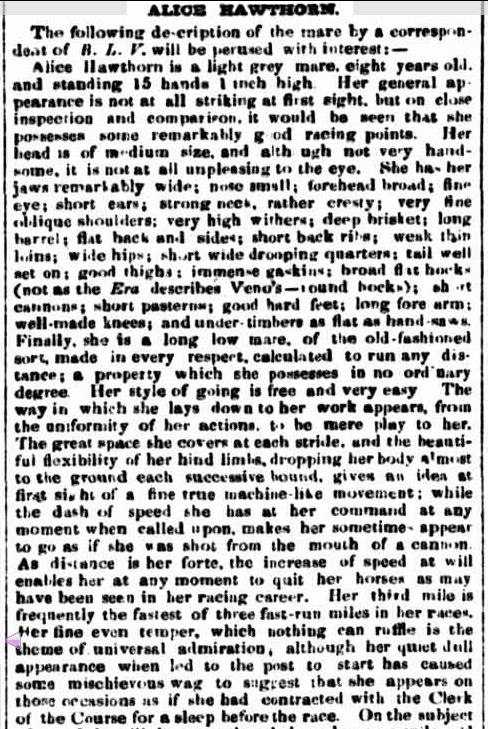
ALICE HAWTHORN. (1857, September 5). Bell’s Life in Sydney and Sporting Reviewer (NSW : 1845 – 1860), p. 2. Retrieved October 1, 2012, from http://nla.gov.au/nla.news-article59867231

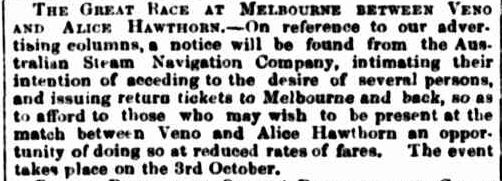
Those attending the Great Inter-Colonial Match race from Sydney could take up the offer from the Australian Steam Navigation Company of a return ticket at a reduced rate.

THE WRECK OF THE DUNBAR. (1857, September 5). Empire (Sydney, NSW : 1850 – 1875), p. 5. Retrieved October 1, 2012, from http://nla.gov.au/nla.news-article64986713

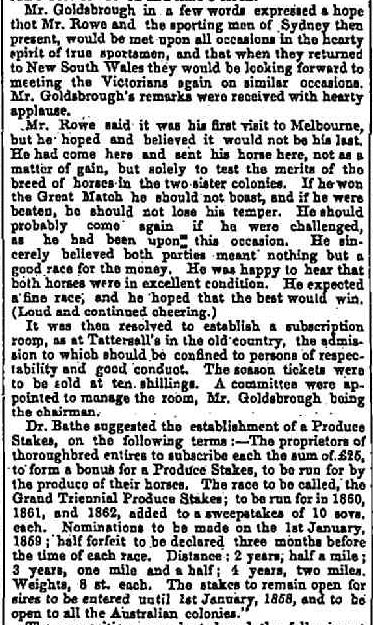
In the preceding days, something akin to the call of the card was held at the Tattersall’s Hotel in Russell Street, where the original challenge was offered.  A healthy amount of money was wagered, all with a sense of good sportsmanship.

Chair, Mr Goldsborough welcomed the sporting men of Sydney, including trainer Mr Rowe, and reassured them that they “would be met upon all occasions in the hearty spirit of true sportsmen”.

At the gathering, a decision was made to set up a subscription room at the Tattersalls Hotel for those of “good respectability and conduct’ for a season ticket of ten shillings.  The Produce Stakes was also devised, open to horses from all colonies.

VENO AND ALICE HAWTHORN. (1857, October 2). The Sydney Morning Herald (NSW : 1842 – 1954), p. 8. Retrieved October 1, 2012, from http://nla.gov.au/nla.news-article28633161

On the morning of 3 October 1857, all roads led to Flemington.  For others, a steamer up the Saltwater River (Maribyrnong River) was the preferred transport.

SPORTING INTELLIGENCE. (1857, October 5). The Argus (Melbourne, Vic. : 1848 – 1956), p. 5. Retrieved October 1, 2012, from http://nla.gov.au/nla.news-article7139724

As feared by many Victorians, it was not Alice Hawthorn’s day, with Veno winning the three-mile race.  “Alice” was not disgraced but could not match the stamina of Veno.

FIRST RACE. THE MATCH FOR THE CHAMPIONSHIP.—VICTORIA V. NEW SOUTH WALES. (1857, October 8). The Sydney Morning Herald (NSW : 1842 – 1954), p. 1 Edition: Second Edition.. Retrieved October 1, 2012, from http://nla.gov.au/nla.news-article13001270

Veno’s trainer accepted another challenge with the horse backing up two races later against Victorian Van Tromp.  Veno raced another three miles, finishing in a faster time than his race against “Alice”, beating Van Tromp by two lengths.

The Victorian racing fraternity was left questioning their horses’ bloodlines and those from the colony of NSW left no doubt where Veno hailed from as this headline from the Empire, a Sydney newspaper shows.

[SECOND EDITION.]. (1857, October 8). Empire (Sydney, NSW : 1850 – 1875), p. 3 Edition: 2nd edition. Retrieved October 1, 2012, from http://nla.gov.au/nla.news-article60261613

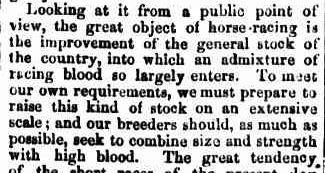
This article from The Argus, written in the days, stressed how important breeding better Victorian horses was if they were to match it with the other colonies and the need for good horse races such as the match race, to make sure that the standard of horse improved.
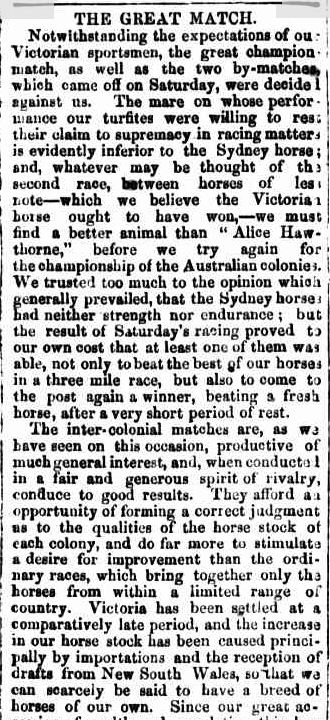
The Argus. (1857, October 5). The Argus (Melbourne, Vic. : 1848 – 1956), p. 5. Retrieved October 1, 2012, from http://nla.gov.au/nla.news-article7139706

It was not long before “Alice” was back racing and on 2 December she was at Ballarat, once again a winner.

THE RACES. SECOND DAY. (1857, December 3). The Star (Ballarat, Vic. : 1855 – 1864), p. 2. Retrieved October 1, 2012, from http://nla.gov.au/nla.news-article66045460

On Thursday 18 February 1858, Alice Hawthorn won the Great Metropolitan Handicap at Flemington, redeeming herself with those who dismissed her both before and after her match race with Veno.

VICTORIA JOCKEY CLUB RACE MEETING. (1858, February 26). Empire (Sydney, NSW : 1850 – 1875), p. 3. Retrieved October 1, 2012, from http://nla.gov.au/nla.news-article60426399

“Alice” continued to race and win.  Just over twelve months after her match race, she was still considered Victoria’s leading three miler, although some thought this was because she had nothing to beat.

No title. (1858, November 6). Bell’s Life in Sydney and Sporting Reviewer (NSW : 1845 – 1860), p. 2. Retrieved October 2, 2012, from http://nla.gov.au/nla.news-article59869552

The 1 October 1859 was the first running of the Australian Champion Sweepstakes at Flemington racecourse.  Horses from the colonies of South Australia, New South Wales, and Tasmania were among the entries, true inter-colonial racing.

One of the entries, The Barber from South Australia, had an unfortunate and unexpected link to the Western District. The Barber’s transportation to Melbourne was the steamer Admella.  The Admella struck trouble along the South Australian coast near the Victorian border and the Portland lifeboat Ladybird with Captain James Fawthrop at her helm went to the rescue.  All the horses aboard the steamer drowned, except for The Barber, who amazingly came to shore, two and a half miles away from the wreck.  He was then walked overland to Geelong and travelled by rail to Melbourne.  Not surprisingly he finished close to the tail of the field in the Sweepstakes.

“Alice”, by this time at least ten years old, acquitted herself well in the three-mile race running fourth behind the winner Victorian Flying Buck,  a three-year-old.

THE CHAMPION RACE DAY. (1859, October 3). The Argus (Melbourne, Vic. : 1848 – 1956), p. 5. Retrieved October 2, 2012, from http://nla.gov.au/nla.news-article5689255

Alice Hawthorn ran her last race in November 1859 in the Turf Club Welter Handicap over three miles.  She won by ten lengths and retired with £5000 in stakes money, the highest of any horse in the colonies.

VICTORIA. (1859, November 26). Bell’s Life in Sydney and Sporting Reviewer (NSW : 1845 – 1860), p. 4. Retrieved October 2, 2012, from http://nla.gov.au/nla.news-article59871699

The Chirnsides sent their mare to stud for a meeting with their imported stallion Peeping Tom. It is not clear if the mating was successful.

On 12 August 1860, the mare they called “Alice” passed away at the Chirnside’s Point Cook at twelve years of age, only nine months out of racing.  Her lungs that gave her the stamina to run long distances had failed her.

MELBOURNE NEWS. (1860, August 16). Bendigo Advertiser (Vic. : 1855 – 1918), p. 2. Retrieved October 3, 2012, from http://nla.gov.au/nla.news-article87945829

DEATH OF ALICE HAWTHORNE. (1860, August 18). Bell’s Life in Sydney and Sporting Reviewer (NSW : 1845 – 1860), p. 2. Retrieved October 2, 2012, from http://nla.gov.au/nla.news-article59873244

“Alice” went from the foothills of the Grampians to matching it with some of the leading horses in Victoria and the other colonies.  She easily could have remained at Mount William Station as nursemaid to the future stars of the Chirnside’s stables.  It was only for her demonstration of brilliance rounding up the escaped horses that saw her rise to becoming a household name.   She saw hard racing considering many of her races were over three miles, a mile further than the Melbourne Cup.  Horses from her time could run two three mile races in a day, just as Veno did on 3 October 1857.

In 1861, the first Melbourne Cup was run.  Racing was building up to a race like the Cup from the time of the Great Inter-Colonial match race, the Great Metropolitan Handicap and the Sweepstakes, but unlike those races, it has endured and strengthened over 150 years.  Racing was evolving, as it was suggested it should after the 1857 match race, by creating great horse races to improve the stock.  Unfortunately for Victoria, Archer from N.S.W. won the first two cups.  Banker, bred by Woodend hotel keeper Joseph Harper, finally won for the colony in 1863.  The Great Inter-Colonial match race began the stream of horses across the borders to race in Victoria.  Today, Victorian racing is International, with overseas horses not only racing here in the spring but taking the main prize.

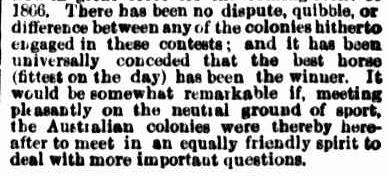
Alice Hawthorn and her rivals of the time have a place in Australian racing history.  While the leaders of the Australian colonies were struggling to work together on a united front, the connections of these horses were showing their political counterparts how to do it.  The Sporting Notes of The Argus of 24 March 1865 praised those involved in racing.  Between the Great Inter-Colonial match race in 1857 and 1865, the racing clubs of the colonies had agreed on a single birth date for all thoroughbreds, August 1 and Victoria had revised its Weight for Age system to come into line with the other colonies.  The correspondent said “It would be remarkable if meeting pleasantly on the neutral ground of sport, the Australian colonies were thereby hereafter to meet in an equally friendly spirit to deal with  more important questions”

SPORTING NOTES. (1865, March 24). The Argus (Melbourne, Vic. : 1848 – 1956), p. 5. Retrieved October 2, 2012, from http://nla.gov.au/nla.news-article5734367

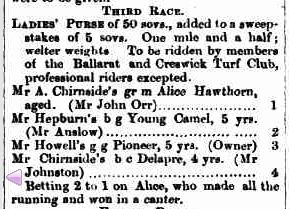
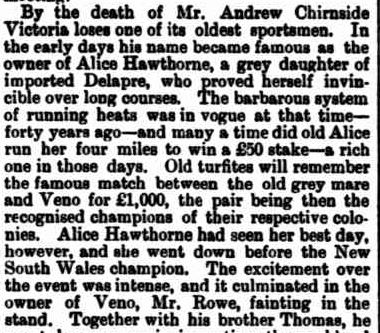
At the time of the death of Andrew Chirnside,  The Border Watch reported that Alice Hawthorn helped make his name in racing circles.

SPORTING NOTES. (1890, May 3). Border Watch (Mount Gambier, SA : 1861 – 1954), p. 3. Retrieved October 2, 2012, from http://nla.gov.au/nla.news-article77489433

I came to know about Alice Hawthorn while searching for articles about Mt. William Station at Trove.  My ggg grandfather James Mortimer and his family arrived at Mt William Station around 1853, about the time “Alice” was broken in.  He was there when she was working as a packhorse and when she rounded up the young horses.  When Cuthbert Fetherstonhaugh was at Munthum Station and heard the stories of the Delpare mare, James Mortimer was at Mt William Station.  Was James Mortimer one of the stockmen who rode Alice her and dismissed her as a riding horse?  He must have at least heard talk of her.

The talk of her continued for years after.  Donald McDonald, in 1928, put Alice Hawthorn’s racing career into perspective.
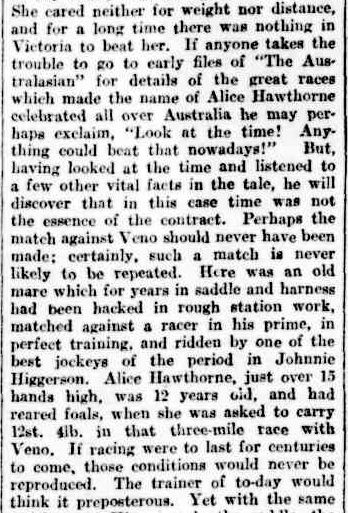
RACING AND ROMANCE. (1928, September 15). The Argus (Melbourne, Vic. : 1848 – 1956), p. 2 Supplement: The Argus. Saturday Camera Supplement.. Retrieved October 3, 2012, from http://nla.gov.au/nla.news-article395692
Trove Tuesday – From the Heart

Not only do I have Western District families, but I also have West Gippsland families.  The Combridges, Hunts and Whites resided around Grantville and Wonthaggi.

My great-great-grandfather was Culmer Thomas White, born in Thanet, Kent, England in 1857.  Culmer descended from the Culmer and White families, well-known in Kent for their boat building businesses at Broadstairs.  The two families came together around 1714 when John White married Mary Culmer.  Culmer’s father, great grandfather and gg-grandfather were all named Culmer White.  There are several other Culmer’s including my gg uncle Culmer William White and William Culmer White, Culmer’s 2nd cousin 1 x removed, who also immigrated to Melbourne, and his son Culmer Reuben White.

Almost everything I have found in the newspapers about Culmer Thomas White has been a treasure.  None more so than this heartfelt letter written to Reverend Henry Howard in 1927 which was then passed on by the Reverend to the West Gippsland Gazette.  Culmer was 70 at the time of writing.

Rev. Henry Howard. (1927, July 5). West Gippsland Gazette (Warragul, Vic. : 1898 – 1930) , p. 1 Edition: MORNING.. Retrieved September 30, 2012, from http://nla.gov.au/nla.news-article68643758

It is a touching letter as Culmer gives his thanks to Reverend Howard, shows his pride in his children, and expresses his feelings at that time in his life, happy but at times lonely.

Culmer’s wife, my great great grandmother, was Alice Elizabeth Hunt, daughter of  William Henry Hunt and Margaret Beatty, immigrants from Middlesex, England.  Alice was born at Chilwell, Victoria in 1857.

Culmer died in 1938 at Wonthaggi and Alice in 1940 at Bass.  They are buried together at the Grantville cemetery.

Culmer and Alice’s youngest child, Myrtle Rose White, married Les Combridge in 1919.  They had five children, four daughters, and one son.  One of those daughters was my Grandma, Mavis Combridge, later to marry Percy Riddiford.

Grandma passed away in 2007, but I did get to ask her about her grandparents Culmer and Alice, prior to her death.  She told me the story of how she and her three younger sisters would stay at their grandparent’s house.  Culmer would pick them up in a horse and cart and they would sit in the back as he drove them to his house.  He was a “lovely man” according to Grandma.  As is the way, there is still so much I would like to ask her about them.

I am very lucky as I still have a living link to Culmer and Alice, via my great Auntie Jean.  I have also spoken to her about her grandparents and she reiterated Grandma’s words that Culmer was a “lovely man”.  When I found this letter, I printed it out and sent it to Auntie Jean. She was thrilled.  I have sent her some of the other articles I have found about him and she has enjoyed being taken back in time.  I wish Grandma could have seen this wonderful letter.

Passing of the Pioneers

September’s Passing of the Pioneers brings the opportunity to post the obituary of Henry Annett of Wallacedale.  It shows how much information you can find out about a person from their obituary if you are lucky. Of course, any information found is purely a lead to primary sources.

After sixteen Passing of the Pioneers, there is now a large collection of Western District pioneer’s names. If you would like to see the full list of pioneer obituaries, follow the link – PIONEER OBITUARIES

Thomas BENNETT: Died 25 September 1889 at Portland.  Thomas Bennett was born in Derbyshire, England, and arrived at Portland in 1854, taking on a job as a merchant tailor.  He enjoyed cricket, racing, athletics, and hunting as both a participant and spectator.  Thomas married after arriving in Portland and he and his wife raised 10 children. His wife died of a stroke some years before and Thomas raised the children, with only four having reached their teens by the time of his death.

Richard BLOOMFIELD: Died 16 September 1901 at Hamilton.  Richard Bloomfield arrived in Australia, first to Tasmania in 1842 and later to Victoria. He joined the Police Force with his first station at Hamilton as chief constable. In his later years, Richard turned to farming and was seventy-nine at the time of his death.
BLOOMFIELD FAMILY MONUMENT, HAMILTON (OLD) CEMETERY

John RIORDAN: Died 27 September 1905 at Portland. Before arriving in Portland, just prior to the turn of the century, John Riordan spent time in Ballarat, Creswick and Ararat running businesses.  In Portland, he owned the London Hotel and served a period on the Portland Council.

The former London Hotel, Portland

Frederick BUCKNALL: Died September 1908  at Dartmoor. In his early days in Portland, Frederick Bucknall believed wattle trees could be commercially grown. He purchased land at Dartmoor and planted his wattles, but blight and fires made his venture difficult.  He went to the goldfields of Western Australia, where he had worked before. He returned to Dartmoor, a lot more financially secure, and continued his Wattle plantation, with more success than his first attempt.

Thomas DONOHOE:  Died 26 September 1908 at Narrawong. Thomas Donohoe of Narrawong was a cabinet maker of much renown, a farmer, and an administrator. He had great political knowledge and for a time was the Narrawong correspondent for the Portland Guardian.

Thomas Richard OLIVER:  Died 21 September 1910 at Horsham. Thomas Oliver was a brother-in-law of Reuben and Jonathan Harman. Born in Cornwall in 1848, he arrived at Melbourne with his parents John Henry Oliver and Ann Richards, and five older brothers and sisters. Thomas worked in the carrying business around Port Fairy before moving to Kalkee in the Wimmera in 1874. In 1876, he married Margaret Luxton, daughter of William Luxton.  Around the early 1890s, Thomas and Margaret moved into Horsham where Thomas opened a grocery business on Church Hill.

Sarah CLARK Died 10 September 1915 at Ararat.  Sarah Clark was born in Hertfordshire, England, and came to Victoria with her parents as a small child.  Her father, Leonard Clark took up a position as a gardener at the Burrumbeep Estate at Maroona.  Sarah married John Basham in 1866 and they had 13 children.  Nine children were still alive at the time of Sarah’s death.

Alfred BYRON: Died 28 September 1916 at Denicull Creek. There is no chance Alfred Byron, born at Ashton-Under-Tyne, Lancashire, England remembers his voyage to Australia as he was only ten days old when the ship sailed. Alfred’s parents settled at Port Fairy, but as a young man he headed off to the goldfields before settling at Denicull Creek, near Ararat.  Farming became his new pursuit. He married and raised a family of six children.

Thomas POLLAND Died 16 September 1917 at Moyston. Born in County Down, Ireland in 1924, Thomas Polland arrived in Victoria in 1853, making his way to the Ballarat goldfields. Present at the time of the Eureka uprising, Thomas enjoyed recounting the stories of the time. He eventually headed to Moyston and for a time worked carting timber from the Grampians, before purchasing land to farm.  His wife passed away around 1904 and Thomas left five of his eight children when he passed away.

Margaret THOMPSON:  Died 2 September 1919 at Horsham. Margaret Thompson was born in Melbourne around 1870, the daughter of Mr W. Thompson and Mrs Bedwell.  Her parents settled at Wonwondah and she lived there until she was seventeen.  Margaret’s mother remarried at this time and Margaret selected land at Telangatuk.  After three years, she married Herman A. Rokesky of Clear Lake.  They moved all over the district in the following years before Margaret and Herman settled in Horsham until the time of Margaret’s death.

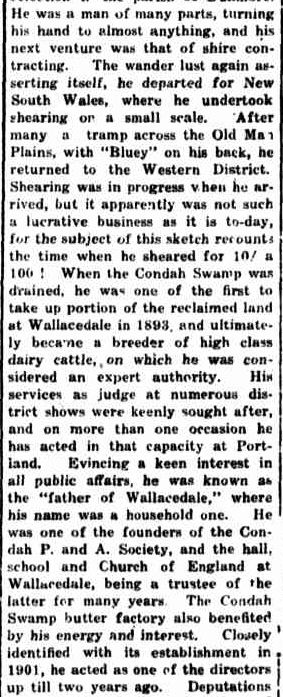
Henry ANNETT:  Died 29 September 1927 at Wallacedale.  In the November 2011 Passing of the Pioneers, I promised I would post Henry Annett’s obituary in September 2012 and here we are.  At the time, I had posted Henry’s wife’s obituary, that of Sarah Millard.  I mentioned then that the story of Henry’s life one of the best of I had read in the form of an obituary.  I have read many more obituaries since that time, and I still think Henry’s is right up there.

Henry Annett was born in Sevenoaks, Kent, England on July 5, 1845. Seven years later he sailed to Portland with his parents aboard the Pryam and Henry’s father joined the police force. Their first home was a Government issued bell tent.  After four years in Portland, Mr Annett Sr transferred to Port Fairy where Henry took up butchering.  Preferring the outdoors, Henry became a carrier taking goods to the Ararat diggings and to Dunkeld with materials for the first school.  At around seventeen, Henry travelled to New Zealand where he walked 10 days from Christchurch over mountains and rivers to reach the newest of the gold diggings in the country, but like many others, he left empty-handed.

After returning to Victoria in 1866, Henry married Sarah Millard of Narrawong but Henry still could not settle down.

THE PIONEERS PASS BY. (1927, October 6). Portland Guardian (Vic. : 1876 – 1953), p. 3 Edition: EVENING. Retrieved September 24, 2012, from http://nla.gov.au/nla.news-article64258739

Eventually, he did settle taking an interest in community affairs and  he earned the name the “father of Wallacedale”

Henry and Sarah had thirteen children, eleven boys, and two girls.  Three boys had predeceased Henry.  He also had forty-eight grandchildren and four great-grandchildren. He was buried at the Condah cemetery.

Robert HICKLETON:  Died 14 September 1932 at Koroit. Robert Hickleton arrived in Portland with his parents in 1852.  They had sailed aboard the Old Ellen.  Robert’s first job was a compositor with the Portland Guardian.  Over the following years, he worked for the Warrnambool Standard, the Portland Mirror, the Hamilton Spectator, and the Port Fairy Gazette, where he spent twenty-nine years.  In his early years, he was a keen athlete and cricketer, and later he was a successful lawn bowler.

Sarah HERBERTSON:  Died September 1932 at Portland. Sarah Herbertson was born in Portland in 1844.  She married Joseph Henry Porter and they lived in Portland during their married life, with Joseph passing away in 1931. They had no children.  Sarah’s obituary mentions she was “deeply attached to her home”.  A model, built by Joseph and Sarah, of that home in Gawler Street, is now on display at Portland’s History House, testimony to her attachment.  Sarah’s obituary gives her maiden name as Henderson.

Model of the home of Joseph and Sarah Porter

Emma GRIFFITHS:  Died September 1936 at Irrewillipe.  Emma Griffiths was 100 years old when she died after spending eighty-five years in Victoria.  Emma was just a girl when she and her mother arrived in Sydney aboard the Avocalle, on which Emma’s mother was a matron caring for the female passengers.  Later they went on to Melbourne, Geelong, and then Buninyong where she married Mr Nicholan. They had three children at Buninyong before moving to Irrewillipe, near Colac around the late 1850s.  Emma had fourteen children and when she died she had sixty-two grandchildren and over thirty great-grandchildren.

Clara Quick GEOMAN:  Died 24 September 1941 at Hamilton. Clara was born at Yambuk in 1859 and in 1884 married Francis Hollard at Portland. They moved to Wallacedale, being among the earliest settlers there. Clara appears to have had a link to Henry Annett as her daughter Ethel married Edward Annett.  Clara had five other children alive at the time of her death.

Trove Tuesday – A Whale of a Time

I stumbled across this little gem only because it shared a page with an article I believe is about the sister of my ggg grandmother Ellen Barry.  That article from The Argus of June 1, 1849,  mentions Mary Walker, the married name of Mary Barry.  Why do I think it is about my Mary Walker?  Aside from the fact she was living in Melbourne then, the article is under the heading “Police Office” with Mary and another woman described as “two notorious termagants”.  My Mary Walker caused an immigration agent to lose his bounty on her, thanks to her disruptive behavior on the voyage from Ireland to Port Phillip.

As I rolled my eyes at possibly another discovery of a misdemeanor by one of the Barry girls, I noticed this little snippet two columns over.

Domestic Intelligence. (1849, June 1). The Argus (Melbourne, Vic. : 1848 – 1956), p. 1 Supplement: Supplement to the Argus.. Retrieved September 23, 2012, from http://nla.gov.au/nla.news-article4765656

Great news for the whales! At last, their winter home in the seas off the south-west of Victoria was safe to visit again.  Whaling was a huge industry at both Portland and Port Fairy with Portland’s first whaling station established in 1833 and  Port Fairy’s in 1835. By the 1840s, few whales existed and whaling was no longer considered commercially viable and the whaling stations closed.

As the article notes, by the end of the 1840s, whales were appearing again.  Today, their descendants visit the waters of Warrnambool, Port Fairy, and Portland and have become a huge boost to tourism during the colder months.  Warrnambool particularly has benefited from whale watching, however this year the main attractions have made only brief visits, preferring Port Fairy, with daily sightings close to shore of up to 13 whales.   Portland too has had whales and over the past few days, a whale and her calf have been off the breakwater, oblivious to the slaughters over 170 years ago.