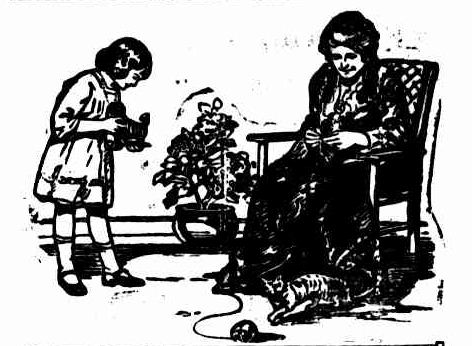
Christmas 1920s style

A new decade dawned with a sense of hope and positivity.  Would the decade end in the same way?

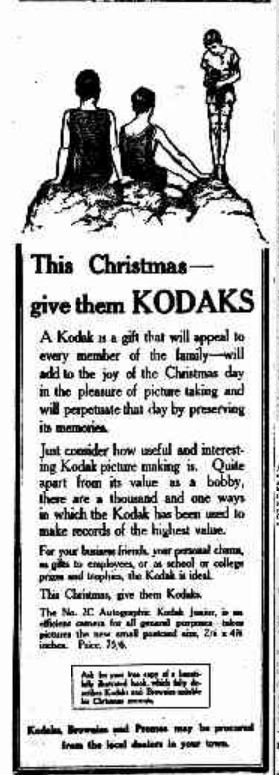
Christmas 1920 and the Kodak brand continued to rise in prominence. Their advertisements promoted Kodak cameras’ convenience which could offer lasting memories of holidays long after they had passed.  Even a child could use it.
1920

Advertising. (1920, December 6). Portland Guardian (Vic. : 1876 – 1953), p. 3 Edition: EVENING.. Retrieved December 12, 2012, from http://nla.gov.au/nla.news-article64022869
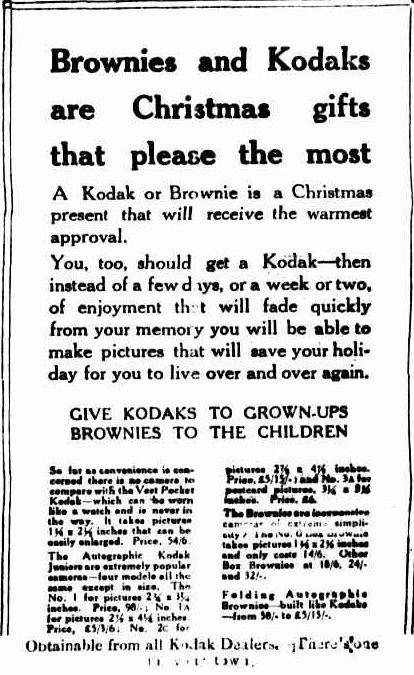
1920a

The Salvation Army’s charity work at Christmas was attracting more attention in the papers during the 1920s.
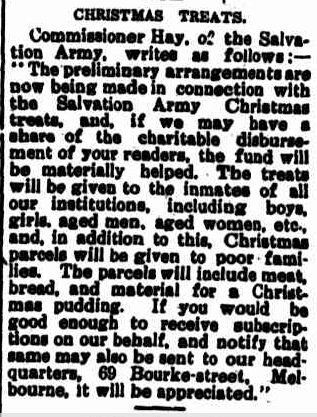
CHRISTMAS TREATS. (1920, December 9). Portland Guardian (Vic. : 1876 - 1953), p. 2 Edition: EVENING.. Retrieved December 12, 2012, from http://nla.gov.au/nla.news-article64022893

CHRISTMAS TREATS. (1920, December 9). Portland Guardian (Vic. : 1876 – 1953), p. 2 Edition: EVENING.. Retrieved December 12, 2012, from http://nla.gov.au/nla.news-article64022893

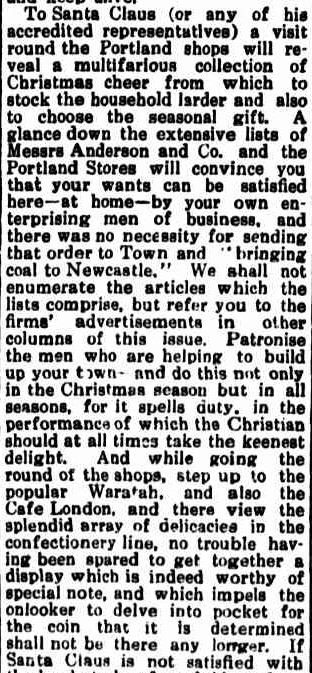
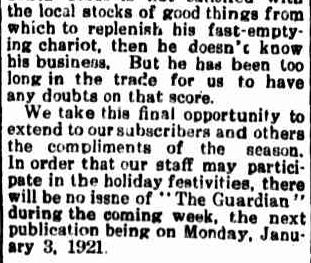
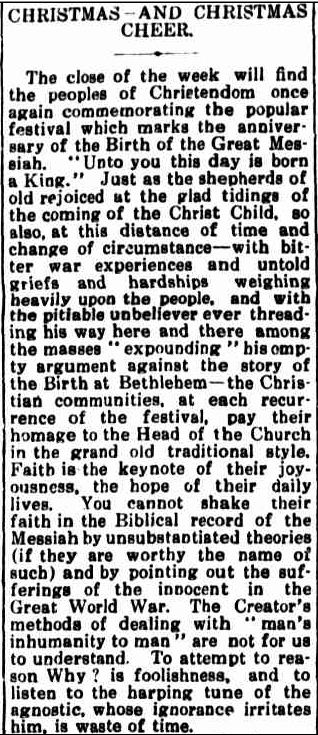
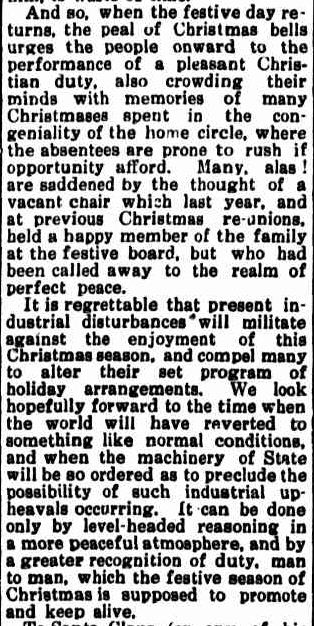
The Portland Guardian Christmas editorial of 23 December 1920 had it all.  Christmas from a religious perspective, the need for positivity,  forward movement and encouragement to buy local products.  Industrial disputes, prominent during the 1920s in Australia are also mentioned as was Santa with the suggestion that if Santa could not find a suitable Christmas gift in the Portland shops, he wasn’t up to the task.  Luckily there was the clarification that Santa has been in the job too long for them to question his abilities.
1920c1920d1920e

Portland Guardian. (1920, December 23). Portland Guardian (Vic. : 1876 - 1953), p. 2 Edition: EVENING.. Retrieved December 12, 2012, from http://nla.gov.au/nla.news-article64022977

Portland Guardian. (1920, December 23). Portland Guardian (Vic. : 1876 – 1953), p. 2 Edition: EVENING.. Retrieved December 12, 2012, from http://nla.gov.au/nla.news-article64022977

It was hot in the Western District during Christmas 1920 and this brought people out on to the streets of Heywood.
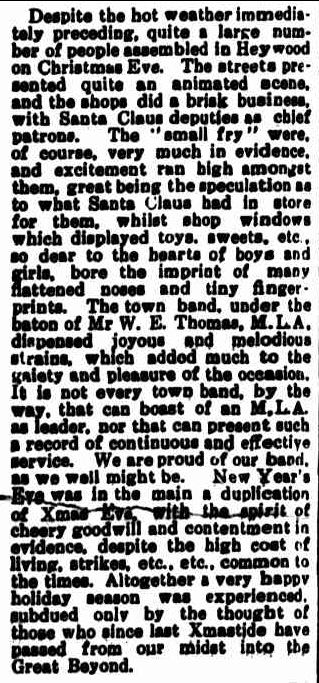
Heywood. (1921, January 3). Portland Guardian (Vic. : 1876 - 1953), p. 3 Edition: EVENING.. Retrieved December 12, 2012, from http://nla.gov.au/nla.news-article64023002

Heywood. (1921, January 3). Portland Guardian (Vic. : 1876 – 1953), p. 3 Edition: EVENING.. Retrieved December 12, 2012, from http://nla.gov.au/nla.news-article64023002

Spencer Street Station (now Southern Cross Station), Melbourne would have been a sight at Christmas time with crates of live poultry of various types lining the platforms.  This report comes from Christmas 1921.
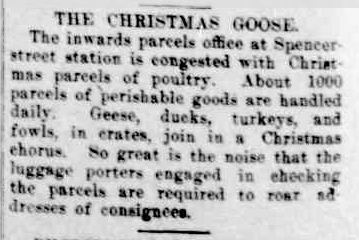
THE CHRISTMAS GOOSE. (1921, December 23). The Horsham Times (Vic. : 1882 - 1954), p. 4. Retrieved December 12, 2012, from http://nla.gov.au/nla.news-article72727852

THE CHRISTMAS GOOSE. (1921, December 23). The Horsham Times (Vic. : 1882 – 1954), p. 4. Retrieved December 12, 2012, from http://nla.gov.au/nla.news-article72727852

The war was over but help was still needed by the many returned servicemen, many facing unemployment.
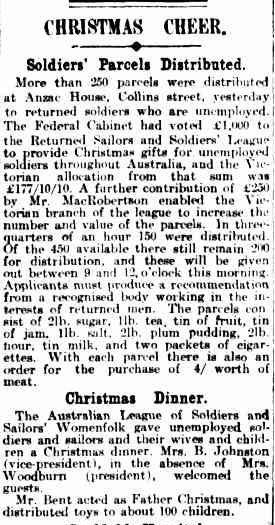
CHRISTMAS CHEER. (1921, December 24). The Argus (Melbourne, Vic. : 1848 - 1956), p. 9. Retrieved December 13, 2012, from http://nla.gov.au/nla.news-article4611429

CHRISTMAS CHEER. (1921, December 24). The Argus (Melbourne, Vic. : 1848 – 1956), p. 9. Retrieved December 13, 2012, from http://nla.gov.au/nla.news-article4611429

The ladies of the Horsham Church of Christ had gathered together homemade goods to sell at their annual Christmas sale of 1922.
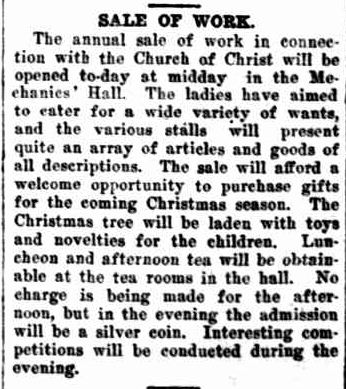
SALE OF WORK. (1922, December 15). The Horsham Times (Vic. : 1882 - 1954), p. 4. Retrieved December 12, 2012, from http://nla.gov.au/nla.news-article72742565

SALE OF WORK. (1922, December 15). The Horsham Times (Vic. : 1882 – 1954), p. 4. Retrieved December 12, 2012, from http://nla.gov.au/nla.news-article72742565

Photographs were a popular gift suggestion for Christmas 1922.
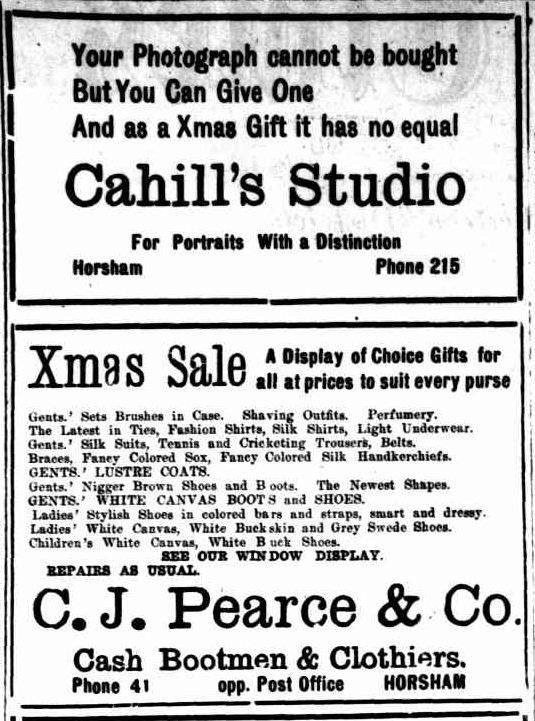
Advertising. (1922, December 15). The Horsham Times (Vic. : 1882 - 1954), p. 2. Retrieved December 12, 2012, from http://nla.gov.au/nla.news-article72742578

Advertising. (1922, December 15). The Horsham Times (Vic. : 1882 – 1954), p. 2. Retrieved December 12, 2012, from http://nla.gov.au/nla.news-article72742578

Barnes the Chemist of Horsham had ivory goods and hair tidies and were also an agent for Kodak, the camera to suit all purses.
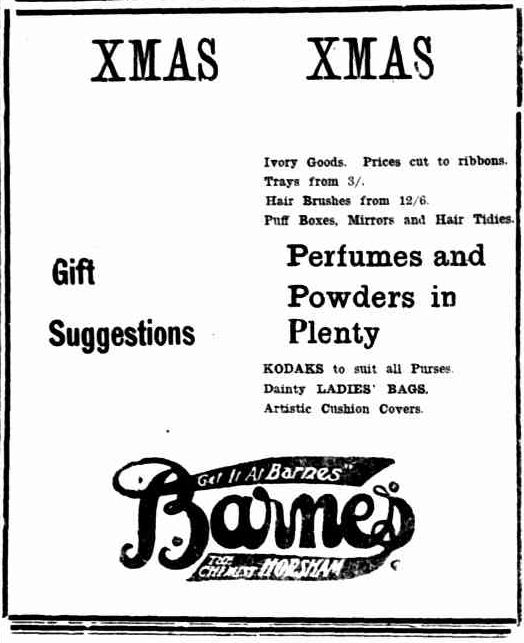
1920kHorsham experienced the coldest Christmas for years in 1922.
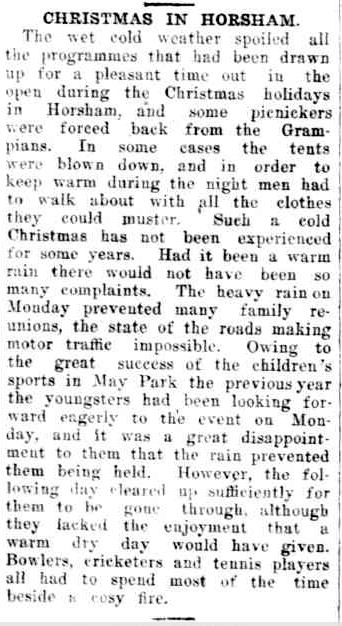
CHRISTMAS IN HORSHAM. (1922, December 29). The Horsham Times (Vic. : 1882 - 1954), p. 4. Retrieved December 12, 2012, from http://nla.gov.au/nla.news-article72742806

CHRISTMAS IN HORSHAM. (1922, December 29). The Horsham Times (Vic. : 1882 – 1954), p. 4. Retrieved December 12, 2012, from http://nla.gov.au/nla.news-article72742806

Shoppers fell over each other to get the best Christmas poultry at the Bendigo Auction markets in December 1923.
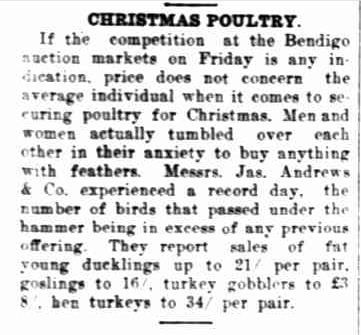
POULTRY FOR CHRISTMAS. (1923, December 21). The Horsham Times (Vic. : 1882 - 1954), p. 6. Retrieved December 12, 2012, from http://nla.gov.au/nla.news-article72737714

POULTRY FOR CHRISTMAS. (1923, December 21). The Horsham Times (Vic. : 1882 – 1954), p. 6. Retrieved December 12, 2012, from http://nla.gov.au/nla.news-article7273771

As seen above, turkeys were the more expensive type of poultry for Christmas 1923 and were considered “a forbidden luxury”.
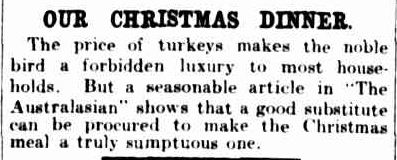
OUR CHRISTMAS DINNER. (1923, December 15). The Argus (Melbourne, Vic. : 1848 - 1956), p. 21. Retrieved December 13, 2012, from http://nla.gov.au/nla.news-article1994780

OUR CHRISTMAS DINNER. (1923, December 15). The Argus (Melbourne, Vic. : 1848 – 1956), p. 21. Retrieved December 13, 2012, from http://nla.gov.au/nla.news-article1994780

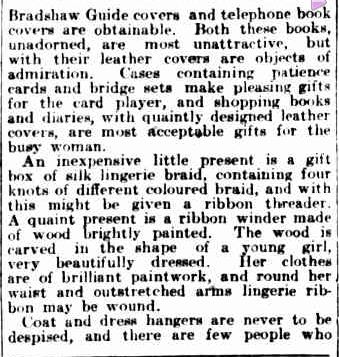
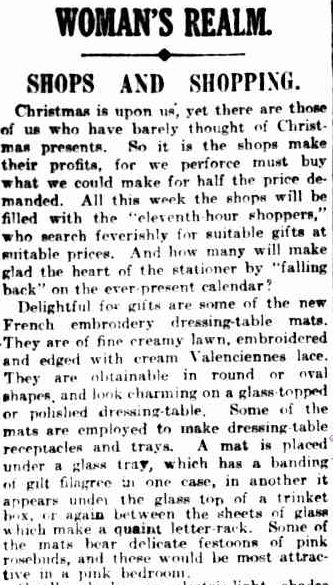
The Argus of 18 December 1923 offered Christmas gift suggestions in the “Woman’s Realm” column.  French embroidery dressing table mats looked “charming” on a glass-topped table.  The Christmas handkerchief was always welcome with some relying on a handkerchief gift to replenish their supply. Telephone book covers and patience card sets were also suggested.
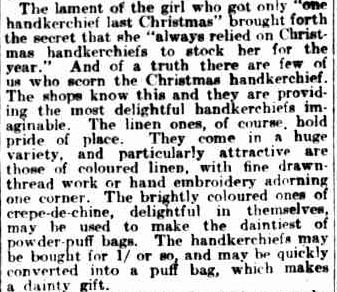
1920aa1920bb

 WOMAN'S REALM. (1923, December 18). The Argus (Melbourne, Vic. : 1848 - 1956), p. 14. Retrieved December 13, 2012, from http://nla.gov.au/nla.news-article2000447MLA citation

WOMAN’S REALM. (1923, December 18). The Argus (Melbourne, Vic. : 1848 – 1956), p. 14. Retrieved December 13, 2012, from http://nla.gov.au/nla.news-article2000447
MLA citation

Christmas 1923 in Horsham sounded a little brighter than 1922.  The greenery on shops and the ladies’ summer dresses added to the splendour of the fine weather.
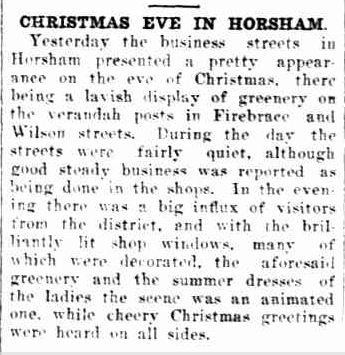
CHRISTMAS EVE IN HORSHAM. (1923, December 25). The Horsham Times (Vic. : 1882 - 1954), p. 4. Retrieved December 12, 2012, from http://nla.gov.au/nla.news-article72737815

CHRISTMAS EVE IN HORSHAM. (1923, December 25). The Horsham Times (Vic. : 1882 – 1954), p. 4. Retrieved December 12, 2012, from http://nla.gov.au/nla.news-article72737815

The annual Christmas treat at May Park had grown into a popular Christmas Eve fixture in Horsham by Christmas 1924.
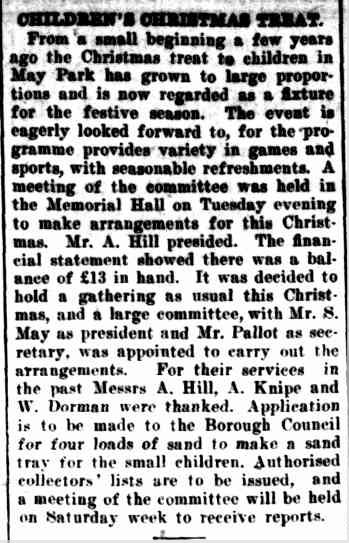
CHILDREN'S CHRISTMAS TREAT. (1924, November 21). The Horsham Times (Vic. : 1882 - 1954), p. 6. Retrieved December 12, 2012, from http://nla.gov.au/nla.news-article72752604

CHILDREN’S CHRISTMAS TREAT. (1924, November 21). The Horsham Times (Vic. : 1882 – 1954), p. 6. Retrieved December 12, 2012, from http://nla.gov.au/nla.news-article72752604

The shopkeepers of Portland were competing for a prize of one guinea from the Mayor for their Christmas 1924 window displays.
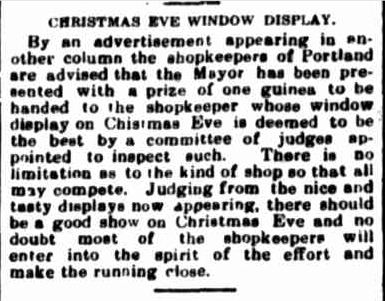
CHRISTMAS EVE WINDOW DISPLAY. (1924, December 15). Portland Guardian (Vic. : 1876 - 1953), p. 2 Edition: EVENING.. Retrieved December 12, 2012, from http://nla.gov.au/nla.news-article64106332

CHRISTMAS EVE WINDOW DISPLAY. (1924, December 15). Portland Guardian (Vic. : 1876 – 1953), p. 2 Edition: EVENING.. Retrieved December 12, 2012, from http://nla.gov.au/nla.news-article64106332

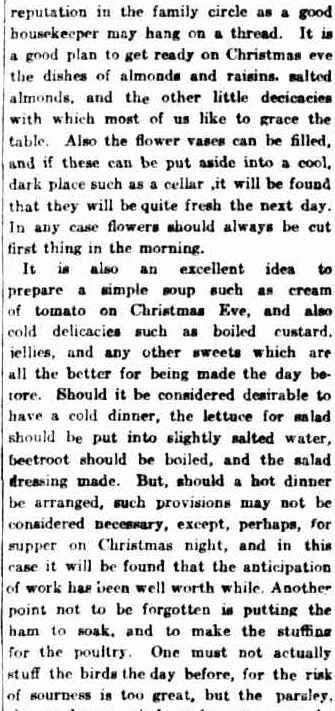
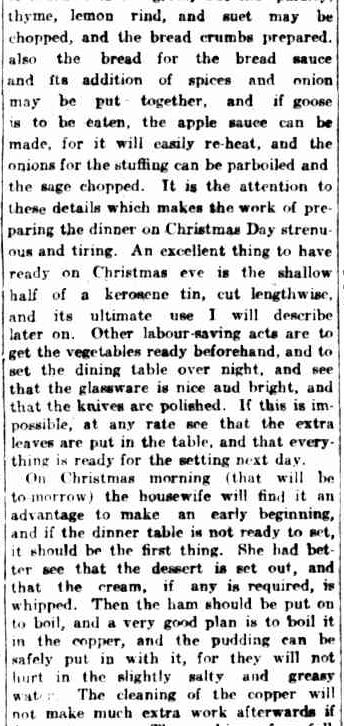
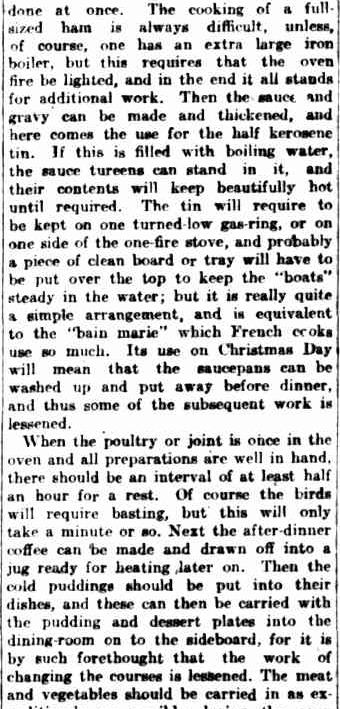
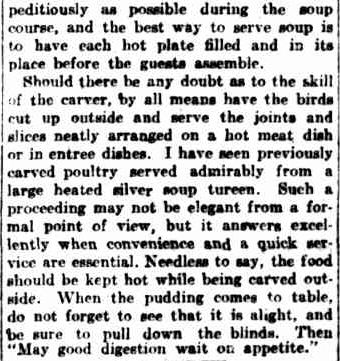
If you were wanting a step by step guide to preparing a 1924 style Christmas dinner, this is it.  Worth reading if you have a mother in law or sisters visiting.  Failure to take heed could see your reputation as “a good housekeeper…hang on a thread”.  This really is priceless and is a wonderful insight into domestic tasks of the 1920s.
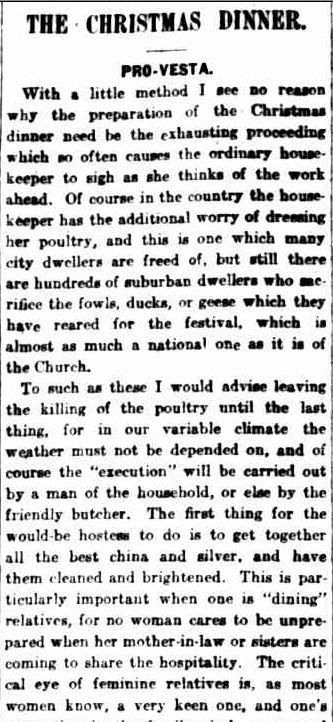
1920dd

1920ee1920ff1920gg

WOMEN to WOMEN. (1924, December 24). The Argus (Melbourne, Vic. : 1848 - 1956), p. 4. Retrieved December 13, 2012, from http://nla.gov.au/nla.news-article2090278

WOMEN to WOMEN. (1924, December 24). The Argus (Melbourne, Vic. : 1848 – 1956), p. 4. Retrieved December 13, 2012, from http://nla.gov.au/nla.news-article2090278

Christmas 1925 was looking disastrous for the parishioners of the Horsham Church of Christ when they heard the news that Father Christmas was stranded at Dooen Hill after his plane had broken down.  A rescue party was sent and he eventually arrived with presents for all.
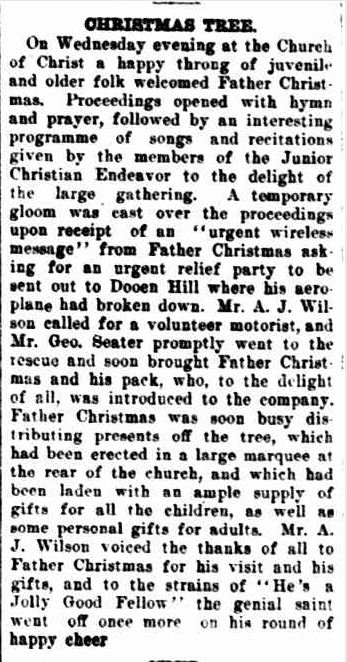
CHRISTMAS TREE. (1925, December 18). The Horsham Times (Vic. : 1882 - 1954), p. 6. Retrieved December 12, 2012, from http://nla.gov.au/nla.news-article73011596

CHRISTMAS TREE. (1925, December 18). The Horsham Times (Vic. : 1882 – 1954), p. 6. Retrieved December 12, 2012, from http://nla.gov.au/nla.news-article73011596

Goodwill and good business marked Christmas 1925 in Horsham.   The reporter also noted that the pine boughs on the shop verandah posts served the purpose of stopping people propping up the posts, “Australia’s favourite duty”.
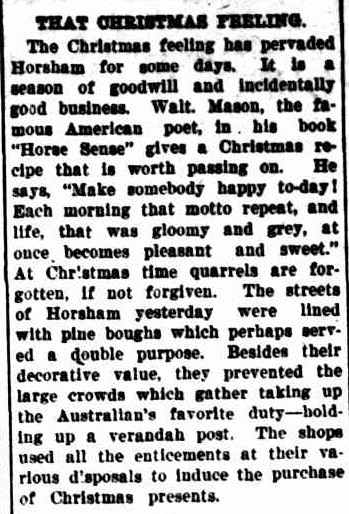
THAT CHRISTMAS FEELING. (1925, December 25). The Horsham Times (Vic. : 1882 - 1954), p. 6. Retrieved December 12, 2012, from http://nla.gov.au/nla.news-article73011820

THAT CHRISTMAS FEELING. (1925, December 25). The Horsham Times (Vic. : 1882 – 1954), p. 6. Retrieved December 12, 2012, from http://nla.gov.au/nla.news-article73011820

While the night soil man and his family innocently enjoyed a hearty Christmas dinner of two geese thanks to what he thought was a generous Christmas box, the true owners lamented that things don’t always turn out the way one expects them to.
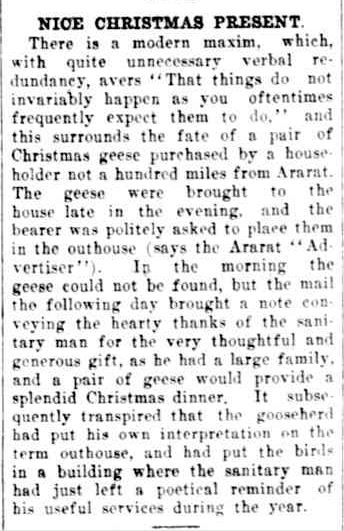
NICE CHRISTMAS PRESENT. (1926, January 12). The Horsham Times (Vic. : 1882 - 1954), p. 4. Retrieved December 12, 2012, from http://nla.gov.au/nla.news-article73000513

NICE CHRISTMAS PRESENT. (1926, January 12). The Horsham Times (Vic. : 1882 – 1954), p. 4. Retrieved December 12, 2012, from http://nla.gov.au/nla.news-article73000513

A. and P. Glover of Horsham opened an extra shop during Christmas 1926 to cater for the increase in trade.
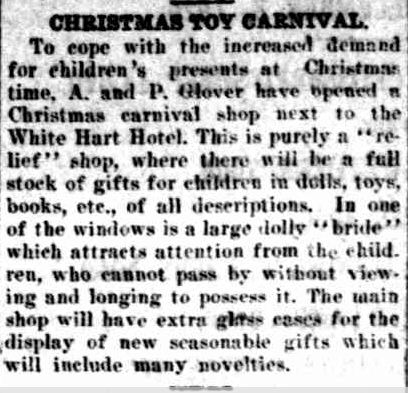
CHRISTMAS TOY CARNIVAL. (1926, November 26). The Horsham Times (Vic. : 1882 - 1954), p. 4. Retrieved December 12, 2012, from http://nla.gov.au/nla.news-article73017110

CHRISTMAS TOY CARNIVAL. (1926, November 26). The Horsham Times (Vic. : 1882 – 1954), p. 4. Retrieved December 12, 2012, from http://nla.gov.au/nla.news-article73017110

A Christmas story from Horsham, 1926.
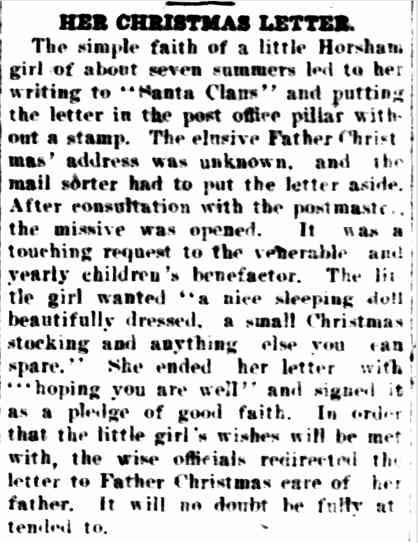
HER CHRISTMAS LETTER. (1926, December 17). The Horsham Times (Vic. : 1882 - 1954), p. 4. Retrieved December 12, 2012, from http://nla.gov.au/nla.news-article73017834

HER CHRISTMAS LETTER. (1926, December 17). The Horsham Times (Vic. : 1882 – 1954), p. 4. Retrieved December 12, 2012, from http://nla.gov.au/nla.news-article73017834
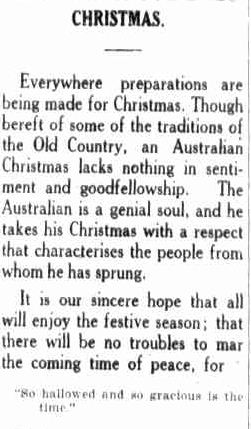
The Border Watch. (1926, December 23). Border Watch (Mount Gambier, SA : 1861 - 1954), p. 4. Retrieved December 13, 2012, from http://nla.gov.au/nla.news-article77688066

The Border Watch. (1926, December 23). Border Watch (Mount Gambier, SA : 1861 – 1954), p. 4. Retrieved December 13, 2012, from http://nla.gov.au/nla.news-article77688066

Father Christmas of “Balloon Land” wrote a letter to the Editor of the Portland Guardian to announce his visit to the Portland Free Library.
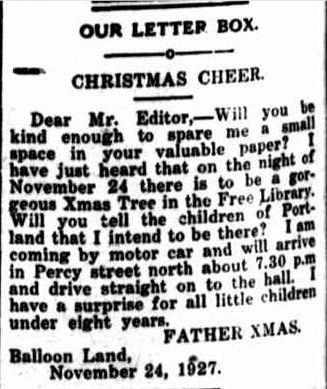
OUR LETTER BOX. (1927, November 14). Portland Guardian (Vic. : 1876 - 1953), p. 2 Edition: EVENING. Retrieved December 13, 2012, from http://nla.gov.au/nla.news-article64259155

OUR LETTER BOX. (1927, November 14). Portland Guardian (Vic. : 1876 – 1953), p. 2 Edition: EVENING. Retrieved December 13, 2012, from http://nla.gov.au/nla.news-article64259155

Mr G.C Perring advised Horsham residents that he was taking orders for Christmas Cakes for the 1927 celebration.
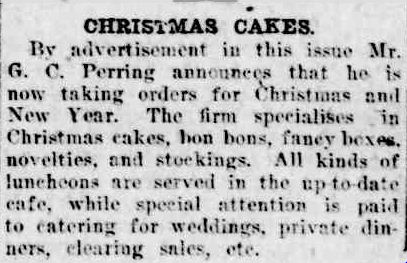
CHRISTMAS CAKES. (1927, December 2). The Horsham Times (Vic. : 1882 - 1954), p. 2. Retrieved December 12, 2012, from http://nla.gov.au/nla.news-article72999479

CHRISTMAS CAKES. (1927, December 2). The Horsham Times (Vic. : 1882 – 1954), p. 2. Retrieved December 12, 2012, from http://nla.gov.au/nla.news-article72999479

The Post Master General’s department distributed three million of the following posters in 1927.
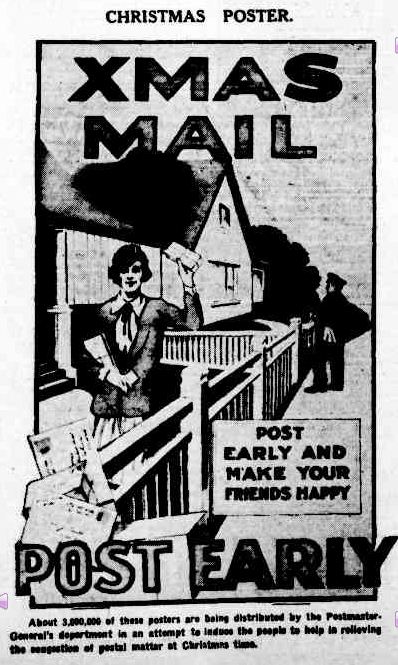
CHRISTMAS POSTER. (1927, December 10). The Argus (Melbourne, Vic. : 1848 - 1956), p. 33. Retrieved December 13, 2012, from http://nla.gov.au/nla.news-article3897110

CHRISTMAS POSTER. (1927, December 10). The Argus (Melbourne, Vic. : 1848 – 1956), p. 33. Retrieved December 13, 2012, from http://nla.gov.au/nla.news-article3897110

The Christmas Box Art Union were selling Australian made Christmas cards.
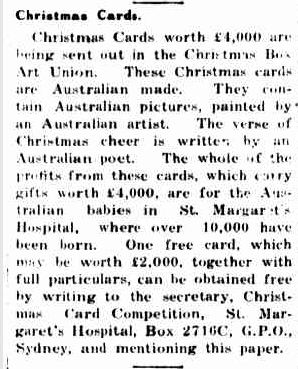
Christmas Cards. (1928, October 22). Portland Guardian (Vic. : 1876 - 1953), p. 2 Edition: EVENING. Retrieved December 12, 2012, from http://nla.gov.au/nla.news-article64267379

Christmas Cards. (1928, October 22). Portland Guardian (Vic. : 1876 – 1953), p. 2 Edition: EVENING. Retrieved December 12, 2012, from http://nla.gov.au/nla.news-article64267379

The Argus Shopping Page offered a range of last minute gift ideas.  Interesting items listed under the heading “Sweets for Children” were bunches of grapes and pink radishes along with tool sets and chocolate telephones.
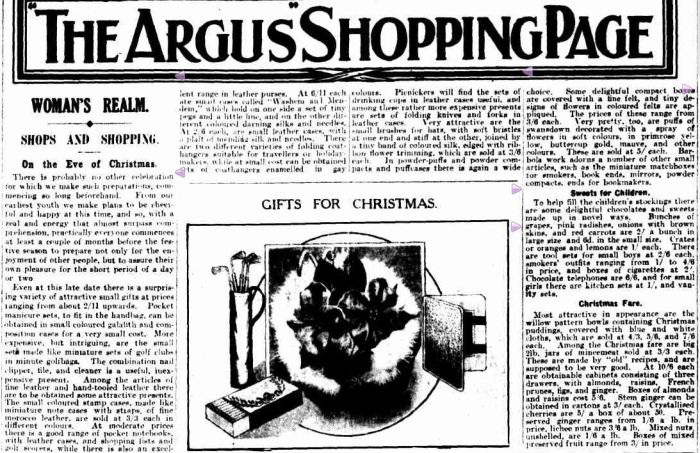
"THE ARGUS" SHOPPING PAGE. (1928, December 21). The Argus (Melbourne, Vic. : 1848 - 1956), p. 13. Retrieved December 13, 2012, from http://nla.gov.au/nla.news-article3976851

“THE ARGUS” SHOPPING PAGE. (1928, December 21). The Argus (Melbourne, Vic. : 1848 – 1956), p. 13. Retrieved December 13, 2012, from http://nla.gov.au/nla.news-article3976851

Every shop in Horsham had taken the trouble to decorate for Christmas 1928.  People were beginning to feel the pinch as the decade drew to a close.
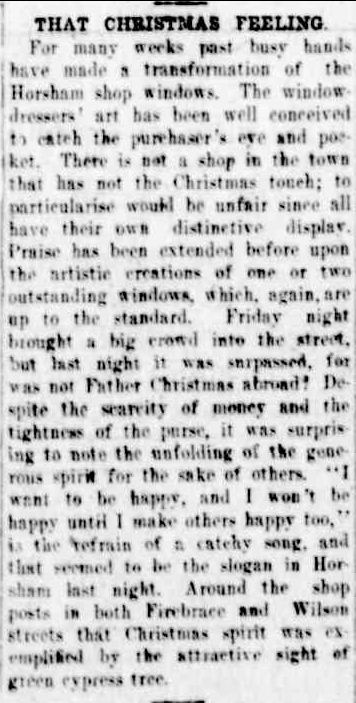
THAT CHRISTMAS FEELING. (1928, December 25). The Horsham Times (Vic. : 1882 - 1954), p. 2. Retrieved December 12, 2012, from http://nla.gov.au/nla.news-article72681761

THAT CHRISTMAS FEELING. (1928, December 25). The Horsham Times (Vic. : 1882 – 1954), p. 2. Retrieved December 12, 2012, from http://nla.gov.au/nla.news-article72681761

Only weeks on from the Wall Street Crash of 1929, Jim Scullin was insisting that Australians buy Australian.  With high unemployment, the crash and a trade deficit of 10 million pounds there was a sense of urgency to stimulate the local economy and create jobs.  Examples of the products imported were £400,000 of serviettes and linen and £46,000 of playing cards.
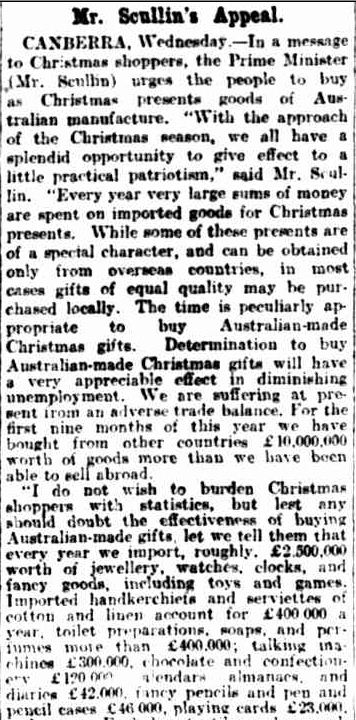
CHRISTMAS PRESENTS. (1929, December 5). The Argus (Melbourne, Vic. : 1848 - 1956), p. 14. Retrieved December 14, 2012, from http://nla.gov.au/nla.news-article4054513

CHRISTMAS PRESENTS. (1929, December 5). The Argus (Melbourne, Vic. : 1848 – 1956), p. 14. Retrieved December 14, 2012, from http://nla.gov.au/nla.news-article4054513

Santa dropped in at the Laverton Air school in December 1929.
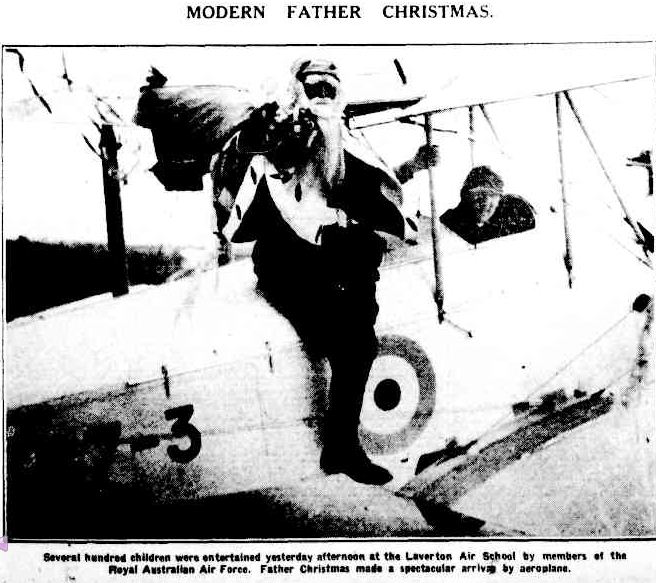
MODERN FATHER CHRISTMAS. (1929, December 7). The Argus (Melbourne, Vic. : 1848 – 1956), p. 17. Retrieved December 14, 2012, from http://nla.gov.au/nla.news-article4055264

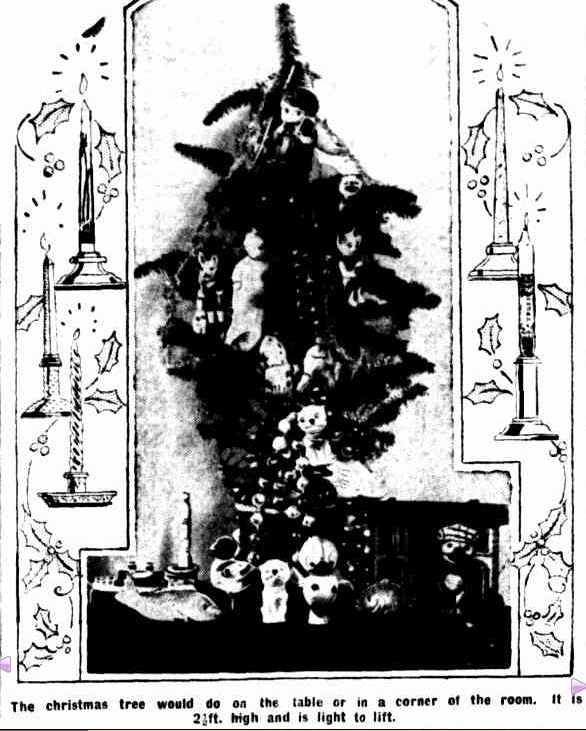
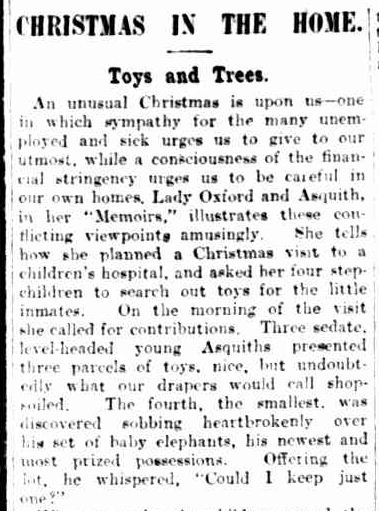
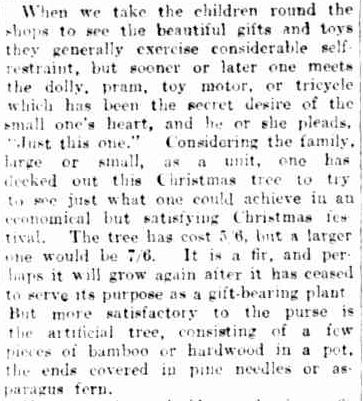
The Argus of 13 December 1929 offered tips on getting through Christmas during a time of “financial stringency”.  Christmas trees ranged in price from 5/6 to 7/6 but a cheaper option was pieces of bamboo or hardwood placed in a pot and adorned with pine needles or asparagus fern.
1920rr

1920ss

"THE ARGUS" SHOPPING PAGE. (1929, December 13). The Argus (Melbourne, Vic. : 1848 - 1956), p. 13. Retrieved December 14, 2012, from http://nla.gov.au/nla.news-article4056538

“THE ARGUS” SHOPPING PAGE. (1929, December 13). The Argus (Melbourne, Vic. : 1848 – 1956), p. 13. Retrieved December 14, 2012, from http://nla.gov.au/nla.news-article4056538

Christmas 1910s style

Australia began the 1910s with innocence but by decade’s end any innocence had gone, snatched away at faraway places unheard of in 1910 like Gallipoli, Fromelles and Beersheba.  Children hanging Christmas stockings in 1910 ended the decade without fathers, brothers or even their own lives.  The decade started with the usual, even frivolous reports about matters such as fruit supplies and ended with life trying to adjust back to those carefree times, but with the stark evidence of missing faces at the Christmas dinner table.

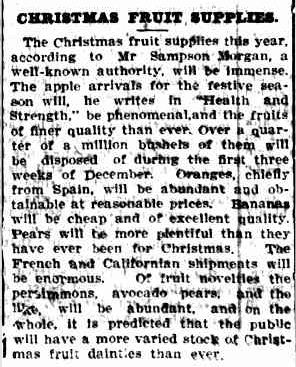
Fruit was in abundance for Christmas 1910 with oranges from Spain, bananas and  pears from France and California.  Shoppers could also buy novelty fruits such as avocado and persimmons.

CHRISTMAS FRUIT SUPPLIES. (1910, January 28). The Colac Herald (Vic. : 1875 – 1918), p. 9. Retrieved December 8, 2012, from http://nla.gov.au/nla.news-article91856179

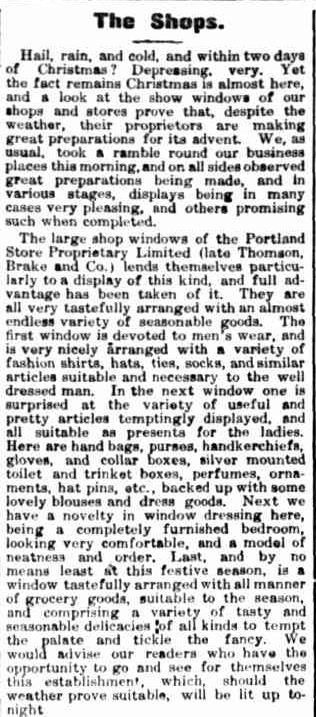
The Portland Guardian raised Christmas spirits dampened by wintry weather.  They reported on the many Christmas shop displays around the town.

The Shops. (1910, December 23). Portland Guardian (Vic. : 1876 – 1953), p. 3 Edition: EVENING. Retrieved December 9, 2012, from http://nla.gov.au/nla.news-article63979222chris19102

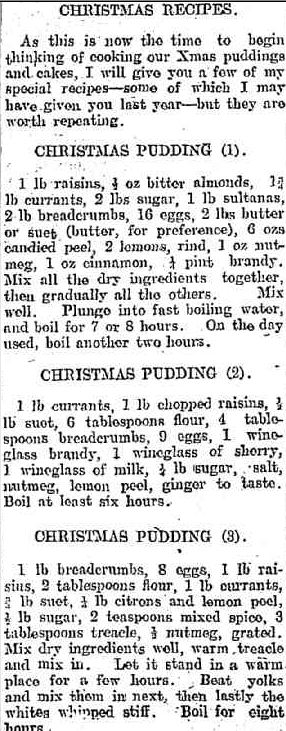
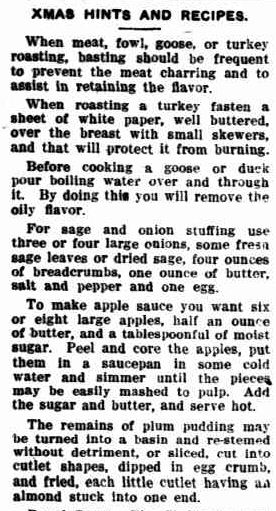
There were always Christmas pudding recipes in the papers.

USEFUL RECIPES. (1911, December 6). The Colac Herald (Vic. : 1875 – 1918), p. 3. Retrieved December 9, 2012, from http://nla.gov.au/nla.news-article90161213

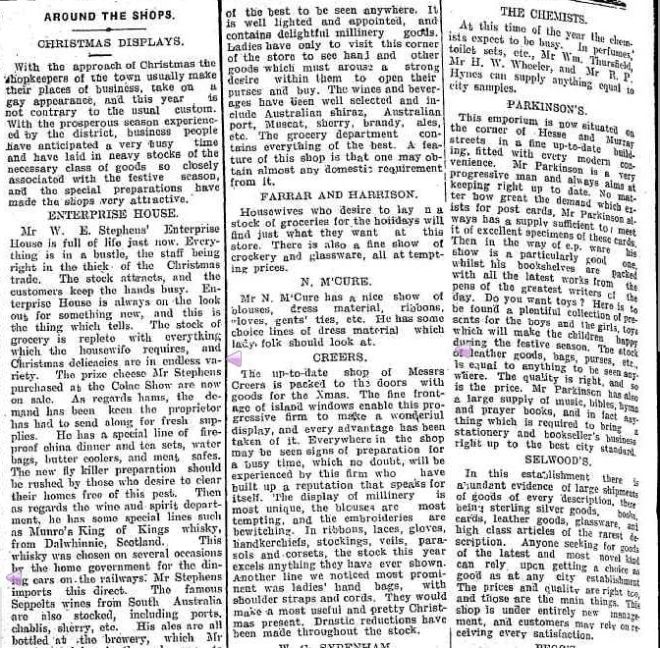
Christmas 1911 saw the shops of Colac go all out with their window displays.  Mr Stephen’s Enterprise House was the place to go for grocery and homewares supplies.  He stocked hams and cheeses and a range of Christmas delicacies and even a new fly-killing preparation, essential for an insect free Christmas lunch in Australia.  Mr Stephens also stocked a range of alcohol including Seppelt’s wine, port and sherry.

AROUND THE SHOPS. (1911, December 22). The Colac Herald (Vic. : 1875 – 1918), p. 4. Retrieved December 9, 2012, from http://nla.gov.au/nla.news-article90160998

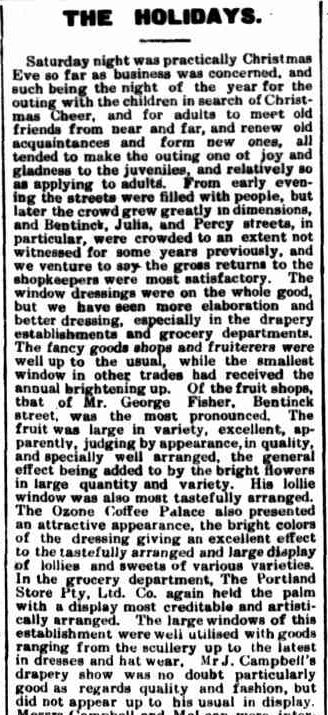
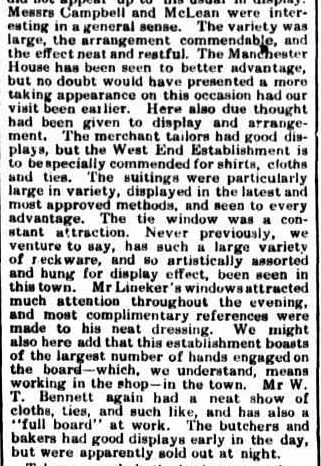
Christmas Eve 1911 in Portland saw the usual hustle and bustle.  It was an evening to catch up with old friends back in Portland for Christmas while children soaked up the festive atmosphere.  The Ozone Coffee Place was just one of the shops with an elaborate window display of lollies and sweets.  By evening the butchers and bakers had sold out of their goods.

chris19105

THE HOLIDAYS. (1911, December 29). Portland Guardian (Vic. : 1876 – 1953), p. 3 Edition: EVENING. Retrieved December 9, 2012, from http://nla.gov.au/nla.news-article63982899

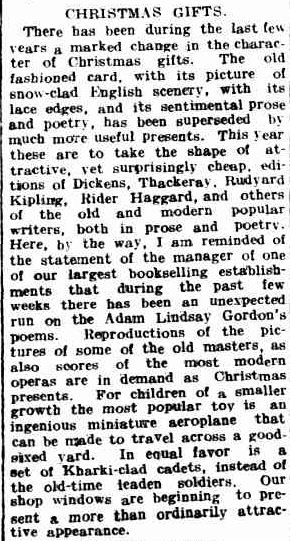
In 1912, the Colac Herald noted the change in Christmas gifts and cards over the years.  Christmas cards with traditional English Christmas scenes had given way to gifts such as books by Dickens, Kipling and Thackeray all available cheaply. Books of Adam Lindsay Gordon’s poetry were also a popular gift in 1912.  Likewise, for children, toys had changed.  Toy planes and modern toy soldiers pushed leaden soldiers aside.

OUR MELBOURNE LETTER. (1912, November 29). The Colac Herald (Vic. : 1875 – 1918), p. 3. Retrieved December 9, 2012, from http://nla.gov.au/nla.news-article87619896

CHRISTMAS ON A SUNDAY. (1912, December 20). The Horsham Times (Vic. : 1882 – 1954), p. 17 Supplement: CHRISTMAS SUPPLEMENT 1912 Horsham Times.. Retrieved December 9, 2012, from http://nla.gov.au/nla.news-article73132675

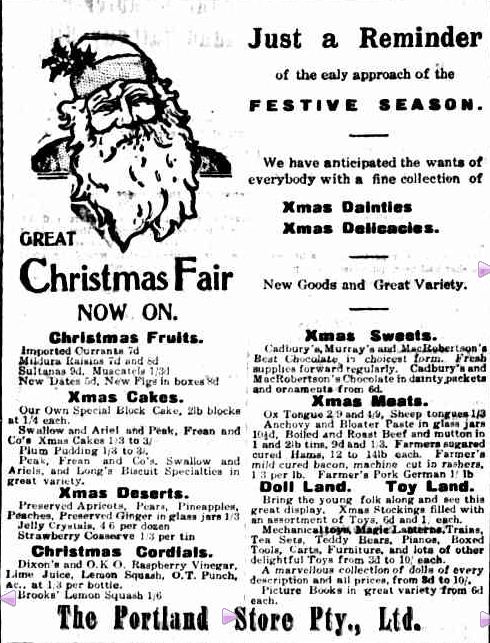
From ox tongues to magic lanterns, block cakes to dolls, The Portland Store Pty. Ltd. could cater for all Christmas 1912 shopping needs.

Advertising. (1912, December 18). Portland Guardian (Vic. : 1876 – 1953), p. 2 Edition: EVENING. Retrieved December 9, 2012, from http://nla.gov.au/nla.news-article64003729

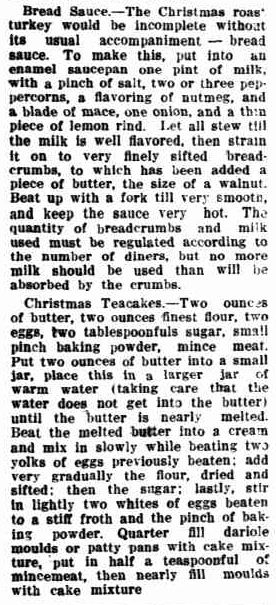
More recipes.  Have you ever had bread sauce on your turkey?

XMAS HINTS AND RECIPES. (1912, December 20). The Horsham Times (Vic. : 1882 - 1954), p. 35 Supplement: CHRISTMAS SUPPLEMENT 1912 Horsham Times.. Retrieved December 9, 2012, from http://nla.gov.au/nla.news-article73132554

XMAS HINTS AND RECIPES. (1912, December 20). The Horsham Times (Vic. : 1882 – 1954), p. 35 Supplement: CHRISTMAS SUPPLEMENT 1912 Horsham Times.. Retrieved December 9, 2012, from http://nla.gov.au/nla.news-article73132554

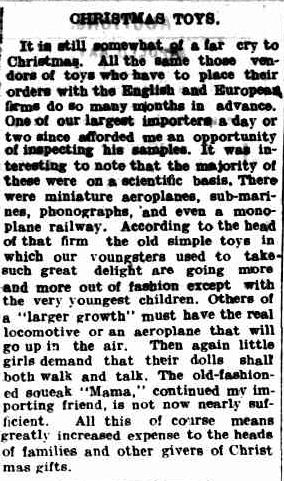
Science based toys were popular in 1913 including planes, submarines and phonographs imported from England and Europe.  Simple toys were out of fashion according to one importer.

CHRISTMAS TOYS. (1913, August 4). The Colac Herald (Vic. : 1875 - 1918), p. 4. Retrieved December 9, 2012, from http://nla.gov.au/nla.news-article93194152

CHRISTMAS TOYS. (1913, August 4). The Colac Herald (Vic. : 1875 – 1918), p. 4. Retrieved December 9, 2012, from http://nla.gov.au/nla.news-article93194152

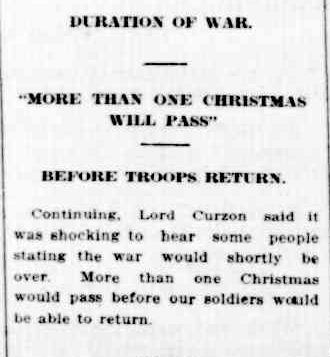
WW1 began in August 1914 and Australians were given a warning in October of that year.  “More than one Christmas will pass” before the war would end.

DURATION OF WAR. (1914, October 14). The Colac Herald (Vic. : 1875 - 1918), p. 5. Retrieved December 9, 2012, from http://nla.gov.au/nla.news-article74263644

DURATION OF WAR. (1914, October 14). The Colac Herald (Vic. : 1875 – 1918), p. 5. Retrieved December 9, 2012, from http://nla.gov.au/nla.news-article74263644

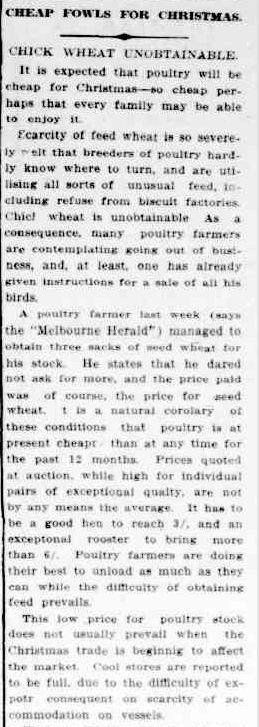
Cheap poultry fed on biscuit crumbs were on the menu for Christmas 1914.

CHEAP FOWLS FOR CHRISTMAS. (1914, November 23). The Colac Herald (Vic. : 1875 - 1918), p. 3. Retrieved December 9, 2012, from http://nla.gov.au/nla.news-article74264661

CHEAP FOWLS FOR CHRISTMAS. (1914, November 23). The Colac Herald (Vic. : 1875 – 1918), p. 3. Retrieved December 9, 2012, from http://nla.gov.au/nla.news-article74264661

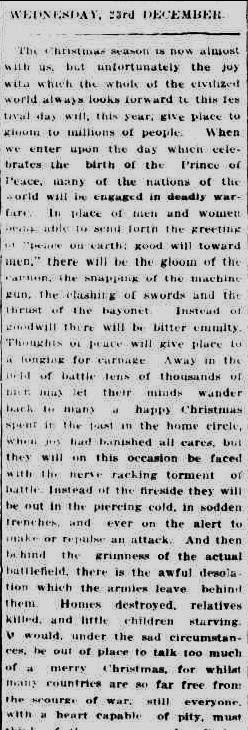
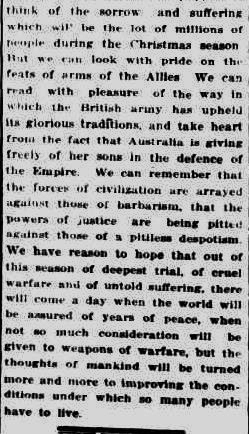
The Colac Herald acknowledged those suffering during the Christmas season due to the war.

“We have reason to hope that out of this season of deepest trial, of cruel warfare and of untold suffering, there will come a day when the world will be assured of years of peace, when not so much consideration will be given to weapons of warfare, but the thoughts of mankind will be turned more and more to improving the conditions under which so many people have to live.”

chris191011

The Colac Herald. (1914, December 23). The Colac Herald (Vic. : 1875 - 1918), p. 2. Retrieved December 9, 2012, from http://nla.gov.au/nla.news-article74265363

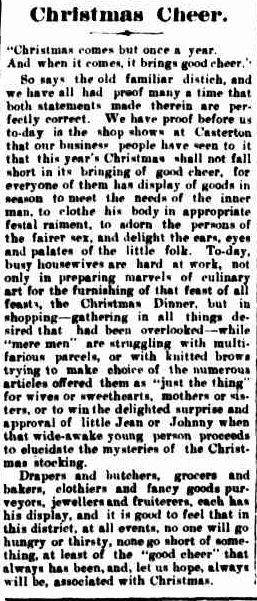
The Colac Herald. (1914, December 23). The Colac Herald (Vic. : 1875 – 1918), p. 2. Retrieved December 9, 2012, from http://nla.gov.au/nla.news-article74265363Despite the events overseas, Casterton had plenty of Christmas cheer as described in this lovely article about Christmas in Casterton, 1914.

Christmas Cheer. (1914, December 24). The Casterton News and the Merino and Sandford Record (Vic. : 1914 - 1918), p. 3 Edition: Bi-Weekly. Retrieved December 9, 2012, from http://nla.gov.au/nla.news-article74763493

Christmas Cheer. (1914, December 24). The Casterton News and the Merino and Sandford Record (Vic. : 1914 – 1918), p. 3 Edition: Bi-Weekly. Retrieved December 9, 2012, from http://nla.gov.au/nla.news-article74763493

During Christmas 1914, Australians felt there was hope the war, the big adventure, would be over by Christmas 1915.  Instead, by the time that Christmas came around the realities of the Great War had come home, with the horrors of Gallipoli the awakening.  Christmas thoughts turned overseas, with the comforts of the soldiers on that December day utmost in the minds of family.  Christmas billies and packages were sent overseas to give the boys a touch of home.

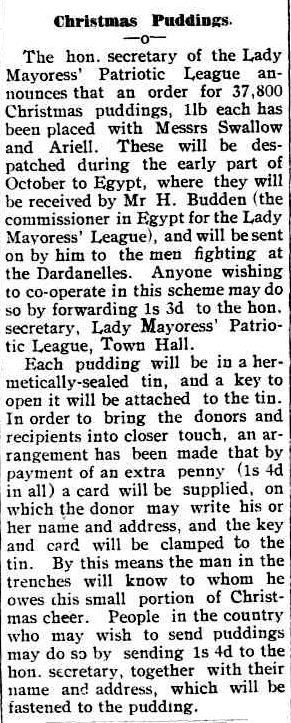
The Lady Mayoress of Melbourne placed an order for 37, 000 Christmas puddings for the troops.  Country folk could send 1s 3d to the Patriotic League and a card would be attached to a pudding with the donor’s details and the key to open the tin.

Christmas Puddings. (1915, September 23). Port Fairy Gazette (Vic. : 1914 - 1918), p. 4 Edition: EVENING. Retrieved December 9, 2012, from http://nla.gov.au/nla.news-article94724253

Christmas Puddings. (1915, September 23). Port Fairy Gazette (Vic. : 1914 – 1918), p. 4 Edition: EVENING. Retrieved December 9, 2012, from http://nla.gov.au/nla.news-article94724253

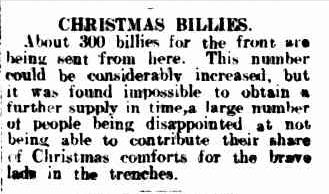
Warrnambool sent 300 Christmas billies to the front in 1915.

CHRISTMAS BILLIES. (1915, October 4). Warrnambool Standard (Vic. : 1914 - 1918), p. 3 Edition: DAILY.. Retrieved December 9, 2012, from http://nla.gov.au/nla.news-article73857728

CHRISTMAS BILLIES. (1915, October 4). Warrnambool Standard (Vic. : 1914 – 1918), p. 3 Edition: DAILY.. Retrieved December 9, 2012, from http://nla.gov.au/nla.news-article73857728

CHRISTMAS PRESENTS. (1915, November 10). The Ballarat Courier (Vic. : 1914 - 1918), p. 3 Edition: DAILY.. Retrieved December 9, 2012, from http://nla.gov.au/nla.news-article75156632

CHRISTMAS PRESENTS. (1915, November 10). The Ballarat Courier (Vic. : 1914 – 1918), p. 3 Edition: DAILY.. Retrieved December 9, 2012, from http://nla.gov.au/nla.news-article75156632

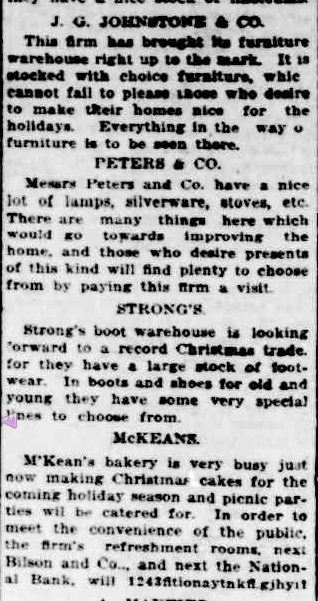
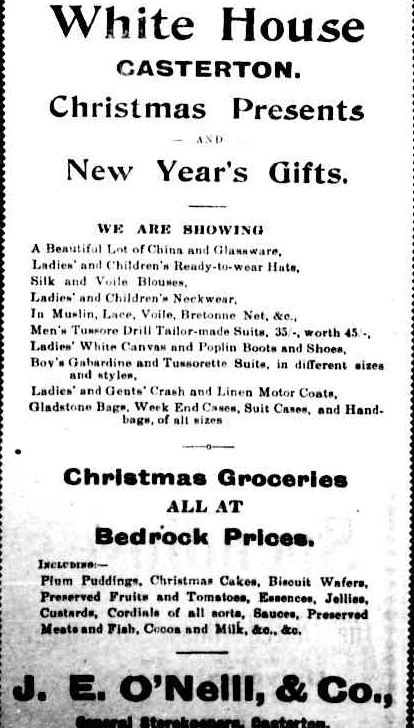
A sample of offerings from the shops of Colac for Christmas 1915.

AROUND THE SHOPS. (1915, December 22). The Colac Herald (Vic. : 1875 - 1918), p. 7. Retrieved December 9, 2012, from http://nla.gov.au/nla.news-article75254862

AROUND THE SHOPS. (1915, December 22). The Colac Herald (Vic. : 1875 – 1918), p. 7. Retrieved December 9, 2012, from http://nla.gov.au/nla.news-article75254862

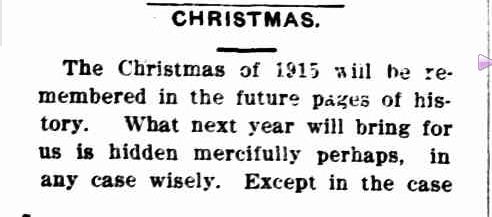
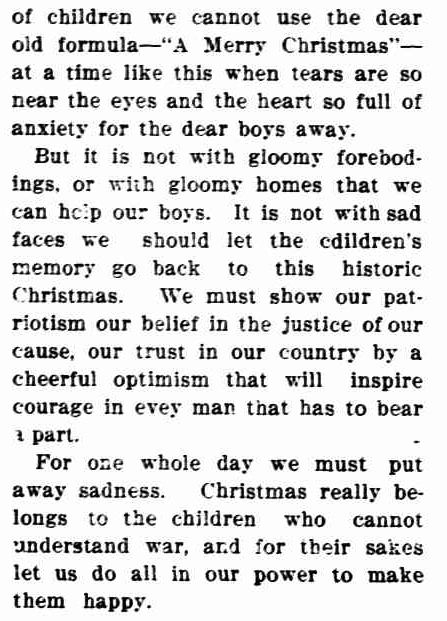
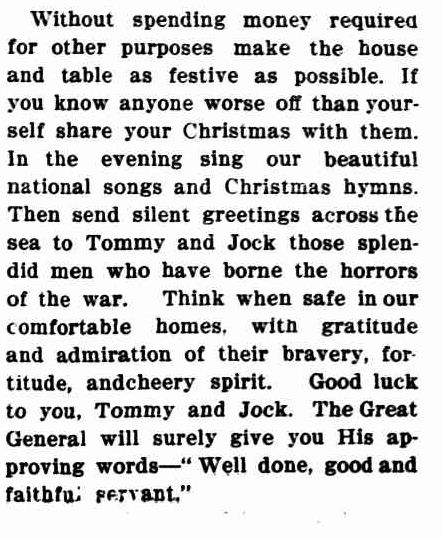
The Figaro Brisbane was a long way from the Western District, but their sentiments about Christmas 1915 are worth sharing.

chris191053chris191054

CHRISTMAS. (1915, December 18). Queensland Figaro (Brisbane, QLD : 1901 - 1936), p. 4. Retrieved December 10, 2012, from http://nla.gov.au/nla.news-article84404928

CHRISTMAS. (1915, December 18). Queensland Figaro (Brisbane, QLD : 1901 – 1936), p. 4. Retrieved December 10, 2012, from http://nla.gov.au/nla.news-article84404928

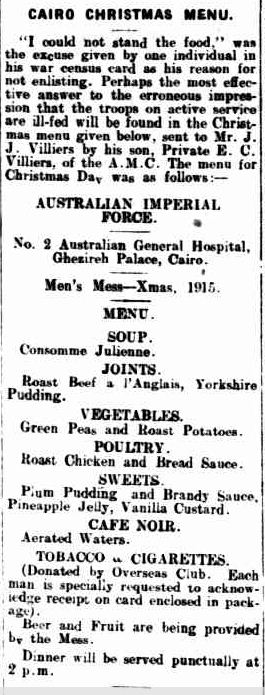
By January 1916, news was getting back to Australia about how troops sent Christmas Day in Cairo.

CAIRO CHRISTMAS MENU. (1916, January 27). Warrnambool Standard (Vic. : 1914 - 1918), p. 4 Edition: DAILY.. Retrieved December 9, 2012, from http://nla.gov.au/nla.news-article73868406

CAIRO CHRISTMAS MENU. (1916, January 27). Warrnambool Standard (Vic. : 1914 – 1918), p. 4 Edition: DAILY.. Retrieved December 9, 2012, from http://nla.gov.au/nla.news-article73868406

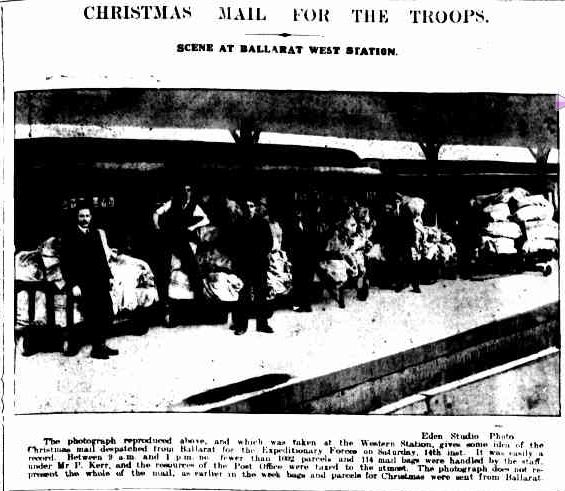
On October 14th, 1916 between 9am and 1pm, 1002 parcels and 114 mail bags left the Western Station, Ballarat bound for the Expeditionary Forces.

CHRISTMAS MAIL FOR THE TROOPS. (1916, October 23). The Ballarat Courier (Vic. : 1914 - 1918), p. 5 Edition: DAILY.. Retrieved December 9, 2012, from http://nla.gov.au/nla.news-article74688931

CHRISTMAS MAIL FOR THE TROOPS. (1916, October 23). The Ballarat Courier (Vic. : 1914 – 1918), p. 5 Edition: DAILY.. Retrieved December 9, 2012, from http://nla.gov.au/nla.news-article74688931

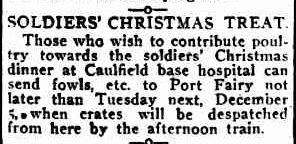
Residents of Port Fairy could give a fowl for a soldiers’ Christmas dinner at the Caulfield Base Hospital.

SOLDIERS' CHRISTMAS TREAT. (1916, November 30). Port Fairy Gazette (Vic. : 1914 - 1918), p. 2 Edition: EVENING. Retrieved December 9, 2012, from http://nla.gov.au/nla.news-article88007022

SOLDIERS’ CHRISTMAS TREAT. (1916, November 30). Port Fairy Gazette (Vic. : 1914 – 1918), p. 2 Edition: EVENING. Retrieved December 9, 2012, from http://nla.gov.au/nla.news-article88007022

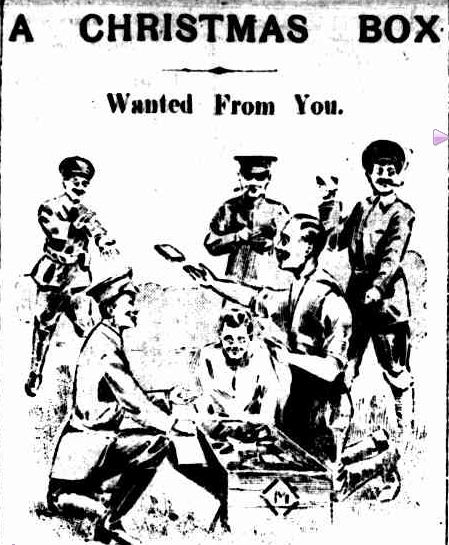
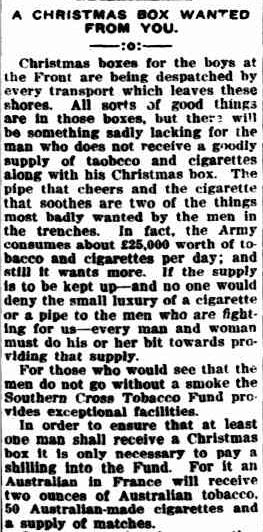
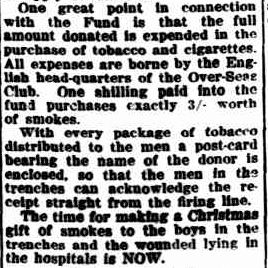
A Christmas Box Wanted From You was the catch cry in September 1916.  How nice, what a lovely thought.  But it was not a Christmas pudding or biscuits the boys wanted in their boxes from home.  They wanted tobacco and a lot of it, especially as the Army was spending £25,000 a day on tobacco and cigarettes.

A CHRISTMAS BOX. (1916, September 15). The Colac Herald (Vic. : 1875 - 1918), p. 3. Retrieved December 9, 2012, from http://nla.gov.au/nla.news-article74473619

A CHRISTMAS BOX. (1916, September 15). The Colac Herald (Vic. : 1875 – 1918), p. 3. Retrieved December 9, 2012, from http://nla.gov.au/nla.news-article74473619

chris191043

A CHRISTMAS BOX WANTED FROM YOU. (1916, October 7). The Mildura Cultivator (Vic. : 1888 - 1920), p. 13. Retrieved December 9, 2012, from http://nla.gov.au/nla.news-article74802247

A CHRISTMAS BOX WANTED FROM YOU. (1916, October 7). The Mildura Cultivator (Vic. : 1888 – 1920), p. 13. Retrieved December 9, 2012, from http://nla.gov.au/nla.news-article74802247

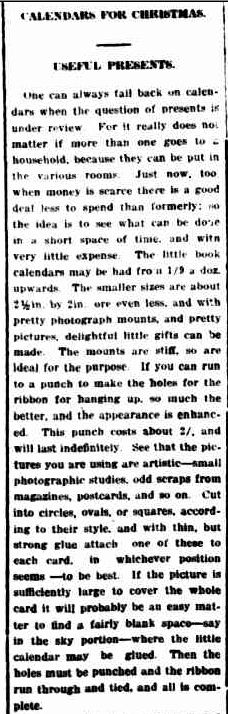
Stuck for Christmas gift ideas?  Consider making a calendar.  One can never have too many calendars.  Put one in every room if need be!

CALENDARS FOR CHRISTMAS. (1916, December 8). The Colac Herald (Vic. : 1875 - 1918), p. 8. Retrieved December 9, 2012, from http://nla.gov.au/nla.news-article74518345

CALENDARS FOR CHRISTMAS. (1916, December 8). The Colac Herald (Vic. : 1875 – 1918), p. 8. Retrieved December 9, 2012, from http://nla.gov.au/nla.news-article74518345

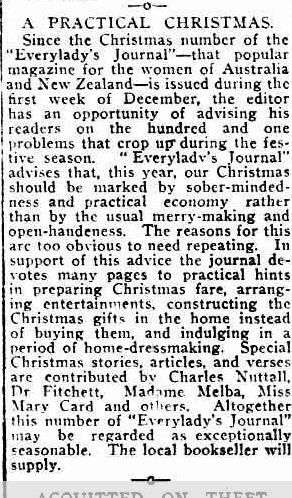
The “Everlady’s Journal” Christmas edition had everything a lady needed to know for preparing for Christmas with the limitations the war brought.

A PRACTICAL CHRISTMAS. (1916, December 18). Port Fairy Gazette (Vic. : 1914 - 1918), p. 2 Edition: EVENING. Retrieved December 9, 2012, from http://nla.gov.au/nla.news-article88007787

A PRACTICAL CHRISTMAS. (1916, December 18). Port Fairy Gazette (Vic. : 1914 – 1918), p. 2 Edition: EVENING. Retrieved December 9, 2012, from http://nla.gov.au/nla.news-article88007787

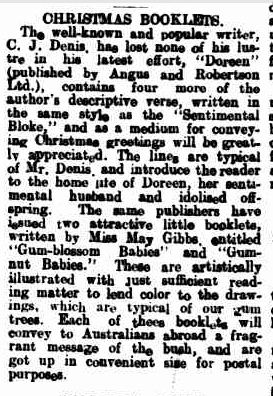
The rush to release books in time for Christmas was on during October 1917.  C.J. Denis had released “Doreen” and May Gibbs had “Gum-Blossom Babies” and “Gumnut Babies” on offer.

CHRISTMAS BOOKLETS. (1917, October 11). Warrnambool Standard (Vic. : 1914 - 1918), p. 8 Edition: DAILY.. Retrieved December 9, 2012, from http://nla.gov.au/nla.news-article73969439

CHRISTMAS BOOKLETS. (1917, October 11). Warrnambool Standard (Vic. : 1914 – 1918), p. 8 Edition: DAILY.. Retrieved December 9, 2012, from http://nla.gov.au/nla.news-article73969439

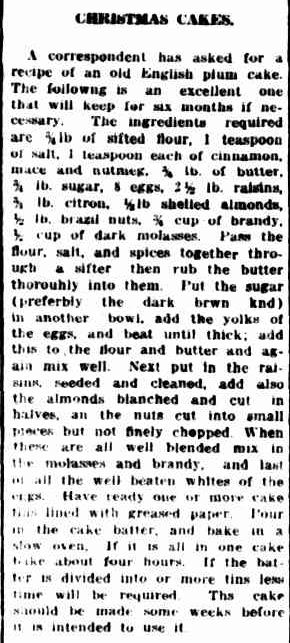
A recipe for an old English plum cake that would keep for six months.

SEASONABLE RECIPES. (1917, December 19). The Colac Herald (Vic. : 1875 - 1918), p. 6. Retrieved December 9, 2012, from http://nla.gov.au/nla.news-article75251369

SEASONABLE RECIPES. (1917, December 19). The Colac Herald (Vic. : 1875 – 1918), p. 6. Retrieved December 9, 2012, from http://nla.gov.au/nla.news-article75251369

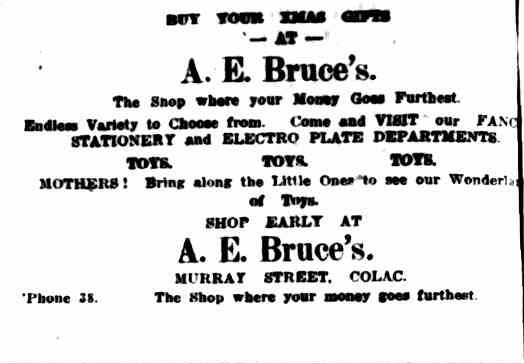
Advertising. (1917, December 19). The Colac Herald (Vic. : 1875 - 1918), p. 6. Retrieved December 9, 2012, from http://nla.gov.au/nla.news-article75251363

Advertising. (1917, December 19). The Colac Herald (Vic. : 1875 – 1918), p. 6. Retrieved December 9, 2012, from http://nla.gov.au/nla.news-article75251363

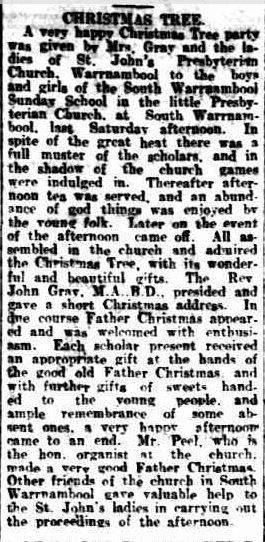
Father Christmas handed out gifts to the children from the South Warrnambool Presbyterian Church Sunday school at a Christmas tree party in 1917.

CHRISTMAS TREE. (1917, December 29). Warrnambool Standard (Vic. : 1914 - 1918), p. 3 Edition: DAILY.. Retrieved December 9, 2012, from http://nla.gov.au/nla.news-article73974530

CHRISTMAS TREE. (1917, December 29). Warrnambool Standard (Vic. : 1914 – 1918), p. 3 Edition: DAILY.. Retrieved December 9, 2012, from http://nla.gov.au/nla.news-article73974530

Advertising. (1918, January 7). The Casterton News and the Merino and Sandford Record (Vic. : 1914 - 1918), p. 2 Edition: Bi-Weekly. Retrieved December 9, 2012, from http://nla.gov.au/nla.news-article74219706

Advertising. (1918, January 7). The Casterton News and the Merino and Sandford Record (Vic. : 1914 – 1918), p. 2 Edition: Bi-Weekly. Retrieved December 9, 2012, from http://nla.gov.au/nla.news-article74219706

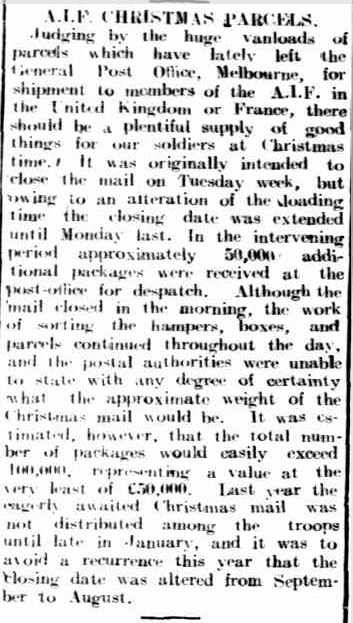
August was the cut off date for Christmas parcels being sent overseas for Christmas 1918.  This was a change from 1917 when the parcels sent in September were not distributed until January.

A.I.F. CHRISTMAS PARCELS. (1918, August 16). The Horsham Times (Vic. : 1882 - 1954), p. 7. Retrieved December 9, 2012, from http://nla.gov.au/nla.news-article72987289

A.I.F. CHRISTMAS PARCELS. (1918, August 16). The Horsham Times (Vic. : 1882 – 1954), p. 7. Retrieved December 9, 2012, from http://nla.gov.au/nla.news-article72987289

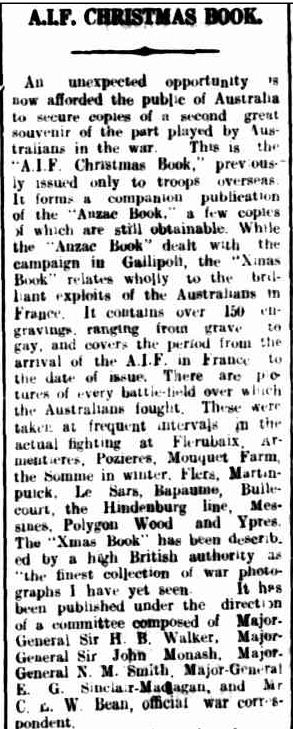
The A.I.F. Christmas book had “the finest collection of war photographs”.  The book became available to the public in 1918.

A.I.F. CHRISTMAS BOOK. (1918, November 6). The Colac Herald (Vic. : 1875 - 1918), p. 4. Retrieved December 9, 2012, from http://nla.gov.au/nla.news-article74474740

A.I.F. CHRISTMAS BOOK. (1918, November 6). The Colac Herald (Vic. : 1875 – 1918), p. 4. Retrieved December 9, 2012, from http://nla.gov.au/nla.news-article74474740

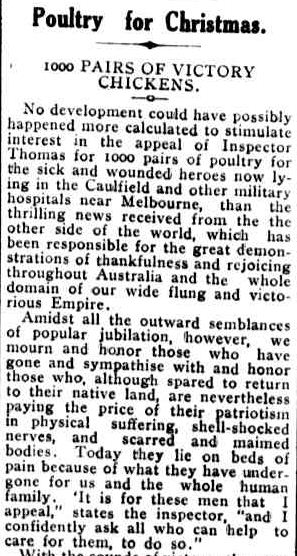
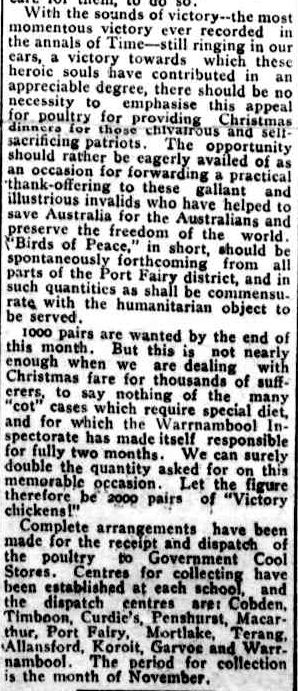
A call went out to country folk to give poultry for Christmas 1918.  The goal was 1000 pair of victory chickens for soldiers in hospital in and around Melbourne.  Dispatch centres were set up in towns such as Timboon, Port Fairy, Macarthur and Penshurst.

chris191048

Poultry for Christmas. (1918, November 18). Port Fairy Gazette (Vic. : 1914 - 1918), p. 2 Edition: EVENING. Retrieved December 9, 2012, from http://nla.gov.au/nla.news-article91987945

Poultry for Christmas. (1918, November 18). Port Fairy Gazette (Vic. : 1914 – 1918), p. 2 Edition: EVENING. Retrieved December 9, 2012, from http://nla.gov.au/nla.news-article91987945

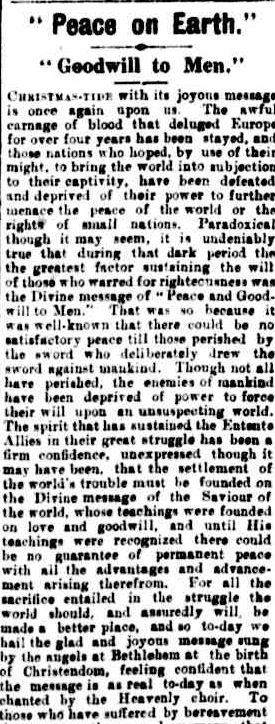
With the end of WW1 in November 1918, the message for Christmas was “Peace on Earth”.

chris191050

Casterton News. (1918, December 23). The Casterton News and the Merino and Sandford Record (Vic. : 1914 - 1918), p. 2 Edition: Bi-Weekly.. Retrieved December 10, 2012, from http://nla.gov.au/nla.news-article74222949

Casterton News. (1918, December 23). The Casterton News and the Merino and Sandford Record (Vic. : 1914 – 1918), p. 2 Edition: Bi-Weekly.. Retrieved December 10, 2012, from http://nla.gov.au/nla.news-article74222949

The war years brought with it the first example of mass marketing I have come across as I’ve moved through the decades and it came from Kodak.  The advertising began in earnest in 1915 with the suggestion a Kodak camera was a perfect gift to send to a “soldier friend” to record their experience.  Their other angle was directed at those at home.  Buy a Kodak camera and take photos of daily life to send to a “soldier friend” to cheer them up.  The Christmas after war’s end, they turned to the idea of a Kodak camera being a perfect way to preserve memories.

Advertising (1918, December 24). Warrnambool Standard (Vic. : 1914 – 1918), p. 4 (DAILY.). Retrieved December 9, 2018, from http://nla.gov.au/nla.news-article74042080

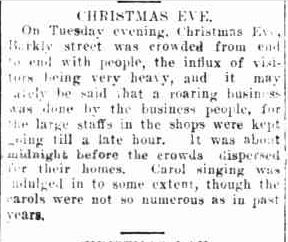
The streets of Ararat were busy on Christmas Eve, 1918.

CHRISTMAS EVE. (1918, December 28). The Ararat advertiser (Vic. : 1914 - 1918), p. 3 Edition: tri-weekly. Retrieved December 9, 2012, from http://nla.gov.au/nla.news-article74285291

CHRISTMAS EVE. (1918, December 28). The Ararat Advertiser (Vic. : 1914 – 1918), p. 3 Edition: tri-weekly. Retrieved December 9, 2012, from http://nla.gov.au/nla.news-article74285291

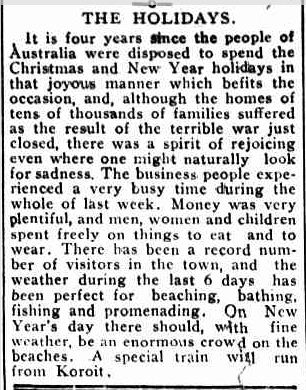
The residents of Port Fairy were feeling a renewed Christmas spirit in 1918, stocking up on food and clothing.

THE HOLIDAYS. (1918, December 30). Port Fairy Gazette (Vic. : 1914 - 1918), p. 2 Edition: EVENING. Retrieved December 10, 2012, from http://nla.gov.au/nla.news-article91994828

THE HOLIDAYS. (1918, December 30). Port Fairy Gazette (Vic. : 1914 – 1918), p. 2 Edition: EVENING. Retrieved December 10, 2012, from http://nla.gov.au/nla.news-article91994828

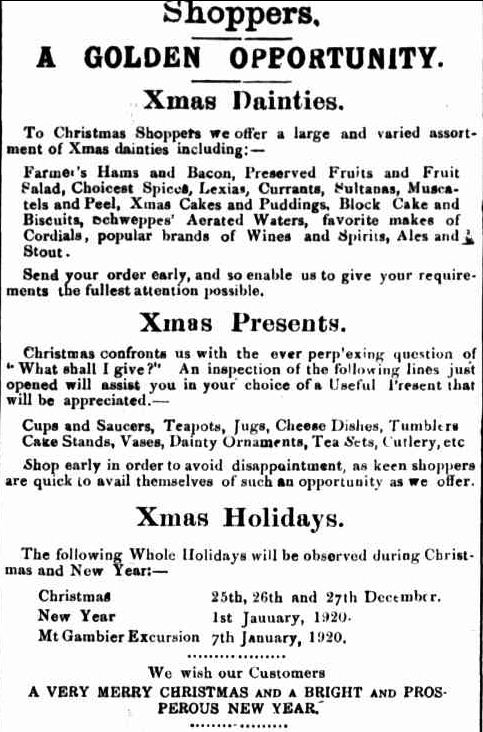
Advertising. (1919, December 11). Portland Guardian (Vic. : 1876 - 1953), p. 3 Edition: EVENING. Retrieved December 9, 2012, from http://nla.gov.au/nla.news-article63960345

Advertising. (1919, December 11). Portland Guardian (Vic. : 1876 – 1953), p. 3 Edition: EVENING. Retrieved December 9, 2012, from http://nla.gov.au/nla.news-article63960345

CHRISTMAS AT THE HOSPITAL. (1919, December 19). The Horsham Times (Vic. : 1882 - 1954), p. 4. Retrieved December 9, 2012, from http://nla.gov.au/nla.news-article73188106

CHRISTMAS AT THE HOSPITAL. (1919, December 19). The Horsham Times (Vic. : 1882 – 1954), p. 4. Retrieved December 9, 2012, from http://nla.gov.au/nla.news-article73188106

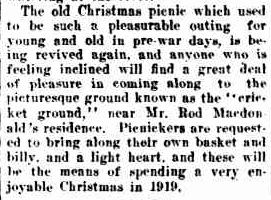
At Wail West in the Wimmera, locals were dusting off their picnic blankets for a Christmas picnic, revived from pre-war days.

WAIL WEST. (1919, December 19). The Horsham Times (Vic. : 1882 - 1954), p. 5. Retrieved December 9, 2012, from http://nla.gov.au/nla.news-article73188080

WAIL WEST. (1919, December 19). The Horsham Times (Vic. : 1882 – 1954), p. 5. Retrieved December 9, 2012, from http://nla.gov.au/nla.news-article73188080

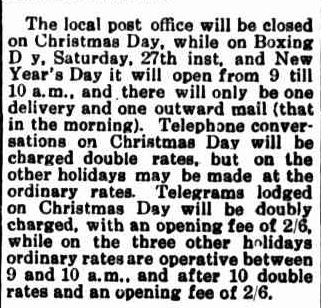
Those making phone calls on Christmas Days 1919 faced double rates.

Portland Guardian First Issue - August 20, 1842. (1919, December 24). Portland Guardian (Vic. : 1876 - 1953), p. 2 Edition: EVENING.. Retrieved December 9, 2012, from http://nla.gov.au/nla.news-article63960424

Portland Guardian First Issue – August 20, 1842. (1919, December 24). Portland Guardian (Vic. : 1876 – 1953), p. 2 Edition: EVENING.. Retrieved December 9, 2012, from http://nla.gov.au/nla.news-article63960424

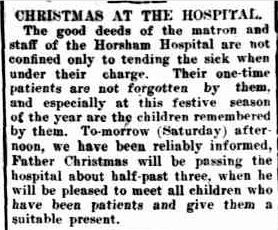
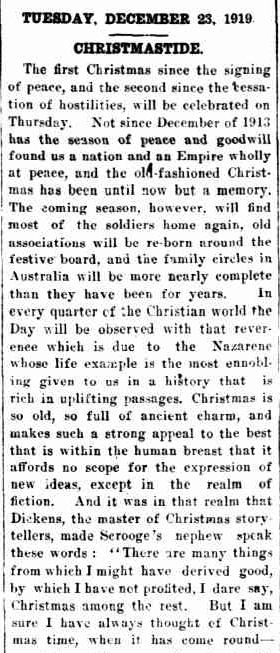
At last, the future was looking brighter when Christmas 1919 arrived as it was the first Christmas since the Treaty of Versailles was signed and the second since fighting had ceased.

chris191032

chris191033

The Horsham Times. (1919, December 23). The Horsham Times (Vic. : 1882 – 1954), p. 4. Retrieved December 9, 2012, from http://nla.gov.au/nla.news-article73188192

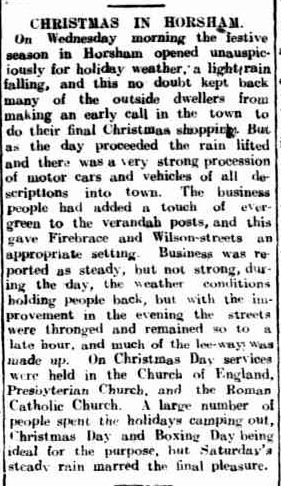
Christmas 1919 in Horsham was busy and businesses added greenery to verandah posts along Firebrace and Wilson Streets.

CHRISTMAS IN HORSHAM. (1919, December 30). The Horsham Times (Vic. : 1882 - 1954), p. 4. Retrieved December 9, 2012, from http://nla.gov.au/nla.news-article73188311

CHRISTMAS IN HORSHAM. (1919, December 30). The Horsham Times (Vic. : 1882 – 1954), p. 4. Retrieved December 9, 2012, from http://nla.gov.au/nla.news-article73188311

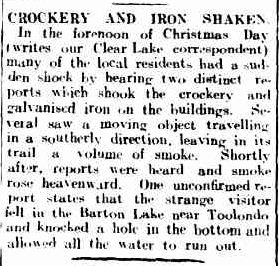
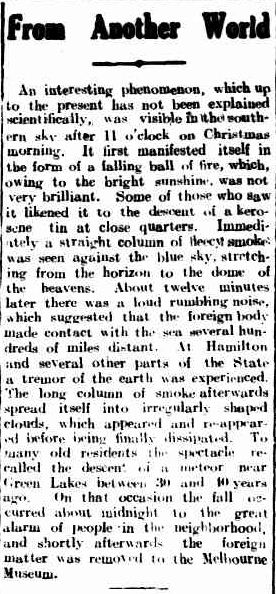
The last Christmas of the 1910s went off with a bang for the residents of some Western Victorian towns.  Residents of Clear Lake, Vectis and Hamilton to name a few saw a heavenly body come to earth on Christmas Day 1919.

CROCKERY AND IRON SHAKEN. (1919, December 30). The Horsham Times (Vic. : 1882 - 1954), p. 5. Retrieved December 9, 2012, from http://nla.gov.au/nla.news-article73188328

CROCKERY AND IRON SHAKEN. (1919, December 30). The Horsham Times (Vic. : 1882 – 1954), p. 5. Retrieved December 9, 2012, from http://nla.gov.au/nla.news-article73188328

From Another World. (1919, December 30). The Horsham Times (Vic. : 1882 - 1954), p. 5. Retrieved December 9, 2012, from http://nla.gov.au/nla.news-article73188314

From Another World. (1919, December 30). The Horsham Times (Vic. : 1882 – 1954), p. 5. Retrieved December 9, 2012, from http://nla.gov.au/nla.news-article73188314

Trove Tuesday – Fido’s Feat

You may have noticed I do like a good animal story.  Here’s another from the Camperdown Chronicle of September 14, 1954.

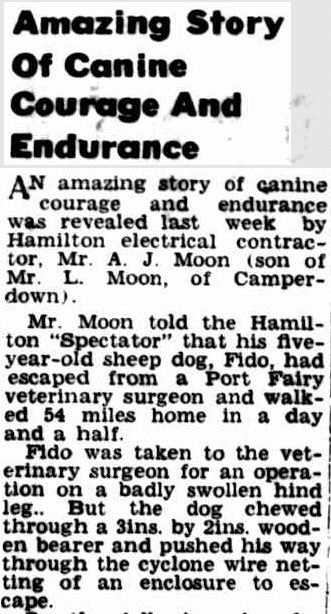
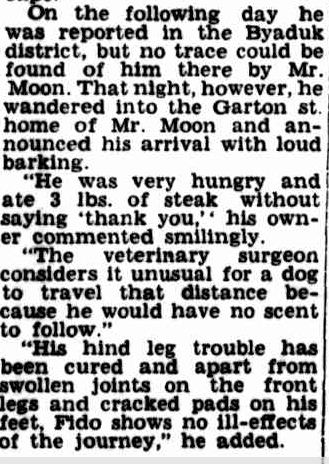
It is the story of Fido, a sheep dog belonging to electrical contractor Mr A.J Moon of Hamilton.  Fido had been confined at a Port Fairy vet, but after a determined escape, he walked 54 miles home to Hamilton even though he was recovering from a leg operation.  When he arrived at Mr Moon’s home in Garton Street, Hamilton, Fido demolished 3lbs of steak.  His leg was cured too!

tt3

Amazing Story Of Canine Courage And Endurance. (1954, September 14). Camperdown Chronicle (Vic. : 1877 - 1954), p. 4. Retrieved December 10, 2012, from http://nla.gov.au/nla.news-article24008716

Amazing Story Of Canine Courage And Endurance. (1954, September 14). Camperdown Chronicle (Vic. : 1877 – 1954), p. 4. Retrieved December 10, 2012, from http://nla.gov.au/nla.news-article24008716

Christmas 1900s style

Christmas 1900 was the last of the 19th century and while some were looking back, others were looking forward to a new century and Federation in 1901.

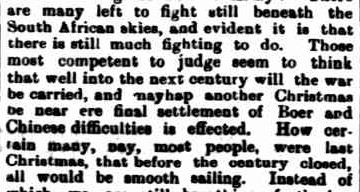
The first Christmas of the 1900s was like many others the people of Australia would face over the next 50 or so years.  Australian troops were overseas fighting and in 1900 it was the Boer War in South Africa.  Over the course of the war, about 16,000 Australians left to  fight.  It was not the first Christmas troops had been in South Africa but as the reporter for the Fitzroy City Press says “Who could have dreamed then that yet another Christmas must pass before the trouble could be settled…”

chris190029

chris190027

THE LAST CHRISTMAS DAY. (1900, December 21). Fitzroy City Press (Vic. : 1881 - 1920), p. 3. Retrieved December 4, 2012, from http://nla.gov.au/nla.news-article65668689

THE LAST CHRISTMAS DAY. (1900, December 21). Fitzroy City Press (Vic. : 1881 – 1920), p. 3. Retrieved December 4, 2012, from http://nla.gov.au/nla.news-article65668689

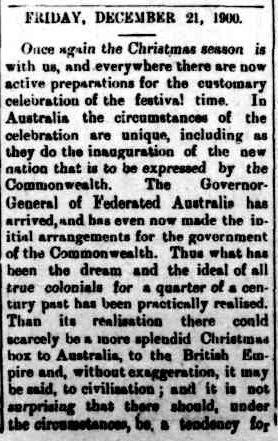
While the Horsham Times also lamented the ongoing war, there was a sense of celebration with Federation just around the corner.  “Thus what has been the dream and the ideal of all true colonials for a quarter of a century past has been practically realised”.  With such a large celebration ahead, there was a propensity to overlook Christmas 1900.  The Commonwealth Inauguration was itself a “splendid Christmas box to Australia, to the British Empire and, without exaggeration, it may be said, to civilization”

chris190030The Horsham Times. (1900, December 21). The Horsham Times (Vic. : 1882 - 1954), p. 2. Retrieved December 4, 2012, from http://nla.gov.au/nla.news-article73025219

The Horsham Times. (1900, December 21). , p. 2. http://nla.gov.au/nla.news-article73025219Tulloh and Company was the place to go in Colac for all Christmas gifts.  For girls, there were wicker prams and strong go-carts, while gifts for boys included hobby horses and pop-guns.

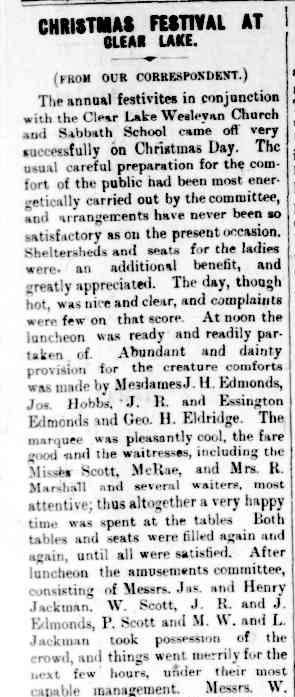
On Christmas Day 1901, the Clear Lake Wesleyan Church and Sabbath school held their annual picnic.  With a lovely lunch served and shelter sheds and seats provided for the ladies, an enjoyable day was had by all.

CHRISTMAS FESTIVAL AT CLEAR LAKE. (1901, January 4). The Horsham Times (Vic. : 1882 - 1954), p. 4. Retrieved December 2, 2012, from http://nla.gov.au/nla.news-article73025286

CHRISTMAS FESTIVAL AT CLEAR LAKE. (1901, January 4). The Horsham Times (Vic. : 1882 – 1954), p. 4. http://nla.gov.au/nla.news-article73025286

The Girls Friendly Society held their annual Christmas tree at the Horsham Mechanics’ Hall with over 100 children receiving a gift.

A CHRISTMAS TREE. (1901, December 13). The Horsham Times (Vic. : 1882 - 1954), p. 3. Retrieved December 2, 2012, from http://nla.gov.au/nla.news-article73030958

A CHRISTMAS TREE. (1901, December 13). The Horsham Times (Vic. : 1882 – 1954), p. 3. http://nla.gov.au/nla.news-article73030958

Christmas Eve. (1901, December 24). The Horsham Times (Vic. : 1882 - 1954), p. 2 Supplement: Supplement to the Horsham Times.. Retrieved December 2, 2012, from http://nla.gov.au/nla.news-article73031210

Christmas Eve. (1901, December 24). The Horsham Times (Vic. : 1882 – 1954), p. 2 http://nla.gov.au/nla.news-article73031210

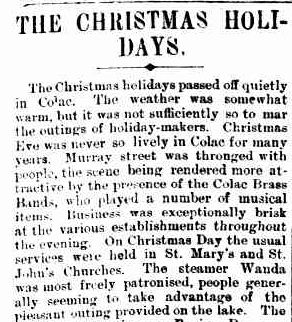
Christmas Day of 1901 was quiet in Colac after a busy Christmas Eve with much last-minute shopping.

THE CHRISTMAS HOLIDAYS. (1901, December 31). The Colac Herald (Vic. : 1875 - 1918), p. 3. Retrieved December 2, 2012, from http://nla.gov.au/nla.news-article90562277

THE CHRISTMAS HOLIDAYS. (1901, December 31). The Colac Herald (Vic. : 1875 – 1918), p. 3. http://nla.gov.au/nla.news-article90562277

This flaming plum pudding would have made a spectacular entrance to the dining room.

Plum Pudding. (1902, March 12). Portland Guardian (Vic. : 1876 - 1953), p. 4 Edition: EVENING. Retrieved December 2, 2012, from http://nla.gov.au/nla.news-article63992065

Plum Pudding. (1902, March 12). Portland Guardian (Vic. : 1876 – 1953), p. 4 Edition: EVENING. http://nla.gov.au/nla.news-article63992065

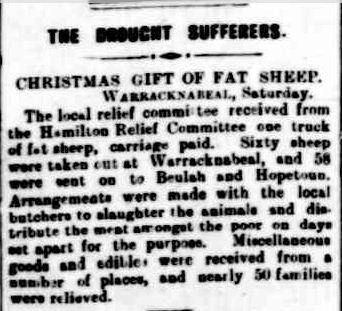
1902 was a drought year and the Hamilton Relief Committee helped out the towns of Warracknabeal, Hopetoun and Beulah with a donation of 60 sheep and other Christmas goodies.

THE DROUGHT SUFFERERS. (1902, December 30). The Horsham Times (Vic. : 1882 - 1954), p. 3. Retrieved December 3, 2012, from http://nla.gov.au/nla.news-article72852456

THE DROUGHT SUFFERERS. (1902, December 30). The Horsham Times (Vic. : 1882 – 1954), p. 3.  http://nla.gov.au/nla.news-article72852456

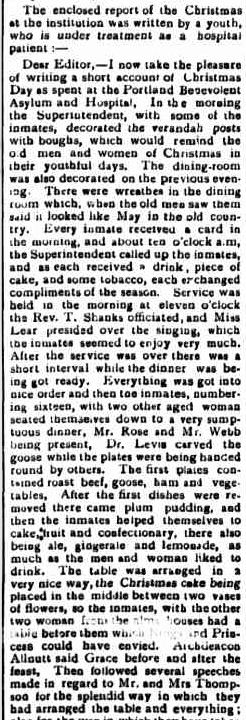
A  Benevolent Asylum is a place one would rather not be on Christmas Day, but in Portland, 1902, best efforts were made to make sure the day was memorable for inmates.  The fare was roastbeef, ham and goose and the Benevolent Asylum superintendent provided inmates with a drink (read “ale”), fruit cake and tobacco

.chris19007

Christmas at the Portland Asylum. (1902, December 31). Portland Guardian (Vic. : 1876 - 1953), p. 3 Edition: EVENING. Retrieved December 3, 2012, from http://nla.gov.au/nla.news-article63995651

Christmas at the Portland Asylum. (1902, December 31). Portland Guardian (Vic. : 1876 – 1953), p. 3 Edition: EVENING. Retrieved December 3, 2012, from http://nla.gov.au/nla.news-article63995651

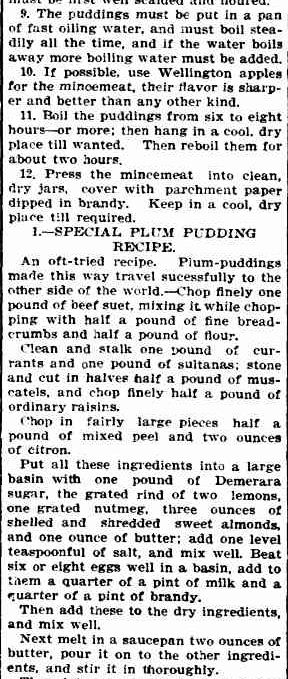
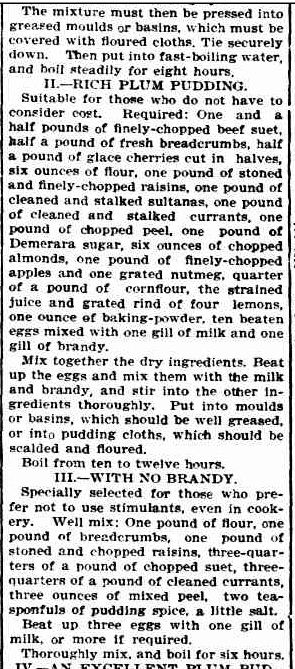
The Colac Herald of December 11, 1903 provided tips for making the Christmas pudding along with three variations of the recipe.

CHRISTMAS FARE. (1903, December 11). The Colac Herald (Vic. : 1875 - 1918), p. 7. Retrieved December 3, 2012, from http://nla.gov.au/nla.news-article87641338
chris190010

CHRISTMAS FARE. (1903, December 11). The Colac Herald (Vic. : 1875 - 1918), p. 7. Retrieved December 3, 2012, from http://nla.gov.au/nla.news-article87641338
CHRISTMAS FARE. (1903, December 11). The Colac Herald (Vic. : 1875 – 1918), p. 7. Retrieved December 3, 2012, from http://nla.gov.au/nla.news-article87641338

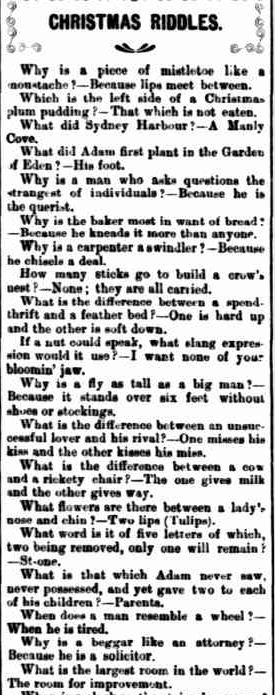
What is Christmas without a corny cracker joke.  They were just as corny in 1904 as they are today.

CHRISTMAS RIDDLES. (1904, December 20). The Horsham Times (Vic. : 1882 - 1954), p. 3 Supplement: CHRISTMAS SUPPLEMENT To The Horsham Times.. Retrieved December 3, 2012, from http://nla.gov.au/nla.news-article72836086

CHRISTMAS RIDDLES. (1904, December 20). The Horsham Times (Vic. : 1882 – 1954), p. 3 Supplement: CHRISTMAS SUPPLEMENT To The Horsham Times.. Retrieved December 3, 2012, from http://nla.gov.au/nla.news-article72836086

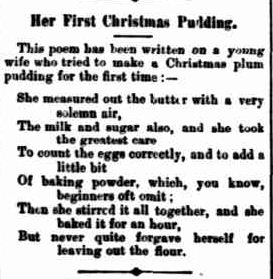
Oh dear, the pressure.

Her First Christmas Pudding. (1904, December 20). The Horsham Times (Vic. : 1882 - 1954), p. 3 Supplement: CHRISTMAS SUPPLEMENT To The Horsham Times.. Retrieved December 3, 2012, from http://nla.gov.au/nla.news-article72836088
Her First Christmas Pudding. (1904, December 20). The Horsham Times (Vic. : 1882 – 1954), p. 3 Supplement: CHRISTMAS SUPPLEMENT To The Horsham Times.. Retrieved December 3, 2012, from http://nla.gov.au/nla.news-article72836088

Some Christmas gift ideas from 1905.

PRETTY CHRISTMAS PRESENTS. (1905, December 1). The Colac Herald (Vic. : 1875 - 1918), p. 6. Retrieved December 3, 2012, from http://nla.gov.au/nla.news-article87609734

PRETTY CHRISTMAS PRESENTS. (1905, December 1). The Colac Herald (Vic. : 1875 - 1918), p. 6. Retrieved December 3, 2012, from http://nla.gov.au/nla.news-article87609734

PRETTY CHRISTMAS PRESENTS. (1905, December 1). The Colac Herald (Vic. : 1875 – 1918), p. 6. Retrieved December 3, 2012, from http://nla.gov.au/nla.news-article87609734

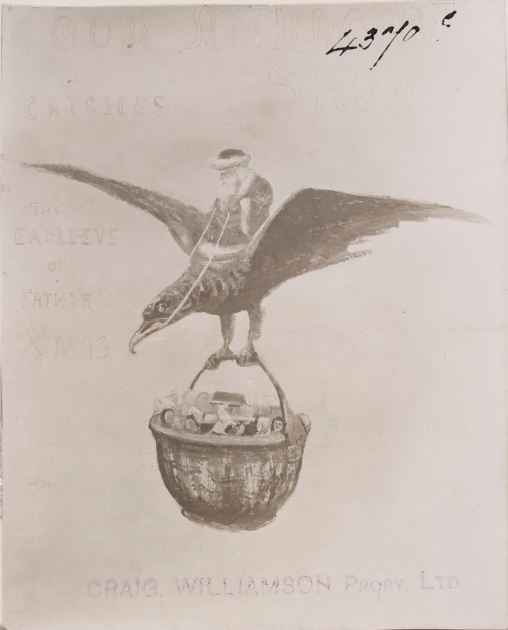
No reindeer for Santa in 1906, rather an eagle as depicted by Miss. M. Scott.

Father Christmas on eagle carrying basket of toys by Miss M. Scott. (1906). Courtesy of the State Library of Victoria http://handle.slv.vic.gov.au/10381/54176

Father Christmas on eagle carrying basket of toys by Miss M. Scott. (1906). Courtesy of the State Library of Victoria http://handle.slv.vic.gov.au/10381/54176

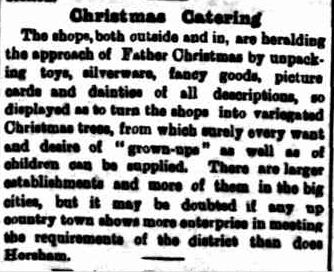
Horsham residents were well serviced by the local shops during the Christmas lead-up of 1906.

Christmas Catering. (1906, December 21). The Horsham Times (Vic. : 1882 - 1954), p. 2. Retrieved December 3, 2012, from http://nla.gov.au/nla.news-article72937123

Christmas Catering. (1906, December 21). The Horsham Times (Vic. : 1882 – 1954), p. 2. Retrieved December 3, 2012, from http://nla.gov.au/nla.news-article72937123

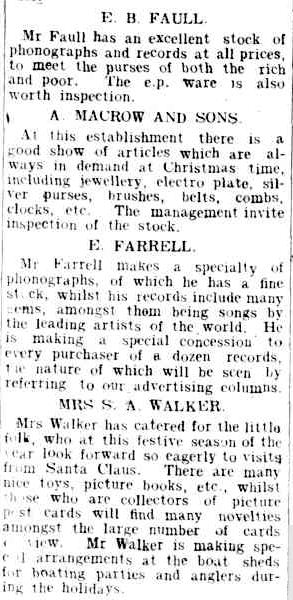
The Colac Herald published a list of  local shops and their Christmas wares.  Mrs Walkers’ shop was sure to have been a favourite with the local children in 1907.

THE SHOPS. (1907, December 23). The Colac Herald (Vic. : 1875 - 1918), p. 3. Retrieved December 4, 2012, from http://nla.gov.au/nla.news-article93273485

THE SHOPS. (1907, December 23). The Colac Herald (Vic. : 1875 – 1918), p. 3. Retrieved December 4, 2012, from http://nla.gov.au/nla.news-article93273485

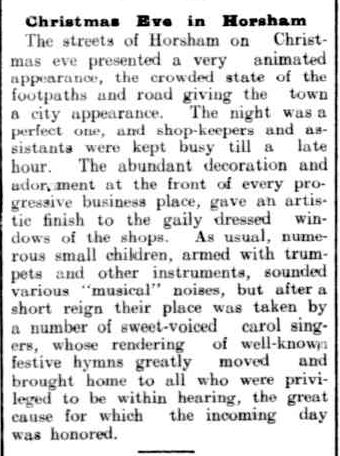
Christmas Eve of 1907 in Horsham was a busy night.  Decorations, carolers, and children with musical instruments added to the atmosphere of the evening.

Christmas Eye in Horsham. (1907, December 31). The Horsham Times (Vic. : 1882 - 1954), p. 2. Retrieved December 4, 2012, from http://nla.gov.au/nla.news-article72806085

Christmas Eye in Horsham. (1907, December 31). The Horsham Times (Vic. : 1882 – 1954), p. 2. Retrieved December 4, 2012, from http://nla.gov.au/nla.news-article72806085

Christmas boxes were given to servants, usually on Boxing Day and were either money or a gift.

LEGALITY OF CHRISTMAS BOXES. (1908, January 24). The Colac Herald (Vic. : 1875 - 1918), p. 6. Retrieved December 4, 2012, from http://nla.gov.au/nla.news-article93273594

LEGALITY OF CHRISTMAS BOXES. (1908, January 24). The Colac Herald (Vic. : 1875 – 1918), p. 6. Retrieved December 4, 2012, from http://nla.gov.au/nla.news-article93273594

People stayed in the streets of Portland until 11.30pm on Christmas Eve 1908, entertained provided by the Portland Band.

THE CHRISTMAS HOLIDAYS. (1908, December 30). Portland Guardian (Vic. : 1876 - 1953), p. 3 Edition: EVENING. Retrieved December 4, 2012, from http://nla.gov.au/nla.news-article63986559

THE CHRISTMAS HOLIDAYS. (1908, December 30). Portland Guardian (Vic. : 1876 – 1953), p. 3 Edition: EVENING. Retrieved December 4, 2012, from http://nla.gov.au/nla.news-article63986559

By 1909 there were still plenty of mail coming from the Old Country.  In one day there were 300 letters, 50 papers and 40 packages to Horsham from England.

NEWS AND NOTES. (1909, December 24). The Horsham Times (Vic. : 1882 - 1954), p. 3. Retrieved December 4, 2012, from http://nla.gov.au/nla.news-article72964368

NEWS AND NOTES. (1909, December 24). The Horsham Times (Vic. : 1882 – 1954), p. 3. Retrieved December 4, 2012, from http://nla.gov.au/nla.news-article72964368

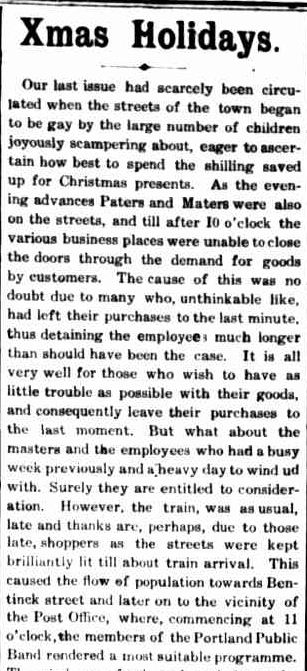
Last minute shoppers suffered the wrath of the Portland Guardian in 1909.  They were reminded to think of the shopkeepers who also had Christmas preparations and families to go to.  Shoppers were out until after 10pm and at 11pm the Portland Public Band entertained those still out on the streets.

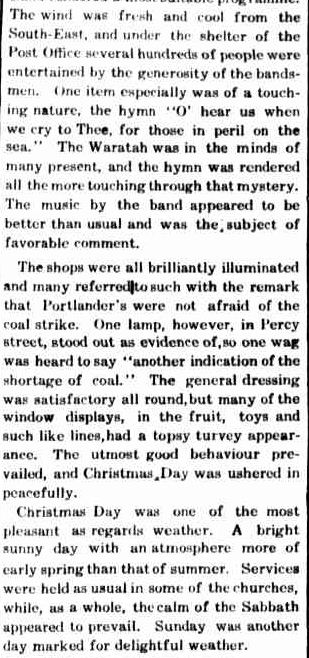
This article gives us some of idea of the current affairs of 1909.  It mentions the “Waratah” which months earlier had vanished without a trace on a return trip to England.  On board were passengers that embarked at the ports of  Adelaide, Melbourne and Sydney.

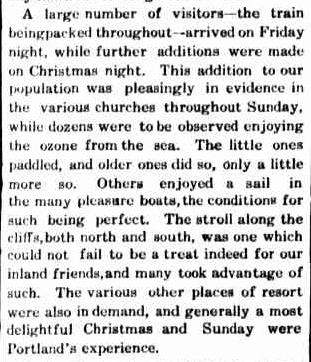
Newcastle coal miners were on strike but that didn’t prevent Portland turning on the lights on Christmas Eve.chris190022chris190023

Xmas Holidays. (1909, December 29). Portland Guardian (Vic. : 1876 - 1953), p. 3 Edition: EVENING. Retrieved December 4, 2012, from http://nla.gov.au/nla.news-article63990393

Xmas Holidays. (1909, December 29). Portland Guardian (Vic. : 1876 – 1953), p. 3 Edition: EVENING. Retrieved December 4, 2012, from http://nla.gov.au/nla.news-article63990393

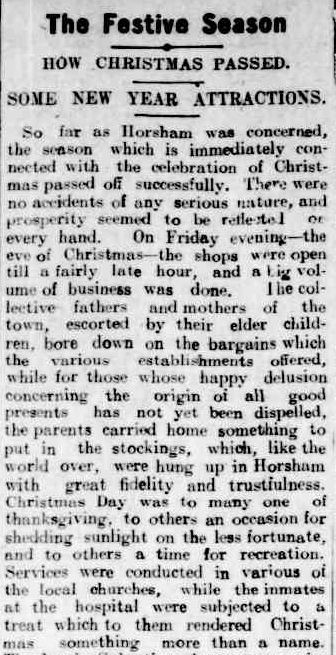
The stockings were up on Christmas Eve 1909 in Horsham.

The Festive Season. (1909, December 31). The Horsham Times (Vic. : 1882 - 1954), p. 4. Retrieved December 4, 2012, from http://nla.gov.au/nla.news-article72964576

The Festive Season. (1909, December 31). The Horsham Times (Vic. : 1882 – 1954), p. 4. Retrieved December 4, 2012, from http://nla.gov.au/nla.news-article72964576

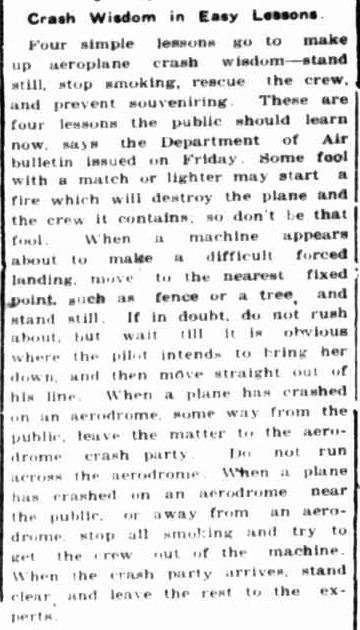
Trove Tuesday – Four Simple Lessons

You just never know what you are going to stumble upon at Trove.  Thanks to the Department of Air’s four simple lessons, I feel I am now ready if a plane happens to crash in my vicinity.Crash Wisdom in Easy Lessons. (1942, April 13). Portland Guardian (Vic. : 1876 - 1953), p. 4 Edition: EVENING. Retrieved December 2, 2012, from http://nla.gov.au/nla.news-article64379670

Crash Wisdom in Easy Lessons. (1942, April 13). Portland Guardian (Vic. : 1876 – 1953), p. 4 Edition: EVENING. Retrieved December 2, 2012, from http://nla.gov.au/nla.news-article64379670

This article from The Portland Guardian of April 13, 1942 was in the column next to the obituary of John Finn Kirby, Western District owner of 1911 Melbourne cup winner, The Parisian.  I was researching the horse and owner for a post around Melbourne Cup time and my eyes strayed to the left and there it was.

The constant theme through the article is to not be a fool and stop smoking when a plane crashes nearby.  Of course this was during WW2 and there would have been more planes in the skies and flying skills may not have been up to scratch as many pilots would have been in training to go overseas.

I wanted to know if there were a prevalence of  plane crashes during this period to prompt the article, so I searched  “RAAF Plane Crash” in the decade 1940-1949 and there were 363 articles.  Most of those were in 1941 with 116 reports and many were  fatal crashes on Australian soil, although I didn’t notice any that caught fire as a result of a cigarette, the crash itself usually enough to cause a fire.  Nor did I see any that involved souveniring.

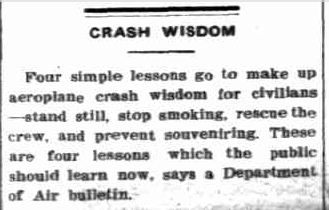
The Portland Guardian was not the only paper to publish the article during 1942.  Eight papers  from Brisbane to Geraldton to Kalgoorlie ran the article in varying forms and Mt Gambier’s Border Watch including the message among the classifieds.  Just three of the papers ran the full story, while the others published a reduced version:

CRASH WISDOM. (1942, May 1). The Charleville Times (Brisbane, Qld. : 1896 - 1954), p. 2. Retrieved December 3, 2012, from http://nla.gov.au/nla.news-article7699277

CRASH WISDOM. (1942, May 1). The Charleville Times (Brisbane, Qld. : 1896 – 1954), p. 2. Retrieved December 3, 2012, from http://nla.gov.au/nla.news-article7699277

The Portland Guardian dutifully ran this shorter article a week after publishing the full article.

Summer Fashion

Summer fashion is about keeping cool but spare a thought for the women of the 19th century.  Western Victoria is at the bottom of mainland Australia yet that makes little difference once summer comes, with temperatures reaching 40 degrees on some days, even in the far south-west.  Imagine arriving from England in February, often the hottest summer month, and having to adapt to heat never experienced before, whilst dressed in inappropriate clothing.

Clothes found in the shops came from overseas made from materials unsuited to the Australian climate.  Throw in a crinoline, corset, petticoats, bloomers, boots and it all made for an uncomfortable summer.  Eventually, women did shed some layers but it did take time.

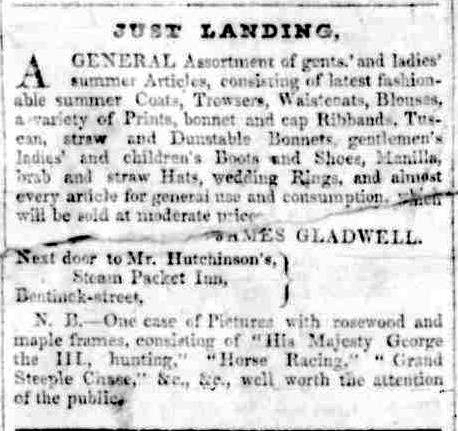
This advertisement from the Portland Guardian and Normanby General Advertiser is from 1842, early days of the colony’s settlement.  James Gladwell was due to take possession of a range of summer clothing fresh off the boat from England.  For those that did not want clothing, they could always buy a framed print of “His Majesty George the III, hunting”

Advertising. (1842, November 19). Portland Guardian and Normanby General Advertiser (Vic. : 1842 – 1876), p. 2. Retrieved November 24, 2012, from http://nla.gov.au/nla.news-article71568834

In 1844, a Pardessus,  a type of coat, was a “most useful appendage to a lady’s outdoor costume”.   Italian taffeta was popular and pink, blue and violet were fashionable colours.

SUMMER FASHIONS. (1844, January 4). Launceston Advertiser (Tas. : 1829 – 1846), p. 4. Retrieved November 24, 2012, from http://nla.gov.au/nla.news-article84772233

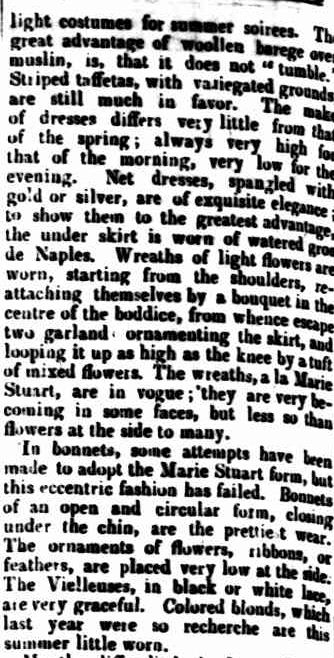
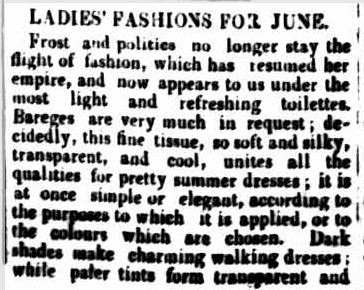
Fashion reports cam from England and was for the wealthier woman, with much of the clothing too impractical and expensive for the average pioneering woman.  The following article is about June fashions (English summer) and published in September 1849 for the Australian summer.

sum72sum73

LADIES' FASHIONS FOR JUNE. (1849, September 27). Geelong Advertiser (Vic. : 1847 - 1851), p. 2 Edition: MORNING. Retrieved December 1, 2012, from http://nla.gov.au/nla.news-article93139412

LADIES’ FASHIONS FOR JUNE. (1849, September 27). Geelong Advertiser (Vic. : 1847 – 1851), p. 2 Edition: MORNING. Retrieved December 1, 2012, from http://nla.gov.au/nla.news-article93139412

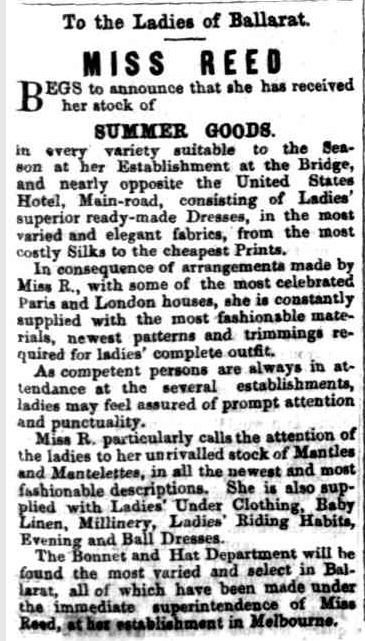
In 1856, a visit to Miss Reed on Main Road, Ballarat was a must for the latest summer clothing from the Fashion houses of Paris and London selling at a range of prices.

Advertising. (1856, December 27). The Star (Ballarat, Vic. : 1855 - 1864), p. 1. Retrieved December 1, 2012, from http://nla.gov.au/nla.news-article66040226

Advertising. (1856, December 27). The Star (Ballarat, Vic. : 1855 – 1864), p. 1. Retrieved December 1, 2012, from http://nla.gov.au/nla.news-article66040226

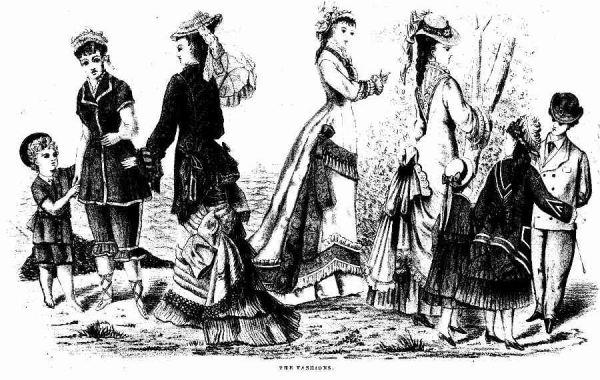
The following sketches are from an article from the Illustrated Sydney News of 9 December 1876  subtitled “Seaside Dress and Bathing Costume”

THE FASHIONS. (1876, December 9). Illustrated Sydney News (NSW : 1853 – 1872), p. 5. Retrieved November 29, 2012, from http://nla.gov.au/nla.news-article63334047

The accompanying description of the outfit third from the left is below:

THE FASHIONS. (1876, December 9). Illustrated Sydney News (NSW : 1853 – 1872), p. 5. Retrieved November 29, 2012, from http://nla.gov.au/nla.news-article63334047

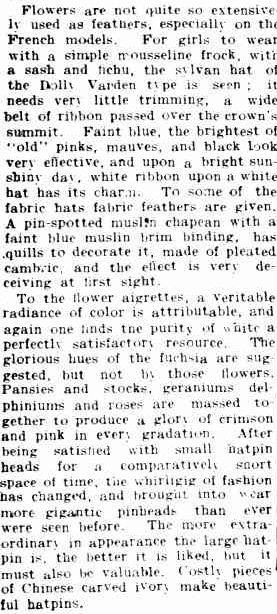
For the ladies of Horsham in November 1889, the news was that a cord loop on the end of a parasol was a fashionable accessory for summer 1889.  Cashmere was popular as was the  “Greek polonaise” dress and mousseline delaine, a material which was taking the place of nun’s veiling.

Ladies’ Column. (1889, November 5). The Horsham Times (Vic. : 1882 – 1954), p. 2 Supplement: SUPPLEMENT TO THE HORSHAM TIMES. Retrieved November 25, 2012, from http://nla.gov.au/nla.news-article72862812

In 1892, the Portland Guardian‘s regular column “World of Fashion” reported summer fashions as “likened to a flower garden in full bloom”.  A dress in peach blossom striped silk perfect for an afternoon by the water.

WORLD OF FASHION. (1892, December 16). Portland Guardian (Vic. : 1876 – 1953), p. 2 Edition: EVENING, Supplement: Supplement to the Portland Guardian.. Retrieved November 25, 2012, from http://nla.gov.au/nla.news-article65441419

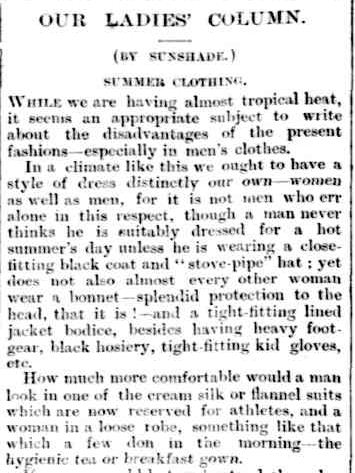
During a New Year’s heat wave, the Williamstown Chronicle argued that the summer fashions were unsuitable for the climate and it was time for clothing specifically made for the conditions.

sum76

OUR LADIES' COLUMN. (1892, January 2). Williamstown Chronicle (Vic. : 1856 - 1954), p. 4. Retrieved December 2, 2012, from http://nla.gov.au/nla.news-article68595885

OUR LADIES’ COLUMN. (1892, January 2). Williamstown Chronicle (Vic. : 1856 – 1954), p. 4. Retrieved December 2, 2012, from http://nla.gov.au/nla.news-article68595885

A bathing costume from 1894.

A Bathing Costume. (1894, September 28). The Broadford Courier and Reedy Creek Times (Broadford, Vic. : 1893 – 1916), p. 5. Retrieved November 29, 2012, from http://nla.gov.au/nla.news-article58882443

Voile was a popular material for summer 1904.  This dress was brown, yes brown, but there were varying shades of brown such as tabac and earth.  Where did the blooming flower garden go?

GOSSIP. (1904, September 16). The Colac Herald (Vic. : 1875 – 1918), p. 7. Retrieved November 25, 2012, from http://nla.gov.au/nla.news-article89708376

A lady’s blouse from 1909.  Patterns were available by mail order from M.Thorp & Co. of Collins Street, Melbourne.  Horsham ladies could get the same look like those from the city.

LADY’S BLOUSE. (1909, October 22). The Horsham Times (Vic. : 1882 – 1954), p. 6. Retrieved November 25, 2012, from http://nla.gov.au/nla.news-article72962676

A lady wouldn’t want to walk too close to a horse in this hat.

A FIELD-FLOWER HAT. (1909, October 22). The Colac Herald (Vic. : 1875 – 1918), p. 8. Retrieved November 25, 2012, from http://nla.gov.au/nla.news-article91852132

Another pattern from M.Thorp & Co. This dress is from their 1911 range.

LADY’S COSTUME. (1911, February 24). The Horsham Times (Vic. : 1882 – 1954), p. 9. Retrieved November 25, 2012, from http://nla.gov.au/nla.news-article73159315

A hat is an important part of a summer outfit in Australia and in 1912 wide brims were in.

FOR WIVES AND DAUGHTERS. (1912, October 2). The Colac Herald (Vic. : 1875 – 1918), p. 4. Retrieved November 25, 2012, from http://nla.gov.au/nla.news-article87620359

It gets hot in Horsham and in 1913, the Horsham Times was offering tips on cool clothing.  Wool was too warm while silk was the coolest of materials.  The advice to ladies was to put their black clothes away until winter and bring out their white attire.

COOL CLOTHES. (1913, October 10). The Horsham Times Vic. : 1882 – 1954), p. 9. Retrieved November 25, 2012, from http://nla.gov.au/nla.news-article72888408

A bathing costume from 1913.

THE LADIES’ COLUMN. (1913, January 21). West Gippsland Gazette (Warragul, Vic. : 1898 – 1930) , p. 5 Edition: MORNING.. Retrieved November 29, 2012, from http://nla.gov.au/nla.news-article68662168

More tips on keeping cool, this time from The Argus of 1913.  The “Women to Women” column advised not to wrap babies in blankets during summer and young children should be dressed in fewer clothes.  “Women themselves have realised the comfort of the scanty clothing that they have been wearing during the last two or three years.  It is only a very old-fashioned woman nowadays who ever wears two petticoats”

WOMEN TO WOMEN. (1913, December 31). The Argus (Melbourne, Vic. : 1848 – 1956), p. 9. Retrieved November 25, 2012, from http://nla.gov.au/nla.news-article7274211

Advertising. (1913, December 31). The Argus (Melbourne, Vic. : 1848 – 1956), p. 9. Retrieved November 25, 2012, from http://nla.gov.au/nla.news-article7274208

The Port Fairy Gazette of 19 January 1914 advertised a pattern for a Ladies’ Bathing Gown.

Advertising. (1914, January 19). Port Fairy Gazette (Vic. : 1914 – 1918), p. 4 Edition: EVENING. Retrieved November 29, 2012, from http://nla.gov.au/nla.news-article91987072

Fur trimming was popular in the summer of 1916.  Really.

FROM NECK TO FEET. (1916, December 7). Port Fairy Gazette (Vic. : 1914 – 1918), p. 5 Edition: EVENING. Retrieved November 25, 2012, from http://nla.gov.au/nla.news-article88008299

This is a great photo from the State Library of Victoria’s collection.  The ladies are on Sorrento beach, Victoria.

Group of women standing ankle deep in water at Sorrento courtesy of the State Library of Victoria .http://handle.slv.vic.gov.au/10381/44447

Group of women standing ankle deep in water at Sorrento courtesy of the State Library of Victoria .http://handle.slv.vic.gov.au/10381/44447

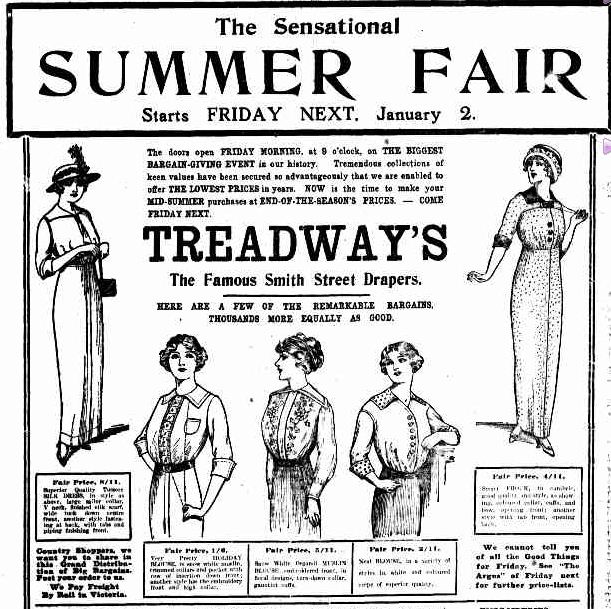
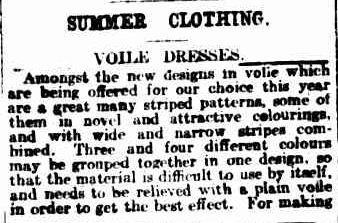
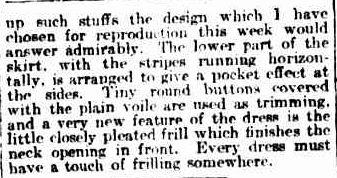
The following dress was an English design.  The article from The Argus of 27 August 1919 notes that it would have to be adapted to suit the Australian summer with a longer sleeve needed to prevent burning.

SUMMER CLOTHING. (1919, August 27). The Argus (Melbourne, Vic. : 1848 – 1956), p. 12. Retrieved November 25, 2012, from http://nla.gov.au/nla.news-article4700420

SUMMER CLOTHING. (1920, August 11). The Argus (Melbourne, Vic. : 1848 – 1956), p. 12. Retrieved November 25, 2012, from http://nla.gov.au/nla.news-article4590862


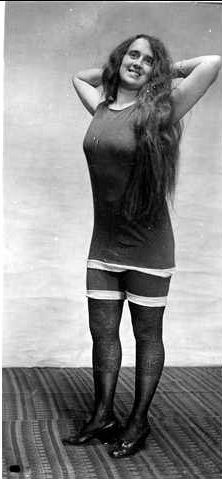
A young woman wearing a bathing costume ca 1920 Image courtesy of the State Library of South Australia – PRG 280/1/17/559 http://images.slsa.sa.gov.au/searcy/17/PRG280_1_17_559.htm

Summer fashions from 1924.

WOMAN’S REALM. (1924, January 8). The Argus (Melbourne, Vic. : 1848 – 1956), p. 14. Retrieved November 25, 2012, from http://nla.gov.au/nla.news-article1932240

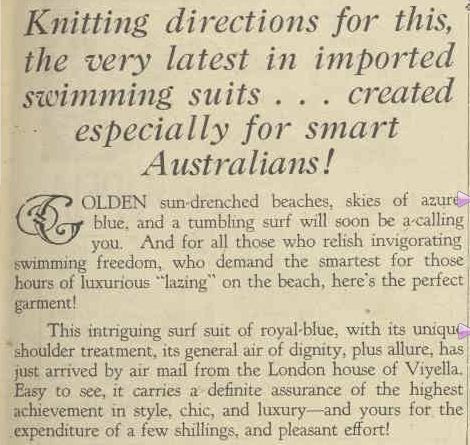
Get the knitting needles out and whip up this royal blue surf suit made from four ply wool.

JUST SEE What We Have Secured FOR YOU… (1935, August 31). The Australian Women’s Weekly (1933 – 1982), p. 47 Section: THE AUSTRALIAN WOMEN’S WEEKLY HOME MAKER. Retrieved November 25, 2012, from http://nla.gov.au/nla.news-article52247098

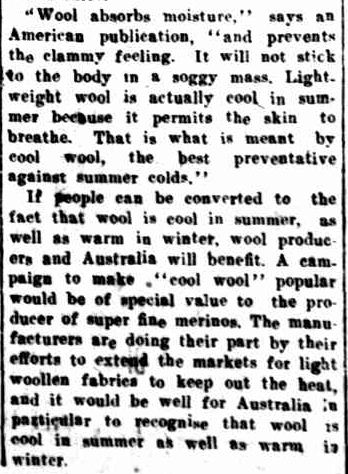
An earlier article from the Horsham Times of 1913, proclaimed wool too warm for summer wear.  Twenty-two years later, designers had learnt the secret of sheep – wool really is cool.  Good for the sheep farmers of the Western District and Wimmera too.

“COOL WOOL”. (1935, October 1). The Horsham Times (Vic. : 1882 – 1954), p. 10. Retrieved November 25, 2012, from http://nla.gov.au/nla.news-article75237170

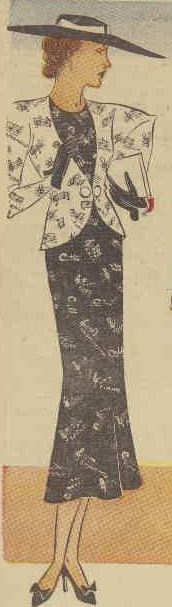
Prints were everywhere in the summer of 1936 and I mean everywhere.  Not only were there print dresses and blouses, but also bags, belts and gloves.  Not just floral prints but also animal prints, musical notes and even fish.

The Fashion Parade. (1936, September 5). The Australian Women’s Weekly (1933 – 1982), p. 8. Retrieved November 27, 2012, from http://nla.gov.au/nla.news-article47477428

Let’s not forget summer shoes.  Shoes from 1939 were metallic, mesh and lace up.

SUMMER SHOES… (1939, August 19). The Australian Women’s Weekly (1933 – 1982), p. 31 Supplement: Fashion Portfolio. Retrieved November 27, 2012, from http://nla.gov.au/nla.news-article51942459

SUMMER SHOES… (1939, August 19). The Australian Women’s Weekly (1933 – 1982), p. 31 Supplement: Fashion Portfolio. Retrieved November 27, 2012, from http://nla.gov.au/nla.news-article51942459

Also from 1939, news that cotton playsuits could double as swimsuits.  There were also towelling two piece numbers and woollen swimsuits.  Also, just for those who wanted an even tan, boned tops, that stayed up even when the straps were slipped off the shoulder.

ALLURING SWIM SUITS—. (1939, November 4). The Argus (Melbourne, Vic. : 1848 – 1956), p. 10 Supplement: The Argus Week-end Magazine. Retrieved November 27, 2012, from http://nla.gov.au/nla.news-article11289777

Beach outfits from the 1940s.

1940

FUN on the BEACH. (1940, January 6). The Australian Women’s Weekly (1933 – 1982), p. 8 Supplement: FASHION PORTFOLIO. Retrieved November 27, 2012, from http://nla.gov.au/nla.news-article46935395

1941

Summer play togs gayer than ever… (1941, November 15). The Australian Women’s Weekly (1933 – 1982), p. 23 Section: Fashion Portfolio. Retrieved November 27, 2012, from http://nla.gov.au/nla.news-article47482941

1945

SUN SOAKERS… (1945, September 29). The Australian Women’s Weekly (1933 – 1982), p. 27. Retrieved November 28, 2012, from http://nla.gov.au/nla.news-article51281589

WW2  was over and cotton was in short supply but it had taken a step up the hierarchy of fabrics.  Not just for tea towels or cheap knock-about frocks, cotton was being used for “finer clothes”.

Topics Feminine. (1946, November 16). Border Watch (Mount Gambier, SA : 1861 – 1954), p. 12. Retrieved November 28, 2012, from http://nla.gov.au/nla.news-article79864845

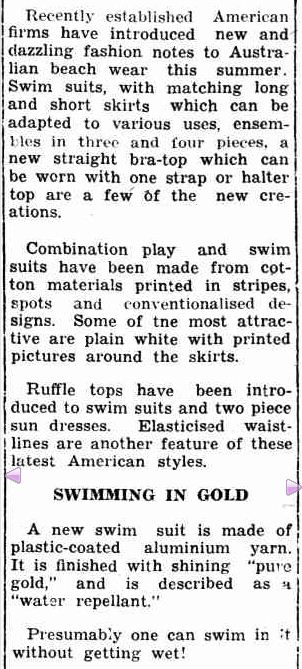
American fashion houses, set up after WW2, were sending their beachwear Australia’s way in 1947, even those made from plastic coated aluminium yarn.

Topics Feminine. (1947, January 4). Border Watch (Mount Gambier, SA : 1861 – 1954), p. 12. Retrieved November 28, 2012, from http://nla.gov.au/nla.news-article78134282

Strapless swimsuits were fashionable in 1949 as were pedal pushers, although judging by the photo which accompanied the article, I’m not sure why.  But as the article suggest they were perfect for those with “not too slim” or “not too shapely” legs.  Tan, caramel, navy and black were popular colours.

WOMEN WILL BE WEARING. (1949, September 13). The Argus (Melbourne, Vic. : 1848 – 1956), p. 2 Supplement: The Argus Woman’s Magazine. Retrieved November 28, 2012, from http://nla.gov.au/nla.news-article22778225

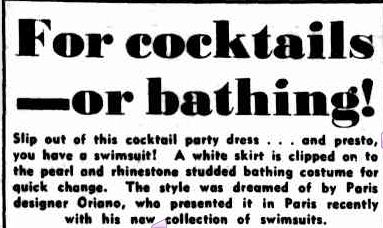
What every girls needs, a swimsuit that doubles as a cocktail dress!

For cocktails —or bathing!. (1954, November 25). The Argus (Melbourne, Vic. : 1848 – 1956), p. 5. Retrieved November 28, 2012, from http://nla.gov.au/nla.news-article23461427

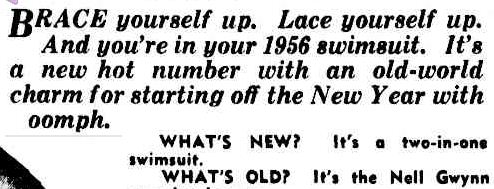
Corsets were back in 1956, if only for swimsuits.  A relief for the writer of the “Woman’s Page”, who was glad to see an end of, she thought, swimsuits looking like a couple of handkerchiefs knotted together.

Woman’s Page. (1956, January 17). The Argus (Melbourne, Vic. : 1848 – 1956), p. 9. Retrieved November 28, 2012, from http://nla.gov.au/nla.news-article72530649

Passing of the Pioneers

Many of the November pioneers came from the south-west of Victoria from Bridgewater to Timboon.  Somewhere in between is Koroit and four of the pioneers who resided there, all of Irish descent.

Samuel LORD: Died 18 November 1906 at Pombeneit.  Samuel Lord was a resident of Pomberneit for forty-one years, but it took him the twenty years prior to settle. Samuel, born in Devonshire, England. arrived in Adelaide in 1845, went to Sydney, then back to Adelaide and in 1849 returned to England for a visit. He then came back to Australia, heading to the goldfields for several years. He then selected land at Pomberneit in 1865. He was a member of the Heytesbury Shire Council and had nine children.

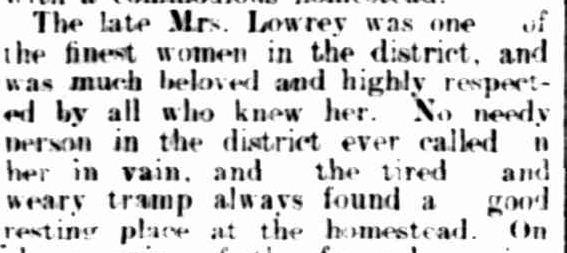
Johanna RYAN:  Died 27 November 1914 at Panmure. Johanna Ryan and her husband Mr T. Lowrey and a child, left Tipperary, Ireland in 1851 for Australia, specifically Hobsons Bay, Victoria. After a time at the Bendigo goldfields, the Lowreys bought land at Kirkstall. Following the Land Selection Act of 1865, the Lowreys selected at the Yallock Estate and turned bush into a “beautiful farm” Johanna was ninety years of age at the time of her death.

GARVOC. (1914, December 5). Warrnambool Standard (Vic. : 1914 – 1918), p. 6 Edition: DAILY.. Retrieved November 22, 2012, from http://nla.gov.au/nla.news-article73556791

Daniel O’CONNELL: Died 5 November 1916 at Koroit. It was a lonely end for Daniel O’Connell. He lived in a hut near the Koroit racecourse and received the old-age pension. In his earlier years, he had worked as a groom and roustabout.  Daniel’s body was found in his hut after a kindly neighbour, Miss Mullens, noticed he seemed unwell and couldn’t hear her.  She rang the police who visited the hut and found his body. He was well in excess of eighty years, according to locals, and he had lived in the district for around sixty years.

Johanna CLEARY: Died 16 November 1916 at Chocolyn. Johanna arrived in Port Fairy from Ireland when she was sixteen, around 1845.  She married John Moloney and they raised six sons and one daughter. The Moloneys also resided at Koroit, but when John died, Johanna went to live with her son James at Chocolyn.

Hugh McDONALD: Died 17 November 1917 at Ararat. Hugh McDonald was another Ararat resident, like those in October Passing of the Pioneers, who did the goldrush circuit. Arriving from Scotland in 1854 aboard the ship Tasmania, he travelled to most of the goldfields in Victoria as well as a stint in New Zealand, but like those October pioneers, it was Ararat that he returned to. His travels must have brought some success as he selected land at Mt. Ararat and built up what became known as the Mt. Ararat Estate (a winery today).  He married and had five children.  He was buried at the Moyston cemetery.

George CAMPBELL: Died November 1918 at Portland.

(1918, November 25). Portland Observer and Normanby Advertiser (Vic. : 1914 – 1918), p. 2 Edition: MORNING. Retrieved November 23, 2012, from http://nla.gov.au/nla.news-article88197935

Catherine MITCHELL: Died 6 November 1918 at Yambuk. Catherine Mitchell arrived in Port Fairy in 1852 aboard the Priam.  She married Richard Thomas of Yambuk and they had four sons, two daughters, forty-five grandchildren and thirty-seven great-grandchildren at the time of her death.  She lived to ninety-two years of age.

James BLACK: Died 17 November 1918 at Koroit. James met an unfortunate death at age seventy-six.  Despite bad health, he was turning out cows when a bull rushed him and knocked him to the ground. He never recovered and died four days later. James was born in Paisley, Scotland and had been a Koroit butcher for over forty years.  He was also Mayor of Koroit on several occasions.

Maria MOLONEY: – Died 24 November 1918 at Koroit. Maria Moloney’s obituary described her as a “good old sort”.  She had been a resident of Koroit for 60 years after arriving from Ireland with her father and brother in 1852 at the age of 15. Her son Richard was killed at war in 1916 and Maria’s health began to fail after hearing the sad news.  She was buried at Tower Hill cemetery.

Sarah Ann OLIVER: Died 15 November 1928 at Brisbane, Queensland. Sarah Ann Oliver was an older sister of Elizabeth and Mary Oliver, wives of Reuben Harman and Jonathon Harman.  Like her two sisters, she was born in Cornwall and immigrated in 1849 aboard the Courier into Port Phillip. Ten years later she married Edmund Dalton, an Irishman and they lived in Port Fairy for the following twenty years, raising eight children. In 1879, Sarah and Edmund moved to the Darling Downs, Queensland.

Thomas MAILON:  Died 10 November 1930 at Portland. Thomas Mailon was born in Portland and was a policeman during his working years.  He lived in what was known locally as the “White House”, a home set on the sandhills near Portland.   An advertisement in the Portland Guardian (below) lists the “White House” for sale. This was only nine months before his death. Thomas had a number of brothers and sisters but never married.

Advertising. (1930, February 10). Portland Guardian (Vic. : 1876 – 1953), p. 3 Edition: EVENING. Retrieved November 26, 2012, from http://nla.gov.au/nla.news-article64291549

Marion Nunn JONES: Died 11 November 1936 at Bridgewater.  Marion Jones was born at the Tasmanian Hotel in Portland around 1851. She married William Forward Hedditch at Lal Lal, the Hedditch family home at Cape Bridgewater.  Forty-six years later, Marion died in the same room as she was married.  Her mother-in-law, Rachel Read was a January Passing Pioneer.

Janet Isabella Mary BLACK: Died 10 November 1941 at Mt. Gambier. Janet Black was born at Bridgewater in October 1863. She was the only daughter of Joshua Black and Janet Nicol and stepsister to Rachel Black whose obituary was in the October Passing of the Pioneers.  Janet married Samuel Kenney and they had one daughter, Lexie. They lived at both Cape Bridgewater and Kongorong. Janet was the last surviving child of Joshua Black.

Mary KENNEY:  Died 19 November 1941 at St. Kilda.  Mary Kenney was a sister-in-law of Janet Black (above) and they passed away within nine days of each other. Mary was the daughter of John and Ellen Kenney of Lower Cape Bridgewater and she was born in Richmond Street, Portland in 1847. She later married J.K. Palmer of Hawkesdale.

Margaret Bennett MARTIN:  Died 12 November 1942 at Portland. Margaret Martin lived in Portland for the entire eighty-five years of her life. She married Mr Symington and they had two sons and three daughters.

Florence COUCH:  Died 17 November 1954 at Surrey Hills. Florence Couch’s father was one of the original pioneers of the Scott’s Creek district near Timboon. Florence was the last surviving member of a family of thirteen. The Couch family were well-known for their horse handling skills. When Florence married Mr Roberts around 1906, they moved to South Africa for two years before returning to Scott’s Creek. She had five surviving children at the time of her death.

A Busy Month Ahead

I have been busy searching Trove, more than usual if that is possible, preparing  December posts.  It will be a big month.

December 1 is the first day of Summer so keep an eye out for some Summer Fashions.  As I found from my Spring Fashion post, that it is interesting to track the changing fashions over the decades.  A “not to be missed” post especially if you would like to find out when women stopped wearing two petticoats in Summer!

Following on from a successful series of posts in December 2011, I will also bring you Christmas from the 1900s to the 1950s with a Western District slant.  The Pioneer Christmas posts have been very popular and, like fashions, there have been definite changes to Christmas celebrations over the decades.

Have you been following the great Trove Tuesday posts from various bloggers each week?  If you would like to see all the posts from the last 14 weeks (can’t believe it’s been that many) check out Amy Houston’s blog Branches, Leaves and Pollen.  Christmas Day will also be Trove Tuesday, so I will have to begin a search for a Trove treasure with a Christmas theme.

There will also be the 19th edition of Passing of the Pioneers.  Around 250 pioneers have now been remembered in these monthly posts and the stories of the early days of the Western District continue.

I also have some new links to add to the Western District Links Page.

In between all this maybe I’ll get a post or two in about my family members.  One of my fellow Western District researchers has, in the last few days, handed me a big hammer to smash down one of my brick walls, so I’ll have to share that.

Phew!  I better get going.

Trove Tuesday – A Lady Motorist

I just love this story I found at Trove:

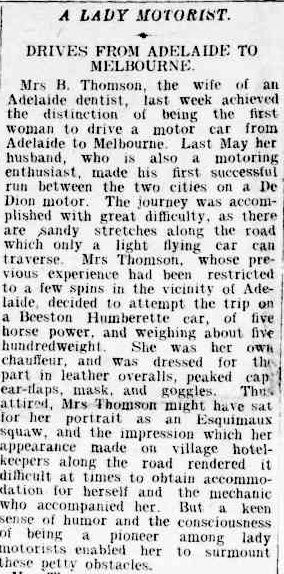
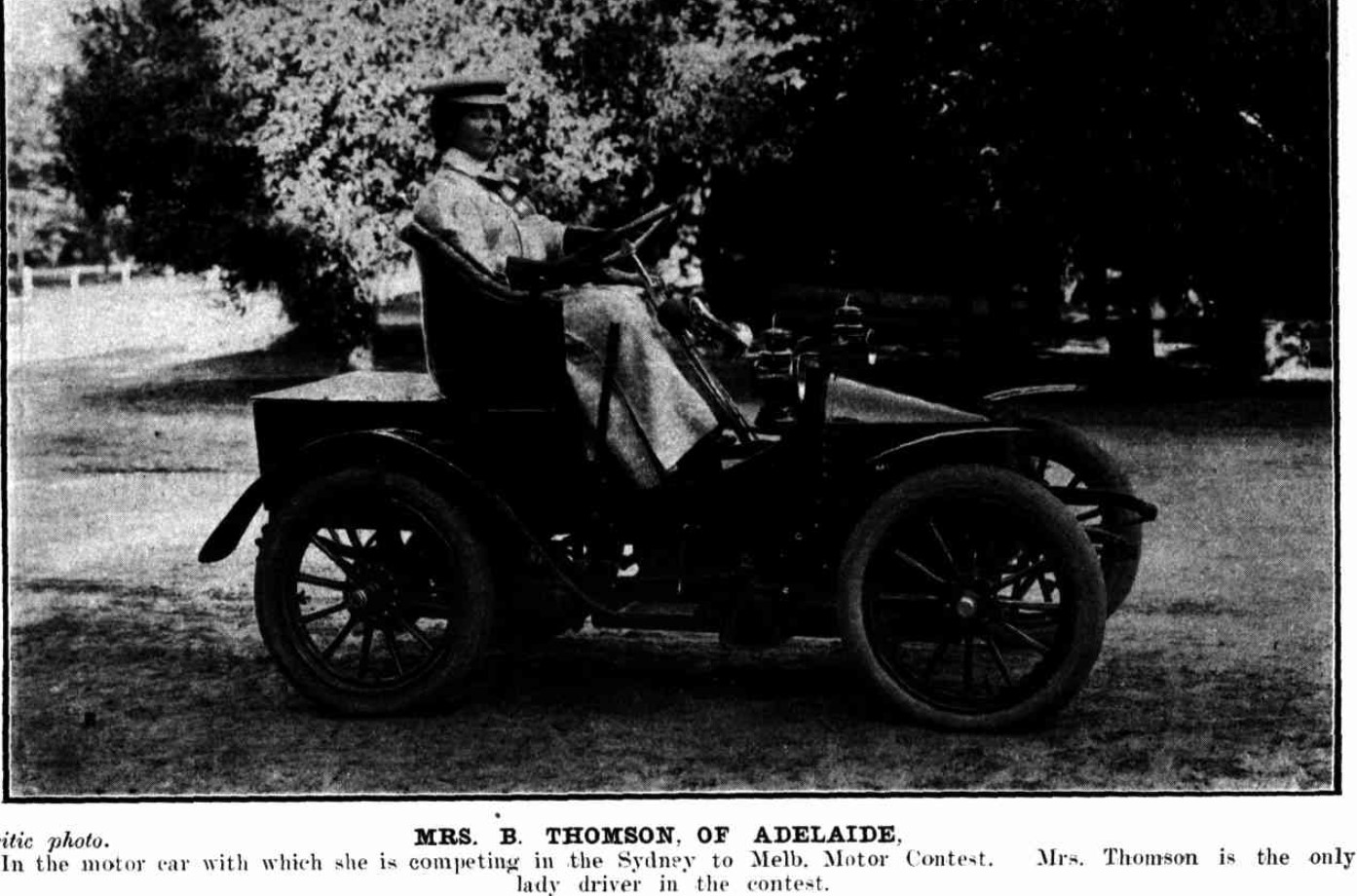
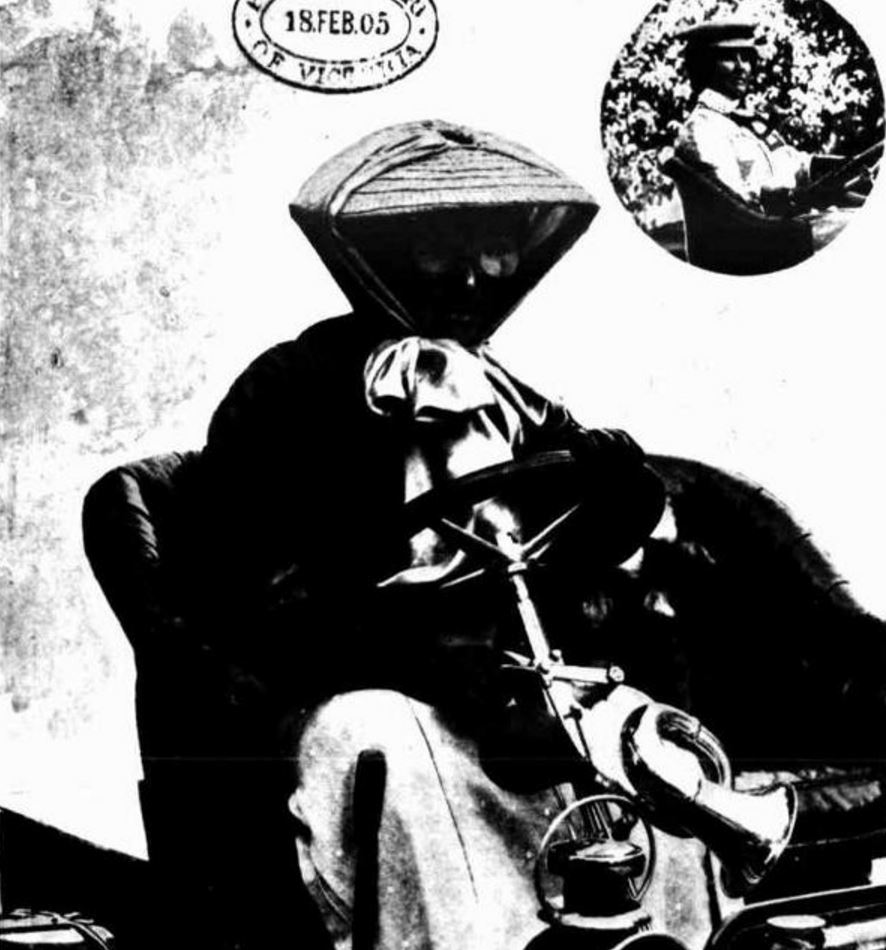
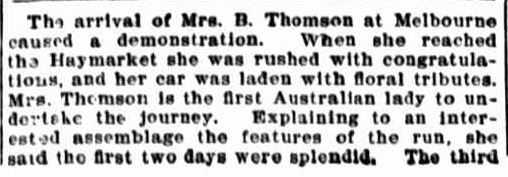
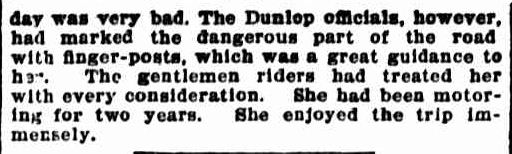
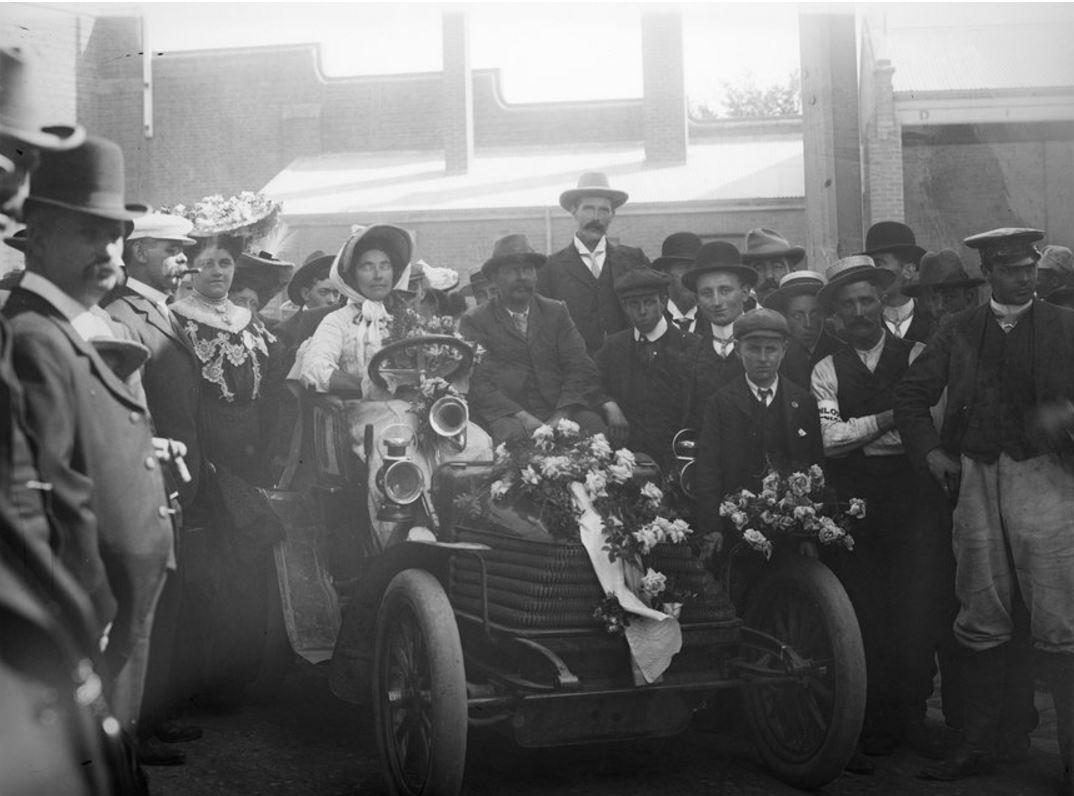
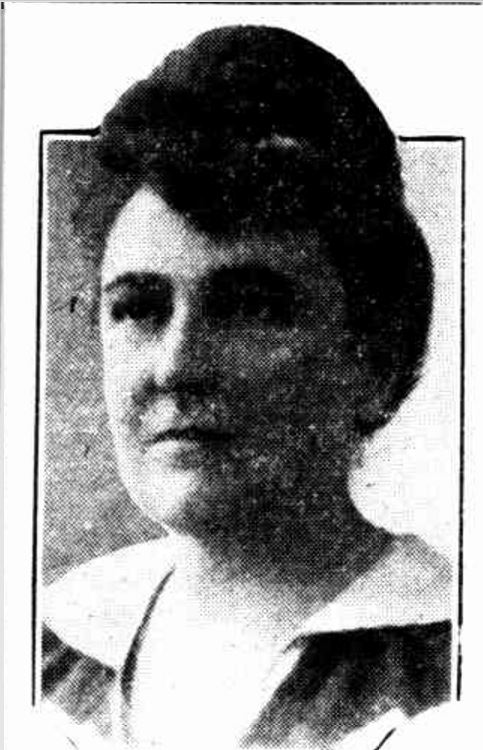
Driving a Beeston Humberette, Florence Thomson travelled from Adelaide to Melbourne in March 1904 earning her the title of the first female to drive the trip.  Spurred on by her dentist husband Ben’s achievements in 1902 in completing the same trip, Florence was nothing short of a trailblazer.

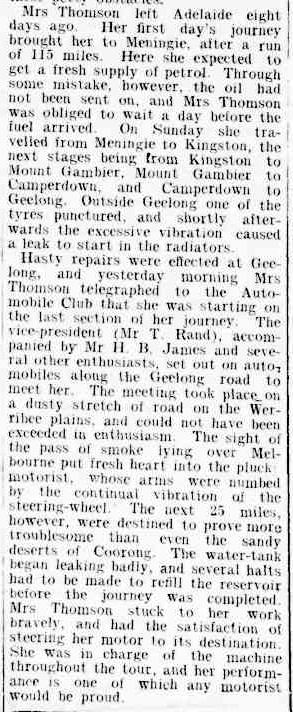
The trip was not without its problems, but the thick sands of the Coorong, limited petrol availability, a puncture, and a leaky radiator did not stop Florence.  Lucky she took a mechanic along with her.

A LADY MOTORIST. (1904, March 28). The Colac Herald (Vic. : 1875 – 1918), p. 1. Retrieved November 21, 2012, from http://nla.gov.au/nla.news-article87353226

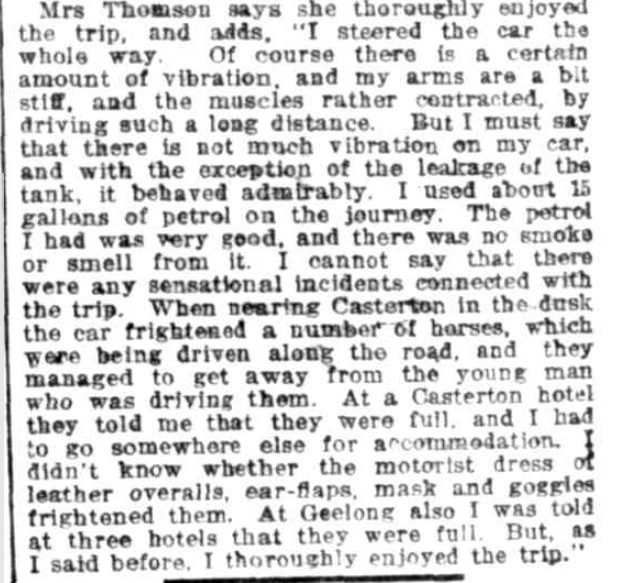
Her trip took her from Broadbeach, SA into Victoria’s Western District. Her car scared horses approaching Casterton and when she arrived in the town, she found there was “no room at the inn”. From Casterton she travelled on to Camperdown and then Geelong where she had a similar experience finding accommodation.

HOLIDAY ON MOTORS. (1904, April 2). Weekly Times, p. 19. http://nla.gov.au/nla.news-article222791657


MRS. B. THOMSON, OF ADELAIDE, (1905, February 22). Critic (Adelaide), p. 27.  http://nla.gov.au/nla.news-article211406512

Florence did not stop there.  In 1905, she competed in the Dunlop Reliability rally from Sydney to Melbourne.

"A LADY MOTORIST." The Australasian (Melbourne, Vic. : 1864 - 1946) 18 February 1905: .

FLORENCE IN HER RACING GARB AND HER EVERYDAY MOTORING ATTIRE – “A LADY MOTORIST.” The Australasian (Melbourne, Vic. : 1864 – 1946) 18 February 1905: <http://nla.gov.au/nla.news-article140780231&gt;.

Mechanical problems at Albury looked as though they would stop Florence, but she made it to Melbourne to great adulation.

(1905, March 1). Australian Town and Country Journal (NSW : 1870 – 1907), p. 52. Retrieved November 26, 2012, from http://nla.gov.au/nla.news-page571151

FLORENCE THOMSON ARRIVING AT THE FINISH LINE OF THE RELIABILITY TRIAL FROM SYDNEY TO MELBOURNE. Image courtesy of the State Library of Victoria. http://handle.slv.vic.gov.au/10381/43094

FLORENCE THOMSON ARRIVING AT THE FINISH LINE OF THE RELIABILITY TRIAL FROM SYDNEY TO MELBOURNE. Image courtesy of the State Library of Victoria. http://handle.slv.vic.gov.au/10381/43094

Mrs Florence Thomson was truly a motoring pioneer as was her husband Ben.  Both had adventurous spirits. How many men in 1904 would have allowed their wife to do what she did, while accompanied by another man, and fully support her?

Born in India, Florence Alice Vardon married Scot Benjamin Thomson in Adelaide, South Australia in 1892. In 1929, twenty-five years after her epic drive from Adelaide to Melbourne, Florence was interviewed by The News (Adelaide). The interview was published on 17 August 1929. Florence told how she learnt to drive in 1902. During her childhood, she travelled around India and Burma with her father, a member of the British Indian Army and as an adult, travelled alone throughout Europe, China and Japan.  

Cars were not her only means of transport, “I have used almost all means of locomotion,” she said, “horses, camels, palanquins, donkeys, ships, trains, elephants, bullock-drays, and push bicycles”. When asked if she had flown in an aeroplane, she revealed she was the first woman passenger to fly with Captain Harry Butler, one of South Australia’s early aviators.

In 1931, as a debate was raging as to the driving ability of women, Florence commented for The Mail (Adelaide), published on 25 April 1931,


"Woman's View" The Mail (Adelaide, SA : 1912 - 1954) 25 April 1931: 11. .

“Woman’s View” The Mail (Adelaide, SA : 1912 – 1954) 25 April 1931: 11. <http://nla.gov.au/nla.news-article58845739&gt;.

Florence died on the 28th January 1938 at her home at 200 North Terrace, Adelaide.  Ben Thomson died in Adelaide on 27 June 1944.

"FIRST WOMAN MOTORIST" News (Adelaide, SA : 1923 - 1954) 17 August 1929: 3 (SPORTS EDITION). Web. .

“FIRST WOMAN MOTORIST” News (Adelaide, SA : 1923 – 1954) 17 August 1929: 3 (SPORTS EDITION). Web. <http://nla.gov.au/nla.news-article128899444&gt;.


In The News – November 24, 1941

The Portland Guardian of November 24, 1941 heralded the 100th birthday of Heywood, a small town about 25 kms north of Portland.  The article remembered The Bell family and their contribution to Heywood’s settlement.  I recently  introduced to you my family link to the Bells in a Trove Tuesday post – A Matter of Relativity about Amelia Harman.  Amelia married Christopher Bell, a grandson of John and Elizabeth Bell.

John Bell and his wife Elizabeth Morrow, left Ireland in 1841 with eight children in tow, some were adults, and sailed to Australia aboard the “Catherine Jamison“.  Five months after their departure, the Bells had settled at Mount Eckersley, a few kilometres north of Heywood.


Great contributors to Western Victorian racing, the family were good friends with poet Adam Lindsay Gordon.  William Bell was with Gordon when he made his mighty leap at Blue Lake, Mt. Gambier.

The Department of Primary Industries cites the height of Mt Eckersley as 450 feet (137 metres) but that didn’t stop John Bell, at the age of 101, from climbing the volcano, only months before his death.

As a family known for longevity, twin sons Henry and James lived to 92 and 97 respectively.  At one time they were Australia’s oldest living twins.

HEYWOOD IS ONE HUNDRED. (1941, November 24). Portland Guardian (Vic. : 1876 – 1953), p. 1 Edition: EVENING. Retrieved November 16, 2012, from http://nla.gov.au/nla.news-article64402492

All of this is well and good but is it all true?  John’s year of death is recorded as 1885, with his birth about 1787.  That would have made him around 97/98, short of the 101 reported.  Still, if he did climb Mt.Eckersley, to do it aged 97/98  was still a mean feat, but John may not have been a centenarian.  The family notice in the Hamilton Spectator at the time of his death gives his age as 98.

There could also be a discrepancy with the year the Bells settled at Mt Eckersley.  The Bells did arrive on the Catherine Jamieson on October 22, 1841 to Port Phillip.  The newspaper article says they were in Heywood by November 1841.  The Glenelg and Wannon Settlers site states John Bell settled at Mt Eckersly in 1843.

A further reminder to not always believe what you read in the papers.