A photo from a place and time your ancestors lived is always interesting. You get a feel for their daily life, the transport of the time, and the fashion. You can see a place as it would have looked through their eyes. If it’s a streetscape, the photo is useful from a local history perspective. This photo, a Rose Postcard held by the State Library of Victoria (SLV) depicting the main street of Hamilton, ticks all those boxes.
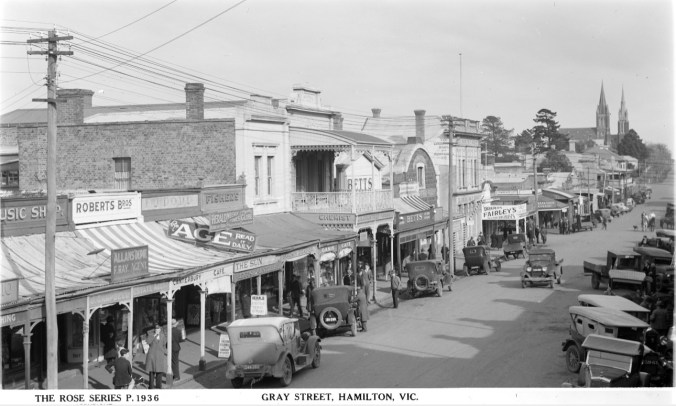
The Hamilton streetscape has changed somewhat, but it’s instantly recognizable by the twin steeples on Church Hill toward the end of Gray Street. There are various postcard shots of Gray Street, but I particularly like this one for the stripy verandah of the Canterbury Cafe owned by the Roberts brothers, and the Fairleys sign. The photo tells several tales, ranging from a global story to a personal family story.
Rose postcards come undated, but you can narrow down the period. Car makes and models and even the format of the registration plate can help. Shops are useful too. If a digitised version of the local newspaper is available at Trove, search the business names and narrow down the period they operated. Sometimes ladies’ fashion, particularly hats and dress lengths, point to a period in time, but this photo comprises mostly men. Their fashion is harder to date.

This photo has an extra clue at the front of the newsagent. The SLV photo viewer has a great zoom function and if we zoom in, this is what we find.

The headline in The Herald newspaper on the day of the photo was “World Flier Gassed in Plane”. Trove has digitised editions of The Herald, so I searched the headline and found the edition. The date was Friday 9 June 1933.

Knowing the date adds more to the story. The world was amid the Great Depression, and aviator James J. Mattern from the United States was attempting to break the world record to circumnavigate the globe, which then stood at just over 8.5 days. He survived the mishap, but his chances of breaking the record were dashed.
On a local level, it was a Friday, explaining the number of men in the street.
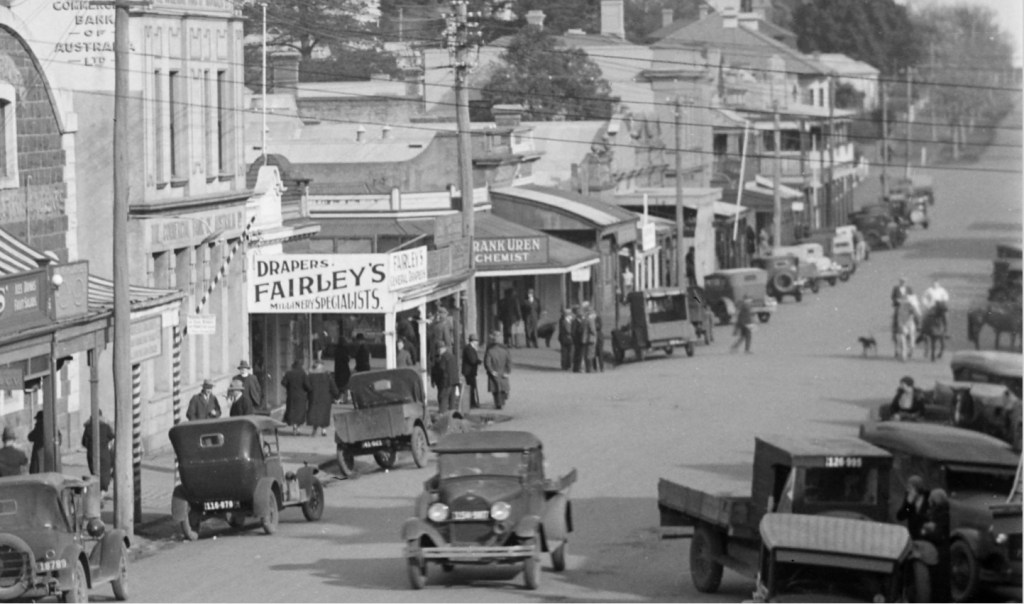
In many larger towns, Friday was the day the country folk came to town for supplies. An article in the Horsham Times from May 1951 bemoaned the traffic jam of people on the Horsham footpaths on a Friday. It was no different in Hamilton.

It was also a popular day for townspeople to head “down the street” and catch up with friends, some back in town for a weekend visit. Hamilton’s own Victoria Cross hero, Ted Kenna, said from the Heidelberg Repatriation Hospital in 1945, he was looking forward to returning to Hamilton to see the crowds of people “down the street” on a Friday. Almost the whole town turned out, he said. He was reminiscing with a former Hamilton girl, Roma Rainford who visited Ted, and they laughed as they recalled the often-used phrase, “I’ll be at home in Gray Street on Friday”.

There is something else significant about 1933. My grandfather kept a diary in that year which was kept by Nana.
Bill Gamble turned twenty-two in 1933. By then, his father, Joseph Gamble, had left the family after about a decade of coming and going. Bill was the breadwinner and had been for some years. With Bill’s help, his mother, Edith, raised Bill’s six siblings. The youngest in 1933 was Shirley, aged five. Bill started as a delivery boy while still at Hamilton Higher Elementary School, before moving into the shop and learning the butchering trade.


From Bill’s diary, I found work was inconsistent in 1933. He was picking up bits and pieces at the abattoir, the butcher shop, and wood carting.

Bill was also a keen photographer and developed films for friends, probably to cover his own photography costs. According to his diary, on 1 April 1933, he and his mate Charlie Stevenson developed five films for Ted Hodges. Then they went to the pictures at the Regent Theatre in Brown Street.

When Bill was not at home or working, he was with Charlie, camping, fishing, shooting, and riding motorbikes. He also spent a lot of time at the home of Charlie’s parents in Digby Road and went there most Fridays for milk. Following his maternal uncles, Bill and George Diwell, Bill played cornet with the Hamilton Brass Band.


Bill also enjoyed going down the street. On Friday 31 March, his entry was “Went down the street for the evening”. He also noted he bought a toothbrush for 2/-. On Friday 21 April, he again went down the street to the bank and Laidlaws (department store). On Friday 5 May, Bill was down the street playing with the Hamilton Brass Band in front of Walker’s Boot and Shoe store in Thompson Street.
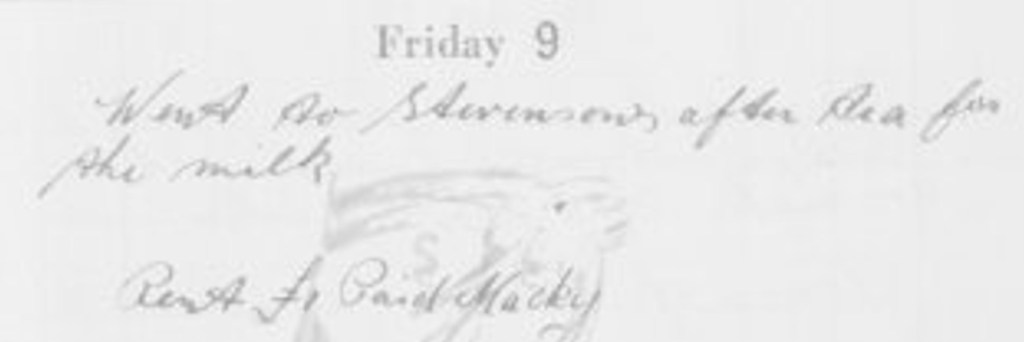
I wondered if Bill went down the street on Friday 9 June 1933. I turned the page… no. But he went to Stevenson’s for milk.
The Fairly’s sign mentioned earlier is in the next photo. This is Bill (on left) at Brown Bros. butchers in Gray Street, close to where the feature photo was shot. The Fairly’s sign is reflected in the window.

Fairley’s was a drapery run by John Fairley and his wife Lillian. John died in 1939, two years after this advertisement.

The streetscape changed in 1944 when a fire destroyed George Bretnall’s music store and damaged the shops nearby.


The strip of shops was owned by the estate of Annie Destree who died in 1917. Annie inherited them when her husband, watchmaker Adolphus Destree died suddenly in 1875. She also owned Fairley’s building. It was nothing new for the Destree family, with fire destroying their shop and residence in 1870.
The shops were rebuilt as shown on another great postcard of Gray Street, taken only a few years after the fire.

The Canterbury Cafe was still open for hot dinners and grills.

The strip of shops still exists, as seen in this more recent photo taken in a similar spot as the older photos. Plane trees planted in the later part of the 20th century don’t make comparison with the older photos easy. And no longer is the street identified by the iconic twin steeples.

You can read more from the Take a Photo series on the link-Take a Photo
© Merron Riddiford 2023

 Western District Families
I very much enjoyed reading this. What a mine of information not only about Hamilton at that time but also for anyone who is starting out researching their family history. Thank you. Carol Armstrong.
LikeLike