Passing of the Pioneers

March is Women’s History Month and just as I did in March 2017, this year I have compiled an all female Passing of the Pioneers. It’s only a small group of seven, almost half the number in 2017, but a worthy group all the same. Remember to click on the underlined text to find more information on a subject.

NEVILLE, Ann Terry – Died 28 March 1900 at Hamilton. Ann Neville was born at Old Brentford, London in 1821. She was married in 1852 to William Carter and they set off for Australia on the Priam in the same year. After arriving at Portland, they went on to Warrnambool and later Port Fairy. In 1854, they decided to leave the coast and move north to Hamiton. The trip from Port Fairy to Hamilton in a bullock wagon took them a week. They settled in South Hamilton.

On 31 December 1868, William died at the age of forty died leaving Ann with six children aged fourteen down.

In 1885, Ann applied to be included on the local voter’s roll. She held allotments 47 and 49, suburban lots in the Parish of South Hamilton. They were located on the southern banks of the Grange Burn between Monivae and Pierrepoint Streets.

At the time of Ann’s death, she left two sons and four daughters. She was buried at the Hamilton (Old) Cemetery.

HEADSTONE OF ANN TERRY CARTER, HAMILTON (OLD) CEMETERY

WATSON, Margaret – Died 1 March 1914 at Coleraine. Margaret Watson was born in Scotland around 1827. She married David Drummond in Tillicoultry, Scotland on 12 June 1852 and they boarded the Chance at Liverpool, England on 23 July 1852. It was a difficult journey with forty-six deaths and on arrival in Melbourne on 28 October 1852, the ship was quarantined and remained so for almost three weeks. Once on dry land, the couple made their way to the Geelong district. A son James was born in 1853 but sadly he died the next year. Another son Richard was born in 1854 and a daughter Margaret in 1857. James was born in 1862 at Duck Ponds near Geelong.

The family moved west to join other members of the Drummond family sometime after 1862 with a son John born at Casterton in 1867.

CASTERTON c1868. Image courtesy of the Museums Victoria Collections https://collections.museumsvictoria.com.au/items/767592

It was also the year David Jr died at Sandford aged seven. The following year baby John died, also at Sandford. In 1869, another son was born and named David. He was born at Dundas suggesting the family had moved to Coleraine, within the Shire of Dundas. By 1870, the Drummond family were living in the township of Coleraine in the vicinity of the Albion newspaper office.

On the evening of 28 October 1870, David’s niece Janet was staying over. That night a huge storm hit Coleraine and the level of the Bryan Creek, close to their home, began to rise. Soon their cottage was surrounded by water. After 12.30am rescuers attempted to rescue the Drummond family. The water was knee-deep and the current was too fast to safely cross. Constable James Mahon made a dash for it but was carried away. Fortunately, he managed to land on top of a pigsty and was able to get back to safety. He tried again and was able to save one of the children.

Storekeeper Louis Lesser also headed across the water and rescued another child. He was also able to lift Margaret out of the water and onto the roof of a cowshed. David got three children to safety and went back for three more, James and Margeret Jr and his niece Janet. Suddenly, the current caught him, and all four were swept away. Around 1.00 am the water had fallen enough for another attempt to cross to the cottage. Margaret was found sitting on the cowshed.

Along with members of the Drummond family, several other people were missing The harrowing task of searching for bodies began at first light with the whole town turning out even though very few had slept. By 6.00 pm on Saturday evening, five bodies had been recovered, all of them children. Five adults were still missing.

COLERAINE c1880. Image courtesy of the State Library of South Australia, Image no. B 21766/52 https://collections.slsa.sa.gov.au/resource/B+21766/52

A funeral for some of the victims of the flood, including those from the Drummond family took place on Monday 31 October.

Margaret was suddenly widowed, left to raise two sons, Richard and David. She remained in Coleraine and her sons went on to marry and raise their own families. Margaret led a quiet life but remained active in her old age. She moved in with her son Richard at Coleraine in her final years but remained active around the home right up until her death on 1 March 1914. Margaret lived to eighty-seven, a long life punctuated with tragedy. She was buried at the Coleraine Cemetery with David, James, and Margaret.

DRUMMOND FAMILY GRAVE, COLERAINE CEMETERY

You can read more about the Coleraine floods on the link to The Great Flood of 1870

STEVENSON, Ruth – Died 25 March 1918 at Colac. Ruth Stevenson was born around 1847 north of Melbourne. Her father Joseph Stevenson arrived in Melbourne around 1840 and started a timber yard in Swanston Street. He also purchased blocks of land in Collins Street. He was a carpenter and built Kirks Bazaar and the Royal Mail Hotel on the corner of Bourke and Swanston Streets. He also built the first punt to operate on the Yarra.

By 1846, Joseph had moved to the area which became known as Diamond Creek where Ruth was born. An old leger in her possession, showed Joseph also contributed to the naming of the Diamond Creek. He had a bullock he called Diamond which became bogged in the creek. Diamond died in the creek, and from then on that spot became known as the spot Diamond died. From there, it became known as Diamond Creek.

The Stevenson family then moved to what would become Christmas Hills and again Joseph Stevenson played a part in the naming of that location. More about that can be found on the link – Christmas Hills. From there the family went on to Kangaroo Ground, followed by Yarra Glen then known as Yarra Flats.

In 1869, Ruth married Thomas Sadler, born in Scotland and living in the Yarra Flats district. The couple remained in that district and raised a large family. That was until 1888 when Ruth was set for the biggest move of her life, more than 250 kilometres away to the Terang district. The Dixie estate south of Terang, once owned by Duncan Walker was subdivided in 1887. Thomas was able to secure a remaining portion of the property.
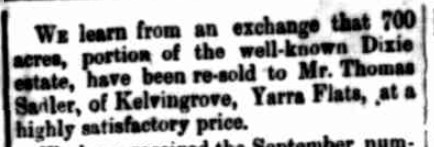
CURRENT TOPICS. (1888, September 13). Camperdown Chronicle p. 2. http://nla.gov.au/nla.news-article18584661

Thomas was given a send-off at the Yarra Flats Hotel in September. Ruth wasn’t in attendance but Thomas accepted a gold watch on her behalf as a going away gift for her hospitality and kindness. The Sadlers moved to the property at Dixie which they named Ecclefechan after a village east of Dumfries in southern Scotland, close to where Thomas was born.

Thomas died in February 1903. The following month, Ruth suffered another loss when her married daughter Annie Carson was found drowned in a well at Dixie. Ruth died at Doctor Brown’s Private Hospital in Colac and was buried at the Terang Cemetery. She was aged seventy-one.

MURRAY, Janet – Died 8 March 1919 at Clear Lake. Janet Murray was born around 1830 in Glasgow and arrived in Australia about 1852 on the James Steadford. In 1853, she married Alexander Robertson at the Geelong Presbyterian Church. They spent some time in Ballarat around 1854 before returning to Geelong until around the late 1860s,

The next move for the Robertsons was to Bochara station in the Hamilton district where they spent nine years, Land was opening up in the Clear Lake district to the north of Balmoral and Alexander selected land there around 1880. The Robertsons then moved south to the Telangatuk district. Alexander died in 1898.

During WW1, Janet was involved with the Telangatuk East branch of the Red Cross. By April 1917, she had knitted thirty-nine pairs of socks over the past year. Janet’s obituary stated, by the end of the war she had knitted 100 pairs of socks.

 (1917, April 5). Rupanyup Spectator and Lubeck, Banyena, Rich Avon and Lallat Advertiser,p. 2. http://nla.gov.au/nla.news-article121052771

Janet died in 1919 at the age of eighty-nine. She left seven children, five boys and two girls, 49 grandchildren, and 39 great-grandchildren.

COLLIE, Ella Georgina – Died 22 March 1941 at Cobden. Ella Collie was born in 1882 at Caramut. She went to school at Caramut before her family moved to Camperdown sometime after 1894.

Ella had sang at school and when once in Camperdown she started singing with the Presbyterian church choir and also as a soloist. In October 1901, she sang at celebrations for the opening of Camperdown’s new Presbyterian church.

CAMPERDOWN PRESBYTERIAN CHURCH. Image courtesy of the State Library of Victoria http://handle.slv.vic.gov.au/10381/63175

In 1902, the Collie’s left Camperdown for Terang and Ella and her brother George were given a send off by the choir. Ella received a gold brooch.

PERSONAL. (1902, June 3). Camperdown Chronicle p. 3. http://nla.gov.au/nla.news-article26566773

In 1906, Ella married William McConachy and they setteled at Koortmoolong on the Port Campbell Road at Jancourt, east of Terang. Ella continued her singing into married life. In 1916, she sang at a concert to raise funds for the Jancourt school’s organ fund.

Ella threw herself into community life. In July 1917, she held a “kitchen utensil” evening at Koortmoolong.

Cobden Times and Heytesbury Advertiser 28 July 1917: 2 http://nla.gov.au/nla.news-page16521487

In 1918, Ella was in charge of the produce stall at the Jancourt Jumble Fair, raising funds for the British Red Cross.

Around 1920. the McConachys moved north to Cobden. Ella continued her community activities in Cobden, always offering a helping hand at events. As a member of the Cobden Presbyterian Church (below), she was involved with the Presbyterian Ladies Guild and was vice president in 1936. She was also a member of the Presbyterian Women’s Missionary Union (PWMU).

COBDEN PRESBYTERIAN CHURCH AND SUNDAY SCHOOL c1933 Image courtesy of the Museums Victoria Collections https://collections.museumsvictoria.com.au/items/772413

In 1932, Ella was vice president of the Cobden Boy Scouts Association. She was also on the committee of the Cobden auxiliary of the Camperdown hospital and in 1938 was vice president She was a vice president and president of the Cobden branch of the Australian Women National League (AWNL) and represented Cobden at the annual AWNL conferences in Melbourne. At the 1939 conference, the delegates were addressed by Prime Minister Menzies. .

Ella died in 1941 aged fifty-eight, leaving her husband William, four daughters, two sons, and two grandchildren. She was buried at the Cobden cemetery. A memorial service was held at the Cobden Presbyterian Church,

LAING, Agnes Isabel – Died 7 March 1944 at Port Fairy. Agnes Laing was born at Yallock station around 1864 where her father was the manager. The family moved to nearby Terang while Agnes was still a young girl.

After leaving school, Agnes became a teacher, registered in 1879 and taught at the Terang school. Her teaching career ended in 1895 when she married William Osburne the owner of the Terang Express newspaper. Agnes and William went on to have one son, George Laing Osburne, known as Laing, the following year.

Agnes attended the Terang Presbyterian Church, and was the organist for nine years.
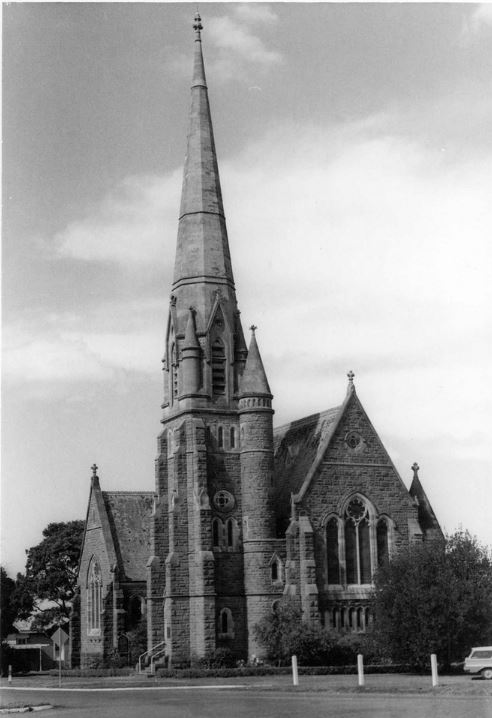
TERANG PRESBYTERIAN CHURCH. Image courtesy of the J.T. Collins Collection, La Trobe Picture Collection, State Library of Victoria. http://handle.slv.vic.gov.au/10381/234278

Agnes was interested in politics and was involved with the Australian Women National League (AWNL). In 1913, she was recognised for her work as secretary of the local branch of the AWNL. In 1938, she was presented with a gift for the recognition of her services to the Terang branch of the AWNL.

During WW1, Agnes was an active member of the blind auxiliary and she was in charge of the Red Cross Jumble Shop in Terang. In July 1915, Agnes wrote a letter to the editor of the Camperdown Chronicle to announce the opening of the Jumble Shop. She also wanted to put to rest rumours goods donated for the front were not reaching those they were intended. She was also involved with the Terang sub-branch of the Returned Sailors’ and Soldiers’ Imperial League of Australia ( R.S.S.I.L.A.).

In the 1920s, Agnes was on the committee of the Terang Rest rooms. She enjoyed golf and played at the Terang Golf Club. She often played with William and in August 1929, they paired up in the Mixed Foursomes at the Terang Golf Club annual tournament.

Agnes and William lost their only son in 1933, when Laing died. William died in 1939. Agnes lived out her days at her home in High Street, Terang with her widowed daughter-in-law Eugenie. Agnes died in 1944 at the Port Fairy Hospital at the age of eighty. She was buried at the Terang Cemetery.

SCOULLER, Mary – Died March 1946 at Colac. Mary Scouller was born at Carpendeit, east of Cobden in 1886. She married Arthur Fisk in 1922 and they spent some time living at Korweinguboora, south of Daylesford where Arthur ran a grocery and post office. They returned to Carpendeit around 1931 living at Leura View.

Mary was an active worker for the Bungador State School and the Bungador Presbyterian Church. Services were held at her home as there was no church at Bungador. She was also involved with other charities and during WW2, the local patriotic funds. Her son Charles enlisted in 1941.

Mary died in 1946 at the age of sixty, leaving Arthur, two sons and two daughters. She was buried at the Colac Cemetery.

Wonderful Western District Women Part 7

Emma CROUCH (1832-1904)

Emma Crouch was born in 1832 in London, England the youngest daughter of Edmund and Matilda Crouch.  Her father died while she was still a young girl and her older brothers George and Charles left England for Australia arriving in Portland around 1838.  Her sister Matilda married and moved to the United States of America in 1849. Emma continued to live with her mother and they resided at Roxeth, in the parish of Harrow on the Hill in London.  By the 1861 England Census, Emma and her mother were living still at Roxeth with Emma was working as a governess. Her mother died two years later.

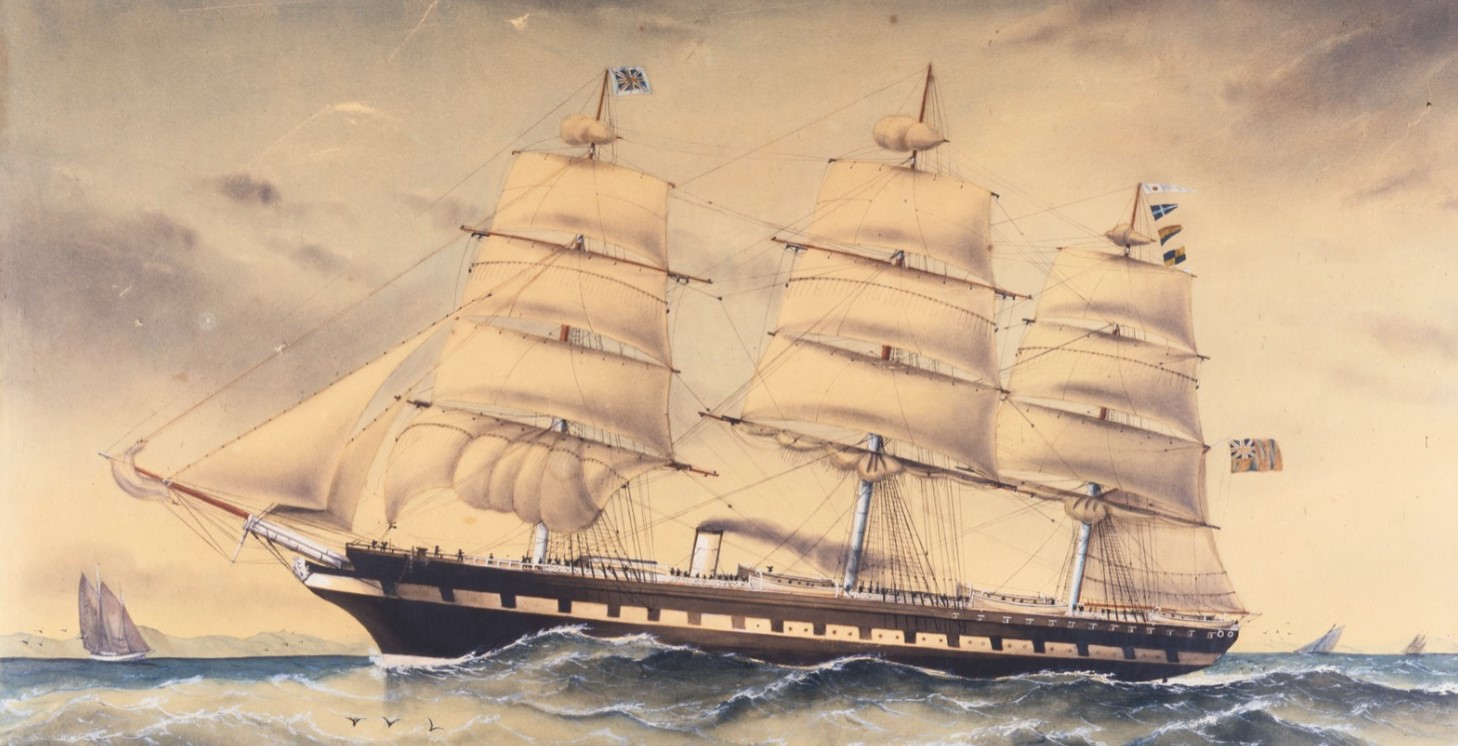
In 1865, Emma’s sister Matilda died in California, and her children, Arthur McCann aged twenty, Kate McCann aged sixteen, and Eustasia de Arroyave aged eight, travelled to England to live with Emma in Roxeth. The following year, Emma then aged thirty-four along with her nephew and nieces, boarded Great Britain (below) for Melbourne arriving on Boxing Day, 1866. 

“GREAT BRITAIN”. Image courtesy of the State Library of Victoria http://handle.slv.vic.gov.au/10381/95167

They then caught the steamer S.S. Edina (below left) to Portland to join Emma’s brother George and Charles.

SS EDINA NEAR WARRNAMBOOL c1863. Image courtesy of the State Library of Victoria http://handle.slv.vic.gov.au/10381/28324

The brothers had established themselves in Portland. Both were in business and George was one of Portland’s first councillors. The Trangmar brothers James and Charles were their business partners at times and George and Charles each married a Trangmar sister.  

Once settled in Portland, Emma started a school in Hurd Street. 

Advertising (1876, July 11). Portland Guardian, p. 2 (EVENINGS.). http://nla.gov.au/nla.news-article63316814

She was also an active member of the St. Stephen’s Anglican Church (below).

ST STEPHEN’S ANGLICAN CHURCH, PORTLAND. Image courtesy of the State Library of Victoria http://handle.slv.vic.gov.au/10381/4157628

The Crouch family connection with the Trangmar family continued in 1876 when Emma’s niece Kate married James William Trangmar, a son of James Trangmar Sr. They moved to Coleraine where the Trangmar family operated a store. In the following years, Emma and Eustasia also moved to Coleraine, around the time James took over full operations of the store.  I like to think Emma and her nieces may be in the photo below, possibly in the garden of the adjoining house.

J.W TRANGMAR’S STORE, COLERAINE c1890. Image courtesy of the Museums Victoria Collections https://collections.museumsvictoria.com.au/items/767465

Emma also established a school for young ladies in Coleraine beginning in 1881.

Advertising (1880, December 16). Hamilton Spectator, p. 4. http://nla.gov.au/nla.news-article225488162

She kept busy in the Coleraine community.  She was a member of the Coleraine Glee Club with Kate and Eustasia. The glee club opened the evening entertainment at the Coleraine Presbyterian Concert in 1881, thought to be the best concert held in Coleraine. Also on the bill that night, was Alfred D’Orsay Tennyson Dickens, a son of author Charles Dickens. Alfred was living in Hamilton then and dropped in to read one of his father’s works.

COLERAINE c1909 Image courtesy of the State Library of Victoria http://handle.slv.vic.gov.au/10381/385977

Emma was an active member of the Holy Trinity Anglican Church congregation and ran the local Girls Friendly Society connected to the church. The first Coleraine Industrial Exhibition was held in    1887  and Emma was on the executive committee. For the 1890 exhibition, the walls of the hall were adorned with artworks by local ladies including Emma. At the 1894 exhibition, Emma won first prize with her tortoiseshell cat.  She also entered potted plants and cut flowers into shows run by the Coleraine Horticulture Society.

Portland was still close to Emma and she often holidayed there. In 1904, however, Emma fell sick after her return to Coleraine from a summer holiday in Portland. To convalesce, she travelled with Eustasia to Kate’s home in Sturt Street, Ballarat but she died on 11 April 1904. She had remained close to her nieces during their thirty-eight years in Victoria and it was fitting Emma spent her last days with them.

The Portland Guardian reported Emma’s remains arrived by the evening train, then were “resting the night before the altar at St Stephen’s” ahead of the funeral service. The funeral cortege left the church for her burial at the Portland Cemetery. 

A memorial service was also held at Coleraine after her death and, on 20 December 1904, a stained glass window was dedicated to the memory of Emma at the Holy Trinity Church, Coleraine (below). It was made by Mr. Montgomery of Melbourne and it depicted the Good Shepherd with the words “To the glory of God and loving memory of Emma Crouch, born Oct. 8, 1832, at rest April 11, 1904”

HOLY TRINITY CHURCH, COLERAINE 1970. Image courtesy of the J.T. Collins Collection, La Trobe Picture Collection, State Library of Victoria http://handle.slv.vic.gov.au/10381/216987

DRISCOLL Mary (c1828-1908) also known as Mary O’DRISCOLL and Mary WADMORE

Mary O’Driscoll was born in Middlesex, England around 1828.  At the age of twenty, she married James Wadmore and they started a family.  On 8 November 1854, the couple and baby Mary boarded the Constant at Southhampton with their destination being Portland Bay.  James acted as an assistant to the ship’s surgeon on the voyage which saw an outbreak of whooping cough.  

Local Intelligence. (1855, February 26). Portland Guardian and Normanby General Advertiser, p. 2 (EVENING). http://nla.gov.au/nla.news-article71571784

The Constant arrived at Portland Bay on 22 February 1855. Mary was carried ashore by one of the crew.

PORTLAND BAY c1857. Image courtesy of the State Library of Victoria http://handle.slv.vic.gov.au/10381/266998

James secured work with Charlton Hedditch at Cape Bridgwater, twenty kilometres or so further west. It was an isolated area on the coast, a far cry from Westminster, London.  It was there in 1855, a daughter Anne was born. In 1856, James was able to select land at Cape Bridgewater, close to what is now Blowholes Road, in partnership with George Terril. A son William was born the following year and a daughter Sarah in 1859.

A month after Sarah’s birth, James was fishing on the rocks on the west coast of Cape Bridgewater with his mates George Terrill and Robert Wilson. 

CAPE BRIDGEWATER c1880. Image courtesy of the State Library of Victoria http://handle.slv.vic.gov.au/10381/335580

The sea was rough and the men decided to move from their position as it was becoming dangerous. They set up in a new spot but about ten minutes later James returned to where they were first located.  A large wave came up and washed him from the rocks. George and Robert saw him swimming but he soon tired and sank.  His body was found washed up on the rocks the following Thursday and an inquest was conducted.  Mary’s account was forwarded to Portland’s Police Magistrate and subsequently to the Portland Guardian and Normanby General Advertiser.  

FATAL ACCIDENT AT BRIDGEWATER (1859, October 31). Portland Guardian and Normanby General Advertiser, p. 3 (EVENINGS.). http://nla.gov.au/nla.news-article64512566

CAPE BRIDGEWATER. Image courtesy of the State Library of Victoria http://handle.slv.vic.gov.au/10381/64458

That left city girl Mary with a farm and four young children, including a newborn to raise alone. However, with the help of the other women in the district, she soon learned all she needed to run her farm and raise her children in the harsh and often lonely environment she found herself in.

Mary’s care extended beyond her own family. She was known for riding a “spirited bay mare” across the district helping those who were sick. In doing so, she was familiar with the ailments of the local residents.  In 1873, Mary was called as a witness at the inquest into the death of young Joshua Black who was found dead in his bed one Monday morning in May. Mary was one of the last people to see Josuha alive on the previous evening, and she was able to say he appeared well and in no pain. With her knowledge of Josuha’s medical history, she was also able to offer the evidence that Josuha’s health at times was fragile and he had previously had a bad cough and some pain above his heart but had been well since the last winter. Margaret’s witness statement is part of the inquest file of Josuha Black held by the Public Record Office of Victoria and available online. In her statement, her opening sentence was, “I am a labouring woman living at Cape Bridgewater”.

When Mary’s daughter Sarah was fifteen, around 1874, the local state school teachers approached Mary with an offer to train Sarah as a teacher. Mary was very proud of Sarah who went on to become the headteacher at Kentbruck six years later. Mary remained at Cape Bridgewater until around 1905. By then, Sarah was the headteacher at Tahara State School and her sister Anne was living with her and keeping the house. Sarah retired from her position and she and Anne moved to Portland. It was planned Mary would move from Bridgewater to live with them.  She sold her various farm implements.

Advertising (1905, June 16). Portland Guardian, p. 2 (EVENING). http://nla.gov.au/nla.news-article63692584

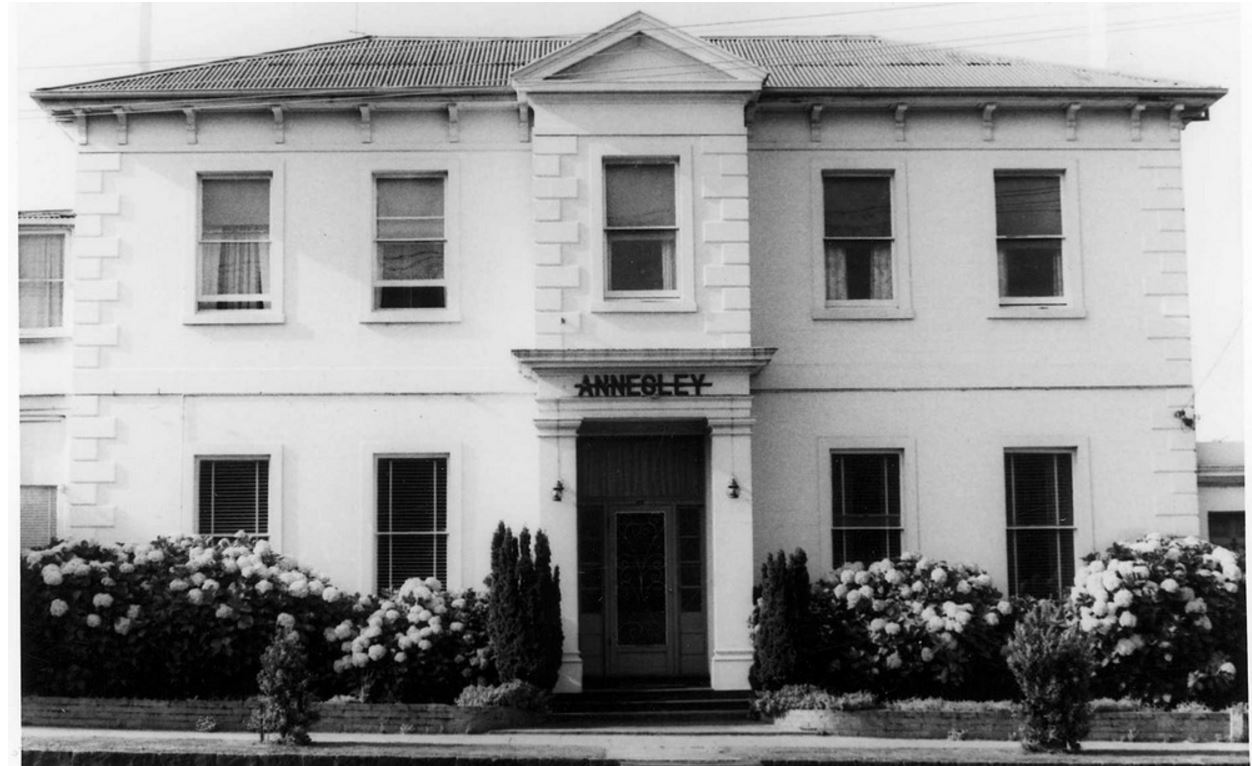
Sarah and Ann purchased, Annesley in Julia Street, Portland, to operate as a private guest house. 

“ANNESLEY”, PORTLAND Image courtesy of the J.T. Collins Collection, La Trobe Picture Collection, State Library of Victoria. http://handle.slv.vic.gov.au/10381/233404

The girls looked after her mother until her death at Annesley on 3 March 1908.  Sarah and Anne continued on in Portland with Sarah contributing to the Book of remembrance of the pioneer women of the Portland Bay district in 1934, in which Mary’s story was told.  Sarah Wadmore died in 1941 and her sister Ann in 1942.

Margaret BROWN:  (1835-1939) also known as Margaret WALKER

MARGARET WALKER. The Age, 11 August 1939

“As quietly as she had lived for 104 years, Mrs. Thomas Walker, Hamilton’s grand old lady, passed away at her home in Shakespeare Street on Thursday last.” (Portland Guardian, 23 October 1939)

And so began the obituary of Margaret Walker (nee Brown).  After fourteen years of the newspapers documenting some of Margaret’s significant birthdays, 90, 99, 100, 101, 103, and 104, they were saying their last farewell to a woman who lived during the reign of six British monarchs. 

Margaret was born in Launceston on 11 August 1835 to Scottish immigrants John and Margaret Brown.  They had arrived in Launceston in the early 1830s.  They headed to Victoria around 1840 on the City of Sydney and John Brown was employed at Customs House in Portland.  On 11 August 1852, Margaret’s seventeenth birthday, she married Thomas Walker, a twenty-nine-year-old Londoner who had arrived in Portland in the early 1840s.  They were married by Presbyterian minister Reverand Ross at Portland.

The couple settled in Portland and remained there until 1866, when they moved to Hamilton, residing in Lonsdale Street.  Thomas made his living as a land agent and was able to acquire land around the town. Margaret and Thomas had eight children.  Two died as babies and in September 1880, her eldest son John Thomas died aged twenty-one.  Then in July 1900, their son Frederick was accidentally killed at Subiaco, Western Australia.

Close to 1909, Margaret and Thomas went to live at 5 Shakespeare Street, Hamilton and that is where Thomas died in April 1909 at the age of eighty-six. By that time, Mary had one remaining son, George who lived in Geelong, and two daughters, Eliza in Melbourne and Maria who lived with Margaret.

When Margaret was ninety-seven, Maria died on 1 July 1932 at Hamilton at the age of seventy-six. The following year was Margaret’s ninety-eighth birthday and she was given a walking stick. By the time her ninety-ninth birthday came around in 1934, she hadn’t used the walking stick.  She also didn’t wear glasses and would spend a few hours in her garden each day. By that time she also had nine grandchildren and nine great-grandchildren.

Also in 1934, was the centenary of white settlement in Victoria, and an event was planned for Portland on 19 November. Margaret booked her accommodation well in advance. Her name would appear in the Book of remembrance of the pioneer women of the Portland Bay district written to coincide with the celebrations. She was one of only thirty-five female settlers named in the book still alive for the centenary. On the day, she was seated in a special area for those who had lived in Portland prior to 1864. 

PORTLAND CENTENARY CELEBRATIONS 1934. Image courtesy of the Museums Victoria Collections https://collections.museumsvictoria.com.au/items/766444

Margaret expected to be presented to the Duke of Gloucester but organisers overlooked that detail on the day. Word got back to the Royal party and a letter was forwarded to Margaret. She received it from His Royal Highness through his equerry (Captain Schrieber) in December 1934. It read:

The Royal train, Queensland, December 3rd, 1934.

Dear Madam, the Duke of Gloucester is sorry to hear that, owing to an oversight, you were not presented to him when His Royal Highness visited Portland, and he wishes me to congratulate you on attaining the age ninety-nine years, and hopes that you will continue in good health to see your centenary. You will be glad to know that His Royal Highness enjoyed his visit to Portland very much.

It was a busy year. Margaret planted a commemorative tree at the western end of Gray street, Hamilton for the centenary celebrations, and she produced seventeen pieces of eyelet linen work, made to give as gifts to family and friends.

In 1935, Margaret’s 100th birthday celebration was held at the Hollywood Cafe in Hamilton with the Mayor of Hamilton, Cr. Stewart, in attendance. The Hollywood Cafe can be seen on the extreme left in the photo below. The enclosed verandah displayed the name of the cafe, and it shared the ground-level verandah with the boot and shoe store.

GRAY STREET, HAMILTON. Image courtesy of the State Library of Victoria http://handle.slv.vic.gov.au/10381/62977

After that outing, it became difficult for Margaret to get out on her birthday, so the Mayor of the day would visit her at her home instead. For her 101st birthday in 1936, twenty-five friends and family gathered at Margaret’s home in Shakespeare Street. Highlights were a birthday cake with 101 candles and a telegram from the Red Cross Society. Sadly Margaret’s daughter Eliza died in November of that year.

The next three birthdays were celebrated quietly at home but Margaret continued in good health. That was until only weeks after her 104th birthday. Margaret became fragile, eventually passing away on Thursday 19 October.  She was buried the following day at the Hamilton (Old) Cemetery with Thomas and Marion.

GRAVE OF THOMAS AND MARGARET WALKER AND THEIR DAUGHTER MARION WATSON. HAMILTON (OLD) CEMETERY. Image courtesy of the State Library of Victoria

Her obituary read:

During the whole of her sometimes eventful life, Mrs. Walker was a lover of all things beautiful, and in quiet contentment, surrounded by her own people and home where she could indulge her liking, which amounted to almost passion, for her garden, she enjoyed to the full her heart’s desire.  (Portland Guardian  23 October 1939)

The remaining living member of Margaret’s immediate family at the time of her death was her son George Joseph Walker. He died in 1960 at Geelong.

REID, Isabella (c1873 -1953) Also Known as Isabella Gilhome

Isabella Reid was the daughter of William Reid and Johanna Steven and was born near Heywood in 1874, one of thirteen children. The Reid farm was Athol Hill on the Fitzroy River two miles from Heywood. In August 1917, Isabella then aged thirty-four, married Charles Gilhome of Colac at the Heywood Presbyterian Church.  The reception was held at Heywood’s Federal Coffee Palace on the corner of Edgar and Scott Streets and owned by her father.

Portland Guardian (1917, August 17) p. 2 (EVENING). http://nla.gov.au/nla.news-article64019248

Isabella and Charles at first lived at Heywood but moved to Bundoora in early 1918. It was then a rural area and Charles ran a dairy farm.  Around the same time, Charles began feeling unwell and was diagnosed with a liver condition. That led to depression and in July 1918, his doctor told him he should go away for a while. Charles and Isabella discussed his plight and Charles decided he would go away for a break. But it was too late. He died on Friday 12 July 1918.

Isabella initially stayed in the Bundoora area but returned to Heywood to be with her aging parents. In 1921, her father William died and in December 1922, the property in his estate was put up for sale including Athol Hill and the coffee palace.  Isabella went on to purchase the coffee palace and adjoining land from the sale.

Advertising (1922, December 23). Weekly Times, p. 18.  http://nla.gov.au/nla.news-article224001699

Vanda Savill’s book Dear Friends, Heywood (1976) mentions Isabella Gilhome and her sister Eliza Reid ran the coffee palace owned by the Reid family.  It’s hard to establish when that was. A newspaper article from the Portland Guardian in 1914 mentions Miss Reid as the hostess, however that could have been her sister Eliza.

Heywood Jottings. (1914, April 29). Portland Guardian, p. 3 (EVENING).  http://nla.gov.au/nla.news-article63968838

Isabella didn’t hold ownership of the coffee palace for long because, in September 1924, it and the adjoining shop was purchased by Edwin Bond.

In May 1925, Isabella’s mother Johanna died aged eighty-three.  After her death, Isabella purchased Retreat in Millbanke Street, Portland, and she and her sister Eliza left Heywood.

News in Brief (1925, October 26). Portland Guardian, p. 3  http://nla.gov.au/nla.news-article64108579

 On 8 July 1927, a furniture sale on Isabella’s behalf was held at Retreat with the property already sold.

Advertising (1927, June 30). Portland Guardian, p. 2 (EVENING).  http://nla.gov.au/nla.news-article64257690

Isabella again returned to Heywood.  As a widowed woman, it was necessary for Isabella to generate an income and she was able to do that with property investment. Later her obituary would read, 

After the death of her husband, Mrs. Gilhome took part in many business transactions, becoming well known as a keen businesswoman through the purchase and sale of houses and shops. She was one of the first to recognise the growing land values in a period of rapid development.

In May 1929, Isabella bought a block of land and house in Heywood from the estate of Patrick King with frontages to Edgar and Lindsay Streets. 

Advertising (1929, April 24). Portland Guardian, p. 2 (EVENING).  http://nla.gov.au/nla.news-article64269205

In 1932, she applied to purchase Crown Land adjoining Scott, Edgar, and Lindsay Streets.  While in 1945, she applied to subdivide allotments 4 and 5 of section 7 in Lindsay Street. In 1946, the Portland Shire Council bought a house belonging to Isabella at Heywood for £1300 for use as an engineer’s residence.  

Isabella’s activities in Heywood and Portland went beyond business. She was a generous and charitable woman and gave back to the community. In 1927, she donated a blackwood armchair to the Portland Hospital and another chair for the women’s ward at the hospital.

PORTLAND HOSPITAL c1945. Image courtesy of the State Library of Victoria http://handle.slv.vic.gov.au/10381/366378

During WW2, Isabella was active with the Heywood Red Cross and was on the committee of the Heywood Returned Soldiers Association Women’s Auxilary  She donated money and knitted balaclavas and socks towards the war effort. 

William and Johanna Reid were among the earliest parishioners at St Andrew’s Presbyterian Church in Heywood and by 1939, their daughter Isabella was the oldest parishioner. In April 1939, she was given the honour of turning the key at the official opening of St Andrew’s Sunday School. Her connection to St Andrew’s extended to the Heywood Presbyterian Ladies Guild.

Isabella Gilhome died in July 1953 at Heywood aged eighty. She was buried at the Heywood Cemetery.   

You can read about more Wonderful Western District women on the link: Western District Women