Passing of the Pioneers

March Passing of the Pioneers shares obituaries of well-known residents of Hamilton, Heywood and Portland. They include the surveyor of Camperdown and yet another man who was at Blue Lake, Mt. Gambier the day Adam Lindsay Gordon took his famed leap.

Thomas BROOKS Died 7 March 1888 at Hotspur. At the time of his death, Thomas Brooks was one of the oldest inhabitants of the Heywood district, having arrived in 1853. His death was a result of an accident after sixty-two-year-old Thomas delivered a coffin to Hotspur from Heywood for the funeral of Mr Fidler. After the funeral, he returned home, only to fall from his horse. He received head injuries, from which he died. A contract worker for the local shire, Thomas was known as an eccentric and was referred to as “Old Tom Brooks”  For more information about Thomas see the South-West Victoria Pioneers website.

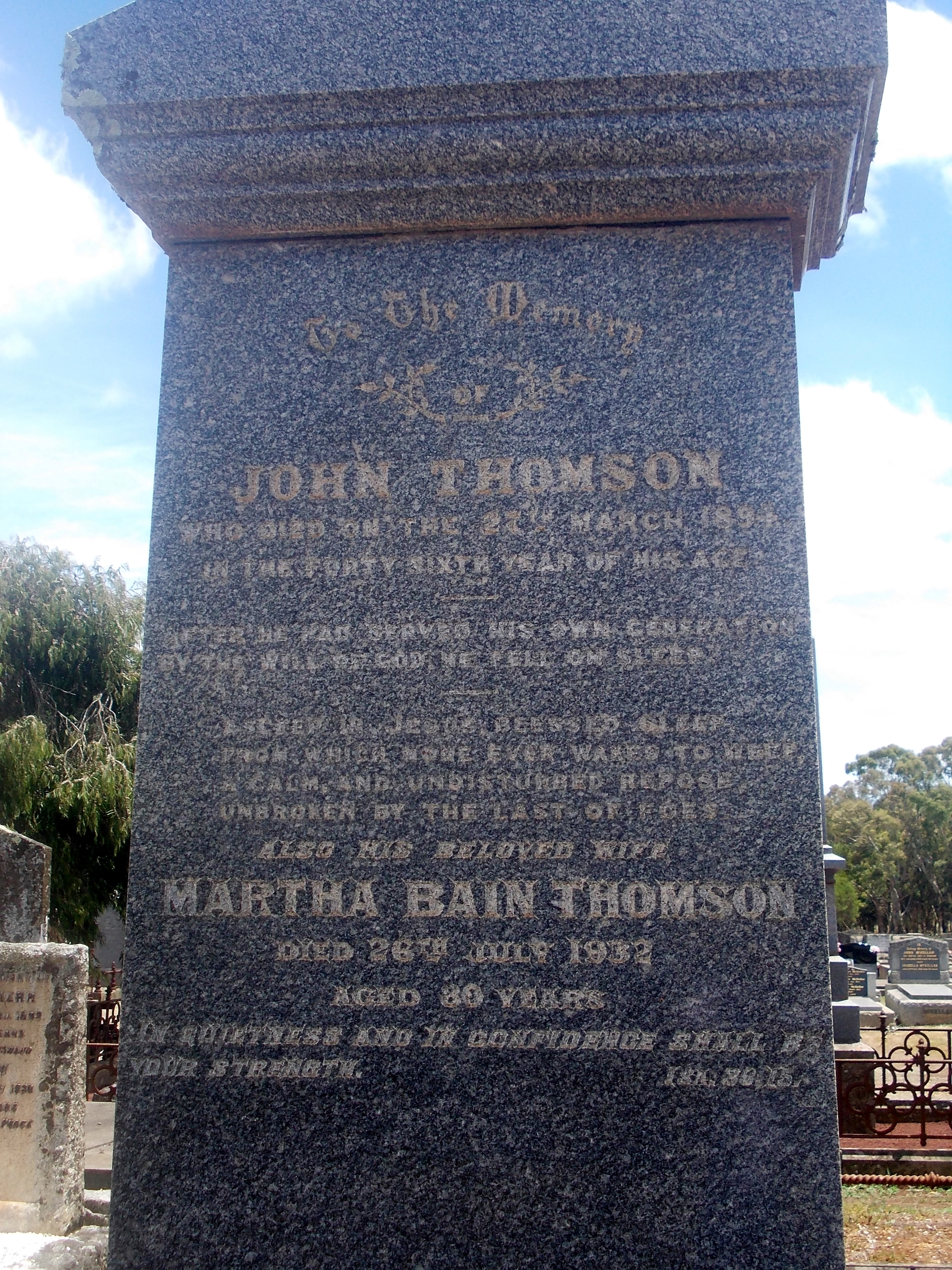
John THOMSON Died 27 March 1894 at Melbourne.  Anyone who lived in Hamilton and district prior to the late 1980s would know the name John Thomson as that was that name that adorned the front of one of Hamilton’s longest-running department stores John Thomson & Co of Gray Street, locally known simply as Thomsons. John Thomson arrived in Victoria from Scotland at a young age and was educated at Scotch College, Geelong, and the Hamilton Academy.  He joined his uncle and brothers, Alexander and William in the store, first established as an Iron store in 1866, and later became a partner.

In 1877, John married Martha Bain Brake,  He had a strong association with the Hamilton Presbyterian Church and when he died, aged forty-six, he was attending the Convention of the Presbyterian Fellowship Association in Melbourne.  A diabetic, he fell sick over the weekend and died as a result.

Advertising. (1953, July 21). The Argus (Melbourne, Vic. : 1848 - 1957), p. 21. Retrieved March 27, 2014, from http://nla.gov.au/nla.news-article23256981

Advertising. (1953, July 21). The Argus (Melbourne, Vic. : 1848 – 1957), p. 21. Retrieved March 27, 2014, from http://nla.gov.au/nla.news-article23256981
 

Robert Dunbar SCOTT: Died 7 March 1898 at Surrey Hills. Robert Scott was born in Scotland and he and his wife arrived in Victoria around 1851. Robert was employed as a land surveyor, his first job to survey the western part of Port Phillip.  He set up camp near what would become the town of Camperdown and set about laying out a new township. He named the first streets, including Manifold Street after the Manifold brothers.  He selected land on the banks of Lake Gnotuk and established the property, Gnotuk Park

LAKE GNOTUK. Image courtesy of the State Library of Victoria http://handle.slv.vic.gov.au/10381/289329

Robert was a member of the local P&A Society and the Freemasons. In the late 1890s, he sold Gnotuk Park and let property at Craigieburn. He later moved to Melbourne establishing himself as a commission agent but lost money in the crash after the land boom. A further account of Robert Scott is on this link – A Link With The Past – Interview with David Scott.

Mercy ERRI: Died 26 March 1932 at Cobrico. Mercy Erri was born in England and arrived in Victoria with her parents in 1857. Her father started in business in Camperdown, one of the early pioneers of that town. Mercy trained as a nurse and was a Sunday School teacher. In her later years, she became an invalid, confined to her bed, but she continued to produce beautiful needlework, even with failing sight. Mercy was eighty-eight years old when she died. She never married.

James MOLLOY: Died 25 March 1937 at Portland. James Molloy arrived in Portland with his parents aboard the British Empire when he was eleven. He went to school at All Saints school in Portland and during those years spent time with William Dutton extracting oil from whale blubber. He was then employed by Edward Henty at Narrawong. His next job was for the Bell’s at Heywood, training racehorses, his greatest success winning the Great Western Steeplechase at Coleraine.  Apparently, he was with Adam Lindsay Gordon on the day Gordon took his leap at Blue Lake, Mt Gambier. He later returned to Portland, working as a storeman and a waterside worker. James married Mary Beglen and they had three sons and two daughters.

David Edmund BATES: Died 5 March 1938 at Casterton. David Bates was born at Narracorte before moving to Casterton with his parents when six. He was educated at the Casterton school before becoming an apprentice draper with Mr Mills.  David was an athlete and once ran second in the Stawell Gift. He took a great interest in the public affairs of Casterton and served as secretary on the Casterton Hospital board.

Eliza MOORE: Died 24 March 1939 at Colac. Eliza Moore was born in Ireland in 1854 and travelled to Victoria as a child aboard the Chance. Her parents settled at Port Fairy and later at Woodford. Eliza married Alexander Russell at Warrnambool and they farmed at Dennington. They then moved to Colac where they remained until Eliza’s death. In her younger years, Eliza was an excellent horsewoman and was devoted to the Church throughout her life.

Daniel FENTON: Died 17 March 1943 at Camperdown. Daniel Fenton was born in Camperdown in 1860 and was the first child baptised at the St. Andrews Presbyterian Church in the same year. He continued his association with the church for the duration of his life. Educated at Camperdown State School, he spent his entire working life as a dairy farmer. He married Mary Ann Shenfield of Cobden and five children were living at the time of Daniel’s death.

 

Oh No…I Missed Trove Tuesday

After 82 consecutive Trove Tuesday posts, I’ve missed one.  Yes, I just couldn’t get a post prepared this week and I’m a bit sad that it has come to an end.  I really was hoping to get to 100 without a break.  Now that I have broken the succession, it is a good time to say that I will have a short break from Trove Tuesday.

With a lot going on in my life including a rapidly approaching due date for my thesis , I need to take a break.  I will still have a March Passing of the Pioneers post (hopefully in time) and will of course post for the Anzac Day Blog Challenge, which I just can’t miss.  In the meantime, if I get a chance to post I will, but I’m not making any promises.

For Trove Tuesday this week, I intended to share some feedback from my post a few Tuesdays back called “Dear Cinderella”.  It is always a bit nerve-racking when I write about someone, not related to me who people may remember.  I did it when I wrote about Lottie Condon, Sultan Aziz, Elsie Day and again when I wrote about the owners of  Skipton, the 1941 Melbourne Cup winner.  I heard from family members of each of those people, which is great and, thankfully, the responses were positive.

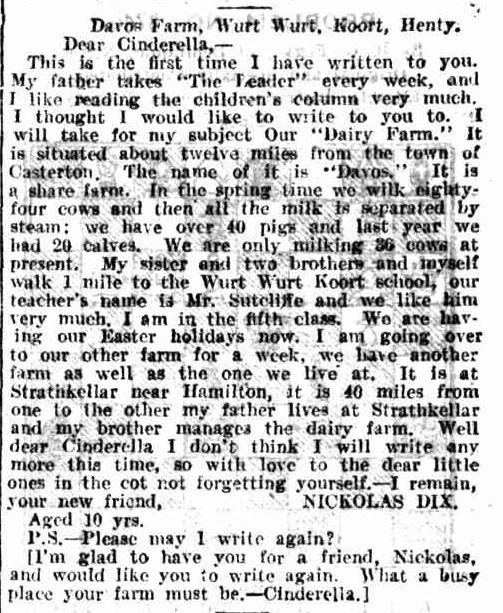
I was lucky enough to receive an email and a blog comment from the granddaughters of Nicholas Dix, Paula and Dallas.  Nicholas was one of the many children that wrote to the Leader Newspaper’s “Dear Cinderella” column.  His description of his farm life in the Western District gives those researching the area a great record of daily life during that time, but for Paula and Dallas it provides a wonderful piece of family history.  His granddaughters on finding my post were “thrilled” to have this reminder of their much loved grandfather who passed away over 30 years ago.


CORRESPONDENCE. (1914, June 13). Leader (Melbourne, Vic. : 1914 - 1918), p. 58. Retrieved January 27, 2014, from http://nla.gov.au/nla.news-article89313857

CORRESPONDENCE. (1914, June 13). Leader (Melbourne, Vic. : 1914 – 1918), p. 58. Retrieved January 27, 2014, from http://nla.gov.au/nla.news-article89313857

I may have found the article, but it is the work of  those at Trove Australia, bringing us the great resource of digitised newspapers, that led to Nicholas’ letter coming to light.  Without the digitisation program, the letter may have remained buried in an archive, possibly to be never read again.  My aim with many of my Trove Tuesday posts, is to find such lost treasures and bring them out for all to read.  If you would like to read my previous 82 Trove Tuesday posts until I resume them again, follow the link – Trove Tuesday.  In the meantime, I hope that other bloggers continue the Trove Tuesday tradition of sharing Trove’s treasures.

Trove Tuesday – Money Shortage

Still on the subject of Charles James Harman, this is an interesting snippet from the Townsville Daily Bulletin of September 3, 1930.

In the 1920s,  Charles, his wife Lavinia Fisher and daughter Mary travelled to London for Charles to take up a post with the R.A.A.F. at the R.A.F. headquarters.  His position was terminated in 1930 and the family returned to Melbourne.  The world was in Depression and while this was not the apparent reason for Charles’ role ending, it was probably a good time to return home.

According to Lavinia, even if Australians in London had money in the bank they could only access their funds after a 60 day waiting period.  The jewellery had to go with women selling off their valuables, probably at a deflated price, just to get some cash to survive.

AUSTRALIANS IN LONDON. (1930, September 3). Townsville Daily Bulletin (Qld. : 1885 - 1954), p. 7. Retrieved March 18, 2014, from http://nla.gov.au/nla.news-article60774888

AUSTRALIANS IN LONDON. (1930, September 3). Townsville Daily Bulletin (Qld. : 1885 – 1954), p. 7. Retrieved March 18, 2014, from http://nla.gov.au/nla.news-article60774888

Trove Tuesday – Charlie and Arthur

Newspapers are great for filling in the gaps in our family histories, uncovering information that would never be known using vital records alone.  That has been the case with my research on my gg uncle Charles James Harman.  The co-subject of last week’s Trove Tuesday post, Charles just keeps popping up in the papers offering me more and more about him.  I had found a lot of information on his post-war life in The Argus, but the arrival of the Hamilton Spectator and the Port Fairy Chronicle at Trove has helped me fill in his pre-war days, spent around Macarthur and Byaduk.

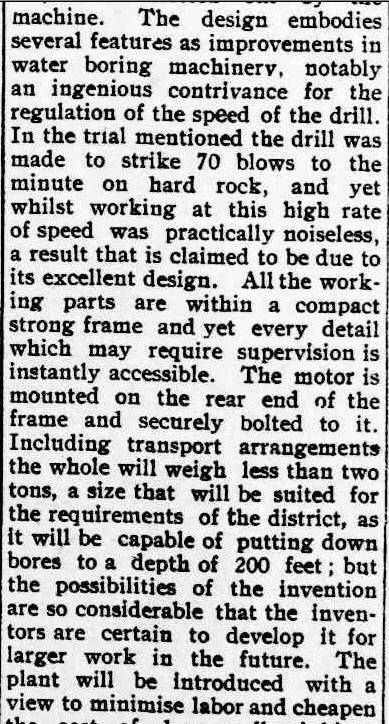
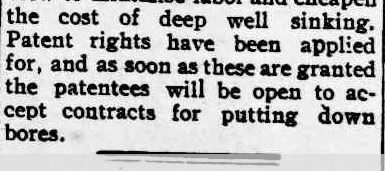
Firstly, I discovered why Charles’ engineering skills were quickly noticed by the Australian Flying Corps (AFC), with his mechanical crew keeping the No.1 Squadron in the air over Egypt during WW1.  Also, I found Charles had a friend.  Yes, even our ancestors had friends and I’m always keen to find those relationships.  The following article from the Port Fairy Chronicle drew my attention to the working relationship between Charles and Arthur Parfrey, but the letter Charles wrote to Arthur, featured in last week’s Trove Tuesday, proved they were mates too.

cj3cj4

cj5

Macarthur Matters. (1914, December 31). Port Fairy Gazette (Vic. : 1914 – 1918), p. 2 Edition: EVENING. Retrieved March 10, 2014, from http://nla.gov.au/nla.news-article91982808

Twelve months before this article, Charles became a widower after his wife Catherine Kinghorn passed away.  Catherine was ten years older than Charles and thirty-seven at the time of their marriage in 1905. They never had children.

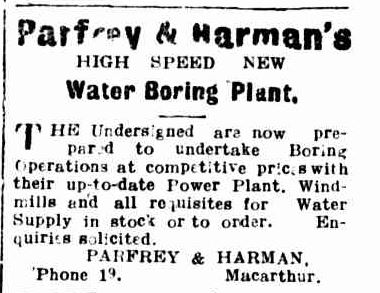
By January 1915, Charles and Arthur had their water-boring plant up and running and available for hire.  Business was brisk with dry conditions prevailing.

Macarthur Matters. (1915, January 18). Port Fairy Gazette (Vic. : 1914 - 1918), p. 2 Edition: EVENING. Retrieved March 10, 2014, from http://nla.gov.au/nla.news-article94724361

Macarthur Matters. (1915, January 18). Port Fairy Gazette (Vic. : 1914 – 1918), p. 2 Edition: EVENING. Retrieved March 10, 2014, from http://nla.gov.au/nla.news-article94724361

Advertising. (1915, January 18). Hamilton Spectator (Vic. : 1914 - 1918), p. 6. Retrieved March 10, 2014, from http://nla.gov.au/nla.news-article119833885

Advertising. (1915, January 18). Hamilton Spectator (Vic. : 1914 – 1918), p. 6. Retrieved March 10, 2014, from http://nla.gov.au/nla.news-article119833885

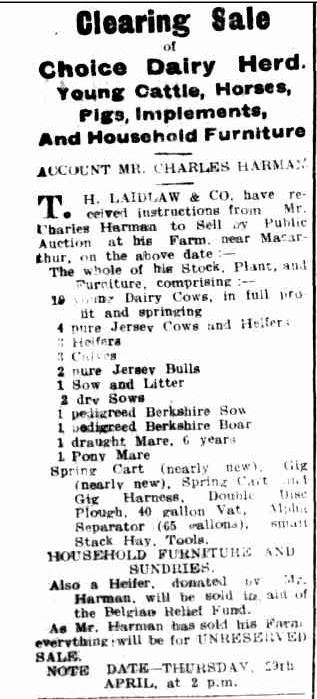
But things can change so quickly and with the war escalating, drought, and no family ties, Charles sold up everything in April 1915. On 12 July 1915 at the age of thirty-six, Charles enlisted, never to return to the Western District as a resident again.

Advertising. (1915, April 20). Hamilton Spectator (Vic. : 1914 - 1918), p. 2. Retrieved March 10, 2014, from http://nla.gov.au/nla.news-article119839929

Advertising. (1915, April 20). Hamilton Spectator (Vic. : 1914 – 1918), p. 2. Retrieved March 10, 2014, from http://nla.gov.au/nla.news-article119839929

The rise of Charles through the ranks with the AFC, finishing the war as a 2nd Lieutenant with military honours, led to a posting in London during the 1920s with the Royal Australian Air Force (RAAF) followed by a life in Melbourne until his death in 1943.  The last half of Charles’ life was a total contrast to the first half.  He went from pigs and dairy cows on the farm at Macarthur to rubbing shoulders with the high-ranking officers in the Royal Air Force and RAAF, flying in airships and attending the funeral of the victims of the R101 airship crash at St Paul’s Cathedral, London. Other attendees included some of the highest-ranked officials in England including the Prince of Wales.  All found out thanks to online newspapers at Trove.

CHARLES HARMAN (Back row, 2nd from left) WITH THE COMMANDING OFFICER AND FLIGHT COMMANDERS OF NO. 1 SQUADRON AFC AT PALESTINE NOVEMBER 1918. Image courtesy of the Australian War Memorial https://www.awm.gov.au/collection/C960630

Trove Tuesday – Those Magnificent Men

This is my eightieth consecutive Trove Tuesday post but I thought my run would end at 79.  Yesterday I took a tumble and now have soft tissue damage in my knee and after a late night in the emergency department, things weren’t looking good for an eightieth Trove Tuesday post.  Thankfully, I had started the post over the weekend, so I thought I would give you what I have so far and finish next Tuesday with the relationship between the subjects in my article, found once again at Trove.

Over the past weekend, the R.A.A.F.  celebrated 100 years of military aviation with an air show at the Point Cook R.A.A.F. base.  So, I thought it was a good time to share an article I found about my gg uncle Charles James Harman, I found in the Hamilton Spectator when the paper came online in 2013.  Charles was the son of Reuben James Harman and Lizzie Bishop and grandson of James Harman and Susan Reed of Byaduk.  He has had a post here before, about the time he took a flight in the R101 airship.

Charles Harman joined the Australian Flying Corp in 1915 as a Flight Sergeant and over the course of the war rose to an officer ranking with the No. 1 Squadron of the A.F.C.  He spent most of the war in Egypt and mid-way through 1916, wrote home to his mate and business associate, Arthur Parfrey of Macarthur.  Arthur passed the interesting letter across to the Hamilton Spectator and the paper published it on 14 September 1916.

The flight he writes of was with pilot  Oswald Watt as they reached heights of 7000 feet.  Considering the planes the then Major Watt was flying, they were daring.  Oswald Watt’s biography is available to read at the Australian Dictionary of Biography.

A LETTER FROM THE AIR. (1916, September 14). Hamilton Spectator (Vic. : 1914 - 1918), p. 4. Retrieved March 1, 2014, from http://nla.gov.au/nla.news-article133707498

A LETTER FROM THE AIR. (1916, September 14). Hamilton Spectator (Vic. : 1914 – 1918), p. 4. Retrieved March 1, 2014, from http://nla.gov.au/nla.news-article133707498