In the News – July 1, 1891

As Victoria’s banks closed on July 1, 1891, to celebrate 40 years of Separation, some were questioning the relevance of the holiday.

The Portland Guardian reported there was some indifference among business owners as to whether they closed or not.  Some shops did decide to open their doors.  The writer proposed this may have been some indication of how each trader felt about Separation day.

The Portland Guardian, (ESTABLISHED 1842.) With which is incorporated The Portland Mirror. (1891, July 1). Portland Guardian (Vic. : 1876-1953), p. 2 Edition: EVENING. Retrieved July 1, 2011, from http://nla.gov.au/nla.news-article65386464

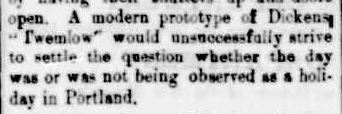
On the same day two years earlier, the Guardian had again raised the worth of the Separation Day holiday.  This time, a character of Charles Dickens, Melvin Twemlow is used to make the writer’s point.

The Portland Guardian,. (1889, July 1). Portland Guardian (Vic. : 1876-1953), p. 2 Edition: EVENING. Retrieved July 1, 2011, from http://nla.gov.au/nla.news-article63623718

Forward to 1894 and there was barely a mention of Separation day, but it did not go by without comment

Established August, 1842. The Portland Guardian, With which is incorporated The Portland Mirror. (1894, July 2). Portland Guardian (Vic. : 1876-1953), p. 2 Edition: EVENING. Retrieved July 1, 2011, from http://nla.gov.au/nla.news-article65407317

In the News – June 4, 1860

The Portland Guardian and Normanby General Advertiser had a regular feature know as “Table Talk” presenting local news.  The June 4, 1860 edition demonstrates some of the rivalries which already existed between towns in the Western District.

Table Talk. (1860, June 4). Portland Guardian and Normanby General Advertiser (Vic. : 1842-1876), p. 2 Edition: EVENINGS. http://nla.gov.au/nla.news-article65443736

The writer is bemused that the Ararat newspaper, presumably the Ararat Advertiser, could compare Ararat with the three coastal towns, Belfast, Warrnambool, and Portland.  Also at the time, money was being spent on the road from Ararat to Warrnambool.  The writer made it clear that while the Government described the road as the Ararat to Portland district road, Portland was in no way benefiting from the money which was being spent on the road.

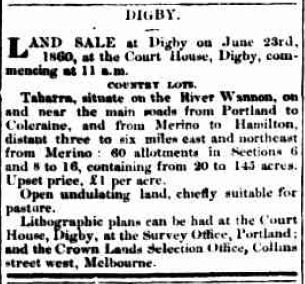
Land sales were also making news.  The Government was releasing land in the Merino, Tahara, and Digby raising concern that by the time the Land Sales Bill went through there would be little decent land to buy.  Further on in the paper, several advertisements spruik the land opportunities including this one for acreage at Tahara

A  “superior class” of female immigrants were making their way to Portland in the following week, the paper reports.  The women had arrived in Melbourne aboard the Atalanta and were considered to be “of timely benefit to this town”.

The mail was late in Mount Gambier on June 2, arriving at 2.40pm.  The correspondent surmises that something must have happened to the mailman because when he did arrive, his head was bandaged.

In the News – May 26, 1927

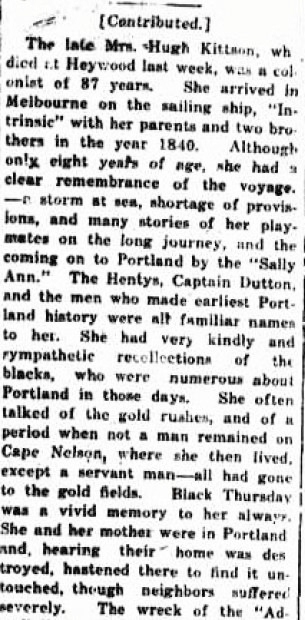
The Portland Guardian of 26 May 1927 reports the death of Mrs. Hugh Kittson.  The obituary gives much information about Mrs. Kittson’s early life including her arrival in Australia and her marriage.  She was 94 years old and had been in Victoria for 82 years and had many memories of those early times.  As I read her story, I wanted to know more about Mrs. Hugh Kittson.  The obituary, as was often the way, did not mention her first or maiden names.  It did say she had travelled to Victoria on the Intrinsic with her parents and two brothers in 1840.

Obituary. (1927, May 26). Portland Guardian (Vic. : 1876-1953), p. 3. Retrieved May 26, 2011, from http://nla.gov.au/nla.news-article64257291

After searching death records and Trove, I found that Mrs Kittson was Margaret Jennings, daughter of Cook Abraham Jennings and Hannah Birchall.  She was born in Manchester in about 1833.  Her brothers were Samuel and Robert Jennings and the “Intrinsic” had in fact arrived in 1841. I then discovered stories about two pioneering families of the southern Western District I had not heard of before, the Jennings and the Kittsons who were both in the Portland and Bridgewater areas before 1850. I particularly enjoyed a Letter to the Editor from the Portland Guardian of 23 January 1877 by Cook Jennings which painted a picture of the 1840s.

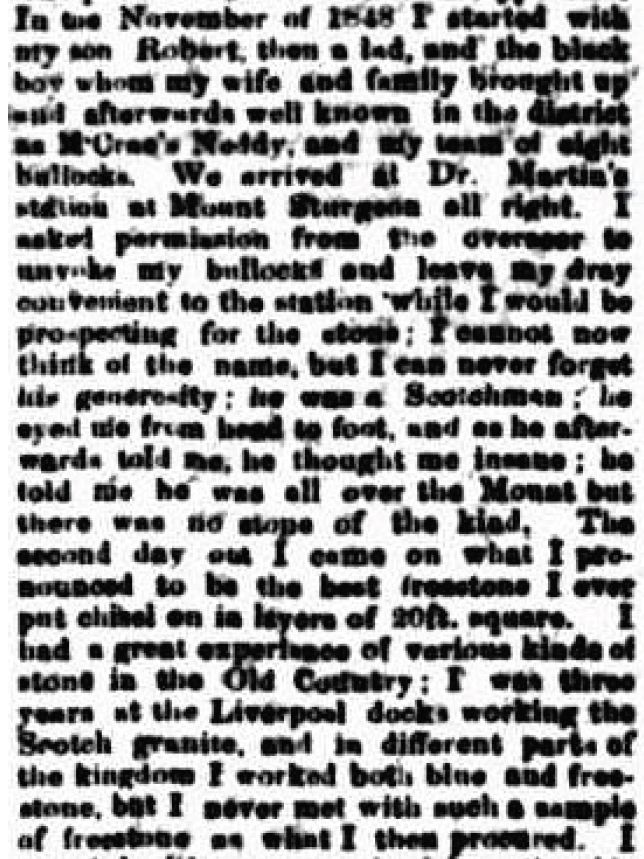
Cook Abraham Jennings’ letter gives an insight into life in the early days of Western Victoria.  He refutes a claim by Thomas Fairburn to be the first person to find freestone at Mount Abrupt near Dunkeld suggesting it was he instead who made the first discovery.   He describes a journey from Portland to Mt Sturgeon and Mt Abrupt almost 30 years earlier.  As a stonemason in Portland, he was keen to source some freestone and after a tip-off, headed to the southern end of the Grampians in 1848 with his travelling companions, son Robert, and an indigenous boy raised by Jennings’ wife.

CORRESPONDENCE. (1877, January 23). Portland Guardian (Vic. : 1876-1953), p. 2 Edition: EVENINGS.. Retrieved May 26, 2011, from http://nla.gov.au/nla.news-article63337471

CORRESPONDENCE. (1877, January 23). Portland Guardian (Vic. : 1876-1953), p. 2 Edition: EVENINGS.. Retrieved May 26, 2011, from http://nla.gov.au/nla.news-article63337471

Jennings describes the return journey when “there was no Hamilton…save Mr. Beath’s store and Blastock’s public house”.  After difficulty crossing the Grange and Violet Creek he eventually reached Portland and sold off the stone, which was still being used as grindstones 30 years later.

The letter also shows that overseas travel was not out of the question for those early pioneers.  Cook Jennings travelled to Richmond, Virginia in 1858 to lodge a claim on a relative’s will.  Although Cook did come across as somewhat of an opportunist!

Margaret Jennings’s husband Hugh Kittson was himself some sort of trailblazer.  The Irish-born son of James and Catherine Kittson, was reported as the first white person to ride overland from Portland to Melbourne.  Hugh and Margaret had seven children and surnames of their descendants include Johnson, White, and Hodgetts.

In the News – May 9, 1910

Recently the National Library of Australia released digital copies of The Portland Guardian onto their Trove website.  This is very exciting for those researching family links in the Western District and along with the Camperdown Chronicle, Trove users have an opportunity to find out more about their families.

I thought it right that today’s In the News should feature articles that appeared in The Portland Guardian on May 9, 1910.

On page 2, the lead story is an Obituary for a long-time Heywood resident Malcolm Cameron.  I have some interest in Malcolm Cameron as he is the father in law of my first cousin four times removed, Emily Harman.
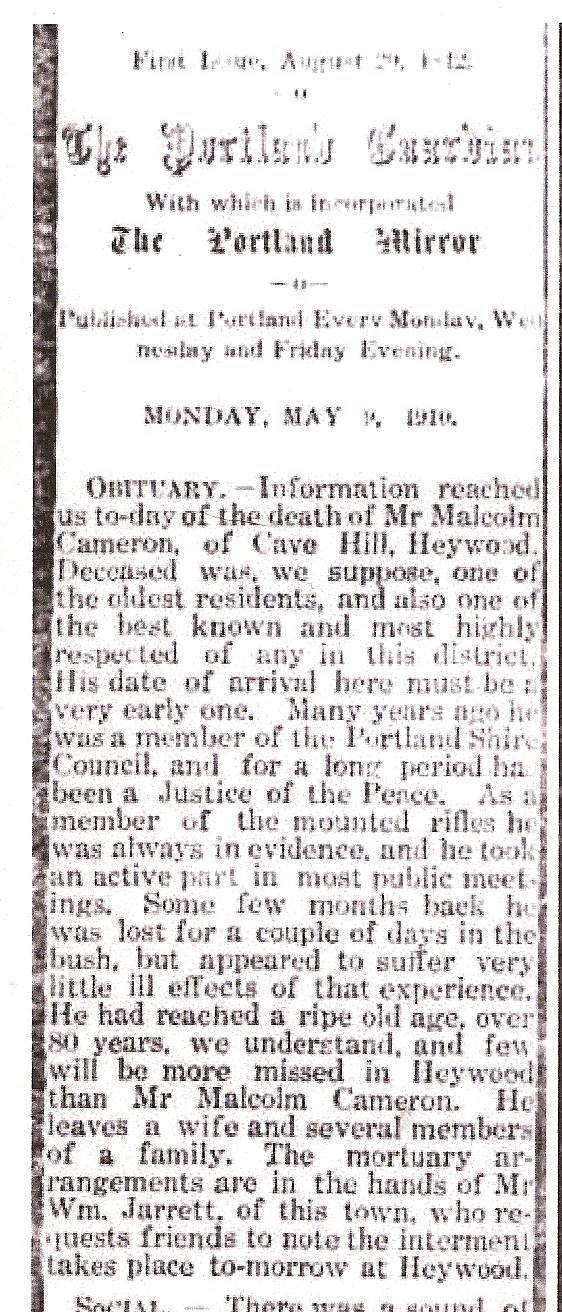
Obituary of Malcolm Cameron First Issue, August 20, 1842. The Portland Guardian. (1910, May 9). Portland Guardian (Vic. : 1876-1953), p. 2 Edition: EVENING. Retrieved May 9, 2011, from http://nla.gov.au/nla.news-article63977026

Malcolm was born in Perthshire, Scotland in around 1823.  There is a record for a Malcolm Douglas arriving on the “Glen Roy” in 1854.  Malcolm married fellow Scot Elizabeth Douglas in Victoria in 1860 and they had their first child, Fanny in 1861 at Heywood.  They had a further nine children over the subsequent 21 years.

From the obituary, it can be seen that Malcolm Cameron was active in the community as a JP and Councillor.  It mentions Malcolm was lost in the bush a few months earlier.  An article about this appeared in The Portland Guardian and other papers including The Argus on December 8, 1909

Malcolm’s son Malcolm Douglas Cameron was born in 1864 at “Cave Hill” near Heywood and married Emily Harman in 1900.  They had two sons, Oliver and Alan.

DEATH OF THE KING

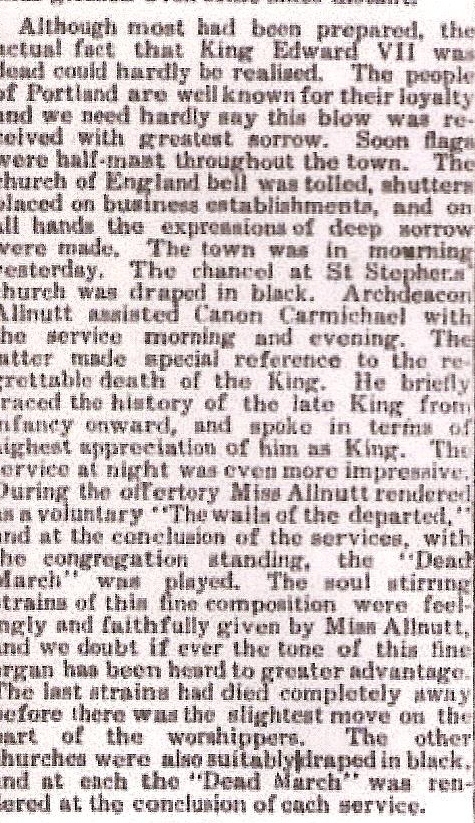
An article on page 2 gives a hint on some major international news of the time.  The Portland Post office would be closed the afternoon of May 9 out of recognition of a day of mourning which had been announced throughout the Commonwealth on the passing of King Edward VII on May 7, 1910.

Death of King Death of the King. (1910, May 9). Portland Guardian (Vic. : 1876-1953), p. 3 Edition: EVENING. Retrieved May 9, 2011, from http://nla.gov.au/nla.news-article63977030

On page 3, the headlines proclaim, “Death of the King” with details of the king’s death and further on, the reaction of the Portland residents.

The people of Portland were sent into deep mourning according to this article with flags at half-mast and church bells tolling. Miss Allnutt, the organist who is mentioned in the article was a daughter of the minister of St Stephens Church at the time. Arch Deacon Allnutt was Minister for over 30 years.

THE UPS AND DOWNS OF SKATING

Skating appears to be a popular pastime of the late 19th Century and early 20th Century.  Two articles about skating appear on page 2, one announcing the opening of the Portland Skating rink and the second demonstrating the dangers of the sport.
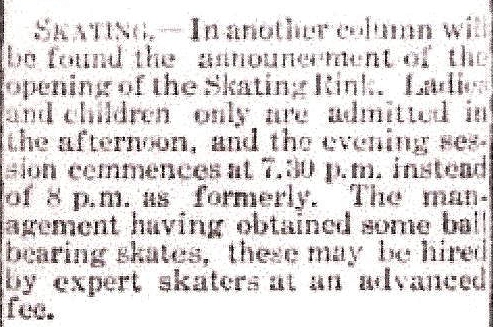
The advertisement on the same page reveals skating was being held at the Free Library Hall and entry was sixpence.  Unless of course one was an expert and wished to try the more advanced ball-bearing skates!

The second article relates to a skating accident at Casterton which resulted in a nasty concussion for Mr Allan Rowlands.  If one considers the size of the average country hall, the thought of skaters hurtling around is rather hair-raising.  No wonder women and children were only allowed to skate in the afternoon when hopefully it would have been a more refined pastime.
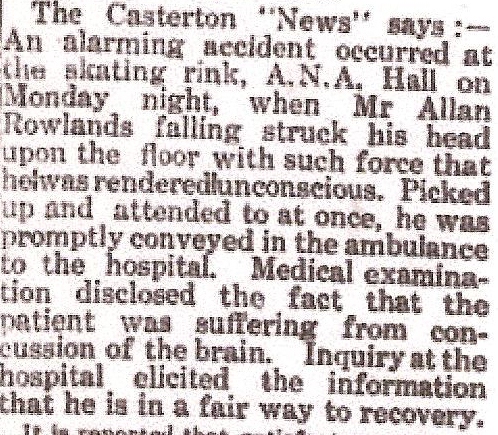
Skating Accident at Casterton First Issue, August 20, 1842. The Portland Guardian. (1910, May 9). Portland Guardian (Vic. : 1876-1953), p. 2 Edition: EVENING. Retrieved May 9, 2011, from http://nla.gov.au/nla.news-article63977026



The “Duke of Richmond”

On 20 October 1852, the barque Duke of Richmond sailed from Birkenhead, England, bound for Portland Bay, Victoria, Australia.  Among the 236 passengers on board were two couples, each from different parts of England, one with small children.  They were my great, great, great grandparents, James and Susan Harman, and William and Margaret Diwell.  William and Margaret, from Kent, had two daughters under five.  Another daughter had passed away before the journey.  James and Susan were from Cambridgeshire and had been married only two months.

One of the passengers, Ann Maria Taylor, wrote in a letter home,

The weather was then so hot that people could not sleep on their berths. They were lying on the open deck…the captain who has been such for thirteen years, said he never experienced such weather.  Indeed I never expected to see land again.  Two nights were awful…lamps smashed…barrels of water capsized. (State Library of Victoria, Letter, Taylor, Ann Maria, 7 March 1853, MS 13313,   http://search.slv.vic.gov.au )

After around 140 days, Captain Thomas Barclay sailed the Duke of Richmond into Portland Bay on 4 March 1853.

portlandbay

PORTLAND BAY, 1856. Illustration by S.T.Gill, courtesy of the State Library of Victoria http://handle.slv.vic.gov.au/10381/303521

The Portland Herald reported on 11 March 1853, that Captain Barclay and Dr Webbers, the Surgeon Superintendent, had attempted to ensure all immigrants were comfortable and happy. However, the voyage was also reported as arduous, with much illness and over twenty deaths.  Measles claimed many of those who died.

The Diwell family disembarked and stayed in Portland for another five years before moving to the Casterton area.  William was a bricklayer and left the ship on his own account.  James Harman was engaged by  Mr Robertson at Boodcarra between Port Fairy and Yambuk for six months with wages of £50. They also spent time at Portland and Port Fairy before moving north to Muddy Creek, southwest of Hamilton, by the end of the 1850s. By 1863, James had selected land at nearby Byaduk

It is doubtful the two families came together again until 1945 when my grandparents, William Gamble and Linda Hadden, were married in Hamilton.

I have done some extra research on the other passengers aboard the Duke of Richmond.  Among them were Thomas and Mary Loats. Thomas was a neighbour of the Harman family in Drury Lane in Melbourn, Cambridgeshire. His older brother married James Harman’s oldest sister, Mary Ann. Thomas and Mary also moved to Muddy Creek. A number of the passengers moved to the Byaduk area. Some of the family names include Clarke, Everett, Gibbons, Looker, McIntyre, Merry, Patman, and Spong.