Surname Saturday Meme: Names, Places and Most Wanted Faces

Following the lead of U.S. genealogist Thomas MacEntee and in turn Australian genealogist Jill Ball, I decided to take part in this meme.  It interested me more than others I had seen, because not only would I get my names “out there”, I also got the chance to do a stocktake.  What an interesting exercise it was.  With some names, I did not have to look up the details as I knew them so well, others I had to refer back to my tree, and for one name, I had basically nothing.

It’s easy to develop favourite families, with some just oozing information making them more compelling to research.  The Harmans are an example of that.  The Riddiford line was probably my least favourite and despite it being my family name, I tended to pass it by. When I did start seriously researching them, I found loads of information.  This avoidance was probably due to them being 20th-century immigrants and my history interests lie in 19th century Australia.  I had no choice but to delve into 18th and 19th century English history and I have really enjoyed it and learnt a lot and I continue to do so.  I am glad I got over my previous mindset.

I also have more Irish links than I normally given myself credit for and I can now clearly see the branches I have been neglecting.

I have included the surnames of my great great grandparents, but I have taken the places and dates back a little further.  If not, I would have had entries with just a single place in Australia with no indication of where the family originated from.

To take part, just do the following at your own blog, then post a  link in the comments at Thomas’ blog post

1. List your surnames in alphabetical order as follows:

[SURNAME]: Country, (State or County, Town), date range;

2. At the end, list your Most Wanted Ancestor with details about them.

MY NAMES, PLACES AND MOST WANTED FACES:

BISHOP:  England (Dorset, Weymouth) 1825-1850; Australia (South Australia, Adelaide) 1850-1854;  Australia (Victoria, Byaduk)1854-1950

COMBRIDGE:  England (Huntingdonshire) 1833-1855;  Australia (Victoria, Geelong 1855-1935);  Australia (Victoria, Grantville) 1900-1950

DIWELL:  England (Sussex) 1825-1852;  Australia (Victoria, Casterton) 1852-1893;  Australia (Victoria, Hamilton) 1893-1940

GAMBLE:  England 1808-1840;  Australia (Victoria, Geelong) 1840-1850;  Australia (Victoria, Colac), 1850-present

HADDEN:  Scotland (East Lothian) 1823-1852;  Australia (Victoria, Geelong) 1852-1865;  Australia (Victoria, Cavendish) 1865-1975;  Australia (Victoria, Hamilton) 1900-present

HARMAN:  England (Cambridgeshire, Melbourn) 1800-1854;  Australia (New South Wales) 1852-1857;  Australia (Victoria, Port Fairy) 1852-1863;  Australia (Victoria, Byaduk) 1863-present

HODGINS:  Ireland (Fermanagh) 1816-1853;  Australia (Victoria, Colac) 1853-1940

HUNT:  England (Middlesex, Poplar) 1834-1854;  Australia (Victoria, Geelong) 1854-1865; Australia (Victoria, Collingwood) 1867- ;  Australia (Victoria, West Gippsland) 1880-1936

JELLY:  Ireland (Down, Drumgooland) 1815-1845;  England (Lancashire, Manchester) 1845-1854;  Australia (Victoria, Casterton) 1854-1900

KIRKIN:  England (London, Lambeth) 1859-1940;

MORTIMER:  England (Berkshire, White Waltham) 1823-1852;  Australia (Victoria, Cavendish) 1865-1930

PIDDINGTON:  England (Buckinghamshire, Cuddington) 1700s-1880

RIDDIFORD:  England (Gloucestershire, Thornbury) 1600s-present; England (Buckinghamshire, Cuddington) 1846-present;  England (London, Lambeth) 1896-1913; Australia (Victoria, Ballarat) 1913-present

WEBB:  England (Surrey, Clapham) 1845-1878; England (London, Lambeth) 1878-1900

WHITE:  England (Kent, Broadstairs) 1857-1876;  Australia (Victoria, Grantville) 1876-1950

WYATT:  ???

MOST WANTED ANCESTOR:

When I started this I thought my most wanted ancestor would be gg-grandmother Mary Jane HODGINS.  She was born in Ireland around 1849, immigrated with her parents West HODGINS  and Martha BRACKIN in 1853 aboard the Marion Moore. She married Matthew GAMBLE in 1871 at Colac.  That is all I know except for the accident which saw Mary Jane lose the top of her finger, as mentioned in the post Misadventures, Deaths and Near Misses.

However, when I looked at the completed list it seemed clear it had to be Jane WYATT, another gg grandmother and second wife of Herbert John COMBRIDGE.

I had previously found a birth for a Jane Wyatt born 1882, St Arnaud but this did not really add up, mainly because my Jane Wyatt married Herbert Combridge in 1895 in Gippsland.  If I searched the Australian Death Index 1787-1985, I find the death of Jane COMBRIDGE in 1909 at Grantville but with no approximate birth year or parents.

As I was writing this post, I decided to have a look around for Jane again.  I checked for people researching Combridges at Ancestry.com and found a reference to Jane’s birth in 1873.  I searched again with this birth date and that threw up something interesting.  There is a Jane Wyatt listed on the Victorian Index to the Children’s Register of State Wards, 1850-1893.  Her birth date is given as 1873, but no birthplace.  This could be my Jane and it could explain the lack of parent names and birth year on the Death index.

So, thanks to this exercise, I may have come a step closer to finding Jane Wyatt, but if she was a ward of the state, I may not be able to find anything else about her.  So if anyone has information on Mary Jane HODGINS and her family, I would love to hear from you!

Passing of the Pioneers

The September “Passing of the Pioneers” in the Portland Guardian saw several prominent Western Victorian residents pass away and two of my own relatives.

Richard LEWIS: Died September 1890 at Digby.  Richard owned some well-known stations in the Western District including Rifle Downs and Hilgay.  An excellent biography of Richard Lewis is on the Ballarat Genealogical Society website. Richard died as a result of Bright’s disease.

Samuel CROSSDied 4 September 1901 at Hamilton. Samuel was seventy-nine at the time of his death and had been in Australia since 1849 after travelling from Sussex, England. He worked in and owned, department stores including the Beehive Store in Hamilton.  In his later years, he was a librarian at the Hamilton Mechanics Institute.

Jacob THEISINGER: Died 13 September 1901 at Portland. Jacob, also a sufferer of Bright’s Disease, had been in the colony since around 1854.  He was a popular person around town and was a member of the Portland German Band.

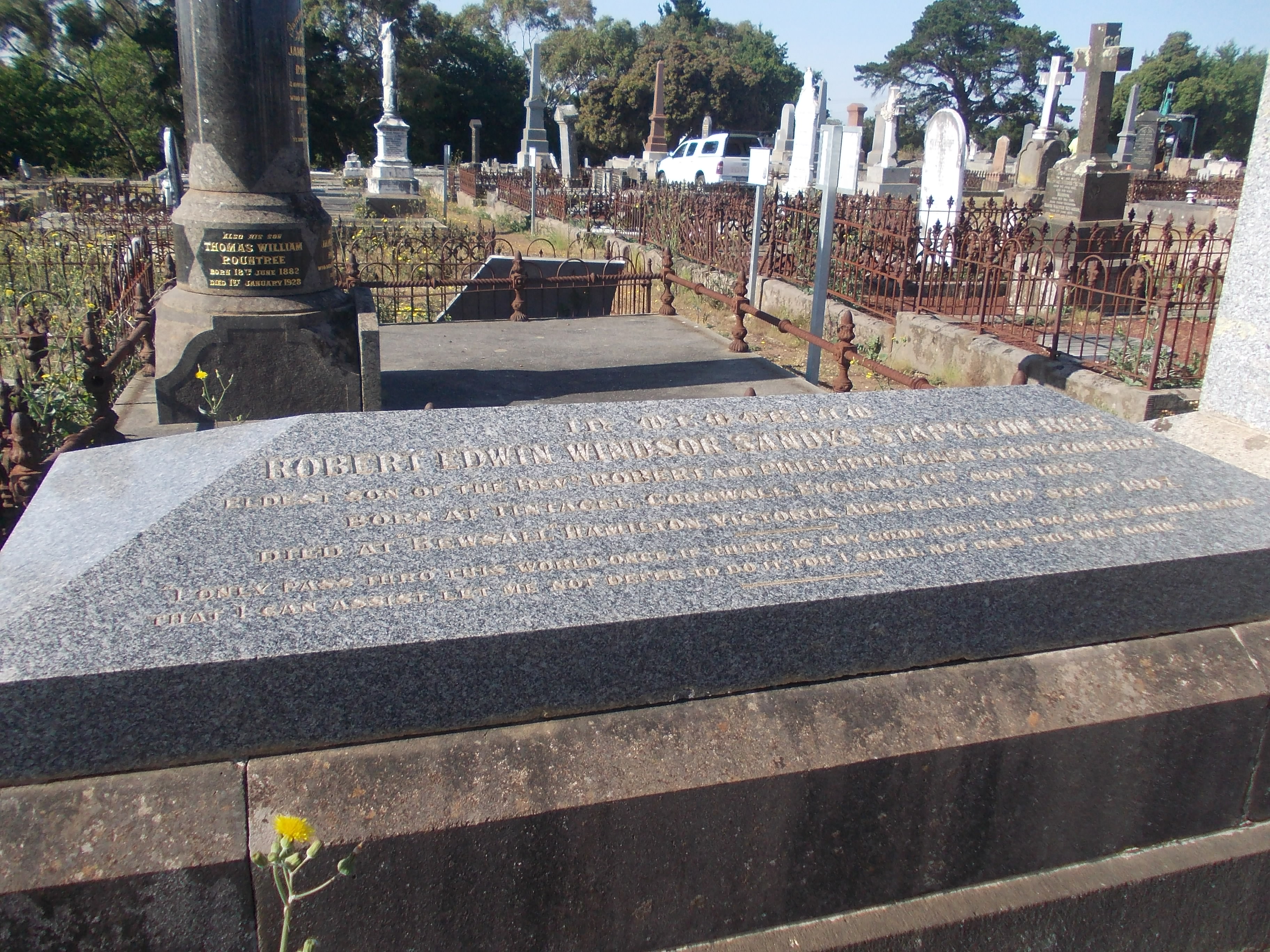
Robert Edwin Windsor Sandys STAPYLTON-BREE: Died 17 September 1907 at Hamilton. Robert Edwin Windsor Sandys Stapylton-Bree was a Hamilton stock and station agent and well know identity not only in Hamilton but also in Portland.  He married the daughter of Stephen HENTY, Annie Maria.  His funeral was well attended with Dean Parkyn presiding over the service.  He and Archdeacon Hayman had motored the 119 mile trip from Ballarat in five hours.

Christina STEWART: Died September 1921 at Hamilton. Christina STEWART was born in Kingussie, Scotland in around 1825 and travelled with her husband, Duncan McPherson, to Australia in 1851 onboard the Hooghlly.  While Duncan went off to the goldfields, Christina waited in Melbourne until they journeyed to Portland.  For a time, she and her husband ran the Dartmoor Hotel.  She was a mother of eight children.

Elizabeth GLADSTONE: Died 18 September 1925 at Millicent, South Australia.  Elizabeth Gladstone grew up near Portland and the Guardian noted she rode eighty miles each day to school.  I am assuming this was a round trip, or it was a short school day.  Elizabeth married George Plunkett in 1862 at Penola, South Australia.

May ROBERTSON: Died September 1925 at Gringalgona.  May Robertson arrived in Sydney with her family in 1847 from Scotland.  They travelled to the Coleraine district by bullock wagon.

Margaret Emily McDONALD:  Died  5 September 1928 at Nokomai, New Zealand.  Margaret McDonald’s parents were early pioneers and she spent time around Portland and Hamilton as a child with one of her early memories being that of Adam Lindsay Gordon and his riding feats.  In 1863, Margaret married Donald Cameron in Melbourne and they moved to New Zealand and raised twelve children.

Margaret BEST: Died 7 September 1933 at Hamilton. Margaret was born in County Caven, Ireland in 1853 to Mr and Mrs William Best.  They arrived at Portland on board the General Hewitt in 1856.  After time in Portland, the Bests moved to Heywood when Margaret was nine. She married James Henry BELL and remained in the Heywood area.

Ada Catherine HAYMAN: Died September 1934 at Portland.  Ada was born in Axminster, Devon, England in about 1858.  She arrived at Portland with her parents and siblings in the 1860s.  This is an interesting family.  Ada’s father was a doctor and practiced in Harrow, Edenhope, and Ararat.  One of her brothers was a doctor, another Archdeacon Hayman presided over R. Stapylton-Bree’s funeral (above).  Another brother W.R. Hayman was one of those who organised the  Aboriginal cricketers’ tour of England in 1868.  The biography of one of the players, Johnny Mullagh, describes the part Hayman played.

Finlay McPherson PATON: Died September 1936 at Tarrayoukyan. Finlay Paton was born at Stirlingshire, Scotland and after landing at Portland, took on the job of ringing the church bell and did so for 15 years. This could have been just one of the reasons for his “magnificent physique”.  Maybe it was because he claimed that he was one of those that carted stones to build Mac’s Hotel in Portland.  Or was it lifting four-bushel bags of wheat from the ground to a wagon, with little trouble.  He really must have been a fine specimen. As were his team of horses used for his carrying business. Bred by Finlay they were the “admiration of the district”

William DIWELL: – Died September 1939 at Jeparit. William was my ggg uncle.  His obituary mentioned his work as a builder and the several buildings in Portland remaining, at the time of his death, as memorials to his work.  It does mention he was a native of Portland, however, he was born at Merino.  It correctly states his wife Frances was a native of Portland.

Thomas Haliburton LAIDLAWDied September 1941 at Hamilton. Over 500 people were reportedly at the funeral of Thomas Laidlaw, a Hamilton stock and station agent.  Thomas was the son of pioneers, Thomas and Grace Laidlaw.   The obituary offers a great description of the early days of Thomas Laidlaw senior in the colony with his four brothers.  Thomas junior, along with building his successful stock and station business was at one time a Shire of Dundas Councillor, President of the Hamilton Racing Club, and chairman of directors of the Hamilton and Western District College, today Hamilton and Alexandra College.  Laidlaw is one of the names that if I hear it, I think of Hamilton.

Henry MORTIMER: Died  6 September 1948 at Portland.  Another ggg uncle of mine, Henry was the son of James Mortimer and Rosanna Buckland.  He was born in Cavendish and was eighty at the time of his death at Portland.  He is best known on this blog as Mr Mortimer of Mr Mortimer’s Daughters.  This was an informative notice as it listed Henry’s children, grandchildren, and great-grandchildren.

Misadventures, Deaths and Near Misses

You have found your ancestor’s date of death, but you are wondering how they died.  You could buy a death certificate, but a certificate for all relatives can be a costly business.  Newspapers are the answer.  With the growing number of Australian newspapers available to search at Trove, there is a good chance you may find an article on your relative’s demise.  In turn, it may lead to an obituary which can also be a wealth of information, but I will discuss those in a future post.

When I began reading old newspapers, I was amazed at the number of deaths and accidents reported, compared to today’s papers.  It seemed even the smallest of accidents could make newspapers right around Australia.  Death reports were explicit and sparing little detail.  However, despite the nature of these reports, I do find them intriguing reading and they can show when, where, and how a family member died.  Also, accident reports show information that you may never have found otherwise.  I may never have known that my great-great-grandmother lost the top of her finger or my great-great-aunt was bitten by a snake.

Horse related accidents were naturally common whether falls or buggy accidents.  As the years passed, motor cars were the culprits, with many stories of them rolling or hitting trees.  The increasing number of motor cars also caused some problems for those still using horses as their main source of transport.  Fire was a common cause of death or accidents.  Candles, coppers, and fireplaces all increased the risk of burns.

Following are some examples of deaths and accidents involving my family members found in the papers at Trove:

Charles Bishop worked at Weerangourt Station, Byaduk,  but I found he also died there.  While chopping wood in 1916, he suffered heart failure and died at the age of 60.   I found this reported in four newspapers.

I feel sorry for poor James Elston.  He died at only 21.  The first article I found on him was in 1901, eight years before he died.  James had broken his leg, but this was the fifth break in two years.  He was sent to the Royal Children’s Hospital in Melbourne.  The Barrier Miner published in Broken Hill reported the accident as a possible record-breaker.

A Marino Boy Puts Up a Record. (1901, August 29). Barrier Miner (Broken Hill, NSW : 1888-1954), p. 2. Retrieved June 4, 2011, from http://nla.gov.au/nla.news-article44302344

In March 1908, James was back in hospital.  He had been thrown from a buggy and fell on a fence.  As a result, he fractured his spine between the shoulder blades and was crippled, his condition critical.  In January 1909, it was reported that James had succumbed to injuries at the Hamilton Hospital.

Robert McClintock died from heart strain and tetanus as a result of chasing a fox.  This was in 1913 and Robert was only 18.  I decided to search Trove with the phrase “chasing a fox” and it threw up many articles about deaths and accidents incurred while chasing foxes.  Some had fallen from horses, others accidentally shot by themselves, or others died the way of Robert McClintock.

Jane Diwell’s death in 1909 demonstrates the dangers women faced doing simple housekeeping tasks.  Married to Samuel Hazeldine,  Jane was in a back shed at their home in Murtoa boiling up beeswax and turpentine, when her clothes caught fire.  Despite desperate attempts by her husband to save her, she died from her burns.  Samuel received severe burns to his hands.

Frederick Hazeldine of Murtoa was watching the eclipse of the sun in 1910 when the 10-year-old slipped off a fence and broke his arm

Frank Coulson was only 17 when he met his fate in 1935.  His body was found near Digby.  He had sustained a fractured skull and his pony’s saddle and bridle were lying close by.  Different articles tried to offer an explanation to his death from having been kicked in the head by the pony or haven fallen awkwardly as the pony jumped a fence.

George Gamble lost his life after a cave-in at the Colac Brick Works in 1910.  He was dug out but later died at the Colac Hospital,

Mary Jane Hodgins (Mrs Matthew Gamble, below), my great great grandmother,  lost the top of her finger in an accident involving a horse.  Notice that this took place in Colac, Victoria, but was reported as far away as Maitland, New South Wales

GENERAL NEWS. (1877, September 1). The Maitland Mercury & Hunter River General Advertiser (NSW : 1843-1893), p. 7. Retrieved June 4, 2011, from http://nla.gov.au/nla.news-article18829977

In 1906, Amy Margaret Bubb, Mrs Benjamin Combridge, was bitten by a snake that had hidden in a mattress.  Her daughter Amy was darning the mattress and noticed something she thought was mice, moving inside.  She called her mother who hit the mattress and was bitten by a black snake on the wrist.  Young Amy ran to the neighbours’ house almost a kilometre away through paddocks and returned with a Mrs Arklay.  By this time, Amy Sr’s arm was black.  Mrs Arklay made an incision and drew black blood from the wound which saved Amy.  This article ran in Tasmania and Adelaide as well as The Argus.

I had known that my great, great, great grandfather William Diwell had died in a fall at the Merino Flour Mill in 1871, but I have since found that he was severely injured three years earlier.  In 1868, the Merino school-house verandah was falling down, so William volunteered to remove it.  Part of the verandah fell on him and he was pulled out suffering a severe head injury.  By all accounts, if the full verandah had of fell on him he would have been crushed to death.  He was 43 at the time and I think he may have been lucky to make it 46 when he did die.

The most gruesome article I have read about one of my family members is that of my great, great, great grandmother Ellen Barry, Mrs. Gamble.  Ellen was a feisty Irish woman, often in the courts and rather fond of a drink.  One night in January 1882, Ellen was home alone in her cottage in Colac, when a fire broke out.  The next day, the coroner found that due to Ellen’s propensity for a tipple, it was most likely she had knocked a candle that started the fire.

A WOMAN BURNT TO DEATH. (1882, January 26). The Argus (Melbourne, Vic. : 1848-1954), p. 8. Retrieved June 5, 2011, from http://nla.gov.au/nla.news-article11530343

These few examples prove how much you can find out about your ancestor’s death, not to mention their life before death.  If you are using Trove, it is useful to search all the papers available because as Mary Jane Hodgins’ accident shows, incidents can be reported interstate.  You can use filters to narrow your search down, particularly if you have a specific date.

In a future post, I will share some of the other articles I have found which don’t relate to my family but show the value of these stories in developing an understanding of how precarious life could be for those living in the 19th and early 20th century.  We can also learn how death was considered in those times by the style of writing and the depth of description.  Most importantly for family historians, our ancestors become more than just a one-dimensional date on a page.

I Wish I Were Related to Chris Coulson

I am sure most of you have come across a person in your research who, while not related, still captures your imagination.  I have found myself off on a tangent many times with a family who has married into my own, only to rein myself in to focus on my direct relatives.

One such person is Christopher Coulson who I first encountered when I found his son Frank married my 2nd great grand-aunt Harriet Diwell. Chris was a horseman and had some involvement with the early days of Western District racing, and that tweaked my interest.

Christopher Coulson was born at Scarborough, Yorkshire in 1817 and married Mary Frances Stubbs in 1841.  Not long after, Christopher began working as a groomsman at the Royal Mews at Buckingham Palace during Queen Victoria’s reign.  Christopher and Mary had one child then, Francis Stubbs Coulson (Frank), born in 1842, and they had three more children at the Mews.  The 1851 Census shows the family living at the Royal Mews. Christopher’s occupation was recorded as “helper in the master of the horses department”.  In 1855, Queen Victoria set up the Buckingham Palace Royal Mews School for the children of those working at the Mews.

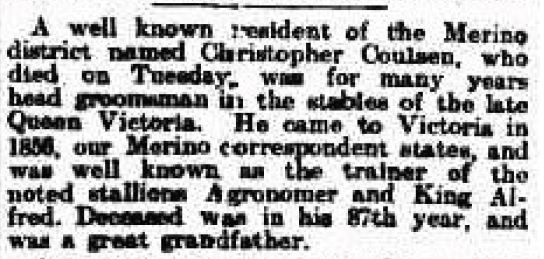
In 1856, Christopher, Mary, and the four children sailed for Australia on General Hewitt arriving in Portland. The Coulsons’ immigration record shows Christopher was to be employed by Mr McKellar of Ardachy at Branxholme for twelve months.  At some stage, Chris went to Rifle Downs at Merino to work as a trainer for Richard Lewis, who owned such horses as the thoroughbred “King Alfred” and Clydesdale stallion “Agronomer”. “King Alfred” was revered throughout the district. Even Adam Lindsay Gordon referred to him in his poem “The Fields of Coleraine”.  He stood at stud with “Agronomer” who competed in local shows and was sire of many of the heavy workhorses in the area. 

Eventually, Chris selected his own land at Dwyers Creek and became a sheep breeder, but always remained a horse lover.  He died in 1904 aged 86.

Chris Coulson Obituary – THE FRUIT INDUSTRY. (1904, August 2). The Brisbane Courier (Qld. : 1864-1933), p. 5. Retrieved May 30, 2011, from http://nla.gov.au/nla.news-article19293600

Christopher and Mary had five children, four born in England and the fifth Georgiana born in Australia at Digby.  Sadly Georgiana died aged five in 1865.  The remaining four children all married and raised families.  They were:

Francis Stubbs Coulson – Born 1842 Yorkshire Died 1916 Victoria.  Frank married Harriet Diwell, daughter of William Diwell and Margaret Turner in 1873.  They had 13 children and lived in the Dwyers Creek/Merino area during their married lives.  Descendants’ surnames include Miller, Cameron, and Gull.

Betsy Ann Coulson – Born 1845 Westminster, London, England Died 1896 Casterton, Victoria.  Betsy married Joseph Wombell, and they had six known children.  Descendants’ surnames include Petterd, Chester, and Rowely.

Christopher Coulson Jnr – Born 1847 Pimlico, London Died 1893 Merino, Victoria. Chris married Lorina Ann Eastick in 1872.  They had nine known children and their descendants’ surnames include Crawley, Grant, Ames, and Stanmore

Amy Oliver Coulson – Born 1852 Pimlico, London Died 1926.  Amy married Alexander Cameron in 1875.  They had three known children.  Descendants’ surnames include Milward and McCombe

I have researched enough of my family tree to know I will not unearth an ancestor who had contact with the early days of the racing and horse breeding industry in the Western District.  A romantic time when Adam Lindsay Gordon wrote of the fields of Coleraine, there was a racecourse in most towns and the early horses, ancestors themselves to many Western District progeny, were swum to shore from boats.  That is why I wish I was related to Christopher Coulson.

Elizabeth Ann Jelly

Richard & Elizabeth Diwell and family

This is Richard and Elizabeth Diwell and their family in the spring of 1900 in Hamilton.  The eldest child, Margaret was nineteen and the youngest, Martha was two. Elizabeth, at forty-four, was in the last months of pregnancy and was radiant.  Martha’s hand rests comfortably on her mother’s growing stomach.  Edith clutches the arm of father Richard, a successful bricklayer and keen gardener, a member of the Hamilton Horticulture Society.  Chrysanthemums were one of his specialities.  Within months, this serene family scene was shattered.

Richard Diwell and Elizabeth Jelly married in June 1877 at Casterton.  Richard, born at Portland in 1854 was the son of William and Margaret Diwell and was their first child born on Australian soil after their arrival in 1853 aboard the Duke of Richmond.  William too was a bricklayer.  Elizabeth was the daughter of  George and Jane Jelly and like William was her parents’ first born in Australia.  They had arrived in 1855 on the Athletae and moved to Casterton where Elizabeth was born in 1856.

Sadness came early in Richard and Elizabeth’s marriage with their first born child, Ada Jane, dying within her first year of life.  Six more children, Margaret, William, Jane, Ralph, Edith and Ernest were born in Casterton over the next eleven years until 1891.  It was in that year that Elizabeth, her mother and sister-in-law, Annabella McIntyre, signed the Victorian Women’s Suffrage Petition along with one hundred other Casterton women.  It was their contribution to the cause championing for equal voting rights for women.

Later in 1891, the Diwells moved to Hamilton.  The following year tragedy would occur again with the passing of five-year-old Ralph.  In 1893, Ethel was born and another pregnancy in 1895 saw the birth of Rebecca but she sadly died in 1896 aged ten months.  George was born in 1896, Martha in 1898.

Which brings us back to 1900.  Despite the losses of the past, life was continuing on for the Diwells.  In March, William was voting in favour of the cancellation of that month’s Hamilton Horticulture Society flower show due to drought and Elizabeth was pregnant for the 12th time at the age of forty-four.

Midway through October Elizabeth fell ill in and was nursed for the next three weeks until she gave birth to a daughter on 2 November.  The baby was weak and died two days later.  Elizabeth was also gravely ill and underwent an operation after the birth of the baby.  She battled to stay but succumbed to peritonitis ten days later, on 12 November.

Elizabeth’s obituary from the Hamilton Spectator on 13 November 1900 read:

“… Another death which has evoked the deepest sympathy of all who knew her took place yesterday when Mrs Diwell, the wife of Mr Richard Diwell, bricklayer of this town, died after a short illness.  The deceased was the second daughter of Mr George Jelly of Casterton where she was born, and she came to Hamilton with her husband in 1891. 

She was taken ill three weeks ago and on the 2nd instance she was confined, the child living only two days.  On Sunday evening she had to undergo an operation as the only hope of saving her life but at 3 o’clock yesterday morning she died of exhaustion, the diagnosis being peritonitis. 

She leaves a husband and eight children – three boys and five girls – the eldest of who, a daughter is only nineteen years of age – to mourn their irreparable loss. Mrs Diwell who was only 44 years of age was highly respected by all who knew her and the deepest sympathy is felt with the stricken family in their bereavement.  The funeral will take place a 3 o’clock this afternoon”

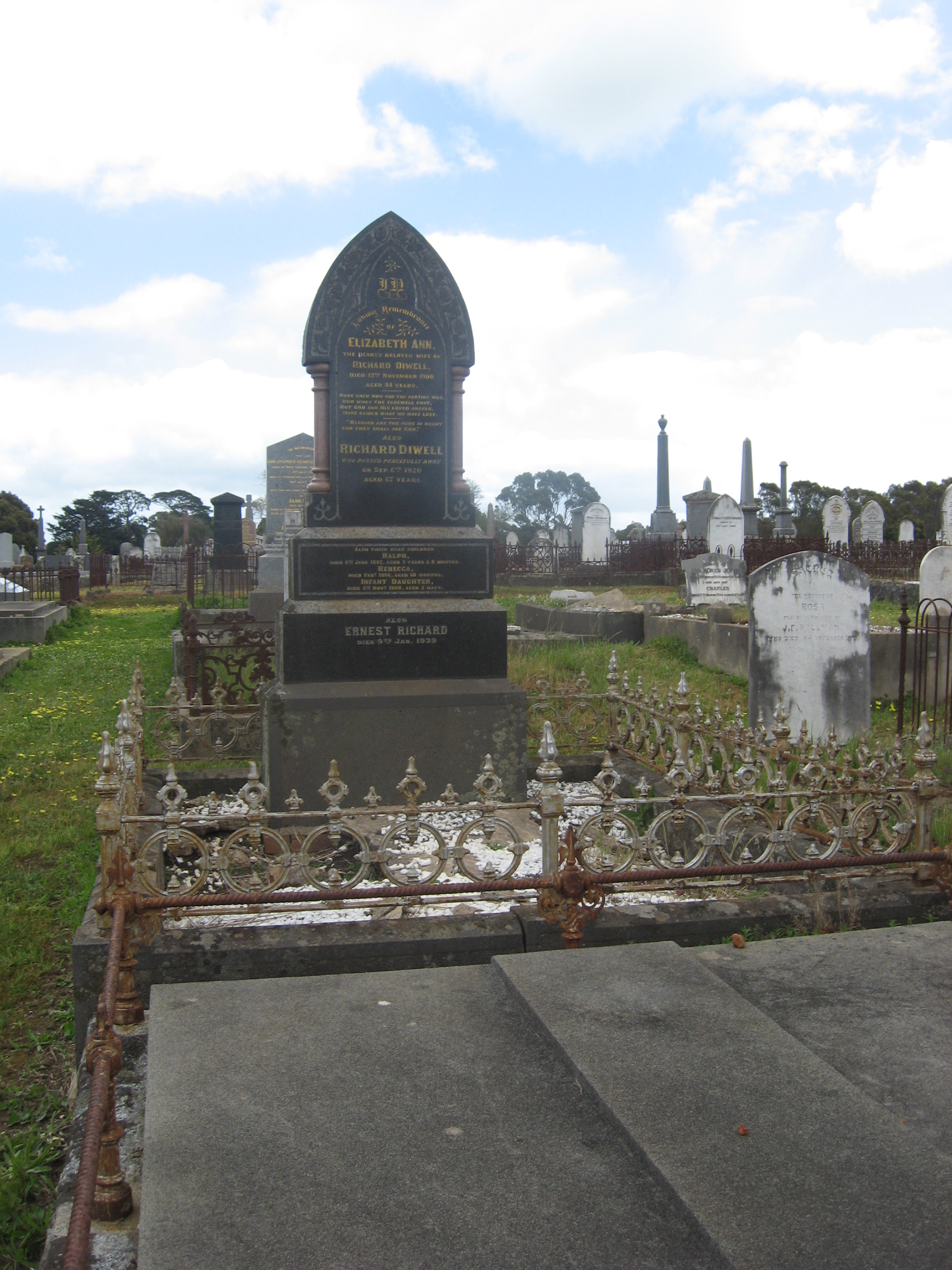
The headstone in the Hamilton Old Cemetery is a tribute to Elizabeth and demonstrates the devotion Richard and her children had for her.  Her headstone read:

“None knew how sad parting was, nor what the farewell cost, but God and his loved angels have gained what we have lost”


Despite having several young children, Richard never remarried.  The older girls Margaret and Jane would have taken on mothering duties of their younger siblings.  Margaret married in 1905, but Jane did not marry until 1915 at thirty by which time youngest Martha was seventeen.  Richard passed away in 1920 and was reunited with Elizabeth.

Life was not altogether easy for the Diwell children, although they always managed a happy disposition.  Margaret had seven children, however, three died, two as newborns.  Edith, my great-grandmother, suffered through an unhappy marriage and spent much time as a single mother.  Jane married twice, both husbands dying, the second after being hit by a taxi.  She never had children.

Grandma (Edith) and Auntie Mat (Martha)

Ethel had four known children, one dying at birth.  Martha or Mat as she was known was forty-one when she married and she also had no children.  The boys, William, Ernest and George all married and became bricklayers like their father and grandfather before them, but Ernest passed away at just forty-eight.

I was not lucky enough to know any members of this family but my mother fondly remembers and often talks of Grandma (Edith), Auntie Janey, Auntie Mat (Martha) and Uncles Bill and George.  The photo above of Grandma and Auntie Mat depicts them just as Mum remembers, always laughing and smiling.

As I look at the Diwell family photo I see Elizabeth as a devoted wife and mother but also a strong woman whose marriage was a partnership of two equals.  I can see the woman who was confident enough to sign the Suffrage petition and I see a happy, kind person, traits she passed to her children.

Next time I visit Richard and Elizabeth’s grave in Hamilton, I will be sure to take some Chrysanthemums.


©Merron Riddiford 2011


The “Duke of Richmond”

On 20 October 1852, the barque Duke of Richmond sailed from Birkenhead, England, bound for Portland Bay, Victoria, Australia.  Among the 236 passengers on board were two couples, each from different parts of England, one with small children.  They were my great, great, great grandparents, James and Susan Harman, and William and Margaret Diwell.  William and Margaret, from Kent, had two daughters under five.  Another daughter had passed away before the journey.  James and Susan were from Cambridgeshire and had been married only two months.

One of the passengers, Ann Maria Taylor, wrote in a letter home,

The weather was then so hot that people could not sleep on their berths. They were lying on the open deck…the captain who has been such for thirteen years, said he never experienced such weather.  Indeed I never expected to see land again.  Two nights were awful…lamps smashed…barrels of water capsized. (State Library of Victoria, Letter, Taylor, Ann Maria, 7 March 1853, MS 13313,   http://search.slv.vic.gov.au )

After around 140 days, Captain Thomas Barclay sailed the Duke of Richmond into Portland Bay on 4 March 1853.

portlandbay

PORTLAND BAY, 1856. Illustration by S.T.Gill, courtesy of the State Library of Victoria http://handle.slv.vic.gov.au/10381/303521

The Portland Herald reported on 11 March 1853, that Captain Barclay and Dr Webbers, the Surgeon Superintendent, had attempted to ensure all immigrants were comfortable and happy. However, the voyage was also reported as arduous, with much illness and over twenty deaths.  Measles claimed many of those who died.

The Diwell family disembarked and stayed in Portland for another five years before moving to the Casterton area.  William was a bricklayer and left the ship on his own account.  James Harman was engaged by  Mr Robertson at Boodcarra between Port Fairy and Yambuk for six months with wages of £50. They also spent time at Portland and Port Fairy before moving north to Muddy Creek, southwest of Hamilton, by the end of the 1850s. By 1863, James had selected land at nearby Byaduk

It is doubtful the two families came together again until 1945 when my grandparents, William Gamble and Linda Hadden, were married in Hamilton.

I have done some extra research on the other passengers aboard the Duke of Richmond.  Among them were Thomas and Mary Loats. Thomas was a neighbour of the Harman family in Drury Lane in Melbourn, Cambridgeshire. His older brother married James Harman’s oldest sister, Mary Ann. Thomas and Mary also moved to Muddy Creek. A number of the passengers moved to the Byaduk area. Some of the family names include Clarke, Everett, Gibbons, Looker, McIntyre, Merry, Patman, and Spong.