Witness for the Prosecution – New Findings

I love it when my ancestors find their voice and through their own words give something of their personalities.  Obviously, their voice is not audible, but through Letters to the Editors, wills or even as witnesses for an inquest, it is then easier to imagine them speaking.

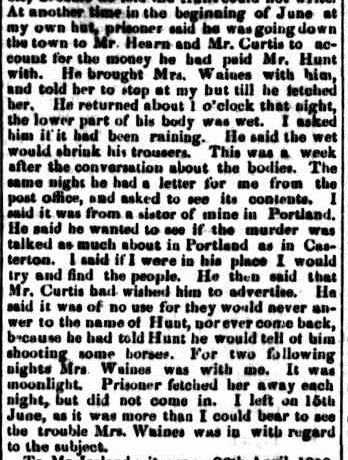
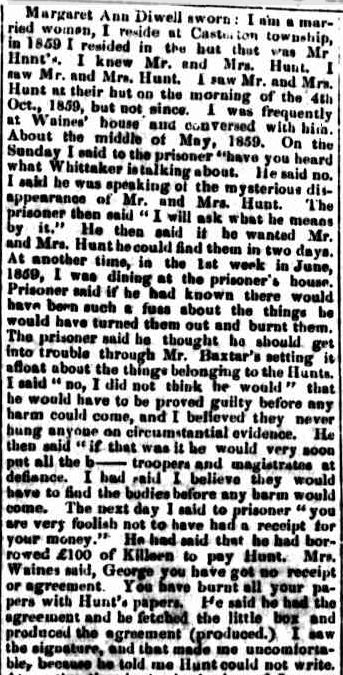
In my post Witness for the Prosecution, I  wrote of ggg grandmother Margaret Ann Turner, married to William Diwell, and her experience as a witness in a murder trial in 1860 at Casterton. Previous newspaper reports had only mentioned her role, but an extensive report of the trial in the Portland Guardian and Normanby General Advertiser of 20 April 1860 brings Margaret to life as she describes her conversations to the defendant, George Waines, prior to his arrest.  Of course, give consideration to the abilities of the person recording the events.

This article tells me a lot about my ggg grandparents.  It reconfirmed they were in Casterton in 1859 and Margaret said they were residing in a hut owned by Mr Hunt.  Also, Margaret must have been good friends with Mrs Waines spending a lot of time at their house, including dining there on occasions.  She makes no mention of William or the six children.

CIRCUIT COURT. (1860, April 20). Portland Guardian and Normanby General Advertiser (Vic. : 1842 – 1876), p. 2 Edition: EVENINGS. Retrieved November 10, 2012, from http://nla.gov.au/nla.news-article65443361

More revelations. George Waines dropped his wife off at Margaret’s hut one night.  Mrs Waines then stayed a further two nights with George returning each night to take Mrs Waines away.  Margaret stated she left on 15 June 1859 because she couldn’t bear to see Mrs Waines put through such torment.  So did Margaret leave her own hut and if so, where did she go?  Once again where were William and the six children?  One would think if William was around during these events, he too would have been called as a witness. William was a bricklayer and worked in surrounding towns so this may explain his apparent absence.

Notice too that Margaret describes the Waines’ abode as a “house”, but the Diwells and Hunts lived in huts.  They were most likely slab huts like the one below.

Sutherland, Alexander, [Slab hut with bark roof ca. 1870-ca. 1880] Image Courtesy of the State Library of Victoria http://digital.slv.vic.gov.au/view/action/nmets.do?DOCCHOICE=353791.xml&dvs=1352638571965~542&locale=en_US&search_terms=&adjacency=&usePid1=true&usePid2=true

The Waines lived in a “house” so it may have been more substantial like the one below, or perhaps larger if George Waines’ aspirations were any indication.

“Family in front of their house on cleared land somewhere in Victoria”
F. J. Stubbs & Co. Photographer [ca. 1858-ca. 1908] Image courtesy of the State Library of Victoria http://handle.slv.vic.gov.au/10381/73293

Another thing that caught my attention was Margaret’s mention of a sister from Portland.  That sent me scurrying to the records as I have never found any of Margaret’s siblings and I would have thought they were back in Surrey.  A quick search of the1841 UK Census records (again) and the Australian Death Index gave me nothing, but I will keep searching.  Or was it just a ruse by Margaret to throw Waines off his interest in her mail.

It is sometimes difficult not to think of ggg grandparents as anything but old.  Reading this latest find has reminded me that Margaret was only thirty-six during the events leading up to the trial which has also reminded me that Margaret lived for only another nine years after the trial.  She was forty-five when she died, only a little older than me.  Margaret never became the old woman I must stop myself imagining her as.

There has also been another development in my family’s association with the Hunt murders.   Another descendant of my ggg grandfather George Jelly contacted me recently.  George’s daughter Elizabeth married Margaret Diwell’s son Richard in 1877.

Judy was kind enough to send me a copy of George’s obituary.  It tells of George’s swimming prowess and how he dived for the bones of the Hunt’s in the Glenelg River.  Unfortunately, I cannot find anything in the various reports about George’s efforts, despite it being mentioned that there was a river search and bones found.

W is for…What Else Could It Be?

Naturally, I had to rejoin the Gould Genealogy Family History Through the Alphabet Challenge at “W”.  W is for Western District and that means a lot to me not only because this blog “Western District Families”.  I was born and raised in the Western District and all the families of my maternal lines, going back six generations, chose to settle in the wonderful Western District.

One of the highlights of the Western District is the geography.  Entering from the east, the Western Plains lead to the rise of the Grampians and on to the volcanic plains and green rolling hills beyond.  To the south are the forests of the Otways, the south-west coastline and volcanic Tower Hill.  And there are the rivers, meandering through the countryside to the sea.

I will take you on a geographical journey through the Western District, just a glimpse really, beginning with two colonial artists, Nicholas Chevalier and my favourite, Eugene Von Guerard.  These artists and others traipsed around Victoria sketching and painting.  Von Guerard also travelled to Tasmania, New South Wales, South Australia and New Zealand.  Looking at their paintings reminds me of the lives they lived for the sake of their art.

Chevalier’s sketch shows the Serra Range including Mt Sturgeon and Mt Abrupt at the southern end of the Grampians.

View of the Grampians, Western District [art original] N. Chevalier.
State Library of Victoria http://handle.slv.vic.gov.au/10381/100967

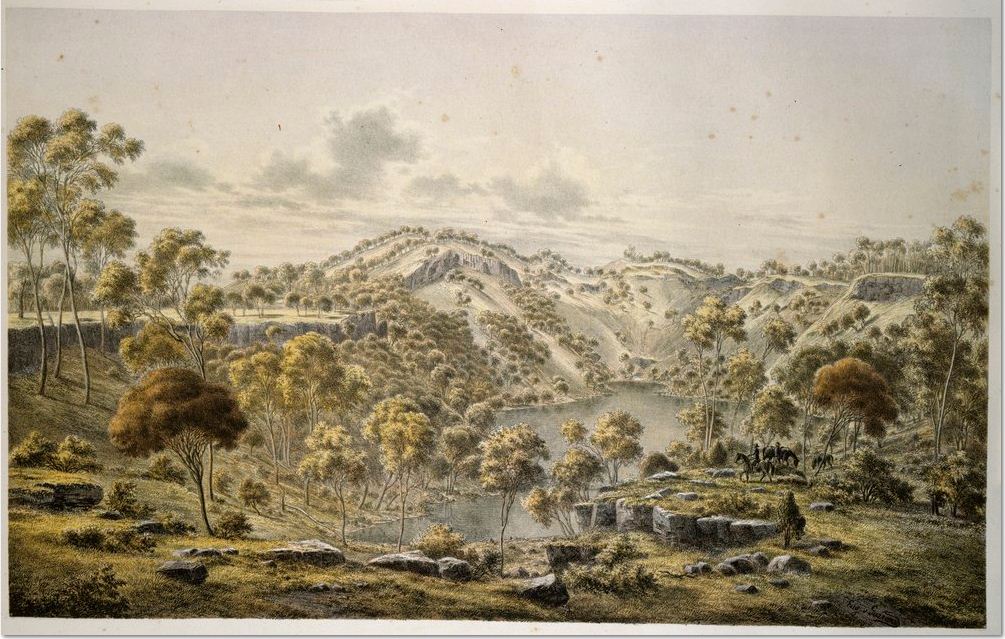
Moving south-west, dormant volcano Mt Eccles near Macarthur has played a part in my family history.  My gg grandfather Reuben James Harman, son of James Harman, owned property at Mt Eccles.  It was also a favourite fishing spot of my grandfather Bill Gamble.

Crater of Mt. Eccles, von Guerard, Eugene,1811-1901,artist.
Image courtesy of the State Library of Victoria http://handle.slv.vic.gov.au/10381/46307

I prefer von Guerard’s depiction of Lake Surprise, the crater lake of Mt Eccles, to my own (below).  I remember as a child asking about the name “Lake Surprise”.  The answer:  When you get to the top of the crater and see the lake, you get a surprise.  Fair enough.
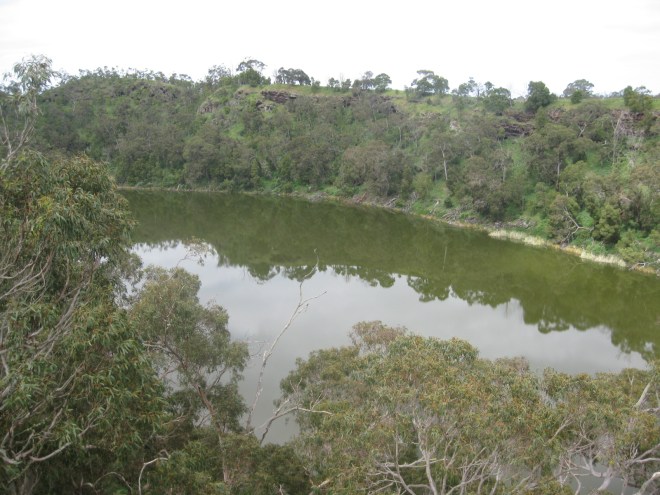
LAKE SURPRISE, MT ECCLES CRATER LAKE

It’s the photo of my grandfather Bill Gamble during the 1930s that is my favourite.
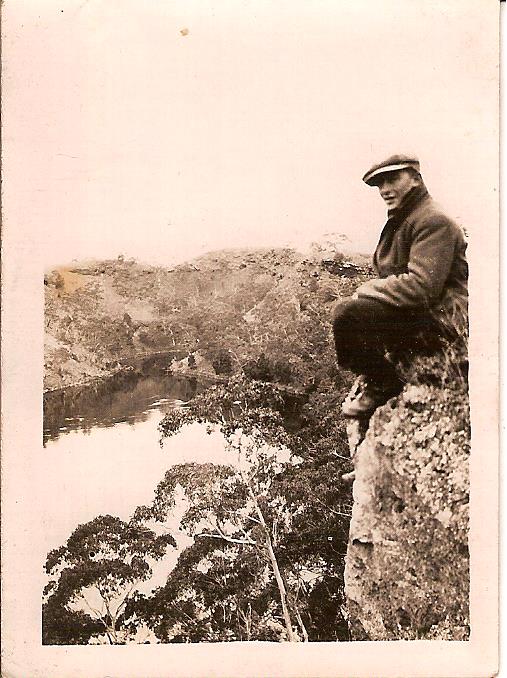
e

A little north of Mt Eccles is the volcanic lava flow, the Harman Valley at Byaduk, named after my Harman family.  In the distance is the source of the lava, Mount Napier.

THE HARMAN VALLEY, BYADUK

South of Mount Eccles is beautiful and historic Port Fairy, the last port of call for the Moyne River, with its origins east of Macarthur, before it reaches the sea.
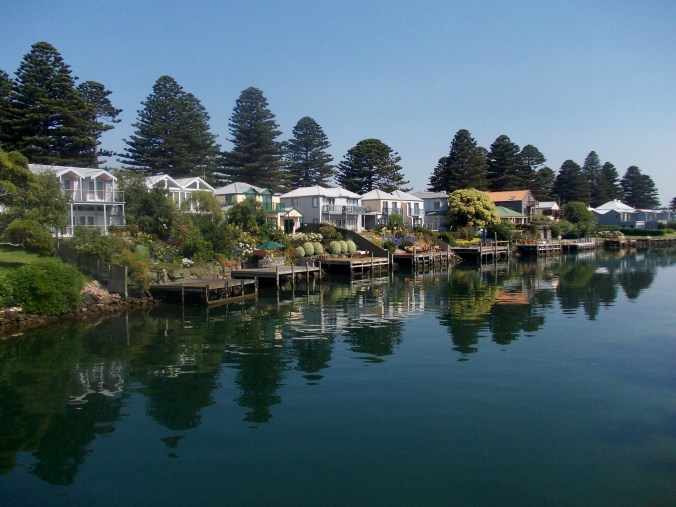
Port Fairy

MOYNE RIVER, PORT FAIRY


Moving east from Port Fairy is Tower Hill, another dormant volcano.

TOWER HILL

Next is Warrnambool.  The cemetery has a great view toward the Hopkins River close to the end of its 271 kilometre journey through the Western District from near Ararat to the sea at Logans Beach, one of the whale nurseries along the south-west coast,

WARRNAMBOOL CEMETERY

WARRNAMBOOL CEMETERY OVERLOOKING THE HOPKNS RIVER

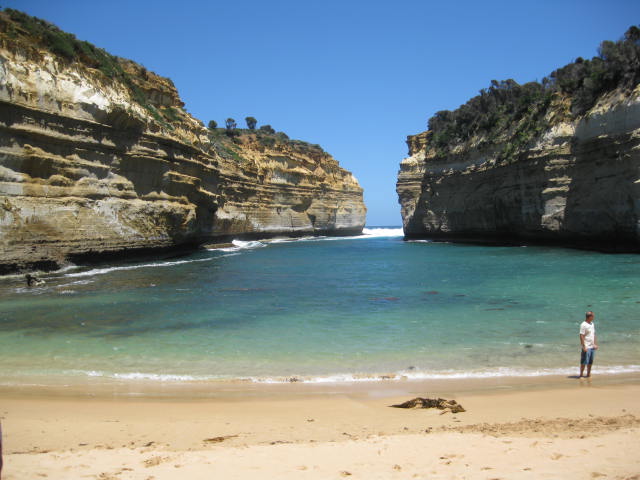
South-east of Warrnambool is the famous Loch Ard Gorge, named for the Loch Ard which wrecked on the treacherous coastline.  The only two survivors, Tom Pearce and Eva Carmichael were washed on to the beach at Loch Ard Gorge.

I find standing on the beach in the Gorge a haunting experience.

LOCH ARD GORGE

East along the coastline is one of the most iconic views, not only of Victoria but Australia.

THE 12 APOSTLES

North-west, and back where we started, are the Grampians.

HALLS GAP, GRAMPIANS

The Grampians are a perfect place to leave the subject of the Western District and move on to another “W” which has been a part of my family since the 1860s, the Wannon River…

W is for…Wannon River

The Wannon River begins its’ flow at the base of Mt Abrupt in the Southern Grampians.  It flows toward Dunkeld, around the base of Mt Sturgeon and leaves the Grampians heading north-west toward Cavendish. Along the way, it passes by Mokanger, the workplace of both the Mortimers and Haddens.  Through Cavendish, it passes close to the cemetery, burial place of members of those two families.

DSCN1056

CAVENDISH OLD CEMETERY


From Cavendish, the river begins a southward journey toward two of the Hamilton district’s jewels, the Nigretta and Wannon waterfalls.  As the river progresses west, the Grange Burn joins the Wannon north of Morgiana, having flowed from just east of Hamilton, the city founded on the Grange.  This section of the Wannon river was another favourite fishing spot of my grandfather Bill Gamble.

On the river flows to Tahara and then Sandford. I have family links to Sandford with Julia Harman, daughter of James Harman residing there with her husband George Holmes.  Two children were born at Sandford including WW1 casualty Arthur Leonard Holmes.  My gg uncle William Diwell also spent some time around Sandford.  In 1914, he completed extensions to the St Marys Church.

The Wannon River then joins another great river of the Western District, the Glenelg River, having passed through some of Victoria’s most beautiful countryside.  It is not surprising Joseph Hawdon, travelling overland to Adelaide with Lieutenant Alfred Miller Mundy of the 21st Regiment in 1839, endorsed Major Thomas Mitchell’s description five years earlier. Major Mitchell followed the Glenelg River from its beginnings in the Grampians through to the sea at Nelson. It is little wonder all my direct ancestors stayed in the Western District after settlement.

(1839, September 26). Launceston Advertiser (Tas. : 1829 – 1846), p. 1 Supplement: SUPPLEMENT. Retrieved October 11, 2012, from http://nla.gov.au/nla.news-page8723904

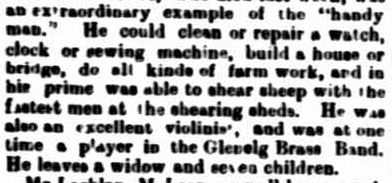
After the merge with the Wannon, the Glenelg flows on to Casterton where I have many family links.  My ggg grandfather George Jelly, the father of Elizabeth Ann Jelly, was one man who could say he had conquered the river.  His obituary read:

“He was a remarkably good swimmer and by his abilities in this direction was instrumental in saving many persons from drowning and rescuing the bodies of many others who had perished in the river” 

He even dived for the bones of Robert and Mary Hunt, murdered by George Wains in 1860.

By the time the Glenelg River reaches the sea, it, the waters of the Wannon and Grange Burn have passed by many of the places my ancestors lived, worked, fished, swam and were laid to rest.

042

NEAR THE MOUTH OF THE GLENELG RIVER, NELSON

The Wannon River between the Nigretta Falls and the Wannon Falls, about twenty kilometres from Hamilton, would be the section most frequented by myself and my family before me.  My own memories come from family visits, Sunday drives with Nana, school excursions and birthday parties.

The following views near the Wannon Falls are from the State Library of Victoria Collection and were captured around 1878 by  Thomas J. Washbourne, a Geelong photographer.

Wannon River Scene – Washbourne, Thomas J. photographer.Image courtesy of the State Library of Victoria Victorian Patents Office Copyright Collection (VPOCC) http://handle.slv.vic.gov.au/10381/53092

Wannon River Scene Washbourne, Thomas J.,photographer.
Image courtesy of the State Library of Victoria – Victorian Patents Office Copyright Collection (VPOCC) http://handle.slv.vic.gov.au/10381/52931

THE WANNON RIVER AT THE WANNON FALLS

Of the two waterfalls, I prefer the Nigretta, especially after rain.  The Wannon Falls could be described as pretty in the way the water drops off the edge, but the Nigretta Falls are, at times, spectacular.

NIGRETTA FALLS ON THE WANNON RIVER Image courtesy of the State Library of Victoria – collection: Cogger album of photographs http://handle.slv.vic.gov.au/10381/41740

The Vagabond (John Stanley James) described the Nigretta Falls in his series “Picturesque Victoria” for The Argus.  In the 4 April 1885 edition of The Argus, The Vagabond wrote of his visit to the Wannon.  He enjoyed the hospitality at the Wannon Inn and then marvelled at the “miniature Niagara”

PICTURESQUE VICTORIA. (1885, April 4). The Argus (Melbourne, Vic. : 1848 – 1956), p. 4. Retrieved October 11, 2012, from http://nla.gov.au/nla.news-article6073697

This photo taken in August this year by my friend Catherine, after some good rain, sees the Nigretta looking like the miniature Niagara Falls described by The Vagabond.

NIGRETTA FALLS – Image courtesy of Catherine Huisman

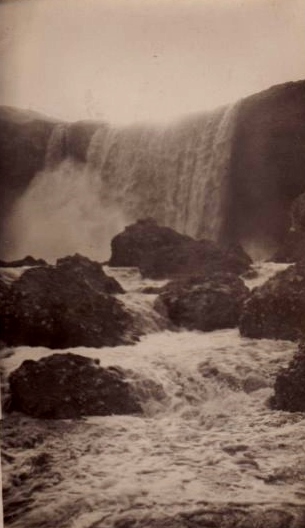
My grandfather, Bill Gamble, took the following photo in the 1930s

bg14

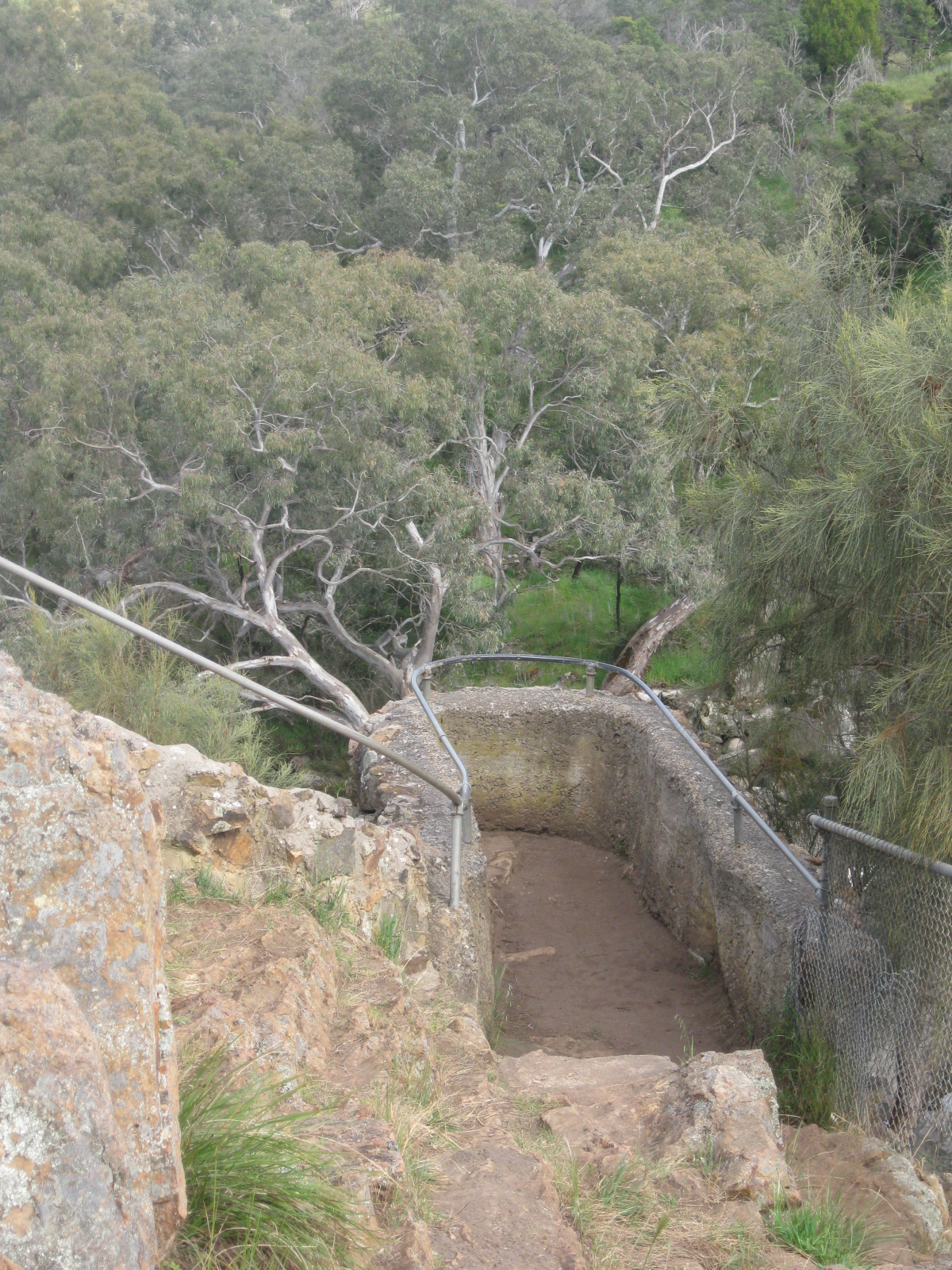
It was pleasing to see that the old viewing platforms still remain at the Nigretta Falls.

NIGRETTA FALLS VIEWING PLATFORM

An impressive wooden staircase now leads down to the falls, but the original steps remain.
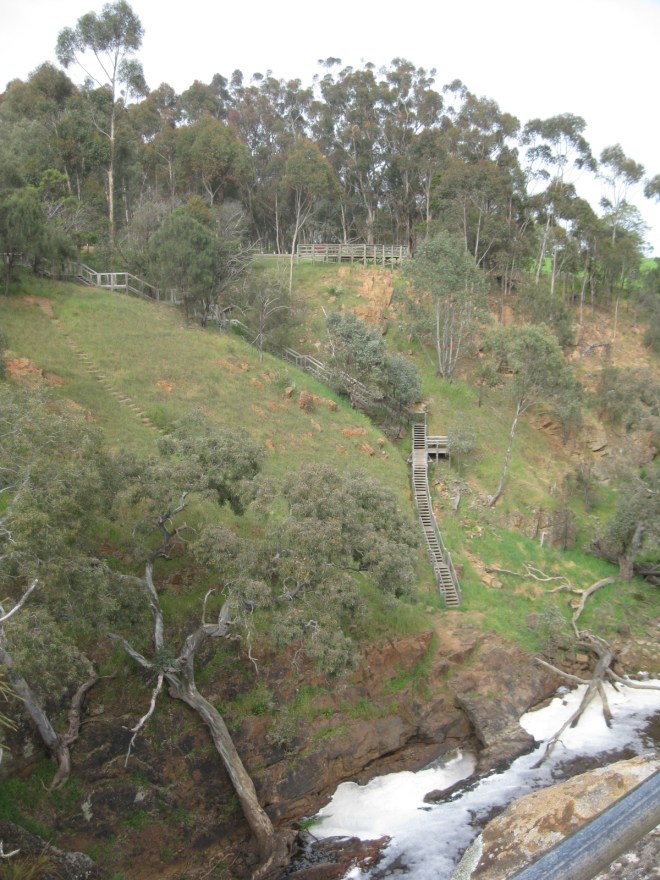
The Wannon Falls (below) holds memories of walking beyond the viewing platform, down to the rocks and behind the falls, but only when they were flowing lightly as they are in this photo.  A new viewing platform now prevents such precarious escapades, even undertaken while on school excursions!

WANNON FALLS

I have two framed prints of the Wannon Falls by Louis Buveot, painted in 1872.  One hangs on a wall as a constant reminder of Hamilton, the Wannon River and the waterfalls.  The original work hangs in the Ballarat Fine Art Gallery. To see the original click on the link – Wannon Falls

The topic of the Wannon River gives me an opportunity to share my all-time favourite family photos.  As a little girl when I first saw Nana’s old photo album, these photos captured my imagination.  When Nana came to live with us she kept her photo albums in her wardrobe. I would take them down, sit on her bed and go straight to the photo below.  It was near the beginning of the album which had black, much-turned pages.

From right: Nana, (Linda Hadden), my great-grandmother (Sarah Elizabeth Harman) and my great auntie Alma’s (Nana’s sister) mother-in-law Mrs Issac William Short (Catherine Gissane Tilley). They are standing on the original lower viewing deck.   The photos from a day at the Wannon were originally very small.  It wasn’t until I enlarged them on a computer, that I noticed Nana’s coat hanging on the railing.
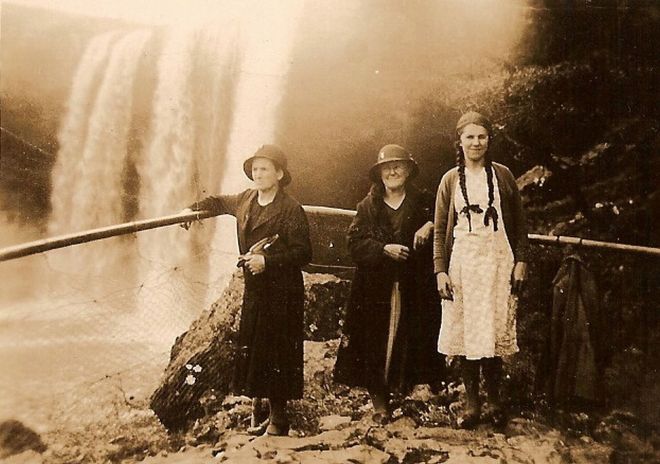
I think the reason I like this photo because Nana looked exactly like she did when I knew her, but with long braids and I still can’t believe she was only about fifteen.  Even the small research assistant thought Nana was the lady in the middle when he first saw it.  He only knew her as an older person and does not think of her as having been a child too.

The second photo was taken from the lower viewing deck, looking toward the upper level.  I didn’t like standing here as a child and as you can see the rail was high at the front  and difficult to see over and to the right of  Nana was a gap between the fence and the rocks.  I much preferred the lower deck.

My grandfather Bill, before he married Nana, liked to visit the Wannon Falls too, although he didn’t stick to the viewing platforms.

bg13

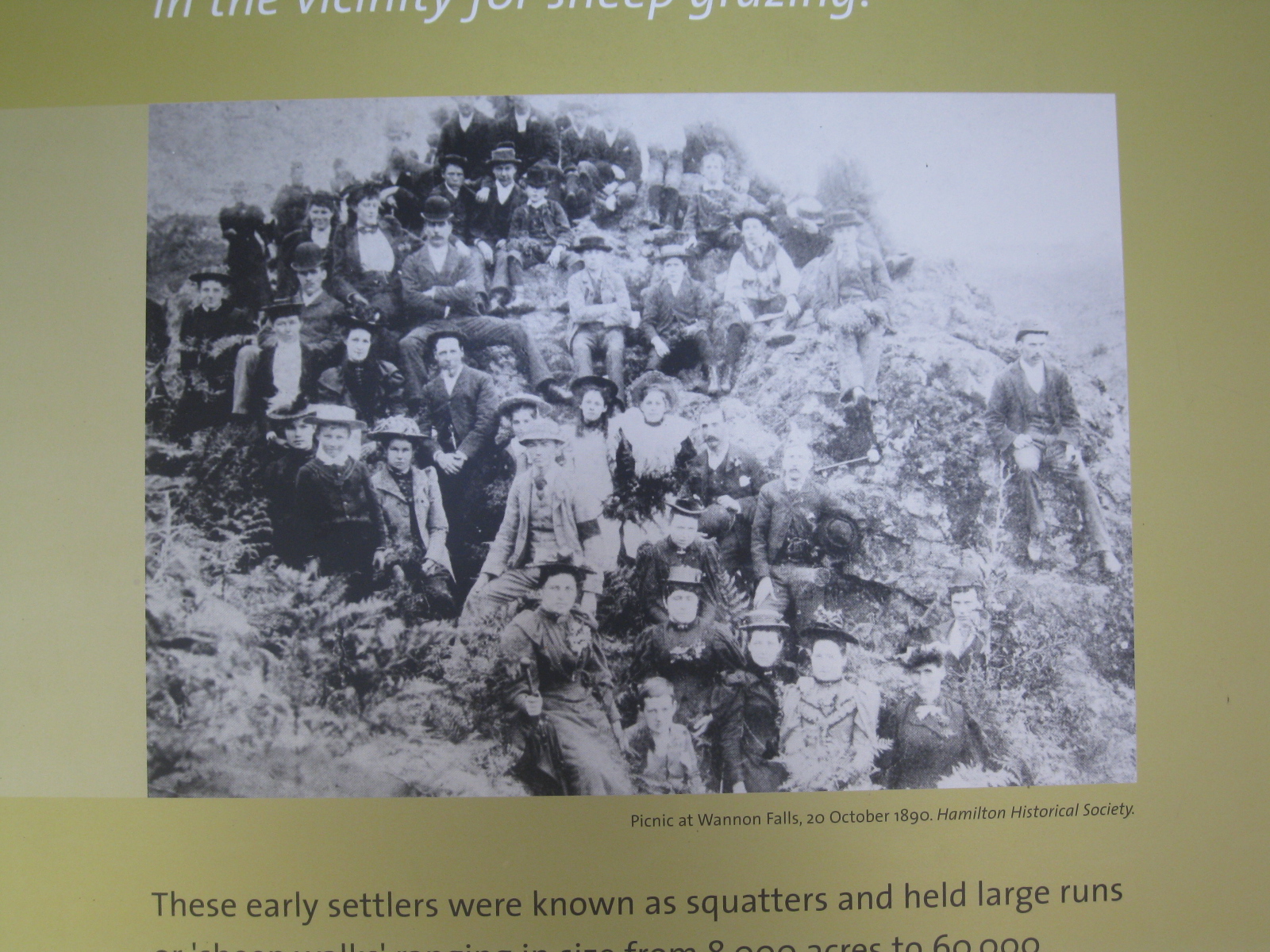
In more recent years, a rotunda was built at the Wannon Falls reserve with information about the waterfall, the local geography and history.

On our visit, the small research assistant said “Look Mum, they even have family history here for you”  He was right. There is a lot of my family history at the Wannon Falls.

©Merron Riddiford 2012
Trove Tuesday

a collection or store of valuable or delightful things

(Oxford Dictionary)

No better words could be used to describe the National Library of Australia’s Trove website.  If you have read a few of my posts, you would know I’m a big Trove fan.    A recent post by Jill Ball at her blog Geniaus, mentioned an initiative by Amy Houston which interested me.  Amy on her blog Branches, Leaves, and Pollen, told how she too is a fan of Trove and invited Australian bloggers to join her on Tuesdays each week to blog about the treasures we have found at Trove.

I have many Trove treasures and a lot of my blog posts are about those.  At first, I thought I would not take part merely because I didn’t think I could choose just one a week.    Where would I start?  That is much like asking me to name my favourite book or film of all time.  I just can’t do it.  But, as Amy suggests the treasure doesn’t always have to be about a family member it could be anything of interest.

I can do that.  How often have you found a newspaper article about a family member, only to find the article, above, below, or beside just as interesting?  I’m into advertisements too and I always read them.  There are some absolute gems, so expect to see some of those on Tuesdays.

Due to time constraints this week, I thought I would begin with a recap of some of my posts that highlight the benefits of Trove to family historians, particularly the digitised newspapers.   Without the newspapers, there is much that I wouldn’t know about my ancestors. Even hours of record searching couldn’t unearth what I have found.

In fact, the papers lead me to the records.  Whether it is records from courts or cemeteries, sporting clubs or churches, Trove has led me there.  Not only is it a time-saver, many of the leads I have found come from places I would never have thought of searching.

These are some of my treasures to date:

Witness for the Prosecution – The story of three of my relatives who were witnesses in murder trials.  I believe two of those stories, that of my ggg grandmother Margaret Diwell and my grandfather Percy Riddiford, would have remained hidden if it wasn’t for Trove.

Alfred Winslow Harman – Stepping out of the Shadows – I knew little about Alfred Harman before I starting an intensive search for him in the Trove digitized newspapers.  Now I know so much more.

Nina’s Royal Inspiration – The story of Nina Harman and her carpet really is delightful.  As Nina is not a close family member, I possibly would not have known this story without finding her direct descendants.  Instead, I found it in a Women’s Weekly at Trove!

To Catch a Thief – Ordinarily,  to find Jim Bishop’s brush with the law, I would have had to search the Branxholme Court Registers held at PROV‘s Ballarat Archives Centre.  Not too hard, but with so many people to research and so many towns on the Victorian court circuit, it may have been a long time before I found it.  Thanks to an article in the Border Watch, that time in Jim’s life is now known to me.

All Quiet By the Wannon – The Mortimer family of Cavendish kept to themselves.  Articles I found at Trove finally gave my ggg James Mortimer a voice.

Mr Mortimer’s Daughters Another Mortimer puzzle solved thanks to Trove.  From Henry Mortimer’s death notice in the Portland Guardian, I was able to establish the married name of one daughter and the second marriage of another daughter.

There is a list of Western Victorian newspapers available at Trove on my Links page.

Don’t forget there are other great treasures that can be found while searching at Trove.  Look beyond the newspaper matches as you never know what might come up in the other categories.  I have found photos of family members and some great early photos of Western Victorian towns while searching.  Trove is also great for tracking down books.

I will try to post something each Tuesday.  Thank you to Amy for the idea and I hope other Australian geneabloggers get involved too.

Show us your treasure and celebrate Trove!

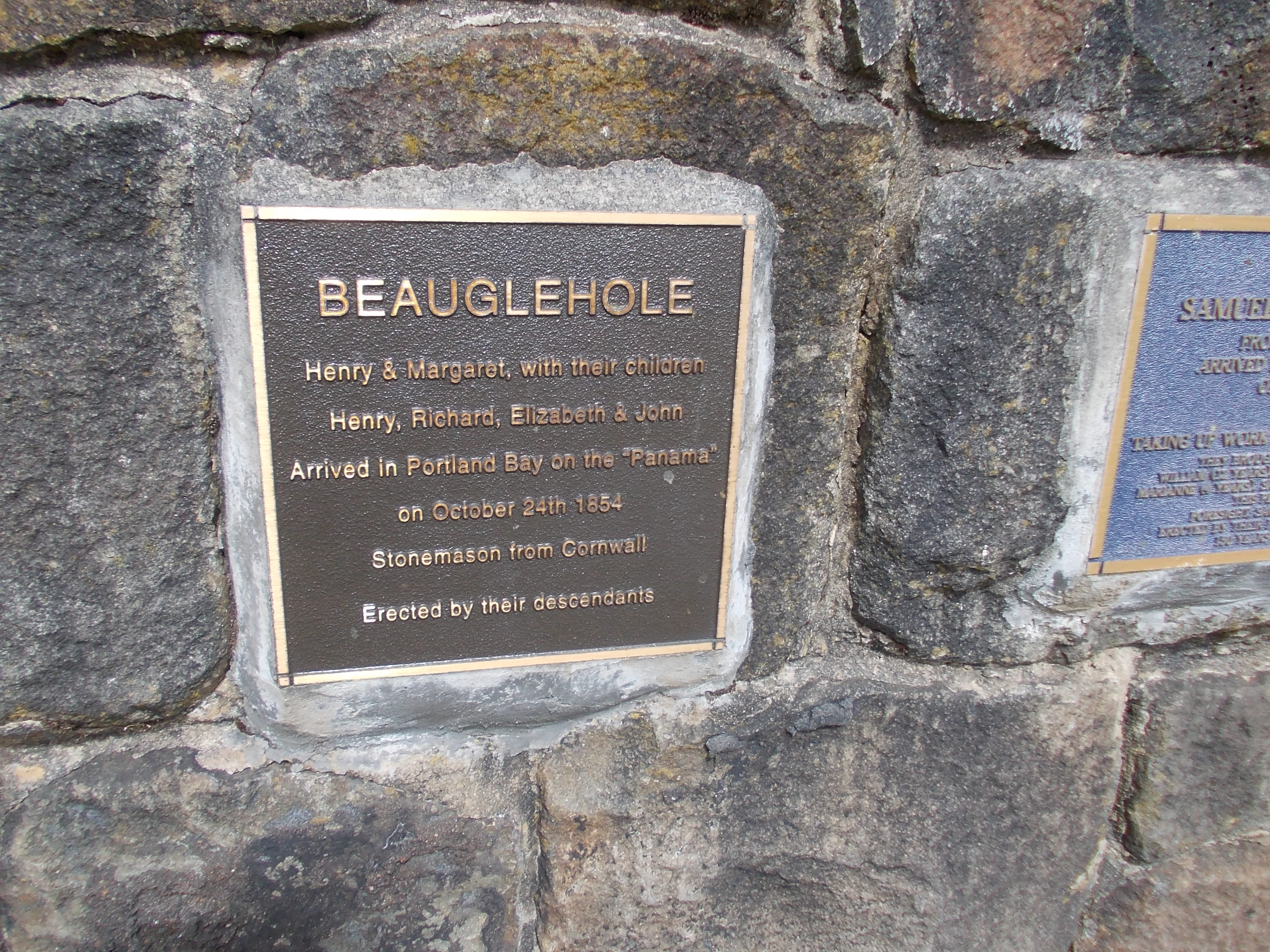
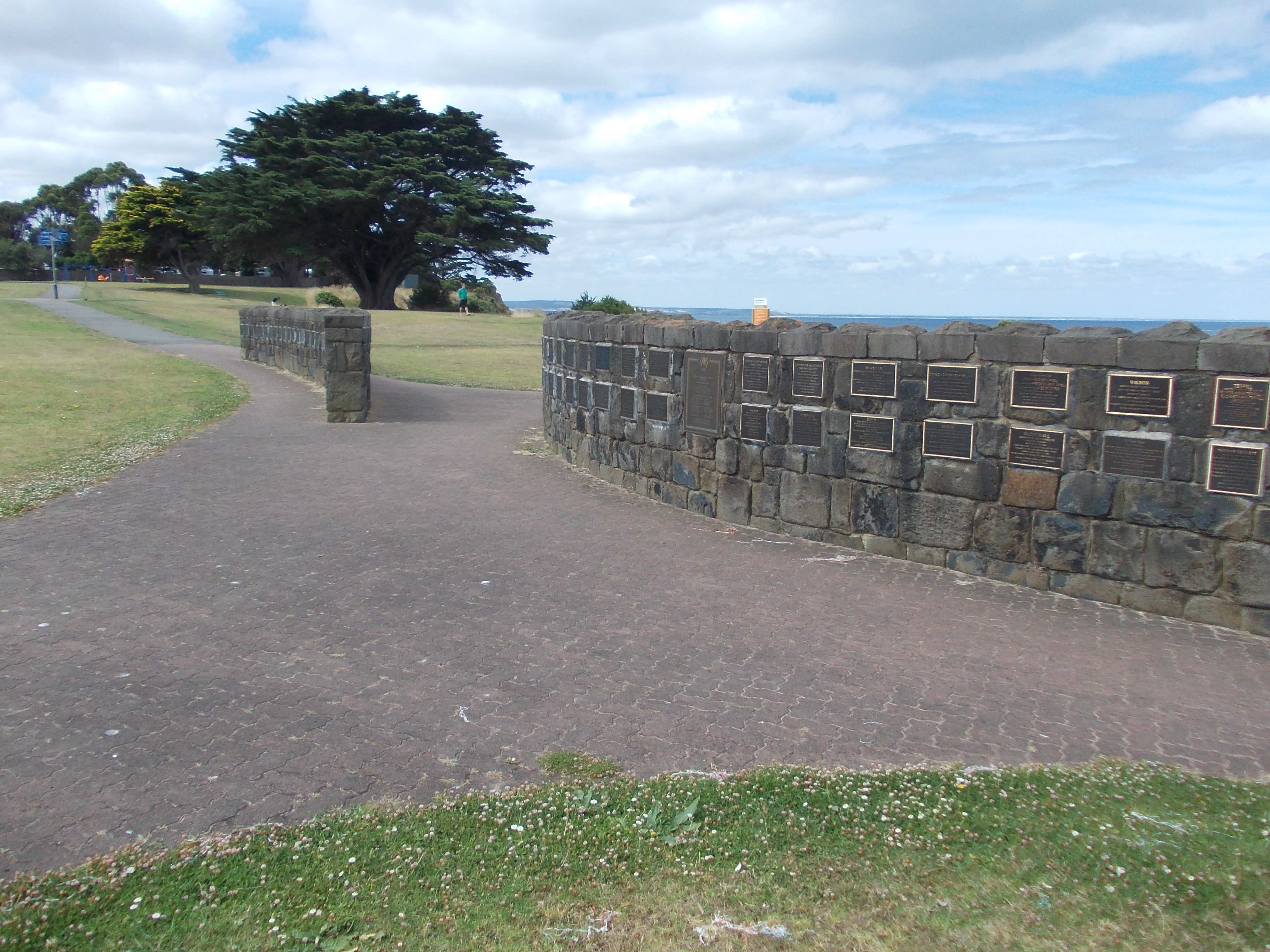
Portland’s Immigration Wall

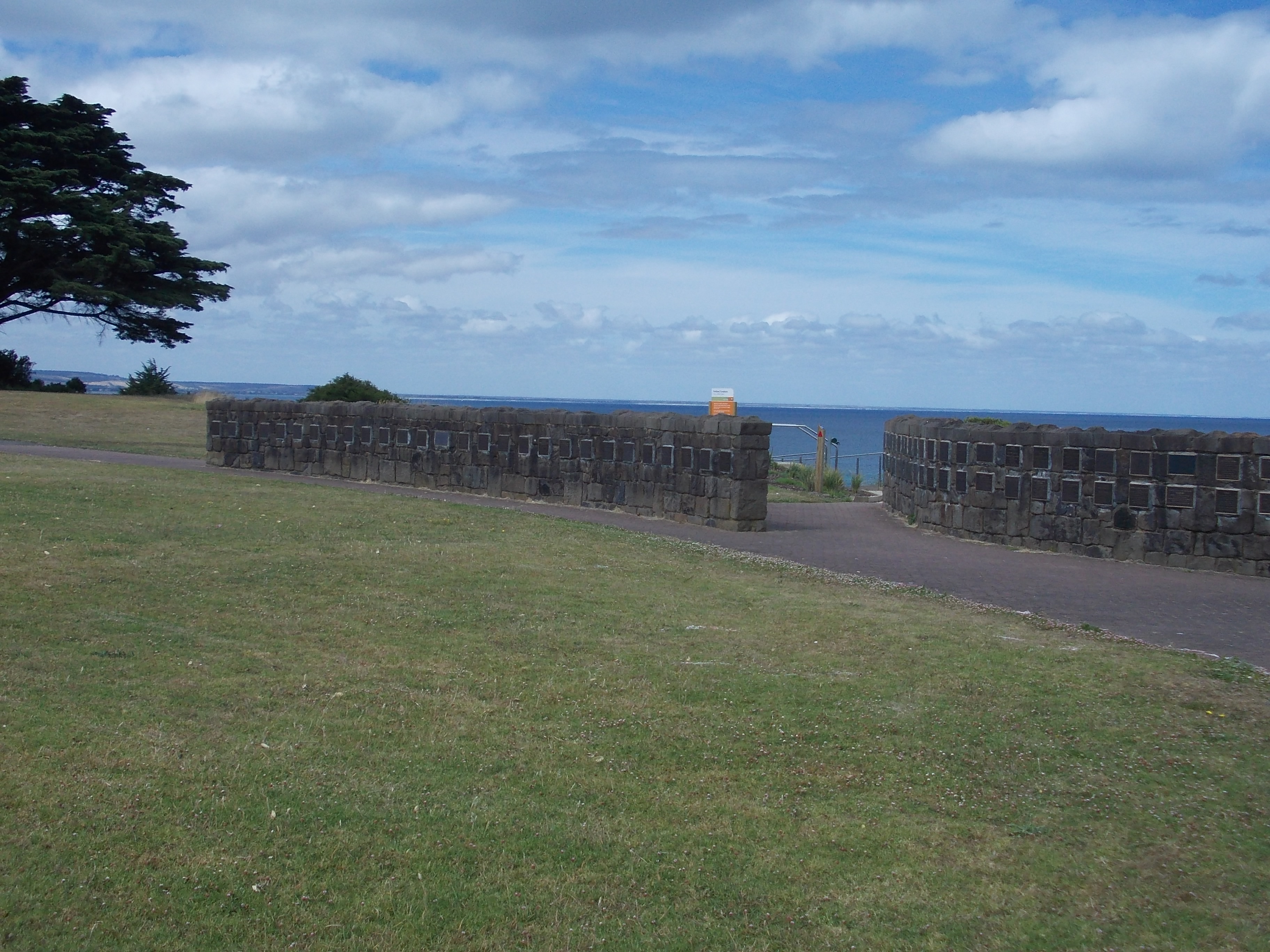
Portland’s Immigration wall is a great way to remember those ancestors who first set foot in Australia at the harbour town.  Located on the “Ploughed Field” opposite the Portland hospital and overlooking Portland Bay, the wall has plaques unveiled by grateful descendants of early pioneers to the south-west of Victoria.

The “Ploughed Field” is where one of Edward Henty’s workers ploughed the first sod of earth in Victoria in 1834 with a single furrowed plough now known as the “Henty Plough” and on display at Portland’s History House.

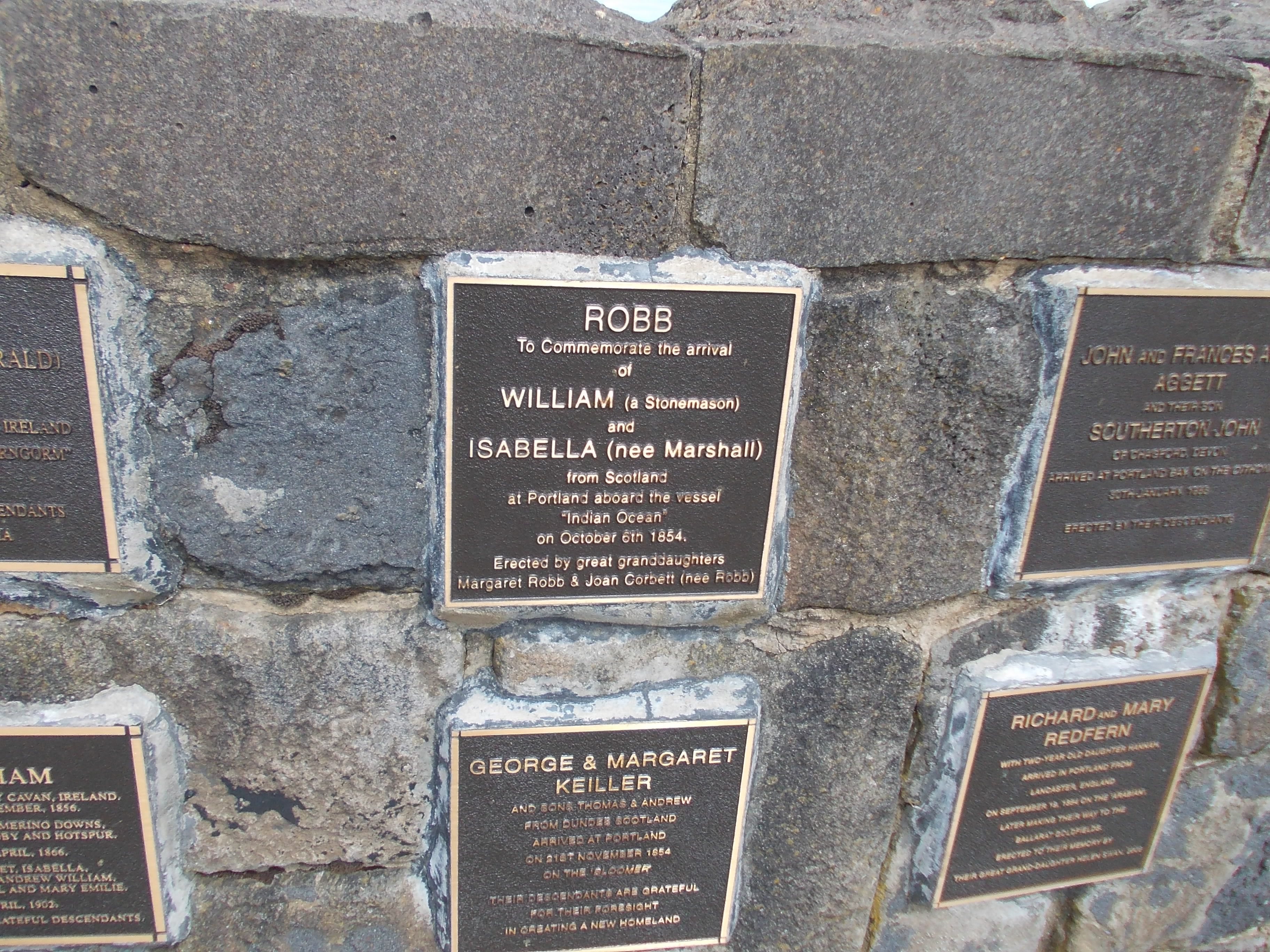
Some of the families remembered on the Immigration wall are :

William and Isabella ROBB were buried at the Old Portland Cemetery.

I know a little of Richard and Jane PRICE thanks to their grandson’s marriage to my first cousin 3 x removed.  Allan James Price married Ada Harman, daughter of Alfred Harman, in 1911.  One of the organisers, Lynn Price, invited me to the unveiling of the plaque and family reunion in 2009.  I met Lynn via the Rootsweb Western District mailing list.  It was disappointing that I was unable to attend as a lot of time has gone into remembering the Price family as seen at the Price family website.   It has photos of the reunion as well as a later event, the unveiling of headstone for Richard and Jane at the Heywood cemetery in 2010.

For more information on how you can see your family on the Immigration Wall, go to the Glenelg Shire website.

I hope one day plaques will be on the wall for my three sets of ggg grandparents who arrived at Portland.  James and Sarah Harman and William and Margaret Diwell and daughters Elizabeth and Sarah Diwell arrived on the Duke of Richmond in 1853 and George and Jane Jelly and their daughter Mary on the Athletae in 1855.

Passing of the Pioneers

As Passing of the Pioneers enters a second year, the fascinating stories keep coming.  Who could not be taken in by James Parker’s story? Gold, Captain Moonlight and more than a stroke of good luck make it an interesting read.  Or Octavius Palmer? While still a teenager, he travelled to California and took on the risky job of gold escort, while Mrs Isabella Gilholme’s business sense saw her acquire a portfolio of shops and houses.

Hannah BIRCHALL: Died July 1889 at Bridgewater.  I have mentioned Hannah Birchall before. In the News -May 26  was about the passing of Mrs Hugh Kittson who was Margaret Jennings, daughter of Hannah. Hannah’s husband, Margaret’s father, was Cook Abraham Jennings. Hannah and Abraham arrived in the district during the 1840s.

Amelia PITTS: Died 11 July 1897 at Myamyn. Mrs Dudden was known by many around Myamyn due to husband Stephen Dudden’s work as a storekeeper in the town. She arrived in Victoria during the 1850s. From a search at Trove, I found that only three months earlier on April 19, 1897, the Dudden’s residence, behind their shop, was destroyed by fire

James PARKER: Died 6 July 1899 at Heywood.  At the time of James Parker’s death, The Portland Guardian correspondent promised an account of Parker’s life, in the next issue. Finally, on 9 August 1899, he came good with his promise and it was worth it.  I cannot possibly summarise the life of James Parker, so you must read the obituary for yourself here.  It is a fascinating read, particularly Parker’s encounter with Captain Moonlight.  I will, however, include a piece from the obituary which describes pioneer life.  As you read, keep in mind the obituary is from 1899.

The Late Mr James Parker. (1899, August 9). Portland Guardian (Vic. : 1876 – 1953), p. 3 Edition: EVENING. Retrieved July 22, 2012, from http://nla.gov.au/nla.news-article63676913

William DISHER: Died 11 July 1902 at Stawell. William Disher arrived in South Australia during the 1830s. He married Agnes Horsburgh in 1842 and during the 1870s they moved to Kewell West, north of Murtoa. William and Agnes had twelve children and by the time of his death, the couple had seventy-two grandchildren and twelve great-grandchildren.  Incidentally, William’s mother had 220 direct descendants at the time of her death at ninety-two, including 120 great-grandchildren. William’s sister was Lady Eliza Milne, the wife of Sir William Milne a South Australian politician.

John M. SHEEHY: Died July 1903 at Casterton. How I need a man like John Sheehy in my life.

OBITUARY. (1903, July 28). The Horsham Times (Vic. : 1882 – 1954), p. 3. Retrieved July 22, 2012, from http://nla.gov.au/nla.news-article72840810

John MacEACHERN: Died 4 July 1908 at Nelson. While John MacEachern had only been in the Nelson district from the 1870s, he had been in Australia since 1839 having arrived in Sydney from Scotland with his parents. He made his way to Victoria, first working at Strathdownie as a stockman, where he proved himself an excellent horseman.

Edwin BOASE: Died July 1911 at Murtoa. Edwin Boase was a newspaper pioneer in the Wimmera. He arrived with his parents in Adelaide as a baby during the 1850s before they headed to Castlemaine. He learnt the printing trade in Ballarat before moving to Horsham in 1872 where he printed the first edition of The Horsham Times. He later founded The Dunmunkle Standard and published the paper for thirty-three years until the time of his death.  He married Isabella Cameron in 1878, a daughter of a former Horsham Mayor.

Octavius Frederick William PALMER: Died 18 July18 1914 at Terang. What a life Octavius Palmer led. He was born in London in 1833 and went to Tasmania with his parents and nine siblings in 1838. His father was Captain Frederick Palmer of the East India Company.  After schooling at the Church of England Grammar School in Launceston, Octavius left for the goldfields of California where he spent three years driving the gold escort team of horses. He returned to the Castlemaine diggings and after some pastoral pursuits with his brothers, he settled in the Western District around Warrnambool.

Octavius was a member of the  Warrnambool Polo Club and the Warrnambool Racing Club. He imported many head of Romney Marsh sheep in the 1870s.  An article from The Age of September 1972, reports on the Palmer family breeding Romney Marsh sheep for 100 years with references to Octavius. How proud he would have been that his family continued to breed the sheep he preferred for the conditions of the southwest of Victoria.

I  couldn’t resist this insight into Octavius in later life. From The Mail (Adelaide), the article describes an “old buster”.

When The Heart Is Young. (1941, September 20). The Mail (Adelaide, SA : 1912 – 1954), p. 4. Retrieved July 25, 2012, from http://nla.gov.au/nla.news-article54893294
Forty seems far too young to be thought of as an “old buster”!

Thomas BAILEY: Died 23 July 1914 at Ballarat. Like the JohnGreed above, Thomas Bailey was from Taunton, Somerset.  He was born there in 1840 but at a young age, he left for the New Zealand goldfields. He then went to Ballarat where he had various mining interests. He married Sarah Craig, the daughter of Walter Craig owner at the time of Ballarat’s Craigs Hotel.

Family Notices. (1869, January 29). The Argus (Melbourne, Vic. : 1848 – 1956), p. 4. Retrieved July 23, 2012, from http://nla.gov.au/nla.news-article5815936

Thomas was a member of the Ballarat Anglers Club, Ballarat Hunt Club and had a keen interest in football.  His death was felt in many parts of Ballarat including the Old Colonists Hall, where, out of respect, a meeting was cancelled.

Richard BRYANT: Died 12 July 1919 at Hamilton. Richard Bryant was born in Cornwall in 1829 and married Elizabeth Millstead in 1850.  The couple travelled to Adelaide aboard the Epaminodas in 1853.  From there they went to Portland and Richard walked on to Ballarat in 1854 in search of gold.  After the death of Elizabeth, Richard and two young daughters settled on land at Mooralla.  He then married Irish-born Margaret Nowlan.  Margaret passed away in 1907.
I have a family link to Richard Bryant via a daughter from his first marriage.  Richard was the grandfather of Elizabeth Bryant McWhirter,  wife of James Stevenson of Cavendish.  James was the subject of the post “Hobbies Passions and Devotions.

Sophia Caroline GORTE: Died 10 July 1920 at Halls Gap.

Obituary. (1920, July 16). The Horsham Times (Vic. : 1882 – 1954), p. 5. Retrieved July 23, 2012, from http://nla.gov.au/nla.news-article73176649

I turned to Ida Stanton’s Bridging The Gap for more information about Sophia Gorte. Sophia’s husband Carl Wehl had a tannery in Stawell but owned land in Halls Gap. The house that Sophia built (as referred to in her obituary) was Glenbower 2 near Borough Huts, just outside Halls Gap. The house was so named as it was next to Glenbower owned by members of the D’Alton family, including twins Sophia and Henrietta.

That home went into ruin, however, at the time of Ida writing her book, poplars and remnants of the garden still existed.   Ida tells how the D’Altons brought the poplars with them to Australia from Napoleon Bonaparte’s grave on the island of St Helena. This is not as unusual as it sounds.  A Google search found many others who also grew both poplars and willows grown from cuttings taken from the island’s trees.  An article from The Mercury tells of a Tasmanian family who did the same.

The bushfires of 1939 saw  Glenbower 2 destroyed. There are photos of both homes in Bridging the Gap, and Sophia Wehl is on the veranda in the Glenbower 2 photo.

Sophia Wehl’s daughter was a noted artist specialising in wildflowers. Her art teacher was neighbour Henrietta D’Alton who was famous for her wildflower art and had even exhibited overseas.

Margaret Ann DIWELL:  Died July 1932 at Hamilton. Margaret was my ggg aunt and daughter of William Diwell and Margaret Turner.  She was born at Portland in 1857 and married John McClintock in 1883. They lived at Grassdale and had eleven children including John, James Richard, and Albert Edward featured in my Anzac Day post The McClintock Brothers.

OBITUARY. (1932, July 21). Portland Guardian (Vic. : 1876 – 1953), p. 2 Edition: EVENING. Retrieved July 23, 2012, from http://nla.gov.au/nla.news-article64298800

In the post, Passing of the Pioneers – A Year On, I mentioned the dangers of wrong information in obituaries. Margaret’s obituary offers an example of this. It mentions her parents arrived in Portland in 1850. They, in fact, arrived on the Duke of Richmond in 1852.  Margaret’s mother is also mentioned because of her involvement in the murder trial of George Waines.  I wrote about that trial in Witness For the Prosecution.

John Thomas EDGARDied 10 July 1941 at Melbourne. John Thomas Edgar was born at Portland in 1848, the son of David and Sarah Edgar. The Edgars settled at Pine Hills estate near Harrow. David Edgar subsidised a private school at the estate for the use of his children and the children of other settlers and John attended that school before going on to Hamilton College and later Scotch College in Melbourne.

With his schooling completed, John returned to Pine Hills to learn the finer points of running Merino sheep. This saw him go to on to become an expert breeder and judge of the popular Western Victorian breed.  He took over management of his father’s property Kandook Estate at Harrow and later the ownership. In 1871, John married Margaret Swan and they raised a family of twelve children. He was the brother of Walter Birmingham Edgar and a cousin to Jean Edgar, both Passing Pioneers.

Michael MURPHY:  Died 12 July 1943 at Melbourne. I have driven past Tobacco Road, Pomonal many times en route to Halls Gap and finally, I know how it got its name. Michael Murphy was a former resident of Pomonal at the foot of the Grampians.  He was one of the tobacco-growing pioneers in the area. I didn’t know tobacco was grown there, but it seems obvious now that Tobacco Road was named for such a reason.

Michael was also a supporter of local football and cricket and was a founding member of the Stawell Druids Lodge.  He was seventy-four at the time of his death, following complications of injuries received in a tram accident in Melbourne.

Isabella REID: – Died July 1953 at Heywood.  Isabella Reid was the daughter of William Reid and Johanna Steven and wife of Charles Gilholme. Isabella ran a guest house but after Charles’ death, she expanded her business interests into property.

DEATH OR HEYWOOD OCTOGENARIAN. (1953, July 27). Portland Guardian (Vic. : 1876 – 1953), p. 2 Edition: MIDDAY. Retrieved July 24, 2012, from http://nla.gov.au/nla.news-article64435398

Misadventures, Deaths, and Near Misses

I have previously posted on the Misadventures, Deaths, and Near Misses of my family members, but as people could hurt themselves in so many ways in the 19th and early 20th century I thought I would share some more.   I have included a couple of people related to me, but most are just everyday people doing everyday things.  If you click on the “victim’s” name it will take you to Trove and the original article.

RABBIT SHOOTING

Beware the perils of rabbit shooting.  Henry Beaton, Reverend T Scanlan & John Kinghorn all knew the dangers, at least in hindsight.

Poor Henry was climbing through a fence with his Winchester when it went off and shot him in the foot.  John Kinghorn, a somewhat accident prone lad, lost the flesh below his thumb after the barrel of his gun exploded in 1890.  On another day not long after, he was riding to Hamilton with the Byaduk Mounted Rifles when another horse kicked him in the leg resulting in a severe leg injury to John.

Reverend Father Scanlan was shooting rabbits with Reverend Father Timmins.  Father Timmins wounded a hare so Father Scanlan pointed his gun through a hedge to take a last shot when the gun exploded, wounding him in the thigh.

A search at Trove found 1624 article headlines containing “Peculiar Accident”  So what characterizes a peculiar accident?  Well  Mrs C.E. Lewis qualified after a cow’s horn ripped her eyelid.

Mr W.B Edgar made the grade while trying to relive his golfing days only to have some protective plovers attack him.

Peculiar Accident. (1937, August 30). Portland Guardian (Vic. : 1876 – 1953), p. 2 Edition: EVENING. Retrieved July 11, 2012, from http://nla.gov.au/nla.news-article64276868

An over exuberant crack of a stock whip resulted in Stephen Moodie’s peculiar accident. Another peculiar accident occurred to an unknown and probably embarrassed customer of Page’s store in Warracknabeal. Lucky in-store video surveillance was not around then or the footage may have made it to a 1920s equivalent of Funniest Home Videos.

A PECULIAR ACCIDENT. (1929, March 19). The Horsham Times (Vic. : 1882 – 1954), p. 8. Retrieved July 11, 2012, from http://nla.gov.au/nla.news-article72606226

Young Alex McIntyre would have thought twice before he messed with a bottle of spirits of salts again.  Deciding the best way to make sure the cork was in the bottle was to stomp down on it with his boot, he caused the bottle to explode.  It was enough to blow the hat from his head.  Luckily he escaped with minor burns and a dose of sense.

While the following peculiar accidents were not headlined as such, I do believe they fall into that category.  Feeding peanuts to a leopard at Melbourne Zoo did it for David Horsfall and Mrs Hill of Casterton found a lost needle in her hand, 35 years later.

Miss Gladys Makin would have been wary of yawning after her peculiar accident in 1908.

PECULIAR ACCIDENT. (1908, March 31). The Horsham Times (Vic. : 1882 – 1954), p. 2. Retrieved July 12, 2012, from http://nla.gov.au/nla.news-article72808154

“Eyes Damaged by Paper” was the headline for Mr H. Foster’s peculiar accident.  From the Minyip “Guardian” newspaper, Mr Foster took paper cuts to a whole new level.  Fingers are the usual victims of the dreaded paper cut, but the gentleman managed to have the paper he was carrying pass over his eyeball.  Several days in a dark room was the remedy.

PAINFUL ACCIDENT. (1916, January 25). Warrnambool Standard (Vic. : 1914 – 1918), p. 3 Edition: DAILY.. Retrieved July 11, 2012, from http://nla.gov.au/nla.news-article73868145

The headline “painful accident” was found 2149 times at Trove, although I think most accidents would fit this description.

Walter Greed of Hamilton was a victim of a painful accident in 1891.  Walter was the son-in-law of Reuben Harman and husband of Jesse Harman.  While working at his uncle’s coach building business Walter’s hand became caught in a studded drum used to prepare stuffing for carriage seats.  Once released, he ran, blood dripping, to Rountree’s Chemists in Gray Street where his hand was bandaged.  The chemist recommended Walter attend the Hamilton Hospital where it was found he had no broken bones.

It goes without saying that Mr Matthews’ accident was painful.  While mustering sheep in the Grampians in 1898  a fall on to dry sticks saw one of them enter three inches into his leg.  Wood was also the cause of Mr J. Sullivan’s painful accident near Warrnambool.  A chip of wood flew up and hit him in the eye, resulting in the eye being removed.

I feel bad smiling while reading the following article.  But when I begin to visualise what John Brisbane was doing it is becomes cartoon-like, particularly if I think of what might have happened and thankfully didn’t.  Apologies to John’s descendants for my mirth.

PAINFUL MOTORING ACCIDENT. (1946, July 25). Portland Guardian (Vic. : 1876 – 1953), p. 2 Edition: EVENING. Retrieved July 12, 2012, from http://nla.gov.au/nla.news-article64408475

SOME UNFORTUNATE RELATIVES

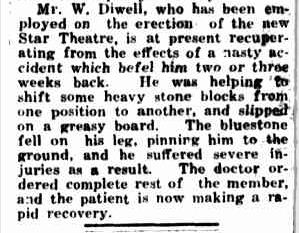
Death by misadventure best describes the unfortunate death of my gg uncle and again spirit of salts proved a very dangerous substance.  In 1939, Ernest Richard Diwell drunk spirits of salts thinking it was whiskey.  This was a fatal mistake.

Only two years earlier, Ernest’s, uncle William Diwell had his own misadventure.

Advertising. (1937, June 10). Portland Guardian (Vic. : 1876 – 1953), p. 3 Edition: EVENING.. Retrieved July 12, 2012, from http://nla.gov.au/nla.news-article64276046

I could go on all day with examples.  I have hundreds of them including “unusual accidents”, “extraordinary deaths” and articles with headlines such as “Horse Jumps in Side-Car” and “Cakes Flew When Horse Bolted”, but I will save them for another time.

Hobbies, Passions and Devotions

The activities of my ancestors outside of their usual occupation is always of interest to me.  Their sports, pastimes, hobbies, and social activities often help define them as people and sometimes those activities are present in later generations.  Also, it can lead to further information from club records and results in newspapers.

In some cases, much spare time was devoted to the church, maybe on the committee such as William Hadden or as a lay preacher like James Harman.  James was also able to find time for his other passion, ploughing competitions, not to mention various committees, such as the local school.

Richard Diwell had an interest in the Hamilton Horticulture Society but also indulged in photography. The photo in the post about Elizabeth Ann Jelly was one of Richard’s using a camera with a timer, a new development in photography at the turn of the century.

My grandfather, Bill Gamble, grandson of Richard Diwell, had many interests, particularly before he married.  He played cornet with the Hamilton Brass band and was a committee member of the Hamilton Rifle Club and a state representative shooter.

He also loved fishing, motorcycles, and like his grandfather before him, photography.  As a result, we now have hundreds of photographs of motorbikes and fishing trips.  He even developed his own photographs.  His passions of photography and motorcycles were passed on to his son Peter.

Many of the Holmes and Diwell families were members of Brass Bands at Casterton and Hamilton.  Alfred Winslow Harman was a rifle shooter and I recently told you about Nina Harman, wiling away the hours completing tapestry carpets.

I recently found an activity that previously hadn’t been present in my family, greyhound breeding.

James Stevenson was the grandson of James Mortimer and Rosanna Buckland. He worked as a manager at Hyde Park a squatting run north of Cavendish until it was split up in 1926 for the Soldier Settlement scheme.  After this James moved to “Glen Alvie” at Cavendish where he described himself as a grazier.

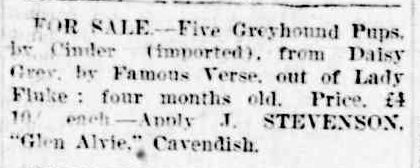
In 1927, he advertised five well-bred greyhound pups for sale.  At £4 each, he stood to earn £20 if he successfully sold them.  A seemingly profitable hobby indeed.

Advertising. (1927, February 25). The Horsham Times (Vic. : 1882 – 1954), p. 5. Retrieved June 15, 2012, from http://nla.gov.au/nla.news-article73082854

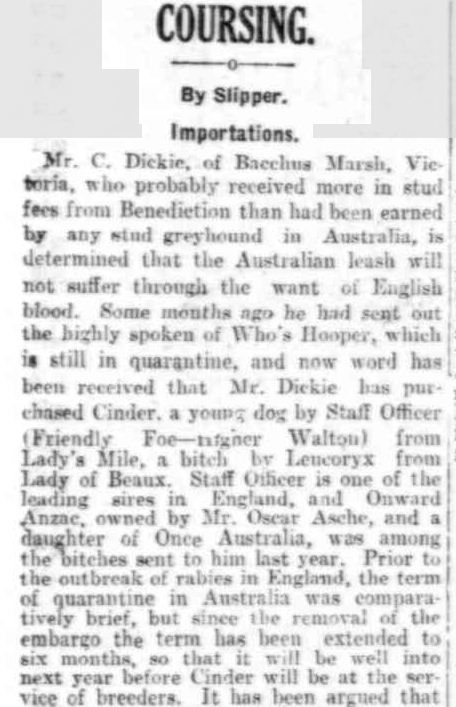
James would have needed a good return on his pups as the sire’s stud fees would have been pricey given Cinder was imported by the successful breeder, Mr. Dickie of Bacchus Marsh.  The article from the time of Cinder’s arrival in Australia in 1923, reports the dog remained in quarantine for six months.  Because of a rabies outbreak in England, there was an extension to the time spent in quarantine only a short time before his arrival.

In 1927, the time of James’ advertisement, greyhound racing using a “mechanical hare” began for the first time at the Epping course in New South Wales.  It took longer for other states to adopt the “tin hare” where they continued with the traditional field coursing.

SPORTS AND PASTIMES. (1923, September 7). The Register (Adelaide, SA : 1901 – 1929), p. 6. Retrieved June 19, 2012, from http://nla.gov.au/nla.news-article65041056


WHAT DID YOUR ANCESTORS DO IN THEIR SPARE TIME?

The McClintock Brothers

This is the second year I have participated in the ANZAC Day Blog Challenge.  It is a privilege to share the stories of my family members who went to war.  The stories of the men and women who served their country in each of the wars should never be forgotten.

Reading the World War 1 service records of my 1st cousins 3x removed,  brothers, John, James and Albert McClintock one thing was obvious.  The great adventure of war soon became a nightmare for the McClintock family of Grassdale near Digby.

Head of the family, John McClintock was born in Ireland in 1842. He arrived in Victoria in 1865 aboard the Vanguard. Somehow he ended up in the Digby area and in 1878 he married Sarah Ann Diwell, my ggg aunt and daughter of William Diwell and Margaret Turner.  The following year, daughter Margaret Ann was born and in 1880, son David was born.  Life seemed good for the McClintock family.

In 1882, the first tragedy befell them.  Sarah passed away at just thirty-one.  John was left with two children aged just three and four. Help was close at hand.  In 1883, John married Sarah’s younger sister, Margaret Ann Diwell.  At twenty-six and fifteen years John’s junior, Margaret went from aunt to mother to Margaret and David. In 1885, the first of eleven children were born to John and Margaret McClintock.  A son, William Diwell McClintock died as an infant in 1887 but by 1902, when the last child Flora was born, Margaret and John had a family of six girls and six boys.

In 1913, a seemingly harmless activity of chasing a fox ended in another tragedy for the McClintocks.  Eighteen-year-old Robert died from heart strain and tetanus as a result of his fox chasing.

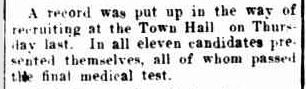
Next was the outbreak of war in 1914 which paved the way for the greatest tragedy faced by the family.  Three of the five McClintock boys, John, James and Albert, enlisted.  Of the remaining two boys, David was too old and Thomas was too young.

JAMES RICHARD McCLINTOCK

James was the first of the McClintock boys to enlist.  In Melbourne on 7 October 1915, the twenty-four-year-old signed his attestation papers and effectively signed his life away.

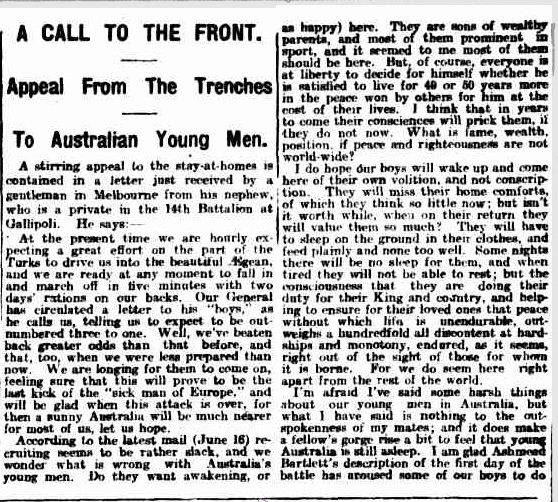
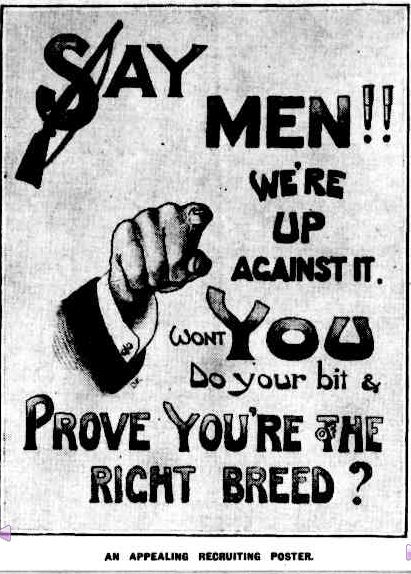
At the time,  those of eligible age were bombarded with propaganda designed to drive recruitment.   The horrors of war had already been felt at home with the Gallipoli landing earlier in the year. The recruitment campaign went to a new level.  War was no longer the big adventure it was made out to be.  Rather men were urged to fight in honour of their fallen countrymen who had died for them. Recruitment posters were everywhere and articles such as this from The Argus of 16 September 1915, must have gone a long way to persuading James to enlist the following month.

A CALL TO THE FRONT. (1915, September 16). The Argus (Melbourne, Vic. : 1848 – 1956), p. 5. Retrieved April 20, 2012, from http://nla.gov.au/nla.news-article1560597

On 27 January 1916, James was given a send-off by the Digby community.

A Digby Recruit. (1916, January 27). The Casterton News and the Merino and Sandford Record (Vic. : 1914 – 1918), p. 3 Edition: Bi-Weekly. Retrieved April 19, 2012, from http://nla.gov.au/nla.news-article74484539

24th Battalion 10 Reinforcements. Australian War Memorial http://cas.awm.gov.au/item/DAX1243

James sailed on 7 March 1916 aboard the HMAT Wiltshire with the 24th Battalion 10th Reinforcement.  He arrived in England on 26 July 1916, and later France at Sausage Valley south of Pozieres on 5 August 1916.  The 24th Battalion had been in France since March after arriving from Egypt.  Previous to that the battalion had been at the Gallipoli landing in 1915.

On the day of his arrival, the 24th had seen action with casualties.  They moved on from their position, making their way around the Somme before reaching Mouquet Farm on 23 August.  The battalion settled in, digging trenches while they could.  The noise of shelling was all around them.

THE FIGHT AT MOQUET FARM. (1916, August 31). Townsville Daily Bulletin (Qld. : 1885 – 1954), p. 4. Retrieved April 21, 2012, from http://nla.gov.au/nla.news-article58914119

The following day, the battle intensified. The 24th Battalion received an estimated fifty casualties.  James McClintock was one of those

CASUALTIES IN FRANCE. (1916, October 3). The Argus (Melbourne, Vic. : 1848 – 1956), p. 7. Retrieved April 20, 2012, from http://nla.gov.au/nla.news-article1626549

Details surrounding his death were sketchy, so much so, his father employed the services of Hamilton solicitors, Westacott and Lord.  On his behalf, they requested details of the death from the defence department to finalise necessary paperwork.  As of November 1916, the final report on James’ death had not been received.  It was clear his remains had not been found.  He now lies below the former battlefields of the Somme with no known grave.

James is remembered at the Villers-Brettoneaux Military Cemetery.   The cemetery has the remains of soldiers brought from various burial grounds and battlefields when it was created after Armistice. It also has memorials for those missing and with no known grave.  James is one of 10,885 listed with such a fate.

Anxiety at home must have increased after news of the death of James.  It was too late to talk John and Albert out of going to war. They had already arrived in England preparing to also travel to the battlefields of the Somme.  At least John and Margaret would have been comforted that twenty-six-year-old John would be there to look after his younger brother.

ALBERT EDWARD McCLINTOCK & JOHN McCLINTOCK

John and Albert McClintock shared their World War 1 journey.  They would have been spurred on by the enlistment of James and maybe envy that he was setting sail on 7 March 1916.  The recruitment drive was in full swing and what man would not have felt that he was less of a man if he did not enlist?

No title. (1916, March 1). The Argus (Melbourne, Vic. : 1848 – 1956), p. 7. Retrieved April 20, 2012, from http://nla.gov.au/nla.news-article2092485

Albert enlisted six days before his brother John.  At nineteen, he filled in his enlistment papers at Hamilton on 25 February 1916.

STREET APPEAL AT HAMILTON. (1916, February 26). The Ballarat Courier (Vic. : 1914 – 1918), p. 4 Edition: DAILY. Retrieved April 20, 2012, from http://nla.gov.au/nla.news-article74502118

On 2 March, John enlisted at Ararat.

The Ararat Advertiser. (1916, March 4). The Ararat Advertiser (Vic. : 1914 – 1918), p. 2. Retrieved April 20, 2012, from http://nla.gov.au/nla.news-article75028814

John was married and living at Wickliffe with his wife Selina Miller Ford.  They had married a year earlier.  At the time of John’s enlistment, it is unlikely that the couple knew they were expecting their first child, due in December.  Maybe John knew by 4 July, when he and Albert boarded the HMAT Berrima and sailed for war with the 29th Battalion 7th Reinforcements.

John and Albert disembarked in England on 23 August 1916.  During December, back home, John’s wife Selina gave birth to their son, John James, his second name a tribute to his fallen uncle.

After time in England,  Albert and John arrived in Etaples, France on 4 February 1917.  On 9 February, they marched out into the field.  The 29th Battalion unit diary notes their location on February 9 as Trones Wood near Guillemont and only ten kilometres from Mouquet Farm.

The battalion was not involved in any major battles at the time. It was at the Battle of Fromelles in 1916 and later in 1917 were a part of the Battle of Polygon Wood, but John and Albert had arrived between campaigns.  During February 1917, members of the battalion were laying cable in the area around Trones Wood.

What exactly happened, three days later on the 12th, is not clear, however, the outcome saw both McClintock boys fighting for their lives with gunshot wounds to their faces.  John’s service record notes the injury was accidental.  He also had shoulder injuries and a fractured left arm.  Albert lost his right eye and had an injured left arm and a fractured right leg.   They were relocated over the next twenty-four hours to the 1st New Zealand Stationary Hospital at Amiens.

On 17 February,  John and Albert’s war-time “adventure” together would end.  Albert was transferred from Amiens to the 13th General Hospital at Boulogne, leaving John fighting for his life at Amiens.

On 1 March 1917, John McClintock passed away from his wounds.  He was buried at the St Pierre Cemetery at Amiens.  Both boys said goodbye to France on the same day, as it was that day that Albert sailed for England.  After only twenty days in the country, and no active fighting, one had lost his life and the other had suffered life changing wounds.

AUSTRALIAN CASUALTIES. (1917, March 16). The Argus (Melbourne, Vic. : 1848 – 1956), p. 10. Retrieved April 19, 2012, from http://nla.gov.au/nla.news-article1604104

On 28 February 1918, over twelve months after the incident,  Albert was discharged from Harefield House Hospital, north of London,  the No.1 Australian Auxiliary Hospital.  He remained in England until May when he returned to Australia.

Digby. (1918, July 25). The Casterton News and the Merino and Sandford Record (Vic. : 1914 – 1918), p. 3 Edition: Bi-Weekly.. Retrieved April 19, 2012, from http://nla.gov.au/nla.news-article74221588

So Albert was home and the war had ended.  Life was expected to go on.  On the outside that is what it did.  There would have been some brave faces at the welcome at Digby.

Albert married Doris Hancock around 1920 and they raised a family of seven.  He died in Digby in 1970 aged seventy-four.

John’s wife Selina never remarried and remained in Wickliffe most of her life, finally passing away in Adelaide in 1960.  John jr enlisted in WW2 but was discharged early. For Selina, there was a constant reminder of John’s sacrifice on the Wickliffe War Memorial.

Parents John and Margaret McClintock did not live long past the war.  The loss of one son would have been enough for any parents to bear, but two would be heart-wrenching.  Another tragedy bestowed them with daughter Flora passing away in 1921 aged just nineteen. John passed away in 1923 aged eighty and Margaret in 1932 aged seventy-four.

On the inside, those people could never have been the same as they were before the war.  In Albert’s case, the loss of an eye and memories of his short time as a soldier would have lived with him forever.  For the others, the deep loss each suffered must have been immense.

This story interested me in a number of ways.  In particular the timing and the locations of the McClintock brothers while in France.  They were each there for such a short time and in similar towns and villages.

Maybe, in those last days before the departure of James, the brothers talked about meeting up somewhere, sometime during their war adventure. They were very close. James was killed only six months before John and Albert arrived in the same area of France he had fallen.  They marched the same roads.  Maybe at some time they did in some way pass each other by.  As John and Albert marched to Trones Wood they could well have passed the final resting place of their brother James.

Today, John and James lay around forty kilometres away from each other in France. Albert is buried at Digby, thousands of kilometres away from his brothers, but I am sure he left a part of his heart in France the day in left in 1917.

LEST WE FORGET

REFERENCES:

24th Battalion Unit Diary

29th Battalion Unit Diary

Australian War Memorial

Australians on the Western Front 1914-1918

Commonwealth War Graves Commission

The AIF Project

The National Archives of Australia

The War Graves Photographic Project

Another “What the Dickens?” Moment

To mark the 200th birthday of Charles Dickens, I posted about Alfred Tennyson Dickens who lived in my hometown of Hamilton.  Entitled “What the Dickens?“, the post describes my amazement that a son of Charles Dickens could have lived in Hamilton.  Alfred left the town due to the accidental death of his wife Jessie.

Yesterday I was in Hamilton for several reasons, one of which was to visit the Hamilton Old Cemetery in search of the grave of Jessie Dickens, and as a result, I had another “What the Dickens?” moment.

My visits to Hamilton are infrequent day trips, so I try to cram in as much as possible. Visits to the cemetery are quick, usually to search for a specific grave or graves. Yesterday was no different, except I had absolutely no idea where in the cemetery Jesse was buried.  With Mum, we headed to the oldest and biggest graves.

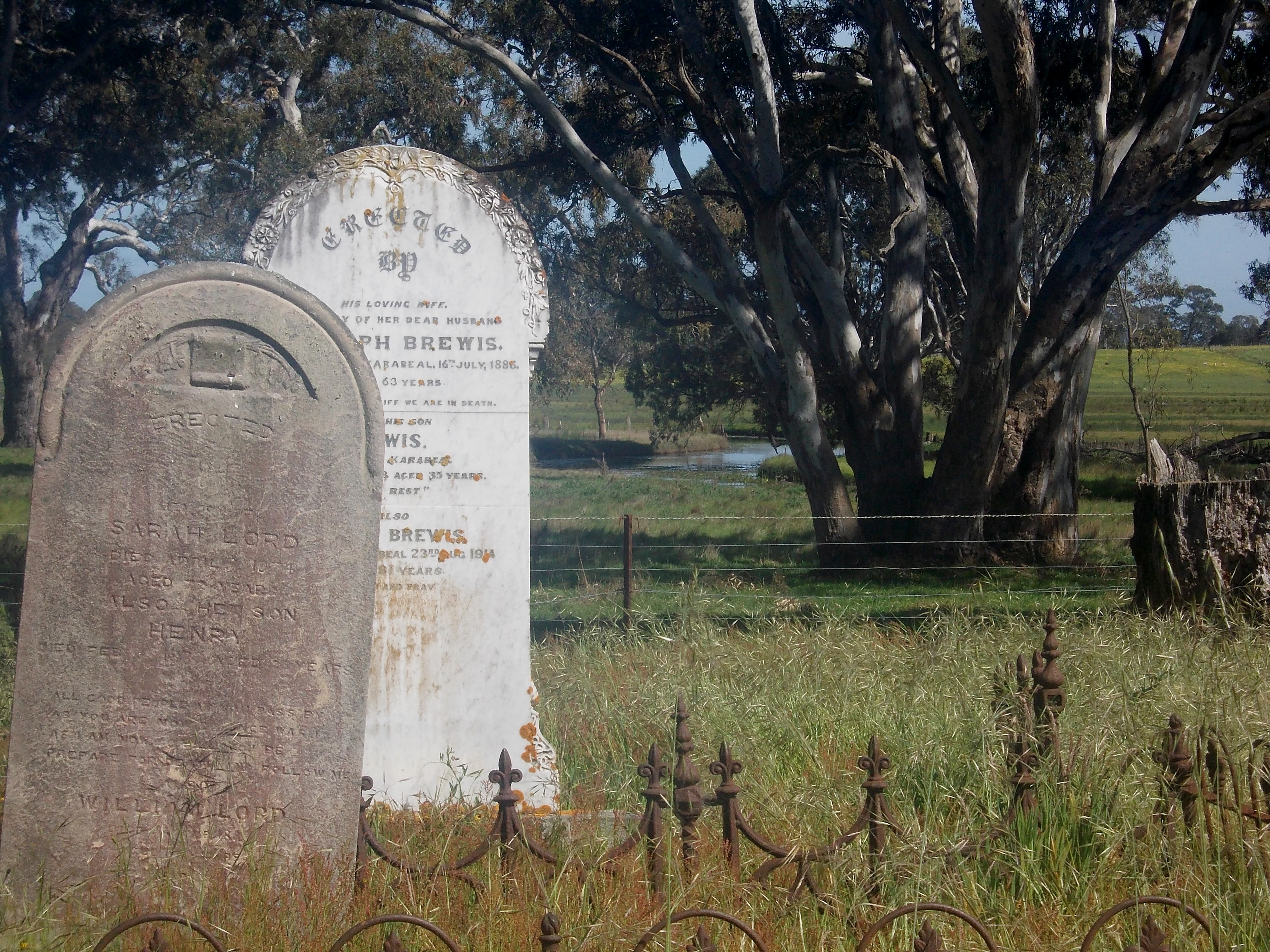
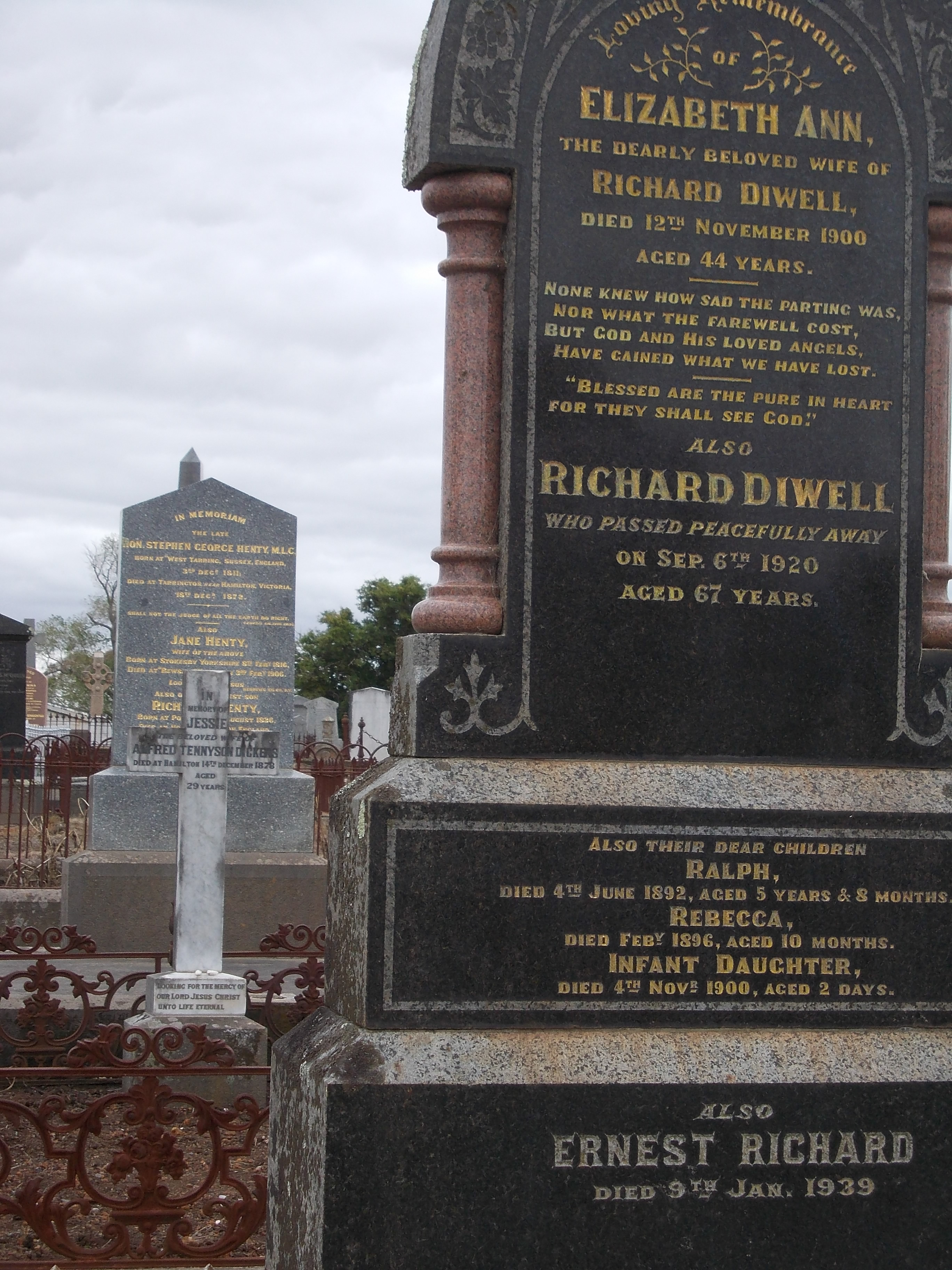
We found the grave quicker than expected.  It turns out the grave of Jessie Dickens is immediately behind my gg grandparents Richard Diwell and Elizabeth Jelly who I have posted about before.  We couldn’t believe we had previously visited the Diwell plot before, unaware the grave of the daughter-in-law of Charles Dickens was right behind. As we were earlier unaware of the Dickens link to Hamilton, we had not made the connection.

What I couldn’t believe was that I had missed the grave immediately behind Jessie’s. It was that of Stephen George Henty, one of the Henty brothers, Victoria’s first settlers.  Stephen, thought to be the most influential of the brothers, was the first to settle inland from Portland, at Muntham, Merino Downs, and Sandford stations.

DIWELL, DICKENS & HENTY GRAVES


Both the Diwell and Dickens headstones were chosen by heartbroken husbands, shattered by their wives’ premature deaths. Jessie was only 29, thrown from a horse-drawn carriage on Portland Road in 1878 and Elizabeth died at 44 due to complications of childbirth in 1900. I have updated the “What the Dickens?” post with a photo of Jessie’s grave.

When I came home, I checked the photos I already had of the Diwell grave, and sure enough, you can see the two other graves in the background.  One of these photos appears on the post “Elizabeth Ann Jelly“.

The thing that struck me was that within a distance of about 6 metres lay the remains of 10 people.  Great Victorian pioneers, Stephen George Henty and wife Jane and their son, Richmond; the wife of the son of one of the greatest novelists of all time and my gg grandparents, Richard and Elizabeth Diwell and four of their children, Ralph, Rebecca, Ernest, and an unnamed baby.  Wow!

In the News – 15 January 1944

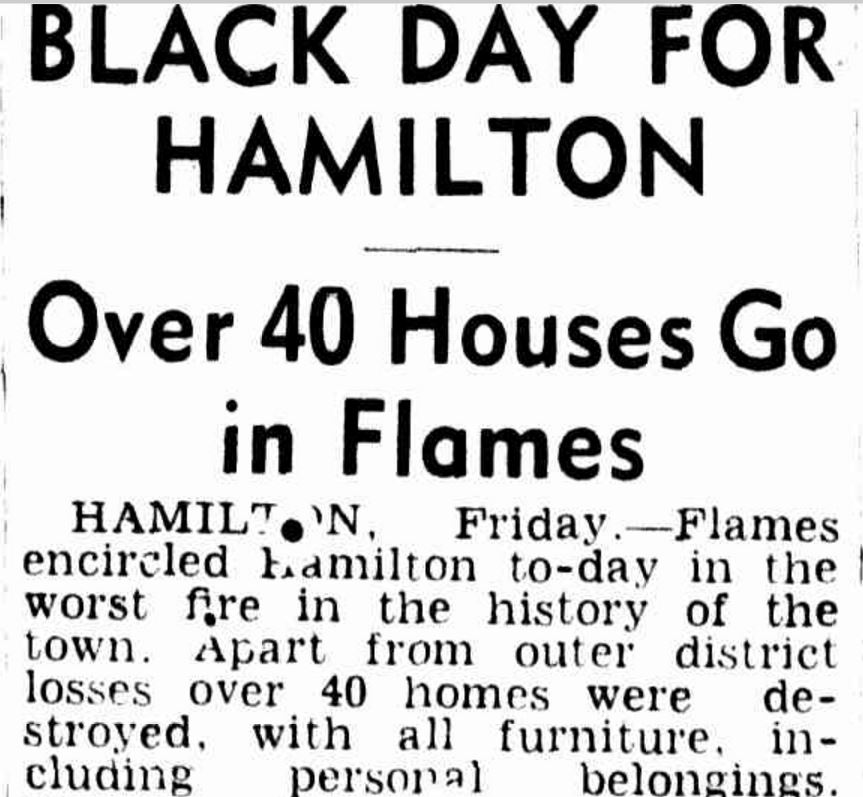
From Saturday 15 January 1944, Victorians were counting the cost of disastrous bushfires that burned out of control a day earlier, Friday 14 January 1944. In Hamilton, the losses were particularly heavy in what were and remain the worst fires in the history of the town, with fifty homes destroyed.

"BLACK DAY FOR HAMILTON" The Age (Melbourne, Vic. : 1854 - 1954) 15 January 1944: .

“BLACK DAY FOR HAMILTON” The Age (Melbourne, Vic. : 1854 – 1954) 15 January 1944: <http://nla.gov.au/nla.news-article206785522&gt;.

There was some warning.  December had recorded below average rainfall, and the temperatures were very high over Christmas and the New Year.  The weekend prior had been hot with temperatures around forty degrees.  Friday 14 January and Saturday 15 January were both declared days of total fire ban across the state except the Mallee.

"BUSH FIRE DANGER" Portland Guardian (Vic. : 1876 - 1953) 13 January 1944: 4 (EVENING). Web. 14 Jan 2017 .

“BUSH FIRE DANGER” Portland Guardian (Vic. : 1876 – 1953) 13 January 1944: 4 (EVENING). <http://nla.gov.au/nla.news-article64387965&gt;.

The Hamilton Hospital admitted more than forty people, and some later died.

HAMILTON AREA LOSS £270,000. (1944, January 19). The Argus (Melbourne, Vic. : 1848 – 1956), p. 4. Retrieved January 18, 2012, from http://nla.gov.au/nla.news-article11821239

CATASTROPHIC FIRE AT HAMILTON. (1944, January 15). The Argus (Melbourne, Vic. : 1848 – 1956), p. 4. Retrieved January 18, 2012, from http://nla.gov.au/nla.news-article11816144

Of the fifty homes destroyed, two belonged to my relatives.  On a trip to Hamilton, I visited Mum’s first cousin and mentioned the 1944 fires to her husband, then his eighties. His family, the Lovell’s, lost their home in the 1944 fires.  He disappeared from the room and returned with a clump of fused pennies, all he had left after the fire, a “memento” he had kept for over 60 years.  I found a similar account in The Age of 20 January 1944,

"Nineteen Patients in Hamilton Hospital" The Age (Melbourne, Vic. : 1854 - 1954) 20 January 1944: .

“Nineteen Patients in Hamilton Hospital” The Age (Melbourne, Vic. : 1854 – 1954) 20 January 1944: <http://nla.gov.au/nla.news-article206793515&gt;.

The Lovell’s house was around three kilometres from the main street, Gray Street.  The Argus reported the closest the fire got to Gray Street was just 500-800 metres from the Post Office.  Having lived in Hamilton, I find this unimaginable, particularly the thought of roofing iron blowing into the main street.

MANY LIVES LOST AND ENORMOUS DAMAGE IN BUSH FIRES. (1944, January 15). The Argus (Melbourne, Vic. : 1848 – 1956), p. 1. Retrieved January 18, 2012, from http://nla.gov.au/nla.news-article11816061

Another of my family members to lose a home was Mrs E.Diwell.  That was Louisa Spender, wife of  Ernest Diwell, a son of my gg grandparents Richard and Elizabeth Diwell.  Ernest passed away in 1939, and Louisa remained at their home, described as “off ” Penshurst Road” on the 1942 Australian Electoral Roll.  They actually lived at the southern end of Rippon Road, which could be described as “off” Penshurst Road.  Penshurst Road is to the east of Hamilton and not far from where I used to live.

Something to consider is that this was wartime, with many men serving overseas. With limited manpower, it was not surprising that women were fighting side by side with men.  I mentioned the fire to Nana, and while she did recall it, she had no other knowledge of it.  She was living in Melbourne then and working at the Munitions factory at Maribyrnong before her marriage in 1945.  Also, her immediate family lived on the northern side of the town, which does not seem to have been in the path of the fire.  When I mentioned women fought the fires, she gave me an “Of course!” type of reply.

Hamilton was not the only town ravaged by the fires of January 1944.  Nearby Dunkeld (below) lost more than forty homes and buildings, and twenty homes were lost at Colac.

THE SCENE AT DUNKELD. "Bush Fire Victims Carry On" Weekly Times (Melbourne, Vic. : 1869 - 1954) 26 January 1944: .

THE SCENE AT DUNKELD. “Bush Fire Victims Carry On” Weekly Times (Melbourne, Vic. : 1869 – 1954) 26 January 1944: <http://nla.gov.au/nla.news-article224839776&gt;.

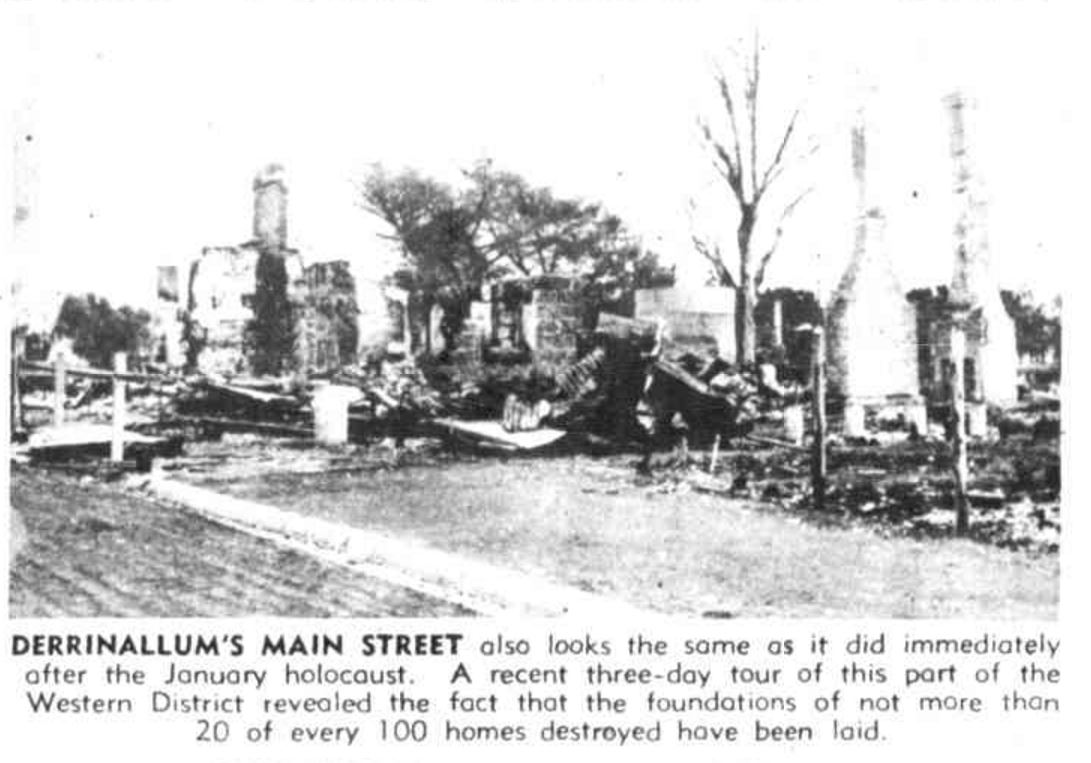
Derrinallum (below) was hit by what The Australasian described as the “January Holocaust”.

"WESTERN DISTRICT FIRE AREAS STILL SCENE OF RUIN" The Australasian (Melbourne, Vic. : 1864 - 1946) 27 May 1944: 6. Web. 14 Jan 2017 .

“WESTERN DISTRICT FIRE AREAS STILL SCENE OF RUIN” The Australasian (Melbourne, Vic. : 1864 – 1946) 27 May 1944: 6. Web. 14 Jan 2017 <http://nla.gov.au/nla.news-article142418919&gt;.

The following article from The Sydney Morning Herald summarised the day of Friday 14 January 1944.

FIRES IN WIDELY-SEPARATED ZONES. (1944, January 15). The Sydney Morning Herald (NSW : 1842 – 1954), p. 9. Retrieved January 18, 2012, from http://nla.gov.au/nla.news-article17878294

Even beachside suburbs of Melbourne had fire running through the ti-tree, forcing hundreds on to the beaches.

FOURTEEN DEATHS IN DISASTROUS BUSH FIRES IN VICTORIA. (1944, January 15). Advocate (Burnie, Tas. : 1890 – 1954), p. 5. Retrieved January 18, 2012, from http://nla.gov.au/nla.news-article68837972