In the News – 13 January 1905

Western District pioneers were exposed to most of the elements Australia offers including flood, drought and fire.  Each had its own devastating effect on their lives and livelihood, particularly those on the land.

By summer 1905, my Harman family of Byaduk had already experienced bushfire,  Fires in 1888, 1896, 1901, and 1902 had seen the loss of stock, grazing land and life.  Bushfires today are just as devastating but the pioneers of the 19th century and early 20th century did not have the weather forecasting, firefighting equipment and communications now available.  When a fire went close to their homes at Byaduk on 11 January 1905, one can only imagine how they managed.

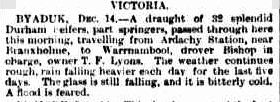
The fire broke away in the stony ground near the Byaduk Caves and travelled southerly at a rapid pace.

NEAR BYADUK CAVES.

NEAR BYADUK CAVES.

The first Harman hit was George Harman, son of James Harman.  His property Quetta was on the north-eastern corner of the Hamilton-Port Fairy Road and what is now Harman’s Road. The fire crossed the main road on to his father’s property Mt Pleasant and Frank Kinghorn’s The Island next door. Alfred Harper, lost all the timber for a new house, while others lost haystacks. Forty men were fighting the fire but wind changes made it almost impossible for them.  The Portland Guardian reported on the fire on 13 January 1905.

HEAVY LOSSES AT BYADUK. (1905, January 13). Portland Guardian (Vic. : 1876 – 1953), p. 2 Edition: EVENING. Retrieved January 11, 2012, from http://nla.gov.au/nla.news-article63691042

A Life Cut Short

In September 1929, the Advocate from Burnie, Tasmania, reported on the Harman family and their longevity.

Family’s Longevity. (1929, September 10). Advocate (Burnie, Tas. : 1890 – 1954), p. 5. Retrieved December 19, 2011, from http://nla.gov.au/nla.news-article67674788

Jonathan died the next year, George made it to 96, Walter 90, Alfred 81 and Sarah (Mrs Adams), 86.   Add brother James who died in 1916 at the age of 86 and the average age of six of the seven children of Joseph and Sarah Harman that came to Australia was 88.

Reuben Harman did not achieve the longevity of his siblings. He died in 1883 aged 44 but if he had of lived on, he would have been the third pea in a pod, with brothers James and Jonathan.

Reuben was born in Melbourn, Cambridgeshire in 1839 and by the age of 12, he was already working as an agriculture labourer as the 1851 UK Census shows.  He was the youngest of the trio of brothers who sailed to Sydney aboard the Kate in 1854, aged 15.

The earliest record I have found of Reuben in Australia, was in 1864 when he married Elizabeth Oliver.  Elizabeth was the sister of Mary Oliver who had married Jonathan Harman two years earlier.  They resided in Byaduk where Reuben farmed with his brothers.  He acquired land and his home property was Berry Bank at Byaduk.  Reuben and Elizabeth raised six children:

Bertha:  Birth: 1866 at Byaduk;  Marriage:  1892 to Felix Alexander James FULLBROOK ;  Death: 1932 at Nambowla, Tasmania

Absalom:  Birth: 1868 at Byaduk’;  Marriage:  1904 to Hazel Maud FILMER;  Death 1954 at Bannockburn, Victoria.

Gershom:  Birth: 1869 at Byaduk;  Marriage: 1905 to  Elizabeth HILLIARD;  Death: 1940 at Hamilton.

Jessie:  Birth: 1871 at Byaduk;  Marriage:  1898 to Walter GREED;  Death: 1949 at Hamilton.

Beatrice:  Birth:  1878 at Byaduk;  Death:  1929 at Hamilton.

Sarah Mulbery:  Birth: 1880 at Byaduk; Death:  1931 at Hamilton.

I have found two references to Reuben at Trove, both from the 12 months before his death.

The first article about Reuben was for a transfer of a lease from himself to brother Jonathan,  found in the Portland Guardian of May 23, 1882.

The Guardian. (1882, May 23). Portland Guardian (Vic. : 1876 – 1953), p. 2 Edition: MORNING.. Retrieved January 2, 2012, from http://nla.gov.au/nla.news-article71582275

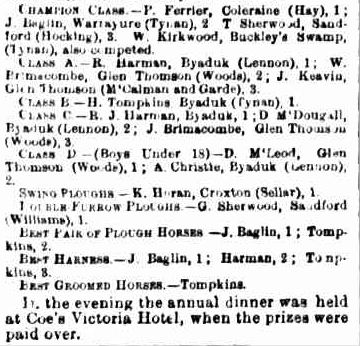
The second, in The Argus of August 19, 1882, reports on the Hamilton ploughing match at Strathkellar, east of Hamilton.  Reuben won Class A, a division down from Champion Class, in heavy conditions.  His plough of choice was the Lennon, also favoured by brother James. He rounded out the day with a second place in the Best Harness class.

HAMILTON PLOUGHING MATCH. (1882, August 19). The Argus (Melbourne, Vic. : 1848 – 1956), p. 11. Retrieved January 2, 2012, from http://nla.gov.au/nla.news-article11550437

On April 28, 1883, Reuben Harman passed away aged just 44 from hydatids.  Reuben was buried at the Byaduk Cemetery.

Headstone of Reuben, Elizabeth, Beatrice and Sarah Harman, Byaduk Cemetery

James Harman was the executor of Reuben’s Will and was very exacting in his application for probate.  Reuben’s estate was to the value of  £1226, quite a tidy sum in 1883.  His assets included 128 acres of land, divided into two parts, one with a two-roomed slab hut with an iron roof and slab partitions.  There was also a further 26 acres of land, 3 horses, 17 head of cattle, 150 sheep, a buggy and an almost new plough.  There is a record of an interest he had in selected land of 70 acres.

After Reuben’s death,  Elizabeth was left to care for the children, then aged 17 down to three.  The first to marry was Bertha in 1892 when she was 26.  Gershom and Jessie also married, however, the two youngest daughters, remained unmarried.  Elizabeth, Beatrice and Sarah eventually moved into Hamilton, with the two girls working as knitting manufacturers.

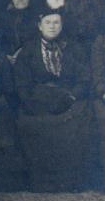
In 1907, Elizabeth returned to Byaduk to represent her family in a photo at the Byaduk and District Pioneers day.  She appears in the group photo from the day.

Elizabeth died in 1919 at Hamilton.  Beatrice and Sarah only lived for another 10 and 12 years respectively, both dying at 52.

This is the last story of the four Harman boys who travelled independently to Australia.  The last three Harman siblings, Sarah, Walter and Alfred, travelled with their parents, Joseph and Sarah to Australia.  Sarah was 11, Walter 10 and Alfred only three.  The stories of those three Harmans are very different from their four older brothers.

Jonathan Harman

Jonathan Harman and his older brother James were like two peas in a pod.  While Jonathan did not show the devotion to the Wesleyan Methodist Church as his lay preacher brother, they shared a keen interest in farming practices and community involvement.

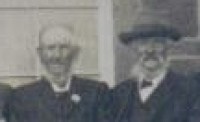
Jonathan and James Harman

Jonathan was born in Melbourn, Cambridgeshire in 1837.  By the 1851 England Census, he was the eldest child still living at the home of Joseph and Sarah Harman in Drury Lane, Melbourn.  His farming career had begun with his occupation, like so many others, agriculture labourer.

In 1854, Jonathan and his brothers George and Reuben boarded the Queen of England for Sydney.  The first record I find for Jonathan in Victoria is 1862 when he married Mary Oliver, daughter of fellow pioneers, Jonathan Oliver and Ann Richards.

In 1863, the first of the couple’s ten children, Arthur, was born at Yambuk, near Port Fairy.  Peter Fraser in Early Byaduk Settlers, mentions Mary’s father  Jonathan Oliver living there in 1863.   Peter Fraser also tells of James and Jonathan Harman each having a team of bullocks which they used for a carting business along the Port Fairy road, at least as far as Byaduk or even Hamilton.

Also from Early Byaduk Settlers, I have discovered Jonathan was one of the first buggy owners in Byaduk, purchasing a heavy red buggy in 1875.  Up until that time, most people owned spring carts which were not suitable for a trip into Hamilton.  Until the arrival of buggies, the only comfortable way to travel to Hamilton was horseback or dray.  That trip would have taken 4-5 hours according to Fraser.  Today, the trip to Byaduk from Hamilton is only about 15 minutes.

The family of Jonathan and Mary Harman was:

Arthur John – Birth: 1863 at Yambuk;  Marriage:  Ellen Mathilda Rogers 1891;  Death: 1933 at Hamilton.

Amelia – Birth: 1864 at Byaduk;  Marriage: Chris Bell, 1901;  Death: 1956 at Portland.

Edith – Birth: 1865 at Byaduk;  Marriage: Robert Bishop, 1901. Death: 1948 at Port Fairy.

Emily – Birth: 1866 at Byaduk, Marriage:  Malcolm Cameron, 1900; Death: 1948 at Heywood.

John – Birth: 1868 at Byaduk; Death: 1886 at Byaduk.

Mary Ann – Birth: 1869 at Byaduk.

Sarah – Birth: 1870 at Byaduk;  Death: 1877 at Byaduk.

Joseph – Birth: 1871 at Byaduk; Death: 1871 at Byaduk.

Minnie – Birth: 1872 at Byaduk; Marriage: Walt Hurrell, 1901; Death: 1953 at Warrnambool.

Jonathan – Birth: 1876 at Byaduk; Marriage: Hannah Waddup Keyte,1904; Death: 1941 at  Ararat.

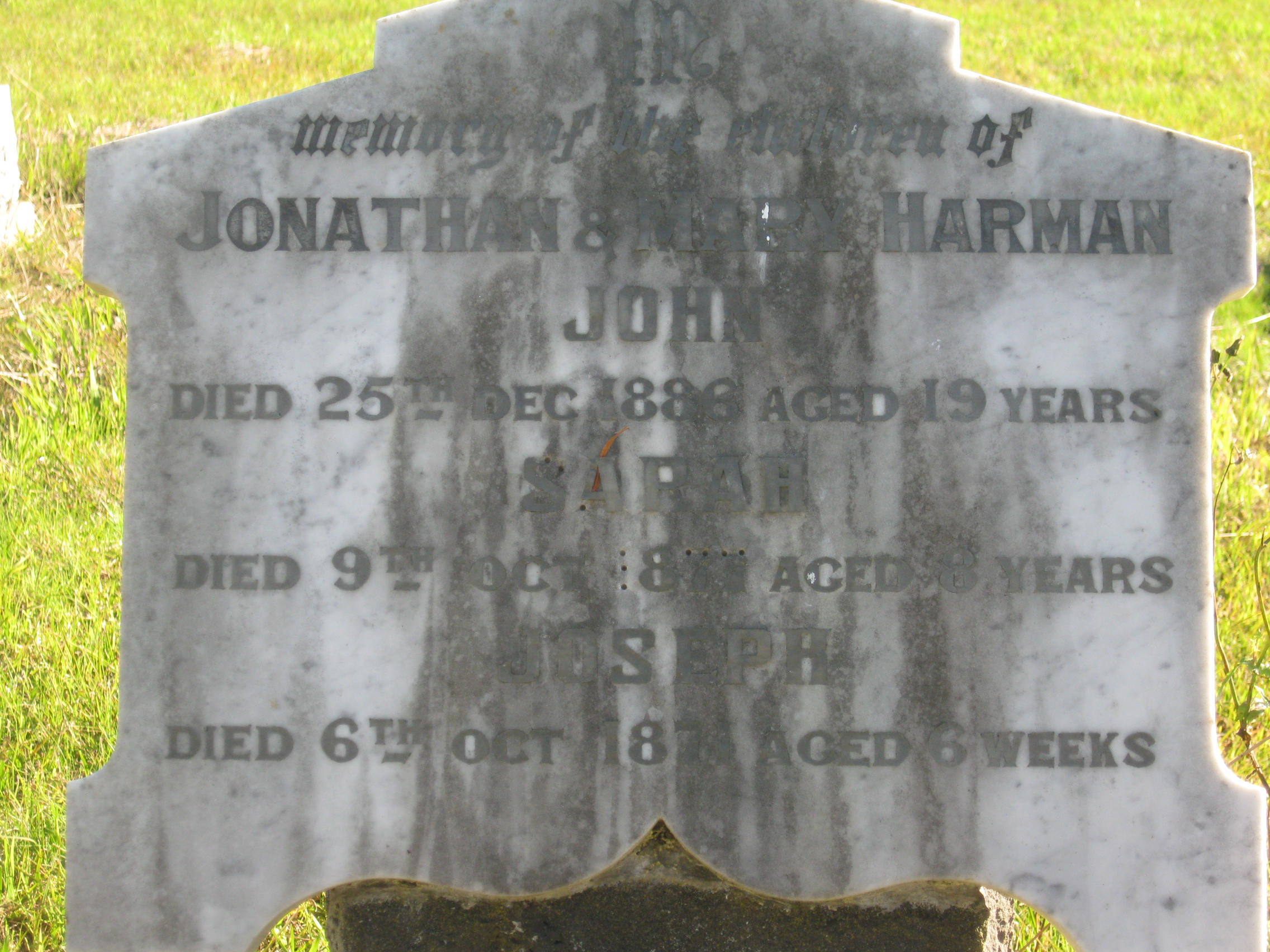
Jonathan and Mary lost one child, Joseph as a baby.  Sarah was only six at the time of her death and her son John was 18.  Daughter Mary Ann was born in 1869 but I have never found a record for her death or marriage.

Joseph, Sarah, and John are buried at the Byaduk cemetery and a headstone marks their grave, but where is Mary Ann?

Headstone of John, Sarah and Joseph Harman, children of Jonathan and Mary Harman,, Byaduk Cemetery

Wife Mary died in 1884 at Byaduk at only 41 years of age.  Her youngest child Jonathan was only eight years old at the time.

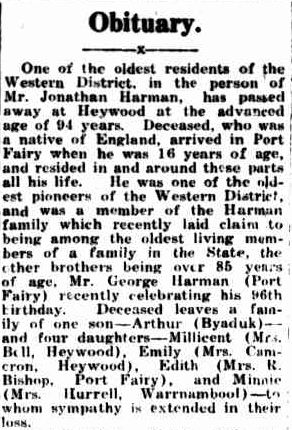
At the time of Jonathan’s death on 2 April 1930, he was living with his daughter Amelia Bell at Heywood.  He was 94 years old.

Obituary. (1930, April 7). Portland Guardian (Vic. : 1876 – 1953), p. 3 Edition: EVENING. Retrieved December 7, 2011, from http://nla.gov.au/nla.news-article64291985

Jonathan’s obituary contains some interesting information.

  • Jonathan’s arrival in Australia. It is true that Jonathan would have been around 16 when he arrived in Sydney from England with his brothers.  Parents Joseph and Sarah arrived a short time after and stayed in N.S.W for several years before heading to Victoria toward the end of the 1850s. Did Jonathan leave N.S.W. before them, possibly shortly after his arrival, taking a ship from Sydney to Port Fairy to join brother James?  Or is this all just unreliable second-hand information as is the nature of obituaries?  Even so, it is worth investigating further in my quest to pin down when all the Harmans arrived in Victoria and by what means.
  • Amelia Harman, who married Chris Bell is listed as Millicent. Her birth name was registered as Amelia. Could Millicent have been a nickname that stuck?
  • Youngest son Jonathan is not mentioned in the obituary despite not passing away until 1941.  I have always thought of him as the black sheep of the family.  He married a girl from outside of the district, Hannah Keyte of Natimuk and he spent time in Queensland with Hannah, before disappearing prior to his death in Ararat, Victoria in 1941.  Hannah was still living in Queensland at the time of his death.  Is it possible that not only did he fall out with his wife Hannah, but also his family back in Byaduk?  Or was it simply because the author of the obituary did not have time for him?

Jonathan was buried with Mary next to their three children at the  Byaduk Cemetery.

Not Such an Odd Fellow

George Hall Harman, born in Melbourn, Cambridgeshire in 1835, was the fifth child of Joseph Harman and Sarah Mulbury.  His middle name “Hall”  came from the maiden name of his paternal grandmother, Keiza Hall.  The 1851 English Census shows 16-year-old George working as an errand boy and living at the home of local publican and farmer, William Dearman.  The following year he saw his older brother James leave for Australia and two years later in 1854, he had his own opportunity to travel to Australia.  With his two younger brothers, Jonathan and Reuben, they boarded the “Kate” at Southampton on 3 August 1854 bound for Sydney, arriving on November 7.

I lose track of George for several years until 1859 when he and brother James advertised land for sale, Boodcarra Farm at Port Fairy, then known as Belfast. The advertisement is listed in the Port Fairy/Belfast News Index 1859.  In 1860, George married Rebecca Graham, the daughter of  Thomas Graham and Margaret Paterson.

Compared to his brothers, George & Rebecca had a relatively small family of five children:

Walter Graham – Birth: 1862 in Port Fairy; Marriage:  1887 to Ann GRAY; Death: 1930 in Kyneton, Victoria.

Edith – Birth: 1865 in Byaduk;  Death: 1866 in Byaduk

Thomas Charles – Birth: 1867 in Port Fairy; Marriage:  1900 to Elizabeth Margaret BUDGE; Death: 1954 in Victoria

Mary Helena – Birth: 1870 in Port Fairy; Marriage:  1911 to Samuel ROGERS;  Death: 1920 in Sale, Victoria

Herbert George – Birth: 1878 in Port Fairy; Marriage: 1905 to Aimee Elizabeth HEAD; Death: 1955 in Wangaratta, Victoria

George and Rebecca began their married life in Port Fairy but moved to Byaduk with the other members of the Harman family around 1863.  It appears that George preferred the seaside town and they returned to Port Fairy by 1867.

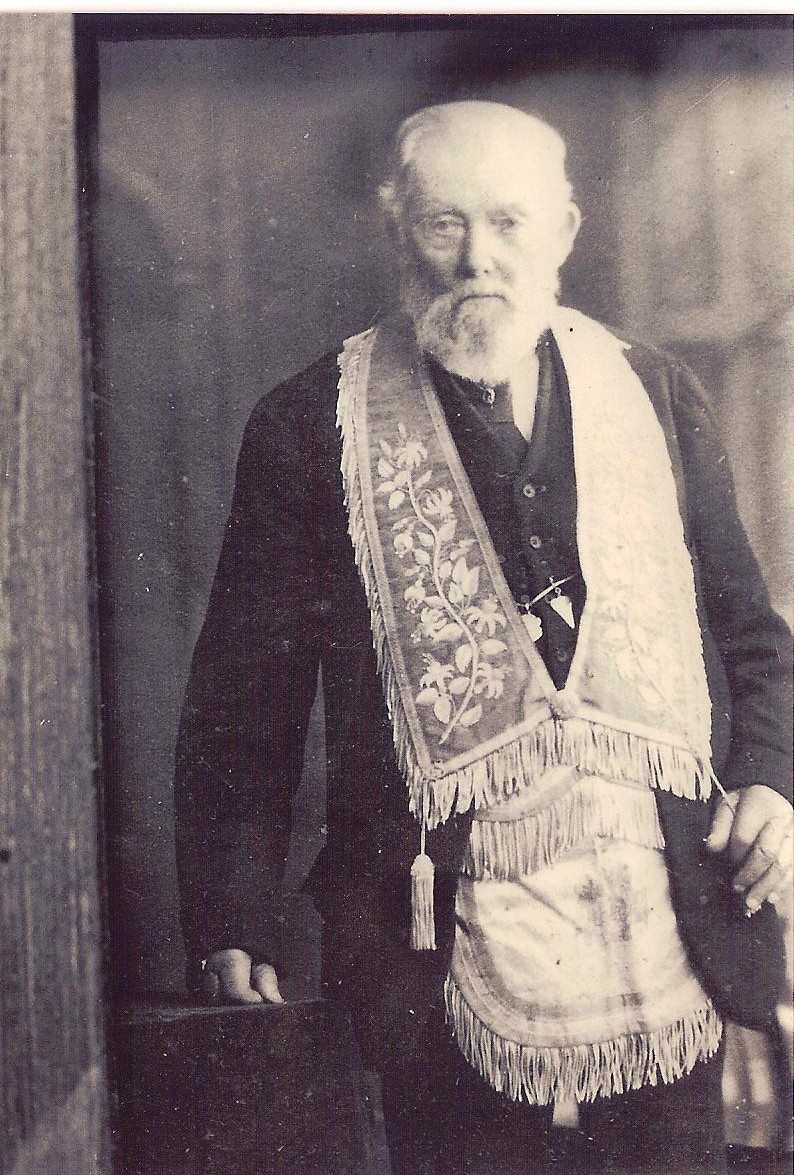
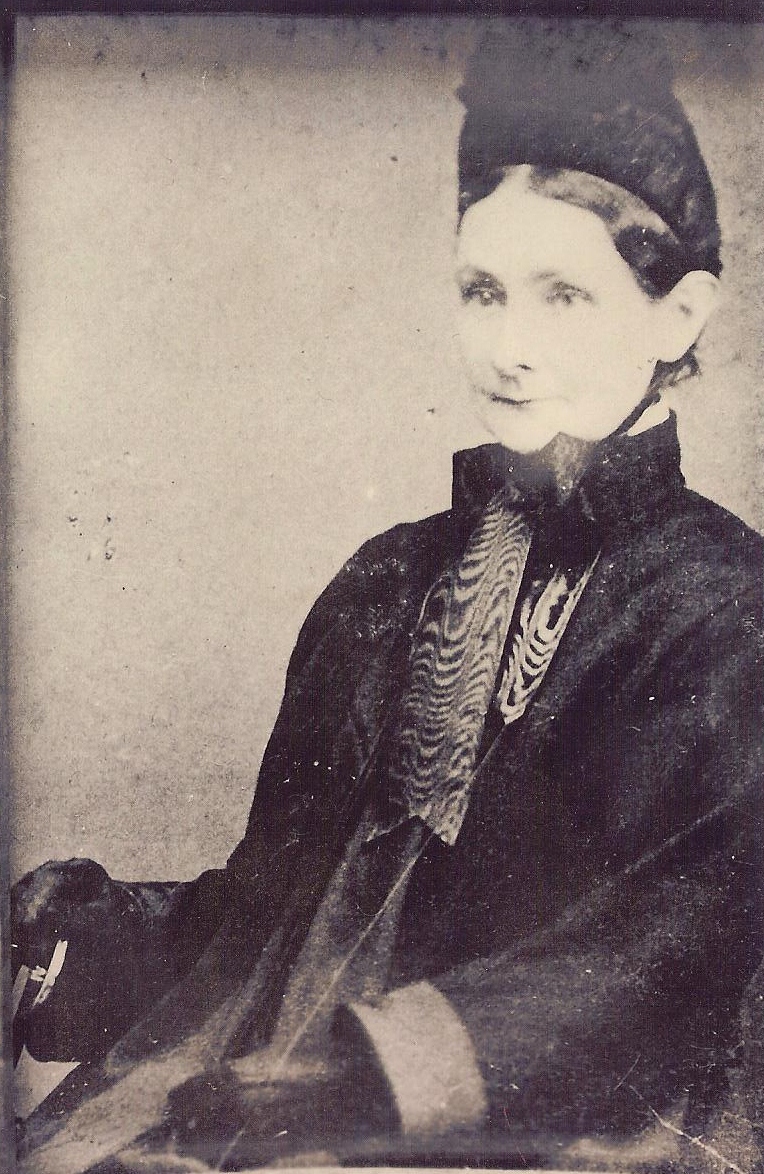
On a visit to Port Fairy, I called in at the Port Fairy Historical Society in the town’s former Court House.   I noticed old portraits on a wall.  Amongst the faces were George and Rebecca Harman.  The Society has a copying service and I was able to arrange for copies to be sent.

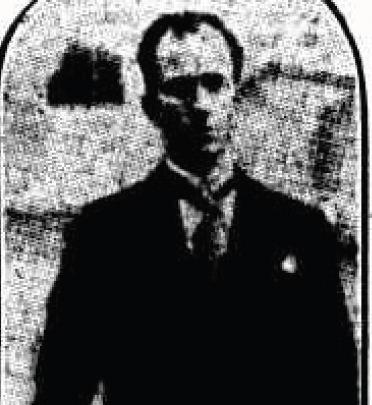
George Hall HARMAN, Original held by Port Fairy Historical Society

Rebecca GRAHAM, Original held by Port Fairy Historical Society

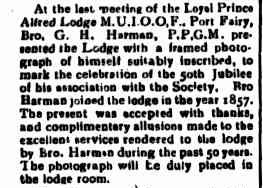
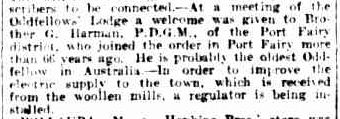
From the photo of George, it is obvious he was a Mason.  Turning to Trove, I was able to establish George was a member of the Manchester Unity Independent Order of Odd Fellows(M.U.I.O.O.F.).  I also found a lead to the possible origin of George’s photograph:

(1907, June 24). Portland Guardian (Vic. : 1876 – 1953), p. 3 Edition: EVENING. Retrieved November 9, 2011, from http://nla.gov.au/nla.news-page6026342

After Rebecca’s death in 1902, George remained in Port Fairy living in James, Gipps, and Sackville Streets.   His occupation varied from “gardener” to “independent means”.  He also spent time with his family as the 1914 Australian Electoral Roll shows, with him residing at the home of his daughter Mary and her husband Samuel Rogers in Wodonga.  He also spent time with his son, Herbert in Wangaratta as this article about the Wangaratta Odd Fellows Lodge in The Argus suggests:

COUNTRY NEWS. (1923, August 29). The Argus (Melbourne, Vic. : 1848 – 1956), p. 23. Retrieved November 9, 2011, from http://nla.gov.au/nla.news-article2007613

George passed away on September 14, 1931, at the ripe old age of 96.  Only two of his children, Thomas and Herbert,  were living at the time of his death.

Family Notices. (1931, September 16). The Argus (Melbourne, Vic. : 1848 – 1956), p. 1. Retrieved November 9, 2011, from http://nla.gov.au/nla.news-article4411246

George was buried at the Port Fairy Cemetery with Rebecca and baby Edith.

Grave of George, Rebecca and Edith Harman, Port Fairy Cemetery

Headstone of George, Rebecca and Edith Harman, Port Fairy Cemetery

I often think of George and the 29 years after Rebecca’s death until his own. He saw the passing of his daughter and son and two granddaughters.  Was it a lonely time or did his activities with the Odd Fellows and the visits to the homes of family members fill the void? I hope so because George was just a normal fellow who happened to be an Odd Fellow.

Witness for the Prosecution

Searching old newspapers has uncovered three family members who were either mentioned or were witnesses at three separate murder trials.  They were my ggg grandmother, a cousin and to my surprise, my grandfather.

The earliest of these was known at the time as the “Casterton Murders“. My ggg grandmother Margaret Ann Turner, (Mrs Diwell)  was mentioned at an inquest in February 1860, which ended with Casterton man, George Waines, being placed on trial for the murder of Robert and Mary Hunt, also of Casterton.

The Hunts had not been seen for several months, with many believing they had left the colony.  George Waines claimed he had brought furniture off them, but rumours spread around the town that George may have been responsible for their disappearance.  The local police investigated and were unable to find the Hunts in the other colonies or New Zealand.

Margaret was mentioned in evidence by Dugald Campbell –
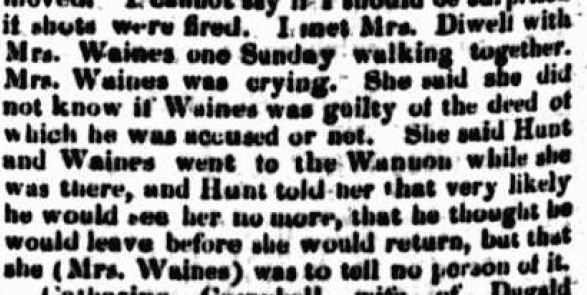
THE CASTERTON MURDER. (1860, February 3). Portland Guardian and Normanby General Advertiser (Vic. : 1842 – 1876), p. 2 Edition: EVENINGS.. Retrieved August 11, 2011, from http://nla.gov.au/nla.news-article64513414

This was a gruesome murder, but it captured the attention of people around Australia.  I found sixty articles from four states.  Many are detailed, including forensic evidence, a letter to the editor from the autopsy surgeon and George’s confession.  He was eventually hung at Melbourne Gaol.

The second murder trial had it all.  A small country town, married Methodist preacher, a young, single,  grazier’s daughter, and arsenic.  A search at Trove for “Omeo 1928” brings up hundreds of articles and I found a Western District connection.

Ronald Griggs moved to Omeo to take up the role of Methodist minister, moving into the residence with wife Ethel.  Originally from Tasmania,  Ronald and Ethel were welcomed into the community by the elders of the church including John Condon and his wife Frances.

OMEO MURDER CASE. (1928, March 8). The Register (Adelaide, SA : 1901 – 1929), p. 9. Retrieved August 11, 2011, from http://nla.gov.au/nla.news-article57042062

GRIGGS NOT GUILTY. (1928, April 21). The Canberra Times (ACT : 1926 – 1954), p. 1. Retrieved August 11, 2011, from http://nla.gov.au/nla.news-article1228707

After meeting John and Frances’ daughter Lottie,  Ronald (left) was a regular visitor to the Condon property.  Ethel was pushed to the outer and after giving birth to their first child, she returned to Tasmania spend time with her parents.

Ronald and Lottie’s “meetings’ became more frequent, but Ethel, (right) inconveniently for Ronald, returned to Omeo.  Only days later, she fell ill and died after several days of severe pain.  Thanks to a suspicious local policeman, the case was taken further and Ethel’s body was exhumed for an autopsy.  Arsenic was present in her body.  Ronald was charged with murder.

Henry Harman was the son of Walter Harman and grandson of Joseph Harman.  He was a well known Ensay grazier and Omeo Methodist church elder.  Henry was called to give evidence against Ronald Griggs, a man he described as a friend.

OMEO WOMAN’S DEATH. (1928, February 29). The Argus (Melbourne, Vic. : 1848 – 1956), p. 24. Retrieved August 11, 2011, from http://nla.gov.au/nla.news-article3914287

I  found a photo of Henry, along with some of the other key witnesses, in the Barrier Miner, a NSW paper which continues to reward me with articles about my Western Victorian family.  It is becoming a reliable but most unlikely source.

WITNESSES AT THE OMEO INQUIRY INTO THE DEATH OF MRS. ETHEL CONSTANCE GRIGGS (1928, March 2). Barrier Miner (Broken Hill, NSW : 1888 – 1954), p. 4. http://nla.gov.au/nla.news-article46008416″%5D

After two trials, the jury retired to decide its verdict.  According to the Canberra Times, thousands waited on the street outside the court to hear the decision.  Ronald Griggs was acquitted, however, his infamy dogged him.  He changed his name and continued to preach, but as his photo was seen around the country, he was found out.  He struggled to find work and the newspapers followed him for months after.

The Western District connection? Henry was born in Byaduk in 1880 as was his sister Susannah Nash Harman.  Susannah married  William Condon, a cousin of Lottie’s father John.  The Condons first settled in the Portland area, before some of the family moved to Omeo.  Lottie’s mother Frances Ethel Huggins was born at Macarthur in 1883 and she and some of her siblings moved to the Omeo area around 1888.  Around the same time, Henry’s father Walter Harman took his family from the Macarthur district to the High Country.

For more reading about the case, there is a book by Reg Egan,  Lottie: A love affair with a man of God and the cruel death that shocked Australia with Henry Harman a key character.  Murder case aside, it offers an insight into life in a small Victorian town in the 1920s.  I have also a public list of newspaper articles at Trove on the case under the heading “Griggs murder

Finally, the “Body under the staircase” trial of fishmonger Thomas Garrity, charged with the murder of widow Rose Harvey on April 28, 1931.  Rose had met up with Garrity for a few drinks at a local hotel and they returned by tram to the residence adjoining Garrity’s shop in Port Melbourne.  Police later found Rose’s body stuffed in a cupboard under the stairs of the residence.

Percy Riddiford was a 27-year-old, single man from Ballarat,  boarding at his brother’s home in Port Melbourne.  He worked on the trams, based at the Camberwell depot and happened to be working the day Thomas Garrity and Rose Harvey travelled his route.  As a result, he was required to appear as a witness to assist in determining the movements of Garrity on that day.

BODY UNDER STAIRCASE. (1931, May 20). The Argus (Melbourne, Vic. : 1848 – 1956), p. 9. Retrieved August 10, 2011, from http://nla.gov.au/nla.news-article4400320

Garrity claimed that unknown men had visited his home on that night, proceeded to get him drunk then robbed his till.  He claimed they must have killed Rose.  The judge considered Garrity could not have put her body under the stairs without help and reduced his charge to manslaughter.  He received eighteen months jail with hard labour.  Garrity pleaded his innocence after sentencing.

This was an event in my grandfather’s life he kept to himself.  The first my father and uncles had heard of it was when I told them of the articles I had found.  He was one to keep things to himself,  so it was good to find out something of his early life.

In the News – August 8, 1919

The Minister for Home and Territories, Mr Glynn announced there would be an Australian Census in 1921.  The chief statistician Mr Knibbs had left for an international statistical conference in Europe to learn how other countries conducted a Census.  He would be looking at borrowing a Power machine to help with the counting.

Portland Guardian. (1919, August 8). Portland Guardian (Vic. : 1876 – 1953), p. 2 Edition: EVENING. Retrieved August 8, 2011, from http://nla.gov.au/nla.news-article63959361

The census was held on April 3, 1921.  Thanks to the Hollerith electric machine, an American invention, results were expected in two years!    I’m not sure if this is the Power machine Mr Knibbs was investigating, but it seems he did pick up some tips from his trip to Europe.  On April 4, 1921, The Argus published an interesting article about how the information for the census was collected.

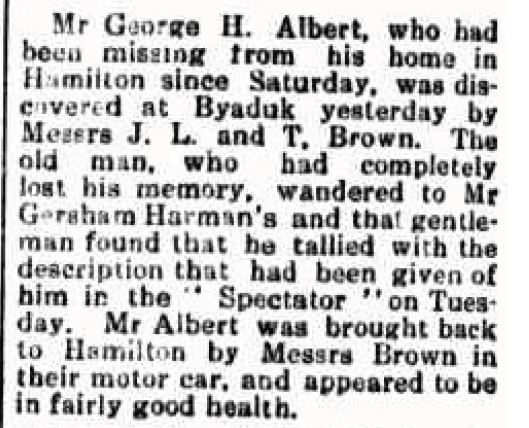
Mr George Albert of Hamilton was found after five days missing.  He was located at Byaduk on the property of Gershom Harman, grandson of Joseph Harman.

Portland Guardian. (1919, August 8). Portland Guardian (Vic. : 1876 – 1953), p. 2 Edition: EVENING. Retrieved August 8, 2011, from http://nla.gov.au/nla.news-article63959361

The Leader of the Pack

When I think of my ancestors, the first name that comes to mind is James Harman.  I don’t know why.  Maybe it’s because if I was to a pick a leader of my ancestors, the boss or the chairperson,  I think It would be James.

In the 15 years or so I have got to know my ggg grandfather, I have imagined him as organised, official and proud.  He was a leader in the church and the farming community speaking up for what he believed.  I can just imagine him standing before my other ancestors, organising and guiding them.  Who would be his deputy?  I would think either of James’ brothers Jonathon or Walt who, in their own activities in the community, were of the same mould.

James was born in Melbourn, Cambridgeshire in 1830, the son of Joseph and Sarah Harman.  He married Susan Reed of Whaddon on August 15, 1852 just two months later on October 20, 1852 they set sail aboard the Duke of Richmond bound for Portland, Victoria, Australia.  They spent time in Port Fairy before settling at Byaduk in the early 1860s.

At Byaduk, James was involved with the church, served on the first committee of the Byaduk State School at the age of 81, and farming activities such as ploughing competitions and the Farmers Union.

James and Susan had 10 children from 1854 to 1875, five boys and five girls.  Even that was orderly.

Reuben James   Birth: 1854 in Port Fairy, Victoria  Marriage: 1877 in Byaduk, Victoria to Elizabeth BISHOP Death: 05 Jan 1937 in Ballarat, Victoria.

Alfred   Birth: 1856 in Portland, Victoria  Marriage: 1883 to Louisa NEWMAN Death: 06 Nov 1922 in Byaduk, Victoria.

Isabella   Birth: 1857 in Port Fairy, Victoria Marriage: 1885 to Stephen WARD Death: 02 Aug 1886 in Port Fairy, Victoria.

George Henry   Birth: 1860 in Port Fairy, Victoria Death: 1861 in Hamilton, Victoria.

Julia   Birth: 1861 in Muddy Creek, Victoria  Marriage: 1882 to George HOLMES Death: 20 Dec 1896 in Casterton, Victoria.

Martha    Birth: 1863 in Byaduk, Victoria Marriage: 08 Nov 1888 in Hamilton, Victoria to Frederick Charles HUGHES Death: 28 Dec 1960 in Hamilton, Victoria.

Henrietta   Birth: 1866 in Byaduk, Victoria. Death: 1952 in Hamilton, Victoria.

Albert    Birth: 1868 in Byaduk, Victoria Marriage: 1907 to Emma CARMICHAEL Death: 26 Nov 1927 in Byaduk, Victoria.

Alice   Birth: 1871 in Byaduk, Victoria Marriage: Dec 1896 in Macarthur, Victoria to William James McLEAN Death: 21 Jun 1927 in Hamilton, Victoria.

George    Birth: 1875 in Byaduk, Victoria Marriage: 1908 to Hilda May HILL Death: 25 Sep 1947 in Hamilton, Victoria.

It was reading James’ Will, written in 1914, that really defined him for me.  In great detail,  he had carefully considered his beneficiaries and ensured that Susan and his spinster daughter Henrietta would be looked after once he was gone.  It also offered information on James’ property and farm related assets.

The first of James’ last wishes was that his watch and chain be passed on to his grandson, Albert Lionel HARMAN, the eldest son of George HARMAN.  Daughter Henrietta was to receive the furniture in the house and all household effects.   She was also the beneficiary of James’ poultry.  He made provision for Henrietta to stay in the house with James’ grandson Charles, only son of  Isabella who died when Charles was a baby.

Farming implements, including a chaff cutter and a set of harrows, were left to son Alfred.  He would also receive two horses and their harness, a number of sheep, and half of the grain and hay on the farm at the time of James’ death.  James had a contingency if there was no grain or hay on the property at the time of his death.  If this was to happen, Alfred would receive £30 instead.  There were conditions for Alfred however. He had to undertake to give his mother Susan 15 shillings a week and give £100 to each of his sisters, Martha and Alice within a year of his father’s death.

Reuben and Albert shared in a large amount of James’ land at Byaduk and Lake Gorrie, near Macarthur.  The description of the property at Byaduk known as the “House Paddock” gives some idea of the out-buildings that existed but also James’ methodical approach to such matters.  It read:

“…commencing at the junction of the Hamilton to Byaduk main road with the Louth road running southerly along the said main road to the entrance gate thence Westerly along the wire fence to the corner of the stackyard and including the woolshed and barn thence Northerly along the wire fence to the Louth road thence along the Louth road easterly to the commencing point.”

The partnership between James and Susan Harman was to come to a rapid close in 1916.  On April 10, Susan passed away aged 86. Just over four months later on August 14,  James himself died also aged 86.  Together they had left England as newlyweds, settled themselves in Victoria before starting their large family.  They had seen births, deaths, and marriages as their family extended, and together they witnessed the growth in the country they had arrived in over 60 years before.

JAMES & SUSAN HARMAN. Photo courtesy of Mike Harman & family.

It seems right they went so close together after 64 years of marriage.  They were buried side by side at the Byaduk cemetery.

© 2011 Merron Riddiford

Jim’s Gone A-Droving

In the 1970s, I visited a Western District drovers’ camp with my father.   I remember the weathered stockmen, their battered caravan, and wiry dogs.  It was not uncommon in those days to drive up behind a mob of sheep being slowly moved along the grassy roadsides.

Then, drovers moved stock to find feed when grass was scarce, but in the early years of settlement, the only way to get stock to and from market or from the ports was to use a drover. Known for their hard-drinking and foul mouths they were often away for months at a time.

My ggg grandfather James Bishop was of those hardy breeds.  He herded cattle from Adelaide to the Western District and moved sheep for the local stations for around 30 years.

Jim was born in Dorset in about 1825.  I am still to find how he came to Australia, but I first catch up with him in this country when he married Sarah Hughes on October 26, 1852, at Adelaide.  They had one child in Adelaide, Mary Elizabeth, but she died aged two.

James and Sarah then moved to Ararat, where James tried his luck on the goldfields.  Charles was born in 1856 in Ararat, followed by my gg-grandmother Elizabeth on September 12, 1857.  Her birth certificate shows James’ occupation as a miner.  James and Sarah had one more child at Ararat, George in 1859.

Not long after, the Bishops moved back to South Australia with two children born in Mt Gambier.  Peter Fraser mentions in Early Byaduk Settlers that James Bishop went to Byaduk around 1865.  This is backed by the birth of Mary Bishop at nearby Macarthur in 1865.   In 1870, Jim selected 16 acres of land at Warrabkook between Byaduk and Macarthur.   Robert, Louisa, and Alice were born at Macarthur, and William was born at Byaduk.

CHILDREN OF JAMES BISHOP & SARAH HUGHES

Mary Elizabeth – Born: 1853 Adelaide, SA.  Died: 1855 Thebarton, SA

Charles – Born: 1856 Ararat, Victoria.  Died: 1916 Macarthur, Victoria; Married:  Sarah DANCER

Elizabeth– Born: 1857 Ararat, Victoria.  Died: 1890 Byaduk, Victoria; Married:  Reuben James HARMAN

George – Born: 1859 Ararat, Victoria.  Died: ?; Married:  Mary HUGHES

Harriet – Born: 1860 Mt Gambier, SA.  Died: 1922 Merino, Victoria; Married:  James ELSTON 1882

Ellen– Born: 1862 Mt Gambier, SA.  Died: 1931 Byaduk, Victoria; Married:  Frederick Watson HINDES 1885 Married:  Abraham CLARKE 1905

Mary– Born: 1865 Macarthur, Victoria.  Died: 1889 Byaduk, Victoria

Robert– Born: 1867 Macarthur, Victoria. Died: 1945 Port Fairy, Victoria; Married:  Edith HARMAN 1901

Louisa – Born: 1870 Macarthur, Victoria.  Died:  1915 Strathmerton, Victoria; Married:  Jonathan Thomas REEVES 1892

Alice – Born: 1872 Macarthur, Victoria.  Died: 1894 Byaduk, Victoria

William James – Born 1874 Byaduk, Victoria. Died:  ?

Peter Fraser tells of  Jim droving cattle overland to the Adelaide market and I have found several references to Jim’s droving in The Argus.  “Pastoral Intelligence” notes in The Argus updated readers on the weather, crops, and stock movements, among other things.  Jim is mentioned on August 4, 1890, droving fat cattle from Muntham, between Coleraine and Casterton to Warrnambool.  The same article mentions the weather as being very cold with constant heavy rain over the previous 24 hours.   Tough conditions for a drover of any age, but at 65 Jim must have found it incredibly tough.

A month after the Argus article, Jim’s eldest daughter Lizzie (Elizabeth) died of consumption (TB) aged just 33.  Only a year before, daughter Mary also died at age 24.  Of 11 children born, Jim had lost three of his daughters.  Also, his wife of 33 years, Sarah,  died in 1885 at only 51 years.  Another daughter, Alice, died before Jim’s own death.

Jim just kept droving.  In October 1892, he was moving cattle from the property of the Powers at Byaduk to Framlingham near Warrnambool this time in humid conditions.  Two months later he was moving heifers during a cold December.

PASTORAL INTELLIGENCE. (1892, December 16). The Argus (Melbourne, Vic. : 1848-1954), p. 6. Retrieved July 12, 2011, from http://nla.gov.au/nla.news-article8493210

The last article I find about Jim is on February 15, 1893.  He had taken horses from William Melville’s Weerangourt station at Byaduk through to Ballarat.

Jim died just two years later in 1895 at Hamilton, aged 70, leaving behind four sons and three daughters.


Western District Volcanoes – Are They Sleeping?

Twice in the past week, I have gone deep into volcanic Western Victoria.  I passed the Grampians and its rock formations, Harman Valley at Byaduk, Mt Napier, and Mt Elephant at Derrinallum.  Along with the dry stone walls that weave through the countryside and the rocks that still litter the landscape, the volcanic activity of the past is evident.

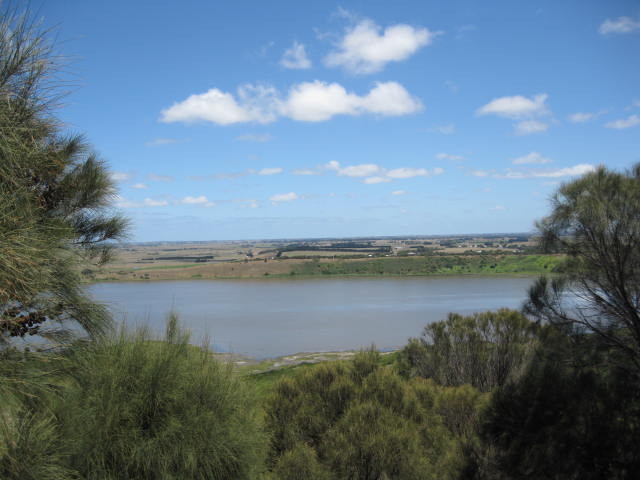
Lake Surprise, crater lake, Budj Bim (Mt Eccles, Victoria)

Since my travels, an earthquake at Korumburra in West Gippsland on Tuesday and a perfectly timed conference in Melbourne, has seen the Western District volcanoes in the news.  Questions are being asked about the likelihood of them erupting again.  Speaking at the Congress of Geodesy and Geophysics, University of Melbourne Professor Bernie Joyce reminded us that the last volcanic eruption at Mt Gambier was 5000 years ago, yet these volcanoes normally would erupt every 2000 years.  According to Professor Joyce we are overdue and contingency plans should be made in readiness for a possible eruption Back in 1902, similar issues were raised.  It was a year not dissimilar to 2010/11 with volcanic eruptions and earthquakes being reported all over the world.

NATURE’S UNREST. (1902, September 13). The Argus (Melbourne, Vic. : 1848-1954), p. 14. Retrieved July 7, 2011, from http://nla.gov.au/nla.news-article9079350

I have found newspaper reports of earthquakes at Yea, Castlemaine, Moe, and Goroke in the same year.  Also, South Australia experienced several earthquakes in the latter part of 1902.  A large earthquake in September felt over most of the state, saw chimneys brought down.  The Bathurst Free Press and Mining Journal reported with some relief that the earthquake was not felt in Mt Gamble (sic), obviously meaning Mt Gambier

The Earthquake in South Australia. (1902, September 22). Bathurst Free Press and Mining Journal (NSW : 1851-1904), p. 2. Retrieved July 7, 2011, from http://nla.gov.au/nla.news-article64341983

Just as well, as panic would have prevailed.  Earlier in July, Mt Gambier authorities had tested the temperature of the famous crater lake, Blue Lake, in light of earlier South Australian quakes

TEMPERATURE OF THE BLUE LAKE. (1902, July 9). The Register (Adelaide, SA : 1901-1929), p. 6. Retrieved July 7, 2011, from http://nla.gov.au/nla.news-article55696129

So what was the explanation to the seismic activity back in 1902?  A paper by H. I Jenson, a student at Sydney University, explained a relationship between sunspots and seismic activity.

I

INTERVIEW WITH MR. E. F. PITTMAN. (1902, September 22). The Sydney Morning Herald (NSW : 1842-1954), p. 7. Retrieved July 7, 2011, from http://nla.gov.au/nla.news-article14506300

Could the Western District volcanoes erupt again was a question being asked at the time.  Professor David from Sydney University said in 1902 that although science was not advanced enough to fully predict, he did not expect any volcanic eruptions in any part of Australia in the near future unless there was stronger earthquake activity. Professor W Howchin of Adelaide University was sure it could and cited other extinct volcanoes which had gone on to erupt. The last word goes to Professor W.G Woolnough, a noted volcano expert of the early 1900s.

LECTURE ON VOLCANOES. (1902, August 12). The Advertiser (Adelaide, SA : 1889-1931), p. 6. Retrieved July 7, 2011, from http://nla.gov.au/nla.news-article4868528

Crater lake, Tower Hill, Victoria

Byaduk’s First Shoemaker

The Harmans arrived in Byaduk around 1863, one of the early families in the area.   Peter Fraser’s Early Byaduk Settlers credits family head, Joseph as the first shoemaker in Byaduk.  He may not have been alone for long as Bailliere’s Victoria Post Office Directory of 1869 lists both Joseph Harman and John Hurrell as shoemakers in the town. Joseph had worked as a shoemaker in Melbourn, Cambridgeshire as well as an agriculture labourer.

Joseph Harman was born in Melbourn around 1805 and married Sarah Mulberry in 1827.  Their first son James died as a baby, but Sarah had another 12 babies over the next 22 years.  The 1841 and 1851 Census both show the family living in Drury Lane, Melbourn.  In 1852, they said goodbye to their newly married son James and his wife Susan who were sailing for  Australia.  In 1854, they again said their farewells as their next three sons, George, Jonathan, and Reuben followed the path of James and Susan to Australia.  However, by the time the boys arrived in Sydney, Joseph along with Sarah and youngest children Sarah (10), Walt (9), and Alfred (2) were themselves sailing for Sydney.

The Harman family sailed on the “Queen of England” on September 30, 1854.  To that point, there are four children I cannot fully account for, Mary Ann (born 1829), Arthur (born 1842), Ann (1848) and Elizabeth (1849).  I have found death records for two other children of Joseph and Sarah, but not these four.  I do feel confident I may find Mary Ann and am now following a lead on her.

The Queen of England arrived in Sydney in early January 1855.  The five Harmans disembarked and reunited with the three boys who had been in New South Wales for two months.  I lose them for a couple of years, although Joseph’s death certificate states he resided in  New South Wales for two years.  I am looking around the Maitland area for them.  By 1858 they had reached Port Fairy and, after six years, the family reunited.

Joseph died at Byaduk in 1893 at the ripe old age of 89.  Sarah had died 13 years earlier.  Joseph’s obituary in the Hamilton Spectator perhaps gives some insight into Joseph’s character and maybe even relations between him and his sons.  It stated that Joseph was a Methodist, who became a Presbyterian.  Considering James and George’s standing in the Methodist church, I wonder how this decision by Joseph was accepted.

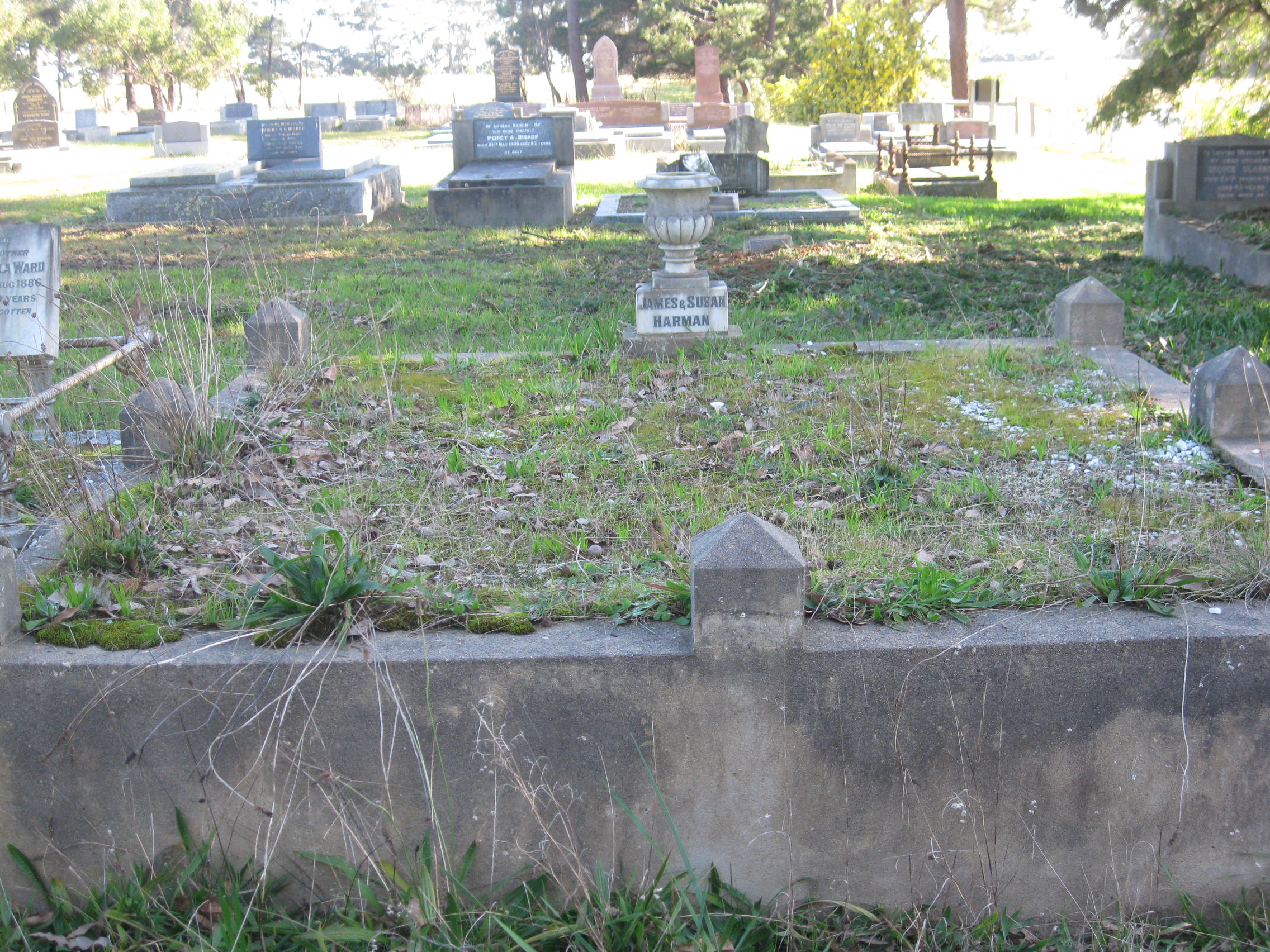
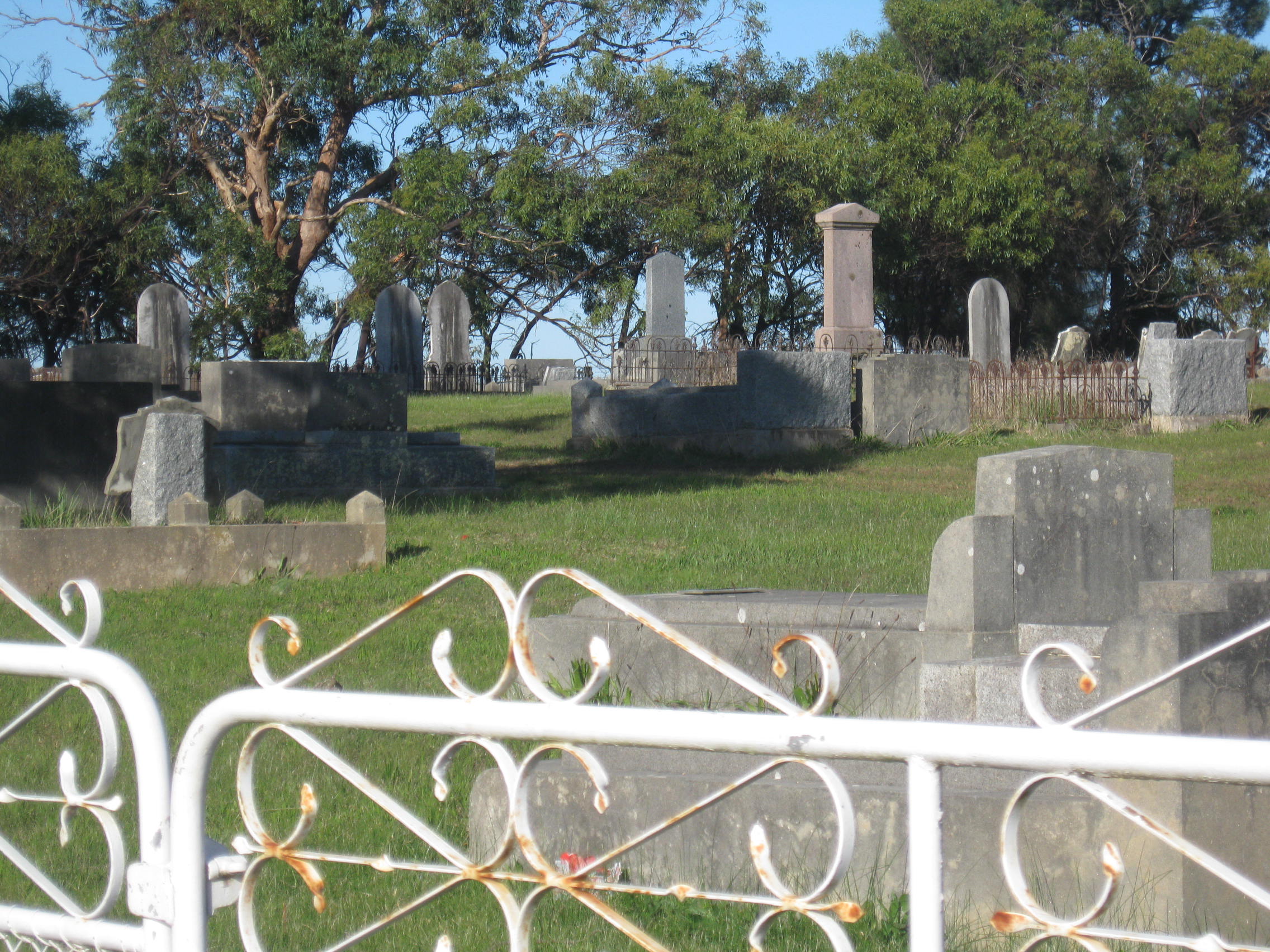
Both Joseph and Sarah were buried at the Byaduk Cemetery. While there is no visible headstone for the pair, there is a large plot enclosed by a rusted wrought iron fence I believe is their resting place.  It is surrounded by graves of other Harman family members in a picturesque corner of the cemetery.

A View of the Byaduk Cemetery