Byaduk Cemetery

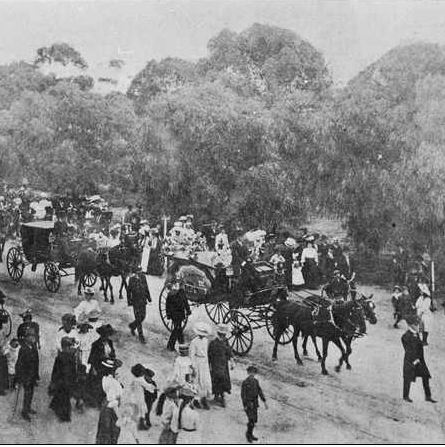
I enjoy a trip to the Byaduk Cemetery.   When I turn off the Hamilton-Port Fairy Road and drive up the hill on not much more than a track, I can sense the ghosts of my ancestors around me, walking or driving a buggy up the hill following a horse-drawn hearse to the cemetery.  It is like stepping back in time.
fun
IMAGE COURTESY OF THE STATE LIBRARY OF SOUTH AUSTRALIA B62833 http://images.slsa.sa.gov.au/mpcimg/63000/B62833.htm

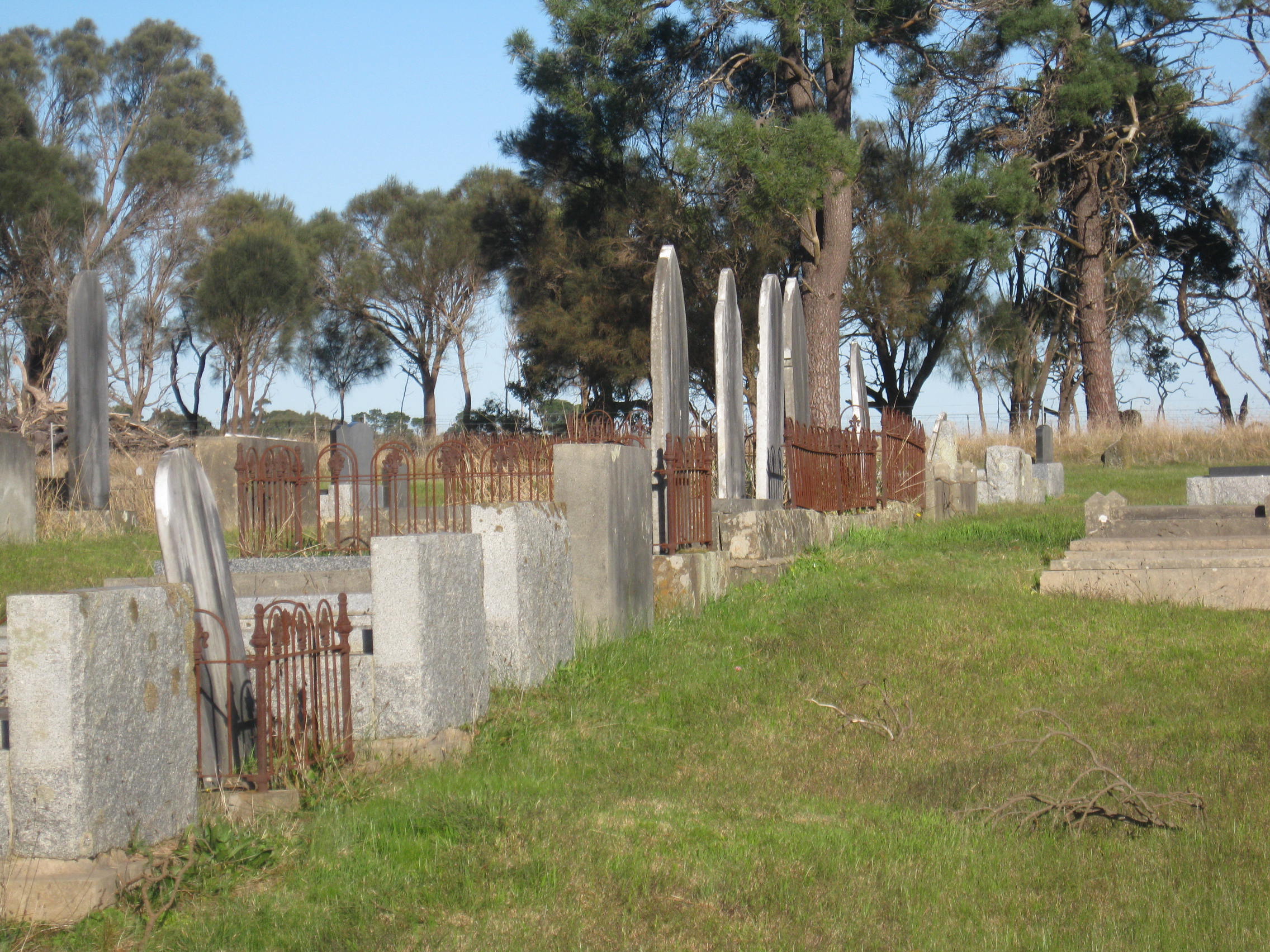
There are over 250 burials, in the cemetery and I will share photos of a small sample of headstones, including some of my family.  There are also unmarked graves, such as that of my 4 x great grandparents Joseph and Sarah Harman.

IMG_1848

THREE BROTHERS

Scottish brothers, Colin, Duncan, and James Fraser called Byaduk home and became respected residents.

The brothers immigrated from Scotland in 1853 and went to the Ararat diggings.  When land became available in 1861, the brothers went to Byaduk, and Colin and James selected “Aird“.

They all at one time lived at “Aird. “James built a hut there, but later built a home at “Lower Aird”, the adjacent property.  Colin built his home at “Aird”, where he resided until his death.  The Victorian Heritage Database has a concise history of the Frasers and information about the Aird Homestead complex and the Lower Aird Homestead complex.  The Weekly Times ran an article about Lower Aird” in 2009.

Duncan didn’t buy land initially; rather, he returned to Scotland.  In 1871, he returned to  Byaduk with his wife Margaret and four children, Simon, Helen, Donald, and Willia,m and they lived at “Aird” for a time.  In 1873, Duncan purchased “Camp Creek“, where he lived until he died in 1878 aged just 49.

HEADSTONE OF DUNCAN &     FRASER, BYADUK CEMETERY
HEADSTONE OF DUNCAN & FRASER, BYADUK CEMETERY

James and Mary Fraser produced a WW1 hero, 2nd Lieutenant Simon Fraser, and his bravery at the Battle of Fromelles, is commemorated at the Australian Memorial Park at Fromelles.  A statue “Cobbers, depicts Simon carrying a fellow soldier during the battle.

2nd Leuitenant Simon Fraser, 58th Battalion.  Image courtesy of the Australian War Memorial-ID no H05926 http://www.awm.gov.au/collection/H05926/
2nd Leuitenant Simon Fraser, 58th Battalion. Image courtesy of the Australian War Memorial-ID no H05926 http://www.awm.gov.au/collection/H05926/

A member of the 57th Battalion,  Sergeant Simon Fraser, carried men from No Man’s Land.  As he lifted a man on his shoulders, he heard another call out , “Don’t forget me cobber”.  Simon was later promoted to 2nd Lieutenant. The following year, he was killed in action.  “Cobbers” has been replicated at the Shrine of Remembrance, Melbourne.

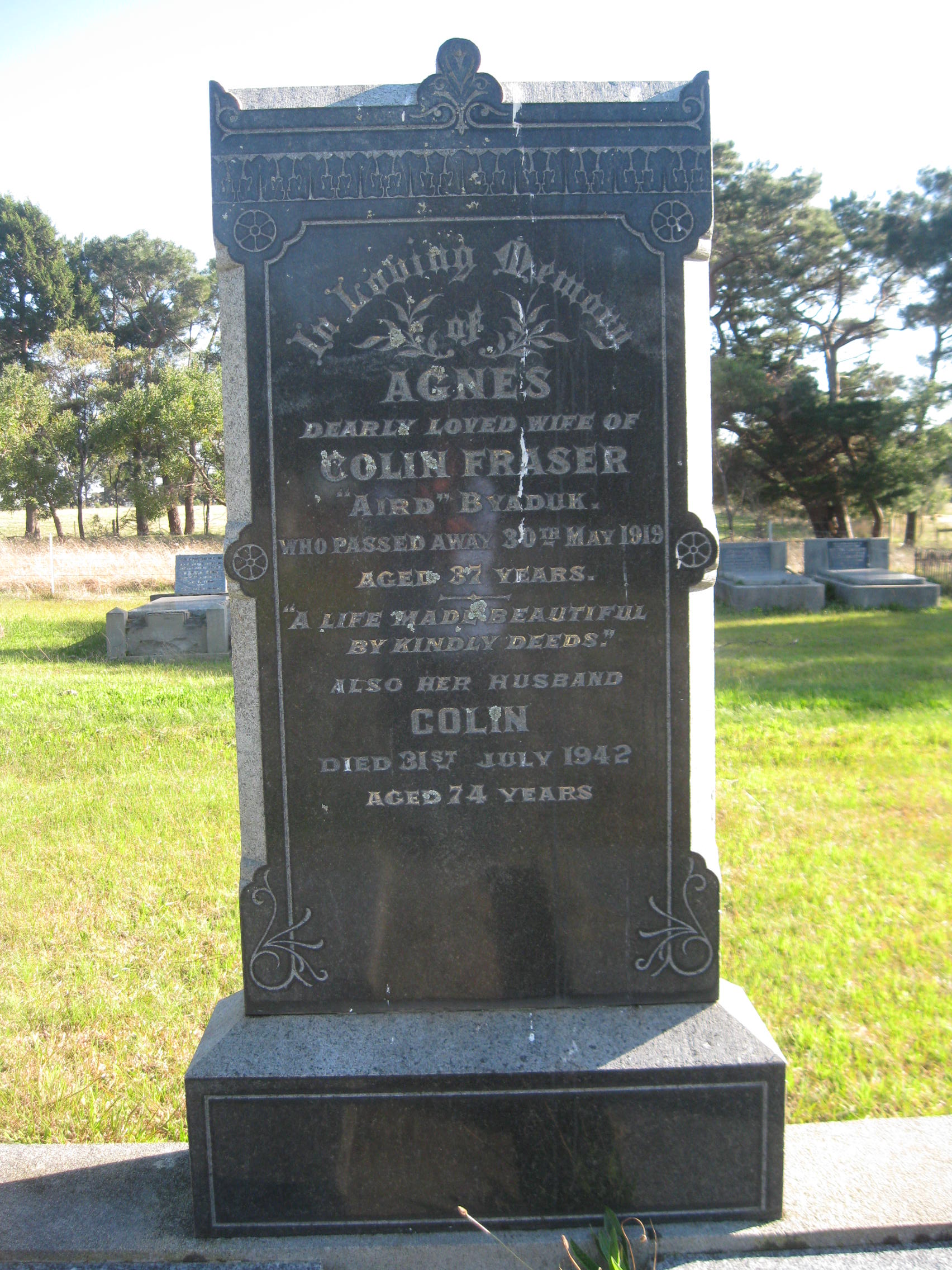
Colin and Margaret Fraser lived at “Aird” but unlike the other two brothers, they had no children.  “Aird” was later purchased by another well-known Byaduk family, the Christies.
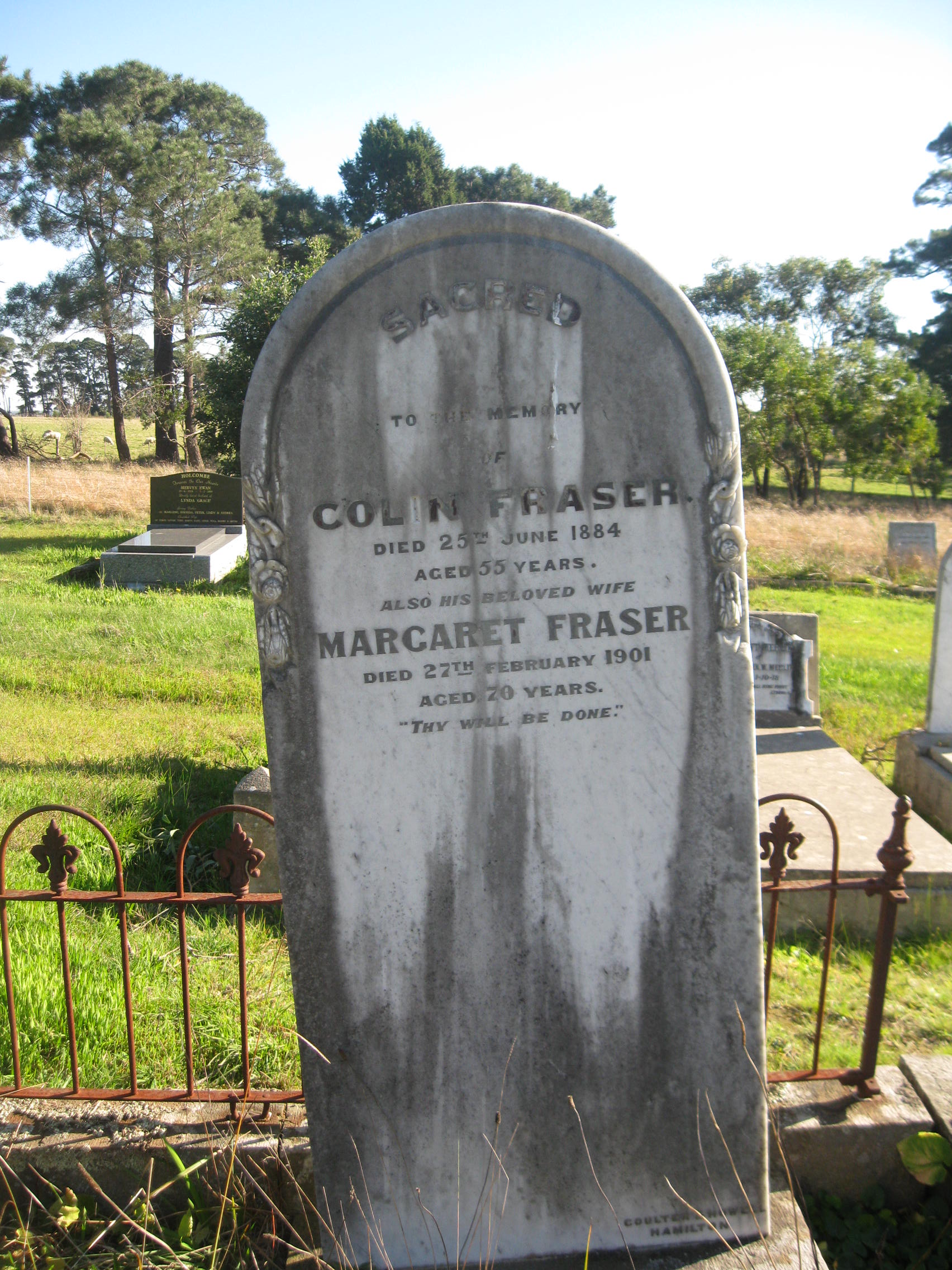
GRAVE OF COLIN &     FRASER, BYADUK CEMETERY
GRAVE OF COLIN & FRASER, BYADUK CEMETERY

I am very thankful to James and Mary Fraser’s third son, Peter Fraser.  It was Peter’s writings of the Early Byaduk History in 1931, compiled from events he kept in diaries, that has given me so much information on the history of Byaduk and the families that lived there.

Peter did not publish his writings, but in 1994, Ian Black of Hamilton typed them out and published a wonderful little book, Early Byaduk Settlers.  It may only be only 15 pages long, but it is a star on my bookshelf and a must for anyone who has ancestors that lived at Byaduk.  Peter tells the story of the Fraser brothers in great detail.

IMG_1815

There are at least sixteen Frasers buried at Byaduk.  Following are some of the family’s headstones:

IMG_1818

IMG_1819

IMG_1821

The following headstones are either linked to each other in some way or have direct links to the Harman family

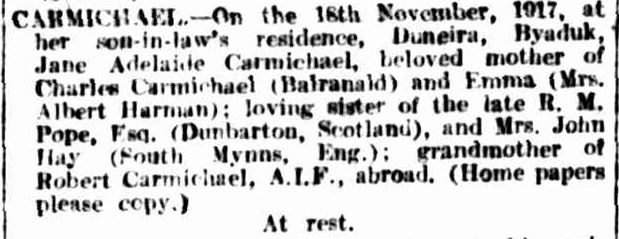
Jane Carmichael (nee Pope) came to Byaduk from Scotland later in life with two of her children, Charles and Emma.  From what I can gather, her husband had either died in Scotland or remained there.
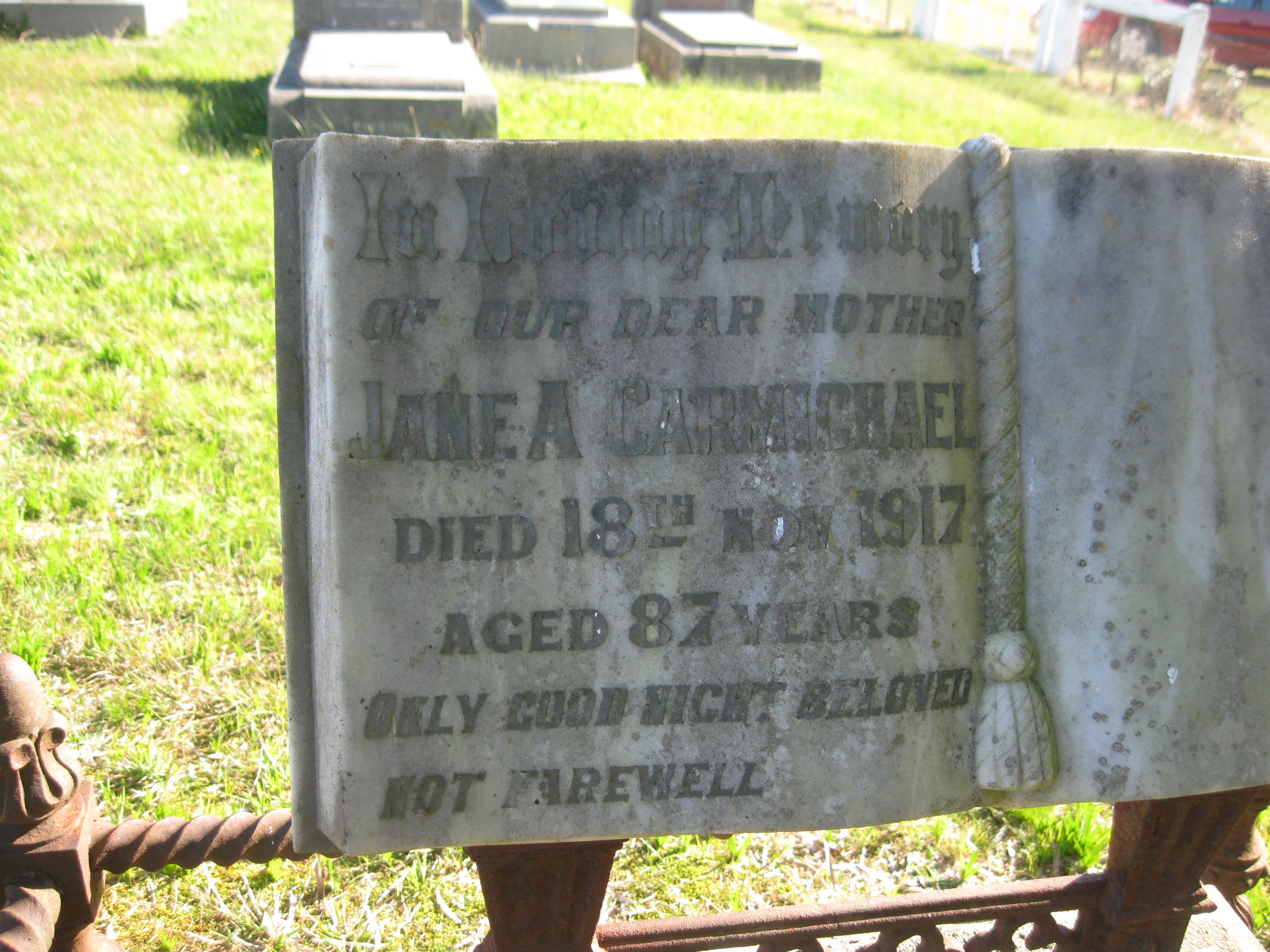
IMG_1823

Family Notices. (1917, November 20). The Argus (Melbourne, Vic. : 1848 - 1956), p. 1. Retrieved March 13, 2013, from http://nla.gov.au/nla.news-article1664422
Family Notices. (1917, November 20). The Argus (Melbourne, Vic. : 1848 – 1956), p. 1. Retrieved March 13, 2013, from http://nla.gov.au/nla.news-article1664422

Emma Carmichael, born in Dundee, Scotland around 1859 married Albert Harman in 1907.  She was 48 and Albert 39.  Albert was the fourth son of James and Susan Harman.

HEADSTONE OF ALBERT AND EMMA HARMAN

Samuel and Jane Tyers did not have any children, but other members of Samuel’s family lived in Byaduk.  There are at least nine other Tyers family members in the Byaduk Cemetery including Samuel’s sister Jane.
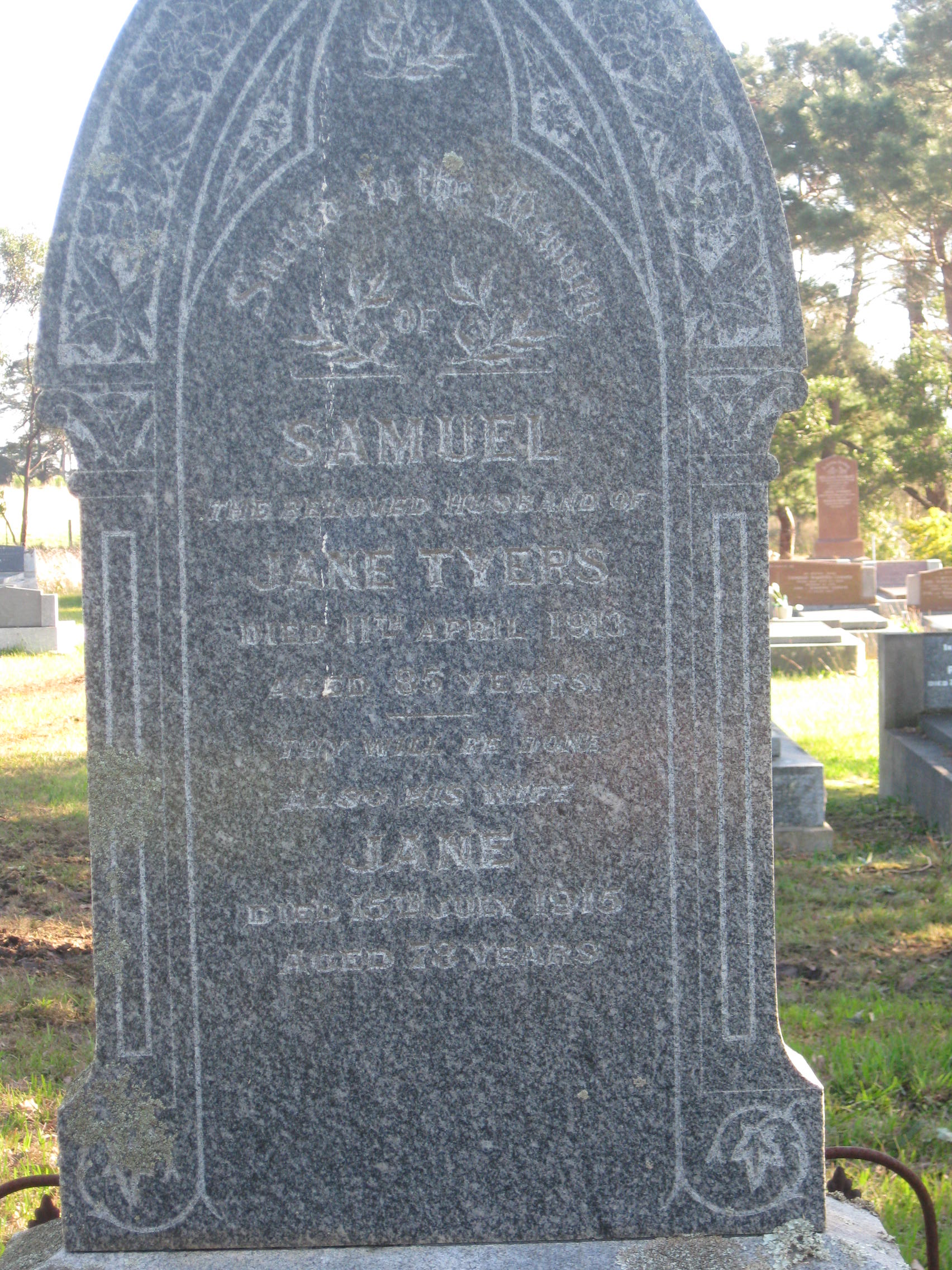
IMG_1829

Other than Charlotte’s obituary, I could not find a lot about James and Charlotte Ward.  It was that obituary, however, that helped me find a link between this headstone and the one following it.

IMG_1841

Family Notices. (1904, April 20). The Argus (Melbourne, Vic. : 1848 - 1956), p. 1. Retrieved March 13, 2013, from http://nla.gov.au/nla.news-article10315347
Family Notices. (1904, April 20). The Argus (Melbourne, Vic. : 1848 – 1956), p. 1. Retrieved March 13, 2013, from http://nla.gov.au/nla.news-article10315347

This  Holmes headstone has a link to the previous one and to Samuel and Jane Tyers (above).  Joseph Holmes (1862-1929) was the son of George Holmes and Jane Tyers.  Jane was a sister of Samuel Tyers (above).

Joseph married Agnes Brand.  Her grandparents were James and Charlotte Ward (above).  Her parents were William Brand and Agnes Ward, and Charlotte’s obituary mentions her daughter “Mrs William Brand”.
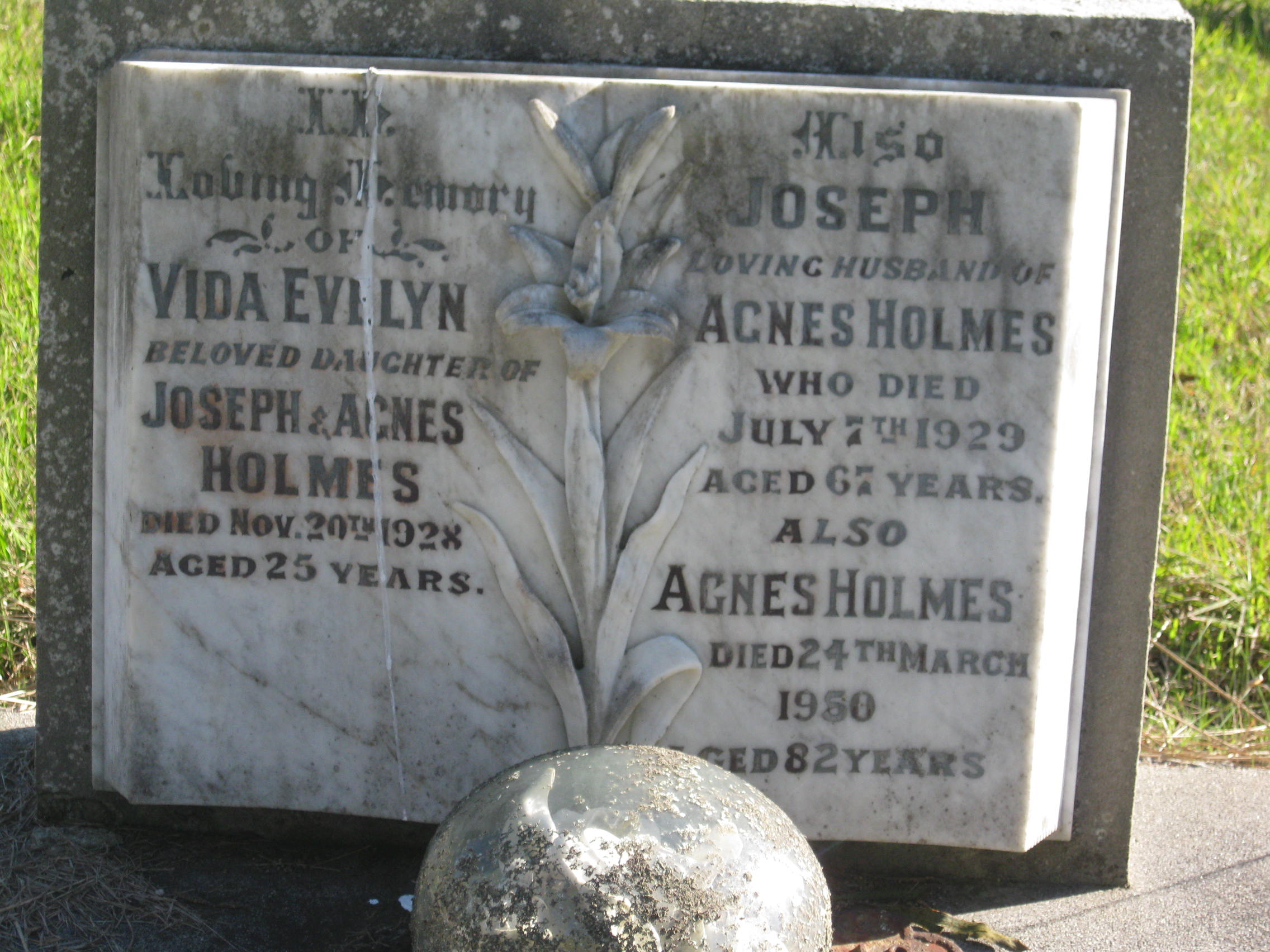
IMG_1840

The following headstone belongs to Isabella Ward and her son Charles Ward.  Isabella was Isabella Harman, daughter of James and Susan Harman.  Her sister, Julia, married George Holmes, brother of Joseph Holmes (above).

Isabella married Stephen Ward in 1885, and their son Charles Frederick Ward was born in 1886, the same year as his mother’s death, presumably as a result of the birth.

I had heard from Nana that Henrietta Harman, Isabella’s unmarried sister, raised Charles.  James Harman, in his will, made provision for his daughter Henrietta and grandson, Charles, to stay in the house that he owned beyond his death and for as long as needed.  Also, after the death of Henrietta, a trust would allow for Charles’ maintenance.  That was not because Auntie Henrietta outlived her much-loved nephew Charles.  He died in 1928 at Ballarat.
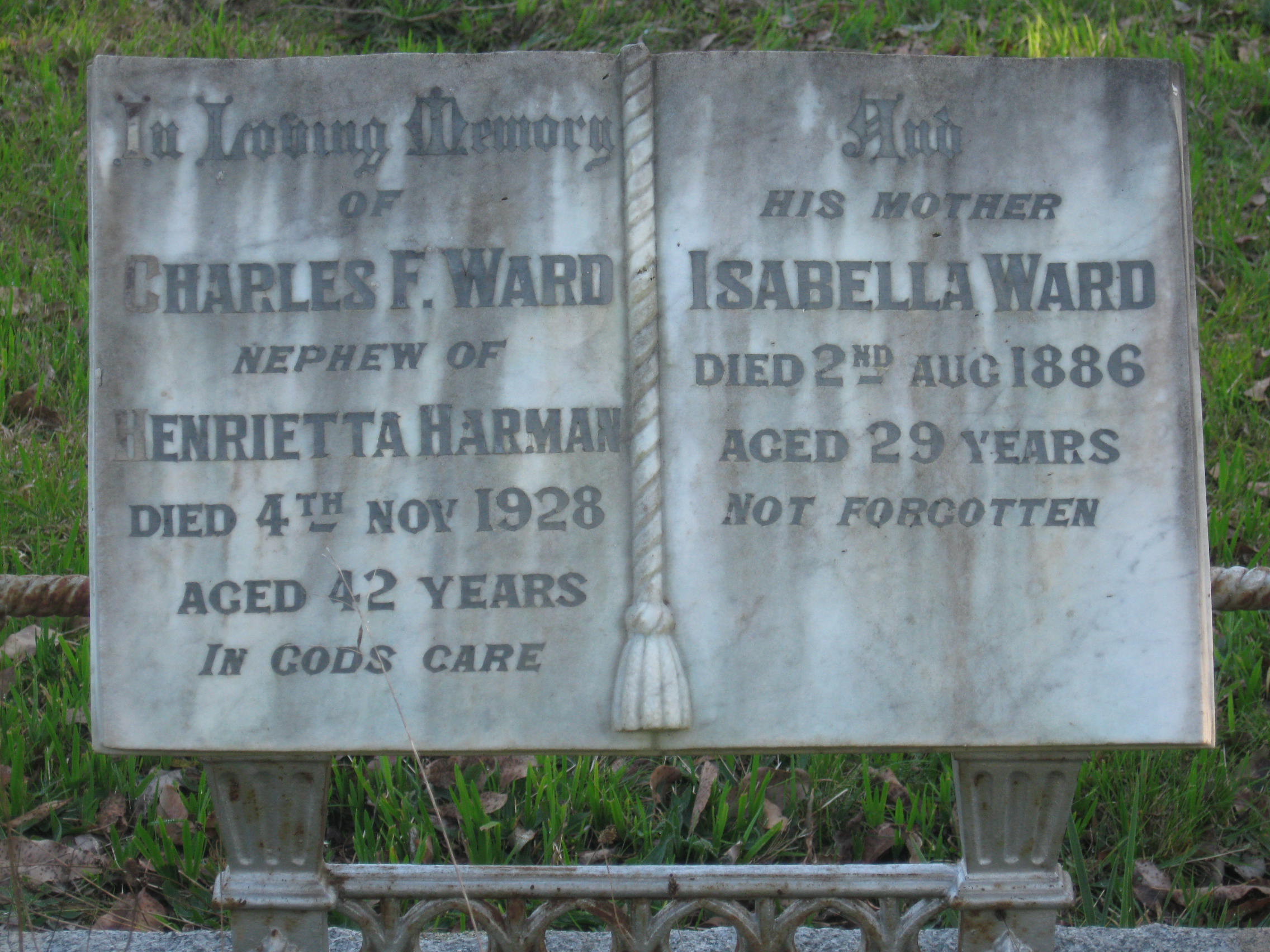
IMG_1830

Henrietta Harman was Nana’s great-aunt, and she could recall as a child,  Auntie Henrietta visiting their home.  That would have been during the 1920s and 30s.  Henrietta would catch the coach from Byaduk to Hamilton.  “She was a dear old thing” Nana would say.  I think maybe because Nana, Linda Henrietta, was named after her great-aunt, she felt a special bond.  Henrietta passed away in 1952 and was buried in a simple grave at Byaduk,.

IMG_1839

Catherine Harman was the wife of my great-great-uncle Charles James Harman, son of Reuben James Harman and Elizabeth Bishop.  Catherine was Catherine Kinghorn, daughter of Francis Kinghorn and Elizabeth White.  Born in 1868 at Byaduk, Catherine married Charles at the age of 37 in 1905.  Charles was 10 years her junior.  Catherine died in hospital in  Melbourne in 1913.  Charles enlisted in the Australian Flying Corps in 1916 and remarried in 1922 to Lavinia Raven Fisher of Middle Park.
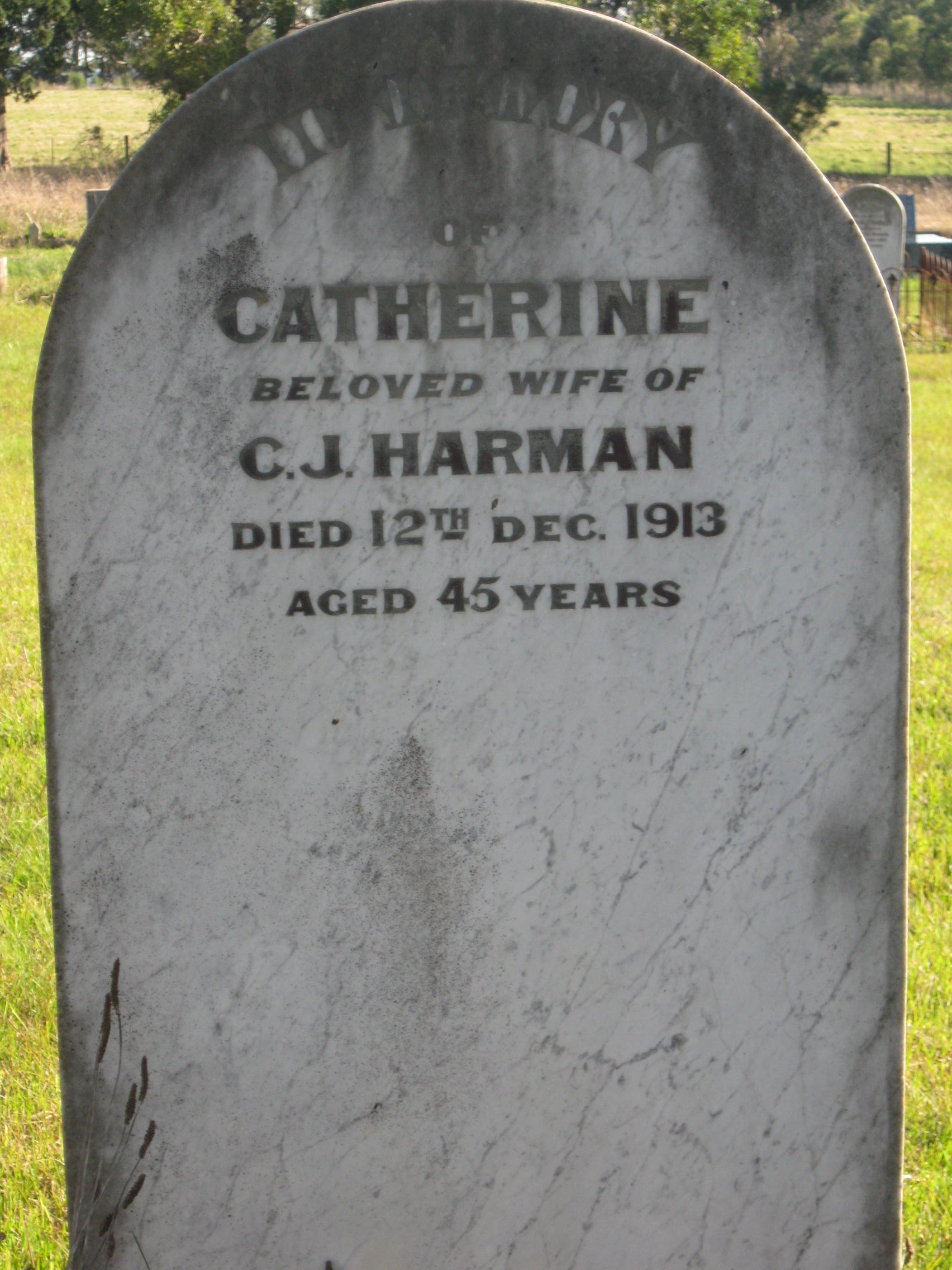
IMG_1845

William Leslie Harman was born in 1888 at Byaduk, the third child and eldest son of Alfred Harman and Louisa Newman.  William was the grandson of James and Sarah Harman.
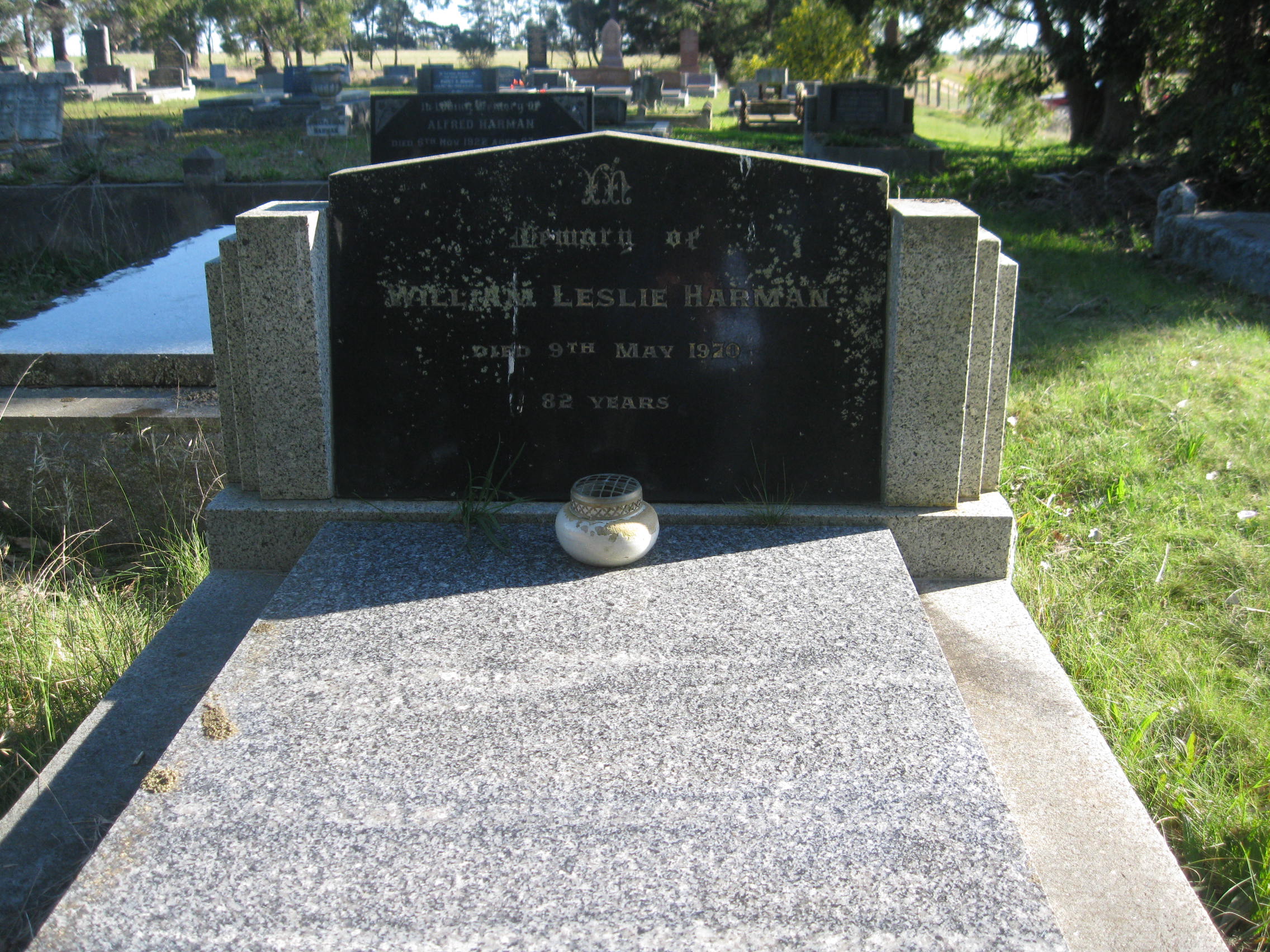
IMG_1838

Isabel Bunworth was Isabel Harman, the sixth daughter of Alfred and Louisa Harman and sister of William (above).  Isabel married John Bunworth of Byaduk in 1923.

IMG_1842

Gershom Harman (1869-1940) was the second son of Reuben Harman and Elizabeth Oliver.  He married Elizabeth Hilliard in 1905, and they had two children, Ivy and Gordon.
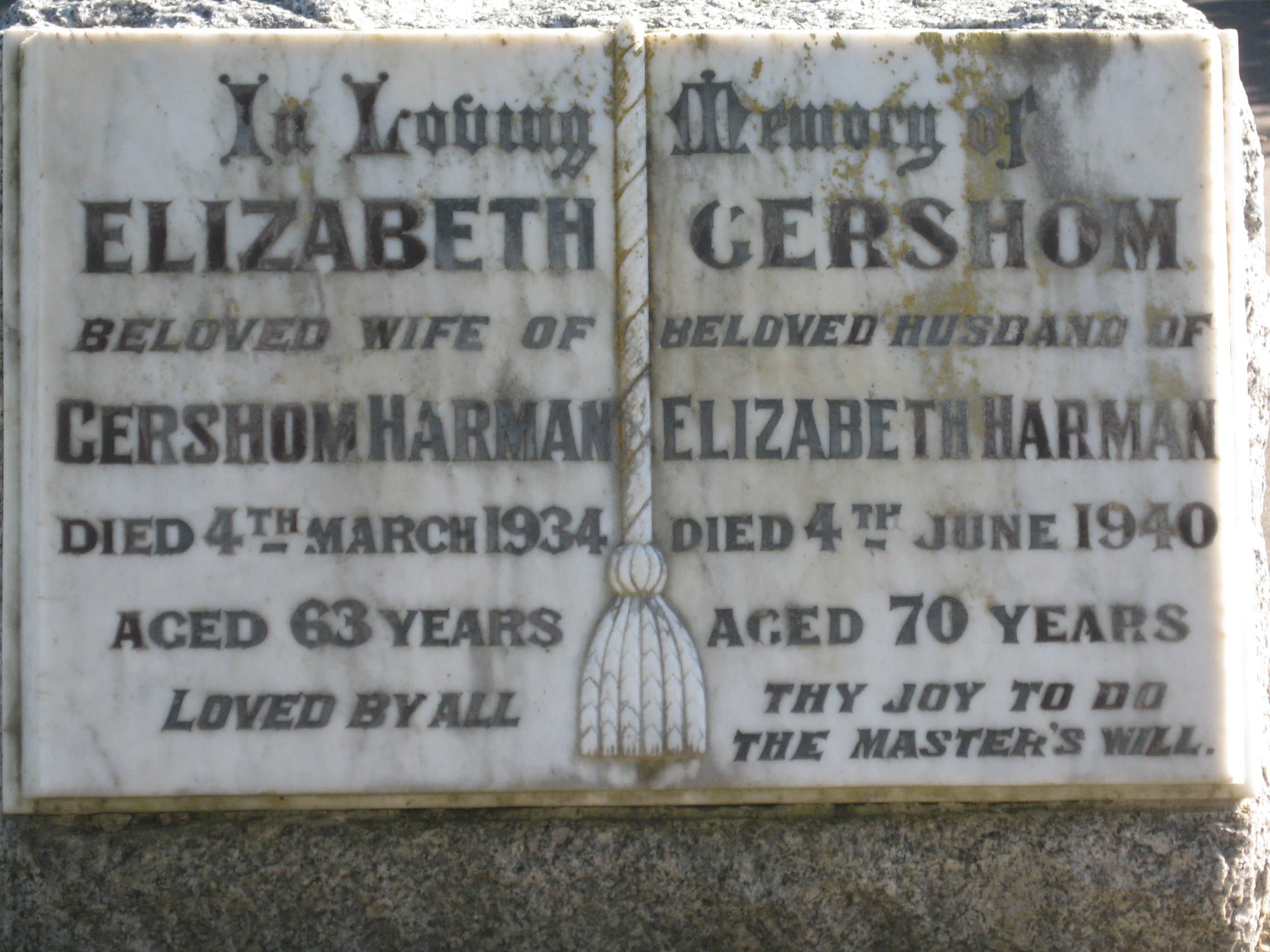
IMG_1835

Family Notices. (1934, March 10). The Argus (Melbourne, Vic. : 1848 - 1956), p. 13. Retrieved March 14, 2013, from http://nla.gov.au/nla.news-article10917287
Family Notices. (1934, March 10). The Argus (Melbourne, Vic. : 1848 – 1956), p. 13. Retrieved March 14, 2013, from http://nla.gov.au/nla.news-article10917287
Family Notices. (1940, June 8). The Argus (Melbourne, Vic. : 1848 - 1956), p. 4. Retrieved March 14, 2013, from http://nla.gov.au/nla.news-article12469954
Family Notices. (1940, June 8). The Argus (Melbourne, Vic. : 1848 – 1956), p. 4. Retrieved March 14, 2013, from http://nla.gov.au/nla.news-article12469954

Now to the Bishops and another Harman link as my gg grandparents were Reuben James Harman and Elizabeth Bishop.

The following headstone belongs to Charles Bishop and his wife, Sarah Dancer.  Charles (1856-1916) was the eldest son of James Bishop and Sarah Hughes.  He was the brother of Elizabeth Bishop.

Charles married Sarah Dancer in 1884, and they had 11 children.  Frances Bishop Hylard was their ninth child, born in 1900.  She married Edward Thomas Hylard in 1920.

IMG_1824

Charles Bishop passed away from a heart attack while loading wood.

COUNTRY NEWS. (1916, August 28). The Argus (Melbourne, Vic. : 1848 - 1956), p. 9. Retrieved March 17, 2013, from http://nla.gov.au/nla.news-article1598956
COUNTRY NEWS. (1916, August 28). The Argus (Melbourne, Vic. : 1848 – 1956), p. 9. Retrieved March 17, 2013, from http://nla.gov.au/nla.news-article1598956

Percy Almond Bishop was the second son of Charles and Sarah Bishop.  Percy was born in 1888 at Byaduk and enlisted in 1916 at Hamilton and served with the 39th Battalion.  He was awarded a Distinguished Conduct Medal and a Military Medal.  Percy never married.

IMG_1827

Family Notices. (1946, May 31). The Argus (Melbourne, Vic. : 1848 - 1956), p. 2. Retrieved March 14, 2013, from http://nla.gov.au/nla.news-article22250486
Family Notices. (1946, May 31). The Argus (Melbourne, Vic. : 1848 – 1956), p. 2. Retrieved March 14, 2013, from http://nla.gov.au/nla.news-article22250486
IMG_1847

Ian Marr’s website, Cemeteries of S.W. Victoria has a full list of the headstones at the Byaduk Cemetery.

**Thank you to Maria Cameron, President of the Port Fairy Genealogical Society, for providing additional information on the Fraser family.

The Drover’s Wife

This post was written for the 2013 Australia Day Blog Challenge organised by genealogist Helen V. Smith. The brief for the challenge was “Tell the story of your first Australian ancestor”.

Easy –  Ellen Barry arrived in 1840 on the Orient.  But you have heard enough about Ellen and her husband Thomas Gamble, another early arrival (and possible convict).   Most of my other ancestors were 1850s Assisted Immigrants.  Maybe I could go with a hunch.

My ggg grandparents James Bishop and Sarah Hughes have been difficult to research.  I eventually discovered they married in Adelaide in 1852.  A few years ago, on the passenger list of the Lysander an 1840 arrival to Adelaide, I found Robert Hughes, his wife and four daughters.

Shipping Report. (1840, September 8). Southern Australian (Adelaide, SA : 1838 - 1844), p. 3. Retrieved January 26, 2013, from http://nla.gov.au/nla.news-article71619943

Shipping Report. (1840, September 8). Southern Australian (Adelaide, SA : 1838 – 1844), p. 3. Retrieved January 26, 2013, from http://nla.gov.au/nla.news-article71619943

As Sarah’s father was Robert,  I’ve kept the Lysander filed away in my mind (yes, there are probably better places), occasionally having a search around the records hoping for something new.

For this post, I decided to try to find, the arrival date of either Sarah or James, but I had to choose.  Firstly, I would need to pay for a digital image of a Death Certificate simply because I was short of clues. This was still cheaper and faster than ordering a hard copy of their South Australian Marriage Certificate.

I’ve posted about James before and I know something of him but nothing of Sarah except she gave birth to eleven children, but I did want to know more.  Also, as Sarah passed away before her husband, the informant would most likely have been James and, if he was still of sane mind, information would be more accurate than that on his own certificate.   He died ten years later in 1895 and his informant may not have known the detail I was after.

Based on that reasoning, Sarah it would be.  So I ordered the certificate and waited, with fingers crossed for the digital image to appear. More often than not when I order a certificate, I end up disappointed.  I was, on this occasion, pleasantly surprised.  The column I was most interested in was “How long in the Australian colony”.  It read, “fourteen years in South Australia”, in Victoria…almost illegible but it looks like thirty-four years.  What do you think?

sh


It does not prove that Sarah came on the Lysander but it does qualify her as an early arrival, so let the story begin.

I have told much of the Bishop family story in the post “Jim’s Gone A-droving” but what of Sarah’s story?  I know so little about her but with help from Henry Lawson’s “The Drover’s Wife” one can wonder and imagine what life was like for her.  While I don’t believe that she felt the isolation experienced by Lawson’s “wife” she must have felt the same loneliness.

Sarah Hughes was born in Brighton, East Sussex, England in 1834 to Robert Hughes and Mary Godfer.  Robert was a sailor according to Sarah’s Death Certificate.  As a child, Sarah arrived in Adelaide.  By 1852, aged eighteen, she had met and married James Bishop from Dorset, nine years her senior.  They lived at Thebarton, just north-west of the Adelaide city centre.  Eight days short of their nine month anniversary, Sarah and Jim welcomed a daughter, Mary Elizabeth, named after her two grandmothers.

For most of his working life, Jim was a drover.  The following article describes a James  Bishop, working as a shepherd near Gawler, South Australia in 1853.

jb

This could well be my Jim, off working early in the marriage.  I have often wondered why only one child was born during the  Adelaide days from 1852-1855/6, considering the speed of conception of the first child and frequency of the later children. Maybe Jim was away working?   Could the gaps between the eleven children be a  measure of Jim’s absences?

Baby Mary passed away in 1855 and this may have been a catalyst for a move.

Family Notices. (1855, March 26). South Australian Register (Adelaide, SA : 1839 - 1900), p. 2. Retrieved January 24, 2013, from http://nla.gov.au/nla.news-article49308047

Family Notices. (1855, March 26). South Australian Register (Adelaide, SA : 1839 – 1900), p. 2. Retrieved January 24, 2013, from http://nla.gov.au/nla.news-article49308047

Or was it gold?  Jim and Sarah next turned up in Ararat where a new lead was found in early 1856.

ARARAT. (1856, June 27). Bendigo Advertiser (Vic. : 1855 - 1918), p. 2. Retrieved January 25, 2013, from http://nla.gov.au/nla.news-article88050962

ARARAT. (1856, June 27). Bendigo Advertiser (Vic. : 1855 – 1918), p. 2. Retrieved January 25, 2013, from http://nla.gov.au/nla.news-article88050962

Would life as a miner’s wife be any different to a shepherd’s wife?  The goldfields were harsh for women, in the minority and left alone while their husband’s sought to change their fortunes.  There was the cold (and Ararat can get very cold), the mud, the heat and dust.   Their home was either a tent or hut.  Settled in Ararat, Sarah gave birth to three children in four years, including my gg grandmother Elizabeth, if lucky a midwife at best assisted or another miner’s wife.  Disease lurked on the goldfields, a constant worry for a mother with young children.

Seemingly luckless, the Bishops moved to Mount Gambier.  Jim would have turned to droving by this time.   While they were in Mount Gambier,  Harriet was born in 1860 and Ellen in 1862.

dw

By 1865, the family had moved to the Macarthur/Byaduk area and in the same year, after a break of three years, Sarah gave birth to a daughter.  She called her Mary after the child she lost 10 years before.

dw2During Jim’s absences, he often took cattle to the Adelaide markets, Sarah would have faced the harshness of the land on her own.  By 1870, she had eight children from a newborn to fourteen.  That year,  Jim selected sixteen acres at Warrabkook, out of Macarthur.  At least the older boys could have helped her with daily farm tasks and Elizabeth, thirteen and Harriett, ten, with the babies.

dw3dw4

dw5

dw6

dw7

dw8

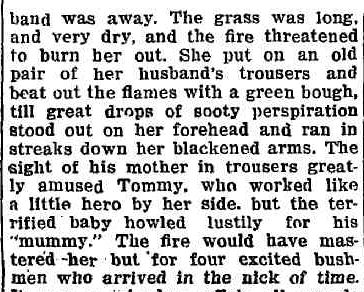
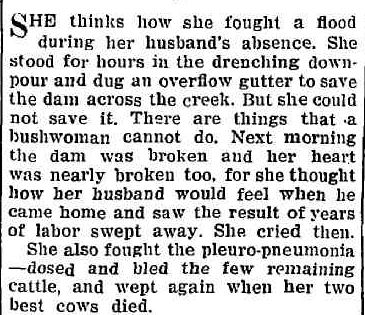
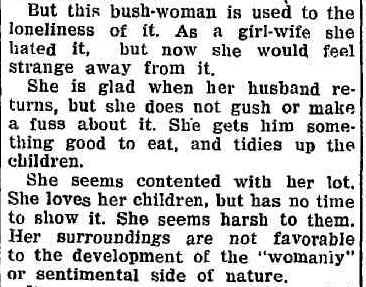
Sarah’s relationship with James is something I wonder about.  Nine years younger than him and only a girl when they married.  Drovers were stereotypically hard-drinking men adapted to long periods alone.  Margaret Kiddle in her book, Men of Yesterday, A Social History of the Western District of Victoria  described drovers as “…hardbitten, sunburnt and blasphemous.”(page 411) How did Jim adjust back at home?  The peace of life on the road with a mob of cattle would be very different to a home full of children.  Did Sarah do as Lawsons’ drover’s wife and not make a fuss?

dw9As Lawson’s “Drover’s Wife” killed a snake that terrorised the family in their home, her eldest son, with some sense of her emptiness, declared “Mother, I won’t go drovin’, blast me if I do”.

dw11For Sarah, this was not the case.  Eldest son Charles worked as a drover.

PASTORAL INTELLIGENCE. (1890, January 15). The Argus (Melbourne, Vic. : 1848 - 1956), p. 6. Retrieved January 25, 2013, from http://nla.gov.au/nla.news-article8583931

PASTORAL INTELLIGENCE. (1890, January 15). The Argus (Melbourne, Vic. : 1848 – 1956), p. 6. Retrieved January 25, 2013, from http://nla.gov.au/nla.news-article8583931

Third son Robert worked as a drover.

rb

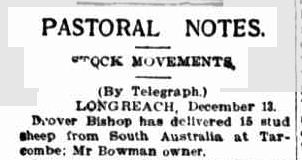
The droving blood ran deep.  The 1913 Electoral Roll lists Sarah’s grandson Hubert Nathaniel Gurney Bishop, with the unmistakable name and son of Charles, as living in Longreach, Queensland.  I  believe this his him.

PASTORAL NOTES. (1913, December 15). Townsville Daily Bulletin (Qld. : 1885 - 1954), p. 5. Retrieved January 25, 2013, from http://nla.gov.au/nla.news-article60386074

PASTORAL NOTES. (1913, December 15). Townsville Daily Bulletin (Qld. : 1885 – 1954), p. 5. Retrieved January 25, 2013, from http://nla.gov.au/nla.news-article60386074

Sarah died on 15 May 1885 at Byaduk from pulmonary tuberculosis.  Buried at only fifty-one at the Macarthur cemetery.  The Wesleyan minister presided.  On Sarah’s death certificate her profession was not home duties, or wife or even mother.  It was a role that was all of those and more…drover’s wife.


sb

After I wrote this post I watched Australian country singer Luke O’Shea ‘s take on The Drover’s Wife.  Pass the tissues, please.

SOURCES:

Excerpts of Henry Lawson’s short story “The Drover’s Wife” from Queensland Country Life – EPICS OF THE BUSH. (1936, June 11). Queensland Country Life (Qld. : 1900 – 1954), p. 7. Retrieved January 26, 2013, from http://nla.gov.au/nla.news-article97158517 and Henry Lawson’s Stories of the Bush. (1936, June 18). Queensland Country Life (Qld. : 1900 – 1954), p. 7. Retrieved January 26, 2013, from http://nla.gov.au/nla.news-article97158597

A full version of “The Drover’s Wife” is available at this link – http://ebooks.adelaide.edu.au/l/lawson/henry/while_the_billy_boils/book2.1.html

Bound For South Australia


Trove Tuesday – In the News

The newspaper articles I have shared each week for Trove Tuesday are similar to those I choose for the spasmodic “In the News” posts.  There are now 21 in total (TT is drawing close with 19 posts), so I thought I would share a few of my favourites for this week’s Trove Tuesday.

September 23, 1870 – Fire swept through Hamilton’s main street, Gray Street.

The Bushfire series – February 8-13 1901, January 13, 1905, January 19, 1944

December 8, 1909 – The Grampians Bunyip

November 16, 1929 – Less than 12 months after my gg uncle, Charles James Harman flew on the airship R101, it crashed over France.

June 16, 1881 – Ploughing matches from Byaduk and beyond.

In The News – November 24, 1941

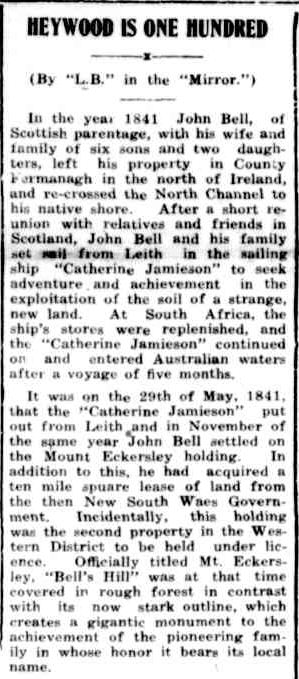
The Portland Guardian of November 24, 1941 heralded the 100th birthday of Heywood, a small town about 25 kms north of Portland.  The article remembered The Bell family and their contribution to Heywood’s settlement.  I recently  introduced to you my family link to the Bells in a Trove Tuesday post – A Matter of Relativity about Amelia Harman.  Amelia married Christopher Bell, a grandson of John and Elizabeth Bell.

John Bell and his wife Elizabeth Morrow, left Ireland in 1841 with eight children in tow, some were adults, and sailed to Australia aboard the “Catherine Jamison“.  Five months after their departure, the Bells had settled at Mount Eckersley, a few kilometres north of Heywood.


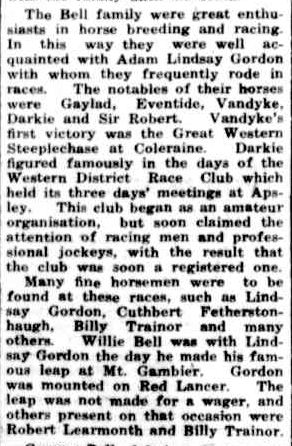
Great contributors to Western Victorian racing, the family were good friends with poet Adam Lindsay Gordon.  William Bell was with Gordon when he made his mighty leap at Blue Lake, Mt. Gambier.

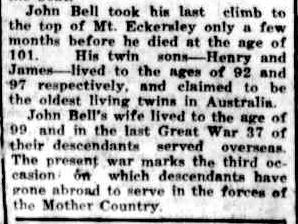
The Department of Primary Industries cites the height of Mt Eckersley as 450 feet (137 metres) but that didn’t stop John Bell, at the age of 101, from climbing the volcano, only months before his death.

As a family known for longevity, twin sons Henry and James lived to 92 and 97 respectively.  At one time they were Australia’s oldest living twins.

HEYWOOD IS ONE HUNDRED. (1941, November 24). Portland Guardian (Vic. : 1876 – 1953), p. 1 Edition: EVENING. Retrieved November 16, 2012, from http://nla.gov.au/nla.news-article64402492

All of this is well and good but is it all true?  John’s year of death is recorded as 1885, with his birth about 1787.  That would have made him around 97/98, short of the 101 reported.  Still, if he did climb Mt.Eckersley, to do it aged 97/98  was still a mean feat, but John may not have been a centenarian.  The family notice in the Hamilton Spectator at the time of his death gives his age as 98.

There could also be a discrepancy with the year the Bells settled at Mt Eckersley.  The Bells did arrive on the Catherine Jamieson on October 22, 1841 to Port Phillip.  The newspaper article says they were in Heywood by November 1841.  The Glenelg and Wannon Settlers site states John Bell settled at Mt Eckersly in 1843.

A further reminder to not always believe what you read in the papers.

Trove Tuesday – Time for a Song

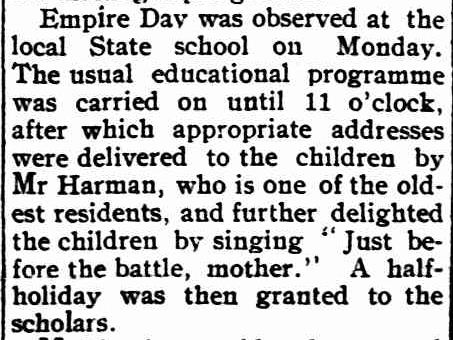
The Port Fairy Gazette has a lot of Byaduk news and I just love this treasure from May 31, 1915.   Australia celebrated Empire Day on May 24 from 1905.  School children participated in patriotic singing and speeches and flags adorned buildings.  The children had a holiday from school in the afternoon.  May 24 was also Cracker Night and in the evening people would gather around bonfires and let off fireworks.

Empire Day 1915 saw ggg grandfather James Harman visit the Byaduk State School and address the children.   He then sang “Just Before the Battle, Mother” and I’m pleased to see he “delighted” the children.  At age 85, he was only a year away from his passing.

BYADUK. (1915, May 31). Port Fairy Gazette (Vic. : 1914 – 1918), p. 2 Edition: EVENING. Retrieved November 14, 2012, from http://nla.gov.au/nla.news-article94725183

“Just Before the Battle, Mother” was an American civil war song but given it was in the midst of WW1, it was apt.  If you have not heard the song before, click on the play button below to hear a rendition courtesy of Soundcloud and P. Murray.

M is for…Methodist

This really should have been a post for the “W” week of the Gould Genealogy Alphabet challenge, but I have another “W” word in mind for that week (guess which word that will be).  To be precise,  “W is for…Wesleyan Methodist” would have been more apt as it is the branch of Methodism that the Harman family followed, but due to an overload of “W”‘s, I’ll turn it upside down and make it “M is for…Methodist”.

What did I know about Methodism before I discovered the Harman’s faith?  Nothing except for a link to temperance.  Therefore, over the years I have tried to find out more about the religion as I think it is definitive in finding out more of what the Harmans were really like, especially James and his brother Walter who were Local Preachers with the church.

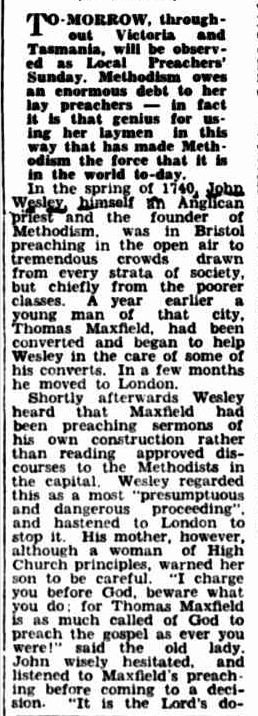
It was the role of a local preacher I discovered was one of the characteristics of Methodism.  This from the Advocate of Burnie on 16 August 1952 gives something of the background:

The Methodist Local Preacher. (1952, August 16). Advocate (Burnie, Tas. : 1890 – 1954), p. 12. Retrieved August 6, 2012, from http://nla.gov.au/nla.news-article69442373

I have also found that James did preach at Hamilton Methodist Church on occasions, found in the history  Uniting we now stand: a history of the Hamilton Methodist Church by Joan A. Smith (1999).  The Hamilton church was originally at 41 McIntyre Street before moving to Lonsdale Street in 1913.  In May this year, a gathering was held recognising 150 years of Methodism in Hamilton.

The Byaduk Methodist Church built 1864, was the first church in the town and a weatherboard Sunday School was added in 1889.  Located on the Hamilton/Port Fairy Road which runs through the town the Byaduk church, along with the Hamilton church,  are now Uniting Churches.  This came about after three churches, the Methodist, Presbyterian and Congregational came together in 1977.

FORMER BYADUK METHODIST CHURCH

Prior to the Byaduk church’s construction services were held in the home of John B. Smith, an early leader of the Wesleyan Methodist Church in Victoria.   In 1866, Smith went to Portland and travelled a circuit which took him throughout the south-west.  His recollections were published in the Portland Guardian of 25 June 1928.  If you have Kittson, Lightbody or Hedditch links, this is worth reading in full.

Early Methodsim. (1928, June 25). Portland Guardian (Vic. : 1876 – 1953), p. 3 Edition: EVENING. Retrieved August 6, 2012, from http://nla.gov.au/nla.news-article64266132

Smith was also a co-author of the book The Early Story of the Wesleyan Methodist Church in Victoria available online.  Of course, there is a lot in the book about John Smith himself who “.. had a clear grasp of the plan of salvation, and a touching and pathetic way of speaking of the “wrath to come”.”(p.269).

Also of Smith:

“The well-worn family Bible used morning, noon, and night for family worship, told of his love for the Psalms and the words of the Lord Jesus and few could use them (even the deep vast words of the fourth gospel), or the plaintive phrases of the Psalms, or the less familiar lines of shaded beauty found in our Hymn Book, with greater feeling and effect” (p269)

The influence of this holy man of God and of other kindred spirits make Byaduk a bright spot in the Hamilton Circuit, while the personal worth and , social standing of Mr. Peter Learmonth as a Christian and a citizen, and the active sympathy and generous help of the Wiggins’ and Learmonths’ on the one hand, and the ungrudging labours of devoted Local Preachers on the other, have served to sustain the cause and comfort the Minister’s heart”(p270)

Peter Fraser in Early Byaduk Settlers, describes an early Methodist service at Byaduk:

“They conducted the services differently from now.  In singing hymns. the preacher read a verse and the congregation sang the verse, then he read another and the congregation sang it and so on to the end of the hymn.  In prayers, most of the congregation knelt; and when the preacher was praying, some in the congregation would sing out AMEN, BE IT SO HALLELUIAH and other words, while others in the congregation would grunt and groan all the time, but it must have been a nuisance to the preacher as the Methodist Ministers stopped it many years ago.” (p. 14)

Peter also names some of the local preachers of which there was an abundance.  They included Mr John Henry Oliver senior, father-in-law of Jonathon and Reuben Harman, and his son John Henry junior.  Also Daniel Love, John Holmes and Samuel Clarke, just to name a few.  George Holmes senior, father in law of Julia Harman, was superintendent of the Sunday School for over forty years.

James and Walter seemed the most devout of the Harman family, with both spreading the word as local preachers. Also, Walter and his wife Lydia established the Sunday School at Ensay and Walter travelled many miles preaching.  Walter’s son Henry was an elder of the Omeo Methodist Church and I have previously told the story of the Omeo Methodist Minister Ronald Griggs.  The church closed ranks around Griggs and continued to support him at the time of his murder trial in 1928.

The post In Search of the Extraordinary Monster looks at the Port Fairy Methodist church.  Port Fairy was the home of the Harman family before they moved to Byaduk

Reuben James Harman, son of James and my gg grandfather,  was buried in the Methodist section of the Ballarat New Cemetery, with the faith continuing on to the next generation.

GRAVE OF REUBEN JAMES HARMAN & EMMA LORDEN – BALLARAT NEW CEMETERY

I know there is so much more to find about the Harman family link to the Wesleyan Methodist Church.  My ggg grandfather was a great servant of the church and saw some changes during its development in Byaduk and Hamilton.   He was still alive when the Hamilton Methodist Church moved to Lonsdale Street, but a major change occurred a year after his death.  In 1917, the Methodist Church of Australia at its Melbourne conference ruled that local preachers were to become known as lay preachers.

METHODIST CONFERENCE. (1917, May 26). Examiner (Launceston, Tas. : 1900 – 1954), p. 6 Edition: DAILY. Retrieved August 7, 2012, from http://nla.gov.au/nla.news-article50927004

A post on the website Gospel Australia has a great post “Poor Old Tom Brown”.  I have included the link but now the site is only working intermittently.   It describes a man who was a Local Preacher in New South Wales and he is very much how I imagine James Harman to have been.

If you have Western District family members who were Methodists, I highly recommend you read The Early Story of the Wesleyan Methodist Church in Victoria.  Various towns throughout the Western District were represented along with many names.  Other areas of Victoria are also covered.

 There is one question about the Harmans and their Methodist faith that I may never have answered.  Why did Joseph Harman, father of James and Walter, change his religion from Methodist to Presbyterian by the time of his death in 1893?  Mentioned in his obituary in Hamilton Spectator it has had me wondering ever since I first read it.


Everybody Happy?

This is the third draft of this post, and it is definitely the final one. Researching this subject has taken me through several twists and turns. I’ve gone from happy dancing around the room to slumped over the keyboard with frustration to happy dancing around the room again.

In my post “Left Behind,” I alluded to a discovery that linked Mary Ann Harman to Australia. It was the Passenger Lists that led me to my subject, and those same passenger lists have contributed to my despair, leaving me desperately searching for answers.

So far, I have bookmarked almost 100 newspaper articles, watched film archive footage, listened to sound archive footage, read musical scores, and entered a lost world of entertainment, vaudeville. I have gone from the stages of the Bristol Hippodrome to the Melbourne Tivoli, from the BBC to the ABC.

I could not share this story until I knew the truth.

So without further ado, let me introduce you to the star of the show –

!!!!!!!!!RUPERT HAZELL!!!!!!!!!!!!!

!!!!!!!!!RUPERT HAZELL!!!!!!!!!!!!!

Rupert Alexander Hazell was born in West Ham, London in 1887. He was the son of Charles George Hazell and Harriett Sarah Loats, daughter of Mary Ann Harman, and granddaughter of Byaduk pioneers, Joseph and Sarah Harman. Charles Hazell worked on the wharves, and Rupert followed him there to work, first for the Royal Naval Stores and then the Port Authority.

But Rupert’s heart was not in it. He was funny, a born comedian.  Despite passing the examinations to enter the Civil Service and delighting his parents, he wanted to share his humour. With that and his musical talent, he said goodbye to the Civil Service.

In 1913, he formed his first partnership, marrying Florence Adele McKnight at Kingston, Surrey.  Adele worked as a saleswoman for a costumer and it’s possible that she met Rupert there. Years later, it was revealed  Rupert had a great interest in ladies’ stage costumes.

The following year, their son was born and christened with the same name as his father, Rupert Alexander.

Rupert was already treading the boards when he enlisted for WW1 in 1916, listing his occupation as an entertainer. He was an acting sergeant in an English hospital, one that saw ANZAC troops as patients.

It was writing songs for Music Hall star George Robey that saw his career take off.  From there, he impressed Wal Pink and vaudeville director Albert De Courville.

THE PHILOSOPHY OF HUMOR. (1927, February 5). The Advertiser (Adelaide, SA : 1889 – 1931), p. 14. http://nla.gov.au/nla.news-article40762292

Radio came to England in 1920 with Dame Nellie Melba making one of the first broadcasts on Marconi’s test station, 2MT in Essex. Rupert, too, was one of those early broadcasters, being one of the first comedians signed by the Marconi Company. The Marconi Company evolved into the BBC in 1922, with whom Rupert broadcast for at least the next two decades.

In 1922, Rupert travelled to New York for the Broadway show, Pins and Needles, co-written by De Courville and Pink, with lyrics co-written by Rupert. He also appeared in the show for the month of February.

The 1923 Royal Command Performance was Rupert’s next big appearance, before King George V and Queen Mary. After this event, advertising for his shows promoted him as “The Man who Made the King Laugh”.

In 1925, Rupert Hazell hit Australian shores for a tour of the Tivoli circuit. With soprano, Miss Elsie Day (her stage name), they toured Sydney and Melbourne with both critical and popular acclaim.

The visit turned into a four-year stay, with Hazell not returning to London until 1929. During that time, he became a radio star with the ABC with stints in all the Australian capital cities and New Zealand.

Accompanied by Elsie Day, their vaudeville act comprised Rupert’s jokes and Elsie’s songs. Taking on a clown-like appearance, Rupert had wild hair and a funny little hat, while Elsie always dressed in her famous crinoline dresses. Rupert greeted audiences with the familiar opening:

“Hello People. Everybody happy?”

This advertisement for the Tivoli, Melbourne, has Rupert and Elsie on the bill with their show “Harmonylarity”

[No heading]. (1925, November 18). The Argus (Melbourne, Vic. : 1848 – 1956), p. 32.  http://nla.gov.au/nla.news-page443364

Around the Studios. (1929, September 5). Western Mail (Perth, WA : 1885 – 1954), p. 12.  http://nla.gov.au/nla.news-article37675276

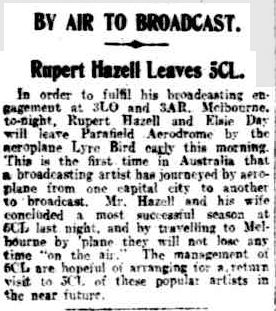
By 1928, Rupert Hazell was well known around Australia thanks to radio broadcasts, vaudeville shows, and speaking engagements with groups such as Rotary. According to The Register (S.A), Rupert and Elsie were the first performers to fly between venues.

BY AIR TO BROADCAST. (1928, July 31). The Register (Adelaide, SA : 1901 – 1929), p. 14.  http://nla.gov.au/nla.news-article57063715

POPULAR ARTISTS ON THE AIR. (1928, August 1). The Advertiser (Adelaide, SA : 1889 – 1931), p. 14. http://nla.gov.au/nla.news-article29283864

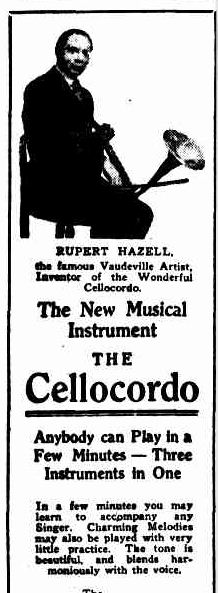
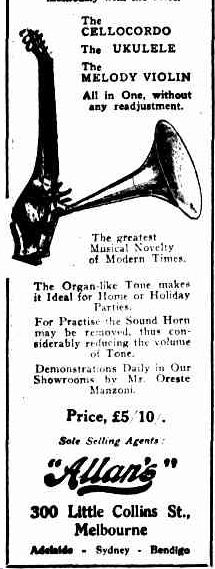
Not only was Rupert a comedian, broadcaster, and composer, but in 1925, while in Australi,a he patented his invention, the Cellocordo, an instrument like the Phonofiddle invented by A.T. Howson.  Rupert also played the Phonofiddle, but also did much to promote his version.

Display Advertising. (1926, March 20). The Argus (Melbourne, Vic. : 1848 – 1956), p. 20.  http://nla.gov.au/nla.news-article3741055


It is around this time in Rupert’s life that questions come up. I had read many articles at Trove about the pair’s 1920s visit and a later visit in 1933-34. Frequently, newspapers reported Elsie as Rupert’s wife. If “Miss Elsie Day” was a stage name, was I to assume that her real name was Florence McKnight?

It was a search at the UK National Archives that uncovered a record of divorce served on Rupert Alexander Hazell by Florence Adele McKnight in 1929. The same year, they both supposedly returned from Australia. But why did Rupert continue to perform with Elsie into the 1930s and beyond if she was Florence?

I had to find out the true identity of “Miss Elsie Day”. I went back to the Passenger Lists and once again studied Rupert’s entries. One would expect that Miss Day would travel using her real name.

There was another “Hazell” listed on three occasions. The first was in 1929 on their return to London.  Accompanying Rupert on the voyage was Eva Hazell, a vocalist. Very interesting. Also interesting was that they each listed a different residence on their return to London, Rupert at 74 Cornhill, London, and “Eva Hazell” at 28 Salmon Road, Kent.

In the later records, 1932 from South Africa and 1934 from Brisbane, Rupert was travelling with Sarah Eva Hazell. Their address was the same, 13 The Fairway, North Wembley. The 1932 record listed Sarah as “wife” and on the 1934 record as “soprano”. On each record, there was a 15-year age difference between Rupert and Eva, while there was only a two-year difference in age between Rupert and Florence.

Eva. That name rang a bell. I had found a marriage record from 1931 listing Rupert Alexander Hazell marrying a woman with the surname Pank. Further investigation revealed her full name was Eva Pank. I had initially assumed this record was for Rupert junior, as I thought Rupert senior was happily married to Florence “Elsie Day” McKnight. I also found the death record for Sarah Eva Hazell from 1988. Things were looking a lot different.

I was now working on the assumption that “Miss Elsie Day” was Sarah Eva Pank. That would mean that when Rupert and “Elsie” were in Australia for the first time, they were not married.

Observer (Adelaide, SA: 1905 – 1931) 5 October 1929, p. 56 http://nla.gov.au/nla.news-article165610189

Then, on their arrival back in England, Florence was waiting with divorce papers. Two years later, in 1931, Rupert finally married his “Miss Elsie Day” and they returned to Australia legally as man and wife. But I could not make such claims without proof.

Back to Trove, and I read through articles from the first visit, comparing them to the second. Was there any way reporting on their relationship was different on each visit? I analysed every interview looking for clues. With no paparazzi following the couple, there were no scandalous rumours, but there were some differences.

On the earlier visit, articles mentioned Rupert Hazell appearing with Miss Elsie Day or his partner, Miss Elsie Day. On one occasion, The Register (Adelaide) reported Elsie was Rupert’s wife, and he referred to her as his “little grandmother”.

BROADCASTING. (1928, July 11). The Register (Adelaide, SA : 1901 – 1929), p. 13.  http://nla.gov.au/nla.news-article57056909

BRIGHT COMEDY VAUDEVILLE. (1928, February 15). The Brisbane Courier (Qld. : 1864 – 1933), p. 25. http://nla.gov.au/nla.news-article21223381

After the formal reporting on the “relationship” during the 1920s visit, the first article after they stepped off the boat at Perth on their return to Australia was totally different:

A BROADCASTING STAR. (1933, December 22). The West Australian (Perth, WA:1879-1954), p. 7.  http://nla.gov.au/nla.news-article32777824

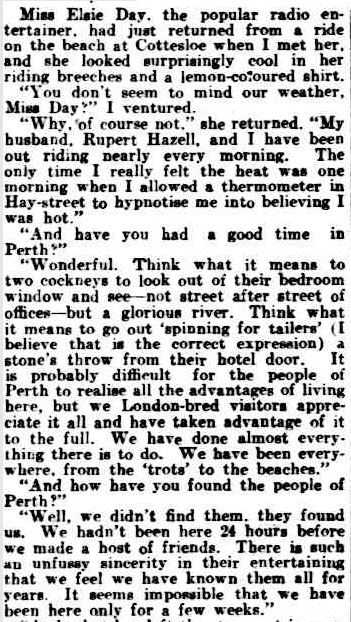
I love this article. The couple was certainly living the good life.

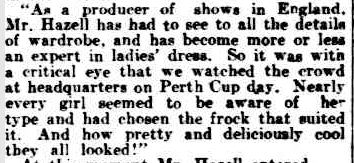
ATTRACTIVE PERTH GIRLS. (1934, January 23). The West Australian (Perth, WA : 1879 – 1954), p. 3. http://nla.gov.au/nla.news-article32795395

Getting copies of divorce papers was a possibility, but a quote of £63 for a digital copy was making it less of an option, although I was getting desperate. I then remembered a comment on a photo on Flickr from the ABC Archive.

The photo is of Rupert and “Elsie” to the right with 3LO Melbourne’s Fred Williams. A comment on the photo from Claire mentioned Elsie Day and Rupert were her gg aunt and uncle. Before I parted with my money for the divorce record, I would contact Claire.  A prompt reply came back, giving me cause to happy dance around the room once again. Claire told me Elsie Day’s real name was Eva Pank or Sarah Eva Pank. She was Claire’s gg aunt on her maternal side.    

I had noticed advertisements from 1924/5 for the Bristol Hippodrome with Rupert performing his show “Harmonylarity” accompanied by Eva Parke. I now believe that was Sarah Eva Pank, and that was when their relationship began.

I can now move on. There is so much more I could tell you about Rupert Hazell’s life. His philosophies of comedy and the audience, topics he spoke of regularly, offer a fascinating insight into early 20th-century entertainment. I also tried to strip back the grease paint to find the “real” Rupert and revealed a complex, intelligent man not afraid to give his opinion, especially about his own talents.

Determination and hard work took him from the ports of London to the stages of the world. He saw comedy move from vaudevillian performances to radio and, in his final years, television, a medium he would have enjoyed being a part of, but I have no evidence of his involvement. Rupert passed away in 1958 at Hampstead, London, aged 71.

When I first discovered Rupert, my only question was if the Harman family in Australia knew of him. I feel they probably did not know their family link, since contact between the Harmans of England and Australia may have ended once Mary Ann passed away in 1873. All the same, it is nice to think Sarah Harman of Flemington, aged in her early 80s, may have tuned her wireless to 3LO and listened to her great-nephew Rupert.

Am I happy? Yes, I am Rupert!

You can watch a performance by Rupert and Elsie from 1935 on this video of footage from the British Pathé. Rupert even plays his Cellocordo.


THANKS

I must thank Alison Rabinovici, who has researched Rupert and his Cellocordo, including for a piece at the Jon Rose Web Project site.  She replied to my enquiry promptly and offered many places to look for further information. She has since followed up with more contacts, and I thank her for all her help.

I big thank you must go to Claire Hardy, the gg niece of Sarah Eva Pank. Without her, I would still be tearing my hair out, spending every waking moment reading, rereading, and analysing.  Thanks to Claire, I can now move on to something else. Some would suggest housework…


SOURCES

1891, 1901, 1911 England Census

British Army WW1 Pension Records (1914-1920)

British Newspaper Archive

British Pathe

England & Wales Death Index (1916-2005)

England & Wales Marriage Index (1916-2005)

Flickr

FreeBDM

Hippodrome Bristol

National Archives of Australia

Papers Past

Trove Australia

The Jon Rose Web Project

The National Archives (UK)

UK Incoming Passenger Lists 1878-1960

From Stone Country to High Country

If I wasn’t the ggg granddaughter of James Harman, I would be just as happy to be the ggg granddaughter of his brother, Walter.  He broke away from Byaduk farm life to pioneer in the High Country of Victoria at Ensay.

There are many things to like about researching Walt.  He and wife Lydia Poynton chose beautiful names for their children. They also liked to be photographed and I have been lucky enough to view some of those wonderful snaps. Also, Walt’s obituary was rich with history and is the kind I wish I could find from James Harman’s death.

Walter was born in December 1845 at Melbourn, Cambridgeshire, England to Joseph and Sarah Harman.  It would be unlikely he remembered a time when older brother James, 15 years his senior, lived in the family home.  While in England he would not have had much to do with any of his older brothers as, by the time he was 8, four of them had left for Australia.

In 1854,  Walter sailed with his parents, Joseph and Sarah, sister Sarah and younger brother Alfred for Sydney aboard the “Queen of England“.  We now know the family went to Western Victoria and were in Byaduk by 1863.

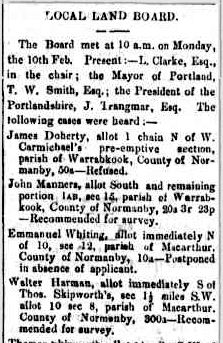
In 1872, aged 27, Walter married Lydia Poynton, daughter of John Poynton and Lydia Walton. Immigrants from Lincolnshire, England, the Poyntons lived in the Macarthur area. The following year Walter applied to the Lands Board for a license on 300 acres near Macarthur.

LOCAL LAND BOARD. (1873, February 24). Portland Guardian and Normanby General Advertiser (Vic. : 1842 - 1876), p. 5 Edition: EVENINGS. Retrieved February 20, 2012, from http://nla.gov.au/nla.news-article65429471

In 1879, he applied for the land next door to the earlier allotment, a further 44 acres.

LOCAL LAND BOARD. (1879, June 7). Portland Guardian (Vic. : 1876 – 1953), p. 2 Edition: MORNINGS.. Retrieved February 20, 2012, from http://nla.gov.au/nla.news-article63398356

Walter and Lydia started their family without haste, with Eunice Walton Harman born the year after their marriage.  Another nine children followed over the next 15 years.

Eunice Walton:  Birth:  1873 at Byaduk; Marriage: 1893 to  Benjamin Miller Lucas;  Death: 1954 at Heathcote Junction, Victoria.

Susannah Nash:  Birth:  1875 at Byaduk; Marriage:  1898 to William Condon;  Death:  1957 at Bairnsdale, Victoria.

Nathan:  Birth: 1878 at  Byaduk; Death:  1892 at Omeo.

Henry: Birth:  1880 at  Byaduk; Marriage:  1922 to  Eva Gertrude Jamison; Death: 1954 at  Bairnsdale, Victoria.

Louisa Mulberry:  Birth:  1881 at Byaduk; Marriage: 1900 to John Phiddian; Death: 1946 at Kyneton, Victoria.

Julia Georgina:  Birth:  1882 at Byaduk;  Marriage:  1915  to  Arthur Frances Lousada;  Death:  1929 at  Malvern, Victoria.

Selina Victoria:   Birth: 1884 at  Byaduk;  Death:  1977 at  Kew, Victoria.

Seth Livingstone:  Birth:  1884 at  Byaduk;  Death: 1892 at Omeo.

Golder Alberta Arlettie:  Birth:  1886 at Byaduk;  Marriage:  1923 to Solomon Kerrison; Death:  1963 at Melbourne.

John Joseph Stanley:  Birth: 1888 at Omeo;  Marriage:  1916 to Daisy Edith Masters;  Death: 1959 at Bairnsdale, Victoria.

This brings us to the wonderful names of the children of Walter and Lydia.  Eunice Walton takes her second name from her maternal grandmother, Lydia Walton.  Susannah Nash was named after her maternal aunt Susannah Poynton.  Susannah married John Nash in 1869 but she died in 1875, aged just 34.  That was the same year Susannah Nash Harman was born. Lydia’s other sister, Mary, also named her daughter Susannah Adeline Skipworth in the same year as her sister’s death.

My favourite name is Julia Georgina.  Julia is such a beautiful name and it may have come from her older cousin Julia Harman, daughter of James.  Selina Victoria is another of my favourite names.  Louisa Mulberry takes her second name from her paternal grandmother, Sarah Mulberry and John Joseph Stanley was named after his grandfathers, Joseph Harman and John Poynton.  I have absolutely no idea where the name Golder Alberta Arlettie may have come from!

The art of child naming carried on to the next generation, with grandchildren of Walter and Lydia having given names such as Stella Camilla Ina May, Edison Winslow, Harold Ornamen Tennyson, Cyril Montrose, Aldith Lorraine, Alban Harcourt, Beryl Maitland, Rodney Raeburn, Wilbur Henry, Athol Elwyn, Winton Harman, Jewel Victoria, Molly Lousada and Gloria Felicity Cambridge.

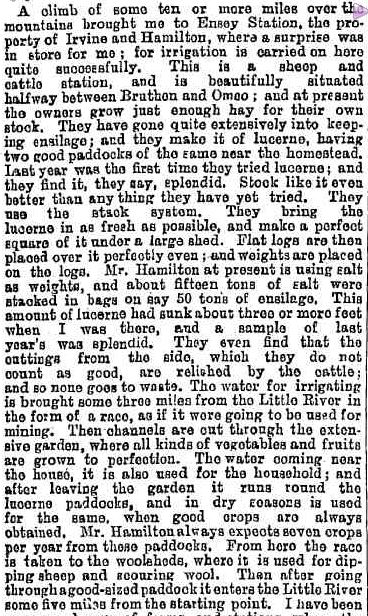
Just when it seemed Walter was settling into a life in the Western District, around 1888,  Walter Harman packed up the family and made the long trip to Ensay in East Gippsland, Victoria’s High Country.  It is the move which interests me, both the reason for travelling to the other side of the state and how they made the trip of over 600 kilometres, including the route they travelled.  The Ensay district did sound enticing, as this article from 1888 suggests:

In Gippsland. (1888, April 7). Australian Town and Country Journal (NSW : 1870 – 1907), p. 44. Retrieved February 20, 2012, from http://nla.gov.au/nla.news-article71096208

In 1843, Ensay Station comprised 38,400 acres.  An article from the Bairnsdale Advertiser and Tambo and Omeo Chronicle in 1917 cites the total acreage at Ensay Station at that time as 11,000 acres.  Over time, land was sold off to the likes of Walter Harman.

When I started researching the Harmans and I found the first references to Omeo, about 40kms north-west of Ensay, I imagined that Walt and his family went alone.  As my research continued I discovered the Condon family from the marriage record of Susannah Nash Harman and William Condon in 1898.  William was born in Portland in 1870, the son of William Charles Condon and Susan Baker.

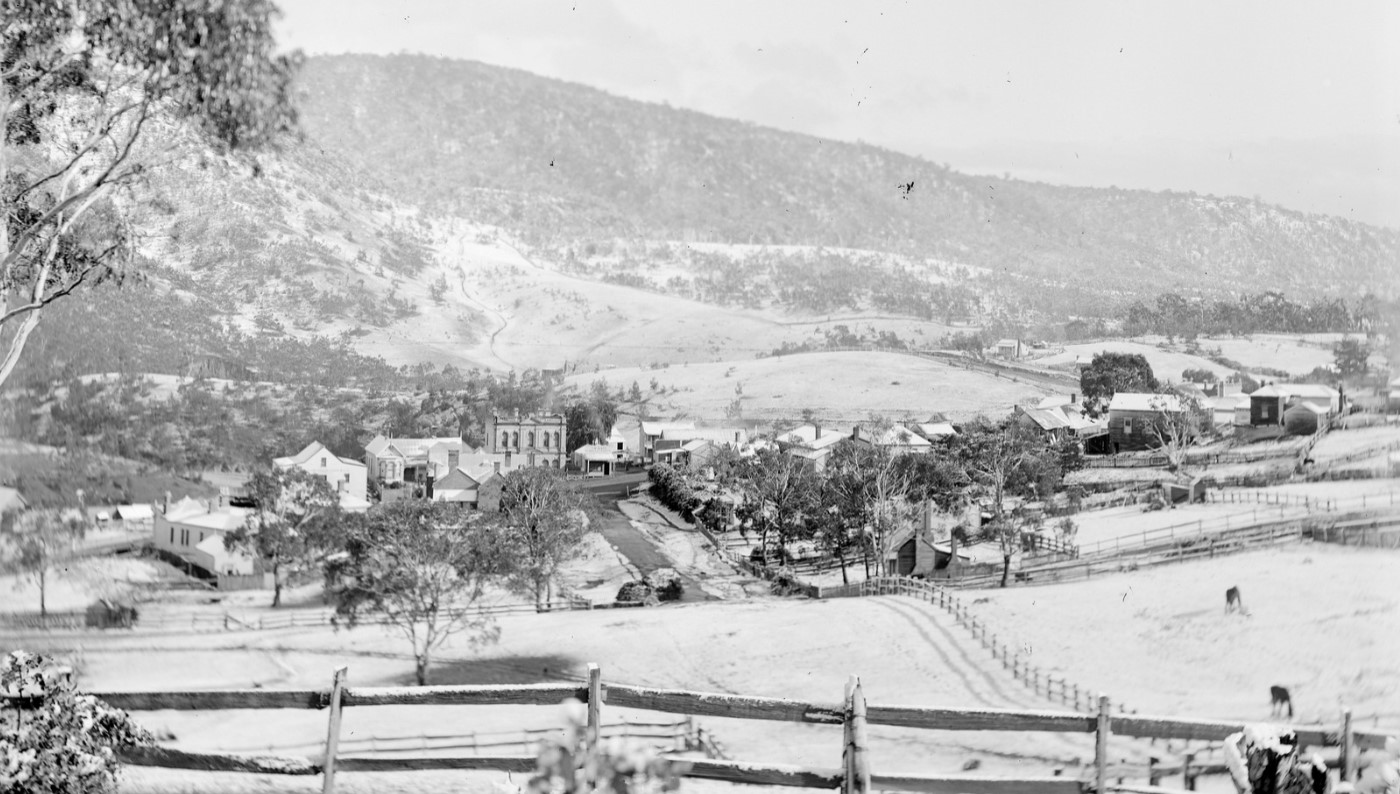
SNOW AT OMEO, c1880-1900. Image courtesy of the State Library of Victoria http://handle.slv.vic.gov.au/10381/22037

Later, thanks to newspaper reports of  Henry HARMAN’s court appearances in the trial of Ronald Griggs, I found John Henry CONDON, father of Lottie Condon.  While John was born in Omeo, he was the cousin of William Condon, Susannah Harman’s husband.  Not only that,  John Condon’s wife, Frances Ethel HUGGINS was born at Mount Eccles, near Macarthur in the Western District.  Frances’ mother was a SKIPWORTH, from Macarthur and her grandmother was a POYNTON, sister of Lydia Poynton, Walter Harman’s wife.  That sister, Mary, was also in the area with her husband, Thomas Skipworth. Phew!

Confusing maybe, but it shows five families living in the Omeo/Ensay area all with links to Byaduk/Macarthur and all connected through marriages over three generations.  Oh yes, Mary Poynton’s daughter Lydia Skipworth took along her new husband Andrew BAULCH from Tower Hill, near Warrnambool.  By 1890, his parent James Baulch and Ann Hulm were living at Bairnsdale.

So, the next question was, who was the trailblazer that made the first big move to the High Country, or was there a convoy of families making the move at the same time?

Using the years the children were born as a guide, the first family to make the move appears to be Henry Condon, older brother of William Condon with his wife Agnes Huggins, aunt of Frances Ethel Huggins.  Married in 1885, their first child was born at Omeo in 1886.  Agnes’ brother James Huggins and wife Elizabeth Skipworth had a child in Macarthur in 1886 with the next child, Thomas Leslie born in 1888 at Omeo.  This is also the same year John Joseph Stanley Harman was born at Omeo.

The obituary of John Tomlin Poynton, nephew of Lydia, talks of his move to the High Country in 1888 with his brother Edward with yet another family tie in, this time to the Skipworths.

PASSED AWAY. (1943, July 19). Gippsland Times (Vic. : 1861 – 1954), p. 1. Retrieved February 14, 2012, from http://nla.gov.au/nla.news-article63255330

The Hamilton Spectator of 8 March 1888, included the following from the Byaduk correspondent, “Several farmers in the neighborhood who have had the good fortune to secure what are said to be superb selections in Gippsland, intend leaving here for that part of the country shortly. “

Walter, with help from Lydia, worked quickly to establish a Sunday school at Ensay and they were a major force behind a State school being opened in the town. 

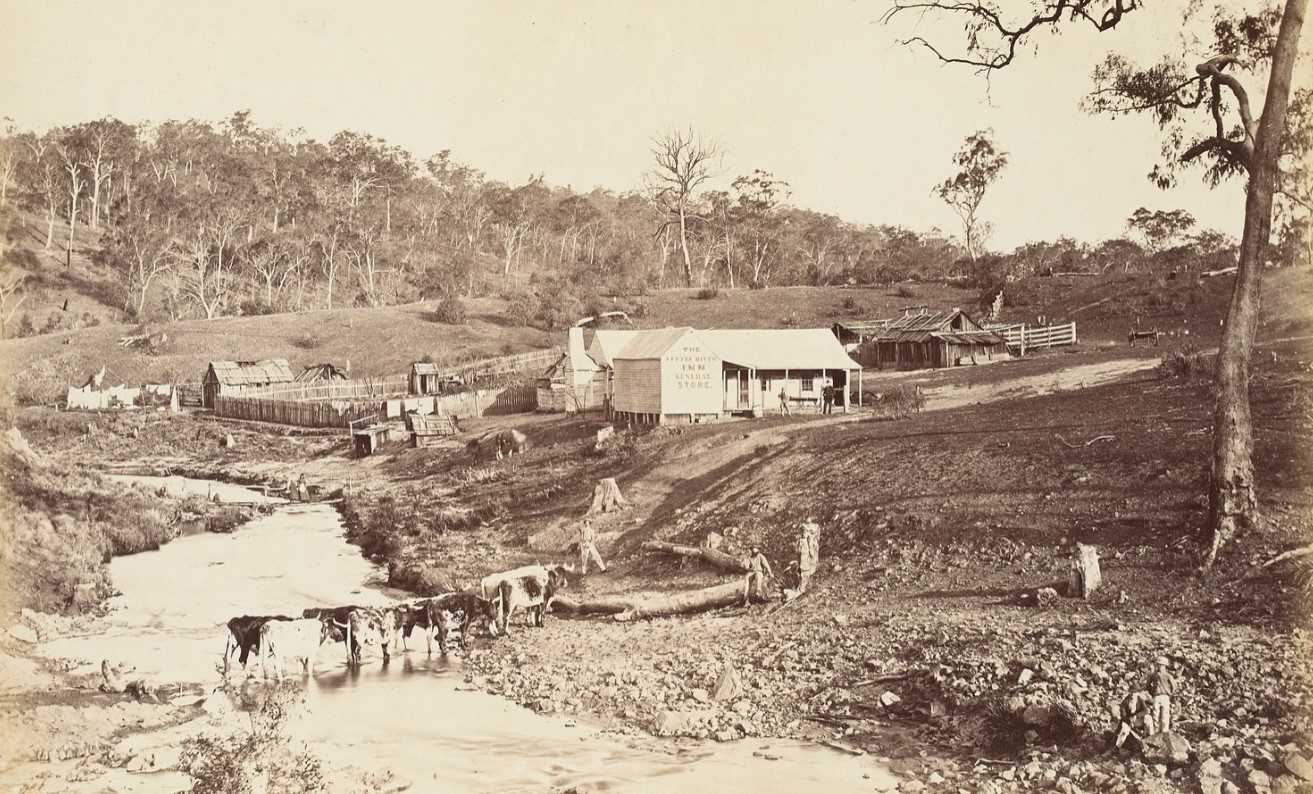
THE OMEO ROAD, ENSAY c1866-1890. Image courtesy of the State Library of Victoria http://handle.slv.vic.gov.au/10381/366573

In 1890, Walter was one of the first trustees of the Ensay Public Cemetery.  The name of the Harman property at Ensay was Systonholme.  This name paid tribute to Lydia’s birthplace, Syston, Lincolnshire, England.

Like his brother James, Walter was a lay preacher for the Methodist Church and would travel by horseback spreading the word of John Wesley.

In 1892, tragedy struck the Harmans in quick succession.  Seth died in July, aged 7 and Nathan passed away in August, aged 13.  The boys were buried at the Omeo cemetery.  Their death certificates are just another two on my long list of “must get” certificates, to see how the boys died so close together, although one would assume it was illness.

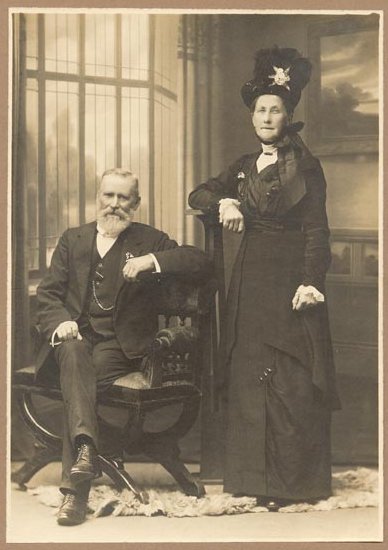
I love this photo of Walt and Lydia.  Despite the stiffness and lack of emotion of early photographs, there is a warmth here and the two seem very comfortable in each other’s company.  They were a team, and this is clear from the photo.  I would like to thank Linda Thatcher for allowing me to use this wonderful photograph.

Walt and Lydia Harman (photo courtesy of Linda Thatcher)

In Walter and Lydia’s later years, they moved into “town”, taking up residence in the Melbourne suburb of Malvern.  In 1923, they were living at 11 Jordan Street with their house named Systonholme, a reminder of Ensay. Daughter Selina was living with them and Julia and her husband Arthur Lousada moved from their home in Toorak to 113 Tooronga Road Malvern, only two streets from her parents.

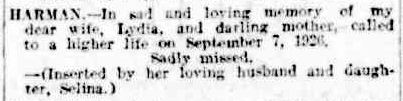
In 1926, Lydia passed away aged 79.  Walter had lost his beloved wife, the woman with whom he had pioneered and raised 10 children.  A  family notice was placed in The Argus at the time of her death:

Family Notices. (1926, September 11). The Argus (Melbourne, Vic. : 1848 – 1956), p. 17. Retrieved February 20, 2012, from http://nla.gov.au/nla.news-article3808510

In 1928, two years after Lydia’s death, Walter and daughter Selina placed an “In Memoriam” notice in The Argus and the pain was still clear.

Family Notices. (1928, September 15). The Argus (Melbourne, Vic. : 1848 – 1956), p. 13. Retrieved February 20, 2012, from http://nla.gov.au/nla.news-article3957034

Faced with life without Lydia, Walter returned to live at Ensay, his other great love.  On 22 October 1936, Walter passed away at  Systonholme, Ensay.

Family Notices. (1936, October 23). The Argus (Melbourne, Vic. : 1848 – 1956), p. 1. Retrieved February 20, 2012, from http://nla.gov.au/nla.news-article11928521

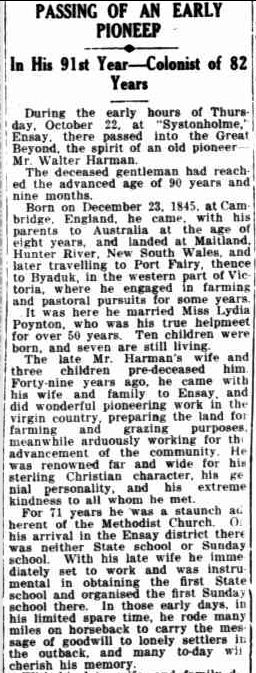
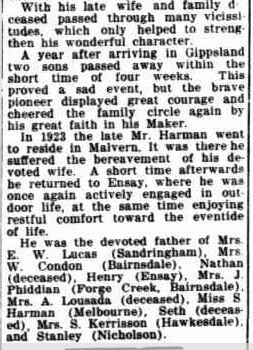
His obituary from the Gippsland Times is a fitting tribute to such a wonderful pioneer who gave so much to his local community while ensuring a comfortable life for his family.
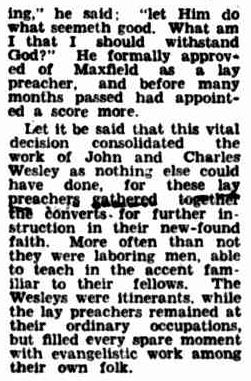
PASSING OF AN EARLY PIONEER. (1936, November 5). Gippsland Times (Vic. : 1861 – 1954), p. 3. Retrieved February 14, 2012, from http://nla.gov.au/nla.news-article62986267

As yet, I have not found an obituary for James Harman but the words written of Walter may give a clue to James himself…”his sterling Christian character, his genial personality, and his extreme kindness to all whom he met”.  There are many similarities between James and Walter, despite their age difference and the fact they lived on opposite sides of Victoria, including their devotion to the Methodist Church and their community involvement.  Both brothers played a role in establishing schools in their respective towns.  The obituary also reconfirmed the Harman’s journey from N.S.W. on arrival in Australia to Port Fairy and then Byaduk.

While Walter Harman is remembered as an Ensay pioneer, he also lived in Byaduk and district for 25 years from the age of 18 to 43, which one could describe as his “formative years”. There was plenty of time for the characteristics, passions and wisdom of his brothers to rub off.

In The News – 8 February – 13 February 1901

I have an interest in the weather, not just for today or the coming weekend but also historically.  Participating in Melbourne University’s Climate History newspaper tagging project involving tagging Trove newspaper articles about weather events, it became evident the weather behaves in a cyclical nature.  If it has happened before it will happen again, droughts, floods, and storms.

Taking my interests a step further,  investigating how weather events affected my ancestors can add greatly to their story. That is why the Victorian bushfires of 1901 are of interest as the Byaduk district, where many of my ancestors lived, was heavily affected.  The weather was similar to two days in my lifetime,  Ash Wednesday on 16 February 1983 and  Black Saturday on 7 February 2009. On each day, fires blazed across Victoria.  

The first reports of fire came through on 8 February 1901.  The following article from The Argus describes the weather of 7 February 1901.  The descriptive language takes the reader to that day.  The heat was oppressive, the wind was strong and dust storms crossed the state, causing unnatural darkness.

HEAT AND GALES. (1901, February 8). The Argus (Melbourne, Vic. : 1848 – 1956), p. 5. Retrieved January 29, 2012, from http://nla.gov.au/nla.news-article10533956

Fires had sprung up throughout the Western District.  Early reports from Branxholme were tragic with one death, stock killed and houses lost.  I have family links to three families who lost their homes, the Millers, Storers and Addinsalls.  George Miller, a racehorse trainer, lost his house and stables and no doubt his horses.

HEAT AND GALES. (1901, February 8). The Argus (Melbourne, Vic. : 1848 – 1956), p. 5. Retrieved January 29, 2012, from http://nla.gov.au/nla.news-article10533956

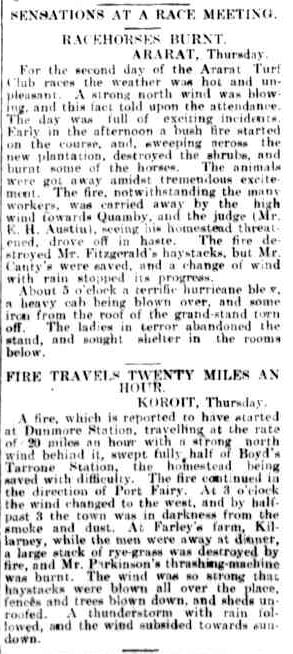
The two-day race meeting at Ararat was held in stifling conditions. A fire started at the course on the second day, with horses receiving burns.  Later the wind picked up and ripped iron off the grandstand roof, sending the ladies within running for shelter.

HEAT AND GALES. (1901, February 8). The Argus (Melbourne, Vic. : 1848 – 1956), p. 5. Retrieved January 29, 2012, from http://nla.gov.au/nla.news-article10533956

Fires started across Victoria including Warrnambool, Alexandra, Wangaratta, Buninyong, Yea, and Castlemaine.

DESTRUCTIVE BUSH FIRES IN VICTORIA. (1901, February 8). The Sydney Morning Herald (NSW : 1842 – 1954), p. 6. Retrieved January 30, 2012, from http://nla.gov.au/nla.news-article14337694

The articles below report on homes lost in the Byaduk district with Byaduk North worst hit.  My relatives were closer to Byaduk township further south and while they were lucky not to lose their homes it must have been terrifying all the same.  

The fire travelled at a great pace, coming within a mile of my ggg grandfather James Harman’s property Mount Pleasant, on the Hamilton-Port Fairy Road, reaching the properties of the Christie brothers just to the north. As well as James and his wife Susan Reed, my great-grandmother Sarah Elizabeth Harman, and her father Reuben James Harman were living at Byaduk but lived further south again in the Byaduk township.  Numerous other family members lived in the area from the Byaduk Caves through to the Byaduk township.  

TERRIBLE BUSH FIRES. (1901, February 9). The Advertiser (Adelaide, SA : 1889 – 1931), p. 7. Retrieved February 7, 2012, from http://nla.gov.au/nla.news-article4818069

DESTRUCTIVE BUSH FIRES. (1901, February 9). Bathurst Free Press and Mining Journal (NSW : 1851 – 1904), p. 2. Retrieved February 7, 2012, from http://nla.gov.au/nla.news-article64452557

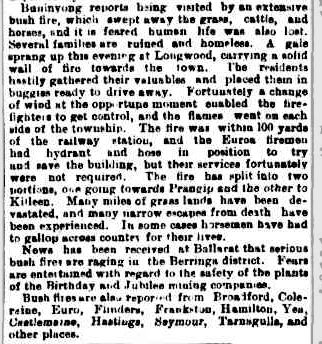
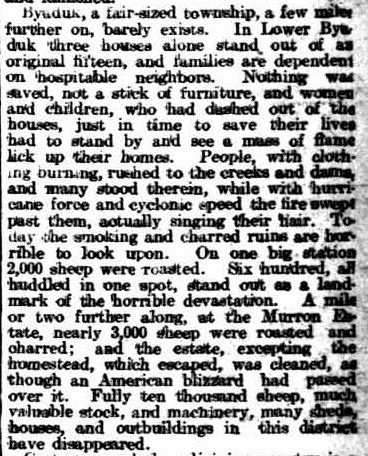
The Hamilton Spectator reported twelve homes destroyed leaving just three standing in Byaduk North.  Most were close to the course of the Lyne Creek running to the west of the township. The Free Presbyterian Church was lost and the Byaduk North Hotel was under threat.  In the days after the fire, the hotel served as a refuge for the homeless.

BYADUK NORTH HOTEL c1906. Image courtesy of the Museums Victoria Collections http://collections.museumvictoria.com.au/items/766487

BYADUK NORTH HOTEL c1906. Image courtesy of the Museums Victoria Collections http://collections.museumvictoria.com.au/items/766487

The homestead of Richard Thomas Carty at Brisbane Hill, a large property to the north of Byaduk North, was destroyed.  While running for the creek, after escaping the homestead, Mrs Carty’s dress caught fire but it was fortunately quelled.  The Cartys rebuilt and the replacement homestead Dunroe still stands today.

"ALONG MACARTHUR ROAD." Hamilton Spectator (Vic. : 1870 - 1918) 9 February 1901 .

“ALONG MACARTHUR ROAD.” Hamilton Spectator (Vic. : 1870 – 1918) 9 February 1901 <http://nla.gov.au/nla.news-article226087594&gt;.

"THE VICTORIAN BUSH FIRES." Australian Town and Country Journal (Sydney, NSW : 1870 - 1907) 23 February 1901: .

“THE VICTORIAN BUSH FIRES.” Australian Town and Country Journal (Sydney, NSW : 1870 – 1907) 23 February 1901: <http://nla.gov.au/nla.news-article71463761&gt;.

The fire burnt through the Monivae Estate with a large loss to fences and livestock and burnt within a mile of Hamilton.  On the other side of town, closer to the Coleraine railway line, the Hamilton Racecourse fell just short of the fire’s path.

"MANY FAMILIES HOMELESS." Leader (Melbourne, Vic. : 1862 - 1918) 9 Feb 1901: 18. .

“MANY FAMILIES HOMELESS.” Leader (Melbourne, Vic. : 1862 – 1918) 9 Feb 1901: 18. <http://nla.gov.au/nla.news-article198084151&gt;.

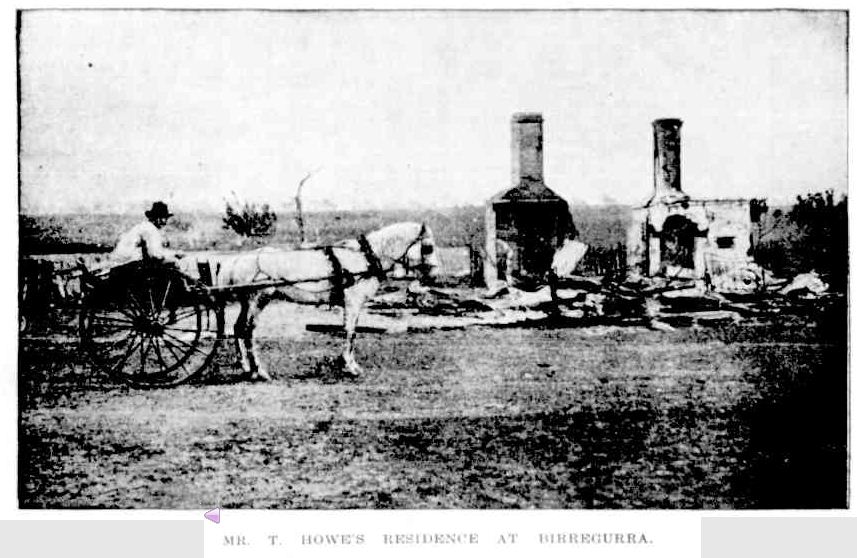
Other areas throughout the Western District felt the brunt of fire on 7 February 1901.  This photograph from Birregurra shows the devastation in that town.

THE VICTORIAN BUSH FIRES. (1901, February 23). Australian Town and Country Journal (NSW : 1870 – 1907), p. 38. Retrieved February 7, 2012, from http://nla.gov.au/nla.news-article71463761

Portland was also under threat with fire circling the town.  The fire did not stop until it met the sea.

VICTORIAN BUSH FIRES. (1901, February 11). The Advertiser (Adelaide, SA : 1889 – 1931), p. 5. Retrieved February 7, 2012, from http://nla.gov.au/nla.news-article4818536

Buninyong near Ballarat was one of the worst areas hit.

BUSH FIRES IN VICTORIA. (1901, February 9). The West Australian (Perth, WA : 1879 – 1954), p. 3. Retrieved February 7, 2012, from http://nla.gov.au/nla.news-article23853766

THE VICTORIAN BUSH FIRES. (1901, February 23). Australian Town and Country Journal (NSW : 1870 – 1907), p. 38. Retrieved February 7, 2012, from http://nla.gov.au/nla.news-article71463761

Macarthur had losses as did Princetown on the south coast.  At Timboon, bullock teams from the local sawmill were lost.

FIRES IN VICTORIA. (1901, February 12). South Australian Register (Adelaide, SA : 1839 - 1900), p. 6. Retrieved February 7, 2012, from http://nla.gov.au/nla.news-article54558042

FIRES IN VICTORIA. (1901, February 12). South Australian Register (Adelaide, SA : 1839 – 1900), p. 6. Retrieved February 7, 2012, from http://nla.gov.au/nla.news-article54558042

By 11 January, aid for the homeless was on the agenda and at Branxholme a public meeting was held to discuss such matters.  Authorities discovered the fire near Branxholme, which was probably the same fire to hit Byaduk, was accidentally started by a travelling tinsmith fixing a trough at Ardachy Estate.

THE BUSH FIRES. (1901, February 11). The Argus (Melbourne, Vic. : 1848 – 1956), p. 5. Retrieved February 7, 2012, from http://nla.gov.au/nla.news-article10534297

A meeting was called at Byaduk for 18 February 1901, and James Harman donated £2 2/ to the fund for the homeless.

"BUSH FIRE BELIEF FUNDS." Hamilton Spectator (Vic. : 1870 - 1918) 21 February 1901: .

“BUSH FIRE BELIEF FUNDS.” Hamilton Spectator (Vic. : 1870 – 1918) 21 February 1901: <http://nla.gov.au/nla.news-article226090204&gt;.

The fire was so strong and relentless, old residents were drawing comparisons to Black Thursday almost fifty years earlier to the day on 6 February 1851.

TELEGRAPHIC. (1901, February 12). Kalgoorlie Western Argus (WA : 1896 – 1916), p. 32. Retrieved February 7, 2012, from http://nla.gov.au/nla.news-article32205605


Sarah Harman – From Country to City

I knew all about the brothers of Sarah Harman before I knew anything of her other than she travelled to Sydney with her parents Joseph and Sarah Harman aboard the “Queen of England” in 1855.  Finally, I decided the time had come to find out more about Sarah.

I quickly discovered she had married George Adams in 1885 and they had one daughter in 1886.  For some time I thought that was Sarah’s story.  It was while searching the Victorian Pioneer Index 1836-1888 using only “Harman” in the “Mother’s name” field, I realised there was more to Sarah than I first thought. I have found this method of searching to be very successful over the years and has unearthed many unknown children and marriages of the females on my tree.

In the index, I found children born at Byaduk to Sarah Harman and a Walter Oakley.  I then found the marriage of Sarah to Walter Oakley in 1864.  Suddenly, Sarah had five children and not one and another spouse.  Sarah’s story had become very different.

Sarah Harman was the only daughter of Joseph and Sarah Harman to come to Australia and she was the eldest of the children to travel with them.  Sarah was born in Melbourn, Cambridgeshire in 1843 and was 12 when she immigrated on the Queen of England.

The Harman family arrived in Byaduk around 1863 and by then Sarah would have been 20.  The following year she married Walter Oakley, son of  Henry Oakley and Susan Bullock.  Walter had family links to Port Fairy and Sarah may well have met him during the time the Harmans spent in the town.

The children of Sarah and Walter were:

SUSAN – Born 1865, Byaduk; Marriage Robert Warwick Cruikshank, Birchip 1892; Death 1949, Wangaratta, Victoria

JOSEPH HARMAN – Born 1867, Byaduk;  Marriage Annie Margaret Simpson, 1891; Death 1957,  Blackburn.

HENRY – Born  1868, Yambuk

ALFRED JAMES – Born 1870; Marriage Kathleen Maud Hodgson, 1910; Death 1951,  Stawell.

To this point it would seem that Sarah was going to live a life similar to her older brothers, living in Byaduk and raising a family.  However, for Sarah, there was a turning point.  Sometime between the birth of Alfred in 1870 and 1884, something happened to Walter Oakley.  What, I am not sure.  I have never found a death record.  He just seemed to disappear.

One of the great things about writing a blog, is you get to meet people with similar research interests.  After my post A Small find at the Vic Expo, I heard from Brad who is an Oakley descendant.  He told me of the family story that Walter had disappeared while on a trip delivering live horses to India.  While this a family story, it is not outside the realm of possibility.

Thousands of horses left Australian shores for India during the mid half of the 19th century and naturally, there were perils.  This is an incredibly interesting part of our history which led to Australia’s own breed of horse, the Waler.  The story of live horse export in Victoria is worthy of its own post at another time.  I like the idea that this is how Walter met is demise, a tragic but romantic end.  Whatever happened, he was gone and Sarah was alone.

Have you found the marriage record of a family member and wondered how on earth did he/she meet that girl/guy?  Sarah’s marriage to George Adams is one such occasion.  How did Sarah from Byaduk, meet George from Melbourne, 12 years her senior, in the 1880s.  Certainly not online dating!

In the last day or so since I started writing this post, I have added Kerryn Taylor to my circles at Google+.  She is a descendant of  George Adams and Catherine Barry and told me George’s father Edward was living in Cambridgeshire when the Harmans were still in Melbourn.  The 1851 England Census lists him living at Bassingbourn, just down the road.  Maybe this link to the old country is the reason why George was in Byaduk and in the life of Sarah Harman.

Who was George Adams?  He was born in Essex, England in 1831 and immigrated to Western Australia around 1852.  He married an Irish girl, Catherine Barry in 1853 in Western Australia.  After the birth of one child, they headed east for Melbourne, where a further six children were born.  Two more children were born in Western Australia in 1868 and 1870.

I pick them up next in 1884.  Catherine passed away in Parkville on May 4.  George is listed as a builder and contractor.

Family Notices. (1884, May 14). Illustrated Australian News (Melbourne, Vic. : 1876 – 1889), p. 78. Retrieved January 19, 2012, from http://nla.gov.au/nla.news-article63184969

The next record of George is the following year, 1885, with his marriage to Sarah Harman.   Not a lot of time elapsed between the death of Catherine and his remarriage, but that was not that unusual.

One child was born from the marriage of George and Sarah.  Sarah was around 42 at the time of the birth.

SARAH SELINA (“Sadie”) – Born 1886 at Kensington;  Marriage Harold Charles STONE, 1915; Death 1977 at Kew.

While it seems that George and Sarah returned to the city, in 1888, George had a listing at Byaduk in that year’s Victorian Post Office Directory, his occupation listed as builder.   He may have kept his work options open. It may also be why George was in the Byaduk area to start with, to build something.

In 1921, George passed away.  He was  91.  The first family notice to appear was from Sarah and “Sadie”.

Family Notices. (1921, January 18). The Argus (Melbourne, Vic. : 1848 – 1956), p. 1. Retrieved January 31, 2012, from http://nla.gov.au/nla.news-article1733023

The following day a notice appeared from the children of George’s first marriage to Catherine Barry.

Family Notices. (1921, January 19). The Argus (Melbourne, Vic. : 1848 – 1956), p. 1. Retrieved January 31, 2012, from http://nla.gov.au/nla.news-article1733152

Then three days later another, more detailed family notice  presumably again from George and Catherine’s children, but unlike the first, it gives the instructions to copy to the Hamilton papers as in the first notice from Sarah and “Sadie”

Family Notices. (1921, January 22). The Argus (Melbourne, Vic. : 1848 – 1956), p. 11. Retrieved January 31, 2012, from http://nla.gov.au/nla.news-article1733627

Are we beginning to see some tension between Sarah and her stepchildren?

George’s Will gives some sign that his children from his first marriage may not have played a big part in his life during his second marriage.  Firstly, Sarah’s son Joseph Harman Oakley and son-in-law, Harold Stone, husband of “Sadie” were executors of the Will.  Sarah was to receive all the household furniture, ornaments and the like as well as all George’s property in his estate.  Upon Sarah’s death, everything was to be sold and distributed as George had nominated.  Aside from his oldest son Edward who was to receive £75, all of his living children from his first marriage were to receive only £20 each.   On the other hand, “Sadie” was to receive the balance of the estate, which sounded as though it would be quiet a considerable sum.

Sarah passed away 10 years later in 1931.  She was 87.  Or was she?  According to her death notice she was in her 90th year.  Her cemetery record lists her as 89.  Her birth record on the England and Wales, Free BMD Birth Index lists her birth in 1843.  The 1851 census has her at seven and as her birth was registered in the last quarter of 1843, this would mean she was turning eight in the year of her census.  The Assisted Immigrants Index lists her age as 12 in 1855, which again fits.  In A Life Cut Short, I posted an article from September 1929 which has Sarah’s age at 85.  Again, if Sarah’s birthday was in the last quarter, this also fits.  I would assume the information for the article came from her brothers.  With 1843 looking like the correct birth year, Sarah should have been 87 at the time of her death, her 88th year, almost 89th but certainly not 90th.  Poor Sarah, what woman would want two years added to her age!

Family Notices. (1931, July 4). The Argus (Melbourne, Vic. : 1848 – 1956), p. 15. Retrieved January 31, 2012, from http://nla.gov.au/nla.news-article4406027

Both Sarah and George are buried at the Fawkner cemetery.

There is something about Sarah’s story that attracted my attention.  Her address at 5 Brixton Street, Flemington. My first thoughts of Flemington are, of course, of the famous racecourse but having driven through the area several times, it also the historic feel of the suburb that comes to mind.  Also, not far away were the Newmarket Saleyards, the City Abbatoir and the Melbourne Showgrounds.  Racing stables were in back lanes and cattle would be herded through the streets en route to the saleyards.  Sarah would only have to step out onto Brixton street for a reminder of country life, horses being led to the track, cattle mooing, drovers’ dogs barking and the smell, well it was bad.

DUST, FLIES, SMELLS, AND NOISES. (1935, August 9). The Argus (Melbourne, Vic. : 1848 – 1956), p. 3. Retrieved February 2, 2012, from http://nla.gov.au/nla.news-article11756155

The Australian Electoral Roll (1903-1980) shows George and Sarah living at 5 Brixton Street in Flemington in 1903.  George died in the house and Sarah lived there after his death.  I like that when Sadie married Harold Stone, they moved into 7 Brixton Street next door and at some stage Sarah, in her later years, moved in with “Sadie”.  In the same year as Sarah’s death, her son Joseph Oakley is listed at 5 Brixton Street in the Australian Electoral Rolls (1903-1980).

Google Street View, points to the painted terrace with the fence as 5 Brixton street.  I’m always a bit wary of where the place the marker lands. If only I could see the street numbers.  I have not been to the house myself but it is on my “to do” list.  Only a couple of months ago I was only about one kilometre away, but with a grumpy driver and child from a day out in the city, I didn’t think they would have appreciated being dragged off course to look at yet another house.  Also the grumpy driver thinks one day we will be arrested  photographing strangers’ houses.  Back to Street View, if you pan around the street, you will see what I mean about the ambiance of the suburb.

Having read George’s Will, it reveals he did own a number of properties, so he may have owned 7 Brixton street, Sadie’s house, also.  In fact he may have owned the entire terrace.  Being a builder, he may have even built the terrace.  As this extract shows, in 1885 land was being offered for sale in Brixton Street.

UNDER THE HAMMER. (1885, February 20). North Melbourne Advertiser (Vic. : 1873 – 1894), p. 3. Retrieved February 1, 2012, from http://nla.gov.au/nla.news-article66154356

The Will states that Sarah was to receive “the rents and income which may arise and be derived from my lands and tenements and from all property in my estate…”.  Also if  “she shall so desire to permit her to reside in any of my messauges or tenements”.  Electoral rolls also listed George has having lived by “Independent means”, so he must have lived off the rent of his properties.  Secretly I used to hope that it meant he was an SP bookie, living so close to the track and all!

So ends Sarah Harman’s story.  A woman who looked set for a life like that of her sister in-laws, a farming wife in a small country town, surrounded by her family including her brothers, nieces and nephews.  A twist of fate would see her live 50 years of her life in the growing city of Melbourne, away from her brothers, but I’m sure never far from their hearts and minds.

If anyone is interested in more information on George Adams, I have found a website with a very good story of him at Adams Generations.