Trove Tuesday – Ewe Turn

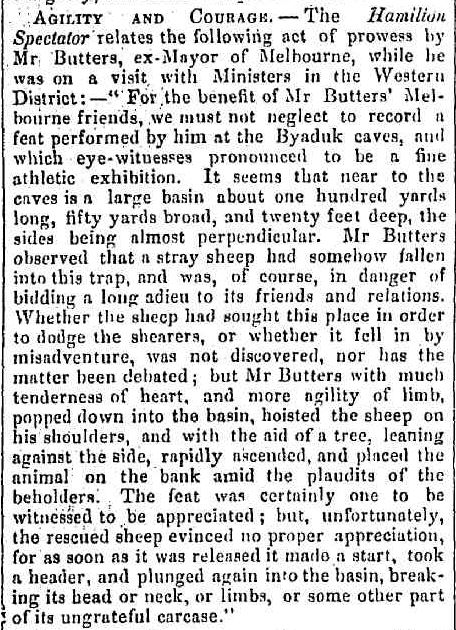
From the Bendigo Advertiser, via the Hamilton Spectator comes a story from  1868 and the Byaduk Caves.  It features an M.P., an ungrateful sheep, plenty of action and athletic prowess and a band of impressed onlookers.

SUICIDE OF MADEMOISELLE MARIE ST. DENIS. (1868, October 26). Bendigo Advertiser (Vic. : 1855 - 1918), p. 3. Retrieved July 20, 2013, from http://nla.gov.au/nla.news-article87899437

SUICIDE OF MADEMOISELLE MARIE ST. DENIS. (1868, October 26). Bendigo Advertiser (Vic. : 1855 – 1918), p. 3. Retrieved July 20, 2013, from http://nla.gov.au/nla.news-article87899437

079-2

BYADUK CAVES

James Stewart Butters became Mayor of Melbourne in 1867 at the age of thirty-five.  He held the position for a year then moved to the Legislative Assembly in the seat of Portland in 1868, the same year as his feat at the Byaduk Caves.  The following year he found himself caught up in a Parliamentary corruption case and was expelled only to return to his seat a few months later.  He spent time in Fiji and then returned to Victoria and returned to the Parliament.

The events at Byaduk Caves  support his  biography by A.C. Milner in the Australian Dictionary of Biography .  Milner writes

“…this tall, powerful Scotsman displayed immense energy and a bold sense of adventure. The strands of his character were evident in his mountain climbing in Scotland as a boy, investing in the colonies, sailing alone in a Fiji hurricane and tampering with the proper workings of parliament. But an element of recklessness is easily detected, though a hearty and genial personality saved him from much condemnation during his life”.

JAMES STEWERT BUTTERS (1867). Image courtesy of the State Library of Victoria. Image no. H5672 http://handle.slv.vic.gov.au/10381/208262

JAMES STEWART BUTTERS (1867). Image courtesy of the State Library of Victoria. Image no. H5672 http://handle.slv.vic.gov.au/10381/208262


Inside History’s Top 50 Genealogy Blogs 2013

What a thrill it was to open the current issue of Inside History Magazine and see Western District Families listed in the Top Genealogy Blogs for 2013.

AsSeenIn17 (3)

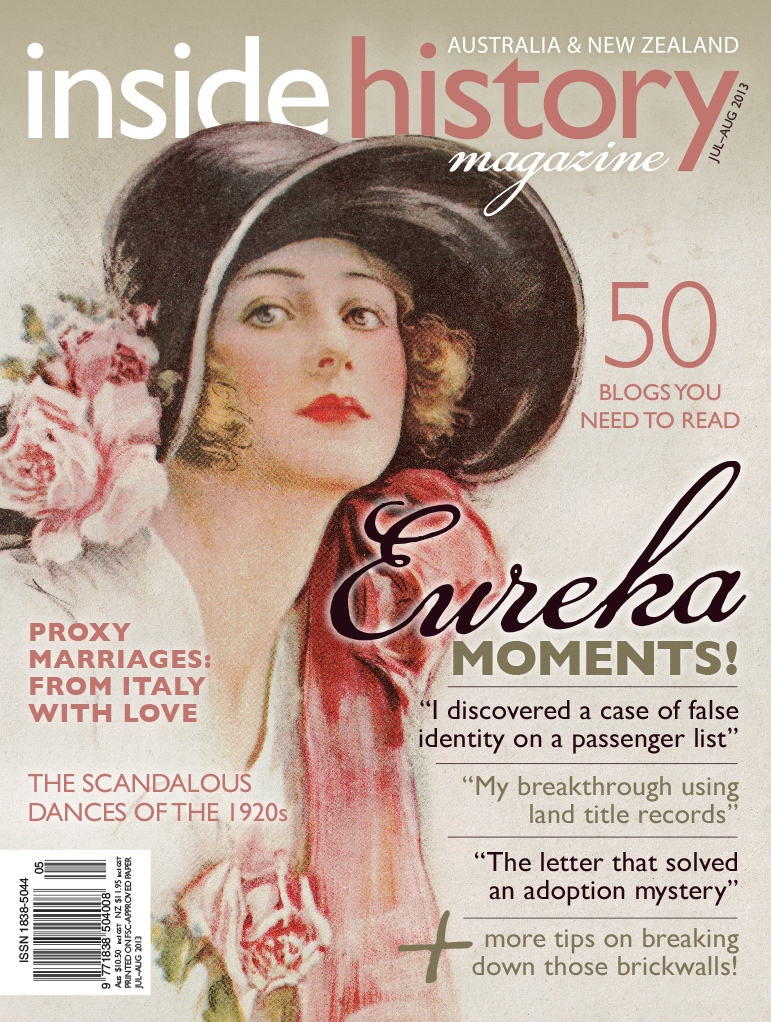
Inside History is a beautifully produced magazine blending history and genealogy in a seamless way.  The covers are always special and the July-August edition (above) is no exception and rates among one of my favourites.   So to be included in a list of blogs compiled by the Inside History team and Jill Ball, my unsuspecting blogging mentor, is an honour.  And not just any list.  The company I keep in the personal blogger category  include some of the best Australian and International genealogy blogs.  Never did I think Western District Families would be shortlisted with Dear Myrtle!  You can find all the Top 50 blogs by following this link   http://www.insidehistory.com.au/2013/07/50-genealogy-blogs-you-need-to-read/     Congratulations to all the bloggers in the Top 50.

Thank you to Jill and Inside History for including Western District Families.  After a difficult year it has been a lovely surprise as  I doubted I could repeat last year’s efforts of  being included in the 2012  Top 50 Genealogy Blogs .  Escapism from daily life by way of travelling back to the time of my pioneering Western District Families has proven worthy on many levels.

Thank you also to all the followers of Western District Families for your encouragement for me to keep sharing stories from the past.

Trove Tuesday – Wallpaper

Wondering where that missing newspaper edition is that you searched desperately for at Trove?  Maybe the only remaining copy is buried in the walls of an old building.


Historical Committee. (1932, March 17). Portland Guardian (Vic. : 1876 - 1953), p. 3 Edition: EVENING. Retrieved July 13, 2013, from http://nla.gov.au/nla.news-article64297702

Historical Committee. (1932, March 17). Portland Guardian (Vic. : 1876 – 1953), p. 3 Edition: EVENING. Retrieved July 13, 2013, from http://nla.gov.au/nla.news-article64297702

Portland Botanical Gardens

The Western District has many historic botanic gardens, most established from the 1850s to the 1870s when it was the thing for a town to do, if nothing else, to keep up with the neighbouring town.  For some, it was for scientific purposes to acclimatise plants and sometimes animals, as with the Hamilton Botanic Gardens.  There is a sense of history walking through each garden, and the tall specimen trees, such as oaks, redwoods, and pines, whisper the tales of times past.

The Portland Botanical Gardens, like the rest of the town, ooze history.  Each botanic garden is unique in some way, and Portland is no different and is unlike other gardens I have visited, including  Hamilton and Geelong.

PORTLAND BOTANICAL GARDENS

PORTLAND BOTANICAL GARDENS

Land for the gardens was first marked out in 1851, but it took a few years of public meetings for the gardens to be established.  In 1853, the Honourary Secretary remarked on the “advantages of a botanical garden, and the study of botanical science”.

PORTLAND. (1853, August 5). Geelong Advertiser and Intelligencer (Vic. : 1851 - 1856), p. 1 Edition: DAILY., Supplement: SUPPLEMENT TO THE GEELONG ADVERTISER AND INTELLIGENCER. Retrieved July 7, 2013, from http://nla.gov.au/nla.news-article86412916

PORTLAND. (1853, August 5). Geelong Advertiser and Intelligencer (Vic. : 1851 – 1856), p. 1 Edition: DAILY., Supplement: SUPPLEMENT TO THE GEELONG ADVERTISER AND INTELLIGENCER. Retrieved July 7, 2013, from http://nla.gov.au/nla.news-article86412916

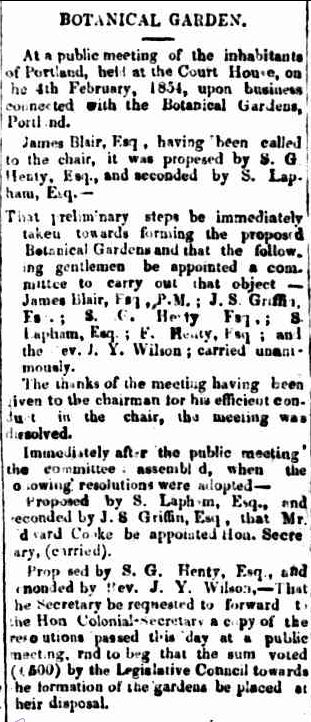
At a public meeting six months later, on February 4, 1854, chaired by James Blair, Stephen Henty proposed that a committee be formed to get the gardens up and running.

 BOTANICAL GARDEN. (1854, February 9). Portland Guardian and Normanby General Advertiser (Vic. : 1842 - 1876), p. 2 Edition: EVENING. Retrieved June 30, 2013, from http://nla.gov.au/nla.news-article71569639

BOTANICAL GARDEN. (1854, February 9). Portland Guardian and Normanby General Advertiser (Vic. : 1842 – 1876), p. 2 Edition: EVENING. Retrieved June 30, 2013, from http://nla.gov.au/nla.news-article71569639

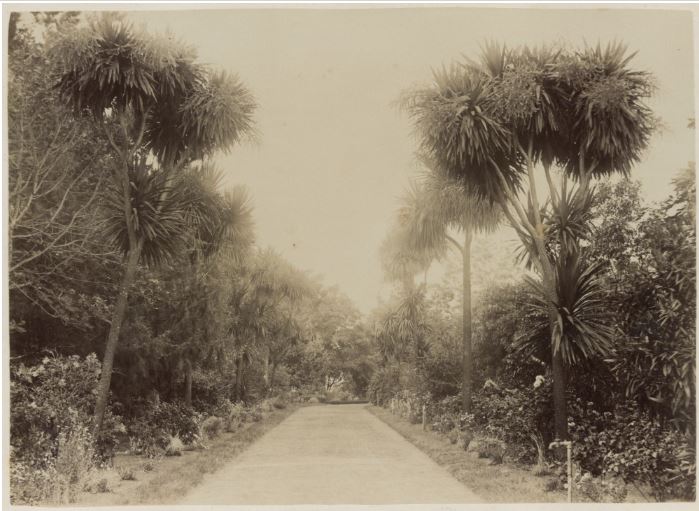
PORTLAND BOTANICAL GARDENS c1891. Image Courtesy of the State Library of Victoria. Image No. H42199/21 http://handle.slv.vic.gov.au/10381/183906

PORTLAND BOTANICAL GARDENS c1891. Image Courtesy of the State Library of Victoria. Image No. H42199/21 http://handle.slv.vic.gov.au/10381/183906

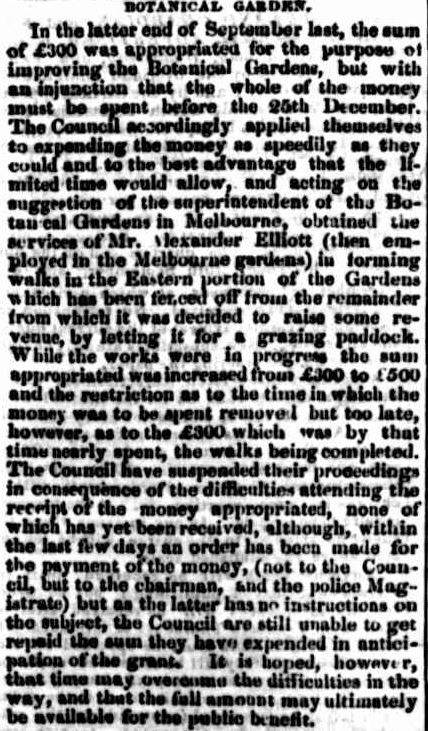
Works began in 1858, assisted by Alexander Elliot from the Royal Botanic Gardens in Melbourne, however, a lack of funds was slowing progress.

MUNICIPAL DISTRICT OF PORTLAND. (1858, March 5). Portland Guardian and Normanby General Advertiser (Vic. : 1842 - 1876), p. 3 Edition: EVENINGS.. Retrieved July 3, 2013, from http://nla.gov.au/nla.news-article64570632

MUNICIPAL DISTRICT OF PORTLAND. (1858, March 5). Portland Guardian and Normanby General Advertiser (Vic. : 1842 – 1876), p. 3 Edition: EVENINGS.. Retrieved July 3, 2013, from http://nla.gov.au/nla.news-article64570632

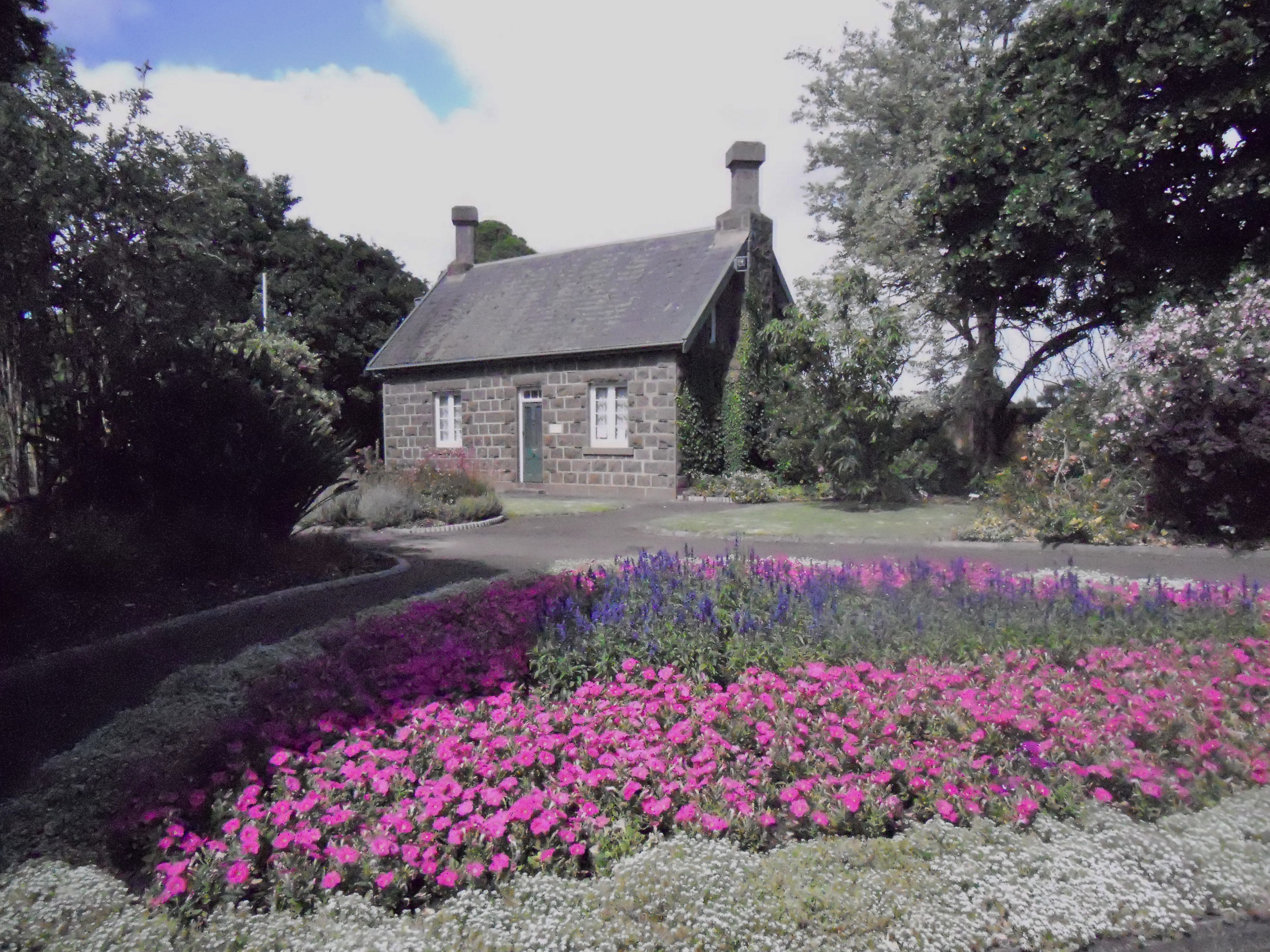
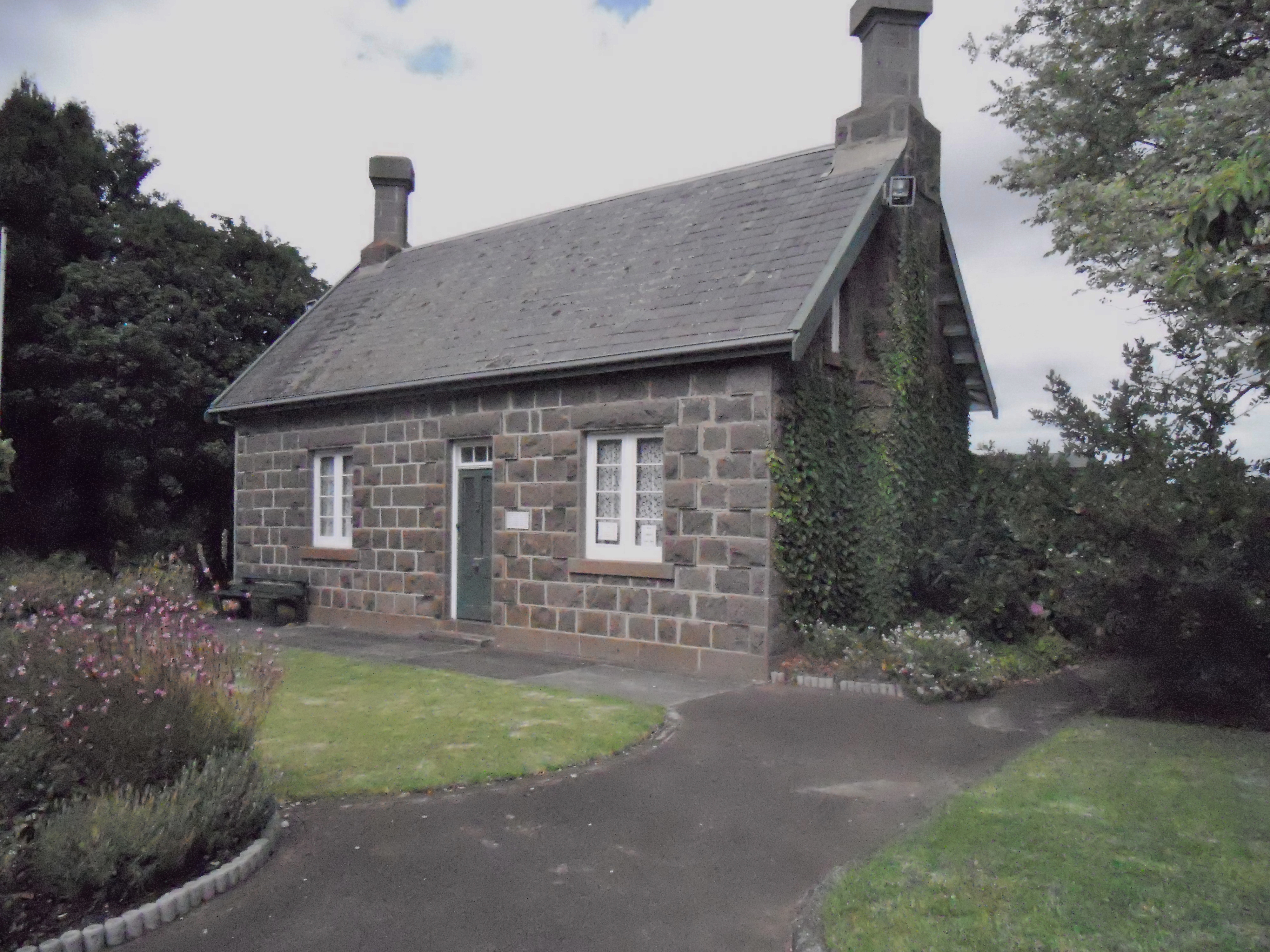
By November, however, the gardens were beginning to take shape and the curator’s cottage was under construction.
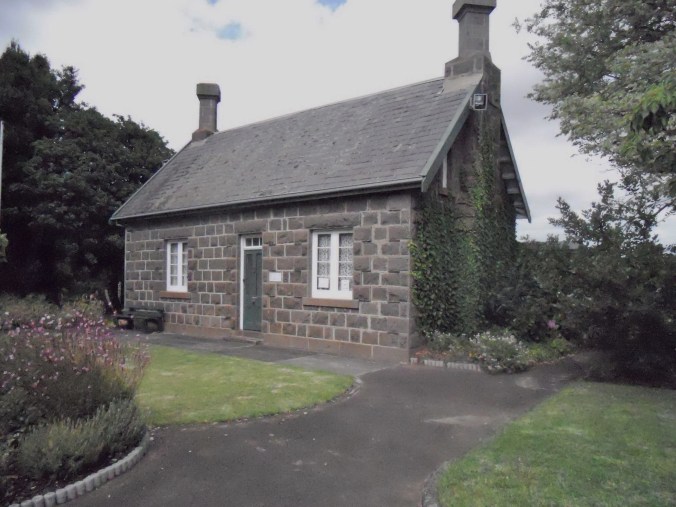
CURATOR'S COTTAGE

CURATOR’S COTTAGE

DOMESTIC INTELIGENCE. (1858, November 3). Portland Guardian and Normanby General Advertiser (Vic. : 1842 - 1876), p. 2 Edition: EVENINGS.. Retrieved July 3, 2013, from http://nla.gov.au/nla.news-article64509473

DOMESTIC INTELIGENCE. (1858, November 3). Portland Guardian and Normanby General Advertiser (Vic. : 1842 – 1876), p. 2 Edition: EVENINGS.. Retrieved July 3, 2013, from http://nla.gov.au/nla.news-article64509473

In 1859, a letter to the Portland Guardian questioned the practice of allowing horses to graze in the gardens overnight.  “Delta” wondered why the committee could keep their horses at the gardens while “the great unwashed are warned at the gate, Dogs not Admitted”

ORIGINAL CORRESPONDENCE. (1859, May 2). Portland Guardian and Normanby General Advertiser (Vic. : 1842 - 1876), p. 2 Edition: EVENINGS.. Retrieved July 4, 2013, from http://nla.gov.au/nla.news-article64510907

ORIGINAL CORRESPONDENCE. (1859, May 2). Portland Guardian and Normanby General Advertiser (Vic. : 1842 – 1876), p. 2 Edition: EVENINGS.. Retrieved July 4, 2013, from http://nla.gov.au/nla.news-article64510907

BOTANICAL GARDENS. (1859, May 2). Portland Guardian and Normanby General Advertiser (Vic. : 1842 - 1876), p. 2 Edition: EVENINGS.. Retrieved July 4, 2013, from http://nla.gov.au/nla.news-article64510906

BOTANICAL GARDENS. (1859, May 2). Portland Guardian and Normanby General Advertiser (Vic. : 1842 – 1876), p. 2 Edition: EVENINGS.. Retrieved July 4, 2013, from http://nla.gov.au/nla.news-article64510906

If you visit the Portland Botanical Gardens, look up at the tall trees and think of those who planted them, or as you walk the paths, consider the hands that carved them.  The story behind these features is my favourite story about the gardens.

Table Talk. (1863, April 23). Portland Guardian and Normanby General Advertiser (Vic. : 1842 - 1876), p. 2 Edition: EVENING. Retrieved July 7, 2013, from http://nla.gov.au/nla.news-article64628622

Table Talk. (1863, April 23). Portland Guardian and Normanby General Advertiser (Vic. : 1842 – 1876), p. 2 Edition: EVENING. Retrieved July 7, 2013, from http://nla.gov.au/nla.news-article64628622

At a meeting of the Portland Historical Committee in 1932, the secretary told the story of the Chinese prisoners and their work at the Portland Botanical Gardens.

Historical Committee. (1932, March 17). Portland Guardian (Vic. : 1876 - 1953), p. 3 Edition: EVENING. Retrieved July 7, 2013, from http://nla.gov.au/nla.news-article64297702

Historical Committee. (1932, March 17). Portland Guardian (Vic. : 1876 – 1953), p. 3 Edition: EVENING. Retrieved July 7, 2013, from http://nla.gov.au/nla.news-article64297702

On the wall of the curator’s cottage is a plaque recognising previous curators of the gardens from the kindly William Allitt in 1861 through to Colin Ellingworth, curator from 1982-1987.

373Andrew Callander was curator from 1922 to 1949.  Upon his appointment, Mr Callander set about tidying up the gardens and building a ti-tree greenhouse for seedling propagation.

 THE PORTLAND LIFEBOAT. (1926, January 7). Portland Guardian (Vic. : 1876 - 1953), p. 3 Edition: EVENING.. Retrieved July 4, 2013, from http://nla.gov.au/nla.news-article64252901

THE PORTLAND LIFEBOAT. (1926, January 7). Portland Guardian (Vic. : 1876 – 1953), p. 3 Edition: EVENING.. Retrieved July 4, 2013, from http://nla.gov.au/nla.news-article64252901

PORTLAND BOTANICAL GARDENS. Image Courtesy of the State Library of Victoria. Image no. H32492/1655 http://handle.slv.vic.gov.au/10381/64772

PORTLAND BOTANICAL GARDENS. Image Courtesy of the State Library of Victoria. Image no. H32492/1655 http://handle.slv.vic.gov.au/10381/64772

PORTLAND BOTANICAL GARDENS. Image courtesy of the State Library of Victoria http://handle.slv.vic.gov.au/10381/66929

PORTLAND BOTANICAL GARDENS. Image courtesy of the State Library of Victoria http://handle.slv.vic.gov.au/10381/66929

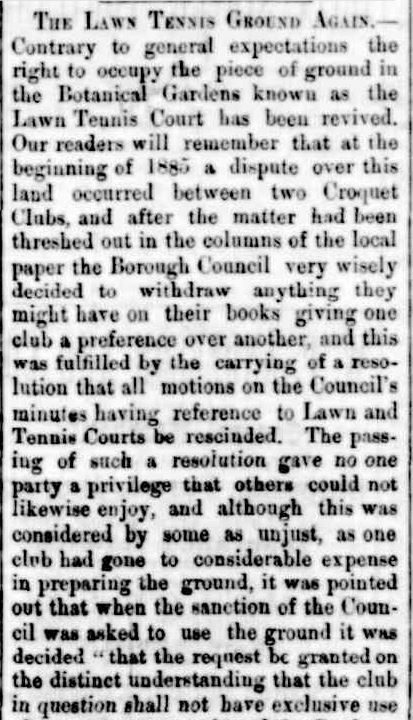
At one time, both croquet and tennis were played at the gardens, and there were often tensions between the two groups and any other group that hoped to share the space.

TABLE TALK. (1876, November 3). Portland Guardian (Vic. : 1876 - 1953), p. 2 Edition: EVENINGS.. Retrieved July 4, 2013, from http://nla.gov.au/nla.news-article63336790

TABLE TALK. (1876, November 3). Portland Guardian (Vic. : 1876 – 1953), p. 2 Edition: EVENINGS.. Retrieved July 4, 2013, from http://nla.gov.au/nla.news-article63336790

THE LAWN TENNIS GROUND AGAIN. (1887, September 2). Portland Guardian (Vic. : 1876 - 1953), p. 2 Edition: EVENING. Retrieved July 4, 2013, from http://nla.gov.au/nla.news-article65410048

THE LAWN TENNIS GROUND AGAIN. (1887, September 2). Portland Guardian (Vic. : 1876 – 1953), p. 2 Edition: EVENING. Retrieved July 4, 2013, from http://nla.gov.au/nla.news-article65410048

375

CROQUET LAWN

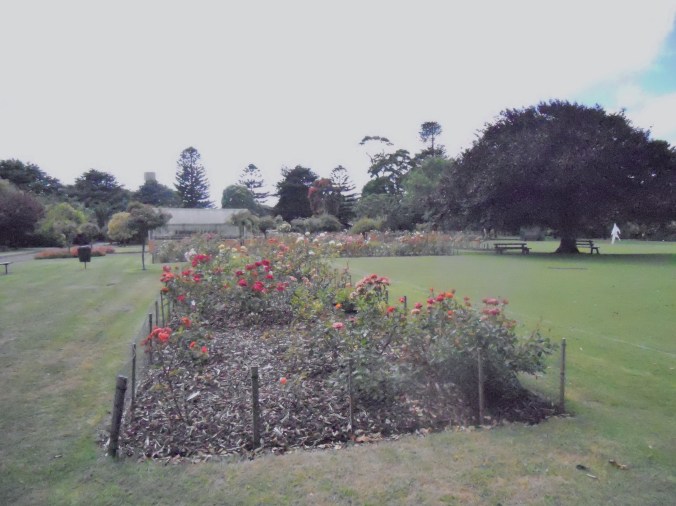
Croquet won out and is still played today.  The tennis courts were converted to rose gardens.  The rosary was first proposed in 1930, but it was 1931 before there was further action.
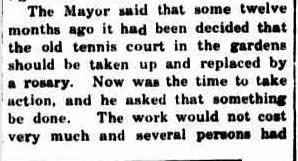
pbg10

Borough Council. (1931, April 13). Portland Guardian (Vic. : 1876 - 1953), p. 3 Edition: EVENING. Retrieved July 5, 2013, from http://nla.gov.au/nla.news-article64294863

Borough Council. (1931, April 13). Portland Guardian (Vic. : 1876 – 1953), p. 3 Edition: EVENING. Retrieved July 5, 2013, from http://nla.gov.au/nla.news-article64294863

378

376

“Wandering Willie’s Wife” visited the Portland Botanical Gardens in 1926 and felt compelled to write a letter to the editor of the Portland Guardian on the subject of a nameless lifeboat on display in the gardens.  Could it have been the lifeboat, captained by James Fawthrop, used to rescue survivors from the wreck of the  S.S. Admella?  Why wasn’t there a name plaque?

pbg8

THE PORTLAND LIFEBOAT. (1926, January 7). Portland Guardian (Vic. : 1876 – 1953), p. 3 Edition: EVENING.. Retrieved July 10, 2013, from http://nla.gov.au/nla.news-article64252901

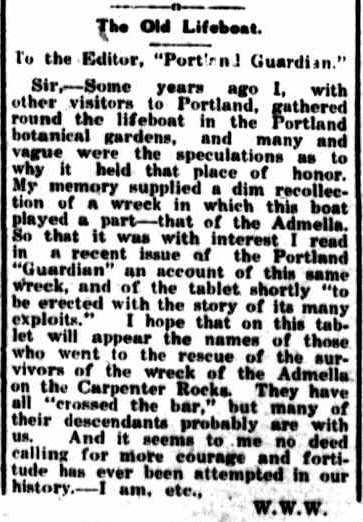
Three years later, “Wandering Willie’s Wife” wrote to the editor again, prompted by the announcement that a “tablet” with the story of the lifeboat Portland would be placed beside the boat.

OUR LETTER BOX. (1929, May 16). Portland Guardian (Vic. : 1876 - 1953), p. 2 Edition: EVENING. Retrieved July 4, 2013, from http://nla.gov.au/nla.news-article64269425

OUR LETTER BOX. (1929, May 16). Portland Guardian (Vic. : 1876 – 1953), p. 2 Edition: EVENING. Retrieved July 4, 2013, from http://nla.gov.au/nla.news-article64269425

The lifeboat is now removed from the elements and is housed in the Portland Maritime Discovery Centre.
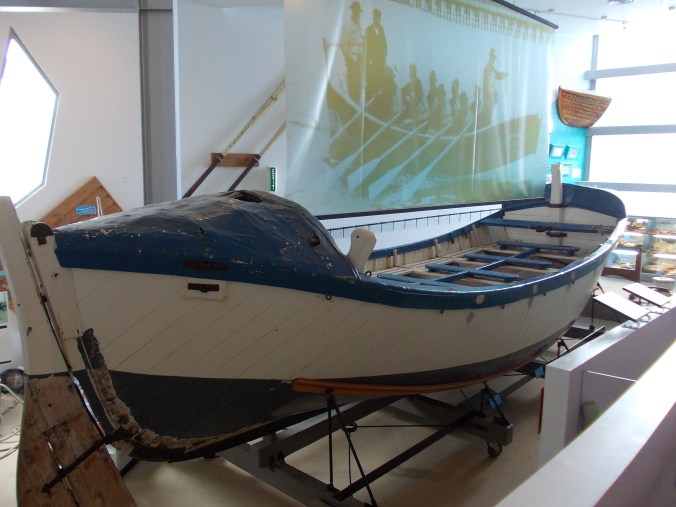
030

LIFEBOAT PORTLAND

ABC Southwest broadcast a story about the Portland Botanic Gardens in March 2009.  The story, including audio and better photos than my own (excluding the wonderful historic photos I found at Trove) can be found by following the link http://www.abc.net.au/local/photos/2009/03/26/2525642.htm
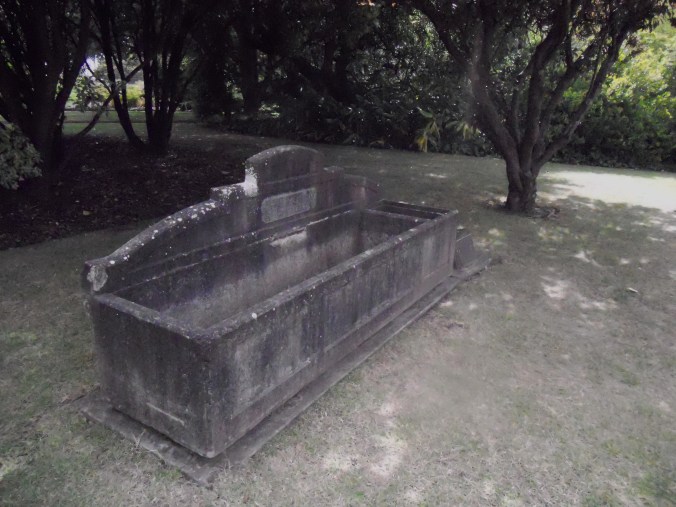
A BILLS HORSE TROUGH (Portland Gardens)
A BILLS HORSE TROUGH (Portland Gardens)

Trove Tuesday – S.S. Casino

The idea of catching a steamship from Portland to Melbourne 100 years ago sounds romantic until one considers the stretch of coastline navigated to reach Melbourne – the Shipwreck coast. There have been over 200 wrecks along the entire stretch of coast, and from Port Fairy to Apollo Bay alone, there have been 80 shipwrecks.

Early settlers used steamers to transport wool and other freight to the Melbourne ports and back. Stephen Henty purchased his own steamers to make the trip. The steamers were also for passengers, an alternative to the rough hair-raising ride of a Cobb & Co coach or later, the train.

Advertising. (1868, February 12). The Argus (Melbourne, Vic. : 1848 - 1957), p. 1. Retrieved July 8, 2013, from http://nla.gov.au/nla.news-article5790334

Advertising. (1868, February 12). The Argus (Melbourne, Vic. : 1848 – 1957), p. 1. Retrieved July 8, 2013, from http://nla.gov.au/nla.news-article5790334

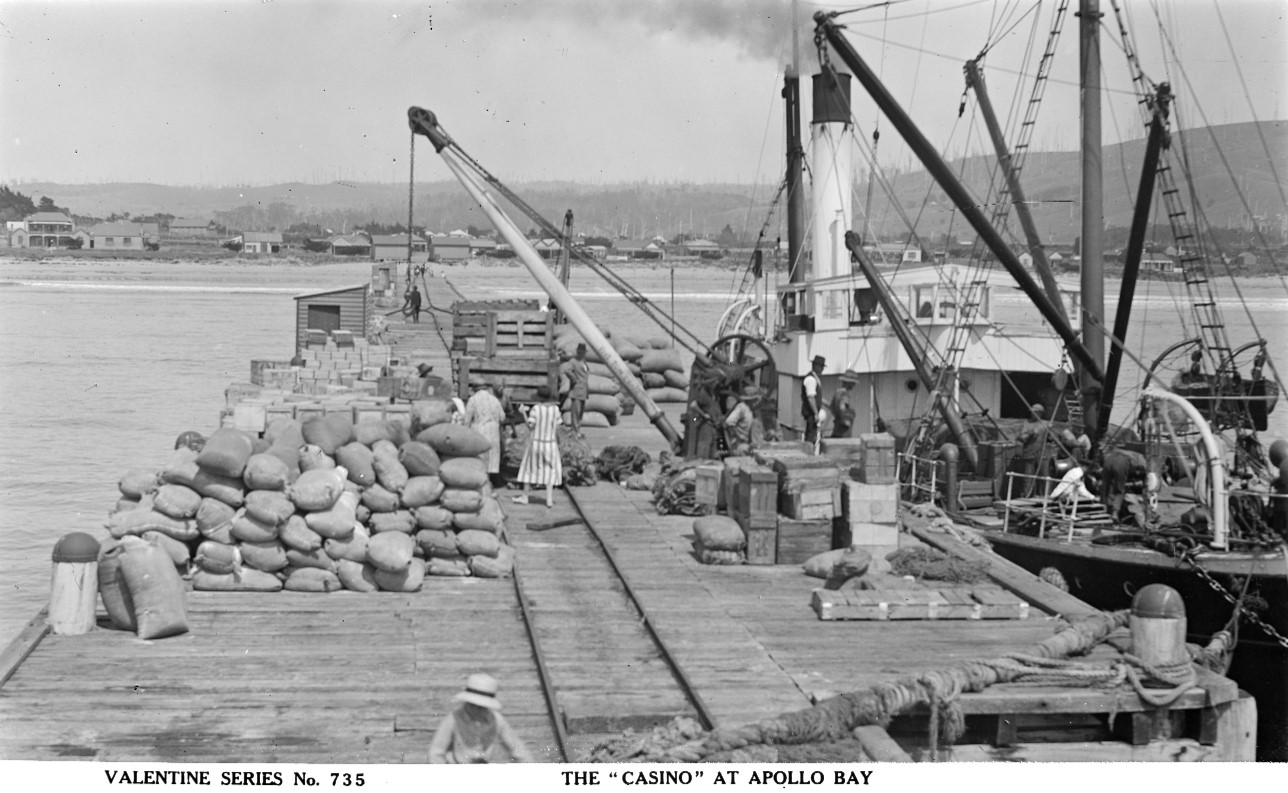
One steamer that regularly made the journey from 1882 was the S.S.Casino, notching up 2,500 trips along the southern coastline. Owned by the Belfast and Koroit Navigation Company, the ship was built in Scotland.

S.S. CASINO. Image courtesy of the State Library of Victoria. Image no. H92.302/23 http://handle.slv.vic.gov.au/10381/195620

S.S. CASINO. Image courtesy of the State Library of Victoria. Image no. H92.302/23 http://handle.slv.vic.gov.au/10381/195620

The Casino is the subject of this week’s Trove Tuesday post because, on 10 July 1932, the steamer made its last voyage.

SS Casino. Image courtesy of the State Library of Victoira
http://handle.slv.vic.gov.au/10381/65095

Just short of the Apollo Bay pier, the S.S.Casino struck a sandbar and sunk.  Ten lives were lost.

casino1

TEN PERISH IN WRECK. (1932, July 11). The Argus (Melbourne, Vic. : 1848 - 1957), p. 7. Retrieved July 8, 2013, from http://nla.gov.au/nla.news-article4462307

TEN PERISH IN WRECK. (1932, July 11). The Argus (Melbourne, Vic. : 1848 – 1957), p. 7. Retrieved July 8, 2013, from http://nla.gov.au/nla.news-article4462307

The Portland Guardian reported on the disaster, noting one survivor, eleven-year-old Joan Greer, was the daughter of a worker at the Richmond Hotel in Portland.  Remarkably, while the girl was travelling aboard the Casino, her mother was taking the train for the return trip from Melbourne to Portland.  One of the victims was Helena Gill, the stewardess with forty years of service.

casino3

Wreck of the Casino. (1932, July 11). Portland Guardian (Vic. : 1876 - 1953), p. 2 Edition: EVENING. Retrieved July 8, 2013, from http://nla.gov.au/nla.news-article64298698

Wreck of the Casino. (1932, July 11). Portland Guardian (Vic. : 1876 – 1953), p. 2 Edition: EVENING. Retrieved July 8, 2013, from http://nla.gov.au/nla.news-article64298698

An unfortunate oversight was an advertisement that ran in the Portland Guardian on July 11, the day after the wreck. It advised passage was available to Melbourne weekly aboard the S.S.Casino “weather and other circumstances permitting”.

Advertising. (1932, July 11). Portland Guardian (Vic. : 1876 - 1953), p. 4 Edition: EVENING. Retrieved July 8, 2013, from http://nla.gov.au/nla.news-article64298708

Advertising. (1932, July 11). Portland Guardian (Vic. : 1876 – 1953), p. 4 Edition: EVENING. Retrieved July 8, 2013, from http://nla.gov.au/nla.news-article64298708

The S.S.Casino still lies at the bottom of the ocean off Apollo Bay and is now a dive wreck.  The anchor is displayed outside the Apollo Bay Post Office. The propeller of the steamer became the centrepiece of a monument in Port Fairy’s Gipps Street.

S.S.CASINO MONUMENT, GIPPS STREET, PORT FAIRY. Image courtesy of the State Library of Victoria http://handle.slv.vic.gov.au/10381/62367

Trove Tuesday – They Say

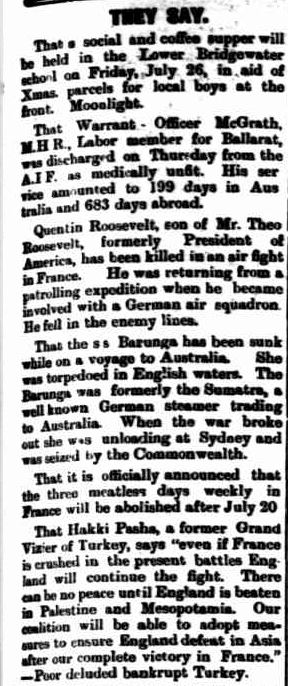
It was the in the Portland Observer and Normanby Advertiser that I first found a “They Say” column.  It was actually a regular column in newspapers across Australia, offering a snapshot of  news and  local gossip, often with a humorous tone.   Each item always began with “That” and the news reported ranged from local to international. The time period of the following four articles is 1915 to 1917, so Australia was at war.

White boots at a Kentbruck wedding?  You probably had to be there.  Mouzie is the Parish of Mouzie, near Portland and it seems there had been a sighting of the Tantanoola tiger.  Incredible since the legend of the Tantanoola tiger went back  1884, when a Bengal tiger supposedly escaped from a circus at Tantanoola in the south-east of South Australia and was the suspected perpetrator behind mauled sheep through into Victoria.  By 1915, the tiger would have been over 30 years old.  Regardless,  it is an interesting story with a twist that I intend to follow-up for a future Trove Tuesday.

THEY SAY. (1915, January 18). Portland Observer and Normanby Advertiser (Vic. : 1914 - 1918), p. 3 Edition: MORNING. Retrieved June 29, 2013, from http://nla.gov.au/nla.news-article88675762

THEY SAY. (1915, January 18). Portland Observer and Normanby Advertiser (Vic. : 1914 – 1918), p. 3 Edition: MORNING. Retrieved June 29, 2013, from http://nla.gov.au/nla.news-article88675762

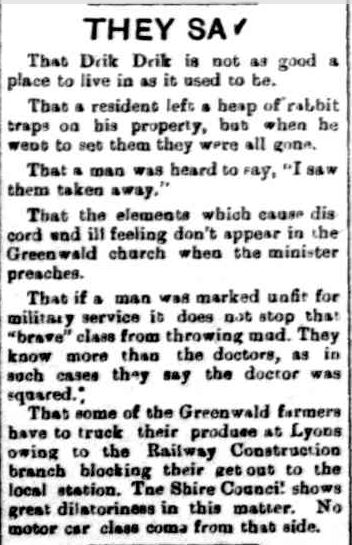
In January 1917, Drik Drik was on the decline and the pressure on men that didn’t go to war was clear.

THEY SAY. (1917, January 11). Portland Observer and Normanby Advertiser (Vic. : 1914 - 1918), p. 3 Edition: MORNING. Retrieved June 29, 2013, from http://nla.gov.au/nla.news-article88675585

THEY SAY. (1917, January 11). Portland Observer and Normanby Advertiser (Vic. : 1914 – 1918), p. 3 Edition: MORNING. Retrieved June 29, 2013, from http://nla.gov.au/nla.news-article88675585

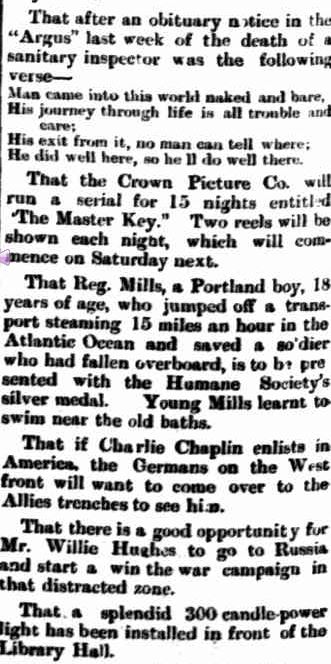
In June 1917, an Victorian State election was on the agenda, but when would it be?  Much like what Australians have endured over the past few days. Again.   Australia’s role in WW1 was costly, with the debt out to £130,000,000.

Amusing was the obituary for a sanitary inspector and the crack at the wealthy for not observing thrift, while they and the State expected those at the lower end of the scale to live an austere lifestyle during wartime.

ts2

THEY SAY. (1917, June 25). Portland Observer and Normanby Advertiser (Vic. : 1914 - 1918), p. 2 Edition: MORNING. Retrieved June 29, 2013, from http://nla.gov.au/nla.news-article88675182

THEY SAY. (1917, June 25). Portland Observer and Normanby Advertiser (Vic. : 1914 – 1918), p. 2 Edition: MORNING. Retrieved June 29, 2013, from http://nla.gov.au/nla.news-article88675182

The following “They Say”, has a more serious tone with mostly international news and was possibly written by a different reporter.

 ts5

https://westerndistrictfamilies.com/wp-content/uploads/2013/06/ts6.jpg

THEY SAY. (1918, July 22). Portland Observer and Normanby Advertiser (Vic. : 1914 – 1918), p. 3 Edition: MORNING. Retrieved July 2, 2013, from http://nla.gov.au/nla.news-article88197409

In contrast to the last “They Say” this edition was very local with much innuendo.  Harry, Maude, Tom and Olive, if they were there real names, may have had a few questions to answer.  Even if  they were false names, Tyrendarra is so small that anyone at the local dance would have known who “Maudie” was.  Pity any girl named Olive living in Portland during November 1917.

THEY SAY. (1917, November 15). Portland Observer and Normanby Advertiser (Vic. : 1914 - 1918), p. 3 Edition: MORNING. Retrieved June 29, 2013, from http://nla.gov.au/nla.news-article88674176

THEY SAY. (1917, November 15). Portland Observer and Normanby Advertiser (Vic. : 1914 – 1918), p. 3 Edition: MORNING. Retrieved June 29, 2013, from http://nla.gov.au/nla.news-article88674176

Why don’t you check out your favourite newspaper at Trove for a “They Say” column.  A search of “They Say” will bring to the top all the papers that ran the column.  They make enjoyable reading.

Passing of the Pioneers

June Passing of the Pioneers features the obituaries of several former Councillors, Mayors, and a Mayoress. There are members of well-known pioneering families and a man who died with no other relatives in Australia. There is also a Hamilton cricket champion who had the potential to play for Australia.

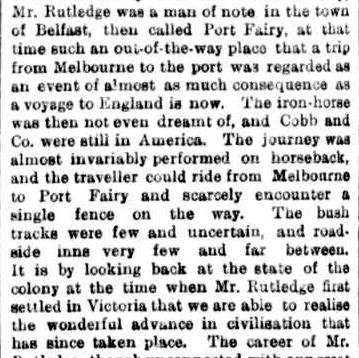
William RUTLEDGE: Died 1 June 1876 at Farnham. William Rutledge, born in Ireland, arrived in Sydney in 1833 aged around twenty-seven.  After his marriage in 1839, he headed south to Queanbeyan, N.S.W. then Kilmore, Victoria in 1840.  A visit to Port Fairy in 1843 saw him buy the business of John Cox and he transformed it into William Rutledge & Co, importers.  He also selected a large amount of land at Farnham near Koroit.  William also sat on the first Victorian Legislative Council in 1851 continuing until 1854. The Christ Church Anglican Church at  Warrnambool has a  memorial window dedicated to the memory of William.

DEATH OF MR. WILLIAM RUTLEDGE, OF FARNHAM. (1876, June 2). The Argus (Melbourne, Vic. : 1848 - 1957), p. 5. Retrieved June 25, 2013, from http://nla.gov.au/nla.news-article5890095

DEATH OF MR. WILLIAM RUTLEDGE, OF FARNHAM. (1876, June 2). The Argus (Melbourne, Vic. : 1848 – 1957), p. 5. Retrieved June 25, 2013, from http://nla.gov.au/nla.news-article5890095

A biography of William Rutledge (below) by Martha Rutledge in the Australian Dictionary of Biography tells of Edward Henty having referred to William as “Terrible Billy”.

WILLIAM RUTLEGE. Image courtesy of the State Library of Victoria Image no. H5056/68

WILLIAM RUTLEDGE. Image courtesy of the State Library of Victoria Image no. H5056/68

George OSBORNE: Died 14 June 1884 at Geelong. George Osborne was born in Sydney around 1809, his father was a member of the 45th Regiment of Foot. George was a ship maker’s apprentice and worked on a whaling ship as a ship’s carpenter.  George first arrived in Victoria in 1840 at Portland. He then went to Melbourne before returning to Portland where he remained with his family. While he had lived in Portland for twenty-five years, after his wife’s death, George moved among his family members until his death. He was buried at the Port Fairy Cemetery.

Eliza PITTS: Died 2 June 1914 at Edenhope. As an infant, Eliza Pitts travelled to Victoria with her parents aboard the  Severn in 1846 and they settled at Wattle Hill, Portland. In 1860, Eliza married Richard Guthridge. They raised a family of six sons and six daughters. Son Frederick has also been a Passing Pioneer. In the early years of their marriage, Richard and Eliza moved several times between Portland, Mt Gambier, and Carapook before settling in the Edenhope district. They were a well-respected family, renowned for their longevity.

Walter DISS: Died 3 June 1916 at Port Fairy. Walter Diss died with no relatives in Australia. He was born in London around 1851 and arrived in Victoria during the 1880s. He ran bakery businesses in Port Fairy and for a time ran the Exchange Hotel at Sale, East Gippsland. He returned to Port Fairy after the death of his wife, two years before his own passing.

Ellen MALONE: Died 20 June 1916 at Killarney. Born in Queen’s County, Ireland around 1831, Ellen arrived at Portland in 1855 aboard the Caringorm.  In 1856, she married Thomas Shanley and they settled at Killarney and raised seven children. At the time of her death, Ellen had forty-two grandchildren and six great-grandchildren.

Robert WOOD: Died 27 June 1917 at Warrnambool. Robert Wood was born in Scotland in 1847 and arrived at Port Fairy, with his parents, aboard the Athletae in 1854. He farmed around  Hopkins Point and Woodford before taking up a job as a storeman for R.H. Patterson of Warrnambool. He had a strong association with the Warrnambool Fire Brigade, serving as a member for forty-two years, twenty years of which he was the station keeper.

Agnetta VIGAR: Died 24 June 1917 at Ararat. Agnetta Vigar was born on the island of Guernsey around 1831. She arrived in Adelaide in 1852 and married William Aggett. They moved to Ararat during the 1860s, settling on the Stawell Road.  She left one son, Thomas, serving in Europe at the time of her death.

John TWOMEY: Died 30 June 1918 at Lilydale. John Twomey was born at Banmore Penshurst, the son of John Twomey a pioneer squatter of the district. John Jr entered the stock and station business and lived at Warrnambool. He was a member of several racing clubs and was a successful owner. In the years before his death, he moved to Melbourne then Lilydale where he passed. He was buried at Warrnambool Cemetery.

John DOYLE: Died 8 June 1922 at Heywood. John Doyle was born in Tipperary, Ireland around 1842. He arrived in Port Fairy about 1856 with his twin brother and they set up a carrying business. John then bought land in Casterton before purchasing the Hamilton Inn at Hamilton. Tired of life as a publican, John bought land at Cape Bridgewater and Heywood and farmed dairy cows. He served as a Councillor with the Portland Shire. After the death of his first wife in 1877, he remarried. He left five sons and two daughters. A sixth son predeceased him. John’s twin brother died five weeks before at Hamilton.

James GOLDIE: Died 4 June 1924 at Port Fairy. James Goldie’s death was tragic, but it should not take away from the contribution he made to Port Fairy. James was born around 1860, the son of John Goldie of Port Fairy. He was the first butter factory manager in Victoria, running a factory at Rosebrook. He later managed a large butter factory in N.S.W.

James’ father, John Goldie tended his farm using the latest scientific practices. A photo of his farm is below. Taken in 1895, it shows trial crops of sugar beets. After John died, James took up part of the farm and became a respected breeder of Ayrshire cattle.

SUGAR BEET GROWING AT PORT FAIRY ON THE FARM OF JOHN GOLDIE c1895. Image Courtesy of the State Library of Victoria. Image No. IAN01/10/95/20 http://handle.slv.vic.gov.au/10381/40232

SUGAR BEET GROWING AT PORT FAIRY ON THE FARM OF JOHN GOLDIE c1895. Image Courtesy of the State Library of Victoria. Image No. IAN01/10/95/20 http://handle.slv.vic.gov.au/10381/40232

James served on the Council of the Borough of Port Fairy with two terms as Mayor. He was also a member of the Agriculture Society committee and he was one of the men that established the Glaxo Milk Company at Port Fairy.

Mary FLETCHER: Died 19 June 1942 at Sandringham. Mary Fletcher was born in Scotland around 1847 and arrived in Victoria as a child. Her parents settled at Goroke and in 1865 she married William Affleck. William passed away in 1867 and in 1869 she married James Wooton Shevill.  James was a Warrnambool Councillor from 1875-1878, holding the Mayoral role in 1877-1878.  In later life, the Shevills moved to Melbourne.

Peter DUSTING: Died 30 June 1946 at Melbourne. As Peter Dusting was the last surviving member of the family of John and Sally Dusting of South Portland, this obituary is more a Dusting family obituary rather than Peter’s. In fact, I was able to find little about Peter from it.  He was born in Portland around 1866 and followed his father and brothers into the fishing business. Later he moved to Melbourne and remained there until his death.

Emma Watsford TERRILL:  Died June 1948 at Hamilton. Emma Terrill was born at Cape Bridgewater around 1880, the youngest daughter of Mr & Mrs George Terrill, pioneers of the district. Emma married William Jennings in 1905.  William was the grandson of Cook Abraham Jennings and Hannah Birchall, also Cape Bridgewater pioneers. Emma was an expert on poultry and was often sought after for advice. After living all her life at Cape Bridgewater, two years before her death she moved into Portland.  Emma passed away in the Hamilton Hospital.

George KENNEDY: Died June 1950 at Hamilton. When I think of Hamilton cricket, I think of Kennedy Oval. George Kennedy is the man who the oval was named for. An obituary for  George Kennedy in the Portland Guardian of 29 June 1950, suggests a decision by Melbourne born George to leave the city for Hamilton as a young man in 1905 may have cost him the opportunity to compete at interstate or even at international level. He played for the Grange club in Hamilton and excelled at both batting and bowling, the latter his specialty. His talent was on display in 1912 when a touring English team played at Hamilton and George’s bowling figures were 3/35. After the match, the ball and a bat signed by the English team was presented by one of his scalps, Sir Jack Hobbs, the most prolific scorer in first-class cricket history. George was seventy-one at the time of his death.  He was buried at the Hamilton (Old) Cemetery.

GRAVE OF GEORGE KENNEDY, HAMILTON (OLD) CEMETERY

Trove Tuesday – What a Newspaper is…

In a week when I have celebrated Trove and the Western District newspapers we can look forward to in the new financial year, I will take you back to 1886 when the Colac Herald defined a newspaper.

What a Newspaper Is. (1886, June 11). The Colac Herald (Vic. : 1875 - 1918), p. 1 Supplement: Supplement to the Colac Herald. Retrieved June 22, 2013, from http://nla.gov.au/nla.news-article90323615

What a Newspaper Is. (1886, June 11). The Colac Herald (Vic. : 1875 – 1918), p. 1 Supplement: Supplement to the Colac Herald. Retrieved June 22, 2013, from http://nla.gov.au/nla.news-article90323615

This article, from almost 130 years ago, defines our reason to post for Trove Tuesday.  As researchers, reading  newspapers from a time when our ancestors relied on their existence for the characteristics listed by the Colac Herald, we gain an insight into life at another time, or “a bird’s-eye view of all the magnanimity and meanness, the joys and the griefs, one births and deaths, the pride and the poverty of the world…”

Trove-ific

I was casually searching at Trove last night, as you do, and a “coming soon” result came up for the Koroit Sentinel & Tower Hill Advocate (1914-1918).  Very surprising as the paper is not on the 2012-13 list of titles coming.  Could this be one of the new titles for 2013-14?  If only the Hamilton Spectator would come up in a search result.   I did another search and there it was, almost glowing on the screen     ***”The Hamilton Spectator” (1914-1918)***.   Happy dance time.

Maybe I could find some more.  I searched “Byaduk” and checked the list of newspapers in the sidebar.  I found the Coleraine Albion & Western Advertiser (1914-1918) and the Penshurst Free Press (1914-1918).  More dancing.

Recently I read in The Warrnambool Standard (a modern day edition) that the Hamilton History Centre had received a Local History grant to digitise the Hamilton Spectator (1860-1878).  That was exciting but I didn’t expect to be reading articles from the Hamilton Spectator on the Trove site in the coming months.

The time period 1914-1918 is of particular interest to me as both James and Susan Harman died in 1916 and I’ve been holding out for a decent obituary for James.  The Spec was my last hope.  I had a false alarm when the Port Fairy Gazette came online, so I have my fingers crossed.  As I will be researching the Harmans more extensively in the next 12 months for my Diploma thesis, this may save some time at the Hamilton History Centre looking through microfilm for his obituary.

Of course I’ve already done a search and had results for each of my family names and I’ve sent requests to my Electronic Friend to email me when the articles are available.  I’m off now to check the other three papers. Think of all the obituaries I can find for Passing of the Pioneers.

If you would like to have a preliminary search too, click on the newspapers above and you will go to the full list of articles already digitised.  You can search from there and if successful,  request a notification when the articles are available.  Happy searching.

What Was “Lost” is Now Found

The subject of my 2013 Anzac Day post was great-grandfather Les Combridge.  I wanted to include a photo of Les and I couldn’t get one of Grandmas’ photos in time, but I knew I had a large envelope with information Grandma’s sister Jean had sent me.  There were photos in the envelope but I couldn’t remember if there was one of Les.  Well, I searched everywhere for that envelope and I couldn’t find it.   That’s right, I’m not an organised genealogist and to qualify that, I recently joined a Facebook group The Organized Genealogist.  I doubt it will help me.

Over the past weekend I stumbled across the envelope.  It wasn’t lost.  I always knew it was somewhere.  I just had to find that somewhere.

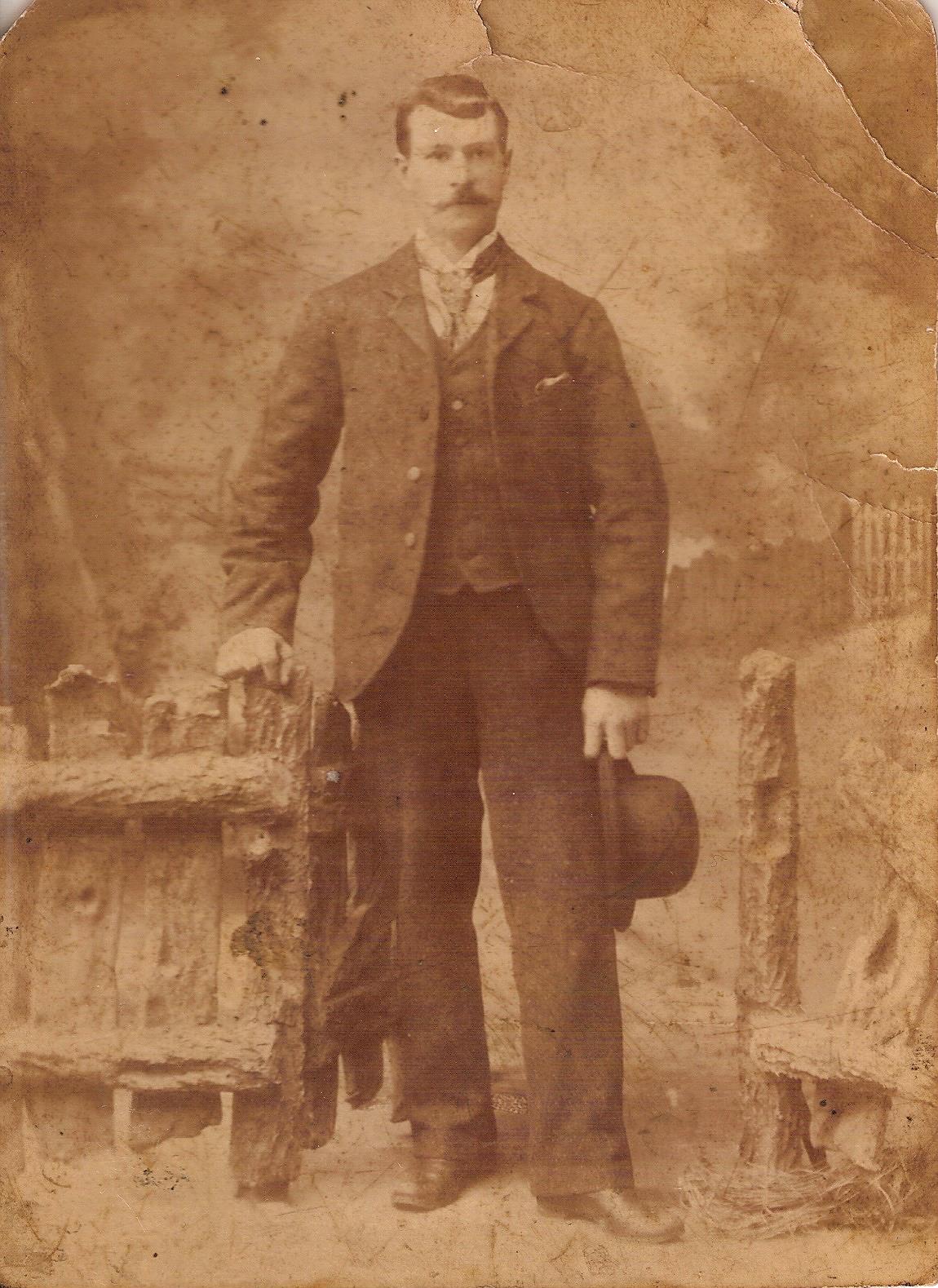
The envelope has a treasure trove of information about the Combridge family and should have demanded my immediate attention when Auntie Jean first sent it to me.  But you know how easy it is to get sidetracked.  There were no photos of Les.  Instead there was one of his father Herbert John Combridge.

Herbert was born in Geelong in 1873, the youngest of 12 children of John Combridge and Martha Baker.  John and Martha had arrived in Geelong in 1855 from England.  Herbert married Jane Wyatt in 1895 at Kyneton. The minister was Herbert’s brother John Robert Combridge, Church of Christ minister at Kyneton at the time .  Herbert and Jane went back to the Geelong district and my great-grandfather Leslie Herbert Combridge was born in 1897 at Steglitz, west of Geelong.  By 1900, Herbert, Jane and Les had moved to Grantville in Gippsland where the remaining three children to the couple were born.

Herbert Combridge2

HERBERT JOHN COMBRIDGE

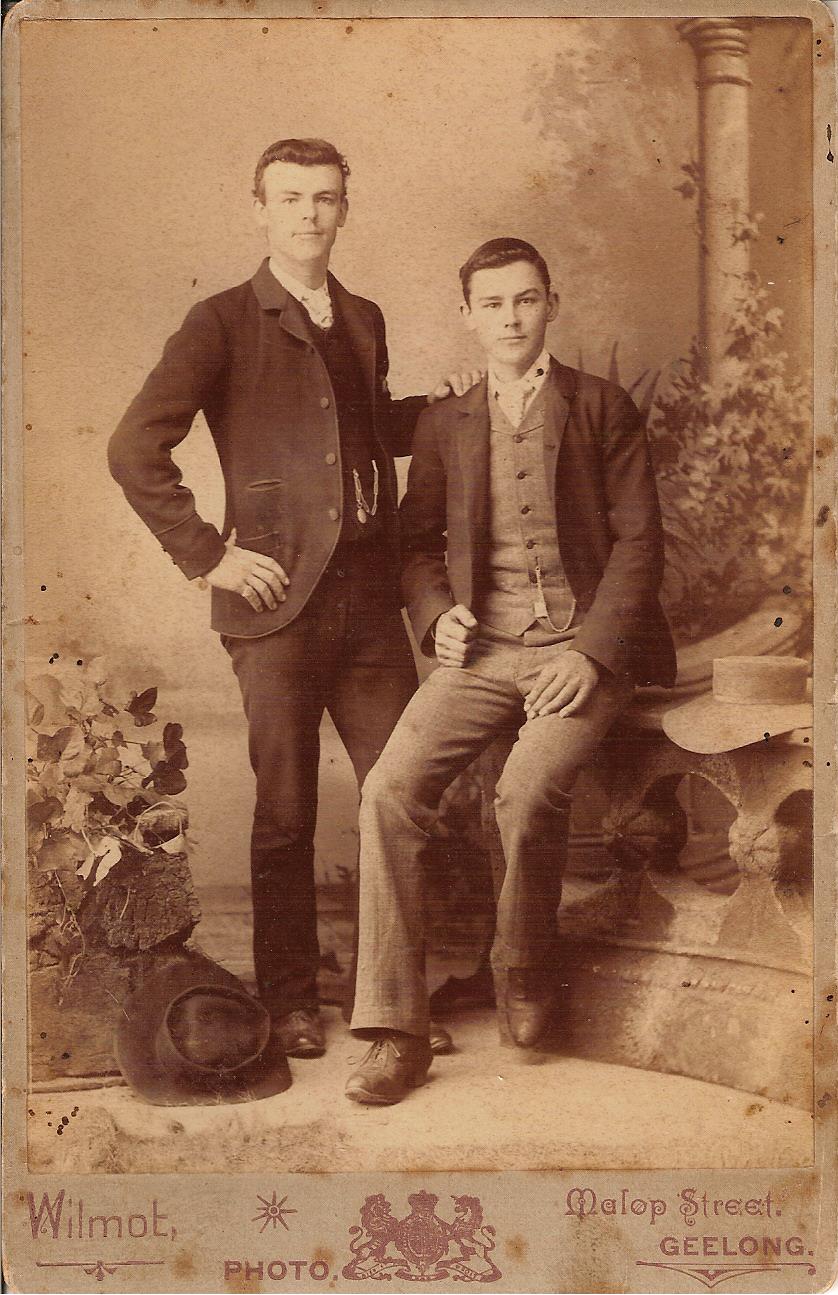
On the back of the next photo someone had written”Les and Claude”.  Claude was the younger brother of Les.  However Auntie Jean had written underneath “not Les and Claude”.

Combridge2

She seemed fairly emphatic about that and I do agree with her.  The photo is too early for Les and Claude and there was a 10 year age difference between the two.  Given the photos came from the same source, a cousin of Auntie Jean, and there was also information about the Geelong Combridge’s, Auntie Jean was probably given the photo for a reason.  I suspect this is another photo of Herbert Combridge.

The first step was to follow-up on the  photographer, “Wilmot of Malop Street, Geelong” to establish a time frame.  The Geelong District Local and Family History site includes a useful Geelong and District Photographers Database.  “Wilmot” was George Wilmot, in business in Geelong from 1865-1923.  He started off with William Keys in 1865-1886, then went out on his own in 1886, first in Fyans Street, then from 1891 to 1923 in Malop Street.

From Trove photographs, I knew that when in business with Keys, the business name at the bottom of the photo was “Wilmot and Keys”.  The logo on the border changed a lot over the years and I only found one other with a coat of arms, that being from around 1907.  The photo was likely taken after 1891 when George moved his business from Fyans Street to Malop street.  Herbert was 18 in 1891.

The boy on the right looks younger and I suspect they are brothers.  If  it is Herbert, he’d be on the right as he was the youngest child in the family.  Benjamin was the next eldest by two years.    Benjamin would have been 20 in 1891.  If Herbert, the photo would be from before his marriage in 1897 when Herbert was aged 24.  The time frame would then be 1891-1897.  What do you think?

I know that while I have learnt a lot about Ladies fashion writing seasonal posts that have proved useful when trying to date photos, I don’t know a lot about men’s clothing, so that’s penciled in for a future post.

Of course this may not be Herbert at all.

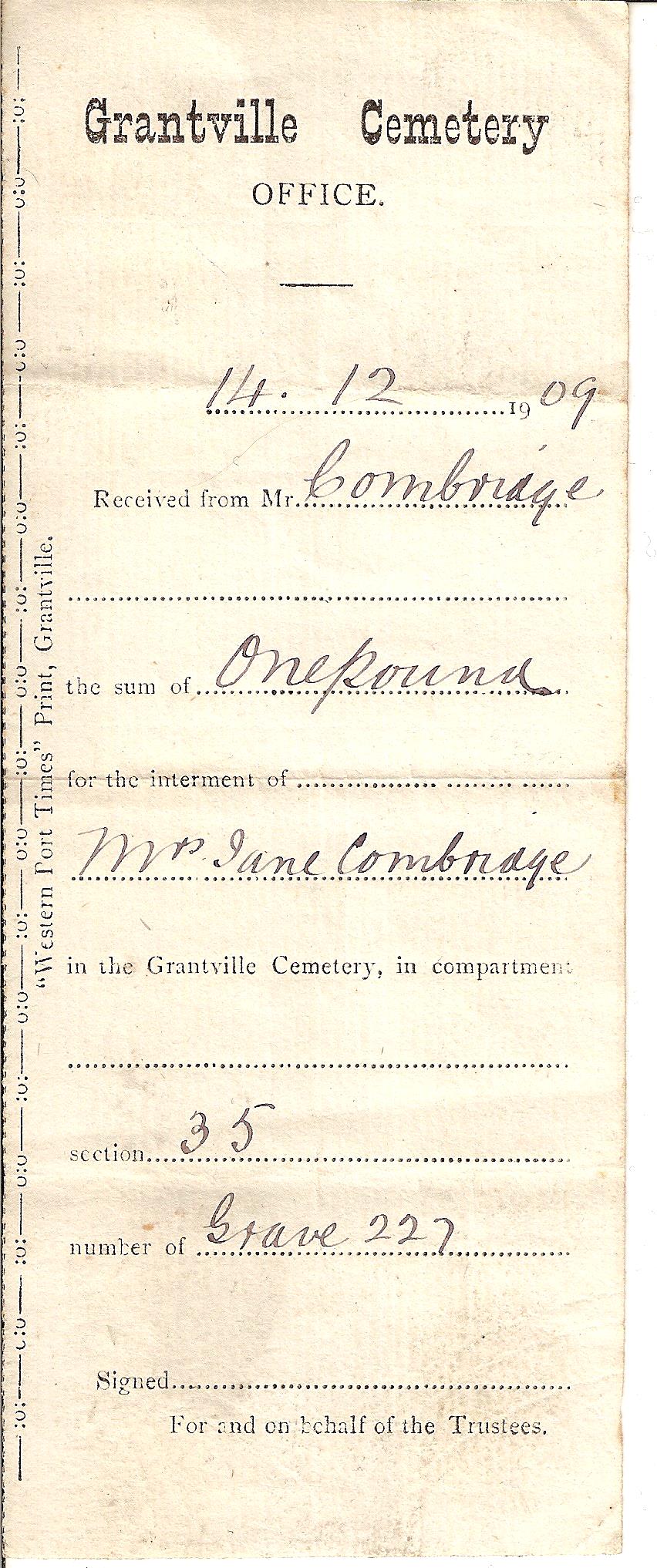
You may remember from the Anzac Day post that Herbert’s wife Jane died in 1909 as a result of childbirth.  In Auntie Jean’s envelope were two cemetery receipts, a sad reminder of that year.  The first receipt, from July 27, is for the interment of a stillborn baby.  The charge 17/6.  Then from December 14, a receipt for the burial of Jane.  The charge £1.

Combridge1

Now, you’ll be pleased to know,  all the gems in Auntie Jean’s envelope are scanned and the originals in a safe place.  I suppose that’s one step toward being more organised.