Despite little time to devote to Western District Families as regularly as I would like, there is always time to remember the great pioneers of the Western District with the monthly Passing of the Pioneers. There is just a small band of pioneers for May, but they each have wonderful stories. Be sure to click on any of the links for more information, especially the link to the wonderful recipe and remedy collection of Mrs Eliza Duckmanton.
James HANKS: Died 21 May 1909 at Horsham. While James Hanks was not an old pioneer, he was from a large pioneering family. He was also my great grandmother’s brother-in-law. James was born at Branxholme in 1871, the son of Thomas Hanks and Sarah Ashton. He married Ellen May Harman of Byaduk in 1901. James had worked in Horsham previous to his marriage and took Ellen to live there. He worked for Messrs Broadbent Bros., carriers of Horsham and by the time of his death, he was the head carter. James and Ellen had three children by 1909 and while Ellen was pregnant with a fourth, James fell ill with typhoid fever and died before their fourth child was born. Poor Ellen was exhausted when her husband’s died, caring for him, the three children, one of those also ill, and coping with pregnancy.
Michael COTTER: Died 10 May 1913 at Dunrobin. Michael Cotter arrived in Tasmania around 1844 and after ten years, travelled to Victoria spending time at the Bendigo and Ballarat diggings. During the 1860s, he started farming at Branxholme and remained there until later in life when he farmed at Carapook. For a detailed history of Michael including his wife Catherine McIntosh and children, follow this link to the SW Pioneers site http://www.swvic.org/carapook/names/cotter.htm
Wilhelm PETSCHEL: Died May 1914 at Hamilton. Wilhelm Petschel was born in Saxonby, Germany was one of Hamilton’s earliest pioneers. Arriving in Adelaide in 1848, he made his way to Portland before taking up a job as a groom at Heywood. He heard of the land sales at The Grange (Hamilton) and upon inspection of the land available was so impressed he purchased a block, declaring that day the happiest of his life. William married in 1856 and two children were born from the union. He was a founding member of the South Hamilton Lutheran Church (today part of the Hamilton Pastoral Museum)
Reverend Samuel FRASER: Died May 1914 at Terang. Born in Scotland around 1844, Samuel Fraser arrived in Terang around 1871 sick from consumption, but still able to take up his duties as Minister in the Parish of Mortlake, based at the Terang Presbyterian Church. His health improved and he remained in the role until his death forty-three years later. Samuel was also the Honorary Treasurer of the Presbytery and clerk of the Presbytery. Among Presbyterians, it was considered a “model presbytery”. He married Miss Hamilton, the daughter of the Reverend William Hamilton of Mortlake and they had two daughters and four sons. Several obituaries were published and they appear on the following links. http://nla.gov.au/nla.news-article119798095http://nla.gov.au/nla.news-article119789693
John DUCKMANTON: Died May 1915 at Dunkeld. John Duckmanton was born in Nottinghamshire, England around 1833 and arrived on the Yorkshire to Victoria about 1860, settling at Dunkeld. John was a carpenter and wheelwright and built the first state school at Dunkeld, among other buildings. He belonged to the St Marys Church of England, sitting on the committee when the foundation stone of the church was laid and was an active member of the Loyal Duke of Edinburgh M.U.I.O.O.F. He and his wife had a family of twelve and he left thirty-three grandchildren. I found an absolute treasure on the Museum Victoria website which is worth a look. John’s wife Eliza Womersley was a bush nurse and in 1870 recorded her recipes and remedies in a book, using handwritten notes and cuttings from other publications. The original book can be seen on the M.V. website on the following link – Eliza’s book.
Patrick BALKIN: Died 17 May 1916 at Hamilton. Born in Kilkenny, Ireland around 1831, Patrick Balkin arrived in Newcastle, N.S.W. aboard the Red Jacket. After two years, he arrived at Port Fairy and then on to the Grange (Hamilton) with his wife Hannah Quinlan. On arrival at the Grange, the town was only young, with just one hotel. They settled at their property Knockaney where they stayed for the rest of their lives. Patrick was a member of the Dundas Shire for twenty-two years and had a wish to advance his chosen place of settlement. Hannah predeceased Patrick and he left a family of two daughters and three sons.
Jane MASON: Died 14 May 1918 at Strathkellar. Jane Mason was born in Norfolk, England, and arrived in Portland in 1852 aboard the Marmion with her parents. The Masons settled first at Balmoral before moving close to Hamilton. In 1865, Jane married Robert Fraser of Glencoe, Hamilton. Around the beginning of the 20th century, they purchased Seesford at Muddy Creek. They retained the property until only months before Jane’s death when she moved to live with her daughter at Strathkellar.
April Passing of the Pioneers includes one of the pioneers of the Presbyterian Church in the Coleraine district, a mother of fourteen children, several Shire Councillors and a successful storekeeper.
Thomas GOODWIN: Died 7 April 1914 at Rosebrook. Thomas Goodwin was born in Tasmania about 1833 and arrived at Port Fairy as a child. He farmed first in the Glenormiston district but when land became available at Farnham, he moved there. In his later years, he farmed at Rosebrook. He left three sons and four daughters.
Letitia WILLIAMSON: Died 11 April 1914 at Koroit. Letitia Williamson was born in County Armagh, Ireland. She arrived in Victoria in 1857 and married James O’Neill in Melbourne the following year. They spent some time in Melbourne then moved to Koroit where James was a bootmaker. James passed away around 1903 and when Letitia passed away she left six children.
William QUILL: Died 13 April 1914 at Portland. William Quill was born at Werrangourt Station, Byaduk around 1845, but his family moved to Yambuk when he was a boy. After his marriage to Miss Doherty, William and his new bride settled at Macarthur. William was on holiday in Portland when he passed away.
Samuel KEEN: Died 21 April 1914 at Hamilton. Samuel Keen was born in Stafford, England around 1846 and came to Australia aboard the ship Helen about six years later with his parents. The family travelled to Hamilton by bullock wagon, where Samuel remained for the rest of his life.
Reverend William John GILLESPIE: Died 24 April 1914 at Hawthorn. Reverend Gillespie was born in Antrim, Ireland in 1826 and trained for the ministry in Belfast. He travelled to Australia in 1867 with his wife of five years, Mary Oliphant Morrison. The following year he took up position in charge of Coleraine, Casterton, Merino, and Digby Churches and remained in that role until 1902. During his time at Coleraine, he was president of the Coleraine debating club, and chairman of the Board of Advice, Mechanics Institute, and Railway League. With his health failing, the Reverend and his wife moved to Melbourne where he remained until his death. He was buried in the Coleraine cemetery.
GRAVE OF WILLIAM JOHN GILLESPIE AND FAMILY, COLERAINE CEMETERY
Arthur Grainger HILL: Died 7 April 1917 at Edenhope. Arthur Hill was born in Somersetshire, England and when he arrived in Australia he first settled in N.S.W. He came to Victoria to work with the Railway Department of Victoria. Around 1880, he was appointed Engineer of the Wannon Shire Council. Due to a successful period of employment with the Shire, upon his retirement, Arthur was awarded a bonus of a year’s wages.
Sarah MOFFATT: Died 22 April 1917 at Hamilton. Sarah Moffatt was born in Ireland around 1836 and arrived in Australia in the late 1850s. She married Peter Lewis and they had two sons, however, Peter passed away. She married Benjamin Chamberlain of Port Fairy and they had three daughters and one son. Sarah was buried at the Port Fairy cemetery. Another obituary appeared in the Hamilton Spectator on 27 April 1917.
George TRANGMAR: Died 25 April 1917 at Melbourne. George Trangmar was born in Brighton, England around 1828 and arrived in Victoria in 1849. He started in business with his brother James in Portland before opening a store in Coleraine in 1851. He remained in business there for twenty-five years and during that time was a member of the Wannon Shire, including some years as President. During the 1870s, he purchased the Toolang Estate near Coleraine for sheep farming. He sold Toolang around the turn of the century and moved to Melbourne. He was buried at Coleraine Cemetery with his wife Matilda McKelvey.
GRAVE OF GEORGE TRANGMAR, COLERAINE CEMETERY
Thomas Lewis WYATT: Died 15 April 1918 at Hamilton. Thomas Wyatt was born in London, England around 1831 and married at St., Brides Church, London in 1853. In 1855, Thomas and Mrs Wyatt. a young son and Thomas’ brother James, left Plymouth aboard the Anna Maria, arriving at Portland in February 1856. He took up the trade of plasterer and his work took him to Mt. Gambier and Melbourne before he went into partnership in Hamilton. He was a founding member of the Portland Oddfellows lodge. Thomas left a widow, two sons and three daughters
Johanna STEVEN: Died April 1925 at Heywood. Johanna Steven was born near Glasgow, Scotland, and arrived in Victoria with her parents around 1860. Her father owned what was known around Portland as the “Wee Station” in South Portland, a small acreage as up to date as a large pastoral station attracting visits by tourists to the town. Johanna married William Reid at Portland and they raised a family of fourteen children. Johanna and William were foundation members of the Heywood Presbyterian Church.
William PHILIP: Died April 1933 at Hamilton. William Philip was born around 1858 and was educated at the Hamilton Academy and Geelong College. After Geelong, he returned to the Western District and owned properties including Violet Creek, Kenilworth, and Mt. William. He was a member of the Dundas Shire Council for twenty years and was a member of the racing, golf, and swimming clubs as well as the Masonic Lodge. His support assisted the financing of the Hamilton War Memorial and local swimming pool.
“Each regiment formed upon a squadron frontage in three lines from 300 to 500 yards apart, and every man was restless, excited, and resolute for victory.
At 4.30 the two regiments moved off at a trot. Surprise and speed were their one chance, so no time was lost in breaking into a gallop. For what seemed to be a space of minutes the Turkish fire ceased, as if the garrison was wondering what the approaching horsemen had in mind. Then swiftly realising that they were out for business, the whole line burst into a flame of fire.
But the Australians were not to be denied, much less were their glorious chargers in the mood to hesitate. As if entering into the spirit of the great game, with ears pricked and manes flashing back, they headed in a wild scamper into the setting sun.
As they reached the Turkish front line trenches, the leading troopers dug in their spurs and their mounts cleared the obstacle in their stride”
The outcome, achieved in just under 60 minutes of wild riding, sheer bravery and maybe a touch of madness, saw the 4th Light Horse Brigade, consisting of the 4th and 12th Light Horse Regiments, capture Beersheba in one of the most important offensives of WW1.
Eight hundred Australian Light Horsemen waited on a ridge about six kilometres from the town of Beersheba, hidden from the Turkish troops. At 4.30pm on October 31, 1917, under the orders of Lieutenant General Harry Chauvel, they moved forward, first at a walk, then a trot, gradually quickening until the order of “CHARGE” was given, and 800 horsemen urged their horses, tired and thirsty from travelling overnight, into a gallop.
The Turks, expecting the Australians to dismount and fight one on one at the first trench, watched with surprise as horsemen, with only bayonets in hand, rode resolutely with no intention of stopping. They cleared the first trench, then the second. As the first squadron approached the third trench and dismounted, gunfire raining upon them, a bullet hit a 28-year-old farmer from Byaduk in the Western District and he died where he fell.
Walter Rodney Kinghorn, the youngest child in a family of 12, was born in Byaduk in 1888 to Francis Kinghorn and Elizabeth White. Britain declared war on Germany on 4 August 1914 and 20 days later at Broadmeadows, 26-year-old Walter Kinghorn enlisted, one of the first from the Hamilton district to do so. Prior to that, life for unmarried Walter consisted of farm work at Byaduk, like his father and brothers before him. His future had looked mapped out for him, but with no wife or children, the offer to see the world was all too enticing.
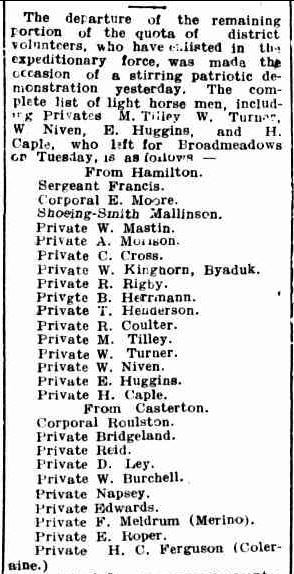
On August 22 1914, the people of Hamilton demonstrated the patriotic feelings that abounded as they bid farewell to what they then thought was the remaining quota of Hamilton district volunteers preparing for departure overseas. Those in the streets that day described the scene as “stirring”.
It was not just men leaving Hamilton. Fourteen horses, donated by prominent local breeders, including James Learmonth of Melville Forest, also said goodbye to their breeding grounds and like the men, were oblivious to what lay ahead of them. The mood was buoyant and locals provided gifts for the men including cigarettes and a box of cigars, from Mr Short, brother-in-law of Private Maurice Tilley. The parade moved along the streets of Hamilton to the Town Hall, accompanied by the Hamilton Pipe Band.
Walter spent time training at the Broadmeadows Camp until 19 October 1914 when the men and horses of the 4th Light Horse sailed aboard the steamer HMAT Wiltshire bound for Egypt. With him were Tom Henderson, Maurice Tilley and William Niven of Hamilton and John Francis of Yulecart.
FEEDING HORSES OF THE 4TH LIGHT HORSE ON BOARD SS WILTSHIRE. Image Courtesy of the Australian War Memorial. Image no. PS0008 http://www.awm.gov.au/collection/PS0008/
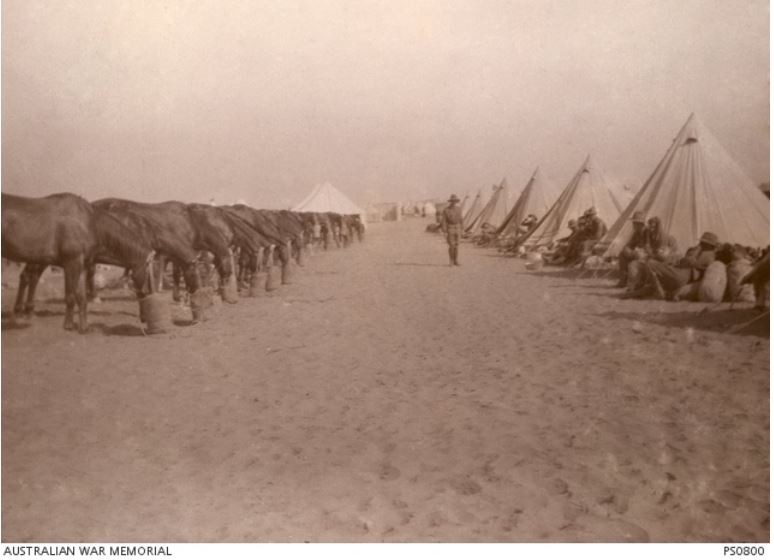
They arrived at Port Said, Egypt on 10 December 1914 and work began to unload the horses and set up camp.
Walter Kinghorn’s service record gives no clue to his whereabouts from the time the steamer docked in December 1914 until 2 January 1916 when he was recorded as being in Heliopolis. The only other listing was that he was a driver with 4th Light Horse Transport from the time of his enlistment until July 5, 1916.
If Walter remained with the 4th Light Horse after their arrival, he would have travelled with them to Gallipoli during May 1915, minus the horses, as infantry reinforcements. The regiment spent six months in the trenches at ANZAC Cove before returning to Egypt to discover the regiment would be split up. Horses had limitations in the desert with water supplies an ongoing concern. Two squadrons left for France, while the rest remained around the Suez Canal.
Walter spent time at the 4th Light Horse Regiment Headquarters at Heliopolis before falling ill late in May 1916. He spent a few weeks in hospital before joining the 1st Light Horse for a month at Tel-El-Kebir. Then on to the 1st Double Squadron at Serapeum, Egypt in July, where he remained for four months.
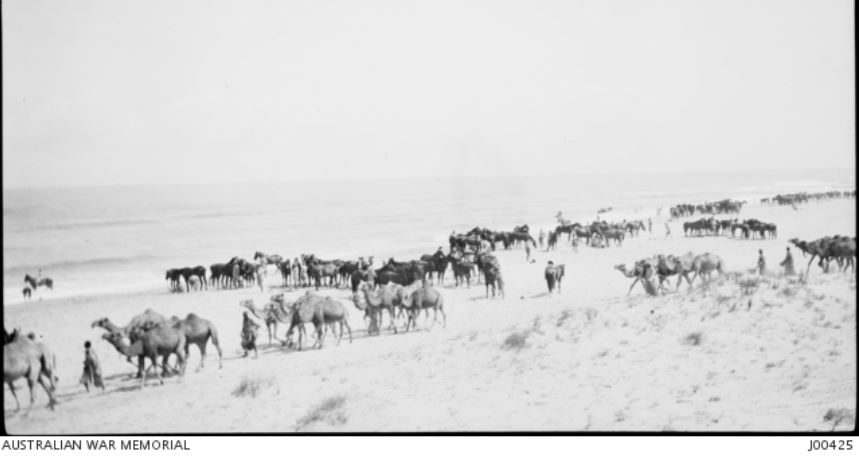
There was still reshuffling among the Light Horse regiments and the 4th Light Horse joined with the Imperial Camel Corps to form the 3rd Camel Regiment at El Ferdan, Egypt in November 1916. Walter was with the camel regiment for three months. On December 27, 1916, Henry Langtip wrote in his diary “Got camels issued today. I don’t like them at all but I suppose one willget used to them“, but the following day…”On camels for the first time today and it was great fun as several fell off”.
4th LIGHT HORSE REGIMENT BATHING HORSES & CAMELS, MARAKEB, PALESTINE, 1917. Image Courtesy of the Australian War Memorial Image No. J00425 http://www.awm.gov.au/collection/J00425/
With further reorganization to the mounted brigades in early March 1917, Walter returned to his role as a driver with the 4th Light Horse Transport, then camped at Ferry Post on the Suez Canal. He was also promoted to Lance Corporal. For some reason, at his own request, Walter reverted from driver to trooper on 26 May 1917, while in Tel El Fara, Palestine. That decision may have sealed his fate.
4th Light Horse in Palestine c 1915. Image courtesy of Picture Queensland, State Library of Queensland Image no. 182314 http://trove.nla.gov.au/version/47940236
In the months leading up to the attack on Beersheba, on two occasions the Allies had unsuccessfully tried to take Gaza but a different tack was in the planning. The Light Horse would come from another direction, the East.
Harry Langtip wrote on Sunday 28 October1917, “We are ready to move out to attack Beersheba at a moments notice. We have had a lecture from the Colonel and he tells us that we are going 30 miles tonight and 30 miles again the next night” (p37 of transcript).
On 31 October he wrote, “We rode all night to get right around Beersheba, 32 miles in all…Our horses ready to go into the line to attack within the next few minutes. It was a terrible ride inheavy dust all the way. The horses have still got the saddles on and I don’t know when they will get them off…”
THE ROAD TO BEERSHEBA (Oct 1917). Image courtesy of the Australian War Memorial Image no. A02788 A02788
Soon they were on the move as the charge began. Aloysius Cotter of the 4th Light Horse wrote home to his sister in Gippsland about the charge. He recounted burying his head in his horse’s mane as they galloped directly into the barrage.
OUR SOLDIERS. LETTER FROM PALESTINE. (1918, February 28). Foster Mirror and South Gippsland Shire Advocate (Vic. : 1914 – 1918), p. 3. Retrieved April 21, 2014, from http://nla.gov.au/nla.news-article129511784
Thomas Hoskisson, of the 12th Light Horse Regiment, wrote home to his brother in N.S.W. about his experience.
HOW THE LIGHT HORSE FOUGHT IN THE CAPTURE OF BEERSHEBA. (1918, December 5). Camden News (NSW : 1895 – 1954), p. 1. Retrieved April 21, 2014, from http://nla.gov.au/nla.news-article136790912
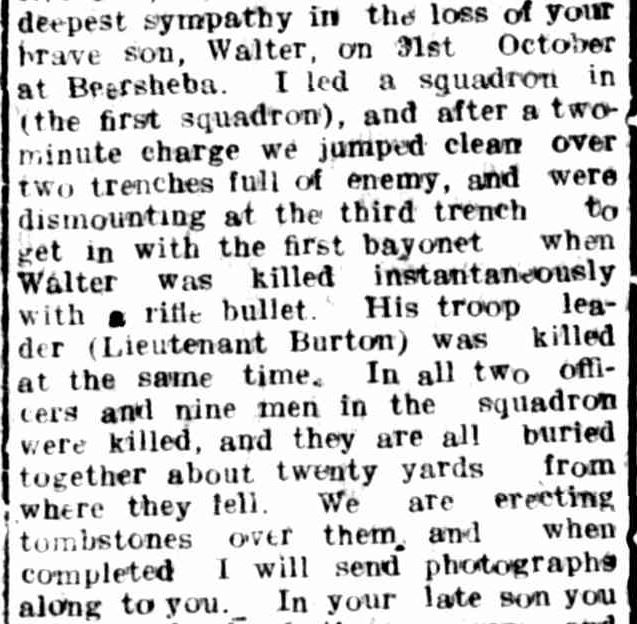
Walter Kinghorn was one of the brave troopers at the head of the charge. His father Francis received a letter from Major James Lawson, a hotel keeper from Rupanyup prior to the war, describing Walter’s last ride.
THE LATE LANCE-CORPORAL WALTER KINGHORN. (1918, May 9). Hamilton Spectator (Vic. : 1914 – 1918), p. 4. Retrieved April 21, 2014, from http://nla.gov.au/nla.news-article119501800
As members of the 4th Light Horse dismounted and fought the Turkish soldiers in the trenches, the 12th Light Horse passed them by and continued on to Beersheba clearing the way for the remaining squadrons to move forward, resulting in the capture of the town. Horses wasted no time drinking from the wells, another advantage of taking Beersheba. Some horses that had survived the gruelling gallop, dropped dead from exhaustion after drinking. Behind them, on the path they had travelled lay fallen horses, taken down from underneath their riders. Considering the number of troops involved and the great risk, the casualties were considered light with 31 men killed and 36 wounded. The loss of horses was higher, with 70 killed and at least 70 wounded.
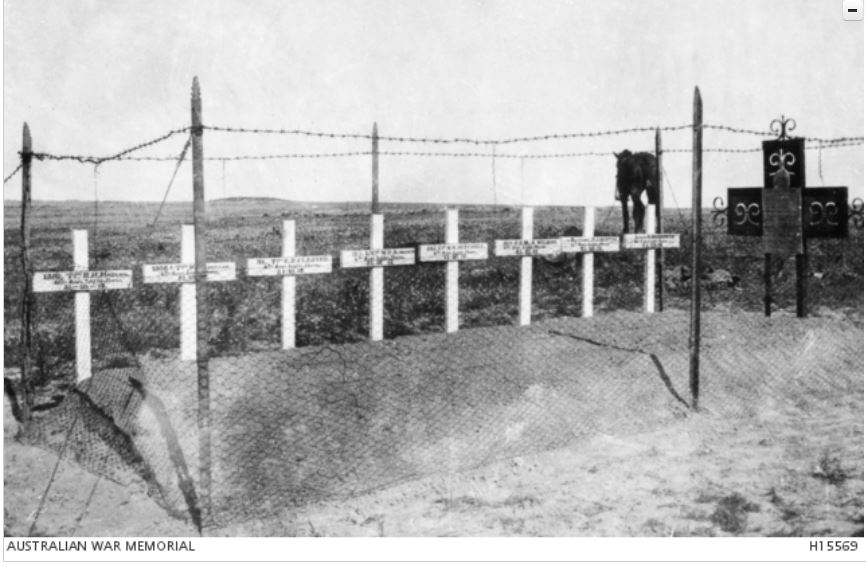
Seven other men died at the same trench as Walter from Troopers to Officers, and they were buried close to where they fell. Eight white crosses marked their graves.
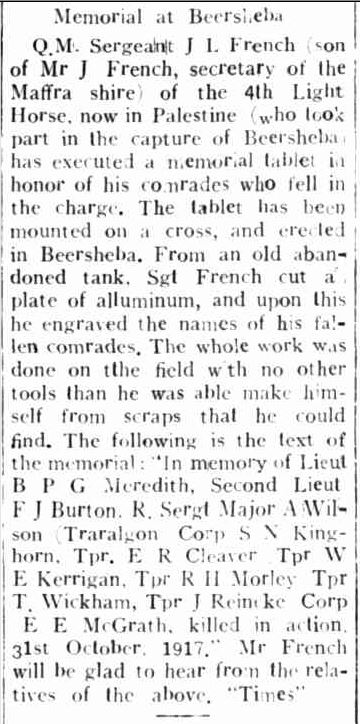
The 4th Light Horse Quarter Master Sergeant James French managed to craft a memorial plaque for the gravesite, using scrap metal, the debris of war. During the 1920s, the plaque was donated to the Australian War Memorial, but not before approval was given by the eight families.
Memorial at Beersheba. (1918, May 14). Gippsland Farmers Journal (Traralgon, Vic. : 1914 – 1918), p. 2. Retrieved April 21, 2014, from http://nla.gov.au/nla.news-article88057978
He may have been thousands of miles from home when he died, but a touch of Byaduk, family and friends was not far away from Walter. Also in Palestine was the No. 1 Squadron of the Australian Flying Corps (AFC) and among the ranks was Charles Harman, Walter’s brother-in-law.
The AFC’s role in Palestine was mainly surveillance, taking photos of the war front and military objectives, such as this photo above Beersheba.
Aerial View of Beersheba taken from the plane of No 1 Squadron AFC. Image courtesy of the Australian War Memorial. Image no. B02020 http://www.awm.gov.au/collection/B02020/
Charles Harman, 10 years older than Walter, married Walter’s eldest sister Catherine in 1905, but he would have known Walter all of his life. After all, Charles’s grandfather James Harman and the Kinghorns had neighbouring properties and in 1907, James and Jonathan Harman stood with Frank and Elizabeth Kinghorn for a photograph with other Byaduk pioneers. The two families had known each other for 50 years. Even while they were overseas, letters to Walter and Charles from home would have told them the news of the marriage of Walter’s brother David Kinghorn to Charles’ cousin, Charlotte Harman in 1915.
Charles Harman was a Sergeant with the AFC No. 1 Squadron mechanics. The mechanics made a memorial plaque and Charles erected it on Walter’s grave. A touching gesture and most likely one of the most difficult times of Charles’ war service. During the 1920s, the plaque was returned to the Kinghorn family after Walter and the other men were exhumed and buried at the Beersheba War Cemetery.
MEMORIAL PLAQUE MADE BY THE MECHANICS OF THE NO. 1 SQUADRON AFC Image Courtesy of the Australian War Memorial. Image No. B02143 http://www.awm.gov.au/collection/B02143/
WALTER KINGHORN. Photo taken at the 2015 Byaduk Spring Show. The photo of Walter was part of a larger tribute to him.
In contrast to the deserts of Palestine, back at home in Western Victoria, the spring grass was abundant, lambs were fattening and the local P&A Agricultural show season was underway. News of Walter’s death, however, began to reverberate from Byaduk by mid-November 1917. His death was felt as far away Trawalla, west of Ballarat, home to Walter’s sister Flora. Reports appeared in both the Ballarat Courier and the Ripponshire Advocate.
TROOPER W. KINGHORN. (1917, November 16). The Ballarat Courier (Vic. : 1914 – 1918), p. 1 Edition: DAILY. Retrieved April 21, 2014, from http://nla.gov.au/nla.news-article73334841
In the Hamilton Spectator, Frank Kinghorn gave thanks to all those who had paid tribute to his youngest son.
When Major Lawson corresponded with Frank Kinghorn the following year, he too paid tribute to Walter and reassured Frank that Walter had played a part in the “finest charge in the annals of modern warfare”. Little consolation for Frank, then in his 80s. He died in 1919.
THE LATE LANCE-CORPORAL WALTER KINGHORN. (1918, May 9). Hamilton Spectator (Vic. : 1914 – 1918), p. 4. Retrieved April 21, 2014, from http://nla.gov.au/nla.news-article119501800
Byaduk suffered the loss of 14 men during WW1 and the community moved to remember them. Described as a historic day for Byaduk, on June 28, 1918, the families of the local men that served, planted trees for an Avenue of Honor. Those who had paid the supreme sacrifice carried a laurel wreath on their plaques. One of Walter’s sisters, most likely Fanny, planted his tree. Mrs Hilda Harman, aunt of Charles Harman planted one for him, while Charles’ sisters Julia and Alice planted trees for the other Harman brothers to serve, Reuben Edward and William Louden.
A cousin of Charles Harman, Isabella Harman had two brothers-in-law served, Denis and Michael Bunworth. Denis was killed only a month earlier in France. As Isabella’s husband, Jonathan Bunworth planted a tree for his brother Michael, he could never imagine that within two weeks, Micheal’s plaque too would bear the telling laurel wreath. Michael was killed on 1 August 1918 in France. The deaths of the two Bunworth boys was also felt by the Kinghorns as Walter’s brother Frank Jr. married Denis and Michael’s sister, Johanna. Three families intertwined through marriage and united in grief.
In nearby Hamilton, the brave ride of the Light Horsemen at Beersheba was also remembered, with a row of 14 Aleppo palms planted along Alexandra Parade in 1920 as a tribute.
Unveiled in 1995, a memorial stone close to the palms completes the Beersheba memorial. Water Kinghorn’s name is beside Dunkeld boy, Edward Womersley, who died of his wounds in the days after the charge.
The horses of the Australian Light Horse, especially those from the Western District that never returned to rolling green pastures, but instead only knew sand, dust, flies, heat and death, their bravery and endurance should never be forgotten.
While in no way can the adrenaline, fear and the scale of the charge at Beersheba be recreated, the Australian film “The Lighthorsemen” does go some way to depict the events of 31 October 1917.
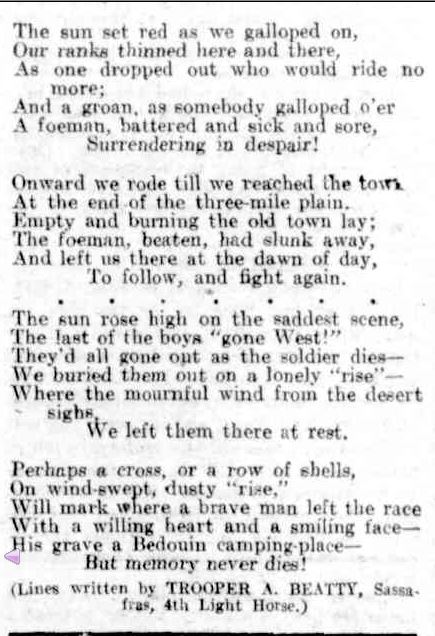
But nothing can go past recollections of those that were at Bersheeba such as the following poem by Trooper Arthur Beatty of Sassafras written in 1918 remembering those buried in a “Bedouin camping place”
That time of year has rolled around again…blogiversary time. Yes, Western District Families is three today and it’s party hat time.
MY NANA, LINDA HADDEN, IS IN THE BACK ROW WITH THE POINTY WHITE HAT
At first glance, my blogging year seemed uneventful. With much time taken up with study and family, and little left to write the type of posts I enjoy. But when I look back over the 100 or so posts of the past year, when at times I’ve felt as though I was in a tug of war with demands from everywhere, I didn’t too badly.
There has also been the ever dependable Trove Tuesday posts. This time last year I had written 33 Trove Tuesday posts and in the past year another 49 have evolved. I particularly enjoyed learning about Aaron Weller, who in 1897 was Victoria’s oldest man. I know some you are missing the Trove Tuesday posts, but they’ll be back. Another regular, Passing of the Pioneers, is still going strong and I will keep up the posts over the coming months. I haven’t counted for a while, but the number of pioneer obituaries is nearing 500.
There were some other highlights such as The Hamilton Spectator (1914-1918) arriving online at Trove. Also the birth of the Western District Families Facebook page now with 162 members. And of course, the re-incarnation of the “I’ve Lived in Hamilton, Victoria” Facebook group , with 2590 members. It has been huge, bringing me new friends, new research ideas and an increased knowledge of Hamilton and district.
But the biggest highlight once again was Western District Families inclusion in Inside History magazine’s 50 top genealogy blogs. To have Western District Families recognised with 49 fantastic blogs from Australia and overseas definitely takes the cake.
A Pleasant Distraction – Introducing the Hamilton Facebook group and an insight into the gathering of Hamilton social history that has resulted.
The General Hewitt – Portland Bay 1856 – First posted in March 2013, this post tells the story of the ship’s arrival in Portland Bay and the events in days after, along with some of the passengers who made the Western District their home.
Muntham Station – A You Tube clip, produced for the sale of the former Henty property, spurred me on to share a little of the history of the former Henty property.
It is also great to see the Links page getting many views and lots of clicks. I hope you found a useful Western District link.
Western District Families has really moved forward in the past 12 months. Views to the blog have almost doubled and at the last blogiversary had 64 followers, today there are 144. I would love to get back to the usual two posts a week, but while I’m working on my Diploma thesis I will be limiting my output here, but I’m looking forward to the second half of the year when I can share some more stories of our Western District Families.
March Passing of the Pioneers shares obituaries of well-known residents of Hamilton, Heywood and Portland. They include the surveyor of Camperdown and yet another man who was at Blue Lake, Mt. Gambier the day Adam Lindsay Gordon took his famed leap.
Thomas BROOKS: Died 7 March 1888 at Hotspur. At the time of his death, Thomas Brooks was one of the oldest inhabitants of the Heywood district, having arrived in 1853. His death was a result of an accident after sixty-two-year-old Thomas delivered a coffin to Hotspur from Heywood for the funeral of Mr Fidler. After the funeral, he returned home, only to fall from his horse. He received head injuries, from which he died. A contract worker for the local shire, Thomas was known as an eccentric and was referred to as “Old Tom Brooks” For more information about Thomas see the South-West Victoria Pioneers website.
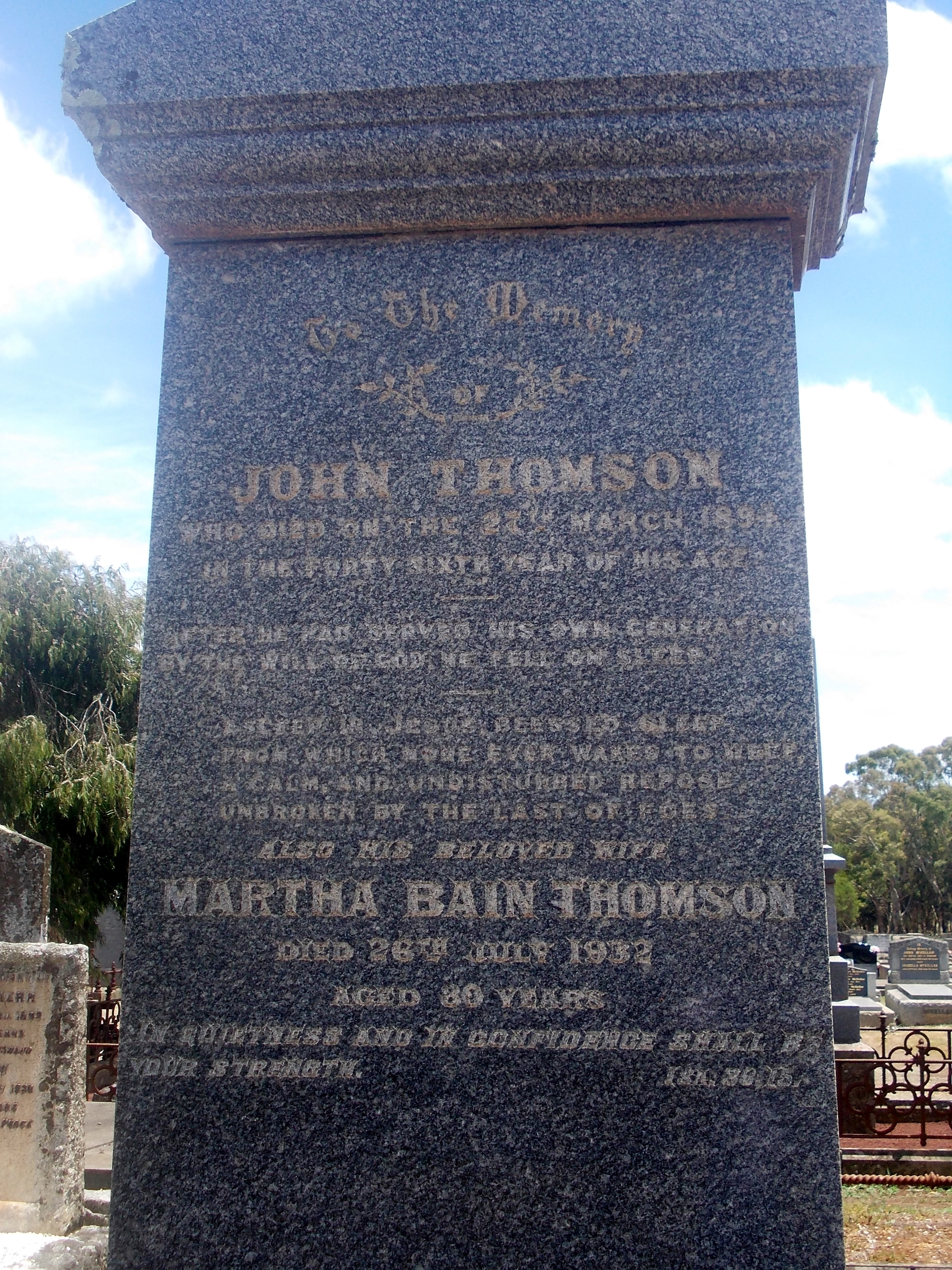
John THOMSON: Died 27 March 1894 at Melbourne. Anyone who lived in Hamilton and district prior to the late 1980s would know the name John Thomson as that was that name that adorned the front of one of Hamilton’s longest-running department stores John Thomson & Co of Gray Street, locally known simply as Thomsons. John Thomson arrived in Victoria from Scotland at a young age and was educated at Scotch College, Geelong, and the Hamilton Academy. He joined his uncle and brothers, Alexander and William in the store, first established as an Iron store in 1866, and later became a partner.
In 1877, John married Martha Bain Brake, He had a strong association with the Hamilton Presbyterian Church and when he died, aged forty-six, he was attending the Convention of the Presbyterian Fellowship Association in Melbourne. A diabetic, he fell sick over the weekend and died as a result.
Robert Dunbar SCOTT: Died 7 March 1898 at Surrey Hills. Robert Scott was born in Scotland and he and his wife arrived in Victoria around 1851. Robert was employed as a land surveyor, his first job to survey the western part of Port Phillip. He set up camp near what would become the town of Camperdown and set about laying out a new township. He named the first streets, including Manifold Street after the Manifold brothers. He selected land on the banks of Lake Gnotuk and established the property, Gnotuk Park.
Robert was a member of the local P&A Society and the Freemasons. In the late 1890s, he sold Gnotuk Park and let property at Craigieburn. He later moved to Melbourne establishing himself as a commission agent but lost money in the crash after the land boom. A further account of Robert Scott is on this link – A Link With The Past – Interview with David Scott.
Mercy ERRI: Died 26 March 1932 at Cobrico. Mercy Erri was born in England and arrived in Victoria with her parents in 1857. Her father started in business in Camperdown, one of the early pioneers of that town. Mercy trained as a nurse and was a Sunday School teacher. In her later years, she became an invalid, confined to her bed, but she continued to produce beautiful needlework, even with failing sight. Mercy was eighty-eight years old when she died. She never married.
James MOLLOY: Died 25 March 1937 at Portland. James Molloy arrived in Portland with his parents aboard the British Empire when he was eleven. He went to school at All Saints school in Portland and during those years spent time with William Dutton extracting oil from whale blubber. He was then employed by Edward Henty at Narrawong. His next job was for the Bell’s at Heywood, training racehorses, his greatest success winning the Great Western Steeplechase at Coleraine. Apparently, he was with Adam Lindsay Gordon on the day Gordon took his leap at Blue Lake, Mt Gambier. He later returned to Portland, working as a storeman and a waterside worker. James married Mary Beglen and they had three sons and two daughters.
David Edmund BATES: Died 5 March 1938 at Casterton. David Bates was born at Narracorte before moving to Casterton with his parents when six. He was educated at the Casterton school before becoming an apprentice draper with Mr Mills. David was an athlete and once ran second in the Stawell Gift. He took a great interest in the public affairs of Casterton and served as secretary on the Casterton Hospital board.
Eliza MOORE: Died 24 March 1939 at Colac. Eliza Moore was born in Ireland in 1854 and travelled to Victoria as a child aboard the Chance. Her parents settled at Port Fairy and later at Woodford. Eliza married Alexander Russell at Warrnambool and they farmed at Dennington. They then moved to Colac where they remained until Eliza’s death. In her younger years, Eliza was an excellent horsewoman and was devoted to the Church throughout her life.
Daniel FENTON: Died 17 March 1943 at Camperdown. Daniel Fenton was born in Camperdown in 1860 and was the first child baptised at the St. Andrews Presbyterian Church in the same year. He continued his association with the church for the duration of his life. Educated at Camperdown State School, he spent his entire working life as a dairy farmer. He married Mary Ann Shenfield of Cobden and five children were living at the time of Daniel’s death.
After 82 consecutive Trove Tuesday posts, I’ve missed one. Yes, I just couldn’t get a post prepared this week and I’m a bit sad that it has come to an end. I really was hoping to get to 100 without a break. Now that I have broken the succession, it is a good time to say that I will have a short break from Trove Tuesday.
With a lot going on in my life including a rapidly approaching due date for my thesis , I need to take a break. I will still have a March Passing of the Pioneers post (hopefully in time) and will of course post for the Anzac Day Blog Challenge, which I just can’t miss. In the meantime, if I get a chance to post I will, but I’m not making any promises.
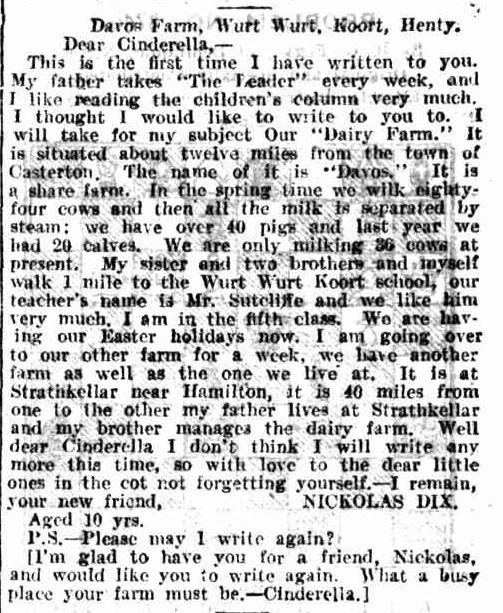
For Trove Tuesday this week, I intended to share some feedback from my post a few Tuesdays back called “Dear Cinderella”. It is always a bit nerve-racking when I write about someone, not related to me who people may remember. I did it when I wrote about Lottie Condon, Sultan Aziz, Elsie Day and again when I wrote about the owners of Skipton, the 1941 Melbourne Cup winner. I heard from family members of each of those people, which is great and, thankfully, the responses were positive.
I was lucky enough to receive an email and a blog comment from the granddaughters of Nicholas Dix, Paula and Dallas. Nicholas was one of the many children that wrote to the LeaderNewspaper’s “Dear Cinderella” column. His description of his farm life in the Western District gives those researching the area a great record of daily life during that time, but for Paula and Dallas it provides a wonderful piece of family history. His granddaughters on finding my post were “thrilled” to have this reminder of their much loved grandfather who passed away over 30 years ago.
I may have found the article, but it is the work of those at Trove Australia, bringing us the great resource of digitised newspapers, that led to Nicholas’ letter coming to light. Without the digitisation program, the letter may have remained buried in an archive, possibly to be never read again. My aim with many of my Trove Tuesday posts, is to find such lost treasures and bring them out for all to read. If you would like to read my previous 82 Trove Tuesday posts until I resume them again, follow the link – Trove Tuesday. In the meantime, I hope that other bloggers continue the Trove Tuesday tradition of sharing Trove’s treasures.
Still on the subject of Charles James Harman, this is an interesting snippet from the Townsville Daily Bulletin of September 3, 1930.
In the 1920s, Charles, his wife Lavinia Fisher and daughter Mary travelled to London for Charles to take up a post with the R.A.A.F. at the R.A.F. headquarters. His position was terminated in 1930 and the family returned to Melbourne. The world was in Depression and while this was not the apparent reason for Charles’ role ending, it was probably a good time to return home.
According to Lavinia, even if Australians in London had money in the bank they could only access their funds after a 60 day waiting period. The jewellery had to go with women selling off their valuables, probably at a deflated price, just to get some cash to survive.
AUSTRALIANS IN LONDON. (1930, September 3). Townsville Daily Bulletin (Qld. : 1885 – 1954), p. 7. Retrieved March 18, 2014, from http://nla.gov.au/nla.news-article60774888
Newspapers are great for filling in the gaps in our family histories, uncovering information that would never be known using vital records alone. That has been the case with my research on my gg uncle Charles James Harman. The co-subject of last week’s Trove Tuesday post, Charles just keeps popping up in the papers offering me more and more about him. I had found a lot of information on his post-war life in The Argus, but the arrival of the Hamilton Spectator and the Port Fairy Chronicle at Trove has helped me fill in his pre-war days, spent around Macarthur and Byaduk.
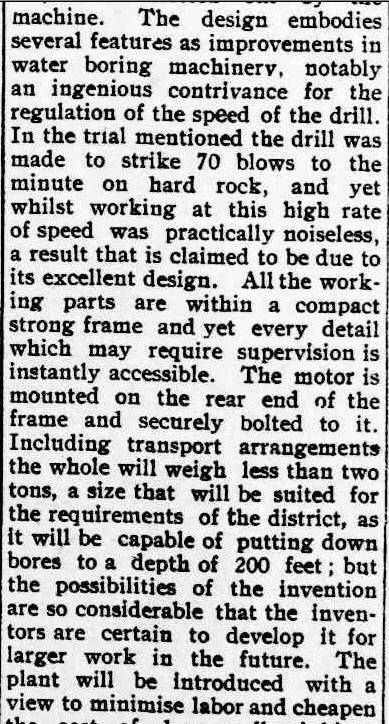
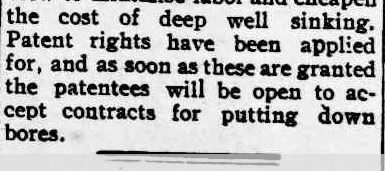
Firstly, I discovered why Charles’ engineering skills were quickly noticed by the Australian Flying Corps (AFC), with his mechanical crew keeping the No.1 Squadron in the air over Egypt during WW1. Also, I found Charles had a friend. Yes, even our ancestors had friends and I’m always keen to find those relationships. The following article from the Port Fairy Chronicle drew my attention to the working relationship between Charles and Arthur Parfrey, but the letter Charles wrote to Arthur, featured in last week’s Trove Tuesday, proved they were mates too.
Macarthur Matters. (1914, December 31). Port Fairy Gazette (Vic. : 1914 – 1918), p. 2 Edition: EVENING. Retrieved March 10, 2014, from http://nla.gov.au/nla.news-article91982808
Twelve months before this article, Charles became a widower after his wife Catherine Kinghorn passed away. Catherine was ten years older than Charles and thirty-seven at the time of their marriage in 1905. They never had children.
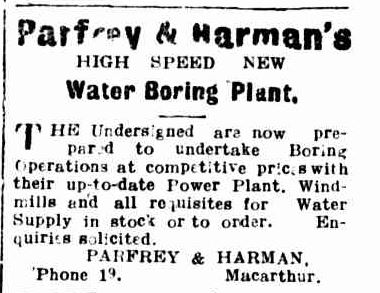
By January 1915, Charles and Arthur had their water-boring plant up and running and available for hire. Business was brisk with dry conditions prevailing.
Macarthur Matters. (1915, January 18). Port Fairy Gazette (Vic. : 1914 – 1918), p. 2 Edition: EVENING. Retrieved March 10, 2014, from http://nla.gov.au/nla.news-article94724361
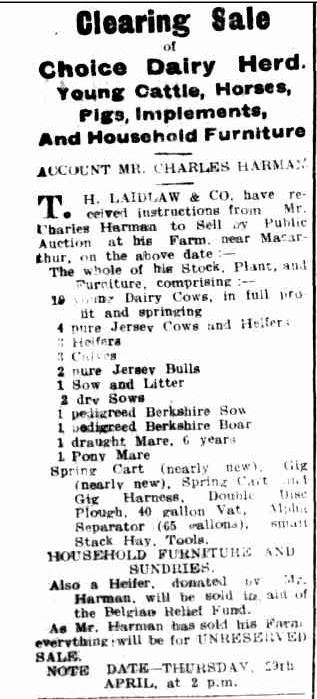
But things can change so quickly and with the war escalating, drought, and no family ties, Charles sold up everything in April 1915. On 12 July 1915 at the age of thirty-six, Charles enlisted, never to return to the Western District as a resident again.
The rise of Charles through the ranks with the AFC, finishing the war as a 2nd Lieutenant with military honours, led to a posting in London during the 1920s with the Royal Australian Air Force (RAAF) followed by a life in Melbourne until his death in 1943. The last half of Charles’ life was a total contrast to the first half. He went from pigs and dairy cows on the farm at Macarthur to rubbing shoulders with the high-ranking officers in the Royal Air Force and RAAF, flying in airships and attending the funeral of the victims of the R101 airship crash at St Paul’s Cathedral, London. Other attendees included some of the highest-ranked officials in England including the Prince of Wales. All found out thanks to online newspapers at Trove.
CHARLES HARMAN (Back row, 2nd from left) WITH THE COMMANDING OFFICER AND FLIGHT COMMANDERS OF NO. 1 SQUADRON AFC AT PALESTINE NOVEMBER 1918. Image courtesy of the Australian War Memorial https://www.awm.gov.au/collection/C960630
This is my eightieth consecutive Trove Tuesday post but I thought my run would end at 79. Yesterday I took a tumble and now have soft tissue damage in my knee and after a late night in the emergency department, things weren’t looking good for an eightieth Trove Tuesday post. Thankfully, I had started the post over the weekend, so I thought I would give you what I have so far and finish next Tuesday with the relationship between the subjects in my article, found once again at Trove.
Over the past weekend, the R.A.A.F. celebrated 100 years of military aviation with an air show at the Point Cook R.A.A.F. base. So, I thought it was a good time to share an article I found about my gg uncle Charles James Harman, I found in the Hamilton Spectator when the paper came online in 2013. Charles was the son of Reuben James Harman and Lizzie Bishop and grandson of James Harman and Susan Reed of Byaduk. He has had a post here before, about the time he took a flight in the R101 airship.
Charles Harman joined the Australian Flying Corp in 1915 as a Flight Sergeant and over the course of the war rose to an officer ranking with the No. 1 Squadron of the A.F.C. He spent most of the war in Egypt and mid-way through 1916, wrote home to his mate and business associate, Arthur Parfrey of Macarthur. Arthur passed the interesting letter across to the Hamilton Spectator and the paper published it on 14 September 1916.
The flight he writes of was with pilot Oswald Watt as they reached heights of 7000 feet. Considering the planes the then Major Watt was flying, they were daring. Oswald Watt’s biography is available to read at the Australian Dictionary of Biography.
When an obituary has only a female pioneer’s married name, I do like to find their maiden name. This month, there was one such pioneer, Mrs Susan Sloan. After a quick search, I found on her death record her father’s name recorded as Francis Sloan. As I don’t want to make assumptions based on a death certificate, I will continue to call her Mrs Susan Sloan, however, I will keep trying to find her maiden name in the future as I have an interest in Susan as you will see in her obituary below.
Marks DAFFY: Died 22 February 1902 at Cundare. Marks Daffy was born in County Clare, Ireland, and arrived in Melbourne in 1857. He spent his first five years in the colony around the Barrabool Hills near Geelong, working on various farms. With money saved, Marks selected land in the Colac district after the passing of the 1862 Duffy Lands Act. He set about building a fine dairy farm, using his good eye for stock to select the best dairy cows. He gave up dairy-farming after twenty-five years and settled into an “easier” life as a grazier. In 1887, after dissatisfaction with the Colac Shire, he ran for a seat which he won. Around eighteen months before his death, a fall from his buggy eventually left him bedridden and ultimately claimed his life. His funeral procession was a mile long and was the largest to arrive at the Cundare cemetery.
William MOODIE: Died 25 February 1914 at Coleraine. William Moodie arrived in the Coleraine district with his Scottish parents at the age of six weeks around 1841. His father took up the property Wando Dale at Nareen and so began William’s life on the land, breeding some of the finest wool stock. After taking over the property from his parents, he built the current Wando Dale Homestead (below) in 1901.
“WANDO DALE”, NAREEN. Image courtesy of the J.T. Collins Collection, La Trobe Picture Collection, State Library of Victoria. Image No. H94.200/302 http://handle.slv.vic.gov.au/10381/217385
He also spent a good part of his seventy-three years in public life. He was a member of the Casterton Roads Board and the Wannon Shire Council. He was also involved with the P&A Society, the local Horticultural Society and St Andrews Church at Coleraine. William Moodie left a widow, seven sons and five daughters.
John KELLY: Died 7 February 1915 at Macarthur. John Kelly arrived from Tasmania, his birthplace, with his family when he was three years old. If John was eighty-five at the time of his death, it would mean that he arrived in Victoria in 1833, so I’m thinking it may have been a little later. Even still, he was an early arrival in the colony. John worked as a carrier with his brother, working the route between Geelong and stations as far west as Casterton. He also ran a store at Yambuk for many years and took up property at Codrington. He died at the home of his daughter Mrs Hindhaugh of Macarthur.
John MURRAY: Died 13 February 1915 at Hamilton. Born in Stirlingshire, Scotland, John Murray was a resident of Hamilton for over fifty years by the time of his death. His family arrived at Geelong aboard the Chariot of Fame and went directly to Hamilton. He spent much of his working life as a labourer and was a member of the Court Brotherhood of the Ancient Order of Foresters for over forty-five years. He was a widow and left five sons and one daughter from a family of twelve children.
Jane O’MAY: Died 17 February 1916 at Buckley Swamp. Jane O’May was born in Paisley, Scotland in 1822 and married William Kirkwood in 1842. William and Jane arrived in Portland in 1852 aboard the John Davis. They travelled by bullock dray to Warrock, near Casterton.
First Issue, August 20 1842. (1916, February 23). Portland Guardian (Vic. : 1876 – 1953), p. 2 Edition: EVENING. Retrieved February 22, 2013, from http://nla.gov.au/nla.news-article64013668
The Kirkwoods were hard-working pioneers and Jane left a large family at the time of her death. Three daughters were still alive along with twenty-four grandchildren and twenty-one great-grandchildren. Jane’s grandson, William Kirkwood of the Hamilton South area, married my first cousin 4 x removed, Sarah Ann Reed.
James COWELL: Died 24 February 1917 at Mortlake. James Cowell was born in Cambridgeshire around 1838 and by 1868, had already established a butcher’s shop at Mortlake. He later became a road contractor for the local Shire. One of James’ three sons, Pte Harry Cowell, lost his life at Gallipoli.
Joseph WOMBWELL: Died 9 February 1918 at Casterton. Arriving in Portland in 1853 aged seventeen years from Essex, England, Joseph Wombwell’s first job was at the Henty’s MunthamStation. He married Betsy Ann Coulson in 1869, the daughter of Christopher Coulson and Mary Frances Stubbs and stayed in Merino until 1875. They then moved to Casterton and lived in a bark hut while Joseph ran a carrying business between Casterton and Portland. One claim to fame is that he delivered the “first load of grog” to the Sandford Hotel. The HamiltonSpectator also published a lengthy obituary for Joseph Wombwell
Susan SLOAN: Died 9 February 1918 at Hamilton. Susan Sloan was born in Glasgow, Scotland and after arriving in Portland in 1855, she went to Ararat where she married Thomas Sloan. They returned to Portland and ran a shipping business, but the trade was tough and they moved inland to Hamilton where there were greater opportunities, and they established a cordial business. Thomas died in 1910 and Susan continued to run the business until her death, after which time family members continued its operations until 1930. The Sloan’s cottage Whinhill in Pope Street, Hamilton was featured in an I’ve Lived in Hamilton, Victoria group post as it is a highly visible and known to most who have lived in Hamilton. None of us knew the history of the cottage and there is still more we would like to find out. The cordial business operated behind the cottage.
John MOFFATT: Died 9 February 1926 at Chatsworth. John Moffatt was born in Scotland in 1854 and arrived in Victoria with his parents in 1872 and resumed his education at Geelong Grammar. At age 19 he took up the running of the Burnewang Estate near Bendigo before he inherited Chatsworth House from his uncle John Moffatt in 1879. He also leased his uncle’s property Hopkins Hill from the estate’s trustees. John Moffatt was a sat on the Shire of Mt Rouse and was a member of the Landowner’s Council.
DEATH OF MR. JOHN MOFFATT. (1926, February 10). The Argus (Melbourne, Vic. : 1848 – 1957), p. 21. Retrieved February 28, 2014, from http://nla.gov.au/nla.news-article3733963




















 Western District Families
You must be logged in to post a comment.