Called by God

While writing the history of the Harmans of Byaduk, I immersed myself in the family’s daily lives and at times felt as though I was there with them.  With my ggg grandfather James Harman, I was among the congregation at the Byaduk Methodist Church and traversed the countryside as he conducted his Local Preacher duties. I attended sheep and Pastoral and Agriculture (P&A) shows and learnt the finer points of tilling the soil at ploughing matches.  I  felt James’ pride in 1907 as he stood with his fellow pioneers and friends for a photograph before his beloved Byaduk Methodist Church (below) and shared his satisfaction when he won a Lincoln ram at the Hamilton P&A show.

BYADUK PIONEER DAY - March 27, 1907. JAMES HARMAN (Back Row, 6th from right), JONATHAN HARMAN (Back Row, 5th from right), ELIZABETH OLIVER, widow of REUBEN HARMAN (Front row, 2nd from right). Photo courtesy of the Hamilton History Centre.

BYADUK PIONEER DAY – March 27, 1907. JAMES HARMAN (Back Row, 6th from right), JONATHAN HARMAN (Back Row, 5th from right), ELIZABETH OLIVER, widow of REUBEN HARMAN (Front row, 2nd from right). Photo courtesy of the Hamilton History Centre.

The post False Alarm, revealed my ongoing frustration of not having an obituary written about James Harman, my favourite ancestor. One such as those written for his brothers Jonathan and Walt, lengthy, information-packed tributes which told me much about the type of men they were.  An obituary for James in the Hamilton Spectator came close but I wanted more.

Just a few weeks before my thesis was due, the Spectator and Methodist Chronicle (Melbourne 1914-1918) came online at Trove and there was an obituary for James. Unfortunately, the article was still undergoing quality control checks so the wait was on.  My “Electronic Friend” would send an email when the article was ready to go but no amount of checking my inbox made the article arrive.  The submission date for my thesis came and went and still, the article was unavailable.  Until yesterday.

The obituary was signed “W.H.G” and knowing something of the Byaduk Methodist Church helped me name the author as the Reverend William Herbert Guard who presided over the church at the time of James’ death.  His tribute answered one of my questions about James.  When did he become involved with the Wesleyan Methodist Church?  Was it when he arrived in Port Fairy in 1852?  Or when the family spent some time at Muddy Creek before going to Byaduk.  Muddy Creek had a strong Methodist community of Wesleyans, Primitives and Reformers who had arrived via Port Fairy.  But, according to Reverend Guard, James’ commitment to Methodism began before leaving Cambridgeshire.

Reverend Guard visited James in his last days and recounted those visits but most powerful were his recollections of James’ final hours. “I’m going home,” a weakening James told him. Then in his last moments, James raised his hand and uttered his last word “Coming” and with that, he was gone. James was ready to meet his God. Many obituaries describe the last moments of a person’s life but often in a clinical fashion. W.H.G.’s description was spiritual.  Such was James’ devotion it couldn’t be any other way.

James was not just “going home” to God. His beliefs gave him the faith to believe he was also joining his wife Susan Reed.  The obituary confirmed the bond he shared with Susan, forged over sixty-four years.  Susan died on 10 April 1916 and James on 13 August in the same year.  I have always thought the few months apart was too long a time for James. He had lost the woman who gave him strength and after only four months they were reunited at the Byaduk Cemetery.

TOGETHER AGAIN

TOGETHER AGAIN

There is little information about Susan’s life besides her birth, death and children in-between.  But she was with James when they left Melbourn, Cambridgeshire as newlyweds and endured a forgettable voyage on the Duke of Richmond.  She travelled with him from the port of Portland to Port Fairy for James’ first employment in Victoria and together they endured the pioneering life at Byaduk.  No doubt she sat up late into the night waiting for James to return from church meetings and sheep shows in neighbouring towns.

Reverend Guard brought to my attention something about Susan I did not know and it was sad to read of her blindness in her last years.  That is now obvious when I look at her in this treasured photo passed on to me by James and Susan’s great-grandson Mike Harman.

JAMES & SUSAN HARMAN. Photo courtesy of Mike Harman & family.

JAMES & SUSAN HARMAN. Photo courtesy of Mike Harman & family.

On reaching the end of Reverend Guard’s tribute, chills had come over me and tears filled my eyes.  Since that first reading, I have thought often of those last hours of James’ life with sadness. After feeling many emotions while researching James’ life, for the first time, I was feeling grief.  It is the only time I have felt that emotion about my long departed ancestors.  Usually, such discoveries evoke feelings of jubilation such as the revelation my ggg Grandmother Ellen Barry died in a house fire caused by her insobriety or learning my gg aunt Ellen Harman dropped dead on the floor while cooking breakfast for her son.  While I did feel sad for their unfortunate passing, always in the back of my mind was the thought “That will be good for the family history”.  But the tears that came to my eyes when reading about James weren’t because this useful information missed my thesis, it was because I felt like I was saying goodbye.

Snapping back to reality, I reminded myself the never-ending journey of family history will bring new stories of James and I can once again join him on his life’s adventures.

james

jh3

"In Memoriam." Spectator and Methodist Chronicle (Melbourne, Vic. : 1914 - 1918) 11 Oct 1916: .

“In Memoriam.” Spectator and Methodist Chronicle (Melbourne, Vic. : 1914 – 1918) 11 Oct 1916: <http://nla.gov.au/nla.news-article154270437&gt;.


Trove Tuesday – Friends Wanted

It’s Trove Tuesday and this is my first TT post since June.  I’ve been looking forward to sharing this little find from The Australian Worker (Sydney).  After coming across these two articles I must say I laughed about their contents for days and all because a typesetter used an “m” instead of a “p.”

The first excerpt is a letter written to the “Children’s Letters” column by my 2nd cousin 3 x removed,  Iris Olive Harman of Ecklin South.  Iris was the daughter of Arthur John Harman and Ellen “Nellie” Matilda Rodgers and was born in 1900 at Cobden,  She was around sixteen when she wrote her letter.  Her grandfather was Jonathan Harman of Byaduk.  She had three older brothers who she mentioned in her letter, Arthur Ernest, Frederick Reginald and Edward George.  They were around 20, 24 and 26 in 1918 and all unmarried.  Iris’ father had moved to Byaduk to live with his father Jonathan four years earlier and I’m still yet to discover what happened to his and Nellie’s marriage.   Iris, a Christian woman was a spinster until into her fifties, marrying William Wormald in 1957.  She died in Warrnambool in 1989.

Knowing that about Iris, you too will be as shocked (and no doubt amused) as I was when I read her letter:

"CHILDREN'S LETTERS." The Australian Worker (Sydney, NSW : 1913 - 1950) 26 Apr 1917: 11. .

“CHILDREN’S LETTERS.” The Australian Worker (Sydney, NSW : 1913 – 1950) 26 Apr 1917: 11. <http://nla.gov.au/nla.news-article145807620&gt;.

Oh dear, the scandal.  A young Christian girl was in search of “men friends.”

It took three months, but finally, an explanation was forthcoming:

"TO CORRESPONDENTS." The Australian Worker (Sydney, NSW : 1913 - 1950) 12 Jul 1917: 13. .

“TO CORRESPONDENTS.” The Australian Worker (Sydney, NSW : 1913 – 1950) 12 Jul 1917: 13. <http://nla.gov.au/nla.news-article145807931&gt;.

While I amused myself for days after, relaying the story to anyone who pretended to listen, I must consider the shame such a tiny slip up caused as implied in the newspaper’s apology.   In the years following, Nellie, Iris and brother Frederick packed up and left for Warrnambool for no apparent reason.  Now having found these articles, I’m wondering if the shame brought to the family may have prompted the move.

In the Social Pages

A former Melbourne newspaper  Table Talk (1885-1939), a weekly social publication, had its release online at Trove at few months ago.  It  quickly went on my list of favourite newspapers for the photos, the fashion and the insight into the social life of Victorians, particularly the upper classes.   There was no need for Facebook in those days.  Socialites just had to share their status with Table Talk and friends could read with envy of trips to London, extended stays in fine Melbourne hotels or a day at the local fox hunt.

In a Trove Tuesday post in June, I lamented that I had been unable to find any family members in Table Talk.  I dug a little deeper and finally I found a photo of a 2nd cousin 2 x removed, Pauline Florence Marchant.


GEELONG NOTES. (1933, November 16). Table Talk (Melbourne, Vic. : 1885 - 1939), p. 48. Retrieved July 19, 2014, from http://nla.gov.au/nla.news-article147259192

GEELONG NOTES. (1933, November 16). Table Talk (Melbourne, Vic. : 1885 – 1939), p. 48. Retrieved July 19, 2014, from http://nla.gov.au/nla.news-article147259192

Pauline was the daughter of Percival “Percy” John Marchant and Elsie Annie Hughes of Geelong.  On her paternal side, Pauline was a granddaughter of Samuel Thomas Marchant, a well-known optician from Geelong and later Melbourne, and Emily Jane Entwistle.  On her maternal side, she was the granddaughter of Frederick Charles Hughes and my ggg Aunt Martha Harman of Hamilton.  Pauline was photographed at St Claire, her families’ residence near the Geelong Botanical Gardens.  St Claire is a lovely home and still stands today.  Pauline’s father Percy was also an optician as was her maternal uncle Russell Hughes of Hamilton.

Table Talk is full of Western District people so check it out.


Passing of the Pioneers

Just a small group of pioneers for the September Passing of the Pioneers.  While the number of obituaries now available are beginning to dwindle after three years of Passing of the Pioneers, time was more of a constraint this month.  On the bright side, it ensures there will still be some pioneer obituaries to share next September.

Margaret O’GORMANDied 9 September 1914 at Mortlake.  Born in Tipperary, Ireland around 1821,  Margaret arrived in Victoria around 1851. She married Patrick Finn in 1855 and they settled in the Mortlake district. Her obituary read, ‘…she was able by her lovable  manner to render and dispense happiness and sunshine wherever she went.’  Patrick died thirty-four years before Margaret and she left four sons and one daughter.  Margaret was buried at the Mortlake Cemetery.

Charles Turner MEDEW: Died September 1914 at Allansford.  Charles Medew was born in Cheltenham, England in 1837 and arrived in Victoria aboard the ship William around 1857. Charles settled in Warrnambool and working as a builder  he built two bridges across the Hopkins River. He selected land near the Warrnambool Cheese and Butter Factory, and in 1914 the site was still known as “Medew’s Corner” although Charles had moved to Melbourne.  Around 1910, Charles built a model airplane and it is now held by Museum Victoria. Charles was visiting his daughter at Allansford when he died.

Mary KESSELL: Died 7 September 1917 at Ararat. Mary and her husband Thomas Gillies were originally from Penzance, Cornwall and arrived at Warrnambool in 1854 aboard the Panama with their infant son. They went to the Ararat diggings in 1856 were they permanently settled. The Gillies family grew to ten, seven sons and three daughters and by the time of her death, Mary had twenty-eight grandchildren and nineteen great-grandchildren. Even into her last years, Mary could recall the early days of Ararat. Her funeral saw a large turnout as the people of Ararat paid their last respects to one of their oldest residents.

William HOWARD: Died 28 September 1916 at Ararat. William Howard was born in Liverpool, England and arrived in Victoria in 1853. The following year he hit the diggings, first at Maryborough, then Fiery Creek and on to the Ararat region.  He eventually took up the lease of the Terminus Hotel at Ararat and later he built the Ararat Coffee Palace. At the time of his death, he left a widow and three grandchildren.

Thomas SHENFIELDDied 2 September 1937 at Cobden. Thomas Shenfield was born at Camperdown in 1861. The following year his family moved to Cobden where Thomas lived out his life. He married Nellie Baker of Cobden and they had six children. Thomas took an interest in the progress of Cobden and was a director of the Tanadrook Cheese Factory (below). He was also a member of the Cobden Methodist Church.

TANDAROOK  CHEESE FACTORY.  Image courtesy of the State Library of Victoria, J.T. Collins collection.  Image no. H98.251/1632 http://handle.slv.vic.gov.au/10381/234397

TANDAROOK CHEESE FACTORY. Image courtesy of the State Library of Victoria, J.T. Collins collection. Image no. H98.251/1632 http://handle.slv.vic.gov.au/10381/234397

Maniacs and Milestones

It’s been awhile since I let you know what I’ve been up to.  In just under two weeks (or hopefully before) I will submit a thesis, a history of the Harman family, to the Society of Australian Genealogists for assessment.  It’s been a crazy 12 months and if I had known some of the things life was going to throw at me over the year, I would probably would not have started it.  But I did and I’ve almost made it and I know it will be worth it.

Mania has made its presence felt lately and that’s not just me as I  finish my Harman history.  Rather, the two mystery children of my ggg uncle Jonathan Harman have bestowed their mania upon  me.  A few months back I wrote about Looking for Mary Ann.  Well I found her.  She did not die as a baby as many Harman researchers have assumed, including myself.  Instead, in the years after her mother’s death in 1884, Mary Ann sunk into a deep depression before her admission to the Ararat Asylum in 1893 where she was a patient for six years.  Thirty two years later her brother Jonathan was also admitted and remained there for 15 years.


ARARAT ASYLUM

ARARAT ASYLUM. Image Courtesy of the State Library of Victoria, Image no. H32492/2366 http://handle.slv.vic.gov.au/10381/63814

Since my suspicions were confirmed I have felt so sad for their father Jonathan.   Despite the death of his wife Mary Oliver at age 41, 46 years before his own death, two children dying as babies and one as a teenager, two children in the Ararat Mental Asylum and an illegitimate grandchild, he was a kind man with a happy demeanor.  I’ve actually grown quite fond of him.   I’ve also been struck at how his life evolved so differently to his brother’s, my ggg grandfather James Harman.  Both settled and farmed in Byaduk until old age and each had 10 children but that’s where the similarities ended.  Yet Jonathan appears to have accepted his lot in life and maybe his Methodist beliefs enabled him not to have feelings of regret or envy toward his brother.  Instead they were close to the end.

While there have not been  many new posts in the past few months , Western District Families has still been passing a few milestones.

Image courtesy of the State Library of Victoria J.T.Collins collection.  Image no. H98.252/296 http://handle.slv.vic.gov.au/10381/235053

Image courtesy of the State Library of Victoria J.T.Collins collection. Image no. H98.252/296 http://handle.slv.vic.gov.au/10381/235053

Recently the blog passed 100,000 page views and is now well on the way to 110,000.  There are now  162 of you following the Western District Families blog and 264 people “like” the Facebook page.  Thank you to everyone who has subscribed to the blog or liked the page.  I’ve been  delighted with Western District Families’ rise this year and I think the Facebook page has a lot to thank for that.  While I may not have time to write a blog post, I can always find a moment to share a photo or link or post one of the 300 posts from the past three years.

During August and September I have posted regular articles from the Hamilton Spectator to the Western District Families Facebook page.  The articles are about WW1  but not news from overseas. Rather they are about the war related happenings in Hamilton during that time.  I’m interested in the residents’ first responses,  their changes in attitude toward the war and toward the many people of  German descent living in nearby towns such as Tabor and Hochkirch .  I do know that anti-German sentiment did grow resulting in a change of name for Hochkirch to Tarrington, a safe Anglo-Saxon name taken from the nearby estate once owned by Stephen George Henty.  I’m also keen to see how The Hamilton Spectator reported those matters.

In around two weeks I hope to hit the ground running with some new blog posts and I can’t wait.  I’ve missed it but I have 20 draft posts in various stages of completion and I’m itching to share them.  For “Trove Tuesday” fans, there is also a long list of “Trove Tuesday” type articles ready to go.  So thank you for hanging in there and I’ll be back with you soon.


Passing of the Pioneers

A small band of Pioneers come together for August Passing of the Pioneers. They include the first Mayor of the Borough of Portland and a crew member of William Dutton’s whale boat.

William McLEAN: Died 28 August 1888 at Port Fairy. At the time of his death, William McLean had resided at the Port Fairy Benevolent Asylum for ten years and was known to all as “Old Billy”. In 1887, he spoke about his life from his time in his birthplace of Scotland. William was born around 1790 and when around twenty, he joined the navy and was a crewman on the HMS Warspite which brought him to Sydney while escorting convicts in 1822.  After meeting some whalers, he decided to jump ship and join them. The whaling ship belonged to William Dutton, one of the first whalers to Portland Bay and William was with him.

Image Coutesy of the State Library of Victoria.  Image no.  PN05/05/77/00  http://handle.slv.vic.gov.au/10381/78495

Image Coutesy of the State Library of Victoria. Image no. PN05/05/77/00 http://handle.slv.vic.gov.au/10381/78495

When asked who was the first to Portland Bay, William Dutton or the Hentys, William replied that Dutton and his crew were there long before the Hentys. Later, William spent time whaling at Port Fairy where he settled.

Mary GRIERSON: Died August 1914 at Port Fairy. Mary Grierson was born in Scotland in 1827 and arrived in Victoria with her parents in 1839. They had sailed aboard the David Clark with Port Fairy’s Captain Mills at the helm.  Mary married David Thomas in 1846 and they settled at Rosebrook, near Port Fairy. They had a family of twelve, six girls and six boys. Mary was a member of the Presbyterian church and her goodwill was known throughout the district.

Thomas BEVAN: Died August 1915 at Colac. Born in Devonshire, England in 1829, Thomas Bevan arrived in Geelong in 1851. He moved to Beeac and became a local preacher for the Methodist Church. Thomas worked hard to build the community and had a strong involvement in all aspects of public affairs. He was also a musician, with violin and flute his instruments both learnt while still in England.

George HAYNES: Died 18 August 1916 at Port Fairy. The Port Fairy Town Hall flag flew at half mast the day George Haynes passed away. George was one of Port Fairy’s earliest residents and the first Mayor of the Borough. George was born in Staffordshire in 1826 and at the local grammar school. In 1854, he and his wife travelled to Australia, landing at Melbourne where they remained for around a year. George then moved on to Port Fairy where he settled and established a merchant business, Haynes and Young. Married twice, George had seven children from his first marriage.

Advertising. (1915, February 1). Port Fairy Gazette (Vic. : 1914 - 1918), p. 4 Edition: EVENING. Retrieved August 30, 2014, from http://nla.gov.au/nla.news-article94722841

Advertising. (1915, February 1). Port Fairy Gazette (Vic. : 1914 – 1918), p. 4 Edition: EVENING. Retrieved August 30, 2014, from http://nla.gov.au/nla.news-article94722841

Joseph LEWIS: Died 27 August 1916 at Port Fairy. Joseph Lewis was born in Staffordshire around 1824 and travelled to Australia aboard the Royal Saxon, landing at Williamstown in 1841Also on board was a relative of Charles Dickens.  After some time working at Little River Joseph travelled to the Grampians with a Mr Dwyer and they attempted to run cattle.  Unsuccessful, Joseph moved on to Port Fairy and purchased the property Glenview, residing there until old age when he moved into the Port Fairy town. Joseph left a widow, four sons, four daughters, thirty-two grandchildren and eighteen great-grandchildren.

Denis BERMINGHAM: Died 17 August 1917 at Port Fairy. Denis Bermingham was from Ireland and arrived in Port Fairy aboard the Chance during the 1850s. Spending time at Koroit and then Woodlands, Denis worked on the land. After moving to Port Fairy the 1880s, he worked for a few years on the harbour. Denis and his wife had thirteen children, nine of whom were still living at the time of Denis’ death.

Robert LEISHMAN: Died 28 August 1917 at Port Fairy. Robert Leishman was born in Scotland around 1830 and arrived in Victoria as a boy in the 1850s. After some time spent at Woodford, he settled at Crossley and for many years ran the farm Cockpen. He had also spent some time working on Korongah Station, then owned by Messrs. Knight and Lydiard.  It was there, during the 1870s that Robert’s wife passed away. During their time together they had a family of five. In the last years of Robert’s life, he moved to Rosebrook and then Bank Street, Port Fairy.

Passing of the Pioneers

When I started posting pioneer obituaries under the heading “Passing of the Pioneers” in July 2011, I never imagined that “Passing of the Pioneers” would still be going three years on. (I didn’t think Western District Families would still be going). Nor did I expect that I could announce this month marks the posting of the 500th pioneer obituary. Over the three years, thanks to the stories of those 500 pioneers, the amount I have learnt about Western District history and the families who built that history has been invaluable. However, the best aspect has been the number of people who have contacted me after finding their pioneering ancestor in the posts. I hope what I have provided has gone a little way toward them learning more about their ancestors’ lives.

The precis I give for each pioneer summarises the obituary that appeared in the paper when the pioneer passed away.  I don’t check the facts written there, such as ships sailed on or years of arrival.  I do search for the maiden name of married women, simply because I prefer to list them with their maiden names and not Mrs A. Smith, for example.  Sometimes I will search for further information about a pioneer and in the entry I include links to the sources I have found. So basically, what I give you is an index to pioneer obituaries with a link to the original and from there you can make what you like of the information provided at the time of the pioneer’s death. Obituaries are, after all, an inaccurate source as the information contained is second or third hand and rarely do you read of negative characteristics of a person or their failures in life.

Importantly, I must thank Trove Australia because without the digitised newspapers I would never have been able to find the 500 obituaries of some of the Western District’s great pioneers.

You can either search or browse the Passing of the Pioneers obituaries. Search a family name in the search box on the side bar of this page or select “Pioneer Obituaries” in the category box, also on the sidebar.  You can then browse through the 36 posts beginning with the most recent.  Simply click on the name of the pioneer to go to the newspaper obituary. If you find a family member, feel free to comment and give more information if you have any.  Leaving a comment increases your chance of finding someone else researching the same person.

____________________________________________________

This month’s pioneers include two men who knew family members of mine with both men being important figures in their respective towns. There is also a bricklayer, a publican and one of the men who discovered the Londonderry mine at Coolgardie, Western Australia.

Hugh MURRAY: Died 28 July 1869 at Colac. Hugh Murray was born in Scotland about 1814 and arrived in Tasmania with his parents and siblings in 1823.  At the age of twenty-three, Hugh left Tasmania for Victoria and settled on the banks of Lake Colac before there was a town and today is considered Colac’s first white settler. Hugh had pastoral interests but also sat as a Magistrate at the local Colac Magistrates Court. Last month’s Passing of the Pioneers included the obituary of Elizabeth Young of Hobart who married Hugh Murray in 1841.

EARLY SETTLEMENT AT LAKE COLAC c1875, BY NICHOLAS CHEVALIER. Image courtesy of the State Library of Victoria. Image No. H3572 http://handle.slv.vic.gov.au/10381/81081

EARLY SETTLEMENT AT LAKE COLAC c1875, BY NICHOLAS CHEVALIER. Image courtesy of the State Library of Victoria. Image No. H3572 http://handle.slv.vic.gov.au/10381/81081

Hugh knew my ggg grandparents Thomas Gamble and Ellen Barry but not in the way one would like their ancestors to be acquainted with an outstanding citizen of Colac. It started with Thomas Gamble, said to have been employed by Hugh Murray to make bricks for his new home at Lake Colac, thus prompting the Gambles to move from Geelong to Colac. Their relationship soon soured. As early as 1851, Thomas’ wife Ellen faced Magistrate Murray in the Colac Court of Petty Sessions charged with drunkenness, one of dozens of charges she would face during her life and it certainly wasn’t her first. In January 1853, Thomas Gamble faced court as the defendant in a case against Hugh Murray. Although the handwriting in the original register of the Colac Court of Petty Sessions (p.83) is difficult to read, I can make out the words  –  “Thomas Gamble – Charged alleged arson in setting fire to Hugh Murray Esq.”.  Fortunately, the case was  dismissed.

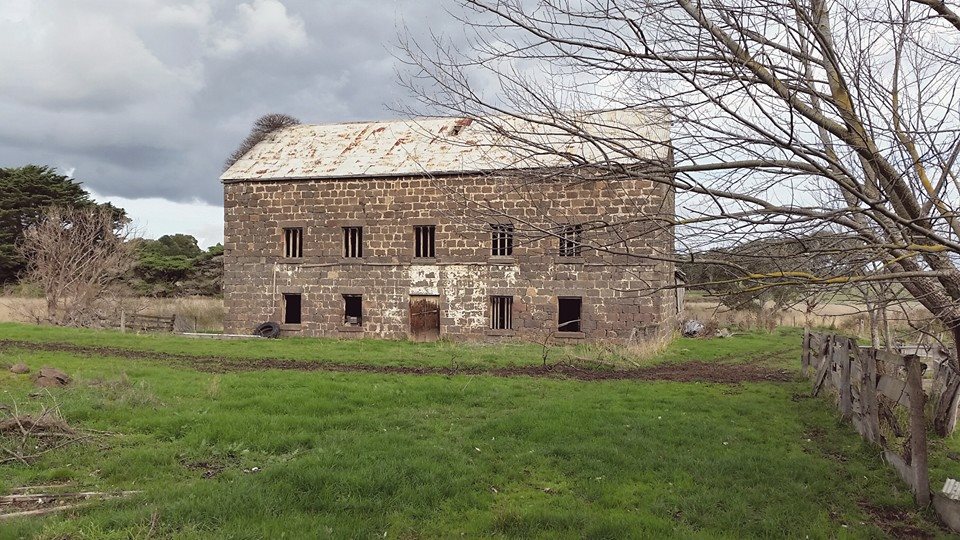
Peter LEARMONTH: Died 19 July 1893 at Hamilton. Peter Learmonth was one of Hamilton’s most prominent citizens from the 1860s to the time of his death, contributing greatly to the growth of that town and the  villages surrounding it. Born in Scotland in 1821, Peter travelled to Tasmania to meet up with his brother William who had already bought land in that colony. Gold attracted Peter and he left for the Californian goldfields in the late 1840s. With no success, he made his way to Victoria in the early 1850s and had good fortune on the Castlemaine goldfields. Getting out while ahead during the mid-1850s, he took up a manager’s job at Merino Downs station owned by Francis Henty, but not before marrying Mary Jarvey Pearson at Portland in 1854.  By 1859, Peter purchased Prestonholme on the banks of the Grange Burn near Hamilton from George Younger and proceeded to build the Grange Burn Flour Mill. He later purchased mills at  Byaduk, Sandford and Penshurst.  The homestead at Prestonholme and the mill still stand today on the Mill Road, Hamilton.

PETER LEARMONTH'S PRESTONHOLME MILL. Photo courtesy of Denis Steer.

PETER LEARMONTH’S GRANGE BURN MILL. Photo courtesy of Denis Steer.

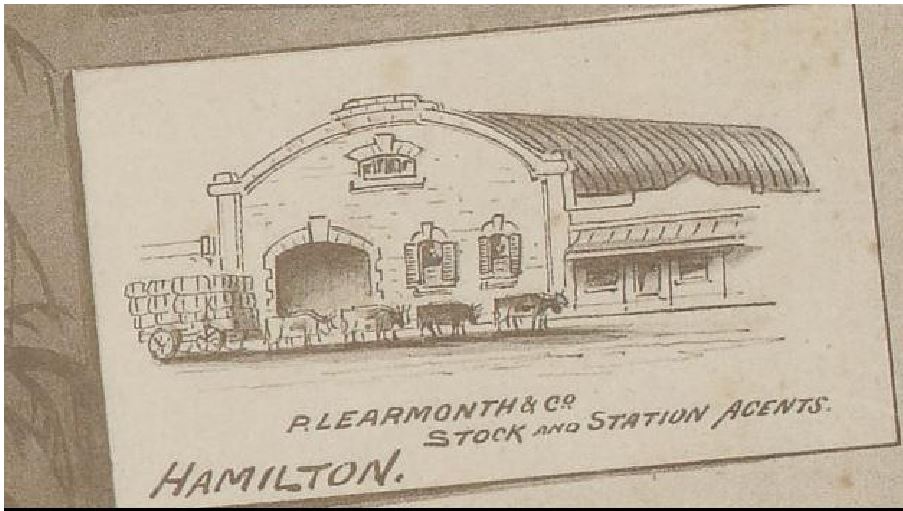
Not satisfied with his milling empire, Peter established P.Learmonth & Co Stock & Station agents in Gray Street, Hamilton. Peter’s sons continued the business after his death.
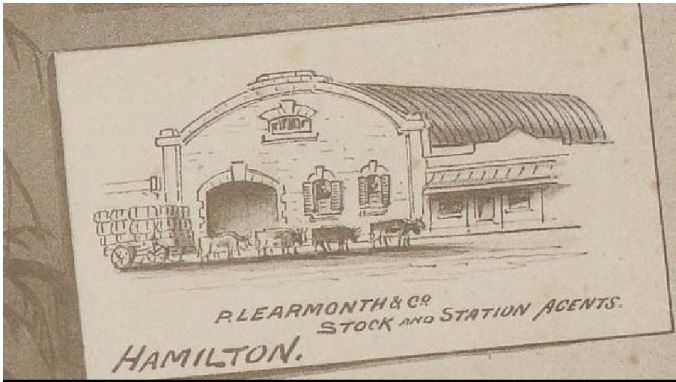
P. LEARMONTH & CO. STOCK & STATION AGENTS. GARY STREET, HAMILTON, WILLIAM TIBBITS (c1896). Image courtesy of the State Library of Victoria. Image no. H83.253/1 http://handle.slv.vic.gov.au/10381/67235

Peter Learmonth was a member of the Dundas Shire Council for nine years, serving as President for four successive terms, a record he still holds. He was also one of the first councilors of the Borough of Hamilton. Peter was one of the driving  forces behind the Hamilton & Western District Boys College and Alexandra Girls School, two schools that built Hamilton’s foundations as an education town.

HAMILTON COLLEGE. Image Courtesy of the State Library of Victoria, J.T.Collins Collection. Image no. H97.250/74 http://handle.slv.vic.gov.au/10381/229855

HAMILTON COLLEGE. Image Courtesy of the State Library of Victoria, J.T.Collins Collection. Image no. H97.250/74 http://handle.slv.vic.gov.au/10381/229855

The Hamilton Hospital was another of Hamilton’s institutions that Peter Learmonth helped set up and was President of the Hospital for eighteen years.

HAMILTON HOSPITAL. Image courtesy of the State Library of Victoria, Image no. H32492/2732 , http://handle.slv.vic.gov.au/10381/63599

HAMILTON HOSPITAL. Image courtesy of the State Library of Victoria, Image no. H32492/2732 , http://handle.slv.vic.gov.au/10381/63599

Two of  Peter Learmonth’s children married into families that were also influential in Hamilton ‘at the time. Eldest son James Allan Learmonth married Annie Thomson, daughter of John Thomson of Monivae in 1886.  A daughter Mary married the son of another prominent Hamilton man, David Laidlaw jnr, son of saddler and self-made man, David Laidlaw. Mary’s obituary appeared in April 2013 Passing of the Pioneers.  Messrs. Learmonth, Laidlaw and Thomson were a force to be reckoned with and include Peter’s brother, Alex Learmonth, also a man of much influence, and it is not surprising that they were able to grow Hamilton into one of Victoria’s most eminent towns.

Later in life, Peter purchased land in Mexico and gave his share to two of his sons. He also purchased Correa Estate” near Dunkeld and pursued pastoral interests with much success.

A supporter of the temperance movement, Peter was president of the Total Abstinence Society and the work of he and John Thomson, saw a Temperance Hall opened in Kennedy Street, Hamilton. They obtained an existing building and converted it to suit the needs of the Society.

As I write my Harman family history and delve into the local histories of Byaduk and Hamilton, Peter Learmonth comes up time and again. A Methodist, he knew my ggg grandfather James Harman and at one stage James was acting as an agent for farm machinery on Peter’s behalf.  James’ daughter Julia married George Holmes Jnr, the son of George Holmes who was a manager of the Grange Burn mill before managing the Byaduk mill. George Jnr worked at the Penshurst mill and took over the Sandford mill with his brothers.

Peter Learmonth passed away at his home at “Prestonholme” .  He was seventy-four.  Peter was buried at the Old Hamilton Cemetery.

GRAVE OF PETER LEARMONTH, OLD HAMILTON CEMETERY.
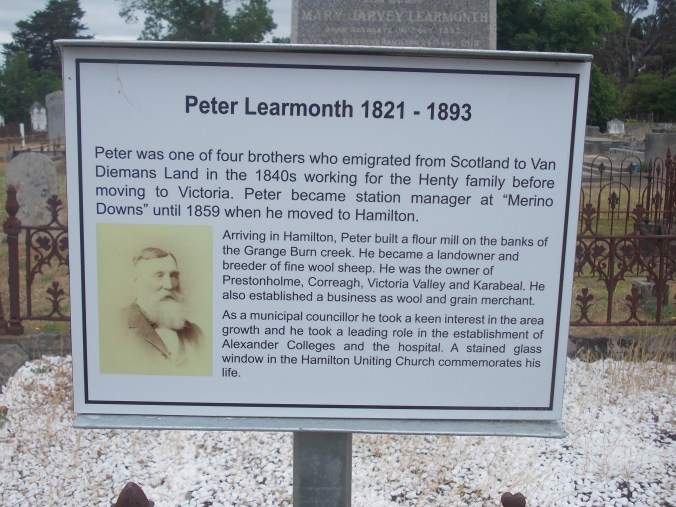
GRAVE OF PETER LEARMONTH, OLD HAMILTON CEMETERY.

PLAQUE ON THE GRAVE OF PETER LEARMONTH, OLD HAMILTON CEMETERY

PLAQUE ON THE GRAVE OF PETER LEARMONTH, OLD HAMILTON CEMETERY

With his prominence with the Methodist Church, a memorial window was unveiled at the Hamilton Wesleyan Methodist Church in McIntyre Street on Sunday 7 January 1900. A new Methodist church was opened in Lonsdale Street,  Hamilton in October 1913, and the window was installed there.

020

THE PETER LEARMONTH MJEMORIAL WINDOW, HAMILTON UNITING CHURCH, FORMALLY HAMILTON METHODIST CHURCH

Sources:

Dundas Shire Centenary, 1863-1963. Hamilton Spectator for the Dundas Shire Council, [Hamilton, Vic.], 1963.

Garden, Donald S. (Donald Stuart) and Hamilton (Vic.). Council Hamilton, a Western District history. City of Hamilton in conjunction with Hargreen, North Melbourne, 1984.

Glenelg & Wannon Settlers (website)

Macdonald, Anita Mariposa : a story of the Learmonths of western Victoria and Mexico, 1834-1930. Heatherleigh Publishing, [Melbourne], 1982.

John SYMONS: Died 10 July 1914 at Hamilton. Born in Cornwall around 1828, John Symons’ trade was ship’s carpenter and after his arrival at Portland in 1854, his skills were in demand with much building work required. From Portland, John moved to Balmoral before settling at the Wannon, near Hamilton. John farmed but was also a contractor for the Roads Board and later the local Shires. One of his most important works in the district was constructing the bridge over the Wannon River at Redruth, a necessity to enable travel from Hamilton to Coleraine and beyond. Timber for the bridge was cut using pit saws and John did much of that work himself. During his marriage, John and his wife raised eleven children with seven still living at the time of his death.

William DUNN: Died 1 July 1914 at Box Hill. William Dunn arrived in Victoria in 1855 from Somersetshire aboard the Raven’s Craig.  After two years in Geelong, he rode by horseback to Hamilton, his home for the next forty-four years.  As a bricklayer and builder, he constructed the Victoria and Colonial banks in Hamilton with William Holden and  Budock Vean, a home in French Street, Hamilton still standing today.  A devout Methodist, he held various positions within the church.

FORMER BANK OF VICTORIA, GRAY STREET, HAMILTON. Image courtesy of the J.T. Collins collection, State Library of Victoria. Image no. H97.250/89 http://handle.slv.vic.gov.au/10381/230031

FORMER BANK OF VICTORIA, GRAY STREET, HAMILTON. Image courtesy of the J.T. Collins collection, State Library of Victoria. Image no. H97.250/89
http://handle.slv.vic.gov.au/10381/230031

Jane DONNELLY: Died 1 July 1914 at Hawkesdale. Born in Ireland around 1834, Jane Donnelly arrived in Australia in the 1860s, settling at Myamyn. She married William Walshe and they raised six children. In the meantime, Jane established the Foresters Hotel at Myamyn and ran a store to cater for the many carriers who used the town as a stopover on their travels.  After the death of her husband, Jane remarried to William Jenkins in 1883 and for a time ran the former Victoria Hotel at Portland.

John MUNRO: Died July 1914 at Hotspur. John Munro was born in Scotland around 1833 and sailed to Hobsons Bay aboard the Champion of the Seas in 1854. Gold must have been his primary reason for coming to Victoria as he spent time around the various diggings before travelling to New Zealand and the goldfields of Otago. After two years, he returned and took up residence at Portland and married in 1867. For many years, he was a storekeeper and post office operator.  He also engaged in farming pursuits and in the early 1890s took up land at Hotspur. At the time of his death, he left a widow and nine children. He was buried at the Hotspur Cemetery.

Alexander John McLEAN: Died 23 July 1915 at Hamilton.  Alexander McLean was born in Scotland around 1836 and arrived in Sydney as a three-year-old with his parents. They later moved to Victoria, taking up residence at Tower Hill. From there, Alexander went on to Myamyn and then Macarthur where he was a founding member of the Methodist Church.  Alexander enjoyed telling stories of the pioneer days, before bridges spanned creeks or railways traversed the countryside.  Alexander and his wife had nine children.

Sarah Ann FARNHAM: Died 21 July 1916 at Hamilton. Born in Somersetshire, England around 1839, Sarah Ann Farnham arrived at Portland in 1858. She married Andrew Lockie at Portland in 1860 and by 1866 they had moved to Hamilton were Andrew ran a saddlery business.  Leaving a family of six children and her husband, Sarah Ann was buried at the Hamilton Old Cemetery.

Mary SAVIN: Died July 1918 at Muddy Creek. Mary Savin was born in Oxfordshire and sailed to Victoria with her parents in 1853.  Around 1855, the family travelled north to Muddy Creek where they settled. Two years later, Mary married John Addinsall and they had a family of twelve children. Like many of the early settlers at Muddy Creek, Mary was a Methodist and it was in a crowded Muddy Creek Methodist Church where Mary was given her last farewell.

John HUXLEY: Died 21 July 1918 at Portland. John Huxley was born in Portland around 1863. During the 1890s, John travelled to Western Australia, lured by the discovery of gold, but unlike the other July pioneers who chose to seek their fortunes, John struck gold in a big way. John and several other men discovered the rich Londonderry mine at Coolgardie, Western Australia. Having made his fortune, John returned to Victoria and purchased the Straun Estate at Merino. A keen racehorse owner, one of John’s big successes came less than a year before his death, when his horse the Ruralist, trained by James Agnew of Hamilton, won the Great Western Steeplechase at Hamilton in September 1917. The horse was also a two-time Brierly Steeplechase winner at Warrnambool.  John passed away at his seaside home Kenly at Portland and was buried at the South Portland cemetery.

Christina Emily FORD: Died 26 July 1931 at Hamilton. Christina Ford was born in Macarthur in 1880 into a well-known pioneering family. In 1905, she married William Baker and they moved to Portland and  raised nine children. Christina was a keen volunteer for the Portland Football Club and was a member of the Australian Women’s National League.

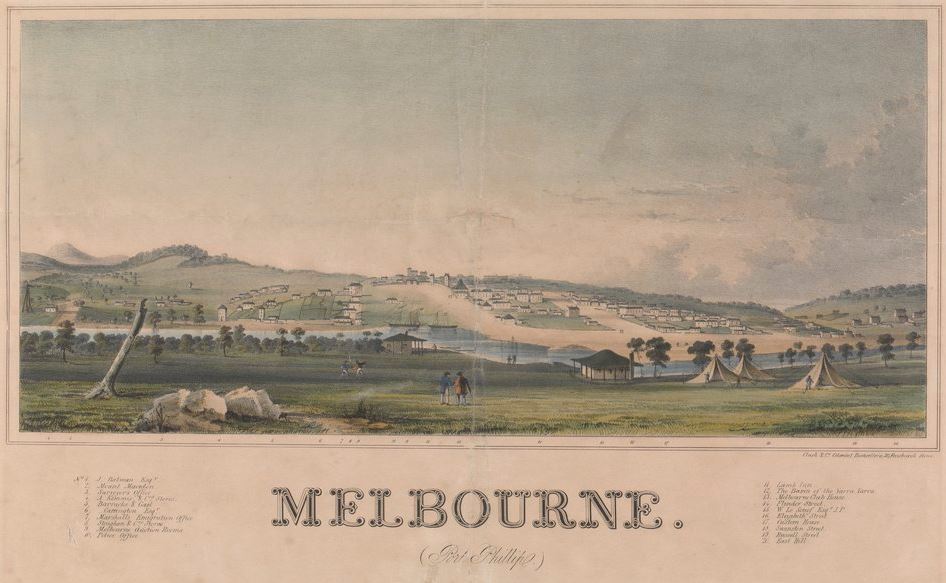
Charles HOLDER: Died 21 July 1922 at Warrnambool. The story of Charles Holder’s life appeared in the Portland Guardian on 28 September 1931, nine years after his death and it gives a great account of Melbourne and Victoria in the 1840s. Charles Holder was born in Bristol, England around 1838 and from the moment he set sail on the Wardshipton as a three-year-old with his parent and siblings, his great pioneering life had begun. The voyage in 1841, with almost 300 other immigrants was harsh with twenty-four deaths including twenty-two children.  hree of those children were Charles’ young sisters. Arriving at Hobson’s Bay, Charles, his parents and two remaining siblings, took a steamer along the Yarra River to Melbourne.

MELBOURNE 1841. Image Courtesy of the State Library of Victoria, Image no. H6262/2 http://handle.slv.vic.gov.au/10381/87604

MELBOURNE 1841. Image Courtesy of the State Library of Victoria, Image no. H6262/2 http://handle.slv.vic.gov.au/10381/87604

After spending time on stations around Melbourne, including Dandenong as a boy and young teenager, Charles made his way to the Western District, working at The Gums between Caramut and  Penshurst. By that time, it was the early 1850s, and Charles headed to the Bendigo diggings but like so many his luck was out and he returned to the west of the state, working at Grassmere near Warrnambool. In the early 1860s, he selected his own land at Cooramook and remained there for the rest of his life.

An obituary in the The Register (Adelaide) on September 2, 1922 , published at the time of Charles’ death has further detail of his pioneering life.

Ellen OSBOURNE: Died 15 July 1934 at Hamilton. Born at Portland, Ellen Osbourne married local builder Thomas Cruse and they continued to resided at Portland. She raised a family and was a devoted member of the Church of England.  Prior to her death, Ellen had been ill for many weeks and as a consequence was admitted to Kia Ora Private Hospital at Hamilton.  Ellen needed a blood transfusion but unlike today when we take for granted stocks of blood at hospitals, in 1934 there wasn’t a Red Cross Blood Bank. Therefore, Ellen’s son donated the blood required for the transfusion.  Unfortunately, it was not enough to save his mother.

Passing of the Pioneers

The stories of the Western District pioneers continue with June Passing of the Pioneers.  Pioneer obituaries come from a woman who was the first European woman at Colac, a man who survived a shipwreck off Tasmania, and a Reverend who started his career as a journalist for the London Times. Look out for the July obituaries when Passing of the Pioneers celebrates a birthday.

Nicholas COLE: Died 22 June 1879 at Darlington. Born in England and heir to an estate in Plymouth, Nicholas Cole decided to try his luck in Australia and arrived in Sydney in 1839. During his voyage, he met another man Peter McArthur and together they sailed on from Sydney to Geelong. They became partners and took up the West Cloven Hills and Menningort runs at Darlington. Those early pioneers faced many hardships including the Black Thursday fires in 1851.  Nicholas, thought to be a descendant of “Old King Cole” the subject of the nursery rhyme of the same name, ran Merino sheep and built up a herd that produced high yields of good quality wool. 

"Pastoral Pioneers" The Australasian (Melbourne, Vic. : 1864 - 1946) 13 October 1934: 49 (METROPOLITAN EDITION). .

“Pastoral Pioneers” The Australasian (Melbourne, Vic. : 1864 – 1946) 13 October 1934: 49 (METROPOLITAN EDITION). <http://nla.gov.au/nla.news-article145242490&gt;.

More information about Nicholas is available on the links –  The Colac Herald 24 June 1879    The Cole Family at West Cloven Hills

Image courtesy of the State Library of Victoria

SHEARING SHED, WEST CLOVEN HILLS (1987) Image courtesy of the State Library of Victoria J.T. Collins Collection, La Trobe Picture Collection. Image no. H95.200/65 http://handle.slv.vic.gov.au/10381/217139

Elizabeth YOUNG: Died 11 June 1892 at Barongarook. Jean Young was born in Scotland in 1823 and as a girl sailed to Tasmania with her parents and her father worked as a solicitor in Hobart. In 1841, she married Hugh Murray. They moved to Geelong and Hugh, considered the founder of Colac, moved to that area, before Jean and her young son joined them, becoming the first European woman in the district.  She raised a family of fourteen children and endured the many hardships faced by early pioneer women in Victoria. Among other things, Jean and Hugh were founding members of the Colac Presbyterian church and Jean remained a pillar of the church during her life. Hugh passed away twenty-three years before Elizabeth in 1869.

George COXON: Died 20 June 1892 at Portland. George Coxon was born and married in England and in 1857 he and his family, including seven children, travelled to Victoria. After a short time on the Victorian goldfields, he took up farming pursuits in the Casterton district.  In his later years, he moved to Portland where he passed away.  A profile of George and his family his available on the SW Pioneers website –    http://www.swvic.org/sandford/coxon_george.htm

Lawrence McKENNA: Died June 1914 at Curlew Hill.  Lawrence McKenna was born around 1830 in Ireland and travelled to Adelaide around 1861. The South Australian explorer John Stuart was about to leave on a government funded expedition to cross the continent and Lawrence joined his party. Stuart eventually abandoned his attempt. After ten years on the goldfields of Victoria and New Zealand, Lawrence gained work at Woodhouse near Dunkeld in 1872. He took a trip back to Ireland in 1874 then returned to Dunkeld to marry Elizabeth Irwin and they settled at nearby Curlew Hill.  In 1900, he was badly burnt while trying to protect his property during bushfires and never fully recovered.

Sophia GERDTZ: Died 5 June 1914 at Hamilton. Sophia Gerdtz was born in Germany around 1831 and arrived in Melbourne during the early 1850s. Her family travelled to Hamilton, where few buildings stood. She first married Robert Thomson at Lyne Station in 1852 but was left a widow during the 1860s. She then married storekeeper Cavendish Neville.  Again widowed, she spent the last years of her life living with her son at Pierrepoint, just out of Hamilton.

 Bridget McNAMARA: Died 19 June 1914 at Tower Hill.  Born in Ireland around 1843, Bridget McNamara arrived with her parents to Port Fairy in 1852 and they settled near Farnham and later Dennington. In 1866 at Warrnambool, Bridget married Hugh Reilly, afterward settling at Southern Cross where they lived for the rest of their lives.

THE Roroit Sentine[?] AND Tower Hill Advocate. (1914, June 27). Koroit Sentinel and Tower Hill Advocate (Vic. : 1914 - 1918), p. 2. Retrieved July 1, 2014, from http://nla.gov.au/nla.news-article119554315

THE Roroit Sentine[?] AND Tower Hill Advocate. (1914, June 27). Koroit Sentinel and Tower Hill Advocate (Vic. : 1914 – 1918), p. 2. Retrieved July 1, 2014, from http://nla.gov.au/nla.news-article119554315

Reverend George Duke LEE: Died June 1915 at Hamilton. Born in Derbyshire, England around 1830, George Lee first worked as a reporter for the London Times in America. After briefly returning to England he sailed to Victoria aboard the Blue Jacket in 1853 and made for the Ballarat goldfields. He worked as a teacher but left after medical advice as his eye sight was failing. Instead, he went on a lecture tour for the Sons of Temperance Friendly Society through the Western District. While visiting Chetwynd he became interested in the teachings of the Presbyterian church and entered the Ministry. He was sent to the St. Johns Presbyterian Church at Cavendish where he remained for thirty years.

Image courtesy of the State Library of Victoria

ST JOHNS PRESBYTERIAN CHURCH, CAVENDISH (1974). Image courtesy of the State Library of Victoria J.T. Collins Collection, La Trobe Picture Collection. Image no. H94.200/605 http://handle.slv.vic.gov.au/10381/217138

When George retired around nine years before his death, he moved to Hamilton.

William ALFORD: Died June 1916 at Ellerslie. William Alford was born in England around 1831 and twenty-one years later he travelled to Australia. He was a steward on the ship he sailed aboard which wrecked off the Tasmanian coast. William and other passengers were able to reach shore on a dingy and they walked to Hobart without shoes. William then travelled to the goldfields of Victoria, working as a driver with the gold escort out of Ballarat and later driving the mail coach between Ballarat and Geelong. He moved to Ellerslie in the mid-1860s and he remained there for the remainder of his life. William was a caretaker of the local Mechanics Institute and was involved with the Ellerslie Football Club.

James WORLAND: Died 18 June 1916 at Warrnambool. James Worland was born in Melbourn, Cambridgeshire around 1851 and arrived in Port Fairy two years later with his parents and they settled in the Warrnambool district. When working age, James took a job at a tannery and later purchased his own tannery. William also took up many roles in the community including warden of the Christ Church and a founding member of the local branch of the Society of St. George. At the time of his death, he left a widow and nine children.

William DAVIDSON: – Died June 1917 at Woolsthorp.  Born in Aberdeen, Scotland, William Davidson arrived at Port Fairy in 1855. He first took up labouring at Minjah, a property near Hawkesdale before opening a store at Woolsthorpe. He later  then turned to dairy-farming.  William was known as “The Chaffer” around Woolsthorpe because he enjoyed having a tease.  A widower at the time of his death, William had twelve surviving children.

Trove Tuesday – Hamilton’s Hero Herbalist

Well, it’s Tuesday and that could only mean one thing…Trove Tuesday. It’s been too long.  I’ve read a lot of the Table Talk newspaper lately, a recent addition to the wonderful collection of Trove Digitised Newspapers.  Because Table Talk (1885-1939) was a social newspaper, I have enjoyed the comings and goings of Western District folk from those times, spending their holidays with friends or living it up in the “big smoke” as guests of Melbourne’s best hotels.  Alas, my Western District families were not in the same class of people who graced the social pages, but I still enjoy the photos of those from a higher station in life enjoying tennis and golf tournaments and fox hunts all in the finest fashions.

One feature of Table Talk is wedding photos.  I have found several  Hamilton brides, and have admired their beautiful gowns and bridesmaids’ dresses while following the changing trends in wedding attire.  One particular photo caught my eye, mainly because I didn’t recognise the Hamilton family names as those that regularly graced the Table Talk pages. It was from the marriage of  Caleb Shang and Annie Kassene, celebrated at the home of Mr. J. Quing Yen of Brown Street, Hamilton.  The bridal party consisted of members of the Shang, Kassene, and Quing Yen families.

shang

TOILET ECONOMY. (1923, May 24). Table Talk (Melbourne, Vic. : 1885 – 1939), p. 12. Retrieved June 22, 2014, from http://nla.gov.au/nla.news-article146570075

I searched Trove for Caleb Shang and was immediately met with headlines of “War Hero”.  I then Googled his name and there were entries from the Australian Dictionary of  Biography, Wikipedia, the Australian War Memorial, and various newspaper articles.  I checked with those sites and the same Caleb Shang married Annie Kassene, but considering Caleb was from Cairns, I was left wondering why he was in Hamilton?

As it turns out,  Caleb served with the 47th Battalion during WW1 and after a battle at Messines Ridge in 1916, he received a Distinguished Conduct Medal(DCM).  In 1918, while still with the 47th, his brave actions at the Somme saw him awarded a Military Medal and a bar was added to his D.C.M, thus becoming the highest decorated Australian soldier of Chinese descent. In August 1918, he was shot in the leg and returned to Australia where he was given a hero’s welcome by the people of Cairns.

Sometime after his return, Caleb worked as a herbalist and moved to Victoria to practice.  To be precise, he moved to Hamilton, joining another herbalist John Quing Yen who married Maud Elizabeth Wah Shang in Queensland in 1910.  Presumably, Maud was Caleb’s sister.  As a herbalist,  Caleb not only serviced the people of Hamilton but also travelled to Mt Gambier offering consultations at a local boarding house, as seen in this advertisement from the Border Watch of 22 September 1922, eight months before his marriage.

Advertising. (1922, September 22). Border Watch (Mount Gambier, SA : 1861 - 1954), p. 2. Retrieved June 22, 2014, from http://nla.gov.au/nla.news-article77677775

Advertising. (1922, September 22). Border Watch (Mount Gambier, SA : 1861 – 1954), p. 2. Retrieved June 22, 2014, from http://nla.gov.au/nla.news-article77677775

After the wedding, Caleb and Annie did not remain in Hamilton long, returning to Cairns. After a long illness, Caleb passed away in 1953.

I thought it necessary to find out a little about the bride Anna (Annie) Louise Kassene,  born at Hamilton in 1900.  She was the daughter of bootmaker Gustav Kassene and Hulda Grambau of Hochkirch (Tarrington).  Hulda died in 1901 after the birth of her third child at barely 20 years of age and Gustav died in 1915.  The two Kassene men in the wedding photo are possibly Annie’s two siblings.  Annie died in Cairns in 1955.

Sources

Australian Dictionary of Biography

Australian War Memorial

Herald Sun


Looking for Mary Ann

A week ago, Karen Annett of the Annett Family Australia Facebook group, posted on another group, Victorian Genealogy, about a missing family member, Frances Annett (born 1840, Seven Oaks, Kent).  As a member of the Annett Family group, I had previously read about the search for Frances, one of those elusive women we often come across in our family trees.  Frances had arrived with her parents William and Mary and siblings to Portland in 1853 and that is the last record of Frances’ being.  In reply to Karen, I posted a message of support that she shouldn’t give up hope of finding Frances, giving her a brief summary of my search for Mary Ann Harman.

For my 300th Western District Families post, this is the extended version of  the story of Mary Ann Harman who I thought was…


LOST WITHOUT TRACE. (1931, December 10). Chronicle (Adelaide, SA : 1895 - 1954), p. 62. Retrieved June 2, 2014, from http://nla.gov.au/nla.news-article90636449

LOST WITHOUT TRACE. (1931, December 10). Chronicle (Adelaide, SA : 1895 – 1954), p. 62. Retrieved June 2, 2014, from http://nla.gov.au/nla.news-article90636449


Mary Ann Harman has always been a mystery.  I have accounted for all the first generation Harmans of Byaduk, their births, death and marriages.  Except for Mary Ann, the daughter of Jonathan Harman and Mary Oliver.

Born in 1869, the sixth child of Jonathon and Mary, Mary Ann drops off the radar after birth.  I’ve checked and double checked her birth record and yes she was definitely born.  Over the 20 years I’ve researched the Harmans, I reached the conclusion she had died as an infant.  Not that unlikely since her younger siblings Joseph and Sarah died during the 1870s, Joseph as a baby and Sarah aged six.

My pursuit of Mary Ann has not been a desperate one because. as she was a child of my ggg uncle, I thought I could live with the fact she was missing.  However, because I’m writing a Harman family history I considered I would have to get some of the records I have refrained from getting before.  Recently I received a copy of Jonathan Harman’s will from PROV via Archival Access, and the mystery deepened because there in black and white was the name of Mary Ann.  At the time of his death in 1930, Jonathan had four daughters, besides Mary Ann, and two sons,  Arthur a farmer from Byaduk and Jonathan, a man I considered  the black sheep of the family.  No surprise to me, he was not named in his father’s will.

Jonathan snr. left his ready money and money in the bank to all his daughters, with a proviso that it did not include Mary-Ann.  He bequeathed the net profit of one of his properties to his daughters…except Mary Ann.  Arthur was to receive the balance of Jonathan’s estate “but subject to and charged with the payment by him of the annuity of twenty pounds to my daughter Mary Ann during her life…”.

So Mary Ann wasn’t dead, rather 61 years of age in 1930, but why was she treated differently to her sisters and Arthur?  Was she untrustworthy or did her father think she was not worthy of a share of his property?  Why did was left an annuity instead?  Was she not capable of supporting herself?  The discovery in Jonathan’s will certainly raised more questions than it answered.

But it meant I could begin searching for her again with renewed confidence.  I went straight to the Victorian Death records and searched for “Mary Ann Harman” (assuming she never married) and found the closest match – Mary Ann Harman born about 1873, died Ararat 1948, parents unknown.  If  that is my Mary Ann,  the fact she died in Ararat possibly answers some of my questions.  The reason being there was a lunatic asylum in Ararat (Aradale).

A search of Trove only found a Law Notice from 1951 declaring the said Mary Ann Harman intestate, however it confirms to me that the Mary Ann who died in Ararat was a spinster.

Advertising. (1951, February 8). The Argus (Melbourne, Vic. : 1848 - 1957), p. 18. Retrieved June 2, 2014, from http://nla.gov.au/nla.news-article23036219

Advertising. (1951, February 8). The Argus (Melbourne, Vic. : 1848 – 1957), p. 18. Retrieved June 2, 2014, from http://nla.gov.au/nla.news-article23036219

Now I have some new leads.  I’ll follow-up probate records and check for an inquest, with the latter helping me confirm if the said Mary Ann was in Ararat Asylum.  But maybe Mary Ann was merely the female black sheep of her family and moved away from the fold and it’s possible that the male black sheep was living with her.  My reason for that thought is that my only other Harman connection to Ararat was Mary Ann’s brother Jonathan jnr. further supporting my case that I’m on the right track with Mary Ann.

After Jonathan jnr. married Hannah Keyte of Arapilis in 1904,  they moved to Kingaroy, Queensland.  Hannah appears to have remained in Queensland but Jonathan disappeared after 1913 reappearing again at the time of his death in 1941 at Ararat.  I do know that after Jonathan’s death there was an inquest, raising the possibility he was in Ararat Lunatic Asylum and a copy is now a must.  To think I have driven past the imposing building of Aradale, on a hill east of Ararat, hundreds of time, looking up and wondering what when on behind its walls.  Now I’m a few steps closer to discovering if members of my family knew exactly what life was like as an inmate.

ARARAT ASYLUM c1880.  Image courtesy of the State Library of Victoria.  Image no. H1887 http://handle.slv.vic.gov.au/10381/151015

ARARAT ASYLUM c1880. Image courtesy of the State Library of Victoria. Image no. H1887 http://handle.slv.vic.gov.au/10381/151015

Writing the Harman family history has  helped me get to know Jonathan Harman snr.  better than I did before and it would be tragic if either or both Mary Ann and Jonathan jnr. were inmates at the Ararat Asylum.  Between 1871 and 1886, he saw the passing of three of his 10 children and his wife Mary at just 43. Then, one by one, his remaining children moved away from Byaduk leaving him alone, while his brothers’ children continued on in the town, growing and prospering.

So in conclusion,  to all of you, including the Annett family researchers, never give up hope that you will one day find your Mary Ann.


**Tours are now held within Aradale, during the day by the Friends of J Ward (a hospital for the criminally insane also in Ararat) and ghost tours by night,conducted by Eerie Tours .Aradale operated from 1867 until 1998.