Nifty Newsletters

When I visit my local library and see masses of newsletters from the region’s family history and historical societies jammed into cardboard magazine holders, I think that while such a resource would be useful, where would I start?  Being a working mum with limited time, they are just not an option.  Also, membership of those societies would be great as I would receive a newsletter in the mail, but again my current status means I have to give consideration to each membership/subscription I take out.

Luckily some societies have newsletters available on their websites and I can read them easily from home when I choose.  Newsletters online that are the most helpful to my research are from the Casterton and District Historical Society (2005-2012) and the Warrnambool Family History Group (1990-1999 & 2004).  Both include a list of the main topics in each newsletter allowing me to easily select an issue.

The Casterton newsletter, “Historical Happenings” has items relevant to different areas of my research such as the History of the Casterton Racing Club Inc, a series of articles about the Hunt murders and Dance Halls, and Orchestras of Casterton.  There is also information about surrounding towns such as Merino, Sandford and Wando Vale.  The March 2011 newsletter even recommends a new magazine called “Inside History.”  I’m sure many of us would endorse that recommendation!  The newsletter opens as a Word document.

The Warrnambool newsletter, “The South-West Genealogist“, includes indexes of Pioneer women of Victoria, school records, and a lot of information on Irish settlers.  There are also many birth, deaths, and marriages in the regular column “Historicals” and there are 19th-century BDMs notices from the “Hamilton Spectator” which have been most useful.  The newsletter opens as a PDF document.

Thank you to both for providing such a wonderful online resource.

Christmas 1940s style

Christmas during wartime 1940s was bleak especially when Japan entered as National security and economic precautions came into force.  Still, there were many eager volunteers to make sure that Christmas was cheery for all, even the Australians  fighting overseas.

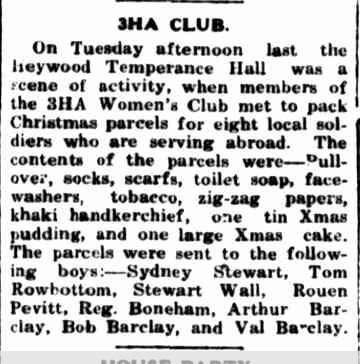
Preparations for Christmas 1940 started early, as volunteers packed parcels bound for overseas troops.

3HA CLUB. (1940, August 29). Portland Guardian (Vic. : 1876 - 1953), p. 3 Edition: EVENING. Retrieved December 18, 2012, from http://nla.gov.au/nla.news-article64397250

3HA CLUB. (1940, August 29). Portland Guardian (Vic. : 1876 – 1953), p. 3 Edition: EVENING. Retrieved December 18, 2012, from http://nla.gov.au/nla.news-article64397250

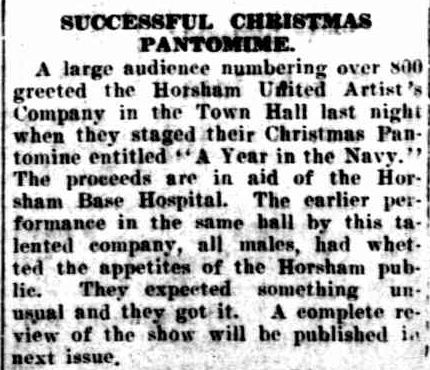
Over 800 people attended a pantomime “A Year in the Navy” at the Horsham Town Hall.

SUCCESSFUL CHRISTMAS PANTOMIME. (1940, December 20). The Horsham Times (Vic. : 1882 - 1954), p. 2. Retrieved December 18, 2012, from http://nla.gov.au/nla.news-article73155556

SUCCESSFUL CHRISTMAS PANTOMIME. (1940, December 20). The Horsham Times (Vic. : 1882 – 1954), p. 2. Retrieved December 18, 2012, from http://nla.gov.au/nla.news-article73155556

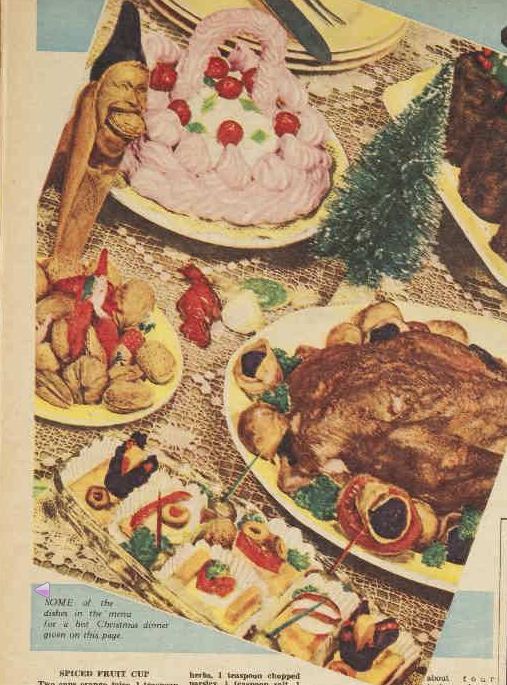
The Australian Women’s Weekly issue of December 21, 1940 featured a fancy Christmas dinner menu.
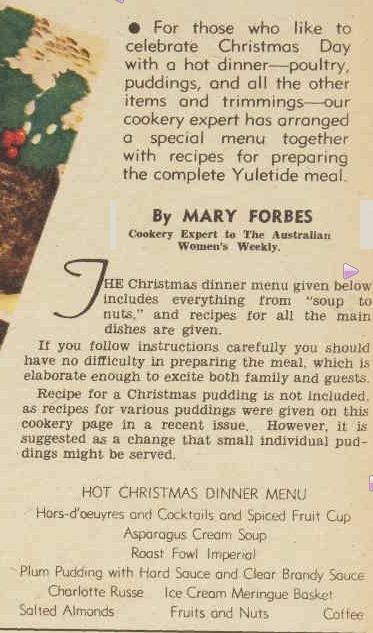
1940uu

CHRISTMAS DINNER. (1940, December 21). The Australian Women's Weekly (1933 - 1982), p. 37 Section: The Homemaker. Retrieved December 19, 2012, from http://nla.gov.au/nla.news-article47244840

CHRISTMAS DINNER. (1940, December 21). The Australian Women’s Weekly (1933 – 1982), p. 37 Section: The Homemaker. Retrieved December 19, 2012, from http://nla.gov.au/nla.news-article47244840

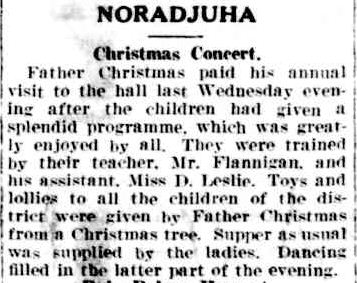
Noradjuha school children received a treat with a visit from Father Christmas after their Christmas concert performance.

NORADJUHA. (1940, December 24). The Horsham Times (Vic. : 1882 - 1954), p. 4. Retrieved December 18, 2012, from http://nla.gov.au/nla.news-article73155694

NORADJUHA. (1940, December 24). The Horsham Times (Vic. : 1882 – 1954), p. 4. Retrieved December 18, 2012, from http://nla.gov.au/nla.news-article73155694

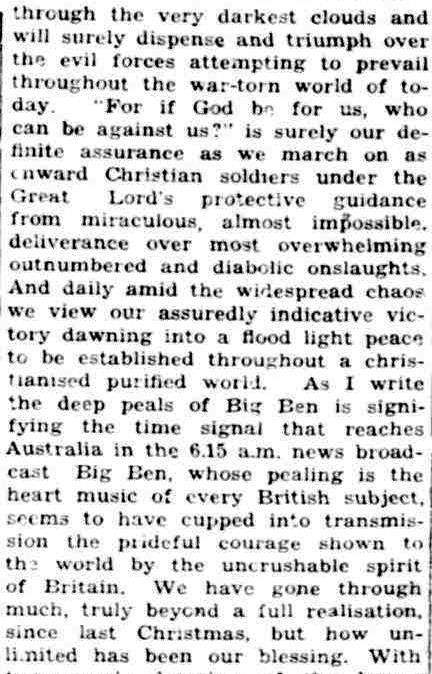
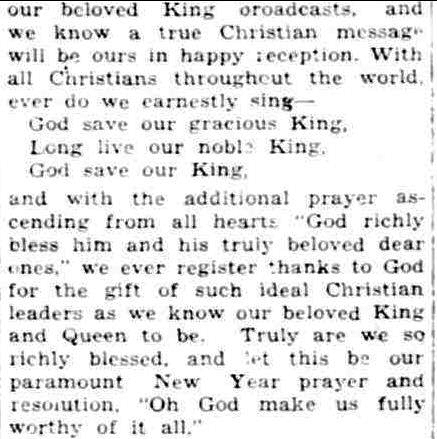
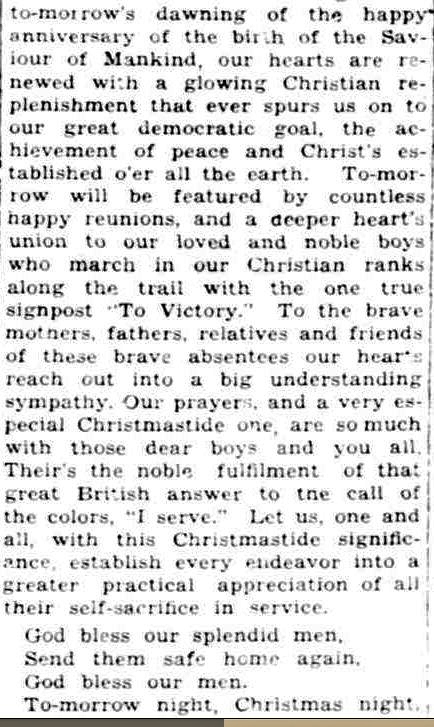
The message of “Peace on Earth” returned to the newspapers.
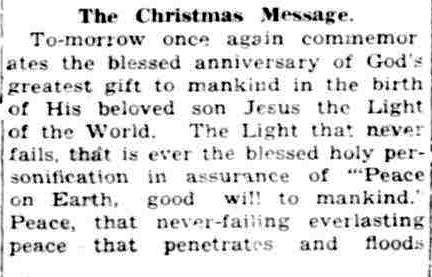
1940d

1940f

The Christmas Message. (1940, December 24). The Horsham Times (Vic. : 1882 – 1954), p. 8. Retrieved December 21, 2012, from http://nla.gov.au/nla.news-article73155682

1940e1940g

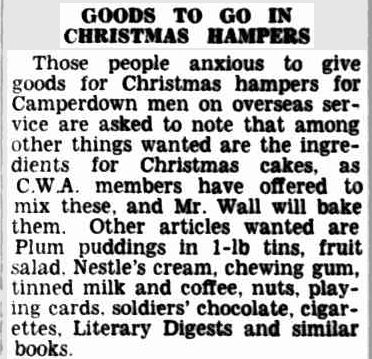
WW2 saw the return of Christmas hampers and in August 1941 volunteers were again donating goods, baking puddings or packing.  Simple items were in the hampers but a soldier in the trenches would have been grateful for a tin of fruit salad on Christmas day.


GOODS TO GO IN CHRISTMAS HAMPERS. (1941, August 26). Camperdown Chronicle (Vic. : 1877 - 1954), p. 3. Retrieved December 18, 2012, from http://nla.gov.au/nla.news-article26547914

GOODS TO GO IN CHRISTMAS HAMPERS. (1941, August 26). Camperdown Chronicle (Vic. : 1877 – 1954), p. 3. Retrieved December 18, 2012, from http://nla.gov.au/nla.news-article26547914

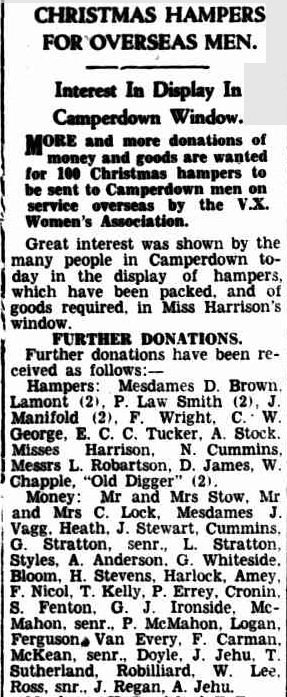
Miss Harrison’s shop in Camperdown displayed hampers packed ready for dispatch.

CHRISTMAS HAMPERS FOR OVERSEAS MEN. (1941, September 2). Camperdown Chronicle (Vic. : 1877 - 1954), p. 3. Retrieved December 18, 2012, from http://nla.gov.au/nla.news-article26548028

CHRISTMAS HAMPERS FOR OVERSEAS MEN. (1941, September 2). Camperdown Chronicle (Vic. : 1877 – 1954), p. 3. Retrieved December 18, 2012, from http://nla.gov.au/nla.news-article26548028

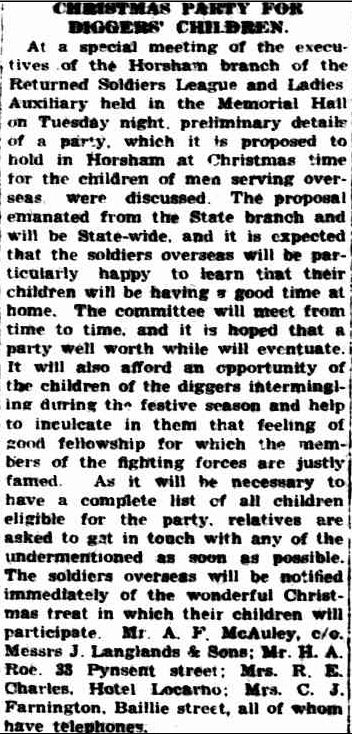
An initiative of the State branch of the Returned Soldiers League saw  Horsham children that had fathers fighting overseas, receive a Christmas party in 1941.  A nice touch was that each father received a letter to tell them of their children’s treat.

1940j

CHRISTMAS PARTY FOR DIGGERS’ CHILDREN. (1941, October 3). The Horsham Times (Vic. : 1882 – 1954), p. 2. Retrieved December 18, 2012, from http://nla.gov.au/nla.news-article72696036

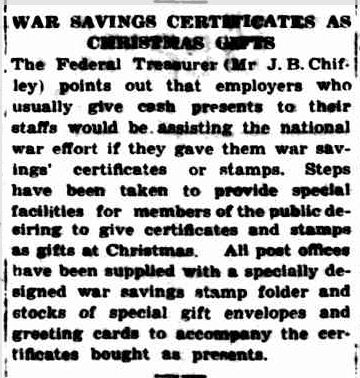
The Federal Treasure urged employers to give their staff War savings certificates or stamps for Christmas 1941 to support the war effort.

WAR SAVINGS CERTIFICATES AS CHRISTMAS GIFTS. (1941, November 25). The Horsham Times (Vic. : 1882 - 1954), p. 2. Retrieved December 18, 2012, from http://nla.gov.au/nla.news-article72697527

WAR SAVINGS CERTIFICATES AS CHRISTMAS GIFTS. (1941, November 25). The Horsham Times (Vic. : 1882 – 1954), p. 2. Retrieved December 18, 2012, from http://nla.gov.au/nla.news-article72697527

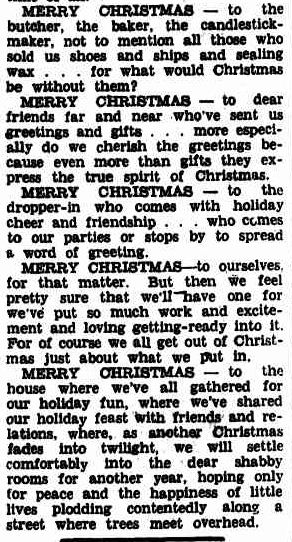
The Williamstown Chronicle of December 19, 1941 said “Merry Christmas” to one and all.
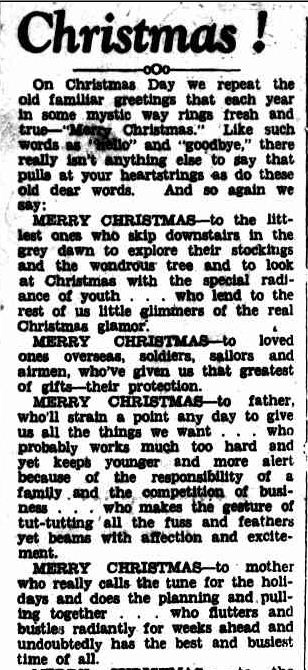
1940l

Christmas !. (1941, December 19). Williamstown Chronicle (Vic. : 1856 - 1954), p. 2 Supplement: Greetings Our Christmas Supplement. Retrieved December 18, 2012, from http://nla.gov.au/nla.news-article70713662

Christmas !. (1941, December 19). Williamstown Chronicle (Vic. : 1856 – 1954), p. 2 Supplement: Greetings Our Christmas Supplement. Retrieved December 18, 2012, from http://nla.gov.au/nla.news-article70713662

Parents had to choose between peaceful toys and war  toys in 1941.  Tanks, submarines and planes increased in number on the toy shop shelves and hats, balls and drums carried patriotic logos.
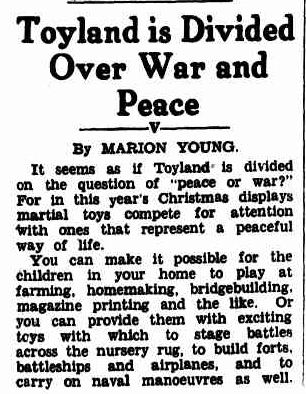
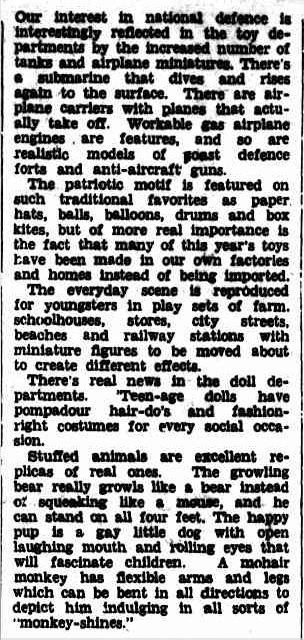
1940n

Toyland is Divided Over War and Peace. (1941, December 19). Williamstown Chronicle (Vic. : 1856 - 1954), p. 2 Supplement: Greetings Our Christmas Supplement. Retrieved December 18, 2012, from http://nla.gov.au/nla.news-article70713661

Toyland is Divided Over War and Peace. (1941, December 19). Williamstown Chronicle (Vic. : 1856 – 1954), p. 2 Supplement: Greetings Our Christmas Supplement. Retrieved December 18, 2012, from http://nla.gov.au/nla.news-article70713661

Mother always considers Dad’s interests when buying a gift, such as golf clubs or fishing rods, but does Dad think that she may also like a hobby.  Don’t blow the budget though!
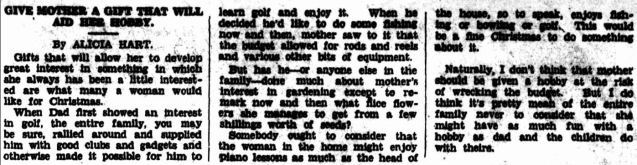
GIVE MOTHER A GIFT THAT WILL AID HER HOBBY. (1941, December 19). Williamstown Chronicle (Vic. : 1856 - 1954), p. 2 Supplement: Greetings Our Christmas Supplement. Retrieved December 18, 2012, from http://nla.gov.au/nla.news-article70713714

GIVE MOTHER A GIFT THAT WILL AID HER HOBBY. (1941, December 19). Williamstown Chronicle (Vic. : 1856 – 1954), p. 2 Supplement: Greetings Our Christmas Supplement. Retrieved December 18, 2012, from http://nla.gov.au/nla.news-article70713714

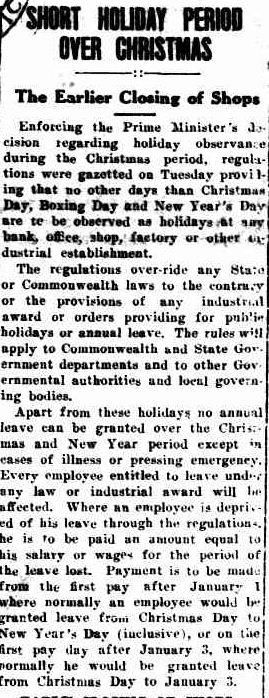
Wartime saw a raft of new regulations imposed on citizens and Christmas was not exempt.

SHORT HOLIDAY PERIOD OVER CHRISTMAS. (1941, December 19). The Horsham Times (Vic. : 1882 - 1954), p. 1. Retrieved December 18, 2012, from http://nla.gov.au/nla.news-article72698208

SHORT HOLIDAY PERIOD OVER CHRISTMAS. (1941, December 19). The Horsham Times (Vic. : 1882 – 1954), p. 1. Retrieved December 18, 2012, from http://nla.gov.au/nla.news-article72698208

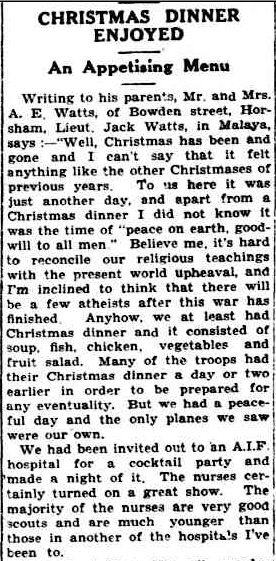
Jack Watts of Horsham,  stationed in Malaya over Christmas 1941 wrote home of his Christmas experience.   The nurses of the AIF held an entertaining cocktail party.

CHRISTMAS DINNER ENJOYí. (1942, January 16). The Horsham Times (Vic. : 1882 - 1954), p. 3. Retrieved December 18, 2012, from http://nla.gov.au/nla.news-article72698798

CHRISTMAS DINNER ENJOYí. (1942, January 16). The Horsham Times (Vic. : 1882 – 1954), p. 3. Retrieved December 18, 2012, from http://nla.gov.au/nla.news-article72698798

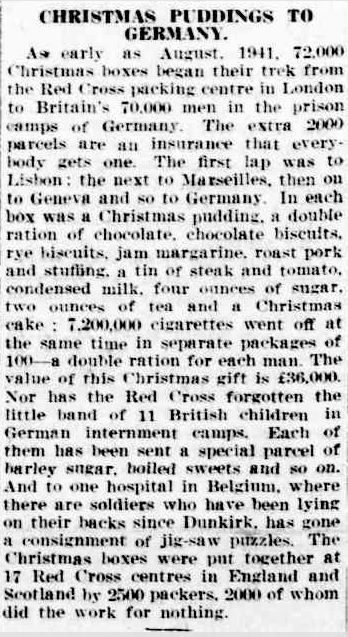
The work of the Red Cross was often reported on during the 1940s.  On this occasion, they were sending 72,000 Christmas boxes to British prisoners across Europe.

CHRISTMAS PUDDINGS TO GERMANY. (1942, January 20). The Horsham Times (Vic. : 1882 - 1954), p. 2. Retrieved December 19, 2012, from http://nla.gov.au/nla.news-article72698955

CHRISTMAS PUDDINGS TO GERMANY. (1942, January 20). The Horsham Times (Vic. : 1882 – 1954), p. 2. Retrieved December 19, 2012, from http://nla.gov.au/nla.news-article72698955

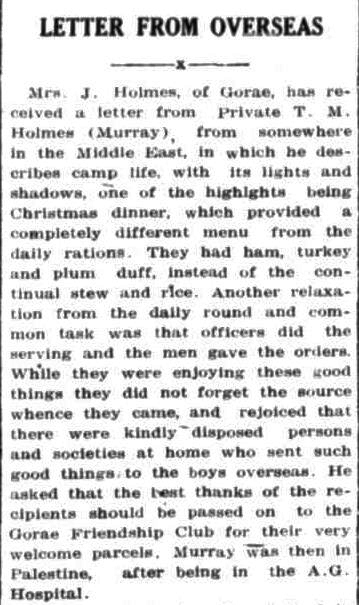
Private T.M. Holmes of Gorae had a welcome break from stew and rice for Christmas 1941, spent in the Middle East.  A dinner of ham, turkey and plum duff was served by officers while the rank and file gave orders.

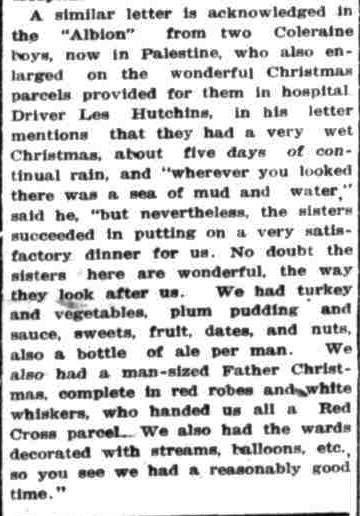
Les Hutchins spent Christmas in a hospital in Palestine and was grateful for his Red Cross parcel and the work of the nursing sisters to make sure Christmas for the patients was as happy as possible.
1940u

LETTER FROM OVERSEAS. (1942, February 2). Portland Guardian (Vic. : 1876 - 1953), p. 3 Edition: EVENING. Retrieved December 19, 2012, from http://nla.gov.au/nla.news-article64378749

LETTER FROM OVERSEAS. (1942, February 2). Portland Guardian (Vic. : 1876 – 1953), p. 3 Edition: EVENING. Retrieved December 19, 2012, from http://nla.gov.au/nla.news-article64378749

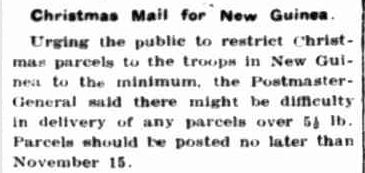
Christmas 1942,  and attention had moved from Europe and the Middle East to closer to home.  Troops were in New Guinea and family could send mail until November 15

Christmas Mail for New Guinea. (1942, November 16). Portland Guardian (Vic. : 1876 - 1953), p. 4 Edition: EVENING. Retrieved December 19, 2012, from http://nla.gov.au/nla.news-article64382762

Christmas Mail for New Guinea. (1942, November 16). Portland Guardian (Vic. : 1876 – 1953), p. 4 Edition: EVENING. Retrieved December 19, 2012, from http://nla.gov.au/nla.news-article64382762

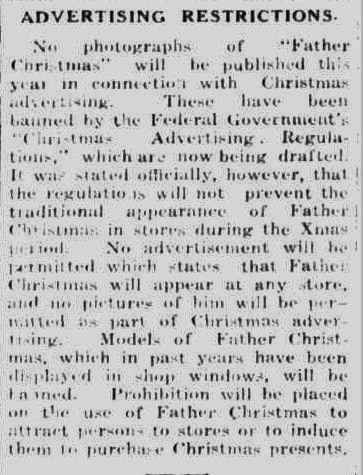
New restrictions were in place  during 1942 and again Christmas was under the spotlight.   Santa was given the year off.

ADVERTISING RESTRICTIONS. (1942, November 16). Portland Guardian (Vic. : 1876 - 1953), p. 2 Edition: EVENING. Retrieved December 19, 2012, from http://nla.gov.au/nla.news-article64382744

ADVERTISING RESTRICTIONS. (1942, November 16). Portland Guardian (Vic. : 1876 – 1953), p. 2 Edition: EVENING. Retrieved December 19, 2012, from http://nla.gov.au/nla.news-article64382744

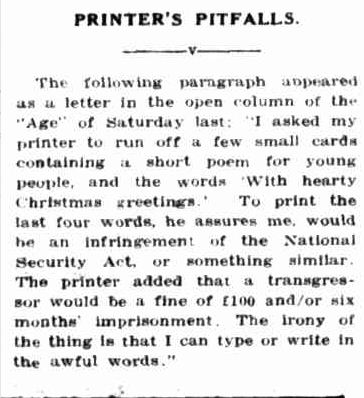
Printers kept a keen eye out for Christmas terms on their print jobs out of  fear of a £100 fine and/or six months imprisonment.

PRINTER'S PITFALLS. (1942, November 26). Portland Guardian (Vic. : 1876 - 1953), p. 4 Edition: EVENING. Retrieved December 19, 2012, from http://nla.gov.au/nla.news-article64382890

PRINTER’S PITFALLS. (1942, November 26). Portland Guardian (Vic. : 1876 – 1953), p. 4 Edition: EVENING. Retrieved December 19, 2012, from http://nla.gov.au/nla.news-article64382890

Advertisements were strictly censored as were motion pictures, signs, leaflets,  hoardings and more.

CHRISTMAS SHOPPING. (1942, November 27). The Horsham Times (Vic. : 1882 - 1954), p. 2. Retrieved December 19, 2012, from http://nla.gov.au/nla.news-article72706611

CHRISTMAS SHOPPING. (1942, November 27). The Horsham Times (Vic. : 1882 – 1954), p. 2. Retrieved December 19, 2012, from http://nla.gov.au/nla.news-article72706611

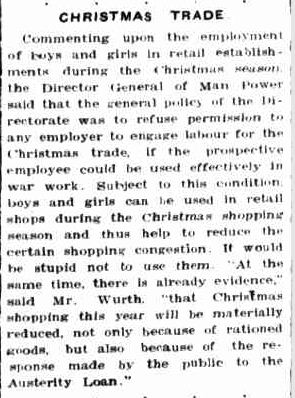
Traders were not allowed to employ staff specifically for Christmas trade but boys and girls could be used to free up the adult workforce for war related work.

CHRISTMAS TRADE. (1942, December 7). Portland Guardian (Vic. : 1876 - 1953), p. 3 Edition: EVENING. Retrieved December 19, 2012, from http://nla.gov.au/nla.news-article64383060

CHRISTMAS TRADE. (1942, December 7). Portland Guardian (Vic. : 1876 – 1953), p. 3 Edition: EVENING. Retrieved December 19, 2012, from http://nla.gov.au/nla.news-article64383060

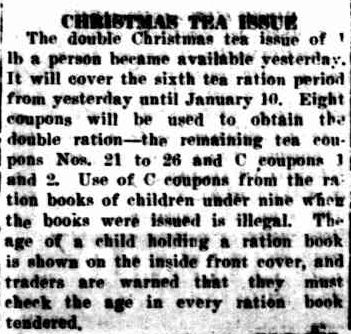
Many would have been thankful for the double Christmas tea issue of 1942.

CHRISTMAS TEA ISSUE. (1942, December 15). The Horsham Times (Vic. : 1882 - 1954), p. 2. Retrieved December 19, 2012, from http://nla.gov.au/nla.news-article72706817

CHRISTMAS TEA ISSUE. (1942, December 15). The Horsham Times (Vic. : 1882 – 1954), p. 2. Retrieved December 19, 2012, from http://nla.gov.au/nla.news-article72706817

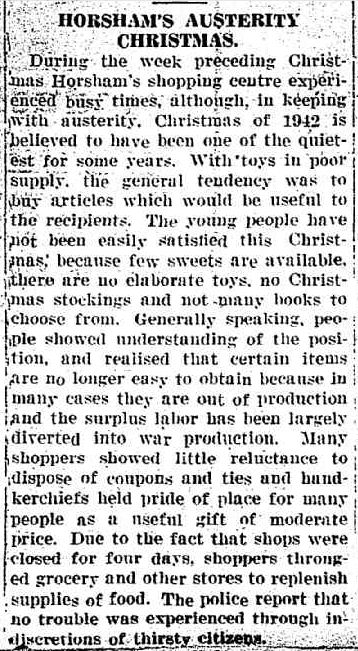
If Australian residents did not know what austerity was before WW2, they sure did by the end.  The country tightened its belt.  Not only that, a shortage of toys, sweets and books limited shopping. Shoppers opted for practical gifts,  ties and handkerchiefs.

HORSHAM'S AUSTERITY CHRISTMAS. (1943, January 1). The Horsham Times (Vic. : 1882 - 1954), p. 2. Retrieved December 19, 2012, from http://nla.gov.au/nla.news-article73103254

HORSHAM’S AUSTERITY CHRISTMAS. (1943, January 1). The Horsham Times (Vic. : 1882 – 1954), p. 2. Retrieved December 19, 2012, from http://nla.gov.au/nla.news-article73103254

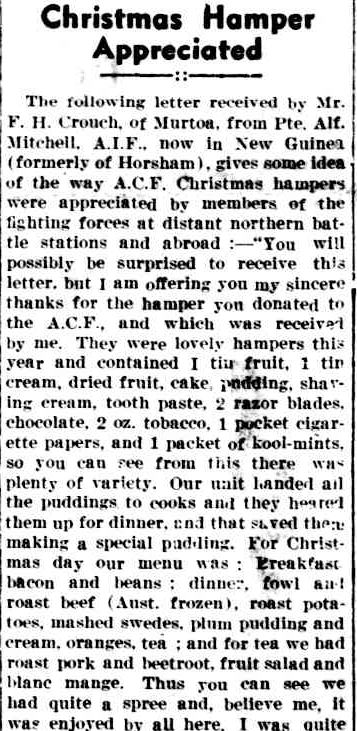
Private Alfred Mitchell, formerly of Horsham, wrote a letter of thanks to Mr Crouch of Murtoa for the hamper he donated for Christmas 1942.  Alf. received  goodies including a tin of cream, dried fruit cake, tooth paste, chocolate, tobacco and kool mints.

As was the norm, Alf and the other members of his unit gave their puddings to the cooks to heat.

Christmas Hamper Appreciated. (1943, February 2). The Horsham Times (Vic. : 1882 - 1954), p. 1. Retrieved December 19, 2012, from http://nla.gov.au/nla.news-article73103694

Christmas Hamper Appreciated. (1943, February 2). The Horsham Times (Vic. : 1882 – 1954), p. 1. Retrieved December 19, 2012, from http://nla.gov.au/nla.news-article73103694

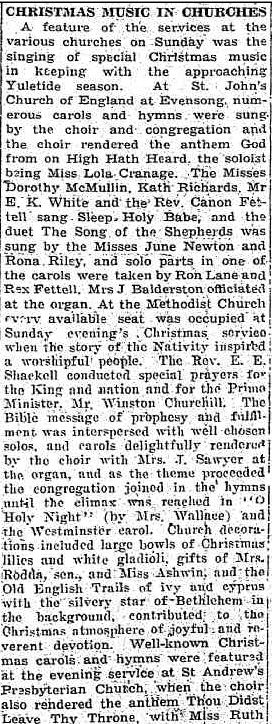
At the Horsham Methodist Church during December 1943, the congregation enjoyed the story of the nativity,  prayers for the King, Prime Minister and Winston Churchill and hymns.  The evening finished with a solo of “O Holy Night” by Mrs Wallace.   Christmas lilies, white gladioli, ivy and cyprus decorated the church.

Similar evenings were held at the St John’s Church of England and St Andrew’s Presbyterian church, also in Horsham.

CHRISTMAS MUSIC IN CHURCHES. (1943, December 21). The Horsham Times (Vic. : 1882 - 1954), p. 2. Retrieved December 19, 2012, from http://nla.gov.au/nla.news-article73108233

CHRISTMAS MUSIC IN CHURCHES. (1943, December 21). The Horsham Times (Vic. : 1882 – 1954), p. 2. Retrieved December 19, 2012, from http://nla.gov.au/nla.news-article73108233

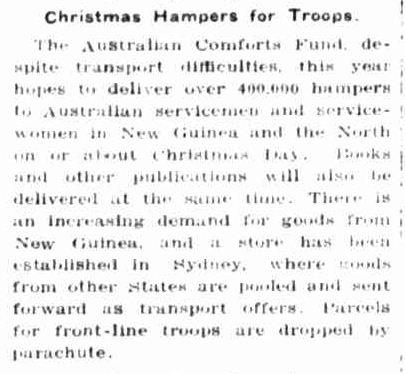
The Australian Comforts Fund packed over 400,000 hampers for New Guinea and beyond during Christmas 1943.

Christmas Hampers for Troops. (1943, December 20). Portland Guardian (Vic. : 1876 - 1953), p. 4 Edition: EVENING. Retrieved December 19, 2012, from http://nla.gov.au/nla.news-article64387758

Christmas Hampers for Troops. (1943, December 20). Portland Guardian (Vic. : 1876 – 1953), p. 4 Edition: EVENING. Retrieved December 19, 2012, from http://nla.gov.au/nla.news-article64387758


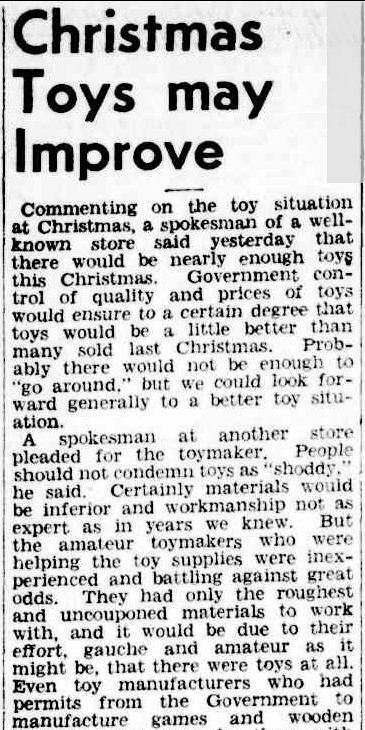
Christmas 1944 saw a promise of better toys.  Limited materials and labour had reduced the quality during the war period.
1940ff

Christmas Toys may Improve. (1944, August 25). The Argus (Melbourne, Vic. : 1848 - 1956), p. 8. Retrieved December 19, 2012, from http://nla.gov.au/nla.news-article11358186

Christmas Toys may Improve. (1944, August 25). The Argus (Melbourne, Vic. : 1848 – 1956), p. 8. Retrieved December 19, 2012, from http://nla.gov.au/nla.news-article11358186 

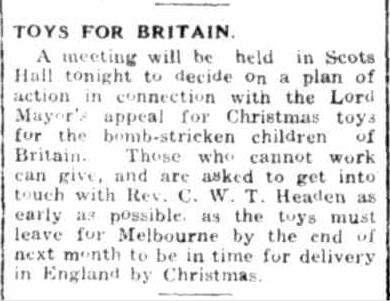
Portland people were getting behind the Lord Mayor’s appeal to send toys to Britain for Christmas 1944.

TOYS FOR BRITAIN. (1944, September 25). Portland Guardian (Vic. : 1876 - 1953), p. 2 Edition: EVENING. Retrieved December 19, 2012, from http://nla.gov.au/nla.news-article64390532

TOYS FOR BRITAIN. (1944, September 25). Portland Guardian (Vic. : 1876 – 1953), p. 2 Edition: EVENING. Retrieved December 19, 2012, from http://nla.gov.au/nla.news-article64390532


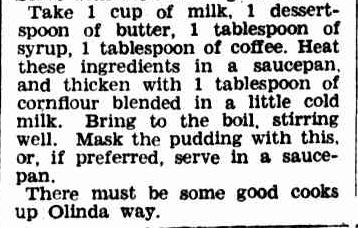
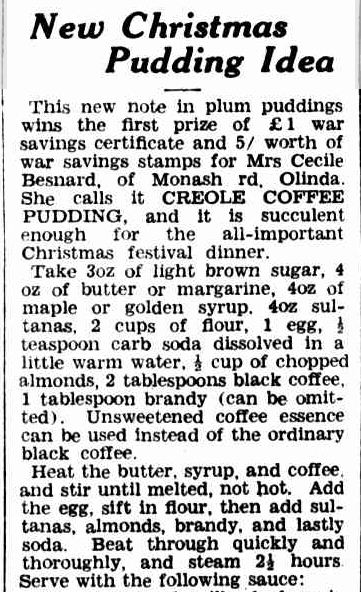
Cecile Besnard of Olinda won first prize in the 1944 Argus plum pudding recipe contest with a Creole Coffee pudding
1940ii

New Christmas Pudding Idea. (1944, November 21). The Argus (Melbourne, Vic. : 1848 - 1956), p. 9. Retrieved December 19, 2012, from http://nla.gov.au/nla.news-article11371169

New Christmas Pudding Idea. (1944, November 21). The Argus (Melbourne, Vic. : 1848 – 1956), p. 9. Retrieved December 19, 2012, from http://nla.gov.au/nla.news-article11371169

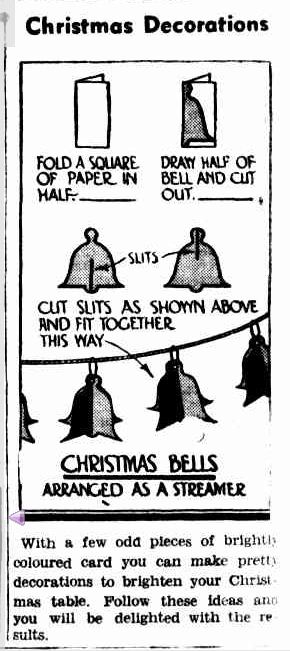
Christmas Decorations. (1944, December 19). The Argus (Melbourne, Vic. : 1848 - 1956), p. 10. Retrieved December 19, 2012, from http://nla.gov.au/nla.news-article11375480

Christmas Decorations. (1944, December 19). The Argus (Melbourne, Vic. : 1848 – 1956), p. 10. Retrieved December 19, 2012, from http://nla.gov.au/nla.news-article11375480


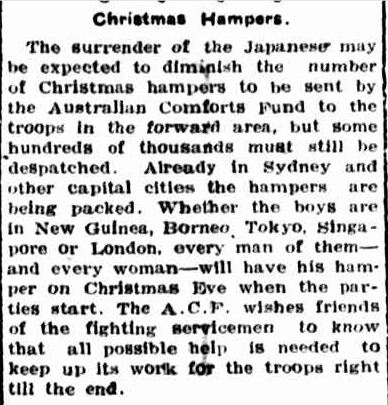
Despite the Japanese surrender, Christmas hampers were still in great demand for Christmas 1945.

Christmas Hampers. (1945, September 17). Portland Guardian (Vic. : 1876 - 1953), p. 1 Edition: EVENING. Retrieved December 19, 2012, from http://nla.gov.au/nla.news-article64405473

Christmas Hampers. (1945, September 17). Portland Guardian (Vic. : 1876 – 1953), p. 1 Edition: EVENING. Retrieved December 19, 2012, from http://nla.gov.au/nla.news-article64405473

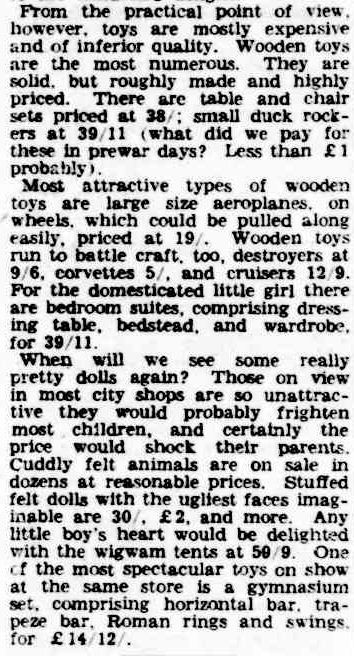
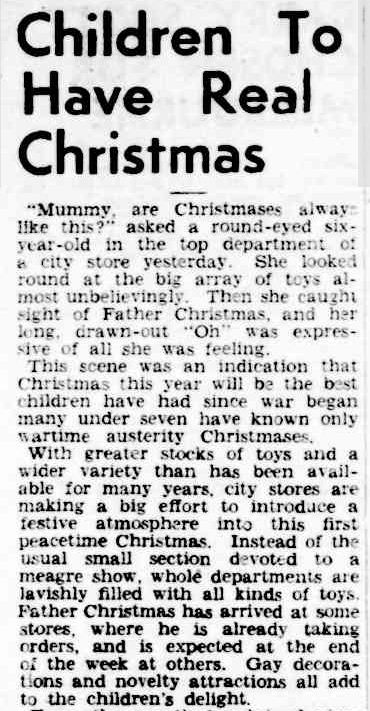
Children that could not remember a Christmas before the war looked forward to celebrating a “real” Christmas in 1945.  Santa was back and made in-store appearances.  Sadly the toys were still inferior and the dolls thought ugly enough to scare little girls.
1940ww

Children To Have Real Christmas. (1945, November 14). The Argus (Melbourne, Vic. : 1848 - 1956), p. 10. Retrieved December 19, 2012, from http://nla.gov.au/nla.news-article12153002

Children To Have Real Christmas. (1945, November 14). The Argus (Melbourne, Vic. : 1848 – 1956), p. 10. Retrieved December 19, 2012, from http://nla.gov.au/nla.news-article12153002

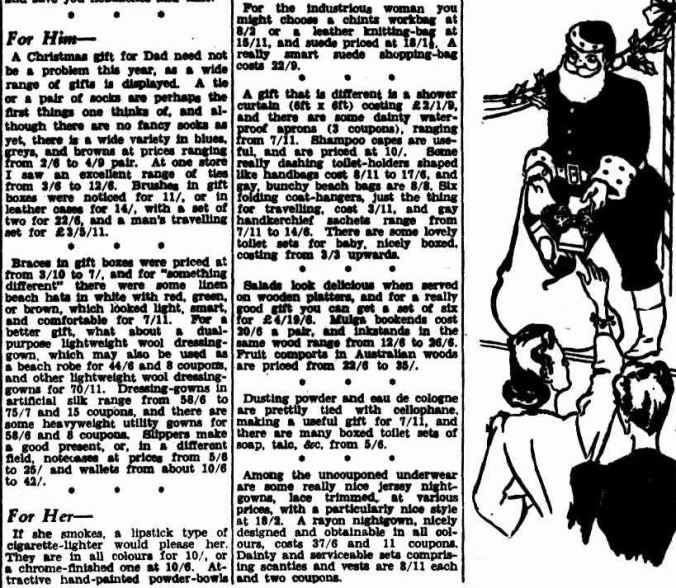
Gift suggestion articles were back as retailers got back into the swing of Christmas trading.  Dad could expect a brush, socks or even a wool dressing gown worth 44/6 and 8 coupons.  If mum was a smoker, maybe a lipstick shaped lighter or for something different, why not a shower curtain?

Give Them for Christmas—. (1945, December 11). The Argus (Melbourne, Vic. : 1848 - 1956), p. 7. Retrieved December 19, 2012, from http://nla.gov.au/nla.news-article12157846

Give Them for Christmas—. (1945, December 11). The Argus (Melbourne, Vic. : 1848 – 1956), p. 7. Retrieved December 19, 2012, from http://nla.gov.au/nla.news-article12157846

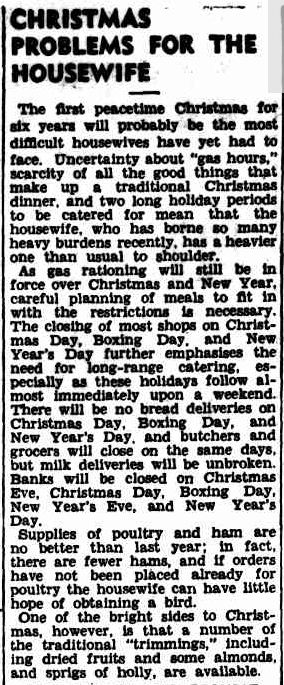
Gas was in short supply in 1945 as was poultry and ham.  On the bright side dried fruits, almonds and holly sprigs were back.

CHRISTMAS PROBLEMS FOR THE HOUSEWIFE. (1945, December 19). The Argus (Melbourne, Vic. : 1848 - 1956), p. 12. Retrieved December 19, 2012, from http://nla.gov.au/nla.news-article12159361

CHRISTMAS PROBLEMS FOR THE HOUSEWIFE. (1945, December 19). The Argus (Melbourne, Vic. : 1848 – 1956), p. 12. Retrieved December 19, 2012, from http://nla.gov.au/nla.news-article12159361

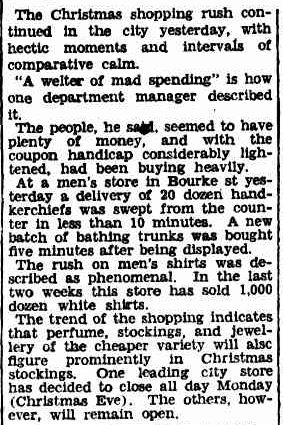
After years of penny-pinching and low-key Christmas days,  shoppers were out in force in 1945.
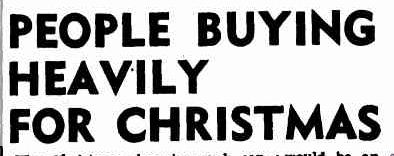
1940aaa

PEOPLE BUYING HEAVILY FOR CHRISTMAS. (1945, December 21). The Argus (Melbourne, Vic. : 1848 - 1956), p. 3. Retrieved December 19, 2012, from http://nla.gov.au/nla.news-article12159834

PEOPLE BUYING HEAVILY FOR CHRISTMAS. (1945, December 21). The Argus (Melbourne, Vic. : 1848 – 1956), p. 3. Retrieved December 19, 2012, from http://nla.gov.au/nla.news-article12159834

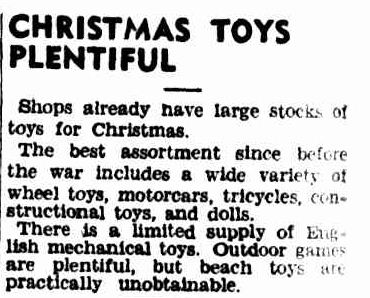
Toys were plentiful, but English mechanical toys were in limited supply and beach toys were unobtainable.

CHRISTMAS TOYS PLENTIFUL. (1946, October 25). The Argus (Melbourne, Vic. : 1848 - 1956), p. 18. Retrieved December 19, 2012, from http://nla.gov.au/nla.news-article22390326

CHRISTMAS TOYS PLENTIFUL. (1946, October 25). The Argus (Melbourne, Vic. : 1848 – 1956), p. 18. Retrieved December 19, 2012, from http://nla.gov.au/nla.news-article22390326

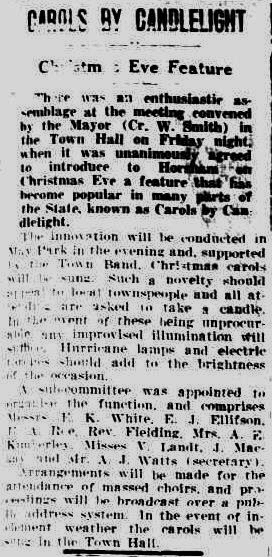
Carols By candlelight was growing in popularity, so the Horsham City Council decided to introduce their own for Christmas 1946.  May Park was the proposed venue.

CAROLS BY CANDLELIGHT. (1946, December 10). The Horsham Times (Vic. : 1882 - 1954), p. 3. Retrieved December 19, 2012, from http://nla.gov.au/nla.news-article73080615

CAROLS BY CANDLELIGHT. (1946, December 10). The Horsham Times (Vic. : 1882 – 1954), p. 3. Retrieved December 19, 2012, from http://nla.gov.au/nla.news-article73080615

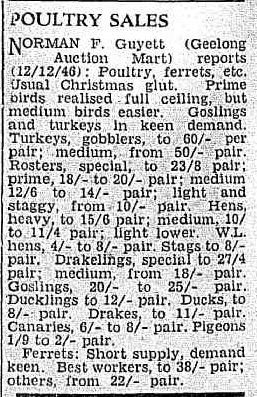
POULTRY SALES. (1946, December 16). Camperdown Chronicle (Vic. : 1877 - 1954), p. 4 Edition: Afternoons.. Retrieved December 19, 2012, from http://nla.gov.au/nla.news-article65438306

POULTRY SALES. (1946, December 16). Camperdown Chronicle (Vic. : 1877 – 1954), p. 4 Edition: Afternoons.. Retrieved December 19, 2012, from http://nla.gov.au/nla.news-article65438306

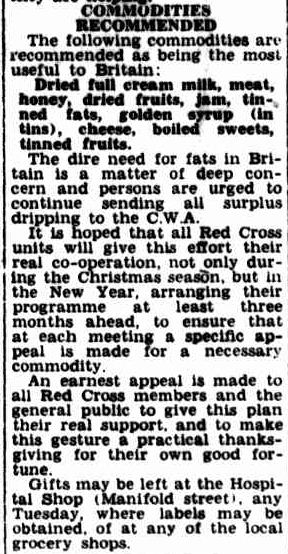
Christmas was brighter in Australia, but in Britain the situation was still grim.  Gifts of food could be left at the Camperdown branch of the Red Cross in Manifold Street.
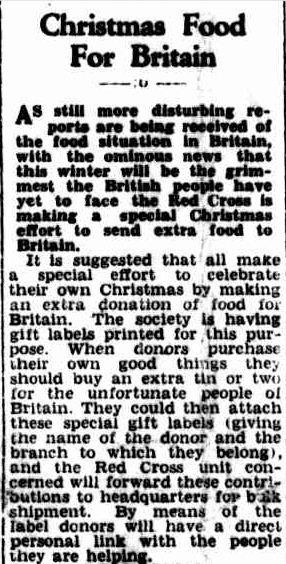
1940oo

Christmas Food For Britain. (1947, December 15). Camperdown Chronicle (Vic. : 1877 - 1954), p. 1 Edition: Afternoons.. Retrieved December 19, 2012, from http://nla.gov.au/nla.news-article65243667

Christmas Food For Britain. (1947, December 15). Camperdown Chronicle (Vic. : 1877 – 1954), p. 1 Edition: Afternoons.. Retrieved December 19, 2012, from http://nla.gov.au/nla.news-article65243667

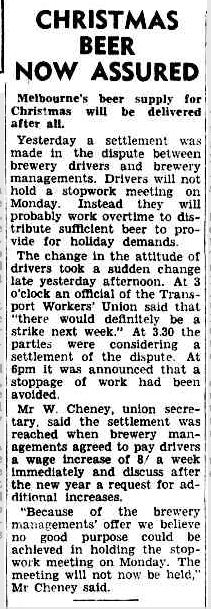
Was this the beginning of what used to be almost annual event?  Brewery workers went on strike just before Christmas 1947.

CHRISTMAS BEER HOW ASSURED. (1947, December 20). The Argus (Melbourne, Vic. : 1848 - 1956), p. 1. Retrieved December 20, 2012, from http://nla.gov.au/nla.news-article22529758

CHRISTMAS BEER HOW ASSURED. (1947, December 20). The Argus (Melbourne, Vic. : 1848 – 1956), p. 1. Retrieved December 20, 2012, from http://nla.gov.au/nla.news-article22529758

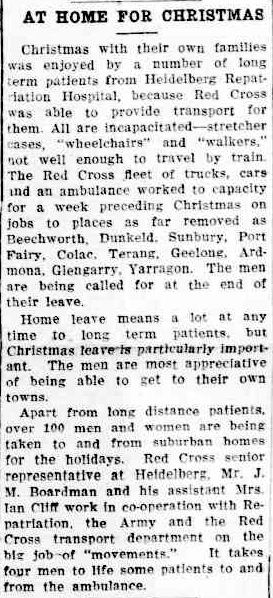
The Red Cross provided transport for patients at the Heidelberg Repatriation Hospital to return home for Christmas 1947.  Trucks, cars and ambulances drove patients to towns such as Dunkeld, Port Fairy, Colac and Terang.

AT HOME FOR CHRISTMAS. (1948, January 20). The Horsham Times (Vic. : 1882 - 1954), p. 8. Retrieved December 19, 2012, from http://nla.gov.au/nla.news-article73087674

AT HOME FOR CHRISTMAS. (1948, January 20). The Horsham Times (Vic. : 1882 – 1954), p. 8. Retrieved December 19, 2012, from http://nla.gov.au/nla.news-article73087674

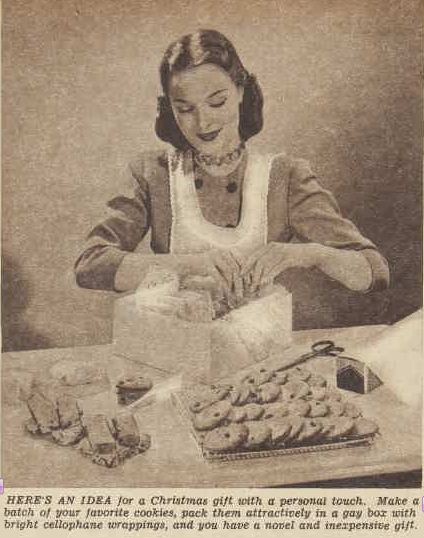
The Australian Women’s Weekly had personal gift giving ideas and a new cook book offer in their December 4, 1948 issue.

Our cookery book will make a wonderful Christmas gift. (1948, December 4). The Australian Women's Weekly (1933 - 1982), p. 34. Retrieved December 20, 2012, from http://nla.gov.au/nla.news-article51389595

Our cookery book will make a wonderful Christmas gift. (1948, December 4). The Australian Women’s Weekly (1933 – 1982), p. 34. Retrieved December 20, 2012, from http://nla.gov.au/nla.news-article51389595

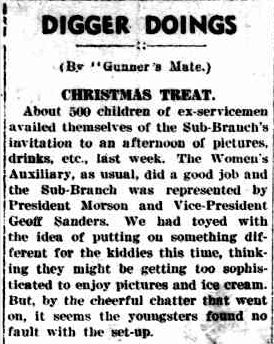
DIGGER DOINGS. (1948, December 31). The Horsham Times (Vic. : 1882 - 1954), p. 5. Retrieved December 19, 2012, from http://nla.gov.au/nla.news-article73093199

DIGGER DOINGS. (1948, December 31). The Horsham Times (Vic. : 1882 – 1954), p. 5. Retrieved December 19, 2012, from http://nla.gov.au/nla.news-article73093199

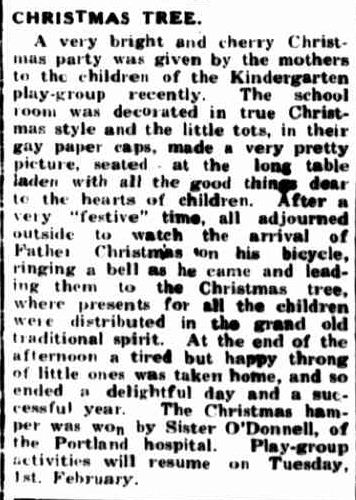
Father Christmas arrived on a bike for the Portland Kindergarten play-group Christmas party.

CHRISTMAS TREE. (1949, January 20). Portland Guardian (Vic. : 1876 - 1953), p. 2 Edition: EVENING. Retrieved December 19, 2012, from http://nla.gov.au/nla.news-article64417285

CHRISTMAS TREE. (1949, January 20). Portland Guardian (Vic. : 1876 – 1953), p. 2 Edition: EVENING. Retrieved December 19, 2012, from http://nla.gov.au/nla.news-article64417285

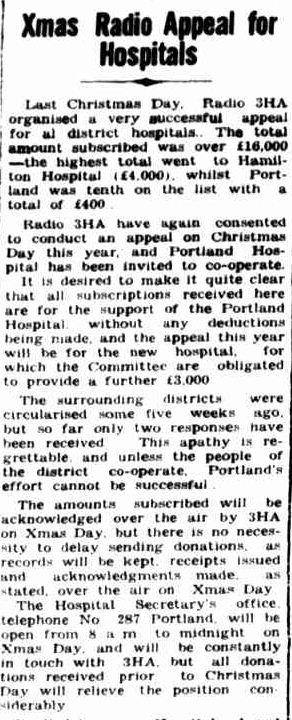
Radio 3HA ran a hospital appeal on Christmas day 1948 and due to its success, repeated it in 1949.

Xmas Radio Appeal for Hospitals. (1949, December 1). Portland Guardian (Vic. : 1876 - 1953), p. 4 Edition: EVENING. Retrieved December 20, 2012, from http://nla.gov.au/nla.news-article64420168

Xmas Radio Appeal for Hospitals. (1949, December 1). Portland Guardian (Vic. : 1876 – 1953), p. 4 Edition: EVENING. Retrieved December 20, 2012, from http://nla.gov.au/nla.news-article64420168

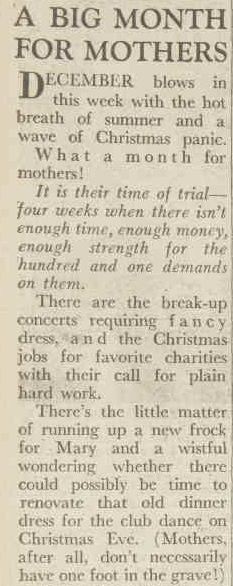
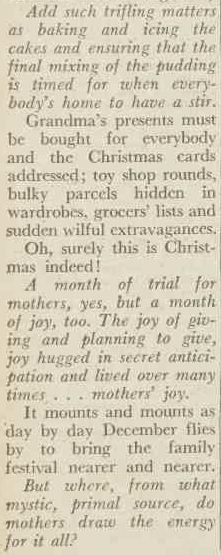
December.  What a month!

1940ggg

Editorial. (1949, December 3). The Australian Women's Weekly (1933 - 1982), p. 18. Retrieved December 20, 2012, from http://nla.gov.au/nla.news-article51594508

Editorial. (1949, December 3). The Australian Women’s Weekly (1933 – 1982), p. 18. Retrieved December 20, 2012, from http://nla.gov.au/nla.news-article51594508

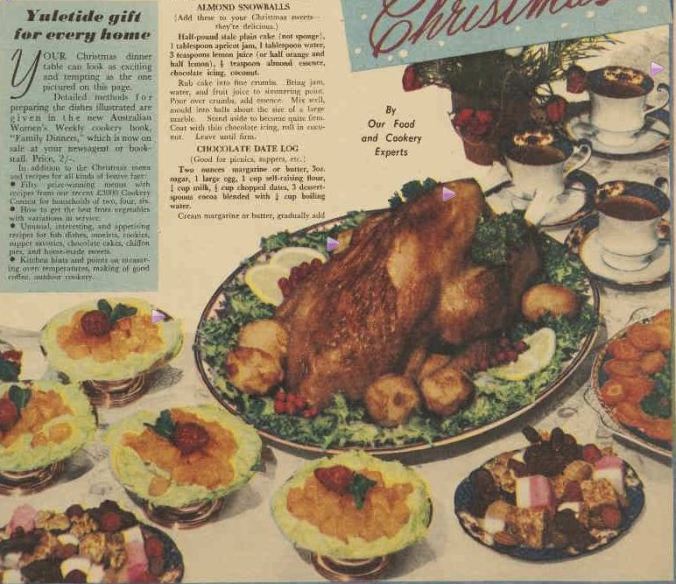
The December 17,  1949 issue of the Australian Women’s Weekly had recipes for Almond Snowballs and Chocolate date log and Christmas table presentation ideas.

Christmas. (1949, December 17). The Australian Women's Weekly (1933 - 1982), p. 53. Retrieved December 20, 2012, from http://nla.gov.au/nla.news-article51600533

Christmas. (1949, December 17). The Australian Women’s Weekly (1933 – 1982), p. 53. Retrieved December 20, 2012, from http://nla.gov.au/nla.news-article51600533


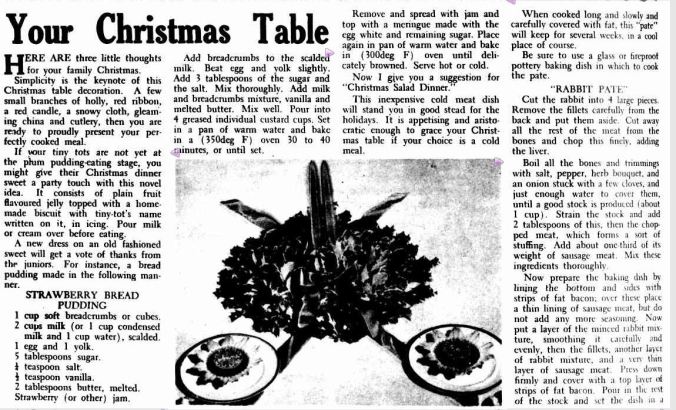
The Argus also had Christmas table hints and a recipe for Rabbit pâté.

Your Christmas Table. (1949, December 20). The Argus (Melbourne, Vic. : 1848 - 1956), p. 4 Supplement: The Argus Woman's Magazine. Retrieved December 20, 2012, from http://nla.gov.au/nla.news-article22799645

Your Christmas Table. (1949, December 20). The Argus (Melbourne, Vic. : 1848 – 1956), p. 4 Supplement: The Argus Woman’s Magazine. Retrieved December 20, 2012, from http://nla.gov.au/nla.news-article22799645


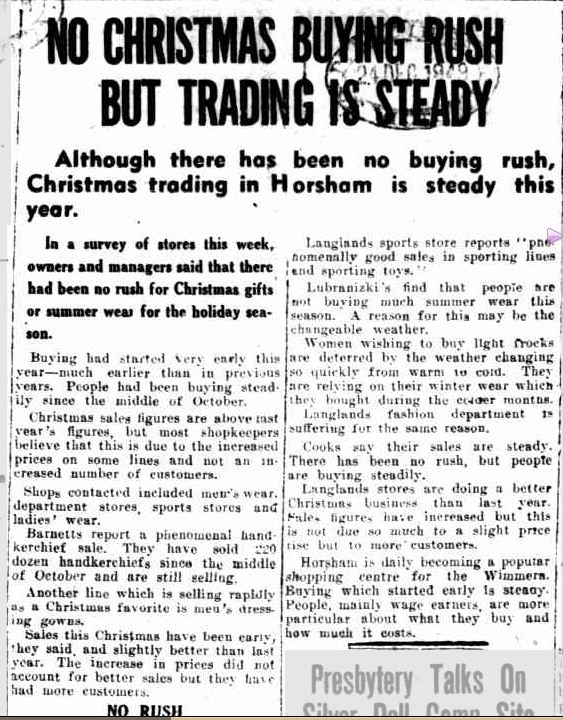
Horsham traders were not experiencing a Christmas rush in 1949 and cooler weather had slowed the sale of summer clothing.  Barnetts, however, saw a rush on that ever popular Christmas gift, handkerchiefs.  Men’s dressing gowns were also selling well.

NO CHRISTMAS BUYING RUSH BUT TRADING IS STEADY. (1949, December 23). The Horsham Times (Vic. : 1882 - 1954), p. 7. Retrieved December 20, 2012, from http://nla.gov.au/nla.news-article73103040

NO CHRISTMAS BUYING RUSH BUT TRADING IS STEADY. (1949, December 23). The Horsham Times (Vic. : 1882 – 1954), p. 7. Retrieved December 20, 2012, from http://nla.gov.au/nla.news-article73103040

An Early Christmas Present

While I take a short break from Christmas posts, I thought I would tell you about an early and surprising Christmas gift I received.

An email arrived late last month from fellow Western District researcher Daryl Povey from the Glenelg and Wannon Settlers website.  He had noticed the following notice in Alan Bald’s book “Births, Deaths & Marriages printed in the “Hamilton Spectator” 1-7-1859 to 31-12-1920″  of which there are 11 volumes:

MARTIMER.–Hannah Martimer (or Mortimer,) wife of a Cavendish carrier, died 26/8/1888, after being bed-ridden for eight months.

“The Hamilton Spectator” 28th August 1888

At last, thanks to Daryl, I had a death date for Rosanna Buckland and yet another variation to her name, Hannah.  You may remember the sign at the entrance to the Old Cavendish Cemetery, listing a “Mrs Mortimer”, buried in 1889.  I do believe now that “Mrs Mortimer” is Rosanna which would make the date incorrect.  Rosanna was only 63 when she died and it is sad to find that she was bed-ridden in the months before her death.

Daryl then forwarded the notice for Rosanna’s husband, James Mortimer:

MORTIMER.–On the 3rd inst., at his late residence, Cavendish, James Mortimer, aged 74 years. Born in Windsor, Wiltshire, England, he came to the colony in 1851, was a station driver and overseer, then a carrier. He died of dropsy and heart disease, and was buried on 5/11/1895, leaving four grown-up children. His wife died about 7 years ago.

“The Hamilton Spectator” 5th November 1895

As Daryl pointed out, there are a couple of errors in this notice.  James was born in White Waltham, Berkshire, England and he and Rosanna arrived in Victoria in December 1852 aboard the “Bombay” and of course James was a station drover and not a driver.

Thank you Daryl for your help once again.   Why not check out Daryl’s website which also incorporates the Casterton Historical society website.  If you have a Western District Family or have an interest in Western District history, particularly  the south-west,  you are bound to find something of interest.  I am constantly amazed at the amount of content on the site.

In The News – November 24, 1941

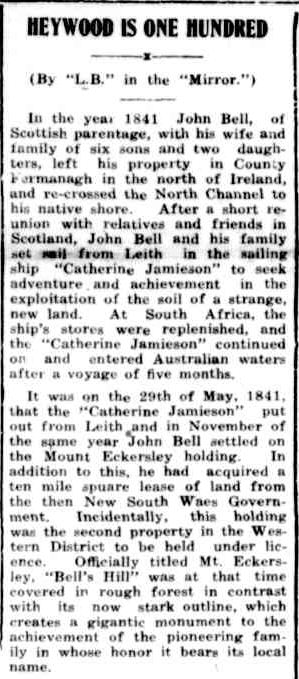
The Portland Guardian of November 24, 1941 heralded the 100th birthday of Heywood, a small town about 25 kms north of Portland.  The article remembered The Bell family and their contribution to Heywood’s settlement.  I recently  introduced to you my family link to the Bells in a Trove Tuesday post – A Matter of Relativity about Amelia Harman.  Amelia married Christopher Bell, a grandson of John and Elizabeth Bell.

John Bell and his wife Elizabeth Morrow, left Ireland in 1841 with eight children in tow, some were adults, and sailed to Australia aboard the “Catherine Jamison“.  Five months after their departure, the Bells had settled at Mount Eckersley, a few kilometres north of Heywood.


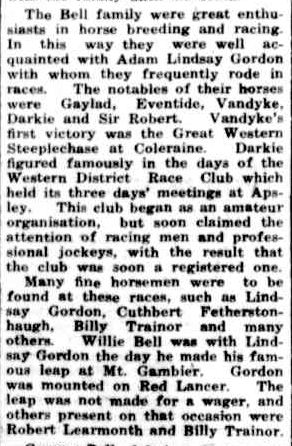
Great contributors to Western Victorian racing, the family were good friends with poet Adam Lindsay Gordon.  William Bell was with Gordon when he made his mighty leap at Blue Lake, Mt. Gambier.

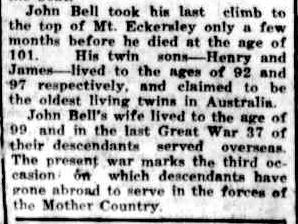
The Department of Primary Industries cites the height of Mt Eckersley as 450 feet (137 metres) but that didn’t stop John Bell, at the age of 101, from climbing the volcano, only months before his death.

As a family known for longevity, twin sons Henry and James lived to 92 and 97 respectively.  At one time they were Australia’s oldest living twins.

HEYWOOD IS ONE HUNDRED. (1941, November 24). Portland Guardian (Vic. : 1876 – 1953), p. 1 Edition: EVENING. Retrieved November 16, 2012, from http://nla.gov.au/nla.news-article64402492

All of this is well and good but is it all true?  John’s year of death is recorded as 1885, with his birth about 1787.  That would have made him around 97/98, short of the 101 reported.  Still, if he did climb Mt.Eckersley, to do it aged 97/98  was still a mean feat, but John may not have been a centenarian.  The family notice in the Hamilton Spectator at the time of his death gives his age as 98.

There could also be a discrepancy with the year the Bells settled at Mt Eckersley.  The Bells did arrive on the Catherine Jamieson on October 22, 1841 to Port Phillip.  The newspaper article says they were in Heywood by November 1841.  The Glenelg and Wannon Settlers site states John Bell settled at Mt Eckersly in 1843.

A further reminder to not always believe what you read in the papers.

Trove Tuesday – UFO Alert!

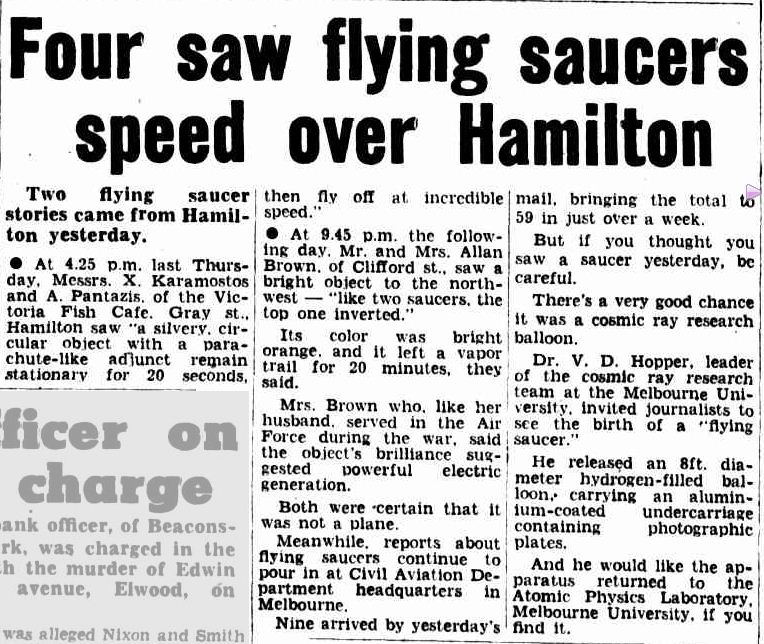
Hamilton experienced the paranormal during January 1954, with two separate “flying saucer” sightings.

Four saw flying saucers speed over Hamilton. (1954, January 13). The Argus (Melbourne, Vic. : 1848 – 1956), p. 5.  http://nla.gov.au/nla.news-article26584624

From a  Trove search of “flying saucers” I found during the 1930s the only flying saucers were those thrown across a room accompanied by a cup, but by the 1940s the flying saucers we know today began to make the news.  Many of the articles I saw were about experimental trials of flying saucers by earthlings.  But by the 1950s, “sightings” of flying saucers, presumably crewed by aliens, were commonplace.

A search of “science fiction” produced similar results.  There was no mention of the term during the 1930s, but by the 1950s it had reached meteoric heights.

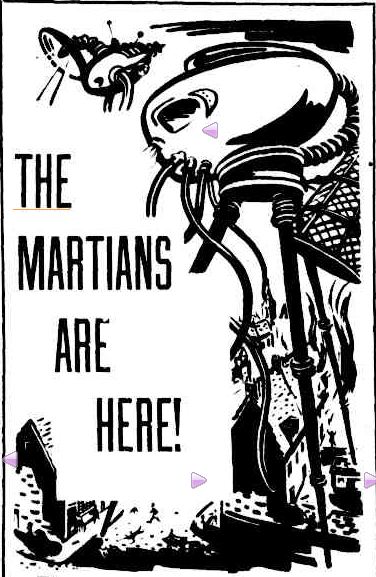
The Science Fiction film genre changed during the 1950s.  Science Fiction films of the 1940s were horrors like Frankenstein and Dracula or superheroes such as Batman and Robin.  The Invisible Man and Flash Gordon were also popular.  The 1950s Sci-Fi films took to the universe with life on other planets a major theme.  The film Flying Saucer was released in 1950, War of the Worlds and Invaders from Mars in 1953 and that year even Abbott and Costello went to Mars.

THE MARTIaNS ARE HERE!. (1953, December 22). The Argus (Melbourne, Vic. : 1848 – 1956), p. 1.  http://nla.gov.au/nla.news-article23303135

No wonder Hamilton residents were on high UFO alert. While the film version of War of the Worlds had not yet reached the town, to add to the hype, their holiday reading may have included instalments of the H.G. Wells’ 1898 novel which ran in The Argus from 24 December 1953 until 7 January 1954, the same day as the Hamilton flying saucer sightings.

***If anyone finds Dr Hopper’s cosmic ray research balloon he would appreciate its return to Melbourne University.

Witness for the Prosecution – New Findings

I love it when my ancestors find their voice and through their own words give something of their personalities.  Obviously, their voice is not audible, but through Letters to the Editors, wills or even as witnesses for an inquest, it is then easier to imagine them speaking.

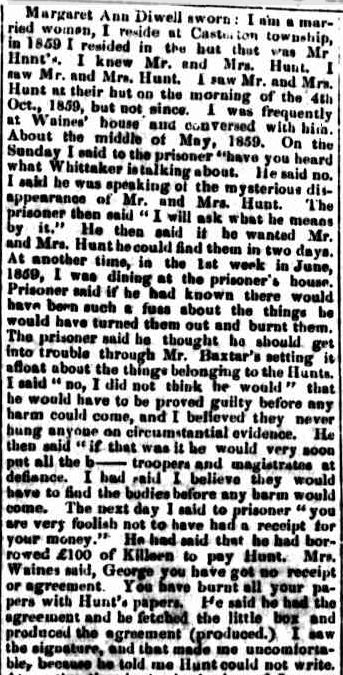
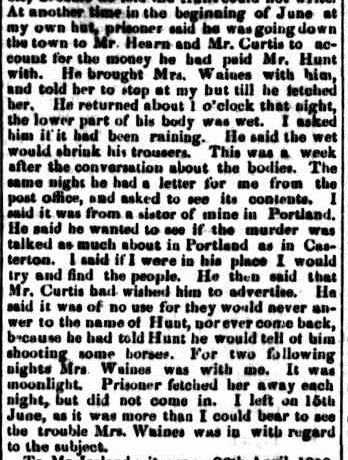
In my post Witness for the Prosecution, I  wrote of ggg grandmother Margaret Ann Turner, married to William Diwell, and her experience as a witness in a murder trial in 1860 at Casterton. Previous newspaper reports had only mentioned her role, but an extensive report of the trial in the Portland Guardian and Normanby General Advertiser of 20 April 1860 brings Margaret to life as she describes her conversations to the defendant, George Waines, prior to his arrest.  Of course, give consideration to the abilities of the person recording the events.

This article tells me a lot about my ggg grandparents.  It reconfirmed they were in Casterton in 1859 and Margaret said they were residing in a hut owned by Mr Hunt.  Also, Margaret must have been good friends with Mrs Waines spending a lot of time at their house, including dining there on occasions.  She makes no mention of William or the six children.

CIRCUIT COURT. (1860, April 20). Portland Guardian and Normanby General Advertiser (Vic. : 1842 – 1876), p. 2 Edition: EVENINGS. Retrieved November 10, 2012, from http://nla.gov.au/nla.news-article65443361

More revelations. George Waines dropped his wife off at Margaret’s hut one night.  Mrs Waines then stayed a further two nights with George returning each night to take Mrs Waines away.  Margaret stated she left on 15 June 1859 because she couldn’t bear to see Mrs Waines put through such torment.  So did Margaret leave her own hut and if so, where did she go?  Once again where were William and the six children?  One would think if William was around during these events, he too would have been called as a witness. William was a bricklayer and worked in surrounding towns so this may explain his apparent absence.

Notice too that Margaret describes the Waines’ abode as a “house”, but the Diwells and Hunts lived in huts.  They were most likely slab huts like the one below.

Sutherland, Alexander, [Slab hut with bark roof ca. 1870-ca. 1880] Image Courtesy of the State Library of Victoria http://digital.slv.vic.gov.au/view/action/nmets.do?DOCCHOICE=353791.xml&dvs=1352638571965~542&locale=en_US&search_terms=&adjacency=&usePid1=true&usePid2=true

The Waines lived in a “house” so it may have been more substantial like the one below, or perhaps larger if George Waines’ aspirations were any indication.

“Family in front of their house on cleared land somewhere in Victoria”
F. J. Stubbs & Co. Photographer [ca. 1858-ca. 1908] Image courtesy of the State Library of Victoria http://handle.slv.vic.gov.au/10381/73293

Another thing that caught my attention was Margaret’s mention of a sister from Portland.  That sent me scurrying to the records as I have never found any of Margaret’s siblings and I would have thought they were back in Surrey.  A quick search of the1841 UK Census records (again) and the Australian Death Index gave me nothing, but I will keep searching.  Or was it just a ruse by Margaret to throw Waines off his interest in her mail.

It is sometimes difficult not to think of ggg grandparents as anything but old.  Reading this latest find has reminded me that Margaret was only thirty-six during the events leading up to the trial which has also reminded me that Margaret lived for only another nine years after the trial.  She was forty-five when she died, only a little older than me.  Margaret never became the old woman I must stop myself imagining her as.

There has also been another development in my family’s association with the Hunt murders.   Another descendant of my ggg grandfather George Jelly contacted me recently.  George’s daughter Elizabeth married Margaret Diwell’s son Richard in 1877.

Judy was kind enough to send me a copy of George’s obituary.  It tells of George’s swimming prowess and how he dived for the bones of the Hunt’s in the Glenelg River.  Unfortunately, I cannot find anything in the various reports about George’s efforts, despite it being mentioned that there was a river search and bones found.

A Western District Melbourne Cup

As John Finn Kirby led his 3yo colt from the Mount Gambier show ring in 1908 judged as Best 10 Stone Hack, most would not have considered the same horse would be led in as the winner of the Melbourne Cup three years later, almost to the day. But John Kirby had a dream, and his “10 Stone Hack”, The Parisian, was one of several new horses he had purchased with the potential to complete the task.

John Finn Kirby was born at his father’s Springbank station, near Casterton, in 1858. His father, Edmund Kirby, was born in Northamptonshire and was one of the early settlers at Casterton, as was John’s Irish-born mother Mary Finn. John and his sister Ellen each received their mother’s surname as their middle name.  As was the way for the sons of the early pastoralists, John was sent away to school, Ballarat College the choice.  He then spent seven years working as a stock and station agent in Ballarat.

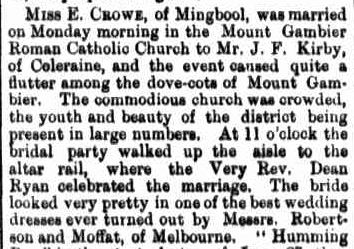
At age twenty-four, John went to work for Smallpage’s Stock and Station agents in Coleraine and after a year, he bought the business. By 1883 he was secretary of the Coleraine Racing Club. In June 1885, John married South Australian girl Elizabeth Crowe, daughter of the late Edmund Crowe and Johanna Crowe, owners of Mingbool Station near Mt Gambier. The wedding was a social highlight in the town, creating much interest.

The Border Watch. (1885, July 1). Border Watch (Mount Gambier, SA : 1861 – 1954), p. 2. Retrieved October 30, 2012, from http://nla.gov.au/nla.news-article77062640

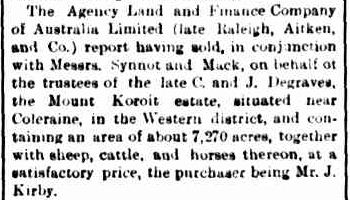
In 1888, John purchased Mt Koroite Estate near the Coleraine racecourse.

COMMERCIAL INTELLIGENCE. (1888, September 21). The Argus (Melbourne, Vic. : 1848 – 1956), p. 9. Retrieved October 30, 2012, from http://nla.gov.au/nla.news-article6902423

In August 1889, Johanna Crowe passed away, resulting in an interesting battle over her will, which ended in the Adelaide Supreme Court. The estate, worth £80,000, was settled with embattled son John receiving £10000 and daughter Elizabeth, Mrs Kirby, receiving half of the balance.  Her children received the other half of the estate.

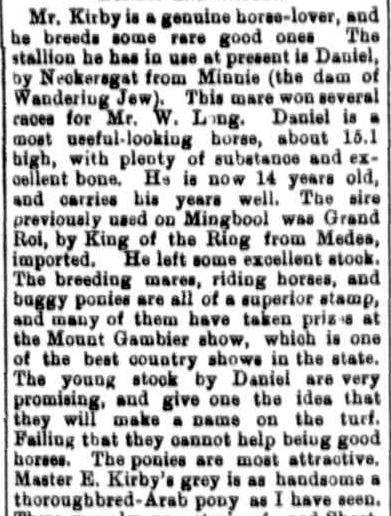
John began to spend time between Mt Koroite and Mingbool.  He’d been breeding and racing horses for a couple of years, but with the use of Mingbool, his interests grew and in 1890 he established the Mingbool Stud, primarily breeding sheep but also horses and cattle. An article from the Border Watch on 18 February 1903, reported Mingbool ran 19,000 sheep, 500 head of cattle and 100 horses.  From the same article,

THE MINGBOOL ESTATE. (1903, February 18). Border Watch (Mount Gambier, SA : 1861 – 1954), p. 4. Retrieved October 30, 2012, from http://nla.gov.au/nla.news-article77157688

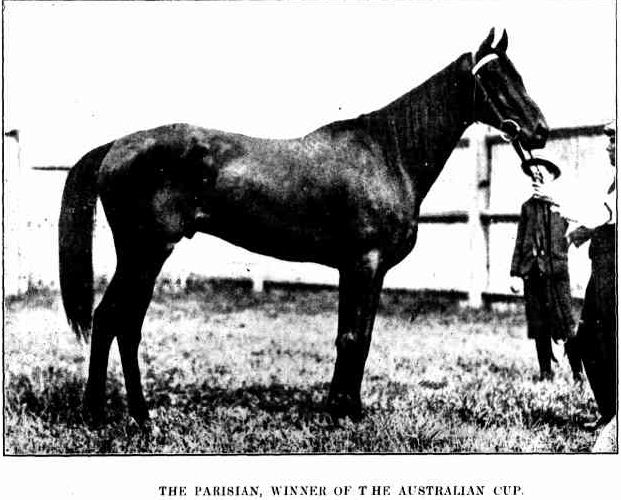
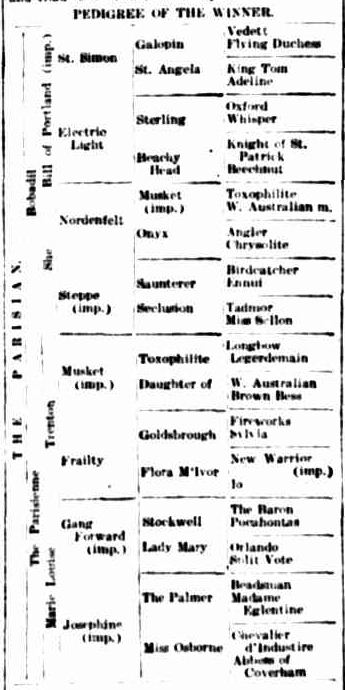
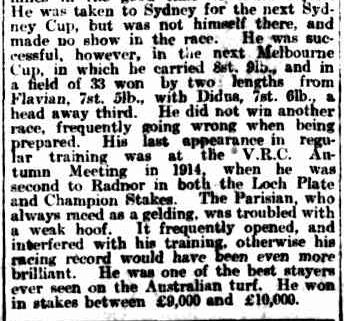
By the middle of 1908, John Kirby had acquired three promising young thoroughbreds, Halloween, Benderay and The Parisian. Benderay was the pick of the trio, brought by Kirby in Dublin, Ireland. He eventually sold the out of form horse in 1912.  Halloween showed a little more promise and picked up a few races for Kirby, but he sold him at auction in 1911. That left The Parisian, bought by Kirby in 1907 at the Melbourne Yearling Sales. His sire was Bobadil, winner of the 1899 Australian Cup and Champion Stakes, and his dam was The Parisienne.

BOBADILL, SIRE OF THE PARISIAN
(1911, March 18). Western Mail (Perth, WA : 1885 – 1954), p. 23. Retrieved November 3, 2012, from http://nla.gov.au/nla.news-article38825171

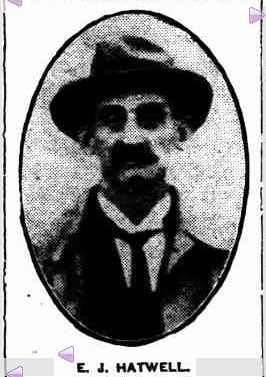
After his victory in the show ring in 1908, The Parisian was in full work by January 1909 with trainer Ernie Hartwell.
On and Off the Racecourse. (1923, June 23). The Mail (Adelaide, SA : 1912 – 1954), p. 4. Retrieved November 1, 2012, from http://nla.gov.au/nla.news-article63442639

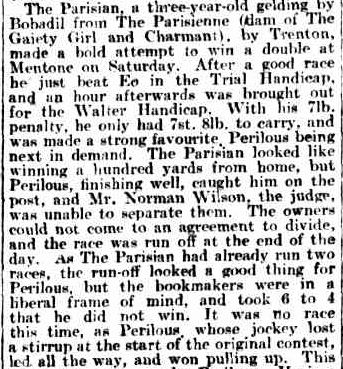
One of his early races, if not his first, was a six furlong Maiden Plate at Sandown Park on 7 April 1909, where he ran fourth, beaten by over ten lengths. The Parisian scored his first victory on 19 April at the Mentone Races, and he backed up an hour later to attempt a double.  An undecided outcome in the second race led to a third race at the end of the meet.

SPORTING INTELLIGENCE. (1909, April 19). The Argus (Melbourne, Vic. : 1848 – 1956), p. 4. Retrieved October 31, 2012, from http://nla.gov.au/nla.news-article10691394

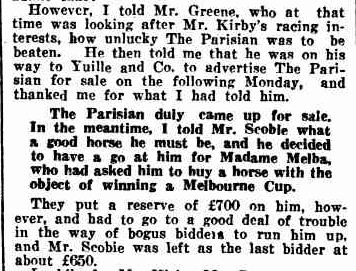
Despite his breeding, the horse was only racing over shorter distances with little success and Kirby sent him to auction.  The great jockey Bobby Lewis, in later years, recalled that time.

£76,000 PLUNGE THAT MISSED. (1933, December 13). The Daily News (Perth, WA : 1882 – 1950), p. 6 Edition: LATE CITY. Retrieved November 1, 2012, from http://nla.gov.au/nla.ne

Passed in, The Parisian was sent to James Agnew, a Hamilton trainer, joining the stable on 1 January 1910.  Agnew soon realised The Parisian was a stayer and increased his distances with success. The Parisian won the 1910 Warrnambool and Hamilton Cups under Agnew. James Agnew’s wins with The Parisian were not enough for him to stay in his stables. The Parisian, along with Halloween, was leased to Charlie Wheeler of Caulfield in June 1910.

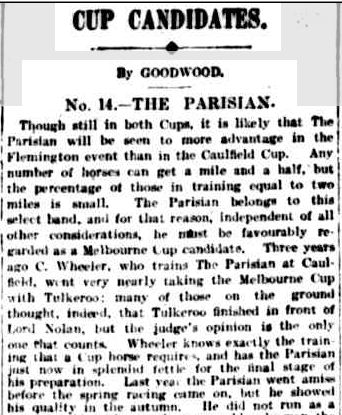
Wheeler took the lead of James Agnew and placed The Parisian over longer journeys and he nominated both The Parisian and Halloween for the 1910 Caulfield Cup and Melbourne Cup not long after their arrival in the Wheeler stable. On October 1, The Argus newspaper’s ongoing summary of the Cup candidates featured The Parisian. With ordinary lead in form, it looked unlikely The Parisian would line up in the Caulfield Cup, with the Melbourne Cup a better option. It was also noted in his last race he struck himself and had a few days off work.

CUP CANDIDATES. (1910, October 1). The Argus (Melbourne, Vic. : 1848 – 1956), p. 17. Retrieved October 31, 2012, from http://nla.gov.au/nla.news-article10465357

The Parisian did not recover fully from his injury of a cracked heel in time for the 1910 Melbourne Cup, and he was scratched.

The Parisian’s first win of any note was the 1911 Australian Cup.  The lead-up to the race was eventful.  Scheduled to run on 7 March, heavy rain leading up to the race saw the meeting postponed and rescheduled for 9 March. However, the rain did not let up, and the race was again rescheduled for Saturday 11 March. Considered a weak field, there were only fourteen runners, and The Parisian was sent out as the second favourite. As the field turned into the Flemington straight, The Parisian drew clear and won by six lengths, easing up.

V.R.C. AUTUMN MEETING. (1911, March 13). The Argus (Melbourne, Vic. : 1848 – 1956), p. 8. Retrieved October 31, 2012, from http://nla.gov.au/nla.news-article10885768

(1911, March 28). Kalgoorlie Western Argus (WA : 1896 – 1916), p. 20. Retrieved November 3, 2012, from http://nla.gov.au/nla.news-article33388818

V.R.C. AUTUMN MEETING. (1911, March 13). The Argus (Melbourne, Vic. : 1848 – 1956), p. 8. Retrieved October 31, 2012, from http://nla.gov.au/nla.news-article10885768

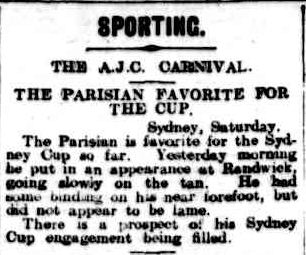
The Parisian then went off to the Sydney Cup, but he was not fully sound and struggled into twelfth.

SPORTING. (1911, April 15). Barrier Miner (Broken Hill, NSW : 1888 – 1954), p. 4. Retrieved November 3, 2012, from http://nla.gov.au/nla.news-article45127765

The next big race set for The Parisian was the 1911 Melbourne Cup.

CUP CANDIDATES. (1911, October 3). The Argus (Melbourne, Vic. : 1848 – 1956), p. 5. Retrieved October 31, 2012, from http://nla.gov.au/nla.news-article11621080

In the week leading up to the race, The Parisian again had heel problems and couldn’t put his hoof to the ground. Again, it looked like he would be scratched.  Charlie Wheeler put the horse in a small paddock full of capeweed next to the stables. The move paid off for Wheeler and on the morning of the race, The Parisian was galloping madly around his paddock trying to avoid capture.

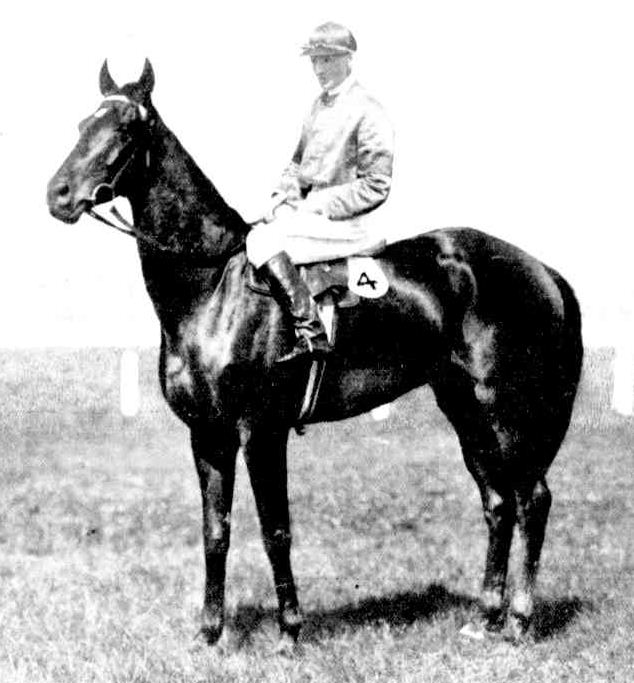
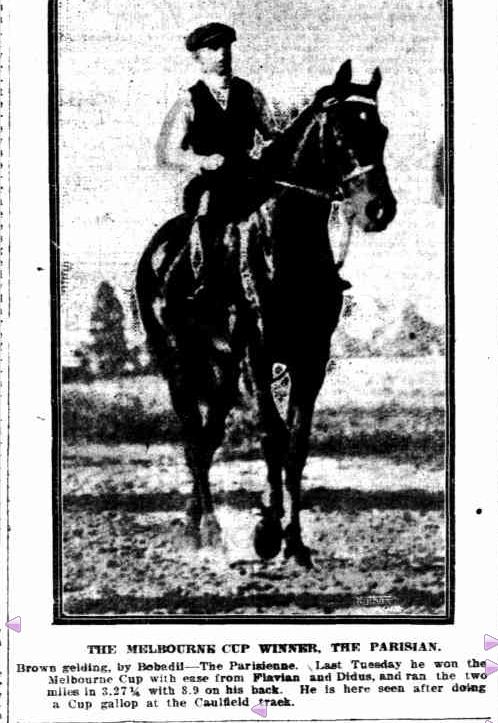
A record crowd of 115,000 people headed to Flemington for the 51st running of the Melbourne Cup.

THE 51st MELBOURNE CUP—THE PARISIAN’S EASY WIN FROM FLAVIAN AND DIDUS. (1911, November 18). Western Mail (Perth, WA : 1885 – 1954), p. 23. Retrieved November 1, 2012, from http://nla.gov.au/nla.news-article38837876

Trafalgar was favourite and The Parisian with Thomas Ronald Cameron aboard was the second favourite in a strong field. The thirty-three horse field jumped and went fast early and as they passed the judge’s box for the first time, the field was well strung out.  The Parisian started making a move coming into the straight for the last time, but Cameron waited, not giving the horse his head until the very last. There was no doubt though, as The Parisian overtook the leaders and won by two lengths, although many thought it was more.  The win was later described as “hollow” and “soft”.

THE 51st MELBOURNE CUP—THE PARISIAN’S EASY WIN FROM FLAVIAN AND DIDUS. (1911, November 18). Western Mail (Perth, WA : 1885 – 1954), p. 23. Retrieved November 1, 2012, from http://nla.gov.au/nla.news-article38837876

THE 51st MELBOURNE CUP—THE PARISIAN’S EASY WIN FROM FLAVIAN AND DIDUS. (1911, November 18). Western Mail (Perth, WA : 1885 – 1954), p. 23. Retrieved November 1, 2012, from http://nla.gov.au/nla.news-article3883787

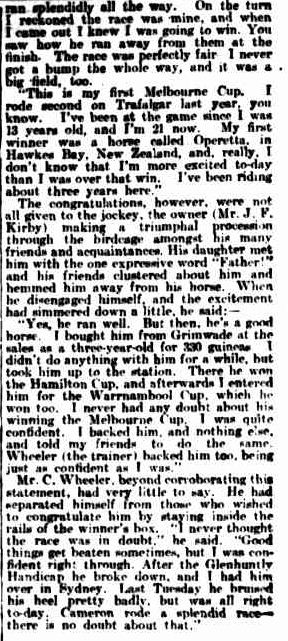
After weighing in, Thomas Cameron was mobbed by stable boys and other jockeys. Meanwhile out in the birdcage, John Finn Kirby’s dream had come true. He was the owner of a Melbourne Cup winner and his delight was clear.

THE RECORD CUP. (1911, November 8). The Argus (Melbourne, Vic. : 1848 – 1956), p. 13. Retrieved November 1, 2012, from http://nla.gov.au/nla.news-article11630312

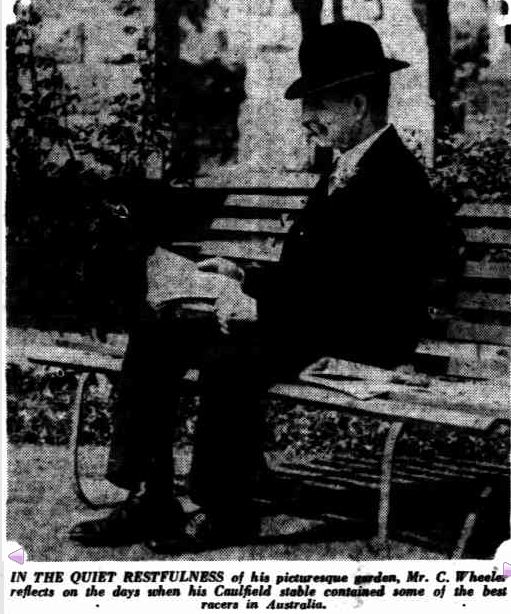
Reflecting twenty years later, Charlie Wheeler revealed the key to training The Parisian for the Cup.

CHARLIE WHEELER’S MEMORIES. (1932, October 29). The Mail (Adelaide, SA : 1912 – 1954), p. 9. Retrieved November 3, 2012, from http://nla.gov.au/nla.news-article59832043

CHARLIE WHEELER’S MEMORIES. (1932, October 29). The Mail (Adelaide, SA : 1912 – 1954), p. 9. Retrieved November 3, 2012, from http://nla.gov.au/nla.news-article59832043

In the days after the Cup, The Parisian was sent to Bacchus Marsh for a spell while John Kirby collected his winnings on “Settling Day” at the Victorian Club. His winnings from the bookmakers were thought to be around  £40,000. The stakes from the Cup were another £7000, although Wheeler, as the lessee, would have received the bulk of that. The Victorian Heritage Database notes around that time, Mt Koroite Homestead received extensive renovations and extensions, presumably from Kirby’s winnings. He had a manager and many staff, including a resident Chinese gardener and a chauffeur, Archie Gunning, who drove Kirby’s car, one of the first cars in the district.

(1911, November 21). Kalgoorlie Western Argus (WA : 1896 – 1916), p. 25. Retrieved November 3, 2012, from http://nla.gov.au/nla.news-article33400021

THE NOBLE ART. (1911, November 12). Sunday Times (Perth, WA : 1902 – 1954), p. 15. Retrieved November 3, 2012, from http://nla.gov.au/nla.news-article57722192

An Autumn 1912 preparation was on the agenda for The Parisian including a chance to repeat his win in the Australian Cup, for which he was the favourite. Unfortunately, his cracked heel again gave him trouble, and he was sent to the paddock, missing all engagements. Brought back for the Spring Carnival, The Parisian ran in the Memsie Handicap first up but needed the run.  He returned in the Rupertswood Handicap where he showed more but was tender after the race. During the following week, The Parisian pulled up lame after track work and Charlie decided to end his Spring campaign.

The Autumn Carnival of 1913 arrived and once again the Australian Cup was set down for The Parisian.  Punters were wary, given the ongoing query about the horse’s soundness. Their caution paid off when The Parisian’s cracked heel again saw him turned out.

It would have seemed unlikely The Parisian would return for the 1913 Spring Carnival, but as a gelding, he did not have a stud career before him and he returned to the track again.  Reports came in early October that he had gone amiss, however, he still ran in the Caulfield Cup on 18 October. There were rumours the horse had problems and would be scratched. However, Charlie Wheeler insisted the horse was fine and ran him. The Parisian ran a creditable fourth but pulled up lame.

Wheeler’s patience was wearing thin, and he advised John Kirby the horse should be turned out for the rest of the spring. Eventually, in early November, Wheeler returned the horse to Kirby, and The Parisian looked set to retire.

Sporting. (1913, October 29). Border Watch, p. 4. http://nla.gov.au/nla.news-article77650783

However, in January 1914 it was reported The Parisian would return to racing in the Western District but not before he raced in the Australian Cup in March.

WORLD OF SPORT. (By “Wakeful.”) THE TURF. (1914, January 17). Barrier Miner, p. 3.  http://nla.gov.au/nla.news-article45268231

Plans changed again as Charlie Wheeler began an Autumn 1914 preparation with The Parisian. After a few starts, Wheeler finally gave up and once and for all returned The Parisian to Coleraine.

The Turf. (1914, May 7). The Daily News, p. 8 Edition: THIRD EDITION. http://nla.gov.au/nla.news-article79921650

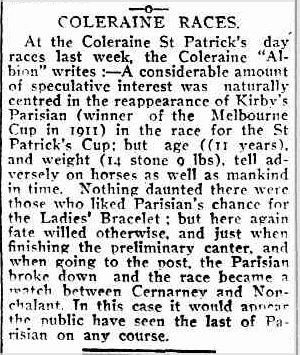
At last, the type of retirement a Melbourne Cup winner deserves looked likely. Nothing of The Parisian racing appeared in the racing pages until just under three years later.  On St Patrick’s Day 1917, The Parisian returned to racing at the Coleraine Racecourse across from Kirby’s Mt Koroite Homestead.  With a hefty weight of 14 stone 9 lbs, the heaviest ever carried at Coleraine, and ridden by, of all people, John Kirby’s chauffeur Archie Gunning, The Parisian broke down again.

COLERAINE RACES. (1917, March 19). Port Fairy Gazette (Vic. : 1914 – 1918), p. 2 Edition: EVENING. Retrieved November 1, 2012, from http://nla.gov.au/nla.news-article88021248

There was little doubt The Parisian had run his last race and around two months later, the sad news came that The Parisian had been euthanised.  Reports stated it was because of a start at a picnic meeting in the Western District. With no reports of the horse racing between March and May, it would have to be assumed his injuries were because of the unreasonable task he was given on St Patrick’s Day at Coleraine when his only purpose in racing was to attract a crowd.

SPORTING. (1917, May 17). The Argus (Melbourne, Vic. : 1848 – 1956), p. 10. Retrieved November 2, 2012, from http://nla.gov.au/nla.news-article1618494

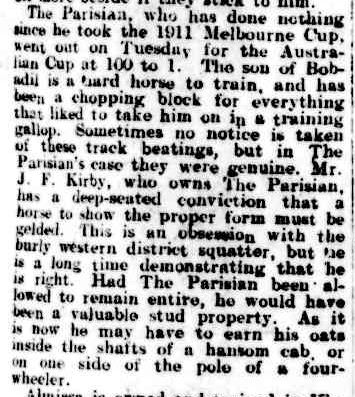
This snippet from Broken Hill’s Barrier Miner four years before The Parisian’s death foresaw what was to come. After two unsuccessful preparations and three years presumably in the paddock, the horse needed to earn more oats.  One would have thought as a Melbourne Cup winner he had earned more than a lifetime’s supply.

WORLD OF SPORT. (1913, March 8). Barrier Miner p. 3.  http://nla.gov.au/nla.news-article45222242

A sad end for a brave horse.

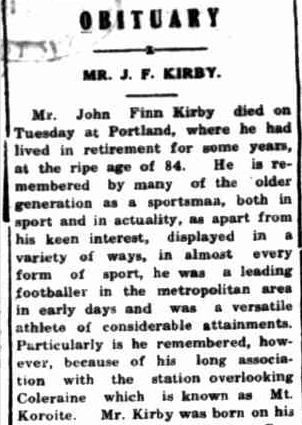
John Finn Kirby passed away in Portland on 7 April 1942, aged eighty-four. His wife Elizabeth had passed away twenty-one years earlier at the Kirby home “Koroite” in Kew, Melbourne.  History shows The Parisian was the best horse Kirby owned, save for Napier a winner of the Great Eastern Steeplechase at Oakbank and the Grand Annual Steeplechase at Warrnambool.

OBITUARY. (1942, April 13). Portland Guardian, p. 4 Edition: EVENING.  http://nla.gov.au/nla.news-article64379650

John, Elizabeth and their daughter Lila are buried at the Coleraine Cemetery.

SOURCES:

Trove Australia – List – The Parisian

Victorian Heritage Database

Misadventures, Deaths and Near Misses

Transport is important to us in one form or another. If nothing else it sure beats walking.   However, the subjects of this installment of Misadventures, Deaths and Near Misses should have stuck to Shank’s pony.

Click on the links to read each article in full.
HORSES

Described as an “energetic” gentleman, Fred Heathcote, having just displayed his cricketing prowess on the field, gave a display of his riding prowess.  Unfortunately, his mount was  freshly broken and reared, falling onto Fred.  Despite an operation in excess of four hours, Fred was expected to make a full recovery

“Look what I’ve done, I’ve broken both my wrists” were the words uttered by Frank Millard upon seeking help after a horse accident.  Frank’s horse had taken him under a low branch.

In 1896,the horse of William Lucas shied at two dogs and somersaulted.  William received concussion, the horse was shaken.

A witness description of the accident involving John Beglin in 1894, suggested the horse “danced on the man while on the ground”  This sounds like it was rather a spectacular fall in which John sustained possible internal injuries.

HORSE DRAWN VEHICLES

Add a wooden attachment to horse, laden with people,  and accidents are bound to happen.  Take, for example, Patrick Power of Byaduk in 1889. The Port Fairy Cobb & Co coach was not far from Koroit when it broke an axle and tipped.  The coach driver fell on top of Patrick leaving him in need of medical attention

Not so lucky was  Oliver Filmer also of Byaduk. In early January 1900, Oliver and six others were returning from an outing to the Byaduk Caves when the horses bolted down a hill.  The buggy went over an embankment and capsized.  All the occupants were thrown out, including Oliver who sustained head injuries and later died.  Oliver was father-in-law to Absalom Harman, the son of Reuben.
In 1901, Mr H. J. Thompson was standing on the back board of a buggy as it went up a steep hill near Wickliffe.  The buggy wheel fell into a rut, Mr Thompson fell forward and hit the wheel with his leg.  Suffering lacerations and a dislocated knee, he was still able to catch the train home from the Wickliffe station.

Thursday April 20, 1876 was a day of accidents and  Mr & Mrs Webley  and their daughter, all of Byaduk, were caught up in the dramas.  While returning from Hamilton to Branxholme in the darkness, a pin holding the buggy shaft fell out and Mr Webley turned the horse across the road to stop it, but the horse went up an embankment, dropping Miss Webley out the back.  The horse then continued on down a cutting and Mr & Mrs Webley tumbled out.  Mr Webley received cuts, Mrs Webley, a broken arm and Miss Webley was not injured.

Similarly, on the same day, Alfred Bennett had a hair-raising experience when his horse, pulling a dog-cart, bolted.

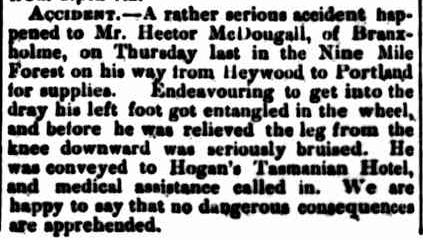
Lucky Hector McDougall had “no dangerous consequences” after his accident when he tangled with a dray’s wheel.

Table Talk. (1864, December 5). Portland Guardian and Normanby General Advertiser (Vic. : 1842 – 1876), p. 2 Edition: EVENING. Retrieved October 16, 2012, from http://nla.gov.au/nla.news-article64632822

Mr Blackney, was left with cake on his face after an incident in Hamilton in 1942.  While his back was turned, his horse bolted, pulling a cart laden with cakes.

CAKES FLEW WHEN HORSE BOLTED. (1942, September 15). The Horsham Times (Vic. : 1882 – 1954), p. 2. Retrieved October 16, 2012, from http://nla.gov.au/nla.news-article72705327

I’m sure a piece of cake helped residents recover from their “mild shock” at finding cakes at their front gates.

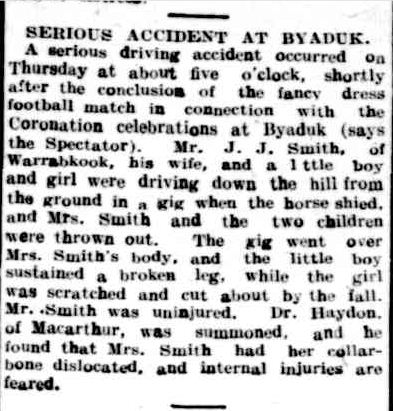
After a fun day at the Byaduk Coronation Celebrations in 1911, which included a fancy dress football match, the Smith Familyof Warrabkook met with disaster while travelling home.

SERIOUS ACCIDENT AT BYADUK. (1911, June 27). The Horsham Times (Vic. : 1882 – 1954), p. 5. Retrieved October 16, 2012, from http://nla.gov.au/nla.news-article73162971

CARS & MOTORCYCLES

If horses and carts weren’t bad enough, throw cars and motorcycles into the mix, and disaster was almost ensured, especially if they all came together at once.  It also appears that with only a lucky few having a motor vehicle in the early days, it was not unusual to pile as many people into the car as possible.

Driving a Damlier home from a day’s shooting at Kirkstall in 1914, George Lock and his four passengers came to grief on the Port Fairy Road on the outskirts of Warrnambool.  It was 7.15pm and the road was dark and narrow.  George, having moved aside for an oncoming car, failed to see the unlit cart of a Chinese market gardener following behind the car.  His car hit the cart sending vegetables across the road.  Debris hit the car’s steering wheel sending the car out of control and into a fence and embankment, throwing the occupants from the car.  George Robinson received the most serious injuries, a ruptured liver.  The Chinese gentleman was lucky to avoid injury and was last seen chasing his horse, also very lucky, down the road.

T.S.A Laidlaw had a scary experience in his new Oldsmobile after leaving Byaduk bound for Macarthur.  The car got into the gravel, crossed the road, went over a prostrate telegraph pole, up an embankment and then overturned.  The car was extensively damaged, Mr Laidlaw wasn’t.

Robert Rymill, a 38-year-old grazier from Penola met a tragic end in a very early motoring accident.  In 1906, he was driving his 15hp Darracq from Melbourne home to Penola when he failed to take a sharp turn at the bottom of a hill, taken while travelling at 12mph.  The car’s wheels slipped and it overturned.  Robert’s passenger, his young gardener was thrown clear, but Robert was pinned underneath the car.  While initially conscious, Robert had passed away by the time help arrived.  This was despite the best attempts of his passenger.

If you are wondering what a Darracq looks like, this clip shows a much more powerful 1905 model travelling a lot faster than 12mph, but you get the idea.

Mr Dotzauer, in 1904, was riding his motorcycle between Terang and Noorat when a horse ran across his path. Mr Doutzauer broke his collar-bone, damage to the motorcycle and horse unknown.

Mrs Living got more than she bargained for when she hitched a ride in Mr E.J.Coopers sidecar one Friday night in 1932.

HORSE JUMPS INTO SIDE-CAR. (1932, April 19). The Horsham Times (Vic. : 1882 – 1954), p. 4. Retrieved October 18, 2012, from http://nla.gov.au/nla.news-article72600659

Len Austin’s accident was caused by a truck tyre, but no, it didn’t run over him.  While working as a road contractor, he noticed a bulge in the truck’s tyre.  The tyre suddenly blew and the expelled air caught him the eye.

Messrs. W Smith and Michael Hickey’s day took a turn for the worse in 1923 while driving a gig with a saddle horse tied to the shafts.  A car with five occupants approached and the saddle horse, obviously not used to the mechanical beasts, shied and found itself on top of the car.  The car rolled, but with plenty of help on hand, it was righted and the driver and his passengers continued on to Horsham.  The horse’s journey ended at the scene.

W is for…What Else Could It Be?

Naturally, I had to rejoin the Gould Genealogy Family History Through the Alphabet Challenge at “W”.  W is for Western District and that means a lot to me not only because this blog “Western District Families”.  I was born and raised in the Western District and all the families of my maternal lines, going back six generations, chose to settle in the wonderful Western District.

One of the highlights of the Western District is the geography.  Entering from the east, the Western Plains lead to the rise of the Grampians and on to the volcanic plains and green rolling hills beyond.  To the south are the forests of the Otways, the south-west coastline and volcanic Tower Hill.  And there are the rivers, meandering through the countryside to the sea.

I will take you on a geographical journey through the Western District, just a glimpse really, beginning with two colonial artists, Nicholas Chevalier and my favourite, Eugene Von Guerard.  These artists and others traipsed around Victoria sketching and painting.  Von Guerard also travelled to Tasmania, New South Wales, South Australia and New Zealand.  Looking at their paintings reminds me of the lives they lived for the sake of their art.

Chevalier’s sketch shows the Serra Range including Mt Sturgeon and Mt Abrupt at the southern end of the Grampians.

View of the Grampians, Western District [art original] N. Chevalier.
State Library of Victoria http://handle.slv.vic.gov.au/10381/100967

Moving south-west, dormant volcano Mt Eccles near Macarthur has played a part in my family history.  My gg grandfather Reuben James Harman, son of James Harman, owned property at Mt Eccles.  It was also a favourite fishing spot of my grandfather Bill Gamble.

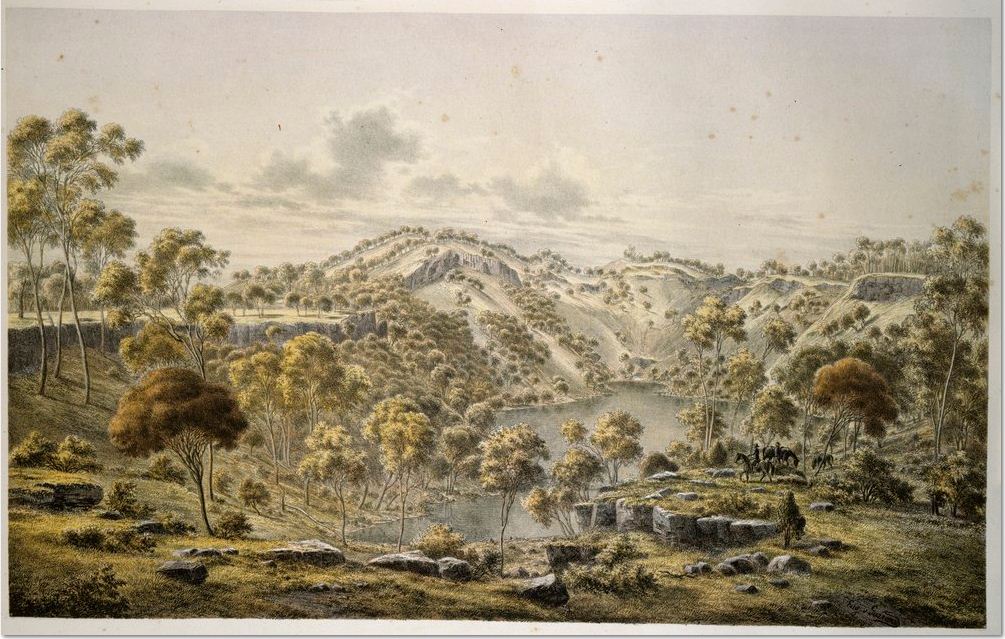
Crater of Mt. Eccles, von Guerard, Eugene,1811-1901,artist.
Image courtesy of the State Library of Victoria http://handle.slv.vic.gov.au/10381/46307

I prefer von Guerard’s depiction of Lake Surprise, the crater lake of Mt Eccles, to my own (below).  I remember as a child asking about the name “Lake Surprise”.  The answer:  When you get to the top of the crater and see the lake, you get a surprise.  Fair enough.

LAKE SURPRISE, MT ECCLES CRATER LAKE

It’s the photo of my grandfather Bill Gamble during the 1930s that is my favourite.

e

A little north of Mt Eccles is the volcanic lava flow, the Harman Valley at Byaduk, named after my Harman family.  In the distance is the source of the lava, Mount Napier.

THE HARMAN VALLEY, BYADUK

South of Mount Eccles is beautiful and historic Port Fairy, the last port of call for the Moyne River, with its origins east of Macarthur, before it reaches the sea.

Port Fairy

MOYNE RIVER, PORT FAIRY


Moving east from Port Fairy is Tower Hill, another dormant volcano.

TOWER HILL

Next is Warrnambool.  The cemetery has a great view toward the Hopkins River close to the end of its 271 kilometre journey through the Western District from near Ararat to the sea at Logans Beach, one of the whale nurseries along the south-west coast,
WARRNAMBOOL CEMETERY

WARRNAMBOOL CEMETERY OVERLOOKING THE HOPKNS RIVER

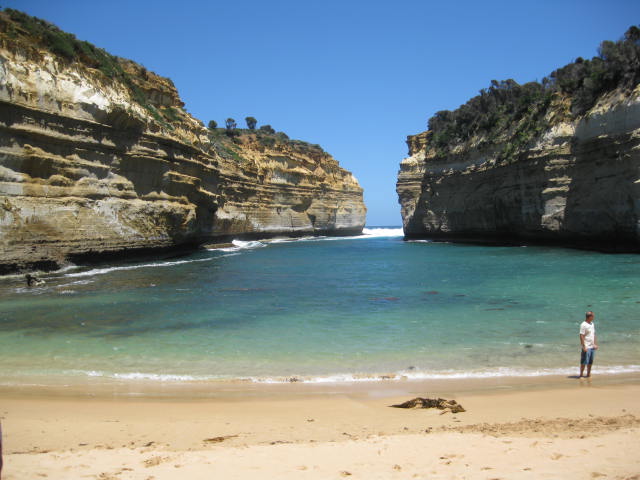
South-east of Warrnambool is the famous Loch Ard Gorge, named for the Loch Ard which wrecked on the treacherous coastline.  The only two survivors, Tom Pearce and Eva Carmichael were washed on to the beach at Loch Ard Gorge.

I find standing on the beach in the Gorge a haunting experience.

LOCH ARD GORGE

East along the coastline is one of the most iconic views, not only of Victoria but Australia.

THE 12 APOSTLES

North-west, and back where we started, are the Grampians.

HALLS GAP, GRAMPIANS

The Grampians are a perfect place to leave the subject of the Western District and move on to another “W” which has been a part of my family since the 1860s, the Wannon River…

W is for…Wannon River

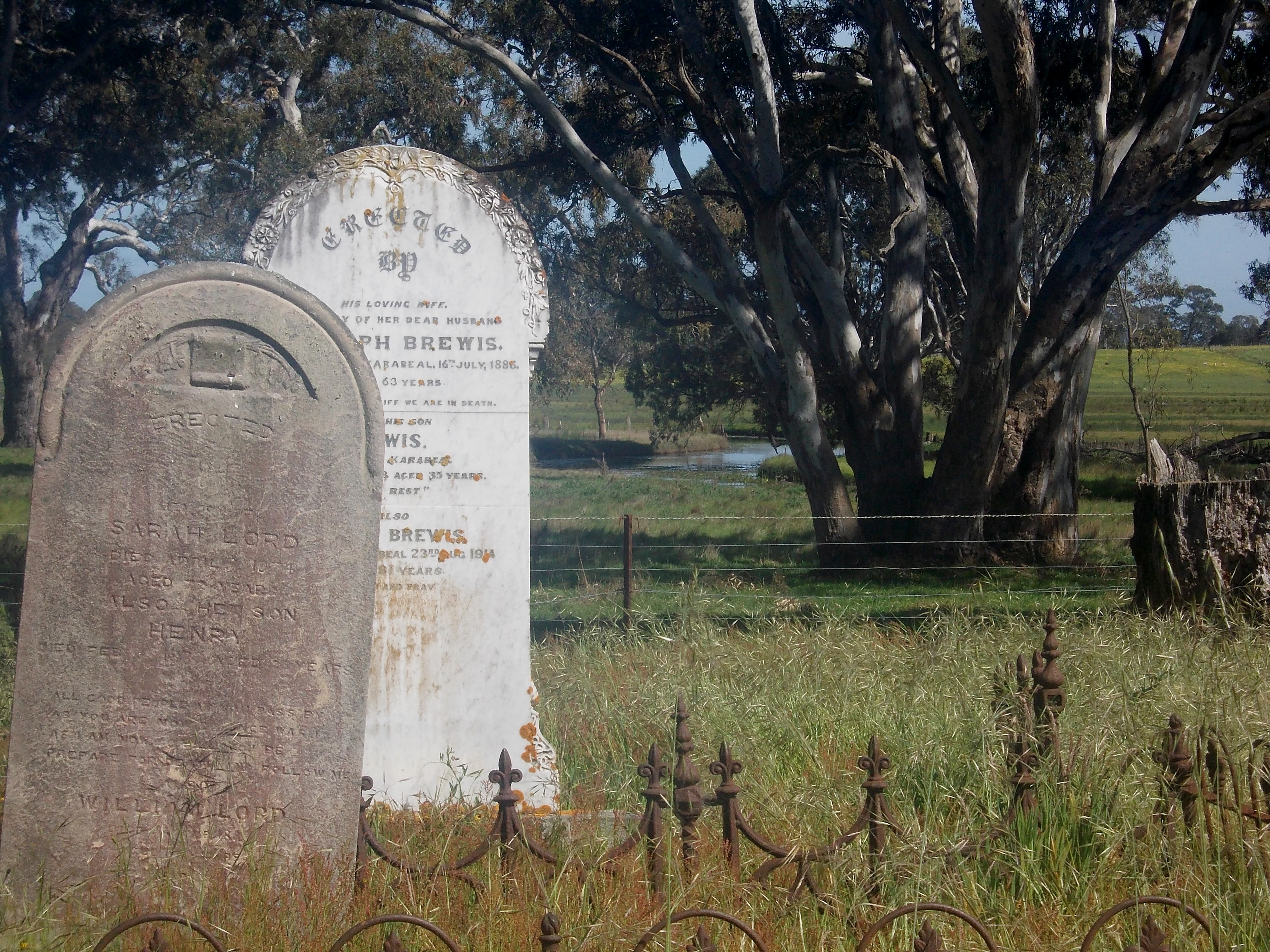
The Wannon River begins its’ flow at the base of Mt Abrupt in the Southern Grampians.  It flows toward Dunkeld, around the base of Mt Sturgeon and leaves the Grampians heading north-west toward Cavendish. Along the way, it passes by Mokanger, the workplace of both the Mortimers and Haddens.  Through Cavendish, it passes close to the cemetery, burial place of members of those two families.

DSCN1056

CAVENDISH OLD CEMETERY


From Cavendish, the river begins a southward journey toward two of the Hamilton district’s jewels, the Nigretta and Wannon waterfalls.  As the river progresses west, the Grange Burn joins the Wannon north of Morgiana, having flowed from just east of Hamilton, the city founded on the Grange.  This section of the Wannon river was another favourite fishing spot of my grandfather Bill Gamble.

On the river flows to Tahara and then Sandford. I have family links to Sandford with Julia Harman, daughter of James Harman residing there with her husband George Holmes.  Two children were born at Sandford including WW1 casualty Arthur Leonard Holmes.  My gg uncle William Diwell also spent some time around Sandford.  In 1914, he completed extensions to the St Marys Church.

The Wannon River then joins another great river of the Western District, the Glenelg River, having passed through some of Victoria’s most beautiful countryside.  It is not surprising Joseph Hawdon, travelling overland to Adelaide with Lieutenant Alfred Miller Mundy of the 21st Regiment in 1839, endorsed Major Thomas Mitchell’s description five years earlier. Major Mitchell followed the Glenelg River from its beginnings in the Grampians through to the sea at Nelson. It is little wonder all my direct ancestors stayed in the Western District after settlement.

(1839, September 26). Launceston Advertiser (Tas. : 1829 – 1846), p. 1 Supplement: SUPPLEMENT. Retrieved October 11, 2012, from http://nla.gov.au/nla.news-page8723904

After the merge with the Wannon, the Glenelg flows on to Casterton where I have many family links.  My ggg grandfather George Jelly, the father of Elizabeth Ann Jelly, was one man who could say he had conquered the river.  His obituary read:

“He was a remarkably good swimmer and by his abilities in this direction was instrumental in saving many persons from drowning and rescuing the bodies of many others who had perished in the river” 

He even dived for the bones of Robert and Mary Hunt, murdered by George Wains in 1860.

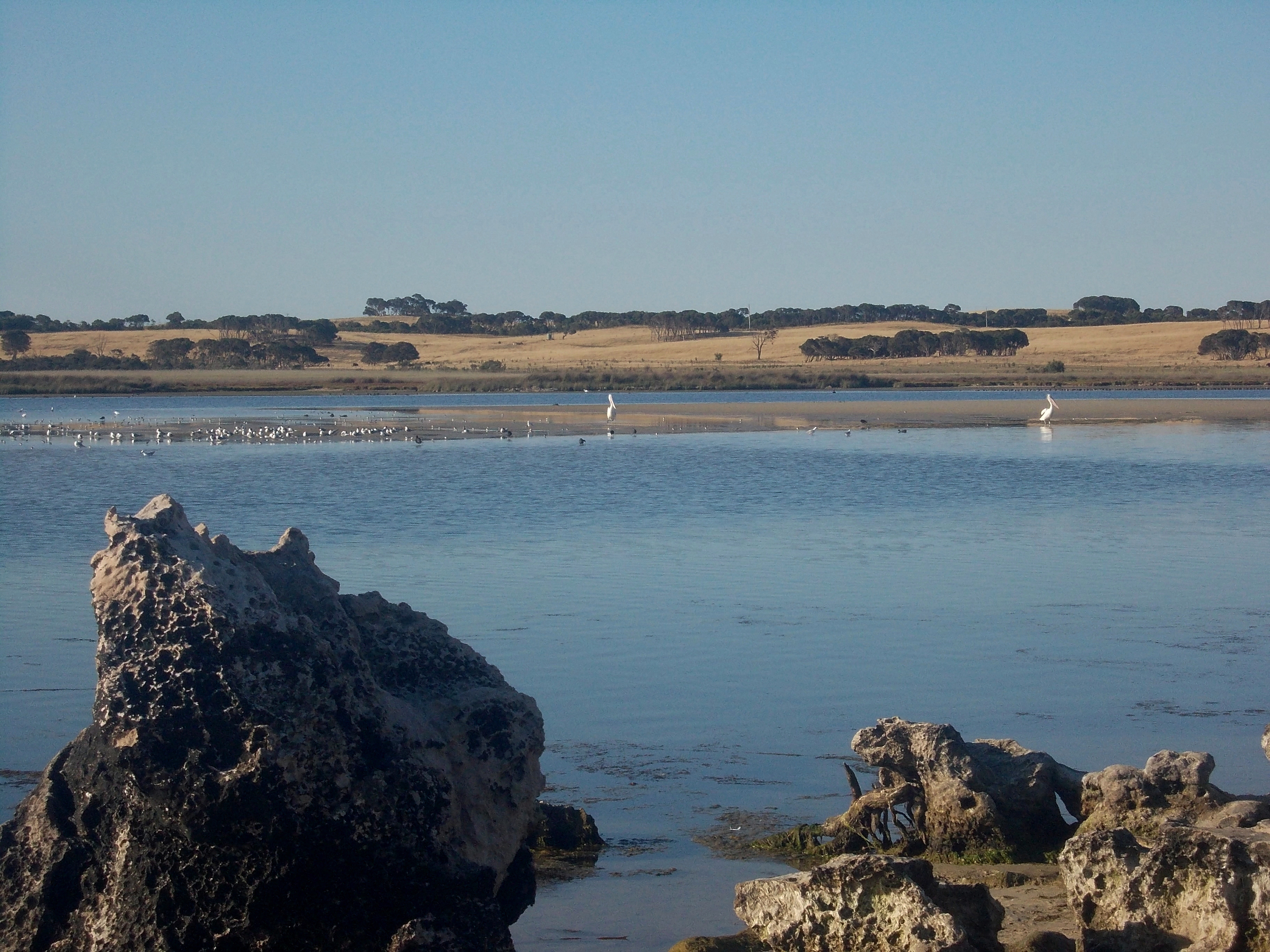
By the time the Glenelg River reaches the sea, it, the waters of the Wannon and Grange Burn have passed by many of the places my ancestors lived, worked, fished, swam and were laid to rest.

042

NEAR THE MOUTH OF THE GLENELG RIVER, NELSON

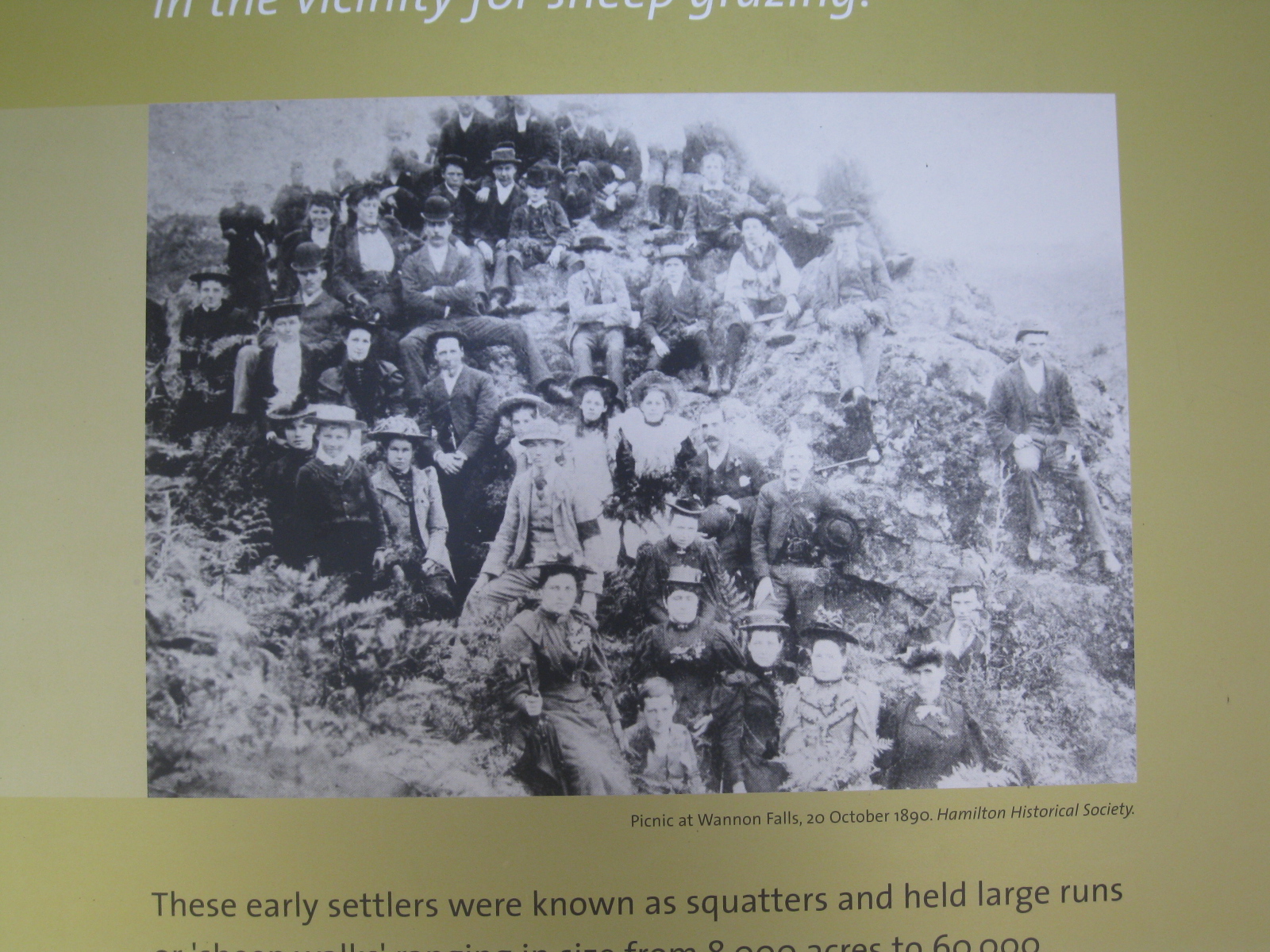
The Wannon River between the Nigretta Falls and the Wannon Falls, about twenty kilometres from Hamilton, would be the section most frequented by myself and my family before me.  My own memories come from family visits, Sunday drives with Nana, school excursions and birthday parties.

The following views near the Wannon Falls are from the State Library of Victoria Collection and were captured around 1878 by  Thomas J. Washbourne, a Geelong photographer.

Wannon River Scene – Washbourne, Thomas J. photographer.Image courtesy of the State Library of Victoria Victorian Patents Office Copyright Collection (VPOCC) http://handle.slv.vic.gov.au/10381/53092

Wannon River Scene Washbourne, Thomas J.,photographer.
Image courtesy of the State Library of Victoria – Victorian Patents Office Copyright Collection (VPOCC) http://handle.slv.vic.gov.au/10381/52931

THE WANNON RIVER AT THE WANNON FALLS

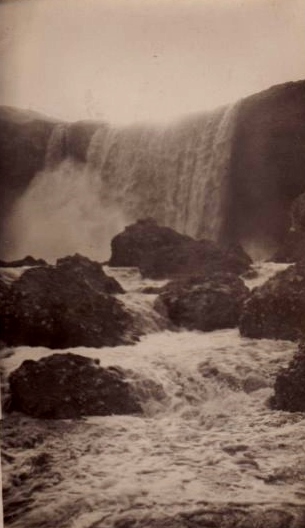
Of the two waterfalls, I prefer the Nigretta, especially after rain.  The Wannon Falls could be described as pretty in the way the water drops off the edge, but the Nigretta Falls are, at times, spectacular.

NIGRETTA FALLS ON THE WANNON RIVER Image courtesy of the State Library of Victoria – collection: Cogger album of photographs http://handle.slv.vic.gov.au/10381/41740

The Vagabond (John Stanley James) described the Nigretta Falls in his series “Picturesque Victoria” for The Argus.  In the 4 April 1885 edition of The Argus, The Vagabond wrote of his visit to the Wannon.  He enjoyed the hospitality at the Wannon Inn and then marvelled at the “miniature Niagara”

PICTURESQUE VICTORIA. (1885, April 4). The Argus (Melbourne, Vic. : 1848 – 1956), p. 4. Retrieved October 11, 2012, from http://nla.gov.au/nla.news-article6073697

This photo taken in August this year by my friend Catherine, after some good rain, sees the Nigretta looking like the miniature Niagara Falls described by The Vagabond.

NIGRETTA FALLS – Image courtesy of Catherine Huisman

My grandfather, Bill Gamble, took the following photo in the 1930s

bg14

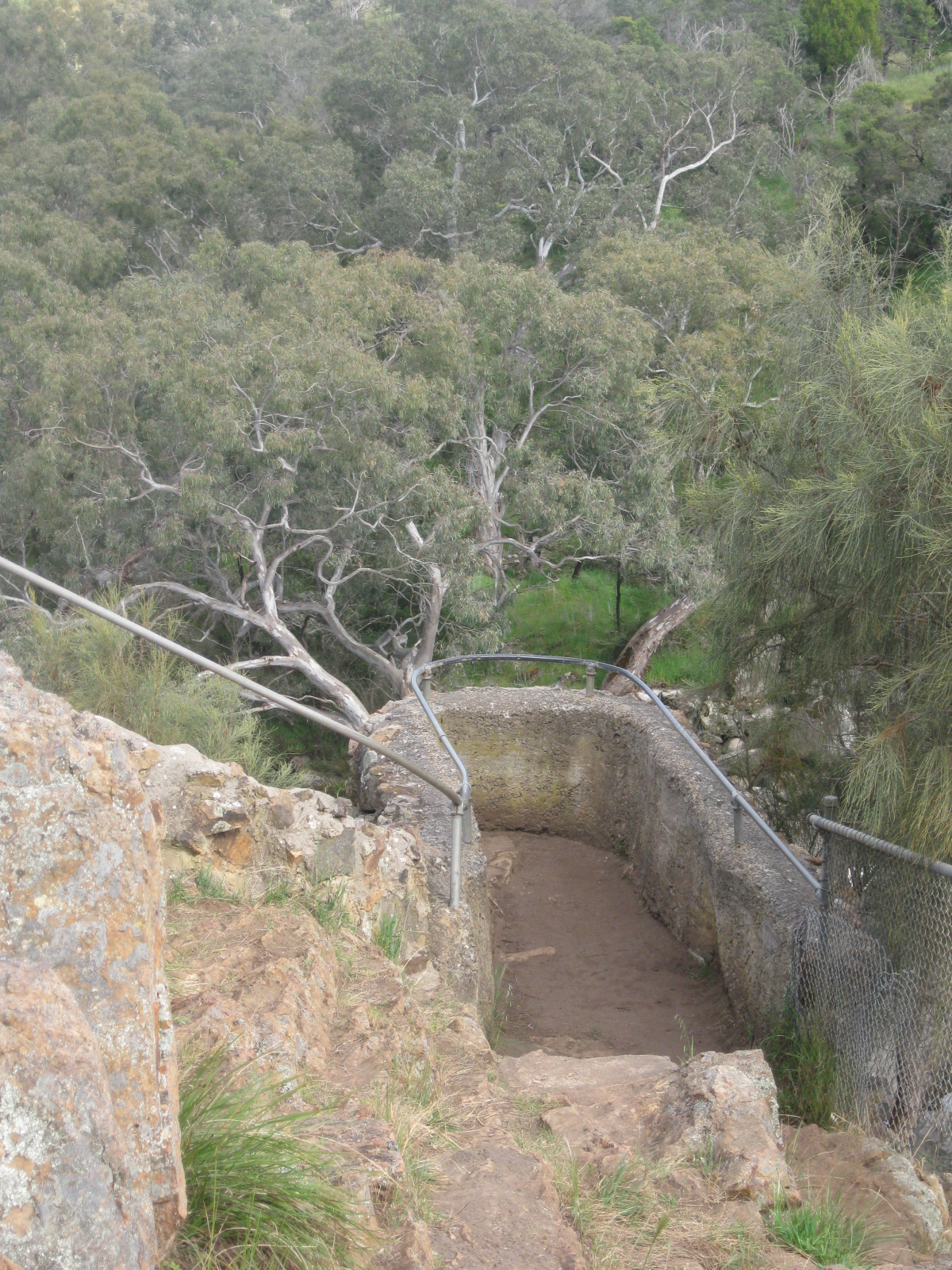
It was pleasing to see that the old viewing platforms still remain at the Nigretta Falls.

NIGRETTA FALLS VIEWING PLATFORM

An impressive wooden staircase now leads down to the falls, but the original steps remain.

The Wannon Falls (below) holds memories of walking beyond the viewing platform, down to the rocks and behind the falls, but only when they were flowing lightly as they are in this photo.  A new viewing platform now prevents such precarious escapades, even undertaken while on school excursions!

WANNON FALLS

I have two framed prints of the Wannon Falls by Louis Buveot, painted in 1872.  One hangs on a wall as a constant reminder of Hamilton, the Wannon River and the waterfalls.  The original work hangs in the Ballarat Fine Art Gallery. To see the original click on the link – Wannon Falls

The topic of the Wannon River gives me an opportunity to share my all-time favourite family photos.  As a little girl when I first saw Nana’s old photo album, these photos captured my imagination.  When Nana came to live with us she kept her photo albums in her wardrobe. I would take them down, sit on her bed and go straight to the photo below.  It was near the beginning of the album which had black, much-turned pages.

From right: Nana, (Linda Hadden), my great-grandmother (Sarah Elizabeth Harman) and my great auntie Alma’s (Nana’s sister) mother-in-law Mrs Issac William Short (Catherine Gissane Tilley). They are standing on the original lower viewing deck.   The photos from a day at the Wannon were originally very small.  It wasn’t until I enlarged them on a computer, that I noticed Nana’s coat hanging on the railing.

I think the reason I like this photo because Nana looked exactly like she did when I knew her, but with long braids and I still can’t believe she was only about fifteen.  Even the small research assistant thought Nana was the lady in the middle when he first saw it.  He only knew her as an older person and does not think of her as having been a child too.

The second photo was taken from the lower viewing deck, looking toward the upper level.  I didn’t like standing here as a child and as you can see the rail was high at the front  and difficult to see over and to the right of  Nana was a gap between the fence and the rocks.  I much preferred the lower deck.

My grandfather Bill, before he married Nana, liked to visit the Wannon Falls too, although he didn’t stick to the viewing platforms.

bg13

In more recent years, a rotunda was built at the Wannon Falls reserve with information about the waterfall, the local geography and history.

On our visit, the small research assistant said “Look Mum, they even have family history here for you”  He was right. There is a lot of my family history at the Wannon Falls.

©Merron Riddiford 2012

Alice Hawthorn – The Western Mare

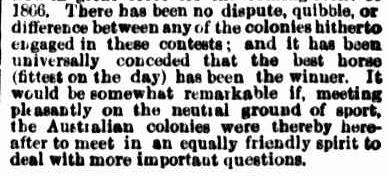
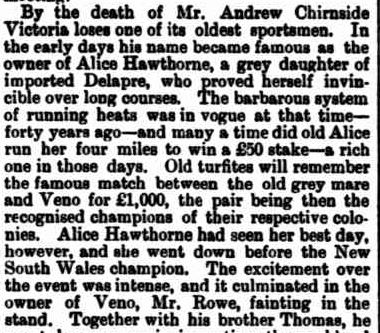
On 3 October 1857, a small grey mare known as “Alice” lined up for a match race with her rival Veno, from the colony of New South Wales (NSW), a race that would in time be remembered for its significance in setting the foundations for what has become Australia’s greatest horse race and strengthening the thoroughbred racing and breeding industry in Australia.  It was a time when inter-colonial rivalry was high, but this period of racing’s history shows that the racing fraternities of each colony, while still highly competitive, were able to work together in a harmonious way to develop the industry we have today. This story is not so much about the match race,  rather the life of the grey mare and the mark she left on Australian racing history.

“Alice”, bred at Mt William Station in the Western District and owned by great racing supporters, the Chirnsides, was born sometime around 1849.  Her sire was Delpare, an imported horse and her dam, Polly McQuinn, a part-Arab mare, bloodlines common in the early days of racing in Australia.  “Alice” was branded with the Chirnside’s  “key” brand.  Horses bearing that brand could never be sold.

DEATH OF ALICE HAWTHORNE. (1860, August 18). Bell’s Life in Sydney and Sporting Reviewer (NSW : 1845 – 1860), p. 2. Retrieved August 8, 2012, from http://nla.gov.au/nla.news-article59873244

At age three “Alice” was broken in and she spent time as a stock horse but, unlike her mother, she was not a good riding horse.  The Chinese workers at the station used her to carry rations to workers situated at out stations on the property but she developed a fistula wither, a painful condition, and was turned out.  During that time she became loose on the station roaming the bush for fifteen months. She ran with a wild horse and the result was a foal which died.  Time in the bush had not served her well, but back on pasture, she blossomed.

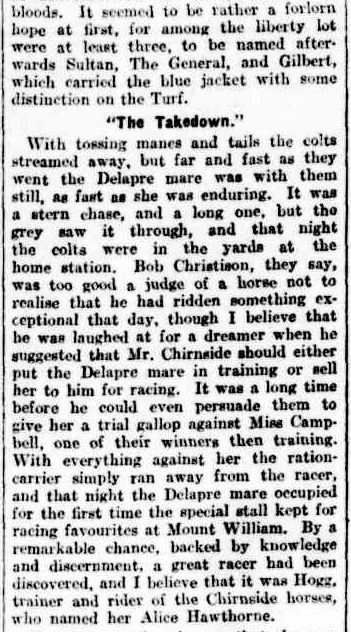
Put to work again, “Alice” was used by Robert Christison, a horse-breaker at Mt William, to act as  “nursemaid” to the young thoroughbreds he was breaking in.  On one occasion, the young horses had missed a muster and Christison chose  “Alice” to bring them back to the main paddock.  What a surprise he received.  This article, “Racing and Romance, Two Western Mares” includes excerpts from the book “After Many Days” by Cuthbert Fetherstonhaugh that recount that day:

RACING AND ROMANCE. (1928, September 15). The Argus (Melbourne, Vic. : 1848 – 1956), p. 2 Supplement: The Argus. Saturday Camera Supplement. Retrieved August 8, 2012, from http://nla.gov.au/nla.news-article3956921

The little mare, who not long before had roamed the bush, impressed and ousted the talented Miss Campbell from her prime stall in the stables.  She was also given her name,  Alice Hawthorn.

Her first race was at Hamilton over a mile and a half.  “Alice” won, kicking off a remarkable career which would span the next four years.  As was racing in those times, “Alice” returned to Hamilton the following day and backed up the win.

HAMILTON. (1856, January 21). Portland Guardian and Normanby General Advertiser (Vic. : 1842 – 1876), p. 3 Edition: EVENING. Retrieved August 8, 2012, from http://nla.gov.au/nla.news-It

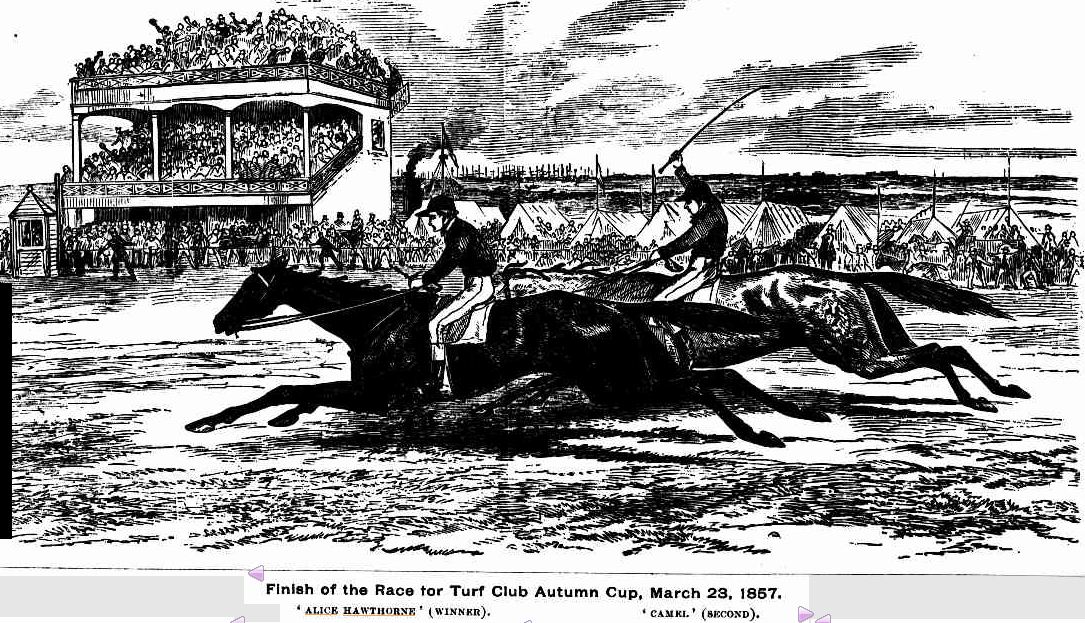
It was not long before Alice Hawthorn was racing at Ballarat, Geelong, and then Flemington.  This sketch shows her storming down the outside to win the Turf Club Autumn Cup of 1857.

Flemington: Past and Present. (1891, October 24). Illustrated Sydney News (NSW : 1853 – 1872), p. 13. Retrieved October 2, 2012, from http://nla.gov.au/nla.news-article63613318

It was this race and others that saw Alice Hawthorn considered one of Victoria’s best horses and in turn, her name was given as a challenger to a horse from NSW in a match race of £1000 aside.  The Victorians wanted to nominate three horses and select the best on the day, however, this was rejected by their NSW. colleagues who nominated just one horse, the chestnut Veno.  Alice Hawthorn, it was.

LOCAL NEWS. (1857, July 1). The Hobart Town Mercury (Tas. : 1857), p. 2. Retrieved August 9, 2012, from http://nla.gov.au/nla.news-article3244328

There was some doubt in the minds of the Victorians that “Alice” was up to the task and her odds went out.  Others considered the home track advantage would help her.  Veno’s arrival in Melbourne created much interest with crowds of people gathering to see the Sydney horse.

VICTORIA. (1857, August 1). Bell’s Life in Sydney and Sporting Reviewer (NSW : 1845 – 1860), p. 2. Retrieved August 9, 2012, from http://nla.gov.au/nla.news-article59867006

Meanwhile, there were security fears for “Alice’ and her trainer Mr Green built a stable at his home to accommodate her safely.

VENO AND ALICE HAWTHORN. (1857, August 29). Bell’s Life in Sydney and Sporting Reviewer (NSW : 1845 – 1860), p. 2. Retrieved August 10, 2012, from http://nla.gov.au/nla.news-article59867185

This thorough description of “Alice”, including her physique, action, and temperament is unlike anything seen today.  The Melbourne correspondent noted her “fine, even temper which nothing can ruffle is the theme of universal admiration”.  Jokes were often made about her arrival at the starting line for races, looking like she had just woken from a sleep. This probably helped her settle in her races and run out the three miles.

ALICE HAWTHORN. (1857, September 5). Bell’s Life in Sydney and Sporting Reviewer (NSW : 1845 – 1860), p. 2. Retrieved October 1, 2012, from http://nla.gov.au/nla.news-article59867231

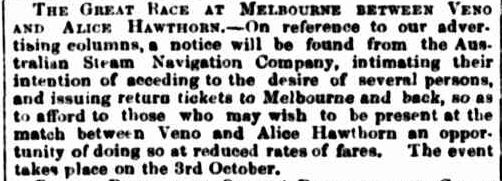
Those attending the Great Inter-Colonial Match race from Sydney could take up the offer from the Australian Steam Navigation Company of a return ticket at a reduced rate.

THE WRECK OF THE DUNBAR. (1857, September 5). Empire (Sydney, NSW : 1850 – 1875), p. 5. Retrieved October 1, 2012, from http://nla.gov.au/nla.news-article64986713

In the preceding days, something akin to the call of the card was held at the Tattersall’s Hotel in Russell Street, where the original challenge was offered.  A healthy amount of money was wagered, all with a sense of good sportsmanship.

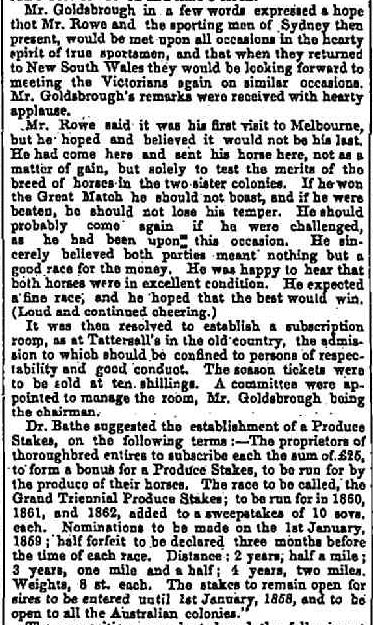
Chair, Mr Goldsborough welcomed the sporting men of Sydney, including trainer Mr Rowe, and reassured them that they “would be met upon all occasions in the hearty spirit of true sportsmen”.

At the gathering, a decision was made to set up a subscription room at the Tattersalls Hotel for those of “good respectability and conduct’ for a season ticket of ten shillings.  The Produce Stakes was also devised, open to horses from all colonies.

VENO AND ALICE HAWTHORN. (1857, October 2). The Sydney Morning Herald (NSW : 1842 – 1954), p. 8. Retrieved October 1, 2012, from http://nla.gov.au/nla.news-article28633161

On the morning of 3 October 1857, all roads led to Flemington.  For others, a steamer up the Saltwater River (Maribyrnong River) was the preferred transport.

SPORTING INTELLIGENCE. (1857, October 5). The Argus (Melbourne, Vic. : 1848 – 1956), p. 5. Retrieved October 1, 2012, from http://nla.gov.au/nla.news-article7139724

As feared by many Victorians, it was not Alice Hawthorn’s day, with Veno winning the three-mile race.  “Alice” was not disgraced but could not match the stamina of Veno.

FIRST RACE. THE MATCH FOR THE CHAMPIONSHIP.—VICTORIA V. NEW SOUTH WALES. (1857, October 8). The Sydney Morning Herald (NSW : 1842 – 1954), p. 1 Edition: Second Edition.. Retrieved October 1, 2012, from http://nla.gov.au/nla.news-article13001270

Veno’s trainer accepted another challenge with the horse backing up two races later against Victorian Van Tromp.  Veno raced another three miles, finishing in a faster time than his race against “Alice”, beating Van Tromp by two lengths.

The Victorian racing fraternity was left questioning their horses’ bloodlines and those from the colony of NSW left no doubt where Veno hailed from as this headline from the Empire, a Sydney newspaper shows.

[SECOND EDITION.]. (1857, October 8). Empire (Sydney, NSW : 1850 – 1875), p. 3 Edition: 2nd edition. Retrieved October 1, 2012, from http://nla.gov.au/nla.news-article60261613

This article from The Argus, written in the days, stressed how important breeding better Victorian horses was if they were to match it with the other colonies and the need for good horse races such as the match race, to make sure that the standard of horse improved.

The Argus. (1857, October 5). The Argus (Melbourne, Vic. : 1848 – 1956), p. 5. Retrieved October 1, 2012, from http://nla.gov.au/nla.news-article7139706

It was not long before “Alice” was back racing and on 2 December she was at Ballarat, once again a winner.

THE RACES. SECOND DAY. (1857, December 3). The Star (Ballarat, Vic. : 1855 – 1864), p. 2. Retrieved October 1, 2012, from http://nla.gov.au/nla.news-article66045460

On Thursday 18 February 1858, Alice Hawthorn won the Great Metropolitan Handicap at Flemington, redeeming herself with those who dismissed her both before and after her match race with Veno.

VICTORIA JOCKEY CLUB RACE MEETING. (1858, February 26). Empire (Sydney, NSW : 1850 – 1875), p. 3. Retrieved October 1, 2012, from http://nla.gov.au/nla.news-article60426399

“Alice” continued to race and win.  Just over twelve months after her match race, she was still considered Victoria’s leading three miler, although some thought this was because she had nothing to beat.

No title. (1858, November 6). Bell’s Life in Sydney and Sporting Reviewer (NSW : 1845 – 1860), p. 2. Retrieved October 2, 2012, from http://nla.gov.au/nla.news-article59869552

The 1 October 1859 was the first running of the Australian Champion Sweepstakes at Flemington racecourse.  Horses from the colonies of South Australia, New South Wales, and Tasmania were among the entries, true inter-colonial racing.

One of the entries, The Barber from South Australia, had an unfortunate and unexpected link to the Western District. The Barber’s transportation to Melbourne was the steamer Admella.  The Admella struck trouble along the South Australian coast near the Victorian border and the Portland lifeboat Ladybird with Captain James Fawthrop at her helm went to the rescue.  All the horses aboard the steamer drowned, except for The Barber, who amazingly came to shore, two and a half miles away from the wreck.  He was then walked overland to Geelong and travelled by rail to Melbourne.  Not surprisingly he finished close to the tail of the field in the Sweepstakes.

“Alice”, by this time at least ten years old, acquitted herself well in the three-mile race running fourth behind the winner Victorian Flying Buck,  a three-year-old.

THE CHAMPION RACE DAY. (1859, October 3). The Argus (Melbourne, Vic. : 1848 – 1956), p. 5. Retrieved October 2, 2012, from http://nla.gov.au/nla.news-article5689255

Alice Hawthorn ran her last race in November 1859 in the Turf Club Welter Handicap over three miles.  She won by ten lengths and retired with £5000 in stakes money, the highest of any horse in the colonies.

VICTORIA. (1859, November 26). Bell’s Life in Sydney and Sporting Reviewer (NSW : 1845 – 1860), p. 4. Retrieved October 2, 2012, from http://nla.gov.au/nla.news-article59871699

The Chirnsides sent their mare to stud for a meeting with their imported stallion Peeping Tom. It is not clear if the mating was successful.

On 12 August 1860, the mare they called “Alice” passed away at the Chirnside’s Point Cook at twelve years of age, only nine months out of racing.  Her lungs that gave her the stamina to run long distances had failed her.

MELBOURNE NEWS. (1860, August 16). Bendigo Advertiser (Vic. : 1855 – 1918), p. 2. Retrieved October 3, 2012, from http://nla.gov.au/nla.news-article87945829

DEATH OF ALICE HAWTHORNE. (1860, August 18). Bell’s Life in Sydney and Sporting Reviewer (NSW : 1845 – 1860), p. 2. Retrieved October 2, 2012, from http://nla.gov.au/nla.news-article59873244

“Alice” went from the foothills of the Grampians to matching it with some of the leading horses in Victoria and the other colonies.  She easily could have remained at Mount William Station as nursemaid to the future stars of the Chirnside’s stables.  It was only for her demonstration of brilliance rounding up the escaped horses that saw her rise to becoming a household name.   She saw hard racing considering many of her races were over three miles, a mile further than the Melbourne Cup.  Horses from her time could run two three mile races in a day, just as Veno did on 3 October 1857.

In 1861, the first Melbourne Cup was run.  Racing was building up to a race like the Cup from the time of the Great Inter-Colonial match race, the Great Metropolitan Handicap and the Sweepstakes, but unlike those races, it has endured and strengthened over 150 years.  Racing was evolving, as it was suggested it should after the 1857 match race, by creating great horse races to improve the stock.  Unfortunately for Victoria, Archer from N.S.W. won the first two cups.  Banker, bred by Woodend hotel keeper Joseph Harper, finally won for the colony in 1863.  The Great Inter-Colonial match race began the stream of horses across the borders to race in Victoria.  Today, Victorian racing is International, with overseas horses not only racing here in the spring but taking the main prize.

Alice Hawthorn and her rivals of the time have a place in Australian racing history.  While the leaders of the Australian colonies were struggling to work together on a united front, the connections of these horses were showing their political counterparts how to do it.  The Sporting Notes of The Argus of 24 March 1865 praised those involved in racing.  Between the Great Inter-Colonial match race in 1857 and 1865, the racing clubs of the colonies had agreed on a single birth date for all thoroughbreds, August 1 and Victoria had revised its Weight for Age system to come into line with the other colonies.  The correspondent said “It would be remarkable if meeting pleasantly on the neutral ground of sport, the Australian colonies were thereby hereafter to meet in an equally friendly spirit to deal with  more important questions”

SPORTING NOTES. (1865, March 24). The Argus (Melbourne, Vic. : 1848 – 1956), p. 5. Retrieved October 2, 2012, from http://nla.gov.au/nla.news-article5734367

At the time of the death of Andrew Chirnside,  The Border Watch reported that Alice Hawthorn helped make his name in racing circles.

SPORTING NOTES. (1890, May 3). Border Watch (Mount Gambier, SA : 1861 – 1954), p. 3. Retrieved October 2, 2012, from http://nla.gov.au/nla.news-article77489433

I came to know about Alice Hawthorn while searching for articles about Mt. William Station at Trove.  My ggg grandfather James Mortimer and his family arrived at Mt William Station around 1853, about the time “Alice” was broken in.  He was there when she was working as a packhorse and when she rounded up the young horses.  When Cuthbert Fetherstonhaugh was at Munthum Station and heard the stories of the Delpare mare, James Mortimer was at Mt William Station.  Was James Mortimer one of the stockmen who rode Alice her and dismissed her as a riding horse?  He must have at least heard talk of her.

The talk of her continued for years after.  Donald McDonald, in 1928, put Alice Hawthorn’s racing career into perspective.

RACING AND ROMANCE. (1928, September 15). The Argus (Melbourne, Vic. : 1848 – 1956), p. 2 Supplement: The Argus. Saturday Camera Supplement.. Retrieved October 3, 2012, from http://nla.gov.au/nla.news-article395692