In the News – June 24, 1861

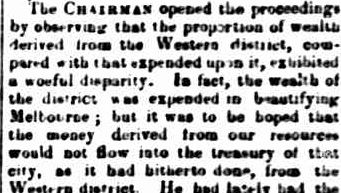
The Portland Guardian and Normanby General Advertiser reported on 19 June 1861, a meeting at Hamilton of the Separation Movement.  It was the first meeting of its kind in Hamilton, following on from a successful meeting in Portland.

SEPARATION MEETING AT HAMILTON. (1861, June 24). Portland Guardian and Normanby General Advertiser (Vic. : 1842-1876), p. 2 Edition: EVENINGS.45 http://nla.gov.au/nla.news-article65446763

Many well-known gentlemen of the district were there, men whose names are still evident in Hamilton.  Messers Skene, Learmonth, McKellar, and McPherson were all present.

Despite a campaign that went into 1862, the move to separate was unsuccessful.

An article in The Portland Guardian on 30 March 1953 reflected on what might have been if separathttp://trove.nla.gov.au/ndp/del/title/109ion had occurred.  The proposed new colony was to be called Princeland, with Hamilton as the capital and Portland as the major port.  I would have been born in Hamilton, the capital of the state of Princeland, Australia.  Imagine!

Talk of separation did not subside, as seen in this article from The Guardian in 1921.  A push in the Riverina area to separate in the early 1920s again saw the suggestion for the south-west of Victoria to also separate.

“WAKE UP, HAMILTON.”. (1921, January 31). Portland Guardian (Vic. : 1876-1953), p. 2 Edition: EVENING.. Retrieved June 24, 2011, from http://nla.gov.au/nla.news-article64023185

Colonial Ploughing Matches

BYADUK PLOUGHING MATCH

The Byaduk Farmers Club held their annual ploughing match on June 14, 1881. The venue was the farm of the Christie brothers and 13 competitors displayed their finest ploughing techniques.

James Harman was a keen competitor of ploughing competitions and on the day won the Champion class.  His plough of choice was the Lennon made in North Melbourne by Hugh Lennon.  Only the year prior the Lennon plough had made news with the capture of the Kelly Gang.  The armour forged for the gang had been made out of Lennon plough boards.

Reuben Harman, James’ younger brother won the B class.  Reuben was 41 at the time and died only two years later.  He was also a fan of the Lennon.  Another Harman, Arthur came second in the C class with a Hornsby plough and along with his uncle Reuben won a prize for best crowns.

“BYADUK PLOUGHING MATCH.” The Australasian (Melbourne, Vic. : 1864 – 1946) 18 June 1881: <http://nla.gov.au/nla.news-article137816092&gt;.

Other notable Byaduk residents to win prizes were William and Alexander Christie and Peter Fraser.  Thanks to Peter Fraser, then an 18-year-old, we now have the book Early Byaduk Settlers, a recollection of his life in Byaduk.  Following the match, the participants enjoyed the annual dinner at Hardy’s Temperance Hotel.  As the Harmans were staunch Methodists, the venue would have been seen as most appropriate.

Ploughing matches were a popular activity for farmers in the late 19th century.  They were an opportunity to display skill, show off the latest farming implements and to gather socially with other farmers.  The first ploughing match was held in the Portland area in the 1850s and they appear to have peaked in the 1880s when Inter-Colonial Ploughing Matches were held at Werribee Park and Ballarat.  The sketches below depict the 1882 event at Werribee Park where 3000 spectators were attendance, including several parliamentarians.  Farmers came from New South Wales, South Australia and Tasmania.

INTERCOLONIAL PLOUGHING MATCH. (1882, August 5). Illustrated Australian News (Melbourne, Vic. : 1876-1889), p. 120. Retrieved June 15, 2011, from http://nla.gov.au/nla.news-article63185745

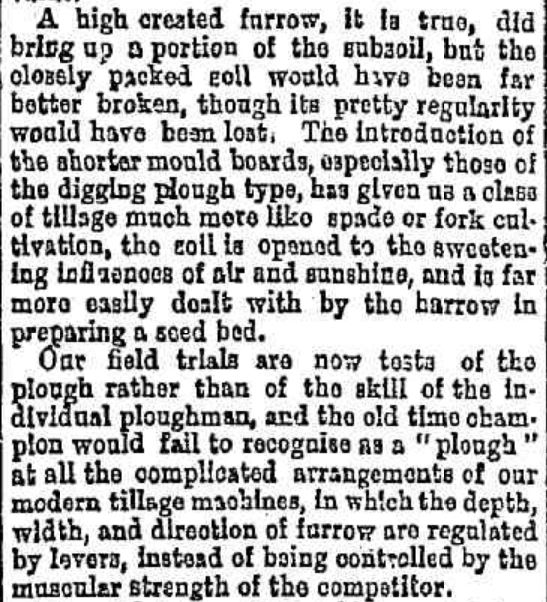
By the mid-1890s, the papers were lamenting the demise of the ploughing match.  This was put down to a number of reason including the move of young people off the land and more advanced implements.  The writer sees horse racing as no match to the social and competitive nature of the ploughing match, which were also free of the “curse of Australia”, gambling.  In the 20th century, the rise of the tractor meant ploughing by horse became almost unknown.  The skill required to plough was not as great as that of horse ploughing and there was no longer a need to demonstrate one’s abilities.  Field days today, allow for the display of the latest farming equipment and techniques filling a void left by the end of ploughing matches.  The following article from The McIvor Times & Rodney Advertiser but was also published in the Portland Guardian.

“Ploughing Matches.” The McIvor Times and Rodney Advertiser (Heathcote, Vic. : 1863 – 1918) 23 January 1896: 1 (Supplement to the McIvor Times.). Web. 1 http://nla.gov.au/nla.news-article90151643

Ploughing match results offer another insight into the lives of our Western District families.  They often have a comment on the highlight of the day and list the farmers’ place of residence.

In Search of the Extraordinary Monster

The cold snap this week has given me a chance to revisit the book by James Bonwick Western Victoria, It’s Geography, Geology and Social Conditions: The Narrative of an Educational Tour in 1857.  Although I have read the book several times, I still enjoy flicking through to my favourite parts.  One of those is the description of the Belfast (Port Fairy) Methodist Church

“…this building has come in for it’s share of carvings, in the shape of wreaths, flowers, vases, etc.  There is John Wesley’s benignant countenance regarding his incoming followers, and a noble shell expands over the front doorway.  An extraordinary monster is beheld crouching beneath the shell.  What he is, and what he does there, is a solemn mystery, known only to the artist.  Guesses as to character and description seem to run into one line, that it (is) neither more no less than the representation of the Arch One, who certainly looks uncomfortable with the shell and John Wesley over his head.   The mason may have intended it to exorcise the neighborhood, or to terrify little children into good behavior at chapel” (p84)

When I first read this book I penciled in a visit to the church when next in Port Fairy.  The fishing port town of Port Fairy is one of my favourite places in Victoria and is a summer playground for many in the Western District.  I  didn’t know on my many visits to Port Fairy in the 1980s, that I had a link with the town.  The Harman family had lived there in the 1850s and as Wesleyan Methodists would have no doubt attended sermons in the church.

While spending a few days there a couple of years ago, my small research assistant and I, walked to the church. I was keen to see the carvings as described by Bonwick and I was pleased to see they lived up to his description.  It is a little difficult to make out in the photo, but the “extraordinary monster” is in the bottom centre of the shell, its mouth is most easily seen.  John Wesley is depicted in the stone above the shell.  The carving directly above the door cannot be clearly seen here. Wire netting had been placed over the carvings in an attempt to protect them.

We were lucky enough to run into a church volunteer doing repairs and he allowed us to go inside the church.  The interior is still in its original condition.  I allowed myself to imagine the sermons of the 19th century with a  preacher placing the fear of God into his parishioners with talk of fire and brimstone.

The church was new when Bonwick visited.  On September 5, 1855, The Argus ran an article from the Belfast Gazette.  It reported the laying of the foundation stone for the Wesleyan church on August 21.  Many townspeople gathered for the occasion, with the Reverend Hart beginning proceedings with prayer, scripture reading, and song.  The ceremony then proceeded to the laying of a time capsule.  That honour was given to William Witton a long-term resident of the colony.  Witton was about 45 at the time and had been a builder in Melbourne before taking up the life of a grazier in the Western District.  His obituary credits him as the builder of the first Melbourne offices of the Bank of Australasia and for being one of the driving forces behind the foundation of Wesleyan churches throughout the colony.   

According to the Gazette, a bottle containing “the  Belfast Gazette and Banner of the week, and an inscription, of which the following is a copy:  “The foundation stone of James street Wesleyan Church, Belfast, laid by William Witton, Esq., on Tuesday, August 21,1855. Minister, Rev. R. Hart; chairman of the district, Rev. D. J. Draper; president of the Conference; Rev. W. B. Boyce: building committee, Messrs. Tillotson, McMahon, Bellett, Cole, and Scott; treasurer, W. W. Watson, Esq. ; secretary, W. N. Hosking, Esq. ; contractors, Messrs. Barnes, McGut, and Trevaskis.”  I thought it was unusual that local sculptor Walter McGill was not mentioned among the contractors, but I now believe that Mr McGut is in fact Mr McGill.  McGill was an interesting character who was not only a sculptor and stonemason but also a phrenologist and has been credited for making the death mask of Captain Moonlight.

Next time I visit the church I am going to look for the foundation stone, and hopefully get some better photos!  The church is now classified by the National Trust, which describes it as “one of Port Fairy’s finest buildings”.  I would have to agree with them.

ENDNOTE:  My small research assistant, now seven, has since resigned from his position.

Misadventures, Deaths and Near Misses

You have found your ancestor’s date of death, but you are wondering how they died.  You could buy a death certificate, but a certificate for all relatives can be a costly business.  Newspapers are the answer.  With the growing number of Australian newspapers available to search at Trove, there is a good chance you may find an article on your relative’s demise.  In turn, it may lead to an obituary which can also be a wealth of information, but I will discuss those in a future post.

When I began reading old newspapers, I was amazed at the number of deaths and accidents reported, compared to today’s papers.  It seemed even the smallest of accidents could make newspapers right around Australia.  Death reports were explicit and sparing little detail.  However, despite the nature of these reports, I do find them intriguing reading and they can show when, where, and how a family member died.  Also, accident reports show information that you may never have found otherwise.  I may never have known that my great-great-grandmother lost the top of her finger or my great-great-aunt was bitten by a snake.

Horse related accidents were naturally common whether falls or buggy accidents.  As the years passed, motor cars were the culprits, with many stories of them rolling or hitting trees.  The increasing number of motor cars also caused some problems for those still using horses as their main source of transport.  Fire was a common cause of death or accidents.  Candles, coppers, and fireplaces all increased the risk of burns.

Following are some examples of deaths and accidents involving my family members found in the papers at Trove:

Charles Bishop worked at Weerangourt Station, Byaduk,  but I found he also died there.  While chopping wood in 1916, he suffered heart failure and died at the age of 60.   I found this reported in four newspapers.

I feel sorry for poor James Elston.  He died at only 21.  The first article I found on him was in 1901, eight years before he died.  James had broken his leg, but this was the fifth break in two years.  He was sent to the Royal Children’s Hospital in Melbourne.  The Barrier Miner published in Broken Hill reported the accident as a possible record-breaker.

A Marino Boy Puts Up a Record. (1901, August 29). Barrier Miner (Broken Hill, NSW : 1888-1954), p. 2. Retrieved June 4, 2011, from http://nla.gov.au/nla.news-article44302344

In March 1908, James was back in hospital.  He had been thrown from a buggy and fell on a fence.  As a result, he fractured his spine between the shoulder blades and was crippled, his condition critical.  In January 1909, it was reported that James had succumbed to injuries at the Hamilton Hospital.

Robert McClintock died from heart strain and tetanus as a result of chasing a fox.  This was in 1913 and Robert was only 18.  I decided to search Trove with the phrase “chasing a fox” and it threw up many articles about deaths and accidents incurred while chasing foxes.  Some had fallen from horses, others accidentally shot by themselves, or others died the way of Robert McClintock.

Jane Diwell’s death in 1909 demonstrates the dangers women faced doing simple housekeeping tasks.  Married to Samuel Hazeldine,  Jane was in a back shed at their home in Murtoa boiling up beeswax and turpentine, when her clothes caught fire.  Despite desperate attempts by her husband to save her, she died from her burns.  Samuel received severe burns to his hands.

Frederick Hazeldine of Murtoa was watching the eclipse of the sun in 1910 when the 10-year-old slipped off a fence and broke his arm

Frank Coulson was only 17 when he met his fate in 1935.  His body was found near Digby.  He had sustained a fractured skull and his pony’s saddle and bridle were lying close by.  Different articles tried to offer an explanation to his death from having been kicked in the head by the pony or haven fallen awkwardly as the pony jumped a fence.

George Gamble lost his life after a cave-in at the Colac Brick Works in 1910.  He was dug out but later died at the Colac Hospital,

Mary Jane Hodgins (Mrs Matthew Gamble, below), my great great grandmother,  lost the top of her finger in an accident involving a horse.  Notice that this took place in Colac, Victoria, but was reported as far away as Maitland, New South Wales

GENERAL NEWS. (1877, September 1). The Maitland Mercury & Hunter River General Advertiser (NSW : 1843-1893), p. 7. Retrieved June 4, 2011, from http://nla.gov.au/nla.news-article18829977

In 1906, Amy Margaret Bubb, Mrs Benjamin Combridge, was bitten by a snake that had hidden in a mattress.  Her daughter Amy was darning the mattress and noticed something she thought was mice, moving inside.  She called her mother who hit the mattress and was bitten by a black snake on the wrist.  Young Amy ran to the neighbours’ house almost a kilometre away through paddocks and returned with a Mrs Arklay.  By this time, Amy Sr’s arm was black.  Mrs Arklay made an incision and drew black blood from the wound which saved Amy.  This article ran in Tasmania and Adelaide as well as The Argus.

I had known that my great, great, great grandfather William Diwell had died in a fall at the Merino Flour Mill in 1871, but I have since found that he was severely injured three years earlier.  In 1868, the Merino school-house verandah was falling down, so William volunteered to remove it.  Part of the verandah fell on him and he was pulled out suffering a severe head injury.  By all accounts, if the full verandah had of fell on him he would have been crushed to death.  He was 43 at the time and I think he may have been lucky to make it 46 when he did die.

The most gruesome article I have read about one of my family members is that of my great, great, great grandmother Ellen Barry, Mrs. Gamble.  Ellen was a feisty Irish woman, often in the courts and rather fond of a drink.  One night in January 1882, Ellen was home alone in her cottage in Colac, when a fire broke out.  The next day, the coroner found that due to Ellen’s propensity for a tipple, it was most likely she had knocked a candle that started the fire.

A WOMAN BURNT TO DEATH. (1882, January 26). The Argus (Melbourne, Vic. : 1848-1954), p. 8. Retrieved June 5, 2011, from http://nla.gov.au/nla.news-article11530343

These few examples prove how much you can find out about your ancestor’s death, not to mention their life before death.  If you are using Trove, it is useful to search all the papers available because as Mary Jane Hodgins’ accident shows, incidents can be reported interstate.  You can use filters to narrow your search down, particularly if you have a specific date.

In a future post, I will share some of the other articles I have found which don’t relate to my family but show the value of these stories in developing an understanding of how precarious life could be for those living in the 19th and early 20th century.  We can also learn how death was considered in those times by the style of writing and the depth of description.  Most importantly for family historians, our ancestors become more than just a one-dimensional date on a page.

In the News – June 4, 1860

The Portland Guardian and Normanby General Advertiser had a regular feature know as “Table Talk” presenting local news.  The June 4, 1860 edition demonstrates some of the rivalries which already existed between towns in the Western District.

Table Talk. (1860, June 4). Portland Guardian and Normanby General Advertiser (Vic. : 1842-1876), p. 2 Edition: EVENINGS. http://nla.gov.au/nla.news-article65443736

The writer is bemused that the Ararat newspaper, presumably the Ararat Advertiser, could compare Ararat with the three coastal towns, Belfast, Warrnambool, and Portland.  Also at the time, money was being spent on the road from Ararat to Warrnambool.  The writer made it clear that while the Government described the road as the Ararat to Portland district road, Portland was in no way benefiting from the money which was being spent on the road.

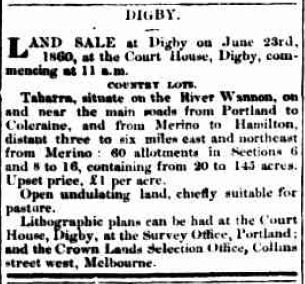
Land sales were also making news.  The Government was releasing land in the Merino, Tahara, and Digby raising concern that by the time the Land Sales Bill went through there would be little decent land to buy.  Further on in the paper, several advertisements spruik the land opportunities including this one for acreage at Tahara

A  “superior class” of female immigrants were making their way to Portland in the following week, the paper reports.  The women had arrived in Melbourne aboard the Atalanta and were considered to be “of timely benefit to this town”.

The mail was late in Mount Gambier on June 2, arriving at 2.40pm.  The correspondent surmises that something must have happened to the mailman because when he did arrive, his head was bandaged.

I Wish I Were Related to Chris Coulson

I am sure most of you have come across a person in your research who, while not related, still captures your imagination.  I have found myself off on a tangent many times with a family who has married into my own, only to rein myself in to focus on my direct relatives.

One such person is Christopher Coulson who I first encountered when I found his son Frank married my 2nd great grand-aunt Harriet Diwell. Chris was a horseman and had some involvement with the early days of Western District racing, and that tweaked my interest.

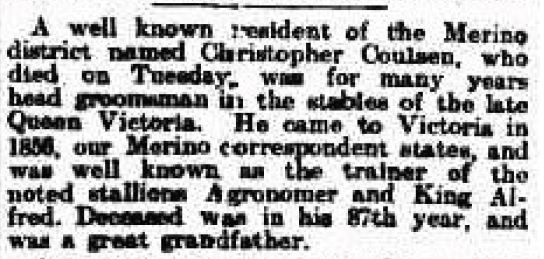
Christopher Coulson was born at Scarborough, Yorkshire in 1817 and married Mary Frances Stubbs in 1841.  Not long after, Christopher began working as a groomsman at the Royal Mews at Buckingham Palace during Queen Victoria’s reign.  Christopher and Mary had one child then, Francis Stubbs Coulson (Frank), born in 1842, and they had three more children at the Mews.  The 1851 Census shows the family living at the Royal Mews. Christopher’s occupation was recorded as “helper in the master of the horses department”.  In 1855, Queen Victoria set up the Buckingham Palace Royal Mews School for the children of those working at the Mews.

In 1856, Christopher, Mary, and the four children sailed for Australia on General Hewitt arriving in Portland. The Coulsons’ immigration record shows Christopher was to be employed by Mr McKellar of Ardachy at Branxholme for twelve months.  At some stage, Chris went to Rifle Downs at Merino to work as a trainer for Richard Lewis, who owned such horses as the thoroughbred “King Alfred” and Clydesdale stallion “Agronomer”. “King Alfred” was revered throughout the district. Even Adam Lindsay Gordon referred to him in his poem “The Fields of Coleraine”.  He stood at stud with “Agronomer” who competed in local shows and was sire of many of the heavy workhorses in the area. 

Eventually, Chris selected his own land at Dwyers Creek and became a sheep breeder, but always remained a horse lover.  He died in 1904 aged 86.

Chris Coulson Obituary – THE FRUIT INDUSTRY. (1904, August 2). The Brisbane Courier (Qld. : 1864-1933), p. 5. Retrieved May 30, 2011, from http://nla.gov.au/nla.news-article19293600

Christopher and Mary had five children, four born in England and the fifth Georgiana born in Australia at Digby.  Sadly Georgiana died aged five in 1865.  The remaining four children all married and raised families.  They were:

Francis Stubbs Coulson – Born 1842 Yorkshire Died 1916 Victoria.  Frank married Harriet Diwell, daughter of William Diwell and Margaret Turner in 1873.  They had 13 children and lived in the Dwyers Creek/Merino area during their married lives.  Descendants’ surnames include Miller, Cameron, and Gull.

Betsy Ann Coulson – Born 1845 Westminster, London, England Died 1896 Casterton, Victoria.  Betsy married Joseph Wombell, and they had six known children.  Descendants’ surnames include Petterd, Chester, and Rowely.

Christopher Coulson Jnr – Born 1847 Pimlico, London Died 1893 Merino, Victoria. Chris married Lorina Ann Eastick in 1872.  They had nine known children and their descendants’ surnames include Crawley, Grant, Ames, and Stanmore

Amy Oliver Coulson – Born 1852 Pimlico, London Died 1926.  Amy married Alexander Cameron in 1875.  They had three known children.  Descendants’ surnames include Milward and McCombe

I have researched enough of my family tree to know I will not unearth an ancestor who had contact with the early days of the racing and horse breeding industry in the Western District.  A romantic time when Adam Lindsay Gordon wrote of the fields of Coleraine, there was a racecourse in most towns and the early horses, ancestors themselves to many Western District progeny, were swum to shore from boats.  That is why I wish I was related to Christopher Coulson.

In the News – May 26, 1927

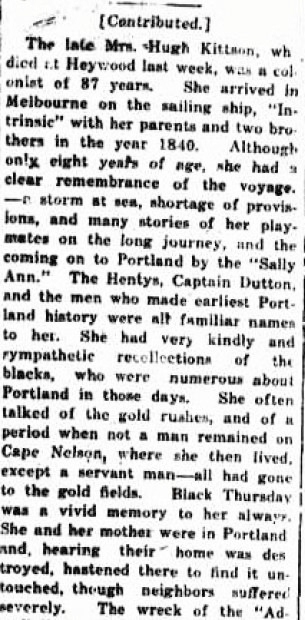
The Portland Guardian of 26 May 1927 reports the death of Mrs. Hugh Kittson.  The obituary gives much information about Mrs. Kittson’s early life including her arrival in Australia and her marriage.  She was 94 years old and had been in Victoria for 82 years and had many memories of those early times.  As I read her story, I wanted to know more about Mrs. Hugh Kittson.  The obituary, as was often the way, did not mention her first or maiden names.  It did say she had travelled to Victoria on the Intrinsic with her parents and two brothers in 1840.
Obituary. (1927, May 26). Portland Guardian (Vic. : 1876-1953), p. 3. Retrieved May 26, 2011, from http://nla.gov.au/nla.news-article64257291

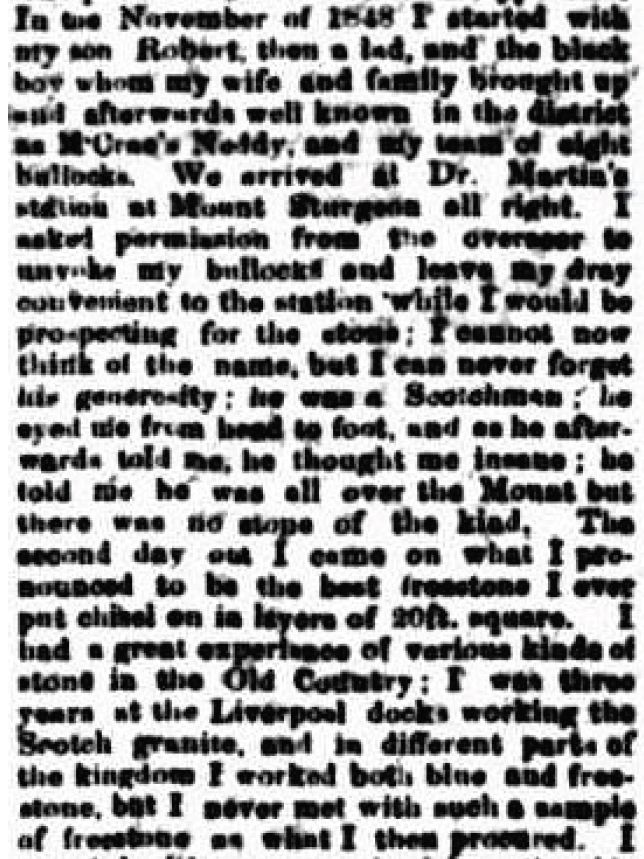
After searching death records and Trove, I found that Mrs Kittson was Margaret Jennings, daughter of Cook Abraham Jennings and Hannah Birchall.  She was born in Manchester in about 1833.  Her brothers were Samuel and Robert Jennings and the “Intrinsic” had in fact arrived in 1841. I then discovered stories about two pioneering families of the southern Western District I had not heard of before, the Jennings and the Kittsons who were both in the Portland and Bridgewater areas before 1850. I particularly enjoyed a Letter to the Editor from the Portland Guardian of 23 January 1877 by Cook Jennings which painted a picture of the 1840s.

Cook Abraham Jennings’ letter gives an insight into life in the early days of Western Victoria.  He refutes a claim by Thomas Fairburn to be the first person to find freestone at Mount Abrupt near Dunkeld suggesting it was he instead who made the first discovery.   He describes a journey from Portland to Mt Sturgeon and Mt Abrupt almost 30 years earlier.  As a stonemason in Portland, he was keen to source some freestone and after a tip-off, headed to the southern end of the Grampians in 1848 with his travelling companions, son Robert, and an indigenous boy raised by Jennings’ wife.

CORRESPONDENCE. (1877, January 23). Portland Guardian (Vic. : 1876-1953), p. 2 Edition: EVENINGS.. Retrieved May 26, 2011, from http://nla.gov.au/nla.news-article63337471

CORRESPONDENCE. (1877, January 23). Portland Guardian (Vic. : 1876-1953), p. 2 Edition: EVENINGS.. Retrieved May 26, 2011, from http://nla.gov.au/nla.news-article63337471

Jennings describes the return journey when “there was no Hamilton…save Mr. Beath’s store and Blastock’s public house”.  After difficulty crossing the Grange and Violet Creek he eventually reached Portland and sold off the stone, which was still being used as grindstones 30 years later.

The letter also shows that overseas travel was not out of the question for those early pioneers.  Cook Jennings travelled to Richmond, Virginia in 1858 to lodge a claim on a relative’s will.  Although Cook did come across as somewhat of an opportunist!

Margaret Jennings’s husband Hugh Kittson was himself some sort of trailblazer.  The Irish-born son of James and Catherine Kittson, was reported as the first white person to ride overland from Portland to Melbourne.  Hugh and Margaret had seven children and surnames of their descendants include Johnson, White, and Hodgetts.

Ghosts of Yesteryear

“It is a good thing sometimes to go back among the ghosts of the past if only to restore our sense of proportion. There is so much that is senseless and ephemeral in modern life that contemplation of the simplicity, the loyalty, the courage, the earnestness and high purpose of our forefathers, gives us a better sense of human values and helps us to sort the meretricious from the wise and good.

There was a greatness in that settlement of Portland and the Wannon valley that surpasses most modern things. Still, we are what we are, and if we cannot do those big things today from lack of opportunity, we can still perhaps, do some little things in a great way and not be lacking. 

These timeless words are those of Mr E.M. Webb a writer for The Herald, Melbourne in an article which appeared in the Portland Guardian on 19 April 1938.  Mr Webb had driven through the Western District en route to Portland.  A spur of the moment decision saw him visit the town of Merino and in turn, he was taken back to the time of Major Thomas Mitchell and the Henty family, both significant in the exploration and settlement of the area.

Along the Road to Merino. (1938, May 19). Portland Guardian (Vic. : 1876-1953), p. 3 Edition: EVENING.. Retrieved May 19, 2011, from http://nla.gov.au/nla.news-article64279106

Webb recounts a lovely story of an unexpected meeting of John and Francis Henty and Major Mitchell at Portland.  Each party thought they were alone in the area and were surprised to come across each other.  Major Mitchell told of land worthy of grazing in the Wannon valley and the Henty’s heeded is advice which saw them settling in the Merino area.  He compared his trip from Merino to Portland to that of the Hentys by bullock wagon which he suggests would have taken four hours, twice as long as his driving time.  Today it would take about one hour.  He also gives acknowledgment to the pioneer women such as Mary Ann Henty, who faced the hardships head-on with their husbands.

I’m sure we can take something from Mr Webb when we research our family histories.  Understanding more about the history of the places they lived and the challenges they faced as pioneers help us to create a vision of our ancestors’ lives.  It is then that we can fully appreciate how we came to be where we are today.

The Harmans of Byaduk

I grew up in Hamilton, with Byaduk only about 20 kilometres from my home.  I passed through it on trips to coastal Port Fairy, visited the nearby dormant volcano Mt Napier with school and heard stories about the Byaduk caves.  Never for a minute did I know that I had any link to the small town with its drystone fences and rocky paddocks.

I  had heard of the Harmans from the conversations of my great uncles and aunties,  but when I asked who they were Nana would just say they are “cousins”, so I figured they were not that closely related.  It was not until I started finding out more about my family tree and Nana told me all the names she knew, I discovered that her mother Sarah was a Harman.

My Great Grandmother Sarah Elizabeth Harman

When first researching, I would look through records for certain family names and would often come up with very little. That was until I started on the Harmans.  There was loads of information and they soon became my favourite family, and not just for the ease of researching them.  I discovered an upstanding, religious family that always dotted the i’s and crossed the t’s.  A family that got involved in the community whether it be building schools, ploughing competitions, the Methodist church, or the Farmers Union.  Back in the late 1800s and early 1900s,  they were a well-known family in the district.

Coming to Australia in three separate groups, Joseph and Sarah Harman and their mostly grown-up children, reunited in Port Fairy during the mid-1850s.  They established themselves in the town, but with the land opening up in 1861 they moved to newly settled Byaduk around 1863.  Joseph was the first bootmaker in the town, while sons James, Jonathon, and Reuben began farming the stony land.  George, who was second eldest, seemed to have no wish to farm and by the late 1860s had returned to Port Fairy where he worked for the local council.

The family grew and by the turn of the century, another generation of Harmans were raising families with the union of marriage linking them to other well-known families in the district, including the Kinghorns, Bishops, and Olivers.  The family was also beginning to branch out to other parts of the state, including Gippsland. In 1907, three members of the Harman family appear in a photograph of Byaduk pioneers, James, Jonathan, and Reuben’s wife Elizabeth.

Byaduk Pioneers 1907

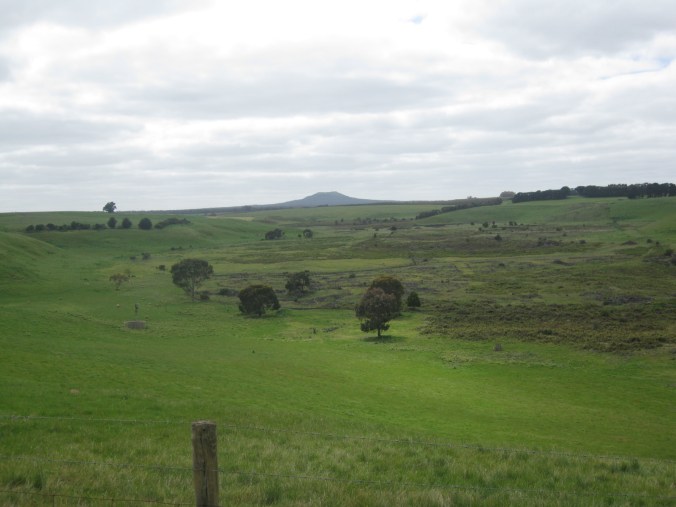
I eventually left Hamilton and did not return to Byaduk until the 1990s to visit the cemetery.  By this time I knew something of the Harman’s standing in the community but had not realised that there was so much recognition of it.  While not that surprised to find a road named after them, I was surprised the Byaduk Caves had the names, Harman’s Cave No 1 and Harman’s Cave No 2 and that the volcanic lava flow that runs from Mt Napier to Byaduk is called “Harman Valley”.  Also, the Byaduk area has been recognised as part of the Kanawika Global Geopark

The Harman Valley, Byaduk

The name of Harman is not common in  Byaduk today but I am proud that ongoing recognition of their presence there is ensured.

Death of First Stawell Gift Winner

The Stawell Gift begins today at Central Park in Stawell.  From humble beginnings in 1878 with a foot race been miners, the meet has grown to be a major annual event on the Australian athletics calendar.  Drawing thousands of people to the Stawell and Grampians region for the Easter period, the Gift has seen many international and leading Australian athletes.

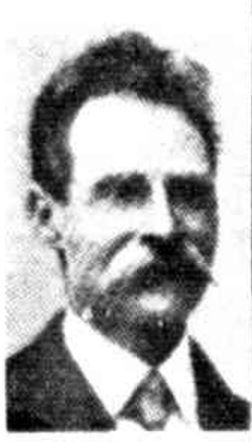
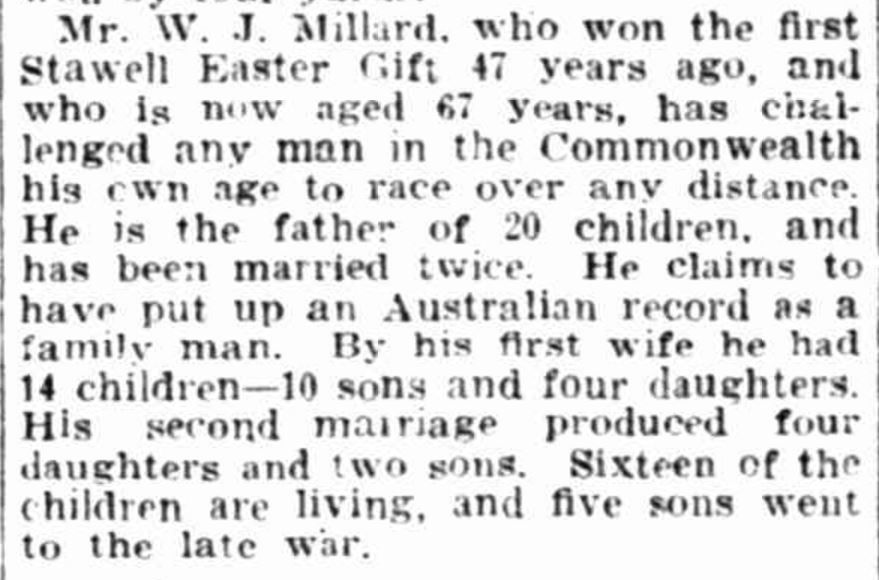
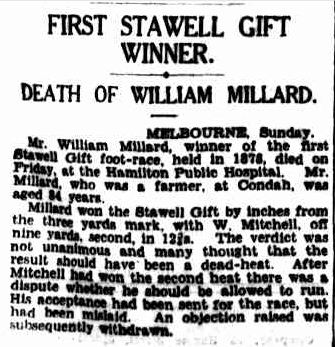
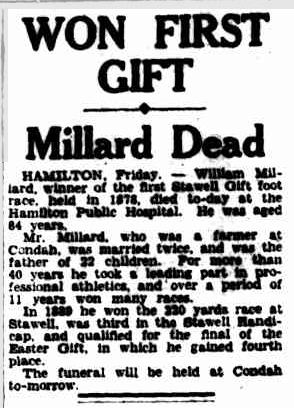
The Gift has certainly come a long way since William Millard of Condah won the first gift in 1878.  The win, however, was not without controversy.  William was almost disqualified.  He died in 1939 at Hamilton Hospital and as these articles attest, his athletic ability was not only confined to the track…he was the father to twenty children from two marriages.  The family name is still common today in the south-west of Victoria.  William’s great-grandson, Daniel Millard won the Stawell Gift in 1997.

“First Stawell Gift Winner Dead” Sporting Globe (Melbourne, Vic. : 1922 – 1954) 3 May 1939: 12 (Edition2 : Cycling And Athletic Sections). <http://nla.gov.au/nla.news-article189148221&gt;.

“STAWELL EASTER GIFT” News (Adelaide, SA : 1923 – 1954) 21 April 1924: 6 (Sporting Edition). <http://nla.gov.au/nla.news-article129836293&gt;.

WON FIRST GIFT. (1939, April 29). The Argus (Melbourne, Vic. : 1848 – 1956), p. 13. Retrieved February 16, 2012, from http://nla.gov.au/nla.news-article12122833

FIRST STAWELL GIFT WINNER. (1939, May 1). The Sydney Morning Herald (NSW : 1842 – 1954), p. 17. Retrieved February 16, 2012, from http://nla.gov.au/nla.news-article17588716