Trove Tuesday – Bottled News

Recently, I wrote a Trove Tuesday post about newspapers used as wallpaper in a North Portland building.   This week I have a similar story, but the newspapers in this case were found in a more unusual place.  The Argus of April 10, 1911 reported on the discovery of newspapers under the Birregurra State school.  While finding newspapers under floors my not be unusual, the containers they were in was unusual.  The papers were shredded and stuffed into bottles.  They were obviously not shredded too small as contractors were able to identify the titles of the newspapers and an article about Adam Lindsay Gordon.  Coincidentally, the find was almost 44 years to the day from when the papers were published.

NEWSPAPERS OF 1887. (1911, April 10). The Argus (Melbourne, Vic. : 1848 - 1957), p. 9. Retrieved September 16, 2013, from http://nla.gov.au/nla.news-article10893529

NEWSPAPERS OF 1887. (1911, April 10). The Argus (Melbourne, Vic. : 1848 – 1957), p. 9. Retrieved September 16, 2013, from http://nla.gov.au/nla.news-article10893529

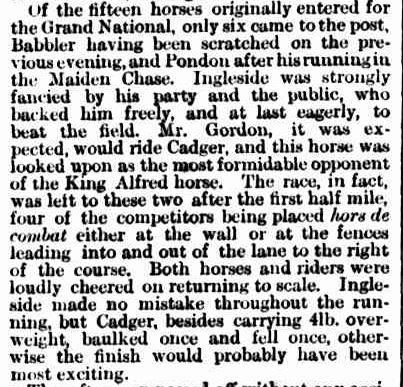
While none of the titles found are available at Trove for the said dates, I was able to find an article about the Autumn Grand National at Ballarat as reported in the Geelong Advertiser of April 13, 1867. The corresponding article was in The Argus of April 13, 1867.

In the feature race, Adam Lindsay Gordon rode Cadger owned by Walter Craig, then proprietor of the well-known Craigs Hotel in Ballarat.  Gordon set the pace and with the remaining four horses dropping off, Cadger and Ingleside were left to fight it out.  The rough and tumble of colonial racing and the fearlessness of Gordon was on display in the final stages of the race.  Cadger baulked at a jump, but Gordon faced him up at again and was able to clear it on the second attempt.  The chase was on but Cadger fell further down the track.  Not to be perturbed, Gordon remounted and continued the race.  Unfortunately, Ingleside had too much of a lead and Gordon and Cadger were beaten by around 12 lengths.
tt18

BALLARAT TURF CLUB. (1867, April 13). The Argus (Melbourne, Vic. : 1848 - 1957), p. 6. Retrieved September 16, 2013, from http://nla.gov.au/nla.news-article5764224

BALLARAT TURF CLUB. (1867, April 13). The Argus (Melbourne, Vic. : 1848 – 1957), p. 6. Retrieved September 16, 2013, from http://nla.gov.au/nla.news-article5764224

Trove Tuesday – Up, Up and Away

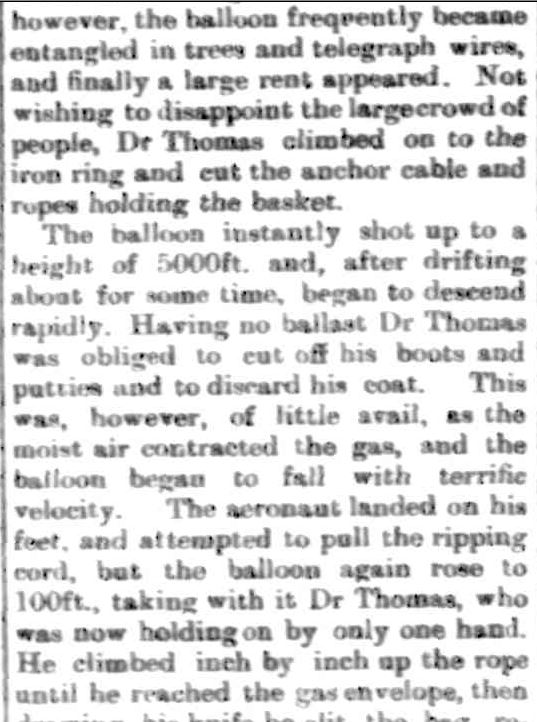
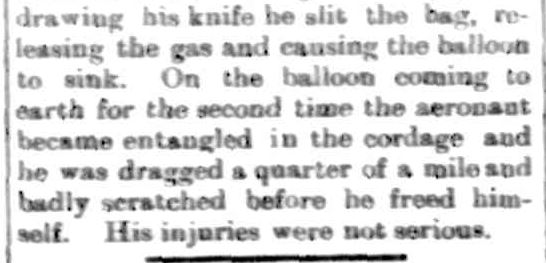
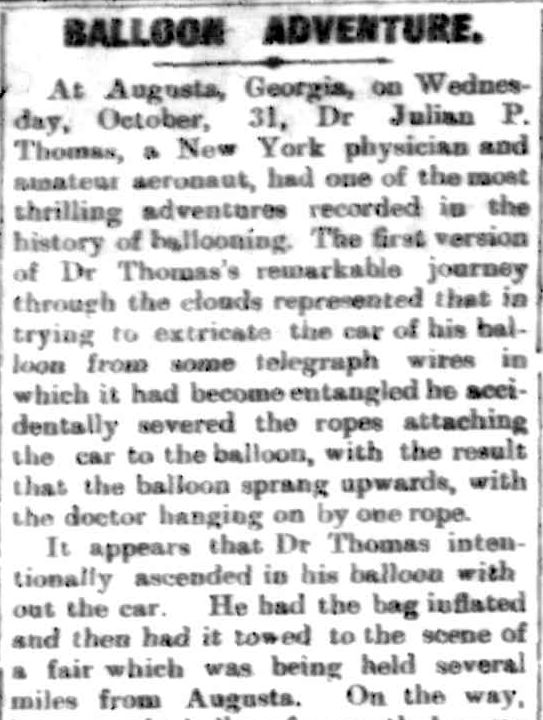
Trove Tuesday goes abroad this week.  The date, October 31, 1906.  The place, Augusta, Georgia, U.S.A.  The man, Dr. Julian P. Thomas an “amateur aeronaut” from New York with a passion for endurance balloon flights.  Julian’s endurance was put to the test on that day in October 31, when his balloon went up and down and up and down again.

tt13tt14

Image Courtesy of State Library of Victoria.  Image No: H90.31/103 http://handle.slv.vic.gov.au/10381/75888

Image Courtesy of State Library of Victoria. Image No: H90.31/103 http://handle.slv.vic.gov.au/10381/75888

Dr Thomas was an interesting character as was his wife who often joined him on his flights.  A Google search of the “Julian Thomas aeronaut” found various newspaper articles from the likes of the New York Times about some of their escapades.  Interestingly, a serious car accident in 1907 involving Julian Thomas, almost resulted in his leg being amputated.

tt16

Image Courtesy of the State Library of Victoria. Image no. H90.31/103 http://handle.slv.vic.gov.au/10381/75888

Trove Tuesday – Scissors and Paste

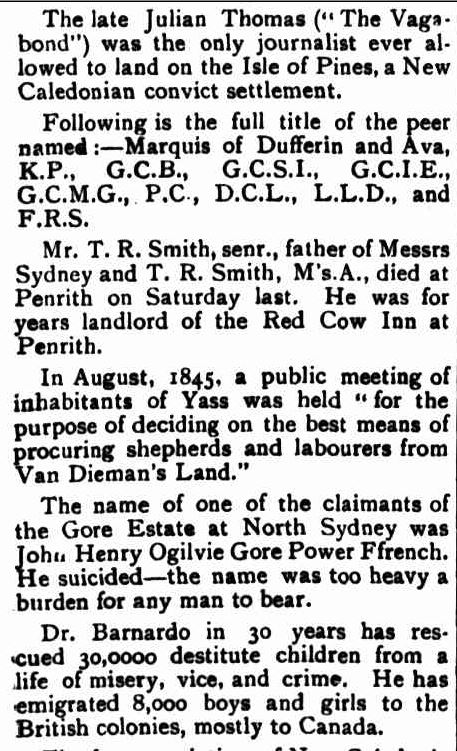
Spotted while researching The Vagabond was this regular feature of the Windsor and Richmond Gazette.  After searching the heading “Scissors and Paste” at Trove, most came from that paper.

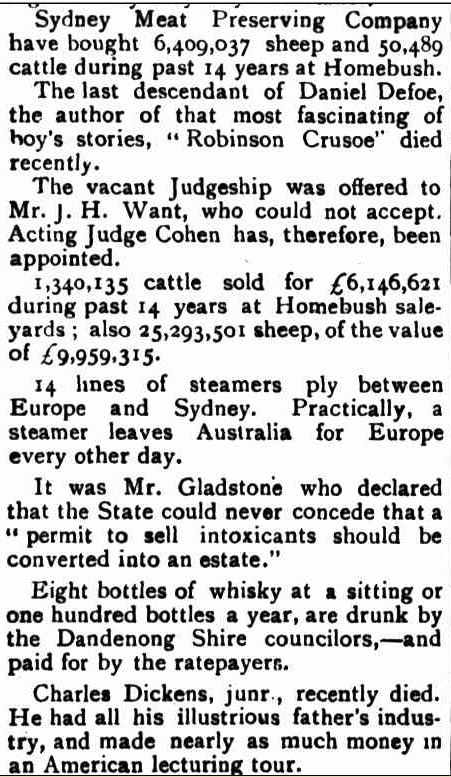
The articles were snippets of larger stories, supposedly cut and pasted by the “Colonel”, who ever the “Colonel” was.  They are similar in tone to the “They Say” articles featured recently on Trove Tuesday, with a mix of serious and amusing snippets.

This offering from September 12, 1896, includes ostriches and Chow dogs, Daniel Defoe and Charles Dickens Jnr.  Public officials were put to task, such as Judge Windeyer and his questionable penison and the Dandenong Shire Councillors, believed to have consumed one hundred rate-payer funded bottles of whiskey over the course of the year.  There are statistics aplenty and court news.


tt7stt8tt9

SCISSORS and PASTE. (1896, September 12). Windsor and Richmond Gazette (NSW : 1888 - 1954), p. 13. Retrieved September 2, 2013, from http://nla.gov.au/nla.news-article72549720

SCISSORS and PASTE. (1896, September 12). Windsor and Richmond Gazette (NSW : 1888 – 1954), p. 13. Retrieved September 2, 2013, from http://nla.gov.au/nla.news-article72549720

This snippet was from February 4, 1899 and I think you will appreciate it…

SCISSORS and PASTE. (1899, February 4). Windsor and Richmond Gazette (NSW : 1888 - 1954), p. 13. Retrieved September 2, 2013, from http://nla.gov.au/nla.news-article66440144

SCISSORS and PASTE. (1899, February 4). Windsor and Richmond Gazette (NSW : 1888 – 1954), p. 13. Retrieved September 2, 2013, from http://nla.gov.au/nla.news-article66440144

You can count on Trove to find an image.  With just a little searching, I was able to come up  with this postcard held at the State Library of Victoria to compliment “Scissors and Paste”.

THE CENSOR AT WORK AS HE IS SEEN BY THE PRESS (c.1914) Image Courtesy of the State Library of Victoria.  Image No. H97.248/154  http://handle.slv.vic.gov.au/10381/142970

THE CENSOR AT WORK AS HE IS SEEN BY THE PRESS (c.1914) Image Courtesy of the State Library of Victoria. Image No. H97.248/154 http://handle.slv.vic.gov.au/10381/142970

Trove Tuesday – Let’s Celebrate

It’s time to celebrate Trove Tuesday.

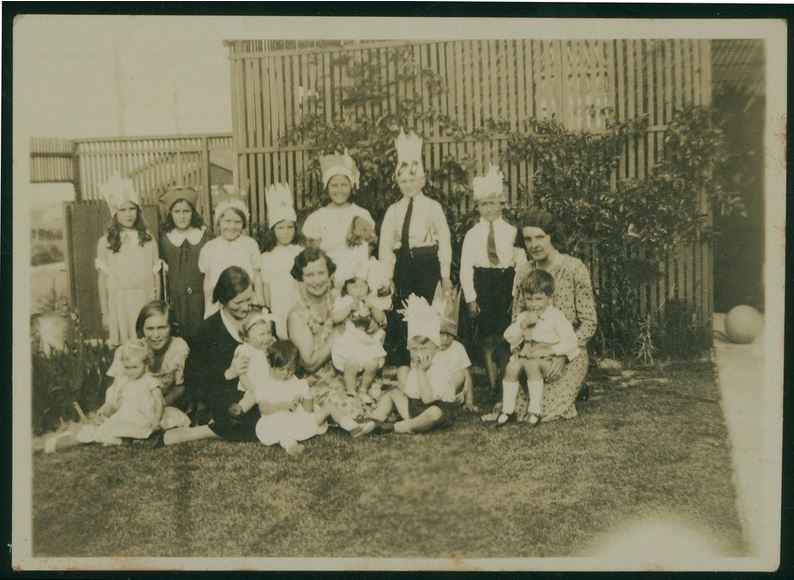
Image Courtesy of the State Library of Victoria.  Image no.  H2010.137/14 http://handle.slv.vic.gov.au/10381/85452

Image Courtesy of the State Library of Victoria. Image no. H2010.137/14 http://handle.slv.vic.gov.au/10381/85452

On Tuesday August 21, 2012, Amy Lehmann wrote a post on her blog, Branches, Leaves & Pollen called Trove Tuesday – Love, Life and Death in Newspapers.  The aim of her post was to show what  treasures are found on the Trove site that “add a bit of extra colour” to our family history research.  Amy then invited other bloggers to join her the following Tuesday to share their Trove treasures.  The next Tuesday, August 28,  nine other bloggers, including myself, joined Amy and Trove Tuesday was away.

Not all the treasures I have shared over the past 52 weeks have been about my family.  Most have been quirky snippets I’ve stumbled across while researching my family or hunting up pioneer obituaries.  You would have to agree animal articles seem to catch my eye most often.  There have been articles about a feisty dog, a lost kaf (sic), hopping kangaroos and jumping sheep, a slippery snake and a incredibly long snake, a hare hunt and a cat on the hunt.  There was also some “beautiful hair” that could have comfortably housed any of the above critters.

Morality and matrimony also had a good run.  Who could forget Reverend Gladstone of Nathalia and his aversion toward married women attending dances.  There was bottom drawer tips, hints for wives and daughters and those popular Commandments for Husbands and Wives.  Then there were the ladies of the night from Geelong…

The five most popular Trove Tuesday posts over the past 52 weeks are:

Trove Tuesday – Matter of Relativity.

Trove Tuesday – Hamilton Then and Now

Trove Tuesday – Advertisements

Trove Tuesday – What a Newspaper is…

Trove Tuesday – They Say

My own Top 5 favourite Trove Tuesday posts are:

Trove Tuesday – A Lady Motorist

Trove Tuesday – Whispering Wedding Bells

Trove Tuesday – UFO Alert

Trove Tuesday – A Little Chatter About A Magpie

Trove Tuesday – From the Heart

I am looking forward to another 52 weeks of Trove Tuesdays and with all the new papers at Trove there will be many more weird and wonderful treasures to share.  Thank you to Amy for coming up with the idea of Trove Tuesday, we have all enjoyed participating.  Check out Amy’s blog for all the Trove Tuesday posts of the past year.

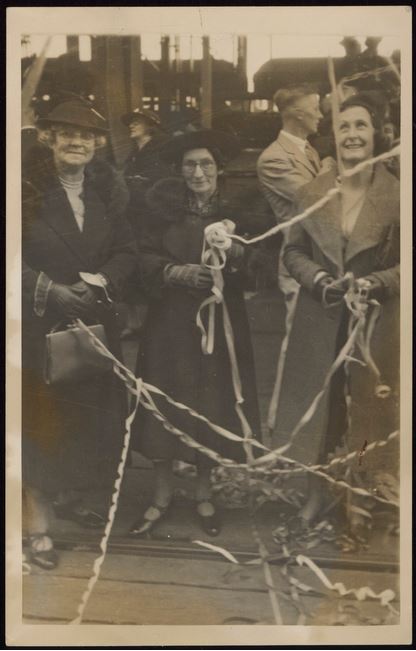
Image Courtesy of the State Library of Victoria.  Image No. H36852 http://handle.slv.vic.gov.au/10381/192072

Image Courtesy of the State Library of Victoria. Image No. H36852 http://handle.slv.vic.gov.au/10381/192072

Trove Tuesday – Let it Snow

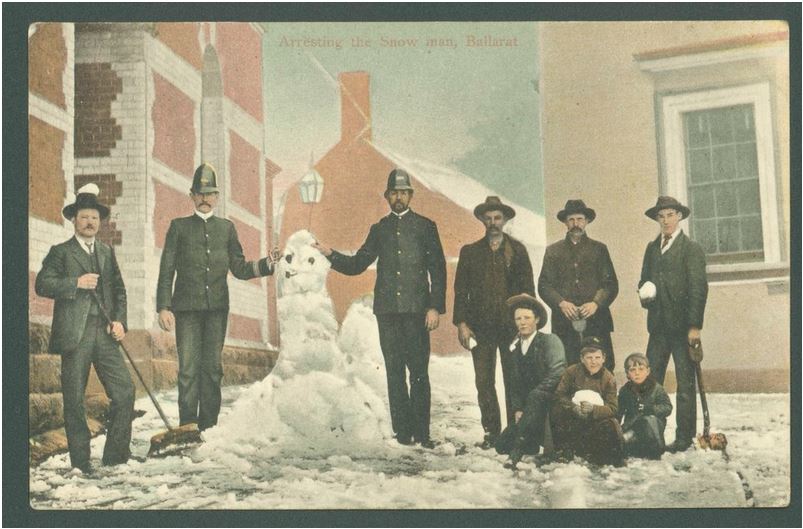
Since Western Victoria is experiencing a cold snap with snowfalls around Ballarat and the Grampians in the past 24 hours, I thought a snow theme for Trove Tuesday appropriate.

This treasure found at Trove is a postcard from Ballarat in 1909.

tt

Snowfalls on the hills around Ballarat and surrounding districts are not uncommon, but the snow rarely settles in the town.  Mt William, the highest peak in the Grampians gets a snow cap some winters, but for a short time only.  Further west, it is less likely to snow in Hamilton and from memory, in the eighteen years I lived there, it may have snowed once, but it was closer to sleet than snow.  I have never known it to snow as it did in July 1901, when snow fell for around nine hours in Hamilton.  It would have been a beautiful sight.

HEAVY SNOW IN THE COUNTRY. (1901, July 29). The Argus (Melbourne, Vic. : 1848 - 1957), p. 6. Retrieved August 20, 2013, from http://nla.gov.au/nla.news-article10563557

HEAVY SNOW IN THE COUNTRY. (1901, July 29). The Argus (Melbourne, Vic. : 1848 – 1957), p. 6. Retrieved August 20, 2013, from http://nla.gov.au/nla.news-article10563557

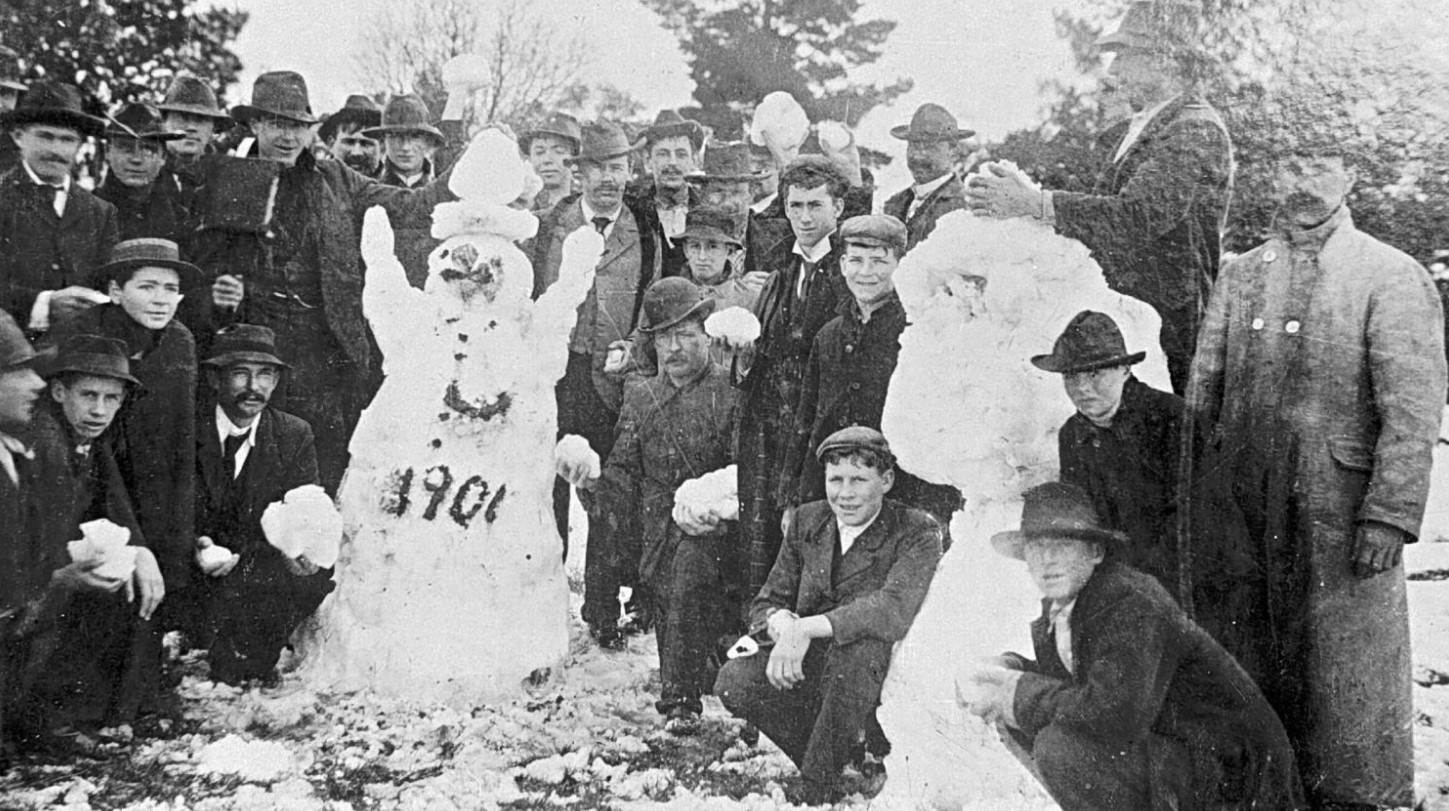
With Trove’s help, I found a photo of a snowman built at Hamilton in 1901, held by Museum Victoria.

HAMILTON 1901. Image courtesy of the Museums Victoria Collections https://collections.museumsvictoria.com.au/items/765795

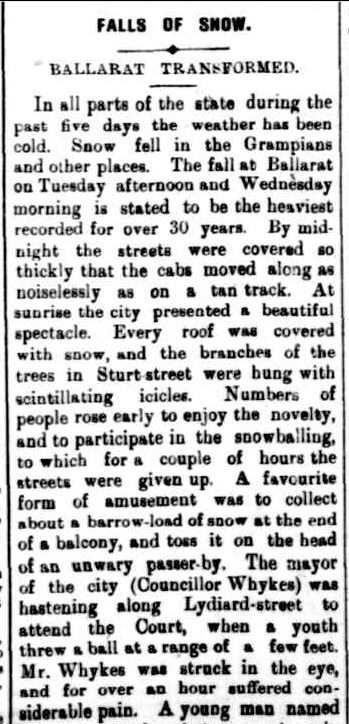
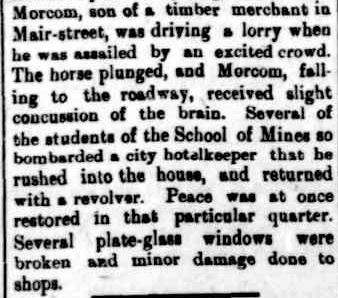
In 1905, heavy snow saw high jinx in the streets of Ballarat that got out of hand resulting in a revolver wielding publican and the Mayor, Councillor Whykes suffering concussion

tt2

FALLS OF SNOW. (1905, September 8). The Horsham Times (Vic. : 1882 - 1954), p. 3. Retrieved August 20, 2013, from http://nla.gov.au/nla.news-article72817822

FALLS OF SNOW. (1905, September 8). The Horsham Times (Vic. : 1882 – 1954), p. 3. Retrieved August 20, 2013, from http://nla.gov.au/nla.news-article72817822

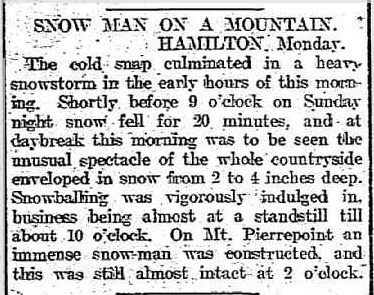
In 1910, Hamilton saw another heavy snowfall.  Such was the novelty, snowballing in the streets took priority over opening the shops.  A large snowman was built on nearby Mt Pierrepoint.

SNOW MAN ON A MOUNTAIN. (1910, October 11). The Border Morning Mail and Riverina Times (Albury, NSW : 1903 - 1920), p. 2. Retrieved August 20, 2013, from http://nla.gov.au/nla.news-article111390335

SNOW MAN ON A MOUNTAIN. (1910, October 11). The Border Morning Mail and Riverina Times (Albury, NSW : 1903 – 1920), p. 2. Retrieved August 20, 2013, from http://nla.gov.au/nla.news-article111390335

Well, this post is my 52nd Trove Tuesday post.  I did it.  I managed to post every Tuesday since Amy Lehmann launched Trove Tuesday on August 28  last year.  Next week, we celebrate Trove Tuesday entering a second year and I will share some of the most popular posts from the past 52 weeks.


Trove Tuesday – The Tiger Again

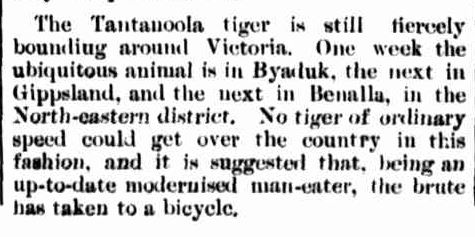
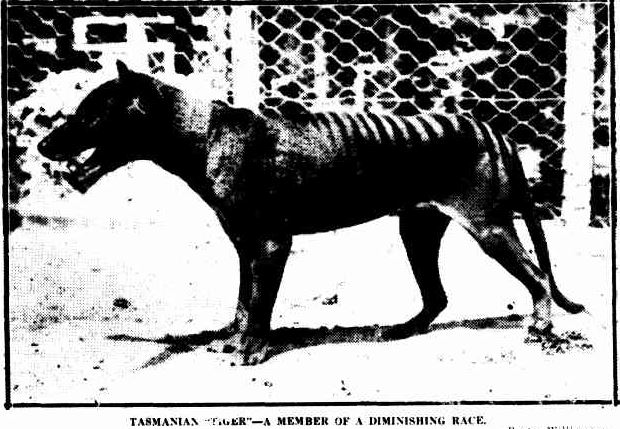
Last month, the Trove Tuesday post, “They Say”  introduced the Tantanoola Tiger that was causing terror for farmers and their sheep in 1915.  I have now found an article from an earlier sighting at Byaduk in 1896.  You may remember the Tantanoola Tiger was first sighted in 1884 after a Bengal tiger supposedly escaped from a circus visiting Tantanoola in the South-East of South Australia and set out on a path of destruction through that district and the Western District of Victoria.

Mr Falkenberg of Byaduk was certain he was a victim of the tiger in 1896.  Just as the story of the Tantanoola tiger had grown in size, so had the tiger itself.  He thought the “tiger was bigger than ever”so big that it was “as big as most horses”.

THE TIGER AGAIN. (1896, February 14). Albury Banner and Wodonga Express (NSW : 1896 - 1939), p. 28. Retrieved August 3, 2013, from http://nla.gov.au/nla.news-article99428658

THE TIGER AGAIN. (1896, February 14). Albury Banner and Wodonga Express (NSW : 1896 – 1939), p. 28. Retrieved August 3, 2013, from http://nla.gov.au/nla.news-article99428658

While the mauling of Mr Falkenberg’s sheep was tragic, I do fear the Byaduk correspondent took the event far too seriously in his report about the “tiger-infested country”.  Thank goodness for the report from the Kalgoorlie Western Argus, almost a month after Mr Falkenberg’s encounter.  That was very much “tongue in cheek” with the last sentence producing a laugh out loud moment for me.

SPORTING. (1896, March 12). Kalgoorlie Western Argus (WA : 1896 - 1916), p. 13. Retrieved August 3, 2013, from http://nla.gov.au/nla.news-article32210351

SPORTING. (1896, March 12). Kalgoorlie Western Argus (WA : 1896 – 1916), p. 13. Retrieved August 3, 2013, from http://nla.gov.au/nla.news-article32210351

I don’t want to add to the hysteria, but I was wondering if it was something else Mr Falkenberg saw…?

No title. (1923, June 20). The Mercury (Hobart, Tas. : 1860 - 1954), p. 5. Retrieved August 13, 2013, from http://nla.gov.au/nla.news-article23695834

No title. (1923, June 20). The Mercury (Hobart, Tas. : 1860 – 1954), p. 5. Retrieved August 13, 2013, from http://nla.gov.au/nla.news-article23695834

Trove Tuesday – Unspoken Memories

Troving never ends. As newspapers come online it’s necessary to check them… just in case.  Often I have filled the gaps in a story or found evidence that supports earlier findings because a “new” paper has arrived on the scene.

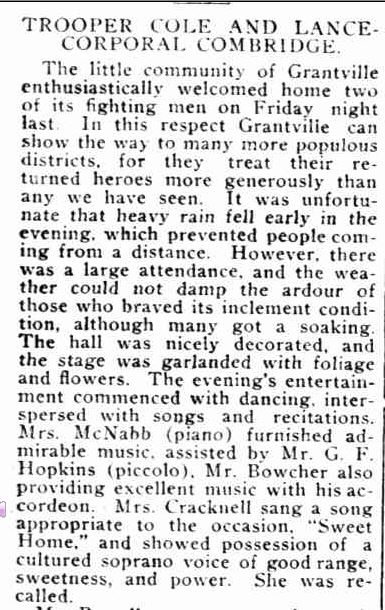
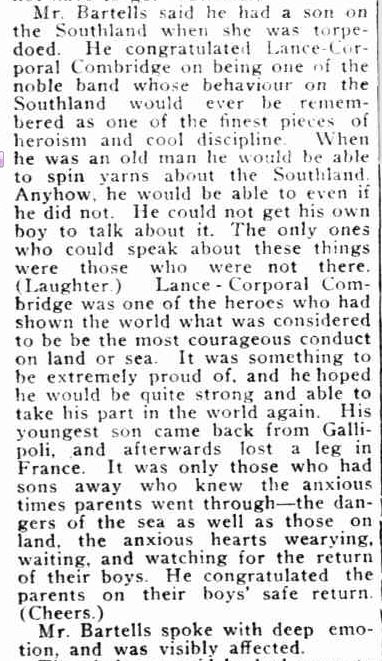
That was the case when the Lang Lang Guardian (1914-1918) came online recently.  For the 2013 Anzac Day Blog Challenge, I wrote about my grandfather Les Combridge so it was pleasing to find the following article from June 21, 1918,  that adds to his story .  It is a report on the return home of two Grantville “fighting men” Trooper Cole and Lance Corporal Combridge.   Aside from what I learnt about Les, this article paints a lovely picture of a small town gathering during that time.  There is the decorated hall, singing and of course supper…ladies a plate please.

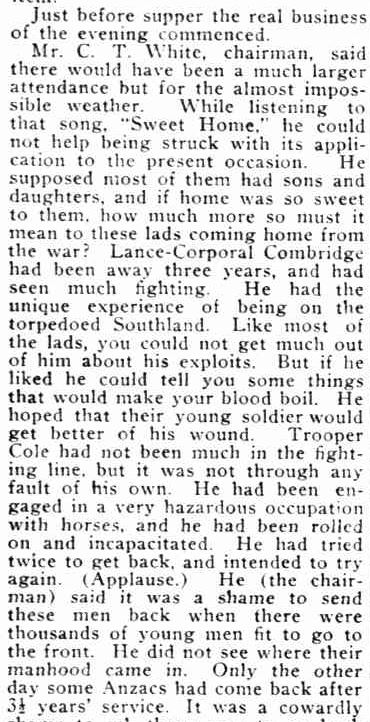
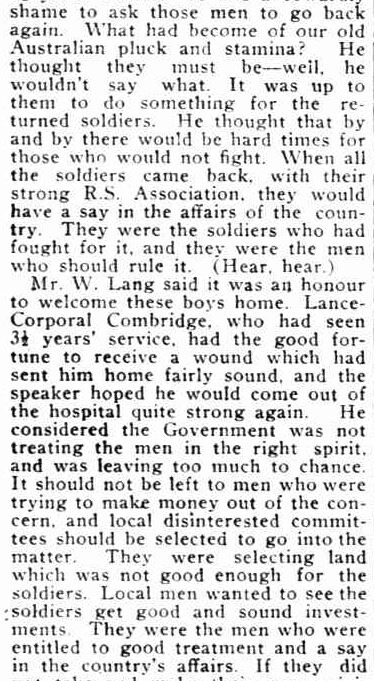
So what can I glean from this article.   Firstly, there is confirmation that Les was on the troop ship “Southland“.  Also the chair for the night was his future father-in-law, Culmer White.  There is a reference to the difficulties faced by returned serviceman and lack of Government support, giving us an idea of the tone of public opinion during those times.

The horrors of war were mentioned but not elaborated upon and it is clear that Les preferred not to speak of his experiences . He was not the only one.  Mr Bartells  said his boys would not speak of their time in service.  He quipped that it was only those that hadn’t been away that would talk about the War.

The saddest part of this article is the speech by Mr Bartells.  He told Les that he could “spin yarns” about the bombing of the “Southland” when he was an old man.  Les never became an old man.  He died 19  years after that night in the Grantville hall, aged 40.  He would have take those yarns to the grave.

Despite feeling  sad for Les, my mood lifted when I reached the last paragraph.   The final item on the agenda was supper and one of the helpers was Miss White.  Les married a “Miss White”, Myrtle Rose, daughter of Culmer White.  This could have been any one of Myrtle’s three sisters that were also “Miss White” in 1918, but it is nice to think that it could have been Myrtle.  That may have been the beginnings of their courtship.  They probably went to school together but with Les having been away at war for a couple of years they may have looked at each other differently as they each reached across the supper table for a cucumber sandwich.  Les and Myrtle married  15 months later on September 16, 1919.

tt4 tt5tt6tt8

GRANTVILLE SOLDIERS' WELCOME HOME. (1918, June 21). Lang Lang Guardian (Vic. : 1914 - 1918), p. 3. Retrieved August 6, 2013, from http://nla.gov.au/nla.news-article119515605

GRANTVILLE SOLDIERS’ WELCOME HOME. (1918, June 21). Lang Lang Guardian (Vic. : 1914 – 1918), p. 3. Retrieved August 6, 2013, from http://nla.gov.au/nla.news-article119515605

Trove Tuesday – Wages

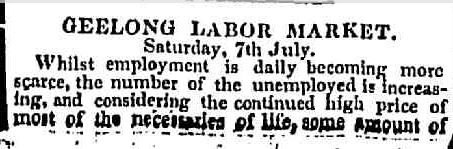
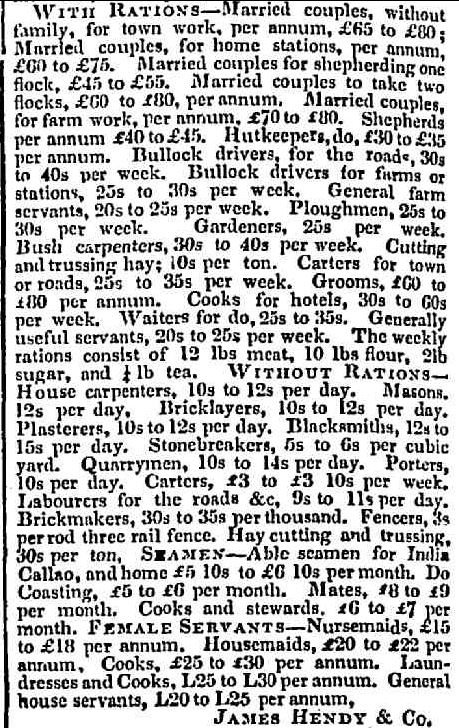
This week’s Trove Tuesday post comes from the Geelong Advertiser and Intelligencer (1851-1856).  The year was 1855 and the colony was in the grips of recession.  Unemployment was high as immigrants arrived daily and luck ran out on the diggings.  The cost of living was also rising.

If your ancestor was lucky enough to have work during 1855, the following list of wages gives us some idea of the wages they were receiving.  Tradesmen attracted the highest wages and of course there was gender disparity, with a shepherd able to earn £45 per annum while the highest paid female occupation, a cook, only paid £30 per annum.

tt29tt30

tt31

GEELONG LABOR MARKET. (1855, July 7). Geelong Advertiser and Intelligencer (Vic. : 1851 – 1856), p. 2 Edition: DAILY.. Retrieved July 5, 2013, from http://nla.gov.au/nla.news-article91866096

Trove Tuesday – Ewe Turn

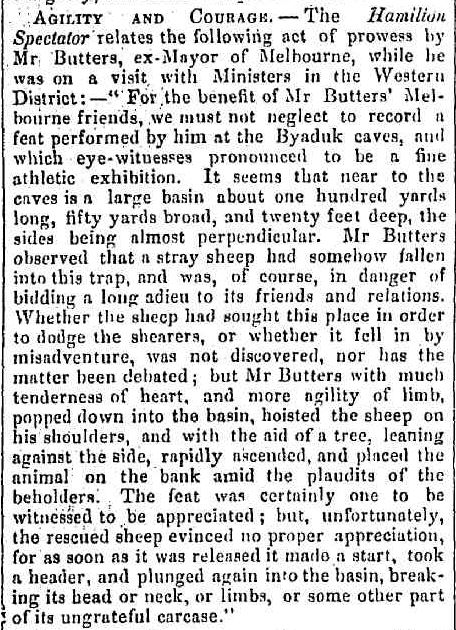
From the Bendigo Advertiser, via the Hamilton Spectator comes a story from  1868 and the Byaduk Caves.  It features an M.P., an ungrateful sheep, plenty of action and athletic prowess and a band of impressed onlookers.

SUICIDE OF MADEMOISELLE MARIE ST. DENIS. (1868, October 26). Bendigo Advertiser (Vic. : 1855 - 1918), p. 3. Retrieved July 20, 2013, from http://nla.gov.au/nla.news-article87899437

SUICIDE OF MADEMOISELLE MARIE ST. DENIS. (1868, October 26). Bendigo Advertiser (Vic. : 1855 – 1918), p. 3. Retrieved July 20, 2013, from http://nla.gov.au/nla.news-article87899437

079-2

BYADUK CAVES

James Stewart Butters became Mayor of Melbourne in 1867 at the age of thirty-five.  He held the position for a year then moved to the Legislative Assembly in the seat of Portland in 1868, the same year as his feat at the Byaduk Caves.  The following year he found himself caught up in a Parliamentary corruption case and was expelled only to return to his seat a few months later.  He spent time in Fiji and then returned to Victoria and returned to the Parliament.

The events at Byaduk Caves  support his  biography by A.C. Milner in the Australian Dictionary of Biography .  Milner writes

“…this tall, powerful Scotsman displayed immense energy and a bold sense of adventure. The strands of his character were evident in his mountain climbing in Scotland as a boy, investing in the colonies, sailing alone in a Fiji hurricane and tampering with the proper workings of parliament. But an element of recklessness is easily detected, though a hearty and genial personality saved him from much condemnation during his life”.

JAMES STEWERT BUTTERS (1867). Image courtesy of the State Library of Victoria. Image no. H5672 http://handle.slv.vic.gov.au/10381/208262

JAMES STEWART BUTTERS (1867). Image courtesy of the State Library of Victoria. Image no. H5672 http://handle.slv.vic.gov.au/10381/208262


Trove Tuesday – Wallpaper

Wondering where that missing newspaper edition is that you searched desperately for at Trove?  Maybe the only remaining copy is buried in the walls of an old building.


Historical Committee. (1932, March 17). Portland Guardian (Vic. : 1876 - 1953), p. 3 Edition: EVENING. Retrieved July 13, 2013, from http://nla.gov.au/nla.news-article64297702

Historical Committee. (1932, March 17). Portland Guardian (Vic. : 1876 – 1953), p. 3 Edition: EVENING. Retrieved July 13, 2013, from http://nla.gov.au/nla.news-article64297702