Trove Tuesday – Hong Sip of Cavendish

One of the great things about the Facebook group “I’ve Lived in Hamilton, Victoria”, is you just never know what is going to turn up.

Over the weekend, member Emma posted photos of a Hamilton Spectator dated Saturday 11 March 1876, found in the roof of Emma’s house undergoing renovations.  One of the photos was of the Dundas Shire Rate valuations for the South Riding.  On the list were my Haddens.  Emma posted a photo of the entire list, and there was another name that caught my interest: Hong Sip.  I mentioned to the group that I would find out more about him and headed to Trove, the first place I go when there are history queries in the group.  As usual, I got a result.

In 1869, a cook, Hong Sip, married a local girl, Margaret Moran.  The Cavendish correspondent was unsure of the name of Hong Sip’s bride, but unlike him, I have access to marriage records.  However, he wrote a lovely account of the occasion and displayed a very optimistic outlook about accepting Interracial marriages.

[No heading]. (1869, April 19). Illustrated Australian News for Home Readers (Melbourne, Vic. : 1867 - 1875), p. 90. Retrieved February 9, 2014, from http://nla.gov.au/nla.news-page5732859

(1869, April 19). Illustrated Australian News for Home Readers, p. 90.  http://nla.gov.au/nla.news-page5732859

To follow-up, I also found this reference to Hong Sip, known as John, after his death in 1885.

[No heading]. (1885, May 9). The Argus (Melbourne, Vic. : 1848 - 1957), p. 6. Retrieved February 10, 2014, from http://nla.gov.au/nla.news-page271825

(1885, May 9). The Argus, p. 6. http://nla.gov.au/nla.news-page271825

From there, I learnt of the sad demise of Hong Sip. On 13 December 1884, while working at Muntham Station near Coleraine, Hong Sip was callously assaulted.  Two men, John Fleming and George Traill, were arrested for the assault.  On 12 January 1885, Hong Sip was admitted to the Hamilton Hospital with inflammation of the lung and died there on 28 January.  The charges against Fleming and Traill were upgraded to manslaughter, and Margaret gave evidence at the trial.  They were found guilty, and Fleming served three months imprisonment and Trail, two months. 

“THE MUNTHAM OUTRAGE INQUEST.” Hamilton Spectator (Vic. : 1870 – 1918) 5 February 1885: <http://nla.gov.au/nla.news-article225656599&gt;.

Margaret and her children, at least five, remained in Cavendish. Margaret died in 1921 at Hamilton aged 69. Her burial took place at the old Cavendish Cemetery on the banks of the Wannon River.

Trove Tuesday – Beasts of Burden

While researching my great-great-uncle Reuben Edward Harman for the Harman family history I’m writing, I’ve been scouring Trove for everything I can find on the 13th Light Horse Regiment, with whom Reuben served during WW1.  Letters home from the boys in the trenches are a great way to get a feel for their war experience.  Daily routines, the sights and smells, and mentions of other soldiers, either from the same battalion or from the same hometown, can all help our understanding of how our family members spent their time in the armed forces during wartime.

The following extract from a letter by Sergent A. Louis Dardel of Batesford Victoria, caught my eye because it mentions the donkeys that worked so hard for the Australian troops, and those of other countries, carting supplies, and injured soldiers over the rough terrain of ANZAC Cove.  The 13th LHR were at Gallipoli, minus their horses.  They were kept back in  Egypt because the Turkish terrain was not considered suitable for them.  The nimble donkeys were their substitutes.

SERGT. A. L. DARDEL. (1915, December 4). Geelong Advertiser (Vic. : 1857 - 1918), p. 8. Retrieved February 3, 2014, from http://nla.gov.au/nla.news-article130708312

SERGT. A. L. DARDEL. (1915, December 4). Geelong Advertiser (Vic. : 1857 – 1918), p. 8. Retrieved February 3, 2014, from http://nla.gov.au/nla.news-article130708312

There had to be photos of the WW1 donkeys, so I searched Trove and found many photos from various sources including the Australian War Memorial and the State Library of Victoria.  The following are a selection of those.

This photo was taken before the Gallipoli landing.  The donkeys were purchased on Lemnos en route to Gallipoli travelling aboard the HMT Ascot.

DONKEYS ABOARD THE HMT ASCOT EN ROUTE TO GALLIPOLI, APRIL 1915 P05927.011.002http://www.awm.gov.au/collection/P05927.011.002

DONKEYS ABOARD THE HMT ASCOT EN ROUTE TO GALLIPOLI, APRIL 1915 P05927.011.002http://www.awm.gov.au/collection/P05927.011.002

This little donkey is the closest I could find to the donkey laden with water bottles mentioned in Sargent Dardel’s letter.

Image Courtesy of the Australian War Memorial. Image No. P01116.009 http://www.awm.gov.au/collection/P01116.009

Image Courtesy of the Australian War Memorial. Image No. P01116.009 http://www.awm.gov.au/collection/P01116.009

No, this is not John Simpson.  In fact, it is Pte. Richard Alexander Henderson, a member of the New Zealand Expeditionary Force, leading the donkey.  Later in the war, he received a Military Medal.

Image Courtesy of the Australian War Memorial. Image no. P03136.001 http://www.awm.gov.au/collection/P03136.001

Image Courtesy of the Australian War Memorial. Image no. P03136.001 http://www.awm.gov.au/collection/P03136.001

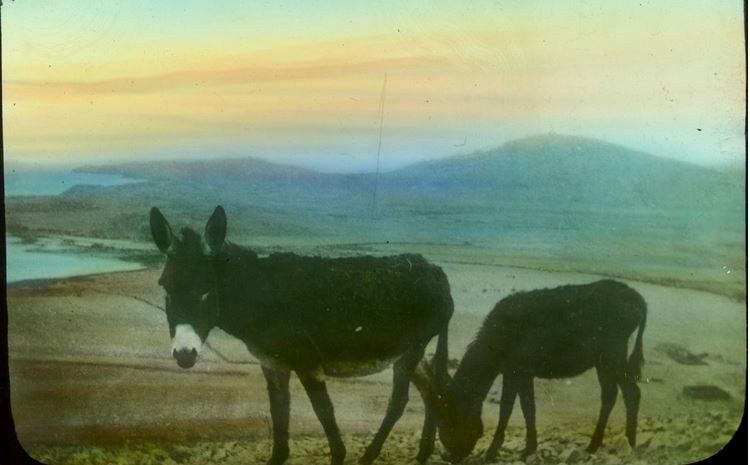
Just as the letter suggests, there was some time out for the donkeys.

DONKEYS AT GALLIPOLI. Image courtesy of the State Library of Victoria. Image no. H83.103/218 http://handle.slv.vic.gov.au/10381/43371

DONKEYS AT GALLIPOLI. Image courtesy of the State Library of Victoria. Image no. H83.103/218 http://handle.slv.vic.gov.au/10381/43371

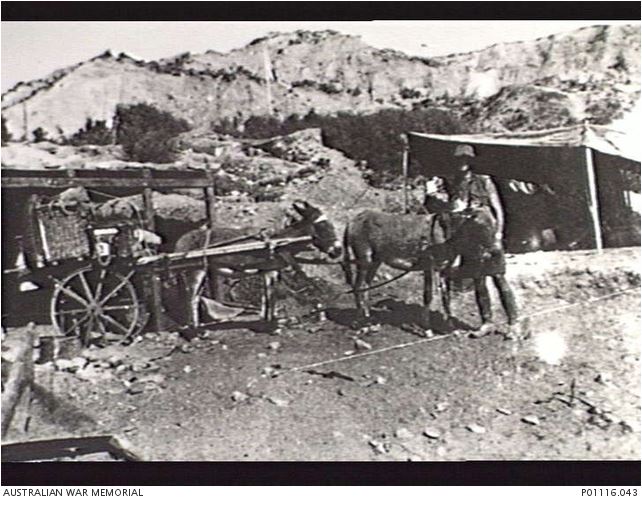
Donkeys were also used to pull carts.

Image Courtesy of the Australian War Memorial. Image no. P01116.043 http://www.awm.gov.au/collection/P01116.043

Image Courtesy of the Australian War Memorial. Image no. P01116.043 http://www.awm.gov.au/collection/P01116.043

As we draw closer to the centenary of WW1, when we take time to remember those that fought for our country, we should also remember the animals that made the task easier, donkeys, horses, and dogs.  They had no choice in being there and not only did many lose their lives they also worked under extreme conditions.

Image Courtesy of the State Library of Victoria. Image no, P02282.012 http://www.awm.gov.au/collection/P02282.012

Image Courtesy of the State Library of Victoria. Image no, P02282.012 http://www.awm.gov.au/collection/P02282.012

Trove Tuesday – Dear Cinderella

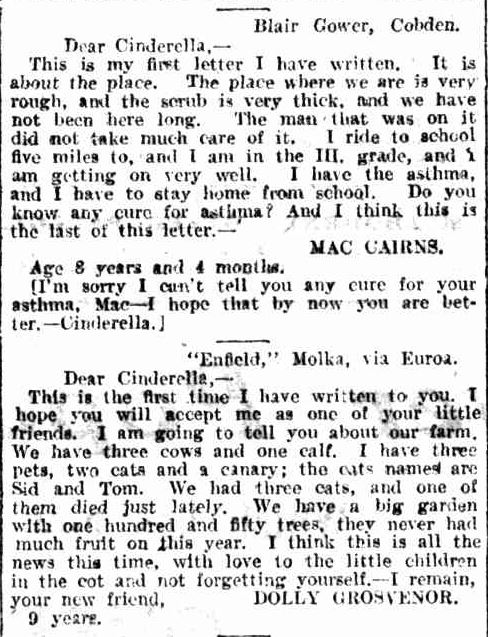
Back in the 1910s, the Leader newspaper, a weekly town and country paper published by The Age, ran a column for children called “Dear Cinderella”.  The letters, mostly written by country children, tell much about life during those times as seen through the eyes of a child.  I have selected a few of the letters to share this Trove Tuesday, with a couple from the Western District.

While many children wrote letters to Cinderella, only a handful were published each week.  Therefore the children often mentioned the number of times they had previously written, hoping Cinderella would finally pick them.  Most times she gave a short reply as she did with Lawrence McCartin of Leongatha.  Lawrence had told of the burnt bush around his home and about school life.  Cinderella then ticked him off for not giving his age.

cin

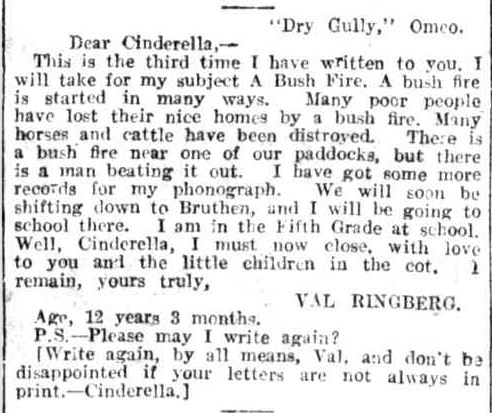
Val Ringberg of Omeo also wrote of fires and some new phonograph records.

CINDERELLA'S MENAGERIE. (1914, May 16). Leader (Melbourne, Vic. : 1914 - 1918), p. 59. Retrieved January 27, 2014, from http://nla.gov.au/nla.news-article89309559

CINDERELLA’S MENAGERIE. (1914, May 16). Leader (Melbourne, Vic. : 1914 – 1918), p. 59. Retrieved January 27, 2014, from http://nla.gov.au/nla.news-article89309559

In the following group of letters, Edith O’Neil gave a great description of the shops in Koondrook in 1914, including five fruit and lollie shops with another lollie shop under construction.  You can never have enough lollie shops.

cin3cin4cin5

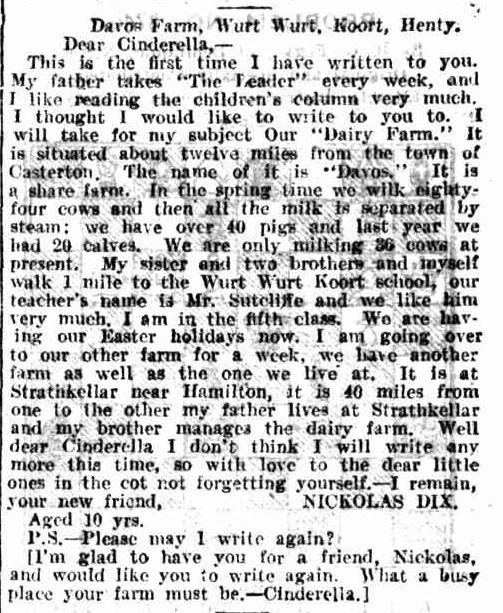
The following letter from Nickolas (sic) Dix, takes us right into the countryside that Major Thomas Mitchell called Australia Felix.  Nicholas lived at Davos Farm at Wurt Wurt Koort near Merino.

CORRESPONDENCE. (1914, June 13). Leader (Melbourne, Vic. : 1914 - 1918), p. 58. Retrieved January 27, 2014, from http://nla.gov.au/nla.news-article89313857

CORRESPONDENCE. (1914, June 13). Leader (Melbourne, Vic. : 1914 – 1918), p. 58. Retrieved January 27, 2014, from http://nla.gov.au/nla.news-article89313857

Nicholas wrote about the Wurt Wurt Koort School he attended and his father’s other farm at Strathkellar, near Hamilton.

Because Nicholas’ family lived in the area largely focused on by Daryl Povey’s site Glenelg & Wannon Settlers and Settlement, I thought it worth a search for the Dix family and I found them.  Nicholas was the son of James Nicholas Dix and Margaret Theresa Doyle and was born in Casterton in 1903, one of fourteen children. Something interesting I found was that Nicholas’ younger brother was Anthony Strathkellar Dix, named after the location of the other Dix farm.

Even more interesting was that when young Nicholas grew up, he joined the Royal Australian Navy in 1918 and by WW2 he was a Chief Petty Officer and recipient of a Distinguished Service Medal (DSM).  Thank you, Daryl, for the extra information about Nicholas.  Back to Trove, and I found a photo of Nicholas Dix.  It’s not a clear photo of him, but we can see the little boy from the Western District who wrote to Cinderella in 1914, thirty years later as a forty-one-year-old Naval Officer.

FLINDERS NAVAL DEPOT—school for sailors. (1944, September 16). The Australian Women's Weekly (1933 - 1982), p. 17. Retrieved January 27, 2014, from http://nla.gov.au/nla.news-article47502246

FLINDERS NAVAL DEPOT—school for sailors. (1944, September 16). The Australian Women’s Weekly (1933 – 1982), p. 17. Retrieved January 27, 2014, from http://nla.gov.au/nla.news-article47502246

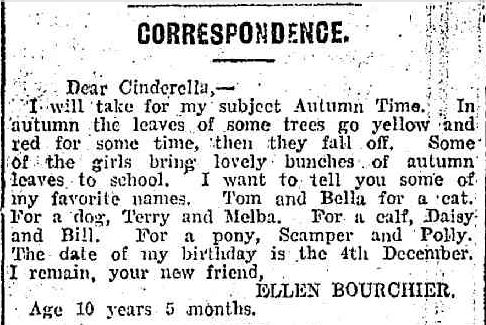
Back to the “Dear Cinderella” letters and I love this one from Ellen Bourchier.  She writes about her favourite names for dogs, cats, calves and ponies.

CORRESPONDENCE. (1915, June 19). Leader (Melbourne, Vic. : 1914 - 1918), p. 55 Edition: WEEKLY. Retrieved January 27, 2014, from http://nla.gov.au/nla.news-article91366815

CORRESPONDENCE. (1915, June 19). Leader (Melbourne, Vic. : 1914 – 1918), p. 55 Edition: WEEKLY. Retrieved January 27, 2014, from http://nla.gov.au/nla.news-article91366815

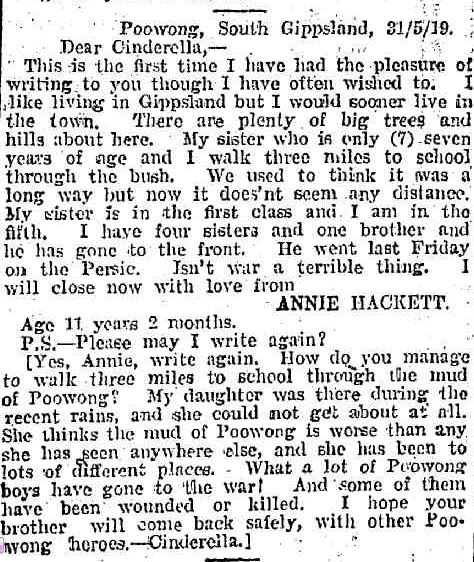
Cinderella wrote a longer reply than most, for Annie Hackett of Poowong.  She wondered how the children managed the three-mile walk to school after rain, such as that experienced by Cinderella’s daughter during a visit to Poowong.  (first I knew Cinderella had a daughter).

cin8

These charming letters are well worth reading with most found with a search at Trove of “Dear Cinderella”.  If you include a town name, you can narrow the search down.

Trove Tuesday – Halls Gap in Pictures

Since the Grampians and Halls Gap have been in the news this week for the unfortunate reason of a bush fire, I thought this week for Trove Tuesday, we should visit this beautiful place in Victoria’s West.

Halls Gap particularly is a special place for me because Dad has lived there for almost 40 years.  So just as I grew up in Hamilton, I grew up in Halls Gap too.

Along with the history books I have collected about Halls Gap, I’ve collected newspaper articles found at Trove.  But I had never searched Trove for Halls Gap/Grampians photos.  Of course, I wasn’t disappointed with the results and it was difficult to narrow down the photos to share.

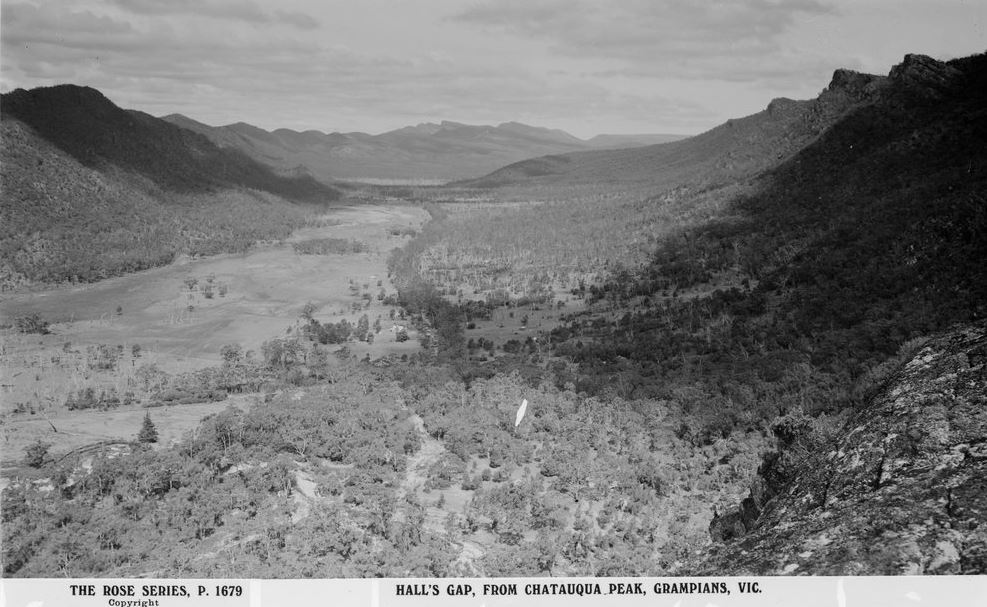
The Rose series of postcards, held by the State Library of Victoria, are an ever reliable source for photos of Western Victoria and there was little doubt that I would find some great photos of Halls Gap among them.  It’s hard to date the Rose postcards as they are all dated 1920-1954, so most times it’s guess-work based on cars, dress and buildings.  Photos such as the following from Sundial Peak, looking over Halls Gap, is pretty well impossible to date.

Image Courtesy of the State Library of Victoria.  Image no,. H32492/2391  http://handle.slv.vic.gov.au/10381/63933

Image Courtesy of the State Library of Victoria. Image no,. H32492/2391 http://handle.slv.vic.gov.au/10381/63933

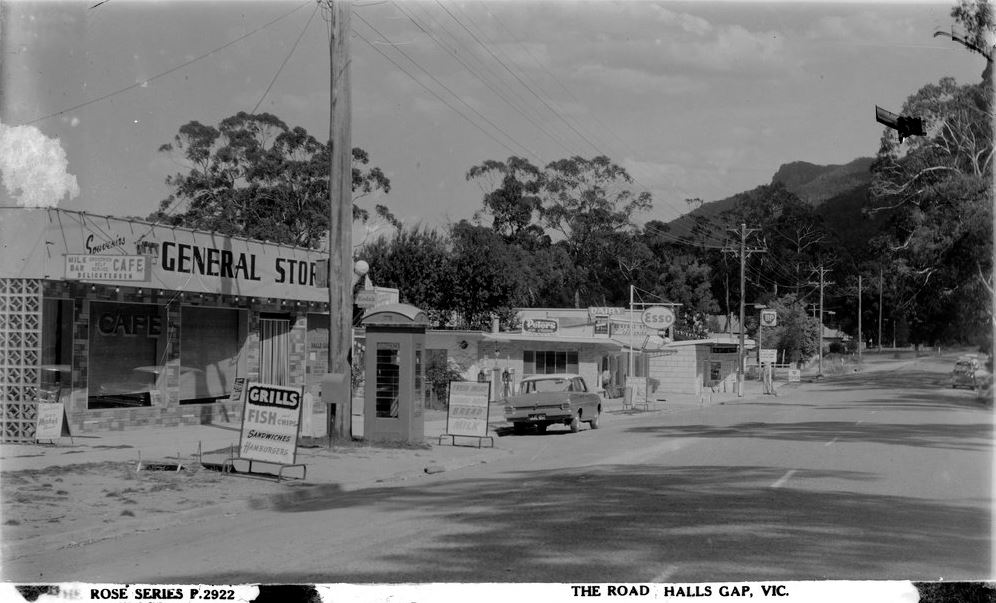
There were two photos of Halls Gap’s main street in the series, several years apart.  The General Store in the second photo, looking almost as it does today, is not in the first photo.  However, I think the first building on the right, with the Holiday House sign, still stands today.

MAIN STREET, HALLS GAP.  Image courtesy of the State Library of Victoria.  Image no,  H32492/8694 http://handle.slv.vic.gov.au/10381/58172

MAIN STREET, HALLS GAP. Image courtesy of the State Library of Victoria. Image no, H32492/8694
http://handle.slv.vic.gov.au/10381/58172

Despite the date range on the postcards being up to 1954, and correct me if I’m wrong, there is an EH Holden parked in the main street.  Holden produced the EH between 1963 and 1965.  There were also two petrol stations, today there is one.

MAIN STREET, HALLS GAP. Image courtesy of the State Library of Victoria,  Image no. H32492/4136 http://handle.slv.vic.gov.au/10381/62227

MAIN STREET, HALLS GAP. Image courtesy of the State Library of Victoria, Image no. H32492/4136 http://handle.slv.vic.gov.au/10381/62227

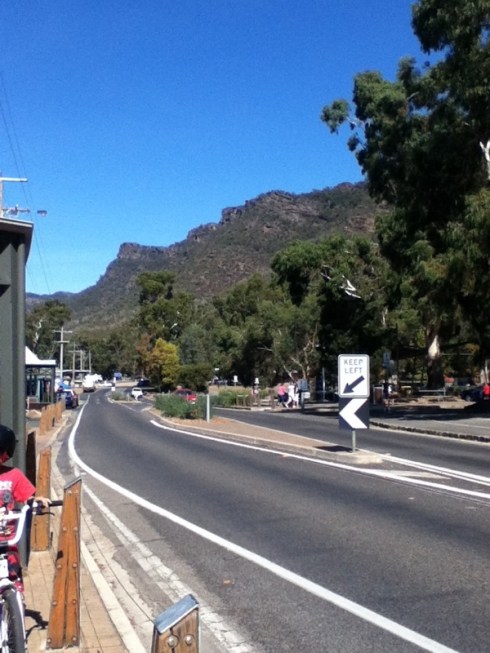
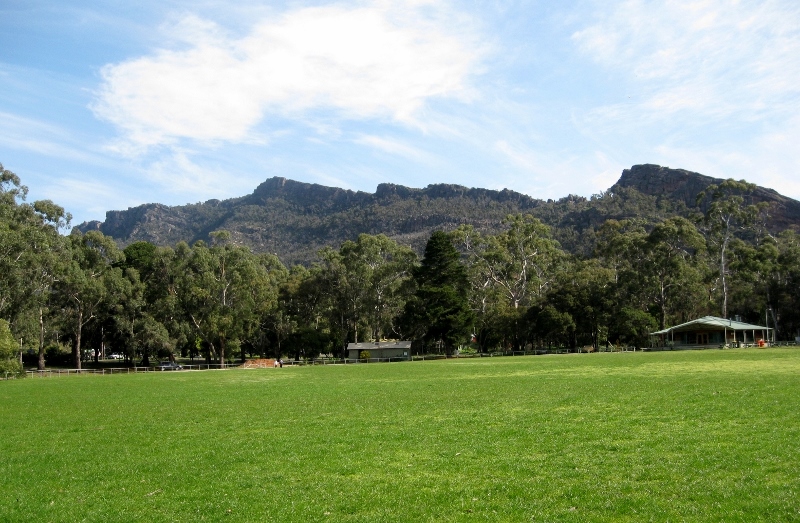
The main street 2012.

Halls Gap

The Mountain Grand Guest House, built in 1944,  still stands today.  This is how I remember the Mountain Grand when I first went to Halls Gap in 1975, but it has changed somewhat over the years due to renovations.

MOUNTAIN GRAND GUEST HOUSE, HALLS GAP.  Image Courtesy of the State Library of Victoria.  Image no. H32492/7789  http://handle.slv.vic.gov.au/10381/60702

MOUNTAIN GRAND GUEST HOUSE, HALLS GAP. Image Courtesy of the State Library of Victoria. Image no. H32492/7789
http://handle.slv.vic.gov.au/10381/60702

FYANS VALLEY, HALLS GAP.  Image Courtesy of State Library of Victoria.  Image no. H32492/2399  http://handle.slv.vic.gov.au/10381/63181

FYANS VALLEY, HALLS GAP. Image Courtesy of State Library of Victoria. Image no. H32492/2399 http://handle.slv.vic.gov.au/10381/63181

IMG_0811 (800x523)

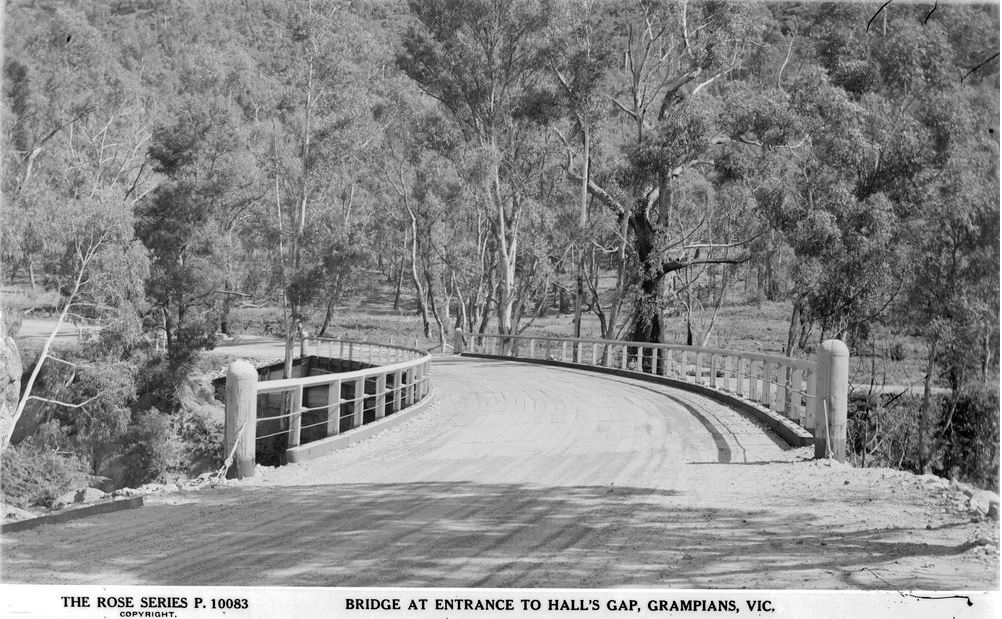
The Delleys Bridge, named after a pioneering family, welcomes visitors from the east into Halls Gap.  Since those first pioneers arrived in the valley, different bridges have spanned the Fyans Creek, one of the few access points into town, and now there is a modern bridge. The bridge in the photo is the style I’m most familiar with, except since the photo, it was widened and a pedestrian lane added.  Just beyond the bridge, a road runs of to the left.  Dad lived a few hundred metres down that road for many years and now still lives close by to the bridge.  I have been over the bridge, under the bridge and ridden nervous horses across while fearing altercations with cars and the long drop over the side.

DELLEY'S BRIDGE, HALLS GAP.  Image Courtesy of the State Library of Victoria.  Image no.  H32492/6669 http://handle.slv.vic.gov.au/10381/58616

DELLEY’S BRIDGE, HALLS GAP. Image Courtesy of the State Library of Victoria. Image no. H32492/6669 http://handle.slv.vic.gov.au/10381/58616

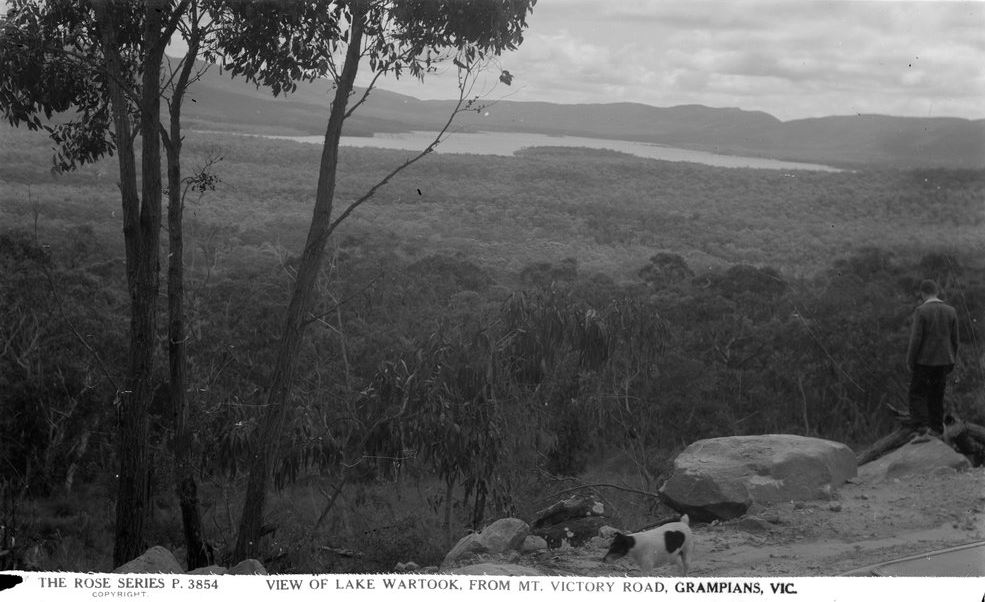
Just over the mountain from Halls Gap is Lake Wartook and the Wartook Valley.  While Halls Gap remained untouched, this part of the Grampians suffered greatly in the fires last week and the level of damage is yet to be fully assessed.

LAKE WARTOOK, GRAMPIANS.  Image Courtesy of the State Library of Victoria.  Image no.  H32492/5317 http://handle.slv.vic.gov.au/10381/59375

LAKE WARTOOK, GRAMPIANS. Image Courtesy of the State Library of Victoria. Image no. H32492/5317 http://handle.slv.vic.gov.au/10381/59375

The last of the Rose postcards was a real surprise for me.  It is of the Halls Gap Bowling club that I didn’t know existed.  I’m guessing from the mountain range behind, it was located on the western side of the township. I will ask a couple of born and bred locals when next there exactly where the greens were.

HALLS GAP BOWLS CLUB. Image courtesy of the State Library of Victoria.  Image no. H32492/4224 http://handle.slv.vic.gov.au/10381/62069

HALLS GAP BOWLS CLUB. Image courtesy of the State Library of Victoria. Image no. H32492/4224 http://handle.slv.vic.gov.au/10381/62069

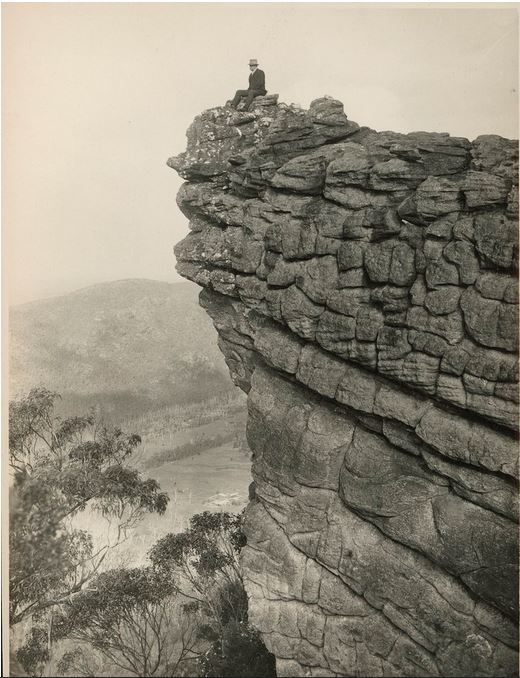
The Victorian Railways collection, also held by the State Library of Victoria, is another great source of Western District town photos.  I just love this photo of the Pinnacle, a popular lookout at the top of the Wonderland Range.  The unfortunate part about this photo is that it does not give you a feeling of how high up the lookout is.  Well, I’m suffering vertigo just looking at those brave trekkers.  Thankfully, the fence was later extended down the side of the lookout.

THE PINNACLE, HALLS GAP.  Image no. H91.50/1002  http://handle.slv.vic.gov.au/10381/97372

THE PINNACLE, HALLS GAP. Image no. H91.50/1002 http://handle.slv.vic.gov.au/10381/97372

I thought they were brave until I found this photo, before the fence.   The photo was dated 1910-1930 however I have found a newspaper article from 1918 that mentions the fence, so it must be closer to 1910.

The gentleman in the photo is not as daring as Halls Gap photographer, Gilbert Rogers (1880-1950).  A photo in Ida Stanton’s book Bridging the Gap: the history of Halls Gap from 1840 (1988) shows Gilbert hanging from a ledge below the Pinnacle, with his camera and tripod, capturing the best views of the mountains.  Crazy.

THE PINNACLE, HALLS GAP.  Image courtesy of the State Library of Victoria.  Image no. H84.461/488 http://handle.slv.vic.gov.au/10381/51930

THE PINNACLE, HALLS GAP. Image courtesy of the State Library of Victoria. Image no. H84.461/488 http://handle.slv.vic.gov.au/10381/51930

Not only do kangaroos and emus, call the Grampians their home, so to do deer, a legacy of the homesick gentry of the 19th century.  This sketch from 1881 gives some clue as to how long they have roamed the mountains.

DEER IN THE GRAMPIANS.  Imprint by Alfred May and Alfred Martin Ebsworth,(1881) Image Courtesy of the State Library of Victoria.  Image no. A/S31/12/81/420 http://handle.slv.vic.gov.au/10381/258236

DEER IN THE GRAMPIANS. Imprint by Alfred May and Alfred Martin Ebsworth,(1881) Image Courtesy of the State Library of Victoria. Image no. A/S31/12/81/420 http://handle.slv.vic.gov.au/10381/258236

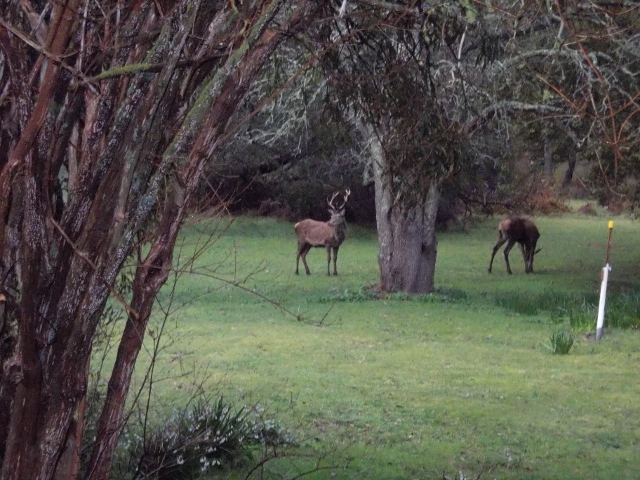
These are deer in Dad’s backyard, descendants of those in the 1881 sketch.  Last Friday evening, with fires burning in the mountains three kilometres away, a stag ate fallen pears from one of Dad’s trees, oblivious.

014 (640x480)

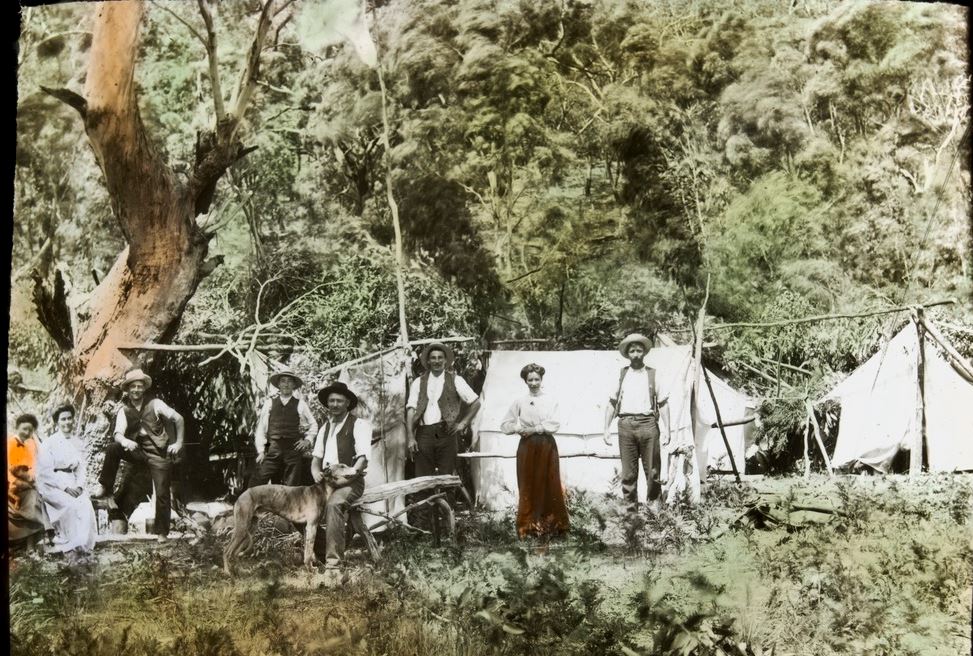
The next series of photos are real treasures.  Again, they are held at the State Library of Victoria and are from a collection gathered by Richard Holdsworth.  The date range for the magic lantern slides is 1860-1930.
gramps1

Image Courtesy of the State Library of Victoria. Image no. H2012.90/51 http://handle.slv.vic.gov.au/10381/245940

THE GRAMPIANS. Image No. H2012.90/54.  Image courtesy of the State Library of Victoria. http://handle.slv.vic.gov.au/10381/245952

THE GRAMPIANS. Image No. H2012.90/54. Image courtesy of the State Library of Victoria. http://handle.slv.vic.gov.au/10381/245952

Image courtesy of the State Library of Victoria.  Image no. H2012.90/56 http://handle.slv.vic.gov.au/10381/245952

Image courtesy of the State Library of Victoria. Image no. H2012.90/56 http://handle.slv.vic.gov.au/10381/245952

Image Courtesy of the State Library of Victoria.  Image no. H2012.90/50http://handle.slv.vic.gov.au/10381/245959

Image Courtesy of the State Library of Victoria. Image no. H2012.90/50http://handle.slv.vic.gov.au/10381/245959

Finally. one of the photographers.  Funnily enough the gentleman with the camera looks very much like my gg grandfather Richard Diwell, himself a keen photographer.

Image Courtesy of the State Library of Victoria.  Image no. H2012.90/49 http://handle.slv.vic.gov.au/10381/245996

Image Courtesy of the State Library of Victoria. Image no. H2012.90/49 http://handle.slv.vic.gov.au/10381/245996

Halls Gap is a busy tourist town, but the Grampians fire last week will bring financial strain to the businesses there, as did the 2006 fires that burned a lot closer to the township.  The town has now reopened to the public and it is business as usual, but with the fear created, thanks to sensational journalism that spread through social media, it will be hard work to get the word out that Halls Gap is safe. Now is the time to visit and support the wonderful people living there.

Trove Tuesday – Leopard on the Loose

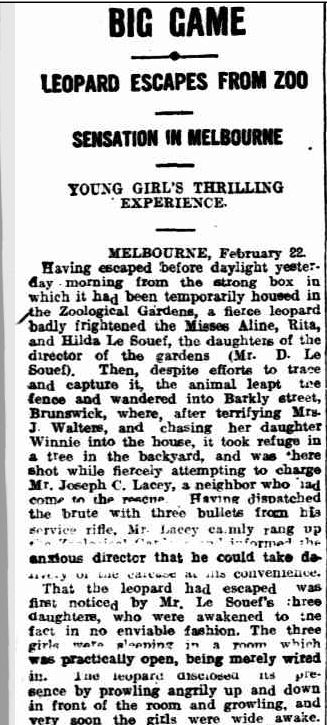
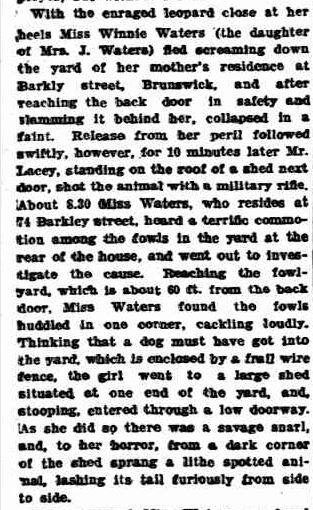
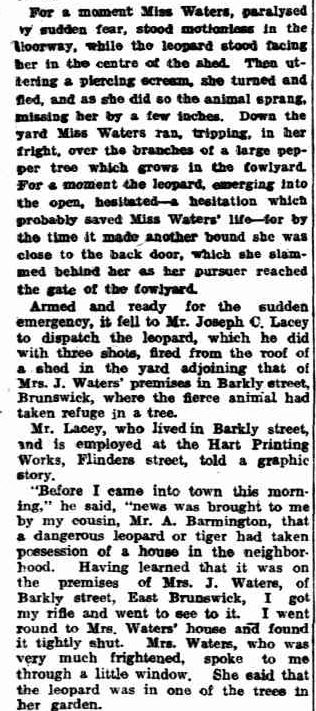
In February 1914, an escapee from the Melbourne Zoo caused a “sensation” on the streets of Brunswick.  Yes, it is another animal story for Trove Tuesday and yes, it is another story with a sad ending.  But it is a story worth sharing and the article, from the Daily Herald of Adelaide goes into great detail about the incident.

It was the daughters of Zoo curator, Mr. D. Le Souef, who were first alerted to one of the zoo’s leopards on the loose in the early hours.  Despite their father’s attempts, the leopard jumped a fence and disappeared from sight.  The leopard was next seen in Barkley Street, Brunswick, at the home of young Miss Winnie Walters.

leo

leo1 leo2 leo2 leo3

leo4

BIG GAME. (1914, February 23). Daily Herald (Adelaide, SA : 1910 – 1924), p. 5. Retrieved January 5, 2014, from http://nla.gov.au/nla.news-article105620933

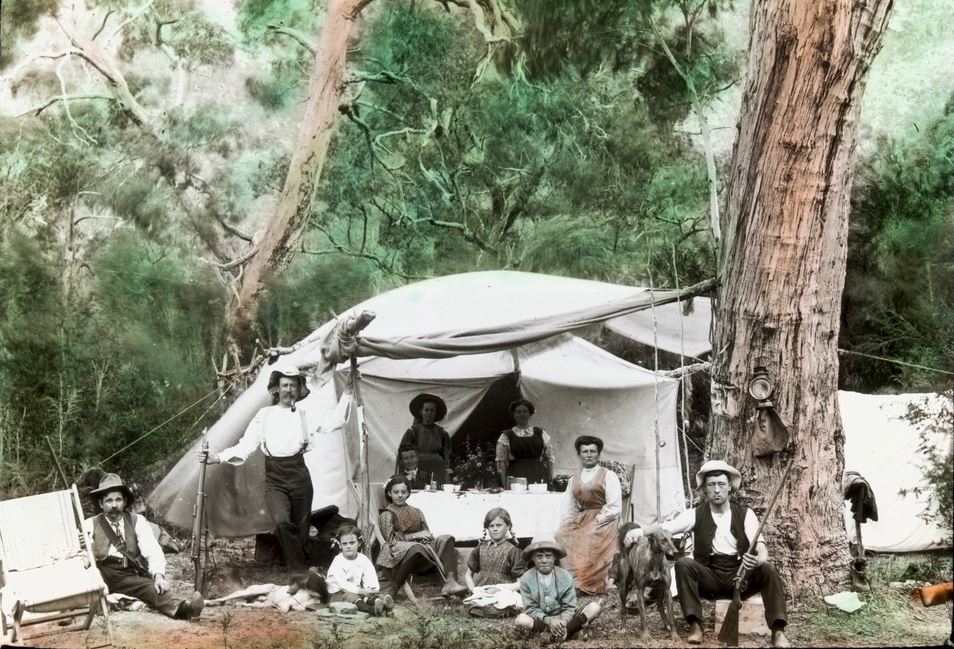
Trove once again come through with a fantastic photo to go with the leopard story, and it comes from the State Library of Victoria.

LEOPARD AT HOBART ZOO.  Image courtesy of the State Library of Victoria.  Image no.  H37687/17 http://handle.slv.vic.gov.au/10381/56312

LEOPARD AT HOBART ZOO. Image courtesy of the State Library of Victoria. Image no. H37687/17 http://handle.slv.vic.gov.au/10381/56312

Trove Tuesday – New Year’s Eve

A week on and it is New Year’s Eve, so let’s go back to the towns of the Western District to see what was happening at year’s end, thanks to Trove.

Warrnambool is a popular New Year’s Eve destination today and a little livelier than 1915. After a tragic year, there was hope for better things in 1916. Now we know happier times did not come in 1916. Sorry, the copy of this article is a little difficult to read in parts.

NEW YEAR'S EVE. (1916, January 3). Warrnambool Standard (Vic. : 1914 - 1918), p. 2 Edition: DAILY.. Retrieved December 30, 2013, from http://nla.gov.au/nla.news-article73865946

NEW YEAR’S EVE. (1916, January 3). Warrnambool Standard, p. 2 Edition: DAILY.. http://nla.gov.au/nla.news-article73865946

Just as Warrnambool had the local brass band playing, so did Coleraine.

Coleraine Albion. (1916, January 6). Coleraine Albion and Western Advertiser (Vic. : 1914 - 1918), p. 2. Retrieved December 30, 2013, from http://nla.gov.au/nla.news-article119606431

Coleraine Albion. (1916, January 6). Coleraine Albion and Western Advertiser, p. 2. http://nla.gov.au/nla.news-article119606431

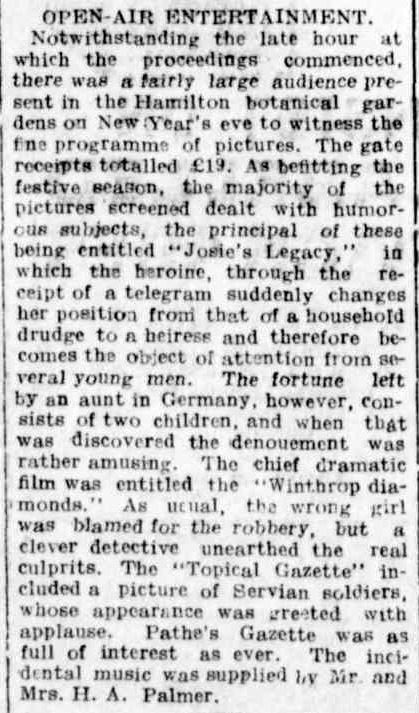
Hamilton residents had an evening of outdoor silent films to enjoy on New Year’s Eve, 1915. There were also many activities to look forward to the following day, including several race meetings, with trains running from Hamilton.

Advertising. (1915, December 30). Hamilton Spectator (Vic. : 1914 - 1918), p. 5. Retrieved December 30, 2013, from http://nla.gov.au/nla.news-article120408582

Advertising. (1915, December 30). Hamilton Spectator, p. 5.  http://nla.gov.au/nla.news-article120408582

Those who attended enjoyed New Year’s Eve pictures enjoyed the humorous “Josie’s Legacy”, the dramatic “Winthrop Diamonds” and an offering from Pathe’s Gazette. Mr. and Mrs. H.A. Palmer accompanied the films with incidental music.

    OPEN-AIR ENTERTAINMENT. (1916, January 3). Hamilton Spectator (Vic. : 1914 - 1918), p. 4. Retrieved December 30, 2013, from http://nla.gov.au/nla.news-article120408747

OPEN-AIR ENTERTAINMENT. (1916, January 3). Hamilton Spectator p. 4.  http://nla.gov.au/nla.news-article120408747

The grassy hill within the Hamilton Botanic Gardens is a perfect place for an outdoor picture theatre.

HAMILTON BOTANICAL GARDENS

HAMILTON BOTANICAL GARDENS

Despite having a late night, Hamiltonians were up early on New Year’s Day to take part in the many activities available, such as the Winslow races, sports days, and day trips to coastal towns.

NEW YEAR HOLIDAYS. (1916, January 3). Hamilton Spectator (Vic. : 1914 - 1918), p. 4. Retrieved December 30, 2013, from http://nla.gov.au/nla.news-article120408772

NEW YEAR HOLIDAYS. (1916, January 3). Hamilton Spectator, p. 4. http://nla.gov.au/nla.news-article120408772

As the year draws to a close, may the next be good for you. Happy New Year.

Image Courtesy of the State Library of Victoria.  Image no.  H99.166/327 http://handle.slv.vic.gov.au/10381/16626

Image Courtesy of the State Library of Victoria. Image no. H99.166/327 http://handle.slv.vic.gov.au/10381/16626

Trove Tuesday – Christmas Eve

What could I share for a Christmas Eve Trove Tuesday?  Something Christmassy of course.  With many new Western District newspapers now at Trove, I thought I would see what was happening on Christmas Eve in the towns that missed out on a mention in the Christmas posts from the previous two years.  The year was 1915 and country was suffering with WW1 and drought .

Coleraine put on the usual Christmas Eve of last minute shopping and the Coleraine Brass Band.

Coleraine Albion. (1915, December 30). Coleraine Albion and Western Advertiser (Vic. : 1914 - 1918), p. 2. Retrieved December 17, 2013, from http://nla.gov.au/nla.news-article119606385

Coleraine Albion. (1915, December 30). Coleraine Albion and Western Advertiser (Vic. : 1914 – 1918), p. 2. Retrieved December 17, 2013, from http://nla.gov.au/nla.news-article119606385

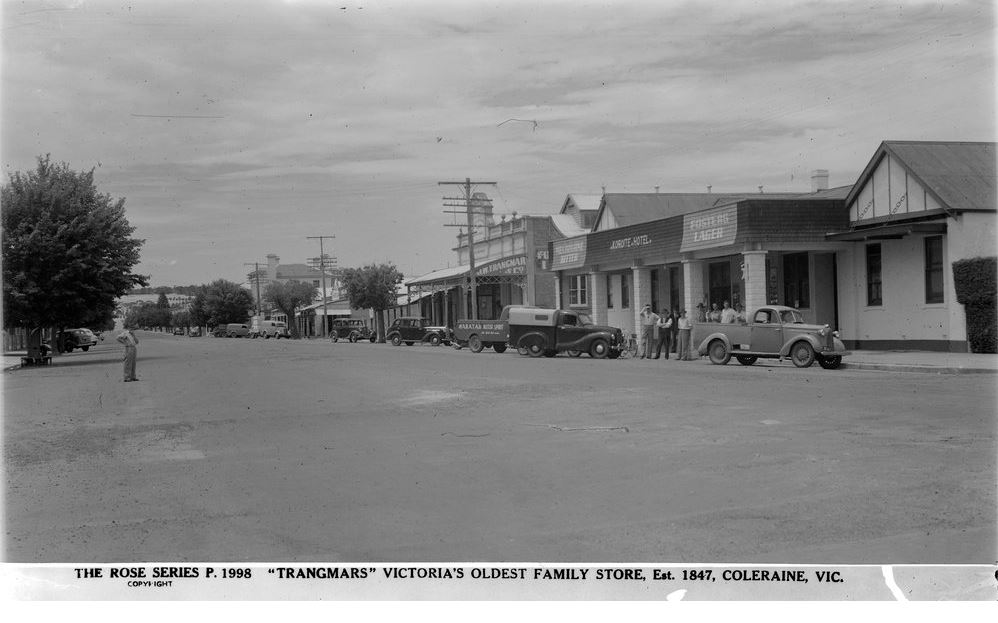
COLERAINE.  Image Courtesy of the State Library of Victoria.  Image no. H32492/2813 http://handle.slv.vic.gov.au/10381/63071

COLERAINE. Image Courtesy of the State Library of Victoria. Image no. H32492/2813 http://handle.slv.vic.gov.au/10381/63071

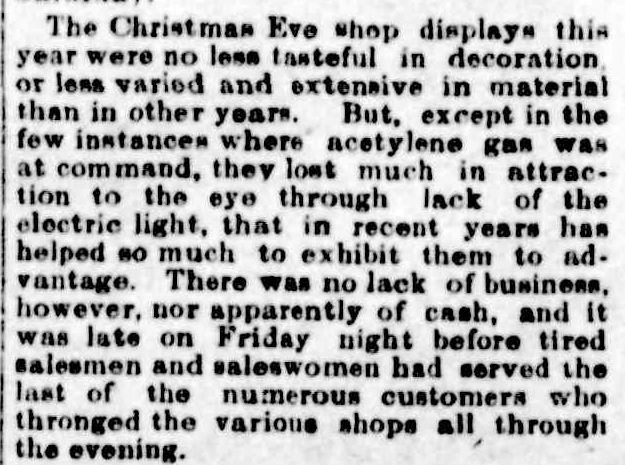
Business was brisk at Casterton and the Casterton Times took the opportunity to rib the pessimists of the district, who I can only imagine had predicted doom for Christmas trading given the events of the time.

Casterton News. (1915, December 23). The Casterton News and the Merino and Sandford Record (Vic. : 1914 - 1918), p. 2 Edition: Bi-Weekly. Retrieved December 17, 2013, from http://nla.gov.au/nla.news-article74767421

Casterton News. (1915, December 23). The Casterton News and the Merino and Sandford Record (Vic. : 1914 – 1918), p. 2 Edition: Bi-Weekly. Retrieved December 17, 2013, from http://nla.gov.au/nla.news-article74767421

HENTY STREET, CASTERTON.  Image Courtesy of the State Library of Victoria.  Image no. H32492/2770  http://handle.slv.vic.gov.au/10381/63173

HENTY STREET, CASTERTON. Image Courtesy of the State Library of Victoria. Image no. H32492/2770
http://handle.slv.vic.gov.au/10381/63173

Because of electricity restrictions due to the war, some of the shop displays could not be highlighted as well as earlier years.

Castern News Printed Monday and Tuesday Evenings. (1915, December 30). The Casterton News and the Merino and Sandford Record (Vic. : 1914 - 1918), p. 2 Edition: Bi-Weekly. Retrieved December 17, 2013, from http://nla.gov.au/nla.news-article74767457

Castern News Printed Monday and Tuesday Evenings. (1915, December 30). The Casterton News and the Merino and Sandford Record (Vic. : 1914 – 1918), p. 2 Edition: Bi-Weekly. Retrieved December 17, 2013, from http://nla.gov.au/nla.news-article74767457

You would be hard pressed to find most of these goods in a shop in Penshurst these days, but in 1915, Chesswas’ had it all.

Advertising. (1915, December 18). Penshurst Free Press (Vic. : 1914 - 1918), p. 2. Retrieved December 17, 2013, from http://nla.gov.au/nla.news-article119562126

Advertising. (1915, December 18). Penshurst Free Press (Vic. : 1914 – 1918), p. 2. Retrieved December 17, 2013, from http://nla.gov.au/nla.news-article119562126

For those in Hamilton, if a buggy shaft broke or a horse lost a shoe over Christmas, shanks’ pony would have had to suffice until January 3rd when the coachbuilders, farriers and blacksmiths of the town resumed after their well earned Christmas break.

Advertising. (1915, December 15). Hamilton Spectator (Vic. : 1914 - 1918), p. 4. Retrieved December 17, 2013, from http://nla.gov.au/nla.news-article120407611

Advertising. (1915, December 15). Hamilton Spectator (Vic. : 1914 – 1918), p. 4. Retrieved December 17, 2013, from http://nla.gov.au/nla.news-article120407611

To finish this Christmas Eve Trove Tuesday post, may I say Merry Christmas to all of you, I greatly appreciated your continued support.

Image Courtesy of the State Library of Victoria. Image no.  H82.96/168 http://handle.slv.vic.gov.au/10381/110126

Image Courtesy of the State Library of Victoria. Image no. H82.96/168 http://handle.slv.vic.gov.au/10381/110126

Trove Tuesday – A Frisky Pony

Trove Tuesday goes to Horsham this week with a story about a naughty pony that caused excitement in the town’s main street, Fibrace Street,  After some kicking and erratic behavior, the pony ended up facing its driver and passenger, Mrs Blight and her daughter.

A PONY'S ESCAPADE. (1909, January 19). The Horsham Times (Vic. : 1882 - 1954), p. 3. Retrieved December 16, 2013, from http://nla.gov.au/nla.news-article72825888

A PONY’S ESCAPADE. (1909, January 19). The Horsham Times (Vic. : 1882 – 1954), p. 3. Retrieved December 16, 2013, from http://nla.gov.au/nla.news-article72825888

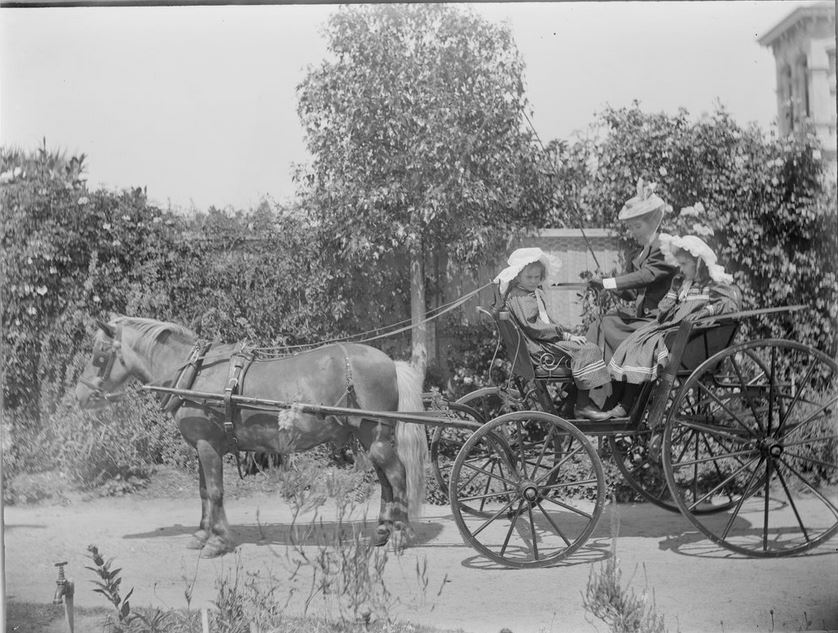
The photo I found at Trove to go with the article, is a treasure.  Taken around the same period as Mrs Blight’s driving excitement, the photo shows Mary Lloyd Taylor and her two daughters in a lovely buggy drawn by a beautiful flaxen chestnut pony.

Mary Lloyd Tayler and two of her daughters in a buggy drawn by pony at "Mynda". c1890-1910.  Image Courtesy of the State Library of Victoria.  Image no. H83.94/156 http://handle.slv.vic.gov.au/10381/16217

Mary Lloyd Tayler and two of her daughters in a buggy drawn by pony at “Mynda”. c1890-1910. Image Courtesy of the State Library of Victoria. Image no. H83.94/156 http://handle.slv.vic.gov.au/10381/16217

Trove Tuesday – Christmas Music

The Hamilton Brass Band has played a big part in lives of some of my family members, especially the Diwell and Gamble families, and there are still descendants of those families in the band today.  Another family member, Frederick Hughes the husband of my ggg aunt Martha Harman was a long-standing leader of the Hamilton Brass Band.

With Christmas just around the corner, I thought I would share this little snippet found at Trove, from the Hamilton Spectator of December 22, 1917.  An annual tradition for the band, was to play on “Kennan’s corner”, (the corner of Gray and Thompson Street) on Christmas Eve.  Freddie Hughes, a Hamilton jeweller, was band leader.  Interesting not a Christmas Carol in sight on the program.

CHRISTMAS MUSIC. (1917, December 22). Hamilton Spectator (Vic. : 1914 - 1918), p. 4. Retrieved December 9, 2013, from http://nla.gov.au/nla.news-article119860771

CHRISTMAS MUSIC. (1917, December 22). Hamilton Spectator (Vic. : 1914 – 1918), p. 4. Retrieved December 9, 2013, from http://nla.gov.au/nla.news-article119860771

Band music is my blood, so  I just had to find a rendition of one of the pieces on the play list, “Sunshine of Your Smile”, to take me to Kennan’s Corner, Christmas Eve, 1917.

Trove Tuesday – Toy Sale

One of the great things about the “I’ve Lived in Hamilton, Victoria” Facebook page is that it’s given me a good excuse to read more of the recently added Hamilton Spectator (1914-1918) at Trove.  As a result, I have been able to find out more about businesses, home owners and general town history.

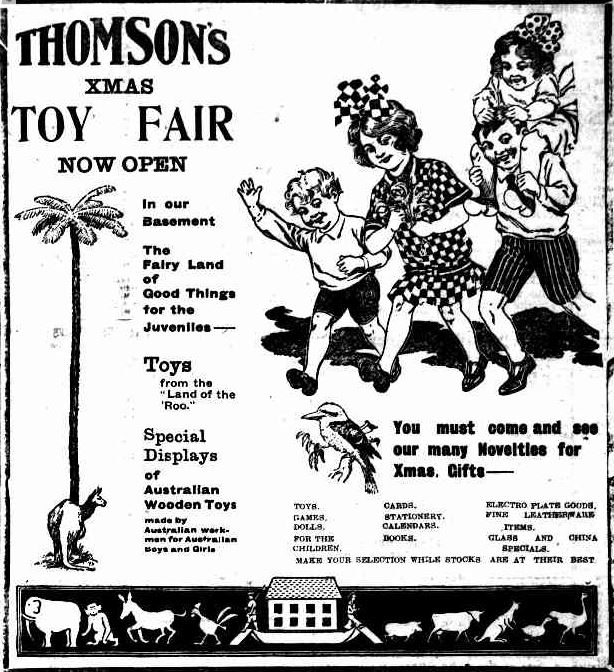
It was while reading a Hamilton Spectator, that I cam across this wonderful advertisement from November 1917 for  Thomson’s Department Store, a Hamilton institution and well remembered by many members of the Facebook group.  The store opened in 1863 and remained pretty much in the same form until the 1980s when the store began a transformation that eventually saw it disappear altogether and become an arcade of shops by the 1990s.

Advertising. (1917, November 29). Hamilton Spectator (Vic. : 1914 - 1918), p. 3. Retrieved December 3, 2013, from http://nla.gov.au/nla.news-article119859911

Advertising. (1917, November 29). Hamilton Spectator (Vic. : 1914 – 1918), p. 3. Retrieved December 3, 2013, from http://nla.gov.au/nla.news-article119859911