Trove Tuesday – Fido’s Feat

You may have noticed I do like a good animal story.  Here’s another from the Camperdown Chronicle of September 14, 1954.

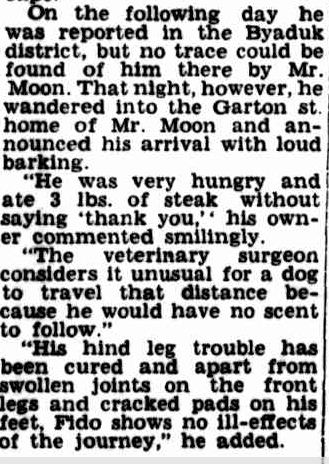
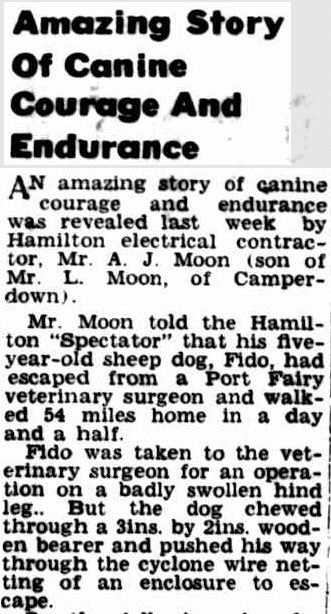
It is the story of Fido, a sheep dog belonging to electrical contractor Mr A.J Moon of Hamilton.  Fido had been confined at a Port Fairy vet, but after a determined escape, he walked 54 miles home to Hamilton even though he was recovering from a leg operation.  When he arrived at Mr Moon’s home in Garton Street, Hamilton, Fido demolished 3lbs of steak.  His leg was cured too!

tt3

Amazing Story Of Canine Courage And Endurance. (1954, September 14). Camperdown Chronicle (Vic. : 1877 - 1954), p. 4. Retrieved December 10, 2012, from http://nla.gov.au/nla.news-article24008716

Amazing Story Of Canine Courage And Endurance. (1954, September 14). Camperdown Chronicle (Vic. : 1877 – 1954), p. 4. Retrieved December 10, 2012, from http://nla.gov.au/nla.news-article24008716

Trove Tuesday – Four Simple Lessons

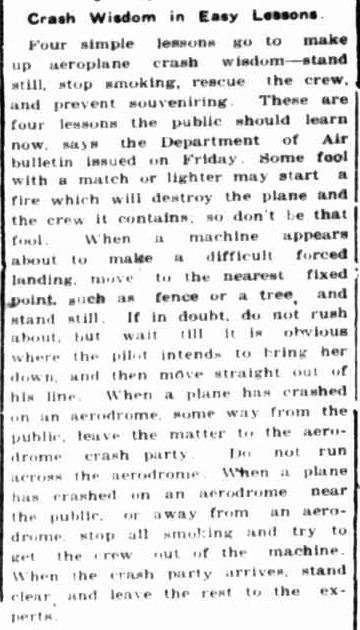
You just never know what you are going to stumble upon at Trove.  Thanks to the Department of Air’s four simple lessons, I feel I am now ready if a plane happens to crash in my vicinity.Crash Wisdom in Easy Lessons. (1942, April 13). Portland Guardian (Vic. : 1876 - 1953), p. 4 Edition: EVENING. Retrieved December 2, 2012, from http://nla.gov.au/nla.news-article64379670

Crash Wisdom in Easy Lessons. (1942, April 13). Portland Guardian (Vic. : 1876 – 1953), p. 4 Edition: EVENING. Retrieved December 2, 2012, from http://nla.gov.au/nla.news-article64379670

This article from The Portland Guardian of April 13, 1942 was in the column next to the obituary of John Finn Kirby, Western District owner of 1911 Melbourne cup winner, The Parisian.  I was researching the horse and owner for a post around Melbourne Cup time and my eyes strayed to the left and there it was.

The constant theme through the article is to not be a fool and stop smoking when a plane crashes nearby.  Of course this was during WW2 and there would have been more planes in the skies and flying skills may not have been up to scratch as many pilots would have been in training to go overseas.

I wanted to know if there were a prevalence of  plane crashes during this period to prompt the article, so I searched  “RAAF Plane Crash” in the decade 1940-1949 and there were 363 articles.  Most of those were in 1941 with 116 reports and many were  fatal crashes on Australian soil, although I didn’t notice any that caught fire as a result of a cigarette, the crash itself usually enough to cause a fire.  Nor did I see any that involved souveniring.

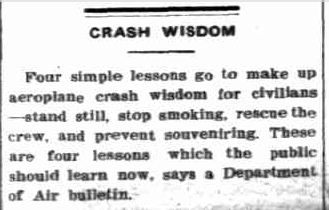
The Portland Guardian was not the only paper to publish the article during 1942.  Eight papers  from Brisbane to Geraldton to Kalgoorlie ran the article in varying forms and Mt Gambier’s Border Watch including the message among the classifieds.  Just three of the papers ran the full story, while the others published a reduced version:

CRASH WISDOM. (1942, May 1). The Charleville Times (Brisbane, Qld. : 1896 - 1954), p. 2. Retrieved December 3, 2012, from http://nla.gov.au/nla.news-article7699277

CRASH WISDOM. (1942, May 1). The Charleville Times (Brisbane, Qld. : 1896 – 1954), p. 2. Retrieved December 3, 2012, from http://nla.gov.au/nla.news-article7699277

The Portland Guardian dutifully ran this shorter article a week after publishing the full article.

Trove Tuesday – A Lady Motorist

I just love this story I found at Trove:

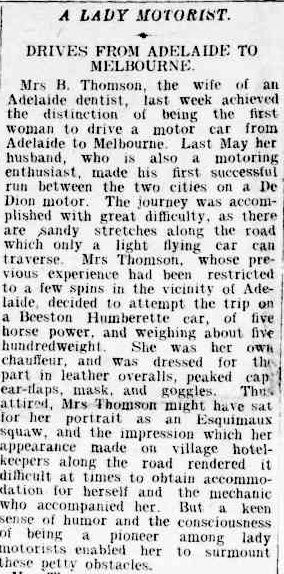
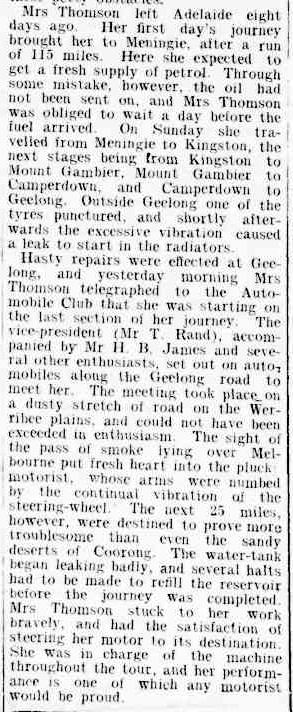
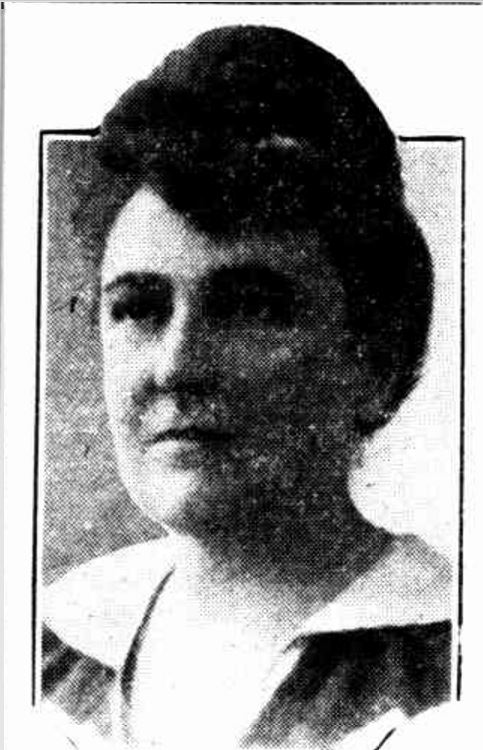
Driving a Beeston Humberette, Florence Thomson travelled from Adelaide to Melbourne in March 1904 earning her the title of the first female to drive the trip.  Spurred on by her dentist husband Ben’s achievements in 1902 in completing the same trip, Florence was nothing short of a trailblazer.

The trip was not without its problems, but the thick sands of the Coorong, limited petrol availability, a puncture, and a leaky radiator did not stop Florence.  Lucky she took a mechanic along with her.

A LADY MOTORIST. (1904, March 28). The Colac Herald (Vic. : 1875 – 1918), p. 1. Retrieved November 21, 2012, from http://nla.gov.au/nla.news-article87353226

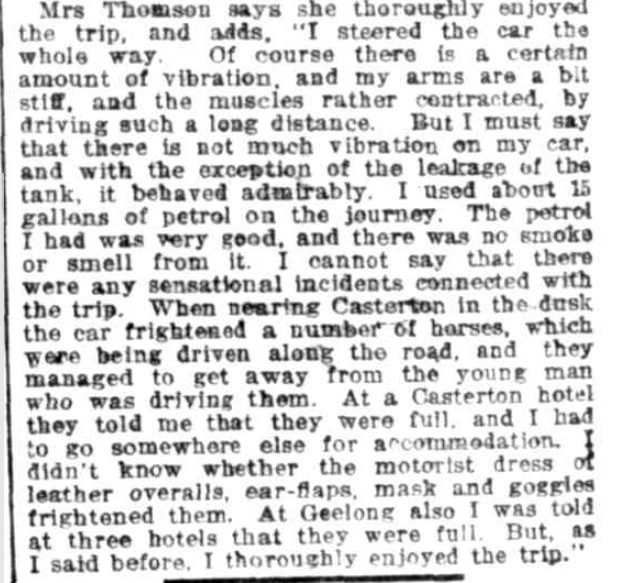
Her trip took her from Broadbeach, SA into Victoria’s Western District. Her car scared horses approaching Casterton and when she arrived in the town, she found there was “no room at the inn”. From Casterton she travelled on to Camperdown and then Geelong where she had a similar experience finding accommodation.

HOLIDAY ON MOTORS. (1904, April 2). Weekly Times, p. 19. http://nla.gov.au/nla.news-article222791657


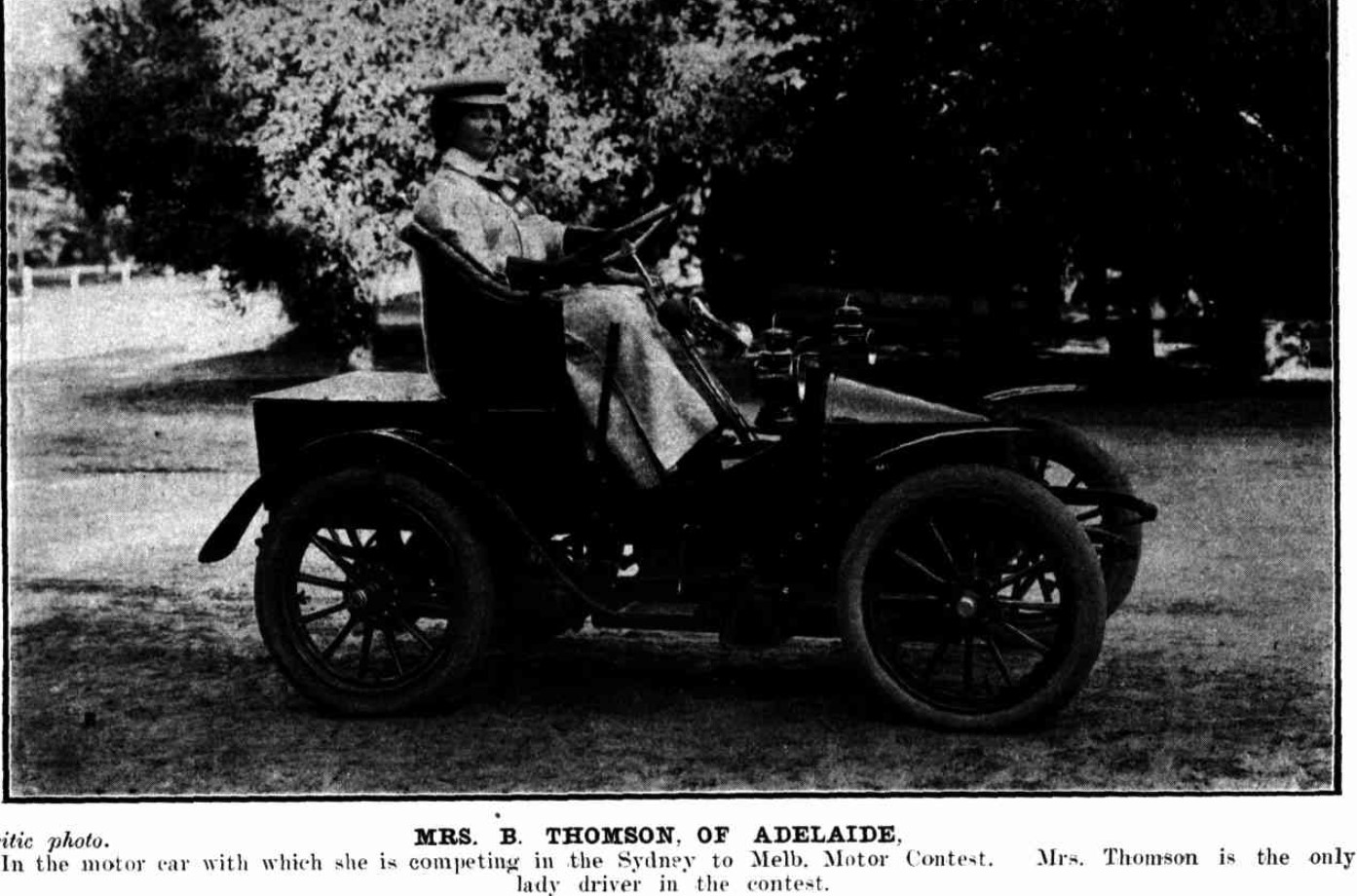
MRS. B. THOMSON, OF ADELAIDE, (1905, February 22). Critic (Adelaide), p. 27.  http://nla.gov.au/nla.news-article211406512

Florence did not stop there.  In 1905, she competed in the Dunlop Reliability rally from Sydney to Melbourne.

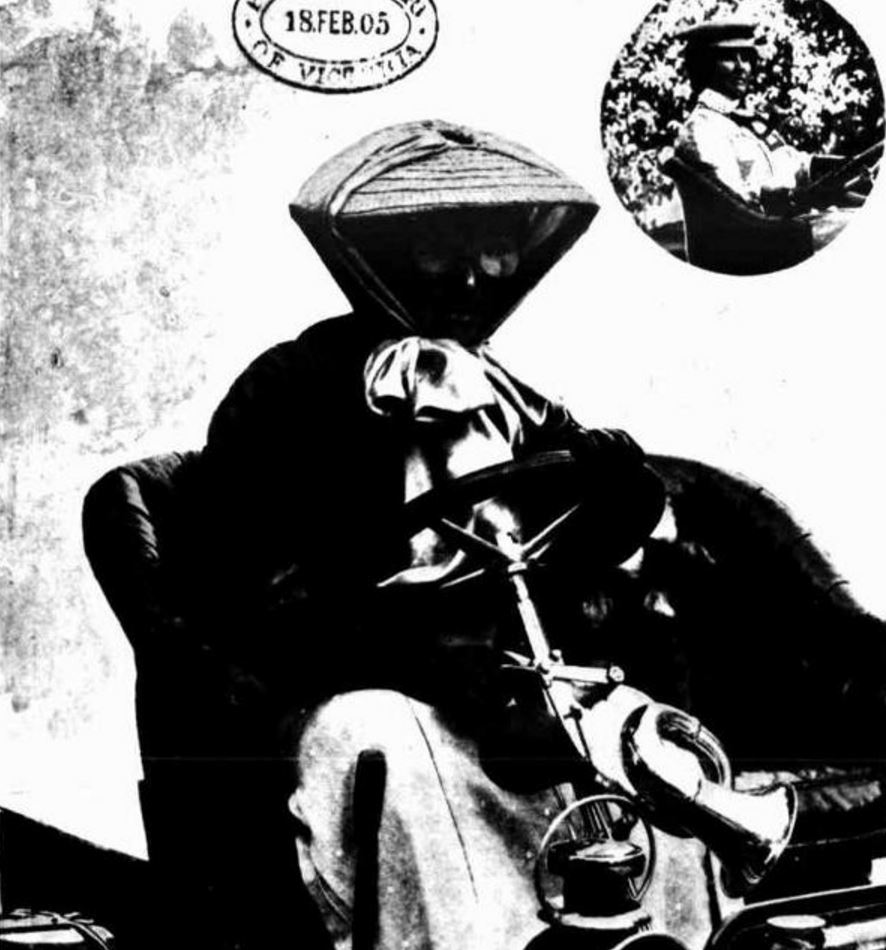
"A LADY MOTORIST." The Australasian (Melbourne, Vic. : 1864 - 1946) 18 February 1905: .

FLORENCE IN HER RACING GARB AND HER EVERYDAY MOTORING ATTIRE – “A LADY MOTORIST.” The Australasian (Melbourne, Vic. : 1864 – 1946) 18 February 1905: <http://nla.gov.au/nla.news-article140780231&gt;.

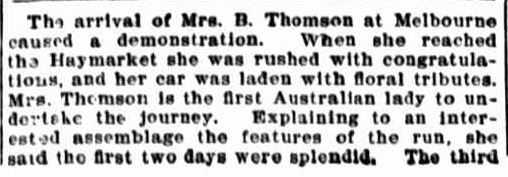
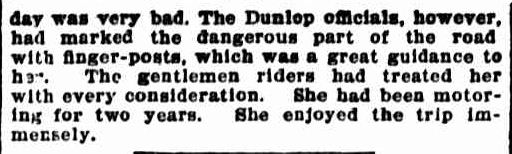
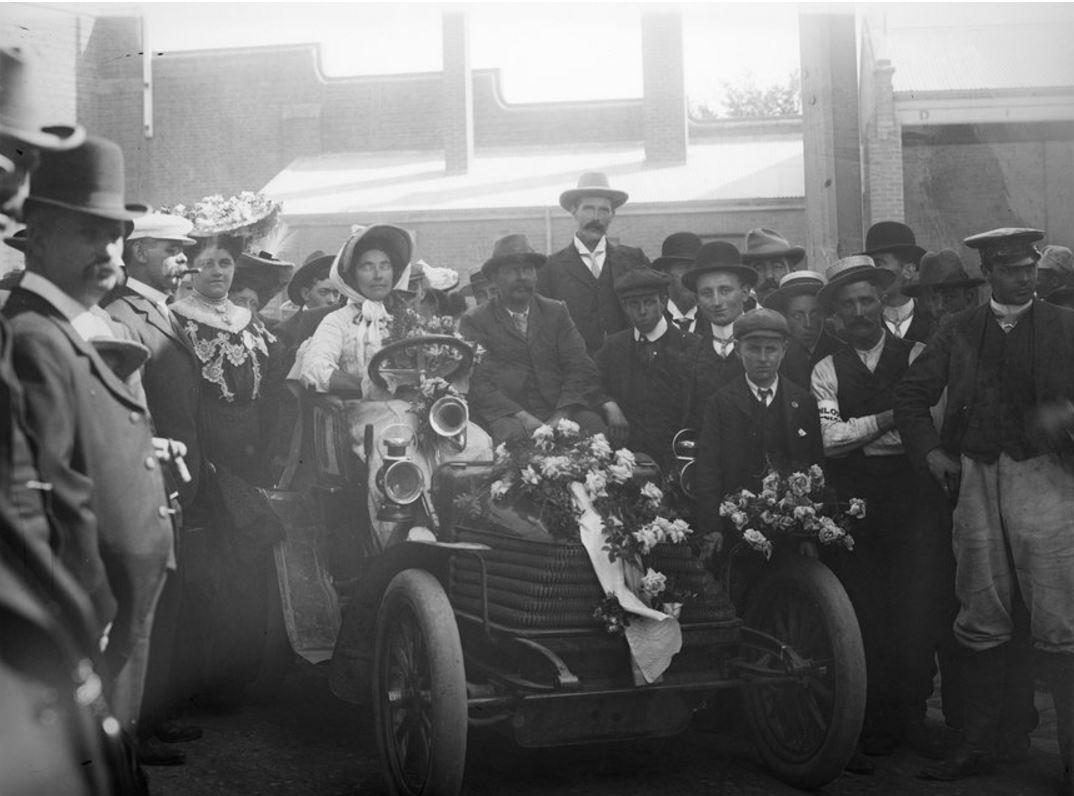
Mechanical problems at Albury looked as though they would stop Florence, but she made it to Melbourne to great adulation.

(1905, March 1). Australian Town and Country Journal (NSW : 1870 – 1907), p. 52. Retrieved November 26, 2012, from http://nla.gov.au/nla.news-page571151

FLORENCE THOMSON ARRIVING AT THE FINISH LINE OF THE RELIABILITY TRIAL FROM SYDNEY TO MELBOURNE. Image courtesy of the State Library of Victoria. http://handle.slv.vic.gov.au/10381/43094

FLORENCE THOMSON ARRIVING AT THE FINISH LINE OF THE RELIABILITY TRIAL FROM SYDNEY TO MELBOURNE. Image courtesy of the State Library of Victoria. http://handle.slv.vic.gov.au/10381/43094

Mrs Florence Thomson was truly a motoring pioneer as was her husband Ben.  Both had adventurous spirits. How many men in 1904 would have allowed their wife to do what she did, while accompanied by another man, and fully support her?

Born in India, Florence Alice Vardon married Scot Benjamin Thomson in Adelaide, South Australia in 1892. In 1929, twenty-five years after her epic drive from Adelaide to Melbourne, Florence was interviewed by The News (Adelaide). The interview was published on 17 August 1929. Florence told how she learnt to drive in 1902. During her childhood, she travelled around India and Burma with her father, a member of the British Indian Army and as an adult, travelled alone throughout Europe, China and Japan.  

Cars were not her only means of transport, “I have used almost all means of locomotion,” she said, “horses, camels, palanquins, donkeys, ships, trains, elephants, bullock-drays, and push bicycles”. When asked if she had flown in an aeroplane, she revealed she was the first woman passenger to fly with Captain Harry Butler, one of South Australia’s early aviators.

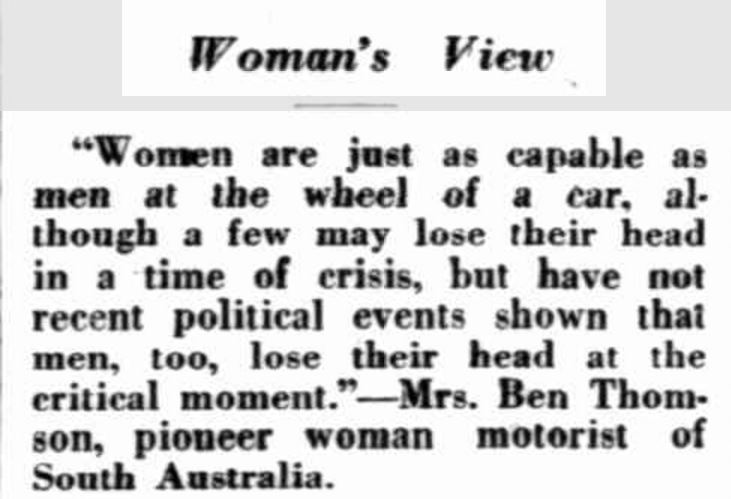
In 1931, as a debate was raging as to the driving ability of women, Florence commented for The Mail (Adelaide), published on 25 April 1931,


"Woman's View" The Mail (Adelaide, SA : 1912 - 1954) 25 April 1931: 11. .

“Woman’s View” The Mail (Adelaide, SA : 1912 – 1954) 25 April 1931: 11. <http://nla.gov.au/nla.news-article58845739&gt;.

Florence died on the 28th January 1938 at her home at 200 North Terrace, Adelaide.  Ben Thomson died in Adelaide on 27 June 1944.

"FIRST WOMAN MOTORIST" News (Adelaide, SA : 1923 - 1954) 17 August 1929: 3 (SPORTS EDITION). Web. .

“FIRST WOMAN MOTORIST” News (Adelaide, SA : 1923 – 1954) 17 August 1929: 3 (SPORTS EDITION). Web. <http://nla.gov.au/nla.news-article128899444&gt;.


Trove Tuesday – Time for a Song

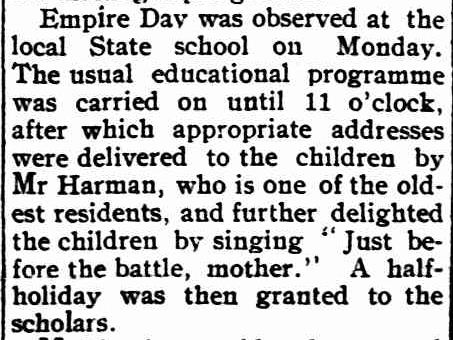
The Port Fairy Gazette has a lot of Byaduk news and I just love this treasure from May 31, 1915.   Australia celebrated Empire Day on May 24 from 1905.  School children participated in patriotic singing and speeches and flags adorned buildings.  The children had a holiday from school in the afternoon.  May 24 was also Cracker Night and in the evening people would gather around bonfires and let off fireworks.

Empire Day 1915 saw ggg grandfather James Harman visit the Byaduk State School and address the children.   He then sang “Just Before the Battle, Mother” and I’m pleased to see he “delighted” the children.  At age 85, he was only a year away from his passing.

BYADUK. (1915, May 31). Port Fairy Gazette (Vic. : 1914 – 1918), p. 2 Edition: EVENING. Retrieved November 14, 2012, from http://nla.gov.au/nla.news-article94725183

“Just Before the Battle, Mother” was an American civil war song but given it was in the midst of WW1, it was apt.  If you have not heard the song before, click on the play button below to hear a rendition courtesy of Soundcloud and P. Murray.

Trove Tuesday – UFO Alert!

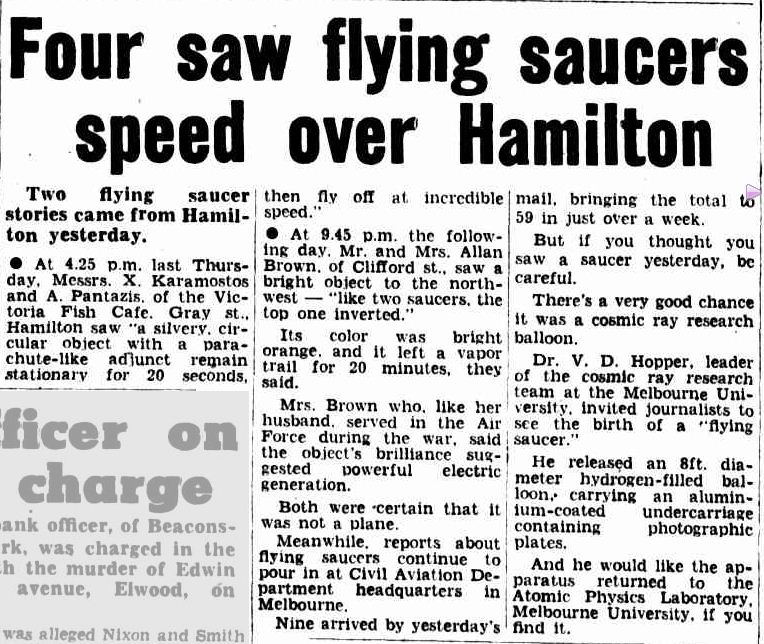
Hamilton experienced the paranormal during January 1954, with two separate “flying saucer” sightings.

Four saw flying saucers speed over Hamilton. (1954, January 13). The Argus (Melbourne, Vic. : 1848 – 1956), p. 5.  http://nla.gov.au/nla.news-article26584624

From a  Trove search of “flying saucers” I found during the 1930s the only flying saucers were those thrown across a room accompanied by a cup, but by the 1940s the flying saucers we know today began to make the news.  Many of the articles I saw were about experimental trials of flying saucers by earthlings.  But by the 1950s, “sightings” of flying saucers, presumably crewed by aliens, were commonplace.

A search of “science fiction” produced similar results.  There was no mention of the term during the 1930s, but by the 1950s it had reached meteoric heights.

The Science Fiction film genre changed during the 1950s.  Science Fiction films of the 1940s were horrors like Frankenstein and Dracula or superheroes such as Batman and Robin.  The Invisible Man and Flash Gordon were also popular.  The 1950s Sci-Fi films took to the universe with life on other planets a major theme.  The film Flying Saucer was released in 1950, War of the Worlds and Invaders from Mars in 1953 and that year even Abbott and Costello went to Mars.

THE MARTIaNS ARE HERE!. (1953, December 22). The Argus (Melbourne, Vic. : 1848 – 1956), p. 1.  http://nla.gov.au/nla.news-article23303135

No wonder Hamilton residents were on high UFO alert. While the film version of War of the Worlds had not yet reached the town, to add to the hype, their holiday reading may have included instalments of the H.G. Wells’ 1898 novel which ran in The Argus from 24 December 1953 until 7 January 1954, the same day as the Hamilton flying saucer sightings.

***If anyone finds Dr Hopper’s cosmic ray research balloon he would appreciate its return to Melbourne University.

Trove Tuesday Goes to the Races!

Today’s Melbourne Cup marks twenty years since a horse my father was a part-owner of, ran in the Cup.   London Bridge won the Duke of Norfolk Handicap (now known as the Andrew Ramsden Stakes) in 1992, a race over 3200 metres at Flemington just like the Melbourne Cup, and he won it in race record time.  His trainer was the Cups master, Bart Cummings, so London Bridge went into Melbourne Cup day with some hope of a good run.

On Cup Day, the rains came and we knew from the Adelaide Cup in May 1992, that London Bridge was not partial to getting is feet wet.  The winner of the  Adelaide Cup was Subzero and when it rained at Flemington on the first Tuesday in November 1992, London Bridge’s chances decreased and Subzero’s chances increased dramatically.  Subbie won and London Bridge ran a brave ninth.

Both London Bridge and Subzero went on to noble careers after their racing retirements.  London Bridge served as a police horse with the Victorian Police Force and Subzero was a Clerk of Course horse for 15 years and then became an Ambassador for Racing Victoria.  At twenty-four, he still visits schools as part of Racing Victoria’s Community Education Programs and other public appearances.

To mark the 20th anniversary of London Bridge’s Melbourne Cup run, this week’s  Trove Tuesday has a Cup theme with newspaper articles about  Bart Cummings.  Both articles are from the Barrier Miner, a Broken Hill newspaper where, surprisingly enough, I find many treasures.

The first article is from 1947 and a young Bart Cummings, working for his father, had a fall from a flighty colt.

Lucky Escape For Racehorse Comedy Court. (1947, October 16). Barrier Miner (Broken Hill, NSW : 1888 – 1954), p. 8. Retrieved November 6, 2012, from http://nla.gov.au/nla.news-article49572477

When I first read this story, I thought it was a different horse to that in the next article, 1950 Melbourne Cup winner, Comic Court.  However after reading Racing Victoria’s bio of Comic Court I realised that Comedy Court and Comic Court were the same.  Both horse and rider were lucky to win any Melbourne Cups!

The next treasure from the Barrier Miner is a photo of Bart Cummings,  Comic Court and Deidre Gath, the daughter of Albert Gath, a harness racing trainer, who had stables near Flemington.

He made her cry. (1950, November 11). Barrier Miner (Broken Hill, NSW : 1888 – 1954), p. 12. Retrieved November 4, 2012, from http://nla.gov.au/nla.news-article49585975

I like this photo as it brings together two racing dynasties, one thoroughbred racing, the other harness racing. I also love the way Comic Court is looking at Deidre.  Three generations of the Cummings family became trainers, Jim, Bart and Anthony, while the Gath family had five brothers training during the 1950s.  Like the Cummings name in thoroughbred racing, the Gaths are still a force in harness racing today.  In August 2012, Andy Gath trained the winner of the Group 1 Breeders Crown Final with Caribbean Blaster and last Saturday, an Anthony Cummings trained horse, Fiveandahalfstar won the Group 1 Victoria Derby.


Trove Tuesday – Advertisements

Having been a media student, I do like to look at advertisements and some of the ads in the old newspapers at Trove are absolute treasures.  I came across this group of advertisements recently in the The Mercury, Hobart from May 21, 1917.  The were all found on Page 7, otherwise dominated by racing news.  Only one, a Havelock tobacco advertisement, was directed at the person in the house most likely to read that section of the paper.

Just as they do today, the advertisement play on the insecurities of consumers.  In these examples they include ‘Am I a good mother/housekeeper?”  and “Am I as attractive/fashionable as I can possibly be?”  Buying the featured products would miraculously take away those insecurities.  Or so the advertisers wanted consumers to believe and still do.

Online shopping was not available in 1917, but the same excitement could be experienced when a mail order parcel arrived in the mail box.  Aimed at the country lady (hence the necessity to ride to the mail box), this advertisement makes the reader feel they could be missing out on something if they did not buy from Andrew Mather & Co, with “thousands of satisfied customers.  Are you one?”

THE TURF. (1917, May 21). The Mercury (Hobart, Tas. : 1860 – 1954), p. 7. Retrieved October 29, 2012, from http://nla.gov.au/nla.news-article1074308

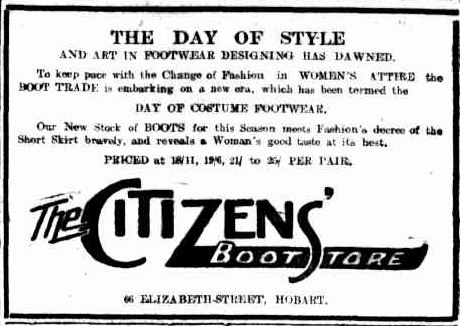
My post on Spring Fashion, explained the change of dress length during WW1.  This advertisement heralded a new era in ladies footwear.  No longer could shoes be hidden under a lady’s skirt.

THE TURF. (1917, May 21). The Mercury (Hobart, Tas. : 1860 – 1954), p. 7. Retrieved October 29, 2012, from http://nla.gov.au/nla.news-article1074308

If it’s good enough for the washerwoman….This Robur advertisement targets both the well-to-do lady of the house and those struggling to make ends meet.  The washerwoman shamed the households that bought “cheap rubbish”” to serve to their staff, and maybe even their guests,  and reassured those on lower incomes that Robur worked out cheaper because it went further and even the finest grades were affordable.

THE TURF. (1917, May 21). The Mercury (Hobart, Tas. : 1860 – 1954), p. 7. Retrieved October 29, 2012, from http://nla.gov.au/nla.news-article1074308

Buying Edmonds Baking Powder was a must for becoming a better home economist.

THE TURF. (1917, May 21). The Mercury (Hobart, Tas. : 1860 – 1954), p. 7. Retrieved October 29, 2012, from http://nla.gov.au/nla.news-article1074308

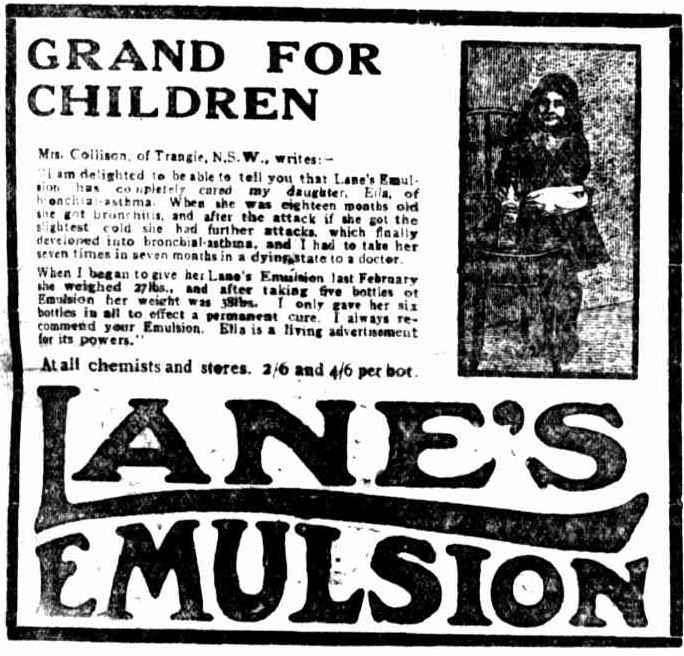
What a great product Lane’s Emulsion must have been.  It cured Mrs Collison’s daughter of asthma!  All it took was six bottles…poor Ella.  Testimonials in advertisements where very common.  In fact, you may find that a relative gave a testimonial.  While researching Sarah Harman’s son, Alfred James Oakley, I found that he had given a testimonial for  Mr Lum the Chinese herbalist from Stawell.  Apparently Mr Lum’s herbal medicines returned Mrs Oakley to full health, something three months under the care of doctors in Melbourne could not do.

THE TURF. (1917, May 21). The Mercury (Hobart, Tas. : 1860 – 1954), p. 7. Retrieved October 29, 2012, from http://nla.gov.au/nla.news-article1074308

An interesting choice of ads to place side by side.  Both  play on a housewife’s doubts about herself, with the ad on the left suggesting experienced housewives know Rex Lorraine Smoked Sausages are “good and fresh”.  Buy them and you too will be a success.  Just “pop the tin in boiling water”, so convenient and  no greasy pan to wash!  Trouble is they don’t sound very appetising.  If  the smoked sausages in jelly caused an outbreak of pimples, Cuticura was the answer.

THE TURF. (1917, May 21). The Mercury (Hobart, Tas. : 1860 – 1954), p. 7. Retrieved October 29, 2012, from http://nla.gov.au/nla.news-article1074308

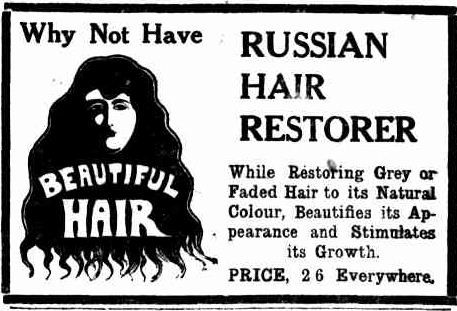
The pimple cream ad. and this one for Russian Hair Restorer, show us that women 100 years ago did care about their appearance.  All that was needed for beautiful hair was a Russian potion.  And what a potion it must have been, supposedly having the power to return grey or faded hair back to a natural colour while stimulating growth.

THE TURF. (1917, May 21). The Mercury (Hobart, Tas. : 1860 – 1954), p. 7. Retrieved October 29, 2012, from http://nla.gov.au/nla.news-article1074308

So next time your browsing the Trove newspapers, check out the advertisements.   Learning about our ancestor’s  food, entertainment, dress and more can go a long way towards understanding their lives.
Trove Tuesday – It was the Snake in the Drawing Room

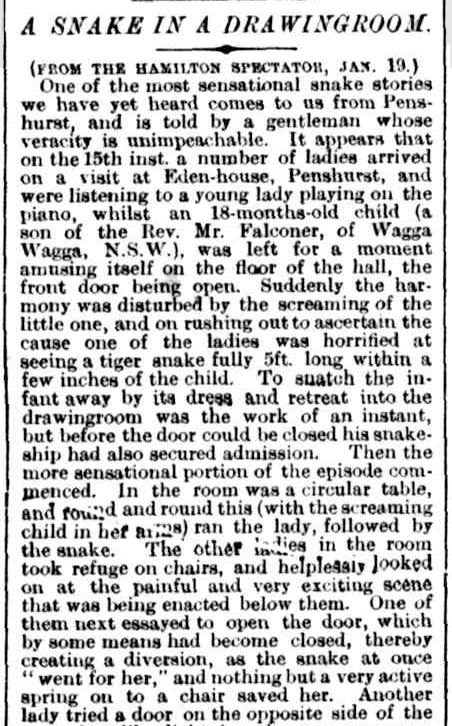
Published in The Argus on 22 January, 1878, this story comes from Penshurst.  It was previously published in the Hamilton Spectator on 19 January 1878.  I agree with the reporter that there are snakes stories and snake stories, but none quite like this snake story.

A SNAKE IN A DRAWINGROOM. (1878, January 22). The Argus (Melbourne, Vic. : 1848 – 1956), p. 10. Retrieved October 17, 2012, from http://nla.gov.au/nla.news-article5918117

Trove Tuesday – A Little Chatter About a Magpie

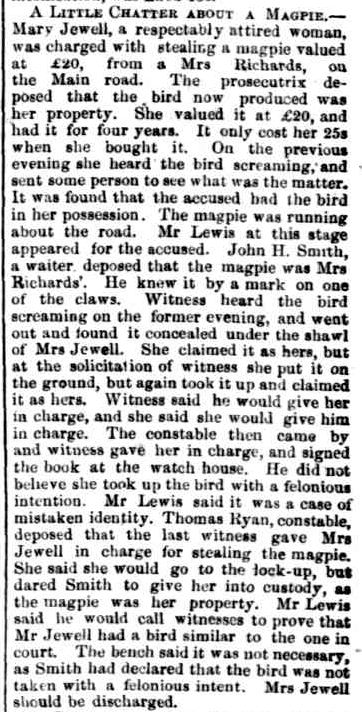
As it is the time of year when the young research assistant is too scared to go into our paddock or walk up the road for fear of swooping magpies, I thought this little treasure from Trove was fitting.  It is from the Ballarat Star of September 21, 1861.

EASTERN POLICE COURT. (1861, September 21). The Star (Ballarat, Vic. : 1855 – 1864), p. 1 Supplement: SUPPLEMENT TO THE STAR. Retrieved October 14, 2012, from http://nla.gov.au/nla.news-article66342198

Trove Tuesday – Matter of Relativity

Try to get your head around this article I found at Trove. It appeared in The West Australian and the Adelaide Advertiser in December 1951 and is about my first cousin 4 x removed, Amelia Harman, daughter of Jonathan Harman. Amelia married Christopher (Chris) Bell of Heywood in 1901. They had three children, Millicent Irene (born 1901), Clarence Jonathan (1902), and Christopher George (born 1903) all born at Heywood. Clarence died in 1905. At least one girl is a descendant of Christopher George Bell. At the time of the photo, Christopher was working as a senior constable of police at Casterton. He would have been around 48 then, so I’m guessing Cheryl of Casterton is Christopher’s daughter.

Amelia had an older daughter, Elsie May, who married Herbert Skipworth at Heywood in 1909. Therefore, Helen Skipworth is likely to be a descendant of Elsie and Herbert. That leaves Lynette Wilmot, who also would likely be a descendant of Elsie May and Herbert.


MATTER OF RELATIVITY. (1951, December 14). The West Australian, p. 8  http://nla.gov.au/nla.news-article49005300

Another amazing thing is the three girls are all nine months old! At the time of writing, Cheryl, Helen, and Lynette would be 61. If they or any other Bell family members see this, I would love to confirm the various family relationships. Amelia was around 87 at the time of this photo. She died in 1956, aged 91.