Passing of the Pioneers

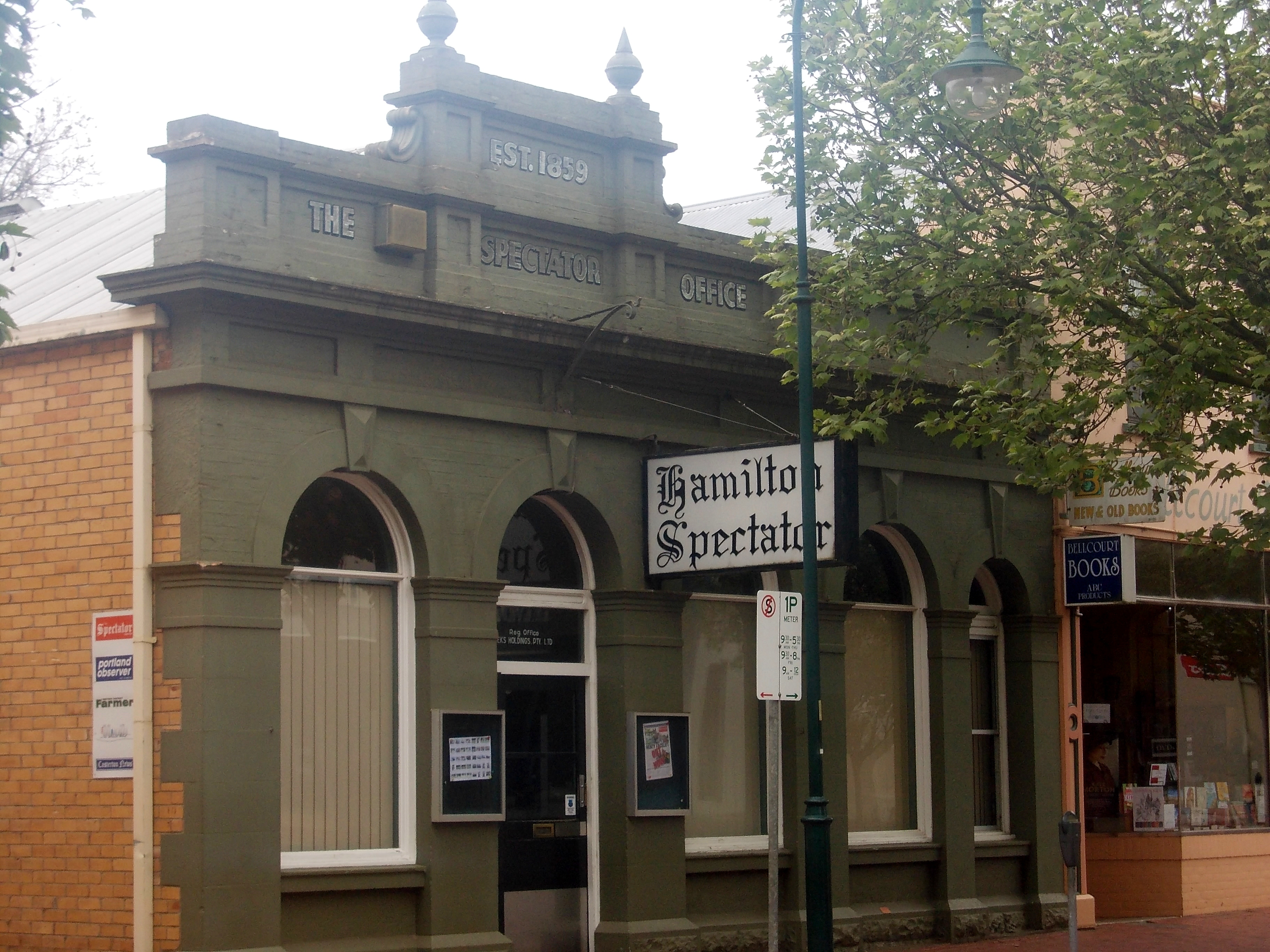
This November’s pioneers were an interesting bunch. There were the sons of pastoralists, a deputy coroner and the daughter of a convict ship surgeon. For me, it was mason Joseph Richards who caught my interest, arriving in a Hamilton in 1854 and pitching his tent on a block that is now part of the town’s CBD.  He later built the Hamilton Spectator offices.

Duncan ROBERTSON: Died November 1882 at Gringegalgona. Duncan Robertson was born in Scotland in 1799. He,his wife and three children travelled to Australia in 1838 first to N.S.W. and then Victoria. They first settled at Satimer at Wando Vale before Duncan purchased Gringegalgona near Balmoral in 1856.  His brothers John and William took up land at Wando Vale Station. More information about Duncan and his family is available at South-west Pioneers.

Charles Henry Fiennes BADNALL:– Died 20 November 1885 at Portland. Charles Badnall was born in Staffordshire  around 1830. He arrived in Victoria during the 1850s and first went to the Portland district with a government survey party.  When that work finished he married Mrs Hannah McKeand and they settled at Hannah’s hometown of Heywood before moving to Portland.

“Family Notices.” Portland Guardian and Normanby General Advertiser (Vic. : 1842 – 1876) 19 May 1864: 2 Edition: .

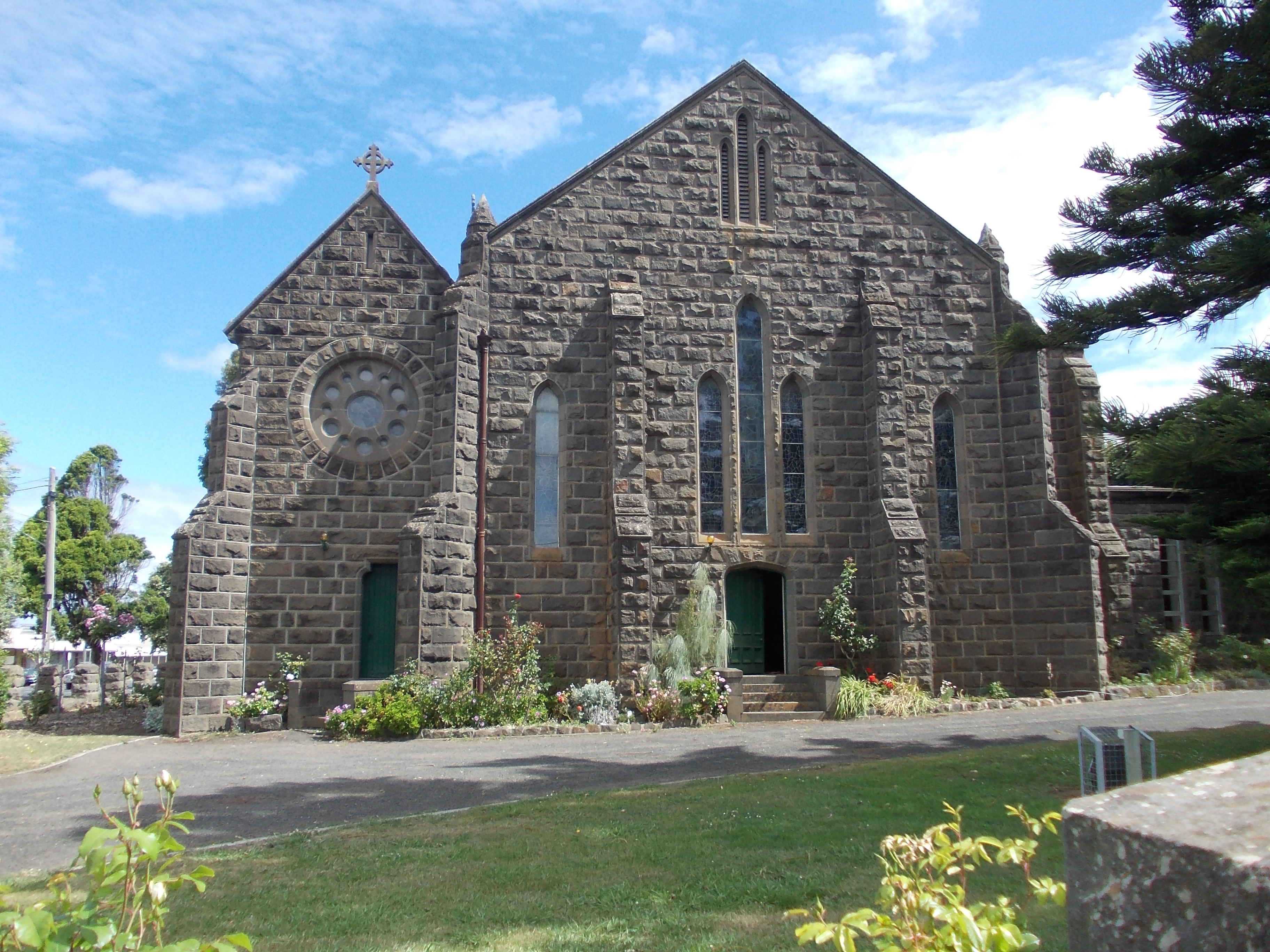
Charles wrote for the Portland Guardian and was also a correspondent for the Hamilton Spectator. He sang with the St. Stephens Church choir and was one of the founding members. Across the weekend after Charles’ death, flags around Portland flew at half-mast including on boats in the harbour.  A biography of Charles is on the following link – Charles Badnall

St Stephens Church, Portland

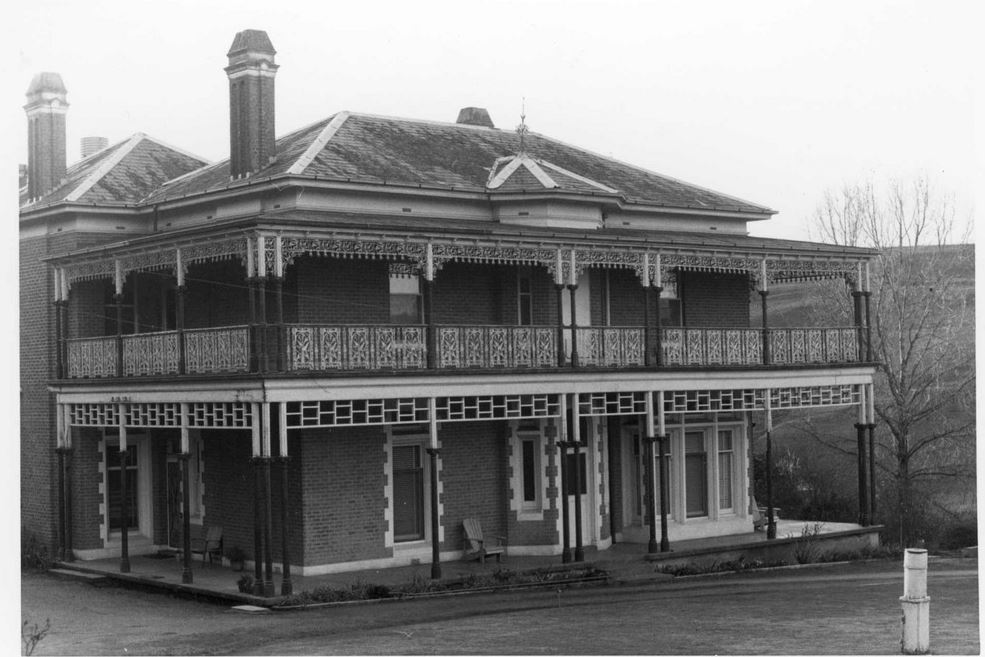
Ann MERRICK: Died 11 November 1904 at Hamilton. Ann Merrick was born in Somerset, England around 1814 and married Edward Cornish in 1834. In 1856 with a large family, they sailed to Australia, landing at Portland. Edward’s first employment in Victoria was at Murndal Estate for Samuel Pratt Winter making bricks for the homestead which in years and several extensions later would look like this (below)

MURNDAL HOMESTEAD, Image Courtesy of the State Library of Victoria J.T.Collins collection,  Image no. H97.250/31 http://handle.slv.vic.gov.au/10381/230143

MURNDAL HOMESTEAD, Image Courtesy of the State Library of Victoria J.T.Collins collection, Image no. H97.250/31 http://handle.slv.vic.gov.au/10381/230143

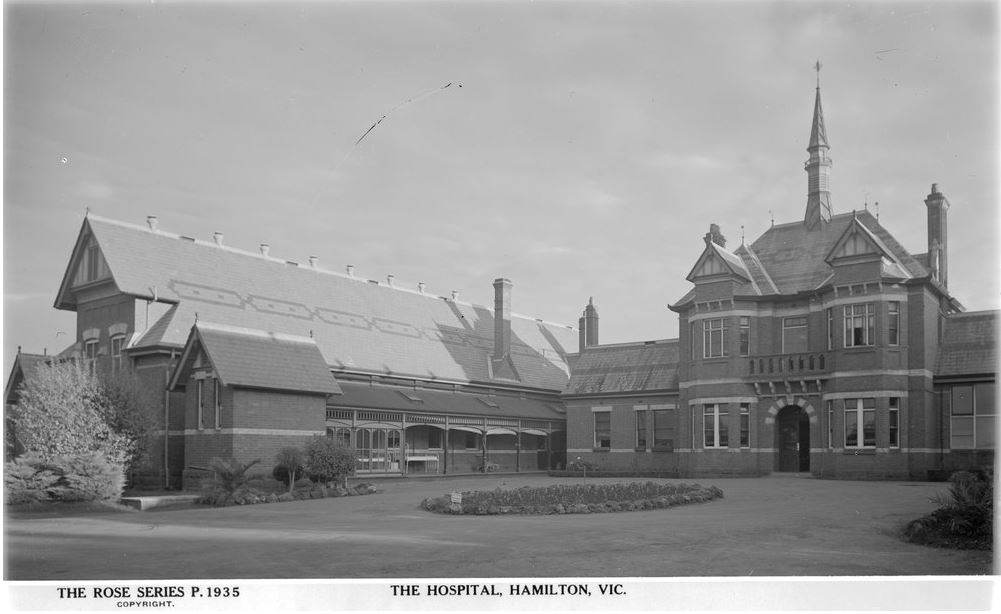
After Murndal, the family moved to nearby Hamilton and Edward made bricks for the Hamilton Hospital. The hospital was officially opened in early 1864, the year that Edward passed away.

HAMILTON HOSPITAL, Image Courtesy of the State Library of Victoria, Image no. H32492/2732 http://handle.slv.vic.gov.au/10381/63599

HAMILTON HOSPITAL, Image Courtesy of the State Library of Victoria, Image no. H32492/2732 http://handle.slv.vic.gov.au/10381/63599

Ann lived on in Hamilton for a further forty years and was buried with Edward at the Old Hamilton Cemetery

Patrick LAVERY: Died 19 November 1905 at Minimay. Patrick Lavery was born in Ireland around 1821 and arrived in Victoria with his wife in 1856. They settled in Heywood where Patrick worked as a blacksmith and farmer. After twenty-seven years, Patrick moved to Minimay to farm with his sons. At his funeral, there were forty buggies and twenty-five men on horseback behind the hearse as it travelled to the Minimay cemetery.

George Gilbert HOLLARD: Died 26 November 1912 at Wallacedale. George Hollard was born in Devon, England in 1817. He arrived at Portland in 1849 aboard the ship Bristol Empire and obtained work with Edward Henty at Muntham Station before returning to Portland. During his final years, George took up residence at Wallacedale with his son. He had great memories of the old times including the Governor of Victoria turning the first sod for the Hamilton-Portland railway in 1876.

“THE GOVERNOR’S VISIT TO THE WESTERN DISTRICT.” The Argus (Melbourne, Vic. : 1848 – 1957) 28 Apr 1876: <http://nla.gov.au/nla.news-article7437893&gt;.

Mary OSBORNE: Died 11 November 1914 at Portland. Born in Ireland in 1825, Mary Osborne arrived in Australia as a ten-year-old. Her father Alick Osborne was a surgeon aboard convict ships and later became the member for Illawara, N.S.W. In 1852 at Dapto, Mary married Lindsay Clarke of Portland and Mary travelled south to Victoria to settle at Portland with Lindsay.

“Family Notices.” The Sydney Morning Herald (NSW : 1842 – 1954) 28 Sep 1852: 3. <http://nla.gov.au/nla.news-article12940304&gt;.

On the journey to Victoria, Mary and Lindsay sailed aboard the Lady Bird which was reported to have been a challenging voyage. So much so, Mary and Lindsay disembarked at Port Fairy and continued the rest of their journey on horseback along the beaches between Port Fairy and Portland. Mary remained in Portland for the duration of her life aside from six years spent in Hamilton.

Joseph RICHARDS: Died 16 November 1916 at Fitzroy. Joseph Richards was born around 1830 in Cornwall and arrived aboard the Nestor to Portland in 1854, with his wife Elizabeth and two young children.  After their arrival, the Nestor was scuttled by the crew eager to get to the goldfields. This account of the Nestor’s demise is from the obituary of Henry Barcham, first mate on the ship.

“[No heading].” Portland Guardian (Vic. : 1876 – 1953) 19 Sep 1910: 2 Edition: <http://nla.gov.au/nla.news-page6067446&gt;.

Joseph arrived in Hamilton, then known as The Grange, in November 1854 when there were few residents. Joseph pitched his tent on a piece of land at what is now the corner of Brown and French Street. From the clues given in his obituary I believe it was the corner with the brick house (below).  A couple of years later he purchased a block in French Street, building a home and residing there until into his seventies.

Joseph was a mason and his first job in Hamilton was to slate the roof of the Victoria Hotel which opened in 1855.  He also won the contract to build the office of the Hamilton Spectator (below), constructed in 1873.

HAMILTON SPECTATOR

HAMILTON SPECTATOR

The last eight years of Joseph’s life were spent living with his son in Fitzroy.  He was eighty-six when he passed away and his body was returned to Hamilton by train. Joseph was buried in the Old Hamilton Cemetery.

George TURNBULL: Died 19 November 1917 at Hamilton. George Turnbull was born in 1858 at Mt. Koroite near Coleraine to Adam Turnbull and Margaret Young. George’s father and grandfather Dr. Adam Turnbull snr were in partnership on the property Winninburn. George tried working for the bank but it was not for him and he returned to Winninburn to farm. He was involved with the St Andrews Church and Sunday School.

WINNINBURN.  Image Courtesy of the State Library of Victoria JT. Collins Collection.  Image no, H98.250/295 http://handle.slv.vic.gov.au/10381/232375

WINNINBURN. Image Courtesy of the State Library of Victoria JT. Collins Collection. Image no, H98.250/295 http://handle.slv.vic.gov.au/10381/232375

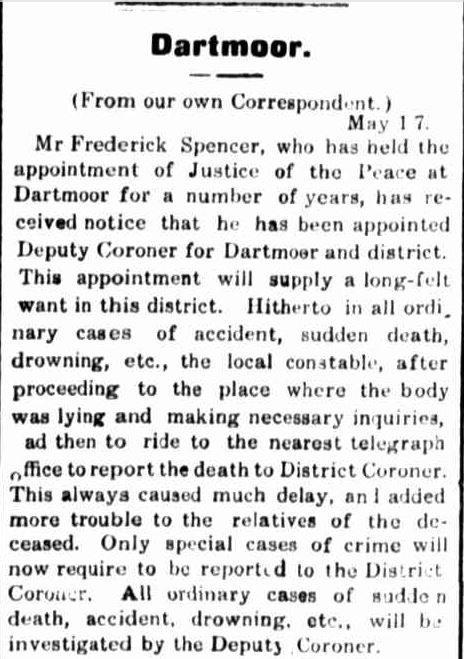
Frederick SPENCER: Died 16 November 1923 at Hamilton. Frederick Spencer was born  in 1853 at Portland. As an adult he took up residence at Dartmoor and was a Justice of the Peace. In 1911, he was appointed Deputy Coroner for Dartmoor, a role that was long overdue according to the Portland Guardian’s Dartmoor correspondent.

“Dartmoor.” Portland Guardian (Vic. : 1876 – 1953) 22 May 1911: 3 Edition: EVENING. <http://nla.gov.au/nla.news-article63980761&gt;.

Two obituaries for Frederick appeared in the Portland Guardian, the first on 10 December 1923 that stated he had lived to “be a little over the allotted span.” Frederick was seventy. He was known for his dry wit making him a popular chairman at functions. Three of Frederick’s sons served at Gallipoli.  One lost his life while another was hospitalised for three years because of the effects of gas.

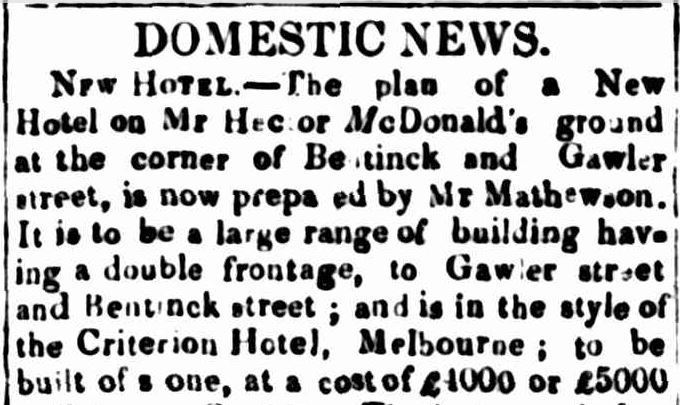
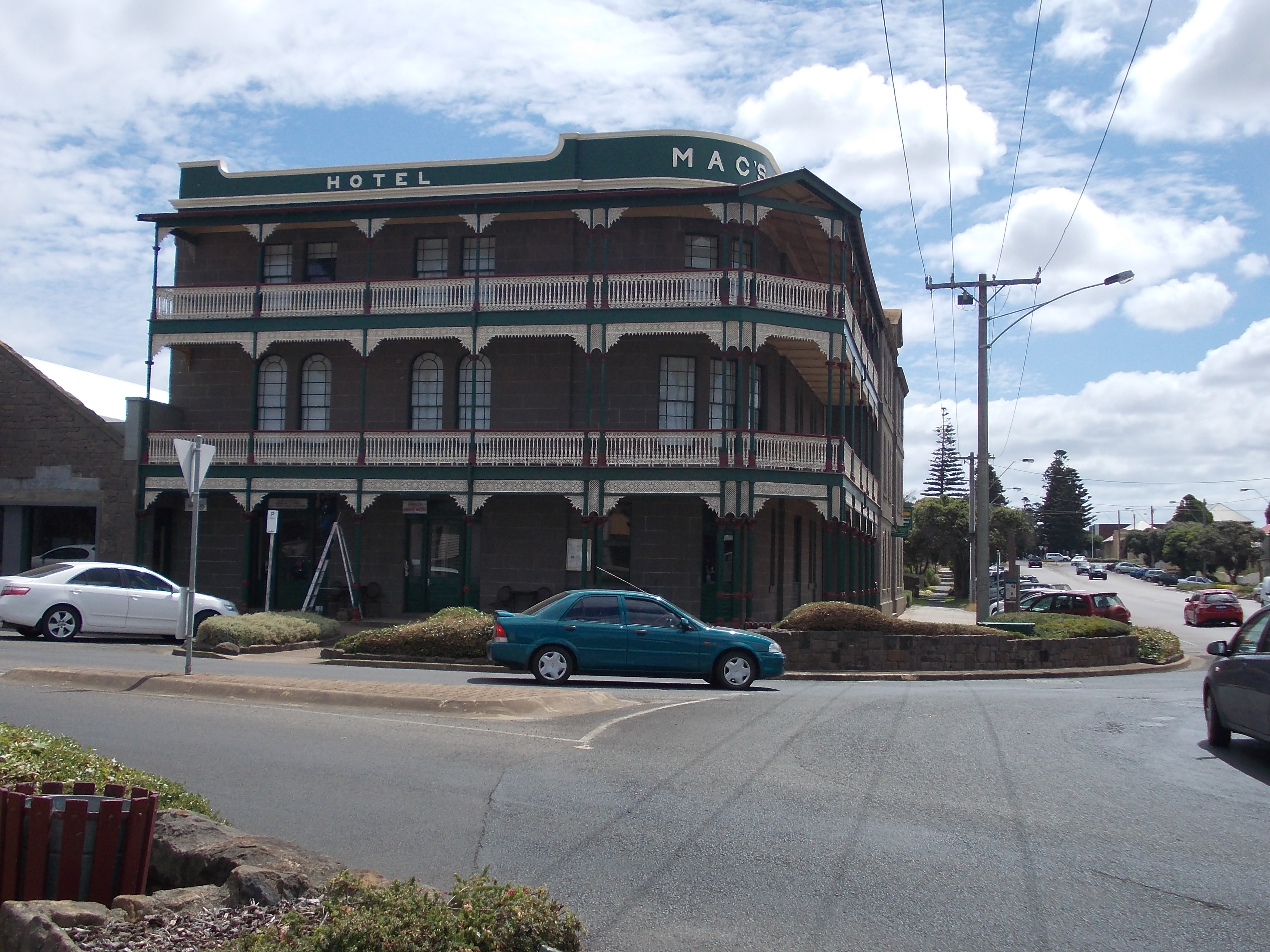
John Samuel McDONALD: Died 25 November 1932 at Portland. John McDonald was born in Scotland around 1837 and arrived in Victoria when he was seven aboard the Tamerlane. His father had arrived at Portland several years before so John, travelling alone, was placed under the care of the ship’s captain. John’s father went on to build Mac’s Hotel in Portland in 1855.

“DOMESTIC NEWS.” Portland Guardian and Normanby General Advertiser (Vic. : 1842 – 1876) 11 Jun 1855: 2 Edition: EVENING. Web. .

182

MAC’S HOTEL, PORTLAND

While his father was building a hotel, John was at the diggings in the hunt for gold. After some years, he settled at Strathdownie. During the 1870s, he married Eliza McDonald of Horsham and the had a family of ten children.

Passing of the Pioneers

Most of the pioneer obituaries found in the newspapers are for men which is unfortunate because we are always searching for more information about our female ancestors. For the month of October, the obituaries for pioneering women outnumber the men.  And great pioneers they were, making great contributions within their communities and all living to very old age. But none lived longer than Margaret Walker (nee Brown) of Hamilton. Passing away in 1939, Margaret reached the age of 104 and remained healthy almost to the end.

Mark NICHOLSON: Died 27 October 1889 at Warrnambool. Mark Nicholson was born in Gloucestershire in 1818 and arrived at Port Phillip in 1840. Rather than practice his profession of law, Mark chose to run cattle at various stations across the colony. In 1848, Governor LaTrobe selected him to act as a Justice of the Peace at Warrnambool and in 1853 he was elected as the Warrnambool and Belfast (Port Fairy) representative in the Victorian Legislative Council. In the following years, Mark spent time in England but returned to Warrnambool to settle in 1873. A full biography of Mark Nicholson is available at the Australian Dictionary of Biography.

John BEST: Died 9 October 1907 at Portland. John Best was born in Ireland in 1835 and arrived at Portland in 1857 aboard General Hewitt. He travelled with his parents William and Letitia Best and his six siblings. The family settled at Heywood and John took up work as a carrier. Later he built bridges and roads for the local Shire. He purchased a farm at nearby Mt. Clay and he remained there until his death. He left a widow and seven children.

William SCOTT: Died 7 October 1909 at Wallan. William Scott arrived in Victoria for the gold rushes and settled in Camperdown around 1860. He took an active role in local politics, serving on the Hampden Shire Council. He was also secretary of the Camperdown P&A Society. There was barely an organisation around Camperdown that did not have William Scott on the committee. His obituary read,

In him has passed one of the rugged pioneers who came magnificently equipped physically, and with the indomitable energy and capacity for sustained effort responsible for the remarkable development that has marked the brief history of this country.

Williams remains were returned from Wallan by train and he was buried at the Camperdown Cemetery.

Euphemia McLEOD: Died 3 October 1914 at Purnim.  Euphemia McLeod was born in Scotland around 1826 and travelled to Australia on the Edward Johnston around 1854. She eventually settled at Purnim with her husband George Crowe and she lived there for fifty years. Euphemia left three daughters and a son.

Ann Rebecca EAGAR: Died 12 October 1917 at Hamilton. Ann Eager was born in Devon, England around 1832 and sailed to Adelaide in the mid-1850s. It was there she married George Rowe and they made their way to Victoria, settling at Wickliffe. They remained there for around thirty years before taking up residence at Hamilton.

Only six months before her death, Ann and George had celebrated their diamond wedding anniversary.  An article appeared in the Ballarat Star of 14 April 14, 1917 reporting on the couple’s anniversary. It told of George’s work as a builder. He worked on several notable buildings in the district including the Coleraine Catholic Church and the Argyle Arms Hotel in Hamilton. During the war years, Ann supported the cause, knitting socks for soldiers and by the time of her wedding anniversary, she had knitted 120 pairs of socks. Ann and George had three sons and two daughters, twenty-eight grandchildren, and seventeen great-grandchildren.

Margaret BROWN: Died October 1939 at Hamilton. Margaret Brown was a great Hamilton pioneer living until the grand age of 104. In her last years, her life was documented as she reached milestone birthdays.  Margaret was born in Launceston in August 1835 with her parents having come from Scotland in 1830. The family sailed to Victoria around 1840 aboard the City of Sydney and in 1852 Margaret married Thomas Walker at Portland. During the mid-1860s, they settled at Hamilton where they remained. They had eight children, but two died as infants.

When Margaret was ninety-eight, she was given a walking stick but she had not used it by the time of her ninety-ninth birthday in 1934. That was also the year of the Portland Centenary and Margaret attended the town’s celebrations. During that year, she had also produced seventeen pieces of eyelet linen work. In 1935, Margaret’s 100th birthday celebration was held at the Hollywood Cafe in Hamilton with the Mayor of Hamilton, Cr. Stewart, in attendance. She also planted a commemorative tree for Victoria’s centenary celebrations. For her 101st birthday, twenty-five friends and family gathered at Margaret’s home at 5 Shakespeare Street. The highlight was a birthday cake with 101 candles. The next three birthdays were celebrated quietly at home. but Margaret continued in good health. That was until only weeks after her 104th birthday when Margaret became more fragile, eventually passing away in October. During her life, Margaret saw the reign of six British monarchs.

Margaret’s birthday articles 90th Birthday    99th Birthday  100th Birthday   101st Birthday   104th Birthday

Elizabeth SILVESTER: Died 7 October 1940 at Noorat. Elizabeth Silvester was born in England around 1852 and arrived in Cobden with her parents as a two-year-old. She ran a business in Cobden for fifty years and attended the Cobden Methodist Church. Married to William Gilham, Elizabeth left two sons at the time of her death, one of whom she lived with at Noorat for the last year of her life. She was buried in the Cobden Cemetery.

Robert Thomas SILVESTER: Died 7 October 1943 at Portland. Robert Silvester was born in Merino in 1862 but as a young man, he moved to Portland and trained as a solicitor. He worked in the partnership Lynne, Silvester, and Fielding before going into practice alone. From 1910-1920, Robert was president of the Portland Racing Club and was also president and captain of the Portland Golf Club.  Robert was also a member of the Portland Bowling Club and the following link is for an obituary from the club –   http://nla.gov.au/nla.news-article64386872

Catherine McCLURE: Died 29 October 1952 at Camperdown. Catherine McLure was born at Mepunga in 1866, the daughter of James and Eliza McLure, early pioneers of the Warrnambool district. In 1885, Catherine married  Benjamin Jeffers at Warrnambool and they moved to Strathbogie. They later returned to the Western District and lived at Timboon, Kellambete, and finally, Chocolyn where they resided for forty years. Catherine enjoyed making toys with her five grandchildren and ten great-grandchildren and telling stories of days past.

Passing of the Pioneers

Just a small group of pioneers for the September Passing of the Pioneers.  While the number of obituaries now available are beginning to dwindle after three years of Passing of the Pioneers, time was more of a constraint this month.  On the bright side, it ensures there will still be some pioneer obituaries to share next September.

Margaret O’GORMANDied 9 September 1914 at Mortlake.  Born in Tipperary, Ireland around 1821,  Margaret arrived in Victoria around 1851. She married Patrick Finn in 1855 and they settled in the Mortlake district. Her obituary read, ‘…she was able by her lovable  manner to render and dispense happiness and sunshine wherever she went.’  Patrick died thirty-four years before Margaret and she left four sons and one daughter.  Margaret was buried at the Mortlake Cemetery.

Charles Turner MEDEW: Died September 1914 at Allansford.  Charles Medew was born in Cheltenham, England in 1837 and arrived in Victoria aboard the ship William around 1857. Charles settled in Warrnambool and working as a builder  he built two bridges across the Hopkins River. He selected land near the Warrnambool Cheese and Butter Factory, and in 1914 the site was still known as “Medew’s Corner” although Charles had moved to Melbourne.  Around 1910, Charles built a model airplane and it is now held by Museum Victoria. Charles was visiting his daughter at Allansford when he died.

Mary KESSELL: Died 7 September 1917 at Ararat. Mary and her husband Thomas Gillies were originally from Penzance, Cornwall and arrived at Warrnambool in 1854 aboard the Panama with their infant son. They went to the Ararat diggings in 1856 were they permanently settled. The Gillies family grew to ten, seven sons and three daughters and by the time of her death, Mary had twenty-eight grandchildren and nineteen great-grandchildren. Even into her last years, Mary could recall the early days of Ararat. Her funeral saw a large turnout as the people of Ararat paid their last respects to one of their oldest residents.

William HOWARD: Died 28 September 1916 at Ararat. William Howard was born in Liverpool, England and arrived in Victoria in 1853. The following year he hit the diggings, first at Maryborough, then Fiery Creek and on to the Ararat region.  He eventually took up the lease of the Terminus Hotel at Ararat and later he built the Ararat Coffee Palace. At the time of his death, he left a widow and three grandchildren.

Thomas SHENFIELDDied 2 September 1937 at Cobden. Thomas Shenfield was born at Camperdown in 1861. The following year his family moved to Cobden where Thomas lived out his life. He married Nellie Baker of Cobden and they had six children. Thomas took an interest in the progress of Cobden and was a director of the Tanadrook Cheese Factory (below). He was also a member of the Cobden Methodist Church.

TANDAROOK  CHEESE FACTORY.  Image courtesy of the State Library of Victoria, J.T. Collins collection.  Image no. H98.251/1632 http://handle.slv.vic.gov.au/10381/234397

TANDAROOK CHEESE FACTORY. Image courtesy of the State Library of Victoria, J.T. Collins collection. Image no. H98.251/1632 http://handle.slv.vic.gov.au/10381/234397

Passing of the Pioneers

A small band of Pioneers come together for August Passing of the Pioneers. They include the first Mayor of the Borough of Portland and a crew member of William Dutton’s whale boat.

William McLEAN: Died 28 August 1888 at Port Fairy. At the time of his death, William McLean had resided at the Port Fairy Benevolent Asylum for ten years and was known to all as “Old Billy”. In 1887, he spoke about his life from his time in his birthplace of Scotland. William was born around 1790 and when around twenty, he joined the navy and was a crewman on the HMS Warspite which brought him to Sydney while escorting convicts in 1822.  After meeting some whalers, he decided to jump ship and join them. The whaling ship belonged to William Dutton, one of the first whalers to Portland Bay and William was with him.

Image Coutesy of the State Library of Victoria.  Image no.  PN05/05/77/00  http://handle.slv.vic.gov.au/10381/78495

Image Coutesy of the State Library of Victoria. Image no. PN05/05/77/00 http://handle.slv.vic.gov.au/10381/78495

When asked who was the first to Portland Bay, William Dutton or the Hentys, William replied that Dutton and his crew were there long before the Hentys. Later, William spent time whaling at Port Fairy where he settled.

Mary GRIERSON: Died August 1914 at Port Fairy. Mary Grierson was born in Scotland in 1827 and arrived in Victoria with her parents in 1839. They had sailed aboard the David Clark with Port Fairy’s Captain Mills at the helm.  Mary married David Thomas in 1846 and they settled at Rosebrook, near Port Fairy. They had a family of twelve, six girls and six boys. Mary was a member of the Presbyterian church and her goodwill was known throughout the district.

Thomas BEVAN: Died August 1915 at Colac. Born in Devonshire, England in 1829, Thomas Bevan arrived in Geelong in 1851. He moved to Beeac and became a local preacher for the Methodist Church. Thomas worked hard to build the community and had a strong involvement in all aspects of public affairs. He was also a musician, with violin and flute his instruments both learnt while still in England.

George HAYNES: Died 18 August 1916 at Port Fairy. The Port Fairy Town Hall flag flew at half mast the day George Haynes passed away. George was one of Port Fairy’s earliest residents and the first Mayor of the Borough. George was born in Staffordshire in 1826 and at the local grammar school. In 1854, he and his wife travelled to Australia, landing at Melbourne where they remained for around a year. George then moved on to Port Fairy where he settled and established a merchant business, Haynes and Young. Married twice, George had seven children from his first marriage.

Advertising. (1915, February 1). Port Fairy Gazette (Vic. : 1914 - 1918), p. 4 Edition: EVENING. Retrieved August 30, 2014, from http://nla.gov.au/nla.news-article94722841

Advertising. (1915, February 1). Port Fairy Gazette (Vic. : 1914 – 1918), p. 4 Edition: EVENING. Retrieved August 30, 2014, from http://nla.gov.au/nla.news-article94722841

Joseph LEWIS: Died 27 August 1916 at Port Fairy. Joseph Lewis was born in Staffordshire around 1824 and travelled to Australia aboard the Royal Saxon, landing at Williamstown in 1841Also on board was a relative of Charles Dickens.  After some time working at Little River Joseph travelled to the Grampians with a Mr Dwyer and they attempted to run cattle.  Unsuccessful, Joseph moved on to Port Fairy and purchased the property Glenview, residing there until old age when he moved into the Port Fairy town. Joseph left a widow, four sons, four daughters, thirty-two grandchildren and eighteen great-grandchildren.

Denis BERMINGHAM: Died 17 August 1917 at Port Fairy. Denis Bermingham was from Ireland and arrived in Port Fairy aboard the Chance during the 1850s. Spending time at Koroit and then Woodlands, Denis worked on the land. After moving to Port Fairy the 1880s, he worked for a few years on the harbour. Denis and his wife had thirteen children, nine of whom were still living at the time of Denis’ death.

Robert LEISHMAN: Died 28 August 1917 at Port Fairy. Robert Leishman was born in Scotland around 1830 and arrived in Victoria as a boy in the 1850s. After some time spent at Woodford, he settled at Crossley and for many years ran the farm Cockpen. He had also spent some time working on Korongah Station, then owned by Messrs. Knight and Lydiard.  It was there, during the 1870s that Robert’s wife passed away. During their time together they had a family of five. In the last years of Robert’s life, he moved to Rosebrook and then Bank Street, Port Fairy.

Passing of the Pioneers

When I started posting pioneer obituaries under the heading “Passing of the Pioneers” in July 2011, I never imagined that “Passing of the Pioneers” would still be going three years on. (I didn’t think Western District Families would still be going). Nor did I expect that I could announce this month marks the posting of the 500th pioneer obituary. Over the three years, thanks to the stories of those 500 pioneers, the amount I have learnt about Western District history and the families who built that history has been invaluable. However, the best aspect has been the number of people who have contacted me after finding their pioneering ancestor in the posts. I hope what I have provided has gone a little way toward them learning more about their ancestors’ lives.

The precis I give for each pioneer summarises the obituary that appeared in the paper when the pioneer passed away.  I don’t check the facts written there, such as ships sailed on or years of arrival.  I do search for the maiden name of married women, simply because I prefer to list them with their maiden names and not Mrs A. Smith, for example.  Sometimes I will search for further information about a pioneer and in the entry I include links to the sources I have found. So basically, what I give you is an index to pioneer obituaries with a link to the original and from there you can make what you like of the information provided at the time of the pioneer’s death. Obituaries are, after all, an inaccurate source as the information contained is second or third hand and rarely do you read of negative characteristics of a person or their failures in life.

Importantly, I must thank Trove Australia because without the digitised newspapers I would never have been able to find the 500 obituaries of some of the Western District’s great pioneers.

You can either search or browse the Passing of the Pioneers obituaries. Search a family name in the search box on the side bar of this page or select “Pioneer Obituaries” in the category box, also on the sidebar.  You can then browse through the 36 posts beginning with the most recent.  Simply click on the name of the pioneer to go to the newspaper obituary. If you find a family member, feel free to comment and give more information if you have any.  Leaving a comment increases your chance of finding someone else researching the same person.

____________________________________________________

This month’s pioneers include two men who knew family members of mine with both men being important figures in their respective towns. There is also a bricklayer, a publican and one of the men who discovered the Londonderry mine at Coolgardie, Western Australia.

Hugh MURRAY: Died 28 July 1869 at Colac. Hugh Murray was born in Scotland about 1814 and arrived in Tasmania with his parents and siblings in 1823.  At the age of twenty-three, Hugh left Tasmania for Victoria and settled on the banks of Lake Colac before there was a town and today is considered Colac’s first white settler. Hugh had pastoral interests but also sat as a Magistrate at the local Colac Magistrates Court. Last month’s Passing of the Pioneers included the obituary of Elizabeth Young of Hobart who married Hugh Murray in 1841.

EARLY SETTLEMENT AT LAKE COLAC c1875, BY NICHOLAS CHEVALIER. Image courtesy of the State Library of Victoria. Image No. H3572 http://handle.slv.vic.gov.au/10381/81081

EARLY SETTLEMENT AT LAKE COLAC c1875, BY NICHOLAS CHEVALIER. Image courtesy of the State Library of Victoria. Image No. H3572 http://handle.slv.vic.gov.au/10381/81081

Hugh knew my ggg grandparents Thomas Gamble and Ellen Barry but not in the way one would like their ancestors to be acquainted with an outstanding citizen of Colac. It started with Thomas Gamble, said to have been employed by Hugh Murray to make bricks for his new home at Lake Colac, thus prompting the Gambles to move from Geelong to Colac. Their relationship soon soured. As early as 1851, Thomas’ wife Ellen faced Magistrate Murray in the Colac Court of Petty Sessions charged with drunkenness, one of dozens of charges she would face during her life and it certainly wasn’t her first. In January 1853, Thomas Gamble faced court as the defendant in a case against Hugh Murray. Although the handwriting in the original register of the Colac Court of Petty Sessions (p.83) is difficult to read, I can make out the words  –  “Thomas Gamble – Charged alleged arson in setting fire to Hugh Murray Esq.”.  Fortunately, the case was  dismissed.

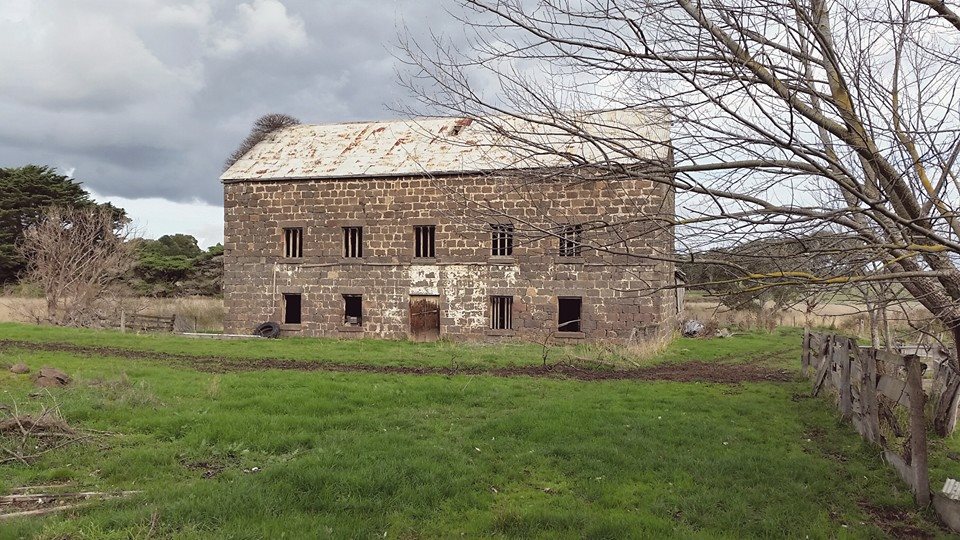
Peter LEARMONTH: Died 19 July 1893 at Hamilton. Peter Learmonth was one of Hamilton’s most prominent citizens from the 1860s to the time of his death, contributing greatly to the growth of that town and the  villages surrounding it. Born in Scotland in 1821, Peter travelled to Tasmania to meet up with his brother William who had already bought land in that colony. Gold attracted Peter and he left for the Californian goldfields in the late 1840s. With no success, he made his way to Victoria in the early 1850s and had good fortune on the Castlemaine goldfields. Getting out while ahead during the mid-1850s, he took up a manager’s job at Merino Downs station owned by Francis Henty, but not before marrying Mary Jarvey Pearson at Portland in 1854.  By 1859, Peter purchased Prestonholme on the banks of the Grange Burn near Hamilton from George Younger and proceeded to build the Grange Burn Flour Mill. He later purchased mills at  Byaduk, Sandford and Penshurst.  The homestead at Prestonholme and the mill still stand today on the Mill Road, Hamilton.

PETER LEARMONTH'S PRESTONHOLME MILL. Photo courtesy of Denis Steer.

PETER LEARMONTH’S GRANGE BURN MILL. Photo courtesy of Denis Steer.

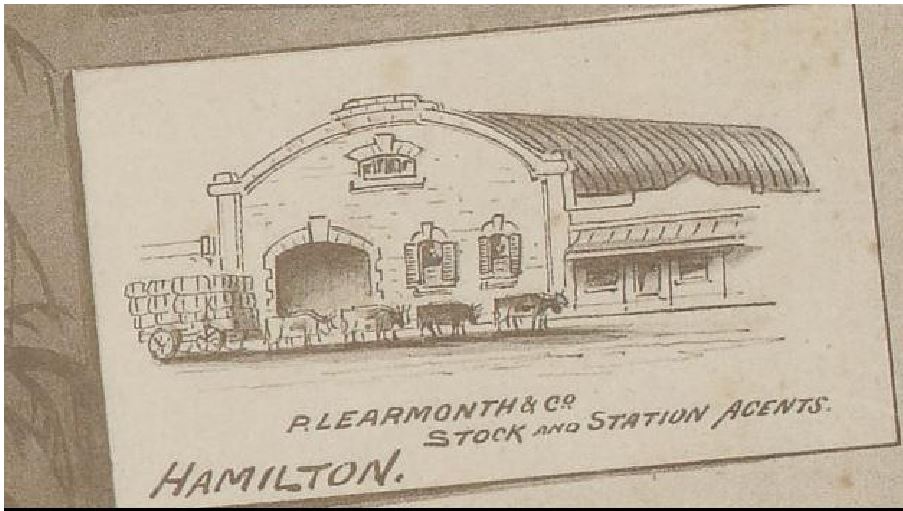
Not satisfied with his milling empire, Peter established P.Learmonth & Co Stock & Station agents in Gray Street, Hamilton. Peter’s sons continued the business after his death.
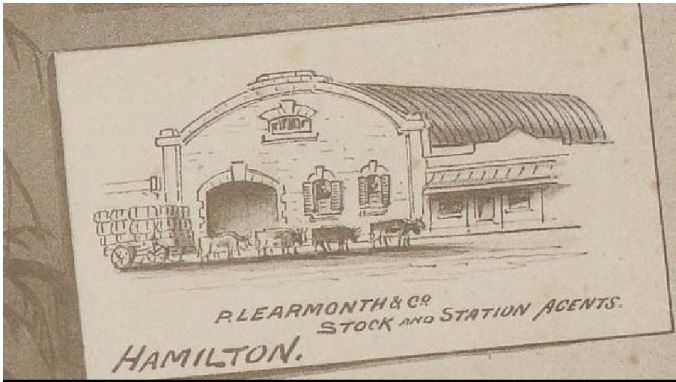
P. LEARMONTH & CO. STOCK & STATION AGENTS. GARY STREET, HAMILTON, WILLIAM TIBBITS (c1896). Image courtesy of the State Library of Victoria. Image no. H83.253/1 http://handle.slv.vic.gov.au/10381/67235

Peter Learmonth was a member of the Dundas Shire Council for nine years, serving as President for four successive terms, a record he still holds. He was also one of the first councilors of the Borough of Hamilton. Peter was one of the driving  forces behind the Hamilton & Western District Boys College and Alexandra Girls School, two schools that built Hamilton’s foundations as an education town.

HAMILTON COLLEGE. Image Courtesy of the State Library of Victoria, J.T.Collins Collection. Image no. H97.250/74 http://handle.slv.vic.gov.au/10381/229855

HAMILTON COLLEGE. Image Courtesy of the State Library of Victoria, J.T.Collins Collection. Image no. H97.250/74 http://handle.slv.vic.gov.au/10381/229855

The Hamilton Hospital was another of Hamilton’s institutions that Peter Learmonth helped set up and was President of the Hospital for eighteen years.

HAMILTON HOSPITAL. Image courtesy of the State Library of Victoria, Image no. H32492/2732 , http://handle.slv.vic.gov.au/10381/63599

HAMILTON HOSPITAL. Image courtesy of the State Library of Victoria, Image no. H32492/2732 , http://handle.slv.vic.gov.au/10381/63599

Two of  Peter Learmonth’s children married into families that were also influential in Hamilton ‘at the time. Eldest son James Allan Learmonth married Annie Thomson, daughter of John Thomson of Monivae in 1886.  A daughter Mary married the son of another prominent Hamilton man, David Laidlaw jnr, son of saddler and self-made man, David Laidlaw. Mary’s obituary appeared in April 2013 Passing of the Pioneers.  Messrs. Learmonth, Laidlaw and Thomson were a force to be reckoned with and include Peter’s brother, Alex Learmonth, also a man of much influence, and it is not surprising that they were able to grow Hamilton into one of Victoria’s most eminent towns.

Later in life, Peter purchased land in Mexico and gave his share to two of his sons. He also purchased Correa Estate” near Dunkeld and pursued pastoral interests with much success.

A supporter of the temperance movement, Peter was president of the Total Abstinence Society and the work of he and John Thomson, saw a Temperance Hall opened in Kennedy Street, Hamilton. They obtained an existing building and converted it to suit the needs of the Society.

As I write my Harman family history and delve into the local histories of Byaduk and Hamilton, Peter Learmonth comes up time and again. A Methodist, he knew my ggg grandfather James Harman and at one stage James was acting as an agent for farm machinery on Peter’s behalf.  James’ daughter Julia married George Holmes Jnr, the son of George Holmes who was a manager of the Grange Burn mill before managing the Byaduk mill. George Jnr worked at the Penshurst mill and took over the Sandford mill with his brothers.

Peter Learmonth passed away at his home at “Prestonholme” .  He was seventy-four.  Peter was buried at the Old Hamilton Cemetery.

GRAVE OF PETER LEARMONTH, OLD HAMILTON CEMETERY.
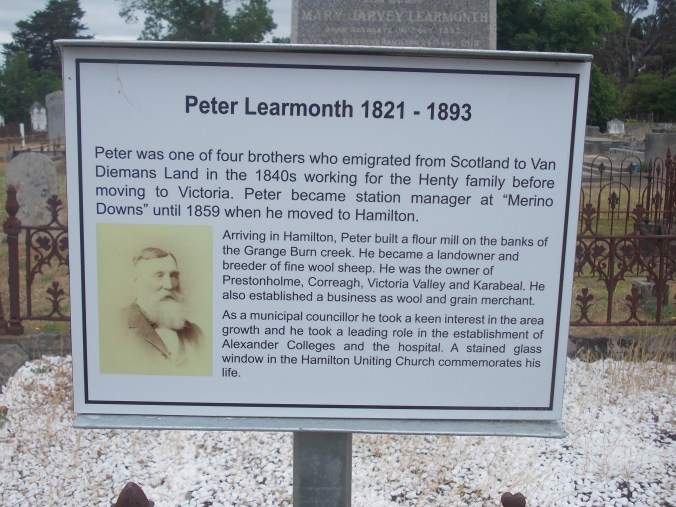
GRAVE OF PETER LEARMONTH, OLD HAMILTON CEMETERY.

PLAQUE ON THE GRAVE OF PETER LEARMONTH, OLD HAMILTON CEMETERY

PLAQUE ON THE GRAVE OF PETER LEARMONTH, OLD HAMILTON CEMETERY

With his prominence with the Methodist Church, a memorial window was unveiled at the Hamilton Wesleyan Methodist Church in McIntyre Street on Sunday 7 January 1900. A new Methodist church was opened in Lonsdale Street,  Hamilton in October 1913, and the window was installed there.

020

THE PETER LEARMONTH MJEMORIAL WINDOW, HAMILTON UNITING CHURCH, FORMALLY HAMILTON METHODIST CHURCH

Sources:

Dundas Shire Centenary, 1863-1963. Hamilton Spectator for the Dundas Shire Council, [Hamilton, Vic.], 1963.

Garden, Donald S. (Donald Stuart) and Hamilton (Vic.). Council Hamilton, a Western District history. City of Hamilton in conjunction with Hargreen, North Melbourne, 1984.

Glenelg & Wannon Settlers (website)

Macdonald, Anita Mariposa : a story of the Learmonths of western Victoria and Mexico, 1834-1930. Heatherleigh Publishing, [Melbourne], 1982.

John SYMONS: Died 10 July 1914 at Hamilton. Born in Cornwall around 1828, John Symons’ trade was ship’s carpenter and after his arrival at Portland in 1854, his skills were in demand with much building work required. From Portland, John moved to Balmoral before settling at the Wannon, near Hamilton. John farmed but was also a contractor for the Roads Board and later the local Shires. One of his most important works in the district was constructing the bridge over the Wannon River at Redruth, a necessity to enable travel from Hamilton to Coleraine and beyond. Timber for the bridge was cut using pit saws and John did much of that work himself. During his marriage, John and his wife raised eleven children with seven still living at the time of his death.

William DUNN: Died 1 July 1914 at Box Hill. William Dunn arrived in Victoria in 1855 from Somersetshire aboard the Raven’s Craig.  After two years in Geelong, he rode by horseback to Hamilton, his home for the next forty-four years.  As a bricklayer and builder, he constructed the Victoria and Colonial banks in Hamilton with William Holden and  Budock Vean, a home in French Street, Hamilton still standing today.  A devout Methodist, he held various positions within the church.

FORMER BANK OF VICTORIA, GRAY STREET, HAMILTON. Image courtesy of the J.T. Collins collection, State Library of Victoria. Image no. H97.250/89 http://handle.slv.vic.gov.au/10381/230031

FORMER BANK OF VICTORIA, GRAY STREET, HAMILTON. Image courtesy of the J.T. Collins collection, State Library of Victoria. Image no. H97.250/89
http://handle.slv.vic.gov.au/10381/230031

Jane DONNELLY: Died 1 July 1914 at Hawkesdale. Born in Ireland around 1834, Jane Donnelly arrived in Australia in the 1860s, settling at Myamyn. She married William Walshe and they raised six children. In the meantime, Jane established the Foresters Hotel at Myamyn and ran a store to cater for the many carriers who used the town as a stopover on their travels.  After the death of her husband, Jane remarried to William Jenkins in 1883 and for a time ran the former Victoria Hotel at Portland.

John MUNRO: Died July 1914 at Hotspur. John Munro was born in Scotland around 1833 and sailed to Hobsons Bay aboard the Champion of the Seas in 1854. Gold must have been his primary reason for coming to Victoria as he spent time around the various diggings before travelling to New Zealand and the goldfields of Otago. After two years, he returned and took up residence at Portland and married in 1867. For many years, he was a storekeeper and post office operator.  He also engaged in farming pursuits and in the early 1890s took up land at Hotspur. At the time of his death, he left a widow and nine children. He was buried at the Hotspur Cemetery.

Alexander John McLEAN: Died 23 July 1915 at Hamilton.  Alexander McLean was born in Scotland around 1836 and arrived in Sydney as a three-year-old with his parents. They later moved to Victoria, taking up residence at Tower Hill. From there, Alexander went on to Myamyn and then Macarthur where he was a founding member of the Methodist Church.  Alexander enjoyed telling stories of the pioneer days, before bridges spanned creeks or railways traversed the countryside.  Alexander and his wife had nine children.

Sarah Ann FARNHAM: Died 21 July 1916 at Hamilton. Born in Somersetshire, England around 1839, Sarah Ann Farnham arrived at Portland in 1858. She married Andrew Lockie at Portland in 1860 and by 1866 they had moved to Hamilton were Andrew ran a saddlery business.  Leaving a family of six children and her husband, Sarah Ann was buried at the Hamilton Old Cemetery.

Mary SAVIN: Died July 1918 at Muddy Creek. Mary Savin was born in Oxfordshire and sailed to Victoria with her parents in 1853.  Around 1855, the family travelled north to Muddy Creek where they settled. Two years later, Mary married John Addinsall and they had a family of twelve children. Like many of the early settlers at Muddy Creek, Mary was a Methodist and it was in a crowded Muddy Creek Methodist Church where Mary was given her last farewell.

John HUXLEY: Died 21 July 1918 at Portland. John Huxley was born in Portland around 1863. During the 1890s, John travelled to Western Australia, lured by the discovery of gold, but unlike the other July pioneers who chose to seek their fortunes, John struck gold in a big way. John and several other men discovered the rich Londonderry mine at Coolgardie, Western Australia. Having made his fortune, John returned to Victoria and purchased the Straun Estate at Merino. A keen racehorse owner, one of John’s big successes came less than a year before his death, when his horse the Ruralist, trained by James Agnew of Hamilton, won the Great Western Steeplechase at Hamilton in September 1917. The horse was also a two-time Brierly Steeplechase winner at Warrnambool.  John passed away at his seaside home Kenly at Portland and was buried at the South Portland cemetery.

Christina Emily FORD: Died 26 July 1931 at Hamilton. Christina Ford was born in Macarthur in 1880 into a well-known pioneering family. In 1905, she married William Baker and they moved to Portland and  raised nine children. Christina was a keen volunteer for the Portland Football Club and was a member of the Australian Women’s National League.

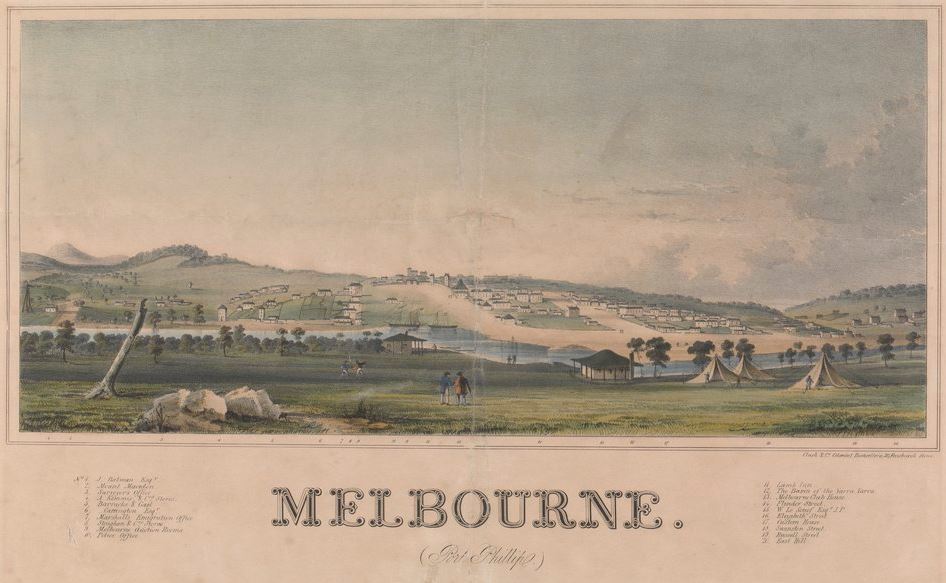
Charles HOLDER: Died 21 July 1922 at Warrnambool. The story of Charles Holder’s life appeared in the Portland Guardian on 28 September 1931, nine years after his death and it gives a great account of Melbourne and Victoria in the 1840s. Charles Holder was born in Bristol, England around 1838 and from the moment he set sail on the Wardshipton as a three-year-old with his parent and siblings, his great pioneering life had begun. The voyage in 1841, with almost 300 other immigrants was harsh with twenty-four deaths including twenty-two children.  hree of those children were Charles’ young sisters. Arriving at Hobson’s Bay, Charles, his parents and two remaining siblings, took a steamer along the Yarra River to Melbourne.

MELBOURNE 1841. Image Courtesy of the State Library of Victoria, Image no. H6262/2 http://handle.slv.vic.gov.au/10381/87604

MELBOURNE 1841. Image Courtesy of the State Library of Victoria, Image no. H6262/2 http://handle.slv.vic.gov.au/10381/87604

After spending time on stations around Melbourne, including Dandenong as a boy and young teenager, Charles made his way to the Western District, working at The Gums between Caramut and  Penshurst. By that time, it was the early 1850s, and Charles headed to the Bendigo diggings but like so many his luck was out and he returned to the west of the state, working at Grassmere near Warrnambool. In the early 1860s, he selected his own land at Cooramook and remained there for the rest of his life.

An obituary in the The Register (Adelaide) on September 2, 1922 , published at the time of Charles’ death has further detail of his pioneering life.

Ellen OSBOURNE: Died 15 July 1934 at Hamilton. Born at Portland, Ellen Osbourne married local builder Thomas Cruse and they continued to resided at Portland. She raised a family and was a devoted member of the Church of England.  Prior to her death, Ellen had been ill for many weeks and as a consequence was admitted to Kia Ora Private Hospital at Hamilton.  Ellen needed a blood transfusion but unlike today when we take for granted stocks of blood at hospitals, in 1934 there wasn’t a Red Cross Blood Bank. Therefore, Ellen’s son donated the blood required for the transfusion.  Unfortunately, it was not enough to save his mother.

Passing of the Pioneers

The stories of the Western District pioneers continue with June Passing of the Pioneers.  Pioneer obituaries come from a woman who was the first European woman at Colac, a man who survived a shipwreck off Tasmania, and a Reverend who started his career as a journalist for the London Times. Look out for the July obituaries when Passing of the Pioneers celebrates a birthday.

Nicholas COLE: Died 22 June 1879 at Darlington. Born in England and heir to an estate in Plymouth, Nicholas Cole decided to try his luck in Australia and arrived in Sydney in 1839. During his voyage, he met another man Peter McArthur and together they sailed on from Sydney to Geelong. They became partners and took up the West Cloven Hills and Menningort runs at Darlington. Those early pioneers faced many hardships including the Black Thursday fires in 1851.  Nicholas, thought to be a descendant of “Old King Cole” the subject of the nursery rhyme of the same name, ran Merino sheep and built up a herd that produced high yields of good quality wool. 

"Pastoral Pioneers" The Australasian (Melbourne, Vic. : 1864 - 1946) 13 October 1934: 49 (METROPOLITAN EDITION). .

“Pastoral Pioneers” The Australasian (Melbourne, Vic. : 1864 – 1946) 13 October 1934: 49 (METROPOLITAN EDITION). <http://nla.gov.au/nla.news-article145242490&gt;.

More information about Nicholas is available on the links –  The Colac Herald 24 June 1879    The Cole Family at West Cloven Hills

Image courtesy of the State Library of Victoria

SHEARING SHED, WEST CLOVEN HILLS (1987) Image courtesy of the State Library of Victoria J.T. Collins Collection, La Trobe Picture Collection. Image no. H95.200/65 http://handle.slv.vic.gov.au/10381/217139

Elizabeth YOUNG: Died 11 June 1892 at Barongarook. Jean Young was born in Scotland in 1823 and as a girl sailed to Tasmania with her parents and her father worked as a solicitor in Hobart. In 1841, she married Hugh Murray. They moved to Geelong and Hugh, considered the founder of Colac, moved to that area, before Jean and her young son joined them, becoming the first European woman in the district.  She raised a family of fourteen children and endured the many hardships faced by early pioneer women in Victoria. Among other things, Jean and Hugh were founding members of the Colac Presbyterian church and Jean remained a pillar of the church during her life. Hugh passed away twenty-three years before Elizabeth in 1869.

George COXON: Died 20 June 1892 at Portland. George Coxon was born and married in England and in 1857 he and his family, including seven children, travelled to Victoria. After a short time on the Victorian goldfields, he took up farming pursuits in the Casterton district.  In his later years, he moved to Portland where he passed away.  A profile of George and his family his available on the SW Pioneers website –    http://www.swvic.org/sandford/coxon_george.htm

Lawrence McKENNA: Died June 1914 at Curlew Hill.  Lawrence McKenna was born around 1830 in Ireland and travelled to Adelaide around 1861. The South Australian explorer John Stuart was about to leave on a government funded expedition to cross the continent and Lawrence joined his party. Stuart eventually abandoned his attempt. After ten years on the goldfields of Victoria and New Zealand, Lawrence gained work at Woodhouse near Dunkeld in 1872. He took a trip back to Ireland in 1874 then returned to Dunkeld to marry Elizabeth Irwin and they settled at nearby Curlew Hill.  In 1900, he was badly burnt while trying to protect his property during bushfires and never fully recovered.

Sophia GERDTZ: Died 5 June 1914 at Hamilton. Sophia Gerdtz was born in Germany around 1831 and arrived in Melbourne during the early 1850s. Her family travelled to Hamilton, where few buildings stood. She first married Robert Thomson at Lyne Station in 1852 but was left a widow during the 1860s. She then married storekeeper Cavendish Neville.  Again widowed, she spent the last years of her life living with her son at Pierrepoint, just out of Hamilton.

 Bridget McNAMARA: Died 19 June 1914 at Tower Hill.  Born in Ireland around 1843, Bridget McNamara arrived with her parents to Port Fairy in 1852 and they settled near Farnham and later Dennington. In 1866 at Warrnambool, Bridget married Hugh Reilly, afterward settling at Southern Cross where they lived for the rest of their lives.

THE Roroit Sentine[?] AND Tower Hill Advocate. (1914, June 27). Koroit Sentinel and Tower Hill Advocate (Vic. : 1914 - 1918), p. 2. Retrieved July 1, 2014, from http://nla.gov.au/nla.news-article119554315

THE Roroit Sentine[?] AND Tower Hill Advocate. (1914, June 27). Koroit Sentinel and Tower Hill Advocate (Vic. : 1914 – 1918), p. 2. Retrieved July 1, 2014, from http://nla.gov.au/nla.news-article119554315

Reverend George Duke LEE: Died June 1915 at Hamilton. Born in Derbyshire, England around 1830, George Lee first worked as a reporter for the London Times in America. After briefly returning to England he sailed to Victoria aboard the Blue Jacket in 1853 and made for the Ballarat goldfields. He worked as a teacher but left after medical advice as his eye sight was failing. Instead, he went on a lecture tour for the Sons of Temperance Friendly Society through the Western District. While visiting Chetwynd he became interested in the teachings of the Presbyterian church and entered the Ministry. He was sent to the St. Johns Presbyterian Church at Cavendish where he remained for thirty years.

Image courtesy of the State Library of Victoria

ST JOHNS PRESBYTERIAN CHURCH, CAVENDISH (1974). Image courtesy of the State Library of Victoria J.T. Collins Collection, La Trobe Picture Collection. Image no. H94.200/605 http://handle.slv.vic.gov.au/10381/217138

When George retired around nine years before his death, he moved to Hamilton.

William ALFORD: Died June 1916 at Ellerslie. William Alford was born in England around 1831 and twenty-one years later he travelled to Australia. He was a steward on the ship he sailed aboard which wrecked off the Tasmanian coast. William and other passengers were able to reach shore on a dingy and they walked to Hobart without shoes. William then travelled to the goldfields of Victoria, working as a driver with the gold escort out of Ballarat and later driving the mail coach between Ballarat and Geelong. He moved to Ellerslie in the mid-1860s and he remained there for the remainder of his life. William was a caretaker of the local Mechanics Institute and was involved with the Ellerslie Football Club.

James WORLAND: Died 18 June 1916 at Warrnambool. James Worland was born in Melbourn, Cambridgeshire around 1851 and arrived in Port Fairy two years later with his parents and they settled in the Warrnambool district. When working age, James took a job at a tannery and later purchased his own tannery. William also took up many roles in the community including warden of the Christ Church and a founding member of the local branch of the Society of St. George. At the time of his death, he left a widow and nine children.

William DAVIDSON: – Died June 1917 at Woolsthorp.  Born in Aberdeen, Scotland, William Davidson arrived at Port Fairy in 1855. He first took up labouring at Minjah, a property near Hawkesdale before opening a store at Woolsthorpe. He later  then turned to dairy-farming.  William was known as “The Chaffer” around Woolsthorpe because he enjoyed having a tease.  A widower at the time of his death, William had twelve surviving children.

Passing of the Pioneers

Despite little time to devote to Western District Families as regularly as I would like, there is always time to remember the great pioneers of the Western District with the monthly Passing of the Pioneers. There is just a small band of pioneers for May, but they each have wonderful stories. Be sure to click on any of the links for more information, especially the link to the wonderful recipe and remedy collection of Mrs Eliza Duckmanton.

James HANKS: Died 21 May 1909 at Horsham. While James Hanks was not an old pioneer, he was from a large pioneering family. He was also my great grandmother’s brother-in-law. James was born at Branxholme in 1871, the son of Thomas Hanks and Sarah Ashton.  He married Ellen May Harman of Byaduk in 1901. James had worked in Horsham previous to his marriage and took Ellen to live there. He worked for Messrs Broadbent Bros., carriers of Horsham and by the time of his death, he was the head carter. James and Ellen had three children by 1909 and while Ellen was pregnant with a fourth, James fell ill with typhoid fever and died before their fourth child was born. Poor Ellen was exhausted when her husband’s died, caring for him, the three children, one of those also ill, and coping with pregnancy.

Michael COTTER: Died 10 May 1913 at Dunrobin. Michael Cotter arrived in Tasmania around 1844 and after ten years, travelled to Victoria spending time at the Bendigo and Ballarat diggings.  During the 1860s, he started farming at Branxholme and remained there until later in life when he farmed at Carapook.  For a detailed history of Michael including his wife Catherine McIntosh and children, follow this link to the SW Pioneers site  http://www.swvic.org/carapook/names/cotter.htm

Wilhelm PETSCHEL: Died May 1914 at Hamilton. Wilhelm Petschel was born in Saxonby, Germany was one of Hamilton’s earliest pioneers.  Arriving in Adelaide in 1848, he made his way to Portland before taking up a job as a groom at Heywood. He heard of the land sales at The Grange (Hamilton) and upon inspection of the land available was so impressed he purchased a block, declaring that day the happiest of his life. William married in 1856 and two children were born from the union. He was a founding member of the South Hamilton Lutheran Church (today part of the Hamilton Pastoral Museum)

SOUTH HAMILTON LUTHERAN CHURCH. Image courtesy of the State Library of Victoria. Image no. H97.250/65 http://handle.slv.vic.gov.au/10381/229921

SOUTH HAMILTON LUTHERAN CHURCH. Image courtesy of the State Library of Victoria. Image no. H97.250/65
http://handle.slv.vic.gov.au/10381/229921

Reverend Samuel FRASER: Died May 1914 at Terang. Born in Scotland around 1844, Samuel Fraser arrived in Terang around 1871 sick from consumption, but still able to take up his duties as Minister in the Parish of Mortlake, based at the Terang Presbyterian Church. His health improved and he remained in the role until his death forty-three years later.  Samuel was also the Honorary Treasurer of the Presbytery and clerk of the Presbytery. Among Presbyterians, it was considered a “model presbytery”. He married Miss Hamilton, the daughter of the Reverend William Hamilton of Mortlake and they had two daughters and four sons. Several obituaries were published and they appear on the following links.   http://nla.gov.au/nla.news-article119798095     http://nla.gov.au/nla.news-article119789693 

TERANG PRESBYTERAIN CHURCH. Image courtesy of the State Library of Victoria. Image no. H32492/3044 http://handle.slv.vic.gov.au/10381/63615

TERANG PRESBYTERIAN CHURCH. Image courtesy of the State Library of Victoria. Image no. H32492/3044 http://handle.slv.vic.gov.au/10381/63615

John DUCKMANTON: Died May 1915 at Dunkeld. John Duckmanton was born in Nottinghamshire, England around 1833 and arrived on the Yorkshire to Victoria about 1860, settling at  Dunkeld.  John was a carpenter and wheelwright and built the first state school at Dunkeld, among other buildings.  He belonged to the St Marys Church of England, sitting on the committee when the foundation stone of the church was laid and was an active member of the Loyal Duke of Edinburgh M.U.I.O.O.F.  He and his wife had a family of twelve and he left thirty-three grandchildren. I found an absolute treasure on the Museum Victoria website which is worth a look. John’s wife Eliza Womersley was a bush nurse and in 1870 recorded her recipes and remedies in a book, using handwritten notes and cuttings from other publications. The original book can be seen on the M.V. website on the following link – Eliza’s book.

Patrick BALKIN: Died 17 May 1916 at Hamilton. Born in Kilkenny, Ireland around 1831, Patrick Balkin arrived in Newcastle, N.S.W. aboard the Red Jacket. After two years, he arrived at Port Fairy and then on to the Grange (Hamilton) with his wife Hannah Quinlan. On arrival at the Grange, the town was only young, with just one hotel. They settled at their property Knockaney where they stayed for the rest of their lives. Patrick was a member of the Dundas Shire for twenty-two years and had a wish to advance his chosen place of settlement. Hannah predeceased Patrick and he left a family of two daughters and three sons.

Jane MASON: Died 14 May 1918 at Strathkellar. Jane Mason was born in Norfolk, England, and arrived in Portland in 1852 aboard the Marmion with her parents. The Masons settled first at Balmoral before moving close to Hamilton. In 1865, Jane married Robert Fraser of Glencoe, Hamilton. Around the beginning of the 20th century, they purchased Seesford at Muddy Creek. They retained the property until only months before Jane’s death when she moved to live with her daughter at Strathkellar.

OBITUARY. (1918, May 18). Hamilton Spectator (Vic. : 1914 - 1918), p. 4. Retrieved May 25, 2014, from http://nla.gov.au/nla.news-article119502066

OBITUARY. (1918, May 18). Hamilton Spectator (Vic. : 1914 – 1918), p. 4. Retrieved May 25, 2014, from http://nla.gov.au/nla.news-article119502066

Passing of the Pioneers

April Passing of the Pioneers includes one of the pioneers of the Presbyterian Church in the Coleraine district, a mother of fourteen children, several Shire Councillors and a successful storekeeper.

Thomas GOODWIN: Died 7 April 1914 at Rosebrook. Thomas Goodwin was born in Tasmania about 1833 and arrived at Port Fairy as a child. He farmed first in the Glenormiston district but when land became available at Farnham, he moved there. In his later years, he farmed at Rosebrook.  He left three sons and four daughters.

Letitia WILLIAMSON: Died 11 April 1914 at Koroit. Letitia Williamson was born in County Armagh, Ireland. She arrived in Victoria in 1857 and married James O’Neill in Melbourne the following year. They spent some time in Melbourne then moved to Koroit where James was a bootmaker. James passed away around 1903 and when Letitia passed away she left six children.

William QUILL: Died 13 April 1914 at Portland. William Quill was born at Werrangourt Station, Byaduk around 1845, but his family moved to Yambuk when he was a boy. After his marriage to Miss Doherty, William and his new bride settled at Macarthur. William was on holiday in Portland when he passed away.

Samuel KEEN: Died 21 April 1914 at Hamilton. Samuel Keen was born in Stafford, England around 1846 and came to Australia aboard the ship Helen about six years later with his parents. The family travelled to Hamilton by bullock wagon, where Samuel remained for the rest of his life.

Reverend William John GILLESPIE: Died 24 April 1914 at Hawthorn. Reverend Gillespie was born in Antrim, Ireland in 1826 and trained for the ministry in Belfast. He travelled to Australia in 1867 with his wife of five years, Mary Oliphant Morrison. The following year he took up position in charge of Coleraine, Casterton, Merino, and Digby Churches and remained in that role until 1902. During his time at Coleraine, he was president of the Coleraine debating club, and chairman of the Board of Advice, Mechanics Institute, and Railway League. With his health failing, the Reverend and his wife moved to Melbourne where he remained until his death. He was buried in the Coleraine cemetery.

GRAVE OF WILLIAM JOHN GILLESPIE AND FAMILY, COLERAINE CEMETERY

Arthur Grainger HILL: Died 7 April 1917 at Edenhope. Arthur Hill was born in Somersetshire, England and when he arrived in Australia he first settled in N.S.W. He came to Victoria to work with the Railway Department of Victoria. Around 1880, he was appointed Engineer of the Wannon Shire Council. Due to a successful period of employment with the Shire, upon his retirement, Arthur was awarded a bonus of a year’s wages.

Sarah MOFFATT: Died 22 April 1917 at Hamilton. Sarah Moffatt was born in Ireland around 1836 and arrived in Australia in the late 1850s. She married Peter Lewis and they had two sons, however, Peter passed away. She married Benjamin Chamberlain of Port Fairy and they had three daughters and one son. Sarah was buried at the Port Fairy cemetery. Another obituary appeared in the Hamilton Spectator on 27 April 1917.

George TRANGMAR: Died 25 April 1917 at Melbourne. George Trangmar was born in Brighton, England around 1828  and arrived in Victoria in 1849. He started in business with his brother James in Portland before opening a store in Coleraine in 1851. He remained in business there for twenty-five years and during that time was a member of the Wannon Shire, including some years as President. During the 1870s, he purchased the Toolang Estate near Coleraine for sheep farming.  He sold Toolang around the turn of the century and moved to Melbourne. He was buried at Coleraine Cemetery with his wife Matilda McKelvey.

GRAVE OF GEORGE TRANGMAR, COLERAINE CEMETERY

Thomas Lewis WYATTDied 15 April 1918 at Hamilton. Thomas Wyatt was born in London, England around 1831 and married at St., Brides Church, London in 1853. In 1855, Thomas and Mrs Wyatt. a young son and Thomas’ brother James, left Plymouth aboard the Anna Maria, arriving at Portland in February 1856.  He took up the trade of plasterer and his work took him to Mt. Gambier and Melbourne before he went into partnership in Hamilton. He was a founding member of the Portland Oddfellows lodge. Thomas left a widow, two sons and three daughters

Johanna STEVEN: Died April 1925 at Heywood. Johanna Steven was born near Glasgow, Scotland, and arrived in Victoria with her parents around 1860. Her father owned what was known around Portland as the “Wee Station” in South Portland,  a small acreage as up to date as a large pastoral station attracting visits by tourists to the town. Johanna married William Reid at Portland and they raised a family of fourteen children. Johanna and William were foundation members of the Heywood Presbyterian Church.

William PHILIP: Died April 1933 at Hamilton. William Philip was born around 1858 and was educated at the Hamilton Academy and Geelong College. After Geelong, he returned to the Western District and owned properties including Violet Creek, Kenilworth, and Mt. William. He was a member of the Dundas Shire Council for twenty years and was a member of the racing, golf, and swimming clubs as well as the Masonic Lodge. His support assisted the financing of the Hamilton War Memorial and local swimming pool.


Passing of the Pioneers

March Passing of the Pioneers shares obituaries of well-known residents of Hamilton, Heywood and Portland. They include the surveyor of Camperdown and yet another man who was at Blue Lake, Mt. Gambier the day Adam Lindsay Gordon took his famed leap.

Thomas BROOKS Died 7 March 1888 at Hotspur. At the time of his death, Thomas Brooks was one of the oldest inhabitants of the Heywood district, having arrived in 1853. His death was a result of an accident after sixty-two-year-old Thomas delivered a coffin to Hotspur from Heywood for the funeral of Mr Fidler. After the funeral, he returned home, only to fall from his horse. He received head injuries, from which he died. A contract worker for the local shire, Thomas was known as an eccentric and was referred to as “Old Tom Brooks”  For more information about Thomas see the South-West Victoria Pioneers website.

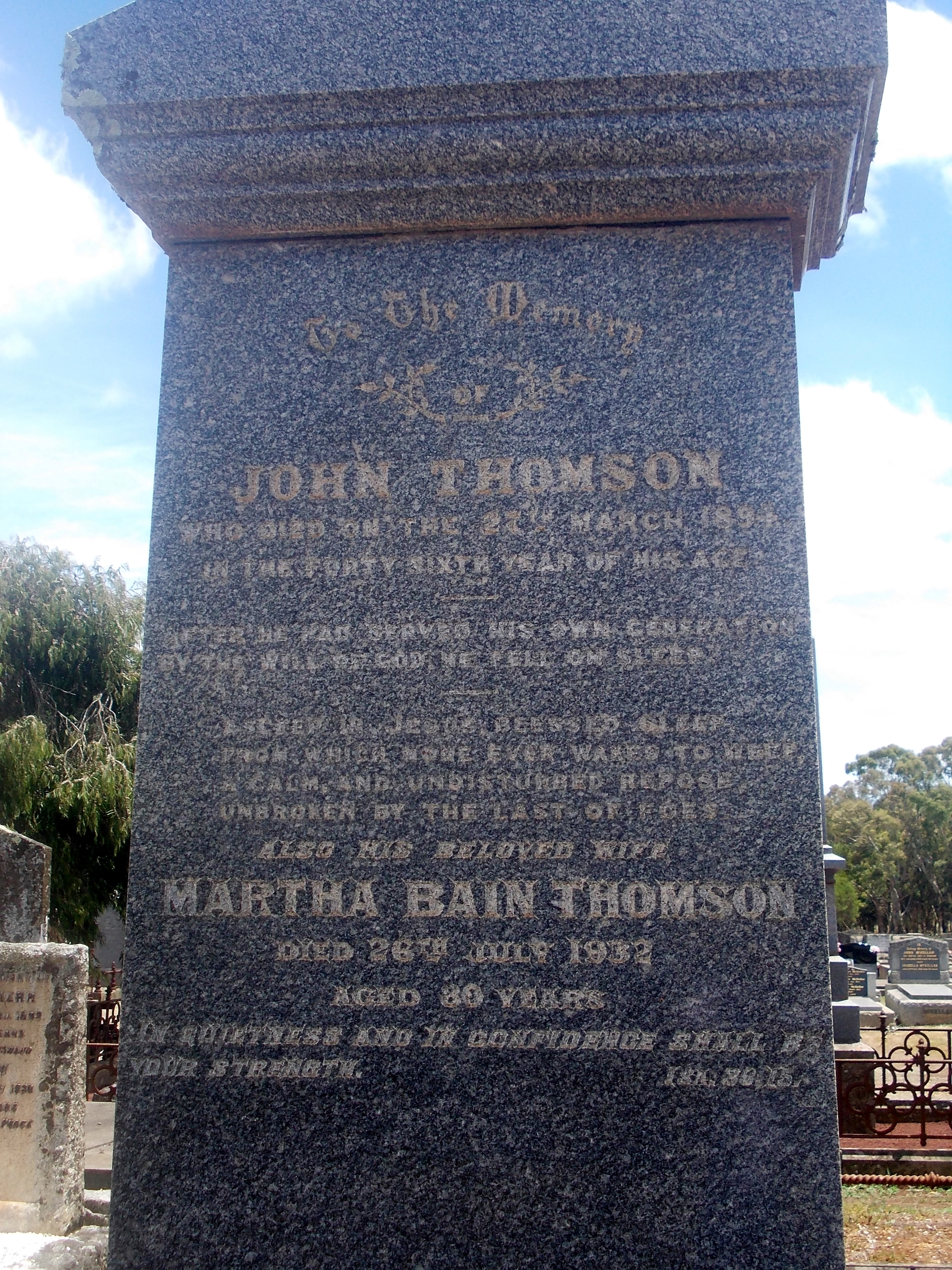
John THOMSON Died 27 March 1894 at Melbourne.  Anyone who lived in Hamilton and district prior to the late 1980s would know the name John Thomson as that was that name that adorned the front of one of Hamilton’s longest-running department stores John Thomson & Co of Gray Street, locally known simply as Thomsons. John Thomson arrived in Victoria from Scotland at a young age and was educated at Scotch College, Geelong, and the Hamilton Academy.  He joined his uncle and brothers, Alexander and William in the store, first established as an Iron store in 1866, and later became a partner.

In 1877, John married Martha Bain Brake,  He had a strong association with the Hamilton Presbyterian Church and when he died, aged forty-six, he was attending the Convention of the Presbyterian Fellowship Association in Melbourne.  A diabetic, he fell sick over the weekend and died as a result.

Advertising. (1953, July 21). The Argus (Melbourne, Vic. : 1848 - 1957), p. 21. Retrieved March 27, 2014, from http://nla.gov.au/nla.news-article23256981

Advertising. (1953, July 21). The Argus (Melbourne, Vic. : 1848 – 1957), p. 21. Retrieved March 27, 2014, from http://nla.gov.au/nla.news-article23256981


Robert Dunbar SCOTT: Died 7 March 1898 at Surrey Hills. Robert Scott was born in Scotland and he and his wife arrived in Victoria around 1851. Robert was employed as a land surveyor, his first job to survey the western part of Port Phillip.  He set up camp near what would become the town of Camperdown and set about laying out a new township. He named the first streets, including Manifold Street after the Manifold brothers.  He selected land on the banks of Lake Gnotuk and established the property, Gnotuk Park

LAKE GNOTUK. Image courtesy of the State Library of Victoria http://handle.slv.vic.gov.au/10381/289329

Robert was a member of the local P&A Society and the Freemasons. In the late 1890s, he sold Gnotuk Park and let property at Craigieburn. He later moved to Melbourne establishing himself as a commission agent but lost money in the crash after the land boom. A further account of Robert Scott is on this link – A Link With The Past – Interview with David Scott.

Mercy ERRI: Died 26 March 1932 at Cobrico. Mercy Erri was born in England and arrived in Victoria with her parents in 1857. Her father started in business in Camperdown, one of the early pioneers of that town. Mercy trained as a nurse and was a Sunday School teacher. In her later years, she became an invalid, confined to her bed, but she continued to produce beautiful needlework, even with failing sight. Mercy was eighty-eight years old when she died. She never married.

James MOLLOY: Died 25 March 1937 at Portland. James Molloy arrived in Portland with his parents aboard the British Empire when he was eleven. He went to school at All Saints school in Portland and during those years spent time with William Dutton extracting oil from whale blubber. He was then employed by Edward Henty at Narrawong. His next job was for the Bell’s at Heywood, training racehorses, his greatest success winning the Great Western Steeplechase at Coleraine.  Apparently, he was with Adam Lindsay Gordon on the day Gordon took his leap at Blue Lake, Mt Gambier. He later returned to Portland, working as a storeman and a waterside worker. James married Mary Beglen and they had three sons and two daughters.

David Edmund BATES: Died 5 March 1938 at Casterton. David Bates was born at Narracorte before moving to Casterton with his parents when six. He was educated at the Casterton school before becoming an apprentice draper with Mr Mills.  David was an athlete and once ran second in the Stawell Gift. He took a great interest in the public affairs of Casterton and served as secretary on the Casterton Hospital board.

Eliza MOORE: Died 24 March 1939 at Colac. Eliza Moore was born in Ireland in 1854 and travelled to Victoria as a child aboard the Chance. Her parents settled at Port Fairy and later at Woodford. Eliza married Alexander Russell at Warrnambool and they farmed at Dennington. They then moved to Colac where they remained until Eliza’s death. In her younger years, Eliza was an excellent horsewoman and was devoted to the Church throughout her life.

Daniel FENTON: Died 17 March 1943 at Camperdown. Daniel Fenton was born in Camperdown in 1860 and was the first child baptised at the St. Andrews Presbyterian Church in the same year. He continued his association with the church for the duration of his life. Educated at Camperdown State School, he spent his entire working life as a dairy farmer. He married Mary Ann Shenfield of Cobden and five children were living at the time of Daniel’s death.


Passing of the Pioneers

When an obituary has only a female pioneer’s married name, I do like to find their maiden name. This month, there was one such pioneer, Mrs Susan Sloan. After a quick search, I found on her death record her father’s name recorded as Francis Sloan. As I don’t want to make assumptions based on a death certificate, I will continue to call her Mrs Susan Sloan, however, I will keep trying to find her maiden name in the future as I have an interest in Susan as you will see in her obituary below.

Marks DAFFY: Died 22 February 1902 at Cundare. Marks Daffy was born in County Clare, Ireland, and arrived in Melbourne in 1857. He spent his first five years in the colony around the Barrabool Hills near Geelong, working on various farms.  With money saved, Marks selected land in the Colac district after the passing of the 1862 Duffy Lands Act. He set about building a fine dairy farm, using his good eye for stock to select the best dairy cows.  He gave up dairy-farming after twenty-five years and settled into an “easier” life as a grazier.  In 1887, after dissatisfaction with the Colac Shire, he ran for a seat which he won. Around eighteen months before his death, a fall from his buggy eventually left him bedridden and ultimately claimed his life.  His funeral procession was a mile long and was the largest to arrive at the Cundare cemetery.

William MOODIE:  Died 25 February 1914 at Coleraine. William Moodie arrived in the Coleraine district with his Scottish parents at the age of six weeks around 1841. His father took up the property Wando Dale at Nareen and so began William’s life on the land, breeding some of the finest wool stock. After taking over the property from his parents, he built the current Wando Dale Homestead (below) in 1901.

“WANDO DALE”, NAREEN. Image courtesy of the J.T. Collins Collection, La Trobe Picture Collection, State Library of Victoria. Image No. H94.200/302
http://handle.slv.vic.gov.au/10381/217385

He also spent a good part of his seventy-three years in public life. He was a member of the Casterton Roads Board and the Wannon Shire Council. He was also involved with the P&A Society, the local Horticultural Society and St Andrews Church at Coleraine. William Moodie left a widow, seven sons and five daughters.

John KELLY: Died 7 February 1915 at Macarthur. John Kelly arrived from Tasmania, his birthplace, with his family when he was three years old. If John was eighty-five at the time of his death, it would mean that he arrived in Victoria in 1833, so I’m thinking it may have been a little later. Even still, he was an early arrival in the colony. John worked as a carrier with his brother, working the route between Geelong and stations as far west as Casterton.  He also ran a store at Yambuk for many years and took up property at Codrington.  He died at the home of his daughter Mrs Hindhaugh of Macarthur.

John MURRAY: Died 13 February 1915 at Hamilton. Born in Stirlingshire, Scotland, John Murray was a resident of Hamilton for over fifty years by the time of his death. His family arrived at Geelong aboard the Chariot of Fame and went directly to Hamilton. He spent much of his working life as a labourer and was a member of the Court Brotherhood of the Ancient Order of Foresters for over forty-five years. He was a widow and left five sons and one daughter from a family of twelve children.

Jane O’MAY: Died 17 February 1916 at Buckley Swamp. Jane O’May was born in Paisley, Scotland in 1822 and married William Kirkwood in 1842. William and Jane arrived in Portland in 1852 aboard the John Davis. They travelled by bullock dray to Warrock, near Casterton.

First Issue, August 20 1842. (1916, February 23). Portland Guardian (Vic. : 1876 - 1953), p. 2 Edition: EVENING. Retrieved February 22, 2013, from http://nla.gov.au/nla.news-article64013668

First Issue, August 20 1842. (1916, February 23). Portland Guardian (Vic. : 1876 – 1953), p. 2 Edition: EVENING. Retrieved February 22, 2013, from http://nla.gov.au/nla.news-article64013668

The Kirkwoods were hard-working pioneers and Jane left a large family at the time of her death.  Three daughters were still alive along with twenty-four grandchildren and twenty-one great-grandchildren. Jane’s grandson, William Kirkwood of the Hamilton South area, married my first cousin 4 x removed, Sarah Ann Reed.

James COWELL: Died 24 February 1917 at Mortlake. James Cowell was born in Cambridgeshire around 1838 and by 1868, had already established a butcher’s shop at Mortlake. He later became a road contractor for the local Shire. One of James’ three sons, Pte Harry Cowell, lost his life at Gallipoli.

Joseph WOMBWELL: Died 9 February 1918 at Casterton.  Arriving in Portland in 1853 aged seventeen years from Essex, England, Joseph Wombwell’s first job was at the Henty’s Muntham Station.  He married Betsy Ann Coulson in 1869, the daughter of Christopher Coulson and Mary Frances Stubbs and stayed in Merino until 1875. They then moved to Casterton and lived in a bark hut while Joseph ran a carrying business between Casterton and Portland. One claim to fame is that he delivered the “first load of grog” to the Sandford Hotel. The Hamilton Spectator also published a lengthy obituary for Joseph Wombwell

Susan SLOAN: Died 9 February 1918 at Hamilton. Susan Sloan was born in Glasgow, Scotland and after arriving in Portland in 1855, she went to Ararat where she married Thomas Sloan. They returned to Portland and ran a shipping business, but the trade was tough and they moved inland to Hamilton where there were greater opportunities, and they established a cordial business. Thomas died in 1910 and Susan continued to run the business until her death, after which time family members continued its operations until 1930. The Sloan’s cottage Whinhill in Pope Street, Hamilton was featured in an I’ve Lived in Hamilton, Victoria group post as it is a highly visible and known to most who have lived in Hamilton. None of us knew the history of the cottage and there is still more we would like to find out.  The cordial business operated behind the cottage.


John MOFFATT: Died 9 February 1926 at Chatsworth. John Moffatt was born in Scotland in 1854 and arrived in Victoria with his parents in 1872 and resumed his education at Geelong Grammar.  At age 19 he took up the running of the Burnewang Estate near Bendigo before he inherited Chatsworth House from his uncle John Moffatt in 1879. He also leased his uncle’s property Hopkins Hill from the estate’s trustees. John Moffatt was a sat on the Shire of Mt Rouse and was a member of the Landowner’s Council.

DEATH OF MR. JOHN MOFFATT. (1926, February 10). The Argus (Melbourne, Vic. : 1848 - 1957), p. 21. Retrieved February 28, 2014, from http://nla.gov.au/nla.news-article3733963

DEATH OF MR. JOHN MOFFATT. (1926, February 10). The Argus (Melbourne, Vic. : 1848 – 1957), p. 21. Retrieved February 28, 2014, from http://nla.gov.au/nla.news-article3733963

John Moffatt’s uncle, John Moffatt, has been a Passing Pioneer and his obituary offers more history about the Moffatt family.