Passing of the Pioneers

The Portland Guardian obituaries from August recognized several residents with very early links to the Portland district. It is well worth reading their obituaries in full.

Robert HEAZLEWOOD:  Died 3 August 1892 at Portland.  Robert was one of Portland’s oldest residents at the time of his death.  He had been in Portland for around 40 years arriving from Tasmania where he had resided since age 16.  Robert ran a farrier business and was considered the best of his trade in the town.

Thomas KEAN:  Died 8 August 1892 at Portland. Thomas arrived in Melbourne in 1843 and went to Portland in 1845 to take charge of the Customs boat.  He did leave for a time when he caught “yellow fever” and joined the hunt for gold.  Unsuccessful, he returned to Portland to resume his position on the Customs boat. and was also a Councillor on a few occasions.

Frederick SAUNDERS:  Died 11 August 1914 at Narrawong.  At eighty-eight years old, Frederick Saunders had been in Australia for eighty-three years.

Francis ROBERTS:  Died 5 August 1920 at Orford. Francis was born in Tasmania and came to Victoria as a nine-year-old.  He spent time at the Firey Creek diggings and selected land at Broadwater where he farmed for the most part of his life.

Eliza Ann MALSEEDDied 13 August 1920 at Myamyn.  Eliza Malseed epitomized the pioneering women of the south-west.  She arrived in Portland from Ireland with her brothers, later marrying a cousin, James Malseed.  She and her husband, along with a small group of pioneering families, forged a life on unsettled land around Cape Bridgewater.  She was remembered as widely read and extremely charitable.  She was eighty-five when she died.

John Read HEDDITCH  Died 12 August 1927 at Cape Bridgewater.  The Portland Guardian reported that John was a descendant of the Hedditch family who arrived in Adelaide in 1837 aboard The Eden.  Also, John was apparently the first white child to be born at the Henty brothers’ Bridgewater run.  He was born in 1847.

William Henry MILLS:  Died August 1931 at Trafalgar.  William’s obituary is an interesting one, not only for its insight into early Australian history, but it demonstrates the need to check the “facts” presented.  William was born in Port Fairy in 1848 and remained there before moving to Gippsland in the late 1870s.  His father was credited as being one of the early discoverers of the south-west of Victoria, arriving in 1825, two years before the Hentys.  The obituary reports that William’s grandfather was the secretary to “Captain Blyth (sic) the then Governor of Victoria”.  Of course, the obituary writer was talking of Captain William Bligh, whose official title was Governor of New South Wales.  Captain Bligh did have a nineteen-year-old secretary by the name of  Peter Mills.

Arthur Harold SUTTON: Died August 1935 at Portland.  This is a most glowing obituary and includes a description of the funeral service.  Arthur was only fifty-three at the time of his death, which shocked Portland.  His parents were Strathdownie pioneers, where Harold was born.  He served in WW1, ran a successful wool export business, and served on the Portland Council.  Over 500 mourners were at his funeral, with over 100 cars (remember this is 1935) following the cortege.  This is an extensive obit which includes details of his children.

Michael James MINOGUE:  Died August 1935.  Michael was the youngest son of Mr and Mrs Simon Minogue, early pioneers of Portland.  A natural horseman, he at one time trained thoroughbreds.

Frederick William BILSTON:  Died August 1935 at Sandford. Frederick was the son of Thomas and Annie Bilston who arrived in Victoria in 1836. Another son, George Yarra Bilston was reportedly the first white child born in Melbourne.  A sister born in 1840, was claimed as the first white child born on the Glenelg River.  Frederick was born in Heywood in 1849 while his parents were running the Heywood hotel.  He trained horses in his early life with the likes of Adam Lindsay Gordon.  He then became a bootmaker and then a carrier.  An expert blade shearer, Frederick would ride to N.S.W to work sheds.  His obituary includes stories of the 1851 bushfires, bushranger Frank Gardiner and high-jumping.

Passing of the Pioneers

The Portland Guardian was mindful of the contribution made by the early pioneers toward developing the south-west.  They offered regular items titled “Passing of the Pioneers” or “Passing Pioneers” and often mentioned in obituaries that “…one by one are old pioneers are passing”.  As early as 1889, they were lamenting the loss of the links to the early settlers and suggesting that the efforts of those who passed be recognised.

The Portland Guardian,. (1889, January 16). Portland Guardian (Vic. : 1876-1953), p. 2 Edition: EVENING. Retrieved July 18, 2011, from http://nla.gov.au/nla.news-article63591640

Established August 1842. The Portland Guardian,. (1899, July 7). Portland Guardian (Vic. : 1876-1953), p. 2 Edition: EVENING. Retrieved July 19, 2011, from http://nla.gov.au/nla.news-article63676630 MLA citation

In 1921, the paper spoke of the many unwritten histories that had gone before, but now we can see the Portland Guardian lived up to its charter of 1889,  successfully recording the histories of many of the local pioneers.  By doing so, they are now helping us learn more about our families and gain a sense of life in the early days of the Western District.  Of course, The Guardian was not alone.  References to the “passing pioneers” are found in most of the papers on the Trove website.

Obituaries are a secondary source as the information comes from the knowledge of those still living and I have noticed errors in obituaries of my family.  But they can offer leads to records you may never have thought of such as Masonic lodge records and local council records. Whatever you do or don’t get out of an obituary, no-one can deny they are often a good read.

July was a month when many “Passing of the Pioneers” columns appeared.  Cold winters in the southwest saw many of the older residents “cross the Great Divide” as the Guardian would put it.

Some of the more notable passing pioneers in the month of July were:

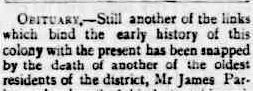
James PARKER:  Died 6 July1889 at Heywood. James PARKER’S obituary is an interesting read.  Born in Tasmania around 1810, he came to the mainland as a whaler. In 1842, he married Margaret NOLAN at Portland. Later he had some luck at the Creswick goldfields only to have an encounter with bushranger Captain Moonlight.

William TULLOH: Died 19 July 1889 at Portland.  This is a lengthy obituary of a Portland resident of nearly fifty years, whose death saw half-closed shutters on homes around the town.  Born in Scotland in 1812, he left a wife, four sons, and a daughter at the time of his passing.  I have found a site with more detail of William and his wife Eliza Mary KEARTON.

James BARNETT: Died 18 July 1892 at Portland.  James was known as “Old Barney” around Portland and while the Portland Guardian credits him as a pioneer, they make a judgement in saying that he did not make the most of his opportunities as other early settlers had done.  He married in 1851 to Elizabeth AUSTIN. Five children were living at the time of James’ death.

Alexander THOMSON: Died July 1897 at Hamilton. Scottish born Alex THOMSON was prominent around the Hamilton area as a Shire of Dundas Councillor for twenty-one years.  At the time of his death, he was the owner of Pierrepoint Estate near Hamilton and was also an active member of the Pastoral and Agricultural society.

Thomas Webb SMITH:  Died 29 July 1914 at Branxholme.  Thomas served on the Borough of Portland council and was mayor from November 1871-November 1873.  He was also a member of the Goodfellows and Freemasons.

Annie Maria HENTY: Died 2 July 1921 at Hamilton.  Annie was from the most famous southwest pioneering family of them all, the Henty’s. The daughter of Stephen HENTY, Annie married Hamilton stock and station agent Robert STAPYLTON BREE in 1874.  The Bree name is preserved in Hamilton with a much-used road of the same name in the town.  Their home Bewsall (below) once stood near the end of Bree Road in North Boundry Road.

HAMILTON. (1903, May 2). The Australasian (Melbourne, Vic. : 1864 - 1946), p. 27. Retrieved February 18, 2014, from http://nla.gov.au/nla.news-article138684187

HAMILTON. (1903, May 2). The Australasian (Melbourne, Vic. : 1864 – 1946), p. 27. Retrieved February 18, 2014, from http://nla.gov.au/nla.news-article138684187

Stapylton-Bree (2)

Ann Eliza KEEPING: Died 9 July 1921 at Portland.  Annie Eliza KEEPING arrived in Australia aboard the Eliza and married John FINNIGAN in 1857.  She was eighty-two at the time of her death.

Joseph Bell PEARSON:  Died 7 July 1922 at Portland. Yet another interesting character.  According to his obituary, Joseph was born on the voyage from England to Tasmania.  His family moved to the Retreat Estate near Casterton in 1844.  He was a noted horseman, with several good racehorses which he would ride himself.  One of his jumps racing rivals was Adam Lindsay Gordon.

Joseph was buried at the Hamilton (Old) Cemetery with his wife Mary Abbott and mother-in-law Martha Holdish (below).

Abbott

Sarah MARSHALL:  Died 7 July 1923 at Gorae West. Sarah was the wife of the late Richard BEAUGHLEHOLE and she died at seventy-three. Richard selected land at Gorae West and transformed swampland into flourishing orchards.  Sarah and Richard had twelve children.

Mary Thurza HEDDITCH: Died 1 July 1930 at Drik Drik. Mary HEDDITCH was born in Portland in 1844 and moved with her family to Bridgewater in 1846.  Her elder brother drowned when she was a teenager leaving her to take on some of his duties.  As a result, she became an accomplished horsewoman, helping her father with the cattle.  She married James MALSEED and together they had seven children.

Phillipa JOHNS: July 1931 at Portland.  Phillipa JOHNS, the daughter of a doctor, was herself something of a substitute doctor for those living in the Willenbrina area, near Warracknabeal.  Later she and her husband William DELLAR moved to the Portland district.  They had nine children.