Third Annual Great Genealogy Poetry Challenge

Genealogist Bill West has changed the title of his Great American Genealogy Poetry & Song Challenge to the Great Genealogy Poetry Challenge, giving those us from other countries to take part.  Thanks to Jill Ball for bringing this Challenge to my attention.

These are the guidelines I followed:

1. Find a poem by a local poet, famous or obscure, from the region one of your ancestors lived in. It can be about a historical event, a legend, a person, or even about a place (like a river)or a local animal. It can even be a poem you or one of your ancestors have written!  Or if you prefer, post the lyrics of a song or a link to a video of someone performing the song.

2. Post the poem or song to your blog (remembering to cite the source where you found it.)

3.Tell us how the subject of the poem or song relates to your ancestor’s home or life.

When I think of poetry and the Western District the name that comes to my mind is that of Adam Lindsay Gordon, poet, policeman, steeplechase jockey and daredevil.  However, many of Gordon’s poems could easily have been set in England.  The most obvious poem with a Western District theme is The Fields of Coleraine, which describes steeplechasing at the Coleraine racecourse, however, it doesn’t really give a feel for life in the area at the time.

I then came across a C.J. Dennis’ poem “When the Sun’s behind the Hill” from his book Blackblock Ballads and Later Verses, published 1918 when Dennis was living in Victoria.  The poem is about a  farming family and as many of my ancestors were farmers, right across Victoria, I thought it was appropriate.  While it is not as light and humorous as some of C.J. Dennis’ works, it is a lovely poem that describes the winding down of both the farm and the farmer at the end of a day.  It also reminds us a farmer’s day begins with the rising sun and ends “when the sun’s behind the hill…”

When the Sun’s Behind the Hill

There’s a soft and peaceful feeling
Comes across the farming hand
As the shadows go a-stealing
Slow along the new-turned land.
The lazy curling smoke above the thatch is showing blue.
And the weary old plough horses wander home’ard two ‘n’ two,
With their chains a-clinkin’, clankin’, when their daily toil is through,
And the sun’s behind the hill.

Then it’s slowly homeward plodding
As the night begins to creep,
And the barley grass is nodding
To the daisies, all asleep,
The crows are flying heavily, and cawing overhead;
The sleepy milking cows are lowing sof’ly in the shed,
And above them, in the rafters, all the fowls have gone to bed,
When the sun’s behind the hill.

Then it’s “Harry, feed old Roaney!”
And it’s “Bill, put up the rail!”
And it’s “Tom, turn out the pony!”
“Mary, hurry with that pail!”
And the kiddies run to meet us, and are begging for a ride
On the broad old “Prince” and “Darky” they can hardly sit astride;
And mother, she is bustling with the supper things inside,
When the sun’s behind the hill.

Then it’s sitting down and yarning
When we’ve had our bite and sup,
And the mother takes her darning,
While our Mary tidies up.
And Bess tells how the baldy cow got tangled in the wire;
And Katie keeps the baby-boy from tumbling in the fire;
And the baccy smoke goes curling as I suck my soothing briar,
When the sun’s behind the hill.

Then we talk about the season,
And of how it’s turning out,
And we try to guess the reason
For the long-continued drought.

Oh, a farmer’s life ain’t roses and his work is never done:
And a job’s no sooner over than another is begun.
For he’s toiling late and early from the rising of the sun
Till he sinks behind the hill.

But it grows, that peaceful feeling
While I’m sitting smoking there,
And the kiddies all are kneeling
To repeat their ev’ning prayer;
For it seems, somehow, to lighten all the care that must be bore
When the things of life are worrying, and times are troubling sore;
And I pray that God will keep them when my own long-day is o’er,
And the sun’s behind the hill.

C.J.Dennis

from

Backblocks, Ballads and Later Verses, 1918

Surname Saturday Meme: Names, Places and Most Wanted Faces

Following the lead of U.S. genealogist Thomas MacEntee and in turn Australian genealogist Jill Ball, I decided to take part in this meme.  It interested me more than others I had seen, because not only would I get my names “out there”, I also got the chance to do a stocktake.  What an interesting exercise it was.  With some names, I did not have to look up the details as I knew them so well, others I had to refer back to my tree, and for one name, I had basically nothing.

It’s easy to develop favourite families, with some just oozing information making them more compelling to research.  The Harmans are an example of that.  The Riddiford line was probably my least favourite and despite it being my family name, I tended to pass it by. When I did start seriously researching them, I found loads of information.  This avoidance was probably due to them being 20th-century immigrants and my history interests lie in 19th century Australia.  I had no choice but to delve into 18th and 19th century English history and I have really enjoyed it and learnt a lot and I continue to do so.  I am glad I got over my previous mindset.

I also have more Irish links than I normally given myself credit for and I can now clearly see the branches I have been neglecting.

I have included the surnames of my great great grandparents, but I have taken the places and dates back a little further.  If not, I would have had entries with just a single place in Australia with no indication of where the family originated from.

To take part, just do the following at your own blog, then post a  link in the comments at Thomas’ blog post

1. List your surnames in alphabetical order as follows:

[SURNAME]: Country, (State or County, Town), date range;

2. At the end, list your Most Wanted Ancestor with details about them.

MY NAMES, PLACES AND MOST WANTED FACES:

BISHOP:  England (Dorset, Weymouth) 1825-1850; Australia (South Australia, Adelaide) 1850-1854;  Australia (Victoria, Byaduk)1854-1950

COMBRIDGE:  England (Huntingdonshire) 1833-1855;  Australia (Victoria, Geelong 1855-1935);  Australia (Victoria, Grantville) 1900-1950

DIWELL:  England (Sussex) 1825-1852;  Australia (Victoria, Casterton) 1852-1893;  Australia (Victoria, Hamilton) 1893-1940

GAMBLE:  England 1808-1840;  Australia (Victoria, Geelong) 1840-1850;  Australia (Victoria, Colac), 1850-present

HADDEN:  Scotland (East Lothian) 1823-1852;  Australia (Victoria, Geelong) 1852-1865;  Australia (Victoria, Cavendish) 1865-1975;  Australia (Victoria, Hamilton) 1900-present

HARMAN:  England (Cambridgeshire, Melbourn) 1800-1854;  Australia (New South Wales) 1852-1857;  Australia (Victoria, Port Fairy) 1852-1863;  Australia (Victoria, Byaduk) 1863-present

HODGINS:  Ireland (Fermanagh) 1816-1853;  Australia (Victoria, Colac) 1853-1940

HUNT:  England (Middlesex, Poplar) 1834-1854;  Australia (Victoria, Geelong) 1854-1865; Australia (Victoria, Collingwood) 1867- ;  Australia (Victoria, West Gippsland) 1880-1936

JELLY:  Ireland (Down, Drumgooland) 1815-1845;  England (Lancashire, Manchester) 1845-1854;  Australia (Victoria, Casterton) 1854-1900

KIRKIN:  England (London, Lambeth) 1859-1940;

MORTIMER:  England (Berkshire, White Waltham) 1823-1852;  Australia (Victoria, Cavendish) 1865-1930

PIDDINGTON:  England (Buckinghamshire, Cuddington) 1700s-1880

RIDDIFORD:  England (Gloucestershire, Thornbury) 1600s-present; England (Buckinghamshire, Cuddington) 1846-present;  England (London, Lambeth) 1896-1913; Australia (Victoria, Ballarat) 1913-present

WEBB:  England (Surrey, Clapham) 1845-1878; England (London, Lambeth) 1878-1900

WHITE:  England (Kent, Broadstairs) 1857-1876;  Australia (Victoria, Grantville) 1876-1950

WYATT:  ???

MOST WANTED ANCESTOR:

When I started this I thought my most wanted ancestor would be gg-grandmother Mary Jane HODGINS.  She was born in Ireland around 1849, immigrated with her parents West HODGINS  and Martha BRACKIN in 1853 aboard the Marion Moore. She married Matthew GAMBLE in 1871 at Colac.  That is all I know except for the accident which saw Mary Jane lose the top of her finger, as mentioned in the post Misadventures, Deaths and Near Misses.

However, when I looked at the completed list it seemed clear it had to be Jane WYATT, another gg grandmother and second wife of Herbert John COMBRIDGE.

I had previously found a birth for a Jane Wyatt born 1882, St Arnaud but this did not really add up, mainly because my Jane Wyatt married Herbert Combridge in 1895 in Gippsland.  If I searched the Australian Death Index 1787-1985, I find the death of Jane COMBRIDGE in 1909 at Grantville but with no approximate birth year or parents.

As I was writing this post, I decided to have a look around for Jane again.  I checked for people researching Combridges at Ancestry.com and found a reference to Jane’s birth in 1873.  I searched again with this birth date and that threw up something interesting.  There is a Jane Wyatt listed on the Victorian Index to the Children’s Register of State Wards, 1850-1893.  Her birth date is given as 1873, but no birthplace.  This could be my Jane and it could explain the lack of parent names and birth year on the Death index.

So, thanks to this exercise, I may have come a step closer to finding Jane Wyatt, but if she was a ward of the state, I may not be able to find anything else about her.  So if anyone has information on Mary Jane HODGINS and her family, I would love to hear from you!

In the News – November 16, 1929

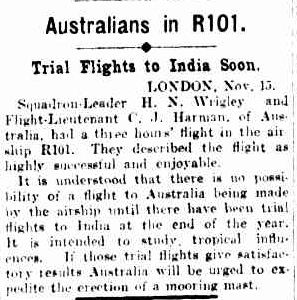
On this day in 1929, The Argus reported that my gg uncle Charles James Harman, then a Flight Lieutenant with the RAAF, working as a Liaison Officer in London, had the once in a lifetime opportunity to ride in an airship, the R101.

I was fairly happy when I found this article at Trove as Charles is one of my favourite and most interesting relatives and I have enjoyed discovering some of the adventures he had during WW1 and also post-war.  Life for Charles in London was a long way removed from growing up in Byaduk and his stories far more romantic than those of his relatives back home… new ploughs,  prizes at agriculture shows, the rain etc.   I also couldn’t wait to tell my Nana about Charles’ airship experience.  He was her uncle, but she said she never met him.  She knew he had gone to war, but that was about all she knew, or as was her way, that was all she was going to tell me.

Australians in R101. (1929, November 16). The Argus (Melbourne, Vic. : 1848 – 1956), p. 21. Retrieved November 14, 2011, from http://nla.gov.au/nla.news-article4050667

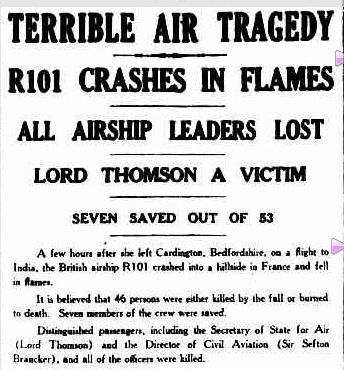
The R101 was still in testing when Charles Harman had his ride, with its construction completed only a month earlier.  It was close to 237 metres long and was like a luxurious hotel in the air. But the R101 never made it to the trial flights in India.  In fact, the airship was en route to India when it crashed over France on October 4, 1930.

TERRIBLE AIR TRAGEDY. (1930, October 6). The Argus (Melbourne, Vic. : 1848 – 1956), p. 9. Retrieved November 15, 2011, from http://nla.gov.au/nla.news-article4204227

Coincidentally, one of those killed was also an Air Liaison officer with the RAAF, working in the same office as Charles in London, Squadron Leader William Palstra.

TERRIBLE AIR TRAGEDY. (1930, October 6). The Argus (Melbourne, Vic. : 1848 – 1956), p. 9. Retrieved November 15, 2011, from http://nla.gov.au/nla.news-article4204227

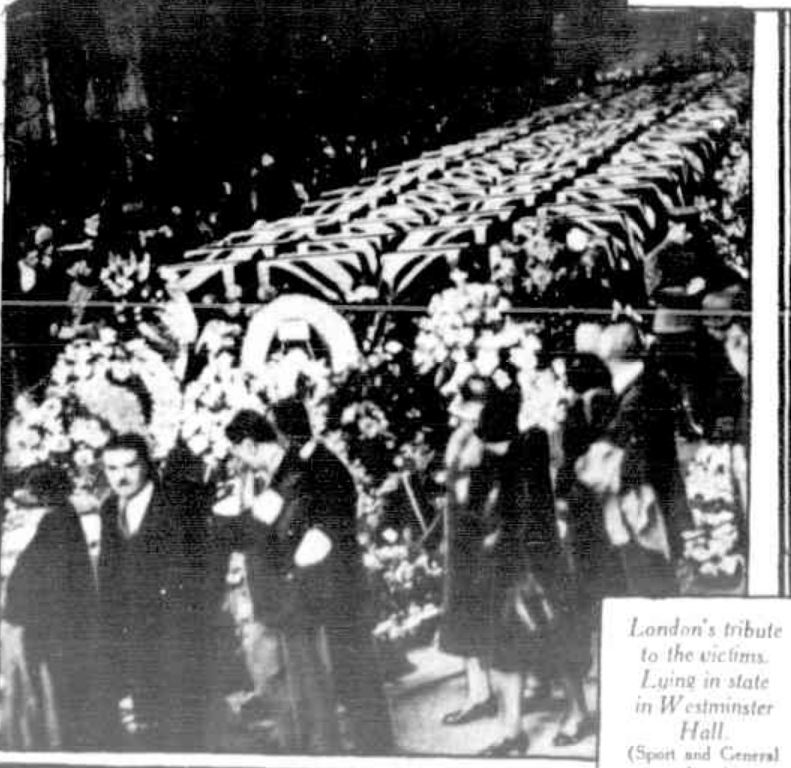
Charles represented the Australian Air Board and the Controller of Civil Aviation at the funeral of the victims.

“AIR DISASTER” Western Argus (Kalgoorlie, WA : 1916 – 1938) 14 October 1930: 13. Web. 10 Aug 2018  http://nla.gov.au/nla.news-article36408720


“R101 DISASTER.” The Australasian (Melbourne, Vic. : 1864 – 1946) 15 November 1930: 34 (METROPOLITAN EDITION). Web. 15 Nov 2018 http://nla.gov.au/nla.news-article140835576

The following video is fantastic.  It shows both stills and moving images of the R101 including the luxurious facilities inside.

In the News – November 16, 1922

The Portland Guardian of 16 November 1922, reported much excitement surrounding the town’s birthday celebrations beginning that day, including “Back to Portland” celebrations.  Former residents had started to return and reacquaint themselves with old friends.

Portland’s Gala Week. (1922, November 16). Portland Guardian (Vic. : 1876 – 1953), p. 2 Edition: EVENING.. Retrieved November 15, 2011, from http://nla.gov.au/nla.news-article64027013

One article Coming Home is a reminder of how useful newspapers are in assisting our research.  Included is a list of all those who had indicated they would be attending the reunion.

Each name includes the present town of residence, some with an address.  The following are just a few of the names:

(1922, November 16). Portland Guardian (Vic. : 1876 – 1953), p. 4 Edition: EVENING.. Retrieved November 14, 2011, from http://nla.gov.au/nla.news-page6065696

Other well-known names included Henty, Holmes, Kittson, Malseed, and Silvester.

Advertising. (1922, November 16). Portland Guardian (Vic. : 1876 – 1953), p. 2 Edition: EVENING.. Retrieved November 14, 2011, from http://nla.gov.au/nla.news-article64027014

Advertising. (1922, November 16). Portland Guardian (Vic. : 1876 – 1953), p. 3 Edition: EVENING.. Retrieved November 15, 2011, from http://nla.gov.au/nla.news-article64027000

Not Such an Odd Fellow

George Hall Harman, born in Melbourn, Cambridgeshire in 1835, was the fifth child of Joseph Harman and Sarah Mulbury.  His middle name “Hall”  came from the maiden name of his paternal grandmother, Keiza Hall.  The 1851 English Census shows 16-year-old George working as an errand boy and living at the home of local publican and farmer, William Dearman.  The following year he saw his older brother James leave for Australia and two years later in 1854, he had his own opportunity to travel to Australia.  With his two younger brothers, Jonathan and Reuben, they boarded the “Kate” at Southampton on 3 August 1854 bound for Sydney, arriving on November 7.

I lose track of George for several years until 1859 when he and brother James advertised land for sale, Boodcarra Farm at Port Fairy, then known as Belfast. The advertisement is listed in the Port Fairy/Belfast News Index 1859.  In 1860, George married Rebecca Graham, the daughter of  Thomas Graham and Margaret Paterson.

Compared to his brothers, George & Rebecca had a relatively small family of five children:

Walter Graham – Birth: 1862 in Port Fairy; Marriage:  1887 to Ann GRAY; Death: 1930 in Kyneton, Victoria.

Edith – Birth: 1865 in Byaduk;  Death: 1866 in Byaduk

Thomas Charles – Birth: 1867 in Port Fairy; Marriage:  1900 to Elizabeth Margaret BUDGE; Death: 1954 in Victoria

Mary Helena – Birth: 1870 in Port Fairy; Marriage:  1911 to Samuel ROGERS;  Death: 1920 in Sale, Victoria

Herbert George – Birth: 1878 in Port Fairy; Marriage: 1905 to Aimee Elizabeth HEAD; Death: 1955 in Wangaratta, Victoria

George and Rebecca began their married life in Port Fairy but moved to Byaduk with the other members of the Harman family around 1863.  It appears that George preferred the seaside town and they returned to Port Fairy by 1867.

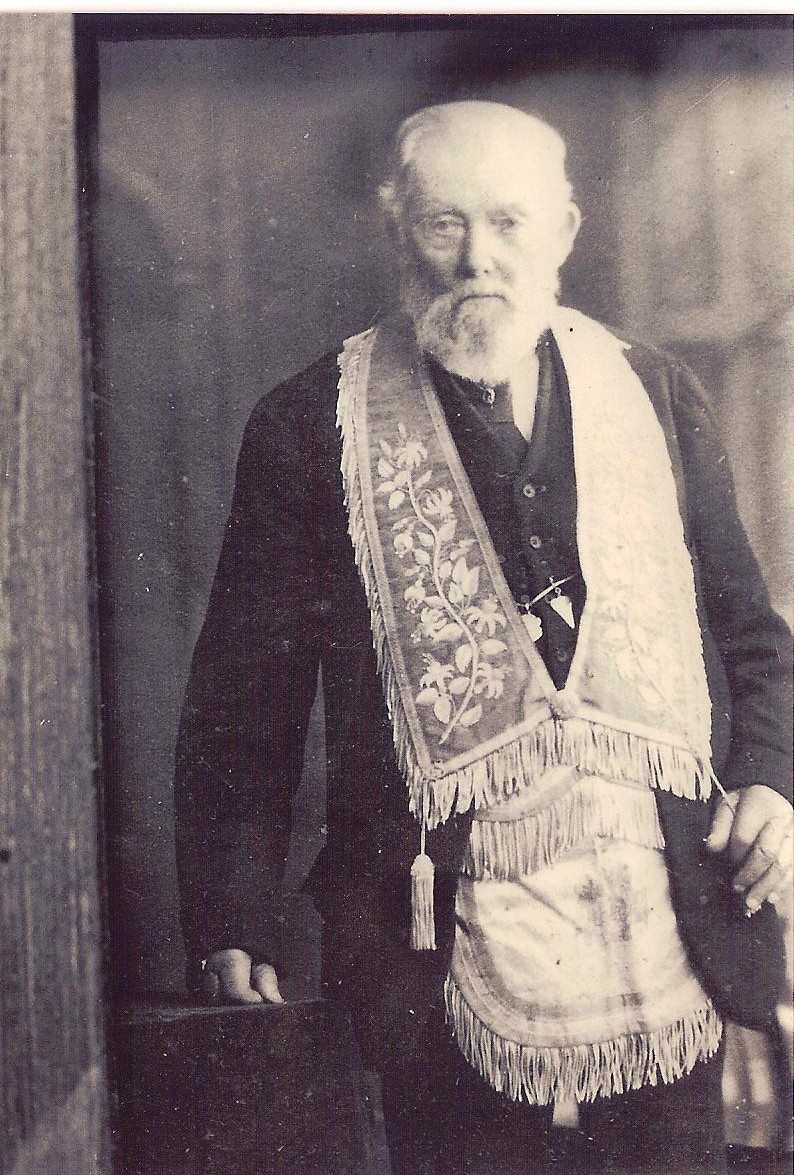
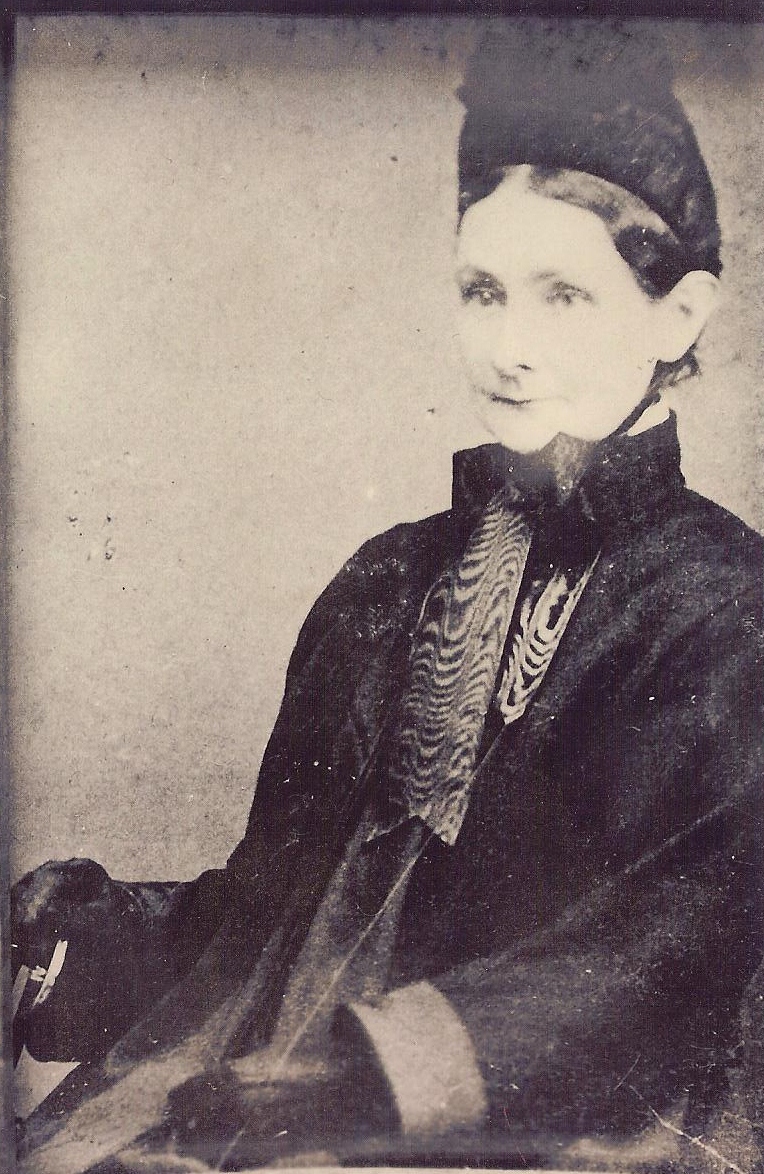
On a visit to Port Fairy, I called in at the Port Fairy Historical Society in the town’s former Court House.   I noticed old portraits on a wall.  Amongst the faces were George and Rebecca Harman.  The Society has a copying service and I was able to arrange for copies to be sent.

George Hall HARMAN, Original held by Port Fairy Historical Society

Rebecca GRAHAM, Original held by Port Fairy Historical Society

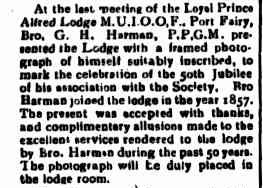
From the photo of George, it is obvious he was a Mason.  Turning to Trove, I was able to establish George was a member of the Manchester Unity Independent Order of Odd Fellows(M.U.I.O.O.F.).  I also found a lead to the possible origin of George’s photograph:

(1907, June 24). Portland Guardian (Vic. : 1876 – 1953), p. 3 Edition: EVENING. Retrieved November 9, 2011, from http://nla.gov.au/nla.news-page6026342

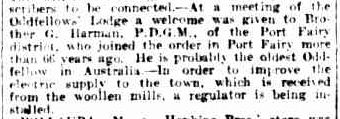
After Rebecca’s death in 1902, George remained in Port Fairy living in James, Gipps, and Sackville Streets.   His occupation varied from “gardener” to “independent means”.  He also spent time with his family as the 1914 Australian Electoral Roll shows, with him residing at the home of his daughter Mary and her husband Samuel Rogers in Wodonga.  He also spent time with his son, Herbert in Wangaratta as this article about the Wangaratta Odd Fellows Lodge in The Argus suggests:

COUNTRY NEWS. (1923, August 29). The Argus (Melbourne, Vic. : 1848 – 1956), p. 23. Retrieved November 9, 2011, from http://nla.gov.au/nla.news-article2007613

George passed away on September 14, 1931, at the ripe old age of 96.  Only two of his children, Thomas and Herbert,  were living at the time of his death.

Family Notices. (1931, September 16). The Argus (Melbourne, Vic. : 1848 – 1956), p. 1. Retrieved November 9, 2011, from http://nla.gov.au/nla.news-article4411246

George was buried at the Port Fairy Cemetery with Rebecca and baby Edith.

Grave of George, Rebecca and Edith Harman, Port Fairy Cemetery

Headstone of George, Rebecca and Edith Harman, Port Fairy Cemetery

I often think of George and the 29 years after Rebecca’s death until his own. He saw the passing of his daughter and son and two granddaughters.  Was it a lonely time or did his activities with the Odd Fellows and the visits to the homes of family members fill the void? I hope so because George was just a normal fellow who happened to be an Odd Fellow.

Off to the Melbourne Cup!

Melbourne Cup day is one of my favourite days of the year.  As a horse lover and a racing fan, it’s not the fashion and the glamour that draws me but rather the elusiveness and history of the prize.  To win the Melbourne Cup is the aim of anyone who has raced horses.  Just to have a runner in the final field of twenty-four is a dream of many.  With most winners comes a story. Some are passed on for generations, such as the stories of Archer, Phar Lap and more recently Media Puzzle.  This also adds to the romance.

This year marks the 150th running of the Cup, the race that stops a nation. But when did it become such an event?  When Phar Lap gave some certainty to depression weary Australians in the 1930s?  When television was able to beam the Cup into lounge rooms around the country?  Or in the past 15 years or so, with the need to display opulence moving it from a day of silly hats as in the 1970s and 80s, to high-class fashion, marquees and celebrities?   None of these.  The Cup’s standing today is just as it has been from the beginning in 1861.

Reading The Argus or The Portland Guardian from the time of the early Cups reveals even then it was a highlight of the racing year.  Racing was well established by the time the Cup began, with many towns having a race track.  Steeple-chasing was a popular pursuit, particularly in the Western District at tracks such as Coleraine and Hamilton.  Racing as a pastime had a greater following then than it does today.  Remember the crowds flocking to the races this week are not indicative of attendances on regular race days.

The Brisbane Courier reported the first Cup had created interest not seen before in the colonies.

THE MELBOURNE CUP. (1861, November 12). The Courier (Brisbane, Qld. : 1861 – 1864), p. 2. Retrieved October 31, 2011, from http://nla.gov.au/nla.news-article4602126

By 1862, the Sydney Morning Herald was declaring it a red-letter day on the racing calendar.   And there it has remained.

MELBOURNE TURF CLUB RACES. (Abridged from the Herald.) FIRST DAY—THURSDAY, 13TH NOVEMBER. (1862, November 20). The Sydney Morning Herald (NSW : 1842 – 1954), p. 8. Retrieved October 31, 2011, from http://nla.gov.au/nla.news-article13237409

The Melbourne Cup was popular among the fine ladies and gentleman of the Western District.  Many with their own racing connections, they would make the trip to partake in the carnival.  There have also been Western District owners, trainers, jockeys and horses involved in the running over the years, such as the Chirnsides and 1912 Cup winner The Parisian.

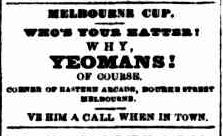
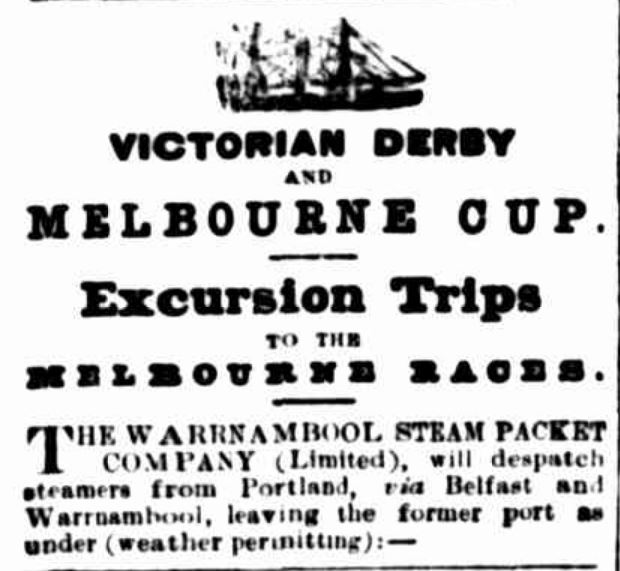
Melbourne businesses knew of the interest and advertised in the Portland Guardian to lure some of the Western District money as this advertisement from 1877 shows:

Advertising. (1877, November 12). Portland Guardian (Vic. : 1876 – 1953), p. 3 Edition: EVENINGS.. Retrieved November 1, 2011, from http://nla.gov.au/nla.news-article63339903

Many Western District people took advantage of special steamer services to get them to the Melbourne Cup

“Advertising” Portland Guardian (Vic. : 1876 – 1953) 5 November 1877: 2 (EVENINGS.). <http://nla.gov.au/nla.news-article63339859&gt;.

In the same year, the Portland Guardian ran an article declaring the 1879 Cup a huge success with 90,000 patrons and comparisons with the great races of the world including the Engish Derby. While the Illustrated Australian News, mentioned the “country cousins” who made the trip, the “shepherd kings”…the squatters.

“THE CUP DAY.” Illustrated Australian News (Melbourne, Vic. : 1876 – 1889) 28 November 1879: <http://nla.gov.au/nla.news-article60095781&gt;.

“Country cousins” from the Casterton district were at the 1879 Cup although some didn’t own up to it.

“CASTERTON.” Hamilton Spectator (Vic. : 1870 – 1918) 1 November 1879: <http://nla.gov.au/nla.news-article226056969&gt;.

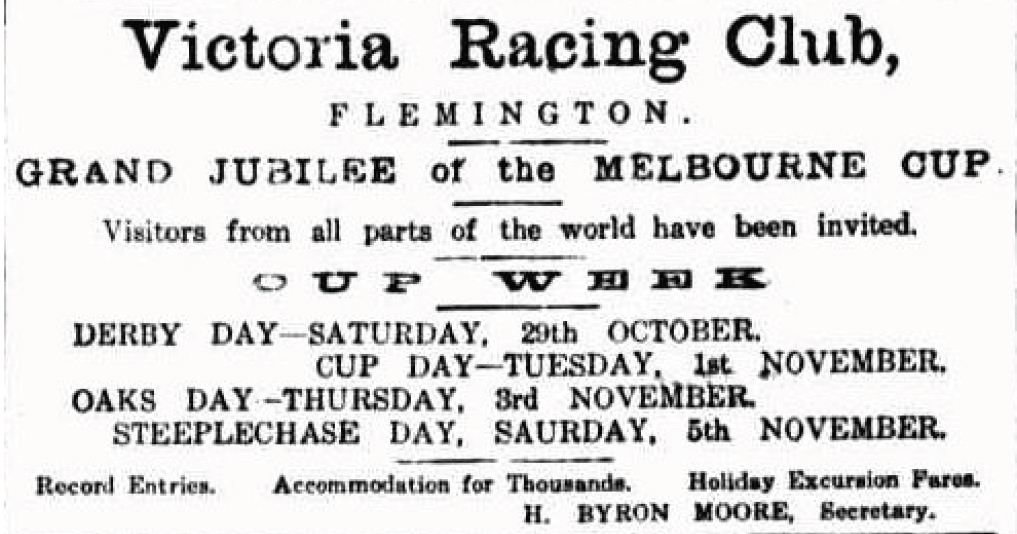
In 1910, advertisements ran in the Portland Guardian luring Western District racegoers to the Cup:

Advertising. (1910, October 26). Portland Guardian (Vic. : 1876 – 1953), p. 2 Edition: EVENING. Retrieved November 1, 2011, from http://nla.gov.au/nla.news-article63978762

The Glenelg Shire President cabled Gallipoli in 1915 with news of the winner just minutes after the race.

First Issue, August 20, 1842. (1915, November 10). Portland Guardian (Vic. : 1876 – 1953), p. 2 Edition: EVENING. Retrieved November 1, 2011, from http://nla.gov.au/nla.news-article63975310

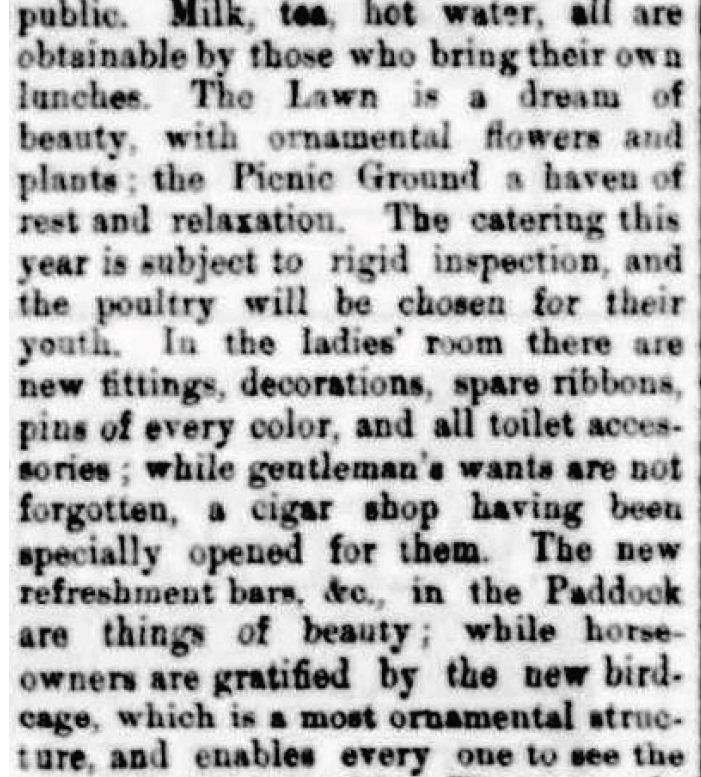
An article “Off to the Melbourne Cup” in the Portland Guardian of 28 October 1887  sums up the grasp the Melbourne Cup holds on the people of Australia.  It could easily have today’s date on it.

Off to the Melbourne Cup!. (1887, October 28). Portland Guardian (Vic. : 1876 – 1953), p. 3 Edition: EVENING. Retrieved November 1, 2011, from http://nla.gov.au/nla.news-article65410876

In the same article, patrons were reassured all their needs would be met at the course and they could rest easy in the knowledge the chicken was safe to eat!

Off to the Melbourne Cup!. (1887, October 28). Portland Guardian (Vic. : 1876 – 1953), p. 3 Edition: EVENING. Retrieved November 1, 2011, from http://nla.gov.au/nla.news-article65410876

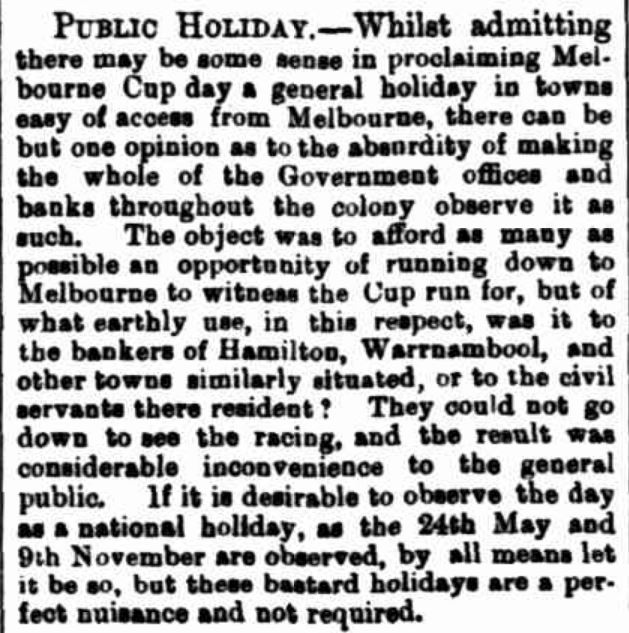
And the last word goes to the Hamilton Spectator from 9 November 1876.

“Items of News.” Hamilton Spectator (Vic. : 1870 – 1918) 9 November 1876: 2. <http://nla.gov.au/nla.news-article226039651&gt;.

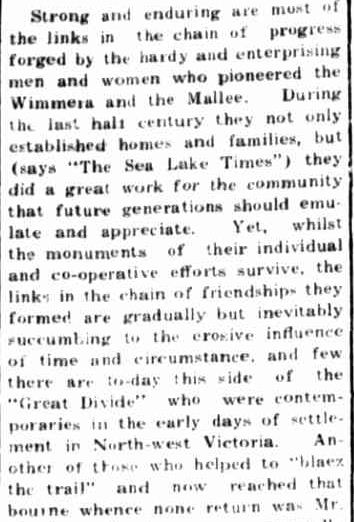
Passing of the Pioneers

This is the fourth “Passing of the Pioneers” and includes a chess champion who lived in Merino and plenty of Irish influence.  They highlight some of the pioneers of Victoria’s Western District by way of their obituaries as published in the Portland Guardian.  If you would like to read the full obituary, just click on the pioneer’s name.

Emma WITHERIDGE: Died  4 October 1888 at Portland. This obituary demonstrates the tone of many at the time.

OBITUARY. (1888, October 5). Portland Guardian (Vic. : 1876 – 1953), p. 2 Edition: EVENING.. Retrieved October 26, 2011, from http://nla.gov.au/nla.news-article63590480

George BEVAN: Died  17 October 1888 at Portland. George owned and died at the London Hotel in Portland.  His family notice shows he was born in Somerset, England and was fifty-nine at the time of death.  George had been in Portland since the early 1860s and was a keen sportsman and former Town Councillor.

Mary ROGERS: Died October 1912 at Greenwald.  Mary Rogers was aged eighty-six at the time of her death and had lived in Victoria for sixty years.  She originally went to Tasmania from Ireland with her parents as a small child.  Mary married Francis Egan who had passed away thirty years earlier.

William Sudgen Price LEWIS: Died 4 October 1915 at Hamilton. William Sudgen Price Lewis was the stepson of Richard Lewis, a former owner of Rifle Downs at Digby.  Born in Tasmania in 1835, William and his brother came to live with Richard Lewis when Richard and their mother married in 1841. In adult life, William leased Hilgay station for a time, bred fine livestock and was a member of several racing clubs. He later retired to Hamilton. He was buried at Hamilton (Old) Cemetery (below).

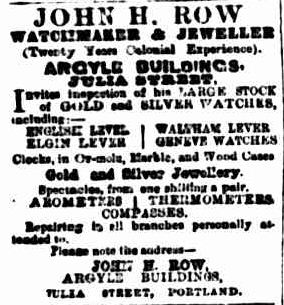
John Hawkins ROW: Died 27 October 1926 at Portland. John Row was a Portland jeweller.

Advertising. (1879, March 27). Portland Guardian (Vic. : 1876 – 1953), p. 2 Edition: MORNINGS.. Retrieved October 27, 2011, from http://nla.gov.au/nla.news-article63341984

At the time of his death, he was the oldest member of the Portland Free Library and the bowling club.  He was also a member of the St Stephen’s Church congregation.

St Stephens Church Portland

John McDONNELL: Died 17 October 1930 at Moree. Mr McDonnell was originally from Ireland and arrived in Australia in 1863 via Liverpool. He was considered one of the oldest people in the district. He married Catherine FAHEY and they selected land at Moree in 1865.

Catherine Bridget SAMPEY: Died October 1933 at Melbourne. Catherine Sampey arrived in Melbourne from Ireland aboard the Red Jacket in 1852. She travelled on to Chetwynd with her brother James Sampey and she later married Patrick WHITE of Casterton.

Elizabeth MONOHAN: Died 12 October 1933 at Casterton. Elizabeth Monohan was 100 when she died. Arriving from Ireland aboard the Frances Henty at age twenty-one, seventy-nine years before, she was still able to converse in Welsh and Gaelic in her later years. In 1859, she married John Glover at Sandford House.

Julia Teresa DOYLE: Died October 1934 at Portland. Born in Tipperary, Ireland but remembered as “a true type of a fine old English lady”, Julia Doyle arrived in Australia as a six-year-old in the mid-1850s. She married Frances SUTTON in 1874 and together they had six daughters and two sons.

Ernest John SEALEY: Died 25 October 1935 at Casterton. In his younger years, Ernest Sealey worked as a bullock driver transporting wool. In later worked on Portland’s deep-water pier, hauling logs from the forests to the pier.

Charles PRATT: Died 26 October 1935 at Birchip.

Obituary. (1935, November 4). Portland Guardian (Vic. : 1876 – 1953), p. 2 Edition: EVENING.. Retrieved October 27, 2011, from http://nla.gov.au/nla.news-article64290777

And so begins the obituary of Charles Pratt.  Charles or Charley as he was widely known, was born at Mumbannar in 1870.  In 1891, he went to Beulah in the Mallee and worked with his step-brother and later selected his own land near Watchupga.  He married Annie LAVERY in 1914 and they had three sons.

Thomas Denton CLARKE: Died 5 October 1937 at Hamilton. Thomas, born around 1847 at Liverpool, was the son of Captain Thomas H. Clarke who was a trader in Portland.  Thomas jnr was a champion chess player and a composer of chess problems.  He won many competitions for both pursuits.  Composing problems up until his death, it was considered probable, according to the obituary, that he was the world’s oldest composer.

James McCLUSKEY: Died October 1942 at Koroit. James McCluskey was born at Portland in 1857, not long after the arrival of his parents on the ship, British Empire. Soon after, the family travelled by bullock wagon to Kirkstall near Warrnambool.  In his early working life, James drove pigs to Port Fairy in order to load them on the steamer Casino to go to market in Melbourne.

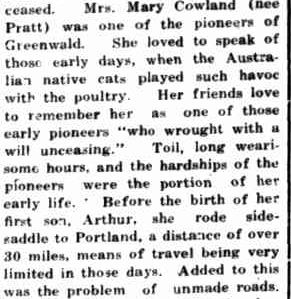
Mary PRATT: Died 7 October 1942 at Greenwald. Mary, the widow of George COWLAND, was eighty-seven at the time of her death.  There were twelve children in their family.  Her obituary recalled her pioneering traits.

OBITUARY. (1942, October 26). Portland Guardian (Vic. : 1876 – 1953), p. 2 Edition: EVENING. Retrieved October 27, 2011, from http://nla.gov.au/nla.news-article64382483
The Day the Queen Visited Hamilton

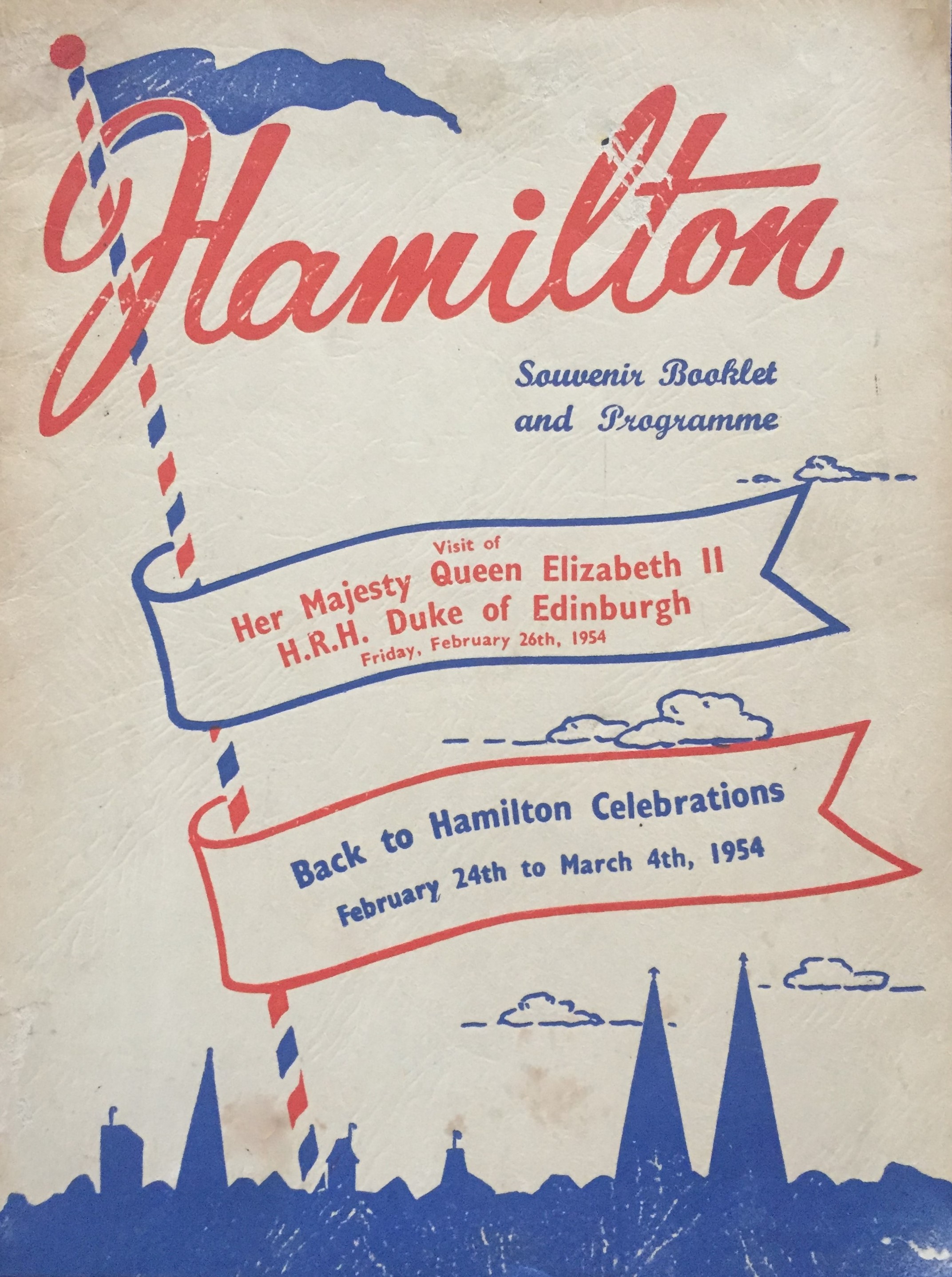
Hamilton Souviner Booklet and Program, 1954

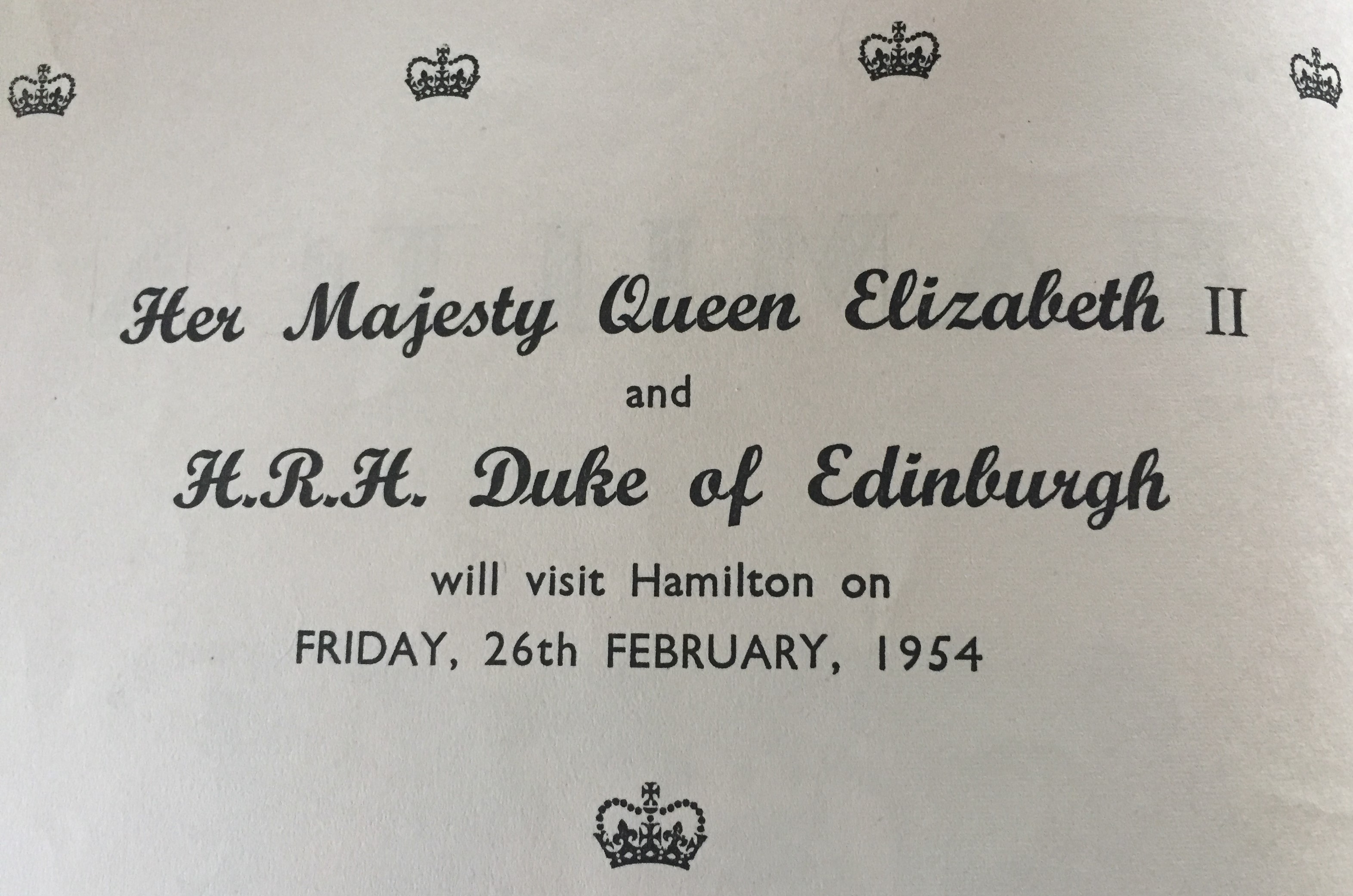
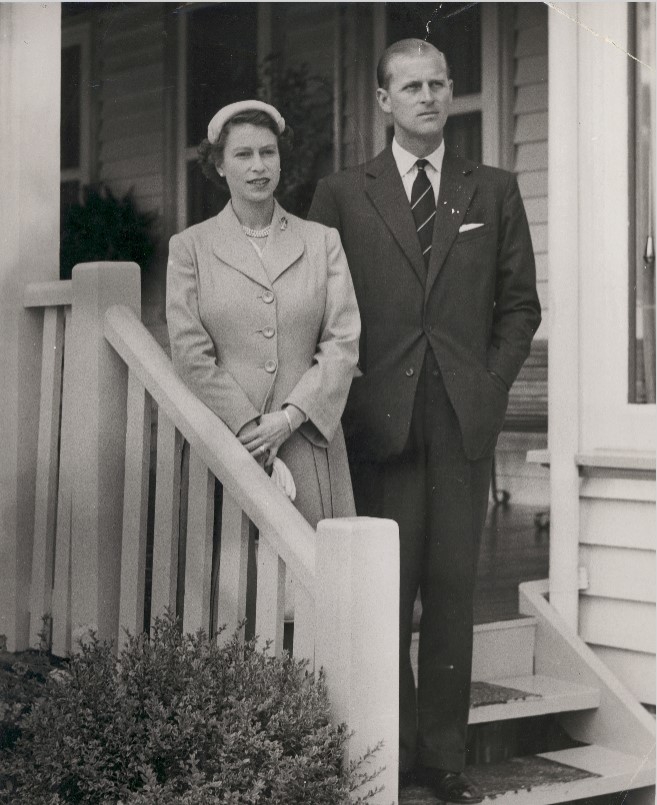
On 26 February 1954, Hamilton was buzzing with excitement for a much-anticipated visit by Queen Elizabeth II and Prince Phillip, Duke of Edinburgh.

Mt Gambier and Hamilton were the only locations in the region chosen for a visit by the new Queen, despite much lobbying by nearby towns. The inter-town rivalry preceding the visit was immense. Headlines in the Portland Guardian at the time included “Number One Priority for Royal Visit Should Have Been Portland’s” and “No Royal Visit an Insult to Portland”

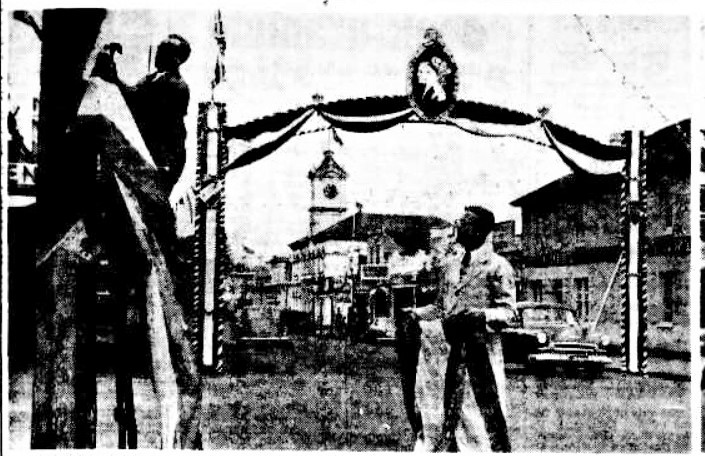
Hamilton wanted to put on a show, and preparations started long before the big day. Residents decorated their homes, some with flags on the roofs for the Queen to see as she flew into the Hamilton Aerodrome.  The council spent £5,000 on decorations, including four large arches around the town, with one on the outskirts made of locally grown hay, oats, and flax, with “Welcome” crafted from wool, for which the district was famous. Several kilometres of bunting, flags, and lights decorated the CBD.

HAMILTON READY TO GREET QUEEN (1954, February 26). The Argus,p. 15. http://nla.gov.au/nla.news-article26593166

More than 100,000 people were expected to converge on the town. Local hotels set up beds in the lounges and on balconies to accommodate the overflow of guests and accommodation houses up to 60 kilometres away reached capacity.

The Royal Visit coincided with “Back to Hamilton” celebrations, and the organising committee published a souvenir booklet.

PHOTO OF AUTHOR’S COPY.

On the big day, The Argus published a map of the best places to glimpse the Queen and Duke.

Where to see the Queen Today FIRST COUNTRY VISIT. (1954, February 26). The Argus p. 7. http://nla.gov.au/nla.news-article26593160

At Melville Oval, around 13,000 school children started assembling from 8.00am.
Along with the school children were several thousand others, many travelling long distances.

HAMILTON’S FAMILY WELCOME. (1954, February 27). The Argus, p. 15. http://nla.gov.au/nla.news-article26593294

With the Queen’s plane scheduled to arrive at the Hamilton Aerodrome, to the north of the city, at 3.35pm, the Dundas Shire President, Cr. Henry Bull, his wife, and around 3000 eager locals gathered to meet Queen Elizabeth and the Duke. Young Rosemary Oates prepared to present Her Majesty with a bouquet.

Back to Hamilton visitors saw Queen and Duke (1954, March 10). Weekly Times p. 78. http://nla.gov.au/nla.news-article224910934

The plane was five minutes late, and a gasp went up from the large crowd when part of the carpet laid on the tarmac almost blew away from the force of the plane’s propellers.
MARGARET OATEN PRESENTS QUEEN ELIZABETH WITH A BOUQUET (1954, February 27). The Argus, p. 7. http://nla.gov.au/nla.news-article26593444

The Royal party then moved by car to Melville Oval, where the schoolchildren were still patiently waiting after eight hours.

Hamilton rocked in Royal salute. (1954, February 27). The Argus p. 7. http://nla.gov.au/nla.news-article26593444

The sight of the decorated city, and an estimated 70,000 adults and children waving, saw the Queen wipe her eyes several times before the motorcade came to a halt at Melville Oval.

Hamilton welcome Queen had tears in her eyes (1954, February 27). The Argus p. 4.  http://nla.gov.au/nla.news-article26593398

After being met by Mayor Cr. Reginald White and Town Clerk Hector Donald and their wives, the royal couple drove around Melville Oval before returning to the airport for a flight to Melbourne.

The Age (Melbourne, Vic. : 1854 – 1954) 27 February 1954, p. 3. http://nla.gov.au/nla.news-article206088677

But not before eight-year-old Jennifer Biggs from Hamilton State School had the honour of presenting the Queen with a bouquet.  Jennifer is pictured below, practising her courtesy before the event while her classmates watch on.

Rag doll aids girl’s curtsy (1954, February 26). The Argus , p. 15.  http://nla.gov.au/nla.news-article26593193

“Hamilton’s Children Cheer the Queen” The Age 27 February 1954: p. 8. http://nla.gov.au/nla.news-article206088514 

Hamilton rocked in Royal salute (1954, February 27). The Argus, p. 7. http://nla.gov.au/nla.news-article26593444

On the return trip to the aerodrome, the Royal party drove past the Hamilton Hospital, where members of the nursing staff excitedly waved to the passing motorcade.

(1954, February 27). The Argus p. 7. http://nla.gov.au/nla.news-article26593444

Back at the aerodrome, around 3,000 people waited to farewell the Royal visitors.  The Argus of 27 February 1954, described how the large crowd “surged forward in a wild rush” jostling “elderly men and women and young children.”

It was a memorable day for Hamilton, one not since matched, and almost 70 years later, it remains in the memories of those who were there to experience it.

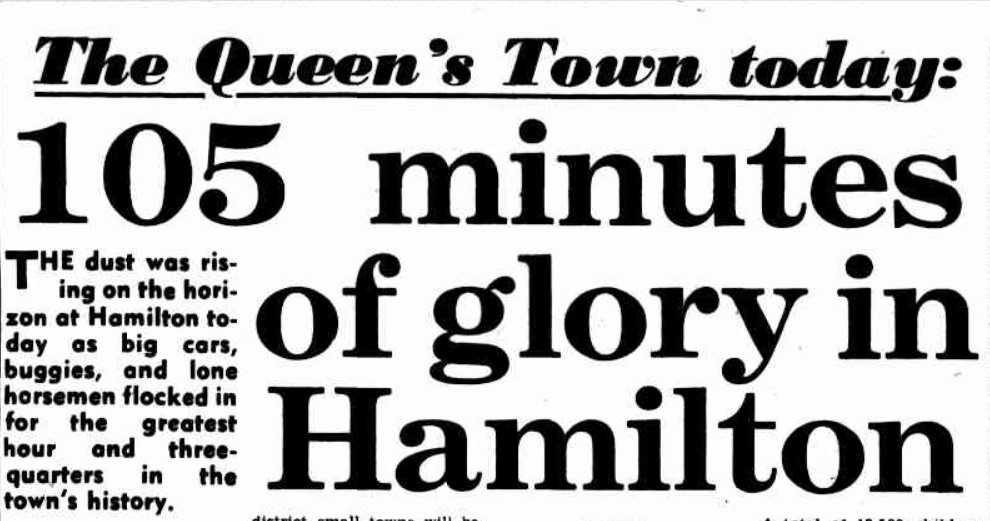
The Queen’s Town today: 105 minutes of glory in Hamilton (1954, February 26). The Argus, p. 2. http://nla.gov.au/nla.news-article26593119

QUEEN ELIZABETH II & PRINCE PHILLIP, DUKE OF EDINBURGH DURING THEIR 1954 TOUR OF VICTORIA. Image courtesy of the State Library of Victoria http://handle.slv.vic.gov.au/10381/245876

They Were Not Alone

I used to imagine life for my great-grandmother, Caroline Kirkin, arriving in Victoria in 1913, with husband Thomas Riddiford and five sons and the difficulties she faced as a woman in such circumstances.  Hardly pioneer times, but without siblings and parents, and living in the small country town of Smeaton, north of Ballarat, she must have felt alone.  She may not have had the companionship of other women at a time when she was raising small children with more on the way.  In time, she would have made friends, but would that have been the same as having family to share memories of growing up in London, a long way removed from country Victoria.

I have also considered life for Susan Reed, my ggg grandmother and wife of James Harman. (below)

JAMES & SUSAN HARMAN. Photo courtesy of Mike Harman & family.

She arrived at Portland in 1852, a new bride at 22.  As assisted immigrants, James had to work for a local property owner to repay their passage, and Susan would have been left alone.  Babies began to arrive in 1854 and James would have been busy establishing a life for them.  Images that would come to mind resembled a Frederick McCubbin painting.

Even Rosanna Buckland, who has led me on a merry chase, has evoked similar feelings within me.  I felt for her on the treacherous voyage to Australia on the “Bombay” and then living in the “bush” at Mt William station with her husband James Mortimer.

Later in my research, when I began to investigate the siblings of these three women,  my picture of their lives in Australia changed.  I snapped out of my romantic imaginings to the reality that these women had a greater support system than first thought.  They were definitely not alone.

Susan Read left siblings, including a brother William, at home in Melbourn, Cambridgeshire.  Searching the Victorian BDM’s for Susan’s death record, using just parent names, brought up a William Reed who died at Muddy Creek, in 1889 with the same parents as Susan.  I had found Susan’s brother living just down the road from her.  William married Sarah Burgin in 1866 and they had seven children mostly in the Warrabkook area.

Woman of mystery Rosanna Buckland was not the only member of her family who could lay claim to the title.  Rosanna had a younger sister Elizabeth, who married Richard Myhill in Berkshire in 1851.  While browsing the passenger list of the “Bombay“, the Mortimer immigrant ship, I found Richard and Elizabeth Myhill also on board.  Elizabeth got off the ship, but where she went after that is unknown.  Richard Myhill shows up time and time again in the records and newspapers but married to Isabella Ross (1860), not Elizabeth Buckland.  So at least for some part, Rosanna had the support of her sister, who may have been a welcome helping hand on the “Bombay“.

Caroline Kirkin had a younger sister Ada.  Ada married Frederick Sturdy in London in 1911 and had three children by the time Caroline departed for Australia.  By 1914, Ada, Frederick, and children were themselves sailing for Australia.  I first found this after a search of Frederick William Sturdy at Ancestry brought up a match on the Australian Electoral Rolls.  The record listed his wife as Ada Sturdy and they were living in Sturt Street, Ballarat, the same town as Caroline.  How could I have not known about Caroline’s sister and her family?  No-one had ever mentioned them. The Sturdys stayed on in Ballarat before moving to Melbourne sometime around the outbreak of WW2 as Frederick had enlisted.

Caroline Celia Ann Kirkin

But wait that’s not all.  I was researching Caroline’s father Frederick Kirkin, who lived and died in London.  He was from a family of ten children, so I proceeded to find out more about them.  I knew that Frederick’s sister had married a Henry Smith, and it was another search at Ancestry which brought up a match for Elizabeth Rose Smith on the Australian Electoral Rolls in 1919 at Geelong.  A search of her death record showed she was in fact a Kirkin.  Elizabeth and Henry had three daughters, two I have confirmed came to Australia, but at the time I did not follow them up further.  All along Caroline’s aunt and cousins were living in Geelong.

But wait that’s not all.  Recently Dad told me he had thought of the two families he boarded with at Geelong as a teenager.  He had talked of them in the past, by name, but names I was not familiar with.  He thought maybe they were related to Grandpa, and I immediately thought of Riddiford relatives, although I thought I had them covered.  I completely overlooked a possible Kirkin link.   I worked back from the death and cemetery records of the couples.  To my surprise, the wives of each of these families had the maiden name Smith, none other than Emily Eliza and Elizabeth May, daughters of Henry and Elizabeth Smith.  They had married Fred Baverstock and Fred Harrison in Geelong.  Dad had been boarding with his first cousins twice removed and did not know it.

But wait that’s not all.  Whilst this research was going on, I found a UK Incoming Passenger List record for Caroline’s parents, Henry and Amy Kirkin.  They had arrived in London in 1926 from Melbourne. Nothing unusual with that. They may have visited daughters Caroline and Ada and sister Elizabeth, but what was that reference to their last place of permanent residency? New Zealand? A search for people researching the Kirkin name revealed one with a New Zealand email address.  I contacted him, asking if he had any clues. I mentioned a daughter, Ivy, who I had found no trace of in English records.  Could she have been in New Zealand?  He replied that Ivy did go to New Zealand, married and he was her grandson. His father had mentioned that Henry and Amy had gone to New Zealand on holiday to visit their daughter.   He was not aware of them living there for an extended period.   More research is required on Henry and Amy’s New Zealand adventure, as while they returned to England in 1926,  they were on the 1928 New Zealand electoral roll.  They both died in London, Amy in 1929, and Henry in 1935.

Suddenly I had Kirkin relatives in both Victoria and New Zealand.  A long way from thinking that Carolyn was the only Kirkin in the Southern Hemisphere.

So with my romantic illusions shattered, I am reminded that often the lives we perceive for our ancestors is not always as it was.  The more information we can gather goes a long way to creating a realistic picture of their lives.  Researching brothers and sisters of direct ancestors can help fill in some of the gaps and if you are like me, the brothers and sisters sometimes led more interesting lives.

While I cannot forget the many pioneer women who did suffer hardship from isolation, not seeing another woman for months, these three women were not in that category.  Aside from the arrival of a relative, in Susan’s case, she may have formed networks via the families’ strong links with the Wesleyan Methodist Church. Rosanna could have shared the company of the other station hand wives, living and working at Mount William station.  Despite feeling somewhat cheated by my discoveries that Susan, Rosanna, and Caroline’s lives may not have been as I first thought, I am now compensated by having Kirkin and Read/Reed links close to home.  Rosanna still owes me!

Histories of South-West Towns

I often look at the ABC Local radio websites, but usually only a page a link has led me to.  Recently I found myself on the ABC South West Victoria website and decided to look around.  I discovered a series of radio interviews by Jeremy Lee entitled A-Z of the South West.  Recorded in 2010, the aim was to highlight the history of towns in the region.  The good news is that there are 45 towns featured, not just 26.  The towns include Macarthur, Caramut, Port Campbell, Branxholme, and Casterton.

They are great interviews with local residents and historians, some have lived in their town all their life.  Topics covered include town beginnings, past businesses, local attractions, prominent residents, and the future outlook. I enjoyed Jim Kent talking about Casterton and his own contribution to the local population, 11 children, 40 grandchildren, and 16 great-grandchildren.  There are photos of each town too.

An understanding of local history is important when researching a family. It can explain why a family chose to settle in a town.  For example, Peter Watt talks of how Cavendish was a town of workers.  Many residents, both male, and female worked for the large stations close to the town such as Mokanger and Kenilworth.  Aside from a sawmill,  a couple of shops, and a pub, there was no other employment opportunities except for the stations.  Two of my families, the Haddens and Mortimers, went to Cavendish primarily to work at Mokanger station and they remained there most of their working lives.

The various ABC websites are a great resource.  I have since looked closer at some of the other ABC local radio websites and found that you can search by topic.  Clicking on the  “Community & Society” tab brings up a list of sub-topics, including “History”.  ABC Western Victoria currently has 86 history-related stories available.  I have also subscribed to an RSS feed of stories tagged “history” so I don’t miss any.  Or take 15 months to stumble across.

To listen to the interviews follow the link:

http://www.abc.net.au/local/stories/2011/06/03/3234418.htm?site=southwestvic