To Catch A Thief

Well, well, well, what an exciting surprise. While searching the newly released digitised copies of the Mt Gambier paper, the Border Watch, I discovered that in 1877, ggg grandfather James Bishop was nabbed for horse theft and remanded pending trial.

I suppose the find was more exciting than surprising. Why wasn’t I surprised?  Well, Jim was a drover and the article revealed he was also a dealer.  Many horses would have passed through his hands, probably unbranded. Being a drover/stockman I would doubt bookkeeping was a strong suit and after reading many Pound Notices in the newspapers of the time, a lot of horses were wandering the countryside.  Mix-ups could easily happen.

SUMMARY OF NEWS. (1877, October 27). Border Watch (Mount Gambier, SA : 1861 – 1954), p. 3. Retrieved February 28, 2012, from http://nla.gov.au/nla.news-article77048847

I was, however, very excited about this new discovery. Enough to tweet about it!  To find some “dirt” is always exciting.  Why is it we always get the most satisfaction from finding a record of an ancestor’s misfortune?  Criminal records, wills, and obituaries are favourites of mine, but don’t forget inquests and asylum records.  Obviously, some of the excitement is just because we have found something, anything, but it also makes the family member more interesting.  These finds give them character.  An extra dimension.

On the point of character, I would have assumed Jim was nothing but respectable.  A Harman/Bishop marriage (that of my gg grandparents) took place in the same year as the arrest with another in the years following. With the Harmans being self-respecting church people, I am sure neither would have occurred if there were any doubts about Jim.

I had to find the outcome of the matter.  I had thought of going to the Ballarat Archives Centre (PROV) where the Branxholme court registers are held (Series VPRS 4892 Court of Petty Sessions Registers).  This however, would not shed much more light on the trial itself.  Surely there was more than one newspaper report.  Country newspapers reported on even the smallest of stories, and the fact James was remanded made it newsworthy.  Now that I had the date of the court case, I could narrow a Trove search down.  Believe me, this is a great help when searching a name like Bishop where a match to the Bishop of Ballarat is more likely than any members of my Bishop family.

I narrowed down a search of “Bishop Branxholme” to 1877 and bingo, the top two matches were about James.  One, I had already found, but the other from the Portland Guardian reported on Jim’s trial in November 1877 after his first court appearance.  While I had searched the same paper for the Bishops, I had not found this article.  The value of dates!  Oh and some knowledge too.  If I had found the article earlier I may have picked up it was one of my Bishops but I would have been unsure which one.

The barter system was alive and well in the Western District in the 1870s, with James trading a horse and £5 for a buggy.  The question was where did the horse come from and was it one of Mr Officer’s of Harton Hills Station

Upon questioning on this matter, Jim replied he did not know how he came to have the horse. Not a good start.

Evidence then moved to that of Constable Foster, who arrested Jim in a plain clothes operation.  Who would have thought?  Jim didn’t.  When asked by the plain-clothed Constable at Lower Byaduk, prior to his arrest, if he had sold mares at Branxholme lately, Jim said “…no, he had none to sell”  but added that Mr. Madison had sold two colts for him at Branxholme.  As two of the four missing horses were colts, Foster arrested Jim and sent him to the lockup.

While incarcerated, Jim had plenty of time to think over his recent conversations and must have realised he said the wrong thing to Foster and raised it with him.  Jim told Foster he had thought he was “…one of Chalico’s men come to look after some of my horses, and this is why I told you I sold no mares at Branxholme.”

Then it became clear Jim was not a good bookkeeper, with him stating at the time of sale he did not get a receipt from Ted Lee the postman from whom he had bought the horse.  Then Ted was hurt, so Jim went to Belfast (Port Fairy) to get a receipt from Ted, but he was too sick.  Oh dear, things were not looking good.

At last, a savior.  Witness Samuel Taylor took the stand.  He had seen Jim and Ted Lee together with four horses.  Ted told Samuel he had sold the horses to Jim.  The horses were then agisted at Taylor’s property for the next fortnight.  Phew.  Case dismissed, and Jim was off the hook.

BRANXHOLME. (1877, November 5). Portland Guardian (Vic. : 1876 – 1953), p. 2 Edition: EVENINGS.. Retrieved March 2, 2012, from http://nla.gov.au/nla.news-article63339852

So Jim didn’t go to jail, but if it wasn’t for Samuel Taylor’s evidence, he may have. I hope he had Ted Lee lined up as a witness.

Now the excitement has subsided and I can continue to consider Jim Bishop an honest man.  But deep down inside, a small part of me is crying…I could have searched prisoner records!  Sorry, Jim!

A Leap Year Dilemma

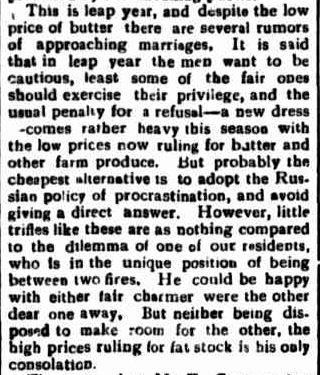
I thought I would share this snippet from the Portland Guardian of 24 February 24 1904.  The single men of Bridgewater had a lot to think about while milking the cows during the leap year of 1904.

Bridgewater. (1904, February 24). Portland Guardian (Vic. : 1876 – 1953), p. 3 Edition: EVENING. Retrieved February 29, 2012, from http://nla.gov.au/nla.news-article63687492

Passing of the Pioneers

Once again an interesting band of Western Victorian pioneers were found in newspaper obituaries from February.  There is a tightrope walker, philanthropist, a motor car pioneer and several hardy pioneer women.  It continues to amaze me the lives the pioneers lived.  I mean, who could imagine a tightrope walker living in Portland in the 19th century, in fact at any time!

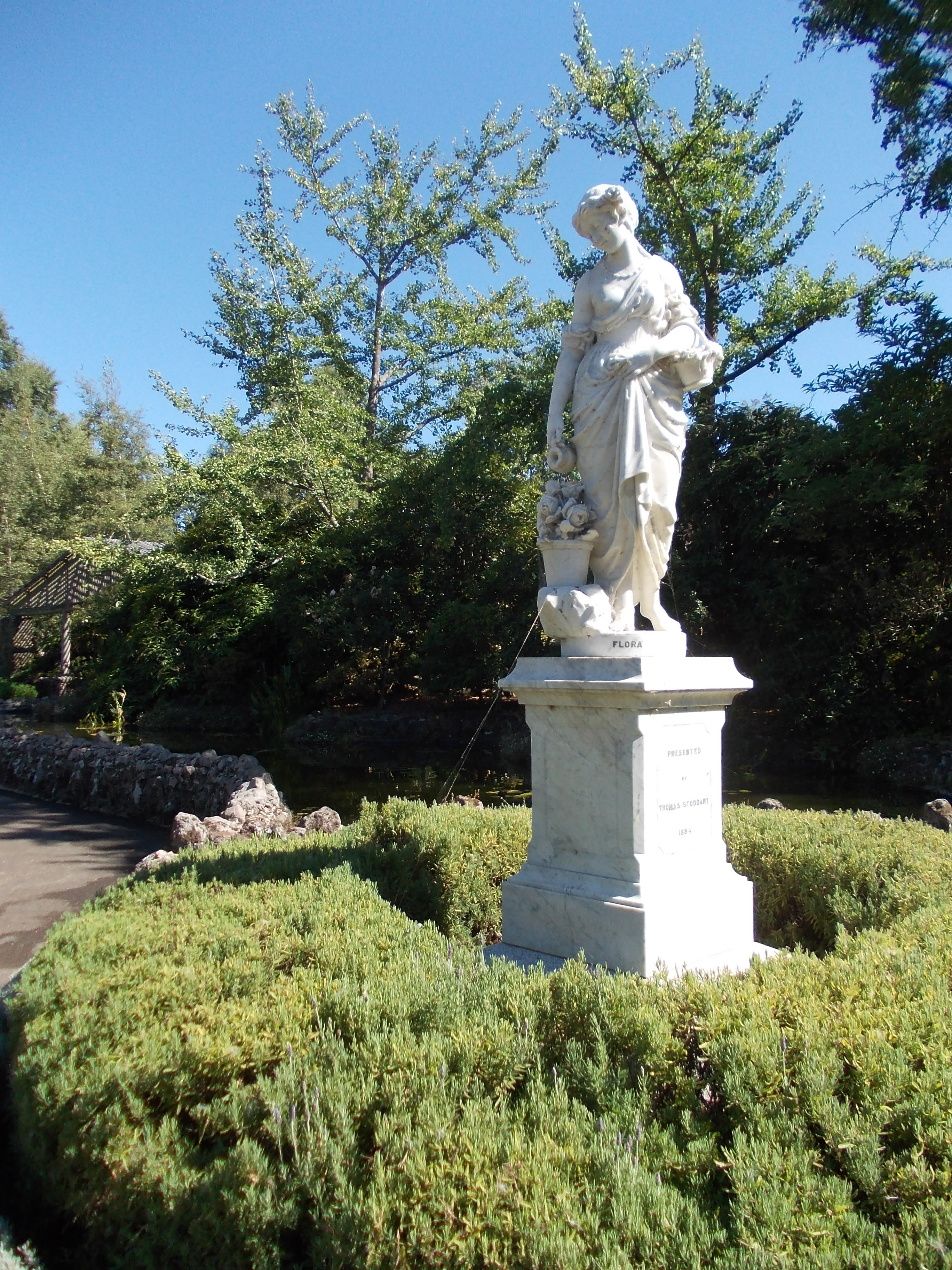
Thomas STODDART: Died 20 February 1905 at Ballarat. When next in Ballarat admiring the many statues in Sturt Street and the Botanical Gardens, thank Thomas Stoddart. He was responsible for getting the ball rolling for leading Ballarat identities to give statues or money towards statues, to the city. From digger to stockbroker, Stoddart donated twelve statues to the city of Ballarat in 1884 after a trip to Europe. This act of philanthropy saw some of Ballarat’s other wealthy citizens bequeath money to fund more statues.  In fact, John Permewan who featured in December Passing of the Pioneers donated the well know “Hebe” which stands in Sturt Street.  As well as the obituary from the Horsham Times, a lengthier obituary appeared in The Argus on February 21.

“FLORA”

“POMONA”

John COFFEY:  Died 9 February 1908 at Melbourne. John Coffey was born in Limerick, Ireland, and came to Australia with his brother in the 1860s. He first went to the Wimmera while carting between Melbourne and the Wimmera. Making a permanent home there, he worked as a farmer and a hotel keeper.  He left a wife, Catherine Almond, five daughters, and three sons.

Thomas HENNESSY: Died 19 February 1908 at Horsham. Thomas Hennessy arrived in Victoria in 1859 aboard the Royal Charter from Limerick, Ireland. He began farming around Koroit, lost a leg, and moved to the Pimpinio district, where he farmed for many years.  An accident before his death contributed to his demise.

James DAVIDSON: Died 12 February 1913 at Narrawong. James Davidson, born at Narrawong, was described as a “good all-round citizen” in his obituary. He was involved in the mounted rifles and athletics.

Matilda GILCHRIST: Died 14 February 1914 at Hawthorn.  Born in Paisley, Scotland, in 1920, she arrived on the Star of the East in 1855.  Her husband, Thomas Lang, was a well-known horticulturist in the late 19th century.  Matilda was the principal of a girls’ school in Ballarat for a time.

Mary Ann DREW: Died 15 February 1915 at Willaura.  Born in Buckinghamshire, England,  Mary Ann Drew came to Victoria in her twenties during the 1850s. She worked at Golf Hill Station at Shelford for George Russell before moving to Sandford, where she married William Lindon. Mary Ann lived at Willaura with her daughter for the last ten years of her life.

Edward Harewood  LASCELLES: Died 12 February 1917 at Geelong. Lascelles is a well-known name in Western Victoria.  Not only does his name form part of the Geelong wool broking firm Denneys Lascelles & Co., but the town of Lascelles in the Mallee was named after him.  Edward Lascelles was born in Tasmania in 1847, married Ethel Denney, and they had six children.  He was a leader in vermin extermination on his property in the Mallee and was the first to introduce share farming in Victoria.

Isabella McDONALD: Died February 1918 at Dandenong. Isabella McDonald arrived in Victoria with her widowed mother in 1863. The following year, she married journalist Mr Dudeney, who had gone to Ballarat to report on the Eureka Stockade riots. Only after a few years of marriage, Mr Dudeney passed away, and she married John Whitehead, a worker at the Ballarat Post Office and later the GPO in Melbourne

Martha MATHEWS: Died 14 February 1918 at Buninyong. Martha Mathews was a colonist of 64 years, arriving in Victoria to join her husband, Richard Phillips, on the goldfields of Ballarat. Martha enjoyed telling stories of the gold rush days.

OBITUARY. (1918, February 18). The Ballarat Courier (Vic. : 1914 – 1918), p. 6 Edition: DAILY.. Retrieved February 26, 2012, from http://nla.gov.au/nla.news-article75176846

Janet SIMPSON: Died 19 February 1920 at  Bondi, New South Wales.  Janet Simpson, her husband Robert Clark, and four children sailed for Australia in 1857. One child, Agnes, died during the journey. At the time of their arrival, the train line to Horsham was under construction, so the family took a coach to Stawell, then a bullock wagon to Horsham.  She was one of the many pioneer women who coped under tough conditions.

Obituary. (1920, February 27). The Horsham Times (Vic. : 1882 – 1954), p. 5. Retrieved February 26, 2012, from http://nla.gov.au/nla.news-article73190179

William HANLON: Died 19 February 1923 at Portland. William Hanlon was the mayor of Portland 11 times.  His interests within the municipality included the President of the Portland Free Library.

William ROBERTSON: Died 2 February 1924 at Portland.  A colonist of seventy-seven years, William Robertson, arrived in Portland as a five-year-old with his parents.  He had travelled to New Guinea and Western Australia as well, once riding in the Great Western Steeplechase at Coleraine.

Charles Francis PATTERSON: Died 17 February 1933 at Portland. Charles was born in Portland in 1857 and spent some time in Western Australia on the railways.  It was there he met his future wife, and after marriage, they returned to Portland to raise ten children.  Charles was a popular figure around the town, and he worked in the fish distribution business.

Alfred Irvine HOGAN: Died 8 February 1934 at Portland. From tightrope walker to saw miller, Alfred Hogan was an interesting chap.  Arriving in Portland as a young man, he gained notoriety as a tightrope walker performing daredevil tricks in the mould of “Blondin” the French tightrope walker.  Age must have caught up with his tightrope walking feats, and he turned to sawmilling, with his obituary crediting him as a pioneer of sawmilling in the Portland district, an industry which became one of the biggest in the area.  Alfred also had a keen interest in Australian Rules football and was one of the people behind the development of Hanlon Park, which is still home to the Portland Football Club today.

Mary Jane SPIKEN:  Died February 1934 at Warrnambool. Mary Jane Spiken’s mother, Anna Harland, arrived in Victoria with members of the Henty family.  Anna married John George Spiken, with Mary Jane born around 1861 at the Henty homestead.  Mary Jane married William Jenkins, and they had seven children.  She had a wealth of knowledge on the early days of Portland.

Fanny Ann MALSEED: Died 13 February 1936 at Myamyn. Fanny Ann was the daughter of James and Eliza Malseed of Mount Richmond.  She married Thomas Edmund Adamson around 1886 and they raised eight children.

Richard YOUNG: Died 16 February 1939 at Horsham. Richard was born at Clunes and moved to Horsham with his parents as a ten-year-old. He married Isabella Anderson, and they raised a large family. Richard was a keen footballer and played for the United Traders football club.  He was a founding member of the Horsham Football Club and was an active member of the local fire brigade.

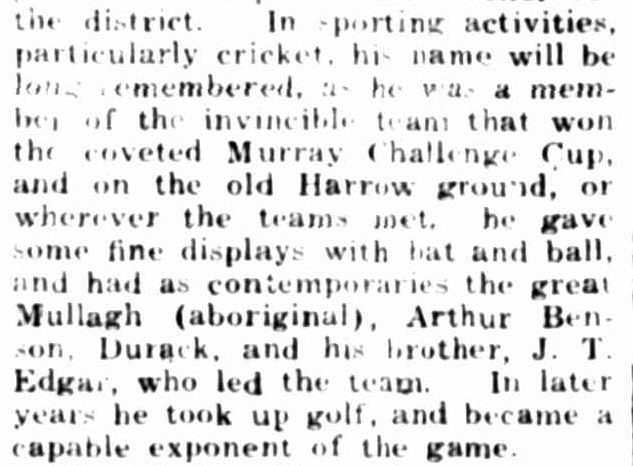
Walter Birmingham EDGAR: Died 22 February 1939 at Portland. Walter Edgar was born at Pine Hills Station at Harrow in 1856.  Educated at Hamilton College, he achieved the double honor of dux of the college and athletic champion.  Despite studying civil engineering at Melbourne University, he returned to Pine Hills to take up agriculture pursuits.  In 1882, he married Jessie Swan of Konongwootong.  In the years before his death, Walter toured England, Scotland, Norway, and Sweden with his daughter.  In his younger days, Walter was something of a cricketer and golfer.  He and his father played some part in the Aboriginal cricket team touring England in 1867.  The team included Johnny Mullagh, with whom Walter often played cricket.

Obituary. (1939, February 27). Portland Guardian (Vic. : 1876 – 1953), p. 3 Edition: EVENING.. Retrieved February 28, 2012, from http://nla.gov.au/nla.news-article64391911

Ann NIVEN: Died 24 February 1942 at Coleraine. Ann Niven came to Australia at five, but without her parents.  They arrived at a later date, but until then, Ann was under the guardianship of Mr and Mrs Christorphen.  They lived where Balmoral now stands, but then it was only bush.  She married William Bird, living at Wombelano, and then for the last thirty-two years of her life, at Coleraine.  Mrs Bird was the mother of eleven children.

Patrick HENRY: Died February 1942 at Terang. Patrick Henry, with his parents, settled in the Woodford area upon their arrival in Australia in 1866.  He began driving bullock wagons as a teenager and worked in that occupation until he was eighty-six.  When he finally retired, it was thought he was the oldest bullock wagon driver in the Western District.

Thomas Turner SHAW:  Died 1 February 1949 at Beaumaris. Thomas Shaw was the son of Thomas and Catherine Shaw. He was born in Victoria in 1864.

THOMAS TURNER SHAW c1866. Image courtesy of the State Library of Victoria. Image no. H2013.172/23 http://handle.slv.vic.gov.au/10381/235471

THOMAS TURNER SHAW c1866. Image courtesy of the State Library of Victoria. Image no. H2013.172/23 http://handle.slv.vic.gov.au/10381/235471

Thomas Shaw was not only a pioneer of fine merino wool production but also of motoring in Victoria.  He drove one of the first steam cars and was also a founding member of the Royal Auto Club (RACV).

New Site – Settlers in the Glenelg & Wannon Region of SW Victoria

Today I heard the South West Victorian content on the Ballarat & District Genealogical Society website now has a stand alone site.  Entitled “Settlers in the Glenelg & Wannon Region of SW Victoria” there is plenty of information for those with Western District families.  Hosted by Daryl Povey, I have used the site so much in it’s former guise.  Daryl intends to keep expanding it too. Some of what you can find includes:

  • Articles
  • Maps
  • Town Histories
  • WW1 Memorials
  • Pastoral Runs
  • Links, lots of them

I first “met” Daryl through the Rootsweb Western District of Victoria mailing list over 10 years ago and I quickly found he has a vast knowledge of Western Victorian history.  If anyone has a question for the list, Daryl is never far away with an answer.  He has helped me out a number of times.  It is also worth joining the mailing list if you have Western District links.  It doesn’t have as much traffic as it used to, social media has something to do with that, but you will find some wonderful people like Daryl, just an email away willing to help with your queries.

As a result of the changes, the Casterton & District Historical Society now has a new link.  I have updated my Western District Links page with the new sites.

From Stone Country to High Country

If I wasn’t the ggg granddaughter of James Harman, I would be just as happy to be the ggg granddaughter of his brother, Walter.  He broke away from Byaduk farm life to pioneer in the High Country of Victoria at Ensay.

There are many things to like about researching Walt.  He and wife Lydia Poynton chose beautiful names for their children. They also liked to be photographed and I have been lucky enough to view some of those wonderful snaps. Also, Walt’s obituary was rich with history and is the kind I wish I could find from James Harman’s death.

Walter was born in December 1845 at Melbourn, Cambridgeshire, England to Joseph and Sarah Harman.  It would be unlikely he remembered a time when older brother James, 15 years his senior, lived in the family home.  While in England he would not have had much to do with any of his older brothers as, by the time he was 8, four of them had left for Australia.

In 1854,  Walter sailed with his parents, Joseph and Sarah, sister Sarah and younger brother Alfred for Sydney aboard the “Queen of England“.  We now know the family went to Western Victoria and were in Byaduk by 1863.

In 1872, aged 27, Walter married Lydia Poynton, daughter of John Poynton and Lydia Walton. Immigrants from Lincolnshire, England, the Poyntons lived in the Macarthur area. The following year Walter applied to the Lands Board for a license on 300 acres near Macarthur.
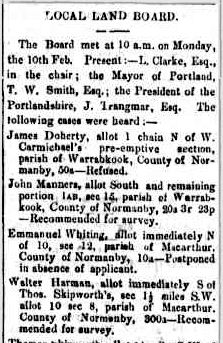
LOCAL LAND BOARD. (1873, February 24). Portland Guardian and Normanby General Advertiser (Vic. : 1842 - 1876), p. 5 Edition: EVENINGS. Retrieved February 20, 2012, from http://nla.gov.au/nla.news-article65429471

In 1879, he applied for the land next door to the earlier allotment, a further 44 acres.

LOCAL LAND BOARD. (1879, June 7). Portland Guardian (Vic. : 1876 – 1953), p. 2 Edition: MORNINGS.. Retrieved February 20, 2012, from http://nla.gov.au/nla.news-article63398356

Walter and Lydia started their family without haste, with Eunice Walton Harman born the year after their marriage.  Another nine children followed over the next 15 years.

Eunice Walton:  Birth:  1873 at Byaduk; Marriage: 1893 to  Benjamin Miller Lucas;  Death: 1954 at Heathcote Junction, Victoria.

Susannah Nash:  Birth:  1875 at Byaduk; Marriage:  1898 to William Condon;  Death:  1957 at Bairnsdale, Victoria.

Nathan:  Birth: 1878 at  Byaduk; Death:  1892 at Omeo.

Henry: Birth:  1880 at  Byaduk; Marriage:  1922 to  Eva Gertrude Jamison; Death: 1954 at  Bairnsdale, Victoria.

Louisa Mulberry:  Birth:  1881 at Byaduk; Marriage: 1900 to John Phiddian; Death: 1946 at Kyneton, Victoria.

Julia Georgina:  Birth:  1882 at Byaduk;  Marriage:  1915  to  Arthur Frances Lousada;  Death:  1929 at  Malvern, Victoria.

Selina Victoria:   Birth: 1884 at  Byaduk;  Death:  1977 at  Kew, Victoria.

Seth Livingstone:  Birth:  1884 at  Byaduk;  Death: 1892 at Omeo.

Golder Alberta Arlettie:  Birth:  1886 at Byaduk;  Marriage:  1923 to Solomon Kerrison; Death:  1963 at Melbourne.

John Joseph Stanley:  Birth: 1888 at Omeo;  Marriage:  1916 to Daisy Edith Masters;  Death: 1959 at Bairnsdale, Victoria.

This brings us to the wonderful names of the children of Walter and Lydia.  Eunice Walton takes her second name from her maternal grandmother, Lydia Walton.  Susannah Nash was named after her maternal aunt Susannah Poynton.  Susannah married John Nash in 1869 but she died in 1875, aged just 34.  That was the same year Susannah Nash Harman was born. Lydia’s other sister, Mary, also named her daughter Susannah Adeline Skipworth in the same year as her sister’s death.

My favourite name is Julia Georgina.  Julia is such a beautiful name and it may have come from her older cousin Julia Harman, daughter of James.  Selina Victoria is another of my favourite names.  Louisa Mulberry takes her second name from her paternal grandmother, Sarah Mulberry and John Joseph Stanley was named after his grandfathers, Joseph Harman and John Poynton.  I have absolutely no idea where the name Golder Alberta Arlettie may have come from!

The art of child naming carried on to the next generation, with grandchildren of Walter and Lydia having given names such as Stella Camilla Ina May, Edison Winslow, Harold Ornamen Tennyson, Cyril Montrose, Aldith Lorraine, Alban Harcourt, Beryl Maitland, Rodney Raeburn, Wilbur Henry, Athol Elwyn, Winton Harman, Jewel Victoria, Molly Lousada and Gloria Felicity Cambridge.

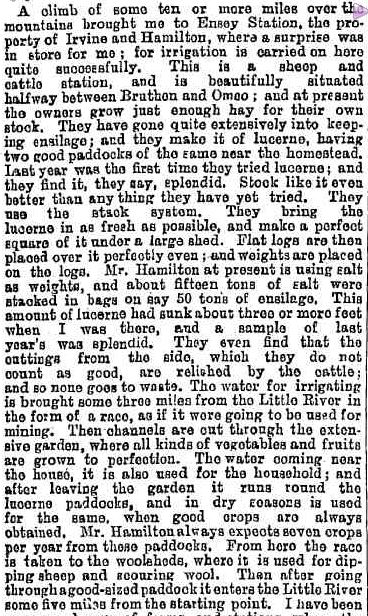
Just when it seemed Walter was settling into a life in the Western District, around 1888,  Walter Harman packed up the family and made the long trip to Ensay in East Gippsland, Victoria’s High Country.  It is the move which interests me, both the reason for travelling to the other side of the state and how they made the trip of over 600 kilometres, including the route they travelled.  The Ensay district did sound enticing, as this article from 1888 suggests:

In Gippsland. (1888, April 7). Australian Town and Country Journal (NSW : 1870 – 1907), p. 44. Retrieved February 20, 2012, from http://nla.gov.au/nla.news-article71096208

In 1843, Ensay Station comprised 38,400 acres.  An article from the Bairnsdale Advertiser and Tambo and Omeo Chronicle in 1917 cites the total acreage at Ensay Station at that time as 11,000 acres.  Over time, land was sold off to the likes of Walter Harman.

When I started researching the Harmans and I found the first references to Omeo, about 40kms north-west of Ensay, I imagined that Walt and his family went alone.  As my research continued I discovered the Condon family from the marriage record of Susannah Nash Harman and William Condon in 1898.  William was born in Portland in 1870, the son of William Charles Condon and Susan Baker.

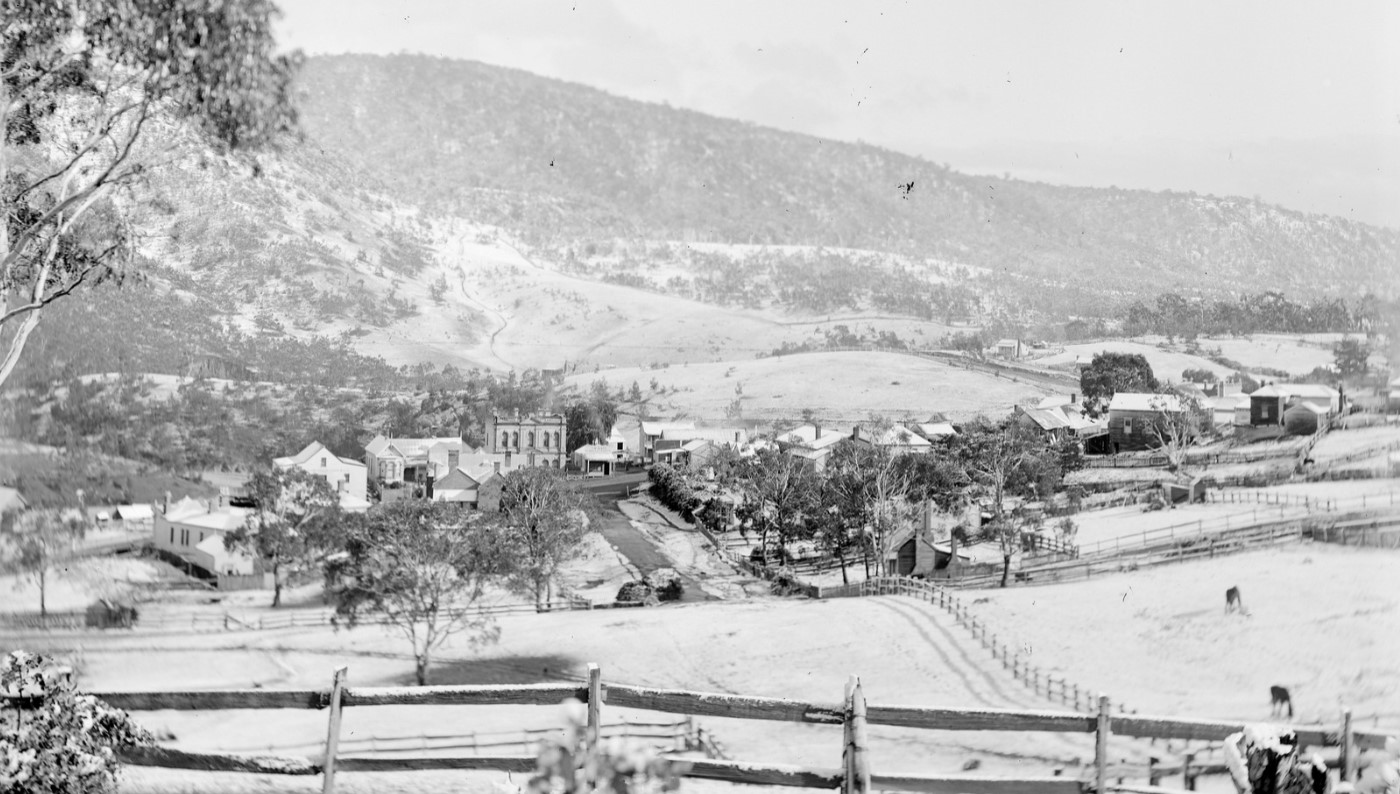
SNOW AT OMEO, c1880-1900. Image courtesy of the State Library of Victoria http://handle.slv.vic.gov.au/10381/22037

Later, thanks to newspaper reports of  Henry HARMAN’s court appearances in the trial of Ronald Griggs, I found John Henry CONDON, father of Lottie Condon.  While John was born in Omeo, he was the cousin of William Condon, Susannah Harman’s husband.  Not only that,  John Condon’s wife, Frances Ethel HUGGINS was born at Mount Eccles, near Macarthur in the Western District.  Frances’ mother was a SKIPWORTH, from Macarthur and her grandmother was a POYNTON, sister of Lydia Poynton, Walter Harman’s wife.  That sister, Mary, was also in the area with her husband, Thomas Skipworth. Phew!

Confusing maybe, but it shows five families living in the Omeo/Ensay area all with links to Byaduk/Macarthur and all connected through marriages over three generations.  Oh yes, Mary Poynton’s daughter Lydia Skipworth took along her new husband Andrew BAULCH from Tower Hill, near Warrnambool.  By 1890, his parent James Baulch and Ann Hulm were living at Bairnsdale.

So, the next question was, who was the trailblazer that made the first big move to the High Country, or was there a convoy of families making the move at the same time?

Using the years the children were born as a guide, the first family to make the move appears to be Henry Condon, older brother of William Condon with his wife Agnes Huggins, aunt of Frances Ethel Huggins.  Married in 1885, their first child was born at Omeo in 1886.  Agnes’ brother James Huggins and wife Elizabeth Skipworth had a child in Macarthur in 1886 with the next child, Thomas Leslie born in 1888 at Omeo.  This is also the same year John Joseph Stanley Harman was born at Omeo.

The obituary of John Tomlin Poynton, nephew of Lydia, talks of his move to the High Country in 1888 with his brother Edward with yet another family tie in, this time to the Skipworths.

PASSED AWAY. (1943, July 19). Gippsland Times (Vic. : 1861 – 1954), p. 1. Retrieved February 14, 2012, from http://nla.gov.au/nla.news-article63255330

The Hamilton Spectator of 8 March 1888, included the following from the Byaduk correspondent, “Several farmers in the neighborhood who have had the good fortune to secure what are said to be superb selections in Gippsland, intend leaving here for that part of the country shortly. “

Walter, with help from Lydia, worked quickly to establish a Sunday school at Ensay and they were a major force behind a State school being opened in the town. 

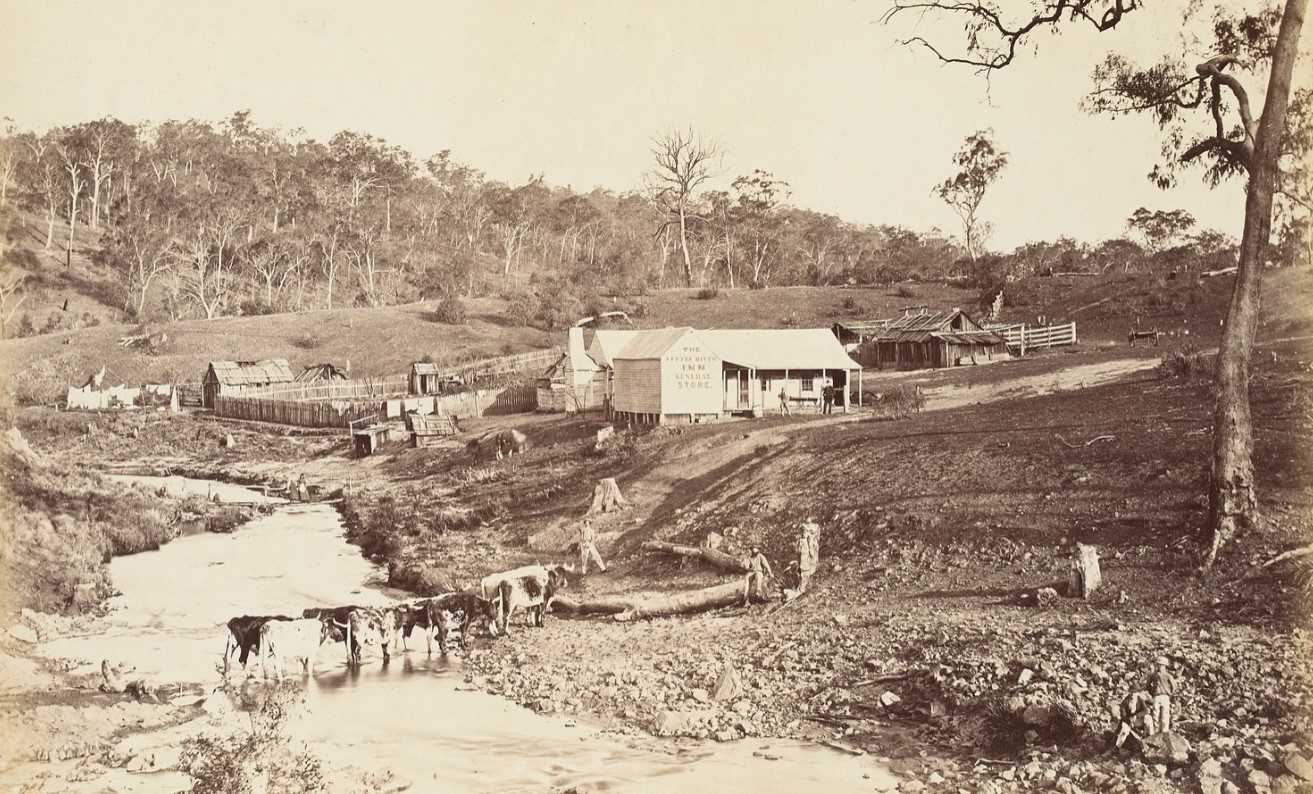
THE OMEO ROAD, ENSAY c1866-1890. Image courtesy of the State Library of Victoria http://handle.slv.vic.gov.au/10381/366573

In 1890, Walter was one of the first trustees of the Ensay Public Cemetery.  The name of the Harman property at Ensay was Systonholme.  This name paid tribute to Lydia’s birthplace, Syston, Lincolnshire, England.

Like his brother James, Walter was a lay preacher for the Methodist Church and would travel by horseback spreading the word of John Wesley.

In 1892, tragedy struck the Harmans in quick succession.  Seth died in July, aged 7 and Nathan passed away in August, aged 13.  The boys were buried at the Omeo cemetery.  Their death certificates are just another two on my long list of “must get” certificates, to see how the boys died so close together, although one would assume it was illness.

I love this photo of Walt and Lydia.  Despite the stiffness and lack of emotion of early photographs, there is a warmth here and the two seem very comfortable in each other’s company.  They were a team, and this is clear from the photo.  I would like to thank Linda Thatcher for allowing me to use this wonderful photograph.
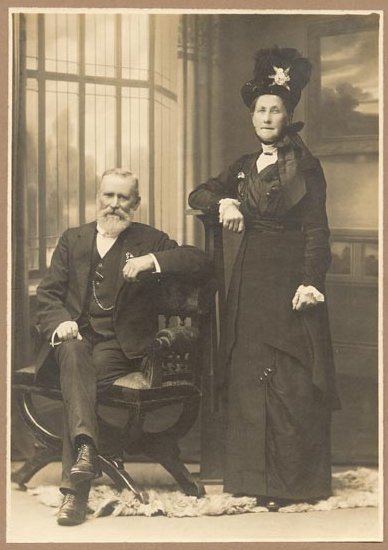
Walt and Lydia Harman (photo courtesy of Linda Thatcher)

In Walter and Lydia’s later years, they moved into “town”, taking up residence in the Melbourne suburb of Malvern.  In 1923, they were living at 11 Jordan Street with their house named Systonholme, a reminder of Ensay. Daughter Selina was living with them and Julia and her husband Arthur Lousada moved from their home in Toorak to 113 Tooronga Road Malvern, only two streets from her parents.

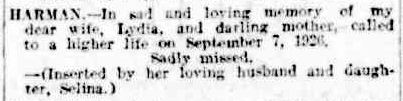
In 1926, Lydia passed away aged 79.  Walter had lost his beloved wife, the woman with whom he had pioneered and raised 10 children.  A  family notice was placed in The Argus at the time of her death:

Family Notices. (1926, September 11). The Argus (Melbourne, Vic. : 1848 – 1956), p. 17. Retrieved February 20, 2012, from http://nla.gov.au/nla.news-article3808510

In 1928, two years after Lydia’s death, Walter and daughter Selina placed an “In Memoriam” notice in The Argus and the pain was still clear.

Family Notices. (1928, September 15). The Argus (Melbourne, Vic. : 1848 – 1956), p. 13. Retrieved February 20, 2012, from http://nla.gov.au/nla.news-article3957034

Faced with life without Lydia, Walter returned to live at Ensay, his other great love.  On 22 October 1936, Walter passed away at  Systonholme, Ensay.

Family Notices. (1936, October 23). The Argus (Melbourne, Vic. : 1848 – 1956), p. 1. Retrieved February 20, 2012, from http://nla.gov.au/nla.news-article11928521

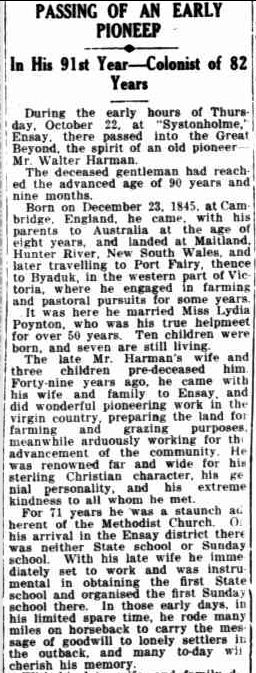
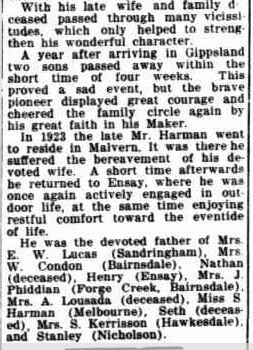
His obituary from the Gippsland Times is a fitting tribute to such a wonderful pioneer who gave so much to his local community while ensuring a comfortable life for his family.

PASSING OF AN EARLY PIONEER. (1936, November 5). Gippsland Times (Vic. : 1861 – 1954), p. 3. Retrieved February 14, 2012, from http://nla.gov.au/nla.news-article62986267

As yet, I have not found an obituary for James Harman but the words written of Walter may give a clue to James himself…”his sterling Christian character, his genial personality, and his extreme kindness to all whom he met”.  There are many similarities between James and Walter, despite their age difference and the fact they lived on opposite sides of Victoria, including their devotion to the Methodist Church and their community involvement.  Both brothers played a role in establishing schools in their respective towns.  The obituary also reconfirmed the Harman’s journey from N.S.W. on arrival in Australia to Port Fairy and then Byaduk.

While Walter Harman is remembered as an Ensay pioneer, he also lived in Byaduk and district for 25 years from the age of 18 to 43, which one could describe as his “formative years”. There was plenty of time for the characteristics, passions and wisdom of his brothers to rub off.

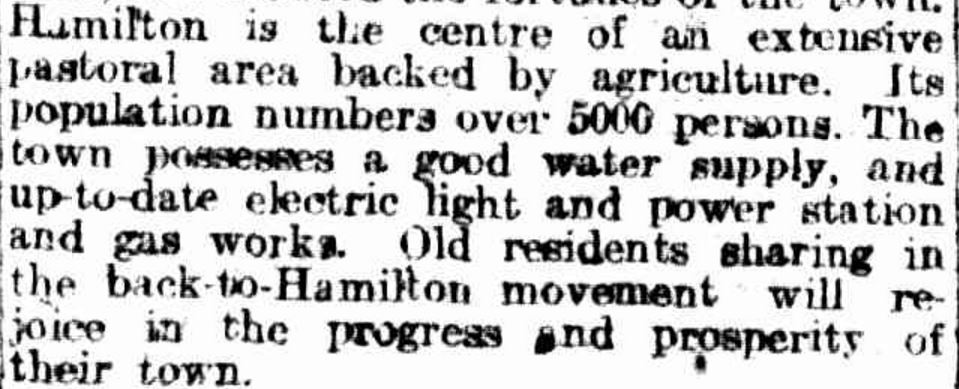
Back to Hamilton February 24, 1923

After months of planning, Saturday 24 February 1923 was the first day of the “Back to Hamilton” celebrations, an event which ran until the following Sunday 3 March.

“BACK TO HAMILTON.”. (1923, February 19). Portland Guardian (Vic. : 1876 – 1953), p. 2 Edition: EVENING.. Retrieved February 21, 2012, from http://nla.gov.au/nla.news-article64101957

Activities planned included band recitals, back to school visits, ancient and modern dance socials and terrier coursing.

bh

bh1

bh2

“BACK TO HAMILTON.” The Age (Melbourne, Vic. : 1854 – 1954) 23 Feb 1923: <http://nla.gov.au/nla.news-article203778556&gt;.

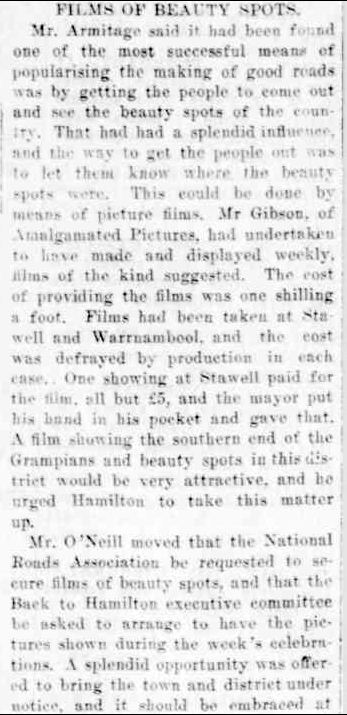
Visits to beauty spots around Hamilton were a feature as were “picture entertainments”.  I wonder if that included films of “Beauty Spots” as proposed in the following article.  Such a film was discussed during a meeting of the National Roads Association who were looking at development of roads through the Grampians to enhance tourism .  The film would be a way to show off the area and reinforce that good roads were necessary throughout the Grampians.  The “Back to Hamilton” celebrations were an opportunity to screen it.

Roads to Grampians. (1923, January 30). The Horsham Times (Vic. : 1882 – 1954), p. 3. Retrieved February 23, 2012, from http://nla.gov.au/nla.news-article72743674

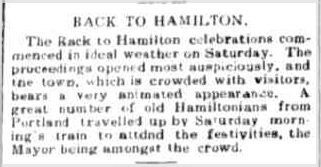
Over the first weekend, Hamilton was full and visitors were enjoying the celebrations in fine weather.

BACK TO HAMILTON. (1923, February 26). Portland Guardian (Vic. : 1876 – 1953), p. 2 Edition: EVENING.. Retrieved February 21, 2012, from http://nla.gov.au/nla.news-article64101997

Many visitors arrived by train and bands welcomed them at the station “Home, Sweet Home”

“BACK TO HAMILTON.”. (1923, February 27). The Argus (Melbourne, Vic. : 1848 – 1956), p. 11. Retrieved February 23, 2012, from http://nla.gov.au/nla.news-article1879114

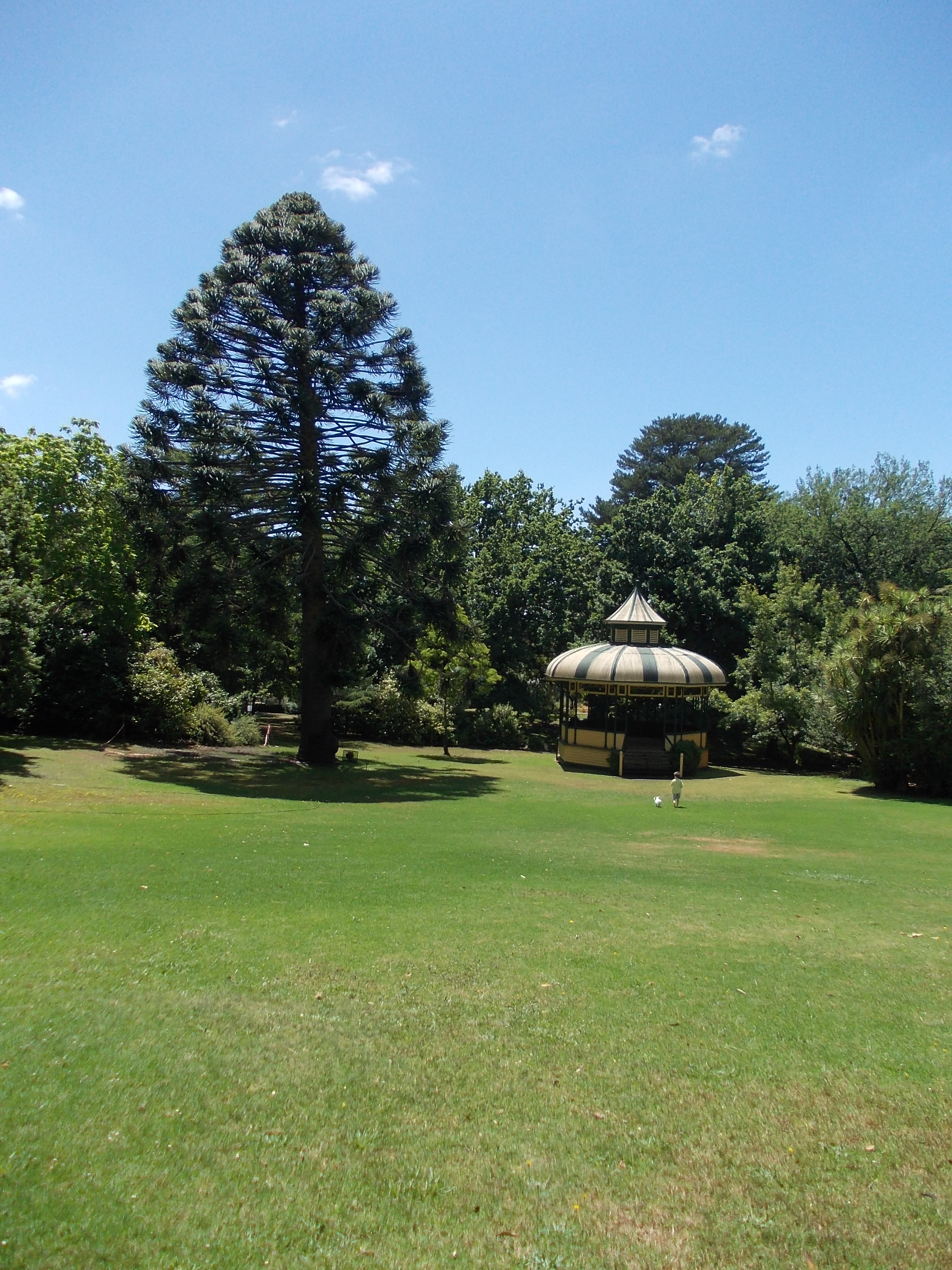
Crowds gathered in the Hamilton Botanic Gardens to listen to band recitals in the bandstand on Sunday February 25.  On the following Tuesday, children gathered in the gardens for sports.

BANDSTAND, HAMILTON BOTANIC GARDENS

Councillor Noske spoke to the gathering declaring “Hamilton was destined to become a great town” and the council’s focus was on closer settlement.  A parade was held on the Tuesday afternoon which included Thomas Cawker of Casterton driving a four-in-hand coach, old pioneers his passengers.

Back to Hamilton. (1923, February 28). The Argus (Melbourne, Vic. : 1848 – 1956), p. 14. Retrieved February 23, 2012, from http://nla.gov.au/nla.news-article1879269

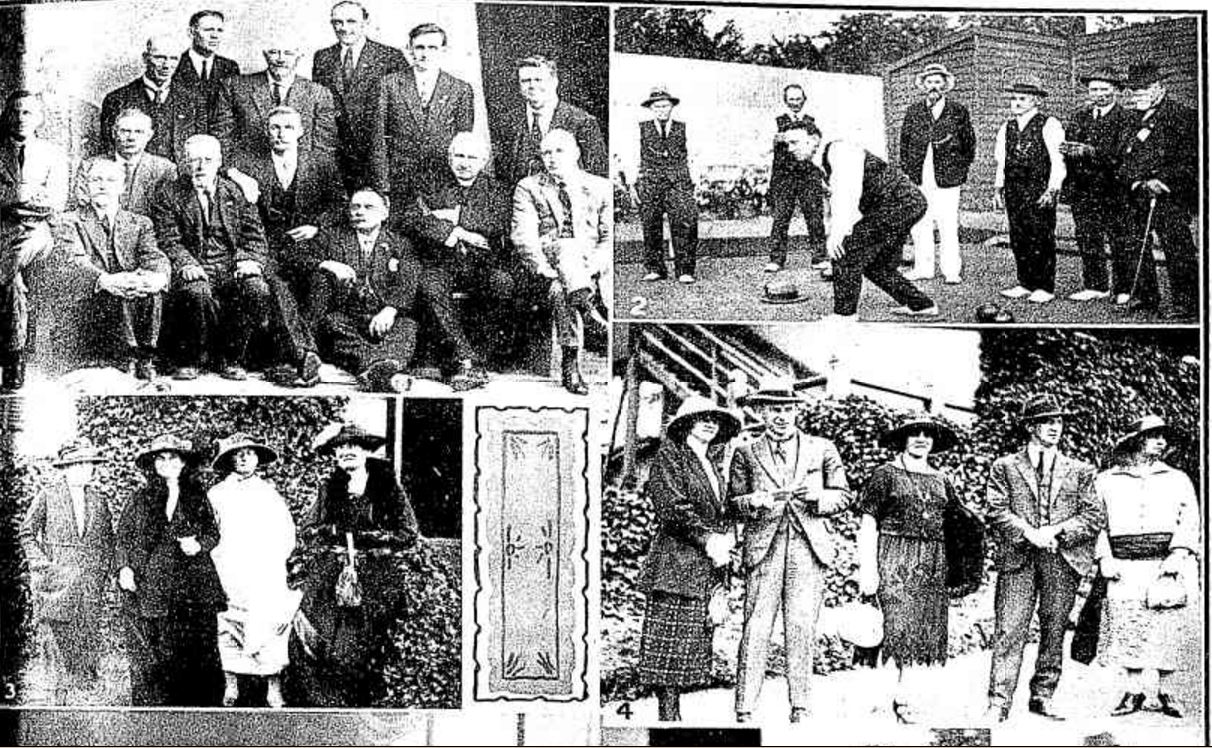
Photos from the event from Table Talk 8 March 1923

bh5

"[No heading]." Table Talk (Melbourne, Vic. : 1885 - 1939) 8 Mar 1923: 9. Web..

bh6

“[No heading].” Table Talk (Melbourne, Vic. : 1885 – 1939) 8 Mar 1923: 9. Web.<http://nla.gov.au/nla.news-page17434629&gt;.

 "[No heading]." Table Talk (Melbourne, Vic. : 1885 - 1939) 8 Mar 1923: 26. .


“[No heading].” Table Talk (Melbourne, Vic. : 1885 – 1939) 8 Mar 1923: 26. <http://nla.gov.au/nla.news-page17434648&gt;.


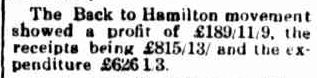
The “Back to Hamilton” was a roaring success, with a profit of £189/11/9.  A very healthy sum for an event which one would imagine was not for profit.  I wonder where the money ended up?

Miscellaneous. (1923, April 9). Portland Guardian (Vic. : 1876 – 1953), p. 3 Edition: EVENING.. Retrieved February 23, 2012, from http://nla.gov.au/nla.news-article64102283

It was during the following year, 1924, when a committee  formed to organize a “Back to Horsham”, gave some clue how such a big profit came about.  While a similar event in Stawell was mostly subsidized,  Hamilton visitors incurred charges for many events, including a trip to a dry Wannon Falls.

Back to Horsham. (1924, August 5). The Horsham Times (Vic. : 1882 – 1954), p. 3. Retrieved February 23, 2012, from http://nla.gov.au/nla.news-article72749147

A Memorial Coincidence

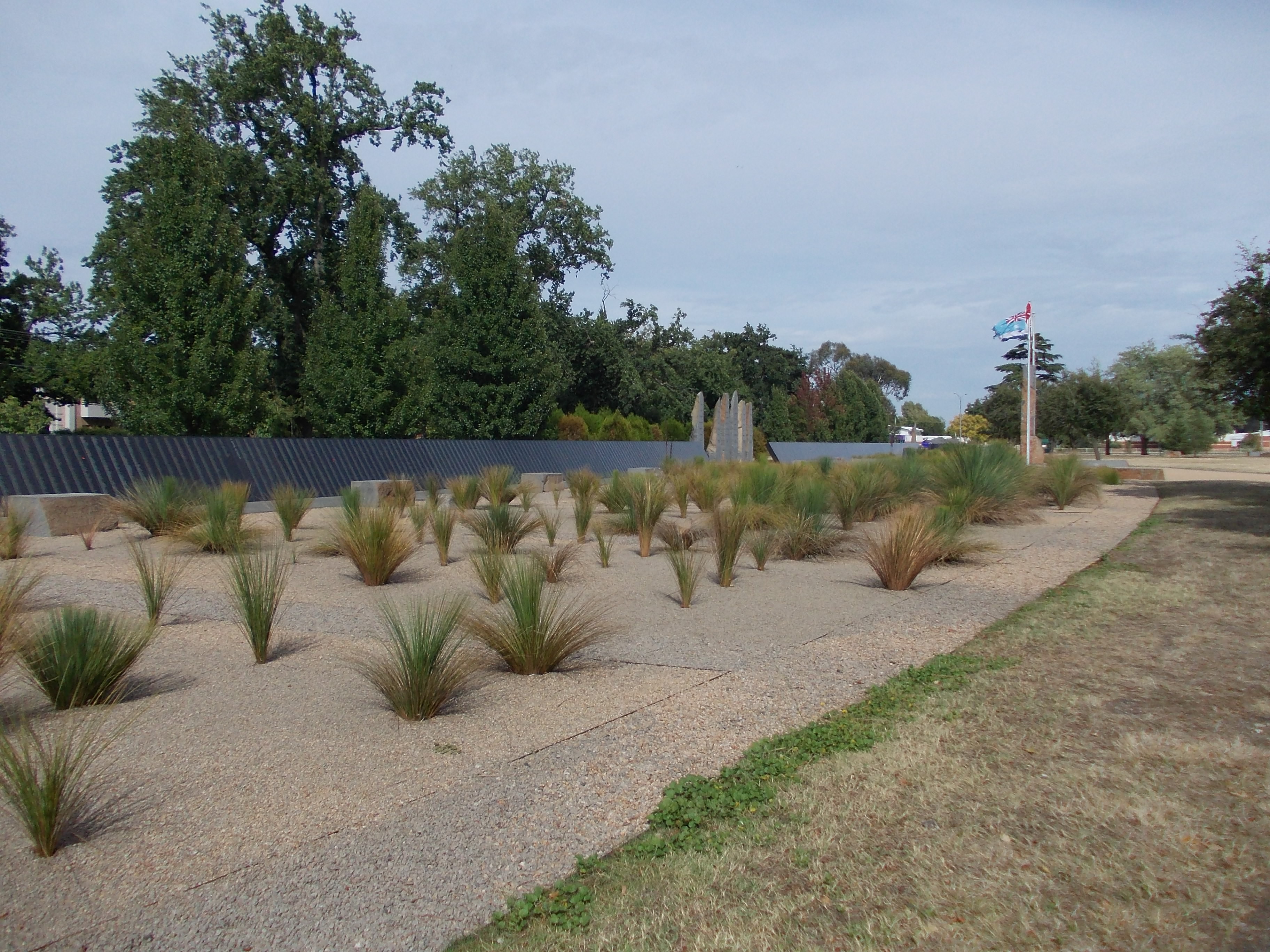
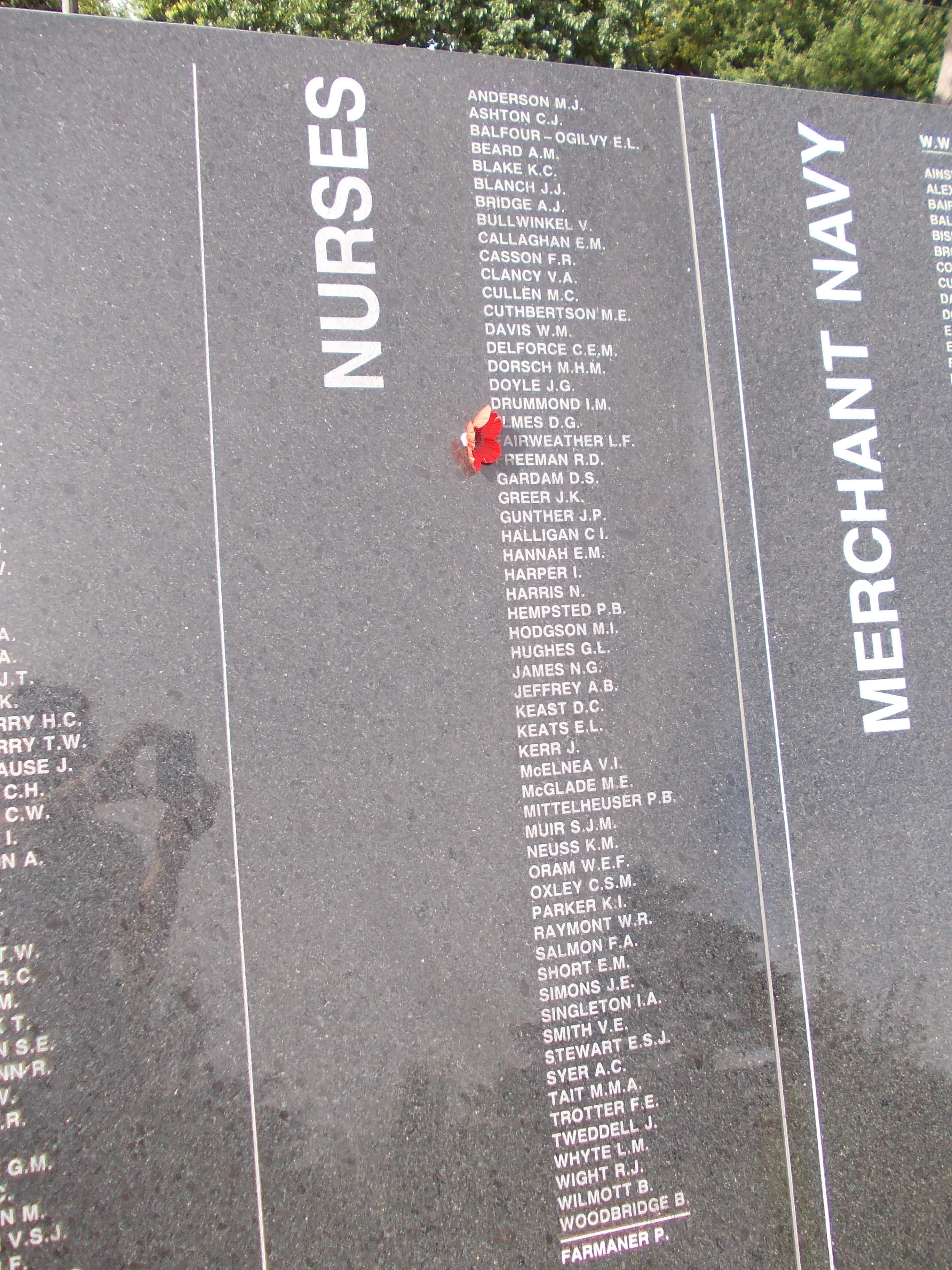
Eight years ago, almost to the day, we decided to visit the newly opened Australian Ex-Prisoners of War Memorial in Ballarat.  My great-uncle Bill Hadden was a POW in Changi and I wanted to find his name.

It was a warm evening, and I was about 8½ months pregnant and apart from another couple browsing through the names, we were the only ones there.  We walked along the row, found Uncle Bill’s name then continued to the end.  As we made the return trip, I noticed the couple had stopped near Uncle Bill’s name.  As I paused nearby for a last tribute, I overheard the couple talking.  They looked puzzled saying they couldn’t see a Bill or a William.  They were pointing right at the list of Haddens on the memorial.  I realised they were talking about Bill Hadden and I immediately understood their predicament.  Uncle Bill’s real name was Thomas Horace Hadden, not William as many people over the years probably thought.

I asked the couple if they were looking for Bill Hadden and they were.  I explained he was the T.H.Hadden on the memorial.

Who were these people?  I certainly didn’t recognise them as cousins.  As it turned out, the lady was a daughter of one of the men incarcerated with Uncle Bill in Changi and Bill had even attended her wedding.  They were en route from Birchip to Melbourne and thought they would drop in at the memorial to look for her father’s name.  Unbelievable.  To think they were there at the same time I was.  Also, if I hadn’t been there at that time, they’d have left wondering why Bill Hadden’s name was not on the memorial.

STOP PRESS!. (1942, February 16). Cairns Post (Qld. : 1909 – 1954), p. 5. Retrieved February 15, 2012, from http://nla.gov.au/nla.news-article42332207

This is a pertinent time to remember that visit eight years ago.  On 15 February 1942,  seventy years ago, Singapore fell to the Japanese and Bill Hadden of the 2/13th Australian General Hospital (2/13 AGH) was taken prisoner. In the days after, he would walk through the gates of Changi prison.

MORE NAMES OF AUSTRALIAN POW’s AT SINGAPORE. (1945, September 14). The Argus (Melbourne, Vic. : 1848 – 1956), p. 2. Retrieved February 15, 2012, from http://nla.gov.au/nla.news-article975785


BILL HADDEN

BILL HADDEN

In Malaya prior to the capture, Uncle Bill wrote a letter home to his great-aunt Henrietta Harman of Byaduk.  Answering the call of the Australian Women’s Weekly, Henrietta sent the letter into the Weekly with it published on 31 January 1942.

LETTERS FROM OUR BOYS. (1942, January 31). The Australian Women’s Weekly (1933 – 1982), p. 2. Retrieved February 15, 2012, from http://nla.gov.au/nla.news-article47812486

This is a wonderful insight into the lead-up to the events of seventy years ago today.  How could Uncle Bill ever imagine the “…greater hardships before it is over” would be over three years in Changi prison.  It has also given me a small glimpse of Henrietta’s life.  Even though I did not know her, I never would have picked her as a reader of the Women’s Weekly.  Maybe it was the incentive of a £1 prize for all letters printed.

May we also remember the brave nurses of the 2/13 AGH, evacuated from Singapore just prior to the fall.  In particular, the nurses on board the ill-fated Vyner Brooke.  The ship was attacked from the air on 14 February 1942.  Survivors found themselves on Radji beach, Banka Island.  They were discovered by Japanese troops who walked twenty-two Australian nurses and one female English civilian into the sea and shot them. One nurse, Sister Vivian Bullwinkel, survived and would herself become a POW.

AUSTRALIAN POW NURSES

Growing up, I was familiar with the name Sister Vivian Bullwinkel.  On Anzac Day, as we watched the march on television, Nana would proudly tell me Uncle Bill knew Vivian Bullwinkel during the war.  It was not until I was older I realised her heroics and the horrific acts she saw.

I also grew up familiar with the name “Changi,” again because Nana would talk of Uncle Bill being in “Changi” during the war.  It probably was not until Uncle Bill, Nana and their two sisters Rose and Alma visited Singapore and the infamous prison in 1981 that I had any inkling of what it really was.

UNCLE BILL & HIS SISTERS IN SINGAPORE

As I have read more, I have learned more about life in Changi for Uncle Bill and thousands of other Australians during that time.  I now know why Nana was so proud of her brother “Billy”.   

I  have a copy of a letter from Uncle Bill to his mother Sarah Hadden (nee Harman) written on 18 August 1945, three days after the war ended.  Bill commented on how fortunate he was to remain at Changi for the duration of his incarceration. He wrote, “I have truly a lot to be thankful for, as many hundreds who went to Thailand and Burma will never return.”


I have only touched on the sinking of the Vyner Brooke and the events on Banka Island.  The Australian War Memorial (AWM) has photos of the nurses from the Vyner Brooke and you can see them here.  It is sad scrolling through the photos of fresh-faced young women who had just enlisted and thinking they never came home.

An article from the Sydney Morning Herald of 18 September 1945 tells the story of Banka Island in Sister Vivian Bullwinkel’s words.

The AWM has articles about the Sinking of the Vyner Brooke and Sister Bullwinkel.

In The News – 8 February – 13 February 1901

I have an interest in the weather, not just for today or the coming weekend but also historically.  Participating in Melbourne University’s Climate History newspaper tagging project involving tagging Trove newspaper articles about weather events, it became evident the weather behaves in a cyclical nature.  If it has happened before it will happen again, droughts, floods, and storms.

Taking my interests a step further,  investigating how weather events affected my ancestors can add greatly to their story. That is why the Victorian bushfires of 1901 are of interest as the Byaduk district, where many of my ancestors lived, was heavily affected.  The weather was similar to two days in my lifetime,  Ash Wednesday on 16 February 1983 and  Black Saturday on 7 February 2009. On each day, fires blazed across Victoria.  

The first reports of fire came through on 8 February 1901.  The following article from The Argus describes the weather of 7 February 1901.  The descriptive language takes the reader to that day.  The heat was oppressive, the wind was strong and dust storms crossed the state, causing unnatural darkness.

HEAT AND GALES. (1901, February 8). The Argus (Melbourne, Vic. : 1848 – 1956), p. 5. Retrieved January 29, 2012, from http://nla.gov.au/nla.news-article10533956

Fires had sprung up throughout the Western District.  Early reports from Branxholme were tragic with one death, stock killed and houses lost.  I have family links to three families who lost their homes, the Millers, Storers and Addinsalls.  George Miller, a racehorse trainer, lost his house and stables and no doubt his horses.

HEAT AND GALES. (1901, February 8). The Argus (Melbourne, Vic. : 1848 – 1956), p. 5. Retrieved January 29, 2012, from http://nla.gov.au/nla.news-article10533956

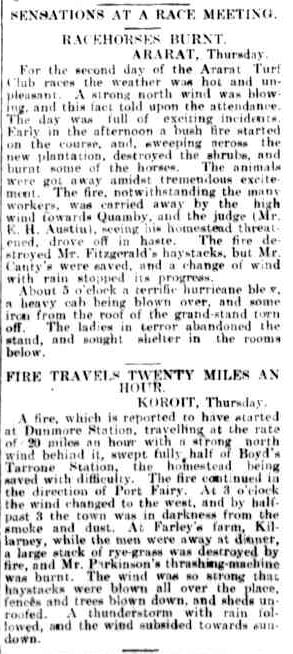
The two-day race meeting at Ararat was held in stifling conditions. A fire started at the course on the second day, with horses receiving burns.  Later the wind picked up and ripped iron off the grandstand roof, sending the ladies within running for shelter.

HEAT AND GALES. (1901, February 8). The Argus (Melbourne, Vic. : 1848 – 1956), p. 5. Retrieved January 29, 2012, from http://nla.gov.au/nla.news-article10533956

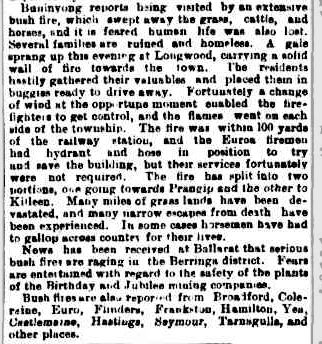
Fires started across Victoria including Warrnambool, Alexandra, Wangaratta, Buninyong, Yea, and Castlemaine.

DESTRUCTIVE BUSH FIRES IN VICTORIA. (1901, February 8). The Sydney Morning Herald (NSW : 1842 – 1954), p. 6. Retrieved January 30, 2012, from http://nla.gov.au/nla.news-article14337694

The articles below report on homes lost in the Byaduk district with Byaduk North worst hit.  My relatives were closer to Byaduk township further south and while they were lucky not to lose their homes it must have been terrifying all the same.  

The fire travelled at a great pace, coming within a mile of my ggg grandfather James Harman’s property Mount Pleasant, on the Hamilton-Port Fairy Road, reaching the properties of the Christie brothers just to the north. As well as James and his wife Susan Reed, my great-grandmother Sarah Elizabeth Harman, and her father Reuben James Harman were living at Byaduk but lived further south again in the Byaduk township.  Numerous other family members lived in the area from the Byaduk Caves through to the Byaduk township.  

TERRIBLE BUSH FIRES. (1901, February 9). The Advertiser (Adelaide, SA : 1889 – 1931), p. 7. Retrieved February 7, 2012, from http://nla.gov.au/nla.news-article4818069

DESTRUCTIVE BUSH FIRES. (1901, February 9). Bathurst Free Press and Mining Journal (NSW : 1851 – 1904), p. 2. Retrieved February 7, 2012, from http://nla.gov.au/nla.news-article64452557

The Hamilton Spectator reported twelve homes destroyed leaving just three standing in Byaduk North.  Most were close to the course of the Lyne Creek running to the west of the township. The Free Presbyterian Church was lost and the Byaduk North Hotel was under threat.  In the days after the fire, the hotel served as a refuge for the homeless.

BYADUK NORTH HOTEL c1906. Image courtesy of the Museums Victoria Collections http://collections.museumvictoria.com.au/items/766487

BYADUK NORTH HOTEL c1906. Image courtesy of the Museums Victoria Collections http://collections.museumvictoria.com.au/items/766487

The homestead of Richard Thomas Carty at Brisbane Hill, a large property to the north of Byaduk North, was destroyed.  While running for the creek, after escaping the homestead, Mrs Carty’s dress caught fire but it was fortunately quelled.  The Cartys rebuilt and the replacement homestead Dunroe still stands today.

"ALONG MACARTHUR ROAD." Hamilton Spectator (Vic. : 1870 - 1918) 9 February 1901 .

“ALONG MACARTHUR ROAD.” Hamilton Spectator (Vic. : 1870 – 1918) 9 February 1901 <http://nla.gov.au/nla.news-article226087594&gt;.

"THE VICTORIAN BUSH FIRES." Australian Town and Country Journal (Sydney, NSW : 1870 - 1907) 23 February 1901: .

“THE VICTORIAN BUSH FIRES.” Australian Town and Country Journal (Sydney, NSW : 1870 – 1907) 23 February 1901: <http://nla.gov.au/nla.news-article71463761&gt;.

The fire burnt through the Monivae Estate with a large loss to fences and livestock and burnt within a mile of Hamilton.  On the other side of town, closer to the Coleraine railway line, the Hamilton Racecourse fell just short of the fire’s path.

"MANY FAMILIES HOMELESS." Leader (Melbourne, Vic. : 1862 - 1918) 9 Feb 1901: 18. .

“MANY FAMILIES HOMELESS.” Leader (Melbourne, Vic. : 1862 – 1918) 9 Feb 1901: 18. <http://nla.gov.au/nla.news-article198084151&gt;.

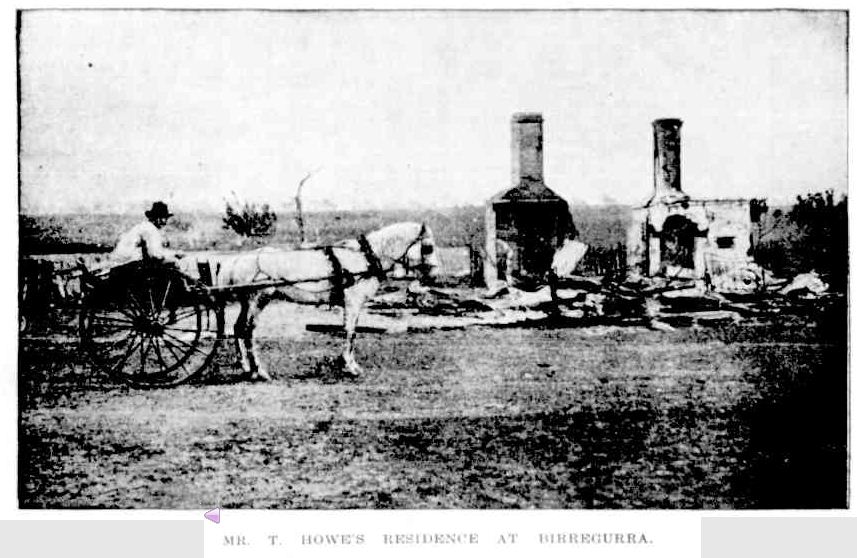
Other areas throughout the Western District felt the brunt of fire on 7 February 1901.  This photograph from Birregurra shows the devastation in that town.

THE VICTORIAN BUSH FIRES. (1901, February 23). Australian Town and Country Journal (NSW : 1870 – 1907), p. 38. Retrieved February 7, 2012, from http://nla.gov.au/nla.news-article71463761

Portland was also under threat with fire circling the town.  The fire did not stop until it met the sea.

VICTORIAN BUSH FIRES. (1901, February 11). The Advertiser (Adelaide, SA : 1889 – 1931), p. 5. Retrieved February 7, 2012, from http://nla.gov.au/nla.news-article4818536

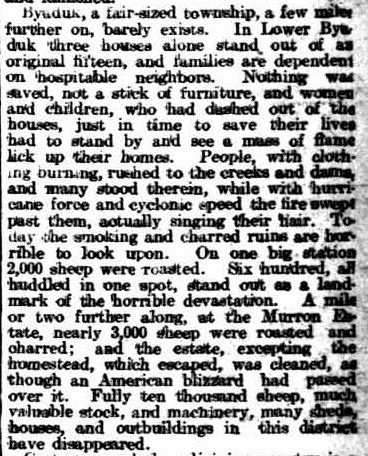
Buninyong near Ballarat was one of the worst areas hit.

BUSH FIRES IN VICTORIA. (1901, February 9). The West Australian (Perth, WA : 1879 – 1954), p. 3. Retrieved February 7, 2012, from http://nla.gov.au/nla.news-article23853766

THE VICTORIAN BUSH FIRES. (1901, February 23). Australian Town and Country Journal (NSW : 1870 – 1907), p. 38. Retrieved February 7, 2012, from http://nla.gov.au/nla.news-article71463761

Macarthur had losses as did Princetown on the south coast.  At Timboon, bullock teams from the local sawmill were lost.

FIRES IN VICTORIA. (1901, February 12). South Australian Register (Adelaide, SA : 1839 - 1900), p. 6. Retrieved February 7, 2012, from http://nla.gov.au/nla.news-article54558042

FIRES IN VICTORIA. (1901, February 12). South Australian Register (Adelaide, SA : 1839 – 1900), p. 6. Retrieved February 7, 2012, from http://nla.gov.au/nla.news-article54558042

By 11 January, aid for the homeless was on the agenda and at Branxholme a public meeting was held to discuss such matters.  Authorities discovered the fire near Branxholme, which was probably the same fire to hit Byaduk, was accidentally started by a travelling tinsmith fixing a trough at Ardachy Estate.

THE BUSH FIRES. (1901, February 11). The Argus (Melbourne, Vic. : 1848 – 1956), p. 5. Retrieved February 7, 2012, from http://nla.gov.au/nla.news-article10534297

A meeting was called at Byaduk for 18 February 1901, and James Harman donated £2 2/ to the fund for the homeless.

"BUSH FIRE BELIEF FUNDS." Hamilton Spectator (Vic. : 1870 - 1918) 21 February 1901: .

“BUSH FIRE BELIEF FUNDS.” Hamilton Spectator (Vic. : 1870 – 1918) 21 February 1901: <http://nla.gov.au/nla.news-article226090204&gt;.

The fire was so strong and relentless, old residents were drawing comparisons to Black Thursday almost fifty years earlier to the day on 6 February 1851.

TELEGRAPHIC. (1901, February 12). Kalgoorlie Western Argus (WA : 1896 – 1916), p. 32. Retrieved February 7, 2012, from http://nla.gov.au/nla.news-article32205605


What the Dickens?

Today marks 200 years since the birth of writer Charles Dickens.  Growing up in Hamilton in the 1970s and 80s my limited diet of Dickens consisted of a production of “Oliver” circa 1978 by the local theatre group and repeats of an old version of “A Christmas Carol” on one of the two TV channels. Oh, and there was a street in Hamilton called Dickens Street, presumably named after Charles himself.  As there is a Burns, Tennyson, Shakespeare, Byron, and Chaucer Street in Hamilton, it made sense to think Dickens Street was part of the theme the early town leaders had happening.  Or did it?  Those other guys are poets anyway.
Having missed a copy of the first edition of a book by Hamilton researcher John McKay in 2007,  The Streets of Hamilton, Western Victoria,  Australia: A History of the People behind the Names, which had a limited print run, I was lucky enough to have Dad snare a copy of the revised 2nd edition in 2009.  It is a terrific book, and as I am familiar with all the street names, it was interesting to read who the streets were named after, with some surprises.

The biggest of those was that Dickens Street, Hamilton was it more likely it was named after the son of Charles Dickens, Alfred D’Orsay Tennyson Dickens.  Why?  Because he lived in Hamilton? What?  The son of one of the world’s most famous novelists could not have lived in Hamilton, my hometown Hamilton, a million miles from the world of Charles Dickens.

Unbelievable but true.  In fact, I find it a little mind-boggling that Alfred Dickens walked the streets of Hamilton 100 years before I did.

Alfred came to be in Australia as his father has sent him off to make his fortune, just as he did with his youngest son Edward Bulwer Lytton Dickens (aka “Plorn”), who lived in New South Wales.

UNLUCKY PLORN DICKENS. (1939, November 4). The Sydney Morning Herald (NSW : 1842 – 1954), p. 13. Retrieved February 6, 2012, from http://nla.gov.au/nla.news-

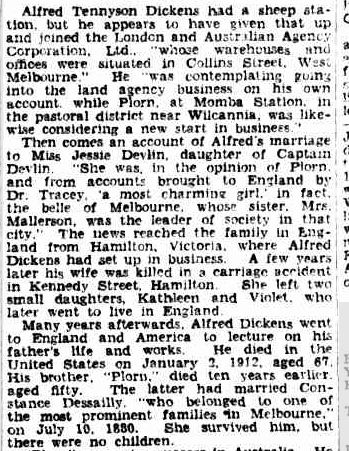
Alfred’s travels led him to Hamilton where he set up an auctioneering business with Robert Stapylton Bree known as Bree, Dickens & Co.  They were in partnership from 1875-1882.

John McKay mentions a property at 32 Collins Street, Hamilton which Alfred rented before building his own home next door.  The house is very familiar to me and I have been along the street many times, so to think that the son of Dickens lived there is almost unbelievable.

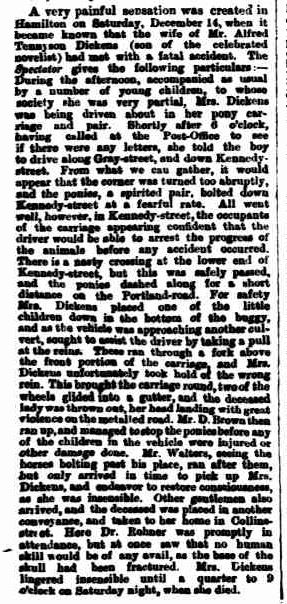
It was an accident that claimed the life of his wife, Jessie Devlin, that saw Alfred Dickens leave Hamilton.

(1878, December 23). The South Australian Advertiser (Adelaide, SA : 1858 – 1889), p. 5. Retrieved February 6, 2012, from http://nla.gov.au/nla.news-page2115990

The horse in the photo below is taking the same path as Jessie’s ponies before bolting down the Kennedy Street hill.

Jessie is buried at the Hamilton (Old) Cemetery

GRAVE OF JESSIE DICKENS

Alfred packed up his two daughters and went to Melbourne.  He was known for his elocution skills and he began giving lectures on his father’s works.  It was on a trip to New York as part of a speaking tour to England and the U.S. that Alfred died.

MR. ALFRED T. DICKENS. (1912, January 4). The Argus (Melbourne, Vic. : 1848 – 1956), p. 7. Retrieved February 6, 2012, from http://nla.gov.au/nla.news-article11643665

First Issue, August 20, 1842. (1912, January 5). Portland Guardian (Vic. : 1876 – 1953), p. 2 Edition: EVENING. Retrieved February 6, 2012, from http://nla.gov.au/nla.news-article63999947

I feel a bit ripped off that it took so long to find out about Hamilton’s brush with Charles Dickens.  But I feel I am not alone.  There would not be many people who either live or have lived in Hamilton that would know the story of Alfred, except for local historians and those who have read John McKay’s book, of course.  Maybe we would know more about him if he had lived out his years in Hamilton, which it appeared he was preparing to do when Jessie met her death.  So on this day, the birthday of Charles Dickens, let us also remember Alfred and his time in the Western District.

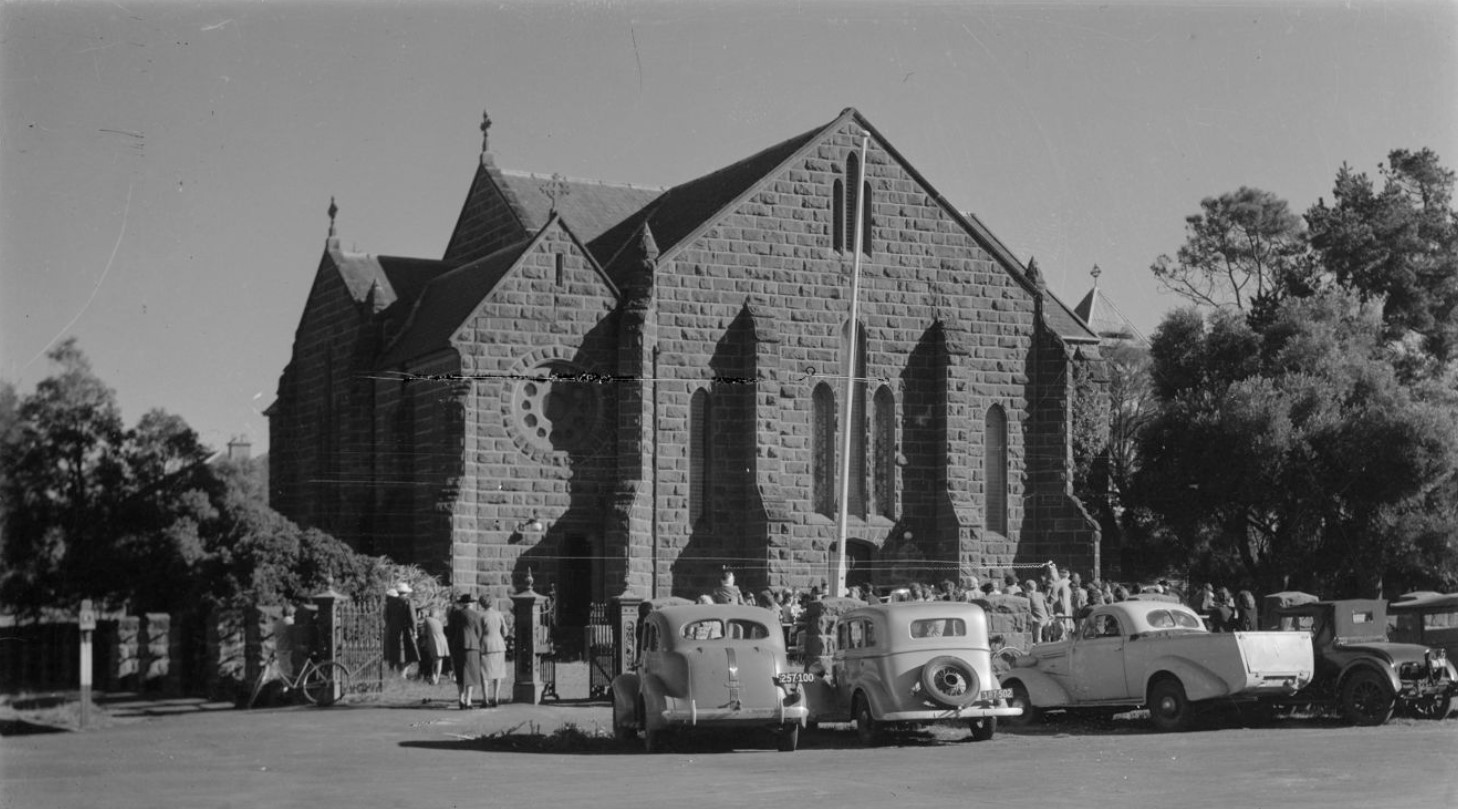
St Stephen’s Church, Portland

During our recent trip to Portland, while the fish were biting, I managed to sneak away for a walk around the town of Portland.

One building I visited was St Stephen’s Anglican Church on the corner of  Julia and Percy Streets.

St Stephens Church Portland

The foundation stone was laid on March 24, 1855.

St Stephens Church Foundation Stone

The Portland Guardian and Normanby General Advertiser reported on the laying of the foundation stone.

Local Intelligence. (1855, March 26). Portland Guardian and Normanby General Advertiser (Vic. : 1842 – 1876), p. 2 Edition: EVENING. Retrieved February 3, 2012, from http://nla.gov.au/nla.news-article71571938

I wonder if the reporter still had a job after overlooking the lunch that followed the ceremony.

I was impressed that the organisers of the day were able to secure Lieutenant Governor of the Colony, Sir Charles Hotham for the event.  However, after reading some articles about Hotham at Trove, and fitting the Portland visit into his timeline, I realised then he probably was trying to get as far away from Melbourne as possible.  The heat was on.  I would also imagine the Henty brothers’ connection to the church may have also been a factor.  Incidentally, Hotham was dead by the year’s end, having caught a chill, which exacerbated his already failing health.  This extract was published in the Empire (Sydney 1850-1875) on the same day as the report on the foundation stone ceremony and the tone is similar to other reports on Hotham at the time.

VICTORIA,. (1855, March 26). Empire (Sydney, NSW : 1850 – 1875), p. 5. Retrieved February 3, 2012, from http://nla.gov.au/nla.news-article60180148

Despite the church receiving a bell in 1864 from Stephen Henty, it was not until 1907 that the bell was hung.

St. Stephens’ Church Bell. (1907, July 5). Portland Guardian (Vic. : 1876 – 1953), p. 3 Edition: EVENING. Retrieved February 3, 2012, from http://nla.gov.au/nla.news-article63966019

Some histories of the bell may tell a different story of the bell’s origins as local historian Noel F. Learmonth had to admit in his article of October 29, 1951.  After reconfirming the story from 1907 article, he went on to say:

ST. STEPHEN’S BELL. (1951, October 29). Portland Guardian (Vic. : 1876 – 1953), p. 4 Edition: MIDDAY.. Retrieved February 3, 2012, from http://nla.gov.au/nla.news-article64429927

Entrance of St Stephen’s Church, Portland

A SHORT HISTORY OF ST STEPHEN’S CHURCH FROM 1869 TO THE PRESENT DAY. (1943, August 30). Portland Guardian (Vic. : 1876 – 1953), p. 4 Edition: EVENING. Retrieved February 3, 2012, from http://nla.gov.au/nla.news-article64386337

I wish I had read this article before I visited.  I would have like to have seen Stephen Henty’s stained glass window.

Interior of St Stephen’s Church

The organ on the wall of the altar has been in place since 1882.

INTERIOR OF ST STEPHEN’S CHURCH. Image courtesy of the State Library of Victoria http://handle.slv.vic.gov.au/10381/441320

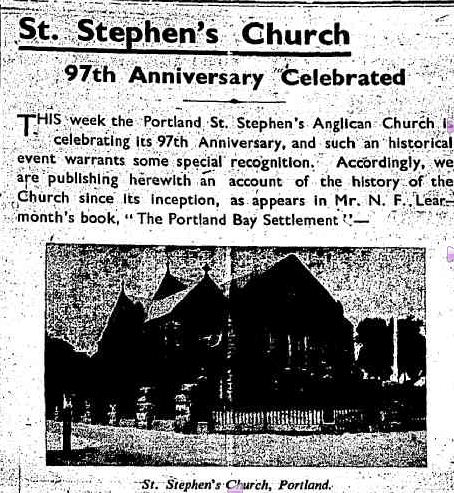
In 1953, the church celebrated its 97th anniversary.  The Portland Guardian of May 14, reported on the event and included an extract from one of Noel Learmonth’s books  “The Portland Bay Settlement”.  A nice touch was when the congregation sang “Happy Birthday” to the church.


St. Stephen’s Church 97th Anniversary celebrated. (1953, May 14). Portland Guardian (Vic. : 1876 – 1953), p. 3 Edition: MIDDAY. Retrieved February 3, 2012, from http://nla.gov.au/nla.news-article64434755

ST STEPHEN’S CHURCH. Image courtesy of the State Library of Victoria http://handle.slv.vic.gov.au/10381/61459

If you are interested in more history of the St Stephen’s Church, an article from the Portland Guardian of August 30, 1943, “A Short History of St Stephen’s Church from 1869 to Present Day” is worth a look.  It also includes a list of the 1943 members of the Ladies Guild.