Trove Tuesday – Hometown Rivals

This Trove Tuesday, we are off to my hometown Hamilton.

Take two rival football clubs, the Hamilton Football Club and the Hamilton Imperials Football Club, merge them and what do you get?  The beginning of a new chapter in the town’s sporting history when the Hamilton Kangaroos make their debut in Round 1 of the 2013 season this Saturday 13 April.  Also, the new club will be entering a different league, the Hampden League, after both were founding members of the Western Border Football League in 1964.

Of the two teams, the Hamilton Football Club had the longest history.  While the club may not have officially been formed at the time of this article from 1868,  it is the earliest article I can find at Trove of football played at Hamilton.

TABLE TALK. (1868, November 12). Portland Guardian and Normanby General Advertiser (Vic. : 1842 - 1876), p. 2 Edition: EVENINGS.. Retrieved April 8, 2013, from http://nla.gov.au/nla.news-article64691122

TABLE TALK. (1868, November 12). Portland Guardian and Normanby General Advertiser (Vic. : 1842 – 1876), p. 2 Edition: EVENINGS.. Retrieved April 8, 2013, from http://nla.gov.au/nla.news-article64691122

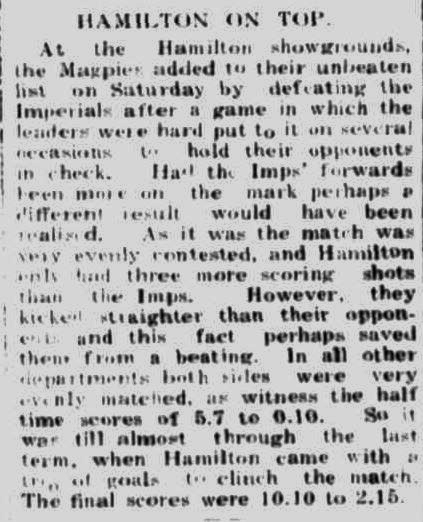
In 1948, a club formed by a breakaway group from the Hamilton Football Club made its debut in the Western District Football League.  The Hamilton Imperials Football Club was born.  In June of that year, the Magpies (Hamilton) and the Bulldogs (Imperials) met for the first time, beginning a rivalry that would endure for the next 64 years.  Hamilton easy winners.

HAMILTON ON TOP. (1948, June 10). Portland Guardian (Vic. : 1876 - 1953), p. 4 Edition: EVENING. Retrieved April 8, 2013, from http://nla.gov.au/nla.news-article64415146

HAMILTON ON TOP. (1948, June 10). Portland Guardian (Vic. : 1876 – 1953), p. 4 Edition: EVENING. Retrieved April 8, 2013, from http://nla.gov.au/nla.news-article64415146

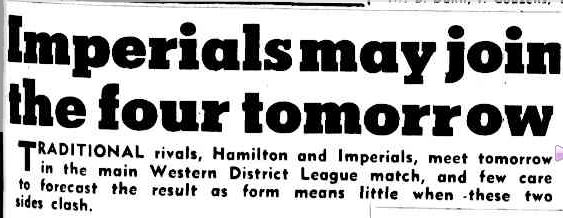
In the 1950s, they used to say that the form guide could be thrown away when Hamilton and the Imperials met.  The following headlines, all from The Argus during the 1950s, show how the rivalry had grown in just a short time.

Traditional clash in Western League HAMILTON HAS EDGE ON OLD RIVALS. (1953, July 3). The Argus (Melbourne, Vic. : 1848 - 1956), p. 10. Retrieved April 8, 2013, from http://nla.gov.au/nla.news-article23253913

Traditional clash in Western League HAMILTON HAS EDGE ON OLD RIVALS. (1953, July 3). The Argus (Melbourne, Vic. : 1848 – 1956), p. 10.  http://nla.gov.au/nla.news-article23253913

tt23

TRADITIONAL RIVALS FIGHT IT OUT. (1955, May 13). The Argus (Melbourne, Vic. : 1848 - 1956), p. 22. Retrieved April 9, 2013, from http://nla.gov.au/nla.news-article71882081

TRADITIONAL RIVALS FIGHT IT OUT. (1955, May 13). The Argus (Melbourne, Vic. : 1848 – 1956), p. 22. http://nla.gov.au/nla.news-article71882081

tt25

Imperials may jain the lour tomorrow. (1956, May 11). The Argus (Melbourne, Vic. : 1848 - 1956), p. 23. Retrieved April 9, 2013, from http://nla.gov.au/nla.news-article71802250

(1956, May 11). The Argus (Melbourne, Vic. : 1848 – 1956), p. 23. http://nla.gov.au/nla.news-article71802250

Here’s to a successful future for the Hamilton Kangaroos, but may the history of the two clubs that came before be maintained so future generations know their role, not only in Hamilton’s sporting history but its social history.

Where did my heart lie?  With the mighty Imps of course!

Gardeners in My Family

It was the Afternoons program on 774 ABC Melbourne that got me thinking about my gardening pedigree.  Presenter Richard Stubbs asked listeners how they came to take up gardening.  Was it passed on from someone else?

IMG_1329 (2)

I grew up in a gardener’s house and remember constant talk of  Spring and Autumn annuals, Marigolds, Petunias, Camellias, Dahlias, the constant moving of sprinklers and manure.

When Nana came to live with us in the late 1970s, the garden talk doubled and if my Great Auntie Rosie came to visit, well.  Auntie Rosie was Nana’s sister and they had other siblings that were keen gardeners too.

One was my great-uncle Bill Hadden.  Visiting his garden was special.  I remember fish ponds, orchids and a large television antenna tower that I had an urge to climb every time I went there.

This is a lovely photo of Uncle Bill as young man in his parent’s backyard at 78 Coleraine Road, Hamilton, planting seed in neat rows with help from his niece, Margaret.  It was about 1934.

0010

I too lived at 78 Coleraine Road.  Mum and Dad lived there when they first arrived in Hamilton after their marriage in 1967.  I came along in March 1968 and we lived there for about a year after my birth.  I wish I had have been older to remember the house, which was later pulled down, as that was the family home of my great grandparents, Thomas Hadden and Sarah Harman and where Nana and her brothers and sisters grew up.  Four generations lived in that house.

I showed Mum the photo of the backyard at 78 Coleraine Road and she was able to tell me more about it.  She said there was still a fence across the backyard when we there but it is was then made from  chook wire.   Auntie Rosie had lived there before us and she kept chooks.  After the photo, cherry plum and blood plum trees were planted and an apple tree, seen in the photo, was still there 33 years later.

Uncle Bill had his own home built after returning from WW2.  It was at 80 Coleraine Road, next door to his parents.

0112

The photo above, shows Mum and Nana, on the left, and Mum’s cousin Norma, right, in the front yard of Uncle Bill and Auntie Bess.  Although a reasonably new house, Uncle Bill already had an established garden and neat concrete and lawn driveway.  He later added a garage and sheds at the end of the driveway.

Alma, another of Nana’s sisters was also a green thumb.  When I visited her a few years ago, when she was in her late 90s, I was amazed at her beautiful potted cyclamen on her back porch. Despite almost no vision, she tended them with care.  She was often found pottering around the garden that she knew so well and was able to move around nimbly.

Advertising. (1876, July 21). Portland Guardian (Vic. : 1876 - 1953), p. 3 Edition: EVENINGS.. Retrieved March 12, 2013, from http://nla.gov.au/nla.news-article63316883

Advertising. (1876, July 21). Portland Guardian (Vic. : 1876 – 1953), p. 3 Edition: EVENINGS.. Retrieved March 12, 2013, from http://nla.gov.au/nla.news-article63316883


Before Nana came to live with us, she and my grandfather, Bill Gamble lived in Ballarat and I have great memories of visiting their house.  The backyard was small but  the space was well used .  Bill grew espalier apples, among other things, and had a shed with three sections lining the back fence.  From my memory, the left section was a fernery, the middle a utility shed that held grain to feed the occupants in the third section, the chooks.  I did like to admire the maiden hair ferns and their cool, soft foliage,  and the feed shed where I dipped my hands into oats in a large wooden barrel. But I did not go in the chook shed.

Advertising. (1936, July 30). Portland Guardian (Vic. : 1876 - 1953), p. 1 Edition: EVENING.. Retrieved March 12, 2013, from http://nla.gov.au/nla.news-article64273334

Advertising. (1936, July 30). Portland Guardian (Vic. : 1876 – 1953), p. 1 Edition: EVENING.. Retrieved March 12, 2013, from http://nla.gov.au/nla.news-article64273334

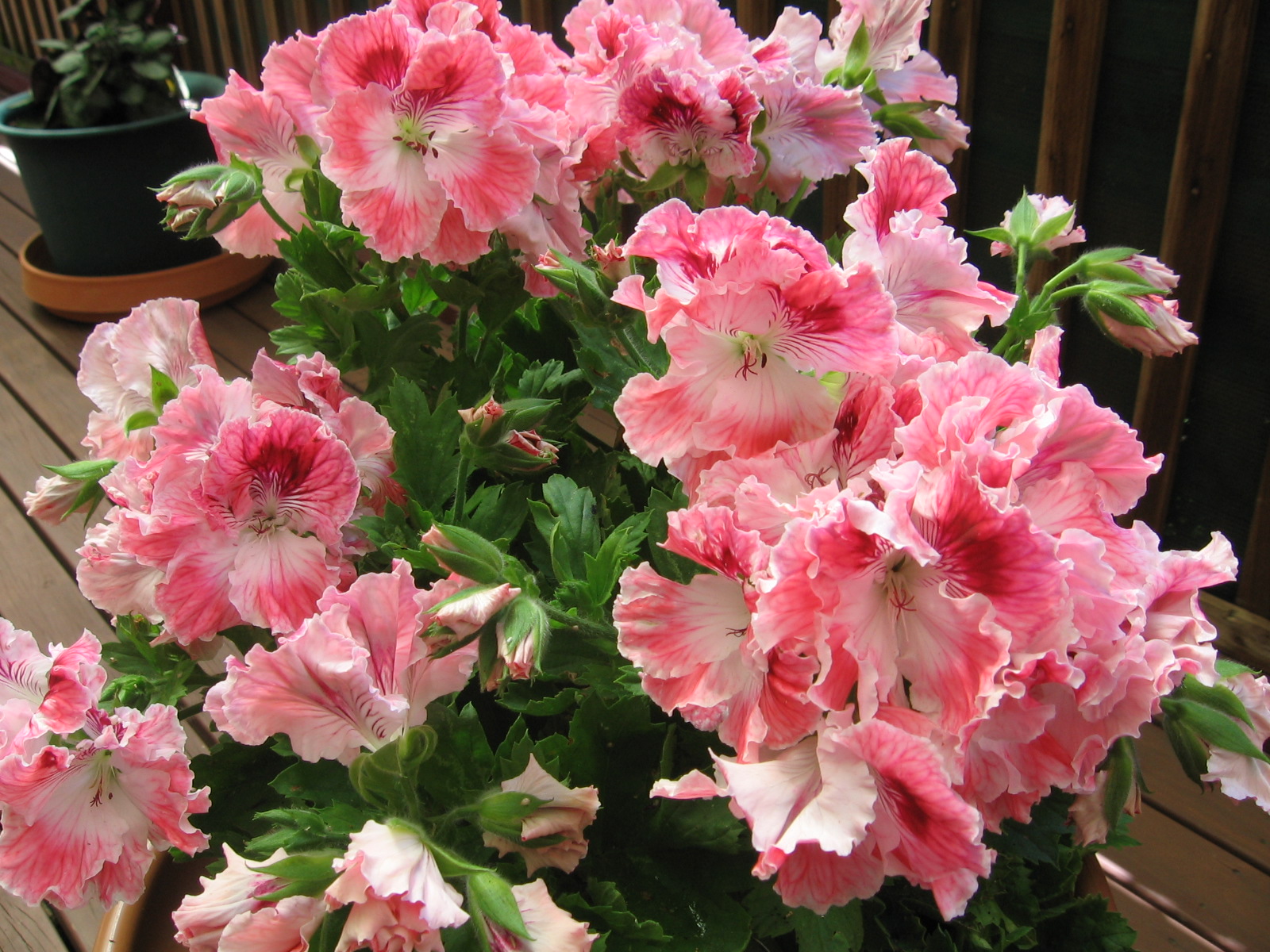
When I checked my memory against mum’s she told me the left side of the shed was interchangeable, depending on her father’s interest at the time.  He used to have budgies too and I can now remember budgie boxes in that part of the shed and attached to the fence.  She couldn’t remember the maiden hair ferns, but her father did grow Pelargoniums at one point.  That must have run in the family, as the following is a photo of one of Mum’s Pelargoniums.

039

The next photo was taken looking across the Gamble backyard.  We have several photos taken from this angle.  It must have been the “photo spot”.  Nana (centre) is  flanked by Bill’s aunt, Jane Diwell and a friend of Jane’s from Geelong.  In the front is my Uncle Peter.  Hopefully the photo shoot did not go on too long as there may have been an accident.

c

Of interest here is the espalier apple tree on the fence, the concrete garden edging my grandfather put in himself, the sack of oats and the Bergenia or “Elephant’s Ears” along the toilet wall.  Mum  used to call them “toilet flowers”.

Auntie Shirley, Bill’s sister is also a keen gardener.  We visited her in the past year and her garden was beautiful, a result of much hard work on her part.  She is now in her 80s.

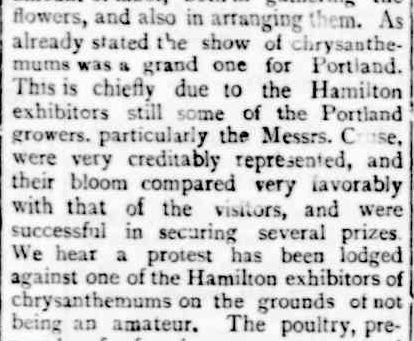
My grandfather, Auntie Shirl and Auntie Jane were descended from a keen gardener, Richard Diwell, Jane’s father.  Richard was a member of the Hamilton Horticulture Society. His specialty was chrysanthemums.  The society often attended shows in nearby towns and the following  item is from 1896 when the Hamilton growers headed to Portland to show of their blooms.  Richard won three prizes in his class.

Portland Horticultural Society. (1896, May 1). Portland Guardian (Vic. : 1876 - 1953), p. 3 Edition: EVENING. Retrieved March 12, 2013, from http://nla.gov.au/nla.news-article63635528

Portland Horticultural Society. (1896, May 1). Portland Guardian (Vic. : 1876 – 1953), p. 3 Edition: EVENING. Retrieved March 12, 2013, from http://nla.gov.au/nla.news-article63635528

The chrysanthemums exhibited by the Hamilton growers were impressive, some a little too impressive for an amateur show.

Portland Horticultural Society. (1896, May 1). Portland Guardian (Vic. : 1876 - 1953), p. 3 Edition: EVENING. Retrieved March 12, 2013, from http://nla.gov.au/nla.news-article63635528

Portland Horticultural Society. (1896, May 1). Portland Guardian (Vic. : 1876 – 1953), p. 3 Edition: EVENING. Retrieved March 12, 2013, from http://nla.gov.au/nla.news-article63635528

Richard also liked ferns and apparently had a fernery.  He was a keen photographer too, and this is one of the photos we have that he “staged” and took himself with a camera timer.  A selection of plants are in the foreground including a maidenhair fern.

Richard & Elizabeth Diwell and family

Richard & Elizabeth Diwell and family

A garden photo that interests me is from the backyard of Richard’s daughter, Edith Diwell, my great-grandmother.  The photo is of three of her sons, including Grandfather Bill on the left.  This was either at a house in Mt Napier Road, Hamilton or Skene Street, Hamilton.  Either way, they would have only been in the house a short time before the photo was taken, so the garden layout was not the work of Edith.  However, it still gives an example of a 1920s backyard.  There is a vegetable garden, with wooden edging and the boys are standing in front of a Yucca.  A fruit tree stands in the background.

x

My paternal side of the family, the Riddifords, did not have the same influence on my love of gardening.  Dad has never grown anything.  Well, at least that’s what I thought.  Mum told me how he thought cauliflowers could be a profitable venture, sometime around 1967, and planted them in the backyard at 78 Coleraine Road.  Turns out there was little market for his produce and that was the end of his gardening days.  We probably ate cauliflower with white sauce for some time afterwards.

Dad’s father, Percy Riddiford, did like to garden.  It was not until  recent years that I came to know how much.

Prior to her death, my Grandma, Mavis, gave me a binder of Your Garden magazines collected by Grandpa.  I knew he liked roses as they lined the perimeter of their front yard, but I didn’t realise his passion went as far as buying gardening magazines.  It just happened that the year the magazines were from was 1968, the year I was born.

017 021

I did enjoy visiting Grandma and Grandpa’s in Ballarat.  A sign, “The Riddifords” hung proudly on the letterbox.   A terrace garden was at the back of the steep block.  Three large steps led to the top of the terrace and I recall that as a small child, I would haul myself up the steps and teeter on the top to look across neighbouring backyards to see Sovereign Hill in its infancy, sprouting up on a nearby hill.  I would cry out that I could see the “historical park”.

IMG_1180

I recently drove past Grandma and Grandpa’s old house to see if Grandpa’s roses were still there.  I do remember them there, but look old and gnarly, not the many years ago.  They are now gone, but suckers grow were the roses were.  A little reminder of Grandpa.

‘My gardening history started in a rented house, but now with a  home of my own, more passion is imparted.  In the 13 years we have lived here, I have gardened through a 10 year drought, dogs, goats, child and recently a plant shredding hail storm.  Inspired by Edna Walling and dispirited by Mother Nature and her creatures.

IMG_0580

My garden is probably not at the point I would like it, but it has changed over the years thanks, I suppose, to the drought.  I started with a range of cottage perennials, including some unusual varieties, but full water restrictions (no mains watering) did not help many of those thirsty English plants.  Anything that survived I have planted more of, and more natives and succulents have come in.

One of my favourite plants is the Aquilegia or “Granny Bonnet’.  It was also a favourite of Nana’s.

IMG_1200

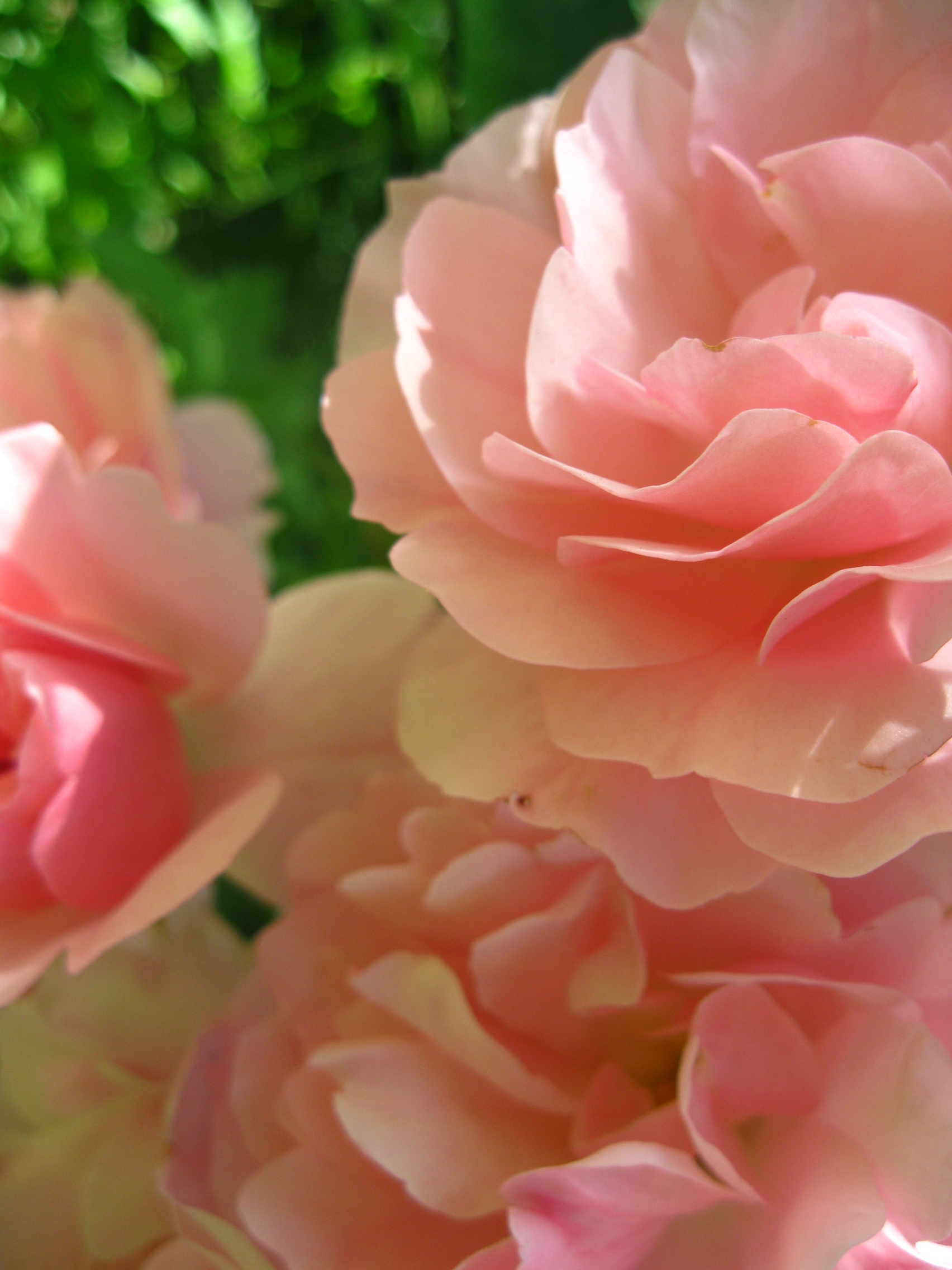
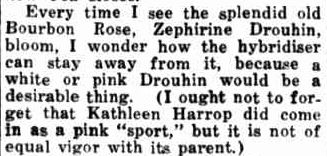
One day my “Zephirine Drouhin”  roses will cover the arch they grow beside.  But every year, just as the juicy new shoots show, two white creatures manage to break into my garden and indulge in one of their favourite delicacies.

IMG_1153and

Are We To Have More Fragrant Roses. (1930, September 5). Advertiser (Hurstbridge, Vic. : 1922 - 1939), p. 8. Retrieved March 12, 2013, from http://nla.gov.au/nla.news-article57763452

Are We To Have More Fragrant Roses. (1930, September 5). Advertiser (Hurstbridge, Vic. : 1922 – 1939), p. 8. Retrieved March 12, 2013, from http://nla.gov.au/nla.news-article57763452

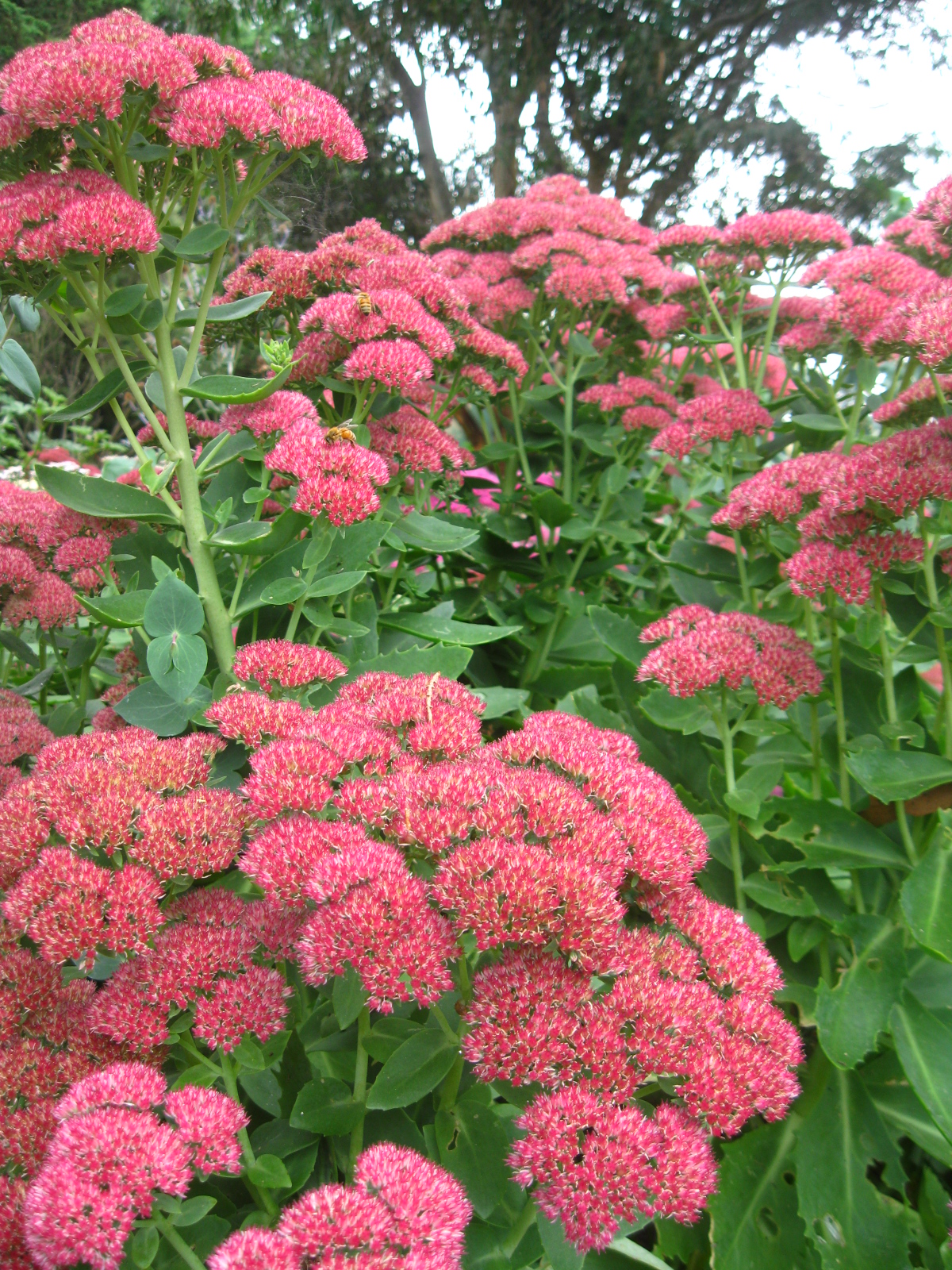
The Sedum is an underrated plant and one that dates back to 19th century Australian gardens.  It transforms itself throughout the year giving ongoing variety in its form and it can cope with dry weather.  I have filled my borders with different varieties and they never disappoint.  The following description of the Sedum is from 1911.

gard8

NOTES. (1911, March 25). The Sydney Morning Herald (NSW : 1842 – 1954), p. 5. Retrieved April 6, 2013, from http://nla.gov.au/nla.news-article15231478

IMG_1579

Advertising. (1894, August 17). Portland Guardian (Vic. : 1876 - 1953), p. 4 Edition: EVENING. Retrieved March 29, 2013, from http://nla.gov.au/nla.news-article65395732

Advertising. (1894, August 17). Portland Guardian (Vic. : 1876 – 1953), p. 4 Edition: EVENING. Retrieved March 29, 2013, from http://nla.gov.au/nla.news-article65395732

If you would like to get an idea of how your ancestors’ gardens may have looked or you would like to recreate a garden from earlier times, Cottage Gardens in Australia by Peter Cuffley is a beautiful book and an excellent resource for studying Australian gardens right back to Colonial days.

IMG_1178

Trove Tuesday – Dancing Girls

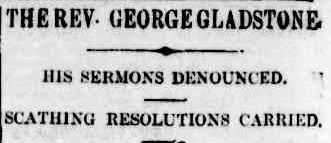
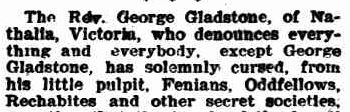
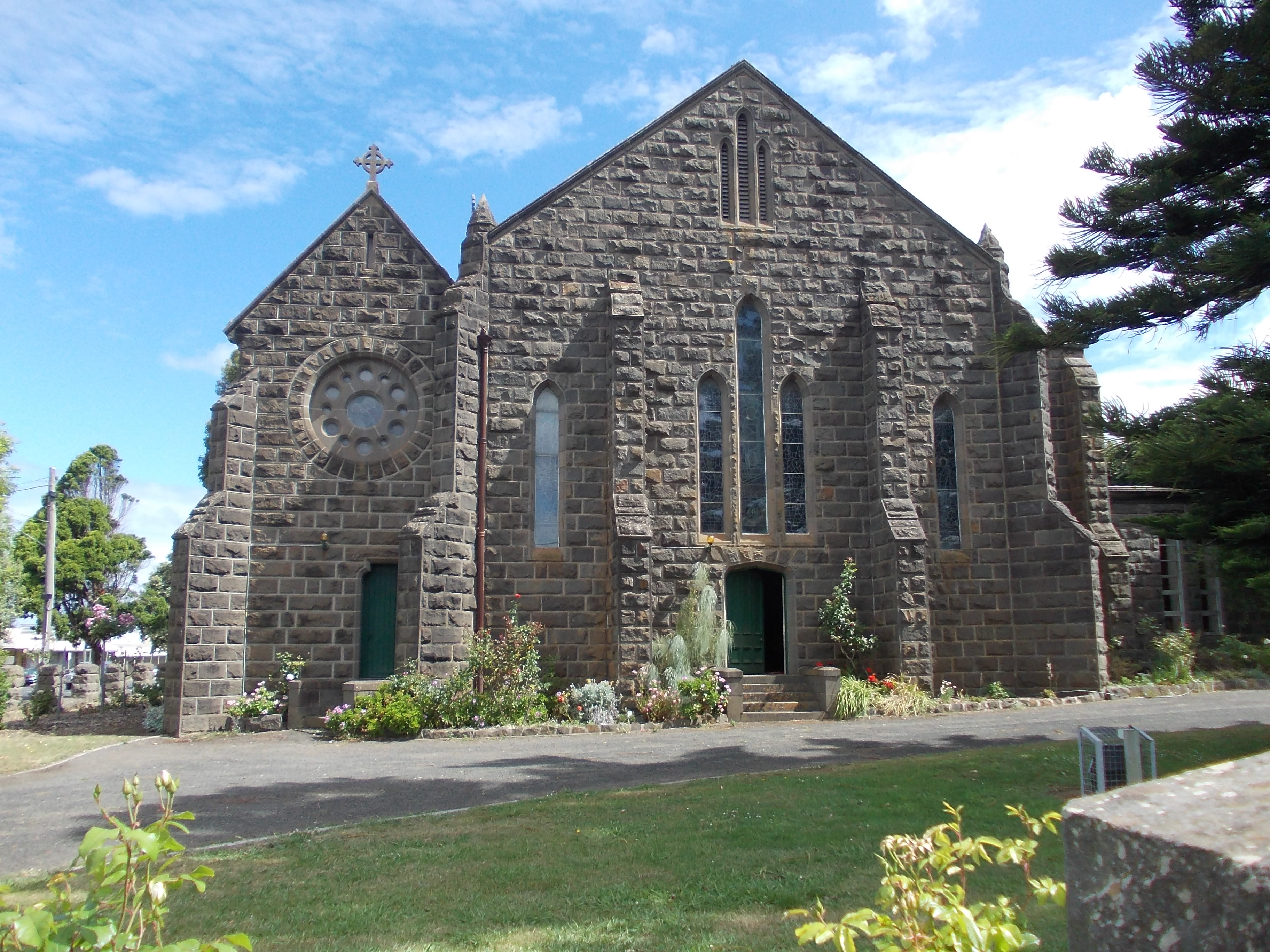
I found this article “Women at Dances” while searching for pioneer obituaries in the Portland Guardian, so I tagged it for a future Trove Tuesday post.  That day has arrived.  Today I introduce the preachings of  Reverend George Gladstone of the Holy Trinity Anglican Church, Nathalia, Victoria.

tt10

Established August 1842. (1899, June 7). Portland Guardian (Vic. : 1876 - 1953), p. 2 Edition: EVENING. Retrieved March 30, 2013, from http://nla.gov.au/nla.news-article63676343

Established August 1842. (1899, June 7). Portland Guardian (Vic. : 1876 – 1953), p. 2 Edition: EVENING. Retrieved March 30, 2013, from http://nla.gov.au/nla.news-article63676343

Surely he didn’t get  away with that. Did he?  Well, yes and no.  While the Bishop of Melbourne stood by his man, the people of Nathalia wanted to run him out of town.

That finding came from a search – George Gladstone Nathalia – at Trove.  There were pages of search results specific to the Reverend and the implications of the June 1899 sermon reported in the Portland Guardian and beyond.

I was not surprised to read headlines like this:

The Dancing Crusade. (1899, June 24). Clarence and Richmond Examiner (Grafton, NSW : 1889 - 1915), p. 7. Retrieved March 30, 2013, from http://nla.gov.au/nla.news-article61302118

The Dancing Crusade. (1899, June 24). Clarence and Richmond Examiner (Grafton, NSW : 1889 – 1915), p. 7. Retrieved March 30, 2013, from http://nla.gov.au/nla.news-article61302118

or this:

THE REV. GEORGE GLADSTONE. (1899, June 21). The Argus (Melbourne, Vic. : 1848 - 1956), p. 8. Retrieved March 30, 2013, from http://nla.gov.au/nla.news-article9516823

THE REV. GEORGE GLADSTONE. (1899, June 21). The Argus (Melbourne, Vic. : 1848 – 1956), p. 8. Retrieved March 30, 2013, from http://nla.gov.au/nla.news-article9516823

or even this:

THE EXTRAORDINARY SERMON. (1899, June 13). The Horsham Times (Vic. : 1882 - 1954), p. 3. Retrieved March 30, 2013, from http://nla.gov.au/nla.news-article7505982

THE EXTRAORDINARY SERMON. (1899, June 13). The Horsham Times (Vic. : 1882 – 1954), p. 3. Retrieved March 30, 2013, from http://nla.gov.au/nla.news-article7505982

A public meeting was held in the Nathalia hall and the following is an example of the tone of the meeting:

THE REV. GEORGE GLADSTONE. (1899, June 21). The Argus (Melbourne, Vic. : 1848 - 1956), p. 8. Retrieved April 1, 2013, from http://nla.gov.au/nla.news-article9516823

THE REV. GEORGE GLADSTONE. (1899, June 21). The Argus (Melbourne, Vic. : 1848 – 1956), p. 8. Retrieved April 1, 2013, from http://nla.gov.au/nla.news-article9516823

A cry of “Horsewhip him” rang out as Mr W. McCormick had his say, indicating the Reverend’s sermons were receiving publicity around the world.

THE REV. GEORGE GLADSTONE. (1899, June 21). The Argus (Melbourne, Vic. : 1848 - 1956), p. 8. Retrieved April 2, 2013, from http://nla.gov.au/nla.news-article9516823

THE REV. GEORGE GLADSTONE. (1899, June 21). The Argus (Melbourne, Vic. : 1848 – 1956), p. 8. Retrieved April 2, 2013, from http://nla.gov.au/nla.news-article9516823

The Reverend did not stop. He delivered a sermon at Barmah, not far from Nathalia in September 1899, and once again spoke of the evils of dances.  He also denounced the Irish, proclaiming they the were known for “drinking, dancing and dynamiting”.  George Gladstone then had to escape through a side door and run through the bush to an awaiting buggy, hence the headline:

Sensational Lecture by a Clergyman. (1899, September 23). The Cumberland Argus and Fruitgrowers Advocate (Parramatta, NSW : 1888 - 1950), p. 5. Retrieved April 1, 2013, from http://nla.gov.au/nla.news-article85778569

Sensational Lecture by a Clergyman. (1899, September 23). The Cumberland Argus and Fruitgrowers Advocate (Parramatta, NSW : 1888 – 1950), p. 5. Retrieved April 1, 2013, from http://nla.gov.au/nla.news-article85778569

A year on he was not leaving anyone alone.

Current Notes. (1900, October 8). The North Queensland Register (Townsville, Qld. : 1892 - 1905), p. 3. Retrieved April 1, 2013, from http://nla.gov.au/nla.news-article82340469

Current Notes. (1900, October 8). The North Queensland Register (Townsville, Qld. : 1892 – 1905), p. 3. Retrieved April 1, 2013, from http://nla.gov.au/nla.news-article82340469

I was surprised to read that in 1907 George Gladstone was still in Nathalia and was still delivering sermons that led to riotous scenes.

In 1908, it all ended up in the courts after the Bishop of Wangaratta revoked Gladstone’s license to preach.  After failing in the courts, Gladstone attempted to set up his own religion, the Natalia Reformed Church of England.  The Victorian Government refused to proclaim the religion.  He passed away in 1916.

George Gladstone, while totally unrepentant, was probably lucky he was not preaching one hundred years later.  Imagine the social media uproar #horsewhiphim

Passing of the Pioneers

March Passing of the Pioneers once again gathers together a diverse group of Western District pioneers. They include a winemaker and a lighthouse keeper. There are links to some well-known Western District properties and families, and a Portland resident that grew up with an English author.

Eliza Mary KEARTON: Died March 1891 at Creswick. Eliza Kearton was a long-time resident of Portland. She had gone to Creswick for an operation but died of complications. She was born in London in 1820 and married William Tulloh in 1844 in Tasmania. William’s obituary appeared in Passing of the Pioneers in July 2011 and includes a lot of detail about their lives in Portland.

James ROBERTSON: Died March 1892 at Portland. James Robertson was born in Alvie, Scotland. Once in Portland, he set up the Iron Store business with his older brothers John and William Robertson.

Anne WILCOX: Died 12 March 1894 at Portland. Anne and her husband Thomas Must were well-known residents of Portland. Anne was from Sydney and married Thomas a Sydney merchant in 1842 before they travelled to Portland to set up a branch of Thomas’ business, Must and Flower. A few years after his arrival in Portland, he had an architect design a home resulting in Prospect, built in 1855. The couple lived there for the rest of their lives. In 1908 at St Stephens Church, unveiled a stained glass window in memory of Mr. and Mrs. Must.

ST STEPHENS CHURCH, PORTLAND

ST STEPHENS CHURCH, PORTLAND


Ann PAXFORD:  Died March 1900 at Portland. Ann Paxford was the daughter of Jonathan Paxford and Ann Bray and was born around 1818. She married Edward Francis Hughes and they arrived in Victoria in 1853 and Portland in 1854.

Ann had an interesting life while a child in England. She spent time with a young Marion Evans better known as George Elliott, writer. Looking further into the story, which appears correct, proved intriguing. Ann, through her mother, Ann Bray was related to Charles Bray a ribbon manufacturer and a leader of the “intellectual elite”.(Oxford Dictionary of National Biography)  He described his house, Rosehill, as “a mecca for radicals and intellectuals” (The Continuum Encyclopedia of British Philosophy in Oxford Reference).  Marion Evans lived at Rosehill and that is where Ann would have come to know her.

Janet McCRACKEN:  Died March 1911 at Stawell. Born in Scotland around 1840, Janet McCracken arrived in Melbourne with her parents in the early 1850s. After a few years, they moved to Stawell and Janet married James Mathers. The couple lived in Stawell for the rest of their lives and had four sons and three daughters.

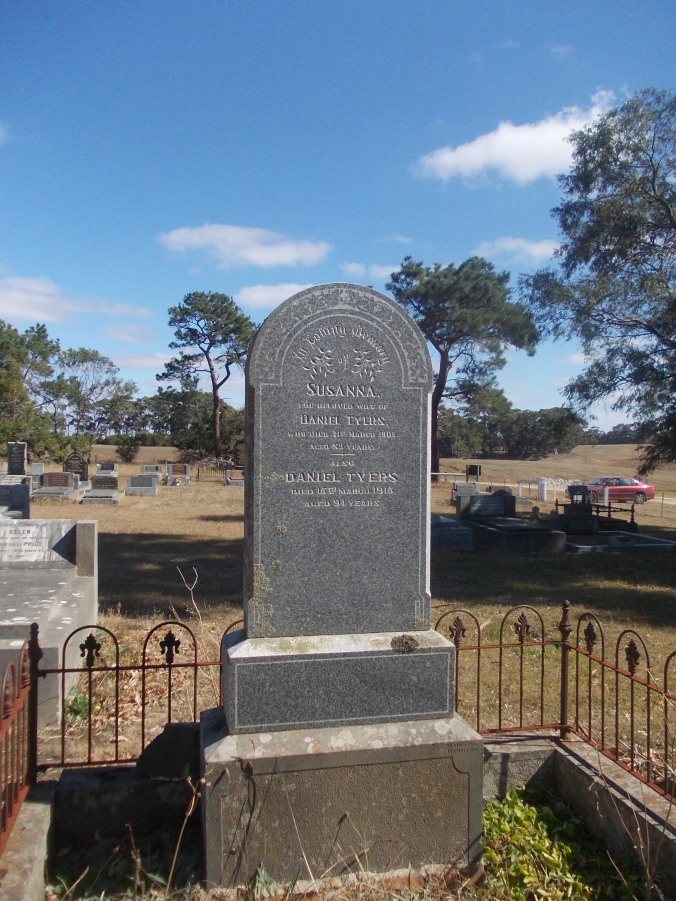
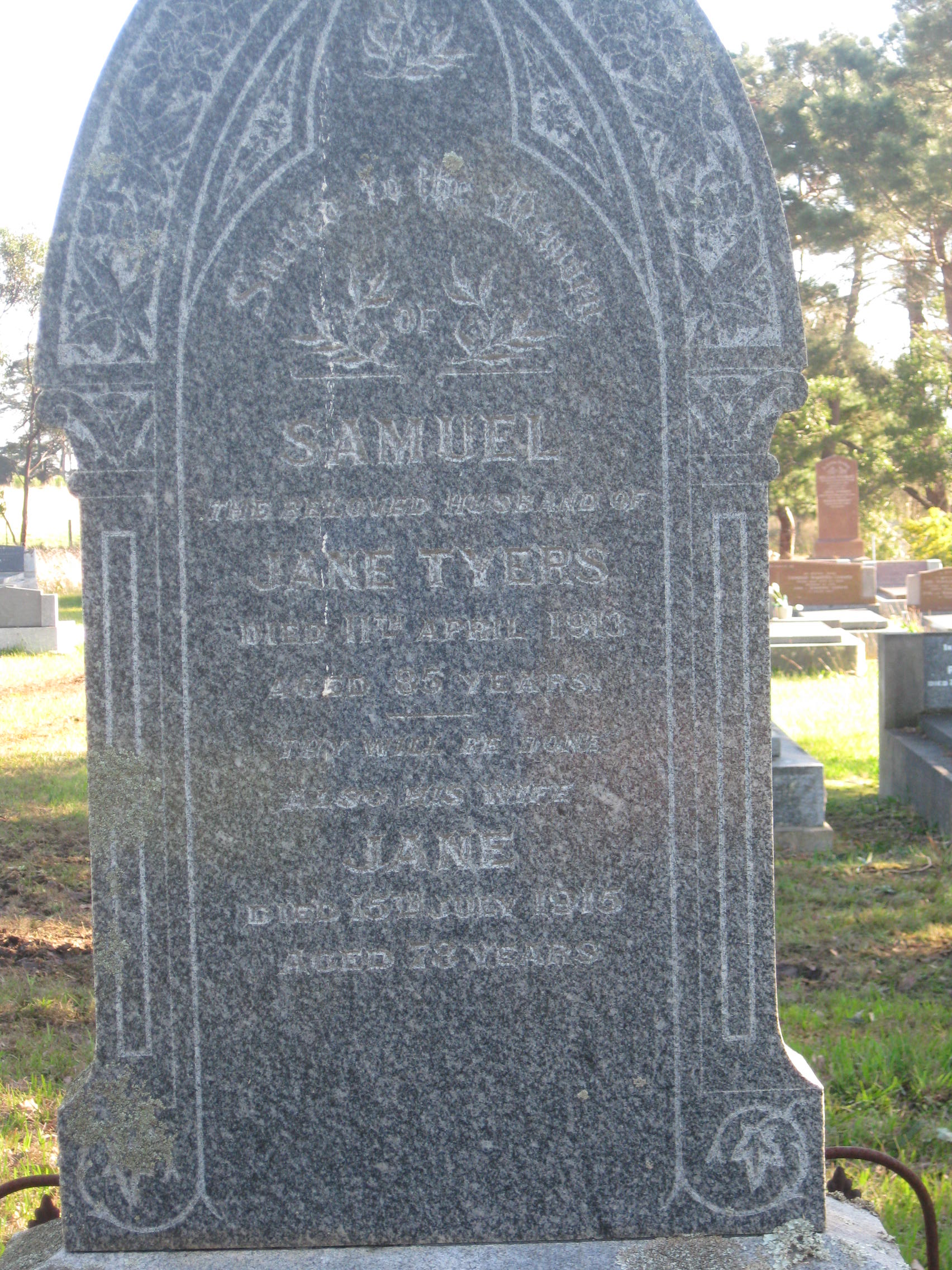
Daniel TYERS: Died 15 March 1915 at Byaduk. After arriving in Victoria around 1856, Daniel Tyers lived at Port Fairy. He later moved to Byaduk where he remained until his death at the age of ninety-five. He was buried at the Byaduk Cemetery along with his brother Samuel and sister Jane.

Tyers

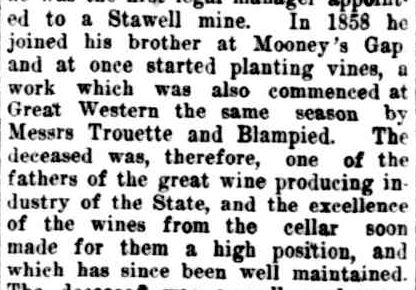
John MOONEY: Died 29 March 1915 at Mooney’s Gap. In 1854, John Mooney from Ireland travelled to Australia aboard the Great Britain. His brother Lawrence had arrived the year before, so John joined him on the Ararat diggings. In 1858,  the brothers planted grapevines at Mooney’s Gap near Ararat and started the Emerald Vineyard. In the same year, just down the road, Jean-Pierre Trouette, his wife Ann-Marie, and brother-in-law Emile Blampied were the first to plant vines at Great Western.  While Troutte’s winery St. Peters no longer exists, other wineries from the early days, Best’s and Seppelts are still in production there.

OBITUARY. (1915, March 30). The Ararat advertiser (Vic. : 1914 - 1918), p. 2 Edition: triweekly. Retrieved March 26, 2013, from http://nla.gov.au/nla.news-article74241893

OBITUARY. (1915, March 30). The Ararat advertiser (Vic. : 1914 – 1918), p. 2 Edition: triweekly. Retrieved March 26, 2013, from http://nla.gov.au/nla.news-article74241893

In 1925, Lawrence Mooney uprooted the vines at Emerald Vineyard and used the land for other purposes.

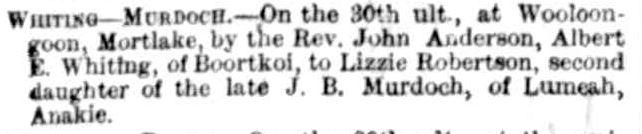
Elizabeth Robertson MURDOCH:  Died 7 March 1916 at Port Fairy. I did a little extra research at Ancestry.com.au on Mrs Whiting because I wanted to find her name, in preference to listing her as Mrs Albert Edwin Whiting. Elizabeth grew up around the Geelong area and married Albert Whiting in 1878. Albert was a son of Edwin Whiting and Hannah Manifold.   Hannah’s brothers were Thomas, Peter and William Manifold, original owners of the Purrumbete run.

At the time of marriage, John was station manager for the Chirnside’s property Boortkoi. Their wedding was at  Woolongoon, Mortlake then owned by Anthony McKenzie. Elizabeth and Albert moved to Port Fairy and lived at Boodcarra before moving to Loongana for several years before Elizabeth’s passing.

Family Notices. (1878, May 6). The Argus (Melbourne, Vic. : 1848 - 1956), p. 1. Retrieved March 28, 2013, from http://nla.gov.au/nla.news-article5931295

Family Notices. (1878, May 6). The Argus (Melbourne, Vic. : 1848 – 1956), p. 1. Retrieved March 28, 2013, from http://nla.gov.au/nla.news-article5931295

William HILL:  Died 14 March 1916 at Warrnambool. Born in Ireland, William Hill spent the first twenty years of his time in Victoria working for Henry de Little, owner of Caramut station.  He then began farming himself, first at Woodford and later at Framlingham where he had dairy cows for seventeen years. In the early 1860s, William married Mary Hassett of Caramut.

Mary FITZGERALD: Died 17 March  1916 at Tower Hill. Mary Fitzgerald lived in the Tower Hill district since she was ten-years-old, around 1849.  She married John Fitzgibbon and she left two sons and eight daughters at the time of her death.  Her funeral was attended by a large crowd of mourners.

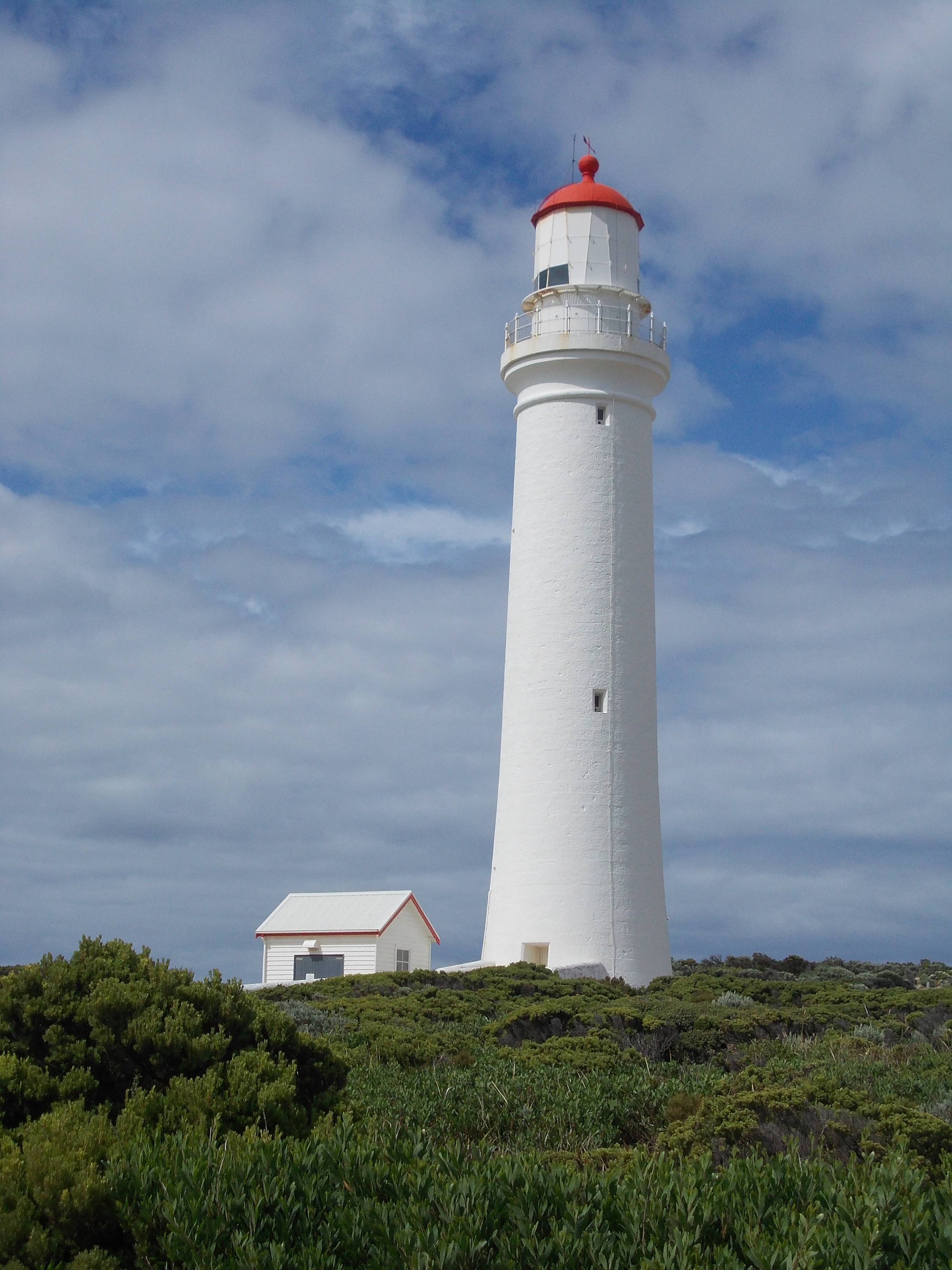
John Joseph Thomas COOPER:  Died March 1918 at Port Fairy. John Cooper was born in Somerset, England and arrived in Victoria with his parents as a baby. He became an assistant lifeboat pilot in 1883 and became the Superintendent of lifeboats at Queenscliff in 1892.  Around 1905, he moved on to lighthouse keeping, working at Queenscliff, Port Fairy, Cape Nelson, and Warrnambool.

QUEENSCLIFF'S BLACK LIGHTHOUSE

QUEENSCLIFF’S BLACK LIGHTHOUSE

CAPE NELSON LIGHTHOUSE

CAPE NELSON LIGHTHOUSE

Marion Letitia HINDES:  Died 13 March 1918 at Port Fairy. Marion Hindes, better known as Letitia, was born in London in 1848 and arrived in Port Fairy four years later. She lived with her aunt, Mrs Gillespie at the Union Inn at Port Fairy. Letitia married Richard Emery in 1889. Richard died eight years before her and she left no children. She had two cousins surviving and two nieces.

Margaret WHITE:  Died 4 March 1925 at South Portland. Margaret White spent most of her life living in the Narrawong and Portland districts, an estimated eighty-two years. She married James Grant in 1870. She left two sons and three daughters. Margaret’s obituary mentions the hardships faced by the early settlers.

Old Resident Passes. (1925, March 5). Portland Guardian (Vic. : 1876 - 1953), p. 2 Edition: EVENING.. Retrieved March 26, 2013, from http://nla.gov.au/nla.news-article64106818

Old Resident Passes. (1925, March 5). Portland Guardian (Vic. : 1876 – 1953), p. 2 Edition: EVENING.. Retrieved March 26, 2013, from http://nla.gov.au/nla.news-article64106818


Florence EDSALL:  Died 22 March 1944 at Geelong.  Florence Edsall was born at Warrenheip near Ballarat around 1858.  She married W.J. Silvester and they lived in Cobden during their working lives, before retiring to Geelong. Florence’s husband was a Councillor with the Heytesbury Shire and was the first child of European descent born at Cobden,

Trove Tuesday – Daddy of Them All

If you have read my Twitter profile, you would have noticed one of my loves, other than family history, is the Carlton Football Club.  This week, as we are in the middle of Round 1 of the 2013 AFL season with Carlton playing on Thursday night, I thought Trove Tuesday should have a sporting theme .

Opening round football is not the only sport happening over the Easter weekend.  One of the great sporting events of  Western Victoria , the Stawell Gift, will attract thousands to the town for a weekend of athletics culminating in the final of the Gift on Monday.  But as I have written about the First Stawell Gift Winner before, I thought I would look at the Carlton Football Club, one of the original teams in the VFL/AFL, from a Trove perspective.

Plucking a name from the past times of the club, I found George Coulthard. He played with Carlton from 1876 to 1882 when teams took part in the Victorian Football Association (The VFL begain in 1896).  Sixty years later, commentators and former players were still naming him as one the greatest footballers ever.  In 1990, he was inducted into the Carlton Hall of Fame.

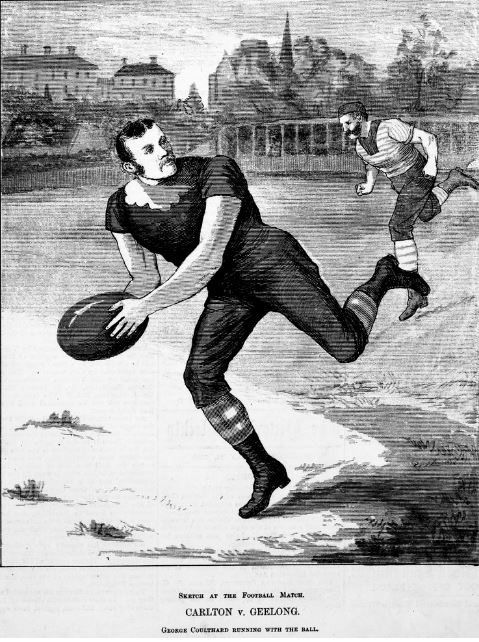
What treasures could I find about George at Trove?  From the “Picture, Photo and Object” search, I found this great engraving from 1880 .  Held at the State Library of Victoria, it shows George, with the ball,  leaving his Geelong opponent behind.  This is a great example of football attire of the time and I’m glad Carlton moved away from the white neck frill.

GEORGE COULTHARD, CARLTON FOOTBALL CLUB - Image Courtesy of the State Library of Victoria - Wood engraving published in Australian pictorial weekly, no. 7, Melbourne, July 24, 1880, held in Rare Books Collection. http://handle.slv.vic.gov.au/10381/104291

GEORGE COULTHARD, CARLTON FOOTBALL CLUB – Image Courtesy of the State Library of Victoria – Wood engraving published in Australian pictorial weekly, no. 7, Melbourne, July 24, 1880, held in Rare Books Collection. http://handle.slv.vic.gov.au/10381/104291

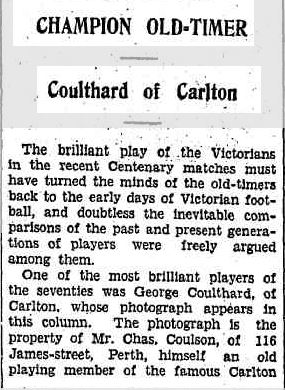
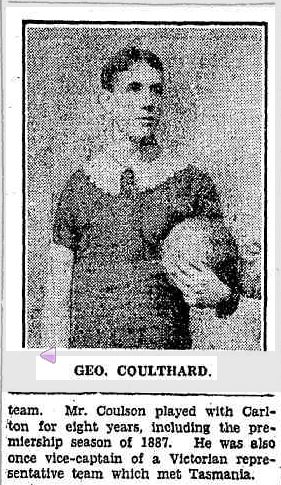
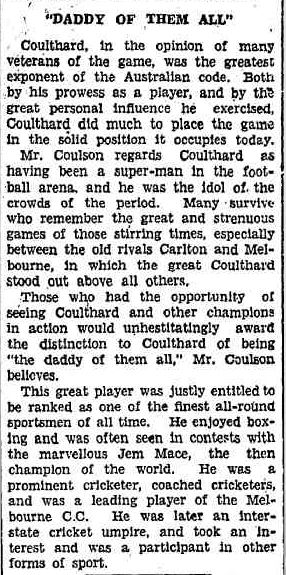
The following article from Perth’s The Daily News summarises George’s career and displays that white frilly collar again.  What was the idea behind that?  George was also a keen boxer and cricketer of some note, even playing a Test match for Australia.  I like George’s entry on the Blueseum site.  The number of games played by George was about 140, 4 state games and 2 Rugby matches.  George was a true all-rounder.

tt8

tt11

CHAMPION OLD-TIMER. (1929, July 13). The Daily News (Perth, WA : 1882 - 1950), p. 4 Edition: FINAL SPORTING EDITION. Retrieved March 26, 2013, from http://nla.gov.au/nla.news-article82981723

CHAMPION OLD-TIMER. (1929, July 13). The Daily News (Perth, WA : 1882 – 1950), p. 4 Edition: FINAL SPORTING EDITION. Retrieved March 26, 2013, from http://nla.gov.au/nla.news-article82981723

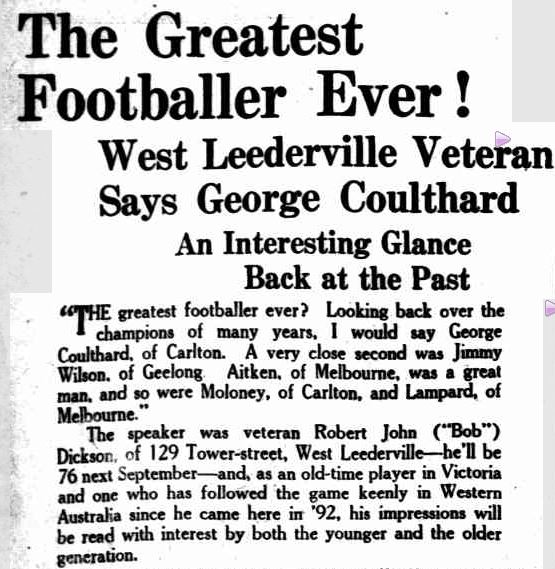
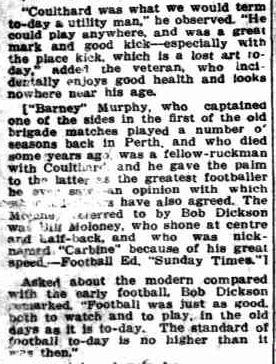
In 1937, “Bob” Dickson told the Sunday Times of Perth, George Coulthard was “the greatest footballer ever”.

gc

The Greatest Footballer Ever!. (1937, July 25). Sunday Times (Perth, WA : 1902 - 1954), p. 13 Section: First Section. Retrieved March 26, 2013, from http://nla.gov.au/nla.news-article58785233

The Greatest Footballer Ever!. (1937, July 25). Sunday Times (Perth, WA : 1902 – 1954), p. 13 Section: First Section. Retrieved March 26, 2013, from http://nla.gov.au/nla.news-article58785233

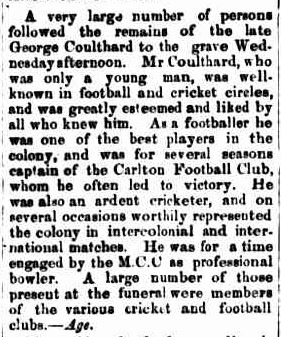
George Coulthard’s story was not all sporting glory as he was sadly cut down in his prime.  Even a great athlete could not hold off the ravages of tuberculosis.  In October 1883, aged 27, he succumbed to the disease.

THE North eastern Ensign. (1883, October 26). The North Eastern Ensign (Benalla, VIC. : 1872 - 1938), p. 2. Retrieved March 26, 2013, from http://nla.gov.au/nla.news-article70744750

THE North eastern Ensign. (1883, October 26). The North Eastern Ensign (Benalla, VIC. : 1872 – 1938), p. 2. Retrieved March 26, 2013, from http://nla.gov.au/nla.news-article70744750

Formed in 1864, the Carlton Football Club has a rich history that includes 16 premierships.  The club is proud of its history and there is a wealth of information available online via the Blueseum website and the Carlton Football Club website. There is a wonderful tribute to George Coulthard on the Blueseum site including many newspaper references.  I also found out a little more about that early guernsey  In additon, one for the original members of the Carlton Football Club was buried at the Hamilton Old Cemetery. Thomas Gorman played with the club from 1864 until 1871. You can read more about him on the link – Thomas Gorman.

Something of interest to the family historian on the Blueseum site is a call out for photos of former Carlton players.  If you find one of your family members played for Carlton anytime over the past 149 years and you have a photo, check out the website.

Byaduk Cemetery

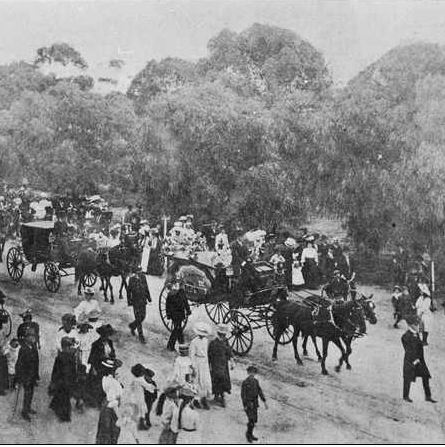
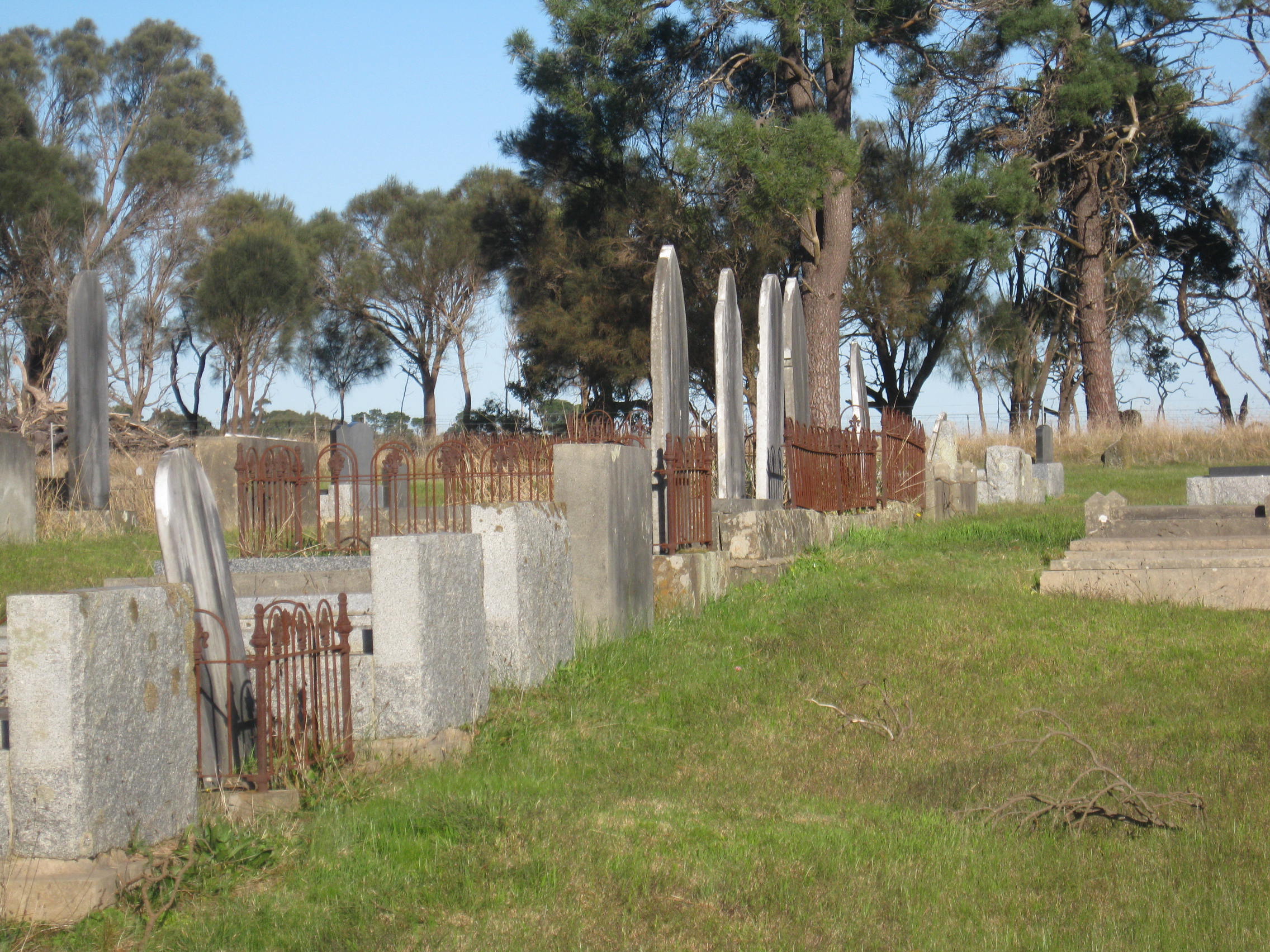
I enjoy a trip to the Byaduk Cemetery.   When I turn off the Hamilton-Port Fairy Road and drive up the hill on not much more than a track, I can sense the ghosts of my ancestors around me, walking or driving a buggy up the hill following a horse-drawn hearse to the cemetery.  It is like stepping back in time.

fun
IMAGE COURTESY OF THE STATE LIBRARY OF SOUTH AUSTRALIA B62833 http://images.slsa.sa.gov.au/mpcimg/63000/B62833.htm

There are over 250 burials, in the cemetery and I will share photos of a small sample of headstones, including some of my family.  There are also unmarked graves, such as that of my 4 x great grandparents Joseph and Sarah Harman.

IMG_1848

THREE BROTHERS

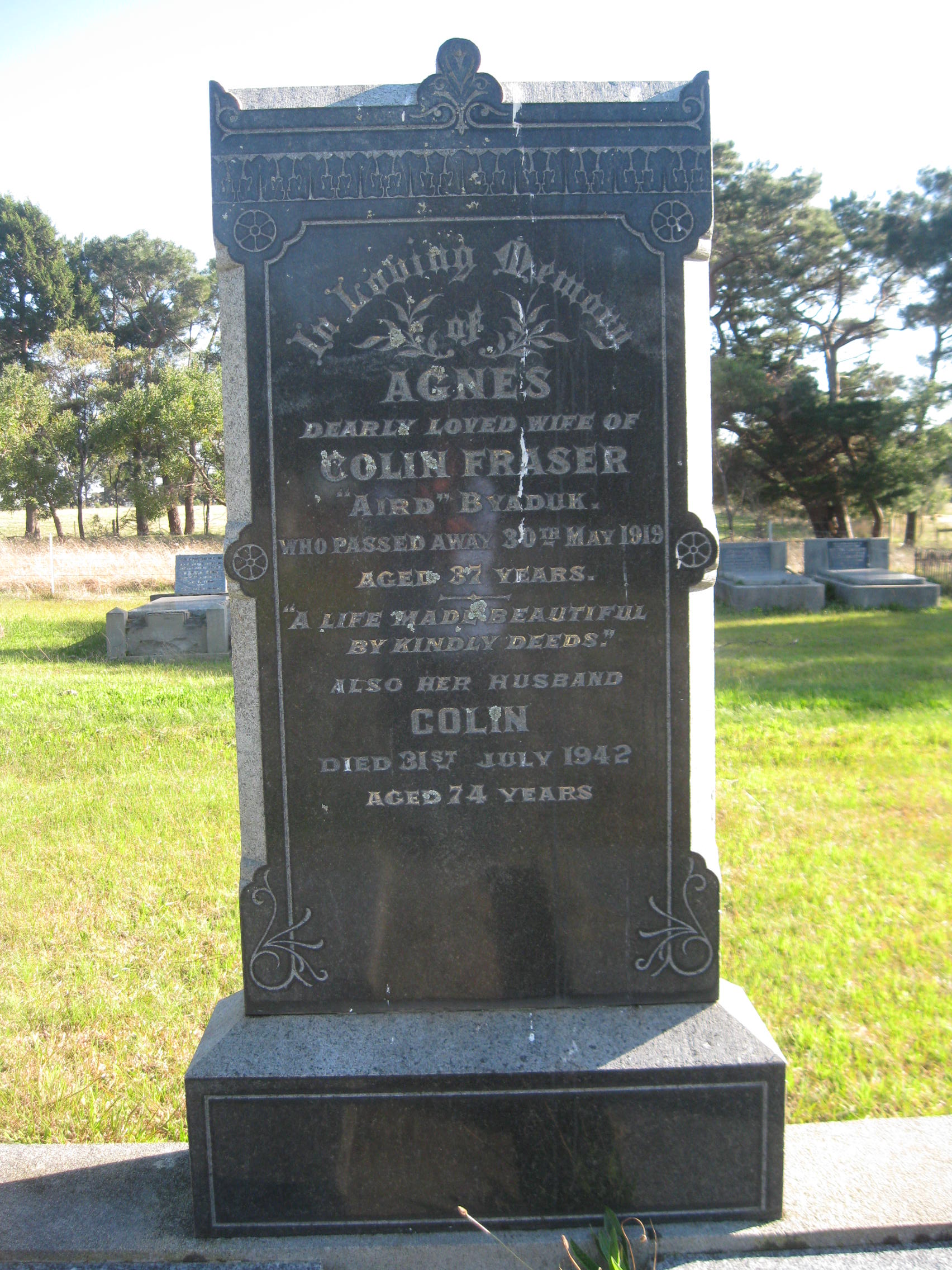
Scottish brothers, Colin, Duncan, and James Fraser called Byaduk home and became respected residents.

The brothers immigrated from Scotland in 1853 and went to the Ararat diggings.  When land became available in 1861, the brothers went to Byaduk, and Colin and James selected “Aird“.

They all at one time lived at “Aird. “James built a hut there, but later built a home at “Lower Aird”, the adjacent property.  Colin built his home at “Aird”, where he resided until his death.  The Victorian Heritage Database has a concise history of the Frasers and information about the Aird Homestead complex and the Lower Aird Homestead complex.  The Weekly Times ran an article about Lower Aird” in 2009.

Duncan didn’t buy land initially; rather, he returned to Scotland.  In 1871, he returned to  Byaduk with his wife Margaret and four children, Simon, Helen, Donald, and Willia,m and they lived at “Aird” for a time.  In 1873, Duncan purchased “Camp Creek“, where he lived until he died in 1878 aged just 49.

HEADSTONE OF DUNCAN &     FRASER, BYADUK CEMETERY
HEADSTONE OF DUNCAN & FRASER, BYADUK CEMETERY

James and Mary Fraser produced a WW1 hero, 2nd Lieutenant Simon Fraser, and his bravery at the Battle of Fromelles, is commemorated at the Australian Memorial Park at Fromelles.  A statue “Cobbers, depicts Simon carrying a fellow soldier during the battle.

2nd Leuitenant Simon Fraser, 58th Battalion.  Image courtesy of the Australian War Memorial-ID no H05926 http://www.awm.gov.au/collection/H05926/
2nd Leuitenant Simon Fraser, 58th Battalion. Image courtesy of the Australian War Memorial-ID no H05926 http://www.awm.gov.au/collection/H05926/

A member of the 57th Battalion,  Sergeant Simon Fraser, carried men from No Man’s Land.  As he lifted a man on his shoulders, he heard another call out , “Don’t forget me cobber”.  Simon was later promoted to 2nd Lieutenant. The following year, he was killed in action.  “Cobbers” has been replicated at the Shrine of Remembrance, Melbourne.

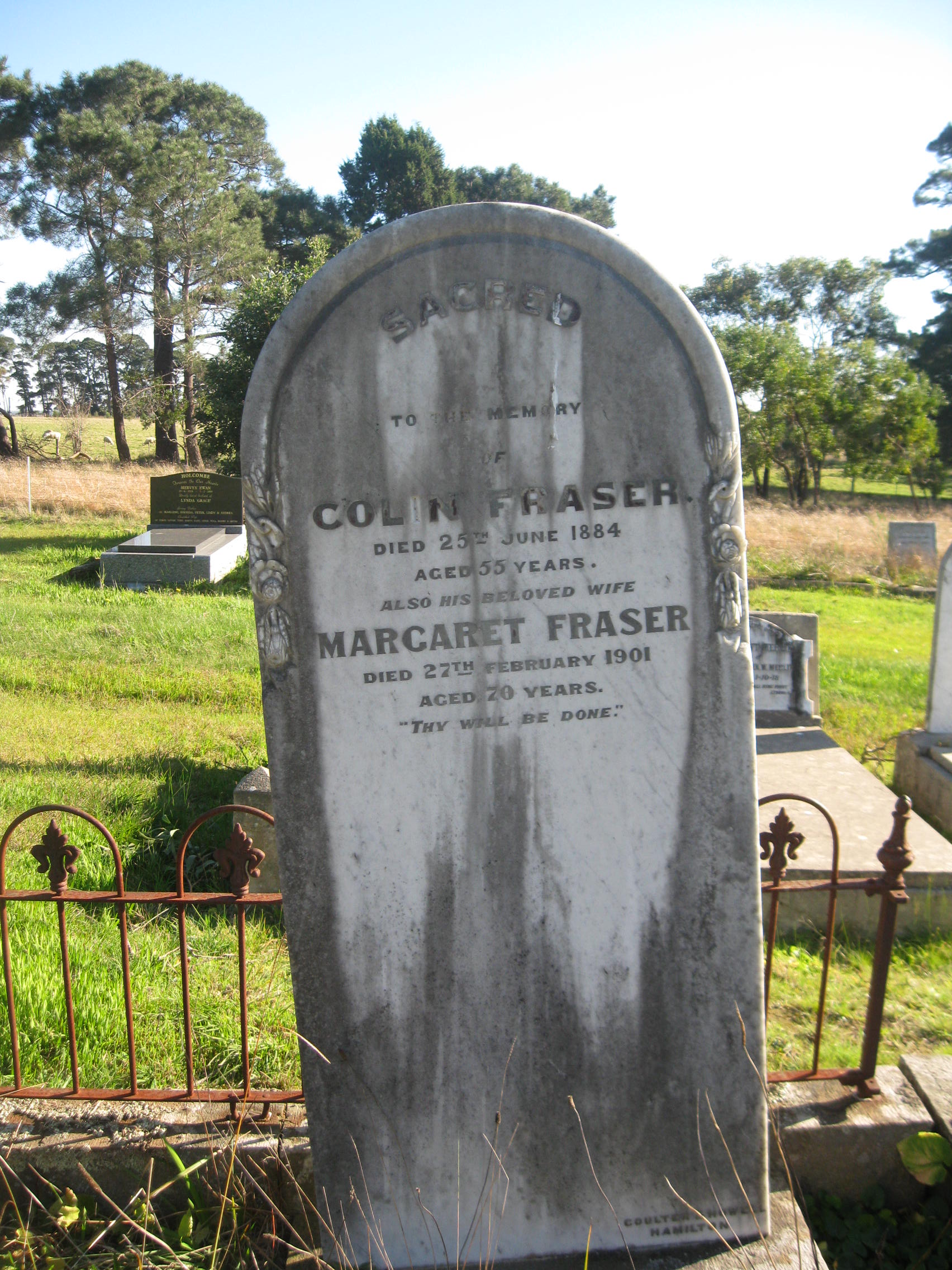
Colin and Margaret Fraser lived at “Aird” but unlike the other two brothers, they had no children.  “Aird” was later purchased by another well-known Byaduk family, the Christies.

GRAVE OF COLIN &     FRASER, BYADUK CEMETERY
GRAVE OF COLIN & FRASER, BYADUK CEMETERY

I am very thankful to James and Mary Fraser’s third son, Peter Fraser.  It was Peter’s writings of the Early Byaduk History in 1931, compiled from events he kept in diaries, that has given me so much information on the history of Byaduk and the families that lived there.

Peter did not publish his writings, but in 1994, Ian Black of Hamilton typed them out and published a wonderful little book, Early Byaduk Settlers.  It may only be only 15 pages long, but it is a star on my bookshelf and a must for anyone who has ancestors that lived at Byaduk.  Peter tells the story of the Fraser brothers in great detail.

IMG_1815

There are at least sixteen Frasers buried at Byaduk.  Following are some of the family’s headstones:

IMG_1818

IMG_1819

IMG_1821

The following headstones are either linked to each other in some way or have direct links to the Harman family

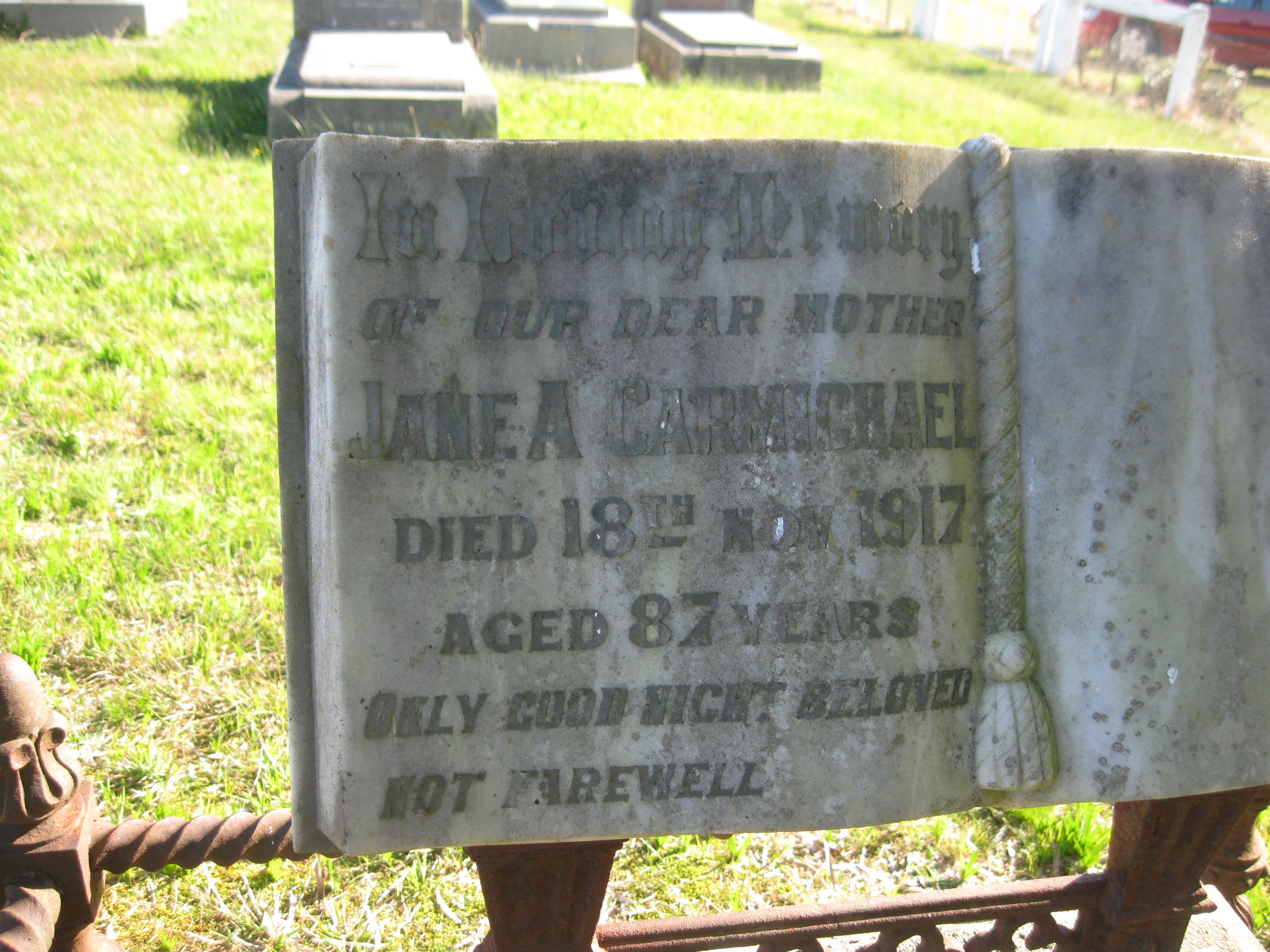
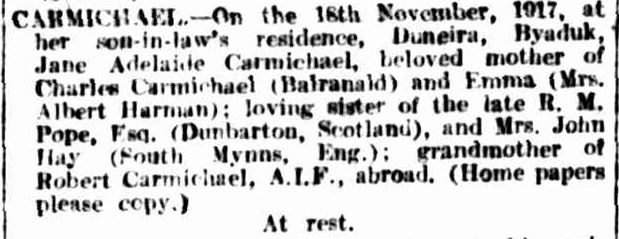
Jane Carmichael (nee Pope) came to Byaduk from Scotland later in life with two of her children, Charles and Emma.  From what I can gather, her husband had either died in Scotland or remained there.

IMG_1823

Family Notices. (1917, November 20). The Argus (Melbourne, Vic. : 1848 - 1956), p. 1. Retrieved March 13, 2013, from http://nla.gov.au/nla.news-article1664422
Family Notices. (1917, November 20). The Argus (Melbourne, Vic. : 1848 – 1956), p. 1. Retrieved March 13, 2013, from http://nla.gov.au/nla.news-article1664422

Emma Carmichael, born in Dundee, Scotland around 1859 married Albert Harman in 1907.  She was 48 and Albert 39.  Albert was the fourth son of James and Susan Harman.

HEADSTONE OF ALBERT AND EMMA HARMAN

Samuel and Jane Tyers did not have any children, but other members of Samuel’s family lived in Byaduk.  There are at least nine other Tyers family members in the Byaduk Cemetery including Samuel’s sister Jane.

IMG_1829

Other than Charlotte’s obituary, I could not find a lot about James and Charlotte Ward.  It was that obituary, however, that helped me find a link between this headstone and the one following it.

IMG_1841

Family Notices. (1904, April 20). The Argus (Melbourne, Vic. : 1848 - 1956), p. 1. Retrieved March 13, 2013, from http://nla.gov.au/nla.news-article10315347
Family Notices. (1904, April 20). The Argus (Melbourne, Vic. : 1848 – 1956), p. 1. Retrieved March 13, 2013, from http://nla.gov.au/nla.news-article10315347

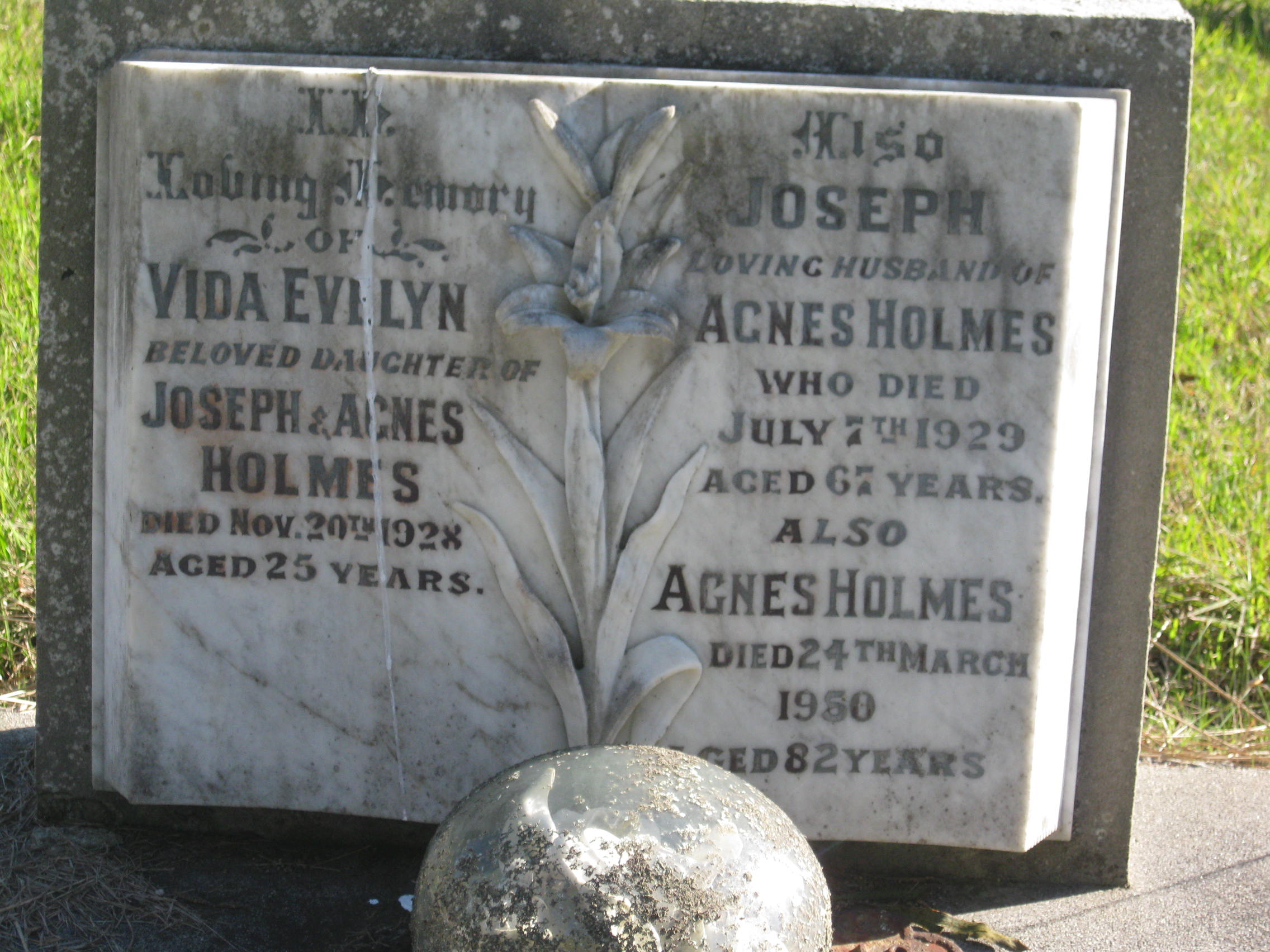
This  Holmes headstone has a link to the previous one and to Samuel and Jane Tyers (above).  Joseph Holmes (1862-1929) was the son of George Holmes and Jane Tyers.  Jane was a sister of Samuel Tyers (above).

Joseph married Agnes Brand.  Her grandparents were James and Charlotte Ward (above).  Her parents were William Brand and Agnes Ward, and Charlotte’s obituary mentions her daughter “Mrs William Brand”.

IMG_1840

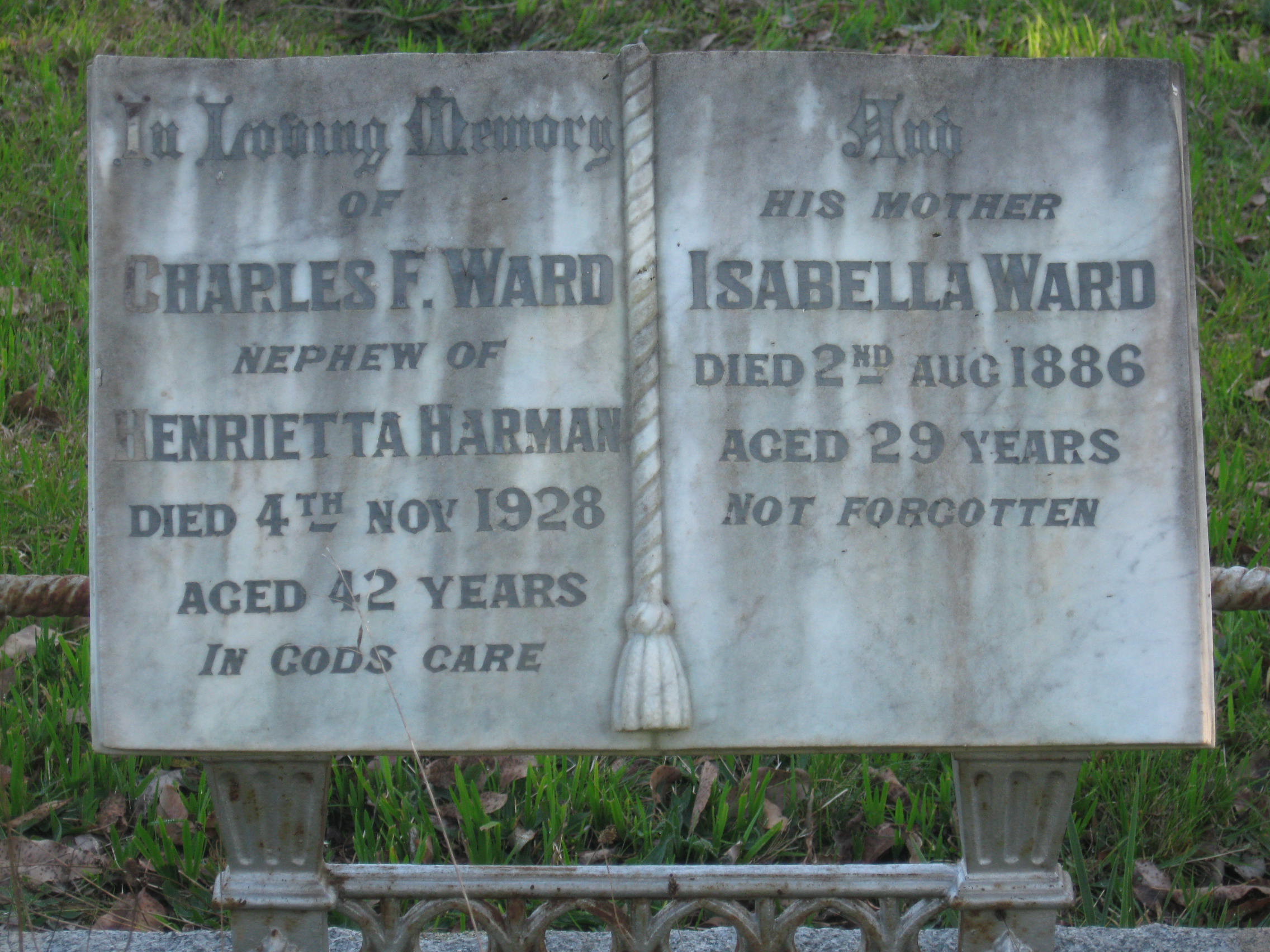
The following headstone belongs to Isabella Ward and her son Charles Ward.  Isabella was Isabella Harman, daughter of James and Susan Harman.  Her sister, Julia, married George Holmes, brother of Joseph Holmes (above).

Isabella married Stephen Ward in 1885, and their son Charles Frederick Ward was born in 1886, the same year as his mother’s death, presumably as a result of the birth.

I had heard from Nana that Henrietta Harman, Isabella’s unmarried sister, raised Charles.  James Harman, in his will, made provision for his daughter Henrietta and grandson, Charles, to stay in the house that he owned beyond his death and for as long as needed.  Also, after the death of Henrietta, a trust would allow for Charles’ maintenance.  That was not because Auntie Henrietta outlived her much-loved nephew Charles.  He died in 1928 at Ballarat.

IMG_1830

Henrietta Harman was Nana’s great-aunt, and she could recall as a child,  Auntie Henrietta visiting their home.  That would have been during the 1920s and 30s.  Henrietta would catch the coach from Byaduk to Hamilton.  “She was a dear old thing” Nana would say.  I think maybe because Nana, Linda Henrietta, was named after her great-aunt, she felt a special bond.  Henrietta passed away in 1952 and was buried in a simple grave at Byaduk,.

IMG_1839

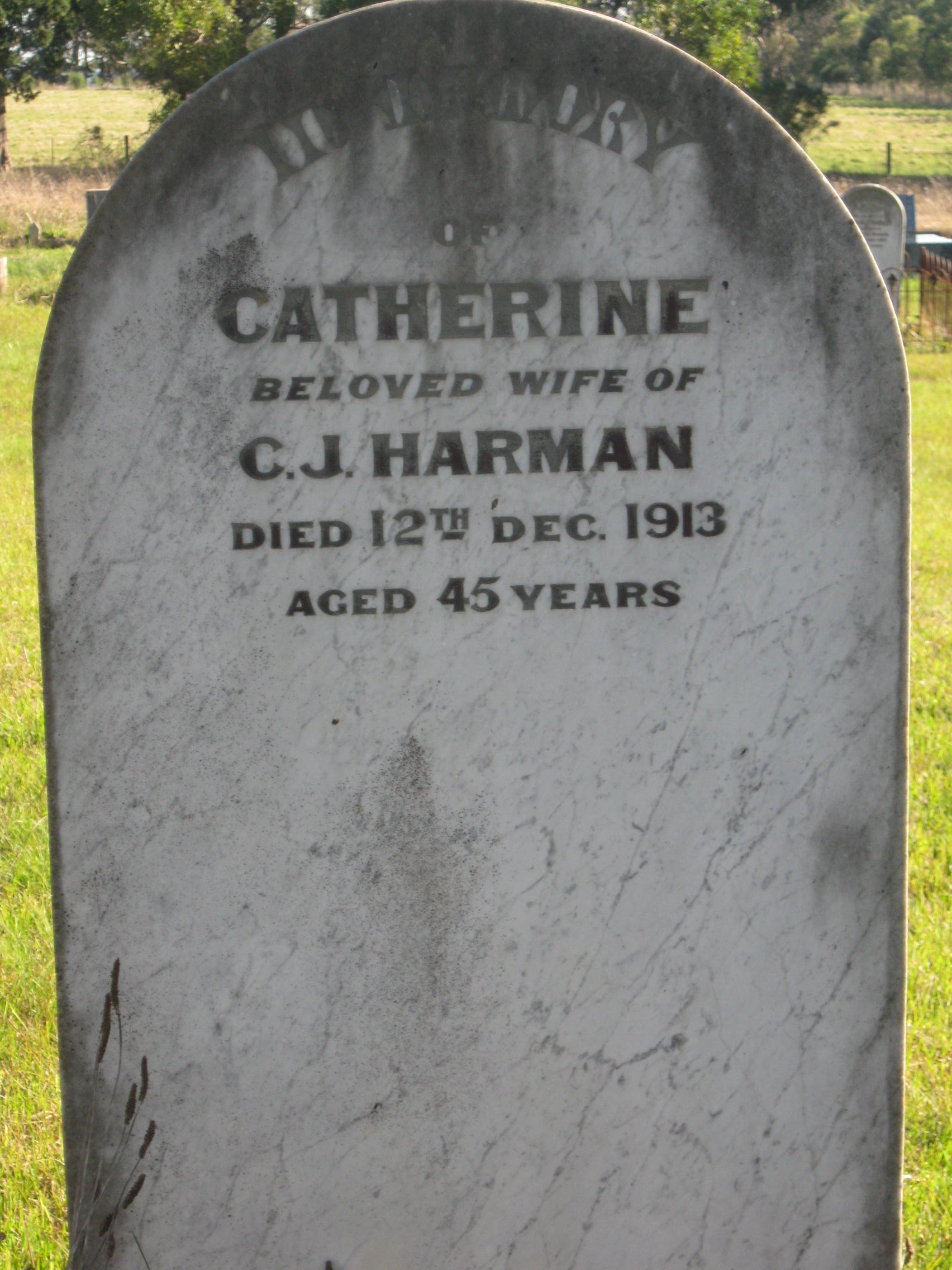
Catherine Harman was the wife of my great-great-uncle Charles James Harman, son of Reuben James Harman and Elizabeth Bishop.  Catherine was Catherine Kinghorn, daughter of Francis Kinghorn and Elizabeth White.  Born in 1868 at Byaduk, Catherine married Charles at the age of 37 in 1905.  Charles was 10 years her junior.  Catherine died in hospital in  Melbourne in 1913.  Charles enlisted in the Australian Flying Corps in 1916 and remarried in 1922 to Lavinia Raven Fisher of Middle Park.

IMG_1845

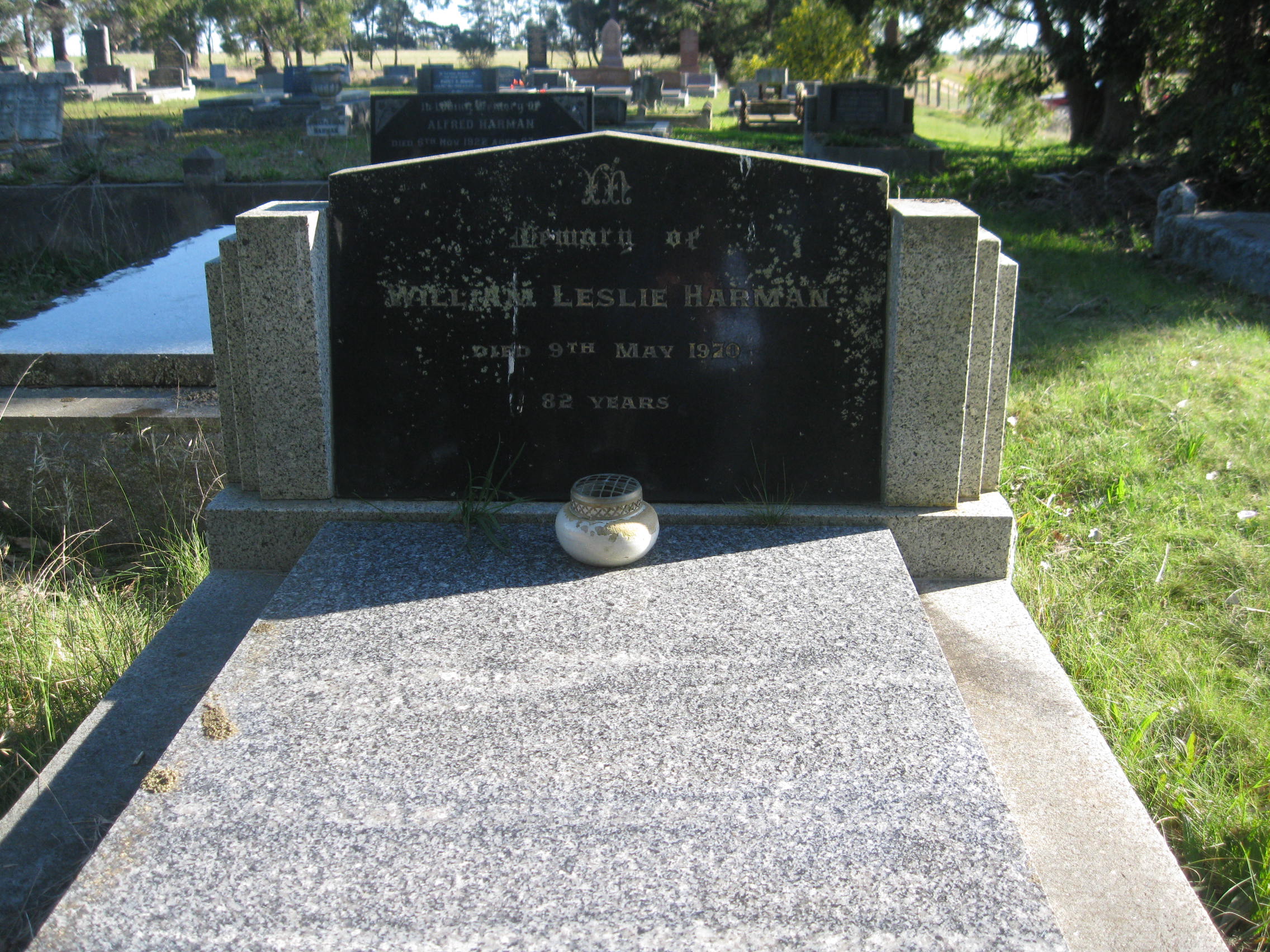
William Leslie Harman was born in 1888 at Byaduk, the third child and eldest son of Alfred Harman and Louisa Newman.  William was the grandson of James and Sarah Harman.

IMG_1838

Isabel Bunworth was Isabel Harman, the sixth daughter of Alfred and Louisa Harman and sister of William (above).  Isabel married John Bunworth of Byaduk in 1923.

IMG_1842

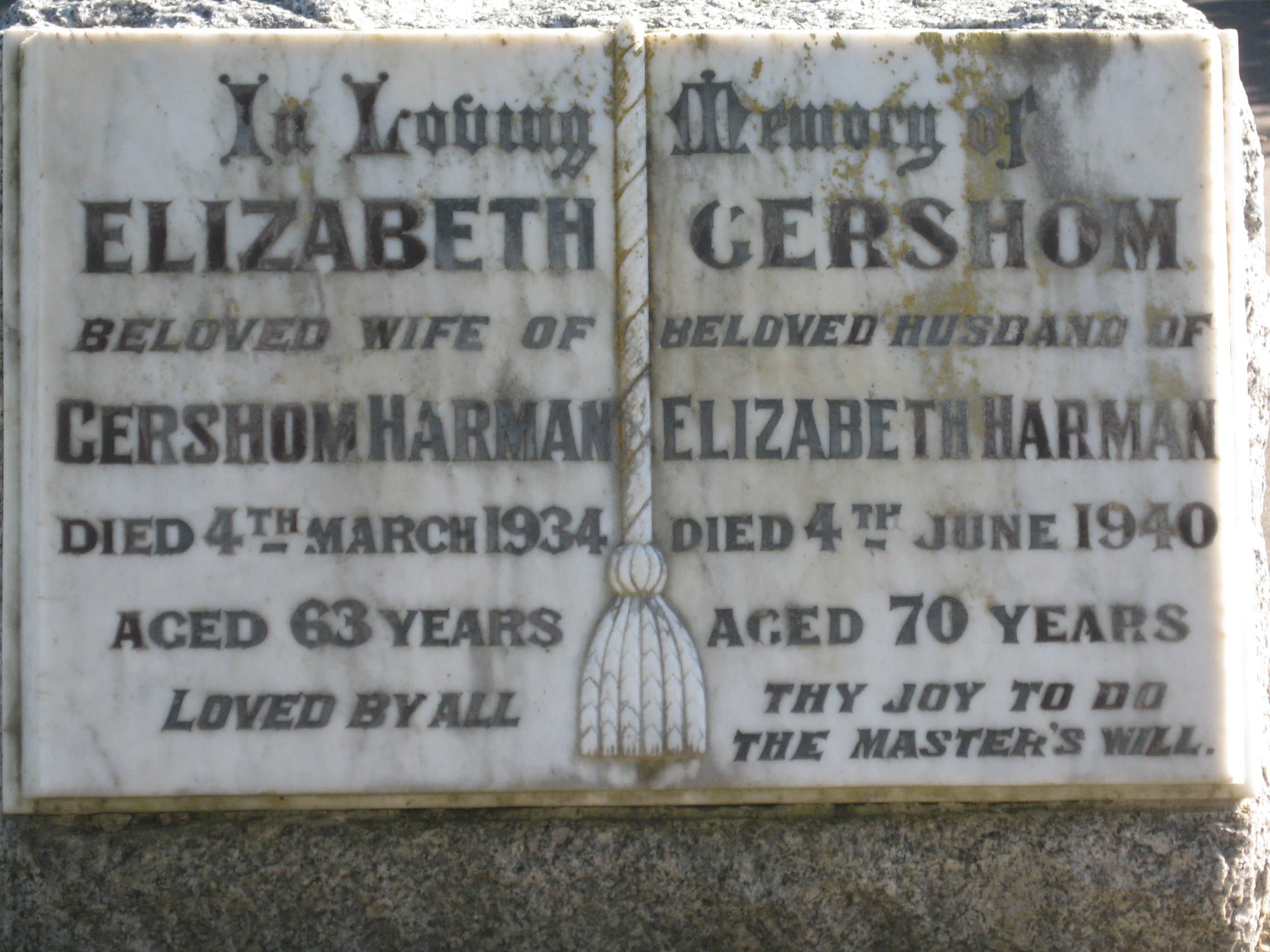
Gershom Harman (1869-1940) was the second son of Reuben Harman and Elizabeth Oliver.  He married Elizabeth Hilliard in 1905, and they had two children, Ivy and Gordon.

IMG_1835

Family Notices. (1934, March 10). The Argus (Melbourne, Vic. : 1848 - 1956), p. 13. Retrieved March 14, 2013, from http://nla.gov.au/nla.news-article10917287
Family Notices. (1934, March 10). The Argus (Melbourne, Vic. : 1848 – 1956), p. 13. Retrieved March 14, 2013, from http://nla.gov.au/nla.news-article10917287
Family Notices. (1940, June 8). The Argus (Melbourne, Vic. : 1848 - 1956), p. 4. Retrieved March 14, 2013, from http://nla.gov.au/nla.news-article12469954
Family Notices. (1940, June 8). The Argus (Melbourne, Vic. : 1848 – 1956), p. 4. Retrieved March 14, 2013, from http://nla.gov.au/nla.news-article12469954

Now to the Bishops and another Harman link as my gg grandparents were Reuben James Harman and Elizabeth Bishop.

The following headstone belongs to Charles Bishop and his wife, Sarah Dancer.  Charles (1856-1916) was the eldest son of James Bishop and Sarah Hughes.  He was the brother of Elizabeth Bishop.

Charles married Sarah Dancer in 1884, and they had 11 children.  Frances Bishop Hylard was their ninth child, born in 1900.  She married Edward Thomas Hylard in 1920.

IMG_1824

Charles Bishop passed away from a heart attack while loading wood.

COUNTRY NEWS. (1916, August 28). The Argus (Melbourne, Vic. : 1848 - 1956), p. 9. Retrieved March 17, 2013, from http://nla.gov.au/nla.news-article1598956
COUNTRY NEWS. (1916, August 28). The Argus (Melbourne, Vic. : 1848 – 1956), p. 9. Retrieved March 17, 2013, from http://nla.gov.au/nla.news-article1598956

Percy Almond Bishop was the second son of Charles and Sarah Bishop.  Percy was born in 1888 at Byaduk and enlisted in 1916 at Hamilton and served with the 39th Battalion.  He was awarded a Distinguished Conduct Medal and a Military Medal.  Percy never married.

IMG_1827

Family Notices. (1946, May 31). The Argus (Melbourne, Vic. : 1848 - 1956), p. 2. Retrieved March 14, 2013, from http://nla.gov.au/nla.news-article22250486
Family Notices. (1946, May 31). The Argus (Melbourne, Vic. : 1848 – 1956), p. 2. Retrieved March 14, 2013, from http://nla.gov.au/nla.news-article22250486
IMG_1847

Ian Marr’s website, Cemeteries of S.W. Victoria has a full list of the headstones at the Byaduk Cemetery.

**Thank you to Maria Cameron, President of the Port Fairy Genealogical Society, for providing additional information on the Fraser family.

Trove Tuesday – Bottom Drawer

What’s in your bottom drawer?

No doubt the lovely ladies of Portland that overran Father Donoghue’s’ alter in last week’s Trove Tuesday post, Whispering Wedding Bells, would each have had a range of items in their bottom drawers ready to take them through to life as a married woman.

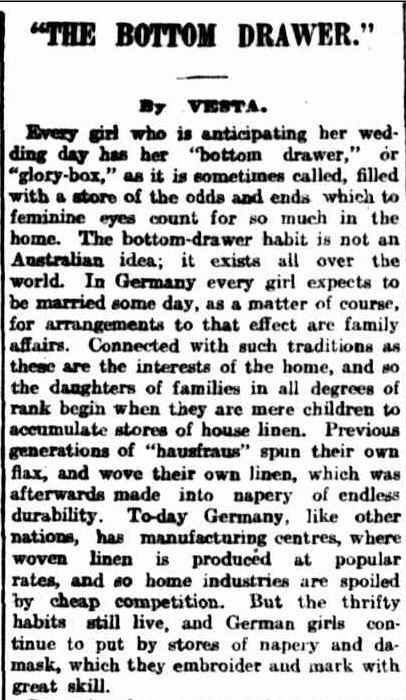
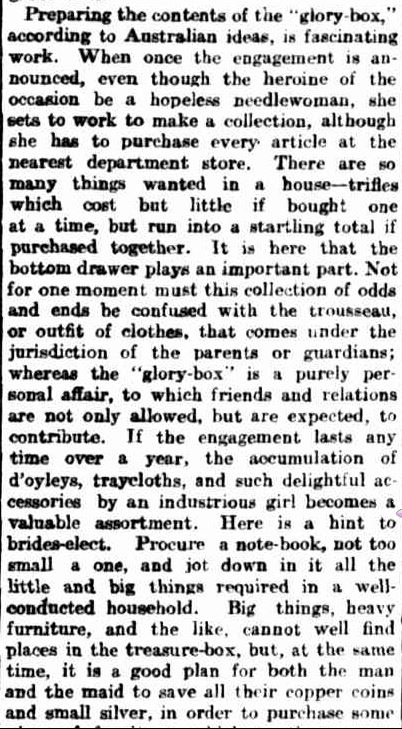
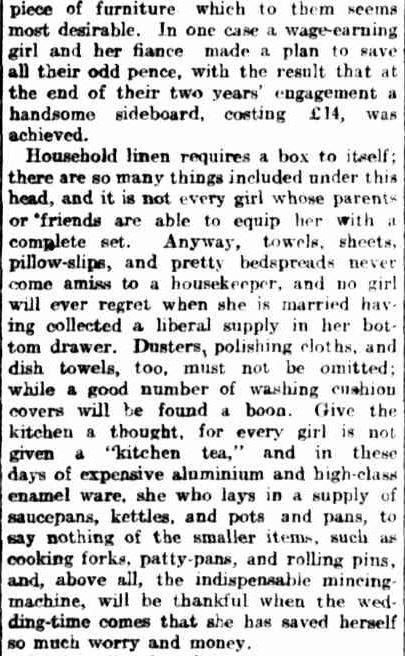
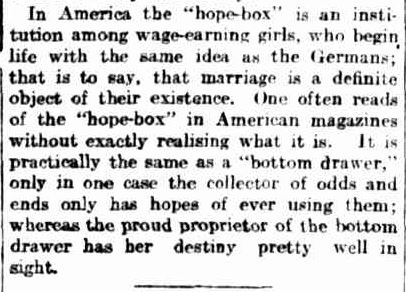
Vesta of the “Women to Women” column from the The Argus, explained on September 10, 1913 the essential items for a girl’s “bottom drawer” or “glory box”.  As you will see they must have been big drawers!

tt2 tt3 tt4

WOMEN TO WOMEN. (1913, September 10). The Argus (Melbourne, Vic. : 1848 - 1956), p. 5. Retrieved March 19, 2013, from http://nla.gov.au/nla.news-article7243175

WOMEN TO WOMEN. (1913, September 10). The Argus (Melbourne, Vic. : 1848 – 1956), p. 5. Retrieved March 19, 2013, from http://nla.gov.au/nla.news-article7243175

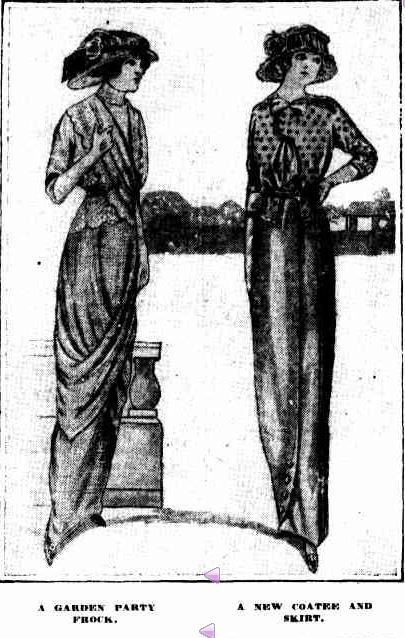
I couldn’t resist sharing these fashions from the same page:

tt6

Trove Tuesday – Whispering Wedding Bells

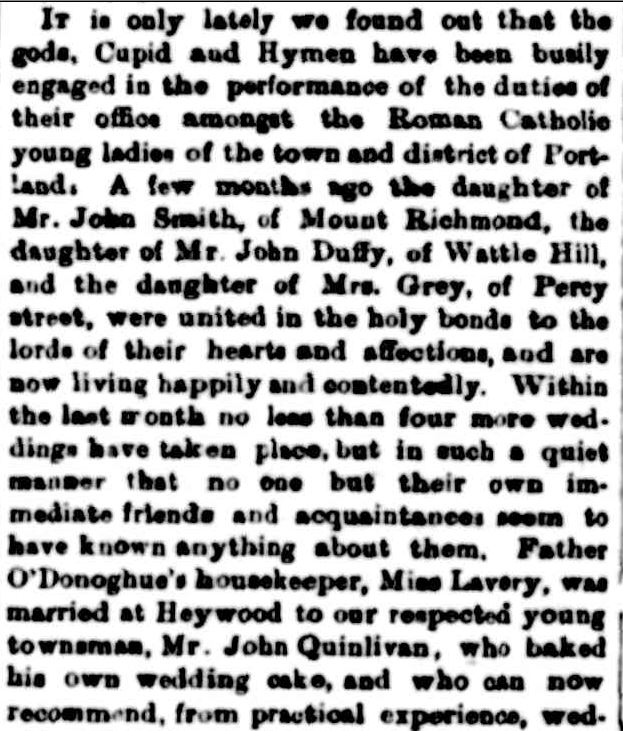
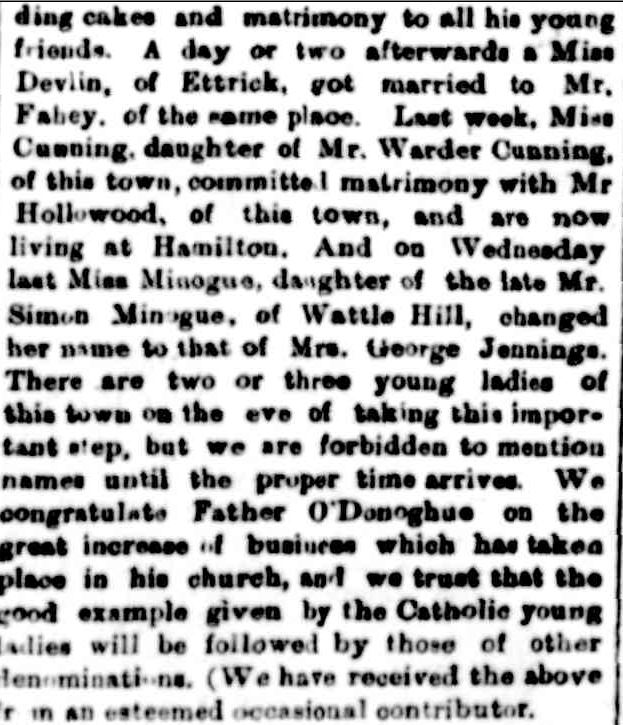
An interesting piece for Trove Tuesday this week.  From February 4, 1882, The Portland Guardian reported on some hush-hush weddings in the district with the information provided by an “esteemed occasional contributor”.  The weddings were happening but the wedding bells were not ringing.  Not only that, one groom baked his own wedding cake.

An article such as this is most useful to the researcher.  It has names, place names, marriages and religious denomination

weddings1

weddings2

The Guardian. (1882, February 4). Portland Guardian (Vic. : 1876 – 1953), p. 2 Edition: MORNING.. Retrieved March 11, 2013, from http://nla.gov.au/nla.news-article63403448

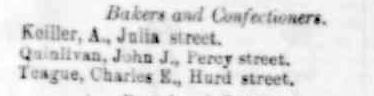
I think Father O’Donoghue might have been ready for a lie down.  All those weddings and he was doing his own housework after his housekeeper, Miss Lavery was also “united in the holy bond”.  In case you were wondering, Miss Lavery’s new husband, John Quinlivan, did not bake the wedding cake just because he fancied himself as a cook… he was a  baker.

PORTLAND PROFESSIONAL AND BUSINESS DIRECTORY. (1890, January 17). Portland Guardian (Vic. : 1876 - 1953), p. 4 Edition: EVENING. Retrieved March 11, 2013, from http://nla.gov.au/nla.news-article63626245

PORTLAND PROFESSIONAL AND BUSINESS DIRECTORY. (1890, January 17). Portland Guardian (Vic. : 1876 – 1953), p. 4 Edition: EVENING. Retrieved March 11, 2013, from http://nla.gov.au/nla.news-article63626245

The General Hewitt – Portland Bay 1856

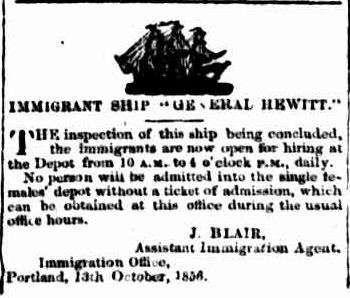
When I read pioneers’ obituaries, a ship comes up time and again, the General Hewitt.  The ship, also called the General Hewett, was a convict ship and later an immigrant ship, sailing to Moreton Bay in 1854 .  The voyage I will focus on was to Portland Bay in  1856.  And what a voyage it was.

On May 5, 1856, the Geelong Advertiser’s correspondent in London wrote:

LONDON. (1856, July 16). Geelong Advertiser and Intelligencer (Vic. : 1851 - 1856), p. 2 Edition: DAILY. Retrieved February 26, 2013, from http://nla.gov.au/nla.news-article93142901

LONDON. (1856, July 16). Geelong Advertiser and Intelligencer (Vic. : 1851 – 1856), p. 2 Edition: DAILY. Retrieved February 26, 2013, from http://nla.gov.au/nla.news-article93142901

The General Hewitt left Plymouth, England on July 5, 1856, and arrived at Portland on October 9, 1856.   Many of the passengers would become some of the finest pioneers of the Western District and the South-East of South Australia and beyond.  A mix of English, Scottish and Irish, the passengers were described as being “of a very useful and eligible class”

gh1

The General Hewitt also carried much needed supplies from the home country, whiskey, brandy, gin and champagne.  There was also some practical cargo such as clothing and haberdashery, garden seeds and glassware.

SHIPPING INTELLIGENCE. (1856, October 13). Portland Guardian and Normanby General Advertiser (Vic. : 1842 - 1876), p. 2 Edition: EVENING.. Retrieved February 10, 2013, from http://nla.gov.au/nla.news-article64567020

SHIPPING INTELLIGENCE. (1856, October 13). Portland Guardian and Normanby General Advertiser (Vic. : 1842 – 1876), p. 2 Edition: EVENING.. Retrieved February 10, 2013, from http://nla.gov.au/nla.news-article64567020

The single females from the ship were available to hire from £15 to £26 for a domestic.  Married couples could be employed at a rate of £40-£45.  While most of the immigrants were “suitable” there were some crew members that were not, resulting in an eventful voyage, with a mutiny attempt no less.
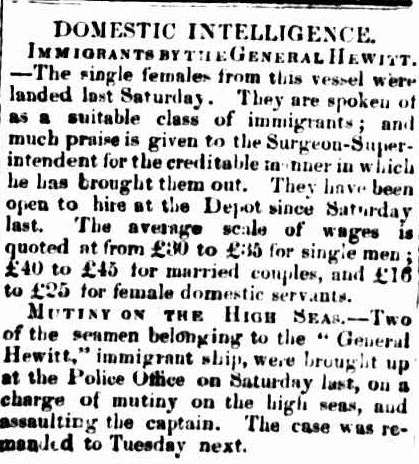
DOMESTIC INTELLIGENCE. (1856, October 13). Portland Guardian and Normanby General Advertiser (Vic. : 1842 - 1876), p. 2 Edition: EVENING.. Retrieved February 13, 2013, from http://nla.gov.au/nla.news-article64567019

DOMESTIC INTELLIGENCE. (1856, October 13). Portland Guardian and Normanby General Advertiser (Vic. : 1842 – 1876), p. 2 Edition: EVENING.. Retrieved February 13, 2013, from http://nla.gov.au/nla.news-article64567019

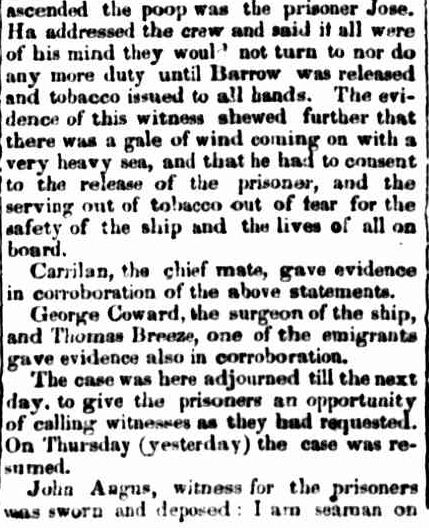
The drama did not stop once the ship arrived at Portland Bay.  Four crew members left the ship on a raft.  Ten others had been locked up and five on the ship were refusing to work.

POLICE COURT. (1856, October 17). Portland Guardian and Normanby General Advertiser (Vic. : 1842 - 1876), p. 2 Edition: EVENING.. Retrieved February 13, 2013, from http://nla.gov.au/nla.news-article64567053

POLICE COURT. (1856, October 17). Portland Guardian and Normanby General Advertiser (Vic. : 1842 – 1876), p. 2 Edition: EVENING.. Retrieved February 13, 2013, from http://nla.gov.au/nla.news-article64567053

On October 14, the two men accused of assault, William Jose and Joseph Barrow appeared in the Portland Police Court, as did the 10 men refusing duty.  Their names included Able Seamen  Millard, Gash, Parry, Gudridge, Gashar and Howson the sail maker.  They received four months hard labour.

gh9

POLICE COURT. (1856, October 15). Portland Guardian and Normanby General Advertiser (Vic. : 1842 - 1876), p. 2 Edition: EVENING.. Retrieved February 13, 2013, from http://nla.gov.au/nla.news-article64567037

POLICE COURT. (1856, October 15). Portland Guardian and Normanby General Advertiser (Vic. : 1842 – 1876), p. 2 Edition: EVENING.. Retrieved February 13, 2013, from http://nla.gov.au/nla.news-article64567037

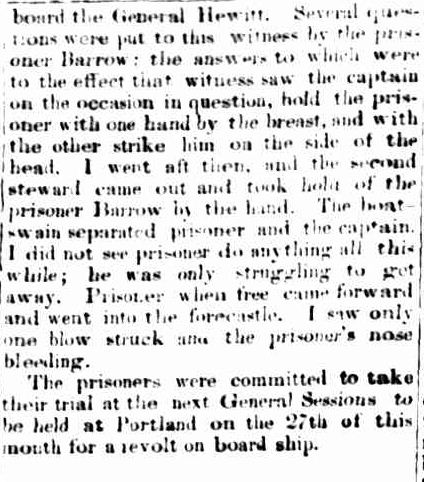
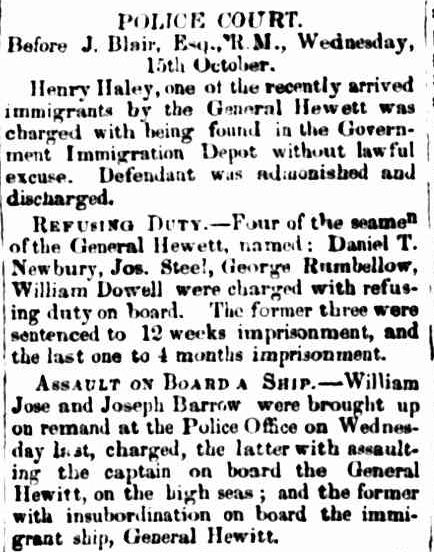
The General Hewitt’s arrival was kept the Police Court busy.  On October 15, one of the immigrants, Henry Haley appeared for being found in the Government Immigration Depot without permission.  Four more crewmen appeared for refusing duty, Daniel Newbury, Joseph Steel, George Rumbellow and William Dowell.  Their sentences ranged from 12 weeks to four months imprisonment.

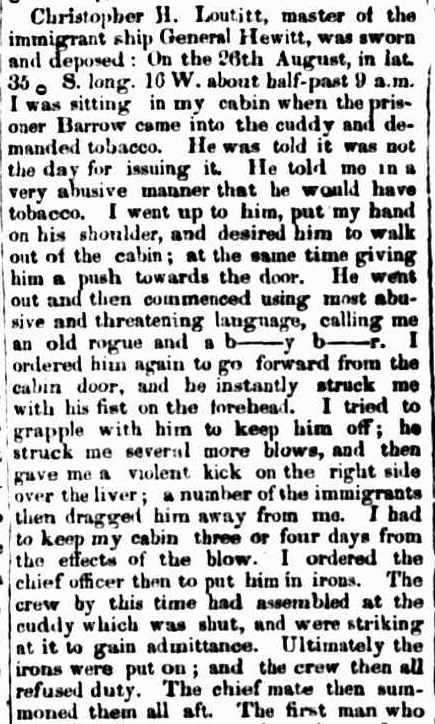
The trial of William Jose and Joseph Barrow for the assault on Captain Christopher H. Loutitt continued.
gh4 gh5

gh6

POLICE COURT. (1856, October 17). Portland Guardian and Normanby General Advertiser (Vic. : 1842 - 1876), p. 2 Edition: EVENING.. Retrieved February 13, 2013, from http://nla.gov.au/nla.news-article64567053

POLICE COURT. (1856, October 17). Portland Guardian and Normanby General Advertiser (Vic. : 1842 – 1876), p. 2 Edition: EVENING.. Retrieved February 13, 2013, from http://nla.gov.au/nla.news-article64567053

Advertising. (1856, October 17). Portland Guardian and Normanby General Advertiser (Vic. : 1842 - 1876), p. 3 Edition: EVENING.. Retrieved February 13, 2013, from http://nla.gov.au/nla.news-article64567048

Advertising. (1856, October 17). Portland Guardian and Normanby General Advertiser (Vic. : 1842 – 1876), p. 3 Edition: EVENING.. Retrieved February 13, 2013, from http://nla.gov.au/nla.news-article64567048

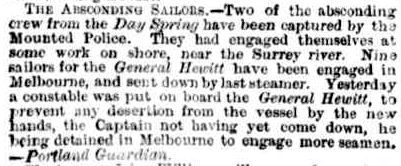
The General Hewitt was already low on crew when, on November 7, two more absconded, the steward, William Thomas an John Carroll the cook.  They had the diggings in their sights, but instead they ended up digging roads.

POLICE COURT. (1856, November 10). Portland Guardian and Normanby General Advertiser (Vic. : 1842 - 1876), p. 2 Edition: EVENING.. Retrieved February 13, 2013, from http://nla.gov.au/nla.news-article64567197

POLICE COURT. (1856, November 10). Portland Guardian and Normanby General Advertiser (Vic. : 1842 – 1876), p. 2 Edition: EVENING.. Retrieved February 13, 2013, from http://nla.gov.au/nla.news-article64567197

A Police Constable kept watch on board the General Hewitt to prevent any more crew jumping ship.  Captain Loutitt travelled to Melbourne in search of more crew.

SHIPPING INTELLIGENCE. (1856, November 27). The Argus (Melbourne, Vic. : 1848 - 1956), p. 4. Retrieved February 13, 2013, from http://nla.gov.au/nla.news-article7140721

SHIPPING INTELLIGENCE. (1856, November 27). The Argus (Melbourne, Vic. : 1848 – 1956), p. 4. Retrieved February 13, 2013, from http://nla.gov.au/nla.news-article7140721

Sixty-two years after the arrival of the General Hewitt, the death of John. S Andrew aka John Forster, brought to light more about the crew of the General Hewitt.  John Andrew was a crew member that bolted, ending up at Muntham near Casterton, where he remained for the rest of his life.  According to John’s obituary, other men of the district that were members of the crew included Messers Rooking and Gasperino.
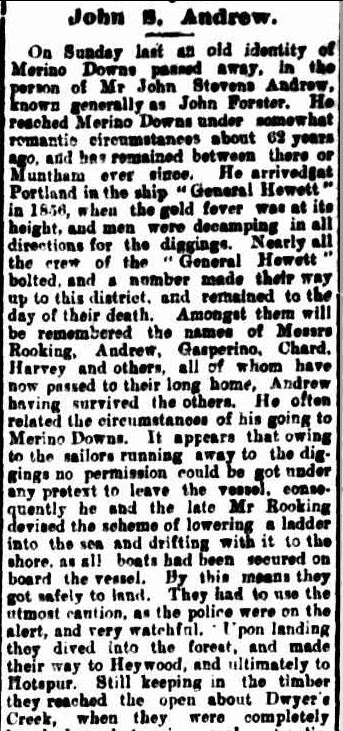
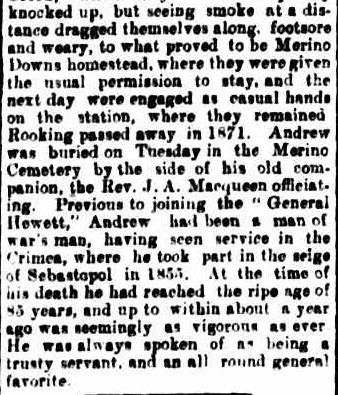
gh17

Passed Away. (1918, October 10). The Casterton News and the Merino and Sandford Record (Vic. : 1914 - 1918), p. 3 Edition: Bi-Weekly.. Retrieved February 13, 2013, from http://nla.gov.au/nla.news-article74222260

Passed Away. (1918, October 10). The Casterton News and the Merino and Sandford Record (Vic. : 1914 – 1918), p. 3 Edition: Bi-Weekly.. Retrieved February 13, 2013, from http://nla.gov.au/nla.news-article74222260

The obituary of William Rooking outed by John Andrew as an escaped crewmen

OBITUARY. (1901, June 14). The Horsham Times (Vic. : 1882 - 1954), p. 3. Retrieved February 26, 2013, from http://nla.gov.au/nla.news-article73027645

OBITUARY. (1901, June 14). The Horsham Times (Vic. : 1882 – 1954), p. 3. Retrieved February 26, 2013, from http://nla.gov.au/nla.news-article73027645

Now to the passengers.  As I’m currently tied to home, I didn’t think I could get access to the General Hewitt’s passenger list, so I thought I would find some of the passengers using Trove and a bit of Googling followed by a cross check with the PROV Online Shipping records.  While I did not come close to the “363 souls” on board, I did find around 70. Some of  those continued to live in the Western District or just across the border in the South East of South Australia.

Then, a need to double cross check and a feeling of guilt about omitting the other 290 or so passengers, I thought I would give Ancestry.com.au a go.  Using the Victoria, Australia, Assisted and Unassisted Passenger Lists 1839-1923, I searched with General Hewitt in the Keywords field and the year 1856 and the list came up.  Early excitement faded rapidly when I realised the work another 290 names were going to bring and the transcribing of the passenger list was far from perfect.  The Cameron family had become the Cameau family, to name just one discrepancy.

As I’ve pottered away on this post for a few weeks, I have decided to just feature those passengers that had their voyage on the General Hewitt mentioned in their obituaries, plus a couple of others I found on the Glenelg and Wannon Settlers site.  Maybe, one day when I am stuck for something to do, I may start working my way through the other “souls” and share them with you.

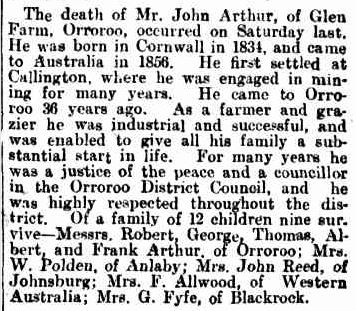
ARTHUR, JOHN & PHILLIPPA   – John and Phillippa Arthur did not stay in Victoria long after their arrival, moving to Callington about 60 kilometres east of Adelaide. PROV Passenger List Index:  http://tinyurl.com/c8a8jfj

OBITUARY. (1912, August 3). Chronicle (Adelaide, SA : 1895 - 1954), p. 42. Retrieved February 27, 2013, from http://nla.gov.au/nla.news-article88699759

OBITUARY. (1912, August 3). Chronicle (Adelaide, SA : 1895 – 1954), p. 42. Retrieved February 27, 2013, from http://nla.gov.au/nla.news-article88699759

ELIAS AND JOHN BATESON:  Elias and John from Cambridgeshire took up work with Edmund Kirby (father of John Kirby) at “Spring Bank” near Sandford. PROV Passenger Index: http://tinyurl.com/am9k8f7

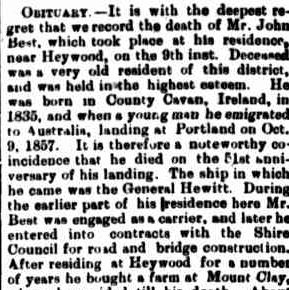
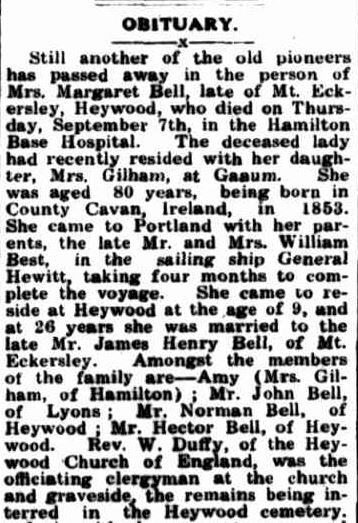
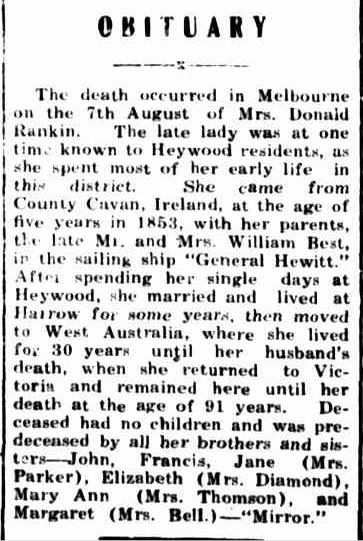
BEST FAMILY:  William and Letitia  Best and their family of seven children were from County Cavan, Ireland and settled at Heywood.   PROV record – http://tinyurl.com/c2l5ekh

The obituaries of three of the children follow:

John was 20 at the time of his arrival at Portland.

First Issue, August 20, 1842. (1907, October 14). Portland Guardian (Vic. : 1876 - 1953), p. 2 Edition: EVENING. Retrieved February 13, 2013, from http://nla.gov.au/nla.news-article63967003

First Issue, August 20, 1842. (1907, October 14). Portland Guardian (Vic. : 1876 – 1953), p. 2 Edition: EVENING. Retrieved February 13, 2013, from http://nla.gov.au/nla.news-article63967003

Margaret Best married James Bell a member of another of Heywood’s pioneering families.

OBITUARY. (1933, September 18). Portland Guardian (Vic. : 1876 - 1953), p. 3 Edition: EVENING.. Retrieved March 6, 2013, from http://nla.gov.au/nla.news-article64283449

OBITUARY. (1933, September 18). Portland Guardian (Vic. : 1876 – 1953), p. 3 Edition: EVENING.. Retrieved March 6, 2013, from http://nla.gov.au/nla.news-article64283449

Letitia Best married Donald Rankin.  After her marriage, she lived in Harrow, Western Australia and Heywood.

OBITUARY. (1941, August 25). Portland Guardian (Vic. : 1876 - 1953), p. 2 Edition: EVENING. Retrieved February 28, 2013, from http://nla.gov.au/nla.news-article64401403

OBITUARY. (1941, August 25). Portland Guardian (Vic. : 1876 – 1953), p. 2 Edition: EVENING. Retrieved February 28, 2013, from http://nla.gov.au/nla.news-article64401403

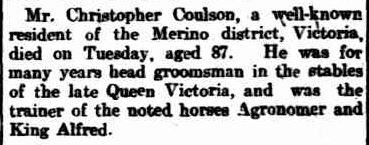
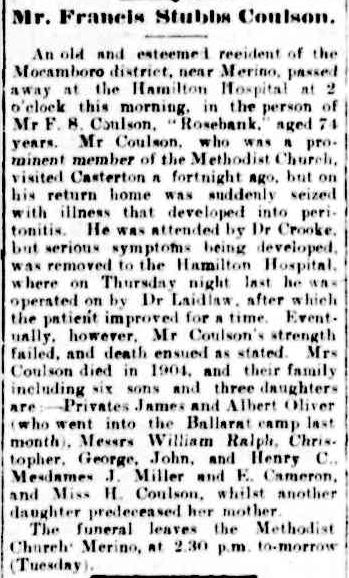
COULSON FAMILY – Christopher and Mary Frances Coulson were originally from Yorkshire and later London.  They sailed on the General Hewitt with their four children aged 4 to 14.  I have previously written about Christopher in the post  I Wish I Were Related To Christopher Coulson.  One of their sons, Francis married my ggg aunt, Harriet Martha Diwell, daughter of William and Margaret.  PROV Passenger Index:  http://tinyurl.com/babw5x2

The obituary of Christopher Coulson Snr.

PERSONAL. (1904, July 28). The Advertiser (Adelaide, SA : 1889 - 1931), p. 6. Retrieved March 6, 2013, from http://nla.gov.au/nla.news-article4991780

PERSONAL. (1904, July 28). The Advertiser (Adelaide, SA : 1889 – 1931), p. 6. Retrieved March 6, 2013, from http://nla.gov.au/nla.news-article4991780

Passed Away. (1916, April 10). The Casterton News and the Merino and Sandford Record (Vic. : 1914 - 1918), p. 3 Edition: Bi-Weekly. Retrieved February 28, 2013, from http://nla.gov.au/nla.news-article74485266

Passed Away. (1916, April 10). The Casterton News and the Merino and Sandford Record (Vic. : 1914 – 1918), p. 3 Edition: Bi-Weekly. Retrieved February 28, 2013, from http://nla.gov.au/nla.news-article74485266

BREEZE FAMILY:  Or is it the Breese family?  As listed on the PROV Index, Thomas and Ann Breeze and their children were aboard the General Hewitt.  However, the following letter indicates their name have been Breese.  PROV Index:  http://tinyurl.com/avj5sse

The letter is from William G. Breese, son of Thomas and Ann.  William was just seven when he arrived at Portland Bay, but 73 years later he was able to recount the voyage particularly the attempted mutiny.
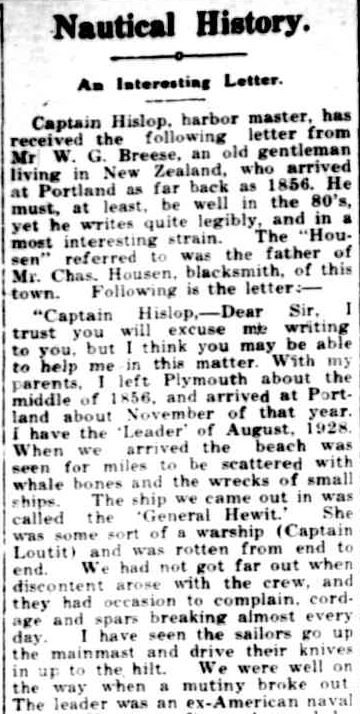
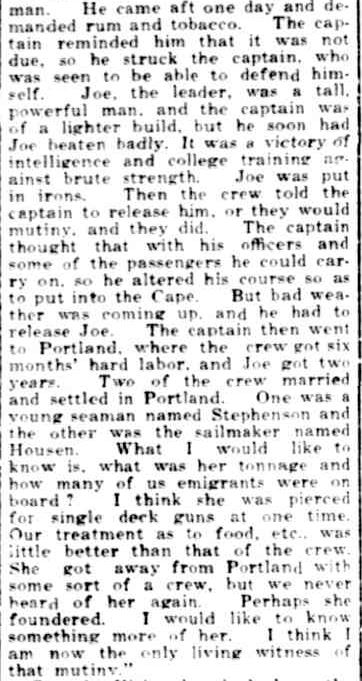
gh48gh49

Nautical History. (1929, April 18). Portland Guardian (Vic. : 1876 - 1953), p. 2 Edition: EVENING. Retrieved March 10, 2013, from http://nla.gov.au/nla.news-article64269148

Nautical History. (1929, April 18). Portland Guardian (Vic. : 1876 – 1953), p. 2 Edition: EVENING. Retrieved March 10, 2013, from http://nla.gov.au/nla.news-article64269148

DWYER, EDMOND – I am yet to find the fate of the General Hewitt, however, Edmond Dwyer’s obituary states the ship was destroyed by fire after one more trip to Australia.  The General Hewitt did make one other trip to Australia landing at  Port Adelaide in 1858.

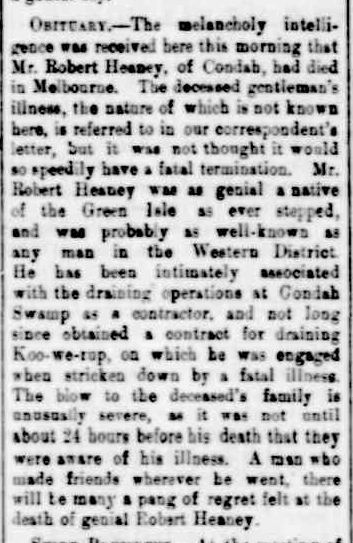
Edmond’s obituary is also useful in that it mentions other passengers on the ship  – the Heaneys and Messers Roulston and Waters.  I can find each of these passengers but I cannot find a passenger under the name of Cannon he mentions.

There were three other Dwyers on the General Hewitt, but I have not been able to find if they are linked to Edmond.  They were:  Catherine (22), Johanna (27), Denis (29)

PROV record http://tinyurl.com/azt5jac
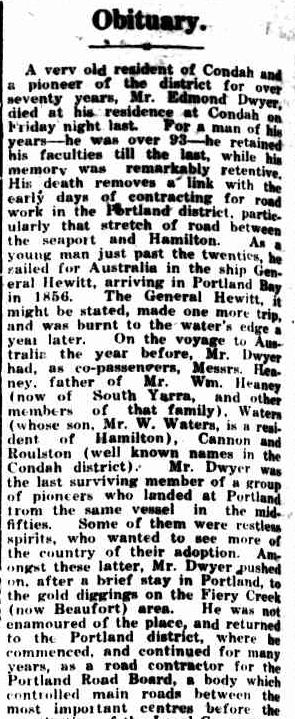
gh19

Obituary. (1930, March 20). Portland Guardian (Vic. : 1876 - 1953), p. 2 Edition: EVENING. Retrieved February 13, 2013, from http://nla.gov.au/nla.news-article64291851

Obituary. (1930, March 20). Portland Guardian (Vic. : 1876 – 1953), p. 2 Edition: EVENING. Retrieved February 13, 2013, from http://nla.gov.au/nla.news-article64291851

HADDEN, David and Mary –   Listed on the Passenger list as Haddon, David and settled in the Carapook area.  PROV Link http://tinyurl.com/asvck8q

HEANEY, Robert and Jane – From Ireland, Robert and Jane pioneered at Condah for 52 years.  PROV Link http://tinyurl.com/a5rgakf

Infections Diseases in Animals. (1890, August 20). Portland Guardian (Vic. : 1876 - 1953), p. 2 Edition: EVENING. Retrieved February 26, 2013, from http://nla.gov.au/nla.news-article63629135

Infections Diseases in Animals. (1890, August 20). Portland Guardian (Vic. : 1876 – 1953), p. 2 Edition: EVENING. Retrieved February 26, 2013, from http://nla.gov.au/nla.news-article63629135

Passing of the Pioneers. (1920, February 5). Portland Guardian (Vic. : 1876 - 1953), p. 3 Edition: EVENING.. Retrieved February 26, 2013, from http://nla.gov.au/nla.news-article64020779

Passing of the Pioneers. (1920, February 5). Portland Guardian (Vic. : 1876 – 1953), p. 3 Edition: EVENING.. Retrieved February 26, 2013, from http://nla.gov.au/nla.news-article64020779

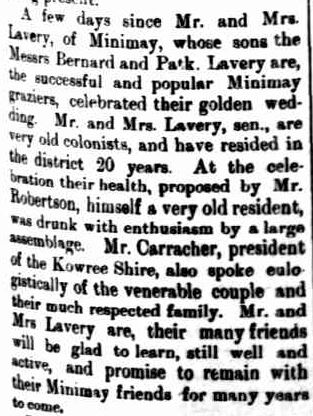
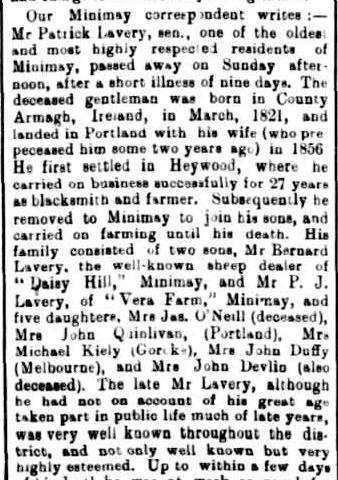
LAVERY Family:    Patrick and Rose and children Ann, Mary and Bernard were from County Armagh, Ireland.   PROV Index:  http://tinyurl.com/ba6juo3

Patrick and Rose celebrated their Golden Wedding Anniversary in 1900.

SOCIAL. (1900, February 27). The Horsham Times (Vic. : 1882 - 1954), p. 1. Retrieved March 7, 2013, from http://nla.gov.au/nla.news-article75063691

SOCIAL. (1900, February 27). The Horsham Times (Vic. : 1882 – 1954), p. 1. Retrieved March 7, 2013, from http://nla.gov.au/nla.news-article75063691

Obituary of Patrick Lavery.

OBITUARY. (1905, November 24). The Horsham Times (Vic. : 1882 - 1954), p. 3. Retrieved February 27, 2013, from http://nla.gov.au/nla.news-article72818770

OBITUARY. (1905, November 24). The Horsham Times (Vic. : 1882 – 1954), p. 3. Retrieved February 27, 2013, from http://nla.gov.au/nla.news-article72818770

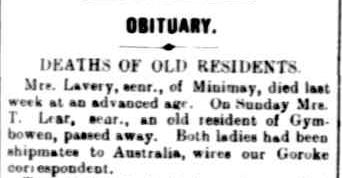
Rose Lavery passed away only days before her fellow General Hewitt shipmate, Mary Lear (below).

OBITUARY. (1903, August 11). The Horsham Times (Vic. : 1882 - 1954), p. 3. Retrieved March 7, 2013, from http://nla.gov.au/nla.news-article72841100

OBITUARY. (1903, August 11). The Horsham Times (Vic. : 1882 – 1954), p. 3. Retrieved March 7, 2013, from http://nla.gov.au/nla.news-article72841100

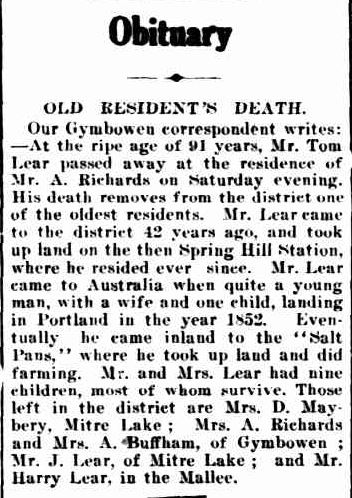
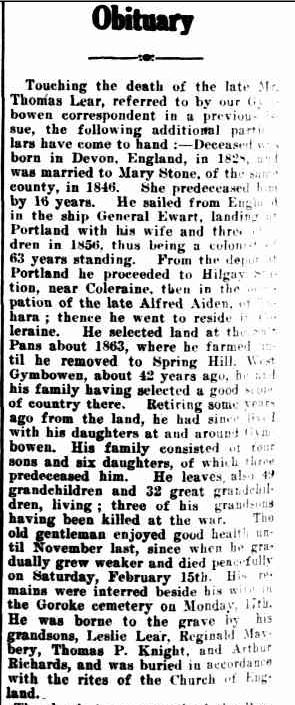
LEAR FAMILY:  Thomas and Mary and their children William, Thomas and Mary were from Devon, England.  They had another seven children after their arrival.  PROV Index:  http://tinyurl.com/cdeuklp

There was a “take two” with Thomas Lear’s obituary.  The Gymbowen correspondent wrote an obituary published in the Horsham Times on February 18, 1919.  The issue of February 21, 1919 set a few facts straight.

Obituary. (1919, February 18). The Horsham Times (Vic. : 1882 - 1954), p. 5. Retrieved March 8, 2013, from http://nla.gov.au/nla.news-article72993062

Obituary. (1919, February 18). The Horsham Times (Vic. : 1882 – 1954), p. 5. Retrieved March 8, 2013, from http://nla.gov.au/nla.news-article72993062

Obituary. (1919, February 21). The Horsham Times (Vic. : 1882 - 1954), p. 4. Retrieved March 9, 2013, from http://nla.gov.au/nla.news-article72993152

Obituary. (1919, February 21). The Horsham Times (Vic. : 1882 – 1954), p. 4. Retrieved March 9, 2013, from http://nla.gov.au/nla.news-article72993152

 McCABE, John and Mathilda:  John and Mathilda, from Ireland, had 10 children after their arrival in Victoria.  They settled in the Sandford district.    PROV Index:  http://tinyurl.com/d785kzx

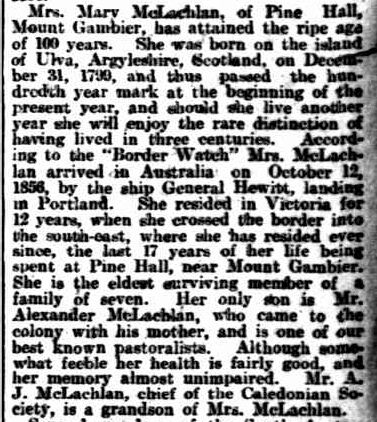
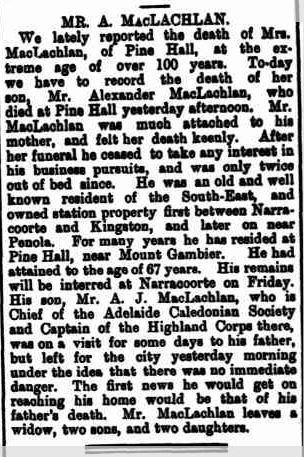
McLACHLAN, Mary and Alexander:  The interesting thing about Mary McLachlan’s obituary, that appeared in many newspapers, is that it names her as a passenger on the General Hewitt, with her son.  However, can find Alexander on the passenger list but not Mary.  PROV Index:  http://tinyurl.com/d39sg4u

PERSONAL. (1900, January 15). The Advertiser (Adelaide, SA : 1889 – 1931), p. 4. Retrieved February 13, 2013, from http://nla.gov.au/nla.news-article29526830

Alexander passed away only six months after his mother.

MR. A. MACLACHLAN. (1900, June 27). Border Watch (Mount Gambier, SA : 1861 - 1954), p. 2. Retrieved March 6, 2013, from http://nla.gov.au/nla.news-article81040451

MR. A. MACLACHLAN. (1900, June 27). Border Watch (Mount Gambier, SA : 1861 – 1954), p. 2. Retrieved March 6, 2013, from http://nla.gov.au/nla.news-article81040451

McCANN, PETER AND JANE and MARY SMITH McCANN:  Peter and Jane were from Ireland and settled around Sandford.  Mary Smith McCANN also sailed with Peter and Jane.  I am not sure if she was a daughter of the couple as she was six, Peter was 22 and Jane was 30.   PROV Index:  http://tinyurl.com/botobco

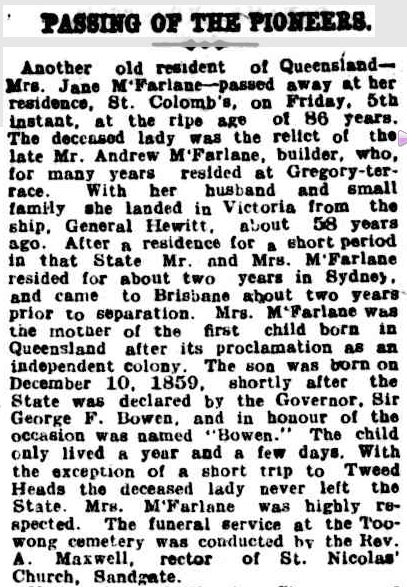
McFARLANE FAMILY:  Andrew and Jane and children George, Elizabeth, Margaret and an unnamed infant.  The McFarlanes did not linger in Victoria very long, moving first to Sydney and later Brisbane.  Their first child born after they moved to Queensland was the first child born in Queensland after its proclamation.  PROV Index http://tinyurl.com/c3kx3dk

PASSING OF THE PIONEERS. (1913, December 20). The Queenslander (Brisbane, Qld. : 1866 - 1939), p. 238. Retrieved February 28, 2013, from http://nla.gov.au/nla.news-article22219423

PASSING OF THE PIONEERS. (1913, December 20). The Queenslander (Brisbane, Qld. : 1866 – 1939), p. 238. Retrieved February 28, 2013, from http://nla.gov.au/nla.news-article22219423

The McFarlanes also offer a lesson:  Even though a person/s disembarked in a particular port, it does not mean they stayed in that general area or even that state.  The McFarlane’s made it from Victoria to Queensland after only two years in the Australia.

MACKINNON, Lachlan:  Lachlan MacKinnon, originally from Argyllshire, Scotland, arrived with his wife and frankly, proving he was on the General Hewitt has almost done my head in.  He does not come up in a search on the PROV Index, in fact no MacKinnons do.  There are McKinnons that sailed on the General Hewitt, but no Lachlans.

Looking to the Ancestry.com.au index, there was a Lachlan McKenzie and several other McKenzies with christian names the same as the McKinnons found on the PROV Index.  The PROV Index has no McKenzies arriving in 1856.  Given the aforementioned dependencies at Ancestry, do I assume the McKenzies are McKinnons and the Lachlan McKinnon listed is really Lachlan MacKinnon?
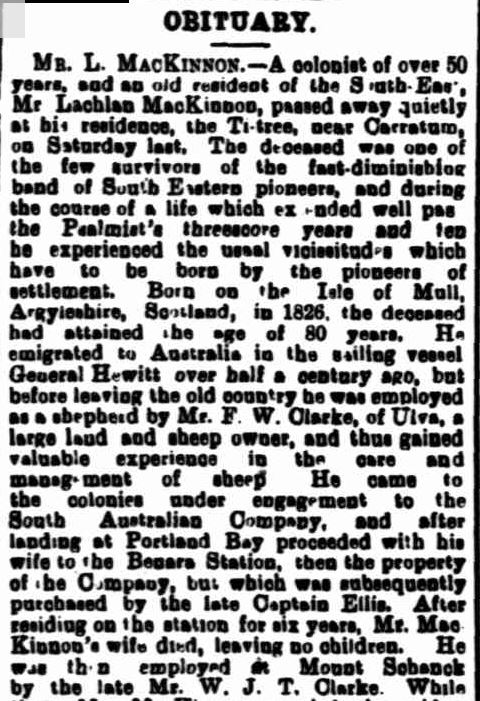
gh36, gh37

OBITUARY. (1906, September 5). Border Watch (Mount Gambier, SA : 1861 - 1954), p. 3. Retrieved March 6, 2013, from http://nla.gov.au/nla.news-article77583891

OBITUARY. (1906, September 5). Border Watch (Mount Gambier, SA : 1861 – 1954), p. 3. Retrieved March 6, 2013, from http://nla.gov.au/nla.news-article77583891


McKINNON FAMILY:  John and Catherine and their children PROV Index  http://tinyurl.com/bn45olf 

NEATE FAMILY:  James and Anne and children Margaret, Julia, Emily, Henry, Albert and Catherine.  PROV Index:  http://tinyurl.com/ad5l7hu

No Title. (1909, May 19). Portland Guardian (Vic. : 1876 - 1953), p. 3 Edition: EVENING. Retrieved February 17, 2013, from http://nla.gov.au/nla.news-article63988049

No Title. (1909, May 19). Portland Guardian (Vic. : 1876 – 1953), p. 3 Edition: EVENING. Retrieved February 17, 2013, from http://nla.gov.au/nla.news-article63988049

POLAND, William and Eliza.  William and Eliza arrived in Portland with an infant and went on to have another six children and became two of Portland’s best known pioneers.  William wasthe manager of “Burswood” owned by Edward Henty.  PROV Index:  http://tinyurl.com/clrhd58
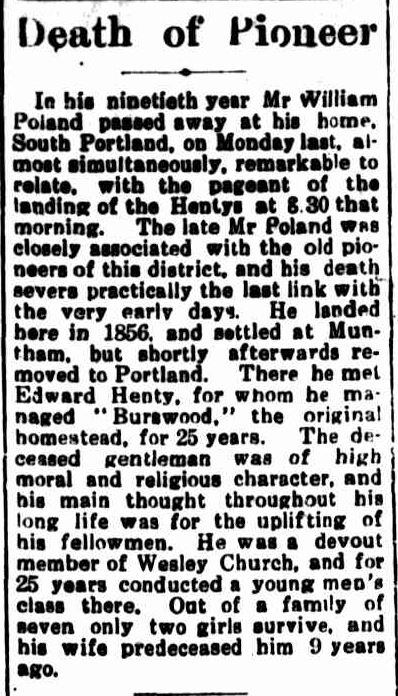
gh46


First Issue, August 20, 1842. (1912, October 18). Portland Guardian (Vic. : 1876 - 1953), p. 2 Edition: EVENING. Retrieved March 10, 2013, from http://nla.gov.au/nla.news-article64003159

First Issue, August 20, 1842. (1912, October 18). Portland Guardian (Vic. : 1876 – 1953), p. 2 Edition: EVENING. Retrieved March 10, 2013, from http://nla.gov.au/nla.news-article64003159


ROULSTON, ROBERT AND JOSEPH:  Trying to pin down Robert and Joseph was difficultEdmond Dwyer mentioned the Roulstons as shipmates and name being well known in the Condah district.  There were also Roulstons at Heywood and I found a reference to that family and the Heaney’s (above).  The Heaney family lived in Heywood for 10 years after arriving on the General Hewitt then moved north to Condah.  Robert and Joseph appear on the PROV Index as Roulstone: http://tinyurl.com/az4b9mt

Heywood's Pioneers. (1938, September 29). Portland Guardian (Vic. : 1876 - 1953), p. 5 Edition: EVENING.. Retrieved March 10, 2013, from http://nla.gov.au/nla.news-article64280358

Heywood’s Pioneers. (1938, September 29). Portland Guardian (Vic. : 1876 – 1953), p. 5 Edition: EVENING.. Retrieved March 10, 2013, from http://nla.gov.au/nla.news-article64280358


STARK, JAMES AND ELIZABETH:  Newlyweds James and Elizabeth spent their first years in Australia at Penola, South Australia before moving to Lake Mundi near Casterton.  PROV Index http://tinyurl.com/d8n7h6t

OBITUARY. (1917, April 28). Border Watch (Mount Gambier, SA : 1861 - 1954), p. 5. Retrieved March 10, 2013, from http://nla.gov.au/nla.news-article77664546

OBITUARY. (1917, April 28). Border Watch (Mount Gambier, SA : 1861 – 1954), p. 5. Retrieved March 10, 2013, from http://nla.gov.au/nla.news-article77664546

WATERS, JOHN and ELLEN: John and Ellen are indexed as Walters.  They settled in the Nareen district.  PROV Index:  http://tinyurl.com/av27lhf

CONCERNING PEOPLE. (1913, April 16). The Register (Adelaide, SA : 1901 - 1929), p. 6. Retrieved February 28, 2013, from http://nla.gov.au/nla.news-article59253916

CONCERNING PEOPLE. (1913, April 16). The Register (Adelaide, SA : 1901 – 1929), p. 6. Retrieved February 28, 2013, from http://nla.gov.au/nla.news-article59253916

PORTLAND RED CROSS. (1917, May 10). Portland Observer and Normanby Advertiser (Vic. : 1914 - 1918), p. 2 Edition: MORNING. Retrieved February 28, 2013, from http://nla.gov.au/nla.news-article88675915

PORTLAND RED CROSS. (1917, May 10). Portland Observer and Normanby Advertiser (Vic. : 1914 – 1918), p. 2 Edition: MORNING. Retrieved February 28, 2013, from http://nla.gov.au/nla.news-article88675915

WATERS, MALACHI AND MARYMalachi and Mary moved around, firstly to Horsham for work and later Portland, Digby and finally Wallacedale. PROV Index http://tinyurl.com/av27lhf

Established August 1842. The Portland Guardian,. (1902, March 12). Portland Guardian (Vic. : 1876 - 1953), p. 2 Edition: EVENING. Retrieved March 10, 2013, from http://nla.gov.au/nla.news-article63992048

Established August 1842. The Portland Guardian,. (1902, March 12). Portland Guardian (Vic. : 1876 – 1953), p. 2 Edition: EVENING. Retrieved March 10, 2013, from http://nla.gov.au/nla.news-article63992048

WILSON, Robert:  Robert sailed with his sister Mary Ann on the General Hewitt.  A year later Mary Ann had already lost track of her brother.  PROV Index:  http://tinyurl.com/a48edrr
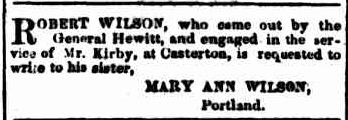
Advertising. (1857, September 4). Portland Guardian and Normanby General Advertiser (Vic. : 1842 - 1876), p. 3 Edition: EVENING. Retrieved February 13, 2013, from http://nla.gov.au/nla.news-article64569266

If one of your family members sailed on the 1856 voyage to Portland Bay on the General Hewitt, please let me know in the comments.

SOURCES:

Ancestry.com.au

Glenelg and Wannon Settlers

Victorian Public Record Office  – Index to British Assisted Immigration 1839-1871

Trove Digitised Newspapers
Autumn Fashion

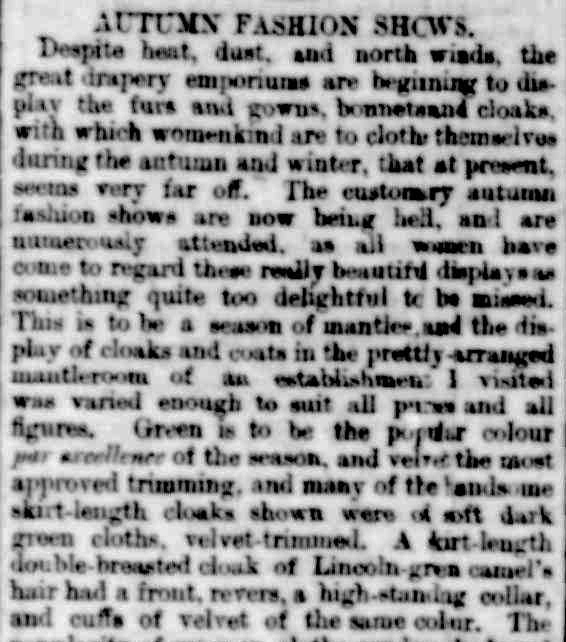
The first two months of Autumn in the Western District produce some of the year’s best weather.  There are warm days but a chill is felt in the night air.  By May, however, we begin to get a taste of what lies ahead with more wet and cold days.

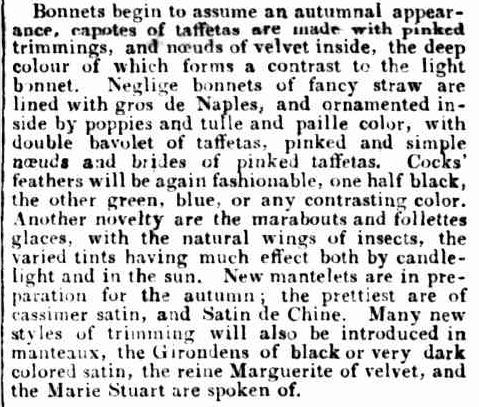
During the mid 19th century, ladies had to rely on reports from London and Paris for their fashion news.  In 1848,   the “London and Paris Ladies Magazine of Fashion” predicted coloured velvet trimmed for Autumn dresses.  Velvet was also popular for bonnets.

aut

FASHIONS FOR OCTOBER. (1848, February 1). Geelong Advertiser (Vic. : 1847 - 1851), p. 1 Edition: EVENING. Retrieved February 24, 2013, from http://nla.gov.au/nla.news-article91458993

FASHIONS FOR OCTOBER. (1848, February 1). Geelong Advertiser (Vic. : 1847 – 1851), p. 1 Edition: EVENING. Retrieved February 24, 2013, from http://nla.gov.au/nla.news-article91458993

Bonnets trimmed with fruit were out for Autumn 1851, but flowers such as forget-me-nots were fashionable.  Dresses with open or short sleeves were accessorised with bracelets, emeralds and “medal” charms the suggestion.

aut2

FASHIONS FOR SEPTEMBER. (1850, December 26). The Cornwall Chronicle (Launceston, Tas. : 1835 - 1880), p. 943. Retrieved February 24, 2013, from http://nla.gov.au/nla.news-article65576052

FASHIONS FOR SEPTEMBER. (1850, December 26). The Cornwall Chronicle (Launceston, Tas. : 1835 – 1880), p. 943. Retrieved February 24, 2013, from http://nla.gov.au/nla.news-article65576052

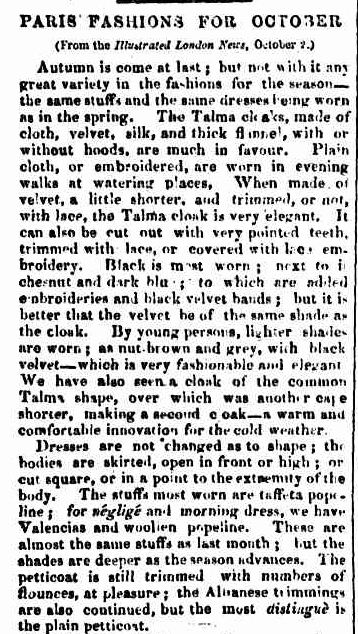
The styles for Autumn 1853 changed little from the Spring before.

PARIS FASHIONS FOR OCTOBER. (1853, February 12). Colonial Times (Hobart, Tas. : 1828 - 1857), p. 3. Retrieved February 24, 2013, from http://nla.gov.au/nla.news-article8772971

PARIS FASHIONS FOR OCTOBER. (1853, February 12). Colonial Times (Hobart, Tas. : 1828 – 1857), p. 3. Retrieved February 24, 2013, from http://nla.gov.au/nla.news-article8772971

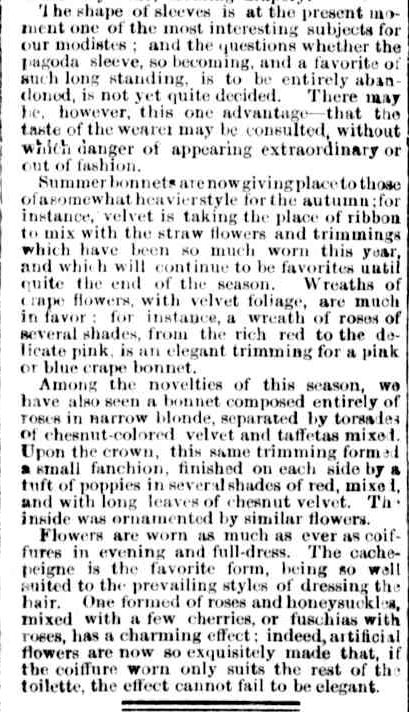
Sleeves were changing in shape during the mid-1850s.  Also, with the change of season, velvet was replacing ribbon on bonnets.

FASHIONS FOR OCTOBER. (1856, January 1). The Argus (Melbourne, Vic. : 1848 - 1956), p. 6. Retrieved February 24, 2013, from http://nla.gov.au/nla.news-article4827100

FASHIONS FOR OCTOBER. (1856, January 1). The Argus (Melbourne, Vic. : 1848 – 1956), p. 6. Retrieved February 24, 2013, from http://nla.gov.au/nla.news-article482710


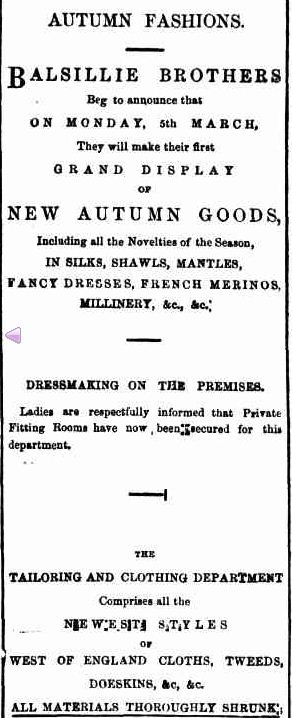
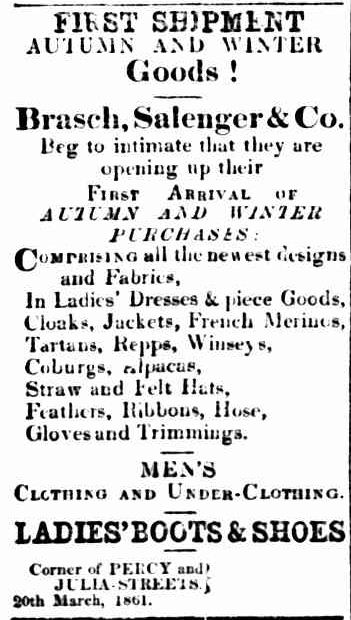
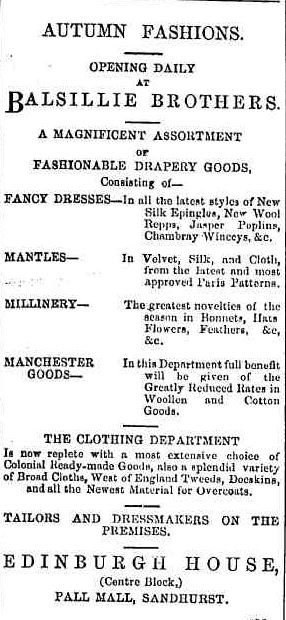
A sample of Autumn fashion advertisements from the 1860s.

Advertising. (1866, March 15). Bendigo Advertiser (Vic. : 1855 - 1918), p. 2. Retrieved February 24, 2013, from http://nla.gov.au/nla.news-article87959303

Advertising. (1861, April 5). Portland Guardian and Normanby General Advertiser (Vic. : 1842 - 1876), p. 2 Edition: EVENINGS.. Retrieved February 24, 2013, from http://nla.gov.au/nla.news-article65446138

Advertising. (1861, April 5). Portland Guardian and Normanby General Advertiser (Vic. : 1842 – 1876), p. 2 Edition: EVENINGS.. Retrieved February 24, 2013, from http://nla.gov.au/nla.news-article65446138

Advertising. (1866, March 15). Bendigo Advertiser (Vic. : 1855 - 1918), p. 2. Retrieved February 24, 2013, from http://nla.gov.au/nla.news-article87959303

Advertising. (1866, March 15). Bendigo Advertiser (Vic. : 1855 – 1918), p. 2. Retrieved February 24, 2013, from http://nla.gov.au/nla.news-article87959303

Advertising. (1868, April 9). Bendigo Advertiser (Vic. : 1855 - 1918), p. 1. Retrieved February 28, 2013, from http://nla.gov.au/nla.news-article87895148

Advertising. (1868, April 9). Bendigo Advertiser (Vic. : 1855 – 1918), p. 1. Retrieved February 28, 2013, from http://nla.gov.au/nla.news-article87895148

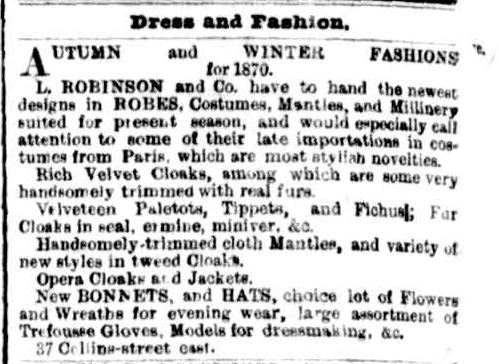
L.Robinson & Co. of Collins Street, Melbourne had the latest imported Paris fashions for Autumn 1870.

Advertising. (1870, April 23). The Argus (Melbourne, Vic. : 1848 - 1956), p. 8. Retrieved February 24, 2013, from http://nla.gov.au/nla.news-article5818692

Advertising. (1870, April 23). The Argus (Melbourne, Vic. : 1848 – 1956), p. 8. Retrieved February 24, 2013, from http://nla.gov.au/nla.news-article5818692

Miss S.H. Heazlewood kept the Portland ladies in the latest styles for Autumn 1884 and she offered a dressmaking service too.

Advertising. (1884, May 17). Portland Guardian (Vic. : 1876 - 1953), p. 3 Edition: MORNING. Retrieved February 25, 2013, from http://nla.gov.au/nla.news-article63342665

Advertising. (1884, May 17). Portland Guardian (Vic. : 1876 – 1953), p. 3 Edition: MORNING. Retrieved February 25, 2013, from http://nla.gov.au/nla.news-article63342665

Not much has changed almost 130 years on.

Not Possible. (1886, April 23). The Colac Herald (Vic. : 1875 - 1918), p. 2 Supplement: Supplement to the Colac Herald. Retrieved February 25, 2013, from http://nla.gov.au/nla.news-article90352809

Not Possible. (1886, April 23). The Colac Herald (Vic. : 1875 – 1918), p. 2 Supplement: Supplement to the Colac Herald. Retrieved February 25, 2013, from http://nla.gov.au/nla.news-article90352809

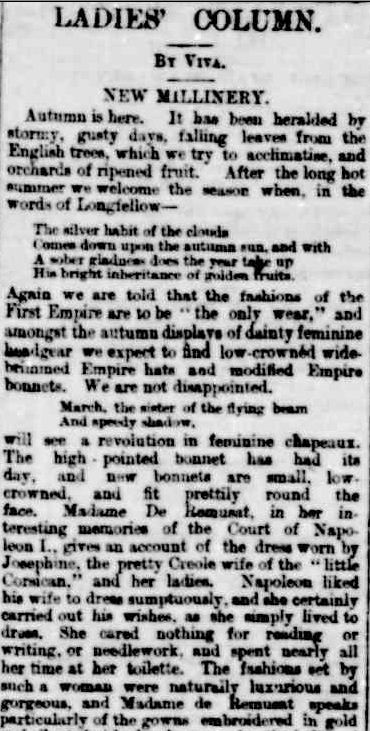
In 1889, furs and cloaks were hitting the shops but outside the weather was anything but cold.

LADIES' COLUMN. (1889, March 1). Portland Guardian (Vic. : 1876 - 1953), p. 3 Edition: EVENING, Supplement: SUPPLEMENT TO THE PORTLAND GUARDIAN. Retrieved February 25, 2013, from http://nla.gov.au/nla.news-article63592223

LADIES’ COLUMN. (1889, March 1). Portland Guardian (Vic. : 1876 – 1953), p. 3 Edition: EVENING, Supplement: SUPPLEMENT TO THE PORTLAND GUARDIAN. Retrieved February 25, 2013, from http://nla.gov.au/nla.news-article63592223

Two weeks later,  the weather was a little more Autumn like.

LADIES' COLUMN. (1889, March 15). Portland Guardian (Vic. : 1876 - 1953), p. 3 Edition: EVENING, Supplement: SUPPLEMENT TO THE PORTLAND GUARDIAN. Retrieved February 25, 2013, from http://nla.gov.au/nla.news-article63622402

LADIES’ COLUMN. (1889, March 15). Portland Guardian (Vic. : 1876 – 1953), p. 3 Edition: EVENING, Supplement: SUPPLEMENT TO THE PORTLAND GUARDIAN. Retrieved February 25, 2013, from http://nla.gov.au/nla.news-article63622402

A “pretty” apron from 1892 with a handy pocket and a cheap price tag.

FASHION'S FRIVOLITIES. (1892, February 26). The Horsham Times (Vic. : 1882 - 1954), p. 2 Supplement: SUPPLEMENT TO The Horsham Times.. Retrieved February 25, 2013, from http://nla.gov.au/nla.news-article72722663

FASHION’S FRIVOLITIES. (1892, February 26). The Horsham Times (Vic. : 1882 – 1954), p. 2 Supplement: SUPPLEMENT TO The Horsham Times.. Retrieved February 25, 2013, from http://nla.gov.au/nla.news-article72722663

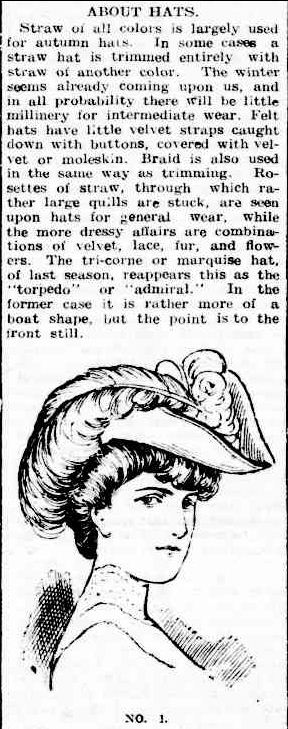
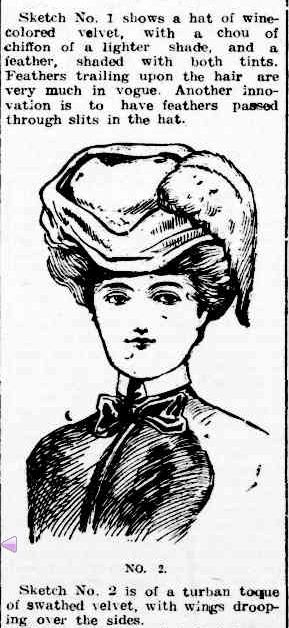
Colourful straw hats were in vogue for Autumn 1904.

aut19aut20

ABOUT HATS. (1904, March 18). The Colac Herald (Vic. : 1875 - 1918), p. 7. Retrieved February 25, 2013, from http://nla.gov.au/nla.news-article87354212

ABOUT HATS. (1904, March 18). The Colac Herald (Vic. : 1875 – 1918), p. 7. Retrieved February 25, 2013, from http://nla.gov.au/nla.news-article87354212

Jeanne Paquin was a French fashion designer known for her tailored gowns.  In 1905, her influence was evident in the fashions reaching Australian shores.

aut22

aut23

WOMAN'S WORLD. (1905, March 24). The Horsham Times (Vic. : 1882 - 1954), p. 1 Supplement: Supplement to the Horsham Times. Retrieved February 26, 2013, from http://nla.gov.au/nla.news-article72815249

WOMAN’S WORLD. (1905, March 24). The Horsham Times (Vic. : 1882 – 1954), p. 1 Supplement: Supplement to the Horsham Times. Retrieved February 26, 2013, from http://nla.gov.au/nla.news-article72815249

The following dress from 1907, in a chiffon Panama material, gives us some idea of the sewing skills that have sadly been lost today.  Horsham ladies did not have to go to the city to buy such a dress.  They could order a Butterick  pattern from M. Thorp & Co of Melbourne.

aut25aut26

LADIES' COSTUME. (1907, April 12). The Horsham Times (Vic. : 1882 - 1954), p. 1 Supplement: Supplement to the Horsham Times. Retrieved February 26, 2013, from http://nla.gov.au/nla.news-article72939046

LADIES’ COSTUME. (1907, April 12). The Horsham Times (Vic. : 1882 – 1954), p. 1 Supplement: Supplement to the Horsham Times. Retrieved February 26, 2013, from http://nla.gov.au/nla.news-article72939046

Shades of purple were popular in 1913, especially for hats and veils.

aut28aut29

FOR WIVES AND DAUGHTERS. (1913, March 26). The Colac Herald (Vic. : 1875 - 1918), p. 4. Retrieved February 26, 2013, from http://nla.gov.au/nla.news-article93194629

FOR WIVES AND DAUGHTERS. (1913, March 26). The Colac Herald (Vic. : 1875 – 1918), p. 4. Retrieved February 26, 2013, from http://nla.gov.au/nla.news-article93194629

By 1914, Horsham ladies not handy with the needle were able to buy fashion equal to their city counterparts without leaving town.

AUTUMN MODES. (1914, March 17). The Horsham Times (Vic. : 1882 - 1954), p. 3. Retrieved February 26, 2013, from http://nla.gov.au/nla.news-article72900577

AUTUMN MODES. (1914, March 17). The Horsham Times (Vic. : 1882 – 1954), p. 3. Retrieved February 26, 2013, from http://nla.gov.au/nla.news-article72900577

Those that suffered for fashion’s sake, would have pleased to see the back of the tight skirt.

OR WIVES AND DAUGHTERS. (1914, April 1). The Colac Herald (Vic. : 1875 - 1918), p. 3. Retrieved February 27, 2013, from http://nla.gov.au/nla.news-article74224403

OR WIVES AND DAUGHTERS. (1914, April 1). The Colac Herald (Vic. : 1875 – 1918), p. 3. Retrieved February 27, 2013, from http://nla.gov.au/nla.news-article74224403

FOR WIVES AND DAUGHTERS. (1916, February 23). The Colac Herald (Vic. : 1875 - 1918), p. 3. Retrieved February 27, 2013, from http://nla.gov.au/nla.news-article75256133

FOR WIVES AND DAUGHTERS. (1916, February 23). The Colac Herald (Vic. : 1875 – 1918), p. 3. Retrieved February 27, 2013, from http://nla.gov.au/nla.news-article75256133

Autumn hats for 1917 had few trimmings, although the white felt hat embroidered with Greek dancing-girls sounds far from plain.

FOR WIVES AND DAUGHTERS. (1917, January 24). The Colac Herald (Vic. : 1875 - 1918), p. 6. Retrieved February 27, 2013, from http://nla.gov.au/nla.news-article74519149

FOR WIVES AND DAUGHTERS. (1917, January 24). The Colac Herald (Vic. : 1875 – 1918), p. 6. Retrieved February 27, 2013, from http://nla.gov.au/nla.news-article74519149

By the end of January 1917, autumn and winter clothing was appearing in the shops, the last thing shoppers wanted to see during a hot summer.  Coat frocks were in and the coatee was flattering for ladies of all shapes and sizes.

aut36

aut37

WOMEN TO WOMEN. (1917, January 24). The Argus (Melbourne, Vic. : 1848 - 1956), p. 10. Retrieved February 27, 2013, from http://nla.gov.au/nla.news-article1592469

WOMEN TO WOMEN. (1917, January 24). The Argus (Melbourne, Vic. : 1848 – 1956), p. 10. Retrieved February 27, 2013, from http://nla.gov.au/nla.news-article1592469

WW1 limited the supply of precious stones for jewellery, with diamonds becoming rare and in turn expensive.  Charm bracelets and three stone engagement rings were popular and wedding rings had narrowed.  Earrings were rarely worn and when they were they were a simple stud. Colours were of subdued tones, fitting for the times.  Suits had few trimmings, relying on a smart cut for style.

aut39

WAR-TIME JEWELLERY. (1917, April 4). The Colac Herald (Vic. : 1875 - 1918), p. 5. Retrieved February 27, 2013, from http://nla.gov.au/nla.news-article74520158

WAR-TIME JEWELLERY. (1917, April 4). The Colac Herald (Vic. : 1875 – 1918), p. 5. Retrieved February 27, 2013, from http://nla.gov.au/nla.news-article74520158

Tyler’s of Bridge Street, Ballarat. advertised in the Border Watch of Mt. Gambier a fair distance to travel in 1922 for the latest autumn fashions.

Advertising. (1922, April 21). Border Watch (Mount Gambier, SA : 1861 - 1954), p. 4. Retrieved February 28, 2013, from http://nla.gov.au/nla.news-article77674135

Advertising. (1922, April 21). Border Watch (Mount Gambier, SA : 1861 – 1954), p. 4. Retrieved February 28, 2013, from http://nla.gov.au/nla.news-article77674135

Some distinctive 1920s styles.

aut60

AUTUMN FASHIONS. (1923, March 21). The Argus (Melbourne, Vic. : 1848 - 1956), p. 6. Retrieved February 28, 2013, from http://nla.gov.au/nla.news-article1884490

AUTUMN FASHIONS. (1923, March 21). The Argus (Melbourne, Vic. : 1848 – 1956), p. 6. Retrieved February 28, 2013, from http://nla.gov.au/nla.news-article1884490

There was plenty of colour on offer with the Autumn fashions of 1926, from rosewood to smoke greys and everything in between.  Imitation fur trimmings were popular on coats and handbags.

OUR WOMEN'S CORNER. (1926, March 23). The Horsham Times (Vic. : 1882 - 1954), p. 2. Retrieved February 27, 2013, from http://nla.gov.au/nla.news-article73002991

OUR WOMEN’S CORNER. (1926, March 23). The Horsham Times (Vic. : 1882 – 1954), p. 2. Retrieved February 27, 2013, from http://nla.gov.au/nla.news-article73002991

A Coolie coat from 1927.

aut42

FASHION FORECASTS. (1928, April 3). The Horsham Times (Vic. : 1882 - 1954), p. 10. Retrieved February 27, 2013, from http://nla.gov.au/nla.news-article72625587

FASHION FORECASTS. (1928, April 3). The Horsham Times (Vic. : 1882 – 1954), p. 10. Retrieved February 27, 2013, from http://nla.gov.au/nla.news-article72625587

Styles from Autumn 1934.

aut44

The Fashion Parade. (1934, February 17). The Australian Women’s Weekly (1933 – 1982), p. 23. Retrieved February 27, 2013, from http://nla.gov.au/nla.news-article46465428

Geoffrey Turton, aka Petrov, was an Australian magazine illustrator and cartoonist.  He worked on publications such as the Bulletin and Smiths Weekly, but also the Australian Women’s Weekly.  The following is an example of work from the Weekly, depicting Autumn styles from 1935.

aut45

The Fashion Parade. (1935, January 26). The Australian Women’s Weekly (1933 – 1982), p. 8. Retrieved March 4, 2013, from http://nla.gov.au/nla.news-article47208042

There was plenty of choice for Autumn 1935, with ladies able to choose the look they preferred.aut46aut47

The Fashion Parade. (1935, January 26). The Australian Women's Weekly (1933 - 1982), p. 8. Retrieved February 27, 2013, from http://nla.gov.au/nla.news-article47208042

The Fashion Parade. (1935, January 26). The Australian Women’s Weekly (1933 – 1982), p. 8. Retrieved February 27, 2013, from http://nla.gov.au/nla.news-article47208042

The Fashion Parade. (1936, February 22). The Australian Women's Weekly (1933 - 1982), p. 8. Retrieved February 27, 2013, from http://nla.gov.au/nla.news-article46942701

The Fashion Parade. (1936, February 22). The Australian Women’s Weekly (1933 – 1982), p. 8. Retrieved February 27, 2013, from http://nla.gov.au/nla.news-article46942701

Friday 19 March 1937 was the date for the opening show of E.S. Finkemeyer’s Autumn and Winter fashions.

AUTUMN AND WINTER SHOW 1937. (1937, March 26). The Horsham Times (Vic. : 1882 - 1954), p. 4. Retrieved February 27, 2013, from http://nla.gov.au/nla.news-article73110816

AUTUMN AND WINTER SHOW 1937. (1937, March 26). The Horsham Times (Vic. : 1882 – 1954), p. 4. Retrieved February 27, 2013, from http://nla.gov.au/nla.news-article73110816

Black worn with accessories in a new red, “rebel red”, was a fashionable look for 1940.

Treatment of Skirts Shows Variety. (1940, March 6). The Argus (Melbourne, Vic. : 1848 - 1956), p. 11. Retrieved February 28, 2013, from http://nla.gov.au/nla.news-article12429983

Treatment of Skirts Shows Variety. (1940, March 6). The Argus (Melbourne, Vic. : 1848 – 1956), p. 11. Retrieved February 28, 2013, from http://nla.gov.au/nla.news-article12429983

A promotion for Australian woollen garments during Autumn 1941.

Fashion triumph for AUSTRALIAN WOOLLENS. (1941, March 29). The Australian Women's Weekly (1933 - 1982), p. 21 Section: Autumn Fashion Book. Retrieved February 27, 2013, from http://nla.gov.au/nla.news-article47483414

Fashion triumph for AUSTRALIAN WOOLLENS. (1941, March 29). The Australian Women’s Weekly (1933 – 1982), p. 21 Section: Autumn Fashion Book. Retrieved February 27, 2013, from http://nla.gov.au/nla.news-article47483414

A cardigan perfect for those cooler March evenings.

Advertising. (1941, April 26). The Australian Women's Weekly (1933 - 1982), p. 5. Retrieved February 27, 2013, from http://nla.gov.au/nla.news-article47484959

Advertising. (1941, April 26). The Australian Women’s Weekly (1933 – 1982), p. 5. Retrieved February 27, 2013, from http://nla.gov.au/nla.news-article47484959

During WW2, when French and Italian fashion houses closed, America came to the forefront of fashion.

AMERICA LAUNCHES AUTUMN FASHIONS. (1944, November 28). The Argus (Melbourne, Vic. : 1848 - 1956), p. 8. Retrieved February 28, 2013, from http://nla.gov.au/nla.news-article11372401

AMERICA LAUNCHES AUTUMN FASHIONS. (1944, November 28). The Argus (Melbourne, Vic. : 1848 – 1956), p. 8. Retrieved February 28, 2013, from http://nla.gov.au/nla.news-article11372401

Sewing patterns from 1945.

Fashion PATTERNS. (1945, April 14). The Australian Women's Weekly (1933 - 1982), p. 21. Retrieved February 27, 2013, from http://nla.gov.au/nla.news-article47118096

Fashion PATTERNS. (1945, April 14). The Australian Women’s Weekly (1933 – 1982), p. 21. Retrieved February 27, 2013, from http://nla.gov.au/nla.news-article47118096

The following two suits sure have that 1940s war-time look about them.

FASHIONS FOR THE AUTUMN. (1947, February 19). The Argus (Melbourne, Vic. : 1848 - 1956), p. 4 Supplement: Woman's Magazine. Retrieved February 28, 2013, from http://nla.gov.au/nla.news-article22409723

FASHIONS FOR THE AUTUMN. (1947, February 19). The Argus (Melbourne, Vic. : 1848 – 1956), p. 4 Supplement: Woman’s Magazine. Retrieved February 28, 2013, from http://nla.gov.au/nla.news-article22409723

This crêpe dress from 1950 was in contrast to the 1947 fashions, above.

No Title. (1950, April 25). The Horsham Times (Vic. : 1882 - 1954), p. 3. Retrieved February 27, 2013, from http://nla.gov.au/nla.news-article72801557

No Title. (1950, April 25). The Horsham Times (Vic. : 1882 – 1954), p. 3. Retrieved February 27, 2013, from http://nla.gov.au/nla.news-article72801557

In 1955, Tweed fashions for ladies emerged, not just tomboys, as did the jersey dress that washed like a stocking.

TWEED... is a Lady. (1955, February 22). The Argus (Melbourne, Vic. : 1848 - 1956), p. 4 Supplement: THE ARGUS SUPPLEMENT OF EXCLUSIVE MYER FASHION. Retrieved February 28, 2013, from http://nla.gov.au/nla.news-article71634754

TWEED… is a Lady. (1955, February 22). The Argus (Melbourne, Vic. : 1848 – 1956), p. 4 Supplement: THE ARGUS SUPPLEMENT OF EXCLUSIVE MYER FASHION. Retrieved February 28, 2013, from http://nla.gov.au/nla.news-article71634754

aut67

The 3-T Gersey Frock. (1955, March 1). The Argus (Melbourne, Vic. : 1848 - 1956), p. 12. Retrieved February 28, 2013, from http://nla.gov.au/nla.news-article71642613

The 3-T Gersey Frock. (1955, March 1). The Argus (Melbourne, Vic. : 1848 – 1956), p. 12. Retrieved February 28, 2013, from http://nla.gov.au/nla.news-article71642613

Max Factor cosmetics were 40 years old when this glamorous Myer advertisement appeared in the Australian Women’s Weekly.  Hollywood starlets such as Marilyn Monroe and Elizabeth Taylor had made red lips sexy.
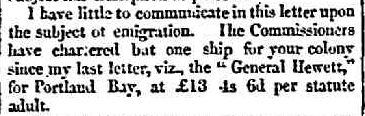
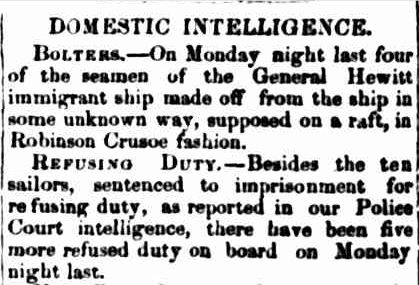
Aut55

Advertising. (1955, March 25). The Argus (Melbourne, Vic. : 1848 - 1956), p. 21. Retrieved February 27, 2013, from http://nla.gov.au/nla.news-article71641049

Advertising. (1955, March 25). The Argus (Melbourne, Vic. : 1848 – 1956), p. 21. Retrieved February 27, 2013, from http://nla.gov.au/nla.news-article71641049