Trove Tuesday – When the Sea Covered Hamilton

Since I have just written about the Reeds of Muddy Creek, I will continue the Muddy Creek theme for Trove Tuesday.

Around 1931, Walter Greed of Hamilton discovered a cowry shell on the banks of Muddy Creek, near Hamilton and passed it on to the National Museum.  Walter was the husband of Jessie Harman, daughter of Reuben Harman of Byaduk, and was a member of the Greed family, funeral directors of Hamilton.

Maybe that doesn’t seem that unusual, but a cowry shell is a seashell and the nearest sea to Muddy Creek is around eighty kilometres away.  The shell Walter found was a fossil from a time when the area surrounding Muddy Creek, including Hamilton, was one hundred fathoms under the sea.  That is around 182 metres.

Muddy Creek and the river it flows into, the Grange Burn, are well-known fossil sites, recorded in Australia’s Fossil Heritage: A Catalogue of Important Australian Fossil Sites.

WHEN THE SEA COVERED HAMILTON. (1931, June 26). The Horsham Times (Vic. : 1882 - 1954), p. 2. Retrieved June 16, 2013, from http://nla.gov.au/nla.news-article72635176

WHEN THE SEA COVERED HAMILTON. (1931, June 26). The Horsham Times (Vic. : 1882 – 1954), p. 2. Retrieved June 16, 2013, from http://nla.gov.au/nla.news-article72635176

The Muddy Creek Reeds

Researching the family of my ggg grandmother Susan has been like searching a muddy creek looking for clues with reeds blocking my way.  The thing is Susan was a Reed and for a time members of her family lived at Muddy Creek.

The main challenge has been the family name.  My ggg grandmother and her siblings were christened as Reed .  She and her family were Read on the 1841 and 1851 UK Census and on Susan’s death record.   Despite the variance,  I had chosen to call Susan and her parents and siblings by the surname Read.   Then I found that Susan’s brother William was living just down the road from her in Victoria.  In 1866 when William married Sarah Burgin, he was William Read.  By 1869, and the birth of William’s first child, he was Reed.  That was the surname taken by his children and that went with him to the grave.

Even though the “Reed” name was consistently used by William from 1869, always lurking is the thought that at sometime the name may be Read.  Or Reid.  Especially in the newspapers.

Susan and William’s story began in Cambridgeshire, first in Melbourn where Susan was born in 1830 and then Whaddon where William was born in 1835.  They remained in Whaddon until they left England.

From the 1841 UK Census, the Read family of Whaddon appeared a fairly typical family in the village.  Parents William Read and Mary Waymant had four children, Susan being the eldest.  William senior was an agricultural labourer.  By the time of the 1851 Census it was clear that over the preceding decade, life for the Read family had changed somewhat.  Susan, recorded as Sussanna was now head of the household, her occupation “pauper”.  There were two new children in the family, Julia aged 7 and John aged  6.  They, along with Sybil then 13 and James 11, were also paupers.  William jnr. 16, was working as an agriculture labourer.

The most noticeable difference from the 1841 Census, other than most of the family being paupers, is that parents William and Mary were not in the house on the night of the 1851 Census.  No amount of searching has found a trace of them on that night or there after.  The other missing family member was Isabella, then 16.  I found her in Bassingbourn working as a servant.  She married in 1853 to Henry Cutts but she died in 1856.  In addition to the information on the Census,  in 1847, another child was born to William and Mary, a son Alfred William.  Like his parents, I have not found any further trace of him.

If William and Mary had died by 1851, it raises questions about Susan’s emotions about leaving for Australia in 1852, shortly after her marriage to James Harman.  Departing would have been heart wrenching enough, but to leave her brothers and sisters under such circumstances must have been extremely difficult for Susan.  She named three of her children after her siblings, Alfred, Julia and Isabella.

Sometime over the following eight to ten years, William jnr left England for Australia but I have not been able to find his arrival in Victoria.  A lot of “William Reeds” and ” William Reads” arrived in Victoria during the 1850s and 60s and that is assuming he came directly to Victoria.

He had arrived in Australia by 1866 as he married Sarah Burgin in that year.  Sarah was the daughter of Richard Burgin and Eliza Addinsall and was born in Lincolnshire, England in 1846.  The Burgins arrived in Geelong in 1854 aboard “Josuha“.  They settled at Muddy Creek, south of Hamilton.

William and Sarah had seven children:

WILLIAM – Born 1869 at Macarthur; Died 1952 at  Hamilton;  Never married.

ELIZA MARY –  Born 1871 at  Hamilton; Died 1954 at  Hamilton;  Marriage – James Percy CLAYTON in  1896.

MARTHA –  Born 1873 at  Macarthur;  Died 1945  at Warrabkook;  Marriage – James Ernest FORD in  1901.

ALBERT –  Born 1874 at  Warrabkook;  Died 1954 at Hamilton;  Marriage –  Elilias PATMAN in  1904.

JOHN –  Born 1877 at Warrabkook;  Died 1878 at Warrabkook.

SARAH ANN –  Born 1879 at  Warrabkook;  Died 1948  at Hamilton;  Marriage –  William KIRKWOOD in 1903.

ALICE –  Born 1882  at Warrabkook;  Died 1974  at Hamilton;  Marriage – Henry Alfred BREWIS  in 1904.

Another difficulty with William Reed is that he lived at both Warrabkook near Macarthur and Muddy Creek, near Hamilton, but he could also be recorded as living at South Hamilton as Muddy Creek fell in the Parish of South Hamilton.  I also can’t rule out nearby Yulecart being used as his place of residence.   So that leaves me searching for William Read or Reed (or Reid) at two locations with four possible place names across the same time period.

In 1888, William was executor of his father in-laws  will.  Noted was William’s signature, “William Reed” and his residence Warrabkook.

Advertising. (1888, June 6). The Argus (Melbourne, Vic. : 1848 - 1957), p. 9. Retrieved May 22, 2013, from http://nla.gov.au/nla.news-article6130428

Advertising. (1888, June 6). The Argus (Melbourne, Vic. : 1848 – 1957), p. 9. Retrieved May 22, 2013, from http://nla.gov.au/nla.news-article6130428

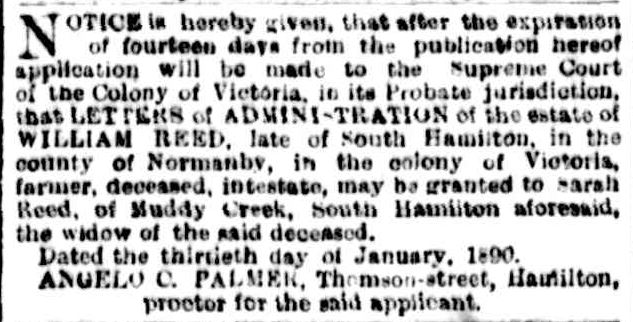
Not taking a lead from his father in law, William passed away the following year, on December 23, 1889, intestate.   William’s two brother-in-laws William  Burgin and my ggg grandfather James Harman, lodged applications to administer the estate.  However,  William’s wife Sarah was granted administration.  The notice, below, said William was from South Hamilton while Sarah was from Muddy Creek, South Hamilton.

Advertising. (1890, January 30). The Argus (Melbourne, Vic. : 1848 - 1957), p. 10. Retrieved June 15, 2013, from http://nla.gov.au/nla.news-article8586393

Advertising. (1890, January 30). The Argus (Melbourne, Vic. : 1848 – 1957), p. 10. Retrieved June 15, 2013, from http://nla.gov.au/nla.news-article8586393

William was buried at Hamilton Old Cemetery and his headstone recorded his place of death as Muddy Creek.

REED GRAVE, HAMILTON OLD CEMETERY

REED GRAVE, HAMILTON OLD CEMETERY

It was William’s’ probate papers that told me more about him.  William owned six properties at the time of his death, three in the Parish of South Hamilton, two in the Parish of Warrabkook and one in the Parish of Yulecart.

One of the properties in South Hamilton of 94 acres, had a five-room stone dwelling with an iron roof and all walls plastered.  One ceiling was still canvas lined.  There was also a stone out building.  This would have been the Reed’s Muddy Creek residence.  The other two smaller properties were next to the “home paddock”.  They were all partially fenced with an old log fence and post and wire.  There is a clue to how long William may have been at Muddy Creek.  The improvements on the properties had occurred over 30 years.  That would go back to around 1859.

This list of tender bids, presented at the District Road Board on February 20, 1863 includes a W.Reed who lodged a tender to repair the ford at Muddy Creek.  He did have the cheapest quote but he was beaten to the job by contractors, Vivian and White.

DISTRICT ROAD BOARD. (1863, February 23). Portland Guardian and Normanby General Advertiser (Vic. : 1842 - 1876), p. 2 Edition: EVENING. Retrieved June 14, 2013, from http://nla.gov.au/nla.news-article64628235

DISTRICT ROAD BOARD. (1863, February 23). Portland Guardian and Normanby General Advertiser (Vic. : 1842 – 1876), p. 2 Edition: EVENING. Retrieved June 14, 2013, from http://nla.gov.au/nla.news-article64628235

The two properties in the Parish of Warrabkook were close by to the Eumeralla River and they can be seen on the  Parish of Warrabkook map from 1879.  John Kirkwood, father-in law of William’s daughter Sarah owned the property to the west.  To the north was the property of William Burgin, William’s brother-in-law.

The larger property of 229 acres  had a four room mud dwelling with a two room wooden add-on.  There were three brick chimneys and the walls were papered.  Two rooms had pine lined ceilings.  This would have been the Reed’s Warrabkook residence.  Improvements on the property had taken place over 22 years, beginning around 1867.

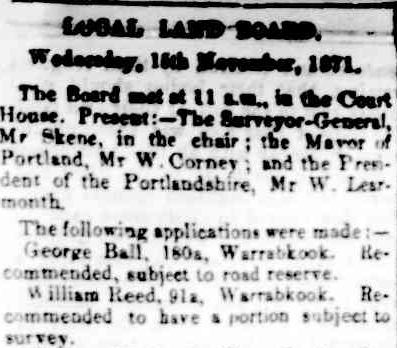
This Local Land Board notice from 1871  reports on an application from W.Reed of Warrabkook.

LOCAL LAND BOARD. (1871, November 30). Portland Guardian and Normanby General Advertiser (Vic. : 1842 - 1876), p. 6 Edition: EVENINGS. Retrieved June 14, 2013, from http://nla.gov.au/nla.news-article65426388

LOCAL LAND BOARD. (1871, November 30). Portland Guardian and Normanby General Advertiser (Vic. : 1842 – 1876), p. 6 Edition: EVENINGS. Retrieved June 14, 2013, from http://nla.gov.au/nla.news-article65426388

It seems that while William may have bought land at Muddy Creek first, he and Sarah spent the early years of their marriage at Warrabkook, although there did seem to be some going backwards and forwards until their third child, Martha was born.  It was some distance between Muddy Creek and Warrabkook, but I think William may have taken a shorter more direct route than Google Maps offers, with a distance of around 42 kilometres.  Susan lived at Byaduk on the way.  The map below shows Warrabkook (A), Byaduk (B) and Muddy Creek (C).

Later they seem to have spent more time at Muddy Creek.  There was a strong Methodist community and the Reeds were members of the Muddy Creek Primitive Methodist Church.  In 1929, Sarah Reed laid the foundation stone for a new Muddy Creek Pioneer church .  Daughter Martha’s  wedding notice from 1901 has Sarah from Muddy Creek and Warrabkook.

SOCIAL. (1901, May 7). The Horsham Times (Vic. : 1882 - 1954), p. 1. Retrieved June 15, 2013, from http://nla.gov.au/nla.news-article73026998

SOCIAL. (1901, May 7). The Horsham Times (Vic. : 1882 – 1954), p. 1. Retrieved June 15, 2013, from http://nla.gov.au/nla.news-article73026998

While I can’t find William Reed’s South Hamilton properties on land maps, the road names around Muddy Creek/Yulecart give a clue.  Like at Warrabkook, the Reed, Burgin and Kirkwoods were never far away from each other.

Until now, I have recorded Susan as Susan Read on my family tree and William as William Reed which is a bit messy.  Writing this post as forced me to look harder at the sources and I have decided that I will change all those I have listed as Read to Reed as that is what Susan and her siblings were christened.  I will still need to factor in the different name variables.

William and Susan were not the only Reeds of Whaddon to come to Australia.  Their sister Sybil lived in Ulmurra, New South Wales.  Her husband John Revell was the puntman on the Coldstream River at Ulmurra.  At the time of Sybil’s death in 1903, Susan placed a notice in The Hamilton Spectator for her younger sister.

So for at least three of the Reed family, life improved and the move to Australia must be attributed to that.  William would not have owned six properties had he stayed in Whaddon.  Although they led  hard pioneering lives, at the end, I doubt they had few regrets.

Trove Tuesday – Hamilton Then and Now

This week, Trove Tuesday is all about photographs.  If you are looking for photos, Trove is the place to go.  One search can find photos from the various State Libraries, Museum Victoria and Flickr, to name a few.  To go straight to the Trove Photos search page, follow the link – TROVE PHOTOS

I found two photos of Hamilton from the 1880s held at the State Library of South Australia.  They were going to be the only subjects of this post, but as usual, I couldn’t stop at that.  With the help of Trove, Google Maps and some of my own photos, we can look at Hamilton then and now.

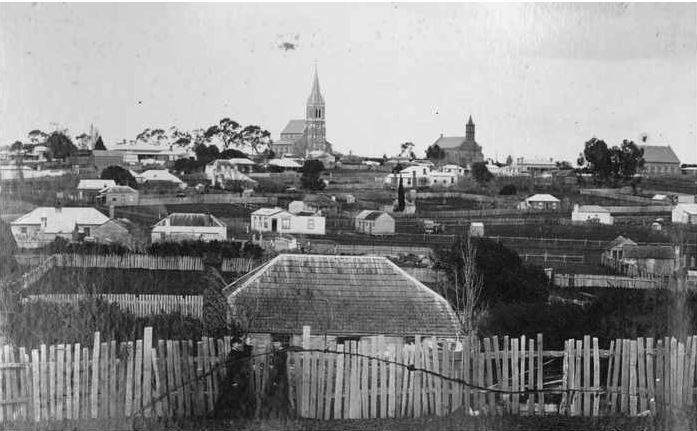
The first photo, probably taken from around Scoresby Street, looks toward what is known as Church Hill.  On the left is the Christ Church(1868) and the right, St Andrew’s Presbyterian Church (1858).  The photo tells so much about Hamilton in 1880, the buildings, the style of houses, and roofing materials.  Even what the ladies were wearing.  I wonder what they were talking about?

VIEW OF HAMILTON, 1880. Image Courtesy of the State Library of South Australia Image No. B2176/55 http://images.slsa.sa.gov.au/mpcimg/22000/B21766_55.htm

VIEW OF HAMILTON, 1880. Image Courtesy of the State Library of South Australia Image No. B2176/55 http://images.slsa.sa.gov.au/mpcimg/22000/B21766_55.htm

The shot from Google Maps shows how densely populated this part of town has become over the years.

The year 1880 was an eventful one in Hamilton.  From the Maitland Mercury & Hunter River General Advertiser, of February 14, 1880, comes a story from The Hamilton Spectator of February 7.  Two days earlier, the Shire Secretary, Henry J. Bloomfield and a local storekeeper J.H. Cooke had a public fight that ended with the firing of Cooke’s revolver.  The evening before, Cooke had been horsewhipped by a female relative of Bloomfield.  Scandal. Maybe that was what the ladies were talking about.

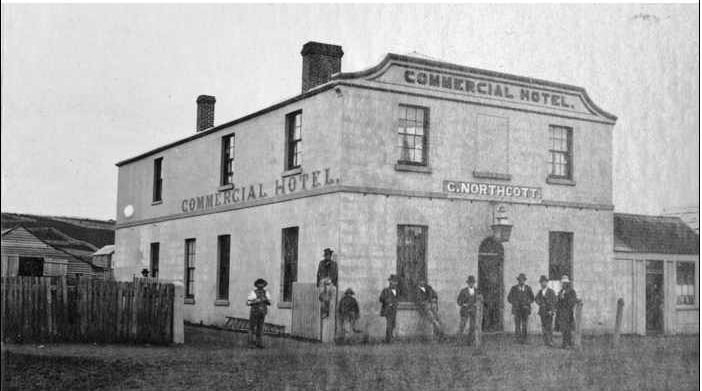
In September 1880 The Duke of Manchester visited Hamilton.  Met at the station by a large crowd, he went on to give a speech at a packed Commercial Hotel.

The event that caused “a profound sensation”, not just in Hamilton but beyond, was an outbreak of Diphtheria that lee to deaths including that of Archdeacon Innes.

Obituary. ARCHDEACON INNES. (1880, April 17). Australian Town and Country Journal (NSW : 1870 - 1907), p. 17. Retrieved June 11, 2013, from http://nla.gov.au/nla.news-article70943080

Obituary. ARCHDEACON INNES. (1880, April 17). Australian Town and Country Journal (NSW : 1870 – 1907), p. 17. Retrieved June 11, 2013, from http://nla.gov.au/nla.news-article70943080

An inquiry was held, as reported in the Evening News (Sydney) with the finding that the disease had originated in nearby Hochkirch (now Tarrington).  Several children had died in that town, but because of a belief that disease was not contagious, it was able to spread unchecked.  It was then transmitted to Hamilton and the result was the death of the Archdeacon and others.

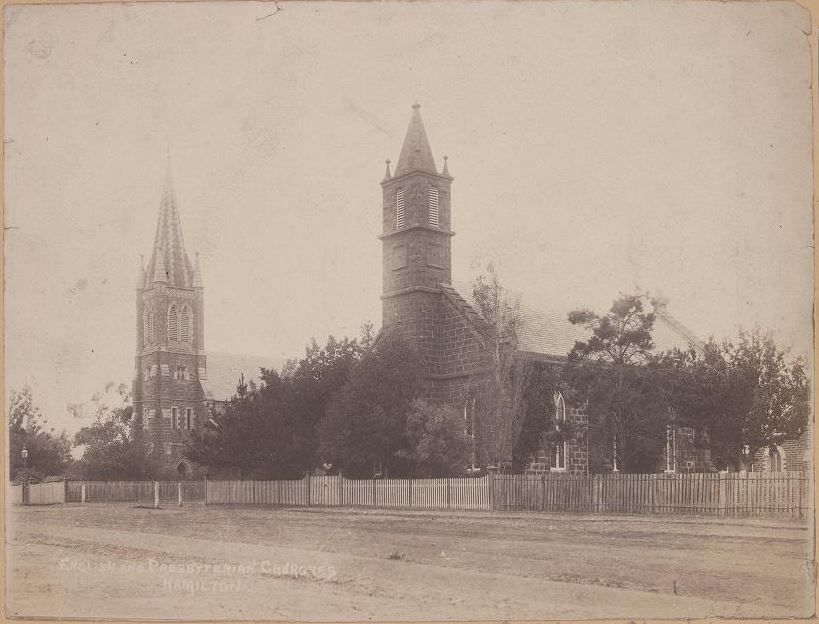
Back to the churches.  In the early 1900s, the St Andrews Presbyterian Church was pulled down and a new church built.  The following photo of the original church is from 1890.

ST ANDREWS PRESBYTERIAN CHURCH & HAMILTON ANGLICAN CHURCH c1890 Image Courtesy of the State Library of Victoria. Image no. H11827 http://handle.slv.vic.gov.au/10381/69513

ST ANDREWS PRESBYTERIAN CHURCH & HAMILTON ANGLICAN CHURCH c1890 Image Courtesy of the State Library of Victoria. Image no. H11827 http://handle.slv.vic.gov.au/10381/69513

Today the two churches stand tall on Church Hill, their steeples visible from many parts of town. Below is the Christ Church in the foreground and St Andrews in the background, taken in 2012.

HAMILTON CHRIST CHURCH CATHEDRAL & ST ANDREWS PRESBYTERIAN CHRUCH, 2012

HAMILTON CHRIST CHURCH CATHEDRAL & ST ANDREWS PRESBYTERIAN CHURCH, 2012

The “new” Presbyterian Church as seen in 2012.

001

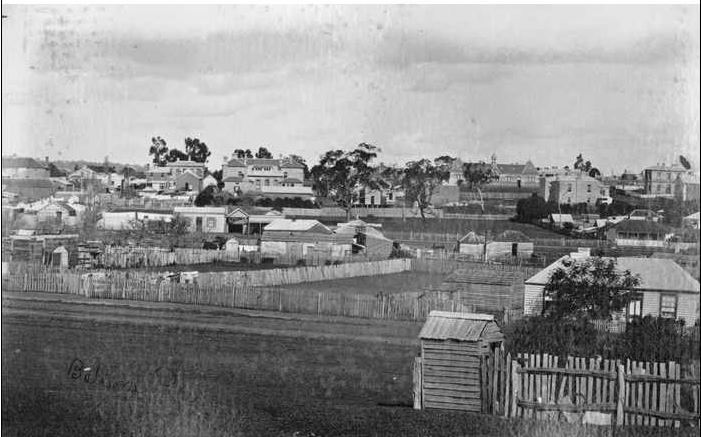
The following photo, from 1880, was taken a little further east to the earlier shot, presumably by the same photographer.  The Gray Street Primary School, then the National School is seen in the top right quadrant.

VIEW OF HAMILTON, 1880. Image Courtesy of the State Library of South Australia. Image no. B21766/54 http://images.slsa.sa.gov.au/mpcimg/22000/B21766_54.htm

VIEW OF HAMILTON, 1880. Image Courtesy of the State Library of South Australia. Image no. B21766/54 http://images.slsa.sa.gov.au/mpcimg/22000/B21766_54.htm

The current school was built in 1876, four years before the above photo, replacing a small wooden school built in 1852.  The photo from the 1880s shows a turret on the centre of the school roof.  It is no longer there as seen in this photo from 2012.

HAMILTON STATE SCHOOL, 2012

HAMILTON STATE SCHOOL, 2012

I wanted to identify more of the buildings in the second 1880s photo, particularly those on the extreme right, near the school.  It is difficult to work out where Gray Street actually was, but taking into consideration the great depth of the schoolyard, I was able to establish that the building closest to the school is Hewlett House (below), on the corner of Gray and Kennedy Streets.  The three windows on the upper level of the building are visible in the original photo.  The home was built in 1876 by Dr Viallis, but he died in 1879 aged 32.

HEWLETT HOUSE, HAMILTON

HEWLETT HOUSE, HAMILTON

The building to the front of Hewlett House must then be the former Temperance Hall in Kennedy Street built, 1876.  From Google Maps, a snap of the building in more recent years.

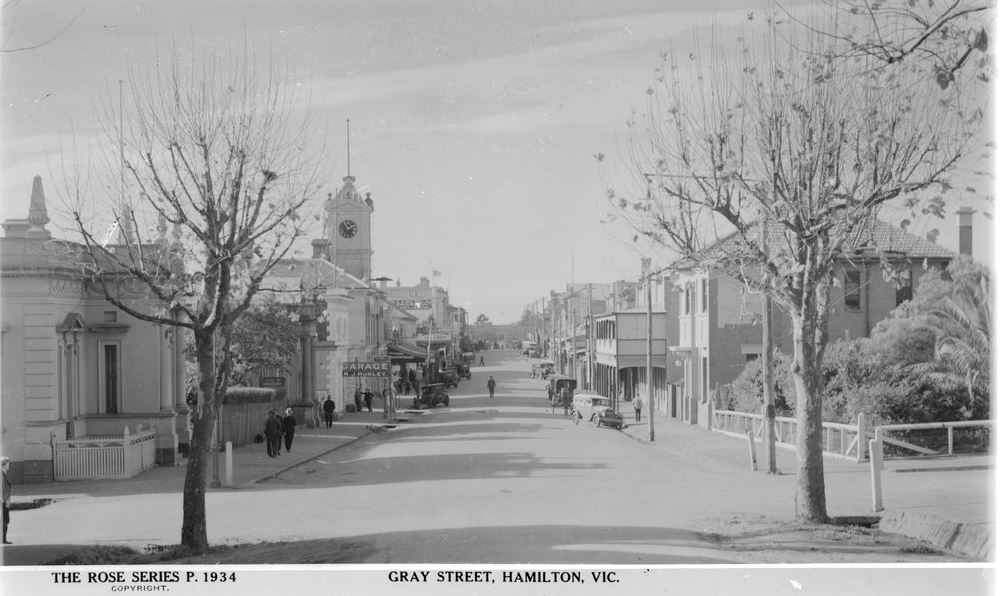
In the 19th century, the western end of Gray Street was the epicentre of town. The Town Hall, Post Office, National School, Mechanics Institute, The Hamilton Spectator and the Hamilton Club were all is this small section of the street.  The photo below is from a Rose postcard.  The postcard collection I found doesn’t have specific dates, only the general date range 1920-1954.

GRAY STREET, HAMILTON. Image Courtesy of the State Library of Victoria, Image No. H32492/2731

GRAY STREET, HAMILTON. Image Courtesy of the State Library of Victoria, Image No. H32492/2731 http://handle.slv.vic.gov.au/10381/63083

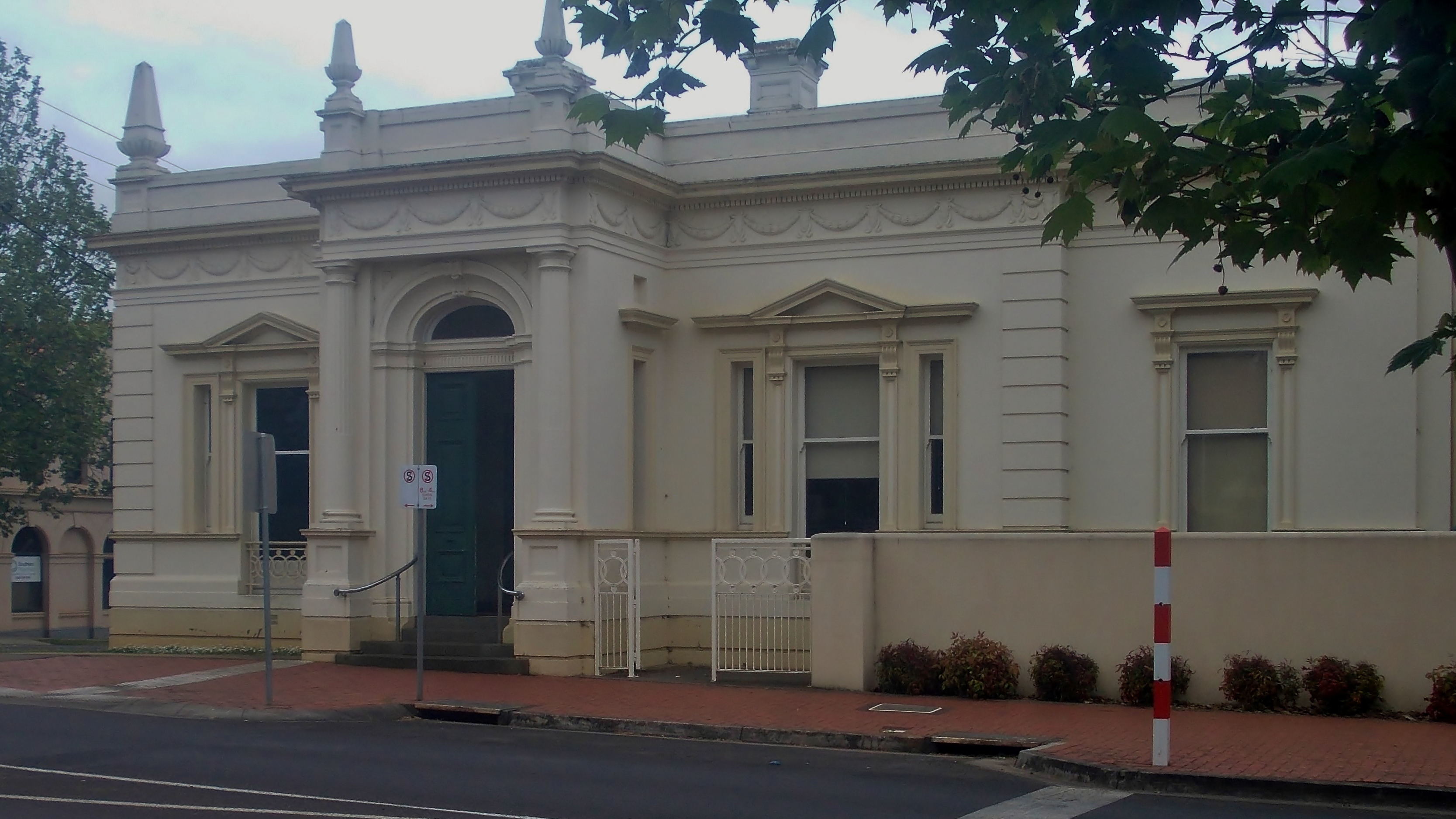
The Hamilton Club, built in 1876  is the first building on the left side of the street.  Opposite is the school, by then Gray Street State School.  The building next to the school, was demolished in 1986.  It was the State Savings Bank of Victoria at the time of the photograph.  Further on, the building with the enclosed verandah would be the former Town Hall Hotel.  It was later known as the Hamilton Hotel and today is the home of the Hamilton Baptist Church.  Below is the Hamilton Club as seen in 2012.

THE HAMILTON CLUB, HAMILTON

THE HAMILTON CLUB, HAMILTON

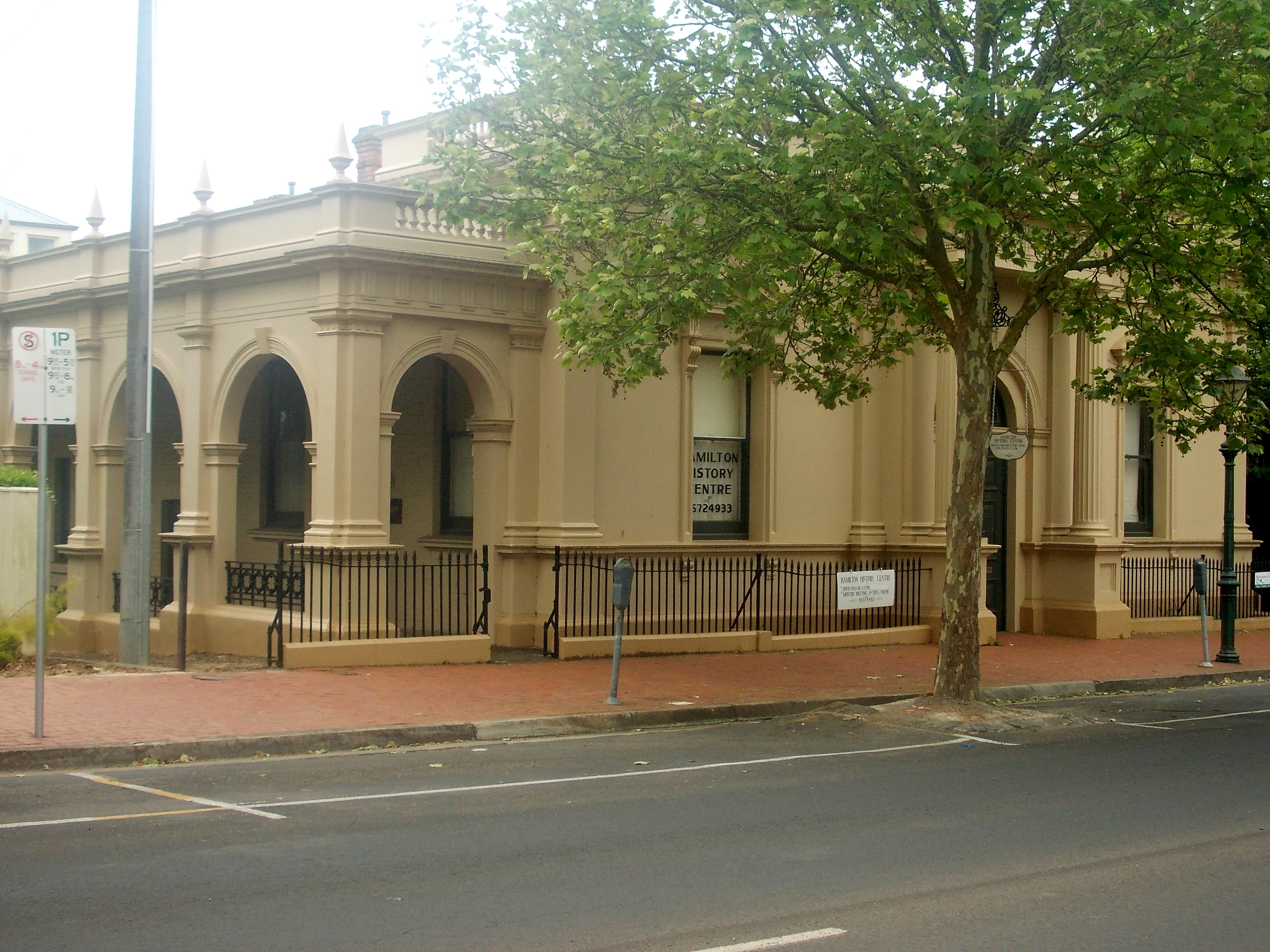
In the original 1880s photo, a fence and hedge runs between the Hamilton Club and the next building, the Mechanics Institute, built 1865.  It is now the home of the Hamilton History Centre.

HAMILTON HISTORY CENTRE, FORMALLY MECHANICS INSTITUTE.

HAMILTON HISTORY CENTRE, FORMALLY MECHANICS INSTITUTE.

Further on from the Mechanics Institute, in the original photo, there is a “Garage” sign.  This was the former Town Hall, built 1873.  A new Town Hall was built in Brown Street in 1909 and the original building sold.  In 1969, the building was demolished and is now a car park for postal employees.

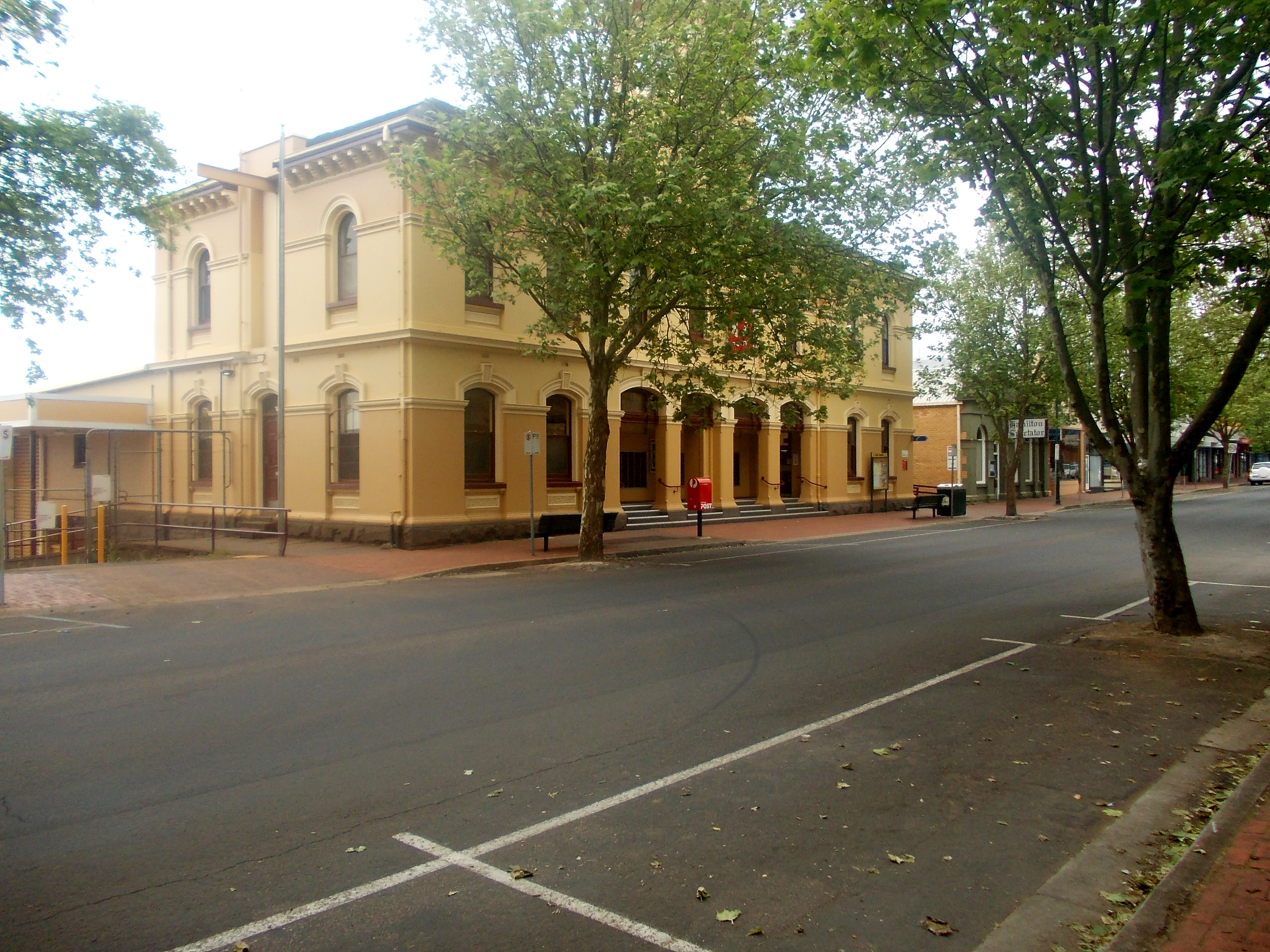
The Hamilton Post Office was built in 1878 and the clock tower added in 1890.  The Hamilton Spectator office is further along the street.

HAMILTON POST OFFICE. Image Courtesy of the State Library of Victoria. Image no. H32492/3788 http://handle.slv.vic.gov.au/10381/61503

HAMILTON POST OFFICE. Image Courtesy of the State Library of Victoria. Image no. H32492/3788 http://handle.slv.vic.gov.au/10381/61503

The Post Office clock tower still exists, it’s just obscured by a plane tree.

HAMILTON POST OFFICE

HAMILTON POST OFFICE

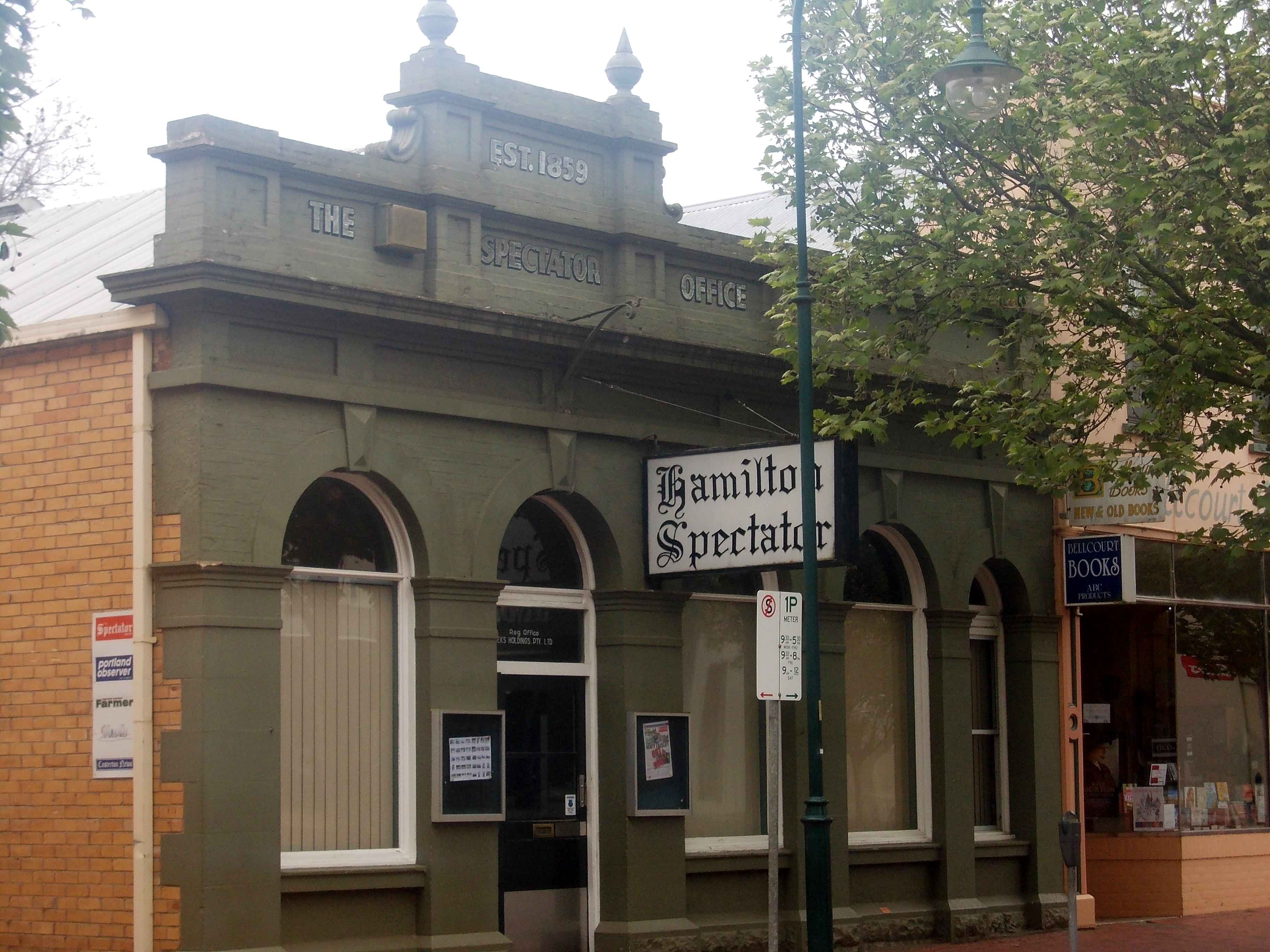
The Hamilton Spectator office, below,  in 2012.  George Robinson established the paper in 1860.  Robinson built the current home of the Spec in 1873.

THE HAMILTON SPECTATOR OFFICE, HAMILTON

THE HAMILTON SPECTATOR OFFICE, HAMILTON

Below is the front of Melville Oval from a Rose Postcard sometime after WW1.  The War Memorial is in the foreground, grandstand in the background and a band rotunda to the left of the grandstand.

MELVILLE OVAL, HAMILTON. Image Courtesy of the State Library of Victoria. Image No.H32492/2800 http://handle.slv.vic.gov.au/10381/63848

MELVILLE OVAL, HAMILTON. Image Courtesy of the State Library of Victoria. Image No.H32492/2800 http://handle.slv.vic.gov.au/10381/63848

Below is a similar view from 2011.  The band rotunda is no longer beside the grandstand.  It found a new home in 1988.

MELVILLE OVAL, HAMILTON

MELVILLE OVAL, HAMILTON

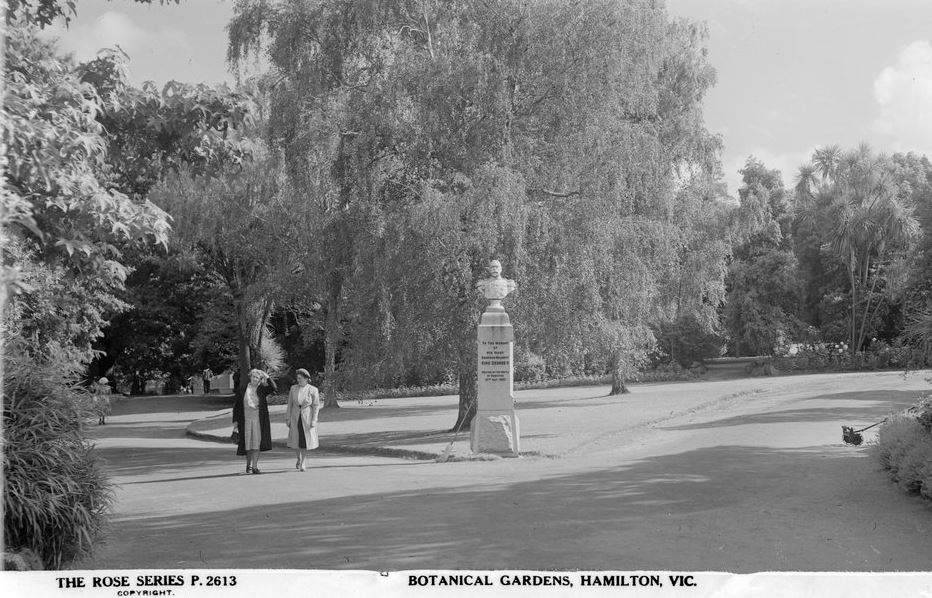
The Hamilton Botanical Gardens is one of my favourite places in Hamilton.  This is the view from the entrance on the corner of Thompson and French Streets.  The bust of George V was erected after the King’s death in 1936.

HAMILTON BOTANICAL GARDENS Image Courtesy of the State Library of Victoria. Image no. H32492/3783 http://handle.slv.vic.gov.au/10381/60784

HAMILTON BOTANICAL GARDENS Image Courtesy of the State Library of Victoria. Image no. H32492/3783 http://handle.slv.vic.gov.au/10381/60784

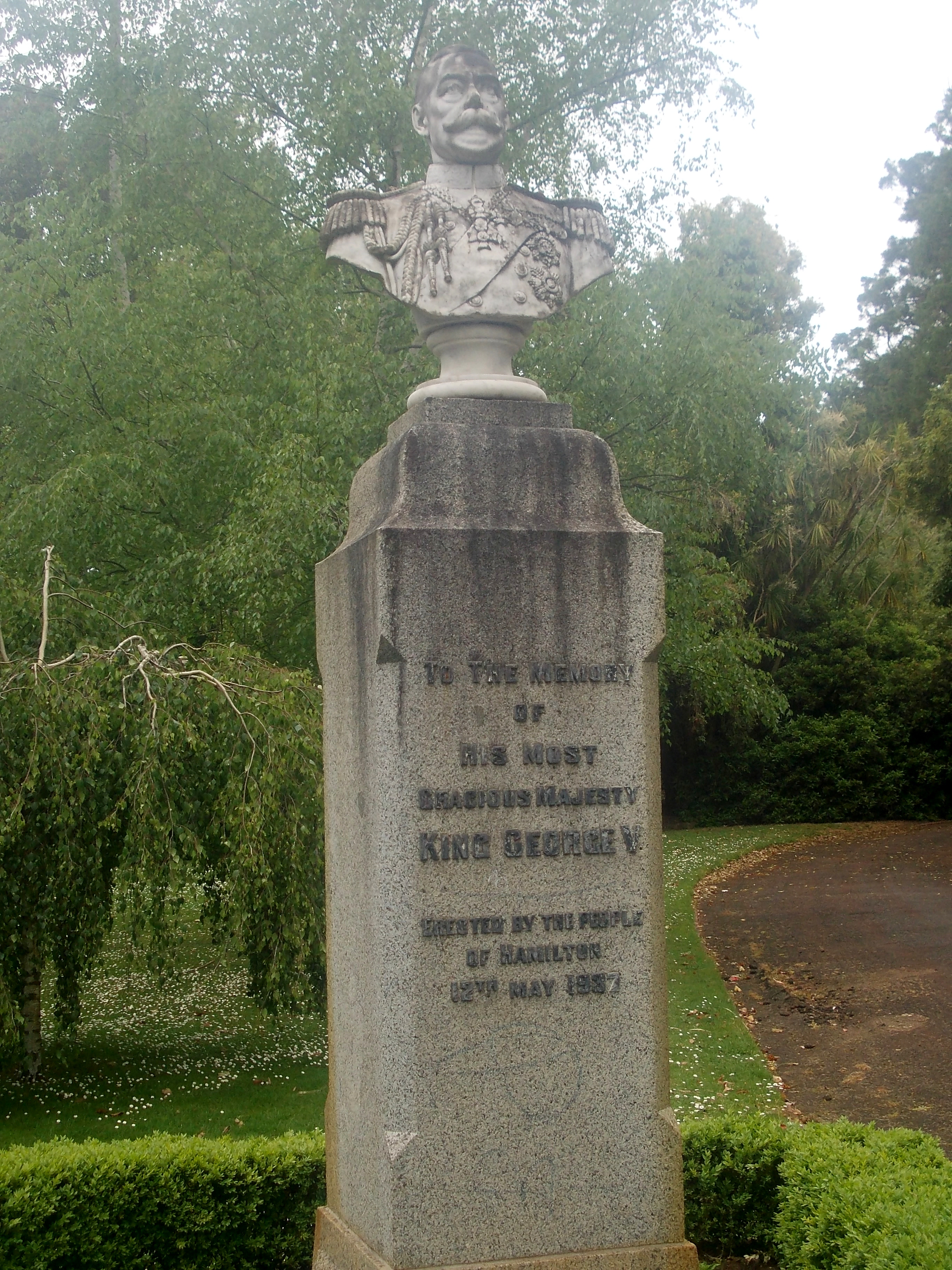
This is George today.  If only he could talk. He would have seen some sights in his 70 or so years in the gardens.

KING GEORGE V MEMORIAL, HAMILTON BOTANICAL GARDENS

KING GEORGE V MEMORIAL, HAMILTON BOTANICAL GARDENS

The John Thomson Memorial Fountain was erected in 1919 in memory of the pastoralist and MLA. John Thomson.  Thomson was a member of the Racing Club, Presbyterian Church and the Fire Brigade and more.

JOHN THOMSON MEMORIAL FOUNTAIN, HAMILTON BOTANICAL GARDENS. Image Courtesy of the State Library of Victoria. Image no. H32492/2808 http://handle.slv.vic.gov.au/10381/63460

JOHN THOMSON MEMORIAL FOUNTAIN, HAMILTON BOTANICAL GARDENS. Image Courtesy of the State Library of Victoria. Image no. H32492/2808
http://handle.slv.vic.gov.au/10381/63460

The fountain today, with the band rotunda, formally at Melville Oval, in the background.  Relocated in 1988,  the gardens are a perfect spot for it.

JOHN THOMSON MEMORIAL FOUNTAIN, HAMILTON BOTANICAL GARDENS

JOHN THOMSON MEMORIAL FOUNTAIN, HAMILTON BOTANICAL GARDENS

This post was so much easier thanks to several booklets I have, written by Margaret Gardner and Val Heffernan of the Hamilton History Centre.  Under the general title of “Exploring Hamilton” they offer several walking and driving tours of Hamilton packed full of history and include the Church Hill walk, CBD – Gray Street walk and the Grange Burn walk.  There are histories of prominent landmarks, shops and homes.  There are eight walking tours and three driving tours in total and are available from the Hamilton History Centre for $5.00 each.  I have six so far and they are a wonderful resource.

Trove Tuesday – Highly Classified

Classified advertisements have always been a favourite of mine to read but sadly they are disappearing from our newspapers.  Reading the “classifieds” from old newspapers gives us some idea of the social history of a town.  From lost animals to insolvency and tenders for new buildings to employment notices, the classifieds had it all.

In almost every paper there were lost and found horses and other stock.  Inappropriate fencing or no fencing at all would have meant a roaming animal was a common sight.

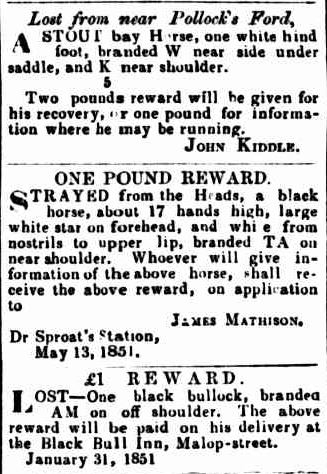
Henry Gibb of Fiery Creek was still offering a reward for his cart horse five months after he last saw it.

Advertising. (1851, May 20). Geelong Advertiser (Vic. : 1847 - 1851), p. 3 Edition: DAILY and MORNING. Retrieved June 2, 2013, from http://nla.gov.au/nla.news-article91914023

Advertising. (1851, May 20). Geelong Advertiser (Vic. : 1847 – 1851), p. 3 Edition: DAILY and MORNING. Retrieved June 2, 2013, from http://nla.gov.au/nla.news-article91914023

Mr Mathison’s  huge 17 hands high black horse would have been hard to hide.  He offered a £1 reward for information on its whereabouts.

Advertising. (1851, May 20). Geelong Advertiser (Vic. : 1847 - 1851), p. 3 Edition: DAILY and MORNING. Retrieved June 2, 2013, from http://nla.gov.au/nla.news-article91914023

Advertising. (1851, May 20). Geelong Advertiser (Vic. : 1847 – 1851), p. 3 Edition: DAILY and MORNING. Retrieved June 2, 2013, from http://nla.gov.au/nla.news-article91914023

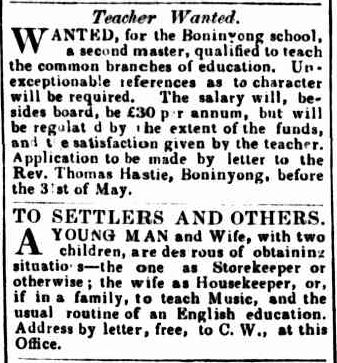
The Rev. Thomas Hastie was looking for a teacher of the Boninyong School (now Buninyong) i 1851.  In Geelong, a couple with children were looking for work, him as a storekeeper and her as a housekeeper or teacher.

Advertising. (1851, May 20). Geelong Advertiser (Vic. : 1847 - 1851), p. 3 Edition: DAILY and MORNING. Retrieved June 2, 2013, from http://nla.gov.au/nla.news-article91914023

Advertising. (1851, May 20). Geelong Advertiser (Vic. : 1847 – 1851), p. 3 Edition: DAILY and MORNING. Retrieved June 2, 2013, from http://nla.gov.au/nla.news-article91914023

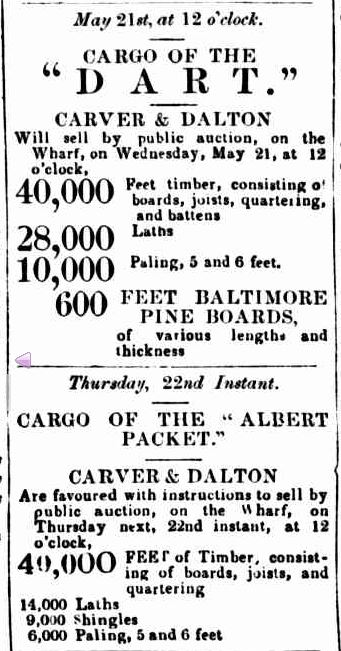
With plenty of building going on in 1851, Carver & Dalton’s auctions of timber would have drawn a crowd.

dvertising. (1851, May 20). Geelong Advertiser (Vic. : 1847 - 1851), p. 3 Edition: DAILY and MORNING. Retrieved June 2, 2013, from http://nla.gov.au/nla.news-article91914023

dvertising. (1851, May 20). Geelong Advertiser (Vic. : 1847 – 1851), p. 3 Edition: DAILY and MORNING. Retrieved June 2, 2013, from http://nla.gov.au/nla.news-article91914023

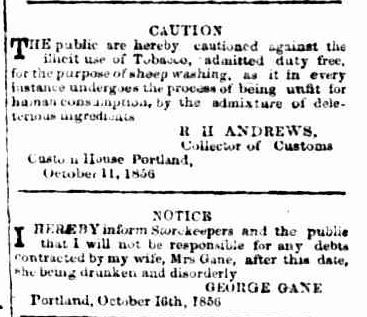
In 1856 the  Collector of Customs of Customs House, Portland used the classifieds to issue a warning about tobacco used for washing sheep.  Additional ingredients made it unfit for human consumption.

Poor George Gane had to air his dirty laundry in public presumably after his drunken wife ran up bills in his name.  He declared he would not be responsible for any debts she incurred.

Advertising. (1856, October 17). Portland Guardian and Normanby General Advertiser (Vic. : 1842 - 1876), p. 3 Edition: EVENING.. Retrieved June 3, 2013, from http://nla.gov.au/nla.news-article64567048

Advertising. (1856, October 17). Portland Guardian and Normanby General Advertiser (Vic. : 1842 – 1876), p. 3 Edition: EVENING.. Retrieved June 3, 2013, from http://nla.gov.au/nla.news-article64567048

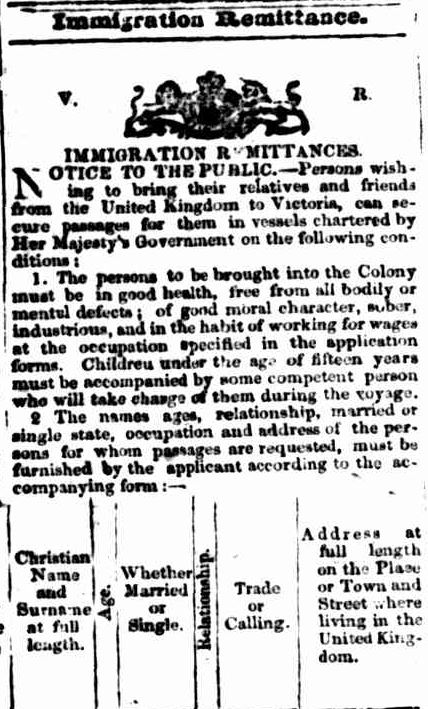
The following Immigration Remittance is an interesting notice and it had me thinking if I had any relatives that may have arrived in Victoria under the scheme described.

class8

class9

Advertising. (1856, October 17). Portland Guardian and Normanby General Advertiser (Vic. : 1842 – 1876), p. 3 Edition: EVENING.. Retrieved June 3, 2013, from http://nla.gov.au/nla.news-article64567048

Something different to lost horses.

Advertising. (1856, October 17). Portland Guardian and Normanby General Advertiser (Vic. : 1842 - 1876), p. 3 Edition: EVENING.. Retrieved June 3, 2013, from http://nla.gov.au/nla.news-article64567048

Advertising. (1856, October 17). Portland Guardian and Normanby General Advertiser (Vic. : 1842 – 1876), p. 3 Edition: EVENING.. Retrieved June 3, 2013, from http://nla.gov.au/nla.news-article64567048

In 1879, the Clothes Washing Machine patented by John Walls could be purchased.  The power, human power that is, needed to run the machine was minimal so even a 15-year-old girl could use it.

Advertising. (1879, July 25). Camperdown Chronicle (Vic. : 1877 - 1954), p. 3. Retrieved June 2, 2013, from http://nla.gov.au/nla.news-article29098359

Advertising. (1879, July 25). Camperdown Chronicle (Vic. : 1877 – 1954), p. 3. Retrieved June 2, 2013, from http://nla.gov.au/nla.news-article29098359

Miss Jenkins of  Terang ran a sober operation at her Temperance Hotel and Coffee Rooms.  Even the horses were well looked after.  Meanwhile, Mrs Geddes of Camperdown had set up an employment agency for servants.

Advertising. (1879, July 25). Camperdown Chronicle (Vic. : 1877 - 1954), p. 3. Retrieved June 3, 2013, from http://nla.gov.au/nla.news-article29098359

Advertising. (1879, July 25). Camperdown Chronicle (Vic. : 1877 – 1954), p. 3. Retrieved June 3, 2013, from http://nla.gov.au/nla.news-article29098359

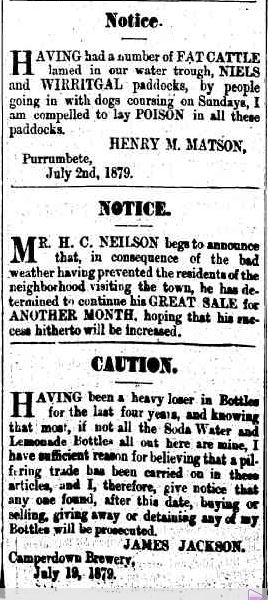
Henry Matson of Purrembete, tired of coursing parties in his paddocks leading to injury to his stock, threatened to lay poison in the paddocks.  James Jackson of the Camperdown Brewery was also fed up.  Fed up with his soda water and lemonade bottles going missing. He was going to sue basically any person with one of his bottles in their possession.

Advertising. (1879, July 25). Camperdown Chronicle (Vic. : 1877 - 1954), p. 3. Retrieved June 2, 2013, from http://nla.gov.au/nla.news-article29098359

Advertising. (1879, July 25). Camperdown Chronicle (Vic. : 1877 – 1954), p. 3. Retrieved June 2, 2013, from http://nla.gov.au/nla.news-article29098359

Winter Fashion

Winter in the Western District is cold and wet and the southerly winds are freezing.  Frosts are common and snow can fall in some parts, especially around the gold towns of Ararat and Ballarat where sub-zero temperatures are frequent.  Winter weather would have reminded the pioneers of home as they donned coats and hats and furs.  Way too many furs. There was something else we don’t face today in the same way.  Mud.

SNOW, NORTH BALLARAT (c1900-1906). Image Courtesy of the State Library of Victoria Image no: H41033/32 http://handle.slv.vic.gov.au/10381/55951

SNOW, NORTH BALLARAT. Image Courtesy of the State Library of Victoria Image no: H41033/32 http://handle.slv.vic.gov.au/10381/55951

Mud was everywhere in Bendigo in 1856.

HE BENDIGO ADVERTISER. (1856, May 28). Bendigo Advertiser (Vic. : 1855 - 1918), p. 2. Retrieved June 2, 2013, from http://nla.gov.au/nla.news-article88050303

HE BENDIGO ADVERTISER. (1856, May 28). Bendigo Advertiser (Vic. : 1855 – 1918), p. 2. Retrieved June 2, 2013, from http://nla.gov.au/nla.news-article88050303

The situation was no different in Portland.

DOMESTIC INTELLIGENCE. (1856, September 19). Portland Guardian and Normanby General Advertiser (Vic. : 1842 - 1876), p. 2 Edition: EVENING.. Retrieved June 2, 2013, from http://nla.gov.au/nla.news-article64566835

DOMESTIC INTELLIGENCE. (1856, September 19). Portland Guardian and Normanby General Advertiser (Vic. : 1842 – 1876), p. 2 Edition: EVENING.. Retrieved June 2, 2013, from http://nla.gov.au/nla.news-article64566835

Winter fashions across the 100 or so years from the 1840s went from heavy velvet dresses to woollen slacks in the 1950s.  Furs of all varieties were popular especially during the 19th century and early 20th century. Thankfully, the wearing of fur is now frowned upon because at the rate it was being worn, all fur-bearing animals would now be extinct.

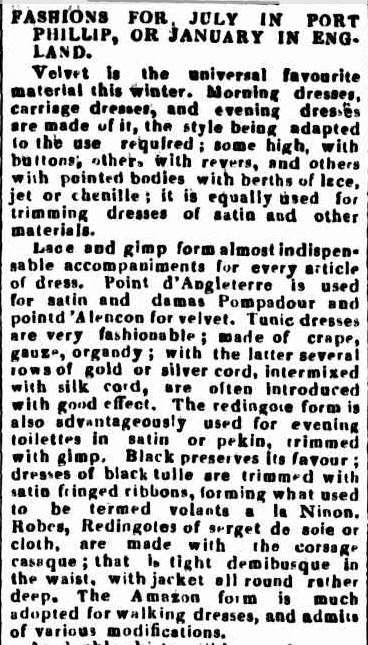
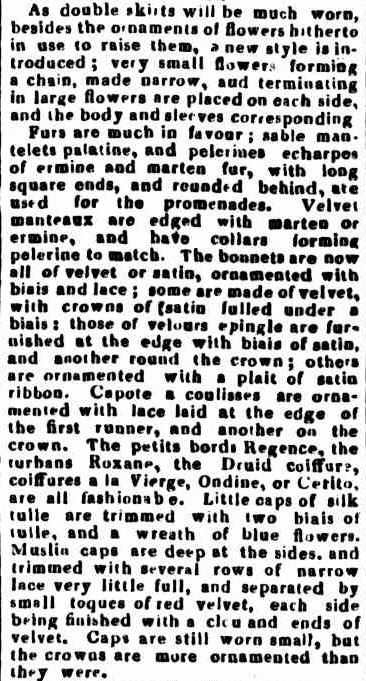
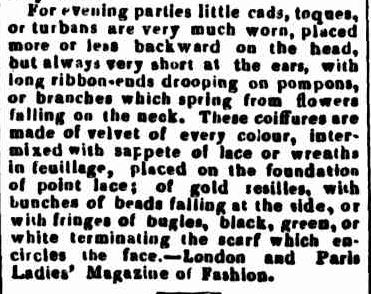
Early Port Phillip settlers of 1845 had word from London that velvet was the must-have fabric for the coming season.  Tunic dresses and double skirts were fashionable.

f1 f2

FASHIONS FOR JULY IN PORT PHILLIP, OR JANUARY IN ENGLAND. (1845, June 11). Geelong Advertiser and Squatters' Advocate (Vic. : 1845 - 1847), p. 5. Retrieved May 22, 2013, from http://nla.gov.au/nla.news-article91122789

FASHIONS FOR JULY IN PORT PHILLIP, OR JANUARY IN ENGLAND. (1845, June 11). Geelong Advertiser and Squatters’ Advocate (Vic. : 1845 – 1847), p. 5. Retrieved May 22, 2013, from http://nla.gov.au/nla.news-article91122789

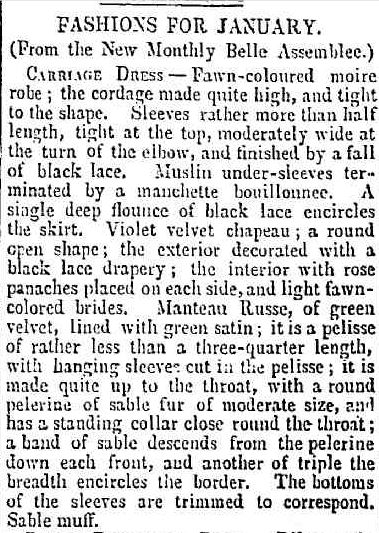
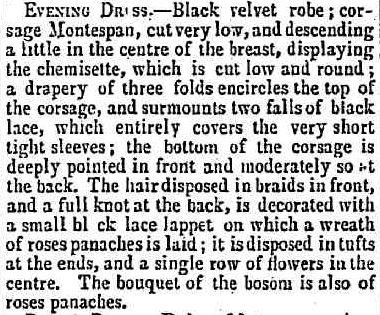
Velvet was still in fashion by the end of the 1840s but not at all practical if walking the muddy streets.

f6

FASHIONS FOR JANUARY. (1849, May 12). Geelong Advertiser (Vic. : 1847 - 1851), p. 1 Edition: MORNING. Retrieved May 22, 2013, from http://nla.gov.au/nla.news-article93133862

FASHIONS FOR JANUARY. (1849, May 12). Geelong Advertiser (Vic. : 1847 – 1851), p. 1 Edition: MORNING. Retrieved May 22, 2013, from http://nla.gov.au/nla.news-article93133862

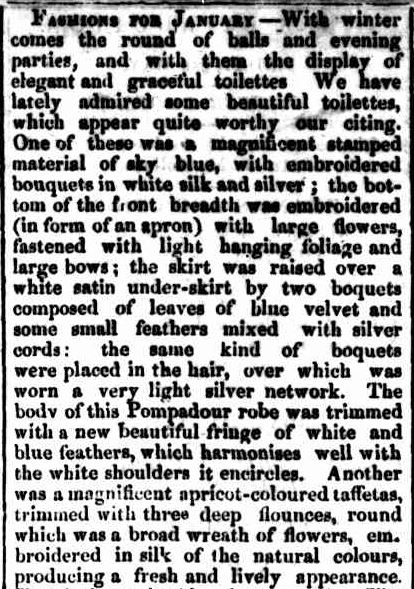
There was a move away from black and other dark colours in 1851, with materials in sky blue and taffeta in apricot.

SCHEDULE REFERRED TO IN THE ABOVE LETTERS. (1851, May 2). The Argus (Melbourne, Vic. : 1848 - 1957), p. 4. Retrieved May 22, 2013, from http://nla.gov.au/nla.news-article4777642

SCHEDULE REFERRED TO IN THE ABOVE LETTERS. (1851, May 2). The Argus (Melbourne, Vic. : 1848 – 1957), p. 4. Retrieved May 22, 2013, from http://nla.gov.au/nla.news-article4777642

“Brights” of Geelong received their first shipment of Winter goods for 1851 in May.  A case of goods including cuffs, collars and sleeves and a range of fur accessories were on offer including sable, mink and squirrel goods.

f9

Advertising. (1851, May 20). Geelong Advertiser (Vic. : 1847 - 1851), p. 3 Edition: DAILY and MORNING. Retrieved May 22, 2013, from http://nla.gov.au/nla.news-article91914023

Advertising. (1851, May 20). Geelong Advertiser (Vic. : 1847 – 1851), p. 3 Edition: DAILY and MORNING. Retrieved May 22, 2013, from http://nla.gov.au/nla.news-article91914023

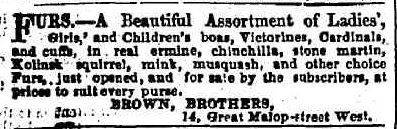
“Brown Brothers” of Geelong offered ladies and children’s boas and cuffs in mink and chinchilla.

Advertising. (1855, May 24). Geelong Advertiser and Intelligencer (Vic. : 1851 - 1856), p. 4 Edition: DAILY.. Retrieved May 22, 2013, from http://nla.gov.au/nla.news-article91871285

Advertising. (1855, May 24). Geelong Advertiser and Intelligencer (Vic. : 1851 – 1856), p. 4 Edition: DAILY.. Retrieved May 22, 2013, from http://nla.gov.au/nla.news-article91871285

Dresses were trimmed with bows, lace, netting and velvet ornaments in the 1860s along with buttons and epaulettes.  The broad borders at the bottom of a dress could be ornamented with trimmings.  An advantage of the border was that it was easy to freshen up with new materials or trims if it became tatty or mud-stained.

FASHIONS FOR JANUARY. (1860, March 19). The Argus (Melbourne, Vic. : 1848 - 1957), p. 6. Retrieved June 1, 2013, from http://nla.gov.au/nla.news-article5679112

FASHIONS FOR JANUARY. (1860, March 19). The Argus (Melbourne, Vic. : 1848 – 1957), p. 6. Retrieved June 1, 2013, from http://nla.gov.au/nla.news-article5679112

Large earrings were in vogue during winter, 1866.  Large gold hoops and pear-shaped earrings were available.

THE FASHIONS FOR DECEMBER. (1866, February 1). Portland Guardian and Normanby General Advertiser (Vic. : 1842 - 1876), p. 4 Edition: EVENING. Retrieved May 30, 2013, from http://nla.gov.au/nla.news-article64635701

THE FASHIONS FOR DECEMBER. (1866, February 1). Portland Guardian and Normanby General Advertiser (Vic. : 1842 – 1876), p. 4 Edition: EVENING. Retrieved May 30, 2013, from http://nla.gov.au/nla.news-article64635701

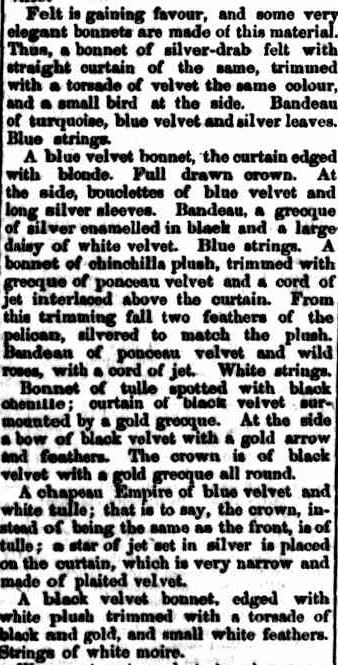
During the same season, felt bonnets were popular.

FASHIONS FOR DECEMBER. (1866, March 5). Portland Guardian and Normanby General Advertiser (Vic. : 1842 - 1876), p. 3 Edition: EVENING. Retrieved May 30, 2013, from http://nla.gov.au/nla.news-article64635944

FASHIONS FOR DECEMBER. (1866, March 5). Portland Guardian and Normanby General Advertiser (Vic. : 1842 – 1876), p. 3 Edition: EVENING. Retrieved May 30, 2013, from http://nla.gov.au/nla.news-article64635944

[No heading]. (1873, May 17). The Australasian Sketcher with Pen and Pencil (Melbourne, Vic. : 1873 - 1889), p. 29. Retrieved June 1, 2013, from http://nla.gov.au/nla.news-page5985335

[No heading]. (1873, May 17). The Australasian Sketcher with Pen and Pencil (Melbourne, Vic. : 1873 – 1889), p. 29. Retrieved June 1, 2013, from http://nla.gov.au/nla.news-page5985335

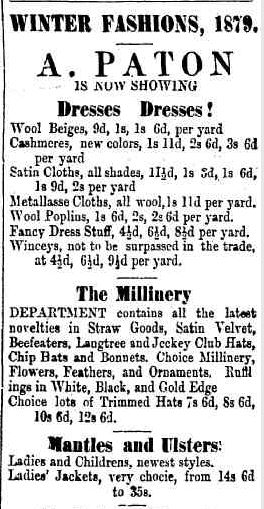
“A. Paton” of Camperdown offered dresses in a range of materials for winter, 1879.

Advertising. (1879, July 25). Camperdown Chronicle (Vic. : 1877 - 1954), p. 3. Retrieved May 30, 2013, from http://nla.gov.au/nla.news-article29098359

Advertising. (1879, July 25). Camperdown Chronicle (Vic. : 1877 – 1954), p. 3. Retrieved May 30, 2013, from http://nla.gov.au/nla.news-article29098359

Patons also sold Dent’s Kid Gloves.  Yes, Dents were going back in the 1870s.  A check of the company website found that Dents gloves were already 100 years old at that time.

Advertising. (1879, July 25). Camperdown Chronicle (Vic. : 1877 - 1954), p. 3. Retrieved May 30, 2013, from http://nla.gov.au/nla.news-article29098359

Advertising. (1879, July 25). Camperdown Chronicle (Vic. : 1877 – 1954), p. 3. Retrieved May 30, 2013, from http://nla.gov.au/nla.news-article29098359

In 1882, dresses in silk were made with jacket bodices.  Bonnets were in the “princess shape” and Newmarket coats were often trimmed with fur.

THE AUSTRALIAN WOMAN'S MAGAZINE. (1882, May 5). Record (Emerald Hill, Vic : 1881 - 1900), p. 3. Retrieved June 2, 2013, from http://nla.gov.au/nla.news-article108472760

THE AUSTRALIAN WOMAN’S MAGAZINE. (1882, May 5). Record (Emerald Hill, Vic : 1881 – 1900), p. 3. Retrieved June 2, 2013, from http://nla.gov.au/nla.news-article108472760

“Heazelwoods” of Percy Street, Portland advertised their new winter stock for 1883.  Hats were available in Beaver, felt and straw.

Advertising. (1883, July 19). Portland Guardian (Vic. : 1876 - 1953), p. 3 Edition: MORNING. Retrieved May 30, 2013, from http://nla.gov.au/nla.news-article71585826

Advertising. (1883, July 19). Portland Guardian (Vic. : 1876 – 1953), p. 3 Edition: MORNING. Retrieved May 30, 2013, from http://nla.gov.au/nla.news-article71585826

Sealskin was the most popular fur for winter 1894. Silver fox, red fox and blue fox were also used for wraps.  Black furs of lynx and fox were also popular.

The Popular Winter Furs. (1894, October 5). The Horsham Times (Vic. : 1882 - 1954), p. 1. Retrieved May 30, 2013, from http://nla.gov.au/nla.news-article72947027

The Popular Winter Furs. (1894, October 5). The Horsham Times (Vic. : 1882 – 1954), p. 1. Retrieved May 30, 2013, from http://nla.gov.au/nla.news-article72947027

The trimming of winter hats with flowers was thought unusual until 1895. Then there were many colours to choose from instead of the usual black, brown and grey.  There was a doctor’s warning with this article – low-cut dresses must not be worn in winter.

WORLD OF FASHION. (1895, June 21). Portland Guardian (Vic. : 1876 - 1953), p. 2 Edition: EVENING, Supplement: Supplement to the Portland Guardian.. Retrieved May 30, 2013, from http://nla.gov.au/nla.news-article65400699

WORLD OF FASHION. (1895, June 21). Portland Guardian (Vic. : 1876 – 1953), p. 2 Edition: EVENING, Supplement: Supplement to the Portland Guardian.. Retrieved May 30, 2013, from http://nla.gov.au/nla.news-article65400699

What a display of fur.

C1890-1918 Image Courtesy of the State Library of Victoria, Image No. H2002.42/23 http://handle.slv.vic.gov.au/10381/40114

C1890-1918 Image Courtesy of the State Library of Victoria, Image No. H2002.42/23 http://handle.slv.vic.gov.au/10381/40114

Women were told to forget furs of the “cat o’-nine-tail’ variety with “glassy eyes, sharp cardboard noses, and wire claws”.  They were no longer “good form”.  That sounded promising for the animals.  No, it wasn’t.  The furs of 1902 were on a “large scale”

WOMAN'S REALM. (1902, November 15). The Argus (Melbourne, Vic. : 1848 - 1957), p. 5. Retrieved May 30, 2013, from http://nla.gov.au/nla.news-article9076147

WOMAN’S REALM. (1902, November 15). The Argus (Melbourne, Vic. : 1848 – 1957), p. 5. Retrieved May 30, 2013, from http://nla.gov.au/nla.news-article9076147

This is an over-blouse an “important” garment from Winter 1908.  It could be made from a Butterick pattern.

LADIES' BLOUSE. (1908, April 17). The Horsham Times (Vic. : 1882 - 1954), p. 7. Retrieved May 30, 2013, from http://nla.gov.au/nla.news-article72808710

LADIES’ BLOUSE. (1908, April 17). The Horsham Times (Vic. : 1882 – 1954), p. 7. Retrieved May 30, 2013, from http://nla.gov.au/nla.news-article72808710

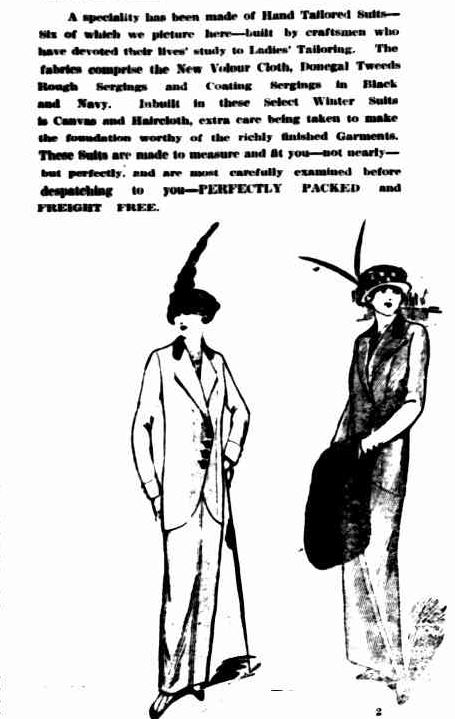
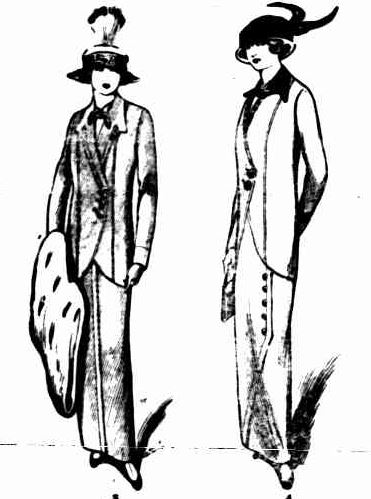
Dimmeys were promoting tailored suits in 1914.  Materials included Donegal Tweeds and velour.

a10 a11

Advertising. (1914, April 1). The Colac Herald (Vic. : 1875 - 1918), p. 3. Retrieved May 30, 2013, from http://nla.gov.au/nla.news-article74224396

Advertising. (1914, April 1). The Colac Herald (Vic. : 1875 – 1918), p. 3. Retrieved May 30, 2013, from http://nla.gov.au/nla.news-article74224396

The young lady from around 1914 wears a fox stole and muffler.  How women ever wore fox furs with the heads with glass eyes, I don’t know.  The closest I’ve come to them has been in antique shops, but after reading the children’s book Grandad’s Gifts by Paul Jennings, I hope I never see another.  If you have read the book, you will know what I mean.

c1914. Image Courtesy of the State Library of South Australia. Image No. PRG280/1/11/516 http://images.slsa.sa.gov.au/searcy/11/PRG280_1_11_516.htm

c1914. Image Courtesy of the State Library of South Australia. Image No. PRG280/1/11/516 http://images.slsa.sa.gov.au/searcy/11/PRG280_1_11_516.htm

“Langlands” of Horsham were offering more than just “average” garments for winter 1919.

a13

Advertising. (1919, April 25). The Horsham Times (Vic. : 1882 - 1954), p. 1. Retrieved May 30, 2013, from http://nla.gov.au/nla.news-article73048126

Advertising. (1919, April 25). The Horsham Times (Vic. : 1882 – 1954), p. 1. Retrieved May 30, 2013, from http://nla.gov.au/nla.news-article73048126

In March 1922. the summer goods were cleared from the windows of fashions houses and exchanged with the latest winter fashions.  A coat of velour with fur trimming was expensive, but the velour made the coat as “warm as a blanket”.  Mole coney was popular.  It sounded exotic but it was only wild rabbit dyed in mole colours.

a49a50

FASHION FOR THE WEEK. (1922, March 15). The Argus (Melbourne, Vic. : 1848 - 1957), p. 4. Retrieved June 2, 2013, from http://nla.gov.au/nla.news-article4685428

FASHION FOR THE WEEK. (1922, March 15). The Argus (Melbourne, Vic. : 1848 – 1957), p. 4. Retrieved June 2, 2013, from http://nla.gov.au/nla.news-article4685428

Some typical 1920s fashion.

a56

WINTER FASHIONS. (1925, July 1). The Argus (Melbourne, Vic. : 1848 - 1957), p. 4. Retrieved June 2, 2013, from http://nla.gov.au/nla.news-article2132544

WINTER FASHIONS. (1925, July 1). The Argus (Melbourne, Vic. : 1848 – 1957), p. 4. Retrieved June 2, 2013, from http://nla.gov.au/nla.news-article2132544

Ostrich feathers were the prediction for winter 1927.  Gone were the days of black or white, all the colours of the rainbow would be available.  Be warned, they only suited the tall and slim.

OSTRICH FEATHER BOAS. (1926, October 26). The Horsham Times (Vic. : 1882 - 1954), p. 6. Retrieved May 31, 2013, from http://nla.gov.au/nla.news-article73016017

OSTRICH FEATHER BOAS. (1926, October 26). The Horsham Times (Vic. : 1882 – 1954), p. 6. Retrieved May 31, 2013, from http://nla.gov.au/nla.news-article73016017

A range of hats, dresses and coats for winter 1929.

FASHION SHOWS. (1929, February 22). The Argus (Melbourne, Vic. : 1848 - 1957), p. 13. Retrieved June 2, 2013, from http://nla.gov.au/nla.news-article3996179

FASHION SHOWS. (1929, February 22). The Argus (Melbourne, Vic. : 1848 – 1957), p. 13. Retrieved June 2, 2013, from http://nla.gov.au/nla.news-article3996179

FASHION SHOWS. (1929, March 1). The Argus (Melbourne, Vic. : 1848 - 1957), p. 13. Retrieved June 2, 2013, from http://nla.gov.au/nla.news-article3993217

FASHION SHOWS. (1929, March 1). The Argus (Melbourne, Vic. : 1848 – 1957), p. 13. Retrieved June 2, 2013, from http://nla.gov.au/nla.news-article3993217

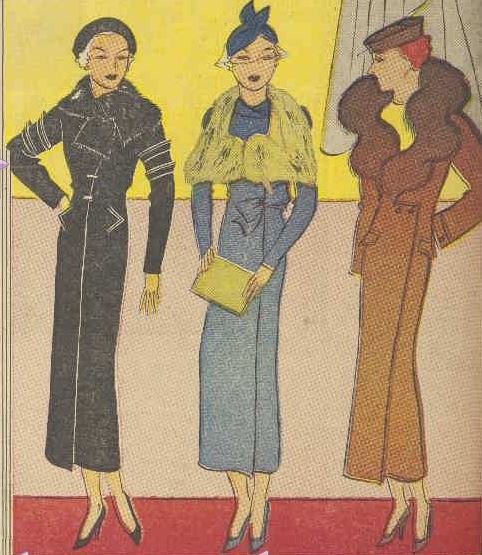
There were hats to suit all for winter, 1934.

a16

The Fashion Parade. (1934, April 21). The Australian Women's Weekly (1933 - 1982), p. 16. Retrieved May 31, 2013, from http://nla.gov.au/nla.news-article51199094

The Fashion Parade. (1934, April 21). The Australian Women’s Weekly (1933 – 1982), p. 16. Retrieved May 31, 2013, from http://nla.gov.au/nla.news-article51199094

After completing four seasons of fashion, the women of Horsham were the standouts in the fashion stakes.  Maybe it was because of the range of clothing brought to the town by shops such as Madame Griffiths’ of Firebrace Street.

WINTER FASHIONS. (1934, May 1). The Horsham Times (Vic. : 1882 - 1954), p. 4. Retrieved May 31, 2013, from http://nla.gov.au/nla.news-article72582666

WINTER FASHIONS. (1934, May 1). The Horsham Times (Vic. : 1882 – 1954), p. 4. Retrieved May 31, 2013, from http://nla.gov.au/nla.news-article72582666

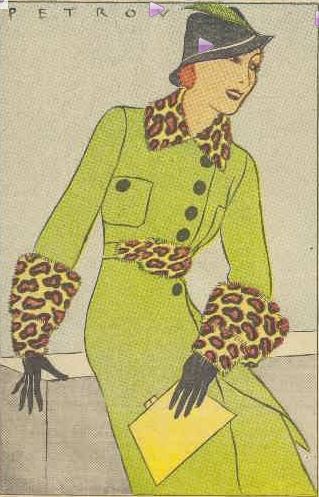
Winter 1935 through the eyes of Petrov.

a19

BUILD YOUR Winter Wardrobe Round YOUR TOPCOAT. (1935, May 4). The Australian Women's Weekly (1933 - 1982), p. 8. Retrieved May 31, 2013, from http://nla.gov.au/nla.news-article47469903

BUILD YOUR Winter Wardrobe Round YOUR TOPCOAT. (1935, May 4). The Australian Women’s Weekly (1933 – 1982), p. 8. Retrieved May 31, 2013, from http://nla.gov.au/nla.news-article47469903

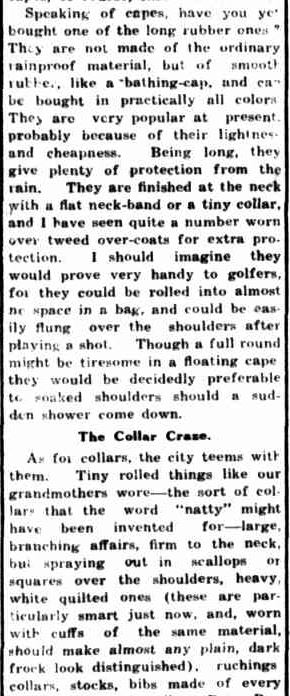
A rather curious type of cape was available for winter 1935.  Made from material akin to that of a “bathing cap”, they were popular because they were light and cheap.  Collars of all sorts were also available, including Peter Pan and those adorned with bows.

a21

Sundries for Winter Wear. (1935, June 6). Portland Guardian (Vic. : 1876 - 1953), p. 3 Edition: EVENING.. Retrieved May 31, 2013, from http://nla.gov.au/nla.news-article64289351

Sundries for Winter Wear. (1935, June 6). Portland Guardian (Vic. : 1876 – 1953), p. 3 Edition: EVENING.. Retrieved May 31, 2013, from http://nla.gov.au/nla.news-article64289351

Cadet Blue, Kenyan Red and Imperial Gold were just some of the wool colours for winter 1936, available in a variety of yarns.

FASHIONS FOR WINTER. (1936, March 9). Portland Guardian (Vic. : 1876 - 1953), p. 3 Edition: EVENING. Retrieved May 31, 2013, from http://nla.gov.au/nla.news-article64271974

FASHIONS FOR WINTER. (1936, March 9). Portland Guardian (Vic. : 1876 – 1953), p. 3 Edition: EVENING. Retrieved May 31, 2013, from http://nla.gov.au/nla.news-article64271974

The Fashion Parade. (1937, March 6). The Australian Women's Weekly (1933 - 1982), p. 6. Retrieved May 31, 2013, from http://nla.gov.au/nla.news-article51587259

The Fashion Parade. (1937, March 6). The Australian Women’s Weekly (1933 – 1982), p. 6. Retrieved May 31, 2013, from http://nla.gov.au/nla.news-article51587259

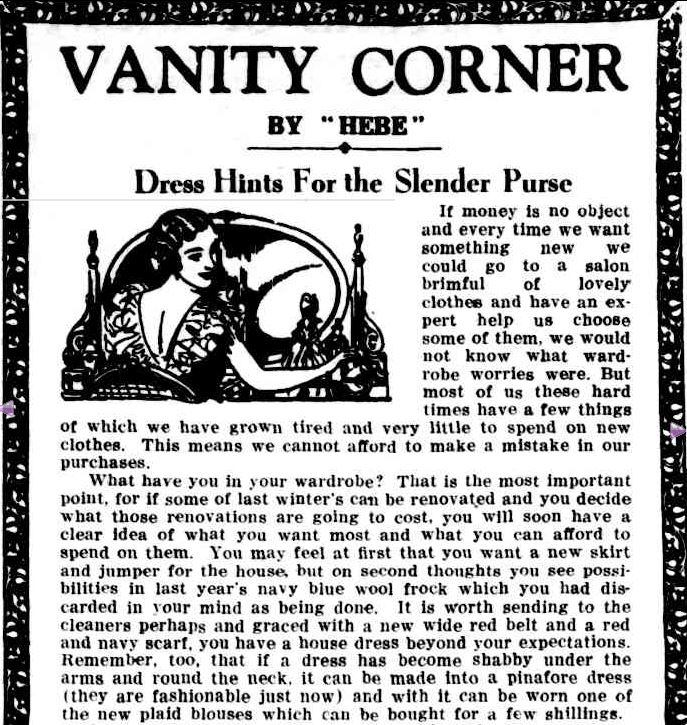
During WW2 money was tight and women were advised on how they could have a fresh winter wardrobe on a limited budget.  A coat was most important and clothes from the previous season could be revitalised to save money for a good quality coat.   Cheap materials creased easily and imagine the creases after three hours sitting at the pictures!

a26

VANITY CORNER. (1941, April 29). The Horsham Times (Vic. : 1882 - 1954), p. 8. Retrieved May 31, 2013, from http://nla.gov.au/nla.news-article72691381

VANITY CORNER. (1941, April 29). The Horsham Times (Vic. : 1882 – 1954), p. 8. Retrieved May 31, 2013, from http://nla.gov.au/nla.news-article72691381

Tweeds were fashionable for winter 1944.

Tweeds are fashion firsts this winter. (1944, May 27). The Australian Women's Weekly (1933 - 1982), p. 19. Retrieved May 31, 2013, from http://nla.gov.au/nla.news-article47218844

Tweeds are fashion firsts this winter. (1944, May 27). The Australian Women’s Weekly (1933 – 1982), p. 19. Retrieved May 31, 2013, from http://nla.gov.au/nla.news-article47218844

And tartans for 1949.

Week-end in the country. (1949, April 16). The Australian Women's Weekly (1933 - 1982), p. 11. Retrieved May 31, 2013, from http://nla.gov.au/nla.news-article47812948

Week-end in the country. (1949, April 16). The Australian Women’s Weekly (1933 – 1982), p. 11. Retrieved May 31, 2013, from http://nla.gov.au/nla.news-article47812948

Military-style hats were popular for winter 1950, including Light Horse plumes.  Cloche hats and berets were also popular.

NEW WINTER HAT STYLES. (1950, April 7). The Horsham Times (Vic. : 1882 - 1954), p. 8. Retrieved May 31, 2013, from http://nla.gov.au/nla.news-article72801141

NEW WINTER HAT STYLES. (1950, April 7). The Horsham Times (Vic. : 1882 – 1954), p. 8. Retrieved May 31, 2013, from http://nla.gov.au/nla.news-article72801141

Rockmans of Horsham offered bargains galore.

a31

Advertising. (1953, March 27). The Horsham Times (Vic. : 1882 - 1954), p. 6. Retrieved May 31, 2013, from http://nla.gov.au/nla.news-article72766479

Advertising. (1953, March 27). The Horsham Times (Vic. : 1882 – 1954), p. 6. Retrieved May 31, 2013, from http://nla.gov.au/nla.news-article72766479

Corduroy appeared for winter 1954 in the shape of dresses and tight jeans.   Paisley and leopard print corduroys were available.

a33

SUEDE COTTON IS EXCITING NEW TOP FASHION FABRIC. (1954, September 29). The Horsham Times (Vic. : 1882 - 1954), p. 2. Retrieved May 31, 2013, from http://nla.gov.au/nla.news-article74792605

SUEDE COTTON IS EXCITING NEW TOP FASHION FABRIC. (1954, September 29). The Horsham Times (Vic. : 1882 – 1954), p. 2. Retrieved May 31, 2013, from http://nla.gov.au/nla.news-article74792605

After all the furs earlier on, I was a little worried when I read about Poodle cloth coats from Rockmans, Canberra.  They also had a large range of cardigans.

a38

Advertising. (1958, March 13). The Canberra Times (ACT : 1926 - 1995), p. 19. Retrieved May 31, 2013, from http://nla.gov.au/nla.news-article91245269

Advertising. (1958, March 13). The Canberra Times (ACT : 1926 – 1995), p. 19. Retrieved May 31, 2013, from http://nla.gov.au/nla.news-article91245269

By 1958, a range of wool slacks were available for winter. They were certainly more practical than the dresses female pioneers wore 100 years before.

a40

Advertising. (1958, May 1). The Canberra Times (ACT : 1926 - 1995), p. 20. Retrieved May 31, 2013, from http://nla.gov.au/nla.news-article91249114

Advertising. (1958, May 1). The Canberra Times (ACT : 1926 – 1995), p. 20. Retrieved May 31, 2013, from http://nla.gov.au/nla.news-article91249114

Trove Tuesday – A Hare Raising Tale

Enough of  Ladies of the Night, Dancing Girls, Husband’s Commandments, Bottom Drawers and Whispering Wedding Bells.  It’s time to go back to one of my favourite Trove Tuesday themes, animal stories.

The Argus of August 5, 1873 published an article from the Hamilton Spectator, relating a story of a hare that had the writer confirming Darwin’s Theory of Natural Selection.  The hare may not have agreed.  No amount of adaptation could save her from a band of men with sticks and dogs.

coursing coursing1

COURSING EXTRAORDINARY. (1873, August 5). The Argus (Melbourne, Vic. : 1848 - 1957), p. 6. Retrieved May 27, 2013, from http://nla.gov.au/nla.news-article5868695

COURSING EXTRAORDINARY. (1873, August 5). The Argus (Melbourne, Vic. : 1848 – 1957), p. 6. Retrieved May 27, 2013, from http://nla.gov.au/nla.news-article5868695

The following image from the State Library of Victoria depicts scenes from a coursing outing in 1883, however the bunny sketch could have come straight out a Peter Rabbit story.

COURSING.  Image Courtesy of the State Library of Victoria.  Image no. A/S07/05/83/85  http://handle.slv.vic.gov.au/10381/156341

COURSING. Image Courtesy of the State Library of Victoria. Image no. A/S07/05/83/85 http://handle.slv.vic.gov.au/10381/156341

Passing of the Pioneers

Welcome to a bumper May Passing of the Pioneers. So many interesting pioneers passed in the month of May, I had to leave some for next year. Those that remain had such great stories that it was necessary to share some extra bits and pieces found about them. Some just passed through the Western District from time to time, others lived there only for a short period while others were residents for over fifty years, but they all left their mark in some way. They include army captains, ship captains, a dentist, and a naturalist.

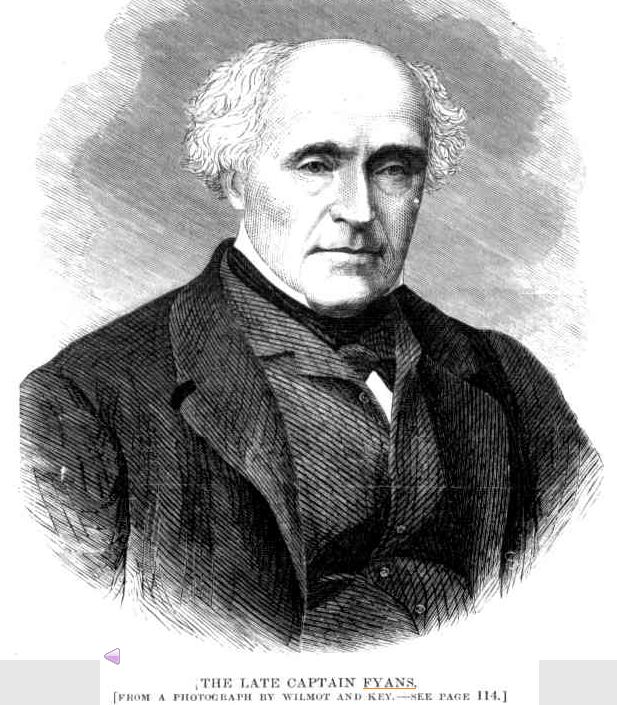
Captain Foster FYANS:  Died 23 May 1870 at Newtown. Western Victorian historian, Margaret Kiddle, wrote in her book Men of Yesterday: a social history of the Western District of Victoria (1834-1890) “the story of  Foster Fyans’ commissionership is a joy to historians” (p.50) . Born in Dublin, Ireland, Foster Fyans was an army captain. He enlisted in 1816 and served with different regiments of the British army including a stint in India. On arrival in Australia in 1833, he became the captain of the guard on Norfolk Island and remained there for two years. In 1837, he left the army and headed to Port Phillip to become the first police magistrate at Geelong.

From 1840, Foster Fyans held the important position of  Crown Lands Commissioner for the Portland Bay area.  A squatter taking up land had to seek permission from the Commissioner and pay an annual fee. The Commissioner’s word was law and there was no arguing with Foster Fyans, a man with a temper.  He tangled with many squatters including the Hentys.  Governor  La Trobe had his moments with Fyans and Kiddle cites La Trobe declaring Fyans “secured to him the chance of a duel once at least in the week as long as he may live” (p.50).

As commissioner, Fyans would ride great distances from Geelong through to Portland and into the Wimmera, a formidable task but his skills marking out selections may not have been as great according to Richard Bennett’s Early Days in Port Fairy (edited by Jan Critchett).  Fyans’ marking of runs “amounted to almost a farce” as Bennett  described the technique used by Fyans:

They were usually laid off in ten mile blocks, measured with a compass in his hand, and timing his horse.  A blackfellow followed, and notched a tree line.  When the Commissioner had travelled what he considered the distance, he notched a corner tree with a broad arrow, and then rode off again at right angles to the next corner, and so on round the block.  Captain Fyans was a bluff old gentleman…” (p.26).

Despite his ways, Fyans was kept on as Commissioner because there was no one else qualified to do the job.

THE LATE CAPTAIN FYANS. (1870, June 18). Illustrated Australian News for Home Readers (Melbourne, Vic. : 1867 - 1875), p. 114. Retrieved May 19, 2013, from http://nla.gov.au/nla.news-article60449034

THE LATE CAPTAIN FYANS. (1870, June 18). Illustrated Australian News for Home Readers (Melbourne, Vic. : 1867 – 1875), p. 114. Retrieved May 19, 2013, from http://nla.gov.au/nla.news-article60449034

Foster Fyans died at Balyang (below) in the Geelong suburb of Newtown and while the house was demolished in 1896, the site is now a part of the Balyang sanctuary. Around the Geelong area the Fyans name is still present with Fyans Street and the suburb, Fyansford. Around the Grampians, there is Lake Fyans and Fyans Creek.

BALYANG, RESIDENCE OF FOSTER FYANS c1851. Image courtesy of the State Library of Victoria Image no. H88.21/107 http://handle.slv.vic.gov.au/10381/71805

William CARMICHAEL:  Died May 1890 at Macarthur. William lived at Harton Hills, near Macarthur. According to his obituary, William purchased the property in 1843 from squatter James Hunter.  However, the Macarthur Historical Society website states William bought the property from the Bolden brothers in 1842.  Any wonder William’s obituary notes there were “many and varied stories” about how he acquired Harton Hills.

Captain Alexander CAMPBELL:  Died 25 May 1890 at South Yarra.  Alexander Campbell was born in 1803 in Argyleshire, Scotland and followed his brothers to Tasmania in 1825. After farming for a few years, Alexander left for Sydney in 1831. The following year a position in charge of the whaling station at Portland was offered to him but he didn’t take up the role until 1836.  In the meantime he went whaling, sailing as far as Japan. After Portland, he went on to Port Fairy where he stayed for about fifteen years.  In that time he built at least two cottages, one occupied by his sisters. In 1851, he became a harbour master and later moved to Gippsland where he returned to farming.  In his last years, Alexander and his wife moved to Caroline Street, South Yarra where he died aged 87.

Captain David FERMANER:  Died May 1893 at Newport. Earlier this year I wrote a Trove Tuesday post entitled Gilding the Lily.  Captain David Fermaner may have been guilty of just that.  At the time of his death, Fermaner, a whaler, was credited as being Victoria’s earliest colonist and that he was standing on the beach at Lady Bay when the ship carrying the first Henty’s reached the Victorian coastline. However, after reading Jenny Williams Fawcett’s account of David Fermaner and his link to the legend of the Mahogany Ship, it became obvious telling the truth was not one of his strong points.

CAPTAIN DAVID FERMANER. Image courtesty of the State Library of Victoria Image no. H2889/85 http://handle.slv.vic.gov.au/10381/68327

After his time in the south-west, Fermaner later became pilot and harbourmaster at Port Albert in Gippsland.

William Thomas PILE:  Died 25 May 1901 at Portland. William Pile was born in Devonshire, England, and as a boy served an apprenticeship in the fishing industry at Hull.  With an urge to see the world, he became a sailor and in 1852, his ship Cossepore arrived at Portland, but he travelled on to Geelong and like many other ships’ crew he left and headed to the diggings.  The thrill of the high seas and travel was a greater lure and he returned to England. It was not until 1854 on a return visit to Portland, he decided to settle.

William’s working life in Portland started as a fisherman and in 1869 after a trip home to England, he returned with a new type of gun to harpoon whales.  He bought into a wattle bark business with Stephen Jarrett that proved lucrative. In 1876 William became a Portland Councillor and then Portland Mayor in 1880 and 1886.

Stephen DUDDEN:  Died 2 May 1903 at Hamilton. Stephen Dudden was born in Somersetshire around 1819 and arrived in Victoria in the 1860s. Stephen showed some entrepreneurial skills setting up a refreshment tent opposite the Hamilton Lands office, in Brown Street, during the rush to buy land after the passing of the Land Act in 1860. He later went to Portland working as a stonemason and then retired to Myamyn. In the month prior to his death, a dehydrated and disheveled Stephen was found by a Hamilton policeman and taken to the Hamilton Hospital where he remained until he passed away from senile decay.

Janet MILLAR:  Died 3 May 1910 at Portland. Janet’s obituary named her only as Mrs. Browning, so I turned to the Australian Death Index to find her birth name, Janet Millar. Janet and her husband John Browning arrived in Victoria in 1849 and headed to Portland to set up a school. With the discovery of gold, the school was abandoned and the Brownings headed for the diggings. They returned to Portland and eventually, John set up another school, John Browning’s Boarding School for Boys.

Janet was eighty-eight at the time of her death and had kept relatively good health and was still tending her home.  However, it was a once in a lifetime chance to see Halley’s Comet in 1910 that led to her demise. She had been out early on cold mornings trying to catch a glimpse of the comet and developed a chill, too much for her weak heart.

Laurence FINN:  Died 24 May 1914 at Port Fairy. Laurence Finn from Tipperary, Ireland arrived in Melbourne with his parents in 1841 and in 1843 they settled in Port Fairy. In 1858, Laurence married Ellen Crowe and they took up residence at Comely Banks, Port Fairy. Laurence’s father ran the Belfast Inn for a time until he let the lease lapse. As a the only child from his father’s second marriage, Laurence and his children inherited a large amount of land. Laurence was a Justice of the Peace and was a member of the Port Fairy Agriculture Society.  Laurence was buried at the Port Fairy Cemetery, below.

John McCOMBE: Died 7 May 1916 at Casterton. Fourteen-year-old, John McCombe arrived in Melbourne aboard the Champion of the Seas in 1854. His family headed directly to Portland but John soon moved on to the Casterton district taking up work at Dunrobin and Nangeela. He purchased a bullock team and began a carrying business and moved to Sandford around 1861 after he married. Four years later he bought land at Deep Creek, Corndale and he remained there until his death.

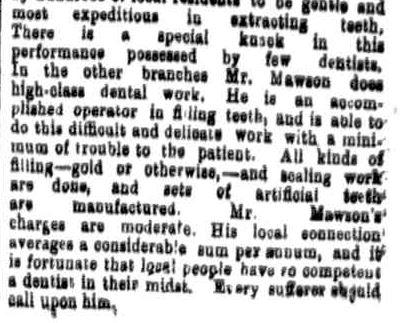
Frederick Sunderland Wood MAWSON:  Died 19 May 1916 at Geelong. Frederick Mawson was a dentist and he travelled the Western District and Mt. Gambier inspecting the teeth of the residents.  Born around 1843, Frederick studied dentistry in England and practiced in Yorkshire.  After acquiring the necessary qualifications for Australia, Frederick set up practice in Geelong and for a few years had a practice in Mt Gambier.

DENTISTRY. (1914, April 2). The Casterton News and the Merino and Sandford Record (Vic. : 1914 - 1918), p. 1 Edition: Bi-Weekly. Retrieved May 23, 2013, from http://nla.gov.au/nla.news-article74760513

DENTISTRY. (1914, April 2). The Casterton News and the Merino and Sandford Record (Vic. : 1914 – 1918), p. 1 Edition: Bi-Weekly. Retrieved May 23, 2013, from http://nla.gov.au/nla.news-article74760513

This “advertorial” from the Border Watch gives a good description of Frederick Mawson and his dentistry.

dentist1

F. J. Mawson,. (1899, April 5). Border Watch (Mount Gambier, SA : 1861 - 1954), p. 4 Supplement: Supplement to the BORDER WATCH. Retrieved May 23, 2013, from http://nla.gov.au/nla.news-article81713460

F. J. Mawson,. (1899, April 5). Border Watch (Mount Gambier, SA : 1861 – 1954), p. 4 Supplement: Supplement to the BORDER WATCH. Retrieved May 23, 2013, from http://nla.gov.au/nla.news-article81713460


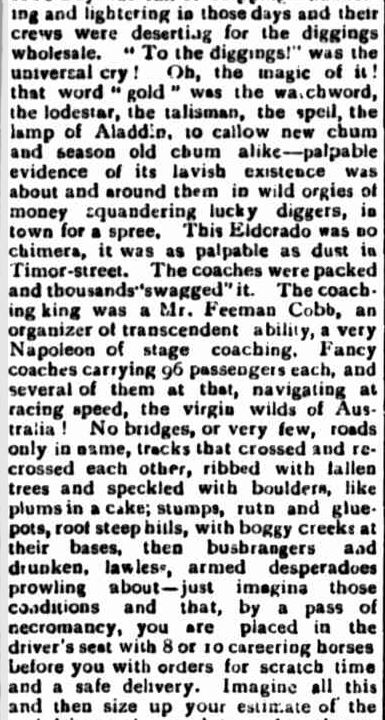
George Deihl McCORMICK: Died 29 May 1916 at Warrnambool.  Born in Toronto, Canada, George McCormick arrived in Victoria in 1852. He farmed and apparently became a part-owner of Cobb & Co. coaches. While I can’t find evidence of this claim, George did know a lot about Cobb & Co. as recorded in his reminisces from 1902 with a writer from the Warrnambool Standard. The article also appeared in the Portland Guardian of January 20, 1902

mccorm mccorm1 mccorm2

This is a perfect opportunity to show a Cobb & Co. coach and the Leviathan coach, introduced in 1862, was the height of madness. Smaller coaches would have been scary enough to ride in as they hurtled along unmade roads. But a coach for 89 passengers. What were they thinking? George’s account above mentions the perils facing the Leviathan coach, but it was not the risk that proved them unsuccessful. Rather, the driver’s whip could not reach the front horses, so a bag of stones was carried to throw at the leaders.

COBB & CO COACH WITH 89 PASSENGERS. Image courtesy of the State Library of Victoria Image No. H4051 http://handle.slv.vic.gov.au/10381/72175

COBB & CO COACH WITH 89 PASSENGERS. Image courtesy of the State Library of Victoria Image No. H4051 http://handle.slv.vic.gov.au/10381/72175

George became a police magistrate in 1882 and purchased Bournfield Park Estate at Woodstock near Whittlesea and in 1889 he arrived in Warrnambool.  He remained there until his death.  He left a wife, Barbara Waddell and five sons and four daughters.

John James VILLIERS:  Died May 1917 at Warrnambool. London born John Villiers was a talented man. He arrived in Victoria in 1858 aged around seventeen and headed to the diggings. In the early 1860s, he went to Warrnambool and his obituary in the Argus on 12 May 1917 said he ran a painting and decorating business in Liebig Street and imported crockery.  John’s interest in painting went beyond house painting.  He enjoyed painting landscapes in oils and watercolors and once he presented a painting to the Warrnambool Art Gallery.

A man of the arts, John was also an amateur dramatic and vocal performer and organised dramatic events to raise money for the likes of the Warrnambool Hospital and the Mechanics Institute. John was a part of the earliest known sound recording in Australia by Warrnambool shoe shop owner, Thomas Rome on one of the first Edison phonographs. John Villiers sang The Hen Convention and if you click on the link, you can hear the song. More information about Thomas Rome and John Villiers and their recordings can be found in a story by ABC Southwest from 2010.

Sarah BARKER: Died May 1917 at Ararat. Most months I can find a pioneer that I have even just a tenuous family link to.  This month it is Sarah Barker. Sarah was the mother of Stephen Ward. Stephen married Isabella Harman, daughter of James Harman. I didn’t know that Sarah Jerrett, as she was in her obituary, was formally Sarah Ward and Sarah Baker.  When I read the obituary, however, it mentioned the Ward connection and her son Stephen.

Sarah, from Norfolk, England, and her first husband James Ward, arrived at Portland in 1852.  She was twenty-three.  Sarah remained there until the late 1890s when she moved to Ararat. Prior to that  Sarah and James had seven children. including second youngest Stephen in 1867. James died in 1879 and Sarah married Francis Jerrett in 1883.

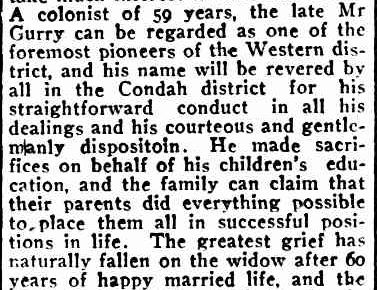
John GURRY:  Died 24 May 1917 at Condah. John Gurry and his wife left Ireland for Portland in 1857. They tried Harrow and Branxholme, running the Western Hotel there, then settled in Condah where John ran a farm. In their later years, they moved into the Condah township. John was buried in a family grave at Portland.

OBITUARY. (1917, May 28). Port Fairy Gazette (Vic. : 1914 - 1918), p. 2 Edition: EVENING. Retrieved May 23, 2013, from http://nla.gov.au/nla.news-article88021627

OBITUARY. (1917, May 28). Port Fairy Gazette (Vic. : 1914 – 1918), p. 2 Edition: EVENING. Retrieved May 23, 2013, from http://nla.gov.au/nla.news-article88021627

Adam EDGAR:  Died 8 May 1941 at Tapanui, New Zealand.  At the age of six, Adam arrived in Portland aboard the Severn in 1857 with his parents, James and Isabella, and his eight siblings. The family went straight to Pine Hills  Harrow the property of James Edgar’s brother, David. Like his cousins and siblings, he was educated at the private school David Edgar had established at Pine Hills.  In 1871,  Adam married Margaret Huston and in 1875, they left for New Zealand where they stayed for the rest of their lives. One of Adam and Margaret’s sons was the Reverend James. Huston Edgar, an explorer, missionary, and author who spent much of his life in China. His obituary is below. Adam’s sister Jean Edgar was a Passing Pioneer from March 2012.

MR. J. H. EDGAR DEAD. (1936, April 6). The Courier-Mail (Brisbane, Qld. : 1933 - 1954), p. 14. Retrieved May 26, 2013, from http://nla.gov.au/nla.news-article36803018

MR. J. H. EDGAR DEAD. (1936, April 6). The Courier-Mail (Brisbane, Qld. : 1933 – 1954), p. 14. Retrieved May 26, 2013, from http://nla.gov.au/nla.news-article36803018

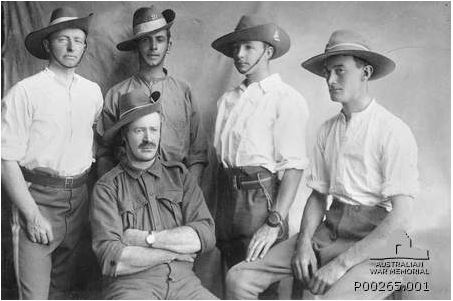
Captain Robert Ernest BAKER: Died 4 May 1943 at Larpent. What an interesting character Captain Baker was. Not a ship’s captain, but a captain in the AIF during WW1 he served with the 8th Light Horse. Reading his eighty-eight-page service record, I found that Baker was actually a Lieutenant when delisted and was only a temporary Captain for a short time during his service. “Captain” does have a better ring to it.

This wonderful photo from the Australian War Memorial has a real Western District flavour but sadly only one, Robert Baker, returned.  Captain Baker is seated on the left.  He was forty-one at the time of enlistment.  The other men are seated right:  Keith Allan Borthwick of Armadale. Standing from left: Major Thomas Harold Redford of Warrnambool, Lt Edward Ellis Henty of Hamilton, Lt Eliot Gratton Wilson of Warrnambool.

Edward Ellis Henty was the grandson of Stephen George Henty. He, Borthwick, Redford, and Wilson joined up on the same day, 21 September 1914 and all died on the same day, 7 August 1915 at the battle of The Nek at Gallipoli.  Robert Baker’s war was plagued with illness, including dysentery and lumbago, but it probably saved his life.  On 7 August 1915, he was in the No 1 Australian Stationary Hospital on Mudros.

Image Courtesy of the Australian War Memorial P00265.001 http://www.awm.gov.au/collection/P00265.001

Image Courtesy of the Australian War Memorial P00265.001 http://www.awm.gov.au/collection/P00265.001

After the war, Captain Baker transformed his property at Larpent into a sanctuary for the native fauna.  He often contributed to the Nature Notes in the Argus.

NOTES FOR BOYS. (1930, September 9). The Argus (Melbourne, Vic. : 1848 - 1957), p. 9. Retrieved May 26, 2013, from http://nla.gov.au/nla.news-article4189243

NOTES FOR BOYS. (1930, September 9). The Argus (Melbourne, Vic. : 1848 – 1957), p. 9. Retrieved May 26, 2013, from http://nla.gov.au/nla.news-article4189243

In 1936, he offered kangaroos from his own sanctuary to the Healesville sanctuary.  Healesville Sanctuary was in its first years as it was officially opened in 1934.

Healesville Shire Council. (1936, May 2). Healesville and Yarra Glen Guardian (Vic. : 1900 - 1942), p. 3. Retrieved May 26, 2013, from http://nla.gov.au/nla.news-article60453763

Healesville Shire Council. (1936, May 2). Healesville and Yarra Glen Guardian (Vic. : 1900 – 1942), p. 3. Retrieved May 26, 2013, from http://nla.gov.au/nla.news-article60453763

Herbert Edward RIPPON:  Died 19 May 1954 at Hamilton. Herbert Rippon was the son of George Rippon, part-owner of the Hamilton Spectator.  Herbert lived at Edradour, a house on Ballarat Road, Hamilton I must have passed a thousand times.  Photos of Edradour can be seen on a Hamilton real estate agency listing.  Herbert inherited ownership of the Hamilton Spectator in 1899. The Victorian Heritage Database has a short bio on Herbert and he was one of the original backers of Sir Reginald Ansett, then a Hamilton resident. He also was a director of John Thompson & Co department store of Hamilton.  Herbert is pictured below at the Hamilton races, third from the left.

WESTERN DISTRICT PICNIC RACE CLUB’S ANNUAL MEETING, HELD ON THE HAMILTON (V.) RACECOURSE ON WEDNESDAY, DECEMBER 12. (1923, December 22). The Australasian p. 58.  http://nla.gov.au/nla.news-article140831487

He was buried at the Hamilton (Old) Cemetery with other members of the Rippon family.

RIPPON FAMILY GRAVE, HAMILTON (OLD) CEMETERY

Trove Tuesday – Ladies of the Night

It is not surprising Pam Jennings was able to write three volumes of her book, Wild and Wondrous Women of Geelong if this week’s Trove Tuesday article from the Boxing Day, 1848 edition of the  Geelong Advertiser  is anything to go by.  Not only that,  my own wild and wondrous ggg grandmother Ellen Barry and her sister Mary were living in Geelong at the time and I have found references to both of them in Volume 3 (1870-1879).  Despite Ellen’s vices, I doubt she would have been the type to take a ride in Geelong’s “nuisance” cab.

CHRISTMAS. (1848, December 26). Geelong Advertiser (Vic. : 1847 - 1851), p. 2 Edition: MORNING. Retrieved May 21, 2013, from http://nla.gov.au/nla.news-article93133214

CHRISTMAS. (1848, December 26). Geelong Advertiser (Vic. : 1847 – 1851), p. 2 Edition: MORNING. Retrieved May 21, 2013, from http://nla.gov.au/nla.news-article93133214

Soon we will be able to read more from the Geelong Advertiser on Trove, with issues from 1857 to 1918 due to be added in the 2013/14 financial year.  This is exciting news for anyone with family in Geelong, including myself, but also Western District researchers.  You can read more about it on the Geelong and District blog.


The Victorian Heritage Database

On May 5, I attended Day 2 of the Victorian Association of Family History Organisation (VAFHO) conference in Ballarat.  It was a great day with some wonderful speakers and I regret I couldn’t make it the first day.

The first keynote speaker was Lisa Gervasoni, a town planner dedicated to Heritage conservation and a member of the Daylesford & District  Historical Society, among other things.  She gave a great talk about using Google Maps to help with family history research and then showed us the usefulness of the Victorian Heritage Database (VHD).  Timely, as I had considered a post about the VHD as I think it is a valuable resource for those researching families from Victoria.

The Victorian Heritage Database is a collection of Heritage places and precincts in Victoria including Heritage studies completed by local councils around the state.

While writing Passing of the Pioneer posts, if I see a property name in an obituary, I head straight to the VHD.  If the property is on the database, most times I can find more about the obit’s subject.  There is always a history of the building, property, etc offering a wealth of information

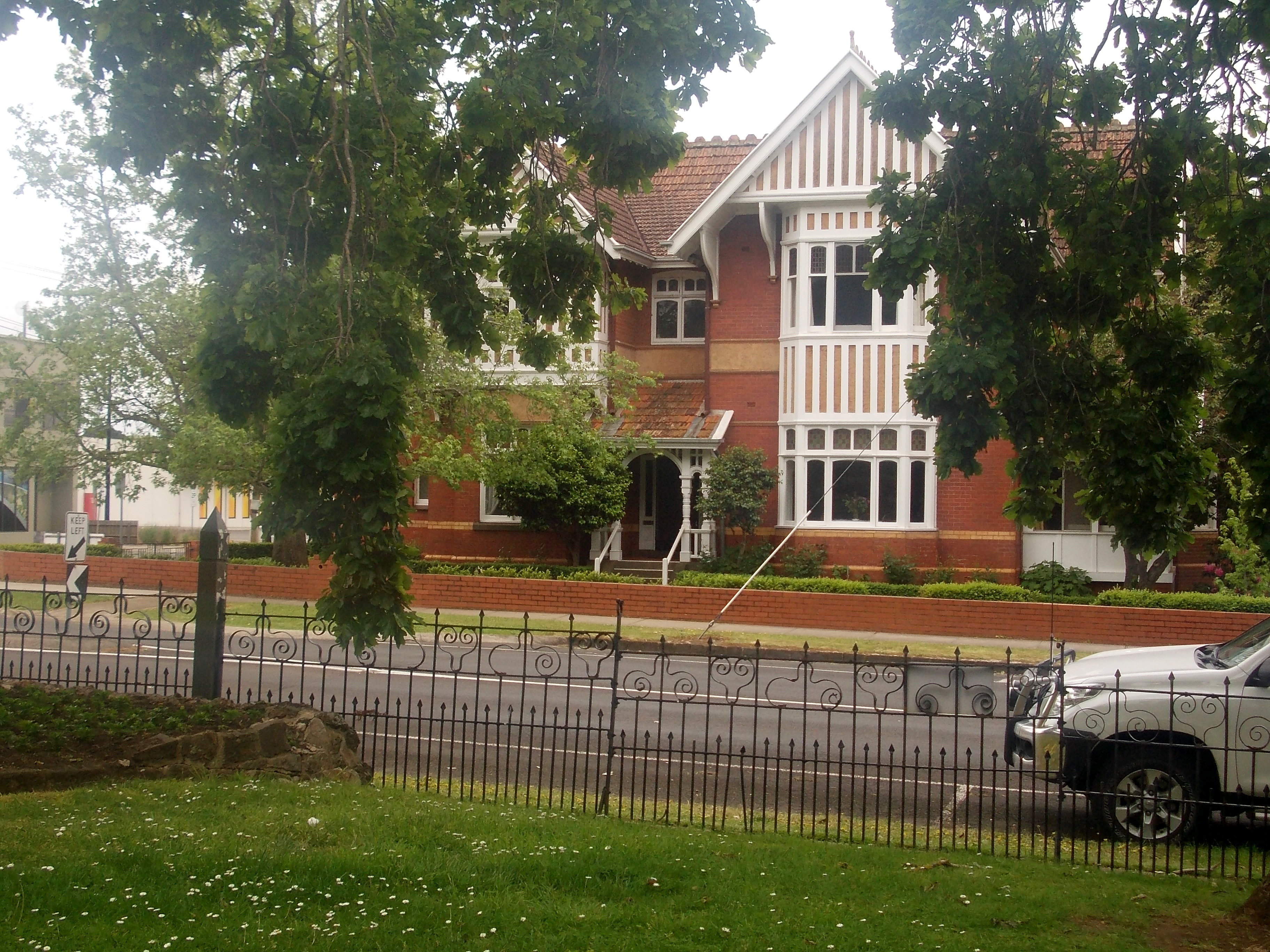
In May Passing of the Pioneers, one obituary belonged to Mary Laidlaw (nee Learmonth).  She and her husband David lived at Eildon” in Hamilton.  A search found information about the house, the architects Ussher and Kemp, and the Napier Club purchasing the building in 1939, the year of Mary’s death.  Not only was I able to expand on the obituary, I learnt something of a house that it is a Hamilton landmark and has intrigued me since childhood.

"EILDON", HAMILTON

“EILDON”, HAMILTON

The VHD was useful when I researched The Parisian, the 1911 Melbourne Cup winner because his owner John Kirby lived at “Mt Koroite Station” opposite Coleraine Racecourse.  On the VHD entry for “Mt Koroite” I found out more about John and even what he did with his winnings from the Melbourne Cup.

The VHD  is useful when researching a cemetery and I have used it for cemetery related posts.  There are photos of headstones and the Byaduk Cemetery entry even has a photo of Jonathon Harman’s headstone.  A short history of the town is given and a history of the cemetery, early burials, and notable “residents” and more.

I have searched property names and town names, but not surnames and Lisa’s talk made me realise I should.  Individuals may be listed as builders of a property or a labourer on a station.  My search of towns had found some references to my family members but I thought for the purpose of this post I would search specific family names.

None of my family were owners of large holdings or houses but the Diwell family were bricklayers and George Jelly was a builder, so maybe there was a chance.

When searching the VHD, use the “Advanced Search” form (below). It will give you more results than the “Simple” search.

There are plenty of options to narrow down a search, but I only used the field “with all of the words“.

An entry on the database will include the location, statement of significance, history and description of the building or otherwise.  There is a Google Maps link with both the aerial view and Street View and most times there is a photo or photos.

Now for my results.  I did find entries I had seen before when searching towns,  but there were some new things.  What all the results show is the different ways your family members can be found at the Victorian Heritage Database.

HADDEN

My search started with the Haddens on my mother’s maternal line.  I had two relevant matches.  The first was about a Bills Horse Trough, in the Lions Park on the Glenelg Highway at Glenthompson installed in the 1920s.

A BILLS HORSE TROUGH (Portland Gardens)

A BILLS HORSE TROUGH (Portland Gardens)

While the horse trough had nothing to do with a Hadden, the entry has a history of the site, previously a blacksmith shop run by Donald Ross.  The other blacksmiths that operated in the town are named including the shop of  Harold James Hadden, my 2nd cousin 1 x removed.

Buggies outside blacksmith's shop. Image courtesy of the State Library of Victoria - Elliot collection. http://handle.slv.vic.gov.au/10381/42869

Buggies outside blacksmith’s shop. Image courtesy of the State Library of Victoria – Elliot collection. http://handle.slv.vic.gov.au/10381/42869

I knew Harold was a blacksmith and that he lived in Glenthompson during that time period, but I didn’t know he ran his own blacksmith shop.

Another entry under “Hadden” was found on a previous search of “Cavendish” and is about gg uncle William Hadden, son of William Hadden and Mary Mortimer.  In 1913, he purchased the Cavendish Cobb & Co Depot and Stables (below) and the adjacent property on the corner of Hamilton Road and Scott Street, Cavendish.  The 1914 Electoral Roll lists William’s occupation as a blacksmith, useful with a Cobb & Co depot.  However, in 1915, the train came to Cavendish taking passengers away from Cobb & Co.

By 1919, William was living at Kiata near Nhill in the Mallee, running the Kiata Hotel.  I am not sure if he had sold the Cobb & Co depot by that time but he never returned to Cavendish and died in Geelong in 1927.

HARMAN

A “Harman” search brought up not a building but a roadside Memorial plantation at Byaduk, sadly in poor condition.  The trees, planted in memory of the Byaduk soldiers that served during WW2, have not been maintained over the years.  My 1st cousin 3 x removed and grandson of James and Susan Harman, Leonard Roy Harman, was killed during the war as was another Byaduk man A.R.McNair.   The Southern Grampians Shire Heritage study on this site reported that much of the significance and integrity of the site had been lost.

The Memorial planting was the only “Harman” reference found until I did a “Byaduk” search.  Then I discovered that a search of “Harman” did not bring up any references to “Harman’s”.  This was after I read the report about the Byaduk General Store ruins.  The general store is thought to have opened around 1863 when another early shop opened,  Joseph Harman’s, bootmaking shop.

DIWELL

I then turned to Mum’s paternal side and searched the Diwells.

Surprisingly the result took me back to Cavendish, a town I never thought they had links to.  However, I found my gg uncle William Diwell, a bricklayer, was the contractor that built the Cavendish Memorial Hall in 1920.


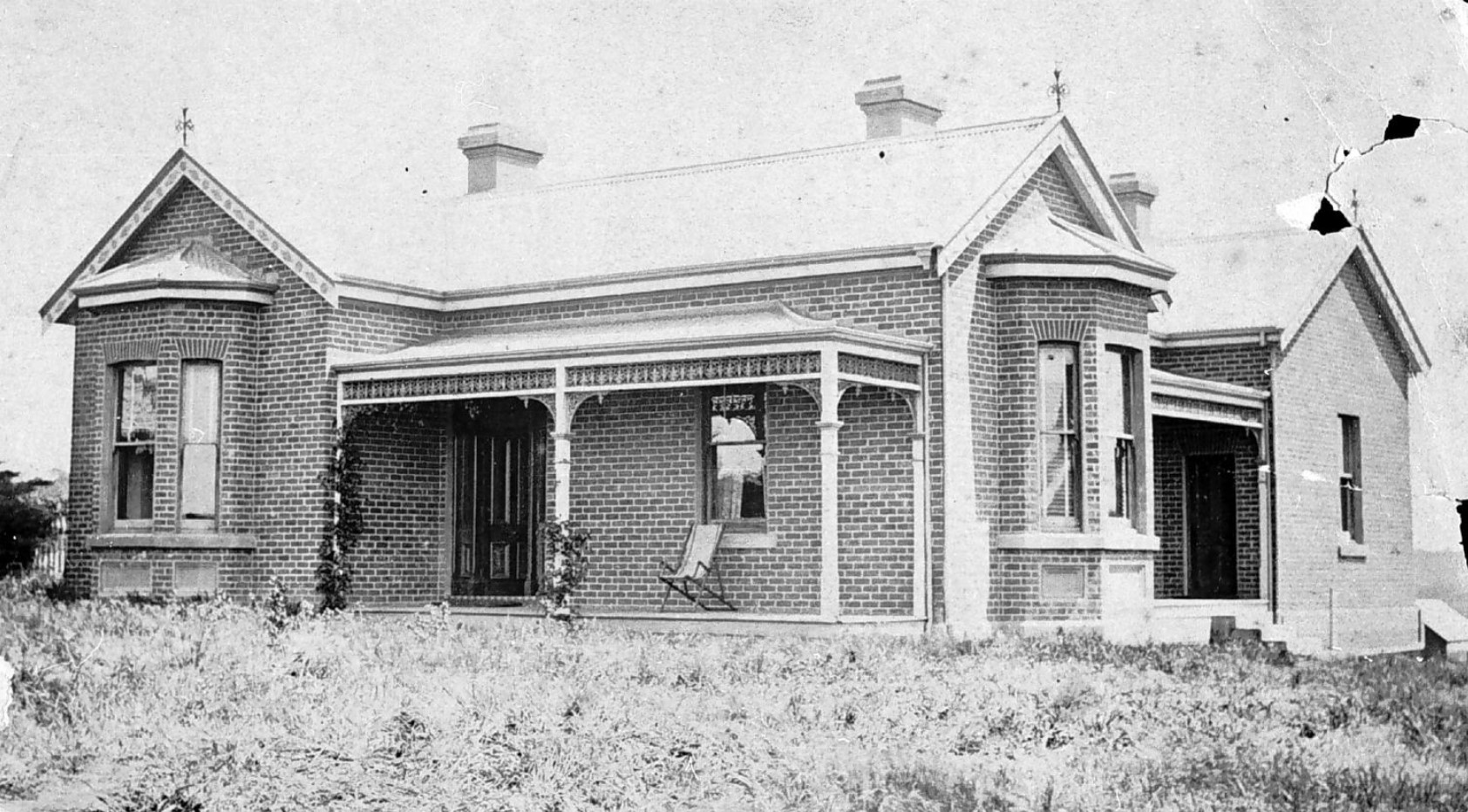
It was no surprise William Diwell was a bricklayer.  The following entries are about his father and grandfathers, all bricklayers or builders.

Firstly, St. Andrews Presbyterian Church in Merino.  Builders Northcott and Diwell built the church in 1868.  That would be ggg grandfather William Diwell and I am assuming Northcott is George Northcott of Merino.  George owned Merino’s Commercial Hotel (below) and the Cobb & Co Station.  From the VHD I  discovered they received  £126/15/- for the job and that they had also built the Merino Free Library and the Mechanics Institute.

COMMERCIAL HOTEL, MERINO 1880 Image Courtesy of the State Library of South Australia http://images.slsa.sa.gov.au/mpcimg/22000/B21766_112.htm

COMMERCIAL HOTEL, MERINO 1880 Image Courtesy of the State Library of South Australia http://images.slsa.sa.gov.au/mpcimg/22000/B21766_112.htm

The next Diwell match was for the Sandford Mechanics Hall (below).  I knew from a transcript of the booklet, Back to Sandford Centenary: 1957  on the Glenelg and Wannon Pioneers site, William Diwell senior had a link to the building of the Mechanics Hall but only that he suggested that it be made of brick and not wood.  The VHD shed a little more light on a conversation that took place between William and the committee secretary J.S. Anderson in 1864, but in doing so, it leaves me questioning the entry

From the Back to Sandford booklet,I knew that William ran into Mr Anderson on the Casterton Road.  Anderson told William of the plans to call for a tender for the building of a wooden hall.  William suggested a brick building and that Mr Anderson should take the idea to the committee before advertising.  The committee thought it was a great idea and they called for tenders for a brick hall.

Turning to the VHD, the report continues on from the above story but cites rate book entries from 1863 that Richard Diwell of Casterton was a brickmaker or bricklayer.  Richard was my gg-grandfather and he was nine in 1863. It continued with the story that William suggested Anderson go back to the committee, but added that William had a proposal, maybe an offer of funding.  The committee agreed to the unknown proposal and the tender process began.   The tender was won by James McCormack.

The thing is, the hall was not built until 1885, 19 years after William Diwell met Mr Anderson on the Casterton Road.  William had been dead 14 years.  So he could hardly be credited for a brick hall,  surely.  Also, why is Richard Diwell mentioned?  Did they mean William or was Richard involved later when the hall was built when, as a 30-year-old bricklayer, it was more realistic?

JELLY

I found entries for George Jelly, my ggg grandfather, and father-in-law of Richard Diwell.  George built the Anglican Rectory (below) in Henty Street Casterton in 1887.

CASTERTON ANGLICAN RECTORY c1890. Image courtesy of the Museums Victoria Collections https://collections.museumsvictoria.com.au/items/769228
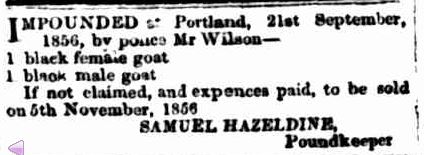
What particularly interested me came from a spontaneous search I did for the variation “George Jellie”.  It brought up the Coleraine Anglican Church.  The history of the church referred to the original structure built in 1853 by Casterton contractor, George Jellie.  My George Jelly did not arrive in Victoria until 1855 aboard the Athelate with his wife Jane and daughter, Mary.  According to his obituary, they first went to Murndal at Tahara, run by Samuel Pratt Winter, and then on to Casterton.  George and Jane’s firstborn child in Australia was my gg-grandmother, Elizabeth Ann Jelly at Casterton in 1856.

That beggars the questions, was there a George Jellie, contractor of Casterton in 1853, or did the first building at the Coleraine Anglican Church not get constructed until around 1856 by which time George Jelly had arrived in the town?  More research is needed on that one.

George’s obituary credits him for building the Casterton Mechanics Institute also, however that building is not on the VHD.

——————————————————–

While the Victorian Heritage Database is full of useful information, I do wrestle with it on occasions as it takes on a mind of its own.  I use a Firefox browser and I think it doesn’t agree with the database. I have tested Chrome and it seems a lot happier.  Another problem I occasionally have is when clicking on a link to VHD from Google or Western District Families.  I get a message that my session has ended.  If that happens, page back and click again and it will come up.

More on Lisa Gervasoni.  Lisa has over 300,000 photos on Flickr and they are also found with a Trove search.  Lisa’s photos of landmarks and war memorials, often come up in my searches of Western Victorian towns.  When I have wanted to see what something in the Western District looks like, Lisa’s great photos have been there.  Thank you, Lisa.

More on the VAFHO conference.  It was great to finally meet in person, Liz Pidgeon from the Yarra Plenty Regional Library and Infolass blog, who I have known on social media for some time.   I also met Craige from the Mortlake Historical Society.  You should check out the great Facebook page he is running for the society.

Trove Tuesday – For Wives and Daughters

The “For Wives and Daughters” columns from the Colac Herald first came to my attention while researching my fashion posts.  The column has fashion tips, recipes, handy hints and more.  I found the column in two other papers, the Warwick Examiner and Times of Queensland and the Western Mail from Perth.  The earliest date I found the column was 1897. The earliest column in the Colac Herald was 1910 and it seems to have run through to the end of 1918 in that paper.

forwives1

FOR WIVES AND DAUGHTERS. (1916, February 23). The Colac Herald (Vic. : 1875 - 1918), p. 3. Retrieved May 12, 2013, from http://nla.gov.au/nla.news-article75256133

FOR WIVES AND DAUGHTERS. (1916, February 23). The Colac Herald (Vic. : 1875 – 1918), p. 3. Retrieved May 12, 2013, from http://nla.gov.au/nla.news-article75256133

In 1914, the tight skirt was on the way out.

daughters“Waste not, want not” was an adage I heard regularly throughout my childhood, one of Nana’s favourites.

daughter1If you want to make dish washing less of a chore, here is a handy hint courtesy of an American housewife.  Or if the cooler weather has caused your nose to run, be sure to apply Vaseline around your nose and mouth area before bed tonight.

daughter2

OR WIVES AND DAUGHTERS. (1914, April 1). The Colac Herald (Vic. : 1875 – 1918), p. 3. Retrieved May 13, 2013, from http://nla.gov.au/nla.news-article74224403

Wondering what to have for dinner tonight?  Fancy some tongue?  Maybe some Pigeon Pie is more to your liking.

Useful Recipes. (1914, April 1). The Colac Herald (Vic. : 1875 - 1918), p. 3. Retrieved May 13, 2013, from http://nla.gov.au/nla.news-article74224398

Useful Recipes. (1914, April 1). The Colac Herald (Vic. : 1875 – 1918), p. 3. Retrieved May 13, 2013, from http://nla.gov.au/nla.news-article74224398

Look out for more “For Wives and Daughters” on future Trove Tuesdays.