Passing of the Pioneers

This is the fourth “Passing of the Pioneers” and includes a chess champion who lived in Merino and plenty of Irish influence.  They highlight some of the pioneers of Victoria’s Western District by way of their obituaries as published in the Portland Guardian.  If you would like to read the full obituary, just click on the pioneer’s name.

Emma WITHERIDGE: Died  4 October 1888 at Portland. This obituary demonstrates the tone of many at the time.

OBITUARY. (1888, October 5). Portland Guardian (Vic. : 1876 – 1953), p. 2 Edition: EVENING.. Retrieved October 26, 2011, from http://nla.gov.au/nla.news-article63590480

George BEVAN: Died  17 October 1888 at Portland. George owned and died at the London Hotel in Portland.  His family notice shows he was born in Somerset, England and was fifty-nine at the time of death.  George had been in Portland since the early 1860s and was a keen sportsman and former Town Councillor.

Mary ROGERS: Died October 1912 at Greenwald.  Mary Rogers was aged eighty-six at the time of her death and had lived in Victoria for sixty years.  She originally went to Tasmania from Ireland with her parents as a small child.  Mary married Francis Egan who had passed away thirty years earlier.

William Sudgen Price LEWIS: Died 4 October 1915 at Hamilton. William Sudgen Price Lewis was the stepson of Richard Lewis, a former owner of Rifle Downs at Digby.  Born in Tasmania in 1835, William and his brother came to live with Richard Lewis when Richard and their mother married in 1841. In adult life, William leased Hilgay station for a time, bred fine livestock and was a member of several racing clubs. He later retired to Hamilton. He was buried at Hamilton (Old) Cemetery (below).

John Hawkins ROW: Died 27 October 1926 at Portland. John Row was a Portland jeweller.
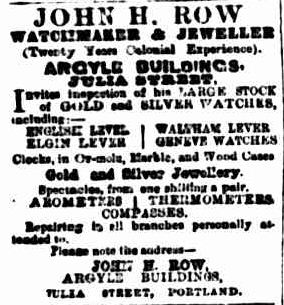
Advertising. (1879, March 27). Portland Guardian (Vic. : 1876 – 1953), p. 2 Edition: MORNINGS.. Retrieved October 27, 2011, from http://nla.gov.au/nla.news-article63341984

At the time of his death, he was the oldest member of the Portland Free Library and the bowling club.  He was also a member of the St Stephen’s Church congregation.

St Stephens Church Portland

John McDONNELL: Died 17 October 1930 at Moree. Mr McDonnell was originally from Ireland and arrived in Australia in 1863 via Liverpool. He was considered one of the oldest people in the district. He married Catherine FAHEY and they selected land at Moree in 1865.

Catherine Bridget SAMPEY: Died October 1933 at Melbourne. Catherine Sampey arrived in Melbourne from Ireland aboard the Red Jacket in 1852. She travelled on to Chetwynd with her brother James Sampey and she later married Patrick WHITE of Casterton.

Elizabeth MONOHAN: Died 12 October 1933 at Casterton. Elizabeth Monohan was 100 when she died. Arriving from Ireland aboard the Frances Henty at age twenty-one, seventy-nine years before, she was still able to converse in Welsh and Gaelic in her later years. In 1859, she married John Glover at Sandford House.

Julia Teresa DOYLE: Died October 1934 at Portland. Born in Tipperary, Ireland but remembered as “a true type of a fine old English lady”, Julia Doyle arrived in Australia as a six-year-old in the mid-1850s. She married Frances SUTTON in 1874 and together they had six daughters and two sons.

Ernest John SEALEY: Died 25 October 1935 at Casterton. In his younger years, Ernest Sealey worked as a bullock driver transporting wool. In later worked on Portland’s deep-water pier, hauling logs from the forests to the pier.

Charles PRATT: Died 26 October 1935 at Birchip.
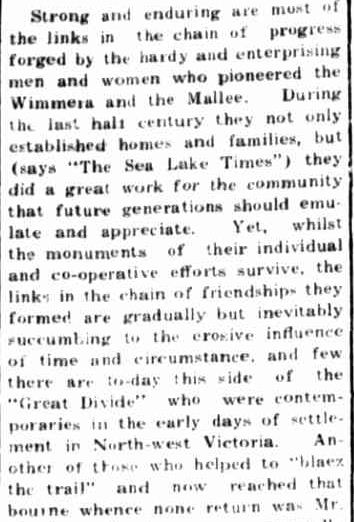
Obituary. (1935, November 4). Portland Guardian (Vic. : 1876 – 1953), p. 2 Edition: EVENING.. Retrieved October 27, 2011, from http://nla.gov.au/nla.news-article64290777

And so begins the obituary of Charles Pratt.  Charles or Charley as he was widely known, was born at Mumbannar in 1870.  In 1891, he went to Beulah in the Mallee and worked with his step-brother and later selected his own land near Watchupga.  He married Annie LAVERY in 1914 and they had three sons.

Thomas Denton CLARKE: Died 5 October 1937 at Hamilton. Thomas, born around 1847 at Liverpool, was the son of Captain Thomas H. Clarke who was a trader in Portland.  Thomas jnr was a champion chess player and a composer of chess problems.  He won many competitions for both pursuits.  Composing problems up until his death, it was considered probable, according to the obituary, that he was the world’s oldest composer.

James McCLUSKEY: Died October 1942 at Koroit. James McCluskey was born at Portland in 1857, not long after the arrival of his parents on the ship, British Empire. Soon after, the family travelled by bullock wagon to Kirkstall near Warrnambool.  In his early working life, James drove pigs to Port Fairy in order to load them on the steamer Casino to go to market in Melbourne.

Mary PRATT: Died 7 October 1942 at Greenwald. Mary, the widow of George COWLAND, was eighty-seven at the time of her death.  There were twelve children in their family.  Her obituary recalled her pioneering traits.
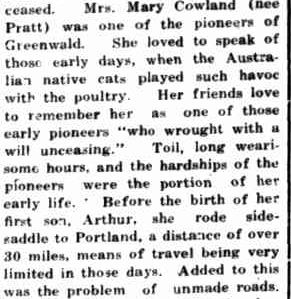
OBITUARY. (1942, October 26). Portland Guardian (Vic. : 1876 – 1953), p. 2 Edition: EVENING. Retrieved October 27, 2011, from http://nla.gov.au/nla.news-article64382483

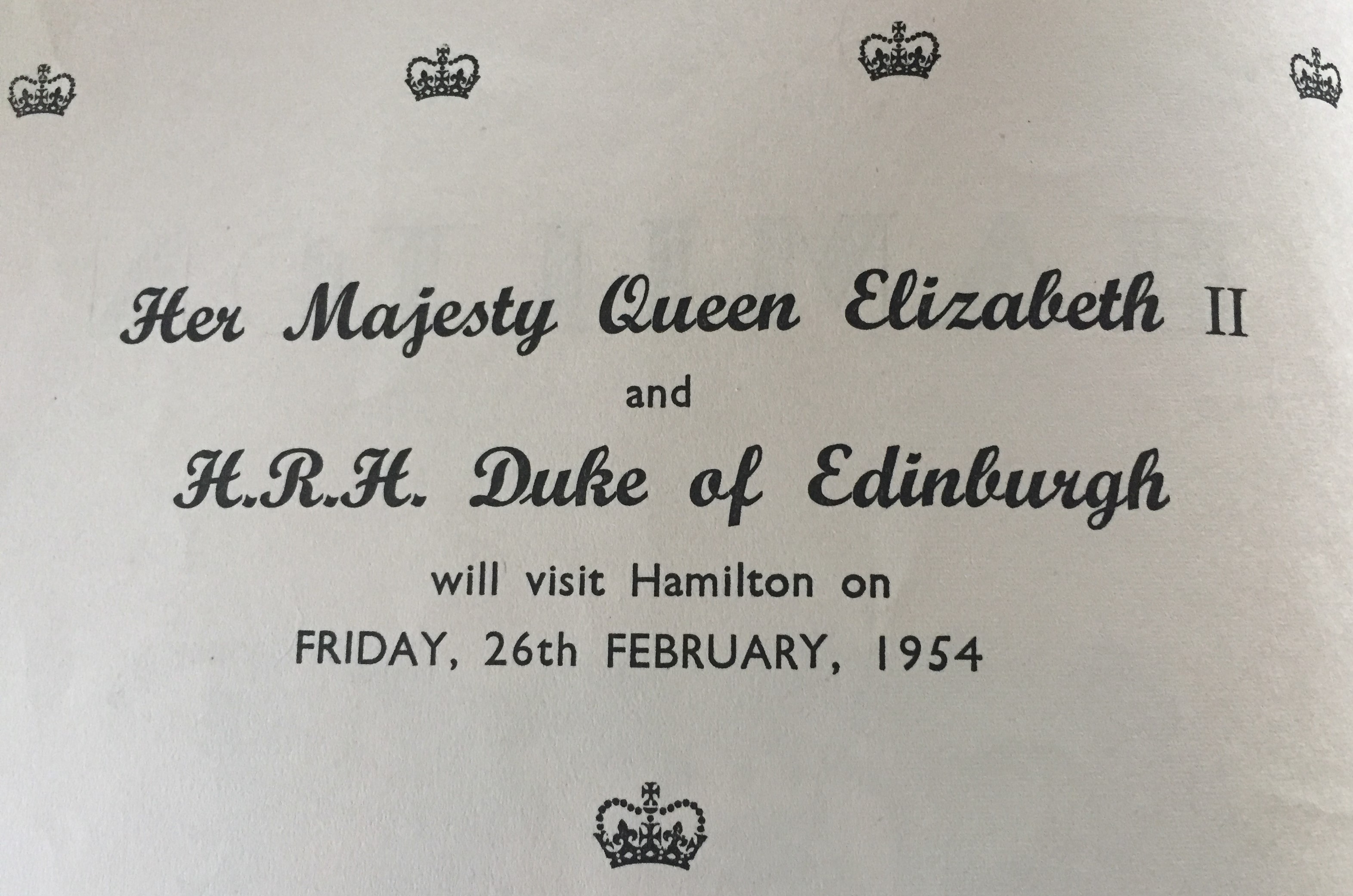
The Day the Queen Visited Hamilton

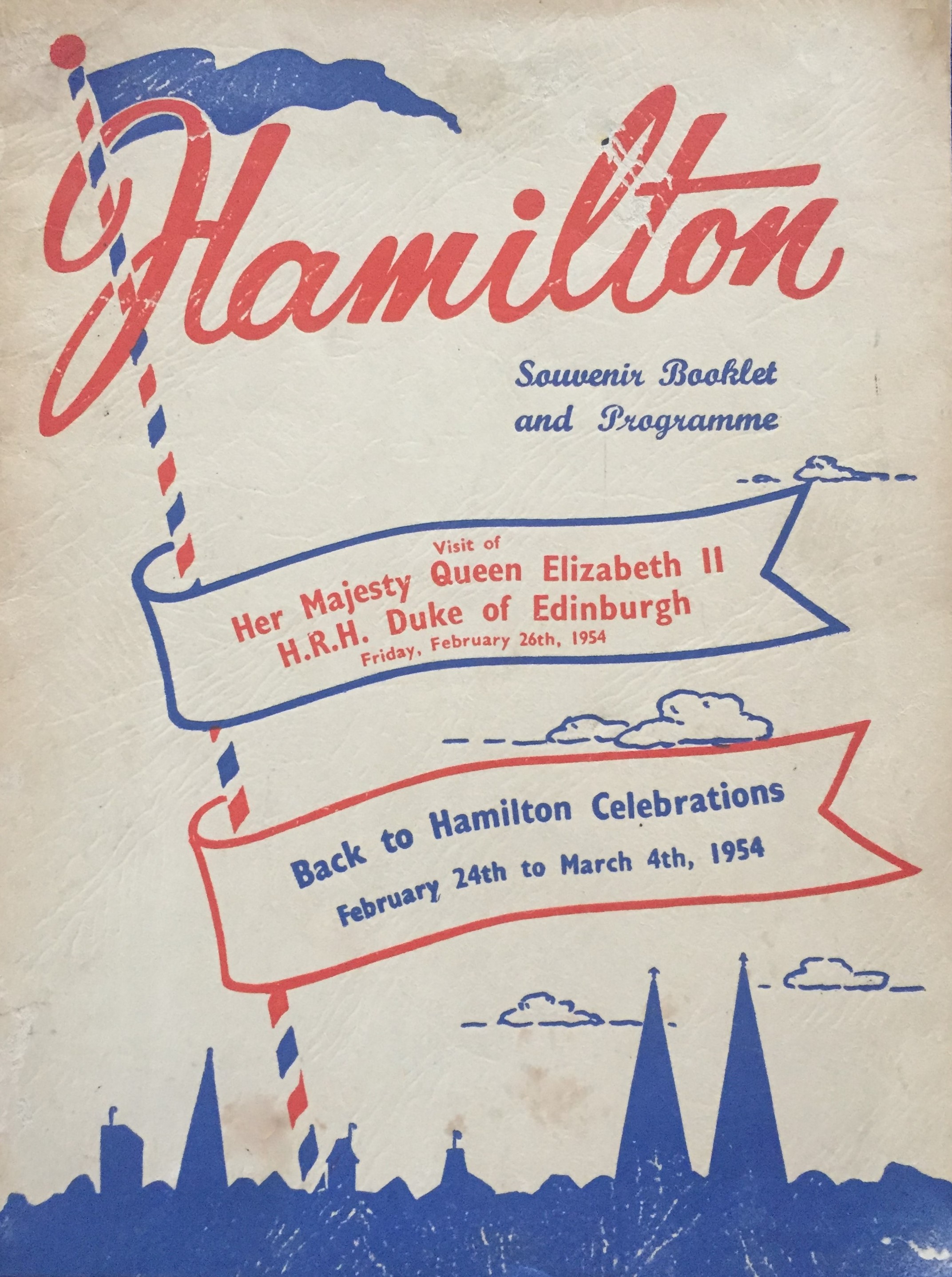
Hamilton Souviner Booklet and Program, 1954

On 26 February 1954, Hamilton was buzzing with excitement for a much-anticipated visit by Queen Elizabeth II and Prince Phillip, Duke of Edinburgh.

Mt Gambier and Hamilton were the only locations in the region chosen for a visit by the new Queen, despite much lobbying by nearby towns. The inter-town rivalry preceding the visit was immense. Headlines in the Portland Guardian at the time included “Number One Priority for Royal Visit Should Have Been Portland’s” and “No Royal Visit an Insult to Portland”

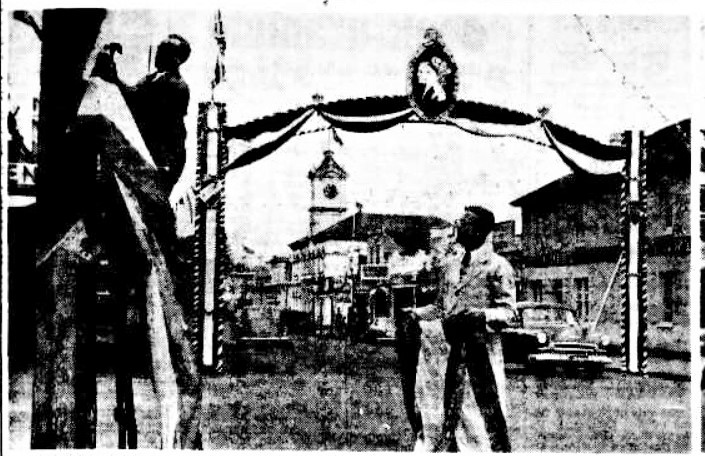
Hamilton wanted to put on a show, and preparations started long before the big day. Residents decorated their homes, some with flags on the roofs for the Queen to see as she flew into the Hamilton Aerodrome.  The council spent £5,000 on decorations, including four large arches around the town, with one on the outskirts made of locally grown hay, oats, and flax, with “Welcome” crafted from wool, for which the district was famous. Several kilometres of bunting, flags, and lights decorated the CBD.

HAMILTON READY TO GREET QUEEN (1954, February 26). The Argus,p. 15. http://nla.gov.au/nla.news-article26593166

More than 100,000 people were expected to converge on the town. Local hotels set up beds in the lounges and on balconies to accommodate the overflow of guests and accommodation houses up to 60 kilometres away reached capacity.

The Royal Visit coincided with “Back to Hamilton” celebrations, and the organising committee published a souvenir booklet.

PHOTO OF AUTHOR’S COPY.

On the big day, The Argus published a map of the best places to glimpse the Queen and Duke.

Where to see the Queen Today FIRST COUNTRY VISIT. (1954, February 26). The Argus p. 7. http://nla.gov.au/nla.news-article26593160

At Melville Oval, around 13,000 school children started assembling from 8.00am.

Along with the school children were several thousand others, many travelling long distances.

HAMILTON’S FAMILY WELCOME. (1954, February 27). The Argus, p. 15. http://nla.gov.au/nla.news-article26593294

With the Queen’s plane scheduled to arrive at the Hamilton Aerodrome, to the north of the city, at 3.35pm, the Dundas Shire President, Cr. Henry Bull, his wife, and around 3000 eager locals gathered to meet Queen Elizabeth and the Duke. Young Rosemary Oates prepared to present Her Majesty with a bouquet.

Back to Hamilton visitors saw Queen and Duke (1954, March 10). Weekly Times p. 78. http://nla.gov.au/nla.news-article224910934

The plane was five minutes late, and a gasp went up from the large crowd when part of the carpet laid on the tarmac almost blew away from the force of the plane’s propellers.

MARGARET OATEN PRESENTS QUEEN ELIZABETH WITH A BOUQUET (1954, February 27). The Argus, p. 7. http://nla.gov.au/nla.news-article26593444

The Royal party then moved by car to Melville Oval, where the schoolchildren were still patiently waiting after eight hours.

Hamilton rocked in Royal salute. (1954, February 27). The Argus p. 7. http://nla.gov.au/nla.news-article26593444

The sight of the decorated city, and an estimated 70,000 adults and children waving, saw the Queen wipe her eyes several times before the motorcade came to a halt at Melville Oval.

Hamilton welcome Queen had tears in her eyes (1954, February 27). The Argus p. 4.  http://nla.gov.au/nla.news-article26593398

After being met by Mayor Cr. Reginald White and Town Clerk Hector Donald and their wives, the royal couple drove around Melville Oval before returning to the airport for a flight to Melbourne.

The Age (Melbourne, Vic. : 1854 – 1954) 27 February 1954, p. 3. http://nla.gov.au/nla.news-article206088677

But not before eight-year-old Jennifer Biggs from Hamilton State School had the honour of presenting the Queen with a bouquet.  Jennifer is pictured below, practising her courtesy before the event while her classmates watch on.

Rag doll aids girl’s curtsy (1954, February 26). The Argus , p. 15.  http://nla.gov.au/nla.news-article26593193

“Hamilton’s Children Cheer the Queen” The Age 27 February 1954: p. 8. http://nla.gov.au/nla.news-article206088514 

Hamilton rocked in Royal salute (1954, February 27). The Argus, p. 7. http://nla.gov.au/nla.news-article26593444

On the return trip to the aerodrome, the Royal party drove past the Hamilton Hospital, where members of the nursing staff excitedly waved to the passing motorcade.

(1954, February 27). The Argus p. 7. http://nla.gov.au/nla.news-article26593444

Back at the aerodrome, around 3,000 people waited to farewell the Royal visitors.  The Argus of 27 February 1954, described how the large crowd “surged forward in a wild rush” jostling “elderly men and women and young children.”

It was a memorable day for Hamilton, one not since matched, and almost 70 years later, it remains in the memories of those who were there to experience it.

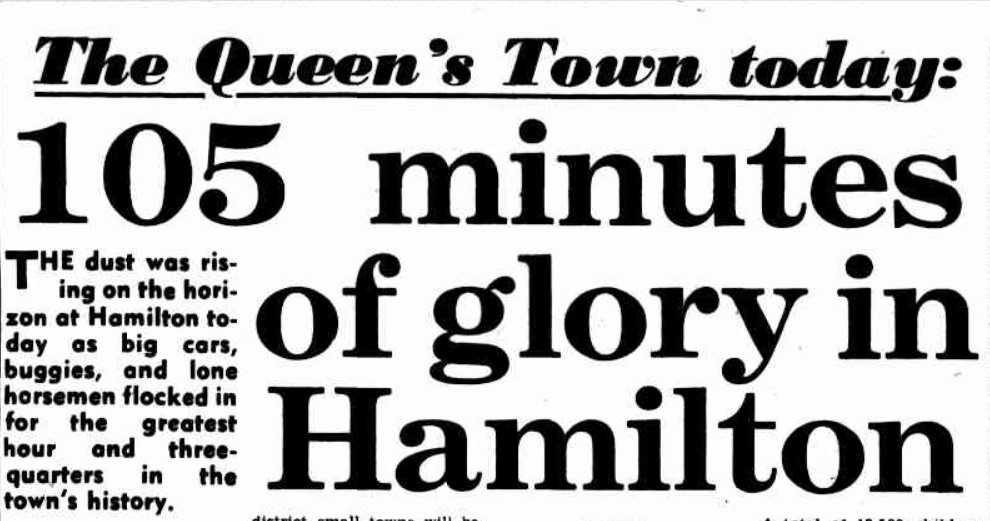
The Queen’s Town today: 105 minutes of glory in Hamilton (1954, February 26). The Argus, p. 2. http://nla.gov.au/nla.news-article26593119

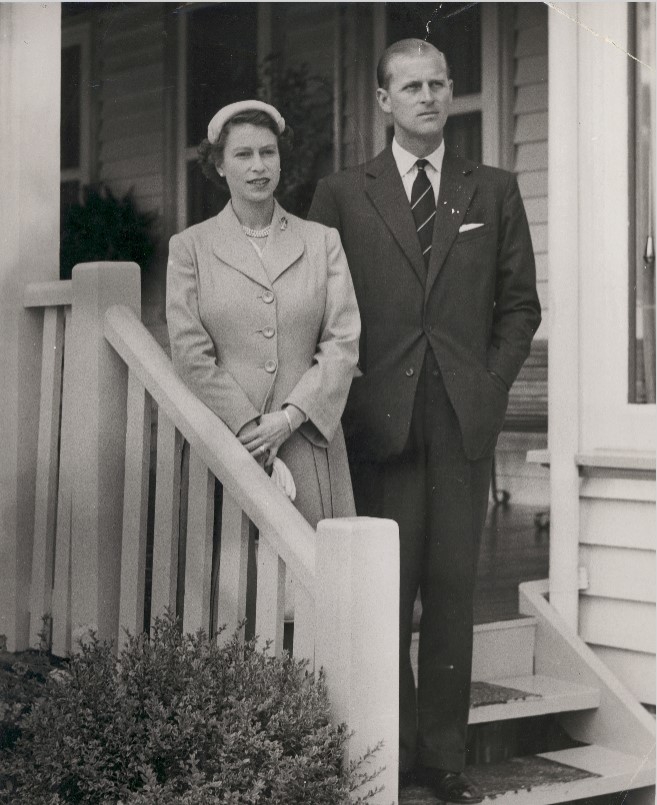
QUEEN ELIZABETH II & PRINCE PHILLIP, DUKE OF EDINBURGH DURING THEIR 1954 TOUR OF VICTORIA. Image courtesy of the State Library of Victoria http://handle.slv.vic.gov.au/10381/245876

They Were Not Alone

I used to imagine life for my great-grandmother, Caroline Kirkin, arriving in Victoria in 1913, with husband Thomas Riddiford and five sons and the difficulties she faced as a woman in such circumstances.  Hardly pioneer times, but without siblings and parents, and living in the small country town of Smeaton, north of Ballarat, she must have felt alone.  She may not have had the companionship of other women at a time when she was raising small children with more on the way.  In time, she would have made friends, but would that have been the same as having family to share memories of growing up in London, a long way removed from country Victoria.

I have also considered life for Susan Reed, my ggg grandmother and wife of James Harman. (below)

JAMES & SUSAN HARMAN. Photo courtesy of Mike Harman & family.

She arrived at Portland in 1852, a new bride at 22.  As assisted immigrants, James had to work for a local property owner to repay their passage, and Susan would have been left alone.  Babies began to arrive in 1854 and James would have been busy establishing a life for them.  Images that would come to mind resembled a Frederick McCubbin painting.

Even Rosanna Buckland, who has led me on a merry chase, has evoked similar feelings within me.  I felt for her on the treacherous voyage to Australia on the “Bombay” and then living in the “bush” at Mt William station with her husband James Mortimer.

Later in my research, when I began to investigate the siblings of these three women,  my picture of their lives in Australia changed.  I snapped out of my romantic imaginings to the reality that these women had a greater support system than first thought.  They were definitely not alone.

Susan Read left siblings, including a brother William, at home in Melbourn, Cambridgeshire.  Searching the Victorian BDM’s for Susan’s death record, using just parent names, brought up a William Reed who died at Muddy Creek, in 1889 with the same parents as Susan.  I had found Susan’s brother living just down the road from her.  William married Sarah Burgin in 1866 and they had seven children mostly in the Warrabkook area.

Woman of mystery Rosanna Buckland was not the only member of her family who could lay claim to the title.  Rosanna had a younger sister Elizabeth, who married Richard Myhill in Berkshire in 1851.  While browsing the passenger list of the “Bombay“, the Mortimer immigrant ship, I found Richard and Elizabeth Myhill also on board.  Elizabeth got off the ship, but where she went after that is unknown.  Richard Myhill shows up time and time again in the records and newspapers but married to Isabella Ross (1860), not Elizabeth Buckland.  So at least for some part, Rosanna had the support of her sister, who may have been a welcome helping hand on the “Bombay“.

Caroline Kirkin had a younger sister Ada.  Ada married Frederick Sturdy in London in 1911 and had three children by the time Caroline departed for Australia.  By 1914, Ada, Frederick, and children were themselves sailing for Australia.  I first found this after a search of Frederick William Sturdy at Ancestry brought up a match on the Australian Electoral Rolls.  The record listed his wife as Ada Sturdy and they were living in Sturt Street, Ballarat, the same town as Caroline.  How could I have not known about Caroline’s sister and her family?  No-one had ever mentioned them. The Sturdys stayed on in Ballarat before moving to Melbourne sometime around the outbreak of WW2 as Frederick had enlisted.

Caroline Celia Ann Kirkin

But wait that’s not all.  I was researching Caroline’s father Frederick Kirkin, who lived and died in London.  He was from a family of ten children, so I proceeded to find out more about them.  I knew that Frederick’s sister had married a Henry Smith, and it was another search at Ancestry which brought up a match for Elizabeth Rose Smith on the Australian Electoral Rolls in 1919 at Geelong.  A search of her death record showed she was in fact a Kirkin.  Elizabeth and Henry had three daughters, two I have confirmed came to Australia, but at the time I did not follow them up further.  All along Caroline’s aunt and cousins were living in Geelong.

But wait that’s not all.  Recently Dad told me he had thought of the two families he boarded with at Geelong as a teenager.  He had talked of them in the past, by name, but names I was not familiar with.  He thought maybe they were related to Grandpa, and I immediately thought of Riddiford relatives, although I thought I had them covered.  I completely overlooked a possible Kirkin link.   I worked back from the death and cemetery records of the couples.  To my surprise, the wives of each of these families had the maiden name Smith, none other than Emily Eliza and Elizabeth May, daughters of Henry and Elizabeth Smith.  They had married Fred Baverstock and Fred Harrison in Geelong.  Dad had been boarding with his first cousins twice removed and did not know it.

But wait that’s not all.  Whilst this research was going on, I found a UK Incoming Passenger List record for Caroline’s parents, Henry and Amy Kirkin.  They had arrived in London in 1926 from Melbourne. Nothing unusual with that. They may have visited daughters Caroline and Ada and sister Elizabeth, but what was that reference to their last place of permanent residency? New Zealand? A search for people researching the Kirkin name revealed one with a New Zealand email address.  I contacted him, asking if he had any clues. I mentioned a daughter, Ivy, who I had found no trace of in English records.  Could she have been in New Zealand?  He replied that Ivy did go to New Zealand, married and he was her grandson. His father had mentioned that Henry and Amy had gone to New Zealand on holiday to visit their daughter.   He was not aware of them living there for an extended period.   More research is required on Henry and Amy’s New Zealand adventure, as while they returned to England in 1926,  they were on the 1928 New Zealand electoral roll.  They both died in London, Amy in 1929, and Henry in 1935.

Suddenly I had Kirkin relatives in both Victoria and New Zealand.  A long way from thinking that Carolyn was the only Kirkin in the Southern Hemisphere.

So with my romantic illusions shattered, I am reminded that often the lives we perceive for our ancestors is not always as it was.  The more information we can gather goes a long way to creating a realistic picture of their lives.  Researching brothers and sisters of direct ancestors can help fill in some of the gaps and if you are like me, the brothers and sisters sometimes led more interesting lives.

While I cannot forget the many pioneer women who did suffer hardship from isolation, not seeing another woman for months, these three women were not in that category.  Aside from the arrival of a relative, in Susan’s case, she may have formed networks via the families’ strong links with the Wesleyan Methodist Church. Rosanna could have shared the company of the other station hand wives, living and working at Mount William station.  Despite feeling somewhat cheated by my discoveries that Susan, Rosanna, and Caroline’s lives may not have been as I first thought, I am now compensated by having Kirkin and Read/Reed links close to home.  Rosanna still owes me!

Histories of South-West Towns

I often look at the ABC Local radio websites, but usually only a page a link has led me to.  Recently I found myself on the ABC South West Victoria website and decided to look around.  I discovered a series of radio interviews by Jeremy Lee entitled A-Z of the South West.  Recorded in 2010, the aim was to highlight the history of towns in the region.  The good news is that there are 45 towns featured, not just 26.  The towns include Macarthur, Caramut, Port Campbell, Branxholme, and Casterton.

They are great interviews with local residents and historians, some have lived in their town all their life.  Topics covered include town beginnings, past businesses, local attractions, prominent residents, and the future outlook. I enjoyed Jim Kent talking about Casterton and his own contribution to the local population, 11 children, 40 grandchildren, and 16 great-grandchildren.  There are photos of each town too.

An understanding of local history is important when researching a family. It can explain why a family chose to settle in a town.  For example, Peter Watt talks of how Cavendish was a town of workers.  Many residents, both male, and female worked for the large stations close to the town such as Mokanger and Kenilworth.  Aside from a sawmill,  a couple of shops, and a pub, there was no other employment opportunities except for the stations.  Two of my families, the Haddens and Mortimers, went to Cavendish primarily to work at Mokanger station and they remained there most of their working lives.

The various ABC websites are a great resource.  I have since looked closer at some of the other ABC local radio websites and found that you can search by topic.  Clicking on the  “Community & Society” tab brings up a list of sub-topics, including “History”.  ABC Western Victoria currently has 86 history-related stories available.  I have also subscribed to an RSS feed of stories tagged “history” so I don’t miss any.  Or take 15 months to stumble across.

To listen to the interviews follow the link:

http://www.abc.net.au/local/stories/2011/06/03/3234418.htm?site=southwestvic