Passing of the Pioneers

A new Passing of the Pioneers post is long overdue. So getting 2024 started, I bring you January Passing of the Pioneers, the obituaries of early Western Victorians who died during the month of January. The men and women in the post come from the Camperdown district, Port Fairy, Coleraine, Carpendeit, and Hamilton. Don’t forget to click on the names to read the newspaper obituary of each person, and click on other links throughout for further information. You can find previous obituaries on the link-Obituary Index

EWING, James-Died 9 January 1892 at Hamilton. James Ewing was born in Peterhead, Scotland, in 1809. He and his wife, Jane Pirie, arrived in Victoria in the early 1850s and in Hamilton by 1860. James was a plasterer by trade. He was initially in business with John Thomas, then later went out on his own.
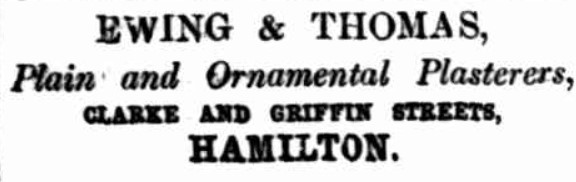
“Advertising” Hamilton Spectator and Grange District Advertiser, 12 April 1862, SUPPLEMENT TO THE HAMILTON SPECTATOR, p. 31 http://nla.gov.au/nla.news-article194859870

James worked on the construction of several large homes in Hamilton, such as Roxburgh House, built for Doctor Wylie in 1873 (below),
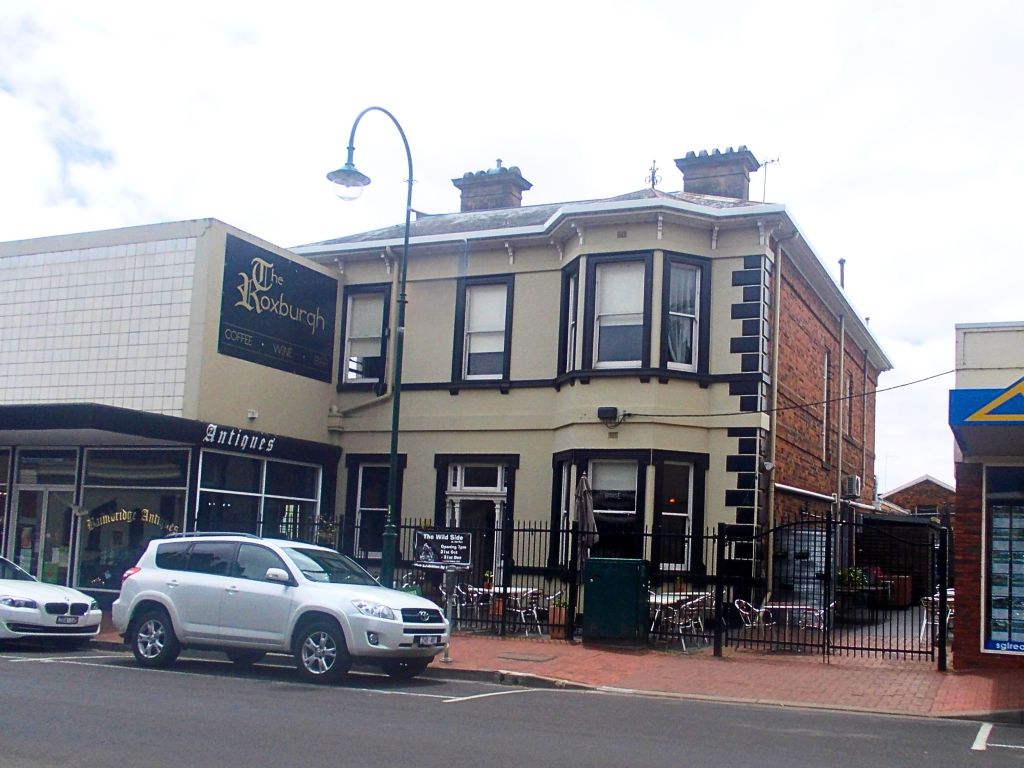
ROXBURGH HOUSE, HAMILTON

Also, Hamilton’s first Wesleyan Methodist Manse, and the Hamilton and Western District College (below)

HAMILTON & WESTERN DISTRICT COLLEGE c1910. Image courtesy of the State Library of Victoria http://handle.slv.vic.gov.au/10381/399043

James died in 1892 and was buried at the Hamilton Cemetery. His wife Jane died ten years later.

GRAVE OF JAMES AND JANE EWING, HAMILTON GENERAL CEMETERY

HAMMETT, Richard-Died 10 January 1911 at Hamilton. Richard Hammett was born in Devonshire, England around 1849. He arrived in Portland and started work as a butcher for William Lewis in that town and nearby Heywood.

When he first arrived in Hamilton, Richard worked for the well-known Hamilton butcher, Thomas Brown. He soon went into partnership with Mr Willett, before operating on his own, which he did for many years.

“Advertising” Hamilton Spectator, 23 August 1884, p.3 http://nla.gov.au/nla.news-article226049933

In 1891, Richard, with the help of his wife Bridget, operated the refreshment rooms at the Hamilton Railway Station, something they did for several years.

“Items of News.” Hamilton Spectator,12 December 1891, p. 2 http://nla.gov.au/nla.news-article226166810

Twice married, Richard lived in Goldsmith Street. He was fond of horse racing and also terrier coursing for which had some success.

HENRY, Eliza Jane-Died 14 January 1911 at Hamilton. Eliza Henry was born in Monaghan, Ireland, and arrived in Victoria in 1844 aboard the Wallace. She headed for Pleasant Creek (Stawell West), then part of the Concongella run, where she married butcher Daniel Bourke in 1845.1 Daniel, Eliza, and their family arrived in Hamilton in the 1860s and settled in Digby Road. In October 1888, Daniel died of strychnine poisoning.
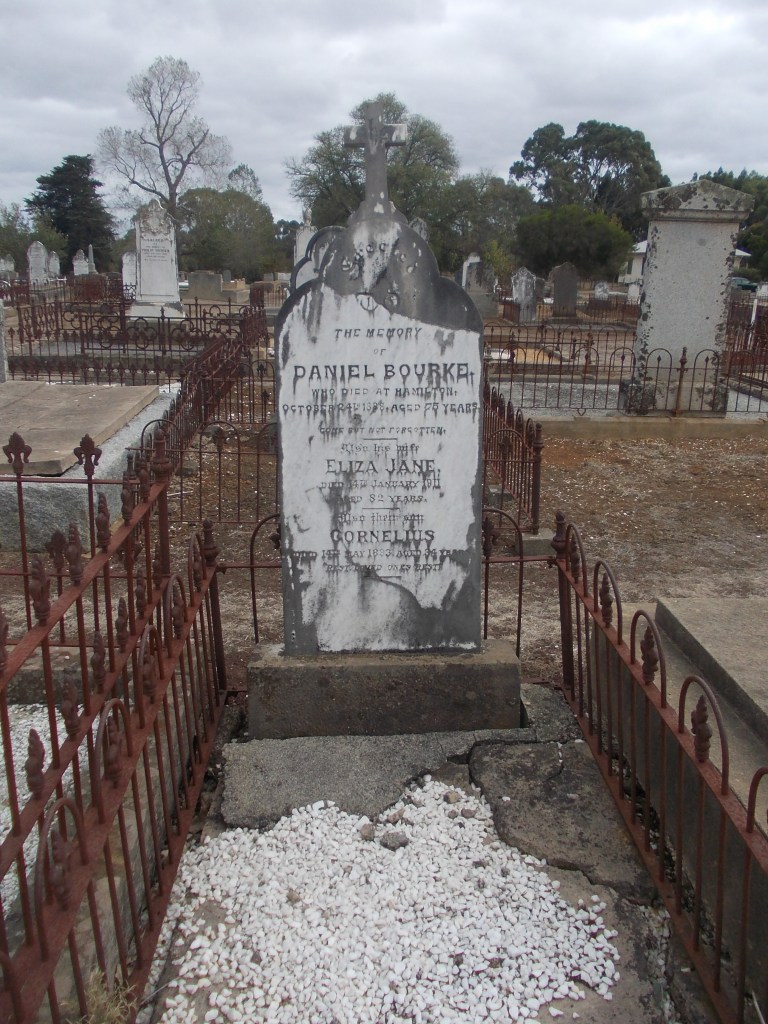
BOURKE FAMILY GRAVE, HAMILTON GENERAL CEMETERY

SILVESTER, Eugene-Died January 1912 at Malvern. Eugene Silvester was born at Balmoral around 1858 and educated at Hamilton College. Known as “Sunny Face” at school, his popularity as a child continued into adult life. He was successful academically and in sports. His academic achievements saw him eyeing a career in law and after his studies, he spent a year as an articles clerk for Anglelo Palmer, a Hamilton solicitor.

The death of Coleraine solicitor Arthur Wade in March 1881 left an opening for a solicitor in the town and in 1882 Eugene opened his own practice in the town, keeping the name of his predecessor in the business name Wade and Silvester.
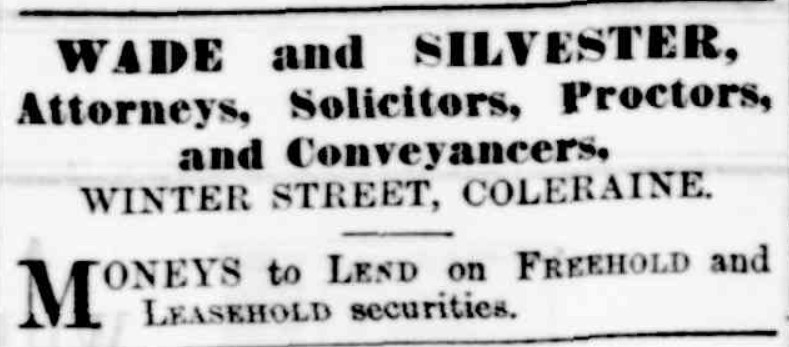
1881 ‘Advertising’, Hamilton Spectator, 28 April, p. 2., http://nla.gov.au/nla.news-article225489685

The same year, Eugene married Ethel Archer.2 They had three sons, Grenville, Eric, and Clive.

Eugene’s talent as a solicitor soon shone through and, as well as gaining many private clients, four nearby shires appointed him as their legal advisor. He later opened an office in Casterton, which his son Grenville took over when he finished his studies. The firm became known as Silvester and Silvester.

1907 ‘Advertising’, Hamilton Spectator, 28 February, p. 4., http://nla.gov.au/nla.news-article226129951

Away from work, Eugene was a vestryman of the Holy Trinity Church at Coleraine (below) and then a Church Warden.

HOLY TRINITY CHURCH, COLERAINE. J.T. Collins collection, State Library of Victoria http://handle.slv.vic.gov.au/10381/216987

Eugene was a Wannon Shire councillor, representing the Balmoral Riding and then the Coleraine Riding. He was the first president of the Coleraine Progress Association, the trustee of the Coleraine Showgrounds, a director of the Coleraine Butter Factory, a freemason, a member of the Mechanics’ Institute, and a member of the Hamilton College Old Boys Association. He also continued his love of sport. He was a champion tennis player and once captained the Hamilton Football team in a game in Ballarat. He also played golf and cricket. His sporting ability saw him called “Pocket Hercules”.

In 1911, heart troubles began for Eugene. After falling ill on a trip to Melbourne for business, he fell he was admitted to Dr. Murray’s Private Hospital. His condition gradually deteriorated, until the sad news reached Coleraine that Eugene Silvester was dead aged 54.

At Hamilton, the flag flew at half mast at the Hamilton & Western District College and in October 1913, the school unveiled a tablet in his honour. In 1916, when the Coleraine Recreation Reserve opened, it received the name “Silvester Oval” in honour of the town’s popular resident. That name remains today.

SILVESTER OVAL, COLERAINE, c1919. Image courtesy of the Museums Victoria Collections https://collections.museumsvictoria.com.au/items/766352

ANSON, Mary-Died 4 January 1914 at Carpendeit. Mary Anson was born in England around 1841 and arrived in Victoria as a girl with her parents. The Anson family settled at Birregurra, east of Colac. It was there Mary met Robert Scouller and they married. Robert operated a flour mill at Birregurra in partnership with his brother John until 1866.
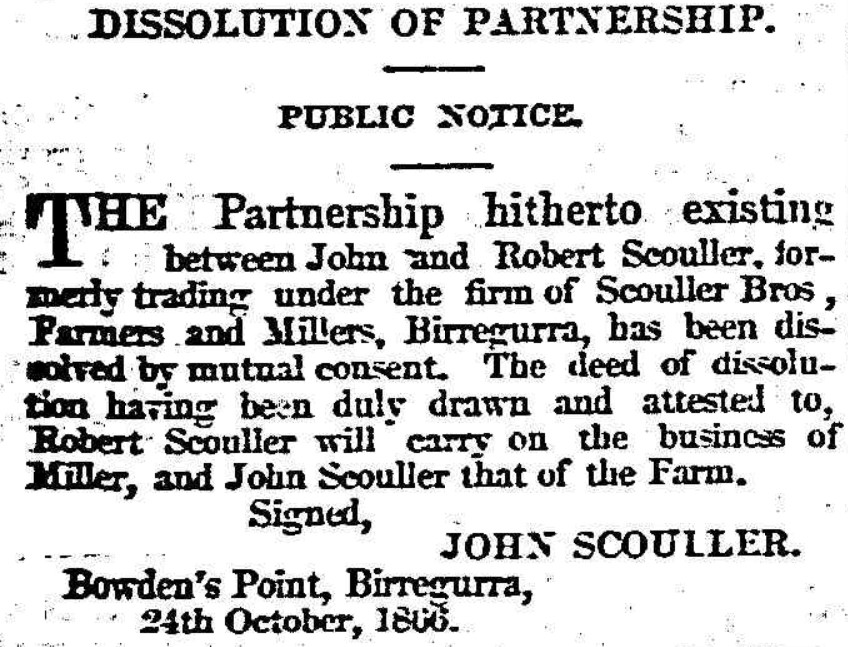
Advertising” Geelong Advertiser,  27 October 1866, http://nla.gov.au/nla.news-article148784672.

Within a few years, Robert and Mary moved to Carpendeit, between Colac and Cobden. Robert moved from a flour miller to a saw miller.

Although Mary had some illness in the years before her death, her passing came relatively suddenly while sitting at the breakfast table at her son’s home. She left nine children at the time of her death. Mary was buried at the Warrncoort cemetery on 6 January 1914.

PRIOR, Margaret-Died 5 January 1918 at Port Fairy. Margaret Prior was born in Cashel, Ireland around 1831. She married James Prior in Ireland and arrived in 1859 on board the Sarah Dixon. They settled in Port Fairy and remained there for the rest of their lives. James was a curator of the Port Fairy Botanic Gardens for 37 years.
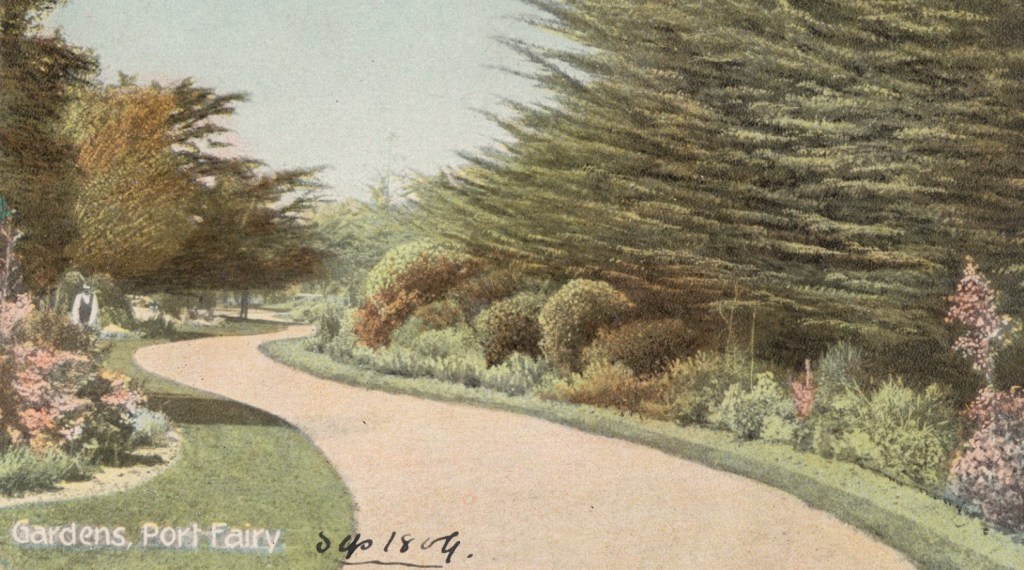
PORT FAIRY BOTANIC GARDENS. Image courtesy of the State Library of Victoria http://handle.slv.vic.gov.au/10381/385235

James died in 1911and after a long illness, during which her family cared for her, Margaret died in 1918. Two sons and three daughters survived her. Margaret’s obituary described her as “…a woman of upright principles and the possessor of a very charitable disposition. She was a most entertaining and interesting personality.”

GELLIE, James Wilson-Died 10 January 1938 at Camperdown. James Gellie spent his 91 years in the Camperdown district. He was born around 1847 at Chocolyn estate on the banks of Lake Colangulac, just north of Camperdown, and died in 1938 in Camperdown. 

On arrival in Victoria, James’ father William secured work at Chocolyn and he and his wife Hannah moved to the district after spending some time in Melbourne. William Gellie selected land after a trip to the diggings in the 1850s, including a property on what is now Gellie Street, between the town and the racecourse.

James first worked for his father, but in 1870, he purchased a team of bullocks. He traversed the district carting with his bullocks. He also went to South Australia, droving cattle and horses. In 1874, James married Margaret McKenzie at Belmont. The couple settled first at Lake View near Camperdown, a property of William Gellie. Later, they moved into town and James ran a livery stable in Manifold Street. 
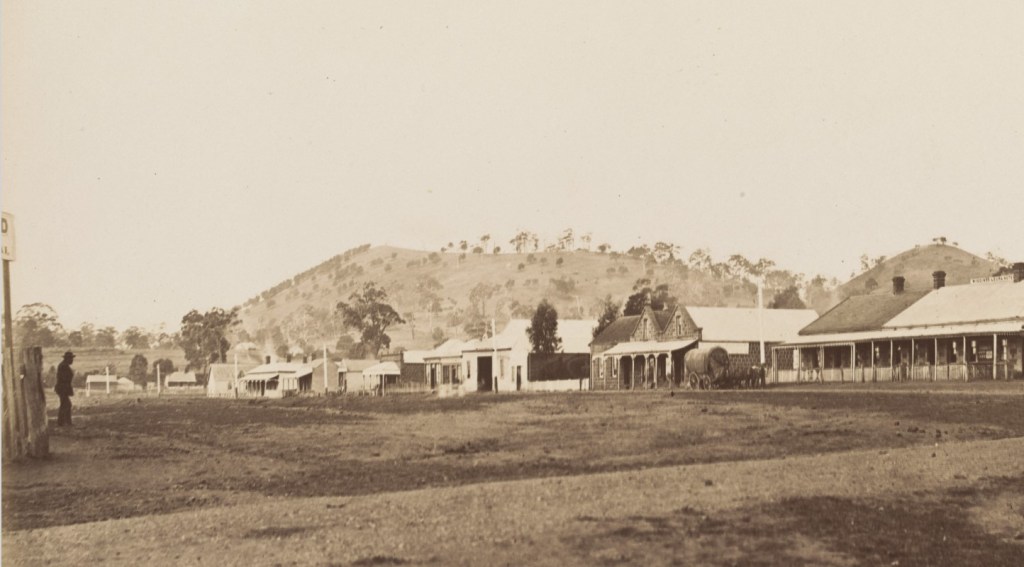
EARLY CAMPERDOWN, c1878. Image courtesy of the State Library of Victoria http://handle.slv.vic.gov.au/10381/307684

His interest in horses extended to racing and James himself trained several horses, with Rigmarole and Postboy among the best. James attended the Melbourne Cup each year and was a member of the Camperdown Racing Club. He was also a member of the Camperdown Pastoral and Agricultural Society. James was buried at the Camperdown Cemetery.

In 1932, James shared memories of his life with the Camperdown Chronicle. He recalled a visit to Mount Gambier on one of his droving trips in the 1870s. It was significant for James as he was a fan of the poet Adam Lindsay Gordon. Even in his mid-eighties, James could recite Gordon’s poem “The Sick Stockrider”,

For good undone and gifts misspent, and resolutions vain,
Tis somewhat late to trouble. This I know-
I should live the same life over, if I had to live again;
And the chances are I go where most men go.

From ‘Bush Ballads and Galloping Rhymes’ (1870).

LUCAS, William Horace-Died 12 January 1943 at Stonyford. William Lucas was born at Marida Yallock in 1866 to Richard Lucas and Harriet Prestage.3 Harriet died just two years later in 1868 and William went to live with his grandparents in Camperdown while his father continued working and later settled at Pomborneit. Richard Lucas had a carting contract with the Colac Rabbit Factory and William, while still a lad, would help his father.
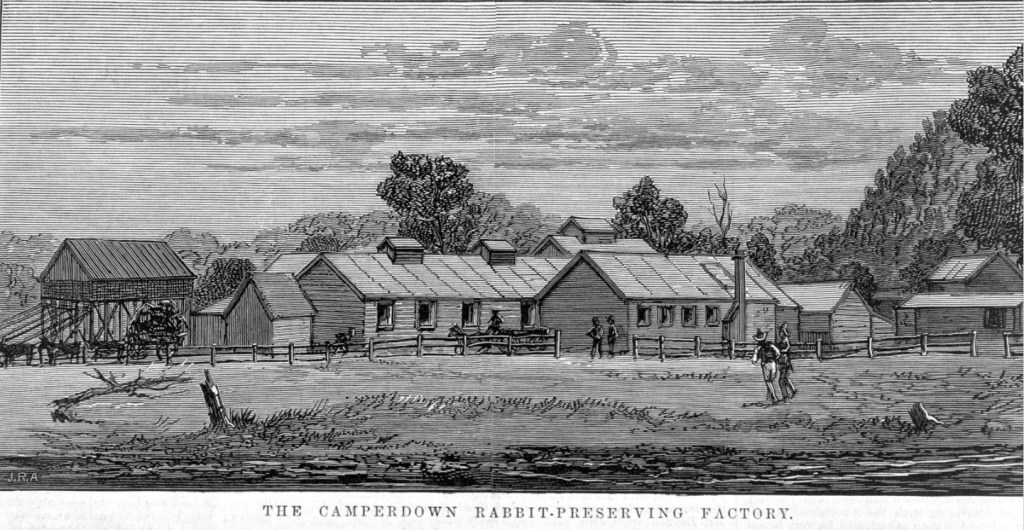
Image courtesy of the State Library of Victoria http://handle.slv.vic.gov.au/10381/257504

When William was older, he worked as a dairy farmer at Stonyford, southeast of Pomborneit. He married Ann Scouller in 1897.4 Ann gave birth to six children, but three died as infants. William and Ann are pictured below with Ila and Horace c1906.

THE LUCAS FAMILY OF ROCKY RIDGE, STONEYFORD. Image courtesy of the Museums Victoria Collections https://collections.museumsvictoria.com.au/items/769557

William was a foundation member of the South Purrumbete Debating Society and was often called on to chair meetings. He also played competitive draughts locally and in Melbourne.

William died in 1943. His funeral was large, with many floral wreaths. He left his widow Ann, two sons and one daughter, also two grandchildren who carried a wreath to his grave.

Additional Sources

  1. Victorian Marriage Index, Department of Justice, Victoria, Eliza Henry, 1845, Reg. No.: 4953/1845
  2. Victorian Marriage Index, Department of Justice, Victoria, Eugene Silvester, 1882, Reg. No. 4964/1882
  3. Victorian Birth Index, Department of Justice, William Horace Lucas, 1866, Reg. No. 20048/1866
  4. Victorian Marriage Index, Department of Justice, Victoria, William Horace Lucas, 1897, Reg. No. 3346/1897

Passing of the Pioneers

March is Women’s History Month and just as I did in March 2017, this year I have compiled an all female Passing of the Pioneers. It’s only a small group of seven, almost half the number in 2017, but a worthy group all the same. Remember to click on the underlined text to find more information on a subject.

NEVILLE, Ann Terry – Died 28 March 1900 at Hamilton. Ann Neville was born at Old Brentford, London in 1821. She was married in 1852 to William Carter and they set off for Australia on the Priam in the same year. After arriving at Portland, they went on to Warrnambool and later Port Fairy. In 1854, they decided to leave the coast and move north to Hamiton. The trip from Port Fairy to Hamilton in a bullock wagon took them a week. They settled in South Hamilton.

On 31 December 1868, William died at the age of forty died leaving Ann with six children aged fourteen down.

In 1885, Ann applied to be included on the local voter’s roll. She held allotments 47 and 49, suburban lots in the Parish of South Hamilton. They were located on the southern banks of the Grange Burn between Monivae and Pierrepoint Streets.

At the time of Ann’s death, she left two sons and four daughters. She was buried at the Hamilton (Old) Cemetery.

HEADSTONE OF ANN TERRY CARTER, HAMILTON (OLD) CEMETERY

WATSON, Margaret – Died 1 March 1914 at Coleraine. Margaret Watson was born in Scotland around 1827. She married David Drummond in Tillicoultry, Scotland on 12 June 1852 and they boarded the Chance at Liverpool, England on 23 July 1852. It was a difficult journey with forty-six deaths and on arrival in Melbourne on 28 October 1852, the ship was quarantined and remained so for almost three weeks. Once on dry land, the couple made their way to the Geelong district. A son James was born in 1853 but sadly he died the next year. Another son Richard was born in 1854 and a daughter Margaret in 1857. James was born in 1862 at Duck Ponds near Geelong.

The family moved west to join other members of the Drummond family sometime after 1862 with a son John born at Casterton in 1867.

CASTERTON c1868. Image courtesy of the Museums Victoria Collections https://collections.museumsvictoria.com.au/items/767592

It was also the year David Jr died at Sandford aged seven. The following year baby John died, also at Sandford. In 1869, another son was born and named David. He was born at Dundas suggesting the family had moved to Coleraine, within the Shire of Dundas. By 1870, the Drummond family were living in the township of Coleraine in the vicinity of the Albion newspaper office.

On the evening of 28 October 1870, David’s niece Janet was staying over. That night a huge storm hit Coleraine and the level of the Bryan Creek, close to their home, began to rise. Soon their cottage was surrounded by water. After 12.30am rescuers attempted to rescue the Drummond family. The water was knee-deep and the current was too fast to safely cross. Constable James Mahon made a dash for it but was carried away. Fortunately, he managed to land on top of a pigsty and was able to get back to safety. He tried again and was able to save one of the children.

Storekeeper Louis Lesser also headed across the water and rescued another child. He was also able to lift Margaret out of the water and onto the roof of a cowshed. David got three children to safety and went back for three more, James and Margeret Jr and his niece Janet. Suddenly, the current caught him, and all four were swept away. Around 1.00 am the water had fallen enough for another attempt to cross to the cottage. Margaret was found sitting on the cowshed.

Along with members of the Drummond family, several other people were missing The harrowing task of searching for bodies began at first light with the whole town turning out even though very few had slept. By 6.00 pm on Saturday evening, five bodies had been recovered, all of them children. Five adults were still missing.

COLERAINE c1880. Image courtesy of the State Library of South Australia, Image no. B 21766/52 https://collections.slsa.sa.gov.au/resource/B+21766/52

A funeral for some of the victims of the flood, including those from the Drummond family took place on Monday 31 October.

Margaret was suddenly widowed, left to raise two sons, Richard and David. She remained in Coleraine and her sons went on to marry and raise their own families. Margaret led a quiet life but remained active in her old age. She moved in with her son Richard at Coleraine in her final years but remained active around the home right up until her death on 1 March 1914. Margaret lived to eighty-seven, a long life punctuated with tragedy. She was buried at the Coleraine Cemetery with David, James, and Margaret.

DRUMMOND FAMILY GRAVE, COLERAINE CEMETERY

You can read more about the Coleraine floods on the link to The Great Flood of 1870

STEVENSON, Ruth – Died 25 March 1918 at Colac. Ruth Stevenson was born around 1847 north of Melbourne. Her father Joseph Stevenson arrived in Melbourne around 1840 and started a timber yard in Swanston Street. He also purchased blocks of land in Collins Street. He was a carpenter and built Kirks Bazaar and the Royal Mail Hotel on the corner of Bourke and Swanston Streets. He also built the first punt to operate on the Yarra.

By 1846, Joseph had moved to the area which became known as Diamond Creek where Ruth was born. An old leger in her possession, showed Joseph also contributed to the naming of the Diamond Creek. He had a bullock he called Diamond which became bogged in the creek. Diamond died in the creek, and from then on that spot became known as the spot Diamond died. From there, it became known as Diamond Creek.

The Stevenson family then moved to what would become Christmas Hills and again Joseph Stevenson played a part in the naming of that location. More about that can be found on the link – Christmas Hills. From there the family went on to Kangaroo Ground, followed by Yarra Glen then known as Yarra Flats.

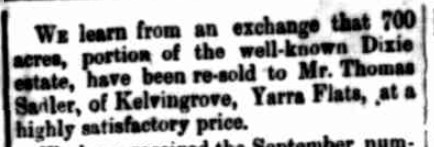
In 1869, Ruth married Thomas Sadler, born in Scotland and living in the Yarra Flats district. The couple remained in that district and raised a large family. That was until 1888 when Ruth was set for the biggest move of her life, more than 250 kilometres away to the Terang district. The Dixie estate south of Terang, once owned by Duncan Walker was subdivided in 1887. Thomas was able to secure a remaining portion of the property.

CURRENT TOPICS. (1888, September 13). Camperdown Chronicle p. 2. http://nla.gov.au/nla.news-article18584661

Thomas was given a send-off at the Yarra Flats Hotel in September. Ruth wasn’t in attendance but Thomas accepted a gold watch on her behalf as a going away gift for her hospitality and kindness. The Sadlers moved to the property at Dixie which they named Ecclefechan after a village east of Dumfries in southern Scotland, close to where Thomas was born.

Thomas died in February 1903. The following month, Ruth suffered another loss when her married daughter Annie Carson was found drowned in a well at Dixie. Ruth died at Doctor Brown’s Private Hospital in Colac and was buried at the Terang Cemetery. She was aged seventy-one.

MURRAY, Janet – Died 8 March 1919 at Clear Lake. Janet Murray was born around 1830 in Glasgow and arrived in Australia about 1852 on the James Steadford. In 1853, she married Alexander Robertson at the Geelong Presbyterian Church. They spent some time in Ballarat around 1854 before returning to Geelong until around the late 1860s,

The next move for the Robertsons was to Bochara station in the Hamilton district where they spent nine years, Land was opening up in the Clear Lake district to the north of Balmoral and Alexander selected land there around 1880. The Robertsons then moved south to the Telangatuk district. Alexander died in 1898.

During WW1, Janet was involved with the Telangatuk East branch of the Red Cross. By April 1917, she had knitted thirty-nine pairs of socks over the past year. Janet’s obituary stated, by the end of the war she had knitted 100 pairs of socks.

 (1917, April 5). Rupanyup Spectator and Lubeck, Banyena, Rich Avon and Lallat Advertiser,p. 2. http://nla.gov.au/nla.news-article121052771

Janet died in 1919 at the age of eighty-nine. She left seven children, five boys and two girls, 49 grandchildren, and 39 great-grandchildren.

COLLIE, Ella Georgina – Died 22 March 1941 at Cobden. Ella Collie was born in 1882 at Caramut. She went to school at Caramut before her family moved to Camperdown sometime after 1894.

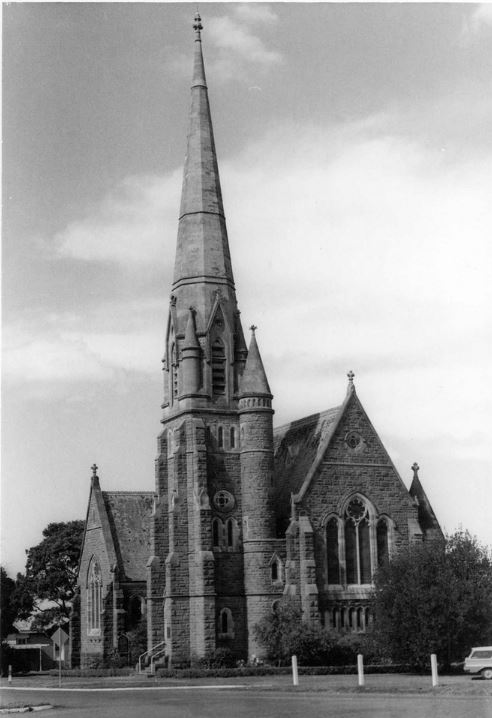
Ella had sang at school and when once in Camperdown she started singing with the Presbyterian church choir and also as a soloist. In October 1901, she sang at celebrations for the opening of Camperdown’s new Presbyterian church.

CAMPERDOWN PRESBYTERIAN CHURCH. Image courtesy of the State Library of Victoria http://handle.slv.vic.gov.au/10381/63175

In 1902, the Collie’s left Camperdown for Terang and Ella and her brother George were given a send off by the choir. Ella received a gold brooch.

PERSONAL. (1902, June 3). Camperdown Chronicle p. 3. http://nla.gov.au/nla.news-article26566773

In 1906, Ella married William McConachy and they setteled at Koortmoolong on the Port Campbell Road at Jancourt, east of Terang. Ella continued her singing into married life. In 1916, she sang at a concert to raise funds for the Jancourt school’s organ fund.

Ella threw herself into community life. In July 1917, she held a “kitchen utensil” evening at Koortmoolong.

Cobden Times and Heytesbury Advertiser 28 July 1917: 2 http://nla.gov.au/nla.news-page16521487

In 1918, Ella was in charge of the produce stall at the Jancourt Jumble Fair, raising funds for the British Red Cross.

Around 1920. the McConachys moved north to Cobden. Ella continued her community activities in Cobden, always offering a helping hand at events. As a member of the Cobden Presbyterian Church (below), she was involved with the Presbyterian Ladies Guild and was vice president in 1936. She was also a member of the Presbyterian Women’s Missionary Union (PWMU).

COBDEN PRESBYTERIAN CHURCH AND SUNDAY SCHOOL c1933 Image courtesy of the Museums Victoria Collections https://collections.museumsvictoria.com.au/items/772413

In 1932, Ella was vice president of the Cobden Boy Scouts Association. She was also on the committee of the Cobden auxiliary of the Camperdown hospital and in 1938 was vice president She was a vice president and president of the Cobden branch of the Australian Women National League (AWNL) and represented Cobden at the annual AWNL conferences in Melbourne. At the 1939 conference, the delegates were addressed by Prime Minister Menzies. .

Ella died in 1941 aged fifty-eight, leaving her husband William, four daughters, two sons, and two grandchildren. She was buried at the Cobden cemetery. A memorial service was held at the Cobden Presbyterian Church,

LAING, Agnes Isabel – Died 7 March 1944 at Port Fairy. Agnes Laing was born at Yallock station around 1864 where her father was the manager. The family moved to nearby Terang while Agnes was still a young girl.

After leaving school, Agnes became a teacher, registered in 1879 and taught at the Terang school. Her teaching career ended in 1895 when she married William Osburne the owner of the Terang Express newspaper. Agnes and William went on to have one son, George Laing Osburne, known as Laing, the following year.

Agnes attended the Terang Presbyterian Church, and was the organist for nine years.

TERANG PRESBYTERIAN CHURCH. Image courtesy of the J.T. Collins Collection, La Trobe Picture Collection, State Library of Victoria. http://handle.slv.vic.gov.au/10381/234278

Agnes was interested in politics and was involved with the Australian Women National League (AWNL). In 1913, she was recognised for her work as secretary of the local branch of the AWNL. In 1938, she was presented with a gift for the recognition of her services to the Terang branch of the AWNL.

During WW1, Agnes was an active member of the blind auxiliary and she was in charge of the Red Cross Jumble Shop in Terang. In July 1915, Agnes wrote a letter to the editor of the Camperdown Chronicle to announce the opening of the Jumble Shop. She also wanted to put to rest rumours goods donated for the front were not reaching those they were intended. She was also involved with the Terang sub-branch of the Returned Sailors’ and Soldiers’ Imperial League of Australia ( R.S.S.I.L.A.).

In the 1920s, Agnes was on the committee of the Terang Rest rooms. She enjoyed golf and played at the Terang Golf Club. She often played with William and in August 1929, they paired up in the Mixed Foursomes at the Terang Golf Club annual tournament.

Agnes and William lost their only son in 1933, when Laing died. William died in 1939. Agnes lived out her days at her home in High Street, Terang with her widowed daughter-in-law Eugenie. Agnes died in 1944 at the Port Fairy Hospital at the age of eighty. She was buried at the Terang Cemetery.

SCOULLER, Mary – Died March 1946 at Colac. Mary Scouller was born at Carpendeit, east of Cobden in 1886. She married Arthur Fisk in 1922 and they spent some time living at Korweinguboora, south of Daylesford where Arthur ran a grocery and post office. They returned to Carpendeit around 1931 living at Leura View.

Mary was an active worker for the Bungador State School and the Bungador Presbyterian Church. Services were held at her home as there was no church at Bungador. She was also involved with other charities and during WW2, the local patriotic funds. Her son Charles enlisted in 1941.

Mary died in 1946 at the age of sixty, leaving Arthur, two sons and two daughters. She was buried at the Colac Cemetery.

Passing of the Pioneers

It’s Women’s History Month and the Passing of the Pioneers of March 2017 featured only women.  Unfortunately, since there are many more newspaper obituaries for men than women, I wasn’t able to keep it up this year.  This March there are eight pioneers, half of them women.  As I find often, the pioneers had things in common. Two of the male pioneers were struck by gold fever in the early 1850s as was the husband of one of the female pioneers.  One lived in a house built by another of the featured pioneers, and two pioneers operated hotels.  If you click on any of the underlined text throughout the post, you will go to further information about a person or subject.

VIALLS, EdmundDied 19 March 1879 at Hamilton.  Edmund Vialls was born in London around 1848.  He studied medicine and did his residency at Poplar Hospital, London.  In 1867, he won the medicinal and surgical gold medals for his work.  Edmund arrived in Victoria in 1870 and by 1872, he was in Richmond at the Melbourne Hospital.  He was appointed surgeon at the Hamilton Hospital but he also set up a private practice.  He engaged Hamilton builders William Holden (see below) and William Dunn in 1876 to build a home and surgery at the corner of Gray and Kennedy Streets,  Hamilton (below), and soon had a thriving practice at the building known as Hewlett House, Hewlett being the maiden name of Edmund’s mother Elizabeth.

HEWLETT HOUSE, HAMILTON

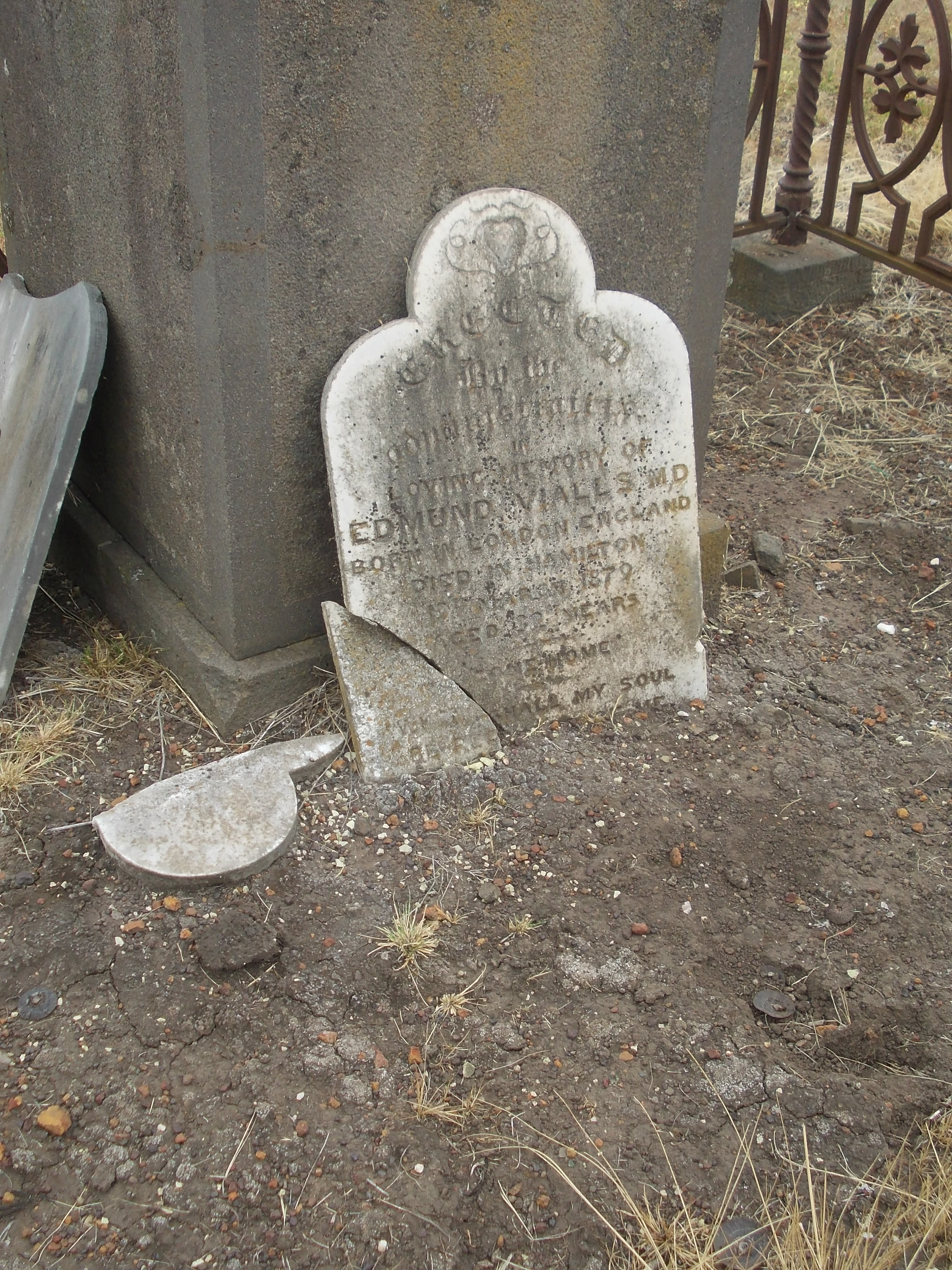
Edmund was also the medical attendant for the Hamilton branches of the Foresters, Hibernian and Oddfellows societies. At the age of thirty-one, Edmund died from epilepsy and congestion of the brain.  He was buried at the Hamilton (Old) Cemetery (below).

GRAVE OF EDMUND VIALLS

QUIGLEY, John – Died 31 March 1898 at Wannon.  John Quigley was born in County Kilkenny, Ireland in 1819.  In 1841, John a surveyor by trade left Ireland for Australia, via Plymouth, England. Arriving at Plymouth, John went to the immigrant depot finding, 

…600 other emigrants were not being fairly treated in the matter of rations, and made it his business to communicate to the commissioner, a Mr James, in London, who personally enquired. into the matter and set it right. Shortly afterwards, notwithstanding that the head serang of the depot had given orders for the fiery young Irishman not to be admitted there, he found that the immigrants had been mulcted to the extent of 10s 6d per head, kept back from them by the agents. Once more he communicated with Mr. James, who hurried down to Plymouth with £300 in cash wherewith to recoup the defrauded ones. This so annoyed the master of the depot that he took more stringent steps to prohibit Mr.Quigley’s entrance to the place, with the consequence, that he was sued for a breach of the regulations and ordered to pay £15 damages with costs. Mr Quigley was congratulated by Mr. James on his determination of character, which, subsequently, stood him in good stead, and, needless to add, made him very popular with the six hundred. These, engaging a band, marched through the streets of Plymouth with young Quigley and a companion, McCluskie, at their head, in celebration of the victories he had won for them.  (Hamilton Spectator, 2 April 1898)

Once in Melbourne, John sought work with horses and was employed by Messrs Solomon at Saltwater River Station.  Today Flemington Racecourse stands on land once part of the station which extended as far as Keilor.  After two years working for the Solomons, John decided to go out on his own. He had two failed attempts in the Murray Region and at Kilmore before meeting Acheson Ffrench of Monivae Station, south of the present Hamilton, who offered him a position.  However, John received a better offer at the neighbouring Grange Burn Station arriving in December 1846.  John was in charge of 600 head of cattle at the station where the main homestead was located near what is now Prestonholme HomesteadIn 1848, John married Winifred Tracy.

In 1851, many in the west of the colony were travelling east to the newly discovered goldfields and John joined them.  He went to Fryer’s Creek, south of Castlemaine where gold was discovered around October 1851.  Life on the diggings wasn’t for John and he returned to Hamilton in 1853. But that time, the first township blocks were for sale. John managed to buy the first lot offered on the site of the Bank of Victoria, for £50 and was Hamilton’s first ratepayer. John also bought the first farm offered in the district, sixty-six acres across the creek from Peter Learmonth at Prestonholme.  Another first, John was reportedly the first man to win a steeplechase in the district held on the flat near the Digby Road bridge at Hamilton.

In 1854,  John purchased the Wannon Inn on the Wannon River at Redruth near the Wannon Falls.

089
SITE OF THE WANNON INN

His licence was granted in 1855 and John set about improving the business.  

“Advertising” Portland Guardian and Normanby General Advertiser, 5 October 1854, p.1  http://nla.gov.au/nla.news-article71571022 

In 1860, he sold the Inn for £4,000 and acquired 5000 acres at the Wannon which became the Falls View Estate.

WANNON FALLS c1860s Photographer Thomas Washbourne. Image courtesy of the State Library of Victoria http://handle.slv.vic.gov.au/10381/361595

 The photo below was taken very close to the northern border of John’s property.

VIEW TOWARD WANNON FALLS
“REDRUTH.” Hamilton Spectator and Grange District Advertiser, 31 August 1861, p. 2. 

John also bought the Bochara Estate and selected land on the Merri Creek near Warrnambool among other places.  He was often asked to enter politics but he liked to keep his political interests at a local level and was one of the first men on the Dundas Roads Board in 1858. It later became the Dundas Shire Council and John was President from 1863 to 1866. By 1870, John was feeling the strain of overextending himself financially.  He retired from public life and lived out his life quietly at the Wannon until his death in 1898. John was buried at the Hamilton (Old) Cemetery.

KILPATRICK, Ann – Died March 1903 at Sandford.  Ann Kilpatrick was born around 1826 in Edinburgh, Scotland.  She married John Grant and they left for Victoria arriving in 1841 aboard the Grindlay. With a man named William Murray, John, and Ann headed west.  John first found work at the property of the Whyte brothers near Coleraine before moving on to the Henty’s Merino Downs. The Grants then took up a run near Penola, South Australia where two children were born, however, by the early 1850s, John was off to the diggings. On his return, the Grants sold up at  Penola and they bought the Woodford Inn at Dartmoor by 1853.  They stayed there for around three years and in that time another son was born. 

In 1856, the Grants purchased land at Sandford and built the Caledonian Union Hotel in the town and operated it from 1857.  It was considered a pretentious building considering the size of the town. A fire broke out at the hotel in 1871, damaging the second storey of the building.  The Grants rebuilt but did not reinstate the second storey.

THE CALEDONIAN UNION HOTEL, SANDFORD. Image courtesy of the J.T. Collins Collection, La Trobe Picture Collection, State Library of Victoria. http://handle.slv.vic.gov.au/10381/234008

After John Grant died in 1879, Ann continued operating the hotel up until her death.  She left two sons and two daughters.

HOLDEN, William – Died 18 March 1910 at Hamilton. William Holden was born at New Brighton, Lancashire in 1832. He arrived at Adelaide in 1852 and headed east to the Victorian diggings. After some time in search of gold, he returned to Adelaide but was back in Victoria by 1860. On 19 May 1863, William started out from Dunkeld to travel to Hamilton, the place he would finally settle after ten years of nomadic life. He left Dunkeld at 11.30am and arrived in Hamilton at 7.30pm. He found the people of the town out in the streets celebrating the marriage of the Prince of Wales. 

A mason by trade, William got work on a new stone Post Office in Gray Street built in the year of his arrival and then worked on a two-storey bluestone building in Kennedy Street for use as a grain store. In time, it became Hamilton’s Temperance Hall. It is seen to the left of the photo below.

KENNEDY STREET, HAMILTON. Image courtesy of the State Library of Victoria

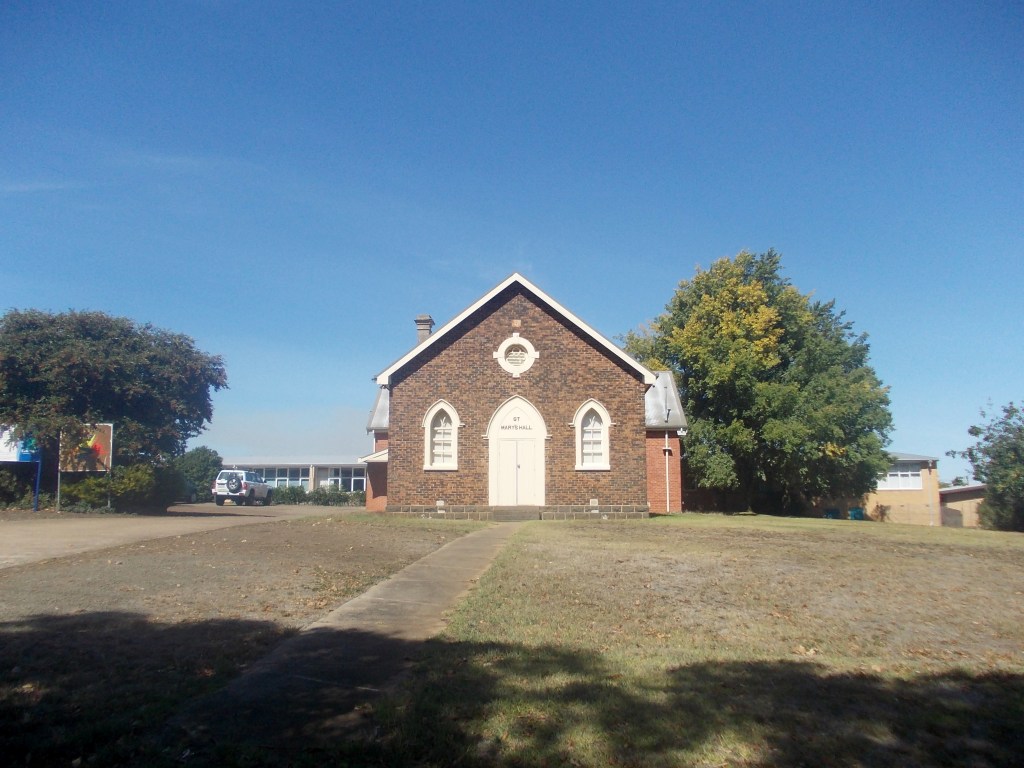
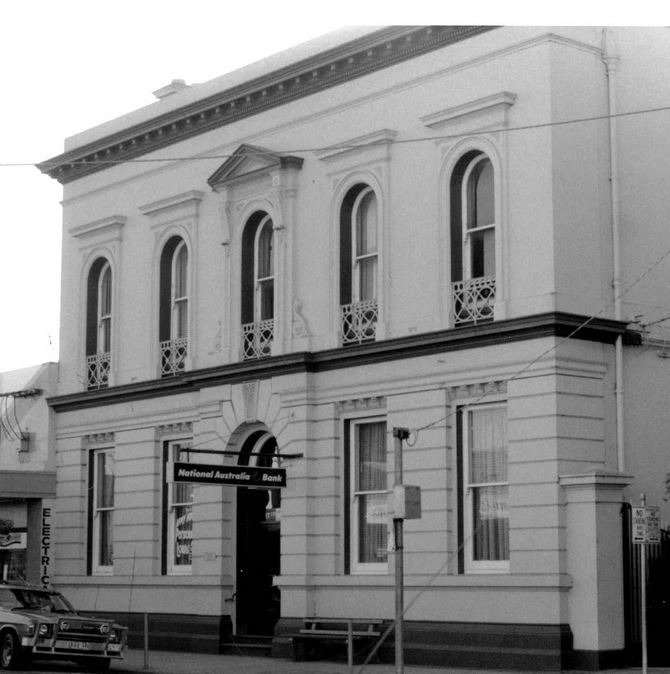
In the 1870s, William entered a partnership with builder William Dunn and together they set about “building” Hamilton. They built some of Hamilton’s grandest buildings, most still standing today. They included the banks, the Bank of Australasia, the Bank of Victoria, and Colonial Bank, and the residences of doctors, including Hewlett House and Roxburgh HouseThere was also the Hamilton Academy completed in 1875, the St Mary’s Hall in Lonsdale Street, and the Hamilton goal. In addition, they built several shops in the CBD of Hamilton, including a strip of shops running from the corner of Gray and Thompson streets.

In 1876, William married Elizabeth Pearson, a daughter of William Pearson and Ann Routledge. John and his family were part of the Hamilton Baptist Church congregation with the devotion to his faith in the naming of his first son, William Joseph Baptist Holden.  William Jr was born on 17 April 1977 at Brighton Cottage, in Lonsdale Street, Hamilton. The property is now known as Tavistock.  In 1887, Ralph, the two-month-old son of William and Elizabeth, died and in 1891, Thomas, aged two weeks, died. The two boys are buried at the Hamilton (Old) Cemetery below.   

GRAVE OF THE CHILDREN OF WILLIAM AND ELIZABETH HOLDEN, HAMILTON (OLD) CEMETERY

William later had a business in Thompson Street operating as a bakery, grocer, and chaff merchant.  He retired from work around 1895 and in 1901, he put up for sale a house on the corner of Lonsdale and McIntyre Street and his shop in Thompson Street up for sale. In 1905, Elizabeth died at fifty-seven.   

William, a democratic man, was interested in politics and the development of political parties. He was keen to know the winner of the 1910 Federal election, but died before there was a result. William died on 18 March 1910, leaving a family of five sons and one daughter. He was buried with Elizabeth at the Hamilton (Old) Cemetery. William’s home Brighton Cottage was sold in August 1910.

HEADSTONE OF WILLIAM AND ELIZABETH HOLDEN, HAMILTON (OLD) CEMETERY

WHITTAKER, Eliza – Died 13 March 1918 at Warrabkook. Eliza Whittaker was born in Ireland around 1823, a daughter of a Battle of Waterloo soldier. The Whittaker family moved to Somersetshire, England, where Eliza met Samuel Trigger. The couple had one child, Emily in Somersetshire before moving to Ball Street, Avening, Gloucestershire (1851 UK Census) where Christina was born. Samuel was working as a miller, but after the birth of a third child, the family boarded the Eliza sailing to Australia. By then there was also a baby, Henry. 

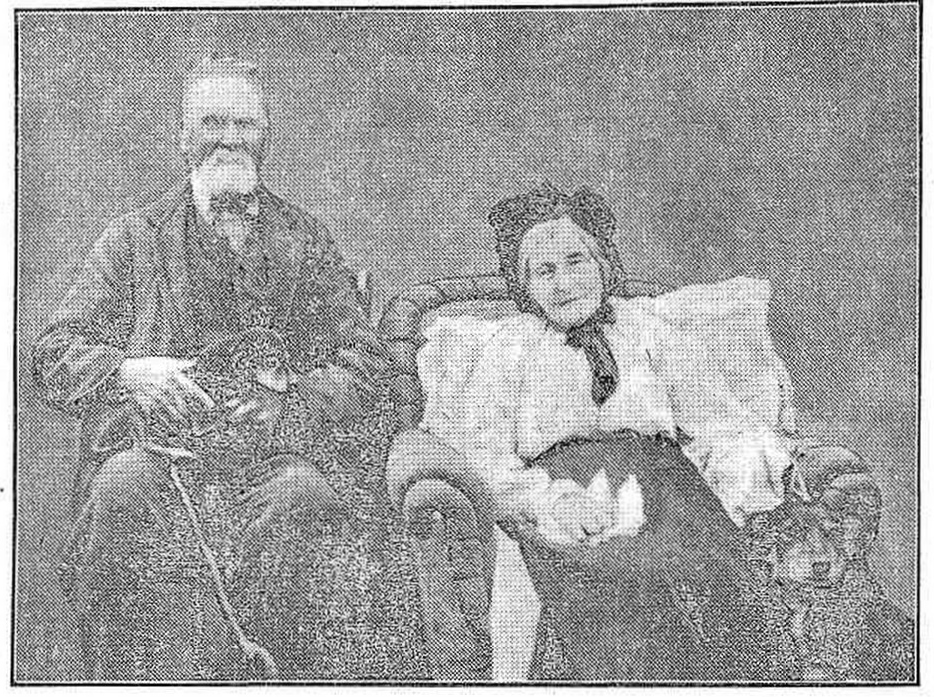
The Triggers arrived at Portland on 9 April 1853 and made their way to Mount Taurus, north of Warrnambool. Eliza had a further five children, including twins at Penshurst in 1858. Samuel selected land near Macarthur in the early 1860s, and they moved to the area. In 1863, baby Mary Ann died at Macarthur. After over seventy years together, on 6 March 1918, the partnership ended when Eliza died aged ninety-seven. Just three weeks later, Samuel also died, aged ninety-eight. At the time of their deaths, the Triggers had four sons, two daughters, thirty-one grandchildren, and thirty-eight great-grandchildren still living.

 
“A VENERABLE COUPLE.” Weekly Times (Vic. : 1914 – 1918) 14 Apr 1917: 10. Web. 15 Aug 2015.

BOWKER, John Thomas – Died 23 March 1928 at Princetown. John Bowker was born in King Street, Melbourne around 1848. During the 1860s, John went to the Camperdown district.

In the late 1860s, while still a young man, John was part of the founding committee member of the Hampden and Heytesbury Pastoral and Agricultural Society. After an inaugural P&A Show at Camperdown, it was decided a new showground site was needed. There were two sites on offer and John was among those who pushed for the selected site, mainly because of the picturesque views it offered.

CAMPERDOWN SHOWGROUND. Image courtesy of the State Library or Victoria http://handle.slv.vic.gov.au/10381/386059

…for situation and the beauty of its surrounding, the Camperdown showground is unequalled in the colony. In its natural state, it is a beautiful spot, with the green slopes of Mount Leura and its more stately companion. Sugarloaf, rising up immediately behind it; whilst northwards is the township, looking prettier in the distance with its grass clothed streets, and its incomparable avenue of trees now almost in their complete spring attire: beyond the town, Lake Culongulac from the shores of which spread away to Mount Elephant and other distant hills, the verdure-clad plains. (Camperdown Chronicle, 25 October 1884 )

CAMPERDOWN SHOWGROUND. Image courtesy of the State Library of Victoria

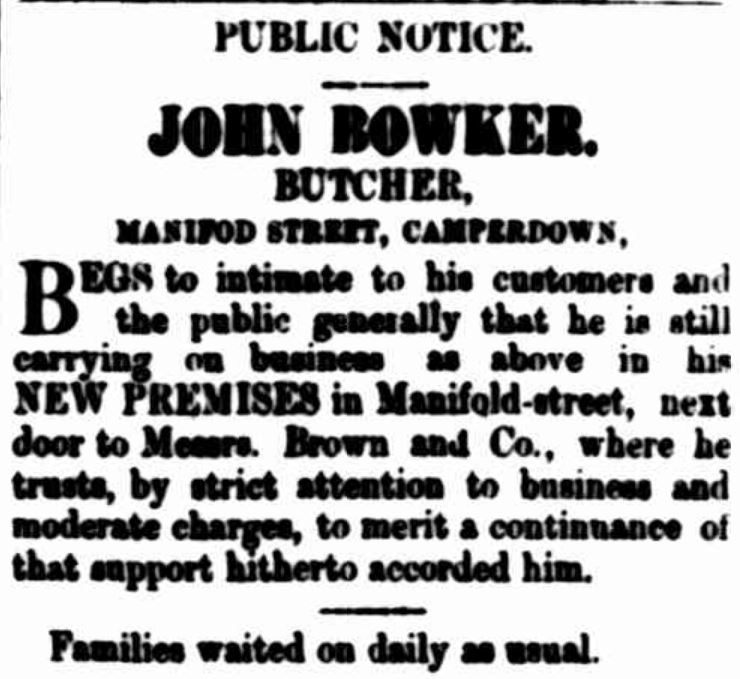
In February 1874, John married Eliza “Lissie” Lord at Geelong. John was a butcher by trade and operated his shop in Camperdown.

“Advertising” Camperdown Chronicle,  30 January 1877, p. 3  http://nla.gov.au/nla.news-article64010246

John and his family moved to a property at Princetown called Kangaroobie by 1884. Eliza was a teacher and since there wasn’t a school at Princetown, she started classes there in that year. John was active within the Princetown community, including as secretary of the Princetown Farmers’ Union.

In 1915, John’s son Alwynne was killed at Gallipoli on 7 August 1915 while serving with the 8th Light Horse Regiment.  By 1926, John was the last surviving member of the founding committee of the Camperdown P&A and that year, he travelled from Princetown to Camperdown for the show. Two years later, John died at Princetown. He left his widow Eliza and three sons and one daughter. He was buried at Port Campbell Cemetery.  Eliza died in 1935 at Princetown.

MOORE, Eliza – Died 24 March 1939 at Colac. Eliza Moore was born in the north of Ireland on  20 May 1954. At the age of four, Eliza left Ireland with her parents and travelled to Australia aboard Chance, arriving at Port Fairy, in September 1857. After some time in Port Fairy, the Moore family moved to Hilder’s Bridge near Grassdale. Eliza, known as a “splendid horsewoman”, married Alexander Russell in 1874 at Warrnambool and they resided at Dennington. 

From around 1904, Eliza and Alexander lived in Colac and for the last fifteen years of their lives, they resided in Manners-Sutton Street, Colac.  Alexander died in 1938 and Eliza went to live at Lismore but was only there five months before she was hospitalised at Colac where she died two weeks later at the age of eighty-five. Eliza was a keen worker for the church and went to services when possible. After her death, Eliza was remembered at St Andrews Church, Colac (below), the following Sunday during the service. Eliza was buried at the Colac Cemetery and left four daughters and five sons.  

ST ANDREWS CHURCH, COLAC c1945 Image courtesy of the State Library of Victoria http://handle.slv.vic.gov.au/10381/384952

SCOULLER, Ann – Died 21 March 1952 at Stonyford.  Ann was born at Birregurra in 1863, but when she was a small child, the Scouller family moved to Carpendeit. Ann had to walk six miles to school through the bush to the Catholic chapel at South Purrumbete for school.  She later attended a school built on the property of Peter Morrison. Ann was a devout worker for the Methodist Church and the Sunday School. Services were then held in the barn of Mr Anson at  Lightwood Vale and the Minister would ride from Camperdown.  Ann was a good horsewoman and rode sidesaddle. She was also an expert needleworker, excelling in dressmaking, fancy work, and crochet. On 5 May 1897 at her mother’s home at Carpendeit, Ann married William Horace Lucas of Pomborneit. They first lived at South Purrumbete before moving to Rocky Ridge, Stonyford around 1910 and were dairy farmers. 
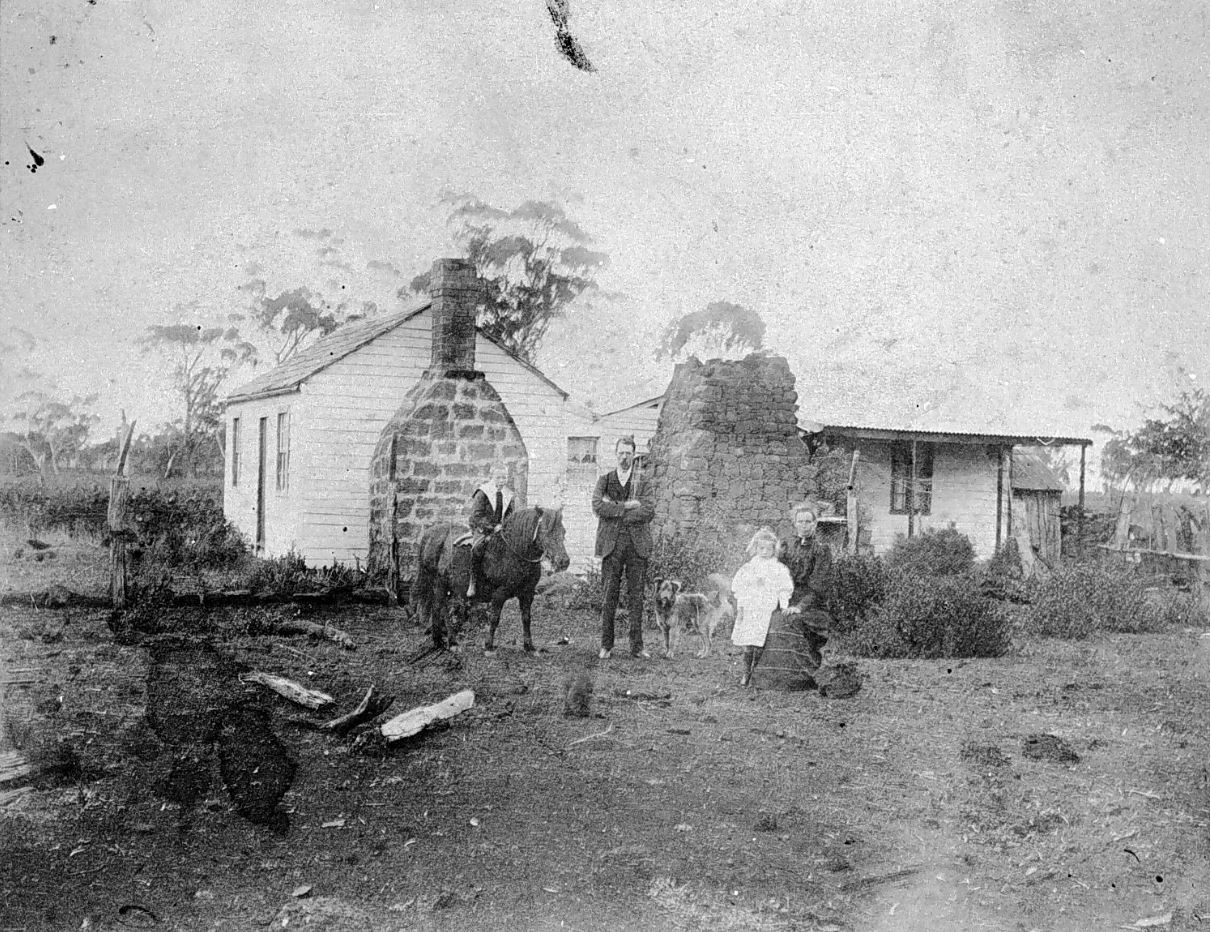
THE LUCAS FAMILY AT “ROCKY RIDGE”, STONEYFORD C1908.
Image courtesy of the Museums Victoria Collections https://collections.museumvictoria.com.au/items/769557

Around 1926, William retired and he and Ann moved to South Yarra. A send-off was held on 3 December 1926 at Stonyford with many turning out to farewell the couple. City life wasn’t for them, and Ann and William returned around 1931 and remained at Stonyford for the rest of their lives. William died in 1943. In September 1949, Ann celebrated her eighty-sixth birthday. She died in 1952, aged eighty-eight. Ann was buried at the Camperdown Cemetery and left two sons and one daughter.