A Pioneer Christmas 1880s Style

Christmas news in Victoria during the 1880s featured cards, decorations, carols, and for something different, the weather.  The shopkeepers of Portland in 1880, decorated their shops for the season.  Mr. Harris, proprietor of the pastry shop went to great trouble adorning his shop with Chinese lanterns and a wreath of roses.
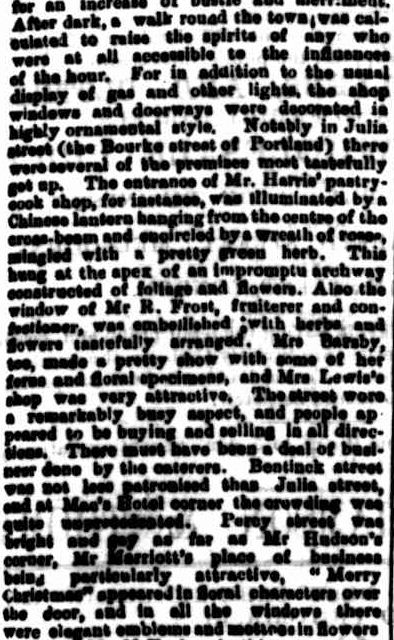
CHRISTMAS EVE. (1880, December 25). Portland Guardian (Vic. : 1876 – 1953), p. 3 Edition: MORNINGS.. Retrieved December 22, 2011, from http://nla.gov.au/nla.news-article63402944
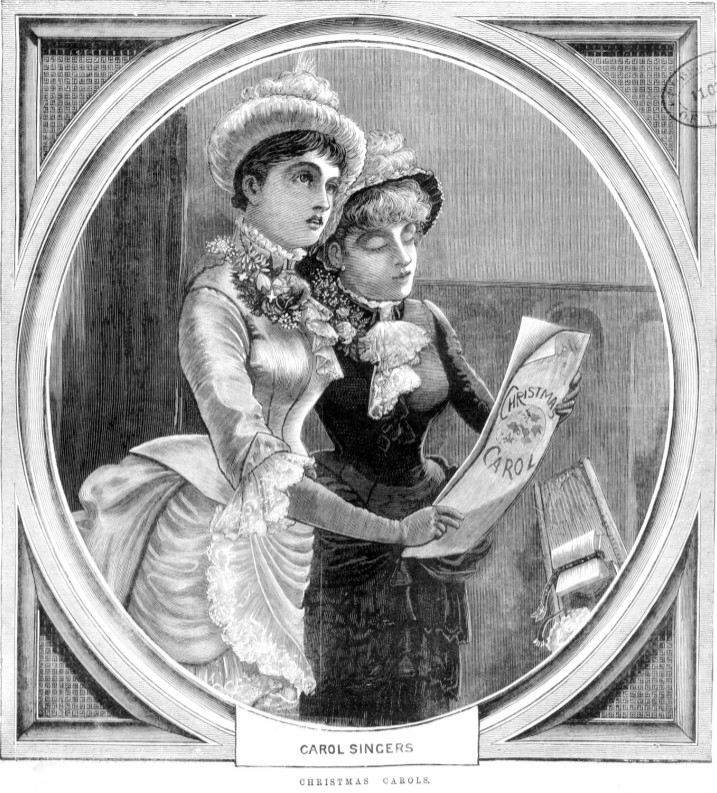
CHRISTMAS 1883. Image courtesy of the State Library of Victoria http://handle.slv.vic.gov.au/10381/253606

Cricket was a popular activity on Christmas day, a tradition that continues today for many who enjoy a game of backyard cricket after lunch.
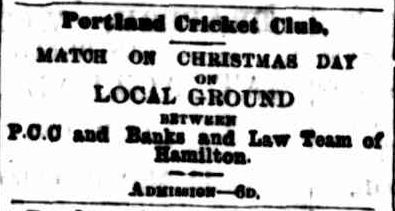
1880, December 25). Portland Guardian (Vic. : 1876 – 1953), p. 3 Edition: MORNINGS.. Retrieved December 22, 2011, from http://nla.gov.au/nla.news-page6018426

Christmas Day 1885 started quietly before churchgoers began to attend their chosen service.  Those not attending church stayed inside until the afternoon when many took advantage of Portland’s coastal position with some boating on the bay.
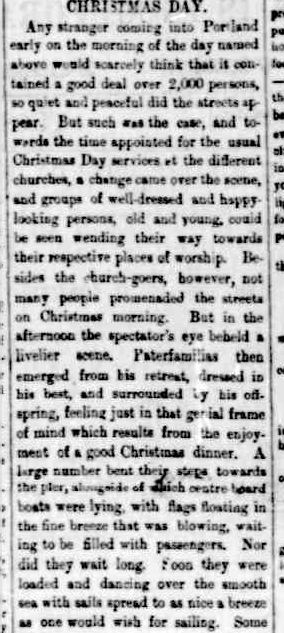
THE HOLIDAYS. (1885, December 29). Portland Guardian (Vic. : 1876 – 1953), p. 2 Edition: MORNINGS. Retrieved December 22, 2011, from http://nla.gov.au/nla.news-article63405142

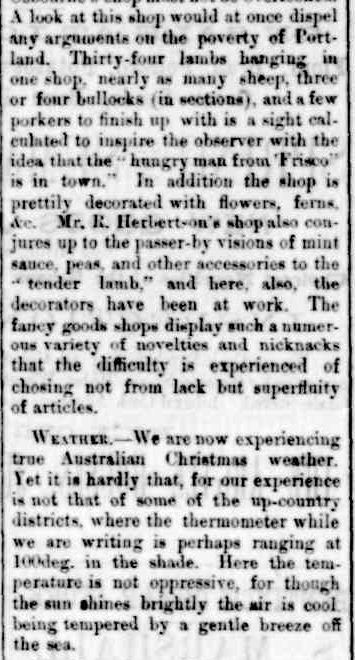
Christmas decorations on shops were still popular mid-1880s and there seems to have been some competition among the Portland shopkeepers.  From spices and currents to fruits and pastries, all had their wares displayed.  Mr. Osborne’s butcher shop window displayed 34 lambs, as many sheep and several bullocks and pigs.  Amid all this, the window was “prettily decorated with flowers, ferns, etc”
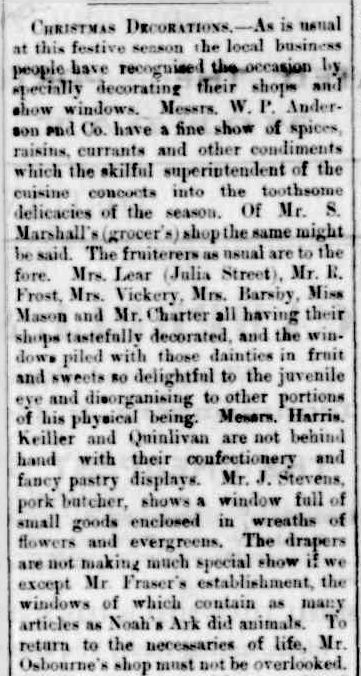
CHRISTMAS DECORATIONS. (1886, December 24). Portland Guardian (Vic. : 1876 – 1953), p. 2 Edition: EVENING. Retrieved December 22, 2011, from http://nla.gov.au/nla.news-article63407593

This is a great advertisement inviting the residents of Portland to visit the Christmas tree at the “Guardian” office. “Children, Don’t Forget to Persuade Father & Mother to Come” is followed by “Parents, Don’t Forget the Children”.
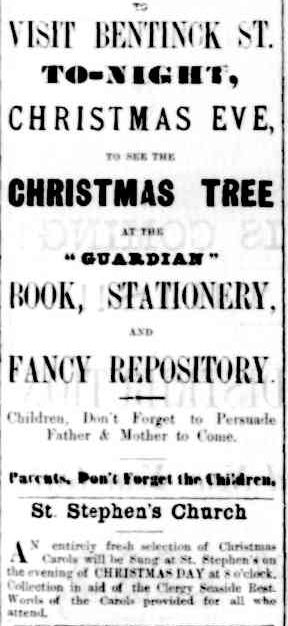
Advertising. (1886, December 24). Portland Guardian (Vic. : 1876 – 1953), p. 2 Edition: EVENING. Retrieved December 23, 2011, from http://nla.gov.au/nla.news-article63407578The Portland Guardian

In 1886, St Stephen’s Church was holding the annual carols, but with “a completely new set of carols”.
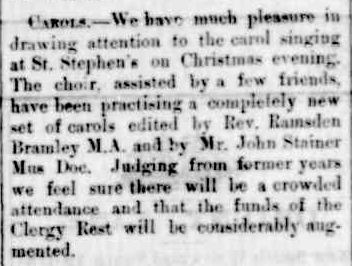
CHRISTMAS DECORATIONS. (1886, December 24). Portland Guardian (Vic. : 1876 – 1953), p. 2 Edition: EVENING. Retrieved December 22, 2011, from http://nla.gov.au/nla.news-article63407593
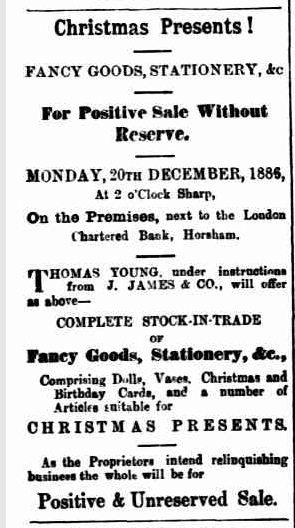
The Portland Guardian,. (1889, December 25). Portland Guardian (Vic. : 1876 – 1953), p. 2 Edition: EVENING. Retrieved December 23, 2011, from http://nla.gov.au/nla.news-article63625996

Christmas 1886 in Melbourne saw many businesses closing their doors from Friday to Wednesday to take full advantage of the Christmas holiday.  Even some hotels closed on Boxing Day!  Residents used this extended holiday period to get out of the city and enjoy the countryside.
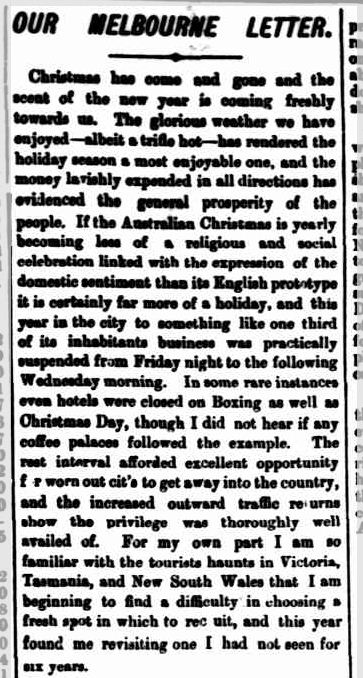
OUR MELBOURNE LETTER. (1886, December 31). The Horsham Times (Vic. : 1882 – 1954), p. 3. Retrieved December 22, 2011, from http://nla.gov.au/nla.news-article72957501

The following extract comes from an article called “Christmas Cheer”.  Along with instructions on how to boil a turkey, there were recipes for accompaniments such as celery sauce, oyster sauce, and German salad.
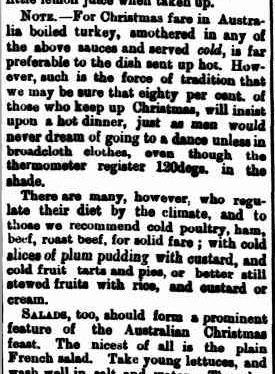
Christmas Cheer. (1888, December 25). The Horsham Times (Vic. : 1882 – 1954), p. 3 Supplement: CHRISTMAS SUPPLEMENT. Retrieved December 22, 2011, from http://nla.gov.au/nla.news-article72875421

Christmas cards seemed to become more popular during the 1880s, and this article from 25 October 1889 describes some of the trends in cards.  It appeared at the time of year cards were written to send to the “mother country”.
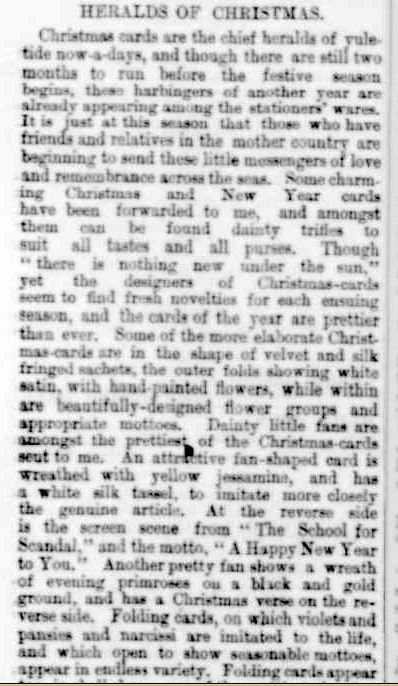
HERALDS OF CHRISTMAS. (1889, October 25). Portland Guardian (Vic. : 1876 – 1953), p. 3 Edition: EVENING, Supplement: SUPPLEMENT TO THE PORTLAND GUARDIAN. Retrieved December 2, 2011, from http://nla.gov.au/nla.news-article63625196

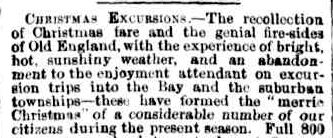
Just when I thought I was not going to see anything of yuletide logs, the following articles from the late 1880s continue the now old arguments of why have a hot lunch during the Australian summer and why are people still persisting with the English traditions?
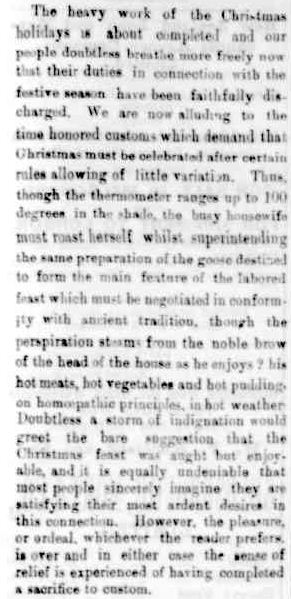
THE CHRISTMAS HOLIDAYS. (1888, December 28). Portland Guardian (Vic. : 1876 – 1953), p. 3 Edition: EVENING. Retrieved December 23, 2011, from http://nla.gov.au/nla.news-article63591436
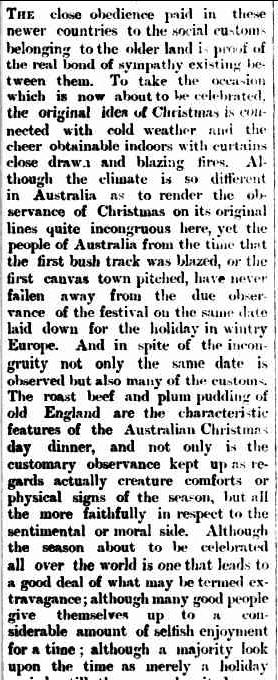
The Horsham Times. (1889, December 24). The Horsham Times (Vic. : 1882 – 1954), p. 2. Retrieved December 22, 2011, from http://nla.gov.au/nla.news-article72863411
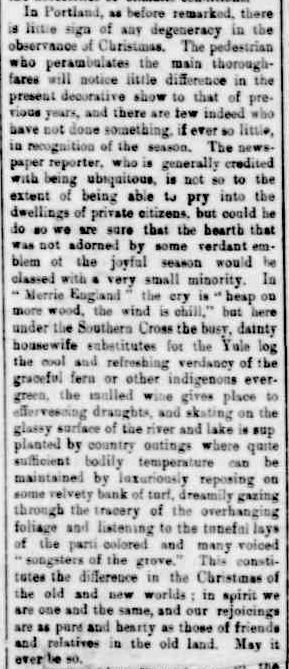
The Portland Guardian,. (1889, December 25). Portland Guardian (Vic. : 1876 – 1953), p. 2 Edition: EVENING. Retrieved December 23, 2011, from http://nla.gov.au/nla.news-article63625996

 

A Pioneer Christmas 1850s Style

Imagine arriving on an immigrant ship to Melbourne or Portland in December.  After enduring the arduous voyage for months, passengers would have set foot in their new country faced with an Australian summer and then reminded Christmas was just around the corner.  My Mortimer family arrived in Melbourne from England on December 14, 1852,  just 11 days before Christmas.  Having known only a cold and maybe white Christmas and possibly losing track of the months, they may have felt a little confused.

Judging by the newspapers of the 1850s, however, it seems that the new arrivals embraced the “new” Christmas of clear skies and sun and a chance to get outside and enjoy the day.

ARRIVAL OF HIS EXCELLENCY SIR H. BARKLY. (1856, December 26). The Argus (Melbourne, Vic. : 1848 – 1956), p. 4. Retrieved December 15, 2011, from http://nla.gov.au/nla.news-article7142206

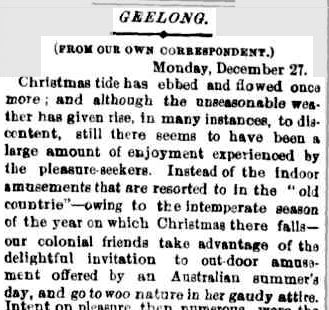
GEELONG. (1858, December 28). The Argus (Melbourne, Vic. : 1848 – 1956), p. 6. Retrieved December 15, 2011, from http://nla.gov.au/nla.news-article7307009

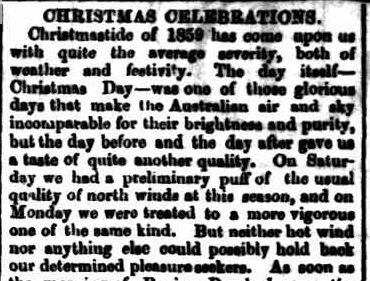
CHRISTMAS CELEBRATIONS. (1859, December 27). The Star (Ballarat, Vic. : 1855 – 1864), p. 1 Supplement: SUPPLEMENT TO THE STAR.. Retrieved December 13, 2011, from http://nla.gov.au/nla.news-article72463975

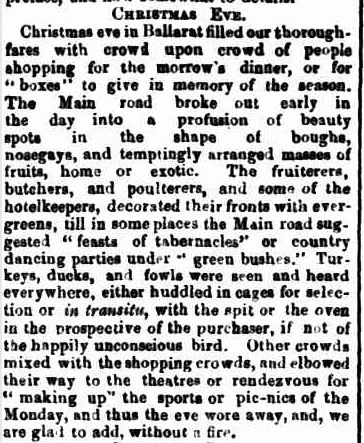
On Christmas Eve, 1859, Main Road Ballarat was abuzz with activity.

CHRISTMAS CELEBRATIONS. (1859, December 27). The Star (Ballarat, Vic. : 1855 – 1864), p. 1 Supplement: SUPPLEMENT TO THE STAR.. Retrieved December 15, 2011, from http://nla.gov.au/nla.news-article72463975

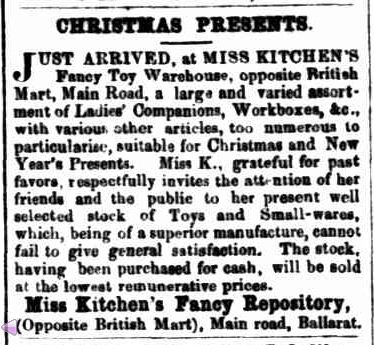
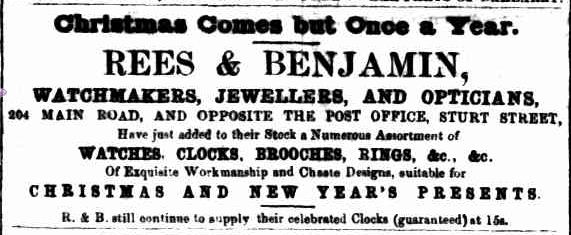
As well as shopping for ducks, geese, and turkey for Christmas lunch, some last-minute Christmas shopping could be done at Miss Kitchen’s Fancy Toy Warehouse or Rees and Benjamin Watchmakers and Jewellers.

Advertising. (1859, December 17). The Star (Ballarat, Vic. : 1855 – 1864), p. 3. Retrieved December 13, 2011, from http://nla.gov.au/nla.news-article72463876

Advertising. (1859, December 20). The Star (Ballarat, Vic. : 1855 – 1864), p. 1. Retrieved December 13, 2011, from http://nla.gov.au/nla.news-article72463910

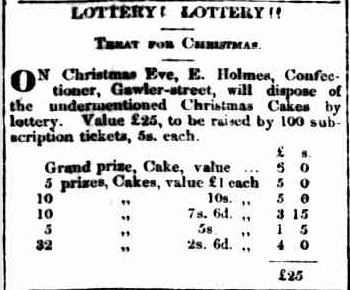
In Portland, shoppers may have spent Christmas Eve with their fingers crossed for the draw of the Christmas cake lottery at Holmes Confectioners in Gawler Street.

Advertising. (1859, December 19). Portland Guardian and Normanby General Advertiser (Vic. : 1842 – 1876), p. 3 Edition: EVENINGS.. Retrieved December 15, 2011, from http://nla.gov.au/nla.news-article64512997

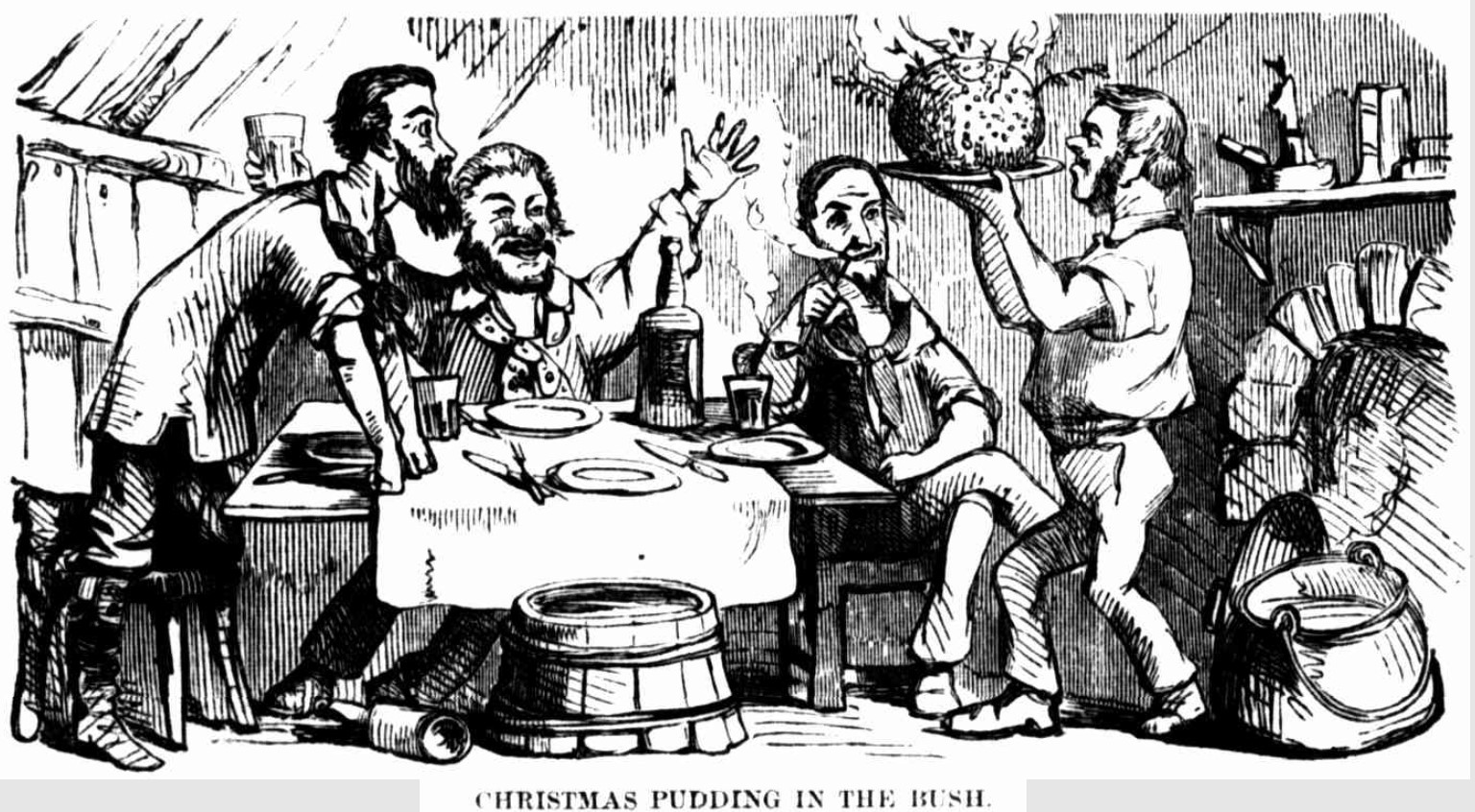
“No Title” Melbourne Punch (Vic. : 1855 – 1900) 2 August 1855: 173.

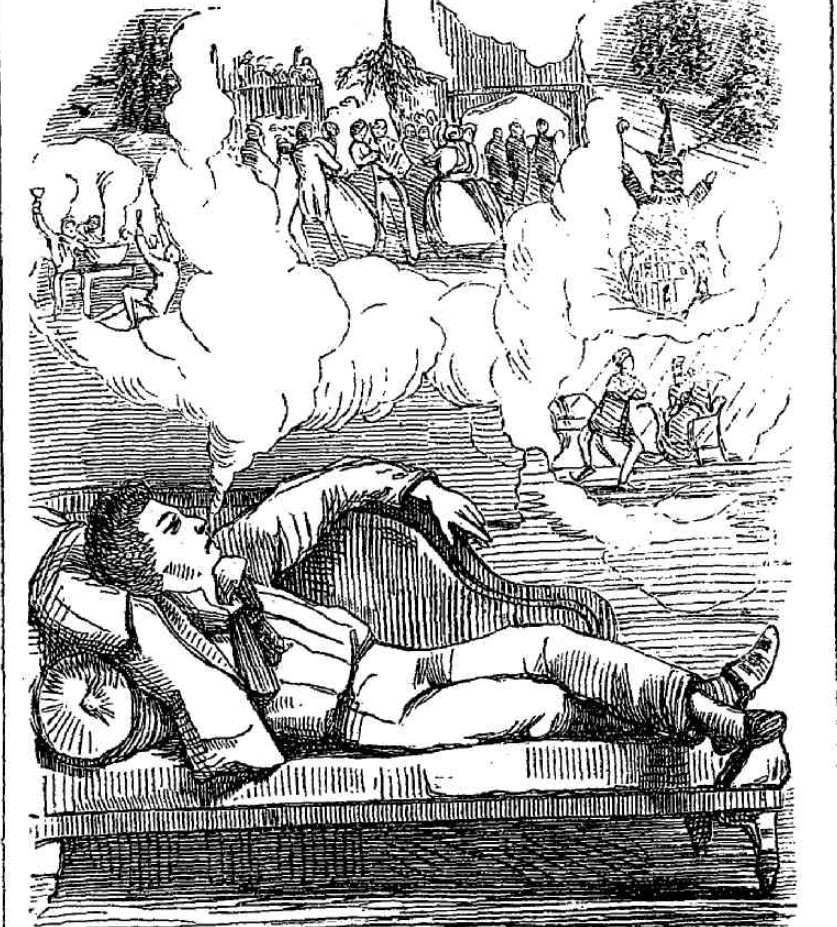
Not everyone was enjoying the new style of Christmas.  This illustration was entitled “A New Chum’s Christmas…The Pleasures of Memory”.

“A NEW CHUM’S CHRISTMAS.” Melbourne Punch (Vic. : 1855 – 1900) 1 January 1857: 3.

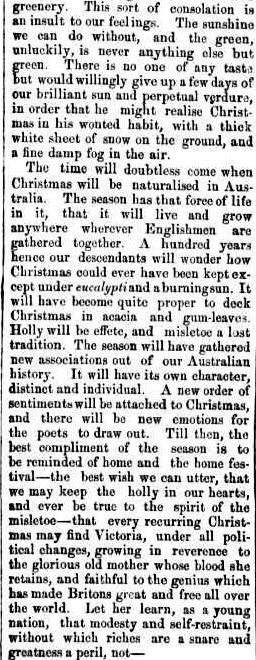
In 1859, the editor of  The Argus lamented that Christmas was not the same in Australia without the snow and mistletoe.  I like his prediction that in one hundred years,  Australians will have forgotten the “old” Christmas and have given Christmas a new feel with eucalyptus and acacia decking the halls.  If only he could see Christmas now as he would see that many of the English traditions of Christmas still exist and we still grapple with the idea of a hot lunch on a hot day,  but we just do it anyway.  The tradition continues.

(1859, December 26). The Argus (Melbourne, Vic. : 1848 – 1956), p. 4. Retrieved December 16, 2011, from http://nla.gov.au/nla.news-page198773

Passing of the Pioneers

November sees more interesting obituaries from the Portland Guardian.  The Horsham Times is now available at Trove, so I have included obituaries from that paper.

Read about a long time manager of Burswood, the Henty homestead, a man who grew new teeth at 80 and two women who lived in the same houses for over 60 years.

Benjamin EDRICH: Died 18 November 1887 at Portland. The Portland Guardian reported at the time of Benjamin EDRICH’s death that another resident “had been removed by the hand of the “Grim Destroyer”.  Benjamin had been in the hotel business for many years.

George BUSH: Died 18 November 1909 at Portland. George BUSH arrived in Portland in 1853 in his early twenties.  A seaman, George was instrumental in rescuing passengers from the wreck of the “Jane” at Bridgewater some years later.

Peter GOLDSMITH: Died 23 November 1909 at Portland. Peter GOLDSMITH arrived in Portland in 1853 aboard the Cornelius captained by Thomas H. CLARKE. Clarke’s son Thomas Denton CLARKE was mentioned in the October Passing of the Pioneers.  Four months after his arrival Peter GOLDSMITH married Miss BLAY and they had nine children. He was eighty-five at the time of his death.

Michael TOBIN: Died 13 November 1916 at Murtoa. The Horsham Times reported the death of Michael Tobin, a Justice of the Peace and former Councillor with the Dunmunkle Shire.  Michael arrived at Geelong in 1853, with his parents from Kilkenny, Ireland.  He worked with his father who ran a carrying business to the diggings.  Michael later lived in the Warrnambool area where he married Mary CLUNE.  In 1872, Michael was one of the first settlers in the Wimmera.

Obituary. (1916, November 21). The Horsham Times (Vic. : 1882 – 1954), p. 4. Retrieved November 24, 2011, from http://nla.gov.au/nla.news-article72983888

George JARRATT: Died November 1919 at Portland. George JARRATT arrived in 1848 to Portland and married soon after.  He and his wife, a daughter of Thomas KEAN, had twelve children.

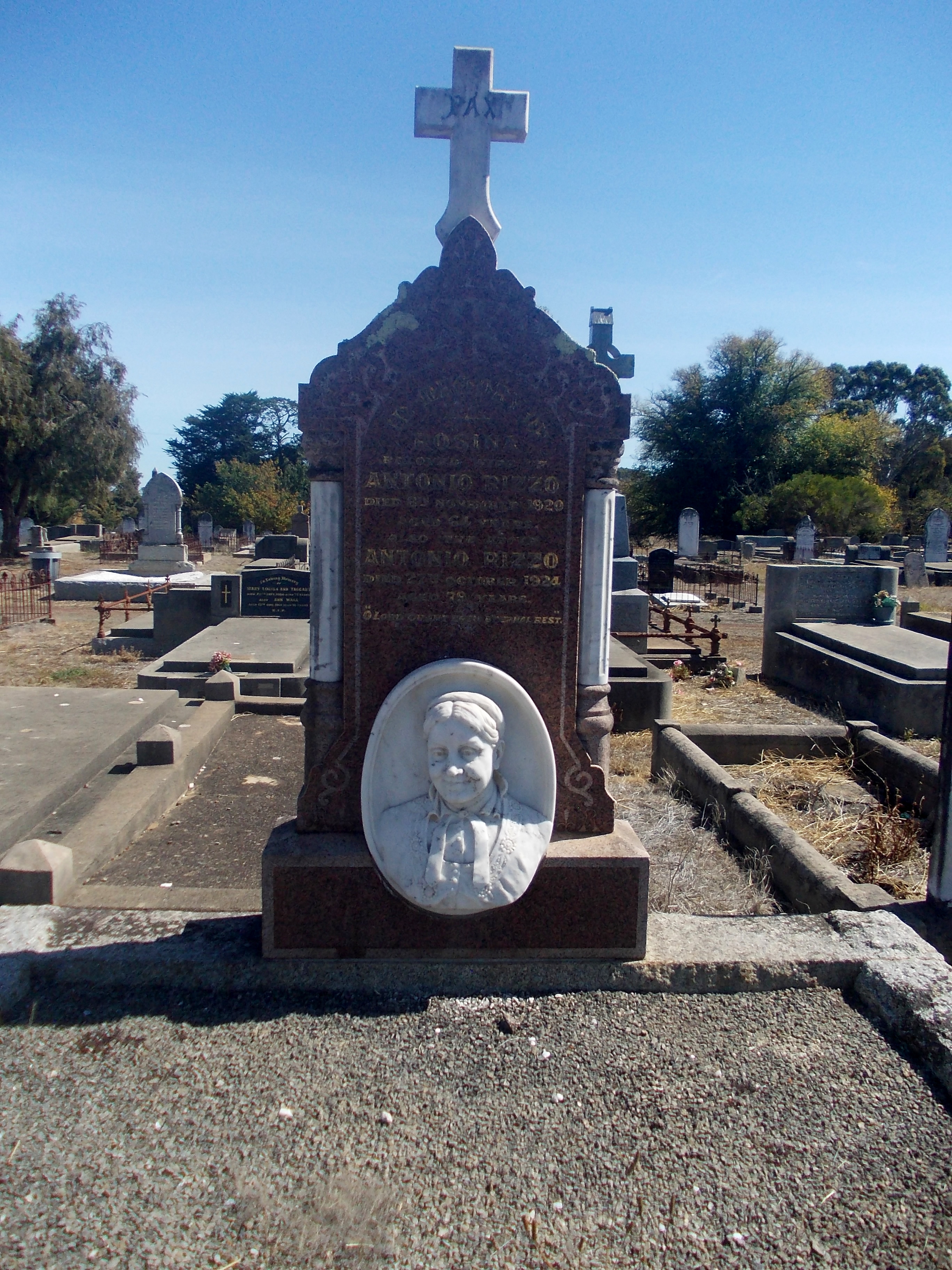
Rose Genevive McCRYSTAL: – Died 8 November 1920 at Caulfield. Rose McCRYSTAL, was the daughter of well-known Portland resident Pat McCrystal. She married W. PEARSON, and moved to Hamilton. After her husband was killed in a buggy accident, she moved back to Portland where she married Antonio RIZZO in 1891. They later returned to Hamilton.

Rizzo

GRAVE OF ROSINA RIZZO (nee McCRYSTAL) AND HER HUSBAND ANTONIO RIZZO, HAMILTON OLD CEMETERY.

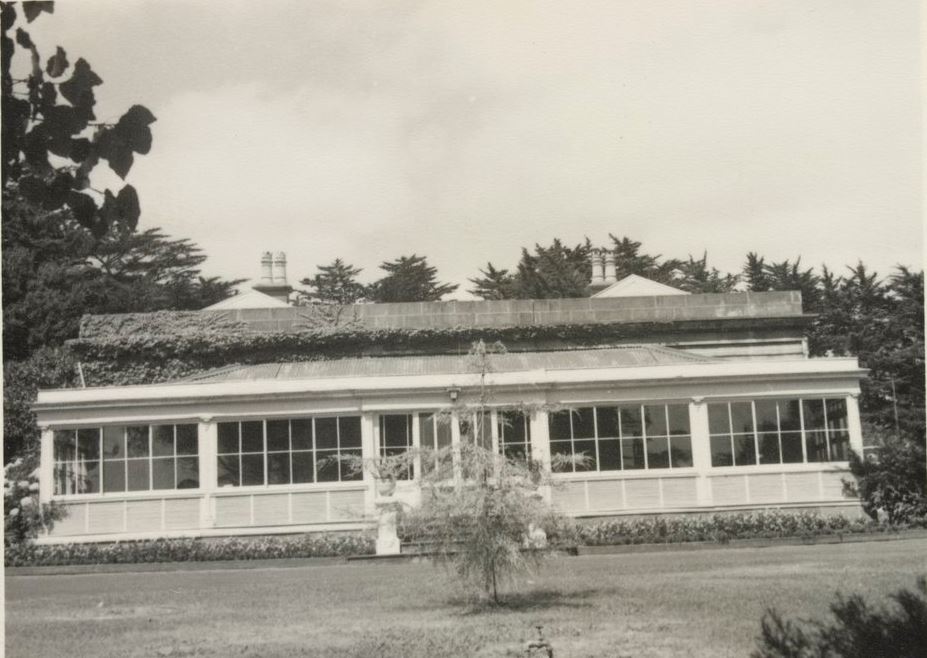
William POLAND: Died 20 November 1922 at Portland. William POLAND arrived in Portland in 1856. He met Edward HENTY and acquired the position of manager of Burswood, the Henty’s original homestead. William held the position for twenty-five years.

“BURSWOOD” PORTLAND. Image courtesy of Colin Caldwell Trust collection, State Library of Victoria. Image no. H84.276/6/44A http://handle.slv.vic.gov.au/10381/72455

Mary Stanton SLEEP: Died 3 November 1923 at Portland. I enlarged this obituary to make sure my eyes weren’t deceiving me.

OBITUARY. (1923, November 8). Portland Guardian (Vic. : 1876 – 1953), p. 2 Edition: EVENING.. Retrieved November 24, 2011, from http://nla.gov.au/nla.news-article64103714

Mary Sleep was ninety-five when she died in 1923, however, the obituary reads she arrived in Portland in 1836 as a married woman!  I think this may have been a typo. A check of the Victorian Marriage Index shows Mary married Francis ROW in 1853.

Isabella MARSHALL: Died 8 November 1927 at Portland. Isabella MARSHALL managed to pass Mary SLEEP (above) for the longest time in one house.  She lived in the same house for sixty-five years. Originally from Scotland, Isabella arrived in Portland aboard the Indian Ocean in 1854 with her husband William ROBB.  She was ninety-six when she died and left seven children, twenty-three grandchildren, twenty-nine great-great-grandchildren and one great-great-great grandchild.  She was buried at the North Portland Cemetery.

Sarah MILLARD: Died 10 November 1927 at Paschendale. Sarah MILLARD was the daughter of William MILLARD of Narrawong. She married William Henry ANNETT in 1870 and they had ten children, eight sons and two daughters.  William, or Henry as he was known, was also known as the “Father of Wallacedale”.  He died only weeks earlier than Sarah on 29 September. Unfortunately, I missed his obituary for the September Passing of the Pioneers, as it appeared in an October issue, but it will definitely appear in September 2012.  Henry’s obituary is one of the best I have read, and what a life he led, especially before he married Sarah.  If you can wait until next year, this is the link:  Obituary of William Henry Annett.  I also spent too much time trying to find a link between Sarah MILLARD and William MILLARD, the winner of the first Stawell Gift.  He may have been Sarah’s brother, but there were a lot of Millards.  Research for another time.

Agnes MUIR: Died 10 November 1942 at Horsham. Agnes MUIR arrived in Brisbane with her new husband Ralph CHEQUER in 1886 aboard the Roma, having married in their home country of Scotland before departing. Over the years, they spent time in Melbourne, Portland and Quantong. At Quantong, the CHEQUERS cleared the land and planted orchards and for thirty years Agnes helped Ralph with the orchard work. One memorable event for the CHEQUERS was in 1911 when they travelled to England for the coronation of King George V.

James COLES: Died 18 November 1944 at Stawell. James COLES was born in the mid-1850s close to the Melbourne GPO.  After time in Avoca, James moved to Stawell as a teenager, later to marry Louisa GILHAM.  He remained in Stawell until his death at ninety-one, aside from a short stint at nearby Fyans Creek.

Thomas THOMPSON: Died 17 November 1945 at Portland. Thomas THOMPSON from Ireland began his time in Australia in Western Australia as a miner. Unsuccessful he headed to Victoria and the Portland district.

OBITUARY. (1945, November 19). Portland Guardian (Vic. : 1876 – 1953), p. 3 Edition: EVENING. Retrieved November 25, 2011, from http://nla.gov.au/nla.news-article64406000

Annie KERR: Died November 1947 at Portland. Annie KERR was the daughter of early Portland residents, her father a doctor. Interesting that he had not practised before his arrival in Portland!  Annie went on to marry John NEWTON.

Joseph Levi Richard BAKER: Died 27 November 1950 at Hamilton. Joseph BAKER was born around 1877 and lived in Collins Street Hamilton. He enjoyed tennis and summer trips to Portland. The obituary reported he was known throughout the Commonwealth for his calligraphy skill. He left a wife Bertha and two daughters.

Carl Frederick Wilhelm PULS: Died 12 November 1953 at Lower Norton. Carl PULS had many claims to fame, but one was his ability to grow new teeth at the age of eighty. Carl was a respected pioneer of the Horsham district and was sadly found dead by his car after a trip to gather wood.

John BERRY: Died 12 November 1953 at Horsham. John BERRY’S death came on the same day as Carl ULS (above).  The BERRY family were pioneers in the Blackheath district, north of Horsham. They later moved to Horsham and John attended the Horsham State School.  John married Ethel KNIPE of Ballarat and worked at Horsham car dealer Wilson Bolton for over forty years. He held one of the first driving licences in Victoria but had driven previous to that, in a time when a licence was not required…scary. I noted that John had a brother James from Hamilton. This may have been the same James BERRY of James Berry & Sons Jewellers, a long-established business in Hamilton when I was growing up there in the 1970s and 80s.

The Horsham Times Goes Digital

(1891, January 6). The Horsham Times (Vic. : 1882 – 1954), p. 1. Retrieved November 23, 2011, from http://nla.gov.au/nla.news-page7084926

It’s great to see issues of  The Horsham Times going online at Trove.  I was very happy when I immediately found articles about family members.  While I did have some family in Horsham, I have found a lot of articles about the Cavendish area which I am hoping will help with the Hadden and Mortimer families.

When fully released, issues available will cover the period 1882-1954.  This will be a great resource for researching the Western District.  There is more to look forward to.  New titles for the 2011-2012 financial year will include:

Ararat Advertiser (1914-1918)   NOW AVAILABLE

Casterton News and the Merino and Sandford Record (1914-1918)  NOW AVAILABLE

Colac Herald (1914-1918) NOW AVAILABLE

Mildura Cultivator (1888-1920) NOW AVAILABLE

Warrnambool Standard (1914-1918) NOW AVAILABLE

If you haven’t visited Trove lately, these are the titles from Western Victoria already available:

The Ballarat Star (1865)

Camperdown Chronicle (1877-1954)

The Kerang Times (1889-1890)

Kerang Times & Swan Hill Gazette (1877-1889)

Portland Guardian (1876-1953)

Portland Guardian and Normanby General Advertiser (1842-1876)

The Star (Ballarat) 1855-1864

Happy reading!

In the News – November 16, 1922

The Portland Guardian of 16 November 1922, reported much excitement surrounding the town’s birthday celebrations beginning that day, including “Back to Portland” celebrations.  Former residents had started to return and reacquaint themselves with old friends.

Portland’s Gala Week. (1922, November 16). Portland Guardian (Vic. : 1876 – 1953), p. 2 Edition: EVENING.. Retrieved November 15, 2011, from http://nla.gov.au/nla.news-article64027013

One article Coming Home is a reminder of how useful newspapers are in assisting our research.  Included is a list of all those who had indicated they would be attending the reunion.

Each name includes the present town of residence, some with an address.  The following are just a few of the names:

(1922, November 16). Portland Guardian (Vic. : 1876 – 1953), p. 4 Edition: EVENING.. Retrieved November 14, 2011, from http://nla.gov.au/nla.news-page6065696

Other well-known names included Henty, Holmes, Kittson, Malseed, and Silvester.

Advertising. (1922, November 16). Portland Guardian (Vic. : 1876 – 1953), p. 2 Edition: EVENING.. Retrieved November 14, 2011, from http://nla.gov.au/nla.news-article64027014

Advertising. (1922, November 16). Portland Guardian (Vic. : 1876 – 1953), p. 3 Edition: EVENING.. Retrieved November 15, 2011, from http://nla.gov.au/nla.news-article64027000

Off to the Melbourne Cup!

Melbourne Cup day is one of my favourite days of the year.  As a horse lover and a racing fan, it’s not the fashion and the glamour that draws me but rather the elusiveness and history of the prize.  To win the Melbourne Cup is the aim of anyone who has raced horses.  Just to have a runner in the final field of twenty-four is a dream of many.  With most winners comes a story. Some are passed on for generations, such as the stories of Archer, Phar Lap and more recently Media Puzzle.  This also adds to the romance.

This year marks the 150th running of the Cup, the race that stops a nation. But when did it become such an event?  When Phar Lap gave some certainty to depression weary Australians in the 1930s?  When television was able to beam the Cup into lounge rooms around the country?  Or in the past 15 years or so, with the need to display opulence moving it from a day of silly hats as in the 1970s and 80s, to high-class fashion, marquees and celebrities?   None of these.  The Cup’s standing today is just as it has been from the beginning in 1861.

Reading The Argus or The Portland Guardian from the time of the early Cups reveals even then it was a highlight of the racing year.  Racing was well established by the time the Cup began, with many towns having a race track.  Steeple-chasing was a popular pursuit, particularly in the Western District at tracks such as Coleraine and Hamilton.  Racing as a pastime had a greater following then than it does today.  Remember the crowds flocking to the races this week are not indicative of attendances on regular race days.

The Brisbane Courier reported the first Cup had created interest not seen before in the colonies.

THE MELBOURNE CUP. (1861, November 12). The Courier (Brisbane, Qld. : 1861 – 1864), p. 2. Retrieved October 31, 2011, from http://nla.gov.au/nla.news-article4602126

By 1862, the Sydney Morning Herald was declaring it a red-letter day on the racing calendar.   And there it has remained.

MELBOURNE TURF CLUB RACES. (Abridged from the Herald.) FIRST DAY—THURSDAY, 13TH NOVEMBER. (1862, November 20). The Sydney Morning Herald (NSW : 1842 – 1954), p. 8. Retrieved October 31, 2011, from http://nla.gov.au/nla.news-article13237409

The Melbourne Cup was popular among the fine ladies and gentleman of the Western District.  Many with their own racing connections, they would make the trip to partake in the carnival.  There have also been Western District owners, trainers, jockeys and horses involved in the running over the years, such as the Chirnsides and 1912 Cup winner The Parisian.

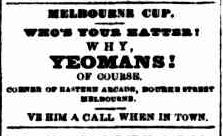
Melbourne businesses knew of the interest and advertised in the Portland Guardian to lure some of the Western District money as this advertisement from 1877 shows:

Advertising. (1877, November 12). Portland Guardian (Vic. : 1876 – 1953), p. 3 Edition: EVENINGS.. Retrieved November 1, 2011, from http://nla.gov.au/nla.news-article63339903

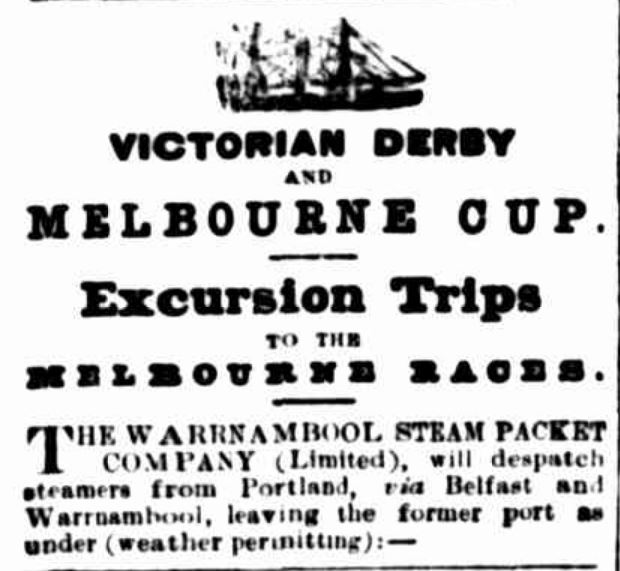
Many Western District people took advantage of special steamer services to get them to the Melbourne Cup

“Advertising” Portland Guardian (Vic. : 1876 – 1953) 5 November 1877: 2 (EVENINGS.). <http://nla.gov.au/nla.news-article63339859&gt;.

In the same year, the Portland Guardian ran an article declaring the 1879 Cup a huge success with 90,000 patrons and comparisons with the great races of the world including the Engish Derby. While the Illustrated Australian News, mentioned the “country cousins” who made the trip, the “shepherd kings”…the squatters.

“THE CUP DAY.” Illustrated Australian News (Melbourne, Vic. : 1876 – 1889) 28 November 1879: <http://nla.gov.au/nla.news-article60095781&gt;.

“Country cousins” from the Casterton district were at the 1879 Cup although some didn’t own up to it.

“CASTERTON.” Hamilton Spectator (Vic. : 1870 – 1918) 1 November 1879: <http://nla.gov.au/nla.news-article226056969&gt;.

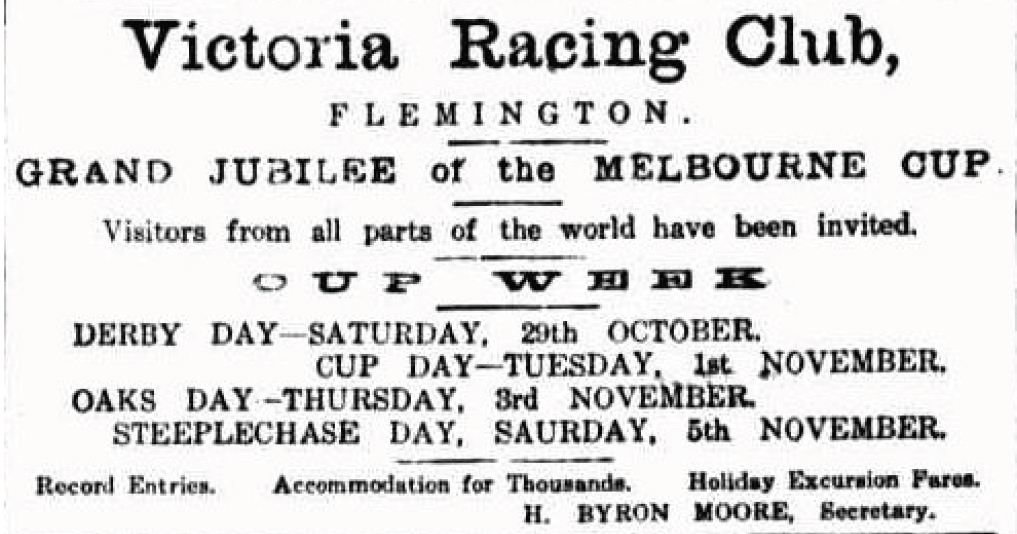
In 1910, advertisements ran in the Portland Guardian luring Western District racegoers to the Cup:

Advertising. (1910, October 26). Portland Guardian (Vic. : 1876 – 1953), p. 2 Edition: EVENING. Retrieved November 1, 2011, from http://nla.gov.au/nla.news-article63978762

The Glenelg Shire President cabled Gallipoli in 1915 with news of the winner just minutes after the race.

First Issue, August 20, 1842. (1915, November 10). Portland Guardian (Vic. : 1876 – 1953), p. 2 Edition: EVENING. Retrieved November 1, 2011, from http://nla.gov.au/nla.news-article63975310

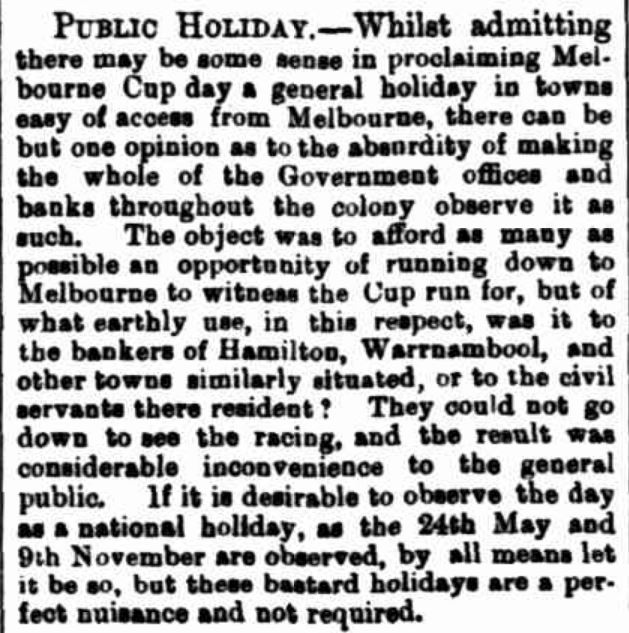
An article “Off to the Melbourne Cup” in the Portland Guardian of 28 October 1887  sums up the grasp the Melbourne Cup holds on the people of Australia.  It could easily have today’s date on it.

Off to the Melbourne Cup!. (1887, October 28). Portland Guardian (Vic. : 1876 – 1953), p. 3 Edition: EVENING. Retrieved November 1, 2011, from http://nla.gov.au/nla.news-article65410876

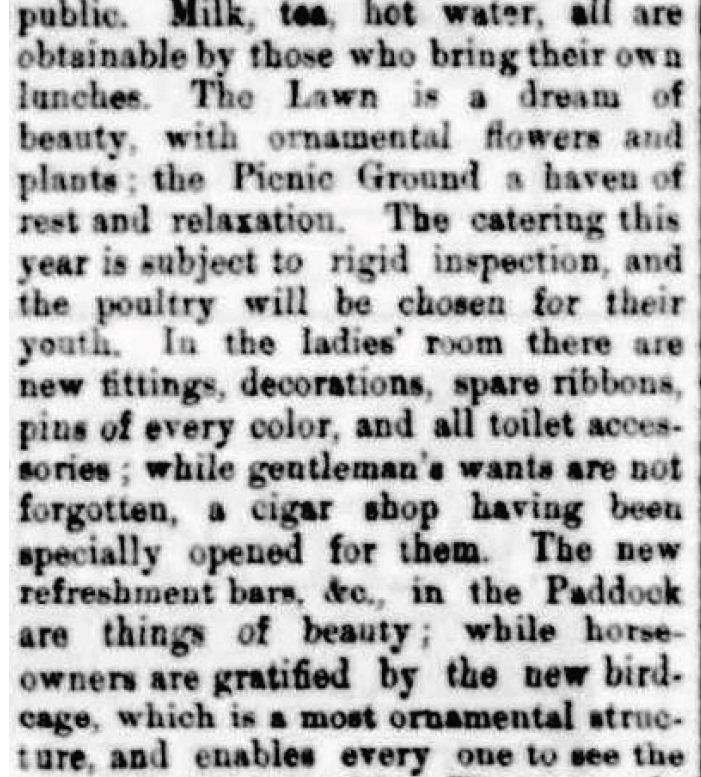
In the same article, patrons were reassured all their needs would be met at the course and they could rest easy in the knowledge the chicken was safe to eat!

Off to the Melbourne Cup!. (1887, October 28). Portland Guardian (Vic. : 1876 – 1953), p. 3 Edition: EVENING. Retrieved November 1, 2011, from http://nla.gov.au/nla.news-article65410876

And the last word goes to the Hamilton Spectator from 9 November 1876.

“Items of News.” Hamilton Spectator (Vic. : 1870 – 1918) 9 November 1876: 2. <http://nla.gov.au/nla.news-article226039651&gt;.

Passing of the Pioneers

This is the fourth “Passing of the Pioneers” and includes a chess champion who lived in Merino and plenty of Irish influence.  They highlight some of the pioneers of Victoria’s Western District by way of their obituaries as published in the Portland Guardian.  If you would like to read the full obituary, just click on the pioneer’s name.

Emma WITHERIDGE: Died  4 October 1888 at Portland. This obituary demonstrates the tone of many at the time.

OBITUARY. (1888, October 5). Portland Guardian (Vic. : 1876 – 1953), p. 2 Edition: EVENING.. Retrieved October 26, 2011, from http://nla.gov.au/nla.news-article63590480

George BEVAN: Died  17 October 1888 at Portland. George owned and died at the London Hotel in Portland.  His family notice shows he was born in Somerset, England and was fifty-nine at the time of death.  George had been in Portland since the early 1860s and was a keen sportsman and former Town Councillor.

Mary ROGERS: Died October 1912 at Greenwald.  Mary Rogers was aged eighty-six at the time of her death and had lived in Victoria for sixty years.  She originally went to Tasmania from Ireland with her parents as a small child.  Mary married Francis Egan who had passed away thirty years earlier.

William Sudgen Price LEWIS: Died 4 October 1915 at Hamilton. William Sudgen Price Lewis was the stepson of Richard Lewis, a former owner of Rifle Downs at Digby.  Born in Tasmania in 1835, William and his brother came to live with Richard Lewis when Richard and their mother married in 1841. In adult life, William leased Hilgay station for a time, bred fine livestock and was a member of several racing clubs. He later retired to Hamilton. He was buried at Hamilton (Old) Cemetery (below).

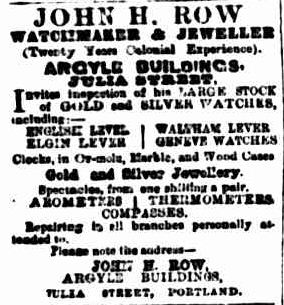
John Hawkins ROW: Died 27 October 1926 at Portland. John Row was a Portland jeweller.

Advertising. (1879, March 27). Portland Guardian (Vic. : 1876 – 1953), p. 2 Edition: MORNINGS.. Retrieved October 27, 2011, from http://nla.gov.au/nla.news-article63341984

At the time of his death, he was the oldest member of the Portland Free Library and the bowling club.  He was also a member of the St Stephen’s Church congregation.

St Stephens Church Portland

John McDONNELL: Died 17 October 1930 at Moree. Mr McDonnell was originally from Ireland and arrived in Australia in 1863 via Liverpool. He was considered one of the oldest people in the district. He married Catherine FAHEY and they selected land at Moree in 1865.

Catherine Bridget SAMPEY: Died October 1933 at Melbourne. Catherine Sampey arrived in Melbourne from Ireland aboard the Red Jacket in 1852. She travelled on to Chetwynd with her brother James Sampey and she later married Patrick WHITE of Casterton.

Elizabeth MONOHAN: Died 12 October 1933 at Casterton. Elizabeth Monohan was 100 when she died. Arriving from Ireland aboard the Frances Henty at age twenty-one, seventy-nine years before, she was still able to converse in Welsh and Gaelic in her later years. In 1859, she married John Glover at Sandford House.

Julia Teresa DOYLE: Died October 1934 at Portland. Born in Tipperary, Ireland but remembered as “a true type of a fine old English lady”, Julia Doyle arrived in Australia as a six-year-old in the mid-1850s. She married Frances SUTTON in 1874 and together they had six daughters and two sons.

Ernest John SEALEY: Died 25 October 1935 at Casterton. In his younger years, Ernest Sealey worked as a bullock driver transporting wool. In later worked on Portland’s deep-water pier, hauling logs from the forests to the pier.

Charles PRATT: Died 26 October 1935 at Birchip.

Obituary. (1935, November 4). Portland Guardian (Vic. : 1876 – 1953), p. 2 Edition: EVENING.. Retrieved October 27, 2011, from http://nla.gov.au/nla.news-article64290777

And so begins the obituary of Charles Pratt.  Charles or Charley as he was widely known, was born at Mumbannar in 1870.  In 1891, he went to Beulah in the Mallee and worked with his step-brother and later selected his own land near Watchupga.  He married Annie LAVERY in 1914 and they had three sons.

Thomas Denton CLARKE: Died 5 October 1937 at Hamilton. Thomas, born around 1847 at Liverpool, was the son of Captain Thomas H. Clarke who was a trader in Portland.  Thomas jnr was a champion chess player and a composer of chess problems.  He won many competitions for both pursuits.  Composing problems up until his death, it was considered probable, according to the obituary, that he was the world’s oldest composer.

James McCLUSKEY: Died October 1942 at Koroit. James McCluskey was born at Portland in 1857, not long after the arrival of his parents on the ship, British Empire. Soon after, the family travelled by bullock wagon to Kirkstall near Warrnambool.  In his early working life, James drove pigs to Port Fairy in order to load them on the steamer Casino to go to market in Melbourne.

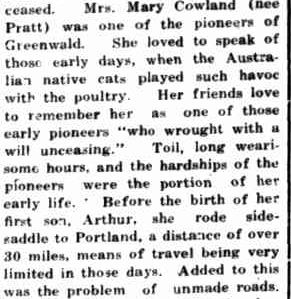
Mary PRATT: Died 7 October 1942 at Greenwald. Mary, the widow of George COWLAND, was eighty-seven at the time of her death.  There were twelve children in their family.  Her obituary recalled her pioneering traits.

OBITUARY. (1942, October 26). Portland Guardian (Vic. : 1876 – 1953), p. 2 Edition: EVENING. Retrieved October 27, 2011, from http://nla.gov.au/nla.news-article64382483

The Day the Queen Visited Hamilton

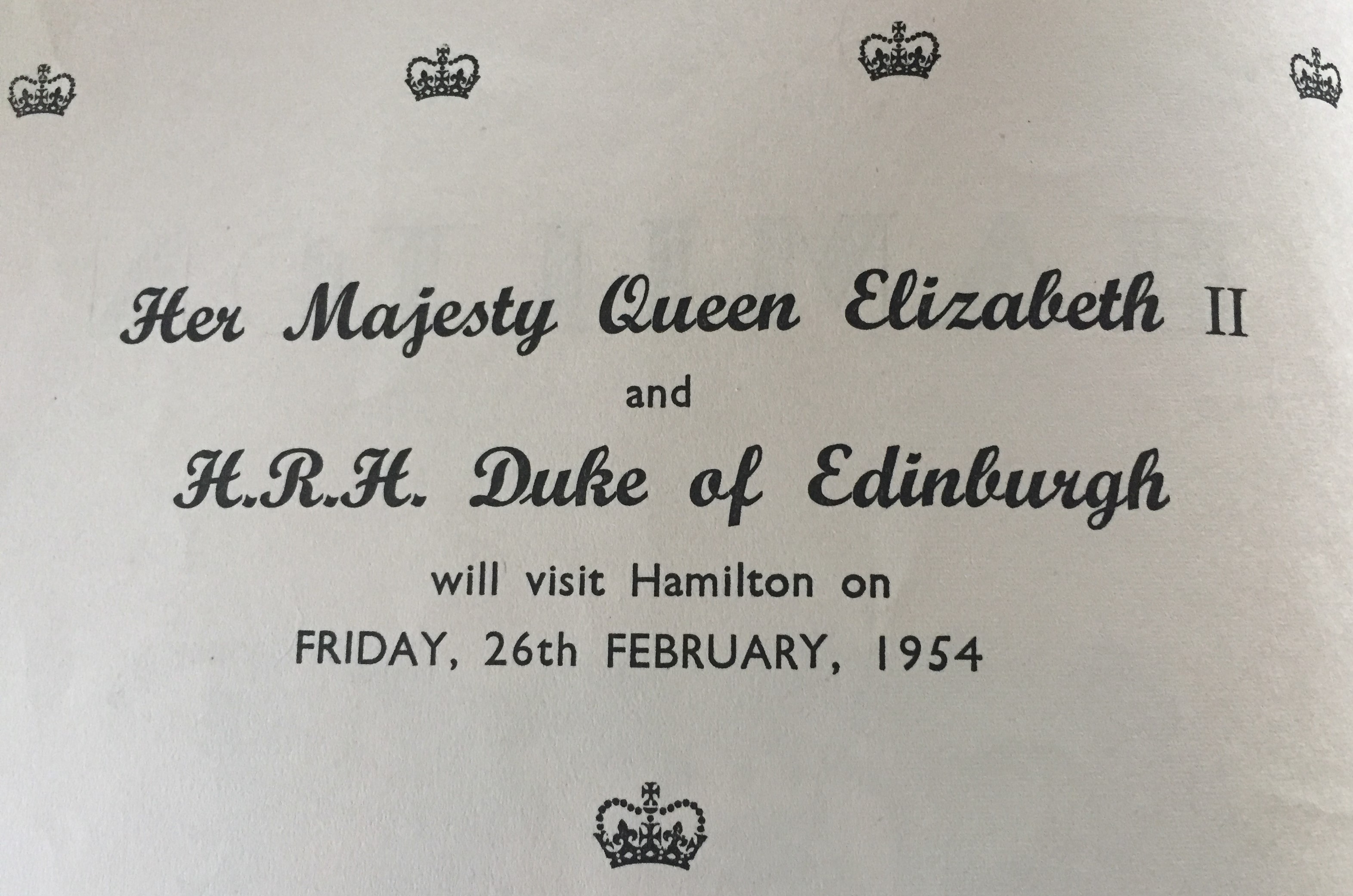
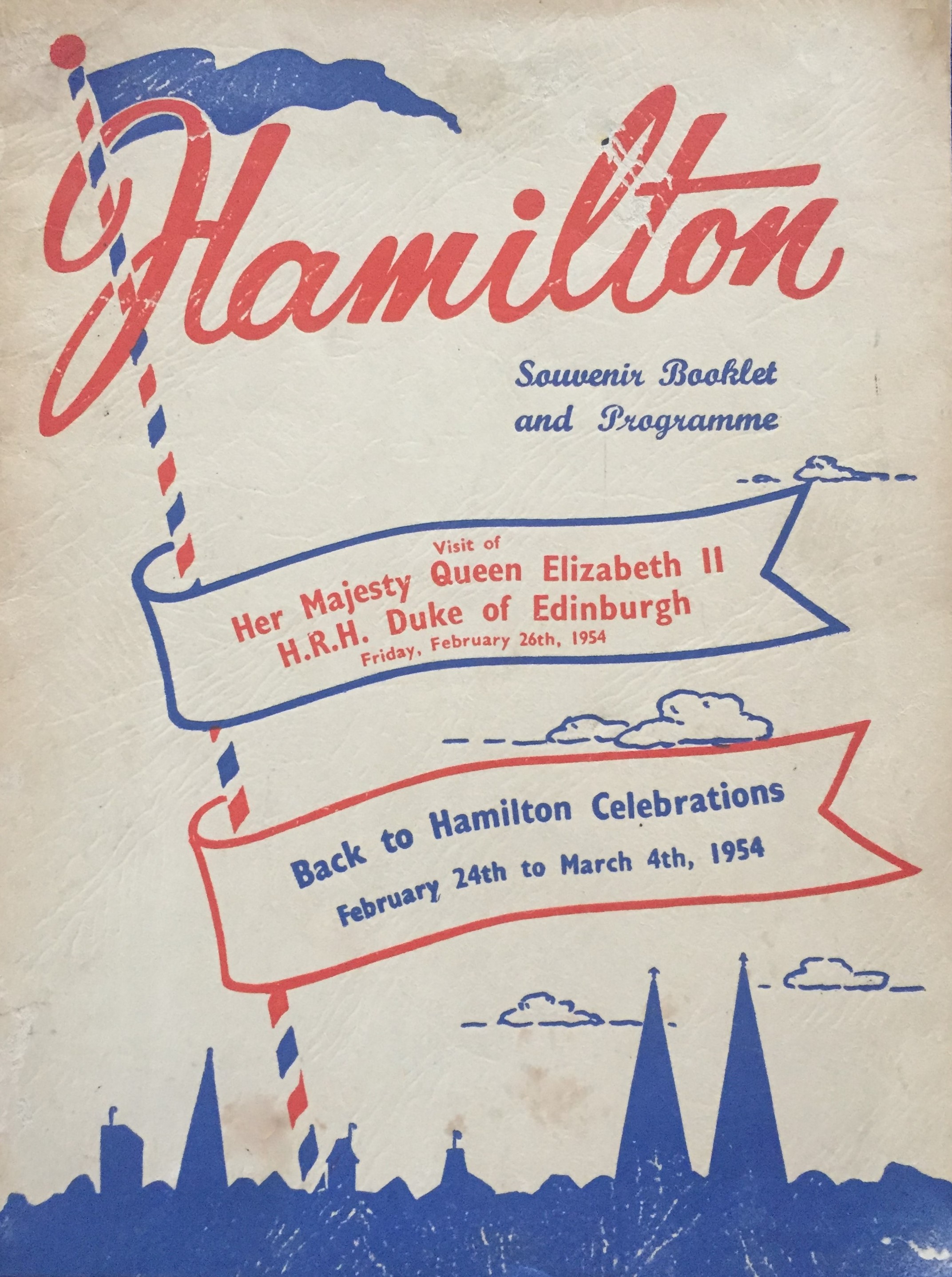
Hamilton Souviner Booklet and Program, 1954

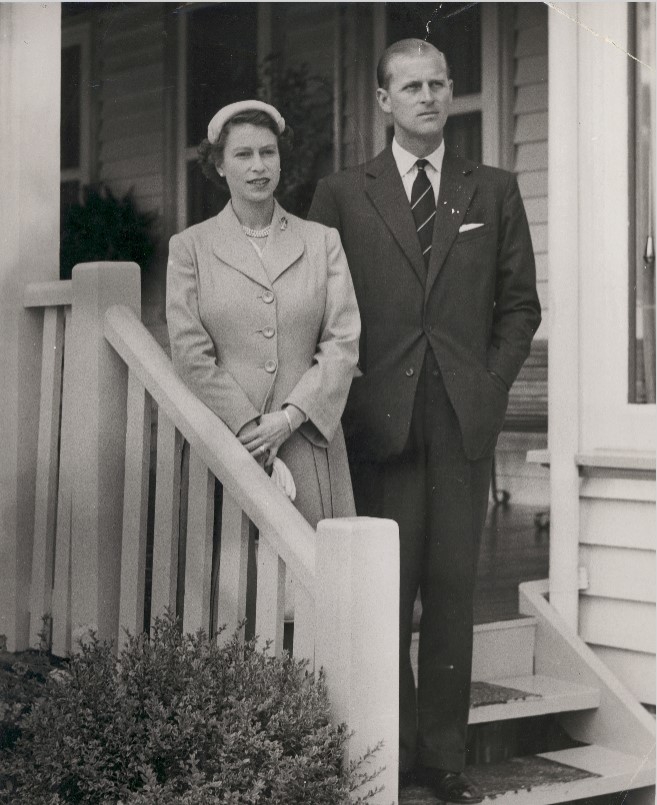
On 26 February 1954, Hamilton was buzzing with excitement for a much-anticipated visit by Queen Elizabeth II and Prince Phillip, Duke of Edinburgh.

Mt Gambier and Hamilton were the only locations in the region chosen for a visit by the new Queen, despite much lobbying by nearby towns. The inter-town rivalry preceding the visit was immense. Headlines in the Portland Guardian at the time included “Number One Priority for Royal Visit Should Have Been Portland’s” and “No Royal Visit an Insult to Portland”

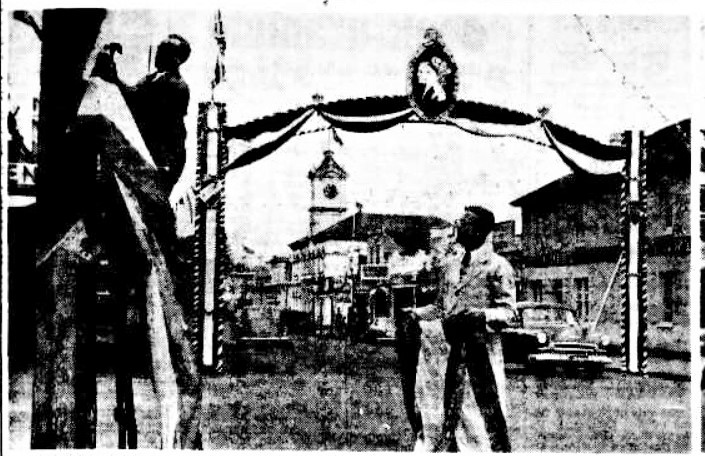
Hamilton wanted to put on a show, and preparations started long before the big day. Residents decorated their homes, some with flags on the roofs for the Queen to see as she flew into the Hamilton Aerodrome.  The council spent £5,000 on decorations, including four large arches around the town, with one on the outskirts made of locally grown hay, oats, and flax, with “Welcome” crafted from wool, for which the district was famous. Several kilometres of bunting, flags, and lights decorated the CBD.

HAMILTON READY TO GREET QUEEN (1954, February 26). The Argus,p. 15. http://nla.gov.au/nla.news-article26593166

More than 100,000 people were expected to converge on the town. Local hotels set up beds in the lounges and on balconies to accommodate the overflow of guests and accommodation houses up to 60 kilometres away reached capacity.

The Royal Visit coincided with “Back to Hamilton” celebrations, and the organising committee published a souvenir booklet.

PHOTO OF AUTHOR’S COPY.

On the big day, The Argus published a map of the best places to glimpse the Queen and Duke.

Where to see the Queen Today FIRST COUNTRY VISIT. (1954, February 26). The Argus p. 7. http://nla.gov.au/nla.news-article26593160

At Melville Oval, around 13,000 school children started assembling from 8.00am.

Along with the school children were several thousand others, many travelling long distances.

HAMILTON’S FAMILY WELCOME. (1954, February 27). The Argus, p. 15. http://nla.gov.au/nla.news-article26593294

With the Queen’s plane scheduled to arrive at the Hamilton Aerodrome, to the north of the city, at 3.35pm, the Dundas Shire President, Cr. Henry Bull, his wife, and around 3000 eager locals gathered to meet Queen Elizabeth and the Duke. Young Rosemary Oates prepared to present Her Majesty with a bouquet.

Back to Hamilton visitors saw Queen and Duke (1954, March 10). Weekly Times p. 78. http://nla.gov.au/nla.news-article224910934

The plane was five minutes late, and a gasp went up from the large crowd when part of the carpet laid on the tarmac almost blew away from the force of the plane’s propellers.

MARGARET OATEN PRESENTS QUEEN ELIZABETH WITH A BOUQUET (1954, February 27). The Argus, p. 7. http://nla.gov.au/nla.news-article26593444

The Royal party then moved by car to Melville Oval, where the schoolchildren were still patiently waiting after eight hours.

Hamilton rocked in Royal salute. (1954, February 27). The Argus p. 7. http://nla.gov.au/nla.news-article26593444

The sight of the decorated city, and an estimated 70,000 adults and children waving, saw the Queen wipe her eyes several times before the motorcade came to a halt at Melville Oval.

Hamilton welcome Queen had tears in her eyes (1954, February 27). The Argus p. 4.  http://nla.gov.au/nla.news-article26593398

After being met by Mayor Cr. Reginald White and Town Clerk Hector Donald and their wives, the royal couple drove around Melville Oval before returning to the airport for a flight to Melbourne.

The Age (Melbourne, Vic. : 1854 – 1954) 27 February 1954, p. 3. http://nla.gov.au/nla.news-article206088677

But not before eight-year-old Jennifer Biggs from Hamilton State School had the honour of presenting the Queen with a bouquet.  Jennifer is pictured below, practising her courtesy before the event while her classmates watch on.

Rag doll aids girl’s curtsy (1954, February 26). The Argus , p. 15.  http://nla.gov.au/nla.news-article26593193

“Hamilton’s Children Cheer the Queen” The Age 27 February 1954: p. 8. http://nla.gov.au/nla.news-article206088514 

Hamilton rocked in Royal salute (1954, February 27). The Argus, p. 7. http://nla.gov.au/nla.news-article26593444

On the return trip to the aerodrome, the Royal party drove past the Hamilton Hospital, where members of the nursing staff excitedly waved to the passing motorcade.

(1954, February 27). The Argus p. 7. http://nla.gov.au/nla.news-article26593444

Back at the aerodrome, around 3,000 people waited to farewell the Royal visitors.  The Argus of 27 February 1954, described how the large crowd “surged forward in a wild rush” jostling “elderly men and women and young children.”

It was a memorable day for Hamilton, one not since matched, and almost 70 years later, it remains in the memories of those who were there to experience it.

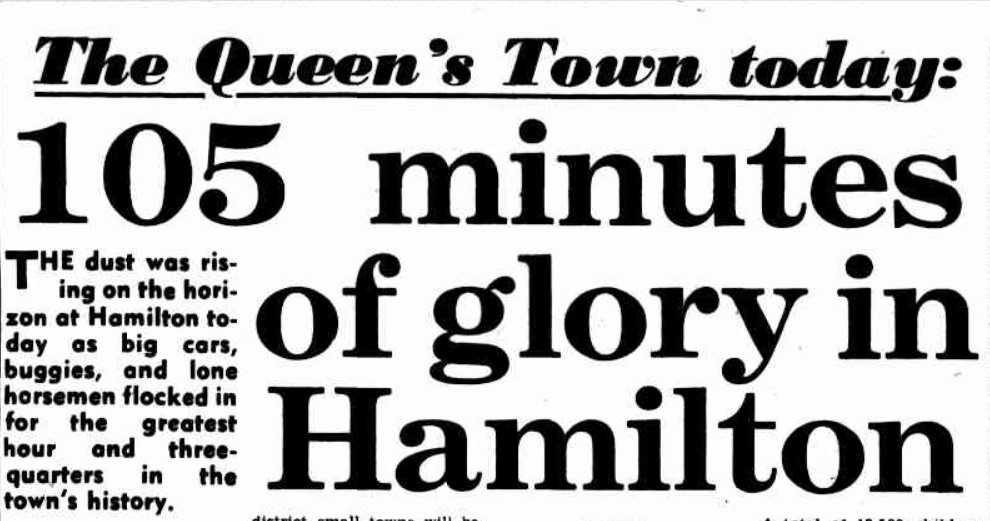
The Queen’s Town today: 105 minutes of glory in Hamilton (1954, February 26). The Argus, p. 2. http://nla.gov.au/nla.news-article26593119

QUEEN ELIZABETH II & PRINCE PHILLIP, DUKE OF EDINBURGH DURING THEIR 1954 TOUR OF VICTORIA. Image courtesy of the State Library of Victoria http://handle.slv.vic.gov.au/10381/245876

Passing of the Pioneers

The Portland Guardian obituaries from August recognized several residents with very early links to the Portland district. It is well worth reading their obituaries in full.

Robert HEAZLEWOOD:  Died 3 August 1892 at Portland.  Robert was one of Portland’s oldest residents at the time of his death.  He had been in Portland for around 40 years arriving from Tasmania where he had resided since age 16.  Robert ran a farrier business and was considered the best of his trade in the town.

Thomas KEAN:  Died 8 August 1892 at Portland. Thomas arrived in Melbourne in 1843 and went to Portland in 1845 to take charge of the Customs boat.  He did leave for a time when he caught “yellow fever” and joined the hunt for gold.  Unsuccessful, he returned to Portland to resume his position on the Customs boat. and was also a Councillor on a few occasions.

Frederick SAUNDERS:  Died 11 August 1914 at Narrawong.  At eighty-eight years old, Frederick Saunders had been in Australia for eighty-three years.

Francis ROBERTS:  Died 5 August 1920 at Orford. Francis was born in Tasmania and came to Victoria as a nine-year-old.  He spent time at the Firey Creek diggings and selected land at Broadwater where he farmed for the most part of his life.

Eliza Ann MALSEEDDied 13 August 1920 at Myamyn.  Eliza Malseed epitomized the pioneering women of the south-west.  She arrived in Portland from Ireland with her brothers, later marrying a cousin, James Malseed.  She and her husband, along with a small group of pioneering families, forged a life on unsettled land around Cape Bridgewater.  She was remembered as widely read and extremely charitable.  She was eighty-five when she died.

John Read HEDDITCH  Died 12 August 1927 at Cape Bridgewater.  The Portland Guardian reported that John was a descendant of the Hedditch family who arrived in Adelaide in 1837 aboard The Eden.  Also, John was apparently the first white child to be born at the Henty brothers’ Bridgewater run.  He was born in 1847.

William Henry MILLS:  Died August 1931 at Trafalgar.  William’s obituary is an interesting one, not only for its insight into early Australian history, but it demonstrates the need to check the “facts” presented.  William was born in Port Fairy in 1848 and remained there before moving to Gippsland in the late 1870s.  His father was credited as being one of the early discoverers of the south-west of Victoria, arriving in 1825, two years before the Hentys.  The obituary reports that William’s grandfather was the secretary to “Captain Blyth (sic) the then Governor of Victoria”.  Of course, the obituary writer was talking of Captain William Bligh, whose official title was Governor of New South Wales.  Captain Bligh did have a nineteen-year-old secretary by the name of  Peter Mills.

Arthur Harold SUTTON: Died August 1935 at Portland.  This is a most glowing obituary and includes a description of the funeral service.  Arthur was only fifty-three at the time of his death, which shocked Portland.  His parents were Strathdownie pioneers, where Harold was born.  He served in WW1, ran a successful wool export business, and served on the Portland Council.  Over 500 mourners were at his funeral, with over 100 cars (remember this is 1935) following the cortege.  This is an extensive obit which includes details of his children.

Michael James MINOGUE:  Died August 1935.  Michael was the youngest son of Mr and Mrs Simon Minogue, early pioneers of Portland.  A natural horseman, he at one time trained thoroughbreds.

Frederick William BILSTON:  Died August 1935 at Sandford. Frederick was the son of Thomas and Annie Bilston who arrived in Victoria in 1836. Another son, George Yarra Bilston was reportedly the first white child born in Melbourne.  A sister born in 1840, was claimed as the first white child born on the Glenelg River.  Frederick was born in Heywood in 1849 while his parents were running the Heywood hotel.  He trained horses in his early life with the likes of Adam Lindsay Gordon.  He then became a bootmaker and then a carrier.  An expert blade shearer, Frederick would ride to N.S.W to work sheds.  His obituary includes stories of the 1851 bushfires, bushranger Frank Gardiner and high-jumping.

Passing of the Pioneers

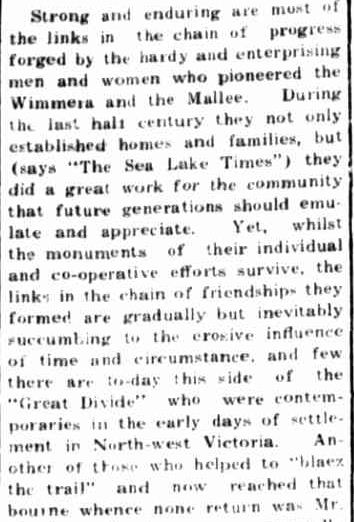
The Portland Guardian was mindful of the contribution made by the early pioneers toward developing the south-west.  They offered regular items titled “Passing of the Pioneers” or “Passing Pioneers” and often mentioned in obituaries that “…one by one are old pioneers are passing”.  As early as 1889, they were lamenting the loss of the links to the early settlers and suggesting that the efforts of those who passed be recognised.

The Portland Guardian,. (1889, January 16). Portland Guardian (Vic. : 1876-1953), p. 2 Edition: EVENING. Retrieved July 18, 2011, from http://nla.gov.au/nla.news-article63591640

Established August 1842. The Portland Guardian,. (1899, July 7). Portland Guardian (Vic. : 1876-1953), p. 2 Edition: EVENING. Retrieved July 19, 2011, from http://nla.gov.au/nla.news-article63676630 MLA citation

In 1921, the paper spoke of the many unwritten histories that had gone before, but now we can see the Portland Guardian lived up to its charter of 1889,  successfully recording the histories of many of the local pioneers.  By doing so, they are now helping us learn more about our families and gain a sense of life in the early days of the Western District.  Of course, The Guardian was not alone.  References to the “passing pioneers” are found in most of the papers on the Trove website.

Obituaries are a secondary source as the information comes from the knowledge of those still living and I have noticed errors in obituaries of my family.  But they can offer leads to records you may never have thought of such as Masonic lodge records and local council records. Whatever you do or don’t get out of an obituary, no-one can deny they are often a good read.

July was a month when many “Passing of the Pioneers” columns appeared.  Cold winters in the southwest saw many of the older residents “cross the Great Divide” as the Guardian would put it.

Some of the more notable passing pioneers in the month of July were:

James PARKER:  Died 6 July1889 at Heywood. James PARKER’S obituary is an interesting read.  Born in Tasmania around 1810, he came to the mainland as a whaler. In 1842, he married Margaret NOLAN at Portland. Later he had some luck at the Creswick goldfields only to have an encounter with bushranger Captain Moonlight.

William TULLOH: Died 19 July 1889 at Portland.  This is a lengthy obituary of a Portland resident of nearly fifty years, whose death saw half-closed shutters on homes around the town.  Born in Scotland in 1812, he left a wife, four sons, and a daughter at the time of his passing.  I have found a site with more detail of William and his wife Eliza Mary KEARTON.

James BARNETT: Died 18 July 1892 at Portland.  James was known as “Old Barney” around Portland and while the Portland Guardian credits him as a pioneer, they make a judgement in saying that he did not make the most of his opportunities as other early settlers had done.  He married in 1851 to Elizabeth AUSTIN. Five children were living at the time of James’ death.

Alexander THOMSON: Died July 1897 at Hamilton. Scottish born Alex THOMSON was prominent around the Hamilton area as a Shire of Dundas Councillor for twenty-one years.  At the time of his death, he was the owner of Pierrepoint Estate near Hamilton and was also an active member of the Pastoral and Agricultural society.

Thomas Webb SMITH:  Died 29 July 1914 at Branxholme.  Thomas served on the Borough of Portland council and was mayor from November 1871-November 1873.  He was also a member of the Goodfellows and Freemasons.

Annie Maria HENTY: Died 2 July 1921 at Hamilton.  Annie was from the most famous southwest pioneering family of them all, the Henty’s. The daughter of Stephen HENTY, Annie married Hamilton stock and station agent Robert STAPYLTON BREE in 1874.  The Bree name is preserved in Hamilton with a much-used road of the same name in the town.  Their home Bewsall (below) once stood near the end of Bree Road in North Boundry Road.

HAMILTON. (1903, May 2). The Australasian (Melbourne, Vic. : 1864 - 1946), p. 27. Retrieved February 18, 2014, from http://nla.gov.au/nla.news-article138684187

HAMILTON. (1903, May 2). The Australasian (Melbourne, Vic. : 1864 – 1946), p. 27. Retrieved February 18, 2014, from http://nla.gov.au/nla.news-article138684187

Stapylton-Bree (2)

Ann Eliza KEEPING: Died 9 July 1921 at Portland.  Annie Eliza KEEPING arrived in Australia aboard the Eliza and married John FINNIGAN in 1857.  She was eighty-two at the time of her death.

Joseph Bell PEARSON:  Died 7 July 1922 at Portland. Yet another interesting character.  According to his obituary, Joseph was born on the voyage from England to Tasmania.  His family moved to the Retreat Estate near Casterton in 1844.  He was a noted horseman, with several good racehorses which he would ride himself.  One of his jumps racing rivals was Adam Lindsay Gordon.

Joseph was buried at the Hamilton (Old) Cemetery with his wife Mary Abbott and mother-in-law Martha Holdish (below).

Abbott

Sarah MARSHALL:  Died 7 July 1923 at Gorae West. Sarah was the wife of the late Richard BEAUGHLEHOLE and she died at seventy-three. Richard selected land at Gorae West and transformed swampland into flourishing orchards.  Sarah and Richard had twelve children.

Mary Thurza HEDDITCH: Died 1 July 1930 at Drik Drik. Mary HEDDITCH was born in Portland in 1844 and moved with her family to Bridgewater in 1846.  Her elder brother drowned when she was a teenager leaving her to take on some of his duties.  As a result, she became an accomplished horsewoman, helping her father with the cattle.  She married James MALSEED and together they had seven children.

Phillipa JOHNS: July 1931 at Portland.  Phillipa JOHNS, the daughter of a doctor, was herself something of a substitute doctor for those living in the Willenbrina area, near Warracknabeal.  Later she and her husband William DELLAR moved to the Portland district.  They had nine children.