There are ten obituaries for the September edition of Passing of the Pioneers. They include a woman from Apollo Bay and a man who was born in Canada. Hotels get a mention again and there is the story of a Branxholme recluse. Each subject now goes on to the WDF Obituary Index. Don’t forget to click on the links (underlined text) for more information on a subject.
MEREDITH, Robert – Died 14 September 1897 at Yeo. Robert Meredith was born in County Sligo, Ireland around 1827. He married Susannah McNamara, and the couple left for Australia in 1858. A son was born on the voyage. The couple settled at Queenscliff then, after around ten years, they moved to Yeo, near Colac, where Robert farmed. During the 1880s, he carried mail from Colac to Yeo. Robert and Susannah raised five sons and three daughters. Robert died in 1897 and Susannah remained at their property Lightwood Park and died there in June 1913.
SMITH, Maria – Died 18 September 1897 at Hamilton. Maria Smith was born in 1843 at Great Swanport, Tasmania, a daughter of blacksmith Robert Smith and Emma Farrell.1 In 1851, Maria came to Victoria aboard the Shamrock with her mother.2 On 24 November 1864 at Geelong, Maria married George Rippon, a writer for the Geelong Advertiser, and a son, John James Rippon, was born the following year. George and Maria lived in Moorabool Street with further children born at their home, sons George in 1867 and Herbert in 1869, followed by daughters Martha in 1870, Emma in 1872, and Alice in 1874.
In July 1876, George entered a partnership in the newspaper the Hamilton Spectator, in the state’s west and the family moved. George was very active in the Hamilton community and their home, Altham Lodge on the corner of Dryden and Collins Streets, saw many guests, including visitors from out of town. Maria was renowned for her hospitality. Maria and George shared a loved of the sport coursing with George, the president of the Hamilton Coursing Club.
Maria was a charitable woman as expressed by Canon Tucker of the Hamilton Anglican Christ Church after her death, “By a thousand quiet acts of Christian charity she had made herself beloved by the sick and needy about her”. She was just fifty-four when she died in 1897. George died two years later. They are buried with their family at the Hamilton (Old) Cemetery, below.

KENDALL, Elizabeth – Died 8 September 1903 at Apollo Bay. Elizabeth Kendall was born around 1835. She came to Australia with her husband John Cawood and a child was born in Geelong in 1861. Soon after, they were at Apollo Bay and among the first white settlers in the area.
Apollo Bay became a logging district and there was an influx of mill workers. Elizabeth saw a need for a restaurant and started offering meals from their home and then accommodation. The Cawood’s Milford House built in 1870, soon became well known to travellers to the district.
On 4 September 1880, the American ship Eric the Red hit the Otway Reef while travelling to Melbourne. Four people drowned in the wreck, including one crewman. The ship was laden with American treasures for the International Exhibition at Melbourne’s Royal Exhibition Building. Soon after the wreck, those items washed up on beaches along the coast. Furniture and fittings from Eric the Red went into the bedrooms of Milford House and the Cawoods built an extension to the home using timbers from the ship.

A visitor to Milford House in 1888 wrote of Elizabeth telling him she was looking at increasing the accommodation at the house. During the visit, John Cawford was pruning his extensive orchard and Elizabeth served fruit and cream. In 1898, fire swept through Apollo Bay and destroyed the orchard, at the time considered one of the best in the colony. John was not there to witness it, having died two years before. But Elizabeth saw the flames come close to her home.
At Elizabeth’s funeral on 10 September 1903, her charitable acts for the needy of the town were remembered. She was considered the “preeminent woman of the town”. Interestingly, she was the first woman in ten years to be interred at the Apollo Bay cemetery. Elizabeth left seven sons and two daughters at the time of her death.
At a memorial service for Elizabeth at Apollo Bay on 13 September, the word “motherly” was what best described Elizabeth…”the mother of Apollo Bay”. Reverend Lowe also described her as one of the “Marthas, always serving and helping”.
Milford House was auctioned in November 1903. In later years, it was destroyed during bushfires.

HOWARTH, William – Died September 1904 at Branxholme. William Howarth was born in Lancashire around 1814 and worked in law offices as a young man. He arrived in NSW and worked in the legal field before travelling to Victoria during the gold rushes of the early 1850s. While in Melbourne, he met a man who had imported stone pavers, but since all interest was in gold, and not construction, William had the chance to purchase the pavers for a cheap price. As people moved away from the diggings, the pavers were in demand, and William turned his outlay to a profit of several hundred pounds.
In the late 1850s, William settled at Branxholme and opened a general store. During his time in Branxholme, William divulged nothing of his life and the locals were unaware if he even had living relatives. It was rumoured he lost money during a land boom. He was a Justice of the Peace and, with his early legal experience, could act as a magistrate if required. In 1859, he was instrumental in Branxholme becoming a gazetted polling place.
William built a cottage in Monroe Street, Branxholme, but within a few years, he built a bluestone house in front of it, thought to be designed by architect Charles Fox. Built with stone carted from Mt Sturgeon near Dunkeld, for a considerable fee, it was considered palatial for the town.
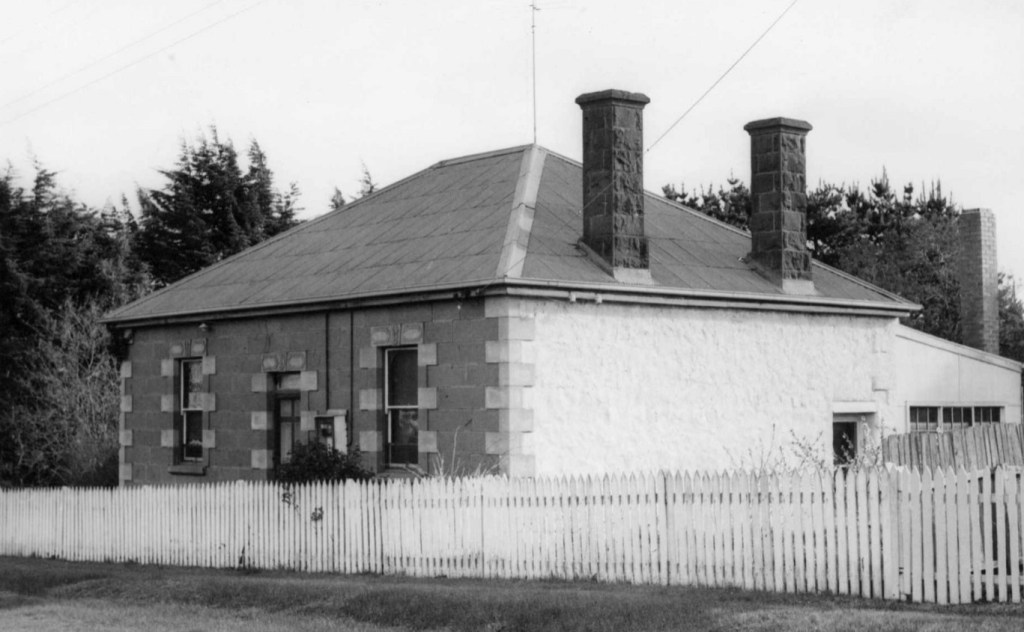
Once the house was built, William left his business and lived “in seclusion” with all the rooms unfurnished except for the one William used as a bedroom. When he died, the interior was just as it was when built. William’s obituary said it was quite a costly home in the end. More information about the cottage-Victorian Heritage Database – https://vhd.heritagecouncil.vic.gov.au/places/23284
CLUNAN, Sarah – Died September 1906 at Dunkeld. How different life for Sarah Clunan may have been if her journey from Ireland to Australia at nineteen had taken her to Sydney as planned. Her entry on the passenger list of the Sir Edward Parry in 1848 shows Sarah, along with several other passengers were “originally for Sydney, remains at Port Phillip”.1 In 1850, Sarah married George Mahony. The obituary of Sarah’s son, Patrick Mahony in 1912, mentions Sarah and George settled at Mount Moriac near Geelong. They then went to Dunkeld around 1865, where they remained until their deaths.
Sarah left three sons, five daughters, and twenty grandchildren at the time of her death.
- Public Records Office of Victoria, Register of Assisted Immigrants from the United Kingdom, VPRS 14/P0000, Book No. 2/3, Sir Edward Parry, 1848, Sarah Clonen
POOK, Mary – Died 24 September 1906 at Dunkeld. Mary Pook was born around 1830 in Brixton, England. She married Edwin Collins at Brixton in 1852. The obituary of Mary’s daughter, Jane Collins, says Mary and Jane arrived at Portland around 1858 aboard the Great Britain. They were to meet her husband Edwin, who had travelled ahead and was at Hamilton. It must be noted the Great Britain arrived in Victoria to Hobsons Bay with immigrants in 1857 and 1859 but not Portland. I also haven’t found Mary or Jane on the passenger lists.
Once the family reunited, they settled in Hamilton where Edwin was a butcher, but they moved to Dunkeld by 1861. Edwin continued butchering, but in 1866, he took over the Royal Mail Hotel. He then ran Dunkeld’s Family Inn (below).

In 1877, the railway arrived in Dunkeld. Edwin built a hotel on the corner of Sterling and Skene Streets, opposite the station, and named it appropriately, the Railway Hotel. Edwin Collins died at the end of 1881 and Mary took over the ownership of the Railway Hotel and her son Adolphus held the license. In March 1894, Mary’s daughter Jane took over the license of the Railway Hotel.
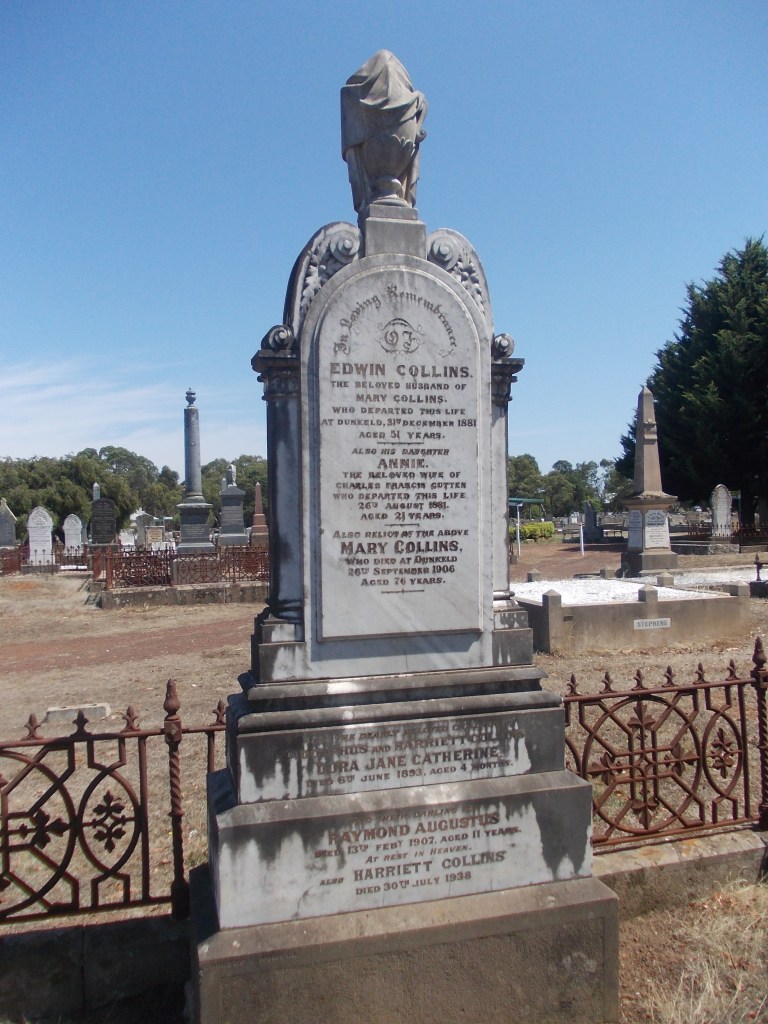
Mary still owned the Railway Hotel at the time of her death. Her probate file held by PROV has an interesting inventory with all the items in the Railway Hotel listed, from pillows to brushes and combs provided for guests’ use in each room. Mary also owned ten parcels of land in the Dunkeld township and one on the outskirts of town. The Railway Hotel was sold in 1907.

McPHEE, Alexander – Died 27 September 1916 at Hamilton. Alexander McPhee was born on the island of Mull off the coast of Scotland around 1833. He arrived in Victoria about 1852 aboard the Marmion which arrived at Portland. With him were his parents, Donald and Mary, and his siblings. They left Portland for Muntham station near Merino, where the family was engaged to work.
Alexander married Sarah Prider in South Australia, and in 1855 they settled at North Hamilton near the Coleraine Road. Alexander was a member of the Independent Order of Rechabites from around 1873.
When WW1 broke, Alexander’s grandson Norman McPhee of Hamilton enlisted in December 1914. In January 1916, Alexander’s son Jack, who had earlier moved to New Zealand, enlisted with the New Zealand Forces. Alexander died in September 1916, saving him from the grief of the loss of firstly Jack, killed in Belgium in June 1917, and three months later Norman, who died from wounds, also in Belgium.
Alexander was buried at the Hamilton Old Cemetery, less than 350 metres from his home. In later years, after the subdivision of the land he once owned, a new street was called McPhee Street. He was buried with his wife Sarah and his parents, Donald and Mary. This is the family plot in 2015.

When I photographed the plot in 2021, I noticed the headstone of Donald and Mary had fallen.

WILSON, Frank – Died 7 September 1917 at Hamilton. Frank Wilson was born in Ontario, Canada, around 1860. He started work in the printing industry, giving him an opportunity to travel to Australia for the Melbourne International Exhibition in 1881 to oversee a printing machinery exhibit. He stayed in Australia and got a job in the printing department of the Daily Telegraph and later the Evening Standard, which was then taken over by The Herald.
Frank then found his way to St Arnaud and was involved with the Lord Nelson mine in the town, working on the machinery. He married Ellen Morrison in St Arnaud in 1901 and they had two daughters and two sons. Frank also worked on mining machinery at Omeo and Stawell. They had arrived in Hamilton by 1909 where Frank ran the Cossar printing machine and suction gas plant at the Hamilton Spectator.

In 1913, Frank faced insolvency. He cited old debts, increased cost of living, and high rent as the cause of his money troubles. Frank was an excellent banjo player and gave tuition to several students in Hamilton. He also played at local concerts.
WHELAN, John – Died 15 September 1918 at Dixie. John Whelan was born around 1840 in Limerick, Ireland. He arrived in Victoria in 1868 on the Southern Ocean. He went to Port Fairy, and that’s where he married his wife, Mary O’Grady. They spent time in the Tower Hill district, and the Garvoc district, before living at Keayang near Terang for around twenty-two years. Mary died around 1913, and John died five years later. He left two sons and three daughters at the time of his death in 1918.
PERRY, Frederick – Died September 1942 at Casterton. In the 1850s, Frederick Perry’s father, John, was the manager of the Upper Crawford station near Condah. That’s where Frederick was born in 1854. In the early 1860s, the family moved to Lexington station near Moyston. It was while at Lexington that Frederick’s older brother William was found dead in a waterhole on 25 October 1860 after going missing while running errands for his father. Foul play was called, but an inquest found William accidentally drowned. Despite that finding, 82 years on, Frederick’s obituary stated Wiliam was murdered. It was said it was the reason for the family leaving the district.
The Perrys headed for the Digby district and Frederick attended the Digby school before getting work at Rifle Downs station. It was there Frederick married Helen Gull in 1876. Eventually, Frederick was a manager material himself and he took over the management of Runnymede near Sandford.
A change of pace came in 1913 when Frederick took over the Digby Hotel where he remained for sixteen years. He retired to Casterton, where he died in 1942.


 Western District Families
You must be logged in to post a comment.